

Boost SEL: 1st Grade Journal Prompts for Emotional Growth
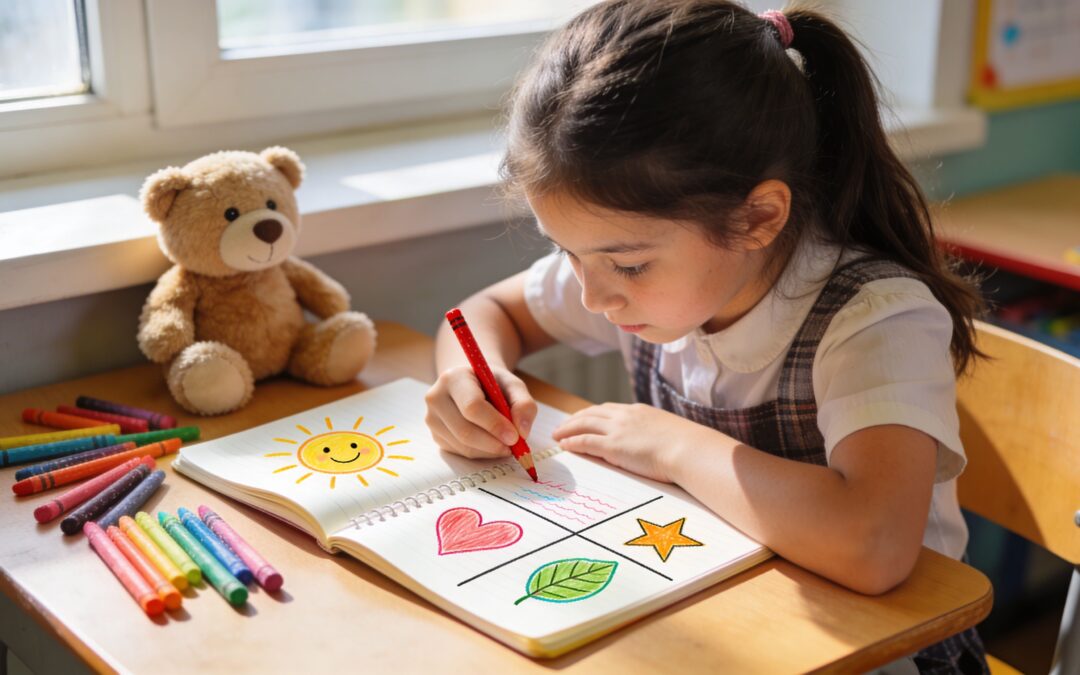
It is 3:15 p.m. A first grader drops a backpack by the door, frowns, and says, “I don’t know” to every question about the day. Ten minutes later, the same child draws a huge storm cloud, a tiny playground, and one sentence: “I was sad when no won piked me.” That page tells you far more than a forced conversation ever could.
That is the quiet power of a journal in first grade. It gives children a place to put big feelings into small, manageable pieces. A drawing becomes a clue. A sentence starter becomes a bridge. Over time, the notebook works like a container that helps a child notice an emotion, connect it to an event, and begin to make sense of it.
For teachers and parents, that matters because young children tend to feel first and explain later. A journal can support both literacy and self-awareness without adding a complicated new routine. The strongest 1st grade journal prompts do more than fill a writing block. They help adults teach emotional vocabulary, reflection, empathy, and problem-solving in ways six- and seven-year-olds will find useful.
This article approaches journaling as an SEL practice, not just a list of writing ideas. Each prompt is paired with the reason it helps, ways to introduce it, sample student responses, and scaffolds for children who need more support. If a child freezes at a blank page, draws instead of writing, or can only manage a few words, that still counts as real journal work.
Journaling also integrates well into early writing instruction. First graders are learning how to tell a story, share an opinion, explain an idea, and add details that make their thinking clear. A journal gives them daily practice with all four. It also gives adults a window into patterns that are easy to miss during a busy day, especially when children need help naming feelings. A simple feelings chart for kids can make that work easier by giving children concrete words to choose from.
A practical routine stays simple and repeatable:
- Use one predictable time: morning arrival, after lunch, or bedtime all work well.
- Let drawing come first: many first graders can show an idea before they can spell it.
- Offer a stem: “I felt ___ when ___” gives structure without doing the thinking for the child.
- Model aloud: write your own short example or say the sentence before asking the child to begin.
- Accept different entry points: one child may dictate, one may label a picture, and one may write three sentences.
Sample journal entry model
Prompt: “Write about a time you were helpful.”
Drawing: A child handing a crayon to a friend.
Writing: “I was hlpfl wen I gav Leo a red kran.”
That entry is successful because the child communicated an experience, a feeling, and a social action.
Used regularly, prompts like these can strengthen writing fluency and give children a dependable place to reflect. They can also support bigger coping skills over time.
1. My Feelings Today
Some prompts belong at the center of your routine. “My Feelings Today” is one of them.
When a child can name a feeling, the child has a better chance of handling it. In first grade, that naming typically starts with simple words like happy, sad, mad, worried, excited, lonely, proud, or calm. The journal gives those words a home.

A strong version of this prompt is short and concrete:
“My feeling today is ___. I feel this way because ___.”
If writing both parts feels too hard, let the child draw a face first, then add one word, then explain out loud.
How to set it up
In a classroom, place a feelings chart where children can easily see it. At home, keep a small page with feeling words tucked into the journal. Some adults also color-code emotions. Blue for sad, yellow for happy, red for angry, green for calm. The color is not the lesson. It is a support.
You can also use this feelings chart for kids as a reference tool when children get stuck between “fine” and the feeling they want to name.
Try one of these routines:
- Morning check-in: Students draw a quick face and complete one sentence before the day begins.
- After-school reset: Children write about one feeling from school before moving into home routines.
- Whole-group empathy circle: Invite children to share just one word, not the whole entry, if privacy matters.
Why this prompt works so well
SEL starts with self-awareness. A child who writes, “I feel mad because my tower fell,” is already doing important work. That child is connecting an inner state to an event. Over time, those repeated connections support self-regulation.
A sample student entry might look like this:
“Today I feel nervus. I feel this way because we have music and I do not like loud sounds.”
That entry tells an adult much more than behavior alone ever could.
Practical teacher move
If you notice the same child writing “worried” or “mad” across several days, use that pattern for a gentle one-on-one check-in, not for public discussion.
This prompt also helps adults avoid guessing. Instead of asking, “Why are you upset?” you can ask, “Do you want to draw it first?” That small shift opens the door.
2. A Time I Was Kind
Children need help noticing kindness in real life. They tend to think kindness only counts if it is big, public, or praised by an adult. This prompt teaches them to see the smaller moments that build a caring classroom or home.
“A Time I Was Kind” works best after children have heard and acted out a few examples. Shared a marker. Waited for a turn. Invited someone to play. Helped a sibling zip a coat. Sat next to a classmate who looked left out.
The writing can start with one sentence:
“I was kind when I ___.”
Then ask a follow-up:
“How did the other person feel?”
That second question gently stretches empathy.
Classroom and family examples
In school, try collecting kindness stories over a week and returning to them on Friday. Children begin to realize kindness is not rare. It happens all around them.
At home, parents can use the same prompt after dinner:
“Did you do one kind thing today?”
If the child says no, offer options:
“Did you share, help, listen, or include someone?”
Here are a few real-world scenarios that work well:
- Recess example: “I let Maya play tag with us.”
- Home example: “I got my little brother a tissue.”
- Learning example: “I showed Ben where the number line was.”
Scaffolds that make children more successful
Some children confuse kindness with obedience. Others only recall what adults praised. Narrow the lens by using role-play first. Act out two quick scenes, one kind and one unkind, then journal about the kind one.
Helpful supports include:
- Sentence starter: “I was kind when I…”
- Feeling extension: “That made my friend feel…”
- Drawing cue: “Show what your hands or face were doing.”
A sample entry might read:
“I was kind when I let Ana use my pink crayon. She felt hapy.”
That is enough. It is specific, social, and meaningful.
You can extend the prompt into community-building by creating a “Kindness Wall” with copied drawings or rewritten class dictations. Keep the original journals private if needed. The point is not display for display’s sake. The point is helping children see that kindness is something they do, not just something adults talk about.
3. What I’m Grateful For
A first grader has a hard morning. The shoe feels wrong. The bus was loud. A classmate sat in the usual seat. By the time journal time begins, the problem can feel as big as the whole day.
That is why gratitude prompts help so much. They give children a small, steady place to stand. Like turning on a flashlight in a messy room, gratitude helps a child notice what is still good, safe, and caring, even when the day feels wobbly.

For first graders, gratitude should stay concrete. Family members, pets, favorite foods, a cozy bed, a teacher, the playground, a grandparent who tells stories. Children this age write best about what they can see, touch, remember, or feel in their bodies.
A simple prompt works well:
“I am grateful for ___ because ___.”
The SEL goal is bigger than polite language. This prompt teaches attention, perspective, and emotional balance. Children practice noticing support instead of only noticing frustration. That skill matters on ordinary days and on hard ones.
How to help children answer with detail
Some children freeze when they hear the word grateful. They know the word, but they do not always know where to start. Narrowing the choice helps.
Try one category at a time:
- A person: “Who helped you today?”
- A place: “Where do you feel calm or safe?”
- A body ability: “What can your body do that helps you?”
- A small moment: “What made today a little better?”
This structure gives adults a full SEL routine, not just a writing line. First, name one category. Next, let the child talk before writing. Then invite a drawing, a sentence, or dictation. If the child gets stuck, offer two choices instead of an open-ended question.
A breathing pause can also help. One slow breath before writing and one after. That small routine tells children, “We are settling our minds now.”
Why gratitude supports resilience
Gratitude does not ask children to ignore sadness, anger, or disappointment. It teaches them to hold two true things at once. “I had a hard recess” and “I am thankful my teacher helped me” can live in the same sentence.
That is emotional maturity in first-grade form.
If you want to connect gratitude writing with broader confidence-building activities for kids, pair this prompt with moments when children remember who supports them and what helps them keep going. Gratitude and confidence often grow side by side.
Scaffolds that make this prompt easier
Children tend to give very broad answers such as “my family” or “school.” Those are fine starting points, but specific details build stronger reflection. You can coach gently by asking, “Which person in your family?” or “What part of school?”
Helpful supports include:
- Sentence starter: “I am grateful for ___ because ___.”
- Oral rehearsal: “Tell me first. Then we will write one part.”
- Drawing cue: “Draw the person, place, or moment before adding words.”
- Extension question: “How did that help you feel?”
A sample student entry might read:
“I am grateful for my sister because she reads with me.”
Another child might write:
“I am grateful for my blanket because it helps me sleep.”
Both are developmentally strong. Each one shows connection, comfort, and cause.
Gratitude writing works especially well during transitions such as Monday mornings, bedtime, the day before a break, or after a stressful moment. Over time, children begin to see that reflection is not just a school task. It is a way to steady their hearts.
4. When I Felt Brave
Bravery in first grade can appear ordinary to adults and enormous to children.
It can be raising a hand, reading aloud, trying a new lunch, sleeping without a night-light, asking to join a game, or telling the truth after making a mistake. This prompt helps children see courage as something they already practice.

A good first-grade version sounds like this:
“I felt brave when I ___.”
Then add:
“It was hard because ___.”
And if the child is ready:
“I did it anyway.”
Helping children define brave
Many children think brave means fearless. That definition blocks reflection because most brave moments come with fear.
Before journaling, I like to say:
“Brave means doing something important even when it feels hard, scary, or new.”
Then I give examples children recognize:
- Speaking up: asking for help
- Trying: doing a hard math problem
- Social courage: telling someone to stop
- Body courage: going to the doctor or dentist
A sample student entry:
“I felt brave when I read in front of the class. It was hard because I was shy.”
That sentence helps a child build identity around effort, not perfection.
Use brave entries as future reminders
This prompt becomes even more useful when adults return to it later. If a child is nervous about a class presentation, you can say, “Remember when you wrote about being brave at swim lessons? What helped then?”
That is how journaling grows into a practical coping tool.
If you want additional ways to support confidence alongside journaling, these confidence-building activities for kids fit naturally with this prompt.
One more reason to keep this prompt in regular rotation. A 2024 NCES report indicates U.S. public schools are increasingly diverse, with a significant portion of students being non-white. An analysis summarized by Waterford.org found that only 2% of prompts across major sites referenced global cultures, which means many children may not see their own experiences reflected in common prompt lists, according to Waterford.org’s discussion of journal prompts for kids. “When I Felt Brave” can help address that gap if adults invite children to define bravery through their own lived experiences, family traditions, languages, and communities.
Useful reframe
When a child says, “It wasn’t brave. It was little,” answer with, “Little brave things count. Those are the ones we practice most.”
5. My Favorite Person and Why
This prompt invites children to write from love, admiration, and connection. It also gives adults a window into who helps a child feel safe, seen, and cared for.
Keep the wording open:
“My favorite person is ___ because ___.”
Do not limit the answer to family. For some children it will be a parent or grandparent. For others it may be a sibling, neighbor, teacher, friend, coach, or cousin. That openness matters.
Keep the language inclusive
Children live in many kinds of families and communities. Some live with one parent, two parents, grandparents, foster caregivers, or extended family. Some may choose a person they miss. Some may choose a person at school because school feels steady.
You can support the writing by offering trait words:
kind, funny, helpful, patient, brave, calm, gentle, playful
Instead of asking only “why,” also try:
“How does this person make you feel?”
That leads to richer responses.
A sample entry:
“My favorite person is my aunt because she is funny and she makes me feel safe.”
Notice that the child is not just naming a person. The child is identifying a relationship quality.
Practical ways to deepen the prompt
This prompt works well in partner sharing, but it should never require public reading. Some entries are personal. Offer choices.
You might invite children to:
- Draw a portrait: Include a shared activity.
- Label traits: Add words around the person’s picture.
- Turn it into a note: Copy the entry onto a card for the person, if the child wants to.
At home, families can respond in the journal with one sentence back. A teacher can also send the prompt home for a keepsake page. Those little exchanges make journaling feel relational, not isolated.
This prompt is also a good way to teach descriptive writing without pressure. Children have something real to say. They are more likely to stretch their language when the subject matters to them.
If a child struggles to choose “favorite,” soften the wording. Try “Someone important to me” or “Someone I love spending time with.” The emotional work stays the same, and the pressure drops.
6. How I Helped a Friend
A child walks in after school and says, “I helped Jayden find his backpack.” That may sound like a small story. For a 1st grader, it is a window into empathy, responsibility, and confidence.
“How I Helped a Friend” helps children notice their own prosocial choices. Many children remember who helped them. Fewer pause to see themselves as someone who can comfort, include, explain, or assist. Journal writing makes that invisible SEL work visible.
A simple sentence frame keeps the task manageable:
“I helped my friend when I ___.”
Then build the reflection one step at a time:
“My friend needed help because ___.”
“After I helped, my friend felt ___.”
“I felt ___ too.”
That sequence works like training wheels. Children first name the action, then the need, then the feeling on both sides. If a child gets stuck, the middle sentence is often the missing piece. Once they can name why help was needed, the writing usually starts to flow.
Examples also matter here, but they should sound like real first grade life, not adult language. You might offer:
- School routines: zipped a coat, found a folder, showed the right page
- Friendship moments: invited someone to play, shared a seat, waited for a turn
- Emotional support: sat with a classmate who looked sad, got a teacher, said kind words
- Learning help: repeated directions, pointed to the next step, helped clean up supplies
Ask the child to choose one true moment from today or this week. Fresh memories are easier to write about than broad ideas about being helpful.
A sample student entry:
“I helped my friend when I let her play with us at recess. She was alone. She felt happy. I felt happy too.”
That response shows more than kindness. It shows perspective-taking. The child noticed another person’s problem, took action, and connected that action to feelings. That is the heart of SEL writing.
How to teach the prompt so children do not confuse helping with fixing
Some children think helping means solving everything for another person. In class, I teach a gentler definition. Helping can mean noticing, including, supporting, or getting an adult. A first grader does not need to “fix” a friend’s sadness to be helpful. Sitting nearby, sharing materials, or telling the teacher can all count.
This prompt is also useful after conflict, but use it carefully. If a child had a hard social day, do not force a cheerful answer. Instead, invite the child to remember any time they were supportive, even from another day. That protects dignity and reminds the child, “You are still someone who can do good in a community.”
If students need more support with feelings language before writing, child-friendly tools such as these anxiety coping skills for kids can give adults phrases to model during reflection.
Practical scaffolds for home or school
You can make this prompt easier with a few small supports:
- Use a choice bank: “Did you help with work, play, feelings, or clean-up?”
- Let children draw first: A picture often unlocks the sentence.
- Add a feelings word bank: proud, calm, happy, relieved, included, safe
- Offer partner retell before writing: Saying the story out loud helps organize the page
At home, a parent might ask, “What did your friend need?” In the classroom, a teacher might ask, “How did your action change the moment?” Those questions move the child beyond “I helped” into cause and effect.
Over time, these entries do more than fill a journal. They help children build an identity: I am someone who notices others. I can make school feel safer and kinder. That belief supports both writing growth and healthy relationships.
7. What Worried Me and How I Felt Better
A first grader walks in looking fine, then melts down when the pencil breaks or the line moves too fast. Adults often see the moment of upset first. This prompt helps us see the story underneath it.
“What worried me and how I felt better” teaches two SEL skills at the same time. Children practice naming a trigger, and they practice remembering a strategy that helped. That combination matters. A worry named without support can leave a child stuck. A coping tool taught without context is harder to use in real life.
Use a simple three-part frame:
“What worried me was ___.”
“I felt ___.”
“I felt better when I ___.”
Keep the first entries small and familiar. A missing toy. A loud fire drill. Worry about reading out loud. A friend saying no. Fear of missing the bus. For young writers, small worries are like training wheels. They let children practice honest reflection without feeling exposed.
Teach the coping menu before the writing
Children cannot explain what helped if they do not yet have words for calming down. This prompt works like a toolbox check. Before asking children to write, make sure they can identify a few tools they have put to use.
A class or family coping menu might include:
- Breathing: slow breaths in and out
- Talking: telling a trusted adult or friend
- Moving: stretching, walking, squeezing hands
- Creating: drawing the problem or coloring
- Comfort: holding a stuffed animal or sitting in a cozy spot
If you want child-friendly language for modeling those tools, these anxiety coping skills for kids can support your routine.
Here is what a simple entry can sound like:
“What worried me was the fire drill. I felt scared. I felt better when my teacher told me what to do.”
That short response gives an adult useful information. You learn the trigger, the feeling, and the support that worked. Over time, entries like this become a map. They show children, “I can have a hard feeling and still get through it.”
How to scaffold the prompt for first graders
Some children freeze when asked to write about worry. That is common. Worry can scramble language, especially for young students.
Try these supports:
- Offer a feelings bank: scared, nervous, confused, sad, frustrated
- Let children draw first: a picture often helps them recall the event in order
- Use sentence strips: one strip for the worry, one for the feeling, one for the coping step
- Model your own mild example: “I worried I would be late. I felt rushed. I felt better when I made a plan.”
- Give a private sharing choice: with the teacher, caregiver, or no read-aloud at all
A sample teacher prompt might be, “What happened first?” A parent might ask, “Who or what helped your body calm down?” Those questions guide the child toward reflection instead of turning the page into a retelling of the whole day.
When to follow up
Some journal entries need only a warm response: “Thank you for telling me.” Others call for a closer check-in, especially if the same worry appears often or the child cannot name anything that helped.
A good response sequence is simple. Validate the feeling. Listen to the whole story. Notice patterns. Then help the child return to one strategy that worked before.
Gentle reminder
Never require a child to read a worry entry aloud. Journals build trust when children know some pages are for a trusted adult, not an audience.
8. When I Made a Good Choice
A first grader bumps a classmate by accident, pauses, and then says, “I’m sorry. Are you okay?” That small moment can pass by in seconds. A journal prompt helps the child slow it down and see what happened inside: I noticed a problem, I chose what to do next, and my choice affected someone else.
That reflection matters because “good choice” is a broad phrase. Young children hear it frequently, but many still need help naming what the choice was and why it helped. Writing gives them a simple mirror. It shows them that character is built in ordinary moments, not only in big acts of kindness or perfect behavior.
Try this prompt:
“I made a good choice when I ___.”
Then add:
“I felt ___ after because ___.”
That last phrase strengthens the SEL lesson. It links behavior to an internal result such as relief, pride, calm, or connection. Over time, children begin to notice that their choices shape both the room around them and the feelings inside them.
What counts as a good choice
Some children define a good choice too narrowly. They may think it means staying quiet, following directions fast, or never making mistakes. A healthier definition is more useful for SEL. A good choice is a decision that helps keep someone safe, honest, responsible, or cared for.
You can teach that idea with categories like these:
- Self-control: I used words when I was upset.
- Responsibility: I cleaned up what I spilled.
- Honesty: I told what really happened.
- Problem-solving: I asked for help when I got stuck.
- Respect: I waited for my turn.
- Care for others: I checked if my friend was okay.
That gives children a framework, not just a rule.
A sample student entry might sound like this:
“I made a good choice when I told the truth about breaking my crayon box. I felt nervous first. Then I felt proud because I was honest.”
Notice what makes that strong. The child names the action, the feeling before, and the feeling after. That sequence helps adults see developing self-awareness, conscience, and decision-making in one short response.
How to teach the prompt without making it feel like punishment
Use this prompt on calm, ordinary days. If it appears only after a hard moment, children start to hear it as a correction tool instead of a reflection tool.
A better routine is to notice specific behaviors before writing. You might say, “You kept your hands to yourself when you were frustrated,” or “You asked to join the game instead of grabbing.” Specific language works like a flashlight. It helps a child see the exact choice worth remembering.
Then scaffold the writing:
- Name the moment: “What happened?”
- Name the choice: “What did you decide to do?”
- Name the feeling: “How did you feel after?”
- Name the impact: “Who did that help?”
If a child gets stuck, offer a sentence frame such as:
“I wanted to ___. I chose to ___. That was a good choice because ___.”
Scaffolding tips for first graders
This prompt is often harder than adults expect. Children may remember the event but struggle to explain why the choice mattered. They need concrete support.
Try these classroom or home supports:
- Sort examples first: good choice for me, good choice for others, good choice for the group
- Use picture cards: waiting, sharing, telling the truth, asking for help, cleaning up
- Model a small example: “I was in a hurry, but I stopped and listened. That was a good choice because it showed respect.”
- Let children draw the scene: the drawing can hold the memory while they build the sentence
- Offer paired talk first: speaking the story aloud often makes writing easier
For children who often hear correction, this prompt can be especially powerful. It gives them evidence of success. One page at a time, they build a new self-story: I am someone who can stop, think, and choose well.
Why this prompt belongs in an SEL framework
This journal idea supports more than behavior. It strengthens self-awareness, social awareness, and responsible decision-making. It also helps adults respond with more precision. Instead of saying, “Be good,” a teacher or parent can point to a real action and reinforce the skill behind it.
Family conversations can deepen the learning. Ask, “What was one good choice you made today that another person may not have noticed?” That question can bring out quiet acts of growth, especially from children who are not eager to speak in a group.
Saved over weeks, these entries become a record of developing judgment. During a conference or check-in, a child can reread earlier pages and see progress in plain language: “I asked for help.” “I told the truth.” “I waited.” For a 6-year-old, that kind of evidence is powerful.
8-Point Comparison of 1st Grade Journal Prompts
| Prompt | Implementation complexity | Resource requirements | Expected outcomes | Ideal use cases | Key advantages |
|---|---|---|---|---|---|
| My Feelings Today | Low, simple daily check-in, easy facilitation | Minimal, paper, crayons, feelings word bank/chart | Improved emotional vocabulary and self-awareness; teacher insight into mood patterns | Morning routines, daily SEL check-ins, individual monitoring | Low-pressure, visual + written options; aligns with SEL standards |
| A Time I Was Kind | Low-Medium, requires prompts and modeling | Minimal, sentence starters, role-play scripts, sharing circle | Increased prosocial behavior, empathy, confidence | Weekly reflection, kindness programs, community building | Reinforces kindness through reflection; builds classroom community |
| What I'm Grateful For | Low, needs consistent practice and modeling | Minimal, visual prompts, gratitude jar, varied prompts | Greater positive outlook, resilience, improved well-being | Morning check-ins, family rituals, mindfulness lessons | Scientifically linked to well-being; accessible for all learners |
| When I Felt Brave | Medium, sensitive facilitation to define "brave" age-appropriately | Moderate, examples, celebration activities, teacher prompts | Increased self-efficacy, resilience, growth mindset | Confidence-building lessons, transitions, risk-taking supports | Normalizes struggle; highlights small, age-appropriate wins |
| My Favorite Person and Why | Low-Medium, requires sensitivity to diverse family situations | Minimal, trait vocabulary, safe-sharing guidelines | Stronger relationships, empathy, sense of belonging | Relationship-building activities, home-school connections | Encourages perspective-taking; strengthens attachments |
| How I Helped a Friend | Low-Medium, needs concrete examples and modeling | Minimal, helping examples, peer recognition board | Improved collaboration, communication, peer support | Conflict resolution lessons, peer-support programs | Reinforces helper identity; reduces social isolation |
| What Worried Me and How I Felt Better | Medium-High, may surface anxiety; requires follow-up | Moderate, coping strategy menu, visual supports, teacher time | Better coping, self-regulation, identification of stressors | SEL lessons on anxiety, targeted support, calming strategy teaching | Teaches active coping; creates individualized calming strategies |
| When I Made a Good Choice | Low, straightforward reflection with teacher notice | Minimal, prompts, positive behavior circle, tracking tools | Reinforced positive behavior, intrinsic motivation, responsibility | Behavior management, character education, conferences | Supports internalization of values; aids classroom management |
Making Journaling a Lasting Habit of the Heart
A first grader drops a backpack by the door, shrugs when you ask about the day, and says, “Fine.” Ten minutes later, that same child draws a storm cloud, writes “I was mad at recess,” and adds, “I felt better when Sam played with me.” That is why journaling matters. The page gives children a place to name what happened before they have the words to explain it in conversation.
These prompts support much more than early writing practice. They help children sort feelings, remember caring moments, notice strengths, and connect actions with consequences. For adults, that makes journaling a simple SEL routine with a clear purpose. Each entry becomes a small window into self-awareness, empathy, coping, and decision-making.
Young children rarely reflect in a neat, polished way. Their thinking can emerge in pieces. A drawing holds one part. A sentence starter holds another part. Inventive spelling fills in the rest. That is developmentally appropriate. A journal works a lot like training wheels. It gives enough support for a child to try something hard, then build skill through repetition.
This routine helps at school and at home. In a classroom, a journal can show a teacher who needs extra support, who is proud of a kind choice, or who is still carrying worry from the morning. At home, journaling slows a rushed conversation and gives children more than one way to communicate. Some children talk first and write later. Others write first and talk after an adult responds with calm interest.
The strongest results usually come from a steady routine, not long entries. Three short writing times each week can teach more than one long session that feels tiring or forced. Children learn best when the structure stays predictable and the expectations stay manageable.
A few practices make that easier:
- Keep the entry small: One picture and one sentence is enough for many first graders.
- Use the same routine: Prompt, draw, write, share if wanted. Predictability helps children feel safe.
- Offer scaffolds on purpose: Sentence stems, feeling word banks, and dictation support help children focus on reflection instead of getting stuck on mechanics.
- Respond to meaning first: “You looked proud when you wrote this” supports SEL growth better than correcting every spelling choice.
- Follow up with action: If a child writes about belly breathing, asking for help, or taking space, remind them to use that strategy the next time they need it.
- Save old entries: Looking back helps children see patterns, growth, and progress they would otherwise miss.
This is also where the full framework around each prompt matters. The prompt itself is only the starting point. The adult guidance, sample responses, and scaffolding choices shape what the child learns from it. “What Worried Me and How I Felt Better,” for example, is not only a writing topic. It becomes a lesson in naming stress, remembering a coping tool, and building confidence that hard feelings can change.
Over time, these pages send a steady message. Your feelings are real. Your choices matter. Your words can help you understand yourself and care for other people. That message supports the heart of SEL. Children begin to see themselves not only as students who complete assignments, but as people who can reflect, repair, help, and grow.
For schools that want broader support around these same skills, Soul Shoppe is one relevant option. The organization works with school communities on connection, safety, empathy, self-regulation, communication, and conflict resolution. Those are the same skills adults reinforce when they use journal prompts with intention.
A notebook may look ordinary.
Used well, it becomes a record of emotional growth, one short entry at a time.