Soul Shoppe's work is made possible by donors and partners who care deeply about the young people in their communities! We can't do this work without you. Support our work in classrooms and on playgrounds across the nation by donating here.
A second grader bursts into tears because a classmate cut in line. A fifth grader goes blank before a quiz and says their stomach hurts. A middle schooler slams a Chromebook shut after one confusing assignment and decides they are “just bad at school.” At home, the same stress can look different. A child melts down over homework, snaps at a sibling, or goes quiet after a hard day.
None of those moments are rare. They are the daily practice field for coping.
Children will feel frustrated, embarrassed, worried, disappointed, and left out. The next step is how they respond. Coping skills help them pause, name what is happening, and choose a response that fits the situation. A good coping skill works like a toolbox. Deep breathing will not solve every problem, and problem-solving will not calm every flooded nervous system. Children need more than one tool, and adults need to know when to offer which one.
Researchers often group coping into four broad categories: skills that address the problem, skills that regulate emotion, skills that help children make meaning, and skills that involve support from other people. That big picture is useful, but many adults need something more concrete in the moment. A teacher needs a phrase to use during math frustration. A caregiver needs a plan for bedtime anxiety. A school team may also want clear ways to teach these skills to families, including short videos or staff explainers, which is why practical resources for AI video production can fit naturally into parent communication and training systems.
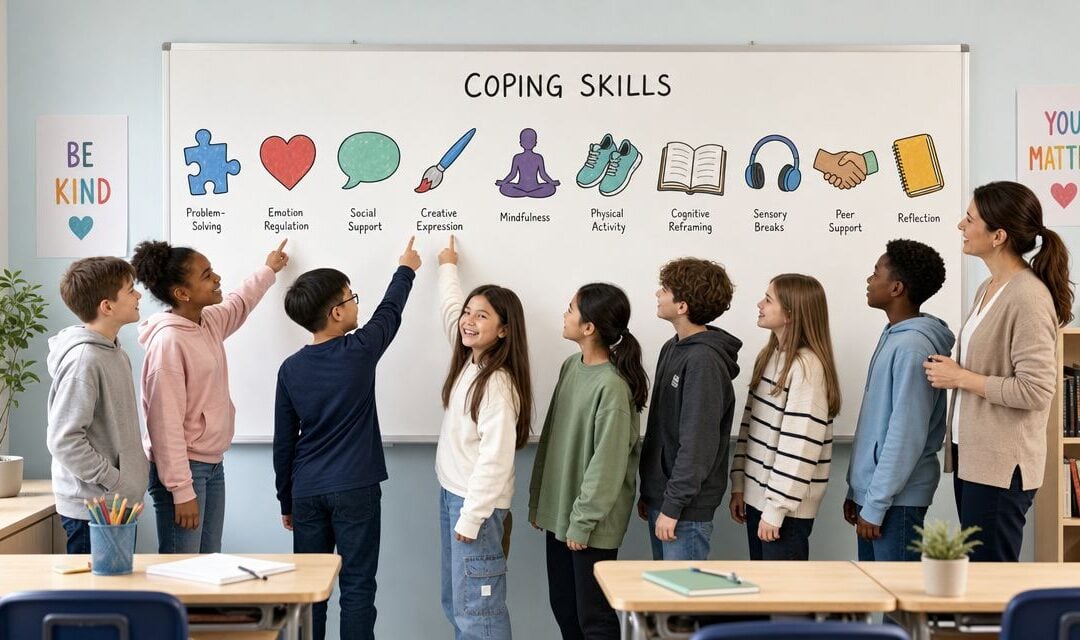
This guide breaks coping down into 10 clear types and turns each one into action for K-8 settings. For every type, you will see what it is, why it helps, what it can sound like, and how to use it in both classrooms and homes. You will also find age-appropriate examples, simple adult scripts, guided deep breathing practices, and child-friendly supports such as belly breathing activities for kids.
The goal is not constant happiness. The goal is a flexible set of habits children can carry into real conflicts, real mistakes, and real disappointment.
A kindergarten teacher might lead a two-minute breathing circle before morning meeting. A fourth grader might use starfish breathing before a spelling test. A parent might say, “Let's do three bubble breaths before we talk about what happened.”
What it looks like in practice
In the classroom, keep it short and visible. Put a breathing card on the wall, pair breathing with a hand signal, or build a predictable reset into transitions. At home, practice during calm moments so the child already knows the routine when emotions rise.
A few concrete examples work well:
Morning reset: “Hands on belly. Breathe in slowly. Feel your stomach rise. Breathe out like you're cooling soup.”
Before a challenge: “Your body looks tight. Try one slow breath before you start.”
After conflict: “We're not ignoring the problem. We're calming first so we can solve it.”
Many kids act out a feeling before they can name it. Emotional labeling slows that process down. Instead of “bad” or “fine,” children learn words like frustrated, left out, embarrassed, disappointed, worried, and overwhelmed.
That matters because language creates space between feeling and behavior. A child who can say, “I'm nervous,” is easier to support than a child who only knows how to refuse, yell, or shut down.
Build emotional vocabulary on purpose
In a classroom, use a feeling check-in during morning meeting or after recess. In counseling groups, let students point to an emotion wheel if speaking feels hard. At home, parents can ask with curiosity, “Was that anger, or was it more like disappointment?”
Try scripts like these:
Teacher script: “I can see something big is happening. Put a name on it if you can.”
Parent script: “You don't seem just mad. Are you hurt, worried, or frustrated?”
Student script: “I feel left out when no one saves me a spot.”
Books also help. Ask, “What is this character feeling right now? What clues do you notice?” Children often identify emotions in others before they can identify them in themselves.
That sentence helps adults stay compassionate and clear at the same time.
3. Physical Movement and Exercise
Some stress lives in the body. Kids bounce, fidget, slump, pace, or clench because their nervous systems are trying to manage load. Movement gives that energy somewhere to go.
Scottish Centre for Conflict Resolution groups physical exercise with emotional coping strategies in practical school-friendly categories, as summarized in the verified background above. That makes sense in K-8 settings, where a quick movement break can prevent a bigger blowup later.
A teacher might pause for a stretch between subjects. A counselor might invite a student to walk a lap before a repair conversation. A parent might suggest a scooter ride, dance break, or dog walk after school instead of launching straight into homework.
Here's one simple principle. Movement should be support, not punishment.
Classroom and home ideas
Low-pressure options: Offer chair stretches, wall pushes, hallway walks, or quiet yoga for students who don't enjoy competitive sports.
Routine movement: Add brain breaks before challenging tasks, not only after behavior problems.
Home reset: Say, “Let's move first, then talk,” after a long school day.
A quick visual can help adults think beyond traditional PE:
Older students sometimes like structured fitness options. If they're looking for ideas, these strength and hypertrophy exercises may offer variety, with adult guidance as needed.
4. Problem-Solving and Goal-Setting
A student is calm enough to talk, but the problem is still sitting there. The missing homework is still missing. The friendship issue is still happening at recess. The math page still looks impossible.
That is the moment for problem-solving coping.
This type of coping helps children address a stressor that can change, at least in part. It works like a map after the emotional storm has passed. Breathing and movement can lower the heat. Problem-solving gives the child a next step, which is often what reduces helplessness.
For adults, the challenge is knowing when to shift from comfort to structure. A useful question is, “Is there something we can do about this problem right now?” If the answer is yes, even partly, goal-setting can help.
Use a short routine children can remember
Keep the steps concrete and repeatable:
Name the problem: “What is happening?”
Find the part you can affect: “What part can you change?”
Brainstorm a few options: “What are three things you could try?”
Choose one small step: “What will you do first?”
Check the result: “Did it help, or do we need a new plan?”
Many children hear “solve the problem” as one giant task, making a short routine effective in turning an overwhelming situation into smaller pieces. A backpack full of mixed papers is not one problem. It may be three problems: unfinished work, no folder system, and rushing at dismissal.
In a classroom, a teacher might say, “You and Mateo both want the same marker. Let's list your choices.” At home, a parent might say, “Homework keeps ending in tears. Let's figure out which part is hardest first.”
Goals should be small enough to start today. A fourth grader stressed about a book report may not need the instruction to “finish it.” They may need, “Write the topic sentence and find one quote.” Small wins build traction because the child can see progress instead of only pressure.
You can also match the strategy to grade level. In K-2, use visuals, two choices, and adult-guided language. In grades 3-5, add written checklists and simple reflection. In middle school, involve the student in setting the goal, naming obstacles, and deciding how to track follow-through.
When a problem can be worked on, children often need a clear process, a short script, and one doable first step.
5. Social Connection and Support-Seeking
Coping isn't only an individual skill. One commonly missed truth is that many school stressors happen with other people present. Social coping reduces stress by seeking emotional or practical support from the community, and it's recognized as a core coping category in the verified research summary above.
This matters in K-8 schools because conflict, exclusion, bullying, and classroom dysregulation often require co-regulation. A child may not need another breathing reminder first. They may need a trusted adult, a buddy, or a clear invitation to reconnect.
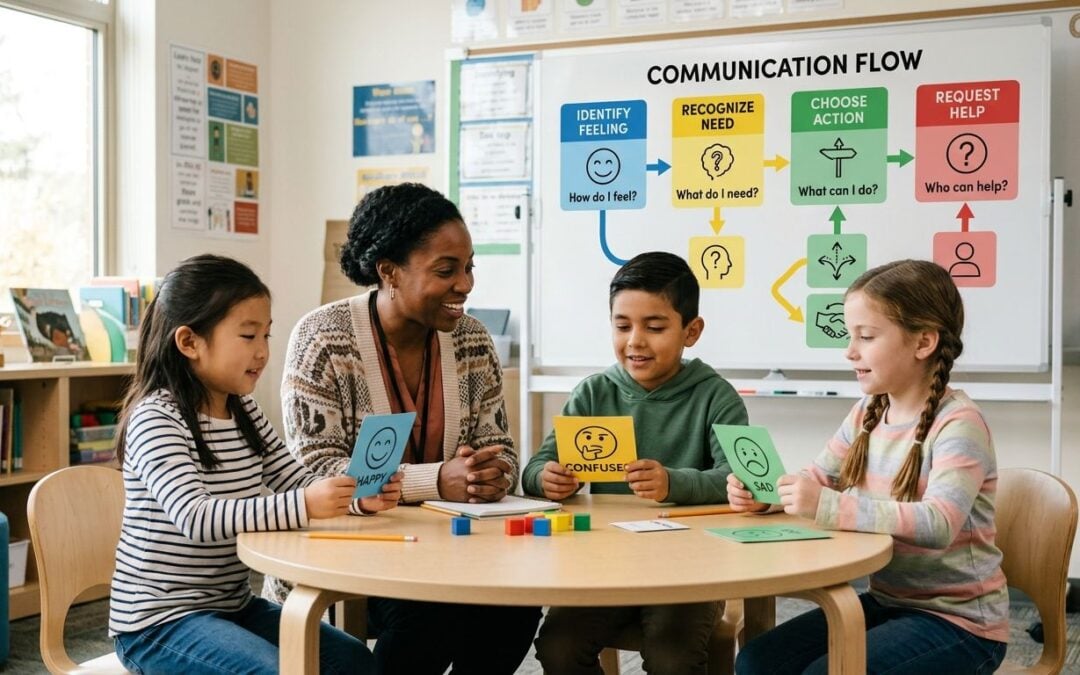
Teach help-seeking as a script
Children often know they feel bad but don't know how to ask for support. Make the words visible and repeatable.
Try these:
“Can you stay with me for a minute?”
“I need help solving this.”
“Can I talk to you after class?”
“I'm upset and I don't want to make it worse.”
In classrooms, you can assign support roles such as partner check-ins, peace corners with adult follow-up, or classroom jobs that reconnect isolated students. At home, create a short list of safe people the child can go to when upset.
A middle school student who had a rough lunch period might use a support card to check in with a counselor. A third grader at home might text a grandparent emoji code that means, “Please call when you can.” The skill is not dependence. It's knowing when connection is the healthiest next move.
6. Creative Expression and Artistic Activities
Not every child wants to talk right away. Some children process by drawing, humming, writing, building, acting, or making. Creative expression gives feelings a place to land.
Child Mind Institute includes journaling and listening to music among commonly recommended healthy coping skills in the verified summary above. In practice, that means schools and families can treat creative activities as real coping tools, not as extras once “real work” is done.
Make the process safe, not performative
A first grader might draw what anger looks like as a storm cloud. A fifth grader might keep a feelings journal with sentence starters like “Today felt heavy when…” A middle schooler might make a playlist for calming down after social drama.
Adults can support this without over-directing it:
Skip grading: don't evaluate coping art for neatness or talent
Add reflection: “Want to tell me about it?” works better than “What is it?”
At home, parents can keep a small “reset basket” with paper, markers, stickers, and a notebook. In class, teachers can use free-write prompts after difficult transitions or community events.
Some children reveal more through a puppet, a sketch, or a song lyric than they can in direct conversation. That still counts as healthy coping.
7. Cognitive Reframing and Perspective-Taking
Thoughts shape feelings. If a child thinks, “Everyone hates me,” their body responds as if that thought is settled fact. Cognitive reframing teaches them to slow down, test the thought, and build a more balanced one.
In the verified background, Scottish Centre for Conflict Resolution includes cognitive restructuring, affirmations, and distraction under cognitive coping. The big school takeaway is simple. Children can learn to notice unhelpful thoughts instead of automatically obeying them.
A balanced thought is stronger than fake positivity
Don't replace one extreme with another. “I'm terrible at math” doesn't need to become “I'm amazing at math.” A more useful reframe is, “This part is hard, but I can ask for help and try one step.”
Use classroom and home questions like:
“What's the story your brain is telling?”
“What evidence do you have?”
“Is there another way to look at this?”
“What would you say to a friend in the same situation?”
A student left out of one game might decide, “Nobody likes me.” An adult can help reframe: “You felt excluded in that moment. That hurts. It doesn't tell the whole story about every friendship.”
Thoughts are important, but they aren't always accurate.
Perspective-taking also belongs here. During conflict, ask students to describe what each person may have wanted, feared, or misunderstood. This doesn't excuse hurtful behavior. It widens understanding enough for repair.
8. Mindful Self-Compassion and Positive Self-Talk
Many children are much harsher with themselves than adults realize. They mutter, “I'm dumb,” “I ruin everything,” or “Nobody wants me.” Positive self-talk and self-compassion interrupt that inner voice with something more honest and supportive.
In the verified summary, positive self-talk is listed among common healthy coping skills recommended across age groups. That's especially important for students who shut down after mistakes or hold themselves to impossible standards.
Teach children how to talk to themselves
A compassionate script should feel believable. Skip exaggerated praise and use grounded language instead.
Examples:
Before a test: “I'm nervous, and I can still try.”
After a mistake: “Messing up doesn't mean I can't fix it.”
During frustration: “This is hard right now. Hard doesn't mean impossible.”
Teachers can model this out loud. “I made a mistake on the board. I'm going to slow down and correct it.” Parents can do the same at home. “I forgot something at the store. That's frustrating, but I can handle it.”
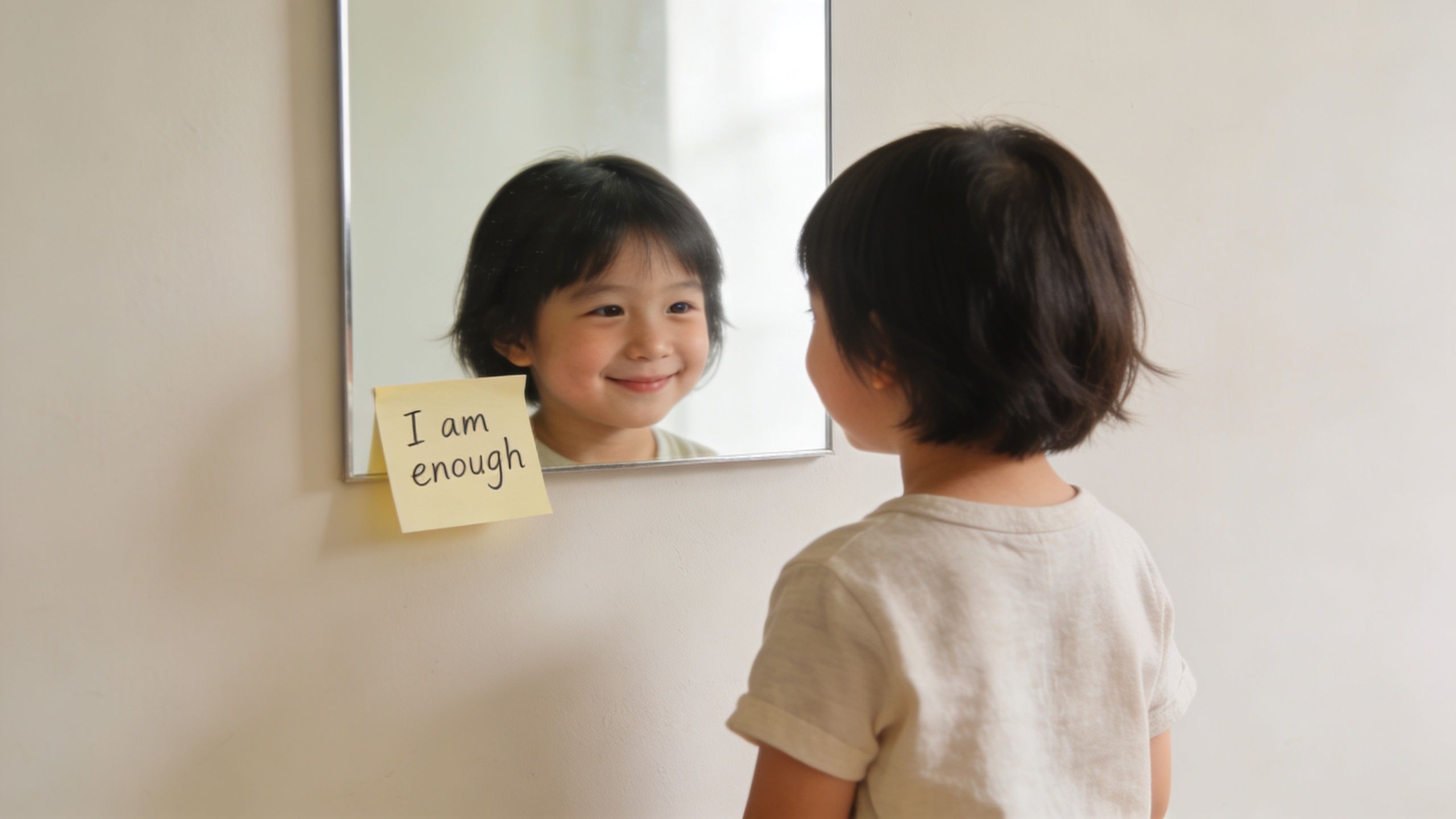
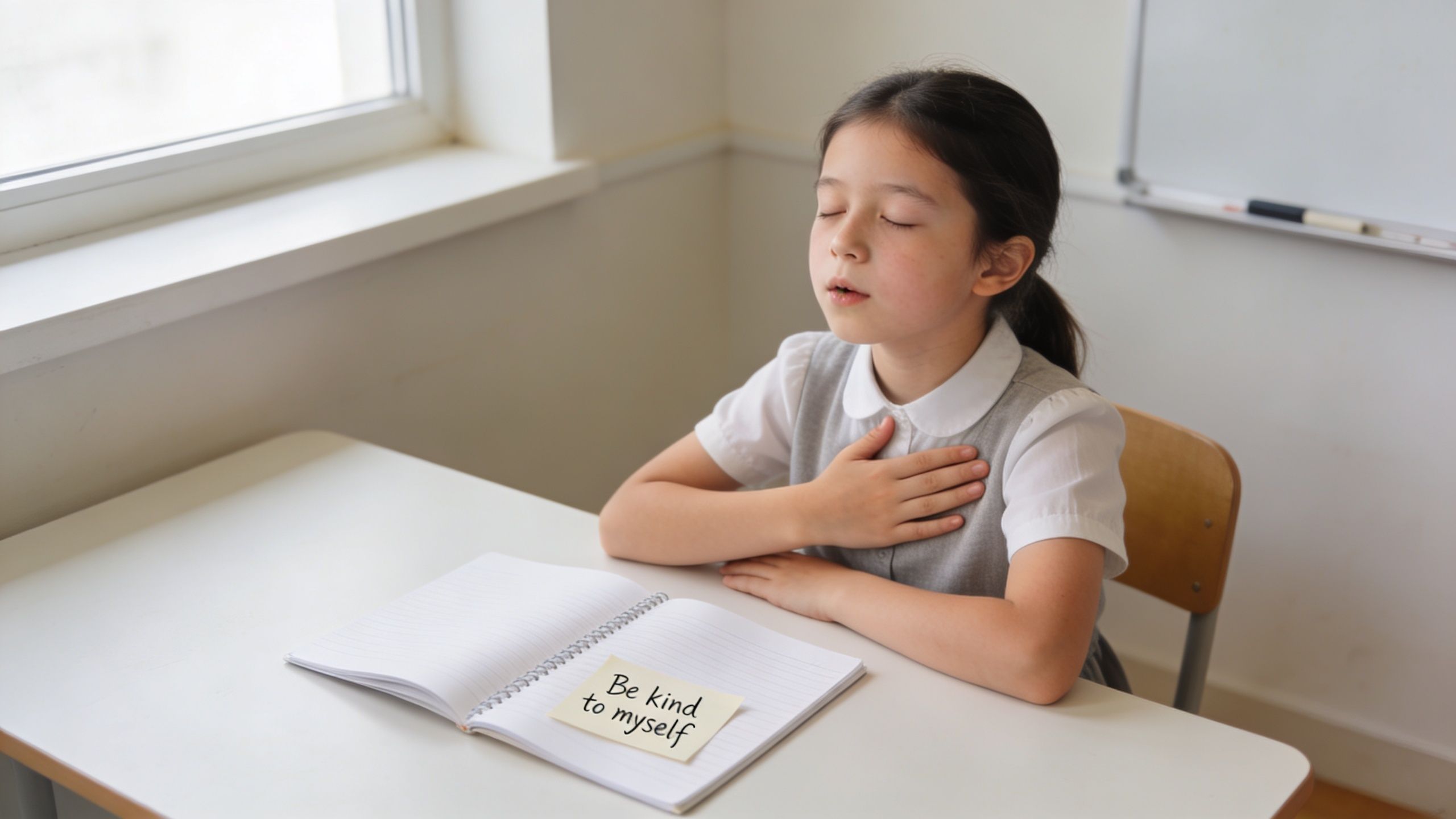
Physical cues help younger children. A hand on the heart, a gentle squeeze of both hands, or wrapping in a blanket can pair body comfort with kind words.
One caution matters here. Supportive self-talk should not become denial. If a child is hurting, “I'm fine” isn't coping. “I'm upset, and I know what can help” is coping.
9. Boundary-Setting and Assertive Communication
Some children cope by staying silent until they explode. Others say yes to things they don't want, then feel resentful or unsafe. Boundary-setting helps them communicate needs and limits earlier.
This fits the solution-focused category described in the verified summary, where examples include collaborative problem-solving, time management, and boundary setting. In school and at home, boundaries are practical coping tools because they reduce repeated stress before it escalates.
Give students words they can actually use
Children need scripts that sound natural for their age:
“Please stop. I don't like that.”
“I need space right now.”
“I'm not ready to talk yet.”
“You can play with me, but not if you keep grabbing.”
For older students, expand the script: “I feel frustrated when my things are used without asking. I need you to check with me first.” That's assertive, not aggressive.
In class, boundary practice can happen through role-play. One student interrupts. Another practices saying, “I'm still talking.” At home, a child can practice asking for quiet during homework or naming a limit with a sibling.
The adult role is important. Respect the child's healthy boundary when possible. If adults ignore every early signal, children often learn to use louder ones.
10. Acceptance and Mindful Tolerance of Difficult Emotions
Some feelings can't be solved away. Grief, disappointment, jealousy, nerves, and sadness often need to be felt, not fixed. Acceptance-based coping teaches children to notice difficult emotions without immediately running from them.
That distinction matters because avoidance-based coping such as disengagement, withdrawal, or emotional suppression is generally treated as maladaptive in the verified EBSCO summary of coping strategies. Temporary relief isn't always healthy relief.
Help children stay with feelings safely
Acceptance sounds like:
“I notice anxiety is here.”
“This feeling is uncomfortable, not dangerous.”
“I can feel sad and still go to school.”
“I don't have to get rid of this feeling before I do the next right thing.”
A student anxious about a class presentation may still choose to present with shaky hands. A child sad after moving homes may still join family dinner instead of hiding in their room. The goal isn't comfort first. It's flexibility.
Some coping skills reduce feelings. Others help children carry feelings without letting those feelings run the whole day.
Adults can use child-friendly metaphors. Emotions are weather. Thoughts are clouds. Waves rise and fall. The child isn't the storm. They're the sky holding it.
One note matters for safety. Accepting feelings never means accepting harmful behavior from self or others. A child can accept anger and still be expected not to hit.
Top 10 Coping Skills Comparison
Strategy
Implementation complexity
Resource requirements
Expected outcomes
Ideal use cases
Key advantages
Mindfulness and Deep Breathing
Low (short guided practice; requires consistency)
Minimal (time, brief guidance, visual cues)
Immediate stress reduction; improved regulation and attention
In-the-moment distress, transitions, test anxiety, daily resets
Portable, easy to teach, evidence-backed
Emotional Labeling and Expression
Low (modeling and reinforcement needed)
Low (feeling charts, prompts, classroom routines)
Reduced emotional intensity; better communication and empathy
Check-ins, restorative circles, de-escalation, emotional literacy work
Quickly lowers intensity; builds vocabulary and shared language
Physical Movement and Exercise
Moderate (planning, scheduling, inclusion)
Moderate–high (space, equipment, time)
Physiological stress relief; improved mood, focus, and health
Brain breaks, recess, chronic stress management, group activities
Strong neurochemical benefits; supports attention and social connection
Problem-Solving and Goal-Setting
Moderate (teaching steps, scaffolding)
Low–moderate (facilitation time, templates)
Increased agency, practical solutions, improved executive function
Highly protective; provides practical help and emotional relief
Creative Expression and Artistic Activities
Low–moderate (facilitation for therapeutic depth)
Moderate (materials, space, facilitator)
Nonverbal emotional processing; increased self-efficacy and expression
Students who struggle with words, counseling, reflective projects
Inclusive expression; validates feelings without pressure to verbalize
Cognitive Reframing and Perspective-Taking
Moderate–high (skill-building and practice)
Low (instructional time, guided exercises)
Reduced rumination/anxiety; stronger resilience and problem-solving
Anxiety, negative thought patterns, growth-mindset interventions
Produces lasting changes in thinking; well-supported by research
Mindful Self-Compassion and Positive Self-Talk
Moderate (practice; cultural adaptation)
Low (guided scripts, brief exercises)
Less self-criticism; increased resilience and sustainable motivation
Perfectionism, setbacks, building internal supports
Builds internal encouragement; protects mental health better than self-esteem alone
Boundary-Setting and Assertive Communication
Moderate–high (skills training, role-play)
Low–moderate (coaching, practice time)
Reduced burnout and conflict; healthier relationships and autonomy
Peer pressure, interpersonal conflict, workload and accommodation requests
Protects wellbeing; establishes respect and clearer expectations
Acceptance and Mindful Tolerance of Difficult Emotions
Moderate–high (skilled facilitation and practice)
Low (teaching) but requires ongoing practice
Greater psychological flexibility; reduced avoidance and secondary distress
Chronic anxiety, grief, situations without immediate solutions
Promotes long-term emotional flexibility and values-aligned action
Putting Coping Skills into Practice Your Next Steps
Teaching these types of coping skills works best when adults stop treating them like emergency tools only. Children need practice when they're calm, support when they're activated, and reflection after the moment has passed. That rhythm matters in every setting, whether you're leading a classroom, running a counseling group, or helping with homework at the kitchen table.
Start smaller than you think you need to. Pick one or two coping skill types to teach explicitly this month. A kindergarten class might focus on breathing and naming feelings. A fourth-grade class might add problem-solving and assertive communication. At home, a family might start with one calming strategy, one help-seeking script, and one boundary phrase that everyone practices together.
Consistency beats intensity. A two-minute reset every morning can do more than a long one-time lesson that never returns. A feeling check-in after school builds more skill than waiting for the next meltdown. Children learn coping from repetition, modeling, and shared language. They also learn it from watching what adults do under pressure.
It helps to match the coping skill to the situation. If a stressor can be changed, problem-solving may help. If the feeling is big but the problem isn't immediately fixable, emotional coping may come first. If the moment is interpersonal, social coping and co-regulation may be the best entry point. If a child is trying hard to escape every uncomfortable feeling, acceptance-based strategies may be more useful than another distraction.
Adults also need to watch for when coping starts to backfire. A strategy that helps in one moment can become unhelpful in another. Distraction can be useful before a child returns to a task, but not if it becomes a way to avoid every hard conversation. Journaling can support expression, but some children may get stuck in rumination without guidance. The question isn't “Is this a good coping skill?” in the abstract. The better question is “Is this helping this child in this moment, in this setting, for this need?”
In schools, shared systems prove important. If teachers, counselors, support staff, and caregivers use similar language, children don't have to relearn the skill in every room. They begin to recognize patterns in themselves. They know what to try, how to ask for help, and what adults mean when they say, “Let's regulate first,” or “What part can you control?”
Soul Shoppe is one option schools may consider if they want support building that kind of shared SEL language. According to the publisher information provided, the organization offers experiential programs, workshops, assemblies, coaching, and family resources focused on self-regulation, mindfulness, communication, conflict resolution, and belonging. That kind of schoolwide approach can make coping skills easier to teach consistently across classrooms and home partnerships.
The long-term goal isn't a child who never feels upset. It's a child who knows what upset feels like, has more than one way to respond, and trusts that support is available. That is emotional resilience in everyday form. It starts with naming, practicing, modeling, and repeating. Then one day, a child who used to yell, hide, or give up says, “I'm frustrated. I need a minute. Then I'm ready to try again.”
If you want practical SEL support for coping skills, communication, and conflict resolution across your whole school community, explore Soul Shoppe for programs and resources designed for students, educators, and families.
A child snaps, “You always ruin everything.” Another child fires back, “You never listen.” A teacher steps in, but the room is already tight with hurt feelings, crossed arms, and quick assumptions. Most adults who work with kids know this moment well. It happens over shared supplies, partner work, recess games, seating choices, and group chats that spill into the school day.
An i message gives children a more useful way to speak from their own experience instead of attacking someone else. That shift matters in classrooms, counseling offices, after-school programs, and homes. It helps kids name feelings, ask for what they need, and stay connected even when they're upset.
This is especially relevant because children communicate both in person and online. iMessage itself is one of the largest proprietary messaging platforms in the world, with an estimated 1.3 billion users globally in 2022, according to SignHouse's iMessage statistics summary. That doesn't mean every conflict happens on Apple devices, but it does highlight how normal device-based communication has become for families and students. If you're also working on stronger trust and belonging in your classroom, this building relationships with students playbook pairs well with the language tools below.
1. I Feel and I Felt Statements for Emotional Expression
Most adults start with “I feel…” because it's the clearest entry point. When a child can say what they felt, the conversation slows down. The focus moves from blame to experience.
A simple frame works well: “I feel ___ when ___.”
That sentence is short enough for younger students and flexible enough for older ones.
Classroom examples that sound natural
Instead of “You made me mad,” try:
Shared supplies: “I felt frustrated when you took my pencil without asking.”
Exclusion at recess: “I felt hurt when you didn't include me in the game.”
Group work: “I felt lonely during group work when no one responded to my ideas.”
These are strong i message examples because they name an emotion and connect it to a specific event. They don't attack the other child's character.
Practical rule: If the sentence starts to sound like blame in disguise, pause and replace judgment words with feeling words.
Children often default to three emotions: mad, sad, and happy. That's a start, but it's not enough for many real conflicts. A child who says “mad” might feel embarrassed, left out, worried, ignored, disappointed, or overwhelmed.
How adults can coach this skill
Use visual supports, sentence stems, and regular modeling. During calm moments, practice with low-stakes situations like losing a turn, waiting in line, or hearing “not yet.” A feelings chart or wheel can help children choose more accurate words, and naming feelings with kids can give adults more language to scaffold that process.
A few coaching moves help:
Validate first: “I hear that you felt hurt.”
Get specific: “What happened right before that feeling?”
Refine gently: “Was it angry, or more disappointed?”
When children can say what they feel, they're less likely to show it through yelling, shutting down, or blaming.
2. I Need Statements for Boundary Setting and Self-Advocacy
Some children can identify a feeling but still don't know what to do next. That's where “I need…” becomes powerful. It turns emotion into direction.
An effective frame is: “I need ___ so I can ___.”
This helps children speak clearly without demanding control over everyone else.
Useful scripts for school and home
A child who's overloaded by noise might say, “I need a quieter workspace so I can concentrate on my math.”
A student who's confused can say, “I need help understanding this before we move forward.”
A child nearing dysregulation might say, “I need a break right now so I can reset my feelings.”
Those are practical i message examples because they're concrete. Adults and peers can respond to them.
Some children need support learning the difference between a need and a want. “I need everyone to stop talking forever” isn't a workable need. “I need less noise” is.
What healthy boundaries sound like
Boundary language should be firm and respectful. It doesn't need an apology attached to it. Many children, especially children who try hard to please adults, benefit from hearing that it's okay to ask for space, help, time, or clarification.
Try coaching with prompts like:
For sensory needs: “I need less noise.”
For learning support: “I need another example.”
For emotional regulation: “I need a minute.”
For personal space: “I need you to stop touching my backpack.”
Kids don't need perfect wording. They need repeated chances to say what they need before their body says it for them.
Adults can reinforce this through routines such as break cards, quiet corners, or help signals. For more ways to teach this explicitly, boundary activities for children can support both classroom and home practice.
3. I Notice and I Observe Statements for Perspective-Taking and Feedback
"I notice…" is especially helpful when a child wants to talk about behavior without making assumptions about motive. This style lowers defensiveness because it sticks closer to what happened.
That matters in conflict. “You were rude” invites an argument. “I noticed you turned away when I came over” invites clarification.
Observation before interpretation
Teach students to describe what they saw or heard, not the story they instantly told themselves.
For example:
Lunch table: “I noticed you turned away when I tried to sit with you at lunch.”
Whole-class reminder: “I noticed the volume increased and people weren't raising hands.”
Peer concern: “I observed that several students didn't respond when you joined the group.”
These examples create room for a reply like, “I didn't hear you,” or “We thought you were still talking to someone else.” Not every hurtful moment is a misunderstanding, but many are.
A useful prompt is, “What did you notice with your eyes or ears?” That helps children separate fact from interpretation.
Here's a short teaching video you can use to reinforce calm communication language:
A strong pattern for adults
Adults can pair observation with curiosity:
Teacher to student: “I noticed your paper stayed blank for several minutes. I'm wondering if you felt stuck.”
Counselor to child: “I observed that you got quiet when teams were chosen. Do you want to tell me about that?”
Parent to sibling pair: “I noticed both of you started talking louder when the game ended.”
This format is also useful in digital communication. Text and app-based messages can be misread easily, and media sharing changes the communication load quickly. According to Roamless's overview of iMessage data use, text-only conversations are light on data, while photos, voice notes, and videos increase usage substantially. For adults working with families, that's a reminder to keep digital conflict-repair messages short, clear, and simple when possible.
4. I Appreciate and I Admire Statements for Building Connection and Gratitude
Conflict repair is only one part of SEL. Children also need language for warmth, recognition, and belonging. “I appreciate…” helps kids notice what is working between them.
Many adults give praise that's broad, like “Good job” or “Nice work.” Appreciation lands better when it names the exact action and its impact.
Appreciation that feels genuine
Try scripts like these:
Peer support: “I appreciate how you helped me understand the math problem because it made me feel supported.”
Whole group: “I admire how our class stayed patient when the technology didn't work.”
Inclusion: “I appreciate when you include everyone in games because it makes recess feel safe.”
These i message examples strengthen classroom culture because they point children toward specific prosocial behaviors they can repeat.
Appreciation is most useful when it answers two questions: What did the person do, and why did it matter?
Simple ways to build the habit
You don't need a big lesson every time. Short routines work well.
Morning meeting: “I appreciate…” partner shares
Closing circle: one class appreciation
Sticky notes: quick peer recognition
Adult modeling: “I appreciated how you waited while I helped another student”
Children often learn gratitude best by hearing it spoken regularly and specifically. If you want more ideas for routines and prompts, ways to show gratitude with kids offers practical extensions.
5. I Choose and I Decided Statements for Agency and Responsibility
When children are upset, they often talk as if they had no choice at all. “He made me do it.” “I had to.” “There was nothing else I could do.” “I choose…” interrupts that pattern and builds accountability without shame.
This language can be uncomfortable at first. It asks a child to own a response, not just report what happened to them. But that's exactly why it's useful.
Agency language in real moments
Here are examples that keep dignity intact:
Escalating conflict: “I chose to walk away because I didn't want to make it worse.”
Repair after harm: “I decided to apologize because I care about our friendship.”
Academic persistence: “I choose to try another strategy because I want to improve.”
Recess conflict: “I decided to ask for help instead of pushing back.”
Children don't need to pretend every situation was easy. They can still say, “I was really angry, and I chose to step away.” That sentence holds both truth and responsibility.
Reflection questions that help
Adults can strengthen this kind of i message with follow-up questions:
Choice awareness: “What choice did you make?”
Alternative paths: “What else could you have chosen?”
Values check: “Which choice matches the kind of friend you want to be?”
A useful caution belongs here. Sometimes an I-message isn't enough because the problem isn't ordinary conflict. It may involve power, repeated harm, intimidation, or safety concerns. The U.S. State Department educational guidance on I-messages aligns with a broader truth many educators know well: calm communication can reduce blame, but it doesn't replace adult follow-through when harmful behavior continues. In those moments, children need protection, boundaries, and clear escalation paths, not pressure to phrase things more politely.
6. I Understand and I Recognize Statements for Validation and Empathy
Empathy language is often what allows a hard conversation to continue. A child who feels seen is more likely to stay engaged. A child who feels dismissed usually shuts down or strikes back.
“I understand…” and “I recognize…” work best when they reflect the other person's experience without rushing to fix it.
Validation before problem-solving
Examples:
Peer to peer: “I recognize that you felt excluded when we chose teams, and that must have hurt.”
Teacher to student: “I understand this feels really hard right now, and I see you trying.”
Friend support: “I recognize that you're nervous about the presentation, and that's a big feeling.”
Notice what these do well. They don't argue about whether the feeling is reasonable. They acknowledge it.
Use “and” more often than “but.” “I know you're upset, but…” usually erases the validation that came first.
Adults can also model reflective listening:
“I hear that you felt embarrassed.”
“I understand that you thought people were laughing at you.”
“I recognize that waiting felt unfair.”
What empathy does and doesn't mean
Empathy isn't agreement. You can understand a child's fear, anger, or disappointment and still hold a boundary. That distinction helps adults stay warm and steady at the same time.
This is also where text-based communication gets tricky. Digital messages are now part of family and school life, yet many traditional i message examples focus only on face-to-face conflict. The Act for Youth guide on using I-messages reflects the common pattern of in-person examples and points toward an important gap for educators: younger children and digital communicators often need shorter, more scaffolded versions. For example, “I felt left out when I saw that message. I want us to talk in person” may work better than a long emotional paragraph. As children build accountability alongside empathy, adults can reinforce that with teaching responsibility in age-appropriate ways.
7. I Hope and I Believe Statements for Encouragement and Future Focus
Some moments call for repair. Others call for strength. “I hope…” and “I believe…” help children look forward when they feel stuck, ashamed, or discouraged.
These statements matter because many students carry a quick story about themselves: I'm bad at this. Nobody likes me. I always mess up. Encouraging i message examples can interrupt that spiral without sounding fake.
Encouragement that children can trust
A few strong models:
Academic struggle: “I believe in your ability to learn this. You've kept trying before.”
Friendship pain: “I hope things get better for you because you deserve kindness.”
Family stress: “I believe you have the strength to handle this, and I'm here to support you.”
Behavior repair: “I believe you can make this right.”
Children can tell when encouragement is empty. “You can do anything” often feels too broad. “I believe you can get through this because I've seen you ask for help and keep going” feels more grounded.
Pair belief with support
Hope language works best when it includes a next step.
Teacher: “I believe you can finish this first part. I'll stay with you for the first problem.”
Parent: “I hope tomorrow feels easier. Let's make a plan for the morning.”
Counselor: “I believe this friendship can heal if both of you are ready to listen.”
There's also a practical systems lesson for adults here. In high-volume support settings, clear language and strong response paths matter. In one case described by Crescendo.ai's business examples, Rachio used AI agents to handle more than 1 million support queries across chat, voice, and email, while keeping a human escalation layer for more complex issues. In schools and youth settings, the parallel is simple: encouraging language helps, but children also need reliable follow-through when a problem is ongoing or complex.
7 I-Message Types Comparison
Statement type
Implementation complexity
Resource requirements
Expected outcomes
Ideal use cases
Key advantages
I Feel / I Felt (Emotional Expression)
Low–Medium, simple format but needs modeling
Emotion charts, repeated practice time, teacher modeling
Improved emotional vocabulary, less blaming, safer classrooms
Teaching emotion naming, de-escalation, K–8 SEL lessons
Separates feelings from blame; builds self-awareness
I Need (Boundary Setting & Self-Advocacy)
Medium, teaches requests and negotiation
Classroom systems for requests, adult willingness to negotiate, practice
Greater self-advocacy, clearer boundaries, reduced anxiety asking for help
Requesting accommodations, asserting personal needs
Teaches assertiveness without aggression; promotes agency
I Notice / I Observe (Perspective-Taking & Feedback)
Medium, requires training in objective language
Practice prompts, mindfulness exercises, vocabulary scaffolds
More accurate communication, reduced assumptions, better feedback
Low–Medium, must be genuine and paired with action
Teacher modeling, specific praise, follow-through supports
Increased resilience, motivation, confidence
Encouragement during setbacks, growth-mindset coaching
Builds hope and optimism; supports persistence
Making I-Messages a Daily Habit
The best i message examples don't live on a poster alone. They become part of the daily language children hear, practice, and repair with over time. That means adults need to model them in ordinary moments, not only during conflict. “I felt concerned when the line got crowded.” “I need everyone to freeze so we can stay safe.” “I appreciate how you waited.” Repetition makes the language usable when emotions run high.
It also helps to teach these seven types as different tools, not one script. A child might need “I feel” in one moment and “I need” in the next. Another child may be ready for “I notice” or “I choose.” Giving students more than one frame respects their developmental stage, communication style, and the kind of situation they're in.
For younger children, keep it short. One or two sentences is enough. For older students, add reflection and repair: “I felt embarrassed when that happened. I need us not to joke about it again.” In digital situations, shorter is often better because tone is easier to misread and long messages can escalate quickly. If families are sending plain text, that communication is lightweight, while images and videos can add much more data use, as noted earlier. That practical detail matters for some households and is one more reason to teach children that not every conflict needs a flood of screenshots or voice notes.
Adults should also remember the limit of the tool. An I-message can support conflict resolution, but it can't solve repeated cruelty, coercion, or unsafe behavior by itself. In those moments, children need adults to step in, document concerns, set boundaries, and protect the student who was harmed. Communication skills and safety procedures should work together.
If your school wants shared language around empathy, self-regulation, and conflict resolution, Soul Shoppe is one relevant option. Its work centers on helping school communities build connection, safety, and practical SEL habits that children and adults can use every day. That kind of consistency is what turns a sentence frame into a culture.
If you want support bringing these tools into your school or home community, Soul Shoppe offers SEL programs and resources focused on communication, empathy, belonging, and conflict resolution for children and the adults who care for them.
You've just explained the directions, and a few students are already asking what to do. At home, you've asked your child to put on shoes, grab a water bottle, and meet you at the door, but only one of those things happened. Those moments are easy to read as defiance, laziness, or distraction.
Usually, they're a listening problem. Not hearing, but listening. Filtering noise, holding information, noticing tone, reading emotion, and staying present long enough to respond well. In a busy classroom or a full family schedule, that's a big skill set.
That's why games for listening matter so much. They give children low-pressure practice with attention, self-regulation, empathy, and communication repair. They also help adults shift from “Why aren't they listening?” to “What support helps them listen better?” That question changes everything.
Many adults need that reminder too. Some of the same principles that help kids tune in also show up in strong leadership tips from Corporate Challenge Events. Clear expectations, emotional safety, and repetition work across ages.
Listening games have deep roots. Maria Montessori's sensory methods date back to 1912, and active listening games have remained part of early childhood education for decades. One example, documented by Mathful Play's Listen, Count, and Guess activity, describes a classic bucket-and-object game and cites sensory play research showing 85% improvement in auditory discrimination skills among children ages 3 to 5 after four weeks of regular play.
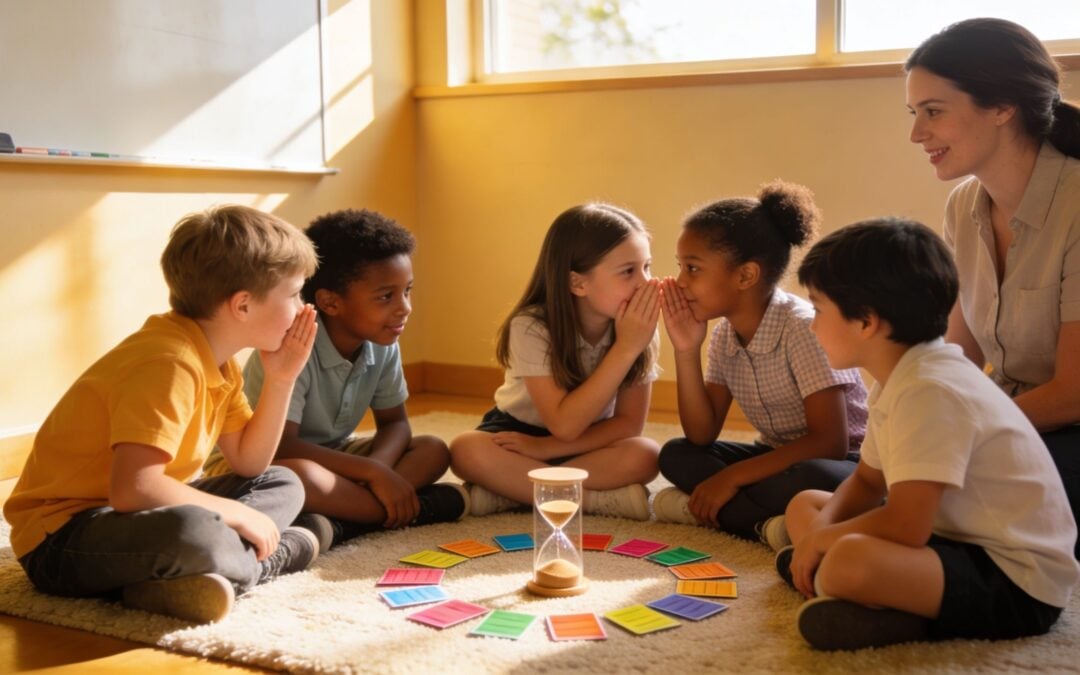
1. Circle Listening
Some games for listening are lively. This one is quiet on purpose.
In a talking circle, students sit in a circle, and only the person holding the talking piece speaks. Everyone else listens without interrupting. That single structure slows the room down and gives children a clear experience of what respectful attention feels like.
I've seen circles work best when adults stop treating them like a performance. Children don't need a perfect answer. They need time, predictable norms, and a real chance to be heard.
How to run it well
Start small. A group of 8 to 12 is usually easier to manage than a whole class if students are new to the format. Use a simple object as the talking piece, such as a smooth stone, a small stuffed animal, or a wooden stick.
Use low-stakes prompts first:
Easy entry prompt: “What's one sound you heard on the way here?”
Belonging prompt: “What helps you feel calm at school?”
Repair prompt: “What should someone do when they interrupt by accident?”
If you want a school-based model for this work, Soul Shoppe shares practical examples in its piece on restorative circles in schools.
Practical rule: Don't force every child to speak on the first round. Passing is often what makes the circle feel safe enough for honest participation later.
This practice aligns naturally with SEL because it teaches turn-taking, perspective-taking, and emotional restraint. The strongest circles aren't the ones with the most polished sharing. They're the ones where children begin responding to one another with less sarcasm, fewer interruptions, and more patience.
A practical classroom example: after recess conflict, don't begin with “What happened?” Start with “What do you need from others so you can listen right now?” That question lowers pressure and often gets better participation.
Later, you can deepen the prompts:
Conflict awareness: “What makes listening hard when you're upset?”
Community building: “What does respect sound like?”
Reflection: “When did someone listen to you this week?”
Here's a short visual introduction you can use if students need to see the structure before trying it.
2. Sound Mapping and Soundscaping
When a room feels overstimulated, children often need help noticing sound before they can manage it. Sound mapping is one of the simplest games for listening because it turns attention into something visible.
Ask students to sit still for a few minutes and listen for sounds near and far. Then invite them to draw a map of what they heard. A bird outside the window might go in the top left corner. A heater hum might sit near the bottom edge. A classmate's pencil tap might appear close by with jagged lines.
Why this works
Some children process sound better when they can externalize it. Drawing, labeling, or sorting sounds gives them another pathway into listening. It also supports emotional regulation because it anchors attention in the present moment.
This works well:
Short first round: Try a brief listening window with younger students.
Choice in response: Let students draw, write, or talk through their sound map.
Feeling connection: Ask which sounds felt calming, annoying, surprising, or comforting.
This does not work well:
Overloading the task: Too many directions at once turns a mindful activity into a compliance test.
Mandatory eyes closed: Some students listen better with eyes open and a soft gaze.
Correcting their perception: If a child heard a “buzzing whirr” and another heard “air noise,” both may be accurately describing the same sound.
A strong example is using a rain recording, playground ambience, or a short nature soundscape after lunch. Students listen, map what they notice, then compare their drawings. That comparison matters. It teaches that two people can hear the same environment differently without either person being wrong.
Sometimes the most useful debrief question is, “Which sound was easiest for you to ignore, and which was hardest?”
For sensory-sensitive learners, lower the complexity. Use fewer sound layers, offer headphones if appropriate, and allow nonverbal responses such as pointing to icons or placing stickers on a printed page.
3. Telephone and Whisper Down the Lane
Telephone gets dismissed as a silly party game, but in practice it's one of the clearest ways to teach how communication breaks down. That makes it one of the most useful games for listening if you debrief it carefully.
The traditional version often rewards the funniest mistake. The better version rewards careful listening, kind repair, and curiosity. Instead of laughing at the person who “messed it up,” the group studies what changed and why.
Make the point bigger than the punchline
Use a meaningful sentence rather than random nonsense. Try something like, “After art, please put the brushes in water and place your painting on the drying rack.” That mirrors the kind of language children hear all day.
Then ask:
Where did the message shift?
What made it hard to hear clearly?
Did anyone make an assumption instead of checking?
What could a listener say if they need repetition?
The learning is in the analysis. Students start noticing that speed, embarrassment, background noise, and guessing all affect accuracy.
This is also where digital listening games can support practice. By 2025, 68% of U.S. K-8 classrooms use digital listening games, and a 2024 Journal of Educational Psychology study linked that use with 45% better attention spans among 5,200 students, as summarized in this overview of audio-based listening games on YouTube. In classrooms, that translates into a useful principle. Repetition and novelty help, but only when students stay emotionally relaxed enough to keep trying.
A good variation is “clarifying Telephone.” Before passing the message, each student may ask for one repeat. That tiny adjustment changes the game from gotcha to skill-building.
If children leave the game thinking, “Listening is hard for everyone sometimes,” you've done it right.
This game is especially useful after peer conflict. It gives students a concrete example of how quickly meaning changes when people assume instead of checking.
4. Tone Detective
Children often focus on words and miss the emotional message carried by tone. “I'm fine” can mean calm, embarrassed, irritated, or seriously hurt. Tone Detective teaches students to listen for pace, volume, pitch, and inflection, not just vocabulary.
Say the same short phrase several ways. “I didn't know that,” works well. Read it as excited, worried, annoyed, shy, playful, and disappointed. Then ask students to identify the feeling and explain what clues they heard.
Keep the emotion task concrete
Don't begin with unlimited answers. Offer a small set of choices if students are hesitant. This reduces performance anxiety and gives language to children who feel the emotion but can't name it yet.
For support, pair this game with a visual tool like Soul Shoppe's feelings chart for kids. Students can point to likely emotions before discussing the clues they heard.
A few strong prompts:
Clue hunt: “Was the voice fast or slow?”
Mismatch check: “Did the tone match the words?”
Personal link: “When have you heard that tone before?”
Repair practice: “What could you say if you weren't sure what the person meant?”
This is useful in classrooms, counseling groups, drama, and family meetings. It's also one of the best games for listening when students struggle with conflict because it trains them to notice emotional cues before reacting.
If you want recorded samples, teachers and creators sometimes use tools similar to professional AI voiceovers for creators to produce multiple versions of the same phrase. The key is not the technology. The key is discussing what students heard and how tone affects trust.
A trade-off worth naming: this game can tempt adults to act like there's always one correct answer. There often isn't. A voice can sound both nervous and irritated. Let students hold mixed interpretations when they can explain their reasoning.
5. Instruction Following and Simon Says
Simon Says survives for a reason. It asks children to pause, inhibit impulse, and hold verbal information in mind. Those are all real listening demands.
Still, the classic trick format can backfire. Some children love the speed and challenge. Others feel publicly caught making mistakes. If your goal is SEL, the better version is cooperative.
Shift from elimination to support
Instead of putting students “out,” keep everyone in and invite peer support. One student gives directions. The group succeeds together when everyone understands what to do.
Try commands like:
Movement plus sequence: “Touch your head, turn once, then sit.”
Mindful action: “Take a breath, tap your knees twice, then show me a quiet thumbs-up.”
Partner cue: “Point to your elbow, then check whether your partner needs the directions repeated.”
That last step matters. It turns listening into a shared responsibility.
Soul Shoppe offers related practice ideas in its active listening activity, and the structure transfers well to classrooms, counseling groups, and home routines.
What works:
Start short: Use two-step directions before increasing complexity.
Normalize repetition: Teach “Can you say that again?” as a strength, not a weakness.
Add visuals when needed: Gestures, icons, or a model student can reduce overload.
What doesn't work:
Fast rapid-fire commands: Students stop processing and start guessing.
One-size-fits-all expectations: Some children need movement or a visual cue to listen well.
The first commercial listening game, Simon, sold 25 million units by 1990, according to the same verified background summary that tracks the growth of digital listening play. That long popularity makes sense. Sequential listening taps a skill children use constantly, from lining up to solving math problems.
6. Partner Mirroring and Reflecting Back
If I had to choose one activity that most directly teaches listening as empathy, it would be this one. One child speaks. The partner listens and reflects back what they heard. Then the speaker confirms, corrects, or adds nuance.
The structure is simple, but the skill is not. Most children, and plenty of adults, rush to advise, defend, or tell their own story. Reflecting back interrupts that habit.
Sentence stems help a lot
Give listeners language they can lean on:
Content stem: “What I heard was…”
Feeling stem: “It sounds like you felt…”
Accuracy stem: “Did I get that right?”
Repair stem: “What did I miss?”
Begin with easy topics. Favorite snacks. Weekend plans. A game they like. Only move into conflict or emotion after students understand the process.
Soul Shoppe's article on empathetic listening offers language that fits this kind of partner work well.
Listening back to someone is often harder than speaking. That's why the first rounds should be short.
This format is especially effective for peer mediation, counseling check-ins, and home conversations between siblings. One practical example: after a disagreement, ask each child to reflect the other person's concern before they explain their own. The pace slows immediately. The heat often drops with it.
There's a broader reason this structure matters. A 2022 CASEL meta-analysis cited in the verified background found SEL contexts like Soul Shoppe's programs can reduce classroom disruptions by 27% across 317 studies. Reflective listening isn't the only reason, but it's one of the practices that helps children feel heard enough to re-enter problem-solving.
7. Story Listening and Retelling
Read-alouds and audio stories are some of the most flexible games for listening because they let children practice attention, memory, inference, and emotional understanding all at once.
The format can be very simple. Read a short story, then ask students to retell what happened, draw one important scene, act out a part, or explain how a character felt. The variation in responses is part of the value. Children learn that good listening includes details, sequence, and perspective.
Build retelling around meaning
Pick stories with emotional texture. Friendship problems, exclusion, kindness, nervousness, repair. Then pause at useful moments and ask:
Prediction: “What do you think will happen next?”
Emotion check: “How is this character feeling right now?”
Personal connection: “Have you ever felt something similar?”
Perspective shift: “Would another character tell this story differently?”
One of my favorite classroom moves is to let one student retell the events and another retell the feelings. That distinction helps children notice that listening isn't only about plot.
This type of play-based listening has global relevance too. UNESCO's 2021 report, cited in the verified background, notes that 1.2 billion children benefit from play-based learning and that 65% in major markets show SEL gains. Story listening fits that pattern because it gives children a safe, shared experience to interpret together.
For extension, pair stories with creative media. Teachers who want examples of multi-format narrative experiences can borrow ideas from creative digital production insights, then adapt them in age-appropriate ways through audio, drawing, drama, and discussion.
A common mistake is over-quizzing comprehension. If every story turns into a test, listening becomes performative. A better approach is to mix one recall question with one feeling question and one open interpretation question.
8. Listening Walk and Mindful Observation
A listening walk is one of the cleanest resets for a noisy group. Students walk indoors or outdoors, paying attention to the soundscape around them. No talking during the observation phase. Just noticing.
Afterward, they share what they heard. A truck backing up. Shoes on gravel. A bird call. Ventilation. Distant laughter. Wind in leaves. The room usually feels different after this. More grounded. Less reactive.
Keep the structure tight
Before the walk, set a clear frame. Tell students how long they'll be quiet, where they'll walk, and what they should listen for. Near sounds. Far sounds. Human sounds. Nature sounds. Mechanical sounds.
Then debrief with prompts like:
Surprise: “What sound did you notice that you usually ignore?”
Emotion: “Which sound felt calming or irritating?”
Awareness: “What did silence help you hear?”
Connection: “What does this place sound like when people take care of it?”
For younger students, collect responses on chart paper. For older students, invite quick journaling or sketch notes.
This activity also supports children who don't want to speak right away. They get to listen first, then contribute from direct experience. That's a gift for quieter students and for those who need time to process language.
The verified background also highlights an underserved need here: adapting listening activities for neurodivergent and sensory-sensitive learners, including support with visual cues, reduced auditory complexity, movement breaks, and alternative ways to respond. That's especially important on listening walks. Some children may do better noticing one assigned category of sound rather than every sound at once.
Silence shouldn't feel punitive. It should feel purposeful.
8-Game Listening Comparison
Activity
Implementation complexity
Resource requirements
Expected outcomes
Ideal use cases
Key advantages
Circle Listening (Talking Circles)
Medium, needs trained facilitation and time
Talking piece, clear norms, quiet space
Equity of voice, trust, active listening, belonging
Inclusive, calming, connects students to environment
Putting Listening at the Heart of Your Community
These games for listening do more than fill five or ten minutes. They shape the emotional climate of a room. When children practice listening with structure, choice, and reflection, they learn that paying attention is not just about compliance. It's about care.
That shift matters in every setting. In classrooms, it helps students follow directions, join group work, and recover from conflict with less defensiveness. At home, it helps siblings hear one another more clearly and gives caregivers better tools than repeating the same instruction louder. In counseling and SEL spaces, it builds the conditions for honesty. Children speak more openly when they trust that someone will listen.
A pattern shows up across nearly all of these activities. Listening improves when the task is clear, the pressure is low, and the adult values understanding over speed. It gets worse when children are rushed, shamed, overloaded, or expected to show listening in only one acceptable way. That's the trade-off practitioners have to keep in view. A game can be engaging and still exclude a child if the format is too noisy, too fast, or too public.
That's why adaptation isn't an extra. It's part of good facilitation. Some children need visuals. Some need movement. Some need fewer sound layers, partner support, or the option to respond by drawing instead of speaking. Those adjustments don't water the activity down. They make the listening work more honest and more inclusive.
If you're choosing where to start, pick one game that matches your biggest need right now. If your group interrupts constantly, use Circle Listening. If directions fall apart, try the cooperative Simon Says variation. If conflict keeps escalating, use Partner Mirroring. If the room feels buzzy and dysregulated, start with Sound Mapping or a Listening Walk.
Then watch closely. Notice who settles. Notice who opens up. Notice which children do better when the pace slows and the expectations are named clearly. Those small observations will tell you more than any script.
Soul Shoppe is one option for schools that want to embed these kinds of SEL practices more intentionally through workshops, assemblies, coaching, and related resources. However you approach it, the core work stays the same. Teach children how to listen with empathy, attention, and regulation, and you change what becomes possible in that community.
If you want support building a school or family culture centered on empathy, communication, and psychological safety, explore Soul Shoppe for practical SEL programs and resources you can use with children and the adults who care for them.
A lot of adults are living this sentence every day without naming it: life is perspective.
You see it during morning meeting when one student says, “She ignored me,” and the other says, “I didn’t even hear you.” You hear it at home when one child says, “That’s not fair,” and a parent is thinking, “I’m trying to help everyone get out the door.” The facts of the moment may be the same. The experience of the moment is not.
For K-8 students, that gap matters. It shapes friendships, classroom trust, problem-solving, and how children make sense of setbacks. When adults teach kids how to pause, look again, and consider another point of view, we aren’t asking them to give up their own feelings. We’re helping them understand that more than one story can be happening at once.
That’s a core social-emotional skill. It helps children move from blame to curiosity, from defensiveness to communication, and from “I’m right” to “Help me understand.”
The Power of Seeing Things Differently
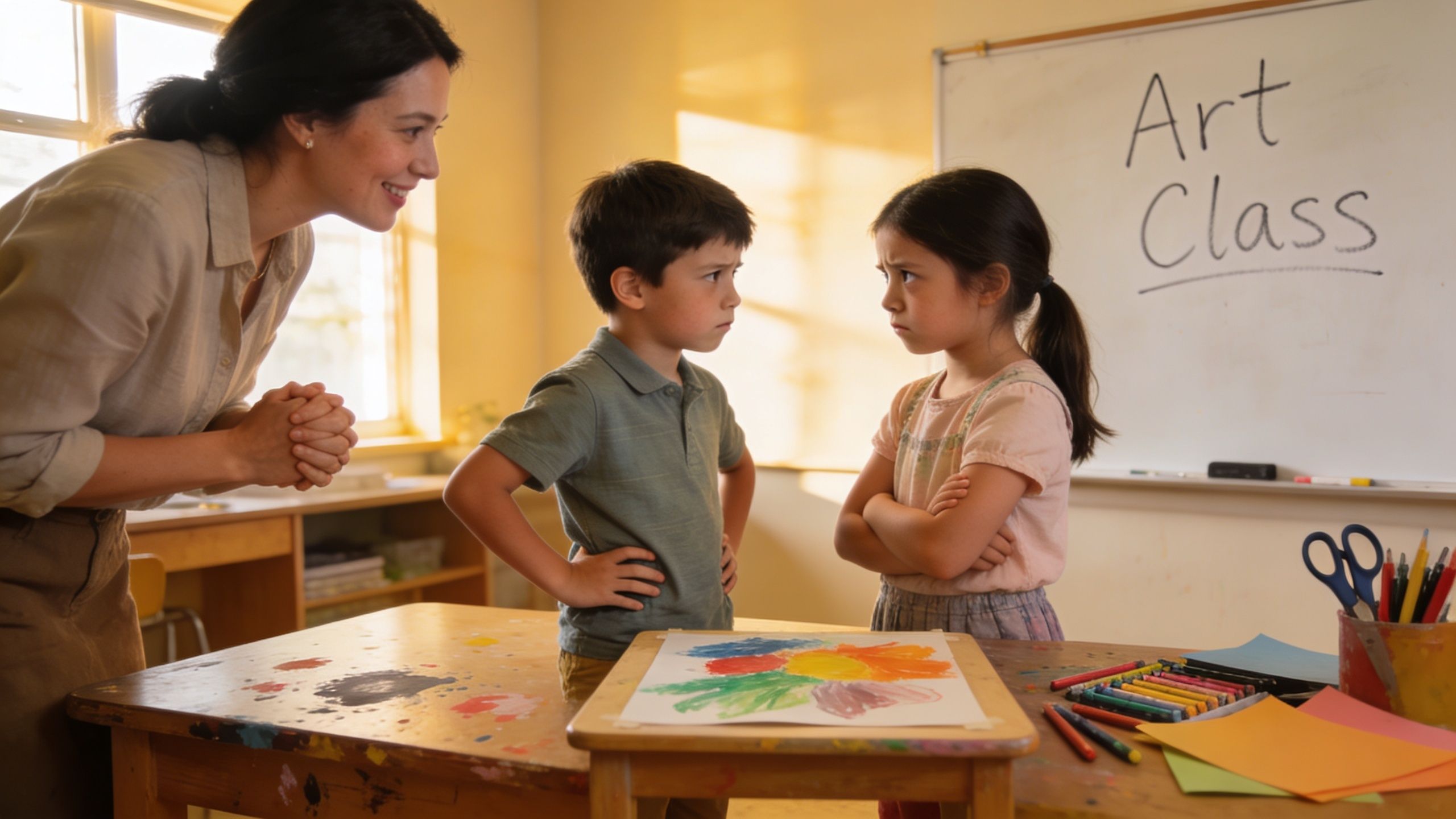
Two second graders are arguing over markers at the art table. One says, “He took it from me.” The other says, “I thought nobody was using it.” Both children are upset. Both feel certain. Both want the teacher to confirm their version.
That’s a small classroom moment, but it holds a big lesson. Children often think perspective means deciding who is correct. In practice, perspective-taking means noticing that each person has partial information, feelings, assumptions, and needs. Once kids learn that, conflict becomes easier to unpack.
What perspective means in a school day
In plain language, perspective is the way a person understands what’s happening. It includes what they noticed, what they missed, what they expected, and what they felt.
A child who says, “Nobody wants me on the team,” may be reacting to one missed invitation. Another child in the same game may be focused on rules and not realize someone feels left out. The event is shared. The meaning attached to it is different.
This is why “life is perspective” lands so strongly in SEL work. It reminds us that behavior doesn’t appear out of nowhere. A child reacts to the meaning they assign to the moment.
Practical rule: Start with, “Tell me what happened from your view,” before you move to correction or consequences.
That one sentence changes the temperature of the room. Kids feel heard, and adults get better information.
Why this matters beyond one conflict
Research from the Pew Research Center on what makes life meaningful across advanced economies shows that while priorities differ across cultures, core human values like family, friendships, and health are nearly universal sources of meaning. For educators and families, that’s a useful reminder. Children need help building connection, belonging, and resilience because those are part of what people consistently value most.
In school, perspective-taking supports exactly those outcomes. A child who can ask, “What else might be going on here?” is less likely to escalate a disagreement and more likely to repair a relationship.
You can even build this mindset into academic lessons. During a read-aloud about environmental care, for example, students can compare how different people see the same problem. If you want real-world visuals for that kind of discussion, these sources for plastic pollution images can help students talk about how the same image may spark sadness, responsibility, anger, or action depending on the viewer.
Where adults often get stuck
Many teachers and parents worry that validating perspective means approving hurtful behavior. It doesn’t.
You can say, “I believe you felt left out,” and also say, “You may not push when you’re angry.” Perspective-taking doesn’t remove boundaries. It makes boundaries more teachable because students are calmer and more able to reflect.
When children learn that other people have inner experiences just as real as their own, they begin to build empathy. That shift is one of the strongest foundations we can give them.
The Science Behind a Shift in Perspective
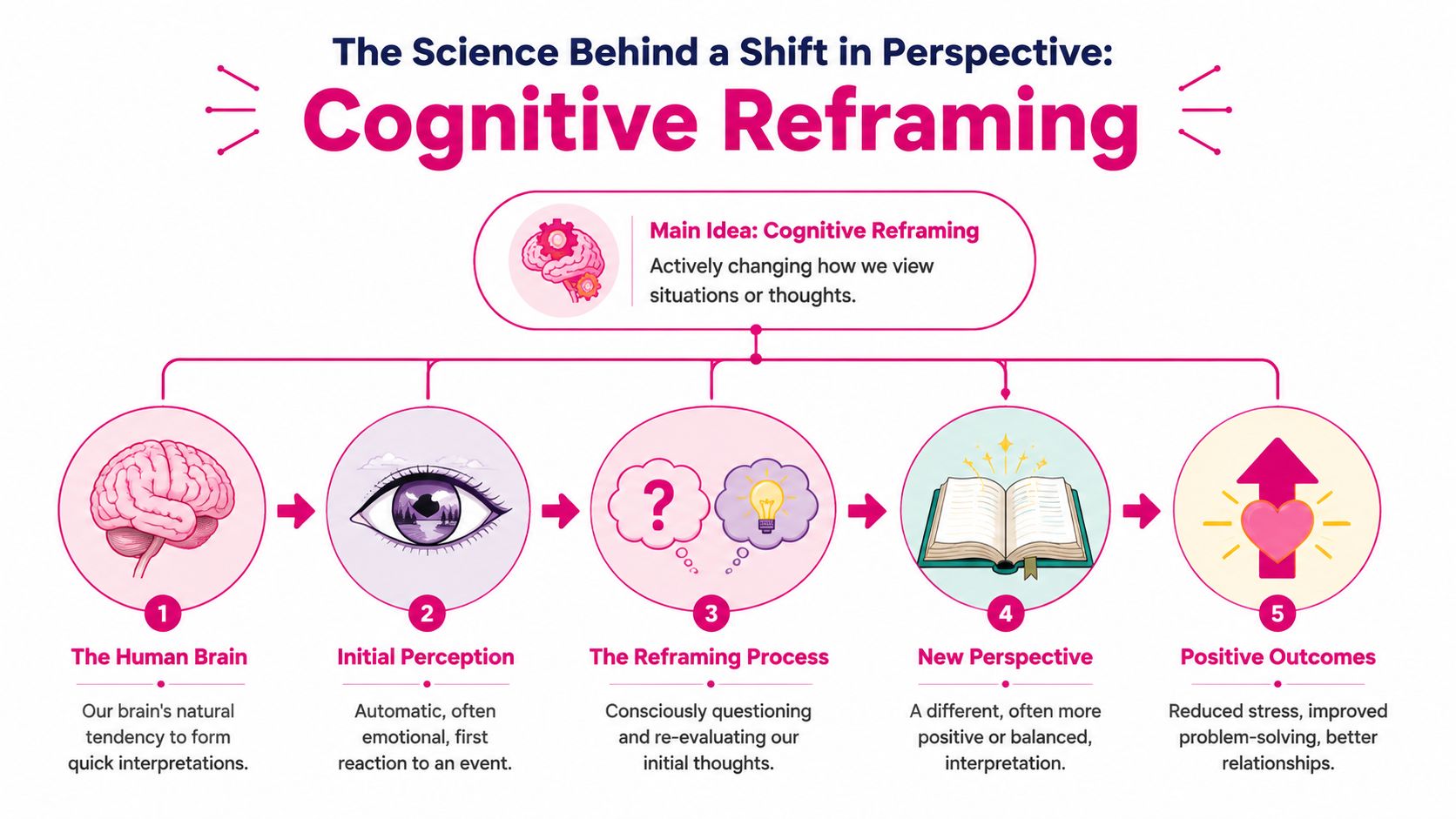
When I explain perspective-taking in staff workshops, I use a simple image. Think of the brain as using a fast camera. It snaps a quick picture of a situation and labels it immediately: threat, unfair, embarrassing, mean, boring.
That first picture isn’t always wrong. But it’s often incomplete.
The brain can learn a second look
Cognitive reframing means teaching students to take a second mental picture. Instead of stopping at “She’s ignoring me,” they learn to ask, “Could she be distracted, nervous, or unsure what to say?” That doesn’t erase their feeling. It widens their interpretation.
Neuroscientific studies described in this discussion of perspective-taking and empathy-related brain activity report that structured perspective-taking exercises can increase activation in brain regions responsible for empathy and improve conflict resolution outcomes in students by up to 31%. For educators, the takeaway is straightforward. Perspective-taking isn’t fluff. Practice changes how students respond.
Two brain regions often come up in this conversation: the anterior cingulate cortex and the temporoparietal junction. You don’t need students to memorize those names. What matters is the idea behind them. Parts of the brain involved in empathy and understanding other minds become more active when people intentionally consider another viewpoint.
A useful classroom analogy
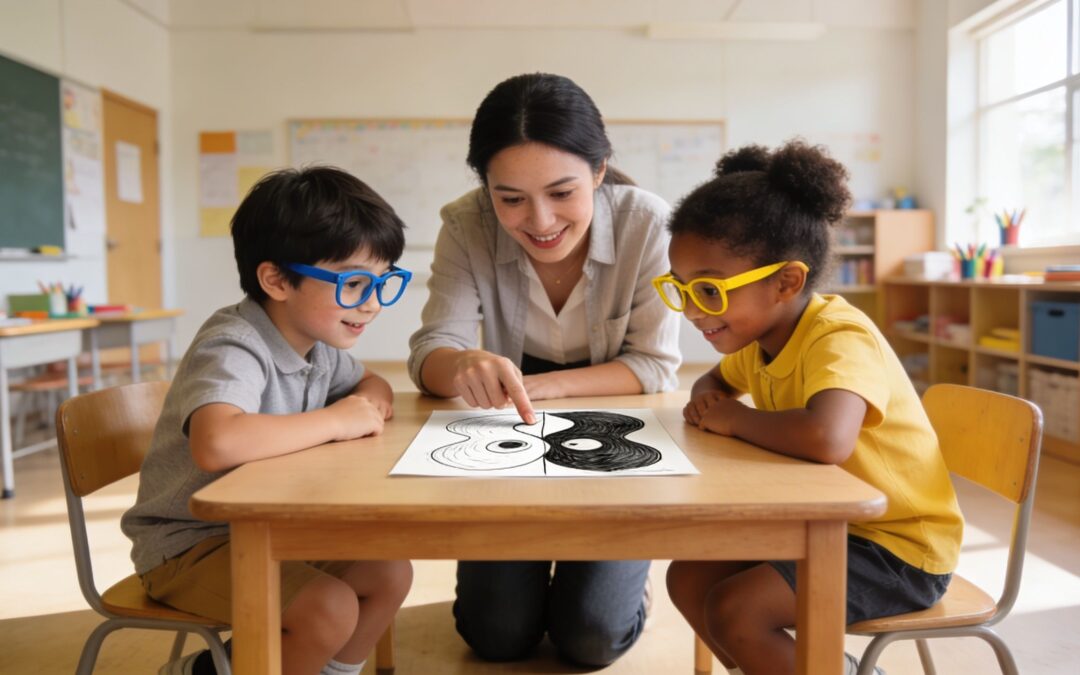
Try calling this “putting on perspective glasses.”
When a student is upset, ask:
What did you first see?
What might you have missed?
What could the other person be thinking or feeling?
What’s a more complete story?
That sequence is simple enough for elementary students and still useful for middle schoolers.
When kids can name their first interpretation, they’re more able to loosen their grip on it.
That’s the moment reframing begins.
Why repeated practice matters
Perspective-taking works like any other skill. One lesson won’t do it. Students need brief, repeated opportunities in real situations.
That’s why short daily routines often work better than waiting for a major conflict. You can build the habit with:
Morning prompts: “What’s one reason someone might have a hard time joining a group today?”
Read-aloud pauses: “How might the side character describe this scene?”
Repair conversations: “What did you assume, and what do you know now?”
Teachers who want a broader SEL foundation for this work may also find Soul Shoppe’s article on what social-emotional development is helpful because it connects perspective-taking to larger developmental skills children use every day.
For adults, a related framework from therapy can also be useful. If you support anxious students or family members, this overview of understanding ACT for anxiety offers language for noticing thoughts without letting them control every reaction. That mindset pairs well with perspective work.
What to say when students get confused
Children often hear “see the other side” as “your feelings don’t count.” Clear language helps.
Try these lines:
“Your feeling is real. We’re also going to look at the whole picture.”
“We’re not changing the facts. We’re checking our interpretation.”
“Two people can remember the same moment differently.”
That’s how we teach students that life is perspective without slipping into relativism or confusion. We help them keep their truth and stay open to someone else’s.
Why Teaching Perspective Boosts School Wellbeing
A school climate doesn’t improve because adults post kindness posters. It improves when students learn what to do in moments of misunderstanding, exclusion, embarrassment, and tension.
Perspective-taking belongs at the center of that work.
Friendship is not extra
An American Perspectives Survey on what matters for a fulfilling life found that 58% of Americans identify good friends as essential to a fulfilling life. That places friendship above several milestones adults are often taught to prioritize. For schools, that’s a practical message. Peer relationships are not a side issue. They are central to wellbeing.
If friendship matters that much in adult life, then teaching children how to listen, repair, include, and interpret each other generously is serious educational work. It affects recess, partner work, group projects, lunch, transitions, and the emotional safety students carry into academic tasks.
A child who trusts peers enough to take a risk in class is more available for learning than a child who is busy scanning for rejection.
What schools gain when perspective becomes common practice
When schools teach perspective consistently, adults often notice changes in the quality of daily interactions before they see changes on any formal measure. Hallway conflicts de-escalate faster. Students become more willing to explain rather than accuse. Teachers spend less energy sorting out social confusion and more energy teaching.
Some of the strongest arguments for SEL also support this work. CASEL research, summarized in this overview of the benefits of social-emotional learning, notes that students receiving evidence-based SEL instruction demonstrate an $11 return for every $1 spent, with gains linked to reduced behavioral referrals, improved attendance, and stronger academic outcomes.
That return makes sense on the ground. When students can interpret conflict with more flexibility, classrooms lose less time to emotional fallout.
What this looks like in practice
Schools don’t need a perfect initiative. They need shared language and consistent adult responses.
A perspective-rich school often sounds like this:
Teachers say: “What story are you telling yourself about that?”
Counselors ask: “What might the other student have intended?”
Administrators coach: “How can we repair impact while understanding perspective?”
Families hear: “We’re teaching students to notice feelings, assumptions, and needs.”
One option schools use to support that kind of shared language is Soul Shoppe, which offers workshops, assemblies, coaching, and digital tools focused on communication, self-regulation, conflict resolution, and empathy.
For teams that want to see how this language can be modeled with students, this short video is a useful conversation starter.
A leadership question worth asking
If students are struggling socially, ask this: Are we only telling them to be kind, or are we teaching them how to interpret each other more accurately?
Kindness matters. Skills make kindness usable.
Leadership move: Put perspective-taking into staff norms, classroom routines, and family communication so students hear the same language everywhere.
That’s how school wellbeing becomes more than a slogan. It becomes a pattern.
Classroom Activities to Cultivate Perspective
Teachers usually don’t need more theory. They need tomorrow’s lesson.
The activities below are designed for regular classrooms, advisory periods, counseling groups, or family workshops. Each one turns the phrase life is perspective into something students can practice with their bodies, voices, and choices.
Perspective-taking activities by grade level
Grade Level
Activity Name
Brief Description
K-2
Storybook Switch
Students retell a familiar story from the perspective of a side character or object.
K-2
Feelings Detective
Children look at a picture or short scenario and guess what different people might feel.
3-5
Two-View Replay
Students describe one playground or classroom moment from two different viewpoints.
3-5
Problem-Solving Circle
A class discusses a conflict and generates multiple interpretations before solutions.
6-8
Role-Play Rewind
Students act out a conflict, then replay it with each person voicing internal thoughts.
6-8
Assumption Check
Students identify the first story they told themselves and revise it using new information.
Kindergarten through grade 2
Young children learn perspective best through play, stories, and concrete prompts.
Storybook Switch works well during read-aloud time. Pause after a key event and ask, “How would the dog tell this story?” or “What does the little brother think is happening?” Students can draw their answer before sharing it aloud.
Feelings Detective is helpful during morning meeting. Show a picture of two children on a playground. Ask:
“What might this child be feeling?”
“What else could be true?”
“What clue helped you decide?”
Keep the tone light. The goal isn’t a single right answer. The goal is flexibility.
Sample teacher script:
“You noticed the face looked upset. Good observing. Now let’s stretch our thinking. Could that same face also mean worried or confused?”
Grades 3 through 5
Upper elementary students are ready to compare viewpoints more directly.
Use Two-View Replay after a mild classroom conflict. Invite two students, or two volunteers using a fictional example, to explain the same event separately. Then ask the class what each person noticed, assumed, and needed.
A Problem-Solving Circle can follow this structure:
Name the situation in one sentence.
Hear each viewpoint without interruption.
List possible feelings.
List possible misunderstandings.
Brainstorm one repair step each person can take.
This keeps the conversation from collapsing into blame. It also teaches students that perspective-taking includes listening for missing information.
Grades 6 through 8
Middle school students can handle more reflection and social nuance.
Role-Play Rewind is powerful because it makes hidden assumptions visible. Two students act out a conflict. Then they replay it, but this time each person pauses to say what they were thinking in the moment. Classmates often realize that what looked “rude” from the outside may have involved embarrassment, insecurity, or misreading tone.
Assumption Check works well in journals or advisory. Give students these prompts:
What happened?
What did I assume at first?
What else might explain it?
What would I say if I wanted clarity instead of conflict?
This routine also connects well to restorative conversations.
Making activities inclusive for neurodivergent learners
A critical gap in many SEL materials is that they don’t adapt perspective-taking instruction for students who process social information differently. Since 1 in 5 students may have a disability, differentiating for students with autism, ADHD, and other learning differences matters for inclusive practice, as noted in this reference connected to adapting perspective-taking for neurodivergent learners.
Some practical adjustments help right away:
Use visual supports: Draw thought bubbles, feeling faces, or simple sequence cards.
Reduce language load: Offer sentence stems such as “I thought ___ because ___.”
Preview social scenarios: Let students rehearse before a live role-play.
Allow multiple response modes: Students can point, write, draw, or use a graphic organizer instead of speaking on the spot.
Teach explicitly: Don’t assume students will infer hidden meaning. Name it.
A student with ADHD may need shorter turns and movement built into discussion. A student with autism may do better when perspective tasks begin with concrete clues instead of abstract guessing. That’s not lowering expectations. It’s making the skill teachable.
End conflict reflection with one question: “What do you understand now that you didn’t understand before?”
That question shifts the goal from winning to learning. Over time, students start asking it for themselves.
Bringing Perspective-Taking Practices Home
School helps the skill start. Home helps the skill stick.
When families use the same language children hear in class, perspective-taking becomes part of everyday life instead of a special lesson. That matters because most of a child’s real practice happens in ordinary moments: breakfast rushes, homework frustration, sibling disputes, car rides, and bedtime conversations.
Simple routines that work
You don’t need a long family meeting. You need a few repeatable questions.
Try these at dinner or in the car:
“Was there a moment today when you and someone else saw things differently?”
“What do you think your teacher was hoping students would understand today?”
“If your pet could describe your afternoon, what would it say?”
That last question is playful, which helps children practice perspective without feeling corrected.
Reading together also creates natural openings. During a story, stop and ask, “Why do you think that character made that choice?” Then add, “Would another character describe that moment differently?” Families who want more ideas for this kind of conversation can explore these practical suggestions on how to teach empathy at home and in daily life.
What to do during sibling conflict
Parents often move too fast to a verdict. That’s understandable. Everyone is tired.
A more effective pattern is:
Hear each child briefly.
Reflect each perspective.
Name the shared problem.
Ask for one repair step from each child.
For example:
“You thought your sister took your turn on purpose.”
“You were excited and didn’t realize he thought it was still his turn.”
“The problem is that both of you want fairness.”
“What can each of you do now?”
“I can understand your perspective without agreeing with how you handled it.”
That sentence helps children separate validation from approval.
Keep the language steady
Children benefit when adults use the same few phrases repeatedly. Pick two or three and stick with them.
Good options include:
“What’s your view?”
“What might be another explanation?”
“What does the other person need right now?”
Consistency matters more than sophistication. Kids learn perspective by hearing it modeled over and over, in calm moments and messy ones.
When families and schools share this language, children get a powerful message. Their feelings matter, and so do other people’s experiences. That balance is where empathy grows.
Building a Culture of Empathy Together
If there’s one idea I want teachers and families to hold onto, it’s this: perspective-taking is teachable.
Children aren’t born knowing how to pause, question their first interpretation, and consider another person’s inner world. They learn it from repeated practice with steady adults. They learn it when a teacher slows down a conflict instead of rushing to blame. They learn it when a parent says, “Tell me your side, and then let’s think about theirs.” They learn it when classrooms treat misunderstandings as chances to build skill.
Life is perspective, but that doesn’t mean truth is meaningless or that every behavior gets excused. It means children need help understanding that each person brings feelings, history, and assumptions into the same moment. Once they grasp that, empathy becomes more reachable. So does accountability.
Schools become safer when students can interpret one another with more generosity. Homes become calmer when family members stop arguing only about facts and start naming viewpoints. Communities become stronger when young people know how to stay grounded in their own experience while making room for someone else’s.
That work belongs to all of us. Teachers, counselors, administrators, caregivers, and community partners all shape the emotional vocabulary children carry into friendships, classrooms, and eventually adulthood.
Small shifts in language create large shifts in culture.
Every time you ask a child, “What else could be true?” you are helping build a more thoughtful, connected, and humane environment. That’s not a small act. It’s culture-building.
Soul Shoppe helps school communities cultivate connection, safety, and empathy through practical social-emotional learning experiences for students and adults. If you want support bringing perspective-taking, communication, and conflict resolution into your classrooms or family partnerships, visit Soul Shoppe.
More Than Words: Turning Self Love Mantras into Lifelong Skills
A child misses one math problem and whispers, “I’m so dumb.” Another gets left out at recess and decides it means nobody likes them. A middle schooler scrolls through photos, compares their life to everyone else’s, and grows quieter by the day. Most adults who care for kids have heard some version of this inner critic. It shows up in classrooms, on car rides home, at bedtime, and in the moments after a mistake.
Self love mantras can help, but only when we treat them as practices instead of posters. If a child says words they don’t believe, the phrase can feel fake. If an adult uses a mantra only after a meltdown, it becomes a rescue tool instead of a life skill. Kids need repetition, modeling, and language that matches their real experience.
That matters because self-affirmation isn’t just a trendy idea. A 2025 meta-analysis covering 17,748 participants across 129 independent studies found that self-affirmation interventions were linked with meaningful improvements in self-perception, general well-being, and social well-being, while also reducing psychological barriers like anxiety, according to this October 2025 review summary on positive affirmations. For educators and families, that’s a useful reminder that brief, low-cost practices can support emotional health when they’re taught well.
The key is teaching children how to use self love mantras in daily life. The eight mantras below work best when adults connect them to feelings, choices, relationships, and repair. That’s where they become part of SEL, not just positive talk.
1. I Am Enough
“I am enough” is often the first mantra kids need, especially the ones who think worth comes from grades, popularity, athletic skill, or always getting it right. This phrase pushes back on the belief that value must be earned. It tells a child, “You still belong, even when things are hard.”
For younger students, keep it concrete. “I am enough even when I spill paint.” “I am enough even when reading feels tricky today.” Older students can go deeper. “I am enough even if I’m not chosen first.” “I am enough even when I’m still figuring out who I am.”
How to teach it so kids believe it
Don’t ask students to chant this phrase with no context. Tie it to common school moments.
Morning meeting prompt: Ask, “What is one thing that makes you enough today, even before you achieve anything?”
After mistakes: Say, “You made an error. Your value didn’t change.”
At home: When a child says, “I’m bad at everything,” respond, “You’re disappointed. And you’re still enough.”
Practical rule: Pair the mantra with a real situation. Children trust specific language more than broad praise.
A teacher might say, “I didn’t explain that as clearly as I wanted. I’m still enough, and I can try again.” That kind of adult modeling matters. Kids learn self-acceptance when they hear adults practice it out loud.
This mantra also fits naturally with belonging work. A hallway poster can help, but daily language matters more. During partner work, class circles, or transitions, remind students that everyone enters the room with equal worth. If you want extra family-friendly language support, Kubrio's guide for parents offers confidence-building ideas that can complement this practice.
2. I Choose to Be Kind to Myself
Some children talk to themselves in ways they’d never use with a friend. They call themselves stupid, annoying, ugly, lazy, or behind. This mantra matters because it introduces agency. A child may not control every feeling, but they can learn to shift how they respond to themselves.
The phrase “I choose” is important. It turns self-kindness into an action, not a personality trait. Kids don’t have to wait until they naturally feel compassionate. They can practice it on purpose.
A simple classroom script
Try this after a student makes a mistake in front of others:
Teacher: “What did your inner voice just say?” Student: “That I messed everything up.” Teacher: “Would you say that to a friend?” Student: “No.” Teacher: “Try again with kindness.” Student: “I made a mistake, but I can keep going.”
That short exchange teaches more than the mantra alone.
Use the Friend Test: “Would you say this to a friend?”
Add a body cue: Hand on heart, one slow breath, then the mantra.
Keep it brief: Long speeches rarely help in a dysregulated moment.
When children are upset, calm first and coach second.
At home, this often comes up after sports, homework, or social conflict. A parent can say, “It sounds like your inner voice is being rough. What would it sound like if you chose to be kind to yourself right now?” That question invites reflection without shaming the child for being hard on themselves.
Self love mantras work better when they sound believable. If “I love everything about myself” feels too far away, “I choose to be kind to myself” is often more honest and more usable. For adults who want language ideas rooted in compassionate self-talk, how to speak life over yourself offers prompts that can be adapted for older students and caregivers.
3. My Feelings Are Valid
Children often hear two unhelpful messages about feelings. One is “Don’t feel that.” The other is “Feel whatever you feel and do whatever comes next.” Neither teaches regulation. “My feelings are valid” gives kids a healthier middle path.
This mantra tells students that emotions are real and important, but emotions don’t get to run the whole room. A child can be angry and still not hit. They can feel jealous and still act respectfully. They can feel sad and still ask for help.
The sentence that should always follow
Teach this pair together:
All feelings are okay. Not all behaviors are okay.
That one line helps students separate emotion from action. It’s especially useful during conflict.
For example, a fourth grader says, “She didn’t pick me, and now I hate her.” Instead of correcting the feeling, an adult might say, “Your feelings are valid. It hurts to feel left out. Let’s find a safe way to say what you need.” That moves the child toward communication instead of suppression.
A counselor might use this mantra with a student who’s been told to “stop crying.” A teacher might use it when a student comes in upset after recess. A caregiver might use it after bedtime tears that seem too big for the situation. In each case, the message is the same. Your feelings make sense. You still need tools.
Practical SEL moves
Name the feeling first: frustrated, embarrassed, worried, disappointed, lonely
Connect feeling to need: space, comfort, repair, clarity, a break
Offer a safe action: breathe, draw, write, talk, ask for support
This mantra also supports psychological safety. Students are more likely to ask for help when they trust that adults won’t mock, minimize, or rush them. In a classroom community, that changes everything. Kids become more honest, more empathic, and more able to hear each other.
4. I Am Growing and Learning
Some students decide very early who they are. “I’m bad at math.” “I’m not a good reader.” “I’m the shy kid.” “I always mess up.” Once that story hardens, effort starts to drop. This mantra loosens the story.
“I am growing and learning” is one of the most useful self love mantras for school because it protects dignity while making room for change. It tells a child that struggle isn’t proof of failure. It’s part of development.
What this sounds like in real life
A kindergartener rebuilding a block tower can say, “I’m growing and learning how to make it steady.” A fifth grader revising an essay can say, “I’m learning how to organize my ideas.” A middle school student after an awkward peer interaction can say, “I’m growing in how I handle conflict.”
That language matters because it shifts identity from fixed to active.
Praise strategy: “You kept trying a new way.”
Praise persistence: “You stayed with it when it got hard.”
Praise reflection: “You noticed what wasn’t working and adjusted.”
When adults praise only talent, students often become more fragile. When adults praise process, students usually become more resilient.
A lesson snippet teachers can use
Write two statements on the board:
“I can’t do this.”
“I’m growing and learning.”
Ask students which statement helps the brain stay open to practice. Then invite them to rewrite common fixed thoughts.
“I’m bad at spelling” becomes “I’m learning spelling patterns.”
“I always ruin group work” becomes “I’m learning how to collaborate.”
“I’m not artistic” becomes “I’m growing my creative confidence.”
This mantra also works well in public repair. If an adult forgets directions or loses patience, they can say, “I’m growing and learning too.” That protects authority while modeling humility. Kids don’t need perfect adults. They need adults who can repair.
5. I Deserve Rest and Boundaries
Many children live in a constant state of “go.” School, homework, sports, activities, screens, social tension, and pressure to perform can wear them down. Adults often do the same to themselves. This mantra reminds kids that rest isn’t a reward for being productive enough. It’s part of being human.
Boundaries are a form of self-respect. Rest is a form of regulation. When we teach both together, children learn that caring for themselves helps them show up better for others.
What kids need to hear
Students often think rest means quitting. Reframe it.
Rest can be active: drawing, swinging, reading, building, listening to music
Rest can be quiet: alone time, breathing, lying down, looking out a window
Boundaries can be kind: “I need space,” “I’m not ready to talk yet,” “I can’t play right now”
A third grader might need a calm corner after lunch. A sixth grader might need fewer after-school commitments for a season. A parent might set a family boundary around device-free evenings so everyone can decompress.
The wider self-improvement app market shows how much people are looking for support in practices like affirmations, meditation, and positive self-talk. In the United States, that market reached $1.22 billion in 2024, up from $762 million in 2022, according to this WebWire report on self-improvement apps. That doesn’t mean an app replaces adult relationships. It does show that many families want accessible tools for emotional regulation and daily reflection.
Adult modeling counts most
Children notice when adults preach boundaries but never take them. If a teacher works through every lunch, kids absorb that. If a parent answers messages all evening while saying “rest matters,” kids absorb that too.
Say the boundary out loud. “I’m taking a few quiet minutes so I can reset.” “I can help after I finish this task.” “I’m resting because my body needs it.” That gives students permission to care for themselves without guilt.
6. I Celebrate My Unique Qualities
Comparison can flatten a child’s sense of self. One student wishes they were louder. Another wishes they were calmer. Another tries to hide a learning difference, cultural identity, family background, or personality trait just to fit in. “I celebrate my unique qualities” interrupts that pressure.
This mantra helps students notice what is distinct and valuable about them. Not better than others. Not more important. Distinct. That’s a powerful shift for identity and belonging.
Try an identity-based activity
Give students a page with the outline of a shield or a superhero badge. In different sections, ask them to fill in:
something they’re proud of
a way they help others
a quality that makes them unique
a challenge they’re learning to work with
a part of their identity they want respected
Then invite students to share only what feels safe to share. The goal isn’t performance. The goal is recognition.
An introverted student might write, “I notice things other people miss.” A highly energetic student might write, “I bring excitement and ideas.” A child with ADHD might identify creativity, humor, and quick thinking as strengths. A multilingual student might celebrate the ability to move between worlds.
Children build self-love faster when adults name strengths that are specific, observable, and not tied only to achievement.
This mantra is especially useful when correcting behavior. If a student interrupts constantly, you might say, “Your enthusiasm is a strength. We’re working on timing.” If a student withdraws, you might say, “Your thoughtfulness matters. I want to make sure your voice gets space too.” That protects identity while addressing the skill gap.
Schools can also support this through books, class discussions, heritage celebrations, and community norms that make difference visible and welcome. Self love mantras become more believable when the environment reinforces them.
7. I Am Responsible for My Choices, Not Everyone's Happiness
This mantra is more advanced, but many children need it. Some students feel responsible for keeping everyone okay. They monitor friends, absorb adult stress, over-apologize, or panic when someone is upset with them. Others get manipulated by peers who use guilt to control them.
This phrase helps students understand healthy responsibility. They are responsible for their own words, tone, actions, and repair. They are not responsible for controlling every other person’s emotional state.
A useful way to teach it
Draw two circles on the board or on paper.
In my control:
my choices
my words
my apology
whether I ask for help
whether I tell the truth
Not in my control:
another person’s mood
whether someone forgives me right away
another child’s friendship choices
how fast someone calms down
That visual is simple, and kids remember it.
A student might say, “I can invite them to play, but I can’t make them have a good day.” Another might say, “I’m responsible for apologizing for teasing. I’m not responsible for whether they want space afterward.” Those are healthy, grounded statements.
Care about people deeply. Don’t carry what belongs to them.
Use it in conflict resolution
In peer conflict, adults sometimes accidentally reinforce over-responsibility. They pressure one child to fix everything emotionally. A better script sounds like this: “Own your part. Speak respectfully. Make repair where you can. Let the other person have their own feelings.”
This mantra is especially helpful for natural caretakers, high achievers, and students affected by trauma, who may become hyper-focused on keeping others stable. For a short visual teaching tool on boundaries and emotional responsibility, this video can support older students and adults:
When students learn this distinction, empathy gets healthier. They can be kind without disappearing.
8. I Matter, and So Does Everyone Else
This may be the most community-centered of all the self love mantras. It holds two truths at once. I matter. Other people matter too. That balance is the heart of strong SEL work.
Some children hear messages that center only the self. Others are taught to disappear for the comfort of others. This mantra resists both extremes. It teaches dignity with empathy.
Where this shows up at school
Use this phrase when addressing exclusion, bullying, interruption, or social hierarchy.
If two students are in conflict, an adult might say, “You both matter in this conversation.” If a child is excluded from a game, a teacher might say, “Everyone here matters. How can we make space with fairness?” If a classroom is dominated by a few loud voices, the teacher can remind the group that quieter students matter too.
This idea also fits with whole-school belonging practices. In classrooms, every student can hold a visible role. In circles, every student can have the option to speak. In projects, every student can contribute in a meaningful way. The words need action beside them.
Why consistency matters
Google Trends and market reporting suggest that interest in self-improvement often spikes around moments like New Year’s and then fades, which is one reason schools and families need practices that last beyond a burst of motivation. One market summary notes that the broader U.S. self-improvement market was valued at $12.0 billion in 2024, with projections for growth through 2028, while behavior support is also shifting toward digital and hybrid formats, according to this self-love trend market overview. In schools, that’s a reminder to build routines, not one-off inspiration.
A practical classroom ritual is a closing circle where students complete one sentence stem: “Today I mattered when…” or “Someone else mattered to me when…” Those prompts move the mantra from abstract to lived.
“My voice matters, and your voice matters” is also a strong reset for class discussions. It slows defensiveness and invites listening. That’s how self-love grows into community care.
Promotes community-wide empathy, inclusion, and safety
Building a Culture of Self-Love, One Mantra at a Time
These eight mantras work best when adults treat them as skills to practice, not slogans to repeat. A child usually won’t internalize “I am enough” after hearing it once on a poster. They start to believe it when a teacher says it after a mistake, when a parent repeats it after disappointment, and when the school culture reflects it through belonging, repair, and respect.
The strongest approach is simple and steady. Pick one mantra for the week. Introduce it in plain language. Connect it to common student experiences. Practice it during calm moments, then return to it during hard ones. That rhythm helps children use the words when they need them.
Believability matters too. Some self love mantras fail because they ask kids to leap too far from their lived reality. Guidance on affirmation practice consistently points to the need for authenticity and belief alignment, especially for young people who quickly reject language that feels fake or performative, as discussed in this reflection on self-love mantras and authentic phrasing. In practice, that means “I’m learning to trust myself” may work better than “I never doubt myself.”
Development also matters. A second grader, a seventh grader, and a child recovering from peer exclusion won’t all connect with the same words in the same way. Age-specific and challenge-specific adaptation is one of the biggest gaps in common mantra advice, especially when schools want to align the practice with self-awareness, emotion regulation, relationship skills, and conflict resolution, as noted in this discussion of self-love mantras for different emotional needs. Teachers and caregivers can close that gap by adjusting the language, examples, and expectations.
A few habits make these practices stick:
Model the mantra yourself: Let children hear you recover from mistakes with respect.
Use it in ordinary moments: transitions, homework frustration, recess conflict, bedtime reflection
Keep it connected to behavior: validate feelings, then guide safe choices
Invite student ownership: let children rewrite mantras in words that sound like them
Revisit often: consistency matters more than intensity
This is the heart of social-emotional learning. We help children build an inner voice that is kinder, steadier, and more truthful. Over time, that voice supports resilience, empathy, and healthier relationships. A classroom or family that practices these mantras together doesn’t just raise confident kids. It builds a community where people know they matter, where repair is possible, and where belonging is practiced every day.
If you want help turning these ideas into shared language, schoolwide routines, and practical SEL experiences, Soul Shoppe offers programs, workshops, and resources that support connection, safety, empathy, and emotional skill-building for students, educators, and families.