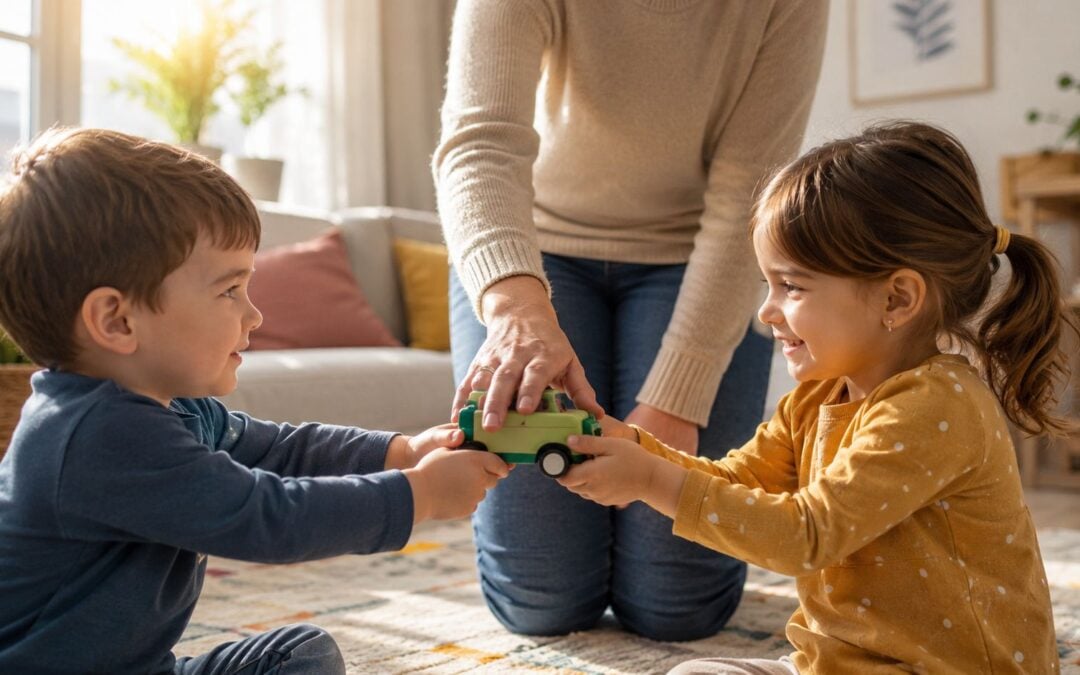
One child is yelling that the blue cup was theirs first. The other is crying because someone “looked at me weird” after breakfast and then took the marker they wanted. A parent is trying to answer emails in the kitchen. A teacher sees the same two children arrive at school already irritated, then clash again during partner work. By 9:15 a.m., everyone feels worn out.
If you're living this, you're not doing anything wrong. Sibling conflict can feel constant, petty, loud, and extremely draining. It also confuses adults because the trigger often seems so small. A spoon. A seat. A turn. A glance.
But small triggers don't mean small meaning.
Children often practice their earliest and most intense social skills with siblings. They test fairness, power, belonging, frustration, and repair in the same relationship, over and over again. That's one reason these moments matter so much. They are not only problems to stop. They are also skills to teach. The same emotional habits children use with a brother or sister often show up later with classmates, teammates, and friends.
From Bickering to Breakthroughs Why Sibling Fights Matter
It starts with a cracker.
An older child grabs the last one. A younger sibling shouts, pushes, and runs to get an adult. The adult steps in, decides who was “right,” and for ten minutes the room quiets down. Then the next argument starts over a blanket, a game rule, or whose turn it is to sit by the window.
Most families know this rhythm. So do schools. Children don't leave home dynamics at the front door. They carry them into recess, small-group work, lunch tables, and hallway interactions.
Why do siblings fight so much, and why should educators care? Because the habits children build at home don't stay there. Large-scale studies of youth in the United States show that sibling fighting is extremely common and strongly linked to later conflict with peers. Researchers found that youth who reported fighting with a sibling were 2.5 times more likely to report fighting with peers, making these family interactions a primary training ground for social behavior, as summarized in this peer conflict and sibling fighting research review.
That finding matters for parents and schools alike. If a child regularly solves conflict with grabbing, blaming, mocking, or escalating, that pattern can spill into friendships and classroom life. If that same child learns to pause, name feelings, negotiate, and repair, those skills can travel too.
Sibling conflict is often the first social lab a child has. What they rehearse there can show up everywhere else.
That doesn't mean every argument is harmful. It means everyday conflict is worth noticing. A home argument over a game controller and a classroom argument over an ipad may look different on the surface, but the underlying skills are often the same. Turn-taking. Flexibility. Emotional regulation. Perspective-taking.
That is why many families and schools benefit from a shared SEL approach. When adults use common language around feelings, boundaries, and repair, children get repetition where it matters most. If you'd like a bigger picture on how these skills support children across settings, this overview of the benefits of social-emotional learning is a helpful companion.
The Hidden Reasons Behind Sibling Rivalry
A fight about a sock is usually not about a sock.
Children fight over objects, space, and turns. But under those surface triggers, there are deeper needs at work. When adults understand those needs, responses get calmer and more effective.
Attention feels like a limited resource
One of the strongest drivers of sibling conflict is perceived fairness. Children notice who got help first, who stayed up later, who got praised, who got corrected more gently, and who seems to have easier access to a parent's attention.
Observational studies in family-conflict literature report that siblings engage in conflict or fight-like interaction about eight times per hour. These clashes are often driven by a core motivation for identity differentiation and competition for parental attention and perceived fairness, which helps explain why fights erupt over seemingly trivial issues, according to this discussion of common sibling conflict patterns.
A practical example: a younger brother keeps poking his older sister while she does homework. The issue may look like “annoying behavior.” But the deeper message might be, “Everyone sees her as the responsible one, and I need someone to notice me too.”
Children are trying to become themselves
Siblings don't only compete. They also separate. A quiet child may become even quieter next to a loud sibling. A highly verbal child may dominate family conversations. One child becomes “the sporty one.” Another becomes “the creative one.”
This is part of identity formation. Children are constantly asking, “Who am I in this family?” Sometimes conflict grows when siblings feel too similar. Other times it grows when one child feels overshadowed.
A classroom version looks familiar too. Two sisters may arrive with tension because one is always called “the helpful one” and the other is “the emotional one.” In school, those labels can keep shaping behavior unless adults help children step out of them.
A useful reframe: children are not only fighting against each other. They are often fighting for a clear sense of self.
Temperament and stress change the temperature
Some children are intense, sensitive, impulsive, or slow to shift gears. Others are easygoing until they're hungry or tired. Add a family transition like a move, a new baby, a divorce, or a schedule change, and the whole sibling system can get pricklier.
That is one reason “treat them exactly the same” rarely works. Different children need different supports. Some need more transition warnings. Some need more quiet. Some need direct coaching in how to enter play without taking over.
Children don't arrive knowing how to share space, negotiate rules, or recover after frustration. Siblings give them frequent practice. Messy practice, but practice all the same.
That is why the best adult question often isn't “How do I stop this forever?” It is “What skill is missing right now?”
Sometimes the missing skill is waiting. Sometimes it's using words. Sometimes it's recognizing that “unfair” and “different” are not always the same thing.
How Sibling Conflict Changes with Age
A toddler's sibling fight doesn't mean the same thing as a teenager's sibling fight. The behavior changes because the developmental task changes. When adults know what children are working on at each stage, their expectations get more realistic.
Toddlers and preschoolers
Young children often fight with their bodies before they can fight with words. They grab, push, scream, and cling to objects because they are still learning impulse control, ownership, and waiting.
A two-year-old may hit because “I want it” is stronger than “I can wait.” A four-year-old may melt down because fairness still feels very concrete. If one child got the red plate, the other may experience that as a major loss.
Example: Two preschool siblings both want to press the microwave button. The conflict isn't only about the button. It's about agency, turn-taking, and the need to feel included.
Elementary-age children
School-age children become more verbal and more rule-focused. Their conflicts often center on cheating, teasing, bossiness, exclusion, and whose turn it really is.
At this age, children are developing a stronger sense of justice, but they often define justice in rigid ways. They may also use sharper language. Instead of pushing, they might say, “You never let me choose,” or “Mom likes you better.”
A school example: two brothers argue during a board game in aftercare because one changes the rules halfway through. The adult hears “They always fight.” But the more accurate reading is, “They need help with flexible thinking, frustration tolerance, and fair process.”
Children often need different coaching as they grow. The goal isn't identical treatment. It's developmentally matched support.
Tweens and teens
Older children usually fight less over toys and more over respect, privacy, and unequal freedoms. One gets a later bedtime. One gets more screen access. One has more chores. One is allowed to walk somewhere alone.
These conflicts can sound more mature, but they still carry strong emotion. Teens may use sarcasm, withdrawal, exclusion, or status games instead of obvious bickering. Adults can miss the intensity because the conflict looks quieter.
Example: A middle schooler slams the bedroom door because a younger sibling barged in and touched their sketchbook. The underlying issue is boundary violation and the growing need for private identity space.
At school, the same child may react strongly if a peer invades personal space or comments on their work without permission. Home and school remain linked.
When and How to Intervene in a Sibling Fight
Adults often ask one question in the middle of chaos: “Should I step in right now?” A simple stoplight model can help.
Not every disagreement needs a referee. Some need a coach. Some need immediate protection.
Green light means stay nearby, but don't rush in
Green-light conflict is balanced and low-stakes. Both children are upset, but neither is unsafe. They are arguing over a game rule, a seat, or whose turn comes next. Voices may be loud, but there is still give-and-take.
In these moments, adults can pause before stepping in.
Observe first: Are both children participating fairly evenly?
Listen for skill use: Are they trying words, even if clumsily?
Hold the boundary: No hitting, threats, or humiliation.
A teacher version might sound like, “I hear two people who both want the same marker. I'm staying close while you work it out.”
Yellow light means coach the process
Yellow-light conflict is escalating. Voices sharpen. Bodies get closer. One child looks flooded. You sense that pushing, name-calling, or tears are close.
This is the moment to scaffold.
Try a short script:
Pause the action: “Stop. Both of you take one step back.”
Name what you see: “You both want control of the same thing.”
Prompt skillful language: “Tell your sibling what you need without blame.”
Offer limited choices: “Do you want to take turns, trade, or set a timer?”
A home example: two children are fighting over shower order. A parent says, “I'm not deciding who deserves it more. I'm helping you solve it. What are two fair options?”
Red light means intervene directly
Red-light conflict requires immediate adult action. Most parenting resources do not provide clear, age-specific markers to help caregivers differentiate healthy disagreement from harmful relationships. Clinical guidance emphasizes that true bullying involves a power differential and one-sided control, not the balanced give-and-take of a typical sibling dispute, as discussed in this clinical conversation on sibling bullying versus normal conflict.
Power imbalance: one child consistently dominates, the other consistently fears
One-sided control: one child can't exit or disagree safely
Safety comes first: if one child is afraid, overwhelmed, or being controlled, it is no longer a simple sibling spat.
In red-light moments, separate first. Process later. Adults can say, “I'm stopping this because it is not safe,” rather than “Who started it?” That shift matters. It keeps the focus on protection and skill-building, not courtroom logic.
5 Practical SEL Strategies to Teach Conflict Resolution
Children need more than reminders to “be nice.” They need repeatable tools they can use when annoyed, jealous, bored, disappointed, or left out.
1. Teach I-feel statements that children can actually say
Skip overly formal scripts. Give children short, usable sentence stems.
Try:
“I feel left out when…”
“I don't like it when…”
“I want a turn when you're done.”
“Please ask before you take my things.”
A second grader probably won't say, “I feel dysregulated by your behavior.” But they can say, “I feel mad when you grab.”
At school, a counselor can role-play this with peers. At home, a parent can coach it during snack time. The wording should match in both places.
2. Create a calm-down spot that is not a punishment
A Peace Corner works best when children use it to regulate, not as a place they get sent in shame. Keep it simple. Pillows, paper, crayons, feeling cards, a timer, or a breathing prompt are enough.
A practical example: after a shouting match, instead of demanding immediate apologies, an adult says, “Your bodies need to calm first. You can sit in the Peace Corner or on the porch chair. When you're ready, we'll solve it.”
This is also where a common home-school language helps. If a child already uses a calm-down space in class, they understand the routine faster at home.
3. Hold short family or classroom problem-solving meetings
Many sibling fights are predictable. The same argument happens every afternoon, every bedtime, every Saturday morning.
Use a standing meeting to solve recurring friction before the next explosion.
Start with one issue: “We keep fighting about the bathroom.”
Invite each child to speak: one minute each, no interruption
List possible solutions: even silly ones at first
Choose one plan to test
Review later: keep, tweak, or replace
A classroom version could address table supplies. A family version could address getting into the car. The process matters as much as the outcome.
Some conflicts don't need deeper emotional processing first. They need a plan.
Research suggests that structured routines and shared schedules can reduce repeat sibling conflicts by up to 40%. When children know exactly when they will have access to a desired item or activity, it reduces the need to argue in the moment, according to this guidance on using schedules to reduce sibling conflict.
That can look like:
A screen-time chart: each child sees their turn in writing
A bathroom order plan: posted for school mornings
A homework table routine: one child starts at the kitchen table, another starts at the desk
A classroom materials system: students sign up for shared art tools or devices
This is not over-structuring. It is removing ambiguity where ambiguity keeps causing fights.
A problem-solving wheel helps children generate options instead of waiting for adults to judge and decide. You can make one with words or pictures.
Include choices such as:
Take turns
Trade
Ask for help
Use a timer
Do it together
Take a break
Pick something else
A parent might point to the wheel and ask, “Which two choices could work here?” A teacher might say, “Try one wheel option before you ask me to solve it.”
A school-based program can support this too. Soul Shoppe offers SEL programming that teaches students shared tools for self-regulation, communication, and conflict resolution, which can help children carry the same language between classroom and home.
A quick demonstration can help adults picture the tone and pacing of these conversations:
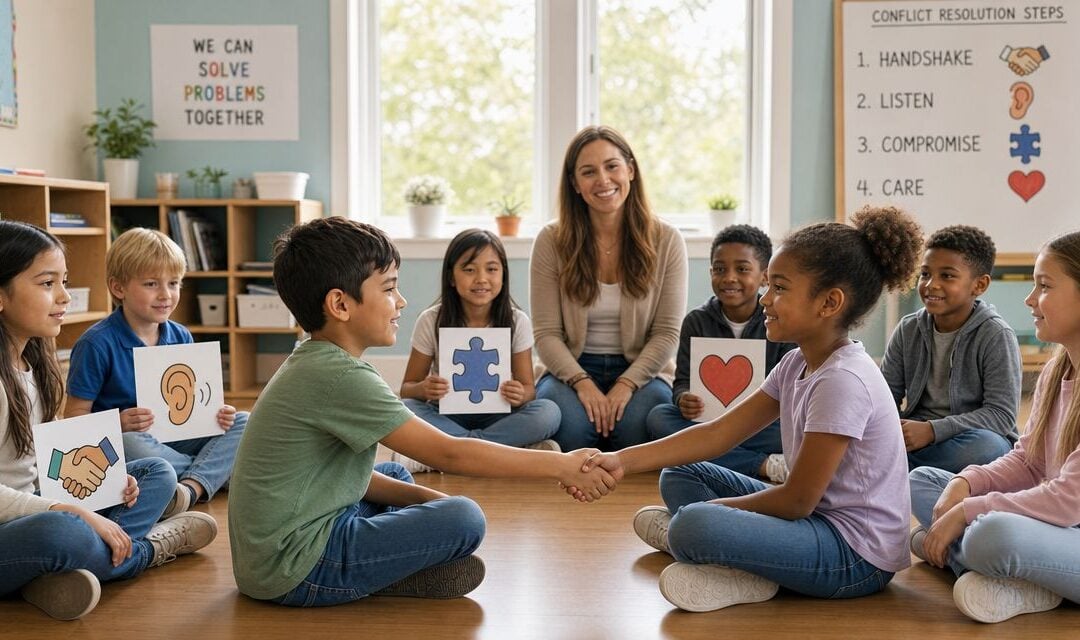
Step 5 puts it in writing
Many schools end with a simple written agreement. The language should be concrete, brief, and realistic.
Good agreement language sounds like this:
Weak agreement
Stronger agreement
“We'll be nicer.”
“We will use kind words during group work and ask before joining the game.”
“We won't fight.”
“If we get upset, we'll ask for a break and talk after lunch.”
Step 6 includes follow-up
A short check-in later helps everyone see whether the agreement is working. This doesn't need to be dramatic. It can be a quick conversation with the coordinator, teacher, or mediators.
Follow-up sends a powerful message to students. Repair isn't just a one-time performance. It's something the school community takes seriously.
Key Roles in Peer Mediation
People sometimes picture peer mediation as students running a meeting with no adult structure. That's not what effective programs look like. Good mediation is student-led and adult-supported, with each person holding a clear role.
The student mediators
Student mediators guide the conversation. They don't investigate, punish, rescue, or lecture. Their main job is to keep the process respectful and moving.
You'll often hear language like:
“Tell us what happened from your point of view.”
“Let's make sure each person gets a turn.”
“What do you need going forward?”
A strong mediator listens for the feelings under the complaint. If one student says, “He always leaves me out,” the mediator might reflect, “It sounds like you felt excluded.”
That small move can change the whole tone of the session.
The students in conflict
The disputants do the hardest part of the work. They have to tell the truth as they experienced it, listen to something they may not like hearing, and take part in creating a next step.
A classroom example makes this concrete. Two middle elementary students are upset after one posted an unkind comment in a shared online space for homework. In mediation, one says, “I was joking.” The other says, “I felt humiliated because other kids saw it.” The process gives both students a chance to move beyond defense and toward accountability.
Helpful coaching for disputants includes:
Use “I” language: “I felt left out” lands better than “You always ruin everything.”
Stay specific: “During science group” is easier to solve than “You do this all the time.”
Ask for something doable: “Please don't talk about me in the lunch line” is clearer than “Be a better person.”
The students in conflict are not passive recipients of a solution. They are the authors of it.
The adult coordinator
Adults make the program safe and sustainable. They train mediators, review referrals, decide which cases fit, and provide backup when students need support.
The adult role should stay mostly in the background during an appropriate mediation. That restraint can be hard for educators, especially when we're used to solving problems quickly. But stepping back is part of what gives students room to practice.
An adult coordinator might:
Adult responsibility
What it looks like
Screening referrals
Deciding whether the issue is appropriate for mediation
Training students
Practicing listening, neutrality, and agreement-writing
Supervising sessions
Staying available without taking over
Following up
Checking whether agreements are being honored
When these roles stay clear, students gain confidence and adults keep the guardrails in place.
How Peer Mediation Builds SEL Skills
Peer mediation is often discussed as a behavior support. That's true, but it's only part of the picture. It's also a practical, repeated way to teach social-emotional skills in real time.
Students practice empathy, not just hear about it
A child develops empathy when they must sit still long enough to hear how their actions affected someone else. That doesn't mean they instantly agree with every detail. It means they practice understanding another perspective.
Self-awareness grows at the same time. A student starts to notice, “When I feel embarrassed, I lash out,” or “When I think I'm being excluded, I interrupt.”
Communication becomes more usable
Students in mediation learn to speak with more precision. Instead of global statements like “Nobody likes me,” they're coached toward language that can be understood and addressed.
Problem-solving grows too. Students move from blame to options. They consider what each person can do tomorrow, not just what they wish had happened yesterday.
Here's a simple way to see the SEL connection:
Empathy: Listening to another student's experience
Self-management: Pausing before reacting
Communication: Speaking openly without attacking
Responsible decision-making: Choosing a realistic agreement
The research points to meaningful outcomes
In a meta-analytic review, researchers found a 93% agreement rate across 4,028 mediations and an 88% satisfaction rate across 4,739 mediations, suggesting that school peer mediation often ends with a mutually accepted agreement rather than an adult-imposed one, as reported in this review of peer mediation outcomes in education.
Those numbers matter because satisfaction and agreement are closely tied to student buy-in. When students feel heard and help shape the outcome, they're more likely to see the process as fair.
A child may forget the exact words used in a mediation session. They're less likely to forget the experience of being listened to and being expected to listen in return.
This is why peer mediation belongs in SEL conversations. It doesn't just talk about skills. It gives students a place to use them while the stakes are real, but still manageable.
Implementing a Program in Your School
Starting a peer mediation program doesn't require a perfect campus or a giant initiative. It requires clarity, consistency, and adults who agree on what the program is for.
A practical starting point is this: define which conflicts belong in mediation, decide who screens referrals, train a small group of students well, and build a routine people can trust. If the process feels mysterious, staff won't refer students. If it feels loose, families won't trust it.
For schools that want a broader communication plan when introducing a new initiative to families or community partners, this comprehensive resource for event PR can help shape a clear rollout message without overcomplicating it.
Start small and train carefully
Choose student mediators based on readiness, not popularity. Look for students who can listen, stay calm, and keep confidence. They don't need to be perfect. They do need coaching.
Training usually includes role-play, listening practice, how to ask neutral questions, and how to end with a clear agreement. Some schools build this internally. Others use outside support. For example, Soul Shoppe offers a peer mediation program and Peacemaker Trainer Certification that schools can use as one structured option for training adults and students.
Build a simple referral path
Teachers need to know exactly what to do when a conflict is a fit for mediation. A referral process can be as straightforward as a short form, a counselor check-in, or a designated time during the week.
Use plain language with staff:
Refer minor peer conflicts
Do not refer safety concerns
Check willingness first
Route all cases through the coordinator
Schools doing this work often pair peer mediation with wider conflict resolution for schools so staff and students share common language.
Plan for age differences
A second grader and a seventh grader can both use mediation, but the format won't look identical.
Aspect
Grades K-3
Grades 4-8
Language
Short sentences, concrete prompts, visual supports
More detailed reflection and student-generated language
Session length
Brief, focused, often with more redirection
Longer conversations with greater student stamina
Common issues
Turn-taking, game disputes, line conflicts, exclusion
Rumors, group chats, friendship shifts, collaborative work conflicts
Mediator support
More adult proximity and coaching
More student autonomy with adult backup
Agreement style
Simple verbal or picture-supported plan
Written agreement with specific next steps
Get staff and families on the same page
Teachers need to know that mediation is not “being soft.” Parents need to know that it's not replacing adult responsibility. It's a structured response for the right kind of conflict.
A few practical moves help:
Share the boundaries early: Explain what mediation is for and what it isn't.
Use common scripts: Give teachers language they can use when offering mediation.
Protect space and privacy: Choose a quiet area where students can speak without an audience.
Review the program regularly: Adults should look at referrals, agreements, and common challenges.
Schools don't need a flashy launch. They need a dependable one.
When Peer Mediation Is Not the Answer
This is the part many guides skip, and it's one of the most important. Peer mediation is not for every conflict.
A public school district description of the process notes that peer mediation is generally designed for minor conflicts, is voluntary, and is typically screened through an intake process. Cases are reviewed for appropriateness, and the program is most commonly used for rumors, friendship conflict, and minor bullying, rather than serious safety issues, coercion, or threats, as outlined in this district peer mediation guidance.
Cases that need adult-led action
If there is a strong power imbalance, ongoing intimidation, harassment, threats, or fear, mediation is the wrong tool. A child cannot negotiate freely when they don't feel safe.
That includes situations such as:
Threats of harm: Any statement or behavior suggesting danger
Coercion: One student pressuring another through fear or control
Serious bullying: Repeated targeted harm with a power imbalance
Harassment or discrimination: Incidents that require formal adult response
Physical aggression: Fights or assault-related concerns
A useful screening question
Ask this before scheduling mediation: Can both students participate freely, safely, and voluntarily?
If the answer is no, stop there. The student needs protection, investigation, discipline, counseling support, or another adult-led intervention.
Responsible schools don't use peer mediation to avoid hard adult decisions. They use it when the situation fits.
That boundary strengthens a program. It tells staff and families that mediation is a skilled response for the right cases, not a catch-all solution.
Conclusion Building a More Peaceful School
Peer mediation gives schools a practical way to teach conflict resolution through experience, not just advice. When students learn to listen, speak openly, and build their own agreements, they don't just settle one argument. They develop habits that support empathy, accountability, and healthier relationships across the school day.
For teachers, parents, and school leaders asking what is peer mediation, the simplest answer is this: it's a structured way for kids to solve the right kinds of conflicts with support, dignity, and clear boundaries.
If your school wants help building student conflict-resolution skills in a structured, age-appropriate way, Soul Shoppe offers SEL programs, peer mediation support, and educator training designed to help school communities create more connection, safety, and empathy.
A disagreement over a single red crayon. A tense moment on the kickball field. A friendship strained by a misunderstanding. Conflict is part of growing up, and in a school or home with children, it can show up before you've even finished your coffee.
The good news is that conflict doesn't have to turn into blame, shutdown, or punishment. Handled well, it becomes a teaching moment. Children learn how to name feelings, listen, repair harm, and stay connected even when they disagree.
If you've been asking what are some conflict resolution strategies that work with K through 8 students, the most helpful answer isn't one trick. It's a set of teachable methods. Strong conflict work usually relies on collaboration rather than positional winning, and professional surveys summarized by Niagara Institute found that collaborating is the most commonly used style among professionals at 59.8%, followed by compromising at 24.4% in workplace settings (Niagara Institute workplace conflict statistics).
That matters for kids too. The same habits that help adults resolve conflict also help students. Listen first. Focus on needs, not just demands. Look for a solution both people can live with. Below are eight practical strategies, each with simple examples, age-based adaptations, and scripts you can use in classrooms, counseling offices, cafeterias, and at home.
1. Collaborative Problem-Solving
When two children are stuck, adults often rush to decide who's right. Collaborative Problem-Solving works better when the issue is a true peer conflict and both students are calm enough to participate. Instead of picking a winner, you help them identify concerns on both sides and build a solution together.
This approach fits school life because students usually have to keep learning and living alongside each other. They sit in the same classroom, line up for the same specials, and often see each other again at recess. A forced apology may end the moment, but it rarely solves the problem underneath.
A simple classroom protocol
Try this sequence with elementary and middle school students:
Name the problem: “You both want the same ball at recess.”
Hear each side: “Tell me what happened from your point of view.”
Identify the need: “So you wanted a turn, and you wanted the game to keep going.”
Brainstorm options: “What are three ways this could work?”
Check for buy-in: “Can both of you agree to try that today?”
A lot of adult success in conflict resolution comes from separating people from the problem and focusing on interests rather than positions. That's also a strong fit for children. “I need the marker because I'm still working” is different from “It's mine.”
Practical rule: Validate first, solve second. A child who feels unheard usually argues harder.
For younger students, keep the language concrete. “What happened?” “How did you feel?” “What do you need now?” For older students, you can add reflection: “What part of this felt unfair to you?”
At home, this may sound like: “You both want the front seat. I'm not deciding yet. First tell me what matters to each of you.” In a classroom, a teacher might use a partner talk format and then jot possible solutions on a sticky note.
If you want a hands-on routine students can practice before real conflict hits, this problem-solving activity for students can help build the habit.
Sample script
“I'm not here to decide who wins. I'm here to help us figure out what each person needs. Then we'll find a plan you can both try.”
That one sentence changes the tone immediately.
2. Restorative Practices
Some conflicts aren't just disagreements. Someone was embarrassed, excluded, shoved, or mocked. In those moments, the goal isn't only to stop the behavior. It's to repair harm and rebuild trust.
Restorative practices give students a way to answer questions that punishment alone can't address. What happened? Who was affected? What needs to be done to make things as right as possible? That shift matters in classrooms because children need accountability and belonging at the same time.
A restorative conversation after a lunchtime incident might include the student who caused harm, the student who was hurt, and a trained adult. The adult keeps the structure steady and calm. Everyone gets a turn without interruption.
Questions that repair instead of inflame
A restorative exchange often sounds like this:
For the student who caused harm: “What were you thinking at the time?” “Who was affected by what happened?”
For the student who was harmed: “What was that like for you?” “What do you need now?”
For both students: “What agreement will help repair this?”
This works well in class meetings too. A quick community circle can address a pattern such as rude joking, exclusion during group work, or conflict over game rules.
When schools want to build a broader system, they often pair circles with staff training, shared language, and referral routines. This overview of restorative justice in schools gives a good school-based picture of how that looks.
One caution matters here. Not every conflict belongs in peer dialogue. Federal civil rights guidance also reminds schools that harassment, bullying, discrimination, repeated aggression, and power-imbalance situations may require documentation, reporting, separation, counseling support, or administrative action rather than informal mediation alone (Harvard Program on Negotiation article referencing school conflict strategy and escalation concerns).
Repair is not the same as minimizing. Students can be held accountable and still be treated with dignity.
A short video can help adults picture the tone and pacing of this work in practice.
Implementation Tips for Educators and Parents
To use role-playing effectively, focus on creating a supportive atmosphere and structured reflection.
Start with Low-Stakes Scenarios: Begin with simple situations, like asking to join a game or disagreeing politely about what to play. For example, a scenario could be: “Two friends both want to use the same swing. How can they solve this problem?” This builds confidence before tackling more sensitive topics like peer pressure or exclusion.
Establish a Safe Space: Clearly state that this is a practice space and there are no “wrong” answers, only learning opportunities. Avoid casting students in roles that mirror their real-life conflicts.
Rotate Roles: Ensure every participant has the chance to play different roles within a scenario. For example, in a scenario about teasing, a student might first play the person being teased, then the teaser, and finally a bystander who steps in. This deepens their understanding by allowing them to experience the situation from multiple viewpoints.
Structure the Debrief: After each role-play, lead a structured discussion. Use reflection questions like, “How did it feel to be in that role?” or “What is one thing you might do differently next time?” to guide the conversation.
Use Observation Guides: Give students who are not actively participating a task, such as watching for specific body language or listening for “I-statements.” This keeps the entire group engaged and focused on the learning objective.
This hands-on practice is vital for building social competence. To explore this topic further, discover these perspective-taking activities that can enhance students’ ability to understand others.
3. Non-Violent Communication (NVC) Training
Non-Violent Communication (NVC) is a powerful framework that transforms how students express themselves and understand others. Developed by Marshall Rosenberg, this communication skill activity teaches participants to move beyond blame and judgment, focusing instead on a four-step process: Observation, Feelings, Needs, and Requests (OFNR). Students learn to state what they see without evaluation, identify their emotions, connect those feelings to universal human needs, and make clear, positive requests.
This approach is transformative because it shifts the focus from winning an argument to fostering connection and mutual understanding. By giving students a concrete structure to navigate difficult conversations, NVC de-escalates conflict and builds empathy. Instead of reacting with anger or defensiveness, students learn to express their authentic experience and listen to the needs of others, creating a foundation for restorative solutions and stronger relationships.
Why It Works
NVC provides a shared, compassionate language that reframes conflict as an opportunity for growth. It directly addresses the root causes of misunderstandings-unmet needs-rather than just the surface-level behaviors. For students, this builds sophisticated emotional intelligence, self-advocacy, and conflict resolution skills. The OFNR framework helps them untangle complex emotions and articulate them constructively, which is a cornerstone of social-emotional wellness and a key element in effective anti-bullying strategies.
Implementation Tips for Educators and Parents
Successfully integrating NVC requires modeling and consistent practice.
Introduce Components Sequentially: Don’t teach all four steps at once. Spend a week on each component: first, practice making pure observations (“I see…”) versus judgments (“You always…”). For example, instead of “You are being messy,” practice saying, “I see your coat and backpack are on the floor.” Then, build an emotional vocabulary using a feelings wheel before connecting feelings to needs.
Use Sentence Stems: Provide clear scaffolds to guide students. Post a visual chart with the stems: “When I see/hear… I feel… because I need… Would you be willing to…?“
Practice with Low-Stakes Scenarios: Start with simple, non-conflict situations. For example, a student could practice: “When I see a new art project is announced (Observation), I feel excited (Feeling) because I need creativity (Need). Would you be willing to tell me what supplies we’ll use (Request)?” A parent might use this at home: “When I see your wet towel on the bed (Observation), I feel frustrated (Feeling) because I need our space to be tidy (Need). Would you be willing to hang it up in the bathroom (Request)?”
Model NVC Language: Adults should explicitly use the OFNR framework in their interactions. A teacher might say, “When I hear talking while I’m giving instructions, I feel frustrated because I need respect and for everyone to be safe. Would you be willing to listen quietly until I’m finished?”
Create Visual Aids: Design posters that break down the four steps with examples and list common feelings and needs. This gives students a reference point during challenging moments.
4. I-Messages and Assertive Communication Workshops
I-Messages and Assertive Communication Workshops are a foundational communication skill activity that teaches students to express their feelings and needs clearly without blaming or accusing others. The core of this practice is shifting from accusatory “You” statements (e.g., “You never listen to me!”) to ownership-based “I” statements (e.g., “I feel frustrated when I’m interrupted because I lose my train of thought”). This simple linguistic change is transformative, reducing defensiveness and opening the door for constructive dialogue.
This activity is crucial for conflict resolution and self-advocacy. By learning to articulate their own experience, students develop assertiveness, the healthy middle ground between passivity and aggression. They learn to set boundaries and make requests respectfully, empowering them to navigate social challenges in the classroom, on the playground, and at home.
Why It Works
This method, popularized by psychologist Thomas Gordon, directly addresses the root of many conflicts: perceived attacks. A “You” statement often feels like a criticism, prompting the listener to shut down or fight back. An “I” message, however, is an undeniable expression of personal feeling, making it much easier for the other person to hear and empathize. For students, this builds emotional intelligence by connecting feelings to specific events and encouraging them to take responsibility for their emotional responses.
Implementation Tips for Educators and Parents
To successfully implement this communication skill activity, focus on scaffolding, practice, and real-world application.
Introduce the Formula: Teach a simple structure for I-Messages, such as “I feel [emotion] when you [specific behavior] because [reason/impact].” Post sentence stems on a classroom wall for easy reference.
Differentiate Communication Styles: Explicitly teach the difference between passive (avoiding conflict), aggressive (blaming or threatening), and assertive (clear, respectful, honest) communication. Use role-playing to demonstrate each style. For example: “Someone cuts in front of you in line.” A passive response is saying nothing. An aggressive response is yelling, “Hey, get out of my spot!” An assertive response is saying, “I feel frustrated when you cut in line because I was waiting my turn.”
Start with Low-Stakes Scenarios: Begin practice with non-threatening situations. For example, have a student practice saying, “I feel left out when a game starts without me because I wanted to play too,” before tackling more intense peer conflicts.
Focus on Non-Verbal Cues: Remind students that assertive communication involves more than words. Practice maintaining a calm tone of voice, making eye contact, and using confident but relaxed posture.
Connect to Home: Encourage parents to practice I-Messages with their children. A simple family activity could be sharing one “I feel…” statement about their day at the dinner table, normalizing the practice. For instance, a child might say, “I felt proud when I finished my math homework because it was really hard.”
Building this skill helps students advocate for themselves effectively and respectfully. For a deeper look into this powerful tool, explore the magic of I feel statements for kids and how they can transform disagreements.
5. Fishbowl Discussion and Observation Technique
The Fishbowl Discussion and Observation Technique is a dynamic group communication skill activity where a small group of students sits in an inner circle (the “fishbowl”) to discuss a topic. The rest of the class sits in an outer circle as observers, paying close attention to the communication patterns, dialogue quality, and non-verbal cues within the inner group. This method sharpens both speaking and observation skills simultaneously.
This activity is powerful because it encourages meta-cognition about social interactions. Observers are not passive; they are active listeners tasked with analyzing the conversation’s flow. This provides a structured way for students to learn from their peers, identify effective communication strategies in real-time, and understand group dynamics from an outside perspective before rotating into the discussion themselves.
Why It Works
This technique, popular in cooperative learning, separates the acts of speaking and analyzing, allowing students to focus on one skill at a time. The inner circle practices articulating ideas and building on others’ points, while the outer circle develops critical observation and listening skills. It makes the invisible elements of a conversation, like interruptions, active listening, and turn-taking, visible and discussable. The structure naturally builds accountability for both respectful dialogue and thoughtful observation.
Implementation Tips for Educators and Parents
To ensure a fishbowl discussion is productive and insightful, clear structure and focused observation are key.
Assign Specific Observation Roles: Give the outer circle a clear task. For example, have them use a worksheet to track: “Who asks clarifying questions?” or “Tally the number of times someone is interrupted versus the number of times someone builds on another’s idea.” Another example is having one observer track body language, noting when students lean in to listen or cross their arms.
Rotate Roles Regularly: Allow students in the outer circle to rotate into the “fishbowl” every 5-10 minutes. This can be done by having a few empty chairs in the inner circle that observers can move into when they have a point to add.
Model and Debrief the Process: Before starting, model what respectful observation looks like. Afterward, dedicate time to debriefing both the content of the discussion and the process of communication. Use prompts like, “What communication habits did you notice that helped the conversation move forward?”
Start with Engaging, Low-Stakes Topics: Begin with prompts like, “Should students have more say in school rules?” or discussing a scene from a class novel. This allows students to practice the format before tackling more complex or sensitive subjects.
Adapt for Different Ages: For younger students (2-4), keep the inner circle small (3-4 students) and the observation task simple, like “Give a thumbs-up when you hear a kind word.” For older students (5-8), observers can analyze more complex dynamics, such as identifying evidence-based arguments versus opinion-based statements.
This structured activity transforms a standard classroom discussion into a rich learning experience about how we communicate.
6. Peer Mediation and Conflict Resolution Training
Peer Mediation and Conflict Resolution Training is a structured communication skill activity that empowers students to act as a neutral third parties, helping their peers resolve disagreements peacefully. This comprehensive program equips student mediators with tools like active listening, I-statements, empathy, and a step-by-step problem-solving process. Instead of adults intervening, students guide their classmates toward mutually acceptable solutions.
This activity is transformative because it shifts the school culture from punitive to restorative. It gives students ownership over their social environment and builds leadership capacity. When peers facilitate conflict resolution, it can feel less intimidating and more relatable for those involved, fostering genuine understanding and sustainable agreements.
Why It Works
Rooted in the principles of restorative justice and conflict resolution education (CRE), this approach teaches that conflict is a normal part of life and can be a catalyst for growth. It moves beyond simply stopping a negative behavior and focuses on repairing harm and relationships. Training students as mediators develops high-level emotional intelligence, critical thinking, and a profound sense of responsibility within the school community. This student-led model creates a ripple effect of positive communication.
Implementation Tips for Educators and Parents
A successful peer mediation program requires a strong framework and consistent support.
Recruit Diverse Mediators: Select a group of students who represent the diverse demographics of your school to ensure all students feel seen and understood.
Provide Robust Training: Initial training should be comprehensive (at least 8-16 hours) and followed by ongoing monthly coaching sessions to refine skills and debrief challenging cases. For example, training should include role-playing common conflicts, like a dispute over a game at recess or a misunderstanding in a group project.
Establish a Clear Process: Develop a clear referral system so teachers, staff, and students know how to request a mediation. Train the disputants on the process so they understand the ground rules and expectations. For instance, a teacher might fill out a simple form to refer two students who are arguing over a shared resource.
Create a Visible Presence: Designate a specific, quiet space for mediations and use bulletin boards or announcements to keep the program visible. This normalizes seeking help to resolve conflicts.
Define Escalation Protocols: Train mediators to recognize when a conflict is too serious for them to handle (e.g., involving bullying, safety concerns) and establish a clear protocol for escalating these issues to a trusted adult. A practical example is teaching mediators the phrase: “This sounds really important, and I think we need an adult’s help to solve this one.”
By teaching students how to navigate disagreements constructively, you provide them with invaluable life skills. To explore more foundational techniques, discover these conflict resolution strategies for kids that complement peer mediation training.
7. Mindfulness-Based Communication and Reflective Listening Practices
Mindfulness-Based Communication is an activity that integrates simple mindfulness techniques with reflective listening to help students communicate with greater presence and emotional regulation. This approach teaches students to pause and notice their internal state before speaking or reacting, especially in high-emotion situations. The core practice involves brief mindfulness exercises like focused breathing or body scans to create the calm and mental clarity needed for empathetic, effective communication.
This communication skill activity is transformative because it addresses the root of many communication breakdowns: emotional reactivity. By learning to ground themselves, students can move from a reactive, defensive state to a responsive, thoughtful one. This creates a foundation of self-awareness that allows them to listen more deeply and express themselves more clearly, turning potential conflicts into opportunities for understanding.
Why It Works
Popularized by thought leaders like Jon Kabat-Zinn and Thich Nhat Hanh, this method connects emotional regulation directly to communication quality. When a student is dysregulated, their capacity for empathy and problem-solving diminishes. Mindfulness provides the practical tools to manage that internal state. By practicing these techniques, students build the neural pathways for self-control and presence, which are essential for navigating complex social interactions at school and at home.
Implementation Tips for Educators and Parents
To successfully integrate mindfulness into communication practices, be consistent and start with simple, accessible exercises.
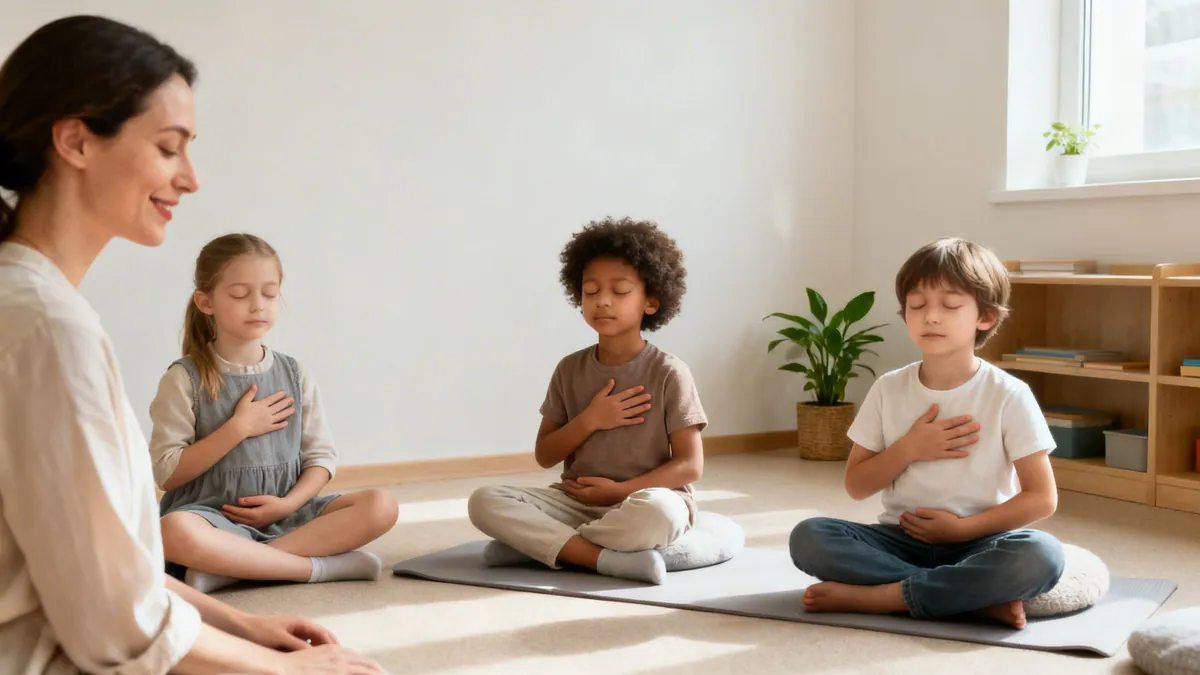
Anchor to Routines: Start class or family meetings with a one-minute breathing exercise. For example, have students place a hand on their belly and feel it rise and fall. This anchors the day in calm. A parent could do this before homework time by saying, “Let’s take three slow ‘balloon breaths’ together to get our minds ready.”
Create a Calm-Down Corner: Designate a space with mindfulness tools like breathing posters, grounding objects (a smooth stone, a soft blanket), and visual timers. Encourage its use before tackling a tough conversation.
Model the Practice: Genuinely practice mindfulness yourself. When you feel frustrated, say, “I’m feeling upset, so I am going to take three deep breaths before I respond.” This models the skill in a real-world context.
Use Simple Language: Use accessible prompts like, “Let’s find our ‘anchor spot’ where we feel our breath the most,” or “Notice your feet on the floor when you feel wobbly.”
Integrate into Conflict Resolution: Before peer mediations, guide students through a brief grounding exercise. Ask them to notice their body in the chair and take a slow breath. This prepares them to listen rather than just react.
This approach builds a powerful internal toolkit for communication. Soul Shoppe’s programs often weave these practices in to help students develop the self-awareness needed for building safer, more connected school communities.
8. Empathy Mapping and Perspective-Building Exercises
Empathy Mapping is a structured, visual communication skill activity that guides students to step into another person’s experience. Using a simple framework, participants consider what someone else might be seeing, hearing, thinking, and feeling in a particular situation. This powerful exercise moves beyond simple sympathy and cultivates genuine empathy by encouraging a deeper, more holistic understanding of different viewpoints.
This activity is essential for building inclusive and supportive communities. When students practice considering the perspectives of others, especially those with different backgrounds or abilities, they develop the cognitive and emotional skills needed to prevent misunderstandings, resolve conflicts, and counter bullying. It makes the abstract concept of empathy tangible and actionable.
Why It Works
Originating in design thinking and adapted for social-emotional learning, empathy mapping makes perspective-taking a concrete process. It requires students to look for clues and make informed inferences rather than simply guessing or projecting their own feelings. This structured approach helps decenter their own experience and build a more nuanced understanding of their peers, literary characters, or community members. The visual nature of the map helps students organize complex social information, making it accessible for diverse learners.
Implementation Tips for Educators and Parents
To use empathy maps effectively, focus on creating a clear structure and safe environment for exploration.
Use Visual Templates: Provide a simple worksheet divided into sections like Says, Thinks, Does, and Feels. This visual organizer guides students through the process and helps them capture their ideas.
Start with Fictional Characters: Begin by having students create an empathy map for a character in a book or a movie. This low-stakes starting point allows them to practice the skill without the social pressure of analyzing a real-life peer conflict. For example, map the perspective of a new student in a story before discussing a new student in your own class.
Ask Deepening Questions: Guide students beyond surface-level observations. Ask follow-up questions like, “Why might they feel that way?” or “What experiences might lead them to think that?” to encourage critical thinking.
Connect Maps to Action: After completing a map, ask students to consider what the person might need. Brainstorm supportive actions, turning empathy into a catalyst for kindness. For instance, after mapping the feelings of a student who was left out, the class could discuss, “What could we do to make sure everyone feels included at recess?“
Model the Process: Complete an empathy map together as a class or family. Choose a relatable scenario, such as a younger sibling’s frustration or a parent’s busy day, and model how to consider their perspective without judgment. For example: “Let’s make an empathy map for Grandma after she cooked a big holiday dinner. What was she feeling? (Tired, happy). What was she doing? (Washing dishes). What might she have been thinking? (I hope everyone enjoyed the meal).”
8-Activity Communication Skills Comparison
Method
Implementation complexity
Resource requirements
Expected outcomes
Ideal use cases
Key advantages
Active Listening Circles
Low–Medium: simple structure but needs facilitation skills
Literature study, DEI lessons, bullying prevention, mediation prep
Visual, concrete tool accessible to diverse learners; links empathy to action
From Practice to Progress: Weaving Communication Skills into Your School’s DNA
The journey from a noisy classroom to a connected community is paved with intentional practice. The eight powerful strategies detailed in this article, from Active Listening Circles to Empathy Mapping, are far more than isolated exercises. They are foundational tools designed to build a culture of understanding, respect, and emotional intelligence. Each communication skill activity serves as a vital thread in weaving a stronger, more resilient social fabric within your school or home.
Moving beyond the individual activity is where the real transformation begins. The ultimate goal is not to simply complete a worksheet or a role-play scenario but to integrate these practices into the very DNA of your daily interactions. Consistent application is the key to turning learned concepts into lived habits.
Synthesizing the Core Lessons: From Activities to Habits
Let’s distill the most critical takeaways from the activities we’ve explored. These are the principles that bridge the gap between a single lesson and a lasting cultural shift.
Listening is an Action: As demonstrated in Active Listening Circles and Mindfulness-Based Communication, true listening is not passive. It is an active, engaged process that requires full presence, empathy, and the suspension of judgment. The simple act of reflecting back what one hears can de-escalate conflict and validate feelings instantly.
Perspective is a Superpower: Activities like Role-Playing, Fishbowl Discussions, and Empathy Mapping all share a common, powerful goal: to help students step outside of their own experiences. When a child can genuinely consider, “How would I feel if that happened to me?” or “What might they be thinking?”, the foundation for compassion is built.
Language Shapes Reality: The shift from blaming “you-statements” to accountable “I-messages” is monumental. This principle, central to Non-Violent Communication and Assertive Communication workshops, empowers students to express their needs and feelings without attacking others, transforming potential conflicts into opportunities for mutual understanding.
Your Actionable Roadmap for Lasting Change
Transforming your school’s culture requires a strategic, tiered approach. It’s not about doing everything at once, but about starting with consistent, manageable steps. Here’s a practical plan for implementation:
Start with a Single Routine: Don’t try to introduce all eight activities in one week. Choose one to embed into a daily or weekly routine. For example, begin every Monday with a brief Active Listening Circle during your morning meeting. Consistency will build familiarity and skill far more effectively than sporadic, varied lessons.
Model, Model, Model: The most effective way to teach these skills is to live them. Use “I-messages” when addressing classroom challenges (“I feel concerned when the noise level gets too high because it’s hard for everyone to focus”). Acknowledge student perspectives, even in moments of correction (“I understand you’re feeling frustrated with the assignment. Let’s talk about the part that’s tricky.”).
Celebrate the Small Wins: Progress, not perfection, is the goal. When you overhear a student use an “I-message” on the playground or see a pair resolve a disagreement using peer mediation steps, acknowledge it. Public or private praise reinforces the value of these skills and encourages others. A simple, “I was so impressed with how you both listened to each other to solve that problem,” can be incredibly powerful.
By championing every communication skill activity as a stepping stone toward a larger vision, you are not just teaching lessons for a test. You are equipping your students with the essential tools for a lifetime of healthier, more meaningful, and more successful relationships, both inside the classroom and far beyond its walls.
Ready to take the next step in building a compassionate and connected school culture? Soul Shoppe provides dynamic programs, from engaging student assemblies to in-depth staff training, designed to embed these vital communication and empathy skills into your school’s core. Explore how our evidence-based approach can help you turn practice into profound and lasting progress at Soul Shoppe.
With the school year underway, it’s time to talk about conflict resolution for kids. The pandemic has made it difficult for children to engage with each other. Therefore, many have missed out on crucial opportunities to build and develop their skills for dealing with conflict.
Teaching kids about how to resolve difficult situations is important because it equips them with resilience and confidence.
Conflict Resolution For Kids
Conflict resolution education is the act of instilling problem-solving skills in children who are in a dispute. Teaching children about conflict helps them to identify problems. It also helps them choose the best solutions on their own.
A good place to start is demonstrating that problems start small and tend to grow. Teaching them to identify problems as soon as they take place makes it easier for kids to quickly overcome the obstacles they face.
Sometimes problems may go unnoticed in the early stages. This can lead to emotions becoming more intense. Therefore, it is important to teach children about their feelings. Having them identify their own emotions will also enable them to understand the emotions of others around them.
In cases where conflict has snowballed into a large problem, it is imperative that children understand responsibility as well as compromise. Knowing that conflict is a two-way street will encourage kids to act and will enable them to preserve their friendships when things go wrong. Practicing compromise will also help to resolve conflicts where children are not destined to be the best of friends. This will help create a peaceful environment and a productive learning space for everyone.
Occasionally two students will not be able to come to a satisfactory conclusion with their problem. There will be times, even though we want them to figure it out on their own, when adults have to step in and guide them further. Reassure your kids and students that they are able to talk to you about their problems.
Conflict Resolution Strategies in the Classroom
Students need to find strategies for resolving different forms of disagreement. Four major conflict resolution strategies identified by educators are: mediation, process curriculum, peaceable classrooms, and peaceable schools.
Mediation
Many schools use peer mediation programs to reduce conflict. Students have the opportunity to talk through conflicts with trained students or adult mediators. Mediation programs are put in place to reduce punishments such as suspension or detention. Learn about Soul Shoppe’s Peacemakers program.
Process Curriculum
Some schools dedicate an entire course to conflict resolution. This is called process curriculum. It introduces problem scenarios before a conflict ever arises.
Peaceable Classrooms
Peaceable classrooms integrate conflict resolution into the classroom daily through classroom management and daily tasks. This is not a separate curriculum but brings a lifestyle approach to teaching conflict resolution. This approach reinforces cooperation and the acceptance of diversity. It also teaches caring and effective communication.
Peaceable Schools
In peaceable schools, all three of the above approaches are implemented. Everyone in the school including teachers, students, and administrators work together to remain proactive about conflict.
These four conflict resolution strategies work together to reduce school absences, decrease referrals and suspensions while increasing self-confidence and self-respect among students.
Conflict Resolution Activities for Kids
Conflict resolution for kids can also be fun. Here are some easy activities to get kids thinking and learning about conflict resolution:
Brainstorm solutions to specific conflicts with your kids. Preparation will help them when any conflict arises. It will also help you gauge how much work you need to do to develop a child’s conflict resolution skills.
Fill a mason jar full of popsicle sticks with solutions to problems. When a child is finding it difficult to find a way to resolve their issues, they can take a stick from the jar and try that. Kids will learn to think on their feet and use the jar less over time.
Create stories individually or in groups. Ask the kids to think about a story that involves conflict and an ending with a solution. They can present the stories to the rest of the class or to their siblings if done at home.
Tip: Reward good conflict resolution by sending a letter home or by creating a gold-star chart.
Conflict Resolution Games for Kids
Gamifying a child’s learning is a good way to create a rewarding environment that will help to create a lasting impact. Here are some ideas you can use in the classroom or at home:
Role-playing is a fun way for children to safely engage in conflict situations. This can be done with each other or with an adult for more challenging conflict scenarios.
Create a simple game of pairs where children have to match the conflict to the solution.
Play problem-solving baseball. This game is great for more complex conflict situations. Start with the conflict and then work through each base until they reach the solution.
Conflict resolution for kids is imperative for social and emotional success. Soul Shoppe provides conflict resolution training for educators through our Peacemakers program. The Peacemakers program aims to create schools where children are empathetic and peace thrives.