Soul Shoppe's work is made possible by donors and partners who care deeply about the young people in their communities! We can't do this work without you. Support our work in classrooms and on playgrounds across the nation by donating here.
When you hear the term “school discipline,” what comes to mind? For many of us, it’s things like detention, suspension, or a trip to the principal’s office. This traditional approach focuses on rules and consequences. But what if we shifted the conversation from punishment to healing?
That’s the core idea behind restorative justice. Instead of asking, “What rule was broken and what’s the punishment?” it asks a fundamentally different set of questions: “Who was harmed? What do they need? And whose job is it to make things right?”
It’s a powerful shift that moves the goal from simply punishing misbehavior to actually repairing harm and rebuilding the relationships at the heart of a school community.
A New Way of Thinking About School Discipline
Think of traditional discipline as a one-way street. A student breaks a rule, a consequence is handed down, and that’s often the end of it. The problem is, this process rarely gets to the root cause of the behavior, and it does little to mend the broken trust between students or between students and staff.
Restorative justice, on the other hand, is more like a community roundabout. When a conflict happens, everyone involved has a chance to navigate a path forward together. The person who caused the harm, the person who was harmed, and even other affected community members all come into the circle. The goal isn’t just to assign blame but to foster understanding, healing, and true accountability.
This isn’t just another program; it’s a mindset that transforms school culture. By teaching empathy and connection, it creates a genuinely safer and more supportive place for everyone to learn and grow. You can dive deeper into how this works by exploring various restorative practices.
Moving Beyond Punishment
Let’s make this real. Imagine a student, Leo, scribbles all over another student’s, Maya’s, artwork.
A traditional response: The teacher sends Leo to the principal’s office, and he gets detention. Leo serves his time, but Maya is still upset about her ruined project, and the tension between them is left to fester. Nothing was really solved.
A restorative response: The teacher facilitates a conversation, maybe in a small circle. Leo has to face Maya and hears how his actions made her feel disrespected and sad. Maya gets to explain why her artwork was so important to her. Together, they decide that a good way for Leo to make it right would be to help her recreate the damaged part.
In the second scenario, Leo isn’t just “in trouble.” He’s confronting the real-world impact of his choices and taking direct responsibility for fixing the harm he caused. That’s what true accountability looks like in action.
The Focus Is on Relationships
At its heart, restorative justice recognizes a simple truth: conflict harms relationships, and those relationships must be at the center of any solution. It’s built on the understanding that strong communities are the foundation of a great school. When students feel seen, heard, and connected to one another, they are far better equipped to thrive, both academically and emotionally.
To help clarify the difference, let’s compare the two approaches side-by-side.
Traditional Discipline vs Restorative Justice at a Glance
Element
Traditional Discipline
Restorative Justice
Core Focus
Broken rules and assigning blame.
Harmed relationships and meeting needs.
Key Question
“What rule was broken and what is the punishment?”
“Who was harmed and what is needed to make things right?”
Accountability
Defined as accepting punishment.
Defined as understanding impact and repairing harm.
Outcomes
Often leads to isolation, resentment, and disconnection.
Fosters empathy, mutual understanding, and reintegration.
Communication
Top-down, authority-driven.
Dialogue-based, involving all affected parties.
Goal
Compliance and control.
Healing, learning, and community building.
As the table shows, the restorative path leads to a very different destination—one where students learn from their mistakes in a way that strengthens the entire school community.
This method creates a space for healing and accountability rather than division and punishment. It provides students with practical tools for self-regulation, communication, and conflict resolution that last a lifetime.
The Core Principles of Restorative Practices
To really get what restorative justice is all about in schools, you have to look past the textbook definition and dive into its foundations. These aren’t just abstract ideas; they’re the active ingredients that shift a school’s culture from punitive to healing. Think of them like the legs of a stool—if you take one away, the whole thing wobbles.
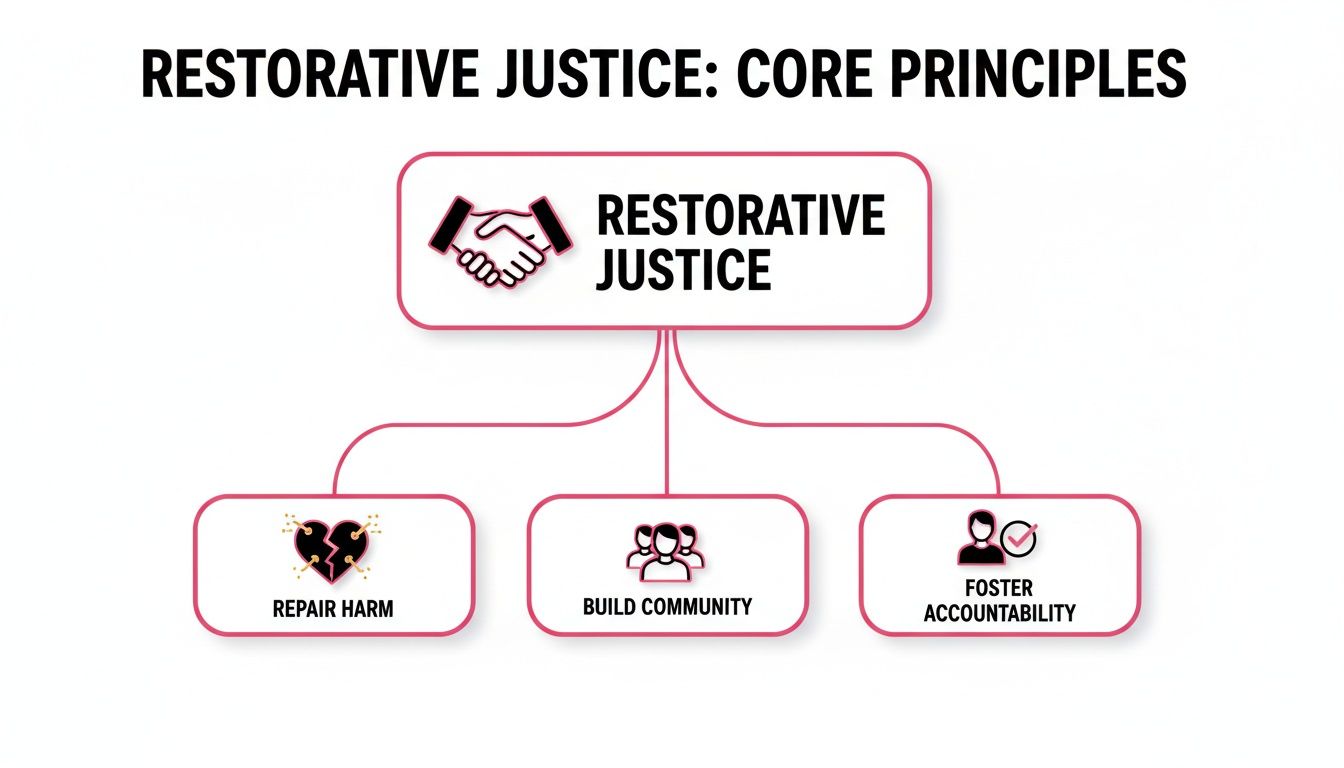
At its core, restorative justice is built on three interconnected principles. Each one moves the focus away from punishment and toward resolution, creating a stronger, more connected community along the way.
Repairing Harm
The first and most important principle is repairing harm. In a traditional system, when a rule gets broken, all eyes are on the rule-breaker. In a restorative model, the focus flips to the harm that was done and what the person who was hurt needs. Accountability isn’t about serving time in detention; it’s about actively taking steps to make things right.
This requires a student to directly acknowledge how their actions affected someone else. It pulls them out of a passive state of just accepting a consequence and into an active role of mending the tear they created in the community fabric.
Practical Example: Picture a fourth-grader, Alex, who gets frustrated during a group project and smashes a classmate’s carefully built model bridge.
Instead of an automatic timeout, the teacher helps them talk it out. The classmate shares how angry and disappointed she is that her hard work was destroyed.
Alex is then tasked with helping repair the damage. He spends his recess helping her find new materials and rebuild the bridge, piece by piece.
Through this, Alex doesn’t just “do his time.” He comes face-to-face with the results of his actions and helps fix the problem he made, learning a huge lesson about respect and responsibility.
Building Community
The second principle is building community. Restorative justice isn’t just a reactive plan for when things go south; it’s a proactive way to keep harm from happening in the first place. It’s based on the simple truth that conflict is far less likely in places where students feel safe, connected, and seen.
Strong relationships are the bedrock of a positive school climate. When students and teachers actually know and trust each other, they’re more likely to be vulnerable, work through disagreements respectfully, and cheer each other on. This sense of belonging is a massive piece of social-emotional wellness.
“Restorative practices create space for healing and accountability rather than division and punishment. They offer a way to make amends, rebuild trust, and strengthen relationships within the community.”
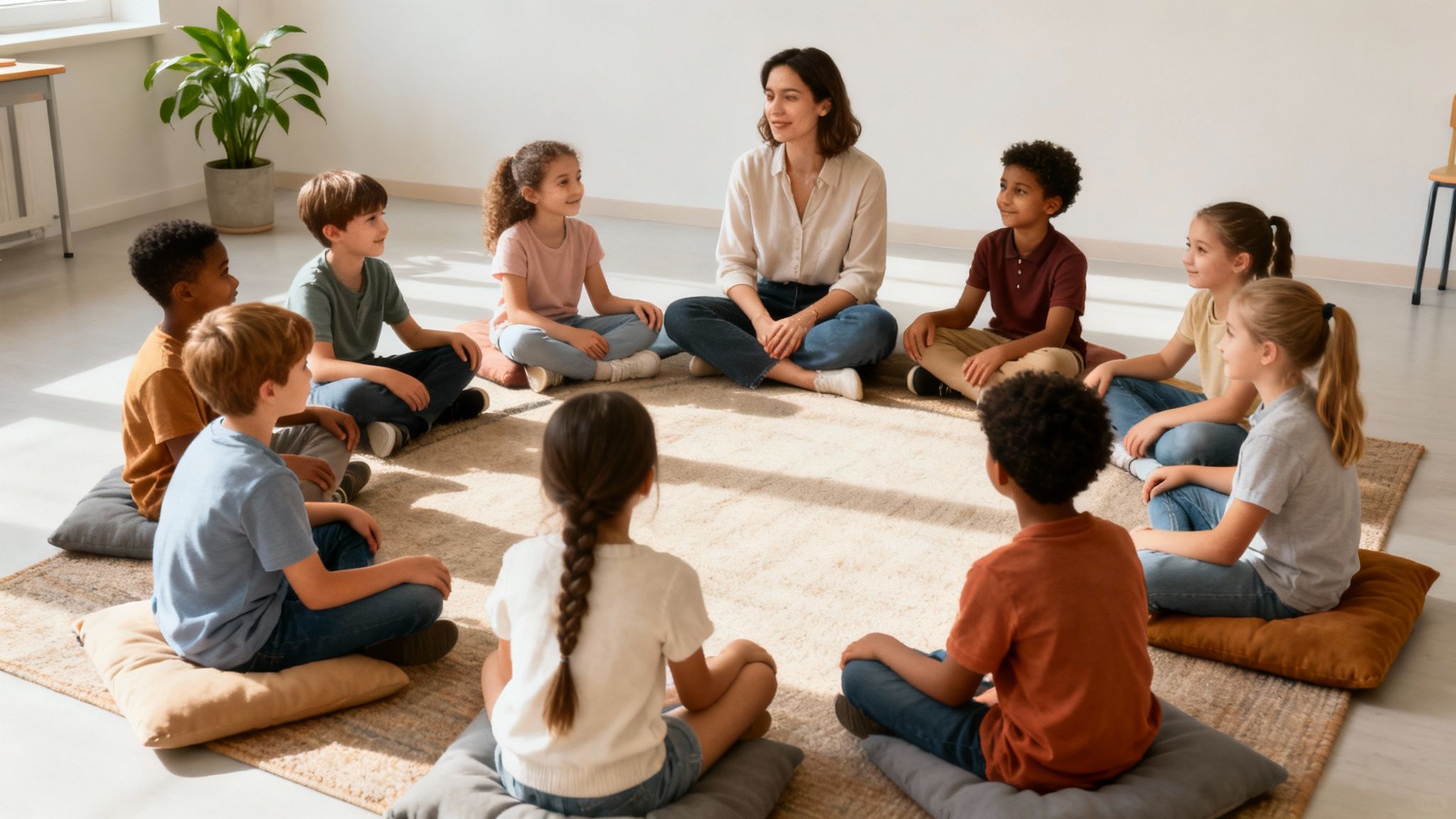
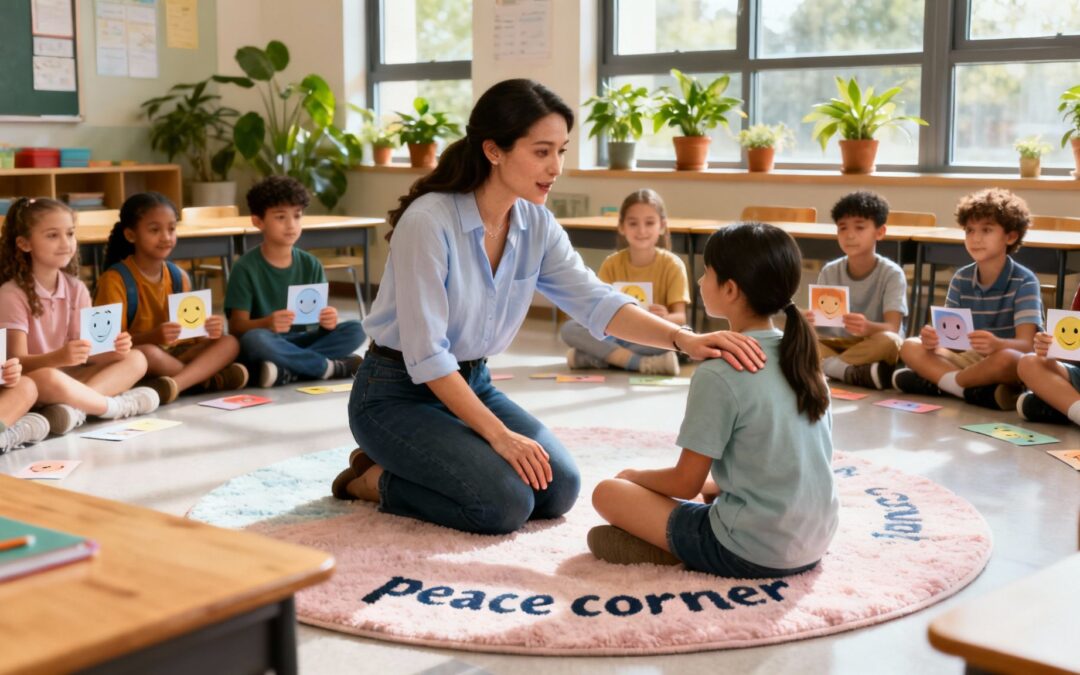
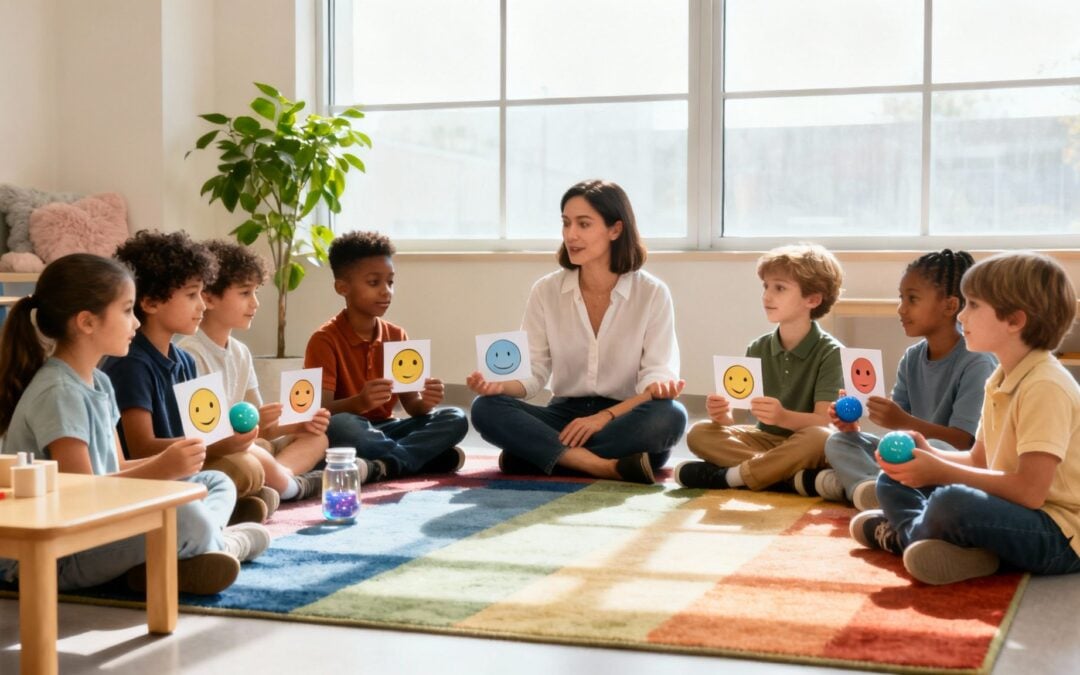
Practical Example: A second-grade teacher kicks off every single day with a five-minute “check-in circle.” Each student gets a chance to answer a simple prompt like, “Share one word that describes how you’re feeling today,” or “What’s one thing you’re looking forward to?”
This simple, daily routine carves out a predictable space for every student to be seen and heard.
Over time, kids get more comfortable sharing their feelings and listening to their peers.
This foundation of trust makes it so much easier to navigate conflicts when they pop up, because the lines of communication are already wide open.
Fostering True Accountability
Finally, the third principle is fostering true accountability. This might be the most misunderstood part of restorative justice. It’s not a “soft” approach that lets kids off the hook. In fact, it often demands more from them than traditional punishment ever could.
True accountability is about understanding the full ripple effect of your actions, facing the people you’ve harmed, and working together on a solution to fix the relationship. It’s about taking ownership, not just taking a penalty. This process builds essential life skills, and you can learn more about how it develops empathy in the classroom in our detailed guide.
Practical Example: A middle schooler spreads a nasty rumor about a classmate online. The rumor causes the targeted student a lot of pain and makes them feel isolated.
A restorative conference is held with both students, a school counselor, and their parents.
The student who was harmed gets to share how the rumor affected their friendships and sense of safety at school.
The student who started the rumor has to listen and then work with the other student to create a plan. This might involve posting a public correction, writing a sincere apology letter, and even presenting to their class about the dangers of cyberbullying.
This outcome requires courage, reflection, and a real commitment to making things right—a much deeper accountability than a simple suspension could ever provide.
Implementing Restorative Justice in Your School
Making the leap from understanding restorative justice in theory to putting it into practice can feel like a big step. The key is a structured, tiered approach that makes implementation feel manageable and, more importantly, effective. This model helps schools apply the right level of support at the right time—from proactive community building for everyone to more intensive responses when serious harm occurs.
Think of this framework less as a rigid set of rules and more as a flexible guide. It’s designed to help schools build a restorative culture from the ground up, ensuring every student benefits from a community-focused environment while also having clear processes for when things go wrong.
The diagram below shows how the core principles of repairing harm, building community, and fostering accountability all work together. They aren’t separate ideas but interconnected pillars holding up the entire restorative process.
Tier 1: Proactive Community Building for All Students
Tier 1 is the foundation. The goal here is to build such strong relationships and a positive classroom climate that most conflicts never even start. These practices are universal, meaning they are for every student, every day.
The focus is on proactive strategies that create a deep sense of belonging and psychological safety. When students feel genuinely connected and respected, they’re far more likely to succeed academically and less likely to act out. These strategies aren’t add-ons; they’re woven directly into the fabric of daily classroom life.
Practical Examples for Parents and Teachers
Daily Check-In Circles: Start or end the day with a quick circle where everyone shares an answer to a prompt. This simple act builds empathy, listening skills, and a sense of community.
Sample Prompt: “Share one kind thing you did for someone today,” or “What is one thing you’re feeling grateful for?”
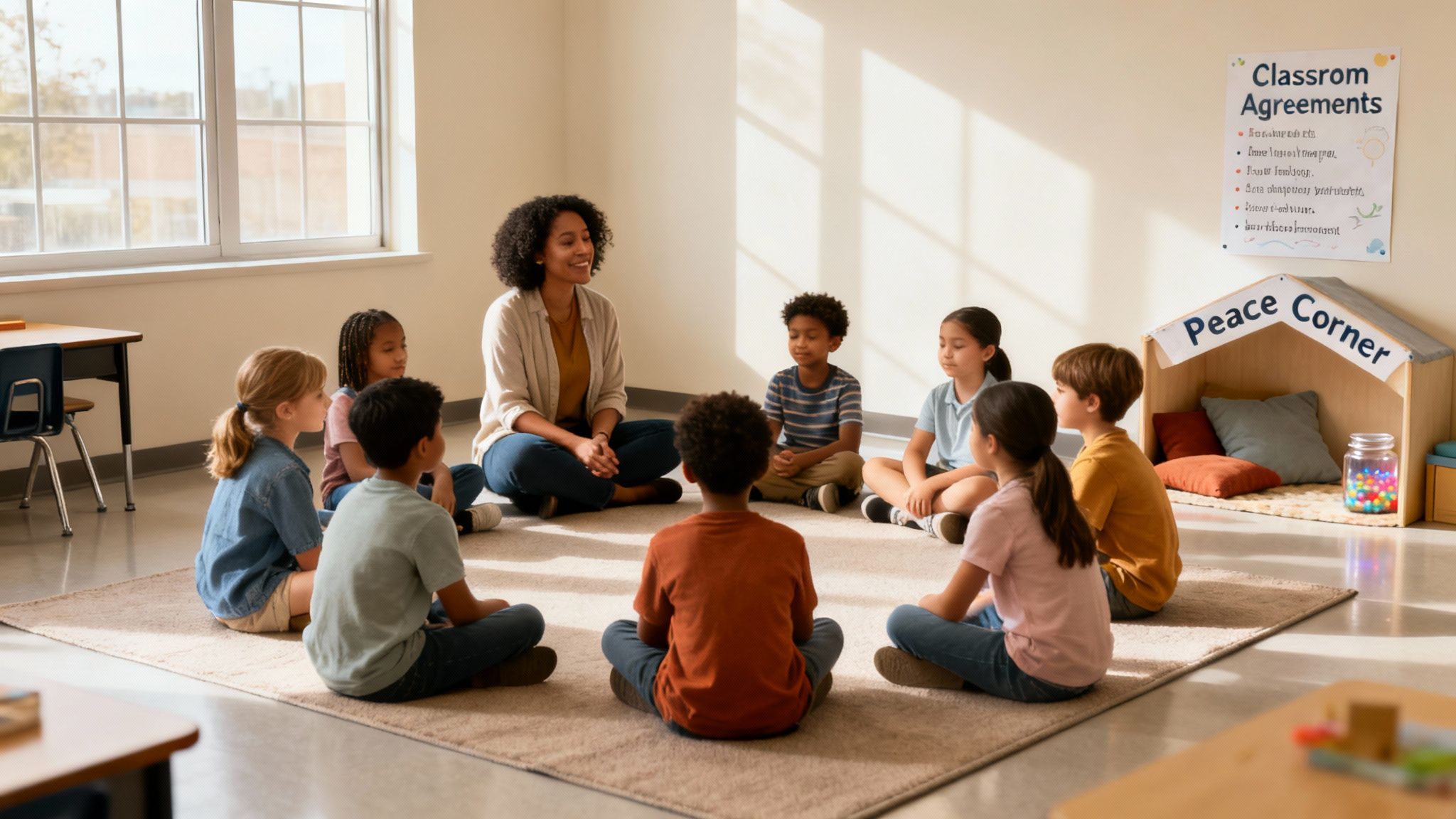
Classroom Agreements: Instead of a top-down list of rules, the class works together to create agreements for how they want to treat one another. This gives students real ownership over their environment.
Process: The teacher might ask, “How do we want to feel in our classroom?” and “What can we all agree to do to make sure everyone feels that way?” The answers become the class’s living constitution.
Tier 2: Responsive Practices for Minor Conflicts
When the inevitable minor issues pop up—an argument over a game, a misunderstanding, or a small disagreement—Tier 2 practices offer a structured way to respond. These interventions are for some students, some of the time, and are designed to address harm quickly before it escalates.
This is where we shift from being proactive to responsive, using restorative language and conversations to guide students toward a resolution. It’s about teaching them to see conflict not as a fight to be won, but as a problem to be solved together.
The goal of a restorative conversation isn’t to find a winner and a loser. It’s to help everyone involved understand each other’s perspective and find a way to move forward in a good way.
Practical Examples for Parents and Teachers
Guided Restorative Conversations: A teacher or parent can facilitate a brief, structured chat between students in conflict.
Sample Question: “What were you thinking and feeling at the time?” or “What did you need in that moment that you weren’t getting?”
Peer Mediation: Older students can be trained to help younger students work through their disputes. This empowers kids to take on leadership roles in maintaining a peaceful school culture.
Process: Two students in conflict meet with a neutral student mediator who guides them through a problem-solving process without ever taking sides.
Tier 3: Intensive Interventions for Significant Harm
Tier 3 is reserved for more serious incidents that cause significant harm to individuals or the whole community. These are formal processes for a few students who need intensive, wrap-around support. They involve bringing everyone affected by an incident together to collectively decide how to repair the harm that was done.
This is the most intensive level and almost always requires a trained facilitator, like a school counselor or an administrator. The process involves careful preparation before the meeting and dedicated follow-up after to ensure it’s safe and productive for everyone involved.
Practical Examples for School Staff
Formal Restorative Conferences: This is a structured meeting that includes the person who caused harm, the person who was harmed, and their supporters (like parents or friends).
Goal: To give the harmed person a voice, help the person who caused harm understand the full impact of their actions, and create a plan for repair that everyone agrees on.
Re-Entry Circles: When a student returns to school after a suspension or another long absence, a circle can be held to welcome them back and begin mending relationships with peers and teachers.
The move toward these practices is growing. A recent EdWeek Research Center survey revealed that 48% of educators report their schools are using restorative justice more now than they did before the 2018-19 school year. By integrating these strategies, schools are better equipped to build the supportive environments essential for effective social-emotional learning programs for schools.
How Restorative Approaches Can Reshape a School Community
When a school begins to shift from a punitive to a restorative mindset, the change doesn’t just stop at student conflicts. It’s so much bigger than that. This approach doesn’t just manage behavior; it starts to transform the entire school ecosystem. The ripple effects create a climate where students feel safer, more connected, and truly understood, leading to powerful improvements in their well-being and how they show up to learn.
Instead of just handing out consequences, restorative practices dig deeper to repair harm and get to the root of what’s really going on. The question changes from “What rule was broken?” to “What happened here, and who was impacted?” This simple but profound shift opens the door to understanding a student’s unmet needs, whether it’s a lack of connection, a struggle at home, or a need for specific social skills.
This focus on understanding and healing brings real, tangible results. It’s not just a feel-good idea. Schools that commit to restorative approaches almost always see a major drop in disciplinary actions that pull kids out of the classroom.
Studies consistently show that schools implementing restorative justice see reduced rates of suspensions and expulsions. This is huge. It means more students stay in the learning environment where they belong, preventing them from falling behind academically and feeling disconnected from their school community.
Creating a Safer and More Connected Climate
One of the biggest wins of restorative justice in schools is the way it nurtures a positive school climate. When students are actively involved in building and maintaining their community—through circles, shared agreements, and open dialogue—they develop a powerful sense of ownership. They learn that their voice matters and that they have a shared responsibility to look out for one another.
This creates a culture of psychological safety where students feel comfortable taking academic risks, asking for help, and just being themselves. The result is a vibrant community where empathy and mutual respect become the norm, not the exception. To learn more about this, check out our guide on how to improve school culture.
Practical Example for Parents and Teachers: Imagine a typical hallway conflict where one student pushes another. A punitive approach might mean an immediate office referral and a detention slip. But a restorative approach leads to a conversation. A teacher might pull both students aside and ask:
“Can you each tell me what happened from your perspective?”
“How did that make you feel?”
“What do you need to feel respected and safe here?”
This dialogue doesn’t excuse the push. It addresses the underlying feelings, helps restore the relationship, and teaches invaluable conflict-resolution skills that prevent future incidents.
Closing Racial Gaps in School Discipline
One of the most powerful outcomes of restorative justice is its ability to create more equitable learning environments for every child. We know that traditional, zero-tolerance policies have often led to disproportionately high rates of suspension and expulsion for students of color. Restorative practices directly challenge this by replacing subjective, punitive responses with consistent, relationship-focused solutions.
By focusing on the harm and the needs of everyone involved, these approaches help reduce the influence of implicit bias in disciplinary decisions. The results can be remarkable, especially for students from marginalized backgrounds who have historically been over-disciplined.
This isn’t just a theory; it’s backed by some really compelling evidence. Restorative practices have been shown to be incredibly effective in reducing racial disparities in school discipline, with Black students often seeing the most significant benefits in major urban districts. Research in Chicago Public Schools, for instance, revealed transformative outcomes for Black students who had previously faced stark inequities in discipline. You can find more insights in this promising research from Brookings.
For restorative justice to really take root in a school, it can’t just be a classroom thing. When the principles of repairing harm and building community are echoed at home and championed by key staff, they become part of the school’s DNA.
This is where families and school counselors become so important. They aren’t just bystanders; they are active partners in creating a consistent, supportive environment for every child. When everyone works together, the positive effects multiply, and students truly start to internalize these crucial social-emotional skills.
How Families Can Support Restorative Practices at Home
When kids hear the same restorative language at home that they hear at school, it creates a seamless world for them. It reinforces the lessons they’re learning about empathy and accountability. After all, parents and caregivers are a child’s first and most influential teachers.
You don’t have to be an expert to bring these ideas into your family life. It often just means small shifts in how you talk about conflict—moving the focus away from blame and toward understanding and repair.
Practical Examples for Parents:
During Sibling Arguments: Instead of sending kids to separate rooms, try guiding a restorative chat. Ask questions that get them thinking about each other’s feelings.
“How do you think your actions made your brother feel?”
“What was going through your mind when that happened?”
“What’s one thing you can do to make things right between you?”
When a Rule is Broken: If a child makes a mess and doesn’t clean it up, connect the consequence directly to the harm.
Instead of a timeout, the repair could be helping with an extra household chore. This isn’t a punishment; it’s about contributing back to the family, which teaches responsibility in a tangible way.
By using restorative language at home, parents help their children build an internal compass for empathy and accountability. This consistency sends a powerful message: repairing our relationships is something our whole community values.
The Crucial Role of the School Counselor
School counselors are perfectly positioned to be the champions of a school’s restorative justice work. With their training in mediation, communication, and student well-being, they can act as facilitators, coaches, and guides for everyone involved.
Counselors often become the central hub for restorative efforts, helping weave these practices into every part of the school’s support system. Their expertise makes them natural leaders for navigating sensitive conversations and showing others how to do the same.
Key Responsibilities for School Counselors:
Leading Formal Conferences: When something serious happens, counselors can step in as skilled, neutral facilitators for Tier 3 incidents. They ensure the process feels safe and fair, keeping the focus on genuine repair for everyone.
Training and Coaching Teachers: Counselors are great resources for professional development. They can model how to lead community-building circles or use restorative questions to handle minor conflicts, building confidence and skill across the entire staff.
Integrating Principles into Counseling: In one-on-one or small group sessions, counselors can weave in restorative ideas. This might mean helping a student see the impact of their behavior on others or guiding them through the steps of mending a friendship.
When counselors take on these roles, they make sure restorative justice is applied with consistency and care, deepening its impact on students’ social and emotional health.
Navigating Common Challenges and Measuring Success
Adopting restorative justice is a journey, not a destination. And while the benefits are crystal clear, the path forward often includes challenges that demand patience, commitment, and a real willingness to learn. Understanding these potential hurdles from the get-go can help your school prepare practical, effective solutions.
The good news is that this is a growing movement. For instance, roughly 72 percent of charter schools now involve students in restorative practices, which is a big jump from the 58 percent seen in traditional public schools. This trend points to a broader shift in thinking, but it doesn’t erase the real-world obstacles. You can dive deeper into the trends and find new schools data on restorative practices here.
Overcoming Common Hurdles
One of the biggest initial challenges is getting full staff buy-in. It’s common for some educators to worry that restorative practices are too “soft” or will eat up precious instructional time. Others might feel they just don’t have the training to navigate difficult conversations with confidence.
The best way forward is to start small. A pilot program with a handful of willing teachers can be a powerful way to demonstrate success and build momentum across the school. Integrating short, simple practices—like a five-minute check-in circle to start the day—makes the whole process feel manageable instead of overwhelming.
The key is to show, not just tell. When staff see restorative circles calming a classroom and preventing larger conflicts, they begin to understand its value firsthand. It’s an investment that pays back in instructional time.
Another hurdle is the deep-rooted punitive mindset that many of us grew up with. Shifting an entire school’s culture from punishment to repair takes consistent effort and modeling from the top down.
Practical Solutions for Implementation:
Provide Ongoing Training: Don’t just do a one-off workshop. Offer coaching sessions that give teachers practical scripts and strategies they can use in their classrooms the very next day.
Create a Leadership Team: Pull together a small team of passionate educators and administrators to guide the implementation, answer questions, and support their colleagues.
Start with Community Building: Focus first on proactive Tier 1 practices. When you build a strong community foundation, it becomes so much easier to handle conflicts when they inevitably pop up.
How to Measure What Matters
Success with restorative justice looks different from traditional discipline metrics. Yes, a drop in suspensions is a fantastic outcome, but it’s only one piece of the puzzle. The real magic is often found in the subtle but powerful shifts in your school’s climate and relationships.
Measuring what matters means looking beyond the numbers to capture the qualitative changes that tell you you’re building a healthier community. This approach gives you a much richer, more accurate story of your progress.
Key Indicators of Success:
School Climate Surveys: Are students reporting a greater sense of belonging and safety? Do they feel like adults and their peers treat them with respect? These surveys provide invaluable data straight from the student experience.
Student and Staff Focus Groups: Host informal conversations to gather stories. Ask questions like, “Can you share a time when a conflict was resolved in a way that felt fair?” These narratives are what bring the data to life.
Teacher Anecdotes: Are teachers noticing more empathy in their classrooms? Are students starting to solve minor problems on their own without needing an adult to step in? These small observations are powerful signs of a real cultural shift.
By combining quantitative data (like attendance and discipline rates) with qualitative feedback, schools can paint a full picture of their restorative journey. This holistic view helps everyone celebrate wins, identify areas for growth, and truly understand the lasting impact of choosing connection over punishment.
Common Questions About Restorative Justice in Schools
When schools start exploring restorative justice, it’s natural for questions to pop up from parents, teachers, and even students. Shifting from a traditional discipline model is a big change, and getting clear answers helps everyone feel more confident.
Let’s tackle some of the most common questions about how this approach actually works in the classroom.
Does Restorative Justice Mean There Are No Consequences?
Not at all. This is probably the biggest misconception out there. Restorative justice doesn’t eliminate consequences; it redefines them to be more meaningful and educational. The focus shifts from punishment that isolates to actions that repair harm and rebuild community.
Think about it this way: instead of an automatic suspension for an argument, a restorative consequence might involve the students mediating their conflict with a trusted adult. They’d work together to create a plan to restore trust. This requires them to face the impact of their actions and take real responsibility for making things right—a much deeper and more lasting lesson than sitting at home.
Accountability is the engine of restorative justice, not a missing piece.
How Can a Busy Teacher Find Time for This?
This is a totally valid concern. The idea of adding one more thing to your plate can feel overwhelming. But the key is to start small and weave restorative practices into what you’re already doing.
Many teachers find that a small investment of time upfront actually saves them a ton of time down the road by preventing bigger conflicts.
A great place to begin is with a five-minute check-in circle during your morning meeting. When a minor issue pops up, try asking simple restorative questions like, “What happened?” and “Who was affected by this?” instead of immediately assigning blame. These small shifts build a foundation of communication that makes the classroom much easier to manage in the long run.
By proactively building community, you spend less time reacting to misbehavior. These small, consistent actions create a classroom culture where students begin to solve problems on their own.
Is This Approach Only for Older Students?
Nope! Restorative principles are incredibly adaptable and just as powerful for kindergarteners as they are for eighth graders. With younger children, you’re just focusing on simpler, more concrete concepts that build the foundation for empathy, communication, and self-regulation.
The language and activities just look a little different.
Practical Examples for Young Learners:
Using “I-Statements”: A teacher can guide a five-year-old to say, “I felt sad when you took my crayon without asking.” This is a huge first step in teaching kids to express their feelings without blaming.
Creating a “Calm-Down Corner”: Having a designated cozy space gives young students a tool for managing big emotions before they escalate into a bigger problem.
Simple Mediations: When two kids argue over a toy, a teacher can facilitate a very brief chat, helping them listen to each other and agree on a way to share.
The core ideas—understanding impact, feeling empathy, and making things right—are universal. They just grow in complexity as your students do.
At Soul Shoppe, we give schools the tools and training to build these essential skills from the ground up. Our goal is to help you create a safer, more connected learning community where every student feels they belong. Find out more about our Social Emotional Learning programs.
Handling disruptive behavior is less about reacting in the moment and more about building a classroom that prevents misbehavior from happening in the first place. The real secret is shifting your mindset from demanding compliance to cultivating a community. When you lead with Social-Emotional Learning (SEL) principles, you create a space where students genuinely feel seen, heard, and supported—and that foundation of trust changes everything.
Building a Proactive and Peaceful Classroom
Honestly, the best way to handle disruptive students is to create a classroom where disruptions rarely get the chance to take root. This goes way beyond just posting a list of rules and consequences. It’s about actively building a culture of respect, safety, and belonging. When students feel truly connected to their teacher and peers, they become invested in the community’s success.
This work is more critical now than ever. Post-pandemic, a staggering 48% of U.S. educators have reported that student behavior is significantly worse than it was before 2019. On top of that, a lack of focus is impacting learning in 75% of schools, highlighting a massive need for foundational socio-emotional support.
Fostering Community and Connection
A strong sense of community is your first and best line of defense against disruptive behavior. It’s the simple, consistent routines that really make a difference, helping students feel grounded and ready to learn.
One of the most powerful routines you can start is a Morning Check-In Circle. This isn’t just a fancy way to take attendance; it’s dedicated time for real connection. Students sit together and share one small thing. Maybe they rate their emotional “weather” for the day (sunny, cloudy, stormy) or answer a simple prompt like, “What’s one thing you’re looking forward to today?”
Practical Example: A teacher notices a student, Liam, shares that his emotional weather is “stormy” because his dog is sick. The teacher makes a mental note to check in with Liam privately after the circle, offering a moment of quiet support or a quick note home. This small act of empathy helps Liam feel seen and can prevent his anxiety from bubbling over into disruptive behavior later in the day.
This little ritual gives you a priceless snapshot of each student’s emotional state before the day even gets rolling. If a child shares they’re feeling “stormy,” you immediately know to offer a bit more support, which can head off a potential outburst later.
Co-Creating Classroom Agreements
Instead of handing down a list of top-down rules, try involving your students in creating “Classroom Agreements.” This collaborative process is a game-changer because it gives them ownership over their environment and behavior.
Just ask your class: “What do we all need from each other to do our best learning?” and “How do we want our classroom to feel?”
Practical Example: A third-grade class might come up with agreements like, “We listen when someone is talking,” “We use kind hands and words,” and “It’s okay to make mistakes.” These get written on a big poster, signed by every student, and hung up where everyone can see it. When a disruption happens, you can gently refer back to it: “Hey, remember how we all agreed to listen when someone is speaking?”
Establishing these shared expectations is a cornerstone of a proactive classroom. You can deepen this practice by exploring effective discipline strategies that build on this collaborative spirit.
Designing a Space for Self-Regulation
Every single student, no matter their age, feels overwhelmed sometimes. A designated “Peace Corner” or “Calm-Down Spot” gives them a safe space to self-regulate before their emotions boil over into a disruption.
It’s crucial to frame this as a supportive tool, not a punishment or a time-out spot. It’s a resource center equipped to help students navigate big feelings.
What to include in a Peace Corner:
Comfortable seating: Think a beanbag chair or a few soft cushions.
Sensory tools: Stress balls, fidgets, or a weighted lap pad can work wonders.
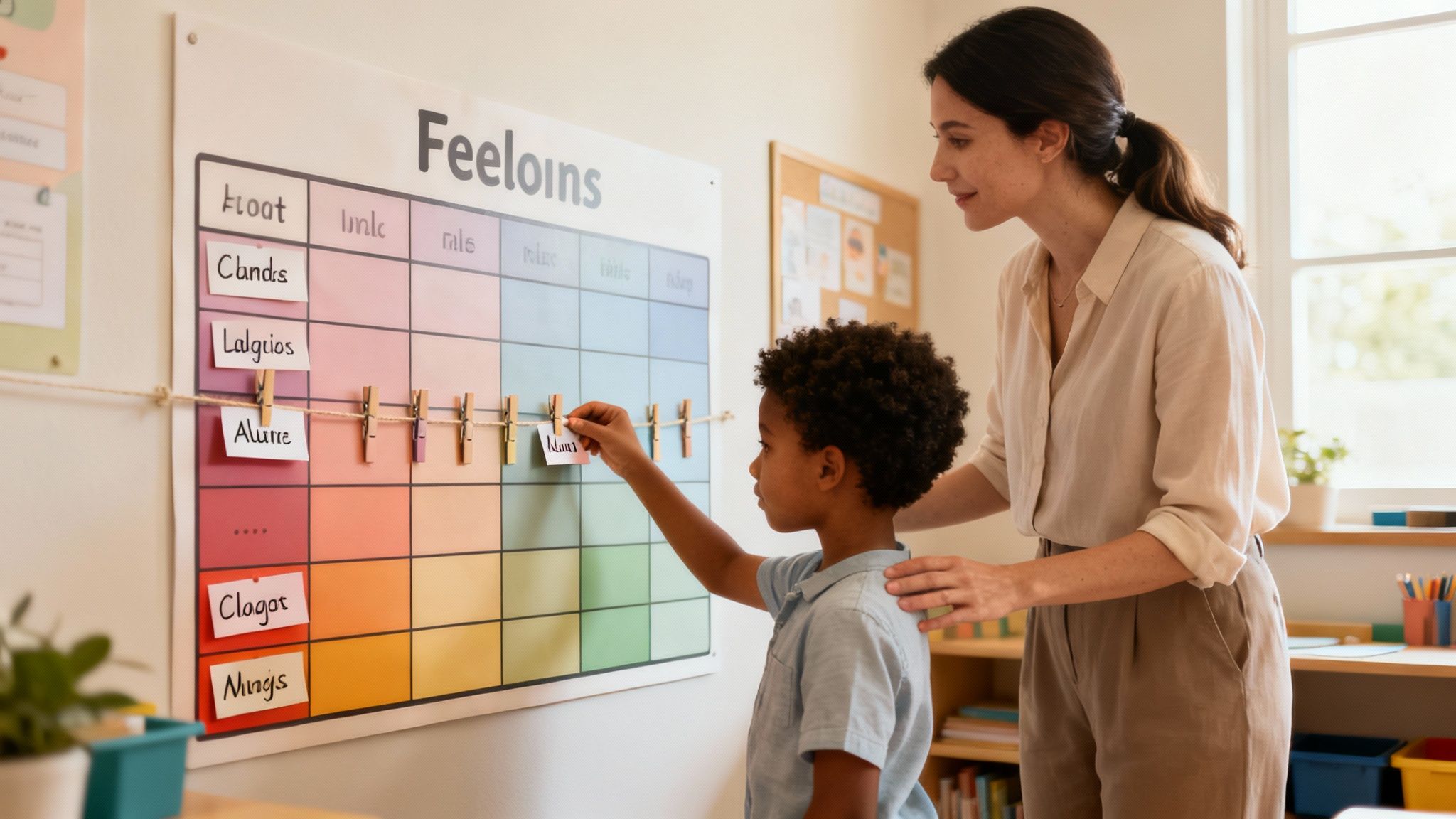
Visual aids: Posters showing simple breathing exercises or a chart of feelings.
Quiet activities: A simple puzzle, some coloring pages, or a glittery calm-down jar.
Practical Example: A student named Maya feels frustrated during a difficult math problem. Instead of crumpling her paper, she remembers the process her teacher taught her. She puts up the non-verbal “break” signal, walks quietly to the Peace Corner, sets a three-minute sand timer, and squeezes a stress ball. After a few minutes, she feels regulated and ready to try the problem again with a clearer mind.
By explicitly teaching students how and when to use this space, you’re not just managing behavior—you’re empowering them with self-management skills they’ll use for the rest of their lives. This foundational work is key to creating the positive atmosphere we all want, and you can learn more in our guide to building a peaceful and welcoming classroom culture.
Getting to the Root Cause of Disruptive Behavior
Before you can respond effectively to a student’s actions, you have to get curious about the need driving them. Nearly all disruptive behavior is just communication in disguise—an outward signal of an internal struggle.
The single most important shift you can make is moving from “behavior manager” to “needs detective.” This one change in perspective is the key to handling disruptions with empathy and real, lasting success.
When we only react to what we see on the surface—the calling out, the refusal to work, the constant fidgeting—we miss the real story. This path usually leads to a frustrating cycle of consequences that never actually solves the problem because it ignores the cause. The goal isn’t just to stop the disruption; it’s to figure out its function. What is this student trying to gain or avoid?
Research shows just how critical it is to get this right, and early. Without the right kind of intervention, disruptive behavior can escalate. For example, boys in aggressive first-grade classrooms are 2.5 times more likely to be aggressive by the time they reach middle school. With 32% of U.S. teachers saying misbehavior gets in the way of their teaching, it’s clear this is a widespread challenge. The good news? Strong, early management can slash the odds of future aggression from 59:1 down to a fraction of that, as detailed by research from PMC.
Identifying Patterns and Triggers
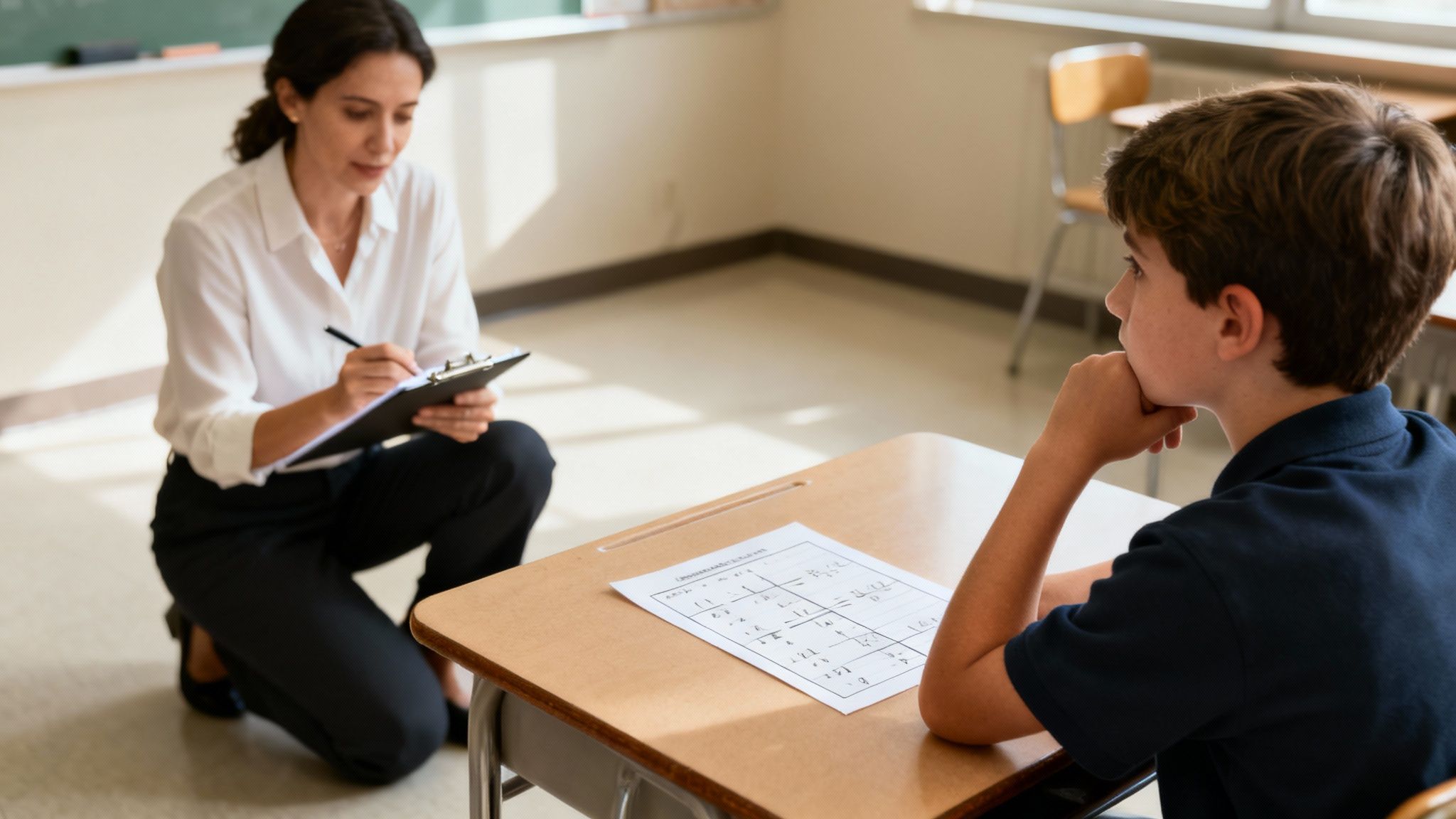
To decode what a student is communicating, you have to become an observer. Start looking for patterns. Think of yourself as a data collector, gathering clues that point you toward the root cause. This doesn’t need to be a complicated system; a simple notepad or a digital doc is all you need to start tracking what you see.
When a disruption happens, ask yourself a few key questions:
When does it happen? Is it always during math, hinting at a learning gap or anxiety? Does it ramp up right before lunch, suggesting hunger?
Where does it happen? Does the behavior pop up during unstructured times like recess or transitions? That could point to a need for social skills support or connection.
What happens right before? Did you just assign independent work? Was there a sudden loud noise? Did another student say something?
Practical Example: A teacher notices that a student, Leo, starts tapping his pencil loudly and trying to talk to neighbors every time they begin independent writing. After jotting down this observation for three days, the teacher realizes the behavior only happens during writing, never math or reading. This pattern suggests Leo isn’t being willfully defiant; he’s likely feeling anxious or stuck about the writing task itself.
These observations help you move past assumptions and start pinpointing specific triggers. That’s the first real step toward finding a solution that works.
Common Unmet Needs Behind the Behavior
Once you’ve spotted a few patterns, you can start connecting them to the most common unmet needs. While every child is different, disruptive behaviors often stem from a handful of core areas.
A student who constantly blurts out might not be trying to be defiant. They could be desperate for positive attention and connection—so much so that even a reprimand feels better than being ignored. The student who puts their head down and refuses to start an assignment isn’t necessarily lazy; they might be completely overwhelmed and are using avoidance to escape the feeling of failure.
Practical Example: A student who rips up their paper isn’t trying to challenge your authority—they’re likely expressing extreme frustration with a task they feel they cannot do. Instead of a punishment, the teacher could offer a different tool, like a mini whiteboard for practice, saying, “Writing can be tough. Let’s try brainstorming on this board first, where mistakes are easy to erase.”
It’s also crucial to remember that what happens outside of school has a huge impact inside the classroom. Understanding challenges like how family homelessness fuels child hunger can completely reframe how you see a child’s inability to focus or self-regulate. When you know a student is carrying heavy burdens, their behavior starts to make a lot more sense.
You can learn more about these challenging behaviors in the classroom in our related guide. By digging deeper to find the “why,” you can respond with compassion and provide support that actually helps, rather than just punishing the symptom.
In-the-Moment Strategies and De-escalation Scripts
When a disruption kicks off, your immediate response is everything. It sets the tone for what comes next. The real goal isn’t to win a battle of wills; it’s to guide a student back to a place where they’re calm and ready to learn again.
The most effective in-the-moment strategies are quiet, quick, and focused on de-escalation, not punishment. These moments are about preserving a student’s dignity while maintaining your authority. When done right, you can turn a potential power struggle into a genuine teaching opportunity.
First, you have to stay regulated yourself. A calm voice and neutral body language are your best tools for lowering the temperature in the room.
Using Non-Verbal Cues and Proximity
Sometimes, the best interventions are the ones nobody else in the class even notices. Before you ever have to say a word, subtle, non-verbal cues can redirect a student without disrupting the flow of your lesson. It’s the least invasive way to handle off-task behavior, and it works surprisingly well.
One of the most powerful tools in your toolkit is strategic proximity. Just walking over and standing near a student’s desk while you continue teaching is often enough to get them back on track. No confrontation, no public call-out—just your quiet presence signaling that you see what’s going on.
Practical Example: Two fourth-graders are whispering during silent reading. Instead of calling their names from across the room, their teacher calmly walks over and stands between their desks while scanning the rest of the class. The whispering stops instantly, and both students pick up their books. Not a single word was exchanged.
The Power of a Quiet Voice and Private Redirection
When you do need to use words, how you say them matters just as much as what you say. A loud, public correction often makes a student feel defensive and cornered, which can make them double down on the behavior.
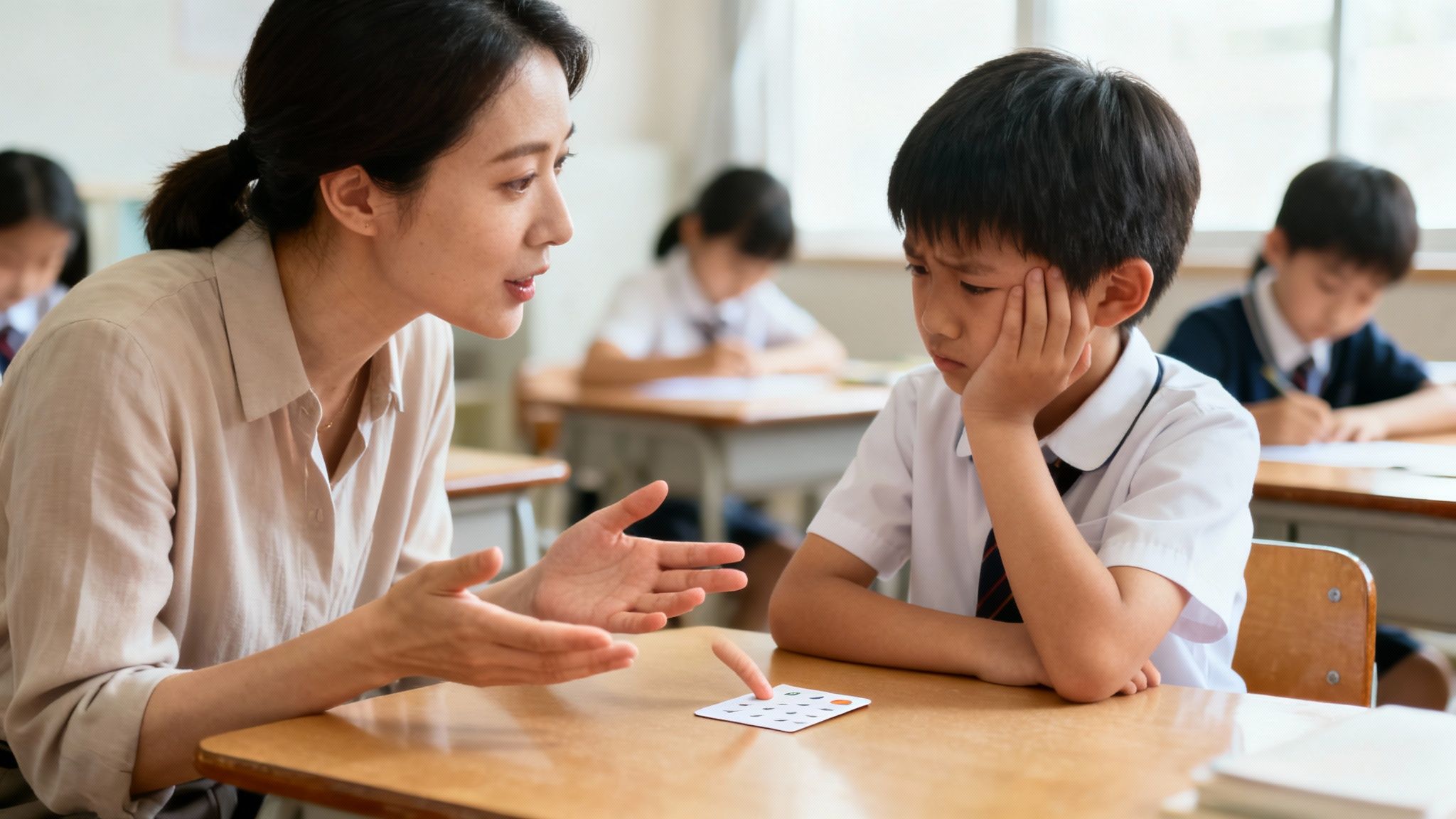
Instead, try getting down to the student’s eye level and speaking in a quiet, firm, but respectful tone. This private redirection shows the student you’re addressing the behavior, not attacking them as a person. It communicates care.
Here are a few ways to redirect quietly:
The “Two-Sentence Intervention”: State the problem in one sentence and offer a solution in the second. For example, “I see you’re having trouble focusing on your worksheet. Why don’t we try the first two problems together?”
Offer a Controlled Choice: This gives the student a sense of agency, which can de-escalate things fast. “You can choose to finish this at your desk or in the peace corner. What works best for you right now?”
Postpone the Conversation: If a student is too agitated for a productive chat, acknowledge their feelings and schedule a time to talk later. “I can see you’re upset. Let’s talk about this in five minutes at my desk once you’ve had a chance to cool down.”
These small shifts are critical for managing the big feelings that can bubble up in a classroom. For more on this, check out our guide on what to do when big emotions take over.
Ready-to-Use De-escalation Scripts
When you’re put on the spot, it can be a lifesaver to have a few go-to phrases ready. The point of these scripts is to be supportive and proactive, not reactive and punitive. They work by validating the student’s feelings while still holding a clear boundary for their behavior.
Thinking about your responses ahead of time helps you stay calm and handle disruptions in a way that builds students up.
Reactive vs Proactive Responses to Common Disruptions
Let’s look at how small changes in our language can make a huge difference. Below is a table that contrasts common reactive phrases with more effective, SEL-informed alternatives.
Disruptive Behavior Scenario
Common Reactive Response to Avoid
Proactive SEL Response to Use
A student refuses to start their work.
“Do your work now or you’ll lose recess.”
“I see getting started feels tough today. Let’s look at the first question together.”
A student is talking out of turn repeatedly.
“Stop talking! I’ve already told you three times.”
“I love your enthusiasm. Please raise your hand so everyone gets a chance to share.”
A student makes a frustrated noise and crumples their paper.
“That’s a waste of paper. Pick it up and start over.”
“I can see you’re feeling frustrated. It’s okay. Let’s take a deep breath and find a new starting point.”
Two students are arguing over supplies.
“Both of you stop it! Give me the crayons.”
“It looks like you both want the same color. How can we solve this problem fairly?”
Using proactive language like this does more than just stop a behavior—it models problem-solving and emotional regulation. You’re teaching a skill that will last a lifetime. This approach reinforces that your classroom is a supportive community where challenges are met with help, not just consequences.
Building a Strong Home and School Partnership
When you’re trying to figure out how to handle disruptive students, it’s easy to feel like you’re on an island. But the truth is, you can’t—and shouldn’t—do it alone. Lasting change really takes hold when a student feels consistently supported by all the adults in their life. Building a collaborative partnership with families is one of the most powerful moves you can make.
This team effort isn’t just about reporting problems. It’s about creating a unified front that wraps support around the student. The goal is to move from a “you versus me” or “school versus home” dynamic to a “we’re in this together for your child” approach. This ensures the student receives the same messages and support, whether they’re in your classroom or at their kitchen table.
Framing the Conversation with Parents
Bringing up a child’s challenging behavior can feel daunting. It’s natural for parents to become defensive if they feel their child—or their parenting—is being criticized. The key is to frame every interaction from a place of partnership and shared goals, starting with a positive connection.
Never, ever lead with a list of problems. Instead, begin by sharing a genuine positive observation or a small moment of success. This simple step shows that you see their child’s strengths and value them as a whole person, not just as a behavior issue.
Practical Example Script for a Phone Call or Email: “Hi [Parent’s Name], this is [Your Name] from [School]. I was thinking about [Student’s Name] today and wanted to share something that made me smile—they were so helpful to a classmate during our science activity. I also wanted to partner with you on something I’ve noticed. [Student] seems to be struggling during transitions between subjects, and I’d love to brainstorm with you to find a strategy that might work both here and at home.”
This approach immediately establishes you as an ally. It shifts the focus from blame to collaborative problem-solving, making parents much more likely to engage as active partners.
Practical Tools for Parent-Teacher Conferences
Parent-teacher conferences are a prime opportunity to strengthen this partnership, but they can quickly turn negative if you’re not careful. It helps to prepare talking points that emphasize teamwork and focus squarely on solutions.
Here are a few actionable tips for these meetings:
Share data, not drama. Instead of saying, “He’s always disruptive,” try something more objective: “I’ve tracked it, and the outbursts happen most frequently right before lunch, which makes me wonder if hunger is a trigger.”
Ask for their expertise. Parents are the ultimate experts on their own children. Ask questions like, “What strategies do you use at home when he gets frustrated?” or “Have you seen this behavior in other settings?”
Create a shared goal. Work together to define one specific, achievable goal. For instance, “Let’s both work on helping him use his words to ask for a break when he feels overwhelmed.”
Practical Example: In a conference, a teacher says, “I’ve noticed Ava has a hard time settling down after recess. At home, what helps her transition from high-energy playtime to a quiet activity?” The parent shares that a five-minute warning and a simple breathing exercise work wonders. Together, they decide the teacher will try the same five-minute warning before the bell rings to come inside.
This collaborative spirit reinforces that you’re on the same team. Parents who feel heard and respected are far more likely to implement suggested strategies at home. You can learn more about these approaches through these positive parenting tips.
Involving School Support Staff
Remember, your partnership circle extends beyond just parents. School counselors, psychologists, social workers, and special education staff are invaluable resources. They bring specialized expertise and can offer different kinds of support for both you and the student.
Don’t wait until a situation becomes a full-blown crisis to reach out. The moment you notice a persistent pattern of disruptive behavior that isn’t responding to your classroom strategies, it’s time to consult with your school’s support team.
Bring your objective observations and documentation to them. They can help you analyze the behavior from a fresh perspective, suggest new interventions, or begin the process for more formal support if needed. Taking this proactive step ensures the student gets the right help sooner and shows families that the entire school community is invested in their child’s success.
Documenting Behavior and Creating Support Plans
When your go-to classroom strategies and talks with parents aren’t enough to change a persistent, disruptive behavior, it’s a signal to shift to a more structured approach. This isn’t a sign of failure. It simply means the student needs a different, more intensive kind of support.
The first step toward getting that support is clear, objective documentation.
This whole process is about painting a data-driven picture of what’s happening—not building a case against a child. By carefully recording the facts, you give your school’s support team (counselors, psychologists, or special education staff) the precise information they need to step in effectively. Without good data, getting a student the right help can feel like an uphill battle.
What to Record for Effective Documentation
To make your notes truly useful, they have to be objective. Focus on the observable facts and leave emotions or interpretations out of it. Think of yourself as a camera recording exactly what happened. This creates a clear, unbiased record for others to analyze.
When you track these details consistently, patterns start to emerge. And those patterns are the key to figuring out what’s really going on.
Here are the key details to log every time:
Date and Time: Pinpoint the exact time. Does it always happen before lunch? Only during math? This helps you see triggers.
Specific Actions: Describe exactly what you saw and heard. Instead of saying a student “was defiant,” write, “refused verbal prompts to begin the assignment and put his head on the desk.”
Location and Context: Where did the behavior happen? Was it during group work, independent reading, or a transition between activities?
Interventions Tried: What did you do in the moment? Jot down your strategy, like “gave a verbal redirection,” “offered a choice between two tasks,” or “prompted a visit to the peace corner.”
Student’s Response: How did the student react to what you did? Did they de-escalate, escalate, or simply ignore the prompt?
Practical Example: A teacher’s log entry might read: “Oct. 5, 10:15 AM: During silent reading, Sam left his seat and walked to the window. I gave a quiet verbal redirection to return to his book. He said, ‘This is boring,’ and remained at the window. I offered the choice to read in the book nook. He refused and sat on the floor.” This factual account is far more useful than “Sam was defiant and off-task again.”
The scale of this challenge is massive. In England’s schools, a staggering 69% of teachers say that poor student behavior regularly disrupts their lessons, with about a fifth of all teaching time lost to these interruptions. This chaos is directly tied to student performance; we know that safer classrooms with clear expectations lead to better academic outcomes.
With school suspensions hitting a record 787,000 in a single academic year, the need for data-backed support systems has never been clearer. You can read more about these findings on the behavior challenge in schools.
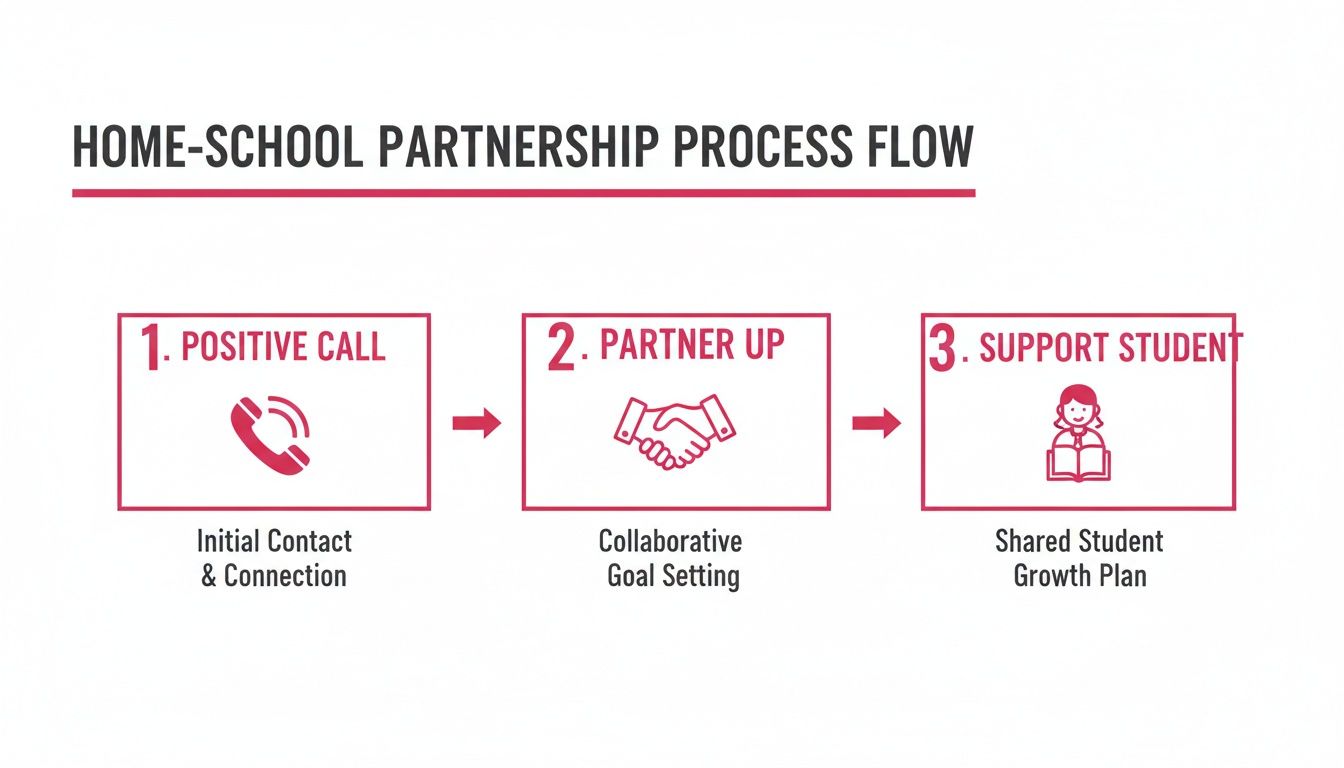
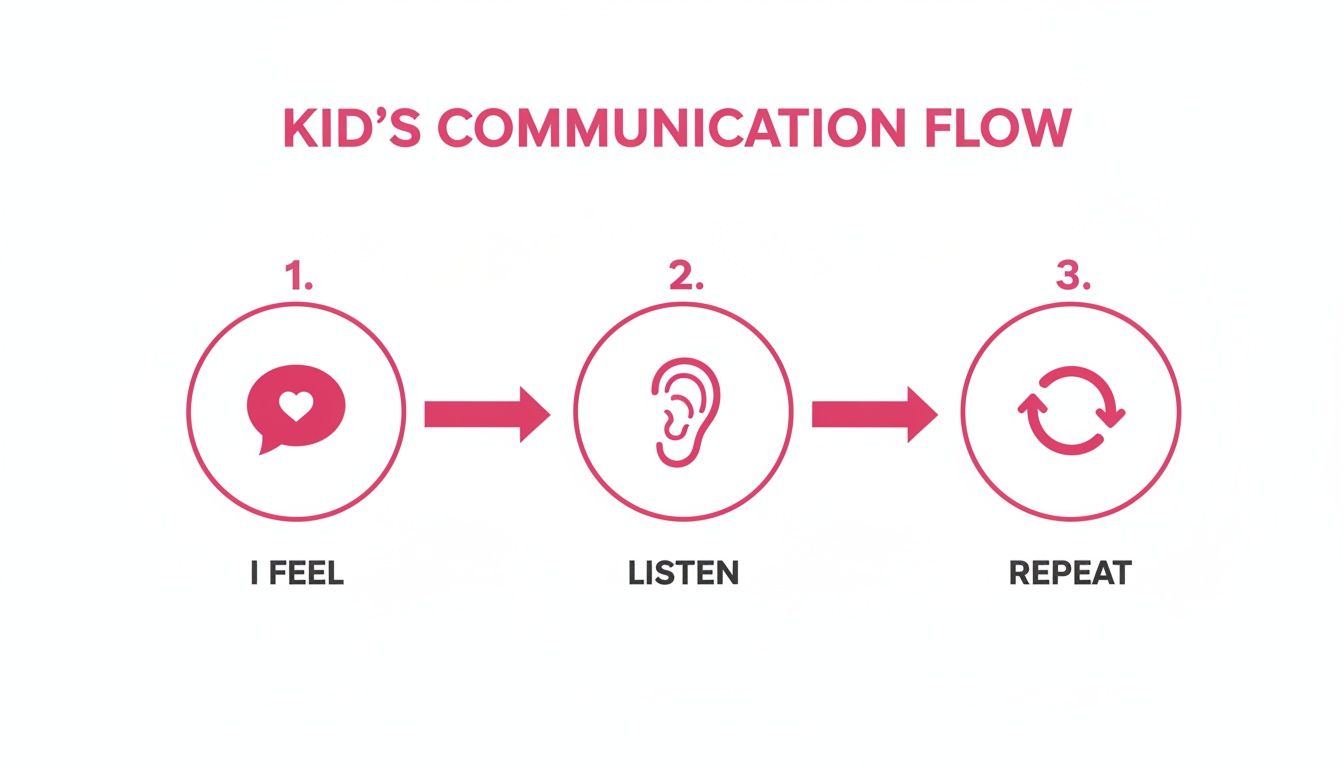
The simple flow below shows how a strong home-school partnership lays the groundwork for these more formal support plans.
This illustrates that the best support starts with positive communication long before a formal plan is even on the table.
Creating a Formal Behavior Intervention Plan
Once you have detailed documentation, you’re ready to refer a student to your school’s support team. With your data in hand, you can all work together to create a formal Behavior Intervention Plan (BIP). A BIP is not a punishment. It’s a proactive, personalized roadmap designed to teach and reinforce positive behaviors.
A BIP is a commitment from the school team to understand a student’s needs and provide targeted support. It shifts the focus from managing disruptions to teaching the skills the student is missing.
Creating a BIP is a team sport. You, the parents, a school psychologist or counselor, and maybe an administrator will all have a seat at the table. The plan will clearly define the target behavior, identify its function (what is the student trying to get or avoid?), and lay out specific strategies to help the student find a better way to meet that need.
For instance, a BIP for a student who frequently has outbursts during math might include:
Proactive Strategies: Allowing the student to work with a partner, or giving them a checklist to break down large assignments into smaller, less overwhelming steps.
Replacement Behaviors: Teaching the student to use a break card to ask for a two-minute rest when they feel frustrated, instead of shouting out.
Reinforcement: Giving specific praise when the student uses their break card appropriately or completes a portion of their work quietly.
This kind of structured plan gets everyone on the same page, providing the consistency and targeted support a struggling student needs to get back on track.
Your Questions About Student Behavior, Answered
Working with kids means navigating the wild, wonderful, and sometimes confusing world of their behavior. It’s a landscape that can bring up a lot of questions for teachers, parents, and anyone who cares for children. How do you know if it’s a real problem or just a tough day? When is it time to call for backup? Let’s get into some of the most common questions we hear.
How Can I Tell the Difference Between a Bad Day and a Real Behavioral Pattern?
This is a big one, and something every teacher grapples with. We’ve all seen a student who is usually sunny and engaged suddenly become withdrawn or a little grumpy. Is it a red flag? Not necessarily.
The key is to look for patterns versus isolated events. A bad day is just that—one day. It might look like a student being unusually quiet, sad, or briefly off-task. Maybe they didn’t sleep well, had a tiff with a friend before school, or just woke up on the wrong side of the bed. It’s a temporary blip.
A disruptive behavioral pattern is different. It’s recurring. It consistently gets in the way of their learning or the learning of those around them. We’re talking about the frequent calling out, the persistent refusal to even start an assignment, or the constant fidgeting that continues day after day, even with gentle redirection.
Practical Example: A second-grader who loves math suddenly puts her head on her desk during your lesson on telling time. That’s likely just a bad day. But if that same student puts her head down every single time a math worksheet hits her desk? You’re seeing a pattern. It could point to anything from math anxiety to a genuine learning gap.
A bad day calls for empathy, a quiet check-in, and a little grace. A pattern, on the other hand, is a signal that we need to observe more closely and start thinking about a more structured plan.
How Do I Correct a Student Without Shaming Them?
No one wants to be called out in front of a crowd, and kids are no exception. Public corrections almost always backfire. They can make a student feel defensive, embarrassed, or resentful, which often escalates the exact behavior you’re trying to address.
Privacy and discretion are your best friends here.
Whenever you can, address the behavior quietly and physically close to the student. Often, you don’t even need to say a word. Simply moving to stand near their desk while you continue teaching can be a powerful, silent cue that gets them back on track.
If words are necessary, keep your voice low and focus on the action, not the child’s character. Instead of calling from across the room, “Why aren’t you working?” walk over and whisper, “I need you to start on the first problem now.” This small shift protects their dignity and makes them more likely to cooperate.
Practical Example: During a class discussion, a student blurts out an answer for the third time. Instead of saying, “Stop interrupting!”, the teacher makes eye contact, subtly shakes her head, and touches her own raised hand as a quiet reminder of the classroom agreement. Later, she praises the student privately when he remembers to raise his hand.
And just as important: “catch them being good.” Make it a point to notice and acknowledge their positive efforts throughout the day. When students feel seen for their contributions, not just their mistakes, they’re more willing to take gentle correction in stride.
When Is It Time to Involve School Support Staff?
Knowing when to ask for help is a critical skill for any educator. You’ve tried different strategies, you’ve communicated with the family, but the behavior isn’t improving. It’s time to bring in the school counselor, psychologist, or an administrator when a student’s behavior hits one of these three benchmarks:
It Compromises Safety: This is the absolute priority. If a student’s actions pose a physical or emotional threat to themselves or anyone else, it’s time to involve support staff immediately.
It Persists Despite Your Best Efforts: You’ve tried proximity, private redirection, positive reinforcement, and partnering with parents, but the disruptive behavior continues or gets worse. Your toolbox is empty, and you need more specialized support.
It Severely Obstructs Learning: The behavior is so frequent or intense that it consistently prevents the student, their classmates, or even you from being able to teach and learn effectively.
Practical Example: A teacher has documented for two weeks that a particular student throws their materials on the floor whenever they are asked to transition from a preferred activity (like drawing) to a non-preferred one (like cleanup). The teacher has tried visual timers, verbal warnings, and offering choices, but the behavior is escalating. This is the perfect time to bring the documentation to the school counselor to brainstorm next steps.
Before you make that referral, make sure your documentation is in order. You’ll want clear, objective notes detailing the specific behaviors, when they happen, and the strategies you’ve already tried. This gives the support team the full picture they need to step in and provide the targeted help that student deserves.
At Soul Shoppe, we believe that every child deserves to feel safe, seen, and supported. Our programs provide schools with the tools to build empathetic, resilient communities where all students can thrive. Learn more about how we can partner with your school at https://www.soulshoppe.org.
Conflict is an inevitable part of life, but for students, it’s a critical learning opportunity. Navigating disagreements on the playground, in the classroom, or online isn’t just about stopping a fight; it’s about building foundational skills for a successful future. The ability to listen, express needs, and solve problems collaboratively is essential for academic success and emotional well-being. When students lack these tools, small misunderstandings can escalate into significant disruptions, impacting classroom culture and individual learning.
This article moves beyond generic advice to offer 10 evidence-based, actionable conflict resolution strategies students in grades K–8 can learn and practice. For educators, administrators, and parents, this guide provides the specific resources needed to teach these vital skills effectively. Inside, you will find a comprehensive toolkit designed for immediate implementation.
Each strategy includes:
Clear summaries and step-by-step instructions.
Age-differentiated tips for elementary and middle school students.
Sample scripts and phrases to guide conversations.
Practical classroom activities and role-playing scenarios.
Direct alignment with core Social-Emotional Learning (SEL) competencies.
Our goal is to equip you with powerful frameworks that build empathy, communication, and resilience. By mastering these techniques, you can help students turn moments of conflict into opportunities for connection and personal growth, creating safer and more collaborative school communities. Let’s explore the methods that transform how students handle disagreements.
1. Restorative Circles and Peer Conferencing
Restorative Circles are structured, supportive discussions that bring students together to address conflicts and their impact. Instead of focusing on punishment, this approach prioritizes repairing harm, understanding different perspectives, and rebuilding relationships. Students, along with a trained facilitator, sit in a circle to share their feelings and collaboratively find a path forward.
This method shifts the focus from “Who is to blame?” to “What happened, who was affected, and how can we make things right?” Peer conferencing is a related, often less formal, version where students mediate disagreements among themselves, guided by restorative principles. This is a powerful conflict resolution strategy for students because it builds empathy and community accountability.
Practical Example: Two students, Maya and Liam, had an argument over a group project, and Maya told other classmates not to work with Liam. A teacher facilitates a restorative circle with Maya, Liam, and two affected classmates. Using a talking piece, Maya shares she was frustrated Liam wasn’t contributing. Liam explains he was confused about his role. The classmates share they felt caught in the middle. They agree on a plan for clear roles in the next project and Maya apologizes for excluding Liam.
Why It Works
Restorative practices give students a voice and a sense of ownership over the solution. This process is highly effective for addressing issues like misunderstandings, exclusion, and minor physical conflicts. The Oakland Unified School District, for example, saw a 34% reduction in suspensions after implementing restorative justice programs. The focus on repairing relationships helps prevent future conflicts and strengthens the overall school climate. These circles are most effective for conflicts where ongoing relationships are important, such as between classmates or friends.
Establish clear guidelines: Co-create circle norms with students, such as “Speak from the heart,” “Listen with respect,” and “Honor the talking piece.”
Use a talking piece: Pass an object around the circle; only the person holding it may speak. This ensures everyone gets an uninterrupted turn.
Begin with low-stakes topics: Build student confidence by using circles for community-building before tackling serious conflicts. You can explore a variety of classroom community-building activities to get started.
2. Mindfulness-Based Conflict De-escalation
Mindfulness-Based Conflict De-escalation teaches students to use awareness techniques, such as focused breathing and body scans, to manage intense emotions during a conflict. This approach helps students pause before reacting impulsively, giving their prefrontal cortex time to engage in thoughtful problem-solving instead of a fight-or-flight response. It creates the internal space needed for constructive dialogue and is a foundational conflict resolution strategy for students.
By learning to recognize their physiological stress signals, students can self-regulate and approach disagreements with a calmer, clearer mind. Instead of escalating a situation, they learn to de-escalate their own emotional state first. This shift from reactionary behavior to a mindful response empowers students to handle friction more effectively and independently.
Practical Example: Two second-graders, Alex and Ben, both grab for the last red marker. Alex starts to cry, and Ben clenches his fists. Their teacher, noticing the rising tension, says, “Let’s both try ‘square breathing’.” She guides them: “Breathe in for four counts, hold for four, breathe out for four, hold for four.” After a few rounds, they are visibly calmer. The teacher can then ask, “Okay, what is the problem we need to solve with this one red marker?”
Why It Works
Mindfulness directly addresses the neurobiology of conflict by calming the amygdala, the brain’s emotional center. This strategy is highly effective for students who struggle with impulsivity, anger, or anxiety. For instance, San Francisco schools implementing mindfulness programs reported an 18% decrease in suspensions. By practicing mindfulness during calm moments, students build the “muscle memory” needed to access these skills under stress. This approach is best for de-escalating emotionally charged situations before a more structured resolution process, like a restorative circle, can begin.
How to Implement It
Start small and be consistent: Introduce short, 2-3 minute mindfulness practices during calm parts of the day. Consistency is more important than duration.
Use child-friendly language: Frame techniques with accessible terms. For example, use “belly breathing” (placing a hand on the stomach to feel it rise and fall) or describe a “calm body” (noticing stillness from toes to head).
Model the behavior: Demonstrate mindfulness yourself when you feel stressed. Saying, “I’m feeling frustrated, so I’m going to take three deep breaths,” builds credibility and normalizes the practice.
Create visual cues: Use posters of breathing techniques or a designated “calm-down corner” as reminders. You can find a variety of calming activities for the classroom to get started.
3. Collaborative Problem-Solving (CPS) Model
The Collaborative Problem-Solving (CPS) model is a structured approach that shifts the focus from winning an argument to working together to find a mutually agreeable solution. Developed by Dr. Ross Greene, this method operates on the principle that conflicts arise from unsolved problems or unmet needs. Instead of focusing on conflicting positions, students learn to identify the underlying concerns driving the disagreement.
This model guides students through a clear, three-step process: defining the problem from both perspectives, brainstorming potential solutions without judgment, and evaluating the options to choose one that works for everyone. As one of the most effective conflict resolution strategies for students, CPS empowers them to see conflict as a shared problem to be solved, not a battle to be won. It builds critical thinking and empathy by requiring them to understand and articulate another person’s point of view.
Practical Example: Two friends constantly argue about what game to play at recess. A parent or teacher guides them through CPS.
Empathy: The adult asks each child, “What’s the hardest part for you about choosing a game at recess?” One says, “I never get to play what I want.” The other says, “I don’t like running games.”
Define the Problem: The adult summarizes, “So, the problem is we need to find a game you both enjoy and feel you have a choice in.”
Brainstorm: They list all ideas: tag, drawing, building, rock-paper-scissors to decide, taking turns. They agree to try taking turns choosing the game each day.
Why It Works
CPS is highly effective because it moves students away from blame and towards practical solutions. By focusing on identifying “unsolved problems,” it depersonalizes the conflict. This method works well for recurring disagreements, such as arguments over classroom materials, group work disputes, or social exclusion. Schools that implement CPS often see a reduction in behavioral referrals and an increase in prosocial behaviors because students are equipped with a concrete tool to manage their own conflicts. The model is most effective for disputes where a tangible solution can be reached.
How to Implement It
Teach the three steps explicitly: Before using it in a real conflict, explicitly teach the steps: (1) Empathy and Understanding, (2) Defining the Problem, and (3) Invitation to Brainstorm. Use role-playing to practice.
Use neutral, guiding language: Frame the conversation with questions like, “What’s getting in the way for you?” or “I’ve noticed we have a hard time when…” This avoids blame.
Write down all ideas: During the brainstorming phase, write down every suggested solution, even silly ones. This validates all contributions and encourages creative thinking.
Evaluate solutions collaboratively: Guide students to assess the brainstormed list by asking, “Is this realistic? Does this work for both of you?” The chosen solution must be mutually agreeable. This process reinforces important communication skills and activities that are essential for success.
4. Peer Mediation and Student Leaders
Peer mediation is a conflict resolution strategy that trains designated student leaders to facilitate productive conversations between their peers. Instead of relying on adult intervention, trained student mediators guide conflicting parties through a structured process to express their concerns, understand each other’s perspectives, and collaboratively develop a solution. This approach empowers students to resolve their own disputes constructively.
This strategy leverages positive peer influence and builds a school culture where students take responsibility for their community. It reduces the burden on teachers and administrators while fostering essential life skills like leadership, empathy, and active listening in the student mediators and their peers. Peer mediation is one of the most effective conflict resolution strategies students can learn because it places them at the center of the solution-building process.
Practical Example: During a kickball game, two students argue over whether a player was out. Instead of a teacher intervening, they go to the “Peace Corner” where two trained fifth-grade peer mediators are on duty. The mediators ask each student to state their side of the story without interruption. They then help the students brainstorm solutions, like a “re-do” of the play or agreeing on a student umpire for the rest of the game. The students agree on a re-do and shake hands.
Why It Works
Peer mediation is highly effective for interpersonal conflicts, such as rumors, social exclusion, or disagreements over shared resources. Because mediators are students themselves, they often have a deeper understanding of the social dynamics at play. Programs in schools frequently report resolution rates of 50-60%, demonstrating that students can successfully manage playground disputes and relationship conflicts when given the proper tools. This approach is most effective when both parties are willing to participate and seek a mutually agreeable outcome.
How to Implement It
Recruit and train diverse mediators: Select a group of student leaders who represent the school’s diverse demographics. Provide them with at least 20 hours of foundational training in active listening, impartiality, and the mediation process.
Establish a clear referral system: Create a simple process for students to request mediation. This could involve a referral box in the counselor’s office or a simple online form.
Define ethical guidelines: Ensure mediators and participants understand and agree to confidentiality rules to build trust in the process. Mediators should only break confidentiality if there is a risk of harm.
Provide ongoing support: Schedule regular debrief sessions for mediators to discuss challenges and share successes. Offer ongoing coaching and celebrate their valuable contributions to the school community. For more guidance, you can learn how to empower students to find solutions with dedicated programs.
Social-Emotional Learning (SEL) is the process of developing the self-awareness, self-control, and interpersonal skills vital for school, work, and life success. Integrating an SEL curriculum directly into classroom instruction provides students with the foundational tools to navigate their emotions and relationships. It teaches core competencies like self-management, social awareness, and responsible decision-making, which are the building blocks of effective conflict resolution.
This approach treats conflict resolution not as an isolated skill but as an outcome of holistic emotional intelligence. Instead of only reacting to problems, SEL proactively equips students with the empathy, communication skills, and emotional regulation needed to prevent many conflicts from starting. When disputes do arise, students are better prepared to handle them constructively. This is one of the most foundational conflict resolution strategies students can develop, as it underpins all other techniques.
Practical Example: A third-grade class begins each day with a “morning meeting.” Today’s topic is responsible decision-making. The teacher presents a scenario: “You see a classmate take a pencil from the teacher’s desk. What are your options? What are the consequences of each option?” Students discuss the dilemma in small groups, practicing how to think through a problem before acting. This proactive lesson gives them a mental script for a real-life ethical conflict.
Why It Works
SEL integration creates a school-wide culture of respect and understanding. By embedding these skills into daily academic life, students learn to apply them in real-time. Research from CASEL shows that students receiving quality SEL instruction have better academic outcomes and improved behavior. For instance, schools using the Second Step curriculum have reported a 25% reduction in physical aggression. SEL is most effective when it is a consistent, school-wide initiative, not just a one-off lesson, creating a common language for students and staff to discuss feelings and solve problems.
How to Implement It
Select an evidence-based curriculum: Choose a program like those from CASEL or Positive Action that aligns with your school’s values and has a proven track record.
Provide comprehensive training: Equip all staff, not just teachers, with the skills and language to model and reinforce SEL competencies consistently.
Integrate, don’t isolate: Weave SEL concepts into core subjects like literature, history, and science. A character’s dilemma in a story, for example, can become a lesson in empathy and perspective-taking.
Engage families: Offer resources and workshops to help parents and caregivers reinforce SEL skills at home. Integrating social-emotional learning into the curriculum is crucial for developing students’ conflict resolution skills, and exploring social-emotional learning platforms like saucial.app can significantly enhance student development.
6. Empathy-Building and Perspective-Taking Exercises
Empathy-building and perspective-taking exercises are structured activities designed to help students understand the viewpoints, feelings, and experiences of others. Instead of reacting defensively, students learn to step into someone else’s shoes through role-plays, storytelling, and empathy interviews. This foundational skill builds compassion and shifts conflicts from competitive battles to cooperative problem-solving.
This approach transforms conflict resolution strategies for students by moving beyond simple behavioral rules and nurturing the emotional intelligence needed to truly understand a situation. By practicing empathy, students develop a crucial life skill that allows them to see the humanity in others, even during a disagreement.
Practical Example: A teacher reads a story where a character feels left out. Afterward, she asks the class, “Has anyone ever felt like that character? What does it feel like in your body when you are left out?” Students share experiences, building a shared understanding of that emotion. Later, when a student is excluded on the playground, the supervising adult can say, “Remember how we talked about feeling left out? How do you think Sarah is feeling right now?” This connects the abstract lesson to a real-life situation.
Why It Works
Empathy is the antidote to judgment and anger. When students can accurately imagine what another person is feeling, they are less likely to escalate conflicts and more willing to find mutually agreeable solutions. These exercises are particularly effective for addressing bullying, social exclusion, and misunderstandings rooted in different cultural or personal backgrounds. For instance, a middle school might use “empathy interviews,” where conflicting students ask each other structured questions to understand their differing perspectives on a shared problem. This process, popularized by thinkers like Marshall Rosenberg and researchers like Brené Brown, validates feelings and opens the door to genuine resolution.
How to Implement It
Start with fictional scenarios: Before tackling real conflicts, use stories or hypothetical situations. Ask, “How do you think the character felt when that happened?”
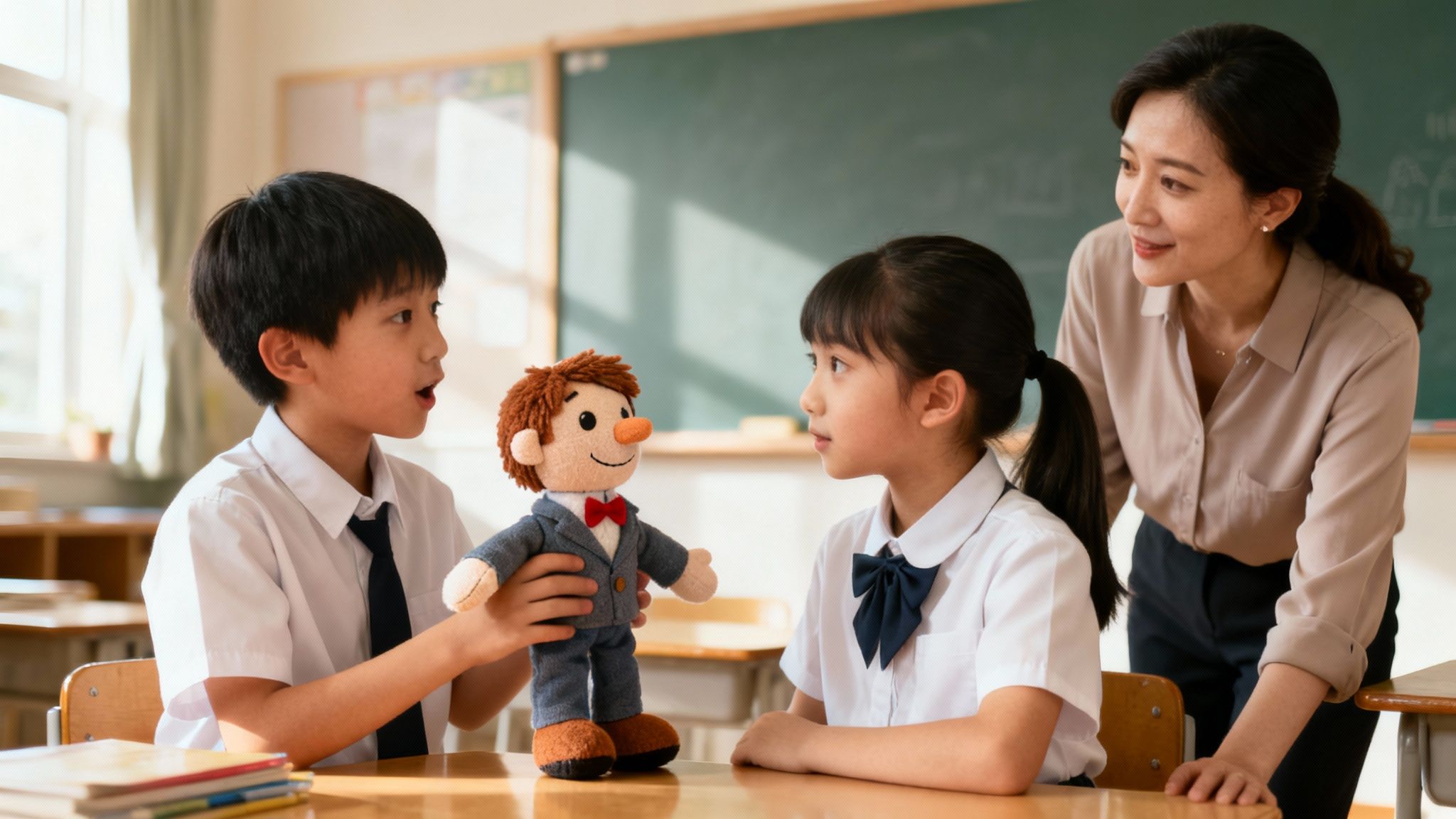
Use props for younger students: Puppets or stuffed animals can help K-2 students act out different perspectives without feeling self-conscious. A simple puppet show can powerfully demonstrate how two characters can see the same event differently.
Incorporate role-playing: Have students switch roles in a conflict scenario. Debrief afterward by asking reflective questions like, “What was it like to be in their shoes?” and “What did you learn about their point of view?”
Connect to literature: Use books and stories featuring diverse characters to spark discussions about different life experiences and feelings. Ask students to write a diary entry from a character’s perspective.
Teach “I-statements” with feeling words: Combine perspective-taking with clear communication. Instead of “You made me mad,” encourage “I felt hurt when…” to foster understanding rather than blame.
7. Nonviolent Communication (NVC) Framework
Nonviolent Communication (NVC) provides students with a powerful structure for expressing themselves and understanding others without blame or criticism. This compassionate communication model, developed by Marshall Rosenberg, breaks down dialogue into four clear components: observations (stating facts without judgment), feelings (identifying emotional responses), needs (recognizing underlying values), and requests (making specific, actionable asks).
This framework transforms confrontational language into productive conversation. Instead of saying, “You’re always hogging the ball,” a student learns to say, “I noticed I haven’t had a turn with the ball for ten minutes (observation), and I feel left out (feeling). I need to be included in the game (need). Can I have a turn next? (request).” This shift is a core element in many successful conflict resolution strategies for students, as it promotes self-awareness and empathy.
Practical Example: A middle schooler is upset because their friend shared a secret.
Instead of: “I can’t believe you told everyone! You’re a terrible friend.”
Using NVC: “When I heard you told Jessica what I said about my parents (observation), I felt really hurt and embarrassed (feeling). I need to be able to trust my friends with my private thoughts (need). Would you be willing to agree not to share my secrets in the future? (request).”
Why It Works
NVC works by de-escalating conflict and focusing on the universal human needs behind actions. It separates the person from the behavior, allowing students to address issues without attacking each other’s character. Successful NVC heavily relies on active listening and participation, moving beyond passive reception to truly engage with and understand others’ perspectives. It’s especially effective for interpersonal disputes, disagreements over resources, and situations where strong emotions are involved, as it provides a clear, repeatable script for navigating difficult feelings.
How to Implement It
Build vocabulary: Begin by explicitly teaching students a wide range of words for feelings and needs. Create “Feelings Wheels” or “Needs Inventories” and post them in the classroom for reference.
Use a simple script: Introduce a youth-friendly sentence frame like, “I noticed…, and I feel… because I need… Would you be willing to…?”
Practice with low-stakes scenarios: Use role-play cards with everyday situations (e.g., someone cutting in line, a friend not sharing a toy) to help students build muscle memory before tackling real conflicts.
Model consistently: Adults in the school should model NVC in their interactions with students and each other. This authenticity shows students that it is a valued communication tool for everyone. The Center for Nonviolent Communication offers a wealth of resources for educators.
8. Buddy and Mentorship Systems
Buddy and mentorship systems are structured programs that pair older students with younger ones or peers with classmates needing support. These relationships create natural opportunities for conflict prevention by fostering connection, belonging, and positive role modeling. A mentor can guide their mentee through social challenges, offering a safe and trusted perspective.
This strategy shifts the dynamic from adult intervention to peer-led support. A fourth grader paired with a first grader can help them navigate playground rules, or a new middle schooler can be matched with an eighth-grade mentor to ease their transition. These programs are powerful conflict resolution strategies for students because they build empathy and develop leadership skills while reducing feelings of isolation that often lead to conflict.
Practical Example: A school pairs every third-grader with a kindergartener as “reading buddies.” They meet once a week to read together. One day, a kindergartener is upset because another child won’t share the building blocks. Instead of running to a teacher, they find their third-grade buddy. The buddy helps them practice “I-statements” and walks with them to talk to the other child. The buddy’s presence provides the confidence the younger student needs to resolve the problem peacefully.
Why It Works
Mentorship provides a protective factor for vulnerable students and gives mentors a sense of purpose and responsibility. By modeling healthy communication and problem-solving, mentors help their mentees build the confidence to handle disagreements constructively. These programs are highly effective for supporting students new to the school, those with a history of behavioral challenges, or any child who could benefit from a positive connection. School-based mentoring programs have been shown to improve attendance, attitudes towards school, and social-emotional skills.
How to Implement It
Provide clear mentor training: Equip mentors with essential skills like active listening, setting boundaries, and knowing when to get an adult’s help.
Create structured activities: Plan initial meetings with specific activities or conversation starters, such as “Two Truths and a Lie” or creating a shared “All About Us” poster.
Establish regular check-ins: Schedule brief, consistent check-ins for mentors with a supervising adult to discuss progress, troubleshoot challenges, and feel supported.
Celebrate successes: Publicly acknowledge the positive impact of your mentors. This can be done through school announcements, certificates, or a special recognition event. Consider programs like Soul Shoppe’s junior leader development for a structured approach.
9. Classroom Agreements and Community Norms
Classroom Agreements are a set of co-created guidelines that establish shared expectations for how community members will treat each other and navigate disagreements. Instead of a list of rules imposed by an adult, this approach involves students in a collaborative process to define their own behavioral standards and conflict resolution protocols. This fosters a sense of ownership and collective responsibility for maintaining a positive classroom environment.
This strategy shifts the dynamic from adult-enforced compliance to community-led accountability. When conflicts arise, the agreements serve as an objective, shared reference point. This approach is a cornerstone of conflict resolution strategies for students because it empowers them to hold themselves and their peers accountable to standards they helped create, grounding solutions in community values.
Practical Example: At the start of the year, a teacher asks students, “How do we want our classroom to feel?” They brainstorm words like “safe,” “fun,” and “respected.” Then she asks, “What can we agree to do to make it feel that way?” The students create agreements like, “We listen when someone is talking,” and “We use kind words.” Two weeks later, one student interrupts another. The teacher can gently say, “Let’s check our agreements. Which one can help us right now?” This empowers students to self-correct based on their own rules.
Why It Works
Student-created agreements build intrinsic motivation for positive behavior and give students a framework for addressing problems respectfully. This process is highly effective for preventing common classroom conflicts like interrupting, disrespect, or exclusion. The Responsive Classroom approach, which heavily incorporates this practice, has been shown to improve social skills and academic performance. The agreements are most effective when they are treated as a living document, referenced daily and revised as needed to address the evolving needs of the classroom community.
How to Implement It
Frame the process positively: Guide students to create agreements about how they will treat each other, not just a list of “don’ts.” For example, frame it as “We listen to understand” instead of “Don’t interrupt.”
Facilitate, don’t dictate: Ask guiding questions like, “How do we want to feel in our classroom?” and “What can we agree to do to make sure everyone feels that way?”
Make them visible: Have students sign the final agreement and display it prominently. Younger students can illustrate each point to reinforce understanding.
Reference them regularly: When a conflict occurs, refer back to the norms by asking, “Which of our agreements can help us solve this problem?” or “How does this action fit with our agreement to show respect?”
10. Conflict Resolution Coaching and Adult Modeling
This strategy recognizes that the most powerful teachers of conflict resolution are the adults in a student’s life. Conflict Resolution Coaching and Adult Modeling focuses on training educators and staff to demonstrate healthy, constructive ways of handling disagreements. When adults consistently model self-regulation, respectful communication, and collaborative problem-solving, students internalize these behaviors as the norm.
The approach shifts the learning from a purely theoretical exercise to a lived reality. By seeing adults openly apologize, take deep breaths when frustrated, and listen actively to opposing views, students learn that conflict is a normal part of relationships that can be navigated successfully. This creates the emotional safety and credibility for students to practice these same conflict resolution strategies students themselves.
Practical Example: A parent gets frustrated trying to help their child with a difficult math problem. Instead of snapping, the parent says, “I’m feeling my frustration rise because this is tricky. Let me take a few deep breaths. Okay, let’s try looking at the example in the book one more time together.” This models self-regulation and problem-solving instead of blame. In the classroom, a teacher whose projector isn’t working could say aloud, “This is very frustrating, but getting angry won’t fix it. I’m going to ask Mr. Davis for help, since he’s good with technology.”
Why It Works
Students learn more from what they see than what they are told. When adults model vulnerability and repair, it dismantles the perception that authority figures are perfect and makes conflict resolution feel achievable. This approach is highly effective for establishing a school-wide culture of respect and trust. It works best for creating a foundational, preventative environment where other conflict resolution strategies can flourish. Schools that emphasize adult culture change often see significant improvements in climate surveys and reductions in disciplinary incidents.
How to Implement It
Provide comprehensive staff training: Equip all staff, including administrators, teachers, and support personnel, with the same conflict resolution language and tools that students are learning, such as Nonviolent Communication (NVC) or Collaborative & Proactive Solutions (CPS).
Narrate your process: When a conflict arises, model self-awareness aloud. For example, a teacher might say, “I’m feeling frustrated right now, so I’m going to take a moment to breathe before we continue this conversation.”
Apologize and repair openly: If you make a mistake or speak harshly, model accountability. An adult could say to a student, “I was wrong to raise my voice earlier. I’m sorry. Can we try that conversation again?”
Celebrate colleague collaboration: When students witness staff members resolving a disagreement respectfully, point it out. You might mention in a class meeting, “Mr. Smith and I had different ideas for the field trip, so we sat down, listened to each other, and found a solution that worked for everyone.” This is a powerful, real-world example of conflict resolution strategies students can emulate.
Low–Medium — facilitation to create and maintain meaningful agreements
Low — class time, visual displays, periodic review
Greater student ownership; clearer expectations; fewer power struggles
Classroom-level behavior management and democratic engagement
Student-created rules increase compliance and shared responsibility
Conflict Resolution Coaching & Adult Modeling
High — culture change requiring ongoing PD and vulnerability
High — coaching, time, system-wide commitment and consistency
Improved school climate; students learn implicitly from adults; increased trust
Whole-school reform, staff culture shifts, modeling for students
Powerful implicit teaching; aligns adult behavior with student learning
Building a Culture of Peace, One Skill at a Time
Equipping students with effective conflict resolution skills is one of the most profound investments an educational community can make. Moving beyond simple behavior management, the strategies detailed in this article-from the structured dialogue of Restorative Circles to the empathetic framework of Nonviolent Communication-represent a fundamental shift in how we view interpersonal challenges. They transform conflict from a disruptive event into a valuable learning opportunity. By systematically teaching these techniques, we are not just quieting classrooms; we are nurturing a generation of thoughtful, resilient, and compassionate leaders.
The journey to a peaceful school culture is not built on a single initiative but on a layered, integrated approach. The true power of these conflict resolution strategies for students is realized when they become part of the school’s DNA, woven into daily interactions, curriculum, and community norms.
From Theory to Daily Practice
The ultimate goal is to move these concepts off the page and into the lived experiences of students. This requires consistent reinforcement and a commitment from all adults in the community.
Consistency is Key: A one-time assembly on bullying or a single lesson on “I-Statements” is not enough. For these skills to stick, they must be practiced regularly, whether through weekly classroom meetings, daily mindfulness moments, or consistent use of shared language by all staff.
Adult Modeling is Non-Negotiable: Students learn more from what we do than what we say. When a teacher models Collaborative Problem-Solving with a frustrated student or a principal uses restorative questions to address a hallway dispute, it sends a powerful message. Every adult interaction becomes a lesson in respectful conflict resolution.
Empowerment Over Punishment: Shifting from a punitive to a restorative mindset is crucial. Instead of asking “Who is to blame and what is the punishment?”, we start asking “What happened, who was affected, and what needs to be done to make things right?”. This empowers students to take ownership of their actions and repair harm, fostering accountability and empathy.
The Lasting Impact of Conflict Competence
The benefits of mastering these skills extend far beyond the school gates. Students who learn to navigate disagreements constructively are better prepared for the complexities of higher education, the collaborative demands of the modern workplace, and the inevitable challenges of personal relationships. They develop stronger self-awareness, greater empathy for others, and the confidence to advocate for their needs peacefully.
By investing in these foundational skills, we are providing students with a toolkit for life. We are teaching them that their voice matters, that understanding others is a strength, and that problems can be solved together. This is the core of social-emotional learning and the bedrock of a healthy, functioning society.
Ultimately, building a culture of peace is an ongoing process, not a destination. It requires patience, dedication, and a shared belief that every student has the capacity to learn, grow, and contribute to a more harmonious world. The tools and strategies outlined here provide a clear roadmap for that journey. By committing to this work, we are not just creating better schools-we are actively building a better future, one peaceful resolution at a time.
Ready to bring a dynamic, experiential approach to social-emotional learning and conflict resolution to your school? The experts at Soul Shoppe provide powerful assemblies, in-class workshops, and professional development that transform school culture by giving students the tools they need to solve problems peacefully. Discover how Soul Shoppe can help you build a community of empowered, empathetic, and resilient learners.
Conflict is a part of life, but it doesn’t have to be a source of stress. For kids, learning how to handle disagreements peacefully is one of the most powerful tools we can give them. It’s about more than just “playing nice”—it’s about learning to understand their emotions, communicate what they’re feeling, and work together to find a fair solution.
When we teach these skills, we turn conflict from something scary into an opportunity for connection and growth.
Why Kids Need Conflict Resolution Skills Now More Than Ever
Let’s be honest: conflict resolution isn’t just a “nice-to-have” skill anymore. It’s an essential toolkit for building resilience, empathy, and emotional well-being. A simple argument over a playground swing or a shared toy can quickly snowball, leading to hurt feelings, social isolation, and classroom disruptions.
Practical Example (No Skills):
Think about a classic classroom squabble over a single tablet. Without the right tools, one child might snatch it away, while the other dissolves into tears. Nobody wins, and the underlying problem—how to share—remains unsolved.
Practical Example (With Skills):
Now, picture that same scene with a child who has some conflict resolution skills. They might take a breath and say, “I’m feeling frustrated because I haven’t had a turn yet. Can we use a timer for 10 minutes each?” Just like that, the dynamic shifts from a power struggle to a collaborative effort.
Conflict Is an Opportunity, Not a Threat
Every disagreement is a live-action classroom for learning vital life skills. When we reframe conflict as a chance to practice, we give kids a gift that will serve them at school, at home, and in their future relationships.
This is especially important because unresolved conflict can be a huge source of anxiety. If this is a concern, it’s helpful to learn the common signs of stress in children and how to step in with support.
The Core Pillars of Kid-Friendly Conflict Resolution
So, where do we start? This guide breaks it down into three foundational skills. I’ve found that focusing on these pillars gives kids a reliable roadmap for navigating almost any disagreement.
The following table summarizes these core skills and what they look like in action across different age groups. It’s a great quick-reference tool for both educators and parents.
| The Core Pillars of Kid-Friendly Conflict Resolution |
| :— | :— | :— |
| Skill | What It Looks Like in Action (K-3) | What It Looks Like in Action (4-8) |
| Understanding Emotions | Naming basic feelings like “mad” or “sad.” Pointing to a feelings chart to show how they feel. | Using more nuanced words like “frustrated” or “disappointed.” Recognizing how emotions feel in their body. |
| Communicating Feelings | Using simple “I feel…” statements, like “I feel sad when you take my crayon.” | Using “I-Statements” to express needs without blaming: “I feel left out when I’m not invited to play.” |
| Solving Problems Together | Suggesting simple solutions like taking turns or asking a teacher for help. | Brainstorming multiple solutions and discussing which one is fairest for everyone involved. |
By building these skills, we give kids the confidence to handle bumps in their friendships constructively instead of letting them derail their day.
The Link Between Emotions and Positive Actions
It all begins with emotional literacy. When kids can name what they’re feeling, they gain the power to manage their reactions instead of being controlled by them. The research is clear on this: there’s a direct line between understanding emotions and choosing positive conflict strategies.
One study found that young children with a better grasp of emotions were 20-30% more likely to negotiate or share instead of grabbing or yelling. This really drives home how critical emotional awareness is to peaceful problem-solving.
By equipping children with these foundational skills, we empower them to turn disagreements into moments of understanding and strengthen their social and emotional wellbeing.
Building the Foundation with Emotional Literacy
Before a child can say, “I’m upset because you knocked over my tower,” they first have to know what “upset” even feels like in their body. This core skill—the ability to spot, understand, and name our feelings—is called emotional literacy. It’s truly the bedrock of conflict resolution.
Without it, a small frustration can quickly snowball into a full-blown tantrum because the child simply doesn’t have the tools to explain their inner world. Our goal is to help them shift from showing their feelings (crying, yelling, stomping) to telling us about them. It all starts with giving them a rich emotional vocabulary. A strong foundation here is essential for their overall social and emotional wellbeing.
Name It to Tame It
There’s a powerful strategy I always come back to: “Name It to Tame It.” The simple act of putting a label on a big, confusing feeling makes it feel less overwhelming and much more manageable. For our youngest learners, this begins with the basics: happy, sad, angry, and scared.
When you see a child in the grip of an emotion, your job is to be a mirror and a narrator.
Practical Example (Kindergarten):
Imagine a kindergartener throws their crayons after a drawing goes wrong. Instead of jumping to a correction, try narrating what you see. “Wow, you slammed your hands down. It looks like you’re feeling frustrated that the lines aren’t straight. Is that right?”
This does two powerful things at once: it hands them the word “frustrated” for their emotional toolkit and it validates their feeling, sending the message that it’s okay to feel that way.
Hands-On Activities for Emotional Literacy
Emotional learning really sticks when it’s interactive. Abstract ideas like “disappointment” become real and understandable when kids can see, touch, and play with them.
Here are a few activities you can try in the classroom or at home:
Create a ‘Feelings Wheel’: On a paper plate or a large circle of paper, draw different feeling faces—happy, sad, angry, surprised, worried. When a child is struggling to find the words, they can just point to the face that matches how they feel. It’s a fantastic pre-verbal tool.
Emotion Charades: Write different emotions on slips of paper and toss them in a hat. Players take turns acting out the feeling without using any words. This is a fun way to help kids practice reading emotional cues in others, which is a huge part of empathy.
Storybook Detectives: When you’re reading together, hit the pause button and ask, “How do you think that character is feeling right now? What clues in the picture or the words tell you that?” This teaches them to look for tells in facial expressions and body language. For more ideas, check out our guide on naming feelings and helping kids find the words they need.
Moving Beyond the Basics with Older Kids
With older kids in grades 4-8, emotional literacy gets more nuanced. Their social worlds are more complex, and so are their feelings. Now’s the time to start exploring the subtle, but important, differences between emotions that might seem similar on the surface.
Teaching children to distinguish between disappointment and jealousy, or between nervousness and excitement, gives them precision in their self-expression. It’s the difference between saying “I feel bad” and “I feel excluded because I wasn’t invited.”
To help them build this more advanced vocabulary, use gentle, observational language and ask curious questions. This builds self-awareness without putting them on the spot.
Coaching Script for an Older Child:
“I noticed you got really quiet and your shoulders slumped after you saw those pictures your friends posted. It looks like that hit you hard. Are you feeling disappointed you couldn’t be there, or is it maybe a little bit of jealousy, too?”
This approach gives them options and validates that their feelings might be complicated. It opens a door for a real conversation, rather than shutting it down with a generic “What’s wrong?” By building this foundational vocabulary, we give children the tools they need to understand themselves, state their needs clearly, and ultimately, resolve conflicts with confidence.
Teaching Kids to Use I-Statements and Active Listening
Once kids can put a name to their feelings, the real work begins: teaching them how to share those feelings without pointing fingers. This is where two of the most powerful tools in our conflict resolution toolbox come into play: I-Statements and active listening.
These skills shift the entire dynamic from accusation to communication, opening up a space where kids can actually understand each other.
Our goal is to help them move away from “You-Statements” like, “You’re so annoying!” or “You always mess up my stuff!” These phrases are conversation enders. They immediately put the other person on the defensive and slam the door on any real solution. Instead, we want to give them a way to talk about what’s happening on their side of the fence.
The Power of I-Statements
An I-Statement is a simple but mighty tool that helps a child own their feelings and state their needs clearly and respectfully. It follows a straightforward formula that pulls the blame right out of the conversation.
The magic formula is: I feel [feeling] when you [specific behavior] because [the impact it has on me].
Let’s look at how this plays out in situations we all see every single day.
Scenario 1: The Sibling Closet Raider
Instead of: “You always steal my clothes! You’re so selfish!”
Try This I-Statement: “I feel frustrated when you take my favorite hoodie without asking because I was planning to wear it and now I can’t find it.”
Scenario 2: Feeling Sidelined in a Game
Instead of: “You never pass the ball to me! You’re a ball hog!”
Try This I-Statement: “I feel left out when I’m open but don’t get a pass because it makes me feel like I’m not part of the team.”
Giving children sentence starters can make this feel way less intimidating. Try writing prompts on a whiteboard or creating a “peace table” at home with cues like: “I feel…” “It bothers me when…” or “I need…”
Shifting from Hearing to Listening
The other half of this communication puzzle is teaching kids how to truly listen. Let’s be honest, most of us listen just to figure out what we’re going to say next. We’re just waiting for our turn to talk.
Active listening, on the other hand, is about listening to understand.
This skill doesn’t come naturally; it needs to be coached. It’s about more than just staying quiet—it’s about showing the speaker you’re engaged and really trying to see things from their perspective. The impact here is huge. In fact, schools that teach conflict resolution tools often see bullying incidents drop by 35-50%, and students show a 24% improvement in their relationships. You can dive into the research by exploring the full report on educational programs and peace.
Here are a few simple techniques to get started:
Nodding and Making Eye Contact: These small physical cues send a powerful message: “I’m with you. Keep going.”
Putting Away Distractions: This means putting down the toy, pausing the video game, or turning to face the person who is speaking.
Asking Clarifying Questions: Simple questions like, “What did you mean by that?” or “Can you tell me more?” show genuine curiosity and a desire to understand.
Try This: Playback Listening
One of the most effective strategies I’ve seen for ensuring understanding is an exercise I call Playback Listening. It’s a simple rule: before you can share your side of the story, you have to repeat back what you heard the other person say.
The point isn’t to agree with them. It’s to prove you were actually listening. The goal is to paraphrase their main point to their satisfaction.
Let’s see it in action during a screen-time squabble:
Imagine two kids, Alex and Ben, are arguing over a shared tablet.
Alex uses an I-Statement: “I feel angry when you keep playing after the timer went off because you promised it would be my turn.”
Ben uses Playback Listening: “So, you’re saying you’re angry because I didn’t stop when the timer went off, and you were supposed to have your turn?”
Alex confirms: “Yes, that’s right.”
Only after Alex confirms that Ben gets it can Ben share his perspective. This one simple step prevents countless misunderstandings. It forces both kids to slow down, take a breath, and truly hear each other, building a bridge of empathy before they even start looking for a solution.
A Practical Framework for Solving Problems Together
Knowing how to name their feelings is half the battle for kids. The other half? Having a clear, predictable plan to actually solve the problem.
Without a roadmap, kids get stuck in the emotional storm of a disagreement, completely unable to see a way out. This is where a simple, practical framework becomes a game-changer. It gives them a tangible process to follow, moving them from conflict to a real solution.
You can make this even more concrete by creating a dedicated physical space for it. Think of it as a “Peace Corner” in your home with some comfy pillows, or a “Resolution Table” in the classroom. Having a designated spot signals that this isn’t a time for arguing—it’s a special time for listening and problem-solving.
Set the Stage for Success
Before you even think about solutions, the environment has to feel safe and supportive. The whole point is to shift kids from a defensive, “me vs. you” mindset to a collaborative, “us vs. the problem” one. As the adult, your role is to be a neutral coach, guiding them with questions instead of just handing them the answers.
This approach is right in line with the principles of restorative practices, which focus on repairing harm and strengthening relationships over assigning blame. If you’re curious, you can learn more about what restorative practices in education look like and see how they create more connected school communities.
Once you have your space, you can introduce a simple, memorable process. This visual flow is a great starting point:
It’s a simple reminder that before we jump to fixing things, we have to express our own feelings and truly hear what the other person is saying.
A 4-Step Process for Finding Solutions
When kids are ready to solve the problem, you can guide them through these four actionable steps. This structure provides the scaffolding they need to build their own agreements and feel empowered.
Step 1: Take a Breath & State the Problem (No Blame!). The first move is always to calm those big emotions. Once they’re a little more centered, each child gets to state the problem from their point of view using an “I-Statement.” The goal is just to define the issue clearly, like, “The problem is we both want to use the blue marker right now.”
Step 2: Brainstorm Solutions Together. This is the “no bad ideas” phase. Get creative! Write down every single suggestion, even the silly ones. For younger kids, you can make this visual by drawing the ideas on a whiteboard.
Step 3: Agree on a Win-Win Solution. Now, look over that brainstormed list together. Guide them in a discussion about which solution feels fair to everyone involved. The key here is mutual agreement. You might ask, “Is this a solution you can both feel good about?”
Step 4: Give the Solution a Try. Once a solution is picked, it’s time to put it into action. Remind them that this is an experiment. If it doesn’t work out, that’s okay! They can always come back to the Resolution Table and try another idea from their list.
For older kids, you could even formalize the agreement a bit. Have them write down their chosen solution on a piece of paper and sign it like a “Friend Agreement.” This little step adds a real sense of ownership and commitment to their plan.
Age-Appropriate Conflict Resolution Scenarios and Solutions
The 4-step process is flexible enough for different age groups, but how you coach them through it will change. Younger kids need more direct guidance and simpler language, while older students can handle more complex brainstorming and abstract reasoning.
Common Conflict
K-3 Approach (Example)
4-8 Approach (Example)
Two kids want the same swing.
1. State Problem: “We both want the swing.” 2. Brainstorm: “Take turns,” “Swing together,” “Play on something else.” 3. Agree: “Let’s use a timer for 5-minute turns.” 4. Try It: Set the timer and start swinging.
1. State Problem: “We can’t agree on who gets the swing first.” 2. Brainstorm: “Rock-paper-scissors,” “One person gets it today, the other tomorrow,” “Find a different activity we both like.” 3. Agree: “Rock-paper-scissors for the first turn, then 10-minute timers.” 4. Try It: Play the game and honor the outcome.
A friend said something hurtful.
1. State Problem: “I feel sad because my feelings were hurt.” 2. Brainstorm: “Say sorry,” “Draw a picture to show feelings,” “Ask for a hug.” 3. Agree: “I will say sorry for hurting your feelings.” 4. Try It: One child apologizes, and the other accepts.
1. State Problem: “I feel disrespected by that comment.” 2. Brainstorm: “Talk about why it was hurtful,” “Explain my side,” “Agree on respectful ways to talk,” “Take a break from each other.” 3. Agree: “We agree to explain our feelings without interrupting and to apologize for the impact.” 4. Try It: Have a structured conversation using I-statements.
Disagreement over game rules.
1. State Problem: “We don’t agree on the rules.” 2. Brainstorm: “Ask a grown-up,” “Make up a new rule,” “Play a different game.” 3. Agree: “Let’s make up one new rule for this game.” 4. Try It: Play one round with the new rule.
1. State Problem: “The official rules are confusing, and it’s causing an argument.” 2. Brainstorm: “Read the rulebook together,” “Look up a video tutorial,” “Vote on an interpretation,” “Modify the rule for our game.” 3. Agree: “Let’s watch a quick ‘how to play’ video to clarify.” 4. Try It: Watch the video and restart the game.
Seeing these real-world examples helps make the process feel less abstract and more achievable for both kids and the adults guiding them.
Coaching Kids Through a Disagreement
Let’s see how this works in a real scenario. Imagine two friends, Maya and Leo, are arguing over the rules of a board game.
Adult Coach: “It sounds like you’re both feeling really frustrated. Why don’t we head to the Resolution Table? Maya, can you start by telling us the problem without blaming Leo?”
Maya: “The problem is that I think we’re supposed to draw two cards, but Leo says it’s only one.”
Adult Coach: “Thanks for sharing that so clearly. Leo, what do you think the problem is?”
Leo: “The problem is the rules are confusing, and we’re arguing instead of actually playing.”
Adult Coach: “Great, we know the problem. Now, what are some possible solutions? Let’s brainstorm.”
Maya: “We could just guess and keep playing.”
Leo: “We could look up the official rules online.”
Maya: “We could make up our own rule just for this one time.”
Leo: “Or we could just play a totally different game.”
Adult Coach: “Those are four fantastic ideas. Which one feels fair to both of you?”
Maya: “I think looking up the rules online is the fairest.”
Leo: “I agree. That way we’ll know for sure.”
Adult Coach: “Excellent. You found a win-win solution. Let’s give it a try!”
Notice how the adult acted as a facilitator, not a judge. They simply asked questions and guided the conversation, which empowers kids to take ownership and solve their own problems. For a fun, low-stakes way to practice this, try incorporating some engaging family board games into your routine. They provide endless, natural opportunities to use this framework.
Coaching Kids Through More Complex Conflicts
While I-Statements and the basic problem-solving steps are fantastic for everyday squabbles, some conflicts just aren’t that simple. They’re messier. We’re talking about situations with deeper issues like power imbalances, rumors, social exclusion, or even a child who just shuts down and refuses to engage.
In these moments, your role has to shift. You’re no longer just a hands-off facilitator; you become a more active, supportive coach.
These tougher situations demand more nuance and a whole lot of patience. It’s not about swooping in to fix everything for them. Instead, you’re providing the scaffolding kids need to navigate these tricky social dynamics on their own. The goal is to stay neutral while empowering them to find their own way forward, even if the path is a little bumpy.
Knowing when to step in and when to let kids struggle a bit is an art. If safety is ever a concern, you intervene immediately. But if the stakes are lower, letting them grapple with the problem can build incredible resilience and problem-solving confidence.
Navigating Power Imbalances
Conflicts between an older, more assertive child and a younger, quieter one are incredibly common. Right from the start, the power dynamic is skewed, and the younger child can easily feel steamrolled. Your job is to level the playing field.
A great first step is to give the quieter child the floor first, making sure they have uninterrupted time to speak their mind. You might even need to help them find the right words.
Coaching in Action: During a dispute over a shared space in the classroom, you might say to the younger child, “It looks like you have some big feelings about this. Can you tell us what’s on your mind? We’re all going to listen quietly.” This simple act validates their voice and sets clear expectations for the other child.
After they’ve spoken, use playback listening to ensure the older child truly heard them. This forces them to pause their own agenda and genuinely consider another perspective.
Addressing Social Exclusion and Rumors
When a conflict is about rumors or being left out, the hurt is often invisible but cuts deep. These situations are less about a tangible problem and more about mending relationships and tending to emotional pain. The focus has to be on empathy and impact.
Instead of getting bogged down trying to prove a rumor true or false, guide the conversation toward how the words or actions made someone feel.
“When coaching kids through social conflict, shift the focus from intent to impact. A child may not have intended to be hurtful, but acknowledging the impact of their actions is the first step toward genuine repair.”
Use gentle, curious questions to open up a real dialogue. You have to avoid blaming language, which will almost always cause a child to shut down.
Instead of: “Why would you spread that rumor?”
Try This: “I heard what was said, and I saw how it landed with Sarah. Can you help me understand what was going on for you in that moment?”
This approach invites reflection instead of defensiveness, creating the space needed for empathy to grow. The consequences of social isolation can be huge. Globally, 222 million crisis-impacted children need educational support, and programs that build these exact emotional skills have been shown to boost positive social approaches by 25-35%. You can learn more about how social-emotional skills support children in crisis on unesco.org.
When a Child Refuses to Participate
So, what do you do when one child crosses their arms, digs in their heels, and declares, “I’m not talking”? This refusal is usually a defense mechanism. It comes from a place of feeling overwhelmed, angry, or totally misunderstood. Forcing them to participate will only backfire.
The key is to give them space, but not an exit pass.
Acknowledge and Validate: Start by saying something like, “I can see you’re not ready to talk right now, and that’s okay. It looks like you’re feeling really angry.”
Offer a Cool-Down Period: Suggest a brief break in a designated calm-down corner. “Why don’t you take five minutes to cool off, and then we can try again? We’ll be here when you’re ready.”
State the Inevitability of Resolution: Make it clear that the problem isn’t just going to disappear. “We still need to solve this problem together, so we’ll wait until you’re ready to join us.”
This approach honors their feelings while holding the boundary that resolution is still necessary. It teaches kids that while their emotions are valid, they are still responsible for their part in finding a solution. It’s a delicate balance, but one that builds both emotional intelligence and accountability.
Your Questions on Teaching Conflict Resolution Answered
As you start weaving these strategies into your classroom or home, questions are bound to pop up. Every kid is different, and every conflict has its own flavor, but the core ingredients—empathy, communication, and problem-solving—are always the same. Here are some of the most common questions I hear from parents and educators.
Think of this as your quick-reference guide. Each answer offers practical advice that connects back to the key strategies in this guide, helping you handle real-life situations with more confidence.
What Is the Best Age to Start Teaching Conflict Resolution Skills to Kids?
You can start laying the foundation for conflict resolution as early as age two or three. It all begins with the building blocks of emotional literacy.
For toddlers, it’s as simple as naming their big feelings. You might say, “You feel so angry that your tower fell down!” This simple act connects a word to a powerful, overwhelming emotion. For preschoolers (ages 4-6), you can introduce basic ideas like sharing and taking turns, along with simple “I feel sad when…” statements to help them express their needs without pointing fingers.
The key is to start with a strong emotional vocabulary and build from there. The strategies in this guide are designed to be flexible for any child in the K–8 range, with the complexity of the problems and solutions growing right alongside them.
How Can I Help a Shy Child Who Avoids Conflict?
For a child who shies away from disagreements, our main goal is to build their confidence through safe, low-stakes practice. Conflict can feel huge and scary, so avoiding it feels like the only safe option. Your job is to show them they have the tools to handle it.
Start by role-playing common scenarios at home or in a quiet corner of the classroom. Practice simple but powerful phrases like, “I’m not finished with that yet,” or, “Please stop, I don’t like that game.”
Using I-Statements is particularly effective for shy children because it allows them to express their feelings and needs without feeling confrontational. It reframes the conversation around their experience, not another child’s wrongdoing.
Reassure them that having a different opinion is perfectly okay and that standing up for their needs is a sign of strength. Make sure to celebrate every small step they take to find and use their voice.
What If the Other Child Refuses to Cooperate?
This is a huge—and very real—learning moment. It’s absolutely essential to teach kids that they can only control their own actions and choices, not anyone else’s.
The first and most important step is to ensure their physical and emotional safety. Teach them to walk away from a situation that feels stuck, hostile, or unproductive and to find a trusted adult. Frame this choice as smart and self-respecting, not as “giving in” or losing.
Practical Example:
If your child tries to use an I-Statement (“I feel frustrated when you keep changing the rules”) and their friend just laughs and says, “I don’t care,” the next step is crucial. Coach your child to say, “This isn’t working for me right now. I’m going to take a break and find an adult.” This empowers your child to make safe choices, even when others aren’t ready or willing to solve the problem. Once an adult is present, they can step in to mediate or address the other child’s behavior separately.
How Do I Align These Skills with My School’s SEL Program?
Consistency between home and school is a powerful amplifier for learning. The great news is that these conflict resolution skills are the foundation of most Social-Emotional Learning (SEL) and anti-bullying programs.
Reach out to your child’s teacher or school counselor. Ask about the specific language and tools they use in the classroom. Do they have a “Peace Path,” a “Cool-Down Corner,” or a “Resolution Table”? By creating a similar space or using the same vocabulary at home, you powerfully reinforce the learning.
When kids hear concepts like “I-Statements” and collaborative problem-solving steps in both environments, the skills really start to stick. It sends a clear message that these tools are important everywhere, creating a unified approach to their emotional growth.
At Soul Shoppe, we believe that every child deserves to feel safe, connected, and understood. Our programs equip K-8 school communities with the shared language and practical tools needed to turn conflict into connection. We provide students and educators with the skills to build empathy, communicate effectively, and solve problems together.
Beyond academics, a child’s ability to understand emotions, build healthy relationships, and make responsible choices is crucial for success in school and life. This is the core of social emotional learning (SEL). For elementary students, these skills are not just ‘nice-to-haves’; they are the building blocks of a safe, connected, and productive learning environment where every child can thrive.
Integrating SEL doesn’t require a complete curriculum overhaul. Many effective strategies can be woven into daily routines, complementing existing educational frameworks. For instance, philosophies like the Montessori method of teaching naturally emphasize student autonomy and self-management, which are key pillars of social emotional development. By intentionally incorporating SEL, educators and caregivers can cultivate classrooms where students feel seen, heard, and equipped to navigate social complexities.
This article provides a comprehensive roundup of 10 practical and research-backed social emotional learning activities for elementary students. Each activity is designed for immediate use by busy teachers, counselors, and parents, offering a clear structure to guide implementation. You will find:
Step-by-step instructions and clear goals for each activity.
SEL competency alignment (e.g., self-awareness, relationship skills).
Practical adaptations for different grade levels, remote settings, and large classes.
From fostering self-awareness with simple mindfulness exercises to building community through cooperative games, these strategies will equip you to nurture emotionally intelligent and resilient learners. The goal is to provide actionable tools that turn abstract SEL concepts into tangible classroom experiences, strengthening the foundation for academic achievement and lifelong well-being.
1. Mindfulness and Breathing Exercises
Mindfulness practices are foundational social emotional learning activities for elementary students, teaching them to pause, focus on the present moment, and observe their thoughts and feelings without judgment. By guiding children through simple breathing techniques, body scans, or sensory awareness exercises, you help them build a crucial gap between a triggering event and their reaction. This mental space is where self-regulation begins, allowing students to manage big emotions like anxiety, frustration, and over-excitement.
These exercises directly support the core SEL competencies of self-awareness (noticing internal states) and self-management (using a tool to regulate those states). The goal is not to eliminate difficult feelings but to equip children with the skills to navigate them constructively.
How to Implement Mindfulness and Breathing
Start by integrating short, simple practices into daily routines. For example, a “Mindful Morning” can begin with two minutes of “belly breathing,” where students place a hand on their stomach to feel it rise and fall. This tangible sensation helps younger learners stay focused. Before a challenging task like a math test, guide them through a “square breathing” exercise: inhale for four counts, hold for four, exhale for four, and pause for four, tracing a square in the air or on their desk.
Practical Example:
A second-grade teacher notices her class is overly energetic and unfocused after recess. She signals for a “Mindful Minute” by ringing a small chime. She guides them: “Place your feet flat on the floor and rest your hands on your desk. Let’s do ‘Volcano Breaths.’ Reach your arms up high as you breathe in deeply, then push the air out with a ‘whoosh’ sound as your arms come down.” She repeats this three times, and the class settles, ready for the next lesson.
Tips for Success
Model First: Always demonstrate the breathing exercise yourself so students see and hear what is expected.
Start Small: Begin with practices as short as 30 seconds to one minute, gradually increasing the duration as students build their focus “muscles.”
Offer Choices: Allow students to sit at their desks, stand, or lie on a rug. Giving them agency over their body position increases comfort and participation.
Use Consistent Cues: A specific chime, a hand signal, or a phrase like “Let’s find our calm” can signal the start of a mindfulness practice, making transitions smoother.
By consistently weaving these moments into the school day, you provide students with a powerful, portable tool for managing their emotional well-being. For more ideas on creating a peaceful classroom, you can find a variety of mindfulness strategies for a relaxed learning environment on soulshoppe.org.
2. Feelings Check-In and Emotion Identification
Feelings check-ins are structured daily activities where students learn to recognize, name, and express their emotions using specific vocabulary and visual aids. These simple routines build emotional literacy from the ground up, giving children the words to articulate their internal states. This practice is one of the most essential social emotional learning activities for elementary students because it normalizes conversations about feelings and creates a classroom culture of empathy and support.
This activity directly supports the core SEL competencies of self-awareness (identifying one’s own emotions) and social awareness (recognizing and understanding the emotions of others). By making emotional identification a regular part of the day, you teach students that all feelings are valid and manageable.
How to Implement Feelings Check-Ins
Integrate check-ins into predictable routines, like morning meetings or the transition after lunch. Use visual tools like a “Feelings Thermometer” or an “Emotion Wheel” where students can point to or place their name next to the feeling that best describes their current state. This non-verbal option is excellent for younger students or those who are hesitant to share aloud. As students become more comfortable, you can invite them to briefly share why they feel a certain way.
Practical Example:
A third-grade teacher starts each morning by having students move their personal clothespin to a section of a large color-coded chart. Red represents intense feelings like anger or excitement, yellow for mild feelings like worry or silliness, and blue for low-energy feelings like sadness or tiredness. She then asks, “I see a few friends in the yellow zone today. Would anyone like to share what’s on their mind?” This simple act validates their emotions and gives her valuable insight into her students’ readiness to learn.
Tips for Success
Validate All Emotions: Respond with empathy and without judgment. Phrases like, “It’s okay to feel disappointed,” or “I understand why you might feel nervous,” create emotional safety.
Expand Emotional Vocabulary: Move beyond “happy, sad, mad.” Introduce more nuanced words like “frustrated,” “proud,” “anxious,” and “content” to help students identify their feelings with greater precision.
Offer Private Options: For students who are not comfortable sharing with the group, provide a journal or a private check-in slip they can hand to you.
Connect Feelings to Needs: Ask follow-up questions like, “What do you need right now to help with that feeling?” This empowers students to practice self-advocacy and problem-solving.
Consistently using these check-ins helps students develop a deeper understanding of themselves and their peers. You can explore a variety of methods for these important routines and find more about using mood meters and other reflection tools on soulshoppe.org.
3. Cooperative Games and Team-Building Activities
Cooperative games shift the focus from individual competition to collective success, making them powerful social emotional learning activities for elementary students. Instead of a “win-lose” dynamic, these activities create a “we all win or we all learn together” environment. By engaging in challenges that require communication, shared strategy, and mutual support, children learn to value collaboration and appreciate the unique strengths of their peers.
These activities are essential for developing relationship skills (communication, cooperation, conflict resolution) and social awareness (perspective-taking, empathy). They build a strong sense of classroom community and belonging, teaching students that relying on others and being reliable are equally important. The goal is to solve a problem together, strengthening interpersonal bonds in the process.
How to Implement Cooperative Games
Integrate team-building exercises during morning meetings, brain breaks, or dedicated community-building time. Start with low-stakes activities that have simple rules. For example, the “Human Knot” challenges a small group to untangle themselves from a jumble of interconnected arms without letting go. Another classic is “Build a Tower,” where teams use limited materials like spaghetti and marshmallows to construct the tallest possible freestanding structure.
Practical Example:
A fourth-grade teacher wants to improve how her students work in small groups. She introduces a challenge: “Cross the River.” She lays out a few small mats (“rafts”) on the floor and explains that the entire group must get from one side of the room to the other without touching the “water” (the floor). The team must pass the rafts to one another to move forward, requiring planning and clear communication. The activity generates laughter, a few failed attempts, and ultimately, a shared sense of accomplishment.
Tips for Success
Focus on Process, Not Outcome: Emphasize how the group worked together, not whether they “won” the challenge. Use prompts like, “What was one helpful thing a teammate said?”
Facilitate a Debrief: After the activity, guide a brief discussion. Ask students what went well, what was challenging, and what they might do differently next time.
Offer Opt-in Participation: Create a psychologically safe environment where students feel comfortable participating. For activities involving touch, like the Human Knot, allow students to choose their level of involvement.
Mix Up the Groups: Intentionally create different groupings for various activities. This helps break down social cliques and builds relationships across the entire classroom.
By incorporating cooperative games, you actively teach students the skills needed to navigate group dynamics, resolve conflicts, and build positive relationships, setting a foundation for successful collaboration inside and outside the classroom.
4. Conflict Resolution and Peer Mediation
Conflict resolution and peer mediation programs are powerful social emotional learning activities for elementary students that teach them to navigate disagreements constructively. Instead of relying on adult intervention for every problem, these structured processes empower children with the skills to listen, understand different perspectives, and find mutually agreeable solutions. This approach transforms conflict from a negative event into a valuable learning opportunity.
These activities directly build the core SEL competencies of social awareness (perspective-taking), relationship skills (communication and conflict resolution), and responsible decision-making (evaluating consequences and solving problems ethically). The ultimate goal is to create a safer, more respectful school climate where students feel capable of solving their own problems.
How to Implement Conflict Resolution
Begin by establishing a dedicated “Peace Corner” or “Conflict Resolution Zone” in the classroom. This area can be equipped with visual aids outlining the steps for resolving a problem, such as using “I-Feel” statements, listening without interrupting, and brainstorming solutions. Introduce these steps through role-playing common classroom scenarios, like arguments over toys or disagreements during a group project. For a more structured approach, older students can be trained as peer mediators to help younger students resolve conflicts during recess.
Practical Example:
Two third-grade students are arguing over a single red marker they both want for an art project. Instead of solving it for them, their teacher directs them to the classroom’s Peace Corner. Following the posted steps, the first student says, “I feel frustrated because I need the red marker for my drawing.” The second student listens and responds, “I hear you’re frustrated. I feel upset because I need it for my drawing, too.” They agree to take turns, using the marker for five minutes each, resolving the conflict independently and respectfully.
Tips for Success
Start Simple: Teach foundational skills like “I-Feel” statements to students in grades K-2 before introducing more complex mediation steps.
Use Real Scenarios: Role-play conflicts that genuinely occur in your classroom or on the playground to make the practice relevant and meaningful.
Practice Consistently: Regular practice helps students internalize the steps so they can recall them automatically during a real, emotionally charged conflict.
Establish Clear Boundaries: Define which problems students can solve themselves and which require adult help, ensuring safety and appropriate support.
By teaching these essential life skills, you equip students to build healthier relationships and contribute to a more positive community. For a deeper look into the language of resolving disputes, you can explore the use of “I-Feel” statements for kids and how they transform disagreements.
5. Gratitude and Appreciation Practices
Gratitude practices are powerful social emotional learning activities for elementary students that shift their focus toward appreciating the positive aspects of their lives. By regularly identifying and expressing thankfulness, children develop a more optimistic outlook, build resilience against setbacks, and strengthen their connections with others. This intentional focus on appreciation helps counter negativity and fosters a sense of contentment and well-being.
These activities directly support the SEL competencies of social awareness (recognizing the contributions of others) and relationship skills (communicating appreciation to build positive connections). The goal is to cultivate a habit of noticing the good, which can profoundly impact a child’s mental health and social interactions.
How to Implement Gratitude and Appreciation
Integrate gratitude into existing routines to make it a natural part of the day. A “Gratitude Circle” during a morning meeting allows students to share one small thing they are thankful for, setting a positive tone for learning. Another effective tool is a “Gratitude Journal,” where students can write or draw something they appreciate each day, creating a personal log of positivity to look back on.
Practical Example:
A third-grade teacher starts an “Appreciation Mail” system. Each Friday, students have a few minutes to write a short, specific note of appreciation to a classmate, teacher, or staff member and “mail” it in a decorated classroom mailbox. The teacher reads a few aloud (with permission), and then delivers the notes. This activity not only highlights kindness but also gives every student a chance to feel seen and valued by their peers.
Tips for Success
Model Authenticity: Share your own specific gratitudes with the class. For example, say, “I’m grateful for how quietly everyone came in this morning; it helped us get started right away.”
Encourage Specificity: Guide students beyond generic answers like “my family.” Prompt them with questions like, “What is something specific your brother did that you are grateful for?”
Offer Multiple Formats: Allow students to express gratitude by writing, drawing, speaking, or even creating a short video. This accommodates different learning styles and comfort levels.
Connect to Community: Create a whole-class “Thankfulness Tree” or an “Appreciation Board” where notes can be posted publicly, fostering a school-wide culture of recognition.
By consistently making space for gratitude, you help students develop a lasting habit of recognizing and appreciating the people and moments that make life meaningful. For more ways to foster a positive classroom climate, explore resources like those available on the Greater Good Science Center’s education page.
6. Social Stories and Perspective-Taking Activities
Social stories and perspective-taking activities are powerful social emotional learning activities for elementary students that use structured narratives to build empathy and social understanding. By stepping into someone else’s shoes through stories, role-playing, or discussions, children learn to recognize different viewpoints, motivations, and emotional experiences. This process helps them understand how their words and actions impact others, laying the groundwork for more compassionate and inclusive interactions.
These activities are essential for developing the core SEL competencies of social awareness (understanding the perspectives of others and empathizing with them) and relationship skills (communicating effectively and building positive connections). The goal is to move students beyond their own immediate experience and cultivate a genuine curiosity and respect for the diverse world around them.
How to Implement Social Stories and Perspective-Taking
Integrate perspective-taking into your existing literacy or morning meeting routines. Start by reading a book with a clear emotional conflict, like The Hundred Dresses by Eleanor Estes, and pause to ask questions that encourage students to consider different characters’ feelings. For example, “How do you think Wanda felt when Peggy teased her? What might Maddie have been thinking when she stood by and said nothing?”
From there, you can move into role-playing scenarios. Use situations that are common in a school setting, like a disagreement over a game at recess or someone feeling left out at the lunch table. Assign roles and have students act out the scenario, then discuss how each character felt and what could have been done differently.
Practical Example:
During a class meeting, a fourth-grade teacher addresses a recurring issue of students saving seats in the cafeteria. She divides the class into small groups and gives them a scenario: “A new student wants to sit at a table, but the other kids say, ‘You can’t sit here, we’re saving these spots for our friends.’ How does the new student feel? How do the other kids feel?” The groups discuss and then share their ideas, leading to a class-wide conversation about creating a more welcoming lunchroom.
Tips for Success
Use Diverse Literature: Select books and stories that feature characters from a wide range of backgrounds, cultures, and abilities to broaden students’ understanding.
Ask Probing Questions: Go beyond simple comprehension. Ask “why” questions like, “Why do you think the character made that choice?” or “What might have happened before this story started to make them feel that way?”
Connect to Real Life: Help students see the connection between the characters’ experiences and their own lives. Ask if they have ever felt a similar way or witnessed a similar situation.
Model Empathy: When discussing characters, model empathetic language yourself. Say things like, “It sounds like that must have been really hard for him,” to guide students’ responses.
By regularly engaging in these activities, you help students build the critical muscle of empathy, transforming your classroom into a more understanding and supportive community.
7. Self-Regulation and Coping Strategy Toolkits
Creating self-regulation and coping strategy toolkits is one of the most powerful social emotional learning activities for elementary students. It moves beyond simply identifying feelings to actively building a personalized plan for managing them. By teaching students to recognize their emotional triggers and the physiological signs of dysregulation, you empower them to proactively choose a strategy that helps them return to a calm, focused state.
This approach directly targets the core SEL competencies of self-awareness (recognizing internal signals) and self-management (deploying a specific coping tool). The goal is to equip every child with a menu of effective, accessible strategies they can use independently when emotions feel overwhelming, fostering resilience and a sense of agency over their well-being.
How to Implement Coping Strategy Toolkits
Begin by explicitly teaching a variety of strategies, explaining which emotions they might help with. Create a visual “Coping Menu” or use a framework like the Zones of Regulation to connect feelings to specific actions. A physical toolkit can be a small box with sensory items, while a classroom “peace corner” offers a designated space for students to use these tools without stigma.
Practical Example:
A third-grade teacher helps a student who gets frustrated during math create a personal toolkit. Inside a pencil box, they place a small piece of bubble wrap to pop, a smooth stone to rub, and a card with three deep-breathing steps. When the student feels frustration rising, they know they can quietly take out their toolkit at their desk and use one of the items to reset before asking for help.
Tips for Success
Practice Proactively: Introduce and practice coping strategies when students are calm, not just in the middle of a difficult moment. This builds muscle memory.
Offer Diverse Options: Include strategies that involve movement (wall pushes), sensory input (fidgets, weighted lap pads), and quiet reflection (drawing, listening to music).
Personalize the Toolkit: Help students identify what truly works for them. What is calming for one child might be overstimulating for another.
Involve Families: Share a list of the strategies being taught at school and encourage families to identify and practice them at home for consistent support. You can explore parent resources from Soul Shoppe for ideas on home implementation.
By normalizing the need for self-regulation tools, you create a supportive environment where students see managing emotions as a skillful and healthy part of life.
8. Morning Meeting and Class Circles
Morning Meeting is a structured daily gathering where students and teachers come together in a circle to start the day. This powerful ritual establishes a predictable and safe routine that intentionally builds classroom community, strengthens relationships, and provides a dedicated time for practicing key social skills. By creating this space for greeting, sharing, and engaging in a group activity, you set a positive tone for learning and reinforce a sense of belonging for every child.
These daily circles are a cornerstone of social emotional learning activities for elementary students because they directly target multiple SEL competencies. They foster social awareness (listening to peers’ perspectives), relationship skills (practicing respectful communication), and responsible decision-making (collaboratively solving class problems). It becomes a living laboratory for the social skills taught in other lessons.
How to Implement Morning Meeting and Class Circles
A typical Morning Meeting, popularized by the Responsive Classroom approach, includes four components: greeting, sharing, group activity, and a morning message. The greeting involves students acknowledging each other by name. Sharing allows students to talk about important events in their lives, while others practice active listening. The group activity is a short, fun game or song that promotes group cohesion, and the message previews the day’s learning goals.
Practical Example:
A third-grade teacher begins her Morning Meeting to address a recurring issue of students feeling left out at recess. During the sharing portion, she poses a prompt: “Think about a time you invited someone new to play. How did it feel?” After a few students share, she uses the morning message to announce they will be creating a class “Inclusion Agreement” together, turning a problem into a collaborative, community-building lesson.
Tips for Success
Establish Clear Norms: Co-create rules for the circle, such as “One person speaks at a time,” “Listen with your whole body,” and “It’s okay to pass.”
Start Small: Keep initial meetings short, around 10-15 minutes, especially for younger students in kindergarten and first grade.
Rotate Leadership: Empower students by allowing them to take turns leading different parts of the meeting, such as the greeting or group activity.
Protect the Time: Treat Morning Meeting as essential instructional time, not something to be skipped when you are busy. Consistency is what builds trust and safety.
By making this a non-negotiable part of your daily schedule, you show students that their voices matter and their relationships are a priority. For a deeper look into fostering this environment, explore these tips on how to build classroom community with Soul Shoppe.
9. Empathy and Kindness Challenges
Empathy and Kindness Challenges are structured campaigns designed to make thoughtful behavior a conscious and celebrated part of school culture. By prompting students to perform deliberate acts of kindness, these activities move empathy from an abstract concept to a tangible action. These challenges build positive momentum, demonstrating how small, individual choices can collectively create a more supportive and inclusive environment for everyone.
These social emotional learning activities for elementary students directly target social awareness (understanding and empathizing with others’ feelings) and relationship skills (building positive connections through prosocial behavior). The goal is to help children recognize the power they have to impact their peers and community positively.
How to Implement Empathy and Kindness Challenges
Launch a school-wide or classroom-specific challenge with a clear theme and duration. For example, a “Kindness is Our Superpower” week could feature daily prompts. Monday’s challenge might be to give a genuine compliment, while Tuesday’s could be to invite someone new to play during recess. The key is making the actions specific and achievable for young students.
Practical Example:
A third-grade classroom creates a “Compliment Chain.” When a student observes or receives a particularly kind act, they write it on a strip of colored paper. The teacher helps them add it as a new link to a paper chain hanging across the classroom. By the end of the month, the chain visually represents the class’s collective kindness, and the teacher reads some of the links aloud to celebrate their progress.
Tips for Success
Be Specific: Vague instructions like “be kind” are less effective than “hold the door open for someone” or “ask a classmate about their weekend.”
Celebrate the Process: Acknowledge effort and intention, not just grand gestures. Create a “Kindness Corner” where students can post notes about kind acts they’ve witnessed.
Connect to Empathy: After an act of kindness, facilitate a brief discussion. Ask questions like, “How do you think it made that person feel when you shared your crayons?”
Involve Families: Send home a note about the challenge and encourage families to participate by noticing and celebrating kindness at home.
These challenges transform the school environment by making kindness and empathy active, shared values. To see how these concepts are integrated into large-scale bullying prevention, you can learn about Soul Shoppe’s successful partnerships, like the one with the Junior Giants to help kids Strike Out Bullying.
10. Family and Community Engagement in SEL
Social emotional learning activities for elementary students are most effective when they extend beyond the school walls. Family and community engagement bridges the gap between classroom instruction and a child’s home life, creating a consistent and supportive ecosystem. By intentionally involving parents, caregivers, and community partners, schools can amplify SEL skills, ensuring children hear and practice the same positive language and strategies in every part of their lives.
This approach strengthens all five core SEL competencies by creating a shared understanding and commitment to social awareness, relationship skills, and responsible decision-making across different environments. When families and schools partner, children see that these skills are valued everywhere, not just in the classroom.
How to Implement Family and Community Engagement
Begin by providing accessible resources and opportunities for connection. Offer parent workshops at various times (in-person and virtual) to accommodate different schedules. Distribute take-home SEL activity packets or newsletters that align with classroom lessons, giving families simple, actionable ways to practice skills like empathy or conflict resolution at home. Partnering with community organizations for events can also broaden your reach and impact.
Practical Example:
A school hosts a “Peaceful Families Night” facilitated by a community partner. Families participate in interactive stations, learning a simple “I-statement” formula for expressing feelings. They are sent home with a magnet summarizing the technique. The following week, a parent shares that her son used an “I-statement” to resolve a disagreement over a toy, a direct result of the shared learning experience.
Tips for Success
Provide Multilingual Resources: Ensure materials are translated to reflect the languages spoken by your school community, making content accessible to all families.
Connect to Parent Priorities: Frame SEL as a tool to help with common challenges like managing homework stress or building cooperation. To extend the spirit of cooperation from the classroom to the home, learning how to creating a family chore chart that fosters teamwork can effectively foster teamwork and shared responsibility among family members.
Start Simple: Introduce one easy-to-use strategy at a time, such as a “calm-down corner” at home or a single feeling word to focus on for the week.
Create a Welcoming Environment: Foster a school culture where families feel valued, respected, and seen as true partners in their child’s education. Gather feedback regularly to ensure programming meets their needs.
10 Elementary SEL Activities Comparison
Program
Implementation complexity
Resource requirements
Expected outcomes
Ideal use cases
Key advantages
Mindfulness and Breathing Exercises
Low — short scripted practices; needs consistency
Minimal — time, quiet space; no special equipment
Faster calming, improved attention and emotion regulation
Creates positive norms, engages students, visible cultural shift
Family and Community Engagement in SEL
High — coordination, outreach, cultural adaptation
Moderate–High — workshops, multilingual materials, staff time
Greater consistency across contexts; stronger family-school partnerships
Family workshops, take-home activities, community partnerships
Extends SEL to home, builds trust, leverages community resources
Putting it All Together: Building a Culture of Connection and Empathy
We have explored a wide range of powerful and practical social emotional learning activities for elementary students, from the quiet introspection of mindful breathing to the dynamic collaboration of cooperative games. Each activity, whether it’s a quick Feelings Check-In or a structured Peer Mediation session, serves as a single thread. When woven together consistently, these threads create a strong, resilient, and supportive classroom tapestry. The goal is not to treat SEL as another box to check, but to embed it into the very heart of the school day.
The true power of these activities is unlocked through intentional and consistent application. A one-time empathy challenge is a great start, but a weekly practice builds a lasting habit of kindness. A coping strategies toolkit is most effective when students are regularly encouraged to use it, not just during moments of crisis, but as a proactive self-management tool. The journey from learning about emotions to living with emotional intelligence is a marathon, not a sprint, built upon these small, repeated practices.
From Activities to a Thriving Classroom Culture
Integrating these diverse activities creates a powerful synergy that transforms the learning environment. Imagine a classroom where a Morning Meeting sets a positive and inclusive tone, a Gratitude Jar visibly tracks the community’s appreciation, and a student-led conflict resolution corner empowers children to solve their own disagreements respectfully. This is the tangible result of a commitment to SEL.
This cultural shift doesn’t happen by accident. It is the direct outcome of educators and caregivers who model these skills and create predictable routines where students feel safe to be vulnerable, make mistakes, and grow. When students have a shared vocabulary for their feelings and a toolbox of strategies for managing them, you’ll see a decrease in disruptive behaviors and an increase in on-task learning, engagement, and peer support.
Your Actionable Next Steps for SEL Implementation
Moving from inspiration to action is the most critical step. Instead of feeling overwhelmed by the number of options, commit to a small, sustainable start.
Choose Your Starting Point: Select one or two activities from this list that resonate most with your students’ needs and your own teaching style. Perhaps it’s starting each day with a “Rose, Bud, Thorn” check-in or introducing a weekly cooperative game.
Schedule It In: Consistency is key. Formally schedule your chosen SEL activities into your weekly lesson plans. This ensures they don’t get pushed aside when things get busy. Even five dedicated minutes a day can have a profound impact over time.
Involve Your Community: Share these ideas with colleagues, administrators, and families. When students see and hear consistent SEL language and practices at school and at home, the learning is reinforced exponentially. Consider sending home a “Kindness Challenge” or a list of conversation starters about feelings.
By embracing these social emotional learning activities for elementary students, you are doing more than just managing a classroom; you are nurturing a generation of compassionate leaders, resilient problem-solvers, and empathetic global citizens. The investment you make in their emotional well-being today will pay dividends for the rest of their lives, equipping them with the essential skills to navigate an increasingly complex world with confidence, kindness, and a strong sense of self.
Ready to take your school’s commitment to SEL to the next level? Soul Shoppe provides comprehensive, research-based programs that create safer, more compassionate school communities by empowering students, staff, and families. Discover how their dynamic assemblies and in-depth curriculum can help you build a sustainable culture of empathy and connection at Soul Shoppe.