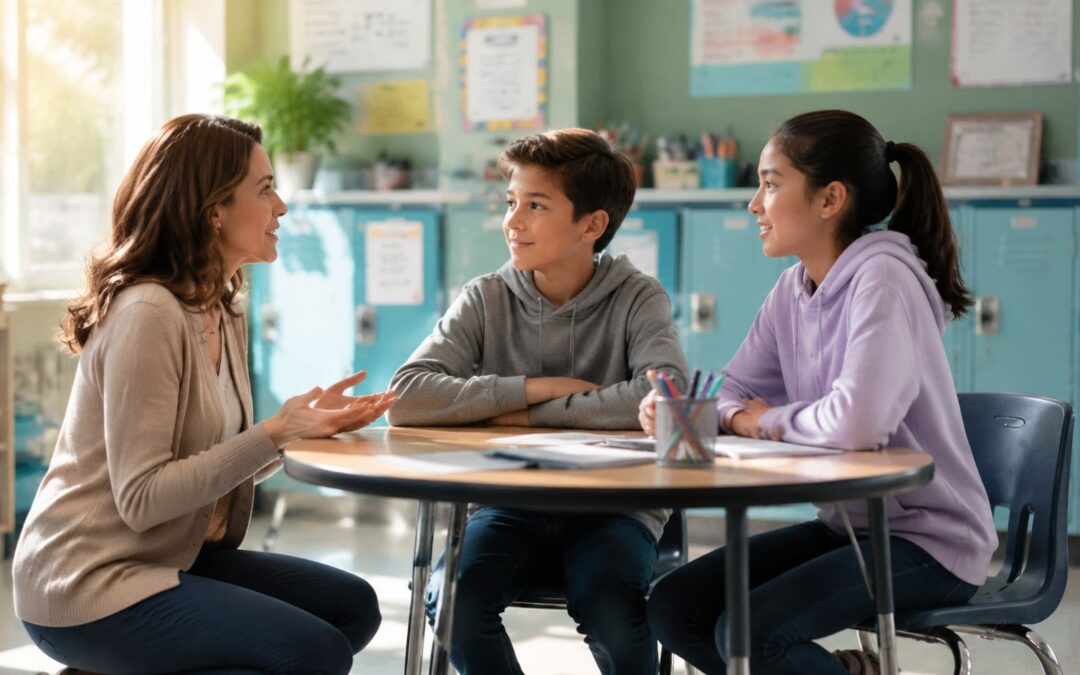
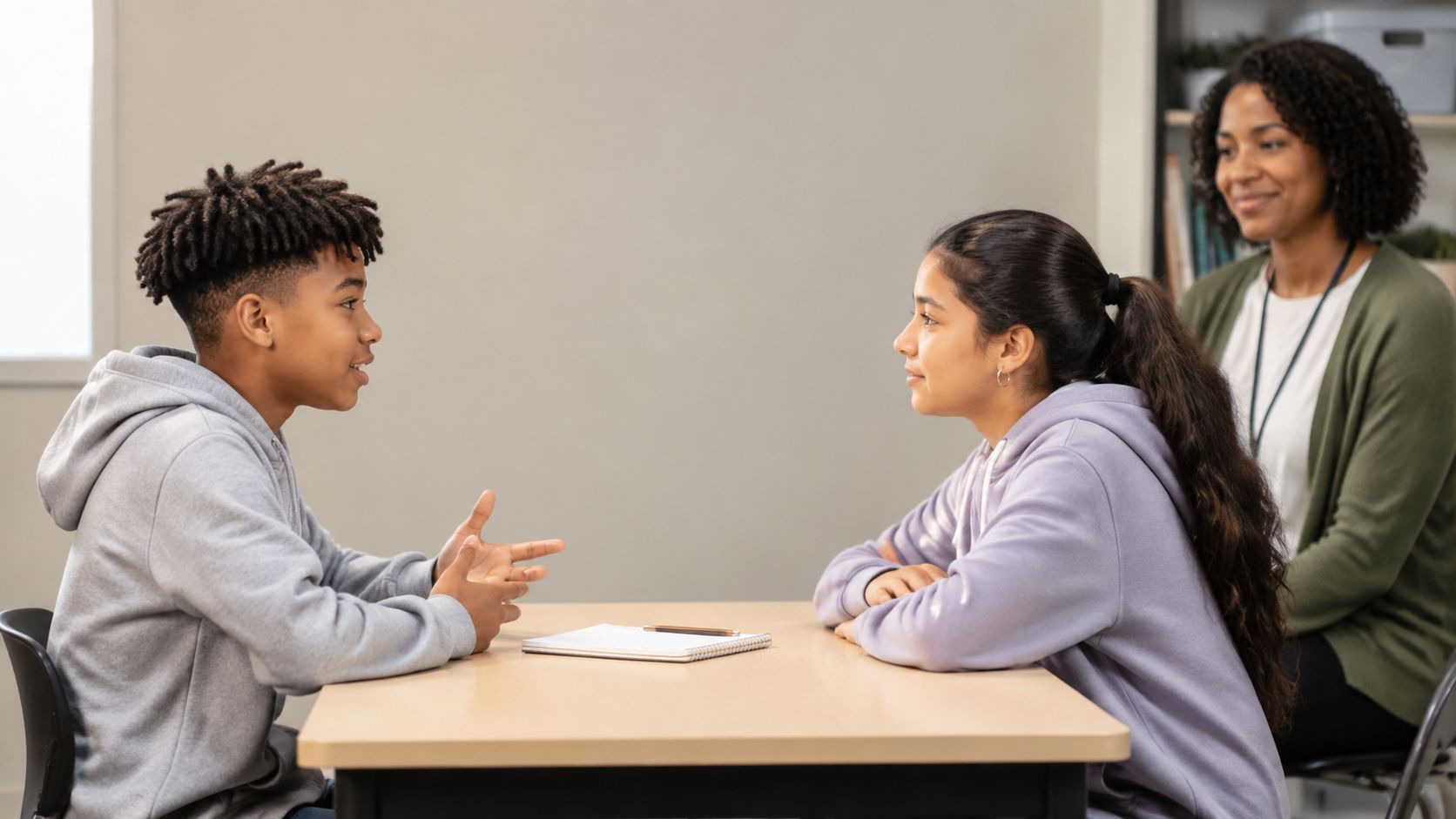
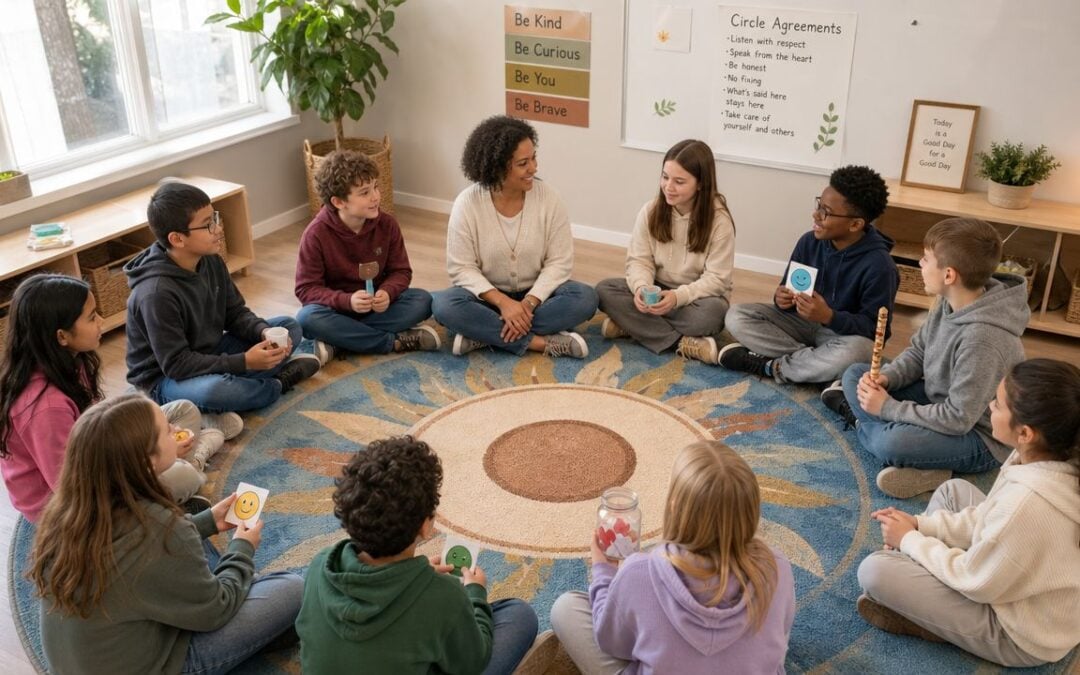
A seventh grader shoves past another student in the hallway. The second student turns, raises his voice, and within moments a careless shoulder bump has become a public argument. A teacher points to an “I-statement” poster and asks both students to explain their feelings. They stare at the wall, mutter a memorized apology, and leave angrier than before.
This scene is familiar because conflict resolution for middle school often fails at the moment students need it most. The activity may look thoughtful on paper, yet the adults haven’t accounted for audience pressure, embarrassment, friendship politics, digital rumors, or the speed at which an adolescent nervous system reacts. Effective instruction has to move beyond attractive scripts and help students use skills under pressure.
Why Middle School Conflicts Need a Different Approach
Middle school students aren’t older elementary students, and they aren’t miniature high school students. Early adolescence brings rapid emotional and social change. Students are developing judgment while also navigating heightened emotional reactivity, stronger sensitivity to peer approval, and a growing concern with social status. A private correction can feel manageable. A public invitation to “talk it out” can feel like humiliation.
That distinction changes the adult response. A peace table designed for younger children may feel childish to a seventh grader who worries that classmates are watching. A high school peer mediation model may assume more independence, verbal confidence, and willingness to reflect than some younger adolescents can yet access. The student who refuses to speak may not be uninterested in repair. They may be protecting themselves from losing face.
The audience is part of the conflict
Consider two students involved in a group-chat dispute. One posted a screenshot, another shared it, and classmates added comments. By the time the students reach school, the original disagreement has become a status contest. Asking them to apologize in front of peers may reward performance instead of honesty.
Begin with three questions:
Who is watching? A student may choose escalation because backing down publicly carries a social cost.
What happened before the visible incident? Hallway conflicts often begin with online messages, exclusion, teasing, or a rumor that adults haven’t seen.
What does each student risk by participating? Fear of retaliation, embarrassment, or being labeled weak can make a structured conversation feel unsafe.
A useful first step is to teach students that conflict resolution isn’t the same as immediate reconciliation. A student can set a boundary, request space, report harassment, or participate in a repair conversation. The correct response depends on the situation.
Practical rule: Never confuse a quiet student with a regulated student. Silence can mean reflection, fear, shutdown, or strategic self-protection.
Compliance isn’t the same as learning
Students can repeat “I feel frustrated when you interrupt me” without understanding when or why to use the sentence. Genuine skill acquisition shows up when a student pauses before posting, asks for clarification, names the actual problem, or chooses adult support instead of retaliation.
That requires repeated practice in realistic settings. The field of school conflict resolution has deep roots, with school-based programs, including peer mediation, emerging in American schools in the early 1970s. A review of the field later estimated that U.S. schools had more than 6,000 conflict resolution programs (historical review of implementation and outcomes). The lesson for today’s middle schools isn’t that every program works automatically. It’s that the model became valuable because students need structured, repeatable ways to manage disagreement.
For a broader foundation in communication, boundaries, and cooperation, teachers and caregivers can also use these social skills for middle school ideas. The strongest approach calibrates language, privacy, practice, and accountability to the way early adolescents think and behave in real time.
Evidence-Backed Frameworks That Actually Work
No single framework solves every middle school conflict. The practical choice depends on the problem, staff capacity, available data, and whether administrators will protect time for consistent implementation. These approaches are most useful when adults teach the skill before a crisis, model it during ordinary classroom friction, and revisit it after an incident.
Restorative practices
Restorative practices help students examine harm, responsibility, and repair. A teacher might say, “I’m concerned that a private screenshot was shared and several students were targeted.” Then the teacher asks restorative questions such as:
What happened from your perspective?
Who was affected?
What were you thinking or feeling at the time?
What needs to happen now to repair the harm?
In practice, the teacher doesn’t force a dramatic confession. The teacher meets with students separately when needed, checks safety, and brings students together only when each person can participate without intimidation.
Sixty-second snapshot: A student says, “I only reposted it because everyone else was laughing.” The teacher responds, “You didn’t create the original message, but your choice affected what happened next. What could repair that part?” The student identifies the repost, removes it where possible, and agrees to correct the false claim privately.
Restorative work is especially helpful when a relationship needs repair, but it can fall flat when staff use circles as a substitute for investigation, boundaries, or consequences.
RULER tools
The RULER Approach, developed by Yale’s Center for Emotional Intelligence, gives students shared language for recognizing and managing emotion. A Mood Meter can help a student distinguish irritation from shame or anxiety before the feeling becomes an accusation. A Meta-Moment creates a pause between the emotional trigger and the chosen response.
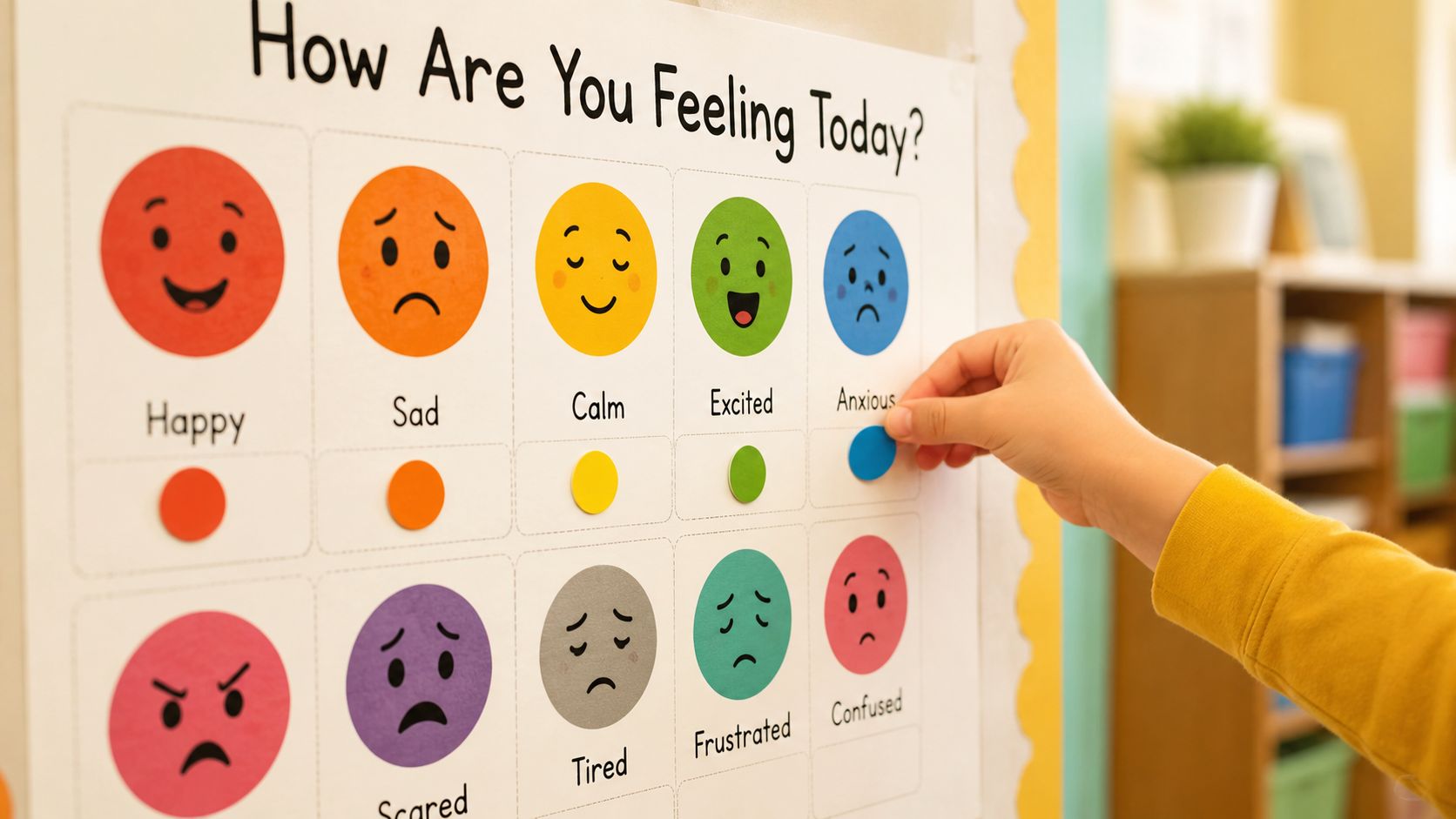
Sixty-second snapshot: A student circles “angry” on a classroom emotion display, then realizes the stronger feeling is embarrassment. The teacher asks, “What response would help the person you want to be in this moment?” The student chooses to request a private conversation rather than confront a peer at lunch.
Collaborative Problem Solving
Collaborative Problem Solving replaces a power struggle with a conversation about an unsolved problem and a lagging skill. In a Plan B conversation, the adult first listens, identifies the student’s concern, names the adult concern, and invites a realistic solution.
Sixty-second snapshot: A student keeps interrupting group work. Instead of saying, “You need to follow directions,” the teacher asks, “I’ve noticed you’re taking over when the group disagrees. What makes it hard to wait for your turn?” The student says classmates ignore his ideas. Together they plan a visible turn-taking routine.
Adapted peer mediation
Peer mediation can give students ownership, but middle school mediators need careful selection, substantial practice, supervision, and clear referral limits. They shouldn’t handle threats, coercion, serious harassment, or situations involving a major power imbalance.
A CDC school safety fact sheet reported that 38% of middle and high schools offered peer mediation, while 58% taught conflict resolution or violence prevention in a required course (CDC school safety fact sheet). Those figures show that mediation and direct instruction have both been used as parts of formal prevention systems.
Framework
Best For
Staff Training Time
Time to Impact
Key Limitation
Restorative practices
Harm, relationship repair, community concerns
Moderate
Gradual
Unsafe or forced conversations can deepen harm
RULER tools
Emotion recognition and regulation
Moderate
Visible in daily routines
Naming emotion doesn’t resolve the underlying problem
Collaborative Problem Solving
Repeated behavior and unmet needs
Moderate to substantial
Gradual
Requires patience and consistent adult follow-through
Peer mediation
Appropriate student-to-student disputes
Substantial
Depends on referrals and supervision
Not suitable for every conflict
Schools comparing broader SEL options can review SEL programs for schools while keeping the central question in view: how will students practice, use, and demonstrate the skill?
Classroom-Ready Implementation Strategies
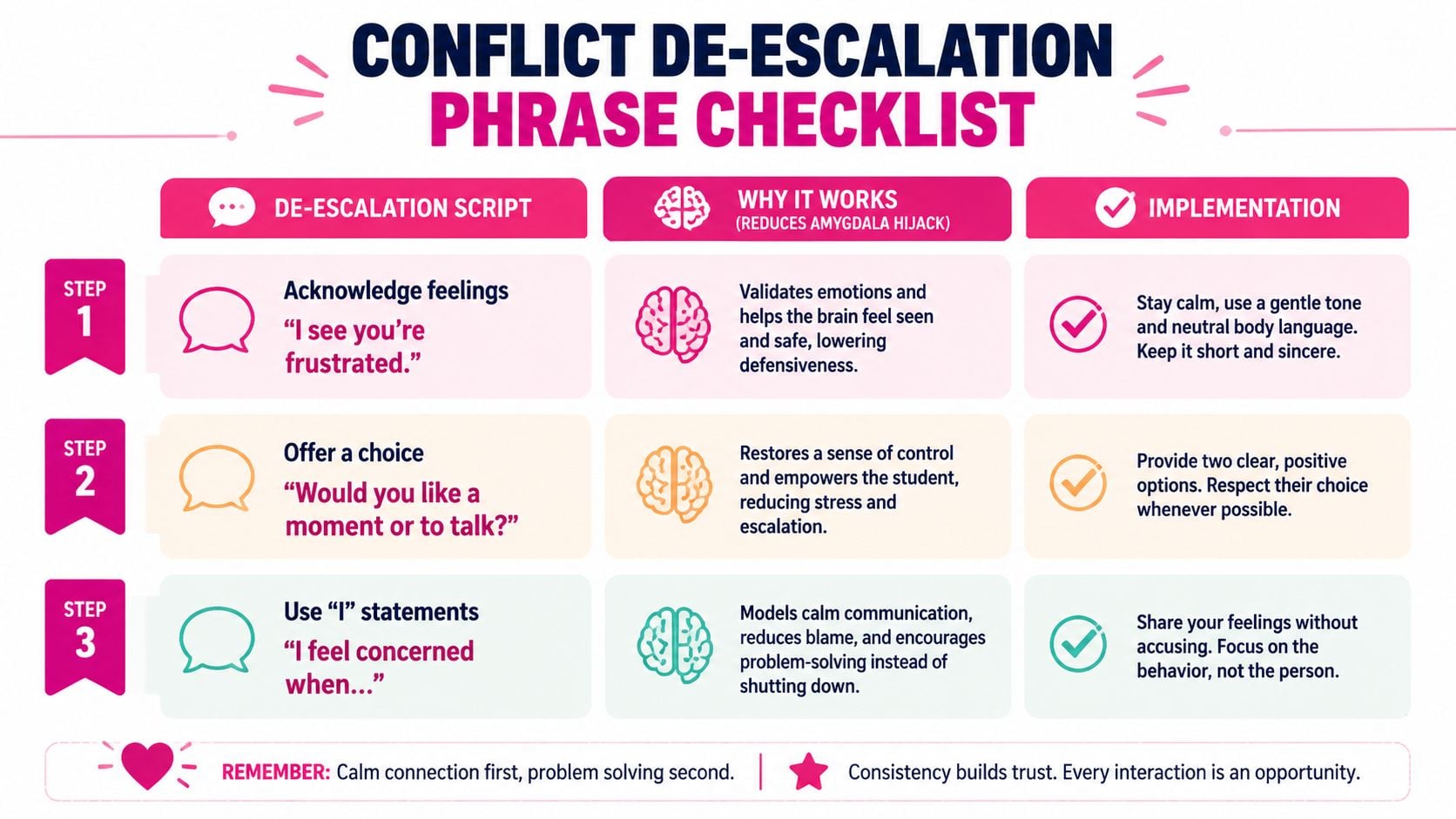
The first move during a conflict is regulation, not analysis. A student whose body is braced for threat won’t absorb a lecture about empathy. Use a low voice, reduce the audience, create physical space, and offer a small choice.
Try these phrases:
Acknowledge: “I can see this matters to you.”
Offer choice: “Would you like a moment, or would you rather talk with me privately?”
Set a boundary: “I’ll listen, but I won’t let anyone threaten or insult another student.”
Invite a next step: “Tell me what happened from your point of view.”
Avoid escalation: Replace “Calm down” with “Take a breath. We can solve one part of this at a time.”
A role-play that feels real
Use a scenario card rather than asking students to invent a conflict.
Scenario card: A student sends a Snapchat message claiming that a classmate cheated. Another student forwards it to friends. By morning, several classmates are whispering. The accused student confronts the sender near the lockers.
Student instructions:
Identify the observable facts without adding motives.
Choose one de-escalation phrase.
Use an “I” statement to describe impact.
Request a specific next step.
Decide when an adult must become involved.
Observer checklist:
Did the speaker avoid insults and threats?
Did the speaker describe behavior rather than label a person?
Did the listener allow the other person to finish?
Did either student ask for space or adult support?
Did the proposed solution address the rumor, not just the argument?
Debrief with questions such as, “Which phrase lowered the temperature?” and “What would change if the students were surrounded by peers?” Don’t praise a polished performance alone. Ask students to identify the moment when the conflict could have gone in a different direction.
A fifteen-minute restorative circle
Keep the protocol short and predictable.
Opening, two minutes: “We’re here to understand what happened and decide what needs to happen next.”
Ground rules, two minutes: One person speaks at a time. Students may pass once. No insults, threats, interruptions, or retaliation.
First round, four minutes: “What happened from your perspective?”
Impact round, three minutes: “Who was affected, and how?”
Repair round, three minutes: “What would make the next interaction safer or more respectful?”
Close, one minute: Summarize the agreement and name who will follow up.
Use a talking object only if it helps students wait their turn. A visibly structured process works better than a symbolic object that feels childish or confusing.
A short video can help staff rehearse language before using it with students:
When the plan breaks down
A student refuses. Don’t force disclosure in front of peers. Offer a private check-in, a written response, or a delayed conversation, while still addressing safety and behavior.
The conflict began online. Save relevant information according to school policy, separate the digital facts from assumptions, and teach that off-campus activity can still affect school safety. Don’t ask students to recreate a public online argument in a public classroom.
Power is unequal. Don’t mediate when one student is frightened, coerced, targeted, or unable to disagree freely. Investigate, protect the targeted student, involve the appropriate safeguarding process, and use restorative dialogue only if safety and genuine choice are present.
For SPED classrooms, shorten directions, preview the sequence visually, allow processing time, and provide alternate communication methods. For multilingual learners, use translated emotion words, visuals, sentence frames, and a chance to rehearse privately before speaking publicly. Teachers can find additional SEL activities for middle school to build practice into existing routines. Even visual reminders, including custom apparel for bullying awareness, can reinforce shared language when they support instruction rather than replace it.
The first two weeks
During the first week, teach one de-escalation phrase, model it, and practice it with low-stakes disagreements. During the second week, add the role-play, collect student reflections, and coach the language during real group work. Keep a simple record of referrals, repeated locations, conflict types, and whether students used the taught strategy. The point isn’t to create paperwork. It’s to see whether the skill appears outside the lesson.
What the Research Really Shows About Effectiveness
A polished conflict-resolution activity can produce a quiet classroom for one period and still leave recurring conflicts unchanged. Research therefore needs to examine more than student satisfaction. A large middle-school evaluation combined teacher and student surveys, disciplinary records across school years, mediation records, and matched comparisons between students who mediated and those who did not (middle-school peer mediation evaluation). This kind of design helps schools ask whether behavior changed beyond the mediation room.
A whole-school restorative-practices trial across 14 middle schools found no significant intention-to-treat effects across the full outcome set, with p-values above 0.14. Students who reported more experience with restorative practices, however, also reported better school climate, stronger peer attachment, improved social skills, and lower physical and cyberbullying victimization (whole-school restorative-practices trial). Consistent delivery matters more than program selection alone, according to this body of research.
The same source describes a Learning Policy Institute analysis across 485 middle schools and about 2 million students. Greater exposure to restorative practices during the move from fifth to sixth grade was associated with improved English and math performance, lower suspension probability, and fewer suspension days, with stronger effects for Black and Latino/a students (Learning Policy Institute findings within the review). Schools should measure how often students encounter the practices and how consistently adults use them, rather than treating adoption as proof of implementation.
What to measure
Track the chain from instruction to daily behavior:
Reach: Which students received instruction, coaching, mediation, or circle participation?
Fidelity: Did adults follow the agreed sequence, language, and safety checks?
Immediate response: Did students feel heard, identify the issue, and understand the next step?
Behavioral change: Did repeated referrals, fights, harassment reports, or classroom disruptions change over time?
Equity: Who is referred, excluded, interrupted, or asked to repair harm?
A Pennsylvania middle-school evaluation reported significantly greater improvement in conflict responses for treatment-group students, with a treatment effect of F[1,31]=52.86, p<.0005 (ERIC evaluation of a middle-school conflict-resolution program). It also reported decreased violence and stronger use of conflict-resolution tools in hypothetical situations. Direct teaching and rehearsal can build usable skills, while transfer to everyday conflicts still requires observation and follow-up.
Framework
Effectiveness Rating
Key Outcomes
Common Pitfalls
Restorative practices
Mixed, stronger with consistent exposure
Climate, attachment, social skills, disciplinary outcomes
Adoption without sufficient uptake
Peer mediation
Promising for appropriate disputes
Satisfaction, agreements, structured dialogue
Weak supervision or unsafe referrals
Direct conflict instruction
Evidence of skill improvement
Better responses and application in scenarios
One lesson without follow-up
Cooperative learning
Positive evidence for peer relations and empathy
Better relationships and lower bullying risk
Unstructured group work
A broader review found 23 studies covering 4,327 mediations, with 4,028 agreements, a 93% success rate, and 88% participant satisfaction with agreements (peer mediation outcomes review). These figures describe mediation outcomes, not proof that an entire school experienced fewer fights. Record agreements separately from recurrence, safety concerns, and disciplinary patterns.
Curriculum research adds another warning. A 2019 review of six middle-school peace and conflict curricula reported that none had been evaluated with outcome-assessment studies (review of peace education and conflict-resolution curricula). An activity may produce thoughtful discussion in the moment, yet schools still need to check whether students use the language during lunch, group work, online conflict, and other settings without immediate adult guidance.
Scaling from Classroom to Campus-Wide Programs
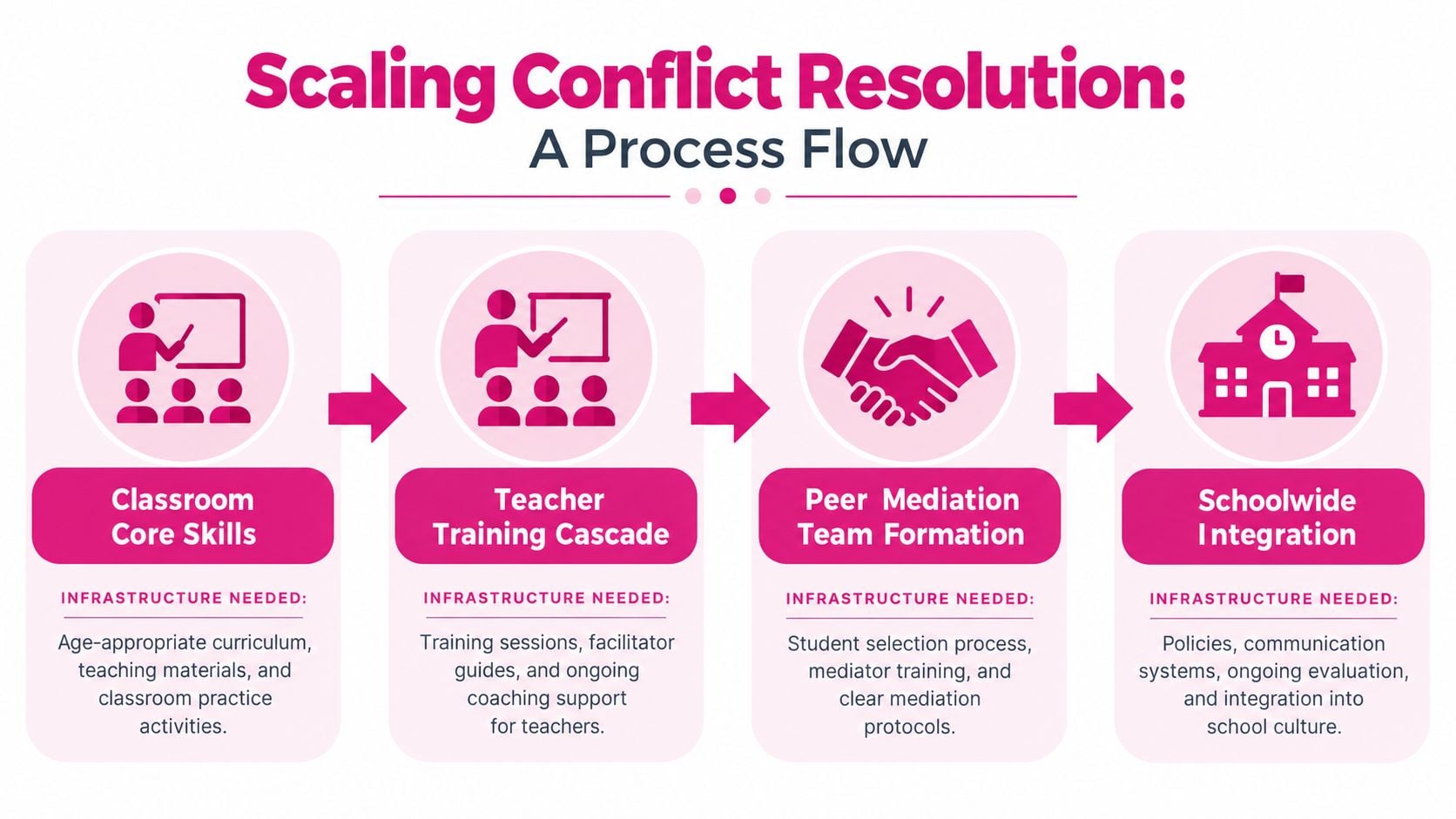
A schoolwide conflict-resolution program becomes real in the places where conflicts unfold, such as a crowded lunchroom, a hallway after dismissal, or a group chat that spills into first period. Shared posters help, but students need consistent language, protected practice time, clear referral rules, supervision, and measures showing whether support reaches them.
Begin with a classroom core, then test it against campus conditions. Teachers can use the same phrases for pausing, describing impact, requesting space, and seeking help. Counselors can map recurring conflict types and locations. Administrators must distinguish incidents requiring investigation from those that may qualify for mediation, and identify situations that peer processes cannot safely handle.
Build the adult system first
A training cascade has value only when the first group rehearses the actual language, decisions, and coaching process. Staff should role-play a hallway escalation, a group-chat rumor, a refusal to participate, and a conflict involving unequal power. A presentation may create agreement in the room; rehearsal shows whether adults can respond under pressure.
Consider two versions of the same lunch conflict. In the first, one supervisor sends students to different adults, another insists on an immediate apology, and a third offers mediation without checking safety. Students receive mixed signals, and the school cannot tell what intervention occurred. In the second, supervisors use a shared pause script, document the incident, complete the same safety check, and refer it through one process. The difference is not a more appealing activity. It is a system that can be observed and improved.
Administrators should examine discipline patterns before selecting a campus goal. If referrals cluster around lunch, train lunch supervisors and practise there. If rumors and friendship disputes dominate, build scenarios around those experiences rather than generic workplace examples.
Peer mediation should follow adult consistency and clear safety limits. Research on peer mediation programs in elementary and secondary schools describes commonly referred conflicts involving gossip and rumors, dating and friendship issues, and harassment. The study reported that 53% of mediated conflicts involved eighth graders. Schools can prepare upper-grade mediators for rumor spreading and friendship breakups, while checking whether local referrals show the same pattern.
Measure reach, fidelity, and impact
As noted in the earlier research summary, consistent delivery matters more than initial adoption. Use a small dashboard:
Reach: Record which grades and student groups receive lessons or referrals.
Fidelity: Sample whether staff followed the agreed protocol and completed safety checks.
Impact: Review recurring incidents, student climate feedback, and classroom observations.
Equity: Compare access to support across student groups without treating demographic patterns as explanations by themselves.
Family engagement helps students practise beyond school. Send home a short conversation guide with prompts such as, “What happened?” “What did you need?” and “What could make tomorrow easier?” Provide translated versions and invite caregivers to practise during ordinary disagreements.
A developed peer structure may benefit from guidance on peer mediation in schools, adapted to local safety policies, staffing, and student needs. Funding can cover training, substitute time, materials, and coaching. Leaders still need to assign ownership and protect practice time.
Your Implementation Roadmap and Next Steps
Start by listening to the school you have. Review referral records, ask students where conflicts begin, interview teachers about repeated patterns, and identify which adults students trust. Don’t select a framework because its activities look engaging. Select it because the problem, staff capacity, and safety conditions match its demands.
Use this rollout sequence:
First, establish a baseline. Record conflict locations, broad incident types, adult responses, repeat referrals, and student perceptions of safety and belonging.
Next, choose a narrow starting point. A grade-level routine, advisory lesson, lunch supervision plan, or carefully screened mediation process is easier to improve than a vague campus initiative.
Train adults through rehearsal. Practice the words, pauses, documentation, and referral decisions staff will use in real moments.
Pilot and review. Watch whether students receive the intervention, whether adults deliver it consistently, and whether outcomes differ across groups.
Expand only after adjustment. Add classrooms, staff, and peer mediators when the core process is clear enough to survive staff absence or schedule pressure.
During the first ninety days, expect uneven participation, awkward language, and some students testing whether adults mean what they say. Respond with coaching, not constant reinvention. If students refuse, preserve choice while maintaining boundaries. If staff skip the process, simplify the protocol and observe the setting where it breaks down. If referrals rise at first, examine whether students are finally reporting incidents rather than assuming the program caused the increase.
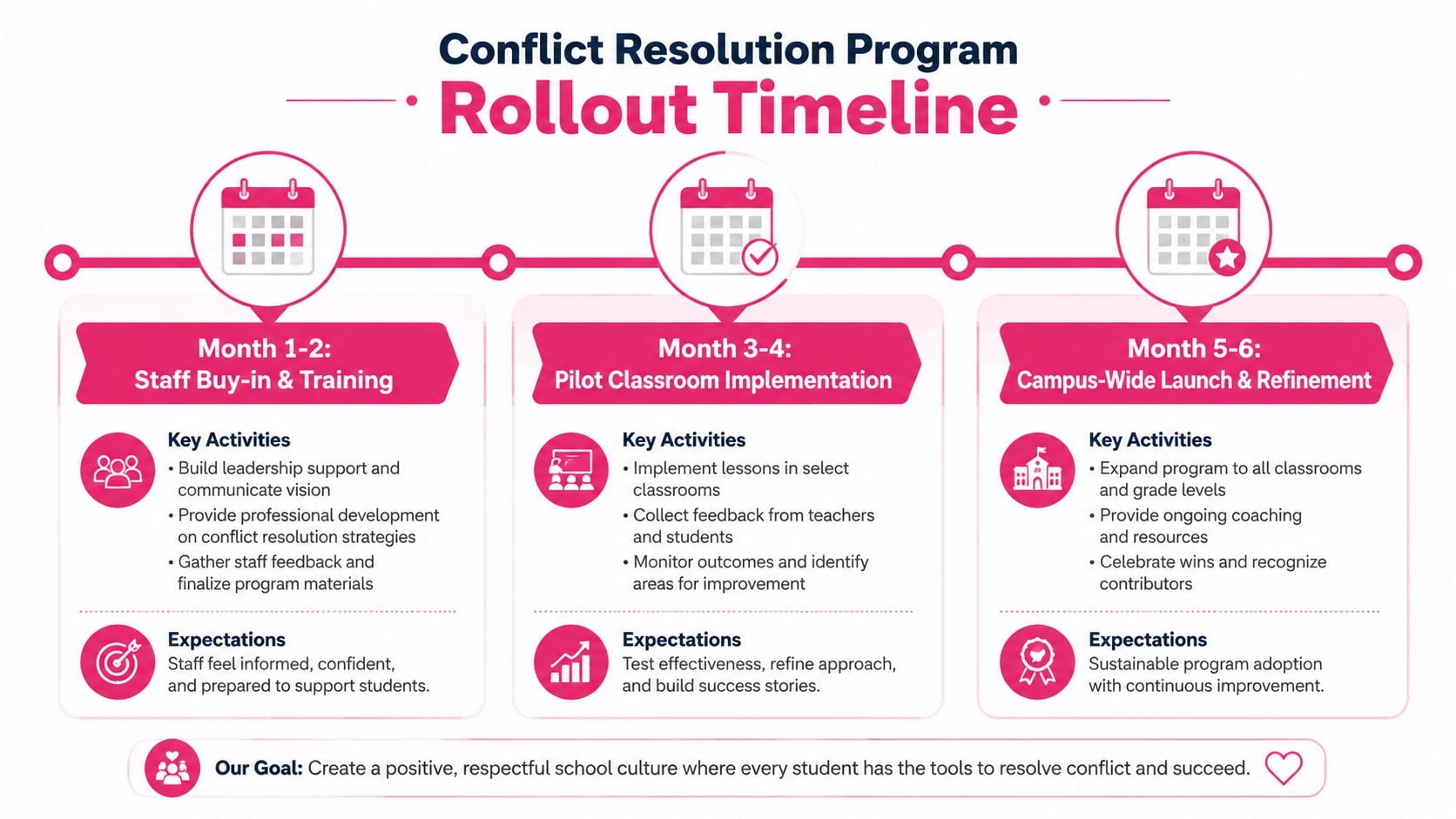
The supplied rollout timeline offers a practical structure: Month 1-2 for staff buy-in and training, Month 3-4 for pilot classroom implementation, and Month 5-6 for campus-wide launch and refinement. Treat those phases as a planning scaffold, not a guarantee. Staff turnover, budget constraints, and shifting priorities make documentation essential. Keep a short protocol, train new adults through the same scenarios, and review outcome data alongside student voice.
The central test is simple: can students use the skill when the audience is watching, the rumor is online, and the adult isn’t standing beside them? Build toward that test gradually, measure more than apologies, and protect safety whenever repair isn’t appropriate.
Soul Shoppe offers interactive workshops and coaching that give school communities shared language for communication, self-regulation, empathy, and conflict resolution. Visit Soul Shoppe to explore practical ways to bring those tools into middle school classrooms, family conversations, and campus-wide SEL systems.
Two students reach for the same box of markers, voices rise, and one child pulls the materials away. At home, siblings argue over who gets the tablet first, each certain the other is being unfair. These moments don’t mean children are failing. They mean children are still learning how to manage strong feelings, explain needs, listen, solve problems, and repair trust.
Conflict resolution activities turn those everyday disagreements into guided practice. The sequence matters: help children regulate first, identify feelings and needs, communicate clearly, generate solutions, negotiate interests, and follow through with repair. Introduce each activity during calm moments, then refer back to the shared language when a real conflict occurs. Children are more likely to use a tool under pressure when they’ve rehearsed it without pressure.
This pathway supports self-awareness, self-management, social awareness, relationship skills, and responsible decision-making. Soul Shoppe’s experiential programs and shared language can complement consistent practice across classrooms, school communities, and families. The evidence also supports treating conflict resolution as a teachable school practice. Conflict resolution education emerged in American schools in the early 1970s, and a widely cited estimate identified more than 6,000 U.S. school programs in the survey-era literature. A review of school mediation history describes how the approach grew from peace education into classroom, counseling, and peer-led structures.
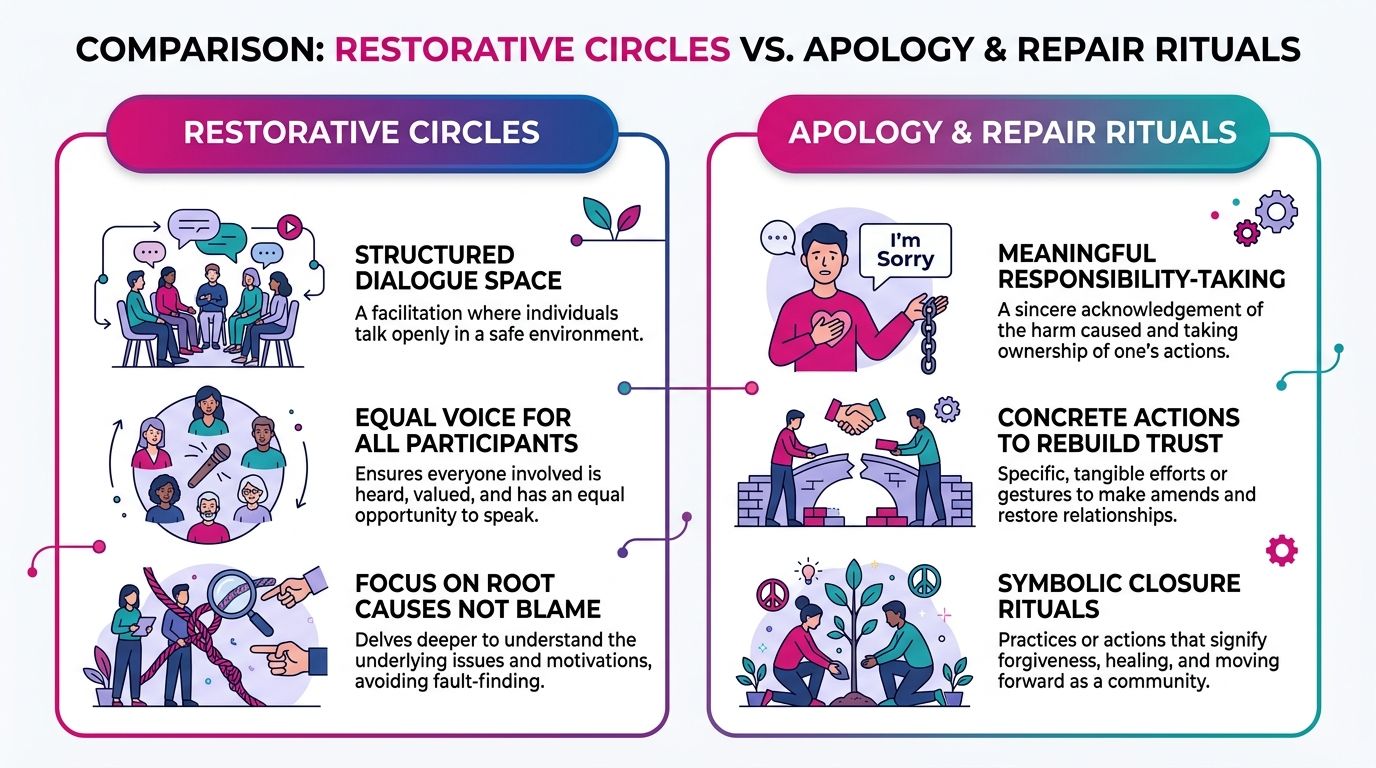
1. Restorative Circles and Apology and Repair Rituals
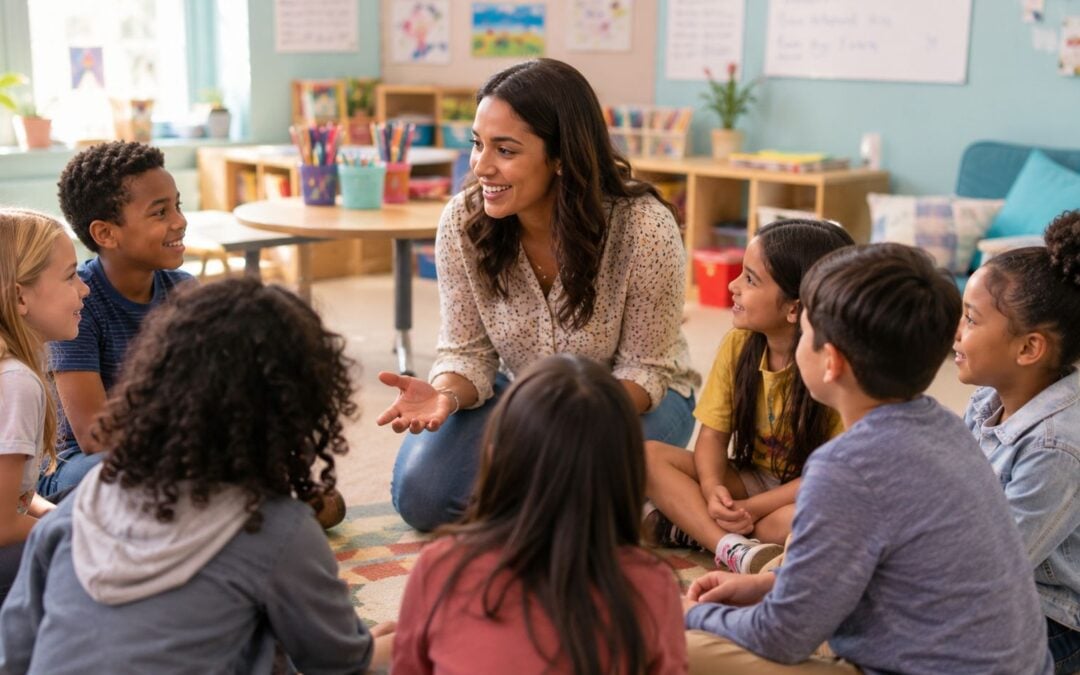
A restorative circle gives children a safe structure for hearing what happened, understanding impact, taking responsibility, and deciding what needs to happen next. Participants sit together, use a talking piece, and speak without interruption. The purpose isn’t to force instant agreement. It’s to make room for perspective, accountability, and a plan that helps the relationship move forward.
After students exclude a classmate from a group project, a teacher might ask each child to describe what happened, how the experience felt, and what would help future collaboration. The students could create a group agreement, and the excluding student might offer an apology that acknowledges the impact, expresses remorse, and names a concrete repair action, such as including the classmate in the next project.
At home, siblings can use a family talking piece after a fight. An older sibling might apologize for shutting the younger child out, then work together with them to create a “ways we work well” list.
Make repair concrete
Begin with low-stakes disagreements before using circles for serious harm. Establish agreements about respect, confidentiality, listening, and the right to pause. Choose a meaningful talking piece with student or family input, prepare guiding questions, and allow the conversation to develop naturally.
Timing: Use a brief circle during class meeting time, or schedule a longer conversation when everyone is calm.
Materials: Provide a talking piece, question cards, paper for agreements, and a visible place to record next steps.
Adaptations: K-2 children can draw feelings or use sentence starters. Older students can examine impact, accountability, and changed behavior.
Cautions: Never demand an apology before a child understands the harm. Don’t use a circle when someone feels unsafe or when a trained adult response is needed.
Assessment: Look for specific acknowledgment, accurate reflection of impact, a realistic repair action, and follow-through.
SEL skills: This activity strengthens empathy, accountability, perspective-taking, relationship repair, and responsible decision-making.
For a classroom-ready explanation of the process, explore restorative circles in schools. Restorative practices work best when they’re sustained across the school, not used only after a crisis. A randomized evaluation in New York City found that increased restorative-practice use during the transition from fifth to sixth grade improved standardized English language arts and mathematics performance, lowered the probability of suspension in a year, and reduced days suspended. The evaluation report also describes district findings linking schoolwide adoption with fewer suspensions, less absenteeism, and better attendance, particularly where implementation was thorough.
2. Conflict Resolution Role-Playing and Scenarios
Role-playing lets students practice difficult conversations before they have to manage one in the hallway, cafeteria, playground, or group chat. The teacher presents a familiar situation, students act out different responses, and the class studies the result. Because the scenario is fictional, children can experiment with active listening, I-statements, perspective-taking, and problem-solving without carrying the full emotional weight of a real dispute.
Start with a lunch transition. One student wants to join a group, but the group is already talking about a game. Students can try asking directly, waiting for an opening, or offering a way to contribute. After each round, ask, “What helped the conversation?” and “What made the other person more likely to listen?” Rotate roles so students experience being the person asking, the person deciding, and the observer.
At home, a parent can role-play with a child who wants to invite a friend over. Switch roles so the child also plays the parent, then discuss how safety, timing, responsibilities, and the child’s wish for connection can all matter.
Keep practice safe and short
Use scenarios drawn from students’ experiences, but don’t assign roles that expose a child’s private conflict. Keep each round brief, usually 2 to 5 minutes, then spend more time debriefing than performing. Recordings can help older students review tone, interruptions, and body language, but participation should never depend on being recorded.
Timing: Use a short practice during morning meeting, advisory, or after introducing a communication tool.
Materials: Prepare scenario cards, role cards, reflection sheets, and optional recording equipment.
Adaptations: K-2 students can use puppets or picture prompts. Grades 3-5 can practice sentence stems. Grades 6-8 can work with digital communication, exclusion, and group-work dilemmas.
Cautions: Remind students that roles aren’t personal. Stop the activity if it becomes mocking, threatening, or emotionally overwhelming.
Assessment: Track whether students identify the problem, use a non-blaming statement, listen without interrupting, and suggest a next step.
SEL skills: Role-play develops communication, empathy, self-management, social awareness, and flexible thinking.
For a related communication practice, see this communication skill activity. Teachers can also connect role-play to games for language learning, especially when students need repeated practice with vocabulary, turn-taking, and conversational repair.
Practical rule: Practice the response you want children to use, not only the conflict you want them to avoid.
Use the video after students understand the scenario, giving them a specific feature to watch for, such as reflective listening or a calm request.
3. Collaborative Problem-Solving
Collaborative Problem-Solving, or CPS, starts with curiosity rather than correction. The adult first asks what each child experiences, then invites everyone to brainstorm possible solutions, and only afterward evaluates the ideas. This structure treats many recurring conflicts as signs that a child needs support with a skill or has an unmet need, rather than as proof of bad character.
Consider two students arguing over art supplies. The teacher might begin with empathy: “Tell me what’s getting in the way.” One child needs reliable access to materials, while the other worries that supplies will disappear before their project is finished. Together, they brainstorm a sign-out sheet, a supply-monitor role, shared bins, or a planned exchange. They choose a sign-out system and rotating monitor role, then revisit the arrangement after students have used it.
At home, siblings can use the same process for screen time. Each child explains what matters, they generate options such as a shared calendar or alternating choices, and the family tests one plan.
Separate ideas from judgment
Use the phrase, “I wonder what’s getting in the way of you or them,” with genuine interest. Don’t jump to a solution because the adult sees an obvious answer. Brainstorming works better when children can offer imperfect ideas without being dismissed immediately.
Timing: Set aside a focused conversation when the conflict isn’t active, then schedule a follow-up.
Materials: Use a problem-solving sheet with spaces for perspectives, ideas, chosen plan, and review date.
Adaptations: Younger children can draw needs and choose from pictured options. Older students can compare likely outcomes and revise a plan.
Cautions: Don’t confuse collaboration with allowing unsafe or disrespectful behavior. Adults still set clear, inviolable boundaries.
Assessment: Record whether students explain needs, generate options, accept feedback, and revisit an ineffective plan.
SEL skills: CPS supports empathy, agency, critical thinking, cooperation, and responsible decision-making.
The problem-solving activity can help teachers and parents use consistent language. Consistency matters because children learn faster when the same question works in the classroom, on the playground, and at home.
4. Peer Mediation Programs
Peer mediation gives trained students a structured role in helping classmates talk through suitable disputes. A mediator doesn’t decide who is right, investigate serious harm, or replace an adult safeguarding response. The mediator listens, asks neutral questions, summarizes each perspective, and helps disputants develop a solution they can accept.
A middle school might train eighth-graders to support younger peers. If sixth-graders have a conflict connected to social media, the school could begin with separate conversations, assess whether joint mediation is appropriate, and then bring students together to clarify what happened, identify the impact, and agree on future boundaries. An adult supervises the process and remains responsible for safety and escalation decisions.
At home, an older sibling can practice a similar role in disputes about toys or screen time, but the parent should remain available and avoid making the older child responsible for resolving serious or repeated conflict.
Build the process before referrals begin
Select mediators who demonstrate respect, fairness, discretion, and willingness to learn. Training should cover active listening, neutrality, questioning, confidentiality limits, agreement writing, and when to involve an adult. Start with close supervision, then increase student independence only when the process is reliable.
Timing: Offer mediation during designated times, not hurried transitions.
Materials: Prepare referral forms, mediator scripts, agreement sheets, private seating, and follow-up records.
Adaptations: K-2 settings may use adult-supported buddy problem-solving rather than formal peer mediation. Grades 6-8 can use a defined mediation protocol.
Cautions: Exclude cases involving threats, coercion, ongoing harassment, serious power imbalances, or safety concerns.
Assessment: Monitor agreement rates, follow-up completion, mediator skill growth, and whether students seek help appropriately.
SEL skills: Peer mediation builds leadership, listening, neutrality, empathy, communication, and conflict management.
The evidence offers a practical reason to use structured mediation. One meta-analysis reported a 93% agreement rate on mediated disputes and 88% participant satisfaction with the agreements reached. The conflict-resolution meta-analysis also found broad positive effects on students’ conflict-resolution skills across conflict-resolution, peace-education, and peer-mediation interventions. Schools can use those findings as encouragement, while still matching mediation to the dispute and providing adult oversight. Learn more about designing peer support programs.
5. Emotional Check-In and Feelings Vocabulary Building
Children can’t explain a need they can’t identify. A regular emotional check-in gives students language for the internal experience that often appears first as silence, arguing, avoidance, or physical agitation. Moving beyond “fine,” “mad,” and “sad” helps children distinguish among frustration, nervousness, excitement, pride, loneliness, calm, and other states.
A teacher might place a feelings wheel near the entrance and invite students to mark a color or word. A child who chooses “anxious” can share privately, write a reason, or indicate that they want support. At home, a family feelings chart on the refrigerator can guide a short conversation at dinner: “What are you feeling, and what may have contributed to it?”
Connect feelings with needs
Model specific language yourself. “I feel rushed because we have a lot to finish” teaches more than “I’m stressed.” Invite children to notice body signals, such as butterflies in the stomach, tight shoulders, a hot face, or quick breathing. Then ask, “What do you need right now?” Validate the feeling while keeping a clear boundary around behavior. A child can feel furious and still not hit, insult, or throw materials.
Timing: Use a daily check-in, then add a quick private check before group work or difficult transitions.
Materials: Provide an emotion wheel, feelings chart, color cards, books, character prompts, and optional journals.
Adaptations: K-2 students can point, draw, or use facial expressions. Older students can compare similar emotions and identify mixed feelings.
Cautions: Don’t require public disclosure. A check-in should create access to support, not pressure children to reveal private information.
Assessment: Notice whether students name emotions more precisely, connect feelings to body cues, and request an appropriate support.
SEL skills: This activity develops self-awareness, emotional vocabulary, self-management, and social awareness.
Use stories and classroom literature to explore feelings indirectly. Discuss what a character may feel, what evidence supports that interpretation, and what the character might need. This approach gives children rehearsal before they have to name their own emotions during a conflict.
6. The Take and Make Communication Tool
The Take and Make tool gives children a predictable exchange for expressing a concern and demonstrating that they understood the other person. In the Take phase, the speaker says, “I feel [emotion] when [behavior] because [need], and I need [solution].” In the Make phase, the listener reflects the message before responding. The listener isn’t agreeing automatically. They’re showing that they heard the concern accurately.
After a group-project problem, a student might say, “I feel frustrated when I don’t see your work on our shared document because I’m worried about our grade, and I need us to check together every day.” The partner reflects, “You’re frustrated because you’re worried the work won’t be finished, and you want us to check the document daily.” Then the students switch roles and decide whether the request is workable.
At home, a parent might say to a teenager, “I feel anxious when I don’t know where you are because I care about your safety, and I need you to text me when you arrive.” The teen reflects the concern before discussing the boundary.
Teach the exchange explicitly
Children shouldn’t be expected to produce this language during a heated moment without rehearsal. Put the formula on a poster, model it with another adult, and practice with low-stakes examples. Younger children may use “I feel ___ when ___” and choose from picture cards. Older students can add the need and a specific, negotiable request.
Timing: Practice during morning meeting, advisory, or family check-in, then use it during one-issue conversations.
Materials: Display a sentence-strip poster, emotion cards, scenario prompts, and reflection cards.
Adaptations: K-2 students can use puppets and repeat short phrases. Grades 3-5 can write requests. Grades 6-8 can adapt the tool for texts and online group work.
Cautions: An I-statement can still sound blaming if it labels the other person. Coach students to describe observable behavior.
Assessment: Listen for a named feeling, a specific behavior, an underlying need, a clear request, and an accurate reflection.
SEL skills: Take and Make builds self-awareness, communication, listening, empathy, and relationship skills.
Don’t require children to continue talking while their bodies are overwhelmed. Pair this tool with a regulation practice, and return to the conversation when both people can listen.
7. Mindfulness and Self-Regulation Practices
A child who is flooded with anger, fear, or embarrassment may not be ready to negotiate. Mindfulness and self-regulation practices create a pause between the body’s alarm response and the next action. Breathing, grounding, body scans, short meditations, and movement breaks help students notice what is happening inside them before they choose what to say or do.
A teacher can lead a brief breathing practice before a tense class meeting. Students might place both feet on the floor, notice one physical sensation, breathe slowly, and identify one goal for the conversation. At home, family members can take three deep breaths before dinner, and a parent can teach a child a calming phrase such as, “I’m safe, I can handle this,” for moments of anxiety.
Make regulation ordinary
Introduce the practice when nobody is upset. Begin with 30 seconds to 2 minutes, then build gradually if students respond well. Use guided recordings when adults don’t feel comfortable leading meditation, and include movement, stretching, wall pushes, or sensory grounding for children who find stillness difficult.
Timing: Practice at a consistent daily time, before transitions, and before difficult conversations.
Materials: Use a timer, visual breathing prompt, calm music, grounding cards, or a quiet space.
Adaptations: K-2 students can blow imaginary bubbles or trace a finger around a shape. Older students can choose among breathing, grounding, body scans, and movement.
Cautions: Never use mindfulness as punishment or insist that a distressed child close their eyes. Offer choices and respect sensory, cultural, and accessibility needs.
Assessment: Observe whether students identify early signs of escalation, select a regulation strategy, and return to a conversation more prepared.
SEL skills: These practices support self-awareness, self-management, attention, emotional resilience, and responsible decision-making.
Frame regulation as brain training rather than as a demand to “calm down.” Students are learning to notice thoughts, emotions, and physical responses so they can make a safer next choice. The practice won’t remove conflict. It can improve readiness for the communication and problem-solving tools that follow.
8. Win-Win Problem-Solving and Interest-Based Negotiation
Two students both want to present first. One feels anxious and wants to finish quickly. The other has an appointment and needs to leave early. Their stated positions appear incompatible, but their underlying interests open more options. The teacher can ask why presenting first matters, list each interest separately, and help students consider reordering, practicing beforehand, or trading presentation roles for another responsibility.
At home, siblings negotiating screen time may begin with competing demands. One wants connection with friends, while the other wants entertainment or uninterrupted play. A schedule can address both interests more effectively than a simple winner-takes-all decision.
Ask about the reason beneath the demand
Use the question, “Why is this important to you?” Listen for the need beneath the position, such as predictability, belonging, privacy, competence, rest, or time with a friend. Put positions on one side of a shared chart and interests on the other. Then invite students to generate 5 to 7 options before evaluating them. The exact count matters less than creating enough space for creative thinking before anyone rejects an idea.
Timing: Use this activity when both parties can participate safely and have enough time to review options.
Materials: Provide a shared chart, sticky notes, markers, a simple decision rubric, and a follow-up calendar.
Adaptations: K-2 students can use “I want” and “I need” picture cards. Grades 3-5 can sort positions and interests. Grades 6-8 can negotiate shared spaces, group roles, schedules, and digital boundaries.
Cautions: Don’t promise that every negotiation ends with equal access or total satisfaction. Safety, fairness, and adult responsibilities remain firm boundaries.
Assessment: Look for interest statements, multiple options, respectful evaluation, an agreed plan, and a later check-in.
SEL skills: This activity develops perspective-taking, cooperation, communication, critical thinking, flexibility, and responsible decision-making.
Encourage “yes, and” thinking during brainstorming. After implementation, ask what worked, what didn’t, and what should change. Celebrate successful agreements because children need to see that cooperation is a practical skill, not just a classroom slogan.
Start with one low-stakes activity and use it consistently. A classroom doesn’t need eight new routines at once, and a family won’t benefit from introducing a complicated process in the middle of a crisis. Choose the tool that matches the moment, teach it during calm practice, and repeat the same words until children recognize the pathway.
Use mindfulness and self-regulation before escalation, when bodies are tense and attention is narrowing. Use feelings vocabulary when children need help noticing and naming what is happening. Use Take and Make when two people are ready for a safer conversation. Choose Collaborative Problem-Solving or win-win negotiation when the central task is reaching an agreement. Use peer mediation for suitable peer disputes with trained support, and reserve restorative circles for accountability, shared understanding, and repair.
Assessment should focus on observable behavior rather than whether students say they enjoyed an activity. Teachers and parents can look for whether a child:
Names a feeling: The child identifies an emotion with increasing precision.
Explains a need: The child connects the feeling to a concern, goal, or request.
Reflects another perspective: The child can summarize what another person experienced without immediately arguing.
Generates options: The child proposes more than one possible solution.
Follows an agreement: The child attempts the plan and returns to review it.
Completes repair: The child acknowledges impact and takes a concrete action to rebuild trust.
Evidence supports a sustained, skills-based approach. A large meta-analysis of conflict resolution education in U.S. schools examined 36 studies and 4,971 students and reported an overall effect size of 0.26 for reducing antisocial behavior. The same analysis reported stronger effects in mid-adolescence, with an effect size of 0.53, and early adolescence, with 0.22, compared with middle childhood, at 0.06. The Office of Justice Programs summary also describes a decline in students reporting bullying from 28% to 20%, and a reduction in students being called hate-related words from 11% to 7.5%.
Age matters, and one routine won’t meet every child’s needs. A study of 350 Vietnamese secondary students found significant gender and grade-level differences in identifying conflict causes, finding compromise, reporting conflicts objectively, and knowing counselor contact information. The study supports adapting activities for K-2, 3-5, and 6-8 rather than assuming that a single script works equally well for every learner.
Families and schools can also check whether skills travel beyond the original setting. A middle-school peer mediation study across three schools tracked teachers, students, disciplinary incidents, mediation outcomes, mediators, disputants, and parents, including whether mediation skills transferred to home conflicts. The study record makes the home connection explicit. In an elementary program, students received 9 hours of training and recorded 783 conflicts over a 9-week period, including 209 at school and 574 at home. The Office of Justice Programs publication reported that the training significantly changed the strategies students used to manage conflict.
Use the same core language across settings. A child who hears “pause, name it, listen, solve it, repair it” from a teacher and a caregiver gets a stronger chance to recognize the process when conflict appears somewhere new. Soul Shoppe can support broader school-community implementation through workshops, assemblies, coaching, courses, and an app, alongside shared tools for self-regulation, mindfulness, communication, and conflict resolution.
Soul Shoppe offers experiential workshops, assemblies, coaching, courses, and an app that help school communities practice shared language for self-regulation, communication, empathy, and repair. Visit Soul Shoppe to explore support for bringing these conflict resolution activities into classrooms, families, and wider school-community practice.
A lot of principals are trying to solve two problems at once right now. A student won't ask for help because they don't want to look foolish. A teacher sees a problem with a new initiative but stays quiet because speaking up feels risky. The rooms may look calm, but underneath that calm is caution.
That is the test of school climate. Not whether people are polite, but whether they feel safe enough to be honest.
In K-8 schools, psychological safety shapes everything you care about. It affects whether a kindergartener says, “I don't get it,” whether a middle schooler admits they hurt a friend, whether a teacher asks for support before burnout sets in, and whether a staff team can challenge a weak plan before it harms students. If you want engagement, belonging, and healthy accountability, you need a daily practice for how to build psychological safety.
What Is Psychological Safety in a School
A common scene in schools looks harmless at first. A student has a question but keeps their hand down. A newer teacher disagrees with a building decision but says nothing in the meeting. A parent has concerns but only shares them after frustration has built up. Silence can look like compliance when it is self-protection.
Psychological safety means people can take interpersonal risks without expecting embarrassment, humiliation, or punishment. The American Psychological Association's 2024 Work in America report defines it as a climate where workers feel comfortable sharing concerns and mistakes without fear of embarrassment or retribution, and links higher safety to practices like feedback opportunities, employee involvement in decisions, and well-trained managers. In a school, that same principle applies to both adults and students. People need to know they can ask questions, admit mistakes, offer ideas, and disagree respectfully.
If you want a deeper grounding in the concept itself, this overview of psychological safety in schools gives useful language for staff conversations.
What safety looks like in real school life
Psychological safety is not a soft layer on top of instruction. It's part of instruction.
When safety is present, you'll hear things like:
Student voice: “Can you explain that again?”
Teacher honesty: “This lesson flopped. I need another way to reach this group.”
Team candor: “I'm worried this schedule will create problems for students who need more transition support.”
Repair language: “I hurt someone. I want to make it right.”
When safety is missing, people hide. They mask confusion, avoid feedback, and protect themselves from blame.
Schools don't become safer because people are told to “be respectful.” They become safer when adults repeatedly prove that honesty won't be punished.
What psychological safety is not
Principals sometimes worry that focusing on safety will lower standards. It won't, if you define it correctly.
What it is
What it is not
Speaking honestly with care
Saying whatever you want without accountability
Admitting mistakes
Avoiding responsibility
Asking for help
Lowering expectations
Respectful disagreement
Public undermining
In practice, psychological safety supports rigor because students and adults can stay in the learning process instead of shifting into defense. That's when real participation starts.
The Foundation Leadership Commitments
If the principal stays guarded, the building stays guarded. Staff watch leadership closely, especially when pressure is high, a district rollout is messy, or a family complaint lands hard. The tone of psychological safety starts with what leaders do in those moments.
A useful school-based model comes from a study of 42 U.S. schools, where a four-phase methodology of explicit norm-setting, leadership modeling, structured listening, and anonymous measurement led to a 34% increase in Staff Trust Index scores and a 27% reduction in reported bullying incidents within one year according to this multi-site school study.
Start with explicit norms
Don't assume staff share the same picture of safe collaboration. Name it.
At the start of a semester, a principal can co-create a short staff charter with agreements such as:
Assume positive intent: We start from the belief that colleagues care about students.
Name concerns early: We raise problems while they're still workable.
Disagree with ideas, not people: We challenge thinking without shaming the person.
Repair when needed: If trust gets strained, we come back and address it.
This works better than a poster full of values words because it tells adults how to act when tension appears.
Model vulnerability without losing authority
Some leaders avoid vulnerability because they think it weakens confidence. In schools, the opposite is usually true. Staff trust principals who can say, “I got that wrong,” and then move into problem-solving.
A principal might open a meeting this way:
Practical rule: “I was wrong about the new dismissal procedure. It's creating confusion for families and staff. I want to hear what's not working and fix it.”
That statement doesn't erase authority. It shows steadiness. It tells staff that truth matters more than image.
Useful phrases for principals include:
“What am I missing?”
“Who sees a risk I may not be seeing?”
“What's the impact on students who need the most support?”
“I'm not asking for agreement. I'm asking for your best thinking.”
Build listening structures, not just open doors
Most principals say, “My door is open.” That's not enough. In schools, the people who most need to speak up are often the least likely to walk through that door.
Use structures:
Listening rounds in meetings so every grade level or role speaks before discussion closes.
Pause and paraphrase protocols where staff reflect back what they heard before responding.
Anonymous pulse checks after major decisions, using tools as simple as Google Forms.
Follow-up loops where leadership reports back what was heard and what will change.
What doesn't work is asking for honesty and then defending every decision in real time. Staff notice that quickly.
Measure what people actually feel
You can't read psychological safety from hallway friendliness. Ask directly.
Good anonymous prompts include:
Staff voice: “I feel safe raising a concern about a school decision.”
Learning climate: “Mistakes are treated as opportunities to learn.”
Follow-through: “When staff give feedback, leadership responds clearly.”
The most important part isn't the survey. It's the response. If people take a risk to tell the truth and nothing happens, trust drops fast.
Cultivating Safety in the Classroom Day by Day
Classroom psychological safety is built in tiny moments. A teacher responds to a wrong answer. A student laughs at a peer. Someone spills paint, forgets homework, or starts to cry during writing. Those moments teach children whether school is a place where they can recover and keep participating.
Here's a visual teachers can use as a quick reset for daily practice.
A strong classroom doesn't need complicated systems. It needs predictable routines that make risk feel manageable.
Normalize mistakes in visible ways
One of the fastest ways to build classroom safety is to stop treating mistakes like interruptions.
A primary teacher might begin Monday morning with “something I got wrong this weekend.” She says, “I burned the pancakes because I stopped paying attention. Next time I'll set a timer.” Then students share their own small mistakes and what they learned. Nobody has to go deep. The point is repetition. Mistakes become discussable.
In upper elementary or middle school, a teacher might use a “revision spotlight.” Instead of only showing polished work, the teacher briefly displays a rough draft, names what changed, and explains why. That tells students that growth is the expectation.
Create low-risk ways to ask questions
Not every child will raise a hand. Some students need distance before they'll use their voice.
Try options like these:
Parking Lot notes: Students write anonymous questions on sticky notes during or after a lesson.
Turn-and-check: Before whole-group discussion, students first test an idea with a partner.
Private rating tools: Students show understanding with fingers on their chest, mini whiteboards, or a Google Form.
Re-entry scripts: “I'm confused about step two” or “Can you say that in another way?”
If a student regularly freezes in groups, it helps to understand that some children experience social evaluation as a threat response. For families and staff who want a plain-language explanation of that pattern, this article on why social situations trigger anxiety can be helpful background.
After a few weeks of using these routines consistently, more students start testing their voice. That's often the first visible sign that safety is taking root.
Sixth through eighth grade with disrespect toward a teacher
A seventh grader mutters an insult when corrected in class, then knocks a notebook off the desk while leaving the room. A purely punitive response might stop there with removal and a referral.
A restorative response still takes the disruption seriously, but it also asks the student to face the human impact. Later, with an administrator present, the teacher facilitates a structured conversation.
She asks:
“What was happening for you right before the comment?”
“What impact did your words and actions have on me and the class?”
“What do you think needs to happen to make this right?”
The student admits he felt embarrassed after being corrected publicly. That doesn't excuse the behavior, but it gives the adults useful information. He apologizes to the teacher, writes a brief plan for what he'll do when he feels activated, and agrees to restore the classroom space before the next class period.
When students participate in the repair plan, they're more likely to follow through on it.
Across ages, the process changes in language and complexity, but the core remains the same. Kids tell the truth about harm, hear one another, and practice repair with adult support.
Proven Benefits for Your School Community
For school teams, the practical question isn't only what is restorative justice. It's whether the approach improves daily life for students and staff. The answer, in many schools, is yes.
Early-adopting districts that implemented restorative justice reported major reductions in suspension and expulsion rates, with some seeing up to 50% fewer exclusions within two years, and in one Chicago high school restorative circles were associated with a 40% drop in disciplinary incidents and a 25% increase in student attendance over one year, according to Edutopia's summary of restorative justice resources.
Those outcomes make sense when you look at what restorative practices build. They don't just respond to conflict. They strengthen relationships, improve communication, and give students repeated chances to practice empathy and self-regulation.
What schools tend to notice first
Often, the first visible change is a calmer tone. Students begin to expect that adults will listen, ask questions, and guide repair instead of escalating every problem into a power struggle.
Schools also report improvements in areas that matter a great deal to families and staff:
School climate: Students often feel safer and more connected when adults use consistent, relational responses.
Attendance and belonging: When children feel respected, they're more likely to want to be at school.
Social-emotional growth: Students practice perspective-taking, emotional language, and problem solving in real situations.
That connection to SEL is important. Restorative work doesn't sit off to the side from emotional development. It gives students a place to use the skills SEL tries to teach. This overview of the benefits of social-emotional learning pairs well with a restorative approach because both center belonging, self-awareness, and healthy relationships.
Schools don't become restorative because they hold a few circles. They become restorative when students trust that harm will be addressed fairly and humanely.
Your Roadmap to Introducing Restorative Practices
Many schools stall out because they try to launch everything at once. A better path is gradual, visible, and well supported.
Start with shared purpose
Before anyone runs a circle, adults need agreement on why the school is making this shift. Is the goal to reduce exclusionary discipline? Improve climate? Build stronger conflict skills? Usually it's all of the above, but leaders should say that clearly.
A small core team helps. Include an administrator, classroom teachers, counseling staff, and if possible, family voices. In K-8 settings, this team often becomes the anchor for consistency.
Train adults before expecting students to do it well
Restorative practice is not intuitive for every adult. Teachers need support with facilitation, regulation, bias awareness, and developmentally appropriate expectations.
Foundational training should help staff:
Use restorative language: Questions such as “Who was affected?” and “What needs to happen now?”
Know when not to circle up immediately: Students may need cooling-off time first.
Tell the difference between accountability and forced apology: Repair should be meaningful, not performative.
Begin with informal routines
Schools often make the work too formal too soon. Start smaller. Use restorative check-ins, affective statements, and quick problem-solving conversations in classrooms and common spaces.
Examples include:
At arrival: “What kind of day are you bringing into the room?”
After interruption: “What happened, and what do you need to rejoin well?”
After peer conflict: “How can you make this right before we move on?”
These small moves teach the language of repair before major incidents occur.
Build Tier 1 circles into the week
Community-building circles are where many schools find their footing. They help students practice listening, turn-taking, perspective-taking, and classroom belonging in low-stakes moments.
A second grade teacher might use a Monday circle prompt like, “What helps you feel included?” A middle school team might use advisory to ask, “How do you want people to treat you when you've made a mistake?”
One practical option schools sometimes use is Soul Shoppe's Student Peacemakers model, which trains students in a structured restorative process for peer conflict. That kind of peer-based support can complement adult-led circles and classroom SEL work when a campus wants students to share responsibility for repair.
Add formal responses carefully
Once adults have experience with informal practice, the school can build capacity for more formal restorative meetings. These require more preparation, clearer safety structures, and stronger facilitation.
A simple rollout sequence works well:
Assess current patterns in discipline, climate, and staff readiness.
Train all staff in common language and basic processes.
Pilot in one grade band or with one trained team.
Collect feedback from students, families, and staff.
Scale gradually with coaching and follow-up.
Leadership move: Protect time for staff reflection. Schools lose momentum when adults are expected to implement restorative practices without space to learn from mistakes.
Navigating Challenges and Measuring True Success
Restorative justice isn't a quick fix, and schools run into trouble when they treat it like one. The most common misstep is assuming it works the same way for every child and every situation.
A recent California OYCR brief found that restorative justice is less effective with younger youth and lower-level cases when schools default to it without developmental screening, and noted that practitioners have begun integrating restorative justice with SEL frameworks in the last 12 months to address that gap, as described in the California OYCR restorative justice brief. In K-8 schools, that means adults need judgment. A kindergartener who grabbed a toy may need co-regulation and direct coaching more than a formal restorative process. A middle school pattern of exclusion may need both a circle and explicit SEL instruction on empathy and group dynamics.
The challenges are real
Some staff worry restorative work takes too much time. It does take time. But unresolved conflict also takes time, often again and again.
Some adults fear it will seem soft. It isn't soft when done well. Asking a student to listen to impact, accept responsibility, and follow through on repair is demanding work.
Measure more than discipline referrals
Schools should absolutely track formal outcomes, but those numbers don't tell the whole story. True success also shows up in quieter indicators:
Belonging: Do students say they feel known and included?
Trust: Do families believe the school handles harm fairly?
Repair quality: Are agreements realistic, completed, and followed up on?
Classroom climate: Are students becoming more honest, more regulated, and more able to solve conflict with support?
The most ethical restorative schools keep asking not only, “Did behavior stop?” but also, “Did healing begin?”
If your school wants support turning restorative ideas into daily SEL practice, Soul Shoppe offers programs, workshops, and school community tools focused on connection, empathy, conflict resolution, and belonging for students and adults alike.
The last seven minutes of the day can undo a lot of good teaching. A student is still carrying frustration from math. Another is worried about a friendship issue that started at recess. Three are already halfway out the door in their minds. If dismissal starts from that energy, the class leaves scattered.
A well-run closing circle gives those minutes a job. It helps students settle, reflect, and leave with a clearer sense of what happened in the day and how they are part of the group. That shift supports classroom culture, but it also supports learning. Students remember more when they pause long enough to name what mattered.
The routine works because it is brief and predictable. Practitioner guidance often places closing circles in a short 5 to 10 minute window, including Kikori's overview of closing circles. That time limit matters. Teachers can protect it even on tight dismissal schedules, and students learn that reflection is part of the day, not an extra when time allows.
The best activities are not interchangeable.
Some help students name emotions. Some repair connection after a hard day. Some build appreciation, reflection, or hope. The difference is in the facilitation. Prompt choice, pacing, opt-in options, and the way you respond to silence all shape whether a circle feels safe or performative. That is why the activities below include more than prompts. Each one comes with facilitation moves, simple scripts, psychological safety tips, and age-specific variations across K to 8. If you want to connect one of these routines to a larger gratitude practice, this guide on ways to show gratitude with students fits naturally with that work.
Use these as tools, not a script you must follow perfectly. A strong closing circle is consistent, calm, and responsive to the class in front of you.
1. Gratitude and Appreciation Circle
This is one of the simplest closing circle activities to launch, and one of the easiest to overdo. It works when students name something specific. It falls flat when the circle turns into a string of vague compliments like “everyone was nice.”
Start by modeling the kind of gratitude you want to hear. “I appreciated how Malik pushed through a hard math problem today and then helped clean up without being asked” gives students a usable example. “I'm grateful for my class” does not.
How to facilitate it well
For younger students, keep the prompt concrete. Try “I'm grateful for ___” or “I appreciated it when ___.” For older students, add a reason. “I appreciate ___ because ___” pushes them past surface-level praise.
A practical script sounds like this:
Practical rule: Praise the action, not the label. “You included someone at recess” teaches more than “You're nice.”
If your class is new to this routine, don't ask everyone to share every day. FCPS practitioner guidance recommends inviting only 3 to 5 students to share each day, which keeps the routine brief and sustainable while still building participation over time.
Kindergarten to grade 2: Use sentence frames on chart paper and allow students to point to a classmate if words are hard.
Grades 3 to 5: Ask for one appreciation tied to effort, teamwork, or courage.
Grades 6 to 8: Invite students to appreciate a peer, an adult, or something they noticed in themselves.
If the room feels forced, switch the format. Students can whisper their appreciation to a partner first, write it on a sticky note, or finish the sentence orally only if they're ready. For more classroom-friendly gratitude ideas, this roundup of ways to show gratitude can help teachers build language students can use.
2. Talking Piece Circle
When a class interrupts constantly, this routine can reset the culture fast. The structure is simple. One object moves around the circle, and only the person holding it speaks.
The object matters less than the meaning you give it. A smooth stone, a soft ball, a wooden heart, or a classroom mascot can all work. What matters is that students understand the norm. Hold the piece, speak if you want, pass if you need to, and listen when someone else has the floor.
Why this works in real classrooms
Talking piece circles are especially useful when your class has uneven participation. You know the pattern. A few students dominate, quiet students disappear, and the teacher ends up managing airtime instead of listening.
This format slows everyone down. It also builds predictability, which is part of psychological safety. Students know they won't be interrupted, and they know they won't be forced into a debate.
A script for an ordinary end-of-day circle might sound like this:
Teacher opening: “When the talking piece gets to you, share one word for how your day ended, or pass.”
Teacher reminder: “We listen all the way through. No fixing, no side comments.”
Teacher close: “Thank you for making space for one another.”
The first few rounds should stay low stakes. Don't start with conflict. Start with prompts like “One thing I learned today” or “One thing I'm carrying home with me.”
Listening circles only feel safe when passing is a real option, not a fake one.
For educators using restorative routines more intentionally, Soul Shoppe's guide to restorative circles in schools offers language and framing that fit naturally into a closing circle. If you want to connect this practice to student voice and narrative, the broader power of storytelling for change is relevant too. Stories often emerge more openly when students know they won't be talked over.
3. Emotional Check-In and Feelings Inventory
Some students end the day wired. Others are flat, heavy, embarrassed, proud, or relieved. If you skip over that emotional reality, you miss valuable information about how the day landed.
An emotional check-in doesn't need to become a counseling session. In fact, it usually shouldn't. The most effective version is brief, consistent, and emotionally neutral. Students identify what they feel. They don't have to justify it, perform it, or fix it.
Good prompts and safer options
For K to 1, use faces, colors, or body signals. For grades 2 and 3, add feeling words like calm, frustrated, proud, worried, and excited. For older students, include more precise language such as disappointed, overwhelmed, hopeful, restless, or relieved.
Here's a simple progression that works:
Name it: “Point to or say one feeling you have right now.”
Notice it: “Where do you feel that in your body?”
Share if you want: “Who wants to say why?”
What doesn't work is pushing every child to explain. Some students need privacy. Some need time. Some are still learning the language.
A good teacher response is short and steady: “Thanks for naming that.” “I'm glad you checked in.” “That makes sense.” Those responses validate without inviting the entire class to analyze one student's mood.
If you want a classroom routine built around mood meters and reflection tools, Soul Shoppe's article on daily check-ins for students offers practical formats teachers can adapt.
K to 8 variations
In primary grades, let students move to a corner that matches their feeling. In upper elementary, try “weather reports” such as sunny, cloudy, stormy, mixed. In middle school, keep it low-pressure. A private written check-in followed by optional sharing often gets better participation than going around the whole circle.
The key trade-off is depth versus consistency. A short daily feelings inventory builds habit. A deep conversation belongs only when the class has time and support for it.
4. Reflection and Learning Questions Circle
If your closing circle never connects back to learning, it can start to feel detached from the essential work of school. Reflection questions solve that. They help students make meaning from what happened academically, socially, and personally.
This routine works especially well after a lesson that asked students to struggle, collaborate, revise, or take a risk. Instead of “What did we do today?” ask something students can think about.
Prompts worth using
Strong prompts invite reflection without sounding like a test. Try these:
Learning transfer: “Where could you use today's learning again?”
Productive struggle: “What felt hard, and what helped you stay with it?”
Community awareness: “How did someone help your learning today?”
Identity growth: “What did you learn about yourself?”
Give actual wait time. Most teachers think they are waiting. Often they're not. A few silent beats changes the quality of responses.
Ask questions that students can answer from lived experience, not questions they think you want answered correctly.
For younger students, use a visual prompt. Hold up icons for “hard,” “fun,” “helpful,” and “surprising,” then ask students to pick one. For grades 4 to 8, invite turn-and-talk before whole-group sharing. Students often speak more thoughtfully after they've rehearsed an idea with a partner.
This circle also pairs well with writing. Students can jot one reflection on an exit slip and then share aloud. If you want a bank of prompts that works across ages, Soul Shoppe's collection of student reflection questions is useful for planning.
The common mistake here is overcomplicating the question. One well-chosen prompt is enough. If you ask four in a row, students start answering none of them thoroughly.
5. Community Affirmation and Peer Strengths Circle
This routine builds belonging fast, but only if the affirmations are earned, specific, and distributed fairly. Otherwise, the same popular students get praised while quieter students disappear.
That's why facilitation matters more here than in almost any other closing circle activity. You're not just inviting kindness. You're teaching students how to notice strengths in one another.
How to keep affirmations genuine
Start with a mini-lesson on the difference between a trait label and observed evidence. “You're awesome” is pleasant but weak. “You noticed Elena didn't have a partner and invited her in” is stronger because it names a behavior the community can value and repeat.
Try a teacher script like this: “Today we're naming strengths we saw. We're not flattering. We're noticing.” That one line tightens the whole routine.
A classroom example: A third grader says, “I want to appreciate Jaden because when I dropped my crayons, he stayed behind to help me pick them up.” A seventh grader says, “I noticed Ava kept the group focused when we got off task, and she did it without embarrassing anyone.”
Both are specific. Both teach the class what care can look like.
Helpful supports by age
Primary grades: Use sentence starters on cards such as “I noticed ___” and “I appreciated when ___.”
Upper elementary: Let students nominate someone for a strength connected to class values like courage, responsibility, or inclusion.
Middle school: Invite affirmations tied to collaboration, integrity, perseverance, or leadership.
If students are hesitant, start with written affirmations and read a few aloud. If one child rarely gets named, the teacher should step in naturally and sincerely. Students notice who gets overlooked. That silence teaches something too.
One more caution. Don't force every student to receive a public round of praise before they're ready. For some children, especially those who feel exposed easily, public affirmation is intense. Let receiving be taught gently.
6. Mindfulness and Body Scan Closing
Some classes need an outward, verbal ending. Others need quiet. On high-energy days, a mindfulness close can be the most effective reset before dismissal.
Mindfulness in a closing circle doesn't need special language or a long script. It needs clarity, brevity, and permission for students to participate in different ways.
A short body scan that works
Try this script:
“Put your feet on the floor if that feels okay. Notice where your body touches the chair or rug. Take one slow breath in, and let it out. Notice your shoulders. Notice your hands. Notice your jaw. If anything feels tight, see if you can soften it a little. If your mind wanders, that's okay. Just come back to your breath.”
That's enough.
For kindergarten, make it sensory. “What do you hear? What do you feel?” For upper grades, name the purpose directly. “We're helping our bodies notice that the day is ending.”
What helps and what doesn't
Do help with choice: Students can sit, stand, or keep eyes open.
Do keep it short at first: A brief practice is more sustainable than a long one students resist.
Don't demand stillness as proof of success: Some students regulate better with small movement.
Don't attach moral language: Calm isn't “good,” and busy energy isn't “bad.”
A short video can help if students benefit from hearing another voice guide the practice. This mindfulness clip is one option to use during class or in planning: