

10 Effective Conflict Resolution Strategies Students Can Use in 2026
Conflict is an inevitable part of life, but for students, it’s a critical learning opportunity. Navigating disagreements on the playground, in the classroom, or online isn’t just about stopping a fight; it’s about building foundational skills for a successful future. The ability to listen, express needs, and solve problems collaboratively is essential for academic success and emotional well-being. When students lack these tools, small misunderstandings can escalate into significant disruptions, impacting classroom culture and individual learning.
This article moves beyond generic advice to offer 10 evidence-based, actionable conflict resolution strategies students in grades K–8 can learn and practice. For educators, administrators, and parents, this guide provides the specific resources needed to teach these vital skills effectively. Inside, you will find a comprehensive toolkit designed for immediate implementation.
Each strategy includes:
- Clear summaries and step-by-step instructions.
- Age-differentiated tips for elementary and middle school students.
- Sample scripts and phrases to guide conversations.
- Practical classroom activities and role-playing scenarios.
- Direct alignment with core Social-Emotional Learning (SEL) competencies.
Our goal is to equip you with powerful frameworks that build empathy, communication, and resilience. By mastering these techniques, you can help students turn moments of conflict into opportunities for connection and personal growth, creating safer and more collaborative school communities. Let’s explore the methods that transform how students handle disagreements.
1. Restorative Circles and Peer Conferencing
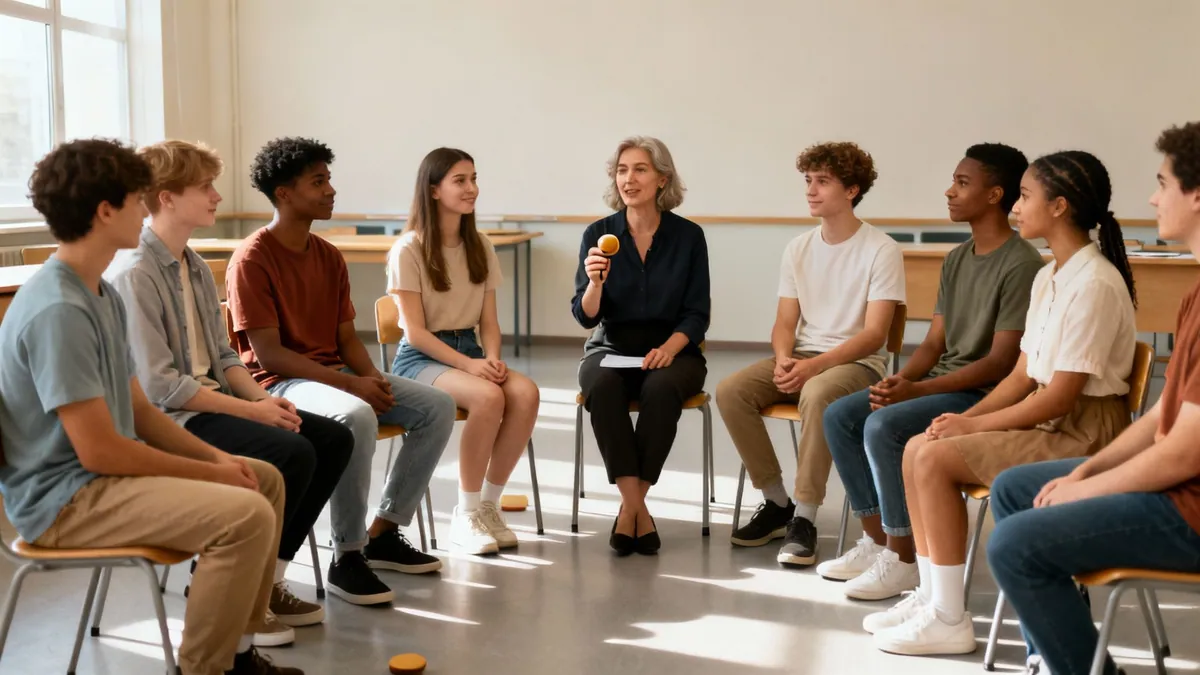
Restorative Circles are structured, supportive discussions that bring students together to address conflicts and their impact. Instead of focusing on punishment, this approach prioritizes repairing harm, understanding different perspectives, and rebuilding relationships. Students, along with a trained facilitator, sit in a circle to share their feelings and collaboratively find a path forward.
This method shifts the focus from “Who is to blame?” to “What happened, who was affected, and how can we make things right?” Peer conferencing is a related, often less formal, version where students mediate disagreements among themselves, guided by restorative principles. This is a powerful conflict resolution strategy for students because it builds empathy and community accountability.
Practical Example: Two students, Maya and Liam, had an argument over a group project, and Maya told other classmates not to work with Liam. A teacher facilitates a restorative circle with Maya, Liam, and two affected classmates. Using a talking piece, Maya shares she was frustrated Liam wasn’t contributing. Liam explains he was confused about his role. The classmates share they felt caught in the middle. They agree on a plan for clear roles in the next project and Maya apologizes for excluding Liam.
Why It Works
Restorative practices give students a voice and a sense of ownership over the solution. This process is highly effective for addressing issues like misunderstandings, exclusion, and minor physical conflicts. The Oakland Unified School District, for example, saw a 34% reduction in suspensions after implementing restorative justice programs. The focus on repairing relationships helps prevent future conflicts and strengthens the overall school climate. These circles are most effective for conflicts where ongoing relationships are important, such as between classmates or friends.
How to Implement It
- Start with training: Ensure staff are trained in circle facilitation and restorative language. Organizations like the International Institute for Restorative Practices (IIRP) offer comprehensive resources.
- Establish clear guidelines: Co-create circle norms with students, such as “Speak from the heart,” “Listen with respect,” and “Honor the talking piece.”
- Use a talking piece: Pass an object around the circle; only the person holding it may speak. This ensures everyone gets an uninterrupted turn.
- Begin with low-stakes topics: Build student confidence by using circles for community-building before tackling serious conflicts. You can explore a variety of classroom community-building activities to get started.
3. Collaborative Problem-Solving (CPS) Model
The Collaborative Problem-Solving (CPS) model is a structured approach that shifts the focus from winning an argument to working together to find a mutually agreeable solution. Developed by Dr. Ross Greene, this method operates on the principle that conflicts arise from unsolved problems or unmet needs. Instead of focusing on conflicting positions, students learn to identify the underlying concerns driving the disagreement.
This model guides students through a clear, three-step process: defining the problem from both perspectives, brainstorming potential solutions without judgment, and evaluating the options to choose one that works for everyone. As one of the most effective conflict resolution strategies for students, CPS empowers them to see conflict as a shared problem to be solved, not a battle to be won. It builds critical thinking and empathy by requiring them to understand and articulate another person’s point of view.
Practical Example: Two friends constantly argue about what game to play at recess. A parent or teacher guides them through CPS.
- Empathy: The adult asks each child, “What’s the hardest part for you about choosing a game at recess?” One says, “I never get to play what I want.” The other says, “I don’t like running games.”
- Define the Problem: The adult summarizes, “So, the problem is we need to find a game you both enjoy and feel you have a choice in.”
- Brainstorm: They list all ideas: tag, drawing, building, rock-paper-scissors to decide, taking turns. They agree to try taking turns choosing the game each day.
Why It Works
CPS is highly effective because it moves students away from blame and towards practical solutions. By focusing on identifying “unsolved problems,” it depersonalizes the conflict. This method works well for recurring disagreements, such as arguments over classroom materials, group work disputes, or social exclusion. Schools that implement CPS often see a reduction in behavioral referrals and an increase in prosocial behaviors because students are equipped with a concrete tool to manage their own conflicts. The model is most effective for disputes where a tangible solution can be reached.
How to Implement It
- Teach the three steps explicitly: Before using it in a real conflict, explicitly teach the steps: (1) Empathy and Understanding, (2) Defining the Problem, and (3) Invitation to Brainstorm. Use role-playing to practice.
- Use neutral, guiding language: Frame the conversation with questions like, “What’s getting in the way for you?” or “I’ve noticed we have a hard time when…” This avoids blame.
- Write down all ideas: During the brainstorming phase, write down every suggested solution, even silly ones. This validates all contributions and encourages creative thinking.
- Evaluate solutions collaboratively: Guide students to assess the brainstormed list by asking, “Is this realistic? Does this work for both of you?” The chosen solution must be mutually agreeable. This process reinforces important communication skills and activities that are essential for success.
8. Buddy and Mentorship Systems
Buddy and mentorship systems are structured programs that pair older students with younger ones or peers with classmates needing support. These relationships create natural opportunities for conflict prevention by fostering connection, belonging, and positive role modeling. A mentor can guide their mentee through social challenges, offering a safe and trusted perspective.
This strategy shifts the dynamic from adult intervention to peer-led support. A fourth grader paired with a first grader can help them navigate playground rules, or a new middle schooler can be matched with an eighth-grade mentor to ease their transition. These programs are powerful conflict resolution strategies for students because they build empathy and develop leadership skills while reducing feelings of isolation that often lead to conflict.
Practical Example: A school pairs every third-grader with a kindergartener as “reading buddies.” They meet once a week to read together. One day, a kindergartener is upset because another child won’t share the building blocks. Instead of running to a teacher, they find their third-grade buddy. The buddy helps them practice “I-statements” and walks with them to talk to the other child. The buddy’s presence provides the confidence the younger student needs to resolve the problem peacefully.
Why It Works
Mentorship provides a protective factor for vulnerable students and gives mentors a sense of purpose and responsibility. By modeling healthy communication and problem-solving, mentors help their mentees build the confidence to handle disagreements constructively. These programs are highly effective for supporting students new to the school, those with a history of behavioral challenges, or any child who could benefit from a positive connection. School-based mentoring programs have been shown to improve attendance, attitudes towards school, and social-emotional skills.
How to Implement It
- Provide clear mentor training: Equip mentors with essential skills like active listening, setting boundaries, and knowing when to get an adult’s help.
- Create structured activities: Plan initial meetings with specific activities or conversation starters, such as “Two Truths and a Lie” or creating a shared “All About Us” poster.
- Establish regular check-ins: Schedule brief, consistent check-ins for mentors with a supervising adult to discuss progress, troubleshoot challenges, and feel supported.
- Celebrate successes: Publicly acknowledge the positive impact of your mentors. This can be done through school announcements, certificates, or a special recognition event. Consider programs like Soul Shoppe’s junior leader development for a structured approach.
9. Classroom Agreements and Community Norms
Classroom Agreements are a set of co-created guidelines that establish shared expectations for how community members will treat each other and navigate disagreements. Instead of a list of rules imposed by an adult, this approach involves students in a collaborative process to define their own behavioral standards and conflict resolution protocols. This fosters a sense of ownership and collective responsibility for maintaining a positive classroom environment.
This strategy shifts the dynamic from adult-enforced compliance to community-led accountability. When conflicts arise, the agreements serve as an objective, shared reference point. This approach is a cornerstone of conflict resolution strategies for students because it empowers them to hold themselves and their peers accountable to standards they helped create, grounding solutions in community values.
Practical Example: At the start of the year, a teacher asks students, “How do we want our classroom to feel?” They brainstorm words like “safe,” “fun,” and “respected.” Then she asks, “What can we agree to do to make it feel that way?” The students create agreements like, “We listen when someone is talking,” and “We use kind words.” Two weeks later, one student interrupts another. The teacher can gently say, “Let’s check our agreements. Which one can help us right now?” This empowers students to self-correct based on their own rules.
Why It Works
Student-created agreements build intrinsic motivation for positive behavior and give students a framework for addressing problems respectfully. This process is highly effective for preventing common classroom conflicts like interrupting, disrespect, or exclusion. The Responsive Classroom approach, which heavily incorporates this practice, has been shown to improve social skills and academic performance. The agreements are most effective when they are treated as a living document, referenced daily and revised as needed to address the evolving needs of the classroom community.
How to Implement It
- Frame the process positively: Guide students to create agreements about how they will treat each other, not just a list of “don’ts.” For example, frame it as “We listen to understand” instead of “Don’t interrupt.”
- Facilitate, don’t dictate: Ask guiding questions like, “How do we want to feel in our classroom?” and “What can we agree to do to make sure everyone feels that way?”
- Make them visible: Have students sign the final agreement and display it prominently. Younger students can illustrate each point to reinforce understanding.
- Reference them regularly: When a conflict occurs, refer back to the norms by asking, “Which of our agreements can help us solve this problem?” or “How does this action fit with our agreement to show respect?”