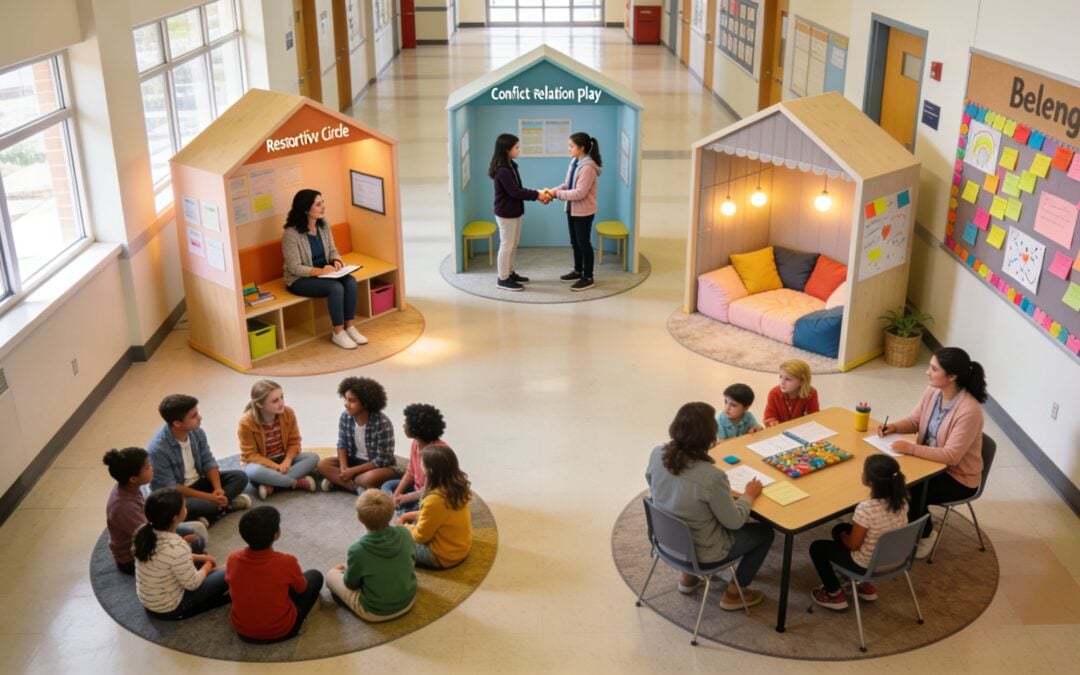
Soul Shoppe's work is made possible by donors and partners who care deeply about the young people in their communities! We can't do this work without you. Support our work in classrooms and on playgrounds across the nation by donating here.
The gym is booked, the bell schedule has been adjusted, and your teachers are already asking the practical questions. Where will students sit? Who's covering recess? Will the presenter need a projector? Beneath those logistics sits a bigger question that many new principals feel right away: Will this assembly help students, or will it just fill an hour?
That question matters because students can tell the difference between a one-off event and a meaningful school experience. They know when adults are offering a catchy slogan with no follow-through. They also know when a school is building a shared language around respect, problem-solving, and belonging.
That's why I encourage school leaders to treat assembly programs for schools as part of their SEL strategy, not as a side event. When they're planned well, assemblies can reinforce the social skills you want students using in the cafeteria, on the playground, in group work, and online. Parents and teachers feel the difference too, because the message doesn't end when students leave the auditorium.
From All-School Meeting to Meaningful Movement
Most principals have seen the same scene. Students file into the multipurpose room buzzing with energy. A few are excited. A few are dysregulated from the transition. Teachers are spread around the edges, hoping the microphone works and that the message lands.
In too many schools, assemblies stop there. They become a break from the day rather than an extension of learning.
That's a missed opportunity. Nearly 80 percent of schools in the United States utilize specialized educational assembly programs to reinforce learning, and those programs are designed to build critical thinking, empathy, and social skills through interactive presentations, as noted by Academic Entertainment's overview of educational assembly providers. That matters because an SEL assembly isn't just about attention. It's about giving a whole student body one shared experience and one shared set of words.
What a stronger assembly looks like
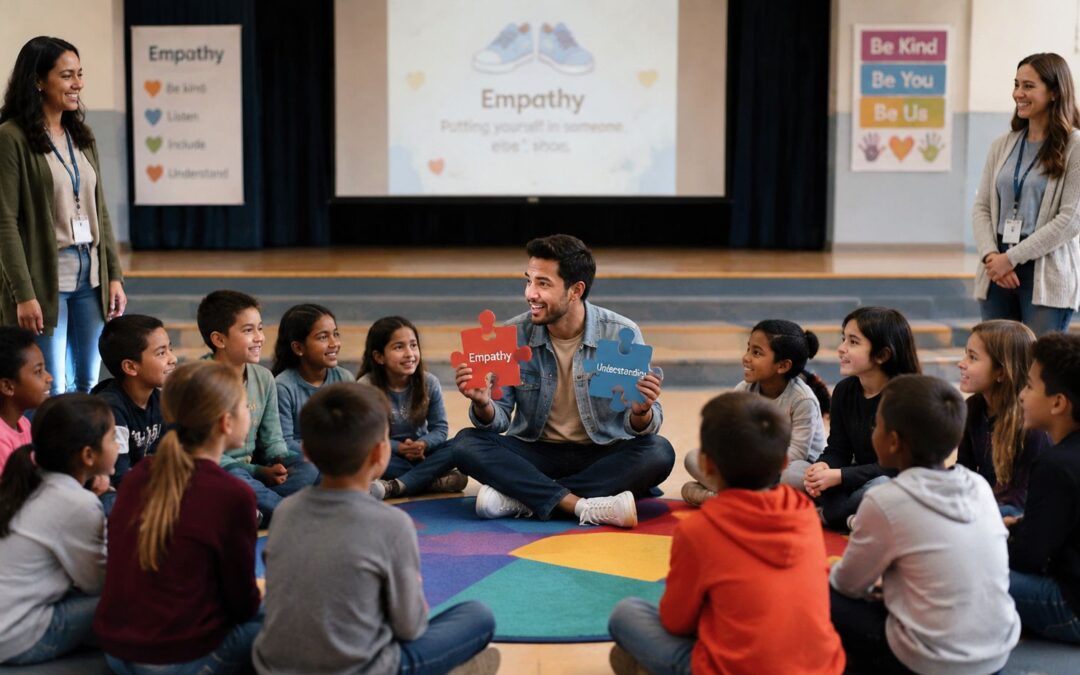
A bullying-prevention assembly with purpose feels different from the moment students enter. Adults have already taught audience expectations. The presenter uses student participation instead of long lectures. Students practice what they might say if they see someone left out at recess. Teachers hear language they can repeat later in class.
Practical rule: If students can't use the message in a real conflict by the end of the week, the assembly was too abstract.
Here's a simple example. A school wants to reduce exclusion on the playground. Instead of booking a generic “be nice” show, the principal chooses a program that helps students identify exclusive behavior, notice its impact, and practice an action step such as inviting someone in, getting help, or using a respectful check-in phrase. The assembly then becomes the launch point for a schoolwide norm.
Why the experience needs to be visible
Students absorb culture through repeated signals. What adults praise, model, and revisit becomes what students expect from one another. That's why details that seem small can help reinforce the larger message. A spirit day, classroom posters, and even coordinated visual cues can make a schoolwide campaign feel coherent. If you're pairing an assembly with a belonging or kindness initiative, T-Shirt Envy for custom campus apparel offers practical ideas for making school messages visible without turning the event into a marketing exercise.
For younger students, I'd also pair the assembly with short movement resets during the following week so the emotional message doesn't compete with regulation needs. This collection of fun brain breaks for school days can help teachers bring students back to focus while keeping the tone connected to care and community.
The shift is simple but important. Don't ask, “What assembly should we book?” Ask, “What student behavior and school climate do we want to strengthen, and how can an assembly help us start that work together?”
Aligning Assembly Goals with Your School Culture
Before you compare providers, get clear on your own school. A strong assembly doesn't begin with a catalog. It begins with a campus need that adults can describe in plain language.
If your staff says, “Our students need kindness,” keep going. Kindness is a value, not yet a planning goal. You need to name where students struggle and what success would look like in daily school life.
Start with the friction points
Walk your campus mentally from arrival to dismissal. Where do students lose connection, self-control, or empathy?
Playground conflict: Students argue, but they don't know how to repair.
Classroom exclusion: Some students get left out of partner work or group games.
Transitions: The move from lunch or specials back to class is rough.
Online behavior: Older students carry digital conflict into the school day.
Once you identify the friction point, write a goal that a teacher could observe. Instead of “improve behavior,” try “students will use common language for problem-solving during recess conflict.” Instead of “promote inclusion,” try “students will practice one response when they notice someone being left out.”
Bring in the adults who know the patterns
Teachers, counselors, noon supervisors, and office staff often see different slices of student life. If you only ask the leadership team, you'll miss useful details. A recess aide might tell you that the issue isn't physical aggression. It's repeated exclusion during games. A fourth-grade teacher might notice that students can explain feelings but struggle to enter hard conversations respectfully.
A short staff prompt can help:
Where are students getting stuck socially?
What language do you wish students used more often?
What would feel different in classrooms or common spaces if this improved?
You can also ask a small student group. Their answers are often concrete. “People say rude things when they lose.” “Kids don't know how to join a game.” “Everyone watches and nobody helps.”
Match the assembly to the culture you're building
An assembly should support the climate you want every day. If your school is working on belonging, your event should give students phrases and routines that support belonging. If your staff is focused on emotional regulation, the assembly should include concrete strategies students can practice.
The clearest assembly goals sound like behavior, not branding.
A useful checkpoint is this: could your teachers continue the theme the next morning without needing to reinterpret it? If the answer is no, your goal is still too vague.
For schools doing broader climate work, this article on how to improve school culture offers a helpful companion lens. The assembly should fit into that larger effort, not sit beside it.
A practical example helps. If your school has recurring lunchroom conflict, your assembly goal might be: “Students will learn and practice respectful language for handling small peer conflicts before they escalate.” That gives your provider, your teachers, and your support staff something specific to reinforce.
Choosing the Right Program and Partner
Once your goals are defined, selection gets easier. You're no longer shopping for a fun event. You're choosing an instructional partner.
The strongest partners don't just entertain students for an hour. They help adults carry the message forward.
What to look for
Use these criteria when reviewing assembly programs for schools.
What to look for
Why it matters
Clear alignment to your SEL or bullying-prevention goal
You want a program that solves your problem, not a generic morale boost
Age-appropriate design
Kindergarten students and fifth graders need different pacing, examples, and language
Interactive participation
Students remember more when they practice, respond, move, or rehearse
Teacher follow-up materials
Staff need vocabulary, prompts, and simple next steps
Behavior support planning
Audience routines and adult roles affect whether students can engage
Evidence-informed approach
You want substance behind the delivery
One example of a more integrated approach is the Soul Shoppe Elementary Peace Program, a year-round K to 5 curriculum that provides school-wide instruction on friendships, problem-solving, and bullying prevention while creating shared language across grades, as described by the San Ramon Valley Unified resource page. That kind of model is useful because it treats the assembly as one piece of a broader system, not the whole intervention.
If you're comparing options, this overview of SEL programs for schools can help you distinguish a stand-alone event from a more connected schoolwide approach.
Questions worth asking a provider
In meetings with providers, ask direct questions. Don't settle for polished generalities.
How do you adapt for age bands? Ask what changes between K to 2 and grades 3 to 5.
What do teachers receive before the event? If the answer is “a flyer,” that's thin support.
What follow-up do you recommend in classrooms? Strong providers can answer quickly and concretely.
How do you handle student participation? You want active engagement without chaos.
What are your AV and space needs? This affects staff planning and student flow.
How do you customize for school goals? Listen for whether they ask about your climate and student needs.
Ask providers to describe what students will actually say or do differently after the assembly. Their answer will tell you whether they teach skills or just themes.
Red flags to avoid
Some warning signs show up fast.
A provider may rely on broad slogans like “be respectful” without naming teachable actions. Another may promise a powerful experience but offer no classroom materials, no staff briefing, and no process for feedback. Be cautious if the program sounds exactly the same for every school regardless of grade level or community need.
Also pay attention to whether the provider understands student regulation. An SEL assembly should never depend on students sitting still for an extended stretch while adults deliver abstract advice. Younger students especially need movement, call-and-response, stories, or guided practice.
Think about cost in the right way
Budget matters, but cheap and effective are not always the same thing. A lower-cost assembly can become expensive in staff time if adults must build all the follow-up from scratch. A more complete program may save effort because it includes planning support, teacher tools, and a schoolwide framework students can keep using.
A helpful question for your team is not “What does this event cost?” It's “What support comes with it, and what will we need to create ourselves if it doesn't?”
Your 8-Week Assembly Planning Timeline
A smooth assembly day starts long before chairs are unfolded. The planning rhythm matters because students benefit when adults are coordinated, calm, and clear.
A practical framework from Academic Entertainment's assembly best practices recommends an 8-week pre-planning timeline that starts with educational goals and budget, includes a detailed day-of plan, and ends with a structured classroom discussion within two days to reinforce retention.
Weeks 8 through 6
Start with purpose and commitment.
Week 8 Confirm your educational goal, target grade levels, and budget. Decide what problem the assembly is meant to address. This is also the time to choose a planning lead.
Week 7 Vet programs and partners. Review sample materials, ask questions, and make sure the content matches your school culture.
Week 6 Finalize booking, date, space, and contract details. Put the event on the master calendar so support staff, specialists, and front office staff can plan around it.
At this stage, I tell principals to create one working document with everything in it. Time, provider contact, tech needs, adult assignments, seating plan, arrival pattern, and classroom follow-up. When details live in one place, the day runs better.
Weeks 5 through 3
At this point, many schools either build momentum or lose it.
Build staff readiness
Teachers need more than a reminder email. They need context.
Week 5 Brief staff on the assembly goal, key themes, schedule changes, and their supervision roles. Tell them what language students will hear so they can reinforce it later.
Week 4 Communicate with families in simple terms. Let them know the theme and include one question they can ask at home, such as, “What did you learn about solving a conflict respectfully?”
Week 3 Confirm logistics. Test microphones, projection, seating flow, and accessibility needs. Assign adults to arrival, side seating, transitions, and any student support needs.
When staff know the vocabulary ahead of time, they can catch and extend teachable moments the same day.
Weeks 2 through 1
Now move from planning to rehearsal.
Timeframe
Priority action
Example
Week 2
Final confirmation with provider
Recheck arrival time, setup window, and interactive elements
Week 2
Student pre-brief
Teachers remind students how to enter, listen, and participate
Week 1
Final run-through
Front office, custodian, AV support, and admin confirm responsibilities
Assembly day
Calm execution
Adults greet classes, guide seating, and reinforce expectations consistently
A practical student pre-brief can be short. “Today's assembly is about how we handle conflict and include others. Your job is to listen for one strategy you can use today at recess.”
The two days after matter most
Many schools treat the assembly itself as the finish line. It's not. The first classroom conversation after the event is where students start turning ideas into usable skills.
Within two days, give teachers a short structure:
One recall prompt: What message do you remember?
One application prompt: Where could you use it at school?
One rehearsal: Practice a phrase, role-play a situation, or draw the steps.
A first-grade class might draw what “including someone” looks like during play. A middle elementary class might role-play how to respond when a game argument starts. That small follow-up is what helps the learning stick.
Beyond the Bell Integrating Assembly Themes in the Classroom
The assembly ends. Students stand up, chatter resumes, and the room empties fast. This is the point where strong schools pull ahead. They don't let the message evaporate in the hallway.
Schools see better results when adults prepare for follow-up. According to Hall of Fame's school assembly guidance, success rates increase by 50% when schools implement post-assembly feedback loops and pre-brief teachers on key themes, while insufficient preparation can lead to a 35% drop-off in post-assembly classroom discussion quality. That tells us something simple. The assembly is only the spark. Teachers build the fire.
What this looks like in real classrooms
A kindergarten team I worked with once followed a friendship-themed assembly by asking students to draw two pictures. In the first, they showed what it looks like when someone is left out. In the second, they drew what they could do to help. The teacher then turned those drawings into a class chart with phrases like “You can play with us” and “Do you want to join?”
That's not complicated. It is effective because it moves from message to action.
A fourth-grade teacher might use the same assembly differently. During morning meeting, students get a scenario: two classmates both want the same ball at recess and start blaming each other. Students practice “I-statements,” identify the problem, and generate two fair next steps. The teacher writes student language on chart paper so it becomes usable during the week.
Age-appropriate examples families and teachers can use
For younger students, concrete tools matter. Soul Shoppe gives useful examples of self-regulation supports by age. For ages 5 to 8, schools can create a Calm Corner or Peace Place with soft pillows, weighted blankets, and quiet fidgets. For ages 9 to 12 at home, caregivers can build a Sensory Toolkit with noise-reducing headphones, scented putty, textured seat cushions, and stress balls, as described in Soul Shoppe's self-regulation examples.
Here are practical follow-ups tied to common assembly themes:
Conflict resolution in K to 2: Practice one sentence stem such as “I didn't like that. Please stop.”
Inclusion in grades 3 to 5: Ask students to script what they can say when they notice someone being excluded.
Emotional regulation at home: Parents can teach a reset routine using a designated calm space before returning to homework or sibling play.
Carry the language into shared spaces
One of the strongest examples of assembly follow-through is the Peace Path, a restorative communication tool used on thousands of playgrounds across the United States to help students resolve conflict step by step, according to the Peace Path guide. The power of a tool like this is that it gives students a visible structure for using the skills introduced in an assembly.
A shared script in the classroom is helpful. A shared script on the playground changes school culture.
Parents can mirror that idea at home. If siblings argue over a game, an adult can slow the moment down with a simple sequence: each child says what happened, each says how they feel, and together they choose a next step. The point isn't perfect wording. It's repetition.
Keep follow-up short and repeatable
Teachers don't need a weeklong unit every time. A good follow-up can happen in ten minutes.
Monday: Recall one key phrase from the assembly.
Wednesday: Practice a role-play in pairs.
Friday: Reflect on when someone used the skill.
That rhythm helps the message become part of daily school life instead of assembly-day memory.
Measuring Real Impact and Fostering Lasting Change
School leaders often get immediate feedback after an assembly. Students seemed engaged. Teachers liked the presenter. The room had energy. Those reactions matter, but they don't answer the deeper question. Did student behavior change?
That's a real challenge for schools. As noted in Touchwall's discussion of school assembly impact, schools need ways to measure long-term behavioral outcomes, not just whether an event felt fun and memorable. For SEL assemblies, that means tracking whether messages about empathy, conflict resolution, or bullying prevention show up in student behavior over time.
Use simple metrics that match your goal
If your assembly focused on inclusion, don't try to measure everything. Track a few indicators that fit the original purpose.
Goal area
Possible school-based measure
Conflict resolution
Teacher notes on whether students attempt a taught problem-solving routine
Inclusion
Staff observations of students inviting peers into games or group work
Emotional regulation
Classroom logs of student use of calm-down strategies
Bullying prevention
Trends in repeated peer conflict reports and follow-up conversations
You don't need a complicated system to start. A shared teacher checklist can work well. Did students use the assembly language? Did they attempt a repair before seeking adult intervention? Did discussion quality improve when teachers prompted them?
Gather information from more than one source
A principal might see positive hallway behavior while recess staff see the opposite. That's why useful measurement includes multiple perspectives.
Teacher reflection forms: Short and easy to complete within a week.
Student prompts: Ask what strategy they remember and where they used it.
Counselor or support staff observations: Especially useful for recurring conflict hotspots.
Family feedback: Did students bring any language or problem-solving habits home?
For schools that want a broader framework, this resource on outcome measurement for SEL work offers useful guidance for turning observations into something more intentional.
Measure what students do after the applause ends.
Review, adjust, repeat
The best evaluation cycle is practical. Collect feedback soon after the assembly, then look again later. If teachers say students remembered the message but didn't use the strategy independently, that doesn't mean the assembly failed. It means your follow-up needs strengthening.
One school may learn that classroom conversations were strong, but playground staff never received the shared language. Another may discover that students understood the empathy message but needed more adult modeling during lunch and recess.
When you treat assembly programs for schools as part of a continuous improvement process, they become far more than an event. They become a tool for shaping how your community listens, responds, repairs, and includes.
If your school is ready to connect assemblies with a larger SEL and bullying-prevention strategy, Soul Shoppe offers programs, workshops, and schoolwide tools that help students and adults build shared language for empathy, self-regulation, communication, and conflict resolution.
A recess soccer game falls apart in under two minutes. One student insists the ball crossed the line. Another says it didn't. A third storms off because nobody listened. By the time the teacher gets there, the argument isn't about the goal anymore. It's about loyalty, fairness, embarrassment, and who gets blamed in front of peers.
That scene is ordinary in K to 8 schools. So is the hallway misunderstanding, the lunch table exclusion, the new student who doesn't know where to sit, and the child who says “I'm fine” while clearly not being fine. Adults can't catch every moment at the exact second it starts. Students are often the first people to notice when something is going sideways.
That's where peer support programs matter. When schools teach students how to listen, include, de-escalate, and bring in adults at the right moment, everyday friction stops turning into culture-wide distrust. Students learn that helping a classmate isn't a popularity move. It's part of how the community works.
In strong schools, this doesn't happen by accident. It happens because adults build structures that make empathy visible, safe, and consistent.
From Conflict to Connection An Introduction
A second grader is crying near the blacktop. Two classmates hover nearby, unsure whether to help or back away. In many schools, that moment ends with an adult stepping in after the child has already felt alone for several minutes. In a school with a thoughtful peer support structure, one student sits beside the child, another goes to get a recess supervisor, and the interaction stays calm because everyone knows their role.
That's the shift. Peer support programs turn scattered acts of kindness into a practiced school skill.
In K to 8 settings, the need is constant. Younger students are learning how to share space, words, and feelings. Older elementary students start managing friendship groups and exclusion. Middle school students are sorting through identity, status, and social pressure. The conflicts change shape by grade level, but the underlying need stays the same. Students need tools for connection.
Students usually reach one another before adults do. A good program teaches them what to do with that access.
The schools that do this well don't treat peer support as a vague kindness campaign. They build a routine. Students learn how to notice distress, invite someone in, solve small problems, and involve adults when a situation is too big for peers to handle.
A practical example helps. A fourth-grade teacher might assign rotating welcome partners for new students, then teach those partners three simple tasks: greet the student at arrival, sit with them at lunch, and walk them through recess expectations. A parent can mirror the same idea at home by helping their child practice simple phrases like, “Do you want to play with us?” or “Want me to come with you to ask the teacher?”
When children rehearse support, they use it.
Schools also need honesty about what can go wrong. Programs fail when they're launched with enthusiasm and no supervision, when only the most polished students are chosen, or when students are expected to handle emotional situations beyond their training. The strongest programs are warm, visible, and adult-backed.
What Are Peer Support Programs in Schools
At school, peer support isn't therapy. It isn't informal counseling with no guardrails. It isn't asking children to carry adult-sized emotional weight.
It's a structured system where students are trained to support other students in age-appropriate ways. That support might look like welcoming a new classmate, helping mediate a minor conflict, noticing when someone seems isolated, or guiding a peer toward a trusted adult.
The simplest way to think about it
Think of peer supporters as social-emotional first responders. They don't diagnose. They don't keep risky secrets. They don't solve every problem. They help slow things down, make connection possible, and bring in adult support when needed.
That works because peer relationships carry real influence in school. Students often test ideas, emotions, and belonging with one another before they ever speak to an adult. If a school wants a healthier climate, it helps to teach students how to use that influence responsibly.
A widely used definition captures the heart of it. Peer support is voluntary, mutual, and reciprocal support with equally shared power, focusing on strengths, transparency, and person-driven action, where peer supporters are open-minded, empathetic, honest, and direct, facilitating change through shared experience and trusted communication in the Peer Support Program Toolkit.
What peer support is and what it is not
A lot of implementation problems begin with fuzzy boundaries. Clear programs teach those boundaries from day one.
It is relationship-based: Students use listening, inclusion, and guided problem-solving.
It is supervised: Adults train students, monitor patterns, and step in when needed.
It is skill-driven: Students learn scripts, protocols, and referral rules.
It is not therapy: Peer supporters should never be positioned as mental health providers.
It is not secret-keeping: If safety is involved, students must tell an adult.
It is not a status club: The work belongs to a diverse group of students, not only the most outspoken leaders.
For a third-grade class, this may look like “kindness partners” who practice noticing who is left out. For a middle school campus, it may involve trained student mediators who help classmates talk through lunchroom or group-project disputes.
Practical rule: If a student peer supporter hears something involving self-harm, abuse, threats, or ongoing bullying, their next move is adult referral, not independent problem-solving.
Peer-to-peer approaches also help schools build mental health literacy. Programs can teach students how to recognize signs of distress in friends, reduce stigma, and connect classmates to support services through shared experiences and school-based guidance, as described in this overview of social-emotional learning programs for schools.
For parents, the home version is simple and useful. Practice one script a week. “You look upset. Want to talk or want me to sit with you?” gives children a concrete way to offer support without taking over.
The Evidence-Based Benefits for Your School Community
The benefits of peer support show up differently depending on who you're looking at. The student receiving help often feels immediate relief. The student offering support builds maturity and leadership. The school gains a more stable and connected climate.
A helpful visual can make that easier to see.
For students receiving support
The first win is often belonging. Students who feel confused, excluded, or overwhelmed usually respond well when another student meets them with calm attention. That doesn't replace adult care. It lowers the barrier to receiving it.
Research also points to meaningful shorter-term outcomes in education settings. Peer mentoring programs in education have been proven to improve shorter-term well-being outcomes, specifically increasing academic retention because peer mentors provide emotional support, connect students to resources, and address concerns about belonging, according to this ASPE review on promoting employment and well-being.
In practice, a fifth grader who checks in with a fourth grader during morning arrival may help that student get settled faster, ask for help sooner, and avoid the slow withdrawal that often shows up before attendance or engagement problems.
Peer support groups also help students build stronger informal networks and better relationships. That matters in schools because many children don't need a dramatic intervention. They need more chances to feel understood and connected. A weekly lunch group for students dealing with friendship stress or anxiety can give them a place to practice naming feelings, hearing similar experiences, and trying coping routines.
For peer leaders
Students who serve as supporters grow too. They learn how to listen without dominating, how to hold boundaries, and how to recognize the difference between helping and rescuing.
A concrete school example is a sixth grader trained to welcome incoming students from another campus. That student learns to greet, explain routines, notice signs of discomfort, and check in with an advisor. A parent might see the same growth at home when that child starts using more patient language with younger siblings.
Later, when teachers want to strengthen regulation and empathy skills in the classroom, simple tools can support that work. Classroom calming bins, role-play cards, or tactile resources can help younger students practice turn-taking and emotional language. If teachers or families want examples, this roundup of social emotional toys for kids offers age-appropriate ideas that fit many elementary settings.
For the school community
A school-level benefit is cultural consistency. Students start hearing and using the same language around conflict, inclusion, and repair. Adults spend less time reacting to preventable social breakdowns and more time coaching.
Here's a useful companion resource for schools working on that larger culture shift. Conflict resolution for schools becomes much easier when students already know how to listen, restate, and seek fair next steps.
This short video is also a practical discussion starter for staff teams considering a student support model.
Outside schools, peer support has also shown strong results in behavioral health systems. A meta-analysis found statistically significant improvement in self-efficacy for individuals with severe mental illness, with one intervention group showing a 2.9-point increase from baseline to 6-month follow-up compared with a 1.6-point improvement in the control group in this peer support meta-analysis. K to 8 schools shouldn't copy clinical models directly, but the broader lesson is useful: when people receive support from peers in a structured setting, confidence and self-management can improve.
Choosing the Right Peer Support Model for Your School
The right model depends on your students, your staffing, and your biggest pain points. A school dealing with frequent playground conflicts needs a different setup than a school focused on helping new students settle in. Start with the problem you're trying to solve, not the program name.
Four common models in K to 8 schools
Peer mentoring works well when students need guidance, confidence, or a sense of belonging over time. Older or more experienced students support younger students through regular check-ins.
Example: A fifth grader meets weekly with a second grader during reading time. They read together, talk about recess, and practice how to join group activities. This model is strong for transition years and for students who need a steady relationship.
Peer mediation fits schools where low-level conflict keeps interrupting the day. Students are trained as neutral helpers who guide peers through a simple resolution process.
Example: Two seventh graders disagree over a group project and stop cooperating. A trained eighth-grade mediator helps each student explain what happened, identify what they need, and agree on a next step. If your campus wants a deeper look at this structure, this article on what is peer mediation gives a school-centered overview.
Peer counseling is more delicate. In K to 8 schools, this should usually mean supervised listening and support, not anything resembling independent counseling. Students can learn to offer empathy, ask good questions, and connect peers with adults.
Example: A middle school student volunteer staffs a supervised lunch table where classmates can talk about friendship stress or worries about school. The student listener knows the script, the limits of confidentiality, and exactly when to involve an adult.
Buddy systems are the simplest entry point. They pair students so nobody has to find their way in a new environment alone.
Example: A new third grader gets a buddy for the first two weeks. The buddy walks them to specials, sits with them at lunch, and introduces them to game options at recess.
Comparison of Peer Support Models
Model
Primary Goal
Example Activity
Best For
Peer Mentoring
Build belonging and guidance over time
Older student checks in weekly with younger student
Grade transitions, confidence, school connection
Peer Mediation
Resolve low-level disputes
Student mediator helps peers talk through a conflict
New student partner for arrival, lunch, and recess
New enrollments, shy students, classroom transitions
How to choose without overcomplicating it
A principal can usually narrow the choice by asking three questions:
Where are problems showing up most often: Recess, transitions, arrival, lunch, or classrooms?
What age group needs the most support: Primary grades, upper elementary, or middle school?
How much adult supervision can you provide: Daily, weekly, or only during specific blocks?
If a school has limited staffing, start with a buddy system or mentoring model. If staff can supervise consistent protocols, mediation can be highly useful. If students are carrying a lot of emotional stress, build a referral-rich mentoring model before attempting anything that looks like counseling.
Pick the smallest model that solves a real problem well. Expansion is easier than repair.
A Roadmap to Implement Your Peer Support Program
Most peer support programs don't fail because the idea is weak. They fail because the rollout is loose. Schools pick students before defining roles, announce the program before training adults, or assume student goodwill can substitute for supervision.
A workable rollout needs phases.
Phase 1 Planning and design
Start with a small design team. Include an administrator, counselor or mental health lead, at least one classroom teacher, and a parent or caregiver voice if possible. In a K to 8 school, include representatives from both lower and upper grades because needs differ.
Then identify the actual student need. Don't guess. Look at discipline patterns, counselor referrals, attendance concerns, transition stress, recess conflict, and teacher observations. A school might learn that the biggest issue isn't bullying language in general. It's repeated fallout during unstructured times.
A practical example: If lunch recess is where most social breakdowns happen, design for that environment first. You might build a recess buddy and mediation hybrid rather than a broad campuswide initiative.
Use this phase to write simple boundaries:
What students can help with: Inclusion, listening, minor conflict, orientation, guided check-ins.
What always goes to adults: Safety concerns, harassment, threats, self-harm disclosures, abuse, repeated targeting.
Where support happens: Playground bench, buddy table, advisory room, welcome walk, lunch circle.
Who supervises: Named adults, not “staff in general.”
Phase 2 Recruitment and training
Don't recruit only the students who already shine in public. Some of the most effective peer supporters are calm, observant, and steady rather than charismatic. Look for empathy, reliability, follow-through, and diversity across grade, identity, language, and social groups.
Training should be explicit and repetitive. Younger students need simple scripts and modeling. Older students can handle role-play, reflection, and scenario analysis.
A useful training sequence includes:
Listening basics: Face the speaker, stay calm, don't interrupt, reflect back what you heard.
Boundary language: “I want to help, and I need to get an adult for this part.”
Problem-solving steps: What happened, how do you feel, what do you need, what's one next step?
Referral practice: Students rehearse how to bring in a teacher, counselor, or recess supervisor.
For a fourth-grade cohort, role-play a lunch exclusion. For middle schoolers, practice a rumor scenario where the correct move is referral, not mediation.
If your program involves volunteers beyond school staff, protect the process early. Schools often need a clear intake and vetting system for family or community helpers. A practical resource on a criminal background check for volunteers can help teams think through that part of implementation.
Phase 3 Launch and supervision
Launch on a small scale before you launch loudly. Test the routines with one grade level, one recess block, or one student group. Fix the weak spots before rolling the program out schoolwide.
The most important protection here is adult oversight. The critical supervision gap in peer support programs is a primary barrier to efficacy; research indicates that without strong clinical oversight and structured supervision, peer mentors risk burnout and programs fail to deliver meaningful mental health improvements, as noted in this report on peer counseling access gaps for youth.
That finding matches what schools experience. Students need regular debriefs. They need adults to review patterns, catch overload early, and reinforce boundaries. A fifth grader who helps peers every day without check-ins can start carrying worries they don't know how to process.
Adult supervision isn't a side task. It's the structure that keeps the program safe.
Set a check-in schedule before launch. Weekly is a good starting point for active student supporters. The meeting can be brief. Review what came up, what felt hard, where an adult stepped in, and whether any student needs a break from the role.
This is also the right place to connect peer support to the broader leadership life of the school. Student service, welcoming roles, conflict helpers, and recess leaders shouldn't operate in separate silos if they're all teaching the same habits. Schools looking for simple structures can pull ideas from student leadership activities.
Phase 4 Evaluation and refinement
Evaluation doesn't need to be complicated to be useful. The point is to learn whether the system is being used, whether it feels safe, and whether adults see a difference in the target area.
Use a mix of quick tools:
Student feedback forms: Did they feel heard, welcomed, or supported?
Teacher observations: Are certain conflicts resolving faster?
Supervisor notes: What types of issues are peers handling well, and what keeps getting referred?
Family input: Has a child talked about feeling more connected or more comfortable at school?
A home example matters here too. Parents can ask concrete questions after launch: “Who do kids go to if they're upset at recess?” or “What are you supposed to do if a friend tells you something big?” If children can answer clearly, training is landing.
If the system feels fuzzy after the first month, simplify. Reduce the role, narrow the setting, retrain the students, and tighten adult check-ins. A smaller program with real boundaries beats a larger one that drifts.
Troubleshooting and Sustaining Your Program
The schools that keep peer support programs alive treat them as part of culture, not a short campaign. Problems will show up. That doesn't mean the model is wrong. It usually means the structure needs attention.
When student leaders start to tire
Burnout is predictable when students absorb emotion without enough adult support. Watch for students who start avoiding meetings, acting overly responsible, or trying to solve issues that aren't theirs.
Use a simple response plan:
Require check-ins: Every peer supporter should meet with a supervising adult on a regular schedule.
Rotate responsibilities: Don't keep the same students on high-intensity roles all year.
Normalize pause requests: A student should be able to step back without shame.
Build decompression in: End meetings with reflection, breathing, or a short reset activity.
When students don't use the program
Low use often means low visibility, not low need. Students need to know who peer supporters are, where to find them, and what kinds of help they can ask for.
Try practical visibility moves:
Classroom introductions: Peer supporters visit homerooms and explain their role in plain language.
Predictable locations: A buddy bench, welcome table, or mediation corner makes access concrete.
Teacher prompts: Teachers can remind students, “This is the kind of problem a peer mediator can help with.”
Family communication: Send home a simple one-page overview so caregivers can reinforce the language.
A sustainable program also needs shared tools across the campus. One example is Soul Shoppe, which offers school-based workshops, assemblies, and coaching focused on conflict resolution, self-regulation, communication, and peer connection. In practice, that kind of support can help schools keep common language in place as student cohorts change.
The long-term goal isn't just to maintain a student team. It's to create a school where students routinely notice one another, use respectful language during conflict, and trust adults enough to loop them in when something is too big to hold alone.
Schools that want stronger peer support systems often need more than a launch plan. They need shared language, student practice, and adult guidance that lasts. Soul Shoppe provides SEL workshops, assemblies, and coaching that help school communities teach conflict resolution, empathy, self-regulation, and peer connection in practical ways for K to 8 settings.
A child walks up to a lunch table with their tray, and nobody says “you can't sit here.” Instead, backpacks slide into the empty seat. Eyes meet, then look away. Someone whispers. Another child shrugs as if nothing happened.
Most adults recognize physical bullying right away. Relational aggression is different. It often happens inside ordinary moments, with ordinary voices, in places where grownups are standing only a few feet away. That's why so many teachers and parents feel unsettled by it. You can sense the hurt, but the behavior can be hard to name.
When people ask me to define relational aggression, they're usually not asking for a textbook answer. They're asking, “Is this bullying, or just friendship conflict?” “Should I step in?” “What does this look like in kindergarten, and how does it change by middle school?” Those are the right questions.
The Unseen Hurt That Happens in Plain Sight
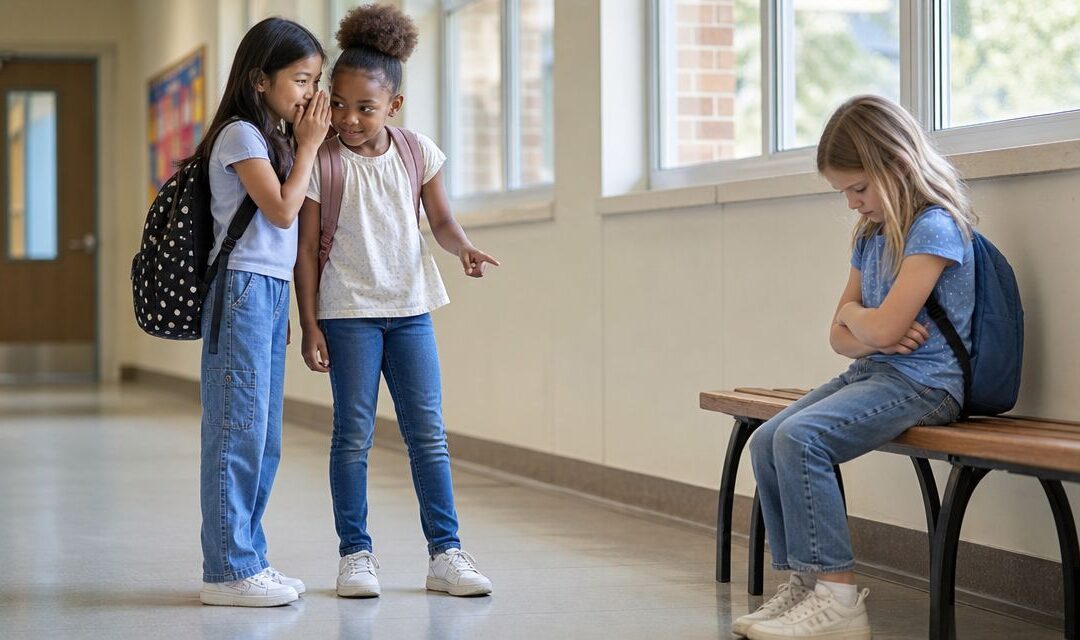
On the playground, four students are planning a game. A fifth child runs over and asks to join. One student says, “We already started,” even though they clearly haven't. Later, the same child finds out everyone was invited to a weekend playdate except them.
In a classroom, a rumor starts. Nobody shouts it across the room. It travels in side comments, shared glances, and a sudden shift in who gets chosen for group work. By dismissal, one student feels like the floor has moved under their feet, and they can't explain why.
That kind of social pain is easy to minimize because it doesn't leave a bruise. But children feel it sharply. They know when they're being iced out, manipulated, or treated like their place in the group is suddenly uncertain.
What makes this especially important is that relational aggression isn't rare, and it doesn't automatically vanish with age. In a study of college women, 68.3% reported being a target of sustained, ongoing relational aggression within the past three years, and 71.2% admitted to engaging in it themselves, showing how widespread this pattern can be beyond middle school in the Alverno conference paper on relational aggression.
What adults often miss
Many caring adults miss relational aggression because it can look like:
Normal social sorting: Kids do change friend groups. That alone isn't aggression.
Quiet behavior: Silence can be weaponized, but silence also happens during ordinary disagreements.
Plausible deniability: A child can say, “I didn't do anything,” and technically mean, “I never said it out loud.”
Practical rule: If a child repeatedly uses belonging, friendship, or group access to hurt someone, control them, or lower their social standing, pay attention.
What it feels like to a child
Children often don't say, “I'm experiencing relational aggression.” They say:
“They keep leaving me out.”
“She said I can't play if I talk to him.”
“Everybody knows something about me, and I don't know what happened.”
“Nothing happened, but I know they're mad at me.”
Those are useful clues. They point to a kind of harm that lives in relationships themselves.
Defining Relational Aggression Beyond Mean Girls
Relational aggression is a nonphysical form of aggression that aims to harm someone's friendships, peer acceptance, social standing, or sense of belonging. Instead of using fists, the aggressor uses the social group. Common tactics include exclusion, rumor-spreading, silent treatment, and manipulating who is “in” or “out,” as described in this SAGE overview of relational aggression.
A simple way to explain it to adults and kids is this: physical aggression tries to hurt the body. Relational aggression tries to hurt a person's place in the group.
That distinction matters in schools. A student may follow every hallway rule, use a calm voice, and still do real harm by turning friendships into tools of control.
Why this definition changed bullying prevention
The concept was formally defined in the 1990s by Crick and Grotpeter, which helped shift bullying prevention beyond physical harm and direct insults to include exclusion and rumor-spreading that damage social standing, as noted in this dissertation review of relational aggression research.
That shift was a big deal for schools. Before that, many adults saw these behaviors as “drama,” “girl drama,” or ordinary friendship ups and downs. The research gave educators language for something they had been seeing all along.
When friendship becomes the weapon, the injury is social. That doesn't make it smaller. It makes it easier to miss.
What relational aggression is not
It helps to separate this from a few look-alikes.
It's not the same as one-time conflict. Two children disagreeing about game rules is conflict.
It's not the same as direct verbal aggression. “You're stupid” is overt verbal harm. “Don't invite her, nobody likes her” is relational harm.
It's not limited to girls. The old “mean girls” frame is too narrow and often keeps adults from seeing the behavior in boys, mixed groups, and online spaces.
A plain-language definition for school and home
If you need a sentence you can use tomorrow, try this:
Relational aggression is when someone uses friendship, inclusion, exclusion, or social information to hurt another person on purpose.
That definition works well in parent meetings, staff trainings, and student conversations because it's clear without being clinical.
If you want language that helps students respond with more care during hard conversations, teaching skills like empathetic listening can help reduce the indirect patterns that fuel group harm.
Recognizing the Signs from Kindergarten to Middle School
In kindergarten, relational aggression often sounds simple. In middle school, it gets more layered. The core pattern stays the same. A child uses connection, access, or status to cause harm.
Adults often get confused because not every exclusion is aggressive. Kids are allowed to have preferences, private friendships, and moments when they need space. The concern rises when exclusion is deliberate, repeated, and tied to humiliation, control, or social punishment.
What it looks like by age
In early elementary, the behavior is usually concrete and easy to hear once you know the pattern. A child says, “You can't come to my birthday party if you play with her,” or “We're best friends now, so you can't be her friend.” Another common version is announcing rules that seem to apply to only one child.
In upper elementary, the social chessboard gets bigger. Students may control who gets invited to sit together, pair up, join a game, or enter a group chat. They may spread a secret, distort a private conversation, or use “everyone thinks” language to pressure someone.
By middle school, the tactics can become sharper and more public. Students may create private chats without one peer, post subtle digs online, share screenshots, or set up social situations where one student is embarrassed in front of others. The same social-harm pattern can extend into digital spaces, where the audience is wider and the message can travel fast.
For families trying to understand the difference between ordinary friendship struggles and controlling behavior, resources on protecting emotional well-being in relationships can offer helpful language that overlaps with what we see in peer groups.
Identifying aggression types in school settings
Aggression Type
Core Intent
Example in Early Elementary (Ages 5-7)
Example in Upper Elementary/Middle School (Ages 8-14)
Physical aggression
Hurt the body or threaten physical safety
Pushing a child out of line
Shoving in the hallway or threatening to fight
Overt verbal aggression
Hurt directly with words
“You're dumb” shouted during centers
Public insults, mocking, name-calling
Relational aggression
Damage belonging, friendship, or status
“You can't play with us because she likes you”
Excluding someone from a group chat, spreading rumors, turning peers against one student
Ordinary peer conflict
Solve or react to a disagreement, not destroy status
“I had it first” during block play
Arguing over project roles, then cooling off with support
Phrases that should get your attention
Listen for repeated language like:
“You can't be friends with both of us.”
“Don't tell her we're doing this.”
“If you sit with them, we're done.”
“It was just a joke,” after public embarrassment
“Everyone thinks you're annoying.”
Those phrases matter because they reveal the mechanism. The child isn't just upset. They're trying to influence the target's place in the peer group.
What teachers and parents can observe
A child may be dealing with relational aggression if you notice:
Sudden social drop-offs: A student who used to join easily now hovers at the edge.
Conditional friendships: One child frequently sets loyalty tests.
Whisper networks: Secrets, side conversations, and repeated “nothing” when an adult approaches.
Patterned exclusion: The same child is regularly left out of games, tables, chats, or partner work.
Behavior changes: School avoidance, clinginess, irritability, or tears after social events.
If you're supporting younger students, it also helps to ground your observations in the larger picture of social-emotional development in children. Many children need direct teaching in friendship skills, but skill gaps and aggression aren't the same thing. Intent and pattern matter.
The Lasting Impact on Social and Emotional Health
When adults dismiss relational aggression as “drama,” children learn two painful lessons. First, their hurt doesn't count. Second, the social world is unsafe unless they can protect themselves by joining in, staying silent, or disappearing.
Research has linked repeated relational aggression with serious outcomes, including depression, low self-esteem, poor social skills, and lower academic performance, and educational guidance also notes that it can escalate into broader violence risk if adults don't address it, as summarized in this relational aggression overview.
The impact on the child being targeted
Targets often become hyperaware of social cues. They scan faces, replay conversations, and worry about what's happening when they aren't present. In school, that can look like trouble concentrating, reluctance to participate, or sudden avoidance of lunch, recess, or group work.
The academic effect makes sense. It's hard to focus on math when you're trying to figure out whether your tablemates are about to freeze you out again.
A child who feels socially unsafe rarely has full attention available for learning.
The impact on the child doing the harm
Children who use relational aggression also need intervention, not just consequences. If a student learns that gossip, exclusion, and alliance-building are effective tools, they may keep using them instead of learning direct communication, repair, and empathy.
That doesn't mean we excuse the behavior. It means we treat it as a developmental warning sign. The child needs accountability and skill-building, not a label that says, “This is just who you are.”
Here is a short video you can use to start reflection with staff or caregivers.
The impact on bystanders and the wider group
Bystanders often feel more than adults realize. They may feel guilty for staying quiet, anxious about becoming the next target, or pressured to choose sides. A classroom where relational aggression goes unchecked becomes a classroom where students guard themselves instead of relaxing into belonging.
That's one reason resilience work matters. At home or in counseling spaces, screen-free ways to foster resilience can support children who are rebuilding confidence after social hurt.
How Schools Can Prevent and Address Relational Aggression
Schools don't stop relational aggression by policing every friendship. They reduce it by teaching what healthy friendship requires. Clear norms. Direct communication. Repair. Inclusion. Adult follow-through.
When school teams define the behavior consistently, students stop hearing mixed messages like “ignore it” in one room and “report everything” in another.
Build a shared language for social harm
Students need concrete language, not vague reminders to “be nice.” Try class agreements such as:
We don't use belonging as a weapon.
We don't spread private information to lower someone's status.
We solve problems with the person, not around the person.
Post the language. Practice it. Refer back to it during real conflicts.
Teach replacement skills, not just rules
A student who excludes may need to learn what to say instead when they feel jealous, annoyed, or threatened. That means teaching sentence stems and rehearsing them.
Examples you can use in class meetings or counseling groups:
Direct request: “I felt left out when that happened. Can we talk?”
Boundary without cruelty: “I want to play with someone else right now, but I'll see you later.”
Repair statement: “I talked about you instead of talking to you. I want to fix that.”
In practice: If students only hear “stop excluding,” they may hide the behavior better. If they learn how to speak honestly and respectfully, they have another option.
Use relational scenarios in role-play
Role-play works best when it sounds like real school life.
Try scenarios like:
Lunch table shift: One student saves seats to block a peer.
Partner project: A group collectively agrees one classmate is “too annoying” to include.
Birthday party talk: Invitations are used to control recess friendships.
Group chat spillover: Weekend messaging creates Monday fallout.
Have students practice three roles. The target, the bystander, and the repairer. That gives them more than one script.
Respond with a whole-school lens
A strong response usually includes these pieces:
Private fact-finding: Talk separately with involved students. Relational aggression often collapses under calm, specific questions.
Pattern tracking: Notice repetition across classes, recess, lunch, or online spillover.
Restorative follow-up: Ask what happened, who was affected, and what needs repair.
Family communication: Share observed behaviors and school supports without escalating blame.
Schools looking for structured SEL support may also use programs such as bullying prevention programs for schools, including options that teach communication, empathy, and conflict resolution as part of daily school culture.
How Parents Can Support Healthy Friendships at Home
Parents don't need to become detectives. Children usually tell us what matters if they believe they won't be brushed off, overreacted to, or immediately marched into a public confrontation.
A calm response helps. When your child says, “They're leaving me out,” start with curiosity before advice. “What happened?” “Has this happened before?” “What did you do next?” Those questions help you hear pattern, intent, and impact.
Conversation starters that work
If your child may be the target, try:
“Did it feel accidental, or did it feel planned?”
“Who felt safe today?”
“What would help tomorrow feel a little easier?”
If your child may have caused harm, try:
“Were you trying to solve a problem, or send a message?”
“What do you think that felt like for the other person?”
“How can you repair it without making excuses?”
Those questions lower defensiveness and still hold the line.
Set home expectations for friendship and tech
Relational aggression often travels through devices, even when the original conflict started at school. Families can help by setting clear expectations about group chats, screenshots, exclusion, and posting about peer conflict.
A few useful rules:
No secret meanness: Don't say online what you wouldn't say respectfully in person.
No screenshot sharing for humiliation: Private messages aren't social currency.
Pause before posting: If the point is to embarrass, isolate, or recruit allies, don't send it.
Model repair in everyday family life
Children learn a lot from how adults handle friction. If a parent says, “I was frustrated, and I spoke sharply. I'm sorry. Let me try again,” the child sees that conflict doesn't have to become control.
That matters because relational aggression often grows where direct communication is weak. Kids need to see honesty and kindness living in the same sentence.
“You don't have to stay close to everyone. You do have to treat people with respect.”
If your child struggles with making or keeping connections, practical ideas for how to make friends at school can reinforce the same friendship skills you're practicing at home.
If your school or family wants more support building empathy, communication, and conflict resolution skills, Soul Shoppe offers social-emotional learning resources and programs designed to help children feel safer, more connected, and more capable in their relationships.
A principal stands at the front office window during morning drop-off. The doors are locked. The visitor badge system works. The camera feed is on. Yet what keeps pulling at her attention isn't the entrance. It's the student who's been eating alone for two weeks, the rising tension between two fourth graders, and the teacher who says her class feels “edgy” every afternoon.
That's where many schools are right now. They've handled parts of physical security, but they're still asking a harder question. What makes children feel safe enough to learn, connect, and ask for help?
For K-8 schools, that answer has to be bigger than hardware. Children are safest when adults notice patterns early, when classmates know how to include one another, when conflict has a repair process, and when students trust that speaking up will lead to help instead of shame. Safety starts to look less like a fortress and more like a healthy community with clear routines, strong relationships, and adults who respond consistently.
Rethinking What Makes a School Truly Safe
A lot of school leaders inherit a narrow version of safety. It focuses on entrances, procedures, and emergencies. Those matter. But principals and parents usually know, from lived experience, that a school can be physically secure and still feel socially unsafe.
A second grader may dread recess because of exclusion. A fifth grader may stop participating because classmates laugh when he gets an answer wrong. A middle-grade student may carry anger from home or the neighborhood into the classroom with no language for it. None of those situations begins with a lockdown. They begin with disconnection.
That's why many effective school safety programs now start with prevention. Long-term national data point in that direction. The nonfatal criminal victimization rate for students ages 12 to 18 at school fell from 181 per 1,000 students in 1992 to 22 per 1,000 in 2022, according to the U.S. Department of Education's Indicators of School Crime and Safety release. That long decline helps explain why the field has increasingly emphasized climate, behavioral supports, and conflict reduction before problems escalate.
A safe school isn't just a place where bad things are stopped. It's a place where students are taught how to belong, regulate, repair, and report concerns early.
For K-8 educators, this shift matters because younger students are still building the skills that shape how they handle frustration, embarrassment, peer pressure, and power. If adults treat every conflict as a rule violation only, children don't learn what to do differently next time. If adults teach emotional vocabulary, help students practice repair, and create routines for inclusion, they build safety from the inside out.
Parents often understand this immediately when it's framed in everyday terms. They want doors locked, yes. They also want their child to have a trusted adult, a clear plan for bullying, and a classroom where mistakes don't become social punishment.
That broader view is where modern school safety programs begin.
What Are Modern School Safety Programs
A modern school safety program works like an ecosystem. You don't get a healthy garden from one strong fence. You need soil, water, routines, early attention to problems, and people who know what they're looking at. Schools work the same way.
Safety is a system, not a single tool
Many schools already use visible security measures. In fact, nearly all schools use at least one security measure like visitor sign-ins. But the strongest evidence for reducing violence points to proactive approaches such as improving school climate, teaching social-emotional skills, and implementing anti-bullying programs, as outlined in the National Center for School Safety overview shared by NIJ.
That distinction clears up a common confusion. A camera can record an incident. A strong adult relationship may prevent it. A locked door controls entry. A classroom routine for calming down can stop a hallway conflict from turning into a fight. Both types of tools matter, but they do different jobs.
What this looks like in a K-8 school
A modern program usually includes layers that work together:
Prevention practices: SEL instruction, anti-bullying systems, predictable behavior expectations, and adult check-ins.
Student support: Counseling access, mental health referrals, re-entry support after crisis, and family communication.
Response structures: A way to report concerns, a team that reviews them, and clear follow-up.
A simple example helps. Suppose a student tells a lunch aide that another child has been making threatening comments during recess. In an older model, staff might wait to see whether something happens. In a modern model, the concern gets documented, reviewed, and addressed through both support and supervision. The student who reported it is taken seriously. The student of concern is not merely labeled “bad.” Adults ask what's driving the behavior, who needs support, and what immediate precautions are necessary.
Practical rule: If your safety plan only activates during a crisis, it's incomplete. Strong school safety programs are active on ordinary Tuesdays.
The strongest programs feel almost boring in the best way. Students know the routines. Adults share language. Families know whom to contact. Small concerns don't get ignored until they become big ones. That consistency is what creates trust.
The Three Pillars of Comprehensive School Safety
When schools try to improve safety, they often overinvest in what's easiest to see. Doors, radios, cameras, and checklists are concrete. Emotional safety is harder to measure in the moment, but it affects everything students do once they enter the building.
The U.S. Department of Education highlights school-based mental health services and climate improvement initiatives as core tools for preventing violence, which is why effective planning has to go beyond physical measures and include psychological and emotional safety as part of the whole system through Safe and Supportive Schools guidance.
Comparing the three pillars
Pillar
Primary Goal
K-8 Classroom Example
Physical safety and security
Protect students and staff through procedures, supervision, and environmental safeguards
A teacher keeps the classroom door protocol consistent, reviews evacuation routes, and uses a clear student pickup routine
Psychological and emotional safety
Help students feel safe to speak, participate, regulate emotions, and seek help
A class uses a Peace Corner where students can calm down, name feelings, and rejoin learning with support
Community and digital safety
Extend safety beyond the classroom through family partnership, online behavior norms, and shared expectations
A school teaches students how to respond to unkind group chats and gives families common language for reporting concerns
Pillar one: physical safety and security
This pillar includes the visible basics. Entry procedures, adult supervision, visitor management, emergency drills, and campus routines all belong here. In K-8 settings, consistency matters as much as equipment.
A practical example is arrival duty. If adults greet students by name while also scanning for distress, they're doing both safety and connection work at once. A child who looks upset, withdrawn, or unusually activated can be redirected to support before the school day unravels.
Pillar two: psychological and emotional safety
This is the pillar schools sometimes skip because it can sound soft. It isn't soft. It's operational. Students who feel humiliated, isolated, or chronically dysregulated don't learn well and don't always make safe choices.
Psychological safety shows up in small routines. A teacher starts the day with a check-in board where students place their name under “ready,” “need quiet,” or “need support.” A counselor teaches students how to use breathing, movement, and feeling words before conflict peaks. A playground supervisor helps children use a repair script instead of forcing a quick apology.
Schools looking for practical support in this area often explore social-emotional learning programs for schools that give staff and students a shared language for self-regulation and conflict resolution.
Pillar three: community and digital safety
Children don't leave their social world at the school gate. A lunchtime conflict may continue in a group text. Neighborhood stress may enter the classroom as irritability or fear. Family uncertainty may show up as withdrawal.
Community and digital safety means schools teach students what to do when online behavior turns mean, secretive, or threatening. It also means parents know how concerns get reported and who follows up. A fifth-grade teacher might say, “If something unsafe happens online at night and it affects school, bring it to us. Don't carry it alone.”
Safety often begins before first period and continues after dismissal. Schools need language and partnerships that travel with children across settings.
The pillars support one another. A child is more likely to follow procedures when they trust adults. A family is more likely to report a concern when they've been treated as partners. That's why multi-faceted school safety programs never rely on a single lane.
Core Components of an Effective Program
The strongest school safety programs are concrete. They don't stay at the level of mission statements. They translate into routines, tools, roles, and practice.
Prevention has to be visible in daily school life
Start with what students experience every day. If a school says it values safety, students should be able to point to where they learn it.
That might include:
A schoolwide SEL routine: Morning meetings, emotion check-ins, calming strategies, and shared language for feelings and needs.
Anti-bullying instruction: Direct teaching on exclusion, bystander action, rumor-spreading, and repair.
Restorative responses: Guided conversations after harm so students learn accountability, empathy, and next steps.
Adult relationship systems: Advisory, lunch bunches, check-in/check-out, or a trusted adult list for students who need extra connection.
A fourth-grade restorative circle is a good example. Two students have a conflict during art. Instead of sending both away with equal blame, the teacher gathers them later with a simple structure: What happened? Who was affected? What do you need now? What can repair look like? Students learn that conflict has a process. That lowers fear and increases fairness.
Schools that want practical prevention tools may also look at bullying prevention programs for schools that combine student instruction with staff training and school climate work. Soul Shoppe is one example of an SEL organization that teaches conflict resolution and shared language for peer support.
Reporting systems and response teams matter
Students often see warning signs before adults do. The key question is whether they trust the adults enough to say something, and whether the school has a system to act on that information.
In U.S. Secret Service research on averted school attacks, prevention happened in nearly all cases because someone reported concerning behavior before the attack was carried out, as described in a CISA school safety training featuring that research. That's why an effective program includes both a reporting path and a trained behavioral threat assessment team.
A strong setup includes:
Low-friction reporting: Students and families know how to report concerns without jumping through hoops.
Clear triage: Reports don't sit in an inbox. A team reviews them quickly.
Support plus safety planning: The response isn't only punitive. It also asks what support, supervision, and communication are needed.
Follow-through: The reporting student sees that adults took the concern seriously.
For younger students, “reporting system” may be as simple as a trusted adult board, a classroom worry box, or a counselor form that an adult helps complete. For older elementary and middle grades, it can include web-based or mobile options.
A school's physical spaces should support this work too. Recess zones, pickup areas, and play structures need clear supervision and upkeep. For a practical facilities lens, many schools review guidelines for school playground safety to make sure environment and behavior expectations match.
Later in the year, some teams find it helpful to revisit core response ideas through a short training video before staff planning days.
When students report a concern, they're testing whether adults mean what they say about safety.
Recovery is part of safety too
Schools sometimes prepare for incidents but not for the aftermath. Recovery includes re-entry meetings, classroom support after a scary event, family communication, and trauma-informed follow-up for affected students and staff.
A simple example is the day after a major conflict. Instead of pretending nothing happened, a principal gives teachers a brief script, counselors check on students who were involved, and families receive clear communication about support and next steps. That steadiness helps restore trust.
The Lifelong Benefits of a Safe School Climate
A safe school climate does more than reduce immediate problems. It changes how children think about themselves, other people, and learning.
When students feel emotionally safe, they take healthy risks. A quiet child raises a hand. A frustrated child tries a coping strategy before flipping a desk. A child who made a social mistake believes repair is possible instead of deciding, “I'm the bad kid now.” Those are not small changes. They shape identity.
What children gain when safety feels real
Students in connected classrooms usually show growth in areas that matter far beyond school:
Belonging: They feel less alone and more willing to participate.
Self-regulation: They learn what to do with anger, embarrassment, and worry.
Empathy: They notice the impact of their choices on peers.
Help-seeking: They're more likely to tell an adult when something feels wrong.
Resilience: They recover from conflict or mistakes without shutting down.
Consider a shy third grader who avoids group work because she's afraid classmates will laugh at her ideas. In a classroom with strong emotional safety, the teacher uses turn-taking structures, models respectful feedback, and checks in privately after tense moments. Over time, that student starts sharing. Then she starts leading. Her academic growth didn't come from a new worksheet. It came from feeling safe enough to be visible.
What adults gain too
School climate affects staff just as much as students. Teachers work better when behavior expectations are consistent, when they have language for de-escalation, and when they don't feel alone with every conflict. Parents also feel more grounded when the school communicates clearly and responds with both care and competence.
Children learn best in places where they don't have to spend all day protecting themselves.
This is why climate work belongs inside safety planning, not on a separate island. A child who feels known is easier to redirect. A parent who trusts the school is more likely to share concerns early. A teacher with good relational tools can prevent a power struggle from becoming a crisis.
That's the long game of school safety. It helps children become people who can manage feelings, build healthy relationships, and contribute to a community without fear running the show.
Implementing and Evaluating Your Program
A school doesn't build safety by buying a binder and holding one meeting. It builds safety by choosing a few clear practices, training adults well, and checking whether those practices are changing student experience.
The National Center for Education Statistics advises schools to systematically collect and analyze incident data on fights, bullying, and threats to identify patterns and guide prevention efforts. Without that kind of data use, even well-designed discipline systems are likely to be ineffective, as explained in NCES guidance on data-based decisionmaking for school safety.
A practical rollout process
Start small enough to do well. A school can phase in strong safety work with a sequence like this:
Build a representative team: Include administration, counseling, teachers, support staff, and family voice.
Clarify your biggest needs: Are you seeing recess conflict, peer cruelty, chronic dysregulation, vague threats, or inconsistent adult response?
Choose a few key practices: For example, one reporting process, one restorative routine, one SEL check-in structure, and one staff protocol for escalation.
Train adults with examples: Staff need role-play, scripts, and case discussion, not just slides.
Communicate with families: Explain what students are being taught and how concerns can be reported.
Review data on a schedule: Don't wait for a crisis to ask whether the system is working.
A principal might notice that most referrals come from recess and the last half hour of the day. That pattern suggests a supervision and transition issue, not a “bad kids” issue. The intervention might include retraining playground staff, reteaching games, assigning student peer leaders, and adjusting pickup routines.
What to track without overcomplicating it
Useful evaluation doesn't have to be fancy. It does have to be consistent.
Location patterns: Playground, cafeteria, hallway, bus line, online spillover into school
Time patterns: Arrival, lunch, dismissal, certain days of the week
Student voice: What students say about belonging, fairness, and trusted adults
Staff feedback: Where adults feel confident and where they need more support
If your team needs a planning starting point for crisis procedures, a customizable security incident response plan template can help organize roles and communication steps. Day-to-day prevention should sit alongside that document, not outside it.
Many schools also connect safety work to broader classroom management best practices so students experience the same expectations during instruction, transitions, and conflict.
A useful test: If you can't tell where incidents are happening, when they happen, and how adults respond, you can't improve the system with confidence.
Evaluation should lead to adjustment. If the worry box goes unused, students may not trust it. If hallway incidents drop but lunch conflict rises, supervision may need to shift. Effective school safety programs are living systems. They improve because adults keep learning from what children and data are showing them.
Your School Safety Checklist and Next Steps
The most productive next step is rarely “do everything.” It's usually “tighten the basics, then build.” Schools and families create safer environments when they act consistently and share the same message. Safety grows when children hear, “You belong here, your concerns matter, and there's a process for getting help.”
For school administrators
Review your prevention systems: Check whether SEL, bullying response, and reporting procedures are visible in daily practice.
Strengthen adult consistency: Train staff on de-escalation, referral pathways, and restorative follow-up so students get predictable responses.
Audit high-risk spaces: Look closely at recess, hallways, pickup, bathrooms, and digital spillover points.
Update emergency materials: Keep procedures current and easy to use. A practical actionable guide for facility emergencies can help teams review plan structure and readiness.
Give students voice: Ask them where they feel safe, where they don't, and which adults they trust.
Practice community-building routines: Many schools use simple school safety activities to help students rehearse inclusion, calming, and reporting skills.
For parents and families
Learn the reporting path: Know how your school handles bullying, threats, and concerning behavior.
Use emotional language at home: Help children name feelings and ask for help before problems snowball.
Practice conflict scripts: Teach phrases like “I didn't like that,” “Please stop,” and “I need help.”
Watch for behavior changes: Withdrawal, sudden avoidance, or angry outbursts can be signs a child doesn't feel safe.
Stay connected to school adults: Early partnership solves more than late crisis communication.
Treat online conflict as real: If a digital issue affects your child's sense of safety, bring it to the school.
School safety is shared work. Principals set the conditions. Teachers create the daily climate. Families reinforce the language. Students learn that safety includes speaking up, calming down, and repairing harm. That's how a school becomes not just protected, but connected.
If your school wants support building safety through empathy, self-regulation, conflict resolution, and belonging, Soul Shoppe offers SEL-based programs and resources for students, staff, and families.
By 8:10 a.m., a principal may already be juggling three safety concerns at once. A student is crying in the hallway after a peer conflict, a teacher needs help with a child who arrived too upset to join class, and the front office is sorting out a parent concern while trying to keep the entry process calm and orderly. That is school safety in real life. It is physical readiness, emotional regulation, and adult judgment happening at the same time.
Schools need locked doors, visitor procedures, and clear emergency plans. They also need students who can name a problem early, adults who can spot escalation before it turns into a crisis, and families who trust the school to respond with care and consistency. In my experience, safety systems hold up better when students feel connected enough to use them.
Recent reporting on school safety trends found that staff alerts overwhelmingly involve everyday situations rather than the worst-case scenarios that tend to dominate public conversation. That matches what many educators see every day. The bulk of school safety work is prevention, response, and recovery during ordinary school hours.
SEL fits directly into that work. A student who can regulate frustration is less likely to escalate a conflict. A class that has practiced empathy and repair is easier to settle after a hard moment. A teacher using trauma-informed teaching strategies can protect emotional safety while still holding clear expectations.
The ten activities below treat safety and belonging as part of the same system. They combine preparedness with relationship skills, communication routines, and emotional support so schools can build a culture that feels safe, not just one that looks prepared.
1. Active Shooter/Lockdown Drills with Trauma-Informed Debrief
The announcement comes over the intercom at 10:17. A first grader starts to cry. A middle school student goes silent and stares at the floor. The teacher locks the door, checks the corner by the bookshelf, and tries to keep her own voice steady. That moment shows what lockdown drills really measure. Procedure matters, and so does emotional regulation.
Schools do need to practice for low-frequency, high-impact emergencies. They also need to make sure the practice itself does not become a source of harm. Active shooter incidents remain rare, but the fear attached to them shapes how students, staff, and families experience any lockdown drill. A trauma-informed debrief helps schools teach safety skills while protecting trust, connection, and a sense of control.
What effective drills look like
The strongest drills are brief, calm, and clearly explained ahead of time. Staff use the same language across classrooms. Students know the routine. Adults know exactly what they are expected to do, whether that means locking doors, moving students out of sight, taking attendance, or waiting for the next direction. Younger children need simple, concrete wording. Older students can handle more context, but they still do not need graphic details.
I have seen schools get better results when they teach one message consistently. We practice so everyone knows what to do. We also check how people are feeling after the practice. That second step is where SEL belongs in a safety plan, not as an extra, but as part of the protocol.
Practical rule: End every lockdown drill with a short, structured debrief and a clear path to adult support.
That debrief can be simple. A teacher might say, “We practiced a safety routine today. If your body still feels tense or worried, you can talk with me, the counselor, or another trusted adult.” Students can take a few slow breaths, notice how their body feels, and name one adult they would go to for help. Those are safety skills too.
What often goes wrong
Problems usually start before the drill begins. Adults skip preparation, use dramatic scripts, or treat realism as the main goal. That choice has a cost. Students may leave frightened instead of prepared, and staff may miss signs that a child has been pushed past their coping capacity.
Families should hear about the drill in advance. Teachers should know which students may need a quiet check-in afterward. Office staff and counselors should have a follow-up plan for students with trauma histories, recent losses, anxiety, or behavior changes. For many schools, that is the difference between a drill that builds confidence and one that creates lingering distress.
A workable staff plan includes:
Notify families early: Use plain language so caregivers can prepare children without raising alarm.
Watch for signs of distress: Look for shutdown, tears, irritability, laughter that covers fear, or refusal to return to classwork.
Address the social piece: If students are replaying rumors, dares, or panic online, schools should teach how to handle negative peer pressure before and after safety exercises.
Include digital safety in family communication: Caregivers often need help deciding how closely to monitor children's online activity after a drill, especially when group chats start spreading fear.
One practical K-5 approach is to close with a grounding routine, a quick feelings check, and a return-to-learning task that feels predictable. Older students may do better with a brief advisory discussion about stress responses, rumor control, and where to get support. The trade-off is time. Debriefing takes minutes away from instruction. In my experience, those minutes are well spent, because a class that feels settled returns to learning faster and trusts the adults running the plan.
2. Bully Prevention and Peer Support Programs
A student gets through math, lunch, and dismissal without a single office referral, yet goes home feeling unsafe. That is often what bullying looks like at school. The problem shows up in exclusion, group chat pile-ons, whispered jokes, and the student who starts asking to stay inside during recess.
Bullying rates remain high among students ages 12 to 18, and K-8 staff usually see the pattern long before a formal report is filed. Safety planning should treat relational aggression as both a behavior issue and an SEL issue. If students cannot read social cues, manage status pressure, or speak up for a peer, the school will keep reacting after harm has already spread.
Clear consequences still matter. They just do not carry the whole load.
Schools make more progress when they teach the skills that prevent cruelty from gaining social traction. That means direct instruction in empathy, bystander action, emotional regulation, and repair after harm. It also means giving students safe ways to ask for help and training adults to respond consistently across classrooms, hallways, buses, and recess.
A practical model often includes:
a small, trained peer support group
simple reporting options for students and families
adult follow-through within a predictable time frame
classroom practice with scripts for interrupting teasing, exclusion, and rumor-spreading
restorative follow-up when students are ready to take responsibility and repair harm
One elementary example is a recess support crew. These students are not junior disciplinarians. They learn how to notice isolation, invite someone into play, use brief inclusive language, and get an adult quickly when a situation is turning mean. For students who struggle with impulsive reactions in these moments, schools can pair peer support with self-regulation strategies for students so intervention is not left to willpower alone.
Family involvement matters because bullying rarely stays on campus. It moves through texts, gaming platforms, shared photos, and private group chats. Schools should give caregivers realistic guidance on how to monitor children's online activity and how to respond when a child is excluded, pressured to forward a screenshot, or pulled into a rumor cycle.
For upper elementary and middle grades, lessons about negative peer pressure fit naturally here. Students need language they can use, such as, “I'm not adding to that,” “Leave me out of this chat,” or “We need an adult before this gets worse.”
The trade-off is staffing and time. Peer programs need training, supervision, and regular refreshers or they become symbolic. In practice, schools get the best results when bully prevention is revisited all year and built into advisory, class meetings, recess routines, and family communication, because a safer school culture depends on social skills students can use under pressure, not posters they stop seeing by October.
3. Mindfulness and Self-Regulation Workshops
Many safety incidents begin as regulation failures. A child gets overwhelmed, a conflict spikes, a hallway interaction turns physical, or a student can't recover after frustration. That's why mindfulness belongs on the safety plan, not off to the side as an enrichment extra.
This doesn't require a silent classroom and perfect posture. In schools, mindfulness is usually much simpler. It's a short breathing routine before transitions, a grounding exercise after recess, or a repeatable calming sequence before students try to solve a problem.
Keep it practical and brief
The mistake many schools make is overcomplicating it. Students don't need long lectures about mindfulness. They need routines they can remember when upset.
Effective workshop examples include:
Breathing choices: Balloon breath, square breathing, or hand tracing for younger students.
Sensory grounding: Name five things you see, four you feel, three you hear.
Reset corners: A calm space with visuals, a timer, and one or two regulation tools.
A teacher might pause after lunch and say, “Before we start science, feet on the floor, one hand on your belly, three slow breaths.” In a counseling group, students might practice identifying body signals that show anger is rising before words come out sharp.
Tie the skill to real school moments
The strongest school safety activities connect skills directly to stress points. Use regulation routines before assemblies, after fire drills, during testing weeks, and after recess conflicts. Staff should practice them too. Students notice immediately when adults ask for calm without modeling it.
One middle school team I'd recommend modeling after in spirit uses the same regulation script in every room: pause, breathe, name the feeling, choose the next step. That consistency matters more than the specific program name. Safety improves when children hear the same calming language from every adult on campus.
4. Social-Emotional Learning Assemblies and School-Wide Events
Assemblies can be forgettable, or they can reset the tone of a campus. The difference is whether the event gives students shared language they'll hear again in classrooms, hallways, lunch spaces, and on the playground.
A strong assembly doesn't try to solve every safety issue in one sitting. It introduces a few core behaviors clearly: how to include someone, how to interrupt meanness, how to ask for help, how to calm down before a conflict spreads. It also signals that these aren't counselor-only topics. They belong to the whole school.
Use assemblies to launch a shared language
The biggest advantage of a school-wide event is alignment. Everyone hears the same vocabulary at the same time. That matters because inconsistency weakens follow-through.
Good assembly themes include:
belonging and inclusion
conflict repair
safe bystander behavior
empathy in high-stress moments
speaking up when a peer needs help
The follow-up matters as much as the event. Teachers should get discussion prompts, short reflection activities, and visible phrases to reuse during the week.
Students don't remember every assembly message. They do remember the one phrase adults keep using afterward.
A K-8 example is an assembly on “pause, breathe, speak respectfully,” followed by classroom role-plays in which students practice the phrase during line disputes, lunch conflicts, and partner work frustration.
Don't confuse energy with impact
A loud, entertaining assembly can still fail if it stands alone. Schools get better results when they use these events as the kickoff to a larger SEL and safety effort. Family communication helps too. Send home the core phrases students heard so caregivers can reinforce them.
If your team wants language for that bridge, the benefits of social-emotional learning provide a practical frame for why these events belong inside a safety strategy, not outside it.
5. Crisis Communication and Family Notification Drills
Families can handle hard news better than confusing silence. When a school communicates quickly, clearly, and consistently, trust holds up under stress. When communication is slow or fragmented, even a manageable situation can feel chaotic.
That's why communication drills belong on the list of serious school safety activities. Schools should practice not only what they'll do in a crisis, but what they'll say, who will say it, and how families will receive updates.
Test the message chain before you need it
A family notification drill should answer basic questions fast. Which system sends the first alert? Who approves the wording? Who updates the website? Who handles phones at the front office? Who communicates with district leadership or first responders?
Many schools use platforms such as Everbridge or Blackboard Connect, but the specific tool matters less than the clarity of the protocol. Every message should identify the communication as a drill, use plain language, and tell families what action is or isn't needed.
Try a scenario like this: a medical emergency near dismissal causes a temporary hold. During the drill, the school sends a text, email, and app alert marked “DRILL,” then checks whether contact records are current and whether staff know how to answer common parent questions.
Debrief with families, not just staff
Schools often stop after testing the system. Don't. Ask families what they received, what felt clear, and what caused confusion. A parent who gets the message but can't tell whether to come to campus still doesn't have the information they need.
A simple drill review should cover:
Channel coverage: Which families received text, email, phone, or app notices.
Message clarity: Whether the wording answered the first three parent questions.
Backup procedures: What happens if the primary system is delayed or unavailable.
This kind of practice also supports multilingual communities. If your school communicates with families in more than one language, message templates need to be translated ahead of time, not in the middle of an emergency.
6. Threat Assessment and Violence Prevention Teams
A student turns in a writing assignment that includes violent imagery. Another student reports a troubling social media post. By lunch, rumors are spreading, teachers are worried, and the front office is fielding calls. In that moment, schools need a clear process that slows panic, gathers facts, and gets the right adults to the table.
That is the job of a threat assessment and violence prevention team.
The strongest teams are multidisciplinary and intervention-focused. An administrator may lead the process, but the best decisions usually come from a group that includes a counselor or school psychologist, a nurse when health factors matter, and staff who know the student's daily behavior. Some schools also consult school resource staff or community providers when the situation calls for it.
This work is about safety, and it is also about SEL. A student who is escalating often shows warning signs through relationships, emotional regulation, communication, or repeated conflict long before a crisis point. Teams that look only for punishment miss the chance to address the underlying need. Teams that look only for distress can miss real risk. Good practice holds both.
Build a process staff can trust
A threat assessment team should never run on hunches or hallway impressions. Staff need to know what to report, how quickly to report it, and what details help. “He was acting weird” is not enough. Specific observations are useful. Exact statements, changes in behavior, named targets, access concerns, recent stressors, and peer reports give the team something concrete to assess.
Documentation matters. So does role clarity.
One person gathers initial facts. One contacts caregivers. One manages follow-up supports. One tracks whether the safety plan is happening in class, on the bus, and during transitions. Without that coordination, schools tend to overreact in one case and underreact in the next.
Use intervention early
Some cases require immediate protective action. Others call for fast support before behavior hardens into grievance or retaliation.
A practical example: a middle school student posts a message that classmates read as threatening. The team reviews the exact post, who saw it, whether a target was named, what happened earlier that week, and whether the student has shown signs of isolation, dysregulation, or conflict with peers. The response might include parent contact, a same-day mental health check-in, increased supervision, a reentry meeting, or an emergency referral. The facts drive the plan.
I have seen schools get better results when the team asks two questions at the same time: “What is the current safety risk?” and “What SEL skill or support is missing here?” That shift keeps the process from becoming purely reactive. It also helps staff choose supports that teach replacement skills, not just impose restrictions.
Concern should trigger a process, not panic.
Schools should also train all staff to report concerns early, especially quieter indicators such as fixation, withdrawal, hopeless language, sudden social conflict, or repeated comments about revenge. Those signs do not mean violence is inevitable. They do mean a student may need adult attention now, not after a major incident.
For schools that want a clearer prevention framework across campus events and off-site activities, this guide on how AnySchool simplifies excursion safety is a useful companion to team-based planning.
7. Classroom-Based Conflict Resolution and Restorative Practices
Two students walk into class angry from recess. One is still replaying the insult. The other is already recruiting friends to take sides. If the only school response is “stop arguing,” that conflict usually resurfaces in the hallway, on the bus, or online after school.
Classroom-based conflict resolution gives students a safer path early. It treats safety and SEL as part of the same job. Students learn how to name harm, manage strong feelings, listen with accuracy, and repair relationships before a minor conflict turns into intimidation, exclusion, or a fight.
Teach repair as a routine
Restorative practice works best in ordinary moments, not only after a major incident. A short morning circle, a partner reset after group work, or a five-minute reflection after a disagreement gives students practice with the exact skills they need under stress.
The goal is not perfect harmony. The goal is predictability.
Students do better when they know the script for conflict before emotions spike. Useful prompts include:
What happened from your point of view?
Who was affected?
What were you feeling at the time?
What do you need now to move forward safely?
What will repair look like?
In elementary classrooms, this may look like a brief teacher-led conversation with clear sentence stems and a concrete next step for tomorrow. In middle school, it often means slowing down a social conflict, separating the audience from the issue, and helping students distinguish intent from impact. That SEL piece matters. Many students are not refusing to repair. They do not yet have the language or regulation skills to do it well.
Keep accountability clear
Restorative practice needs structure. Students still need firm boundaries, adult leadership, and consequences when harm is repeated, targeted, or serious. A restorative conversation is not a free pass, and it should never replace a safety response that is already warranted.
I have found that teachers get better results when they decide one thing before the conversation starts. What must be addressed right now: emotional regulation, relationship repair, or immediate safety? That keeps the meeting focused and prevents a vague discussion that leaves everyone frustrated.
A practical example: after a group chat argument spills into first period, the teacher does not ask students to “work it out” in front of peers. The students cool down first. Then the teacher or counselor facilitates a brief process that names the harm, sets limits on future contact if needed, and creates a specific repair plan. That might include an apology, changed seating, adult check-ins, or a temporary pause on collaborative work.
Many safety problems play out in shared spaces where adults have less control and students rely more on habits. For that reason, schools should pair classroom repair routines with clear supervision plans for recess, transitions, dismissal, and extracurriculars. Schools also need practical systems for movement beyond the classroom, including trip and activity planning. For off-campus supervision, it can help to see how AnySchool simplifies excursion safety.
8. Mental Health First Aid and Crisis Intervention Training for Staff
A student in distress usually encounters a teacher, aide, bus driver, office staff member, or recess supervisor before they ever reach a counselor. That's why staff training matters so much. Adults need more than goodwill. They need a response script.
Mental Health First Aid and crisis intervention training give staff a way to notice warning signs, stay calm, and connect a student to the next level of support. For K-8 schools, the practical value is immediate. The adult in front of the student stops making the moment worse.
Here's one example of the kind of staff learning schools often use:
Train for the moment before referral
Staff members don't need to become therapists. They do need to know how to respond when a child is panicking, dissociating, making hopeless statements, or escalating toward aggression.
The most useful training is scenario-based. Practice what to say, where to stand, how to lower stimulation, when to call for help, and how to document concerns afterward.
A workable school script might sound like this:
Regulate the space: lower voice, reduce audience, move peers away.
Name what you see: “I can tell this is a lot right now.”
Offer simple choices: “Would you like water, a quiet space, or for me to stay with you while we call support?”
Transfer carefully: connect the student to the counselor, nurse, or designated crisis responder.
Support adults too
Staff can't offer calm if they're depleted and unsupported. Secondary trauma is real in schools. So is emotional overload after repeated student crises.
One practical habit is ending serious incidents with a short adult debrief. What happened, what worked, who needs follow-up, and who needs a moment before returning to class coverage. Schools that normalize this protect both student safety and staff sustainability.
9. Parent and Family Engagement Workshops on School Safety and SEL
School safety gets stronger when families hear the same language children hear at school. Without that alignment, adults can end up working against each other. A school teaches regulation and repair, while home conversations focus only on punishment or fear. Students notice the mismatch.
Family workshops can close that gap. They don't need to be formal or long. They do need to be practical.
Focus on usable skills
Parents and caregivers show up when the content helps with tonight's problems, not only policy updates. Good workshop topics include calming routines for transitions, what to say after a bullying report, how to respond when a child says school feels unsafe, and how to tell the difference between conflict and targeted harm.
One useful format is a short evening session with role-play. Adults practice responses to common student statements:
“Nobody likes me.”
“They were joking, but it felt mean.”
“I don't want to tell the teacher.”
“I'm scared about the drill.”
That gives families language they can use immediately at home.
Remove participation barriers
The content matters, but access matters too. Offer sessions at more than one time. Provide a video option when possible. Translate handouts. Keep examples age-specific.
Older data from NCES on school-related fears and avoidance reminds us that some students avoid school or certain areas because they fear harm. Families often hear about that avoidance first. When schools help caregivers respond calmly and early, they catch problems before attendance, learning, and trust erode further.
A practical addition is a take-home one-pager with school contacts, reporting pathways, and two or three SEL phrases caregivers can repeat at home. Small tools often get used more than polished binders.
10. Peer Support and Student Leadership Programs
A new student walks into the cafeteria, scans the room, and freezes for half a second. Staff may not catch that moment. Other students do.
That is why peer support belongs in any serious school safety plan. Students notice exclusion, brewing conflict, and social withdrawal long before those patterns show up in an office referral. When schools connect that student insight to SEL skills such as empathy, help-seeking, boundary-setting, and responsible decision-making, safety work gets stronger at the relationship level, not only the procedural one.
Give students real roles, clear limits, and adult backup
Peer programs work when the role is specific and supervised. Students should know how to welcome a classmate, include someone who is alone, listen without promising secrecy, and hand off safety concerns to an adult quickly. They also need regular check-ins with staff, because even capable student leaders should not carry other students' pain by themselves.
In K-8 settings, the most usable models are usually the simplest:
buddy systems between older and younger students
peer welcome teams for new students
student climate or belonging committees
affinity groups with adult facilitation
peer mediators for minor conflict, with clear referral rules
Schools often invest heavily in cameras, access control, and assessment routines, as noted earlier in the article. Those measures matter. They do not build the student-to-student trust that determines whether a child speaks up, includes a peer, or asks for help before a problem grows.
Treat student voice as operational input
Token leadership programs fade fast. If students serve on a safety or climate team, ask for observations tied to real parts of the day: arrival, hall transitions, lunch, recess, bathrooms, dismissal, and online group chats that spill into school. Then respond visibly.
Students stay engaged when adults close the loop. If a concern can be fixed, fix it. If it cannot, explain why and name the next best option.
One elementary model I have seen work well is a trained fifth-grade welcome crew. They greet new students, sit with them at lunch during the first week, notice early signs of isolation, and bring concerns to a designated counselor or administrator. It is low-cost, easy to supervise, and practical. More important, it teaches student leaders a core safety lesson: caring for peers starts with connection, and connection is often the first layer of prevention.
Watch the trade-off here. Peer leadership can strengthen belonging, but it can also overburden the same dependable students if adults are not careful. Rotate roles, keep expectations narrow, and build in adult debriefs. The goal is a safer school culture where students practice SEL skills in real situations, with adults still responsible for protection, intervention, and follow-through.
10 School Safety Activities: Side-by-Side Comparison
Program
Implementation complexity
Resource requirements
Expected outcomes
Ideal use cases
Key advantages
Active Shooter/Lockdown Drills with Trauma-Informed Debrief
High, detailed planning & trauma-informed skills
Significant staff training, counselors, coordination time
Improved preparedness with reduced psychological harm
Safety compliance, emergency readiness with mental health focus
Balances physical safety with student emotional well‑being
Bully Prevention and Peer Support Programs
Moderate–High, school‑wide sustained effort
Training for students/staff, reporting systems, ongoing coaching
Fewer bullying incidents; stronger school climate over time
Cost‑effective; leverages student influence and trust
Safety as a Shared Responsibility
A student comes in upset after a rough morning at home. By second period, that stress shows up as arguing, refusal, or shutting down. If the adults around that student only see behavior, they miss the safety issue developing in front of them. If they also see regulation, connection, and support as part of safety work, they have more ways to respond early and well.
That is the practical shift behind this whole list. School safety is not only about preparing for the worst-case event. It is also about reducing the everyday breakdowns that can grow into crisis if no one steps in skillfully. Drills, alert systems, family notification plans, and threat assessment processes all matter. So do peer support, restorative conversations, self-regulation routines, and clear emotional language that students can use under stress.
As noted earlier in the article, school violence and daily emergency response both remain real concerns for schools. That combination calls for a wider frame. Schools need protective procedures, and they need adults and students who can notice distress, slow conflict down, repair harm, and ask for help before a situation escalates.
For school leaders, the best next step is usually narrower than people expect. Choose one weak point and improve it all the way. I have seen schools make real progress by tightening one dismissal routine, adding a trauma-informed debrief after drills, or standardizing how staff respond to peer conflict. A focused change is easier to train, monitor, and sustain than a long safety plan that never reaches classrooms.
Teachers and counselors build culture through repetition. A brief check-in at the start of class. A posted script for resolving conflict. A calm-down routine students practice before they need it. A referral process every adult can explain the same way. Those habits do not replace formal safety protocols. They make those protocols more effective because students are already used to naming feelings, following directions, and seeking support.
Families are part of the same system. When home and school use similar language for reporting concerns, managing conflict, and calming the body, students get consistency instead of mixed signals. That consistency lowers confusion and helps children recover faster after mistakes, social problems, or frightening events.
If your school wants support connecting SEL with safety planning, Soul Shoppe is one option that offers experiential programs focused on self-regulation, mindfulness, communication, conflict resolution, and bullying prevention. The larger point is simple. Physical safety and emotional safety work better together than apart.
Strong schools prepare for emergencies and teach the daily skills that prevent many emergencies from growing. That is shared responsibility in practice.
Translators USA for HR document translation can also be useful when districts need family-facing safety documents and staff materials available in multiple languages with consistent wording.
If your school is ready to strengthen safety through connection, empathy, and practical SEL tools, explore Soul Shoppe for workshops, assemblies, courses, and resources that help students and adults build the shared language and everyday habits that make campuses safer.