

10 Student Leadership Activities for K-8 Schools
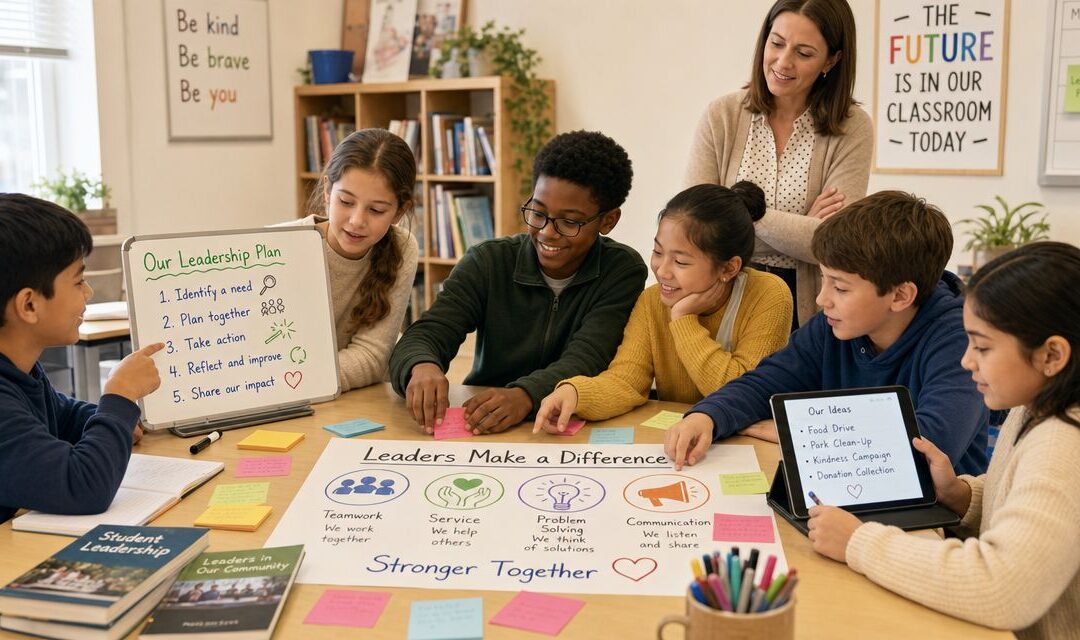
You can see the need for student leadership every day. A disagreement starts on the playground and no one knows how to step in well. A new student sits alone at lunch. A class has strong ideas about improving school culture, but the only adults making decisions are already stretched thin.
That’s where student leadership activities matter. In K-8 schools, leadership isn’t about creating a few polished speakers or handing out badges and titles. It’s about helping students practice confidence, communication, honesty, responsibility, listening, respect, integrity, empathy, teamwork, and compassion. A major 2023 survey of almost 7,000 student leaders found those were the top qualities young people themselves associated with effective leadership, and the same review noted that students place leadership in a democratic framework focused on influence, contribution, and relationships, not control or status (student leadership research summarized by SSAT).
That matches what works in schools. Students grow when they get real responsibility, adult coaching, and structures that protect belonging. They don’t grow from token jobs, popularity contests, or vague encouragement to “be leaders” without tools.
The 10 ideas below are practical student leadership activities you can run in a K-8 setting. Each one includes what it builds, how to launch it, where it tends to go wrong, and how to adapt it so more students can lead.
1. Student Leadership Councils
A student leadership council works when it solves real problems. It falls flat when it becomes a school photo opportunity or a place where the same confident students talk while everyone else watches.
For elementary schools, this might look like rotating classroom ambassadors who gather input from classmates and bring it to a weekly meeting. In middle school, it can be a formal council that helps shape spirit events, welcome routines, service projects, or anti-bullying campaigns.

How to set it up well
Start with representation before elections. If you only elect students by popularity, you’ll often miss thoughtful leaders, multilingual students, quieter students, and children who care a great deal but don’t campaign well.
A stronger model is mixed entry. Use some elected seats, some teacher-nominated seats, and some rotating classroom roles. Then train everyone in meeting norms, listening, and how to gather peer input before making recommendations.
- Give them one real lane: Let the council own something visible, like recess equipment ideas, school welcome routines, or a kindness week.
- Use a simple agenda: Opening check-in, issue review, student feedback, decision, next steps.
- Require class feedback loops: Council members shouldn’t just share their opinions. They should bring back questions, collect peer ideas, and report out.
Practical rule: If adults can override every decision without explanation, students will stop treating the council seriously.
For younger students, use sentence frames such as “Students in our class noticed…” and “Our suggestion is….” For older students, add subcommittees for climate, events, and peer support.
The best councils build democratic habits. Students learn that leadership means listening across differences, not winning the room.
2. Peer Mentoring and Buddy Programs
Peer mentoring is one of the most reliable student leadership activities because it helps both sides. Younger students get connection and orientation. Older students practice patience, responsibility, and emotional awareness.
A simple example is a 5th grade and kindergarten buddy system. Older students read together, walk to assemblies together, and model classroom routines. In middle school, 8th graders can support incoming 6th graders during the first months of transition.
What to teach mentors first
Don’t choose mentors only by grades or teacher pleasing behavior. Pick students who can listen, stay calm, and follow through. Then train them before they ever meet with younger peers.
Use role-play for common moments. A kindergartener clings at drop-off. A new student says nothing. A younger buddy gets frustrated during a game. Mentors need scripts, not just encouragement.
A strong starter routine includes:
- Opening ritual: Greeting, name check, and one easy question.
- Shared activity: Read, draw, play a structured game, or complete a collaborative task.
- Closing reflection: “What went well today?” and “What should we do next time?”
If you want mentors to build stronger connections, pair the program with intentional relationship-building activities. That gives students more than a buddy title. It gives them ways to connect.
Common mistakes
Schools often make buddy programs too loose. If students just “go hang out,” some pairs click and others drift. Structure creates safety.
Another mistake is leaving mentors unsupported. Check in with them regularly. Ask what feels easy, what feels awkward, and where they need adult backup. Leadership grows through coaching, not silent observation.
A good buddy program is especially helpful for new students, multilingual learners, and children who need a friend before they need advice.
3. Student-Led Conflict Resolution Programs
Some of the strongest student leadership activities teach students how to handle tension directly. Peer mediation, peacemaker teams, and student-led restorative circles all give children a structured way to respond when conflict shows up.
Conflict is constant in school life. Exclusion, teasing, line-cutting, game disputes, and group work friction don’t disappear because adults post expectations on the wall.
Build the structure before you launch
Student mediators need clear boundaries. They are not mini-therapists, investigators, or disciplinarians. Their role is to help peers slow down, name what happened, hear each other, and work toward a fair next step.
Teach a protocol they can repeat. For example: each student speaks without interruption, each student says how they were affected, both identify what they need now, and both agree on a repair plan. Keep the process short enough for school use and simple enough that students can remember it under stress.
Soul Shoppe’s approach is especially relevant here because schools can train adults to launch Student Peacemakers in grades 3 through 5 through its certification pathway, using the Peace Path as a structured peer conflict tool.
Before students mediate, many educators benefit from concrete models for empowering students to find solutions in conflict.
Here’s a useful example of what student-facing conflict support can look like in practice:
What works and what doesn’t
What works is narrow scope, adult supervision, and frequent practice. What doesn’t work is handing students a mediation badge after one lesson and expecting them to manage serious social harm.
Student mediators should handle manageable peer conflict. Safety issues, harassment, threats, and repeated targeting always belong with adults.
For elementary students, use visuals, feeling words, and a short repair menu. For middle school students, add confidentiality limits, facilitation practice, and reflection after each mediation.
When schools sustain these programs, they often connect them to larger school improvement efforts. One four-year implementation window found student leadership programming was associated with positive improvements in attendance, discipline referrals, and state test performance over time (Leader in Me summary of longitudinal school outcomes).
4. Student-Designed Social-Emotional Learning Initiatives
Leadership gets real when students identify a need in the community, design a response, try it, and revise it. That process teaches ownership far better than an adult-made kindness poster campaign ever will.
A class might notice that recess conflicts spike after lunch. A student team could design a calm-start station with breathing cards, feelings check-ins, and peer greeters. Another group might realize new students don’t know playground games, then create a “join us” club with rotating hosts.
A simple planning frame
Give students a structure that keeps the work grounded:
- Notice: What problem are we seeing?
- Listen: Who is affected, and what do they say they need?
- Design: What small action could help?
- Try: When and where will we test it?
- Reflect: What changed, and what should we adjust?
This approach helps adults avoid taking over. Students still need support, but the support should sound like coaching. Ask, “Who else needs to be included?” or “How will students know this is for them?” instead of “Here’s what you should do.”
Grade-level adaptations
In K-2, keep it classroom-based. Students can create a kindness routine, a welcome board, or a helper system. In grades 3-5, teams can lead schoolwide campaigns around gratitude, recess inclusion, or calm corners. In middle school, students can gather peer feedback, develop short proposals, and present them to administrators.
What usually fails is making the project too broad. “Improve school climate” is too vague. “Help students feel included during indoor recess” is workable. The tighter the focus, the stronger the student ownership.
This format is also useful for students who don’t want performative leadership. They can plan, interview, design visuals, collect feedback, and track what’s working.
5. Student Wellness and Mindfulness Leaders
Some students are natural calm-setters. They remind classmates to breathe before a presentation, help peers reset after recess, or notice when the room is getting dysregulated. A wellness leadership role gives those students language and structure.
That doesn’t mean students should lead mental health care. It means they can help normalize simple regulation practices that make classrooms feel safer and steadier.

Start with modeling, not performance
Train a small group first. Show them how to lead a breathing exercise, a body check, a gratitude pause, or a transition reset. Then have them practice in pairs before they guide a whole class or morning meeting.
If you’re building a schoolwide routine, it helps to draw from age-appropriate mindfulness activities for kids. Give student leaders a menu so they can choose from several options rather than reading one script forever.
- For primary grades: Use breathing shapes, stretch cards, and feelings visuals.
- For upper elementary: Add short scripts for pre-test calm-downs or post-recess resets.
- For middle school: Let students co-lead advisory openings, wellness campaigns, or reflective circles.
Inclusion matters here
Many schools accidentally make wellness leadership feel like public speaking with a softer tone. It doesn’t need to be. A student can ring a chime, hand out reflection prompts, model a grounding posture, or lead by preparing the environment.
Leadership in wellness can look quiet. A student who helps peers regulate without taking over is leading.
The broader leadership development world is also moving toward hybrid and flexible formats. Schools can take the same lesson without copying corporate models. Offer more than one way to participate.
6. Student Inclusion and Belonging Task Forces
If your school wants student leadership to improve climate, create a belonging task force. This group asks a clear question: who feels left out here, and what can we change?
That sounds simple, but it requires courage and adult humility. Students often see exclusion patterns adults miss. They know which lunch tables feel closed, which routines embarrass students, and which school traditions leave some children out.
How to make the work honest
Start with listening. Use short class discussions, sticky-note prompts, or advisory circles to gather input. Questions like “When do students feel alone here?” and “Where is it hard to join in?” usually produce useful answers quickly.
Then form a mixed student team. Include social connectors, quieter students, multilingual learners, students with different support needs, and children from different grade levels if possible. A belonging task force should reflect the school, not just the most visible leaders.
Try one focused project first:
- Lunch connection plan: Greeters, conversation cards, or open-seat signs.
- Recess inclusion project: Student hosts who teach games and invite peers in.
- Welcome routine: Student-made maps, peer tours, or first-week check-ins.
What adults need to watch
Don’t ask students to diagnose every school problem without acting on any of it. If students repeatedly name exclusion and nothing changes, trust drops fast.
Also, don’t frame belonging as fixing “those kids who struggle socially.” Strong belonging work changes systems and routines. It doesn’t shame individual students.
One of the biggest gaps in public advice on student leadership is inclusion for quieter, neurodivergent, multilingual, or anxious students. Too many leadership models still center speaking up, debating, or performing. More thoughtful approaches make room for reflection, peer dialogue, self-assessment, and individualized growth plans (inclusive student leadership perspective).
7. Student Peer Support and Mental Health Ambassador Programs
This activity requires the clearest boundaries of the whole list. Student mental health ambassadors can be helpful, but only when adults define the role tightly and supervise it closely.
Students can notice, welcome, listen briefly, and help peers connect with trusted adults. They should not carry secrets about safety, promise confidentiality they can’t keep, or become the emotional safety net for the whole campus.
The role that actually works
Train ambassadors in three things. First, how to notice signs that a peer may need support. Second, how to respond with calm, simple language. Third, how to refer quickly to a counselor, teacher, or administrator.
A middle school version might include lunchtime peer support tables, transition support for new students, or student-created campaigns that reduce stigma around asking for help. In upper elementary, the role is usually lighter. Think check-in buddies, welcome teams, or help-seeking ambassadors who can say, “Let’s go find an adult together.”
A useful script is short: “I’m glad you told me. You don’t have to handle this alone. Let’s talk to an adult now.”
Protect the student leaders too
These programs can backfire if adults focus only on the peers receiving help and forget the ambassadors themselves. Student leaders need debrief time, emotional support, and permission to step back.
A student support ambassador is a bridge, not a treatment provider.
This role is strongest when it sits inside a broader system led by counselors, social workers, or trained administrators. It’s not a replacement for services. It’s a peer-friendly entry point that can make help easier to reach.
8. Student Community Service and Social Justice Leadership
Service becomes leadership when students make decisions. If adults pick the cause, set the schedule, and assign the tasks, students may help, but they aren’t really leading.
A better model starts with what students care about. One group may want to organize a food drive. Another may focus on campus recycling. Older students may advocate for safer crossings near school, book access, or community care projects tied to local needs.
Move from charity to reflection
The strongest service projects include both action and meaning-making. Students should know who the project serves, what root issue they’re responding to, and what they learned about responsibility, fairness, or community.
For example, a 4th grade class might collect hygiene items for families in need, then write reflections about dignity and what makes receiving help feel respectful. A middle school team might plan a local awareness event, speak to community partners, and create student-made materials that explain the issue to peers.
- Choose with students: Offer a few real options and let them decide.
- Assign leadership roles: Outreach, supplies, messaging, reflection, event setup.
- Close the loop: Share what happened and thank the people involved.
If your students want to plan a fundraiser as part of their service work, educators can discover charity fundraising events to adapt for a school setting.
Trade-offs to expect
Not every service project needs to become activism, and not every activism project fits every age group. Younger students usually need concrete, local action. Older students can handle more analysis and advocacy.
What matters most is authenticity. Students should feel, “We saw a need, we organized around it, and our actions meant something.”
9. Student Diversity, Equity, and Belonging Committees
This committee works best when students examine everyday school life through the lens of fairness and representation. It works worst when adults form the group for appearance, then avoid the hard conversations that follow.
In elementary school, this might mean reviewing whose stories are featured in classroom libraries, what holidays are recognized, or whether all students can see themselves in school displays. In middle school, students can look at policies, student experiences, or participation patterns and make practical recommendations.
Set up brave, protected discussion
Students need clear norms before they talk about identity, bias, and belonging. Use agreements such as listening to understand, speaking from personal experience, and separating intent from impact.
Adults should also be careful not to put the burden of education on students from marginalized groups. A strong committee includes many voices, but no child should be expected to represent an entire identity group.
For schools already working on classroom belonging, Soul Shoppe’s ideas for teaching diversity in the classroom can support that broader culture work.
Practical project ideas
A diversity, equity, and belonging committee can do meaningful work without becoming abstract. Try one of these:
- Representation review: Students audit posters, books, and celebration displays.
- Access check: Students identify school routines that feel confusing or exclusionary.
- Belonging campaign: Students create peer messages about respect, names, pronouns, culture, and inclusion.
An empirical middle-school leadership study used the Leadership Skills Inventory in a pre/post design across a two-round leadership course, which is a useful reminder that schools can measure leadership growth with formal tools instead of relying only on anecdotes (middle school leadership study using pre and post assessment). A committee like this can track growth in listening, communication, and collaborative problem-solving the same way.
10. Student Leadership Summits and Retreats
Sometimes students need concentrated time away from the usual pace of school to step into leadership more fully. A summit or retreat can do that. It creates momentum, shared language, and a stronger cross-grade network.
This can be a half-day school event, a district gathering, or a retreat format for student teams. The most useful versions mix skill-building, reflection, team challenges, and concrete planning for what students will do when they return.
What belongs in the agenda
Keep direct instruction short. Students learn leadership by doing it. Build the day around scenarios, partner tasks, problem-solving stations, and facilitated circles.
A strong summit usually includes a mix of these:
- Connection-building: Cross-grade mixers, values cards, or identity maps.
- Skill practice: Active listening, facilitation, conflict repair, welcome routines.
- Action planning: Each team leaves with one goal, one timeline, and one adult contact.
That only helps if the summit itself has substance. Gear can reinforce belonging, but it can’t replace leadership practice.
Don’t let the energy disappear
The biggest mistake is treating the summit as the finish line. It should be a launch point. Schedule follow-up meetings, advisor check-ins, and small wins students can complete quickly after the event.
A practical example is a K-8 leadership day where upper elementary and middle school students attend workshops in the morning, then return to mixed teams to plan one school improvement action. Within the next two weeks, each team shares progress in advisory or assembly.
That follow-through is what turns inspiration into culture.
Student Leadership Activities: 10-Point Comparison
| Program | Implementation complexity | Resource requirements | Expected outcomes | Ideal use cases | Key advantages |
|---|---|---|---|---|---|
| Student Leadership Councils | Moderate–High (structured governance, elections) | Faculty advisor time, meeting space, modest budget | Strong leadership skills, increased student voice, school-wide initiatives | School-wide planning, policy feedback, event coordination | Authentic leadership experience; higher engagement and student ownership |
| Peer Mentoring and Buddy Programs | Low–Moderate (pairing and routine scheduling) | Mentor training, coordinator time, regular meetings | Reduced anxiety/isolation, improved social skills, transition support | New student onboarding, grade transitions, early grades | Cost-effective peer support; models positive behavior |
| Student-Led Conflict Resolution Programs | High (training, protocols, escalation rules) | Intensive mediator training, supervision, tracking systems | Fewer minor referrals, improved communication, restorative culture | Peer conflicts, bullying prevention, restorative practice models | Peers often more receptive; reduces staff burden |
| Student-Designed SEL Initiatives | High (project-based design and evaluation) | Faculty coaching, planning time, possible project budget | Student ownership of SEL, tailored interventions, project management skills | Addressing specific SEL gaps, pilot programs, student-driven change | Authentic engagement; sustainable, student-informed solutions |
| Student Wellness and Mindfulness Leaders | Moderate (specialized practice training) | Mindfulness trainers, scheduled session time, coaching | Better self-regulation, visible wellness culture, scalable practices | Schoolwide wellness promotion, morning routines, stress management | Peer-relatable delivery; scalable and normalizes healthy coping |
| Student Inclusion and Belonging Task Forces | High (sensitive facilitation, data work) | Facilitation support, surveys/data tools, admin buy-in | Targeted inclusion improvements, reduced isolation, coalition-building | Addressing belonging barriers, cross-group connection work | Student-centered insights into barriers; builds empathy and systems thinking |
| Student Peer Support & Mental Health Ambassadors | High (risk protocols, crisis boundaries) | Extensive mental health training, supervision, legal review | Increased help-seeking, stigma reduction, clear referral pathways | Augmenting counseling services, early identification of distress | Accessible first contact; builds mental health literacy |
| Student Community Service & Social Justice Leadership | Moderate (logistics, partnerships) | Transportation, community partnerships, fundraising, time | Civic engagement, empathy, real community impact, advocacy skills | Service learning, advocacy campaigns, community partnerships | Empowers agency; connects school to real-world issues |
| Student Diversity, Equity & Belonging Committees | High (data analysis, equity facilitation) | Equity training, data access, experienced facilitation, sustained commitment | Systemic recommendations, policy change, improved cultural responsiveness | Reviewing policy, curriculum audits, addressing disparities | Centers student voice in equity work; develops critical consciousness |
| Student Leadership Summits & Retreats | Moderate–High (event logistics, curriculum design) | Budget for venue/speakers, staff time, transportation, follow-up coaching | Accelerated skill development, networking, implementation momentum | Kickoffs, district-level leadership development, intensive training | Intensive, fast-tracked learning; builds strong peer networks and accountability |
Building a Lasting Culture of Student Leadership
Student leadership activities work best when they stop being special events and start becoming part of how the school runs. Students need repeated chances to contribute, reflect, repair, and try again. One leadership role won’t transform a campus on its own. A connected set of routines can.
That means starting smaller than many schools expect. You don’t need a full council, peer mediation center, wellness team, and annual summit all at once. You might begin with a buddy program for one grade band, a student-led recess inclusion team, or a rotating classroom leadership role with clear training and reflection. If the structure is real, students will feel it.
Adults set the conditions. Students do best when expectations are explicit, support is visible, and leadership roles come with actual responsibility. They also do better when schools stop equating leadership with charisma. Some students lead by facilitating a circle. Others lead by noticing who’s alone, organizing materials, translating for a peer, preparing a reflection prompt, or asking a thoughtful question that shifts the whole group.
That’s one of the most important mindset changes for K-8 schools. If leadership only belongs to the loudest students, many children will decide it isn’t for them. If leadership includes listening, empathy, reliability, and repair, far more students can grow into it.
Schools also need patience. Sustainable leadership culture usually develops over time, especially when the work is tied to school climate, conflict resolution, belonging, and student voice. Programs tend to become stronger when they are coached consistently and woven into everyday routines instead of treated as extras.
Parents can reinforce this at home, too. A child doesn’t need a title to practice leadership. They can welcome a new teammate, help solve a sibling conflict respectfully, plan a small service project, or reflect on how their actions affect others. Those habits transfer back into school.
If you’re building this work across a campus, it helps to choose common language and shared practices that students and adults can use consistently. Soul Shoppe is one relevant option for schools that want support with connection, safety, empathy, mindfulness, and conflict resolution through workshops, assemblies, coaching, and student-centered tools. Community-building beyond the classroom matters too, and schools planning staff or student culture events can also discover inspiring team activities to support shared experiences.
The goal isn’t to produce polished young executives. The goal is to help children practice being thoughtful, courageous, responsible members of a community. When schools do that well, student leadership stops being a program. It becomes part of the culture students carry with them every day.
If you want student leadership to become part of how your school runs, we can help you build it. Our Peacemaker Trainer Certification prepares staff to run the program themselves, and Peacemaker Vests make student leaders visible on the playground.