Soul Shoppe's work is made possible by donors and partners who care deeply about the young people in their communities! We can't do this work without you. Support our work in classrooms and on playgrounds across the nation by donating here.
Peer mediation is a structured student-led process where trained students help classmates resolve minor conflicts peacefully, and research found a 93% agreement rate across 4,028 mediations and an 88% satisfaction rate across 4,739 mediations in a meta-analytic review. If you're a teacher or parent dealing with the same argument for the third time this week, peer mediation gives kids a way to talk it through, understand what each person needs, and make their own workable agreement.
A lot of school conflicts start small. Two students argue over a game at recess. Partners in class blame each other for a messy project. Friends stop speaking because of a rumor, and by lunch the whole table has taken sides.
Adults can step in and stop the immediate problem. We often need to. But many families and educators want something more than a quick fix. They want students to learn how to handle conflict without shaming, stonewalling, or waiting for an adult to solve everything.
That's where peer mediation fits. At its best, it helps students move from accusation to conversation. It also supports the larger work of building a campus where listening, repair, and accountability are part of daily life, much like the relationship-building goals behind the benefits of social-emotional learning.
Introduction From Disagreements to Dialogue
If you work in a K-8 school, you already know how fast a simple disagreement can grow legs. One child says, “She cut in line.” Another says, “He started it.” A teacher tries to sort out the facts while the rest of the class watches, and now a two-minute problem has become a twenty-minute disruption.
Parents see a version of this too. A child comes home upset, tells one piece of the story, and expects the adult to declare a winner by dinner.
Peer mediation is a student-led process in which trained students help peers talk through a conflict, name what's bothering them, and work toward a solution they both accept. That definition matters because peer mediation isn't just “kids helping kids be nice.” It's a structured way to practice communication, self-control, perspective-taking, and repair.
Why schools use it
When children are taught how to slow down and speak truthfully, several good things can happen at once:
Conflict gets clearer: Students separate facts, feelings, and assumptions.
Ownership increases: Instead of hearing a punishment from an adult, they help build the plan.
Skills transfer: What they practice in mediation can show up later in the classroom, on the playground, and at home.
Peer mediation works best when the goal is not to prove who's “the bad kid,” but to help both students leave with dignity and a realistic next step.
A simple example
A fourth grader says, “She never lets me play with them.” The other student says, “That's not true. You boss everyone around.”
In a typical hallway intervention, an adult may tell both students to apologize and move on. Sometimes that's enough. Sometimes it isn't.
In peer mediation, trained student mediators would help them slow the moment down. One student speaks without interruption. Then the other does the same. The mediators help them identify the underlying issue beneath the surface, maybe feeling left out, maybe feeling controlled, maybe both. From there, the students create a plan they can implement.
That shift matters. Kids aren't only ending one conflict. They're building a way of handling the next one better.
The Core Principles of Peer Mediation
Peer mediation only works when the adults and students share the same basic ground rules. Without those principles, it turns into a mini-courtroom, a forced apology session, or a popularity contest.
Neutrality matters
A student mediator is not a judge. Think of the role more like a referee who keeps the process fair and calm without deciding who deserves to win.
That distinction helps teachers too. If adults present mediation as a way to find out who's right, students quickly stop trusting it. The mediator's job is to guide the conversation, not to hand down a verdict.
A mediator might say:
“We're here to help both of you talk and listen.”
“We won't pick sides.”
“You'll make the agreement, not us.”
Voluntary participation changes the tone
Peer mediation is generally voluntary. That's important because a forced conversation rarely leads to an honest one. If a child is dragged into a session, the result is often silence, sarcasm, or a fake agreement that falls apart by recess.
Voluntary participation doesn't mean schools ignore conflict. It means mediation is used when students are willing and able to engage in problem-solving. If they aren't, adults need a different response.
Confidentiality builds trust
Students speak more openly when they believe the session won't become lunchroom gossip. Confidentiality tells them, “This conversation is for repair, not for entertainment.”
Of course, adults should explain limits in child-friendly language. Privacy is part of the process, but safety comes first. If a student reveals something that signals harm or danger, an adult has to step in.
Practical rule: Tell students that mediation is private, but not secret when someone's safety is at risk.
Student ownership is the engine
A strong mediation process centers student voice. The point isn't to coach children into repeating adult-approved phrases. The point is to help them understand what happened, say what they need, and build an agreement they can live with.
This is one reason peer mediation connects so naturally with restorative practices in education. Both approaches ask students to take responsibility through dialogue and repair rather than simple compliance.
Here's the heart of it:
Principle
What it looks like in school
Neutrality
Mediators guide the talk without deciding who is right
Voluntary participation
Students agree to take part rather than being cornered into it
Confidentiality
The conversation stays private within clear safety limits
Ownership
Students create the solution instead of receiving an adult-imposed answer
When readers ask what is peer mediation, these principles are the true answer underneath the label. They're what make the process feel safe enough, fair enough, and useful enough to try.
The Peer Mediation Process Step by Step
One reason educators hesitate to use peer mediation is that it sounds vague. In practice, it isn't vague at all. A school-based process is usually structured and predictable.
A helpful visual can make that sequence easier to picture.
According to a school protocol summary from Nebraska MTSS, peer mediation is a structured, voluntary conflict-resolution process in which two trained student mediators help students move from positional arguments to interest-based problem solving through ground rules, uninterrupted storytelling, issue identification, and student-generated solutions, while the mediators facilitate rather than impose outcomes, as described in this peer mediation protocol overview.
Step 1 creates safety
The mediators begin by introducing themselves and setting ground rules. These usually include listening without interrupting, speaking respectfully, and staying focused on solving the problem.
This opening matters more than people think. It tells students, “This won't be a shouting match.”
A mediator might say:
“Each person will get a turn.”
“Please talk about what happened from your point of view.”
“We're looking for a solution both of you can accept.”
Step 2 slows the conflict down
Each student tells their story without interruption. That sounds simple, but it's often the first time each child has actually heard the other person all the way through.
Teachers can support this skill in everyday classroom life by teaching I-feel statements for kids. A student who can say, “I felt embarrassed when you laughed,” is much easier to understand than a student who only says, “You're mean.”
Step 3 finds the real issue
After both stories are shared, the mediators help identify what's really at stake. The fight may look like it's about a seat, a ball, or a rumor. Underneath, it may be about fairness, belonging, respect, or hurt feelings.
This is the turning point. Students move from “You did this” to “Here's what I needed.”
Sometimes the conflict is not about the object at all. It's about how the student felt in that moment.
Step 4 generates options
Now the students brainstorm solutions. The mediators don't hand them an answer. They ask questions that help the students do the thinking.
Examples include:
“What would make tomorrow go better?”
“What can each of you agree to do differently?”
“Which solution feels fair to both of you?”
At this point, a short example helps. Two fifth graders argue about materials during art. One keeps grabbing shared supplies. In mediation, they agree to divide tools before the lesson starts and ask before borrowing. That's a small agreement, but it's specific enough to use.
A video example can help educators picture the tone and pacing of a student-centered conflict conversation.
3. Mindfulness and Self-Regulation
Many conflicts don't begin with the issue itself. They begin with an overwhelmed nervous system. A child feels embarrassed, threatened, tired, or overstimulated, and the conflict explodes from there.
That's why self-regulation comes before problem-solving so often. A student who's breathing fast, crying hard, or clenching fists usually can't do perspective-taking yet. They need help returning to calm first.
What regulation looks like by age
In K to 2, use body-based tools. “Smell the flower, blow out the candle.” “Push your feet into the floor.” “Put your hands on your belly and count to four.”
In grades 3 to 5, students can learn cues. “My face feels hot.” “My chest feels tight.” “I need a pause before I talk.” By middle school, many can reflect on triggers and choose a strategy themselves.
A calm corner, breathing card, feelings chart, or short body scan can all help. The point isn't to make children silent. The point is to help them notice what they're feeling before they act on it.
A conflict-management review in PubMed Central notes that conflict handling tends to go better when people are emotionally regulated and when the environment feels neutral and psychologically safe (PubMed Central review on conflict management and training). That's true in a fourth-grade classroom just as much as it is in a workplace.
A script adults can use
“Your body looks really activated right now. We're not solving this yet. First we're going to get you steady.”
That language helps children understand that calming down isn't a punishment. It's part of the skill.
For daily routines, teachers might open the day with one minute of quiet breathing. Parents might use a reset before siblings re-enter play. If you want practical ways to build this into the week, these mindfulness activities for students offer age-friendly ideas.
4. Active Listening and Empathetic Communication
Conflict gets worse when children feel interrupted, corrected, or dismissed. It softens when someone listens closely enough to catch both the facts and the feelings.
That sounds simple, but it takes practice. Most students, and plenty of adults, listen while preparing a defense. Active listening teaches a different habit. Stay with the speaker. Reflect back what you heard. Check that you understood before you respond.
A simple listening frame for students
Teach students three moves:
Listen without interrupting: Hands still, eyes on speaker, mouth quiet.
Reflect the message: “What I hear you saying is…”
Check accuracy: “Did I get that right?”
In practical use, a second grader might say, “You felt mad because I cut in line.” A sixth grader might say, “So you weren't trying to be rude. You thought it was your group's turn.”
Harvard's negotiation guidance emphasizes understanding perceptions, managing emotions, and identifying underlying interests instead of trying to win the argument. In schools, that translates directly into reflective listening and empathy. Children don't have to agree with each other to understand each other.
“Tell me more” is often more useful than “Calm down.”
At home, try this during sibling conflict: “Before you answer your brother, repeat what you heard him say.” In class, partner students and let one speak for thirty seconds while the other only reflects.
What adults should avoid
Some phrases shut listening down fast:
“You're overreacting.” It dismisses emotion.
“I know exactly how you feel.” It can make the child feel replaced.
“But…” right after a reflection. It usually cancels the empathy that came before it.
Among conflict resolution strategies that help immediately, this one belongs near the top. Children often settle faster when they feel accurately heard.
5. Peer Mediation and Student Leadership
Adults can't be everywhere. Hallways, lunch tables, playgrounds, and bus lines all produce conflict in real time. Peer mediation gives students a structured way to help classmates resolve lower-level disputes before they grow.
The key word is structured. Peer mediation isn't “kids handling it themselves” with no support. Students need training, clear boundaries, and adult supervision. When done well, it turns student leaders into calm facilitators rather than junior disciplinarians.
Where peer mediation works best
This approach fits situations like friendship tension, turn-taking disputes, minor name-calling that hasn't become a bullying pattern, and disagreements during games or group projects. It doesn't fit threats, harassment, intimidation, bias incidents, or anything involving safety concerns.
A middle school might train a group of diverse student mediators and assign them a supervised lunch-space table. A fourth-grade class might have rotating peace helpers who guide classmates through a teacher-taught script.
Useful mediator prompts include:
“What happened from your view?”
“What did you need in that moment?”
“What agreement can you both keep?”
Students often respond well to peers because the power dynamic feels different. A classmate can model calm language in a way that feels relatable. The process also teaches leadership, confidentiality, and fairness.
What adults still need to do
Adults should train mediators to recognize when a conflict is beyond peer handling. If one student is frightened, repeatedly targeted, much younger, or under social pressure, a staff member should step in.
A good school routine includes private debriefs with peer mediators after tough cases. Ask what they noticed, where they felt stuck, and whether follow-up is needed.
This method also reinforces a larger truth from conflict research. Collaboration works best when people are motivated, emotionally steady, and working in a safe process. Peer mediation can create that structure for everyday student conflict.
6. Nonviolent Communication and Compassionate Communication
Children often speak in judgments. “She's mean.” “He never shares.” “They always leave me out.” Those statements may reflect real pain, but they don't help another child know what to do next.
Nonviolent Communication offers a cleaner path. It teaches students to move from blame to clarity using four parts: observation, feeling, need, and request.
A school-friendly version of the four steps
You can teach it like this:
Observation: “When you took the marker while I was using it…”
Feeling: “…I felt frustrated…”
Need: “…because I needed time to finish…”
Request: “…would you ask before taking it next time?”
That structure slows the rush to accusation. It helps children separate facts from interpretation. “You didn't pass me the ball” is different from “You hate me.”
For younger students, shorten it to “I feel… when… I need…” Many classrooms use visual prompts or sentence stems on the wall. Some even use animal metaphors or color coding to make the language memorable.
Language shift: Move students from “You always” to “When this happened.”
At home, a parent can model it too. “When toys are left on the stairs, I feel worried because I need people to be safe. Please pick them up before dinner.” That's conflict education in daily life.
Why it helps in K through 8 settings
This method is especially useful for children who escalate quickly with harsh words or who shut down because they don't know how to express a need. It also pairs well with restorative circles and mediation because it gives students a common sentence structure.
Start with low-stakes practice. Use common school scenarios such as borrowed supplies, seat changes, exclusion from a game, or teasing during cleanup. Repetition matters. Children need many chances to use the wording before it appears naturally during real conflict.
7. Conflict Coaching and Individual Support
Some students don't need a whole-class strategy first. They need one trusted adult and a quiet place to think. Conflict coaching works well for children who repeat the same conflict pattern, struggle with social anxiety, misread peers, or become flooded too quickly to use group tools on the spot.
A coach can be a counselor, dean, teacher, mentor, or family support staff member. The conversation is one-on-one and practical. What happened? What did you feel? What pattern do you notice? What could you try next time?
A coaching conversation in practice
A fifth grader who keeps arguing during group work might meet with a counselor after lunch. The adult could help the student spot a trigger: “You get upset when your idea isn't chosen right away.” Then they practice a replacement response: “Can I explain my idea before we decide?”
A student athlete who has repeated teammate conflict might role-play how to ask for space without sounding hostile. A child who freezes during friendship issues might rehearse one sentence to use the next day.
This process works best in a psychologically safe setting, with specific follow-up and a concrete plan. A conflict-management review in healthcare settings describes a useful sequence that maps well here too: perspective-sharing, clarifying questions, generating alternatives, reality-checking, and agreeing on who will do what and when. That's very close to what a good school counselor does in an individual session, even when the language is simpler.
When coaching is especially useful
Consider conflict coaching when a student:
Repeats the same conflict often
Needs rehearsal before speaking to peers
Has strong reactions that block problem-solving
May need added support beyond discipline
Sometimes conflict behavior is tied to planning, impulse control, or flexibility challenges. In those cases, broader support can help, including tools like this guide to executive function coaching, which explains coaching supports for skills that affect daily behavior and self-management.
8. Bully Prevention and Upstander Programs
Not every student conflict is a balanced disagreement. Sometimes one child holds social power, repeats harmful behavior, and targets another child who can't easily defend themselves. That's not a “both sides just need to communicate better” situation.
Schools need bully prevention and upstander teaching, not just conflict-resolution scripts. Students should know how to get help, support a peer, and avoid feeding harmful behavior with laughter, filming, or silence.
What to teach students directly
Children can learn a short set of upstander responses:
Stand with the targeted student: Sit beside them, invite them into a game, walk with them.
Get adult help: Report clearly and quickly.
Refuse to join in: Don't laugh, repost, or encourage the behavior.
For adults, the work is to respond consistently. Separate students if needed. Document what happened. Check on the student who was harmed. Address the behavior with accountability and follow-up, not only a one-time warning.
A 2025 PMC article summarizing guidance on conflict management notes the value of handling conflict early and visibly, lowering the emotional temperature, and identifying the underlying problem before relationship damage hardens. The same summary also cites CPP Global's report that workplace disputes consume about 2.8 hours per employee per week, which equals roughly 145.6 hours annually per employee over a 52-week year (PMC article summarizing early intervention and CPP Global data). In schools, the principle carries over clearly. Delayed response lets patterns grow.
Conflict is not always the right frame
This distinction matters: bullying, harassment, repeated aggression, and bias-based harm need adult-led action. Students can still learn empathy and repair when appropriate, but safety comes first.
Families and schools often need shared language around this. “Work it out” is not enough when one child is being targeted. For practical parent and school ideas, this guide on how to stop bullying offers concrete next steps.
8-Point Conflict Resolution Comparison
A useful way to read this chart is to picture a K to 8 school day. A second grader melts down during a game at recess. Two fifth graders keep repeating the same argument during group work. A middle school student has a pattern of hurtful comments online. Those situations all involve conflict, but they do not call for the same response. This comparison helps adults choose the right tool, with enough detail to use it in classrooms and at home.
You can read the table like a toolbox. Some strategies work best as daily habits. Others fit moments of harm, repeated patterns, or schoolwide prevention. That is the value of a K to 8 playbook. It does not stop at naming theories. It helps adults match the method to the child's age, the level of emotion, and the kind of support the situation needs.
Strategy
Implementation complexity
Resource requirements
Expected outcomes
Ideal use cases
Key advantages
Collaborative Problem-Solving (CPS)
Moderate, structured three-step process that needs facilitation
Facilitator training, time for joint sessions, private space
Community responsibility model, active bystanders, evidence-based reductions in bullying
One caution helps here. A strong comparison chart can make every option look interchangeable. They are not. Peer mediation may fit a disagreement over rules in a game. It does not fit coercion, repeated targeting, or bias-based harm. Conflict coaching can help one student see a pattern in their reactions. It cannot replace schoolwide prevention work. Matching strategy to situation is what makes the playbook practical, not just informative.
Building a Culture of Peace Your Next Step
These eight strategies work best when they stop being special interventions and start becoming normal routines. That's the fundamental shift. Children learn conflict resolution through repetition, modeling, and shared language across the spaces where they live and learn.
If you're a teacher, you don't need to launch all eight at once. Pick one method that matches the problem in front of you. If your class is reactive, start with mindfulness and self-regulation. If students talk over one another, teach active listening. If harm has happened and relationships feel frayed, begin with restorative questions.
If you're a parent, choose one simple script and use it consistently. “Tell me what happened.” “What were you feeling?” “What do you need now?” “What can you do to make it better?” Repeated often, those questions teach children that conflict is something they can move through, not just something adults punish.
For school leaders, the bigger job is coherence. A campus gets stronger when classroom teachers, counselors, recess staff, and families use similar language. That makes conflict less mysterious for children. They know what to expect. They know the adults won't jump straight to blame. They also learn that some situations call for collaboration, while others require immediate protection, documentation, and firm adult action.
That's an important distinction in any K through 8 playbook. Ordinary peer conflict can often be coached, mediated, or restored. Safety issues need escalation. Both approaches are part of good conflict practice.
There's also a practical reason schools are paying more attention to this area. Conflict resolution is increasingly treated as a real software and services category, with one market report projecting growth in the global conflict resolution solutions market from US$11.79 billion in 2026 to US$19.31 billion by 2033, and noting mediation as the largest segment in 2026 because of its flexibility and cost-effectiveness across workplace, commercial, and family disputes (Coherent Market Insights conflict resolution solutions market projection). Even if you're not shopping for a platform, that projection reflects something educators already feel every day. Schools need systems, not just good intentions.
The most important next step is small and steady. Teach one routine. Practice it in calm moments. Use it again when conflict appears. Over time, students begin to internalize the pattern. They pause more often. They listen longer. They repair faster. That doesn't create a conflict-free school. It creates a school where conflict is handled with more skill, care, and safety.
For schools that want structured support, Soul Shoppe is one relevant option. The organization offers social-emotional learning programs and conflict-resolution tools for school communities, including shared language around self-regulation, communication, and repair.
If you'd like school-based support for teaching students how to handle conflict with empathy and accountability, explore Soul Shoppe. Their programs help school communities build shared practices around mindfulness, communication, bullying prevention, and conflict resolution.
A lot of schools are dealing with the same pattern right now. A disagreement starts at recess, follows students into the hallway, reappears during math, and ends with an office referral that doesn't really solve anything. The students feel wronged, the teacher loses instructional time, and the adults are left managing the same conflict in different forms all week.
That’s why conflict resolution for schools can’t live as a single lesson, a poster in the counseling office, or a once-a-year assembly. It has to be a system. When schools build shared language, predictable routines, tiered supports, and student leadership into daily practice, conflict becomes teachable instead of punishable.
Why a School-Wide Approach to Conflict Resolution Matters
A school rarely has a “behavior problem” in isolation. More often, it has a systems problem. Students move from classroom to playground to cafeteria to aftercare, and if each space handles conflict differently, children learn that resolution depends on which adult is closest, not on a skill they can use anywhere.
That inconsistency is expensive. It costs teaching time, emotional energy, and trust. It also sends a quiet message to students that conflict is something adults take over, rather than something children can learn to manage with support.
Discipline alone doesn’t teach replacement skills
A removal, a warning, or a consequence may stop a moment. It usually doesn’t teach what the student should do next time. If a child doesn’t know how to calm down, explain an upset, listen, repair harm, or re-enter a relationship, the same pattern returns with new players.
Schools that teach conflict resolution as part of daily practice tend to see broader gains. Research summarized by the Conflict Resolution Education report found that students in CRE programs ranked 12 percentile points higher in achievement than matched peers, while the same body of research found decreases in aggressiveness, discipline referrals, and suspension rates, along with improvements in school and classroom climate.
That matters because academic focus and emotional safety are connected. A classroom where students expect ridicule, retaliation, or constant adult rescue is not a classroom where deep learning holds.
Practical rule: If your conflict process only starts after a major incident, you’re already late.
A calm campus is built, not wished for
Leaders sometimes ask whether conflict resolution is “one more initiative.” In practice, it works better as an organizing principle for how adults respond, how students speak, and how relationships are repaired.
A school-wide model gives staff a common approach to questions like these:
What happens first: Does the adult separate students, coach them, or send them out?
What language is expected: Are students taught sentence stems, listening moves, and repair routines?
When does conflict become a support issue: Which students need more than universal instruction?
How do families hear about the work: Are they getting the same language children hear at school?
Schools already investing in social-emotional learning programs for schools usually find that conflict resolution becomes one of the clearest ways SEL shows up in visible, daily behavior.
What leaders should notice first
Before launching anything new, walk the campus and listen.
Look for repeated hotspots, repeated students, and repeated adult phrases. If one teacher says “use your words,” another says “stop arguing,” and a third says “go to the office,” the school is teaching three different conflict models at once.
A school-wide approach creates coherence. And coherence is what turns conflict from a drain on learning into part of how a school teaches children to live and learn together.
Laying the Foundation for a Peaceful School
Many programs fail because schools start with materials instead of agreements. They buy a curriculum, run a training, and hope the culture changes on its own. It usually doesn’t.
A peaceful school starts with adult clarity. Staff need to know what the school believes about conflict, when adults step in, what students are expected to practice, and how repair happens after harm.
Start with a clear operating belief
The most useful starting point is simple: conflict is normal, aggression is not, and resolution is teachable.
That belief changes the tone of the whole program. Instead of asking, “How do we stop kids from having conflict?” the school asks, “How do we teach students to handle conflict safely and skillfully?”
That difference shows up in policy language, referral practices, and classroom routines.
A short guiding statement can help. For example:
At our school, conflict is addressed through safety, regulation, communication, problem-solving, and repair. We teach students to resolve everyday disagreements with support, and we respond to harm in ways that protect the community and rebuild trust.
Build a representative team before you draft anything
Don’t assign this work to one counselor and hope it spreads. Build a small implementation team with enough range to catch blind spots.
Include:
A classroom teacher: Someone who knows what can realistically happen during a busy school day.
An administrator: Someone who can align discipline practice with the new approach.
A counselor or mental health staff member: Someone who can guide regulation, crisis response, and referral pathways.
A specials, recess, or lunch representative: Many conflicts happen outside core instruction.
A family voice: Parents often catch language gaps between school and home.
If your school serves students with high stress exposure, make sure your planning reflects trauma-informed care. Adults need to distinguish between willful harm, lagging skills, and nervous-system overload. Without that lens, schools can mistake dysregulation for defiance and over-punish children who need structure, co-regulation, and predictability.
Write a policy adults can actually use
The best conflict resolution policies are short enough to remember and specific enough to apply. A dense document nobody reads won’t change practice.
Your policy should answer five things:
What counts as classroom-manageable conflict
What requires immediate adult or administrative response
What process students are taught for everyday disagreement
How restorative repair happens after harm
How incidents are documented and reviewed
A workable policy often sounds like this in plain language:
Minor peer conflict: Staff coach students through the school’s shared process.
Repeated conflict: Teacher documents patterns and requests targeted support.
Safety concern or severe aggression: Adult secures safety first, then a restorative and support process follows when students are regulated.
Repair: Students rejoin community through accountability, not just time away.
Decide what adults will do consistently
Consistency doesn’t mean every teacher has the same personality. It means students get the same sequence.
For example, adults might agree to this response pattern:
Situation
Adult move
Heated but safe disagreement
Pause interaction, regulate, coach students through script
Ongoing repeated conflict
Track pattern, notify support team, involve family
Harmful incident with safety concern
Secure safety, separate, regulate, investigate, repair later
Classroom community impact
Use circle, class meeting, or restorative conversation
Plan for the first ninety days, not just launch day
Early implementation falls apart when schools ask adults to improvise. Give staff a narrow, manageable opening routine.
A practical rollout often includes:
Shared language posters in classrooms and common spaces
Short staff scripts for coaching student conflict
A referral pathway for students who need more support
A family communication plan that explains the approach in plain terms
A meeting cadence so the implementation team can adjust quickly
Schools sustain this work when adults stop treating conflict resolution as an add-on and start treating it as part of instruction, supervision, and relationship repair.
That’s the foundation. Without it, the rest becomes a set of disconnected tactics.
Designing Tiered Interventions for Student Support
Not every student needs the same level of help. Some children need daily modeling and simple scripts. Some need extra practice in small groups. A smaller number need individualized planning because conflict is tied to trauma, skill gaps, neurodivergence, persistent peer patterns, or significant emotional dysregulation.
That’s where a tiered model helps. It keeps schools from over-referring everyday conflict while still responding seriously when students need more.
Tier 1 is for every student, every day
Tier 1 is the core of conflict resolution for schools. This is what all students are taught, in all classrooms, whether they currently struggle with conflict or not.
For younger students, one of the clearest universal models is the NAEYC three-step approach. In that model, the teacher first states the behavior and identifies emotions, then explains the implications, and finally helps children address the problem and brainstorm solutions. The approach showed 85% efficacy in reducing incidents, and after 6 weeks of consistent use, 75% of children independently verbalized solutions, compared with 20% at baseline.
That kind of Tier 1 work looks simple, but it changes a lot. Instead of “Stop it,” students hear language like:
“You both want the same blocks.”
“You seem frustrated.”
“What could you say to tell him what you need?”
“What’s another way to solve this?”
What Tier 1 should include
A strong universal layer usually includes:
Common scripts: I-statements, listening stems, repair language
Visual supports: Posters in classrooms, playgrounds, and high-conflict spaces
Adult modeling: Staff using the same language with students and with each other
Re-teaching: Short refreshers after breaks, schedule changes, and difficult incidents
If you need examples of how conflict work connects to relationship skills more broadly, this guide on relationship conflict resolution is a useful companion for thinking about shared language across settings.
Tier 2 is for students who need more repetition and coaching
Some students understand the language during a lesson but can’t access it when emotions rise. Others get stuck in the same peer conflict patterns, even with classroom support. Tier 2 is where schools provide targeted, short-term help.
These supports might include check-in groups, lunch bunches, counselor-led social problem-solving groups, or planned rehearsal before high-risk times like recess or partner work.
A Tier 2 group might practice:
entering play
handling “no”
solving turn-taking problems
responding to teasing without escalation
repairing friendship conflict after exclusion
This layer works best when it’s practical, not abstract. Students need to rehearse the exact moments that keep tripping them up.
A student who can explain the steps in counseling but can’t use them on the blacktop doesn’t need more theory. They need rehearsal in context.
Tier 3 is individualized and coordinated
Tier 3 is for students with persistent, complex, or high-impact conflict needs. At this level, the question isn’t just “How do we stop the behavior?” It’s “What function is this conflict serving, what skills are missing, and what support plan will hold under stress?”
Tier 3 often includes individualized behavior plans, counseling support, family partnership, restorative re-entry after serious incidents, and close coordination across adults.
Individual plan, family meeting, restorative re-entry, coordinated supports
Student support team
The trade-off leaders need to accept
A tiered system requires discipline from adults. Schools often overuse Tier 3 responses for Tier 1 problems, or they under-respond to Tier 3 needs by repeating classroom reminders that clearly aren’t enough.
The right question is not “What consequence fits?” It’s “What level of instruction and support fits?”
When schools answer that well, staff stop feeling like every conflict is a crisis, and students stop getting mixed signals about what help is available.
Bringing Conflict Resolution into the Classroom
Teachers don’t need another abstract framework. They need language they can use at 10:12 a.m. when two students are both claiming the same marker, one child is near tears, and the rest of the class is watching.
That’s where classroom routines matter. The strongest conflict resolution programs give teachers a repeatable script, a physical place to regulate, and enough practice time that students don’t rely on adults for every disagreement.
Use one classroom protocol until students know it cold
The Responsive Classroom conflict resolution protocol is useful because it’s concrete. It teaches four steps: Calming down, Explaining the upset, Discussion, and Acknowledgment. In implemented classrooms, teachers reported a 70 to 80% reduction in teacher interventions for peer disputes after 3 months.
Those four steps are simple enough for young children and still useful with older elementary students when the language is adjusted.
A classroom version might sound like this:
Calming down “Pause. Take a breath. Step to the calm spot if you need it.”
Explaining the upset “Say, ‘I feel upset when ___ because ___.’”
Discussion “The listener says, ‘What I hear you saying is ___.’”
Acknowledgment “End with an agreement, a thank you, or another clear sign that the conflict is closed for now.”
A script teachers can use in the moment
Say two students are arguing over scissors during a project.
Teacher: “Both of you stop for a second. Nobody is in trouble. We’re going to solve it.”
Student A: “He grabbed them.”
Teacher: “First, calm your body. Two breaths.”
Student B: “But I had them first.”
Teacher: “You’ll both get a turn. A, use the sentence frame.”
Student A: “I feel mad when you take the scissors because I was still using them.”
Teacher: “B, say back what you heard.”
Student B: “You feel mad because I took the scissors when you were still using them.”
Teacher: “A, is that right?”
Student A: “Yes.”
Teacher: “Now B, your turn.”
Student B: “I felt frustrated because I thought you were done and I needed them.”
Teacher: “A, what did you hear?”
This kind of structure slows the moment down enough for learning to happen.
Set up a calm-down spot that actually works
A peace corner only helps if it’s a tool, not a punishment chair.
Include things students can use independently:
Breathing cards
A feelings chart
Sentence stems for conflict
Paper and pencil for drawing or writing
A visual of the class conflict steps
Place it where students can regulate without becoming a spectacle. Then teach how to use it during neutral times. Don’t wait until a conflict is already active.
If the first time students hear about the calm-down spot is during an argument, they’ll experience it as removal. If they practice with it ahead of time, they’ll use it as a tool.
Mini-lessons by grade band
K to 2 lesson idea
Read a story where two characters want the same object. Pause and ask:
“How is each character feeling?”
“What could one character say with an I-statement?”
“What would good listening look like?”
Then have students role-play with puppets or picture cards.
Grades 3 to 5 lesson idea
Give students a common school scenario: one student feels left out of a game, another says the teams were already set.
Ask pairs to practice:
speaker statement
listener paraphrase
solution brainstorm
closing acknowledgment
Middle grades adaptation
Use realistic conflicts: group work, social exclusion, rumor repair, seat disputes, digital misunderstandings that spill into school.
Students usually need less simplification and more credibility. Keep the process direct. Avoid babyish language.
Build it into classroom culture, not just crisis response
Teachers get better results when conflict resolution shows up before there’s conflict.
The classroom is where the system becomes real. If students only encounter conflict resolution language in assemblies or counseling sessions, they won’t use it when it counts.
Empowering Students with Peer Mediation and Restorative Practices
When adults handle every disagreement, students may comply, but they don’t become peacemakers. A school shifts culture when students learn that they can help hold the community together.
Peer mediation is one of the clearest ways to make that shift visible.
A well-run peer mediation program doesn’t ask children to manage unsafe situations or serious harm on their own. It gives trained students a role in resolving everyday disputes that are appropriate for peer support. That usually includes friendship tension, misunderstandings, line-cutting complaints, recess disagreements, and low-level social conflict.
The results are strong. A meta-analytic review summarized in the Civil Mediation Council report on resolving conflict in schools found a 93% agreement rate across 4,327 mediations. In schools with peer mediation programs, 77.5% reported less staff time spent sorting out conflict and 63.5% reported calmer playgrounds. One documented service managed 135 student conflict cases, and 59 of those could have led to permanent exclusion or prosecution without that support.
What student mediators need to learn
Peer mediators don’t need to sound like miniature lawyers. They need a few well-practiced habits.
Train students to do these things well:
Stay neutral: No taking sides, even when one student seems more persuasive.
Use a structure: Open, hear each side, identify the problem, brainstorm, agree on next steps.
Protect privacy: Explain what stays in mediation and what must be reported for safety.
Know limits: Unsafe behavior, threats, coercion, and severe bullying go to adults.
Close clearly: End with a specific agreement, not vague goodwill.
A simple student mediator opening script can be:
“I’m here to help both of you talk and listen. I’m not choosing who’s right. Each person gets a turn, and we’re looking for a solution you can both agree to.”
How to launch without overcomplicating it
Start smaller than you think. A pilot with a trained group of upper elementary or middle grade students is usually more sustainable than a schoolwide splashy launch with weak adult support.
Choose:
one coordinator
a quiet meeting space
a referral process
a short training sequence
a supervision routine
Restorative practices fit naturally here too. For a broader frame on how circles, repair conversations, and accountability can work alongside mediation, this overview of restorative practices in education is a helpful companion.
Here’s a short look at peer-led conflict support in action:
8. Consistent Classroom Routines and Clear Expectations
One of the most foundational classroom management best practices involves creating a highly predictable environment. When students know exactly what to do and how to do it for every part of the school day, from sharpening a pencil to transitioning to lunch, their cognitive load decreases. This predictability frees up mental energy for learning and reduces the anxiety that often fuels disruptive behavior.
Consistent routines and clear expectations are not about rigid control; they are about creating psychological safety. Students feel confident and secure when their environment is logical and consistent. Research supports this, showing classrooms with well-established routines can have up to 50% fewer behavioral referrals.
How to Implement Routines and Expectations
Successful implementation moves beyond simply stating rules. It involves actively teaching procedures as you would any academic subject: with modeling, practice, and reinforcement.
Start Small and Build: Don’t overwhelm students (or yourself) by teaching 20 routines on day one. Focus on the 2-3 most critical procedures first, such as your morning entry routine, how to get the teacher’s attention, and the dismissal process. Once those are mastered, gradually introduce others. For example, a kindergarten teacher might focus only on the routine for hanging up coats and backpacks for the entire first week.
Model, Practice, Role-Play: Use the “I Do, We Do, You Do” model. First, demonstrate the routine yourself. For example, physically walk through the steps of turning in homework. Then, have the class practice it together, perhaps lining up for lunch as a group. Finally, have individual students role-play the procedure, like demonstrating how to ask for help. Repeat this process daily for the first two weeks of school and reteach as needed after breaks or when issues arise.
Create Visual Supports: Words are fleeting, but visuals are constant reminders. Post a daily visual schedule with pictures for younger students. Create anchor charts for multi-step procedures (like “Group Work Expectations”). Place laminated procedure cards at relevant classroom stations, such as a small sign at the pencil sharpener that says, “1. Wait for a quiet time. 2. Sharpen quickly. 3. Return to your seat.”
Classroom-Ready Example: Morning Entry Routine Instead of letting students trickle in with unstructured time, establish a clear three-step entry procedure posted on the door:
Unpack your backpack and hang it on your hook.
Turn in your homework to the red basket.
Begin your morning warm-up work silently.
Practice this sequence every morning, offering specific verbal praise like, “I see Leo has already started his warm-up. Excellent focus!” This small routine prevents morning chaos and sets a productive tone for the entire day.
9. Authentic Relationships, Belonging, and Family Engagement
Building genuine relationships where students feel known, valued, and psychologically safe is a cornerstone of effective classroom management best practices. When this sense of belonging is extended to include proactive, two-way family engagement, it creates a powerful support system that nurtures positive behavior and encourages academic risk-taking. This approach shifts the focus from managing behavior to fostering connection.
This is not just a feel-good strategy; it is a research-backed imperative. Schools that prioritize belonging report higher attendance, improved academic achievement, and a greater sense of safety. Research from organizations like Soul Shoppe shows that students who feel cared for by their teachers are significantly more likely to persist through challenges. When you add strong family partnerships into the mix, schools can see up to 30% fewer behavioral problems.
How to Implement Relationships and Engagement
Cultivating authentic connections requires intentional, consistent effort. It involves showing genuine interest in students as individuals and viewing families as essential partners in their child’s education.
Make Personal Connections Daily: Greet every student by name at the door with a high-five, handshake, or smile. Use interest inventories at the start of the year and then ask specific follow-up questions like, “How did your soccer game go on Saturday?” or “Did you finish that amazing drawing you were telling me about?”
Proactive Positive Communication: Don’t let your only communication with families be about problems. A practical example is to send a “Good News” postcard home when a student shows kindness or masters a new skill. Or, use a communication app to send a quick photo of a student engaged in a positive activity with a caption like, “Jasmine was a fantastic leader in her group today!”
Partner with Families for Problem-Solving: When an issue arises, approach the family as a teammate. Start the conversation with, “I’d love to partner with you to help Marco succeed. Can you tell me what strategies work best at home when he gets frustrated?” This shows respect and positions the parent as an expert on their child.
Classroom-Ready Example: The “Two-by-Ten” Strategy For a student you’re struggling to connect with, commit to the “Two-by-Ten” strategy. Spend two minutes a day for ten consecutive school days having a non-academic, non-disciplinary conversation with them.
You might ask about their favorite video game, their pet, or their weekend plans. The goal is simply to build rapport and show you see them as a person beyond their behavior or grades. This focused effort can dramatically repair and strengthen a relationship, often leading to a significant decrease in disruptive behavior because the student feels seen and valued.
10. Student Leadership and Voice in Classroom Management
One of the most transformative classroom management best practices involves shifting from a teacher-centric model to a community-based one where students have authentic agency. Giving students meaningful roles in classroom decision-making, from setting expectations to solving problems, builds a profound sense of ownership and responsibility. When students have a voice, they become invested partners in creating a positive and productive classroom culture.
This approach is about co-creating the classroom environment rather than imposing it. Students who feel seen, heard, and valued are far more likely to be engaged and motivated, and less likely to exhibit oppositional behaviors. Research shows that schools prioritizing student voice see stronger student-teacher relationships, increased academic engagement, and more equitable outcomes.
How to Implement Student Leadership and Voice
Cultivating student voice requires intentionally creating structures where their input is not just heard but acted upon. It involves teaching the skills needed to participate constructively in a democratic community.
Hold Regular Class Meetings: Dedicate time each week for a structured class meeting. Use an agenda that students can add to throughout the week. For example, a student might add “The pencils are always missing from the writing center” to the agenda, allowing the class to solve the problem together.
Create Meaningful Classroom Jobs: Go beyond simple line leader or paper passer roles. Establish leadership positions that have real responsibility. For example, a “Tech Expert” could be trained to help peers with login issues, or a “Class Ambassador” could be responsible for giving a short tour to any classroom visitors.
Co-create Expectations and Consequences: In the first week of school, ask, “What does a respectful classroom look, sound, and feel like?” Chart their answers. Then, guide them to turn these ideas into 3-5 positively-phrased class rules. When a rule is broken, ask the student, “We agreed to be respectful. What would be a good way to repair the harm done and make a better choice next time?”
Classroom-Ready Example: Problem-Solving Class Meeting Instead of the teacher unilaterally banning a popular but distracting item (e.g., trading cards), bring the issue to a class meeting.
State the Problem: “I’ve noticed that trading cards are becoming a big distraction during math time. What have you all noticed?”
Brainstorm Solutions: Ask students to brainstorm fair solutions. Ideas might include “cards are only for recess,” “a designated 10-minute trading time on Fridays,” or “cards stay in backpacks until dismissal.”
Vote and Commit: Have the class vote on the best solution and agree to try it for one week before revisiting the decision.
This process teaches problem-solving skills, respects students’ interests, and generates far greater buy-in for the final solution.
Classroom Management: 10-Strategy Comparison
Practice
Implementation complexity
Resource requirements
Expected outcomes
Ideal use cases
Key advantages
Restorative Practices and Circles
High — requires trained facilitators and school buy-in
Moderate–High — staff training, scheduled circle time, facilitator support
Class governance, restorative processes, student-centered classrooms
Empowers students, increases buy-in and peer accountability
Putting It All Together: Creating Your Proactive Classroom Ecosystem
Navigating the landscape of classroom management best practices can feel like trying to assemble a complex puzzle. We’ve explored ten powerful, interconnected strategies, from establishing consistent routines and integrating Social-Emotional Learning to fostering student voice and implementing restorative justice. The crucial takeaway is not to view these as a checklist of isolated tactics, but as threads to be woven together into a resilient and supportive classroom ecosystem. Effective management isn’t about control; it’s about connection, co-creation, and community.
The journey begins not with a complete overhaul, but with a single, intentional step. The most impactful changes are often small, consistent actions that build trust and predictability over time. By focusing on creating a foundation of psychological safety and authentic relationships, you establish the fertile ground where all other practices can take root and flourish.
Synthesizing the Core Principles
At their heart, these ten classroom management best practices share a common philosophy: they are proactive, not reactive. They shift the focus from correcting misbehavior to cultivating an environment where students feel seen, valued, and equipped with the skills to navigate social and emotional challenges.
Proactive vs. Reactive: Instead of waiting for conflict to arise, we build community through restorative circles, teach self-regulation with mindfulness exercises, and pre-empt confusion with crystal-clear routines. This preemptive approach minimizes disruptions and maximizes learning time.
Skills over Sanctions: Rather than relying solely on consequences, we actively teach empathy, perspective-taking, and collaboration. This empowers students with the social-emotional competencies they need to succeed both in school and in life.
Connection as the Catalyst: The thread connecting all these strategies is the power of human connection. Authentic relationships with students and strong family engagement are not “soft skills”; they are the very bedrock of a well-managed, thriving classroom.
Your Actionable Next Steps
Embarking on this journey requires commitment, not perfection. The goal is progress. Here is a practical, step-by-step approach to begin integrating these principles into your daily practice:
Start with a Self-Assessment: Reflect on the ten practices discussed. Which one resonates most deeply with your teaching philosophy? Where do you see the most immediate need in your classroom? Perhaps it’s strengthening relationships (#9) or clarifying routines (#8).
Choose One and Go Deep: Select a single practice to focus on for the next four to six weeks. For example, if you choose Mindfulness and Self-Regulation (#3), you could commit to leading a two-minute “belly breathing” exercise after every transition from recess or lunch.
Practical Example: A third-grade teacher might introduce a “Peace Corner” with a breathing ball and emotion flashcards. The initial goal isn’t for every student to use it perfectly, but simply to introduce it as a shared tool for co-regulation.
Involve Your Students: Frame this as a collaborative effort. Announce your new focus to the class. Say, “Team, we’re going to work on getting better at listening to each other’s ideas. One way we’ll do this is by practicing restorative sentence stems when we disagree.” This fosters buy-in and positions students as partners.
Track and Reflect: Keep a simple journal. What’s working? What challenges are arising? How are students responding? This reflection is crucial for making small adjustments and recognizing progress, which fuels motivation. After a month, you can either deepen your implementation of that practice or layer on a second, complementary one.
Mastering these classroom management best practices is an ongoing process of learning, adapting, and growing alongside your students. It is a profound investment that pays dividends far beyond a quiet and orderly room. It is the work of building a compassionate, equitable, and empowering community where every child has the opportunity to bring their whole self to the learning process, ready to engage, take academic risks, and ultimately, thrive.
Ready to bring this transformative, community-centered approach to your entire school? Soul Shoppe provides research-based programs, professional development, and practical SEL tools that directly align with the classroom management best practices in this guide. Discover how our on-site and virtual programs can help you build a safer, more connected school culture at Soul Shoppe.
When you hear the term “school discipline,” what comes to mind? For many of us, it’s things like detention, suspension, or a trip to the principal’s office. This traditional approach focuses on rules and consequences. But what if we shifted the conversation from punishment to healing?
That’s the core idea behind restorative justice. Instead of asking, “What rule was broken and what’s the punishment?” it asks a fundamentally different set of questions: “Who was harmed? What do they need? And whose job is it to make things right?”
It’s a powerful shift that moves the goal from simply punishing misbehavior to actually repairing harm and rebuilding the relationships at the heart of a school community.
A New Way of Thinking About School Discipline
Think of traditional discipline as a one-way street. A student breaks a rule, a consequence is handed down, and that’s often the end of it. The problem is, this process rarely gets to the root cause of the behavior, and it does little to mend the broken trust between students or between students and staff.
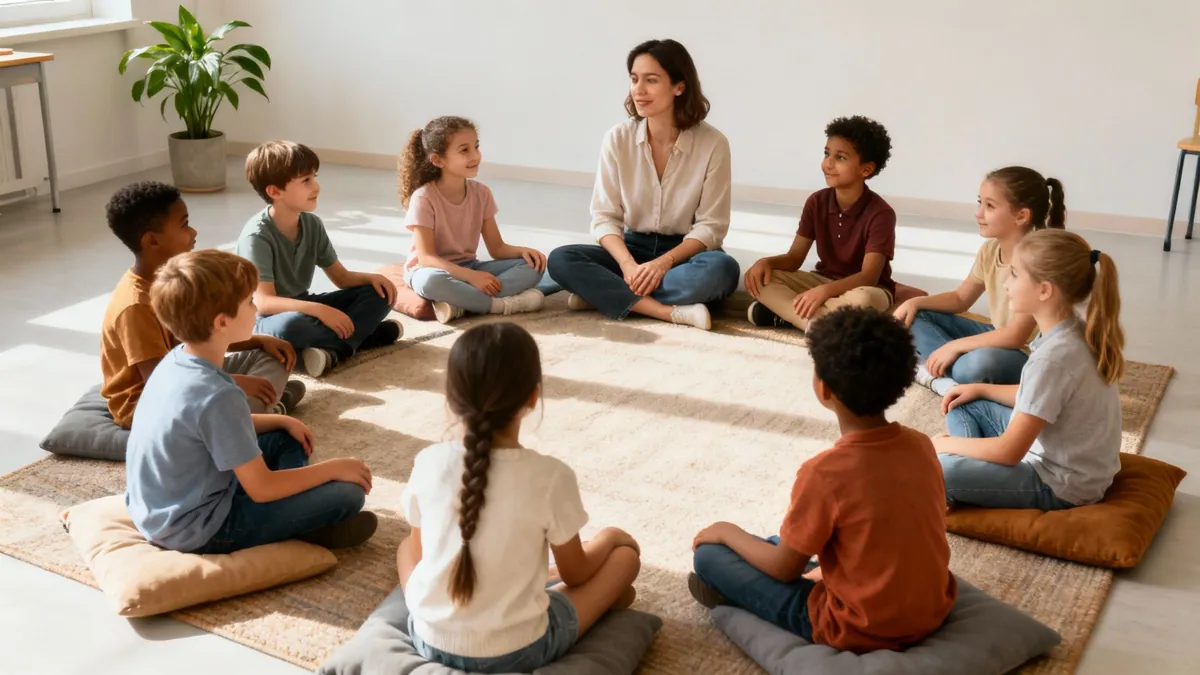
Restorative justice, on the other hand, is more like a community roundabout. When a conflict happens, everyone involved has a chance to navigate a path forward together. The person who caused the harm, the person who was harmed, and even other affected community members all come into the circle. The goal isn’t just to assign blame but to foster understanding, healing, and true accountability.
This isn’t just another program; it’s a mindset that transforms school culture. By teaching empathy and connection, it creates a genuinely safer and more supportive place for everyone to learn and grow. You can dive deeper into how this works by exploring various restorative practices.
Moving Beyond Punishment
Let’s make this real. Imagine a student, Leo, scribbles all over another student’s, Maya’s, artwork.
A traditional response: The teacher sends Leo to the principal’s office, and he gets detention. Leo serves his time, but Maya is still upset about her ruined project, and the tension between them is left to fester. Nothing was really solved.
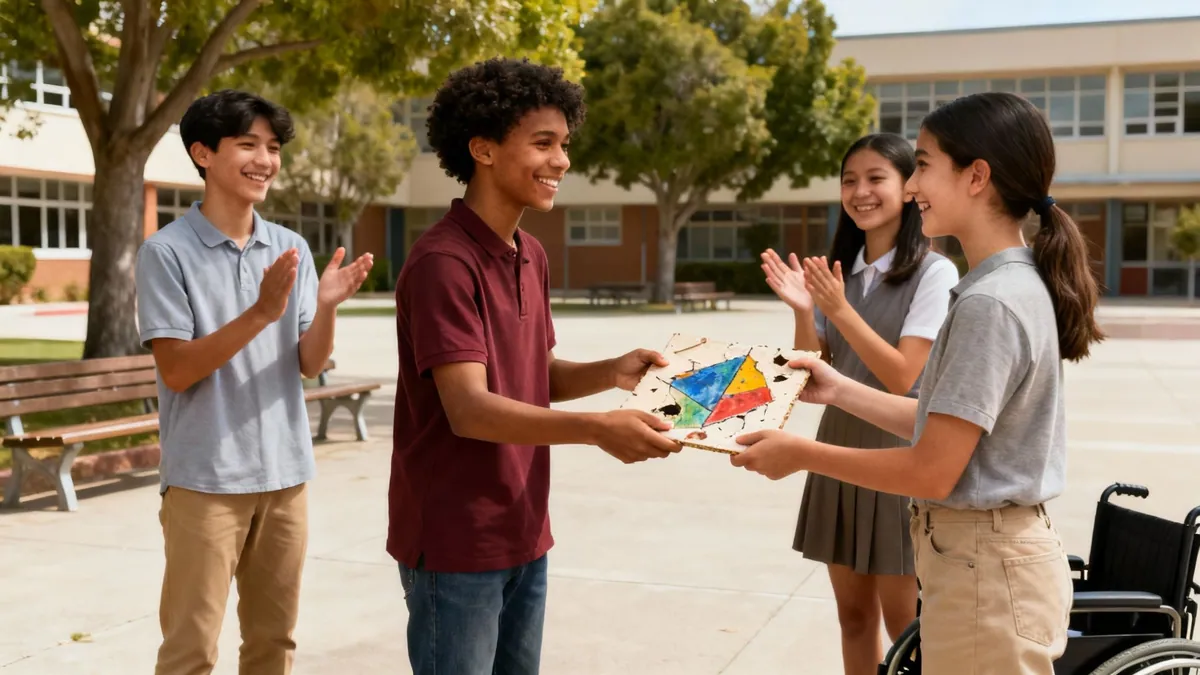
A restorative response: The teacher facilitates a conversation, maybe in a small circle. Leo has to face Maya and hears how his actions made her feel disrespected and sad. Maya gets to explain why her artwork was so important to her. Together, they decide that a good way for Leo to make it right would be to help her recreate the damaged part.
In the second scenario, Leo isn’t just “in trouble.” He’s confronting the real-world impact of his choices and taking direct responsibility for fixing the harm he caused. That’s what true accountability looks like in action.
The Focus Is on Relationships
At its heart, restorative justice recognizes a simple truth: conflict harms relationships, and those relationships must be at the center of any solution. It’s built on the understanding that strong communities are the foundation of a great school. When students feel seen, heard, and connected to one another, they are far better equipped to thrive, both academically and emotionally.
To help clarify the difference, let’s compare the two approaches side-by-side.
Traditional Discipline vs Restorative Justice at a Glance
Element
Traditional Discipline
Restorative Justice
Core Focus
Broken rules and assigning blame.
Harmed relationships and meeting needs.
Key Question
“What rule was broken and what is the punishment?”
“Who was harmed and what is needed to make things right?”
Accountability
Defined as accepting punishment.
Defined as understanding impact and repairing harm.
Outcomes
Often leads to isolation, resentment, and disconnection.
Fosters empathy, mutual understanding, and reintegration.
Communication
Top-down, authority-driven.
Dialogue-based, involving all affected parties.
Goal
Compliance and control.
Healing, learning, and community building.
As the table shows, the restorative path leads to a very different destination—one where students learn from their mistakes in a way that strengthens the entire school community.
This method creates a space for healing and accountability rather than division and punishment. It provides students with practical tools for self-regulation, communication, and conflict resolution that last a lifetime.
The Core Principles of Restorative Practices
To really get what restorative justice is all about in schools, you have to look past the textbook definition and dive into its foundations. These aren’t just abstract ideas; they’re the active ingredients that shift a school’s culture from punitive to healing. Think of them like the legs of a stool—if you take one away, the whole thing wobbles.
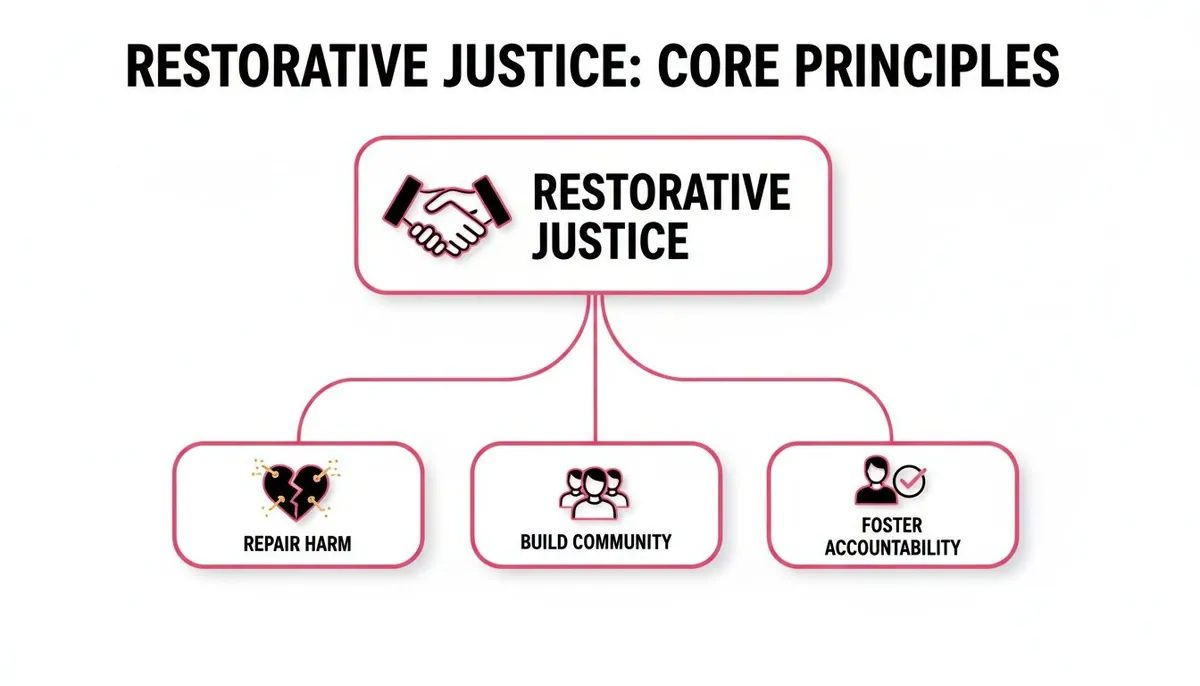
At its core, restorative justice is built on three interconnected principles. Each one moves the focus away from punishment and toward resolution, creating a stronger, more connected community along the way.
Repairing Harm
The first and most important principle is repairing harm. In a traditional system, when a rule gets broken, all eyes are on the rule-breaker. In a restorative model, the focus flips to the harm that was done and what the person who was hurt needs. Accountability isn’t about serving time in detention; it’s about actively taking steps to make things right.
This requires a student to directly acknowledge how their actions affected someone else. It pulls them out of a passive state of just accepting a consequence and into an active role of mending the tear they created in the community fabric.
Practical Example: Picture a fourth-grader, Alex, who gets frustrated during a group project and smashes a classmate’s carefully built model bridge.
Instead of an automatic timeout, the teacher helps them talk it out. The classmate shares how angry and disappointed she is that her hard work was destroyed.
Alex is then tasked with helping repair the damage. He spends his recess helping her find new materials and rebuild the bridge, piece by piece.
Through this, Alex doesn’t just “do his time.” He comes face-to-face with the results of his actions and helps fix the problem he made, learning a huge lesson about respect and responsibility.
Building Community
The second principle is building community. Restorative justice isn’t just a reactive plan for when things go south; it’s a proactive way to keep harm from happening in the first place. It’s based on the simple truth that conflict is far less likely in places where students feel safe, connected, and seen.
Strong relationships are the bedrock of a positive school climate. When students and teachers actually know and trust each other, they’re more likely to be vulnerable, work through disagreements respectfully, and cheer each other on. This sense of belonging is a massive piece of social-emotional wellness.
“Restorative practices create space for healing and accountability rather than division and punishment. They offer a way to make amends, rebuild trust, and strengthen relationships within the community.”
Practical Example: A second-grade teacher kicks off every single day with a five-minute “check-in circle.” Each student gets a chance to answer a simple prompt like, “Share one word that describes how you’re feeling today,” or “What’s one thing you’re looking forward to?”
This simple, daily routine carves out a predictable space for every student to be seen and heard.
Over time, kids get more comfortable sharing their feelings and listening to their peers.
This foundation of trust makes it so much easier to navigate conflicts when they pop up, because the lines of communication are already wide open.
Fostering True Accountability
Finally, the third principle is fostering true accountability. This might be the most misunderstood part of restorative justice. It’s not a “soft” approach that lets kids off the hook. In fact, it often demands more from them than traditional punishment ever could.
True accountability is about understanding the full ripple effect of your actions, facing the people you’ve harmed, and working together on a solution to fix the relationship. It’s about taking ownership, not just taking a penalty. This process builds essential life skills, and you can learn more about how it develops empathy in the classroom in our detailed guide.
Practical Example: A middle schooler spreads a nasty rumor about a classmate online. The rumor causes the targeted student a lot of pain and makes them feel isolated.
A restorative conference is held with both students, a school counselor, and their parents.
The student who was harmed gets to share how the rumor affected their friendships and sense of safety at school.
The student who started the rumor has to listen and then work with the other student to create a plan. This might involve posting a public correction, writing a sincere apology letter, and even presenting to their class about the dangers of cyberbullying.
This outcome requires courage, reflection, and a real commitment to making things right—a much deeper accountability than a simple suspension could ever provide.
Implementing Restorative Justice in Your School
Making the leap from understanding restorative justice in theory to putting it into practice can feel like a big step. The key is a structured, tiered approach that makes implementation feel manageable and, more importantly, effective. This model helps schools apply the right level of support at the right time—from proactive community building for everyone to more intensive responses when serious harm occurs.
Think of this framework less as a rigid set of rules and more as a flexible guide. It’s designed to help schools build a restorative culture from the ground up, ensuring every student benefits from a community-focused environment while also having clear processes for when things go wrong.
The diagram below shows how the core principles of repairing harm, building community, and fostering accountability all work together. They aren’t separate ideas but interconnected pillars holding up the entire restorative process.
Tier 1: Proactive Community Building for All Students
Tier 1 is the foundation. The goal here is to build such strong relationships and a positive classroom climate that most conflicts never even start. These practices are universal, meaning they are for every student, every day.
The focus is on proactive strategies that create a deep sense of belonging and psychological safety. When students feel genuinely connected and respected, they’re far more likely to succeed academically and less likely to act out. These strategies aren’t add-ons; they’re woven directly into the fabric of daily classroom life.
Practical Examples for Parents and Teachers
Daily Check-In Circles: Start or end the day with a quick circle where everyone shares an answer to a prompt. This simple act builds empathy, listening skills, and a sense of community.
Sample Prompt: “Share one kind thing you did for someone today,” or “What is one thing you’re feeling grateful for?”
Classroom Agreements: Instead of a top-down list of rules, the class works together to create agreements for how they want to treat one another. This gives students real ownership over their environment.
Process: The teacher might ask, “How do we want to feel in our classroom?” and “What can we all agree to do to make sure everyone feels that way?” The answers become the class’s living constitution.
Tier 2: Responsive Practices for Minor Conflicts
When the inevitable minor issues pop up—an argument over a game, a misunderstanding, or a small disagreement—Tier 2 practices offer a structured way to respond. These interventions are for some students, some of the time, and are designed to address harm quickly before it escalates.
This is where we shift from being proactive to responsive, using restorative language and conversations to guide students toward a resolution. It’s about teaching them to see conflict not as a fight to be won, but as a problem to be solved together.
The goal of a restorative conversation isn’t to find a winner and a loser. It’s to help everyone involved understand each other’s perspective and find a way to move forward in a good way.
Practical Examples for Parents and Teachers
Guided Restorative Conversations: A teacher or parent can facilitate a brief, structured chat between students in conflict.
Sample Question: “What were you thinking and feeling at the time?” or “What did you need in that moment that you weren’t getting?”
Peer Mediation: Older students can be trained to help younger students work through their disputes. This empowers kids to take on leadership roles in maintaining a peaceful school culture.
Process: Two students in conflict meet with a neutral student mediator who guides them through a problem-solving process without ever taking sides.
Tier 3: Intensive Interventions for Significant Harm
Tier 3 is reserved for more serious incidents that cause significant harm to individuals or the whole community. These are formal processes for a few students who need intensive, wrap-around support. They involve bringing everyone affected by an incident together to collectively decide how to repair the harm that was done.
This is the most intensive level and almost always requires a trained facilitator, like a school counselor or an administrator. The process involves careful preparation before the meeting and dedicated follow-up after to ensure it’s safe and productive for everyone involved.
Practical Examples for School Staff
Formal Restorative Conferences: This is a structured meeting that includes the person who caused harm, the person who was harmed, and their supporters (like parents or friends).
Goal: To give the harmed person a voice, help the person who caused harm understand the full impact of their actions, and create a plan for repair that everyone agrees on.
Re-Entry Circles: When a student returns to school after a suspension or another long absence, a circle can be held to welcome them back and begin mending relationships with peers and teachers.
The move toward these practices is growing. A recent EdWeek Research Center survey revealed that 48% of educators report their schools are using restorative justice more now than they did before the 2018-19 school year. By integrating these strategies, schools are better equipped to build the supportive environments essential for effective social-emotional learning programs for schools.
How Restorative Approaches Can Reshape a School Community
When a school begins to shift from a punitive to a restorative mindset, the change doesn’t just stop at student conflicts. It’s so much bigger than that. This approach doesn’t just manage behavior; it starts to transform the entire school ecosystem. The ripple effects create a climate where students feel safer, more connected, and truly understood, leading to powerful improvements in their well-being and how they show up to learn.
Instead of just handing out consequences, restorative practices dig deeper to repair harm and get to the root of what’s really going on. The question changes from “What rule was broken?” to “What happened here, and who was impacted?” This simple but profound shift opens the door to understanding a student’s unmet needs, whether it’s a lack of connection, a struggle at home, or a need for specific social skills.
This focus on understanding and healing brings real, tangible results. It’s not just a feel-good idea. Schools that commit to restorative approaches almost always see a major drop in disciplinary actions that pull kids out of the classroom.
Studies consistently show that schools implementing restorative justice see reduced rates of suspensions and expulsions. This is huge. It means more students stay in the learning environment where they belong, preventing them from falling behind academically and feeling disconnected from their school community.
Creating a Safer and More Connected Climate
One of the biggest wins of restorative justice in schools is the way it nurtures a positive school climate. When students are actively involved in building and maintaining their community—through circles, shared agreements, and open dialogue—they develop a powerful sense of ownership. They learn that their voice matters and that they have a shared responsibility to look out for one another.
This creates a culture of psychological safety where students feel comfortable taking academic risks, asking for help, and just being themselves. The result is a vibrant community where empathy and mutual respect become the norm, not the exception. To learn more about this, check out our guide on how to improve school culture.
Practical Example for Parents and Teachers: Imagine a typical hallway conflict where one student pushes another. A punitive approach might mean an immediate office referral and a detention slip. But a restorative approach leads to a conversation. A teacher might pull both students aside and ask:
“Can you each tell me what happened from your perspective?”
“How did that make you feel?”
“What do you need to feel respected and safe here?”
This dialogue doesn’t excuse the push. It addresses the underlying feelings, helps restore the relationship, and teaches invaluable conflict-resolution skills that prevent future incidents.
Closing Racial Gaps in School Discipline
One of the most powerful outcomes of restorative justice is its ability to create more equitable learning environments for every child. We know that traditional, zero-tolerance policies have often led to disproportionately high rates of suspension and expulsion for students of color. Restorative practices directly challenge this by replacing subjective, punitive responses with consistent, relationship-focused solutions.
By focusing on the harm and the needs of everyone involved, these approaches help reduce the influence of implicit bias in disciplinary decisions. The results can be remarkable, especially for students from marginalized backgrounds who have historically been over-disciplined.
This isn’t just a theory; it’s backed by some really compelling evidence. Restorative practices have been shown to be incredibly effective in reducing racial disparities in school discipline, with Black students often seeing the most significant benefits in major urban districts. Research in Chicago Public Schools, for instance, revealed transformative outcomes for Black students who had previously faced stark inequities in discipline. You can find more insights in this promising research from Brookings.
For restorative justice to really take root in a school, it can’t just be a classroom thing. When the principles of repairing harm and building community are echoed at home and championed by key staff, they become part of the school’s DNA.
This is where families and school counselors become so important. They aren’t just bystanders; they are active partners in creating a consistent, supportive environment for every child. When everyone works together, the positive effects multiply, and students truly start to internalize these crucial social-emotional skills.
How Families Can Support Restorative Practices at Home
When kids hear the same restorative language at home that they hear at school, it creates a seamless world for them. It reinforces the lessons they’re learning about empathy and accountability. After all, parents and caregivers are a child’s first and most influential teachers.
You don’t have to be an expert to bring these ideas into your family life. It often just means small shifts in how you talk about conflict—moving the focus away from blame and toward understanding and repair.
Practical Examples for Parents:
During Sibling Arguments: Instead of sending kids to separate rooms, try guiding a restorative chat. Ask questions that get them thinking about each other’s feelings.
“How do you think your actions made your brother feel?”
“What was going through your mind when that happened?”
“What’s one thing you can do to make things right between you?”
When a Rule is Broken: If a child makes a mess and doesn’t clean it up, connect the consequence directly to the harm.
Instead of a timeout, the repair could be helping with an extra household chore. This isn’t a punishment; it’s about contributing back to the family, which teaches responsibility in a tangible way.
By using restorative language at home, parents help their children build an internal compass for empathy and accountability. This consistency sends a powerful message: repairing our relationships is something our whole community values.
The Crucial Role of the School Counselor
School counselors are perfectly positioned to be the champions of a school’s restorative justice work. With their training in mediation, communication, and student well-being, they can act as facilitators, coaches, and guides for everyone involved.
Counselors often become the central hub for restorative efforts, helping weave these practices into every part of the school’s support system. Their expertise makes them natural leaders for navigating sensitive conversations and showing others how to do the same.
Key Responsibilities for School Counselors:
Leading Formal Conferences: When something serious happens, counselors can step in as skilled, neutral facilitators for Tier 3 incidents. They ensure the process feels safe and fair, keeping the focus on genuine repair for everyone.
Training and Coaching Teachers: Counselors are great resources for professional development. They can model how to lead community-building circles or use restorative questions to handle minor conflicts, building confidence and skill across the entire staff.
Integrating Principles into Counseling: In one-on-one or small group sessions, counselors can weave in restorative ideas. This might mean helping a student see the impact of their behavior on others or guiding them through the steps of mending a friendship.
When counselors take on these roles, they make sure restorative justice is applied with consistency and care, deepening its impact on students’ social and emotional health.
Navigating Common Challenges and Measuring Success