Conflict is an inevitable part of life, but for students, it’s a critical learning opportunity. Navigating disagreements on the playground, in the classroom, or online isn’t just about stopping a fight; it’s about building foundational skills for a successful future. The ability to listen, express needs, and solve problems collaboratively is essential for academic success and emotional well-being. When students lack these tools, small misunderstandings can escalate into significant disruptions, impacting classroom culture and individual learning.
This article moves beyond generic advice to offer 10 evidence-based, actionable conflict resolution strategies students in grades K–8 can learn and practice. For educators, administrators, and parents, this guide provides the specific resources needed to teach these vital skills effectively. Inside, you will find a comprehensive toolkit designed for immediate implementation.
Each strategy includes:
Clear summaries and step-by-step instructions.
Age-differentiated tips for elementary and middle school students.
Sample scripts and phrases to guide conversations.
Practical classroom activities and role-playing scenarios.
Direct alignment with core Social-Emotional Learning (SEL) competencies.
Our goal is to equip you with powerful frameworks that build empathy, communication, and resilience. By mastering these techniques, you can help students turn moments of conflict into opportunities for connection and personal growth, creating safer and more collaborative school communities. Let’s explore the methods that transform how students handle disagreements.
1. Restorative Circles and Peer Conferencing
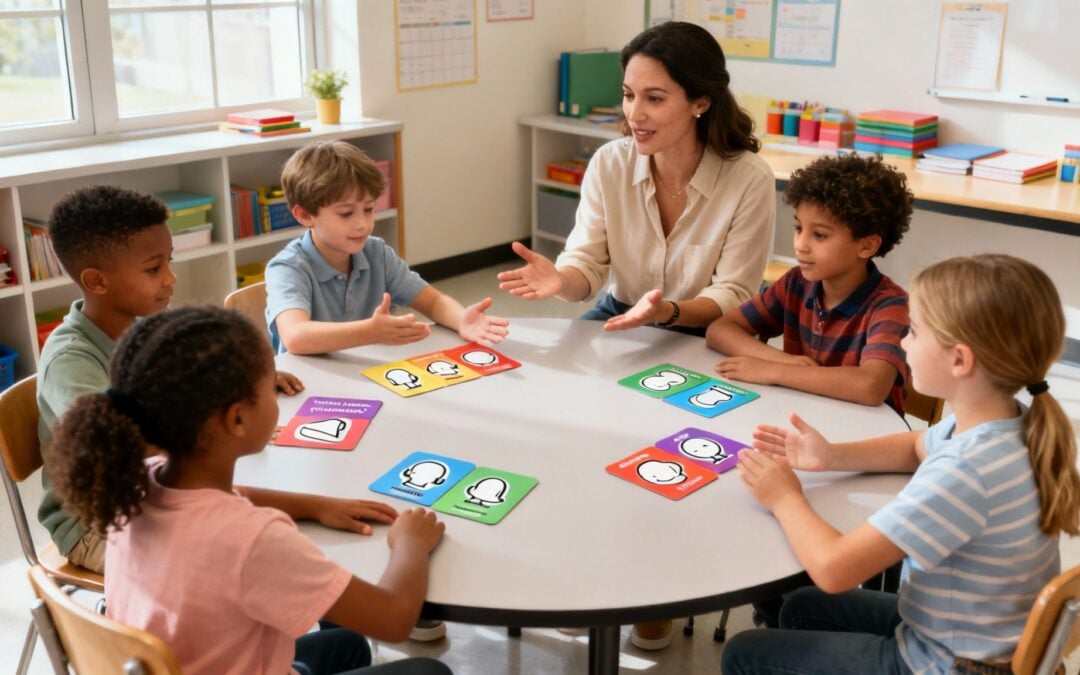
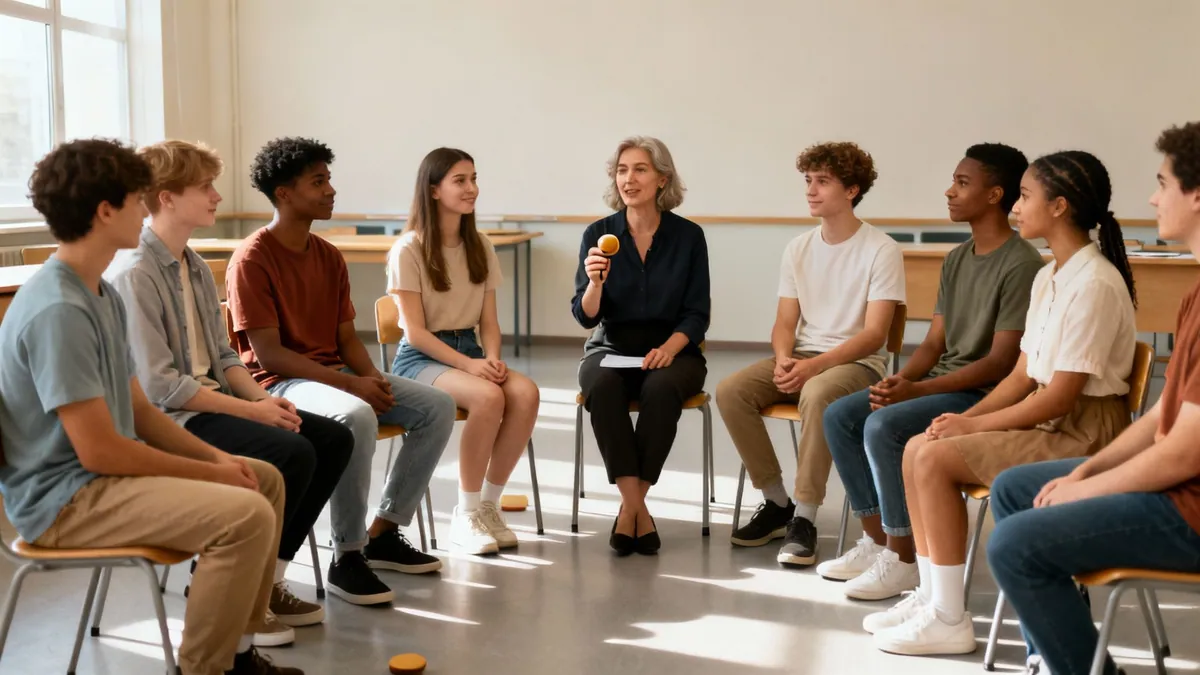
Restorative Circles are structured, supportive discussions that bring students together to address conflicts and their impact. Instead of focusing on punishment, this approach prioritizes repairing harm, understanding different perspectives, and rebuilding relationships. Students, along with a trained facilitator, sit in a circle to share their feelings and collaboratively find a path forward.
This method shifts the focus from “Who is to blame?” to “What happened, who was affected, and how can we make things right?” Peer conferencing is a related, often less formal, version where students mediate disagreements among themselves, guided by restorative principles. This is a powerful conflict resolution strategy for students because it builds empathy and community accountability.
Practical Example: Two students, Maya and Liam, had an argument over a group project, and Maya told other classmates not to work with Liam. A teacher facilitates a restorative circle with Maya, Liam, and two affected classmates. Using a talking piece, Maya shares she was frustrated Liam wasn’t contributing. Liam explains he was confused about his role. The classmates share they felt caught in the middle. They agree on a plan for clear roles in the next project and Maya apologizes for excluding Liam.
Why It Works
Restorative practices give students a voice and a sense of ownership over the solution. This process is highly effective for addressing issues like misunderstandings, exclusion, and minor physical conflicts. The Oakland Unified School District, for example, saw a 34% reduction in suspensions after implementing restorative justice programs. The focus on repairing relationships helps prevent future conflicts and strengthens the overall school climate. These circles are most effective for conflicts where ongoing relationships are important, such as between classmates or friends.
Establish clear guidelines: Co-create circle norms with students, such as “Speak from the heart,” “Listen with respect,” and “Honor the talking piece.”
Use a talking piece: Pass an object around the circle; only the person holding it may speak. This ensures everyone gets an uninterrupted turn.
Begin with low-stakes topics: Build student confidence by using circles for community-building before tackling serious conflicts. You can explore a variety of classroom community-building activities to get started.
3. Collaborative Problem-Solving (CPS) Model
The Collaborative Problem-Solving (CPS) model is a structured approach that shifts the focus from winning an argument to working together to find a mutually agreeable solution. Developed by Dr. Ross Greene, this method operates on the principle that conflicts arise from unsolved problems or unmet needs. Instead of focusing on conflicting positions, students learn to identify the underlying concerns driving the disagreement.
This model guides students through a clear, three-step process: defining the problem from both perspectives, brainstorming potential solutions without judgment, and evaluating the options to choose one that works for everyone. As one of the most effective conflict resolution strategies for students, CPS empowers them to see conflict as a shared problem to be solved, not a battle to be won. It builds critical thinking and empathy by requiring them to understand and articulate another person’s point of view.
Practical Example: Two friends constantly argue about what game to play at recess. A parent or teacher guides them through CPS.
Empathy: The adult asks each child, “What’s the hardest part for you about choosing a game at recess?” One says, “I never get to play what I want.” The other says, “I don’t like running games.”
Define the Problem: The adult summarizes, “So, the problem is we need to find a game you both enjoy and feel you have a choice in.”
Brainstorm: They list all ideas: tag, drawing, building, rock-paper-scissors to decide, taking turns. They agree to try taking turns choosing the game each day.
Why It Works
CPS is highly effective because it moves students away from blame and towards practical solutions. By focusing on identifying “unsolved problems,” it depersonalizes the conflict. This method works well for recurring disagreements, such as arguments over classroom materials, group work disputes, or social exclusion. Schools that implement CPS often see a reduction in behavioral referrals and an increase in prosocial behaviors because students are equipped with a concrete tool to manage their own conflicts. The model is most effective for disputes where a tangible solution can be reached.
How to Implement It
Teach the three steps explicitly: Before using it in a real conflict, explicitly teach the steps: (1) Empathy and Understanding, (2) Defining the Problem, and (3) Invitation to Brainstorm. Use role-playing to practice.
Use neutral, guiding language: Frame the conversation with questions like, “What’s getting in the way for you?” or “I’ve noticed we have a hard time when…” This avoids blame.
Write down all ideas: During the brainstorming phase, write down every suggested solution, even silly ones. This validates all contributions and encourages creative thinking.
Evaluate solutions collaboratively: Guide students to assess the brainstormed list by asking, “Is this realistic? Does this work for both of you?” The chosen solution must be mutually agreeable. This process reinforces important communication skills and activities that are essential for success.
8. Buddy and Mentorship Systems
Buddy and mentorship systems are structured programs that pair older students with younger ones or peers with classmates needing support. These relationships create natural opportunities for conflict prevention by fostering connection, belonging, and positive role modeling. A mentor can guide their mentee through social challenges, offering a safe and trusted perspective.
This strategy shifts the dynamic from adult intervention to peer-led support. A fourth grader paired with a first grader can help them navigate playground rules, or a new middle schooler can be matched with an eighth-grade mentor to ease their transition. These programs are powerful conflict resolution strategies for students because they build empathy and develop leadership skills while reducing feelings of isolation that often lead to conflict.
Practical Example: A school pairs every third-grader with a kindergartener as “reading buddies.” They meet once a week to read together. One day, a kindergartener is upset because another child won’t share the building blocks. Instead of running to a teacher, they find their third-grade buddy. The buddy helps them practice “I-statements” and walks with them to talk to the other child. The buddy’s presence provides the confidence the younger student needs to resolve the problem peacefully.
Why It Works
Mentorship provides a protective factor for vulnerable students and gives mentors a sense of purpose and responsibility. By modeling healthy communication and problem-solving, mentors help their mentees build the confidence to handle disagreements constructively. These programs are highly effective for supporting students new to the school, those with a history of behavioral challenges, or any child who could benefit from a positive connection. School-based mentoring programs have been shown to improve attendance, attitudes towards school, and social-emotional skills.
How to Implement It
Provide clear mentor training: Equip mentors with essential skills like active listening, setting boundaries, and knowing when to get an adult’s help.
Create structured activities: Plan initial meetings with specific activities or conversation starters, such as “Two Truths and a Lie” or creating a shared “All About Us” poster.
Establish regular check-ins: Schedule brief, consistent check-ins for mentors with a supervising adult to discuss progress, troubleshoot challenges, and feel supported.
Celebrate successes: Publicly acknowledge the positive impact of your mentors. This can be done through school announcements, certificates, or a special recognition event. Consider programs like Soul Shoppe’s junior leader development for a structured approach.
9. Classroom Agreements and Community Norms
Classroom Agreements are a set of co-created guidelines that establish shared expectations for how community members will treat each other and navigate disagreements. Instead of a list of rules imposed by an adult, this approach involves students in a collaborative process to define their own behavioral standards and conflict resolution protocols. This fosters a sense of ownership and collective responsibility for maintaining a positive classroom environment.
This strategy shifts the dynamic from adult-enforced compliance to community-led accountability. When conflicts arise, the agreements serve as an objective, shared reference point. This approach is a cornerstone of conflict resolution strategies for students because it empowers them to hold themselves and their peers accountable to standards they helped create, grounding solutions in community values.
Practical Example: At the start of the year, a teacher asks students, “How do we want our classroom to feel?” They brainstorm words like “safe,” “fun,” and “respected.” Then she asks, “What can we agree to do to make it feel that way?” The students create agreements like, “We listen when someone is talking,” and “We use kind words.” Two weeks later, one student interrupts another. The teacher can gently say, “Let’s check our agreements. Which one can help us right now?” This empowers students to self-correct based on their own rules.
Why It Works
Student-created agreements build intrinsic motivation for positive behavior and give students a framework for addressing problems respectfully. This process is highly effective for preventing common classroom conflicts like interrupting, disrespect, or exclusion. The Responsive Classroom approach, which heavily incorporates this practice, has been shown to improve social skills and academic performance. The agreements are most effective when they are treated as a living document, referenced daily and revised as needed to address the evolving needs of the classroom community.
How to Implement It
Frame the process positively: Guide students to create agreements about how they will treat each other, not just a list of “don’ts.” For example, frame it as “We listen to understand” instead of “Don’t interrupt.”
Facilitate, don’t dictate: Ask guiding questions like, “How do we want to feel in our classroom?” and “What can we agree to do to make sure everyone feels that way?”
Make them visible: Have students sign the final agreement and display it prominently. Younger students can illustrate each point to reinforce understanding.
Reference them regularly: When a conflict occurs, refer back to the norms by asking, “Which of our agreements can help us solve this problem?” or “How does this action fit with our agreement to show respect?”
How to Implement Conflict Resolution
Begin by establishing a dedicated “Peace Corner” or “Conflict Resolution Zone” in the classroom. This area can be equipped with visual aids outlining the steps for resolving a problem, such as using “I-Feel” statements, listening without interrupting, and brainstorming solutions. Introduce these steps through role-playing common classroom scenarios, like arguments over toys or disagreements during a group project. For a more structured approach, older students can be trained as peer mediators to help younger students resolve conflicts during recess.
Practical Example:
Two third-grade students are arguing over a single red marker they both want for an art project. Instead of solving it for them, their teacher directs them to the classroom’s Peace Corner. Following the posted steps, the first student says, “I feel frustrated because I need the red marker for my drawing.” The second student listens and responds, “I hear you’re frustrated. I feel upset because I need it for my drawing, too.” They agree to take turns, using the marker for five minutes each, resolving the conflict independently and respectfully.
Tips for Success
Start Simple: Teach foundational skills like “I-Feel” statements to students in grades K-2 before introducing more complex mediation steps.
Use Real Scenarios: Role-play conflicts that genuinely occur in your classroom or on the playground to make the practice relevant and meaningful.
Practice Consistently: Regular practice helps students internalize the steps so they can recall them automatically during a real, emotionally charged conflict.
Establish Clear Boundaries: Define which problems students can solve themselves and which require adult help, ensuring safety and appropriate support.
By teaching these essential life skills, you equip students to build healthier relationships and contribute to a more positive community. For a deeper look into the language of resolving disputes, you can explore the use of “I-Feel” statements for kids and how they transform disagreements.
5. Gratitude and Appreciation Practices
Gratitude practices are powerful social emotional learning activities for elementary students that shift their focus toward appreciating the positive aspects of their lives. By regularly identifying and expressing thankfulness, children develop a more optimistic outlook, build resilience against setbacks, and strengthen their connections with others. This intentional focus on appreciation helps counter negativity and fosters a sense of contentment and well-being.
These activities directly support the SEL competencies of social awareness (recognizing the contributions of others) and relationship skills (communicating appreciation to build positive connections). The goal is to cultivate a habit of noticing the good, which can profoundly impact a child’s mental health and social interactions.
How to Implement Gratitude and Appreciation
Integrate gratitude into existing routines to make it a natural part of the day. A “Gratitude Circle” during a morning meeting allows students to share one small thing they are thankful for, setting a positive tone for learning. Another effective tool is a “Gratitude Journal,” where students can write or draw something they appreciate each day, creating a personal log of positivity to look back on.
Practical Example:
A third-grade teacher starts an “Appreciation Mail” system. Each Friday, students have a few minutes to write a short, specific note of appreciation to a classmate, teacher, or staff member and “mail” it in a decorated classroom mailbox. The teacher reads a few aloud (with permission), and then delivers the notes. This activity not only highlights kindness but also gives every student a chance to feel seen and valued by their peers.
Tips for Success
Model Authenticity: Share your own specific gratitudes with the class. For example, say, “I’m grateful for how quietly everyone came in this morning; it helped us get started right away.”
Encourage Specificity: Guide students beyond generic answers like “my family.” Prompt them with questions like, “What is something specific your brother did that you are grateful for?”
Offer Multiple Formats: Allow students to express gratitude by writing, drawing, speaking, or even creating a short video. This accommodates different learning styles and comfort levels.
Connect to Community: Create a whole-class “Thankfulness Tree” or an “Appreciation Board” where notes can be posted publicly, fostering a school-wide culture of recognition.
By consistently making space for gratitude, you help students develop a lasting habit of recognizing and appreciating the people and moments that make life meaningful. For more ways to foster a positive classroom climate, explore resources like those available on the Greater Good Science Center’s education page.
6. Social Stories and Perspective-Taking Activities
Social stories and perspective-taking activities are powerful social emotional learning activities for elementary students that use structured narratives to build empathy and social understanding. By stepping into someone else’s shoes through stories, role-playing, or discussions, children learn to recognize different viewpoints, motivations, and emotional experiences. This process helps them understand how their words and actions impact others, laying the groundwork for more compassionate and inclusive interactions.
These activities are essential for developing the core SEL competencies of social awareness (understanding the perspectives of others and empathizing with them) and relationship skills (communicating effectively and building positive connections). The goal is to move students beyond their own immediate experience and cultivate a genuine curiosity and respect for the diverse world around them.
How to Implement Social Stories and Perspective-Taking
Integrate perspective-taking into your existing literacy or morning meeting routines. Start by reading a book with a clear emotional conflict, like The Hundred Dresses by Eleanor Estes, and pause to ask questions that encourage students to consider different characters’ feelings. For example, “How do you think Wanda felt when Peggy teased her? What might Maddie have been thinking when she stood by and said nothing?”
From there, you can move into role-playing scenarios. Use situations that are common in a school setting, like a disagreement over a game at recess or someone feeling left out at the lunch table. Assign roles and have students act out the scenario, then discuss how each character felt and what could have been done differently.
Practical Example:
During a class meeting, a fourth-grade teacher addresses a recurring issue of students saving seats in the cafeteria. She divides the class into small groups and gives them a scenario: “A new student wants to sit at a table, but the other kids say, ‘You can’t sit here, we’re saving these spots for our friends.’ How does the new student feel? How do the other kids feel?” The groups discuss and then share their ideas, leading to a class-wide conversation about creating a more welcoming lunchroom.
Tips for Success
Use Diverse Literature: Select books and stories that feature characters from a wide range of backgrounds, cultures, and abilities to broaden students’ understanding.
Ask Probing Questions: Go beyond simple comprehension. Ask “why” questions like, “Why do you think the character made that choice?” or “What might have happened before this story started to make them feel that way?”
Connect to Real Life: Help students see the connection between the characters’ experiences and their own lives. Ask if they have ever felt a similar way or witnessed a similar situation.
Model Empathy: When discussing characters, model empathetic language yourself. Say things like, “It sounds like that must have been really hard for him,” to guide students’ responses.
By regularly engaging in these activities, you help students build the critical muscle of empathy, transforming your classroom into a more understanding and supportive community.
7. Self-Regulation and Coping Strategy Toolkits
Creating self-regulation and coping strategy toolkits is one of the most powerful social emotional learning activities for elementary students. It moves beyond simply identifying feelings to actively building a personalized plan for managing them. By teaching students to recognize their emotional triggers and the physiological signs of dysregulation, you empower them to proactively choose a strategy that helps them return to a calm, focused state.
This approach directly targets the core SEL competencies of self-awareness (recognizing internal signals) and self-management (deploying a specific coping tool). The goal is to equip every child with a menu of effective, accessible strategies they can use independently when emotions feel overwhelming, fostering resilience and a sense of agency over their well-being.
How to Implement Coping Strategy Toolkits
Begin by explicitly teaching a variety of strategies, explaining which emotions they might help with. Create a visual “Coping Menu” or use a framework like the Zones of Regulation to connect feelings to specific actions. A physical toolkit can be a small box with sensory items, while a classroom “peace corner” offers a designated space for students to use these tools without stigma.
Practical Example:
A third-grade teacher helps a student who gets frustrated during math create a personal toolkit. Inside a pencil box, they place a small piece of bubble wrap to pop, a smooth stone to rub, and a card with three deep-breathing steps. When the student feels frustration rising, they know they can quietly take out their toolkit at their desk and use one of the items to reset before asking for help.
Tips for Success
Practice Proactively: Introduce and practice coping strategies when students are calm, not just in the middle of a difficult moment. This builds muscle memory.
Offer Diverse Options: Include strategies that involve movement (wall pushes), sensory input (fidgets, weighted lap pads), and quiet reflection (drawing, listening to music).
Personalize the Toolkit: Help students identify what truly works for them. What is calming for one child might be overstimulating for another.
Involve Families: Share a list of the strategies being taught at school and encourage families to identify and practice them at home for consistent support. You can explore parent resources from Soul Shoppe for ideas on home implementation.
By normalizing the need for self-regulation tools, you create a supportive environment where students see managing emotions as a skillful and healthy part of life.
8. Morning Meeting and Class Circles
Morning Meeting is a structured daily gathering where students and teachers come together in a circle to start the day. This powerful ritual establishes a predictable and safe routine that intentionally builds classroom community, strengthens relationships, and provides a dedicated time for practicing key social skills. By creating this space for greeting, sharing, and engaging in a group activity, you set a positive tone for learning and reinforce a sense of belonging for every child.
These daily circles are a cornerstone of social emotional learning activities for elementary students because they directly target multiple SEL competencies. They foster social awareness (listening to peers’ perspectives), relationship skills (practicing respectful communication), and responsible decision-making (collaboratively solving class problems). It becomes a living laboratory for the social skills taught in other lessons.
How to Implement Morning Meeting and Class Circles
A typical Morning Meeting, popularized by the Responsive Classroom approach, includes four components: greeting, sharing, group activity, and a morning message. The greeting involves students acknowledging each other by name. Sharing allows students to talk about important events in their lives, while others practice active listening. The group activity is a short, fun game or song that promotes group cohesion, and the message previews the day’s learning goals.
Practical Example:
A third-grade teacher begins her Morning Meeting to address a recurring issue of students feeling left out at recess. During the sharing portion, she poses a prompt: “Think about a time you invited someone new to play. How did it feel?” After a few students share, she uses the morning message to announce they will be creating a class “Inclusion Agreement” together, turning a problem into a collaborative, community-building lesson.
Tips for Success
Establish Clear Norms: Co-create rules for the circle, such as “One person speaks at a time,” “Listen with your whole body,” and “It’s okay to pass.”
Start Small: Keep initial meetings short, around 10-15 minutes, especially for younger students in kindergarten and first grade.
Rotate Leadership: Empower students by allowing them to take turns leading different parts of the meeting, such as the greeting or group activity.
Protect the Time: Treat Morning Meeting as essential instructional time, not something to be skipped when you are busy. Consistency is what builds trust and safety.
By making this a non-negotiable part of your daily schedule, you show students that their voices matter and their relationships are a priority. For a deeper look into fostering this environment, explore these tips on how to build classroom community with Soul Shoppe.
9. Empathy and Kindness Challenges
Empathy and Kindness Challenges are structured campaigns designed to make thoughtful behavior a conscious and celebrated part of school culture. By prompting students to perform deliberate acts of kindness, these activities move empathy from an abstract concept to a tangible action. These challenges build positive momentum, demonstrating how small, individual choices can collectively create a more supportive and inclusive environment for everyone.
These social emotional learning activities for elementary students directly target social awareness (understanding and empathizing with others’ feelings) and relationship skills (building positive connections through prosocial behavior). The goal is to help children recognize the power they have to impact their peers and community positively.
How to Implement Empathy and Kindness Challenges
Launch a school-wide or classroom-specific challenge with a clear theme and duration. For example, a “Kindness is Our Superpower” week could feature daily prompts. Monday’s challenge might be to give a genuine compliment, while Tuesday’s could be to invite someone new to play during recess. The key is making the actions specific and achievable for young students.
Practical Example:
A third-grade classroom creates a “Compliment Chain.” When a student observes or receives a particularly kind act, they write it on a strip of colored paper. The teacher helps them add it as a new link to a paper chain hanging across the classroom. By the end of the month, the chain visually represents the class’s collective kindness, and the teacher reads some of the links aloud to celebrate their progress.
Tips for Success
Be Specific: Vague instructions like “be kind” are less effective than “hold the door open for someone” or “ask a classmate about their weekend.”
Celebrate the Process: Acknowledge effort and intention, not just grand gestures. Create a “Kindness Corner” where students can post notes about kind acts they’ve witnessed.
Connect to Empathy: After an act of kindness, facilitate a brief discussion. Ask questions like, “How do you think it made that person feel when you shared your crayons?”
Involve Families: Send home a note about the challenge and encourage families to participate by noticing and celebrating kindness at home.
These challenges transform the school environment by making kindness and empathy active, shared values. To see how these concepts are integrated into large-scale bullying prevention, you can learn about Soul Shoppe’s successful partnerships, like the one with the Junior Giants to help kids Strike Out Bullying.
10. Family and Community Engagement in SEL
Social emotional learning activities for elementary students are most effective when they extend beyond the school walls. Family and community engagement bridges the gap between classroom instruction and a child’s home life, creating a consistent and supportive ecosystem. By intentionally involving parents, caregivers, and community partners, schools can amplify SEL skills, ensuring children hear and practice the same positive language and strategies in every part of their lives.
This approach strengthens all five core SEL competencies by creating a shared understanding and commitment to social awareness, relationship skills, and responsible decision-making across different environments. When families and schools partner, children see that these skills are valued everywhere, not just in the classroom.
How to Implement Family and Community Engagement
Begin by providing accessible resources and opportunities for connection. Offer parent workshops at various times (in-person and virtual) to accommodate different schedules. Distribute take-home SEL activity packets or newsletters that align with classroom lessons, giving families simple, actionable ways to practice skills like empathy or conflict resolution at home. Partnering with community organizations for events can also broaden your reach and impact.
Practical Example:
A school hosts a “Peaceful Families Night” facilitated by a community partner. Families participate in interactive stations, learning a simple “I-statement” formula for expressing feelings. They are sent home with a magnet summarizing the technique. The following week, a parent shares that her son used an “I-statement” to resolve a disagreement over a toy, a direct result of the shared learning experience.
Tips for Success
Provide Multilingual Resources: Ensure materials are translated to reflect the languages spoken by your school community, making content accessible to all families.
Connect to Parent Priorities: Frame SEL as a tool to help with common challenges like managing homework stress or building cooperation. To extend the spirit of cooperation from the classroom to the home, learning how to creating a family chore chart that fosters teamwork can effectively foster teamwork and shared responsibility among family members.
Start Simple: Introduce one easy-to-use strategy at a time, such as a “calm-down corner” at home or a single feeling word to focus on for the week.
Create a Welcoming Environment: Foster a school culture where families feel valued, respected, and seen as true partners in their child’s education. Gather feedback regularly to ensure programming meets their needs.
10 Elementary SEL Activities Comparison
Program
Implementation complexity
Resource requirements
Expected outcomes
Ideal use cases
Key advantages
Mindfulness and Breathing Exercises
Low — short scripted practices; needs consistency
Minimal — time, quiet space; no special equipment
Faster calming, improved attention and emotion regulation
Creates positive norms, engages students, visible cultural shift
Family and Community Engagement in SEL
High — coordination, outreach, cultural adaptation
Moderate–High — workshops, multilingual materials, staff time
Greater consistency across contexts; stronger family-school partnerships
Family workshops, take-home activities, community partnerships
Extends SEL to home, builds trust, leverages community resources
Putting it All Together: Building a Culture of Connection and Empathy
We have explored a wide range of powerful and practical social emotional learning activities for elementary students, from the quiet introspection of mindful breathing to the dynamic collaboration of cooperative games. Each activity, whether it’s a quick Feelings Check-In or a structured Peer Mediation session, serves as a single thread. When woven together consistently, these threads create a strong, resilient, and supportive classroom tapestry. The goal is not to treat SEL as another box to check, but to embed it into the very heart of the school day.
The true power of these activities is unlocked through intentional and consistent application. A one-time empathy challenge is a great start, but a weekly practice builds a lasting habit of kindness. A coping strategies toolkit is most effective when students are regularly encouraged to use it, not just during moments of crisis, but as a proactive self-management tool. The journey from learning about emotions to living with emotional intelligence is a marathon, not a sprint, built upon these small, repeated practices.
From Activities to a Thriving Classroom Culture
Integrating these diverse activities creates a powerful synergy that transforms the learning environment. Imagine a classroom where a Morning Meeting sets a positive and inclusive tone, a Gratitude Jar visibly tracks the community’s appreciation, and a student-led conflict resolution corner empowers children to solve their own disagreements respectfully. This is the tangible result of a commitment to SEL.
This cultural shift doesn’t happen by accident. It is the direct outcome of educators and caregivers who model these skills and create predictable routines where students feel safe to be vulnerable, make mistakes, and grow. When students have a shared vocabulary for their feelings and a toolbox of strategies for managing them, you’ll see a decrease in disruptive behaviors and an increase in on-task learning, engagement, and peer support.
Your Actionable Next Steps for SEL Implementation
Moving from inspiration to action is the most critical step. Instead of feeling overwhelmed by the number of options, commit to a small, sustainable start.
Choose Your Starting Point: Select one or two activities from this list that resonate most with your students’ needs and your own teaching style. Perhaps it’s starting each day with a “Rose, Bud, Thorn” check-in or introducing a weekly cooperative game.
Schedule It In: Consistency is key. Formally schedule your chosen SEL activities into your weekly lesson plans. This ensures they don’t get pushed aside when things get busy. Even five dedicated minutes a day can have a profound impact over time.
Involve Your Community: Share these ideas with colleagues, administrators, and families. When students see and hear consistent SEL language and practices at school and at home, the learning is reinforced exponentially. Consider sending home a “Kindness Challenge” or a list of conversation starters about feelings.
By embracing these social emotional learning activities for elementary students, you are doing more than just managing a classroom; you are nurturing a generation of compassionate leaders, resilient problem-solvers, and empathetic global citizens. The investment you make in their emotional well-being today will pay dividends for the rest of their lives, equipping them with the essential skills to navigate an increasingly complex world with confidence, kindness, and a strong sense of self.
Ready to take your school’s commitment to SEL to the next level? Soul Shoppe provides comprehensive, research-based programs that create safer, more compassionate school communities by empowering students, staff, and families. Discover how their dynamic assemblies and in-depth curriculum can help you build a sustainable culture of empathy and connection at Soul Shoppe.
In today’s dynamic elementary classrooms, academic skills are only half the story. The ability to understand emotions, build relationships, and make responsible decisions forms the bedrock of a successful learner and a compassionate human being. This is the core of social-emotional learning (SEL), a framework that equips students with the essential tools to navigate their inner worlds and the world around them. For educators seeking a child-centered philosophy that deeply aligns with holistic child development and SEL, exploring foundational approaches like the Reggio Emilia approach to education can provide a powerful, inquiry-based framework for these practices.
For teachers, counselors, and parents, the primary challenge isn’t just knowing that SEL is important-it’s finding practical, engaging ways to integrate it into daily routines. This guide moves beyond abstract theory to offer a comprehensive roundup of field-tested social emotional learning activities elementary students can immediately benefit from. We provide step-by-step instructions, grade-specific adaptations from Kindergarten through 5th grade, and real-world examples to help you cultivate a thriving, emotionally intelligent community.
Inside this resource, you will discover a curated list of activities designed to build key competencies, including:
Self-Awareness: Identifying and understanding emotions.
Self-Management: Developing coping strategies and resilience.
Social Awareness: Cultivating empathy and perspective-taking.
Relationship Skills: Fostering collaboration and effective communication.
Responsible Decision-Making: Encouraging thoughtful and ethical choices.
Whether you’re looking to start an emotion check-in circle, introduce mindfulness exercises, or implement peer conflict resolution, this article serves as your practical playbook. These activities will help you foster connection, safety, and resilience in the children you support, building a foundation for lifelong well-being and academic success.
1. Emotion Check-In Circle
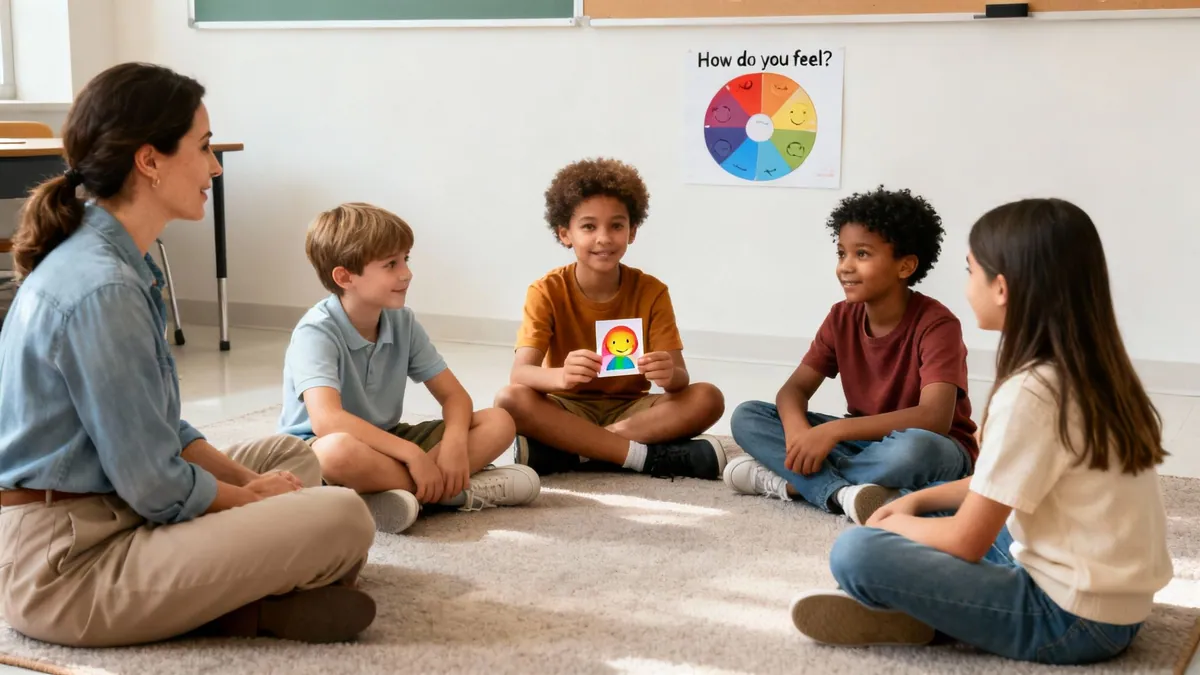
The Emotion Check-In Circle is a foundational routine where students gather to identify and share their current feelings in a safe, structured setting. This simple yet powerful practice serves as a daily emotional barometer for the classroom, helping students build self-awareness and empathy from the very start of their day. By creating a predictable space to name emotions, teachers normalize the full spectrum of feelings, from excitement to disappointment, fostering a culture of psychological safety.
This activity is more than just a morning greeting; it is a core component of many effective social emotional learning activities for elementary students. It provides valuable insight into who might need extra support and helps children connect their internal state to their readiness to learn.
How to Implement an Emotion Check-In Circle
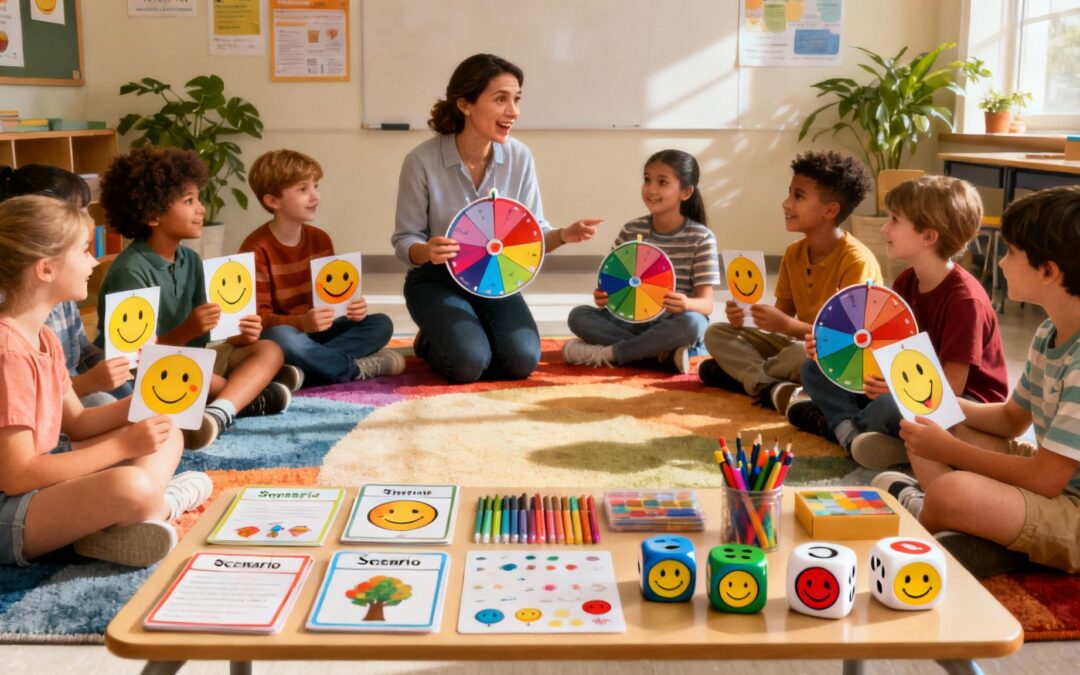
Materials Needed: Emotion wheel, feeling cards, or a simple chart paper with different feeling words/faces. For a more structured approach, consider the Mood Meter framework popularized by Marc Brackett at the Yale Center for Emotional Intelligence.
Time: 5-10 minutes daily.
CASEL Competency: Self-Awareness, Social Awareness.
Step-by-Step Instructions:
Gather Students: Arrange students in a circle on the rug or at their desks.
Model First: The teacher starts by sharing their own feeling. For example, “Good morning, everyone. Today, I am feeling calm because I had a relaxing weekend and drank my favorite tea this morning.”
Provide a Framework: Students share their feeling using a sentence stem, like “Today I feel ____ because ____.”
Practical Example (Kindergarten): A student points to a happy face card and says, “Today I feel happy because it’s my turn to be the line leader.”
Practical Example (3rd Grade): A student shares, “Today I feel a little nervous because we have a math test, but I also feel hopeful because I studied.”
Listen and Acknowledge: The group listens without judgment. The goal is to acknowledge, not to fix. A simple “Thank you for sharing” is often enough.
Offer Alternatives: Always include a “pass” option. Students who are not ready to share can say “pass” without penalty.
Key Insight: Consistency is crucial. When the Emotion Check-In Circle becomes a non-negotiable part of the daily routine, students learn to trust the process and become more willing to share honestly over time. It transforms the classroom into a community where every emotional state is valid and heard.
2. Mindfulness and Breathing Exercises
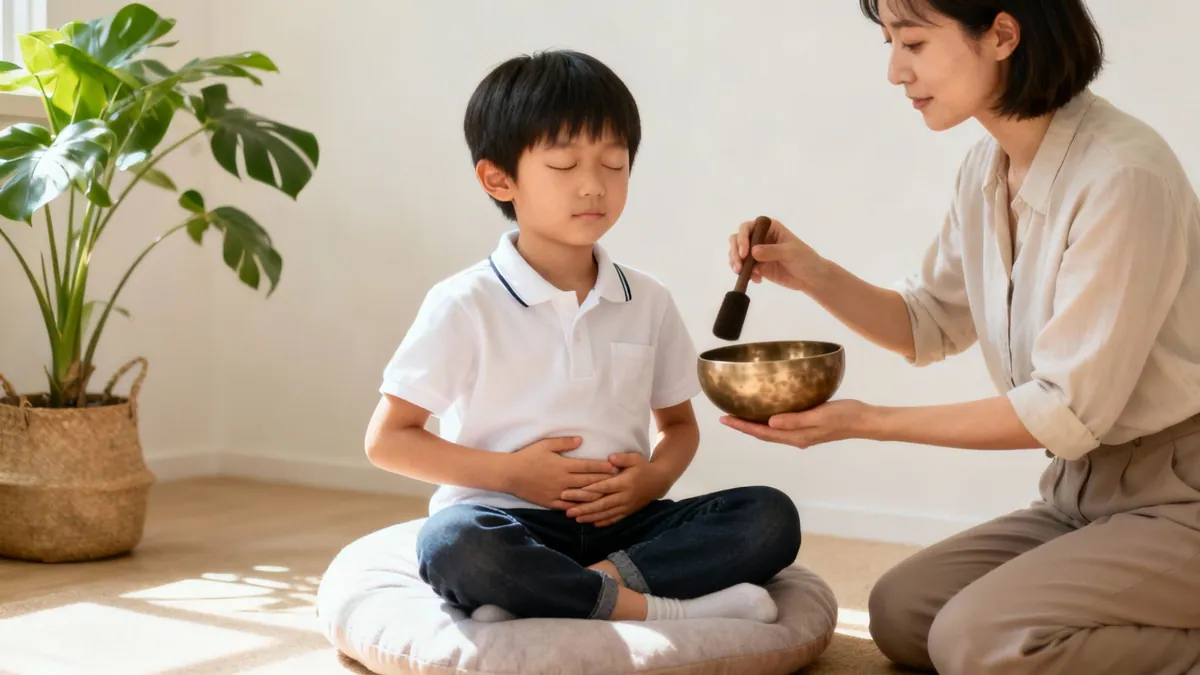
Mindfulness and Breathing Exercises are brief, guided practices that teach students to focus their attention on the present moment. Through simple breathing techniques, body scans, or visualizations, these evidence-based exercises help reduce stress, improve focus, and build crucial self-regulation skills. They provide students with concrete, accessible tools to use independently when feeling overwhelmed, anxious, or dysregulated, making them a cornerstone of effective social emotional learning activities for elementary students.
These practices are not about emptying the mind but about anchoring it. For young learners, this can be as simple as a two-minute “belly breathing” break between subjects or using an app like Calm or Headspace Kids for a guided meditation. This builds a foundation for managing big emotions and enhances their ability to engage in learning.
How to Implement Mindfulness and Breathing Exercises
Materials Needed: A quiet space, optional items like a chime or bell, cushions, or guided meditation audio from an app or website.
Create a Signal: Use a consistent sound, like a chime, a soft bell, or a specific song, to signal that it is time for a mindfulness break.
Guide the Breathing: Start with a simple, tangible technique.
Practical Example (“Take 5 Breathing”): “Hold up one hand like a star. Use the pointer finger of your other hand to trace it. Breathe in as you trace up your thumb, and breathe out as you trace down. Inhale up your pointer finger, exhale down. Continue for all five fingers.”
Practical Example (“Belly Breathing”): “Place one hand on your tummy. Imagine a small balloon inside. As you breathe in through your nose, feel the balloon fill up with air. As you breathe out through your mouth, feel the balloon slowly deflate.”
Offer Options: Provide choices to accommodate different needs. Students can sit at their desks, lie on the rug, or stand. Offer “eyes open” options for students who may find closing their eyes uncomfortable, suggesting they find a single spot to focus on.
Keep it Brief: Begin with very short sessions (60-90 seconds) and gradually increase the duration as students build their focus “muscles.”
Practice Proactively: Introduce and practice these skills when students are calm. This ensures they can access the tools when they are actually feeling stressed or upset.
Key Insight: The goal is not to achieve perfect stillness but to practice returning focus to the breath. Frame it as a “brain break” or “reset button.” When students learn that they have the power to calm their own bodies and minds with their breath, they gain a profound sense of agency over their emotional well-being.
3. Peer Collaboration and Cooperative Learning Projects
Peer Collaboration and Cooperative Learning Projects are structured small-group activities where students work together toward a shared goal, requiring communication, compromise, and interdependence. This approach transforms academic tasks into powerful opportunities for social and emotional growth. By intentionally designing projects that necessitate teamwork, teachers help students develop vital competencies like perspective-taking, conflict resolution, and leadership in an authentic context.
These projects are more than just group work; they are among the most effective social emotional learning activities for elementary students because they integrate SEL directly into academic content. This method builds a classroom culture where students learn to value diverse ideas, support their peers, and navigate the social complexities of achieving a common objective.
How to Implement Peer Collaboration and Cooperative Learning
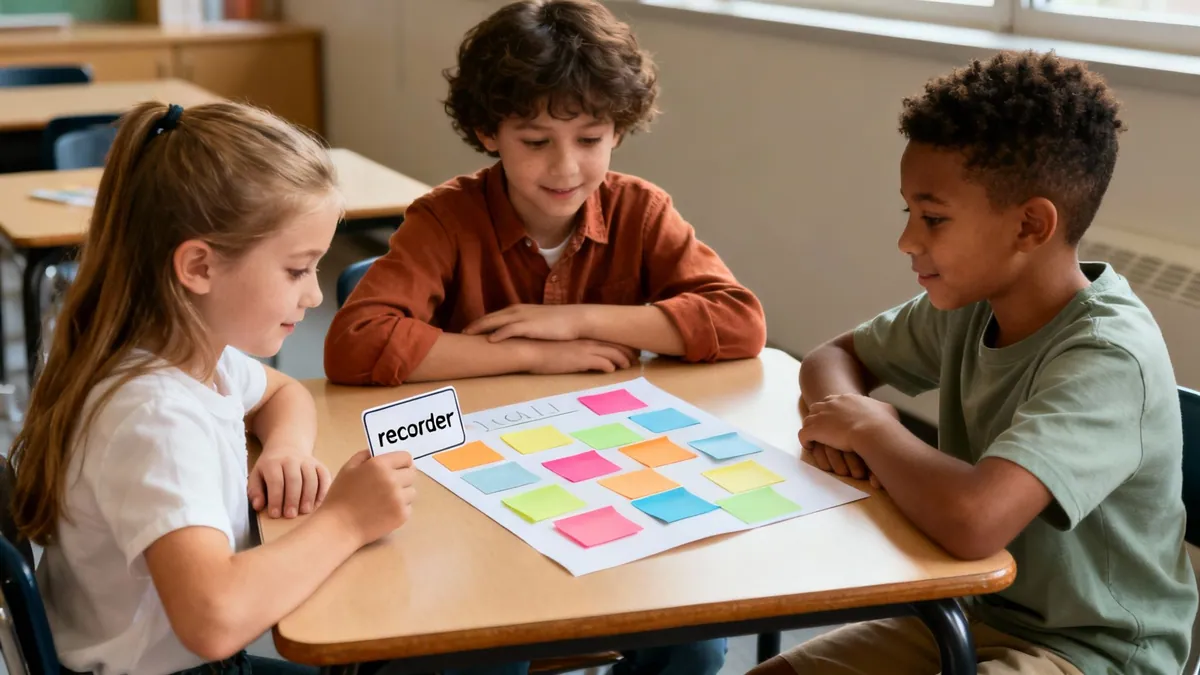
Materials Needed: Varies by project. Chart paper for group norms, role cards (e.g., Time Keeper, Encourager, Reporter), and project-specific supplies like research materials or STEM building items.
Time: Can range from a single 20-minute session (e.g., Think-Pair-Share) to a multi-week project.
Form Groups Intentionally: Create small, diverse groups that balance academic abilities, social skills, and personalities. Avoid letting students always pick their own groups.
Define Clear Roles and Goals: Assign specific roles to each member and provide a clear, measurable group goal. Rotate roles regularly so every student gains experience.
Practical Example (Science Project): In a group of four building a volcano, one student is the Materials Manager (gathers supplies), one is the Builder (constructs the model), one is the Recorder (writes down the steps), and one is the Presenter (explains the project to the class).
Teach Collaboration Skills Explicitly: Before starting, model and practice skills like active listening and respectful disagreement. Use sentence stems like, “I hear you saying…, what if we tried…?”
Structure the Task: Use a proven cooperative learning structure.
Practical Example (Think-Pair-Share): The teacher poses a question (“What was the main character’s biggest challenge?”). Students think quietly for one minute, pair up with a partner to discuss their ideas, and then share their combined thoughts with the whole class.
Monitor and Coach: Circulate the room to provide support, ask guiding questions, and help groups navigate challenges.
Include Group Reflection: After the project, guide students to reflect on their process. Ask: “What went well in our teamwork?” and “What could we do differently next time?”
Key Insight: The most crucial element is teaching collaboration as a skill in itself. Celebrate the process, not just the final product. Acknowledge groups for excellent communication, problem-solving, and mutual respect, reinforcing that how they work together is just as important as what they create.
4. Social Stories and Perspective-Taking Activities
Social Stories and perspective-taking activities use narratives and role-playing to help students understand that others have different thoughts, feelings, and experiences. These exercises are fundamental for developing empathy and reducing bias by allowing children to step into someone else’s shoes in a guided, safe way. By exploring character motivations and diverse viewpoints, students build a stronger “Theory of Mind,” which is the ability to understand others’ mental states.
This method is one of the most effective social emotional learning activities for elementary students because it translates abstract concepts like empathy into concrete, relatable scenarios. Whether through a picture book or a specific social narrative, these tools give children the language and framework to navigate complex social situations.
How to Implement Social Stories and Perspective-Taking
Materials Needed: Diverse picture books (like The Feelings Book by Todd Parr or In My Heart by Jo Witek), pre-written social stories for specific situations, chart paper, markers, or role-playing props.
Time: 15-20 minutes, 1-2 times per week.
CASEL Competency: Social Awareness, Relationship Skills.
Step-by-Step Instructions:
Select a Relevant Story: Choose a picture book or social story that reflects a current classroom challenge (e.g., sharing, handling disappointment, joining a new group).
Practical Example: After noticing students arguing over playground equipment, read The Recess Queen by Alexis O’Neill.
Read and Pause: Read the story aloud, pausing at key moments to ask perspective-taking questions.
Practical Example: While reading, pause and ask, “How do you think Mean Jean felt when no one wanted to play with her? Look at her face. What clues do you see? What about Katie Sue? How did she feel when she decided to ask Jean to play?”
Facilitate Discussion: Encourage students to share their interpretations. Validate different ideas by explaining that people can feel differently about the same situation. Use sentence starters like, “I think they felt ____ because ____.”
Extend with an Activity: Follow the story with a related activity.
Practical Example: Students can draw two faces: one showing how a character felt at the beginning of the story and another showing how they felt at the end. They then explain the change to a partner.
Connect to Real Life: Link the story’s lesson back to the classroom. For instance, “Remember how Katie Sue invited Mean Jean to play? Let’s be like Katie Sue today and look for someone who might need a friend at recess.”
Key Insight: The power of this activity lies in using diverse and authentic narratives. When students see characters from varied backgrounds, abilities, and family structures, they learn that empathy extends to everyone, not just those who are like them. It builds a foundation for an inclusive and understanding community.
5. Conflict Resolution and Peer Mediation Programs
Conflict Resolution and Peer Mediation Programs are structured systems that teach students the skills to identify, communicate about, and solve interpersonal problems collaboratively. These programs shift the classroom dynamic from adult-led discipline to student-led problem-solving, empowering children to become active agents in creating a positive school climate. By training students as mediators, schools build leadership skills and reduce teacher intervention in minor disputes.
This approach is one of the most impactful social emotional learning activities elementary students can engage in because it provides real-world application of complex skills. It reframes conflict not as a failure but as a valuable opportunity for growth, empathy, and understanding. Programs like Responsive Classroom and Soul Shoppe have popularized these practices in schools nationwide.
How to Implement Conflict Resolution and Peer Mediation
Materials Needed: “I-statement” sentence frames, conflict resolution posters with clear steps, a designated “peace corner” or table for mediations, and training materials for student mediators.
Time: 15-20 minutes for mediations as needed; ongoing training and reinforcement.
Teach Core Concepts: Introduce a simple, school-wide conflict resolution process. A common model is: 1. Cool Down, 2. Talk and Listen (using I-statements), 3. Brainstorm Solutions, 4. Agree on a Plan.
Model I-Statements: Explicitly teach and practice the “I feel ___ when you ___ because ___” framework.
Practical Example: Instead of “You’re a mean cheater!”, teach a student to say, “I feel frustrated when you change the rules of the game because I thought we already agreed.”
Train Peer Mediators: Select and train a diverse group of students (not just the “best behaved”) to act as neutral third-party facilitators. Train them to guide peers through the resolution steps without giving solutions.
Establish Protocols: Define which conflicts are appropriate for peer mediation (e.g., disagreements over games, feeling left out) and which require adult help (e.g., bullying or safety concerns).
Provide a Space: Set up a specific, quiet area where mediations can happen without an audience. This makes the process feel official and safe. A small table in the corner with a “peace rose” or talking stick can work well.
Key Insight: The goal of a student mediator is not to solve the problem for their peers but to ask powerful questions that help them solve it themselves. Train mediators with questions like, “What could you do differently next time?” and “What do you need to feel better?” This builds true problem-solving capacity and agency.
6. Gratitude and Kindness Practices
Gratitude and Kindness Practices are intentional activities designed to cultivate appreciation, generosity, and positive regard for others. These powerful routines shift a classroom’s focus toward optimism and interconnectedness, helping students recognize the good in their lives and in their peers. By embedding practices like gratitude journals and kindness challenges, teachers actively build a more prosocial and supportive learning environment.
This goes beyond simply saying “thank you.” These social emotional learning activities for elementary students teach them to look for and acknowledge kindness, which in turn boosts their own happiness, strengthens relationships, and improves their overall mental well-being. This practice helps rewire the brain to notice positive experiences.
How to Implement Gratitude and Kindness Practices
Materials Needed: Journals or notebooks, chart paper, sticky notes, a “kindness jar” or box, art supplies.
Time: 5-15 minutes daily or weekly.
CASEL Competency: Relationship Skills, Social Awareness.
Step-by-Step Instructions:
Introduce the Concept: Begin with a simple discussion about what gratitude and kindness mean. Use a story or personal example to illustrate the concepts.
Establish a Routine: Choose a consistent practice.
Practical Example (Gratitude Circle): During morning meeting, pass a “gratitude stone” around the circle. The person holding the stone shares one specific thing they are thankful for, like “I’m grateful for my dad because he made me pancakes this morning.”
Launch a Kindness Challenge: Dedicate a week to kindness. Provide daily prompts.
Practical Example: A “Kindness Bingo” card could have squares like “Give a genuine compliment,” “Invite someone new to play,” “Hold the door for someone,” and “Help a classmate clean up.”
Create a Visual Tracker: Use a “Caught Being Kind” bulletin board where students can post sticky notes acknowledging kind acts they witness. This makes kindness visible and celebrated.
Connect Gratitude to Action: After a special event or field trip, have students write thank-you notes or create a short thank-you video for the people who made it possible.
Key Insight: Specificity is the cornerstone of effective gratitude practice. Guide students beyond generic statements like “I’m grateful for my family.” Encourage them to elaborate: “I’m grateful my big sister read me a story last night because it made me feel safe and loved.” This deeper reflection anchors the feeling and makes the practice more meaningful.
7. Self-Advocacy and Assertiveness Skills Training
Self-Advocacy and Assertiveness Skills Training explicitly teaches students how to recognize and respectfully communicate their needs, boundaries, and preferences. This practice empowers children by giving them the tools to develop their own voice, agency, and confidence. By learning the crucial difference between passive, aggressive, and assertive communication, students build a foundation for academic success and lifelong healthy relationships.
This training is one of the most vital social emotional learning activities for elementary students, as it moves beyond simply identifying feelings to acting on them constructively. It is especially impactful for students who are marginalized, have learning differences, or tend to be more withdrawn, ensuring they have the skills to be seen and heard.
How to Implement Self-Advocacy and Assertiveness Skills Training
Materials Needed: Scenario cards, “I-statement” sentence frames, anchor charts defining passive, assertive, and aggressive communication styles.
Define and Differentiate: Use an anchor chart to explicitly teach the differences between passive (quiet, avoiding conflict), aggressive (blaming, demanding), and assertive (calm, clear, respectful) communication. Use simple examples for each.
Introduce “I-Statements”: Provide students with a clear and simple script for assertive communication, such as: “I feel ____ when you ____. I need ____.”
Role-Play Scenarios: Practice with low-stakes scenarios.
Practical Example (Academic Need): A student role-plays telling a teacher, “I feel confused by the directions for the project. I need you to explain step two again, please.”
Practical Example (Social Boundary): One student practices saying to another, “I feel uncomfortable when you stand so close to me. I need a little more space, please.”
Practice Saying “No”: Teach students respectful ways to set boundaries, such as “No, thank you,” or “I’d rather not do that.” Role-play situations where a friend asks them to do something they don’t want to do.
Debrief and Reinforce: After role-playing, discuss how it felt to be assertive. Acknowledge that it can feel uncomfortable at first but gets easier with practice.
Key Insight: Modeling is everything. When teachers and parents consistently use assertive “I-statements” and respect students’ boundaries, they demonstrate that self-advocacy is a valued and effective skill. Celebrate students’ attempts, even if imperfect, to create a culture where every child knows their voice matters and will be heard.
8. Growth Mindset and Resilience-Building Lessons
Growth Mindset and Resilience-Building Lessons teach students that intelligence and abilities are not fixed traits but can be developed through effort, strategic practice, and feedback. Based on the research of Carol Dweck, these lessons help children reframe challenges as opportunities, view mistakes as crucial parts of learning, and persist through setbacks. This approach shifts the focus from innate talent to the power of process, building a foundation for both academic achievement and emotional well-being.
These lessons are a cornerstone of effective social emotional learning activities for elementary students because they directly target self-management and responsible decision-making. By cultivating resilience, students are better equipped to handle academic frustrations and social conflicts with confidence and determination. To further cultivate this mindset, students can benefit from learning effective strategies to improve problem-solving skills, empowering them to tackle challenges constructively.
How to Implement Growth Mindset and Resilience-Building Lessons
Materials Needed: “The Magical Yet” by Angela DiTerlizzi or other growth mindset books, chart paper, markers, stories of famous failures (e.g., Michael Jordan, Oprah), goal-setting worksheets.
Introduce the Concept: Use a simple analogy like comparing the brain to a muscle. Explain that when we work hard and try new things, our brain grows stronger by creating new connections.
Read and Discuss: Read a story that models a growth mindset. Ask discussion questions like, “What challenge did the character face?” and “What did they do when they made a mistake?”
Teach “The Power of Yet”: Introduce the phrase “I can’t do it… yet.”
Practical Example: Create a class chart with two columns: “Fixed Mindset Thoughts” and “Growth Mindset Thoughts.” Fill it with examples like changing “This is too hard” to “This may take some time and effort.” Or “I can’t read this word” to “I can’t read this word… yet.”
Create a “Famous Failures” Gallery: Display pictures and stories of successful people who overcame significant setbacks. Discuss how failure was a necessary step in their journey to success.
Use Effort-Based Praise: In daily interactions, praise the process, not just the outcome.
Practical Example: Instead of saying “You’re so smart!” when a child solves a puzzle, say, “I love how you turned the pieces different ways to see what would fit. Your strategy worked!”
Key Insight: A growth mindset is cultivated through consistent language and classroom culture, not just isolated lessons. Creating a “mistake-friendly” environment where errors are celebrated as “brain builders” is essential. When teachers model their own learning struggles and resilience, students learn that productive struggle is a normal and valuable part of growth.
9. Diversity, Inclusion, and Anti-Bias Classroom Activities
Diversity, Inclusion, and Anti-Bias Activities are intentional lessons that celebrate human differences while actively addressing bias and discrimination. These practices move beyond surface-level multicultural celebrations to build genuine cultural competence, challenge stereotypes, and foster a deep sense of belonging for all students. By integrating these social emotional learning activities, elementary teachers equip children to understand their own identities and appreciate the diverse world around them.
This approach, championed by educators like Louise Derman-Sparks, is not just about being kind; it’s about creating justice. It gives students the language and tools to recognize and confront unfairness, making them active participants in building a more equitable classroom and community.
How to Implement Diversity, Inclusion, and Anti-Bias Activities
Materials Needed: Diverse books featuring “windows and mirrors” (characters both different from and similar to your students), identity charts, chart paper, markers, and curated read-alouds that tackle topics of fairness and bias.
Time: Varies; can be a 15-minute read-aloud or an ongoing, year-long unit.
CASEL Competency: Self-Awareness, Social Awareness, Relationship Skills.
Step-by-Step Instructions:
Introduce “Windows and Mirrors”: Using the framework from Rudine Sims Bishop, explain that books can be mirrors (reflecting our own lives) or windows (offering a view into someone else’s).
Practical Example: After reading Amazing Grace by Mary Hoffman, ask, “Who in our class saw a mirror in this story? Who saw a window into a new experience?”
Create Identity Charts: Give each student a large piece of paper with their name in the center. Have them draw or write words that describe the multiple facets of their identity (e.g., sister, artist, soccer player, Spanish speaker).
Share and Connect: Students share one part of their identity chart with a partner or small group, finding connections and celebrating differences.
Discuss Fairness: Use a picture book to introduce a scenario involving bias or unfairness.
Practical Example: Read The Sneetches by Dr. Seuss and ask, “Was it fair that only the Star-Belly Sneetches could go to the parties? Why or why not? What could the Plain-Belly Sneetches have done?”
Practice Being an Upstander: Role-play scenarios where students can practice being an “upstander” by safely and respectfully speaking up when they see something unfair.
Key Insight: Authentic representation is paramount. Anti-bias work must be woven into the curriculum year-round, not isolated to specific heritage months. This consistency ensures students see diversity as a fundamental and valued aspect of the human experience, not a special topic.
10. Emotion Regulation and Coping Strategy Toolbox
The Emotion Regulation and Coping Strategy Toolbox is a personalized collection of techniques students can use to manage overwhelming feelings and calm their nervous systems. This approach shifts the focus from adult-led intervention to student-led self-regulation, empowering children with a sense of agency and control over their emotional responses. By creating a tangible or mental “toolbox,” students learn to identify what they need in a moment of stress, building independence and emotional resilience.
This concept is a cornerstone of effective social emotional learning activities for elementary students because it acknowledges that there is no one-size-fits-all solution for managing emotions. It teaches children to become experts on their own needs, equipping them with practical skills to navigate challenges like frustration, anxiety, and excitement both inside and outside the classroom.
How to Implement a Coping Strategy Toolbox
Materials Needed: Poster board, index cards, art supplies, a physical box or container, sensory items (stress balls, scented dough, soft fabric), and visual aids for different strategies.
Time: 15-20 minutes for initial teaching of a new strategy; ongoing practice daily.
Introduce the Concept: Explain that a toolbox holds tools to fix things, and an emotional toolbox holds tools to help us manage our feelings. Use a physical box as a visual anchor.
Teach Strategies Explicitly: During calm moments, teach one or two strategies at a time.
Practical Example: For a “Grounding” technique, teach the 5-4-3-2-1 method: “When you feel worried, pause and silently name 5 things you can see, 4 things you can touch, 3 things you can hear, 2 things you can smell, and 1 thing you can taste. This helps bring your brain back to the present moment.”
Categorize for Clarity: Group strategies into categories like Movement (jumping jacks, stretching), Sensory (squeezing a stress ball, listening to music), Cognitive (counting to 10, positive self-talk), and Creative (drawing, journaling).
Create Visual Tools: Have students create their own strategy cards with drawings or words. These can be put on a ring, in a personal box, or displayed on a “Calm Down Corner” poster.
Model and Narrate: As the teacher, visibly use the strategies yourself. Say, “I’m feeling a little frustrated with this technology, so I’m going to take three deep breaths before I try again.”
Practice and Reflect: After a student uses a strategy, follow up later. Ask, “I saw you went to the calm corner to squeeze the dough. How did that feel for your body? Did it help?”
One of the single most impactful shifts you can make in your classroom is moving away from a list of top-down rules to a living, breathing agreement you create with your students. This isn’t just about what ends up on the poster; the magic is in the conversations that get you there.
When students have a real voice in shaping their learning environment, they develop a profound sense of ownership. It stops being about “your rules” and starts being about “our community.” Instead of a lecture on behavior, the process becomes a collaborative project focused on a simple goal: creating a shared understanding of how everyone wants to feel and what they need from each other to make that happen. For student buy-in, it’s an absolute game-changer.
Guiding the Conversation
The key to a successful classroom agreement is asking the right questions. Your job here is to facilitate, not dictate. Think of yourself as a guide, helping students reflect on what makes a community feel safe, productive, and welcoming.
First, set the stage. Let them know you’re going to work together as a team to decide how you want your classroom to run so everyone can do their best learning and feel good about coming to school.
Here are a few open-ended prompts I’ve found really get the ball rolling:
What words would you use to describe the classroom you dream of being a part of?
How do we want to feel when we walk into this room every morning?
What do we need from each other to feel safe enough to share our ideas, even when we’re unsure?
Disagreements are going to happen! How can we handle them with respect? For example, what can we say instead of “you’re wrong”?
What does it look like and sound like when we are truly listening to one another?
These kinds of questions get students thinking about the feeling behind the rules, which is so much more meaningful than a simple list of dos and don’ts.
From Ideas to Actionable Agreements
As the ideas start flowing, capture everything on an anchor chart or whiteboard. Don’t filter yet—just get it all down. Your next step is to help the class distill this brainstorm into a handful of clear, positive, and actionable statements.
The trick is to reframe any negative commands (“Don’t be rude”) into positive commitments (“We speak with kindness”). This small linguistic shift is incredibly powerful. It focuses on what you will do rather than what you won’t, which feels proactive and empowering.
Examples of Reframing Student Ideas:
Student Suggestion
Positive Agreement
“No yelling out.”
“One person speaks at a time so all voices can be heard.”
“Don’t make fun of people.”
“We respect each other’s ideas and experiences.”
“Don’t mess with my stuff.”
“We take care of our own and others’ belongings.”
“Don’t be mean.”
“We speak to each other with kindness and assume good intentions.”
A classroom agreement is not a static document. It’s a living commitment that should be revisited, referenced, and celebrated all year long.
Once your class has landed on 3-5 core agreements, have every student sign the poster. This simple act symbolizes their personal commitment to upholding these shared values. Then, hang it somewhere prominent—a constant, visual reminder of the community you’re all building together.
Making the Agreement a Part of Your Culture
Now for the most important part: making sure that beautiful poster doesn’t just collect dust. Weave it into the fabric of your daily classroom life.
When a conflict pops up, use the agreement as your touchstone. Instead of saying, “Stop arguing,” you can point to the chart and ask, “Let’s look at our agreement about respecting each other’s ideas. How can we use that to solve this problem?” This simple redirect empowers students to hold themselves and each other accountable.
And don’t forget to celebrate the wins! When you see students living up to the agreements, point it out. “I just saw Maria help Leo with his project without being asked. That’s a perfect example of our agreement to support each other.” This positive reinforcement is what makes the agreement real. It shows everyone that these aren’t just words on a wall—they’re the way we do things here.
Partnering with Families to Extend Your Community
A thriving classroom community doesn’t just happen inside the school building. It truly flourishes when it extends beyond the classroom door to include families as respected, valued partners. When families feel seen and connected, they become our most powerful allies in a child’s learning journey.
Building these bridges doesn’t have to be a huge time commitment. It’s really about creating consistent, positive, and two-way channels of communication. The goal is to make families feel like they are genuinely part of the team. Often, it’s the simple, high-impact strategies that work best.
Start with a Warm and Welcoming First Step
That very first interaction sets the tone for the entire school year. Before you even touch on academics, take a moment to learn about the unique world each child comes from. A simple “Family Welcome Survey” is a fantastic tool for this.
This isn’t just about collecting data; it’s about starting a relationship. Frame your questions with respect and genuine curiosity.
Sample Welcome Survey Questions:
What are your hopes and dreams for your child this school year?
What is one thing you want me to know about your child that will help me be the best teacher for them? (e.g., “She is very shy at first but opens up once she feels safe.”)
What are some of your family’s favorite traditions or celebrations?
How does your child best receive praise or recognition? (e.g., “He prefers quiet, private praise over being singled out in front of the class.”)
What is the best way for us to communicate (email, app, phone call)?
This small gesture immediately communicates that you see and value the family’s expertise. It also gives you invaluable insights that help you connect with each student on a much deeper level right from day one.
Craft Weekly Updates That Build Connection
Let’s move beyond the standard weekly email that just lists homework and upcoming tests. Think about creating a class update that tells the story of your community in action. The goal here is to give families a window into their child’s world, not just another to-do list.
Think of it as your weekly highlight reel. Share photos of students deep in a collaborative project, a quick video of a fun science experiment, or even just a powerful quote from a class discussion. A practical example could be a short paragraph saying, “This week in social studies, students debated the pros and cons of ancient Roman aqueducts. Ask your child which side they argued for!” This gives parents a specific conversation starter.
A weekly update that shares a story of learning, a moment of kindness, or a collaborative success is far more powerful than a list of assignments. It invites families into the classroom experience, making them feel like part of the community’s journey.
Create Opportunities for Families to Engage
Inviting families into your classroom in meaningful ways solidifies their role as true partners. These moments are powerful, allowing students to take pride in their work and their community with their biggest supporters right there beside them.
Here are a few practical ideas to get you started:
Host a Student-Led Showcase: Instead of a traditional parent-teacher conference, let the students lead the conversation. They can present a portfolio of their work, share what they’re most proud of, and set goals for themselves with their families there to cheer them on.
Create a Shared Digital Album: Use a secure platform like Seesaw or a private Google Photos album where you can share candid shots of classroom moments. This gives families a real-time glimpse into the daily life of your community.
Family “Expert” Day: Invite parents and caregivers to come in and share a skill, a tradition, or a story related to their heritage or profession. For example, a parent who is a graphic designer could give a short lesson on logo design, or a grandparent could share stories about a holiday celebrated in their culture. This positions family members as valuable resources and celebrates the rich diversity within your community.
By consistently making these positive connections, you reinforce the message that everyone is on the same team, working together to help every single child succeed.
Common Questions About Building Classroom Community
Even with a fantastic plan in place, the realities of the classroom will always throw a few curveballs. Knowing how to build community isn’t just about the proactive steps; it’s also about troubleshooting the tricky situations that pop up.
Here are some of the most common questions I hear from teachers, with practical advice for those moments that really test our community-building skills.
How Do I Reach a Withdrawn Student?
When a student seems withdrawn or resistant, our first instinct might be to pull them into group activities. But that can often backfire. The real key is to shift from big-group expectations to small, individual connections. Forcing participation rarely works, but creating low-pressure invitations can make all the difference.
Start by learning what they’re genuinely into—a video game, a specific artist, a sport—and just bring it up casually when you have a one-on-one moment. For example, you might say, “Hey, I noticed you have a Minecraft keychain. My nephew loves that game. What’s the coolest thing you’ve ever built?” It’s a simple way to show you see them as a person, not just a student who isn’t participating.
Another great strategy is to give them a meaningful classroom job that lets them contribute without being the center of attention. Roles like “Tech Assistant” (helping with projectors or tablets) or “Class Librarian” (organizing the bookshelf) allow them to add real value to the community, but on their own terms. Just be sure to offer positive, private reinforcement for these small steps.
Your goal isn’t to force a withdrawn student into the middle of the circle. It’s to make sure they feel valued and respected right where they are, knowing the invitation to step closer is always open when they’re ready.
What Is the Best Way to Handle Conflicts?
First, let’s reframe this. Conflicts aren’t a sign that your community is failing—they’re actually an opportunity to make it stronger. The most effective way to handle them is to be restorative, not punitive. This means your focus is on repairing the harm done, not just assigning blame.
When a disagreement happens, try using a structured process to guide the conversation. A “restorative circle” is an incredibly powerful tool where everyone involved gets to share their perspective without being interrupted.
Guide your students to use “I-statements” to talk about how they feel. For example, instead of, “You always leave me out at recess,” a student learns to say, “I felt hurt when I wasn’t invited to play soccer today.” This simple shift helps them take ownership of their emotions without attacking the other person. The whole point is to find a way forward together, which reinforces the most important idea in our classroom: relationships are the priority.
I Have Limited Time. What Can I Do Daily?
If you only have a few minutes each day, the single most impactful thing you can do is a positive greeting at the door every single morning. It’s a small ritual that takes less than two minutes but has a massive impact on your classroom culture.
Make eye contact with each student as they walk in. Use their name. Offer a simple, warm interaction—a high-five, a handshake, or just a genuine smile.
This one consistent moment of connection sends a powerful message to every child before they even sit down: “You are seen, you are welcome, and I am happy you are here.” It is, without a doubt, the highest-leverage, lowest-effort strategy for building a strong community foundation.
At Soul Shoppe, we believe every student deserves to feel safe, connected, and valued at school. Our programs provide the tools and strategies to help you build a thriving classroom community where every child can flourish. Learn more about how we can support your school.