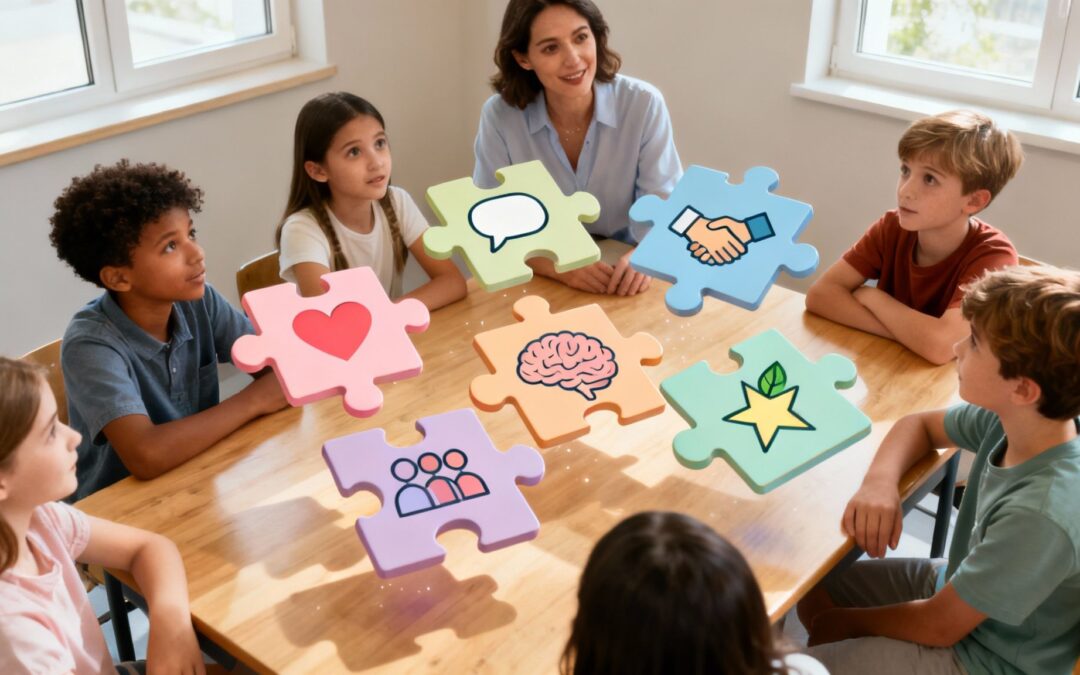
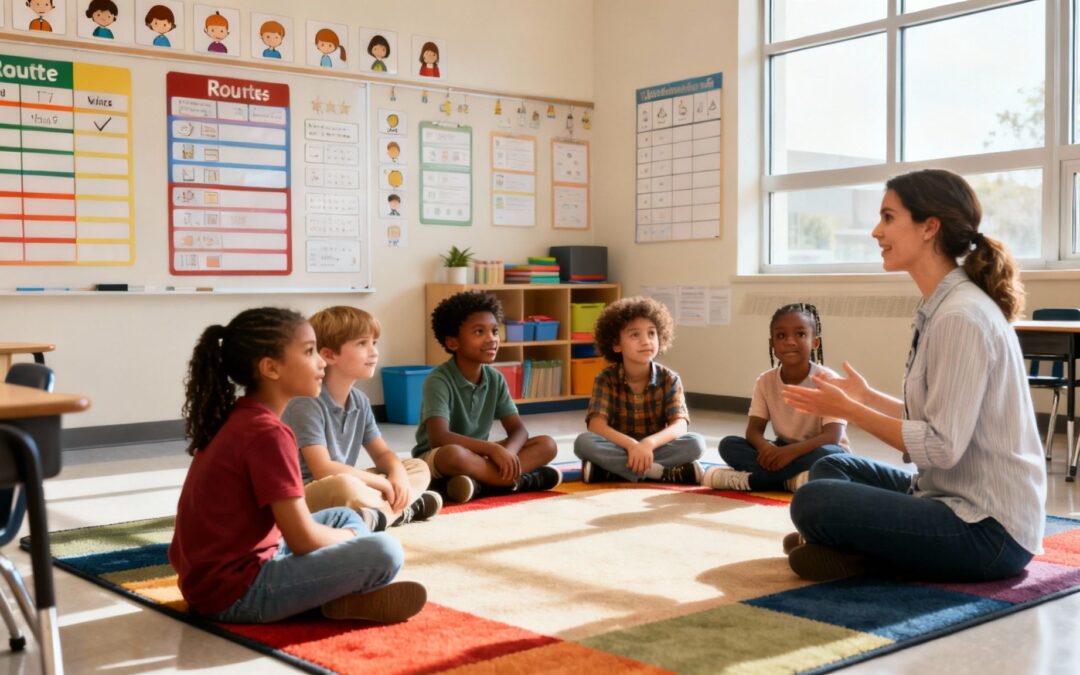
In a world that feels increasingly divided, the ability to genuinely understand another person’s point of view is more than a skill; it’s a superpower. For K-8 students, developing this ability, known as perspective-taking, is foundational for building healthy relationships, resolving conflicts, and creating inclusive communities. It’s the bedrock of social-emotional learning (SEL) that allows students to move from simple sympathy (feeling for someone) to true empathy (feeling with someone). This critical shift requires children to first understand their own emotions. A critical initial step in empathy is helping children identify and articulate their own feelings; consider using a simple feelings chart for kids to build this self-awareness.
This practical guide moves beyond abstract advice to offer a comprehensive roundup of powerful and actionable perspective taking activities designed for immediate use in classrooms, counseling sessions, and at home. We’ve compiled a variety of dynamic exercises suitable for kindergarten through middle school, ensuring you have the right tools for every developmental stage. Each item in this listicle includes:
Clear, step-by-step instructions.
Age-appropriate differentiations and modifications.
Specific SEL skills targeted by the activity.
Practical examples and sample scripts.
From role-playing and storytelling to art-based expression and restorative circles, these strategies are designed to cultivate deep, authentic empathy. Let’s explore how to move beyond the cliché and into transformative practices that create environments where every child feels seen, heard, and understood.
1. Role-Playing and Scenario-Based Activities
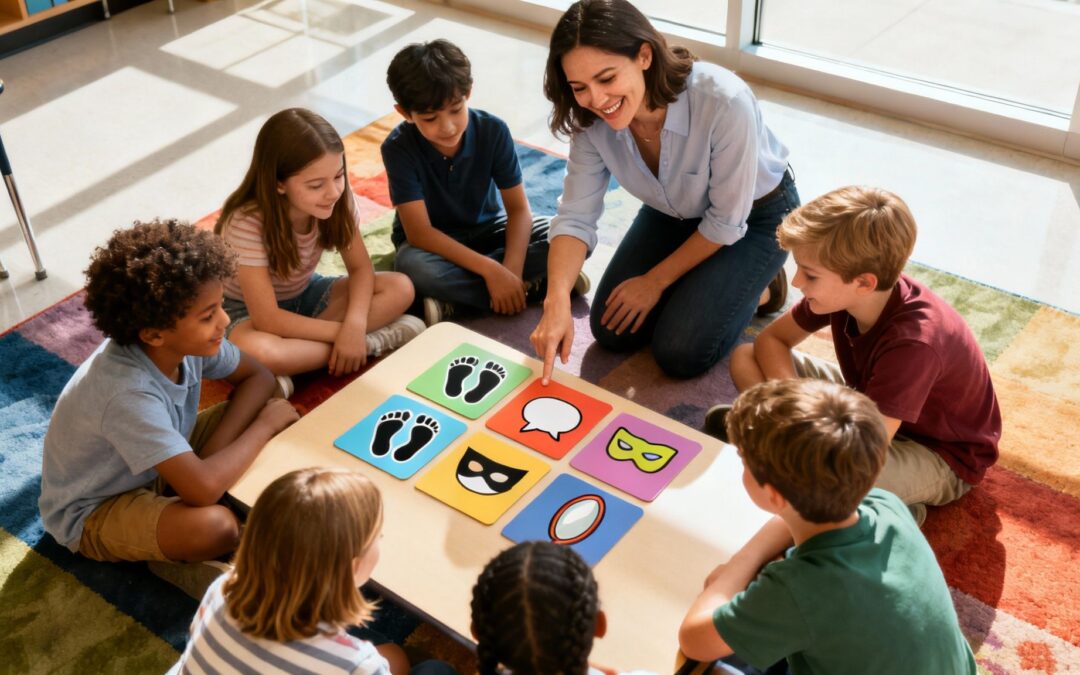
Role-playing is a powerful, hands-on method where students step into another person’s shoes to act out real-world scenarios. By embodying different characters, participants move beyond theoretical understanding to an experiential grasp of diverse viewpoints. This dynamic approach is one of the most effective perspective taking activities because it integrates movement, emotion, and social interaction, making empathy a tangible skill.
This method, popularized by practices like Augusto Boal’s Theatre of the Oppressed and used extensively by organizations like Soul Shoppe, allows students to safely explore complex social dynamics. They can practice navigating conflict, responding to peer pressure, and understanding the feelings of others in a controlled environment.
How It Works
The core of role-playing is assigning students specific roles within a predefined scenario. They act out the situation, making choices and reacting as their character would. The facilitator then guides a group reflection to unpack the experience.
For Younger Students (K-3): Use simple, relatable scenarios. Practical Example: Have two students act out a conflict over a shared toy. One student is the “grabber,” and the other is the “owner.” A third student can play the “friend” who sees it happen. Afterward, ask: “To the owner: how did it feel when the toy was taken?” “To the grabber: what did you want in that moment?” “To the friend: what did you see and how did it make you feel?”
For Older Students (4-8): Tackle more nuanced situations. Practical Example: A scenario could involve one student trying to convince another to cheat on a test, a group navigating the exclusion of a peer at lunch, or a student posting a hurtful comment online about a classmate. Assign roles like “the poster,” “the target,” and “the bystander” who saw the comment but didn’t say anything.
Implementation Tips for Success
To ensure these activities are productive and safe, structure is key. Always establish clear guidelines and objectives before you begin.
Start Small: Begin with low-stakes, lighthearted scenarios (e.g., disagreeing on a game to play at recess) before moving to more emotionally charged topics like bullying or exclusion.
Facilitate Debriefing: The learning happens in the reflection. After a role-play, use guided questions:
“To the person playing [Character A], what were you feeling when that happened?”
“What do you think [Character B] was thinking?”
“If we did this again, what could we change for a better outcome?”
Offer Opt-Outs: Participation should always be a choice. Allow students to observe if they are not comfortable acting. Observers can provide valuable insights during the debriefing.
Role-playing builds a strong foundation for social-emotional learning by transforming abstract concepts like empathy and respect into practical, memorable skills. By actively practicing these scenarios, students develop crucial communication skills that they can apply to real-life challenges.
7. Programmatic and Community-Based Approaches: SEL, Mindfulness, and Service Learning
Beyond standalone lessons, programmatic approaches embed perspective-taking into the very fabric of school culture through comprehensive Social-Emotional Learning (SEL) curricula, mindfulness practices, and service learning. These structured methods intentionally teach empathy alongside self-awareness, relationship skills, and responsible decision-making. By combining direct instruction with real-world community engagement, these are powerful perspective taking activities that help students understand systemic issues and their role within a larger community.
This approach, championed by organizations like CASEL and demonstrated through experiential programs like those offered by Soul Shoppe, moves beyond individual scenarios to build a consistent, school-wide language for empathy and understanding. It connects classroom learning to authentic community needs, fostering a deep sense of civic responsibility and interconnectedness.
How It Works
These programs integrate perspective-taking skills across the curriculum and school day, rather than isolating them to a single lesson. They often combine classroom instruction with practical, reflective experiences.
For Younger Students (K-3): Use an SEL curriculum like Second Step or Responsive Classroom during morning meetings. Practical Example: A lesson might focus on identifying feelings in others using picture cards. This is followed by a class project like creating “get well soon” cards for a local children’s hospital, during which the teacher asks, “What words can we write that would make someone feel happy and cared for?”
For Older Students (4-8): Implement a service-learning project. Practical Example: Students could partner with a local food bank. First, they learn about food insecurity in social studies. Then, they volunteer to sort donations. Finally, they write a reflection answering: “After meeting volunteers and hearing stories, how has your perspective on hunger in our community changed?”
Implementation Tips for Success
Success with these broad approaches hinges on thoughtful planning, professional development, and authentic community partnerships.
Integrate, Don’t Add On: Weave SEL concepts into existing structures like morning meetings, advisory periods, and academic subjects. This makes the learning feel relevant and continuous.
Invest in Training: Effective implementation requires that all staff understand the philosophy and practical strategies of the chosen program. Quality professional development is non-negotiable.
Center Community Voice: When engaging in service learning, partner with community organizations as equals. Ensure projects are designed to meet genuine, community-identified needs rather than positioning students as “saviors.”
Build in Reflection: Structure time for reflection before, during, and after service projects. Use prompts like, “What do we expect to learn?” and “How has this experience changed our perspective?”
Cultivate Mindfulness: Introduce mindfulness to build the self-regulation and awareness necessary for perspective-taking. For deepening personal focus, practices such as meditating with crystals can be integrated to help students cultivate inner calm.
By adopting a programmatic approach, schools create a reinforcing ecosystem where perspective-taking is not just a lesson, but a lived value. These structured programs provide students with the consistent practice needed to develop a sophisticated and compassionate worldview. You can explore a variety of engaging social-emotional learning activities to supplement any curriculum.
8. Family and Cross-Generational Perspective-Taking Activities
Inviting family and community members into the classroom bridges the gap between home and school, enriching a student’s understanding of how personal history and culture shape viewpoints. These activities honor that students come from diverse family structures and backgrounds, positioning their lived experiences as valuable sources of knowledge. This approach makes learning relevant and affirms student identity, making it one of the most powerful perspective taking activities available.
This asset-based approach, rooted in frameworks like the Funds of Knowledge theory developed by Moll, Amanti, Neff, and Gonzalez, recognizes that families possess rich cultural and cognitive resources. By centering these voices, schools can build authentic partnerships and create a more inclusive learning environment where every family’s story is valued.
How It Works
This method involves creating structured opportunities for students to learn from their relatives and community elders. The focus is on storytelling and shared experiences, helping students connect curriculum concepts to the real world and understand the diverse viewpoints within their own community.
For Younger Students (K-3): Host a “Family Treasures” show-and-tell. Practical Example: Students bring an item from home that is special to their family (like a grandparent’s recipe, a cultural garment, or an old photograph) and invite a family member to help them share its story. This helps children see how objects can hold different meanings and histories for different people.
For Older Students (4-8): Implement a family history interview project. Practical Example: Students use a provided set of questions to interview an older relative about their life experiences, such as “What was school like for you?” or “Tell me about a time you had to be brave.” They can then present their findings by creating a “podcast” episode, a written report, or a visual timeline that is shared with the class.
Implementation Tips for Success
Creating a welcoming space for families is crucial for these activities to succeed. The goal is to build genuine, respectful relationships.
Offer Multiple Participation Options: Not all families can come to school during the day. Allow participation through recorded videos, written stories, drawings, or a live video call. This inclusivity ensures everyone who wants to share can.
Build Relationships First: Don’t make the first interaction with a family a request for them to share personal stories. Build rapport through positive communication, newsletters, and school events before extending an invitation to participate in a classroom activity.
Facilitate a Thoughtful Debrief: After a family or community member shares, guide a student discussion to process the experience. Ask questions like:
“What was one new thing you learned about your classmate’s family or culture?”
“How was their experience similar to or different from your own family’s?”
“How does learning this story change how you see our community?”
Engaging families and elders directly validates students’ identities and shows them that learning happens everywhere, not just within school walls. These cross-generational connections build a strong sense of community and teach students to appreciate the rich diversity of perspectives that make up their world.
Comparison of 8 Perspective-Taking Activities
Activity
Implementation complexity
Resource requirements
Expected outcomes
Ideal use cases
Key advantages
Role-Playing and Scenario-Based Activities
Low–Moderate — needs facilitator debrief skills
Minimal materials and space; teacher facilitation time
Rapid observable social skill practice; improved empathy and confidence
Bullying prevention, conflict resolution, social skill practice (K–8)
Highly engaging; immediate feedback; builds shared classroom language
Literature and Storytelling Circles
Moderate — requires skilled facilitation and time
Texts/resources, structured protocols, teacher/librarian support
Deeper perspective analysis, improved literacy and respectful dialogue
Cultural understanding, literacy-integrated SEL, community building
Integrates academics + SEL; highlights diverse voices; scalable
Empathy Mapping and Visual Perspective Activities
Low — templates and modeling make it easy to implement
Templates, art supplies, display space, time for reflection
Tangible artifacts showing perspective; accessible for varied learners
Early elementary, students with verbal or processing challenges, conflict mapping
Concrete and inclusive; supports visual/kinesthetic learners; reusable
Peer Interviews and “Getting to Know You” Activities
Low–Moderate — needs protocols and privacy safeguards
Question banks, partner time, facilitator prep, confidentiality norms
Stronger peer connections, active listening, reduced isolation
Welcoming new students, peer mentoring, building belonging
Direct relationship-building; adaptable across ages; low cost
Perspective-Taking Through Art, Music, and Creative Expression
Moderate — needs clear framing to link art to perspective
Art/music materials, space, arts facilitation or teacher training
Increased emotional expression, alternative access to empathy development
Supporting language learners, trauma processing, honoring diverse expression
Engages multiple modalities; less verbally demanding; affirming
Restorative Circles and Peer Dialogue Processes
High — requires extensive training and cultural shift
Trained facilitators, time, preparatory work, follow-up supports
Relationship repair, accountability, measurable reductions in harm
Putting Perspective into Practice: Your Next Steps
We’ve explored a rich tapestry of perspective taking activities, from the dramatic flair of role-playing scenarios to the quiet introspection of empathy mapping. Each of the eight approaches detailed in this guide, whether it’s harnessing the power of storytelling, engaging in restorative circles, or interviewing a peer, serves as a vital tool in building a foundation of social-emotional intelligence. These are not just isolated classroom exercises; they are invitations to cultivate a culture of empathy, curiosity, and genuine human connection.
The core takeaway is that perspective-taking is not a static skill learned in a single lesson. It is a dynamic, ongoing practice. It flourishes when woven into the very fabric of a child’s daily life, becoming as natural as reading or math. It is the practice of asking, “What might this look like from their side?” during a playground disagreement, a historical lesson, or a family discussion.
From Activities to Lifelong Habits
The true power of these strategies is realized when they move beyond the activity itself and become a routine way of thinking and interacting. The ultimate goal is to equip students with an internal framework for understanding others, a framework they can carry with them long after they leave the classroom.
For example, a student who regularly participates in Literature Circles doesn’t just learn to analyze characters; they learn to question their own initial judgments about people they meet. A child who has used an Empathy Map to understand a classmate’s frustration is better equipped to offer support instead of reacting with annoyance. This is where the magic happens: the activity becomes a habit, and the habit becomes a part of their character.
Key Insight: The most effective perspective taking activities are those that are consistently integrated, creating a predictable and safe environment where students feel empowered to explore different viewpoints without fear of judgment.
Your Actionable Next Steps
Embarking on this journey doesn’t require a complete overhaul of your curriculum or home life. Meaningful change begins with small, intentional steps. Here is how you can start putting these ideas into practice today:
Start Small and Be Specific: Don’t try to implement everything at once. Review the list of activities and choose just one that feels like a natural fit for your students’ age group and current needs. Perhaps you start by incorporating a “Getting to Know You” interview into your morning meeting once a week, or you select a book specifically for its potential to spark a perspective-taking discussion.
Model the Behavior: Children are keen observers. Let them see you practicing perspective-taking. You can do this by verbalizing your own thought process. For instance, a teacher might say, “I see that many of you are feeling tired today. I’m going to try to see this from your perspective and adjust our schedule to include a short movement break.” A parent might say, “I’m feeling frustrated, but I’m going to take a moment to understand why you might have felt you needed to do that.”
Connect to Academics: Seamlessly integrate these practices into existing lessons. When studying a historical event, prompt students to write a diary entry from the perspective of two different historical figures. In science, have them debate the environmental impact of a new technology from the viewpoint of a scientist, a business owner, and a community resident. This shows that perspective-taking is a critical thinking skill applicable across all subjects.
Embrace Imperfection: There will be moments when discussions are challenging or when students struggle to see another viewpoint. This is part of the learning process. The goal is not to achieve perfect empathy in every interaction but to consistently create opportunities for practice. Celebrate the effort, not just the outcome.
By committing to these practices, we are doing more than just teaching a social skill. We are nurturing compassionate leaders, thoughtful friends, and engaged citizens who can navigate a complex and diverse world with wisdom and kindness. We are giving them the invaluable gift of seeing the world not just through their own eyes, but through the eyes of others.
Ready to build a comprehensive, campus-wide culture of empathy and respect? Soul Shoppe offers experiential programs that provide students and staff with a shared language and practical tools for conflict resolution, emotional intelligence, and perspective-taking. Explore Soul Shoppe’s programs to bring these vital skills to your entire school community.
Understanding the impact of trauma on learning is no longer optional; it’s essential for creating classrooms where every student can thrive. Trauma, stemming from adverse childhood experiences (ACEs) or systemic stressors, can fundamentally alter a child’s brain development. This directly affects their ability to regulate emotions, build relationships, and access learning. For K-8 educators, this means that traditional classroom management techniques may not only be ineffective but could also re-traumatize a student who is struggling.
The goal isn’t to become a therapist. Instead, it’s about making a crucial shift in perspective from asking, “What’s wrong with this student?” to “What happened to this student, and how can I support them?” By implementing trauma informed teaching strategies, educators can build environments of psychological safety that calm the nervous system and reopen pathways to engagement, connection, and academic growth. A trauma-informed classroom is a space where students feel seen, safe, and supported, allowing their brains to move out of survival mode and into a state ready for learning.
This comprehensive guide moves beyond theory to provide ten actionable strategies tailored for the K-8 classroom. Each item includes practical, step-by-step implementation details, real-world examples, and guidance on how to adapt these methods to meet individual student needs. You will discover how to create predictable routines, foster authentic connections, and use restorative practices to build a more resilient and supportive learning community for every child.
1. Creating Psychologically Safe Classrooms
Psychological safety is the bedrock of all trauma-informed teaching strategies, creating an environment where students feel secure enough to take healthy academic and social risks. For students who have experienced trauma, the world can feel unpredictable and threatening. A psychologically safe classroom counteracts this by establishing consistency, predictability, and emotional validation, allowing a child’s nervous system to shift from a constant state of high alert to one of calm readiness for learning. This foundation is crucial for engagement, cognitive function, and building positive relationships.
A foundational element in creating a psychologically safe classroom is successfully forming a supportive community where students feel connected and valued. When students trust their teacher and peers, they are more willing to participate, ask for help, and navigate challenges without fear of judgment or shaming.
How to Implement This Strategy
Establish Predictable Routines: Post and review a visual daily schedule. Use timers or verbal cues to signal transitions consistently. For example, use the same short, calm song every day to signal clean-up time. This predictability reduces anxiety about what comes next.
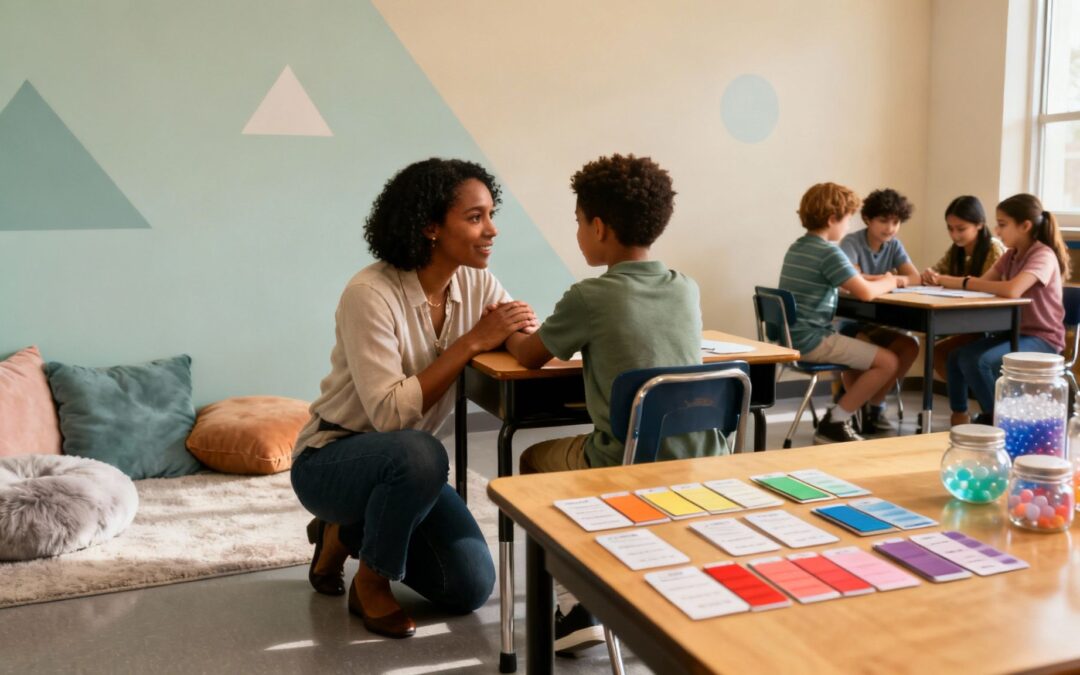
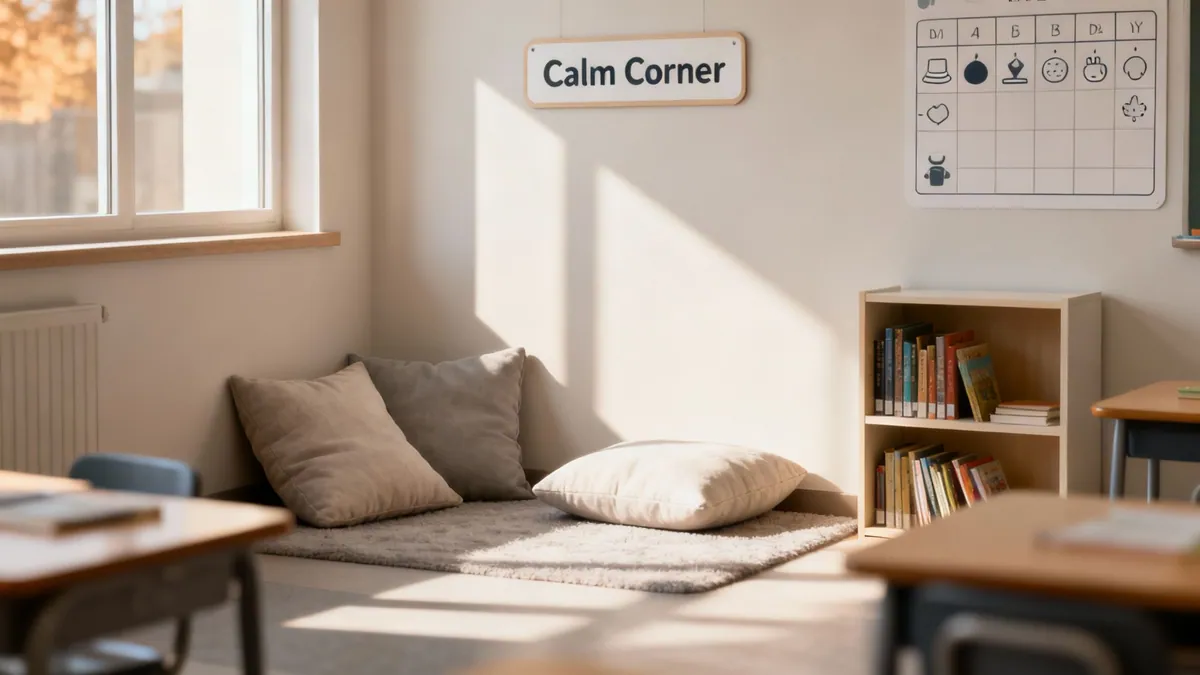
Create Safe Spaces: Designate a “calm-down corner” or “cozy corner” with comfortable seating, sensory tools, and books. Teach students how to use this space to self-regulate, framing it as a tool for everyone. For instance, you could say, “If you feel your engine running too fast, you can take a 5-minute break in the cozy corner to help your body feel calm.” For more ideas, explore these detailed steps on how to create a safe space for students.
Co-Create Classroom Agreements: At the beginning of the year, work with students to establish shared expectations. Instead of a rule like “No shouting,” an agreement might be, “We use calm voices to show respect for our friends’ ears.” Phrase them positively and have all students sign the poster.
Practice Welcoming Rituals: Greet every student at the door by name each morning with a choice of a handshake, high-five, or wave. This simple, consistent act of connection reinforces that each child is seen and valued from the moment they arrive.
This approach is most effective when implemented universally from the first day of school, as it sets the tone for the entire year. It is particularly vital during times of change, such as after a school break or a disruptive event, to re-establish a sense of stability and security.
2. Self-Regulation and Co-Regulation Techniques
Self-regulation is the ability to manage emotions and behaviors, a skill that can be significantly underdeveloped in students who have experienced trauma. Co-regulation is the supportive process where a calm, regulated adult helps a child navigate distress and return to a state of balance. By explicitly teaching and modeling these skills, educators provide one of the most essential trauma informed teaching strategies, equipping students with tools to manage their internal states and engage in learning. Instead of just reacting to behavior, this approach addresses the underlying neurological need for safety and calm.
The work of neurobiologists like Dr. Dan Siegel emphasizes how co-regulation helps build neural pathways for independent self-regulation over time. When a teacher remains a calm, validating presence during a student’s meltdown, they are not just managing a moment; they are actively helping to wire the child’s brain for future resilience.
6. Mindfulness and Breathing Techniques
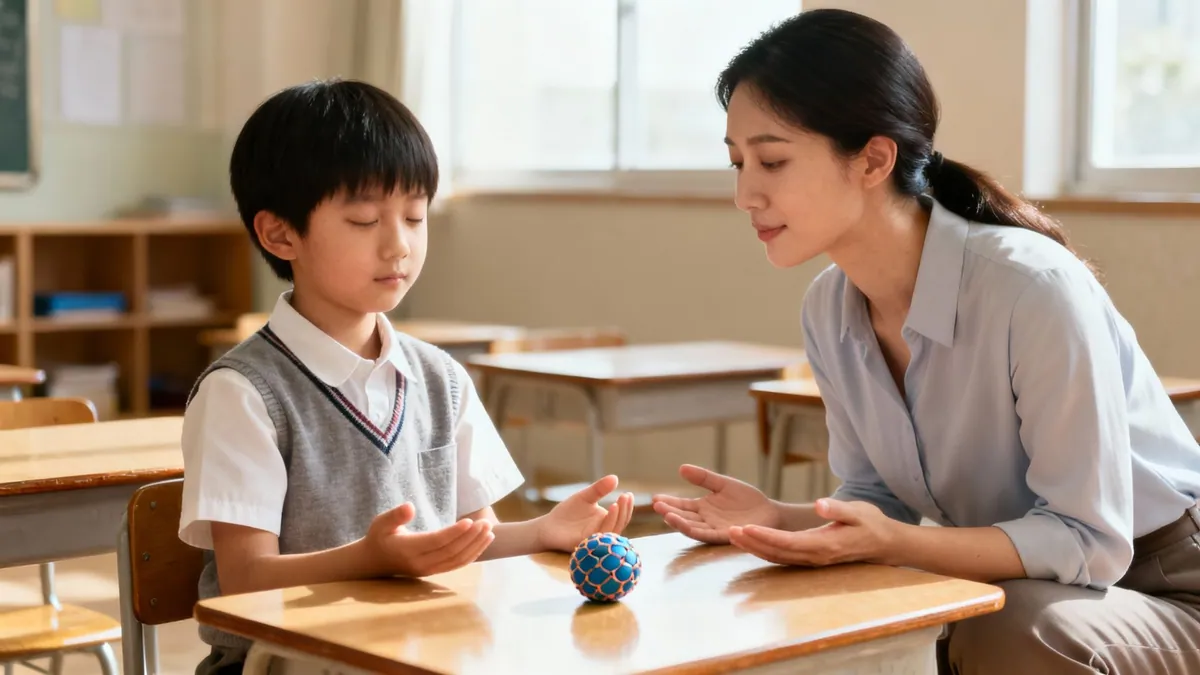
Mindfulness and breathing techniques are fundamental tools that teach children to manage their internal state before, during, and after a conflict. These practices focus on developing self-awareness and self-regulation, allowing students to pause and notice their emotions instead of acting impulsively. By learning simple exercises like belly breathing or box breathing, children gain the ability to calm their nervous systems, which is a critical first step in engaging in productive dialogue and one of the most proactive conflict resolution activities for kids.
This approach empowers students by giving them control over their own emotional responses. When a child feels anger or frustration rising, having a go-to breathing technique provides an immediate, constructive action to take. Research shows that schools implementing mindfulness programs see a significant reduction in behavioral incidents, as children are better equipped to handle stress and approach peer disputes with a clearer, more thoughtful mindset.
How It Works
Objective: To teach children how to self-regulate their emotions, reduce stress responses, and approach conflicts from a place of calm and clarity.
Materials Needed: A quiet space, optional visuals like a pinwheel or a breathing ball.
Best For: Proactively building emotional regulation skills, de-escalating conflicts in the moment, and helping students manage anxiety and stress.
Step-by-Step Directions:
Introduce the Concept: Explain in simple terms that our breath can help our brains and bodies calm down when we feel big emotions like anger or sadness. Use an analogy, like letting the air out of a balloon slowly.
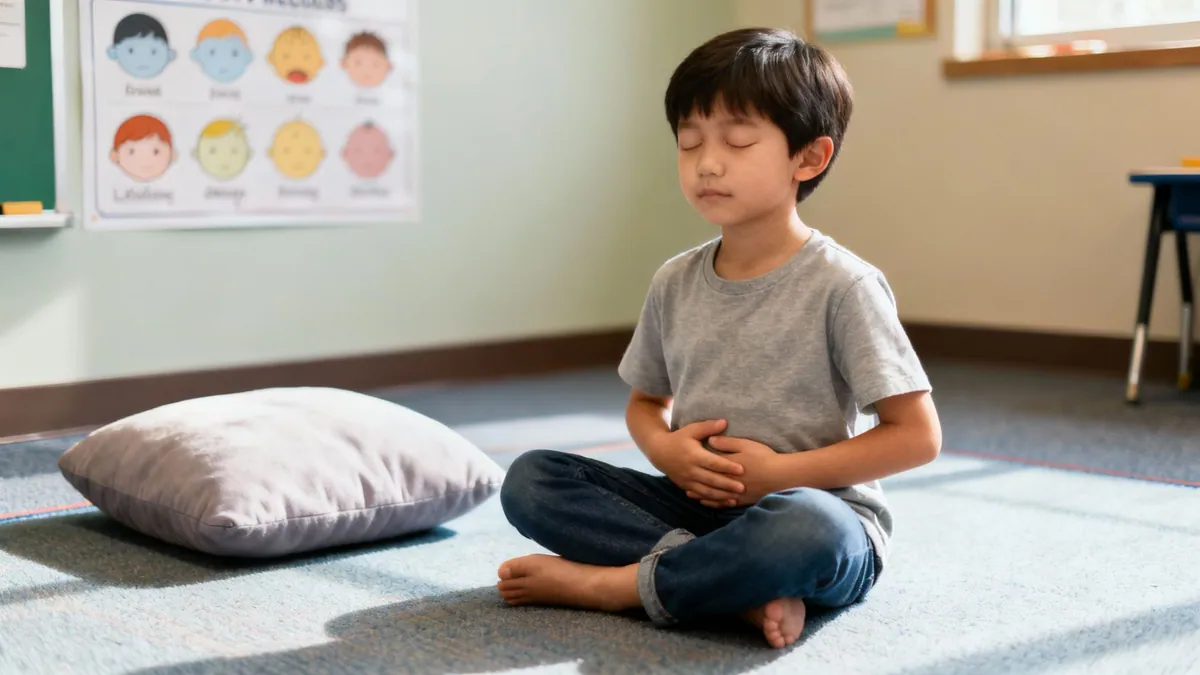
Model a Technique: Demonstrate a simple breathing exercise. For “Belly Breathing,” place a hand on your stomach and take a deep breath in through your nose, feeling your belly expand. Then, breathe out slowly through your mouth, feeling your belly go down.
Practice Together: Guide students through several rounds of the breathing exercise. Use visual cues, like pretending to smell a flower (breathing in) and blow out a candle (breathing out).
Connect to Emotions: Help students identify when to use this tool. Ask, “When might be a good time to use our calm breathing?” (e.g., “When I feel mad at a friend,” or “Before I take a test”).
Create a Calm-Down Corner: Designate a quiet area in the classroom with pillows and visual aids for breathing techniques that students can use independently when they feel overwhelmed.
Integrate into Daily Routines: Practice for 1-3 minutes daily, such as after recess or before a challenging subject, to build the skill as a habit.
Practical Example: Liam gets a math problem wrong and crumples his paper in frustration, ready to yell. His teacher, noticing his clenched fists, quietly says, “Liam, let’s do our box breathing.” She guides him to breathe in for a count of four, hold for four, breathe out for four, and hold for four, tracing a square in the air with her finger. After two rounds, Liam’s shoulders relax. He is now calm enough to look at his mistake without a major outburst, and the teacher can help him with the problem.
Mindfulness is not just about sitting still; it’s about building awareness. Programs like Mindful Schools have shown incredible success in K-8 settings by giving students practical tools for emotional management. To explore more ways to integrate these practices, you can find a variety of age-appropriate mindfulness activities for kids that support social-emotional learning and conflict resolution.
7. Nonviolent Communication (NVC) and Compassionate Listening
Nonviolent Communication (NVC), often called Compassionate Communication, is a framework that helps children express themselves honestly without blame or criticism. It focuses on four core components: observations, feelings, needs, and requests. This approach guides students to listen for the underlying needs in others’ words, making it a transformative tool among conflict resolution activities for kids that builds deep empathy and connection.
Instead of reacting with judgment, children learn to say, “When I see/hear [observation], I feel [feeling] because I need [need]. Would you be willing to [request]?” This structure moves conversations away from right-and-wrong thinking and toward mutual understanding. By teaching kids to identify their own feelings and needs, NVC empowers them to solve problems collaboratively, reducing defensiveness and fostering a culture of care.
How It Works
Objective: To teach children to communicate their feelings and needs without blame and to listen with empathy to the feelings and needs of others.
Materials Needed: Visual aids like posters or flashcards showing the four NVC steps, a list of “feelings” and “needs” words.
Best For: De-escalating interpersonal conflicts, teaching self-advocacy skills, building emotional vocabulary, and fostering a collaborative classroom environment.
Step-by-Step Directions:
Introduce the Four Steps: Explain the NVC model: Observations (what you saw/heard), Feelings (the emotion it triggered), Needs (the universal need behind the feeling), and Requests (a specific, positive action).
Build Vocabulary: Create and display lists of “Feelings Words” (e.g., sad, frustrated, joyful) and “Needs Words” (e.g., respect, safety, to be included).
Practice with Scenarios: Use role-playing or puppets to practice the NVC formula. For example, a student might practice saying, “When you took the ball without asking, I felt frustrated because I need to be respected. Would you be willing to ask me next time?”
Practice “Guessing” Needs: When a child is upset, model compassionate listening by guessing their feelings and needs. “Are you feeling angry because you need more playtime?”
Model the Language: Consistently use NVC language in your own interactions with students and other adults to make it a natural part of the environment.
Celebrate Efforts: Acknowledge and praise students when you see them attempting to use NVC to express themselves or understand a peer.
Practical Example: Instead of yelling, “You always leave me out!” a child learns to use NVC. She approaches her friend and says, “When I saw you and the others playing a new game at recess and I wasn’t invited [observation], I felt sad [feeling] because I need to feel included by my friends [need]. Would you be willing to ask me to play next time you start a new game [request]?” This gives the friend concrete information to work with, rather than just an accusation.
The NVC framework, developed by Marshall B. Rosenberg, has been successfully integrated into schools and restorative justice programs worldwide. Schools using NVC report significant improvements in peer relationships and a more collaborative classroom culture. For more resources and training materials, you can explore the Center for Nonviolent Communication.
8. Empathy-Building Activities and Perspective-Taking Exercises
Empathy-Building Activities are designed to help children understand and share the feelings of others by actively engaging in perspective-taking. Through exercises like analyzing stories, role-playing scenarios, or creating “empathy maps,” students learn to look beyond their own viewpoint. This approach is fundamental to conflict resolution, as it shifts a child’s focus from “who is right” to “how does the other person feel,” making it an essential set of conflict resolution activities for kids.
By practicing empathy, children build the cognitive and emotional skills needed to recognize emotions, appreciate diverse experiences, and connect with their peers. This proactive approach doesn’t just resolve conflicts; it prevents them from escalating by fostering a culture of compassion and mutual respect. Research consistently shows that anti-bullying programs incorporating empathy activities can reduce bullying incidents by 25-35%, demonstrating its powerful impact on school climate.
How It Works
Objective: To develop the ability to understand and share the feelings of another person, fostering compassion and improving social interactions.
Materials Needed: Storybooks with diverse characters, pictures or videos depicting emotions, chart paper, and markers for empathy maps.
Best For: Proactively building a positive classroom culture, resolving interpersonal disagreements rooted in misunderstanding, and helping students understand the impact of their words and actions.
Step-by-Step Directions:
Select a Scenario: Choose a relatable story, a short video clip, or a real (but anonymized) classroom situation. For example, a story about a new student feeling left out.
Introduce Perspective-Taking: Ask students to imagine they are a specific character in the scenario. Prompt them with questions like, “What is this person thinking?” or “How might their body feel right now?”
Create an Empathy Map: Draw a large head on chart paper divided into four quadrants: Says, Thinks, Feels, and Does. As a group, fill in each quadrant from the character’s perspective.
Connect to Personal Experience: Ask students if they have ever felt a similar way. This helps bridge the gap between a fictional character and their own lives.
Brainstorm Empathetic Responses: Guide the group to think about what the character might need from others. Ask, “What could someone say or do to help this person feel better?”
Practice through Role-Play: Have students act out the scenario, first as it happened, and then again using the empathetic responses they just brainstormed.
Practical Example: A teacher reads the book Wonder to the class. After a chapter where the main character, Auggie, is bullied, the teacher creates an empathy map. Students brainstorm what Auggie might be thinking (“Why are they so mean?”), feeling (“Lonely, ashamed, scared”), saying (nothing, or something quiet), and doing (looking at the ground, hiding his face). This exercise helps students who might have laughed at someone different understand the deep emotional impact of their actions.
Empathy is a skill that can be taught and strengthened with intentional practice. Programs like Michele Borba’s The Kindness Curriculum have shown that structured empathy education leads to significant improvements in peer relationships and classroom behavior. To explore more strategies, you can learn how to teach empathy effectively and integrate it into daily interactions.
9. Bully Bystander Intervention Training
Bully Bystander Intervention Training empowers students who witness bullying to become “upstanders” instead of passive onlookers. Research shows that peer intervention can stop over half of bullying incidents within seconds, making this one of the most impactful conflict resolution activities for kids. This approach shifts the culture from one of silent complicity to one of active peer support and collective responsibility for safety.
Instead of just focusing on the bully and the target, this training recognizes that bystanders hold immense power to change the outcome of a conflict. It teaches students safe and effective strategies to de-escelate situations, support a classmate, or get adult help. By equipping the silent majority with concrete tools, schools can build a proactive, prosocial community where bullying is less likely to occur.
How It Works
Objective: To teach students how to safely and effectively intervene in bullying situations, reducing peer-on-peer aggression and fostering a culture of mutual support.
Materials Needed: Scenarios or role-playing scripts, chart paper or a whiteboard for brainstorming strategies.
Best For: Whole-class or school-wide initiatives to proactively address bullying, building peer leadership skills, and creating a safer school climate.
Step-by-Step Directions:
Define Roles: Start by explaining the three roles in a bullying situation: the person doing the bullying, the person being targeted, and the bystander. Emphasize that bystanders have a choice: to do nothing or to become an “upstander.”
Introduce the ‘4 D’s’ of Intervention: Teach students four clear, safe strategies:
Direct: Directly tell the bully to stop (e.g., “Hey, leave them alone. That’s not cool.”).
Distract: Create a diversion to interrupt the situation (e.g., “Come on, the bell’s about to ring,” or “Did you see that game last night?”).
Delegate: Get help from an adult like a teacher, counselor, or principal.
Delay: Check in with the person who was targeted after the incident to offer support.
Role-Play Scenarios: Have students practice using these strategies in guided role-playing scenarios. Provide realistic situations and encourage them to try different approaches.
Discuss Safety: Reinforce that their safety is the top priority. If a situation feels dangerous, the best choice is always to Delegate (get an adult).
Distinguish ‘Tattling’ from ‘Telling’: Clarify the difference: tattling is meant to get someone in trouble, while telling (or reporting) is meant to get someone out of trouble.
Celebrate Upstanders: Create a system to acknowledge and celebrate students who act as upstanders, reinforcing this positive behavior school-wide.
Practical Example: A student, Chloe, sees two popular kids making fun of a classmate’s new haircut. Instead of confronting them directly, which feels scary (Direct), she uses a different strategy. She chooses Distract. She walks over to the targeted student and says loudly, “Hey, Mrs. Davis is looking for you! We need to go practice for the play.” She pulls the student away from the situation. Later, she uses Delay by checking in and saying, “I’m sorry they were mean. I really like your haircut.” She also decides to Delegate by letting her teacher know what happened in private.
10. Positive Behavioral Interventions and Supports (PBIS) with SEL Integration
Positive Behavioral Interventions and Supports (PBIS) is a proactive, school-wide framework designed to teach and promote positive behavior, creating a more supportive learning environment. Instead of just reacting to misbehavior, PBIS focuses on explicitly teaching students the social and emotional skills they need to succeed. When integrated with Social-Emotional Learning (SEL), it becomes one of the most comprehensive systems for improving how students navigate their social world, making it a powerful foundation for conflict resolution activities for kids.
By establishing clear, consistent expectations across the entire school-from the classroom to the playground-PBIS reduces the ambiguity that often leads to conflict. This systematic approach ensures that students understand what is expected of them and are positively reinforced for meeting those expectations. This creates a predictable and safe climate where students are better equipped to handle disagreements constructively, as they have a shared language and set of skills to draw upon.
How It Works
Objective: To create a positive school climate by systematically teaching, modeling, and reinforcing behavioral expectations, thereby preventing conflict before it starts.
Materials Needed: School-wide commitment, visual aids (posters with expectations), a system for positive reinforcement (e.g., tokens, verbal praise), and data tracking tools.
Best For: Establishing a consistent, school-wide culture of respect and responsibility, reducing overall disciplinary incidents, and integrating SEL competencies into daily school life.
Step-by-Step Directions:
Establish Expectations: A leadership team, including students and families, defines 3-5 broad, positively stated behavioral expectations (e.g., “Be Respectful,” “Be Responsible,” “Be Safe”).
Teach Explicitly: Create lesson plans to teach what these expectations look like in different settings (e.g., “Respect in the hallway means using quiet voices”). Use role-playing and direct instruction.
Create a Reinforcement System: Develop a system to acknowledge students when they meet the expectations. This could be verbal praise, a school-wide token economy, or other forms of recognition.
Implement Tiered Interventions: Use school data (like office referrals) to identify students who need more targeted support (Tier 2) or intensive, individualized support (Tier 3).
Integrate SEL and Conflict Resolution: Embed specific conflict resolution skills into the PBIS framework. For example, teach “I-statements” as part of what it means to “Be Respectful.”
Review Data and Adapt: Regularly analyze behavioral data to identify trends and adjust strategies. Celebrate successes to maintain momentum and buy-in from staff and students.
Practical Example: A school’s PBIS theme is “Be a STAR: Safe, Thoughtful, and Respectful.” In the cafeteria, “Respectful” is defined on a poster as “Wait your turn, use kind words, and include others.” A teacher sees a student letting another student cut in line and says, “Thank you for being respectful by including your friend.” Later, when two students argue over a seat, a lunch monitor can point to the poster and ask, “How can we solve this problem in a way that is thoughtful and respectful, like a STAR?”
PBIS is a data-driven framework with extensive evidence of success. The Center on PBIS provides a wealth of resources, research, and implementation guides for schools. For example, districts that combine PBIS with restorative practices have shown some of the strongest improvements in school climate and reductions in disciplinary disparities.
Comparison of 10 Kids Conflict-Resolution Activities
Item
Implementation complexity
Resource requirements
Expected outcomes
Ideal use cases
Key advantages
Restorative Circles
Medium–High (skilled facilitation, time)
Trained facilitators, scheduled circle time, consistent practice
Improved relationships; fewer disciplinary referrals; stronger community
Coherent, data-driven framework; tiered supports and consistency
From Conflict to Connection: Your Next Steps
Teaching conflict resolution is not about creating a world devoid of disagreements; it’s about empowering children with a durable toolkit to navigate them with confidence, empathy, and integrity. Throughout this guide, we’ve explored ten powerful conflict resolution activities for kids, moving from the structured dialogue of Restorative Circles to the internal focus of Mindfulness and Breathing Techniques. Each strategy, whether it’s the peer-led approach of Mediation or the compassionate framework of Nonviolent Communication, offers a unique pathway toward building more peaceful and connected communities.
The common thread weaving through these diverse activities is a fundamental shift in perspective. Instead of viewing conflict as a disruptive problem to be punished or avoided, we can reframe it as a critical opportunity for growth, learning, and deeper understanding. A disagreement over a shared toy is no longer just a moment of friction; it becomes a practical lesson in empathy, negotiation, and self-regulation.
Key Takeaways: Weaving Skills into Daily Life
The true power of these strategies is unlocked through consistent and intentional integration. A one-time role-playing session is helpful, but embedding these skills into the very fabric of the classroom or home environment creates lasting change.
Conflict is a Teachable Moment: Every argument, from a playground dispute to a sibling squabble, is a chance to practice the skills you’re teaching. Use these moments to guide children through identifying their feelings, using “I” statements, and actively listening to another’s perspective.
Consistency is Crucial: A school that combines a PBIS framework with daily Emotion Coaching and weekly Restorative Circles builds a multi-layered support system. At home, pairing mindfulness exercises with regular check-in conversations reinforces the message that emotional health is a family priority.
Modeling is Everything: Adults are the primary role models. When a teacher or parent demonstrates calm, active listening, and a willingness to see another’s point of view during their own conflicts, they provide the most powerful lesson of all. Children learn more from what we do than from what we say.
Your Actionable Next Steps
Transforming theory into practice can feel daunting, but progress begins with small, deliberate steps. Choose one or two activities from this list that resonate most with your specific needs and start there.
Start Small with a “Skill of the Week”: Dedicate one week to practicing a specific skill. For instance, focus on “Active Listening.” Model it in conversations, praise students when they demonstrate it, and use a simple debrief question at the end of the day: “When did you feel truly heard today?”
Create a “Peace Corner” or “Calm-Down Spot”: Designate a physical space in the classroom or home where a child can go to self-regulate. Stock it with tools discussed in this article, like breathing exercise cards, feeling wheels, or a journal for reflection. This normalizes the act of taking space to manage big emotions.
Integrate Language into Daily Routines: Make the vocabulary of conflict resolution part of your everyday language. Instead of saying, “Stop fighting,” try, “It looks like you two have a problem. How can you solve it together?” or “Let’s use our ‘I feel’ statements to explain what’s happening.”
By intentionally implementing these conflict resolution activities for kids, you are not just managing behavior; you are cultivating essential life skills. You are building a foundation for healthier relationships, stronger communities, and more resilient, empathetic, and emotionally intelligent individuals who can turn moments of conflict into opportunities for profound connection.
Ready to bring these powerful strategies to your entire school community with expert guidance? Soul Shoppe specializes in creating safe, empathetic, and connected school environments through interactive programs and professional development that make social-emotional learning and conflict resolution come alive. Explore Soul Shoppe to see how our proven, hands-on approach can help you build a more peaceful and supportive culture for every student.
In today’s elementary schools, the need for robust social-emotional learning (SEL) has never been more apparent. Moving beyond a simple classroom management tool, effective SEL is foundational to building a thriving school culture where students feel safe, understood, and equipped to succeed. It directly impacts academic achievement, reduces behavioral issues, and provides children with essential life skills like self-awareness, empathy, and responsible decision-making. The core challenge for principals, counselors, and district leaders is navigating the crowded market of sel programs for elementary schools to find one that genuinely aligns with their community’s unique needs, budget, and implementation capacity.
This guide is designed to solve that exact problem. We will provide a clear, comprehensive roundup of seven leading programs, moving beyond marketing claims to offer actionable insights. For each program, you’ll find a concise profile, key features, and practical examples that teachers and parents can use to support students. We’ll explore how one program might use a puppet to teach conflict resolution in kindergarten, while another might use digital scenarios to help fifth graders practice responsible social media use. While fostering this environment primarily involves robust programming, schools also often utilize complementary tools to build community, such as exploring strategic uses of promotional products for schools to reinforce core values.
Our goal is to equip you with the specific information needed to make a confident and informed decision for your students. To help you compare options as you read, we’ve organized the key data for each program into a scannable comparison matrix at the end of the article. Let’s dive in.
1. Soul Shoppe
Soul Shoppe stands out as a comprehensive and deeply experienced partner for schools seeking to build a resilient, empathetic, and communicative campus culture. With over two decades of dedicated work in K-8 schools, this organization offers one of the most robust and flexible sel programs for elementary schools, combining research-backed curriculum with dynamic, experiential learning. Their approach moves beyond simple lesson plans, focusing on creating a shared language and practical tools that students, staff, and families can use to navigate complex social and emotional landscapes.
The core of Soul Shoppe’s methodology is its focus on whole-community transformation. They understand that for SEL to be effective, it must be integrated into every aspect of the school day. This is achieved through a multi-faceted delivery model that includes interactive student workshops, powerful school-wide assemblies, and ongoing professional development and coaching for educators. This ensures that the principles of self-regulation, conflict resolution, and empathy are not just taught, but consistently modeled and reinforced by all adults in the community.
Key Features and Practical Applications
Soul Shoppe excels in translating SEL theory into actionable, everyday skills. Their programs are designed to be immediately applicable, equipping students with tools to handle real-world challenges.
Experiential Learning: Instead of passive instruction, students engage in role-playing and interactive activities. For example, in a workshop on conflict resolution, students might practice using “I-statements” to express their feelings during a simulated disagreement over a playground game, learning to say, “I feel frustrated when I don’t get a turn,” instead of, “You’re hogging the ball!”
Flexible Delivery Formats: Schools can choose the level of engagement that fits their needs and budget, from a single, high-impact assembly to kick off an anti-bullying campaign, to a year-long, embedded coaching program for teachers. They also offer a digital app and online courses, making SEL accessible for at-home reinforcement.
Whole-Community Focus: Soul Shoppe provides resources for parents and hosts community-building events like the Peaceful Warriors Summit. This extends the learning beyond the classroom, creating a cohesive support system for children. For instance, parents might receive a newsletter with conversation starters about empathy, such as asking, “How do you think your friend felt when you shared your snack today?” mirroring the language their child is learning in school.
Strong Credibility: The organization’s impact is backed by a 20+ year track record and recognized thought leadership, including a TEDx talk by founder Vicki Abadesco and partnerships with respected initiatives like the Junior Giants. You can explore more ideas on their blog, which details a variety of social-emotional learning activities for elementary students.
Implementation Insight: For a school just beginning its SEL journey, a great starting point with Soul Shoppe is their “Peacemaker Program” assembly. This single event can introduce core concepts and a common vocabulary school-wide, creating immediate momentum and buy-in from both students and staff for deeper programming later.
Program Details and Considerations
Category
Details
Grade Band
Kindergarten–8th Grade
Delivery Format
On-site (assemblies, workshops, coaching), Digital (app, online courses), Hybrid models
Cost Range
Customized pricing. Schools and districts must contact Soul Shoppe for a quote based on specific needs, number of students, and delivery format.
Evidence Level
Research-based and evidence-informed. Backed by over 20 years of implementation data and positive school climate outcomes.
Pros:
Proven, research-based curriculum with a long history of success.
Highly flexible delivery options cater to diverse school needs and budgets.
Focuses on building psychological safety and empathy for the entire school community.
Exceptional credibility through founder expertise and high-profile partnerships.
Cons:
Pricing is not publicly listed, requiring direct contact for a quote, which can slow down initial budget planning.
Primarily designed for K-8, so high schools may need to seek more age-specific resources.
Soul Shoppe is an excellent choice for elementary and middle schools ready to invest in a holistic, relationship-centered SEL partner. Its blend of direct instruction, community engagement, and flexible programming makes it one of the most effective and adaptable sel programs for elementary schools available today.
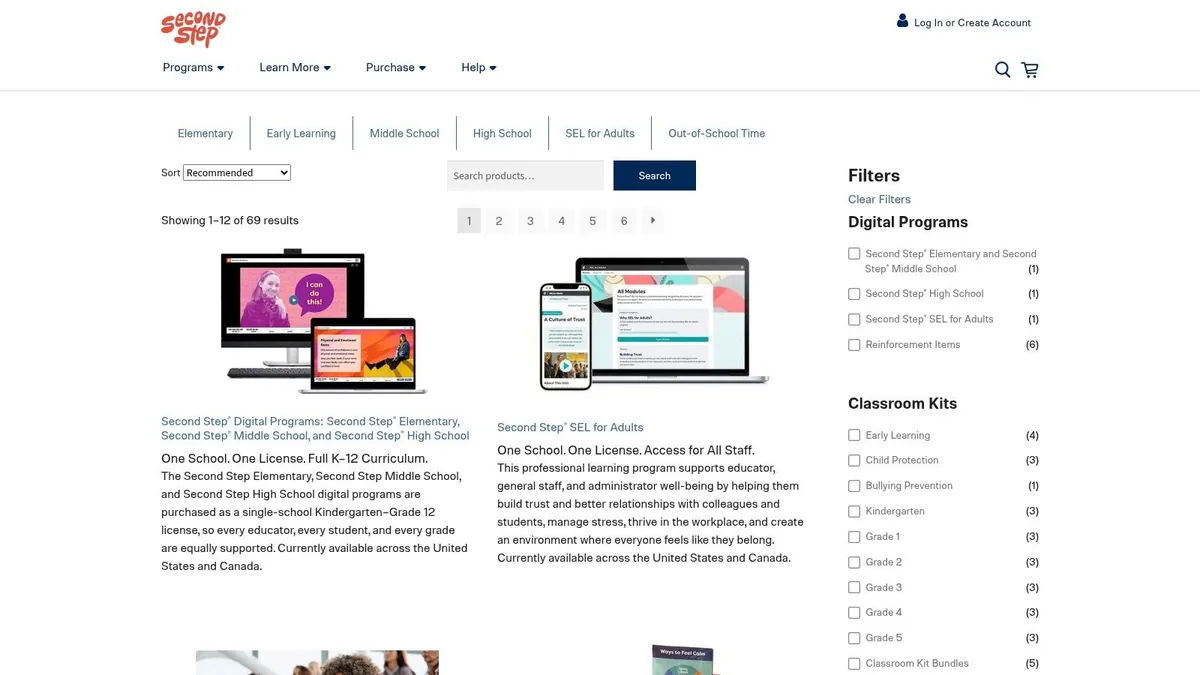
As one of the most widely recognized and research-backed SEL programs for elementary schools, Second Step from the Committee for Children offers a robust, turnkey solution for schools seeking a structured and comprehensive curriculum. The platform is designed for easy implementation, providing educators with everything they need to deliver consistent, high-quality social-emotional instruction right out of the box.
Second Step stands out for its clarity and ease of use. Each lesson is meticulously scripted and supported by engaging songs, puppets (for younger grades), and short video clips that capture student attention. This structured approach ensures fidelity of implementation across classrooms and grade levels, a key factor for achieving school-wide impact.
Key Features and Implementation
The program is organized into grade-specific units that align with core SEL domains. For example, a kindergarten lesson might feature a puppet who is feeling angry. The teacher guides students to help the puppet identify the feeling (“He’s mad!”) and then practice a calming strategy together, like taking “belly breaths.” This directly builds self-awareness and self-management skills.
Delivery Formats: Schools can choose between grade-banded physical classroom kits (Early Learning–Grade 5) or a more flexible digital license (K–8). The digital format includes streaming media, online training, and easier access to materials.
Specialized Units: Beyond the core curriculum, Second Step offers crucial add-on units for Bullying Prevention and Child Protection, allowing schools to address specific safety concerns within the same framework.
Language Support: Recognizing diverse student populations, the program provides Spanish-language resources for students and families from Early Learning through Grade 3.
Practical Tip: Use the provided family communication letters (available in multiple languages) after completing each unit. For instance, after a unit on problem-solving, a parent might get a letter suggesting they ask their child, “What was a problem you solved at school today? What steps did you take?” This reinforces learning by connecting classroom skills to home life.
Program Details
Feature
Description
Grade Band
Early Learning–Grade 8
Format
Physical classroom kits (PK–5) or school/district-wide digital license (K–8)
Cost Range
Kits start around $300-$500 per grade; digital licenses are tiered by enrollment and term (request a quote).
Evidence
Strong (ESSA Level 1). Meets CASEL’s “SELect” program designation.
Best Fit For
Schools and districts looking for a proven, structured, and easy-to-implement program with extensive support resources.
While the upfront cost for a full-school implementation can be significant, the program’s strong evidence base and comprehensive support often provide a clear return on investment. The website allows for single-site purchases of kits, but district leaders should contact the sales team directly for quotes on digital licenses or multi-site discounts to navigate the various product bundles effectively. Understanding the foundational concepts of SEL can also help educators maximize the program’s impact; you can explore the five core SEL competencies to deepen your team’s knowledge.
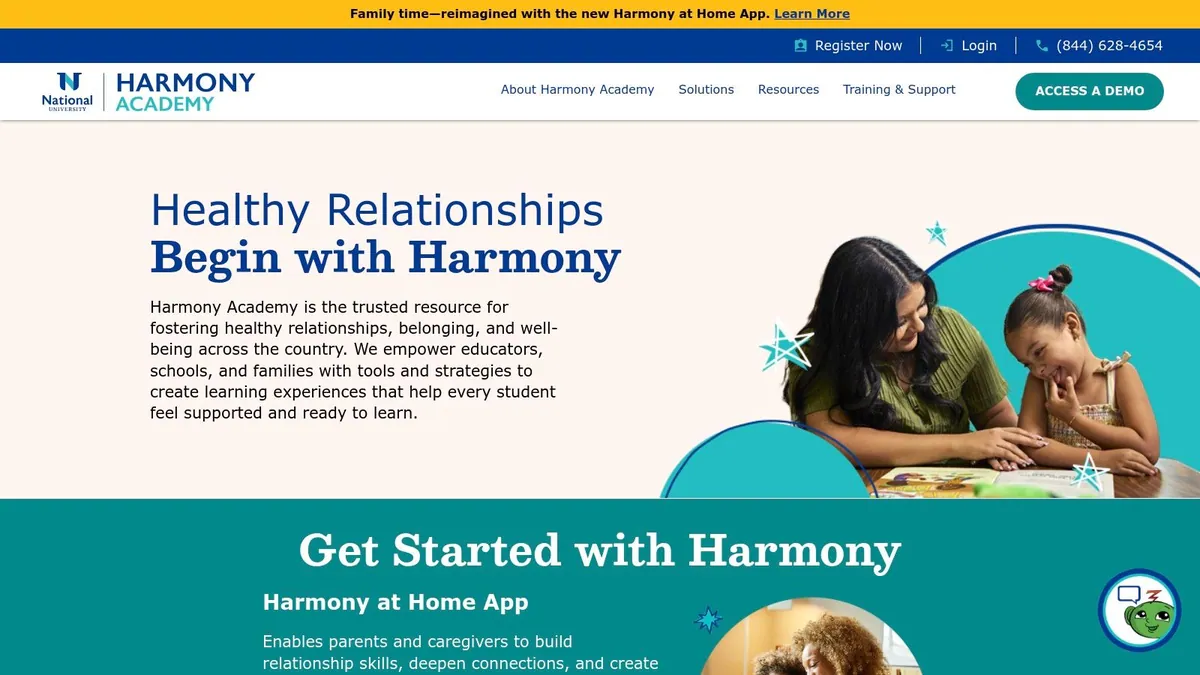
3. Harmony Academy (National University) – Harmony SEL
Harmony SEL, offered through National University’s Harmony Academy, presents an incredibly accessible and relationship-focused approach to social-emotional learning. What makes this program a standout choice is its no-cost digital curriculum, removing the significant financial barrier that can prevent schools from adopting high-quality SEL programs for elementary schools. It is designed to foster positive peer relationships and build an inclusive classroom environment from the very start.
The program’s core philosophy centers on connection and communication, using specific routines and activities to build community. Rather than just teaching concepts, Harmony SEL integrates practices like “Meet Up” and “Buddy Up,” which are daily and weekly routines where students engage in structured, collaborative conversations and activities. This emphasis on peer-to-peer interaction makes the learning practical and immediately applicable.
Key Features and Implementation
Harmony’s lessons are built around five key themes: Diversity and Inclusion, Empathy and Critical Thinking, Communication, Problem Solving, and Peer Relationships. For example, a “Buddy Up” activity might pair students to discuss a story where a character feels misunderstood. They would use provided question cards like, “How could the other character have listened better?” to practice active listening and perspective-taking, directly building empathy and communication skills.
Delivery Formats: The primary format is a comprehensive, no-cost digital curriculum for Pre-K–6, accessible after a simple online registration. This includes lesson plans, activities, stories, and games.
Professional Development: Harmony Academy offers a wealth of support, including live and on-demand online training sessions and product demos. This ensures educators feel confident implementing the curriculum with fidelity.
University Backing: Being part of National University, the program is grounded in research and benefits from district-facing initiatives and partnerships for schools seeking deeper engagement.
Practical Tip: Fully commit to the “Meet Up” and “Buddy Up” routines. For “Meet Up,” start each day with a greeting and a sharing question like, “What is one thing you are looking forward to today?” This simple, consistent ritual builds community and gives every student a voice, setting a positive tone for learning.
Program Details
Feature
Description
Grade Band
Pre-K–Grade 6
Format
No-cost digital curriculum and online portal. Print materials are also available for purchase.
Cost Range
Free for the core digital Pre-K–6 curriculum and online training. Deeper, customized professional development for districts may have associated costs.
Evidence
Promising (ESSA Level 3). Recognized by CASEL as a “Promising Program.”
Best Fit For
Schools and districts seeking a high-quality, research-informed, no-cost core SEL curriculum, especially those prioritizing community-building and peer relationships.
The low barrier to entry makes Harmony SEL an excellent choice for any school, but particularly for those with limited budgets. The focus on building a strong classroom community is a core strength; you can find more ideas for classroom community-building activities that pair well with Harmony’s philosophy. While the program is free, schools should plan to invest time in the provided training to maximize its impact and understand its relationship-centered approach.
The PATHS (Promoting Alternative Thinking Strategies) Program is a highly respected, evidence-based curriculum recognized as one of the cornerstone SEL programs for elementary schools. It provides a comprehensive, classroom-based model designed to promote emotional literacy, self-control, and positive interpersonal problem-solving skills, all critical components for a healthy school climate.
PATHS stands out for its deep focus on emotional vocabulary and a structured problem-solving framework. The curriculum uses concrete tools like “Feeling Faces” cards and fully scripted lessons that guide teachers through complex topics with clarity and confidence. This structured approach helps ensure that all students receive consistent instruction in core emotional regulation and social skills.
Key Features and Implementation
The program is delivered through grade-specific classroom implementation packages that contain all necessary materials. A typical first-grade lesson might involve introducing a new feeling like “frustrated” using a Feeling Face card. The teacher then reads a story about a character feeling frustrated and guides students to practice the “Control Signals” technique (a three-step process of stopping, taking a long deep breath, and saying the problem) before discussing a solution.
Delivery Formats: The program is primarily sold as physical grade-level classroom implementation packages, which include manuals, posters, feeling cards, and other hands-on materials.
Training Included: Every classroom package now includes access to a self-paced online instructor training module, removing a common barrier to effective implementation. Optional on-site workshops can be purchased for more in-depth, hands-on professional development.
Bilingual Resources: To support diverse classroom communities, the program offers home-connection resources and other materials in both English and Spanish.
Practical Tip: Consistently use the “Problem-Solving Steps” posters during class meetings and even for minor classroom conflicts. When students have a disagreement on the playground, guide them through the steps on the poster: 1. Stop and calm down, 2. Say the problem and how you feel, 3. Set a positive goal, etc. This repetition embeds the framework into their daily interactions.
Program Details
Feature
Description
Grade Band
Preschool–Grade 5
Format
Grade-specific physical classroom kits with included online training; optional on-site professional development available.
Cost Range
Classroom kits are priced per grade, typically ranging from $700-$900. Purchases can be made directly from the website’s e-commerce store.
Evidence
Strong (ESSA Level 1). Meets CASEL’s “SELect” program designation.
Best Fit For
Schools seeking a structured, evidence-based curriculum with tangible, hands-on materials and a strong focus on emotional vocabulary.
While a full-school implementation requires purchasing multiple grade-level packages, the inclusion of online training adds significant value and lowers the initial barrier to entry. The program’s emphasis on explicit instruction makes it an excellent choice for building foundational skills. Educators can enhance this learning by incorporating supplemental emotional intelligence activities for kids to provide even more opportunities for practice.
Learn more at: shop.pathsprogram.com
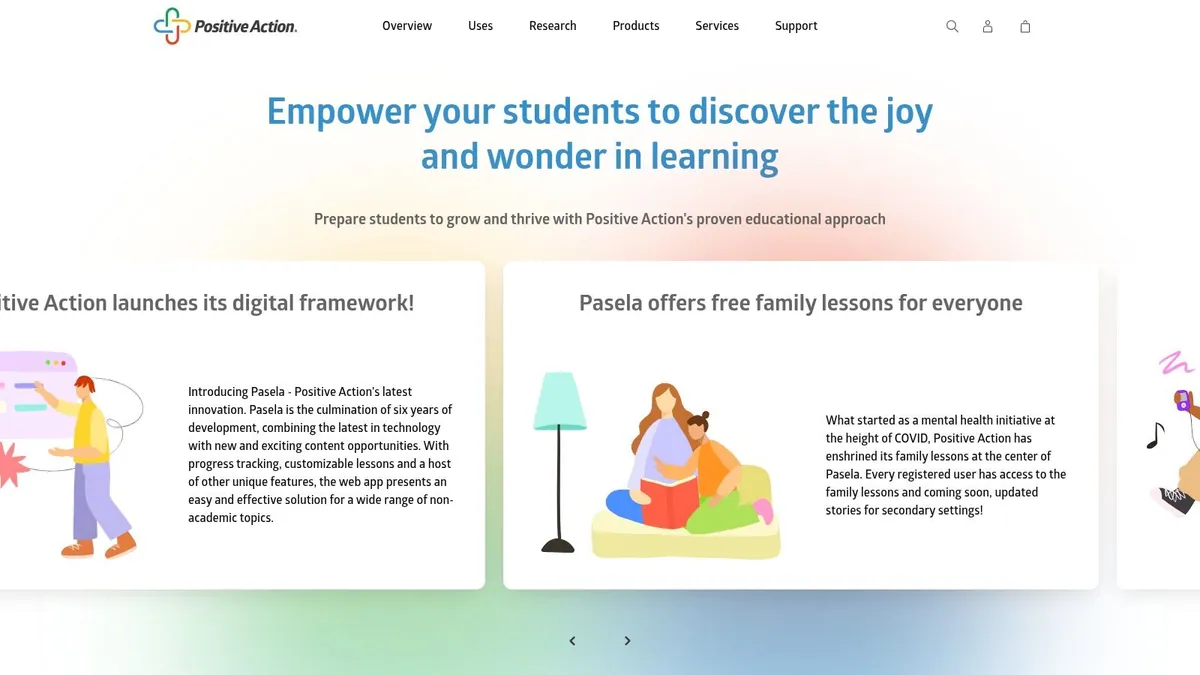
5. Positive Action
Positive Action offers a unique, philosophy-driven approach among SEL programs for elementary schools, framing social-emotional learning through the intuitive concept that positive thoughts lead to positive actions, which in turn lead to positive feelings. This Pre-K through Grade 6 curriculum is delivered via comprehensive, ready-to-use classroom kits, making it a straightforward choice for schools that prefer tangible, hands-on materials for daily instruction.
What sets Positive Action apart is its spiraling curriculum built around six core units: Self-Concept, Positive Actions for Body and Mind, Managing Yourself Responsibly, Treating Others the Way You Like to be Treated, Telling Yourself the Truth, and Improving Yourself Continually. The lessons are brief (around 15 minutes), scripted, and designed for easy integration into the school day, ensuring teachers can consistently reinforce these foundational concepts.
Key Features and Implementation
The program is structured with grade-specific kits that include everything from teacher’s manuals and posters to puppets and activity sheets. For example, a first-grade lesson might involve reading a story from the kit about being a good friend. The teacher then facilitates a discussion about the positive action of sharing, connecting it to the positive feeling of happiness that comes from making a friend feel included. This concrete, action-oriented approach helps young learners internalize complex social skills.
Delivery Formats: The primary format is physical classroom kits (Pre-K–6), available as starter, combo, or refresher packages. Select kits also include access to Pasela, the embedded digital license for supplementary online resources.
Transparent Purchasing: The website is designed for school procurement, with clear, itemized pricing and district-friendly options like purchase order acceptance and multi-address shipping.
Comprehensive Support: Beyond the materials, the program is backed by strong customer support via phone and email, with clear policies for returns and exchanges posted online.
Practical Tip: Use the program’s “reinforcement activities,” like the provided coloring sheets or take-home notes, to create a bridge between school and home. When a student demonstrates a positive action, like helping a classmate clean up a spill, a teacher can send home a pre-made “Positive Action Note” celebrating it. This provides powerful positive reinforcement and keeps parents informed and engaged.
Program Details
Feature
Description
Grade Band
Pre-K–Grade 12 (with a strong focus on elementary Pre-K–6)
Format
Physical classroom kits with hands-on materials. An embedded digital license (Pasela) is included with some kit options.
Cost Range
Kits are priced per grade, starting around $400 for a refresher kit to over $1,200 for a deluxe combo kit. Pricing is transparent on the website.
Evidence
Strong (ESSA Level 1). Listed on the National Registry of Evidence-based Programs and Practices (NREPP).
Best Fit For
Schools and districts seeking a scripted, kit-based program with a strong evidence base and a simple, unifying philosophy that is easy for students and staff to grasp.
While purchasing full K-6 coverage requires buying multiple individual kits, the transparent pricing and clear kit contents on the website simplify the budgeting process for administrators. The structured, 15-minute lessons make it highly adaptable for teachers with packed schedules, ensuring that consistent SEL instruction can happen without significant disruption to core academic time.
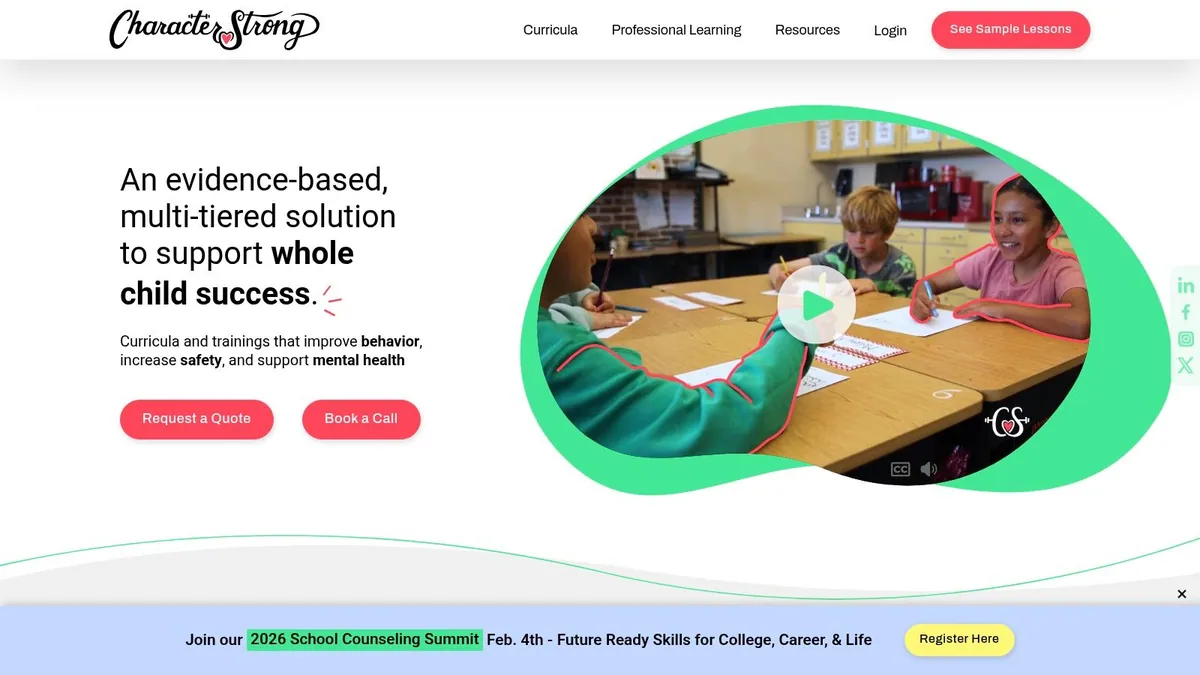
6. CharacterStrong (PurposeFull People for Elementary)
CharacterStrong offers a dynamic and holistic approach to social-emotional learning, integrating character development directly into its framework. Their elementary curriculum, known as PurposeFull People, is designed to build not just SEL competencies but also essential character traits like kindness, respect, and perseverance. This dual focus makes it one of the most comprehensive SEL programs for elementary schools for leaders aiming to cultivate a positive and proactive school culture.
The digital curriculum is built around a clear, vertically aligned scope and sequence from Pre-K to 5th grade, ensuring that skills are scaffolded year after year. CharacterStrong stands out by providing ongoing support, professional development, and continuous product updates, treating implementation as a long-term partnership rather than a one-time purchase. This model supports whole-school adoption and helps sustain the program’s impact over time.
Key Features and Implementation
PurposeFull People delivers daily, bite-sized lessons that are easy for teachers to integrate into their existing routines. For example, a first-grade lesson on courage might involve a short “Courageous Conversation” prompt where students share a time they felt brave, such as trying a new food or speaking in front of the class. This is followed by a brief activity practicing how to support a friend who is feeling scared, such as saying, “You can do it!”
Delivery Format: The curriculum is fully digital and sold via a per-building (site) license, which includes access for all staff, implementation support, and professional development resources.
Tiered Support: The platform includes tools and strategies for both Tier 1 (universal) and Tier 2 (targeted) interventions, helping schools meet the needs of all students.
Whole-Child Focus: Lessons explicitly connect SEL skills (like self-awareness) with character traits (like honesty), providing a more rounded approach to student development.
Practical Tip: Utilize the “Character Dares” included in the curriculum. These are simple, actionable challenges (e.g., “Give a genuine compliment to three different people today”) that encourage students to practice character traits in authentic ways throughout the school day, moving learning beyond the lesson itself.
Program Details
Feature
Description
Grade Band
Pre-K–Grade 5 (with separate curricula for Middle and High School)
Format
Digital curriculum delivered through a school-wide site license.
Cost Range
Pricing is based on school enrollment and requires a custom quote from the sales team. It is not available for single-classroom purchase.
Evidence
Promising (ESSA Level 3). Has an evidence profile available through the Evidence for ESSA clearinghouse.
Best Fit For
Schools and districts committed to a whole-school implementation model that pairs SEL with character development and values ongoing support.
The site-license model makes CharacterStrong less suitable for individual teachers seeking a resource, but it is an excellent fit for school leaders who want to build a unified, campus-wide culture. Because pricing is not publicly listed, administrators should connect with the CharacterStrong team to get a detailed quote and discuss the robust implementation support and professional development included in the package.
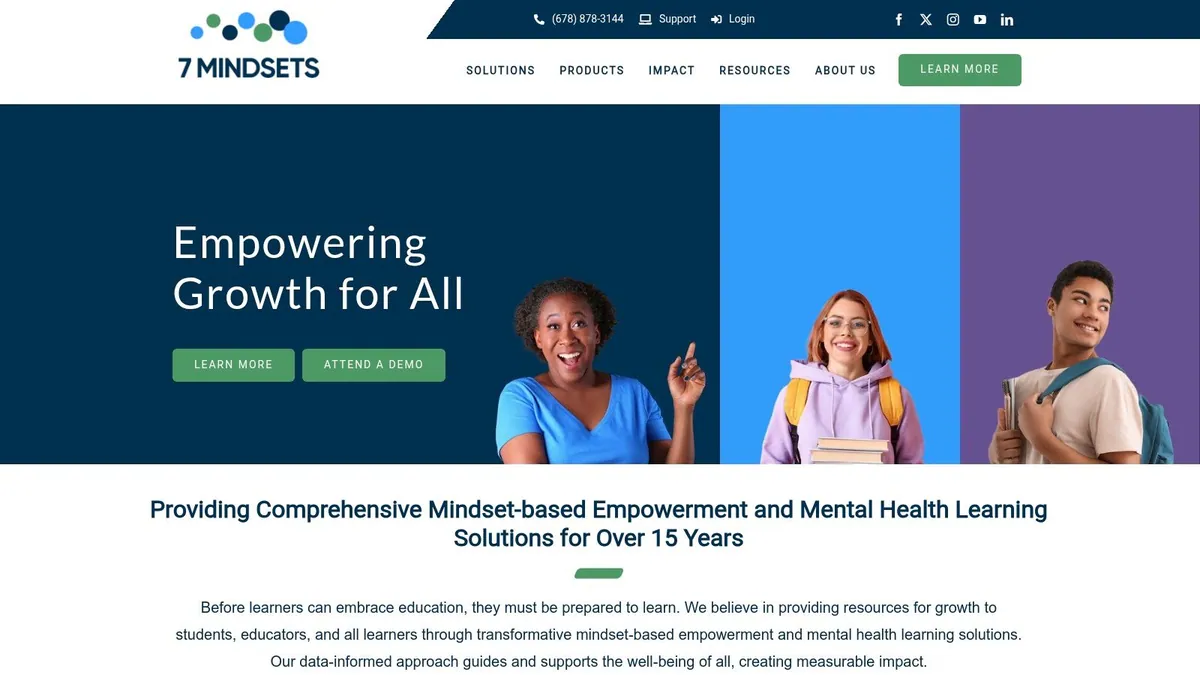
Built on a foundation of mindset-based learning, 7 Mindsets offers a distinct approach to social-emotional development. Unlike programs that focus solely on discrete skills, this platform integrates SEL into a framework of empowering beliefs, making it one of the more unique SEL programs for elementary schools. It is designed as a digital-first, teacher-led curriculum that requires minimal prep time, allowing educators to focus more on delivery and student connection.
7 Mindsets stands out for its cohesive Pre-K to 12th-grade pathway, which provides districts with a vertically aligned SEL language and framework. For elementary schools, the digital portal is packed with engaging, age-appropriate video content, lesson plans, and supplemental activities that are easy to access and implement. The focus is on inspiring students with core principles like “Everything is Possible” and “Live to Give.”
Key Features and Implementation
The program is structured around its seven core mindsets, with each grade level exploring them through targeted lessons. For example, a second-grade lesson on the “100% Accountable” mindset might involve watching a short animated video where a character blames others for a spilled drink. The teacher then leads a discussion about taking responsibility, followed by a role-playing activity where students practice saying, “It was my mistake, and I can help clean it up.” This directly builds self-management and responsible decision-making skills.
Delivery Format: The curriculum is fully digital, with a robust online portal that houses all lessons, videos, activities, and teacher resources.
Minimal Prep Time: Lessons are intentionally designed for quick preparation, often requiring just 10 minutes for a teacher to review before delivery. The platform also includes a large library of supplemental activities for extension.
Data and Progress Monitoring: School and district leaders can use the Leader Dashboard to track implementation fidelity, view usage data, and monitor progress on key SEL competencies.
Practical Tip: Leverage the “Mindset of the Month” school-wide theme. For the “Live to Give” mindset, a school could organize a simple canned food drive or have students make thank-you cards for cafeteria staff. This translates an abstract concept into concrete, community-building actions.
Program Details
Feature
Description
Grade Band
Pre-K–12 (with specific K–5 courses)
Format
Fully digital, web-based curriculum with a comprehensive resource library
Cost Range
Quote-based. Schools and districts must contact the sales team for a live demo and customized pricing based on enrollment.
Evidence
Moderate (ESSA Level 2). Meets CASEL’s “SELect” program designation.
Best Fit For
Districts seeking a vertically aligned K-12 solution and schools that prefer a digital-first, low-prep, mindset-based approach.
While the quote-based pricing requires direct contact, this allows for a tailored implementation plan. The branded language of the “seven mindsets” may require some initial professional development to align with a district’s existing SEL vocabulary. However, for schools ready to embrace a positive, asset-based framework, 7 Mindsets provides a comprehensive and engaging digital solution that supports both students and educators.
Integrated SEL and character education across grades Pre-K–6
Districts requiring clear pricing and procurement-friendly ordering
Transparent, itemized pricing and district-friendly purchasing options
CharacterStrong (PurposeFull People)
Moderate — site licensing for whole-school digital curriculum
Per-building license, PD and implementation supports; pricing by quote
Grade-aligned SEL plus character traits, supports Tier 1/2 implementation
Schools/districts planning whole-school adoption with ongoing updates
Evidence profile (Evidence for ESSA), continuous product improvements, site licensing model
7 Mindsets
Low–Moderate — teacher-led digital lessons with minimal prep
Digital curriculum license (quote), leader dashboard and assessment tools
Mindset-focused SEL growth, measurable progress and K–12 pathway
Districts wanting low-prep lessons, data monitoring and K–12 alignment
Short teacher prep, large content library, progress monitoring/dashboard tools
Making Your Choice: Next Steps for a More Connected Campus
Navigating the landscape of SEL programs for elementary schools can feel overwhelming, but the journey to find the right fit is a critical investment in your students’ futures. We’ve explored a range of powerful options, from the experiential, peer-led model of Soul Shoppe to the structured, research-backed curricula of Second Step and the PATHS Program. We’ve seen how programs like Harmony SEL foster peer relationships, while Positive Action and CharacterStrong integrate character development into daily academics. Finally, 7 Mindsets offers a unique approach focused on shifting student perspectives toward resilience and success.
The most important takeaway is this: the “best” program doesn’t exist in a vacuum. The most effective SEL initiative is the one that seamlessly aligns with your school’s unique culture, student demographics, staff capacity, and community values. A curriculum is just a tool; real change happens when that tool is wielded with intention by a committed and well-supported team. True social-emotional learning transcends lesson plans and becomes woven into the very fabric of your school’s environment, visible in every hallway interaction, classroom discussion, and playground resolution.
Your Action Plan for Selecting an SEL Program
Choosing a program requires a thoughtful, collaborative process. Rushing this decision can lead to poor adoption and wasted resources. Instead, treat it as a strategic initiative. Here is a step-by-step guide to help your team move forward with clarity and confidence.
Assemble a Diverse SEL Committee: Your first step is to gather a team that represents your entire school community. This should include administrators, classroom teachers from various grade levels, school counselors, support staff (like paraprofessionals or cafeteria monitors), and, crucially, parents. This diversity ensures that the chosen program will address needs from multiple perspectives and gain widespread buy-in.
Define Your “Why” and Identify Core Needs: Before looking at any specific curriculum, your committee must clarify your school’s goals. Are you primarily focused on reducing disciplinary incidents and bullying? Do you need to improve classroom management and on-task behavior? Or is your goal to build a more profound sense of belonging and empathy among students?
Practical Example: A school might find that post-recess conflicts are their biggest challenge. Their “why” becomes “to equip students with the skills to solve minor peer conflicts independently.” This focus immediately helps them evaluate programs based on their conflict-resolution components.
Assess Your School’s Capacity and Resources: Be realistic about what your school can support. This assessment involves several key factors:
Budget: Consider not just the initial purchase price but also ongoing costs for training, materials, and potential renewals.
Time: How much instructional time can you realistically dedicate to SEL each week? Some programs require daily 15-minute lessons, while others are more flexible.
Staffing: Who will lead the implementation? Is it the classroom teacher, the counselor, or a dedicated SEL coordinator? Ensure you have the personnel to support the program effectively.
Training: Evaluate the professional development offered. Does the program provide initial training, ongoing coaching, and resources for new staff members? Strong training is non-negotiable for successful implementation.
Shortlist and Deeply Evaluate Programs: Using your defined needs and capacity assessment, narrow your choices to two or three top contenders from this list or others you discover. Request demos, review sample lessons, and speak with representatives. Ask for references from schools with similar demographics to yours. This is the time to dig into the details and see how each program would look and feel in your classrooms.
Pilot the Program (If Possible): The best way to know if a program works is to try it. Consider running a small-scale pilot with a few volunteer teachers across different grade levels. This allows you to gather direct feedback from staff and students, identify potential implementation challenges, and make a final, evidence-based decision before a full-scale rollout. This step can prevent costly mistakes and ensure your chosen program truly resonates with your school community.
Ultimately, selecting one of the many available SEL programs for elementary schools is the first step on a transformative journey. The real work begins with implementation, creating a culture where every adult in the building models empathy and every child feels seen, heard, and valued. This commitment is what turns a curriculum into a catalyst for a more connected, compassionate, and successful campus.
If you are choosing an SEL program for your school, that is what we do. Our K–6 programs combine in-school workshops and assemblies with practical tools students keep using afterwards. Schools rolling out across every playground usually start with the Peace Path® Bundle for Schools.
Effective classroom management has evolved far beyond simply controlling behavior. Today’s most successful educators recognize that a quiet, compliant classroom isn’t the same as an engaged, thriving one. The true goal is to build a foundation of psychological safety, connection, and belonging where every student feels seen, valued, and ready to learn. This shift is crucial, especially as students navigate complex social and emotional landscapes.
Traditional discipline often focuses on reacting to misbehavior, but the most effective classroom management best practices are proactive, preventative, and rooted in social-emotional learning (SEL). By intentionally teaching skills like self-regulation, empathy, and conflict resolution, we equip students with the tools they need to succeed academically and socially. This comprehensive guide moves beyond theory to provide actionable, research-backed strategies that K-8 teachers, administrators, and parents can implement immediately.
You will find practical, classroom-ready examples and clear implementation steps for a range of powerful techniques. We will cover:
Establishing restorative circles and using de-escalation scripts.
Integrating mindfulness and self-regulation activities.
Building authentic family partnerships that support student well-being.
Implementing trauma-informed and culturally responsive teaching methods.
These strategies create environments where students do not just behave, they flourish. Let’s explore the practical steps you can take to transform your learning space into a supportive, collaborative, and joyful community for the upcoming school year and beyond.
1. Consistent Classroom Routines and Clear Expectations
One of the most foundational classroom management best practices involves creating a highly predictable environment. When students know exactly what to do and how to do it for every part of the school day, from sharpening a pencil to transitioning to lunch, their cognitive load decreases. This predictability frees up mental energy for learning and reduces the anxiety that often fuels disruptive behavior.
Consistent routines and clear expectations are not about rigid control; they are about creating psychological safety. Students feel confident and secure when their environment is logical and consistent. Research supports this, showing classrooms with well-established routines can have up to 50% fewer behavioral referrals.
How to Implement Routines and Expectations
Successful implementation moves beyond simply stating rules. It involves actively teaching procedures as you would any academic subject: with modeling, practice, and reinforcement.
Start Small and Build: Don’t overwhelm students (or yourself) by teaching 20 routines on day one. Focus on the 2-3 most critical procedures first, such as your morning entry routine, how to get the teacher’s attention, and the dismissal process. Once those are mastered, gradually introduce others. For example, a kindergarten teacher might focus only on the routine for hanging up coats and backpacks for the entire first week.
Model, Practice, Role-Play: Use the “I Do, We Do, You Do” model. First, demonstrate the routine yourself. For example, physically walk through the steps of turning in homework. Then, have the class practice it together, perhaps lining up for lunch as a group. Finally, have individual students role-play the procedure, like demonstrating how to ask for help. Repeat this process daily for the first two weeks of school and reteach as needed after breaks or when issues arise.
Create Visual Supports: Words are fleeting, but visuals are constant reminders. Post a daily visual schedule with pictures for younger students. Create anchor charts for multi-step procedures (like “Group Work Expectations”). Place laminated procedure cards at relevant classroom stations, such as a small sign at the pencil sharpener that says, “1. Wait for a quiet time. 2. Sharpen quickly. 3. Return to your seat.”
Classroom-Ready Example: Morning Entry Routine Instead of letting students trickle in with unstructured time, establish a clear three-step entry procedure posted on the door:
Unpack your backpack and hang it on your hook.
Turn in your homework to the red basket.
Begin your morning warm-up work silently.
Practice this sequence every morning, offering specific verbal praise like, “I see Leo has already started his warm-up. Excellent focus!” This small routine prevents morning chaos and sets a productive tone for the entire day.
2. Social-Emotional Learning (SEL) Integration Across Curriculum
Effective classroom management best practices extend beyond behavior charts to address the root causes of student actions. Integrating social-emotional learning (SEL) across the curriculum shifts the focus from managing behavior to developing the whole child. This approach systematically weaves core competencies like self-awareness, relationship skills, and responsible decision-making into daily instruction, giving students the tools to understand and regulate their emotions, collaborate effectively, and solve problems constructively.
Treating SEL as a foundational element, rather than a separate subject, creates a more supportive and empathetic classroom culture. This proactive strategy equips students with essential life skills, which directly translates to improved behavior and academic focus. Research from CASEL shows that schools with strong SEL programs see significant reductions in discipline issues and an average 11-percentile-point gain in academic achievement.
How to Implement SEL Integration
Successful integration means making SEL a visible and consistent part of the school day. It requires explicitly teaching, modeling, and providing opportunities for students to practice these crucial skills in authentic contexts.
Weave into Daily Touchpoints: Start and end the day with intention. Use morning meetings for a “feelings check-in” where students can show a thumbs-up, down, or sideways to indicate how they’re feeling. Use closing circles for reflections, asking, “What was one challenge you faced today, and how did you handle it?”
Model and Narrate: As the teacher, you are the primary model for SEL. Narrate your own process aloud: “I’m feeling a little frustrated that the technology isn’t working, so I am going to take a deep breath before I try again.” This makes emotional regulation strategies visible and normalizes them for students.
Connect to Academic Content: Embed SEL into your existing lessons. When reading a story like The Giving Tree, ask, “How do you think the tree was feeling in this moment? What clues tell us that?” In a history lesson about the Civil Rights Movement, discuss the empathy and responsible decision-making required by leaders like Martin Luther King Jr.
Classroom-Ready Example: The “Pause Button” Introduce a simple self-regulation technique called the “Pause Button.” Teach students that when they feel a big emotion like anger or frustration, they can physically pretend to press a “pause button” on their hand or desk. This action serves as a physical cue to stop, take one deep “belly breath,” and think about a calm choice.
Practice this together when the class is calm. Role-play scenarios where it would be useful, such as disagreeing with a friend or struggling with a math problem. Acknowledge students when you see them using it: “I saw you use your pause button when you were getting frustrated. That was a great choice to help you stay in control.”
3. Mindfulness and Self-Regulation Practices
Effective classroom management is not just about managing behavior; it’s about building students’ capacity to manage themselves. Mindfulness practices teach students to be present and aware of their thoughts, feelings, and bodily sensations without judgment. This awareness is the first step toward self-regulation, allowing students to pause and choose a constructive response rather than reacting impulsively.
This approach is a powerful preventive tool. By regularly practicing mindfulness, students strengthen their executive function skills, reduce stress, and learn to manage difficult emotions before they escalate. Schools that embed these practices often see significant improvements in student behavior and academic focus, as mindfulness is a core component of trauma-informed and healing-centered education.
How to Implement Mindfulness and Self-Regulation
Integrating these practices requires consistency and a gentle, non-judgmental approach. The goal is to equip students with a toolkit of strategies they can use independently throughout their day and their lives. For more in-depth strategies, you can explore a range of self-regulation strategies for students.
Start with Short, Guided Practice: Begin with just 2-3 minutes of guided mindfulness each day, perhaps after recess or before a test. Use a calming signal like a bell or chime to start. Say something like, “Let’s do our mindful minute. Close your eyes if you’re comfortable, and just listen to the sounds outside our classroom for one minute.”
Teach Specific Breathing Techniques: Explicitly teach simple, memorable breathing exercises. For example, introduce “Box Breathing” (breathe in for 4, hold for 4, breathe out for 4, hold for 4) by drawing a square in the air with your finger as you guide them. Create a visual anchor chart so students can reference it when they feel overwhelmed.
Establish a Calm-Down Corner: Designate a small, comfortable space in the classroom where students can go to self-regulate. Stock it with mindfulness tools like a Hoberman sphere (breathing ball), soft pillows, visual aids for breathing techniques, and noise-reducing headphones. Model how to use the space when you are calm, not as a punishment.
Classroom-Ready Example: Mindful Transitions Transitions are often a source of chaos. Instead of rushing from one subject to the next, use them as a moment for a “mindful minute.” Before starting math, ring a chime and say:
Pause: Put your pencils down and place your hands on your desk.
Breathe: Let’s take three deep “Lion Breaths” together (inhale through the nose, exhale audibly through the mouth).
Notice: Silently notice how your body feels. Are you ready for our next activity?
This simple routine takes less than 60 seconds but helps the entire class reset their focus, calm their nervous systems, and prepare for new learning, making it one of the most effective classroom management best practices.
4. Positive Behavior Support Systems (PBIS)
Positive Behavior Support Systems, commonly known as PBIS, shift the focus from punishment to prevention. This proactive, data-driven framework establishes a culture where positive behaviors are explicitly taught, modeled, and reinforced across all school settings. Rather than waiting to react to misbehavior, PBIS creates an environment where students understand the expectations and are motivated to meet them, preventing many issues before they start.
This approach is one of the most effective classroom management best practices because it builds a unified, supportive school-wide culture. Schools implementing PBIS consistently report significant reductions in office discipline referrals, sometimes by as much as 50%, alongside improvements in academic outcomes and student attendance. It fosters a sense of belonging by making the behavioral expectations clear, fair, and positive.
How to Implement a PBIS Framework
Implementing PBIS successfully requires a school-wide commitment to teaching behavior with the same intentionality as academic subjects. It involves a systematic, layered approach that supports all students.
Define Core Expectations: Start by establishing 3-5 broad, positively stated behavioral expectations for the entire school community. Common examples include being Respectful, Responsible, and Safe. These simple terms become the foundation for all behavioral instruction.
Teach and Reteach Explicitly: Dedicate significant time in the first few weeks of school to explicitly teach what these expectations look like in every setting. For example, show a short video of students demonstrating what “Be Responsible” looks like in the cafeteria (throwing away trash) versus the library (returning books to the shelf).
Use a Recognition System: Create a system to acknowledge students who meet the expectations. This could be giving out “Caught Being Good” tickets, putting a marble in a class jar for a collective reward, or simple, specific verbal praise. Aim for a ratio of at least four positive interactions for every one corrective interaction to build momentum and goodwill.
Track and Analyze Data: Systematically collect and review behavior data (like office referrals) at least monthly. A practical example would be a grade-level team noticing from the data that most playground conflicts happen near the swings on Tuesdays and Thursdays, then deciding to add an extra supervisor to that specific zone on those days.
Classroom-Ready Example: Cafeteria Expectations Instead of a long list of “don’t” rules, a PBIS approach uses a simple matrix to teach positive behaviors. For the cafeteria, the expectations might be:
Be Respectful: Use quiet voices and good table manners.
Be Responsible: Clean up your space and push in your chair.
Be Safe: Walk at all times and keep your hands to yourself.
Staff would actively teach these behaviors and then give out “Caught Being Good” tickets to students demonstrating them. A student who cleans up without being asked might receive a ticket and specific praise: “Thank you for being responsible by cleaning your area, Maria!”
5. Trauma-Informed and Culturally Responsive Teaching
Effective classroom management acknowledges the whole child, including their backgrounds, identities, and life experiences. Trauma-informed and culturally responsive teaching are two interconnected approaches that create a foundation of psychological safety and belonging, which is essential for learning and positive behavior. This practice recognizes that behavior is often a form of communication, signaling an unmet need or a response to past or present adversity.
Instead of a compliance-first model, these approaches prioritize connection and understanding. By honoring students’ cultural identities and creating a predictable, supportive environment, teachers can preemptively address the root causes of many behavioral challenges. Research shows that schools integrating these practices see significant reductions in disciplinary referrals and notable gains in student engagement and academic achievement, making them one of the most vital classroom management best practices.
How to Implement Trauma-Informed and Culturally Responsive Practices
Integrating these frameworks means shifting your mindset from “what is wrong with this student?” to “what happened to this student, and what do they need?” This involves intentionally building an environment that promotes healing, validation, and empowerment.
Prioritize Safety and Predictability: Trauma impacts the nervous system, making predictability a critical need. Maintain the consistent routines mentioned earlier. A practical example is giving a 5-minute and 2-minute warning before every transition to avoid surprising students who may have a heightened startle response.
Integrate “Mirrors and Windows”: Ensure your curriculum and classroom library serve as mirrors that reflect your students’ own cultures, and as windows into the experiences of others. For instance, a teacher in a classroom with many students of Mexican heritage should ensure there are books by authors like Pam Muñoz Ryan or Yuyi Morales readily available.
Focus on Co-Regulation: A dysregulated adult cannot regulate a dysregulated child. When a student is escalated, your calm presence is the most effective tool. A practical example is to lower your own voice, get down to their eye level, and say, “I see you are having a really hard time. I am right here with you. Let’s take a breath together.” This models calmness instead of escalating the situation.
Classroom-Ready Example: A “Cool-Down Corner” Instead of a punitive time-out chair, create a voluntary “cool-down corner” or “peace corner.” Equip it with comforting items like a soft blanket, a stress ball, coloring pages, and a feelings chart.
Teach and model its use: “When you feel your anger growing big, you can choose to take a 5-minute break in the peace corner to help your body feel calm again. This is a helpful choice, not a punishment.” This gives students agency and teaches them a crucial self-regulation skill, replacing disruptive outbursts with a constructive coping strategy.
6. Empathy Building and Perspective-Taking Activities
Effective classroom management best practices extend beyond behavior charts to cultivate the core social-emotional skills that prevent conflict. Intentionally teaching students to understand and share the feelings of others builds empathy as a classroom habit. When students can step into a classmate’s shoes, they are less likely to engage in bullying and more inclined to act with kindness, strengthening the entire community.
This approach transforms the classroom from a group of individuals into a connected team. Empathy is not a fixed trait; it’s a skill that can be developed through guided practice. Research from programs like Roots of Empathy shows that a focus on perspective-taking significantly reduces aggression and bullying, creating a safer and more inclusive learning environment where students feel a true sense of belonging.
How to Implement Empathy-Building Activities
Integrating empathy into your daily curriculum requires weaving it into academic content and classroom routines. It involves teaching students to look beyond their own experiences and consider the diverse perspectives around them.
Read Diverse Stories: Use high-quality children’s literature as a springboard for discussion. After reading a book like Wonder by R.J. Palacio, ask specific questions like, “How do you think Auggie felt when Julian made that comment? What could the other students have done to show empathy in that moment?”
Use Think-Pair-Share: Before a whole-group discussion about a conflict, give students a moment to process. Have them first think individually, then pair up with a partner to discuss their ideas, and finally share their combined perspectives with the class. This gives quieter students a safer way to practice sharing their perspective before addressing the whole group.
Connect to Real Conflicts: When minor disagreements arise, frame them as opportunities to practice empathy. For example, if two students are arguing over a book, guide them by saying, “Sam, can you try to use an ‘I feel’ statement? Sarah, your job is to listen and then repeat back what you heard Sam say. Then we will switch.” This structured dialogue builds listening skills.
Classroom-Ready Example: “A Mile in Their Shoes” Scenario After a disagreement on the playground over a game, instead of just assigning a consequence, facilitate a perspective-taking activity. Give each student involved a piece of paper and ask them to write or draw the story of what happened from the other person’s point of view.
Prompt: “Imagine you are [classmate’s name]. What did you see, hear, and feel during the game?”
Share: Have them share their “new” stories with each other in a quiet corner.
Reflect: Ask, “Did hearing their side of the story change how you feel? What can we do differently tomorrow?”
This simple role-reversal exercise builds crucial empathy muscles and helps students resolve their own conflicts constructively, a key component of a well-managed classroom.
7. Collaborative Learning Structures and Cooperative Groups
Effective classroom management isn’t just about preventing negative behavior; it’s about actively fostering positive engagement. Structuring purposeful peer interaction through cooperative learning activities is a powerful strategy that builds both academic skills and social-emotional competencies. When students are taught how to collaborate, they learn to communicate, support peers, and solve problems together, which reduces isolation and increases their sense of belonging.
This approach transforms the classroom from a collection of individuals into a community of learners. Research shows that classrooms using structured cooperative learning can see significant improvements in academic achievement and peer relationships. For educators committed to culturally responsive practices, understanding the profound impact of various forms of trauma, including generational trauma, is crucial, as creating supportive peer networks can be a powerful protective factor for students.
How to Implement Collaborative Structures
Simply putting students into groups is not enough; collaboration is a skill that must be explicitly taught and scaffolded. The goal is to create positive interdependence where students succeed together.
Teach Collaboration Skills First: Before assigning a group task, teach and model key skills. A practical example is to create a “T-Chart” for “Active Listening,” with one column for “Looks Like” (e.g., eyes on speaker, nodding) and another for “Sounds Like” (e.g., “Tell me more,” “I hear you saying…”).
Assign and Rotate Roles: Give each group member a specific job to ensure equitable participation. Roles like Facilitator (keeps the group on task), Timekeeper (monitors the clock), Recorder (writes down ideas), and Reporter (shares with the class) provide structure. Use role cards with descriptions to make the jobs clear.
Use Structured Protocols: Implement established protocols to guide discussions. For the Jigsaw method, you might assign four students in a group each a different paragraph of a text. They then meet with students from other groups who have the same paragraph to become “experts” before returning to their home group to teach what they learned.
Classroom-Ready Example: Structured Turn-and-Talk Instead of an unstructured “turn and talk to your partner,” provide clear scaffolding for a richer discussion:
Pose a Question: “Based on the text, what is the most important reason the character made that choice?”
Assign Roles: Partner A will speak for 1 minute first. Partner B will listen and then ask one clarifying question.
Provide a Sentence Frame: Partner B starts their question with, “What I heard you say was… Am I understanding that correctly?”
Switch Roles: After Partner B asks their question and A responds, they switch roles for the same amount of time.
This simple structure teaches active listening, paraphrasing, and focused conversation, making peer interaction a productive learning tool.