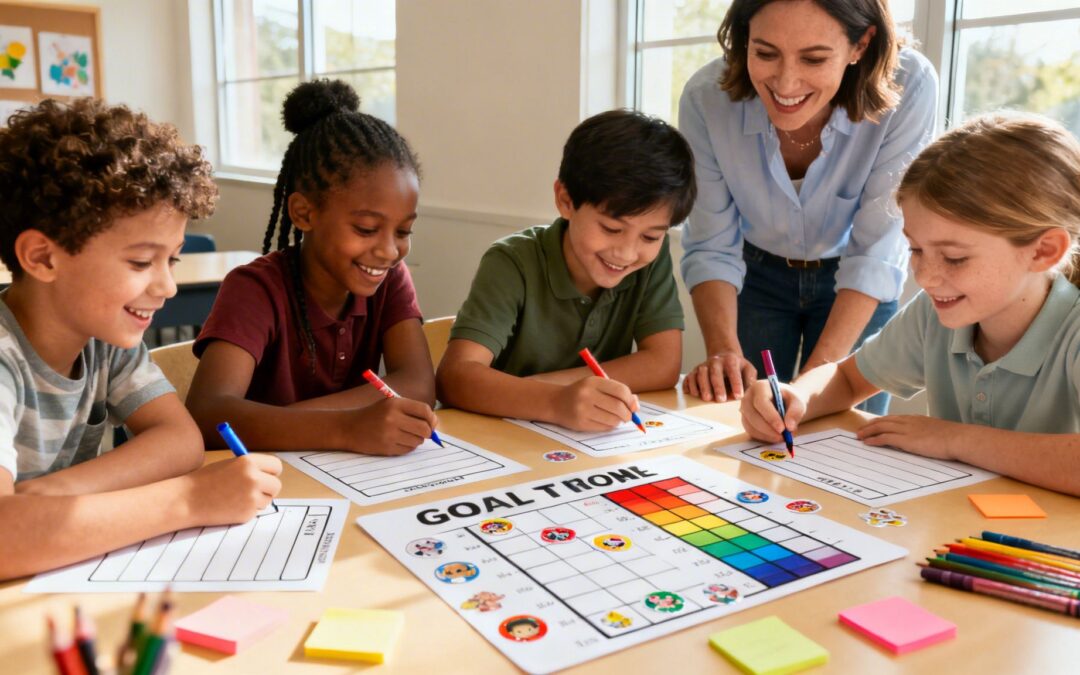
Teaching your child how to set goals is more than just a life skill; it’s a way to give them a sense of purpose and control over their own journey. It’s the simple but powerful process of turning “I wish” into “I can,” one small step at a time.
Why Goal Setting for Kids Is a Game Changer
Think about a student who just goes through the motions, completing assignments without any real spark. Now, imagine that same student’s face lighting up after they set a tiny, personal goal and achieve it. This is the magic of goal setting for kids—it shifts their mindset from passive to proactive.
When children learn to set their own targets, they start seeing the direct link between their effort and the results. This isn’t just about chasing better grades; it’s a core Social-Emotional Learning (SEL) practice that builds real confidence and self-awareness from the inside out.
Building Resilience and Focus
A goal gives a child a clear destination. All of a sudden, classroom tasks aren’t just things they have to do; they’re stepping stones toward something they genuinely want to accomplish.
For a kindergartener, the goal might be as simple as learning to tie their shoes by the end of the month. Every fumbled knot and successful loop has a purpose. A parent could say, “Let’s practice making the ‘bunny ears’ with the laces five times every morning after you put on your shoes.”
For a fifth-grader, it could be tackling a chapter book that’s just a little bit challenging. They learn to break it down, persevere through tricky words, and celebrate finishing the last page. A teacher might help them set a goal like, “I will read one chapter each night and write down one new word I learned.”
This process naturally teaches resilience. Missing a goal isn’t a failure; it becomes a powerful lesson in what to try differently next time. It also strengthens their self-management skills—a cornerstone of both academic success and personal growth. You can explore our guide on https://soulshoppe.org/blog/2026/02/21/what-are-self-management-skills/ for a deeper dive into this crucial area.
Connecting Effort to Achievement
Goal setting takes the vague idea of “working hard” and makes it tangible. It offers a framework where children can see their own actions creating real, measurable outcomes.
Teaching goal setting is about showing children they are the authors of their own progress. When they see a goal through from start to finish, they build a belief in their own ability to make things happen.
The benefits of goal setting for students are clear, but how they manifest can look different depending on the child’s age.
Goal Setting Benefits Across K-8
Here’s a quick look at how goal setting supports students at each developmental stage.
Grade Band
Primary Benefit
Example
K–2
Building Self-Efficacy
“I can do it!” A student feels proud after successfully writing their name with a capital letter, a goal they worked on all week.
3–5
Developing Persistence
“I won’t give up.” A student uses a checklist to finish a multi-step science project, even when parts are tricky.
6–8
Fostering Agency
“I’m in charge of my learning.” A student sets a goal to improve their pre-algebra grade by attending after-school help sessions.
As you can see, the goals evolve, but the underlying skills—confidence, perseverance, and ownership—grow right alongside them.
This skill has a surprisingly significant global impact, too. Studies related to UN Sustainable Development Goal 4 found that children who practice structured goal setting early on have a 20-30% higher rate of on-time primary school completion. This is especially critical in regions where students are at a higher risk of dropping out.
By creating a shared language around goals at home and in the classroom, we build a supportive ecosystem for our kids. We help them turn abstract ambitions into concrete achievements, fostering a sense of agency that will serve them for the rest of their lives. For more on fostering genuine student motivation, check out this fantastic guide: Goal Setting for Kids: How to Build Agency, Not Just Checklists.
Making Goals Click with a Kid-Friendly Framework
Adults love acronyms like SMART goals, but let’s be honest—for a kid, that can feel like doing homework. When it comes to goal setting for kids, the words we use are everything. We need to ditch the corporate jargon and translate it into something that makes sense on the playground.
The idea is to turn a rigid process into an exciting adventure. Instead of getting hung up on formal definitions, we can reframe the core principles into something fun, memorable, and easy for a child to own.
The real aim isn’t just to set a target; it’s to spark a child’s own motivation. When the framework itself is empowering and simple, we give them the keys to drive their own progress.
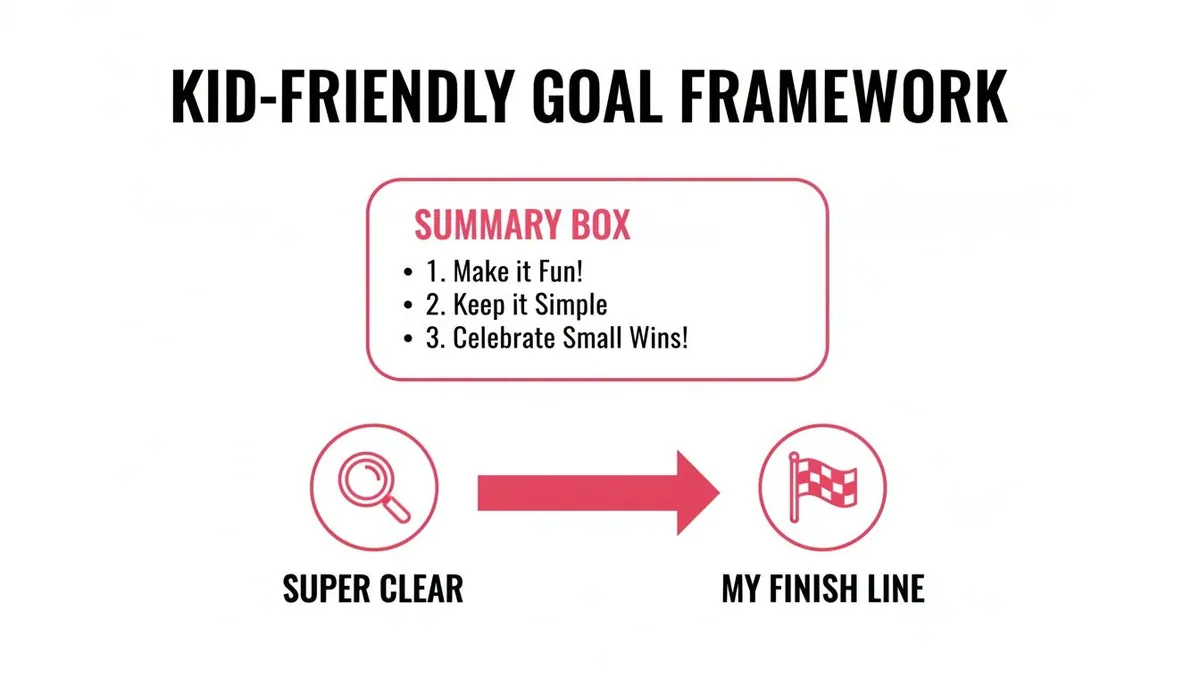
This kid-friendly approach breaks down the same powerful ideas behind effective goal setting into five simple, action-oriented phrases.
Super Clear What I’ll Do
Vague goals like “I want to be better at math” are a recipe for frustration. Why? Because there’s no clear target. A “Super Clear” goal helps a child pinpoint exactly what they will do, turning a fuzzy wish into a concrete action.
This step is all about getting specific. You can guide them with questions like, “What does ‘being better’ look like? What’s one small thing you could do this week to practice?”
Vague Idea: “Be better at math.”
Super Clear Goal: “I will finish my math homework before dinner on Mondays and Wednesdays without asking for help on the first try.”
This clarity gives them a starting line and a defined task, which is far less overwhelming than a huge, undefined ambition.
Easy to See My Progress
A goal needs a way to be measured so kids can see they’re getting somewhere and celebrate those small wins. It’s the difference between “getting good at reading” and “reading five pages of my book every night before bed.” This is how they build momentum.
What if a child wants to be kinder? How can they see their progress? We can help them make it measurable.
Vague Idea: “Be nicer to my friends.”
Super Clear & Measurable Goal: “I will give one real compliment to a classmate during recess each day this week.”
Suddenly, the goal is trackable. At the end of the week, they can count their compliments and feel a genuine sense of accomplishment. Setting measurable social goals like this is incredibly powerful. In fact, schools using research-based SEL programs have seen bullying drop by 28%, in large part because students set and track specific goals around empathy. To learn more about how structured goals support better education, check out the resources from the Joint SDG Fund.
A Challenge I Can Actually Do
Goals should stretch a child, but not so much that they feel defeated before they even start. An achievable goal builds confidence. If a kid has never scored in soccer, a goal of “scoring 10 goals in the next game” is just a setup for disappointment.
A much better approach is to focus on the process.
Unrealistic Goal: “Score 10 goals in the next game.”
Achievable Goal: “I will take five practice shots on the goal every day after school this week.”
This shifts the focus to effort—something that is completely within the child’s control—rather than a final outcome that depends on many different factors.
Something That Matters to Me
This is the secret sauce: the “why” behind the goal. For a child to stick with something hard, it has to connect to what they actually care about. A goal to “practice piano for 30 minutes” will always feel like a chore if it’s just what a parent wants.
Help them find their own reason. Maybe they want to learn the theme song from their favorite video game.
Assigned Goal: “You will practice piano for 30 minutes daily.”
Relevant Goal: “I will practice the first page of the ‘Super Mario’ theme song until I can play it without mistakes, so I can show my friends.”
When the goal truly matters to them, the motivation comes from within.
My Finish Line
Every great quest needs a finish line. A deadline creates a healthy sense of focus and gives everyone a clear moment to celebrate success. Without a “when,” goals can drag on forever and lose steam.
The timeline should make sense for the child’s age—keep it short for younger kids and allow for longer-term goals for older students.
Goal without a Finish Line: “I want to build a cool Lego creation.”
Goal with a Finish Line: “I will finish building my Lego space station by the end of Saturday afternoon.”
This simple addition transforms a casual activity into a real project with a clear end point, teaching kids about focus and planning along the way.
Hands-On Goal Setting Activities for Every Age
Now that we have a kid-friendly framework, it’s time to put it into action. Let’s be real—goal setting for kids only clicks when it moves off the worksheet and into the real world. The right activity makes the whole process feel less like a chore and more like a game they’re excited to win.
The trick is to match the activity to their developmental stage. A kindergartener needs something visual and immediate, while a middle schooler is totally ready to take on a complex, long-term project. Here are some of my favorite hands-on activities that bring goals to life for every age group.
Activities for Early Learners (Grades K-2)
For our youngest students, goals need to be tangible, simple, and—most importantly—fun. At this age, they’re just starting to grasp that their actions can lead to a specific outcome. The focus should always be on short-term goals with super visible progress markers to keep them motivated.
A simple visual can make all the difference. It helps them see the two most important parts: a “Super Clear” start and a “My Finish Line” they can look forward to.
This simple image reminds us that a successful goal for a little one starts with a very specific task and ends with a clear point of completion.
Kindness Quest
This activity turns a social-emotional goal into a playful adventure. It makes abstract concepts like “being kind” totally concrete and helps kids practice those pro-social behaviors in a structured, rewarding way.
How it works:
Create a Quest Board: Grab a piece of construction paper or a small whiteboard. At the top, write down the goal, something like, “My Kindness Quest this week is to share my toys.”
Define the Actions: Brainstorm what “sharing” actually looks like. You might get answers like “let a friend have a turn with the red truck” or “ask someone if they want to build blocks with me.”
Track with Stickers: Every time the child completes a kind action, they get to put a sticker on their Quest Board. Seeing that board fill up is immediate, positive reinforcement!
Discussion Questions:
“How did it feel when you shared your toy with your friend?”
“What did their face look like when you asked them to play?”
Goal Goalposts
This is a fun, sports-themed activity that’s perfect for tracking academic or behavioral goals, like learning sight words or remembering to raise a hand. It uses a familiar and exciting visual to represent progress.
Practical Example: A first-grader’s goal is to learn five new sight words by Friday. You can create two “goalposts” on a wall using painter’s tape. Each day the child practices, they move a paper soccer ball a little closer to the goal. When they can read all five words correctly, they get to “score” by taping the ball right between the posts. That simple action creates a powerful sense of accomplishment.
Activities for Elementary Students (Grades 3-5)
By this age, kids can handle more complex, multi-step goals. They’re starting to understand the connection between consistent effort over time and a bigger achievement down the road. Activities for this group should encourage planning, persistence, and a bit of self-reflection.
At this stage, goal-setting becomes a tool for personal discovery. It’s not just about what they can do, but about who they are becoming—a persistent problem-solver, a helpful community member, or a dedicated artist.
Personal Best Portfolio
This activity is fantastic for skill-based goals where improvement is gradual, like in P.E., art, or writing. It beautifully shifts the focus from competing with others to competing with oneself, which is a core tenet of a growth mindset.
How it works:
Select a Skill: The student picks a skill they want to improve, like dribbling a basketball, drawing a portrait, or writing a story.
Create the Portfolio: Use a simple folder or binder to collect evidence of their progress.
Capture Baselines and Milestones: The first entry is their “starting point”—maybe a video of them dribbling for 30 seconds or their first story draft. As they practice, they add new entries, dating each one.
Practical Example: A fourth-grader wants to improve her jump rope skills. Her goal: “to do 25 consecutive jumps by the end of the month.” Her portfolio starts with a note saying she can currently do seven jumps. Each week, she records her new “personal best.” Seeing the number climb from 7 to 12, then 18, and finally to 26 provides undeniable proof that her practice is paying off. For more ideas, you can find some wonderful social-emotional learning activities for elementary students in this guide.
Helping Hands Challenge
This project-based activity connects personal goals to community impact. It helps students see that their actions can benefit others—a powerful motivator, as research has shown time and again.
How it works: The class or family picks a community-focused goal, like “Collect 50 cans for the local food drive” or “Make 20 thank-you cards for school support staff.” They then break the large goal into smaller, individual tasks. A large paper cutout of a tree on a bulletin board can serve as a tracker; for every milestone reached (like every 5 cans collected), students add a “leaf” with their name on it to the tree.
Activities for Middle Schoolers (Grades 6-8)
Middle schoolers are primed for long-term, passion-driven goals. They’re capable of abstract thinking and complex planning, so our activities should empower them to take full ownership of their ambitions, from the initial idea to the final execution.
Passion Project Blueprint
This activity guides students in turning a personal interest into a significant, long-term project. It’s an amazing way to teach essential life skills like research, planning, time management, and presentation.
How it works:
Identify a Passion: The student chooses something they’re genuinely curious about—learning to code a simple game, starting a podcast, or organizing a charity bake sale.
Create the Blueprint: The student maps out their entire project. This “blueprint” should include the final goal, necessary resources, a step-by-step timeline with mini-deadlines, and a plan for sharing their final product.
Regular Check-ins: The adult’s role shifts to that of a project manager or coach. Hold weekly check-ins to discuss progress, troubleshoot obstacles, and offer encouragement.
Peer Accountability Groups
For academic or study-related goals, working with peers can provide a huge boost of both support and motivation. This activity also teaches collaboration, communication, and mutual responsibility.
Practical Example: A group of three eighth-graders wants to improve their algebra grades before final exams. They form an accountability group and set a shared goal: “We will all complete our homework on time and score a B or higher on the next quiz.” They agree to meet once a week during lunch to review tough concepts and check in on each other’s progress. This structure turns an individual struggle into a shared team mission.
To make it even easier, here’s a quick-reference table with some sample goals tailored for different developmental stages.
Grade-Appropriate Goal Ideas
Grade Band
Academic Goal Example
Social-Emotional Goal Example
K–2
I will learn my 5 new sight words by Friday.
I will share my toys with a friend at recess this week.
3–5
I will read for 20 minutes every night for a month.
I will give a classmate a genuine compliment each day.
6–8
I will raise my science grade from a C to a B by the next report card.
I will join one new club to meet people with similar interests.
Think of these as starting points. The most powerful goals will always be the ones that come directly from the students themselves, reflecting their own unique interests and aspirations.
Connecting Goals to a Growth Mindset
These activities directly support self-regulation and focus, making them an effective way to start the school day. Many teachers find success using guided video resources like GoNoodle for energetic brain breaks or Cosmic Kids Yoga for storytelling-based movement. These tools help students embody the mind-body connection essential to social-emotional learning, teaching them that movement can be a powerful tool for managing feelings and preparing to learn.
How to Implement Mindful Movement
Choose a Few Go-To Activities: Start with two or three simple, repeatable activities. Rotating between familiar options like “Cosmic Kids Yoga,” a specific GoNoodle dance, or a simple stretching sequence helps students engage quickly without needing lengthy instructions. A practical example is a “Weather Report” stretch: reach high for the sun, wiggle fingers for rain, sway side-to-side for the wind.
Model and Connect to Feelings: Participate enthusiastically alongside your students. Use language that connects the physical movement to an emotional or mental state. For example, “As we do our tree pose, feel how strong and steady your body is. This can help us feel strong inside, too.”
Use Consistent Verbal Cues: Simple, predictable phrases create a routine. Cues like, “Breathe in the calm, breathe out the wiggles,” or, “Notice your feet firmly on the ground,” help ground students and reinforce the mindful aspect of the movement.
Offer Differentiated Options: Ensure every student can participate. Provide seated variations for yoga poses or suggest hand and arm movements for students with physical limitations. For example, during a standing stretch, you could say, “If you’re sitting, reach your arms up high from your chair!” The goal is participation and body awareness, not perfect form. When students feel overwhelmed, you can remind them, “Remember how we stretched this morning? Let’s try that now to help our bodies feel calm.”
2nd Grade Morning Work: 8-Activity Comparison
Activity
Implementation complexity
Resource requirements
Expected outcomes
Ideal use cases
Key advantages
Mindfulness & Breathing Check-In Circle
Low–Moderate — needs consistent teacher modeling
Minimal — no materials required; optional apps or visual timer
Weekly rituals, celebrations, reinforcement of positive behavior
Strengthens culture; highlights strengths; easy to implement
Mindful Movement & Brain Break Activities
Low–Moderate — needs space and energy management
Moderate — physical space, videos/music, adaptations for accessibility
Regulation of energy, improved focus, embodied awareness
Transitions, before challenging tasks, for kinesthetic learners
Releases energy while teaching body-awareness; supports attention and regulation
Putting It All Together: Your First Week of Meaningful Morning Work
Moving from a list of ideas to a functional classroom routine is the most critical step. A successful 2nd grade morning work plan isn’t about implementing thirty new activities at once. It’s about building a consistent, sustainable rhythm that sets a positive tone for the day. The SEL-focused activities we’ve explored, from breathing check-ins to gratitude journaling, are powerful tools for creating a classroom where students feel seen, safe, and ready to learn. By prioritizing connection before content, you invest in a more peaceful and productive learning environment for the entire year.
Remember, the goal is progress, not perfection. Start small, stay consistent, and observe how your classroom community begins to shift. Your initial efforts lay the groundwork for a year of deeper engagement and stronger student relationships.
Your Sample SEL-Focused Morning Work Week
To help you get started, here is a practical, sample weekly plan that balances different SEL skills. This structure can be adapted to fit your students’ needs and your own classroom schedule.
Mindful Monday: Begin the week with a calming activity.
Activity:Mindfulness & Breathing Check-In Circle. Lead students in a simple 3-minute box breathing exercise (inhale for 4, hold for 4, exhale for 4, hold for 4). Afterwards, ask students to share one word describing how they feel.
Teamwork Tuesday: Focus on connection and collaboration.
Activity:Partner or Peer Share Activity. Pose a simple, low-stakes question like, “What is one thing you are looking forward to this week?” Give partners two minutes each to share and practice active listening.
Wisdom Wednesday: Dedicate mid-week to problem-solving skills.
Activity:Conflict Resolution & Problem-Solving Role-Play. Present a common scenario: “Two students both want to use the same blue crayon during art.” Brainstorm a few peaceful solutions together as a class.
Thoughtful Thursday: Cultivate gratitude and positive thinking.
Activity:Gratitude & Appreciation Activity. Have students write or draw one thing they are grateful for in their morning work journal. This could be a person, a favorite toy, or a sunny day.
Feelings Friday: End the week with emotional reflection.
Activity:Emotion Recognition & Feelings Check-In. Display a few emotion flashcards (happy, sad, frustrated, excited). Ask students to privately point to the one that best matches their feeling and then draw a picture of that emotion in their journal.
Final Takeaways for Lasting Success
As you build out your 2nd grade morning work routine, keep these core principles in mind. They are the keys to turning a good morning routine into a great one.
Consistency Over Complexity: A simple, predictable routine done every day is far more effective than a complicated one that is difficult to maintain. Students thrive on structure; it helps them feel secure.
Model Everything: Never assume students know how to participate. Model how to breathe deeply, how to listen to a partner, and how to write a gratitude statement. Your vulnerability and participation give them permission to do the same.
Connection is the Goal: The primary purpose of this morning time is not academic rigor, but human connection. By filling your students’ emotional cups first, you make them more available for learning throughout the day. This simple shift in priority can significantly reduce classroom disruptions and boost academic focus.
Ready to bring even more powerful, structured social-emotional learning into your classroom? The activities discussed in this article are foundational to the work we do at Soul Shoppe. Explore our programs at Soul Shoppe to find comprehensive, school-wide solutions that empower students with the tools to build empathy, resolve conflicts, and create a culture of kindness.
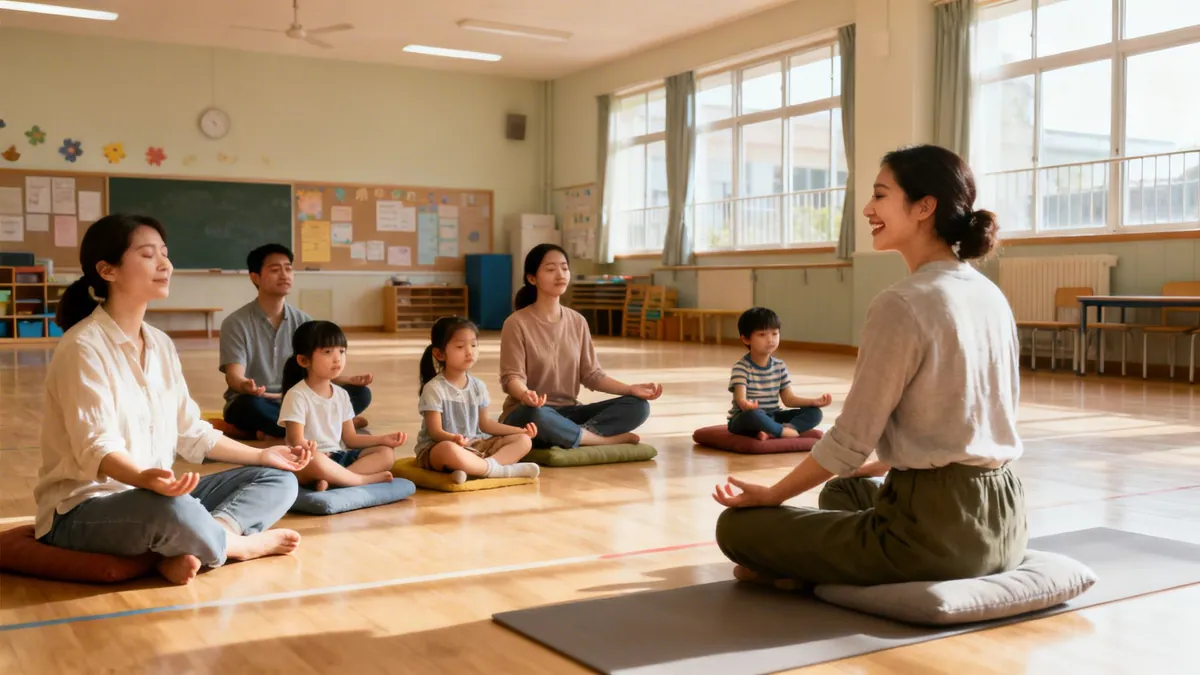
When we talk about teaching mindfulness to children, we’re talking about giving them simple, practical tools to pay attention to the present moment without judgment. This can be as easy as a few focused breaths or a game that hones their sensory awareness. The goal is to help them regulate their emotions, improve focus, and build resilience in a way that just makes sense to them.
Why Teaching Mindfulness to Children Matters Now More Than Ever
Let’s be honest: managing a child’s big emotions, whether in a bustling classroom or a busy home, can be a daily challenge. Kids today are swimming in a sea of constant stimulation, academic pressure, and tricky social situations. This environment is fueling a noticeable rise in https://soulshoppe.org/blog/2022/01/29/stress-in-children/, making it harder for them to focus, connect with others, and simply manage their feelings.
Mindfulness isn’t about forcing kids to sit still and be quiet. It’s about handing them a toolkit for life. It gives them the foundational skills to understand their own inner world, creating that all-important pause between a feeling and a reaction. For example, instead of a child immediately shoving a classmate who takes their toy, mindfulness helps them notice the anger, pause, and maybe use their words instead.
The Research-Backed Benefits in Action
When we introduce mindfulness to children, we’re not just hoping for the best. We’re teaching skills with proven, positive outcomes that go far beyond a few moments of calm. These benefits show up in real, tangible ways in their behavior and learning.
So what does this look like in practice? Here are a few core benefits you can expect to see blossom with a consistent mindfulness routine.
A Quick Look at Mindfulness Benefits for K-8 Students
This table breaks down the research-supported benefits you can expect to see when you bring mindfulness into your students’ lives.
Benefit Area
What It Looks Like in a Child
Impact on Learning
Improved Focus
A child can gently bring their attention back to the lesson, even with distractions around them.
Students absorb new material more easily and stay engaged for longer periods.
Emotional Regulation
Instead of an outburst, a student learns to recognize anger and says, “I need a minute.”
Fewer classroom disruptions and a more positive, supportive atmosphere for everyone.
Increased Empathy
A child understands their own feelings better, so they can recognize and respond to their peers’.
Conflicts on the playground decrease, and students build stronger, kinder relationships.
Reduced Stress
A student uses a breathing technique before a test instead of feeling overwhelmed by anxiety.
Kids feel more confident and capable, which frees up mental energy for academic challenges.
Greater Resilience
A child can bounce back from a mistake or social hiccup with a more balanced perspective.
Students are more willing to take academic risks and persevere through difficult assignments.
Ultimately, by equipping students with these tools, we create psychologically safer environments where they feel seen, heard, and understood. This sense of security is the bedrock of any thriving learning community.
This approach aligns beautifully with the philosophy behind the Montessori method of teaching, which emphasizes child-led learning and fostering curiosity within a prepared environment. Both mindfulness and Montessori empower children by giving them tools for self-direction and deep concentration.
A Growing Movement Supported by Evidence
Mindfulness in schools is far from a fleeting trend. A massive body of research backs up its effectiveness, with systematic reviews showing consistent positive effects on mental health, cognitive skills, and social-emotional growth.
The data also reveals a powerful truth: when educators practice mindfulness themselves, the benefits for students are significantly amplified.
And the support is overwhelming. With global parental support for school-based programs at 93%, there is a clear mandate to weave these essential skills into our educational fabric. By teaching mindfulness, we aren’t just adding another subject to the day. We are investing in their long-term well-being and giving them skills to navigate a complex world with greater awareness, compassion, and resilience.
Age-Appropriate Mindfulness Activities You Can Use Today
The best way to get started with mindfulness is by doing, not just explaining. We want these practices to feel like a natural part of the day, not another chore. Instead of demanding perfect stillness, we can meet kids where they are with playful, sensory activities that match their developmental stage.
The real key is to keep it simple, engaging, and short, especially in the beginning. I’ve found that a one-minute mindful activity done consistently is far more powerful than a long, infrequent session that everyone dreads.
Here are some practical, age-appropriate activities you can try today, complete with scripts and tips I’ve picked up from years in the classroom.
Engaging Early Learners: Grades K-2
For our youngest students, mindfulness needs to be a sensory experience. It should be playful and concrete. Abstract ideas won’t land nearly as well as activities that involve their bodies, their favorite toys, and the world right in front of them. We’re building the most basic awareness skills here.
Buddy Breathing
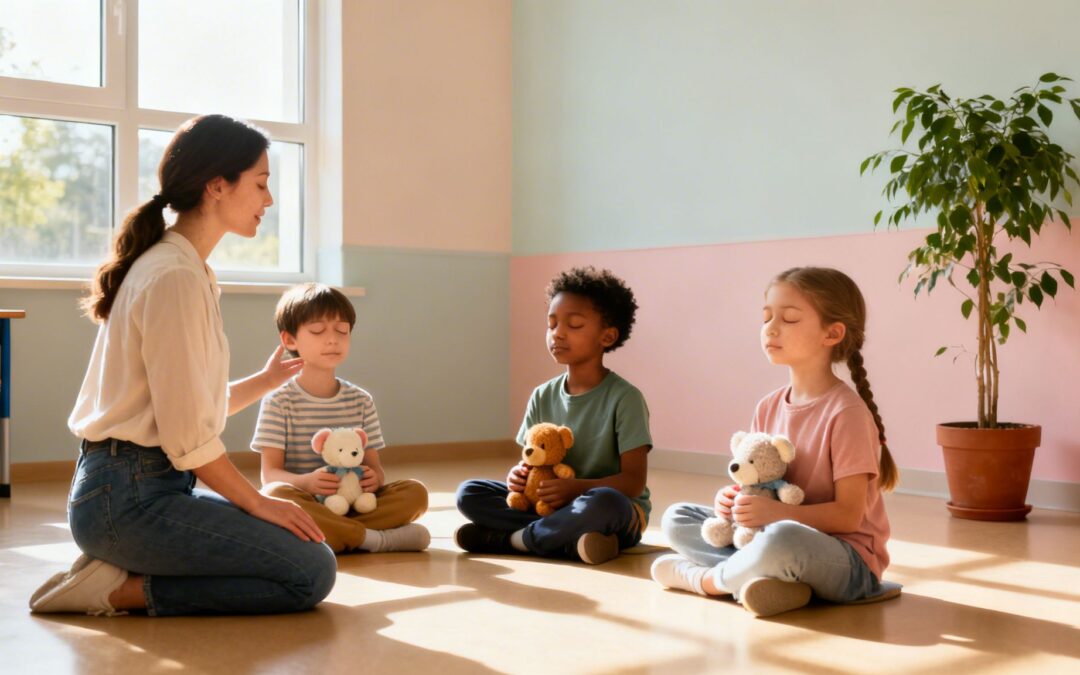
This simple breathing exercise is a classroom favorite. It uses a stuffed animal to make an invisible process—the breath—visible and real. It’s a wonderfully calming activity for transitions or settling down after a rowdy recess.
How to do it: Invite the kids to lie down comfortably on their backs. Have them place a small stuffed animal or “breathing buddy” on their belly.
Script: “Let’s give our buddies a gentle ride. When you breathe in, watch your buddy rise up toward the ceiling. As you breathe out, see your buddy slowly float back down. Just notice your buddy going for a quiet ride, up and down, with each breath.”
Pro-Tip: I like to play some soft, instrumental music in the background. If a child is extra wiggly, reframe it. Encourage them to notice how their buddy is having a “bumpy ride” today. This turns it into an observation, not a failure.
Sound Safari
This one is fantastic for sharpening listening skills and practicing focused attention. It uses the sounds already in your environment and turns the simple act of listening into a fun adventure.
How to do it: Ask students to sit comfortably and close their eyes if they want to. I use a small chime to signal the start and end of our “safari.”
Script: “We’re going on a Sound Safari! Our ears are our superpowers. For the next minute, let’s listen for as many different sounds as we can. What can you hear inside our room? What can you hear outside? What sounds are quiet? What sounds are loud?”
Pro-Tip: When the minute is up, have students share the sounds they “collected.” This validates their experience and creates a great sense of shared discovery.
Building Awareness: Grades 3-5
As kids get into the upper elementary years, they’re ready to start grasping more abstract ideas and doing a bit of self-reflection. Activities for this age can focus more on identifying internal states—like thoughts and emotions—and connecting them to what’s happening in their bodies.
Weather Report Check-In
This metaphor gives students a simple, non-judgmental way to name and share how they’re feeling. Just like the weather, emotions come and go. They aren’t permanent, and they aren’t “good” or “bad.”
How to do it: Introduce the idea that our feelings are like the weather inside us. I have a visual chart on the wall with different weather types (sunny, cloudy, rainy, stormy, windy).
Script: “Let’s check in with our internal weather today. You don’t have to change it, just notice what it is. Are you feeling sunny and bright? A little cloudy or foggy? Maybe it feels rainy with some sad tears, or even stormy with some big, loud feelings. Take a quiet moment and see what your weather is right now.”
Pro-Tip: Let students share by pointing to the chart or writing it on a sticky note. This lets them communicate their feelings without needing to find complicated words. It’s a quick and powerful emotional check-in.
Mindful Walking
This practice is great for grounding kids in their bodies and the present moment. It turns a simple walk across the room into an exercise in focus and serves as an excellent “brain break” between subjects.
How to do it: Ask students to stand and find their own space. Then, instruct them to walk around the room in slow motion.
Script: “Let’s try some ‘turtle walking.’ As you walk very, very slowly, can you feel your foot lifting off the floor? Can you feel your heel touching down, then the rest of your foot? Just notice the feeling of your feet connecting with the ground. What does the floor feel like under your feet?”
Pro-Tip: Start with just 30-60 seconds. As they get used to it, you can have them notice other things, like the air on their skin. These embodiment exercises are powerful tools for self-regulation; for more ideas, you might be interested in our guide on embodiment practices for kids in school and at home.
The goal here isn’t to get rid of the wiggles or stop all thinking. It’s to build the muscle of awareness—that ability to notice what’s happening, inside and out, without immediately getting swept away by it.
Empowering Middle Schoolers: Grades 6-8
By middle school, students are dealing with complex social situations and intense academic pressure. They’re also capable of more sophisticated metacognition—thinking about their own thinking. Mindfulness for this age group can offer real, practical tools for navigating difficult thoughts and building self-awareness.
Thought Surfing
This technique uses a surfing metaphor to help students relate to their thoughts in a new way. Instead of getting pulled under by a difficult thought, they learn to “ride the wave” of it—observing it as it rises, crests, and falls away.
How to do it: Explain that thoughts are like waves in the ocean; they come and go. We can’t stop the waves, but we can learn to surf.
Script: “When a strong or tricky thought comes up, like ‘I’m going to fail this test,’ imagine it as a wave. Acknowledge it’s there. Instead of fighting it, try to ride it. Notice how the thought feels in your body. Notice its peak, and then watch as it starts to lose energy and fade, just like a wave on the shore.”
Pro-Tip: This is about changing the relationship to thoughts, not suppressing them. Encourage students to name the thought (“Ah, the ‘I’m not good enough’ wave is here again”) to create some distance and reduce its power.
Mindful Journaling Prompts
Journaling offers a structured, private space for middle schoolers to practice self-reflection. Giving them specific, mindful prompts can help them move beyond just listing events to actually exploring their inner experience.
How to do it: Provide a journal and set aside 5-10 minutes of quiet time. Offer a few prompts on the board for them to choose from.
Examples of Prompts:
“Describe a moment today when you felt completely present. What were you doing? What did you notice with your senses?”
“Think of a challenging moment from your week. What emotion did you feel most strongly? Where did you feel it in your body?”
“Write about one small thing you’re grateful for today and why. It could be a song, a food, a person, or a sunny spot in the room.”
Pro-Tip: Emphasize that there are no right or wrong answers, and that spelling and grammar don’t matter. The journal is for their eyes only. This creates a safe space for honest reflection without the pressure of being graded.
Weaving Mindfulness into Your Daily Routine
The real magic happens when mindfulness isn’t just another lesson but becomes a natural, seamless part of the day. When you weave small, consistent moments of awareness into existing routines, you help create a classroom culture where focus and calm are the default settings. It’s about turning those chaotic transitions into opportunities for a collective deep breath.
This approach makes mindfulness feel easy and sustainable. Instead of trying to carve out a new 30-minute block, you infuse it into the seconds and minutes you already have. These small, repeated actions are what build lasting habits and a genuine culture of awareness.
From Morning Chaos to Mindful Arrival
The first few minutes of the school day can set the tone for the next several hours. A frantic, rushed entry often leads to a scattered, unfocused class. But what if you could swap that chaotic energy for a simple, two-minute “Mindful Arrival”? This is a game-changer for grounding students and preparing their minds for learning.
Here’s what that shift can look like in practice:
The Old Way: The bell screams, kids flood the room, bags drop with a thud, and chatter fills the air while you try to get everyone’s attention for announcements.
The Mindful Way: As students enter, soft, instrumental music is playing. They know the routine: put their things away and find their seats. Once most are settled, you ring a small chime to signal the start of a one-minute mindful moment.
Mindful Arrival Script: “Good morning, everyone. Let’s start our day together. As you settle into your seat, can you feel your feet flat on the floor? Take a slow breath in… and let it all the way out. For the next minute, let’s just listen to the quiet sounds in our room.”
This simple change doesn’t add time to your day; it reclaims it. It acts as a powerful reset, allowing the entire class to start on the same calm page. Building these simple, predictable moments is key to helping children feel emotionally grounded. You can find more ideas in our guide to creating emotionally grounding routines for kids.
Integrating Mindfulness into Your Curriculum
You don’t need a separate curriculum to teach mindfulness. In fact, the most powerful way to do it is by embedding these practices directly into the subjects you already teach. This reframes mindfulness as a practical tool for learning, not just another “thing” to do.
I hear from a lot of teachers who worry kids will find these practices “boring.” But my experience—backed by research—is that when they’re woven in thoughtfully, kids are incredibly receptive. A 2023 feasibility study on school-based interventions had a remarkable 96% retention rate in a program run during class hours. It just goes to show that when the activities are interactive and supported by the teacher, kids are all in. You can read the full research on this effective school integration.
Here are a few ways this can look in different subjects:
Science: During a nature observation, add a mindful step. Before students start classifying a leaf or a rock, ask them to spend one minute simply observing it with all their senses. “What do you see? What does it feel like? What do you smell?”
Language Arts: When reading a story, pause after a key emotional moment. You could ask: “Where do you think the character is feeling that sadness in their body? Where do you feel big emotions in your own body?”
History: After learning about a difficult historical event, use a quiet, reflective prompt. “Take a quiet moment to think about one feeling that came up for you during this lesson. You don’t have to share it, just notice it.”
Math: When a student is stuck on a tough problem, suggest a “Math Brain Break.” Say, “Okay, let’s pause. Everyone close your eyes and take three slow ‘balloon breaths’—breathe in deep to fill your belly like a balloon, and breathe out slow to let the air out. Now, let’s look at the problem again with fresh eyes.”
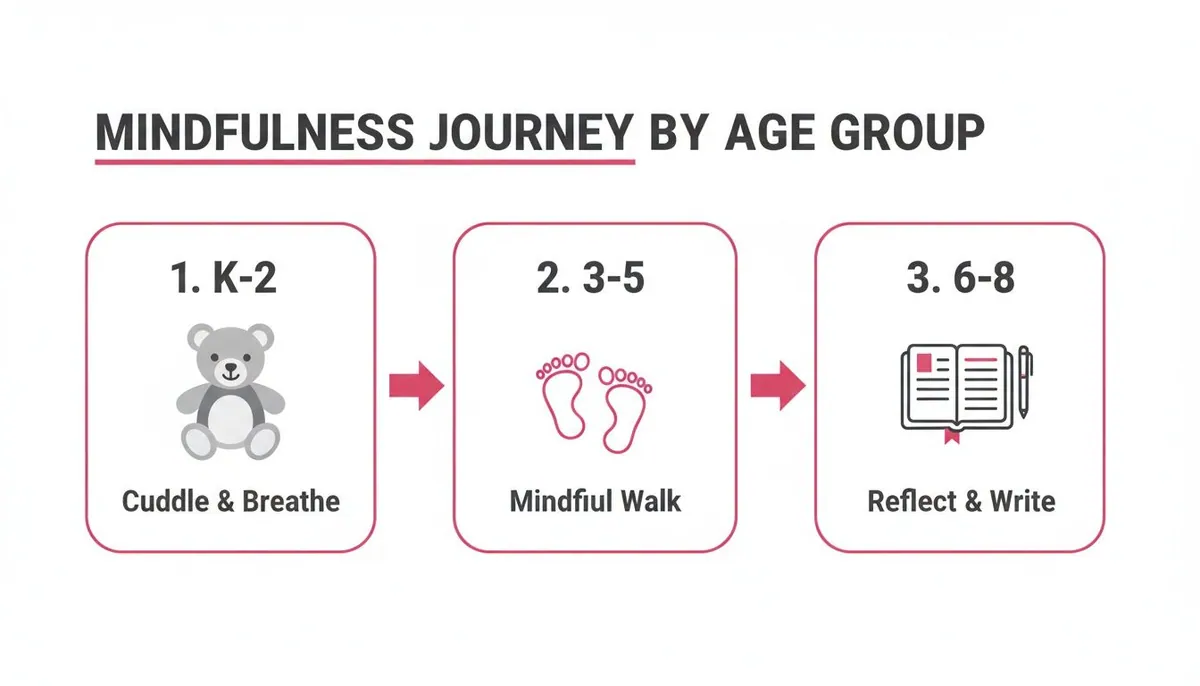
As kids get older, these practices can evolve, moving from simple sensory exercises to more reflective techniques.
As you can see, the journey builds on itself. It starts with concrete, body-based activities for our youngest learners and grows into more introspective practices for older students.
Using Micro-Practices for Transitions and Resets
Some of the best opportunities for mindfulness are hidden in the “in-between” moments. Think about the transition from math to reading, the lull before lunch, or the restlessness after a long assembly. These are perfect times for a “Mindful Minute.”
These quick one-minute resets act like a mental palate cleanser, helping students shift gears and release any lingering stress or excitement. A great example is a ‘Starfish Breath’: have kids spread their hand like a starfish. They trace up one finger while breathing in, and trace down the other side while breathing out, continuing for all five fingers.
The Gratitude Share
A wonderful way to close the day is with a brief “Gratitude Share.” This simple practice helps students leave on a positive, reflective note.
Set the Tone: Gather students in a circle or have them turn to a partner.
The Prompt: Ask them to think of one small thing from their day they are grateful for. It could be learning something new, a kind word from a friend, or the sunshine during recess.
Share (Optional): Invite a few students to share their gratitude aloud if they feel comfortable. This simple act of sharing amplifies the positive feeling in the room.
It’s these small, consistent practices, woven into the fabric of the school day, that truly build a lasting foundation of awareness, focus, and emotional well-being for every child.
Partnering With Families to Build a Mindful Community
When we teach mindfulness in the classroom, the practices truly come alive when they become a shared language between school and home. Bridging this gap creates a supportive ecosystem that reinforces these essential life skills, helping transform classroom exercises into deeply rooted family habits.
Let’s face it, though—most families are incredibly busy and might not be familiar with mindfulness at all. The key is to make your communication simple, inviting, and practical. Start by clearly explaining what you’re doing in the classroom and, just as importantly, why it matters for their child.
Sharing Your “Why” Through Newsletters
Your regular class or school newsletter is the perfect place to start. You don’t need to write a long essay. Just keep the blurbs short, positive, and focused on the benefits for their child. Avoid jargon and always offer one simple thing they can try at home.
Here’s a little blurb you can adapt for your own newsletter:
This Week’s Mindful Moment: Listening Ears
Hello Families! This week in class, we’ve been practicing “Mindful Listening”—a fun game where we pause and notice all the quiet sounds around us. This simple activity helps students improve their focus and calm their bodies. You can try it at home for just one minute! Ask your child: “What sounds can you hear right now?” It’s a great way to settle down before bed.
These small, consistent updates demystify the practice and empower parents to become partners in your work.
Host a Family Mindfulness Night
For a more immersive experience, think about hosting a family mindfulness night. This can be virtual or in-person, and it’s not about sitting in silence for an hour! It’s about playful connection, shared learning, and giving families tangible tools they can use right away.
Structure the evening around fun, interactive activities:
Buddy Breathing: Ask each family to bring a favorite stuffed animal. Lead them through the same breathing exercise you use in class so parents can experience it firsthand.
Mindful Tasting: Use a simple snack like a raisin or a small piece of chocolate. Guide families to explore it with all their senses before eating. It’s always a hit.
Create ‘Calm Down Jars’: This is a wonderful hands-on activity. Provide jars, water, glitter, and glue, and let families create a visual tool they can take home for when big emotions arise.
This kind of shared experience builds real community and shows parents that mindfulness is an activity for connection, not just for quiet time. Positive parenting is all about connection, and you can explore more strategies by reading our guide on positive parenting tips to nurture your child’s growth.
Launch a Home-and-School Mindfulness Challenge
A weekly or monthly challenge can be a fantastic, low-pressure way to encourage consistent practice. Create a simple, downloadable sheet with fun activities that families can do together.
The impact of these school-led initiatives can be huge. In the ‘World’s Largest Mindful Moment’ event, an impressive 67% of parents reported practicing mindfulness at home with their kids afterward. A staggering 96% saw clear benefits, including children getting better at handling emotions (63%), becoming calmer (42%), and showing more empathy (28%). This highlights the powerful ripple effect of your work. You can discover more about these powerful family engagement findings.
Here are some sample weekly challenges you could include:
Week 1 – Mindful Munching: Practice ‘Mindful Eating’ with one snack this week. Eat without screens and talk about the tastes, smells, and textures.
Week 2 – Rose, Thorn, Bud: At dinner one night, share your “rose” (a positive moment), “thorn” (a challenge), and “bud” (something you’re looking forward to).
Week 3 – Mindful Steps: Take a three-minute walk together, inside or out. Walk in silence and just notice the feeling of your feet on the ground.
Week 4 – Gratitude Jar: Write down one thing you’re thankful for each day and add it to a jar. Read them all at the end of the week.
By making families your partners, you multiply the impact of your efforts. You’re not just teaching a skill; you’re helping to build a truly mindful community where every child is supported.
Wrestling with the Hurdles and Spotting Real Wins
For Older Students (4-8):
Classroom Yoga: Lead a 5-minute yoga flow with simple poses like Mountain, Warrior II, and Downward-Facing Dog. Focus on connecting breath with movement. Example: In the middle of a long class block, say, “Alright everyone, let’s stand up and do a 3-minute stretch. Reach for the sky in Mountain Pose, and let’s flow through two rounds of Warrior poses to reset our bodies.”
Cross-Body Exercises: Guide students through activities that cross the body’s midline, like touching their right hand to their left knee and vice versa. These movements help integrate the brain’s hemispheres. Example: If focus is waning, announce, “Time for a brain wake-up! Stand up. We’re going to do 20 cross-crawls. Right elbow to left knee, left elbow to right knee. Let’s go!”
Pro Tip: Create a “movement menu” with pictures or short descriptions of 5-6 quick activities students can choose from when they feel antsy. Offering choices empowers them to recognize their needs and take ownership of their self-regulation.
5. Social Problem-Solving and Perspective-Taking
Social problem-solving is a structured approach that moves students beyond reactive, emotional responses to conflict. It teaches them to analyze challenges systematically by identifying the problem, brainstorming solutions, considering consequences, and making a thoughtful choice. This skill is paired with perspective-taking, the ability to understand a situation from another person’s point of view, which is fundamental to building empathy and connection within a school community.
This strategy works by externalizing the conflict and turning it into a manageable puzzle rather than a personal attack. When students feel wronged or frustrated, their first impulse might be to blame or retaliate. By introducing a clear, step-by-step process, educators help them engage their rational brain, slow down their emotional reactions, and see the situation more clearly. This is one of the most practical self-regulation strategies because it gives students a concrete plan for navigating the complex social world, reducing anxiety and impulsive behavior.
How to Implement Social Problem-Solving
For Younger Students (K-3):
“Problem-Solving Wheel”: Create a visual wheel with simple solutions like “Ask for a turn,” “Say please,” “Walk away,” or “Get a teacher.” When a conflict arises over a toy, guide students to the wheel to choose a strategy. Example: “I see two friends who both want the blue truck. Let’s go to the problem-solving wheel. Which idea could you try first? Ah, ‘Ask for a turn.’ Let’s try that.”
“How Would They Feel?”: During read-alouds, pause and ask questions about the characters’ feelings. For example, “How do you think the wolf felt when the little pig wouldn’t let him in? Why?” Example: After reading about a character who shares, ask, “How did it make the other character feel when she shared her snack? How did it make her feel to be kind?”
For Older Students (4-8):
Structured Protocol: Teach and post a formal problem-solving process: 1. Define the problem (without blame). 2. Brainstorm at least three solutions. 3. Evaluate the pros and cons of each. 4. Choose one and try it. 5. Reflect on the outcome. Example: Two students are arguing about their group project. You say, “Okay, let’s use the protocol. Step 1: What’s the problem, stated without blame? ‘We disagree on the topic for our presentation.’ Good. Step 2: Let’s brainstorm three possible solutions right now.”
Role-Playing Scenarios: Use common classroom conflicts (e.g., being left out at recess, disagreeing on a group project) as practice scenarios for role-playing the protocol. Explore more ideas with these perspective-taking activities.
Pro Tip: Frame problem-solving as a skill everyone is learning, including adults. When you make a mistake, model the process out loud: “I was frustrated and spoke too quickly. I should have taken a moment to think about a better solution.” This normalizes the learning process and encourages students to try without fear of failure.
6. Positive Self-Talk and Cognitive Reframing
Positive self-talk and cognitive reframing are powerful self-regulation strategies that teach students to become aware of their internal dialogue and intentionally shift unhelpful thoughts. This approach helps children move from rigid, negative thinking to more flexible and encouraging perspectives. Instead of automatically assuming the worst, students learn to speak to themselves with the same kindness they would offer a friend, building resilience by changing the narrative around challenges and mistakes.
This strategy works by intercepting and challenging automatic negative thoughts before they escalate into overwhelming emotions. When a student thinks, “I’m terrible at math,” it can lead to feelings of frustration and avoidance. Cognitive reframing encourages them to pause and replace that thought with a more constructive one, such as, “This math problem is tricky, but I can try a different strategy.” This shift empowers students to view setbacks as temporary and solvable, which is a core component of developing a growth mindset. To learn more about fostering this mindset, explore these ways to build resilience and perseverance in students.
How to Implement Self-Talk and Reframing
For Younger Students (K-3):
“Thought Swapping”: Create a T-chart with “Helpful Thoughts” on one side and “Unhelpful Thoughts” on the other. When a student says, “No one will play with me,” guide them to find a “helpful thought” swap, like, “I can ask someone to play.” Example: “I hear you saying, ‘This is too hard.’ That sounds like an unhelpful thought. Let’s look at our chart. What’s a helpful thought we could swap it with? How about, ‘I can try my best’?”
“Turn-Around Phrases”: Introduce simple, powerful phrases like adding the word “yet” to statements. “I can’t read this” becomes “I can’t read this yet.” Example: A student says, “I don’t know how to tie my shoes.” You can gently respond, “You don’t know how to tie them yet. Let’s practice together.”
For Older Students (4-8):
“Catch It, Check It, Change It”: Teach students a three-step process: First, catch the negative thought. Second, check if it’s 100% true and helpful. Third, change it to a more realistic or supportive statement. Example: A student mutters, “I’m going to fail this test.” You can guide them: “Okay, catch that thought. Now, let’s check it. Is it 100% true that you will fail? You studied. So, let’s change it. What’s more accurate? Maybe, ‘I’m nervous about the test, but I’m prepared’.”
“What Would You Tell a Friend?”: When a student is self-critical, ask them what they would say to a friend in the same situation. This helps them access a more compassionate inner voice. Example: “You just called yourself ‘stupid’ for making that mistake. If your best friend made the same mistake, would you call them stupid? No? What would you say to them? Okay, now try saying that to yourself.”
Pro Tip: Model your own cognitive reframing out loud. Saying something like, “Oops, I forgot to bring the papers. It’s frustrating, but I can solve this by emailing them later,” shows students that everyone makes mistakes and that the response is what matters most.
7. Sensory Tools and Regulation Stations
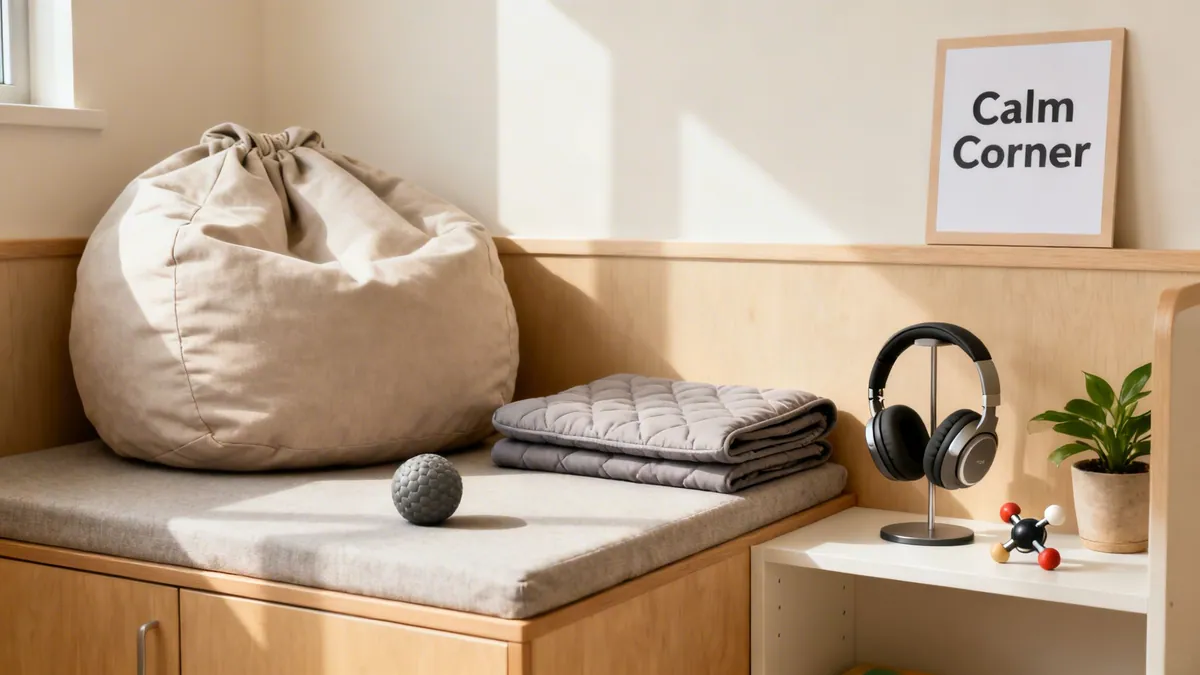
Sensory tools and regulation stations offer tangible, physical support for students learning to manage their internal states. Tools like fidgets, weighted lap pads, and noise-canceling headphones provide direct sensory input that can calm an overstimulated nervous system or provide the necessary stimulation for a student to focus. A regulation station, often called a “calm corner” or “peace corner,” is a designated space where students can access a curated collection of these tools to independently practice self-regulation.
This approach honors neurodiversity by acknowledging that different brains process sensory information differently. For some students, the hum of fluorescent lights can be overwhelming, while for others, sitting still is a significant challenge. Sensory-based self-regulation strategies work by giving the nervous system the input it needs to find a “just right” state of arousal for learning and engagement. To understand the foundational science behind these tools, delving into this guide on what is sensory integration can provide invaluable insight into how children process and respond to sensory input.
How to Implement Sensory Tools and Stations
For Younger Students (K-3):
“Calm-Down Corner”: Create a cozy corner with soft pillows, a weighted blanket, and a small box of sensory items like squishy balls, textured fabrics, and scented playdough. Example: When a student is starting to get upset, you can say, “It looks like your body needs a break. Would you like to spend five minutes in the calm-down corner with the blue squishy ball to help your body feel better?”
Individual Sensory Bags: For students who need consistent support, a small pouch with two or three approved fidgets can be kept at their desk for quiet use during lessons. Example: “David, remember if your hands start feeling busy during story time, you can quietly use the stretchy noodle from your sensory bag to help you listen.”
For Older Students (4-8):
Regulation Station: Design a space that is less about “calm” and more about “reset.” Include options like resistance bands for stretching, noise-canceling headphones, and more discreet fidgets like spinner rings or putty. Example: You notice a student tapping their pen loudly and shaking their leg. You can say, “Hey Alex, it looks like you have a lot of energy right now. Feel free to use a resistance band at the regulation station for a few minutes to get that energy out.”
Sensory Choice Board: Offer a menu of options students can choose from when feeling dysregulated, such as: “Listen to music for 5 minutes,” “Use the weighted lap pad,” or “Squeeze the stress ball 10 times.” Example: “Sarah, I see you’re feeling overwhelmed. Please point to one choice on the sensory board that you think would help your brain reset right now.”
Pro Tip: Explicitly teach the purpose and procedures for using sensory tools and regulation stations. Frame them as “brain tools,” not toys. Emphasize that these are available to everyone to help their brains get ready to learn, which destigmatizes their use and promotes a supportive classroom culture.
8. Journaling and Reflective Writing
Journaling and reflective writing offer a quiet, personal space for students to process their emotions, clarify their thoughts, and track their personal growth. This strategy involves putting feelings and experiences onto paper, which engages the brain differently than verbalizing them. Whether through unstructured free-writing or guided prompts, journaling supports emotional release, cognitive integration, and is one of the most effective self regulation strategies for building introspection.
The act of writing down thoughts and feelings externalizes them, making them feel more manageable. Research by psychologists like James Pennebaker shows that this form of expressive writing can decrease stress and improve well-being. By giving abstract emotions a concrete form, students can examine their experiences from a distance, identify patterns, and develop a stronger sense of self-awareness and control. It serves as a personal record of their resilience and progress.
How to Implement Journaling and Reflective Writing
For Younger Students (K-3):
Draw and Write Journals: Students can draw a picture of a feeling or event and then write (or dictate) a single sentence about it. For example, “I felt happy when I played on the swings.” Example: “Today in your journal, I want you to draw a picture of something that happened at recess. Then you can write one sentence about how it made you feel.”
“Rose and Thorn”: Each day, students share or draw one positive thing (a rose) and one small challenge (a thorn). This simple structure builds a habit of reflection. Example: At the end of the day, say, “Let’s think about our day. What was your rose—something that made you smile? What was your thorn—something that was a little tricky? Draw them in your journal.”
For Older Students (4-8):
Guided Prompts: Offer weekly prompts aligned with social-emotional learning goals. Examples include: “Describe a time you felt proud and what you did,” or “What was a challenge this week and how did you approach it?” Example: “This week’s journal prompt is on the board: ‘Write about a time you disagreed with a friend. What happened, and what did you learn from it?'”
Gratitude Journaling: Start or end the day by having students write down three specific things they are grateful for. This practice is proven to shift focus toward positive experiences. Example: As a bell-ringer activity, instruct students, “Open your journals and for the next three minutes, list three things, big or small, that you’re thankful for today. It could be your breakfast, a sunny day, or a friend.”
Pro Tip: Clearly establish that journals are private spaces. State that you will never read them unless a student explicitly asks you to. This trust is essential for honest self-expression and makes journaling a safe tool for emotional exploration.
9. Social Support and Strategic Breaks (Connection-Building + Time-Out)
Social support and strategic breaks are two intertwined self-regulation strategies that center on safety and connection. When students feel a strong sense of belonging and know they have trusted adults and peers to turn to, their capacity for managing emotions increases. This foundation of social safety makes strategic breaks, or non-punitive time-outs, far more effective. These breaks are not punishments but restorative opportunities for students to step away, decompress, and practice regulating themselves in a calm space.
This combination works by addressing a core human need for connection, as highlighted by researchers like Brené Brown. A regulated, caring adult can help a child co-regulate, modeling calmness and providing the security needed for the child’s nervous system to settle. Strategic breaks give students the time and space to apply other self-regulation strategies without the pressure of an audience. This builds autonomy and internal skills, showing students they are capable of managing big feelings. For a deeper dive into creating this environment, explore Soul Shoppe’s relationship-centered SEL programming.
How to Implement Connection and Breaks
For Younger Students (K-3):
Morning Meetings: Start each day with a brief, structured check-in circle where every child has a chance to share. This builds community and a sense of being seen. Example: “Good morning, everyone! Our greeting today is a high-five. After you greet your neighbor, please share one thing you’re looking forward to today.”
“Cool-Down Corner”: Create a designated, cozy space with soft pillows, sensory tools (like squishy balls or textured fabrics), and picture books about feelings. Students can choose to go there when they feel overwhelmed. Example: “Jason, it looks like you’re feeling frustrated. You can choose to take a 5-minute break in our cool-down corner to help your body calm down.”
For Older Students (4-8):
Peer Buddy Systems: Pair students to support each other academically and socially. Train them in active listening and how to offer help respectfully. Example: “Remember, if you’re feeling stuck on the assignment, you can use the ‘Ask 3 Before Me’ rule, and your peer buddy is one of those people you can check in with first.”
Restorative Circles: Use circles to discuss classroom issues or repair harm after a conflict. This process gives everyone a voice and focuses on mending relationships rather than assigning blame. Example: After a disagreement at lunch, you might say, “Let’s have a restorative circle to talk about what happened. We’ll use the talking piece, and everyone who wants to will get a chance to share how they were impacted.”
Pro Tip: Frame breaks as a tool for everyone. Say, “This space helps your brain get back on track so you can learn and solve problems.” Practice using the break area when everyone is calm, so students understand its purpose before they are in a moment of crisis. Always follow up with a brief, quiet conversation to reflect and welcome the student back.
10. Goal-Setting, Progress Monitoring, and Growth Celebration
Engaging students in setting meaningful goals, tracking their own progress, and celebrating growth is a powerful self-regulation strategy that builds agency and motivation. This approach shifts the focus from external control to internal drive, teaching students how to identify a desired outcome, create a plan, and persist through challenges. By framing effort and setbacks as part of a journey, it reinforces a growth mindset and develops crucial executive functioning skills.
This process works by making abstract concepts like “being respectful” or “staying calm” concrete and measurable. When a student helps create a goal, they take ownership of it. Regularly monitoring progress provides tangible evidence of their effort, which builds self-efficacy and the belief that they can influence their own outcomes. This metacognitive practice is a cornerstone of developing mature self-regulation.
How to Implement Goal-Setting and Celebration
For Younger Students (K-3):
Behavioral Goals: Frame goals in simple, positive language. For instance, “I will use my walking feet in the hallway” or “I will raise my hand before speaking.” Example: You might create a goal with a child: “Your goal for this week is to use kind words when you feel frustrated. Let’s practice what that sounds like.”
Visual Progress Trackers: Use a sticker chart, a coloring path, or a jar to fill with pom-poms. The visual feedback is immediate and motivating for this age group. A student might add a sticker to their chart each time they remember to use kind words with a friend. Example: “Wow, Michael! I saw you ask for a turn instead of grabbing. That was you using kind words! Go put a pom-pom in our class goal jar!”
For Older Students (4-8):
SMART Goals: Introduce the concept of SMART (Specific, Measurable, Achievable, Relevant, Time-bound) goals. A goal could be: “For the next two weeks (Time-bound), I will use my 4-7-8 breathing strategy (Specific) at least once a day when I feel frustrated (Measurable, Achievable) so I can stay focused in class (Relevant).” Example: A student wants to be more organized. You help them set a goal: “My goal is to write down all my homework in my planner (Specific) every day for the rest of the month (Time-bound).”
Student Portfolios & Check-ins: Have students keep a simple journal or portfolio to document their progress. Conduct weekly check-ins where they reflect on what worked, what was hard, and if the goal needs to be adjusted. Example: During a check-in, you could ask, “Let’s look at your goal of starting your homework before 7 PM. How did it go this week? What made it easy? What made it hard?”
Pro Tip: Celebrate the effort and the process, not just the final achievement. Acknowledge persistence when a student tries a calming strategy, even if they still get upset. This reinforces that the act of trying is what builds the skill, making them more likely to stick with these self-regulation strategies long-term.
10-Strategy Self-Regulation Comparison
Strategy
Implementation complexity
Resource requirements
Expected outcomes
Ideal use cases
Key advantages
Mindfulness and Deep Breathing
Low — simple to teach but needs regular practice
Minimal — none required; visual cues helpful
Immediate physiological calming, improved attention and emotional awareness
Makes progress visible, reinforces persistence and agency
Putting It All Together: Building a Culture of Self-Regulation
We’ve explored ten powerful self regulation strategies, from the immediate calm of deep breathing to the long-term resilience built through cognitive reframing. Each tool offers a unique pathway for children to understand and manage their internal worlds. Yet, the true power of these strategies emerges not from isolated lessons, but from their consistent integration into the rhythm of daily life. The ultimate goal isn’t just to teach a child what to do when they feel overwhelmed; it’s to cultivate an environment where emotional awareness and thoughtful response become second nature.
This journey is about building a culture, not just checking off a list. It’s the difference between a teacher occasionally saying, “Use your words,” and a classroom where emotional labeling is a daily practice, supported by visual charts and celebrated during morning meetings. It’s the shift from a punitive time-out to a restorative “strategic break” in a designated regulation station, where a child learns to connect their physical sensations with a need for sensory input or quiet reflection.
From Individual Skills to a Shared Language
The most profound impact comes when these self regulation strategies become a shared language between adults and children, and among peers. When an entire school community adopts the STOP technique, a student in crisis knows that any adult they approach will understand their need for a moment to pause and breathe. Similarly, when a family embraces positive self-talk, a child struggling with homework can be guided with a gentle reminder: “I hear that ‘I can’t do this’ thought. What’s a stronger, kinder thought we can try instead?”
This shared understanding turns abstract concepts into concrete, collaborative actions. It creates a predictable and supportive safety net, reassuring children that their big feelings are valid and that they are equipped with the tools, and the support system, to navigate them constructively.
Key Takeaway: Self-regulation is not a solitary skill learned in a vacuum. It flourishes in an ecosystem of co-regulation, where trusted adults model, guide, and reinforce these strategies with patience and consistency.
Actionable Next Steps for Educators and Parents
Building this culture can feel like a monumental task, but it begins with small, intentional steps. Here is a practical roadmap to get you started:
Start Small and Model Consistently: Don’t try to implement all ten strategies at once. Choose one or two that feel most accessible for your students or children. Perhaps you begin by introducing “Belly Breathing” during transitions or morning meetings. As the adult, you must model it authentically. When you feel your own frustration rising, say out loud, “I’m feeling a little overwhelmed, so I’m going to take three deep breaths to calm my body.” This modeling is more powerful than any worksheet.
Make it Visual and Accessible: Create tangible reminders. Post visuals of the STOP technique in the classroom. Designate a “Peace Corner” or “Regulation Station” with a few sensory tools. For older students, co-create posters with positive self-talk affirmations. These physical cues serve as environmental prompts, reminding students to use their skills before emotions escalate.
Integrate, Don’t Isolate: Weave these strategies into your existing routines. During literature discussions, ask questions like, “How do you think that character was feeling? What problem-solving strategy could they have used?” When a conflict arises on the playground, guide students through perspective-taking. Connect goal-setting to academic projects and personal conduct, celebrating the effort and progress along the way.
Embrace Progress Over Perfection: There will be setbacks. A child who has successfully used their breathing techniques for weeks might have a difficult day and forget. This is normal. The goal is not to eliminate emotional outbursts but to shorten their duration, reduce their intensity, and build the child’s capacity to recover more quickly. Respond to these moments with empathy, not judgment, and treat them as opportunities for reteaching.
By patiently and persistently weaving these self regulation strategies into the fabric of your classroom or home, you are giving children a gift that extends far beyond academic success. You are equipping them with the emotional intelligence, resilience, and confidence to build healthy relationships, overcome obstacles, and navigate the complexities of life with grace and strength. You are not just managing behavior; you are nurturing a foundation for lifelong well-being.
Ready to build a comprehensive, campus-wide culture of safety and connection? Soul Shoppe provides expert training and programs that empower both students and educators with a shared language and practical tools for thriving together. Learn more about bringing these powerful strategies to your entire school community at Soul Shoppe.
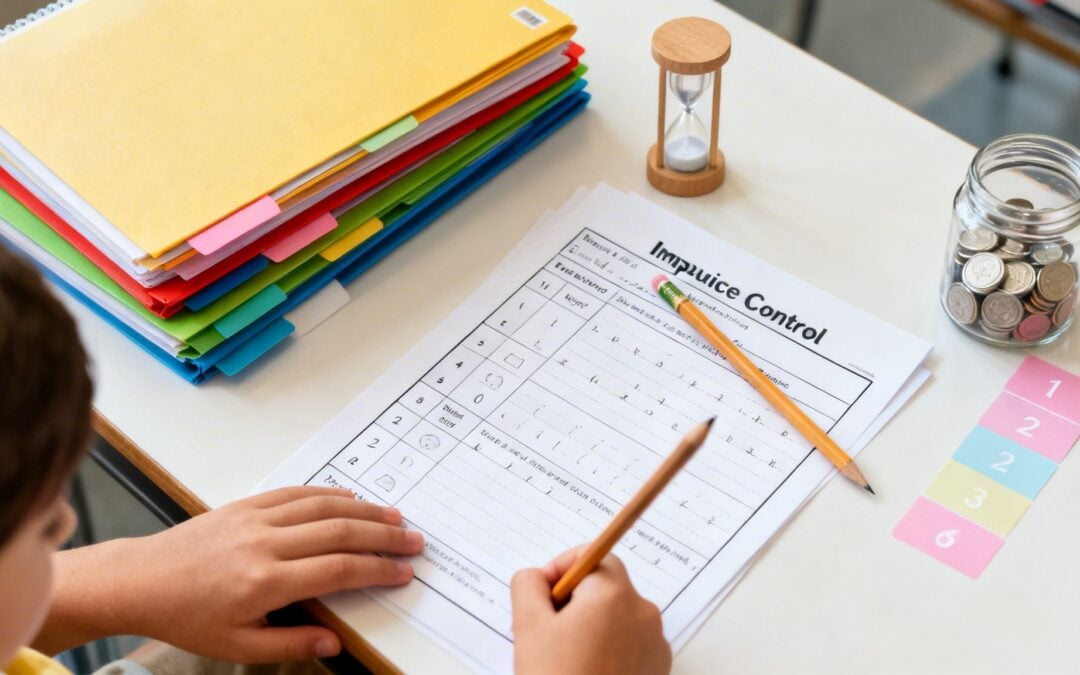
Impulse control is more than just telling students to “stop and think.” It’s a core executive function skill essential for classroom learning, peer relationships, and emotional well-being. When students struggle to manage their impulses, it can manifest as blurting out, difficulty waiting their turn, or reacting emotionally to small frustrations. This not only disrupts the learning environment but also hinders a child’s ability to engage with complex tasks and build meaningful connections.
Social-Emotional Learning (SEL) provides the framework for teaching these skills explicitly. By using structured activities, we can help students recognize their internal cues, pause before acting, and choose more thoughtful responses. This article provides a curated list of 12 effective impulse control worksheets and resources designed for K-8 educators and parents. We move beyond simple lists to give you practical, classroom-ready tools and concrete examples of their use.
For instance, we’ll show you how a “Stop, Think, Act” printable can be used during a specific classroom conflict or how a “Size of the Problem” worksheet helps a student re-evaluate an emotional outburst after recess. Each resource includes a direct link, a brief analysis of its strengths, and ideas for adapting it to meet the needs of diverse learners. Our goal is to equip you with a collection of targeted tools to help build a more regulated, focused, and supportive classroom environment for every student.
1. Tools Of The Heart Online Course
While not a direct source for standalone impulse control worksheets, Soul Shoppe’s Tools of the Heart Online Course earns its place as our featured choice because it provides the foundational, evidence-based framework needed to make those worksheets effective. This digital offering translates over two decades of in-person, experiential Social-Emotional Learning (SEL) into a scalable online format. It’s designed for educators and families who want to move beyond simple printables and build a consistent, school-wide (or home-wide) culture of self-regulation and emotional intelligence.
The course’s strength lies in its focus on creating a shared language and repeatable practices. Instead of just handing a child a worksheet, educators learn how to introduce and model core concepts like mindful awareness and compassionate communication first. For example, a teacher might use the course’s “Peace Corner” strategy to establish a safe space in the classroom. When a student later struggles with blurting out, a worksheet on “thinking before speaking” becomes a supportive tool for that established practice, not an isolated disciplinary action.
Key Strengths and Use Cases
The program is especially valuable for school leaders planning SEL rollouts for the 2025–26 academic year. It equips staff with a unified vocabulary and practical, trauma-informed strategies that create psychological safety. This shared foundation ensures that any supplementary materials, including impulse control worksheets, are applied consistently and effectively from one classroom to the next.
Practical Application: A school counselor can use the course’s conflict resolution modules to train peer mediators. The strategies learned, such as “I-statements,” can then be reinforced with role-playing worksheets to help students practice their new skills in a controlled setting. For example, after learning the format, students could fill out a worksheet with a real-life conflict: “I feel upset when you take my pencils without asking. I would like you to ask me first.”
Home-School Connection: The course provides families with the same tools used at school, creating a cohesive support system. A parent can use the “feelings thermometer” concept to discuss emotional intensity, which directly connects to anger management activities for kids and helps them better understand their triggers before they act impulsively. A practical example would be a parent and child coloring in the thermometer to show how the child felt when their sibling wouldn’t share a toy, and then discussing what a “cooler” reaction could be.
System-Wide Integration: Tools of the Heart complements Soul Shoppe’s other offerings, including in-person workshops, coaching, and a dedicated app, allowing for a layered approach to building a positive school climate.
Access and Implementation
The online course is designed for flexible adoption by entire schools or individual educators. However, the website lacks specific details on pricing, course duration, or certification. Prospective users will need to contact Soul Shoppe directly to get a quote and discuss implementation logistics tailored to their needs. While this digital course is powerful, schools facing significant behavioral challenges may find that it works best when paired with Soul Shoppe’s on-site coaching for more intensive support.
Therapist Aid is a gold standard resource library widely used by clinicians and school counselors, offering evidence-informed worksheets grounded in therapeutic approaches like CBT and DBT. While not exclusively focused on impulse control, its strength lies in the clinical quality of its materials, which target the root causes of impulsivity such as emotional dysregulation and poor executive functioning. The platform provides a rich collection of tools applicable to teaching self-regulation.
This site stands out because its worksheets directly translate complex therapeutic concepts into kid-friendly formats. Instead of a generic search for “impulse control worksheets,” educators can find targeted tools by looking up related skills. For example, the “Urge Surfing” worksheet is perfect for helping a student with ADHD learn to tolerate the impulse to blurt out answers, while the “Anger Stop Signs” printable provides a concrete visual for a child who struggles with physical impulsivity when frustrated. These resources are part of broader self-management skills, which are crucial for student success. A teacher could use the “Anger Stop Signs” worksheet by having a student identify their personal “yellow light” feelings (like feeling hot or clenching fists) before they get to a “red light” outburst.
Implementation and Access
The website offers a mix of free and premium content. Many high-quality worksheets are available for free download as printable PDFs, and some have interactive fillable versions. A PRO membership (starting at $59/year) unlocks the full library, including video resources and advanced tools. A practical approach is to start with their free materials, which are substantial, and curate a small, effective collection before considering a subscription.
Key Features & User Experience:
Evidence-Informed: Worksheets are based on established methods like Cognitive Behavioral Therapy (CBT) and Dialectical Behavior Therapy (DBT).
Dual Formats: Many resources are available as both printable PDFs and digitally fillable versions.
Ease of Use: The website is well-organized, allowing users to search by topic (e.g., anger, ADHD), modality (e.g., CBT), or audience (e.g., kids, teens).
Limitations: The best content is often behind a paywall, and you must search across multiple categories to build a complete impulse control toolkit.
Centervention is an excellent source for free, classroom-ready social-emotional learning (SEL) resources specifically designed for elementary and middle school students. Its strength lies in providing straightforward, one-page printable worksheets bundled with mini-lessons. These materials explicitly teach impulse control by contrasting thoughtful actions with impulsive ones, making the concept concrete for younger learners. The platform’s focus on practical, school-based scenarios makes its content highly relevant and easy to implement.
This site stands out because of its grab-and-go lesson format. Instead of just a worksheet, educators get facilitation notes that guide a brief discussion. For example, the “Think Before You Act” worksheet presents scenarios like a classmate taking your favorite crayon. The lesson plan prompts a discussion about an impulsive reaction (yelling) versus a thoughtful one (using an “I statement”). These impulse control worksheets are perfect for short morning meetings or small-group interventions, directly addressing behaviors seen on the playground or in the classroom. A teacher could say, “Let’s look at scenario #2: Someone cuts in front of you in the lunch line. What’s an impulsive ‘react’ choice? What’s a thoughtful ‘respond’ choice?”
Implementation and Access
Centervention offers a significant number of its worksheets and lesson plans completely free with no paywall; users simply provide an email to download the PDFs. The free library is extensive enough to build a solid foundation for SEL instruction. The company’s core products are paid, game-based digital programs that offer a more in-depth curriculum, but their free printables are high-quality, standalone resources.
Key Features & User Experience:
Classroom-Ready: Worksheets come with accompanying mini-lessons and clear facilitation notes.
Relevant Scenarios: Content is grounded in real situations kids encounter at school, such as waiting in line or managing frustration during group work.
Explicit Instruction: The materials clearly distinguish between impulsive and thoughtful responses, a key concept for K-5 students.
Limitations: The visual design of the PDFs is simple, and the site’s most robust, interactive content is reserved for its paid digital programs.
4. The OT Toolbox – Impulse Control Worksheets & Journal
The OT Toolbox brings a unique, occupation-therapy-informed perspective to impulse control, focusing on the underlying executive functions and sensory processing needs that often drive impulsive behavior. Created by a pediatric OT, these resources are less about simple behavior charts and more about building foundational skills like emotional awareness, habit formation, and practical coping strategies. The platform offers a direct solution for educators and parents seeking a structured program.
This site stands out for its practical, routine-based tools. The worksheets and journal pages are designed for consistent carryover between school and home. Instead of just identifying feelings, a student might use a worksheet to map out what happens before an outburst and create a visual plan for what to do instead. For example, a student who impulsively rips their paper when frustrated can use the journal pages to identify that trigger (e.g., “I get mad when my letters don’t look right”) and practice a replacement behavior, like using a stress ball or taking three deep breaths, with visual cues to support them. These concrete, sensory-based strategies are a hallmark of the OT approach.
Implementation and Access
The website provides a free 5-page sampler of its impulse control worksheets, which requires an email opt-in to download. This sampler is an excellent starting point to test the materials. For a more complete program, the full Impulse Control Journal is available as a paid digital download (around $15-20). This ~80-page printable journal offers a more structured, long-term tool for building self-regulation skills through reflection, tracking, and strategy practice.
Key Features & User Experience:
OT-Informed Strategies: Activities are grounded in occupational therapy principles, targeting executive function and sensory needs.
Structured Journaling: The paid journal provides a cohesive program rather than a collection of one-off worksheets.
Practical for Carryover: The visual routines and reflection pages are designed for use in both classroom and home settings.
Limitations: The most substantial resource is a paid product, and the free sampler requires providing an email address.
Your Therapy Source offers a unique blend of occupational therapy (OT) and psychoeducational resources, making it a great stop for practical, action-oriented tools. The site provides a free three-page “Think Before You Act” PDF packet alongside a more structured “Stop–Think–Act” scenario set. Its approach connects cognitive self-regulation with physical movement, which is highly effective for kinesthetic learners and students who need to burn off excess energy before they can focus.
This platform stands out by integrating multi-sensory learning into its impulse control worksheets. For example, the “Stop–Think–Act” materials come with a song to help students memorize the sequence, reinforcing the habit through auditory channels. Instead of just discussing scenarios, a teacher could have students physically act them out: hop on one foot for “Stop,” touch their head for “Think,” and then perform the correct action. A practical example for parents could be using the worksheets at home: before reacting to a sibling taking a toy, the child is prompted to stop, think of three possible solutions (ask for it back, tell a parent, play with something else), and then choose one to act out. This OT-friendly method helps embed the pausing mechanism in a child’s muscle memory.
Implementation and Access
The core impulse control resources are available as free, direct-download PDFs, making them easy to access and distribute in a school setting. While these freebies are brief, they are designed for quick, repetitive practice in small groups or as classroom brain breaks. For more extensive units, you will need to browse the site’s larger catalog of paid products. The simple graphics and layout make the worksheets approachable and not overstimulating for younger students.
Key Features & User Experience:
Multi-Sensory Approach: Reinforces learning with songs, visuals, and suggested physical movements.
OT/PE Integration: Materials are designed by therapists and can be easily used in physical education or occupational therapy sessions.
Free and Accessible: Key printables are completely free, lowering the barrier to trying them out.
Limitations: The free offerings are short and serve more as an introduction; the visuals are more basic compared to premium resources from other sites.
Twinkl USA is a massive teacher-created resource library offering a wide array of classroom management and SEL printables. While its scope is broad, it contains specific and practical impulse control worksheets designed for direct classroom application. The platform’s main advantage is that its resources are made by educators for educators, ensuring they are grade-aligned and relevant to common classroom challenges like blurting or off-task behavior.
This site stands out because its materials often come in editable formats, a key feature for differentiation. A teacher can easily adapt the language or scenarios in a resource like the ‘Impulse Control (Think It or Say It?)’ worksheet to match the specific needs of students with IEPs or 504 plans. For example, a teacher could change the scenarios to reflect a recent playground conflict, making the lesson highly personal and relevant. The ‘Impulse Control Activity Sheet’ provides relatable situations, such as “You see a cookie on the counter before dinner.” Students then write or draw the impulsive action (eating it now) and the controlled action (waiting until after dinner), prompting a discussion about consequences.
Implementation and Access
A subscription is required to download most resources, though a limited number of free materials are available. The platform operates on a membership model (starting around $5/month for the Core plan), which grants access to its entire library of printables, lesson plans, and digital activities. Educators should verify that resource terminology aligns with U.S. standards, as some content may reflect UK or Australian conventions. The search function is the best way to find specific impulse control worksheets within the huge database.
Key Features & User Experience:
Editable Formats: Many resources are available in formats like PowerPoint or Google Slides, allowing for easy customization.
Teacher-Created: Content is designed by fellow educators, ensuring it is practical and classroom-ready.
Grade-Aligned: Resources are clearly marked for specific grade levels, simplifying lesson planning.
Limitations: Full access requires a paid subscription, and users may need to filter through a large volume of content to find the perfect worksheet.
Teach Starter is a teacher-created platform offering a U.S.-focused collection of classroom-ready resources, including materials that build the foundational skills for impulse control. While it’s not a specialized therapeutic site, its strength lies in integrating social-emotional learning into standard academic contexts. The platform groups impulse control under the broader umbrella of “self-management,” alongside goal-setting and organizational skills, making it easy to find complementary materials.
This site stands out for its practical, print-and-go design, with resources made by educators for educators. Instead of complex clinical jargon, you will find accessible tools aligned with classroom routines. For example, the “Size of the Problem” worksheet helps students contextualize their reactions. A teacher can use this after recess with a student who is upset, asking them to rate the problem (e.g., “Liam didn’t want to play my game”) as a small, medium, or large problem, and then match their reaction to it. Another useful tool is their “Self-Control Mazes,” which provide a fun, game-like activity for younger students to practice pausing and thinking before acting.
Implementation and Access
Teach Starter operates on a freemium model. A limited number of free downloads are available, but full access to their entire library, including editable formats, requires a subscription. Individual teacher plans start around $7.50 per month (billed annually), and they offer transparent pricing for school-wide licenses. The ability to download resources as editable Google Slides or PowerPoint files is a significant advantage, allowing for easy customization to meet specific student needs.
Key Features & User Experience:
Classroom-Focused: Materials are teacher-reviewed, standards-aligned, and designed for immediate classroom use.
Multiple Formats: Resources are available as printable PDFs and editable Google Slides or PowerPoint files.
Organized for Educators: Content is sorted by grade level, subject, and resource type, making it simple to find what you need.
Limitations: The most effective impulse control worksheets are part of a paid subscription, and users must search within the broader “self-management” category to locate them.
K5 Learning provides printable self-control and self-discipline worksheets specifically designed for the K-5 age group. Its materials use simple language and clear visuals to present foundational strategies, such as understanding the cause and effect of one’s choices. This straightforward approach makes the worksheets incredibly easy for teachers and parents to deploy with minimal preparation, serving as quick, targeted practice for younger learners.
The platform stands out for its laser focus on early elementary skill-building. While other sites cover a broad spectrum of SEL topics, K5 Learning offers short, structured practice pages that directly address impulse control in a way young children can grasp. For example, a worksheet might ask a first-grader to draw a line connecting a scenario like “I want the toy my friend has” to a positive choice like “I can ask for a turn” versus an impulsive one like “I will grab it.” A parent could use another worksheet at home by asking, “The worksheet shows a girl about to interrupt her mom on the phone. What’s a better choice she could make?” These exercises are fundamental building blocks for more complex self-regulation strategies for students they will learn later.
Implementation and Access
K5 Learning offers a selection of free sample worksheets, but the majority of its social-emotional learning content is accessible through a subscription. The membership (starting at $14.95/month) provides full access to its entire library of reading, math, and other academic worksheets in addition to the SEL materials. The best way to use the site is to download the free samples to see if the format works for your students before committing to a plan.
Key Features & User Experience:
Age-Specific Design: Content is created explicitly for kindergarten through fifth grade, ensuring developmental appropriateness.
Minimal Prep: The printable PDF format allows for quick implementation in classrooms or at home.
Clear Skill Labeling: Worksheets are clearly titled with skills like “self-control” or “self-discipline.”
Limitations: A subscription is required for most of the SEL worksheets, and the scope is narrower than that of a dedicated SEL curriculum provider.
9. Teachers Pay Teachers (TPT) – Curated Impulse Control Packs
Teachers Pay Teachers (TPT) is an enormous online marketplace where educators create and sell their own classroom resources. Its value lies in the sheer volume and specificity of materials available, offering thousands of impulse control worksheets, social stories, and activity packs designed by teachers for teachers. Unlike clinical sites, TPT content is born from direct classroom experience, often tailored to specific grade levels (K-5) and common behavioral scenarios.
This platform stands out for its niche, scenario-based resources. Instead of a general worksheet on “thinking before acting,” you can find a complete lesson pack for a second grader who impulsively shouts out answers, or a social story bundle for a kindergartener who struggles with taking turns. A practical example is using a social story from TPT called “My Mouth is a Volcano” with a student who blurts out. The teacher and student read the story together and then complete a corresponding worksheet where the student practices raising their hand in different illustrated scenarios. Many sellers bundle materials into comprehensive units, providing a multi-faceted approach to teaching a single skill.
Implementation and Access
TPT operates on a per-product model, with most resources available as instant digital downloads after purchase. Prices for individual worksheet packs are generally affordable, often falling in the $2 to $8 range. To use it effectively, it’s crucial to read product reviews and check previews carefully, as quality varies significantly between sellers. Searching for terms like “impulse control social story” or “executive functioning worksheet pack” yields highly specific results.
Key Features & User Experience:
Classroom-Tested: Resources are created by practicing teachers and counselors, making them practical and relevant.
Grade-Specific: Materials are often designed for very specific grade bands (e.g., K-1, 3-5), ensuring developmental appropriateness.
Affordable Pricing: Single-classroom licenses make it accessible for individual teachers to purchase what they need without a subscription.
Limitations: Quality is inconsistent across the platform, requiring careful vetting of sellers. Licensing typically restricts sharing resources with other staff members.
GoZen! – Printable Kits & Library
GoZen! is a well-regarded resource that offers research-based printable kits and a subscription library focused on building social-emotional skills like self-regulation and executive functioning. Instead of single, isolated worksheets, GoZen! provides comprehensive, visually engaging kits like the “Executive Functioning Activity Kit” or the “Calm Down Corner Kit.” These collections are designed to give students a concrete toolkit for managing difficult emotions and impulsive behaviors.
This platform stands out by packaging impulse control tools within broader skill sets that resonate with elementary and middle schoolers. For example, a teacher can use the calm-down cards from a kit to help a student practice pausing before reacting angrily to a peer. A practical application would be creating a “calm-down” space in the classroom using the kit’s visuals; when a student feels impulsive, they can go to that corner and use a worksheet from the kit to trace a breathing pattern or identify their emotion. The journaling pages encourage reflective thinking, a key component of improving foresight and reducing impulsivity.
Implementation and Access
Access to GoZen!’s materials is primarily through purchases or a subscription. The printable kits can be bought individually, while the extensive Printable Library, containing over 200 downloads, requires an annual subscription. This model is best for educators or parents who are ready to invest in a structured, long-term SEL curriculum rather than just looking for a few quick impulse control worksheets.
Key Features & User Experience:
Structured Kits: Provides themed collections of printables, games, and visual aids that work together.
Research-Based: Content is grounded in psychological principles for building resilience and emotional regulation.
High-Quality Design: The printables are professionally designed, colorful, and highly engaging for children.
Limitations: Many resources are bundled into paid products, and users must search within broader topics like “executive function” to find tools for impulsivity.
11. PositivePsychology.com – Self-Control for Kids
PositivePsychology.com offers a unique, research-backed article that serves as both professional development for educators and a curated collection of activities. Rather than just a list of downloads, this resource explains the “why” behind self-control strategies, connecting psychological principles to practical classroom applications. It effectively bridges the gap between academic research and actionable tools for teaching impulse control skills.
This site stands out by contextualizing its activities within established theories of child development and self-regulation. The article presents several easy-to-implement exercises, like “Think It or Say It,” which directly addresses verbal impulsivity, and “Body Signals Mapping,” a great tool for helping students connect physical sensations to emotional reactions. For example, a parent could use the “Body Signals Mapping” activity by giving their child a body outline and asking, “When you get really excited about a new toy, where do you feel it in your body? Let’s color that spot.” This helps the child recognize the physical precursors to impulsive actions, like jumping or grabbing.
Implementation and Access
The article and its core activity descriptions are completely free to access. However, many of the linked printables or supplementary materials are hosted on partner sites or require an email sign-up to download. Educators should be prepared to gather materials from multiple sources rather than accessing a single downloadable pack. A great approach is to use the article as a guide, implementing the core concepts with your own classroom materials before seeking external printables.
Key Features & User Experience:
Research Context: Activities are explained with clear connections to psychological principles and child development.
Practical Directions: The instructions for each exercise are written for easy implementation by teachers or parents.
Varied Activities: Includes tools for addressing verbal impulsivity, emotional awareness, and delayed gratification.
Limitations: The linked impulse control worksheets are not centrally located; users must click through to various external sites, some of which require sign-ups.
Mylemarks provides a large catalog of counseling resources, featuring over 750 worksheets, workbooks, and journals designed for social-emotional learning. While its scope is broad, the platform contains excellent tools for addressing impulsivity by focusing on self-regulation routines, trigger identification, and practicing replacement behaviors. The materials are designed with kid-friendly visuals and clear, step-by-step instructions that work well in individual, group, or classroom settings.
This site’s value comes from its sheer volume and targeted support for tiered interventions. A school counselor can use a “Size of the Problem” worksheet with a whole class, pull a small group to work through a “Thought Changing” workbook, and provide an individual student with a “Behavior Tracker” for specific impulse control goals. A practical example is using the “My Choices” worksheet with a student after an incident. The worksheet prompts them to describe what happened, identify their impulsive choice, and then brainstorm two better choices they could make next time. The availability of many resources in Spanish is a significant asset for multilingual school communities.
Implementation and Access
Mylemarks operates on a per-product model, with digital downloads available for individual purchase. Prices vary, and more in-depth workbooks or bundles are priced higher. Users can also subscribe to the Mylemarks All-Access Pass (starting at $12.99/month or $99/year), which grants unlimited downloads. A practical strategy is to browse the free resources section first to assess the style and quality before purchasing specific tools or committing to a subscription.
Key Features & User Experience:
Tiered Support: The catalog contains materials suitable for whole-class lessons, small group counseling, and intensive individual support.
Spanish-Language Options: A substantial portion of the library is available in Spanish, increasing accessibility.
Visually Engaging: Worksheets use child-friendly graphics and layouts to maintain student interest.
Limitations: Finding specific impulse control worksheets requires navigating a very large catalog; the per-product pricing can become costly without a subscription.
Impulse‑control items require searching in large catalog; bundles can be costly
Putting Worksheets into Practice: Building Lasting Impulse Control Skills
Navigating the landscape of impulse control worksheets can feel overwhelming, but as we’ve explored, the right tool can be a powerful catalyst for student growth. From the scenario-based activities offered by Therapist Aid to the gamified approach of Centervention, each resource provides a unique entry point for teaching self-regulation. The key takeaway is not just to find a worksheet, but to understand how it fits into a student’s individual learning journey and the broader classroom culture.
Remember, these printable resources are most effective when they are not used in isolation. True, lasting skill development comes from integrating these concepts into the fabric of the school day. A worksheet on identifying emotional triggers becomes far more meaningful when followed by a class discussion about a recent conflict on the playground, allowing students to apply the abstract concept to a real, lived experience. The goal is to move from passive learning on paper to active, real-world application.
Selecting the Right Tool for the Moment
Choosing the most suitable resource depends entirely on your specific goals and your students’ needs. Are you introducing the basic “stop and think” concept to a kindergarten class? The visually engaging and simple worksheets from K5 Learning or Twinkl might be the perfect fit. Do you need to help a fourth-grader connect their physical sensations to emotional responses? The OT Toolbox’s journal prompts or GoZen!’s printables offer a more nuanced approach.
Consider these factors when making your selection:
Skill Deficit vs. Performance Deficit: Is the student lacking the knowledge of what to do (a skill deficit), or do they know the skill but struggle to use it in the heat of the moment (a performance deficit)? Worksheets are excellent for building foundational knowledge, but performance deficits require role-playing, coaching, and in-the-moment reminders.
Student Engagement: A worksheet that resonates with one child may not connect with another. Offering a choice between a few curated options from a source like Teachers Pay Teachers can increase buy-in and ownership of the learning process.
Time and Preparation: Some resources, like those from Mylemarks or PositivePsychology.com, are print-and-go. Others may require more context-setting or follow-up activities to be truly effective.
Creating a Supportive Ecosystem for Self-Regulation
The most successful interventions occur when the language and strategies are consistent across different environments. A “pause button” visual cue from a worksheet is exponentially more powerful when the librarian, the recess monitor, and the classroom teacher all use the same term to prompt a student. This creates a predictable and supportive ecosystem where self-regulation is a shared community value, not just a 15-minute lesson.
For educators and administrators looking to build this kind of unified system, creating a cohesive strategy is key. This often involves staff training to ensure everyone is equipped with the same language and tools. Exploring various professional development workshop ideas can provide the structure needed to turn a collection of great worksheets into a school-wide framework for emotional intelligence.
Ultimately, the journey of teaching impulse control is a marathon, not a sprint. The impulse control worksheets detailed in this guide are not magic wands; they are tools. They are conversation starters, practice arenas, and visual aids that empower students to understand their own minds. By pairing these resources with consistent reinforcement, real-world application, and a compassionate, supportive environment, we equip children with the foundational skills they need for academic achievement, healthy relationships, and lifelong well-being.
Ready to move beyond individual worksheets and build a comprehensive, school-wide culture of emotional intelligence? Soul Shoppe provides evidence-based social-emotional learning programs that equip entire communities with the tools and common language needed for lasting change. Explore how our programs can transform your school at Soul Shoppe.