Soul Shoppe's work is made possible by donors and partners who care deeply about the young people in their communities! We can't do this work without you. Support our work in classrooms and on playgrounds across the nation by donating here.
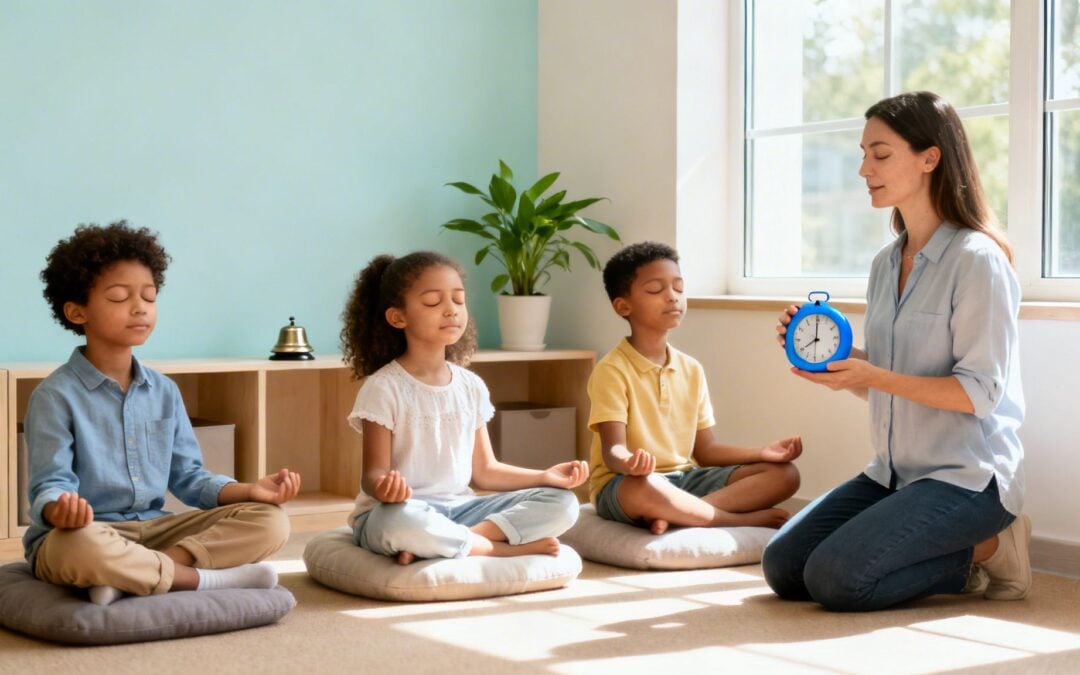
In today’s fast-paced world, children navigate a landscape of constant stimulation and high expectations. The ability to pause, breathe, and connect with the present moment isn’t just a nice-to-have; it’s a foundational skill for emotional regulation, focus, and resilience. This article moves beyond theory, offering a practical, evidence-informed toolkit of 10 mindfulness exercises for kids.
Designed for parents, teachers, and caregivers, each activity is broken down into simple, actionable steps, complete with age-appropriate adaptations and real-world examples. From calming anxious minds before a test to building empathy in the classroom, these exercises are more than just activities. They are building blocks for social-emotional learning (SEL) that equip children to thrive both academically and personally.
This comprehensive guide provides everything you need to introduce these powerful practices into your home or classroom. You will find step-by-step instructions, time guidance, and specific tips for adapting each exercise for different age groups and settings. For those looking to deepen their understanding and supplement these activities, exploring curated lists of books about social emotional learning can provide valuable narratives and frameworks to reinforce these concepts.
We will explore a variety of techniques, including:
Belly Breathing to manage stress.
Mindful Listening to improve focus.
Gratitude Practices to foster a positive outlook.
Body Scan Meditations to build self-awareness.
Each section is structured for quick reference and immediate implementation, helping you cultivate a more peaceful and attentive environment for the children in your care. By integrating these mindfulness exercises, you are giving kids a superpower: the ability to understand and manage their inner world with confidence.
1. Belly Breathing (Diaphragmatic Breathing)
Belly breathing, also known as diaphragmatic breathing, is a cornerstone of mindfulness exercises for kids. This foundational practice teaches children to take slow, deep breaths that originate from the diaphragm, causing the belly to rise and fall. This simple action directly engages the parasympathetic nervous system, our body’s natural relaxation response, helping to lower heart rate and reduce feelings of anxiety or stress.
Unlike shallow chest breathing, which is common during stressful moments, belly breathing provides an immediate and tangible tool for self-regulation. It is one of the most accessible self-regulation strategies for students and can be used anywhere, anytime.
How to Guide Belly Breathing
To introduce this technique, have children lie down comfortably or sit with a straight spine. Instruct them to place one hand on their chest and the other on their belly. Cue them to breathe in slowly through their nose, feeling the hand on their belly rise like a balloon filling with air, while the hand on their chest stays relatively still. Then, they should exhale slowly through their mouth, feeling their belly deflate.
Key Cue: “Imagine you have a small balloon in your belly. When you breathe in, you are slowly filling it up with air. When you breathe out, the balloon gently deflates.”
Practical Implementation and Tips
Make it Visual: Place a small stuffed animal or a “breathing buddy” on the child’s belly while they lie down. Their goal is to make the buddy gently rise and fall with each breath. For example, a child upset about a scraped knee can lie down with their favorite teddy bear on their tummy and focus on giving it a slow ride up and down.
Use Counting: Guide children through a simple counting pattern, such as breathing in for four counts, holding for four counts, and exhaling for four counts. This adds a focal point for their attention.
Integrate into Routines: A teacher might lead a two-minute belly breathing session after recess to help the class transition calmly to the next lesson. A parent can use it as part of a bedtime routine to promote restful sleep.
Normalize the Practice: Introduce belly breathing when children are calm and regulated. For example, practice for one minute during a morning meeting at school. This ensures they build muscle memory for the skill, making it easier to access during moments of frustration, anger, or nervousness before a big game.
2. Body Scan Meditation
The Body Scan Meditation is a guided exercise that encourages children to bring gentle, nonjudgmental attention to different parts of their body, one at a time. This practice helps kids develop a stronger mind-body connection, teaching them to notice physical sensations like warmth, tingling, or tension without feeling the need to react to them. It is a powerful tool for building body awareness and helping children recognize how emotions can manifest physically.
Pioneered in modern mindfulness by Jon Kabat-Zinn, this technique is not about changing or fixing sensations, but simply noticing them. For children, this fosters an ability to sit with discomfort and understand the transient nature of physical feelings, which is a key component of emotional resilience. It’s one of the most effective mindfulness exercises for kids to connect with their inner world.
How to Guide a Body Scan Meditation
Have children lie down comfortably on their backs with their eyes closed or with a soft, downward gaze. In a calm voice, guide their attention sequentially through the body, starting from the toes and moving slowly up to the head. Invite them to notice any sensations in each part without judgment.
Key Cue: “Bring your attention to your toes. You don’t have to move them, just notice how they feel. Are they warm or cool? Tingly or still? Whatever you feel is perfectly okay.”
Practical Implementation and Tips
Keep it Brief and Playful: For younger children, start with a 3-5 minute scan. You can call it a “Tingle Tour” or “Flashlight Focus,” imagining a gentle beam of light scanning their body. For example, a kindergarten teacher could say, “Let’s shine our magic flashlight onto our feet. What do you notice?”
Allow for Movement: It’s natural for kids to fidget. Offer “wiggle breaks” between body parts. You might say, “Now let your feet have a little wiggle before we move our attention to our legs.”
Use Inclusive Language: Frame invitations gently. For instance, “Notice your left hand… or if you prefer, just think about that space.” This is especially important for children with diverse physical abilities or sensitivities.
Integrate into Daily Transitions: A guidance counselor might use a short body scan with an anxious student to help them ground themselves before returning to class. A parent can lead a calming scan as part of a bedtime routine to release the day’s tension and promote sleep. For example, a parent could say, “Let’s notice if our legs feel tired from all that running today. Now let’s see how our tummy feels.”
3. Mindful Movement & Brain Breaks (Yoga, Short Movement Breaks)
Mindful movement combines gentle physical activity with present-moment awareness, making it one of the most engaging mindfulness exercises for kids. Practices like children’s yoga or short, structured “brain breaks” bridge the mind-body connection, helping children release physical tension, improve focus, and regulate their energy levels. This approach is especially effective for kinesthetic learners who thrive when they can move their bodies.
Unlike traditional exercise, the goal is not performance but awareness. Children learn to notice how their bodies feel during movement, connecting with their breath and physical sensations. These embodiment practices for kids empower them with tools to reset their attention and manage restlessness, both in the classroom and at home.
How to Guide Mindful Movement
Begin by creating a safe, non-competitive space. For yoga, use storytelling to guide poses, like becoming a tall, strong tree or a stretching cat. For a brain break, simply ask children to stand up and “shake out the wiggles” or “stretch toward the sky.” The key is guiding them to pay attention to the physical sensations as they move.
Key Cue: “As you stretch your arms up high, notice how your sides feel. Can you feel your muscles waking up? Now, as you shake your hands out, imagine you are shaking off any wiggly or tired feelings.”
Practical Implementation and Tips
Use Storytelling: Frame movements within a narrative. For example, a librarian leading a yoga session could guide children through an imaginary journey to the jungle, having them become a hissing snake (Cobra Pose) or a roaring lion (Lion’s Breath).
Schedule Brain Breaks: Integrate short (2-5 minute) movement breaks between academic subjects. A teacher might use a GoNoodle video or lead a quick “animal walks” session—like crab walking or frog hopping—to transition from math to reading.
Focus on Feeling, Not Form: Emphasize that every child’s pose will look different. The goal is to notice what their own body feels like, not to achieve a perfect posture.
Pair with Breathing: Connect breath to movement. For example, in a “Balloon Breath” break, a teacher can instruct students to breathe in while raising their arms overhead (filling the balloon) and breathe out while lowering them (letting the air out).
4. Mindful Listening Circles
Mindful Listening Circles are a structured and powerful practice that teaches children the art of deep, non-judgmental listening. In this exercise, participants sit in a circle, and one person speaks at a time without interruption. This simple format creates a safe container for sharing, fostering empathy, strengthening communication skills, and building a profound sense of community and psychological safety.
This practice transforms listening from a passive activity into an active, mindful engagement. By focusing entirely on the speaker, children learn to quiet their own inner chatter and offer their full, respectful attention. This is one of the most effective mindfulness exercises for kids because it directly builds social awareness and relationship skills, which are core components of social-emotional learning.
How to Guide a Mindful Listening Circle
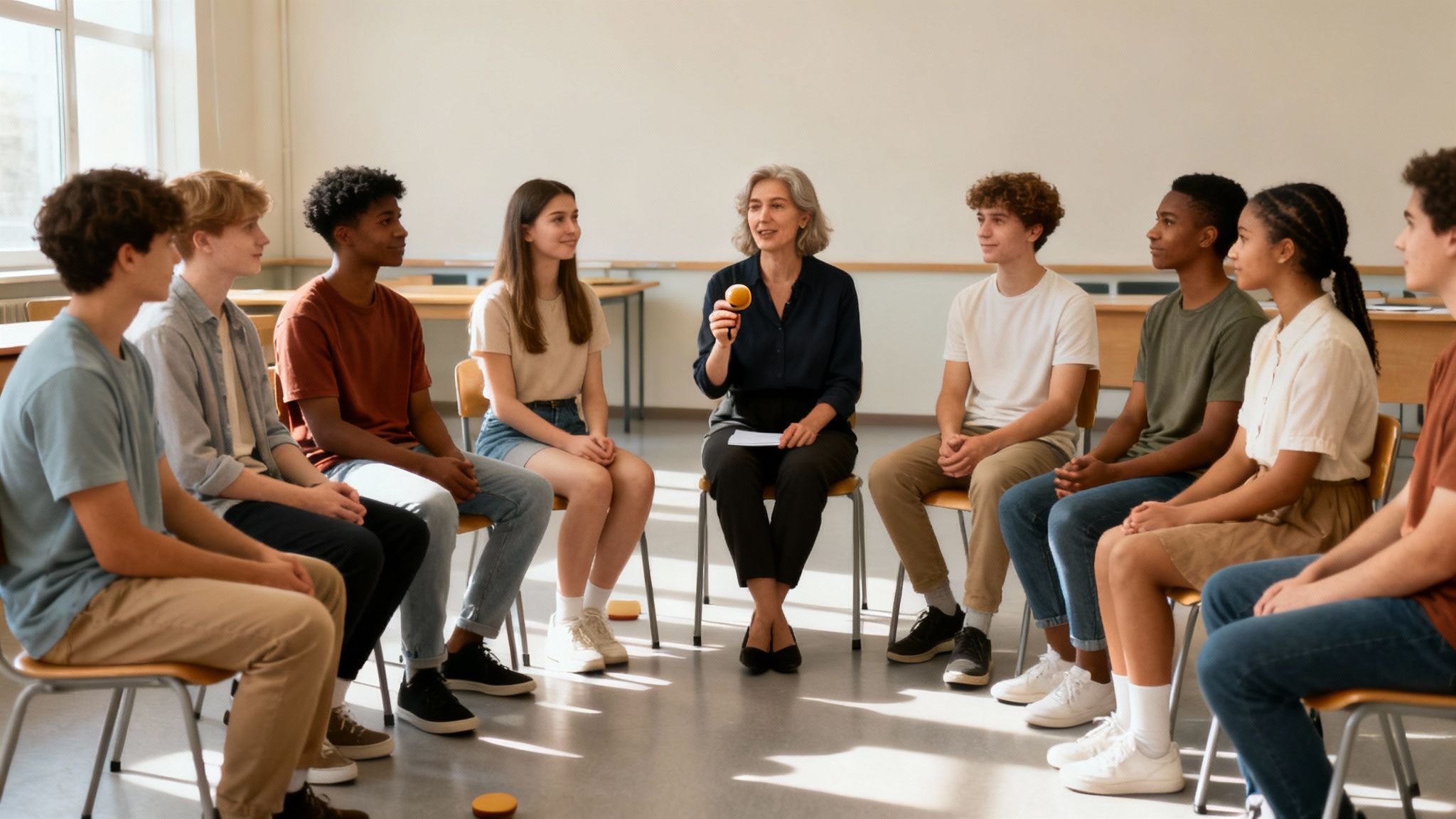
To begin, gather the children in a circle where everyone can see each other. The facilitator establishes clear expectations and introduces a “talking piece,” which can be any object like a special stone, a small stuffed animal, or a decorated stick. Only the person holding the talking piece is allowed to speak.
The facilitator poses a prompt, and the talking piece is passed around the circle. Each child has the option to share their thoughts related to the prompt or to simply pass the piece to the next person without speaking. The core rule is that everyone else listens silently and respectfully until the speaker is finished and passes the piece.
Key Cue: “When you are not holding the talking piece, your only job is to listen with your ears, your eyes, and your heart. Listen to understand, not to reply.”
Practical Implementation and Tips
Establish Clear Ground Rules: Before starting, co-create and review essential rules: One person speaks at a time (the one with the talking piece), listen respectfully, what is shared in the circle stays in the circle, and it is always okay to pass.
Use a Talking Piece: A physical object makes the speaker role tangible and clear. It prevents interruptions and helps children visually track whose turn it is to speak. For example, a “listening shell” could be used, where students imagine it holds the speaker’s voice.
Start with Low-Risk Prompts: Build trust by beginning with light, fun prompts like, “Share one thing that made you smile this week,” or “If you could have any superpower, what would it be?” Gradually move to deeper topics as the group’s comfort level grows.
Model Mindful Listening: The facilitator’s role is crucial. They must model attentive, non-judgmental listening, validate children’s contributions with a nod or a simple “thank you,” and hold the emotional space for the group. For more ideas, explore other powerful listening skills activities.
Integrate into Routines: A teacher can use a circle for a morning meeting to check in on how students are feeling. For example, using a prompt like, “Share one word that describes your mood today.” This can become a cherished ritual for building classroom community.
5. Gratitude Practice and Journaling
Gratitude practice is a powerful mindfulness exercise that trains children to actively notice and appreciate the positive aspects of their lives. This intentional focus on thankfulness helps shift a child’s perspective away from challenges or what is lacking, building emotional resilience and fostering a more optimistic outlook. By regularly acknowledging people, experiences, and even small objects they are grateful for, children develop a deeper awareness of the good that surrounds them daily.
This practice is not about ignoring difficulties but about balancing one’s worldview. It has been popularized by positive psychology researchers who have demonstrated its strong link to increased happiness and well-being. By making gratitude a conscious habit, we equip children with a tool to counteract negative thought patterns and cultivate a sense of connection and contentment.
How to Guide a Gratitude Practice
Introduce gratitude in a simple, accessible way. Start by asking children to think of one thing that made them smile that day. The goal is to make it a low-pressure, reflective moment rather than a task. You can guide them with prompts that encourage specificity, helping them move from general statements to meaningful reflections.
Key Cue: “Let’s think of three specific things we are thankful for right now. It could be a person who was kind, a food you enjoyed, or the feeling of the sun on your skin during recess.”
Practical Implementation and Tips
Create a Gratitude Jar: In a classroom or at home, decorate a jar. Have children write or draw one thing they are grateful for on a small slip of paper each day and add it to the jar. For example, a child might write, “I’m grateful for when my friend shared their crayons with me.” Read the slips together at the end of the week.
Start a Journal: For older children, a dedicated gratitude journal can be a personal space for reflection. For younger kids or those who benefit from written reflection, exploring mental health journaling prompts can be a wonderful way to cultivate self-awareness and gratitude. Even drawing pictures of things they are thankful for is effective.
Integrate into Routines: Incorporate a gratitude share into daily routines. For example, a family can make it a dinnertime ritual where each person shares one “rose” (a positive thing) from their day. Discover more impactful gratitude activities for kids to keep the practice fresh.
Model Authenticity: Adults should participate and model genuine gratitude. For example, a teacher could say, “I’m grateful for how hard everyone worked on their math problems today.” This shows that gratitude is a valuable practice for everyone.
6. Mindful Eating
Mindful eating is a powerful practice that transforms meal or snack time into a rich sensory experience. It teaches children to slow down and use all five senses to explore their food: noticing colors, textures, smells, sounds, and, finally, flavors. This intentional engagement anchors them in the present moment, fostering a healthier relationship with food and a greater awareness of their body’s hunger and fullness cues.
This exercise is particularly valuable as it counters the rushed, distracted eating habits that are common today. By turning a routine activity into an opportunity for mindfulness, it helps children develop appreciation, self-regulation, and body awareness without needing extra time in their schedule. It is a foundational practice for building lifelong healthy habits.
How to Guide Mindful Eating
Choose a simple food item like a raisin, a slice of apple, or a cracker to start. Guide children through a sensory exploration before they even take a bite. Prompt them to observe the food as if they have never seen it before, noticing its shape, weight, and texture in their hands. Encourage them to smell it, listen to it, and finally, to take one small, slow bite, chewing deliberately to discover all its flavors.
Key Cue: “Let’s become food detectives! Before you eat, let’s use our senses. What does the cracker look like? Can you hear a sound when you break it? What does it smell like? Now, take a tiny bite and see how many flavors you can discover.”
Practical Implementation and Tips
Start Small: Begin with a “mindful minute” during snack time, focusing on just the first bite of a food item. For example, a teacher can guide the class to mindfully eat one Goldfish cracker, noticing its salty taste and crunchy sound.
Five Senses Exploration: Explicitly guide children through their senses. Ask questions like, “What colors do you see on your orange slice?” or “What does the yogurt feel like on your tongue?”
Slow Down the Chew: Encourage children to chew their food more than usual, perhaps counting to ten before swallowing. This aids digestion and helps them recognize when they are full.
Eliminate Distractions: At home, try having one screen-free meal a day. In the classroom, ensure snack time is a calm period without other competing activities.
Connect to Gratitude: Talk about where the food came from. For example, while eating strawberries, a parent could say, “Let’s thank the sun and the rain for helping these berries grow.” This builds a sense of connection and appreciation.
7. Guided Imagery and Visualization
Guided imagery, also known as visualization, is a powerful mindfulness practice that taps into a child’s natural gift for imagination. This exercise involves a guide leading children through a detailed, imaginary journey to a peaceful and safe place, using rich sensory language to make the scene feel real. This process activates the brain’s relaxation response, helping to reduce anxiety, manage stress, and build a portable mental sanctuary they can access anytime.
Visualization works by shifting a child’s focus from external stressors or internal worries to a calming, internally-generated experience. By engaging their senses in this imagined world, children can effectively quiet the mind and regulate their emotional state. It is a highly effective and engaging mindfulness exercise for kids who thrive on creativity and storytelling.
How to Guide Visualization
To begin, have children find a comfortable position, either sitting up or lying down, and gently close their eyes. Use a calm, slow voice to describe a peaceful setting, focusing on what they might see, hear, smell, feel, and even taste. Encourage them to immerse themselves fully in the scene you are creating.
Key Cue: “Picture yourself walking on a soft, sandy beach. Feel the warm sun on your skin and listen to the gentle sound of the waves. What colors do you see in the sky? Can you smell the salty air?”
Practical Implementation and Tips
Offer Choices: Empower children by allowing them to choose their own “calm place,” whether it’s a magical forest, a cozy fort, or a favorite real-life spot. This increases their sense of ownership and safety.
Use Rich Sensory Language: Incorporate details that appeal to all senses. For example, instead of “imagine a forest,” say “imagine you can smell the damp earth and pine needles, and feel the bumpy bark of a tall tree.”
Integrate into Transitions: A teacher can lead a five-minute guided imagery session before a test to ease anxiety. For example, “Imagine a calm, blue light filling your mind, helping you remember everything you’ve learned.”
Create Recordings: Record your own guided imagery scripts or use resources from apps like Calm or Headspace Kids. Having recordings available allows children to use this tool independently when they need it, such as at bedtime to help with sleep.
Debrief the Experience: After the visualization, gently guide children back to the present moment. Ask questions like, “How does your body feel now compared to before we started?” This helps them connect the practice to its calming physical effects.
Mindful sensory activities, often called the “5 Senses Grounding” technique, are a powerful way to anchor children in the present moment. This exercise guides a child to deliberately engage each of their five senses to notice their immediate surroundings, pulling their attention away from overwhelming thoughts, anxieties, or big emotions. By focusing on tangible, neutral information, this practice helps interrupt worry spirals and activates a state of calm awareness.
This technique is a cornerstone of trauma-informed care and is highly effective for managing anxiety. It provides children with an immediate, concrete strategy to use when their thoughts feel chaotic, grounding them in the safety of the here and now. The structure of the exercise is simple, making it one of the most practical mindfulness exercises for kids to learn and use independently.
How to Guide the 5 Senses Grounding Technique
To begin, invite the child to take a slow, deep breath. Guide them through a sequential process of noticing their environment using the popular 5-4-3-2-1 format. Encourage them to name each item aloud or silently to themselves. The goal is not to judge what they sense, but simply to notice it.
Key Cue: “Let’s use our super senses to get to know this moment. We are going to find things around us right now. First, can you find 5 things you can see?”
Practical Implementation and Tips
Teach the 5-4-3-2-1 Method: Explicitly guide children through the sequence: notice 5 things you can see, 4 things you can feel or touch, 3 things you can hear, 2 things you can smell, and 1 thing you can taste.
Create Sensory Kits: A school counselor can create a “grounding kit” with items of different textures (a smooth stone, soft fabric), distinct scents (a lavender sachet), and quiet sounds (a small rain stick) to make the practice more engaging.
Integrate Before Transitions: A teacher could lead the class through a quick 5 Senses scan before a test or after a noisy lunch period to help students settle their minds and focus.
Practice When Calm: Introduce this technique when children are regulated. For example, a parent can play the “5 Senses Game” with their child in the car, asking “What are 5 things you can see right now?” This helps them build proficiency so they can access it more easily during moments of distress.
9. Loving-Kindness Meditation (Metta)
Loving-kindness meditation, often called Metta, is a powerful mindfulness practice designed to cultivate compassion, connection, and empathy. This exercise guides children to mentally send wishes of well-being, safety, and happiness to themselves and others. The practice follows an expanding circle of care, starting with the self, moving to loved ones, then to neutral people, and eventually even to those with whom they have difficulty.
This exercise directly builds social-emotional learning (SEL) skills by training the heart and mind to be kinder. It helps reduce negative self-talk, diminishes feelings of anger or resentment toward others, and fosters a more inclusive and caring classroom environment. By regularly practicing, children learn that kindness is a skill they can strengthen, just like a muscle.
How to Guide Loving-Kindness Meditation
Begin by having children sit in a comfortable, quiet posture with their eyes gently closed or looking softly at the floor. Guide them to place a hand over their heart to connect with the feeling of warmth. Then, lead them through a series of simple, repeatable phrases directed toward different people.
Key Cue: “Silently in your mind, repeat after me. First, let’s send these kind wishes to ourselves: May I be happy. May I be safe. May I be healthy and strong.”
Practical Implementation and Tips
Start with Self-Love: Always begin the practice by directing kindness inward. Many children find it difficult to be kind to themselves, so this is a crucial first step. Progress to people they love easily, like family or pets, before moving to others.
Keep Phrases Simple: Use short, memorable phrases that are easy for children to repeat in their minds. You can adapt them to feel more authentic, such as, “I wish myself happiness,” or “I hope I have a good day.”
Use for Conflict Resolution: A school counselor can use this meditation in a restorative circle after a conflict between students. For example, guiding both children to send kind wishes to themselves and then silently to each other can help repair the relationship and build empathy.
Gradual Expansion: Introduce the concept of sending kindness to a “neutral” person (like a mail carrier) and, when ready, to a “difficult” person. Frame this not as forgiving bad behavior but as freeing oneself from holding onto anger. For example, explain that sending kind wishes is like sending a balloon into the sky—it makes you feel lighter, no matter who it’s for.
Nature-based mindfulness, often inspired by the Japanese practice of Shinrin-yoku or “forest bathing,” is an immersive exercise that encourages children to connect with the natural world through their senses. This practice involves intentionally slowing down in an outdoor setting to observe, listen, touch, and smell the environment. By focusing their attention on the sights, sounds, and textures of nature, children can anchor themselves in the present moment, which significantly reduces stress and promotes a sense of calm and belonging.
This powerful mindfulness exercise for kids leverages our innate connection to nature, known as biophilia, to soothe the nervous system and enhance well-being. It moves mindfulness from an abstract concept into a tangible, sensory-rich experience that is highly engaging for young learners.
How to Guide Nature-Based Mindfulness
Take children to an outdoor space like a park, schoolyard, or even a single tree. Encourage them to walk slowly and quietly, without a specific destination in mind. Guide their awareness to each of their senses, one by one. Ask them to notice the different shades of green, the feeling of the breeze on their skin, the sounds of birds or rustling leaves, and the smell of the soil or flowers. The goal is simply to notice without judgment.
Key Cue: “Let’s use our ‘owl eyes’ and ‘deer ears.’ What can you see without moving your head? What is the quietest sound you can hear if you listen very carefully?”
Practical Implementation and Tips
Sensory Scavenger Hunt: Instead of a list of items to find, create a list of sensory experiences: “Find something smooth,” “Listen for a bird’s song,” or “Find something that smells like pine.”
Pair with Journaling: After a mindful walk, have children draw or write about one thing they noticed. For example, a teacher can ask, “Draw the most interesting leaf you saw today and describe how it felt in your hand.”
Integrate into Academics: A teacher can take a science lesson outdoors, asking students to mindfully observe an insect or a plant for five minutes before discussing its life cycle. This enhances both focus and learning.
Start Small: This practice doesn’t require a forest. For example, a parent and child can mindfully observe a spider spinning a web outside their window or listen to the sound of rain on the roof. The key is intentional, focused awareness.
10 Mindfulness Exercises for Kids — Quick Comparison
Practice
Implementation complexity
Resource requirements
Expected outcomes
Ideal use cases
Key advantages
Belly Breathing (Diaphragmatic Breathing)
Low — quick to teach, brief instruction needed
None — tactile cues or props (stuffed animal) optional
Outdoor space (garden, yard, park), variable time (10+ minutes)
Reduced stress, attention restoration, connection to nature and belonging
Outdoor classes, school gardens, walking meditations, nature journaling
Strong evidence for stress reduction; combines physical activity and mindfulness
Bringing It All Together: Weaving Mindfulness into Daily Life
Throughout this guide, we have explored a diverse collection of ten powerful mindfulness exercises for kids, from the calming rhythm of Belly Breathing to the expansive awareness of Nature-Based Mindfulness. Each activity serves as a unique tool, designed to help children navigate the complexities of their inner and outer worlds with greater calm, clarity, and compassion. The goal is not to perfect every exercise, but to build a rich and accessible toolkit that children can turn to whenever they need it.
The journey of integrating mindfulness is one of patience, consistency, and adaptation. By introducing these practices, you are planting seeds of emotional intelligence that will flourish for a lifetime. Children learn to recognize their feelings without being overwhelmed by them, develop a stronger sense of empathy for others, and build the resilience needed to face challenges with a centered mind.
Key Takeaways and Actionable Next Steps
To make mindfulness a sustainable part of your home or classroom, focus on integration rather than addition. The most effective approach is to weave these practices into the natural flow of the day, transforming routine moments into opportunities for mindful awareness.
Here are some practical next steps to get started:
Start Small and Be Consistent: Don’t try to implement all ten exercises at once. Choose one or two that feel most accessible. For example, you might commit to a two-minute Body Scan before bedtime or start each morning meeting with a round of Mindful Listening. Consistency is more impactful than intensity.
Model the Behavior: Children are incredibly perceptive. When they see you taking a few deep breaths when you feel stressed or expressing gratitude for a small joy, they learn that mindfulness is a valuable, real-world skill. Your practice gives them permission and a clear example to follow.
Connect to Daily Routines: Link mindfulness exercises to existing schedules. A Mindful Eating moment can be part of the first five minutes of lunch. A brief Gratitude Practice can become a beloved dinnertime ritual. A quick Mindful Movement break can be used to transition between academic subjects, helping to reset focus and energy.
Create a “Peace Corner” or “Calm-Down Kit”: Designate a physical space where a child can go to practice these skills. Stock it with items that engage the senses, like a soft blanket, a glitter jar, or headphones with guided visualizations. This empowers children to self-regulate when they feel big emotions.
The Lasting Impact of Mindful Kids
The value of teaching mindfulness exercises for kids extends far beyond immediate stress reduction. When children learn to tune into their bodies, listen with intention, and cultivate kindness, they are developing the core competencies of social-emotional learning (SEL). They become better problem-solvers, more empathetic friends, and more engaged, self-aware learners.
Imagine a classroom where students can use Belly Breathing to manage test anxiety or a home where siblings use Loving-Kindness Meditation to resolve conflicts. These are not abstract ideals; they are tangible outcomes of a consistent mindfulness practice. By equipping children with these internal resources, we are not just helping them get through a tough day. We are empowering them to build a foundation for a mentally and emotionally healthy life, enabling them to show up in the world with confidence, connection, and a deep understanding of themselves and others. Your commitment to this practice is a profound gift that will continue to grow with them.
Ready to bring a structured, school-wide approach to social-emotional learning to your campus? Soul Shoppe provides dynamic, evidence-based programs that teach students the skills of empathy, respect, and emotional regulation through experiential assemblies and curriculum. Discover how you can build a more positive and connected school climate by visiting Soul Shoppe today.
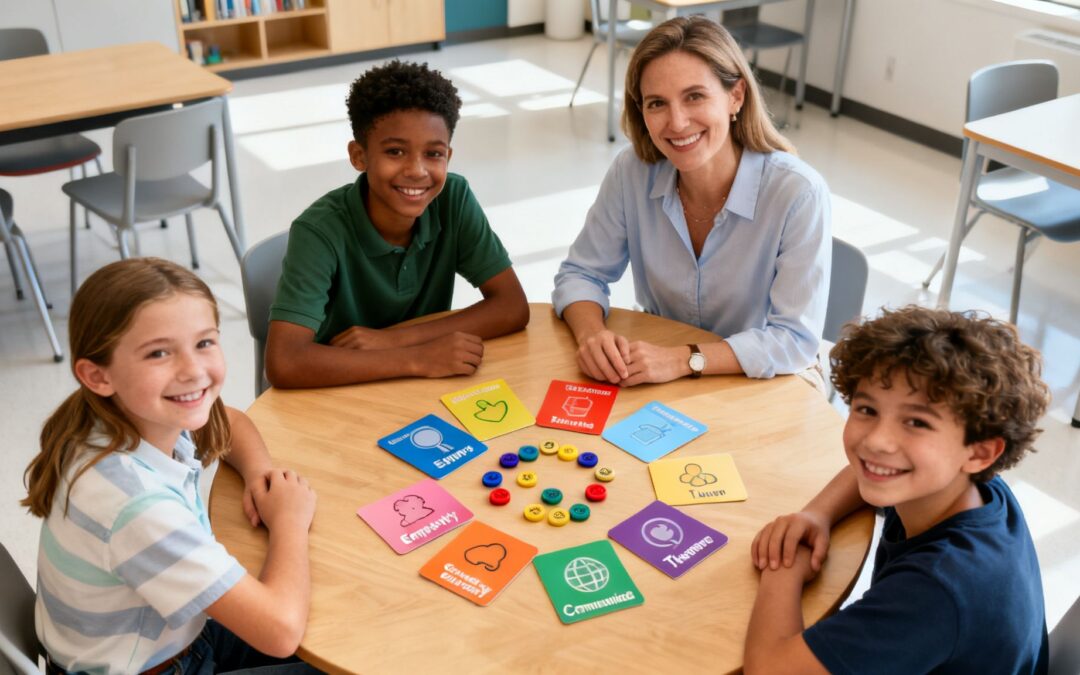
Middle school is a period of immense change, both socially and emotionally. Students are navigating complex peer dynamics, forming their identities, and facing new academic pressures. This makes it a critical time to intentionally build social-emotional learning (SEL) skills. Effective SEL is not just another item on a long to-do list; it is the foundation for a positive school culture, improved academic outcomes, and lifelong well-being.
By equipping students with practical tools for self-awareness, empathy, and conflict resolution, we empower them to thrive during these pivotal years and beyond. The right sel activities for middle school can transform a classroom environment, reduce bullying, and help adolescents manage the intense emotions that define this stage of development. This is about giving them a vocabulary for their feelings and strategies for their challenges.
This article moves beyond theory to provide a curated roundup of 10 practical, classroom-ready SEL activities. Each entry is designed for immediate implementation by teachers, counselors, and even parents. You will find:
Step-by-step instructions for easy facilitation.
Clear objectives and time estimates for planning.
Practical examples and differentiation tips to meet diverse needs.
Adaptations for virtual or at-home settings.
This guide provides the actionable strategies needed to integrate meaningful social-emotional learning into daily routines, helping students build the resilience and interpersonal skills necessary for success in school and in life.
1. Emotion Check-In Circles
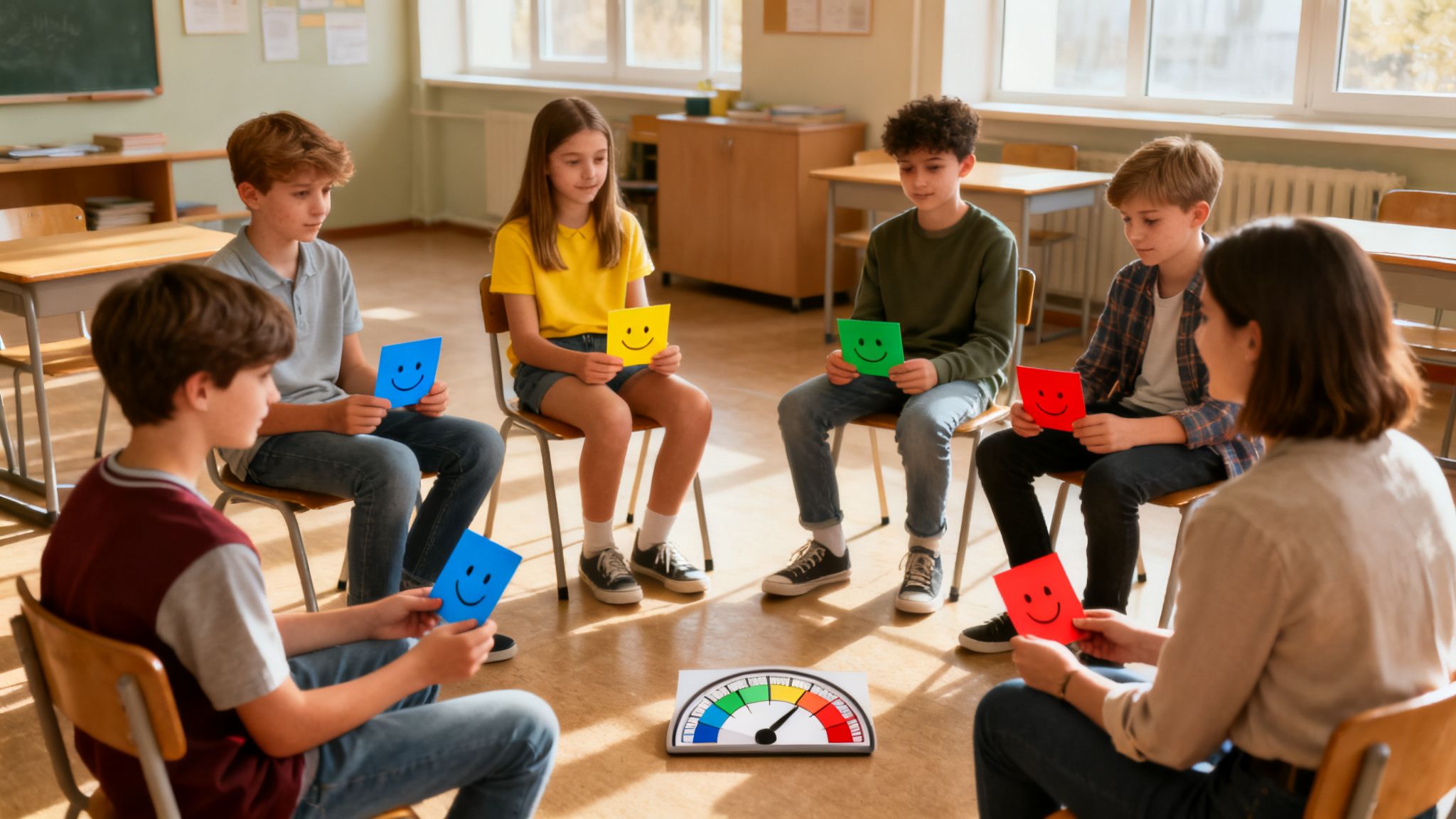
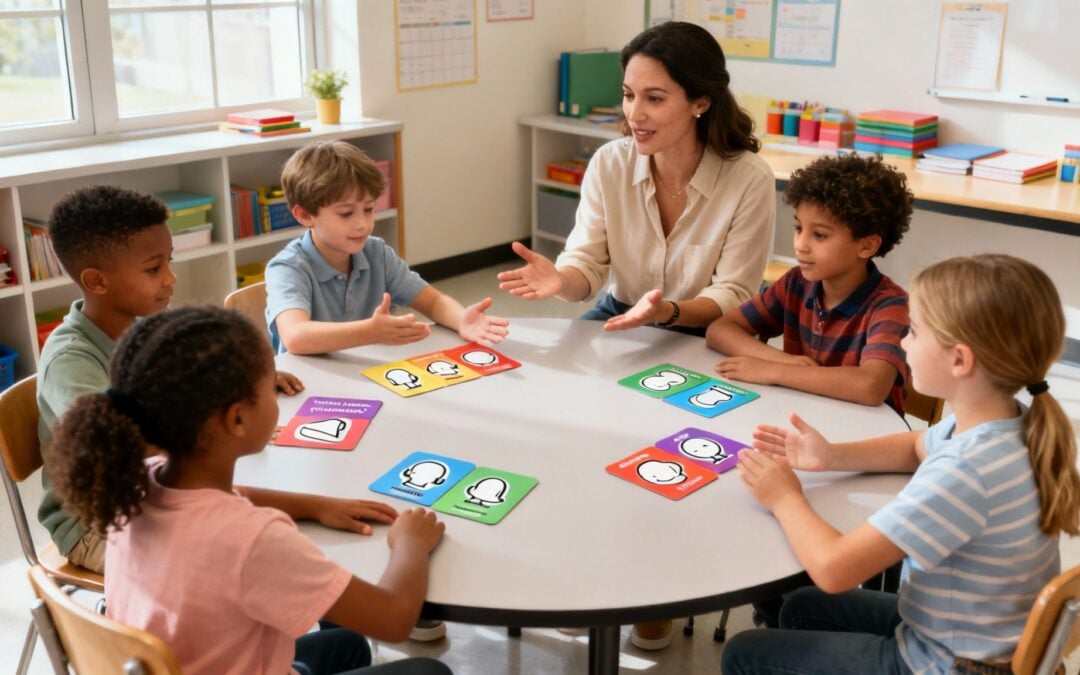
Emotion Check-In Circles are a structured, routine practice where students gather to share their current emotional state. This powerful yet simple activity helps build emotional awareness, fosters psychological safety, and gives educators a real-time understanding of the classroom’s emotional climate. By creating a dedicated space for feelings, these circles validate students’ experiences and normalize conversations around mental well-being, making it one of the most foundational sel activities for middle school.
This practice involves students indicating their mood using a consistent framework, such as a color-coded “mood meter,” a set of emoji cards, or a shared emotional vocabulary. For example, a student might hold up a blue card to signify feeling calm, a yellow card for feeling energetic, or a red card for feeling angry or overwhelmed. This shared language removes the pressure of finding the “right” words and creates an accessible entry point for all learners.
How to Implement Emotion Check-In Circles
Implementing this activity is straightforward. At the beginning of class or during a transition, gather students in a circle. The facilitator (teacher) should model the process first by sharing their own emotional state: “Today, I’m feeling green, which for me means I’m calm and ready to learn. How is everyone else feeling?” Students then take turns sharing, with the explicit option to “pass” if they don’t feel comfortable. A practical example could be a student saying, “I’m in the yellow zone today because I’m excited about the basketball game after school,” or “I’m a little blue because I didn’t get much sleep.”
Practical Tips for Success
Start Simple: Begin with non-verbal cues like thumbs up/down/sideways or holding up a colored card before moving to verbal sharing.
Establish a Routine: Conduct circles at the same time each day (e.g., first five minutes of first period) to build the habit.
Honor Privacy: Always provide an option to pass without requiring an explanation. This builds trust and respects student autonomy.
Use Consistent Language: Adopt a school-wide emotional vocabulary, like the frameworks from Soul Shoppe, to ensure clarity and reinforcement across classes. For more ideas on how to implement this, you can explore various daily check-in tools that boost student confidence.
2. Mindfulness Breathing Breaks
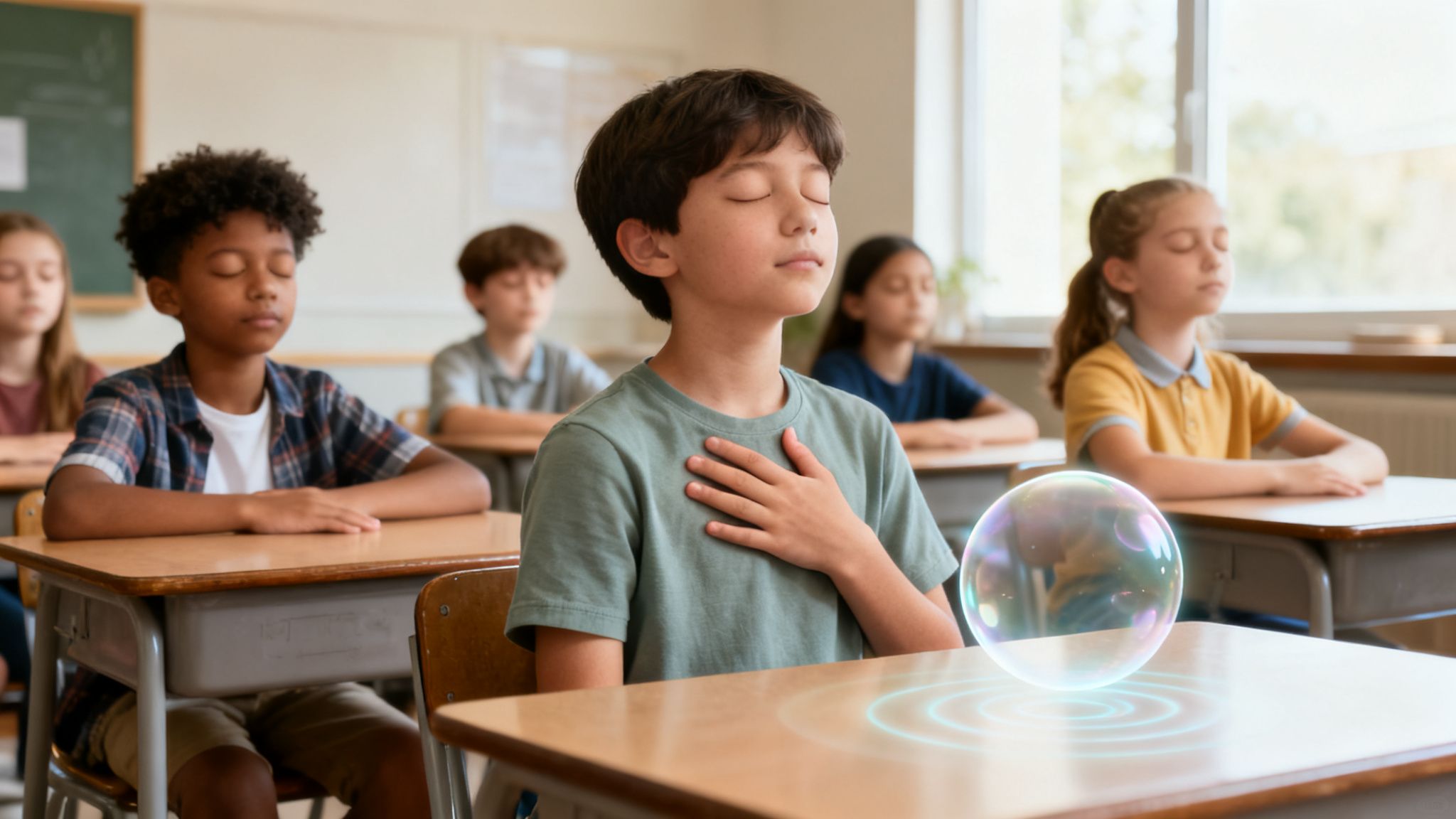
Mindfulness Breathing Breaks are short, structured exercises integrated throughout the school day to help students self-regulate and improve focus. These brief, guided practices (typically 2-5 minutes) teach tangible techniques like box breathing or belly breathing that students can use independently to manage stress, anxiety, and overwhelming emotions. By equipping students with these tools, educators can proactively support their well-being and create a more centered learning environment, making this one of the most practical sel activities for middle school.
This practice involves leading students through a specific breathing pattern, often with visual or auditory cues. For instance, a teacher might guide students through “box breathing” by instructing them to inhale for four counts, hold for four, exhale for four, and hold again for four, tracing a square in the air or on a worksheet. A practical example for parents is to use this before homework time: “Let’s do our ‘pizza breath’ before we start math. Breathe in like you’re smelling a hot pizza, then blow out slowly to cool it down.” This simple, repetitive action gives students a concrete anchor, helping them calm their nervous system.
How to Implement Mindfulness Breathing Breaks
Integrating these breaks is simple and requires no special equipment. Start during a calm moment, like the beginning of class or after lunch, to introduce the concept. Model the technique yourself: “We’re going to try a 3-minute ‘belly breath’ to help our minds settle. Place one hand on your belly. As you breathe in, feel your belly expand like a balloon. As you breathe out, feel it gently deflate.” Consistency is key to making these practices automatic for students when they feel anxious before a test or overwhelmed by a social situation.
Practical Tips for Success
Introduce During Calm Times: Teach and practice breathing techniques when students are regulated, not just during a crisis. This builds muscle memory for when they actually need the skill.
Use Visual Anchors: Provide visual aids like a “breathing ball” that expands and contracts, a feather to blow gently, or an animated GIF of a pulsing shape to make the abstract concept of breath more concrete.
Practice for Automaticity: Stick with one or two techniques until students have mastered them. Repetition helps the skill become an automatic response to stress.
Connect to Their Goals: Frame the practice around things middle schoolers care about, like improving focus for a big game, staying calm during a presentation, or managing test anxiety.
Offer Alternatives: Be sensitive to trauma-informed practices. For some students, closing their eyes or focusing on breath can be triggering. Offer alternatives like focusing on a visual object or noticing the feeling of their feet on the floor.
3. Peer Compliment and Gratitude Exchanges
Peer Compliment and Gratitude Exchanges are structured activities where students intentionally give and receive specific, genuine affirmations. This practice moves beyond generic praise to focus on character, effort, and specific actions, helping to build authentic connections and combat the social isolation common in middle school. By creating a routine for expressing appreciation, these exchanges strengthen peer relationships and foster a positive classroom culture, making them one of the most impactful sel activities for middle school.
These exchanges can take many forms, from written gratitude notes passed between classmates to verbal “appreciation circles” held weekly. For instance, a student might write, “I appreciate that you included me in your group when you saw I was working alone.” Another practical example is a “Shout-Out Wall” where anyone can post a sticky note praising a peer, like, “Shout-out to Jamal for helping me pick up my books when I dropped them.” This specificity teaches students to observe and value the positive behaviors of others, building empathy and social awareness in a tangible way.
How to Implement Peer Compliment and Gratitude Exchanges
To begin, dedicate a specific time for the activity, such as during morning meetings or at the end of the week. The teacher should model how to give a meaningful compliment first: “I’d like to thank Sarah for helping a new student find their way to the library. That was a very kind and welcoming action.” Students can then share compliments verbally in a circle or write them on pre-made cards. A “compliment box” can also be used for students who prefer to share anonymously.
Practical Tips for Success
Model Specificity: Always model behavior-focused compliments, not appearance-based ones. Instead of “I like your shirt,” model, “I admire your patience when you were explaining that math problem to me.”
Provide Sentence Starters: Offer prompts like “I appreciate you because…” or “I noticed you were a good friend when you…” to help students formulate their thoughts.
Ensure Equity: Use a structured system, like pulling names from a jar, to ensure every student has a chance to be recognized over time.
Make it a Routine: Consistency is key. A weekly “Gratitude Friday” makes the practice a predictable and valued part of the classroom culture. To find more ways to incorporate this practice, explore these gratitude activities for kids.
Celebrate Both Roles: Acknowledge the courage it takes to give a compliment and the grace required to receive one. This reinforces the value of both giving and receiving kindness.
4. Conflict Resolution and Restorative Practices Circles
Conflict Resolution Circles are a structured dialogue process rooted in restorative practices where students involved in a dispute come together to understand, take accountability, and repair harm. This approach shifts the focus from punishment to healing and relationship-building, providing a safe space for each person’s perspective to be heard. Unlike punitive measures that can isolate students, these circles rebuild community and address the root causes of conflict, making them one of the most transformative sel activities for middle school.
The practice involves a trained facilitator guiding participants through a series of questions designed to foster empathy and generate a collective solution. A practical example: after a disagreement in the hallway where one student pushed another, the students involved might be asked, “What happened?”, “Who has been affected by what you did and how?”, and “What do you need to do to make things right?”. The student who pushed might realize their action embarrassed the other student in front of friends, and the group could decide that a genuine apology and a plan for giving each other space is the best way to move forward. This framework moves beyond blame to focus on impact and restoration.
How to Implement Conflict Resolution Circles
To implement a circle, a facilitator (a trained teacher, counselor, or administrator) gathers the affected students in a private, neutral space. The facilitator sets ground rules for respectful communication, often using a talking piece to ensure only one person speaks at a time. They guide the dialogue through the restorative questions, ensuring each participant has a chance to share their experience and perspective without interruption. The ultimate goal is for the students to co-create a mutually agreeable plan to repair the harm and move forward.
Practical Tips for Success
Invest in Training: Before implementing, ensure staff receive comprehensive training from organizations like the International Institute for Restorative Practices (IIRP) to facilitate effectively.
Start with Low Stakes: Build skill and comfort by using circles for minor disagreements, like a dispute over a seat at the lunch table, before addressing more significant conflicts.
Establish Clear Protocols: Use a consistent script and guidelines for every circle to create predictability and safety for all participants.
Follow Up on Agreements: Check in with students after the circle to ensure they are upholding their agreed-upon solutions, which reinforces accountability.
5. Empathy and Perspective-Taking Role Plays
Empathy and Perspective-Taking Role Plays are structured, interactive scenarios where students step into another person’s shoes to understand different viewpoints and emotional experiences. This activity moves beyond simply talking about empathy and allows students to feel and react from a new perspective, making it one of the most impactful sel activities for middle school. By enacting real-world conflicts or diverse experiences, students build crucial social awareness and relationship skills in a controlled, supportive environment.
These dramatic activities involve presenting students with a scenario, such as a misunderstanding between friends, witnessing someone being excluded, or navigating a group project with conflicting ideas. For a practical example, the teacher could set up this scenario: “Student A saw a mean comment about them online posted by Student B, who is their friend.” One student plays A, another plays B, and a third plays a bystander. The true learning happens during the post-activity debrief, where they reflect on the thoughts and feelings of their assigned character and connect the experience back to their own lives.
How to Implement Empathy Role Plays
Begin by establishing clear ground rules to ensure the space feels safe and respectful, emphasizing that this is for learning, not entertainment. Present a simple, low-stakes scenario, for example: “One student wants to play basketball at recess, but their friend wants to sit and talk. How do they resolve this?” Assign roles and give students a few minutes to act out the scene. Afterward, facilitate a discussion with questions like, “How did it feel to be in your character’s position?” and “What might your character have done differently?”
Practical Tips for Success
Assign Roles: Instead of letting students choose, assign roles to gently push them out of their comfort zones and challenge them to consider unfamiliar perspectives.
Start with Low Stakes: Begin with common, everyday scenarios before moving on to more complex topics like bullying or social exclusion.
Establish Opt-Outs: Always provide a way for a student to opt-out or take on a non-acting role, like an observer or time-keeper, to respect their comfort level.
Make Debrief Meaningful: The reflection is the most critical part. Connect the role-play back to school values and SEL competencies, ensuring students understand the purpose of the activity. Programs like Soul Shoppe excel at using experiential activities to make these connections clear.
Process Emotions: Acknowledge and validate any genuine emotions that arise during the role play, reinforcing that it is a safe space to explore difficult feelings.
6. Personal Strengths and Growth Mindset Exploration Activities
Personal Strengths and Growth Mindset Exploration Activities are structured exercises that guide students in identifying their unique talents, passions, and learning styles. These powerful sel activities for middle school help shift their perspective from a “fixed mindset” (believing abilities are static) to a “growth mindset,” where they see challenges as opportunities to learn and develop. This process empowers students by focusing on what they do well and reframing areas for development as possibilities for growth, not failures.
This approach involves using tools like strength inventories or learning style assessments to give students concrete language for their abilities. Instead of a student thinking, “I’m bad at math,” they learn to say, “I’m working on building my math skills, and I can use my strength in creativity to find new ways to solve problems.” A practical example is the “Famous Failures” activity, where students research successful people like Michael Jordan or J.K. Rowling who overcame major setbacks, reinforcing that failure is a part of growth.
How to Implement Personal Strengths and Growth Mindset Activities
To implement this, begin by introducing the concept of a growth mindset, popularized by Carol Dweck’s research. Use a simple activity like having students complete a “Strengths Inventory” worksheet to identify their top five academic, social, or creative strengths. The teacher can model this by sharing their own strengths and a skill they are currently working on: “One of my strengths is organization, but I am still learning how to be a better public speaker. I practice by…” This creates a classroom culture where effort is celebrated.
Practical Tips for Success
Use Consistent Language: Regularly use phrases like “not yet,” “effort grows your brain,” and “let’s learn from that mistake” to reinforce growth mindset principles.
Create Strength Profiles: Have students create a visual “Strength Profile” that they can refer to when facing academic or social challenges.
Practice “Strength Spotting”: Encourage students to identify and acknowledge strengths in their peers. For example, “I noticed you used your strength of perseverance on that tough assignment.”
Model Your Own Growth: Share your own learning journey, including mistakes and areas where you are still growing. For a deeper dive, you can explore strategies for building resilience and perseverance in students.
7. Social-Emotional Literacy Through Literature and Story Circles
Social-Emotional Literacy Through Literature and Story Circles uses narratives as a powerful tool for exploring complex emotions and social dynamics. This approach leverages books, graphic novels, and personal stories as mirrors for students to see themselves and as windows to understand others. By discussing characters who navigate challenges like peer conflict, identity, and resilience, students develop empathy, emotional vocabulary, and problem-solving skills in a relatable context.
This method transforms reading from a passive activity into an interactive exploration of the human experience. A practical example: a class might read a graphic novel like New Kid by Jerry Craft and discuss a specific scene where the main character, Jordan, feels torn between two different groups of friends. The teacher could ask, “What emotions do you think Jordan is feeling? Have you ever been in a situation where you felt like you had to choose between friends? What did you do?” These discussions make abstract SEL concepts tangible and are a highly effective addition to any collection of sel activities for middle school.
How to Implement Literature and Story Circles
Begin by selecting a text that features relatable characters and relevant social-emotional themes. After reading a chapter or section, gather students in a “story circle” for a facilitated discussion. The teacher can start with open-ended questions like, “How do you think the main character was feeling in this chapter?” or “Have you ever felt like a character in this story?” The goal is to connect the narrative to students’ own lives, fostering self-awareness and social understanding.
Practical Tips for Success
Select Diverse Texts: Choose books with a wide range of characters and experiences. Graphic novels like Smile by Raina Telgemeier or novels like Wonder by R.J. Palacio are excellent for middle schoolers.
Prepare Thoughtful Questions: Develop discussion prompts that link character choices and emotions directly to SEL competencies like responsible decision-making and relationship skills.
Offer Multiple Response Options: Allow students to process the story through writing, drawing, or drama. A student might create a comic strip showing an alternate ending or write a journal entry from a character’s perspective.
Model Vulnerability: Share your own connections to the story’s themes. This helps create a safe environment where students feel comfortable sharing their own perspectives and experiences.
Involve Students in Selection: Ask students to recommend books or stories that resonate with them. This empowers them and ensures the material is relevant to their lives.
8. Service Learning and Community Contribution Projects
Service Learning and Community Contribution Projects are structured initiatives where students identify real-world community needs and engage in meaningful, sustained service to address them. More than just a one-time volunteer event, these projects empower students to develop empathy, agency, and a strong sense of civic responsibility. By connecting classroom learning to community action, this approach makes social-emotional development tangible and impactful, solidifying its place among the most powerful sel activities for middle school.
This practice involves a complete cycle of investigation, planning, action, and reflection. For example, a group of students might notice that younger students at a neighboring elementary school have trouble reading. Their service learning project could involve partnering with a first-grade class to become “reading buddies,” meeting weekly to read stories aloud and help the younger students practice their literacy skills. The focus is on genuine partnership and ensuring student voice is central to creating solutions.
How to Implement Service Learning Projects
Begin by facilitating a brainstorming session where students identify issues they care about in their school or local community. Once a need is chosen, guide them through researching the issue, connecting with community partners, and creating an actionable project plan. For example, a project to support a local animal shelter could involve students organizing a supply drive, creating informational posters about pet adoption, and volunteering to walk dogs. The teacher’s role is to facilitate, connect students with resources, and structure consistent reflection.
Practical Tips for Success
Start with Student Voice: Use interest surveys and community mapping activities to help students identify issues that genuinely resonate with them.
Forge Real Partnerships: Collaborate with established community organizations to ensure the project addresses a genuine need identified by the community itself.
Integrate Reflection: Schedule time for students to reflect before, during, and after the project to process their experiences, challenges, and growth.
Connect to Curriculum: Link the project to academic subjects like science (environmental projects), language arts (advocacy campaigns), or math (budgeting for a supply drive).
Define Meaningful Roles: Ensure every student has a significant role beyond simple tasks. Designate project managers, communication leaders, or research specialists. When designing service learning projects, consider various transformative ways to give back to the community that align with student interests and needs.
9. Mindful Movement and Yoga Practices
Mindful Movement and Yoga Practices are structured physical activities designed to help middle schoolers build body awareness, self-regulation, and stress management skills. Moving beyond traditional yoga, this approach uses stretching, strength-building poses, and breathwork to connect physical sensations with emotional states. It offers a tangible way for students to release tension, improve focus, and develop a positive relationship with their bodies, making it one of the most effective sel activities for middle school for holistic well-being.
This practice isn’t about perfect poses but about internal experience. Instead of focusing on flexibility, the language emphasizes strength, stability, and listening to one’s body. For instance, during a “Mountain Pose,” a teacher might ask students to feel their feet grounding them to the floor, connecting the physical sensation of stability to the emotional feeling of being calm and centered before a test. A practical example for parents could be doing a “Cat-Cow” stretch with their child after they’ve been sitting and doing homework for a long time, asking them, “How does it feel to move your back after being still for so long?”
How to Implement Mindful Movement and Yoga Practices
Integrating mindful movement can be as simple as leading a two-minute stretch break or as structured as a dedicated weekly yoga session. A great starting point is to use these activities during transitions, such as after lunch or before a high-focus task. The facilitator should model the movements alongside students, using inclusive, body-positive language and always offering variations and the choice to opt-out. For example, you could say, “Let’s try a ‘Warrior Pose’ to feel our strength. You can keep your hands on your hips or raise them high, whatever feels best for you today.”
Practical Tips for Success
Emphasize Strength Over Flexibility: Use cues like “Feel how strong your legs are” rather than “See how far you can stretch.” This builds self-efficacy and body positivity.
Offer Choices: Always provide multiple options for each movement or pose. For a forward fold, students can bend their knees deeply or place hands on their shins instead of the floor.
Connect Movement to Emotion: Prompt reflection by asking, “How does your body feel after that stretch? Did you notice a change in your energy?”
Model Participation: Practice alongside students to create a shared, non-judgmental experience. Your participation signals that this is a community practice, not a performance.
Create a Safe Space to Opt-Out: Explicitly state that students can choose to rest or sit quietly without needing to provide a reason. This honors their autonomy and builds trust.
10. Identity and Belonging Exploration Through Creative Expression
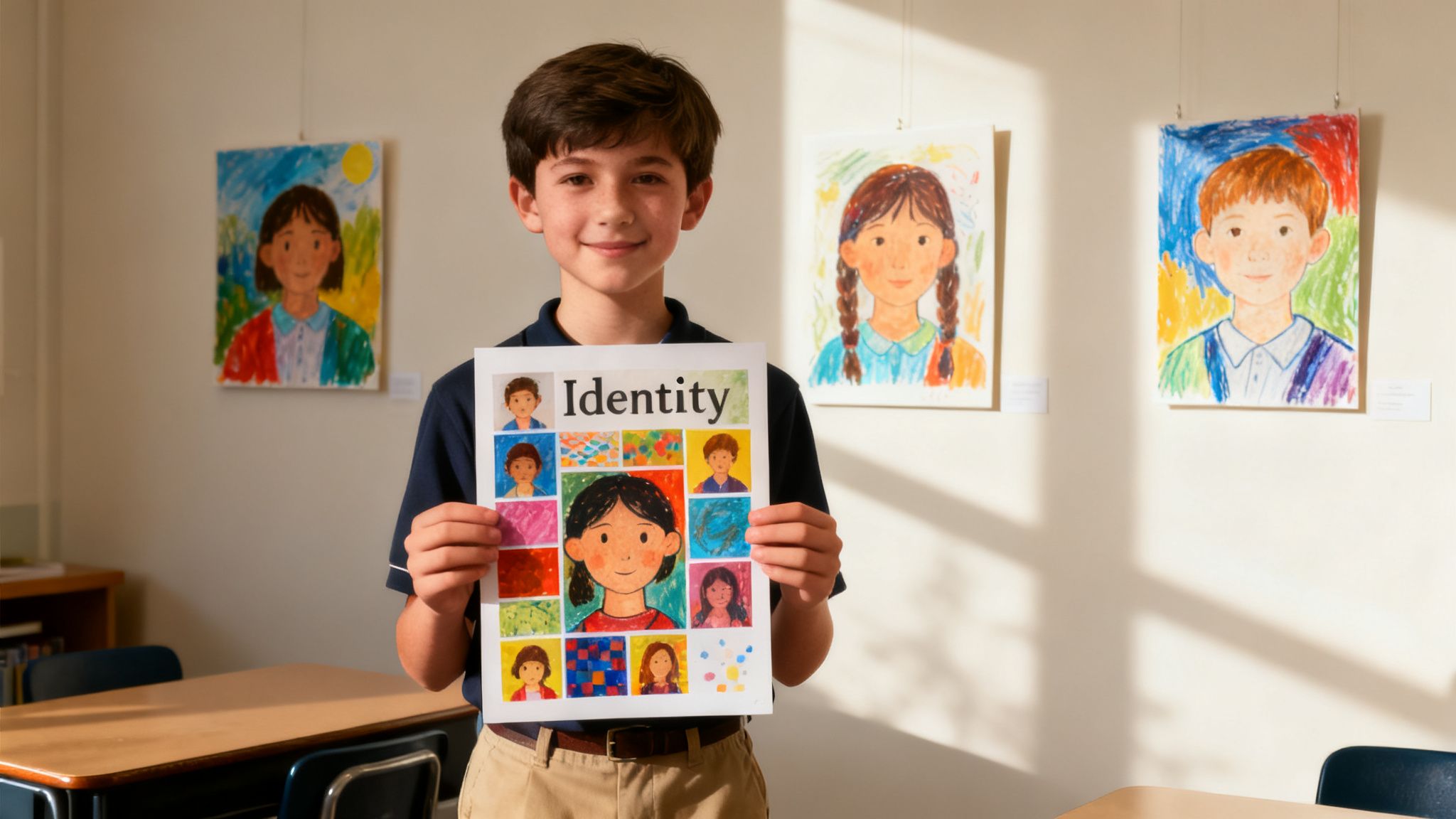
Identity and Belonging Exploration activities guide middle schoolers to investigate who they are through creative mediums like art, writing, and music. This process helps students understand their unique cultures, strengths, and values while building appreciation for the diverse identities of their peers. By creating and sharing personal projects in a supportive environment, students feel seen and valued, reducing feelings of isolation and strengthening the classroom community.
This practice moves beyond simple “about me” worksheets by inviting students to create tangible representations of their identities. A practical example is the “Identity Box” project, where students decorate the outside of a shoebox to represent how the world sees them, and fill the inside with objects, pictures, or words that represent their true, internal self—their hopes, fears, and passions that others may not see. Sharing these creations helps build empathy and provides a powerful foundation for respectful peer relationships, making it a cornerstone among sel activities for middle school.
How to Implement Identity and Belonging Exploration
To begin, introduce a project theme, such as an “Identity Collage” or a “Cultural Artifact Showcase.” Provide a wide range of materials (magazines, colored paper, fabric, clay, digital tools) and give students dedicated class time to work. Model the activity by creating and sharing your own identity project to demonstrate vulnerability. The sharing process can be a “gallery walk,” where students view each other’s work and leave positive comments, or small group discussions with clear, affirming protocols.
Practical Tips for Success
Offer Choices: Provide multiple creative options like drawing, podcasting, or creative writing to accommodate different skills and preferences.
Establish Safe Sharing: Create classroom agreements about respectful listening and use sentence starters for feedback, such as “I noticed…” or “I appreciate how you showed…”
Honor Privacy: Allow students to choose which parts of their project they share and with whom. An anonymous component can also build trust.
Model Vulnerability: Share aspects of your own identity and story to create a culture of openness and connection.
Display Student Work: Prominently display the finished projects in the classroom or hallway to visually affirm that every student belongs. To further this work, you can find more strategies for teaching diversity in the classroom.
10 Middle School SEL Activities Comparison
Practice
Implementation complexity
Resource requirements
Expected outcomes
Ideal use cases
Key advantages
Emotion Check-In Circles
Low–Medium — simple routine but needs consistency
Minimal — visual aids, 5–10 min daily, SEL vocabulary
Somatic regulation; increased body awareness; reduced stress
Movement breaks, wellness classes, transitions
Combines physical regulation with mindfulness; accessible options
Identity & Belonging Exploration Through Creative Expression
Medium — needs safe culture and cultural competence
Moderate — art/music supplies, time, facilitation skill
Stronger sense of belonging and visibility; reduced isolation
Identity units, art integration, cultural celebrations
Validates diverse identities; multiple modes of expression
Putting It All Together: Building a Culture of Connection
Navigating the complex world of middle school requires more than just academic knowledge; it demands emotional intelligence, resilience, and a strong sense of self. The diverse range of SEL activities for middle school detailed in this article, from Emotion Check-In Circles to community-focused Service Learning Projects, provides a robust toolkit for educators, counselors, and parents. These aren’t just one-off lessons to be completed and forgotten; they are foundational practices designed to be woven into the very fabric of the school day.
The true power of these activities is unlocked through consistency. A single session on conflict resolution is helpful, but regular Restorative Practices Circles create a shared language and a trusted process for navigating disagreements. A one-time mindfulness exercise can be calming, but daily Mindfulness Breathing Breaks build lasting self-regulation skills that students can access during moments of high stress, like before a major exam or during a difficult social interaction.
From Individual Activities to a Systemic Shift
The ultimate goal extends beyond teaching isolated skills. It’s about cultivating an environment where emotional awareness is normalized, empathy is expected, and every student feels a genuine sense of belonging. When activities like Peer Compliment Exchanges and Identity Exploration projects become routine, they shift the school culture from one of competition and comparison to one of collaboration and mutual respect.
This transformation requires a deliberate and collective effort. To truly integrate SEL, schools must embrace a philosophy of prioritizing connection before diving into rigorous academic content. When students feel seen, heard, and valued, they are more engaged, more willing to take academic risks, and better equipped to learn.
Your Actionable Next Steps
Embarking on this journey can feel daunting, but progress begins with small, intentional steps. Here’s how you can start building a more connected and emotionally intelligent community today:
Start Small and Be Consistent: Don’t try to implement all ten activities at once. Choose one or two that align with your students’ most pressing needs. For example, if you notice frequent classroom squabbles, begin with the Conflict Resolution Role Plays. Commit to facilitating the chosen activity regularly, perhaps weekly or even daily, to build momentum.
Involve Students in the Process: Middle schoolers crave autonomy and purpose. Ask for their feedback on which activities they find most engaging and helpful. Co-create classroom norms or a “conflict resolution contract” with them, giving them ownership over their learning environment. This collaborative approach ensures the practices are relevant and meaningful to them.
Model the Skills Yourself: The most powerful SEL lesson is the one you model. Demonstrate emotional vulnerability during check-ins, use “I-statements” when addressing conflicts, and openly discuss your own strategies for managing stress. When adults practice what they preach, students see these skills as authentic and valuable for life, not just for school.
By championing these SEL activities for middle school, you are doing more than just preparing students for a test or the next grade level. You are equipping them with the essential tools to build healthy relationships, navigate challenges with confidence, and contribute positively to their communities. You are nurturing a generation of empathetic, resilient, and self-aware individuals prepared not just for success, but for a lifetime of well-being.
Ready to take your school’s social-emotional learning to the next level? Soul Shoppe provides comprehensive, research-based programs, on-site coaching, and powerful digital resources that transform school culture from the inside out. Explore how Soul Shoppe can help you build a safer, more connected, and thriving school community.
Effective classroom management has evolved far beyond simply controlling behavior. Today’s most successful educators recognize that a quiet, compliant classroom isn’t the same as an engaged, thriving one. The true goal is to build a foundation of psychological safety, connection, and belonging where every student feels seen, valued, and ready to learn. This shift is crucial, especially as students navigate complex social and emotional landscapes.
Traditional discipline often focuses on reacting to misbehavior, but the most effective classroom management best practices are proactive, preventative, and rooted in social-emotional learning (SEL). By intentionally teaching skills like self-regulation, empathy, and conflict resolution, we equip students with the tools they need to succeed academically and socially. This comprehensive guide moves beyond theory to provide actionable, research-backed strategies that K-8 teachers, administrators, and parents can implement immediately.
You will find practical, classroom-ready examples and clear implementation steps for a range of powerful techniques. We will cover:
Establishing restorative circles and using de-escalation scripts.
Integrating mindfulness and self-regulation activities.
Building authentic family partnerships that support student well-being.
Implementing trauma-informed and culturally responsive teaching methods.
These strategies create environments where students do not just behave, they flourish. Let’s explore the practical steps you can take to transform your learning space into a supportive, collaborative, and joyful community for the upcoming school year and beyond.
1. Consistent Classroom Routines and Clear Expectations
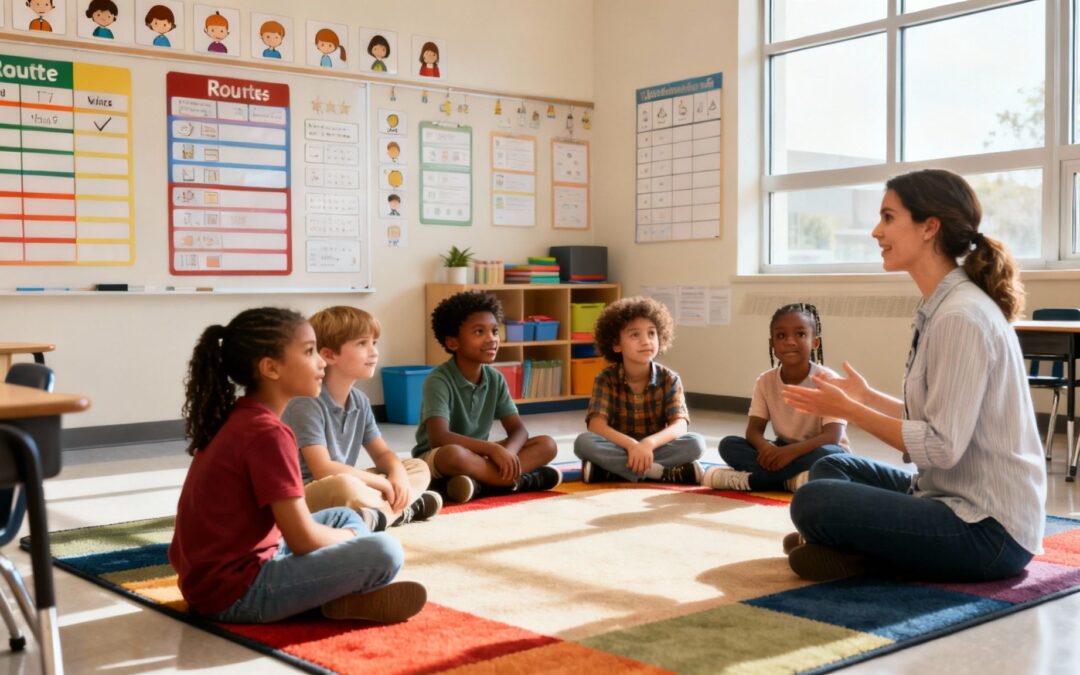
One of the most foundational classroom management best practices involves creating a highly predictable environment. When students know exactly what to do and how to do it for every part of the school day, from sharpening a pencil to transitioning to lunch, their cognitive load decreases. This predictability frees up mental energy for learning and reduces the anxiety that often fuels disruptive behavior.
Consistent routines and clear expectations are not about rigid control; they are about creating psychological safety. Students feel confident and secure when their environment is logical and consistent. Research supports this, showing classrooms with well-established routines can have up to 50% fewer behavioral referrals.
How to Implement Routines and Expectations
Successful implementation moves beyond simply stating rules. It involves actively teaching procedures as you would any academic subject: with modeling, practice, and reinforcement.
Start Small and Build: Don’t overwhelm students (or yourself) by teaching 20 routines on day one. Focus on the 2-3 most critical procedures first, such as your morning entry routine, how to get the teacher’s attention, and the dismissal process. Once those are mastered, gradually introduce others. For example, a kindergarten teacher might focus only on the routine for hanging up coats and backpacks for the entire first week.
Model, Practice, Role-Play: Use the “I Do, We Do, You Do” model. First, demonstrate the routine yourself. For example, physically walk through the steps of turning in homework. Then, have the class practice it together, perhaps lining up for lunch as a group. Finally, have individual students role-play the procedure, like demonstrating how to ask for help. Repeat this process daily for the first two weeks of school and reteach as needed after breaks or when issues arise.
Create Visual Supports: Words are fleeting, but visuals are constant reminders. Post a daily visual schedule with pictures for younger students. Create anchor charts for multi-step procedures (like “Group Work Expectations”). Place laminated procedure cards at relevant classroom stations, such as a small sign at the pencil sharpener that says, “1. Wait for a quiet time. 2. Sharpen quickly. 3. Return to your seat.”
Classroom-Ready Example: Morning Entry Routine Instead of letting students trickle in with unstructured time, establish a clear three-step entry procedure posted on the door:
Unpack your backpack and hang it on your hook.
Turn in your homework to the red basket.
Begin your morning warm-up work silently.
Practice this sequence every morning, offering specific verbal praise like, “I see Leo has already started his warm-up. Excellent focus!” This small routine prevents morning chaos and sets a productive tone for the entire day.
2. Social-Emotional Learning (SEL) Integration Across Curriculum
Effective classroom management best practices extend beyond behavior charts to address the root causes of student actions. Integrating social-emotional learning (SEL) across the curriculum shifts the focus from managing behavior to developing the whole child. This approach systematically weaves core competencies like self-awareness, relationship skills, and responsible decision-making into daily instruction, giving students the tools to understand and regulate their emotions, collaborate effectively, and solve problems constructively.
Treating SEL as a foundational element, rather than a separate subject, creates a more supportive and empathetic classroom culture. This proactive strategy equips students with essential life skills, which directly translates to improved behavior and academic focus. Research from CASEL shows that schools with strong SEL programs see significant reductions in discipline issues and an average 11-percentile-point gain in academic achievement.
How to Implement SEL Integration
Successful integration means making SEL a visible and consistent part of the school day. It requires explicitly teaching, modeling, and providing opportunities for students to practice these crucial skills in authentic contexts.
Weave into Daily Touchpoints: Start and end the day with intention. Use morning meetings for a “feelings check-in” where students can show a thumbs-up, down, or sideways to indicate how they’re feeling. Use closing circles for reflections, asking, “What was one challenge you faced today, and how did you handle it?”
Model and Narrate: As the teacher, you are the primary model for SEL. Narrate your own process aloud: “I’m feeling a little frustrated that the technology isn’t working, so I am going to take a deep breath before I try again.” This makes emotional regulation strategies visible and normalizes them for students.
Connect to Academic Content: Embed SEL into your existing lessons. When reading a story like The Giving Tree, ask, “How do you think the tree was feeling in this moment? What clues tell us that?” In a history lesson about the Civil Rights Movement, discuss the empathy and responsible decision-making required by leaders like Martin Luther King Jr.
Classroom-Ready Example: The “Pause Button” Introduce a simple self-regulation technique called the “Pause Button.” Teach students that when they feel a big emotion like anger or frustration, they can physically pretend to press a “pause button” on their hand or desk. This action serves as a physical cue to stop, take one deep “belly breath,” and think about a calm choice.
Practice this together when the class is calm. Role-play scenarios where it would be useful, such as disagreeing with a friend or struggling with a math problem. Acknowledge students when you see them using it: “I saw you use your pause button when you were getting frustrated. That was a great choice to help you stay in control.”
3. Mindfulness and Self-Regulation Practices
Effective classroom management is not just about managing behavior; it’s about building students’ capacity to manage themselves. Mindfulness practices teach students to be present and aware of their thoughts, feelings, and bodily sensations without judgment. This awareness is the first step toward self-regulation, allowing students to pause and choose a constructive response rather than reacting impulsively.
This approach is a powerful preventive tool. By regularly practicing mindfulness, students strengthen their executive function skills, reduce stress, and learn to manage difficult emotions before they escalate. Schools that embed these practices often see significant improvements in student behavior and academic focus, as mindfulness is a core component of trauma-informed and healing-centered education.
How to Implement Mindfulness and Self-Regulation
Integrating these practices requires consistency and a gentle, non-judgmental approach. The goal is to equip students with a toolkit of strategies they can use independently throughout their day and their lives. For more in-depth strategies, you can explore a range of self-regulation strategies for students.
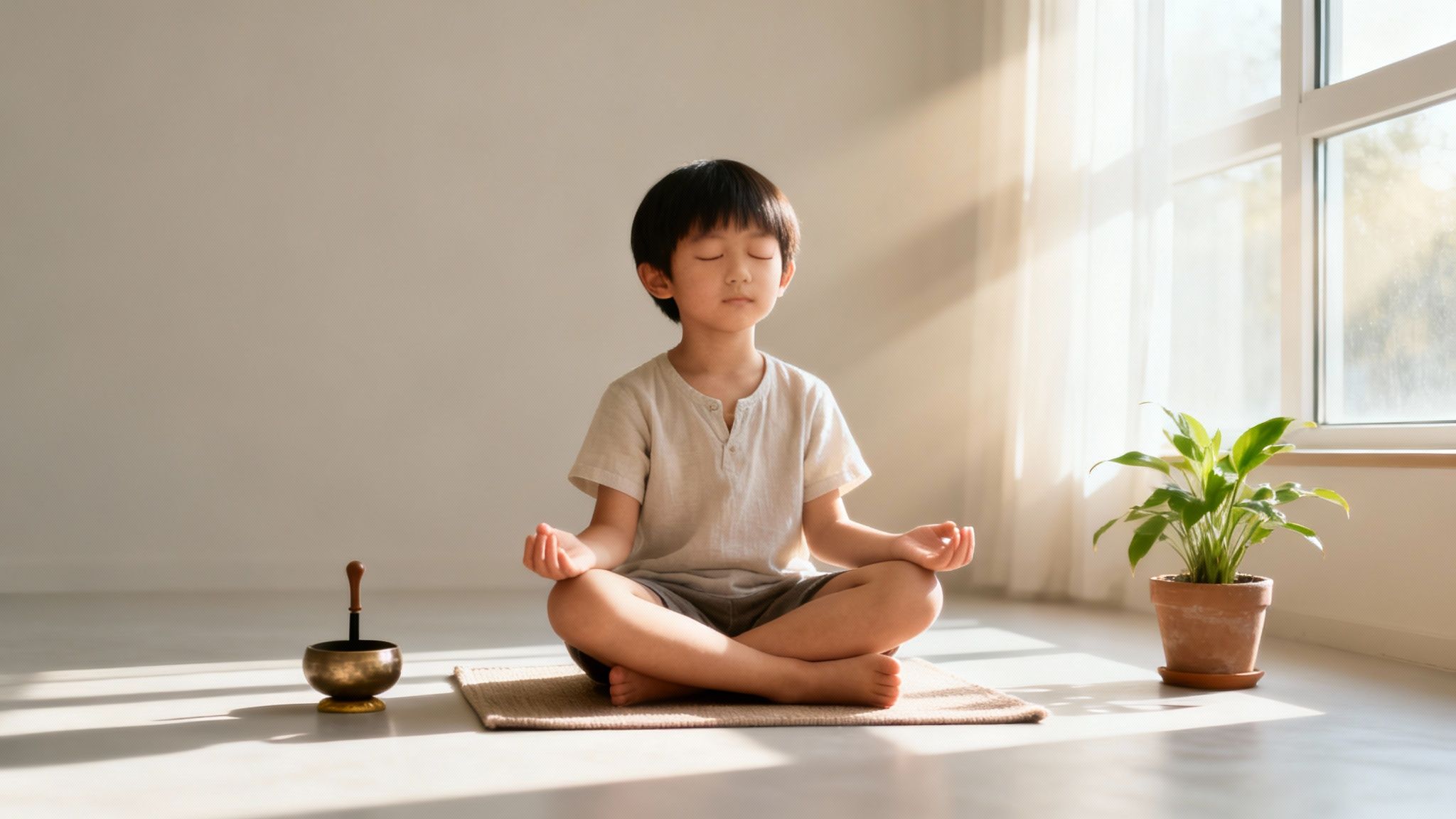
Start with Short, Guided Practice: Begin with just 2-3 minutes of guided mindfulness each day, perhaps after recess or before a test. Use a calming signal like a bell or chime to start. Say something like, “Let’s do our mindful minute. Close your eyes if you’re comfortable, and just listen to the sounds outside our classroom for one minute.”
Teach Specific Breathing Techniques: Explicitly teach simple, memorable breathing exercises. For example, introduce “Box Breathing” (breathe in for 4, hold for 4, breathe out for 4, hold for 4) by drawing a square in the air with your finger as you guide them. Create a visual anchor chart so students can reference it when they feel overwhelmed.
Establish a Calm-Down Corner: Designate a small, comfortable space in the classroom where students can go to self-regulate. Stock it with mindfulness tools like a Hoberman sphere (breathing ball), soft pillows, visual aids for breathing techniques, and noise-reducing headphones. Model how to use the space when you are calm, not as a punishment.
Classroom-Ready Example: Mindful Transitions Transitions are often a source of chaos. Instead of rushing from one subject to the next, use them as a moment for a “mindful minute.” Before starting math, ring a chime and say:
Pause: Put your pencils down and place your hands on your desk.
Breathe: Let’s take three deep “Lion Breaths” together (inhale through the nose, exhale audibly through the mouth).
Notice: Silently notice how your body feels. Are you ready for our next activity?
This simple routine takes less than 60 seconds but helps the entire class reset their focus, calm their nervous systems, and prepare for new learning, making it one of the most effective classroom management best practices.
4. Positive Behavior Support Systems (PBIS)
Positive Behavior Support Systems, commonly known as PBIS, shift the focus from punishment to prevention. This proactive, data-driven framework establishes a culture where positive behaviors are explicitly taught, modeled, and reinforced across all school settings. Rather than waiting to react to misbehavior, PBIS creates an environment where students understand the expectations and are motivated to meet them, preventing many issues before they start.
This approach is one of the most effective classroom management best practices because it builds a unified, supportive school-wide culture. Schools implementing PBIS consistently report significant reductions in office discipline referrals, sometimes by as much as 50%, alongside improvements in academic outcomes and student attendance. It fosters a sense of belonging by making the behavioral expectations clear, fair, and positive.
How to Implement a PBIS Framework
Implementing PBIS successfully requires a school-wide commitment to teaching behavior with the same intentionality as academic subjects. It involves a systematic, layered approach that supports all students.
Define Core Expectations: Start by establishing 3-5 broad, positively stated behavioral expectations for the entire school community. Common examples include being Respectful, Responsible, and Safe. These simple terms become the foundation for all behavioral instruction.
Teach and Reteach Explicitly: Dedicate significant time in the first few weeks of school to explicitly teach what these expectations look like in every setting. For example, show a short video of students demonstrating what “Be Responsible” looks like in the cafeteria (throwing away trash) versus the library (returning books to the shelf).
Use a Recognition System: Create a system to acknowledge students who meet the expectations. This could be giving out “Caught Being Good” tickets, putting a marble in a class jar for a collective reward, or simple, specific verbal praise. Aim for a ratio of at least four positive interactions for every one corrective interaction to build momentum and goodwill.
Track and Analyze Data: Systematically collect and review behavior data (like office referrals) at least monthly. A practical example would be a grade-level team noticing from the data that most playground conflicts happen near the swings on Tuesdays and Thursdays, then deciding to add an extra supervisor to that specific zone on those days.
Classroom-Ready Example: Cafeteria Expectations Instead of a long list of “don’t” rules, a PBIS approach uses a simple matrix to teach positive behaviors. For the cafeteria, the expectations might be:
Be Respectful: Use quiet voices and good table manners.
Be Responsible: Clean up your space and push in your chair.
Be Safe: Walk at all times and keep your hands to yourself.
Staff would actively teach these behaviors and then give out “Caught Being Good” tickets to students demonstrating them. A student who cleans up without being asked might receive a ticket and specific praise: “Thank you for being responsible by cleaning your area, Maria!”
5. Trauma-Informed and Culturally Responsive Teaching
Effective classroom management acknowledges the whole child, including their backgrounds, identities, and life experiences. Trauma-informed and culturally responsive teaching are two interconnected approaches that create a foundation of psychological safety and belonging, which is essential for learning and positive behavior. This practice recognizes that behavior is often a form of communication, signaling an unmet need or a response to past or present adversity.
Instead of a compliance-first model, these approaches prioritize connection and understanding. By honoring students’ cultural identities and creating a predictable, supportive environment, teachers can preemptively address the root causes of many behavioral challenges. Research shows that schools integrating these practices see significant reductions in disciplinary referrals and notable gains in student engagement and academic achievement, making them one of the most vital classroom management best practices.
How to Implement Trauma-Informed and Culturally Responsive Practices
Integrating these frameworks means shifting your mindset from “what is wrong with this student?” to “what happened to this student, and what do they need?” This involves intentionally building an environment that promotes healing, validation, and empowerment.
Prioritize Safety and Predictability: Trauma impacts the nervous system, making predictability a critical need. Maintain the consistent routines mentioned earlier. A practical example is giving a 5-minute and 2-minute warning before every transition to avoid surprising students who may have a heightened startle response.
Integrate “Mirrors and Windows”: Ensure your curriculum and classroom library serve as mirrors that reflect your students’ own cultures, and as windows into the experiences of others. For instance, a teacher in a classroom with many students of Mexican heritage should ensure there are books by authors like Pam Muñoz Ryan or Yuyi Morales readily available.
Focus on Co-Regulation: A dysregulated adult cannot regulate a dysregulated child. When a student is escalated, your calm presence is the most effective tool. A practical example is to lower your own voice, get down to their eye level, and say, “I see you are having a really hard time. I am right here with you. Let’s take a breath together.” This models calmness instead of escalating the situation.
Classroom-Ready Example: A “Cool-Down Corner” Instead of a punitive time-out chair, create a voluntary “cool-down corner” or “peace corner.” Equip it with comforting items like a soft blanket, a stress ball, coloring pages, and a feelings chart.
Teach and model its use: “When you feel your anger growing big, you can choose to take a 5-minute break in the peace corner to help your body feel calm again. This is a helpful choice, not a punishment.” This gives students agency and teaches them a crucial self-regulation skill, replacing disruptive outbursts with a constructive coping strategy.
6. Empathy Building and Perspective-Taking Activities
Effective classroom management best practices extend beyond behavior charts to cultivate the core social-emotional skills that prevent conflict. Intentionally teaching students to understand and share the feelings of others builds empathy as a classroom habit. When students can step into a classmate’s shoes, they are less likely to engage in bullying and more inclined to act with kindness, strengthening the entire community.
This approach transforms the classroom from a group of individuals into a connected team. Empathy is not a fixed trait; it’s a skill that can be developed through guided practice. Research from programs like Roots of Empathy shows that a focus on perspective-taking significantly reduces aggression and bullying, creating a safer and more inclusive learning environment where students feel a true sense of belonging.
How to Implement Empathy-Building Activities
Integrating empathy into your daily curriculum requires weaving it into academic content and classroom routines. It involves teaching students to look beyond their own experiences and consider the diverse perspectives around them.
Read Diverse Stories: Use high-quality children’s literature as a springboard for discussion. After reading a book like Wonder by R.J. Palacio, ask specific questions like, “How do you think Auggie felt when Julian made that comment? What could the other students have done to show empathy in that moment?”
Use Think-Pair-Share: Before a whole-group discussion about a conflict, give students a moment to process. Have them first think individually, then pair up with a partner to discuss their ideas, and finally share their combined perspectives with the class. This gives quieter students a safer way to practice sharing their perspective before addressing the whole group.
Connect to Real Conflicts: When minor disagreements arise, frame them as opportunities to practice empathy. For example, if two students are arguing over a book, guide them by saying, “Sam, can you try to use an ‘I feel’ statement? Sarah, your job is to listen and then repeat back what you heard Sam say. Then we will switch.” This structured dialogue builds listening skills.
Classroom-Ready Example: “A Mile in Their Shoes” Scenario After a disagreement on the playground over a game, instead of just assigning a consequence, facilitate a perspective-taking activity. Give each student involved a piece of paper and ask them to write or draw the story of what happened from the other person’s point of view.
Prompt: “Imagine you are [classmate’s name]. What did you see, hear, and feel during the game?”
Share: Have them share their “new” stories with each other in a quiet corner.
Reflect: Ask, “Did hearing their side of the story change how you feel? What can we do differently tomorrow?”
This simple role-reversal exercise builds crucial empathy muscles and helps students resolve their own conflicts constructively, a key component of a well-managed classroom.
7. Collaborative Learning Structures and Cooperative Groups
Effective classroom management isn’t just about preventing negative behavior; it’s about actively fostering positive engagement. Structuring purposeful peer interaction through cooperative learning activities is a powerful strategy that builds both academic skills and social-emotional competencies. When students are taught how to collaborate, they learn to communicate, support peers, and solve problems together, which reduces isolation and increases their sense of belonging.
This approach transforms the classroom from a collection of individuals into a community of learners. Research shows that classrooms using structured cooperative learning can see significant improvements in academic achievement and peer relationships. For educators committed to culturally responsive practices, understanding the profound impact of various forms of trauma, including generational trauma, is crucial, as creating supportive peer networks can be a powerful protective factor for students.
How to Implement Collaborative Structures
Simply putting students into groups is not enough; collaboration is a skill that must be explicitly taught and scaffolded. The goal is to create positive interdependence where students succeed together.
Teach Collaboration Skills First: Before assigning a group task, teach and model key skills. A practical example is to create a “T-Chart” for “Active Listening,” with one column for “Looks Like” (e.g., eyes on speaker, nodding) and another for “Sounds Like” (e.g., “Tell me more,” “I hear you saying…”).
Assign and Rotate Roles: Give each group member a specific job to ensure equitable participation. Roles like Facilitator (keeps the group on task), Timekeeper (monitors the clock), Recorder (writes down ideas), and Reporter (shares with the class) provide structure. Use role cards with descriptions to make the jobs clear.
Use Structured Protocols: Implement established protocols to guide discussions. For the Jigsaw method, you might assign four students in a group each a different paragraph of a text. They then meet with students from other groups who have the same paragraph to become “experts” before returning to their home group to teach what they learned.
Classroom-Ready Example: Structured Turn-and-Talk Instead of an unstructured “turn and talk to your partner,” provide clear scaffolding for a richer discussion:
Pose a Question: “Based on the text, what is the most important reason the character made that choice?”
Assign Roles: Partner A will speak for 1 minute first. Partner B will listen and then ask one clarifying question.
Provide a Sentence Frame: Partner B starts their question with, “What I heard you say was… Am I understanding that correctly?”
Switch Roles: After Partner B asks their question and A responds, they switch roles for the same amount of time.
This simple structure teaches active listening, paraphrasing, and focused conversation, making peer interaction a productive learning tool.
8. Consistent Classroom Routines and Clear Expectations
One of the most foundational classroom management best practices involves creating a highly predictable environment. When students know exactly what to do and how to do it for every part of the school day, from sharpening a pencil to transitioning to lunch, their cognitive load decreases. This predictability frees up mental energy for learning and reduces the anxiety that often fuels disruptive behavior.
Consistent routines and clear expectations are not about rigid control; they are about creating psychological safety. Students feel confident and secure when their environment is logical and consistent. Research supports this, showing classrooms with well-established routines can have up to 50% fewer behavioral referrals.
How to Implement Routines and Expectations
Successful implementation moves beyond simply stating rules. It involves actively teaching procedures as you would any academic subject: with modeling, practice, and reinforcement.
Start Small and Build: Don’t overwhelm students (or yourself) by teaching 20 routines on day one. Focus on the 2-3 most critical procedures first, such as your morning entry routine, how to get the teacher’s attention, and the dismissal process. Once those are mastered, gradually introduce others. For example, a kindergarten teacher might focus only on the routine for hanging up coats and backpacks for the entire first week.
Model, Practice, Role-Play: Use the “I Do, We Do, You Do” model. First, demonstrate the routine yourself. For example, physically walk through the steps of turning in homework. Then, have the class practice it together, perhaps lining up for lunch as a group. Finally, have individual students role-play the procedure, like demonstrating how to ask for help. Repeat this process daily for the first two weeks of school and reteach as needed after breaks or when issues arise.
Create Visual Supports: Words are fleeting, but visuals are constant reminders. Post a daily visual schedule with pictures for younger students. Create anchor charts for multi-step procedures (like “Group Work Expectations”). Place laminated procedure cards at relevant classroom stations, such as a small sign at the pencil sharpener that says, “1. Wait for a quiet time. 2. Sharpen quickly. 3. Return to your seat.”
Classroom-Ready Example: Morning Entry Routine Instead of letting students trickle in with unstructured time, establish a clear three-step entry procedure posted on the door:
Unpack your backpack and hang it on your hook.
Turn in your homework to the red basket.
Begin your morning warm-up work silently.
Practice this sequence every morning, offering specific verbal praise like, “I see Leo has already started his warm-up. Excellent focus!” This small routine prevents morning chaos and sets a productive tone for the entire day.
9. Authentic Relationships, Belonging, and Family Engagement
Building genuine relationships where students feel known, valued, and psychologically safe is a cornerstone of effective classroom management best practices. When this sense of belonging is extended to include proactive, two-way family engagement, it creates a powerful support system that nurtures positive behavior and encourages academic risk-taking. This approach shifts the focus from managing behavior to fostering connection.
This is not just a feel-good strategy; it is a research-backed imperative. Schools that prioritize belonging report higher attendance, improved academic achievement, and a greater sense of safety. Research from organizations like Soul Shoppe shows that students who feel cared for by their teachers are significantly more likely to persist through challenges. When you add strong family partnerships into the mix, schools can see up to 30% fewer behavioral problems.
How to Implement Relationships and Engagement
Cultivating authentic connections requires intentional, consistent effort. It involves showing genuine interest in students as individuals and viewing families as essential partners in their child’s education.
Make Personal Connections Daily: Greet every student by name at the door with a high-five, handshake, or smile. Use interest inventories at the start of the year and then ask specific follow-up questions like, “How did your soccer game go on Saturday?” or “Did you finish that amazing drawing you were telling me about?”
Proactive Positive Communication: Don’t let your only communication with families be about problems. A practical example is to send a “Good News” postcard home when a student shows kindness or masters a new skill. Or, use a communication app to send a quick photo of a student engaged in a positive activity with a caption like, “Jasmine was a fantastic leader in her group today!”
Partner with Families for Problem-Solving: When an issue arises, approach the family as a teammate. Start the conversation with, “I’d love to partner with you to help Marco succeed. Can you tell me what strategies work best at home when he gets frustrated?” This shows respect and positions the parent as an expert on their child.
Classroom-Ready Example: The “Two-by-Ten” Strategy For a student you’re struggling to connect with, commit to the “Two-by-Ten” strategy. Spend two minutes a day for ten consecutive school days having a non-academic, non-disciplinary conversation with them.
You might ask about their favorite video game, their pet, or their weekend plans. The goal is simply to build rapport and show you see them as a person beyond their behavior or grades. This focused effort can dramatically repair and strengthen a relationship, often leading to a significant decrease in disruptive behavior because the student feels seen and valued.
10. Student Leadership and Voice in Classroom Management
One of the most transformative classroom management best practices involves shifting from a teacher-centric model to a community-based one where students have authentic agency. Giving students meaningful roles in classroom decision-making, from setting expectations to solving problems, builds a profound sense of ownership and responsibility. When students have a voice, they become invested partners in creating a positive and productive classroom culture.
This approach is about co-creating the classroom environment rather than imposing it. Students who feel seen, heard, and valued are far more likely to be engaged and motivated, and less likely to exhibit oppositional behaviors. Research shows that schools prioritizing student voice see stronger student-teacher relationships, increased academic engagement, and more equitable outcomes.
How to Implement Student Leadership and Voice
Cultivating student voice requires intentionally creating structures where their input is not just heard but acted upon. It involves teaching the skills needed to participate constructively in a democratic community.
Hold Regular Class Meetings: Dedicate time each week for a structured class meeting. Use an agenda that students can add to throughout the week. For example, a student might add “The pencils are always missing from the writing center” to the agenda, allowing the class to solve the problem together.
Create Meaningful Classroom Jobs: Go beyond simple line leader or paper passer roles. Establish leadership positions that have real responsibility. For example, a “Tech Expert” could be trained to help peers with login issues, or a “Class Ambassador” could be responsible for giving a short tour to any classroom visitors.
Co-create Expectations and Consequences: In the first week of school, ask, “What does a respectful classroom look, sound, and feel like?” Chart their answers. Then, guide them to turn these ideas into 3-5 positively-phrased class rules. When a rule is broken, ask the student, “We agreed to be respectful. What would be a good way to repair the harm done and make a better choice next time?”
Classroom-Ready Example: Problem-Solving Class Meeting Instead of the teacher unilaterally banning a popular but distracting item (e.g., trading cards), bring the issue to a class meeting.
State the Problem: “I’ve noticed that trading cards are becoming a big distraction during math time. What have you all noticed?”
Brainstorm Solutions: Ask students to brainstorm fair solutions. Ideas might include “cards are only for recess,” “a designated 10-minute trading time on Fridays,” or “cards stay in backpacks until dismissal.”
Vote and Commit: Have the class vote on the best solution and agree to try it for one week before revisiting the decision.
This process teaches problem-solving skills, respects students’ interests, and generates far greater buy-in for the final solution.
Classroom Management: 10-Strategy Comparison
Practice
Implementation complexity
Resource requirements
Expected outcomes
Ideal use cases
Key advantages
Restorative Practices and Circles
High — requires trained facilitators and school buy-in
Moderate–High — staff training, scheduled circle time, facilitator support
Class governance, restorative processes, student-centered classrooms
Empowers students, increases buy-in and peer accountability
Putting It All Together: Creating Your Proactive Classroom Ecosystem
Navigating the landscape of classroom management best practices can feel like trying to assemble a complex puzzle. We’ve explored ten powerful, interconnected strategies, from establishing consistent routines and integrating Social-Emotional Learning to fostering student voice and implementing restorative justice. The crucial takeaway is not to view these as a checklist of isolated tactics, but as threads to be woven together into a resilient and supportive classroom ecosystem. Effective management isn’t about control; it’s about connection, co-creation, and community.
The journey begins not with a complete overhaul, but with a single, intentional step. The most impactful changes are often small, consistent actions that build trust and predictability over time. By focusing on creating a foundation of psychological safety and authentic relationships, you establish the fertile ground where all other practices can take root and flourish.
Synthesizing the Core Principles
At their heart, these ten classroom management best practices share a common philosophy: they are proactive, not reactive. They shift the focus from correcting misbehavior to cultivating an environment where students feel seen, valued, and equipped with the skills to navigate social and emotional challenges.
Proactive vs. Reactive: Instead of waiting for conflict to arise, we build community through restorative circles, teach self-regulation with mindfulness exercises, and pre-empt confusion with crystal-clear routines. This preemptive approach minimizes disruptions and maximizes learning time.
Skills over Sanctions: Rather than relying solely on consequences, we actively teach empathy, perspective-taking, and collaboration. This empowers students with the social-emotional competencies they need to succeed both in school and in life.
Connection as the Catalyst: The thread connecting all these strategies is the power of human connection. Authentic relationships with students and strong family engagement are not “soft skills”; they are the very bedrock of a well-managed, thriving classroom.
Your Actionable Next Steps
Embarking on this journey requires commitment, not perfection. The goal is progress. Here is a practical, step-by-step approach to begin integrating these principles into your daily practice:
Start with a Self-Assessment: Reflect on the ten practices discussed. Which one resonates most deeply with your teaching philosophy? Where do you see the most immediate need in your classroom? Perhaps it’s strengthening relationships (#9) or clarifying routines (#8).
Choose One and Go Deep: Select a single practice to focus on for the next four to six weeks. For example, if you choose Mindfulness and Self-Regulation (#3), you could commit to leading a two-minute “belly breathing” exercise after every transition from recess or lunch.
Practical Example: A third-grade teacher might introduce a “Peace Corner” with a breathing ball and emotion flashcards. The initial goal isn’t for every student to use it perfectly, but simply to introduce it as a shared tool for co-regulation.
Involve Your Students: Frame this as a collaborative effort. Announce your new focus to the class. Say, “Team, we’re going to work on getting better at listening to each other’s ideas. One way we’ll do this is by practicing restorative sentence stems when we disagree.” This fosters buy-in and positions students as partners.
Track and Reflect: Keep a simple journal. What’s working? What challenges are arising? How are students responding? This reflection is crucial for making small adjustments and recognizing progress, which fuels motivation. After a month, you can either deepen your implementation of that practice or layer on a second, complementary one.
Mastering these classroom management best practices is an ongoing process of learning, adapting, and growing alongside your students. It is a profound investment that pays dividends far beyond a quiet and orderly room. It is the work of building a compassionate, equitable, and empowering community where every child has the opportunity to bring their whole self to the learning process, ready to engage, take academic risks, and ultimately, thrive.
Ready to bring this transformative, community-centered approach to your entire school? Soul Shoppe provides research-based programs, professional development, and practical SEL tools that directly align with the classroom management best practices in this guide. Discover how our on-site and virtual programs can help you build a safer, more connected school culture at Soul Shoppe.
Conflict is an inevitable part of life, but for students, it’s a critical learning opportunity. Navigating disagreements on the playground, in the classroom, or online isn’t just about stopping a fight; it’s about building foundational skills for a successful future. The ability to listen, express needs, and solve problems collaboratively is essential for academic success and emotional well-being. When students lack these tools, small misunderstandings can escalate into significant disruptions, impacting classroom culture and individual learning.
This article moves beyond generic advice to offer 10 evidence-based, actionable conflict resolution strategies students in grades K–8 can learn and practice. For educators, administrators, and parents, this guide provides the specific resources needed to teach these vital skills effectively. Inside, you will find a comprehensive toolkit designed for immediate implementation.
Each strategy includes:
Clear summaries and step-by-step instructions.
Age-differentiated tips for elementary and middle school students.
Sample scripts and phrases to guide conversations.
Practical classroom activities and role-playing scenarios.
Direct alignment with core Social-Emotional Learning (SEL) competencies.
Our goal is to equip you with powerful frameworks that build empathy, communication, and resilience. By mastering these techniques, you can help students turn moments of conflict into opportunities for connection and personal growth, creating safer and more collaborative school communities. Let’s explore the methods that transform how students handle disagreements.
1. Restorative Circles and Peer Conferencing
Restorative Circles are structured, supportive discussions that bring students together to address conflicts and their impact. Instead of focusing on punishment, this approach prioritizes repairing harm, understanding different perspectives, and rebuilding relationships. Students, along with a trained facilitator, sit in a circle to share their feelings and collaboratively find a path forward.
This method shifts the focus from “Who is to blame?” to “What happened, who was affected, and how can we make things right?” Peer conferencing is a related, often less formal, version where students mediate disagreements among themselves, guided by restorative principles. This is a powerful conflict resolution strategy for students because it builds empathy and community accountability.
Practical Example: Two students, Maya and Liam, had an argument over a group project, and Maya told other classmates not to work with Liam. A teacher facilitates a restorative circle with Maya, Liam, and two affected classmates. Using a talking piece, Maya shares she was frustrated Liam wasn’t contributing. Liam explains he was confused about his role. The classmates share they felt caught in the middle. They agree on a plan for clear roles in the next project and Maya apologizes for excluding Liam.
Why It Works
Restorative practices give students a voice and a sense of ownership over the solution. This process is highly effective for addressing issues like misunderstandings, exclusion, and minor physical conflicts. The Oakland Unified School District, for example, saw a 34% reduction in suspensions after implementing restorative justice programs. The focus on repairing relationships helps prevent future conflicts and strengthens the overall school climate. These circles are most effective for conflicts where ongoing relationships are important, such as between classmates or friends.
Establish clear guidelines: Co-create circle norms with students, such as “Speak from the heart,” “Listen with respect,” and “Honor the talking piece.”
Use a talking piece: Pass an object around the circle; only the person holding it may speak. This ensures everyone gets an uninterrupted turn.
Begin with low-stakes topics: Build student confidence by using circles for community-building before tackling serious conflicts. You can explore a variety of classroom community-building activities to get started.
2. Mindfulness-Based Conflict De-escalation
Mindfulness-Based Conflict De-escalation teaches students to use awareness techniques, such as focused breathing and body scans, to manage intense emotions during a conflict. This approach helps students pause before reacting impulsively, giving their prefrontal cortex time to engage in thoughtful problem-solving instead of a fight-or-flight response. It creates the internal space needed for constructive dialogue and is a foundational conflict resolution strategy for students.
By learning to recognize their physiological stress signals, students can self-regulate and approach disagreements with a calmer, clearer mind. Instead of escalating a situation, they learn to de-escalate their own emotional state first. This shift from reactionary behavior to a mindful response empowers students to handle friction more effectively and independently.
Practical Example: Two second-graders, Alex and Ben, both grab for the last red marker. Alex starts to cry, and Ben clenches his fists. Their teacher, noticing the rising tension, says, “Let’s both try ‘square breathing’.” She guides them: “Breathe in for four counts, hold for four, breathe out for four, hold for four.” After a few rounds, they are visibly calmer. The teacher can then ask, “Okay, what is the problem we need to solve with this one red marker?”
Why It Works
Mindfulness directly addresses the neurobiology of conflict by calming the amygdala, the brain’s emotional center. This strategy is highly effective for students who struggle with impulsivity, anger, or anxiety. For instance, San Francisco schools implementing mindfulness programs reported an 18% decrease in suspensions. By practicing mindfulness during calm moments, students build the “muscle memory” needed to access these skills under stress. This approach is best for de-escalating emotionally charged situations before a more structured resolution process, like a restorative circle, can begin.
How to Implement It
Start small and be consistent: Introduce short, 2-3 minute mindfulness practices during calm parts of the day. Consistency is more important than duration.
Use child-friendly language: Frame techniques with accessible terms. For example, use “belly breathing” (placing a hand on the stomach to feel it rise and fall) or describe a “calm body” (noticing stillness from toes to head).
Model the behavior: Demonstrate mindfulness yourself when you feel stressed. Saying, “I’m feeling frustrated, so I’m going to take three deep breaths,” builds credibility and normalizes the practice.
Create visual cues: Use posters of breathing techniques or a designated “calm-down corner” as reminders. You can find a variety of calming activities for the classroom to get started.
3. Collaborative Problem-Solving (CPS) Model
The Collaborative Problem-Solving (CPS) model is a structured approach that shifts the focus from winning an argument to working together to find a mutually agreeable solution. Developed by Dr. Ross Greene, this method operates on the principle that conflicts arise from unsolved problems or unmet needs. Instead of focusing on conflicting positions, students learn to identify the underlying concerns driving the disagreement.
This model guides students through a clear, three-step process: defining the problem from both perspectives, brainstorming potential solutions without judgment, and evaluating the options to choose one that works for everyone. As one of the most effective conflict resolution strategies for students, CPS empowers them to see conflict as a shared problem to be solved, not a battle to be won. It builds critical thinking and empathy by requiring them to understand and articulate another person’s point of view.
Practical Example: Two friends constantly argue about what game to play at recess. A parent or teacher guides them through CPS.
Empathy: The adult asks each child, “What’s the hardest part for you about choosing a game at recess?” One says, “I never get to play what I want.” The other says, “I don’t like running games.”
Define the Problem: The adult summarizes, “So, the problem is we need to find a game you both enjoy and feel you have a choice in.”
Brainstorm: They list all ideas: tag, drawing, building, rock-paper-scissors to decide, taking turns. They agree to try taking turns choosing the game each day.
Why It Works
CPS is highly effective because it moves students away from blame and towards practical solutions. By focusing on identifying “unsolved problems,” it depersonalizes the conflict. This method works well for recurring disagreements, such as arguments over classroom materials, group work disputes, or social exclusion. Schools that implement CPS often see a reduction in behavioral referrals and an increase in prosocial behaviors because students are equipped with a concrete tool to manage their own conflicts. The model is most effective for disputes where a tangible solution can be reached.
How to Implement It
Teach the three steps explicitly: Before using it in a real conflict, explicitly teach the steps: (1) Empathy and Understanding, (2) Defining the Problem, and (3) Invitation to Brainstorm. Use role-playing to practice.
Use neutral, guiding language: Frame the conversation with questions like, “What’s getting in the way for you?” or “I’ve noticed we have a hard time when…” This avoids blame.
Write down all ideas: During the brainstorming phase, write down every suggested solution, even silly ones. This validates all contributions and encourages creative thinking.
Evaluate solutions collaboratively: Guide students to assess the brainstormed list by asking, “Is this realistic? Does this work for both of you?” The chosen solution must be mutually agreeable. This process reinforces important communication skills and activities that are essential for success.
4. Peer Mediation and Student Leaders
Peer mediation is a conflict resolution strategy that trains designated student leaders to facilitate productive conversations between their peers. Instead of relying on adult intervention, trained student mediators guide conflicting parties through a structured process to express their concerns, understand each other’s perspectives, and collaboratively develop a solution. This approach empowers students to resolve their own disputes constructively.
This strategy leverages positive peer influence and builds a school culture where students take responsibility for their community. It reduces the burden on teachers and administrators while fostering essential life skills like leadership, empathy, and active listening in the student mediators and their peers. Peer mediation is one of the most effective conflict resolution strategies students can learn because it places them at the center of the solution-building process.
Practical Example: During a kickball game, two students argue over whether a player was out. Instead of a teacher intervening, they go to the “Peace Corner” where two trained fifth-grade peer mediators are on duty. The mediators ask each student to state their side of the story without interruption. They then help the students brainstorm solutions, like a “re-do” of the play or agreeing on a student umpire for the rest of the game. The students agree on a re-do and shake hands.
Why It Works
Peer mediation is highly effective for interpersonal conflicts, such as rumors, social exclusion, or disagreements over shared resources. Because mediators are students themselves, they often have a deeper understanding of the social dynamics at play. Programs in schools frequently report resolution rates of 50-60%, demonstrating that students can successfully manage playground disputes and relationship conflicts when given the proper tools. This approach is most effective when both parties are willing to participate and seek a mutually agreeable outcome.
How to Implement It
Recruit and train diverse mediators: Select a group of student leaders who represent the school’s diverse demographics. Provide them with at least 20 hours of foundational training in active listening, impartiality, and the mediation process.
Establish a clear referral system: Create a simple process for students to request mediation. This could involve a referral box in the counselor’s office or a simple online form.
Define ethical guidelines: Ensure mediators and participants understand and agree to confidentiality rules to build trust in the process. Mediators should only break confidentiality if there is a risk of harm.
Provide ongoing support: Schedule regular debrief sessions for mediators to discuss challenges and share successes. Offer ongoing coaching and celebrate their valuable contributions to the school community. For more guidance, you can learn how to empower students to find solutions with dedicated programs.
Social-Emotional Learning (SEL) is the process of developing the self-awareness, self-control, and interpersonal skills vital for school, work, and life success. Integrating an SEL curriculum directly into classroom instruction provides students with the foundational tools to navigate their emotions and relationships. It teaches core competencies like self-management, social awareness, and responsible decision-making, which are the building blocks of effective conflict resolution.
This approach treats conflict resolution not as an isolated skill but as an outcome of holistic emotional intelligence. Instead of only reacting to problems, SEL proactively equips students with the empathy, communication skills, and emotional regulation needed to prevent many conflicts from starting. When disputes do arise, students are better prepared to handle them constructively. This is one of the most foundational conflict resolution strategies students can develop, as it underpins all other techniques.
Practical Example: A third-grade class begins each day with a “morning meeting.” Today’s topic is responsible decision-making. The teacher presents a scenario: “You see a classmate take a pencil from the teacher’s desk. What are your options? What are the consequences of each option?” Students discuss the dilemma in small groups, practicing how to think through a problem before acting. This proactive lesson gives them a mental script for a real-life ethical conflict.
Why It Works
SEL integration creates a school-wide culture of respect and understanding. By embedding these skills into daily academic life, students learn to apply them in real-time. Research from CASEL shows that students receiving quality SEL instruction have better academic outcomes and improved behavior. For instance, schools using the Second Step curriculum have reported a 25% reduction in physical aggression. SEL is most effective when it is a consistent, school-wide initiative, not just a one-off lesson, creating a common language for students and staff to discuss feelings and solve problems.
How to Implement It
Select an evidence-based curriculum: Choose a program like those from CASEL or Positive Action that aligns with your school’s values and has a proven track record.
Provide comprehensive training: Equip all staff, not just teachers, with the skills and language to model and reinforce SEL competencies consistently.
Integrate, don’t isolate: Weave SEL concepts into core subjects like literature, history, and science. A character’s dilemma in a story, for example, can become a lesson in empathy and perspective-taking.
Engage families: Offer resources and workshops to help parents and caregivers reinforce SEL skills at home. Integrating social-emotional learning into the curriculum is crucial for developing students’ conflict resolution skills, and exploring social-emotional learning platforms like saucial.app can significantly enhance student development.
6. Empathy-Building and Perspective-Taking Exercises
Empathy-building and perspective-taking exercises are structured activities designed to help students understand the viewpoints, feelings, and experiences of others. Instead of reacting defensively, students learn to step into someone else’s shoes through role-plays, storytelling, and empathy interviews. This foundational skill builds compassion and shifts conflicts from competitive battles to cooperative problem-solving.
This approach transforms conflict resolution strategies for students by moving beyond simple behavioral rules and nurturing the emotional intelligence needed to truly understand a situation. By practicing empathy, students develop a crucial life skill that allows them to see the humanity in others, even during a disagreement.
Practical Example: A teacher reads a story where a character feels left out. Afterward, she asks the class, “Has anyone ever felt like that character? What does it feel like in your body when you are left out?” Students share experiences, building a shared understanding of that emotion. Later, when a student is excluded on the playground, the supervising adult can say, “Remember how we talked about feeling left out? How do you think Sarah is feeling right now?” This connects the abstract lesson to a real-life situation.
Why It Works
Empathy is the antidote to judgment and anger. When students can accurately imagine what another person is feeling, they are less likely to escalate conflicts and more willing to find mutually agreeable solutions. These exercises are particularly effective for addressing bullying, social exclusion, and misunderstandings rooted in different cultural or personal backgrounds. For instance, a middle school might use “empathy interviews,” where conflicting students ask each other structured questions to understand their differing perspectives on a shared problem. This process, popularized by thinkers like Marshall Rosenberg and researchers like Brené Brown, validates feelings and opens the door to genuine resolution.
How to Implement It
Start with fictional scenarios: Before tackling real conflicts, use stories or hypothetical situations. Ask, “How do you think the character felt when that happened?”
Use props for younger students: Puppets or stuffed animals can help K-2 students act out different perspectives without feeling self-conscious. A simple puppet show can powerfully demonstrate how two characters can see the same event differently.
Incorporate role-playing: Have students switch roles in a conflict scenario. Debrief afterward by asking reflective questions like, “What was it like to be in their shoes?” and “What did you learn about their point of view?”
Connect to literature: Use books and stories featuring diverse characters to spark discussions about different life experiences and feelings. Ask students to write a diary entry from a character’s perspective.
Teach “I-statements” with feeling words: Combine perspective-taking with clear communication. Instead of “You made me mad,” encourage “I felt hurt when…” to foster understanding rather than blame.
7. Nonviolent Communication (NVC) Framework
Nonviolent Communication (NVC) provides students with a powerful structure for expressing themselves and understanding others without blame or criticism. This compassionate communication model, developed by Marshall Rosenberg, breaks down dialogue into four clear components: observations (stating facts without judgment), feelings (identifying emotional responses), needs (recognizing underlying values), and requests (making specific, actionable asks).
This framework transforms confrontational language into productive conversation. Instead of saying, “You’re always hogging the ball,” a student learns to say, “I noticed I haven’t had a turn with the ball for ten minutes (observation), and I feel left out (feeling). I need to be included in the game (need). Can I have a turn next? (request).” This shift is a core element in many successful conflict resolution strategies for students, as it promotes self-awareness and empathy.
Practical Example: A middle schooler is upset because their friend shared a secret.
Instead of: “I can’t believe you told everyone! You’re a terrible friend.”
Using NVC: “When I heard you told Jessica what I said about my parents (observation), I felt really hurt and embarrassed (feeling). I need to be able to trust my friends with my private thoughts (need). Would you be willing to agree not to share my secrets in the future? (request).”
Why It Works
NVC works by de-escalating conflict and focusing on the universal human needs behind actions. It separates the person from the behavior, allowing students to address issues without attacking each other’s character. Successful NVC heavily relies on active listening and participation, moving beyond passive reception to truly engage with and understand others’ perspectives. It’s especially effective for interpersonal disputes, disagreements over resources, and situations where strong emotions are involved, as it provides a clear, repeatable script for navigating difficult feelings.
How to Implement It
Build vocabulary: Begin by explicitly teaching students a wide range of words for feelings and needs. Create “Feelings Wheels” or “Needs Inventories” and post them in the classroom for reference.
Use a simple script: Introduce a youth-friendly sentence frame like, “I noticed…, and I feel… because I need… Would you be willing to…?”
Practice with low-stakes scenarios: Use role-play cards with everyday situations (e.g., someone cutting in line, a friend not sharing a toy) to help students build muscle memory before tackling real conflicts.
Model consistently: Adults in the school should model NVC in their interactions with students and each other. This authenticity shows students that it is a valued communication tool for everyone. The Center for Nonviolent Communication offers a wealth of resources for educators.
8. Buddy and Mentorship Systems
Buddy and mentorship systems are structured programs that pair older students with younger ones or peers with classmates needing support. These relationships create natural opportunities for conflict prevention by fostering connection, belonging, and positive role modeling. A mentor can guide their mentee through social challenges, offering a safe and trusted perspective.
This strategy shifts the dynamic from adult intervention to peer-led support. A fourth grader paired with a first grader can help them navigate playground rules, or a new middle schooler can be matched with an eighth-grade mentor to ease their transition. These programs are powerful conflict resolution strategies for students because they build empathy and develop leadership skills while reducing feelings of isolation that often lead to conflict.
Practical Example: A school pairs every third-grader with a kindergartener as “reading buddies.” They meet once a week to read together. One day, a kindergartener is upset because another child won’t share the building blocks. Instead of running to a teacher, they find their third-grade buddy. The buddy helps them practice “I-statements” and walks with them to talk to the other child. The buddy’s presence provides the confidence the younger student needs to resolve the problem peacefully.
Why It Works
Mentorship provides a protective factor for vulnerable students and gives mentors a sense of purpose and responsibility. By modeling healthy communication and problem-solving, mentors help their mentees build the confidence to handle disagreements constructively. These programs are highly effective for supporting students new to the school, those with a history of behavioral challenges, or any child who could benefit from a positive connection. School-based mentoring programs have been shown to improve attendance, attitudes towards school, and social-emotional skills.
How to Implement It
Provide clear mentor training: Equip mentors with essential skills like active listening, setting boundaries, and knowing when to get an adult’s help.
Create structured activities: Plan initial meetings with specific activities or conversation starters, such as “Two Truths and a Lie” or creating a shared “All About Us” poster.
Establish regular check-ins: Schedule brief, consistent check-ins for mentors with a supervising adult to discuss progress, troubleshoot challenges, and feel supported.
Celebrate successes: Publicly acknowledge the positive impact of your mentors. This can be done through school announcements, certificates, or a special recognition event. Consider programs like Soul Shoppe’s junior leader development for a structured approach.
9. Classroom Agreements and Community Norms
Classroom Agreements are a set of co-created guidelines that establish shared expectations for how community members will treat each other and navigate disagreements. Instead of a list of rules imposed by an adult, this approach involves students in a collaborative process to define their own behavioral standards and conflict resolution protocols. This fosters a sense of ownership and collective responsibility for maintaining a positive classroom environment.
This strategy shifts the dynamic from adult-enforced compliance to community-led accountability. When conflicts arise, the agreements serve as an objective, shared reference point. This approach is a cornerstone of conflict resolution strategies for students because it empowers them to hold themselves and their peers accountable to standards they helped create, grounding solutions in community values.
Practical Example: At the start of the year, a teacher asks students, “How do we want our classroom to feel?” They brainstorm words like “safe,” “fun,” and “respected.” Then she asks, “What can we agree to do to make it feel that way?” The students create agreements like, “We listen when someone is talking,” and “We use kind words.” Two weeks later, one student interrupts another. The teacher can gently say, “Let’s check our agreements. Which one can help us right now?” This empowers students to self-correct based on their own rules.
Why It Works
Student-created agreements build intrinsic motivation for positive behavior and give students a framework for addressing problems respectfully. This process is highly effective for preventing common classroom conflicts like interrupting, disrespect, or exclusion. The Responsive Classroom approach, which heavily incorporates this practice, has been shown to improve social skills and academic performance. The agreements are most effective when they are treated as a living document, referenced daily and revised as needed to address the evolving needs of the classroom community.
How to Implement It
Frame the process positively: Guide students to create agreements about how they will treat each other, not just a list of “don’ts.” For example, frame it as “We listen to understand” instead of “Don’t interrupt.”
Facilitate, don’t dictate: Ask guiding questions like, “How do we want to feel in our classroom?” and “What can we agree to do to make sure everyone feels that way?”
Make them visible: Have students sign the final agreement and display it prominently. Younger students can illustrate each point to reinforce understanding.
Reference them regularly: When a conflict occurs, refer back to the norms by asking, “Which of our agreements can help us solve this problem?” or “How does this action fit with our agreement to show respect?”
10. Conflict Resolution Coaching and Adult Modeling
This strategy recognizes that the most powerful teachers of conflict resolution are the adults in a student’s life. Conflict Resolution Coaching and Adult Modeling focuses on training educators and staff to demonstrate healthy, constructive ways of handling disagreements. When adults consistently model self-regulation, respectful communication, and collaborative problem-solving, students internalize these behaviors as the norm.
The approach shifts the learning from a purely theoretical exercise to a lived reality. By seeing adults openly apologize, take deep breaths when frustrated, and listen actively to opposing views, students learn that conflict is a normal part of relationships that can be navigated successfully. This creates the emotional safety and credibility for students to practice these same conflict resolution strategies students themselves.
Practical Example: A parent gets frustrated trying to help their child with a difficult math problem. Instead of snapping, the parent says, “I’m feeling my frustration rise because this is tricky. Let me take a few deep breaths. Okay, let’s try looking at the example in the book one more time together.” This models self-regulation and problem-solving instead of blame. In the classroom, a teacher whose projector isn’t working could say aloud, “This is very frustrating, but getting angry won’t fix it. I’m going to ask Mr. Davis for help, since he’s good with technology.”
Why It Works
Students learn more from what they see than what they are told. When adults model vulnerability and repair, it dismantles the perception that authority figures are perfect and makes conflict resolution feel achievable. This approach is highly effective for establishing a school-wide culture of respect and trust. It works best for creating a foundational, preventative environment where other conflict resolution strategies can flourish. Schools that emphasize adult culture change often see significant improvements in climate surveys and reductions in disciplinary incidents.
How to Implement It
Provide comprehensive staff training: Equip all staff, including administrators, teachers, and support personnel, with the same conflict resolution language and tools that students are learning, such as Nonviolent Communication (NVC) or Collaborative & Proactive Solutions (CPS).
Narrate your process: When a conflict arises, model self-awareness aloud. For example, a teacher might say, “I’m feeling frustrated right now, so I’m going to take a moment to breathe before we continue this conversation.”
Apologize and repair openly: If you make a mistake or speak harshly, model accountability. An adult could say to a student, “I was wrong to raise my voice earlier. I’m sorry. Can we try that conversation again?”
Celebrate colleague collaboration: When students witness staff members resolving a disagreement respectfully, point it out. You might mention in a class meeting, “Mr. Smith and I had different ideas for the field trip, so we sat down, listened to each other, and found a solution that worked for everyone.” This is a powerful, real-world example of conflict resolution strategies students can emulate.
Low–Medium — facilitation to create and maintain meaningful agreements
Low — class time, visual displays, periodic review
Greater student ownership; clearer expectations; fewer power struggles
Classroom-level behavior management and democratic engagement
Student-created rules increase compliance and shared responsibility
Conflict Resolution Coaching & Adult Modeling
High — culture change requiring ongoing PD and vulnerability
High — coaching, time, system-wide commitment and consistency
Improved school climate; students learn implicitly from adults; increased trust
Whole-school reform, staff culture shifts, modeling for students
Powerful implicit teaching; aligns adult behavior with student learning
Building a Culture of Peace, One Skill at a Time
Equipping students with effective conflict resolution skills is one of the most profound investments an educational community can make. Moving beyond simple behavior management, the strategies detailed in this article-from the structured dialogue of Restorative Circles to the empathetic framework of Nonviolent Communication-represent a fundamental shift in how we view interpersonal challenges. They transform conflict from a disruptive event into a valuable learning opportunity. By systematically teaching these techniques, we are not just quieting classrooms; we are nurturing a generation of thoughtful, resilient, and compassionate leaders.
The journey to a peaceful school culture is not built on a single initiative but on a layered, integrated approach. The true power of these conflict resolution strategies for students is realized when they become part of the school’s DNA, woven into daily interactions, curriculum, and community norms.
From Theory to Daily Practice
The ultimate goal is to move these concepts off the page and into the lived experiences of students. This requires consistent reinforcement and a commitment from all adults in the community.
Consistency is Key: A one-time assembly on bullying or a single lesson on “I-Statements” is not enough. For these skills to stick, they must be practiced regularly, whether through weekly classroom meetings, daily mindfulness moments, or consistent use of shared language by all staff.
Adult Modeling is Non-Negotiable: Students learn more from what we do than what we say. When a teacher models Collaborative Problem-Solving with a frustrated student or a principal uses restorative questions to address a hallway dispute, it sends a powerful message. Every adult interaction becomes a lesson in respectful conflict resolution.
Empowerment Over Punishment: Shifting from a punitive to a restorative mindset is crucial. Instead of asking “Who is to blame and what is the punishment?”, we start asking “What happened, who was affected, and what needs to be done to make things right?”. This empowers students to take ownership of their actions and repair harm, fostering accountability and empathy.
The Lasting Impact of Conflict Competence
The benefits of mastering these skills extend far beyond the school gates. Students who learn to navigate disagreements constructively are better prepared for the complexities of higher education, the collaborative demands of the modern workplace, and the inevitable challenges of personal relationships. They develop stronger self-awareness, greater empathy for others, and the confidence to advocate for their needs peacefully.
By investing in these foundational skills, we are providing students with a toolkit for life. We are teaching them that their voice matters, that understanding others is a strength, and that problems can be solved together. This is the core of social-emotional learning and the bedrock of a healthy, functioning society.
Ultimately, building a culture of peace is an ongoing process, not a destination. It requires patience, dedication, and a shared belief that every student has the capacity to learn, grow, and contribute to a more harmonious world. The tools and strategies outlined here provide a clear roadmap for that journey. By committing to this work, we are not just creating better schools-we are actively building a better future, one peaceful resolution at a time.
Ready to bring a dynamic, experiential approach to social-emotional learning and conflict resolution to your school? The experts at Soul Shoppe provide powerful assemblies, in-class workshops, and professional development that transform school culture by giving students the tools they need to solve problems peacefully. Discover how Soul Shoppe can help you build a community of empowered, empathetic, and resilient learners.
If we want to truly stop bullying, we have to move beyond reactive punishments and start building a proactive culture of safety and respect from the ground up. The most durable solution isn’t a single program but a unified strategy that weaves together school-wide policies, classroom-level social-emotional learning (SEL), and active family partnerships. This guide offers a clear roadmap for creating an environment where every child feels secure enough to thrive.
Building a Foundation of Safety to Stop Bullying
When we ask how to stop bullying, the real answer isn’t a one-time assembly or a catchy slogan. It’s about creating a fundamental shift in the school’s ecosystem. It means building a place where empathy is taught as intentionally as mathematics and where kindness is woven into the daily fabric of school life. This approach moves beyond just telling students “don’t bully” and instead gives them the skills to understand one another.
Why a Unified Strategy Matters
A disconnected approach almost always falls flat. A school might have a strong anti-bullying policy on the books, but if teachers aren’t equipped with classroom strategies and parents aren’t involved, the policy remains just words on paper. A plan that actually works requires everyone to be on the same page, speaking the same language of respect and support.
This is where the three pillars come into play. Creating a protective net around students requires a team effort, with each group playing a vital role. This shared responsibility is key to building a strong foundation of safety.
Three Pillars of Bullying Prevention
Stakeholder Group
Key Responsibility
Example Action
School Leadership
Establishes clear, consistent policies and expectations for behavior.
Implementing a school-wide reporting system and restorative justice protocols.
Teachers & Staff
Implements daily practices that foster empathy, communication, and conflict resolution.
Leading daily morning meetings focused on SEL skills like perspective-taking.
Parents & Caregivers
Reinforces these values at home and maintains open lines of communication with the school.
Discussing the school’s “kindness” theme at home and practicing empathy with their child.
When these three groups work in concert, they create a powerful, protective net around students. A huge part of this foundation is fostering a strong sense of psychological safety. You can learn more about the importance of psychological safety and see why it’s so critical for every community.
The Power of Social-Emotional Learning
The statistics on bullying are staggering. A massive global analysis found that 25% of students are victims, while another 16% are stuck in the cycle as both bullies and victims. This isn’t just a behavior issue; it’s a public health crisis tied to severe emotional distress.
But the research also points to a powerful solution. Schools that implement comprehensive SEL programs see bullying incidents drop by as much as 30%. Why? Because they teach core skills like empathy, self-awareness, and self-regulation. These are the building blocks of a kind and respectful community.
A truly safe school isn’t just free from physical harm—it’s a place where every child feels seen, heard, and valued. This sense of belonging is the ultimate antidote to bullying.
By focusing on these proactive strategies, we do more than just stop negative behaviors—we actively build a positive culture. A key step in this process is learning how to create a safe space where students feel comfortable enough to be themselves and ask for help when they need it. This playbook provides the practical, actionable methods to make that vision a reality.
Designing Your Whole-School Prevention Plan
To truly stop bullying, we have to shift from just reacting to incidents to proactively building a campus-wide culture of respect. That big-picture work starts with a solid, whole-school prevention plan. Think of it as a blueprint that gives everyone—administrators, students, parents, and staff—a shared language and a clear set of expectations for how we treat each other.
An effective plan isn’t a document that gathers dust on a shelf; it’s a living guide shaping daily interactions on campus. It takes abstract ideas like “kindness” and turns them into real, observable behaviors. This whole process kicks off when school leadership lands on a clear, simple, and unified definition of what bullying is—and what it isn’t.
Establish a Clear Definition of Bullying
Your first job is to define bullying in a way that’s simple enough for a first-grader to grasp but still holds weight with a high school senior. This definition has to be communicated over and over, consistently, across the entire school.
The key is to distinguish bullying from everyday conflict by highlighting its three core ingredients: an imbalance of power, repetition, and an intent to harm.
For example, a teacher could put it this way: “Conflict is when two friends disagree over a game. Bullying is when one person repeatedly uses their power—whether that’s being bigger, more popular, or something else—to hurt someone else on purpose.”
This clarity is everything. It empowers both students and staff to recognize bullying when it happens, which is the essential first step to stopping it. When everyone’s on the same page, reporting becomes far more accurate and effective.
Assemble a Dedicated Safety Committee
This isn’t a one-person job. You need a dedicated safety committee made up of administrators, teachers, counselors, parents, and, yes, even students. This team becomes the champion for your anti-bullying efforts, digging into the data and making sure the plan stays on course. Their different viewpoints are invaluable for creating strategies that are actually practical for your specific school community.
This committee is tasked with a few critical actions:
Assess the current climate: Use surveys to get a real baseline. Where and when is bullying actually happening?
Set specific, measurable goals: Don’t just aim to “reduce bullying.” Aim for something concrete, like a 20% reduction in reported incidents on the playground within six months.
Communicate the plan: Make sure every single person knows the policies, the procedures, and their specific role in making the school a safer place.
Gather Honest Feedback and Data
To fix the real problems, you need real feedback. As you design your plan, it’s crucial to set up reporting systems that feel safe. Well-designed anonymous feedback forms can be a game-changer, allowing students and staff to report what they see without fearing retaliation. This data is pure gold for pinpointing “hot spots” where bullying is most common, like the bus line or that one unsupervised hallway.
A school climate survey can reveal surprising truths. You might discover that what adults perceive as harmless teasing is experienced by students as relentless social bullying. Acting on this data is what makes a prevention plan effective.
This information lets you target your efforts with precision. If the surveys show cyberbullying is a major issue, you can pour resources into digital citizenship lessons. This data-driven approach moves you beyond guesswork and toward solutions that work.
Implement Proactive and Engaging Programs
A strong plan is always more about prevention than punishment. Instead of just waiting for fires to start, you have to actively build a culture of kindness and respect through programs that get students engaged. This is the work that makes bullying socially unacceptable.
Consider kicking off initiatives like these:
Peer Mediation: Train older students to help younger ones resolve conflicts peacefully. It empowers the student leaders and teaches everyone valuable life skills.
Kindness Campaigns: Organize a school-wide “Kindness Week” with daily challenges, like writing thank-you notes to cafeteria staff or creating a “wall of compliments.”
Upstander Training: Don’t just hope students will intervene—explicitly teach them how to do it safely. Role-playing different scenarios helps them build the confidence to actually speak up.
These activities aren’t just fluffy add-ons; they are fundamental to shifting the entire school culture. For more structured approaches, you can explore various bullying prevention programs for schools that offer proven frameworks for building empathy and respect. When kindness and inclusion become the norm, you create an environment where bullying simply can’t thrive.
Classroom Scripts and Strategies for Teachers
Teachers are on the front lines, turning school-wide policies into the everyday reality of the classroom. To really make a difference, you need more than just theory; you need practical, in-the-moment tools to build an anti-bullying culture from the ground up. This is about weaving social-emotional learning (SEL) into the very fabric of your lessons, morning meetings, and even the way you handle small conflicts.
These consistent, small actions are what truly create a psychologically safe classroom. When students feel seen, heard, and have the words to express their feelings without attacking others, the environment that lets bullying take root starts to fade away.
Start the Day with Connection
Those first few minutes of the day are everything—they set the tone for all the hours that follow. A structured morning meeting is a perfect routine for building community and explicitly teaching the communication skills that stop bullying before it starts.
One of the most powerful tools you can give students is the “I feel” statement. It’s a simple language shift, but it’s a game-changer. It turns accusations into conversations, helping kids share their hurt feelings without putting the other person on the defensive.
Morning Meeting Script Example
Imagine a student, Alex, seems down after a disagreement during recess.
Teacher: “Good morning, everyone. Before we start our day, let’s do a quick check-in using our ‘I feel’ statements. Remember how this works? It helps us share what’s going on inside without placing blame. We start with ‘I feel…’, then ‘when you…’, and finish with ‘because…'”
Teacher (to Alex): “Alex, it looks like something might be on your mind. Would you feel comfortable sharing with an ‘I feel’ statement?”
Alex: “I feel sad when Maya says I can’t play with the group because it makes me feel left out.”
Teacher: “Thank you for sharing that, Alex. That took a lot of courage. Maya, can you tell me what you heard Alex say?”
Maya: “He feels sad because I told him he couldn’t play.”
Teacher: “Exactly. Thank you for listening. Now, how can we solve this problem together so that everyone feels included?”
This kind of structured dialogue doesn’t just resolve one issue; it models empathy and collaborative problem-solving for the whole class, creating a foundation of respect that lasts all day.
Weave Empathy into Daily Lessons
You don’t need a separate, time-consuming curriculum to teach SEL. You can bake it right into the subjects you’re already teaching. Literature, history, and even science are full of opportunities for students to step into someone else’s shoes and build their empathy muscles.
During Reading: When you’re discussing a story, go deeper than just plot points. Ask questions that invite emotional reflection: “How do you think the main character felt when that happened? Why do you think the antagonist acted that way? Have you ever felt something similar?”
In Social Studies: As you learn about historical events, make a point to discuss the perspectives of all the different groups involved. This helps students see that every story has multiple sides and that people’s experiences and feelings shape their actions.
For Group Projects: Before they dive in, have students create a simple “team contract.” They can agree on how they’ll communicate respectfully, listen to everyone’s ideas, and handle disagreements if they come up.
These small, consistent practices help students get in the habit of considering how others feel—a cornerstone of bullying prevention. For more ideas, check out our guide to classroom management strategies for teachers that foster a positive learning environment.
Intervene with a Clear Protocol
When you see a bullying incident happen, knowing exactly what to do and say is critical. A calm, consistent, and structured response de-escalates the tension and helps every student feel safe. The goal is to stop the immediate behavior, support the student who was targeted, and address the aggressor’s actions without shaming them in front of their peers.
Just follow this simple, three-part process:
Stop the Behavior Immediately: Use a firm but calm voice. “Stop. That is not okay in our classroom.”
Support the Targeted Student: Immediately turn your attention to the student who was hurt. “Are you alright? Come with me, let’s talk over here for a second.”
Address the Behavior Privately: Talk to the student who did the bullying later, away from an audience. “Tell me what was happening there. Let’s talk about that choice. In this school, we are kind to each other.”
The immediate priority is always the safety and well-being of the targeted child. By addressing the other student’s behavior in private, you lower their defensiveness and open the door for a real conversation about their actions and the impact they had.
This protocol ensures you act decisively to stop the harm while preserving the dignity of everyone involved. It sends a clear message: the behavior is the problem, not the child.
Globally, the scale of this issue is huge; one-third of youth (30.5%) report being bullied. Whole-school SEL strategies that build connection and empathy are the most powerful antidote, reducing bullying incidents by 20-50%. Programs that teach skills like self-regulation and conflict resolution have a proven track record of creating safer school communities. You can discover more insights about the worldwide impact of bullying and effective solutions.
How to Respond to Bullying Incidents
When a bullying incident happens, the way adults respond is a powerful moment. It can either make things worse or start the healing process. A clear, compassionate, and consistent workflow is the key to making sure the targeted student feels supported, the behavior is addressed, and the whole community learns from what happened.
The first move is always to stop the behavior and make sure everyone is safe. But the long game isn’t just about punishment—it’s about repairing the harm and teaching crucial life skills. This mindset shifts the focus away from simple punishment and toward accountability and restoration.
Initial Steps for Immediate Intervention
When an incident is happening right in front of you, a swift and calm response makes all the difference. Your priority is to de-escalate the situation and check in on the well-being of the student who was targeted. Research shows that when a bystander steps in, bullying stops within 10 seconds most of the time. As an adult, your intervention carries even more weight.
This three-step process is a great mental model for teachers and staff to follow in the heat of the moment.
This visual reminds us that safety and support always come first. Addressing the behavior can wait until the immediate situation has calmed down.
Conducting a Fair and Unbiased Investigation
Once things are stable, it’s time to figure out what happened. This isn’t about taking sides; it’s about gathering the facts from a neutral place. A fair process shows every student involved that their voice matters and that the goal is to find a truthful, helpful resolution.
Separate and Listen: Talk with each student involved one-on-one and in private. This keeps them from being influenced by each other and gives them a safe space to share their side of the story.
Use Open-Ended Questions: Instead of asking, “Did you push him?” try something like, “Can you tell me what happened at recess today?” This encourages a more detailed and honest account.
Talk to Witnesses: If other students saw what happened, their perspective is valuable. Remind them that the goal is to help everyone, not to get anyone in trouble.
Document Everything: Use a simple incident report form to note who was involved, what happened, where and when it took place, and who saw it. This paper trail is vital for spotting patterns and making sure you follow up consistently.
Shifting from Punishment to Restorative Practices
While consequences are necessary, a purely punitive approach like an automatic suspension often fails to teach new behaviors. It can make a student feel even more isolated and resentful without getting to the root of why they acted out in the first place.
A much more effective approach is using restorative practices. This framework focuses on helping the student who caused harm understand its real-world impact and then giving them a chance to actively repair it.
Instead of asking, “What rule was broken and what is the punishment?” a restorative approach asks, “Who was harmed, what are their needs, and whose obligation is it to repair that harm?”
This is a fundamental shift that helps build a culture of accountability and empathy. By focusing on mending relationships, you not only stop the immediate behavior but also teach students critical skills in communication and conflict resolution. If you’re new to this concept, you can learn more about what restorative practices in education look like in our detailed guide.
Facilitating Restorative Conversations
A key tool here is the restorative conversation or circle. This is a mediated meeting where the students involved can speak and listen to one another in a safe, structured environment. An adult facilitator guides the conversation, making sure it stays respectful and productive.
Here’s a simple script you can adapt to guide a restorative conversation:
Facilitator Script Example
To the student who caused harm: “Can you tell me what happened from your perspective? What were you thinking at the time?”
To the student who was harmed: “What was the impact of that on you? What was the hardest part for you?”
To the student who caused harm: “Now that you’ve heard how [student’s name] felt, what are your thoughts?”
To both students: “What needs to happen to make things right? What can we do to make sure this doesn’t happen again?”
This process doesn’t just tell students what to do; it guides them toward genuine understanding and shared solutions. The outcome isn’t dictated by an adult but co-created by the students themselves, which makes it far more meaningful and likely to stick.
Partnering with Parents for Prevention
A strong home-school partnership is one of the most powerful defenses we have against bullying. When schools and families are on the same page, speaking the same language of empathy and respect, we create a consistent, supportive world for our kids. It means the lessons of kindness learned in the classroom get reinforced at home, and vice versa.
This alliance is so important because it closes the gaps where bullying can take root. When a child knows their parents and teachers are a united team, they feel safer. They’re also far more willing to speak up about problems they’re facing or witnessing.
Opening Lines of Communication
For schools, a real partnership starts with proactive communication. The key is not to wait for an incident to happen before reaching out. Instead, build a steady rhythm of sharing resources and creating opportunities for parents to engage with the school’s anti-bullying mission.
These efforts don’t have to be complicated to be effective:
Monthly Newsletter Templates: Dedicate a small section to conversation starters for families. It could be as simple as, “This month, ask your child about a time they saw someone being an ‘upstander’ and what that looked like.”
Parent Workshop Agendas: Host a workshop—in-person or virtual—on a relevant topic like digital citizenship or understanding social bullying. Give parents practical takeaways they can use that same night.
Resource Hub: Create a simple page on the school website with curated articles, book recommendations, and links to support services for families.
This kind of consistent outreach builds trust and gives parents the tools they need to be active partners.
Guidance for When Your Child Is Being Bullied
For parents, hearing that your child is being bullied is heartbreaking and can make you see red. Your first response is absolutely critical in helping your child feel safe and heard. The goal is to listen without judgment and then move into calm, strategic action.
Here’s a practical way to respond:
Listen and Validate: Try to set your own emotions aside for a moment and create a truly safe space for your child to share. Say things like, “Thank you for trusting me with this. That sounds really hard,” or “I’m so sorry that happened. We will figure this out together.”
Document Everything: Keep a simple, factual log of incidents. Just note the date, time, location, what happened, and who was involved. This information is invaluable when you talk to the school.
Contact the School Calmly: Schedule a meeting with your child’s teacher or a school counselor. Bring your log and approach the conversation as a collaborative partner. A good starting line is, “I’m concerned about something and I’d like your help.”
Your child’s emotional safety is the top priority. Reassure them that it is not their fault and that you are on their team. This validation is a powerful antidote to the shame and isolation that bullying can cause.
When Your Child Is the One Bullying
Discovering that your child is the one causing harm can be confusing and deeply upsetting. It’s so important to address the behavior directly while also making it clear that you love and support them. This isn’t about shame; it’s about helping them understand the impact of their actions and learn better ways to interact with others.
Start with a calm, private conversation. Try to understand the “why” behind their behavior—are they feeling insecure, struggling to fit in, or mimicking something they’ve seen? Set firm, clear boundaries that the behavior is unacceptable and establish consequences that are logical and restorative, like writing a sincere letter of apology or helping a younger student with a task.
Tackling Cyberbullying Head-On
The digital world adds a whole new layer of complexity. The fight has moved online, where harassment can feel inescapable 24/7. Recent data shows an alarming trend: lifetime cyberbullying victimization is projected to skyrocket from 33.6% in 2016 to 58.2% by 2025. This digital nightmare is most common on platforms like Instagram and YouTube, making digital citizenship a non-negotiable life skill. You can learn more about the stark realities of cyberbullying statistics to get the full picture.
Parents and schools have to work together on this. It means:
Setting Tech Boundaries: Establish clear family rules about screen time, what can be shared online, and which apps are appropriate.
Promoting Digital Empathy: Talk regularly about how words and images shared online have a real-world impact on people’s feelings. It’s not just pixels on a screen.
Recognizing Warning Signs: Be aware of changes in your child’s behavior, like becoming secretive about their device, seeming anxious after being online, or suddenly withdrawing from friends.
By fostering open dialogue about our digital lives and modeling responsible online behavior, we can help kids navigate their online worlds safely and kindly. This partnership between home and school is our best strategy for how to stop bullying in all its forms.
Your Top Questions About Bullying, Answered
Even with the best school-wide plan, bullying situations can feel complex and emotionally charged. When you’re in the thick of it, whether you’re a parent or an educator, tough questions come up. These moments are nuanced and require direct, thoughtful advice.
Knowing how to respond isn’t just about big programs; it’s about confidently handling these specific, real-world moments. The right response can make all the difference for a child who is struggling. Here, we tackle some of the most common challenges you might face.
How Can I Spot the Sneakier Forms of Bullying?
Physical aggression is usually obvious, but social bullying—what experts often call relational aggression—is much harder to see. It’s subtle, insidious, and can be just as damaging, leaving a child feeling worthless and completely alone. This is the kind of harm that often flies right under the adult radar.
Keep an eye out for these more hidden behaviors:
Intentional Exclusion: This isn’t just a one-off disagreement. It’s a consistent, deliberate pattern of leaving a child out of games, friend groups, or conversations to isolate them.
Spreading Rumors: This classic tactic now happens in whispers down the hallway and in blasts across social media. The goal is always the same: to ruin a child’s reputation and social standing.
The Silent Treatment: A group might suddenly stop talking to one child, ignoring them completely. It’s a powerful and painful way to exert social control.
Public Humiliation: This includes making a child the butt of a joke in front of everyone, mimicking how they talk or walk, or doing something to deliberately embarrass them.
A real-world example? You might notice a student who used to be inseparable from their group is now eating lunch alone every day. When you ask, they might just shrug and say, “They don’t like me anymore.” A gentle, probing conversation, however, might uncover a clear pattern of intentional exclusion.
What Are a School’s Legal Responsibilities?
Every school has a legal and ethical duty to provide a safe learning environment. While the specifics can vary, all 50 states have anti-bullying laws on the books. These laws typically require schools to have a clear anti-bullying policy, a process for reporting and investigating incidents, and a prevention plan.
Things get even more serious when federal civil rights laws come into play. If the bullying is based on a student’s race, color, national origin, sex, disability, or religion, the school’s responsibility escalates. They must take immediate and effective steps to end the harassment, stop it from happening again, and address its impact.
A school’s legal duty isn’t just about having a policy tucked away in a binder. It’s about actively implementing and enforcing it. If a school knows about severe or persistent bullying and doesn’t respond adequately, they could be held liable.
For parents, this is key. Get familiar with your school’s and district’s specific anti-bullying policy. If you feel like your concerns aren’t being taken seriously, putting your complaint in writing—and directly referencing their own policy—can be an incredibly powerful next step.
When Is It Time to Seek Professional Help?
Being bullied is a deeply painful experience, and the emotional scars can last long after the behavior stops. Many kids are resilient, of course, but some need extra support to process the trauma and rebuild their sense of self. Knowing when to call in a professional is a crucial part of helping a child who has been deeply hurt.
Consider finding a therapist or counselor if you notice these signs persisting over time:
Major shifts in behavior: Your child becomes unusually withdrawn, anxious, or depressed.
School avoidance: They constantly complain of stomachaches or headaches, especially on school mornings, or flat-out refuse to go.
Losing interest in things they once loved: They suddenly quit the soccer team or stop drawing, with no new interest to replace the old one.
Changes in sleeping or eating: This could look like nightmares, trouble falling asleep, or a sudden loss of appetite.
Any talk of self-harm: Any mention of feeling hopeless or wanting to hurt themselves should be taken seriously and addressed immediately.
For instance, if a child who lived for soccer suddenly refuses to go to practice because the kids who tease them are on the team, and that withdrawal starts creeping into other areas of their life, it’s a clear signal. The emotional impact is significant. A good therapist can offer a safe space to work through those feelings and develop healthy coping skills.
At Soul Shoppe, we believe that creating a safe and empathetic school community is the most powerful way to prevent bullying. Our programs equip students, teachers, and parents with the social-emotional tools needed to build a culture of kindness and respect from the ground up. Learn how we can help your school at https://www.soulshoppe.org.