

8 Powerful Closing Circle Activities for K-8 Classrooms
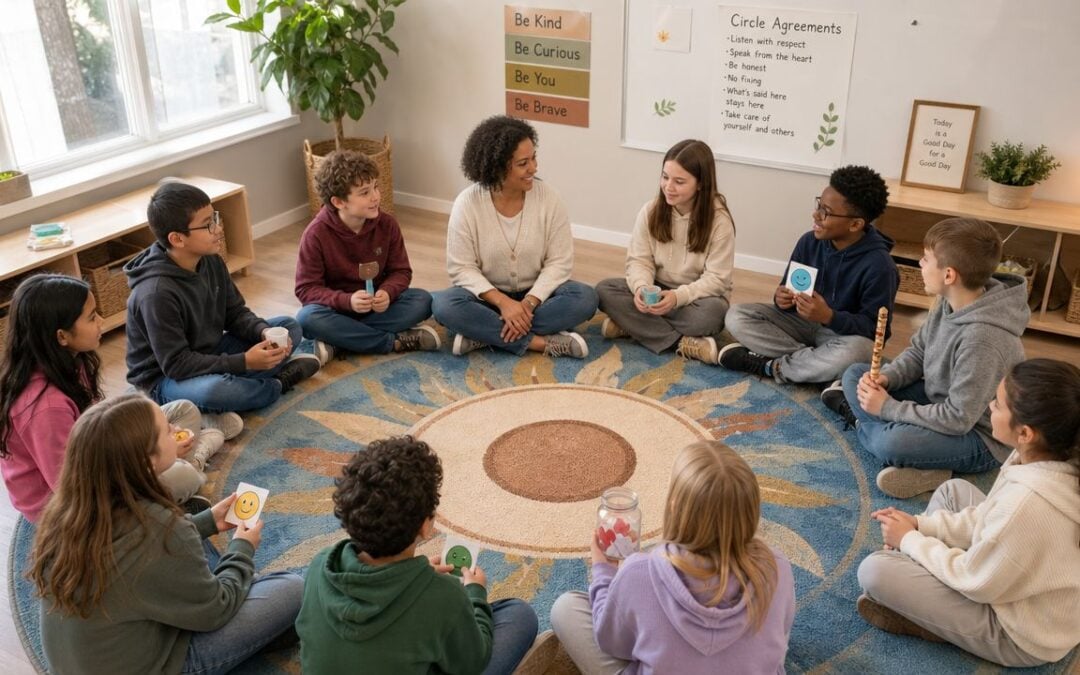
The last seven minutes of the day can undo a lot of good teaching. A student is still carrying frustration from math. Another is worried about a friendship issue that started at recess. Three are already halfway out the door in their minds. If dismissal starts from that energy, the class leaves scattered.
A well-run closing circle gives those minutes a job. It helps students settle, reflect, and leave with a clearer sense of what happened in the day and how they are part of the group. That shift supports classroom culture, but it also supports learning. Students remember more when they pause long enough to name what mattered.
The routine works because it is brief and predictable. Practitioner guidance often places closing circles in a short 5 to 10 minute window, including Kikori's overview of closing circles. That time limit matters. Teachers can protect it even on tight dismissal schedules, and students learn that reflection is part of the day, not an extra when time allows.
The best activities are not interchangeable.
Some help students name emotions. Some repair connection after a hard day. Some build appreciation, reflection, or hope. The difference is in the facilitation. Prompt choice, pacing, opt-in options, and the way you respond to silence all shape whether a circle feels safe or performative. That is why the activities below include more than prompts. Each one comes with facilitation moves, simple scripts, psychological safety tips, and age-specific variations across K to 8. If you want to connect one of these routines to a larger gratitude practice, this guide on ways to show gratitude with students fits naturally with that work.
Use these as tools, not a script you must follow perfectly. A strong closing circle is consistent, calm, and responsive to the class in front of you.
1. Gratitude and Appreciation Circle
This is one of the simplest closing circle activities to launch, and one of the easiest to overdo. It works when students name something specific. It falls flat when the circle turns into a string of vague compliments like “everyone was nice.”
Start by modeling the kind of gratitude you want to hear. “I appreciated how Malik pushed through a hard math problem today and then helped clean up without being asked” gives students a usable example. “I'm grateful for my class” does not.

How to facilitate it well
For younger students, keep the prompt concrete. Try “I'm grateful for ___” or “I appreciated it when ___.” For older students, add a reason. “I appreciate ___ because ___” pushes them past surface-level praise.
A practical script sounds like this:
Practical rule: Praise the action, not the label. “You included someone at recess” teaches more than “You're nice.”
If your class is new to this routine, don't ask everyone to share every day. FCPS practitioner guidance recommends inviting only 3 to 5 students to share each day, which keeps the routine brief and sustainable while still building participation over time.
- Kindergarten to grade 2: Use sentence frames on chart paper and allow students to point to a classmate if words are hard.
- Grades 3 to 5: Ask for one appreciation tied to effort, teamwork, or courage.
- Grades 6 to 8: Invite students to appreciate a peer, an adult, or something they noticed in themselves.
If the room feels forced, switch the format. Students can whisper their appreciation to a partner first, write it on a sticky note, or finish the sentence orally only if they're ready. For more classroom-friendly gratitude ideas, this roundup of ways to show gratitude can help teachers build language students can use.
2. Talking Piece Circle
When a class interrupts constantly, this routine can reset the culture fast. The structure is simple. One object moves around the circle, and only the person holding it speaks.
The object matters less than the meaning you give it. A smooth stone, a soft ball, a wooden heart, or a classroom mascot can all work. What matters is that students understand the norm. Hold the piece, speak if you want, pass if you need to, and listen when someone else has the floor.
Why this works in real classrooms
Talking piece circles are especially useful when your class has uneven participation. You know the pattern. A few students dominate, quiet students disappear, and the teacher ends up managing airtime instead of listening.
This format slows everyone down. It also builds predictability, which is part of psychological safety. Students know they won't be interrupted, and they know they won't be forced into a debate.
A script for an ordinary end-of-day circle might sound like this:
- Teacher opening: “When the talking piece gets to you, share one word for how your day ended, or pass.”
- Teacher reminder: “We listen all the way through. No fixing, no side comments.”
- Teacher close: “Thank you for making space for one another.”
The first few rounds should stay low stakes. Don't start with conflict. Start with prompts like “One thing I learned today” or “One thing I'm carrying home with me.”
Listening circles only feel safe when passing is a real option, not a fake one.
For educators using restorative routines more intentionally, Soul Shoppe's guide to restorative circles in schools offers language and framing that fit naturally into a closing circle. If you want to connect this practice to student voice and narrative, the broader power of storytelling for change is relevant too. Stories often emerge more openly when students know they won't be talked over.
3. Emotional Check-In and Feelings Inventory
Some students end the day wired. Others are flat, heavy, embarrassed, proud, or relieved. If you skip over that emotional reality, you miss valuable information about how the day landed.
An emotional check-in doesn't need to become a counseling session. In fact, it usually shouldn't. The most effective version is brief, consistent, and emotionally neutral. Students identify what they feel. They don't have to justify it, perform it, or fix it.

Good prompts and safer options
For K to 1, use faces, colors, or body signals. For grades 2 and 3, add feeling words like calm, frustrated, proud, worried, and excited. For older students, include more precise language such as disappointed, overwhelmed, hopeful, restless, or relieved.
Here's a simple progression that works:
- Name it: “Point to or say one feeling you have right now.”
- Notice it: “Where do you feel that in your body?”
- Share if you want: “Who wants to say why?”
What doesn't work is pushing every child to explain. Some students need privacy. Some need time. Some are still learning the language.
A good teacher response is short and steady: “Thanks for naming that.” “I'm glad you checked in.” “That makes sense.” Those responses validate without inviting the entire class to analyze one student's mood.
If you want a classroom routine built around mood meters and reflection tools, Soul Shoppe's article on daily check-ins for students offers practical formats teachers can adapt.
K to 8 variations
In primary grades, let students move to a corner that matches their feeling. In upper elementary, try “weather reports” such as sunny, cloudy, stormy, mixed. In middle school, keep it low-pressure. A private written check-in followed by optional sharing often gets better participation than going around the whole circle.
The key trade-off is depth versus consistency. A short daily feelings inventory builds habit. A deep conversation belongs only when the class has time and support for it.
4. Reflection and Learning Questions Circle
If your closing circle never connects back to learning, it can start to feel detached from the essential work of school. Reflection questions solve that. They help students make meaning from what happened academically, socially, and personally.
This routine works especially well after a lesson that asked students to struggle, collaborate, revise, or take a risk. Instead of “What did we do today?” ask something students can think about.
Prompts worth using
Strong prompts invite reflection without sounding like a test. Try these:
- Learning transfer: “Where could you use today's learning again?”
- Productive struggle: “What felt hard, and what helped you stay with it?”
- Community awareness: “How did someone help your learning today?”
- Identity growth: “What did you learn about yourself?”
Give actual wait time. Most teachers think they are waiting. Often they're not. A few silent beats changes the quality of responses.
Ask questions that students can answer from lived experience, not questions they think you want answered correctly.
For younger students, use a visual prompt. Hold up icons for “hard,” “fun,” “helpful,” and “surprising,” then ask students to pick one. For grades 4 to 8, invite turn-and-talk before whole-group sharing. Students often speak more thoughtfully after they've rehearsed an idea with a partner.
This circle also pairs well with writing. Students can jot one reflection on an exit slip and then share aloud. If you want a bank of prompts that works across ages, Soul Shoppe's collection of student reflection questions is useful for planning.
The common mistake here is overcomplicating the question. One well-chosen prompt is enough. If you ask four in a row, students start answering none of them thoroughly.
5. Community Affirmation and Peer Strengths Circle
This routine builds belonging fast, but only if the affirmations are earned, specific, and distributed fairly. Otherwise, the same popular students get praised while quieter students disappear.
That's why facilitation matters more here than in almost any other closing circle activity. You're not just inviting kindness. You're teaching students how to notice strengths in one another.
How to keep affirmations genuine
Start with a mini-lesson on the difference between a trait label and observed evidence. “You're awesome” is pleasant but weak. “You noticed Elena didn't have a partner and invited her in” is stronger because it names a behavior the community can value and repeat.
Try a teacher script like this: “Today we're naming strengths we saw. We're not flattering. We're noticing.” That one line tightens the whole routine.
A classroom example:
A third grader says, “I want to appreciate Jaden because when I dropped my crayons, he stayed behind to help me pick them up.”
A seventh grader says, “I noticed Ava kept the group focused when we got off task, and she did it without embarrassing anyone.”
Both are specific. Both teach the class what care can look like.
Helpful supports by age
- Primary grades: Use sentence starters on cards such as “I noticed ___” and “I appreciated when ___.”
- Upper elementary: Let students nominate someone for a strength connected to class values like courage, responsibility, or inclusion.
- Middle school: Invite affirmations tied to collaboration, integrity, perseverance, or leadership.
If students are hesitant, start with written affirmations and read a few aloud. If one child rarely gets named, the teacher should step in naturally and sincerely. Students notice who gets overlooked. That silence teaches something too.
One more caution. Don't force every student to receive a public round of praise before they're ready. For some children, especially those who feel exposed easily, public affirmation is intense. Let receiving be taught gently.
6. Mindfulness and Body Scan Closing
Some classes need an outward, verbal ending. Others need quiet. On high-energy days, a mindfulness close can be the most effective reset before dismissal.
Mindfulness in a closing circle doesn't need special language or a long script. It needs clarity, brevity, and permission for students to participate in different ways.

A short body scan that works
Try this script:
“Put your feet on the floor if that feels okay. Notice where your body touches the chair or rug. Take one slow breath in, and let it out. Notice your shoulders. Notice your hands. Notice your jaw. If anything feels tight, see if you can soften it a little. If your mind wanders, that's okay. Just come back to your breath.”
That's enough.
For kindergarten, make it sensory. “What do you hear? What do you feel?” For upper grades, name the purpose directly. “We're helping our bodies notice that the day is ending.”
What helps and what doesn't
- Do help with choice: Students can sit, stand, or keep eyes open.
- Do keep it short at first: A brief practice is more sustainable than a long one students resist.
- Don't demand stillness as proof of success: Some students regulate better with small movement.
- Don't attach moral language: Calm isn't “good,” and busy energy isn't “bad.”
A short video can help if students benefit from hearing another voice guide the practice. This mindfulness clip is one option to use during class or in planning: