Soul Shoppe's work is made possible by donors and partners who care deeply about the young people in their communities! We can't do this work without you. Support our work in classrooms and on playgrounds across the nation by donating here.
Building a Toolbox for Big Feelings: A Guide for Educators and Families
You've probably seen the moment already today. A student shuts down after a hard math page. Two children argue over a game at recess and one bursts into tears. A child who looked fine at breakfast suddenly says they can't go into school. Big feelings don't wait for the perfect lesson block, and that's exactly why a strong coping toolkit matters.
A good list of coping skills PDF gives kids something concrete to reach for when words are hard to find. It also helps adults teach emotional regulation in small, repeatable ways. One longitudinal study of more than 1,500 university students found that using a wider range of coping strategies was linked with better adjustment, and students who used 10 or more distinct strategies showed a 35% higher rate of successful adjustment than those using fewer than 5, according to the coping diversity study published in PMC. The takeaway for K-8 settings is simple. Kids need more than one calming trick.
That's where printable tools shine. A poster near the calm corner, a short handout in a family newsletter, or a small-group worksheet can turn abstract SEL language into something students can practice. The list below focuses on resources you can print, teach, and adapt right away for classrooms, counseling spaces, and home routines.
1. Tools Of The Heart Online Course
If you're not looking for one more disconnected handout, Tools Of The Heart Online Course deserves the featured spot. It's built for adults who want children to learn coping skills in context, with shared language, routines, and relationship repair woven into everyday school life.
Soul Shoppe's approach stands out because it doesn't treat self-regulation as an isolated intervention. The course is grounded in more than 20 years of school-based SEL practice and focuses on teachable habits like mindfulness, compassionate communication, self-awareness, and conflict resolution. That matters when you want the classroom teacher, counselor, recess aide, and caregiver all using the same language.
Best Use Case
This is the strongest fit for schools that want campus-wide consistency, and for families who want more than a static list of coping skills PDF. It works especially well when a principal or SEL lead wants common routines such as breathing, noticing feelings, repair conversations, and peer support woven across grade levels.
A practical example: a second-grade team can teach a short morning regulation routine, while a middle school advisory group uses the same language during peer conflict. At home, caregivers can reinforce the same reset steps before homework or bedtime.
Practical rule: Use this course when your challenge isn't access to coping ideas. It's consistency, adult modeling, and shared language.
What Educators Will Appreciate
Schoolwide language: Students hear the same phrases across classrooms, support staff, and family communication.
Flexible delivery: Teachers, counselors, and caregivers can learn on their own schedule.
Better implementation path: The course connects naturally with Soul Shoppe's workshops, assemblies, coaching, app support, and community programming.
There are a couple tradeoffs. The public page doesn't show a detailed syllabus or sample lessons, so some teams will want a closer look before committing. It also works best when adults practice the routines regularly. Like any SEL training, it builds capacity, but it doesn't replace clinical mental health support for students who need it.
For K-2, keep the language concrete. “Smell the flower, blow out the candle” works better than “activate self-regulation.” For grades 3-5, add reflection prompts like “What helped your body feel safe again?” For middle school, connect coping to belonging, conflict repair, and self-advocacy.
2. Therapist Aid, Coping Skills Worksheets
Therapist Aid coping skills worksheets are some of the easiest print-and-go materials for educators who want clean, professional PDFs. The library includes general coping sheets plus more targeted topics like anxiety, triggers, healthy versus unhealthy coping, and DBT-style tools.
This option is strongest for upper elementary and middle school students who can handle more clinical language. Many worksheets are fillable, which makes them useful for counseling sessions, check-in/check-out folders, and student support plans.
Where It Fits Best
Use Therapist Aid when you need structure, not decoration. A school counselor might hand a coping skills worksheet to a fifth grader who keeps saying “nothing works,” then help the student sort strategies into categories like body, mind, and connection.
Best for small groups: Students can circle three coping skills they'll try this week and reflect on which one helped most.
Best for student folders: Keep a printed page in a binder for quick access during stressful parts of the day.
Best for older students: The language is usually clearer for grades 4-8 than for kindergarten or first grade.
One limitation is tone. Some sheets feel written for therapy settings first, schools second. For younger children, you'll likely need to simplify wording and pair the worksheet with modeling.
A classroom example: turn a dense coping list into a choice board. Instead of asking, “Which strategy will you use?” ask, “Do you want a body break, a quiet activity, or someone to talk to?” That simple shift helps students choose faster.
3. Akron Children's Hospital, 99 Healthy Coping Skills PDF
If you want one sheet you can print in under a minute and use all week, the Akron Children's Hospital 99 Healthy Coping Skills PDF is a strong pick. It's a single-page list packed with concrete ideas across movement, creativity, sensory input, breathing, and connection.
This is the kind of list of coping skills PDF that works well when students freeze and say, “I don't know what to do.” The options are short, scan-friendly, and easy to highlight.
Best Use in a School Day
A teacher can post it in a calm corner and ask students to choose one strategy before returning to work. A counselor can send it home with three items already starred so caregivers know what the child has practiced at school.
Keep this one visible, but don't stop at visibility. Have students rehearse two or three favorites when they're calm, not just when they're upset.
A practical example for grades 1-3: ask students to use colored dots. Green means “I can do this by myself,” yellow means “I need an adult to remind me,” and red means “this one isn't for me.” For grades 4-8, have students build a “top five for school” and a separate “top five for home.”
The downside is that it isn't differentiated by age. Some items will fit an eight-year-old better than a kindergartner, and some will need adult judgment based on setting. It's also a list, not a lesson sequence, so it works best when paired with direct teaching.
4. Children's Healthcare of Atlanta Strong4Life, Coping Skills Tip Sheets
The Strong4Life coping skills tip sheets from Children's Healthcare of Atlanta do something many printable resources miss. They teach the skill, not just the name of the skill. You'll find handouts on grounding, journaling, progressive muscle relaxation, and other concrete techniques, with English and Spanish options for broader family access.
That bilingual availability makes these handouts especially useful for family newsletters, parent nights, and district resource hubs. They're also friendly enough to send home without a long explanation.
Why the How-To Matters
A lot of children can name a coping strategy but can't apply it when stress spikes. Recent concerns in SEL materials often come back to a simple issue. Lists name too many ideas without showing students when or how to use them. That's why Strong4Life's step-by-step style helps.
For example, instead of telling a student to “ground yourself,” you can print a handout, practice it during morning meeting, then rehearse the same sequence before a test. In a family setting, a caregiver can keep one page on the fridge and walk through it after a rough sibling conflict.
For K-2: Turn one tip sheet into a picture-supported mini-lesson with gestures.
For grades 3-5: Have students annotate the sheet with “when I could use this.”
For middle school: Ask students to rate which steps feel realistic in class versus at home.
The only inconvenience is navigation. The materials live across several pages, so gathering a full set takes a few extra clicks. Some handouts also lean toward parent coaching, which means teachers may want to trim or adapt the wording for classroom use.
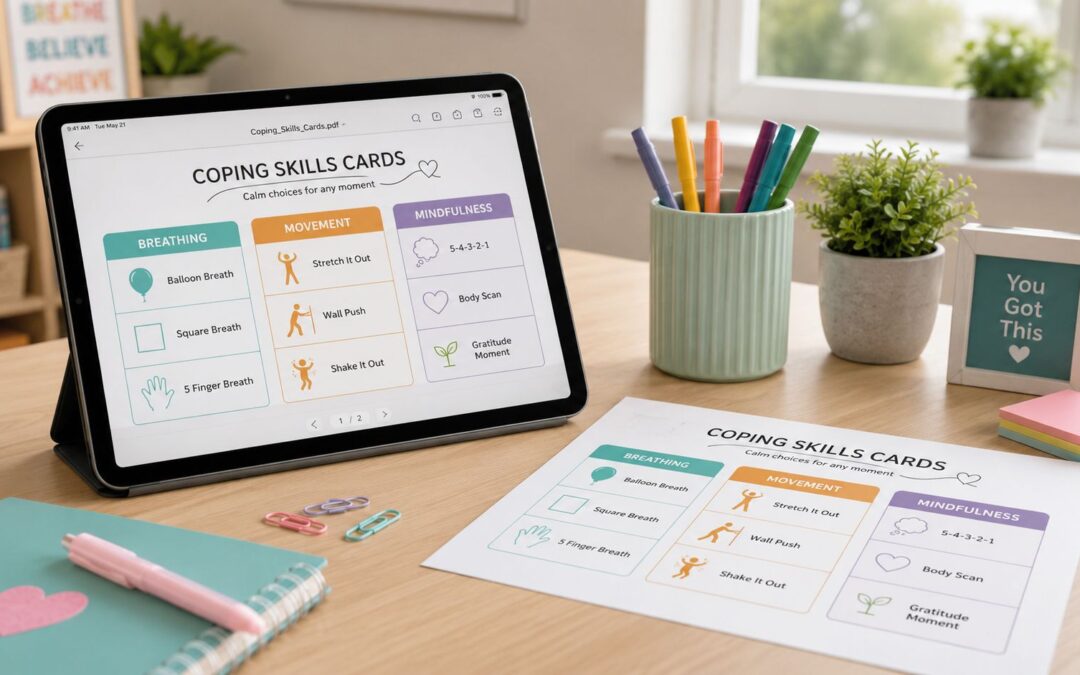
Visual learners often need more than a text-heavy handout. Sanford Fit's Kids' Coping Strategies Poster Packs give you colorful, classroom-ready supports that teach breathing, mindfulness, grounding, and positive self-talk in a format young children can use.
These packs shine in elementary settings, especially calm corners, counseling offices, and transition spaces. Spanish versions add flexibility for schoolwide use.
Best for Calm Corners and Routines
This resource works well when you want coping practice to feel normal, not remedial. A poster by the classroom door can cue a reset before rejoining group work. A set of Mindful Moments cards can become part of your post-recess routine.
One reason multisensory strategies matter is that cues tied to sensory anchors can be more effective in moments of acute stress. Guidance linked through the NIMH Bookshelf overview on relaxation and stress reduction supports the value of body-based, sensory-grounded calming techniques, which is exactly the kind of thing these posters make easy to teach.
A pinwheel, bubble breath visual, or tracing card often works faster with younger students than a verbal reminder to “calm down.”
A practical example: in kindergarten, let students point to a breathing card instead of explaining their feeling. In fourth grade, add a reflection strip that says, “What changed in my body after one minute?” That turns a poster into a habit.
This set is primarily elementary-focused. Middle school students may find the design too young unless you select the more neutral visuals and pair them with advisory discussion.
6. Boys Town, 50 Coping Skills for Children
The Boys Town 50 Coping Skills for Children PDF is concise, positive, and easy to share. If you need a handout for planners, family packets, or student support binders, this one is straightforward and practical.
Boys Town also pairs the list with coping toolbox guidance for caregivers, which makes it stronger than a list that stops at “try these.” The tone is especially parent-friendly.
Best for Family Communication
This is one of the easiest resources to send home because it doesn't feel clinical. A school can include it in a beginning-of-year SEL packet, or a teacher can laminate it for students who need quick prompts during the day.
Here's a simple home-school example. A child circles three school-friendly skills such as drawing, taking deep breaths, or asking for a break. At home, the caregiver circles three evening-friendly skills such as listening to music, talking, or taking a quiet reset. The overlap becomes that child's core coping set.
Use in planners: Tape a reduced-size copy inside the cover.
Use in newsletters: Highlight one “family skill of the week.”
Use in conferences: Ask adults and children to each pick the same two strategies they'll reinforce.
The limitation is depth. It doesn't segment skills by setting or provide much instruction on how to teach them. For that reason, it's best as a companion handout after you've modeled the strategies.
7. PESI Publishing, Free Coping Skills for Kids PDF Sampler
If you want materials that feel kid-centered right away, the PESI Publishing coping skills PDF sampler is worth a look. It includes a printable checklist, calming strategy pages, coping menus, and planning templates designed for ages 4 to 12.
The sampler format is useful when you're deciding whether a larger workbook would fit your setting. You can test the tone, visuals, and student response before buying anything else.
Best for Personalizing a Student Plan
This resource is a nice fit for calm-down kits and individual coping menus. A student can sort options into “works at school,” “works at home,” and “I want to try this with help.”
The personalization piece matters because broad lists can overwhelm children. The ISSUP compilation of 117 healthy coping skills shows the value of concrete, measurable actions such as going for a brisk 10-minute walk or doing a counted routine. That same principle applies here. Students usually do better when the strategy is specific and doable.
For example, don't just hand over a menu and say “pick one.” Try this instead:
For younger students: “Choose one quiet hand activity and one breathing activity.”
For grades 3-5: “Pick two strategies you can do in under five minutes.”
For older elementary and middle school students: “Pick one strategy for frustration and one for social stress.”
The drawback is that it's only a sampler and the landing page includes marketing elements. Still, for many teachers and counselors, the free pages are enough to pilot routines before expanding.
8. Centervention, Coping Skills and Emotional Regulation Worksheets
Centervention coping skills and emotional regulation worksheets are built with school use in mind. That shows up in the grade-banded materials, facilitation notes, and practical focus on skills like square breathing, grounding, and evaluating whether a strategy helped.
If you run Tier 1 lessons, small groups, or Tier 2 check-ins, this resource is one of the most classroom-oriented options on the list.
Best for Small Group Practice
Centervention works well when students need guided repetition. A counselor can teach 5-4-3-2-1 grounding to a small group, then send each student back with a matching worksheet and cue card for class.
A practical example for grade bands:
Elementary: Use one body-based worksheet per week and practice it before transitions.
Upper elementary: Add a reflection prompt such as “What problem was my body trying to solve?”
Middle school: Compare short-term calming skills with longer-term coping plans.
This grade-band distinction matters because many generic PDFs don't clearly separate immediate regulation from later problem-solving. In practice, students often need to calm their bodies first and think later. Centervention's materials lend themselves to that sequence better than a simple all-purpose list.
There's some extra navigation on a few downloads, and the visual style varies across resources. Even so, the ease of facilitation makes this a strong option for educators who want more than a poster.
9. Child Mind Institute, Managing Intense Emotions for Kids
Some resources are better at coaching adults than listing student strategies. Child Mind Institute's managing intense emotions guides are strong because they help caregivers and educators understand what to do before, during, and after a child is dysregulated.
The printable activity sheets support grounding, co-regulation, and calm-time practice. That makes this a good bridge between home and school.
Best for Home-School Alignment
Use these guides when a child's coping skills break down across settings. A student may use a breathing tool successfully in the counselor's office but forget it during lunch conflict or at bedtime. Adult coaching helps close that gap.
Children often need a calm adult, a practiced script, and a familiar cue before they can use a coping skill independently.
A practical example: send one printable sheet home after a support meeting and ask the family to practice it at a neutral time, not during a meltdown. Then have the teacher use the same language in class. “Hands on belly, slow exhale, name one thing you see” works better when children hear it in both places.
The tradeoff is format. These are guide-first resources, so if you want a standalone list of coping skills PDF, you may need to pull out the printable parts yourself. Still, for students who need co-regulation and consistency, that extra context is often what makes the strategy stick.
10. National Child Traumatic Stress Network, Coping Fact Sheets
The National Child Traumatic Stress Network coping fact sheets are especially useful when schools need trauma-informed family support. These handouts are more text-heavy than a poster pack, but they bring credibility and a steady tone that works well in difficult seasons.
They're a smart choice for district family resource pages, re-entry packets, crisis response communication, and parent education events.
Best for District and Family Support
Use NCTSN when the message needs to be calm, trustworthy, and broad enough for many situations. Parent and youth versions support whole-family learning, which is helpful when stress affects routines at school and at home.
A practical school example: after a community stressor, a principal can send the parent fact sheet with one short note from the school counselor explaining which two coping routines teachers will also use in class. That creates continuity without overwhelming families.
For younger grades: Pull out two or three strategies and turn them into visuals.
For upper grades: Use the handout during advisory or counseling check-ins.
For caregivers: Highlight one section and invite them to practice it during a calm moment.
The main limitation is readability for younger children. The language is stronger for adults and older students than for primary classrooms, so teachers will often need to adapt it into simpler scripts or visuals.
Top 10 Coping Skills PDF Resources Comparison
Resource
Core features
Target audience / setting
Unique selling point
Format & cost
Tools Of The Heart Online Course (Soul Shoppe)
Research-based SEL course; scaffolded tools for self-regulation, mindfulness, compassionate communication
High authority on child trauma; suitable for district-wide distribution
Printable fact sheets (PDF); free
Putting Your Coping Skills PDFs into Practice
A PDF is a starting point, not a destination. Students don't build regulation skills by glancing at a poster once. They build them by practicing when they're calm, hearing the same language from trusted adults, and using simple routines often enough that those routines become familiar.
That's why the best list of coping skills PDF is the one you teach. Print fewer pages and use them more consistently. A single breathing card, a short menu of body-based options, and one reflection routine can do more for a classroom than a giant binder nobody opens.
Here are practical ways to make these resources work in real life:
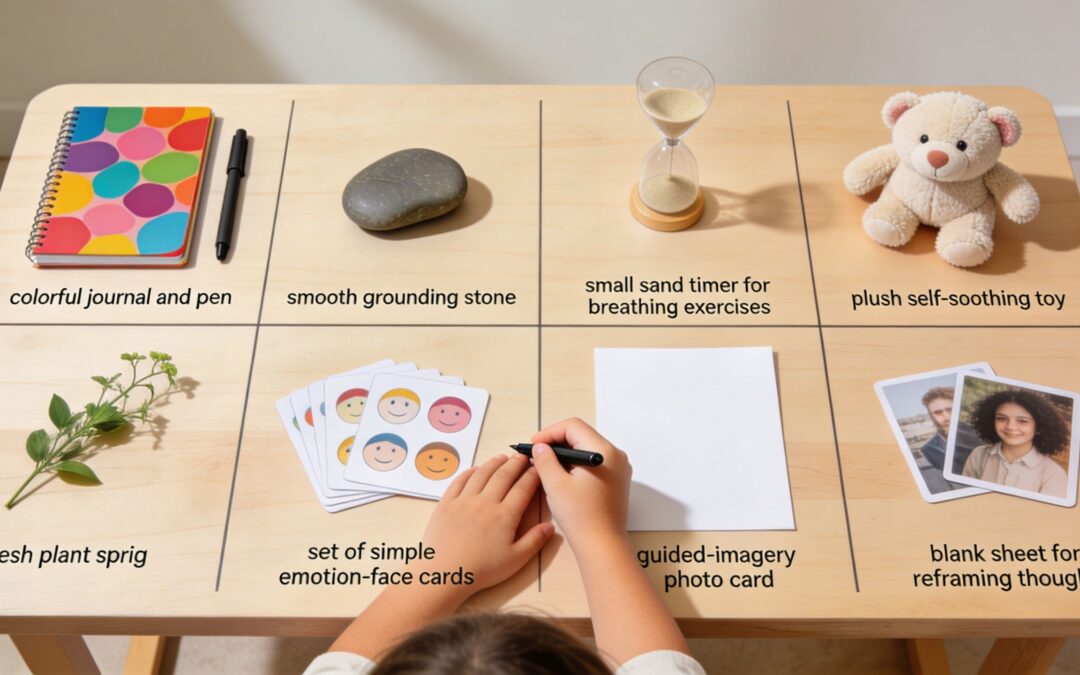
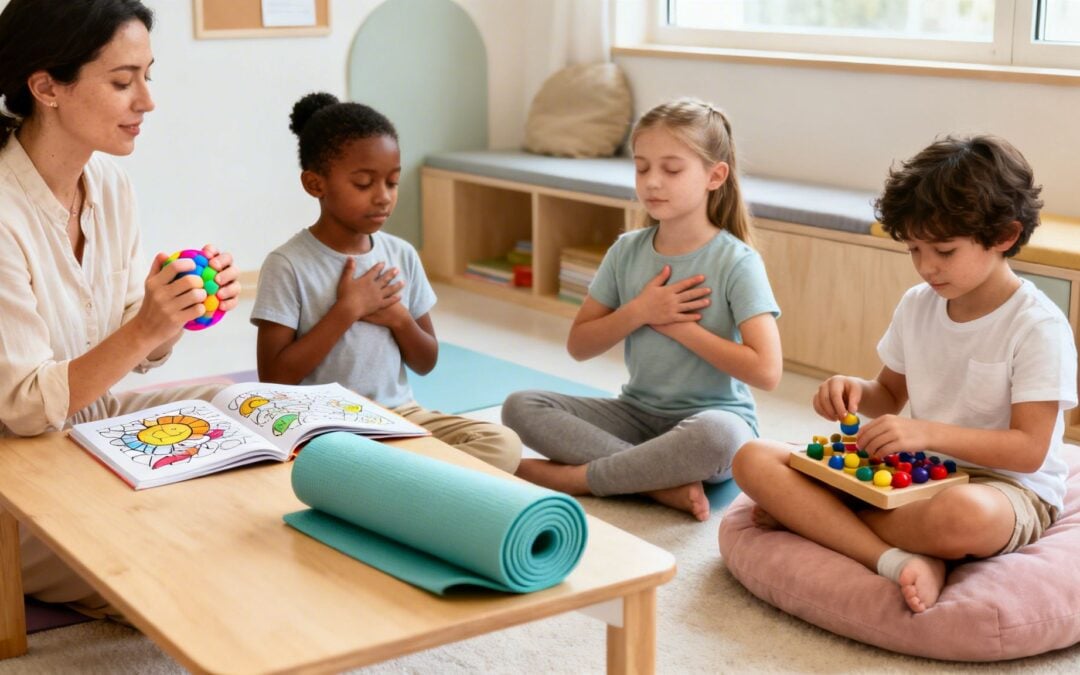
Build a personal calm-down kit: Let students choose three printed tools and three physical items, such as a breathing card, a coping menu, paper for drawing, a sensory object, and a visual timer.
Teach in calm moments: Introduce one skill during morning meeting, advisory, or counseling group before students need it under pressure.
Use scenario practice: Role-play common moments like losing a game, feeling stuck on homework, or getting corrected in front of peers.
Match the skill to the setting: A child may use wall pushes at school, journaling at home, and a help script in the hallway.
Model it yourself: Teachers and caregivers can say, “I'm frustrated, so I'm taking one slow breath before I answer.”
One common mistake is treating all coping skills as interchangeable. They aren't. Some help a child calm their body right now. Others help them reflect, reconnect, or solve a problem later. When you organize your resources that way, students start to understand when to use which tool.
It also helps to prepare your files before sharing them. If you send home handouts or post them online, you may want to remove PDF metadata on Mac and Windows so family-facing documents stay tidy and privacy-conscious.
If you're leading a school or district, think beyond isolated downloads. The strongest results usually come from a shared SEL language across classrooms, counseling spaces, and homes. That's where Soul Shoppe can help. Their programs support the shift from individual coping strategies to a wider culture of belonging, empathy, conflict repair, and emotional safety. When adults across a campus use the same language and routines, students don't just manage stress more effectively. They feel more connected, more capable, and more ready to learn.
If you want more than a printable list and you're ready to build a shared SEL culture, explore Soul Shoppe. Their school and family programs help children and adults practice self-regulation, mindfulness, communication, and conflict resolution in ways that fit real classrooms and real relationships.
A child storms off after recess because a friend wouldn’t share. Another freezes before a math test and says their stomach hurts. A middle schooler shrugs and mutters, “I don’t care,” when you can tell they absolutely do. In those moments, adults often reach for the same phrase: calm down.
The problem is that “calm down” isn’t a tool. It’s a request.
Children need actual strategies they can use when frustration, worry, embarrassment, grief, or disappointment rush in faster than their thinking brain can catch up. That’s where emotion focused coping comes in. These strategies help kids work with the feelings created by a hard situation, especially when they can’t fix the situation right away. A student can’t undo a conflict, erase a mistake, or control a family change in the moment. They can learn how to notice, express, soothe, and move through the emotions that come with it.
That matters. A 2015 meta-analysis on emotion-focused coping found that people who actively processed and expressed emotions, rather than avoiding them, showed measurable improvements in resilience and well-being. That’s an important distinction for adults in schools and homes. Not all emotion-focused coping helps. Suppressing feelings tends to backfire, while healthy emotional processing can support stronger coping.
These emotion focused coping examples are designed for real classrooms, real homes, and real kids. They’ll also strengthen the emotional intelligence that children need to handle relationships, stress, and setbacks with more confidence.
1. Mindfulness and Present-Moment Awareness
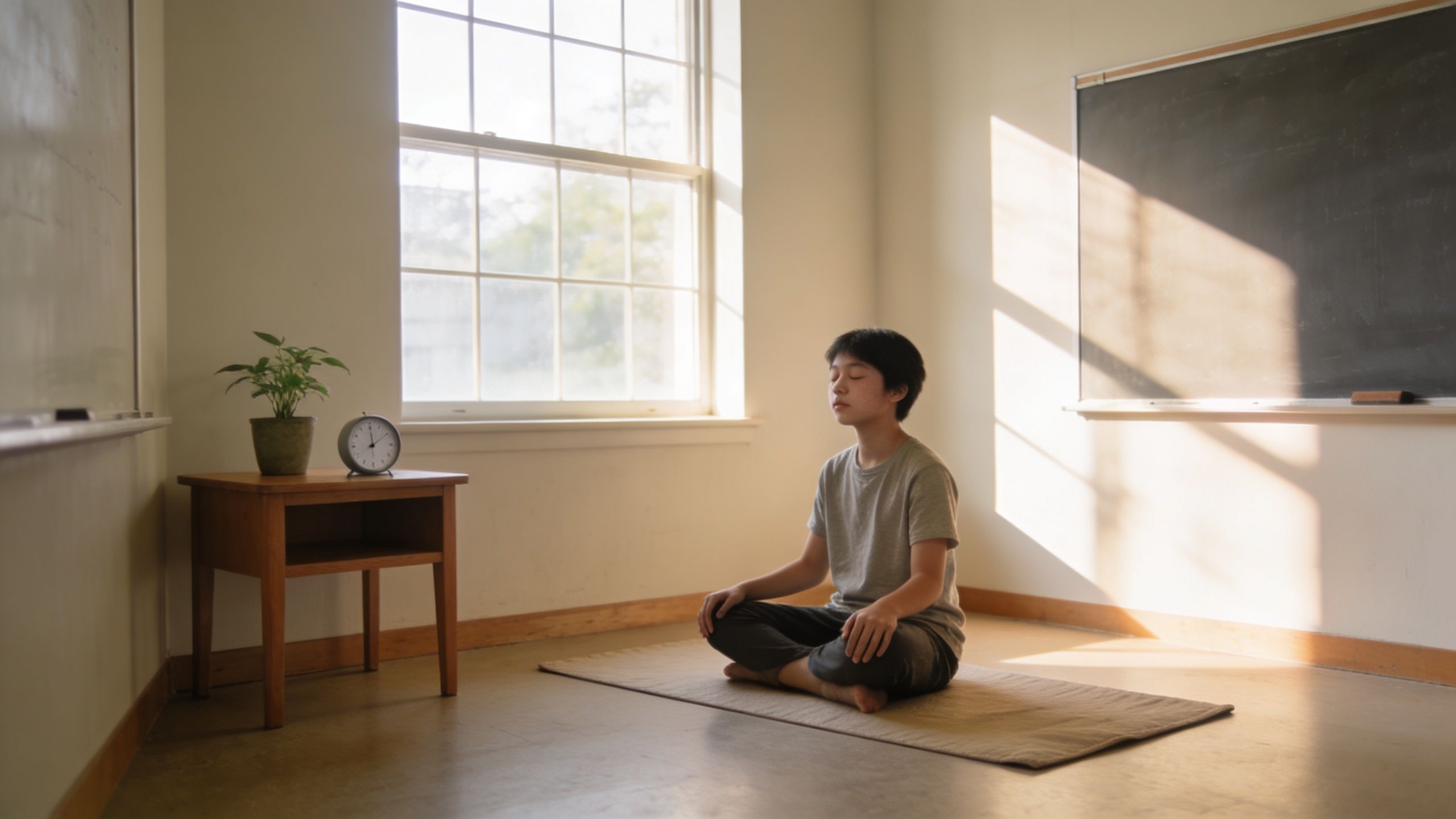
Mindfulness gives a child something concrete to do when feelings start to spike. Instead of getting pulled deeper into panic, anger, or shame, they practice noticing what’s happening right now. Breath. Feet on the floor. Hands on the desk. Sounds in the room. That pause can keep emotion from taking over behavior.
In school, this often looks simple. A third grader takes three slow breaths before opening a test packet. A teacher starts the morning with one minute of quiet noticing. A parent kneels beside a crying child and says, “Let’s feel your belly rise and fall together.”
What it sounds like with kids
You don’t need long meditations. Short, repeatable routines work better.
For early elementary: “Name three things you see, two things you hear, one thing you feel in your body.”
For upper elementary: “Put one hand on your chest and one on your belly. Breathe in slowly. Breathe out even slower.”
For middle school: “Notice the thought. Don’t argue with it yet. Just label it: worried thought, mad thought, embarrassed thought.”
Practical rule: Practice mindfulness when kids are calm, not only when they’re upset. Skills learned during peaceful moments are easier to use during hard ones.
Classroom and home adaptations
A mindfulness routine works best when it’s built into the day. Try it before tests, after lunch, after conflict, or during transitions. If you want students to understand why this matters, tie it to the idea of living in the now, which helps kids shift attention away from spiraling “what if” thoughts.
Teachers can say, “We’re not trying to make every feeling disappear. We’re helping our bodies get steady enough to think.” Parents can use the same language at bedtime, before sports, or after a sibling conflict.
2. Emotional Expression and Creative Outlets
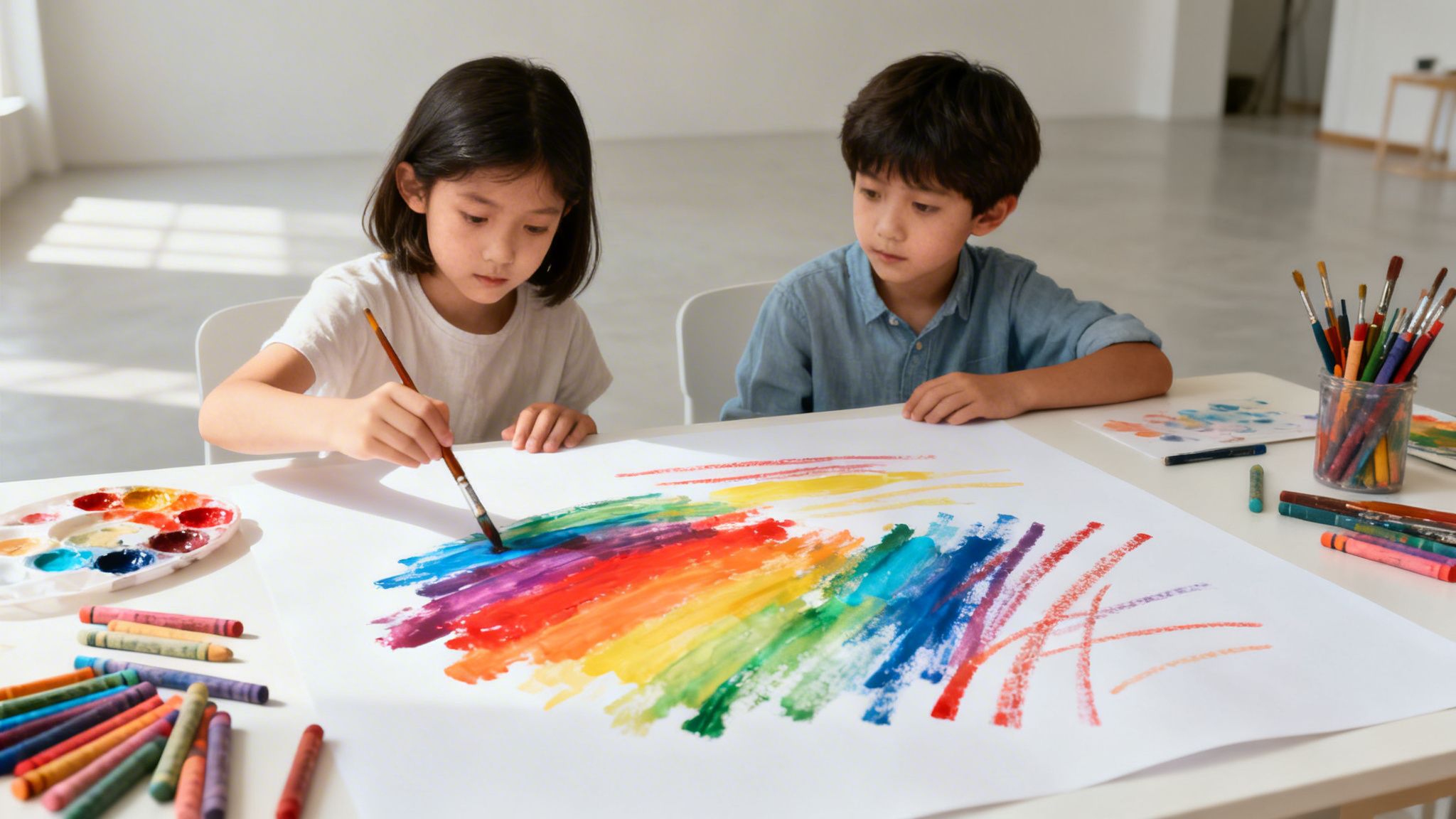
Some children can tell you exactly what they feel. Many can’t. They show it in drawings, movement, music, pretend play, or the way they slam a marker onto paper. Creative expression gives emotion a safe exit. It helps a child process feelings without needing perfect words first.
This is one of the most useful emotion focused coping examples for younger students and for older kids who shut down when asked direct questions. A child might draw “what anger looks like,” create a playlist for different moods, or act out a problem with puppets before they’re ready to talk.
Ways to use it without turning it into an assignment
The key is to focus on expression, not performance. Don’t correct the art. Don’t ask for neatness. Don’t force sharing.
Art option: “Use color and shape to show how today feels.”
Writing option: “Finish this sentence three times: Right now I wish…”
Movement option: “Show me with your body what nervous feels like, then show me what steady feels like.”
Drama option: “Let the puppet say what the student can’t say yet.”
A feelings chart for kids can help children move from broad labels like mad or sad to more accurate words like left out, embarrassed, worried, or disappointed. That added precision often lowers intensity because the feeling becomes easier to understand.
Sample adult script
Try: “You don’t have to explain it right away. You can draw it, write it, or move it.”
That kind of permission matters. A randomized trial described in this positive affect journaling overview found that journaling was linked with significant reductions in mental distress, anxiety, and perceived stress after an 8-week intervention, with benefits that persisted at follow-up. For children, the school version can be much simpler: a short reflection page, a feelings doodle, or a gratitude journal they return to regularly.
3. Social Support and Connection-Building
Kids regulate better in relationship. Even very independent children often need another nervous system nearby before they can settle their own. That’s why connection is one of the strongest emotion focused coping examples you can teach.
For some students, support means talking. For others, it means sitting next to a trusted adult, walking a lap with the counselor, or knowing there’s one peer who’ll save them a seat at lunch. The message is the same: you don’t have to carry big feelings alone.
Build support before a child is in crisis
Waiting until a student is overwhelmed is too late. Connection has to be part of the routine.
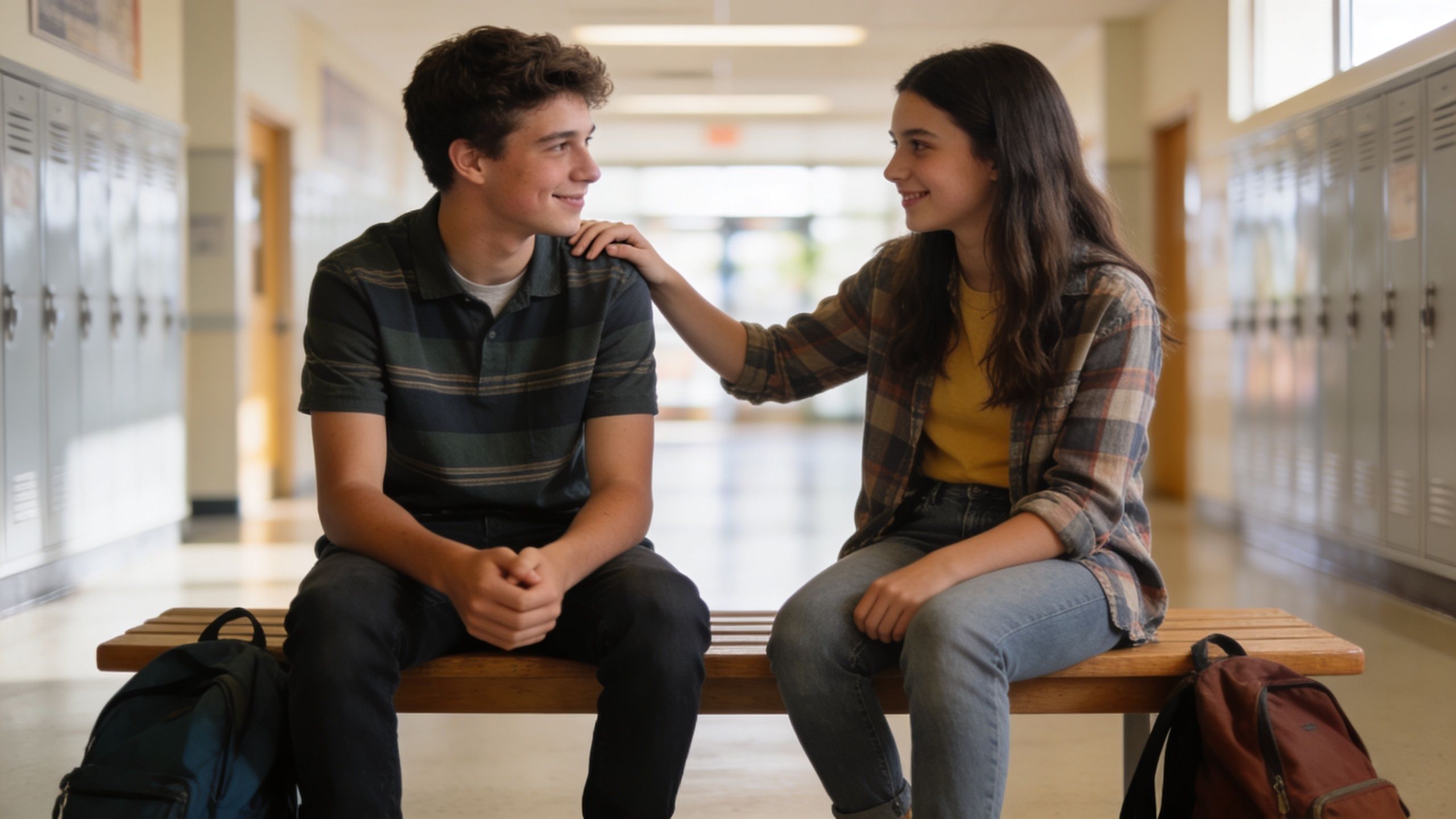
Teacher check-ins: Greet students by name and notice changes in mood.
Peer structures: Use partner shares, lunch groups, or buddy systems.
Family routines: Set a daily “tell me one hard thing and one good thing” conversation.
Counselor support: Give students a clear path for asking for help without shame.
Research summarized in this overview of coping patterns in students found that girls reported higher overall coping levels than boys, and that self-efficacy and family support influenced which coping strategies students used. The same review also noted that withdrawal was associated with depressed mood. For adults, that’s a reminder to teach help-seeking directly instead of assuming children will do it on their own.
Sample scripts for adults and peers
A supportive response sounds like this:
“You don’t have to fix it right now. Tell me what feels hardest.”
A peer can learn simple language too: “Do you want advice, or do you want me to just stay with you?” Activities that strengthen trust and belonging make these moments more likely. Schools can support that through intentional relationship-building activities woven into the week.
4. Self-Compassion and Positive Self-Talk
Many kids are much harder on themselves than adults realize. You see it after a wrong answer, a missed goal, a social mistake, or a small correction. “I’m dumb.” “Nobody likes me.” “I ruin everything.” That inner voice can turn one hard moment into a much bigger emotional crash.
Self-compassion teaches children to talk to themselves the way they’d talk to a friend. It doesn’t mean pretending everything is fine. It means meeting struggle with honesty and kindness.
Replace harsh self-talk with helpful language
Children usually need this modeled out loud. They don’t automatically know what compassionate self-talk sounds like.
Try these swaps:
Instead of: “I’m terrible at this.” Try: “This is hard for me right now.”
Instead of: “I messed up everything.” Try: “I made a mistake, and I can repair it.”
Instead of: “Everyone else gets it.” Try: “I’m still learning, just like everybody else.”
A teacher can model this after making a mistake on the board: “I don’t love getting things wrong, but mistakes help me see what to fix.” That lands because it’s real.
A quick self-compassion routine
Give students three steps they can remember:
Name it: “This is a hard moment.”
Normalize it: “Other people feel this way too.”
Support yourself: “What do I need to hear right now?”
Parents can keep this concrete: “You’re disappointed. That makes sense. What would help you talk to yourself kindly?” Teachers can post positive affirmations for kids and revisit them after mistakes, not just during morning meetings.
Speak to the child in a way you hope they’ll eventually speak to themselves.
That’s one of the quietest and strongest forms of SEL teaching.
5. Reframing and Cognitive Perspective-Taking
A child’s first interpretation of an event is often the most painful one. “She didn’t wave back because she hates me.” “The teacher corrected me because I’m bad.” “I failed one quiz, so I’m going to fail everything.” Reframing helps children slow down and consider another possible explanation.
This doesn’t mean arguing kids out of their feelings. If a child feels hurt, they feel hurt. Reframing comes after validation, not instead of it.
Start with the feeling, then widen the lens
A good adult response sounds like this: “I can see why that felt embarrassing. Let’s look at what else might be true.”
Then ask questions that invite perspective:
“What’s one other explanation?”
“What would you say to a friend in this situation?”
“Is this a forever problem, or a right-now problem?”
“What facts do you know for sure?”
For younger children, use visual choices. “Do you think your friend was being mean on purpose, distracted, or upset about something else?” For older students, introduce thinking traps such as mind-reading, catastrophizing, and all-or-nothing thinking.
Real school examples
A student gets feedback on an essay and says, “My teacher thinks I’m bad at writing.” Reframing sounds like: “Your teacher spent time on comments because your writing matters and can grow.”
A student isn’t picked for a game and says, “Nobody wants me.” Reframing might be: “That felt personal. It may also have been a quick choice between friends.”
This strategy pairs well with journaling, class discussions, and restorative conversations. Adults can model it openly: “My first thought was that the meeting went badly. My second thought is that people were tired and distracted.”
6. Relaxation Techniques and Somatic Awareness
Sometimes the fastest way to help a child with big feelings is through the body, not through words. An anxious child may have tight shoulders, shaky hands, or a stomachache. An angry child may clench fists or breathe fast. Somatic coping teaches kids to notice those signals and respond before they escalate.
That’s useful because many children don’t recognize stress until it’s already overflowing. Body awareness gives them an earlier warning system.
Here’s a simple practice to introduce:
Simple body-based tools that work in classrooms
Relaxation doesn’t have to be elaborate. The best tools are short, repeatable, and easy to do without drawing attention.
Box breathing: Inhale, hold, exhale, hold using the same count.
Hand squeeze and release: Tighten fists, then relax them.
Shoulder reset: Lift shoulders to the ears, hold, then drop.
Grounding through touch: Press feet into the floor or hands onto the desk.
Stretch break: Reach high, fold forward, then roll back up slowly.
For younger children, make it playful. “Pretend you’re squeezing lemons in both hands.” For older students, explain the purpose directly: “Your body is activated. We’re helping it come back to steady.”
Sample script for tense moments
Try: “Before we talk, let’s help your body feel safer.”
Some families also like calming sensory rituals at home, including scents tied to bedtime or quiet time. If that interests you, this piece on Aroma Warehouse essential oils insights offers ideas adults can consider alongside breathing, stretching, and other relaxation habits. In school settings, keep it simple and inclusive, since not every student can tolerate scent-based supports.
7. Acceptance and Emotional Validation
A lot of children think a feeling is a problem that must be erased immediately. Adults sometimes reinforce that without meaning to. We rush to distract, fix, persuade, or explain away. But feelings often settle faster when children feel understood.
Acceptance means helping a child notice, “I feel angry,” or “I feel scared,” without piling shame on top of the feeling itself. Validation means saying that the emotion makes sense in context, even if the behavior still needs limits.
Validation is not the same as permission
This distinction matters. You can validate a feeling and still stop harmful behavior.
Validate the feeling: “You’re really angry that the game ended.”
Hold the limit: “I won’t let you throw the marker.”
Offer support: “Let’s figure out what your anger needs right now.”
Children learn that emotions are allowed, but not every action is. That’s a powerful lesson for school culture and family life.
Phrases adults can keep ready
Use short statements that sound natural:
“It makes sense that you feel that way.”
“You don’t have to like this feeling for it to be real.”
“We can make room for the feeling and still choose a safe next step.”
A child who hears these messages repeatedly starts to internalize them. Over time, that reduces the urge to suppress emotions or act them out. A longitudinal study on emotion-oriented coping found that emotion-oriented coping played a meaningful role in change over time among women in treatment, underscoring the value of emotional expression and processing in difficult, hard-to-control circumstances. In child-friendly terms, feelings often need attention before growth can happen.
8. Meaning-Making and Values-Based Action
Some emotional experiences stay with children because the event touched something important. A bullying incident may affect a child profoundly because belonging matters to them. A failed project may sting because they care about competence. Meaning-making helps kids connect the feeling to what matters, instead of seeing pain as random or pointless.
This is especially helpful after disappointment, loss, exclusion, or unfairness. The question shifts from “How do I get rid of this feeling?” to “What does this feeling tell me about what I care about?”
Help children connect feelings to values
Ask open-ended questions:
“Why did this matter so much to you?”
“What does this show you care about?”
“What kind of person do you want to be in response to this?”
A child upset about a friend conflict may realize they value loyalty. A student crushed by a poor grade may realize they care deeply about improvement. Once values are clear, action becomes possible.
Turn insight into a next step
Values-based action doesn’t require a grand gesture. It can be small and concrete.
A student who felt excluded might choose to include someone else tomorrow. A child hurt by teasing might help create kinder class norms. A middle schooler discouraged by a setback might make a study plan that reflects persistence.
This is one place where emotion-focused and problem-focused coping meet. First the child names and processes the feeling. Then they act in a way that lines up with who they want to be. That combination builds resilience with real staying power.
Post-loss, collective trauma processing, identity and value work
Transforms suffering into purposeful action and sustained motivation
Putting It All Together: Blending Strategies for Resilient Kids
The strongest coping toolkit isn’t built around one perfect strategy. It’s built around options. A child might need mindfulness before a test, journaling after a friendship conflict, body-based relaxation during a shutdown, and self-compassion after making a mistake. Different moments call for different supports.
That’s why these emotion focused coping examples work best when adults treat them as flexible tools, not rigid programs. Start by helping the child regulate the emotional storm. Breathe. Draw. Name the feeling. Sit with a trusted adult. Once the child is steadier, move toward problem-solving. Make the plan. Repair the friendship. Practice the skill. Ask for help.
This sequence matters because dysregulated children usually can’t reason their way out of distress first. They need to feel safe, seen, and settled enough to think clearly. Emotion-focused coping creates that opening. Then problem-focused coping can do its job.
For teachers, this may mean building a few routines into the day instead of waiting for crisis. A calm corner. A check-in ritual. A class breathing pause after recess. A feelings chart near the meeting rug. A regular writing prompt that lets students process emotion without being put on the spot.
For parents, it often means changing the first response. Instead of “You’re fine” or “Go calm down,” try “I can see this is a lot” or “Let’s help your body first.” That small shift teaches children that emotions are manageable, not dangerous.
Research also supports the idea that adaptive emotional processing matters more than suppression. The distinction is important in schools and homes alike. We don’t want children to stuff feelings down. We want them to learn how to notice, express, and move through them safely.
If a child’s distress is persistent, severe, or interfering with daily life, bring in more support. A school counselor, pediatrician, or licensed mental health professional can help assess what’s going on and what level of care is needed. Some schools also look to SEL organizations such as Soul Shoppe for workshops, courses, and community-based support that give children and adults shared language for self-regulation, empathy, and connection.
And if you’re helping a child prepare for a big transition, emotional coping belongs there too, right alongside academic skills. Practical readiness includes the ability to handle frustration, ask for support, and recover from mistakes. This InchBug guide to kindergarten readiness is a useful reminder that school success depends on more than letters and numbers.
If you want more support teaching kids how to name feelings, regulate big emotions, and build safer relationships, explore Soul Shoppe. Their SEL resources and programs are built to help school communities and families practice these skills in everyday life.
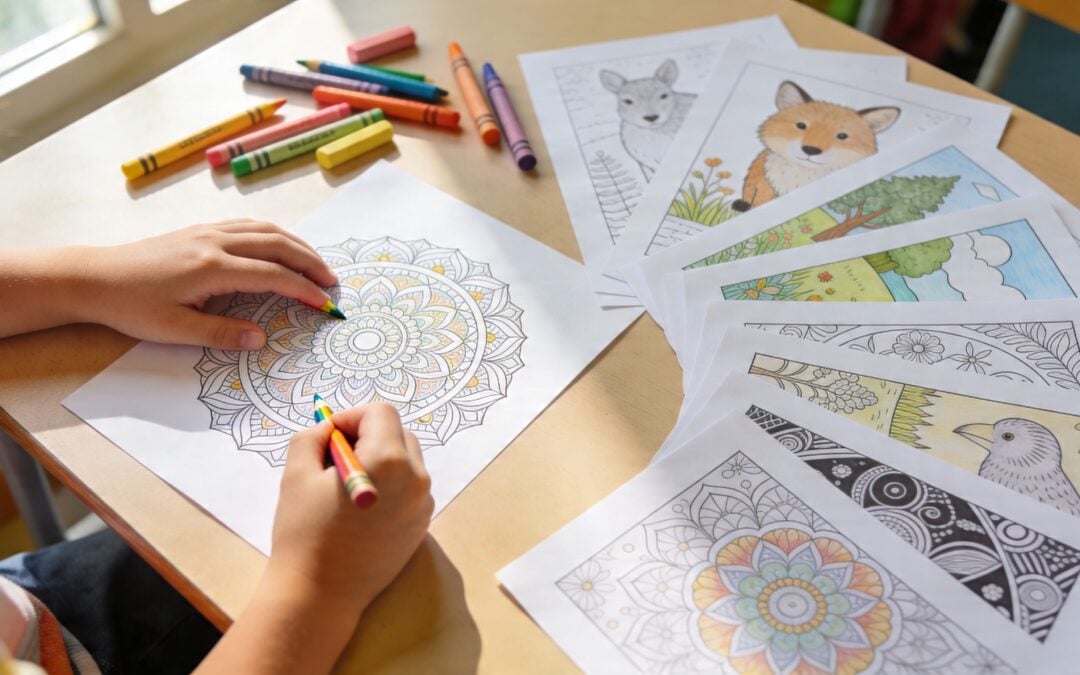
A student walks in already keyed up. Maybe it's a quiz day. Maybe recess went badly. Maybe nothing obvious happened, but you can see it in the tight shoulders, the quick breathing, the way the pencil taps the desk. In those moments, anxiety coloring pages can help because they give kids something simple, concrete, and regulating to do with their hands while the nervous system settles.
That doesn't mean every coloring page works the same way. Some are really coping-skills lessons in disguise. Some are best for a calm-down corner. Some work because an adult sits beside the child and co-regulates. Others are better for small groups, counseling offices, or independent use during transitions. The printable matters, but the pairing matters more. A page plus a script, a check-in, or a reflection prompt turns coloring from filler into SEL practice.
There’s also a real reason educators keep returning to coloring. A 2018 study in the IAFOR Journal of Arts & Humanities found that coloring activities, especially mandala coloring, reduced state anxiety in adolescents more than free-form coloring or puzzle controls. That matters in schools because we often need tools that work in the moment, not just ideas students are supposed to remember later.
I’ve used coloring pages before class meetings, after lunch, in counseling groups, and during those tense weeks when test worry rises. The strongest resources don't just say "relax." They help kids name feelings, notice body signals, and practice what to do next.
Below are the anxiety coloring pages and printable tools I’d trust with students, staff, and families. Each one includes a practical way to use it, because the best printable in the world won't do much if adults don't know how to frame it.
1. National Institute of Mental Health Stand Up to Stress! Coloring & Activity Book
The NIMH Stand Up to Stress! Coloring & Activity Book is the one I’d hand to a school team that wants a trustworthy starting point. It isn’t only a stack of pretty pages. It teaches kids what stress feels like, what coping looks like, and how to reach for help in language upper-elementary students can understand.
I like it for grades 3 through 6 because it meets students where they are. The design is approachable, and the activities don't assume a big counseling vocabulary. It also comes from a mental health agency, which gives principals and counselors confidence when they’re sending materials home.
Best way to use it at school
This works well in a short-term counseling group, a health block, or a re-entry plan for a student who’s been overwhelmed. Because it mixes coloring with coping content, you can move from regulation to conversation without switching materials.
Try a simple three-step routine:
Color first: Give students two quiet minutes to start one page before any discussion.
Name the signal: Ask, "What does worry feel like in your body right before it gets big?"
Choose one strategy: Have each student circle or say one coping action they could try later that day.
A practical classroom example: before a spelling test, invite students to color for a few minutes while practicing a slow inhale and exhale. That pairing fits with school-based interest in quick regulation tools, and child anxiety support works best when adults teach coping explicitly, not only react after stress spikes. If you want language to extend the lesson, Soul Shoppe’s guide to anxiety coping skills for kids offers helpful phrases teachers and caregivers can borrow.
Practical rule: Don’t hand out the whole booklet at once. Pick one page that matches the moment, such as body clues, calming strategies, or asking for support.
One more reason this resource stands out. The booklet is easy to distribute in school communities because it’s free and available in English and Spanish on the NIMH site.
2. Sesame Workshop Coloring to Calm Down and Color Me Calm
When a child needs connection more than instruction, I reach for Sesame Workshop’s Coloring to Calm Down resources. These pages are short, warm, and easy to use with an adult sitting nearby. That matters because many anxious moments in early childhood and elementary settings are really co-regulation moments.
These aren't the pages I’d use for a deep lesson on anxiety. They’re better for reset points. Think arrival time, after a conflict, before bedtime at home, or while waiting for a counseling appointment.
Why they work with younger children
Sesame Workshop understands how to keep the activity light while still prompting awareness. Kids can color without feeling like they’re in a "lesson," but the adult can still guide attention toward breathing, noticing, and settling.
Here’s a script teachers and caregivers can use while coloring together:
"Let’s color one part slowly. While you do that, see if your shoulders feel tight or soft. I’m going to make my breathing slower too."
That adult modeling piece is the whole point. If the grownup’s voice gets slower and their posture relaxes, the page becomes a shared calming routine instead of a demand to "calm down."
Use this resource when you want:
A fast transition reset: Keep a few copies by the door for students who need help shifting into class.
A family handoff tool: Send one page home with a note suggesting an adult color alongside the child.
A calm corner routine: Pair the page with crayons, a timer, and one feeling prompt.
If you're helping adults build that side-by-side support, Soul Shoppe’s post on teaching children how to self-soothe gives language that fits this style well.
The main limitation is scope. You won’t get a huge library or school-specific anxiety themes. But for young students who need a gentle entry point, these anxiety coloring pages are easy to trust and easy to repeat.
3. GoZen! Printable Library and Calm Down Corner Kit
If you’re outfitting a whole counseling office, grade-level team, or district calm-down space, GoZen! Plus is one of the more complete options. I wouldn’t describe it as a coloring-page site alone. It’s an SEL printable system that includes mindful coloring inside a broader library of journals, posters, activities, and regulation tools.
That broader setup is useful because anxiety coloring pages work best when they aren’t isolated. A child may color first, then use a feelings chart, then write a coping plan, then practice self-talk. GoZen! makes that sequence easier.
Where it fits best
This is strongest for adults who want consistency across settings. A counselor can use one page in a small group, a teacher can place a related version in the calm corner, and a caregiver can reinforce similar language at home.
A practical implementation example looks like this:
Morning check-in: Student identifies energy level or feeling.
Coloring choice: Student selects a mindful coloring page tied to calm, focus, or strengths.
Reflection: Adult asks, "What changed in your body while you colored?"
Transfer: Student picks one strategy to use when worry returns.
That’s the kind of structure many schools need. Without it, coloring can drift into "something to keep kids busy." With it, students start linking internal states, actions, and outcomes.
A 2019 Pepperdine University study involving 160 undergraduates found that four structured coloring conditions, including adult coloring books, all significantly reduced state anxiety after anxiety induction, with no significant differences among conditions. I wouldn’t transfer college findings directly onto every child setting, but the takeaway is useful for educators. The regulating effect may come less from finding the "perfect" page and more from giving students a structured, contained coloring experience they can put to use.
The downside is cost. Much of the library sits behind a subscription or paid product. Still, for schools that want a reusable SEL bank rather than a one-off printable, it’s a strong option.
4. Teachers Pay Teachers Feeling Nervous at School Coloring Pages
The Feeling Nervous at School Coloring Pages on Teachers Pay Teachers stands out because it focuses on familiar school triggers. That specificity matters. A lot of anxiety coloring pages are generic. Kids color hearts, swirls, or flowers, but no one helps them talk about the cafeteria, hallway noise, substitute teachers, or tests.
This kind of resource is useful when a student’s worry is tied to predictable school moments. If the anxiety shows up during transitions or academic pressure, context-specific pages often open the door faster than broad mindfulness designs.
Good fit for counseling groups and check-ins
I’d use these pages with a small counseling group for students who all struggle with school-day nerves. Each student colors a page tied to a common trigger, then shares what that moment feels like and what helps.
You can make the conversation concrete with prompts like:
Before the moment: "What does your body do when you know this part of the day is coming?"
During the moment: "What helps a little, even if it doesn’t make the feeling disappear?"
After the moment: "Who can notice you’re having a hard time and support you?"
Some children can color and talk at the same time. Others need the coloring first and the talking later. Let the page lower the pressure before you ask for words.
This resource also pairs well with classroom support planning. A teacher might notice that one student always melts down before independent work. The child colors a page about school worry with the counselor, identifies body clues, then practices a one-sentence help script such as, "Can you get me started?" That kind of bridge from page to action is what makes the printable worthwhile.
The caution with Teachers Pay Teachers is consistency. Listings vary by seller, visual quality, and licensing terms. Review carefully before sharing across a whole team.
5. St. Jude Children’s Research Hospital Free Coloring Pages
St. Jude’s free coloring pages are a good reminder that anxiety support doesn't always need to look overtly clinical. These pages aren’t framed as a full anxiety curriculum. Instead, they offer art-centered activity sheets that work well in waiting spaces, family events, classrooms, and counseling offices where you want calming engagement without making a child feel singled out.
That matters for students who resist anything that feels like "therapy work." Sometimes a playful page is the safer doorway.
Best use for mixed-age settings
I especially like resources like this when you have a broad age range or a public-facing setting. A family night, a school wellness fair, or a counseling waiting room needs materials that feel welcoming to many kinds of kids.
Try setting up a coloring station with one short invitation:
"You can color anything you like. While you color, notice one thing your hands are doing and one thing your breathing is doing."
That prompt keeps the tone low-pressure. It doesn’t force disclosure, but it still builds awareness.
This type of use fits with the broader picture of coloring as an accessible support. In a randomized trial with patients receiving treatment for generalized anxiety disorder, adding coloring therapy for three weeks led to statistically superior outcomes compared with the control group on measures including HAMA, SAS, and positive mood, according to the PMC article on coloring therapy and anxiety outcomes. In school terms, I’d translate that carefully. Coloring won’t replace clinical care, but it can serve as a practical adjunct that supports regulation and coping.
For implementation, keep the expectations simple:
Offer choice: Lay out several pages instead of assigning one.
Keep tools easy: Crayons, markers, and colored pencils should all be available.
Skip forced sharing: Let students decide whether they want to talk after coloring.
The tradeoff is focus. Because these pages aren’t specifically built around school anxiety or coping scripts, the adult has to provide the SEL framing.
6. Awkward Critters Free SEL Activities with Anxiety Themes
There’s something powerful about giving anxiety a character. The Awkward Critters activities page does that in a way younger students can understand. Instead of asking children to explain a vague internal storm, it lets them relate to a creature, compare experiences, and talk about worry with a bit more distance.
That distance can lower shame. A child who won’t say, "I get anxious at school" might say, "Raven worries a lot when things feel uncertain."
A strong option for K to 5 bibliotherapy
These pages work best when paired with the Awkward Critters books, but they still have value on their own. I’d use them in a classroom read-aloud, a lunch bunch, or a home setting where a parent wants to open a feelings conversation without overwhelming the child.
A scriptable activity:
Read or summarize the character.
Invite the child to color while thinking about times they feel similar.
Ask, "What does Raven do when worry gets loud?"
Then ask, "What helps you when your worry gets loud?"
That sequence matters because children often need to talk about the character first before they can talk about themselves.
Why character pages can be easier than abstract pages
Many mandala-style anxiety coloring pages regulate through rhythm and repetition. Character pages do something different. They normalize emotion. They tell children, "This feeling exists. It has patterns. You are not the only one."
I’ve seen this work particularly well with students who are verbal but guarded. If direct SEL worksheets lead to shrugging or joking, a character-based page can bypass that resistance.
The limitation is depth and volume. This isn’t a giant printable library, and it works best when adults lean into the relational side. If you hand out the page without discussion, you’ll miss most of its value.
7. Empowering Education Mindful Coloring K to 2 lesson and printable
A first-grade class comes in from recess loud, wiggly, and slightly off balance. Handing out crayons alone will not settle that energy. The Empowering Education mindful coloring lesson for K to 2 helps teachers turn coloring into a taught regulation routine with clear language, pacing, and reflection.
That distinction matters in early grades. Young students often treat coloring as a race, a performance task, or a chance to compare work. This lesson redirects attention to sensory noticing. In practice, that means the adult is teaching the process the same way they would teach lining up, partner talk, or how to use a calm corner.
I like this resource because it answers the question many teachers wonder: what do I say while students color? A good SEL printable is only half the tool. The other half is the script that helps children slow their bodies and name what changed.
Best use: teach it before students need it
Use this lesson during a neutral part of the day, not only after a meltdown or difficult transition. Regulation routines work like fire drills. Children benefit when they practice the steps while calm, so the routine feels familiar when stress is higher.
A simple classroom sequence might sound like this:
"Today we are practicing mindful coloring. Our job is to notice our hands, our breath, and the way the crayon moves."
"Put both feet on the floor. Let your shoulders soften."
"Color one small section slowly. There is no prize for finishing first."
"Pause and check in. Is your body feeling busy, steady, tight, or calm?"
That last step is where the SEL learning happens. Without reflection, coloring stays an art activity. With reflection, it becomes practice in self-awareness.
If your class already uses short regulation routines, this lesson fits well alongside other mindfulness activities for students that build attention and body awareness.
As noted earlier in the article, structured coloring appears more helpful for calming than completely open-ended coloring in some settings. For a K to 2 teacher, the practical takeaway is straightforward. A page with simple structure, plus adult guidance, often works better than saying, "Here, color this," and hoping students settle.
Use with care: If a child starts worrying about neatness, staying in the lines, or picking the "right" color, shift the goal right away. Say, "We are practicing slow breathing and steady hands, not making a perfect picture."
This is not a giant printable library, and that is part of its value. It gives adults a lesson they can teach, repeat, and adapt. In a classroom or counseling group, that repeatable routine is often what helps a simple coloring page become a regulation tool.
8. Monday Mandala Large free catalog of mandala coloring pages
If you need sheer variety, Monday Mandala is practical. The site has a large catalog, and that’s a real advantage in school settings because anxiety coloring pages aren't one-size-fits-all. One child settles with simple shapes. Another wants intricate repetition. Another needs something in between.
This is the kind of site I’d use to stock a calm corner binder or counselor file cabinet. Print several levels, sort them by complexity, and let students choose.
Differentiation is the real value here
An anxious student who’s already overloaded may do better with wide spaces and fewer decisions. A student who ruminates might benefit from a more detailed design that holds attention longer.
I’d label folders something like this:
Easy start: Large spaces, simple lines, less visual demand.
Steady focus: Moderate detail for students who want a bit more engagement.
Deep focus: Intricate pages for older students who enjoy repetitive coloring.
That organization helps adults match the page to the child’s state instead of grabbing whatever is on top.
There’s also a broader cultural reason these pages are so widely available. The adult coloring book market has grown significantly as mental health awareness and mindfulness practices have become more mainstream, according to Techsci Research’s adult coloring book market overview. In schools, that wider adoption means educators can now access more printable formats, themes, and digital options than they could a decade ago.
The drawback is obvious. Monday Mandala doesn’t provide the SEL framing for you. You have to add the language, the check-in, and the closure. Still, for volume and flexibility, it’s hard to beat.
9. Mindful Art Center Free mandala coloring pages
Sometimes you don’t want an enormous catalog. You want a small, clean set you can print today and use tomorrow. That’s where the Mindful Art Center mandala printables are helpful.
The pages feel teacher-ready. They’re especially useful for upper elementary and middle school students who may resist cartoonish designs but still respond to a quiet, structured visual task.
Good for brain breaks and counselor drop-ins
I’d keep these for moments when a student needs a reset but not a long processing conversation. The page itself does some of the work because the repeating pattern naturally encourages slow attention.
A simple counseling office routine:
Student chooses a mandala.
Adult says, "You don’t need to finish. Just start with one section."
After a few minutes, adult asks, "Are things feeling faster, slower, or the same inside?"
That final question matters because it teaches self-observation without pressure.
Start with a corner or one ring of the mandala. Many anxious students calm faster when the task feels finite.
These pages also work well for test-prep weeks. I’ve seen teachers place one on each desk as students enter, with soft music and a brief breathing cue. It changes the emotional temperature of the room without taking much time.
The tradeoff is scope. This is a small library, and the pages aren’t designed for specific triggers like peer conflict or classroom performance anxiety. But for quality, ease, and a more mature visual style, it’s a solid choice.
10. KidMinds Free mandala coloring pages for kids
The KidMinds mandala coloring pages for kids are useful when you want one larger set that can stretch across several grades. The mix of simpler and more detailed pages makes it easier to support siblings at home, mixed-age groups, or classrooms where students have different attention spans.
This is the kind of printable bank I’d recommend to families who say, "Can you just give me one thing I can keep on hand for rough evenings or stressful mornings?"
How to turn a free set into an SEL routine
Because the pages themselves aren’t anxiety-specific, the adult has to provide the structure. The good news is that structure can be simple.
Try this at home or at school:
Before coloring: Ask the child to rate their body as "busy," "in-between," or "calm."
During coloring: Invite them to color one small section at a time.
After coloring: Ask, "What does your body need next, water, movement, quiet, or help?"
That last question keeps the activity from becoming an endpoint. Coloring helps a child settle enough to notice the next need.
There’s still a gap in the field. Adult-focused content dominates many searches and printable collections, while evidence-informed, school-ready anxiety coloring pages for children remain less developed, as discussed in Clarity Clinic’s article on printable coloring pages for stress and anxiety. In practice, many educators are still adapting general coloring resources into child-centered SEL tools on their own.
KidMinds works well for that kind of adaptation. It gives you enough variety to build a system:
Transition pages for arrival or after recess
Test-day pages for quiet entry routines
Home copies for backpacks or caregiver support
It’s not a specialized intervention, but it is flexible, approachable, and easy to reuse.
Anxiety Coloring Pages, 10-Resource Comparison
Resource
Core features
Target audience
Unique strength
Limitations
Price / Access
National Institute of Mental Health, “Stand Up to Stress!” Coloring & Activity Book
30+ pages blending psychoeducation and colorable activities; ages 8–12; English & Spanish; public-domain PDF
Upper-elementary students, school counselors, district distribution
Government-produced, evidence-aligned content with explicit reuse rights
Skews to 8–12; may need scaffolding for K–1; not pure coloring-only pack
Free, public-domain download
Sesame Workshop, “Coloring to Calm Down” / “Color Me Calm”
Single-page calm coloring with mindfulness prompts; variants for families and military
Early childhood, caregivers, kindergarten teachers for co-regulation
Trusted brand; designed for adult–child co-coloring and modeling calm
Limited number of pages; not targeted to specific school anxiety scenarios
Free printable
GoZen!, Printable Library & Calm Down Corner Kit
1,000+ SEL printables including mindful coloring, journals, posters; licensing guidance
Schools, counselors, districts seeking comprehensive SEL kits
Extensive, lesson-aligned library with educator scaffolds and org licensing
Most content behind paywall; account setup and cost may exceed small budgets
20-page curated mandala packet for kids; varied complexity and print guidance
Primary through early middle-school teachers and families
Larger single free set that bridges early grades to middle school
Not explicitly labeled for anxiety; blog ads may appear
Free download
Beyond the Page: Fostering Resilient, Emotionally Aware Kids
Anxiety coloring pages are one of my favorite low-barrier supports because they’re easy to introduce and easy to repeat. A teacher can keep a folder in a desk. A counselor can slide a page across the table without turning the moment into a big event. A caregiver can print one at home and sit beside a child who’s having a hard night. That accessibility matters.
But the page is only the beginning. Coloring works best when adults treat it as a regulation tool, not a distraction tactic. If the message is "Do this so you stop bothering people," kids feel that. If the message is "This can help your body settle so you can notice what you need," the same page becomes respectful and useful.
That’s why pairing matters so much. A simple breathing prompt, a body-awareness question, or a closing reflection can turn coloring into real SEL practice. Even a short script helps. "What do you notice in your hands?" "Did your breathing change?" "What might help next?" Those questions build interoception, language, and agency.
It also helps to match the resource to the purpose. If you need explicit coping instruction, NIMH is a better fit than a generic mandala page. If a child needs co-regulation, Sesame Workshop is often stronger than an independent printable. If you’re stocking a calm corner for many ages, a broad catalog like Monday Mandala or KidMinds gives you needed range. If you want school-specific discussion, a focused Teachers Pay Teachers resource may open better conversations.
In classrooms, I recommend teaching coloring routines before students are dysregulated. Practice them during morning meeting, SEL block, or a quiet Friday reset. That way, when anxiety rises, the routine already feels familiar. Kids don’t have to learn a new strategy in the middle of a hard moment.
For counselors and administrators, the bigger implementation question is consistency. If every adult uses different language, students have to start over in each room. A shared script helps. You might decide that every adult in the building uses the same three prompts: "What are you noticing in your body?" "What helps you feel a little steadier?" and "What do you need next?" Once those become routine, any anxiety coloring page can fit into a wider support system.
Families need that consistency too. When a school sends home a printable, add one or two lines for caregivers. Keep it plain. "Color with your child for a few minutes. You don’t need to fix the feeling. Just notice together and ask what might help next." That kind of guidance makes home use much more effective.
Most important, remember what success looks like. The goal isn't to eliminate anxiety. Kids need to know that worry, stress, and uncertainty are part of life. The goal is to help them recognize those feelings earlier, respond with tools instead of panic, and trust that support is available. Coloring can help create that bridge because it slows the moment down enough for awareness and choice to return.
When schools build around that idea, anxiety coloring pages stop being throwaway printables. They become part of a culture of emotional safety, shared language, and everyday resilience. For schools and districts that want a more thorough approach, Soul Shoppe offers experiential programs and curriculum designed to help students and staff build connection, self-regulation, empathy, and strong school communities.
If you want more than a folder of printables, Soul Shoppe can help your school build the kind of SEL culture where tools like anxiety coloring pages take hold. Their workshops, assemblies, coaching, and curriculum give students and adults shared language for mindfulness, self-regulation, communication, and conflict resolution so support feels consistent across classrooms, counseling spaces, and home connections.
Anxiety in children can feel like an overwhelming storm of emotions, making it difficult for them to learn, connect with others, and feel secure in their environment. For parents, caregivers, and educators, finding effective ways to help can be a significant challenge. The goal is not to eliminate worry entirely, but to equip children with a practical toolkit to navigate these feelings successfully. This article moves beyond generic advice to provide a curated collection of eight evidence-based, actionable activities for kids with anxiety.
Each strategy is designed for easy implementation in both classroom and home settings, supported by specific examples and trauma-informed tips. We will explore a range of approaches that address the whole child, from grounding mindfulness and breathing exercises to expressive creative arts and purposeful movement. You will find concrete methods that help children externalize their feelings through journaling, connect with nature, and build social skills through structured games.
This resource provides a comprehensive guide for building resilience and emotional regulation skills. It focuses on empowering children by teaching them how to recognize their emotional triggers and respond with confidence. We are not just aiming to calm the immediate storm; we are teaching children how to become their own anchors in any weather, fostering a sense of agency over their emotional well-being. Let’s begin building a versatile toolkit filled with practical and effective strategies.
1. Mindfulness and Breathing Exercises
Mindfulness and breathing exercises are foundational activities for kids with anxiety, teaching them to anchor themselves in the present moment and consciously calm their nervous system. These structured practices interrupt the body’s automatic stress response, or “fight-or-flight” mode, by activating the parasympathetic nervous system, which promotes rest and relaxation. By focusing on the physical sensation of their breath, children gain a powerful, portable tool they can use anywhere to manage overwhelming feelings.
This approach empowers children with a sense of control over their internal state, turning an abstract feeling like anxiety into a manageable physical process. The work of pioneers like Jon Kabat-Zinn and Thich Nhat Hanh has shown that consistent practice can reshape neural pathways, making self-regulation a more accessible skill over time.
Why It Works for Anxiety
Anxiety often pulls a child’s focus toward future worries (“What if I fail the test?”) or past events (“Why did I say that?”). Breathing exercises immediately redirect their attention to the present. The slow, deep breaths signal safety to the brain, lowering heart rate and blood pressure, and providing immediate physiological relief.
Practical Examples and Implementation
Belly Breathing (or “Balloon Breathing”): Ask the child to place a hand or a small stuffed animal on their belly. Instruct them: “Breathe in slowly through your nose for four counts and watch the stuffed animal rise as you fill your belly like a big balloon. Then, breathe out slowly through your mouth for four counts and watch it go back down.”
Box Breathing: Use a visual aid or have them trace a square on their desk or leg with their finger. Guide them: “Breathe in for four seconds as you trace the top side, hold your breath for four seconds as you trace down, breathe out for four seconds as you trace the bottom, and hold for four seconds as you trace back up.”
Snake Breath: This makes exhaling fun. Have the child take a deep breath in and then hiss it out slowly and steadily like a snake, trying to make the “ssssss” sound last as long as possible.
Classroom “Calm Corner”: Schools like those using Soul Shoppe’s peer mediation programs often designate a quiet space with visual breathing guides (like a poster of box breathing), glitter jars, and soft seating. A child feeling overwhelmed can use the corner for a 3-minute reset.
Actionable Tips for Adults
Practice Proactively: Introduce these techniques during calm moments, such as circle time in the morning or before bedtime at home. Say, “Let’s practice our Balloon Breaths to help our bodies feel calm and ready for the day.”
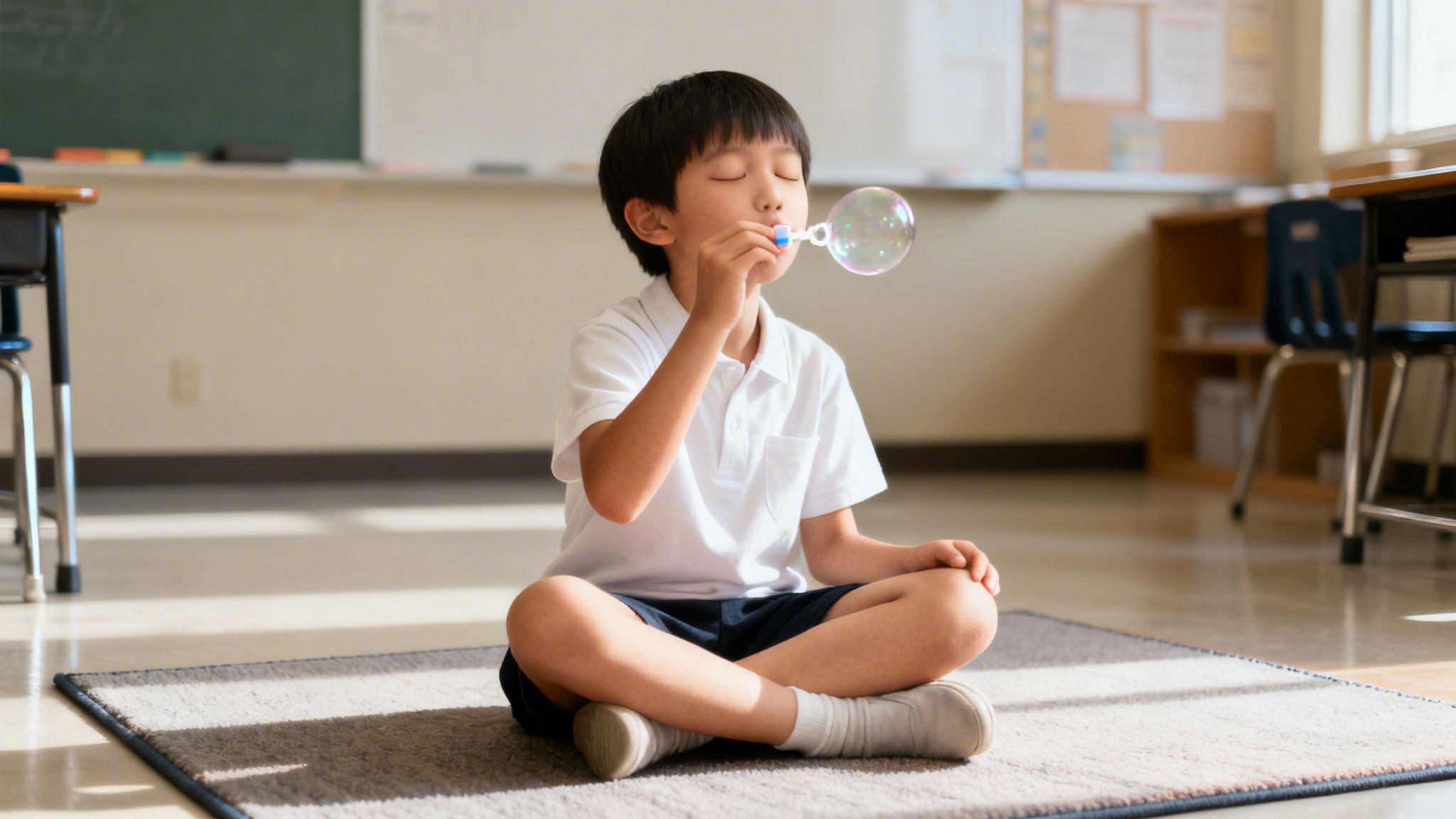
Use Visuals: For younger children, use a pinwheel or bubbles to provide a concrete visual for their exhale. This makes the concept of a long, slow breath less abstract. Challenge them to see how slowly they can make the pinwheel spin.
Model It Yourself: When you feel stressed, say aloud, “I’m feeling a little overwhelmed, so I’m going to take three deep belly breaths.” This normalizes the practice and shows its real-world application.
Keep It Short: Start with just 30-60 seconds of focused breathing for younger kids and gradually increase the duration as they become more comfortable.
To explore a wider range of exercises, you can find more mindfulness activities for kids that build on these foundational breathing techniques.
2. Creative Arts and Expression (Drawing, Painting, Sculpting)
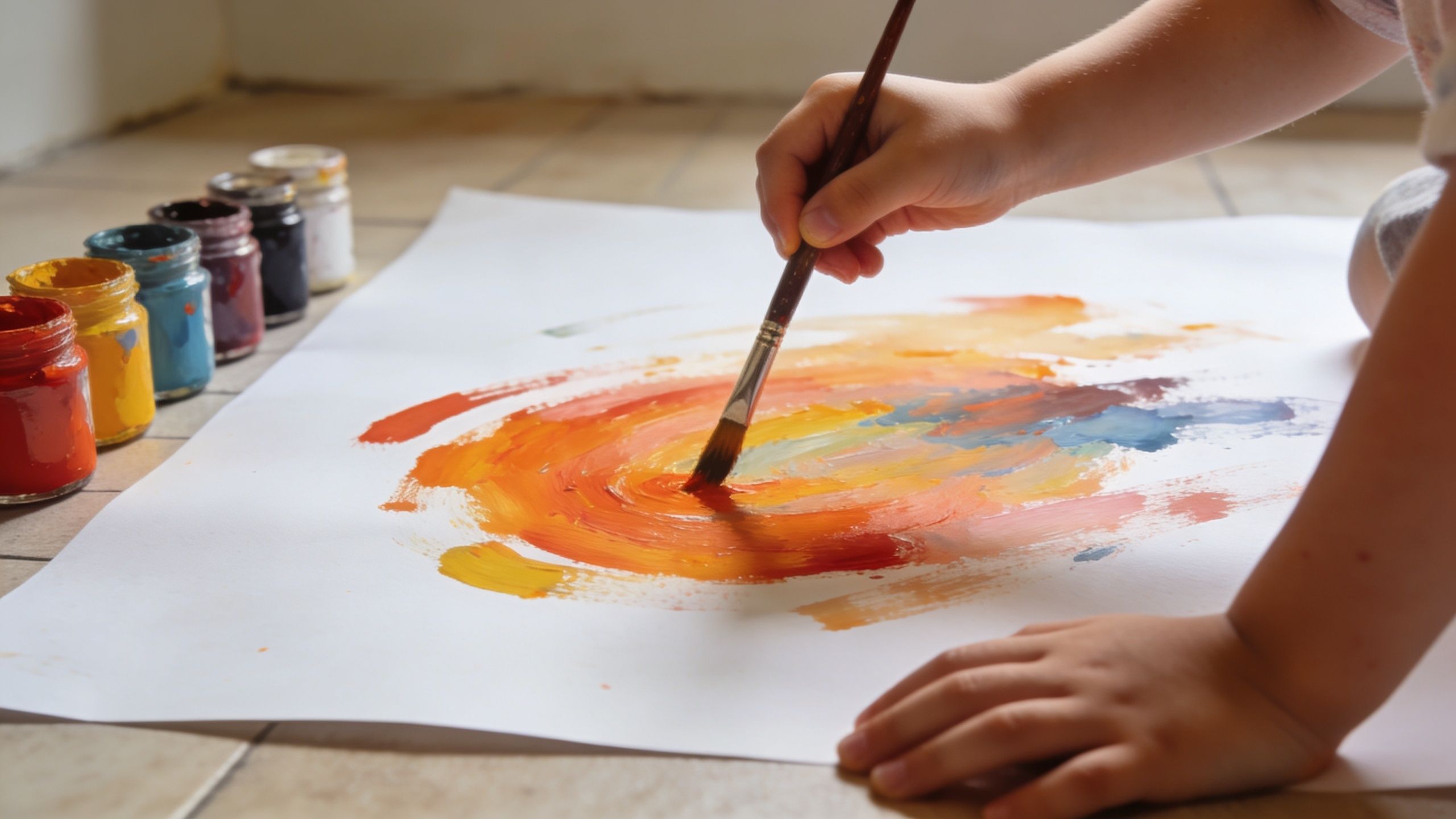
Creative arts provide a powerful non-verbal outlet for children to process complex emotions like anxiety. Activities such as drawing, painting, or sculpting bypass the analytical parts of the brain that can get stuck in worry loops, allowing children to access and express their feelings directly. The tactile and sensory nature of art-making itself is inherently grounding, making it one of the most effective activities for kids with anxiety.
This approach is championed by art therapists and trauma-informed educational practices, which recognize that giving form to a feeling makes it less overwhelming and more manageable. The focus is not on artistic skill but on the act of creation, which provides a sense of agency and a safe container for difficult emotions.
Why It Works for Anxiety
Anxiety can be hard for children to put into words. Art offers a different language, one of symbols, colors, and shapes. This externalization process allows a child to see their anxiety as separate from themselves, reducing its power. The repetitive, rhythmic motions involved in drawing or sculpting can also be meditative, helping to calm a racing mind and an activated nervous system.
Practical Examples and Implementation
Worry Monsters: Provide paper, markers, and modeling clay. Instruct the child: “Draw or build what your worry looks like. Does it have big teeth? Spiky hair? Give it a name.” Afterward, they can draw a cage around it, give it a silly hat, or physically lock a clay version in a box to symbolize taking control.
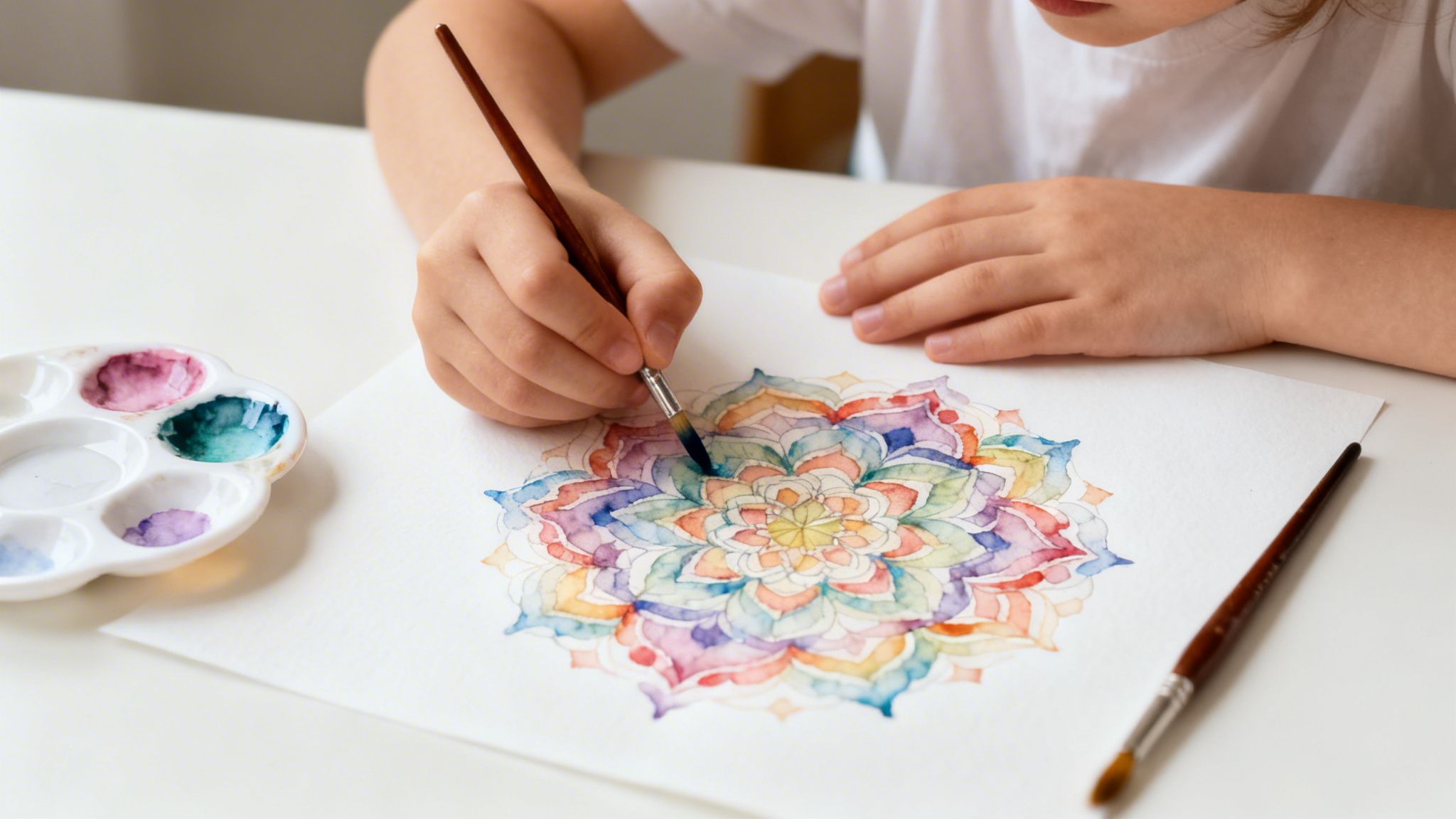
Mandala Coloring: Provide printed mandala templates for children to color. The structured, symmetrical patterns are known to promote focus and calm, making them a perfect tool for a classroom “calm-down corner.” Suggest they start from the center and work their way out.
“Feelings” Painting: Set out paints and paper with the simple prompt to “paint what your worry feels like” or “paint what calm looks like.” For example, a child might paint anxiety as a chaotic scribble of black and red, while calm might be a smooth wash of blue and green.
Clay Squishing and Sculpting: The sensory act of kneading, rolling, and squishing clay is very grounding. Prompt them: “Squeeze the clay as hard as you can when you think of a worry, then smooth it out to make it feel calm.”
Actionable Tips for Adults
Focus on Process, Not Product: Emphasize that there is no “right” way to create. Use phrases like, “Tell me about the colors you chose,” instead of asking, “What is it?”
Offer a Variety of Materials: Provide options like clay, paint, markers, and collage materials. Different textures and mediums will appeal to different children and sensory needs.
Use Specific Prompts: Guide their expression with gentle prompts like, “Draw a picture of a place where you feel totally safe,” or “If your anger had a color, what would it be today?”
Validate Their Expression: Display their artwork (with their permission) to show that their feelings and creative expressions are valued and seen.
Expanding on creative outlets, it’s worth exploring the developmental benefits of beginner guitar lessons for kids, which can contribute to a child’s emotional well-being through structured musical expression.
3. Movement and Somatic Activities (Yoga, Dance, Stretching)
Physical activities that integrate mind-body awareness help anxious children release stored tension and reconnect with their bodies in a safe, non-judgmental way. Movement practices like yoga, dance, and stretching activate the parasympathetic nervous system, reducing the physiological symptoms of anxiety while building body awareness and confidence. These are powerful activities for kids with anxiety because they offer a non-verbal outlet for expressing complex emotions.
This approach is grounded in somatic psychology, which recognizes that emotional stress is stored physically in the body. As Bessel van der Kolk’s work highlights, intentional movement can help process and release this tension. By guiding a child to move their body, you give them a direct tool to change how they feel from the inside out.
Why It Works for Anxiety
Anxiety often creates a feeling of disconnection from one’s own body, leading to physical symptoms like a racing heart, tense muscles, or shallow breathing. Somatic activities counter this by drawing a child’s attention back to their physical sensations in a positive context. This process helps them feel more grounded and in control, proving that they can influence their physical state through movement.
Practical Examples and Implementation
Cosmic Kids Yoga: Programs like Cosmic Kids Yoga, popular in elementary classrooms, weave storytelling into yoga poses. For instance, children don’t just do “Cat-Cow Pose”; they pretend to be cats arching their backs in a spooky cave and then cows mooing at the moon. This makes the practice engaging and less intimidating.
“Brain Break” Dance Videos: Many teachers use short, energetic dance videos (like GoNoodle) as a transition tool between academic subjects. This provides a quick, structured release of pent-up anxious energy. A three-minute “freeze dance” can reset the entire classroom’s energy.
Progressive Muscle Relaxation (PMR): A school counselor can guide a child to systematically tense and then release different muscle groups. For instance, “Pretend you’re squeezing lemons in your hands as tight as you can for five seconds… now let them go and feel the softness. Now, scrunch up your toes like you’re trying to pick up a pencil with your feet… and relax.”
Stomping and Shaking: For a child with a lot of jittery energy, say, “Let’s pretend we’re big elephants and stomp our feet ten times. Now, let’s shake out our arms like wet noodles for a count of ten.”
Actionable Tips for Adults
Offer Choices: Let the child lead. Ask, “Would you rather stretch like a tall giraffe or shake out your wiggles like a puppy?” This empowers them and respects what their body needs.
Start with Gentle Movements: For a highly anxious child, begin with slow, simple stretches or swaying to calm music rather than high-energy activities.
Combine with Breathing: Encourage a child to exhale audibly during a big stretch (“Let out a big sigh as you reach for your toes”) or to breathe in time with the music. This deepens the calming effect of the movement.
Focus on Feeling, Not Performance: Use prompts like, “Notice how your feet feel planted on the floor like tree roots,” or “What does that stretch feel like in your arms?” This shifts the focus from “doing it right” to internal awareness.
To discover more ways to connect movement and emotion, explore these embodiment practices for kids suitable for school and home.
4. Journaling and Expressive Writing
Journaling and expressive writing provide children with a private, reflective space to explore anxious thoughts and feelings without judgment or pressure. This activity helps externalize worries by moving them from the mind onto paper, making them feel more tangible and manageable. It fosters metacognitive awareness, allowing kids to observe their thought patterns and identify specific anxiety triggers over time.
This approach empowers children to process their emotions independently, turning abstract fears into concrete words they can examine and understand. The pioneering research of psychologist James Pennebaker demonstrated that expressive writing about emotions can lead to significant improvements in both mental and physical health, including reduced anxiety.
Why It Works for Anxiety
Anxious thoughts often swirl internally in a repetitive, overwhelming loop. The act of writing forces a child to structure these thoughts, which can slow down the mental spiral and reduce its intensity. By giving worries a name and a description, journaling makes them less powerful and provides a healthy outlet for feelings that might otherwise remain bottled up.
Practical Examples and Implementation
Prompted Anxiety Journals: Use a dedicated notebook with simple prompts like, “Today my worry feels like a __ out of 10,” “One thing I am worried about is…,” or “A time I felt brave was when…” This guided structure is less intimidating than a blank page.
Worry Notebooks: Many school counselors provide “worry notebooks” or a “worry box” where students can write down a concern on a slip of paper and “post” it in the box. This symbolic act helps them set the worry aside and focus on their day.
Gratitude Journaling: Instead of focusing on worry, prompt the child to write or draw three things they are thankful for each day. This shifts their focus toward positive experiences. For example: “1. The sun was warm at recess. 2. My friend shared their snack. 3. I liked the book we read.”
Creative and Art Journals: Combine writing with drawing or collage. Books like “Wreck This Journal” encourage messy, imperfect expression. A child can draw their anxiety monster, scribble out a frustrating feeling with a black crayon, or write down a brave thought in their favorite color.
Actionable Tips for Adults
Start with Prompts: A blank page can be overwhelming. Offer simple sentence starters like, “I feel nervous when…” or “I feel calm when…” to get them started.
Keep It Private: Reassure the child that their journal is their private space. They should only share entries if they choose to. This builds trust and encourages honesty.
Model the Behavior: Let your child see you writing in your own journal. You can share, “I’m writing down something that’s on my mind so I can understand it better.”
Focus on Effort, Not Perfection: Emphasize that spelling, grammar, and handwriting don’t matter. The goal is expression, not a perfect essay. Praise their willingness to explore their feelings.
For children who struggle to find the right words, you can learn more about how to express your feelings in words to provide better support and guidance.
5. Nature-Based Activities and Outdoor Time
Engaging with the natural world offers a powerful, restorative antidote to the internal-facing nature of anxiety. Nature-based activities shift a child’s focus outward, providing gentle sensory input that grounds them in the present moment and reduces stress. This approach leverages the environment as a co-regulator, lowering cortisol levels, improving mood, and restoring the capacity for attention without the pressure of structured performance.
This method taps into the concept of “biophilia,” our innate tendency to connect with nature. Influential figures like Richard Louv, author of Last Child in the Woods, and the global Forest School movement have highlighted how outdoor time is essential for healthy child development, directly counteracting the overstimulation and worry that feed anxiety. Time spent outdoors provides a non-judgmental space for exploration and being.
Why It Works for Anxiety
Anxiety often traps children in a loop of worrisome thoughts. Nature interrupts this cycle by engaging all the senses: the feeling of grass underfoot, the sound of birds, the smell of rain, the sight of a leaf’s intricate patterns. This multisensory engagement is a form of natural mindfulness that requires no special training, effectively lowering heart rate and promoting a sense of calm and connection.
Practical Examples and Implementation
5-4-3-2-1 Grounding: This is a classic outdoor mindfulness exercise. Ask the child to name: 5 things they can see (a bird, a green leaf, a crack in the sidewalk), 4 things they can feel (the wind on their skin, a rough tree bark), 3 things they can hear (a car, a dog barking), 2 things they can smell (freshly cut grass), and 1 thing they can taste.
School or Home Garden: The simple, repetitive tasks of watering plants, pulling weeds, and observing a seedling grow are rhythmic and grounding. Caring for another living thing can also build confidence and a sense of purpose.
“Sit Spot” Practice: Designate a specific spot in a park, backyard, or schoolyard where the child can sit quietly for 5-10 minutes. Encourage them to simply observe what happens around them, noticing the insects, the clouds, and the movement of leaves without any goal or expectation.
Nature Scavenger Hunt: Create a list of things to find, not just by sight but by other senses. For example: “Find something smooth,” “Find something that makes a crunching sound,” or “Find something that smells like pine.”
Actionable Tips for Adults
Start Small: If a child is hesitant, begin with short, 10-minute exposures, like eating a snack on the porch or looking at the clouds from a window.
Allow Unstructured Play: Resist the urge to direct every activity. Let the child lead the exploration, whether it’s digging in the dirt, collecting interesting rocks, or simply lying in the grass.
Create a “Nature Box”: Keep a small box for collecting natural treasures like pinecones, feathers, or unique stones. This gives a purpose to walks and creates a tangible connection to the experience.
Model Curiosity: Express your own wonder about the natural world. Say things like, “Wow, look at the intricate pattern on that leaf!” or “I wonder what kind of bird is making that sound.” Your enthusiasm is contagious.
6. Social-Emotional Learning Games and Role-Playing
Social-emotional learning (SEL) games and role-playing activities offer an engaging, non-threatening way for children to build crucial anxiety management skills. By embedding learning within a playful context, these activities reduce the pressure of practicing difficult social and emotional concepts. This approach transforms abstract skills like empathy, problem-solving, and emotional regulation into tangible, interactive experiences.
Role-playing, in particular, allows children to safely rehearse their responses to anxiety-provoking scenarios, building confidence and a sense of preparedness. Through experiential programs like those developed by Soul Shoppe, which use interactive workshops and games, children learn by doing. This active participation helps internalize coping strategies far more effectively than passive instruction.
Why It Works for Anxiety
Anxiety often stems from a fear of the unknown or a feeling of being unprepared for social situations. SEL games and role-playing directly address this by creating a safe “practice ground.” Children can try out different responses, make mistakes without real-world consequences, and learn scripts for navigating challenges like peer conflict or asking for help, making these some of the most effective activities for kids with anxiety.
Practical Examples and Implementation
Emotion Charades: Write different emotions (e.g., worried, excited, frustrated, proud) on slips of paper. A child draws one and acts it out using only their face and body while others guess. This builds emotional vocabulary and the ability to recognize nonverbal cues.
Problem-Solving Scenarios with Puppets: Use puppets to act out a common dilemma, such as “One puppet wants to join a game but is too scared to ask.” The children can give the puppet advice and then act out a positive outcome, lowering the personal stakes of the role-play.
SEL Board Games: Use commercially available games like “The Emotion Game” or “Calm Down Time” to structure conversations about feelings. The game format provides clear rules and turn-taking, which can be comforting for an anxious child. A teacher might use these in a small group setting.
“What If?” Brainstorm: Pose a common worry: “What if no one plays with you at recess?” Have the group brainstorm as many possible solutions as they can, from asking a specific person to play, to joining a game already in progress, to telling a teacher they feel lonely. This builds a mental library of options.
Actionable Tips for Adults
Focus on Process, Not Perfection: Celebrate a child’s courage to participate rather than the “correctness” of their answer or performance. The goal is practice and effort, not winning.
Debrief After Play: After a game or role-play, ask open-ended questions like, “How did that feel to ask for help?” or “When could you use that strategy at school?” This helps connect the playful activity to real-life application.
Allow Observation First: For a hesitant or shy child, allow them to watch their peers play first. You can give them a job, like “timekeeper” or “idea writer,” to keep them involved before they feel ready to actively participate.
Start with Low-Stakes Scenarios: Begin role-playing with simple, positive situations (e.g., how to give a friend a compliment) before moving on to more challenging scenarios like managing disagreements.
To build on these ideas, you can find a variety of other kids’ social skills activities that incorporate similar playful learning principles.
7. Pet Therapy and Animal-Assisted Interventions
Interacting with a calm, trained animal offers immediate, non-verbal comfort that can be profoundly grounding for a child experiencing anxiety. Animal-assisted interventions leverage the human-animal bond to reduce physiological stress responses, providing a safe and non-judgmental presence that anxious children often crave. The simple act of petting an animal can lower cortisol levels and blood pressure, creating a tangible calming effect.
This approach creates a bridge for connection and communication, as children often find it easier to express their feelings to an animal or about an animal. Organizations like Pet Partners have established standards and training programs that underscore the therapeutic benefits of these interactions, making them a trusted and evidence-based practice in many schools and clinical settings.
Why It Works for Anxiety
Anxiety can make a child feel isolated and misunderstood. An animal’s presence is simple, accepting, and unconditional. It doesn’t ask questions or place demands, which can disarm a child’s defensiveness and create an environment of pure comfort. This allows the child to shift their focus from internal worries to the external, sensory experience of touching, watching, or caring for the animal.
Practical Examples and Implementation
Reading Programs: Many schools and libraries have “Reading to Dogs” programs where children practice reading aloud to a therapy dog. This lowers performance anxiety because the dog is a non-judgmental listener, helping the child build fluency and confidence.
Counselor’s Office Companion: A trained therapy dog that resides in the school counselor’s office can help children feel more comfortable opening up. A counselor might start a session by saying, “Why don’t you tell Buddy about your morning while you give him a nice pet?”
Equine-Assisted Therapy: In these programs, a child might be tasked with grooming a horse. The repetitive, rhythmic motion of brushing is calming, and successfully leading a large animal builds immense confidence and teaches non-verbal communication skills.
Classroom Pet Responsibility: Caring for a small class pet like a guinea pig or hamster teaches routine and empathy. A specific, predictable task like feeding the pet each morning can be a grounding start to the day for an anxious child.
Actionable Tips for Adults
Prioritize Safety and Certification: Only work with certified therapy animals and handlers from reputable organizations. Ensure you screen for student allergies or phobias beforehand.
Teach Respectful Interaction: Model and explicitly teach children how to approach and touch an animal gently. Say, “We need to use soft hands and let him sniff us first to say hello. This helps him feel safe with us.”
Let the Child Lead: Allow the child to approach the animal at their own pace. Never force an interaction. The goal is to build a sense of safety and control, not to create another source of pressure.
Integrate Mindful Petting: Frame the interaction as a sensory activity. Guide them: “Notice how soft his fur feels under your fingers. Let’s try to match our breathing to his while we pet him slowly and quietly.” This combines the benefits of animal interaction with mindfulness.
8. Cognitive-Behavioral and Coping Strategy Tools
Cognitive-behavioral and coping strategy tools are structured activities that help children understand and change the relationship between their thoughts, feelings, and actions. These techniques, drawn from evidence-based Cognitive Behavioral Therapy (CBT), give kids a practical framework to identify anxious thoughts, question their validity, and replace them with more balanced and helpful ones. This empowers them with agency over their internal world, transforming abstract worries into manageable challenges.
This approach operationalizes anxiety management, making it a learnable skill rather than a mysterious force. The work of CBT pioneers like Aaron Beck and Albert Ellis established the core principle that our interpretations of events, not the events themselves, cause our emotional responses. By teaching children to become “thought detectives,” we equip them to reframe their experiences and build resilience.
Why It Works for Anxiety
Anxiety thrives on unexamined, catastrophic thoughts that often spiral out of control. CBT-based tools interrupt this cycle by introducing a critical pause. They teach children to externalize their worries by writing or drawing them, which creates psychological distance and makes the thoughts less powerful. By systematically evaluating and challenging these thoughts, kids learn that feelings aren’t always facts and that they can choose more effective ways to respond.
Practical Examples and Implementation
Thought Detective Work (Thought Record): Create a simple worksheet with three columns: “Worry Thought” (e.g., “The teacher is going to be mad I forgot my homework”), “Clues Against It” (e.g., “She was understanding last time,” “I can tell her I’ll bring it tomorrow”), and “Helpful Thought” (e.g., “I made a mistake, and I can fix it. It’s not a disaster”).
Coping Cards: On small index cards, help the child write or draw 3-5 simple, actionable strategies they can use when feeling anxious. Examples include “Take 5 balloon breaths,” “Think of my safe place (my bed with my cat),” or “Squeeze my stress ball 10 times.” They can keep these in a pocket or on their desk for quick reminders.
Worry Time: Designate a specific 10-15 minute period each day as “Worry Time.” If a worry pops up outside this time, the child writes it down in a “Worry Journal” to be addressed during the designated period. This teaches them they can control when they engage with worries.
Ladder of Bravery: For a specific fear (e.g., speaking in class), help the child break it down into small, manageable steps. Step 1 might be just thinking about raising their hand. Step 2 could be raising their hand without speaking. Step 3 could be answering a one-word question. They tackle one step at a time, building confidence as they climb the “ladder.”
Actionable Tips for Adults
Introduce One Tool at a Time: Start with a single strategy, like identifying “worry thoughts,” and practice it consistently before adding another layer like “helpful thoughts.”
Use Their Language: Frame concepts using relatable metaphors. Anxious thoughts can be “worry bugs” that need to be shooed away, “gremlins” telling lies, or “false alarms” from their brain.
Practice When Calm: Introduce and role-play these strategies during calm, neutral moments. Trying to teach a new skill during a moment of high anxiety is rarely effective.
Create Visuals: Make charts, posters, or personalized cards that remind the child of their coping strategies. Visual cues are powerful anchors during moments of distress.
Target Specific Concerns: Tailor the tools to address a child’s unique fears. For instance, addressing specific concerns like how to help kids with separation anxiety requires focused strategies and tools that directly challenge thoughts about being away from a caregiver.
8-Point Comparison: Activities for Kids with Anxiety
Item
Implementation complexity
Resource requirements
Expected outcomes
Ideal use cases
Key advantages
Mindfulness and Breathing Exercises
Low — simple to teach; needs routine
Minimal — no materials or special setup
Immediate calming; improved self-regulation over time
Classroom transitions, pre-test routines, at-home practice
Fast, evidence-based, zero cost, portable
Creative Arts and Expression (Drawing, Painting, Sculpting)
Low–Medium — setup and facilitation needed
Art supplies, space; optional art therapist for depth
Emotional processing, confidence, calming through creation
Counselor offices, art stations, family art nights
Non‑verbal processing, tangible outcomes, inclusive for low‑verbal kids
Movement and Somatic Activities (Yoga, Dance, Stretching)
Low–Medium — space and basic instruction recommended
Open space, optional instructor or video, music
Reduced physiological arousal; better sleep and body awareness
Putting It All Together: Building a Resilient Future
Supporting a child navigating the often-turbulent waters of anxiety is a journey, not a destination. It’s a process built on patience, consistent practice, and most importantly, a deep sense of connection. The comprehensive toolkit of activities for kids with anxiety explored in this article, from grounding mindfulness exercises to expressive art and somatic movement, are far more than simple distractions. They are the fundamental building blocks of emotional literacy and lifelong resilience.
Each strategy offers a unique pathway for a child to understand and manage their internal world. The immediate calm of a structured breathing exercise can anchor a child in a moment of panic. The expressive release of painting or sculpting can give voice to feelings that are too big for words. The empowering logic of a cognitive coping card can help a child challenge distorted thoughts and regain a sense of control. The goal is not to eliminate anxiety, an impossible and unhelpful task, but to equip children with the skills to recognize it, sit with it, and navigate through it without letting it take the lead.
Key Takeaways for Lasting Impact
The true power of these interventions lies in their consistent and thoughtful application. Moving forward, the most critical step is to shift from knowing these strategies to integrating them into the fabric of daily life.
Consistency Over Intensity: A five-minute “5-4-3-2-1” grounding exercise every day before a challenging subject is more effective than a one-hour session once a month. Create predictable routines where these tools are a normal part of the day, not just a reaction to a crisis.
Empowerment Through Choice: No single activity works for every child or every situation. Offer a “menu” of coping strategies. A child who feels overwhelmed might reject a quiet breathing exercise but enthusiastically engage in a vigorous “stomp and shake” movement activity to release physical tension.
Model and Co-Regulate: Children learn emotional regulation by watching the adults around them. When you feel stressed, model taking a deep breath and naming your feeling. Say, “I’m feeling a little frustrated right now, so I’m going to take three slow belly breaths to help my body calm down.” This act of co-regulation is one of the most powerful teaching tools you have.
Focus on the “Why”: Frame these activities not as a fix for something “wrong” but as powerful tools for building “brain muscles.” Explain that just like we exercise our bodies to get stronger, these activities help us build a stronger, more flexible mind that can handle big feelings.
Actionable Next Steps: From Plan to Practice
To make these strategies stick, begin with small, manageable steps. Choose one or two activities from the list that you believe will resonate most with your child or students. For example, you might create a “calm-down corner” in a classroom or a “peace place” at home, stocking it with drawing supplies, soft clay, and pre-written journaling prompts.
Next, identify a specific time to introduce and practice the new skill when the child is already calm and regulated. For instance, you could practice “Box Breathing” together after school as a way to decompress from the day. By weaving these activities for kids with anxiety into predictable routines, you normalize them and reduce the barrier to using them during moments of genuine distress. The ultimate goal is to empower children to become active, confident participants in their own emotional well-being, one small, brave, and supported step at a time.
Ready to bring a structured, school-wide approach to social-emotional learning? Soul Shoppe provides dynamic, experiential programs that teach children essential skills for emotional regulation, empathy, and conflict resolution, creating a culture of support that reinforces these vital activities. Learn how to transform your school community at Soul Shoppe.
Anxiety in children can feel overwhelming for everyone involved-the child, their parents, and their teachers. It often manifests not just as worry, but as stomachaches, irritability, avoidance, or difficulty concentrating in the classroom. The core challenge lies in finding practical, in-the-moment tools that empower kids to navigate these big feelings without feeling defined by them. This guide moves beyond generic advice to offer a curated roundup of 10 evidence-based anxiety activities for kids, designed for easy implementation in both school and home settings.
This is not a theoretical discussion; it is a hands-on toolkit. Each activity is broken down into actionable steps, providing the specific language and structure needed to help children from kindergarten through 8th grade build resilience, self-awareness, and a sense of control. For example, instead of just suggesting “deep breathing,” we provide scripts for guided exercises like “Box Breathing” or “Bumblebee Breath,” complete with age-appropriate adaptations.
As experts in social-emotional learning, we have seen these strategies transform school communities by creating a shared language of support and emotional regulation. This article will equip educators, administrators, and parents with the same practical tools. You will learn how to implement structured grounding techniques, creative expression prompts, and cognitive reframing exercises that foster a sense of safety and connection. Ultimately, our goal is to help you turn moments of anxiety into powerful opportunities for emotional growth and learning.
1. Mindfulness and Deep Breathing Exercises
Mindfulness and deep breathing are foundational anxiety activities for kids because they directly engage the body’s nervous system. These practices teach children to activate their parasympathetic nervous system, which signals the body to rest and calm down, counteracting the “fight or flight” response of anxiety. By focusing on the physical sensation of the breath, children learn to anchor themselves in the present moment rather than getting carried away by worried thoughts.
This technique is effective because it’s a portable tool a child can use anytime, anywhere, without needing special equipment. It provides an immediate, tangible action they can take when they feel overwhelmed, empowering them with a sense of control over their emotional state.
How to Implement It
Goal: To teach children a simple, reliable self-regulation technique to manage anxious feelings as they arise.
Best For: In-the-moment calming, daily routine for emotional regulation, and transitions between activities.
Time: 1-5 minutes.
Step-by-Step Guide:
Introduce the Concept: Explain breathing in simple terms. For younger kids, you can say, “Let’s pretend we’re smelling a beautiful flower. Breathe in deep through your nose. Now, let’s pretend we’re blowing out birthday candles. Breathe out slowly through your mouth.” For older students, explain how slow, deep breaths tell their brain it’s safe to relax.
Model the Technique: Practice with them. A common method is Box Breathing:
Breathe in slowly for a count of four.
Hold the breath for a count of four.
Breathe out slowly for a count of four.
Hold the breath out for a count of four.
Practice Consistently: Integrate “Mindful Minutes” into daily routines. For example, a teacher might say, “Before we start our math test, let’s all do three ‘box breaths’ together to clear our minds.” Consistent practice during calm times helps children remember the skill when they actually feel anxious.
Practical Tips and Variations
For Younger Children (K-2): Use “Bubble Breathing” (pretending to blow bubbles) or “Belly Buddies” (lying down with a small stuffed animal on their belly and watching it rise and fall with each breath).
For Older Children (3-8): Introduce guided mindfulness apps or scripts. Encourage them to notice where they feel the breath in their body (nostrils, chest, stomach) to deepen their focus.
At Home: Create a designated “calm-down corner” where breathing exercises are practiced. Parents can model the behavior by taking deep breaths themselves during stressful moments.
In the Classroom: Establish a non-verbal signal for when a student needs a breathing break. Organizations like Soul Shoppe often integrate whole-class breathing exercises into their assemblies to create a shared school-wide language for self-regulation.
Key Insight: The power of this practice lies in its simplicity and accessibility. By teaching children to focus on their breath, you give them a lifelong tool for managing stress that requires nothing more than their own body and attention.
For more ideas on how to incorporate these practices, you can explore additional mindfulness activities for kids to expand your toolkit.
2. Progressive Muscle Relaxation (PMR)
Progressive Muscle Relaxation (PMR) is a powerful kinesthetic activity where children intentionally tense and then release different muscle groups. This process helps them become aware of the physical sensations of stress and relaxation, providing a tangible way to release the tension that often accompanies anxiety. It teaches a direct mind-body connection essential for self-regulation.
This technique is particularly effective for children who internalize anxiety physically, such as clenching their jaw, tensing their shoulders, or having stomachaches. By practicing PMR, they learn to recognize these signs of tension and gain a concrete method for letting that physical stress go, which in turn calms their minds.
How to Implement It
Goal: To teach children how to recognize and release physical tension, giving them a hands-on tool to reduce anxiety.
Best For: Bedtime routines to ease anxiety before sleep, calming down after an emotionally charged event, and for kids who hold stress in their bodies.
Time: 5-10 minutes.
Step-by-Step Guide:
Introduce the Concept: Explain that when we feel worried, our bodies can get tight and stiff. This activity helps us learn how to make our bodies feel loose and relaxed, like a floppy noodle.
Guide the Sequence: Lead the child through a script that involves tensing and then relaxing muscle groups one by one. Use descriptive, kid-friendly language:
Hands: “Squeeze your hands into tight fists, like you’re squeezing a lemon. Hold it… now let the juice drip out and relax your hands.”
Arms: “Pretend you are a strongman and make a muscle. Tighter! Now let your arms go limp.”
Face: “Scrunch up your whole face like you just smelled something sour. Wrinkle your nose and squeeze your eyes shut. Now, relax and smooth it all out.”
End with Stillness: After moving through all the muscle groups (including shoulders, stomach, legs, and feet), have the child lie still for a minute and notice how calm and heavy their body feels.
Practical Tips and Variations
For Younger Children (K-2): Use a “Tense and Melt” script. Have them pretend to be a snowman standing tall and stiff (tense), then imagine the sun comes out and they melt into a puddle (relax).
For Older Children (3-8): Pair PMR with calming music or nature sounds. Encourage them to rate their tension level on a scale of 1 to 10 before and after the exercise to see the difference.
At Home: Incorporate PMR into the bedtime routine to help a child with anxiety settle down for sleep. A parent can guide them through the steps while they are tucked in bed, whispering, “Now let’s squeeze our toes tight, like we’re digging them into the sand… and relax.”
In the Classroom: After a high-energy activity like recess, a physical education teacher can lead a 5-minute PMR cool-down. School counselors often use this in small groups as part of anxiety intervention programs.
Key Insight: PMR gives children a physical vocabulary for relaxation. It moves the abstract idea of “calming down” into a concrete set of actions they can perform and feel, empowering them to actively manage their body’s response to stress.
3. Guided Imagery and Visualization
Guided imagery and visualization are powerful anxiety activities for kids that tap into their natural capacity for imagination. This technique involves leading a child through a detailed, multi-sensory mental journey to a calm, safe, or happy place. By focusing on these positive, imagined scenarios, children can mentally step away from anxious thoughts and feelings, effectively activating their parasympathetic nervous system to induce a state of relaxation.
This method is effective because it creates a mental escape route from stress. It empowers children by teaching them that they can change their emotional state simply by using their minds. Repeated practice helps build positive neural pathways, reinforcing the brain’s ability to access calmness and making it a more automatic response to stress over time.
How to Implement It
Goal: To help children build a mental “safe space” they can access anytime to reduce anxiety and promote relaxation.
Best For: Bedtime routines, transitions, pre-test calming, and building emotional resilience.
Time: 3-10 minutes.
Step-by-Step Guide:
Find a Quiet Space: Have the child sit or lie down comfortably in a place with minimal distractions. Ask them to close their eyes if they feel comfortable doing so.
Use a Calming Script: Begin by guiding them through a few deep breaths. Then, using a slow, soothing voice, describe a peaceful scene. Use rich, sensory details: “Imagine you are walking on a warm, sandy beach. Feel the soft sand between your toes. Hear the gentle waves washing ashore. See the bright blue sky above you.”
Encourage Personalization: Ask them to add their own details to their special place. What else do they see, hear, or feel? This makes the experience more vivid and personal.
Gently Return: After a few minutes, slowly guide them back to the present moment. Ask them to wiggle their fingers and toes before slowly opening their eyes.
Practical Tips and Variations
For Younger Children (K-2): Keep visualizations short and simple. Focus on concrete, comforting ideas. For example, “Imagine you are a sleepy kitten curled up in a soft, warm sunbeam. Feel how warm and cozy you are. Now, imagine someone you love is gently stroking your back.”
For Older Children (3-8): Introduce more complex scenarios, like visualizing success before a sports game or presentation. Encourage them to create and write down their own “safe place” script that you can read to them.
At Home: Use guided visualization stories at bedtime to ease nighttime anxiety. Apps like Calm or Headspace offer a wide variety of kid-friendly guided imagery sessions.
In the Classroom: A teacher can lead a brief, whole-class visualization before a test to calm nerves. A school counselor might work with an anxious student to create a personalized “safe place” recording they can listen to with headphones when feeling overwhelmed.
Key Insight: Visualization leverages a child’s imagination as a therapeutic tool. It teaches them that they possess an internal resource for creating calm and safety, no matter what is happening externally.
Grounding techniques are powerful anxiety activities for kids designed to pull their focus away from distressing internal thoughts and back to the physical world. The 5-4-3-2-1 Sensory Method is a structured, evidence-based exercise that interrupts an anxiety spiral by systematically engaging all five senses. It forces the brain to redirect its attention from abstract worries to the concrete, tangible environment.
This method is highly effective because it provides a simple, memorable script for children to follow during moments of panic or overwhelming anxiety. By concentrating on external sensory information, a child’s nervous system receives the message that they are safe in the present moment, which helps to de-escalate the “fight or flight” response and restore a sense of calm and control.
How to Implement It
Goal: To equip children with a rapid mental tool that anchors them in the present moment when they feel overwhelmed by anxious thoughts or panic.
Best For: Acute anxiety, panic attacks, dissociative moments, and helping dysregulated students regain focus.
Time: 2-5 minutes.
Step-by-Step Guide:
Introduce the Concept: Explain that when our minds are full of worries, we can use our five senses as anchors to bring us back to the “here and now.” Frame it as a detective game where they have to find clues in their environment.
Guide Them Through the Steps: Calmly and slowly, prompt them to identify:
5 things you can SEE: Ask them to look around and name five objects. A practical example would be: “Okay, let’s play. I see the green plant, the blue pen on the desk, the white clock, your red shoes, and the yellow sticky note.”
4 things you can FEEL: Guide them to notice physical sensations, such as the chair beneath them, their feet on the floor, or the texture of their clothing.
3 things you can HEAR: Prompt them to listen for sounds nearby, like a ticking clock, distant traffic, or the hum of a computer.
2 things you can SMELL: Encourage them to identify any scents in the air, like a pencil, a book, or hand sanitizer.
1 thing you can TASTE: Ask them to notice the taste inside their mouth or have them take a sip of water.
Practice During Calm Times: Like breathing exercises, grounding is most effective when learned and practiced when a child is not in distress. Use posters or cue cards to help them remember the sequence.
Practical Tips and Variations
For Younger Children (K-2): Simplify the prompts and make it a game. “Can you find five blue things in the room?” or “Let’s touch four different textures and describe them.”
For Older Children (3-8): Encourage them to silently practice the 5-4-3-2-1 method on their own. They can also write down what they notice in a journal to deepen the grounding effect.
At Home: A parent can gently guide a child through the steps during a moment of panic. Having a “grounding object,” like a smooth stone or a piece of textured fabric, can enhance the sense of touch.
In the Classroom: Teachers can establish a non-verbal signal for a student to request a grounding break. The entire class can also practice this as a “sensory reset” after a high-energy activity to help everyone settle.
Key Insight: Grounding interrupts the feedback loop of anxiety. By forcing the brain to process real-time sensory data, you stop anxious thoughts from spiraling and re-establish a connection to the safety of the present moment.
Creative expression activities like art, music, and movement are powerful anxiety activities for kids because they offer a non-verbal outlet for complex emotions. When children feel anxious, they often struggle to find the right words to describe their internal state. These activities bypass the brain’s verbal processing centers, allowing kids to externalize their feelings directly and symbolically through color, sound, or physical motion.
This process is effective because it shifts the focus from the abstract nature of a feeling to a tangible, creative act. It provides a safe container for difficult emotions and helps children gain a sense of mastery over them. Engaging in art, dance, or music can also be inherently calming, promoting a state of flow that reduces anxious thoughts and fosters self-expression.
How to Implement It
Goal: To provide a non-verbal, constructive outlet for children to process and express anxious feelings safely.
Best For: Children who have difficulty verbalizing emotions, proactive anxiety prevention, and emotional processing after a stressful event.
Time: 10-30 minutes.
Step-by-Step Guide:
Introduce the Concept: Frame the activity as a way to show feelings, not create a perfect masterpiece. You might say, “Let’s draw what your worry looks like,” or “Let’s move our bodies to a song that feels happy and strong.”
Offer Choices: Provide a variety of open-ended materials like clay, paint, markers, or instruments. Let the child choose the medium that feels right for them, which honors their preference and gives them a sense of control.
Encourage Expression: Prompt them with feeling-based questions: “What color is your anger?” or “If your sadness was a sound, what would it be?” Avoid judgment about the final product; the value is in the process. A practical example is giving a child a lump of clay and saying, “Show me what the knot in your stomach feels like. You don’t have to make it look like anything, just show me the feeling.”
Reflect and Connect (Optional): After the creative process, invite the child to talk about their creation. Ask, “Can you tell me about your drawing?” This step helps connect the non-verbal expression with verbal language, building emotional vocabulary.
Practical Tips and Variations
For Younger Children (K-2): Use large-scale movement like “animal walks” to express different feelings (e.g., a stomping bear for anger). Finger painting is another great way to engage their senses and express emotions physically.
For Older Children (3-8): Encourage journaling with drawings or creating a “mood playlist.” Drama-based games like charades with emotions can help them explore expression in a fun, low-pressure way. For children who enjoy detailed activities, the wonderfully calming and creative world of cross stitch offers a focused way to manage feelings.
At Home: Create a “feelings art box” with various supplies that is always accessible. Play music and have spontaneous “dance parties” to release pent-up energy and stress.
In the Classroom: Integrate “feelings art projects” into SEL time. Organizations like Soul Shoppe often use experiential and creative workshops to help students process emotions and build empathy in a group setting.
Key Insight: The power of creative expression lies in its ability to make the invisible visible. By turning an internal feeling into an external creation, children can understand, manage, and communicate their anxiety in a way that words alone often cannot.
6. Physical and Mindful Movement (yoga, stretching, body scan, active play)
Physical and mindful movement provides a powerful outlet for anxious energy, connecting the mind and body to promote calm. When children feel anxious, their bodies often store that tension, leading to restlessness and discomfort. Activities like yoga, stretching, and even active play help release this physical stress and burn off excess cortisol, the body’s stress hormone.
This integrated approach is effective because it teaches interoceptive awareness, or the ability to notice internal body sensations. By combining movement with mindfulness, such as in a body scan, children learn to identify where they hold tension (like tight shoulders or a clenched jaw) and consciously release it. This builds a child’s capacity to recognize the early physical signs of anxiety and proactively manage them before they escalate.
How to Implement It
Goal: To channel anxious energy into a productive physical outlet and build a child’s awareness of their own body’s stress signals.
Best For: Releasing pent-up energy, daily stress management, and helping kids who struggle to sit still during traditional calming exercises.
Time: 5-15 minutes.
Step-by-Step Guide:
Introduce the Mind-Body Connection: Explain to children that our feelings live in our bodies. Say something like, “Sometimes when you feel worried, your tummy might feel tight or your shoulders might feel heavy. Moving our bodies can help those feelings move through and out.”
Guide a Simple Movement: Choose an activity appropriate for the space and energy level. For energy release, a teacher could say, “Okay class, let’s have a 60-second ‘shake it out’ break. Stand up and shake your arms, shake your legs, and shake all those wiggles out!” For calming, try guided yoga poses.
Incorporate a Body Scan: After the movement, ask children to stand or sit quietly and notice how their body feels. Prompt them with questions: “Notice your feet on the floor. Are they warm or cool? Can you feel your heartbeat? Is it fast or slow?”
Practical Tips and Variations
For Younger Children (K-2): Use imaginative movement. Pretend to be different animals: stretch tall like a giraffe, crouch low like a frog, or stand strong like a tree (tree pose).
For Older Children (3-8): Introduce structured yoga flows or tai chi movements. Use guided body scan meditations from apps or scripts that encourage them to mindfully scan from head to toe.
At Home: Schedule “movement breaks” during homework time. A 5-minute dance party or a series of simple stretches can reset focus and reduce frustration.
In the Classroom: Integrate short, 2-3 minute movement breaks between subjects. Use resources like GoNoodle for guided dances or lead simple chair yoga stretches. Soul Shoppe workshops often show teachers how to weave these body-awareness strategies into the daily classroom routine.
Key Insight: Movement gives anxiety a place to go. By teaching children to listen to their bodies and respond with mindful motion, you equip them with a somatic tool for emotional regulation that addresses the physical root of their anxious feelings.
To explore this further, you can discover more about embodiment practices for kids in school and at home.
7. Journaling and Writing Reflection
Journaling and writing reflection are powerful anxiety activities for kids that help them externalize and process their emotions. This cognitive-emotional technique involves documenting thoughts, feelings, and worries, which helps children develop emotional literacy, identify patterns in their anxiety, and challenge unhelpful thought cycles. By putting their feelings on paper, kids create distance from overwhelming emotions, allowing for clearer thinking and problem-solving.
This method is effective because it transforms abstract worries into concrete words that can be examined and understood. It provides a private, non-judgmental space for children to express themselves honestly, creating a tangible record of their emotional journey and coping strategies. This process reinforces their ability to manage anxiety by turning reflection into a proactive skill.
How to Implement It
Goal: To help children process complex emotions, identify anxiety triggers, and develop self-awareness by externalizing their thoughts and feelings through writing.
Best For: Daily emotional check-ins, processing specific worrying events, building emotional vocabulary, and cognitive restructuring.
Time: 5-15 minutes.
Step-by-Step Guide:
Introduce the Journal: Frame the journal as a safe and private space. For younger kids, call it a “Worry Book” or “Feelings Diary.” For older kids, explain it as a tool for “clearing their head” and organizing thoughts.
Provide a Starting Point: Begin with guided prompts to ease them into the practice. For example, a teacher could put a prompt on the board: “Write or draw about one thing you’re excited for and one thing you’re nervous about today.” Or a parent could ask, “What is one thing that felt tricky today? Let’s write it down.”
Establish a Routine: Make journaling a consistent practice, such as during morning arrival in a classroom or before bed at home. Repetition makes it a reliable coping mechanism that children will turn to independently over time.
Practical Tips and Variations
For Younger Children (K-2): Since writing skills are still developing, use a “draw and dictate” method. Let them draw their feeling or worry, and then an adult can write down their spoken words to describe it.
For Older Children (3-8): Introduce more complex journaling formats like a “Thought Record” from Cognitive Behavioral Therapy (CBT). They can list a situation, the automatic thought, the feeling, and then a more balanced, alternative thought.
At Home: Create a “Worry Box” where children can write down a worry on a slip of paper and “post” it into the box to be discussed with a parent later. This physically contains the anxiety.
In the Classroom: Use daily journal prompts for morning work to serve as an emotional check-in. Establish clear rules about privacy, ensuring students know their journal is their personal space unless they choose to share.
Key Insight: Journaling teaches children that they are separate from their anxious thoughts. By writing them down, they learn they can observe their worries without letting those worries define them, a foundational skill for lifelong emotional regulation.
8. Social Connection and Peer Support
Social connection is one of the most powerful anxiety activities for kids because it directly counters the isolation where worried thoughts often grow. This relational approach helps children build a sense of belonging and psychological safety, reminding them they are not alone. Secure relationships with peers and trusted adults act as a buffer against stress and provide a network for co-regulation.
This method is effective because it shifts the focus from an internal struggle to a shared, supportive experience. When children feel seen, heard, and valued within a community, their nervous systems can more easily shift from a state of threat to one of safety. Organizations like Soul Shoppe have long emphasized that building school-wide connection is fundamental to reducing anxiety and fostering resilience.
How to Implement It
Goal: To reduce feelings of isolation and build a supportive community where children feel safe to share their experiences and seek help.
Best For: Children who withdraw when anxious, building a positive classroom or school climate, and developing long-term resilience.
Time: Varies; can be brief daily check-ins or ongoing structured programs.
Step-by-Step Guide:
Create Structured Opportunities: Don’t leave connection to chance. A practical example is implementing a “Lunch Buddy” system where a teacher pairs an anxious child with a friendly, trained peer for a low-pressure social meal once a week.
Teach Key Social Skills: Explicitly teach skills like active listening, empathy, and conflict resolution. Role-playing scenarios where students practice offering support or asking for help can build confidence and competence.
Establish Peer Support Systems: Formalize peer-to-peer help. This could be a peer mentoring program where older students support younger ones, or a student-led support group for specific concerns like anxiety or family changes, facilitated by a school counselor.
Promote Whole-School Community: Use assemblies and classroom meetings to build a shared identity and collective responsibility for one another’s well-being. This creates a culture where seeking and offering support is normalized and celebrated.
Practical Tips and Variations
For Younger Children (K-2): Use “Partner-Up” activities where students are paired for a task. Implement a “Kindness Catcher” jar where students write down acts of kindness they witness, reinforcing a supportive classroom environment.
For Older Children (3-8): Launch student support groups or a peer mentoring program. Provide training for peer mentors on anxiety awareness, active listening, and knowing when to get an adult involved.
At Home: Encourage participation in group activities or clubs based on your child’s interests. Arrange one-on-one playdates with a trusted friend to practice social skills in a comfortable setting.
In the Classroom: Start the day with a “Connection Circle” where each student shares a brief update. Proactively address any signs of exclusion or bullying to maintain a foundation of safety for all students.
Key Insight: Anxiety shrinks when connection grows. By intentionally building a web of supportive relationships, you give children a powerful, living resource that fosters resilience far more effectively than isolated coping skills alone.
To build the foundational skills for this approach, you can find more ideas in these kids’ social skills activities.
9. Cognitive Reframing and Thought Challenging
Cognitive reframing is a powerful anxiety activity for kids that teaches them to identify, question, and change the negative thought patterns that fuel anxiety. This technique is rooted in Cognitive-Behavioral Therapy (CBT) and empowers children by showing them that thoughts are not always facts. By learning to challenge their anxious thoughts, they develop the critical skill of separating feelings from reality, which is fundamental for building long-term resilience.
This approach is highly effective because it gives children a concrete strategy for managing their internal world. Instead of being swept away by worry, they learn to become “thought detectives,” actively investigating their thoughts for evidence. This process interrupts the cycle of anxious rumination and catastrophizing, helping them develop more balanced and realistic perspectives.
How to Implement It
Goal: To help children recognize anxious thought patterns and replace them with more helpful, evidence-based ones.
Best For: Repetitive worries, catastrophic thinking (e.g., “I’m going to fail my test”), and building long-term emotional regulation skills.
Time: 5-10 minutes.
Step-by-Step Guide:
Introduce the Concept: Explain that our brains sometimes send us “worry thoughts” that aren’t 100% true. Use a simple analogy like a thought being a “guess” about what might happen, not a fact.
Identify the Thought: Help the child pinpoint the specific anxious thought. For example: “Everyone will laugh at me during my presentation.” Write it down so it feels more manageable.
Gather Evidence (Be a Detective): Guide them to challenge the thought. A practical script could be: “Okay, let’s be detectives. What evidence do you have that everyone will laugh? Has that happened before? What’s a more likely thing to happen? What would you tell a friend who had this same worry?”
Create a New Thought: Help them formulate a more balanced, realistic thought. Instead of “Everyone will laugh,” it could be, “I’m prepared for my presentation, and even if I’m nervous, my friends will support me.”
Practical Tips and Variations
For Younger Children (K-2): Use “Thought Bubbles.” Draw the worry thought in one bubble and then draw a more helpful “brave thought” in another. Personify the worry thought as a “Worry Monster” whose tricks they can learn to spot.
For Older Children (3-8): Introduce a “Thought Record” worksheet with columns for the situation, the anxious thought, the evidence against it, and a new balanced thought. This structured approach helps them internalize the process.
At Home: When a child expresses a major worry, compassionately validate their feeling (“It sounds like you’re really scared”) before gently moving into detective work (“Let’s look at the evidence for that thought”).
In the Classroom: During morning meetings, discuss the idea of “thinking traps” like jumping to conclusions. A school counselor can run small groups on “thought challenging” for students with high anxiety.
Key Insight: This technique teaches children that they have agency over their thoughts. By systematically questioning their worries, they learn that anxiety is a manageable emotion, not an uncontrollable force.
Connecting with nature is a powerful anxiety activity for kids because it taps into our innate biological affinity for the natural world. Structured and unstructured time outdoors engages multiple senses, encourages physical activity, and provides a broader perspective that can make worries feel smaller. This approach leverages the inherent calming properties of natural environments to reduce stress, lower cortisol levels, and improve overall mood.
This method is effective because it simultaneously addresses cognitive, physical, and sensory aspects of anxiety. Research increasingly demonstrates that spending time outdoors can significantly reduce stress and improve mood, highlighting the healing power of green spaces for mental well-being. By immersing a child in a natural setting, you provide an environment that naturally calms the nervous system and encourages mindful observation.
How to Implement It
Goal: To use the calming and restorative effects of nature to reduce anxiety, promote physical activity, and build emotional resilience.
Best For: Proactive emotional regulation, sensory breaks for overwhelmed children, and building a long-term coping strategy.
Time: 15-30 minutes.
Step-by-Step Guide:
Schedule Predictable Nature Time: Integrate outdoor time into the daily or weekly routine. This could be a 20-minute walk after school, a designated “outdoor classroom” period, or a weekend family hike. Predictability makes it a reliable coping tool.
Engage the Senses: Guide the child to actively notice their surroundings. For example, a teacher could take the class outside and say, “For the next three minutes, let’s do a ‘listening walk.’ I want you to walk silently and notice all the different sounds you can hear. We’ll share what we heard when we get back.”
Encourage Gentle Movement: Activities like walking, gardening, or simply exploring a park combine the benefits of physical activity with nature exposure. This helps release anxious energy and boosts mood-enhancing endorphins.
Practical Tips and Variations
For Younger Children (K-2): Go on a “nature scavenger hunt” to find specific items (a smooth rock, a yellow leaf). Plant a small windowsill garden to care for, connecting them to the life cycle of plants.
For Older Children (3-8): Introduce nature journaling, where they can draw or write about what they observe. Involve them in larger projects like a school or community garden, giving them a sense of purpose and accomplishment.
At Home: Establish a family ritual like a post-dinner walk or a weekly visit to a local park. Even having lunch in the backyard can be an effective way to break up the day and get fresh air.
In the Classroom: If access to large green spaces is limited, bring nature indoors with classroom plants. Use a “nature window” to observe weather patterns or bird feeders. A short walk around the school grounds can serve as an effective anxiety break.
Key Insight: Nature provides a free, accessible, and highly effective therapeutic environment. By making outdoor time a regular part of a child’s routine, you equip them with a powerful tool for self-regulation that addresses anxiety on both a psychological and physiological level.
10 Anxiety-Reducing Activities for Kids: Side-by-Side Comparison
Technique
Implementation complexity
Resource requirements
Expected outcomes
Ideal use cases
Key advantages
Mindfulness and Deep Breathing Exercises
Low — simple to teach; needs repeated practice
Minimal — no equipment
Immediate calming; improved interoception and self-regulation over time
Acute anxiety, classroom transitions, anywhere
Portable, evidence-based, builds agency
Progressive Muscle Relaxation (PMR)
Moderate — guided sequence and time needed
Low — script/audio and space to lie/sit
Reduced somatic tension; improved sleep and body awareness
Somatic anxiety, bedtime routines, small-group work
Building a Culture of Support: Integrating Anxiety Tools into Daily Routines
Navigating the landscape of childhood anxiety can feel overwhelming, but as we’ve explored, a robust toolkit of practical strategies can make all the difference. This collection of ten distinct anxiety activities for kids offers more than just temporary relief; it provides the foundational building blocks for lifelong emotional resilience. From the immediate calm of Deep Breathing Exercises to the creative release of Art Therapy and the grounding power of Nature Connection, each activity equips children with the ability to understand, manage, and ultimately befriend their anxious feelings.
The true power of these tools is unlocked not through occasional use, but through consistent integration into the rhythm of daily life. The goal is to transform these interventions from reactive measures into proactive habits, creating an environment where emotional well-being is as prioritized as academic learning or physical health.
Weaving Wellness into Daily Life
Consistency is the cornerstone of building emotional muscle memory. When a child practices Progressive Muscle Relaxation during a calm story time, they are banking that skill for a moment of future stress. When a classroom begins the day with a collective ‘Peace Breath’ or uses the 5-4-3-2-1 Grounding technique as a standard transition between subjects, it normalizes self-regulation and makes it a shared, accessible practice for everyone.
Think of it this way: a teacher might model Cognitive Reframing out loud when a lesson plan goes awry. “My first plan for our science experiment didn’t work, and that’s frustrating. Instead of thinking ‘I failed,’ I’m going to think, ‘This is a great chance to be a scientist and try a different hypothesis.’ Who has an idea?” This small act demonstrates that it’s okay for things to go wrong and provides a concrete script for managing disappointment.
Creating a Culture of Psychological Safety
The most effective anxiety activities for kids flourish in an atmosphere of psychological safety. This means creating spaces at home and in school where children feel secure enough to express vulnerability without fear of judgment. It’s about shifting the narrative from “What’s wrong with you?” to “What’s happening, and how can we help?”
When a student is encouraged to take a five-minute break for Mindful Movement or to use a journaling corner to process their feelings, the message is clear: your emotional health matters here. This culture is reinforced through activities focused on Social Connection and Peer Support, where empathy and active listening are taught as essential skills. By fostering this supportive ecosystem, we empower children not only to use these tools for themselves but also to become compassionate allies for their peers.
From Activities to Empowerment
The journey from learning these activities to mastering them is a gradual process that requires patience, practice, and adult co-regulation. The ultimate objective is not to eradicate anxiety, which is a normal human emotion, but to demystify it. We aim to replace feelings of helplessness with a sense of competence and confidence.
By consistently offering and modeling these diverse strategies, you give children a rich vocabulary to manage their inner world. You empower them with the profound understanding that while they cannot always control the waves of anxiety, they can learn to surf. They learn that a racing heart can be slowed with breath, scattered thoughts can be grounded in the senses, and overwhelming feelings can be channeled into a beautiful piece of art. This is the heart of emotional intelligence, a gift that will serve them far beyond the classroom and throughout their entire lives.
Ready to take the next step in building a positive and supportive school climate? Soul Shoppe provides dynamic, evidence-based programs and assemblies that teach students essential social-emotional skills, empowering them to resolve conflicts, practice empathy, and navigate complex feelings like anxiety. Explore our offerings to bring these transformative tools to your entire school community at Soul Shoppe.