Soul Shoppe's work is made possible by donors and partners who care deeply about the young people in their communities! We can't do this work without you. Support our work in classrooms and on playgrounds across the nation by donating here.
Beyond academics, a child’s ability to understand emotions, build healthy relationships, and make responsible choices is crucial for success in school and life. This is the core of social emotional learning (SEL). For elementary students, these skills are not just ‘nice-to-haves’; they are the building blocks of a safe, connected, and productive learning environment where every child can thrive.
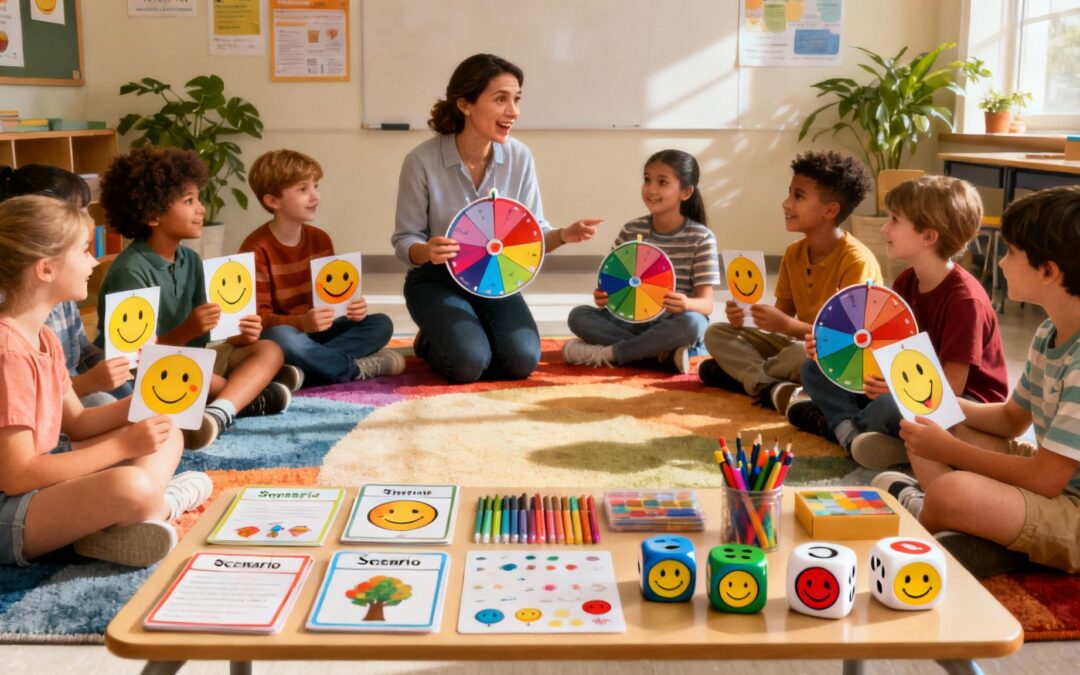
Integrating SEL doesn’t require a complete curriculum overhaul. Many effective strategies can be woven into daily routines, complementing existing educational frameworks. For instance, philosophies like the Montessori method of teaching naturally emphasize student autonomy and self-management, which are key pillars of social emotional development. By intentionally incorporating SEL, educators and caregivers can cultivate classrooms where students feel seen, heard, and equipped to navigate social complexities.
This article provides a comprehensive roundup of 10 practical and research-backed social emotional learning activities for elementary students. Each activity is designed for immediate use by busy teachers, counselors, and parents, offering a clear structure to guide implementation. You will find:
Step-by-step instructions and clear goals for each activity.
SEL competency alignment (e.g., self-awareness, relationship skills).
Practical adaptations for different grade levels, remote settings, and large classes.
From fostering self-awareness with simple mindfulness exercises to building community through cooperative games, these strategies will equip you to nurture emotionally intelligent and resilient learners. The goal is to provide actionable tools that turn abstract SEL concepts into tangible classroom experiences, strengthening the foundation for academic achievement and lifelong well-being.
1. Mindfulness and Breathing Exercises
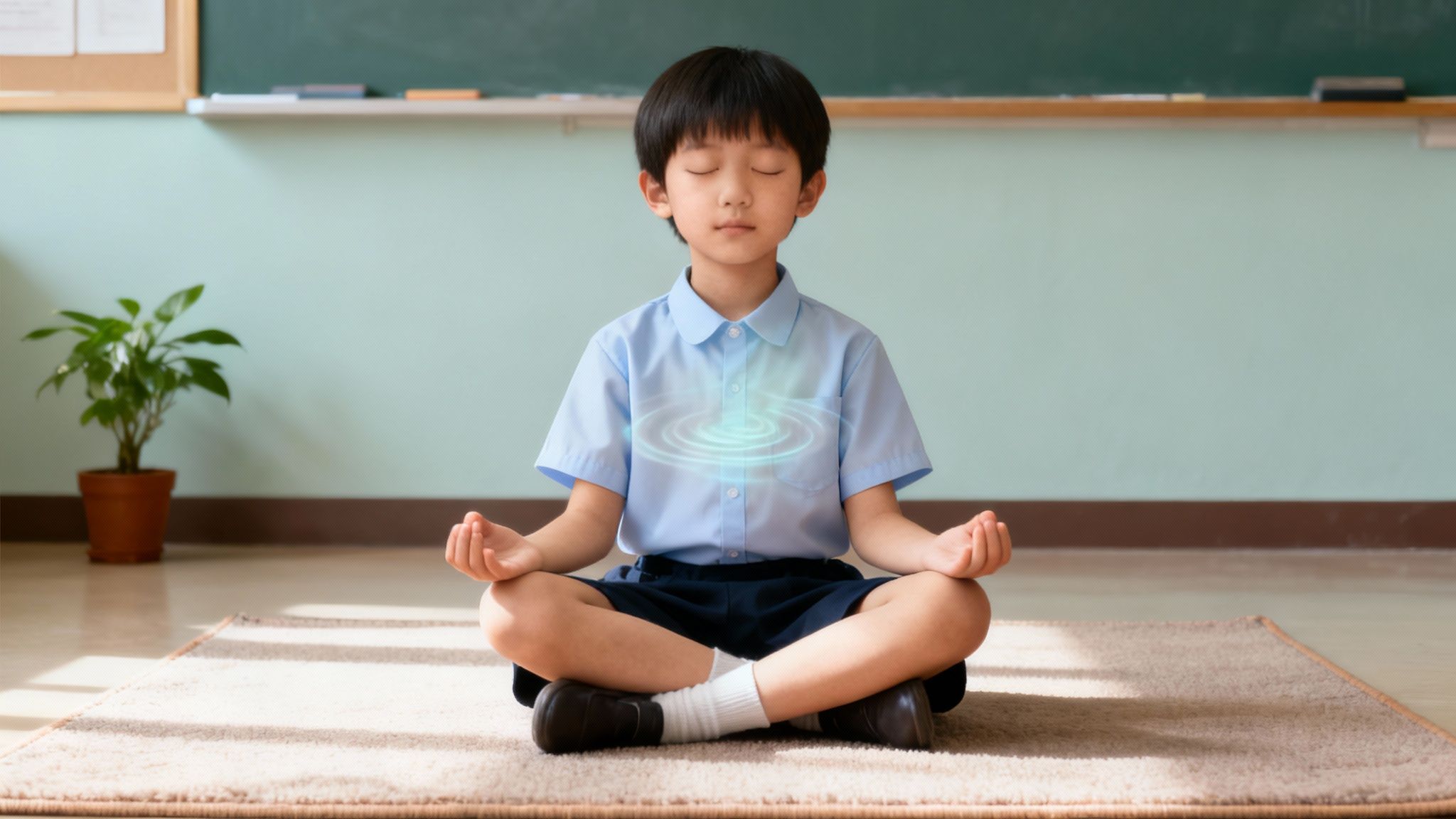
Mindfulness practices are foundational social emotional learning activities for elementary students, teaching them to pause, focus on the present moment, and observe their thoughts and feelings without judgment. By guiding children through simple breathing techniques, body scans, or sensory awareness exercises, you help them build a crucial gap between a triggering event and their reaction. This mental space is where self-regulation begins, allowing students to manage big emotions like anxiety, frustration, and over-excitement.
These exercises directly support the core SEL competencies of self-awareness (noticing internal states) and self-management (using a tool to regulate those states). The goal is not to eliminate difficult feelings but to equip children with the skills to navigate them constructively.
How to Implement Mindfulness and Breathing
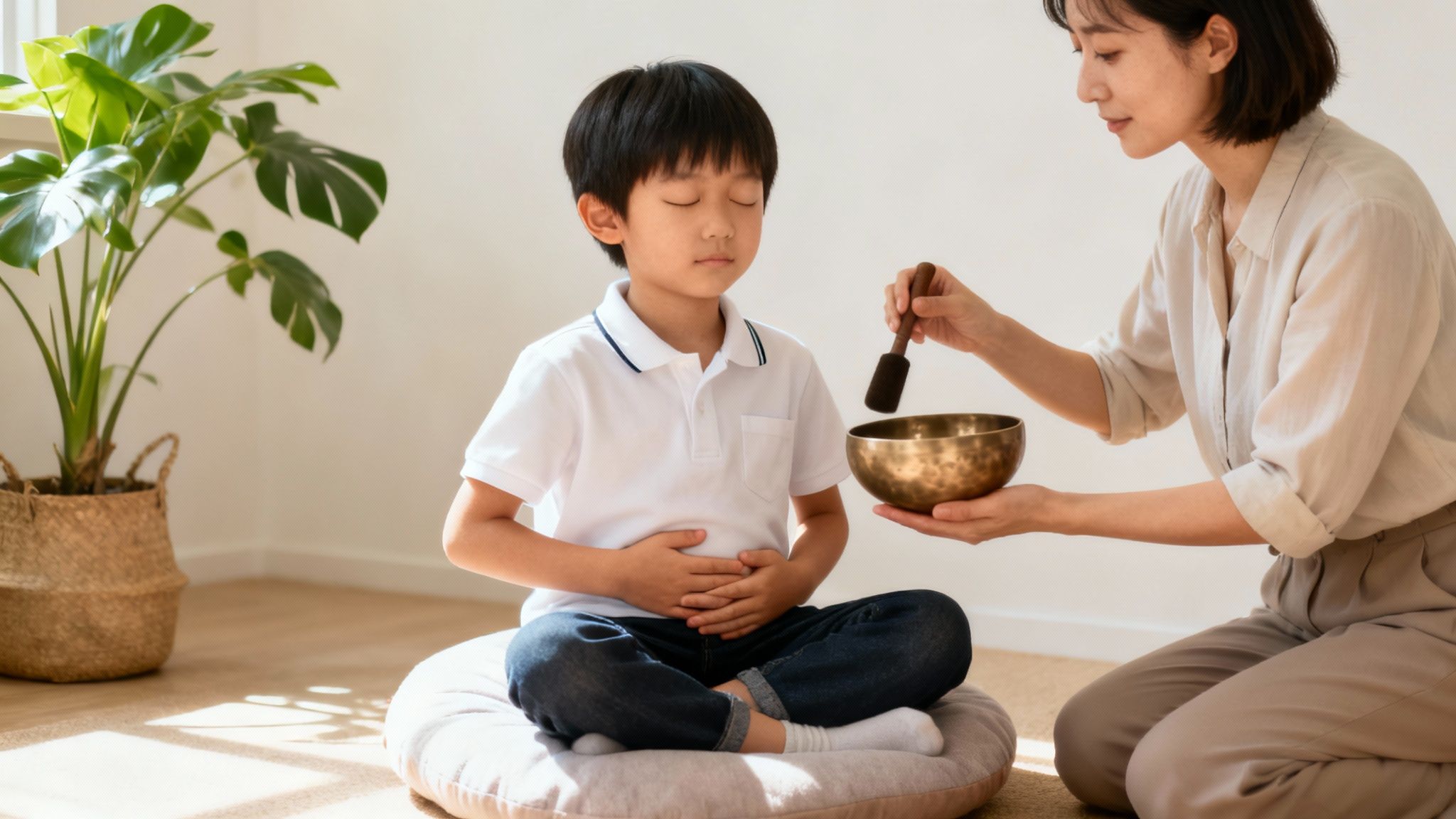
Start by integrating short, simple practices into daily routines. For example, a “Mindful Morning” can begin with two minutes of “belly breathing,” where students place a hand on their stomach to feel it rise and fall. This tangible sensation helps younger learners stay focused. Before a challenging task like a math test, guide them through a “square breathing” exercise: inhale for four counts, hold for four, exhale for four, and pause for four, tracing a square in the air or on their desk.
Practical Example:
A second-grade teacher notices her class is overly energetic and unfocused after recess. She signals for a “Mindful Minute” by ringing a small chime. She guides them: “Place your feet flat on the floor and rest your hands on your desk. Let’s do ‘Volcano Breaths.’ Reach your arms up high as you breathe in deeply, then push the air out with a ‘whoosh’ sound as your arms come down.” She repeats this three times, and the class settles, ready for the next lesson.
Tips for Success
Model First: Always demonstrate the breathing exercise yourself so students see and hear what is expected.
Start Small: Begin with practices as short as 30 seconds to one minute, gradually increasing the duration as students build their focus “muscles.”
Offer Choices: Allow students to sit at their desks, stand, or lie on a rug. Giving them agency over their body position increases comfort and participation.
Use Consistent Cues: A specific chime, a hand signal, or a phrase like “Let’s find our calm” can signal the start of a mindfulness practice, making transitions smoother.
By consistently weaving these moments into the school day, you provide students with a powerful, portable tool for managing their emotional well-being. For more ideas on creating a peaceful classroom, you can find a variety of mindfulness strategies for a relaxed learning environment on soulshoppe.org.
2. Feelings Check-In and Emotion Identification
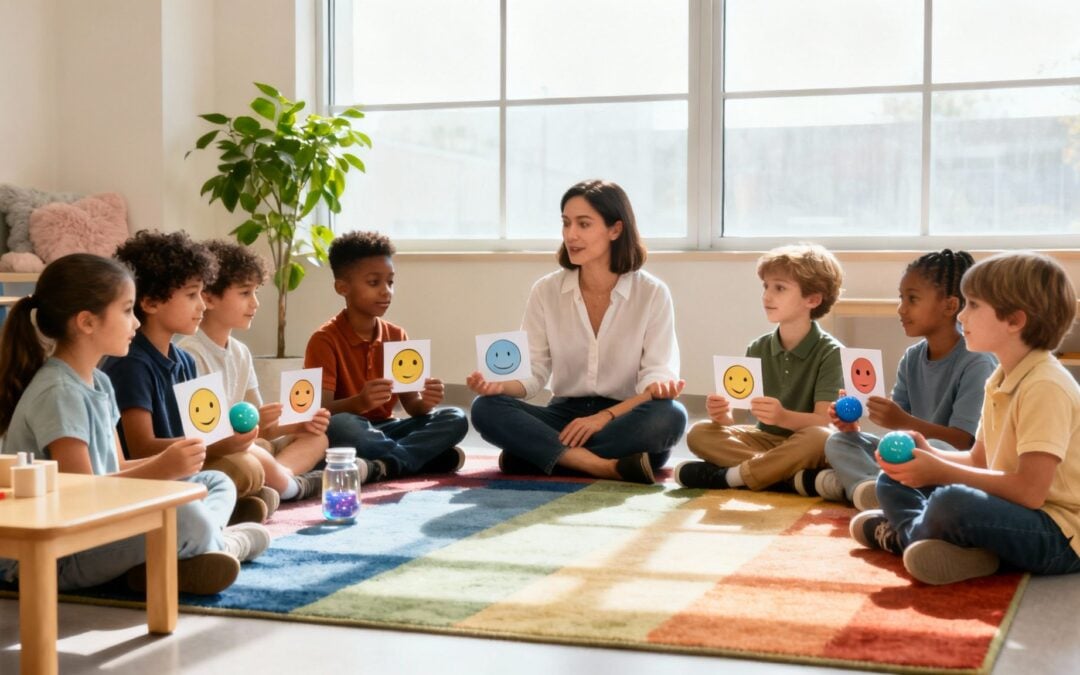
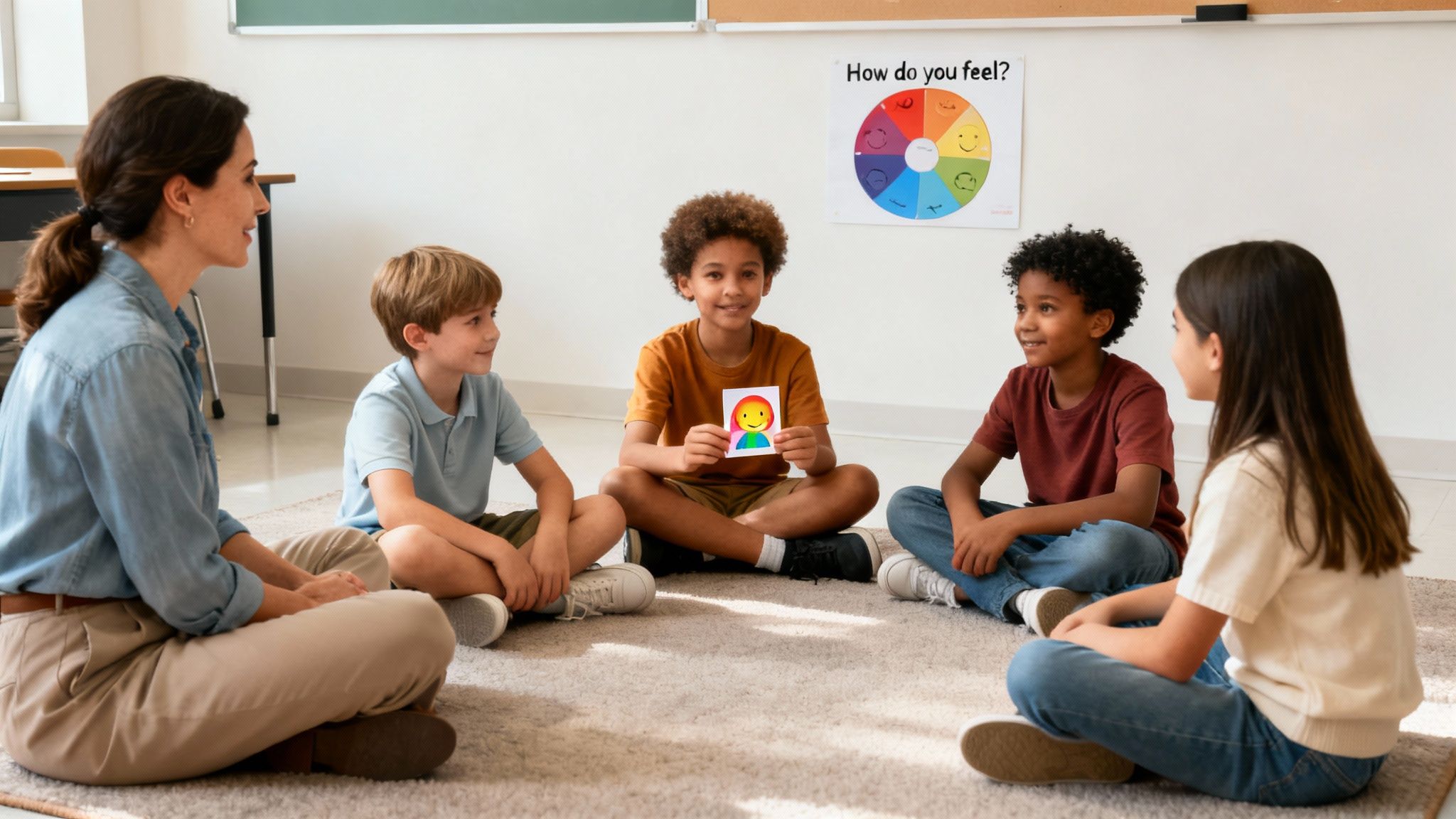
Feelings check-ins are structured daily activities where students learn to recognize, name, and express their emotions using specific vocabulary and visual aids. These simple routines build emotional literacy from the ground up, giving children the words to articulate their internal states. This practice is one of the most essential social emotional learning activities for elementary students because it normalizes conversations about feelings and creates a classroom culture of empathy and support.
This activity directly supports the core SEL competencies of self-awareness (identifying one’s own emotions) and social awareness (recognizing and understanding the emotions of others). By making emotional identification a regular part of the day, you teach students that all feelings are valid and manageable.
How to Implement Feelings Check-Ins
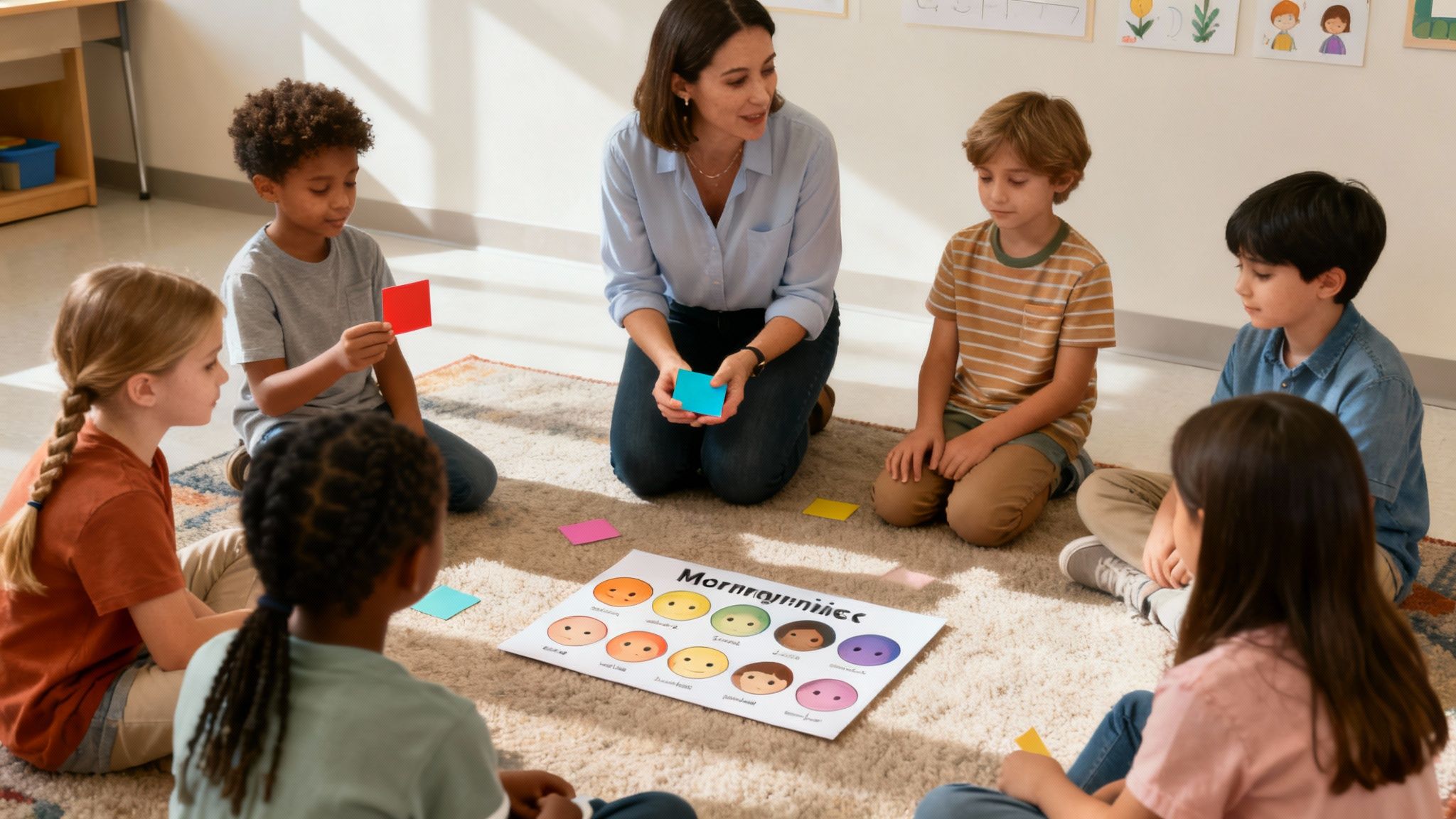
Integrate check-ins into predictable routines, like morning meetings or the transition after lunch. Use visual tools like a “Feelings Thermometer” or an “Emotion Wheel” where students can point to or place their name next to the feeling that best describes their current state. This non-verbal option is excellent for younger students or those who are hesitant to share aloud. As students become more comfortable, you can invite them to briefly share why they feel a certain way.
Practical Example:
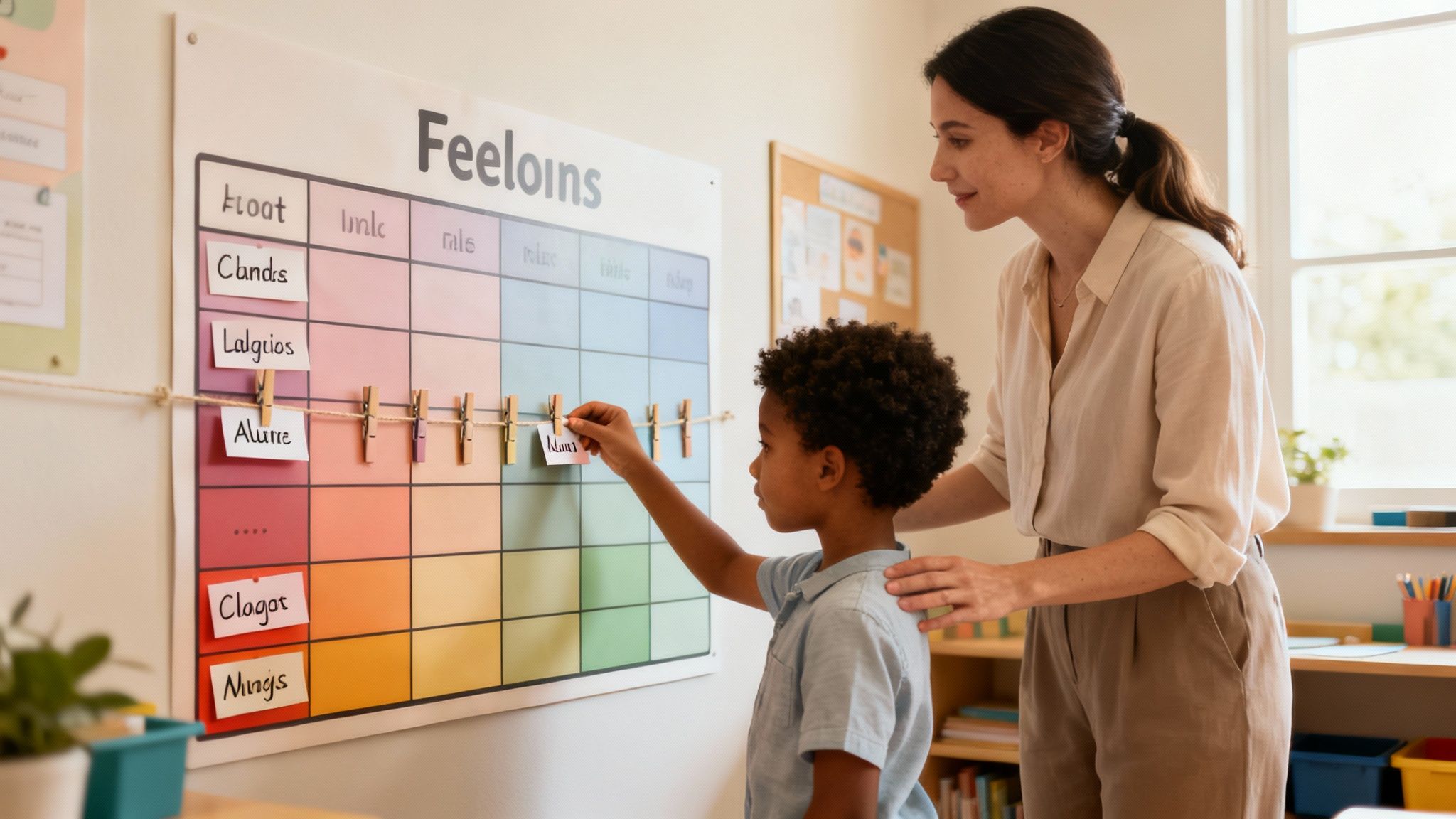
A third-grade teacher starts each morning by having students move their personal clothespin to a section of a large color-coded chart. Red represents intense feelings like anger or excitement, yellow for mild feelings like worry or silliness, and blue for low-energy feelings like sadness or tiredness. She then asks, “I see a few friends in the yellow zone today. Would anyone like to share what’s on their mind?” This simple act validates their emotions and gives her valuable insight into her students’ readiness to learn.
Tips for Success
Validate All Emotions: Respond with empathy and without judgment. Phrases like, “It’s okay to feel disappointed,” or “I understand why you might feel nervous,” create emotional safety.
Expand Emotional Vocabulary: Move beyond “happy, sad, mad.” Introduce more nuanced words like “frustrated,” “proud,” “anxious,” and “content” to help students identify their feelings with greater precision.
Offer Private Options: For students who are not comfortable sharing with the group, provide a journal or a private check-in slip they can hand to you.
Connect Feelings to Needs: Ask follow-up questions like, “What do you need right now to help with that feeling?” This empowers students to practice self-advocacy and problem-solving.
Consistently using these check-ins helps students develop a deeper understanding of themselves and their peers. You can explore a variety of methods for these important routines and find more about using mood meters and other reflection tools on soulshoppe.org.
3. Cooperative Games and Team-Building Activities
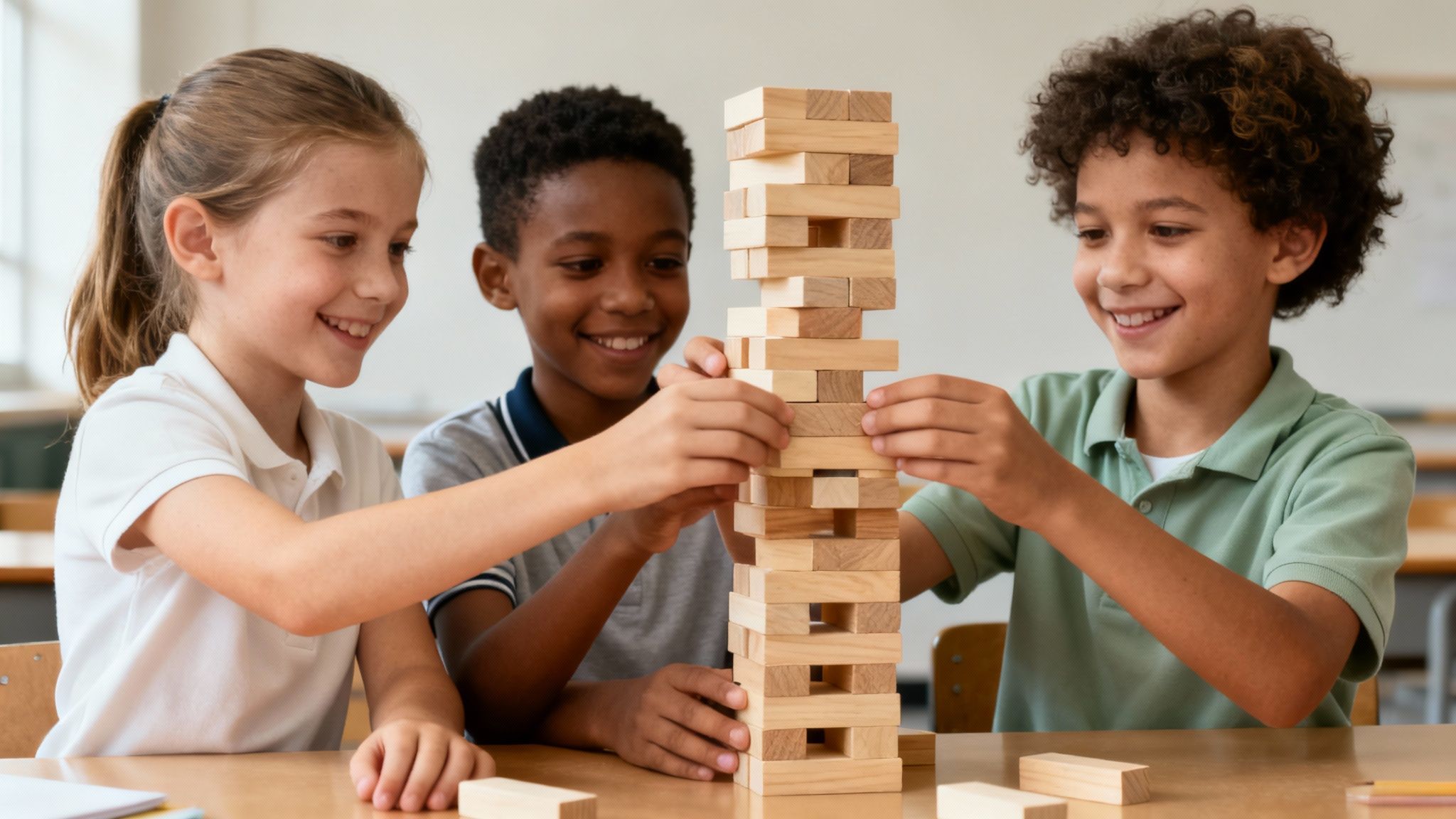
Cooperative games shift the focus from individual competition to collective success, making them powerful social emotional learning activities for elementary students. Instead of a “win-lose” dynamic, these activities create a “we all win or we all learn together” environment. By engaging in challenges that require communication, shared strategy, and mutual support, children learn to value collaboration and appreciate the unique strengths of their peers.
These activities are essential for developing relationship skills (communication, cooperation, conflict resolution) and social awareness (perspective-taking, empathy). They build a strong sense of classroom community and belonging, teaching students that relying on others and being reliable are equally important. The goal is to solve a problem together, strengthening interpersonal bonds in the process.
How to Implement Cooperative Games
Integrate team-building exercises during morning meetings, brain breaks, or dedicated community-building time. Start with low-stakes activities that have simple rules. For example, the “Human Knot” challenges a small group to untangle themselves from a jumble of interconnected arms without letting go. Another classic is “Build a Tower,” where teams use limited materials like spaghetti and marshmallows to construct the tallest possible freestanding structure.
Practical Example:
A fourth-grade teacher wants to improve how her students work in small groups. She introduces a challenge: “Cross the River.” She lays out a few small mats (“rafts”) on the floor and explains that the entire group must get from one side of the room to the other without touching the “water” (the floor). The team must pass the rafts to one another to move forward, requiring planning and clear communication. The activity generates laughter, a few failed attempts, and ultimately, a shared sense of accomplishment.
Tips for Success
Focus on Process, Not Outcome: Emphasize how the group worked together, not whether they “won” the challenge. Use prompts like, “What was one helpful thing a teammate said?”
Facilitate a Debrief: After the activity, guide a brief discussion. Ask students what went well, what was challenging, and what they might do differently next time.
Offer Opt-in Participation: Create a psychologically safe environment where students feel comfortable participating. For activities involving touch, like the Human Knot, allow students to choose their level of involvement.
Mix Up the Groups: Intentionally create different groupings for various activities. This helps break down social cliques and builds relationships across the entire classroom.
By incorporating cooperative games, you actively teach students the skills needed to navigate group dynamics, resolve conflicts, and build positive relationships, setting a foundation for successful collaboration inside and outside the classroom.
4. Conflict Resolution and Peer Mediation
Conflict resolution and peer mediation programs are powerful social emotional learning activities for elementary students that teach them to navigate disagreements constructively. Instead of relying on adult intervention for every problem, these structured processes empower children with the skills to listen, understand different perspectives, and find mutually agreeable solutions. This approach transforms conflict from a negative event into a valuable learning opportunity.
These activities directly build the core SEL competencies of social awareness (perspective-taking), relationship skills (communication and conflict resolution), and responsible decision-making (evaluating consequences and solving problems ethically). The ultimate goal is to create a safer, more respectful school climate where students feel capable of solving their own problems.
How to Implement Conflict Resolution
Begin by establishing a dedicated “Peace Corner” or “Conflict Resolution Zone” in the classroom. This area can be equipped with visual aids outlining the steps for resolving a problem, such as using “I-Feel” statements, listening without interrupting, and brainstorming solutions. Introduce these steps through role-playing common classroom scenarios, like arguments over toys or disagreements during a group project. For a more structured approach, older students can be trained as peer mediators to help younger students resolve conflicts during recess.
Practical Example:
Two third-grade students are arguing over a single red marker they both want for an art project. Instead of solving it for them, their teacher directs them to the classroom’s Peace Corner. Following the posted steps, the first student says, “I feel frustrated because I need the red marker for my drawing.” The second student listens and responds, “I hear you’re frustrated. I feel upset because I need it for my drawing, too.” They agree to take turns, using the marker for five minutes each, resolving the conflict independently and respectfully.
Tips for Success
Start Simple: Teach foundational skills like “I-Feel” statements to students in grades K-2 before introducing more complex mediation steps.
Use Real Scenarios: Role-play conflicts that genuinely occur in your classroom or on the playground to make the practice relevant and meaningful.
Practice Consistently: Regular practice helps students internalize the steps so they can recall them automatically during a real, emotionally charged conflict.
Establish Clear Boundaries: Define which problems students can solve themselves and which require adult help, ensuring safety and appropriate support.
By teaching these essential life skills, you equip students to build healthier relationships and contribute to a more positive community. For a deeper look into the language of resolving disputes, you can explore the use of “I-Feel” statements for kids and how they transform disagreements.
5. Gratitude and Appreciation Practices
Gratitude practices are powerful social emotional learning activities for elementary students that shift their focus toward appreciating the positive aspects of their lives. By regularly identifying and expressing thankfulness, children develop a more optimistic outlook, build resilience against setbacks, and strengthen their connections with others. This intentional focus on appreciation helps counter negativity and fosters a sense of contentment and well-being.
These activities directly support the SEL competencies of social awareness (recognizing the contributions of others) and relationship skills (communicating appreciation to build positive connections). The goal is to cultivate a habit of noticing the good, which can profoundly impact a child’s mental health and social interactions.
How to Implement Gratitude and Appreciation
Integrate gratitude into existing routines to make it a natural part of the day. A “Gratitude Circle” during a morning meeting allows students to share one small thing they are thankful for, setting a positive tone for learning. Another effective tool is a “Gratitude Journal,” where students can write or draw something they appreciate each day, creating a personal log of positivity to look back on.
Practical Example:
A third-grade teacher starts an “Appreciation Mail” system. Each Friday, students have a few minutes to write a short, specific note of appreciation to a classmate, teacher, or staff member and “mail” it in a decorated classroom mailbox. The teacher reads a few aloud (with permission), and then delivers the notes. This activity not only highlights kindness but also gives every student a chance to feel seen and valued by their peers.
Tips for Success
Model Authenticity: Share your own specific gratitudes with the class. For example, say, “I’m grateful for how quietly everyone came in this morning; it helped us get started right away.”
Encourage Specificity: Guide students beyond generic answers like “my family.” Prompt them with questions like, “What is something specific your brother did that you are grateful for?”
Offer Multiple Formats: Allow students to express gratitude by writing, drawing, speaking, or even creating a short video. This accommodates different learning styles and comfort levels.
Connect to Community: Create a whole-class “Thankfulness Tree” or an “Appreciation Board” where notes can be posted publicly, fostering a school-wide culture of recognition.
By consistently making space for gratitude, you help students develop a lasting habit of recognizing and appreciating the people and moments that make life meaningful. For more ways to foster a positive classroom climate, explore resources like those available on the Greater Good Science Center’s education page.
6. Social Stories and Perspective-Taking Activities
Social stories and perspective-taking activities are powerful social emotional learning activities for elementary students that use structured narratives to build empathy and social understanding. By stepping into someone else’s shoes through stories, role-playing, or discussions, children learn to recognize different viewpoints, motivations, and emotional experiences. This process helps them understand how their words and actions impact others, laying the groundwork for more compassionate and inclusive interactions.
These activities are essential for developing the core SEL competencies of social awareness (understanding the perspectives of others and empathizing with them) and relationship skills (communicating effectively and building positive connections). The goal is to move students beyond their own immediate experience and cultivate a genuine curiosity and respect for the diverse world around them.
How to Implement Social Stories and Perspective-Taking
Integrate perspective-taking into your existing literacy or morning meeting routines. Start by reading a book with a clear emotional conflict, like The Hundred Dresses by Eleanor Estes, and pause to ask questions that encourage students to consider different characters’ feelings. For example, “How do you think Wanda felt when Peggy teased her? What might Maddie have been thinking when she stood by and said nothing?”
From there, you can move into role-playing scenarios. Use situations that are common in a school setting, like a disagreement over a game at recess or someone feeling left out at the lunch table. Assign roles and have students act out the scenario, then discuss how each character felt and what could have been done differently.
Practical Example:
During a class meeting, a fourth-grade teacher addresses a recurring issue of students saving seats in the cafeteria. She divides the class into small groups and gives them a scenario: “A new student wants to sit at a table, but the other kids say, ‘You can’t sit here, we’re saving these spots for our friends.’ How does the new student feel? How do the other kids feel?” The groups discuss and then share their ideas, leading to a class-wide conversation about creating a more welcoming lunchroom.
Tips for Success
Use Diverse Literature: Select books and stories that feature characters from a wide range of backgrounds, cultures, and abilities to broaden students’ understanding.
Ask Probing Questions: Go beyond simple comprehension. Ask “why” questions like, “Why do you think the character made that choice?” or “What might have happened before this story started to make them feel that way?”
Connect to Real Life: Help students see the connection between the characters’ experiences and their own lives. Ask if they have ever felt a similar way or witnessed a similar situation.
Model Empathy: When discussing characters, model empathetic language yourself. Say things like, “It sounds like that must have been really hard for him,” to guide students’ responses.
By regularly engaging in these activities, you help students build the critical muscle of empathy, transforming your classroom into a more understanding and supportive community.
7. Self-Regulation and Coping Strategy Toolkits
Creating self-regulation and coping strategy toolkits is one of the most powerful social emotional learning activities for elementary students. It moves beyond simply identifying feelings to actively building a personalized plan for managing them. By teaching students to recognize their emotional triggers and the physiological signs of dysregulation, you empower them to proactively choose a strategy that helps them return to a calm, focused state.
This approach directly targets the core SEL competencies of self-awareness (recognizing internal signals) and self-management (deploying a specific coping tool). The goal is to equip every child with a menu of effective, accessible strategies they can use independently when emotions feel overwhelming, fostering resilience and a sense of agency over their well-being.
How to Implement Coping Strategy Toolkits
Begin by explicitly teaching a variety of strategies, explaining which emotions they might help with. Create a visual “Coping Menu” or use a framework like the Zones of Regulation to connect feelings to specific actions. A physical toolkit can be a small box with sensory items, while a classroom “peace corner” offers a designated space for students to use these tools without stigma.
Practical Example:
A third-grade teacher helps a student who gets frustrated during math create a personal toolkit. Inside a pencil box, they place a small piece of bubble wrap to pop, a smooth stone to rub, and a card with three deep-breathing steps. When the student feels frustration rising, they know they can quietly take out their toolkit at their desk and use one of the items to reset before asking for help.
Tips for Success
Practice Proactively: Introduce and practice coping strategies when students are calm, not just in the middle of a difficult moment. This builds muscle memory.
Offer Diverse Options: Include strategies that involve movement (wall pushes), sensory input (fidgets, weighted lap pads), and quiet reflection (drawing, listening to music).
Personalize the Toolkit: Help students identify what truly works for them. What is calming for one child might be overstimulating for another.
Involve Families: Share a list of the strategies being taught at school and encourage families to identify and practice them at home for consistent support. You can explore parent resources from Soul Shoppe for ideas on home implementation.
By normalizing the need for self-regulation tools, you create a supportive environment where students see managing emotions as a skillful and healthy part of life.
8. Morning Meeting and Class Circles
Morning Meeting is a structured daily gathering where students and teachers come together in a circle to start the day. This powerful ritual establishes a predictable and safe routine that intentionally builds classroom community, strengthens relationships, and provides a dedicated time for practicing key social skills. By creating this space for greeting, sharing, and engaging in a group activity, you set a positive tone for learning and reinforce a sense of belonging for every child.
These daily circles are a cornerstone of social emotional learning activities for elementary students because they directly target multiple SEL competencies. They foster social awareness (listening to peers’ perspectives), relationship skills (practicing respectful communication), and responsible decision-making (collaboratively solving class problems). It becomes a living laboratory for the social skills taught in other lessons.
How to Implement Morning Meeting and Class Circles
A typical Morning Meeting, popularized by the Responsive Classroom approach, includes four components: greeting, sharing, group activity, and a morning message. The greeting involves students acknowledging each other by name. Sharing allows students to talk about important events in their lives, while others practice active listening. The group activity is a short, fun game or song that promotes group cohesion, and the message previews the day’s learning goals.
Practical Example:
A third-grade teacher begins her Morning Meeting to address a recurring issue of students feeling left out at recess. During the sharing portion, she poses a prompt: “Think about a time you invited someone new to play. How did it feel?” After a few students share, she uses the morning message to announce they will be creating a class “Inclusion Agreement” together, turning a problem into a collaborative, community-building lesson.
Tips for Success
Establish Clear Norms: Co-create rules for the circle, such as “One person speaks at a time,” “Listen with your whole body,” and “It’s okay to pass.”
Start Small: Keep initial meetings short, around 10-15 minutes, especially for younger students in kindergarten and first grade.
Rotate Leadership: Empower students by allowing them to take turns leading different parts of the meeting, such as the greeting or group activity.
Protect the Time: Treat Morning Meeting as essential instructional time, not something to be skipped when you are busy. Consistency is what builds trust and safety.
By making this a non-negotiable part of your daily schedule, you show students that their voices matter and their relationships are a priority. For a deeper look into fostering this environment, explore these tips on how to build classroom community with Soul Shoppe.
9. Empathy and Kindness Challenges
Empathy and Kindness Challenges are structured campaigns designed to make thoughtful behavior a conscious and celebrated part of school culture. By prompting students to perform deliberate acts of kindness, these activities move empathy from an abstract concept to a tangible action. These challenges build positive momentum, demonstrating how small, individual choices can collectively create a more supportive and inclusive environment for everyone.
These social emotional learning activities for elementary students directly target social awareness (understanding and empathizing with others’ feelings) and relationship skills (building positive connections through prosocial behavior). The goal is to help children recognize the power they have to impact their peers and community positively.
How to Implement Empathy and Kindness Challenges
Launch a school-wide or classroom-specific challenge with a clear theme and duration. For example, a “Kindness is Our Superpower” week could feature daily prompts. Monday’s challenge might be to give a genuine compliment, while Tuesday’s could be to invite someone new to play during recess. The key is making the actions specific and achievable for young students.
Practical Example:
A third-grade classroom creates a “Compliment Chain.” When a student observes or receives a particularly kind act, they write it on a strip of colored paper. The teacher helps them add it as a new link to a paper chain hanging across the classroom. By the end of the month, the chain visually represents the class’s collective kindness, and the teacher reads some of the links aloud to celebrate their progress.
Tips for Success
Be Specific: Vague instructions like “be kind” are less effective than “hold the door open for someone” or “ask a classmate about their weekend.”
Celebrate the Process: Acknowledge effort and intention, not just grand gestures. Create a “Kindness Corner” where students can post notes about kind acts they’ve witnessed.
Connect to Empathy: After an act of kindness, facilitate a brief discussion. Ask questions like, “How do you think it made that person feel when you shared your crayons?”
Involve Families: Send home a note about the challenge and encourage families to participate by noticing and celebrating kindness at home.
These challenges transform the school environment by making kindness and empathy active, shared values. To see how these concepts are integrated into large-scale bullying prevention, you can learn about Soul Shoppe’s successful partnerships, like the one with the Junior Giants to help kids Strike Out Bullying.
10. Family and Community Engagement in SEL
Social emotional learning activities for elementary students are most effective when they extend beyond the school walls. Family and community engagement bridges the gap between classroom instruction and a child’s home life, creating a consistent and supportive ecosystem. By intentionally involving parents, caregivers, and community partners, schools can amplify SEL skills, ensuring children hear and practice the same positive language and strategies in every part of their lives.
This approach strengthens all five core SEL competencies by creating a shared understanding and commitment to social awareness, relationship skills, and responsible decision-making across different environments. When families and schools partner, children see that these skills are valued everywhere, not just in the classroom.
How to Implement Family and Community Engagement
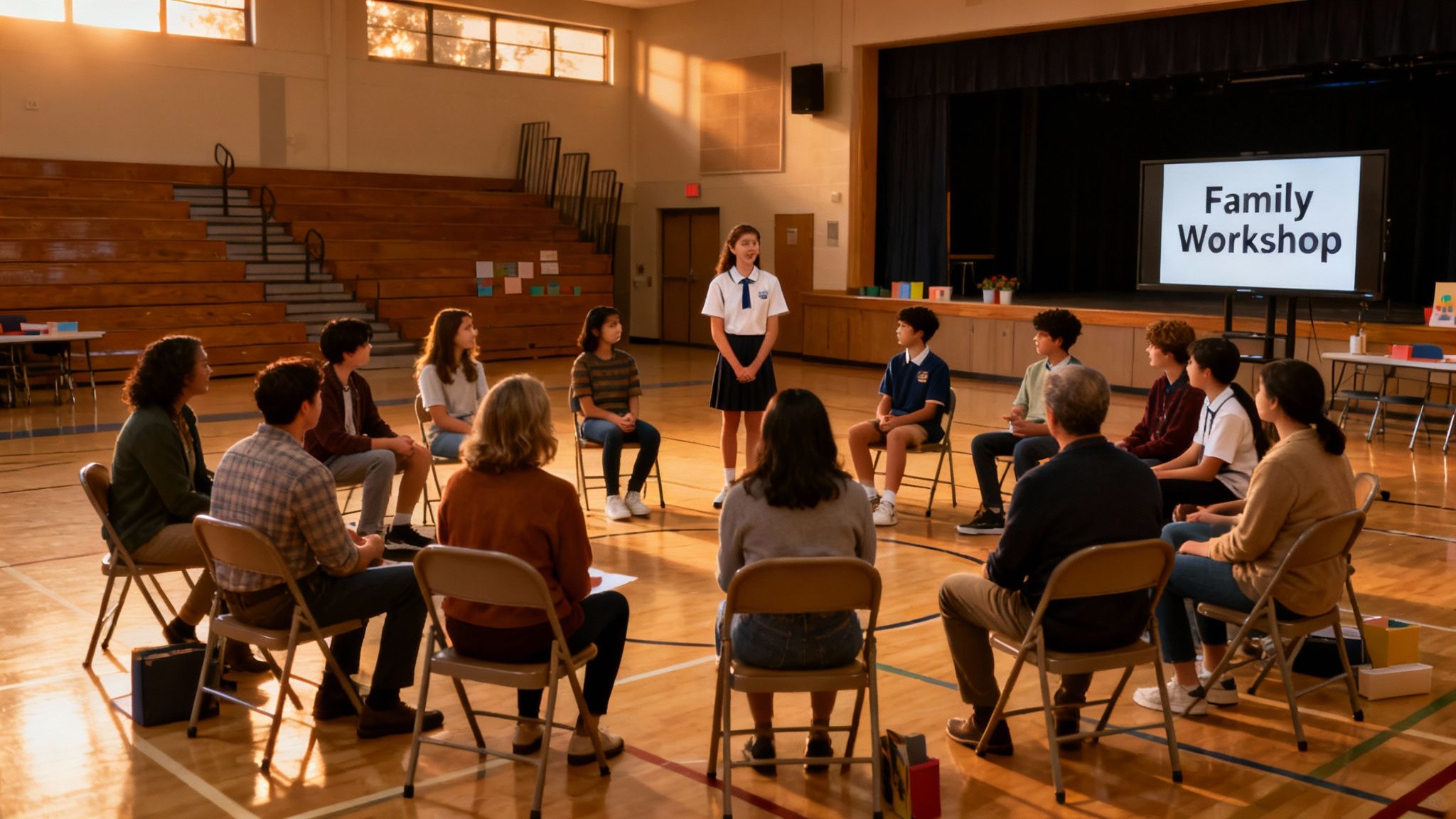
Begin by providing accessible resources and opportunities for connection. Offer parent workshops at various times (in-person and virtual) to accommodate different schedules. Distribute take-home SEL activity packets or newsletters that align with classroom lessons, giving families simple, actionable ways to practice skills like empathy or conflict resolution at home. Partnering with community organizations for events can also broaden your reach and impact.
Practical Example:
A school hosts a “Peaceful Families Night” facilitated by a community partner. Families participate in interactive stations, learning a simple “I-statement” formula for expressing feelings. They are sent home with a magnet summarizing the technique. The following week, a parent shares that her son used an “I-statement” to resolve a disagreement over a toy, a direct result of the shared learning experience.
Tips for Success
Provide Multilingual Resources: Ensure materials are translated to reflect the languages spoken by your school community, making content accessible to all families.
Connect to Parent Priorities: Frame SEL as a tool to help with common challenges like managing homework stress or building cooperation. To extend the spirit of cooperation from the classroom to the home, learning how to creating a family chore chart that fosters teamwork can effectively foster teamwork and shared responsibility among family members.
Start Simple: Introduce one easy-to-use strategy at a time, such as a “calm-down corner” at home or a single feeling word to focus on for the week.
Create a Welcoming Environment: Foster a school culture where families feel valued, respected, and seen as true partners in their child’s education. Gather feedback regularly to ensure programming meets their needs.
10 Elementary SEL Activities Comparison
Program
Implementation complexity
Resource requirements
Expected outcomes
Ideal use cases
Key advantages
Mindfulness and Breathing Exercises
Low — short scripted practices; needs consistency
Minimal — time, quiet space; no special equipment
Faster calming, improved attention and emotion regulation
Creates positive norms, engages students, visible cultural shift
Family and Community Engagement in SEL
High — coordination, outreach, cultural adaptation
Moderate–High — workshops, multilingual materials, staff time
Greater consistency across contexts; stronger family-school partnerships
Family workshops, take-home activities, community partnerships
Extends SEL to home, builds trust, leverages community resources
Putting it All Together: Building a Culture of Connection and Empathy
We have explored a wide range of powerful and practical social emotional learning activities for elementary students, from the quiet introspection of mindful breathing to the dynamic collaboration of cooperative games. Each activity, whether it’s a quick Feelings Check-In or a structured Peer Mediation session, serves as a single thread. When woven together consistently, these threads create a strong, resilient, and supportive classroom tapestry. The goal is not to treat SEL as another box to check, but to embed it into the very heart of the school day.
The true power of these activities is unlocked through intentional and consistent application. A one-time empathy challenge is a great start, but a weekly practice builds a lasting habit of kindness. A coping strategies toolkit is most effective when students are regularly encouraged to use it, not just during moments of crisis, but as a proactive self-management tool. The journey from learning about emotions to living with emotional intelligence is a marathon, not a sprint, built upon these small, repeated practices.
From Activities to a Thriving Classroom Culture
Integrating these diverse activities creates a powerful synergy that transforms the learning environment. Imagine a classroom where a Morning Meeting sets a positive and inclusive tone, a Gratitude Jar visibly tracks the community’s appreciation, and a student-led conflict resolution corner empowers children to solve their own disagreements respectfully. This is the tangible result of a commitment to SEL.
This cultural shift doesn’t happen by accident. It is the direct outcome of educators and caregivers who model these skills and create predictable routines where students feel safe to be vulnerable, make mistakes, and grow. When students have a shared vocabulary for their feelings and a toolbox of strategies for managing them, you’ll see a decrease in disruptive behaviors and an increase in on-task learning, engagement, and peer support.
Your Actionable Next Steps for SEL Implementation
Moving from inspiration to action is the most critical step. Instead of feeling overwhelmed by the number of options, commit to a small, sustainable start.
Choose Your Starting Point: Select one or two activities from this list that resonate most with your students’ needs and your own teaching style. Perhaps it’s starting each day with a “Rose, Bud, Thorn” check-in or introducing a weekly cooperative game.
Schedule It In: Consistency is key. Formally schedule your chosen SEL activities into your weekly lesson plans. This ensures they don’t get pushed aside when things get busy. Even five dedicated minutes a day can have a profound impact over time.
Involve Your Community: Share these ideas with colleagues, administrators, and families. When students see and hear consistent SEL language and practices at school and at home, the learning is reinforced exponentially. Consider sending home a “Kindness Challenge” or a list of conversation starters about feelings.
By embracing these social emotional learning activities for elementary students, you are doing more than just managing a classroom; you are nurturing a generation of compassionate leaders, resilient problem-solvers, and empathetic global citizens. The investment you make in their emotional well-being today will pay dividends for the rest of their lives, equipping them with the essential skills to navigate an increasingly complex world with confidence, kindness, and a strong sense of self.
Ready to take your school’s commitment to SEL to the next level? Soul Shoppe provides comprehensive, research-based programs that create safer, more compassionate school communities by empowering students, staff, and families. Discover how their dynamic assemblies and in-depth curriculum can help you build a sustainable culture of empathy and connection at Soul Shoppe.
In today’s dynamic elementary classrooms, academic skills are only half the story. The ability to understand emotions, build relationships, and make responsible decisions forms the bedrock of a successful learner and a compassionate human being. This is the core of social-emotional learning (SEL), a framework that equips students with the essential tools to navigate their inner worlds and the world around them. For educators seeking a child-centered philosophy that deeply aligns with holistic child development and SEL, exploring foundational approaches like the Reggio Emilia approach to education can provide a powerful, inquiry-based framework for these practices.
For teachers, counselors, and parents, the primary challenge isn’t just knowing that SEL is important-it’s finding practical, engaging ways to integrate it into daily routines. This guide moves beyond abstract theory to offer a comprehensive roundup of field-tested social emotional learning activities elementary students can immediately benefit from. We provide step-by-step instructions, grade-specific adaptations from Kindergarten through 5th grade, and real-world examples to help you cultivate a thriving, emotionally intelligent community.
Inside this resource, you will discover a curated list of activities designed to build key competencies, including:
Self-Awareness: Identifying and understanding emotions.
Self-Management: Developing coping strategies and resilience.
Social Awareness: Cultivating empathy and perspective-taking.
Relationship Skills: Fostering collaboration and effective communication.
Responsible Decision-Making: Encouraging thoughtful and ethical choices.
Whether you’re looking to start an emotion check-in circle, introduce mindfulness exercises, or implement peer conflict resolution, this article serves as your practical playbook. These activities will help you foster connection, safety, and resilience in the children you support, building a foundation for lifelong well-being and academic success.
1. Emotion Check-In Circle
The Emotion Check-In Circle is a foundational routine where students gather to identify and share their current feelings in a safe, structured setting. This simple yet powerful practice serves as a daily emotional barometer for the classroom, helping students build self-awareness and empathy from the very start of their day. By creating a predictable space to name emotions, teachers normalize the full spectrum of feelings, from excitement to disappointment, fostering a culture of psychological safety.
This activity is more than just a morning greeting; it is a core component of many effective social emotional learning activities for elementary students. It provides valuable insight into who might need extra support and helps children connect their internal state to their readiness to learn.
How to Implement an Emotion Check-In Circle
Materials Needed: Emotion wheel, feeling cards, or a simple chart paper with different feeling words/faces. For a more structured approach, consider the Mood Meter framework popularized by Marc Brackett at the Yale Center for Emotional Intelligence.
Time: 5-10 minutes daily.
CASEL Competency: Self-Awareness, Social Awareness.
Step-by-Step Instructions:
Gather Students: Arrange students in a circle on the rug or at their desks.
Model First: The teacher starts by sharing their own feeling. For example, “Good morning, everyone. Today, I am feeling calm because I had a relaxing weekend and drank my favorite tea this morning.”
Provide a Framework: Students share their feeling using a sentence stem, like “Today I feel ____ because ____.”
Practical Example (Kindergarten): A student points to a happy face card and says, “Today I feel happy because it’s my turn to be the line leader.”
Practical Example (3rd Grade): A student shares, “Today I feel a little nervous because we have a math test, but I also feel hopeful because I studied.”
Listen and Acknowledge: The group listens without judgment. The goal is to acknowledge, not to fix. A simple “Thank you for sharing” is often enough.
Offer Alternatives: Always include a “pass” option. Students who are not ready to share can say “pass” without penalty.
Key Insight: Consistency is crucial. When the Emotion Check-In Circle becomes a non-negotiable part of the daily routine, students learn to trust the process and become more willing to share honestly over time. It transforms the classroom into a community where every emotional state is valid and heard.
2. Mindfulness and Breathing Exercises
Mindfulness and Breathing Exercises are brief, guided practices that teach students to focus their attention on the present moment. Through simple breathing techniques, body scans, or visualizations, these evidence-based exercises help reduce stress, improve focus, and build crucial self-regulation skills. They provide students with concrete, accessible tools to use independently when feeling overwhelmed, anxious, or dysregulated, making them a cornerstone of effective social emotional learning activities for elementary students.
These practices are not about emptying the mind but about anchoring it. For young learners, this can be as simple as a two-minute “belly breathing” break between subjects or using an app like Calm or Headspace Kids for a guided meditation. This builds a foundation for managing big emotions and enhances their ability to engage in learning.
How to Implement Mindfulness and Breathing Exercises
Materials Needed: A quiet space, optional items like a chime or bell, cushions, or guided meditation audio from an app or website.
Create a Signal: Use a consistent sound, like a chime, a soft bell, or a specific song, to signal that it is time for a mindfulness break.
Guide the Breathing: Start with a simple, tangible technique.
Practical Example (“Take 5 Breathing”): “Hold up one hand like a star. Use the pointer finger of your other hand to trace it. Breathe in as you trace up your thumb, and breathe out as you trace down. Inhale up your pointer finger, exhale down. Continue for all five fingers.”
Practical Example (“Belly Breathing”): “Place one hand on your tummy. Imagine a small balloon inside. As you breathe in through your nose, feel the balloon fill up with air. As you breathe out through your mouth, feel the balloon slowly deflate.”
Offer Options: Provide choices to accommodate different needs. Students can sit at their desks, lie on the rug, or stand. Offer “eyes open” options for students who may find closing their eyes uncomfortable, suggesting they find a single spot to focus on.
Keep it Brief: Begin with very short sessions (60-90 seconds) and gradually increase the duration as students build their focus “muscles.”
Practice Proactively: Introduce and practice these skills when students are calm. This ensures they can access the tools when they are actually feeling stressed or upset.
Key Insight: The goal is not to achieve perfect stillness but to practice returning focus to the breath. Frame it as a “brain break” or “reset button.” When students learn that they have the power to calm their own bodies and minds with their breath, they gain a profound sense of agency over their emotional well-being.
3. Peer Collaboration and Cooperative Learning Projects
Peer Collaboration and Cooperative Learning Projects are structured small-group activities where students work together toward a shared goal, requiring communication, compromise, and interdependence. This approach transforms academic tasks into powerful opportunities for social and emotional growth. By intentionally designing projects that necessitate teamwork, teachers help students develop vital competencies like perspective-taking, conflict resolution, and leadership in an authentic context.
These projects are more than just group work; they are among the most effective social emotional learning activities for elementary students because they integrate SEL directly into academic content. This method builds a classroom culture where students learn to value diverse ideas, support their peers, and navigate the social complexities of achieving a common objective.
How to Implement Peer Collaboration and Cooperative Learning
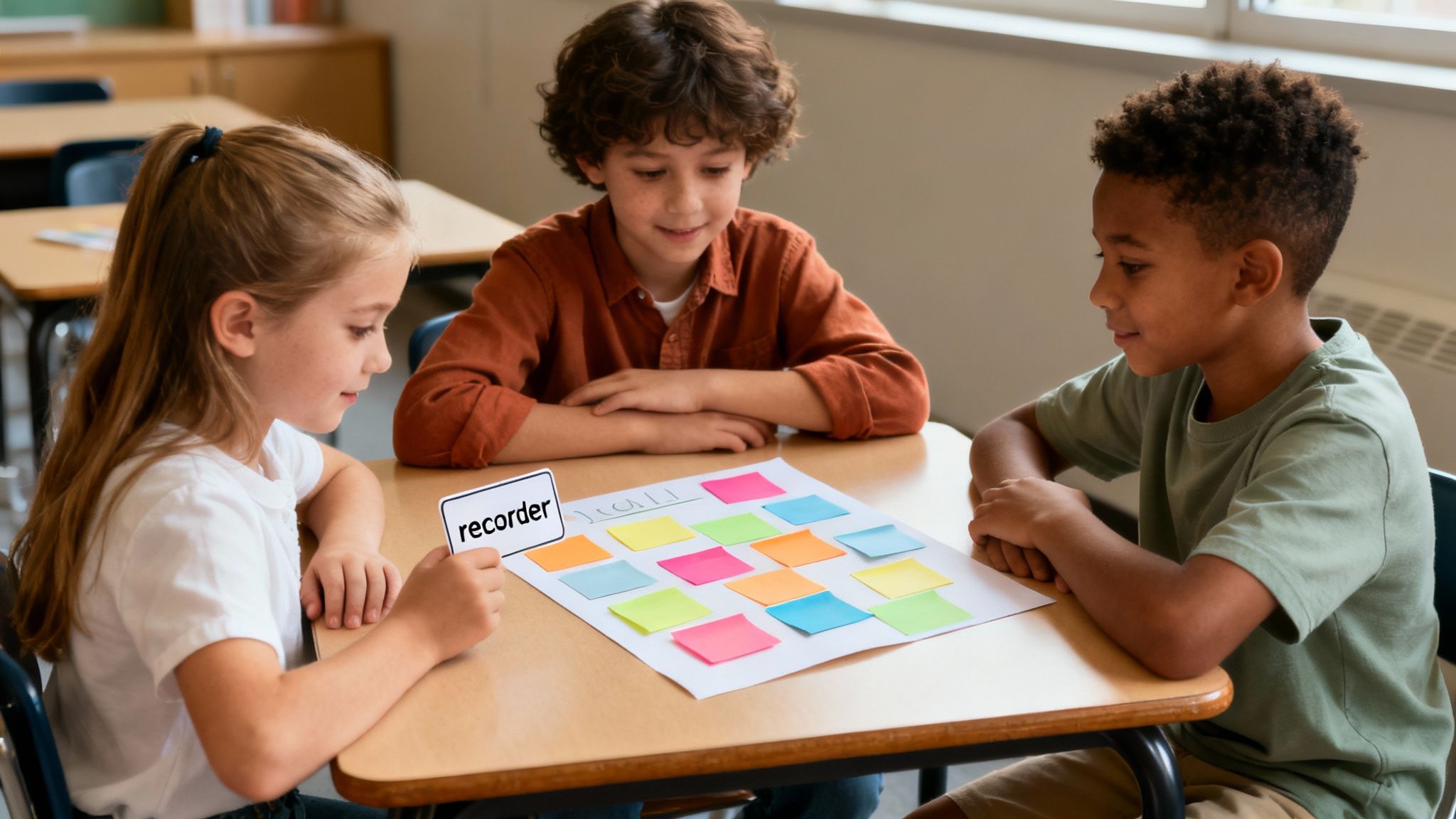
Materials Needed: Varies by project. Chart paper for group norms, role cards (e.g., Time Keeper, Encourager, Reporter), and project-specific supplies like research materials or STEM building items.
Time: Can range from a single 20-minute session (e.g., Think-Pair-Share) to a multi-week project.
Form Groups Intentionally: Create small, diverse groups that balance academic abilities, social skills, and personalities. Avoid letting students always pick their own groups.
Define Clear Roles and Goals: Assign specific roles to each member and provide a clear, measurable group goal. Rotate roles regularly so every student gains experience.
Practical Example (Science Project): In a group of four building a volcano, one student is the Materials Manager (gathers supplies), one is the Builder (constructs the model), one is the Recorder (writes down the steps), and one is the Presenter (explains the project to the class).
Teach Collaboration Skills Explicitly: Before starting, model and practice skills like active listening and respectful disagreement. Use sentence stems like, “I hear you saying…, what if we tried…?”
Structure the Task: Use a proven cooperative learning structure.
Practical Example (Think-Pair-Share): The teacher poses a question (“What was the main character’s biggest challenge?”). Students think quietly for one minute, pair up with a partner to discuss their ideas, and then share their combined thoughts with the whole class.
Monitor and Coach: Circulate the room to provide support, ask guiding questions, and help groups navigate challenges.
Include Group Reflection: After the project, guide students to reflect on their process. Ask: “What went well in our teamwork?” and “What could we do differently next time?”
Key Insight: The most crucial element is teaching collaboration as a skill in itself. Celebrate the process, not just the final product. Acknowledge groups for excellent communication, problem-solving, and mutual respect, reinforcing that how they work together is just as important as what they create.
4. Social Stories and Perspective-Taking Activities
Social Stories and perspective-taking activities use narratives and role-playing to help students understand that others have different thoughts, feelings, and experiences. These exercises are fundamental for developing empathy and reducing bias by allowing children to step into someone else’s shoes in a guided, safe way. By exploring character motivations and diverse viewpoints, students build a stronger “Theory of Mind,” which is the ability to understand others’ mental states.
This method is one of the most effective social emotional learning activities for elementary students because it translates abstract concepts like empathy into concrete, relatable scenarios. Whether through a picture book or a specific social narrative, these tools give children the language and framework to navigate complex social situations.
How to Implement Social Stories and Perspective-Taking
Materials Needed: Diverse picture books (like The Feelings Book by Todd Parr or In My Heart by Jo Witek), pre-written social stories for specific situations, chart paper, markers, or role-playing props.
Time: 15-20 minutes, 1-2 times per week.
CASEL Competency: Social Awareness, Relationship Skills.
Step-by-Step Instructions:
Select a Relevant Story: Choose a picture book or social story that reflects a current classroom challenge (e.g., sharing, handling disappointment, joining a new group).
Practical Example: After noticing students arguing over playground equipment, read The Recess Queen by Alexis O’Neill.
Read and Pause: Read the story aloud, pausing at key moments to ask perspective-taking questions.
Practical Example: While reading, pause and ask, “How do you think Mean Jean felt when no one wanted to play with her? Look at her face. What clues do you see? What about Katie Sue? How did she feel when she decided to ask Jean to play?”
Facilitate Discussion: Encourage students to share their interpretations. Validate different ideas by explaining that people can feel differently about the same situation. Use sentence starters like, “I think they felt ____ because ____.”
Extend with an Activity: Follow the story with a related activity.
Practical Example: Students can draw two faces: one showing how a character felt at the beginning of the story and another showing how they felt at the end. They then explain the change to a partner.
Connect to Real Life: Link the story’s lesson back to the classroom. For instance, “Remember how Katie Sue invited Mean Jean to play? Let’s be like Katie Sue today and look for someone who might need a friend at recess.”
Key Insight: The power of this activity lies in using diverse and authentic narratives. When students see characters from varied backgrounds, abilities, and family structures, they learn that empathy extends to everyone, not just those who are like them. It builds a foundation for an inclusive and understanding community.
5. Conflict Resolution and Peer Mediation Programs
Conflict Resolution and Peer Mediation Programs are structured systems that teach students the skills to identify, communicate about, and solve interpersonal problems collaboratively. These programs shift the classroom dynamic from adult-led discipline to student-led problem-solving, empowering children to become active agents in creating a positive school climate. By training students as mediators, schools build leadership skills and reduce teacher intervention in minor disputes.
This approach is one of the most impactful social emotional learning activities elementary students can engage in because it provides real-world application of complex skills. It reframes conflict not as a failure but as a valuable opportunity for growth, empathy, and understanding. Programs like Responsive Classroom and Soul Shoppe have popularized these practices in schools nationwide.
How to Implement Conflict Resolution and Peer Mediation
Materials Needed: “I-statement” sentence frames, conflict resolution posters with clear steps, a designated “peace corner” or table for mediations, and training materials for student mediators.
Time: 15-20 minutes for mediations as needed; ongoing training and reinforcement.
Teach Core Concepts: Introduce a simple, school-wide conflict resolution process. A common model is: 1. Cool Down, 2. Talk and Listen (using I-statements), 3. Brainstorm Solutions, 4. Agree on a Plan.
Model I-Statements: Explicitly teach and practice the “I feel ___ when you ___ because ___” framework.
Practical Example: Instead of “You’re a mean cheater!”, teach a student to say, “I feel frustrated when you change the rules of the game because I thought we already agreed.”
Train Peer Mediators: Select and train a diverse group of students (not just the “best behaved”) to act as neutral third-party facilitators. Train them to guide peers through the resolution steps without giving solutions.
Establish Protocols: Define which conflicts are appropriate for peer mediation (e.g., disagreements over games, feeling left out) and which require adult help (e.g., bullying or safety concerns).
Provide a Space: Set up a specific, quiet area where mediations can happen without an audience. This makes the process feel official and safe. A small table in the corner with a “peace rose” or talking stick can work well.
Key Insight: The goal of a student mediator is not to solve the problem for their peers but to ask powerful questions that help them solve it themselves. Train mediators with questions like, “What could you do differently next time?” and “What do you need to feel better?” This builds true problem-solving capacity and agency.
6. Gratitude and Kindness Practices
Gratitude and Kindness Practices are intentional activities designed to cultivate appreciation, generosity, and positive regard for others. These powerful routines shift a classroom’s focus toward optimism and interconnectedness, helping students recognize the good in their lives and in their peers. By embedding practices like gratitude journals and kindness challenges, teachers actively build a more prosocial and supportive learning environment.
This goes beyond simply saying “thank you.” These social emotional learning activities for elementary students teach them to look for and acknowledge kindness, which in turn boosts their own happiness, strengthens relationships, and improves their overall mental well-being. This practice helps rewire the brain to notice positive experiences.
How to Implement Gratitude and Kindness Practices
Materials Needed: Journals or notebooks, chart paper, sticky notes, a “kindness jar” or box, art supplies.
Time: 5-15 minutes daily or weekly.
CASEL Competency: Relationship Skills, Social Awareness.
Step-by-Step Instructions:
Introduce the Concept: Begin with a simple discussion about what gratitude and kindness mean. Use a story or personal example to illustrate the concepts.
Establish a Routine: Choose a consistent practice.
Practical Example (Gratitude Circle): During morning meeting, pass a “gratitude stone” around the circle. The person holding the stone shares one specific thing they are thankful for, like “I’m grateful for my dad because he made me pancakes this morning.”
Launch a Kindness Challenge: Dedicate a week to kindness. Provide daily prompts.
Practical Example: A “Kindness Bingo” card could have squares like “Give a genuine compliment,” “Invite someone new to play,” “Hold the door for someone,” and “Help a classmate clean up.”
Create a Visual Tracker: Use a “Caught Being Kind” bulletin board where students can post sticky notes acknowledging kind acts they witness. This makes kindness visible and celebrated.
Connect Gratitude to Action: After a special event or field trip, have students write thank-you notes or create a short thank-you video for the people who made it possible.
Key Insight: Specificity is the cornerstone of effective gratitude practice. Guide students beyond generic statements like “I’m grateful for my family.” Encourage them to elaborate: “I’m grateful my big sister read me a story last night because it made me feel safe and loved.” This deeper reflection anchors the feeling and makes the practice more meaningful.
7. Self-Advocacy and Assertiveness Skills Training
Self-Advocacy and Assertiveness Skills Training explicitly teaches students how to recognize and respectfully communicate their needs, boundaries, and preferences. This practice empowers children by giving them the tools to develop their own voice, agency, and confidence. By learning the crucial difference between passive, aggressive, and assertive communication, students build a foundation for academic success and lifelong healthy relationships.
This training is one of the most vital social emotional learning activities for elementary students, as it moves beyond simply identifying feelings to acting on them constructively. It is especially impactful for students who are marginalized, have learning differences, or tend to be more withdrawn, ensuring they have the skills to be seen and heard.
How to Implement Self-Advocacy and Assertiveness Skills Training
Materials Needed: Scenario cards, “I-statement” sentence frames, anchor charts defining passive, assertive, and aggressive communication styles.
Define and Differentiate: Use an anchor chart to explicitly teach the differences between passive (quiet, avoiding conflict), aggressive (blaming, demanding), and assertive (calm, clear, respectful) communication. Use simple examples for each.
Introduce “I-Statements”: Provide students with a clear and simple script for assertive communication, such as: “I feel ____ when you ____. I need ____.”
Role-Play Scenarios: Practice with low-stakes scenarios.
Practical Example (Academic Need): A student role-plays telling a teacher, “I feel confused by the directions for the project. I need you to explain step two again, please.”
Practical Example (Social Boundary): One student practices saying to another, “I feel uncomfortable when you stand so close to me. I need a little more space, please.”
Practice Saying “No”: Teach students respectful ways to set boundaries, such as “No, thank you,” or “I’d rather not do that.” Role-play situations where a friend asks them to do something they don’t want to do.
Debrief and Reinforce: After role-playing, discuss how it felt to be assertive. Acknowledge that it can feel uncomfortable at first but gets easier with practice.
Key Insight: Modeling is everything. When teachers and parents consistently use assertive “I-statements” and respect students’ boundaries, they demonstrate that self-advocacy is a valued and effective skill. Celebrate students’ attempts, even if imperfect, to create a culture where every child knows their voice matters and will be heard.
8. Growth Mindset and Resilience-Building Lessons
Growth Mindset and Resilience-Building Lessons teach students that intelligence and abilities are not fixed traits but can be developed through effort, strategic practice, and feedback. Based on the research of Carol Dweck, these lessons help children reframe challenges as opportunities, view mistakes as crucial parts of learning, and persist through setbacks. This approach shifts the focus from innate talent to the power of process, building a foundation for both academic achievement and emotional well-being.
These lessons are a cornerstone of effective social emotional learning activities for elementary students because they directly target self-management and responsible decision-making. By cultivating resilience, students are better equipped to handle academic frustrations and social conflicts with confidence and determination. To further cultivate this mindset, students can benefit from learning effective strategies to improve problem-solving skills, empowering them to tackle challenges constructively.
How to Implement Growth Mindset and Resilience-Building Lessons
Materials Needed: “The Magical Yet” by Angela DiTerlizzi or other growth mindset books, chart paper, markers, stories of famous failures (e.g., Michael Jordan, Oprah), goal-setting worksheets.
Introduce the Concept: Use a simple analogy like comparing the brain to a muscle. Explain that when we work hard and try new things, our brain grows stronger by creating new connections.
Read and Discuss: Read a story that models a growth mindset. Ask discussion questions like, “What challenge did the character face?” and “What did they do when they made a mistake?”
Teach “The Power of Yet”: Introduce the phrase “I can’t do it… yet.”
Practical Example: Create a class chart with two columns: “Fixed Mindset Thoughts” and “Growth Mindset Thoughts.” Fill it with examples like changing “This is too hard” to “This may take some time and effort.” Or “I can’t read this word” to “I can’t read this word… yet.”
Create a “Famous Failures” Gallery: Display pictures and stories of successful people who overcame significant setbacks. Discuss how failure was a necessary step in their journey to success.
Use Effort-Based Praise: In daily interactions, praise the process, not just the outcome.
Practical Example: Instead of saying “You’re so smart!” when a child solves a puzzle, say, “I love how you turned the pieces different ways to see what would fit. Your strategy worked!”
Key Insight: A growth mindset is cultivated through consistent language and classroom culture, not just isolated lessons. Creating a “mistake-friendly” environment where errors are celebrated as “brain builders” is essential. When teachers model their own learning struggles and resilience, students learn that productive struggle is a normal and valuable part of growth.
9. Diversity, Inclusion, and Anti-Bias Classroom Activities
Diversity, Inclusion, and Anti-Bias Activities are intentional lessons that celebrate human differences while actively addressing bias and discrimination. These practices move beyond surface-level multicultural celebrations to build genuine cultural competence, challenge stereotypes, and foster a deep sense of belonging for all students. By integrating these social emotional learning activities, elementary teachers equip children to understand their own identities and appreciate the diverse world around them.
This approach, championed by educators like Louise Derman-Sparks, is not just about being kind; it’s about creating justice. It gives students the language and tools to recognize and confront unfairness, making them active participants in building a more equitable classroom and community.
How to Implement Diversity, Inclusion, and Anti-Bias Activities
Materials Needed: Diverse books featuring “windows and mirrors” (characters both different from and similar to your students), identity charts, chart paper, markers, and curated read-alouds that tackle topics of fairness and bias.
Time: Varies; can be a 15-minute read-aloud or an ongoing, year-long unit.
CASEL Competency: Self-Awareness, Social Awareness, Relationship Skills.
Step-by-Step Instructions:
Introduce “Windows and Mirrors”: Using the framework from Rudine Sims Bishop, explain that books can be mirrors (reflecting our own lives) or windows (offering a view into someone else’s).
Practical Example: After reading Amazing Grace by Mary Hoffman, ask, “Who in our class saw a mirror in this story? Who saw a window into a new experience?”
Create Identity Charts: Give each student a large piece of paper with their name in the center. Have them draw or write words that describe the multiple facets of their identity (e.g., sister, artist, soccer player, Spanish speaker).
Share and Connect: Students share one part of their identity chart with a partner or small group, finding connections and celebrating differences.
Discuss Fairness: Use a picture book to introduce a scenario involving bias or unfairness.
Practical Example: Read The Sneetches by Dr. Seuss and ask, “Was it fair that only the Star-Belly Sneetches could go to the parties? Why or why not? What could the Plain-Belly Sneetches have done?”
Practice Being an Upstander: Role-play scenarios where students can practice being an “upstander” by safely and respectfully speaking up when they see something unfair.
Key Insight: Authentic representation is paramount. Anti-bias work must be woven into the curriculum year-round, not isolated to specific heritage months. This consistency ensures students see diversity as a fundamental and valued aspect of the human experience, not a special topic.
10. Emotion Regulation and Coping Strategy Toolbox
The Emotion Regulation and Coping Strategy Toolbox is a personalized collection of techniques students can use to manage overwhelming feelings and calm their nervous systems. This approach shifts the focus from adult-led intervention to student-led self-regulation, empowering children with a sense of agency and control over their emotional responses. By creating a tangible or mental “toolbox,” students learn to identify what they need in a moment of stress, building independence and emotional resilience.
This concept is a cornerstone of effective social emotional learning activities for elementary students because it acknowledges that there is no one-size-fits-all solution for managing emotions. It teaches children to become experts on their own needs, equipping them with practical skills to navigate challenges like frustration, anxiety, and excitement both inside and outside the classroom.
How to Implement a Coping Strategy Toolbox
Materials Needed: Poster board, index cards, art supplies, a physical box or container, sensory items (stress balls, scented dough, soft fabric), and visual aids for different strategies.
Time: 15-20 minutes for initial teaching of a new strategy; ongoing practice daily.
Introduce the Concept: Explain that a toolbox holds tools to fix things, and an emotional toolbox holds tools to help us manage our feelings. Use a physical box as a visual anchor.
Teach Strategies Explicitly: During calm moments, teach one or two strategies at a time.
Practical Example: For a “Grounding” technique, teach the 5-4-3-2-1 method: “When you feel worried, pause and silently name 5 things you can see, 4 things you can touch, 3 things you can hear, 2 things you can smell, and 1 thing you can taste. This helps bring your brain back to the present moment.”
Categorize for Clarity: Group strategies into categories like Movement (jumping jacks, stretching), Sensory (squeezing a stress ball, listening to music), Cognitive (counting to 10, positive self-talk), and Creative (drawing, journaling).
Create Visual Tools: Have students create their own strategy cards with drawings or words. These can be put on a ring, in a personal box, or displayed on a “Calm Down Corner” poster.
Model and Narrate: As the teacher, visibly use the strategies yourself. Say, “I’m feeling a little frustrated with this technology, so I’m going to take three deep breaths before I try again.”
Practice and Reflect: After a student uses a strategy, follow up later. Ask, “I saw you went to the calm corner to squeeze the dough. How did that feel for your body? Did it help?”
Key Insight: The power of the toolbox comes from choice and practice. Teach strategies when students are calm and regulated, not in the heat of the moment. This ensures the brain is ready to learn and retain the skill, making it accessible when big emotions arise. Validate that it takes practice, just like learning to read or ride a bike.
Multi-modal, individualized strategies; addresses root dysregulation rather than symptoms
Putting It All Together: Weaving SEL into the Fabric of Your School and Home
Throughout this guide, we’ve explored a comprehensive toolkit of social emotional learning activities elementary students can use to build a strong foundation for life. From the quiet self-reflection of Mindfulness and Breathing Exercises to the dynamic collaboration of Peer Projects, each activity serves as a vital building block. We’ve seen how Emotion Check-Ins cultivate self-awareness, how Social Stories foster empathy, and how Conflict Resolution programs empower students to navigate complex social landscapes with confidence.
The true power of these activities is realized not when they are treated as isolated lessons, but when they become an integrated part of your daily rhythm. The goal is to move beyond a checklist of SEL tasks and cultivate an environment where emotional intelligence is as valued and practiced as academic achievement. This is about weaving a thread of empathy, resilience, and connection into the very fabric of your classroom, school, and home.
Key Takeaways for Lasting Impact
As you move forward, keep these core principles at the forefront of your SEL implementation. These are the foundational ideas that transform individual activities into a sustainable, culture-shaping practice.
Consistency Over Intensity: A brief, 5-minute daily Emotion Check-In or Gratitude Practice will yield far greater results over time than an elaborate, one-off monthly assembly. Small, consistent actions build lasting habits and create a predictable, safe emotional environment for children.
Modeling is Non-Negotiable: Children learn by observing the adults around them. When you, as a teacher or parent, take a deep breath when frustrated, use “I feel” statements to express your emotions, or admit a mistake and discuss what you learned, you are providing the most powerful SEL lesson of all. Your actions give students permission and a clear roadmap to do the same.
Integration, Not Addition: Look for organic opportunities to embed SEL into your existing routines. A math problem can become a lesson in resilience through a Growth Mindset lens. A history lesson is a perfect opportunity for perspective-taking. A class disagreement is a real-time chance to practice conflict resolution skills.
Actionable Next Steps: From Plan to Practice
Knowing what to do is the first step; putting it into practice is what creates change. Here are tangible next steps you can take today to bring these social emotional learning activities elementary concepts to life.
Start Small and Build Momentum: Don’t try to implement all ten activity types at once. Choose one or two that resonate most with your students’ or children’s current needs. Perhaps you start with an “Emotion Regulation Toolbox” if big feelings are a challenge, or “Kindness Practices” to improve classroom climate. Master that activity, celebrate your successes, and then gradually introduce another.
Create a Common Language: Ensure everyone in the child’s ecosystem is using the same terms. If you’re using the “Zones of Regulation” in the classroom, share a simple guide with families so they can use the same language at home. When a student talks about being in the “yellow zone,” every adult understands what that means and how to offer support.
Gather Feedback and Adapt: The most effective SEL strategies are responsive to student needs. Regularly ask students what’s working. A simple exit ticket asking, “What was one coping strategy that helped you today?” can provide invaluable insight. Be prepared to adapt your approach based on their feedback, ensuring the activities remain relevant and impactful.
By committing to these practices, you are doing more than just managing classroom behavior or navigating sibling squabbles. You are nurturing a generation of compassionate, resilient, and self-aware leaders. You are equipping children with the essential skills they need to understand themselves, connect meaningfully with others, and contribute positively to their communities. This journey is a profound investment in their future well-being and success, creating a ripple effect of kindness and emotional intelligence that will extend far beyond your classroom or home.
Ready to take your school’s social emotional learning to the next level with proven, structured programs? Soul Shoppe provides dynamic, engaging assemblies, classroom curriculum, and parent workshops designed to build empathy and stop bullying before it starts. Explore how Soul Shoppe can help you create a safer, more connected school community today.
Let’s be honest: the old ways of dealing with bullying just don’t work. For years, schools have relied on “No Bullying Zone” posters and rigid zero-tolerance policies. The intent was good, but the results? Not so much.
These traditional methods fall short because they’re reactive. They focus on punishment after the fact, missing the bigger picture entirely. They treat the symptom, not the cause.
Bullying isn’t just a discipline problem; it’s a relationship problem. It happens when a student doesn’t have the emotional tools to handle feelings like frustration, insecurity, or anger. It thrives in a school culture where empathy and kindness aren’t actively taught and modeled.
The Real Cost of Outdated Methods
The fallout from these failed tactics is staggering. At one point, old-school anti-bullying campaigns were so ineffective that 160,000 students were staying home from school every single day just to avoid being harassed. For the kids who did show up, the constant stress and anxiety caused their GPAs to tank by an average of 10-15%.
The data is clear: simply punishing kids who bully does little to support the students being targeted or to actually change the school’s climate for the better. You can see more on why these tactics failed over at Defeat The Label’s website.
This is exactly why we need a new playbook. The problem isn’t a lack of rules; it’s the need for a deep, cultural shift—one that puts emotional intelligence and community connection front and center.
Moving from Punishment to Prevention
The solution is to move away from a punitive mindset and embrace a proactive, educational one. Instead of just telling kids “don’t bully,” we need to actively teach them how to be kind, empathetic, and resilient.
This is the heart of Social-Emotional Learning (SEL).
SEL isn’t just another box to check on a teacher’s to-do list. It’s the framework for building a positive, supportive school culture from the ground up. It focuses on teaching five core skills:
Self-Awareness: Knowing your own emotions and thoughts. Example: A student recognizing, “I’m feeling angry because I did poorly on that quiz.”
Self-Management: Learning to regulate those emotions and behaviors. Example: Instead of lashing out, the angry student takes three deep breaths to calm down.
Social Awareness: Understanding others’ perspectives and showing empathy. Example: Noticing a classmate sitting alone at lunch and thinking, “They might be feeling lonely.”
Relationship Skills: Building and keeping healthy, positive connections. Example: Listening to a friend’s opinion during a group project, even if it’s different from their own.
Responsible Decision-Making: Making thoughtful choices about your actions. Example: Choosing to tell a teacher about a mean comment online instead of retaliating.
When we weave these skills into the school day, we’re giving students the tools to handle social challenges constructively. This proactive approach is a key part of what makes restorative practices in education so effective, as it focuses on repairing harm and strengthening the entire community.
“When we teach children how to handle their emotions, we give them the power to handle conflict. We aren’t just stopping a negative behavior; we are building a positive skill that lasts a lifetime.”
The table below breaks down this fundamental shift in thinking.
Shifting from Reactive Punishment to Proactive Prevention
Attribute
Traditional Approach (Reactive)
SEL Approach (Proactive)
Core Philosophy
Zero tolerance, punishment-focused
Skill-building, community-focused
Timing
Responds after an incident occurs
Builds skills before conflict arises
Focus On
The negative behavior (the “what”)
The underlying causes (the “why”)
Key Tools
Suspensions, detentions, posters
Classroom routines, SEL curriculum, peer support
Student Role
Passive rule-follower or rule-breaker
Active participant in building a positive culture
Outcome
Fear of punishment, resentment, unresolved issues
Empathy, resilience, stronger relationships
This isn’t about ignoring harmful behavior. It’s about getting smarter and more effective in how we address it.
Ultimately, figuring out how to reduce bullying isn’t about finding the perfect punishment. It’s about creating an environment where bullying struggles to take root in the first place. This guide will walk you through the practical, actionable steps to make that vision a reality in your school.
Building a Foundation of Psychological Safety
To really get a handle on bullying, schools need to shift from just reacting with punishments to proactively building a culture where every kid feels seen, valued, and secure. This foundation is called psychological safety—an environment where students feel safe enough to be themselves, ask for help, and even make mistakes without being shamed. It’s the absolute bedrock of a thriving, bully-proof community.
This kind of cultural shift doesn’t happen on its own. It has to be intentionally designed and consistently modeled by leadership, starting right at the top. When administrators champion psychological safety, everyone from teachers to bus drivers gets the clear message: our kids’ well-being is the top priority.
From Mission Statement to Morning Announcements
Weaving psychological safety into the school starts by making it part of the very fabric of the day. This is about more than a generic mission statement; it’s about defining clear, positive behaviors that everyone understands and lives by.
Instead of a long list of “don’ts,” zero in on a few core values like “Be Kind,” “Be Respectful,” or “Be an Ally.” These aren’t just rules; they’re active principles for how to be a community.
Weave it into your official language: Look at your school’s mission statement or student handbook. Can you revise it to explicitly mention values like empathy, belonging, and respect? Practical Example: Instead of “We prohibit bullying,” try “We are a community dedicated to building empathy and ensuring every student feels they belong.”
Talk about it constantly: Use morning announcements to put a spotlight on a specific value each week. Practical Example: A principal could say, “This week, let’s focus on being an ally. That might look like inviting someone new to join your game at recess or speaking up when you see something that isn’t right.”
Make it visible: Reinforce these ideas with visual cues that go beyond generic posters. Practical Example: Display student-created art that illustrates kindness, or post quotes from students about what makes them feel safe at school.
Leadership Sets the Tone
For any of this to stick, school leaders have to be visibly and vocally on board. Staff and students need to see that creating a safe environment is more than just a passing initiative—it’s how the school operates, period.
A really powerful way administrators can model this is by starting staff meetings differently. Instead of jumping right into the agenda, begin with a quick connection activity. Practical Example: A principal could ask everyone to share one small win from their week or one thing they appreciate about a colleague. This simple act builds trust and psychological safety among the adults, who then carry that mindset into their classrooms.
A school’s culture is a direct reflection of its leadership’s priorities. When administrators consistently model and reward empathy, connection, and vulnerability, they give everyone else permission to do the same. This creates a powerful ripple effect that can transform the entire school climate.
This infographic really nails the shift in thinking required to make a real dent in bullying.
As you can see, just putting up posters doesn’t work. It’s the strategic shift in approach that ultimately leads to a positive, successful student community.
Extending Safety Beyond the Classroom
Psychological safety shouldn’t stop at the classroom door. Every adult who interacts with students is part of this ecosystem of support. That includes cafeteria staff, custodians, and bus drivers, who often see social dynamics that teachers miss.
Administrators can lead by offering simple training for all staff on how to spot and respond to exclusionary behavior. Practical Example: A bus driver can be coached to praise students who make room for others (“Great job making space for Maria, James!”) or to gently step in if they overhear unkind language (“Hey folks, on this bus we use respectful words.”). When a student sees that every adult is reinforcing the same values, the message becomes deeply ingrained.
You can discover more strategies and learn how to create a safe space for students in our detailed guide.
By making psychological safety a school-wide commitment—led from the top and embraced by all—you create an environment where kindness is the norm and bullying struggles to find a foothold.
Weaving SEL into Your Daily Classroom Routines
A positive school culture isn’t built overnight. It’s built moment by moment, in the small, consistent interactions happening inside your classroom every single day. This is where Social-Emotional Learning (SEL) stops being a buzzword and starts being a lived reality for your students.
The good news? Weaving SEL into your day isn’t about adding a complicated new curriculum to an already packed schedule. It’s about making small, intentional shifts in your existing routines. These simple practices build the core skills—like self-awareness and empathy—that stop bullying before it even has a chance to start.
When these skills become as natural as turning in homework, you’ll see a real shift in your classroom climate. The goal is to make emotional intelligence just part of the air your students breathe.
Start the Day with an Emotional Check-in
One of the most powerful things you can do is start each day with a ‘feelings check-in.’ It’s a simple routine that normalizes talking about emotions and gives you an instant read on your students’ headspaces. This doesn’t need to be complex or take up a ton of time.
For younger students, a “feelings forecast” board is a great tool where students place their name magnet under a sun (happy), a sun-and-cloud (okay), a cloud (sad/worried), or a thundercloud (angry).
Here’s a practical example for older students:
Use a digital tool like a Google Form or a quick journal prompt: “On a scale of 1-5, how are you feeling today? In one sentence, what’s on your mind?” This gives them privacy while still giving you valuable insight.
During your morning meeting, you can acknowledge the overall mood:
“Good morning, everyone. Looking at our check-in, I see a mix of feelings today. That’s totally normal. Remember, if you’re having a tough morning, it’s okay to take a quiet moment in our calm-down corner if you need it. I’m here to support you.”
This tiny act does so much. It validates every child’s feelings, teaches emotional vocabulary, and opens a door for kids to ask for help. It sends a quiet but powerful message: “How you feel matters here.”
Foster Deeper Connections with Weekly Circles
Daily check-ins are great for building individual awareness, but weekly connection circles are where you build the muscle of social awareness and empathy. These are structured, safe conversations where students practice active listening and learn from each other’s perspectives.
Connection circles are a cornerstone of many successful social emotional learning programs for schools because they build genuine community. The trick is to start with low-stakes topics to build trust before you ever get to the more sensitive stuff.
Here’s an easy framework to follow:
Use a talking piece: Only the person holding a special object (like a small ball or a smooth stone) can speak.
Set the ground rules: We listen with respect. No interruptions. What’s shared in the circle stays in the circle.
Offer a prompt: Pose a question that gets students reflecting and sharing.
Example Prompts for Connection Circles:
Grade Level
Prompt Idea
K–2
“Share about a time someone was a good friend to you.”
3–5
“What does it feel like when your feelings are hurt, and what helps?”
6–8
“Talk about a time you disagreed with a friend. How did you work it out?”
These circles help students realize they aren’t alone in their feelings. That shared humanity is a powerful antidote to the isolation that often fuels bullying. They start to see the person behind the classmate.
Use Mindful Minutes to Manage Big Emotions
Conflict often blows up when students get hijacked by big emotions they don’t know how to handle. A ‘mindful minute’ is a proactive tool that teaches self-regulation when things are calm, giving students a skill they can pull out when things get stressful. This isn’t discipline; it’s building emotional resilience.
You can lead this after recess, before a test, or anytime the energy in the room feels a little frantic. It can be as simple as guiding students through a few slow, deep breaths.
A Practical Example (Box Breathing): “Okay, team, let’s reset with some box breathing. We’ll breathe in for four counts, hold for four, breathe out for four, and hold for four. Ready? (Trace a square in the air or on your desk). Breathe in… 2… 3… 4… Hold… 2… 3… 4… Breathe out… 2… 3… 4… Hold… 2… 3… 4. Let’s do that one more time.”
This simple practice helps students connect their breath to their feelings, empowering them to find their own sense of calm. For more ideas and concrete examples, exploring these practical social emotional learning activities can give you even more tools for your toolbox.
By embedding these small but mighty routines into your classroom, you’re actively teaching the skills that dismantle bullying from the ground up and creating a space where empathy and respect are the default.
Responding to Incidents with Empathy and Action
Even in schools with the most positive culture, conflicts are going to happen. It’s inevitable. But it’s how you respond in those critical moments that truly defines your school’s commitment to safety and respect. It’s time to move away from a purely punitive model and toward a restorative one, transforming these incidents from disciplinary write-ups into powerful learning opportunities.
The real goal isn’t just to stop the behavior in the moment. It’s to repair the harm done and, in the process, teach essential life skills. This requires separate, thoughtful conversations with each person involved—the student who was harmed, the one who did the harming, and just as importantly, the kids who saw it happen. This is how you show every single student they matter.
Supporting the Student Who Was Harmed
Your first move, always, is to support the student who was targeted. Before you do anything else, make sure they are physically and emotionally safe. Your initial conversation needs to be all about listening and validating their experience.
This is not the time to investigate or problem-solve. It’s a moment for genuine human connection.
A Practical Script for This Conversation:
Find a quiet, private space away from the action. Keep your tone calm and reassuring.
“Thank you for trusting me with this. I’m so sorry you went through that, and I want you to know I believe you. My most important job right now is to make sure you feel safe. What’s one thing I can do to help you feel safe right now?”
This simple script does two crucial things: it validates their feelings and immediately gives them a sense of control. You’re communicating that their well-being is the top priority, which is the first step in rebuilding their sense of security at school.
Guiding the Student Who Caused Harm
When you talk to the student who acted aggressively, your mindset has to shift from accusation to curiosity. The classic “Why did you do that?” almost always backfires, triggering defensiveness and shutting down any chance of a real conversation. A restorative approach is more interested in understanding the why behind the action, not just punishing the action itself.
Instead of focusing on consequences, you’re guiding them toward accountability and empathy.
Questions to Shift the Conversation:
“Can you walk me through what was happening for you right before this happened?”
“What were you hoping would happen when you made that choice?”
“How do you think your actions made the other person feel?”
“What do you think needs to happen to start making things right?”
These kinds of questions move a student from a place of blame to a space of reflection. Practical example: A student who pushed another might reveal, “He laughed at me when I tripped, so I felt embarrassed and angry.” This insight allows you to address the underlying feeling of embarrassment, not just the push.
Engaging the Witnesses
Witnesses, often called bystanders, play a massive role in shaping school culture. They are never truly neutral. Their silence can feel like a green light to the person causing harm, while their action can be a lifeline for the person being targeted. Your conversation with them is all about empowering them to become helpful allies, or “upstanders.”
Start by acknowledging that it can be scary or confusing to see something like that happen.
Empowering Witnesses with Actionable Steps:
Validate their position: “It can be really tough to know what to do when you see a situation like that. Thanks for being willing to talk with me about it.”
Explore their feelings: “What was going through your mind when you saw that happening?”
Brainstorm safe options: “Next time you see something that doesn’t feel right, what are some safe things you could do? For example, you could interrupt by asking the person a question about homework, you could go tell a teacher, or you could simply walk over and stand with the person being targeted so they aren’t alone.”
This teaches kids that being an ally doesn’t always mean a dramatic confrontation. It gives them a toolbox of safe, practical strategies they can actually use.
The impact of bullying is severe, and your response matters immensely. A recent meta-analysis of over 600,000 children found that 25% are victims of bullying globally, which is strongly linked to depression and anxiety. However, the same research showed that schools with strong SEL programs saw victimization rates drop by 20-30%. Why? Because students learn the very empathy and emotional regulation skills needed to navigate these conflicts. You can discover more insights from this global bullying study and see the data for yourself.
By responding with empathy and a restorative mindset, you not only address the immediate incident but also strengthen the entire community. You’re reinforcing the message that everyone has a part to play in keeping school a safe and kind place for all.
Empowering Students to Become Active Allies
The most powerful force against bullying isn’t another rule in the handbook. It’s the kids themselves.
When we shift the school culture from one of passive bystanders to active allies—or “upstanders”—we create real, lasting change. This isn’t just about telling students to “be nice.” It’s about giving them tangible, age-appropriate tools they can actually use when they see something that isn’t right.
The goal is to build a network of kids who know how to stand up for each other safely and effectively. When students feel their peers have their back, the entire school climate begins to feel kinder.
From Bystander to Upstander
So many kids want to help, but they hang back. They might be afraid, unsure of what to do, or think it’s not their problem to solve. Our job is to give them a menu of safe options that work for different personalities and comfort levels.
Not every kid is going to feel comfortable directly confronting someone, and that’s perfectly okay.
An upstander is simply anyone who sees something wrong and chooses to do something to make it right. Their actions can be big or small, direct or indirect. Sometimes, the smallest gesture makes the biggest difference to someone feeling isolated.
“Allyship isn’t about being a hero; it’s about being a human. It’s choosing to connect with someone’s struggle and offering support, no matter how small it seems. A simple ‘Are you okay?’ can change everything for a person who feels alone.”
To see what this looks like in action, you can explore the power of allyship in our detailed guide. The key is teaching a whole range of strategies so every student can find a way to contribute.
Practical Strategies for Student Allies
Role-playing these scenarios in the classroom is one of the best ways to build confidence. It creates muscle memory, giving students a chance to practice in a safe space before they ever need to use these skills for real.
Here are four clear strategies, moving from indirect to more direct, that you can teach and practice with your students.
Distract: This is a fantastic, low-confrontation way to de-escalate a tense moment. A student can interrupt a negative interaction by creating a simple diversion.
Younger kids (Practical Example): A student sees two classmates arguing over a ball. They could run up and say, “Hey! The teacher just said it’s almost time for popsicles! Let’s go get in line!”
Older kids (Practical Example): A student overhears a group making fun of someone’s shoes. They could walk over to the person being targeted and say, “Hey, I was looking for you. Are you ready to head to the library? We have to finish that project.”
Support: This strategy bypasses the aggressor completely and focuses on the person being hurt. It shows them they aren’t alone and sends a powerful message of solidarity.
Practical Example: After seeing a classmate get teased, another student can walk over, sit with them, and quietly ask, “That was really unfair. Are you okay?” or even just say, “I’m sitting with you.”
More Direct Upstander Actions
Some students will feel comfortable taking a more direct approach. It’s critical to emphasize that they should only do this if they feel safe.
Speak Up: This involves using a calm, clear voice to name the behavior and state that it’s not okay.
Practical Example: A student could look at the person causing harm and say, “That’s not cool. Stop,” or “We don’t talk to people like that here.”
Get Help: This is always a strong and brave choice. Teaching students to find a trusted adult reinforces that they don’t have to handle these situations alone.
Practical Example: A student sees cyberbullying in a group chat after school. They take a screenshot and show it to a counselor or parent, saying, “I saw this and knew it wasn’t right. I’m worried about them.”
When we equip students with these practical, varied tools, we empower them to take ownership of their school community. They become the ones building a culture where everyone belongs and bullying struggles to find a foothold.
Creating a Strong School and Home Partnership
The skills we teach in the classroom—empathy, respect, conflict resolution—can’t just live within the school walls. For these lessons to truly take root, they need to be echoed and reinforced at home. Real, lasting change happens when school and home work together, creating a consistent, supportive world for every child.
This partnership is about so much more than sending home flyers. It’s about building a shared language and a common goal. When parents and educators are on the same page, kids receive a powerful, unified message about kindness and respect, no matter where they are. The aim is to make these values a natural part of a child’s life, from their desk to the dinner table.
A huge piece of this puzzle is fostering genuine parent involvement in education. Research consistently shows that strong home-school partnerships give a major boost to a child’s overall success and well-being. When families feel connected and informed, they become your most powerful allies.
Equipping Parents with Practical Tools
Schools can take the lead here by making it incredibly easy for parents to join the conversation. Don’t assume families already know what SEL is or why it matters. Proactively share what you’re working on in simple, clear terms.
Try sending home a monthly newsletter with a specific SEL focus. One month, you might zero in on empathy.
Here’s a practical example for a newsletter:
“This month in class, we’re exploring what it means to show empathy—to understand and share the feelings of others. You can support this at home! Practical Tip: When watching a movie or TV show together, ask your child, ‘How do you think that character felt when that happened?’ or ‘What would you have done in that situation?’ These small questions build big hearts!”
This approach gives parents a concrete, low-pressure way to reinforce classroom learning. It turns an abstract concept into a simple, actionable conversation starter.
Fostering Deeper Conversations at Home
For parents, opening the door to conversations about their child’s social and emotional life doesn’t require a formal sit-down. In fact, the best discussions often happen naturally, during car rides or while making dinner. The trick is to ask open-ended questions that go beyond “How was your day?”
These questions gently probe into a child’s social world, giving them space to share their wins and their struggles.
Simple Conversation Starters for Families:
What was one kind thing you did for someone today?
Did you see anyone do something kind for someone else?
Tell me about a time you worked with a team at recess or in class. What went well?
Was there a time today you felt proud of how you treated someone?
Notice that these questions aren’t just about spotting problems. They’re about celebrating kindness and resilience, helping children build a positive story around their social interactions.
Aligning Language in Parent-Teacher Conferences
Parent-teacher conferences are a golden opportunity to strengthen this home-school bond. Let’s move beyond just talking about academics and intentionally carve out time for social and emotional growth. This simple shift signals to parents that you see and value the whole child.
Instead of just reporting on behavior, try framing it through an SEL lens.
Instead of saying: “She can be bossy in group projects.”
Try this (Practical Example): “We’re working on relationship skills, like listening to others’ ideas and finding compromises. I’ve noticed Sarah is a passionate leader, and our next step is helping her invite more voices into the conversation. How do you see her practicing these skills at home with siblings or friends?”
This collaborative approach turns a potential criticism into a shared goal. It invites parents to be partners in helping their child develop skills they’ll use for the rest of their lives. When schools and families work in concert, they create a seamless web of support where every child feels safe, valued, and understood.
At Soul Shoppe, we believe that creating safer, kinder school communities is a team effort. We provide schools and families with the tools and programs needed to build a culture of empathy and connection from the inside out. Learn how we can help you foster a strong school and home partnership at https://www.soulshoppe.org.
Building a strong classroom community isn’t just a nice idea—it’s the single most important investment you can make in your students’ success. It’s about intentionally creating a safe, supportive space where every single student feels seen, heard, and valued. This is what transforms a room of disconnected individuals into a cohesive team, ready to learn and grow together.
The Foundation of a Connected Classroom
A positive classroom community doesn’t just happen. It’s carefully and consistently built, day by day. It’s the feeling of psychological safety that allows a quiet student to share an idea, even if they’re not sure it’s right. It’s the mutual respect that lets students give each other constructive feedback without anyone feeling attacked. For example, instead of a student saying, “That’s a bad idea,” the community culture encourages them to say, “I see your point. Have you also considered…?”
Think of it this way: when students feel like they belong, their brains can switch from a protective “fight or flight” mode to a state of genuine curiosity and engagement. Instead of worrying about fitting in, they can pour that energy into learning. This sense of belonging is a non-negotiable for academic achievement and social-emotional growth.
Why Community Matters More Than Ever
In any classroom I’ve been in, a true sense of community immediately cuts down on behavioral issues and boosts participation. When a student feels connected to their peers and their teacher, they become more invested in the group’s success and are far less likely to act out.
This supportive atmosphere also encourages academic risk-taking. Students are more willing to try a tough math problem on the board or ask a question they think might sound silly. A practical example is when a student attempts a challenging fraction problem on the whiteboard and gets it wrong, but the class response is a supportive, “Good try, you were really close!” instead of silence or snickering.
The benefits aren’t just anecdotal, either. They’re backed by solid research. Longitudinal studies have shown impressive results from programs designed to build classroom community. Students in these classrooms not only develop a greater sense of their own abilities but also achieve higher grade-point averages and test scores than their peers.
A thriving classroom community is not built with a single team-building activity. It is woven into the very fabric of your teaching—from how you greet students at the door to how you facilitate challenging conversations.
The Core Pillars of Community
To get you started, here’s a quick look at the core components of classroom community, outlining your role and what you’re aiming for with your students.
Core Component
Teacher’s Role
Student Outcome
Safety & Trust
Model respect, establish clear routines, and create a predictable environment where mistakes are learning opportunities.
Students feel secure enough to be vulnerable, ask for help, and take academic risks without fear of judgment.
Inclusivity & Belonging
Actively celebrate diversity, ensure all voices are heard, and integrate culturally relevant content and practices.
Every student, regardless of background or ability, feels like an essential and valued member of the group.
Shared Ownership
Co-create classroom norms with students, assign meaningful classroom jobs, and involve them in decision-making processes.
Students feel a sense of responsibility for their learning environment and are invested in its collective success.
These pillars provide a solid framework for creating an environment where every student can truly thrive.
Building this foundation rests on a few key principles. At its heart, it’s about creating an environment where every member feels both physically and emotionally secure.
Here’s what that looks like in practice:
Safety and Trust: Students need to know their classroom is a predictable and supportive space. This comes from setting clear expectations and consistently modeling respect and kindness in every interaction. A practical example is establishing a “Mistakes are Expected, Respected, and Inspected” motto, where you celebrate a student’s logical process even if the final answer is incorrect.
Inclusivity and Belonging: Every student must feel like an essential part of the group. This means actively making space for different perspectives, celebrating what makes each child unique, and ensuring all voices are heard. For instance, during a history lesson, you could invite students to share stories about their own family’s heritage related to the topic.
Shared Ownership: Students become more invested when they have a real say in their environment. Co-creating classroom norms or giving students meaningful responsibilities fosters a powerful sense of ownership. A simple example is letting students vote on the theme for the next class project or the book for the next read-aloud.
By focusing on these elements, you create the conditions for a vibrant learning environment to flourish. It all starts when you learn how to create a safe space where students are free to be their authentic selves.
Weaving Connection into Your Daily Routines
The real magic of classroom community isn’t just in the big, planned lessons; it’s baked into the small, everyday moments. Consistent routines are the steady heartbeat of a connected classroom, creating a predictable rhythm that helps every student feel safe, seen, and ready to learn. These rituals are the scaffolding for trust and belonging.
Think about the first few minutes of the day. A frantic rush to get seated sends a very different message than a deliberate, personal moment of connection at the door. When kids know what to expect, their nervous systems can relax. Our guide on how routines for kids help children feel emotionally grounded dives deeper into this psychology.
Start the Day with a Powerful Greeting
That first interaction of the morning can set the tone for the entire day. Going beyond a generic “good morning,” a personalized greeting at the door communicates one simple, powerful message to each student: “I see you, and I’m glad you’re here.”
This isn’t just a nice gesture; it’s a strategy that gets results. Research has shown that when teachers start the day with positive greetings at the door (PGD), there’s a significant boost in academic engaged time and a noticeable drop in disruptive behaviors. These simple rituals, alongside restorative practices like community circles, have a real, measurable impact. If you want to see the data for yourself, you can learn more about the importance of community-building in the classroom.
Here are a few age-appropriate ideas you can try tomorrow:
For K–2 Students: Set up a choice board by the door with pictures for a high-five, a silly dance, a hug, or a fist bump. This gives your youngest learners a sense of agency and turns the greeting into a fun, interactive game.
For 3–5 Students: Try a daily password or a special handshake. The password could be a vocabulary word from science or a fun fact, creating a quick moment of shared knowledge. For example, the password might be “photosynthesis” during a plant unit.
For 6–8 Students: With this age group, authenticity is everything. A simple nod and a genuine “How’s it going?” or “Hey, nice new haircut,” can be far more effective than a forced, overly cheerful greeting. A calm, sincere check-in goes a long way.
Design Morning Meetings That Truly Build Bonds
The Morning Meeting is a cornerstone routine for any community-focused classroom, but it has to be more than just running through the daily schedule. To be truly effective, it needs to be a dedicated time for students to connect with each other, share their voices, and feel like they belong to a team.
A solid structure includes four key parts: a greeting, a time for sharing, a group activity, and a morning message. The greeting, in particular, is your chance to make sure every single child is welcomed by their peers.
Greeting Examples:
Snowball Greet (K-2): Each student writes their name on a piece of paper, crumples it into a “snowball,” and gently tosses it into the circle’s center. Then, each child picks a new snowball, opens it, and finds that person to say good morning to.
Would You Rather? Check-in (3-5): Kick things off with a fun “Would you rather…” question (e.g., “…have the ability to fly or be invisible?”). Students share their answers and a quick reason why, learning something new and unexpected about their classmates.
Appreciation Toss (6-8): One student starts with a soft ball or beanbag. They share a piece of appreciation for another student—”I appreciate how Sarah helped me with my math yesterday”—and gently toss the ball to them. The receiver then shares an appreciation for someone else, and so on.
A well-facilitated Morning Meeting doesn’t just start the day on a positive note—it actively teaches students the skills of listening, empathizing, and validating others’ experiences.
Foster Ownership with Meaningful Classroom Jobs
Nothing builds a sense of shared ownership quite like giving students real responsibility for their environment. Classroom jobs should be more than just chores; they should be meaningful roles that contribute to the collective good. This practice is what shifts the mindset from “the teacher’s classroom” to “our classroom.”
Instead of the usual lineup of generic roles, get creative and tie jobs to your students’ strengths and your community’s values.
Class Historian: This student uses a class camera or tablet to take photos of special moments or collaborative projects during the week. On Fridays, they share a quick recap. For example, they might show a photo of a group building a successful bridge in a STEM challenge.
Greeter of Guests: When a visitor enters the room, this student is responsible for welcoming them, shaking their hand, and explaining what the class is working on at that moment. This is a huge confidence booster and shows respect for the classroom.
Materials Manager: Instead of just passing out papers, this student ensures that project supplies are organized, accessible, and well-stocked. They might conduct a “supply inventory” on Fridays and post a list of items that are running low.
These daily and weekly rituals are what transform your classroom from a place students simply attend into a community they are proud to belong to.
Routines are the bedrock of a safe classroom, but targeted Social-Emotional Learning (SEL) activities are how we intentionally teach the skills that build a true community. Think of these not as one-off icebreakers, but as structured experiences that deepen relationships and help you cultivate a resilient classroom culture.
Through these activities, students learn to step into someone else’s shoes, share their own feelings without fear, and handle tricky social situations with grace. This is where the magic happens—where empathy and trust take root.
This isn’t just a feel-good idea; it has a massive impact. A huge international survey by the OECD found that while 79% of students feel they belong at school, the numbers vary wildly from school to school. This proves what we as teachers already know: the environment we create in our own four walls can completely change a child’s sense of community.
Building this sense of community is a daily practice, not a one-time event. A simple, repeatable process can reinforce these SEL skills every single day.
This cycle of greeting, sharing, and owning our actions creates constant opportunities for students to practice connection and empathy.
Activities for Younger Students (Grades K-2)
With our youngest learners, we want to keep things simple, concrete, and centered on positive vibes. The goal here is to build foundational skills in a way that feels like play. A “Compliment Circle” is a perfect way to get started.
Here’s how to run it:
First, gather your students in a circle on the rug.
Grab a soft object, like a class stuffed animal or a beanbag, to act as a talking piece.
You go first to model. Hold the object and give a student a specific, genuine compliment. For example, “I really loved how you invited Maya to play with the blocks today.”
Then, pass the object to that student. They give a compliment to someone else before passing it along. Keep it going until every child has had a turn to both give and receive a compliment.
A little pro-tip: I like to put sentence stems on the board, like “I appreciate how you…” or “It was helpful when you…” This helps kids move beyond “I like your shoes” to something more meaningful.
Building Empathy with Older Students (Grades 3-5)
By upper elementary, students are ready for more abstract thinking and deeper reflection. This is the perfect time to introduce activities that help them see that everyone has a rich, complex inner world. The “Inside/Outside” activity is incredibly powerful for this.
Here’s how to set it up:
Preparation: Give each student a large piece of paper and ask them to draw a simple outline of a person.
The Outside: On the outside of the outline, they’ll write or draw things about themselves that others can easily see—like their hair color, their favorite sport, or that they love to draw.
The Inside: Then, on the inside of the outline, they’ll add the things people can’t see—a worry they have, a hidden talent, or a special memory with their family.
Sharing: In small, trusted groups of three or four, students can share one “inside” item and one “outside” item.
This activity is a beautiful, visual reminder that there’s always more to a person than what’s on the surface. It really fosters a culture of curiosity and compassion. For more ideas like this, check out these practical social emotional learning activities.
By creating structured opportunities for vulnerability, we teach students that sharing our authentic selves is not only safe but is the very thing that builds the strongest bonds.
Encouraging Perspective-Taking with Middle Schoolers (Grades 6-8)
Middle school is a time of navigating complex social webs and figuring out their own moral compass. SEL activities for this age group should respect their growing intellect and their desire for autonomy and debate. A “Moral Dilemma” discussion is a fantastic way to do this.
Pick a scenario that feels real and relevant. Something like, “Your best friend asks to copy your homework because they were up all night with a family emergency. You know your teacher has a strict no-cheating policy. What do you do, and why?”
Here’s how to structure the conversation:
Present the Dilemma: Clearly lay out the scenario and the tough choice at its core.
Think Time: Give students a few minutes to jot down their initial thoughts and reasoning on their own.
Small Group Huddle: Put them in small groups to discuss their different viewpoints. Encourage them to really listen to one another.
Full-Class Debrief: Have a spokesperson from each group share the main arguments that came up, focusing less on the final decision and more on the why behind it.
Your job here isn’t to declare a “right” answer. It’s to be a facilitator, creating a space where students can safely practice seeing an issue from multiple angles and articulate their own values. These kinds of rich discussions are just one example of the many social-emotional learning activities that can really strengthen your classroom community.
To help you visualize how this all fits together, here is a sample plan for an upper elementary classroom that weaves these kinds of activities into a multi-week focus.
Sample 6-Week Community Building Plan
This table outlines how you can sequence themes and activities over several weeks to intentionally build specific SEL skills.
Week
Theme
SEL Competency Focus
Sample Activity
1
Getting to Know You
Self-Awareness
“Inside/Outside” Person Activity
2
Building Trust
Relationship Skills
“Human Knot” Team Challenge
3
Understanding Others
Social Awareness
Compliment Circle
4
Working Together
Responsible Decision-Making
Group Problem-Solving Scenario
5
Managing Feelings
Self-Management
“Feelings Thermometer” Check-ins
6
Celebrating Our Community
Relationship Skills
“Classroom Appreciations” Graffiti Wall
By intentionally weaving targeted SEL activities like these into your curriculum, you’re not just hoping for a kind classroom—you’re giving students the tools they need to build an empathetic and trusting community from the inside out.
Co-Creating Classroom Agreements with Students
One of the single most impactful shifts you can make in your classroom is moving away from a list of top-down rules to a living, breathing agreement you create with your students. This isn’t just about what ends up on the poster; the magic is in the conversations that get you there.
When students have a real voice in shaping their learning environment, they develop a profound sense of ownership. It stops being about “your rules” and starts being about “our community.” Instead of a lecture on behavior, the process becomes a collaborative project focused on a simple goal: creating a shared understanding of how everyone wants to feel and what they need from each other to make that happen. For student buy-in, it’s an absolute game-changer.
Guiding the Conversation
The key to a successful classroom agreement is asking the right questions. Your job here is to facilitate, not dictate. Think of yourself as a guide, helping students reflect on what makes a community feel safe, productive, and welcoming.
First, set the stage. Let them know you’re going to work together as a team to decide how you want your classroom to run so everyone can do their best learning and feel good about coming to school.
Here are a few open-ended prompts I’ve found really get the ball rolling:
What words would you use to describe the classroom you dream of being a part of?
How do we want to feel when we walk into this room every morning?
What do we need from each other to feel safe enough to share our ideas, even when we’re unsure?
Disagreements are going to happen! How can we handle them with respect? For example, what can we say instead of “you’re wrong”?
What does it look like and sound like when we are truly listening to one another?
These kinds of questions get students thinking about the feeling behind the rules, which is so much more meaningful than a simple list of dos and don’ts.
From Ideas to Actionable Agreements
As the ideas start flowing, capture everything on an anchor chart or whiteboard. Don’t filter yet—just get it all down. Your next step is to help the class distill this brainstorm into a handful of clear, positive, and actionable statements.
The trick is to reframe any negative commands (“Don’t be rude”) into positive commitments (“We speak with kindness”). This small linguistic shift is incredibly powerful. It focuses on what you will do rather than what you won’t, which feels proactive and empowering.
Examples of Reframing Student Ideas:
Student Suggestion
Positive Agreement
“No yelling out.”
“One person speaks at a time so all voices can be heard.”
“Don’t make fun of people.”
“We respect each other’s ideas and experiences.”
“Don’t mess with my stuff.”
“We take care of our own and others’ belongings.”
“Don’t be mean.”
“We speak to each other with kindness and assume good intentions.”
A classroom agreement is not a static document. It’s a living commitment that should be revisited, referenced, and celebrated all year long.
Once your class has landed on 3-5 core agreements, have every student sign the poster. This simple act symbolizes their personal commitment to upholding these shared values. Then, hang it somewhere prominent—a constant, visual reminder of the community you’re all building together.
Making the Agreement a Part of Your Culture
Now for the most important part: making sure that beautiful poster doesn’t just collect dust. Weave it into the fabric of your daily classroom life.
When a conflict pops up, use the agreement as your touchstone. Instead of saying, “Stop arguing,” you can point to the chart and ask, “Let’s look at our agreement about respecting each other’s ideas. How can we use that to solve this problem?” This simple redirect empowers students to hold themselves and each other accountable.
And don’t forget to celebrate the wins! When you see students living up to the agreements, point it out. “I just saw Maria help Leo with his project without being asked. That’s a perfect example of our agreement to support each other.” This positive reinforcement is what makes the agreement real. It shows everyone that these aren’t just words on a wall—they’re the way we do things here.
Partnering with Families to Extend Your Community
A thriving classroom community doesn’t just happen inside the school building. It truly flourishes when it extends beyond the classroom door to include families as respected, valued partners. When families feel seen and connected, they become our most powerful allies in a child’s learning journey.
Building these bridges doesn’t have to be a huge time commitment. It’s really about creating consistent, positive, and two-way channels of communication. The goal is to make families feel like they are genuinely part of the team. Often, it’s the simple, high-impact strategies that work best.
Start with a Warm and Welcoming First Step
That very first interaction sets the tone for the entire school year. Before you even touch on academics, take a moment to learn about the unique world each child comes from. A simple “Family Welcome Survey” is a fantastic tool for this.
This isn’t just about collecting data; it’s about starting a relationship. Frame your questions with respect and genuine curiosity.
Sample Welcome Survey Questions:
What are your hopes and dreams for your child this school year?
What is one thing you want me to know about your child that will help me be the best teacher for them? (e.g., “She is very shy at first but opens up once she feels safe.”)
What are some of your family’s favorite traditions or celebrations?
How does your child best receive praise or recognition? (e.g., “He prefers quiet, private praise over being singled out in front of the class.”)
What is the best way for us to communicate (email, app, phone call)?
This small gesture immediately communicates that you see and value the family’s expertise. It also gives you invaluable insights that help you connect with each student on a much deeper level right from day one.
Craft Weekly Updates That Build Connection
Let’s move beyond the standard weekly email that just lists homework and upcoming tests. Think about creating a class update that tells the story of your community in action. The goal here is to give families a window into their child’s world, not just another to-do list.
Think of it as your weekly highlight reel. Share photos of students deep in a collaborative project, a quick video of a fun science experiment, or even just a powerful quote from a class discussion. A practical example could be a short paragraph saying, “This week in social studies, students debated the pros and cons of ancient Roman aqueducts. Ask your child which side they argued for!” This gives parents a specific conversation starter.
A weekly update that shares a story of learning, a moment of kindness, or a collaborative success is far more powerful than a list of assignments. It invites families into the classroom experience, making them feel like part of the community’s journey.
Create Opportunities for Families to Engage
Inviting families into your classroom in meaningful ways solidifies their role as true partners. These moments are powerful, allowing students to take pride in their work and their community with their biggest supporters right there beside them.
Here are a few practical ideas to get you started:
Host a Student-Led Showcase: Instead of a traditional parent-teacher conference, let the students lead the conversation. They can present a portfolio of their work, share what they’re most proud of, and set goals for themselves with their families there to cheer them on.
Create a Shared Digital Album: Use a secure platform like Seesaw or a private Google Photos album where you can share candid shots of classroom moments. This gives families a real-time glimpse into the daily life of your community.
Family “Expert” Day: Invite parents and caregivers to come in and share a skill, a tradition, or a story related to their heritage or profession. For example, a parent who is a graphic designer could give a short lesson on logo design, or a grandparent could share stories about a holiday celebrated in their culture. This positions family members as valuable resources and celebrates the rich diversity within your community.
By consistently making these positive connections, you reinforce the message that everyone is on the same team, working together to help every single child succeed.
Common Questions About Building Classroom Community
Even with a fantastic plan in place, the realities of the classroom will always throw a few curveballs. Knowing how to build community isn’t just about the proactive steps; it’s also about troubleshooting the tricky situations that pop up.
Here are some of the most common questions I hear from teachers, with practical advice for those moments that really test our community-building skills.
How Do I Reach a Withdrawn Student?
When a student seems withdrawn or resistant, our first instinct might be to pull them into group activities. But that can often backfire. The real key is to shift from big-group expectations to small, individual connections. Forcing participation rarely works, but creating low-pressure invitations can make all the difference.
Start by learning what they’re genuinely into—a video game, a specific artist, a sport—and just bring it up casually when you have a one-on-one moment. For example, you might say, “Hey, I noticed you have a Minecraft keychain. My nephew loves that game. What’s the coolest thing you’ve ever built?” It’s a simple way to show you see them as a person, not just a student who isn’t participating.
Another great strategy is to give them a meaningful classroom job that lets them contribute without being the center of attention. Roles like “Tech Assistant” (helping with projectors or tablets) or “Class Librarian” (organizing the bookshelf) allow them to add real value to the community, but on their own terms. Just be sure to offer positive, private reinforcement for these small steps.
Your goal isn’t to force a withdrawn student into the middle of the circle. It’s to make sure they feel valued and respected right where they are, knowing the invitation to step closer is always open when they’re ready.
What Is the Best Way to Handle Conflicts?
First, let’s reframe this. Conflicts aren’t a sign that your community is failing—they’re actually an opportunity to make it stronger. The most effective way to handle them is to be restorative, not punitive. This means your focus is on repairing the harm done, not just assigning blame.
When a disagreement happens, try using a structured process to guide the conversation. A “restorative circle” is an incredibly powerful tool where everyone involved gets to share their perspective without being interrupted.
Guide your students to use “I-statements” to talk about how they feel. For example, instead of, “You always leave me out at recess,” a student learns to say, “I felt hurt when I wasn’t invited to play soccer today.” This simple shift helps them take ownership of their emotions without attacking the other person. The whole point is to find a way forward together, which reinforces the most important idea in our classroom: relationships are the priority.
I Have Limited Time. What Can I Do Daily?
If you only have a few minutes each day, the single most impactful thing you can do is a positive greeting at the door every single morning. It’s a small ritual that takes less than two minutes but has a massive impact on your classroom culture.
Make eye contact with each student as they walk in. Use their name. Offer a simple, warm interaction—a high-five, a handshake, or just a genuine smile.
This one consistent moment of connection sends a powerful message to every child before they even sit down: “You are seen, you are welcome, and I am happy you are here.” It is, without a doubt, the highest-leverage, lowest-effort strategy for building a strong community foundation.
At Soul Shoppe, we believe every student deserves to feel safe, connected, and valued at school. Our programs provide the tools and strategies to help you build a thriving classroom community where every child can flourish. Learn more about how we can support your school.
An effective anti-bullying program is so much more than posters and one-off assemblies. It’s about intentionally building a school-wide culture of respect and empathy. Think of it less as a reaction to incidents and more as a proactive strategy for creating a learning environment where every single student feels safe and valued.
Building a Foundation for Safer Schools
A successful program always starts with understanding what bullying actually looks like on your campus. It’s about getting beyond the broad statistics and seeing this challenge as an opportunity to build a more connected, supportive community. When kids feel unsafe, their ability to learn, focus, and thrive plummets.
Recent global data shows this isn’t just a feeling; it’s a growing problem. Between 2019 and 2023, the percentage of 4th graders who reported being bullied jumped from 45% to 56%. For 8th graders, that number climbed from 60% to 64%. Even more concerning, students who experience bullying often fall behind in core subjects, which can impact their academic future for years to come.
The Core Components of a Strong Strategy
The most effective approaches are built on a few key pillars that work together to create real, lasting change. Instead of just reacting to isolated events, these components get to the root of the school culture.
Proactive Education: This means teaching students what bullying looks like in all its forms—verbal, social, and cyber—and giving them the words to identify and report it. A practical example is a “word of the week” like “exclusion,” where teachers in K-3 classes read a story about a character being left out, while 5th-grade classes discuss real-world scenarios from group chats.
Skill-Building: You have to equip students with practical tools for things like conflict resolution, empathy, and managing their own emotions. For example, teachers can introduce “I-messages” (“I feel sad when I’m not included in the game”) as a concrete tool for students to express feelings without blaming others.
Consistent Response: Staff need clear, consistent procedures for intervening and addressing bullying behavior in a way that is both fair and restorative. For example, all playground monitors can be trained to use the same three-step response: 1) Stop the behavior, 2) Separate the students, and 3) Start a restorative conversation with, “What happened, and what can we do to make it right?”
Community Partnership: It’s critical to bring families into the conversation, making sure the messages of respect and kindness are being reinforced at home. A practical example is sending home a one-page guide that mirrors the classroom lesson on digital citizenship, giving parents conversation starters to use with their children about online behavior.
The most impactful anti-bullying programs don’t just punish bad behavior; they actively teach and reward positive social skills. The goal is to make kindness and respect the normal, expected way to act in the school environment.
Integrating Social-Emotional Learning
The real bedrock of any anti-bullying strategy that sticks is Social-Emotional Learning (SEL). When you weave SEL into the fabric of the school day, students learn the very skills they need to manage their emotions, see things from another person’s perspective, and build healthy relationships. This is the foundation for a positive climate. You can discover more about how SEL programs for schools create this foundation.
For example, a teacher could shift a staff conversation from, “How do we stop fights on the playground?” to “How can we teach students to solve disagreements peacefully during recess?” See the difference? That subtle shift moves the focus from a reactive, punishment-based model to a proactive, skill-building one. A practical application of this would be teaching students a simple “Stop, Walk, Talk” method for handling minor conflicts themselves before seeking adult help.
Setting a clear, measurable goal is a powerful first step. Instead of a vague aim to “reduce bullying,” try something more specific, like “decrease verbal altercations in the cafeteria by 20% this semester.” This section gives you the “why” behind this approach. Now, let’s dive into the “how.”
How to Assess Your School’s Unique Needs
Before you even start looking at the incredible variety of anti bullying programs schools can bring in, you have to get an honest picture of your specific challenges. This is non-negotiable.
A one-size-fits-all program just doesn’t cut it. The social dynamics of a 3rd-grade playground are worlds away from the pressures of an 8th-grader’s group chat. A thorough needs assessment is your foundation, giving you the real-world data you need to pick a program that actually solves what’s happening in your hallways and online.
Think of it less as a formal evaluation and more as creating a detailed map of your school’s social and emotional landscape. It’s about seeing beyond the official incident reports to uncover the issues that often fly under the radar.
Gathering Honest Feedback from Your Community
To get an accurate view, you must create safe ways for students, staff, and families to share what’s really going on without fear of judgment. Anonymous surveys are absolute gold, especially for older students who might be hesitant to put their name on anything.
Confidential feedback forms for teachers or structured focus groups with parents can also shine a light on patterns you might be missing. When you combine these methods, you get a much richer, multi-layered understanding of the problem. You’ll start to see where, when, and how bullying is happening, which is the essential first step to stopping it.
To help you get started, here are a few questions you can adapt for your own surveys and discussions.
Needs Assessment Toolkit for K-8 Schools
The key to a successful needs assessment is using a variety of tools to hear from every corner of your school community. Below is a breakdown of effective methods for gathering the data you need to understand your school’s climate and specific bullying challenges.
Method
Target Audience
Key Questions to Ask
Implementation Tip
Anonymous Student Surveys
Grades 3-8
• Where do you feel least safe at school? (hallway, playground, etc.)
• In the last month, have you seen a friend being left out online or at school?
• If you saw something unkind, who is the first adult here you would tell?
Use simple, age-appropriate language. For younger kids, use visuals or a “thumbs up/down” format. Assure them it’s 100% anonymous.
Staff Feedback Forms
All Teachers & Support Staff
• When do you see the most negative peer interactions? (lunch, recess, transitions)
• What type of bullying do you feel least equipped to handle? (verbal, social, cyber)
• What training would help you feel more confident in addressing these issues?
Make it a quick digital form. Emphasize that you’re looking for honest feedback to provide better support, not to evaluate performance.
Parent Focus Groups
Parents/Guardians
• What are your biggest concerns about your child’s social life at school?
• Has your child ever mentioned feeling excluded by peers because of something that happened online?
• What can we do to make communication about these issues better?
Host these at flexible times (e.g., one morning, one evening). A skilled, neutral facilitator can help ensure everyone feels heard.
Reviewing Incident Data
School Leadership & Counselors
• Are there patterns in our current incident reports? (locations, times, specific students)
• What types of incidents are most frequently reported?
• How consistent is our follow-up and documentation process?
Look for what’s not there, too. If reports are low but survey data shows high rates of bullying, it points to an under-reporting problem.
By triangulating data from these different sources, you can build a comprehensive and accurate picture of your school’s unique needs, moving beyond assumptions to data-driven insights.
Turning Data into Specific Goals
Okay, you’ve gathered all this fantastic information. Now what? The next step is translating it into clear, measurable goals. Aiming to “reduce bullying” is a nice thought, but it’s impossible to track and often leads to everyone feeling like they’ve failed.
You have to get specific.
A goal without a number is just a wish. Your assessment data is what allows you to set meaningful benchmarks that demonstrate real progress and keep your team motivated.
Let’s walk through a real-world example. Imagine your surveys show that 40% of 7th-grade girls report feeling socially excluded and that a surprising number of students can’t name a single trusted adult at school.
Instead of a vague goal, you can now set a powerful, data-driven one:
“Decrease incidents of social exclusion in 7th grade by 15% and increase the number of students who can name a trusted adult at school by 25% within one school year.”
See the difference? This goal is specific, measurable, and tied directly to the needs you just uncovered. It gives your team a clear target to aim for and provides a concrete way to measure whether the program you choose is actually working. This focus ensures your time, energy, and resources are pointed exactly where they’ll make the biggest impact.
Choosing the Right Evidence-Based Program
So, you’ve done the hard work of assessing your school’s unique needs. Now comes the exciting—and sometimes overwhelming—part: picking a program that actually meets those needs. The market for anti bullying programs schools can use is crowded, and it’s easy to get lost in the options.
The key is to use your data as a filter. Focus on evidence-based models that feel like a good fit for your school’s culture and the specific goals you’ve set.
An “evidence-based” program isn’t just a buzzword; it means the program has been rigorously tested and proven to work. This is a big deal. It’s your assurance that you’re investing precious time and resources into a strategy with a real track record of success. Many of the strongest programs are built on a foundation of Social-Emotional Learning (SEL). They don’t just tell kids not to bully—they teach the essential skills of empathy, self-regulation, and conflict resolution that prevent bullying from happening in the first place.
Matching Program Type to Your School’s Data
Different programs are designed to solve different problems. This is where your needs assessment data becomes your most trusted guide. It helps you look past the glossy marketing brochures and see if a program’s core focus truly matches your students’ real-world challenges.
Let’s say your surveys showed that most conflicts among your 6th graders are happening online and revolve around social exclusion. In that case, you’d want to prioritize a program with a robust digital citizenship and social skills component. A practical example would be a curriculum that includes role-playing scenarios about being left out of a group chat or seeing a mean meme about a classmate. A program focused solely on physical aggression would completely miss the mark.
On the other hand, if you’re seeing frequent physical altercations during unstructured times like recess, you’d need a program that emphasizes hands-on conflict resolution and emotional regulation skills, especially for younger students. For instance, a program teaching “calm-down corners” with breathing exercises would be a practical fit. You’re looking for that “aha!” moment when a program feels like it was designed specifically for the issues you uncovered.
The right program doesn’t just put a bandage on bullying; it gives students the social and emotional tools to build a culture where it can’t thrive. This proactive, skill-building approach is the heart of any sustainable solution.
A Practical Checklist for Evaluating Programs
When you start comparing programs, it helps to have a consistent set of criteria. This keeps you focused on what really matters and ensures you’re thinking about the practical side of implementation, not just the curriculum itself.
Here’s a checklist to help you evaluate your options:
Evidence and Research: Does the program have peer-reviewed research backing it up? Look for actual studies showing measurable drops in bullying behavior.
Alignment with SEL: Does the program explicitly teach core SEL skills like empathy, perspective-taking, and relationship-building?
Staff Training Requirements: What’s required to get your team up to speed? Is it a one-off workshop, or is there ongoing professional development? A great program provides practical, hands-on training that leaves staff feeling confident.
Parent and Family Component: How does the program bring families into the fold? Look for resources like parent workshops, take-home activities, or communication guides that help reinforce the lessons at home.
Sustainability and Cost: What are the long-term costs? Think about curriculum updates, materials, and any ongoing training fees. A program has to be financially sustainable to become a true part of your school’s culture.
Understanding Program Impact and Models
It’s important to set realistic expectations. The good news is that research shows proven anti bullying programs schools implement can make a real difference. On average, traditional interventions have been found to cut bullying by 19-20% and victimization by 15-16%.
One of the most well-known comprehensive models, the Olweus Bullying Prevention Program (OBPP), has shown its effectiveness for decades. It uses school-wide strategies to improve peer relationships and make sure bullying doesn’t just stop—it stays stopped.
As you explore the different types of bullying prevention programs for schools, you’ll notice they tend to fall into a few categories. Some, like Olweus, are comprehensive, systemic approaches that require a true school-wide commitment. Others might be more targeted, skill-building workshops you can weave into existing health or advisory classes. Neither approach is inherently “better.” The best choice is the one that fits your school’s specific needs, resources, and capacity. By using your data and a clear evaluation checklist, you can confidently choose a program that will help you build a safer, more connected community for everyone.
Creating Your School’s Implementation Plan
So, you’ve chosen an evidence-based program that truly fits your school’s unique needs. That’s a huge step! But even the very best anti bullying programs schools can find will fall flat without a thoughtful, strategic rollout. A great plan is what turns a good idea into a lasting part of your school’s culture.
The key is to break the process down into manageable phases. This ensures that everyone—from staff to students to families—feels prepared and invested. Rushing the launch can create confusion and resistance, but a phased approach builds momentum and confidence.
Think of it as a roadmap that moves from initial prep work to the big launch and, finally, to ongoing reinforcement.
This kind of timeline shows how each phase builds on the last, helping your program become a sustainable practice—not just a temporary initiative.
The Pre-Launch Preparation Phase
This is where you lay the groundwork, usually over the summer or in the first few weeks of school. Your main goal here is to equip your staff with the skills and confidence they need to lead the charge.
Meaningful staff training is so much more than just a quick overview of the curriculum. It has to be interactive and practical.
The most effective training gives teachers the chance to practice their skills in a safe environment. When they’ve already role-played how to intervene in a conflict, they are far more likely to act confidently in the moment.
For example, a training session could involve teachers working through real-world scenarios they’ll actually encounter.
Scenario: A teacher overhears one 5th grader telling another, “You can’t play with us anymore. We don’t like your shoes.”
Role-Play: One teacher plays the student, another plays the teacher who intervenes. They can practice using non-confrontational language to address the exclusionary behavior and guide the students toward a resolution.
This phase is also the time to get your communication materials ready. Think about how you’ll get the word out—posters, brochures, or handbooks can make a big difference. High-quality visuals and take-home resources reinforce key messages. There are many excellent educational printing solutions that can help make your materials look professional and engaging.
Launch, Integration, and Reinforcement
With your staff prepared, you’re ready to move into the launch and integration phases. This is all about introducing the program’s concepts to students and families in a way that feels exciting and important.
Sample Phased Implementation Plan
Here’s a look at how a year-long rollout could be structured. This is just a model, of course—you’ll want to adapt it to your school’s calendar and specific needs.
Phase
Key Activities
Target Audience
Timeline
Prep
Finalize curriculum, schedule trainings, prepare communication materials.
Hold parent workshops, integrate program language into daily routines.
Families, Students
First Semester
Reinforcement
Use data to track progress, recognize student leaders, align school policies.
Full School Community
Ongoing (Year-Round)
This phased approach helps build buy-in gradually and makes the entire process feel less overwhelming for everyone involved.
Launch Week Activities (First Month of School)
Your launch should be a positive, high-energy event. Kick things off with an all-school assembly that introduces a core theme, like “Be an Upstander.” Then, follow up with grade-level activities that make the concepts tangible and real.
For Younger Students (K-3): Teachers could read a story about friendship and lead a “wrinkled heart” activity, where students see how unkind words leave a lasting mark on a paper heart.
For Older Students (4-8): They could create a class pledge against bullying, defining what respectful behavior looks like in their classroom and online. For example, the pledge might include a commitment to not be a bystander to mean comments in group chats.
First-Semester Integration
Now, the focus shifts to weaving these concepts into the daily fabric of school life. Schedule parent workshops that align home and school strategies. For instance, if students are learning about “I-messages” to express feelings, a parent workshop could teach families the same language, providing conversation starters to use at home. This consistency is absolutely key for long-term success.
Ongoing Reinforcement (Year-Round)
Sustaining momentum requires continuous effort. This means embedding the program’s language and skills into all parts of the school day, from the cafeteria to the classroom. For example, a teacher could start a math lesson by saying, “Let’s use our strong listening skills, just like we practiced in our anti-bullying lesson,” connecting the skills to all academic areas.
It also means shifting from purely punitive consequences to approaches that focus on repairing harm. This is a powerful shift that truly changes a school’s culture. If you’re curious about this approach, you might be interested in exploring our guide on what restorative practices in education look like. It’s a game-changer for ensuring your anti-bullying program becomes a deeply rooted part of who you are as a school.
Engaging Students and Families as Partners
A positive school climate isn’t built in a vacuum by administrators alone; it’s a true community effort. I’ve seen firsthand that the most successful anti bullying programs schools use are the ones that turn students and families from a passive audience into active partners.
When everyone feels a sense of ownership, that culture of respect and kindness you’re building extends far beyond the classroom walls. This means moving past the occasional newsletter or email blast and creating real opportunities for students and families to contribute, learn new skills, and echo your program’s core messages at home.
Empowering Students as Leaders
Students are on the front lines. They often see and experience conflicts long before adults do, making them your most valuable allies. Giving them leadership roles isn’t just about empowerment; it creates a more authentic, peer-driven culture of support that a top-down approach can never replicate.
Think about creating something like an ‘Upstander Club,’ where students are trained to safely intervene or support peers who are being left out. This isn’t about asking them to police the hallways. It’s about equipping them with skills.
Peer-led initiatives work because they shift the social dynamic, making it “cool” to be kind and supportive. When older students model positive behavior, it has a more powerful impact than directives from adults alone.
Here are a few practical ways to get student-led initiatives off the ground:
Student Ambassadors: Train older students, like 7th or 8th graders, to become conflict resolution ambassadors for the younger grades. They can help younger peers navigate minor disagreements on the playground, teaching them valuable skills in the process. For example, an ambassador could guide two first-graders through a simple “rock-paper-scissors” game to decide who goes first on the slide.
Peer-Led Assemblies: Ask a group of 8th graders to create and lead a short assembly for 5th graders on digital kindness and responsible social media use. The message just lands differently when it comes from a respected older peer.
Kindness Campaigns: Let students design and run their own school-wide kindness campaign. For example, they could create a “Kindness Catcher” box in the library where students can anonymously submit notes about kind acts they witnessed, which are then read during morning announcements.
Forging Strong Family Partnerships
For families to become genuine partners, they need more than just information—they need tools and a clear picture of the school’s approach. This builds a crucial bridge between home and school, ensuring everyone is speaking the same language of respect and empathy.
Engaging families in special education advocacy and school partnerships is also a vital piece of the puzzle. These conversations are key to creating an inclusive environment where every child’s needs are truly met.
One of the most effective strategies I’ve seen is hosting interactive workshops. Instead of a lecture, create a hands-on experience where parents can learn and practice the same SEL language and conflict resolution skills their kids are learning in class. That way, when a child comes home talking about using an “I-message,” their parent knows exactly what they mean and how to reinforce it.
You can also equip families with practical resources to use at home. This could be as simple as a fridge magnet with conversation starters about friendship or a one-page guide on how to respond when their child witnesses unkind behavior online. For example, a tip sheet for parents could suggest a script: “It sounds like what you saw online was really hurtful. Let’s talk about what an upstander could do in that situation.” For more ideas, explore these hands-on anti-bullying activities that can easily be adapted for families.
Finally, make sure families have a clear, simple, and confidential way to report concerns. When parents know who to contact and feel confident their concerns will be heard and addressed with respect, they become an essential part of the school’s safety net.
Keeping the Momentum Going and Knowing You’re Making a Difference
Launching your anti-bullying program is a huge step, but it’s really just the starting line. The real work is what comes next: weaving these new values so deeply into your school’s DNA that they become “just how we do things here.” This is how you move from a one-off initiative to a lasting cultural shift, powered by smart policies and a clear view of your progress.
To make your program stick, your school’s policies have to match its principles. Now is the perfect time to pull out that student handbook and give it an update. Go beyond a generic statement and get specific about all forms of aggression—cyberbullying, social exclusion, and spreading rumors all need to be named.
A policy is more than just a set of rules; it’s a public declaration of your school’s values. When policies are clear, consistent, and restorative, they send a powerful message that everyone’s safety and well-being are top priorities.
For example, think about shifting the language in your handbook from being purely punitive to being more restorative. Instead of a section that just lists consequences, add language about repairing harm and rebuilding relationships. For instance, a policy might state that after an incident, students will participate in a “restorative circle” with a counselor to understand the impact of their actions and decide together how to make things right. This shows students your goal isn’t just to punish, but to teach and heal the community.
Using Data to Track and Celebrate Progress
Data is your best friend for measuring success and keeping everyone on board. You don’t need a degree in analytics; simple, consistent data collection can tell you so much. This isn’t just about creating reports for the district office—it’s about finding real wins to celebrate and pinpointing where you still need to focus your energy.
Here are a few practical ways to keep a finger on the pulse:
Quarterly Pulse-Check Surveys: Send out short, anonymous surveys with just 3-5 questions. Ask students how safe they feel or if they feel like they belong. A practical question could be, “This month, did you see another student help someone who was being treated unkindly? (Yes/No/Not Sure).”
Incident Report Analysis: Look at your formal incident reports every month or so to spot patterns. Are you seeing fewer reports of online conflict? Are more kids stepping in as “upstanders”?
Teacher and Staff Feedback: Open up a simple channel for teachers to share what they’re seeing. What’s working well in the classroom? What challenges are popping up in the hallways or during lunch? A simple weekly email with the prompt, “Share one win and one challenge related to our school climate this week,” can provide invaluable insight.
The Power of Clear Policies
Strong policies are the skeleton that holds your whole effort together. It’s not just theory; clear, inclusive anti-bullying policies are proven to dramatically lower victimization and mental health risks, especially for your most vulnerable students.
Just look at the research from The Trevor Project. In schools with comprehensive anti-LGBTQ+ policies, bullying rates for these youth are just 28%, a massive drop from the 55% seen in schools without those protections. This protective effect even extends to the most heartbreaking outcomes—suicide attempt rates fall from 22% to just 10% in schools with supportive policies. It’s a stark reminder that policy isn’t just paperwork; it’s a life-saving tool.
Sharing your progress is how you keep the momentum alive. Imagine being able to stand up in a school assembly or write in a parent newsletter, “Great news! Reports of name-calling in the 6th grade have dropped by 30% this semester.” When you share data-driven wins like that, you make the program’s impact real for everyone. It shows that all the hard work is paying off and motivates your entire community to stay committed for the long haul.
Common Questions About School Anti-Bullying Programs
Rolling out a new anti-bullying program naturally brings up questions. School leaders, teachers, and parents all want to know what to expect. Getting clear on timelines, how to handle inevitable resistance, and where to start when the budget is tight can make the whole process feel much less daunting.
Let’s dive into some of the most common questions we hear from school leaders.
How Long Does It Take to See Results?
This is the big one, and the honest answer is: lasting cultural change is a marathon, not a sprint. While you might notice positive shifts in language and awareness within a few months, seeing a measurable drop in bullying incidents often takes at least a full school year of consistent, focused effort.
The key is to celebrate the small wins along the way to keep everyone motivated.
For instance, acknowledging a student for using a new conflict-resolution skill on the playground is a huge victory. So is sharing with staff that office referrals for peer conflicts have dropped 15% since last quarter. These small victories are proof that the work is paying off, and they keep the momentum going.
What Is the Best Way to Handle Resistance?
Resistance from staff or parents usually isn’t about the idea of stopping bullying. It often comes from feeling overwhelmed or seeing this as “just another initiative” that will fade away. The best way to get ahead of this is to bring them into the process from the very beginning—starting with the needs assessment and program selection.
When staff and parents help identify the problem, they become much more invested in being part of the solution. Ownership is a powerful tool for building genuine buy-in.
For teachers, it’s all about providing high-quality, practical training that actually builds their confidence, not just checks a box. For example, during a staff meeting, give teachers time to work in small groups to brainstorm how they will integrate the concept of empathy into an upcoming lesson plan. For parents, try hosting workshops that clearly explain the program’s goals and how a safer learning environment benefits every child.
Are There Low-Cost Strategies to Start With?
Absolutely. If a comprehensive, evidence-based program isn’t in the budget right now, don’t let that stop you. You can make a powerful shift by focusing on culture first. These foundational steps can create incredible momentum and even help secure funding down the road.
Here are a few practical ideas to get started:
Launch a school-wide kindness theme. Publicly recognize students for “upstander” behavior during morning announcements or assemblies. For instance, start a “Caught Being Kind” ticket system where staff can give students a special ticket when they see them helping a peer.
Set clear classroom expectations for respectful communication. This is especially important during group work and class discussions where disagreements can pop up. A teacher could create a simple anchor chart with phrases like, “I hear your idea, and I’d like to add…”
Use morning meeting time for quick Social-Emotional Learning activities. Even five minutes dedicated to identifying feelings or practicing active listening can make a huge difference. A simple activity is asking students to go around the circle and complete the sentence, “Today I’m feeling _____, and that’s okay.”
At Soul Shoppe, we provide schools with the tools to build kinder, safer communities where every child can thrive. Our programs are designed to create lasting cultural change by empowering students and staff with practical skills for empathy and conflict resolution. Learn more about how we can support your school’s journey.
Effective SEL programs for schools aren’t just a “nice-to-have” anymore; they’re a foundational piece of a modern education. Think of them as an emotional operating system—the essential software that equips students with the core skills to manage academic pressures, navigate tricky social situations, and build a positive school culture from the ground up.
Why Effective SEL Programs Are No Longer Optional
Imagine a student’s education is a high-powered computer. You can load it up with the best programs—advanced math, engaging history lessons, creative arts—but none of it will run smoothly without a stable operating system.
That’s exactly what Social-Emotional Learning (SEL) is for our students. It’s the essential background processing that allows them to actually access academic content, manage stress, and work together. Without these skills, students often struggle to apply what they’re learning. SEL gives them the tools to not just succeed academically, but to thrive as well-rounded people.
The Core Competencies in Action
SEL is built on five core competencies that come to life every single day on campus. These aren’t just abstract concepts; they are the practical, real-world skills students use to navigate challenges big and small.
Self-Awareness: A student recognizes they feel anxious before a big presentation and understands that this feeling is making it hard to focus. Practical Example for Teachers: You might notice a student is tapping their pencil rapidly or avoiding eye contact. A simple, private check-in like, “I see you’re getting ready for your presentation. It’s normal to feel some butterflies. What’s one thing you’re most proud of in your work?” helps them name the feeling.
Self-Management: Instead of getting overwhelmed by that feeling, the student uses a deep-breathing technique they learned to calm their nerves and organize their thoughts. Practical Example for Parents: If your child is frustrated with their homework, you can say, “I can see this is really tough. Let’s try the ‘box breathing’ we learned: breathe in for four seconds, hold for four, out for four, hold for four. Let’s do it together three times before we look at the problem again.”
Social Awareness: During a group project, one student notices a classmate is unusually quiet and seems frustrated. They practice empathy by asking, “Is everything okay? How can we help?” Practical Example for Teachers: During group work, you can prompt students with, “Take a moment to check in with your team. Is everyone’s voice being heard? Does anyone look like they might have an idea but haven’t shared it yet?”
Relationship Skills: When a disagreement pops up about the project’s direction, the students use active listening and respectful communication to find a compromise, stopping the conflict before it escalates. Practical Example for Parents: If siblings are arguing over a toy, you can guide them by saying, “It sounds like you both want to play with the same thing. Let’s use our ‘I feel’ statements. Can you tell your sister, ‘I feel frustrated when you grab the toy from me’?”
Responsible Decision-Making: The group talks through their options, considers the consequences for everyone involved, and chooses a path that ensures the project is completed fairly and on time. Practical Example for Teachers: Before recess, you could pose a quick scenario: “If you see a new student standing alone on the playground, what are three different choices you could make? What might happen with each choice?” This helps them practice thinking through consequences.
These everyday scenarios show exactly why effective sel programs for schools are so critical. They help students move from simply reacting emotionally to responding thoughtfully. A huge part of this is giving children healthy coping mechanisms for complex emotions. Offering tools and resources for reducing anxiety in children is a perfect example of putting this into practice.
An effective SEL program doesn’t just teach students what to learn; it teaches them how to learn. It builds the resilience, focus, and collaborative spirit necessary for a productive and positive campus culture.
Ultimately, bringing SEL into your school is a strategic move to address some of education’s most persistent challenges. From boosting student mental health to reducing behavioral issues, these programs create an environment where both academic and personal growth can truly flourish. For a deeper dive into why this is so fundamental, you can explore more about why SEL matters for today’s students.
Exploring the Four Main Models of SEL Programs
Choosing the right SEL program for your school can feel like a huge task, but it helps to know they generally fall into four main models. Each one offers a different way to build social-emotional skills, and the best fit really depends on your school’s unique culture, resources, and goals.
Think of it like tending a school garden. You could plant seeds in individual pots, cultivate a large community plot, or enrich the existing soil everywhere. Similarly, SEL programs can be targeted or school-wide, structured or integrated. Getting a handle on these delivery methods is the first step toward finding a solution that will truly take root and flourish on your campus.
Structured Curriculum Programs
The most traditional model is a structured curriculum. This approach provides explicit, weekly lessons on specific SEL competencies, much like a dedicated math or reading block. It’s designed to ensure that SEL skills are taught consistently and systematically to every single student.
Picture a third-grade teacher leading a 20-minute lesson on empathy every Tuesday. The lesson might kick off with a story about a character who feels left out, followed by a class discussion and a role-playing activity where students practice inviting a classmate to join their game.
Pros: This model guarantees that all students receive direct instruction on core SEL skills. The lessons are often pre-planned, which is a huge time-saver for busy teachers.
Cons: It can sometimes feel like “one more thing” to cram into an already packed schedule. If the concepts aren’t connected to daily school life, the lessons risk feeling isolated from students’ real-world experiences.
This decision tree shows how SEL skills can become the go-to tool for students navigating everyday challenges like stress.
The key insight here is that SEL gives students a proactive pathway. It empowers them to actively manage their feelings rather than just reacting to them.
Integrated Teacher Coaching
Another powerful approach is integrated teacher coaching. Instead of treating SEL as a separate subject, this model focuses on professional development that helps teachers weave SEL concepts directly into their existing academic instruction. It’s less about adding new lessons and more about enriching the ones already happening.
For instance, during a history lesson about a difficult event, a teacher coached in SEL might prompt students to discuss the different perspectives of the people involved (social awareness). Or, before a challenging science experiment, they might lead a brief goal-setting exercise to build perseverance (self-management). This method makes SEL a natural, seamless part of the learning process.
High-Impact Assemblies and Workshops
The third model centers on high-impact assemblies and workshops. These are school-wide events designed to build a shared language and collective excitement around a core SEL concept, like conflict resolution or creating a sense of belonging. They work as a powerful catalyst for a positive school culture.
A perfect example is a school hosting an assembly that introduces a memorable, easy-to-use tool for managing frustration. Students and staff learn the tool together, and it becomes a common reference point. When a conflict later pops up on the playground, a yard-duty supervisor can simply say, “Remember the ‘Peace Path’?” creating an immediate, shared understanding of how to resolve the issue constructively.
This model excels at creating a ripple effect. A single, powerful experience can introduce concepts and tools that teachers, students, and staff can refer to and build upon for the rest of the school year.
Supplementary App-Based Tools
Finally, supplementary app-based tools offer a digital way to reinforce SEL skills. These programs give students opportunities for personalized practice through games, journaling prompts, and interactive scenarios on tablets or computers.
Imagine a student using a school-approved app for 10 minutes during a quiet work period. The app might present them with a scenario about feeling disappointed and guide them through a virtual exercise on identifying their emotions and choosing a healthy coping strategy. These tools are excellent for reinforcing lessons and giving students a private space to practice self-awareness and self-management at their own pace.
Comparing SEL Program Models
To help you sort through these options, here’s a quick-reference table comparing the four main models. Use it to get a clearer picture of which approach might align best with your school’s current needs, resources, and long-term vision.
Program Model
Best For
Implementation Effort
Example in Action
Structured Curriculum
Schools needing a systematic, consistent approach that guarantees direct instruction for every student.
Medium to High: Requires dedicated time in the master schedule and teacher training on the curriculum.
A 30-minute SEL lesson on responsible decision-making is taught every Friday morning in all 4th-grade classrooms using a pre-made curriculum with videos and worksheets.
Integrated Coaching
Schools aiming to embed SEL into the fabric of daily academics, making it feel more natural and less like an “add-on.”
High: Requires significant investment in ongoing professional development and coaching for all teachers.
A science teacher uses a group lab experiment to explicitly teach collaboration, communication, and how to handle frustration when the experiment doesn’t work as planned.
Assemblies & Workshops
Schools looking to kickstart their SEL initiative, create a shared vocabulary, and build school-wide buy-in quickly.
Low to Medium: Involves scheduling the event and some light prep, but often relies on an outside provider for delivery.
An all-school assembly introduces a conflict-resolution tool called the “I-Message.” For the rest of the year, teachers and students use the phrase “Use your I-Message” on the playground and in the classroom.
App-Based Tools
Schools wanting to provide personalized, self-paced practice to reinforce concepts taught in other ways.
Low: Primarily involves procuring the software and integrating it into technology or quiet-time blocks.
During “choice time,” students spend 15 minutes twice a week on an app that provides scenarios for practicing empathy and identifying emotions in others.
Each model has its strengths, and it’s not an all-or-nothing choice. Many schools find the most success by blending elements from multiple approaches to create a custom SEL strategy that truly serves their community.
The Impact of Evidence-Based SEL Programs
Choosing to invest in SEL programs for schools is a big decision, but the results from evidence-based approaches really do speak for themselves. This isn’t just about making students feel good; it’s about creating tangible, measurable improvements in your school’s climate and even its academic outcomes. When students learn how to manage their emotions and build healthy relationships, the entire campus culture starts to shift for the better.
That shift creates a powerful ripple effect. A more positive school environment naturally leads to fewer behavioral issues, which means teachers can spend more of their precious time actually teaching. In turn, students feel safer and more connected, making them more open to learning and more willing to participate in class.
From a Safer Hallway to Higher Test Scores
The line between social-emotional skills and academic success is direct and well-documented. Students who develop skills like perseverance, focus, and responsible decision-making are simply better equipped to tackle tough academic material. They’re less likely to give up when they get frustrated and more likely to ask for help when they need it.
Let’s look at a real-world example. Imagine a middle school that decides to implement an SEL program focused on relationship skills and conflict resolution.
Before SEL: Hallway conflicts and minor scuffles between classes were a daily headache, causing frequent disciplinary referrals and lost instructional time. Students even reported feeling anxious during passing periods.
After SEL: The school introduces a shared language for disagreeing respectfully and solving problems. Teachers model these skills, and students get to practice them through role-playing in class. Six months later, the school sees a 30% reduction in hallway-related discipline incidents because students are using “I-statements” instead of shoving.
This isn’t just a behavioral win; it’s an academic one, too. The time teachers once spent managing conflicts is now dedicated to learning, and the drop in student anxiety creates a more focused educational environment for everyone. This is the kind of clear, positive outcome that helps administrators show the real value of their investment. You can see more data on how this works by reviewing the research behind Soul Shoppe’s programs.
The Data Behind Thriving School Communities
These positive effects aren’t just isolated stories. A massive review of 424 studies across 53 countries found significant boosts in school climate after SEL was introduced. The key findings? Stronger feelings of connection among students, better peer and teacher relationships, a noticeable drop in bullying, and an increased sense of safety.
On top of that, a national survey showed 83% of principals now use SEL curricula, with 72% reporting that it’s effective for supporting youth mental health. For a deeper dive, you can explore the full 2023 year-in-review on SEL trends.
An evidence-based SEL program is not an expense; it is a strategic investment. It builds the foundational skills that reduce behavioral issues, foster a positive climate, and directly support the academic mission of the school.
This kind of data gives school leaders the compelling evidence needed to advocate for funding and get buy-in from staff, parents, and the district. When you frame SEL as a core strategy for student success, you can make a powerful case that it’s an essential piece of a modern, effective education. The evidence is clear: when students thrive emotionally, they thrive academically.
How to Choose the Right SEL Program for Your Campus
Picking the right partner from the many sel programs for schools is a huge decision, one that will echo through your campus culture for years to come. To get it right, you have to look past the glossy brochures and slick marketing claims. This isn’t about buying a product; it’s about choosing a long-term partner for your school’s mission.
A truly great program won’t feel like a separate, add-on initiative. It should weave itself into your school’s unique ecosystem, feeling more like a set of tools that amplify the good work you’re already doing. To find that perfect fit, you need a clear set of criteria to sift through the options.
Start with Evidence and Alignment
First things first: any program you consider needs to have a solid foundation in evidence. An evidence-based program is one that’s been tested and proven to deliver measurable, positive outcomes. For the sake of your students and your budget, this is completely non-negotiable.
Just as important is cultural alignment. The program’s content has to connect with your student body. It should reflect their lived experiences and offer tools that feel relevant and useful to every single child, no matter their background.
Here are a few questions to get your initial review started:
Is the program backed by research? Ask vendors for the studies or data that prove its effectiveness in schools like yours.
Is the content culturally responsive? How does the program make sure its materials are inclusive and respectful of diverse family structures, cultures, and identities? For example, do scenarios include different types of families and names from various cultural backgrounds?
Can it adapt to our school’s specific needs? A one-size-fits-all approach almost never works. Look for flexibility.
Evaluate Teacher Support and Professional Development
You could have the best curriculum in the world, but it will fall flat if your teachers aren’t equipped and excited to use it. A top-tier SEL provider knows their job doesn’t end when the boxes of materials arrive. They stick around, offering robust, ongoing support to make sure your educators feel confident and competent.
A program’s commitment to professional development is a direct reflection of its commitment to your school’s long-term success. A single, one-off training day is not enough; look for a partner who offers sustained coaching and support.
When you’re talking with potential vendors, dig deep into their training models. Vague promises of “support” just won’t cut it. You need specifics that prove they’ll be a true partner to your staff.
Sample Questions for Vendors:
What does your initial training for our teachers actually look like? Is it a lecture, or is it interactive and hands-on?
Do you offer ongoing coaching or professional learning communities for our staff? For instance, will a coach visit our classrooms to provide feedback?
What specific tools do you provide for teachers to weave these skills into daily instruction, not just during a 30-minute SEL block? Do you provide sample scripts or question stems?
Can you share a case study from a school with a similar demographic to ours?
Look for Strong Family and Community Engagement
Social-emotional learning doesn’t stop when the school bell rings. The most successful sel programs for schools build a bridge from the classroom to the living room. They give parents and caregivers resources and strategies to reinforce the very same skills their kids are learning on campus.
This creates a consistent emotional language that supports a child in every part of their life. When parents are actively engaged, they become powerful allies. So, you’ll want to look for programs that have a real, intentional family engagement component.
This might look like:
Parent workshops or virtual training sessions that teach them the same coping strategies their children are learning.
Take-home activities or conversation starters for families, like a “dinner table question” related to empathy.
A dedicated app or portal with resources just for parents, such as short videos explaining how to handle common behavioral challenges at home.
By following this kind of structured evaluation, you can move forward confidently, knowing you’re choosing a program that won’t just check a box, but will become a true partner in building a thriving, emotionally intelligent school community.
A Step-by-Step Guide to Implementing an SEL Program
Rolling out a new social-emotional learning program isn’t a one-and-done event. It’s a journey. If you rush it, you risk creating confusion and meeting resistance from your staff. But when you treat it like the thoughtful process it is, you can weave SEL into the very fabric of your school’s culture for years to come.
Breaking the implementation down into clear, manageable steps is the key. It helps you build momentum, overcome common hurdles like staff skepticism, and bring your entire community along for the ride. Think of this as your roadmap from the initial spark of an idea to sustained success.
Phase 1: Build an SEL Team and Assess Needs
Before you can decide where you’re going, you need a team to help navigate. The first step is to assemble a small, dedicated SEL committee. Pull together a diverse group of administrators, teachers from different grade levels, your school counselor, and maybe even a parent representative. These folks will become the champions and core planners for the whole initiative.
Their first mission? To get a crystal-clear picture of your school’s current social-emotional landscape. What are your real strengths, and where are the most pressing challenges?
Dig into the Data: Start by looking at what you already have. Review school climate surveys, attendance sheets, and discipline records to spot any patterns. For example, do discipline referrals spike during recess or in the cafeteria? This could point to a need for conflict-resolution skills.
Listen to Your People: Send out short, anonymous surveys or hold informal focus groups with staff and students. Ask simple but powerful questions like, “What’s the biggest challenge students run into when working in groups?” or “When do you feel most supported at school?” A common answer like “Students get frustrated and give up” indicates a need for self-management and perseverance strategies.
This initial groundwork gives you the “why” behind the entire process. It’s what helps you choose a program that actually solves your school’s problems, not just one that checks a box.
Phase 2: Secure Buy-In from Staff and Stakeholders
Let’s be honest: no new initiative gets off the ground without widespread support. Getting true buy-in means connecting SEL directly to the daily realities of your teachers, staff, and families. You have to frame it not as “one more thing” on their plate, but as a powerful tool that makes their jobs easier and students’ lives better.
The most effective way to build support is to show, not just tell. Demonstrate how SEL skills can lead to a more manageable and engaged classroom, directly addressing common pain points like student disengagement and teacher burnout.
A great way to do this is by running a small pilot program with a handful of enthusiastic volunteer teachers. After six weeks, share their success stories and, more importantly, their data. Imagine presenting a simple chart showing a 25% decrease in classroom disruptions for the pilot group. That’s far more persuasive than just talking about potential benefits.
Phase 3: Plan the Launch
With your team in place and support starting to build, it’s time to map out the official launch. A great kickoff event does more than just announce the program—it generates real excitement and establishes a shared language from day one. This is your chance to set a positive, unified tone for the whole school year.
Consider launching with a high-energy, all-school assembly. You could introduce a new school motto tied to an SEL skill, like “Hawks Help Each Other Soar,” to reinforce relationship skills and social awareness. The key is to follow it up immediately with classroom activities that connect to the assembly’s theme, making sure the message travels from the auditorium right back to each student’s desk. For example, after the assembly, each class could create a poster illustrating what “Hawks Help Each Other Soar” looks like in the classroom, on the playground, and in the cafeteria.
Phase 4: Provide Effective and Ongoing Training
A single day of training won’t create lasting change. It just won’t. To be effective, professional development has to be practical, ongoing, and genuinely supportive. Your staff needs to feel confident and fully equipped to bring these new skills into their daily routines.
This means getting beyond theory and focusing on strategies teachers can use in their classrooms the very next day. To ensure the program is used as intended, many schools seek professional coaching support for their staff. High-quality support from a professional development program can provide the sustained coaching teachers need to feel like they’ve truly mastered these skills.
Phase 5: Monitor, Refine, and Celebrate
Implementation is an active process, not a “set it and forget it” task. You need a simple system for monitoring progress and gathering feedback so you can make smart adjustments along the way.
Regular Check-ins: Use quick surveys or short discussions during staff meetings to ask teachers what’s working and what isn’t. An example question could be: “Which SEL strategy have you used most this week, and how did it go?”
Listen to Students: Hold quarterly focus groups with a few students to hear their side of the story. Ask them things like, “Have you used the ‘calm-down corner’ this month? How did it help?” or “Can you tell me about a time you used an ‘I-message’ with a friend?”
Celebrate the Wins: Publicly acknowledge progress, no matter how small. Share stories of students successfully resolving conflicts or teachers noticing better cooperation in the school newsletter. For instance, “A huge shout-out to Mrs. Davis’s class for their amazing teamwork on their science projects this week!” This reinforces the value of what you’re doing and keeps everyone motivated.
How to Measure the Success of Your SEL Investment
After putting time, energy, and budget into an SEL program, the big question always comes up: “How do we know this is actually working?”
Measuring the impact of sel programs for schools is more than just a box to check. It’s how you justify the investment, secure future funding, and—most importantly—celebrate real, tangible progress with your staff, students, and families.
The key is moving beyond simple anecdotes. You need a thoughtful mix of numbers-driven data and human stories. Just like you track reading levels and math scores, you can track the social-emotional health of your school, giving you a clear picture of your return on investment and helping you refine your approach over time.
Using Quantitative Data to Track Progress
Quantitative data gives you the hard numbers to show change. These are the objective metrics that school boards, district leaders, and other stakeholders often want to see first.
The best place to start is with the data you’re probably already collecting. Use it to establish a baseline before your program kicks off.
A few powerful metrics to track include:
Disciplinary Referrals: A noticeable drop in office referrals for things like hallway conflicts or classroom disruptions is a strong sign that students are using new self-management and conflict-resolution skills. Practical Example: You can track not just the number of referrals, but the type. A decrease in referrals for “physical aggression” could show the impact of a conflict resolution unit.
Attendance Rates: When students feel safer and more connected, they want to come to school. An uptick in attendance often reflects a more positive and welcoming school climate.
School Climate Surveys: Use pre- and post-program surveys with specific questions. Think along the lines of, “Do you have at least one trusted adult at this school?” or “Do you feel safe in the hallways?” A positive shift in these responses is compelling evidence of success.
This focus on measurable outcomes is fueling huge growth in the market. The global social-emotional learning market, which hit USD 4.0 billion, is projected to soar to USD 21.1 billion by 2033. Web-based tools now hold a 57% market share, largely because they make it easier for schools to collect the data they need to prove their programs are working.
Capturing Qualitative Insights and Stories
While numbers are powerful, the real heart of SEL’s impact often lies in the stories. Qualitative data captures the human side of your program’s success, illustrating how and why the culture is changing in ways that numbers alone can’t.
Qualitative measurement is about listening for the echoes of your SEL program in the daily life of your school. It’s hearing a student use a specific tool to solve a problem or a teacher describing a more cooperative classroom.
Gathering these insights doesn’t have to be complicated.
You could conduct brief student focus groups, asking them to share examples of when they used a new strategy to handle a tough situation. Collecting teacher testimonials about shifts in classroom cooperation or student confidence also provides powerful, relatable evidence. For example, a teacher might share, “Before, group projects were a struggle. Now, I hear students saying things like, ‘Let’s make sure everyone gets a turn to speak.’ It’s a small change, but it has made a huge difference.”
Common Questions About Bringing SEL to Your School
Even with the best plan in hand, questions are bound to come up. As a school leader, you’re likely hearing them from every direction—teachers, staff, and parents. Here are some of the most common ones we hear, with answers that can help you build confidence and clear the path forward.
How Much Class Time Does This Really Take?
This is probably the number one question from teachers, and it’s a fair one. The time commitment really depends on the model you choose. A formal curriculum might call for a 20-30 minute lesson each week, but honestly, the most powerful SEL isn’t an isolated event. It’s woven into the fabric of the day.
Think of it this way: a teacher can lead a 5-minute breathing exercise to help students manage pre-test jitters. That’s self-management in action. Or they might use a quick “turn-and-talk” activity during a reading lesson to build relationship skills. An incredible assembly can introduce a shared language around respect and empathy in a single afternoon, which teachers can then reference for months. The goal is integration, not addition.
How Do We Get Teachers On Board with Another New Thing?
Teacher buy-in is everything. Without it, even the best program will fall flat. The key is to stop presenting initiatives and start building them together. Involve your teachers from day one. Give them a real voice in the selection process so they feel a sense of ownership.
Then, invest in high-quality professional development that goes beyond a single workshop—ongoing coaching is what makes the skills stick. Most importantly, frame SEL not as another task on their plate, but as a tool to make their classrooms calmer and more manageable. When teachers see for themselves that these skills lead to fewer disruptions and more focused students, they’ll become your biggest advocates.
A teacher at a staff meeting might share a win: “You know how Michael and Sarah used to argue constantly over kickball? After we practiced our conflict resolution tools, they worked out a disagreement at recess all by themselves. It saved me 15 minutes of mediation, and they were back to playing in no time.”
Can We Use Grant Money for an SEL Program?
Yes, absolutely! Many evidence-based SEL programs for schools are a perfect fit for federal and state grants, especially those focused on student well-being, school climate, and academic recovery, like Title I or ESSER funds.
The trick is to connect the dots in your application. Don’t just say you want an SEL program; clearly link the program’s specific outcomes to the grant’s goals. Use data and evidence to show how it will improve attendance, reduce discipline referrals, or boost student engagement. For instance, in your grant proposal, you could write, “This SEL program will directly address our goal of reducing chronic absenteeism by fostering a greater sense of belonging and safety, which research shows is linked to improved attendance.” When you do that, you’re not just asking for funding—you’re presenting a powerful, data-backed solution.