Soul Shoppe's work is made possible by donors and partners who care deeply about the young people in their communities! We can't do this work without you. Support our work in classrooms and on playgrounds across the nation by donating here.
A child cries after being bumped in line. Another stares at a group project, unable to start. A middle-school student checks a phone again and again after a friendship text goes unanswered. In each case, the feeling is real, but the child may not yet have the words or strategies to understand what's happening and respond constructively.
That's the practical answer to what is emotional literacy. It's the developing ability to recognize, understand, express, and regulate emotions in yourself and respond thoughtfully to emotions in other people. In a K–8 school, this skill appears in ordinary moments, during morning meeting, recess, partner work, dismissal, family dinner, and group chats.
A Classroom Moment That Shows Why This Matters
A third-grader is waiting in line when another student pushes ahead. Her face tightens, her hands curl, and then she bursts into tears. She can recognize that something feels wrong, but she can't yet separate anger, hurt, and unfairness, so the feeling comes out as crying and shouting.
Across the room, a fifth-grader's group project falls apart. One partner changes the plan, another stops participating, and the student freezes over the worksheet. The child may understand that the group is struggling, but doesn't know how to express, “I'm overwhelmed and I need us to choose one plan.” Without that language, withdrawal can look like defiance or disinterest.
Later, a middle-school student sends a message to a friend and receives no reply. The student reads the silence as rejection, becomes embarrassed or angry, and posts a sharp comment. The missing skills are more complex here. The student needs to recognize the emotional reaction, consider possible causes, express concern directly, and regulate the urge to respond immediately.
The four skills inside one busy day
These moments involve four connected abilities:
Recognizing: noticing body signals, facial expressions, tone, and emotional shifts.
Understanding: connecting a feeling to its cause, context, thoughts, and likely effects.
Expressing: communicating the feeling, need, or concern clearly.
Regulating: choosing a response that protects safety, learning, and relationships.
A teacher who helps the third-grader say, “I'm angry because my place was taken,” gives the child more than a vocabulary word. The teacher creates a pause between the event and the reaction. That pause can make room for a breathing strategy, a request for adult help, or a calm repair conversation.
Practical rule: Teach the feeling language before the next conflict, then prompt students to use it during the conflict.
The benefits reach beyond the individual child. When students can identify what's happening and repair after disagreement, teachers spend less time decoding behavior and more time supporting learning. Peer relationships become easier to restore, and children have a clearer path back into the lesson.
Emotional literacy doesn't require a separate lesson every time. A greeting, a modeled sentence, a check-in, or a short debrief can build it. The working definition becomes clearer when we look closely at the four abilities children practice.
Defining Emotional Literacy in Plain Language
Emotional literacy is the ability to recognize, understand, express, and regulate emotions in yourself and others. It develops gradually, and children can strengthen it through repeated practice at school and home.
A useful analogy is reading and writing. A child first decodes marks on a page, then understands meaning, produces language, and adjusts expression for the audience. Emotional literacy follows a similar path. Children decode emotional signals, make sense of them, communicate what they feel, and adjust their response to fit the situation.
Recognize the signal
Recognition means noticing an emotion in the body, behavior, voice, face, or situation. A kindergartner might say, “My tummy feels buzzy,” before having the word nervous. A teacher can respond, “Your tummy feels buzzy, and your hands are tight. You might be nervous about sharing.”
Recognition doesn't require perfect certainty. It starts with curiosity and observation.
Understand the meaning
Understanding connects the emotion to its context, causes, thoughts, and consequences. A fourth grader might notice that a classmate's voice sounds flat after a loss. The student can learn to avoid guessing, ask gently, and recognize that sadness may affect participation.
Modern research describes children's emotion knowledge in similarly concrete terms, including emotional context, causes, physical reactions, thoughts, behaviors, and responses that support regulation. The 2024 school-based research on children's emotion literacy treats these as teachable areas rather than vague personality traits.
Express the experience
Expression means communicating an emotion accurately and respectfully. A child might say, “I'm disappointed that the game ended,” instead of knocking over the pieces. A sixth grader might write, “I'm angry about what happened, so I'm going to wait before I reply.”
Expression includes words, tone, timing, gestures, and requests. Children need practice finding language that tells others what's happening without blaming them.
Regulate the response
Regulation doesn't mean suppressing feelings or pretending to be calm. It means managing the emotional response well enough to choose a safe and useful next step. That might involve breathing, moving, taking space, asking for help, checking the facts, or returning to a conversation later.
These abilities are age-staged. Younger children may begin with body cues and basic feeling words. Older students can examine mixed emotions, social context, impact, repair, and digital communication. The common thread is daily language, not a badge or one-time program.
How Emotional Literacy Differs From Related Ideas
Schools often use emotional literacy, emotional intelligence, and SEL as if they mean the same thing. They overlap, but each term points to a different teaching lens.
Emotional literacy focuses on the practical skill set of recognizing, understanding, expressing, and regulating emotion in social situations. It leaves out some of the broader systems and capacities associated with emotional intelligence. In class, use it when you're teaching a student to identify a feeling, explain its cause, communicate a need, or repair harm.
Emotional intelligence is a broader capacity for perceiving, using, understanding, and managing emotions. It can include self-awareness, self-management, social awareness, and relationship management. Emotional literacy gives students the language and practice that support those capacities, but it doesn't describe every aspect of effective decision-making or relationship leadership. This guide to emotional intelligence offers the neighboring concept in broader terms.
Social-emotional learning, or SEL, is the schoolwide framework for teaching and applying social and emotional competencies. It includes instruction, classroom routines, adult modeling, relationships, discipline practices, and family partnerships. Emotional literacy is one skill area inside that larger system.
Social awareness is a specific social-emotional competency involving empathy, perspective-taking, and attention to other people's experiences. It helps a student consider what a classmate may be feeling, but it doesn't by itself cover recognizing one's own body cues or regulating an impulsive reaction.
Digital emotional literacy adds another context. It applies the same core abilities to texts, online comments, group chats, social media, and AI-mediated communication, where facial expressions and vocal tone may be missing.
Concept
Scope
Primary Focus
Best Classroom Use
Emotional literacy
Individual and relational skill set
Recognizing, understanding, expressing, and regulating feelings
Teach specific feeling words, sentence stems, coping choices, and repair
Emotional intelligence
Broader emotional capacity
Using emotional information to navigate decisions and relationships
Discuss broader self-management, empathy, and relationship habits
SEL
K–12 framework and schoolwide approach
Instruction, climate, relationships, and applied competencies
Align routines, lessons, adult practice, and family engagement
Social awareness
One social-emotional competency
Perspective-taking and empathy
Analyze another person's viewpoint and needs
Digital emotional literacy
Emotional skill in digital contexts
Interpreting and managing emotion through screens
Practice pausing, checking meaning, and communicating online
The distinction helps teachers choose a measurable goal. “Build SEL” is a broad school aim. “Students will use a feeling word and a reason during conflict” is an emotional literacy target.
What the Research Shows About Teaching It
The strongest evidence comes from universal school-based SEL rather than from isolated emotion-vocabulary activities. A contemporary meta-analysis found significant gains compared with controls in student skills, attitudes, behaviors, school climate and safety, peer relationships, school functioning, and academic achievement (research review of universal school-based SEL).
That pattern fits what teachers see in practice. A student who can label rising frustration has a better chance of choosing a pause before interrupting. A student who can understand a peer's perspective has more tools for resolving a disagreement. Those small changes can improve the conditions in which teaching and learning occur.
What schools can reasonably expect
Schools shouldn't promise that an emotional literacy lesson will eliminate conflict or distress. Students will still become angry, disappointed, anxious, embarrassed, and impulsive. The more accurate expectation is stronger access to skills and more opportunities to use them under pressure.
Evidence from a school-based emotional well-being program for disadvantaged primary-school children found significant improvements in self-awareness, self-regulation, motivation, and social skills after intervention (intervention study on emotional well-being and emotional literacy). The practical lesson is that one activity can target several skills when it asks children to notice body cues, select a calming strategy, and rehearse a repair statement.
What transfer looks like: A student may still have a difficult reaction, but recover sooner, explain more accurately, and return to the relationship or task with less adult prompting.
Research supports sequenced, active, explicit, and repeated teaching. Students need to see adults model language, practice responses, receive feedback, and use the same tools across settings. A morning meeting, a recess debrief, and a family conversation can reinforce one another when they share familiar words and steps.
For school leaders, the outcome is a healthier climate, steadier peer relationships, fewer avoidable disruptions, and improved access to learning. For families, it's a practical reason to make feeling language part of ordinary conversation.
Practical Examples for Classrooms and Homes
A child arrives angry after recess, another keeps fidgeting during morning work, and a caregiver later receives a sharp text from home. Emotional literacy gives adults a shared way to handle these ordinary moments. The practice should be small enough to repeat, with the target skill named clearly rather than hidden inside a vague “SEL time” conversation.
Early elementary
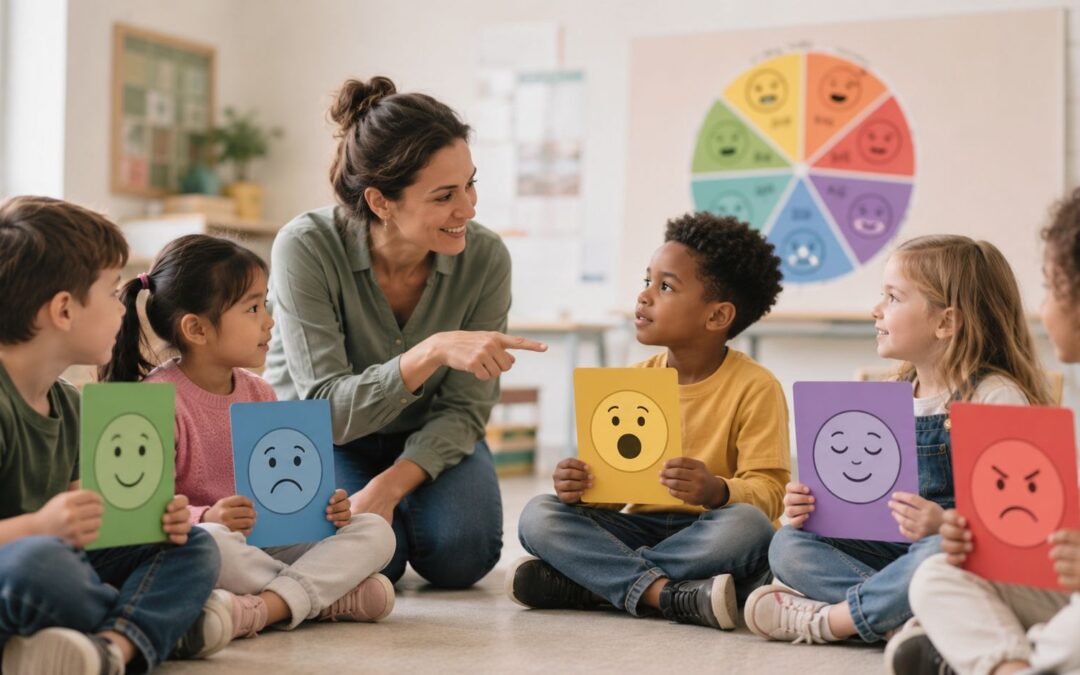
Start the day with a feelings word wall. Add familiar words such as happy, sad, mad, scared, and calm, then introduce more precise choices such as disappointed, worried, proud, lonely, or frustrated. During morning meeting, children can point to a word, gesture toward it, or describe a body cue.
The aim is recognition and expression, not public disclosure. A child might say, “I feel wiggly,” or place a private card near a check-in board. The teacher can model, “I'm frustrated because the materials aren't ready, so I'm going to take one slow breath and begin with what I have.” That example connects a feeling with its cause and a manageable response.
A classroom calm-down corner works best as a place to practice regulation, not as punishment. Include a feelings chart, breathing prompt, paper for drawing, and a short menu of choices. After the child settles, ask, “What did your body notice? What happened? What could help you rejoin?” At home, caregivers can use the same sequence after a sibling dispute: name the feeling, explore the cause, and offer a limited choice of next steps.
Upper elementary
In grades three through five, teachers can model sentence stems during real classroom friction:
“I felt ___ when ___ happened.” This links emotion to context.
“I'm guessing you might feel ___, is that close?” This practices empathy without claiming to know another person's mind.
“I need ___ so I can ___.” This turns a feeling into a constructive request.
“I'm ready to talk, but I need a short pause first.” This makes regulation visible.
A family dinnertime check-in can use a feelings wheel. Each person chooses a word and shares a cause, body signal, or coping response. A caregiver might say, “I felt relieved when the appointment ended because I had been worried.” The adult is teaching understanding, while allowing children to decide how much they want to share.
Teachers who need a simple record of patterns can pair student reflections with an online behavior tracking solution. Keep notes focused on observable behaviors and support needs, not labels or assumptions.
Middle school
For grades six through eight, use role-play in both directions. One student practices saying, “When the slides changed without telling me, I felt unprepared. Next time, can we check the plan together?” The partner responds, “I hear that the change affected you. I was trying to help, but I should have asked first.” Students then switch roles so the exercise does not frame one person as the problem.
This rehearses expression, perspective-taking, and repair in language students can use during group work, friendship conflict, or a family disagreement.
At home, create a family contract for tech-driven emotional moments. It might include pausing before replying to an insulting message, asking for clarification when tone is unclear, avoiding forwarded screenshots during conflict, and moving a heated exchange to face-to-face conversation or a voice call. The contract teaches digital context-awareness and regulation without treating devices as the enemy. Age-adaptable ideas are available in these emotional awareness activities for children and students.
Lesson Ideas Assessment Tips and School Implementation
A teacher can begin on Monday without creating a new course. Choose one feeling skill, teach it directly, and look for evidence of use during ordinary routines.
Three lessons ready for Monday
Feelings vocabulary with picture cards: Show facial expressions, body positions, and brief situations. Students sort the cards by possible feeling, explain their reasoning, and add a more precise word when “mad” or “sad” isn't enough. This primarily teaches recognition and understanding.
Empathy mapping with a short story: Draw four boxes labeled “What might the character notice,” “What might the character think,” “What might the character feel,” and “What might the character need.” Emphasize that students are making informed guesses, not stating facts about another person's inner life. This builds social awareness and perspective-taking.
Problem-solving circle: Use a recurring playground conflict. Each participant describes what happened without insults, names an emotion and need, listens to another viewpoint, and proposes a repair. The group chooses a next step that protects safety and belonging. This practices expression, regulation, and repair.
Assessment can stay low stakes. Teachers might notice whether students use a wider range of feeling words, explain causes more clearly, recover faster after upset, or seek help before behavior escalates. Track patterns over time through brief anecdotal notes, student reflections, or class discussions rather than reducing a complex skill to a single score.
Look for movement, not perfection: Progress may sound like “I'm still angry, but I can talk now,” or “I thought you ignored me, but I'll ask before assuming.”
Schools should embed practice in existing structures. Morning meetings, advisory, read-aloud discussions, recess reflection, restorative conversations, and family communication can carry the work without adding another block. Paraprofessionals, recess supervisors, counselors, and office staff also need the shared language because students practice emotional literacy across the campus, not only with their classroom teacher.
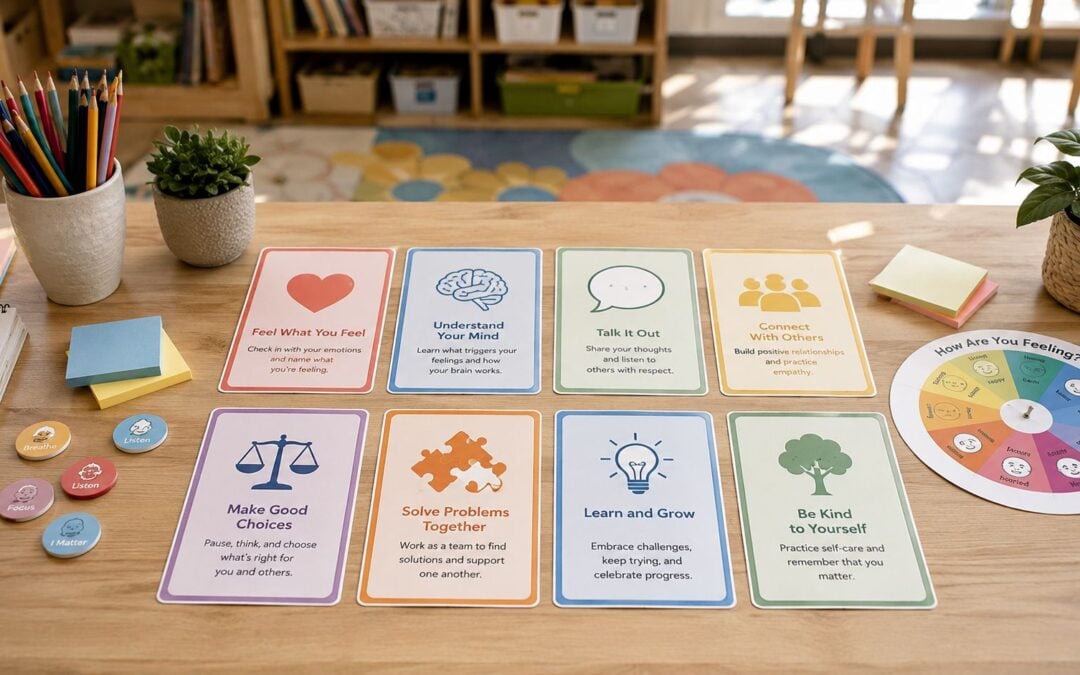
Send home feeling-word cards and short newsletters with one sentence stem or regulation strategy. Families don't need a full curriculum to reinforce the work. They need to hear the same language and know that adults value both emotional honesty and responsible action.
A short demonstration can help staff visualize the teaching move before they try it:
Common Misconceptions and the Digital Era
Myth: Feelings should stay outside the classroom. Students bring emotions with them, whether adults name them or not. A child who feels embarrassed may avoid work, provoke peers, or shut down. A brief check-in can make the feeling discussable before it controls the lesson.
Myth: Emotional talk is soft or off-task. Emotional literacy supports the behaviors that make learning possible. Students need language for frustration during challenging work, disappointment after feedback, and uncertainty during collaboration.
Myth: Children will outgrow emotional struggles. Development changes what students can understand, but it doesn't automatically provide the vocabulary or regulation strategies they need. Adults still have to model, prompt, and practice.
Myth: Children absorb these skills socially without explicit teaching. Some children pick up emotional language through conversation and supportive relationships. Others need direct instruction, repeated rehearsal, and adults who make invisible processes visible.
Digital emotional literacy
Online communication removes many cues children use in person. A short text can sound angry, playful, dismissive, or rushed depending on the reader. Students also face the permanence of screenshots, rapid emotional spread through group chats, social comparison, cyberbullying, and communication shaped by platforms or AI.
Digital emotional literacy applies the same four abilities to those conditions:
Recognize: Notice your reaction to a message and identify what cues are present.
Understand: Consider alternative explanations for ambiguous wording and the possible impact of forwarding or posting.
Express: Ask for clarification, state concern, and choose a channel that fits the problem.
Regulate: Pause before replying, step away from the device, and avoid escalating a public exchange.
Schools can establish device-free emotion check-in moments so students practice reading their own signals without a screen competing for attention. Teachers can also model interpretation: “That message felt harsh to you. What do we know for certain, what are we assuming, and what could we ask before responding?”
Emotional literacy begins with four teachable abilities, recognize, understand, express, and regulate. The evidence supports explicit, sequenced practice connected to classroom climate, relationships, behavior, and learning. The smallest first step is simple: choose one feeling word, model one sentence, and invite students or family members to use it during a real moment this week.
Soul Shoppe offers research-based SEL programs, workshops, and coaching that give school communities shared language for self-regulation, communication, empathy, and conflict resolution. Visit Soul Shoppe to explore tools that can help students and grownups practice emotional literacy at school and at home.
A third-grade class is spread across the blacktop, searching for shapes that match a geometry card. Nearby, a kindergarten group sits beneath an oak tree, passing around a pinecone and describing its texture. At the garden beds, fifth graders measure soil, compare plant growth, and argue cheerfully about which row needs more water. These moments look ordinary, but they carry more educational weight than a simple break from class.
Outdoor learning means any structured academic, social, or reflective experience outside the classroom walls. It can happen in a schoolyard, courtyard, neighborhood, garden, nature area, or local park. The setting changes, but the purpose remains clear: students use movement, observation, conversation, and real materials to understand ideas and practice skills.
K–8 students are especially ready for this approach. They're curious, sensory-driven, and still learning through their bodies as much as through explanations. A lesson outside can give a child who struggles with a worksheet another way to count, describe, collaborate, or demonstrate understanding.
The strongest outdoor learning benefits aren't limited to one subject. Research connects well-designed outdoor experiences with engagement, ownership of learning, social development, self-concept, wellbeing, and physical activity. Academic improvement appears in some settings, but the most consistent gains often involve attention, regulation, cooperation, and meaningful participation.
The practical question for educators isn't whether every lesson should move outdoors. It's how to design outdoor experiences that are accessible, purposeful, repeatable, and connected to curriculum and social-emotional learning. The examples below pair research evidence with activities a teacher or caregiver can run with minimal preparation.
Why Outdoor Learning Matters for K–8 Students
The blacktop math hunt works because students aren't only hearing about shapes. They're finding rectangles in fences, counting angles in playground equipment, and explaining their reasoning to a partner. The kindergarten circle works because the oak tree gives children a shared object of attention, while the fifth-grade garden task turns measurement into a decision with visible consequences.
These activities also change the social rhythm of the school day. Students move between stations, negotiate materials, ask questions that arise naturally, and see classmates contribute in different ways. A child who rarely speaks during whole-group instruction may become the careful observer who notices a bird nest, identifies a pattern, or helps a partner balance a structure.
Outdoor learning is more than recess
Recess gives students valuable unstructured time, but outdoor learning adds an intentional objective. A teacher might ask students to record evidence of erosion, write sensory descriptions, compare perimeter measurements, or practice a conflict-resolution routine during a team challenge. The lesson can be playful, but it still has a learning target and a way to notice progress.
That distinction matters for families, too. A neighborhood walk can become an informal science lesson when a child tracks cloud changes, a language lesson when they create a story from observed details, or a self-management exercise when they pause to identify sounds and body sensations.
A 2022 systematic review of learning in natural outdoor settings found consistent benefits across several domains, including increased engagement and ownership of learning, stronger social and collaborative skills, and improved self-concept, with some evidence of academic improvement in the review of outdoor learning research. The review treats outdoor learning as an educational strategy, not just recreation.
A multidimensional case for K–8 schools
Outdoor experiences can support reading, science, math, physical development, and SEL at the same time. Students may read a field guide, estimate the height of a tree, cooperate on a shelter design, and reflect on frustration during one carefully planned activity.
That range makes outdoor learning especially useful when schools want to strengthen the whole child without creating a separate program for every need. It also raises an important equity question: who has safe, welcoming access to nature outside school, and who depends on school to provide it?
The most effective plans treat outdoor learning as part of the school's instructional design. They make room for access needs, define clear supervision routines, and give teachers practical activities that can be repeated rather than relying on occasional field trips.
What the Research Says About Outdoor Learning Benefits
The research is encouraging, but it's more precise than the phrase “nature helps children learn.” Evidence points to several outcome areas, and the strength of the result depends on the program's design, duration, learner age, and intended outcome.
Academic outcomes need context
A historical review of environmental education in California reported that secondary students from 11 Californian schools who participated in outdoor environmental learning scored higher in 72% of academic assessments, including reading, science, math, attendance rates, and grade-point averages, than students from traditional schools in the reviewed outdoor-learning evidence. That finding is important, but it shouldn't be treated as a promise that every outdoor lesson will produce broad academic gains.
Outdoor instruction can make academic content more concrete. Students can measure actual garden beds, use descriptive language for changing weather, or read informational text before checking evidence outside. Research summarized in school-learning reviews also reports that one outdoor-learning intervention left children more focused and on-task during later indoor lessons, with almost half the number of teacher redirects in this evidence review of outdoor learning.
Social, emotional, physical, and cognitive outcomes
The wider evidence base includes social cooperation, confidence, wellbeing, environmental awareness, physical skills, cognitive skills, and risk-management skills. A review of Forest School research identified gains across seven major outcome areas, showing why schools shouldn't judge outdoor learning only by test performance through the systematic review of Forest School research.
A separate review found that children's time outdoors is consistently linked to higher physical activity and better cardiorespiratory fitness, while more time outside is associated with lower sedentary behavior in the review of children's outdoor time. Recent evidence also emphasizes stress reduction, attention, self-regulation, sleep, physical activity, and cognition as especially credible areas of benefit in the review of nature exposure and outdoor activity.
Domain
Reported outcome
Typical magnitude
Academic
Higher performance across 72% of assessments in the cited California review
Broad but context-dependent
Engagement
Greater engagement and ownership of learning
Consistent qualitative and measurable benefits
Social-emotional
Stronger cooperation, confidence, self-concept, and wellbeing
Multidimensional gains
Attention
Fewer teacher redirects after one outdoor-learning intervention
Almost half the number of redirects
Physical
More physical activity and less sedentary behavior with more outdoor time
Consistent association
Forest School
Gains across seven outcome areas
Benefits vary by design and learner
For educators exploring the field, resources on starting environmental education programs can help translate broad principles into school-based planning. Teachers should still read results carefully. Self-selected participants, short intervention windows, inconsistent definitions of outdoor learning, and differences in age or baseline need can limit how confidently one program's result transfers to another school. A 2022 systematic review and a later mixed-methods synthesis both point toward structured, repeated, nature-specific experiences rather than one-off outdoor lessons as the more credible path to sustained benefits in the systematic review of outdoor learning. For additional SEL research framing, educators can consult Soul Shoppe's research resources.
Social-Emotional Growth in Outdoor Settings
Outdoor settings give children real social problems to solve. They must decide who carries the bucket, how a group crosses a muddy patch, whether a structure is stable, or what to do when two students want the same materials. Those moments create practice opportunities that a teacher can observe and coach in real time.
Three features make this setting especially useful for SEL: sensory richness, physical movement, and informal peer interaction.
Novelty can reset attention
A change in surroundings gives students new details to notice. The sound of traffic, the texture of bark, the movement of clouds, or the pattern of shadows can help children shift attention away from a difficult indoor routine. In CASEL-aligned terms, this supports self-awareness and self-management, because students can notice their internal state and choose a response.
A teacher might see a student pause before grabbing a material, name that they're frustrated, and ask for a turn without prompting. That self-correction is more useful than a quiet line held together only by adult reminders.
Movement supports regulation
Walking, carrying, balancing, digging, and stretching give students appropriate ways to use physical energy. Movement doesn't solve every behavior challenge, but it can help children return to a calmer state before discussion or written work.
Use a simple regulation cue: “Notice your feet, slow your breathing, and choose your next safe step.” This connects body awareness to self-management without turning the activity into a lecture.
Peer interaction builds belonging
Outdoor tasks often create informal groupings based on interest or role. One student may observe, another may build, and another may record. These flexible roles can interrupt fixed classroom hierarchies and give quieter students a meaningful way to contribute.
The teacher's job is to name the skill, not dominate the interaction. Ask, “How did your group decide?” or “What helped both people get heard?” Those questions connect the experience to relationship skills, social awareness, and responsible decision-making. Activities focused on empathy and listening can also draw from these empathy-building activities.
Conflict resolution becomes concrete outdoors. When students disagree over space or materials, guide them to describe the problem, hear each perspective, generate options, and test a fair solution. Over time, teachers may notice more equitable turn-taking and faster de-escalation because students have rehearsed those moves repeatedly.
Practical rule: Don't remove every manageable disagreement. Coach students through safe, respectful problem-solving so the outdoor setting becomes a rehearsal space for community life.
Equity and Access Considerations
Outdoor learning can widen opportunity, but only when schools design for students who face the greatest barriers. A child with a large yard, reliable transportation, and outdoor clothing may already receive nature exposure outside school. Another child may depend on the schoolyard for every safe chance to explore plants, weather, movement, and open space.
Urban schools may have limited green areas, but they can still use courtyards, sidewalks, rooftops where permitted, shaded blacktops, community gardens, and neighborhood walks. The educational value comes from purposeful observation and participation, not from having a forest on campus.
Accessibility must be planned before the activity is announced. Students with mobility disabilities may need firm, navigable pathways, reachable materials, and roles that don't depend on uneven terrain. Students with sensory sensitivities may need quiet zones, advance notice about textures or sounds, flexible clothing, and the option to observe before joining.
Weather and health needs also shape participation. Schools should provide shade, water, weather gear, sunscreen routines aligned with family and school policies, and allergy-aware plant choices. Families without transportation shouldn't be excluded from meaningful off-campus experiences, so bus-supported trips and partnerships with local parks can matter.
Barrier
Who it affects
School planning response
Limited green space
Students in dense urban areas
Use courtyards, gardens, sidewalks, and schoolyard investigations
Uneven terrain
Students with mobility disabilities
Provide accessible pathways, reachable materials, and alternative roles
Weather exposure
Students sensitive to heat, cold, rain, or sun
Plan shade, water, gear, indoor alternatives, and clear weather rules
Allergens
Students with allergies or respiratory needs
Select plants carefully, review health plans, and offer low-trigger locations
Missing clothing or equipment
Families with limited resources
Maintain shared weather gear, spare clothing, and washable materials
Transportation limits
Students unable to reach parks independently
Use school buses, nearby sites, and community partnerships
The 72% academic-assessment finding from the California review should not lead schools to assume all students receive the same benefit. Access, program quality, baseline need, and duration influence outcomes. Equity is a design question: who can enter the activity, who can participate fully, and whose knowledge gets recognized?
Sample Outdoor Activities Tied to SEL Objectives
The best activities are short enough to repeat and open-ended enough to reveal student thinking. A clipboard, chalk, natural materials, and a clear prompt can support meaningful work in a schoolyard or courtyard.
Sound Mapping
Grade band: K–8 Materials: Paper, pencils, clipboards SEL objective: Self-awareness How to run it: Students sit or stand safely in one place and mark sounds with symbols or words. Younger children can draw; older students can distinguish near and far sounds or describe how each sound affects their body.
Facilitation prompt: “What did you notice first, and what changed when you paid closer attention?” Debrief: “Which sound helped you feel settled, and which one made it harder to focus?”
This activity works well before reading or independent writing because it gives students a quiet transition into attention.
Nature Trust Walk
Grade band: K–5, adapted for older students Materials: Cones or a clearly marked path SEL objective: Relationship skills How to run it: Pair students. One partner gives verbal directions along a simple, accessible route while the other walks with eyes open and focuses on listening. Switch roles, then discuss how the directions felt.
Facilitation prompt: “What made the instructions clear and respectful?” Debrief: “How did your partner show that they were listening?”
Keep the route familiar and never require blindfolds. The goal is communication, not discomfort.
Weather Problem-Solving Stations
Grade band: K–8 Materials: Weather cards, chart paper, simple observation tools SEL objective: Responsible decision-making How to run it: Groups rotate through prompts such as choosing clothing for conditions, protecting a paper structure from wind, or deciding whether a planned activity needs modification.
Facilitation prompt: “What evidence supports your choice?” Debrief: “What would you change after seeing the result?”
This links science reasoning with practical judgment. Families can use the same routine before a walk or outdoor play.
Group Habitat Build
Grade band: K–8 Materials: Sticks, leaves, cardboard, string, or reusable blocks SEL objective: Teamwork and social awareness How to run it: Groups design a shelter or habitat for a fictional small animal. Assign rotating roles, but let students negotiate details.
Facilitation prompt: “Whose idea haven't we tested yet?” Debrief: “How did your group respond when the first plan didn't work?”
For more sensory-based variations, teachers and caregivers can adapt ideas from this five-senses activity resource. Families seeking structured movement opportunities beyond school can also explore a summer camp for active kids as one possible community option.
Reflection Circle
Grade band: K–8 Materials: A designated sitting spot and optional reflection cards SEL objective: Self-management How to run it: Students sit in a circle and complete one sentence: “I noticed,” “I contributed,” “I found difficult,” or “Next time I will.” Passing is allowed.
Facilitation prompt: “What choice helped you stay engaged?” Debrief: “What will you carry into the next classroom activity?”
The circle turns an outdoor experience into transferable learning rather than leaving the SEL lesson implicit.
Implementation Tips for Schools and Classrooms
Sustainable outdoor learning depends less on elaborate spaces than on dependable routines. Teachers are more likely to use the schoolyard when they know when they're going, what students will do, how safety will work, and where materials are stored.
Build a repeatable schedule
Start with short outdoor blocks connected to existing lessons. A class might take vocabulary outside for observation writing, move a math rotation to the blacktop, or use a garden bed during a science unit. The visual implementation guide suggests integrating 20–30 minute outdoor blocks across morning, midday, and afternoon routines [in the implementation infographic below].
Create a shared calendar so classes don't compete for the same area. Store clipboards, chalk, magnifiers, measuring tools, and weather gear in labeled bins near the exit. Chalk circles, tree-shaded benches, and movable tubs can turn an ordinary yard into a set of learning zones without major construction.
Agree on safety before the first lesson
Staff should define simple rules for rain, temperature, air quality, lightning, supervision, allergies, water, sunscreen, and clothing. Permission slips should explain the regular routine, while individual health plans guide specific accommodations.
Paraprofessionals can serve as outdoor co-teachers when they receive activity guides, communication prompts, and safety protocols. A short staff meeting can establish:
Purpose: Identify the curriculum and SEL objective.
Place: Select an accessible area and a backup location.
People: Assign supervision zones and support roles.
Materials: Prepare one labeled bin per activity.
Health: Confirm water, medication, allergy, and weather procedures.
Evidence: Decide what teachers will observe or collect.
Extend lessons instead of doubling preparation
Take the same anchor text outdoors and ask students to find evidence in the environment. Use the same math vocabulary while measuring real objects. Bring indoor writing prompts outside, then return for drafting and revision.
Parent volunteers can support observation stations, material management, or garden care when school policies allow. Local parks, libraries, and environmental organizations may offer locations or expertise. These partnerships expand capacity, but schools should keep the learning target and access expectations under school control.
Outdoor learning becomes sustainable when it feels like a familiar teaching move, not a special event that requires a new plan from scratch.
Measuring Impact and Bringing It All Together
Administrators don't need a complicated research project to determine whether outdoor learning is helping. They need a small set of shared measures, a baseline, and a regular review cycle that combines numbers with what teachers and students report.
Choose measures across academic participation, SEL, and physical experience. Track enough to notice patterns, but not so much that teachers spend the lesson recording data instead of teaching.
Metric
Domain
Data source
Cadence
Outdoor lesson attendance
Access and participation
Attendance records
Reviewed regularly
Time-on-task observations
Engagement
Walkthrough form
During selected lessons
Formative assessment changes
Academic learning
Existing grade-level checks
At baseline and review points
Self-regulation rubric
SEL
Teacher observation
Repeated classroom cycle
Peer-conflict referrals
SEL and belonging
Referral or behavior records
Reviewed regularly
Outdoor minutes
Physical access
Class or school log
Weekly
Student reflection themes
Wellbeing and voice
Journals or exit slips
After selected activities
A useful process begins with a baseline using tools the school already has. Record current outdoor participation, observe attention during a familiar lesson, review existing formative data, and ask teachers to tally how often students attempt a conflict-resolution strategy outdoors.
After a 90-day implementation period, repeat the same measures using a practical outcome-measurement approach. The purpose isn't to claim that outdoor learning caused every change. It's to compare patterns, identify which activities students access, and determine whether particular learners need different supports.
A one-page dashboard can include a few numbers, two student reflection themes, a teacher observation, and an access note. For example, leaders might see that students participate regularly but need more shade, or that group builds create strong collaboration while weather stations produce richer academic discussion.
Return to the blacktop math hunt. Its value isn't that every child will suddenly master geometry. Its value is that students can move, notice, explain, cooperate, and receive feedback in a setting that makes learning visible. With honest measurement and thoughtful design, outdoor learning becomes a practical equity lever that strengthens academic participation, regulation, belonging, and the daily K–8 experience.
Soul Shoppe helps schools build the connection, safety, empathy, and conflict-resolution skills that make outdoor learning more inclusive and productive. Visit Soul Shoppe to explore interactive SEL programs, workshops, coaching, and practical tools for students, educators, and families.
A child slams a book shut, walks away from a group, or suddenly refuses to talk. At home, a caregiver asks what happened and hears, “I don't know,” followed by tears, silence, or another burst of anger. The child may not yet have the language to explain the experience, but the feeling is still communicating something.
Emotional awareness means more than choosing happy or angry from a chart. Children gradually learn to notice feelings, recognize body signals, identify triggers, sense intensity, understand possible needs, and consider what to do next. Those skills support self-awareness, self-management, social awareness, relationship skills, and responsible decision-making.
The eight emotional awareness activities below move from simple noticing and naming toward empathy and personalized regulation plans. Each one includes an objective, materials, steps, reflection prompts, developmental adaptations for K–2, 3–5, and 6–8, an exit ticket, and an implementation tip.
Introduce every activity during a calm moment. Model the skill yourself, offer choices, protect privacy, and never require a child to disclose personal experiences publicly. Soul Shoppe's shared language and practical SEL approach can also help schools use consistent tools across classrooms, counseling spaces, and homes.
1. Emotion Check-In Circles
A check-in circle gives children a brief, predictable way to notice and name their current state. Students might choose a color, weather pattern, animal, or feeling word. The point isn't to produce a perfect explanation. It's to make emotional awareness visible and give adults a gentle opportunity to notice who may need support.
Try it in the classroom or at home
Gather students in a circle with emotion cards, a color wheel, or a simple weather display. Ask each child to choose one option and share a sentence if they wish. A third-grade teacher might ask students to point to a color matching their Monday mood and explain their choice. At dinner, a parent could ask, “Was your day sunny, cloudy, rainy, or stormy?”
An adolescent counselor might use animal check-ins. A student who chooses a turtle may be signaling low energy or a wish for space, while another who chooses a hummingbird may feel restless. The metaphor makes participation less threatening without forcing students to use unfamiliar emotion vocabulary.
For younger children, begin with colors or pictures. Older students can name a more precise feeling, such as disappointed, relieved, guarded, or hopeful.
Practical rule: A student may pass without judgment. Participation should build safety, not become a public test of openness.
Use a consistent time, keep responses brief, and model authentic but appropriate vulnerability. The adult might say, “I'm feeling stretched today, so I'm going to take a slow breath before we begin.” For more ideas on making this routine consistent, explore these daily student check-in and mood meter tools.
Materials: Emotion cards, a color wheel, weather images, or animal cards.
Reflection prompts: “What helped you choose that feeling?” “Does the feeling seem small, medium, or strong?” “What might help you participate today?”
Adaptations: K–2 students can point or draw. Grades 3–5 can add a reason. Grades 6–8 can choose a metaphor and name what support would help.
Exit ticket: “Today I feel ___, and I may need ___.”
Implementation tip: Track patterns privately, never as labels. A repeated choice may invite a quiet check-in with a counselor or caregiver, but it isn't a diagnosis.
2. Emotion Sorting and Classification Games
Children often know that they feel “bad” before they can distinguish frustrated from angry or nervous from excited. Sorting games turn abstract emotional concepts into cards, pictures, movements, and conversations. Students compare feelings, notice differences in intensity, and develop language they can use during real problems.
Make emotional vocabulary concrete
Prepare cards showing basic emotions, facial expressions, body postures, and everyday situations. A kindergarten group might sort a picture of receiving a puppy into a happy bucket and a picture of a friend moving away into a sad bucket. A third-grade class can place “a little annoyed” and “extremely furious” along a continuum, then discuss what makes the experiences different.
For older students, use more nuanced situations. A fifth grader might consider whether a character feels embarrassment, shame, or self-consciousness after making a mistake in front of peers. The discussion matters more than choosing one supposedly correct answer. Several emotions may fit the same event, depending on the person's interpretation and history.
Build the class language together
Create an emotion vocabulary wall that grows throughout the year. Add synonyms, body clues, related needs, and possible responses. Students might connect frustrated with “stuck,” “tight hands,” and “a need for help,” while connecting relieved with “loose shoulders,” “a deep breath,” and “a need to rest.”
Use visual support: Pair each word with faces, drawings, gestures, or color.
Use familiar situations: Include recess conflicts, homework, sibling arguments, transitions, tests, and celebrations.
Ask comparison questions: “How is worried different from scared?” “Can someone feel excited and nervous together?”
Link names to action: After identifying a feeling, ask what could help the learner make a safe next choice.
Materials: Emotion cards, situation cards, chart paper, sticky notes, or a digital sorting tool.
Reflection prompts: “Which two feelings were hardest to separate?” “Can one situation create different feelings for different people?”
Adaptations: K–2 students can sort three or four basic emotions. Grades 3–5 can use intensity lines and feeling families. Grades 6–8 can analyze mixed emotions, assumptions, and context.
Exit ticket: “One new word for a feeling I know is ___.”
Implementation tip: Revisit the same vocabulary during conflict repair, literature discussions, and writing. Words become useful when adults use them outside the activity.
3. Body Awareness and Emotion Mapping
A child may notice a tight jaw, hot cheeks, shaky hands, a fast heartbeat, or a heavy stomach before identifying the emotion attached to those sensations. Body mapping helps students recognize these early signals. That awareness can create a pause before a feeling becomes overwhelming.
Map sensations without declaring one correct answer
Give students a body outline and colored pencils. Ask them to mark where they notice happiness, worry, anger, calm, or sadness. A first-grade student might color the heart yellow for happiness and the fists red for anger. A third grader could use a feelings thermometer and record what anxiety feels like at different intensity levels.
A sixth-grade counselor might guide a quiet scan from head to toe. Students notice whether their shoulders are raised, their stomach feels tight, or their breathing has changed. They can keep discoveries private or share only a general observation.
Body signals vary. One student may feel anger in the jaw, while another feels it in the chest or legs. Avoid telling children what they “should” feel.
“Your body may give you information, but you're the person who decides what the signal means.”
Materials: Body outline sheets, large poster paper, colored pencils, emotion thermometers, and optional quiet music.
Steps: Name one emotion, invite students to notice sensations, mark the body, and connect the signal to an early warning sign. Then pair the sign with a choice, such as breathing, stretching, movement, water, or asking for space.
Reflection prompts: “What do you notice first?” “What changes when the feeling gets stronger?” “Which response feels comfortable and safe?”
Adaptations: K–2 students can use colors and simple body words. Grades 3–5 can record intensity and early signals. Grades 6–8 can compare sensations across emotions and situations.
Exit ticket: “When I notice ___ in my body, I can try ___.”
Implementation tip: Practice during calm periods. Children may not be able to learn a body scan while already flooded. Offer a drawing or written alternative to students who don't want to lie down, close their eyes, or engage in movement.
4. Mindfulness and Breathing Practices for Emotional Awareness
Mindfulness gives children a way to notice thoughts, feelings, sounds, and body sensations without immediately reacting. Breathing and grounding practices are especially useful because students can carry them into a test, hallway conflict, family argument, or crowded cafeteria.
School-based mindfulness and cognitive-behavioral programs have been associated with improvements in emotional awareness and positive emotions, along with reductions in depression in children aged 7–12, according to a 2023 systematic review and meta-analysis. The practical lesson is simple: keep the practice brief, repeat it, and let students choose an approach that feels safe.
Offer several ways to pause
A kindergarten teacher can lead “bubble breaths.” Students pretend to blow one large bubble, inhaling gently and exhaling slowly. A fourth-grade class might use grounding by naming five things they see, four they can touch, three they hear, two they smell, and one they taste.
A sixth grader could use a guided breathing app before a test, then rate the emotion before and after practice. The rating isn't a grade and doesn't need to reach zero. Students are learning that they can notice an emotion and choose a response.
Materials: A timer, breathing cards, sensory objects, a feelings scale, or a guided audio resource.
Reflection prompts: “What did you notice before and after?” “Which anchor helped you stay present?” “Would you choose breathing, movement, sound, or an object next time?”
Adaptations: K–2 students can use pretend bubbles or stuffed animals that rise and fall with breathing. Grades 3–5 can practice grounding and belly breathing. Grades 6–8 can compare techniques and decide when each fits.
Exit ticket: “When I feel overwhelmed, I can pause by ___.”
Implementation tip: Don't use mindfulness as forced compliance or as a substitute for addressing unsafe conditions. A child may keep eyes open, move, draw, or use sound instead. These breathing techniques for kids can support a wider menu of choices. Adults can also improve productivity with mindfulness by modeling the same pause instead of demanding calm from children.
5. Emotion Charades and Role-Playing
Some children understand emotions more easily through movement than through writing or extended discussion. Charades lets them observe facial expressions, posture, gestures, pace, and personal space. Role-play adds perspective-taking, so students can explore what different people might feel in the same situation.
Start with a low-pressure guessing game. A second-grade student acts out excited, scared, sad, or angry while classmates identify clues. Ask, “What did you notice in the face?” and “How did the body move?” Remind students that these are clues, not universal rules. Not every sad person cries, and not every excited person moves loudly.
Move from performance to perspective
A fourth-grade class might role-play a recess conflict in which one student is excluded. Students act out the scene from different perspectives, then discuss possible feelings, needs, and repair choices. A sixth-grade counselor can use frozen “emotion sculptures” for disappointment, pressure, pride, or uncertainty.
Set boundaries before the activity begins. No student should mock another child's expression, imitate trauma, or be forced into a role. Give everyone a pass option and allow students to observe, narrate, draw, or work with a partner.
Materials: Emotion cards, short scenario cards, open floor space, and optional props.
Reflection prompts: “What clues did you notice?” “Could the same face mean something different?” “What might each person need next?”
Adaptations: K–2 students can use single emotions and whole-group acting. Grades 3–5 can explore friendship problems and repair language. Grades 6–8 can role-play peer pressure, test anxiety, disappointment, and misunderstandings.
Exit ticket: “One clue I noticed was ___, but I also know I should ask rather than assume.”
Implementation tip: Process every scenario. The discussion after the acting develops awareness more reliably than the performance itself.
6. Emotion Story-Sharing and Narrative Activities
Stories give children emotional distance. They can examine a character's fear, loneliness, jealousy, courage, or pride without having to reveal a personal experience. From that safe distance, students learn to identify emotions, consider motivations, predict responses, and connect feelings with choices.
Read aloud and pause for think-aloud modeling. In a first-grade classroom, a teacher might read The Feelings Book by Todd Parr and ask how a character feels, whether students have felt that way, and what might help. A third-grade class reading Chrysanthemum can track how the character moves from pride to hurt and back toward belonging.
Let students create the meaning
Avoid asking for one approved interpretation. Ask, “What makes you think the character feels that way?” and “What else could be happening?” A character may appear angry while also feeling embarrassed or afraid. This helps students understand that emotions can overlap and that behavior doesn't tell the whole story.
A fifth grader might write “The Time I Felt Brave,” describing nervousness before an event, body sensations during it, and what changed afterward. Sharing can be private, partner-based, drawn, recorded, or offered to a trusted adult.
Materials: Picture books, chapter excerpts, storyboards, drawing supplies, or a recording tool.
Reflection prompts: “What changed the character's feeling?” “What did the character need?” “What might you do in that situation?”
Adaptations: K–2 students can draw a face and dictate a sentence. Grades 3–5 can sequence emotional changes. Grades 6–8 can examine perspective, assumptions, identity, and consequences.
Exit ticket: “The character felt ___ because ___. A helpful next step might be ___.”
Implementation tip: Preview books and scenarios for grief, bullying, family separation, violence, or other potentially activating content. Offer a warning, an alternative text, and access to a trusted adult when needed.
7. Feelings Journals and Emotion Tracking
Private reflection helps children notice patterns that disappear during a busy day. A journal can contain words, drawings, symbols, audio, or a mixture of formats. Students may record the feeling, situation, body signal, intensity, response, and what happened afterward.
A second grader might use a color-coded chart and discover that frustration appears often during transitions. A caregiver could offer an anxious fourth grader a worry journal for drawing or writing before bed. A sixth grader who dislikes handwriting might record voice memos instead.
Protect privacy while building insight
Explain exactly what adults will and won't read. A journal should not become hidden surveillance, but adults also need a clear safety plan if a child discloses risk of harm. Share the boundary before students begin, and invite them to mark entries they want to discuss.
Use open prompts instead of yes-or-no questions:
Name the feeling: “Today I felt ___.”
Trace the trigger: “This started when ___.”
Notice the body: “I felt it in my ___.”
Identify support: “What helped, or what might help next time?”
Look for change: “The feeling was different later because ___.”
For K–2, combine drawings with simple words and teacher scribing. Grades 3–5 can use sentence starters and pattern charts. Grades 6–8 can compare triggers, interpretations, strategies, and outcomes while keeping the work confidential.
Materials: Notebooks, feelings charts, colored pencils, tablets, or a voice recorder.
Reflection prompts: “What pattern do you notice?” “Which response helped even a little?” “What would you like an adult to understand?”
8. Emotion Regulation Strategy Planning and Personal Toolkits
Awareness becomes more useful when children connect it to a chosen action. After a student can recognize a feeling and its early signals, they can build a personal plan for what to try next. The plan shouldn't promise that a strategy will erase an emotion. It gives the child options, agency, and a route back toward safety and participation.
A second grader might create a calm-down kit with a stress ball, breathing card, picture of a happy memory, and encouraging note. A fourth grader and parent could make a “When I'm Angry” card with choices such as breathing, counting, going outside, or talking with Dad. A sixth grader might create a digital plan with separate choices for anxiety, sadness, and frustration.
Match strategies to the child
Ask students which tools feel helpful, tolerable, and available. One child may prefer movement, another quiet, another music, another conversation. Include social supports and environmental changes, not only individual coping tools.
Materials: Index cards, sensory objects, drawing supplies, headphones, movement menus, and a list of trusted adults.
Steps: Identify the emotion, name the body signal, choose several possible strategies, practice them while calm, and record what happened. Include a plan for seeking adult help when the feeling stays intense or safety is at risk.
Adaptations: K–2 students can choose from picture cards. Grades 3–5 can match strategies to feelings and settings. Grades 6–8 can create situation-specific plans for class, home, sports, friendships, and online interactions.
Reflection prompts: “What do you notice first?” “Which option fits this setting?” “When should you ask an adult to help?”
Exit ticket: “When I notice ___, I'll try ___, then ask ___ if I still need support.”
Implementation tip: Children should choose and test strategies rather than receive a fixed prescription. Review plans regularly. A strategy that worked for a younger student may need adjustment as the child's needs and environments change.
Individualized interventions, students building independent regulation
Empowers agency, bridges awareness to action, personalized and portable
Turn Emotional Awareness Into a Shared Daily Practice
You don't need to introduce all eight activities at once. Begin with one routine that feels predictable and manageable, such as a morning color check-in or a private feelings card. Once students understand that the routine is brief, optional in its level of disclosure, and followed by respectful adult attention, add one body-awareness or regulation practice.
A useful progression is to ask three questions: “What am I feeling?” “What do I notice in my body?” and “What could I try next?” These questions connect identification to action. They also help adults avoid stopping at an emotion label when a child needs support with a transition, conflict, sensory overload, academic frustration, or loneliness.
Use the same language across settings whenever possible. A school might call the first signs of escalation “body clues,” while a family uses “warning signals.” Those phrases don't need to match perfectly, but shared concepts help children carry skills from the classroom to the playground, bus, home, and community.
Offer private alternatives. A child may point to a card, write a response, draw, use a digital form, speak with a trusted adult, or pass. Children with different verbal abilities, cultural communication styles, sensory needs, and experiences of stress won't all show awareness in the same way. A quiet student may be engaged even without speaking in a circle.
Notice patterns without turning them into identities. “You often choose worried” invites curiosity. “You're an anxious child” can make a temporary experience feel permanent.
Track participation and learning with light-touch checks. Ask students to name a feeling and body signal, match a scenario to more than one possible emotion, explain why a strategy might fit, or complete a short exit ticket. Review whether students can use the language during real moments, not only during lessons. Satisfaction matters, but concrete indicators such as student self-report, teacher observations, behavior ratings, and appropriate service-use information can offer a fuller picture. Research on school mindfulness and SEL has used these kinds of operational measures, including teacher-rated behavior and student reports, rather than relying only on enjoyment surveys. A randomized trial of an 8-week school mindfulness program reported stronger gains in emotion-regulation strategies and teacher-rated externalizing behavior than controls, as described in the published trial record.
The broader evidence supports treating emotional awareness as a teachable practice rather than a soft extra. A landmark meta-analysis of 213 interventions reported a grand mean effect size of 0.30 and an 11-percentile-point gain in academic achievement compared with controls, according to the Learning Policy Institute's evidence brief. A later contemporary synthesis examined 1,862 outcomes across 12 domains and found a statistically significant overall effect of Hedges' g = 0.194 in favor of SEL. Another review covering 12 programs, 59 studies, and 83,233 participants reported an overall effect size of 0.15, with benefits spanning social-emotional skills, attitudes, academic performance, prosocial behavior, and reductions in antisocial behavior, as reported in Child Development. Follow-up benefits were observed from 6 months up to 18 years after intervention and were consistent across race, socioeconomic background, and school location.
These findings don't mean every activity works identically for every student. Reviews of school-based mindfulness and cognitive-behavioral programs found stronger evidence for self-management than for broader social-awareness outcomes among adolescents, reinforcing the need to match activities to age and purpose. A 6-week mindfulness program delivered by school staff to primary students aged 9–10 was reported as feasible and enjoyable, with potential benefits for well-being and emotion regulation, according to the active controlled study. Start with a small routine, observe what students use, and adjust without treating the first version as final.
End each day or week with a simple reflection. Ask every child to name one feeling, one body signal, and one trusted strategy they can try next. If a disclosure suggests danger, abuse, self-harm, or a threat to someone else, follow your school or community safeguarding procedures and involve the appropriate qualified support. Emotional awareness activities support care and connection, but they don't replace mental health treatment or immediate safety intervention.
Schools looking for a consistent, experiential approach can consider Soul Shoppe's workshops, coaching, and shared tools for mindfulness, self-regulation, communication, conflict resolution, and restorative conversations. Its Peace Path process and check-in resources can help adults extend common language from classrooms into homes.
Soul Shoppe offers interactive workshops, assemblies, coaching, digital and on-site programs, and practical SEL tools that support emotional awareness, self-regulation, empathy, and conflict resolution. Visit Soul Shoppe to explore options for bringing shared emotional language and daily practices to your school community.
A student stares at a test, pencil hovering, while their breathing becomes quick and shallow. At home, another child returns from recess too wound up to begin homework. In both moments, adults often reach for the same advice: “Calm down.” The words rarely give a child a usable way to calm down.
Lazy 8 breathing offers a concrete alternative. A child traces a sideways figure eight, or infinity symbol, while coordinating an inhale with one loop and an exhale with the other. The moving finger gives attention somewhere to land, while the steady rhythm helps turn breathing into a simple regulation routine.
When Lazy 8 Breathing Helps Kids Reset
Maya's teacher noticed the signs before the test began. Maya kept tapping her foot, erased the same answer several times, and took short breaths through her mouth. Rather than sending her out or insisting that she start immediately, the teacher placed a small infinity symbol on the desk and said, “Let's trace it together once.”
The teacher traced one loop while breathing in, then followed the second loop while breathing out. Maya copied the motion. The test didn't become easier, and the breathing exercise didn't solve the anxiety behind it, but it gave Maya a practical pause before she returned to the page.
Notice the early signals
Children may benefit from a reset when they're:
Fidgeting or rushing: Their body seems unable to settle, even when they understand what comes next.
Breathing shallowly: Their breaths become quick, uneven, or noticeably held.
Becoming reactive: A small correction leads to tears, arguing, refusal, or an outburst.
Pulling away: Some children become quiet, avoid eye contact, or stop participating instead of showing visible distress.
The exercise fits naturally before a test, after recess, during a difficult transition, following a conflict, or as part of a bedtime wind-down. A parent might use it after an overwhelming school day, especially alongside practical homework burnout tips that reduce pressure before work begins. A teacher might use it when the class returns from lunch and the room feels scattered.
Lazy 8 breathing is a short self-regulation tool, not a punishment, compliance demand, or replacement for counseling. It won't make every child calm immediately, and some children may dislike breath-focused activities when they're already highly distressed. Offer it with choice, model it without judgment, and keep another grounding option available, such as noticing objects in the room or using a tactile item. Educators can pair it with other grounding techniques for kids when visual tracing isn't a good fit.
How to Teach Lazy 8 Breathing Step by Step
Teach the movement when children are already reasonably settled. A child who first learns the pattern during a calm morning is more likely to remember it before a presentation or after a playground disagreement.
Set up the body and the shape
Ask the child to sit comfortably, place both feet on the floor, and let their hands relax. Draw a large sideways eight on paper, a desk, or a card. The child can place a finger at the center crossing point or at the beginning of the first loop.
Choose a direction and keep it consistent. For a common classroom version, the child traces the left loop while breathing in through the nose, crosses through the center, and traces the right loop while breathing out through the mouth. Reversing the direction isn't a problem if the child can maintain a smooth inhale and exhale.
Match the breath to the movement
Coach the child to take about 3 to 4 seconds to trace the first side while inhaling, then another 3 to 4 seconds to trace the second side while exhaling, following school-based relaxation guidance from Worcester Public Schools. The timing doesn't need to be exact. It needs to feel slow enough that the breath and finger move together.
Use a calm script:
“Start in the middle. Trace this loop slowly as you breathe in through your nose. Cross the middle, trace the next loop as you breathe out through your mouth. Let your finger and breath travel together.”
The most common beginner error is rushing the shape. If a child completes the eight quickly, the hand may move while the breath stays rapid. Slow the adult's own tracing first, then invite the child to follow. Children who find desk tracing too conspicuous can trace in the air, across the palm, or invisibly on a leg.
For more guided options, teachers and caregivers can compare this practice with other breathing techniques for kids and choose the format that feels most comfortable.
Why Slow Breathing Works for Self-Regulation
A student arrives at group time tense, breathing quickly, and unable to begin the first task. Tracing a lazy 8 gives that student a steady visual route to follow while paced breathing gradually slows the body. The shape provides structure, but the timing of the breath does much of the regulatory work.
A 2021 narrative review on slow breathing in children describes slow breathing as roughly 4 to 10 breaths per minute. A child does not need to count breaths during a stressful moment. A smooth tracing pattern can provide the same kind of pacing cue, with a clear start, center crossing, and finish.
Slow breathing sends the nervous system a repeated signal that the body can reduce its level of activation. A 2022 systematic review of 223 studies on vagal tone and slow breathing found increases in vagally mediated heart-rate variability during slow-breathing practice, immediately afterward, and after multi-session interventions. In everyday language, these changes are associated with stronger parasympathetic, or rest-and-regulate, activity.
Direct research on lazy 8 breathing remains limited. Its likely value comes from several parts working together: a slower exhale, visual attention, hand movement, and a predictable sequence. Pacing also needs to fit the learner. If the child strains to make each loop last longer, the exercise can create more tension instead of easing it.
Why the visual cue matters
A distressed child may not be able to follow a long explanation or generate a calming image. A visible shape reduces choices and gives attention one manageable path. The child can notice:
Where the finger is.
Whether the breath is moving in or out.
Whether the pace feels smooth.
That combination can interrupt an automatic reaction long enough for an adult to offer the next step. The worry may remain, yet the student may be better able to read a question, request help, or rejoin the group.
For a related practice focused on breath and body awareness, caregivers can explore the belly-breathing technique. Follow the learner's response. If counting breaths increases discomfort, shift attention to movement, sound, touch, or the surrounding environment.
Adapting Lazy 8 Breathing for Different Ages
The same infinity shape can feel playful to a kindergartener, practical to a fifth grader, and private to a middle school student. The adult's language matters as much as the movement.
Early elementary students in K-2
Young children usually need a bigger movement and a simpler story. Draw the shape with a whole arm, use a large floor version, or invite the child to trace an “air racetrack” with one finger.
Try this script:
“Your finger is a car. Drive around one loop while you smell a flower. Drive around the other loop while you gently blow a candle.”
Keep the practice brief and playful. A guide for younger children may use 4 to 6 repetitions, but stop sooner if the child loses interest or becomes silly in a way that signals the activity is no longer regulating. The point isn't perfect technique. The point is helping the child notice a slower body.
Upper elementary students in 3-5
Children in this group can learn the name Lazy 8 breathing and understand a simple explanation of the brain-body connection. Say, “The shape gives your attention a path, and the slow breath tells your body to shift gears.”
Invite students to practice at their desks. Some guidance recommends 8 repetitions because of the “lazy 8” name, while other school materials suggest continuing until the body and mind feel calm (school breathing handout). Treat both as options rather than rules. An attentive child may need fewer cycles, while another may need a little longer.
Middle school students in 6-8
Older students often reject anything that sounds childish or public. Frame the exercise as a discreet way to manage test tension, presentation nerves, or a difficult social moment.
Offer invisible versions:
Trace on a leg: Keep the hand still on the thigh and make the shape with one finger.
Trace on a desk: Use a tiny movement beside the notebook.
Visualize the path: Follow an imagined infinity symbol while breathing evenly.
A useful script is, “You don't have to look calm for this to help. Pick a private version, slow the loop down, and use it before the stress takes over.”
Avoid requiring students to close their eyes, perform in front of peers, or disclose why they need a reset. Choice protects dignity and makes the tool more usable. The broader mindfulness guidance for students can help schools build that choice into a wider regulation menu.
Weaving Lazy 8 Breathing into Daily Routines
A regulation strategy becomes reliable when adults attach it to moments that already happen. Don't wait for a crisis to announce a new breathing exercise. Practice it during a calm transition, then use the same cue when the room becomes unsettled.
In a classroom, the teacher might place an eight card on the board after recess and lead a quiet round before opening books. Before a test, the teacher can say, “Pencils down for one slow loop and one slow exhale.” After lunch, the class might trace together while students return materials and settle into seats.
Build shared cues at school and home
A small desk card, refrigerator note, or poster can show the shape with arrows for inhale and exhale. Keep the wording consistent across adults:
Classroom transitions: Use it after recess, before tests, or when attention is scattered.
Home routines: Try it before homework, after school decompression, during sibling conflict, or before bed.
Quiet reminders: Point to the card instead of repeating “calm down.”
Adult modeling: Trace visibly while saying, “I'm taking a reset before I answer.”
At home, a parent might pause beside a child's homework and trace the shape on the table without demanding participation. During a sibling conflict, the adult can regulate first, then offer, “I'm going to do two slow loops. You can join me or watch.”
This shared vocabulary changes the meaning of the tool. Lazy 8 breathing becomes a normal way to prepare, pause, and reconnect, rather than evidence that a child has behaved badly.
Common Mistakes and How to Fix Them
The exercise usually fails because of delivery, not because children are incapable of using it.
Tracing too fast: The motion becomes a hand game with rapid breathing. Return to 3 to 4 seconds per side, and have the adult demonstrate the pace.
Moving too slowly: The child loses the path and attention drifts. Make the shape larger or shorten the practice while preserving the breath match.
Giving vague cues: “Breathe normally” doesn't teach synchrony. Say when to inhale, when to exhale, and where to cross the center.
Introducing it only during meltdowns: Practice during calm transitions first. A familiar routine is easier to access under stress.
Expecting instant calm: Some children need repeated low-pressure practice before the movement feels natural. Praise noticing and trying, not a particular emotional result.
Practical rule: If the child becomes dizzy, distressed, more activated, or resistant, stop and offer a different strategy. Try grounding through the senses, quiet movement, water, space, or support from a trusted adult instead.
Lazy 8 breathing is one option in a broader SEL toolkit. Use it regularly, keep the pacing gentle, and let the child have a meaningful choice in how, when, and whether to participate.
Soul Shoppe offers school and family SEL programs, workshops, coaching, and practical mindfulness resources that build shared language for self-regulation, connection, and conflict resolution. Visit Soul Shoppe to explore support for bringing breathing practices and broader regulation tools into classrooms and homes.
61% of U.S. adults have experienced at least one adverse childhood experience, or ACE, and 16% have experienced four or more types, according to the Centers for Disease Control and Prevention's ACE prevention data. Among high school students, three in four reported at least one ACE, while one in five reported four or more. These experiences can include abuse, neglect, and household dysfunction during childhood, the same developmental years when adult responses can either intensify stress or help children feel safe enough to recover and learn.
Trauma informed parenting offers a practical way to make that protective response more consistent. It doesn't ask parents or teachers to diagnose a child, excuse unsafe behavior, or find perfect words during every hard moment. It asks adults to understand behavior in context, reduce avoidable threats, create predictable routines, and teach regulation through relationship.
Why Trauma Informed Parenting Matters Now
Adversity can shape health, learning, relationships, and later opportunities. The CDC's overview of ACEs and prevention explains why early experiences matter, but a child's distress rarely arrives with a label. It may look like defiance, withdrawal, impulsivity, perfectionism, or a sudden loss of skills.
Trauma informed parenting is a framework for responding to children with safety, curiosity, and steady boundaries. Instead of asking, “What's wrong with you?” an adult can ask, “What might this behavior be communicating?” A child who refuses to enter a classroom may feel overwhelmed by separation or uncertainty. A child who argues about every instruction may be trying to regain control. A child who seems indifferent may be protecting themselves from disappointment.
Those possibilities guide observation, not diagnosis. Hunger, fatigue, learning differences, sensory needs, family stress, developmental changes, and ordinary frustration can also influence behavior. Trauma informed practice keeps the explanation open while addressing the immediate need: helping the child regain enough regulation to participate.
Caregiver regulation makes that work possible. A dysregulated adult can turn a difficult moment into a threat, even with caring intentions. Before correcting, lower your voice, slow your breathing, and use a brief script: “I'm getting frustrated. I'm going to pause so I can help.” This is not easy or quick, especially when work, siblings, and household stress are already demanding attention. It is a repeatable skill, not a test of perfect patience.
Safety is more than the absence of danger
Children need physical safety and emotional safety. A safe environment includes clear expectations, calm adult voices, reliable transitions, and consequences that teach rather than humiliate. It also allows a child to say, “I need help,” without expecting punishment for asking.
Teachers can post a visual schedule and explain changes before they happen. Parents can give a transition warning before leaving a playground or beginning homework. A school and family can agree on one shared phrase, such as, “You are safe, and we will work out the next step,” so the child hears a consistent message across settings.
Practical rule: Connection doesn't remove boundaries. It helps children experience boundaries without feeling abandoned or threatened.
A 2024 systematic review and meta-analysis found benefits from trauma-informed parenting programs for parenting outcomes and parental mental health. The review reported a pooled parenting outcome of d = 0.75, with a 95% confidence interval of 0.09 to 1.15, and a parental mental health effect of d = 0.21, with a 95% confidence interval of 0.09 to 0.32, in the peer-reviewed review indexed by PubMed. The practical message is grounded and hopeful: adult responses can change, and caregiver well-being belongs in the plan.
Families can also review this discussion of the pandemic's effects on children to consider how prolonged stress may continue to affect children's behavior and connection.
The Five Core Principles of Trauma Informed Parenting
The five principles commonly used in trauma-informed care are safety, choice, collaboration, trustworthiness, and helping children build agency and voice. Together, they guide adults to reduce re-traumatization by including emotional and physical safety in ordinary decisions, not only during crises. A practical guide to trauma-informed care principles describes approaches such as warning a child before a transition and offering two acceptable choices.
Safety and choice
A child experiences safety when expectations are understandable and adults protect people without adding shame. At home, a parent might say, “I won't let anyone get hurt. I'm moving the blocks while we calm down.” In class, safety may include a quiet place where a student can reset privately rather than being singled out by peers.
Choice gives children a manageable sense of agency while adults retain responsibility for limits. Offer two options that meet the same need: “Do you want to put on your shoes before or after your coat?” or “Would you like to start with the odd problems or the even problems?” The choices need to be real, clear, and possible for the child to carry out.
Collaboration and trustworthiness
During homework, collaboration might sound like, “The assignment feels too big right now. Should we read the directions together, or would you like to explain the first question to me?” The adult keeps the expectation in place, while the child helps decide how to begin. That shared problem-solving can turn resistance into participation.
Trustworthiness develops through accurate promises and dependable follow-through. Avoid saying, “Nothing will change,” when a change is unavoidable. Say, “The schedule is changing today. I'll tell you what I know, and I'll check in with you after lunch.” A teacher who returns when promised, or a parent who explains a changed plan, shows that adults can remain predictable even when circumstances shift.
Building agency in ordinary moments
A child who notices body tension and walks away instead of hitting is practicing agency. Adults strengthen that learning by naming the process: “You noticed your body getting tense and moved away before you hit. That was a safer choice. Let's practice what you can say next time.” The focus stays on awareness, skill use, and repair, rather than praise that ignores difficulty.
Caregivers carrying their own histories may need structured support instead of trying to change family patterns alone. therapy for young parents NY is one possible resource for connecting personal healing with day-to-day parenting.
A short video can help families and educators hear how these principles translate into practice:
The Overlooked Role of Caregiver Regulation
A calm script cannot work reliably when the adult delivering it is already overwhelmed. Trauma informed parenting often focuses on what to say to a child, yet caregiver stress and regulation are the engines that make those words usable. The caregiver's nervous system sets the emotional temperature of the interaction.
Parent trauma and child trauma are strongly linked, but trauma exposure is only one influence on parenting. Parenting stress can shape how trauma exposure relates to harsh or sensitive parenting. A 2025 systematic review of longitudinal studies found that common pathways from parent trauma to child outcomes run through caregiver mental health and parenting behavior, according to the review record from the American Psychological Association. Support therefore needs to address parental stress, depression, and regulation skills alongside empathy and validation.
Regulation before response
A child throws a shoe during the morning rush. The adult's first impulse may be to threaten, lecture, or grab. Regulation starts with a brief interruption:
Put both feet on the floor.
Exhale slowly before speaking.
Name the state privately: “I'm overloaded and getting sharp.”
Reduce the demand to the next safe action.
Use a low, brief sentence: “The shoe is on the floor. I'll help you pick it up.”
This is practical safety, not indulgence. It keeps the adult's nervous system from adding another layer of threat to an already difficult moment.
Short practices can fit into existing routines. Drink water before school pickup, sit in the car for a minute, trade a bedtime task with another adult, or write down the trigger after everyone is safe. A repeatable practice can help more than an elaborate plan that never happens.
Your regulation is part of the support you're giving your child, not a reward you earn after the child behaves.
Repair matters after a rupture: “I yelled. That was frightening, and it wasn't your responsibility to calm me. I'm going to try again.” Caregivers who want a simple framework for noticing and interrupting their reactions can explore this guide to self-regulation. Professional support is appropriate when stress, depression, anger, or trauma symptoms affect safety or daily functioning. Caregivers carrying their own histories may benefit from structured support rather than trying to change family patterns alone. therapy for young parents NY offers a directory of clinicians who specialize in parent-focused trauma work.
Recognizing Trauma Signs Across Different Ages
Trauma doesn't have one appearance. Some children become loud and restless, while others become exceptionally quiet. Some hide distress behind achievement, humor, caretaking, or apparent independence. The useful question isn't whether a behavior proves trauma. It's whether a meaningful change, repeated pattern, or intense reaction is telling adults that the child needs more support.
Early childhood
A kindergartner may collapse when the class changes activities, cling to a caregiver at drop-off, regress in toileting, or become distressed by ordinary noise. Adults may label the child defiant or “too sensitive,” especially when the reaction seems larger than the event.
Start with predictability and co-regulation: “First we'll clean up, then we'll line up. You can hold the transition card or stand beside me.” At home, a parent might say, “Your body is having a hard time stopping. I'll stay close while we move to the next thing.”
The Child Welfare Information Gateway's guidance for parenting children who have experienced trauma recommends concrete regulation supports such as a calm space, waiting until parent and child are calm before discussing behavior, and reflecting feelings back.
School age
A third-grader might stop joining friends at recess, complain of stomachaches, lose materials, or react intensely to correction. Adults may mistake withdrawal for laziness and irritability for disrespect. A teacher can check the pattern rather than escalating immediately: “I've noticed independent work has felt harder this week. Do you want to start with me, use the quiet table, or tell me what got in the way?”
Parents can look for changes across settings. Ask whether sleep, appetite, play, concentration, or willingness to separate has shifted. One difficult afternoon doesn't explain a child's needs, but repeated changes deserve curiosity and communication.
Middle school
A seventh-grader may experience a sudden drop in grades, avoid trusted adults, take risks, become unusually controlling, or seem emotionally flat. Adolescents often protect privacy, so direct interrogation can close the door. Try, “You don't have to tell me everything right now. I've noticed school feels heavier, and I'm available to help you find support.”
Teachers can offer private check-ins, predictable deadlines, and a discreet way to request a break. For more examples of observable changes, consult this resource on signs of stress in children and how to support students. Adults should avoid diagnosing from behavior alone and should involve qualified professionals when concerns persist or safety is at risk.
Practical Strategies and Scripts for Daily Life
The most useful trauma informed parenting tools fit into ordinary moments. They reduce uncertainty, support regulation, and preserve limits without turning every struggle into a power contest.
Morning transitions
Transitions can activate fear or resistance, especially when a child doesn't know what will happen next. Use a visual sequence, give advance notice, and offer one limited choice.
Give a warning: “In ten minutes, we'll wash hands and sit for dinner.”
Name the next step: “Shoes, backpack, then the car.”
Offer agency: “Do you want the blue socks or the gray socks?”
A child who tears up a worksheet may be overwhelmed, not unwilling. Lower the intensity before teaching the skill.
Try: “I can see this feels too hard right now. Let's take three breaths, choose one problem, and ask for help if we need it.” A calm corner with breathing cards, a sensory object, or a glass of water can create enough space for problem-solving.
Teachers can offer the same sequence at school: regulate, connect, clarify, then complete. Avoid demanding an explanation while the child is crying or shouting. A regulated brain is better positioned to listen and plan.
Aggressive outbursts
Safety comes first. Move other children away, remove dangerous objects, and stay nearby if doing so is safe. Speak and keep your words short: “I won't let you hit. I'm here. Your hands can push the wall or squeeze this cushion.”
The American Bar Association's trauma-informed recommendations emphasize teaching and modeling alternatives to violence while maintaining a respectful, trusting relationship. After the child settles, reflect the feeling and teach the replacement: “You were furious when the game ended. Next time, say ‘I need a break' or come to me.”
Withdrawal and bedtime anxiety
Withdrawal needs an invitation, not a demand for disclosure. Sit nearby and say, “You don't need to talk yet. I'll keep you company.” At bedtime, use the same short routine, explain what will happen, and leave a predictable way to reconnect: “I'll check on you after I put the dishes away.”
These strategies aren't magic phrases. They work through repetition, adult steadiness, and follow-through.
Partnering with Schools and Knowing When to Seek Help
Schools can reach families who aren't already connected to therapy or child welfare services. A 2025 implementation study found that a universal trauma-informed parenting program offered in public schools could engage parents exposed to high levels of ACEs, according to the study from Johns Hopkins University. A 2026 scoping review found that published child-welfare interventions have mostly focused on foster or resource parents and the child's trauma symptoms, leaving less attention for biological parents, caregivers outside the system, and prevention before crisis involvement.
That makes school partnership practical, not merely aspirational. A parent can tell a teacher, “My child has been under significant stress. You don't need the private details, but predictable transitions and a quiet check-in may help.” A teacher can respond, “What helps at home? What signs tell you your child is becoming overwhelmed? How should we communicate when we notice a change?”
Questions that create alignment
Parents can ask:
Predictability: “How does my child learn about schedule changes?”
Regulation: “Where can my child take a brief, supervised break?”
Connection: “Which adult checks in privately?”
Communication: “What information should we share, and how will it be protected?”
SEL support: “How does the school teach emotional awareness, conflict resolution, and help-seeking?”
Teachers should avoid promising secrecy or sharing a child's history broadly. Share only information needed to support safety, learning, and communication, following school policy and applicable safeguarding requirements.
Professional support becomes important when distress persists, intensifies, disrupts learning or relationships, causes major changes in sleep or daily functioning, or creates risk of harm. Immediate safety concerns, abuse concerns, suicidal statements, or serious violence require urgent help through local emergency, crisis, safeguarding, or medical services. Parents and teachers can document observable behavior and consult a pediatrician, licensed mental health professional, or school-based counselor rather than trying to determine a diagnosis alone.
Building Resilience One Connection at a Time
Progress rarely looks like a child who never melts down again. It looks more like a parent who notices the early signs, lowers their voice, and repairs after a difficult morning. It looks like a teacher who gives a student a private reset instead of public criticism, then welcomes the student back into learning.
Resilience grows through repeated experiences of safety, belonging, skill-building, and repair. A caregiver might say, “We both had a hard time. We're still connected, and we can practice a different ending.” That sentence doesn't erase the rupture, but it shows the child that conflict doesn't have to end the relationship.
The most durable habits are small:
Pause before reacting.
Meet physical needs and reduce uncertainty.
Treat behavior as communication while holding clear limits.
Give choices where choices are possible.
Ask for help before stress becomes a safety crisis.
Repair openly when you get it wrong.
For additional ideas about how relationships support children's capacity to recover and adapt, read building resilience in children. Parents and educators can begin today by choosing one predictable transition, one regulation support, and one repair phrase to practice consistently.
Soul Shoppe offers school and family SEL programs, parenting resources, courses, and an app that support emotional awareness, self-management, communication, and connection. Visit Soul Shoppe to explore practical tools and structured support for building safer, more connected relationships at home and school.