Soul Shoppe's work is made possible by donors and partners who care deeply about the young people in their communities! We can't do this work without you. Support our work in classrooms and on playgrounds across the nation by donating here.
Teaching your child how to set goals is more than just a life skill; it’s a way to give them a sense of purpose and control over their own journey. It’s the simple but powerful process of turning “I wish” into “I can,” one small step at a time.
Why Goal Setting for Kids Is a Game Changer
Think about a student who just goes through the motions, completing assignments without any real spark. Now, imagine that same student’s face lighting up after they set a tiny, personal goal and achieve it. This is the magic of goal setting for kids—it shifts their mindset from passive to proactive.
When children learn to set their own targets, they start seeing the direct link between their effort and the results. This isn’t just about chasing better grades; it’s a core Social-Emotional Learning (SEL) practice that builds real confidence and self-awareness from the inside out.
Building Resilience and Focus
A goal gives a child a clear destination. All of a sudden, classroom tasks aren’t just things they have to do; they’re stepping stones toward something they genuinely want to accomplish.
For a kindergartener, the goal might be as simple as learning to tie their shoes by the end of the month. Every fumbled knot and successful loop has a purpose. A parent could say, “Let’s practice making the ‘bunny ears’ with the laces five times every morning after you put on your shoes.”
For a fifth-grader, it could be tackling a chapter book that’s just a little bit challenging. They learn to break it down, persevere through tricky words, and celebrate finishing the last page. A teacher might help them set a goal like, “I will read one chapter each night and write down one new word I learned.”
This process naturally teaches resilience. Missing a goal isn’t a failure; it becomes a powerful lesson in what to try differently next time. It also strengthens their self-management skills—a cornerstone of both academic success and personal growth. You can explore our guide on https://soulshoppe.org/blog/2026/02/21/what-are-self-management-skills/ for a deeper dive into this crucial area.
Connecting Effort to Achievement
Goal setting takes the vague idea of “working hard” and makes it tangible. It offers a framework where children can see their own actions creating real, measurable outcomes.
Teaching goal setting is about showing children they are the authors of their own progress. When they see a goal through from start to finish, they build a belief in their own ability to make things happen.
The benefits of goal setting for students are clear, but how they manifest can look different depending on the child’s age.
Goal Setting Benefits Across K-8
Here’s a quick look at how goal setting supports students at each developmental stage.
Grade Band
Primary Benefit
Example
K–2
Building Self-Efficacy
“I can do it!” A student feels proud after successfully writing their name with a capital letter, a goal they worked on all week.
3–5
Developing Persistence
“I won’t give up.” A student uses a checklist to finish a multi-step science project, even when parts are tricky.
6–8
Fostering Agency
“I’m in charge of my learning.” A student sets a goal to improve their pre-algebra grade by attending after-school help sessions.
As you can see, the goals evolve, but the underlying skills—confidence, perseverance, and ownership—grow right alongside them.
This skill has a surprisingly significant global impact, too. Studies related to UN Sustainable Development Goal 4 found that children who practice structured goal setting early on have a 20-30% higher rate of on-time primary school completion. This is especially critical in regions where students are at a higher risk of dropping out.
By creating a shared language around goals at home and in the classroom, we build a supportive ecosystem for our kids. We help them turn abstract ambitions into concrete achievements, fostering a sense of agency that will serve them for the rest of their lives. For more on fostering genuine student motivation, check out this fantastic guide: Goal Setting for Kids: How to Build Agency, Not Just Checklists.
Making Goals Click with a Kid-Friendly Framework
Adults love acronyms like SMART goals, but let’s be honest—for a kid, that can feel like doing homework. When it comes to goal setting for kids, the words we use are everything. We need to ditch the corporate jargon and translate it into something that makes sense on the playground.
The idea is to turn a rigid process into an exciting adventure. Instead of getting hung up on formal definitions, we can reframe the core principles into something fun, memorable, and easy for a child to own.
The real aim isn’t just to set a target; it’s to spark a child’s own motivation. When the framework itself is empowering and simple, we give them the keys to drive their own progress.
This kid-friendly approach breaks down the same powerful ideas behind effective goal setting into five simple, action-oriented phrases.
Super Clear What I’ll Do
Vague goals like “I want to be better at math” are a recipe for frustration. Why? Because there’s no clear target. A “Super Clear” goal helps a child pinpoint exactly what they will do, turning a fuzzy wish into a concrete action.
This step is all about getting specific. You can guide them with questions like, “What does ‘being better’ look like? What’s one small thing you could do this week to practice?”
Vague Idea: “Be better at math.”
Super Clear Goal: “I will finish my math homework before dinner on Mondays and Wednesdays without asking for help on the first try.”
This clarity gives them a starting line and a defined task, which is far less overwhelming than a huge, undefined ambition.
Easy to See My Progress
A goal needs a way to be measured so kids can see they’re getting somewhere and celebrate those small wins. It’s the difference between “getting good at reading” and “reading five pages of my book every night before bed.” This is how they build momentum.
What if a child wants to be kinder? How can they see their progress? We can help them make it measurable.
Vague Idea: “Be nicer to my friends.”
Super Clear & Measurable Goal: “I will give one real compliment to a classmate during recess each day this week.”
Suddenly, the goal is trackable. At the end of the week, they can count their compliments and feel a genuine sense of accomplishment. Setting measurable social goals like this is incredibly powerful. In fact, schools using research-based SEL programs have seen bullying drop by 28%, in large part because students set and track specific goals around empathy. To learn more about how structured goals support better education, check out the resources from the Joint SDG Fund.
A Challenge I Can Actually Do
Goals should stretch a child, but not so much that they feel defeated before they even start. An achievable goal builds confidence. If a kid has never scored in soccer, a goal of “scoring 10 goals in the next game” is just a setup for disappointment.
A much better approach is to focus on the process.
Unrealistic Goal: “Score 10 goals in the next game.”
Achievable Goal: “I will take five practice shots on the goal every day after school this week.”
This shifts the focus to effort—something that is completely within the child’s control—rather than a final outcome that depends on many different factors.
Something That Matters to Me
This is the secret sauce: the “why” behind the goal. For a child to stick with something hard, it has to connect to what they actually care about. A goal to “practice piano for 30 minutes” will always feel like a chore if it’s just what a parent wants.
Help them find their own reason. Maybe they want to learn the theme song from their favorite video game.
Assigned Goal: “You will practice piano for 30 minutes daily.”
Relevant Goal: “I will practice the first page of the ‘Super Mario’ theme song until I can play it without mistakes, so I can show my friends.”
When the goal truly matters to them, the motivation comes from within.
My Finish Line
Every great quest needs a finish line. A deadline creates a healthy sense of focus and gives everyone a clear moment to celebrate success. Without a “when,” goals can drag on forever and lose steam.
The timeline should make sense for the child’s age—keep it short for younger kids and allow for longer-term goals for older students.
Goal without a Finish Line: “I want to build a cool Lego creation.”
Goal with a Finish Line: “I will finish building my Lego space station by the end of Saturday afternoon.”
This simple addition transforms a casual activity into a real project with a clear end point, teaching kids about focus and planning along the way.
Hands-On Goal Setting Activities for Every Age
Now that we have a kid-friendly framework, it’s time to put it into action. Let’s be real—goal setting for kids only clicks when it moves off the worksheet and into the real world. The right activity makes the whole process feel less like a chore and more like a game they’re excited to win.
The trick is to match the activity to their developmental stage. A kindergartener needs something visual and immediate, while a middle schooler is totally ready to take on a complex, long-term project. Here are some of my favorite hands-on activities that bring goals to life for every age group.
Activities for Early Learners (Grades K-2)
For our youngest students, goals need to be tangible, simple, and—most importantly—fun. At this age, they’re just starting to grasp that their actions can lead to a specific outcome. The focus should always be on short-term goals with super visible progress markers to keep them motivated.
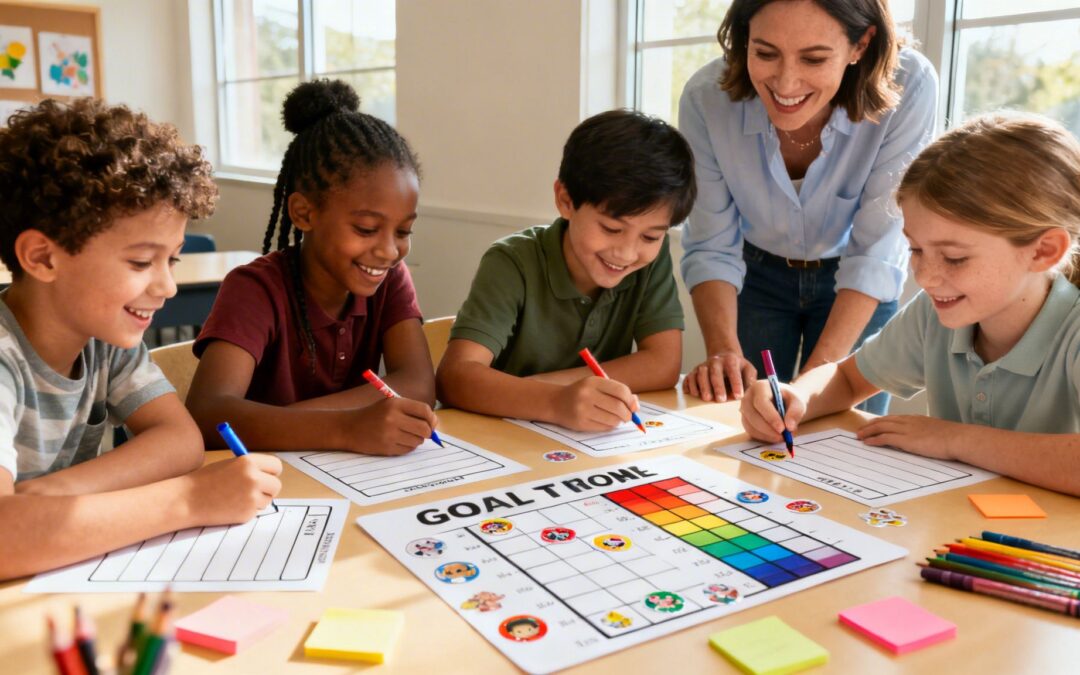
A simple visual can make all the difference. It helps them see the two most important parts: a “Super Clear” start and a “My Finish Line” they can look forward to.
This simple image reminds us that a successful goal for a little one starts with a very specific task and ends with a clear point of completion.
Kindness Quest
This activity turns a social-emotional goal into a playful adventure. It makes abstract concepts like “being kind” totally concrete and helps kids practice those pro-social behaviors in a structured, rewarding way.
How it works:
Create a Quest Board: Grab a piece of construction paper or a small whiteboard. At the top, write down the goal, something like, “My Kindness Quest this week is to share my toys.”
Define the Actions: Brainstorm what “sharing” actually looks like. You might get answers like “let a friend have a turn with the red truck” or “ask someone if they want to build blocks with me.”
Track with Stickers: Every time the child completes a kind action, they get to put a sticker on their Quest Board. Seeing that board fill up is immediate, positive reinforcement!
Discussion Questions:
“How did it feel when you shared your toy with your friend?”
“What did their face look like when you asked them to play?”
Goal Goalposts
This is a fun, sports-themed activity that’s perfect for tracking academic or behavioral goals, like learning sight words or remembering to raise a hand. It uses a familiar and exciting visual to represent progress.
Practical Example: A first-grader’s goal is to learn five new sight words by Friday. You can create two “goalposts” on a wall using painter’s tape. Each day the child practices, they move a paper soccer ball a little closer to the goal. When they can read all five words correctly, they get to “score” by taping the ball right between the posts. That simple action creates a powerful sense of accomplishment.
Activities for Elementary Students (Grades 3-5)
By this age, kids can handle more complex, multi-step goals. They’re starting to understand the connection between consistent effort over time and a bigger achievement down the road. Activities for this group should encourage planning, persistence, and a bit of self-reflection.
At this stage, goal-setting becomes a tool for personal discovery. It’s not just about what they can do, but about who they are becoming—a persistent problem-solver, a helpful community member, or a dedicated artist.
Personal Best Portfolio
This activity is fantastic for skill-based goals where improvement is gradual, like in P.E., art, or writing. It beautifully shifts the focus from competing with others to competing with oneself, which is a core tenet of a growth mindset.
How it works:
Select a Skill: The student picks a skill they want to improve, like dribbling a basketball, drawing a portrait, or writing a story.
Create the Portfolio: Use a simple folder or binder to collect evidence of their progress.
Capture Baselines and Milestones: The first entry is their “starting point”—maybe a video of them dribbling for 30 seconds or their first story draft. As they practice, they add new entries, dating each one.
Practical Example: A fourth-grader wants to improve her jump rope skills. Her goal: “to do 25 consecutive jumps by the end of the month.” Her portfolio starts with a note saying she can currently do seven jumps. Each week, she records her new “personal best.” Seeing the number climb from 7 to 12, then 18, and finally to 26 provides undeniable proof that her practice is paying off. For more ideas, you can find some wonderful social-emotional learning activities for elementary students in this guide.
Helping Hands Challenge
This project-based activity connects personal goals to community impact. It helps students see that their actions can benefit others—a powerful motivator, as research has shown time and again.
How it works: The class or family picks a community-focused goal, like “Collect 50 cans for the local food drive” or “Make 20 thank-you cards for school support staff.” They then break the large goal into smaller, individual tasks. A large paper cutout of a tree on a bulletin board can serve as a tracker; for every milestone reached (like every 5 cans collected), students add a “leaf” with their name on it to the tree.
Activities for Middle Schoolers (Grades 6-8)
Middle schoolers are primed for long-term, passion-driven goals. They’re capable of abstract thinking and complex planning, so our activities should empower them to take full ownership of their ambitions, from the initial idea to the final execution.
Passion Project Blueprint
This activity guides students in turning a personal interest into a significant, long-term project. It’s an amazing way to teach essential life skills like research, planning, time management, and presentation.
How it works:
Identify a Passion: The student chooses something they’re genuinely curious about—learning to code a simple game, starting a podcast, or organizing a charity bake sale.
Create the Blueprint: The student maps out their entire project. This “blueprint” should include the final goal, necessary resources, a step-by-step timeline with mini-deadlines, and a plan for sharing their final product.
Regular Check-ins: The adult’s role shifts to that of a project manager or coach. Hold weekly check-ins to discuss progress, troubleshoot obstacles, and offer encouragement.
Peer Accountability Groups
For academic or study-related goals, working with peers can provide a huge boost of both support and motivation. This activity also teaches collaboration, communication, and mutual responsibility.
Practical Example: A group of three eighth-graders wants to improve their algebra grades before final exams. They form an accountability group and set a shared goal: “We will all complete our homework on time and score a B or higher on the next quiz.” They agree to meet once a week during lunch to review tough concepts and check in on each other’s progress. This structure turns an individual struggle into a shared team mission.
To make it even easier, here’s a quick-reference table with some sample goals tailored for different developmental stages.
Grade-Appropriate Goal Ideas
Grade Band
Academic Goal Example
Social-Emotional Goal Example
K–2
I will learn my 5 new sight words by Friday.
I will share my toys with a friend at recess this week.
3–5
I will read for 20 minutes every night for a month.
I will give a classmate a genuine compliment each day.
6–8
I will raise my science grade from a C to a B by the next report card.
I will join one new club to meet people with similar interests.
Think of these as starting points. The most powerful goals will always be the ones that come directly from the students themselves, reflecting their own unique interests and aspirations.
Connecting Goals to a Growth Mindset
While reaching a goal is a fantastic moment, the real, lasting power of goal setting for kids is found in the journey. The process itself is a perfect opportunity to nurture a growth mindset—that powerful belief that our abilities and intelligence can grow through dedication and hard work.
This means we have to consciously shift the focus. Instead of only looking at the final outcome, we look at the effort. Instead of praising natural talent, we celebrate strategy and persistence. When we tie goal setting to this mindset, we’re teaching children something much bigger than just how to achieve a single target. We’re teaching them how to learn, adapt, and grow from every single experience.
From Praising Results to Praising Effort
The words we choose have a massive impact. It’s completely natural to want to celebrate a child’s success, but how we celebrate shapes the lesson they take away. If we only praise their intelligence or an innate skill, we can accidentally create a fixed mindset. Kids can become afraid of challenges that might make them look less “smart.”
Praising effort, strategies, and resilience, on the other hand, builds a growth mindset. It sends a clear message: challenges are just opportunities to get stronger.
Instead of: “You got an A on your spelling test! You’re so smart.”
Try: “I saw how you practiced your spelling words every night this week. Your hard work really paid off on this test!”
Instead of: “You won the race, you’re a natural athlete!”
Try: “Wow, you didn’t give up on that final lap, even when you looked tired. Your persistence was amazing to watch!”
This simple switch helps kids value the process. They start to see that their actions—studying, practicing, trying new things—are what truly lead to success. That’s a lesson they can carry into any goal they set for the rest of their lives. You can find more ideas for instilling this belief in our guide on developing a growth mindset for kids.
Learning from Setbacks and Obstacles
Let’s be honest: a goal-setting journey without a few bumps in the road is rare. Those moments are actually where the most important learning happens. A growth mindset helps reframe those setbacks not as failures, but as valuable information. Our job as parents and educators is to guide kids through that reflection.
When a child gets discouraged, we can steer the conversation toward learning and strategy.
The most powerful question you can ask a child who is struggling with a goal is not “Why did you fail?” but rather, “What did you learn?” This transforms a moment of disappointment into an opportunity for growth.
By normalizing setbacks, we teach resilience. We show kids that hitting a wall is just part of the process and that the most successful people are often the ones who have learned how to pivot, adjust their strategy, and try again.
Using Reflection to Build Self-Awareness
Regular reflection is the glue that connects goal progress to a growth mindset. Asking thoughtful, open-ended questions gets children to think critically about their own efforts and what they’re learning along the way.
Here are some powerful reflection prompts to use during weekly check-ins:
“What was the hardest part of your goal this week, and what did you learn from it?”
“What strategy worked really well for you? What’s one you might change?”
“Can you show me a spot where you struggled and then figured it out?”
“What are you most proud of about your effort this week, no matter the result?”
This type of guided reflection is a core piece of strong Social-Emotional Learning. We’ve seen programs that embed this kind of shared language and goal-setting achieve remarkable results. For instance, some tools have led to 25% higher self-regulation scores and cut classroom conflicts by 30%. Building this psychological safety through small, achievable goals also boosts emotional intelligence, with some programs showing a 20% gain in collaboration.
To keep building this crucial perspective, you might explore different growth mindset activities for kids to find practical exercises and new ideas. When we weave these principles into the goal-setting process, we aren’t just helping children reach their targets; we’re giving them the resilience and self-awareness to thrive long after a specific goal is met.
How to Track Progress and Celebrate the Wins
A goal without a way to track it can quickly lose steam. To keep motivation high on the journey of goal setting for kids, we have to make progress visible and celebrate every step forward. This isn’t about waiting for the big finish line; it’s about honoring the small, consistent efforts that lead to big results.
When we build tracking and celebration right into the process, we create a powerful positive feedback loop. This shows children that their hard work is paying off in real-time, making them feel successful and excited to keep going. The key is to find creative, age-appropriate methods that feel more like a fun ritual than a boring chore.
Making Progress Visual and Tangible
For kids, seeing is believing. Abstract ideas like “making progress” become real when they can physically see how far they’ve come. Visual trackers are one of the most effective tools you can have.
Goal Thermometer: This classic is perfect for goals with a clear numerical target. If a child’s goal is to read 10 books, draw a big thermometer, mark it with numbers 1 through 10, and let them color in a new section for each book they finish.
Milestone Map: For projects with multiple steps, a Milestone Map is a game-changer. Draw a winding path from a “Start” point to a “Finish” flag. Along the way, create stepping stones for each mini-goal. Kids can move a token or place a sticker on each one they complete.
Here’s how that looks in practice: Imagine a third-grader’s goal is to learn their multiplication tables up to 10. Their Milestone Map could have a stepping stone for mastering the 2s, another for the 3s, and so on. This breaks a huge goal into manageable chunks and gives them a reason to celebrate at each stage.
Creating Routines for Celebration
Celebration shouldn’t be an afterthought. By building it into your weekly routine—at home or in the classroom—you create a culture of encouragement where effort is consistently seen and valued.
The goal is to celebrate the process, not just the final outcome. When kids are praised for their persistence, focus, and small wins, they learn to value the hard work itself.
These routines don’t need to be elaborate. In fact, simple, consistent acknowledgment is often more meaningful than one big reward at the end. Consider creating a dedicated space or time just for sharing progress.
Ideas for Regular Celebrations
Weekly Wins Jar: Place a jar somewhere everyone can see it. Throughout the week, whenever a child makes progress on their goal—no matter how small—they write it on a slip of paper and drop it in the jar. During a family meeting or class wrap-up, you can read the “wins” aloud.
Goal-Getter Bulletin Board: Dedicate a board in your classroom or a wall at home to showcase goal progress. This is a great spot to display Goal Thermometers, Milestone Maps, or even photos of kids working toward their goals.
Supportive check-ins are a huge part of this. Just taking a few moments to ask how things are going makes children feel seen and supported. You can find more strategies for this in our article on how daily check-ins for students boost confidence. These conversations are the perfect chance to offer encouragement, help them troubleshoot problems, and celebrate the small wins together. It turns every step of the journey into a victory.
Common Questions About Goal Setting for Kids
Putting new ideas into practice always brings up questions. When you start teaching goal setting for kids, you’re bound to hit a few common bumps in the road. That’s perfectly normal! Think of these hurdles not as problems, but as part of the learning process itself.
The aim isn’t perfection from the get-go. Instead, it’s about being ready to transform those challenges into powerful moments that build resilience and a true can-do attitude. Here are the questions we hear most often, with practical answers you can use today.
What if My Child Sets an Unrealistic Goal?
This is a fantastic learning opportunity, not a red flag. When a kid dreams big—like becoming a YouTube sensation overnight—our first instinct might be to gently bring them back down to earth. But hold that thought. Instead, let’s help them build a bridge from their big dream to a realistic first step.
Guide them to break that huge goal into something tiny and achievable. For that aspiring YouTuber, a perfect starting goal might be: “I will watch three videos about making great content and write down one tip from each by the end of the week.”
This simple pivot teaches them essential skills like planning and research, making their huge ambition feel less like a fantasy and more like a project. When you praise their effort on these small, initial steps, you’re showing them that every major achievement is built on a foundation of small, consistent actions. That’s the core of a growth mindset.
How Do I Motivate a Child Who Seems Uninterested?
Motivation almost always sprouts from personal interest. If a child seems apathetic about setting goals, it’s usually because the goals feel disconnected from what they genuinely love to do. The key? Forget the word “goal” for a minute.
Just talk to them. Find out what they’re passionate about right now. Is it Minecraft? Drawing comics? A new sport they saw on TV?
When you anchor a goal to a child’s existing passion, it no longer feels like work. It becomes a structured way for them to do more of what they already love.
Frame the very first goal around that passion. Make it small, low-pressure, and—most importantly—fun.
For the gamer: “Plan and build one new type of structure in your Minecraft world by Saturday.”
For the social butterfly: “Think of and organize one new game for you and your friends to play at recess this week.”
The real objective here is to create a positive, successful first experience. This shows them that a “goal” isn’t a chore; it’s just a plan to get even better at their favorite things.
How Often Should We Talk About Their Goals?
Finding the right rhythm for check-ins is crucial. If you ask too often, it can feel like nagging. But if you wait too long, the goal can lose its momentum and fizzle out. The ideal frequency really depends on the child’s age and how long the goal is supposed to take.
For Younger Kids (K–2): They’re usually working on short, weekly goals. Quick, light daily check-ins work best. A simple, “How did we do with our kindness goal today?” keeps it top-of-mind without adding pressure.
For Older Kids (3–8): With longer, month-long goals, a dedicated weekly check-in is perfect. This gives them enough time to make real progress between chats while still offering a regular chance for support and course correction.
Try to make these check-ins a comfortable, normal routine. Weave them into a Sunday family chat or a Friday classroom wrap-up. This transforms the conversation from a potential interrogation into a supportive part of their week.
My Child Gets Really Discouraged by Setbacks. What Should I Do?
Learning to handle setbacks is one of the most important lessons goal setting can teach. When your child is frustrated that something didn’t work out, your first move is always to validate their feelings. “I get it. It’s so frustrating when things don’t go the way you planned.”
Once they feel heard and understood, you can shift the dynamic from failure to investigation. Frame it like a detective mission.
Ask curious questions: “What do you think got in the way? What’s one thing we could try differently next time?”
Brainstorm adjustments: “Does the goal feel a little too big right now? Should we adjust it to make the next step easier?”
This approach turns a roadblock into useful data. It teaches kids to analyze problems instead of internalizing failure, which is the very essence of resilience.
It also helps tremendously to share your own stories of messing up and trying again. When you model that challenges are a normal, necessary part of doing anything worthwhile, you give them the courage to persevere through their own.
At Soul Shoppe, we believe that building these skills is fundamental to creating connected and empathetic school communities. Our programs provide the tools and shared language necessary to help students develop self-regulation, resilience, and healthy relationships. To learn how we can support your school or family, explore our social-emotional learning programs.
Imagine your 2nd graders walking into a calm, focused classroom, ready to connect and learn. This isn’t a fantasy; it’s the power of intentional morning routines. Traditional worksheets often miss the most critical part of a child’s school day: settling their minds and bodies. Effective 2nd grade morning work should build a foundation for learning, not just fill time before the first bell.
This guide provides a curated list of practical, low-prep activities that prioritize social-emotional learning (SEL) alongside academics. These ideas are designed for busy teachers, administrators, and parents seeking to replace morning chaos with meaningful engagement. A key part of this process involves teaching students foundational skills. Understanding how to regulate emotions is a cornerstone of a peaceful classroom, as it equips children with the tools they need to manage big feelings and focus on learning.
You will find specific, actionable examples for each activity, from mindfulness check-ins to problem-solving role-plays. We also include differentiation tips and ways to integrate practices from leading SEL organizations like Soul Shoppe. The goal is to ensure your students start their day feeling safe, connected, and truly ready to thrive.
1. Mindfulness & Breathing Check-In Circle
Starting the day with a Mindfulness & Breathing Check-In Circle is a powerful form of 2nd grade morning work that prioritizes social-emotional learning (SEL) before academics begin. This 5 to 10-minute structured activity involves gathering students in a circle on the floor to practice guided breathing, simple body scans, or grounding techniques. The primary goal is to help students transition from home to school, co-regulate their nervous systems, and build a foundation of calm, focused attention for the day ahead.
This practice directly supports students’ ability to identify and manage their emotions, a key component of SEL. Many schools successfully use programs like Calm or Headspace for Schools, while others integrate these moments into the Responsive Classroom morning meeting structure. The teacher acts as a facilitator, modeling calmness and guiding students through simple, consistent routines.
How to Implement a Breathing Circle
Start Small and Be Consistent: Begin with just two to three minutes of guided practice each morning. As students become more familiar and comfortable with the routine, you can gradually extend the time. A practical example is a “Take 5” breathing exercise: students trace their hand, breathing in as they trace up a finger and out as they trace down.
Create a Dedicated Space: If possible, designate a “calm-down corner” or a specific area of the classroom for this circle. Keep it free from visual distractions to help students focus inward.
Use Simple, Repetitive Language: Guide students with clear, predictable phrases. For example, “Let’s take a deep breath in through our noses, filling our bellies like a balloon… now, slowly let the air out through your mouth like you’re blowing a bubble.” This consistency creates a sense of safety and predictability. To effectively help children regulate their emotions and prepare for the day, consider integrating some of the best breathing exercises tailored for calming the nervous system.
Follow with an Emotion Check-In: After the breathing practice, ask students to non-verbally share how they are feeling. A simple thumbs-up (feeling great), thumbs-sideways (feeling okay), or thumbs-down (having a tough time) provides a quick, private way to gauge the classroom climate. These quick assessments are an essential part of effective daily check-ins for students.
Your authentic participation is key. When students see their teacher actively and genuinely engaging in the breathing exercises, they are more likely to mirror that engagement and internalize the benefits of the practice.
Integrating a daily Social-Emotional Learning (SEL) Prompt Reflection is an effective form of 2nd grade morning work that builds emotional intelligence through writing or discussion. This quiet, independent activity asks students to respond to a specific prompt about feelings, relationships, or problem-solving. By answering questions like, “Who showed you kindness yesterday?” or “How did you handle a frustration today?” students practice identifying emotions, developing empathy, and using the language of self-awareness.
This practice gives students a structured way to process their inner world and connect it to their school life. Many effective curricula, such as the Second Step Program and Zones of Regulation, use this prompt-based method to reinforce key SEL concepts. It allows teachers to gain valuable insight into students’ well-being while fostering a classroom culture where emotional expression is valued and normalized.
How to Implement SEL Prompts
Establish a Weekly Theme: Create a rotating schedule to cover different SEL competencies. A practical example: Monday (Gratitude – “What is one thing you are thankful for?”), Tuesday (Kindness – “Draw a time you helped a friend.”), Wednesday (Problem-Solving), Thursday (Empathy), and Friday (Reflection). This provides structure and predictability.
Keep Prompts Simple and Concrete: Phrase questions in a way that is easy for a second grader to understand. Instead of “Describe a time you showed perseverance,” try “What is something you worked hard on and didn’t give up?”
Model Vulnerability: Share your own authentic, age-appropriate response to the prompt first. Saying, “I felt frustrated this morning when I couldn’t find my keys, so I took a deep breath,” shows students that everyone manages emotions.
Use Visual Anchors: Create an anchor chart with sentence starters like “I felt happy when…” or “A kind thing I saw was…” to support students who need help structuring their thoughts. For example, for a prompt about helping, a starter could be: “I helped my mom by…” Providing a range of thoughtful and effective student reflection questions can guide this practice and deepen its impact.
Normalize All Feelings: Emphasize that there are no “right” or “wrong” answers. The goal is honest reflection, not a perfect response. This builds psychological safety and encourages authentic sharing.
3. Kindness & Connection Morning Meeting
A Kindness & Connection Morning Meeting is a structured, 10 to 15-minute group gathering that serves as exceptional 2nd grade morning work by putting community first. In this daily practice, students celebrate one another, practice active listening, and intentionally build a safe, supportive classroom culture. The core purpose is to establish belonging, reduce feelings of isolation, and ensure that every student feels seen and heard before academic instruction begins.
This intentional community-building time directly addresses students’ need for safety and connection, which are prerequisites for engaged learning. Many effective models exist, from the well-known Responsive Classroom Morning Meeting to frameworks like Tribes Learning Communities. The teacher’s role is to facilitate a predictable routine where students can share good news, acknowledge peer accomplishments, or play cooperative games.
How to Implement a Kindness Meeting
Establish Clear Norms: Co-create rules for respectful listening with your students. Simple expectations like “quiet bodies,” “kind faces,” and “eyes on the speaker” help everyone feel safe to share. For example, create an anchor chart with pictures demonstrating these norms.
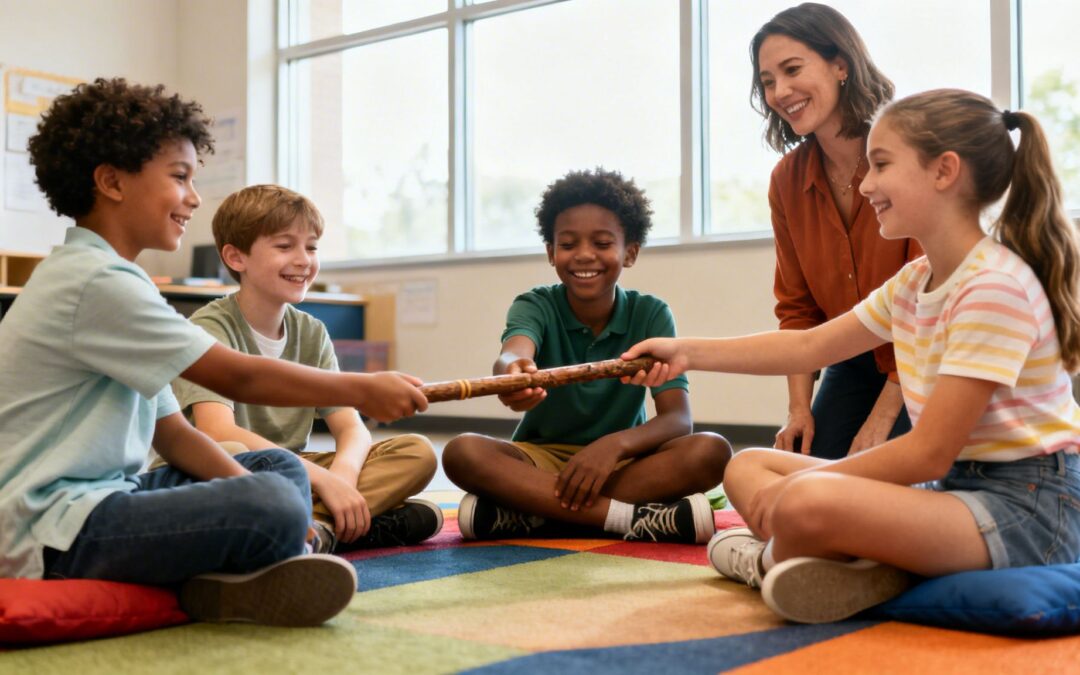
Use a Talking Piece: Pass a designated object (a special rock, a small stuffed animal) to show whose turn it is to speak. This ensures equitable participation and teaches students not to interrupt, giving each child uninterrupted time. For example, you can say, “Only the person holding ‘Sparky the Star’ can share their thoughts.”
Start with Low-Risk Sharing: Begin the year with simple prompts like, “Share one thing you enjoyed this weekend.” As trust builds, you can move toward more personal sharing. For example: “Share your favorite part of the book we read yesterday.”
Rotate the Celebration Focus: To keep it fresh, dedicate each day to a different theme. For example, Mondays could be for celebrating academic effort (“I want to celebrate Maria for working so hard on her math facts”), while Tuesdays are for noticing acts of kindness. This structure guides students on what to look for in their peers. To discover more ways to foster these connections, you can find a wealth of classroom community-building activities that complement this morning routine.
Your consistent modeling of vulnerability and appreciation sets the tone. When you genuinely celebrate a student’s effort or share a personal story, you show students that the classroom is a true community where every member matters.
Using role-play for conflict resolution is a dynamic form of 2nd grade morning work that gives students hands-on practice with social problem-solving. These short, interactive skits focus on common classroom issues like sharing, taking turns, or responding to unkind words. By acting out different roles in a safe, guided setting, students learn to see conflicts from multiple perspectives, practice using “I-Feel” statements, and brainstorm peaceful solutions together. This makes abstract concepts like empathy and respect tangible and memorable.
This method directly equips students with the language and strategies needed to navigate peer disagreements constructively. Experiential programs from organizations like Soul Shoppe and the Second Step Program often feature role-playing as a core component for teaching these skills. The teacher facilitates by setting up simple scenarios, guiding the process, and helping students reflect on the outcomes of their chosen solutions, turning potential disruptions into learning opportunities.
How to Implement Problem-Solving Role-Play
Start with Puppets: Before asking students to perform, use puppets or stuffed animals to act out scenarios. This lowers the pressure and allows students to focus on the problem and solution, not on being in the spotlight. A practical example: have one puppet snatch a toy from another, then guide students to give the puppets the right words to use.
Scaffold the Scenarios: Begin with simple, two-character conflicts. For example, “Character A took Character B’s crayon without asking.” As students gain confidence, you can introduce more complex situations like, “Leo and Sara both want to be line leader. What can they do?”
Create a Visual Aid: Develop a “Problem-Solving Steps” anchor chart that students can reference. Steps might include: 1. Stop and Cool Off, 2. Use an “I-Feel” Statement, 3. Listen to the Other Person, and 4. Brainstorm a Solution. A practical example for step 2 is teaching the phrase: “I feel _____ when you _____ because _____.” To explore more ideas for building these skills, check out these engaging conflict resolution activities for kids.
Rotate Roles: Ensure every student has the chance to play different parts, including the person with the problem, the person who caused it, and a helpful bystander or “peace-maker.” This builds empathy by allowing them to experience the situation from all sides.
Connect to Real Life: After a role-play session, explicitly connect the practice to classroom life. Say, “Remember how we practiced asking nicely for a turn? I saw Jamal and Aisha do that at the block center. Great job using your peace-making skills!” This helps transfer the skills from the activity to real-world interactions.
5. Emotion Recognition & Feelings Check-In
Building emotional literacy is a foundational part of social-emotional learning, and an Emotion Recognition & Feelings Check-In serves as effective 2nd grade morning work for this purpose. This daily activity asks students to identify and name their current feelings using visual aids like emotion wheels or feelings charts. The goal is to create a safe, predictable routine where discussing emotions is normalized, helping teachers gauge student readiness for learning and building a more empathetic classroom culture.
This practice gives students the vocabulary they need to move beyond simple terms like “mad” or “sad.” Frameworks such as the Zones of Regulation, which categorize feelings into colored zones (blue, green, yellow, red), are widely used to help children understand their emotional and physical state. Other teachers may use a feelings thermometer or a daily mood board where students place their name under a corresponding emotion face.
How to Implement a Feelings Check-In
Introduce Emotions Gradually: Start the school year with four basic feelings: happy, sad, angry, and scared. As students master this vocabulary, you can introduce more nuanced words like disappointed, frustrated, proud, or calm. For example, create a “feeling of the week” and discuss what it looks like, sounds like, and feels like in the body.
Use Consistent Visual Supports: Choose one visual system and stick with it. Whether it’s a color-coded chart based on The Color Monster or a Zones of Regulation poster, consistency helps students quickly recognize and identify their state without confusion. A practical example: a pocket chart where each student moves their name stick to the “zone” they are in each morning.
Model Naming Your Own Emotions: Your authenticity is powerful. Start the check-in by sharing your own feelings in a simple, age-appropriate way. For example, “Good morning, class. I am feeling excited today because we get to start our new science unit.” This models that all feelings are normal and acceptable.
Provide Non-Verbal Options: Not every child will be ready to share verbally. Allow students to use a thumbs-up/sideways/down signal, point to a chart, or place a clothespin with their name on a feelings poster. Respecting this choice is key to building trust and psychological safety.
After the check-in, you can make a general observation to validate their feelings and connect them to classroom strategies. A simple statement like, “I see some of us are in the blue zone and feeling tired this morning. Let’s remember we can take a stretch break if we need one,” shows students you see them and are ready to support them.
6. Partner or Peer Share Activity
A Partner or Peer Share Activity is a structured form of 2nd grade morning work that develops crucial communication and social skills. This 5 to 10-minute routine involves pairing students to ask and answer thoughtful questions, practice active listening, and learn about one another in a safe, one-on-one setting. The primary goal is to build a supportive classroom community, give quieter students a voice, and foster empathy by creating intentional connection points.
This practice is a cornerstone of collaborative learning models like Responsive Classroom and Cooperative Learning. By taking turns speaking and listening, students move beyond surface-level interactions to build genuine understanding. The teacher acts as a facilitator, modeling respectful communication and providing engaging prompts that encourage students to share their thoughts and experiences.
How to Implement a Partner Share Activity
Model Expected Behaviors: Before starting, explicitly model what good listening and speaking look like. For example, act out a “good partner” who makes eye contact and asks a follow-up question, then a “distracted partner” who is looking away. A practical example is using the “EEKK” rule: Elbow-to-Elbow, Knee-to-Knee.
Use Clear Prompts and a Timer: Start with simple, concrete questions like, “What is one thing you are good at?” or “If you could have any superpower, what would it be and why?” Use a visual timer to give each partner 1-2 minutes to share, providing a clear structure for turn-taking.
Intentionally Pair Students: To build a stronger classroom community, purposefully pair students who may not typically interact. Rotating partners weekly or biweekly ensures that every student gets a chance to connect with many different classmates throughout the year, breaking down social cliques. For example, use “clock buddies” where students pre-select partners for different times of the day.
Teach Active Listening Skills: Make active listening a direct teaching point. Instruct students to “look at your partner, nod to show you’re listening, and think of one question to ask about what they said.” You can even create a “listening challenge” where students have to introduce their partner and one thing they learned from them. For example: “This is my partner, Sam. I learned that his favorite animal is a cheetah.”
7. Gratitude & Appreciation Activity
Integrating a Gratitude & Appreciation Activity into your routine is a simple yet profound type of 2nd grade morning work that builds community and fosters a positive classroom environment. This activity invites students to identify what they are thankful for, recognize their own strengths, and appreciate kindness in their peers. It shifts the daily focus toward positive relationships and emotional well-being, setting a constructive tone for learning.
Formats can range from a whole-class gratitude circle or a “Thankfulness Thanksgiving” tradition to individual gratitude journals. The core goal is to help students develop a practice of noticing the good around them, which builds resilience and a growth mindset. This practice is popularized by the Bucket Fillers movement and supported by research from positive psychology on the benefits of gratitude.
How to Implement Gratitude Activities
Create a Visual “Appreciation Board”: Designate a bulletin board where students can post sticky notes with appreciative comments about classmates. A practical example: a “Bucket Filler” board where students write notes saying, “To Lena, You filled my bucket when you shared your crayons with me. From, David.” Seeing the board fill up provides a powerful visual reinforcement.
Scaffold with Specific Prompts: Young students may need help identifying things to be grateful for. Use clear prompts like, “What is something that made you smile this morning?” or “Who showed you kindness on the playground yesterday?”
Model Authentic Gratitude: Share your own specific and genuine gratitude. For example, “I am so grateful for how quietly and respectfully everyone transitioned from the rug to their desks.” This models the behavior you want to see.
Introduce “Shout-Out Fridays”: Dedicate a few minutes at the end of the week for students to give a verbal “shout-out” to a peer who helped them, showed perseverance, or was a good friend. To ensure everyone feels included, you can discreetly track who receives shout-outs and gently guide students to recognize peers who haven’t been mentioned recently. For instance, “Let’s give a shout-out to someone who showed courage this week.”
8. Mindful Movement & Brain Break Activities
Incorporating Mindful Movement & Brain Break Activities into your morning routine is a dynamic form of 2nd grade morning work that channels physical energy into focus and self-awareness. These short, 5-minute sessions combine guided physical activities like yoga, stretching, or dance with mindful principles. The objective is to help students release pent-up energy, improve body awareness, and prepare their brains for academic tasks. This practice builds a crucial bridge between physical sensations and emotional states.
These activities directly support self-regulation and focus, making them an effective way to start the school day. Many teachers find success using guided video resources like GoNoodle for energetic brain breaks or Cosmic Kids Yoga for storytelling-based movement. These tools help students embody the mind-body connection essential to social-emotional learning, teaching them that movement can be a powerful tool for managing feelings and preparing to learn.
How to Implement Mindful Movement
Choose a Few Go-To Activities: Start with two or three simple, repeatable activities. Rotating between familiar options like “Cosmic Kids Yoga,” a specific GoNoodle dance, or a simple stretching sequence helps students engage quickly without needing lengthy instructions. A practical example is a “Weather Report” stretch: reach high for the sun, wiggle fingers for rain, sway side-to-side for the wind.
Model and Connect to Feelings: Participate enthusiastically alongside your students. Use language that connects the physical movement to an emotional or mental state. For example, “As we do our tree pose, feel how strong and steady your body is. This can help us feel strong inside, too.”
Use Consistent Verbal Cues: Simple, predictable phrases create a routine. Cues like, “Breathe in the calm, breathe out the wiggles,” or, “Notice your feet firmly on the ground,” help ground students and reinforce the mindful aspect of the movement.
Offer Differentiated Options: Ensure every student can participate. Provide seated variations for yoga poses or suggest hand and arm movements for students with physical limitations. For example, during a standing stretch, you could say, “If you’re sitting, reach your arms up high from your chair!” The goal is participation and body awareness, not perfect form. When students feel overwhelmed, you can remind them, “Remember how we stretched this morning? Let’s try that now to help our bodies feel calm.”
2nd Grade Morning Work: 8-Activity Comparison
Activity
Implementation complexity
Resource requirements
Expected outcomes
Ideal use cases
Key advantages
Mindfulness & Breathing Check-In Circle
Low–Moderate — needs consistent teacher modeling
Minimal — no materials required; optional apps or visual timer
Weekly rituals, celebrations, reinforcement of positive behavior
Strengthens culture; highlights strengths; easy to implement
Mindful Movement & Brain Break Activities
Low–Moderate — needs space and energy management
Moderate — physical space, videos/music, adaptations for accessibility
Regulation of energy, improved focus, embodied awareness
Transitions, before challenging tasks, for kinesthetic learners
Releases energy while teaching body-awareness; supports attention and regulation
Putting It All Together: Your First Week of Meaningful Morning Work
Moving from a list of ideas to a functional classroom routine is the most critical step. A successful 2nd grade morning work plan isn’t about implementing thirty new activities at once. It’s about building a consistent, sustainable rhythm that sets a positive tone for the day. The SEL-focused activities we’ve explored, from breathing check-ins to gratitude journaling, are powerful tools for creating a classroom where students feel seen, safe, and ready to learn. By prioritizing connection before content, you invest in a more peaceful and productive learning environment for the entire year.
Remember, the goal is progress, not perfection. Start small, stay consistent, and observe how your classroom community begins to shift. Your initial efforts lay the groundwork for a year of deeper engagement and stronger student relationships.
Your Sample SEL-Focused Morning Work Week
To help you get started, here is a practical, sample weekly plan that balances different SEL skills. This structure can be adapted to fit your students’ needs and your own classroom schedule.
Mindful Monday: Begin the week with a calming activity.
Activity:Mindfulness & Breathing Check-In Circle. Lead students in a simple 3-minute box breathing exercise (inhale for 4, hold for 4, exhale for 4, hold for 4). Afterwards, ask students to share one word describing how they feel.
Teamwork Tuesday: Focus on connection and collaboration.
Activity:Partner or Peer Share Activity. Pose a simple, low-stakes question like, “What is one thing you are looking forward to this week?” Give partners two minutes each to share and practice active listening.
Wisdom Wednesday: Dedicate mid-week to problem-solving skills.
Activity:Conflict Resolution & Problem-Solving Role-Play. Present a common scenario: “Two students both want to use the same blue crayon during art.” Brainstorm a few peaceful solutions together as a class.
Thoughtful Thursday: Cultivate gratitude and positive thinking.
Activity:Gratitude & Appreciation Activity. Have students write or draw one thing they are grateful for in their morning work journal. This could be a person, a favorite toy, or a sunny day.
Feelings Friday: End the week with emotional reflection.
Activity:Emotion Recognition & Feelings Check-In. Display a few emotion flashcards (happy, sad, frustrated, excited). Ask students to privately point to the one that best matches their feeling and then draw a picture of that emotion in their journal.
Final Takeaways for Lasting Success
As you build out your 2nd grade morning work routine, keep these core principles in mind. They are the keys to turning a good morning routine into a great one.
Consistency Over Complexity: A simple, predictable routine done every day is far more effective than a complicated one that is difficult to maintain. Students thrive on structure; it helps them feel secure.
Model Everything: Never assume students know how to participate. Model how to breathe deeply, how to listen to a partner, and how to write a gratitude statement. Your vulnerability and participation give them permission to do the same.
Connection is the Goal: The primary purpose of this morning time is not academic rigor, but human connection. By filling your students’ emotional cups first, you make them more available for learning throughout the day. This simple shift in priority can significantly reduce classroom disruptions and boost academic focus.
Ready to bring even more powerful, structured social-emotional learning into your classroom? The activities discussed in this article are foundational to the work we do at Soul Shoppe. Explore our programs at Soul Shoppe to find comprehensive, school-wide solutions that empower students with the tools to build empathy, resolve conflicts, and create a culture of kindness.
What Is Social Skills Training and Why It Matters Now
Social skills are the essential foundation upon which friendships, academic success, and future opportunities are built. Think of them as the sturdy frame of a house—without that solid structure, everything else is shaky. Social skills training is all about giving children a practical toolkit to navigate their world confidently. It helps them read social cues, communicate with respect, and build real connections.
In a world where digital interaction so often takes the place of face-to-face connection, these skills have become more critical than ever. The ability to cooperate, listen, and manage emotions isn’t a “soft skill” anymore; it’s a non-negotiable part of a child’s development. You can explore the bigger picture of this growth in our guide on what is social-emotional development.
Building the Foundation for Future Success
Social skills training goes way beyond just teaching good manners. It’s about equipping students with the tools to understand their own feelings and, just as importantly, empathize with what others are feeling. This isn’t about memorizing rigid rules; it’s about building genuine emotional intelligence.
A teacher might see a classroom disagreement over a shared toy not as a problem to be punished, but as a perfect teaching moment. Instead of making accusations, students learn to use “I-statements” to express themselves.
Practical Example: During a group activity, a student feels their idea was ignored. Instead of saying, “You never listen to me!”, the teacher can guide them to say, “I feel frustrated when my idea isn’t heard because I want to help the team.” This simple shift empowers children to solve problems together without placing blame.
Social skills are the bedrock of a positive school climate. When students feel seen, heard, and understood, they are more engaged, more resilient, and better prepared to learn. Fostering these skills creates a ripple effect, improving everything from classroom behavior to academic outcomes.
Preparing Students for a Changing World
The importance of these skills extends far beyond the playground. The global market for soft skills training is booming, hitting USD 26 billion in 2023 and projected to reach USD 38 billion by 2032. Employers know that skills like teamwork, communication, and creative problem-solving are essential for success.
With experts predicting that nearly 39% of core worker skills will change by 2030, social and emotional learning is a crucial investment in our kids’ futures. You can find more insights into this growing demand and how schools are adapting on zionmarketresearch.com.
Ultimately, social skills training is about fostering connection and building resilience. By giving students a shared language for empathy and respect, we create safer, more supportive learning environments where every single child has the chance to thrive.
Understanding the Core Components of Social Skills
Social skills training isn’t about making kids memorize a list of rules for how to act. It’s much deeper than that. It’s about building a practical, intuitive foundation that helps children connect with others and navigate their world with confidence.
To make it simple, we can break these abilities down into three core pillars: Connecting with Others, Understanding Yourself, and Navigating Social Situations. Think of them as the three legs of a stool—if one is wobbly, the whole thing feels unstable. A child needs all three to feel balanced and secure in social settings.
Connecting With Others
This first pillar is all about looking outward. It covers the skills needed to build relationships and truly understand the people around us. Key pieces here include empathy—the ability to feel with someone—and active listening, which is about hearing to understand, not just waiting for your turn to talk.
For a student, this is so much more than just being quiet while a classmate is speaking. It’s making eye contact, nodding, and maybe even rephrasing what they heard to show they were really tuned in.
Practical Example: During a group project, one student practices active listening by saying, “So, if I’m hearing you right, you think we should start with the research part first? That’s a good idea. We could also…” This simple step shows they valued their peer’s input before jumping in with their own thoughts.
Understanding Yourself
The second pillar turns the focus inward. Before a child can really manage their relationships with others, they need a solid handle on their own internal world. This comes down to self-awareness (knowing what you’re feeling and thinking) and emotional regulation (managing those feelings in healthy ways).
This is where a child learns to identify that their stomach is fluttering because they feel nervous, not just because it hurts. From there, they can start using strategies to calm those feelings instead of letting them take over and run the show.
Practical Example: A student feels a surge of frustration after losing a board game in class. Instead of yelling or knocking over the pieces, they remember a technique they learned. They walk over to the classroom’s “calm-down corner” for two minutes, take a few deep breaths, and then rejoin the group, ready to move on.
A groundbreaking 2023 OECD survey of 130,000 students found that schools with structured social-emotional learning programs saw remarkable benefits. Students in these environments reported 25% higher feelings of psychological safety and belonging, and they even showed an 11% gain in achievement scores. You can learn more about these findings on nurturing social and emotional learning.
Navigating Social Situations
Finally, the third pillar brings the internal and external worlds together. This is where kids apply their self-awareness and empathy to handle real-world interactions. The core skills here are respectful communication and collaborative problem-solving. This is all deeply rooted in the principles of social learning, which explains how we pick up new behaviors by watching and interacting with others.
This pillar helps children handle everything from asking to join a game on the playground to working through a disagreement with a friend. It gives them a kind of script for navigating those tricky moments with confidence and respect. For a deeper look at these skills, check out our guide on the five core SEL competencies explained.
This chart shows just how much the social skills market is expected to grow, which really underscores how critical these abilities are for preparing students for the future.
The data points to a major trend: what starts as social skills training in the classroom becomes a highly valued asset in the global workforce.
How to Integrate Social Skills Training in the Classroom
Let’s be honest: the thought of squeezing another subject into an already packed school day can feel overwhelming. But what if social skills training wasn’t “another thing” to teach? What if it was a new lens for seeing your entire day?
The most powerful way to build social skills is to make them part of the very fabric of your classroom culture. This means moving beyond one-off lessons and weaving skill-building moments into the routines you already have. When you do this, you create a shared language around respect, empathy, and problem-solving that students start to use naturally.
Transform Morning Meetings into Skill-Building Sessions
Your daily morning meeting is the perfect launchpad. Before you even get to the day’s agenda, you can dedicate just five or ten minutes to a specific social skill. It sets a positive, intentional tone for everything that follows.
This small daily practice grounds students and builds community in a low-stakes, supportive way. Over time, these brief sessions compound, creating a powerful foundation of social competence.
Practical Example: Teaching “I-Statements”
An “I-Statement” is a simple tool that helps kids express their feelings without blaming anyone else. You can introduce it with a quick morning meeting agenda:
Introduce the Goal (1 min): “Today, we’re going to learn a way to share our feelings without starting an argument. It’s called an ‘I-Statement.'”
Model the Skill (2 min): “So, instead of saying, ‘You took my crayon and made me mad,’ I could say, ‘I feel frustrated when my crayon is taken because I wasn’t finished.’ See how I focused on my own feeling?”
Group Practice (2 min): Have students turn to a partner and practice turning a “You-Statement” (like, “You’re being too loud”) into an “I-Statement” (like, “I feel distracted when it’s loud because I’m trying to read”).
Leverage Teachable Moments Throughout the Day
Some of the most profound learning doesn’t happen on a schedule. A disagreement on the playground or a miscommunication during group work isn’t a disruption—it’s a live-action coaching session for social skills.
When you spot a social challenge unfolding, stepping in to guide students through it in real-time makes the lesson stick. It shows them how to apply these skills precisely when they need them most.
Practical Example: A Playground Disagreement
Imagine two fourth-graders, Alex and Ben, arguing over who was first in line for the swings. Instead of just sending them to the back of the line, you can turn this into a teachable moment.
Step 1: Stop and Breathe. Approach calmly. “Okay, let’s pause for a second. Both of you take one deep breath.” This simple act helps lower the emotional temperature.
Step 2: Guide with Questions. “Alex, can you tell Ben how you’re feeling using an ‘I-Statement’?” Alex might try, “I feel upset because I thought I was next.”
Step 3: Encourage Active Listening. “Ben, what did you hear Alex say?” This simple question ensures Ben is listening to understand, not just waiting for his turn to talk.
Step 4: Brainstorm Solutions. “What are two ways we could solve this so it feels fair to both of you?” Maybe they decide to take turns for five minutes each or even swing together.
By reframing everyday conflicts as learning opportunities, educators empower students to become independent problem-solvers. This process builds a resilient classroom community where challenges are seen as a chance to grow together, not as a source of division. To learn more, check out our guide on how to build classroom community.
Use Structured Activities to Reinforce Concepts
While teachable moments are pure gold, structured activities give students a safe space to practice without the pressure of a real conflict. These planned exercises can be fun, engaging, and easy to adapt for different age groups.
Think of these activities as the practice drills that help turn a conscious, clunky effort into an automatic, natural skill.
Here are a few ideas you can use tomorrow:
For Younger Students (K-2): Emotion Charades. Write different emotions (happy, sad, frustrated, surprised) on cards, maybe with little cartoon faces. A student picks a card and acts out the feeling without words while the class guesses. This builds their emotional vocabulary and helps them read nonverbal cues.
For Older Students (3-5): Collaborative Problem-Solving. Put a real-life challenge on the board, like: “Our class has too much leftover trash after lunch. In your groups, come up with three solutions we could all try.” This gets them working as a team, listening to different ideas, and finding a consensus.
For Middle Schoolers (6-8): Perspective-Taking Scenarios. Present a short scenario like: “A new student joins your class and eats lunch alone. What are three possible reasons why they might be sitting alone, and what is one small thing you could do to make them feel more welcome?” Discussing their answers helps them challenge assumptions and practice empathy.
How to Reinforce Social Skills at Home
The skills a child picks up in a classroom are just one piece of the puzzle. For social skills to truly stick, they need to be practiced in the one place kids feel safest and spend most of their time: at home. Building a bridge between school and home life reinforces what your child is learning, showing them that these skills matter everywhere, not just in front of a teacher.
The great news is this doesn’t mean you need to run formal lessons or set up complicated activities. The most powerful social skills training happens naturally, woven into the simple, everyday moments you already share as a family. These low-prep, high-impact strategies can turn routine interactions into powerful learning opportunities.
Turn Dinnertime into Connection Time
Think of the family dinner table as the perfect social skills laboratory. It’s a natural time to disconnect from screens and actually reconnect with each other. By asking thoughtful questions, you can steer conversations that build empathy, perspective-taking, and the art of listening.
Instead of the classic “How was your day?”—which almost always gets a one-word answer—try using more specific prompts to get the ball rolling. The goal is to encourage storytelling and reflection.
Dinner Table Conversation Prompts:
To Build Empathy: “What was one kind thing you saw someone do for someone else today?” or “Tell me about a time you felt really proud of a friend.”
To Practice Perspective-Taking: “If you could switch places with any character from a book or show, who would it be and why?”
To Encourage Self-Awareness: “What was the hardest part of your day? What was the easiest part?”
These kinds of questions create a space where sharing feelings is normal and listening to others is an expected part of the routine. If you’re looking for more ways to nurture this crucial skill, check out our guide on how to teach empathy.
Model Healthy Conflict Resolution
Kids are always watching. They learn so much more from what we do than from what we say. One of the most important lessons you can teach is how to disagree respectfully, and the best way to teach it is to model it yourself.
This doesn’t mean you need to stage major arguments in front of your kids. It’s actually about handling the small, everyday disagreements with grace and respect.
Practical Example: You and your partner disagree on what movie to watch. Instead of getting frustrated, you can model a healthy compromise out loud. You could say, “Okay, I see you really want to watch the action movie, and I’m more in the mood for a comedy. How about we watch your pick tonight, and we can watch mine tomorrow?”
This brief exchange teaches volumes. It shows that it’s okay to have different opinions, that listening to another person’s perspective matters, and that finding a solution together is the real goal. You’re demonstrating that conflict doesn’t have to be a scary thing; it can actually be productive.
Use Screen Time Productively
Let’s be real, screen time is a part of daily life in most homes. Instead of seeing it as just a passive activity, you can turn movies, TV shows, and even video games into active social learning moments. The characters and their stories provide perfect, low-stakes examples of complex social situations.
The key is to chime in with a few thoughtful questions during or after the show. This simple step transforms passive watching into an active, reflective experience that builds critical social awareness.
Questions to Ask During a Movie or Show:
“How do you think that character felt when their friend said that?” This question nudges your child to step into a character’s shoes and practice empathy.
“What could they have done differently in that situation?” This encourages critical thinking and problem-solving, letting them brainstorm better social strategies from the sidelines.
“Have you ever felt like that character before?” This helps them connect what’s happening on-screen to their own real-life experiences, deepening their self-awareness.
By weaving these small practices into your daily life, you create a supportive home environment where social skills aren’t just taught, but lived. This partnership between school and home is what helps children take these crucial skills and apply them with confidence in every part of their lives.
Choosing the Right Social Skills Program for Your School
For school leaders and SEL coordinators, picking a social skills program can feel like walking through a crowded marketplace. Every option promises big results, so how do you find the one that will actually make a real, lasting difference in your school’s culture? The trick is to look past the marketing noise and use a clear, thoughtful framework to weigh your options.
A great social skills training program is more than just a purchase; it’s an investment in your students’ long-term happiness and academic growth. To make sure that investment pays dividends, you need a partner who offers more than just a box of lessons. You need a program built on a solid foundation, designed to weave right into the fabric of your school community.
Is the Program Grounded in Research and Evidence?
The first and most important question to ask is simple: is this program based on real evidence? This means its methods are rooted in proven research about how kids learn and develop socially and emotionally. A program without this foundation is like a house built on sand—it might look good at first, but it won’t hold up over time.
Look for programs that can clearly explain their “why.” Do they pull from established frameworks in child development and psychology? A research-backed program ensures you aren’t just chasing the latest trend but are putting strategies in place that have a real history of success.
A program’s philosophy should be transparent and easy to grasp. If you can’t see the ‘why’ behind the ‘what,’ it’s a red flag. The best programs are built on a deep understanding of childhood development and social learning principles.
Does It Prioritize Hands-On Learning?
Kids learn social skills by doing, not by filling out worksheets. The most effective training gets students on their feet, engaging in hands-on activities where they can practice communication, teamwork, and conflict resolution in the moment.
Think of it like learning to ride a bike. You can read a manual about balance and pedaling all day, but you only truly learn when you get on and start wobbling. The same goes for social skills. Look for programs that are packed with role-playing, group challenges, and guided practice instead of just passive learning.
Practical Example: A program that uses interactive games to teach empathy is miles more effective than one that just defines the word. An activity where students have to build something together without talking, for instance, forces them to rely on nonverbal cues and develop a much deeper awareness of what their peers are thinking and feeling.
Does It Support Your Staff and Engage Families?
A program is only as good as the people who bring it to life every day. Any curriculum you consider should come with robust training and ongoing support for your teachers and staff. This is critical for making sure everyone feels confident and equipped to use the program’s language and strategies consistently across the entire school.
Just as important is a real plan for family engagement. When parents and caregivers are given tools to reinforce the same skills at home, it creates a powerful, unified community approach. That bridge between school and home is what makes the learning stick. As you explore programs, don’t forget to look into funding options, including specific special education grants for teachers that can help make it happen.
Finally, think about how technology can support your work. According to the 2023 Coursera Global Skills Report, the demand for soft skills training online is massive, and this trend is absolutely reflected in K-12 education. Well-designed digital tools can help equalize access to high-quality SEL, with schools using them seeing 20-30% better emotional regulation outcomes. You can read the full report to learn more about global skills trends.
How to Know If It’s Working: Measuring Growth in Social Skills
So, you’re putting in the effort to teach social skills. How can you tell if it’s actually making a difference? The good news is, you don’t need complicated spreadsheets or formal assessments. Moving beyond a gut feeling is more about knowing what to look for and celebrating the small wins that signal real, lasting change.
The goal isn’t perfection; it’s progress. When you can spot how new skills in empathy, confidence, and problem-solving are starting to take root, you’ll know what’s working and where a child might need a little extra support.
Tracking Progress in the Classroom
For educators, measuring social skills can be woven right into the fabric of the school day. It’s all about observing patterns and gathering simple, practical insights that paint a clear picture of student growth.
Here are a few straightforward ways to do it:
Simple Observation Checklists: During group projects or playtime, keep a basic checklist handy. Did a student really listen to a peer’s idea without interrupting? Did they offer to help someone who was stuck? Ticking these boxes over time shows you which skills are sticking.
A Dip in Disciplinary Data: Take a look at the trends in playground squabbles or classroom disagreements. A noticeable drop in incidents over a few months is a powerful sign that students are starting to use their new conflict resolution tools on their own.
Before-and-After Pulse Checks: Use simple, anonymous surveys to get a feel for the classroom climate. Asking questions like, “Do you feel like your ideas are respected here?” or “Do you know who to ask for help when you’re upset?” can reveal a lot about their sense of belonging and psychological safety.
Seeing the Skills Come to Life at Home
For parents, success often shows up in those subtle but powerful moments when you aren’t looking. It’s about noticing when your child uses a new skill without being prompted, especially when their emotions are running high.
Keep an eye out for these concrete signs of progress:
Independent Problem-Solving: You overhear your kids working through a fight over a video game themselves, using calm words instead of shouting. That’s a huge win.
Using “Feeling” Words: Instead of a meltdown, your child says, “I’m so frustrated that this won’t work!” This shows a massive leap in their ability to recognize and name their own emotions.
Spontaneous Empathy: Your child sees a friend looking sad at the park and walks over to ask if they’re okay. This is when you know the lessons on empathy are becoming a natural, heartfelt response, not just a rule they’re following.
Ultimately, the most important metric is a child’s growing confidence in social situations. When you see them willingly join a group, speak up for themselves respectfully, or bounce back from a minor social fumble, you know the training is making a real impact.
Celebrating these small, consistent steps is everything. Recognizing that your child chose to take a deep breath instead of yelling is just as important as them making a new friend. This focus on gradual improvement makes the journey of social and emotional learning a positive and empowering one for everyone.
Common Questions About Social Skills Training
Even with the best intentions, diving into social skills training can bring up a few questions for parents and educators alike. Let’s walk through some of the most common ones to help you feel confident and clear as you get started.
How Early Can Social Skills Training Begin?
Social learning starts the day a child is born, but more structured training can begin as early as preschool. At this age, it’s all about the fundamentals: sharing, taking turns, and listening when a friend is talking. These early experiences lay the essential groundwork for navigating more complex social situations down the road.
Practical Example: A preschool teacher might use a puppet to model how to ask for a toy instead of just grabbing it. The puppet could say, “May I have a turn with the blue block, please?” This simple, playful demo makes a big concept easy for a three-year-old to grasp and try out themselves.
Is Social Skills Training Only for Children with Diagnosed Needs?
Absolutely not. While it’s a critical support for children with developmental challenges like Autism Spectrum Disorder (ASD), social skills training benefits every child. In a world full of screens, all kids need direct guidance on how to read social cues, handle their emotions, and work through disagreements. It’s a universal life skill.
Think of social skills training like learning to read or do math. Some students might need more intensive support, but it’s a core competency that helps every single learner succeed, both in the classroom and out in the world.
What if a Child Resists or Doesn’t Seem Interested?
It’s completely normal for a child to push back, especially older students who might feel singled out. The key is to make it feel relevant and empowering, not like a punishment. Frame it as learning “people skills” that will help them make friends, nail that group project, or even handle tricky situations online.
Connecting the skills to their own goals is a game-changer.
For the child who wants more friends: Focus on simple conversation starters or how to join a game on the playground. For example, practice saying, “That looks fun! Can I play next time there’s an opening?”
For the student who dreads group work: Practice active listening and how to share ideas without talking over others. For example, role-play phrases like, “That’s a great point. To build on that, we could also…”
For the kid who gets frustrated easily: Introduce a simple calming tool, like the STOP method (Stop, Take a breath, Observe, Proceed), to help them feel more in control of their reactions. For example, have them practice STOP when a puzzle piece doesn’t fit or a video game level is too hard.
When kids see—through consistent and positive reinforcement at school and home—that these skills make their lives easier and more fun, the resistance will start to fade.
At Soul Shoppe, we give schools and families the tools and support to build emotionally intelligent, resilient communities. Our programs transform school culture from the inside out by teaching a shared language of empathy and respect. Learn more about how Soul Shoppe can support your students.
In the fast-paced world of education, pausing for reflection can feel like a luxury. Yet, it’s one of the most powerful practices for building social-emotional learning (SEL) skills that last a lifetime. Intentional student reflection questions transform everyday moments—a tough math problem, a playground disagreement, a successful group project—into profound learning opportunities.
This guide moves beyond generic prompts, offering a curated collection of questions designed to build specific SEL competencies like self-awareness, empathy, and resilience. For teachers, administrators, and parents, these questions are not just conversation starters. They are practical tools to help children connect with their inner world, understand their impact on others, and navigate challenges with confidence. To help embed reflection into daily life, exploring tools like the power of journaling can create a consistent and private space for students to process their thoughts and feelings.
Drawing on principles that animate programs which champion connection and psychological safety, we’ll explore how the right questions at the right time can help students and entire school communities thrive. This list is your roadmap to fostering deeper self-understanding and stronger relationships, one thoughtful question at a time. Inside, you’ll find categorized questions for different grade levels, SEL skills, and specific situations, along with practical tips for putting them into action immediately in the classroom or at home.
1. What am I feeling right now, and where do I feel it in my body?
This foundational question bridges the gap between abstract emotions and concrete physical experiences. It guides students to develop interoception, the skill of sensing and interpreting internal body signals. By connecting an emotion like “nervous” to a physical sensation like a “tight chest,” students gain a powerful tool for self-awareness and regulation. This approach is a cornerstone of somatic awareness, recognizing that our bodies often register emotions before our minds fully process them.
Why It Works
This student reflection question moves beyond a simple “How are you?” to encourage deeper self-inquiry. It helps students understand that emotions are not just thoughts; they are physical events. For many children, identifying a “buzzy feeling in my stomach” is more accessible than finding the word for anxiety. Over time, this practice builds a student’s emotional vocabulary and their capacity to manage overwhelming feelings before they escalate.
This practice shifts emotional literacy from an intellectual exercise to a lived, felt experience, making self-regulation more intuitive and effective.
How to Implement This in Your Classroom
Start by incorporating this question into low-stakes, calm moments, such as a morning meeting or after recess. The goal is to build the skill when students are regulated so they can access it during times of stress.
Model First: Share your own experience. “I’m feeling excited about our science experiment today, and I notice my shoulders feel light and my breathing is easy.”
Use Visuals: Provide younger students (K-2) with a body outline diagram. They can draw or color where they feel sensations like happiness, sadness, or frustration.
Create a No-Judgment Zone: Emphasize that all feelings and physical sensations are valid and okay. There are no “bad” emotions, only signals that give us information.
Practical Example: A parent notices their child is quiet after school. Instead of asking “What’s wrong?”, they could say, “Let’s check in with our bodies for a second. I’m noticing my legs feel tired from the day. What are you feeling in your body right now?” The child might say, “My head feels tight.” This opens a door to talk about a potential headache or the stress of a long day without pressure.
Pairing this reflective prompt with simple breathing exercises gives students an immediate action to take once they identify a challenging sensation. Helping students recognize and name their feelings is a critical first step. For more strategies, explore ways of naming feelings to help kids find the words they need.
2. What choice do I have in this situation, and what would I prefer to do?
This empowerment-focused question shifts a student’s mindset from feeling helpless to identifying their own agency. It guides students to recognize their power even in difficult situations by distinguishing between what they can and cannot control. This prompt is a cornerstone of building resilience, helping students see themselves as active participants in their lives rather than passive recipients of circumstances.
Why It Works
This question directly counters feelings of powerlessness that often accompany conflict, academic pressure, or social challenges. By framing situations in terms of choice, it helps students develop problem-solving skills and an internal locus of control. It moves them from a reactive state (“This is happening to me”) to a proactive one (“Here is what I can do about it”), which is fundamental for developing self-advocacy and emotional regulation.
This student reflection question builds a foundation of personal responsibility, teaching students that while they can’t control the situation, they can always control their response.
How to Implement This in Your Classroom
Introduce this question during moments of minor conflict or frustration to build the skill in a low-stakes environment. The key is to validate the difficulty of the situation first before exploring a student’s options.
Brainstorm Without Judgment: Co-create a list of all possible choices, even the less-than-ideal ones. This teaches students that every action has a consequence and helps them think through outcomes.
Use Visuals: For younger students, create a “Choice Wheel” or a simple T-chart with columns for “Things I Can Control” and “Things I Can’t Control.”
Focus on ‘Prefer’: The second part of the question, “what would I prefer to do?” is vital. It connects the student’s choice to their own values and desired outcomes, making the decision more meaningful.
Practical Example: A fourth-grade student is upset because a classmate won’t share the swings at recess. The teacher validates their frustration: “It’s hard when you want a turn and have to wait.” Then, they ask, “What choices do you have right now?” Together, they might list options like: 1) wait five more minutes, 2) ask a teacher for help, 3) find another activity, or 4) say something unkind. The student can then reflect on which choice aligns with the outcome they truly want: having a fun recess.
3. How did my actions affect others, and what did I notice?
This powerful question shifts a student’s focus from internal feelings to external impact, building the foundational skill of perspective-taking. It encourages students to become social detectives, observing the effects of their words and actions on those around them. This prompt moves beyond a simple “Did you apologize?” to cultivate genuine empathy and social responsibility, which are core components of building a kind and inclusive classroom community.
Why It Works
This student reflection question helps children connect their behavior to another person’s experience, a key step in developing empathy. It separates intent from impact, allowing students to see that even well-intentioned actions can have unintended consequences. By asking “What did you notice?” instead of “What did you do wrong?”, the question opens the door for observation without immediate shame or defensiveness. This approach, rooted in restorative practices and Nonviolent Communication, helps students understand their role in the social ecosystem.
This question transforms conflict from a moment of blame into an opportunity for learning, connection, and repair.
How to Implement This in Your Classroom
Use this question during restorative conversations after a conflict, in one-on-one check-ins, or as a debrief after group work. The goal is to build awareness, not assign blame.
Use Curious Language: Frame the question with genuine curiosity. “When you said that, what did you notice about Sarah’s face?” or “How do you think the group felt when you shared your idea?”
Focus on Observation: Encourage students to describe what they saw or heard. “Her shoulders slumped a little,” or “He got quiet after that.” This grounds the reflection in concrete evidence.
Validate, Then Expand: Acknowledge the student’s own feelings first. “I know you were feeling frustrated. And, let’s also think about how your words landed with your friend.”
Practical Example: After a student snatches a marker from a classmate, a teacher might pull them aside and ask, “I saw you grab the marker. What did you notice happen with Alex right after that?” The student might say, “He crossed his arms and looked down.” The teacher can follow up with, “What do you think that tells us about how he was feeling?” This guides the student toward recognizing the impact of their action.
4. What am I grateful for today, and why does it matter to me?
This strengths-based question shifts a student’s focus from what’s wrong to what’s right. It intentionally guides them to notice the good in their lives, building resilience by actively countering the brain’s natural negativity bias. By adding the “why it matters” component, the prompt moves beyond a simple list, asking students to connect an object, person, or moment to their personal values and feelings. This practice is a cornerstone of positive psychology and is central to fostering the sense of belonging and connection that builds strong classroom communities.
Why It Works
This student reflection question is more than just a feel-good exercise; it’s a cognitive tool that rewires how students perceive their daily experiences. Regularly practicing gratitude has been shown to improve mood, increase optimism, and even strengthen relationships. When students pause to consider why something matters, they are building a deeper understanding of themselves and what brings them joy or comfort. This strengthens their self-awareness and provides a foundation for appreciating others.
Gratitude helps students recognize that even on difficult days, there are still sources of strength and goodness, which is a powerful lesson in emotional resilience.
How to Implement This in Your Classroom
Integrate gratitude into daily or weekly routines to make it a consistent habit rather than a one-time event. The key is to make it an authentic and safe sharing experience.
Go Beyond the Surface: When a student says, “I’m grateful for my dog,” gently follow up with, “That’s wonderful. What is it about your dog that matters to you today?” This encourages deeper reflection.
Model Authenticity: Share your own specific gratitude. “I am grateful for the sunny morning because it made my walk to school feel cheerful and gave me energy for our day.”
Create a Gratitude Jar or Wall: Have students write what they are grateful for on slips of paper and add them to a class jar. Read a few aloud each week to build a culture of appreciation.
Acknowledge Complexity: Reassure students that it’s okay to feel grateful for something even while also feeling sad or frustrated about another. Emotions are not mutually exclusive.
Practical Example: A parent can use this question at the dinner table. When their child says they’re grateful for video games, the parent can ask, “That’s great. Why do video games matter to you?” The child might answer, “Because it’s how I relax after school,” or “It’s how I connect with my friends.” This reveals the underlying value (relaxation, friendship) and deepens the conversation.
Pairing this prompt with a journaling activity gives students a private space to explore their feelings. Consistent practice helps build the emotional muscles students need to navigate challenges with a more balanced perspective. To further support this, consider exploring how to build a classroom community where appreciation is a daily norm.
5. Who helped me today, and how did I show appreciation?
This relationship-focused question shifts a student’s perspective from individual achievement to community interdependence. It encourages them to actively scan their environment for acts of kindness and support, fostering a culture of gratitude and reciprocity. By prompting students to consider not only who helped them but also how they responded, it completes the loop of social connection and reinforces prosocial behaviors.
Why It Works
This student reflection question actively builds a peer support network and normalizes the act of asking for and receiving help. It helps students recognize that support comes in many forms, from a friend sharing a crayon to a classmate offering a kind word. This practice, central to programs like Soul Shoppe’s community-building initiatives, dismantles the idea that one must be completely self-reliant and instead builds a foundation of healthy collaboration and trust.
This prompt transforms the classroom from a collection of individuals into a supportive ecosystem where every member’s contribution is seen and valued.
How to Implement This in Your Classroom
Integrate this question into end-of-day routines or weekly wrap-ups to create a consistent ritual of gratitude. The goal is to make noticing and appreciating help a natural habit.
Model Vulnerability: Share an example of how a student or colleague helped you. “I was feeling stuck on how to explain this math problem, and Ms. Garcia gave me a great idea. I made sure to thank her for her help.”
Create Appreciation Stations: Set up a corner in the classroom with notecards, sticky notes, and drawing materials where students can create thank-you messages for their helpers.
Normalize All Forms of Help: Explicitly teach students to recognize small acts of support. Create a chart with examples like “someone who listened,” “someone who shared,” or “someone who gave me a smile.”
Practical Example: During a closing circle, a teacher asks the question. A fourth-grade student says, “Leo helped me. I couldn’t get my locker open, and he showed me the trick to it.” The teacher can then prompt, “That’s wonderful of Leo. And how did you show your appreciation?” The student might respond, “I said thank you!” or, if they didn’t, it becomes a gentle opportunity to encourage doing so next time.
6. What triggered me, and what do I need right now?
This two-part question moves students from simply identifying an emotion to understanding its cause and advocating for a solution. It connects self-awareness (recognizing the trigger) with self-advocacy (communicating a need), empowering students to become active participants in their own well-being. This approach, central to trauma-informed practices and programs like Soul Shoppe, teaches that big feelings often have a specific starting point, and that recognizing it is the first step toward self-regulation.
Why It Works
This student reflection question helps demystify emotional reactions. Instead of seeing a behavior like shutting down as random, a student can trace it back to a specific trigger, such as feeling overwhelmed in a noisy hallway. This process shifts the focus from a “bad” behavior to an unmet need, giving both the student and the teacher a clear path forward. It builds internal agency, teaching children they have the power to understand their reactions and ask for help in a constructive way.
By linking a trigger to a need, this question transforms a moment of dysregulation into an opportunity for problem-solving and connection.
How to Implement This in Your Classroom
Introduce the concept of “triggers” as buttons that get pushed and cause a big reaction. Practice identifying them and brainstorming needs during calm, neutral moments so students are prepared to use the skill when stressed.
Create a “Needs Menu”: Co-create a visual chart of things students can ask for when they feel triggered. This might include a 5-minute break, a drink of water, a quiet corner, or a check-in with a trusted adult.
Use Trigger Mapping: Help students identify patterns. A simple T-chart with “My Triggers” on one side and “What I Need” on the other can help them see connections between situations and their reactions.
Validate, Validate, Validate: When a student communicates a need, the adult response is critical. Affirming their request with, “Thank you for telling me you need a break. Let’s make that happen,” builds the trust required for this practice to work.
Practical Example: A fourth-grader slams their pencil down during math. Instead of addressing the action first, the teacher quietly asks, “It seems like something just triggered a big feeling. What’s happening?” The student might reply, “I don’t get it, and I feel stupid.” The teacher can follow up with, “That feeling of frustration is the trigger. What do you need right now?” The student might then be able to ask for help on the specific problem, a moment to breathe, or to work with a partner.
7. What challenge did I face, and what strength did I use to handle it?
This powerful, two-part question shifts a student’s focus from the struggle to their own inner resources. Instead of dwelling on a problem, it guides them to see challenges as opportunities to activate and recognize their personal strengths. This approach, rooted in strengths-based psychology and growth mindset principles, helps students build a narrative of capability and resilience.
Why It Works
This student reflection question actively reframes difficulty. It validates the hardship of a challenge first, then immediately pivots to self-empowerment. By asking students to name the strength they used, they begin to build a mental catalog of their own skills, such as courage, patience, creativity, or perseverance. This practice moves them from a passive role (“bad things happened to me”) to an active one (“I used my strength to handle it”).
This question teaches students to view themselves as resourceful problem-solvers, transforming their relationship with adversity and building lasting self-efficacy.
How to Implement This in Your Classroom
Introduce this question after a group project, a tricky academic task, or following a resolved conflict. The goal is to connect the memory of the struggle directly to the feeling of overcoming it.
Validate the Challenge First: Always start by acknowledging the difficulty of the situation. “I saw how tricky that math problem was for everyone.” This creates a safe space for students to be honest.
Provide a “Strengths Vocabulary” List: Students may not have the words to describe their strengths. Post a visible chart with words like patience, focus, courage, creativity, collaboration, humor, honesty, and adaptability.
Celebrate the Process, Not Just the Outcome: The focus isn’t on whether they “won” or “lost” the challenge but on the strength they demonstrated while navigating it.
Practical Example: A parent asks their middle schooler about a test they were worried about. The student says it was hard but they passed. The parent can ask, “That’s great. What was the most challenging part, and what strength did you use to get through it?” The student might reflect and say, “The essay question was tough, but I used my strength of focus to block everything out and just write down what I knew.”
This process is a key part of building resilience in children, as it equips them with the language and awareness to see themselves as capable individuals who can face future difficulties.
8. Did I show respect today, and how could I show more?
This character-focused question moves reflection from an internal state to external behavior, asking students to consider their impact on others and their environment. It grounds social-emotional learning in the tangible actions of respect for self, peers, and community norms. By framing the question around showing more respect, it encourages a growth mindset, focusing on continuous improvement rather than on past mistakes.
Why It Works
This question directly builds the foundation for psychological safety and belonging in a classroom. Respect, as a core value, is the bedrock of positive relationships and a functional learning community. This prompt encourages students to develop behavioral accountability in a compassionate way, connecting their actions to the well-being of the group. It shifts the concept of respect from a passive rule to an active, daily practice.
By regularly reflecting on respect, students learn to see it not as a command from an authority figure, but as a personal commitment to creating a safe and kind community.
How to Implement This in Your Classroom
Introduce this question after establishing a shared understanding of what respect looks, sounds, and feels like in your specific classroom context. It is a powerful tool for end-of-day reflections or after collaborative activities.
Co-Create Definitions: Work with your students to create a “Respect Looks Like” anchor chart. Ask for their ideas on showing respect to classmates, teachers, school property, and themselves. This gives them ownership over the concept.
Frame as Growth: When discussing responses, always use forward-looking language. Instead of asking “Why weren’t you respectful?” try “What’s one small way you could show more respect tomorrow?”
Model Self-Respect: Talk openly about how you show respect for yourself. For example, “I’m going to take a short break to drink some water because I need to respect my body’s needs.”
Practical Example: Following a group project, a teacher asks the class to journal on this prompt. A fourth-grader writes, “I showed respect by not interrupting my partner when she was talking. I could show more respect by asking her if she agreed with my idea before I started writing it down.” This shows the student can identify a success and a specific area for growth.
9. Who did I connect with today, and what made that connection special?
This question shifts a student’s focus from academic performance to the relational fabric of their day. It encourages them to recognize and value the small, often overlooked moments of social interaction that contribute to a sense of belonging and community. By asking not just who they connected with but what made it special, students learn to identify the specific actions and feelings that build strong relationships, a core component of social awareness.
Why It Works
This student reflection question helps make the invisible network of classroom relationships visible. It moves beyond a simple count of friends to an evaluation of the quality of social interactions. Students begin to understand that connection can come from a shared laugh over a silly drawing, a quiet moment of help from a classmate, or a supportive word from a teacher. This practice directly counters feelings of isolation and teaches students that meaningful connections are built through intentional, everyday moments.
By noticing and naming positive social interactions, students actively participate in building a culture of kindness and inclusion, strengthening the entire classroom community.
How to Implement This in Your Classroom
Introduce this question as part of a regular closing circle or end-of-day journal prompt. The consistency helps students develop a habit of looking for moments of connection throughout their day.
Start Simple: For younger students, begin with, “Who did you play with today?” or “Who made you smile?” Gradually add the “what made it special?” component as they become more comfortable.
Use a Connection Web: On a whiteboard, write students’ names in a circle. When a student shares a connection, draw a line of yarn between their name and the person they connected with. Over a week, the class can see a visual representation of their interconnectedness.
Celebrate All Connections: Acknowledge every type of interaction, from a high-five with a peer to a helpful chat with the librarian. This reinforces that all positive social bonds matter, not just close friendships.
Support and Observe: Pay close attention to students who consistently struggle to name a connection. This can be a quiet signal that they need more support in building social skills or finding their place in the group.
Practical Example: During a weekly reflection, a fifth-grader shares, “I connected with Maria today.” The teacher follows up, “That’s wonderful. What made that connection feel special?” The student replies, “She noticed I was struggling with the math problem and just came over and said, ‘Hey, number seven is tricky, right? Let’s look at it.’ It felt good that she saw I needed help without me asking.”
10. What did I learn about myself today through my interactions with others?
This powerful question reframes relationships as mirrors for self-discovery, helping students see how their interactions reflect their own strengths, challenges, and values. It moves reflection from a purely internal activity to one that is socially contextualized, a core principle of emotional intelligence. By asking this, we guide students to connect their interpersonal experiences with their intrapersonal development, fostering a deeper sense of self-awareness.
Why It Works
This student reflection question helps children and teens understand that personal growth doesn’t happen in a vacuum. It normalizes the idea that we learn crucial things about ourselves through our connections with others, whether those interactions are smooth or challenging. A conflict with a peer might reveal a student’s difficulty with listening, while a collaborative project might highlight their skill as a natural encourager. This prompt turns everyday social events into valuable learning opportunities.
By examining their interactions, students shift from blaming others for difficult moments to exploring their own role and capacity for growth.
How to Implement This in Your Classroom
Introduce this question during end-of-day wrap-ups, after group work, or following a conflict resolution circle. The goal is to build a habit of seeing social interactions as sources of personal insight rather than just external events.
Model Authenticity: Share your own reflections. “During our staff meeting today, I learned that I get defensive when I receive feedback. I want to work on listening more openly next time.”
Use Feedback Circles: After a group project, have students share one thing they appreciated about a partner and one thing they learned about themselves while working together.
Normalize the Process: Emphasize that learning from others is a lifelong skill. Frame insights as “discoveries” rather than criticisms, creating a judgment-free atmosphere.
Keep it Private: For more sensitive reflections, have students write their answers in a private journal to encourage complete honesty without fear of peer judgment.
Practical Example: After a disagreement on the playground, a teacher sits with two fourth-graders. Instead of just focusing on the problem, she asks each student privately, “What did you learn about yourself during that argument?” One student might realize, “I learned that when I feel misunderstood, I get really loud.” This insight is the first step toward finding a more effective way to communicate his feelings.
Comparison of 10 Student Reflection Questions
Prompt
Implementation complexity
Resource requirements
Expected outcomes
Ideal use cases
Key advantages
What am I feeling right now, and where do I feel it in my body?
Low — brief guided reflection
Trained adult facilitator, safe space, optional body outlines
Older students, SEL cycles, mentorship and coaching
Integrates interpersonal insight with personal growth
Putting Reflection into Practice: Your Next Steps
The journey through this extensive collection of student reflection questions reveals a powerful truth: reflection is not an add-on, but a central component of meaningful learning and healthy social-emotional development. We’ve explored questions designed for every grade band, from the tangible “What did my body feel like?” for a kindergartener to the more abstract “How does this feedback shape my next steps?” for an eighth grader. The key takeaway is that the habit of reflection is what builds a student’s capacity for self-awareness, empathy, and responsible decision-making.
By moving beyond simple academic recall, these questions invite students to become active participants in their own growth. They learn to see challenges not as failures, but as opportunities to identify the strengths they used. They begin to understand that their actions, even small ones, create ripples that affect their peers. This consistent, structured practice is the foundation for building a positive, supportive, and resilient classroom community where every student feels seen and heard.
From Questions to Action: Your Implementation Plan
Knowing the right questions is only the first step; integrating them into the fabric of your daily routine is where the real work begins. The goal is to make reflection a natural, expected, and safe part of the day, not a separate, intimidating task.
Here are a few actionable next steps to bring these concepts to life:
Start Small and Be Consistent: Don’t try to implement twenty new questions at once. Choose one specific focus area for the upcoming week. For example, you might decide to focus on social awareness by using the question, “How did my actions affect others today?” as an exit ticket every afternoon. Consistency with a single question is more effective than sporadic use of many.
Model Vulnerability: The most powerful tool you have is your own example. Share your own reflections with your students or children. You could say, “I faced a challenge today when the projector wasn’t working. I used my strength of patience and problem-solving to figure it out.” This shows them that reflection is a lifelong skill for everyone.
Create Predictable Structures: Students thrive on routine. Weaving reflection into predictable moments removes the pressure. Incorporating a “Rose, Bud, Thorn” protocol into your morning meeting or dinner conversation provides a reliable framework. As you consider practical ways to foster SEL, implementing supportive routines, such as a structured morning checklist for kids, can help create a calmer environment conducive to self-reflection.
Vary the Modality: Reflection doesn’t always have to be a written response in a journal. Cater to different learning styles by offering diverse ways for students to express their thoughts. Younger students might draw a picture of a feeling, while older students could record a short audio or video response on a class platform. Provide sentence starters for students who need more support.
The ultimate value of fostering reflective practices lies in empowering students with an internal compass. When a child can pause after a conflict and ask, “What choice do I have in this situation?”, they are no longer just reacting to the world. They are learning to respond to it with intention, empathy, and integrity. This skill is one of the greatest gifts you can give them, equipping them to build healthier relationships, navigate a complex world, and become confident, compassionate individuals.
Ready to build a school-wide culture of empathy and positive communication? Soul Shoppe provides research-based social-emotional learning programs, engaging assemblies, and practical tools that bring the power of student reflection questions to life. Explore how Soul Shoppe can help your community create a safer, more connected environment for every child.
So, what exactly is a social skills group? Think of it as a small, guided get-together where students can practice communication, cooperation, and conflict resolution in a safe space. It’s way more than just another class—it’s a social laboratory where kids learn the unwritten rules of friendship and how to get along with others.
Why Social Skills Groups Are a Game-Changer
A social skills group is one of the most powerful tools we have for building a more empathetic and connected school culture. Instead of just reacting to problems on the playground or in the classroom, these groups get to the root of the issues, turning frustrating moments into proactive skill-building.
I’ve seen it happen time and time again. A student who always plays alone at recess because they just don’t know how to join in a game suddenly has the words to ask. A few weeks later, that same student is not only playing but helping other kids solve a disagreement over the rules. That’s the kind of “before and after” we’re talking about.
The Ripple Effect in Your School
When students learn to manage their emotions and understand where others are coming from, the benefits don’t just stay within the group. You start to see a positive ripple effect across the entire school.
Fewer Playground Problems: Kids who have scripts for sharing, taking turns, and compromising are way less likely to get into arguments or tussles. Practical Example: A student who learns to say, “Can I use the red swing when you’re done?” is much less likely to just shove another child to get what they want.
A Calmer Classroom: A child who can say, “I’m frustrated,” is less likely to act out. That means teachers can spend more time teaching and less time putting out fires. Practical Example: Instead of knocking over a tower of blocks in anger, a student might say, “I’m feeling mad because my tower keeps falling,” giving the teacher a chance to help them manage that feeling constructively.
A Truly Inclusive Vibe: These groups are empathy-builders. They teach students to appreciate differences and support their classmates, which helps make school feel like a safe place for everyone. Practical Example: After a group discussion on including others, a student might notice a classmate sitting alone at lunch and ask, “Do you want to come sit with us?”
Building a Foundation for Emotional Well-being
At its core, a social skills group meets a fundamental human need for connection. A big part of that is feeling socially supported, which is a cornerstone of well-being.
These groups are especially powerful for students who need that direct, explicit instruction. For example, one study on group-based support for children with autism found significant improvements in social skills. Parent-reported scores on a responsiveness scale dropped from an average of 73.00 to 64.57 right after the program, and those gains were still there three months later.
This shows that the right support doesn’t just teach a skill for a day—it builds a foundation for lasting social confidence.
Ultimately, putting time and energy into social skills is an investment in your entire learning environment. It’s a key piece of any school-wide wellness plan. If you’re looking at the bigger picture, you might find our guide on how social-emotional learning programs benefit schools helpful.
Building Your Group for Success from Day One
Setting up a social skills group that truly clicks can feel like a massive undertaking, but I’ve found that a strong foundation makes all the difference. When you create a structured, predictable environment from the very first meeting, you’re building the trust students need to feel secure. This initial setup isn’t just about logistics; it’s about paving the way for meaningful growth right from the start.
A successful group actually begins long before the first session. It starts with thoughtfully identifying which students will benefit most. While our minds often jump to kids with more disruptive behaviors, it’s just as important to think about the ones who internalize their struggles.
Look for the quiet student who never raises their hand, the one who always seems to be playing alone at recess, or the child who gets visibly overwhelmed during group projects. These are often the students who desperately need a safe, structured space to practice interaction without the pressure of a big, bustling classroom.
Finding the Right Group Mix
Once you have a few students in mind, the next step is figuring out the group’s composition. The size and mix of your group have a huge impact on its dynamic and overall effectiveness. There’s no single “perfect” size—the ideal number really depends on your specific goals and the needs of the kids.
Small Groups (3-4 students): This size is perfect for highly targeted support. It allows for much more one-on-one attention from you and is ideal for students who are very shy, anxious, or need intensive practice on a specific skill, like how to start a conversation. Practical Example: In a small group, you could role-play introducing yourself, giving each student multiple turns to practice saying, “Hi, my name is ___. Can I play?”
Larger Groups (6-8 students): A slightly larger group brings more diverse perspectives and a wider range of practice opportunities. This setting is great for students who are ready to work on navigating more complex social situations, like group decision-making or figuring out disagreements with peers. Practical Example: With a larger group, you can play a cooperative game where they must all agree on a strategy to win, forcing them to negotiate and compromise.
The key is to strike a balance where students feel supported but are also gently challenged to grow.
Crafting a Predictable and Safe Routine
I can’t stress this enough: kids thrive on predictability. A consistent session structure lowers anxiety and helps students know exactly what to expect, which frees them up to focus on learning and trying out new skills. The most effective social skills groups I’ve run have always followed a clear, repeatable pattern.
This simple flow shows how structured interactions can turn social challenges into real opportunities for growth.
By guiding students from individual conflict toward collaborative teamwork, the group provides a clear path to better social relationships.
A typical session can be broken down into a few core parts that create a comforting rhythm. This structure not only organizes your time but also models the natural flow of positive social interactions—checking in, sharing an experience, and parting on a good note. For more ideas, you can learn more about how to create a safe space where students feel comfortable opening up.
A reliable routine might look something like this:
Welcome and Feelings Check-In (5 minutes): Start each session by going around the circle and having each student share how they’re feeling. You could use a “feelings wheel” or just a simple number from one to ten. Practical Example: A student might say, “I’m a 3 today because I was worried about my math test.” This builds self-awareness and empathy from the very first minute.
Introduce the Skill of the Day (10 minutes): Clearly and simply introduce one new social skill. This could be anything from “how to join a conversation” to “understanding someone else’s point of view.” Practical Example: You could say, “Today, we’re going to practice being ‘space invaders’ in a good way! We’ll learn how to notice if someone is busy and how to wait for a pause before we talk to them.”
Practice Through Activity (20 minutes): This is the heart of the session. Get the kids engaged in a hands-on activity, game, or role-play that lets them practice the skill. Practical Example: If the skill is “taking turns,” you might play a cooperative board game where everyone has to work together and wait for their turn to help the team win.
Positive Wrap-Up and Reflection (5 minutes): Always end on a high note. Each member can share one thing they learned or one success they had during the group. This reinforces the learning and sends them off feeling accomplished. Practical Example: A student could share, “I was proud that I let Maria go first in the game today.”
Creating this predictable flow is about more than just managing time; it’s about building a container of psychological safety where students feel confident enough to take social risks. When they know what’s coming next, they are more willing to be vulnerable and try something new. This structure is the bedrock of a successful social skills group.
Engaging Activities for Every Age and Skill Level
Once you’ve put a social skills group together, the real work—and fun—begins. The secret to a great group isn’t just about teaching social rules; it’s about creating lively, enjoyable experiences where students can practice skills without the pressure of getting it “right.” When activities feel more like play than work, kids build confidence and the lessons just stick.
The heart of any session is getting kids to interact and work together. To keep things fresh and productive, it helps to have a whole toolbox of ideas ready. You can even adapt many fun team building activities to fit your group’s specific goals and age range.
Activities for Early Elementary Students (K-2)
For our youngest learners, keep it simple, concrete, and focused on the basics—like figuring out emotions or taking turns. The goal here is to make social learning a hands-on, tangible experience.
Emotion Detectives: Grab a set of emotion flashcards. One student picks a card and makes the face, and the others become “detectives” to guess the feeling. Here’s how to take it deeper: After they guess “angry,” ask, “What clues on their face told you they were angry? Are their eyebrows down? Is their mouth in a straight line?” This builds that critical skill of reading nonverbal cues.
Compliment Circle: This is a fantastic way to wrap up a session on a positive note. Each child turns to the person next to them and gives a specific, kind compliment. Instead of a generic “You’re nice,” guide them toward something like, “I really liked how you shared the blue marker with me today.” It teaches them how to both give and receive praise gracefully.
Activities for Upper Elementary Students (3-5)
By this age, students are ready for more nuance. They can handle complex scenarios that require problem-solving and seeing things from someone else’s point of view. Now’s the time to introduce activities where they have to collaborate to find a solution.
Role-playing is one of the most powerful tools in your kit here. It lets students practice navigating tricky situations—like playground arguments or feeling left out—in a safe space before they have to do it in real time. For more great hands-on ideas, our guide on kids’ social skills activities is packed with options.
When children role-play a solution, they build muscle memory for positive social behavior. It moves the skill from an abstract idea into a concrete action they can use on the playground tomorrow.
Problem-Solving Scenarios: Write down common peer conflicts on slips of paper. Think things like, “Two friends both want to use the only swing,” or “Someone cuts in front of you in the lunch line.” Students draw a scenario and, as a group, act out a few different ways to solve it. Practical Example: For the “swing” scenario, one student could act out grabbing it, another could try a “rock, paper, scissors” solution, and a third could suggest taking turns for five minutes each.
Team Storytelling: This one is great for listening and cooperation. Start a story with a single sentence, like “Once upon a time, there was a dragon who was afraid of heights.” Each student adds just one sentence to continue the narrative. They have to listen carefully to what came before to make the story flow.
Activities for Middle School Students (6-8)
Middle schoolers are wrestling with much bigger concepts like fairness, social justice, and navigating seriously complex friendships. Your activities should tap into their growing ability to think abstractly and consider different viewpoints.
Perspective-Taking Debates: Pick a topic that’s actually relevant to their lives, like, “Should cell phones be allowed during lunch?” Then, assign students to argue for the side they don’t agree with. This forces them to step into someone else’s shoes and build a case from a different perspective.
Social Sleuths (Video Clips): Find a short, muted clip from a TV show or movie that shows a social interaction. Have the group analyze the body language, facial expressions, and context. Their job is to figure out what’s happening, what the characters are feeling, and what might happen next. Practical Example: Use a clip of two friends having a subtle disagreement. Ask the group: “How can you tell she’s upset even though she’s smiling? Look at her crossed arms and how she’s not making eye contact.” It’s a fantastic way to practice reading subtle social cues.
Sample Social Skills Group Activities by Age and SEL Competency
Mapping your activities to core SEL skills ensures you’re building a well-rounded and effective curriculum. This table offers a simple framework for connecting different competencies with age-appropriate exercises you can use to plan your sessions.
SEL Competency
Activity for K-2nd Grade
Activity for 3rd-5th Grade
Activity for 6th-8th Grade
Self-Awareness
Feelings Check-In Students use a feelings wheel to identify and share their current emotional state at the start of the group.
Strength Spotting Each student identifies one personal strength and shares an example of when they used it that week.
Values Journaling Students spend five minutes writing about a time they had to make a choice that aligned with their personal values.
Relationship Skills
Turn-Taking Tower Students take turns adding a block to a tower, practicing patience and cooperation to keep it from falling.
Collaborative Mural The group works together on a large piece of paper to draw a mural on a given theme, negotiating space and ideas.
Active Listening Pairs One student speaks for two minutes about a topic while their partner listens without interrupting, then summarizes what they heard.
With a little planning, you can easily tailor activities to meet your students right where they are, building skills that will serve them well beyond the walls of your group room.
How to Measure Success and Share Progress
So, how do you know if your social skills group is actually working? While formal assessments have their place, tracking success doesn’t have to mean complicated reports or dense spreadsheets. Honestly, the most meaningful progress often shows up in small, everyday moments—the kind you can see and hear if you know what you’re looking for.
Measuring success is really about learning to spot these subtle shifts and celebrating them for the huge wins they are.
This whole process isn’t just about collecting data; it’s about piecing together a story of growth. When you focus on practical, observable behaviors, you start to build a clear picture of how a student is developing real social confidence over time.
Simple Tools for Tracking Growth
To do this well, you need simple, easy-to-use tools that don’t add hours to your already packed schedule. The goal here is to capture authentic moments of skill-building in real-time, both inside and outside the group.
Here are a few methods I’ve found incredibly practical:
Observation Checklists: I like to create a simple checklist with just two or three target behaviors for each student. During group sessions or even a quick pop-in to the classroom, you can quickly tally how often a student nails a skill.
Practical Example: For a student working on joining conversations, your checklist might have items like: “Made eye contact with a peer,” “Asked a relevant question,” or “Waited for a natural pause before speaking.” You can simply put a checkmark next to each behavior you observe during a 20-minute recess.
Student Self-Reflections: The real magic happens when students start to recognize their own progress. A simple “Goal of the Week” worksheet can be a fantastic tool for building that self-awareness.
Practical Example: At the start of a session, a student might set a goal like, “I will use a calming strategy when I feel frustrated.” At the end, they can reflect on how it went, maybe with a simple scale of smiley faces or by jotting down a few words like, “I took two deep breaths when Sam knocked over my LEGOs.”
Using tools like these helps you gather specific, concrete examples that show genuine skill development. For more ideas on fostering this kind of self-awareness, you can explore our resources on how daily check-ins for students can build confidence.
Sharing Wins with Parents and Teachers
Tracking progress is only half the battle; sharing it is just as important. When you communicate successes to parents and teachers—no matter how small they seem—you build a powerful team around that child. This collaboration is what helps reinforce new skills in all the other environments, like at home and in the classroom.
The key is to make communication quick, specific, and positive. Forget the long, formal reports. A brief, targeted message can be far more effective and motivating for everyone.
A simple email that says, “Just wanted to share a win! Today in our group, Alex used an ‘I feel’ statement to solve a disagreement during a game,” gives parents and teachers a concrete example of progress they can celebrate and encourage.
This approach turns progress monitoring from a chore into a powerful way to build alliances. It’s not just a hunch, either; research on group social skills interventions shows that programs with strong parent-group components get significantly better results. When you bring parents into the loop, you aren’t just sharing information—you are amplifying the impact of the social skills group. You can read more about the research on social development interventions to see the data for yourself.
Here’s a simple formula for structuring these updates to make them pop:
Start with the Success: Always lead with the positive observation.
Name the Skill: Explicitly state the social skill the student demonstrated.
Give Some Context: Briefly describe the situation where it happened.
Encourage Reinforcement: Suggest a simple way they can acknowledge this skill at home or in class. Practical Example: You could add, “If you see him share a toy at home, you could say, ‘I noticed how well you’re taking turns!'”
This consistent, positive loop ensures the skills learned in group are seen, valued, and practiced everywhere else. That’s how they become a natural, lasting part of a child’s social toolkit.
Making Your Group Work in the Real World
A truly great social skills group isn’t a rigid, follow-the-script kind of thing. It needs to breathe and shift with the kids in it, becoming a place where every child feels understood and perfectly challenged. Our goal is to move beyond the therapy room and give students skills that actually work on the playground, in the classroom, and even in their digital lives.
Flexibility is everything. It’s the only way to make sure the lessons you teach are not just learned but actually used. This all comes down to tailoring your activities to fit the individual kids in your group—that’s the real cornerstone of a successful program.
Differentiating Activities for Every Student
In any group, you’re going to have a mix of personalities and skill levels. Your ability to adapt on the fly will make all the difference for each child’s growth. This doesn’t mean you need to create a dozen separate lesson plans. It’s about making small, thoughtful adjustments.
Here are a few practical ways I’ve learned to differentiate activities:
For the Shy or Anxious Student: Putting a quiet child on the spot with a direct question can cause them to freeze up. Instead of creating that pressure, give them tools. I often use a simple set of conversation starter cards with low-stakes questions like, “What’s your favorite thing to do at recess?” This gives them a script to lean on until they build more confidence.
For the Student Who Masters Skills Quickly: Some kids will pick up concepts like turn-taking almost instantly. To keep them challenged and engaged, I like to introduce another layer of complexity. You can challenge them with more advanced ethical dilemmas or social problems. Ask something like, “What would you do if you saw a friend cheating on a game?” This pushes them to think more deeply about fairness and friendship.
For the Student Who Struggles with Impulse Control: For a child who constantly interrupts or acts without thinking, structure is your best friend. Simple tools like a “talking stick” or a visual timer can make an abstract concept like “waiting your turn” tangible and much easier to follow. Practical Example: In a group discussion, only the person holding the designated “talking stick” is allowed to speak. This gives a physical reminder to wait.
The most powerful adaptations are often the simplest. It’s about creating a flexible environment where every child has the right amount of support to take their next social step, no matter how big or small.
Bridging the Gap to the Real World
The ultimate test of a social skills group is whether the skills actually transfer to real-life situations. This means we have to be really intentional about connecting what happens in our sessions to the students’ day-to-day lives.
One of the most powerful ways to do this is to take the learning outside the four walls of your room. Research backs this up, showing that practicing skills in natural environments is incredibly effective. In fact, community-based social skills training has shown better outcomes than traditional clinic-based approaches. One study even found that programs combining clinic practice with community activities had the highest treatment effects, underscoring that real-world application is a critical ingredient for success. You can read more about these community-based therapy findings and see for yourself how powerful applied learning can be.
Tackling Modern Social Challenges
Today’s social world is way more than just face-to-face interaction. Our students are navigating group chats, online gaming, and social media—all of which have their own unwritten rules and potential pitfalls. A modern, adaptive social skills group has to tackle these challenges head-on.
Here’s how you can bring these topics into your sessions:
Analyze Text Message Tones: Show the group screenshots of text exchanges (with names removed, of course). Ask questions like, “How do you think the person who sent this is feeling?” or “What does it mean when someone uses all caps?” This helps kids learn to read the tone and subtext that are so often lost in digital communication.
Role-Play Online Disagreements: Set up scenarios based on common online conflicts. For example, “A friend posts a photo of you that you don’t like. How do you ask them to take it down?” or “Someone says something mean about you in a group chat. What can you do?” Acting these out gives them a game plan for handling tricky situations thoughtfully instead of just reacting.
Discuss Digital Citizenship: Open up conversations about online privacy, what’s okay to share, and how to be an “upstander” instead of a bystander when they see cyberbullying. Practical Example: Role-play a scenario where one student “sees” a mean comment posted about another. Practice phrases they can use to support the target, like privately messaging them to say, “I’m sorry that happened. Are you okay?”
By weaving in these real-world and digital scenarios, your group becomes more than just a place to practice—it becomes an essential training ground for modern life. This focus on relevance is what ensures the impact of your work sticks with them long after the final session ends.
Common Questions About Social Skills Groups
Even with a clear plan, it’s natural to have a few “what if” questions before jumping in. These questions usually come from a good place—wanting to make sure every child has the best possible experience.
Let’s walk through some of the most common concerns and how to handle them with practical, real-world strategies.
How Do I Handle a Resistant or Uncooperative Student?
It’s a familiar scene: one student is consistently disengaged, refusing to join in or even disrupting the group. The key here is to approach their behavior with curiosity, not frustration. More often than not, that resistance is a signal that a student feels anxious, overwhelmed, or misunderstood.
Try to connect with them one-on-one, away from the pressure of the group. Before or after a session, you could say something like, “I noticed it seemed tough to join in today. Is there anything that would make it feel a little easier?” Sometimes, a tiny adjustment can make all the difference.
Practical Example: A student named Leo kept putting his head down during role-playing activities. Instead of pushing him, the facilitator learned he was really anxious about “messing up” in front of everyone. The solution? For a few sessions, Leo became the “director,” telling others what to do. This low-pressure role let him observe and participate on his own terms until he felt ready to jump in and act.
How Long Should a Social Skills Group Last?
There isn’t a single magic number, but when it comes to building new habits, consistency and duration are everything. A one-off workshop just isn’t enough to create lasting change.
Most evidence-based programs, like the Seaver NETT intervention, suggest a structured course of about 12 weeks. This timeline gives students enough repetition to learn a skill, practice it in a safe space, and start trying it out in their daily lives. After the initial program, many groups find it helpful to continue meeting bi-weekly or monthly to maintain their progress.
The goal isn’t a quick fix but a steady build-up of confidence and competence. Think of it like learning an instrument—consistent practice over time is what leads to mastery.
What If a Child Doesn’t Seem to Be Making Progress?
First, remember that progress in social learning is rarely a straight line. It’s completely normal for a student to seem like they’ve mastered a skill one week, only to struggle with it the next. When you feel a student is stuck, it’s a great time to pause, revisit the basics, and check in on their individual goals.
Ask yourself a few questions:
Is the skill too complex? Maybe it needs to be broken down into smaller, more manageable steps.
Is the activity a good fit? The way you’re practicing might not be clicking with that child’s learning style.
Are outside factors at play? Stress at home or in other classes can have a huge impact on a child’s ability to engage and learn.
Practical Example: Maya wasn’t using the “I feel…” statements the group had been practicing. Her teacher realized Maya had a hard time identifying her emotions in the moment. So, they pivoted. They started using an “emotion wheel” at the beginning of each session to help Maya build that foundational self-awareness. That small step was the key that unlocked her progress. By focusing on the why behind the stalled progress, you can find a more effective path forward for every child.
At Soul Shoppe, we believe every child deserves to feel connected and understood. Our programs provide schools with the tools and support needed to build kinder, more empathetic communities. Learn more about how Soul Shoppe can help your school create a culture of belonging.