Soul Shoppe's work is made possible by donors and partners who care deeply about the young people in their communities! We can't do this work without you. Support our work in classrooms and on playgrounds across the nation by donating here.
Two students reach for the same box of markers, voices rise, and one child pulls the materials away. At home, siblings argue over who gets the tablet first, each certain the other is being unfair. These moments don't mean children are failing. They mean children are still learning how to manage strong feelings, explain needs, listen, solve problems, and repair trust.
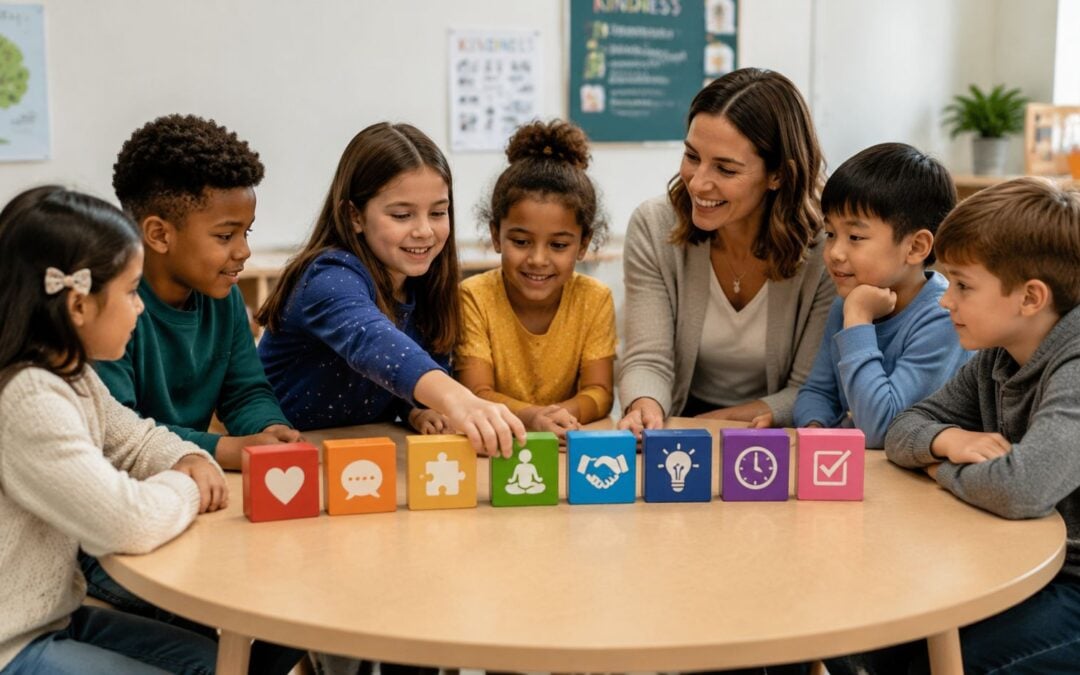
Conflict resolution activities turn those everyday disagreements into guided practice. The sequence matters: help children regulate first, identify feelings and needs, communicate clearly, generate solutions, negotiate interests, and follow through with repair. Introduce each activity during calm moments, then refer back to the shared language when a real conflict occurs. Children are more likely to use a tool under pressure when they've rehearsed it without pressure.
This pathway supports self-awareness, self-management, social awareness, relationship skills, and responsible decision-making. Soul Shoppe's experiential programs and shared language can complement consistent practice across classrooms, school communities, and families. The evidence also supports treating conflict resolution as a teachable school practice. Conflict resolution education emerged in American schools in the early 1970s, and a widely cited estimate identified more than 6,000 U.S. school programs in the survey-era literature. A review of school mediation history describes how the approach grew from peace education into classroom, counseling, and peer-led structures.
1. Restorative Circles and Apology and Repair Rituals
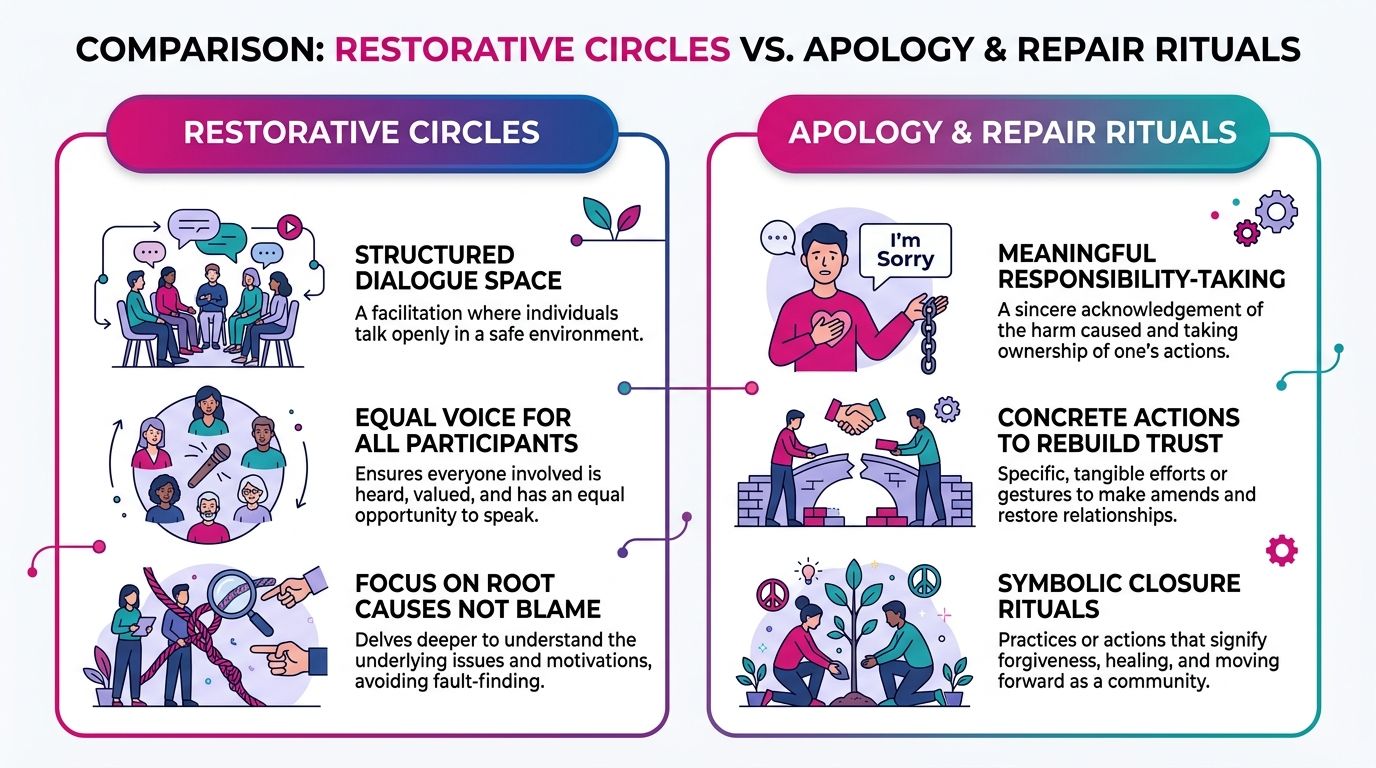
A restorative circle gives children a safe structure for hearing what happened, understanding impact, taking responsibility, and deciding what needs to happen next. Participants sit together, use a talking piece, and speak without interruption. The purpose isn't to force instant agreement. It's to make room for perspective, accountability, and a plan that helps the relationship move forward.
After students exclude a classmate from a group project, a teacher might ask each child to describe what happened, how the experience felt, and what would help future collaboration. The students could create a group agreement, and the excluding student might offer an apology that acknowledges the impact, expresses remorse, and names a concrete repair action, such as including the classmate in the next project.
At home, siblings can use a family talking piece after a fight. An older sibling might apologize for shutting the younger child out, then work together with them to create a “ways we work well” list.
Make repair concrete
Begin with low-stakes disagreements before using circles for serious harm. Establish agreements about respect, confidentiality, listening, and the right to pause. Choose a meaningful talking piece with student or family input, prepare guiding questions, and allow the conversation to develop naturally.
Timing: Use a brief circle during class meeting time, or schedule a longer conversation when everyone is calm.
Materials: Provide a talking piece, question cards, paper for agreements, and a visible place to record next steps.
Adaptations: K-2 children can draw feelings or use sentence starters. Older students can examine impact, accountability, and changed behavior.
Cautions: Never demand an apology before a child understands the harm. Don't use a circle when someone feels unsafe or when a trained adult response is needed.
Assessment: Look for specific acknowledgment, accurate reflection of impact, a realistic repair action, and follow-through.
SEL skills: This activity strengthens empathy, accountability, perspective-taking, relationship repair, and responsible decision-making.
For a classroom-ready explanation of the process, explore restorative circles in schools. Restorative practices work best when they're sustained across the school, not used only after a crisis. A randomized evaluation in New York City found that increased restorative-practice use during the transition from fifth to sixth grade improved standardized English language arts and mathematics performance, lowered the probability of suspension in a year, and reduced days suspended. The evaluation report also describes district findings linking schoolwide adoption with fewer suspensions, less absenteeism, and better attendance, particularly where implementation was thorough.
2. Conflict Resolution Role-Playing and Scenarios
Role-playing lets students practice difficult conversations before they have to manage one in the hallway, cafeteria, playground, or group chat. The teacher presents a familiar situation, students act out different responses, and the class studies the result. Because the scenario is fictional, children can experiment with active listening, I-statements, perspective-taking, and problem-solving without carrying the full emotional weight of a real dispute.
Start with a lunch transition. One student wants to join a group, but the group is already talking about a game. Students can try asking directly, waiting for an opening, or offering a way to contribute. After each round, ask, “What helped the conversation?” and “What made the other person more likely to listen?” Rotate roles so students experience being the person asking, the person deciding, and the observer.
At home, a parent can role-play with a child who wants to invite a friend over. Switch roles so the child also plays the parent, then discuss how safety, timing, responsibilities, and the child's wish for connection can all matter.
Keep practice safe and short
Use scenarios drawn from students' experiences, but don't assign roles that expose a child's private conflict. Keep each round brief, usually 2 to 5 minutes, then spend more time debriefing than performing. Recordings can help older students review tone, interruptions, and body language, but participation should never depend on being recorded.
Timing: Use a short practice during morning meeting, advisory, or after introducing a communication tool.
Materials: Prepare scenario cards, role cards, reflection sheets, and optional recording equipment.
Adaptations: K-2 students can use puppets or picture prompts. Grades 3-5 can practice sentence stems. Grades 6-8 can work with digital communication, exclusion, and group-work dilemmas.
Cautions: Remind students that roles aren't personal. Stop the activity if it becomes mocking, threatening, or emotionally overwhelming.
Assessment: Track whether students identify the problem, use a non-blaming statement, listen without interrupting, and suggest a next step.
SEL skills: Role-play develops communication, empathy, self-management, social awareness, and flexible thinking.
For a related communication practice, see this communication skill activity. Teachers can also connect role-play to games for language learning, especially when students need repeated practice with vocabulary, turn-taking, and conversational repair.
Practical rule: Practice the response you want children to use, not only the conflict you want them to avoid.
Use the video after students understand the scenario, giving them a specific feature to watch for, such as reflective listening or a calm request.
3. Collaborative Problem-Solving
Collaborative Problem-Solving, or CPS, starts with curiosity rather than correction. The adult first asks what each child experiences, then invites everyone to brainstorm possible solutions, and only afterward evaluates the ideas. This structure treats many recurring conflicts as signs that a child needs support with a skill or has an unmet need, rather than as proof of bad character.
Consider two students arguing over art supplies. The teacher might begin with empathy: “Tell me what's getting in the way.” One child needs reliable access to materials, while the other worries that supplies will disappear before their project is finished. Together, they brainstorm a sign-out sheet, a supply-monitor role, shared bins, or a planned exchange. They choose a sign-out system and rotating monitor role, then revisit the arrangement after students have used it.
At home, siblings can use the same process for screen time. Each child explains what matters, they generate options such as a shared calendar or alternating choices, and the family tests one plan.
Separate ideas from judgment
Use the phrase, “I wonder what's getting in the way of you or them,” with genuine interest. Don't jump to a solution because the adult sees an obvious answer. Brainstorming works better when children can offer imperfect ideas without being dismissed immediately.
Timing: Set aside a focused conversation when the conflict isn't active, then schedule a follow-up.
Materials: Use a problem-solving sheet with spaces for perspectives, ideas, chosen plan, and review date.
Adaptations: Younger children can draw needs and choose from pictured options. Older students can compare likely outcomes and revise a plan.
Cautions: Don't confuse collaboration with allowing unsafe or disrespectful behavior. Adults still set clear, inviolable boundaries.
Assessment: Record whether students explain needs, generate options, accept feedback, and revisit an ineffective plan.
SEL skills: CPS supports empathy, agency, critical thinking, cooperation, and responsible decision-making.
The problem-solving activity can help teachers and parents use consistent language. Consistency matters because children learn faster when the same question works in the classroom, on the playground, and at home.
4. Peer Mediation Programs
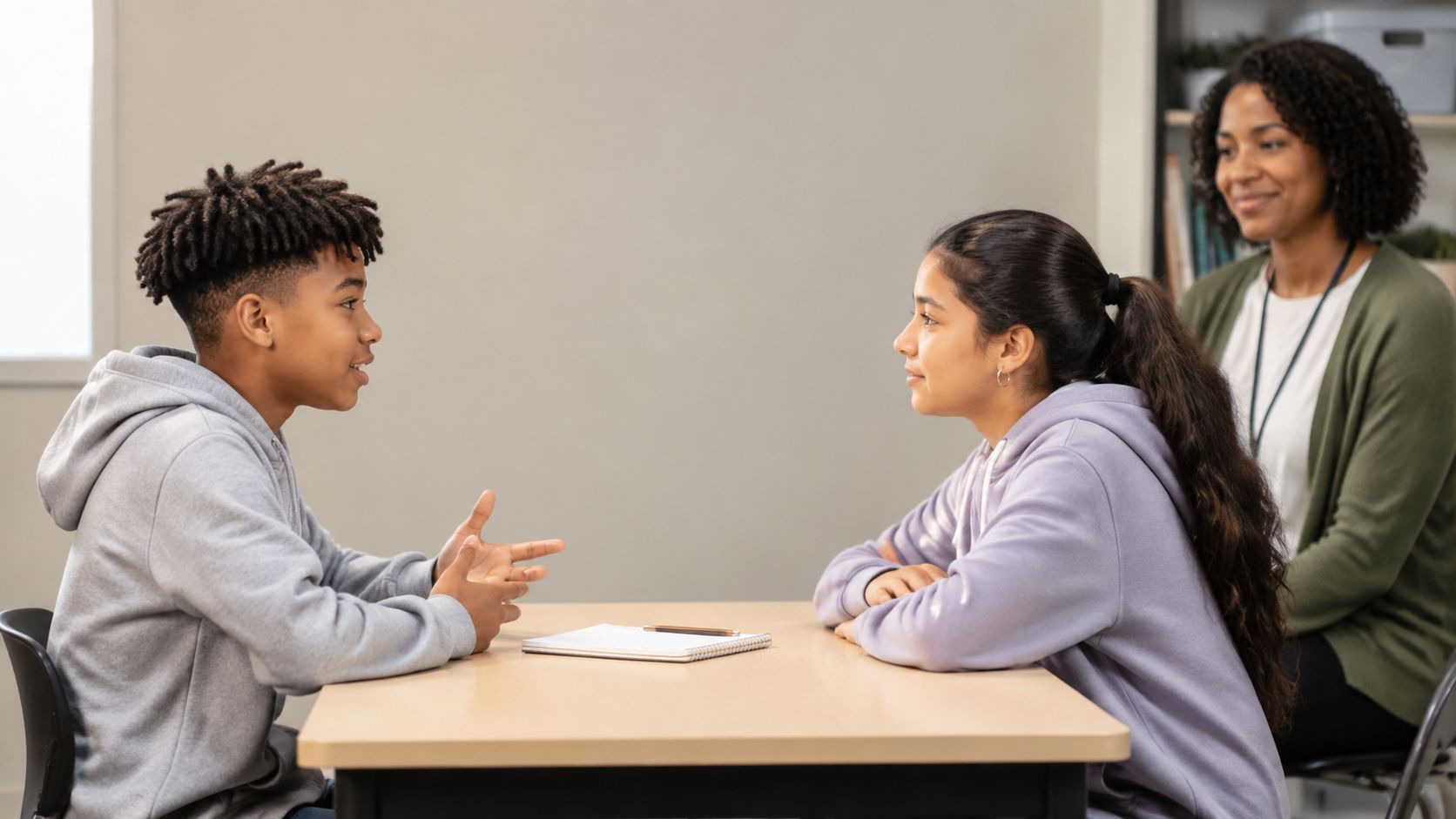
Peer mediation gives trained students a structured role in helping classmates talk through suitable disputes. A mediator doesn't decide who is right, investigate serious harm, or replace an adult safeguarding response. The mediator listens, asks neutral questions, summarizes each perspective, and helps disputants develop a solution they can accept.
A middle school might train eighth-graders to support younger peers. If sixth-graders have a conflict connected to social media, the school could begin with separate conversations, assess whether joint mediation is appropriate, and then bring students together to clarify what happened, identify the impact, and agree on future boundaries. An adult supervises the process and remains responsible for safety and escalation decisions.
At home, an older sibling can practice a similar role in disputes about toys or screen time, but the parent should remain available and avoid making the older child responsible for resolving serious or repeated conflict.
Build the process before referrals begin
Select mediators who demonstrate respect, fairness, discretion, and willingness to learn. Training should cover active listening, neutrality, questioning, confidentiality limits, agreement writing, and when to involve an adult. Start with close supervision, then increase student independence only when the process is reliable.
Timing: Offer mediation during designated times, not hurried transitions.
Materials: Prepare referral forms, mediator scripts, agreement sheets, private seating, and follow-up records.
Adaptations: K-2 settings may use adult-supported buddy problem-solving rather than formal peer mediation. Grades 6-8 can use a defined mediation protocol.
Cautions: Exclude cases involving threats, coercion, ongoing harassment, serious power imbalances, or safety concerns.
Assessment: Monitor agreement rates, follow-up completion, mediator skill growth, and whether students seek help appropriately.
SEL skills: Peer mediation builds leadership, listening, neutrality, empathy, communication, and conflict management.
The evidence offers a practical reason to use structured mediation. One meta-analysis reported a 93% agreement rate on mediated disputes and 88% participant satisfaction with the agreements reached. The conflict-resolution meta-analysis also found broad positive effects on students' conflict-resolution skills across conflict-resolution, peace-education, and peer-mediation interventions. Schools can use those findings as encouragement, while still matching mediation to the dispute and providing adult oversight. Learn more about designing peer support programs.
5. Emotional Check-In and Feelings Vocabulary Building
Children can't explain a need they can't identify. A regular emotional check-in gives students language for the internal experience that often appears first as silence, arguing, avoidance, or physical agitation. Moving beyond “fine,” “mad,” and “sad” helps children distinguish among frustration, nervousness, excitement, pride, loneliness, calm, and other states.
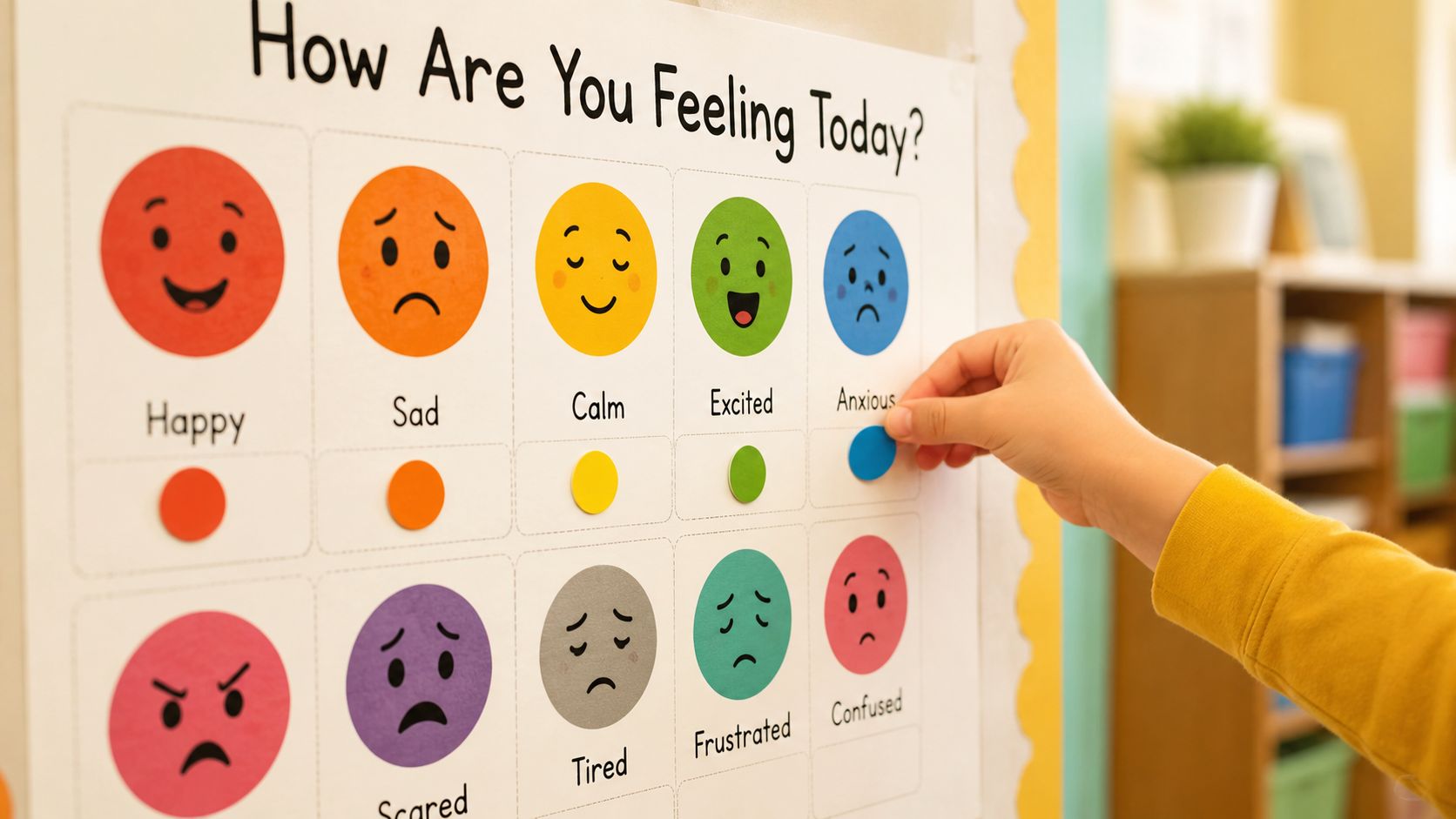
A teacher might place a feelings wheel near the entrance and invite students to mark a color or word. A child who chooses “anxious” can share privately, write a reason, or indicate that they want support. At home, a family feelings chart on the refrigerator can guide a short conversation at dinner: “What are you feeling, and what may have contributed to it?”
Connect feelings with needs
Model specific language yourself. “I feel rushed because we have a lot to finish” teaches more than “I'm stressed.” Invite children to notice body signals, such as butterflies in the stomach, tight shoulders, a hot face, or quick breathing. Then ask, “What do you need right now?” Validate the feeling while keeping a clear boundary around behavior. A child can feel furious and still not hit, insult, or throw materials.
Timing: Use a daily check-in, then add a quick private check before group work or difficult transitions.
Materials: Provide an emotion wheel, feelings chart, color cards, books, character prompts, and optional journals.
Adaptations: K-2 students can point, draw, or use facial expressions. Older students can compare similar emotions and identify mixed feelings.
Cautions: Don't require public disclosure. A check-in should create access to support, not pressure children to reveal private information.
Assessment: Notice whether students name emotions more precisely, connect feelings to body cues, and request an appropriate support.
SEL skills: This activity develops self-awareness, emotional vocabulary, self-management, and social awareness.
Use stories and classroom literature to explore feelings indirectly. Discuss what a character may feel, what evidence supports that interpretation, and what the character might need. This approach gives children rehearsal before they have to name their own emotions during a conflict.
6. The Take and Make Communication Tool
The Take and Make tool gives children a predictable exchange for expressing a concern and demonstrating that they understood the other person. In the Take phase, the speaker says, “I feel [emotion] when [behavior] because [need], and I need [solution].” In the Make phase, the listener reflects the message before responding. The listener isn't agreeing automatically. They're showing that they heard the concern accurately.
After a group-project problem, a student might say, “I feel frustrated when I don't see your work on our shared document because I'm worried about our grade, and I need us to check together every day.” The partner reflects, “You're frustrated because you're worried the work won't be finished, and you want us to check the document daily.” Then the students switch roles and decide whether the request is workable.
At home, a parent might say to a teenager, “I feel anxious when I don't know where you are because I care about your safety, and I need you to text me when you arrive.” The teen reflects the concern before discussing the boundary.
Teach the exchange explicitly
Children shouldn't be expected to produce this language during a heated moment without rehearsal. Put the formula on a poster, model it with another adult, and practice with low-stakes examples. Younger children may use “I feel ___ when ___” and choose from picture cards. Older students can add the need and a specific, negotiable request.
Timing: Practice during morning meeting, advisory, or family check-in, then use it during one-issue conversations.
Materials: Display a sentence-strip poster, emotion cards, scenario prompts, and reflection cards.
Adaptations: K-2 students can use puppets and repeat short phrases. Grades 3-5 can write requests. Grades 6-8 can adapt the tool for texts and online group work.
Cautions: An I-statement can still sound blaming if it labels the other person. Coach students to describe observable behavior.
Assessment: Listen for a named feeling, a specific behavior, an underlying need, a clear request, and an accurate reflection.
SEL skills: Take and Make builds self-awareness, communication, listening, empathy, and relationship skills.
Don't require children to continue talking while their bodies are overwhelmed. Pair this tool with a regulation practice, and return to the conversation when both people can listen.
7. Mindfulness and Self-Regulation Practices
A child who is flooded with anger, fear, or embarrassment may not be ready to negotiate. Mindfulness and self-regulation practices create a pause between the body's alarm response and the next action. Breathing, grounding, body scans, short meditations, and movement breaks help students notice what is happening inside them before they choose what to say or do.
A teacher can lead a brief breathing practice before a tense class meeting. Students might place both feet on the floor, notice one physical sensation, breathe slowly, and identify one goal for the conversation. At home, family members can take three deep breaths before dinner, and a parent can teach a child a calming phrase such as, “I'm safe, I can handle this,” for moments of anxiety.
Make regulation ordinary
Introduce the practice when nobody is upset. Begin with 30 seconds to 2 minutes, then build gradually if students respond well. Use guided recordings when adults don't feel comfortable leading meditation, and include movement, stretching, wall pushes, or sensory grounding for children who find stillness difficult.
Timing: Practice at a consistent daily time, before transitions, and before difficult conversations.
Materials: Use a timer, visual breathing prompt, calm music, grounding cards, or a quiet space.
Adaptations: K-2 students can blow imaginary bubbles or trace a finger around a shape. Older students can choose among breathing, grounding, body scans, and movement.
Cautions: Never use mindfulness as punishment or insist that a distressed child close their eyes. Offer choices and respect sensory, cultural, and accessibility needs.
Assessment: Observe whether students identify early signs of escalation, select a regulation strategy, and return to a conversation more prepared.
SEL skills: These practices support self-awareness, self-management, attention, emotional resilience, and responsible decision-making.
Frame regulation as brain training rather than as a demand to “calm down.” Students are learning to notice thoughts, emotions, and physical responses so they can make a safer next choice. The practice won't remove conflict. It can improve readiness for the communication and problem-solving tools that follow.
8. Win-Win Problem-Solving and Interest-Based Negotiation
Two students both want to present first. One feels anxious and wants to finish quickly. The other has an appointment and needs to leave early. Their stated positions appear incompatible, but their underlying interests open more options. The teacher can ask why presenting first matters, list each interest separately, and help students consider reordering, practicing beforehand, or trading presentation roles for another responsibility.
At home, siblings negotiating screen time may begin with competing demands. One wants connection with friends, while the other wants entertainment or uninterrupted play. A schedule can address both interests more effectively than a simple winner-takes-all decision.
Ask about the reason beneath the demand
Use the question, “Why is this important to you?” Listen for the need beneath the position, such as predictability, belonging, privacy, competence, rest, or time with a friend. Put positions on one side of a shared chart and interests on the other. Then invite students to generate 5 to 7 options before evaluating them. The exact count matters less than creating enough space for creative thinking before anyone rejects an idea.
Timing: Use this activity when both parties can participate safely and have enough time to review options.
Materials: Provide a shared chart, sticky notes, markers, a simple decision rubric, and a follow-up calendar.
Adaptations: K-2 students can use “I want” and “I need” picture cards. Grades 3-5 can sort positions and interests. Grades 6-8 can negotiate shared spaces, group roles, schedules, and digital boundaries.
Cautions: Don't promise that every negotiation ends with equal access or total satisfaction. Safety, fairness, and adult responsibilities remain firm boundaries.
Assessment: Look for interest statements, multiple options, respectful evaluation, an agreed plan, and a later check-in.
SEL skills: This activity develops perspective-taking, cooperation, communication, critical thinking, flexibility, and responsible decision-making.
Encourage “yes, and” thinking during brainstorming. After implementation, ask what worked, what didn't, and what should change. Celebrate successful agreements because children need to see that cooperation is a practical skill, not just a classroom slogan.
Start with one low-stakes activity and use it consistently. A classroom doesn't need eight new routines at once, and a family won't benefit from introducing a complicated process in the middle of a crisis. Choose the tool that matches the moment, teach it during calm practice, and repeat the same words until children recognize the pathway.
Use mindfulness and self-regulation before escalation, when bodies are tense and attention is narrowing. Use feelings vocabulary when children need help noticing and naming what is happening. Use Take and Make when two people are ready for a safer conversation. Choose Collaborative Problem-Solving or win-win negotiation when the central task is reaching an agreement. Use peer mediation for suitable peer disputes with trained support, and reserve restorative circles for accountability, shared understanding, and repair.
Assessment should focus on observable behavior rather than whether students say they enjoyed an activity. Teachers and parents can look for whether a child:
Names a feeling: The child identifies an emotion with increasing precision.
Explains a need: The child connects the feeling to a concern, goal, or request.
Reflects another perspective: The child can summarize what another person experienced without immediately arguing.
Generates options: The child proposes more than one possible solution.
Follows an agreement: The child attempts the plan and returns to review it.
Completes repair: The child acknowledges impact and takes a concrete action to rebuild trust.
Evidence supports a sustained, skills-based approach. A large meta-analysis of conflict resolution education in U.S. schools examined 36 studies and 4,971 students and reported an overall effect size of 0.26 for reducing antisocial behavior. The same analysis reported stronger effects in mid-adolescence, with an effect size of 0.53, and early adolescence, with 0.22, compared with middle childhood, at 0.06. The Office of Justice Programs summary also describes a decline in students reporting bullying from 28% to 20%, and a reduction in students being called hate-related words from 11% to 7.5%.
Age matters, and one routine won't meet every child's needs. A study of 350 Vietnamese secondary students found significant gender and grade-level differences in identifying conflict causes, finding compromise, reporting conflicts objectively, and knowing counselor contact information. The study supports adapting activities for K-2, 3-5, and 6-8 rather than assuming that a single script works equally well for every learner.
Families and schools can also check whether skills travel beyond the original setting. A middle-school peer mediation study across three schools tracked teachers, students, disciplinary incidents, mediation outcomes, mediators, disputants, and parents, including whether mediation skills transferred to home conflicts. The study record makes the home connection explicit. In an elementary program, students received 9 hours of training and recorded 783 conflicts over a 9-week period, including 209 at school and 574 at home. The Office of Justice Programs publication reported that the training significantly changed the strategies students used to manage conflict.
Use the same core language across settings. A child who hears “pause, name it, listen, solve it, repair it” from a teacher and a caregiver gets a stronger chance to recognize the process when conflict appears somewhere new. Soul Shoppe can support broader school-community implementation through workshops, assemblies, coaching, courses, and an app, alongside shared tools for self-regulation, mindfulness, communication, and conflict resolution.
Soul Shoppe offers experiential workshops, assemblies, coaching, courses, and an app that help school communities practice shared language for self-regulation, communication, empathy, and repair. Visit Soul Shoppe to explore support for bringing these conflict resolution activities into classrooms, families, and wider school-community practice.
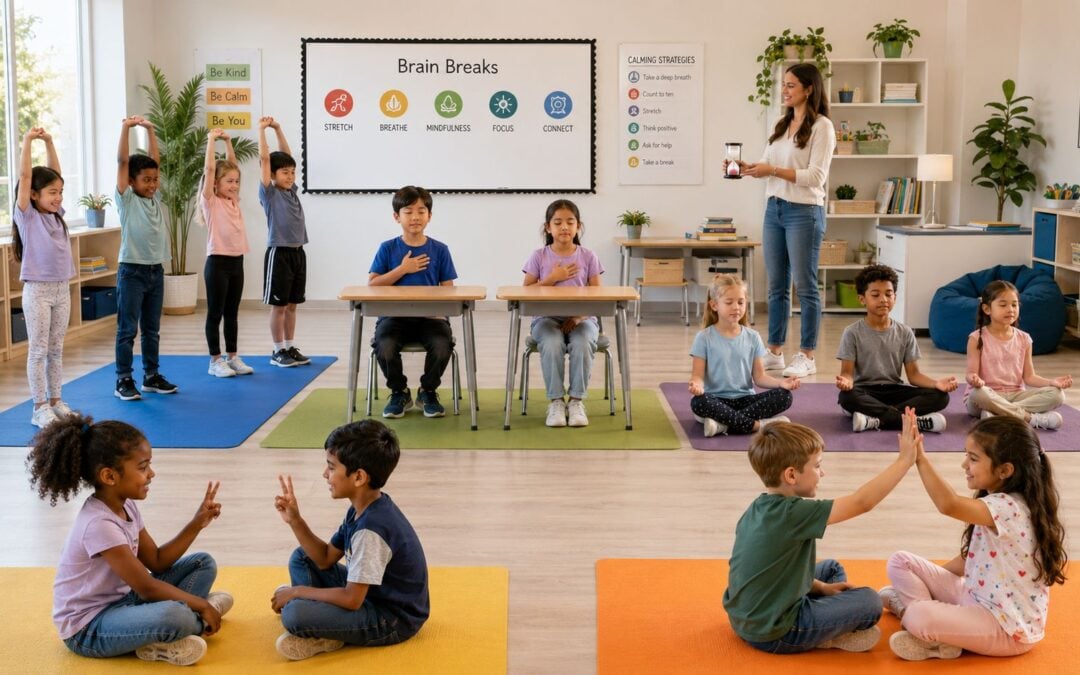
In any learning environment, from the classroom to the living room, maintaining focus and engagement can be a challenge. That’s where fun brain breaks become a powerful tool. These are not just time-fillers; they are strategic mental resets designed to help students refocus, regulate their emotions, and absorb information more effectively. Research shows that short, structured breaks improve cognitive function, reduce stress, and support social-emotional learning (SEL). For example, even simple activities like social dancing offer incredible benefits for mental well-being and social connection, reinforcing why an intentional break is so important.
This guide provides 10 practical, research-backed activities ready for immediate use. You'll find step-by-step instructions, age-specific adaptations, and classroom management tips for each brain break. Whether you're a teacher, administrator, or parent, these ideas will help you create a more positive and productive learning atmosphere, complete with suggestions for integrating Soul Shoppe’s shared SEL language to build a stronger sense of community.
1. Mindful Movement & Stretching
This category of fun brain breaks combines gentle physical activity with mindfulness, helping students release tension while sharpening their focus. Instead of high-energy bursts, these activities involve slow, intentional movements paired with deep breathing. This approach calms the nervous system, builds body awareness, and supports emotional regulation, making it a perfect reset before a challenging lesson or after a period of intense concentration.
How to Implement It
Successful integration relies on consistency and clear guidance. For example, a second-grade teacher might lead a five-minute "Shoulder Rolls and Sky Reaches" routine before math to settle the class. A parent could use a "Forward Fold" stretch after homework to help their child transition calmly to dinner time.
For an effective session, consider these tips:
Set the Tone: Play soft, instrumental music to create a calm atmosphere.
Model Slowly: Demonstrate each movement clearly so students can easily follow along. Example: As you model a "Neck Roll," slowly drop your chin to your chest and then gently roll your right ear toward your right shoulder, holding for a count of three before switching sides.
Use Simple Cues: Use accessible language like, "Reach for the ceiling," or "Gently drop your chin to your chest."
Connect Breath to Movement: Guide students by saying, "Breathe in as you lift your arms, and breathe out as you lower them."
2. The 5-4-3-2-1 Sensory Grounding Technique
This category of fun brain breaks uses a powerful mindfulness tool that anchors students to the present moment by engaging their five senses. The technique involves systematically identifying five things you see, four you can touch, three you hear, two you smell, and one you taste. This process interrupts overwhelming feelings or anxiety, pulling focus away from internal distress and toward the immediate external environment. It is an effective strategy for calming the nervous system and restoring emotional balance.
How to Implement It
Implementation is most successful when the technique is practiced during calm moments first. A third-grade teacher might lead the class through it after recess to help them settle, while a parent can use it to de-escalate a meltdown in a busy store. By making it a familiar routine, students learn to use it independently when they feel stressed, such as before a test.
For an effective session, consider these tips:
Model the Process: Guide students through each sense, demonstrating how to slowly notice and name items. Example: "Okay class, let's start with five things we can see. I see the green plant on the windowsill, the blue poster, Maria's red sweater, the white clock, and the light on the ceiling. Now it's your turn."
Create Visual Aids: Use a poster or laminated desk card showing the 5-4-3-2-1 sequence as a helpful reminder.
Adapt as Needed: For "taste," suggest students think of one thing they like to eat or the last thing they ate. For "touch," they can feel their desk, their sleeve, their pencil, and their own hair.
Pair with Breathing: Encourage slow breaths between each step, saying, “Breathe in and tell me five things you can see.”
3. Dance & Movement Breaks
This high-energy category of fun brain breaks uses music and playful movement to help students burn off excess energy, boost their mood, and increase blood flow to the brain. These activities provide a joyful outlet for physical expression, helping reset focus and build a positive classroom community. Whether it's a structured dance-along or a moment of free movement, these breaks are perfect for shaking out restlessness and re-energizing the room.
How to Implement It
Successful dance breaks are about channeling energy constructively. For example, a third-grade teacher might start the day with a two-minute dance party to an upbeat song, noticing improved moods and fewer conflicts. At home, a parent could use a quick game of "freeze dance" after school to help their child transition from a long day to homework time with renewed focus.
For an effective session, consider these tips:
Use Guided Videos: Use resources like GoNoodle or Just Dance Kids to provide structured, easy-to-follow routines.
Create a Playlist: Build a class-approved playlist of upbeat, age-appropriate songs that students can request.
Manage Space: If space is limited, have some students dance freely while others march or jog in place. Example: "Group A, you can do jumping jacks at your desk. Group B, you can jog in place. Let's switch in 30 seconds!"
Practice Impulse Control: Incorporate freeze dance, where students stop moving when the music pauses, to build listening skills and self-regulation.
Plan a Calm-Down Transition: Follow a high-energy dance break with a minute of deep breathing or stretching to help students settle back into their work.
4. Breathing Exercises & Belly Breathing
This powerful category of fun brain breaks uses guided breathing to activate the body’s natural relaxation response. Simple techniques like belly breathing calm the nervous system, helping students shift from a state of stress or high energy to one of calm focus. By learning to control their breath, students gain a practical tool for managing emotions, reducing anxiety, and preparing their minds for learning.
How to Implement It
Implementation can be adapted for any age. For instance, a kindergarten teacher might use the "smell the flower, blow out the candle" cue before circle time. A parent could guide their child through "balloon breathing," imagining their belly inflating and deflating, to soothe homework frustration.
To get started, try these simple tips:
Use Concrete Imagery: Younger students connect well with visuals like flowers, candles, or waves. Example: "Pretend you are holding a cup of hot chocolate. Breathe in deeply to smell the chocolatey scent for four counts. Now, slowly blow out for four counts to cool it down."
Model Visibly: Exaggerate the movement of your own belly so students have a clear visual to imitate.
Provide Tactile Feedback: Ask students to place a hand on their belly to feel the rise and fall.
Practice Proactively: Introduce these techniques during calm moments so they become familiar and accessible during stressful times. You can explore a detailed guide on the belly breathing technique to build confidence.
5. Partner Connection Games & Pair Bonding
This type of fun brain break focuses on interactive activities designed for two students, building social connection, communication, and peer relationships. Rather than individual or large-group activities, these games require direct engagement with a partner. Activities like mirroring movements or hand-clapping games help students practice collaboration and attunement, which strengthens classroom community and provides a much-needed mental reset.
How to Implement It
Success with partner games comes from clear instructions and thoughtful pairing. A fourth-grade teacher could introduce a "Mirroring" activity where one student leads with slow movements and their partner copies them exactly, building focus and empathy. A parent at home can play "Partner Simon Says" with their child to foster connection and joyful interaction after a long school day.
For an effective session, consider these tips:
Model First: Demonstrate the activity with a student so everyone understands the expectations.
Pair Strategically: Mix up partners regularly so students connect with different classmates.
Start Simple: Begin with low-pressure games before moving to more complex or physical ones. Example: A game of "Thumb Wrestling" or a simple hand-clapping sequence like "Miss Mary Mack."
Facilitate Reflection: Ask questions like, "What did you learn about your partner today?" to deepen the social-emotional learning aspect. For more ideas, explore other relationship-building activities that build community.
6. Guided Imagery & Visualization
This type of fun brain break transports students to calm mental landscapes, using the power of imagination to achieve deep relaxation and focus. The facilitator guides students through a sensory-rich story or scene, such as a peaceful beach or a magical forest. By engaging their minds in a positive, tranquil scenario, students can quiet distracting thoughts, reduce anxiety, and return to their tasks with a renewed sense of clarity and emotional balance.
How to Implement It
Successful guided imagery depends on creating a safe, comfortable environment with a slow, soothing voice. For example, a fourth-grade teacher might lead a "Floating on a Cloud" visualization after a lively recess to help the class settle down. A parent could use a "Safe Place" visualization to help their child manage worries before a big test.
For an effective session, consider these tips:
Use a Soothing Tone: Speak slowly and softly, pausing frequently to allow students to build the images in their minds.
Include Sensory Details: Describe what students might see, hear, smell, and feel. Example Script: "Imagine you are walking on a warm, sandy beach. You can feel the soft sand between your toes. Hear the gentle sound of the waves crashing on the shore. Can you smell the salty air?"
Offer Choices: Allow students to participate in a way that feels comfortable. Say, "You can close your eyes or just look down at your desk."
Keep it Brief: Start with short, 3- to 5-minute sessions and gradually increase the time as students become more familiar with the practice.
This category of fun brain breaks shifts mental gears from logical processing to creative, intuitive thinking. Activities like free drawing, doodling, or coloring provide a low-pressure outlet for emotional expression and mental rest. By engaging the artistic side of the brain, students can quietly process feelings, reduce stress, and return to academic tasks with a refreshed and calmer mindset. It is a meditative break that values process over a perfect finished product.
How to Implement It
Successful creative breaks depend on accessibility and an emphasis on freedom. For instance, a second-grade teacher might start the day with "feelings doodles," where students draw whatever represents their current mood. A parent could use "worry drawing" after school, inviting their child to doodle their anxieties before discussing them.
For an effective session, consider these tips:
Emphasize Process: Remind students, "There is no right or wrong way to create." The goal is expression, not a masterpiece.
Offer Simple Prompts: Suggest ideas like "draw your happy place" or "doodle your favorite sound," but allow students to create freely. Example: "Let's all draw a 'scribble monster.' Just scribble on the page for 10 seconds, then turn your scribble into a monster by adding eyes and legs!"
Keep Materials Ready: Have paper, crayons, and pre-printed patterns like mandalas easily accessible for quick transitions. Exploring tools like anxiety coloring pages can provide structured yet calming options.
Create a Calm Atmosphere: Play soft, instrumental music to help students settle into a creative flow.
8. Kindness & Gratitude Circles
This category of fun brain breaks shifts the focus from physical movement to social-emotional connection. These structured group activities guide students to practice giving and receiving compliments, sharing appreciations, or identifying things they are grateful for. By creating a dedicated time for positive expression, these circles build empathy, strengthen peer relationships, and actively rewire focus toward pro-social thinking. It's an ideal reset for improving classroom climate and fostering a sense of belonging.
How to Implement It
Successful integration depends on creating a safe, predictable routine. For example, a third-grade teacher could hold a weekly “Compliment Circle” where each student receives two genuine compliments from peers, helping to reduce classroom conflicts. A parent might start a “Gratitude Dinner” where each family member shares something they appreciated about another person that day, building stronger family bonds.
For an effective session, consider these tips:
Model First: Demonstrate how to give a specific, genuine compliment to a student before asking the class to try. Example: Instead of "You're nice," model saying, "I appreciated how you helped Leo pick up his crayons when he dropped them. That was very kind."
Use Sentence Starters: Provide prompts like, “I appreciated when you…” or “I am grateful for…” to guide students.
Establish Clear Rules: Create a “no criticism” zone where only positive appreciations are shared.
Allow Passing: Normalize allowing students to pass if they don’t feel ready to share, which builds psychological safety.
9. Nature & Outdoor Observation Breaks
This category of fun brain breaks connects students with the natural world to provide a genuine sensory reset. By stepping outside or simply observing through a window, children shift their focus from academic pressures to the details of their environment-clouds, plants, weather, and wildlife. This practice reduces stress, grounds students in the present moment, and cultivates an appreciation for the world around them, making it an excellent way to calm a restless class.
How to Implement It
Successful nature breaks are built on simple, repeatable routines. For instance, a third-grade class could take a three-minute "sensory walk" around the playground, focusing on what they can hear and smell. At home, a parent might ask their child to spend a few minutes at a window on a rainy day and describe the patterns the raindrops make, helping them transition calmly from screen time to homework.
For an effective session, consider these tips:
Use Guided Prompts: Ask simple questions to direct focus, such as, "What are three different colors you can see?" or "What sounds are the loudest and quietest?" Example: "Everyone look at that tree. How many different shades of green can you find in its leaves? What direction is the wind blowing the branches?"
Create a Nature Journal: Encourage students to sketch or write down one thing they notice each time.
Visit the Same Spot: Returning to the same tree or garden area regularly helps students observe seasonal changes over time.
Engage All Senses: Prompt students to touch tree bark, smell damp earth after rain, or listen for bird calls to create a full sensory experience.
10. Sound & Music-Based Brain Resets
This category of fun brain breaks uses audio cues to shift mental states, offering a powerful tool for emotional regulation and focus. Activities range from actively singing or tapping rhythms to passively listening to calming music. Sound and music directly influence mood and energy levels, making them an efficient way to reset the classroom atmosphere, energize a sluggish group, or soothe overstimulated minds before a transition.
How to Implement It
Successful integration depends on being intentional with your audio choices. For instance, a fourth-grade teacher could play five minutes of instrumental focus music during independent writing time to help students concentrate. A parent might teach their child a simple, calming song to sing softly when they feel overwhelmed by big emotions.
For an effective session, consider these tips:
Curate Playlists: Create separate playlists for different needs: calming instrumentals for tests, upbeat tunes for energy boosts, and focus music for work periods.
Teach Simple Songs: Use repetitive, simple songs or chants that students can easily learn and sing together to signal transitions. Example: A simple call-and-response chant like, "Teacher: Macaroni and cheese! Students: Everybody freeze!"
Incorporate Rhythm: Use body percussion like clapping or desk tapping, or simple instruments like shakers, to create a shared rhythm that builds community and releases energy.
Consider Volume: Be mindful that some students are sensitive to loud sounds. Keep background music at a low, non-distracting volume.
Quick Comparison: 10 Fun Brain Breaks
Activity
Implementation complexity
Resource requirements
Expected outcomes
Ideal use cases
Key advantages
Mindful Movement & Stretching
Low–Moderate — teacher models simple sequences
Minimal space, optional soft music
Reduced tension, improved attention, body awareness
Transitions, before focused work, anxiety reduction
Inclusive, minimal setup, teaches self‑regulation
The 5-4-3-2-1 Sensory Grounding Technique
Low — scripted prompts, quick to run
None
Rapid anxiety reduction, present‑moment focus
Acute stress moments, pre‑test, quick resets
Portable, fast, works individually or whole group
Dance & Movement Breaks
Low–Moderate — manage music and timing
Music/audio and open space
Energy release, improved mood, increased focus
High‑energy periods, morning routines, before recess
Transitions, calming during work, energizing before activity
Neurologically impactful, versatile, enjoyable
Putting Fun Brain Breaks into Action
We've explored a wide range of engaging, research-backed activities designed to refresh young minds, from Mindful Movement and the 5-4-3-2-1 Sensory Grounding technique to Creative Expression and Kindness Circles. The common thread connecting them all is the power of intentional pausing. These are not just fun distractions; they are vital tools for building focus, managing emotions, and creating a positive, supportive learning environment. The true value of Fun Brain Breaks emerges when they become a consistent, predictable part of the daily rhythm.
Building a Sustainable Routine
The key is to start small and build momentum. Don't try to introduce all ten activities at once. Instead, choose one that aligns with your students' current needs. If post-recess energy is high, a guided Belly Breathing exercise might be perfect. If you notice students struggling with a complex math problem, a quick Dance & Movement Break could be the reset they need to find a new perspective.
Remember to model the activities enthusiastically and participate alongside your students. Your engagement signals that these moments are just as important as academic instruction. After each break, take thirty seconds to debrief. Ask simple questions like, "How does your body feel now?" or "What did you notice during that quiet moment?" This reflective practice connects the physical action to the internal benefit, deepening their social-emotional awareness.
From Breaks to Breakthroughs
Integrating Fun Brain Breaks consistently does more than just improve attention spans. It communicates a powerful message to students: their well-being matters. When they learn to identify their need for a break and use strategies like guided imagery or a gratitude share to reset, they are building foundational self-regulation and self-advocacy skills that will support them for a lifetime. These short, intentional pauses create the space needed for academic and emotional breakthroughs to happen, transforming your classroom into a place where students feel seen, supported, and ready to learn.
Ready to take your classroom's social-emotional learning to the next level? The strategies in this article are a great start, and Soul Shoppe provides the programs and curriculum to build a truly peaceful school culture. Explore our offerings at Soul Shoppe to discover how to integrate these practices into a comprehensive, school-wide system.
A lot of school leaders are already doing SEL. It just doesn't always feel organized.
You might walk into one classroom and see a teacher leading a breathing reset before math. In another, students are using sentence stems to solve a peer conflict. Down the hall, the counselor is running a lunch group on friendship skills. All of that matters. But if each practice lives on its own, students experience SEL as a set of isolated moments instead of a shared way of learning and relating.
That's where social emotional learning standards help. They turn good intentions into a school-wide system. They give adults a common language, help teams decide what to teach when, and make student growth more visible in daily practice.
From Scattered Acts of SEL to a School-Wide Strategy
A principal once described her school to me this way: “We have caring teachers, solid routines, and lots of SEL moments. But I'm not sure students are building skills in a consistent way.”
That's a common K-8 reality.
A second-grade teacher may use a calming corner beautifully. A fifth-grade teacher may coach students to use “I feel” statements during group work. A middle school advisor may facilitate strong conversations about belonging and peer pressure. Each adult is helping. The problem isn't effort. The problem is fragmentation.
What scattered SEL looks like in practice
When SEL is scattered, you often see patterns like these:
Different language in every room. One class says “take a break,” another says “reset,” and another says “self-regulate,” with no shared student-friendly language.
Uneven skill building. Students practice emotion naming in primary grades but get far less support with stress management or conflict repair later on.
Unclear expectations for staff. Teachers care, but they don't always know which skills belong in universal classroom instruction and which need targeted support.
Family confusion. Parents hear about mindfulness one week and problem-solving the next, but they can't tell what the school intends to teach over time.
A coherent framework changes that. Instead of asking each adult to invent SEL from scratch, standards identify the competencies and grade-band expectations students should develop across the school experience.
Practical rule: If a student moves from one classroom to another, the language of SEL should feel familiar, not brand new.
That's why I encourage leaders to think of standards as a blueprint, not a script. They don't replace teacher judgment. They organize it. They help you connect classroom routines, advisory lessons, discipline practices, and family communication into one strategy.
If your team is comparing stand-alone lessons with broader implementation options, it can help to review examples of social-emotional learning programs for schools and then ask a sharper question: Which program or practice aligns to the skills we want students to learn over time?
The shift school leaders are really making
The move isn't from “no SEL” to “SEL.”
It's from random acts of support to a developmental plan. In a standards-based model, adults can answer practical questions with more confidence:
What should a kindergartner be learning about feelings?
What should a fourth grader know about managing frustration during collaboration?
What should an eighth grader be able to do when social tension rises?
Once a staff can answer those questions together, SEL stops feeling like one more initiative. It becomes part of how the school teaches, responds, and builds community every day.
What Are Social Emotional Learning Standards
Social emotional learning standards are the skills and developmental expectations a school or state wants students to build in areas like self-awareness, self-management, empathy, relationships, and decision-making.
The simplest comparison is academic standards. In reading, standards tell us what students should know and do at different grade levels. SEL standards do the same thing for social and emotional development. They clarify the “what” and the “when.”
They are not a boxed curriculum.
A curriculum is the set of lessons, routines, and materials you use. Standards are the framework behind those choices. That distinction matters because schools often get stuck here. A team adopts a program and assumes the program itself is the plan. A stronger approach starts with standards, then chooses lessons and routines that match them.
The five competencies most educators recognize
Many state and district frameworks are organized around the five CASEL competencies:
Self-awareness Students recognize emotions, strengths, challenges, and how feelings affect behavior. In a classroom, this might sound like, “I'm frustrated because this is hard,” instead of shutting down or acting out.
Self-management Students regulate emotions, manage impulses, set goals, and use coping strategies. A first grader may take three breaths and ask for a break. A seventh grader may plan how to stay calm before a presentation.
Social awareness Students notice other people's feelings and perspectives, including people with different backgrounds or experiences. In practice, this shows up when students listen before reacting or adjust their words when a peer is upset.
Relationship skills Students communicate clearly, resolve conflict, cooperate, and seek or offer help. Teachers see this during partner work, recess repair conversations, and group projects.
Responsible decision-making Students consider consequences, safety, ethics, and the impact of choices on themselves and others. This is the skill behind pausing before posting, gossiping, excluding, or escalating.
Why standards have to be teachable
A good standard can be translated into something adults can observe. That's one reason frameworks matter. They move us from broad hopes like “be respectful” to teachable behaviors like naming emotions, taking turns, repairing harm, or resolving conflict.
Washington State's framework shows how concrete this can become. It uses 6 standards and 17 benchmarks in a grade-band competency structure, while CASEL's model uses five competencies. The same technical guidance explains that evidence-based elementary SEL programs commonly target specific behaviors such as social skills, identifying others' feelings, identifying one's own feelings, and behavioral coping or relaxation, with several appearing in roughly 92–100% of reviewed programs in that analysis of program components (Washington State SEL standards and benchmarks).
That's the part busy teams often need to hear. Standards work when they can be turned into visible student actions.
A standard is only useful if a teacher can answer, “What would this look like during math, recess, and dismissal?”
For teams teaching in blended, online, or tech-rich environments, the same logic applies to adult collaboration. This overview of social learning for digital educators is useful because it shows how shared learning structures can support consistent practice across settings.
If your staff needs a clearer grounding in why this work belongs alongside academics, this short read on why SEL matters can help frame the conversation.
The Growing Adoption of SEL Standards Nationwide
If SEL standards still feel optional in your district, the national picture tells a different story.
Schools across the United States have moved SEL from the margins toward the center of school design. By the 2023–24 school year, 83% of U.S. principals reported that their schools used an SEL curriculum, and the number of states with K-12 SEL standards grew from 14 in 2019 to 27 by 2022 (CASEL implementation update).
Why this shift matters for school leaders
That trend changes the leadership conversation.
A few years ago, SEL could be treated as an add-on driven by a counselor, a grant, or a small team of enthusiastic teachers. In many places, that's no longer realistic. Standards-based SEL is increasingly part of the same coherence work leaders already do for literacy, math, attendance, behavior, and school climate.
Here's what that looks like on the ground:
Curriculum conversations change. Teams ask whether the school's SEL lessons are aligned across grade bands, not just whether a teacher likes a particular activity.
Professional learning gets more focused. Staff need support with modeling, practice, and classroom integration, not just awareness.
Climate goals become more teachable. Instead of saying “we want students to be respectful,” schools define the specific social and emotional skills behind respectful behavior.
Family communication gets clearer. Parents can see the progression of skills the school is teaching, not just hear occasional SEL buzzwords.
Adoption doesn't guarantee implementation
This is the part that deserves honesty. A state can publish standards, and a district can purchase materials, but students still won't benefit unless adults use those standards consistently.
That's why leaders should read the adoption trend as an opportunity, not a finish line.
A standards document can help a school answer important design questions:
Which skills are expected at each grade band?
Where are those skills taught explicitly?
Where are they practiced in academic settings?
How do adults reinforce them during conflict, stress, and transition moments?
The existence of standards tells you SEL has entered the infrastructure of schooling. It doesn't tell you whether students are experiencing it in a meaningful way.
That distinction matters in K-8 settings because developmental shifts happen quickly. A school with strong implementation doesn't just say it values empathy and self-management. It teaches those skills on purpose, from kindergarten through middle school, in language students can use.
How SEL Standards Look Across Grade Levels
One reason social emotional learning standards can feel abstract is that words like “self-management” sound broad. Teachers and parents usually understand them once they can picture actual student behavior.
Let's use self-management as the example. Across K-8, the standard stays recognizable, but the behavior becomes more advanced as students grow. A six-year-old and a thirteen-year-old both need impulse control and stress management. They just show those skills differently.
A grade-band view of one competency
Grade Band
Example Skill: Impulse Control
Example Skill: Stress Management
K-2
Waits for a turn, keeps hands to self, uses a teacher prompt before blurting out
Uses a calming corner, takes belly breaths, names “I need help” or “I need a break”
3-5
Pauses before reacting in group work, notices body signals, uses agreed class routines during frustration
Chooses a coping strategy before a test, uses self-talk, asks for clarification instead of shutting down
6-8
Stops and thinks before posting, arguing, or escalating with peers, reflects on triggers and patterns
Plans ahead for stressful events, uses regulation tools independently, recovers after setbacks without disrupting others
The point isn't that every student will demonstrate these skills perfectly. The point is that adults can teach, model, notice, and coach them.
What this looks like in real classrooms
In K-2, self-management is concrete and immediate. A teacher might post visuals for feelings, model how to breathe slowly, and guide students to say, “I feel mad, and I need space.” Parents can support the same skill at home by using a simple routine such as pause, breathe, and talk.
In grades 3-5, students can handle more reflection. A fourth-grade teacher might stop after a tense group task and ask, “What did your body feel like when your idea wasn't chosen?” That question helps students connect internal cues to behavior. At home, caregivers can ask after a hard day, “What helped you calm down, and what made it harder?”
For grades 6-8, the work becomes more social, internal, and identity-linked. Students need help noticing stress patterns, peer influence, and the gap between feeling and action. A middle school teacher might coach students to prepare for a stressful presentation with a plan: what to say to themselves, what breathing strategy to use, and what support to ask for if they freeze.
Middle school students often know the language of regulation before they can use it under pressure. They still need practice.
Two questions that keep grade-band planning realistic
When a team builds around standards, I recommend using these filters:
Can we observe it? “Demonstrates self-management” is too broad by itself. “Uses a taught strategy to calm down after frustration” is more workable.
Can we teach it more than once? If a skill only shows up in one assembly or one advisory lesson, it won't stick. Students need repeated practice in routines, transitions, collaboration, and conflict.
Say your school identifies “manage strong feelings during disagreement” as a priority.
A developmental sequence might look like this:
K-2 Students learn to stop, name a feeling, and ask an adult for help.
3-5 Students practice using sentence stems, listening, and trying one regulation strategy before responding.
6-8 Students reflect on triggers, disagree without personal attacks, and repair relationships after conflict.
That's what it means to live the standard. The wording may come from a state document, but the learning shows up in everyday behavior.
How to Map SEL Standards to Your School Curriculum
Most schools don't need to build an SEL system from nothing. They need to organize what already exists, fill the gaps, and make the sequence clearer.
That starts with curriculum mapping. Not a giant binder project. A practical one.
Start with an SEL audit
Gather a small team that includes classroom teachers, student support staff, and an administrator. Then look at where SEL is already happening.
Ask questions like these:
Which skills do we already teach on purpose?
Where do students practice those skills during the week?
Which grade levels have strong routines but weak explicit instruction?
Where are adults using different language for the same skill?
You'll usually find that your school already teaches a lot. The issue is alignment.
For example, a third-grade ELA unit may already ask students to infer character feelings. That connects to social awareness. A science lab may require turn-taking and problem-solving, which can support relationship skills and responsible decision-making. Morning meeting may teach emotion naming, but maybe there's no clear plan for how students build on that in upper grades.
Use SAFE as a quality filter
Strong social emotional learning standards don't come alive through random activities. They need a coherent instructional design. One widely used guide is SAFE, which stands for Sequenced, Active, Focused, and Explicit. CASEL-linked guidance emphasizes that standards should be thorough and developmentally appropriate so schools can match them with evidence-based programs and make SEL a learning progression instead of an occasional add-on (SAFE design guidance for SEL standards).
A quick way to use SAFE is to review your current lessons and ask:
Sequenced Do skills build over time, or are lessons dropped in randomly?
Active Do students practice through role-play, reflection, discussion, and real interaction?
Focused Is there protected attention to SEL, or are expectations implied but never taught?
Explicit Can students name the skill they are learning and when to use it?
A workable mapping process for K-8 schools
Here is a process I've seen work well:
Choose a small set of priority standards Don't try to map everything at once. Pick a few school-wide skills such as emotion regulation, conflict resolution, and perspective-taking.
Create a grade-band look-for list Define what those skills should look like in K-2, 3-5, and 6-8.
Map existing touchpoints Include homeroom, advisory, morning meeting, ELA discussions, partner tasks, recess systems, and discipline repair processes.
Spot the gaps Maybe students are taught how to identify feelings but not how to recover after peer conflict. Maybe staff expect self-management in middle school but haven't built the progression leading there.
Align tools and routines A school might use classroom circles, reflection sheets, peer mediation scripts, or one structured provider. For example, Soul Shoppe offers digital and on-site SEL programs that teach practical tools and shared language for self-regulation, mindfulness, communication, and conflict resolution. The key question isn't brand loyalty. It's alignment.
Plan adult practice Standards fail when only students are expected to use the language. Adults need common prompts, modeling routines, and response practices too.
Revisit quarterly Mapping is not one-and-done. Schools need to ask whether taught skills are actually showing up in student behavior.
If your staff can't name where a skill is introduced, practiced, reinforced, and revisited, that skill probably isn't embedded yet.
For teams creating mini-lessons, family explainers, or advisory refreshers, clear visuals can help. This guide to educational video production is useful if you want to turn standards into short, reusable teaching supports for staff or caregivers.
If you want examples of routines, prompts, and implementation supports, this collection of social-emotional learning tools can help teams move from planning to day-to-day use.
Measuring Progress with SEL Assessments
School leaders eventually ask the right question: How do we know whether students are building these skills?
That question matters because SEL growth isn't always obvious from a single lesson or a single week. It shows up over time in how students handle frustration, collaborate with peers, ask for help, and recover from mistakes.
A large Harvard summary of panel research tracking students in grades 4 through 12 found that core SEL competencies such as self-management and social awareness declined during middle school, and the Learning Policy Institute summary cited there describes SEL research across hundreds of studies on six continents with medium to large effect sizes across several outcomes. CASEL also reports evidence from more than 1 million students worldwide across PreK-12 showing positive impacts on academic achievement and school functioning (Harvard summary of SEL trends and research base).
That combination is important. Students' social-emotional skills can shift over time, and schools can support that growth when instruction is intentional.
Three common ways schools assess SEL
Assessment approach
What it can show
Best use in K-8
Watch-outs
Student self-report
How students perceive their own skills, feelings, and sense of belonging
Older elementary and middle school reflection, climate checks, growth conversations
Younger students may need support understanding questions; responses can reflect mood or interpretation
Teacher rating scales
Patterns adults observe over time in classroom behavior and peer interaction
Universal screening, progress monitoring, identifying support needs
Adults need shared criteria so ratings stay consistent
Direct performance tasks or demonstrations
Whether students can apply a skill in a structured task or scenario
Skill checks during role-plays, advisory, circles, and restorative practice
Harder to administer at scale and requires staff calibration
What to look for in an assessment tool
Schools sometimes choose tools because they're available, quick, or bundled with a curriculum. A better approach is to ask whether the tool has solid documentation for its purpose, development, structure, norms, reliability, validity, fairness, administration, and scoring.
In plain language, you want to know:
What is this tool actually designed to measure?
Is it appropriate for this age group?
Will staff understand how to interpret the results?
Can the data inform instruction rather than just sit in a spreadsheet?
Use data for improvement, not labeling
SEL assessment works best when it supports reflection and action.
A fourth-grade team might notice that students can identify emotions but struggle to use coping strategies independently. That finding should shape reteaching. A middle school may learn that students report lower confidence in handling peer conflict. That should lead to more modeling, practice, and coaching.
Assessment should help adults improve supports, not turn SEL into a high-stakes score.
That's especially true for K-8 settings. Younger students need developmentally sensitive measures. Older students need assessment practices that respect identity, privacy, and context. In both cases, the most useful data connects back to observable behavior and practical next steps.
Building Lasting Support for Your SEL Program
The strongest standards-based SEL plan can still stall if adults don't trust it, understand it, or see themselves in it.
Sustainability depends less on polished documents and more on whether teachers, families, and students experience SEL as useful, fair, and connected to daily school life.
Close the gap between paper and practice
One of the biggest implementation problems is simple: a school has standards, but classrooms vary widely in students' real experience.
That gap shows up when one teacher teaches conflict repair directly while another handles every disagreement as misbehavior. It shows up when students hear strong language about belonging in assemblies but don't see it reflected in hallway correction, group work, or discipline follow-up.
Leaders can reduce that gap by focusing on a few essential elements:
Shared adult language Agree on a small set of prompts and terms students will hear across settings.
Visible modeling Teachers and staff need to demonstrate apology, reflection, emotional regulation, and respectful disagreement.
Routine practice Skills need to appear in transitions, collaboration, and problem-solving, not just during a weekly SEL block.
Coaching over compliance Staff usually need examples, rehearsal, and feedback more than another checklist.
Treat equity as a design issue
SEL only helps all students when schools avoid turning it into a lesson in compliance with dominant norms.
Research on historically underserved populations argues that SEL can advance equity when it is embedded in school-family-community partnerships and responsive to learner context, and New York's revised benchmarks explicitly center belonging, identity, and perspectives across difference (ACT report on SEL and historically underserved populations).
That matters in practical terms.
A culturally responsive SEL approach asks questions like:
Are we teaching “self-management” as silent compliance, or as skillful regulation with dignity?
Do students see their identities, languages, and family ways of communicating reflected in examples and discussions?
Are we teaching perspective-taking in ways that honor difference instead of flattening it?
Do families get invited in as partners, or only contacted when behavior becomes a concern?
SEL should expand students' capacity and belonging. It shouldn't ask them to leave parts of themselves at the door.
How to build buy-in that lasts
Buy-in grows when adults see that SEL makes school more workable.
Teachers tend to engage when they can connect standards to real classroom pain points such as transitions, peer conflict, disengagement, and stress. Families engage when schools explain skills in everyday language and offer examples they can use at home. Students engage when they feel the work helps them manage actual situations, not just complete a lesson.
A durable approach often includes:
A clear reason for the work Explain how the standards support learning, relationships, and school climate.
Small, visible early wins Start with a few routines or skills that staff can use right away.
Family-facing examples Share short examples of what a skill sounds like at school and how caregivers can reinforce it at home.
Staff reflection time Adults need space to ask hard questions, especially about consistency and equity.
Regular recalibration Revisit whether written expectations are showing up in student experience.
The schools that sustain SEL aren't the ones with the most posters. They're the ones where adults use the standards to guide instruction, relationships, and responses every day.
If your school wants help turning social emotional learning standards into concrete routines, shared language, and student-ready tools, Soul Shoppe offers programs and resources designed to support self-regulation, communication, conflict resolution, and belonging across whole school communities.