

8 Conflict Resolution Activities for K–8
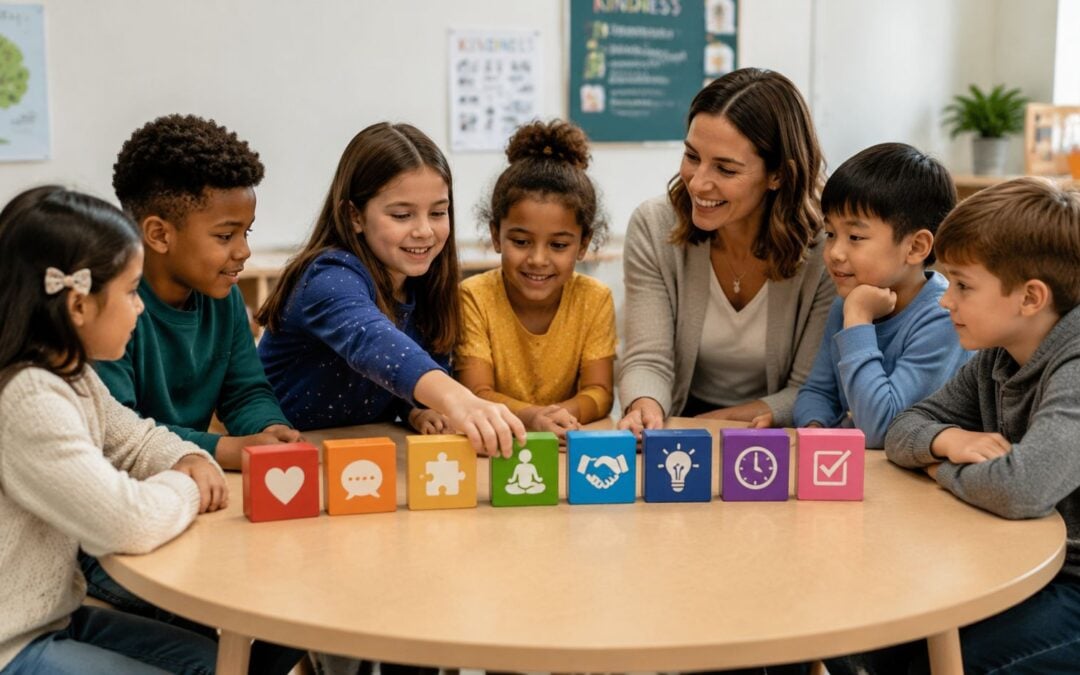
Two students reach for the same box of markers, voices rise, and one child pulls the materials away. At home, siblings argue over who gets the tablet first, each certain the other is being unfair. These moments don’t mean children are failing. They mean children are still learning how to manage strong feelings, explain needs, listen, solve problems, and repair trust.
Conflict resolution activities turn those everyday disagreements into guided practice. The sequence matters: help children regulate first, identify feelings and needs, communicate clearly, generate solutions, negotiate interests, and follow through with repair. Introduce each activity during calm moments, then refer back to the shared language when a real conflict occurs. Children are more likely to use a tool under pressure when they’ve rehearsed it without pressure.
This pathway supports self-awareness, self-management, social awareness, relationship skills, and responsible decision-making. Soul Shoppe’s experiential programs and shared language can complement consistent practice across classrooms, school communities, and families. The evidence also supports treating conflict resolution as a teachable school practice. Conflict resolution education emerged in American schools in the early 1970s, and a widely cited estimate identified more than 6,000 U.S. school programs in the survey-era literature. A review of school mediation history describes how the approach grew from peace education into classroom, counseling, and peer-led structures.
1. Restorative Circles and Apology and Repair Rituals
A restorative circle gives children a safe structure for hearing what happened, understanding impact, taking responsibility, and deciding what needs to happen next. Participants sit together, use a talking piece, and speak without interruption. The purpose isn’t to force instant agreement. It’s to make room for perspective, accountability, and a plan that helps the relationship move forward.
After students exclude a classmate from a group project, a teacher might ask each child to describe what happened, how the experience felt, and what would help future collaboration. The students could create a group agreement, and the excluding student might offer an apology that acknowledges the impact, expresses remorse, and names a concrete repair action, such as including the classmate in the next project.
At home, siblings can use a family talking piece after a fight. An older sibling might apologize for shutting the younger child out, then work together with them to create a “ways we work well” list.
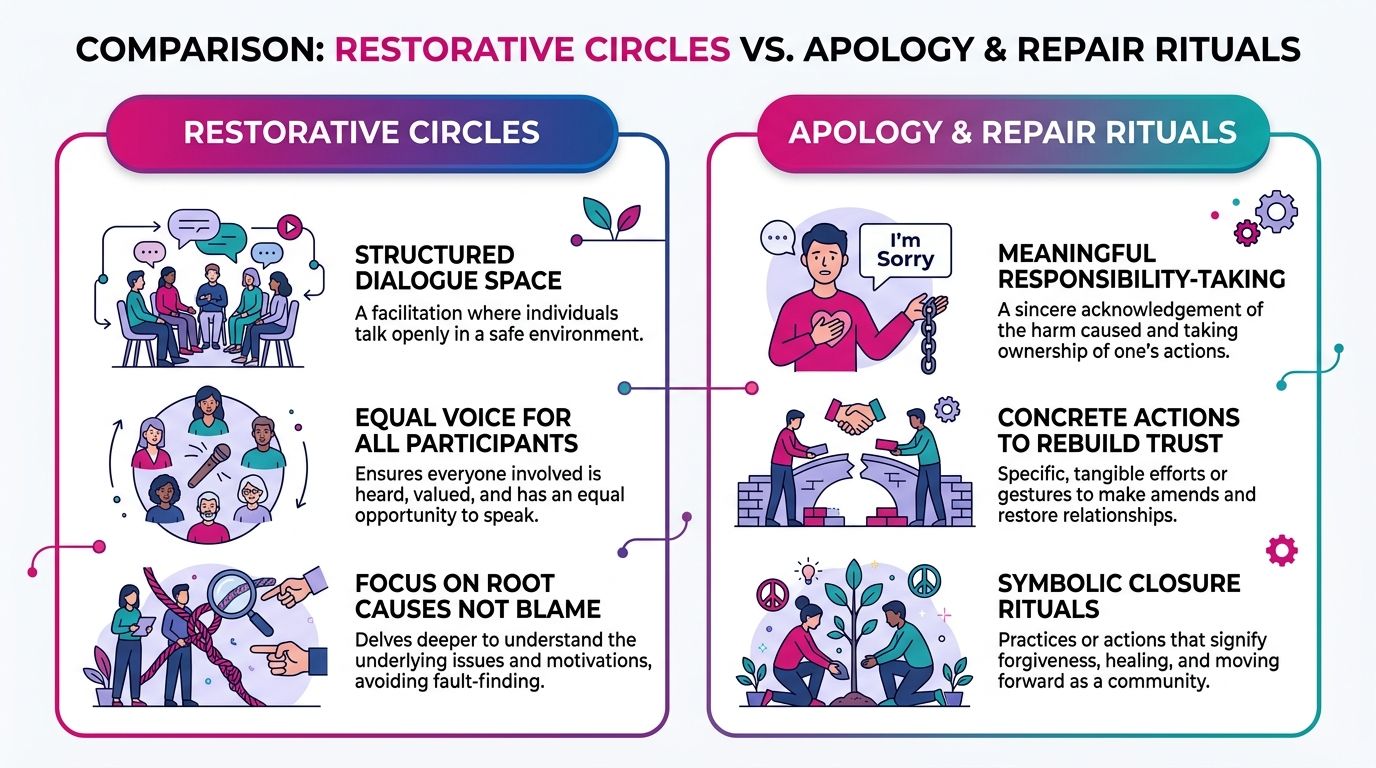
Make repair concrete
Begin with low-stakes disagreements before using circles for serious harm. Establish agreements about respect, confidentiality, listening, and the right to pause. Choose a meaningful talking piece with student or family input, prepare guiding questions, and allow the conversation to develop naturally.
- Timing: Use a brief circle during class meeting time, or schedule a longer conversation when everyone is calm.
- Materials: Provide a talking piece, question cards, paper for agreements, and a visible place to record next steps.
- Adaptations: K-2 children can draw feelings or use sentence starters. Older students can examine impact, accountability, and changed behavior.
- Cautions: Never demand an apology before a child understands the harm. Don’t use a circle when someone feels unsafe or when a trained adult response is needed.
- Assessment: Look for specific acknowledgment, accurate reflection of impact, a realistic repair action, and follow-through.
- SEL skills: This activity strengthens empathy, accountability, perspective-taking, relationship repair, and responsible decision-making.
For a classroom-ready explanation of the process, explore restorative circles in schools. Restorative practices work best when they’re sustained across the school, not used only after a crisis. A randomized evaluation in New York City found that increased restorative-practice use during the transition from fifth to sixth grade improved standardized English language arts and mathematics performance, lowered the probability of suspension in a year, and reduced days suspended. The evaluation report also describes district findings linking schoolwide adoption with fewer suspensions, less absenteeism, and better attendance, particularly where implementation was thorough.
2. Conflict Resolution Role-Playing and Scenarios
Role-playing lets students practice difficult conversations before they have to manage one in the hallway, cafeteria, playground, or group chat. The teacher presents a familiar situation, students act out different responses, and the class studies the result. Because the scenario is fictional, children can experiment with active listening, I-statements, perspective-taking, and problem-solving without carrying the full emotional weight of a real dispute.
Start with a lunch transition. One student wants to join a group, but the group is already talking about a game. Students can try asking directly, waiting for an opening, or offering a way to contribute. After each round, ask, “What helped the conversation?” and “What made the other person more likely to listen?” Rotate roles so students experience being the person asking, the person deciding, and the observer.
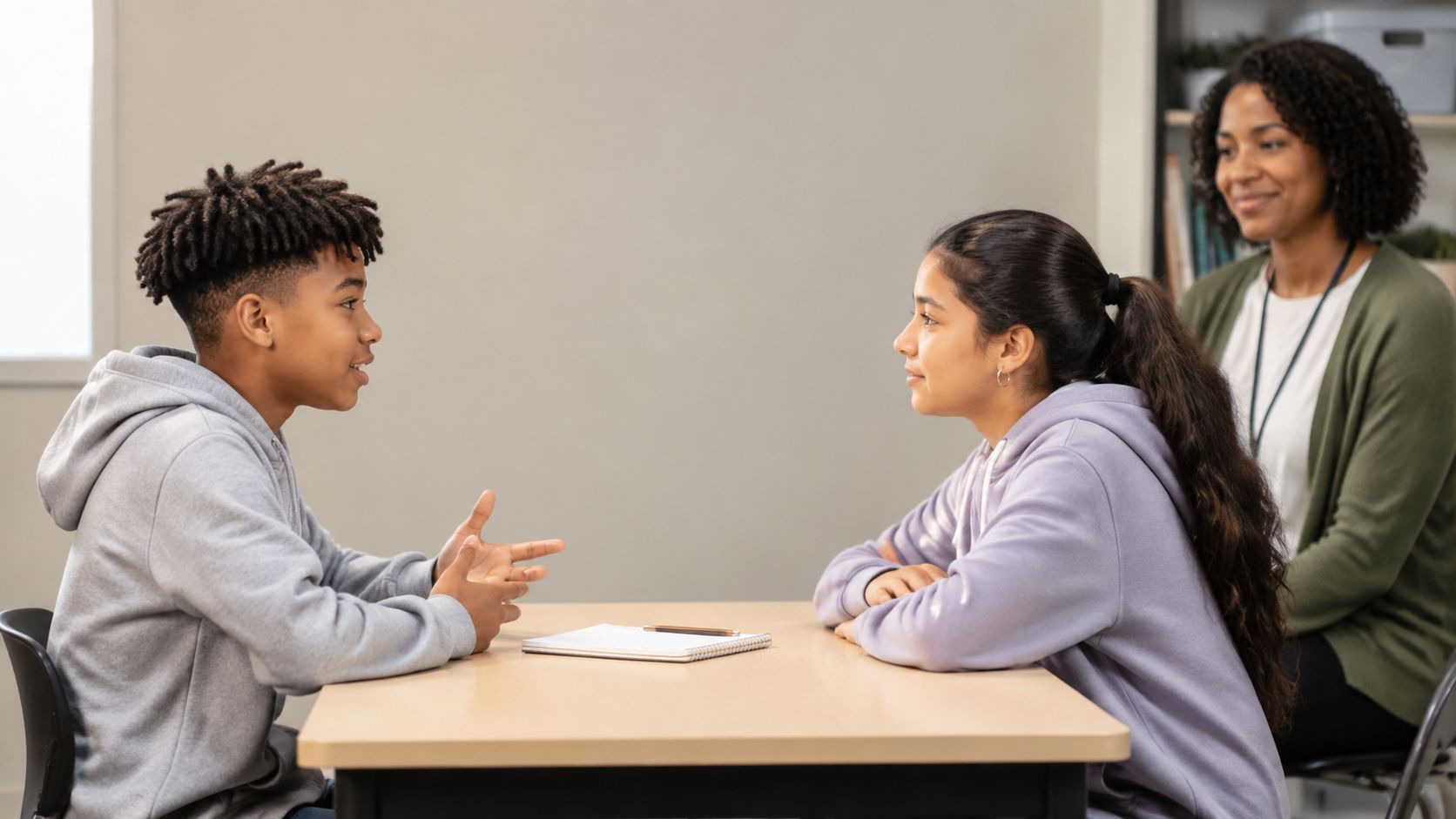
At home, a parent can role-play with a child who wants to invite a friend over. Switch roles so the child also plays the parent, then discuss how safety, timing, responsibilities, and the child’s wish for connection can all matter.
Keep practice safe and short
Use scenarios drawn from students’ experiences, but don’t assign roles that expose a child’s private conflict. Keep each round brief, usually 2 to 5 minutes, then spend more time debriefing than performing. Recordings can help older students review tone, interruptions, and body language, but participation should never depend on being recorded.
- Timing: Use a short practice during morning meeting, advisory, or after introducing a communication tool.
- Materials: Prepare scenario cards, role cards, reflection sheets, and optional recording equipment.
- Adaptations: K-2 students can use puppets or picture prompts. Grades 3-5 can practice sentence stems. Grades 6-8 can work with digital communication, exclusion, and group-work dilemmas.
- Cautions: Remind students that roles aren’t personal. Stop the activity if it becomes mocking, threatening, or emotionally overwhelming.
- Assessment: Track whether students identify the problem, use a non-blaming statement, listen without interrupting, and suggest a next step.
- SEL skills: Role-play develops communication, empathy, self-management, social awareness, and flexible thinking.
For a related communication practice, see this communication skill activity. Teachers can also connect role-play to games for language learning, especially when students need repeated practice with vocabulary, turn-taking, and conversational repair.
Practical rule: Practice the response you want children to use, not only the conflict you want them to avoid.
Use the video after students understand the scenario, giving them a specific feature to watch for, such as reflective listening or a calm request.
3. Collaborative Problem-Solving
Collaborative Problem-Solving, or CPS, starts with curiosity rather than correction. The adult first asks what each child experiences, then invites everyone to brainstorm possible solutions, and only afterward evaluates the ideas. This structure treats many recurring conflicts as signs that a child needs support with a skill or has an unmet need, rather than as proof of bad character.
Consider two students arguing over art supplies. The teacher might begin with empathy: “Tell me what’s getting in the way.” One child needs reliable access to materials, while the other worries that supplies will disappear before their project is finished. Together, they brainstorm a sign-out sheet, a supply-monitor role, shared bins, or a planned exchange. They choose a sign-out system and rotating monitor role, then revisit the arrangement after students have used it.
At home, siblings can use the same process for screen time. Each child explains what matters, they generate options such as a shared calendar or alternating choices, and the family tests one plan.
Separate ideas from judgment
Use the phrase, “I wonder what’s getting in the way of you or them,” with genuine interest. Don’t jump to a solution because the adult sees an obvious answer. Brainstorming works better when children can offer imperfect ideas without being dismissed immediately.
- Timing: Set aside a focused conversation when the conflict isn’t active, then schedule a follow-up.
- Materials: Use a problem-solving sheet with spaces for perspectives, ideas, chosen plan, and review date.
- Adaptations: Younger children can draw needs and choose from pictured options. Older students can compare likely outcomes and revise a plan.
- Cautions: Don’t confuse collaboration with allowing unsafe or disrespectful behavior. Adults still set clear, inviolable boundaries.
- Assessment: Record whether students explain needs, generate options, accept feedback, and revisit an ineffective plan.
- SEL skills: CPS supports empathy, agency, critical thinking, cooperation, and responsible decision-making.
The problem-solving activity can help teachers and parents use consistent language. Consistency matters because children learn faster when the same question works in the classroom, on the playground, and at home.
4. Peer Mediation Programs
Peer mediation gives trained students a structured role in helping classmates talk through suitable disputes. A mediator doesn’t decide who is right, investigate serious harm, or replace an adult safeguarding response. The mediator listens, asks neutral questions, summarizes each perspective, and helps disputants develop a solution they can accept.
A middle school might train eighth-graders to support younger peers. If sixth-graders have a conflict connected to social media, the school could begin with separate conversations, assess whether joint mediation is appropriate, and then bring students together to clarify what happened, identify the impact, and agree on future boundaries. An adult supervises the process and remains responsible for safety and escalation decisions.
At home, an older sibling can practice a similar role in disputes about toys or screen time, but the parent should remain available and avoid making the older child responsible for resolving serious or repeated conflict.
Build the process before referrals begin
Select mediators who demonstrate respect, fairness, discretion, and willingness to learn. Training should cover active listening, neutrality, questioning, confidentiality limits, agreement writing, and when to involve an adult. Start with close supervision, then increase student independence only when the process is reliable.
- Timing: Offer mediation during designated times, not hurried transitions.
- Materials: Prepare referral forms, mediator scripts, agreement sheets, private seating, and follow-up records.
- Adaptations: K-2 settings may use adult-supported buddy problem-solving rather than formal peer mediation. Grades 6-8 can use a defined mediation protocol.
- Cautions: Exclude cases involving threats, coercion, ongoing harassment, serious power imbalances, or safety concerns.
- Assessment: Monitor agreement rates, follow-up completion, mediator skill growth, and whether students seek help appropriately.
- SEL skills: Peer mediation builds leadership, listening, neutrality, empathy, communication, and conflict management.
The evidence offers a practical reason to use structured mediation. One meta-analysis reported a 93% agreement rate on mediated disputes and 88% participant satisfaction with the agreements reached. The conflict-resolution meta-analysis also found broad positive effects on students’ conflict-resolution skills across conflict-resolution, peace-education, and peer-mediation interventions. Schools can use those findings as encouragement, while still matching mediation to the dispute and providing adult oversight. Learn more about designing peer support programs.
5. Emotional Check-In and Feelings Vocabulary Building
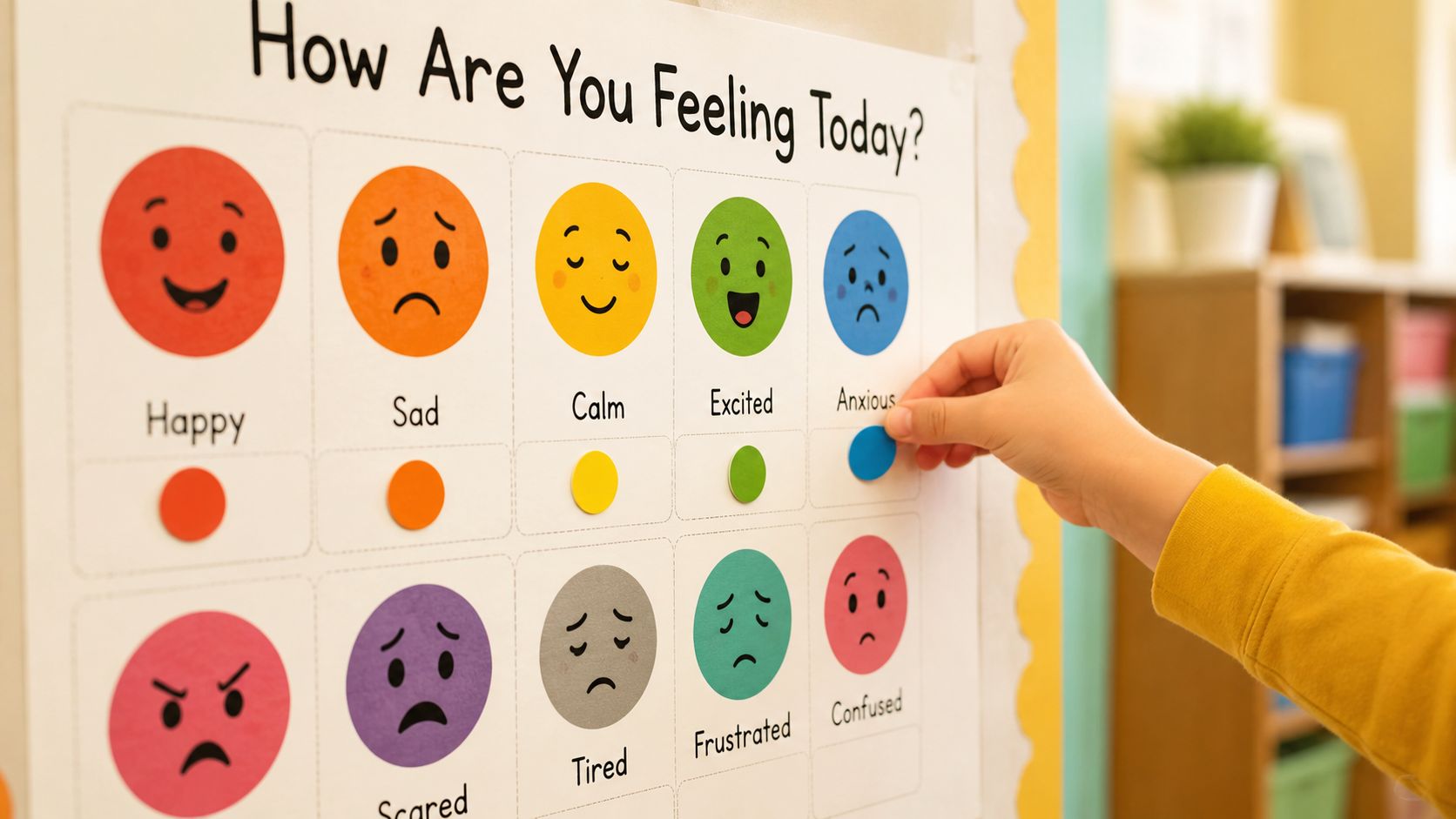
Children can’t explain a need they can’t identify. A regular emotional check-in gives students language for the internal experience that often appears first as silence, arguing, avoidance, or physical agitation. Moving beyond “fine,” “mad,” and “sad” helps children distinguish among frustration, nervousness, excitement, pride, loneliness, calm, and other states.
A teacher might place a feelings wheel near the entrance and invite students to mark a color or word. A child who chooses “anxious” can share privately, write a reason, or indicate that they want support. At home, a family feelings chart on the refrigerator can guide a short conversation at dinner: “What are you feeling, and what may have contributed to it?”
Connect feelings with needs
Model specific language yourself. “I feel rushed because we have a lot to finish” teaches more than “I’m stressed.” Invite children to notice body signals, such as butterflies in the stomach, tight shoulders, a hot face, or quick breathing. Then ask, “What do you need right now?” Validate the feeling while keeping a clear boundary around behavior. A child can feel furious and still not hit, insult, or throw materials.
- Timing: Use a daily check-in, then add a quick private check before group work or difficult transitions.
- Materials: Provide an emotion wheel, feelings chart, color cards, books, character prompts, and optional journals.
- Adaptations: K-2 students can point, draw, or use facial expressions. Older students can compare similar emotions and identify mixed feelings.
- Cautions: Don’t require public disclosure. A check-in should create access to support, not pressure children to reveal private information.
- Assessment: Notice whether students name emotions more precisely, connect feelings to body cues, and request an appropriate support.
- SEL skills: This activity develops self-awareness, emotional vocabulary, self-management, and social awareness.
Use stories and classroom literature to explore feelings indirectly. Discuss what a character may feel, what evidence supports that interpretation, and what the character might need. This approach gives children rehearsal before they have to name their own emotions during a conflict.
6. The Take and Make Communication Tool
The Take and Make tool gives children a predictable exchange for expressing a concern and demonstrating that they understood the other person. In the Take phase, the speaker says, “I feel [emotion] when [behavior] because [need], and I need [solution].” In the Make phase, the listener reflects the message before responding. The listener isn’t agreeing automatically. They’re showing that they heard the concern accurately.
After a group-project problem, a student might say, “I feel frustrated when I don’t see your work on our shared document because I’m worried about our grade, and I need us to check together every day.” The partner reflects, “You’re frustrated because you’re worried the work won’t be finished, and you want us to check the document daily.” Then the students switch roles and decide whether the request is workable.
At home, a parent might say to a teenager, “I feel anxious when I don’t know where you are because I care about your safety, and I need you to text me when you arrive.” The teen reflects the concern before discussing the boundary.
Teach the exchange explicitly
Children shouldn’t be expected to produce this language during a heated moment without rehearsal. Put the formula on a poster, model it with another adult, and practice with low-stakes examples. Younger children may use “I feel ___ when ___” and choose from picture cards. Older students can add the need and a specific, negotiable request.
- Timing: Practice during morning meeting, advisory, or family check-in, then use it during one-issue conversations.
- Materials: Display a sentence-strip poster, emotion cards, scenario prompts, and reflection cards.
- Adaptations: K-2 students can use puppets and repeat short phrases. Grades 3-5 can write requests. Grades 6-8 can adapt the tool for texts and online group work.
- Cautions: An I-statement can still sound blaming if it labels the other person. Coach students to describe observable behavior.
- Assessment: Listen for a named feeling, a specific behavior, an underlying need, a clear request, and an accurate reflection.
- SEL skills: Take and Make builds self-awareness, communication, listening, empathy, and relationship skills.
Don’t require children to continue talking while their bodies are overwhelmed. Pair this tool with a regulation practice, and return to the conversation when both people can listen.
7. Mindfulness and Self-Regulation Practices
A child who is flooded with anger, fear, or embarrassment may not be ready to negotiate. Mindfulness and self-regulation practices create a pause between the body’s alarm response and the next action. Breathing, grounding, body scans, short meditations, and movement breaks help students notice what is happening inside them before they choose what to say or do.
A teacher can lead a brief breathing practice before a tense class meeting. Students might place both feet on the floor, notice one physical sensation, breathe slowly, and identify one goal for the conversation. At home, family members can take three deep breaths before dinner, and a parent can teach a child a calming phrase such as, “I’m safe, I can handle this,” for moments of anxiety.
Make regulation ordinary
Introduce the practice when nobody is upset. Begin with 30 seconds to 2 minutes, then build gradually if students respond well. Use guided recordings when adults don’t feel comfortable leading meditation, and include movement, stretching, wall pushes, or sensory grounding for children who find stillness difficult.
- Timing: Practice at a consistent daily time, before transitions, and before difficult conversations.
- Materials: Use a timer, visual breathing prompt, calm music, grounding cards, or a quiet space.
- Adaptations: K-2 students can blow imaginary bubbles or trace a finger around a shape. Older students can choose among breathing, grounding, body scans, and movement.
- Cautions: Never use mindfulness as punishment or insist that a distressed child close their eyes. Offer choices and respect sensory, cultural, and accessibility needs.
- Assessment: Observe whether students identify early signs of escalation, select a regulation strategy, and return to a conversation more prepared.
- SEL skills: These practices support self-awareness, self-management, attention, emotional resilience, and responsible decision-making.
Frame regulation as brain training rather than as a demand to “calm down.” Students are learning to notice thoughts, emotions, and physical responses so they can make a safer next choice. The practice won’t remove conflict. It can improve readiness for the communication and problem-solving tools that follow.
8. Win-Win Problem-Solving and Interest-Based Negotiation
Two students both want to present first. One feels anxious and wants to finish quickly. The other has an appointment and needs to leave early. Their stated positions appear incompatible, but their underlying interests open more options. The teacher can ask why presenting first matters, list each interest separately, and help students consider reordering, practicing beforehand, or trading presentation roles for another responsibility.
At home, siblings negotiating screen time may begin with competing demands. One wants connection with friends, while the other wants entertainment or uninterrupted play. A schedule can address both interests more effectively than a simple winner-takes-all decision.
Ask about the reason beneath the demand
Use the question, “Why is this important to you?” Listen for the need beneath the position, such as predictability, belonging, privacy, competence, rest, or time with a friend. Put positions on one side of a shared chart and interests on the other. Then invite students to generate 5 to 7 options before evaluating them. The exact count matters less than creating enough space for creative thinking before anyone rejects an idea.
- Timing: Use this activity when both parties can participate safely and have enough time to review options.
- Materials: Provide a shared chart, sticky notes, markers, a simple decision rubric, and a follow-up calendar.
- Adaptations: K-2 students can use “I want” and “I need” picture cards. Grades 3-5 can sort positions and interests. Grades 6-8 can negotiate shared spaces, group roles, schedules, and digital boundaries.
- Cautions: Don’t promise that every negotiation ends with equal access or total satisfaction. Safety, fairness, and adult responsibilities remain firm boundaries.
- Assessment: Look for interest statements, multiple options, respectful evaluation, an agreed plan, and a later check-in.
- SEL skills: This activity develops perspective-taking, cooperation, communication, critical thinking, flexibility, and responsible decision-making.
Encourage “yes, and” thinking during brainstorming. After implementation, ask what worked, what didn’t, and what should change. Celebrate successful agreements because children need to see that cooperation is a practical skill, not just a classroom slogan.
Comparison of 8 Conflict Resolution Activities
| Method | Implementation complexity | Resource requirements | Expected outcomes | Ideal use cases | Key advantages |
|---|---|---|---|---|---|
| Restorative Circles and Apology & Repair Rituals | High, needs careful facilitation and time | Skilled facilitators, dedicated time/space, talking piece, follow-up processes | Restored relationships, accountability, reduced repeat harm, closure | Serious relational harms, community restoration, bullying/exclusion incidents | Deep mutual understanding, shared norms, meaningful repair |
| Conflict Resolution Role-Playing and Scenarios | Medium, planning and debriefing required | Time for scenarios, facilitator, safe norms, optional recording | Practiced skills, increased confidence, perspective-taking | Teaching communication techniques, rehearsing common student situations | Experiential, engaging, makes abstract skills concrete |
| Collaborative Problem-Solving (CPS) | Medium–High, structured dialogue and practice | Trained adults, time for meetings, consistent language | Addresses root causes, greater student buy-in, fewer repeat conflicts | Recurrent behavior linked to unmet needs, individualized problem-solving | Empowers student agency, targets underlying skills/needs |
| Peer Mediation Programs | Medium, program setup and oversight needed | Substantial initial training, adult supervision, scheduling | Reduced disciplinary referrals, peer-led resolutions, mediator skill development | Peer disputes suitable for student mediation, school-wide peer support systems | Scalable peer-led model, builds leadership and peer culture |
| Emotional Check-In & Feelings Vocabulary Building | Low, routine practice is simple to establish | Visual supports (charts/wheels), short regular time, facilitator modeling | Improved emotional literacy, reduced reactivity, clearer expression | Universal classroom routines, prevention and early intervention | Easy to implement, preventative, supports self-awareness |
| The “Take and Make” Communication Tool (I‑Statements & Reflective Listening) | Low–Medium, teachable formula requiring practice | Teaching time, posters/visuals, role-play practice | Reduced defensiveness, clearer needs communication, better listening | Small conflicts, group work, parent‑child conversations | Predictable structure, reduces escalation, transferable skill |
| Mindfulness and Self-Regulation Practices | Low, brief practices easily integrated | Minimal time, optional guided recordings, trained facilitator | Lower physiological arousal, improved focus and resilience | Preemptive calming, moments of tension, universal skill-building | De-escalates physiologic reactivity, accessible, supports learning |
| Win‑Win Problem‑Solving & Interest‑Based Negotiation | Medium–High, facilitation and option generation needed | Facilitator, time for brainstorming/evaluation, visual aids | Durable agreements meeting underlying interests, increased cooperation | Conflicts with negotiable needs, resource allocation, contested roles | Produces mutually satisfying solutions, teaches negotiation skills |
Build a Shared Language for Repair
Start with one low-stakes activity and use it consistently. A classroom doesn’t need eight new routines at once, and a family won’t benefit from introducing a complicated process in the middle of a crisis. Choose the tool that matches the moment, teach it during calm practice, and repeat the same words until children recognize the pathway.
Use mindfulness and self-regulation before escalation, when bodies are tense and attention is narrowing. Use feelings vocabulary when children need help noticing and naming what is happening. Use Take and Make when two people are ready for a safer conversation. Choose Collaborative Problem-Solving or win-win negotiation when the central task is reaching an agreement. Use peer mediation for suitable peer disputes with trained support, and reserve restorative circles for accountability, shared understanding, and repair.
Assessment should focus on observable behavior rather than whether students say they enjoyed an activity. Teachers and parents can look for whether a child:
- Names a feeling: The child identifies an emotion with increasing precision.
- Explains a need: The child connects the feeling to a concern, goal, or request.
- Reflects another perspective: The child can summarize what another person experienced without immediately arguing.
- Generates options: The child proposes more than one possible solution.
- Follows an agreement: The child attempts the plan and returns to review it.
- Completes repair: The child acknowledges impact and takes a concrete action to rebuild trust.
Evidence supports a sustained, skills-based approach. A large meta-analysis of conflict resolution education in U.S. schools examined 36 studies and 4,971 students and reported an overall effect size of 0.26 for reducing antisocial behavior. The same analysis reported stronger effects in mid-adolescence, with an effect size of 0.53, and early adolescence, with 0.22, compared with middle childhood, at 0.06. The Office of Justice Programs summary also describes a decline in students reporting bullying from 28% to 20%, and a reduction in students being called hate-related words from 11% to 7.5%.
Age matters, and one routine won’t meet every child’s needs. A study of 350 Vietnamese secondary students found significant gender and grade-level differences in identifying conflict causes, finding compromise, reporting conflicts objectively, and knowing counselor contact information. The study supports adapting activities for K-2, 3-5, and 6-8 rather than assuming that a single script works equally well for every learner.
Families and schools can also check whether skills travel beyond the original setting. A middle-school peer mediation study across three schools tracked teachers, students, disciplinary incidents, mediation outcomes, mediators, disputants, and parents, including whether mediation skills transferred to home conflicts. The study record makes the home connection explicit. In an elementary program, students received 9 hours of training and recorded 783 conflicts over a 9-week period, including 209 at school and 574 at home. The Office of Justice Programs publication reported that the training significantly changed the strategies students used to manage conflict.
Use the same core language across settings. A child who hears “pause, name it, listen, solve it, repair it” from a teacher and a caregiver gets a stronger chance to recognize the process when conflict appears somewhere new. Soul Shoppe can support broader school-community implementation through workshops, assemblies, coaching, courses, and an app, alongside shared tools for self-regulation, mindfulness, communication, and conflict resolution.
Soul Shoppe offers experiential workshops, assemblies, coaching, courses, and an app that help school communities practice shared language for self-regulation, communication, empathy, and repair. Visit Soul Shoppe to explore support for bringing these conflict resolution activities into classrooms, families, and wider school-community practice.