Soul Shoppe's work is made possible by donors and partners who care deeply about the young people in their communities! We can't do this work without you. Support our work in classrooms and on playgrounds across the nation by donating here.
Your student is crying because a classmate “said it weird.” Your child is stomping down the hall because a sibling “never listens.” A small misunderstanding has turned into silence, yelling, or a shove. Most adults in that moment don't need another reminder that communication matters. They need words, routines, and activities that help kids use language when feelings get big.
That's why communication skills for kids deserve the same attention we give reading practice, math facts, and behavior plans. Communication isn't just talking more. It's listening with care, naming feelings, reading body language, taking turns, asking for what you need, and disagreeing without tearing a relationship apart. Those are learnable skills.
Why Communication Is Your Child's Superpower
A child who can say, “I'm mad that you cut in line,” is using a stronger life skill than a child who only knows how to glare, grab, or shut down. That single sentence protects friendships, keeps classrooms calmer, and helps adults respond with support instead of guesswork.
Communication shapes almost every part of a child's day. It affects how they join a game, ask a question, explain an answer, repair a mistake, and recover after conflict. It also affects whether adults understand what's really going on beneath behavior. A child who can put inner experience into words is easier to teach, easier to help, and more likely to feel understood.
The public clearly recognizes how central this skill is. The National Education Association reports that 90% of Americans consider communication skills the most important attribute for students to “get ahead in the world today,” ahead of reading at 85%, math at 80%, and writing at 78% in perceived value for long-term success, as noted by the National Education Association's report on communication as the most important skill.
For older students, that growth can eventually extend into structured speaking settings such as debate, student leadership, or Model UN. Families and educators looking for that next step may find this guide to MUN communication excellence useful because it shows what clear, organized speaking can look like when kids are ready for more formal practice.
Communication is often the hidden skill underneath behavior, belonging, and academic confidence.
When adults teach communication on purpose, children don't just become more polite. They become more capable. They learn that feelings can be expressed, needs can be named, and disagreements can be handled with words.
The Five Pillars of Youth Communication
When adults say a child “needs better communication,” that can feel too broad to teach. It helps to break communication into five parts that kids can practice one at a time.
A useful starting point is this: many children feel stronger in private conversation than in more formal speaking situations. A 2025 Literacy Trust report found that over 81% of young people believe they are good listeners in private, yet they feel substantially less competent in formal or public-speaking contexts, according to the Literacy Trust's 2025 speaking and listening report. That gap matters. A child may seem socially capable at home or with a friend, then freeze during class discussion, group work, or conflict.
Active Listening
Think of active listening as being a thought detective. The child's job isn't just to hear words. It's to notice meaning.
A teacher might say, “Tell me what your partner is worried about before you answer.” A parent might ask, “What do you think your brother wanted when he grabbed the marker?” Those questions slow kids down and teach perspective-taking.
Signs a child is practicing active listening include:
Looking toward the speaker: Not perfect eye contact every second, but clear attention.
Responding to the idea: “So you wanted a turn” instead of changing the subject.
Asking a follow-up: “Did that happen at recess or in class?”
Clear Expression
This is the pillar many adults focus on first. Kids need simple, direct language for thoughts, feelings, and needs.
Instead of “Use your words,” try more specific coaching:
For feelings: “Say, ‘I'm frustrated.’”
For needs: “Say, ‘I need space.’”
For help: “Say, ‘Can you explain that again?’”
Clear expression isn't about sounding fancy. It's about being understandable. If a second grader says, “I don't like it when you laugh when I'm talking,” that's successful communication.
Nonverbal Cues
Children communicate long before they finish a sentence. Their shoulders, face, voice, and distance from others all send messages.
A child may say “I'm fine” while crossing their arms, looking down, and using a sharp tone. That's why adults need to teach kids to read nonverbal information and to notice their own signals too.
Practical rule: If the words and the body don't match, pause and help the child name both.
You might say, “Your words say you're okay, but your face looks upset. Want help finding the words?”
Conversational Flow
Conversation is a rhythm. Kids have to learn when to start, when to pause, when to ask a question, and how to stay connected.
This includes:
Taking turns
Not interrupting
Adding on-topic comments
Ending a conversation kindly
A common home example is the child who blurts into an adult conversation. A common classroom example is the student who gives a strong idea but doesn't respond to anyone else's idea. Both children need practice with flow, not punishment for “being rude.”
Conflict Language
This pillar is often skipped, but it's the one many children need most. Conflict language means knowing how to disagree, protest, set a boundary, and stay respectful at the same time.
Useful phrases include:
“I see it differently.”
“Please stop. I don't like that.”
“I'm upset, and I need a minute.”
“Can we solve this another way?”
When kids build all five pillars together, communication becomes more balanced. They don't just talk more. They understand more, express more clearly, and recover from hard moments faster.
Communication Milestones for Grades K-8
Children don't all develop at the same pace, but there are patterns adults can watch for. The most helpful way to think about milestones is not “Can this child talk a lot?” but “Can this child listen, express, connect, and repair?”
Daily practice matters. Developmental research shows that children who participate in daily practice conversations, where adults ask specific questions and role-play scenarios, demonstrate 35% higher proficiency in active listening and emotional regulation than peers, as described in the Virtual Lab School's communication and language development lesson. That's one reason brief, steady routines work better than occasional lectures.
For readers who want a broader SEL foundation behind these communication milestones, this overview of social emotional development in children helps connect language growth with self-awareness and relationships.
Communication Skill Milestones and Support Strategies
Age Group
Key Communication Milestones
Teacher & Parent Prompts
K-2
Takes turns in simple conversations. Names basic feelings. Retells short events in order. Begins noticing facial expressions and tone. Needs support waiting, interrupting respectfully, and using words during frustration.
“What happened first?” “Show me your calm voice.” “Tell your friend what you need.” “What do you think their face is saying?”
3-5
Explains ideas with more detail. Asks clarifying questions. Starts adjusting language for peers and adults. Can describe a problem but may still blame, overtalk, or shut down during conflict.
“Say the problem in one sentence.” “What's your reason?” “What could you ask instead of assume?” “Can you tell that story in order?”
6-8
Tracks longer conversations. Notices subtext, mixed feelings, and social nuance. Can disagree more thoughtfully when coached. May struggle with sarcasm, peer pressure, embarrassment, or public speaking.
“What message do you want them to hear?” “What's the respectful disagreement?” “Can you summarize their point before yours?” “How could you say that in a stronger, calmer way?”
What adults often misread
A quiet child isn't always a strong listener. Sometimes they're confused or anxious.
A talkative child isn't always a strong communicator. Sometimes they're speaking quickly because they don't yet know how to organize a thought or tolerate pause.
That's why prompts matter so much. Specific prompts give kids a ladder to climb. “How was school?” often gets nothing. “Who did you sit with at lunch, and what did you talk about?” gives a child something concrete to answer.
Easy daily practice conversations
Try one of these during a car ride, transition, or closing circle:
Best part and hard part: “What was the best part of your day? What was the hardest?”
Retell with detail: “Tell me what happened from the beginning.”
Perspective switch: “How do you think the other person saw it?”
Rehearsal for later: “If that happens again, what could you say?”
These moments don't need to be long. They need to be consistent and specific. That's what helps communication skills for kids move from theory into habit.
Activities to Build Active Listening and Clear Expression
Children build communication through doing. A worksheet can support the process, but it can't replace live interaction. Kids need chances to listen, guess, retell, organize, clarify, and try again.
Clinical studies show that teaching children conversation structures like the PREP method. Point, Reason, Example, Point. Can result in a 40% reduction in peer conflict incidents and a 28% increase in student empathy scores in K-8 settings, based on the research summary in this overview of conversation structure and PREP-based practice. In practice, that means structure helps children think under stress.
If you want one activity focused especially on hearing and reflecting meaning, this active listening activity for students pairs well with the games below.
Feelings Charades
A parent writes simple emotions on scraps of paper: frustrated, proud, disappointed, excited, worried. A child picks one and acts it out without speaking. Everyone else guesses the feeling and explains which clues helped.
This works because it makes invisible emotions visible. Kids start noticing clenched jaws, slumped shoulders, quick breathing, and bright eyes. After the guess, ask, “What words might go with that face and body?” A child acting frustrated might practice saying, “I need help,” or “This is harder than I expected.”
A classroom version works well during morning meeting. Students can act out a feeling and classmates can respond with one supportive sentence.
One-Minute Storyteller
Choose a familiar topic such as recess, a soccer game, a science experiment, or losing a tooth. The child gets one minute to tell the story clearly.
Then the adult asks three questions:
What was your main point?
What detail helped me picture it?
What could you say more clearly next time?
This game teaches children that a good story needs sequence and focus. If the child starts everywhere at once, help them reset: “Start with where you were. Then tell me what happened. Then tell me why it mattered.”
Barrier Game
Place a few blocks, crayons, or shapes between two children with a small divider so they can't see each other's materials. One child gives directions. The other has to recreate the arrangement by listening only.
This game quickly reveals vague language. “Put it over there” doesn't work. “Place the red block next to the blue one” works better.
Good communication gets more precise when the listener can't rely on guessing.
After a round, ask, “What helped?” Kids often discover that slower speech, specific words, and checking for understanding make a huge difference.
Story Chain
One child begins with a sentence such as, “The dog ran into the library.” The next child adds a sentence that fits. The story continues around the circle.
This game rewards listening because each new sentence has to connect to the last one. It also helps impulsive children practice waiting and helps hesitant children contribute in manageable pieces.
Try these sentence supports if kids get stuck:
“Then the character decided…”
“But there was a problem…”
“So they asked…”
PREP for kids
PREP sounds formal, but it's simple when taught with kid-friendly language:
Point: “I think we should line up again.”
Reason: “Because people were pushing.”
Example: “A few kids got bumped near the door.”
Point: “So I think we should try it more calmly.”
This is especially useful when children feel emotional and their thoughts scatter. A teacher can write PREP on the board. A parent can hold up four fingers and coach one part at a time.
A child arguing over game rules might say:
“I think we need a new turn.”
“Because the rule wasn't clear.”
“You went twice when I thought it was my turn.”
“So let's restart that round.”
These activities don't require expensive materials. They require repetition, warmth, and specific coaching. That's how communication skills for kids become stronger in both the classroom and the living room.
Teaching Kids How to Talk Through Disagreements
Many children can greet politely, answer questions, and share a story. Then conflict appears, and their language disappears. That's not a character flaw. It's a stress response.
Research from the education sector shows a significant gap in structured support for children who struggle with communication during conflict, with many SEL programs offering too little practical guidance for verbalizing disagreement without aggression, as discussed in this article on helping children build strong communication skills.
That gap shows up everywhere. A student says, “He's being mean,” but can't explain what happened. A child screams “Stop!” then hits. An older student knows they disagree but only has two settings: silence or sarcasm. Kids need actual scripts.
Children do better in conflict when adults reduce language demands. A simple sentence frame gives them something stable to hold.
Try this pattern:
I feel _____ when _____ because _____. I need _____ .
Examples:
“I feel frustrated when you interrupt because I lose my turn. I need you to wait.”
“I feel left out when you change the game without me because I don't know the rules. I need you to explain.”
“I feel angry when you grab my pencil because I'm still using it. I need you to ask first.”
This isn't robotic. It's training wheels.
Teach the difference between aggression and assertiveness
Many children think strong words are rude. Others think loud words are strong. Neither is true.
Use this quick comparison:
Style
What it sounds like
Passive
“It's fine.”
Aggressive
“You're so annoying. Stop it.”
Assertive
“Stop. I don't like that.”
Assertive language is direct, respectful, and clear. It doesn't attack the person. It names the problem and the boundary.
Give kids exact phrases for common conflicts
Children need short scripts they can remember in the moment.
For interruption:
“I'm still talking.”
“Please wait. You can go next.”
For unwanted behavior:
“Stop. I don't like that.”
“Don't touch my things.”
For disagreement:
“I see it differently.”
“I disagree, and here's why.”
For escalation:
“I'm too upset to solve this right now.”
“I need a minute, then I can talk.”
Adults often tell kids to “use your words” without first giving them the words.
Role-play the hard part
Children rarely access new language for the first time in a heated moment. Practice has to happen before the next conflict.
Try a quick role-play:
Adult plays the annoying classmate or sibling.
Child practices one assertive sentence.
Adult responds appropriately.
Child repeats with stronger posture and calmer tone.
Reverse roles too. Let the child play the upset one while you model the words. This lowers pressure and helps them hear what effective conflict language sounds like.
A short video can help adults hear how conflict language can be modeled in a calm, teachable way.
Teach repair, not just defense
Conflict communication isn't only about protecting yourself. It's also about repairing after harm.
Useful repair lines include:
“I was upset, and I spoke harshly. I want to try again.”
“I understand why you were hurt.”
“Next time I'll say it differently.”
If you want structured practice options, organizations like Soul Shoppe offer experiential SEL workshops and role-play based tools that help students rehearse communication, self-regulation, and conflict resolution in community settings.
Children don't need perfect scripts. They need enough language to stay connected while they're upset. That is a skill worth teaching directly.
How to Assess and Support Developing Skills
Most communication assessment for children should begin with observation, not pressure. Watch what happens during partner work, family meals, recess stories, transitions, and conflict. Those are the moments when real skill shows up.
A simple informal checklist can guide what you notice.
What to look for in everyday interactions
Listening habits: Does the child stay with the speaker's idea, or do they jump topics quickly?
Clarity: Can the child explain what happened in a way another person can follow?
Emotional language: Do they have words for feelings beyond mad, sad, and fine?
Turn-taking: Can they wait, pause, and enter a conversation without taking over?
Repair attempts: After a mistake or misunderstanding, do they try again?
A child doesn't need to do all of these smoothly to be on track. You're looking for patterns, not perfection.
Door openers that keep kids talking
Adults often shut conversations down by asking questions that feel too broad or too loaded. Door opener statements help children elaborate without feeling cross-examined.
Try:
“Tell me more about that.”
“I'm listening.”
“What happened next?”
“How did that feel in your body?”
“What do you wish they understood?”
Observation cue: When a child gives a small answer, don't rush to fix it. Offer one door opener and wait.
That pause matters. Many children need extra time to organize language.
When extra support may help
If a child consistently struggles to understand directions, retell events, express needs, manage conversational turns, or communicate clearly during stress, it may help to consult a school counselor, speech-language professional, or developmental specialist. Families who want a clearer picture of what a formal language-related evaluation can involve may find this overview of cognitive assessment for language helpful.
Support doesn't mean something is wrong. It means the adults around the child are building a stronger bridge between thought, feeling, and language.
Fostering a Lifelong Culture of Communication
Strong communication doesn't come from one lesson, one poster, or one family talk. It grows when children live in an environment where people listen, pause, repair, and try again. That's what a culture of communication looks like.
It looks like a teacher who says, “Tell me your point in one sentence.” It looks like a parent who asks, “What do you need right now?” It looks like classmates learning to disagree without humiliation and siblings learning that anger can be spoken instead of thrown.
The most sustainable approach is small and steady. Name the five pillars. Use age-appropriate prompts. Play simple listening games. Teach one conflict script at a time. Repeat them often enough that children can use them when they're upset, embarrassed, or under pressure.
If you're building this work across a school or home SEL routine, the broader benefits of social emotional learning can help explain why these daily communication habits matter so much for belonging, empathy, and problem-solving.
Choose one thing this week. Try Emotion Charades at home. Post one disagreement script near your classroom rug. Practice “I feel… when… because… I need…” before the next hard moment. Communication skills for kids grow through repetition, safety, and caring adults who keep making room for practice.
Soul Shoppe helps schools, families, and youth communities build the shared language kids need for empathy, self-regulation, communication, and conflict resolution. Explore Soul Shoppe for practical SEL programs, workshops, and resources that support safer, more connected classrooms and homes.
You're probably here because a child is having a hard time right now.
Maybe it's the student who crumples a worksheet and shouts when a partner changes the rules. Maybe it's the child who looks fine all day, then melts down over the wrong color cup at home. Maybe it's your own kid, sobbing on the bedroom floor after a sibling conflict that seemed small to everyone else.
When adults see these moments again and again, it's easy to think the problem is behavior. But usually the issue is skill. The child doesn't yet know how to notice what's happening inside, slow the escalation, and choose a response that works.
That's why emotional regulation for kids matters so much. It isn't about making children quiet, compliant, or “easy.” It's about helping them move through big feelings without getting lost in them. That skill supports learning, friendships, family life, and a child's growing sense that “I can handle hard things.”
For some children, movement-based activities can help because they pair body awareness, routine, and adult coaching. If you're curious how structured physical practice can support confidence and self-control, these important BJJ insights for parents offer a useful lens. Emotional skills also connect closely to broader social-emotional learning, which is why many educators start with why SEL is important before building classroom routines.
Why Emotional Regulation Is a Superpower for Kids
A child who can regulate emotions isn't a child who never gets upset. It's a child who can get upset and recover.
That distinction matters. Adults often praise the child who stays calm and worry about the child who falls apart. But emotional regulation is not the absence of emotion. It's the ability to notice feelings, make sense of them, and find a path forward.
What this looks like in real life
In a classroom, one student hears “put your pencils away” and moves on. Another hears the same direction, feels disappointment, and blurts out, “This is stupid.” At home, one child loses a board game and asks for a rematch. Another flips the game board and storms off.
Those moments can look defiant from the outside. Often they're really signs that the child's internal system got overloaded.
Practical rule: Don't ask first, “How do I stop this behavior?” Ask, “What skill is missing in this moment?”
When adults make that shift, everything changes. We stop treating regulation like a discipline issue alone and start teaching it like we teach reading, tying shoes, or riding a bike. A child practices with support. An adult models the steps. Progress comes in small, repeatable moments.
Why it deserves the word superpower
Children use emotional regulation everywhere. They use it when they wait for a turn, hear “no,” lose a game, get corrected, join a group, recover from embarrassment, and try again after frustration.
That's why emotional regulation for kids is a foundational skill, not a side topic. It helps children participate in school, repair conflict, and stay open to learning even when feelings are intense. For parents and teachers, that means the work isn't just calming kids down in hard moments. It's building the inner tools they'll carry into the next one.
Understanding Emotional Regulation in Childhood
Think of emotional regulation as a child's emotional thermostat. It helps them notice when their internal temperature is rising, dropping, or changing fast. The thermostat doesn't stop weather from happening. It helps the child respond to it.
Children are not born with a fully working emotional thermostat. They build it over time. According to the APA, emotion regulation in children is a multi-component system that depends on attention control, planning, cognitive development, and language development. In early childhood, regulation is largely behavioral and depends on caregiver co-regulation through soothing, distraction, and modeling. More independent regulation emerges as executive functions mature. The APA also notes that secure, trusting caregiver relationships are associated with better emotion regulation in toddlers, and that intervention programs for preschool and school-age children can produce gains in executive function, emotion identification and regulation, and adjustment (APA on emotion regulation).
The four building blocks
Here's a simple way to understand what children are doing when they regulate.
Attention control helps a child shift focus away from the spark that's making things worse.
Planning helps a child pause and choose a next step instead of reacting automatically.
Thinking skills help a child understand cause and effect, perspective, and consequences.
Language helps a child name feelings and ask for help.
If one of those pieces is still developing, the child may struggle even when they know the rule.
A student may know “keep hands to yourself” and still shove when angry because their body moved faster than their planning skills. A preschooler may cry every time a parent leaves because they feel distress but don't yet have the language to say, “I'm worried you won't come back.” A child who can say, “I'm frustrated and need a break,” is showing real growth.
Co-regulation comes before self-regulation
One of the biggest misunderstandings adults have is expecting self-control before a child has enough supported practice.
Young children borrow regulation from adults. They settle because someone gets low, quiet, and steady. They recover because an adult names what happened and offers a next step. That's co-regulation.
Children learn to calm with us before they can reliably calm by themselves.
Over time, the adult support gets lighter. The child starts using the same words, cues, and routines independently. That's the bridge from co-regulation to self-regulation.
If you want a helpful companion concept, emotional intelligence in children overlaps with this work because children need both awareness and strategy.
What adults often get wrong
Adults sometimes teach regulation as if it means “stop crying,” “use a calm voice,” or “go take a break.” Those can be helpful directions, but they're not the whole skill.
Regulation starts earlier. A child has to notice what they feel, understand what it means, and recognize what their body is signaling. If we skip those steps, we end up demanding control without teaching the path to it.
That's why emotional regulation for kids works best when adults slow down and teach the process, not just the outcome.
Developmental Milestones and Signs of Struggle
Children's regulation skills change a lot from toddlerhood through elementary school. Expectations need to change too. A toddler who screams when frustrated is not the same as a third grader who stomps away after losing a game, even if both need support.
The easiest way to stay grounded is to ask two questions. What's typical at this age? And what signs suggest the child needs more teaching, more support, or a closer look at stress in their environment?
Emotional regulation milestones by age
Age Range
Typical Regulation Behaviors
How Adults Can Support
Toddler
Strong feelings come fast. Recovery often depends on adult comfort, distraction, routine, and simple limits.
Use short phrases, predictable routines, and physical co-regulation such as sitting nearby, rocking, or soft voice cues.
Preschool
Children begin naming basic feelings, following simple calming routines, and using play to work through emotions. They still need frequent reminders.
Teach feeling words, model calm-down steps, rehearse transitions, and keep expectations concrete.
Early elementary
Children can start linking triggers, feelings, and choices. They may use some strategies independently when calm, but often lose access to them under stress.
Practice skills ahead of time, use visual cues, coach after conflict, and keep language consistent across adults.
Later elementary
Children can reflect more, take another person's perspective, and discuss problems after they settle. Social stress often becomes a bigger trigger.
Help children prepare for peer conflict, embarrassment, competition, and workload. Encourage self-advocacy and repair conversations.
This table helps adults avoid two common errors. One is expecting too much too soon. The other is overlooking a child who seems “fine” because their distress is expressed subtly.
What dysregulation can look like
Some children externalize. You see yelling, hitting, bolting, arguing, or refusing.
Other children internalize. You see shutdown, silence, stomachaches, perfectionism, tearfulness, clinginess, or a child who says “I don't know” to every feeling question.
Both patterns matter.
Research from the Australian Institute of Family Studies notes that early adversity can disrupt the development of emotional literacy and body-awareness. Children may show either suppressed or intensified emotional expression and may fail to connect body signals such as a racing heartbeat, dry mouth, or a “wobbly tummy” with anxiety or fear. The implication is that adults should explicitly teach the body-emotion link and safe expression, not just push for behavioral compliance (AIFS guidance on adversity and regulation).
Watch the body, not just the behavior
A child often shows stress in the body before behavior makes sense to adults.
Look for patterns like:
Tight muscles before a conflict
Fast breathing during a difficult transition
Complaints about stomach or head pain before school or social situations
Frozen posture when asked to speak in front of others
Rapid talking or irritability when a task feels overwhelming
A child who says “my tummy feels weird” may be giving you the earliest possible clue that regulation support is needed.
This is why child emotional development matters in practice. If adults can spot early signals, they can step in before the child reaches the point of explosion or shutdown.
When to worry less and teach more
A hard moment does not automatically mean something is wrong. Children get overwhelmed. They misread social situations. They overreact. They recover.
What matters more is the pattern. Does the child need the same level of adult help every time? Are feelings hard to name? Do conflicts repeat with no learning afterward? Does the child seem disconnected from body signals or unable to express distress safely?
If so, support should get more explicit. Slow things down. Teach the body-feeling connection. Rehearse specific responses. Reduce shame. Regulation grows when children feel understood and coached, not judged.
Core Emotional Regulation Strategies for Home and School
The most useful tools are simple enough to use every day. I often teach them as Name It, Feel It, Tame It. Children remember the rhythm, and adults can use the same language at home and school.
Near the beginning, keep your goal small. You're not trying to eliminate big feelings. You're helping the child build a repeatable sequence.
Name it
Children regulate better when they can label what they feel before the feeling takes over.
Try a few routines that make emotional language normal:
Daily check-ins. Ask, “What's your weather today? Sunny, cloudy, stormy, mixed?” This works well for younger children who don't yet have many feeling words.
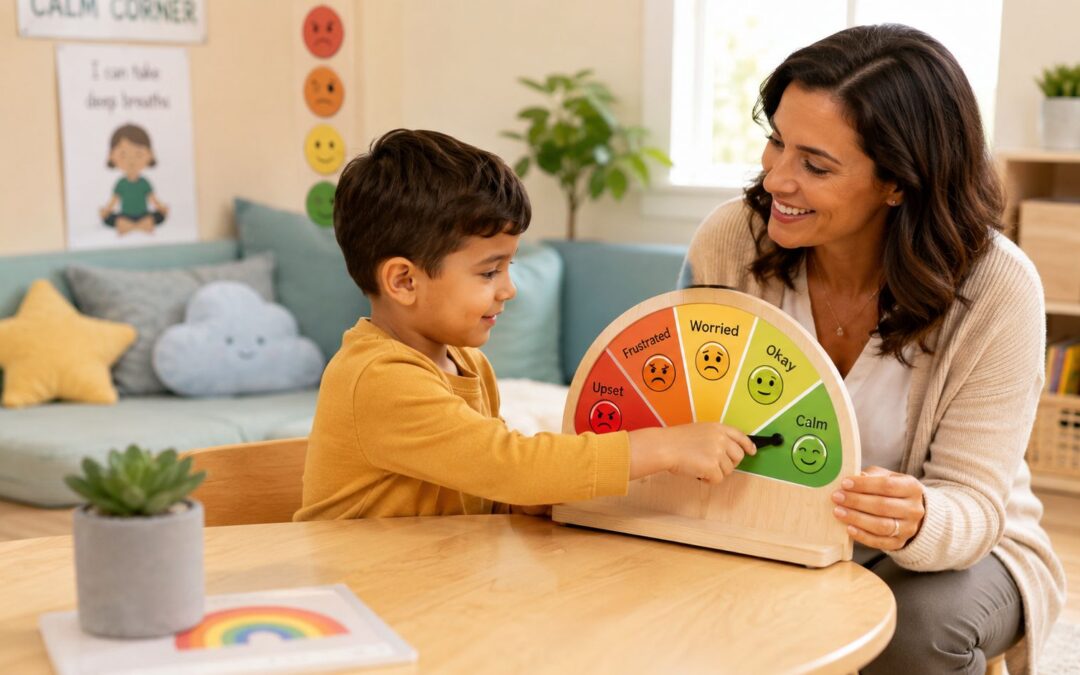
Feeling charts. Keep a small chart on the fridge, near a classroom meeting area, or inside a folder. Let children point if words are hard.
Story pauses. While reading, stop and ask, “What do you think this character is feeling? How can you tell?”
Sample script: “I can see your face got tight and your voice got louder. I'm wondering if you're frustrated or disappointed.”
That script matters because it doesn't force a label. It offers one.
Feel it
This step teaches the body-emotion link. Many children know they're upset only after they're already deep into the reaction.
Use short, concrete activities:
Body map Draw a simple outline of a body. Ask, “Where do you feel anger? Where do you feel worry?” A child might color the hands, chest, tummy, or face.
Two-minute body scan Say, “Close or lower your eyes if that feels okay. Notice your jaw. Your shoulders. Your hands. Your belly. What feels tight, hot, buzzy, or heavy?”
Signal matching Make cards with body clues on one side and feelings on the other. Examples include shaky hands, hot cheeks, lump in throat, fast heart, and tired shoulders.
Sample script: “Your fists are tight. Your body is telling us something before your words are ready.”
Once children can name the feeling and notice body cues, they need a short menu of responses. Keep the menu small. Too many choices can backfire in the moment.
A few dependable options:
Dragon breaths. Inhale through the nose. Exhale slowly like a dragon blowing warm air, not a fire blast.
Wall push. Press both hands into a wall for a slow count. This gives physical input without disrupting others.
5-4-3-2-1 grounding. Name things you can see, feel, hear, smell, and taste or imagine tasting.
Ask for a break. Teach the child the exact words. “I need a minute.” “Can I reset and come back?” “Can I get water and return?”
Coach's note: Calming strategies work better when children practice them while calm, not for the first time during a meltdown.
A short video can help adults model these skills in a concrete way:
Set up a calm-down space that isn't punishment
A peace corner should feel like support, not exile. Don't use it as “Go away until you act right.” Use it as “Here's where your body can reset.”
Include a few specific tools:
Visual cue cards with options like breathe, stretch, draw, squeeze, water, ask for help
Simple sensory items such as a soft cushion, fidget, stuffed animal, or resistance band on a chair
Emotion tools like a mirror, body map, feeling faces, or sentence starters
Repair prompts such as “What happened?” “What do I need?” “How can I fix it?”
Sample script: “You don't go to this because you're in trouble. You go to this when your body needs help.”
One option schools sometimes use is a structured SEL program with shared language across classrooms. For example, Soul Shoppe offers programs that teach self-regulation, mindfulness, communication, and conflict-resolution tools in school settings.
Applying Regulation Skills in Challenging Moments
It's a common sticking point for many adults. A child can do deep breathing during morning meeting and still explode during recess. They can identify “frustrated” on a chart and still scream at homework time.
That doesn't mean the teaching failed. It means the skill hasn't transferred yet.
Guidance in this area often focuses on individual techniques like breathing and labeling feelings, but it doesn't always explain how to use them in classrooms, recess, or sibling conflict where peer dynamics are the trigger. A more useful approach is to practice skills while calm, then transfer them into real settings through role-play, short rehearsals, and consistent adult language. Portable tools such as simple cues and visual supports fit this need well (Incredible Years on emotional regulation).
Use fewer words during the storm
When a child is escalated, long explanations usually make things worse. Their processing narrows. Keep your voice low, your words short, and your body non-threatening.
Try scripts like these:
During playground conflict “Stop. You're safe. I'm here. We'll solve it when your body is calmer.”
During a sibling fight “I'm not choosing sides right now. First we separate. Then we settle.”
During homework frustration “This feels hard. We're not quitting and we're not forcing. Let's reset for one minute.”
During public embarrassment “You don't need to talk yet. Stand with me. Breathe once. We'll decide the next step together.”
Avoid “Calm down” by itself. It names the goal but gives no path.
Rehearse the exact hard moments
Children need practice in the same way athletes do. If you only teach the skill in theory, it won't show up under pressure. That's true whether the child is preparing for a spelling quiz or mastering soccer shootout strategy, where calm execution depends on repeated rehearsal under realistic conditions.
Use short role-plays:
Pretend someone cuts in line.
Pretend a sibling grabs the toy.
Pretend the math page looks too hard.
Pretend a friend says, “You can't play.”
Then coach one sentence and one action.
Examples:
“I didn't like that. I need space.”
“Can I have it when you're done?”
“This is hard. Please do the first one with me.”
“I'm getting mad. I'm taking a break.”
Practice should feel brief and ordinary. Two minutes before recess can matter more than a long lecture after a blow-up.
Change the environment, not just the child
Sometimes adults ask a child to regulate in a setting that almost guarantees dysregulation. Noise, crowding, unclear expectations, rushed transitions, and social uncertainty can all push a child past their limit.
A few adjustments can lower the load:
Visual schedules help children anticipate what's next.
First-then cards reduce negotiation during nonpreferred tasks.
Transition warnings give the nervous system time to adjust.
Designated cool-down spots prevent public power struggles.
Consistent cue words such as “pause,” “reset,” or “check your body” make adult coaching more portable.
In classrooms, it also helps when adults decide in advance what they'll say during predictable stress points. In homes, it helps when all caregivers use the same phrases. Consistency is calming.
Return later to reflect and repair
True teaching often happens after the child is calm.
Ask:
What happened first?
What did your body do?
What feeling showed up?
What helped, even a little?
What can we try next time?
Keep the tone curious, not courtroom-style. Reflection builds insight. Shame shuts it down.
Measuring Progress and Building a Supportive Community
Many adults use the wrong scoreboard. They look for “no more meltdowns” and miss the quieter signs that real growth is happening.
Progress in emotional regulation for kids often looks like this instead:
The child uses a feeling word before behavior escalates.
They notice a body cue such as tight fists or a shaky tummy.
They accept help faster instead of fighting every prompt.
They ask for a break or space in words.
They recover sooner after disappointment or conflict.
They repair by apologizing, problem-solving, or trying again.
That kind of progress is meaningful because it shows the child is building access to skills, not just getting better at hiding distress.
What families and schools should track
Keep observations concrete. Instead of saying, “He had a better day,” note what changed.
You might track:
what triggered the reaction
what body cues appeared first
which adult script helped
whether the child used a tool independently
how the recovery went
This kind of noticing helps adults respond with more precision. It also makes growth visible, which is encouraging for children and grownups alike.
Improvement is often less about fewer feelings and more about faster recognition, safer expression, and steadier recovery.
Why community matters
A child learns regulation faster when the adults around them sound like a team.
If school says, “Name your feeling, then ask for a break,” and home says, “Use your words and take space if you need it,” the child gets a consistent pathway. If one adult punishes all emotion while another tries to coach it, the child gets mixed signals.
This is one reason community-based work matters. Programs outside traditional classrooms can also reinforce emotional growth when they give children structure, belonging, and supportive adult relationships. For one example of how community settings can shape youth development, this piece on youth outreach through Brazilian Jiu-Jitsu offers a helpful perspective.
Children do best when the message is steady across settings. Big feelings are allowed. Safe behavior is expected. Skills can be taught. Repair is possible.
Patience matters here. So does compassion for yourself. Adults won't coach perfectly every time, and children won't use every strategy when they need it most. What helps is repetition, calm language, and a shared belief that regulation is learnable.
If your school or family wants practical SEL tools that help children build emotional regulation, communication, and conflict-resolution skills with shared language across a community, explore Soul Shoppe. Their programs, workshops, and resources are designed to help kids and grownups practice these skills in real life, where they matter most.
A child stands at the edge of the soccer field, the classroom door, the birthday party circle, or the top of the slide and says the same thing in different words: “What if I mess up?” Adults usually feel the urge to answer fast. We say, “You'll be fine,” “Just be confident,” or “Don't worry so much.”
That response is kind, but it usually isn't enough.
Building confidence in kids works better when we stop treating confidence like a mood and start treating it like a set of experiences. Children build it when they feel safe enough to try, connected enough to belong, and capable enough to recover when something doesn't go smoothly. At home and at school, that means confidence grows through routines, language, and relationships far more than through pep talks alone.
Why True Confidence Is More Than Just Praise
A lot of adults are trying hard to encourage children, but many kids still hesitate, avoid, melt down, or quit quickly when something feels uncertain. That gap matters. A child can hear “good job” all day and still believe, deep down, “I can't do hard things.”
The modern view of confidence is much more useful. Guidance from Nationwide Children's Hospital on building healthy self-esteem emphasizes that confidence is built through repeatable behaviors such as praising effort, setting realistic goals, normalizing mistakes, and teaching problem-solving. That shift matters because it moves adults away from vague praise and toward concrete experiences of mastery.
Praise helps, but mastery sticks
Children borrow our words for a while. Then they test those words against real life.
If a student hears “you're amazing” but never gets to struggle, adjust, and succeed on their own, the praise feels thin. If a child hears “you're so smart” and then gets one answer wrong, that label can crack fast. By contrast, when a child thinks, “I didn't know how to do this, then I learned,” confidence starts to root.
A simple way to frame it is this:
Empty praise says: “Feel good.”
Real confidence says: “You can handle hard things.”
Healthy support says: “I'll stay with you while you practice.”
Confidence is not the absence of doubt. It's the memory of having done something hard before.
This is also why a growth mindset approach for kids can be so helpful when adults use it well. The value isn't in repeating “yet” as a slogan. The value is in helping children connect effort, strategy, and progress.
Why this matters right now
Emotional distress isn't rare. In 2023, 40% of U.S. high school students reported persistent sadness or hopelessness, while 20% seriously considered attempting suicide, according to the CDC data cited in They Are the Future's teen self-esteem statistics roundup. Those are older students, but the message for K-8 adults is clear. Children need environments where risk-taking feels emotionally safe.
The same source reports that the average 2-year-old hears 432 negative statements per day versus 32 positive statements, a roughly 13.5-to-1 imbalance, in cited family-level research. That doesn't mean adults are unkind all day. It means correction, hurry, limits, and frustration can easily outnumber language that builds competence.
What works better than general encouragement
Try replacing broad praise with specific reflection:
Instead of this
Try this
“Good job”
“You kept trying even when that was frustrating.”
“You're a natural”
“You used a new strategy and it helped.”
“Don't be shy”
“You can start with one small step.”
“Just believe in yourself”
“What part feels doable first?”
That's the heart of building confidence in kids. Adults don't create it by convincing children to feel fearless. We help children earn it.
The Unspoken Foundation of Confidence Safety and Belonging
Some children look “unconfident” when the issue is not feeling safe. Others seem defiant or checked out when they feel exposed, excluded, or unsure where they fit. In both cases, pushing performance before connection usually backfires.
Confidence grows faster in environments where children can make mistakes without shame, ask questions without being mocked, and participate without worrying they'll be socially punished for it. That applies in classrooms, on teams, at lunch tables, and at home.
KidsHealth's guidance notes that confidence grows when children feel they matter to others and have healthy friendships, and that confidence is shaped by exclusion, bullying, and classroom climate, not just by praise from adults. You can read that perspective in KidsHealth's guide to boosting self-esteem.
What psychological safety looks like in real life
Psychological safety sounds abstract until you watch for it. You can usually spot it by listening to what children are willing to do.
In a safe classroom, a student says, “I'm confused,” without scanning the room first. In a safe home, a child admits, “I forgot,” without bracing for humiliation. On a healthy team, a player can try, miss, and stay included.
Here are signs an environment supports confidence:
Mistakes stay small: Adults correct behavior without attacking identity.
Participation is flexible: Children can start with a partner, a smaller role, or a quieter entry point.
Adults notice inclusion: Who gets picked, ignored, interrupted, or laughed at is taken seriously.
Repair happens: Conflict, teasing, and social harm are addressed instead of minimized.
Practical rule: If a child spends more energy protecting themselves than engaging, confidence-building strategies won't land.
A lot of school adults find it helpful to strengthen the environment before asking a child to take bigger social or academic risks. Soul Shoppe has useful ideas in this safe space guide for classrooms and communities, especially for building shared norms around listening, inclusion, and repair.
Belonging is social, not private
Many articles treat confidence like a private trait inside the child. That's too narrow. Children build self-trust partly through other people's responses.
Consider two students with the same skill level. One is greeted by name, paired with kind peers, and invited in when they hesitate. The other is corrected publicly, left out at recess, and teased when they make mistakes. Their “confidence level” will not develop the same way, even if both receive the same academic instruction.
That's why belonging has to be built intentionally.
Home and school routines that raise belonging
Opening check-ins: Ask, “What's one word for how you're coming in today?” This gives children a low-pressure way to be themselves.
Private connection: A quick one-on-one moment often changes a child's whole day. “I'm glad you're here” is simple and powerful.
Structured partner work: Pair children thoughtfully. Don't let social confidence depend only on who is already popular.
Family rituals: Try rose-thorn-bud at dinner. One good thing, one hard thing, one thing you're looking forward to.
For coaches and activity leaders, peer safety matters just as much. If sports are part of a child's life, adults may also find this director's guide on sports bullying useful for recognizing how team culture affects participation and self-worth.
A quick reflection tool for adults
Ask these questions about your classroom, home, or program:
Can this child make a mistake here without losing status?
Does this child have at least one reliable connection with an adult?
Do peers treat this child like they belong?
Are we asking for courage before we've built enough safety?
When the answer is no, confidence work should start with the ecosystem, not the child.
Actionable Strategies for Building Everyday Competence
Once safety is in place, confidence grows through practice. Not giant, dramatic breakthroughs. Small wins. Repeated effort. Real ownership. Adults often underestimate how much children need visible, doable success.
One especially useful method is to create micro-goals with a 70% to 95% success rate, then pair them with specific process feedback. That recommendation comes from Dr. Paul McCarthy's guide to building child confidence in sports. The idea is simple. The task should be challenging enough to stretch the child, but not so hard that they keep hitting a wall.
Start with the next smallest step
Adults often assign the whole task when the child only has the capacity for the first slice of it.
A few examples:
A child who says “I can't clean my room” may only need to start with put books on the shelf.
A student who avoids writing may begin with say your idea out loud, then write one sentence.
A child nervous about joining recess can start with stand near the game for two minutes, then choose whether to join.
This is where goal-setting routines for kids become practical. Good goals are concrete, visible, and small enough that the child can tell whether they did the step.
Adults should support the step, not steal the step.
That means resisting the urge to over-help. If you organize the backpack, fix the homework error, speak for the child, or finish the project, the task may get done, but the child doesn't get the mastery experience.
A simple planning tool:
Situation
Too big
Better micro-goal
Homework avoidance
“Finish all your homework”
“Do the first two problems, then check in”
Friendship stress
“Go make friends”
“Ask one classmate to sit together”
Sports hesitation
“Play confidently”
“Call for the ball one time”
Morning routine
“Be more responsible”
“Put lunchbox by the door before bed”
Use process feedback, not identity labels
Children listen closely to what adults highlight. If we mostly praise outcomes or traits, children often become more fragile around mistakes. If we praise process, they learn what to repeat.
Try these swaps:
Instead of: “You're so smart.” Say: “You stuck with that when it got tricky.”
Instead of: “You're such a good artist.” Say: “You kept revising until it matched your idea.”
Instead of: “You're the brave one.” Say: “You felt nervous and still took the first step.”
Notice what changes. The child is no longer protecting a label. They're learning a method.
Create visual proof of success
Children forget their competence when they're upset, embarrassed, or comparing themselves to others. That's why visual reminders help.
A few options work well at home and in school:
Confidence CV: A page titled “Things I've learned to do.” Include school, social, and life skills.
Success jar: Write small wins on slips of paper. “Asked for help.” “Tried again.” “Read out loud.”
Highlight reel folder: Save drawings, kind notes, photos of projects, and reflection sheets.
Achievement collage or journal: This is one area where Soul Shoppe's confidence-building activities can be useful, especially reflective tools like goals journaling or an achievements collage.
A child who says, “I never do anything right,” often needs evidence, not argument.
Here's a helpful video for parents and teachers thinking about competence-building in everyday situations.
Give responsibility that means something
Confidence grows when children contribute. The job doesn't need to be impressive to adults. It needs to be real to the child.
Try responsibilities like:
Home role Feed the pet, portion snacks, match socks, or check the weather and report it.
Classroom role Hand out supplies, greet new students, water plants, or monitor cleanup.
Peer role Be the partner who explains directions, invites someone in, or helps reset materials.
In sports and movement settings, this same principle applies. A child doesn't need to be the standout performer to grow in confidence. Skill-building drills that match developmental level can help, and coaches may find this guide to drills for all skill levels useful when they want challenge without overload.
Age-Specific Approaches from Kindergarten to Middle School
Confidence work should change as children grow. A six-year-old usually needs support around routines, expression, and basic independence. A middle schooler often needs help with identity, peer dynamics, and taking healthy risks in public.
Across child-development guidance, the benchmark is calibrated challenge. ZERO TO THREE describes the scaffolding rule this way in its guidance on developing self-confidence from 24 to 36 months: keep tasks within the child's current skill range, be specific about the objective, and fade adult support as the child gains ownership. Too hard leads to helplessness. Too easy creates empty success.
Kindergarten through grade 2
At this stage, confidence grows through repetition, predictability, and “I can do it myself” moments.
Good targets include:
putting on shoes or backpack with minimal help
asking for a turn or help with words
cleaning up one category of toys or materials
choosing between two appropriate options
A useful adult script is short and concrete: “First put the crayons in the bin. Then I'll check.” That works better than “Clean this up” or “You know what to do.”
Grades 3 through 5
Upper elementary students care more about comparison and peer approval. They also have more capacity for reflection, responsibility, and repair.
Helpful confidence builders here include:
Area
Practical example
Schoolwork
Let the child correct one mistake independently before stepping in
Friendships
Practice how to enter a group, invite someone, or repair a misunderstanding
Home responsibility
Give a steady chore the family relies on
Self-advocacy
Rehearse one sentence to ask a teacher for clarification
This age often benefits from post-challenge reflection: “What part did you handle well?” and “What would you try differently next time?”
The goal is not to remove struggle. It's to size it so the child can own it.
Grades 6 through 8
Middle schoolers need more privacy, more dignity, and more voice. Public praise can embarrass them. Public correction can shut them down.
Support confidence by offering:
Choice in how to participate: speak, write, lead a small group, or contribute behind the scenes
Real responsibility: planning part of a project, managing materials, mentoring a younger student
Coaching around social complexity: navigating exclusion, group texts, and shifting friendships
Room to recover: a bad day shouldn't become a fixed identity
A middle schooler may reject help that feels childish, but still need scaffolding. Try, “Do you want me to listen, help you plan, or just sit with you for a minute?” That preserves autonomy while keeping connection.
How to Support Anxious or Perfectionistic Children
Standard confidence advice can land badly with anxious or perfectionistic kids. “Just try.” “Mistakes help you grow.” “Go ahead, you'll be fine.” Those phrases aren't wrong, but they can feel too big for a child whose nervous system reads uncertainty as danger.
Guidance highlighted by Happily Family's article on building kids' confidence points to a common gap: mainstream advice often doesn't answer how much challenge is too much for a child who freezes under uncertainty. That's the right question.
What backfires
These children often don't need more pressure. They need better calibration.
What tends to fail:
Surprise exposure: putting them on the spot to “build resilience”
Over-reassurance: answering every fear for them, which can accidentally reinforce dependence
High-stakes language: “This is easy,” “There's nothing to worry about,” or “Don't make a big deal out of it”
All-or-nothing expectations: asking for full participation when partial participation is the appropriate next step
An anxious child may look oppositional. A perfectionistic child may look highly capable. Both can be terrified of getting it wrong.
Better ways to build confidence gently
Use language that validates emotion and shrinks the task.
Try scripts like these:
“It makes sense that this feels hard.”
“You don't have to do the whole thing right now.”
“What would make this a just-right challenge?”
“Let's make a version small enough to practice.”
Instead of calling a mistake a failure, call it information. “Now we know what part needs more practice.” That reduces shame and keeps the child engaged with the process.
A useful routine is to separate the child from the worry:
Name the worry voice. “Your worry is telling you everyone will laugh.”
Answer it without arguing too much. “That worry is loud right now.”
Choose one action. “Let's decide on one small move anyway.”
For some children, leadership is easier to practice in supportive, low-spotlight ways. This article on how to be a team leader offers useful examples of contribution that don't depend on being the most visible or most skilled.
Build the challenge with the child, not for the child
Anxious and perfectionistic children usually do better when they help design the plan. Ask:
What part feels hardest?
What would make it feel safer?
Do you want to practice privately first?
What's a version you can complete even if you still feel nervous?
For families and educators supporting kids with bigger worry patterns, these anxiety coping skills for kids can pair well with confidence-building work.
The key is not to eliminate discomfort. It's to keep the discomfort within a range the child can survive, learn from, and remember.
Conclusion Turning Confidence into a Daily Practice
Confidence isn't something adults can hand to a child. It isn't a speech, a compliment, or a personality trait some kids have and others don't. It grows from repeated experiences of safety, belonging, effort, and recovery.
Children build it when they know mistakes won't cost them connection. They build it when adults give them real responsibility instead of doing everything for them. They build it when the challenge fits their current capacity. They build it when peers include them, when teachers notice them, and when caregivers respond with steadiness instead of panic.
That's why building confidence in kids works best as a daily practice.
Some days that practice looks like letting a child struggle with one zipper before helping. Some days it looks like protecting a child from public embarrassment. Some days it looks like helping a perfectionistic student attempt a smaller version of the assignment. Some days it looks like teaching a class how to include the child who always hangs back on the edge of the group.
What matters is the pattern.
A confident child is not a child who never doubts themselves. It's a child who starts to believe, “Even when I feel unsure, I can take one step. Even when I make a mistake, I still belong. Even when something is hard, I'm not alone in it.”
That is a stronger goal than confidence as performance. It gives children something sturdier. Self-trust. Flexibility. Courage with support. Those are the qualities that carry from kindergarten into adolescence, and from school into life.
If you want support bringing these kinds of SEL practices into your home, classroom, or school community, Soul Shoppe offers practical tools, workshops, and relationship-based programs that help kids build safety, connection, and everyday confidence from the inside out.
It's late. You're replaying the day in your head. Maybe you snapped during homework, missed a school email, or felt distracted when your child wanted to tell you a long story about recess. A question slips in: Am I doing enough?
Most moms I meet, whether in schools, counseling rooms, or parent workshops, aren't asking because they don't care. They're asking because they care. They want to raise children who feel safe, capable, and loved. They also live in a world that asks them to earn, organize, notice, soothe, plan, remember, and keep going.
Moving Beyond the Myth of the Perfect Mom
The modern picture of motherhood is crowded. In the U.S., 40.5% of mothers with children under 18 are equal, primary, or sole income earners for their families, and in 2022 employed mothers spent 12.5 hours per week on active child care compared with 8.6 hours in 1975, which is over 40% more time on active child care while also working for pay, according to the U.S. Department of Labor's overview of mothers in the economy.
That matters because many ideas about the “good mom” still assume endless availability, endless patience, and endless memory. Real families don't run on endless anything. They run on skills, habits, repair, and support.
A healthier way to think about the qualities of a mom is this: not as a perfection checklist, but as a learnable social-emotional skill set. A good mom isn't the one who never gets tired, never misreads a moment, or always has the perfect words. She's the one who keeps building the conditions children need most. Safety. Connection. Structure. Repair.
If your brain feels full all the time, that's not a personal failure. It's often mental load. Many parents find it helpful to name the invisible planning work they're carrying, and this guide to managing mental load offers a practical starting point.
It also helps to shift from self-judgment to skill-building. Instead of asking, “Am I a good mom?” try asking, “What skill would help most in my family this week?” Maybe it's listening without fixing. Maybe it's holding a bedtime boundary. Maybe it's apologizing after a rough morning. Simple positive parenting tips can support that kind of steady, realistic growth.
Good-enough parenting gives children something they can actually use: a real relationship with a real adult who keeps coming back to connection.
When we translate big ideals into teachable behaviors, parents and educators can work from the same map. That shared map is where children often make their strongest gains.
Cultivating Emotional Safety as Your Foundation
Children learn best when they feel safe with the adults around them. Not spoiled. Not in charge. Safe.
Emotional safety means a child believes, “My feelings won't make this relationship disappear.” That belief changes how children talk, recover, and behave. It doesn't erase big feelings. It gives those feelings a place to land.
Empathy is the first signal of safety
Empathy is not agreeing with every reaction. It's showing your child that their inner experience makes sense to you.
A child says, “Nobody likes me.” The unsafe response is, “That's not true. Stop being dramatic.” The safer response is, “It sounds like you felt really left out today.” That second response doesn't lock in the child's conclusion. It opens the door for regulation and problem-solving.
Try this simple script:
Name what you hear: “You seem disappointed.”
Reflect the situation: “It happened when your partner picked someone else.”
Emotional regulation is the adult skill children borrow first
Children don't learn regulation from lectures. They learn it from nervous systems near them. When a mom lowers her voice, pauses before reacting, or says, “I'm upset, so I'm taking one breath before I answer,” she is teaching regulation in real time.
One easy home activity is a Feelings Thermometer. Draw a thermometer with four zones:
Zone
What it feels like
What helps
1 Calm
okay, focused
keep going
2 Stirring
annoyed, restless
drink water, stretch
3 Hot
mad, overwhelmed
breathing, quiet corner
4 Boiling
yelling, shut down
pause, co-regulate with an adult
Use it during calm moments first. Then, when your child is upset, ask, “What number are you right now?” That question is easier for many children than “How do you feel?”
Practical rule: Regulate first, teach second. A child in full distress can't absorb a lesson about behavior.
For families who like playful ways to build these skills, activities such as role-play, emotion cards, and guessing games can help. This roundup on how Playz helps develop emotional intelligence includes ideas parents can adapt for home.
What emotional safety looks like on a busy Tuesday
It often looks small:
At breakfast: “You're quiet today. Want me to just sit with you?”
After school: “Do you want help, or do you want me to listen first?”
At bedtime: “We had a hard moment earlier. I'm still here.”
Those ordinary responses teach a deep lesson. Feelings are manageable. Relationships can hold them. That's one of the strongest qualities of a mom a child can experience.
The Power of True Presence and Attunement
Some children have adults around them all day and still feel unseen. That's because presence is more than proximity.
Research on motherhood norms describes the “present mother” as someone with high attentional availability, accurate cue detection, and rapid response calibration, and that kind of attunement supports emotional co-regulation by helping adults step in before a child's needs escalate, as described in this research review on the “present mother” norm.
Presence is a noticing skill
Attunement sounds academic, but in daily life it often starts with one sentence: “I notice…”
“I notice you stopped eating after two bites.”
“I notice your shoulders got tight when we mentioned school.”
“I notice you're getting silly in that way that means you're overtired.”
That's not surveillance. It's informed caregiving. A child who feels accurately noticed is less likely to need to escalate to get understood.
A useful distinction for parents and teachers:
Being present in the room
Being attuned to the child
You hear noise
You notice a pattern
You react after a meltdown
You catch strain early
You say “Use your words”
You help the child find words
You focus on behavior only
You track cues, needs, and timing
This is why the qualities of a mom can be taught as observable skills. We can practice noticing. We can practice timing. We can practice listening for what behavior is trying to communicate.
How to strengthen attunement in small moments
Busy families don't need a three-hour ritual. They need repeatable micro-habits.
Try these:
Use device-free connection zones Pick one routine. Car ride. Bedtime. After-school snack. During that time, phones stay away.
Play the two-minute scan Before correcting behavior, pause and scan for cues. Hungry? Embarrassed? Overstimulated? Seeking connection?
Ask one observation before one question Say, “You got quiet when math came up,” before asking, “What happened?”
Mirror the child's pace Some children talk fast when upset. Others need long pauses. Matching pace helps them stay engaged.
If you want language that supports this kind of listening, these ideas on empathetic listening fit well in both home and school conversations.
A child doesn't always need an answer first. Often the child needs an accurate witness.
A school-age example
A fourth grader starts “forgetting” homework. An adult who only sees compliance may respond with pressure. An attuned adult notices the child has also become slower in the morning, more irritable at pickup, and less social after school.
That adult might say, “I'm noticing homework has been harder this week, and you seem more tired than usual. Is school feeling heavy right now?” That response gives the child a bridge into honesty.
Presence, then, is not just warmth. It's effective observation plus a timely response. Children feel that difference immediately.
Providing Structure with Consistency and Boundaries
Children relax when the adults act like they know what the guardrails are. They may protest those guardrails. They may test them daily. Still, structure helps children feel held.
Many parents worry that boundaries will damage connection. Usually the opposite is true. Kind, predictable limits tell a child, “You don't have to manage the whole world. I'm helping.”
Consistency lowers confusion
Consistency doesn't mean rigid sameness. It means your child can generally predict what matters, what happens next, and how adults respond.
That predictability supports regulation. A child who knows the bedtime sequence, homework routine, or morning expectation uses less energy guessing and more energy participating.
A simple structure often works better than a complicated system. Try this short family pattern:
After school: snack, movement, short check-in
Before homework: bathroom, water, supplies ready
Before bed: hygiene, connection, lights out routine
Children don't just need routine for tasks. They also need routine for relationships. For example, a daily five-minute check-in can become the emotional anchor of the day.
Boundaries are not punishments
A healthy boundary says what the adult will do to keep people safe, respectful, or regulated. It does not shame the child.
Compare these examples:
Less helpful: “If you don't stop whining right now, no tablet for a week.”
More helpful: “I want to hear you. I can listen when your voice is calmer.”
Less helpful: “You're being impossible.”
More helpful: “I won't let you hit. I'll stay close while you calm down.”
Less helpful: “Because I said so.”
More helpful: “The answer is no for today. You can be upset, and the limit is still no.”
Children borrow stability from adults who mean what they say and say it without cruelty.
A firm and kind script parents can use
Many moms need language more than theory. Here's a script for a common moment:
Child: “Play with me now!” Parent: “I want to play with you. I need quiet time for 15 minutes. When the timer rings, I'll join you.”
This script works because it does four jobs at once. It shows care. It sets a limit. It gives a clear timeline. It follows through.
You can also co-create family agreements, especially with elementary-age children:
Topic
Child input
Adult boundary
Screen time
choose show or game
adult sets start and stop
Chores
choose order
everyone contributes
Morning routine
pick music or outfit prep style
leaving time stays fixed
When children help shape part of the plan, they're more likely to cooperate with the plan.
One of the steady qualities of a mom is leadership without harshness. Not controlling every feeling. Not surrendering every limit. Just providing enough structure that a child can grow safely inside it.
Building Resilience Through Repair and Encouragement
Every parent will get it wrong sometimes. You'll misread a cue, answer too sharply, rush a child who needed more time, or enforce a limit in a tone you regret. That isn't evidence that you've failed. It's evidence that you're human.
What matters most after a hard moment is often repair. Parenting guidance identifies “repair when you make mistakes” as a hallmark quality, and a reliable sequence of acknowledging the event, naming the impact, apologizing, and offering a next step helps strengthen psychological safety and model accountability, as described in this guidance on traits of a good mom.
Repair teaches more than perfection ever could
A child who sees an adult repair learns powerful lessons:
Mistakes can be faced
Conflict can soften
Shame doesn't get the last word
Relationships can recover
That is resilience in action. Children don't build resilience by living in a mistake-free home. They build it by living in a home where people know how to come back together.
Here is a simple repair model parents and educators can both use.
Acknowledge “I yelled when you spilled the water.”
Name the impact “That probably felt scary and unfair.”
Apologize “I'm sorry.”
Offer a next step “Next time I'm frustrated, I'm going to pause before I speak.”
Reconnect “Do you want a hug, or do you want to sit together for a minute?”
Encouragement builds courage, not dependence
Repair helps children recover from relational stress. Encouragement helps them take healthy action afterward.
Encouragement is different from praise. Praise often focuses on the result. Encouragement focuses on effort, strategy, and persistence.
Compare:
Praise only
Encouragement
“You're so smart”
“You kept going when it got hard”
“Good job”
“You tried a new way to solve it”
“You're the best artist”
“You added details and stayed with it”
Children who hear encouragement start to internalize a message: I can try. I can learn. I can recover.
If you want a school-home lens on this, resources about building resilience in children can help adults use similar language across settings.
When a parent says, “I was wrong, and I'm fixing it,” the child learns accountability without humiliation.
A small shift toward autonomy
Encouragement also means stepping back enough for children to do manageable hard things. Let them answer the teacher's question themselves. Let them pack part of their school bag. Let them try the apology to a sibling with coaching instead of having you do it for them.
One of the most overlooked qualities of a mom is this balance: being supportive without taking over. That balance grows confidence.
Creating a Shared Language with Your Child's School
A child does better when home and school are not sending competing emotional messages. If a family says, “Talk about feelings,” but school mainly says, “Stop crying,” the child gets mixed signals. If both settings use similar language for safety, regulation, and repair, the child has a much easier job.
What shared language sounds like
Parents don't need clinical terms. Teachers don't need long family history. Both sides need usable language.
A parent might write:
“We're working on emotional regulation at home. When my child starts to shut down, a short pause and a simple choice helps more than lots of questions.”
A teacher might respond:
“We practiced ‘I feel' statements today during peer conflict, and your child participated well with a little support.”
That kind of exchange creates continuity. The child hears the same core message in both places: feelings are real, behavior has limits, and relationships can recover.
Scripts that help parents and teachers partner well
Here are a few examples families can use right away.
For a parent starting the conversation: “I'm noticing mornings have been harder. Have you seen any patterns at school that might help us understand what's going on?”
For a teacher sharing a useful strategy: “Your child responds well when I give a preview before transitions. You might try that before homework or bedtime too.”
For a parent naming a boundary approach: “We're trying to stay calm and consistent with limits at home. If there's language you use at school for redirection, I'd love to reinforce it.”
For a counselor or support staff member: “When conflict happens, we're helping students identify impact and practice repair. Using those same words at home can make the skill stick.”
Schools that want better family conversations often benefit from preparing adults with stronger question design. For leaders refining how they gather insight from families and staff, this resource on Comprehensive school interview questions can spark more thoughtful conversations.
A short video can also help adults align around what children need socially and emotionally.
One shared tool is better than five separate ones
If you're a school team or a family, start small. Pick one common tool and use it across settings for two weeks.
Examples:
Shared tool
Home use
School use
Feelings check-in
after school
morning meeting
Repair script
after sibling conflict
after peer conflict
Previewing transitions
before bedtime
before cleanup
Calm-down choices
bedroom or kitchen
regulation corner
This is one place where a structured SEL program can support consistency. For example, Soul Shoppe offers workshops and coaching that teach shared language for self-regulation, communication, and conflict resolution, which schools and families can reinforce together.
When adults coordinate, children don't have to decode two different emotional worlds. They can spend that energy learning, relating, and growing.
Embracing the Journey of a Good-Enough Mom
The most helpful qualities of a mom are not shiny traits that some people are born with and others are not. They are practices. You build them, lose them, return to them, and build them again.
Emotional safety tells a child, “Your feelings won't push me away.” Presence says, “I'm noticing you closely enough to help.” Structure says, “You are free inside clear guardrails.” Repair says, “This relationship can heal.” Those are not small gifts. They shape how children see themselves, other people, and the world.
A good-enough mom is not checked out, but she also isn't chasing flawless performance. She listens, notices, sets limits, repairs, and keeps learning. Some days that will look graceful. Some days it will look like apologizing in the carpool line and trying again after dinner.
If you're parenting and working, parenting and caregiving, parenting and carrying most of the invisible planning load, you do not need another impossible standard. You need a realistic picture of growth. Children don't need a perfect mother. They need a trustworthy one.
Keep the target close. Notice one cue earlier. Respond one step calmer. Hold one limit more clearly. Repair one hard moment more sincerely. That's how strong families are built.
If you want more support turning these everyday parenting moments into teachable SEL skills, explore Soul Shoppe. Their resources, workshops, and school-based programs focus on practical tools for empathy, regulation, communication, and conflict resolution that help children and grownups build safer, more connected relationships.
Welcome to our practical guide to Social-Emotional Learning (SEL) for elementary students. In an environment where emotional intelligence is as critical as academic knowledge, providing young learners with tools to understand their feelings and connect with others is essential. This article offers a deep dive into powerful sel activities for elementary students, designed to be practical, engaging, and effective for teachers, counselors, and parents alike.
We move beyond abstract ideas to give you actionable steps, specific examples, and adaptations for different age groups. For instance, instead of just suggesting "breathing exercises," we detail how a "Bear Breath" technique can calm a first grader's pre-test jitters, while a "4-7-8 Breathing" script can help a fifth grader manage frustration during a group project. This guide is your roadmap to implementing these important practices.
Our goal is to help you cultivate resilient, emotionally intelligent learners who are ready to collaborate, solve problems, and succeed. The following curated collection of activities will help build a strong foundation for lifelong well-being and academic success. You will find detailed instructions for everything from peer empathy exercises to growth mindset lessons, all organized to be easily implemented in a classroom or at home. Let's explore the activities that will foster a more connected, safe, and empathetic community for your students.
1. Mindfulness and Breathing Exercises
Mindfulness and breathing exercises are structured practices that teach students to anchor their attention in the present moment. These foundational SEL activities for elementary students help them develop self-awareness and self-management by learning to calm their own nervous system, particularly during moments of high energy, stress, or conflict. The core idea is simple: by focusing on the physical sensation of breathing, a child can create distance from overwhelming emotions and respond more thoughtfully.
To deepen the understanding of these practices, educators can explore resources that explain in detail what mindfulness meditation entails. These exercises are not about emptying the mind but rather about paying attention on purpose, without judgment. This skill is critical for building emotional intelligence and resilience.
How to Implement in Your Classroom
Effective integration relies on consistency and modeling. You can introduce these practices as "brain breaks" between subjects, as a centering routine to start the day, or as a cool-down activity after recess.
Belly Breathing: Have students place a hand on their belly and feel it rise and fall like a balloon as they inhale and exhale slowly. Practical Example: Before a spelling test, say, "Let's take three balloon breaths. Put your hand on your belly. Breathe in and feel the balloon get bigger… now breathe out and let the air out slowly."
Box Breathing: Guide students to inhale for a count of four, hold for four, exhale for four, and hold for four. Drawing a square in the air with their finger can help them track the steps. Practical Example: When the class is noisy after recess, say, "Let's get our focus back with box breathing. Trace a square in the air. Breathe in… hold… breathe out… hold."
Five Senses Grounding: When a student is anxious, ask them to name five things they can see, four things they can feel, three things they can hear, two things they can smell, and one thing they can taste. Practical Example: If a child is crying over a scraped knee, you could say, "Okay, let's calm our body. Can you tell me five blue things you see in the room right now?"
Classroom Tip: Practice alongside your students. When they see you taking deep breaths before a challenging lesson, it normalizes the strategy and demonstrates its practical application in everyday life. Start with sessions as short as one minute and gradually increase the duration as students become more comfortable.
2. Emotion Identification and Feelings Vocabulary Activities
Emotion identification activities are interactive lessons and games designed to expand students' emotional vocabulary, helping them name and understand feelings in themselves and others. These foundational SEL activities for elementary students build emotional literacy, a critical component of self-awareness and social awareness. The goal is to give children the specific words they need to move beyond "mad" or "sad" to more nuanced feelings like "frustrated," "disappointed," or "anxious," enabling better communication and self-regulation.
Pioneered by experts like Marc Brackett at the Yale Center for Emotional Intelligence, this work emphasizes that if you can name an emotion, you can begin to manage it. By making feelings vocabulary a regular part of classroom conversation, educators create a safe environment where all emotions are acknowledged as valid, even if the behaviors they cause need guidance.
How to Implement in Your Classroom
Integrating these activities works best through consistent, playful practice rather than a single lesson. Use them during morning meetings, as transitions, or in response to social situations that arise naturally.
Feelings Wheel or Chart: Create a large, visible feelings wheel in the classroom. During check-ins, students can point to the emotion that best describes how they feel, providing a low-pressure way to share. Practical Example: During morning meeting, have students put a clothespin with their name on it next to the feeling on the chart that best matches their mood.
Emotion Charades: Write different emotions on cards. A student picks a card and acts out the feeling without words, while classmates guess. Practical Example: A student picks "frustrated." They might stomp their foot lightly and cross their arms. Another student guesses, "Are you angry?" The teacher can then ask, "What's the difference between angry and frustrated?"
Literature-Based Discussion: During read-alouds, pause and ask, "How do you think this character is feeling right now? What clues in the story or pictures tell you that?" Practical Example: While reading Where the Wild Things Are, pause and ask, "When Max was sent to his room, what feeling was he showing? Look at his face. Is it just anger, or maybe disappointment too?"
Classroom Tip: Collaboratively create a classroom "emotions anchor chart" with your students. As you introduce new feelings words throughout the year, add them to the chart with simple definitions or drawings. This co-created resource fosters ownership and makes the vocabulary more meaningful.
To find more games, charts, and tools for your classroom, you can find further resources for teaching emotional vocabulary to kids that make learning about feelings engaging and effective.
3. Gratitude and Positive Reflection Practices
Gratitude and positive reflection practices are simple yet powerful exercises that teach students to intentionally notice and appreciate the good in their lives. These foundational SEL activities for elementary students build self-awareness and social awareness by shifting focus from problems to positives. The core principle, supported by positive psychology research, is that training the brain to look for what's working builds resilience, strengthens relationships, and improves overall well-being.
By consistently identifying things they are thankful for, students learn to recognize the value in everyday moments, people, and their own abilities. This practice counters negativity bias and helps children develop a more balanced and optimistic outlook, which is crucial for managing challenges and building strong emotional health.
How to Implement in Your Classroom
Integrating gratitude into your daily routine can be simple and quick, making it a sustainable practice. The key is modeling authentic appreciation and providing structured opportunities for students to share. You can add these activities to your morning meeting, use them as a calm-down transition, or conclude the day on a positive note.
Gratitude Journals: Provide notebooks where students can write or draw something they are grateful for each day. Practical Example: At the end of the day, prompt students: "Today, draw or write about one person who was kind to you." For younger students, provide the sentence starter, "I am thankful for…"
Appreciation Circles: During a morning meeting, have students go around the circle and complete the sentence, "Today, I am grateful for…" This builds community as students listen to their peers' appreciations. Practical Example: On a Monday, you might ask, "Share one thing you are grateful for that you did this weekend."
Thank You Letters: Guide students in writing and delivering letters of appreciation to classmates, school staff, or family members. This directly practices relationship skills and empathy. Practical Example: Before a holiday break, have students write a short thank-you note to the school custodian, librarian, or a cafeteria worker, telling them one specific thing they appreciate.
Classroom Tip: Expand the concept of gratitude beyond material things. Use sentence starters to help students appreciate experiences ("I'm grateful for learning how to…"), people ("I'm thankful for my friend because…"), and personal strengths ("I'm proud that I was able to…"). This teaches them to find value in a wide range of life experiences.
For additional guidance on fostering a culture of thankfulness, explore these practical ways to show gratitude that can be adapted for both school and home environments.
4. Cooperative Learning and Team-Building Games
Cooperative learning and team-building games are structured group activities designed to build collaboration, communication, and problem-solving skills. These essential SEL activities for elementary students create an environment where interdependence is necessary for success, which helps foster a sense of belonging and reduces feelings of isolation. The focus is on shared goals, requiring students to listen to peers, negotiate ideas, and work together, thereby strengthening relationship skills and social awareness.
By participating in these activities, students learn to appreciate diverse perspectives and contribute to a common objective. The process helps them understand the give-and-take of working in a group, a critical life skill. To better understand the framework behind these interactions, educators can find value in exploring resources that explain what collaborative problem-solving is and how it supports student development. These games are not just about fun; they are carefully designed practice for real-world social navigation.
How to Implement in Your Classroom
Successful integration depends on clear structure and intentional debriefing. You can use these games as icebreakers, brain breaks, or dedicated time during morning meetings to build a strong classroom community from the very beginning of the school year.
Human Knot: Have a small group of students stand in a circle, reach across to grab the hands of two different people, and then work together to untangle themselves into a single circle without letting go. Practical Example: Split the class into groups of 6-8. After they form a "knot," tell them, "Talk to your teammates to figure out who needs to move where. You might have to go under someone's arms!"
Silent Sequencing: Give each student in a small group a card with a number, a letter of the alphabet, or part of a picture sequence. The group must line themselves up in the correct order without speaking. Practical Example: Give a group of five students cards showing the life cycle of a butterfly. They must use gestures and observation to line up in the correct order: egg, caterpillar, chrysalis, butterfly, etc.
All Aboard: Mark a small area on the floor with tape (the "ship"). Challenge a group of students to fit entirely inside the space. Gradually make the ship smaller in each round, requiring more creative problem-solving and cooperation. Practical Example: Start with a hula-hoop. Challenge a group of 8 to get both feet inside. Then, fold a large towel in half and challenge them again.
Classroom Tip: After each activity, lead a short debrief session. Ask questions like, "What was challenging about that?" or "What did your team do well to succeed?" This reflection is where the most significant SEL learning occurs, as it connects the game to real-life teamwork and communication skills.
5. Peer Empathy and Perspective-Taking Activities
Peer empathy and perspective-taking activities are structured exercises designed to help students understand and share the feelings of others. These essential SEL activities for elementary students focus on building social awareness and relationship skills by encouraging children to see situations from another person’s viewpoint. The main goal is to develop both the cognitive ability to imagine another's experience and the emotional capacity to connect with their feelings, which is foundational for kindness, conflict resolution, and positive relationships.
This approach is central to the work of experts like Daniel Goleman, who identifies empathy as a key component of emotional intelligence. Programs like Soul Shoppe's bullying prevention curriculum put these ideas into practice, teaching students that understanding someone else's perspective is the first step to resolving conflicts peacefully. These activities move beyond simply telling students to "be nice" and give them the tools to actually understand why their actions affect others.
How to Implement in Your Classroom
Integrating empathy-building exercises requires creating a safe space where students feel comfortable sharing and exploring different viewpoints. You can use literature, real-life scenarios, or structured role-plays as a springboard for these discussions.
Character Perspective Switch: During a read-aloud, pause the story and ask students to act out how a different character might feel. Practical Example: After reading The Three Little Pigs, ask, "How would the story be different if the wolf told it? What might he say about why he was blowing the houses down? Maybe he was just cold and had a bad cough?"
Empathy Interviews: Pair students and provide them with gentle, open-ended questions to ask each other, such as "Can you tell me about a time you felt really proud?" or "What is something that makes you feel happy?" This builds active listening skills and mutual understanding. Practical Example: Give partners three minutes each. Student A asks Student B, "What's your favorite thing to do on the weekend and why?" Student A can only listen and then summarizes what they heard.
Scenario Role-Play: Present a common, low-stakes conflict, like two students wanting to use the same playground ball. Have them role-play the situation and then switch roles to experience the other side. Debrief with questions like, "What did it feel like to be in their shoes?" Practical Example: Set the scene: "Maria and Leo both want the red ball at recess." Ask two students to act it out. Then say, "Okay, switch! Now, Leo, you're Maria. How does it feel to see someone else grab the ball you wanted?"
Classroom Tip: Start with fictional characters or hypothetical situations before moving to real classroom conflicts. This creates a safe distance, allowing students to practice empathy skills without feeling personally targeted. Regularly celebrate and point out instances where students show genuine understanding or compassion for a peer.
For more resources on fostering empathy and peaceful conflict resolution, explore the tools offered by the Junior Giants Strike Out Bullying partnership, which provides excellent models for youth programs.
6. Social-Emotional Learning Circles and Community Meetings
Social-Emotional Learning (SEL) circles and community meetings are structured group discussions where students share experiences, solve problems, and build a sense of belonging. These dedicated times create a predictable space for voice, connection, and collective problem-solving. This practice is one of the most effective SEL activities for elementary students because it directly develops relationship skills, social awareness, and responsible decision-making in a safe, peer-supported environment. The core idea is that by sitting in a circle, every member is equal and visible, fostering a community where listening is as important as speaking.
These meetings establish a consistent rhythm for relationship-building and maintenance, moving beyond academic instruction to nurture the whole child. Concepts like the soul circles developed by Soul Shoppe emphasize creating psychological safety, allowing students to express themselves without fear of judgment. This routine practice strengthens the classroom ecosystem, making it more resilient to conflict and more conducive to learning.
How to Implement in Your Classroom
Success with community circles depends on consistency and clear expectations. You can hold them daily as a morning meeting to set a positive tone or weekly to address emerging classroom issues. They can also be used as needed for problem-solving or celebrating successes.
Establish a Routine: Begin each day with a 10-15 minute morning meeting. Include a greeting, a sharing component, a group activity, and a brief message for the day to build predictability. Practical Example: Start with a "Handshake Greeting" where students walk around and shake 3 classmates' hands. Then have them share one thing they're excited to learn today.
Use a Talking Piece: Introduce a special object, like a small decorated stone or a soft ball, as a "talking piece." Only the person holding the object may speak, which teaches patience and respectful listening. Practical Example: Hold up a "talking stone" and say, "We are going to pass this around the circle. When it's your turn, please share one goal you have for this week. If you don't want to share, you can just pass it to the next person."
Set Clear Norms Together: Co-create guidelines with your students. Examples include: "Listen with your heart," "Speak your truth," "Respect the talking piece," and "What's said in the circle stays in the circle."
Provide Sentence Starters: Support reluctant speakers with prompts like, "I feel happy when…" or "One challenge I'm facing is…" This lowers the barrier to participation. Practical Example: Write on the board: "I'm proud that I…" and invite students to complete the sentence when it's their turn.
Classroom Tip: Start with low-risk topics. Ask students to share their favorite weekend activity or something they are proud of. As trust builds, you can gradually move toward more complex conversations, such as resolving a playground conflict or discussing ways to make the classroom more inclusive.
For additional guidance on facilitating these powerful conversations, explore the principles of restorative circles in schools which offer frameworks for repairing harm and strengthening community bonds through structured dialogue.
7. Growth Mindset and Resilience-Building Lessons
Growth mindset and resilience-building lessons teach students that intelligence and skills can be developed through dedication and hard work. These critical SEL activities for elementary students shift the focus from fixed traits to the power of effort, practice, and learning from mistakes. Popularized by researchers like Carol Dweck, these lessons help children build resilience by reframing failure as an essential part of the learning process, empowering them to persist through challenges.
The core principle is teaching students about neuroplasticity, the brain's ability to form new connections. When children understand their brain can grow stronger with effort, they see challenges not as roadblocks but as opportunities. This fosters self-management and a positive, motivated approach to learning that extends far beyond the classroom walls.
How to Implement in Your Classroom
Integrating a growth mindset requires intentional language, celebratory framing of mistakes, and consistent reinforcement. You can weave these concepts into daily instruction, feedback, and classroom culture.
Introduce "The Power of Yet": When a student says, "I can't do this," add the word "yet." This simple linguistic shift frames the task as an achievable goal rather than an impossible one. Practical Example: A student says, "I can't tie my shoes." You respond with a smile, "You can't tie your shoes yet. Let's practice one step."
Create a "Mistake Wall" or "Productive Struggle" Board: Dedicate a space in the classroom to celebrate mistakes as learning opportunities. Have students share what they learned from an error, normalizing the experience and highlighting its value. Practical Example: Post a sticky note that says, "I kept getting 15 instead of 16, but I learned I was forgetting to carry the one!"
Use Process-Focused Feedback: Instead of praising intelligence ("You're so smart!"), praise the process and effort. Practical Example: Instead of "You're a great artist," say, "I love how you used so many different colors in your drawing and how you kept working on the details."
Share Stories of Resilience: Discuss famous figures or even your own personal stories of overcoming challenges through persistence. This shows students that struggle is a universal part of success. Practical Example: Read a picture book about Michael Jordan being cut from his high school basketball team and talk about how he used that failure to motivate himself.
Classroom Tip: Model a growth mindset yourself. When you make a mistake in front of the class, acknowledge it openly and talk through how you will fix it or what you learned. This authentic modeling is powerful and shows students that everyone is a learner.
For a deeper dive into the research and practical applications, Carol Dweck's work on mindset theory provides foundational knowledge for educators aiming to build resilient, motivated learners.
8. Conflict Resolution and Peer Mediation Training
Conflict resolution and peer mediation training are structured programs that equip students with the skills to manage disagreements constructively. These essential SEL activities for elementary students focus on relationship skills and responsible decision-making by teaching a clear, step-by-step process for peaceful problem-solving. Instead of relying on adult intervention for every dispute, students learn to become active agents in creating a positive and supportive school climate.
The goal is to shift the classroom culture from one of tattling and escalation to one of communication and mutual respect. Programs like those developed by Soul Shoppe provide research-based training that empowers students to handle peer conflicts on their own. By learning to listen, identify needs, and find common ground, children build confidence and empathy.
How to Implement in Your Classroom
Consistency is key to making conflict resolution a part of your school's DNA. Start by teaching a simple, school-wide framework that all students and staff can use. This creates a common language for solving problems.
Introduce 'I-Statements': Teach students to express their feelings without blaming others. Practical Example: Instead of a student yelling, "You always take the blue crayon!" teach them to say, "I feel frustrated when the blue crayon is gone because I wanted to use it for the sky. Can I use it when you're done?"
Role-Play Scenarios: Use common classroom conflicts (e.g., cutting in line, disputes over game rules) as role-playing exercises. Have students practice walking through the conflict resolution steps, from active listening to brainstorming solutions. Practical Example: Set up a scenario where two students disagree on the rules of a game. Have them practice saying, "Let's take a break," listening to each other's side, and then suggesting a compromise, like, "How about we play your way this time and my way next time?"
Establish a Peace Corner: Designate a quiet area in the classroom where two students can go to work through a problem using a scripted "peace path" or conversation guide. Practical Example: The "Peace Corner" could have a sand timer and posters with prompts like: 1. Cool down. 2. Use an I-Statement. 3. Listen. 4. Find a solution.
Train Peer Mediators: Select and train older elementary students to act as neutral facilitators during recess or lunch. These mediators help younger students talk through their problems but do not solve the issues for them.
Classroom Tip: Model the conflict resolution process in your own interactions. When a disagreement occurs between students, calmly guide them through the steps rather than simply assigning a consequence. Acknowledge and celebrate when you see students successfully resolving a conflict on their own to reinforce the behavior.
9. Self-Care and Wellness Activities
Self-care and wellness activities are practices that teach students to intentionally care for their physical, mental, and emotional well-being through healthy habits. These foundational SEL activities for elementary students build self-management and responsible decision-making skills by connecting daily actions to overall health. The core concept is to empower children with the understanding that caring for themselves is a fundamental responsibility that supports their ability to learn, grow, and interact positively with others.
Teaching wellness helps students recognize the critical link between their physical state and their emotional responses. By understanding how sleep, nutrition, and movement affect their mood and focus, they gain the tools for self-regulation and resilience. This approach is central to the work of organizations like CASEL and others that promote a complete view of student well-being as a precursor to academic and social success.
How to Implement in Your Classroom
Effective integration means weaving wellness into the fabric of the school day, not just treating it as a separate lesson. Frame these activities as tools for success, helping students feel their best so they can do their best.
Movement and Brain Breaks: Integrate short, structured movement breaks between lessons. This could be a two-minute dance party, a series of simple yoga poses, or stretching exercises led by a student. Practical Example: After a long period of quiet seat work, put on a fun song and say, "Okay, two-minute dance break to wake up our bodies and brains!"
Nutrition and Hydration Stations: Create a classroom culture that encourages healthy habits. Designate a water bottle refill station and have "hydration breaks." Discuss healthy snack choices and how they provide "brain fuel." Practical Example: After recess, announce a two-minute "Water Break" where everyone takes a sip from their water bottle before starting the next lesson.
Self-Soothing Toolkits: Help each student create a personal "calm-down kit" with items like a small stress ball, a comforting object, or a card with breathing exercise instructions. Practice using these kits when feeling overwhelmed. Practical Example: A student who is feeling anxious before a presentation can quietly take out their stress ball and squeeze it under their desk.
Classroom Tip: Model self-care openly and without apology. You might say, "I'm feeling a little scattered, so I'm going to take a few deep breaths before we start math." This normalizes self-care and shows students that everyone needs these strategies to manage daily challenges.
For more resources on building a culture of well-being, explore the holistic approaches to student thriving offered by programs like Soul Shoppe, which emphasize the connection between inner wellness and positive community behavior.
10. Identity Exploration and Belonging Activities
Identity exploration and belonging activities guide students to understand and celebrate their unique backgrounds while fostering connections across differences. These powerful SEL activities for elementary students focus on building self-awareness and social awareness, creating an inclusive classroom where every child feels seen, valued, and safe. By examining the multiple dimensions of their identity-from culture and family to personal interests-students learn to appreciate diversity and recognize their shared humanity.
This approach is informed by the work of scholars like Gloria Ladson-Billings on culturally relevant pedagogy, which emphasizes connecting curriculum to students' lived experiences. The goal is to move beyond surface-level celebrations and embed a genuine sense of belonging into the school's fabric. When students feel psychologically safe, they are more willing to engage, learn, and form positive relationships.
How to Implement in Your Classroom
Creating a safe space is the first step. Explicitly teach about inclusive language and establish clear norms for respectful dialogue. Integrate diverse perspectives and literature throughout your curriculum, not just during designated heritage months.
Identity Maps: Give students a large piece of paper with their name in the center. Have them draw spokes outward to different aspects of their identity, such as "family," "hobbies," "culture," "favorite foods," and "languages." This visual tool helps them see how multifaceted they are. Practical Example: A student might write "soccer player," "big brother," "loves tacos," and "speaks Spanish and English" on their map.
Cultural Heritage Sharing: Invite students (and their families, if possible) to share a story, tradition, food, or object that is important to their cultural heritage. This builds pride and educates peers. Practical Example: A student brings in a matryoshka doll from home and explains how the stacking dolls represent generations of their family.
"I Am From" Poems: Use a template to guide students in writing poems that describe their unique origins, memories, and personal histories. These poems can be shared to build empathy and understanding. Practical Example: A student might start their poem with the line "I am from Saturday morning pancakes…" or "I am from the sound of my grandma's laugh…"
Classroom Tip: Model vulnerability by sharing aspects of your own identity and how it shapes your perspective. When you visibly celebrate the diverse backgrounds present in your classroom and address microaggressions promptly, you reinforce the message that every student belongs.
To further encourage a sense of self-worth and belonging, a personalized nursery rhyme book can make children feel truly special by featuring them as the hero of their own story. For additional support, look to resources from Soul Shoppe, which offer practical strategies for building psychological safety and belonging for all students.
Comparison of 10 SEL Activities
Practice
Implementation complexity
Resource requirements
Expected outcomes
Ideal use cases
Key advantages
Mindfulness and Breathing Exercises
Low — short sessions; teacher modeling recommended
Minimal — quiet space, scripts/audio
Faster calming, improved focus and self-regulation
Bringing It All Together: Your Next Steps in Building an SEL-Powered Community
The journey toward a more emotionally intelligent and connected learning environment is built on small, consistent actions. This article has provided a detailed roadmap with numerous sel activities for elementary students, spanning from mindfulness exercises to cooperative games and conflict resolution strategies. These aren't just one-off lesson plans; they are foundational tools for cultivating a culture of empathy, resilience, and belonging.
The true impact of these activities comes from their thoughtful integration into the daily fabric of your classroom, school, or home. Success isn't about implementing all ten ideas at once. It's about choosing what resonates most with your students' needs and your community's goals, and starting there.
Key Takeaways and Actionable Next Steps
Mastering social-emotional learning is not a race; it is a developmental process for both adults and children. As you move forward, keep these core principles in mind to guide your efforts.
1. Start Small and Build Momentum: Instead of feeling overwhelmed by the variety of options, select one or two activities to introduce. For example, you might decide to begin every day with a simple two-minute breathing exercise (from our Mindfulness section) for a month. Once that becomes a comfortable routine, you could introduce a weekly "Gratitude Circle" on Fridays. This gradual approach makes the integration feel manageable and sustainable.
2. Model, Model, Model: Children learn social and emotional skills by observing the adults around them. When a conflict arises, model "I-statements" yourself. If you feel frustrated, narrate your own self-regulation process out loud: "I'm feeling a little overwhelmed by this task, so I'm going to take a few deep breaths before I continue." Your vulnerability and authenticity give students permission to do the same.
Expert Insight: The most powerful SEL instruction happens when educators and parents embody the skills they are teaching. Your actions provide a living curriculum that is more impactful than any worksheet or formal lesson.
3. Integrate, Don't Isolate: Look for natural opportunities to weave SEL into your existing schedule.
During Reading: Use a perspective-taking activity when discussing a character's motivations. Ask, "How do you think that character felt? What clues in the story tell us that?"
On the Playground: When a disagreement over a game occurs, guide students through the conflict resolution steps you've practiced in the classroom.
At Home: During dinner, use a prompt from the "Emotion Identification" activities. Ask everyone to share a "rose" (a positive part of their day) and a "thorn" (a challenging part of their day).
The Broader Impact: Why This Work Matters
Investing in these sel activities for elementary students pays dividends that extend far beyond the classroom walls. When children develop strong self-awareness, they become better learners, more capable of managing frustration and persevering through academic challenges. When they practice empathy and responsible decision-making, they build healthier relationships and contribute to a safer, more inclusive school climate.
You are not just teaching students how to be better students; you are equipping them with the essential life skills to become compassionate friends, engaged community members, and resilient adults. Every gratitude journal entry, every cooperative game, and every successfully mediated conflict is a building block for a more caring and connected world. The work you are doing is profound.
Take a moment to acknowledge the importance of this commitment. Choose your first step, implement it with intention, and trust in the process. You have the tools to begin transforming your community today.
Ready to deepen your school's commitment to social-emotional learning with expert guidance? Soul Shoppe provides research-based programs, from dynamic assemblies to on-site professional development, designed to build a positive school climate and give your staff the tools for lasting success. Explore how Soul Shoppe can support your community's SEL journey.