Soul Shoppe's work is made possible by donors and partners who care deeply about the young people in their communities! We can't do this work without you. Support our work in classrooms and on playgrounds across the nation by donating here.
Building trust with a child isn't about grand gestures. It's built in the small, everyday moments—the consistent actions that create a deep sense of safety and predictability.
For students, this means knowing that the adults in their lives, both at school and at home, are reliable, fair, and truly have their back. It's the daily practice of making a child feel seen, heard, and valued for who they are.
Why Trust Is the Bedrock of Student Success
Trust isn’t just a "nice-to-have" in the classroom. It's the essential ingredient that allows a child's academic and emotional growth to take root. When kids feel genuinely safe with an adult, they’re far more willing to take the intellectual risks that learning requires—like raising a hand to ask a question they worry is "dumb" or tackling a math problem that feels impossible.
This sense of security is what we call psychological safety, and it has a direct line to a student's behavior and focus. A child who trusts their teacher is more likely to buy into classroom rules, collaborate with classmates, and engage in learning because they believe the environment is supportive and just. It's the foundation for creating a positive teacher-student relationship that fuels real growth.
To really see how these components work together, it helps to break them down. Here are the four pillars that uphold a trusting environment in any school.
The Four Pillars of Trust in a School Setting
Pillar of Trust
What It Looks Like in the Classroom
Impact on Students
Reliability
"My teacher does what they say they will do." This means following through on promises, from grading papers on time to remembering a conversation. Example: If a teacher says, "We'll have 5 minutes of free draw time at the end of class," they make sure it happens, even if the lesson runs a little long.
Students feel secure and know they can count on the adults around them, which reduces anxiety.
Benevolence
"My teacher genuinely cares about me." This shows up in small acts of kindness, active listening, and showing interest in a student's life outside of academics. Example: A teacher notices a student is wearing a new soccer jersey and says, "Hey, I see your jersey! Did you have a game this weekend?"
Students feel valued as individuals, not just as learners, boosting their self-worth.
Competence
"My teacher knows their stuff and can help me learn." This is about clear instruction, managing the classroom effectively, and providing the right support. Example: When a student is stuck on a long division problem, the teacher offers a different way to think about it, like using manipulatives or drawing it out.
Students feel confident in the learning process and are more willing to ask for help when they struggle.
Honesty
"My teacher is truthful, even when it's hard." This means admitting mistakes, being transparent about classroom decisions, and being fair with consequences. Example: The teacher realizes they made a mistake on the answer key for a quiz. They announce it to the class, saying, "I made an error on question #5. Let's fix that together and I'll adjust your scores."
Students learn to trust the adult's integrity and are more likely to be honest in return.
When you consistently demonstrate these four pillars, you're not just managing a classroom—you're building a community where every child feels safe enough to thrive.
The Power of Predictability and Reliability
In my experience, building trust with kids often comes down to one simple thing: consistency. A predictable classroom, where routines are clear and expectations are applied fairly, sends a powerful message that this is a safe and stable place.
Teacher Example: Think of the teacher who greets every student at the door with a smile or a high-five. Or the one who uses the same quiet signal every single time. That dependability helps anxious kids feel grounded and secure.
Parent Example: At home, it’s the parent who promises to be at the school play and shows up, no matter how small the role. That simple act of following through reinforces that their word means something.
This isn’t just a hunch; it’s a core human need. In fact, research shows that over 90% of U.S. adults believe trust and honesty are the most vital parts of any relationship—even more than shared interests. It’s a powerful reminder of how critical it is to actively nurture these bonds.
Trust is the emotional glue that holds relationships together. In a school setting, it’s what allows a child to put down their emotional armor and pick up a pencil, ready to learn.
Parents are a child's first and most important emotional anchor. When a kid comes home devastated over a fight with a friend, a parent who listens without jumping to conclusions and validates their feelings reinforces that home is the safest place to land. For example, instead of immediately saying, "Well, what did you do?" a parent might say, "That sounds so upsetting. I'm sorry that happened." This consistent emotional support is a cornerstone of trust, giving children the confidence they need to face the world.
Core Practices for Building Everyday Trust
Building trust with a child isn't about grand, one-time gestures. It’s about the small, everyday things that stack up over time. It’s the consistent, reliable, and empathetic actions that show a child they are psychologically safe with you.
Trust is forged in the quiet moments. It’s what happens when we choose to truly listen, to follow through on a small promise, and to prioritize the relationship over being “right.” This is something we’ve seen proven time and again in Soul Shoppe’s 20+ years of work in schools—empathy and consistency are the cornerstones of a child’s social-emotional strength.
Shift Your Language to Lead with Empathy
The words we choose can either build walls or open doors. When a child acts out, our first instinct is often to correct the behavior. But a trust-building approach starts by acknowledging the feeling behind the action. This small shift validates their inner world and keeps the lines of communication from snapping shut.
Instead of jumping to a conclusion that assigns blame, try leading with an observation.
Instead of saying: "You always interrupt when others are talking."
Try this: "I can see you have so many great ideas and you're excited to share them. It’s also important that everyone gets a chance to speak."
This empathy-first approach models respect and teaches self-awareness without a hint of shame. It sends a powerful message: I see your good intentions, even if we need to redirect the behavior.
Make Your Actions Predictable and Consistent
Consistency is the bedrock of feeling safe. For children, knowing what to expect from the adults around them calms their nervous system. It reduces anxiety and frees up mental space so they can actually focus on learning and growing. When your words and actions align, you become a dependable presence in their world.
"A child's trust is built on a simple promise: you are who you say you are. When we follow through, keep our word, and maintain predictable routines, we are silently telling them, 'You can count on me.'"
Here are a few ways to put this into practice:
For Teachers: If you say you'll review a concept the next day, make sure it happens. If you establish a consequence for a specific behavior, apply it fairly and consistently to all students. For example, if the rule is "no phones during instruction," the consequence should apply to everyone equally, without exception.
For Parents: If you promise to play a game after dinner, set a timer and honor that commitment. Following through on even the smallest promises shows your child they are a priority. For example, even if you're tired, saying, "Okay, like I promised, let's play one round of Uno," builds immense trust.
This level of predictability helps children feel secure. For more ideas on how to strengthen these bonds in the classroom, check out our collection of effective relationship-building activities.
Practice Transparency and Honesty
Being transparent doesn't mean sharing everything. It means being open about your reasoning and, when you make a mistake, owning it. This vulnerability doesn't make you look weak—it makes you look human. It shows kids that it’s okay to be imperfect and that accountability is a strength.
For example, a teacher might say, "We're going to have a substitute tomorrow. I know that can feel a bit strange, so I've left a detailed plan for Mrs. Davis and we'll pick right back up when I return on Wednesday." This transparency reduces student anxiety about the unknown.
Clear and honest communication is a non-negotiable for trust, whether you're a teacher, parent, or coach. For more practical strategies on this, this coach-parent communication guide offers some great, transferable insights. By being straightforward and open, you foster a partnership grounded in mutual respect.
Adapting Your Approach for Different Age Groups
Building trust with a six-year-old is a completely different ballgame than building it with a thirteen-year-old. While the heart of trust—reliability, empathy, and honesty—never changes, the way we show it has to. To connect with kids, you have to meet them where they are.
What a kindergartener needs to feel safe and seen is worlds away from what a middle schooler craves. Adapting your strategies shows them you get it. That respect for their stage of life is a massive trust-builder all on its own.
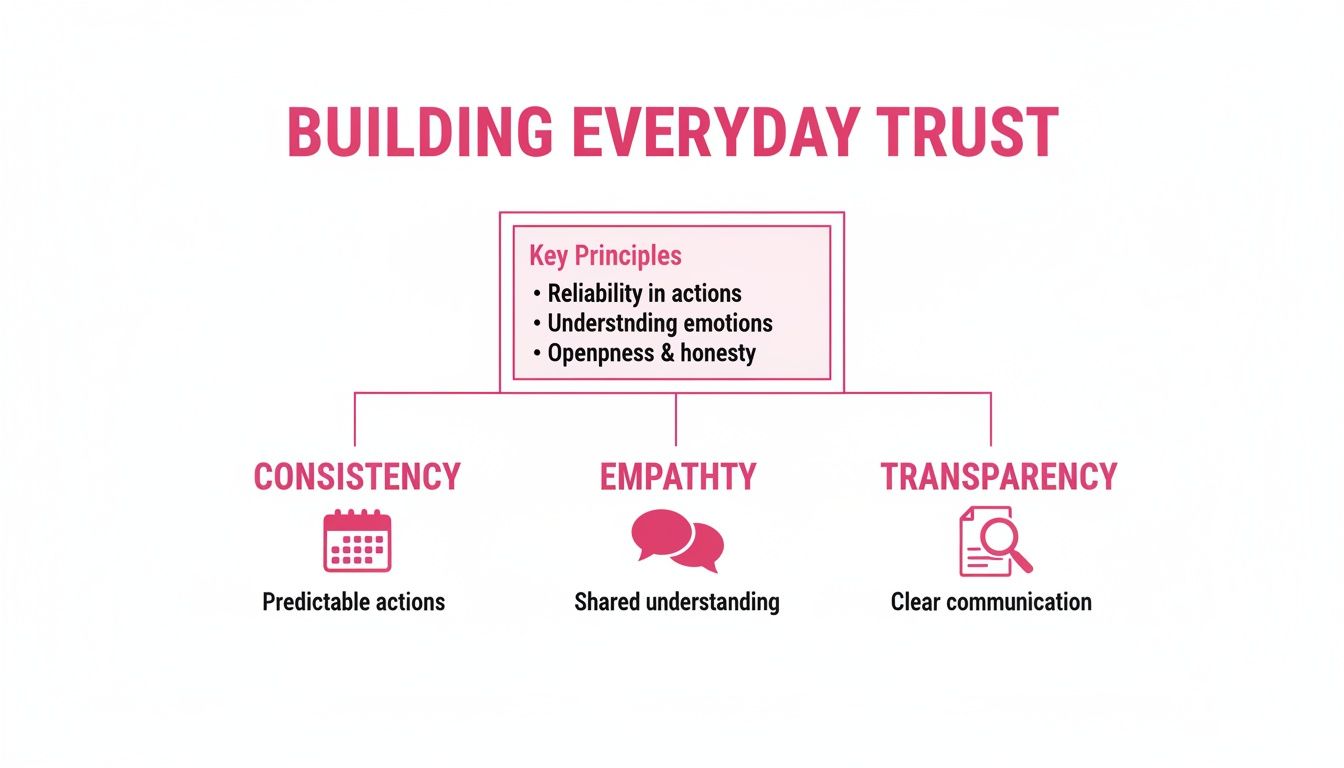
The three pillars of consistency, empathy, and transparency are universal. But let's break down what they look like in action across different age groups.
The table below gives a quick overview of how a child's primary trust needs evolve and how our actions can meet those needs.
Trust-Building Strategies by Age Group
Age Group
Primary Trust Need
Teacher/Parent Action Example
K-2 (Ages 5–7)
Predictability & Safety
Sticking to a consistent morning routine. Clearly explaining what will happen next. Example: A parent uses a visual chart at home showing the steps for getting ready: 1. Get dressed, 2. Eat breakfast, 3. Brush teeth.
Grades 3-5 (Ages 8–10)
Fairness & Integrity
Applying rules equally to all students. Apologizing if you make a mistake. Example: A teacher uses a random name picker to call on students, ensuring everyone gets a fair chance to participate.
Grades 6-8 (Ages 11–14)
Respect & Autonomy
Knocking before entering their room. Asking for their opinion instead of giving direct advice. Example: A parent asks, "What do you think is a fair curfew for the school dance on Friday?" instead of just setting one.
Thinking about these developmental needs helps us make sure our efforts to connect actually land the way we intend.
Building Trust with K-2 Students (Ages 5-7)
For our littlest learners, trust is all about predictability and physical safety. Their world can feel huge and chaotic, so they look to adults to be a calm, steady anchor.
Warmth, clear routines, and following through on tiny promises are the currency of trust here. It's about being a reliable presence in their often-unpredictable world.
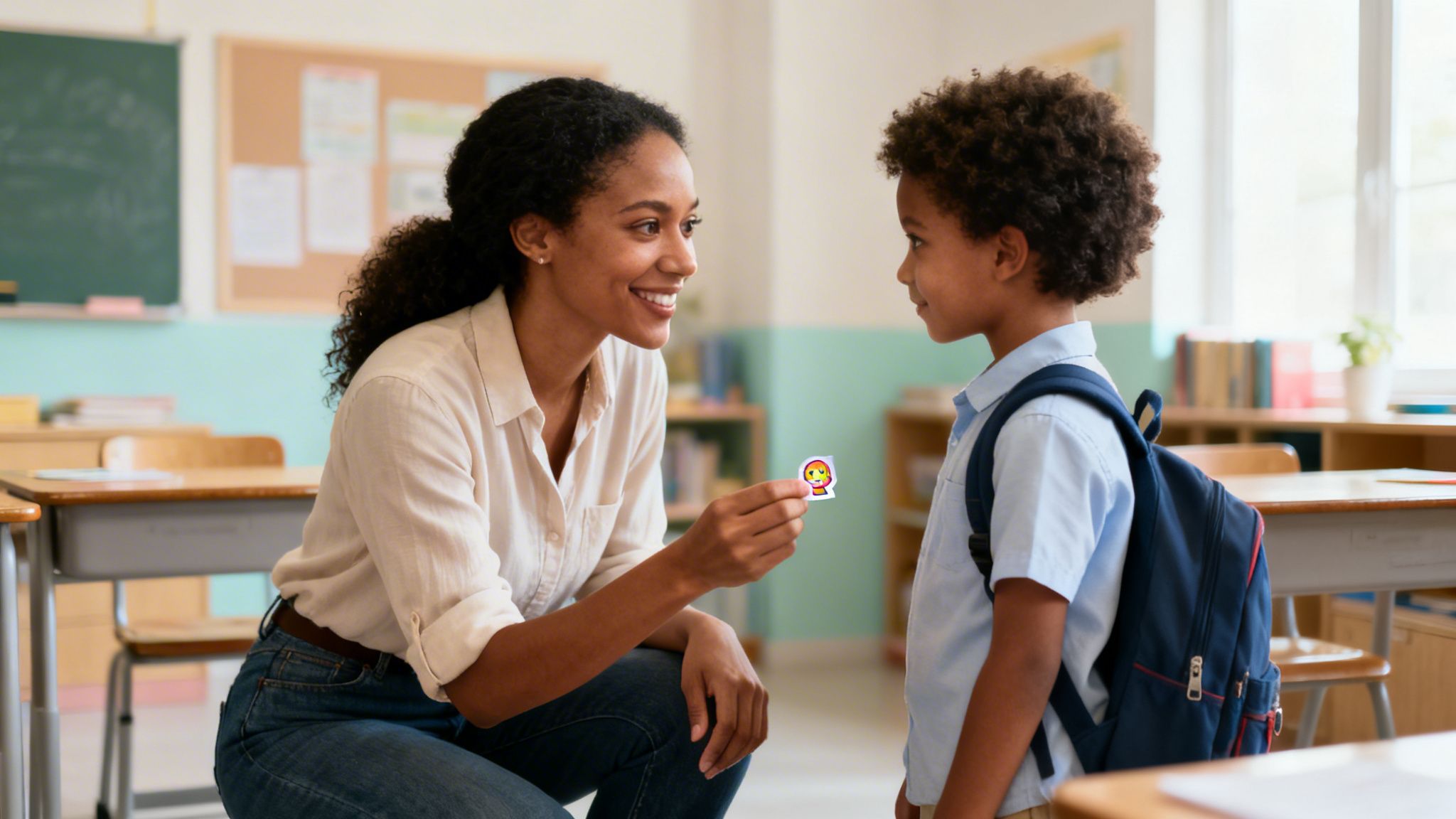
In the classroom: A first-grade teacher sees a student hanging back from a new activity. Instead of pushing, she kneels to his level, makes eye contact, and says, “This is new, huh? Let’s just try the first step together.” That small act communicates safety and partnership.
At home: A parent sticks to the same bedtime routine every single night—bath, book, then lights out. This reliable sequence eases anxiety and reinforces that the parent is a source of comfort.
Connecting with Grades 3-5 (Ages 8-10)
By upper elementary, a child’s sense of justice and fairness is razor-sharp. They are watching. They’re noticing if your words match your actions, and they will absolutely call you on it if they don’t.
At this stage, keeping your promises is everything. They are old enough to remember what you said you’d do, and they’ll be tracking it.
Trust with a ten-year-old is often a matter of integrity. They are starting to grasp complex social rules and look to adults to model what it means to be fair, honest, and accountable.
For example, a teacher who applies classroom rules to every student—no favorites, no exceptions—earns deep respect. In the same way, a parent who promises to be at the soccer game and then actually shows up (and pays attention!) proves their child is a priority.
This is also a great age to signal that you trust them by giving them age-appropriate responsibilities. For example, a teacher can make a student the "tech helper" for the week, trusting them to pass out tablets. This simple act encourages them to trust you right back.
Earning Trust from Middle Schoolers (Ages 11-14)
Welcome to middle school, a whirlwind of social and emotional change. Tweens and teens are naturally pulling away from adults and turning toward their peers. Building trust now requires a delicate dance of respect, vulnerability, and guidance.
They are desperate for autonomy and have a built-in radar for being patronized or controlled. Small acts of respect go a very long way.
Model vulnerability: This doesn't mean oversharing, but you can share an appropriate story about a time you struggled. Saying something like, "I remember feeling really left out in seventh grade, and it was tough," normalizes their feelings and makes you a real person, not just an authority figure.
Respect their space: Knock before you enter their room. Ask permission before sharing a funny story about them with family. These gestures show you see them as individuals who deserve privacy.
Act as a sounding board: When they come to you with a problem, resist the urge to jump in with a solution. Instead, ask open-ended questions like, "That sounds hard. What do you think you'll do?" or "How did that make you feel?" This empowers them to find their own solutions while knowing you're in their corner.
How to Repair Trust When It Is Broken
Let's be honest: we all make mistakes. A promise gets broken in the chaos of a busy week, a temper flares unexpectedly, or a responsibility is simply forgotten. These moments can sting, and it's easy to feel like you've damaged a connection with a child beyond repair.
But what if we saw these moments not as failures, but as powerful teaching opportunities? Repairing a breach of trust isn't about pretending it never happened. It's about showing a child, step-by-step, how to mend a relationship with honesty and care. And it always starts with the adult taking the first step.
Take Full Ownership and Apologize Sincerely
The single most important part of rebuilding trust is offering a genuine apology—one that’s completely free of excuses. A real apology focuses on your actions and their impact, not your intentions. Phrases like "I'm sorry, but…" or "I'm sorry you felt that way" immediately shift the blame and signal that you're not truly taking responsibility.
A sincere apology is specific and owns the action completely.
For Teachers: Instead of a vague, "I'm sorry I got frustrated," try pulling the student aside later. Say something like, "I raised my voice at you earlier, and that wasn't okay. I was feeling overwhelmed, but it's my job to manage that. I am truly sorry I spoke to you that way."
For Parents: Instead of, "I'm sorry I missed your game, I was so busy," try, "I know I promised I would be there, and I broke that promise. I am so sorry I let you down. Your game was important, and I should have made it a priority."
This kind of vulnerability shows the child you respect their feelings and are accountable for what you did. It sends a clear message: our relationship is more important than my pride.
Talk About the Impact and Make a Plan Together
After the apology, the next step is to open the door for the child to share how it felt for them. This validates their experience and helps them process the hurt. You can ask a simple, open-ended question like, “How did it feel when I did that?”
Then, just listen. Don't interrupt, explain, or get defensive. Your only job here is to show them their feelings are heard and legitimate.
Finally, you can turn a mistake into a moment of collaborative problem-solving. Work together on a plan to prevent it from happening again. For example, a parent could say, “Next time I’m feeling overwhelmed, I’m going to take three deep breaths before I speak. What’s something you could do if you notice I’m starting to get frustrated?”
This process of radical honesty and repair is the foundation of strong, resilient relationships. When a child sees you model accountability, you're giving them an invaluable roadmap for navigating their own future friendships and connections.
While trust between a teacher and a student is powerful, creating a truly trusting school environment takes more than just one-on-one connections. It means shifting the entire campus culture. It’s about moving trust from being an occasional nice moment to being the very air everyone breathes.
This kind of deep, systemic trust isn’t built in a single assembly or with a new poster in the hallway. It grows from consistent, school-wide practices that make psychological safety a given for every single person—students, staff, and families alike.
Model Vulnerability and Connection from the Top
If you want a culture of trust, the leadership team has to go first. When principals and administrators are open, prioritize connection, and aren't afraid to be vulnerable, they give everyone else permission to do the same. That feeling trickles down from the staff lounge right into the classrooms.
Kick off staff meetings with connection. Before you even touch the agenda, start with a simple check-in. Ask something like, “What’s one small win you’ve had this week?” or “Share something you’re feeling challenged by.” This small habit makes it normal to be human and builds real bonds between colleagues.
Meet one-on-one with your staff. Real trust isn’t built in big, formal meetings. It’s built in personal conversations. Taking the time to connect individually shows your teachers you value their perspective and creates a foundation for honest dialogue when things get tough.
In a room of twelve, people posture. One-on-one, they think out loud. They get excited. They take risks. Good leadership depends on building personal relationships that create trust.
This approach turns a group of individual educators into a genuinely collaborative team. When your staff feels seen and trusted by you, they are so much better equipped to create that same supportive space for their students. For more ideas on this, our guide on how to improve school culture is a great resource.
Create Authentic Opportunities for Student Voice
For students to trust the adults and the "system," they need to feel like they’re a real part of it. When we create genuine ways for them to give feedback, we’re sending a clear message: your opinions matter, and we’re listening. It shifts students from being passive recipients of rules to active partners in shaping their own community.
Here are a few ways to make that happen:
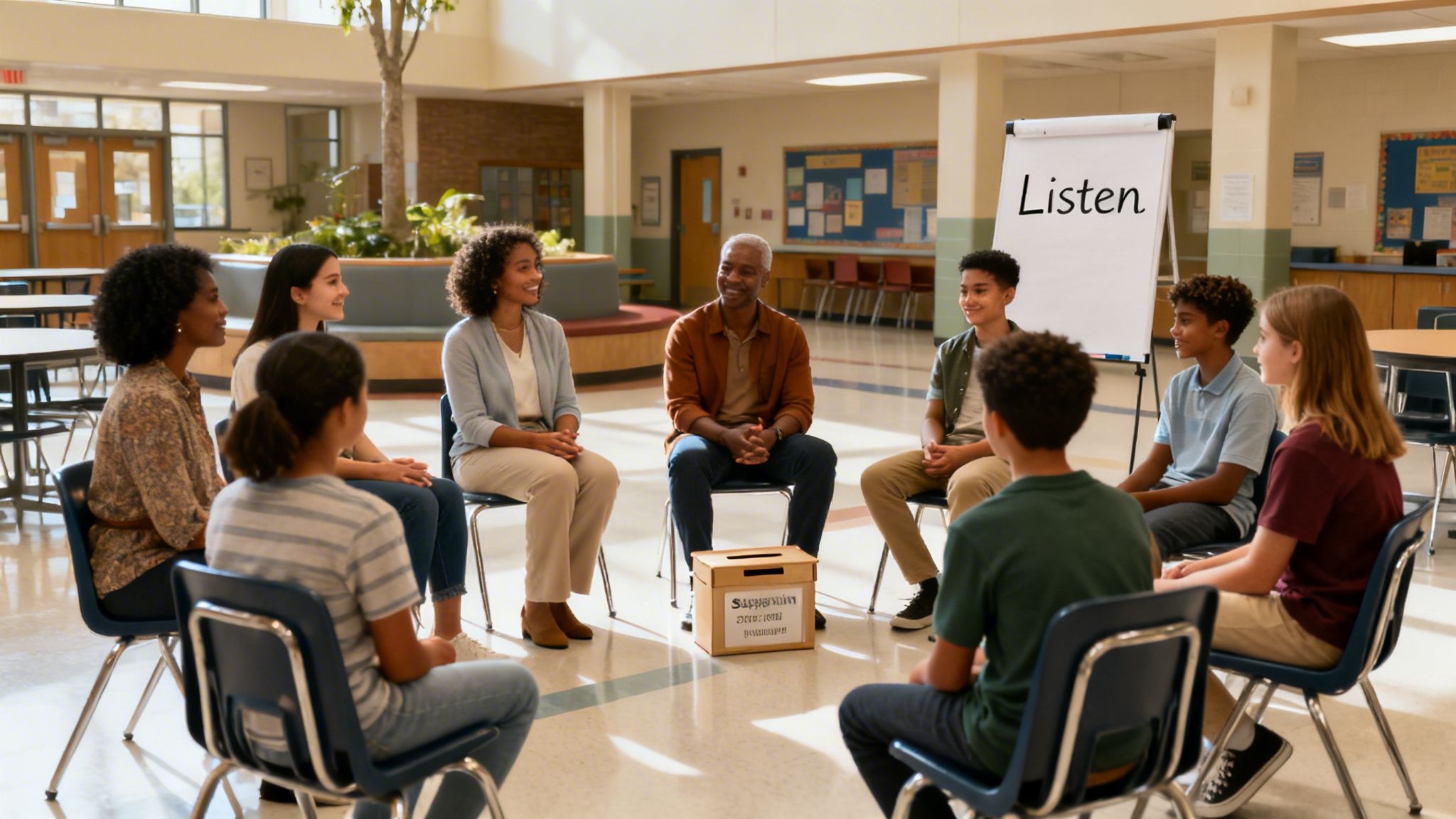
Student Advisory Councils: Form a representative group of students who meet regularly with school leadership. Let them talk about school climate, policies, and what’s really on their minds. For example, a council might discuss hallway traffic issues and propose a "one-way" system, which leadership then implements.
Feedback Surveys: Use anonymous surveys to get honest input on everything from the cafeteria food to how safe they feel in the hallways. The most important step? Share the results and what you’re doing about them.
A Shared Language for Conflict: Adopt a school-wide framework for resolving disagreements. When everyone—from the playground aide to the principal—uses the same tools and vocabulary, it creates consistency. Soul Shoppe programs do just this, equipping entire schools with a shared approach to communication and empathy.
By weaving these practices into the daily life of your school, trust stops being an abstract goal and becomes a structural part of your community. It’s how you build a resilient, connected campus where everyone feels they truly belong.
Common Questions About Building Trust with Students
As educators and parents, we know building trust isn't a one-and-done activity. It's a daily practice full of complex situations that can leave even the most experienced among us searching for the right approach.
When things get tricky, it’s natural to have questions. Here are a few of the most common ones we hear, along with some real-world strategies that work.
How Can I Build Trust with a Student Who Has a History of Trauma?
Building trust with a child who has experienced trauma is a delicate process that calls for extra patience, consistency, and a deep commitment to creating safety. The goal is to slowly build a foundation of security through small, predictable interactions.
It starts with the simple things. Greet them by name at the door, every single day. Notice their effort on an assignment, not just the final score. More than anything, be a reliable presence and always do what you say you will do.
A powerful way to do this is by offering choices, which helps restore a sense of control that trauma often takes away. Instead of saying, "You need to finish this worksheet now," you could try, "Would you rather start with the math problems or the reading questions?" This small shift gives them agency.
Over time, this consistent, predictable, and safe presence helps rewire their expectations of adults, creating the psychological safety they need to truly learn and connect.
What if I Make a Mistake and Break a Student's Trust?
It happens to all of us. The good news is that repairing a rupture in a relationship is not only possible but also an incredibly powerful life lesson for a child. The key is a genuine, prompt, and private apology where you take full ownership.
Acknowledging your mistake and its impact shows respect and humility. Often, this act of authentic repair strengthens a relationship even more than if the mistake had never happened in the first place.
Pull the student aside when you're both calm. You could say, "I was wrong to raise my voice earlier. I was feeling frustrated, but that's not how I should have handled it. I am sorry."
It's crucial to avoid excuses like, "I'm sorry, but you weren't listening." A clean, direct apology shows the child that your relationship is more important than your pride.
How Do I Get My Cynical Middle Schoolers to Trust Me?
Adolescent cynicism is often just a protective shield. To get past it, you have to prove you're a trustworthy adult who respects their growing need for autonomy and sees them as capable young people.
Be Authentic: Share your own appropriate struggles to show you're human. You might say, "I remember how stressful group projects were in 8th grade. Let's talk about how we can make sure everyone does their part."
Listen Actively: When they share an opinion, even one you disagree with, validate their perspective. Try saying, "I can see why you feel that way. Tell me more." It shows you're hearing them, not just waiting to talk.
Respect Their Intelligence: Avoid sarcasm, which can be easily misinterpreted as disrespect. Treat them like the smart, perceptive people they are becoming. For example, when discussing a novel, ask them for their interpretations of a character's motives instead of just telling them the "right" answer.
With middle schoolers, being fair, authentic, and respectful of their intelligence is the fastest way to earn their trust and show them you are a reliable ally.
At Soul Shoppe, we believe these skills are essential for creating thriving school communities. Our programs provide students, staff, and families with the tools to build and repair relationships, fostering empathy and psychological safety for everyone. Discover how Soul Shoppe can support your school.
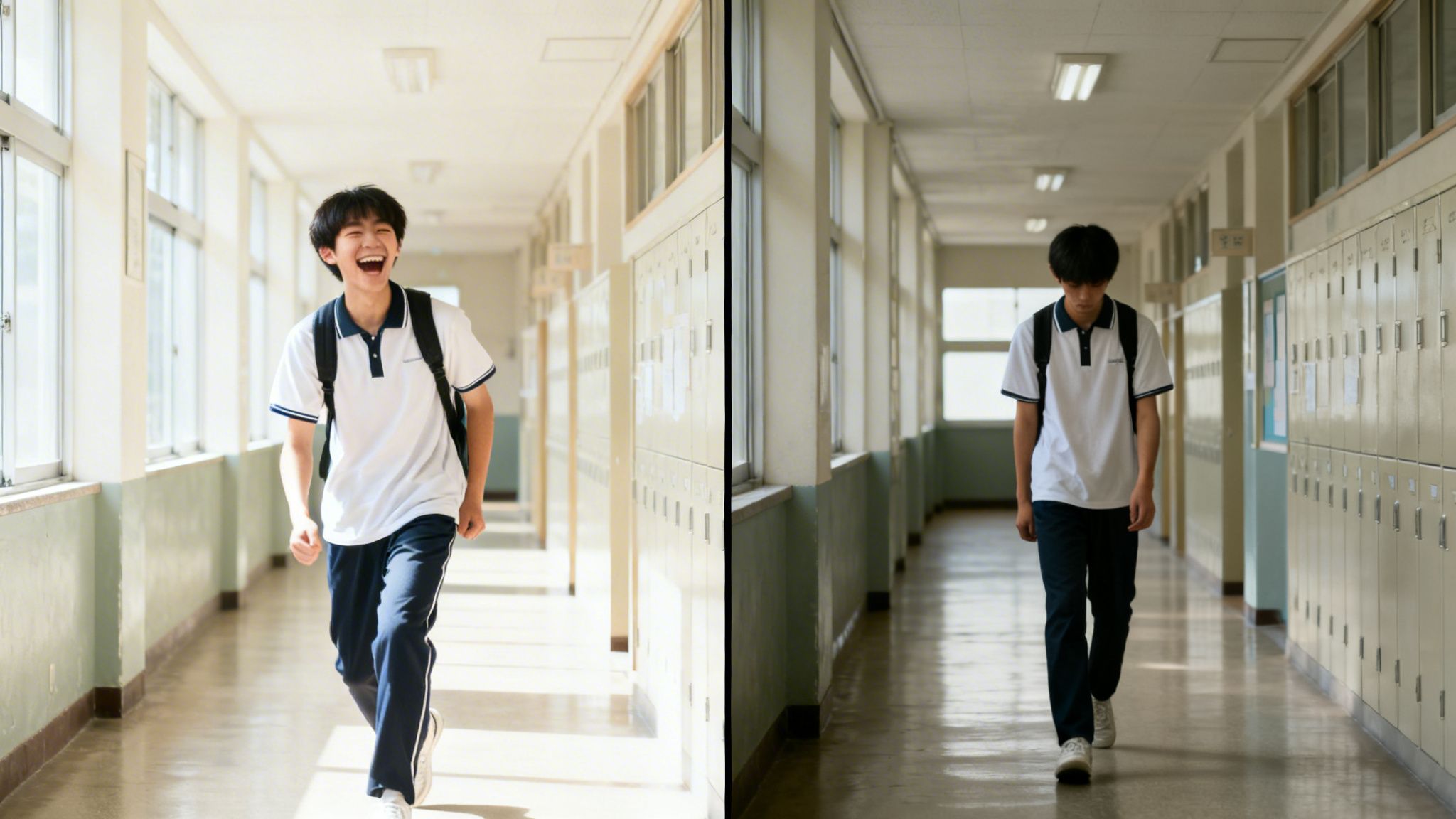
It’s easy to use the words “emotion” and “mood” interchangeably, but in the world of social-emotional learning, they mean very different things. Think of it this way: an emotion is like a sudden, intense rain shower—it hits hard but passes quickly. A mood is more like the weather for the entire day—a lingering sense of sunniness or a persistent gray gloom that colors everything.
Understanding the Key Difference Between Emotion and Mood
For educators and parents, telling them apart is the key to supporting a child’s well-being effectively. Whether a student is navigating a fleeting emotion or a persistent mood changes everything—how you respond, the words you use, and which strategies will actually help. This awareness is a cornerstone of building strong social-emotional skills.
Let’s look at a real-world example. Imagine Maria aces a tough math test she studied hard for. That immediate burst of pride and joy she feels? That’s an emotion. It’s a direct, powerful reaction to a specific event—the good grade—and it will probably fade as she heads to her next class.
Now, think about David, who comes to school feeling irritable and just plain "blah." He can’t pinpoint why; he just feels off. This low-grade, generalized feeling that follows him all morning is a mood. It acts as a background filter, making him less patient with friends and less able to focus during lessons. A teacher might notice he's sighing a lot, dropping his pencil, and not engaging in a class discussion he'd normally enjoy.
This distinction is critical. We respond to a brief emotional flare-up differently than we do a lingering, undefined mood. One requires in-the-moment validation, while the other calls for a broader look at potential underlying factors.
Understanding this difference empowers you to give more targeted, effective support. Instead of a one-size-fits-all approach, you can tailor your response to what the child is actually experiencing. This helps children learn to identify and manage their inner worlds, a vital skill for resilience. This ties directly into the bigger picture of a child’s growth, which you can learn more about in our guide to what social-emotional development is.
Emotion vs Mood A Quick Comparison Guide
To help you quickly tell the difference in the moment, we’ve put together a simple guide. Think of this as your cheat sheet for understanding a child’s inner state.
Characteristic
Emotion
Mood
Cause
Caused by a specific, identifiable event or trigger.
Often lacks a clear, specific trigger; can be general.
Duration
Short-lived, lasting from seconds to a few minutes.
Longer-lasting, persisting for hours, days, or more.
Intensity
High intensity; a strong and powerful feeling.
Lower intensity; a more subtle, background feeling.
Awareness
We are usually aware of the emotion and its cause.
We may not be aware of the mood or its origin.
Having this breakdown handy makes it easier to pause and assess what's really going on, allowing for a much more thoughtful and helpful response.
A Deeper Comparison of How Feelings Work
While the definitions are a great start, the real magic happens when we can see the difference between an emotion and a mood in a child’s daily life. It helps to have a handle on concepts like what emotional regulation entails, because this knowledge lets us read a student’s inner world with more accuracy and compassion.
By looking at four key areas—the cause, the timeline, the intensity, and what’s happening in the body—we can get a much clearer picture and learn how to spot the difference in our students.
The Cause: Was There a Trigger?
The most straightforward way to tell an emotion from a mood is to look for a specific trigger. Emotions are almost always a direct reaction to something that just happened.
Emotion Example: A fifth-grader feels a sharp pang of disappointment (emotion) right after learning the class field trip was canceled. The cause is obvious and immediate. The teacher can directly link the student's sad face to the announcement they just made.
Mood Example: A seventh-grader is quiet and withdrawn all afternoon. He can't name one single thing that's wrong, but he just feels a general sense of gloominess (mood). This could be from a poor night’s sleep or the slow build-up of stress over the week. His parent might notice he's been dragging his feet and sighing since he woke up.
An emotion answers the question, "What just happened?" A mood often leaves a child wondering, "Why do I feel this way?" This distinction is your first clue for figuring out how to help.
The Timeline: How Long Does It Last?
The lifespan of a feeling is another huge clue. Emotions are like a flash of lightning—intense but quick. Moods are more like the day's weather forecast; they tend to settle in and hang around for a while.
Emotion Example: A student's flash of anger when a classmate accidentally knocks over their project is powerful, but it's also short-lived. Once the mess is cleaned up and an apology is made, the anger usually fades within minutes.
Mood Example: A child might wake up feeling irritable and carry that low-grade frustration all the way from breakfast to their after-school activities, affecting everything they do. At school, a teacher notices they are snippy with friends during group work, and at home, a parent sees them slam their bedroom door for no apparent reason.
The Intensity: How Loud Is the Feeling?
When it comes to the difference between emotion vs mood, think about volume. Emotions are loud. They're often too big to ignore. Moods are more like a low hum in the background.
Emotion Example: The burst of joy a student feels when they’re picked for the team is powerful and all-consuming in that moment. You'll see it in a huge smile, a fist pump, or them excitedly telling a friend. The spike of fear right before a presentation demands their full attention.
Mood Example: A student in a contented mood has a gentle sense of well-being that makes it easier to learn and get along with others. A child in a melancholy mood might just feel "blah," without the energy or drive to really participate. A teacher might observe them doodling instead of taking notes or staring out the window.
The Body: What Are the Physical Signs?
Finally, emotions and moods show up differently in our bodies. Emotions often trigger immediate, noticeable physical reactions that are easy for anyone to see.
Emotion (Fear): A child's heart starts racing, their breathing gets shallow, and their palms might get sweaty right before they have to perform. A parent might see their child wringing their hands before a piano recital.
Emotion (Embarrassment): A student’s face flushes bright red after they answer a question wrong. The physical reaction is involuntary and immediate.
Moods have more subtle physical tells. It's less about a big, dramatic reaction and more about a general state of being.
Mood (Anxious): A student might be restless and fidgety for hours, with a constant feeling of being on edge. A teacher might notice them tapping their pen, shaking their leg, or asking to go to the bathroom repeatedly.
Mood (Sluggish): A child might complain about being tired, move more slowly than usual, or have a hard time focusing. They might rest their head on their desk or respond to questions with a delay.
By paying attention to these four aspects, we can move beyond just putting a name to a feeling. We start to understand how it works, which is the first step toward offering support that truly helps.
How to Spot the Difference in Children and Teens
Is your student just having a bad moment, or is it a bad day? Knowing the difference between a passing emotion and a lingering mood is one of the most important skills we can have as parents and educators. It changes everything about how we respond.
Think of it this way: a student’s sharp, quick burst of frustration after losing a game is an emotion. It’s a direct, fiery reaction to something specific that just happened. But a student who is quiet, disengaged, and sighing through the entire school day? That’s likely a mood. The feeling is running in the background, coloring their whole experience without a single, obvious trigger.
Spotting the difference helps us respond with more empathy and precision. It's the first step in making a child feel truly seen and understood.
Recognizing Expressions Across Different Age Groups
How kids show their inner worlds changes dramatically as they grow. Younger children tend to wear their feelings on the outside, physically and immediately. Older students, on the other hand, often turn inward, making our observations a bit more like detective work.
For Younger Students (Kindergarten – 2nd Grade):
Emotions are physical: When a kindergartener’s favorite crayon breaks, their anger might look like a full-body tantrum—crying, stomping, or even throwing the broken pieces. Their joy is just as big and physical, with jumping, clapping, and happy shouts after winning a game.
Moods drain their energy: A low mood often shows up as unusual quietness during circle time. A teacher might notice they lose interest in things they usually love, like recess, or start complaining about being tired. A parent might see them pushing food around their plate at dinner instead of eating. They don't have the words for "I feel down," but their body language is shouting it.
For Older Students (3rd – 8th Grade):
Emotions get more verbal: A fourth-grader might slam their textbook shut and mutter, “This is so unfair!” after a disagreement with a friend. The reaction is still tied to an event, but now it’s expressed with more words and less physical drama.
Moods become more internal and social: An eighth-grader’s bad mood can look like social withdrawal—headphones on during lunch, one-word answers to a parent's questions, and avoiding friends in the hallway. It can also manifest as a persistent irritability or a cynical attitude that hangs around for days.
A child psychologist might say, "Pay attention to the pattern, not just the single event. A single outburst is data, but a week of quiet withdrawal is a story. Nuanced observation is about learning to read that story."
Key Observational Cues for Adults
To get better at telling an emotion from a mood, the biggest clue is time. How long does it last? According to the work of psychologist Paul Ekman, emotions are like quick sparks—lasting just seconds or minutes. They’re often ignited by a clear trigger, like getting praised by a teacher or having a conflict on the playground. Moods, however, can stretch for hours or even days, often without a single cause you can point to. They can be influenced by bigger things like stress, sleep, or even the weather. You can read more from Paul Ekman about this distinction on his website.
Here are a few practical questions to ask yourself:
Look for the Trigger: Can you connect the behavior to something that just happened (e.g., a friend took their toy)? If yes, you’re probably looking at an emotion. If not, it could be a mood.
Check the Clock: Did the behavior start and end fairly quickly (within minutes)? That’s an emotion. Has it been hanging around all morning, or for a few days? That’s a mood.
Assess the Impact: Is the feeling disrupting a single moment or activity (e.g., they cried but then rejoined the game)? That’s likely an emotion. Is it affecting their friendships, their focus, and their overall engagement in school (e.g., they've been sitting alone at lunch all week)? That points to a mood.
When you consistently use these observational filters, you’ll get much better at figuring out what a child is experiencing. This also helps you guide them toward building their own self-awareness, an essential skill we explore in our article on helping kids find the words they need for their feelings.
Practical Strategies for Responding at School and Home
Once you’ve spotted the difference between a fleeting emotion and a persistent mood, you can finally tailor your response to be truly helpful. The way we support a child in a sudden flash of anger is worlds away from how we help one navigating a week of gloominess. The right strategy at the right time is what empowers students to build genuine resilience.
Think of it this way: responding effectively comes down to whether you're addressing the "in the moment" feeling or the "over time" feeling. That distinction between emotion and mood is your guide. One requires immediate, focused tools, while the other needs broader, more holistic support.
Strategies for Immediate Emotions
When a child is in the grip of a powerful emotion, our goal is to help them move through it safely—without ever dismissing the feeling itself. Your role is to be a calm anchor in their storm.
Validate the Feeling: The first and most critical step is to simply acknowledge what you see. This isn't about agreeing with their reaction, but about showing you recognize their internal state. It’s about connection before correction.
Practice Co-Regulation: Young children, and even older students, often need an adult to help them find their calm. This means staying calm yourself, using a soft tone, and offering a steady, reassuring presence. For a young child, this might mean getting down on their level.
Use Quick Mindfulness Exercises: Simple, in-the-moment exercises can help a child reset. These don’t need to be long or complicated—just enough to break the emotional spiral.
The core principle for responding to emotions is validation before problem-solving. Saying, "I can see you're really frustrated with that puzzle," is far more effective than, "It's just a puzzle, don't get so upset."
Example Conversation Starter (Teacher): "Leo, I see your fists are clenched and your face is red. It looks like you’re feeling really angry that your tower fell. Let’s take three deep 'lion breaths' together, and then we can talk about what to do next."
Example Conversation Starter (Parent): "It seems like you're incredibly disappointed that the sleepover was canceled. I get it. It’s okay to feel sad about that. Let's sit together for a minute."
These quick-response tools are essential for managing those emotional spikes. You can find more practical, in-the-moment tools in our guide to self-regulation strategies for students.
Strategies for Persistent Moods
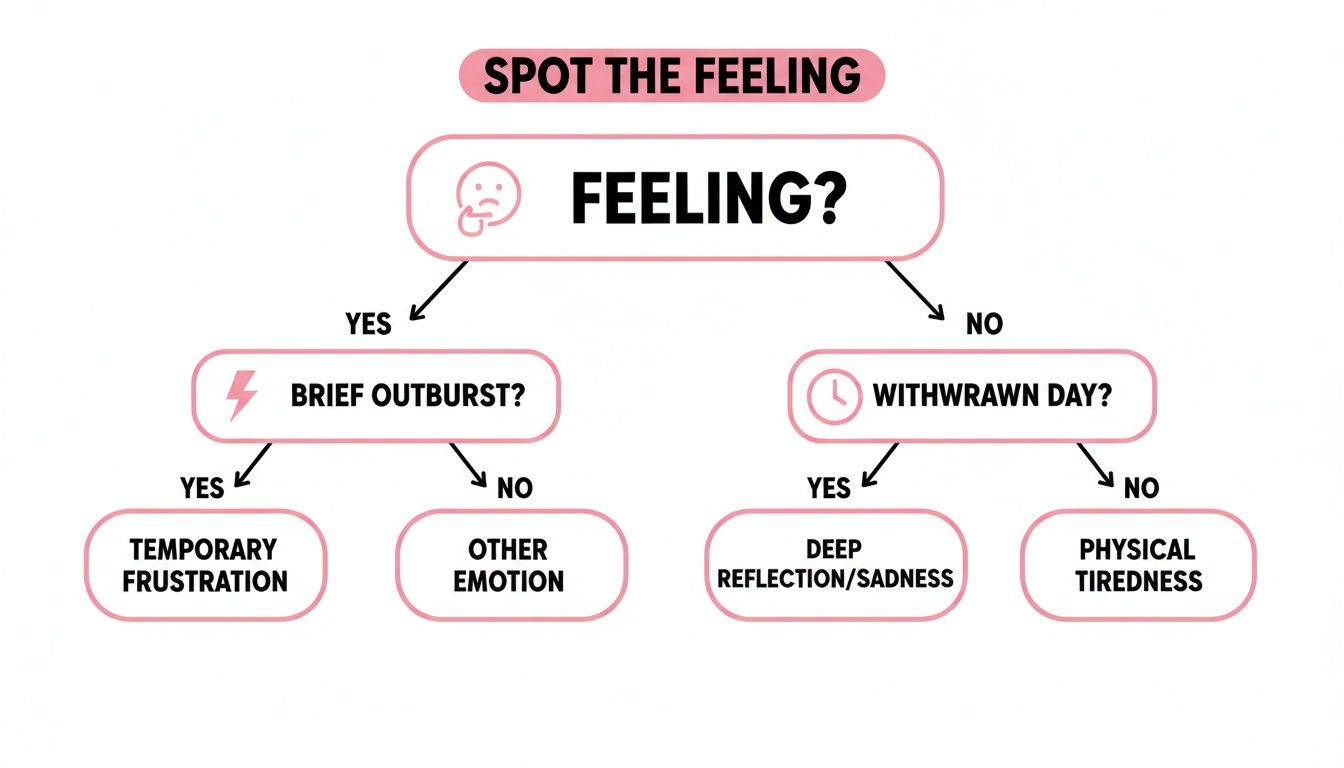
Managing a lingering mood requires a totally different, more investigative approach. Since moods often lack a clear, single trigger, the goal is to play detective, identify patterns, and introduce positive influences over time.
This flowchart is a great tool for helping you and the students you work with start to untangle what’s going on inside.
Here are some proactive ways to address those persistent moods:
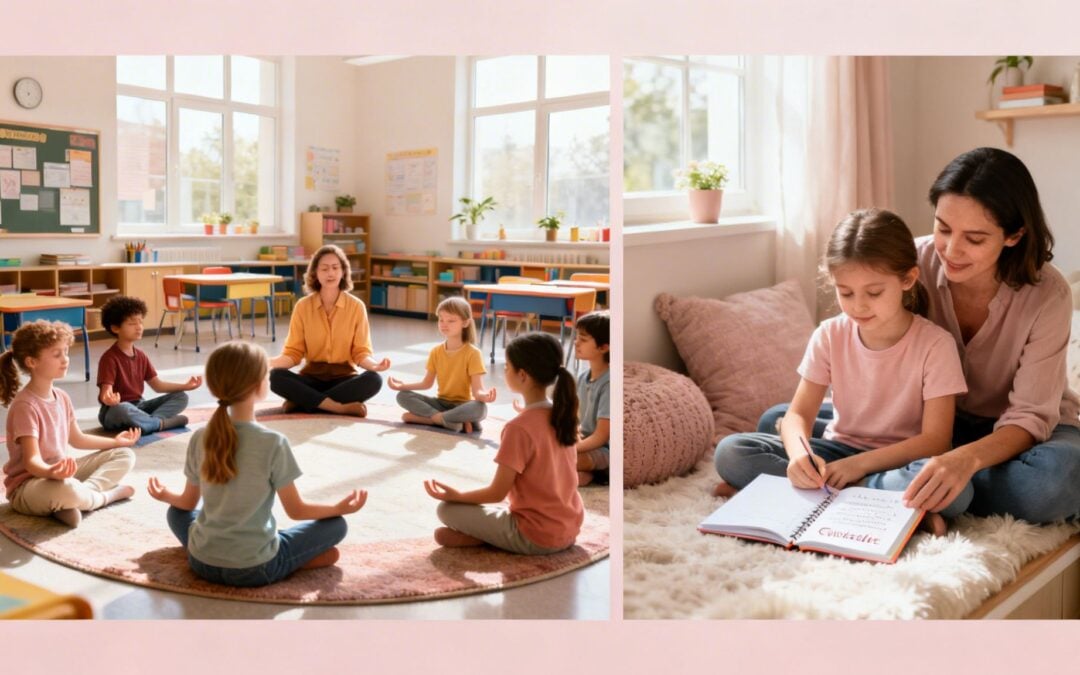
Encourage Journaling: A simple notebook where a child can write or draw their feelings can reveal surprising patterns. For a younger child, this might be a "feelings weather chart" where they draw a sun, cloud, or raincloud each day to show how they feel.
Discuss Underlying Factors: Open a gentle, non-judgmental conversation about potential causes. You can ask about sleep ("I've noticed you seem extra tired lately, how has your sleep been?"), friendships, schoolwork, or screen time without trying to "fix" anything immediately. Just listen.
Introduce Mood-Boosting Activities: Intentionally integrate activities that are known to improve mood. This could mean scheduling regular physical exercise, setting aside time for creative pursuits like painting or music, or simply spending more time outdoors. For a student, this might be a five-minute "brain break" with music.
Example Conversation Starter (Teacher): "Hey, Sam. I've noticed you've been pretty quiet this week, which is a little different for you. Everything okay? I'm here if you want to talk about anything at all, big or small."
Example Conversation Starter (Parent): "I've sensed you've been in a bit of a gloomy mood lately. I get that way sometimes too. I was thinking we could go for a bike ride this weekend to get some fresh air. What do you think?"
Building Emotional Literacy with Proven SEL Tools
It’s one thing to understand the difference between an emotion and a mood. It’s another thing entirely to know what to do about them in the middle of a chaotic school day. This is where the real work of emotional literacy begins—when students and staff have a shared, practical vocabulary and concrete tools to navigate their inner worlds.
Soul Shoppe programs are designed to bridge that exact gap, moving past definitions to offer real-world resources for managing both the flash of an emotion and the lingering weight of a mood. By embedding these tools into the school day, we help create a space where every child feels seen, heard, and ready to handle their feelings constructively.
Tools for In-the-Moment Emotions
When a big, powerful emotion like anger or frustration erupts from a conflict, kids need a clear path forward. A shared script and a physical process can turn a moment of conflict into a powerful learning opportunity, de-escalating the situation while teaching vital problem-solving skills.
One of our most effective tools for this is the Peace Path.
Think of it as a roadmap for resolving conflict. When two students have a disagreement on the playground—a clear trigger for strong feelings—a teacher or peer leader guides them to the Path. They walk through designated steps, each designed to help them talk, listen, and find a resolution together. The structure gives them the safety to process their anger or hurt, practice using "I-statements" ("I felt sad when you said you wouldn't play with me"), and take responsibility for their part.
The immediate emotion is handled, the conflict gets resolved, and most importantly, the students walk away with a repeatable skill for the next time a big feeling shows up.
Tools for Tracking Long-Term Moods
Dealing with a persistent, low-grade mood is a different challenge. It’s not about a single event but about building self-awareness over time. Students, especially as they get older, need ways to identify and understand the patterns behind why they might feel "blah" or irritable for days on end.
The goal isn't to eliminate bad moods but to understand them. When a student can connect their low mood to a lack of sleep or stress about a project, they gain a sense of control and can make positive changes.
For this, we find that guided journaling can be incredibly powerful. Our digital programs use prompts designed to help middle schoolers track their moods in a way that encourages reflection, not just venting.
A student might get a prompt like, “On a scale of 1-5, what’s your energy level today? What's one thing that might be affecting it?” or “Describe your ‘inner weather’ today. Is it sunny, cloudy, or stormy? Why?” A teacher could use this as a quick morning check-in to get a sense of the room's overall climate.
Over time, this simple practice helps students connect the dots between their moods and other factors like sleep, friendships, or school stress. This is metacognition in action, and it’s a cornerstone of developing high-level emotional intelligence and how we teach it.
By equipping a school with tools like these, Soul Shoppe helps create a supportive ecosystem where feelings are not just felt, but understood. To keep the learning going, incorporating varied and engaging Social Emotional Learning Activities is a great way to reinforce these skills.
When everyone—from the principal to the students—is using the same language and strategies, navigating the complex world of feelings becomes a shared and empowering journey.
Of course. Here is the rewritten section, crafted to match the specified human-written style, tone, and formatting.
Knowing When a Child Might Need More Support
Understanding the difference between an emotion and a mood is a huge step in supporting our kids. But what do we do when a child's low mood just won't lift, or their emotional reactions feel consistently dialed up to eleven?
Knowing when to ask for more help is a critical part of being a caring adult in a child's life. This isn't about sounding the alarm for every off-day. It’s about recognizing patterns that tell us something more might be going on, allowing us to step in before a struggle becomes a crisis.
Clear Signs That More Support Is Needed
Every child is unique, but some signs are universal signals that a child needs a closer look. This goes beyond the simple emotion vs. mood debate and into the territory of duration, intensity, and impact.
Here are a few specific things to watch for, both at home and in the classroom:
Persistent Moods: A sad, irritable, or worried mood that sticks around for more than two weeks without a break is a major flag. For example, a student who has been withdrawn and weepy most days for three weeks, not just after a specific sad event.
Significant Behavioral Changes: Has a once-social butterfly started spending recess alone? Has a curious student lost all interest in their favorite subjects? A parent might notice their normally talkative teen now gives only one-word answers at dinner every night.
Disproportionate Emotional Reactions: We're talking about a pattern of meltdowns or outbursts that are way out of proportion to the trigger. A minor mistake like spilling water leading to inconsolable crying on a regular basis is a sign.
Impact on Daily Functioning: The child’s emotional state is getting in the way of their life. This could mean they’re having trouble sleeping, eating, getting to school, or keeping up with their friendships. A teacher might hear from a parent that their child is having stomachaches every morning before school.
Remember, you are an expert on your child or student. If your gut tells you something is fundamentally different and has been for a while, listen to it. Trust what you're seeing.
A Step-by-Step Guide for What to Do Next
If you're noticing these signs, the idea of taking action can feel overwhelming. Try to see it not as a crisis, but as a loving, proactive step toward getting your child what they need. Asking for professional guidance is a sign of strength.
Here is a clear process to follow:
Document Your Observations: Before you make a call, spend a few days jotting down what you see. Be specific and non-judgmental. Note the behavior, time of day, and context (e.g., "For the past three weeks, Leo has refused to join friends at recess and has been tearful after school most days"). This kind of log is incredibly helpful for professionals.
Speak with the School Counselor: For teachers, the school counselor is your first stop. For parents, they are an invaluable partner. Share your documented notes and work together on a plan for in-school support and monitoring.
Consult with a Pediatrician: It's always a good idea to connect with your child's doctor. They can help rule out any underlying medical issues that might be causing the mood or behavior changes. Don't forget to bring your notes to this appointment.
Seek a Child Therapist or Psychologist: If concerns continue, your pediatrician or school counselor can refer you to a mental health professional who specializes in working with kids. They can provide a formal assessment and teach your child targeted skills to cope with their feelings and address what's going on underneath the surface.
Answering Your Questions About Emotions and Moods
It’s a journey to truly get the nuances between emotions and moods, especially when you’re trying to help a child navigate them. We often hear these questions from teachers and parents, so we’ve put together some answers to help you feel more confident in supporting the kids in your life.
Can a Big Emotion Turn into a Lingering Mood?
Absolutely. Think of it this way: when a powerful feeling isn't processed, it doesn't just disappear. It can hang around, coloring the rest of the day.
Practical Example: A student gives a presentation and fumbles their words, feeling a sudden flash of embarrassment (emotion). If there's no space to shake it off or get a little reassurance from the teacher, that fleeting feeling can curdle into a withdrawn, anxious mood that lasts all afternoon. They might avoid eye contact and refuse to participate in other classes, the original trigger long past. This is exactly why having tools to handle emotions in the moment is so vital.
How Do I Explain Moods to a Little Kid?
The best way is to use simple, concrete comparisons that they can immediately grasp. The abstract idea of a "mood" is really tricky for young minds.
Practical Example: A great place to start is with a weather analogy. You could explain that an emotion is like a big, loud clap of thunder—it’s powerful and grabs your attention, but it’s over pretty quickly. A mood, on the other hand, is like a long, drizzly gray day that makes everything feel a bit slower and heavier. You could even create a "feelings forecast" chart together, where they can point to a sun, cloud, or raincloud to show their "inner weather" each morning.
When you give kids a simple metaphor like the weather, you’re handing them a language to talk about a complex inner world. It makes the experience less intimidating and much easier to manage.
Is It a Feeling or Just a Behavior I’m Seeing?
This is such an important distinction to make. Behavior is what we can see on the outside, but the feeling is what's driving it from the inside. We have to look past the action to understand the emotion behind it.
Practical Example: Imagine a child who rips up their drawing after making one small mistake. Tearing the paper is the behavior. The emotion fueling it could be intense frustration, disappointment, or even anger at themselves. If we only address the behavior ("We don't rip our things"), we miss the real teaching moment.
Instead, try to validate the feeling first: "It's so frustrating when your drawing doesn't look the way you want it to. I get it. Let's take a deep breath together before we try again." This approach teaches them how to manage the feeling, not just suppress the action.
At Soul Shoppe, we believe that giving students and educators a shared language for feelings is the first step toward building a thriving, supportive community. Explore our programs to bring these powerful, practical skills to your school.
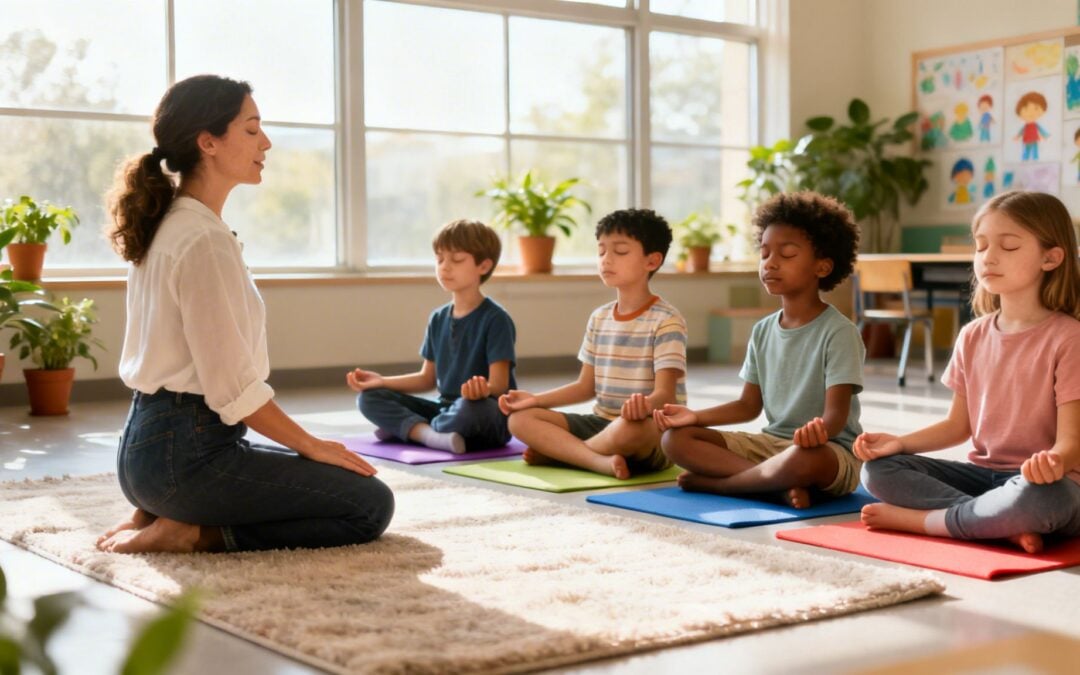
When we talk about mindfulness in the classroom, we're not asking kids to empty their minds. It's much more practical than that. We're teaching them how to pay attention to the present moment with a sense of kindness and curiosity, training their brains to focus and better manage the big waves of thoughts and emotions that can be so distracting.
The result? A calmer, more focused, and more productive learning environment for everyone.
Why Mindfulness in the Classroom Is Essential
So many of our students walk through the school doors already feeling overwhelmed. They're navigating a world of constant pings, pressures, and stimulation that can leave them feeling stressed and anxious before the first bell even rings. When a child's nervous system is on high alert, it's incredibly difficult for them to focus, learn, or build positive relationships.
This is exactly why mindfulness in the classroom is no longer a "nice-to-have." It's a foundational tool for both academic success and emotional well-being. Think of it less as another thing on your endless to-do list, and more as a powerful strategy that primes the brain for learning, making every other minute of instruction that much more effective.
Creating a Foundation for Focus
Picture this: your third-graders tumble back into the classroom after a chaotic recess. They're buzzing with energy, a few are still bickering over a game, and starting the afternoon math lesson feels almost impossible. Instead of trying to talk over the noise, you dim the lights and ring a small chime.
"Okay, friends," you say softly. "Let's take two minutes to settle our bodies. Put your hands on your desk, feel your feet on the floor, and just listen until you can't hear the chime anymore." That simple, two-minute reset is enough to interrupt the chaos and guide your students back into a learning mindset.
This is mindfulness in action, and it directly supports academics. When students learn to notice their own restlessness and are given tools to find their calm, they are much better prepared to:
Improve Attention: Mindfulness literally strengthens the brain's ability to focus and tune out distractions. For example, a student who practices noticing sounds can better tune out hallway noise during a test.
Enhance Emotional Regulation: Kids learn to recognize big feelings like frustration or excitement without letting those feelings take over. A practical example is a student who feels angry after a disagreement using a "breathing buddy" technique to calm down before shouting.
Boost Working Memory: It's simple—a calmer mind is better able to hold on to and process new information. After a mindful minute, a student is more likely to remember a multi-step instruction you give them.
Responding to a Growing Need
This shift isn't just happening in a few classrooms; it's a global movement in education. The mindfulness in education market is on track to surge from $1.4 billion in 2024 to an estimated $5.3 billion by 2033. This incredible growth isn't a fluke. It's a direct response to rising concerns over student anxiety and a wave of compelling neuroeducation research that links mindfulness to better focus and emotional intelligence.
By teaching students to pause and notice their inner world, we give them a lifelong skill for navigating challenges. It’s about building self-awareness, not just about being quiet.
This internal skill set is a huge piece of the social-emotional development puzzle. When a child can identify what's happening inside them, they get much better at understanding the feelings of others. This is how we build empathy. In fact, you can explore the powerful connection between inner awareness and social skills by reading about the benefits of social-emotional learning.
Ultimately, weaving mindfulness into the school day helps create resilient, emotionally intelligent learners who are ready to take on a complex world.
Your Implementation Plan For School-Wide Mindfulness
Bringing mindfulness to an entire school can feel like a huge undertaking. But a thoughtful, step-by-step approach can make it not only manageable but truly sustainable. The secret? A successful school-wide rollout isn't a top-down mandate. It begins with genuine buy-in and a focus on the well-being of the adults in the building first.
The most effective mindfulness in the classroom programs always start by supporting the teachers. When educators feel the personal benefits of mindfulness themselves—less stress, more presence—they become the most authentic and powerful champions for their students.
Start Small and Build Momentum
The key is to avoid overwhelming your staff. Instead of a massive, all-at-once launch, think about creating a ripple effect that starts with a core group of enthusiastic people.
Form a Wellness Team: Find a few passionate staff members—teachers, counselors, or administrators—to lead the charge. This small team can pilot practices, gather feedback, and help guide the process.
Conduct a Needs Assessment: Don't assume you know what the biggest stressors are. Use a simple, anonymous survey to ask staff and students what they're struggling with. For example, a question could be: "When do you feel most stressed during the school day? (a) Before a test, (b) During lunch/recess, (c) Transitions between classes."
Identify Pilot Classrooms: Invite a handful of interested teachers to try a few simple practices for a month. Support them with resources and regular check-ins, creating a low-stakes space to experiment.
This gradual approach builds a foundation of success stories and hands-on experience, which makes the whole idea much more appealing to hesitant staff members down the road.
This flow shows the simple but powerful path that mindfulness creates, moving us from a state of stress to one of calm, focused attention.
The goal isn't to eliminate stress completely—that's impossible. It's about developing the skills to navigate it effectively, which leads to greater mental clarity and calm.
Provide Robust Professional Development
Great training is the engine of a successful program. The quality of teacher preparation is directly tied to student outcomes. And the data backs this up.
Of the over 7,000 adults trained to deliver mindfulness to more than 200,000 young people, 92% of teachers reported personal benefits like reduced stress. This personal growth has helped fuel an explosion in youth meditation, which jumped from just 0.6% in 2012 to 5.4% in 2017. As you can see from these findings on teacher training and student outcomes, when teachers are well-supported, the social improvements in students are much more likely to stick.
When introducing the idea at a staff meeting, start with an experience. Don’t just talk about mindfulness—lead a one-minute breathing exercise. Let them feel the shift from chaos to calm firsthand.
To make sure your program is truly effective, it's essential to Master Instructional Design Principles when creating your PD sessions. Your training should be experiential, ongoing, and practical, not just a one-off workshop.
Weave Mindfulness into the School Day
Look for small openings to embed short, simple practices into routines you already have. This helps mindfulness become a natural part of the school culture, not just another thing on the to-do list.
Practical Examples for School-Wide Integration:
Morning Announcements: Start the day with a school-wide "Mindful Minute." The principal can guide students in a moment of quiet breathing or ask them to notice one sound in the building.
Script: "Good morning, everyone. Before we begin our day, let's take a moment to arrive. Feel your feet flat on the floor, take a slow breath in, and a long breath out. Have a wonderful day of learning."
Classroom Transitions: The moments between activities are perfect for a quick reset. Use a chime, a song, or a simple breathing exercise to signal a shift in focus.
Teacher Tip: After a lively activity, you could say, "Let's practice 'Stoplight Breathing.' We'll take one deep breath for the red light to pause, one for the yellow light to notice, and one for the green light to get ready for what's next."
By integrating these small moments, you build a consistent practice across campus. This approach reinforces mindfulness as a core piece of your school's support system, just like other effective SEL programs for schools. The goal is to make these tools second nature for both students and staff.
Practical Mindfulness Activities For Every Grade Level
The best way to bring mindfulness into the classroom isn't through long, complicated lessons. It's about weaving short, simple practices into the natural rhythm of the school day. The trick is picking activities that are right for each age group, ensuring a technique meant to bring calm doesn't just create confusion or a case of the giggles.
The goal is to give students a mental toolkit they can reach for anytime—before a test, after a disagreement on the playground, or just when their brain feels a little too "buzzy." Below are some of my favorite, road-tested examples for different grades, complete with scripts to help you guide them with confidence.
Activities For Early Learners (Grades K-2)
With our youngest students, mindfulness has to be tangible, playful, and connected to things they can see and feel. We use imagination and physical sensations to make big ideas like "attention" and "calm" feel real.
Belly Buddies
This is a classic for a reason—it makes mindful breathing visible and fun. It's perfect for settling the class down after recess or as a quiet start to your morning meeting.
How it works: Students lie on their backs (a rug or mat is great) and place a small stuffed animal or a beanbag on their belly.
Sample Script: "Find a comfy spot on your back and let your Belly Buddy rest on your tummy. Without talking, let's see if we can rock our buddies to sleep. Take a slow, quiet breath in through your nose and feel your belly lift your buddy way up. Now, breathe out slowly and watch your buddy float back down. Let's take a few more sleepy breaths together."
Weather Reports
This activity is a game-changer for building emotional literacy. Instead of a child having to say "I'm angry," they can learn to say "I feel stormy inside." This creates a little bit of distance, making the feeling less overwhelming.
How it works: During your morning meeting, ask students to check in with their "internal weather."
Sample Script: "Let's be weather reporters for our feelings. What's the weather like inside you today? Is it sunny and bright? Maybe a little cloudy and quiet? Or are there some rumbly storm clouds? There's no right or wrong weather; we're just noticing what's there."
Exercises For Middle Grades (Grades 3-5)
Upper elementary students are ready for practices that are a bit more structured. They can start to grasp the connection between where they put their attention and how they feel inside.
Mindful Listening
This practice is fantastic for sharpening focus and pulling students into the present moment using sound. It's one of my favorite ways to transition between subjects and reset the room's energy.
How it works: You'll need something that makes a long, resonant sound, like a singing bowl, a chime, or even a simple bell.
Sample Script: "Let's practice our mindful listening. I'm going to make a sound. If you're comfortable, you can close your eyes and listen as carefully as you can. Put a thumb up when you can't hear the sound anymore. Let's see how long we can follow the sound with our ears."
Thought Surfing
This exercise introduces a huge idea: thoughts come and go, and we don't have to get swept away by every single one. It’s an early step in learning to think about our own thinking.
This teaches a core principle of mindfulness: we are not our thoughts. Just as a surfer rides a wave, we can learn to observe our thoughts as they rise and fall without letting them knock us over.
How it works: This works well as a short, guided visualization.
Sample Script: "Imagine you are sitting by a gentle stream. Every thought that pops into your head is like a leaf floating by on the water. You don't have to grab the leaf or follow it down the stream. Just notice it as it floats into view, and then watch as it floats away."
For educators just starting out, finding high-quality 5 minute guided meditation scripts can be a fantastic resource for these short, effective breaks.
Techniques For Older Students (Grades 6-8)
Middle schoolers are not only capable of more introspection, but they also appreciate understanding the "why" behind what they're doing. The best practices for this age group help them navigate the specific social and academic pressures they face every day. You'll find many more ideas to support this age group in our guide to mindfulness activities for kids.
Mindful Walking
For students who have a hard time sitting still, mindful walking is a lifesaver. It channels that restless energy into a focused, grounding practice. It’s a great tool to use before a big presentation or after a tense moment with a friend.
How it works: Students can walk slowly and silently around the classroom or in a hallway, putting all their focus on the physical feeling of walking.
Sample Script: "We're going to take a slow, mindful walk. As you take each step, just notice the feeling of your foot lifting off the floor, moving through the air, and connecting with the ground again. Feel the heel, the arch, the ball of your foot. If your mind starts wandering to other things, gently bring your attention back to the feeling of your feet on the floor."
To make it even easier to find the right activity at the right time, here’s a quick-start guide you can use as a reference.
Mindfulness Quick-Start Activities By Grade Level
This table summarizes some simple and effective mindfulness exercises you can tailor for different developmental stages in your K-8 classroom.
Grade Level
Activity Name
Core Skill
Best Time to Use
K-2
Belly Buddies
Mindful Breathing
After recess, start of day
K-2
Weather Report
Emotional Awareness
Morning meeting, check-ins
3-5
Mindful Listening
Focused Attention
Transitions, before a test
3-5
Thought Surfing
Metacognition
When students seem distracted
6-8
Mindful Walking
Grounding, Focus
Before presentations, for restless energy
6-8
Body Scan
Body Awareness
End of day, after PE
Remember, the goal isn't perfection; it's about offering consistent opportunities for students to connect with themselves. Starting with just one or two of these simple practices can make a world of difference.
Creating A Trauma-Informed Mindfulness Practice
We all see the clear benefits of mindfulness in the classroom, but jumping in with a one-size-fits-all plan can backfire. For a student who has experienced trauma, some of the most common instructions—like closing their eyes or sitting perfectly still—can feel anything but calm. In fact, it can feel deeply unsafe and trigger the exact vulnerability we're trying to soothe.
A trauma-informed practice isn't about perfectly following a script. It’s about putting safety, choice, and connection first. It’s a shift from asking for compliance to building trust, making sure every single student feels secure enough to explore these tools on their own terms.
The Power of Invitation and Choice
Our words matter immensely. The simplest, most powerful shift you can make is moving from commands to invitations. This small change hands the control back to the student, reinforcing that they are in charge of their own body and their own experience.
Here’s what that looks like in the classroom:
Use Invitational Language: Instead of, "Close your eyes," try offering a gentle choice: "I invite you to close your eyes if that feels comfortable, or you can just soften your gaze and look down toward your desk."
Always Offer Options: A child who feels anxious sitting still might do better with a different sensory focus. You could say, "We're going to try a quiet breathing exercise. You can do that at your desk, or if your body needs to move, you can do a silent, slow stretch instead."
Honor the Opt-Out: Make it clear that choosing not to participate is perfectly okay. A student who opts out can be given a quiet alternative, like drawing or reading, without any sense of punishment. This respects their boundaries and shows them you can be trusted.
This way, mindfulness stays a tool for self-regulation, not a task to be graded or a new way to get in trouble. When we punish a student for not "doing mindfulness correctly," we shatter the trust it's meant to build. For a deeper look, check out these essential trauma-informed teaching strategies.
From Stillness to Movement
A huge piece of the trauma-informed puzzle is realizing that stillness isn't always the goal. For a child whose body is humming with the energy of stress or trauma, being forced to be still can actually spike their anxiety. Sometimes, movement is the most direct path to regulation.
Think about this scenario: During quiet reading, you see Alex fidgeting constantly. He's tapping his pencil, shifting in his seat, and just can't seem to settle. The old-school response might be to correct him for being disruptive.
But a trauma-informed lens sees this behavior as communication. Alex isn't trying to be difficult; his body is telling you he needs to release energy. Instead of demanding stillness, you could quietly offer him a chance to move.
Example Scenario in Action
Teacher: (Kneeling beside Alex's desk) "Hey, it looks like you have a lot of energy right now. Would it help to take a two-minute 'heavy work' break? You could help me carry these books to the library."
Result: Alex gets a valid, helpful way to move his body and reset his nervous system. He comes back to his desk a few minutes later, far more ready to focus.
This approach validates the student's inner world and teaches them how to recognize what their body needs and find a healthy way to meet that need. It turns mindfulness from a rigid exercise into a flexible, responsive toolkit for life.
Engaging Parents in Your School's Mindfulness Journey
The amazing work you do with mindfulness in the classroom can feel like a game-changer for your students. But what happens when the school day ends? When we bring parents into the fold, those classroom practices blossom into genuine life skills.
Creating that school-to-home connection is everything. It turns a "school thing" into a "family thing," making the tools of mindfulness stick. It's all about clear, friendly communication and giving families simple, no-stress ways to practice together.
Let's be honest, for many parents, the word "mindfulness" might sound a little fuzzy or even intimidating. Our job is to cut through the noise, skip the jargon, and show them how practical and beneficial these skills are for their kids.
Communicating The What and Why
I've found the best way to start is by framing mindfulness as simple "attention training." It's a skill, just like learning to ride a bike. This framing helps parents see it as a secular, science-backed tool that leads to outcomes they deeply care about: better focus, calmer kids, and more kindness.
Practical Communication Tips:
Newsletter Snippets: Don't overwhelm them. Just add a tiny, recurring "Mindful Minute" section to your weekly newsletter. Share one quick idea, a fun fact about how focus works, or a link to a 2-minute breathing exercise. For example: "This week in class, we learned 'Belly Breathing'! Ask your child to show you how they use their 'belly buddy' to calm down."
Parent Night Presentations: This is your moment to show, not just tell. Lead parents through a simple, 60-second breathing exercise. When they feel that subtle shift from scattered to centered themselves, they get it. The lightbulb goes on.
Address Concerns Head-On: It's common for some parents to worry if this is a religious practice. Be ready to explain that school-based mindfulness is completely secular. It’s all about the science of attention and helping our kids learn to manage big feelings and stress.
Simple Activities for Family Engagement
The secret to getting families on board is to offer activities that are genuinely fun, easy, and fit into the chaos of family life. We're not asking them to add another "to-do" to their list.
The most powerful home-based activities don't feel like another chore. They are small, intentional shifts in awareness during everyday routines that help families connect with each other.
Here are a few ideas I've seen work wonders. Share them with parents to get the ball rolling:
Mindful Meals Challenge families to eat just one meal a week with a little more awareness. No screens! For the first few bites, everyone can silently notice the colors, smells, and tastes of their food. A fun way to start is asking: "Without talking, what's one thing you notice about the crunch of your carrot?"
Family Gratitude Jar This is a classic for a reason—it works. All you need is a jar. Family members write down things they're thankful for on little slips of paper throughout the week. Reading them aloud together on a Sunday evening? A truly powerful ritual for connection and positivity.
"Rose and Thorn" Check-In This is a fantastic routine for dinnertime or bedtime. Each person shares their "rose" (something great that happened that day), and their "thorn" (something that was tough). It's a simple structure that builds emotional vocabulary and gives kids a safe, predictable way to open up about their struggles.
When you offer easy, concrete examples like these, you pull back the curtain on mindfulness in the classroom. You show parents they already have everything they need to be incredible partners in their child's emotional growth.
How Do You Know Your Mindfulness Program Is Working?
So, you’ve put in the time and energy to bring mindfulness into your classrooms. Fantastic! But how can you be sure it's actually making a difference? Measuring the impact doesn't require a mountain of spreadsheets. It’s really about weaving together the clear, simple data with the powerful stories of change you see and hear in your hallways every single day.
The idea is to get a real sense of what’s working, what needs a little tweaking, and how to show the value of this work to your entire school community. This means looking at both the numbers and the narratives.
Seeing the Whole Picture: Data and Stories
The most compelling proof of success comes from mixing "hard data" with what I like to call "heart data." One tells you what changed, while the other tells you how and why it truly matters.
Think about it: a drop in office referrals is a great metric on its own. But it becomes so much more powerful when you pair it with a teacher’s story about a student who once escalated every conflict, but now takes a few deep breaths before responding. That’s where the magic is.
Here are a few practical ways to capture both:
Simple Student Check-Ins: Use student-friendly surveys at the beginning and end of a semester. Keep the language simple. Ask questions like, "When I feel frustrated, I have a tool I can use to calm down," with answers ranging from "Not Yet" to "Almost Always."
Look at Behavioral Trends: Keep an eye on your school’s data for office referrals, playground incidents, and classroom disruptions. A noticeable decrease over time is a strong sign that students are starting to use their new self-regulation skills.
Gather the "Wins": Create a super-simple way for teachers to share quick success stories—maybe a shared digital document or even a physical box in the staff lounge. A practical example would be a teacher sharing: "Today, before the math test, I saw three students doing 'square breathing' on their own without any prompt from me." Capturing these anecdotes is essential.
Fidelity Checks as Supportive Coaching
To make sure these practices are landing well and being used consistently, administrators can use a fidelity checklist during classroom walk-throughs. The key here is that this isn't an evaluation tool; it's a way to offer supportive coaching.
A checklist helps you spot the little things. Are teachers using invitational language? Are students using calming strategies on their own? Does the classroom feel more connected? This helps you see exactly where a teacher might need an extra resource or just a bit of encouragement.
A quick walk-through can tell you so much. You might see a teacher leading a 30-second breathing exercise or notice a student independently using a "peace corner." These moments are your data.
And the data backs this up on a larger scale. Research shows that over 1 million elementary students in the U.S. have been part of school-based mindfulness programs, with incredible results. One study showed students were 40% more likely to show prosocial behaviors, while another found a 35% improvement in executive functions like focus and planning. You can explore more of these important findings on mindfulness and student development.
Choosing Your Assessment Tools
The right measurement tools will depend on your school's goals and what you have the capacity for. Here’s a quick breakdown to help you decide on the right mix for your community.
Assessment Method
What It Measures
Best For
Student Surveys
Self-awareness, perceived stress, use of skills
Gauging student self-perception and emotional literacy.
Behavioral Metrics
Office referrals, incident reports, attendance
Tracking changes in school-wide climate and safety.
Teacher Anecdotes
Classroom climate, student empathy, skill transfer
Capturing rich, qualitative stories of impact.
Fidelity Checklists
Program consistency, quality of implementation
Providing targeted coaching and support for teachers.
By blending a few of these methods, you can build a comprehensive, convincing, and authentic story about the positive force of mindfulness in the classroom. It’s how you prove the value of this work for your students, your staff, and your entire school culture.
Frequently Asked Questions About Mindfulness in Schools
As mindfulness becomes a more familiar part of the school day, questions from teachers, leaders, and parents are bound to come up. And they’re good questions. Getting clear, honest answers is the first step to building the trust needed to bring these powerful skills to your community.
We get it. We’ve heard these same questions from schools we work with, and we want to tackle them head-on.
Isn't Mindfulness a Religious Practice?
This is one of the first and most important questions we hear. Let’s be clear: the mindfulness we practice and teach in schools is 100% secular.
We approach it as "brain training" or "attention practice." It's all about understanding the science of our brains. The focus is on practical skills—like mindful breathing or noticing sounds—that help students manage their focus and emotions. These are universal human abilities, not tied to any single belief system.
For example, a teacher might say, "Let's all listen and see how many different sounds we can hear in the next 30 seconds." This is an exercise in auditory focus, not a spiritual ritual. We are incredibly careful with our language, keeping it inclusive and centered on shared human experiences like stress, focus, and kindness.
How Can I Justify This When My Students Are Behind Academically?
We hear you. This is a real and valid concern for so many educators. With the pressure to catch students up, how can you possibly make time for something else?
The key is to shift your perspective: mindfulness isn't time taken from academics, it's an investment in academic readiness. Think about it—a calm, focused student is a student who is ready to learn. A dysregulated classroom is where instructional time truly gets lost.
Research—and our own experience in thousands of classrooms—shows that even 3-5 minutes of practice can settle a group, sharpen focus, and reduce the kinds of disruptions that pull you away from teaching.
A simple one-minute breathing exercise after a chaotic lunch break or between subjects can be the very thing that makes the next lesson stick. You're not losing a minute; you're gaining a much more productive and settled 45.
What if a Student Refuses to Participate?
First and foremost, participation is always an invitation, never a mandate. If you try to force a child to be mindful, you’ve already undermined the entire goal of creating safety and self-awareness. Our aim is to build a classroom culture where it’s okay to opt out respectfully.
Here are a few ways we coach teachers to handle this:
Offer Quiet Alternatives: A student who opts out can be invited to do another quiet, solo activity. This could be reading a book, doodling, or simply resting their head on their desk. The goal is quiet, not compliance.
Model, Don't Preach: Your consistency is the most powerful tool. When you lead the practice without pressure or judgment, resistant students almost always get curious. Over time, they see it’s a safe and even pleasant activity, and they often choose to join in on their own.
Keep it Light and Playful: Especially for younger kids, framing it as a game works wonders. We use exercises like pretending to smell a flower and then blow out a birthday candle. Acknowledging that it can feel a little silly or strange at first also gives kids permission to be human and helps normalize the whole experience.
At Soul Shoppe, we believe in building these skills with practical, on-the-ground support for your entire school community. Discover how our programs create calmer, more connected classrooms at https://www.soulshoppe.org.
In today's complex world, equipping students with tools for emotional resilience is as crucial as teaching reading and math. The growing need for supportive environments at school and home has made intentional mental health support a priority. This guide moves beyond theory, offering a practical collection of 10 evidence-informed mental health activities designed specifically for K-8 students.
Each activity provides a clear, actionable framework that teachers, administrators, and parents can implement immediately. From building emotional vocabulary with feelings identification exercises to fostering peaceful conflict resolution, these tools are designed for real-world application. For example, a teacher might use a restorative circle to address a classroom disagreement over playground rules, while a parent could introduce a simple gratitude practice at the dinner table to shift the family's focus toward positivity.
The goal is to provide tangible ways to nurture social-emotional well-being. This includes structured programs and also enriching personal pursuits. For instance, consider the profound benefits of learning to play an instrument, which can boost brain function, mood, and overall skills, contributing significantly to a child's foundation of well-being.
Whether you're an educator seeking to create a calmer, more connected classroom or a caregiver wanting to strengthen communication at home, this listicle offers the specific steps, materials, and adaptations you need. These are not just ideas; they are ready-to-use strategies from trusted sources like Soul Shoppe, which has spent over two decades helping school communities cultivate safety and connection.
1. Mindfulness and Breathing Exercises
Mindfulness and breathing exercises are structured practices that teach students to focus their attention on the present moment. These mental health activities guide children to notice their breath, bodily sensations, and thoughts without judgment. The core purpose is to help regulate the nervous system, which can reduce feelings of anxiety and improve emotional awareness, creating a calmer, more focused learning environment.
These foundational social-emotional learning (SEL) skills are already seeing success in schools. For example, some elementary classrooms start the day with a "mindful minute," where students listen to a chime until the sound fades completely. Others use "breathing buddies," placing a small stuffed animal on a student's belly to visually guide deep, calming breaths. These simple but effective practices are core to programs from organizations like Mindful Schools, which have been implemented in hundreds of schools.
Quick Guide for Implementation
Age Range: K-8
Time: 3-10 minutes
Materials: Optional: chime or bell, comfortable cushions, small objects (e.g., stuffed animals, smooth stones).
How to Get Started
Introduce the Concept: Explain mindfulness as "noticing what's happening right now." For breathing, you can use the analogy of a balloon slowly inflating and deflating. Example: For younger kids, say, "Let's pretend our bellies are balloons. When we breathe in, the balloon gets big. When we breathe out, all the air comes out slowly."
Start Small: Begin with short, 1- to 3-minute guided sessions. Use consistent cues like a specific time of day (e.g., after recess) or a gentle sound to signal the start of the practice.
Practice Together: Model engagement by participating alongside your students. This shows that it's a shared activity and not a task to be completed. Example: A teacher can say, "I'm going to do my 'balloon breaths' with you. Let's all take one big breath in… and let it out."
Normalize Wandering Minds: Remind students that it is natural for their minds to wander. The practice is gently bringing their attention back to their breath, not achieving a perfectly empty mind. For a great foundational technique, you can learn more about the belly breathing technique and teach it to your students.
Facilitator Tip: Create a dedicated "Peace Corner" or "Mindfulness Corner" in your classroom or home. Stock it with soft pillows, calming visuals, and maybe a few fidget tools to create an inviting space for self-regulation.
2. Emotional Check-In and Feelings Identification
Emotional check-ins are structured activities where students learn to identify, name, and talk about their emotions. These mental health activities build emotional literacy, the foundation of emotional intelligence, by using tools like feeling charts and regular check-in conversations. The core purpose is to give students a shared, non-judgmental language for their feelings, which helps create a more empathetic and supportive classroom community.
This practice is central to many social-emotional learning (SEL) programs and is easily adapted across different age groups. For example, K-2 classrooms often start the day with a "feelings share" during their morning meeting, where each child points to a face on a chart that matches their current emotion. In middle school, teachers might use an "emotional exit ticket," asking students to anonymously write down a word or two describing how they feel after a lesson. These consistent routines normalize talking about feelings and help educators identify students who might need extra support.
Introduce the Vocabulary: Start with a basic set of emotion words (e.g., happy, sad, angry, scared) for younger students and expand to more complex words (e.g., frustrated, anxious, proud, content) for older ones.
Establish a Routine: Make emotional check-ins a predictable part of the day, such as at the beginning of class or after lunch. Example: A parent can ask at dinner, "What was your 'high point' and 'low point' today?" to open a discussion about feelings. A teacher can have students place a clothespin with their name on it next to an emotion word on a chart as they enter the room.
Model Vulnerability: Share your own feelings in an age-appropriate way. Saying, "I'm feeling a little frustrated because the projector isn't working, so I'm going to take a deep breath," shows students how to manage emotions constructively.
Use Visual Aids: Visuals are key, especially for younger students or visual learners. You can find great examples of a feelings chart for kids to use as a starting point in your classroom or home.
Facilitator Tip: Emphasize that all emotions are valid; there are no "good" or "bad" feelings. The focus is on recognizing the emotion and choosing a helpful response, not on judging the feeling itself. Always respect a student's choice not to share and never force participation.
3. Conflict Resolution and Peer Mediation Programs
Conflict resolution and peer mediation programs are structured systems that teach students practical communication and problem-solving skills to resolve disagreements. These mental health activities empower children to act as neutral third-party mediators, guiding their peers through a process of negotiation and mutual understanding. The purpose is to build a school culture where conflict is seen as an opportunity for growth, reducing social isolation and giving students ownership over their community's well-being.
These programs are a powerful tool for developing advanced social-emotional skills. For instance, many middle schools implement peer mediation where trained students use "I-statements" to help classmates discuss issues like rumors or social exclusion without blaming each other. Similarly, restorative justice circles, used in districts like Oakland USD, bring students together to talk through the impact of their actions and collaboratively decide how to repair harm. These initiatives, inspired by models from The Community Boards Program, create safer, more connected school environments.
Quick Guide for Implementation
Age Range: 3-8 (Formal mediation programs are typically grades 3-8)
Time: 15-30 minutes per session
Materials: A designated quiet space, "peace table" or neutral meeting area, talking piece (optional), script or flowchart for mediators.
How to Get Started
Recruit and Train Mediators: Select a diverse group of student volunteers who represent different social circles. Provide them with foundational training on listening, impartiality, and the steps of mediation.
Establish Clear Procedures: Create a simple referral process so students and teachers know how and when to request mediation. Define what issues are appropriate for peer mediation (e.g., arguments over a game, misunderstandings) versus those needing adult intervention (e.g., bullying, safety concerns).
Structure the Session: Teach mediators to follow a script. Example Script: 1) Welcome and set rules. 2) Person A tells their side. 3) Person B tells their side. 4) Clarify feelings and needs. 5) Brainstorm solutions. 6) Agree on a plan.
Coach, Don't Solve: Train teachers to guide students toward using mediation rather than immediately solving their problems for them. For excellent foundational skills, you can learn more about conflict resolution strategies for kids to support this process.
Facilitator Tip: Publicly acknowledge your peer mediators' contributions, perhaps through school announcements or certificates. This validates their important work, reinforces the program's value to the school community, and motivates continued participation.
4. Social-Emotional Learning (SEL) Curricula and Workshops
Social-emotional learning (SEL) curricula and workshops are structured educational programs that systematically teach core life skills. These mental health activities move beyond single exercises to provide a comprehensive framework for developing self-awareness, self-management, social awareness, relationship skills, and responsible decision-making. The goal is to embed these competencies into the school's culture, giving students a shared language and consistent tools to navigate their emotions and social interactions.
These programs are already a cornerstone of effective school mental health strategies. For instance, the Second Step program is used in thousands of schools, providing weekly lessons on topics like empathy and problem-solving. Other schools adopt the Responsive Classroom approach, which integrates SEL into daily academic instruction. Experiential programs like those from Soul Shoppe offer interactive assemblies and workshops, such as the Peaceful Warriors Summit, that allow students to practice conflict resolution and empathy in real-time, dynamic scenarios. This makes abstract concepts tangible and memorable.
Quick Guide for Implementation
Age Range: K-8
Time: Varies; 20-45 minute lessons weekly, or half/full-day workshops.
Materials: Dependent on the specific curriculum; may include lesson plans, student workbooks, posters, videos, and facilitator guides.
How to Get Started
Form a Team: Create an SEL committee with teachers, administrators, counselors, and parents to evaluate and select a program that fits your school's unique needs and culture.
Start with a Pilot: Introduce a new curriculum or workshop series in one or two grade levels first. This allows you to gather feedback and work out implementation challenges before a school-wide rollout.
Invest in Training: Ensure all staff involved receive robust professional development with ongoing coaching. Teacher confidence and buy-in are critical for the program's success.
Communicate and Involve Families: Host an informational night or send home resources explaining the program and its benefits. Example: Send home a one-page summary of the month's SEL theme (e.g., "Empathy") with a conversation starter for the dinner table. For more ideas, you can explore different SEL programs for schools to find the right fit.
Facilitator Tip: Integrate SEL concepts across subjects. Connect a lesson on empathy to a character in a novel, or discuss responsible decision-making during a history lesson about a major event. This shows students that SEL skills are relevant everywhere, not just during a specific "SEL time."
5. Gratitude and Positive Psychology Practices
Gratitude and positive psychology practices are mental health activities designed to shift a student’s focus toward positive experiences, personal strengths, and appreciation for others. These exercises guide children to intentionally notice the good in their lives, which can counteract the brain's natural tendency to focus on negative events. The main goal is to build resilience, boost optimism, and improve overall well-being by rewiring thought patterns toward positivity and thankfulness.
These concepts, popularized by researchers like Martin Seligman and Brené Brown, are being successfully integrated into school cultures. For instance, many classrooms now host a weekly "Appreciation Circle" where students share something they are grateful for about a classmate. Others implement "Strength Spotting," where students identify and acknowledge a peer's positive character trait, like perseverance or kindness. These practices help foster a supportive community, reduce symptoms of anxiety and depression, and build lasting emotional skills.
Quick Guide for Implementation
Age Range: K-8
Time: 5-15 minutes
Materials: Optional: journal or notebook, jar, sticky notes, "appreciation" board.
How to Get Started
Introduce the Concept: Explain gratitude as "noticing the good things" and positive psychology as "focusing on our strengths." Use a simple analogy like a "gratitude lens" that helps you see the bright spots in your day.
Start with Simple Rituals: Begin with a small, consistent practice, such as "Thankful Thursday," where each student writes one thing they are grateful for on a sticky note and adds it to a classroom display. Parent Example: At bedtime, ask your child to name "three good things" that happened that day, no matter how small.
Model Authenticity: Participate yourself by sharing genuine and specific examples of gratitude. Instead of saying, "I'm thankful for our class," try, "I'm grateful for how quietly you all worked during reading time; it helped us create a peaceful room."
Make It Visual and Tangible: Create a "Gratitude Jar" where students can drop notes of thanks throughout the week. To incorporate gratitude into daily life, exploring these 8 gratitude journal prompts can be a great starting point for enhancing positive psychology practices.
Facilitator Tip: When practicing strength-spotting, be specific. Instead of saying "You're smart," praise the action: "I noticed you didn't give up on that hard math problem. That showed real perseverance." This makes the feedback more meaningful and helps students recognize their own character strengths.
6. Social Skills and Cooperative Learning Activities
Social skills and cooperative learning activities are structured methods for explicitly teaching and practicing key social competencies. These mental health activities guide students through teamwork, perspective-taking, active listening, and conflict resolution in a supportive setting. The main goal is to build strong relationship skills, which are foundational for emotional well-being, academic success, and creating a positive school climate where all students feel they belong.
These collaborative approaches are central to frameworks like Kagan Cooperative Learning and educational philosophies that prioritize equity. For example, a teacher might use a "Think-Pair-Share" structure where students first consider a question individually, then discuss it with a partner before sharing with the whole class. Another powerful application is the "Jigsaw" method, where each student in a group becomes an "expert" on one piece of a topic and then teaches it to their peers. These techniques are cornerstones of programs like the Junior Giants, which uses teamwork in sports to promote character development and inclusion.
Quick Guide for Implementation
Age Range: K-8
Time: 15-45 minutes (can be integrated into any lesson)
Materials: Dependent on the academic task; chart paper for group roles, sentence starters, or discussion prompts.
How to Get Started
Teach Skills Directly: Before starting a group task, explicitly teach the social skill you want students to practice, such as "using encouraging words" or "making sure everyone has a turn to speak." Example: A teacher could model this by saying, "An encouraging word sounds like, 'Great idea!' or 'Let's try that.'"
Assign Structured Roles: Give each group member a specific job, like a Recorder (writes down ideas), a Speaker (shares with the class), a Materials Manager (gathers supplies), or a Timekeeper. This ensures everyone participates.
Use Randomized Groups: Intentionally mix up student groups frequently. This helps break down social cliques and encourages students to build relationships with a wider range of peers.
Debrief the Process: After the activity, lead a brief discussion about how the teamwork went. Ask questions like, "What went well in your group today?" and "What is one thing we could do better next time?"
Facilitator Tip: Create and post visual aids with sentence starters for respectful disagreement (e.g., "I see your point, but have you considered…") or collaboration (e.g., "Building on that idea…"). This provides students with the language they need to navigate social interactions successfully.
7. Mindful Movement and Yoga for Children
Mindful movement and yoga are physical mental health activities that integrate body-based awareness with intentional motion. These practices, which include yoga, creative dance, and guided stretching, teach children to notice how their bodies feel as they move. The core purpose is to build the mind-body connection, offering a healthy outlet for stored-up energy and emotions while improving physical coordination and self-awareness.
These kinesthetic practices are increasingly common as brain breaks and structured physical education. For instance, many classrooms use short, guided movement videos between academic lessons to help students reset and refocus. Some schools offer kids' yoga as an after-school program, using animal-themed poses to make it engaging. These activities, championed by organizations like the Kids' Yoga Alliance, are excellent for kinesthetic learners who process information and emotion through physical action.
Set the Stage: Create a safe space where students have room to move without bumping into others. Explain that the goal is to notice how their bodies feel, not to achieve a perfect pose.
Use Accessible Language: Frame poses with kid-friendly names like "Cat-Cow," "Downward-Facing Dog," or "Tree Pose." Instead of complex terms, use simple cues like "stretch your arms to the sky."
Start with Short Sequences: Begin with brief 5-minute routines. You can follow a guided video together or lead a simple series of three to four poses, like a morning stretch routine to wake up the body. Example sequence: Start in "Mountain Pose" (standing tall), reach up for "Volcano Pose," fold forward, then finish in "Child's Pose."
Connect Movement to Emotion: Ask reflective questions like, "What does a strong mountain pose feel like in your body?" or "How does it feel to stretch like a cat waking up from a nap?" This builds emotional vocabulary. For a fun and accessible introduction, try this "Zen Den" guided yoga session with your students:
Facilitator Tip: Emphasize effort over perfection. Celebrate every child's participation by saying things like, "I love how you are all trying these new shapes with your bodies." Offer modifications, such as doing a pose while seated in a chair or against a wall for balance support.
8. Restorative Practices and Community Circles
Restorative practices are proactive processes that build community, relationships, and shared responsibility, while also providing a framework for responding to harm when it occurs. These mental health activities shift the focus from punishment to repairing relationships. Community circles and restorative conferences bring groups together to discuss issues, celebrate connections, repair harm, and problem-solve collaboratively, creating a foundation of psychological safety.
This approach is central to bullying prevention and creating a supportive school climate. For example, many elementary classrooms now start with a "Morning Circle," where students check in and share feelings using a talking piece. When conflict arises, a "Peacemaking Circle" can be held to address the behavior's impact, involving all affected parties to decide on a meaningful resolution. Restorative justice programs in Oakland schools have demonstrated success in reducing suspensions and improving the sense of belonging among students.
Quick Guide for Implementation
Age Range: K-8
Time: 15-45 minutes
Materials: A talking piece (a special object to signify whose turn it is to speak), comfortable seating arranged in a circle, optional: chart paper for co-creating agreements.
How to Get Started
Start Proactively: Begin with low-stakes community-building circles before using them for conflict. Use prompts like, "Share a time you felt proud" or "What is one hope you have for our class?"
Co-Create Norms: Establish ground rules together, such as "Listen with respect," "Speak from the heart," and "One person speaks at a time." This creates shared ownership of the space.
Introduce a Talking Piece: Explain that only the person holding the object can speak. Practical Example: Use a decorated rock, a small stuffed animal, or a special stick. Say, "Whoever is holding the 'talking turtle' is the only one who can talk. This helps us be great listeners."
Use Restorative Questions: When addressing harm, move from "What rule was broken?" to restorative questions: "What happened?", "Who has been affected?", and "What needs to be done to make things right?". Learn more about the core principles of restorative practices at the National Association for Community and Restorative Justice.
Facilitator Tip: Trust is the bedrock of restorative work. Invest significant time in building relationships and establishing circle norms before attempting to address sensitive conflicts. A well-facilitated proactive circle is the best preparation for a responsive one.
9. Family Engagement and Home-Based SEL Activities
Family engagement and home-based SEL activities extend social-emotional learning beyond the classroom, creating a consistent support system for children. These mental health activities involve structured programs and resources like parent workshops, take-home practice exercises, and communication guides. The goal is to empower families with the tools and language to reinforce SEL concepts at home, ensuring that a child's emotional growth is supported in all areas of their life.
This approach bridges the gap between school and home, which is critical for lasting impact. For instance, a school might send home a weekly "Dinner Table Topics" card with questions like, "What was one 'rose' (a good thing) and one 'thorn' (a challenge) from your day?" This simple practice encourages emotional sharing. Organizations like CASEL provide extensive family resources, and schools use apps like ClassDojo to share SEL moments and tips directly with parents, building a strong, collaborative community around each child.
Quick Guide for Implementation
Age Range: K-8
Time: 10-15 minutes per activity
Materials: Varies by activity; often includes worksheets, conversation prompts, or simple household items.
How to Get Started
Introduce with a Positive Frame: Position these as opportunities for family connection, not as homework. Emphasize that these activities are designed to be fun and build stronger relationships.
Make It Accessible: Provide resources in multiple formats and languages. A short video, a printable PDF, and a text message prompt can all deliver the same activity, reaching families where they are.
Start with Low-Barrier Activities: Begin with simple, universally positive topics like gratitude or kindness. For example, a "Gratitude Jar" where family members write down things they are thankful for each day is an easy entry point.
Connect to School Learning: Explicitly link home activities to what students are learning in class. Practical Example: If students learn "I-Statements" in class, a take-home note could explain the concept and suggest a practice scenario for parents: "Instead of 'You made me mad,' try 'I feel mad when I have to ask you three times to clean your room.'" For families seeking more tools, our parent resources and newsletter offer practical guidance.
Facilitator Tip: Host optional, informal "office hours" or a virtual coffee chat for parents to ask questions about the SEL activities. This creates a no-pressure environment for support and helps you gather valuable feedback to improve the resources.
10. Bullying Prevention and Peer Support Programs
Bullying prevention and peer support programs are structured initiatives that aim to create a psychologically safe school environment. These are essential mental health activities because they directly address peer harm, which can cause significant anxiety, depression, and social isolation. The goal is to shift school culture from one of passive bystanders to one of active allies, teaching students the skills to prevent bullying, support those who are targeted, and engage in restorative practices.
These programs go beyond simple "be nice" campaigns by providing clear definitions of bullying and concrete strategies for action. For example, evidence-based models like the Olweus Bullying Prevention Program are implemented school-wide, involving students, staff, and parents. Other initiatives, like the Junior Giants Strike Out Bullying program, partner with community organizations to promote respect and positive peer relationships. These efforts often include training peer mediators who help classmates resolve lower-level conflicts before they escalate.
Materials: Curriculum guides, posters, anonymous reporting boxes or digital forms, student handbooks.
How to Get Started
Define and Teach: Clearly define what bullying is (and isn't) using student-friendly language. Focus on the three key elements: it's unwanted aggressive behavior, involves a power imbalance, and is repeated or has the potential to be repeated.
Train the Adults: Ensure all staff, from teachers to bus drivers, are trained to recognize and intervene in bullying situations consistently. This builds a foundation of trust and safety.
Establish Clear Reporting: Create multiple, safe ways for students to report incidents, including anonymously. This could be a physical "courage box" in the library or a simple online form.
Teach Bystander Intervention: Equip students with safe strategies to act as "upstanders." Example Role-Play: One student pretends to tease another. The "upstander" can practice saying, "Hey, leave them alone," or walking over to the targeted student and saying, "Do you want to go play somewhere else with me?" Our own work at Soul Shoppe is dedicated to building these skills in K-8 students.
Facilitator Tip: Focus on restorative practices rather than purely punitive ones. When harm occurs, facilitate conversations that help the student who bullied understand the impact of their actions and find meaningful ways to repair the relationship and community trust.
10-Point Comparison: Mental Health Activities
Program
Implementation complexity
Resource requirements
Expected outcomes
Ideal use cases
Key advantages
Mindfulness and Breathing Exercises
Low–Medium (brief routines, teacher training)
Minimal (scripts/apps, small space)
Immediate calming, better focus and self-regulation
Morning meetings, transitions, classroom calming
Quick to implement, scalable, low cost
Emotional Check‑In and Feelings Identification
Low–Medium (structured routines)
Low (charts, visual supports, time)
Improved emotional vocabulary and early distress identification
Comprehensive prevention, supports victims and bystanders
Putting It All Together: A Whole-Community Approach to Mental Health
This article has detailed ten distinct categories of powerful mental health activities, from individual mindfulness practices to school-wide peer support programs. Each one offers a specific set of tools for building emotional intelligence, resilience, and a stronger sense of community. But their true power is unlocked not when used in isolation, but when woven into the very fabric of a child’s daily life, both at school and at home. The goal is to move beyond one-off lessons and create an ecosystem of consistent, predictable support.
Viewing these practices as a menu rather than a checklist allows you to build a sustainable plan. A single school assembly on bullying prevention, for example, has a limited impact. But when paired with weekly restorative circles in the classroom, ongoing conflict resolution training, and parent workshops on positive communication, the message is reinforced, and the skills become ingrained. It is this layering of strategies that builds a truly supportive environment where children feel safe enough to be vulnerable and confident enough to solve problems.
Your Action Plan: From Individual Activities to a Unified Strategy
Moving from knowledge to action is the most important step. The key is to start small and build momentum. Overhauling everything at once can be overwhelming and counterproductive. Instead, focus on creating small, consistent habits that will grow over time.
Consider this phased approach for implementation:
Phase 1: Start with Low-Hanging Fruit. Begin with activities that require minimal time and resources. For instance, a teacher could introduce a two-minute "Belly Breathing" exercise after recess each day to help students transition back to learning. A parent could start a simple dinner-time tradition of sharing one thing they were grateful for that day. These small but consistent mental health activities establish a foundation of emotional awareness.
Phase 2: Build and Expand. Once a few practices become routine, you can introduce more structured activities. A school might pilot a peer mediation program with a single grade level before expanding it. A family could designate one night a week for a "Feelings Charades" game, making emotional expression a fun and regular part of their interaction. The goal here is to deepen the practice and involve more people.
Phase 3: Integrate and Systematize. In this phase, you connect the dots between different initiatives. The language used in a classroom's social-emotional learning curriculum should align with the techniques taught in the peer mediation program. The skills a child learns in a school-based gratitude circle can be reinforced with a family gratitude jar at home. This creates a common vocabulary and a unified approach to well-being across different environments.
Key Takeaway: The most effective mental health support isn't about doing everything at once. It's about doing one or two things consistently, and then thoughtfully adding more layers of support until these practices become second nature for the entire community.
Committing to these practices is an investment in our collective future. When we provide children with a robust toolkit of mental health activities, we are not just helping them manage stress or navigate a single conflict. We are equipping them with the core competencies they need to build healthy relationships, make responsible decisions, and face life’s inevitable challenges with confidence and compassion. We are creating a generation of adults who are more self-aware, empathetic, and resilient. This consistent, community-wide effort transforms a school from a place of academic instruction into a true center of well-being where every child can flourish.
For schools and districts ready to take a deeper, more structured approach, partnering with an expert organization can make all the difference. Soul Shoppe provides evidence-based social-emotional learning programs, professional development for staff, and parent resources designed to build a positive and safe school climate. Explore how Soul Shoppe can help you integrate these powerful mental health activities into a cohesive, school-wide strategy.
In today's classrooms and communities, the ability for students to connect, empathize, and collaborate is more than a 'nice-to-have'—it's foundational to academic success and emotional well-being. Strong peer relationships create the psychological safety necessary for students to take risks, ask for help, and engage fully in their learning. When students feel a sense of belonging, they are more likely to participate, cooperate, and support one another.
For parents and teachers, fostering these connections isn't about forcing friendships; it's about intentionally creating opportunities for positive interaction. This guide moves beyond generic advice to provide a curated roundup of 10 powerful, research-based relationship building activities. Each entry is designed for practical implementation, complete with age-differentiated examples, clear instructions, and alignment with core Social-Emotional Learning (SEL) competencies.
Whether you are a teacher building a supportive classroom culture, a school counselor leading a small group, or a parent helping your child navigate social dynamics, these activities offer concrete tools to help every student feel seen, valued, and connected. From Cooperative Games that teach teamwork to Empathy Mapping that encourages perspective-taking, this list provides specific, actionable strategies to strengthen the bonds that underpin a thriving learning environment. You will find practical examples for various age groups, helping you adapt each exercise for your specific needs.
1. Two Truths and a Lie
This classic icebreaker is one of the most effective and adaptable relationship building activities for any age group. It fosters a climate of psychological safety and shared discovery with minimal setup. Participants share three statements about themselves: two that are true and one that is false. The group then guesses which statement is the lie, leading to surprising revelations and genuine connections.
The activity’s strength lies in its participant-led nature. Each person controls the level of personal information they disclose, making it a low-stakes way to practice vulnerability. For example, a student might share, "I have a pet tarantula," "I have been to Hawaii," and "My favorite food is broccoli." This simple format sparks curiosity and helps peers find common ground in a playful, non-threatening manner.
How to Implement "Two Truths and a Lie"
Objective: To build rapport, foster active listening, and create a safe space for sharing.
Best For: All ages (K-8+), opening new groups, warm-ups before deeper discussions.
Time: 10-20 minutes.
Materials: None required (optional: whiteboards, index cards, or paper for writing).
Step-by-Step Instructions:
Model First: The facilitator (teacher, counselor, or parent) should always go first to set a clear example. Share three interesting but not overly obvious statements about yourself.
Give Thinking Time: Allow students 1-2 minutes to silently prepare their three statements. For younger students (K-2), provide sentence starters like, "My favorite animal is…" or "I have visited…" to guide them.
Share in Small Groups: Have students share in pairs or small groups of 3-4. This increases participation and reduces the pressure of presenting to a large audience.
Guess Respectfully: Instruct students to listen carefully to each person's three statements before discussing and making a group guess.
Reveal and Elaborate: After the group guesses, the sharer reveals the lie and can briefly elaborate on one of the true statements, adding context and personality.
Key Insight: The debrief is as important as the activity itself. After a round, ask questions like, "What did we learn about our classmates today?" or "What made a lie believable?" This reflection reinforces the goal of getting to know one another beyond surface-level assumptions. Soul Shoppe, a social-emotional learning organization, frequently uses this activity to establish a safe, playful tone at the beginning of their classroom workshops.
2. Circle of Trust / Talking Circles
This intentional gathering is one of the most powerful relationship building activities for establishing equity and deepening connections. Rooted in indigenous wisdom and restorative practices, Talking Circles create a space where participants sit in a circle and take turns speaking and listening without interruption. This structured format promotes authentic dialogue and ensures every person has an equal voice and visibility.
The circle's strength is its ability to build empathy and understanding of diverse perspectives. By using a "talking piece" (an object that grants the holder the right to speak), the dynamic shifts from a free-for-all debate to focused, respectful listening. It is used effectively in restorative justice circles to address peer conflict, as well as in daily morning meetings to build a positive classroom community from the start.
How to Implement "Circle of Trust / Talking Circles"
Objective: To build empathy, cultivate respect for diverse perspectives, and create a brave space for authentic sharing.
Best For: All ages (K-8+), community building, conflict resolution, daily check-ins.
Time: 15-30 minutes (adaptable).
Materials: A designated "talking piece" (e.g., a decorated stone, a small stuffed animal, a special stick).
Step-by-Step Instructions:
Establish Circle Agreements: Before the first circle, collaboratively create agreements with the group. These often include principles like "Listen with respect," "Speak from the heart," "What is said in the circle stays in the circle," and "It's okay to pass."
Introduce the Talking Piece: Explain that only the person holding the object may speak. This simple rule is key to ensuring everyone is heard and interruptions are eliminated.
Pose an Open-Ended Prompt: The facilitator starts by asking a question that invites reflection, not a simple "yes" or "no" answer.
Practical Example (K-2): "Share one thing that makes you smile."
Practical Example (3-5): "Talk about a time you showed kindness to someone."
Practical Example (6-8): "Describe a challenge you are proud of overcoming."
Model and Pass: The facilitator answers the prompt first, then passes the talking piece to the next person in the circle. Remind participants they can pass if they do not wish to share.
Allow for Silence: Do not rush to fill pauses. Silence gives participants time to think and shows respect for the person who just spoke.
Close with Intention: End the circle with a closing ritual. This could be a shared quote, a moment of silent reflection, or a collective thank you to honor what was shared.
Key Insight: The structure itself teaches social-emotional skills. The act of waiting for the talking piece builds impulse control, while listening to every peer's perspective cultivates empathy. As a core component of restorative practices, circles shift the focus from punishment to understanding, helping communities repair harm and strengthen bonds after a conflict.
3. Cooperative Games and Team Challenges
Cooperative games shift the focus from individual competition to shared success, making them powerful relationship building activities. In these exercises, groups work together toward a common goal, requiring communication, problem-solving, and mutual support. This approach builds group cohesion while teaching practical collaboration skills that are essential in both academic and social settings.
The value of cooperative play is evident in its application across various youth settings. An elementary PE class might use the "Human Knot" to encourage physical problem-solving, while a middle school advisory period could feature a digital escape room to foster strategic thinking. Furthermore, a variety of energising indoor team building activities can effectively boost cooperation and communication among students, particularly in diverse learning environments. The shared struggle and eventual success create strong bonds and positive memories.
How to Implement Cooperative Games and Team Challenges
Objective: To improve communication, build trust, and develop group problem-solving skills.
Best For: All ages (K-8+), breaking down cliques, building team identity, applying SEL skills.
Time: 15-30 minutes.
Materials: Varies by activity (e.g., rope for Human Knot, building blocks for a tower challenge, or just open space).
Step-by-Step Instructions:
Select an Appropriate Challenge: Choose a game that fits the group's developmental level.
Practical Example (K-2): "Keep the Balloon Up." Students work together to keep one or more balloons from touching the floor.
Practical Example (3-5): "Group Juggle." Students stand in a circle and toss a soft ball to one another, aiming to establish a pattern and see how quickly they can complete it without dropping the ball.
Practical Example (6-8): "Spaghetti Tower." Groups get 20 sticks of spaghetti, a yard of tape, and a marshmallow. The goal is to build the tallest freestanding tower with the marshmallow on top.
Clearly State the Cooperative Goal: Before starting, explicitly state that the goal is to succeed as a team. For example, "The goal is for everyone in your group to untangle the knot, not to see which group finishes first."
Facilitate, Don't Direct: Your role is to monitor group dynamics. Watch for students who may be excluded or for individuals who dominate the conversation. Gently intervene with questions like, "Let's hear what Maria thinks," or "How can we make sure everyone has a chance to help?"
Allow for Productive Struggle: Don't be too quick to offer solutions. Let students experience the challenge of working together. This is where the most significant learning and bonding occurs.
Debrief with Reflection: After the game, lead a discussion. Ask questions like, "What was the hardest part?" "What did someone do that helped the group succeed?" and "How can we use this teamwork in our classroom?" Soul Shoppe provides many excellent ideas for cooperative games that build community.
Key Insight: The primary goal is the process, not the outcome. Whether a team "wins" or "loses" the challenge is less important than how they communicated, supported each other, and managed frustration. Emphasize that these skills are the same ones needed to be a good friend, a helpful classmate, and a supportive teammate in any situation.
4. Guided Reflection and Journaling Prompts
Structured writing or drawing exercises provide a quiet, introspective path toward stronger relationships, starting with the one we have with ourselves. By using guided prompts, individuals reflect on their experiences, emotions, and interactions, creating a powerful foundation for empathy and connection. This method is especially valuable for introverted students who may process their thoughts more effectively internally before sharing with others.
Journaling’s effectiveness comes from the safe, private space it creates for honest self-expression. A student can explore complex feelings about a peer conflict or celebrate a moment of kindness without the pressure of an immediate audience. For instance, a prompt like, "Describe a time you felt proud of how you treated a friend," allows a child to connect positive actions to their own emotions, building both self-awareness and social-emotional skills.
How to Implement "Guided Reflection and Journaling Prompts"
Objective: To develop self-awareness, practice self-regulation, and create a safe outlet for emotional processing before sharing with others.
Best For: All ages (K-8+), introverted learners, after-conflict resolution, morning meetings, or individual check-ins.
Time: 10-15 minutes.
Materials: Journals or notebooks, paper, writing/drawing tools (optional: digital tools like the Soul Shoppe app).
Step-by-Step Instructions:
Introduce the Prompt Clearly: Present a single, open-ended prompt.
Practical Example (K-2): "Draw a picture of a time you felt happy with a friend. What were you doing?"
Practical Example (3-5): "Write about a time it was hard to be a good friend. What happened and what did you learn?"
Practical Example (6-8): "Reflect on a time you disagreed with a friend. How did you handle it, and what might you do differently next time?"
Offer Multiple Formats: Emphasize that there is no "right" way to respond. Students can write sentences, use bullet points, draw a picture, or create a mind map. This accommodates different learning styles and expressive preferences.
Create Quiet Reflection Time: Build in 5-10 minutes of uninterrupted, quiet time for students to work in their journals. The focus is on reflection, not production. Ensure the space feels calm and free of pressure.
Make Sharing Voluntary: If sharing is part of the activity, make it optional and low-stakes. Use partner sharing or a "talking circle" where students can pass if they choose. Never force a student to read their private reflections aloud.
Connect to a Theme: Use themed journals (e.g., Gratitude, Friendship, Managing Big Feelings) to give the practice structure over time and track growth in specific areas.
Key Insight: The primary goal is honest reflection, not writing quality. To build trust, keep initial journal entries private. As a facilitator, your role is to create the conditions for safety and underscore that journaling is a tool for understanding ourselves, not an assignment to be graded. Programs like Soul Shoppe integrate journaling to help students master self-regulation, turning internal reflection into a cornerstone of healthy peer relationships.
5. Peer Mentoring and Buddy Systems
Pairing experienced students with younger or socially isolated peers is a powerful strategy for building an inclusive school climate. These structured buddy systems create authentic opportunities for support, modeling, and friendship. By creating a formal program, schools can nurture prosocial behaviors, reduce bullying, and give students a profound sense of belonging.
The effectiveness of this approach comes from its peer-led foundation. A mentor relationship feels more natural and less intimidating than adult intervention. For instance, a school might pair a confident 5th grader with a shy kindergartener to help them navigate the lunchroom, or train a group of 8th graders to act as peer allies for new students. These connections build genuine peer bonds that increase feelings of safety and community.
How to Implement "Peer Mentoring and Buddy Systems"
Objective: To build empathy, foster leadership skills, reduce social isolation, and create a supportive peer culture.
Best For: All ages (K-8+), school-wide initiatives, supporting new students, and bullying prevention.
Time: Ongoing throughout the school year or a semester.
Materials: Training materials, mentor applications, and a clear role description.
Step-by-Step Instructions:
Define the Program's Goal: Be clear about the purpose. Is it to help new students adjust, support academic skills, or improve social dynamics at recess? This will guide your mentor selection and training.
Train Your Mentors: Explicitly teach mentors key skills. Provide training on active listening, confidentiality, problem-solving, and knowing when to get an adult involved. Use frameworks like Soul Shoppe’s communication tools to give mentors specific language to use.
Match Pairs Intentionally: Thoughtfully pair students based on personality, shared interests, and specific goals. Avoid random pairings. A quiet, artistic 6th grader might be a great match for a new 4th grader who loves to draw.
Structure Low-Pressure Activities: Start the relationships with fun, informal activities.
Practical Example (K-5): "Reading Buddies." Older students read picture books to their younger buddies once a week.
Practical Example (6-8): "Lunch Buddies." Mentors meet their mentees for lunch once a month to chat and help them connect with other peers.
Provide Ongoing Support and Check-Ins: Schedule regular check-ins with the mentors. Give them a safe space to share their experiences, ask for advice, and discuss any concerns. This prevents mentor burnout and ensures the program's health.
Key Insight: A mentor’s role is to be a supportive friend, not to fix another student’s problems. Clarify this boundary from the start with a role description that states, “Your job is to be a friendly peer support and a positive role model.” This empowers mentors to act within their capacity and helps them understand that their primary contribution is building a trusting relationship.
6. Empathy Mapping and Perspective-Taking Exercises
These structured relationship building activities guide students to analyze another person's experience by considering what they might see, hear, think, and feel. By mapping out another's perspective, whether it's a fictional character, a peer, or a public figure, students practice the foundational SEL skill of empathy. This process builds a deeper understanding of others, reduces conflict, and encourages supportive behaviors in the community.
The power of empathy mapping lies in its structured approach to a complex emotional skill. It moves students beyond simple sympathy toward genuine perspective-taking. For instance, after reading a story, a first-grade class might map out how a character felt when they were left out. In middle school, students could use an empathy map to analyze the perspective of someone who engaged in bullying, exploring the potential needs or pressures that led to their actions. This helps dismantle assumptions and fosters a more compassionate school climate.
How to Implement "Empathy Mapping"
Objective: To develop empathy, improve social awareness, and promote pro-social problem-solving.
Best For: All ages (K-8+), conflict resolution, literature analysis, anti-bullying initiatives.
Time: 15-30 minutes.
Materials: Whiteboard, chart paper, or individual worksheets with an empathy map template (sections for See, Hear, Think, Feel, Needs/Wants).
Step-by-Step Instructions:
Introduce the Subject: Select a subject for the empathy map. This could be a character from a book, a historical figure, a student in a hypothetical scenario, or even a real but anonymized situation from the school community.
Explain the Map: Draw or distribute the empathy map. Guide students through each quadrant: What does this person See in their environment? What do they Hear from others? What might they Think to themselves? How do they Feel?
Brainstorm Collaboratively: As a class or in small groups, have students brainstorm ideas for each quadrant.
Practical Example (K-2): After reading The Recess Queen, create a class empathy map for the character "Mean Jean." What did she see (kids running away)? What did she feel (lonely, angry)?
Practical Example (3-5): Use a map to explore the perspective of a new student on their first day of school. What might they be thinking and feeling?
Identify Needs and Pains: After filling out the main quadrants, discuss the person’s underlying needs, wants, or pains. What is their core challenge or desire in this situation?
Connect to Action: Ask students, "Now that we understand this perspective, how could we support this person?" or "What is one kind thing we could do?" This step turns empathy into compassionate action. More perspective-taking activities can help build this skill.
Key Insight: The goal is understanding, not necessarily agreement or forcing a conclusion that "we are all the same." After mapping, focus reflection on how this new perspective might change future interactions. In its conflict resolution curriculum, Soul Shoppe uses role-play and perspective-taking to help students understand the impact of their actions, a crucial step in restorative practices after harm has occurred.
7. Social-Emotional Learning (SEL) Skill-Building Workshops and Assemblies
Moving beyond brief icebreakers, structured SEL skill-building workshops and assemblies are powerful relationship building activities that directly teach core competencies. These are not one-off events but intentional, interactive presentations designed to equip students with practical tools for self-awareness, conflict resolution, and social awareness. By focusing on experiential learning, these programs make abstract concepts like empathy concrete and memorable.
The effectiveness of this approach comes from its direct instruction model. Instead of hoping students absorb skills implicitly, organizations like Soul Shoppe create signature assemblies that explicitly teach students how to use "I-statements" to resolve conflicts or how to recognize and regulate their emotions. These skills become a shared language for the entire school community, fostering a culture of mutual respect and understanding that reduces bullying and improves classroom dynamics.
How to Implement SEL Skill-Building Workshops
Objective: To explicitly teach, model, and practice specific SEL skills (e.g., conflict resolution, emotional regulation) in a structured, school-wide format.
Best For: All ages (K-8+), whole-school culture initiatives, targeted interventions for specific grade levels or behavioral challenges.
Time: 45-60 minutes for an assembly or workshop; can be a series or a single event.
Materials: Varies by program; often includes props, visuals, take-home resources, and follow-up lesson plans for teachers.
Step-by-Step Instructions:
Identify a Specific Need: Before booking a program, use school climate data or teacher feedback to pinpoint a precise skill gap. Are students struggling with managing frustration or resolving playground disputes? Choose a workshop that addresses that exact need.
Select a Reputable Provider: Partner with an organization that specializes in experiential SEL, such as Soul Shoppe, which has a 20-year track record. Ensure their approach is interactive and aligns with your school’s values.
Prepare Students and Staff: Frame the assembly as an exciting, practical learning opportunity, not a lecture on behavior. Brief teachers beforehand on the key skills that will be introduced so they can help reinforce them.
Engage During the Event: Encourage active participation. Effective programs use student volunteers to model skills, role-play real-world scenarios, and lead call-and-response chants that make learning sticky.
Plan for Reinforcement: A one-time assembly is a starting point. Use the provider's follow-up materials, such as posters and classroom activities, to integrate the new skills into daily routines and school-wide language.
Practical Example: A teacher can reference a "Peace Path" poster taught in the assembly when two students have a disagreement. They can walk the students through the steps on the poster: 1. Cool down. 2. Use "I-statements." 3. Brainstorm solutions.
Key Insight: To get leadership buy-in, frame SEL workshops as a direct investment in academic achievement. Explain that when students learn to manage their emotions and relationships, they are more available for learning, leading to improved attendance, focus, and test scores. Presenting SEL as a cornerstone of a successful academic environment, not just a "nice-to-have" program, is critical for securing resources and support.
8. Restorative Practices and Repair Circles
When conflict causes harm, restorative practices shift the focus from punishment to accountability, healing, and community repair. Unlike punitive measures that isolate individuals, these practices bring together those affected to understand the impact of actions and collaboratively find a path forward. This process is one of the most profound relationship building activities because it rebuilds trust after it has been broken.
The core of this approach is the repair circle, a facilitated meeting that includes the person who caused harm, the person harmed, and supporters for each. For instance, after a bullying incident, a restorative circle allows the student who was targeted to explain the emotional impact, and the student who did the bullying to understand the consequences beyond a simple disciplinary action. This structured dialogue helps rebuild the social fabric and prevents future harm by addressing root causes.
How to Implement "Restorative Practices and Repair Circles"
Objective: To repair harm, rebuild trust, and teach accountability and empathy after a conflict.
Best For: All ages (K-8+), responding to peer conflict, bullying, or community disruptions.
Time: 30-60 minutes, depending on the complexity of the situation.
Materials: A talking piece (an object to signify whose turn it is to speak), a quiet and private space.
Step-by-Step Instructions:
Invest in Training: Facilitating a repair circle requires skill. Seek professional development from organizations like Soul Shoppe to learn how to manage difficult conversations and guide participants toward resolution.
Conduct Pre-Meetings: Meet with the person who caused harm and the person who was harmed separately. Prepare them for the process, listen to their perspectives, and ensure they are willing to participate.
Set the Stage: Begin the circle by clearly stating its purpose: "Our goal today is to understand what happened and work together to make things right." Establish ground rules, such as using the talking piece and listening without interrupting.
Use Restorative Questions: Guide the conversation with specific, non-blaming questions:
What happened?
What were you thinking at the time?
Who has been affected by what you did, and how?
What do you think you need to do to make things right?
Create a Repair Agreement: Collaboratively develop a concrete plan of action.
Practical Example: After a student repeatedly interrupted a classmate's presentation, a repair agreement might include: 1) A sincere, specific apology to the presenter. 2) The student practices active listening skills with a counselor. 3) The student writes a short reflection on why respecting others' work is important.
Key Insight: Restorative practices are most effective when they are also used proactively to build community from the start, not just reactively after harm. Soul Shoppe coaches teachers to use circle formats for daily check-ins, creating a foundation of trust that makes repair conversations more successful when conflicts arise. To learn more, see this detailed overview of what restorative practices in education are and how they can be implemented.
9. Gratitude and Strength-Based Recognition Activities
These structured activities create a culture where students regularly acknowledge peer strengths, express gratitude, and celebrate positive contributions. This practice combats isolation by ensuring every student feels seen and valued for their unique qualities. By making recognition a daily habit, schools build an environment of belonging and mutual respect.
The power of these relationship building activities comes from their consistency. When students are taught how to spot and name specific strengths in others, it shifts their focus from deficits to assets. For instance, instead of a generic "good job," a student might learn to say, "I appreciated how you included Sarah in our game at recess; that was really kind." This level of specificity makes the recognition more meaningful and helps students see positive behaviors in concrete terms.
How to Implement "Gratitude and Strength-Based Recognition"
Objective: To build a culture of appreciation, improve self-esteem, and help students recognize positive qualities in themselves and others.
Best For: All ages (K-8+), morning meetings, classroom community building, restorative practices.
Time: 5-15 minutes, depending on the activity.
Materials: Sticky notes, index cards, a "gratitude jar," or a designated bulletin board.
Step-by-Step Instructions:
Teach Genuine Recognition: Model how to give specific and sincere appreciation. Explain the "what and why" format: "I noticed you (specific action), and it mattered because (specific impact)."
Integrate Into Routines: Make recognition a predictable part of the day or week. Use a "Gratitude Circle" during morning meetings, asking, "Who did you see being a good friend yesterday and what did they do?"
Offer Multiple Formats: Accommodate different comfort levels.
Practical Example: Create a "Shout-Out" bulletin board where students can write positive notes about classmates on sticky notes and post them publicly.
Practical Example: Use a "Gratitude Jar" where students drop in private notes of thanks for others. The teacher can read a few aloud (with permission) at the end of the week.
Celebrate Diverse Strengths: Ensure a wide range of contributions are celebrated, including academic, social, creative, and athletic skills. Highlight qualities like kindness, perseverance, and leadership.
Model Receiving Gratitude: Teach students how to accept a compliment gracefully. Practice simple responses like, "Thank you, that means a lot to me," to avoid deflecting positive feedback.
Key Insight: To ensure every student is seen, facilitators should discreetly track who receives recognition. If certain students are consistently overlooked, find opportunities to "spotlight" their strengths publicly or prompt peers to notice their contributions. This intentional approach ensures that recognition activities are truly inclusive and reinforce the value of every single member of the community.
10. Social Skills and Conversation Coaching
This targeted approach moves beyond general activities to provide direct instruction in specific social skills that are foundational to forming relationships. It involves modeling, role-playing, and guided practice in areas like initiating conversations, reading social cues, or managing disagreements. This coaching is especially helpful for socially isolated students, those with social anxiety, or anyone needing explicit support to build peer connections.
The power of this method is in its precision. Instead of hoping social skills develop on their own, coaching breaks them down into small, achievable steps. For instance, a counselor might role-play with a student how to join a group at recess, starting with observing the group, finding a natural opening, and using a simple phrase like, "Hi, what are you playing?" This makes the abstract goal of "making friends" a concrete, repeatable process.
How to Implement "Social Skills and Conversation Coaching"
Objective: To teach, practice, and reinforce specific social behaviors required for building and maintaining positive relationships.
Best For: All ages (K-8+), students struggling with social isolation, small groups, or one-on-one intervention.
Time: 15-30 minute sessions, ongoing as needed.
Materials: Role-play scenarios, video modeling examples, checklists for specific skills.
Step-by-Step Instructions:
Assess the Specific Need: Identify the precise skill gap. Is the student struggling with eye contact, asking questions, or joining a group? Start with one small, observable goal, such as, "Ask one follow-up question during a conversation."
Model and Explain: Explicitly model the skill. The adult should think aloud to reveal the internal process. For example, "I see they are talking about video games. I also like video games, so I will wait for a pause and then ask, 'Which game is your favorite?'"
Practice in a Safe Setting: Use role-play in a counselor's office or a quiet corner of the classroom to practice the skill.
Practical Example: A parent can practice with their child how to ask a friend to play at the park. Role-play both a "yes" scenario and a "no, maybe later" scenario so the child feels prepared for either outcome.
Provide Specific Feedback: Offer immediate and positive feedback. Say, "You did a great job making eye contact when you asked that question. That helped your friend feel heard."
Plan for Generalization: Help the student apply the skill in a real-world setting. Before lunch, you might say, "Remember how we practiced asking a question? Let’s try to do that with one person at your table today."
Key Insight: Acknowledge the student's feelings throughout the process. Coaching social skills can feel vulnerable, so it's important to validate their anxiety by saying, "I know this feels new and a bit scary, and I am proud of you for trying." Celebrating small wins and connecting them to real-life success helps build the confidence needed for these relationship building activities. You can find more strategies for successful social skills training and implementation.
Low-cost, frequent reinforcement that increases visibility
Social Skills & Conversation Coaching
Medium–High — individualized instruction and practice
Trained coach, structured lessons, time for in vivo practice
Improved observable social behaviors, confidence, better peer interactions
Small-group interventions, students with social anxiety or ASD
Targeted, skill-based coaching that boosts real-world success
From Activities to Culture: Making Connection a Daily Practice
The journey through this extensive list of relationship building activities reveals a powerful truth: fostering connection is not about isolated events but about intentional, consistent practice. We’ve explored a variety of methods, from the introductory fun of Two Truths and a Lie to the deep, healing work of Restorative Practices. Each activity, whether it's a quick Cooperative Game or a structured Peer Mentoring program, serves as a vital tool in your toolkit. However, the real impact emerges when these tools are no longer seen as special occasions but as integral parts of your school or home's daily rhythm.
The activities detailed in this guide, such as Empathy Mapping, Gratitude Circles, and Social Skills Coaching, are designed to be more than just fillers in a schedule. They are foundational blocks for building a culture where students feel seen, heard, and valued. The key is to move from doing activities to being a community that embodies the principles behind them. This requires a fundamental shift in mindset, championed by the adults in the environment.
Bridging the Gap: From One-Off Exercises to Daily Habits
To make this cultural shift a reality, consider how these activities can be woven into the fabric of your daily and weekly routines. The goal is to make positive social interaction the default, not the exception.
Morning Meetings: Instead of a simple roll call, start the day with a quick round of a Gratitude and Strength-Based Recognition activity. A simple prompt like, "Share one person you're grateful for today and why," can set a positive tone for the entire day.
Academic Integration: Embed these practices directly into your curriculum. When studying a historical conflict, use an Empathy Map to help students understand the different perspectives involved. When starting a group science project, kick it off with a Cooperative Game to build team cohesion before the academic work begins.
Conflict Resolution: Move away from punitive measures and toward a restorative approach. When a disagreement arises on the playground, don't just separate the students. Guide them through a mini-Repair Circle, giving each a chance to speak and be heard, fostering mutual understanding and a path forward.
True connection isn't built in a single assembly or a one-time workshop. It is cultivated in the small, consistent, and intentional interactions that happen every single day. It’s the teacher who models active listening, the administrator who champions peer mentoring, and the parent who facilitates a Talking Circle at the dinner table.
The Lasting Impact of Strong Relational Skills
Investing the time and resources into these relationship building activities yields benefits that extend far beyond a peaceful classroom or a harmonious home. You are equipping children with essential life skills. The ability to perspective-take, communicate needs clearly, resolve conflict constructively, and build supportive networks are predictors of long-term well-being, academic success, and career fulfillment.
To foster a culture where connection is a daily practice, implementing robust and effective community building strategies is essential for creating a sustainable and supportive environment. When students feel a deep sense of belonging, they are more engaged, more resilient, and more available for learning. They learn to trust others and, just as importantly, to trust themselves. By prioritizing these practices, you are not just managing behavior; you are nurturing compassionate, capable, and connected human beings who will positively shape their communities for years to come.
Ready to move from simply implementing activities to building a thriving, connected school culture? Soul Shoppe provides the expert training, curriculum, and ongoing support needed to embed these powerful relationship building activities into the very DNA of your school. Learn more about how Soul Shoppe can help your community today.