Soul Shoppe's work is made possible by donors and partners who care deeply about the young people in their communities! We can't do this work without you. Support our work in classrooms and on playgrounds across the nation by donating here.
It's late. You're replaying the day in your head. Maybe you snapped during homework, missed a school email, or felt distracted when your child wanted to tell you a long story about recess. A question slips in: Am I doing enough?
Most moms I meet, whether in schools, counseling rooms, or parent workshops, aren't asking because they don't care. They're asking because they care. They want to raise children who feel safe, capable, and loved. They also live in a world that asks them to earn, organize, notice, soothe, plan, remember, and keep going.
Moving Beyond the Myth of the Perfect Mom
The modern picture of motherhood is crowded. In the U.S., 40.5% of mothers with children under 18 are equal, primary, or sole income earners for their families, and in 2022 employed mothers spent 12.5 hours per week on active child care compared with 8.6 hours in 1975, which is over 40% more time on active child care while also working for pay, according to the U.S. Department of Labor's overview of mothers in the economy.
That matters because many ideas about the “good mom” still assume endless availability, endless patience, and endless memory. Real families don't run on endless anything. They run on skills, habits, repair, and support.
A healthier way to think about the qualities of a mom is this: not as a perfection checklist, but as a learnable social-emotional skill set. A good mom isn't the one who never gets tired, never misreads a moment, or always has the perfect words. She's the one who keeps building the conditions children need most. Safety. Connection. Structure. Repair.
If your brain feels full all the time, that's not a personal failure. It's often mental load. Many parents find it helpful to name the invisible planning work they're carrying, and this guide to managing mental load offers a practical starting point.
It also helps to shift from self-judgment to skill-building. Instead of asking, “Am I a good mom?” try asking, “What skill would help most in my family this week?” Maybe it's listening without fixing. Maybe it's holding a bedtime boundary. Maybe it's apologizing after a rough morning. Simple positive parenting tips can support that kind of steady, realistic growth.
Good-enough parenting gives children something they can actually use: a real relationship with a real adult who keeps coming back to connection.
When we translate big ideals into teachable behaviors, parents and educators can work from the same map. That shared map is where children often make their strongest gains.
Cultivating Emotional Safety as Your Foundation
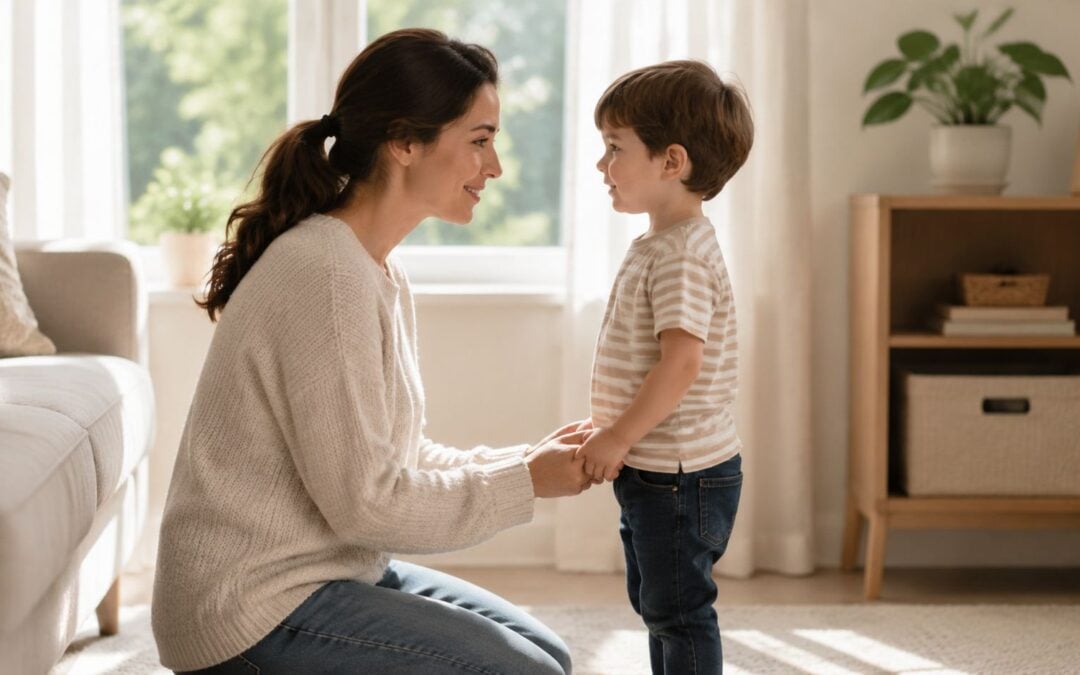
Children learn best when they feel safe with the adults around them. Not spoiled. Not in charge. Safe.
Emotional safety means a child believes, “My feelings won't make this relationship disappear.” That belief changes how children talk, recover, and behave. It doesn't erase big feelings. It gives those feelings a place to land.
Empathy is the first signal of safety
Empathy is not agreeing with every reaction. It's showing your child that their inner experience makes sense to you.
A child says, “Nobody likes me.” The unsafe response is, “That's not true. Stop being dramatic.” The safer response is, “It sounds like you felt really left out today.” That second response doesn't lock in the child's conclusion. It opens the door for regulation and problem-solving.
Try this simple script:
Name what you hear: “You seem disappointed.”
Reflect the situation: “It happened when your partner picked someone else.”
Emotional regulation is the adult skill children borrow first
Children don't learn regulation from lectures. They learn it from nervous systems near them. When a mom lowers her voice, pauses before reacting, or says, “I'm upset, so I'm taking one breath before I answer,” she is teaching regulation in real time.
One easy home activity is a Feelings Thermometer. Draw a thermometer with four zones:
Zone
What it feels like
What helps
1 Calm
okay, focused
keep going
2 Stirring
annoyed, restless
drink water, stretch
3 Hot
mad, overwhelmed
breathing, quiet corner
4 Boiling
yelling, shut down
pause, co-regulate with an adult
Use it during calm moments first. Then, when your child is upset, ask, “What number are you right now?” That question is easier for many children than “How do you feel?”
Practical rule: Regulate first, teach second. A child in full distress can't absorb a lesson about behavior.
For families who like playful ways to build these skills, activities such as role-play, emotion cards, and guessing games can help. This roundup on how Playz helps develop emotional intelligence includes ideas parents can adapt for home.
What emotional safety looks like on a busy Tuesday
It often looks small:
At breakfast: “You're quiet today. Want me to just sit with you?”
After school: “Do you want help, or do you want me to listen first?”
At bedtime: “We had a hard moment earlier. I'm still here.”
Those ordinary responses teach a deep lesson. Feelings are manageable. Relationships can hold them. That's one of the strongest qualities of a mom a child can experience.
The Power of True Presence and Attunement
Some children have adults around them all day and still feel unseen. That's because presence is more than proximity.
Research on motherhood norms describes the “present mother” as someone with high attentional availability, accurate cue detection, and rapid response calibration, and that kind of attunement supports emotional co-regulation by helping adults step in before a child's needs escalate, as described in this research review on the “present mother” norm.
Presence is a noticing skill
Attunement sounds academic, but in daily life it often starts with one sentence: “I notice…”
“I notice you stopped eating after two bites.”
“I notice your shoulders got tight when we mentioned school.”
“I notice you're getting silly in that way that means you're overtired.”
That's not surveillance. It's informed caregiving. A child who feels accurately noticed is less likely to need to escalate to get understood.
A useful distinction for parents and teachers:
Being present in the room
Being attuned to the child
You hear noise
You notice a pattern
You react after a meltdown
You catch strain early
You say “Use your words”
You help the child find words
You focus on behavior only
You track cues, needs, and timing
This is why the qualities of a mom can be taught as observable skills. We can practice noticing. We can practice timing. We can practice listening for what behavior is trying to communicate.
How to strengthen attunement in small moments
Busy families don't need a three-hour ritual. They need repeatable micro-habits.
Try these:
Use device-free connection zones Pick one routine. Car ride. Bedtime. After-school snack. During that time, phones stay away.
Play the two-minute scan Before correcting behavior, pause and scan for cues. Hungry? Embarrassed? Overstimulated? Seeking connection?
Ask one observation before one question Say, “You got quiet when math came up,” before asking, “What happened?”
Mirror the child's pace Some children talk fast when upset. Others need long pauses. Matching pace helps them stay engaged.
If you want language that supports this kind of listening, these ideas on empathetic listening fit well in both home and school conversations.
A child doesn't always need an answer first. Often the child needs an accurate witness.
A school-age example
A fourth grader starts “forgetting” homework. An adult who only sees compliance may respond with pressure. An attuned adult notices the child has also become slower in the morning, more irritable at pickup, and less social after school.
That adult might say, “I'm noticing homework has been harder this week, and you seem more tired than usual. Is school feeling heavy right now?” That response gives the child a bridge into honesty.
Presence, then, is not just warmth. It's effective observation plus a timely response. Children feel that difference immediately.
Providing Structure with Consistency and Boundaries
Children relax when the adults act like they know what the guardrails are. They may protest those guardrails. They may test them daily. Still, structure helps children feel held.
Many parents worry that boundaries will damage connection. Usually the opposite is true. Kind, predictable limits tell a child, “You don't have to manage the whole world. I'm helping.”
Consistency lowers confusion
Consistency doesn't mean rigid sameness. It means your child can generally predict what matters, what happens next, and how adults respond.
That predictability supports regulation. A child who knows the bedtime sequence, homework routine, or morning expectation uses less energy guessing and more energy participating.
A simple structure often works better than a complicated system. Try this short family pattern:
After school: snack, movement, short check-in
Before homework: bathroom, water, supplies ready
Before bed: hygiene, connection, lights out routine
Children don't just need routine for tasks. They also need routine for relationships. For example, a daily five-minute check-in can become the emotional anchor of the day.
Boundaries are not punishments
A healthy boundary says what the adult will do to keep people safe, respectful, or regulated. It does not shame the child.
Compare these examples:
Less helpful: “If you don't stop whining right now, no tablet for a week.”
More helpful: “I want to hear you. I can listen when your voice is calmer.”
Less helpful: “You're being impossible.”
More helpful: “I won't let you hit. I'll stay close while you calm down.”
Less helpful: “Because I said so.”
More helpful: “The answer is no for today. You can be upset, and the limit is still no.”
Children borrow stability from adults who mean what they say and say it without cruelty.
A firm and kind script parents can use
Many moms need language more than theory. Here's a script for a common moment:
Child: “Play with me now!” Parent: “I want to play with you. I need quiet time for 15 minutes. When the timer rings, I'll join you.”
This script works because it does four jobs at once. It shows care. It sets a limit. It gives a clear timeline. It follows through.
You can also co-create family agreements, especially with elementary-age children:
Topic
Child input
Adult boundary
Screen time
choose show or game
adult sets start and stop
Chores
choose order
everyone contributes
Morning routine
pick music or outfit prep style
leaving time stays fixed
When children help shape part of the plan, they're more likely to cooperate with the plan.
One of the steady qualities of a mom is leadership without harshness. Not controlling every feeling. Not surrendering every limit. Just providing enough structure that a child can grow safely inside it.
Building Resilience Through Repair and Encouragement
Every parent will get it wrong sometimes. You'll misread a cue, answer too sharply, rush a child who needed more time, or enforce a limit in a tone you regret. That isn't evidence that you've failed. It's evidence that you're human.
What matters most after a hard moment is often repair. Parenting guidance identifies “repair when you make mistakes” as a hallmark quality, and a reliable sequence of acknowledging the event, naming the impact, apologizing, and offering a next step helps strengthen psychological safety and model accountability, as described in this guidance on traits of a good mom.
Repair teaches more than perfection ever could
A child who sees an adult repair learns powerful lessons:
Mistakes can be faced
Conflict can soften
Shame doesn't get the last word
Relationships can recover
That is resilience in action. Children don't build resilience by living in a mistake-free home. They build it by living in a home where people know how to come back together.
Here is a simple repair model parents and educators can both use.
Acknowledge “I yelled when you spilled the water.”
Name the impact “That probably felt scary and unfair.”
Apologize “I'm sorry.”
Offer a next step “Next time I'm frustrated, I'm going to pause before I speak.”
Reconnect “Do you want a hug, or do you want to sit together for a minute?”
Encouragement builds courage, not dependence
Repair helps children recover from relational stress. Encouragement helps them take healthy action afterward.
Encouragement is different from praise. Praise often focuses on the result. Encouragement focuses on effort, strategy, and persistence.
Compare:
Praise only
Encouragement
“You're so smart”
“You kept going when it got hard”
“Good job”
“You tried a new way to solve it”
“You're the best artist”
“You added details and stayed with it”
Children who hear encouragement start to internalize a message: I can try. I can learn. I can recover.
If you want a school-home lens on this, resources about building resilience in children can help adults use similar language across settings.
When a parent says, “I was wrong, and I'm fixing it,” the child learns accountability without humiliation.
A small shift toward autonomy
Encouragement also means stepping back enough for children to do manageable hard things. Let them answer the teacher's question themselves. Let them pack part of their school bag. Let them try the apology to a sibling with coaching instead of having you do it for them.
One of the most overlooked qualities of a mom is this balance: being supportive without taking over. That balance grows confidence.
Creating a Shared Language with Your Child's School
A child does better when home and school are not sending competing emotional messages. If a family says, “Talk about feelings,” but school mainly says, “Stop crying,” the child gets mixed signals. If both settings use similar language for safety, regulation, and repair, the child has a much easier job.
What shared language sounds like
Parents don't need clinical terms. Teachers don't need long family history. Both sides need usable language.
A parent might write:
“We're working on emotional regulation at home. When my child starts to shut down, a short pause and a simple choice helps more than lots of questions.”
A teacher might respond:
“We practiced ‘I feel' statements today during peer conflict, and your child participated well with a little support.”
That kind of exchange creates continuity. The child hears the same core message in both places: feelings are real, behavior has limits, and relationships can recover.
Scripts that help parents and teachers partner well
Here are a few examples families can use right away.
For a parent starting the conversation: “I'm noticing mornings have been harder. Have you seen any patterns at school that might help us understand what's going on?”
For a teacher sharing a useful strategy: “Your child responds well when I give a preview before transitions. You might try that before homework or bedtime too.”
For a parent naming a boundary approach: “We're trying to stay calm and consistent with limits at home. If there's language you use at school for redirection, I'd love to reinforce it.”
For a counselor or support staff member: “When conflict happens, we're helping students identify impact and practice repair. Using those same words at home can make the skill stick.”
Schools that want better family conversations often benefit from preparing adults with stronger question design. For leaders refining how they gather insight from families and staff, this resource on Comprehensive school interview questions can spark more thoughtful conversations.
A short video can also help adults align around what children need socially and emotionally.
One shared tool is better than five separate ones
If you're a school team or a family, start small. Pick one common tool and use it across settings for two weeks.
Examples:
Shared tool
Home use
School use
Feelings check-in
after school
morning meeting
Repair script
after sibling conflict
after peer conflict
Previewing transitions
before bedtime
before cleanup
Calm-down choices
bedroom or kitchen
regulation corner
This is one place where a structured SEL program can support consistency. For example, Soul Shoppe offers workshops and coaching that teach shared language for self-regulation, communication, and conflict resolution, which schools and families can reinforce together.
When adults coordinate, children don't have to decode two different emotional worlds. They can spend that energy learning, relating, and growing.
Embracing the Journey of a Good-Enough Mom
The most helpful qualities of a mom are not shiny traits that some people are born with and others are not. They are practices. You build them, lose them, return to them, and build them again.
Emotional safety tells a child, “Your feelings won't push me away.” Presence says, “I'm noticing you closely enough to help.” Structure says, “You are free inside clear guardrails.” Repair says, “This relationship can heal.” Those are not small gifts. They shape how children see themselves, other people, and the world.
A good-enough mom is not checked out, but she also isn't chasing flawless performance. She listens, notices, sets limits, repairs, and keeps learning. Some days that will look graceful. Some days it will look like apologizing in the carpool line and trying again after dinner.
If you're parenting and working, parenting and caregiving, parenting and carrying most of the invisible planning load, you do not need another impossible standard. You need a realistic picture of growth. Children don't need a perfect mother. They need a trustworthy one.
Keep the target close. Notice one cue earlier. Respond one step calmer. Hold one limit more clearly. Repair one hard moment more sincerely. That's how strong families are built.
If you want more support turning these everyday parenting moments into teachable SEL skills, explore Soul Shoppe. Their resources, workshops, and school-based programs focus on practical tools for empathy, regulation, communication, and conflict resolution that help children and grownups build safer, more connected relationships.
Some days with a 3-year-old feel sweet and connected. Other days feel like you've repeated “shoes on,” “gentle hands,” and “time to clean up” so many times that your own voice starts to sound far away.
That doesn't mean your child is “bad,” stubborn, or trying to make life hard. At this age, kids are still learning how to understand expectations, manage big feelings, and move from one task to another. A behavior chart for 3 year old children can help, but not because it forces obedience. It works best when it gives a young child something concrete to see, touch, and succeed with.
Used well, a chart becomes less about control and more about communication. It says, “Here's what we're practicing. I'm with you. I notice your effort.” That shift matters. It turns the chart from a reward board into a small daily tool for self-awareness, confidence, and connection.
Why Use a Behavior Chart for a 3-Year-Old?
A 3-year-old usually knows more than they can consistently do. They may understand “please put your cup on the table,” yet still melt down when you ask during a busy morning. That gap is normal. Young children benefit from visual reminders because pictures and simple routines are easier to hold onto than long verbal directions.
Behavior charts have been around for a long time, and they didn't start as a social media parenting trend. The use of visual reward systems in preschools like Head Start in the 1960s showed a 30 to 40 percent improvement in compliance rates within 3 months, and a 2019 meta-analysis found that behavior charts increased positive behaviors like sharing in preschoolers by 62 percent (CDC developmental milestone reference).
A chart works best as a visual bridge
A chart helps a young child connect three things:
What the grownup expects “Toys go in the bin.”
What the child did “You put the blocks away.”
How success feels “You did it. You look proud.”
That's why I don't treat a chart like a scoreboard. I treat it like a shared routine. If you're looking for a broader foundation for calm, connected guidance at home, these positive parenting tips can support the same approach.
A chart won't replace connection. It gives connection a visible place to land.
Why families often feel relief
Many adults feel immediate relief when they stop relying on repeated verbal correction. The chart carries part of the message. Instead of saying “I told you three times,” you can point, smile, and say, “Let's check what comes next.”
Some caregivers also appreciate outside perspectives on what strong early learning support looks like at home. This guide on educational advice for elite families offers a useful reminder that consistency, emotional safety, and developmentally appropriate expectations matter just as much as academics.
Choosing Behaviors That Build Skills Not Just Compliance
The most important part of any behavior chart happens before you make it. If you pick the wrong goals, the chart will feel frustrating fast.
A lot of adults start with what they want to stop. Stop whining. Stop hitting. Stop refusing bedtime. But young children do better when we name what to do instead. A behavior chart for 3 year old children should focus on teachable actions, not vague commands.
Start very small
Child development specialists recommend starting with only 1 to 3 specific, positively framed behaviors to avoid cognitive overload. Charts with more than 5 behaviors see success drop below 50 percent, while charts with 3 or fewer behaviors can yield 70 to 85 percent adherence improvement in 2 to 4 weeks (Alpha Mom guidance on starting a toddler behavior chart).
That means “fewer targets” isn't lowering the bar. It's giving your child a real chance to succeed.
What to choose
Look for behaviors that are:
Visible You can tell right away if it happened.
Simple One action, not a chain of tasks.
Positive State the skill you want.
Relevant Pick routines that matter in your day.
Here's a quick way to reframe common goals.
Choosing Effective Target Behaviors for a 3-Year-Old
Instead of this (Vague/Negative)
Try this (Specific/Positive)
SEL Skill Being Built
Be good at bedtime
Stay in bed after story time
Self-regulation
Stop making a mess
Put toys in the bin
Responsibility
Don't yell
Use a calm voice to ask for help
Communication
Stop grabbing
Gentle hands with the cat
Empathy
Listen better
Come when I say “bath time”
Cooperation
Stop fighting
Take turns with one toy
Social awareness
Let your child help choose
A 3-year-old doesn't need full control, but they do need some ownership. You might say, “Should we practice toys in the bin or gentle hands first?” That small choice helps the chart feel collaborative.
For example, if cleanup is hard after preschool, let your child choose the picture for that row. Maybe they want a block drawing, a toy basket photo, or a purple sticker next to it. That's not a small detail. It tells them, “This belongs to us.”
Practical rule: If a behavior is too abstract to draw, it's probably too abstract for the chart.
If your child needs more support with the underlying social skills behind chart goals, these social skills activities for preschoolers can help you practice the same abilities through play.
Creating a Simple and Visual Behavior Chart
Once you know the target behaviors, keep the chart itself very plain. Adults often over-design these. A 3-year-old doesn't need a complicated system. They need a clear picture of what success looks like today.
What the chart can look like
Use whatever is easy for your home or classroom:
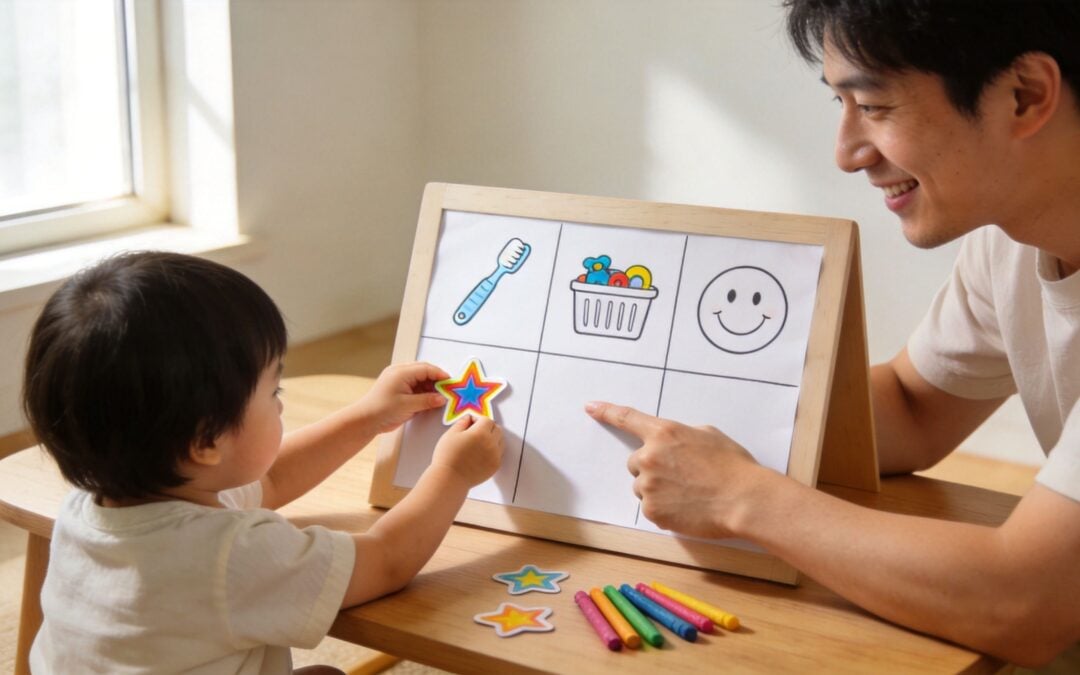
A laminated sheet with a marker and wipe-off stars
A magnetic whiteboard with simple icons
Construction paper on the fridge with sticker spots
Photos of routines taped in sequence
A folder chart that travels between school and home
Add one row for each behavior. Include a picture if possible. A toothbrush icon for brushing teeth. A bed for staying in bed. A toy bin for cleanup.
Make it with your child
Children are more invested in tools they help create. Let them choose the paper color, draw a symbol, or place the picture labels. Keep that help manageable. You're inviting participation, not asking them to design a spreadsheet.
A simple script can sound like this:
“We're making a helper chart. This shows the things you're practicing. Do you want a star sticker or a dinosaur sticker for the toy cleanup spot?”
That small conversation turns the chart into a shared project.
Keep the layout uncluttered
For a child this age, less is better:
Use 1 to 3 behaviors on the chart
Place it at eye level in one consistent spot
Choose one marker type such as stars, stamps, or magnets
Avoid crowded language and use simple words or pictures
If your child already responds well to visual emotion supports, a feelings chart for kids can pair nicely with the behavior chart so routines and emotions are both visible.
A good chart doesn't need to be cute enough for a bulletin board. It needs to be understandable in two seconds.
Using Your Chart to Nurture Positive Habits
The power of the chart isn't in the sticker. It's in the moment around the sticker.
When adults use the chart warmly and consistently, children start linking effort, action, and emotional safety. That's where habit-building happens. Not through pressure, but through repeated, supported success.
What this sounds like in real life
Morning example:
Your child puts their shoes by the door after one reminder.
You say, “You put your shoes in the right spot. You remembered what to do.” Then add, “Let's put your sticker on the chart.”
Cleanup example:
Your child starts whining when it's time to put blocks away. You kneel down and point to the chart. “We're practicing toys in the bin. I'll do the first two with you.” After they join in, you name the effort. “You kept going even when it felt hard.”
Bedtime example:
Your child stays in bed after stories. In the morning you return to the chart and say, “You stayed in bed all night. Your body learned the bedtime plan.”
Use rewards that increase connection
At this age, the best rewards are often shared experiences. Try:
Extra story time before bed
A silly dance party in the kitchen
Choosing the next family game
A walk with a grownup
Picking the bedtime song
These rewards keep the adult-child relationship at the center. They also reduce the chance that the chart becomes only about getting stuff.
“You did it” is good. “You did it, and I noticed how hard you worked” is better.
Build the chart into a routine
The chart works best when it shows up at predictable moments, not only after conflict. Good times to check it include:
A simple chart check-in should feel short, warm, and calm. It's not a performance review.
Troubleshooting When Your Chart Isn't Working
Sometimes adults try a chart for three days, hit a rough patch, and decide the child “doesn't respond to charts.” Usually the problem isn't the child. It's the setup.
The biggest misconception is that the sticker does all the work. It doesn't. Young children stay engaged when the chart includes relationship, voice, and immediate feedback.
According to CDC guidance on using rewards, a lack of child input can halve buy-in, leading to success rates below 40 percent, and relying only on the sticker without verbal praise can lead to a 50 percent dropout rate.
When this happens, try this
Your child doesn't care about stickers Try a different marker. Some kids prefer stamps, magnets, Velcro dots, or moving a small character along a path. The point is visible progress, not the sticker itself.
Your child melts down when they don't earn one Stay calm and coach the feeling first. “You're upset. You really wanted the star.” Then return to the skill. “Let's practice together so you can try again later.” The chart should never become a shaming tool.
Your child keeps forgetting the goal That usually means the behavior is too abstract or the chart is too far removed from the moment. Move the chart closer to where the routine happens, and use a clearer image.
Your child argues that they did the task Choose more observable goals. “Put pajamas in the hamper” is easier to verify than “be helpful.”
Two fixes that solve many problems
First, involve your child again. Ask, “Should we use stars or animal stamps?” or “Do you want to practice bedtime or cleanup first?” Ownership matters more than many adults realize.
Second, increase your words, not just your tracking. A sticker without connection can feel mechanical. A sticker paired with, “You remembered all by yourself,” helps a child feel capable.
Sometimes a chart “fails” because it's asking for a skill the child hasn't learned yet. Teaching comes before tracking.
Moving Beyond the Chart to Intrinsic Motivation
A behavior chart should be a scaffold, not a forever system. If it stays in place too long, the child may focus more on the reward than the meaning behind the behavior.
That concern is worth taking seriously. A 2023 study in Child Development found that children on reward charts showed 25 percent lower intrinsic task engagement after the chart was removed, compared to play-based SEL groups. The same source notes that 62 percent of parents report struggling with this transition (Latitudes overview of behavior charts and motivation concerns).
A simple four-week fade-out plan
Use the chart fully at first, then gradually shift the focus from external reward to internal pride.
Weeks 1 and 2
Keep the chart visible and consistent. Give the sticker or marker each time the target behavior happens, along with warm praise.
Say things like:
“You put your toys away.”
“You kept trying.”
“You look proud of yourself.”
Week 3
Start giving the marker less often while keeping praise every time. You might say, “You did it. I noticed right away,” and give a sticker at some check-ins rather than all of them.
This is also a good time to ask reflective questions:
“How did your body feel when you cleaned up?”
“What helped you stay calm?”
“What are you proud of?”
Week 4
Move to praise and connection only. The chart can still hang there, but it becomes a reminder rather than the main event.
Use language that builds self-awareness:
“You remembered without the chart.”
“That was responsible.”
“You worked through frustration.”
“You helped your body follow the routine.”
What you're aiming for
You want your child to slowly think less about “Do I get a star?” and more about “I know how to do this” and “I feel good when I succeed.”
That shift won't look perfect. Some children ask for the sticker again. Some protest when the system changes. Stay calm and steady. If the chart has been used with warmth, your child has already learned something bigger than the target behavior. They've learned that effort gets noticed, feelings can be named, and routines can become manageable.
If you want more support building connection, empathy, and self-regulation at home or at school, Soul Shoppe offers practical social-emotional learning resources that help children and grownups create calmer, more connected communities.
Most adults meet goal setting when they're already overwhelmed. A preschooler meets it while standing in one sock, refusing the other shoe, and melting down because the zipper feels “wrong.”
That's why goal setting for preschoolers has to look different. It can't feel like pressure. It has to feel like help.
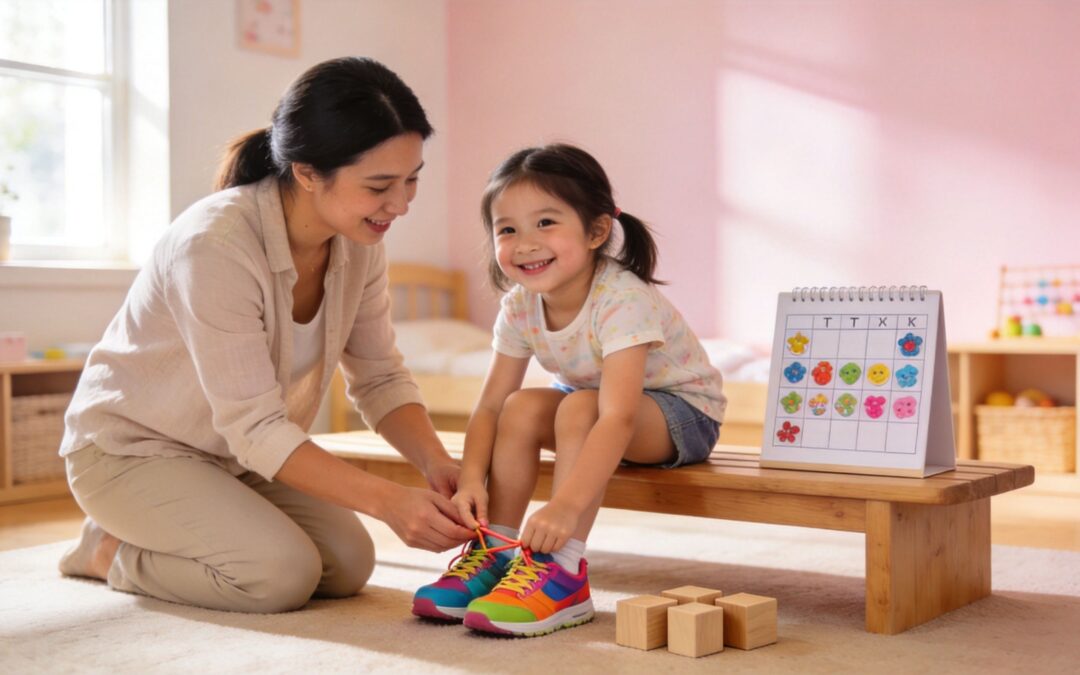
In early childhood settings, I've found that the best goals are woven into ordinary moments. Getting dressed. Putting blocks away. Waiting for a turn. Carrying a napkin to the table. These small efforts teach children something bigger than task completion. They teach, “I can try. I can keep going. I can do one step at a time.”
Why Tiny Goals Lead to Big Confidence
A four-year-old doesn't wake up wanting a lecture about perseverance. They want to do what the big kids do, feel capable, and get through the day without everything turning into a struggle.
That's why tiny goals work so well. When a child hears, “Your job is to put both shoes by the door,” that feels doable. “Get ready by yourself” often doesn't. One is clear. The other is too big to hold in mind.
Everyday struggles are often hidden learning moments
Think about a common morning scene. A child can't get their coat on. An adult is late. Voices get tighter. The child shuts down.
Now shift the frame. Instead of “Come on, get dressed,” try a small mission: “Today your goal is to put one arm in your coat by yourself.” That changes the emotional tone right away. The child has a target they can reach.
Small success builds momentum. Children start to expect that effort leads somewhere. That mindset matters. If you want a deeper family-friendly read on nurturing children's growth mindset, it pairs well with this approach because both focus on helping kids see progress as something they can create.
Practical rule: If a goal leads to instant frustration, it's probably too large. Shrink it until the child can act on it right away.
Confidence grows through repetition, not speeches
Preschoolers build confidence from doing, not from being told they're capable. When they repeat a manageable goal across several days, they begin to trust themselves.
That's especially important in social-emotional learning. A child who learns, “I can carry my cup to the sink,” is also learning to tolerate frustration, recover from mistakes, and stay with a task. Those are self-management muscles.
You can see this same idea in confidence from the inside out. Real confidence doesn't come from constant praise. It grows when children experience themselves as effective.
A few preschool-friendly goals that build this kind of confidence:
Self-care goal: Put your socks in the hamper.
Classroom goal: Push in your chair after snack.
Friendship goal: Use words when you want a turn.
Cleanup goal: Put three blocks in the bin.
None of these sound dramatic. That's the point. Tiny goals let children practice success often enough that “I can't” slowly becomes “I'll try.”
The Building Blocks of a Preschooler's Goal
Adults usually think of goals as future plans. Preschoolers need goals they can see, touch, and do today.
A developmentally appropriate goal for this age is small, concrete, visual, and close in time. “Be more responsible” won't mean much to a four-year-old. “Put your cup on the tray after snack” will.
What a good preschool goal looks like
A strong preschool goal usually has these features:
It's observable: You can tell whether it happened. “Wash hands before snack” works. “Have better listening” is too vague.
It's short-term: The child can experience it soon, often within the day or over several days.
It's action-based: It focuses on what the child will do, not on a personality trait.
It fits the routine: It lives inside real moments like arrival, cleanup, centers, snack, or bedtime.
A useful test is this. Can the child picture the goal in their mind? If not, simplify it.
Process goals beat broad outcome goals
For young children, process matters more than outcome. “Try both shoes before asking for help” is often a better goal than “Put on shoes perfectly.”
This approach protects motivation. Preschoolers are still developing planning, working memory, and frustration tolerance. When adults choose goals that are too broad, children can feel like they've failed before they've even started.
A helpful overview of how early learning goals fit into child development can be found where Grow With Me explains early years learning. It gives useful context for why daily routines matter so much in the early years.
A preschool goal should sound more like a next step than a life lesson.
Predictability helps children stay engaged
Routine matters even more than many adults realize. A 2023 study on preschoolers' goal adaptation found that children were more likely to adjust their approach when changes in a task were predictable, while unpredictable changes were more disruptive, especially for children under 4.5 years.
That finding matches what teachers see every day. If the goal-setting routine changes constantly, some children spend all their energy figuring out the format instead of doing the task.
Here's what predictability can look like in practice:
Everyday setting
Less helpful approach
More helpful approach
Arrival
New chart, new language, new expectation each day
Same visual, same phrase, same first step
Cleanup
“Clean everything up”
“Put five cars in the basket”
Dressing
Rushed adult takeover
Same sequence each time, with one child-owned step
Many adults make goal setting sound heavier than it needs to be. Preschoolers respond best when it feels conversational, shared, and tied to something they already want to do.
Start with one real moment. Maybe your child wants to pour water without spilling. Maybe your students rush through cleanup. That's enough. You don't need a special unit or a formal meeting.
A simple visual can help make the idea concrete.
Say less, guide more
Use short sentences and invite the child into the plan.
Try language like this at home or in the classroom:
Name the goal
“Our goal is to put the books back on the shelf.”
“Your goal is to carry your plate to the counter.”
Ask for the first step
“What do you do first?”
“Which book will you pick up?”
Notice effort
“You kept trying even when the zipper got stuck.”
“You remembered the basket without me telling you again.”
Keep the next step small
“Tomorrow, your goal is to do the first button.”
“Next time, let's try two toys before cleanup help.”
This kind of language reduces power struggles. It also gives children practice thinking in sequence, which is a major part of early self-regulation.
Model your own goals out loud
Preschoolers learn a lot from hearing adults think aloud. You can model goals in ordinary language without turning it into a lesson.
For example:
During snack prep: “My goal is to put all the cups on the table before I sit down.”
During cleanup: “I'm going to finish putting the markers in the box.”
During transitions: “My goal is to find my keys and my water bottle before we leave.”
When adults do this, children start to understand that goals aren't just demands adults place on kids. Goals are tools people use to help themselves.
Later in the section, this short video can reinforce the idea for families and educators who like to see concepts modeled in action.
Make the goal visible
For preschoolers, invisible ideas fade fast. A drawing, a photo, or a simple picture card keeps the goal in view.
Research from Boston Children's Health Physicians notes that visually representing goals can support follow-through. For preschoolers, drawing the goal can increase task completion for independence skills by up to 50% compared with verbal instructions alone.
That doesn't mean every family needs a perfect chart. It means the child benefits from seeing what they're aiming for.
Try these easy versions:
Draw it: Sketch a toothbrush, backpack, or toy bin.
Use a photo: Take a picture of the child completing the step.
Make a first-then card: “First shoes on, then outside.”
Use one symbol: A cup icon near the sink means “put cup here.”
“Our goal is something we can see and do.”
Sample scripts for common preschool moments
Adults often ask for exact words. Here are a few.
Situation
Try saying
Morning dressing
“Your goal is one sleeve by yourself. I'll help with the other one if you need it.”
Classroom cleanup
“We're all working on one cleanup goal. Put three items where they belong.”
Turn-taking
“Your goal is to ask for a turn with words.”
Bedtime routine
“Let's draw your bedtime goal. Pajamas first, then book.”
The simpler the script, the more likely children are to remember it and act on it.
A Toolbox of Goal-Setting Activities and Examples
Sometimes adults understand the concept but still wonder, “What goal should I use tomorrow?”
The easiest answer is to start where the child already bumps into difficulty. If mornings are hard, build a morning goal. If transitions are rough, create a transition goal. If a child wants to help, turn that desire into a helper goal.
For families who like paper tools, journals, or planners for older kids and adults, it can be interesting to look at strategic partners for personal growth. For preschoolers, though, the “planner” is usually much simpler: a photo, a picture card, a basket label, or a tiny checklist with images.
Sample Preschool Goal-Setting Ideas
If you're planning classroom routines, preschool lesson plan ideas can help you connect goals to the flow of the day.
Domain
Example Goal
What to Say
Activity Idea
Self-Care & Independence
Put both shoes by the door
“Your goal is shoes by the mat.”
Make a shoe spot with tape or a picture label
Self-Care & Independence
Wash hands before snack
“What comes first before we eat?”
Put picture cues by the sink
Self-Care & Independence
Zip coat after help starting
“You pull it up after I click it.”
Practice on a dressing board or jacket station
Helping & Community
Carry one napkin to the table
“Today you're our napkin helper.”
Set up a helper basket near meals
Helping & Community
Put one book back after reading
“When you finish, the book goes home to the shelf.”
Match books to shelf labels with pictures
Helping & Community
Greet one classmate or family member
“Can you say good morning to one friend?”
Use arrival name cards
Quiet Time & Focus
Sit and look at one book for a few minutes
“Your goal is book time with your body calm.”
Create a cozy reading spot
Quiet Time & Focus
Finish one simple puzzle step
“Let's find the edge piece first.”
Offer a small puzzle with a tray
Quiet Time & Focus
Stay with one center before switching
“Pick one job, then we'll check back.”
Use a center choice card
Movement & Motor Skills
Hop to the line
“Can your feet do two hops to the line?”
Make a hop path with floor spots
Movement & Motor Skills
Carry a tray with two hands
“Your goal is two hands all the way.”
Practice with beanbags or cups
Movement & Motor Skills
Stack blocks carefully
“Build up, then stop and look.”
Challenge the child to make a short tower
Social-Emotional Skills
Ask for help with words
“What can you say if it's too hard?”
Practice with puppets
Social-Emotional Skills
Wait for one turn
“Your goal is to wait, then go.”
Use a turn-taking game
Social-Emotional Skills
Use a calm-down spot
“When your body feels big, you can go to your cozy spot.”
Add a visual choice card for calming tools
Choose the goal by watching, not guessing
The best examples come from observation. Notice where a child nearly succeeds. That's usually the sweet spot.
For example:
A child who throws all the toys during cleanup may not need “better behavior.” They may need a smaller cleanup target.
A child who avoids drawing may need a goal around sitting for one short art step, not finishing a whole project.
A child who always asks for help immediately may need a goal like “try one step, then ask.”
Classroom lens: Strong goals often begin with, “I noticed you can almost do this.”
That tone protects dignity. It invites partnership instead of correction.
Tracking Progress with Purpose and Joy
Tracking can help children stay engaged, but only if it feels encouraging. When adults turn tracking into pressure, preschoolers either perform for the reward or avoid the task altogether.
The better approach is to make progress visible while keeping the emotional message clear. We're noticing effort. We're not grading worth.
That matters because self-recording changes the child's role. They're no longer just receiving adult feedback. They're participating in their own growth.
Simple self-recording tools work best:
Pom-pom jar: Add one pom-pom after the child completes the agreed step.
Picture checklist: The child marks off images, not words.
Sticker path: One sticker for each day they practice.
Goal ladder: Each rung shows one tiny part of the task.
The tool should match the child's developmental level. If the tracker is confusing, it becomes one more demand.
Keep celebration grounded in effort
There's nothing wrong with being happy when a child meets a goal. The key is what you highlight.
Try responses like:
“You kept working when it felt tricky.”
“You remembered the first step on your own.”
“You came back after getting frustrated.”
“You used your picture card to help yourself.”
Those comments teach children what to value in themselves.
A supportive classroom routine can strengthen this. During meeting time, children might share one goal they're practicing or one step they tried that day. In many classrooms, simple daily check-ins and reflection tools create the emotional safety needed for that kind of sharing.
When tracking stops helping
Sometimes a chart loses its power. Sometimes a child starts demanding the sticker more than caring about the skill. That's your cue to adjust.
You might:
Simplify the tracker: Move from a weekly chart to one card.
Change the visual: Use photos instead of icons.
Shorten the time frame: Track one routine, not the whole day.
Pause the tool: Keep the goal, remove the chart for a while.
Tracking should support ownership. If it starts feeling like surveillance, it's time to reset.
Adapting Goal Setting for Every Child
Many goal-setting resources often fall short. They offer one chart, one script, and one version of success. Preschoolers don't come in one version.
Some children are highly verbal and eager to announce a goal. Others communicate through movement, gestures, AAC, or very few words. Some love visual charts. Others respond better to real photos, objects, or a short adult-child routine repeated the same way every day.
If a child has communication differences, don't assume they can't participate in goal setting. Change the entry point.
For example:
For children with limited verbal language: Offer two photo choices. “Coat” or “hands washed.”
For children with motor challenges: Make the goal about one meaningful part of the routine they can own.
For children who are easily overwhelmed: Use one goal in one setting, with the same adult and same visual each time.
For highly active children: Build movement into the goal. “Carry two cushions to the circle” may work better than “sit still nicely.”
For cautious or shy children: Start privately. A public goal-share can come later, or not at all.
Use tools that match the child, not adult convenience
Sticker charts are popular because adults can set them up quickly. But quick for adults isn't always accessible for children.
Better options might include:
Real photos instead of cartoon icons
Object cues like an actual spoon, shoe, or book
Single-step boards rather than multi-step charts
Simple tech supports if a child responds well to them
Choice-based language so the child has some ownership
The most effective goal is the one the child can understand, enter, and experience as success.
In inclusive practice, child-led doesn't mean child-alone. It means we watch carefully, adapt thoughtfully, and refuse to confuse compliance with growth.
If you want support building inclusive, practical SEL routines around goal setting, communication, and self-regulation, Soul Shoppe offers programs and resources designed to help school communities and families create more connection, confidence, and belonging for every child.
In a world of constant distraction and pressure, how can we help young people build the emotional foundation for resilience, connection, and success? While academic skills are crucial, social-emotional learning (SEL) provides the bedrock for everything else. Gratitude isn't just about good manners; it's a powerful SEL practice that can reshape school culture, strengthen family bonds, and equip K-8 students with the tools to navigate life's challenges.
Research shows that consistent gratitude practices can increase happiness, improve mental health, and foster empathy. But how do we move beyond a simple 'thank you' and embed genuine appreciation into the daily lives of children? The key is to make it an active, visible, and consistent part of their world, both at school and at home. This requires more than just saying the words; it demands structured, intentional activities that make gratitude a habit. By focusing on specific ways to show gratitude, we can teach students to recognize the good in their lives and in others, which in turn builds a more positive and supportive community.
This comprehensive guide provides ten powerful and practical ways to cultivate gratitude, designed specifically for K-8 principals, teachers, and parents. Each strategy is backed by actionable steps, age-specific adaptations, and conversation starters. Drawing from over 20 years of SEL work by Soul Shoppe, these methods offer a clear roadmap to cultivate a thriving environment where every child feels seen, valued, and connected. From peer-to-peer appreciation circles to integrating gratitude into family routines, you will find concrete tools to build a lasting culture of thankfulness.
1. Gratitude Journaling in the Classroom
Gratitude journaling is a structured practice where students regularly write down things they are thankful for. This evidence-based social-emotional learning tool helps rewire the brain toward positivity, reduces anxiety, and builds emotional awareness. In a school setting, it creates a shared language around appreciation and belonging, making it particularly effective for K-8 students who are developing foundational emotional intelligence.
This practice is one of the simplest yet most powerful ways to show gratitude because it makes reflection a concrete, repeatable habit. The physical act of writing or drawing focuses a child's attention, moving appreciation from an abstract thought to a tangible expression. It gives students a private space to explore their feelings and recognize the good in their lives, from a sunny day to a friend's kind word.
How to Implement Gratitude Journaling
Make it a Ritual: Consistency is key. Dedicate a specific time, such as during morning meetings or the last five minutes of the day, for journaling. This predictability helps build a lasting habit. For example, a "Five-Minute Friday" write before dismissal allows students to end the week on a positive note.
Provide Structure and Flexibility: Offer sentence starters for younger students (K-2), such as "I'm grateful for… because…" or "Today, I felt happy when…". For older students, provide more open-ended prompts like, "Write about a challenge you're grateful for and what you learned from it." Allow students to express themselves through drawing, writing, or even creating a list of words.
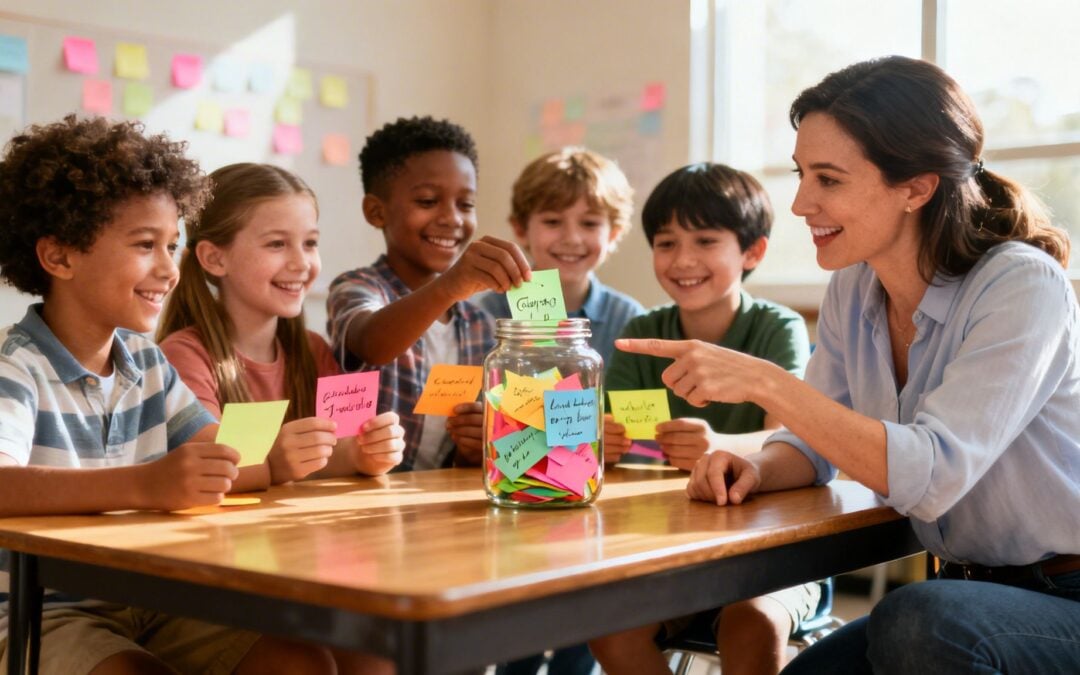
Create a Shared Space (Optional): Establish a "Gratitude Wall" or a community jar where students can anonymously submit entries they wish to share. Reading these aloud can reinforce a culture of appreciation and show students they are part of a grateful community.
Practical Example: A third-grade teacher noticed her class struggled with negative self-talk. She introduced a daily gratitude journaling practice using the prompt, "What's one small thing you're grateful for today?" She observed students not only writing about big events but also small moments, like "I'm grateful for my sharp pencil because it helps me draw" or "I'm grateful Sarah shared her snack with me." This shift in focus helped them appreciate effort and everyday resources.
This practice directly supports SEL competencies like self-awareness and relationship skills. By regularly identifying positive aspects of their lives, students build resilience and empathy. To explore more gratitude activities for kids, you can find additional ideas for changing the way kids see the world.
2. Peer-to-Peer Gratitude Circles
Peer-to-peer gratitude circles are structured small-group conversations where students express appreciation for one another in a safe, facilitated setting. This practice directly addresses belonging and psychological safety by creating intentional opportunities for students to give and receive acknowledgment. In a classroom, these circles build empathy, strengthen peer relationships, and reduce feelings of isolation, making them an excellent way to show gratitude and build community.
This method is powerful because it makes gratitude a shared, verbal experience. Unlike private journaling, gratitude circles teach students the social-emotional skills of articulating appreciation and gracefully accepting it. It moves gratitude from an internal feeling to a public affirmation, which validates students and shows them their positive actions are noticed by their peers. This is especially important for building a culture where kindness is the norm.
How to Implement Gratitude Circles
Establish Norms First: Before the first circle, co-create guidelines with the students. Essential norms include one person speaking at a time, listening without judgment, and keeping what's shared in the circle confidential. This ensures a foundation of trust and respect.
Use Sentence Starters: Provide clear and simple prompts to guide students, especially when the practice is new. Use phrases like, "I appreciate you for…" or "I noticed when you… and I was grateful because…". This helps students focus on specific behaviors and actions rather than general personality traits.
Start with Consistency, Then Rotate: Initially, keep the small groups consistent to build deep trust. Once students are comfortable with the process, rotate the groups. This allows students to connect with a wider range of classmates, breaking down cliques and fostering a more inclusive classroom environment.
Practical Example: During an advisory period, a sixth-grade teacher used gratitude circles to address social friction. He had students pass a "talking stick" and use the sentence starter, "I want to thank [student's name] because…" One student shared, "I want to thank Marco because he helped me pick up my books when they fell, even though we don't usually talk." This small, specific acknowledgment helped bridge a social gap and visibly improved the classroom dynamic.
By facilitating these circles, educators can directly teach and reinforce core SEL competencies like social awareness and relationship skills. Students learn to see the good in others and communicate it constructively, which is a fundamental skill for building healthy, supportive relationships throughout their lives.
3. Teacher-to-Student Gratitude Notes
Teacher-to-student gratitude notes are personalized expressions of appreciation from educators to students, highlighting specific strengths, growth, or character qualities. This practice directly uses the powerful influence of teacher-student relationships to build a child’s confidence and sense of belonging. Research shows that when students feel seen and valued by adults in their school, their academic engagement, behavior, and mental health all improve.
This method is one of the most effective ways to show gratitude because it singles out positive actions, making appreciation specific and memorable. A simple note can shift a student’s entire perspective on their school day, especially for those who may not often receive positive affirmation. By moving beyond generic praise, teachers communicate that they are paying close attention to each child's unique contributions and character.
How to Implement Teacher-to-Student Gratitude Notes
Create a Sustainable System: Don't leave appreciation to chance. Create a system to ensure every student receives a note regularly. Use a class roster checklist or set a goal to write three to five notes each day. This prevents educators from only noticing the most outgoing or highest-achieving students.
Be Specific and Authentic: Vague praise like "You're a good student" is less impactful than a specific observation. Instead, try, "I noticed how you helped Marcus with his math problem even when you were finished," or "Your thoughtful question during our science discussion helped the whole class think differently." Specificity shows you are truly paying attention.
Integrate, Don't Isolate: Weave gratitude notes into regular communications. Send a "Friday Postcard" home celebrating a student's weekly growth or use a digital platform to quickly send a positive message to a student and their family. This separates appreciation from behavioral correction and reinforces that the student is valued as a whole person.
Practical Example: A middle school advisory teacher made a commitment to write one specific gratitude note on a sticky note for a different student each day, leaving it on their desk before they arrived. He noticed students would often save the notes in their binders. One student, who had been struggling with motivation, told him, "Your note said, 'I'm proud of how hard you worked on that essay, even when it was tough.' That was the first time a teacher said they were proud of me for trying, not just for my grade."
This practice builds strong connections and directly supports a student’s sense of self-worth. By modeling specific appreciation, teachers also teach students how to recognize and value positive qualities in others. You can explore more about the power of a positive teacher-student relationship and its effects on school climate.
4. Family Gratitude Rituals and Home Integration
Family gratitude rituals extend social-emotional learning beyond the classroom, creating a bridge between school and home. These are structured, repeatable practices that families adopt to reinforce appreciation as a shared value. When schools and families work together on these ways to show gratitude, the impact is multiplied, creating a consistent environment where children feel seen, heard, and valued. This approach empowers parents as essential SEL partners, ensuring gratitude becomes part of a child's core identity.
This method is powerful because it makes gratitude a lived experience rather than just a school lesson. Simple, consistent home practices, like sharing "highs and lows" at dinner or a bedtime thank-you, help children connect appreciation to their daily lives. It provides a safe space for families to communicate openly, build stronger bonds, and collectively focus on the positive, supporting the work done in the classroom.
How to Implement Family Gratitude Rituals
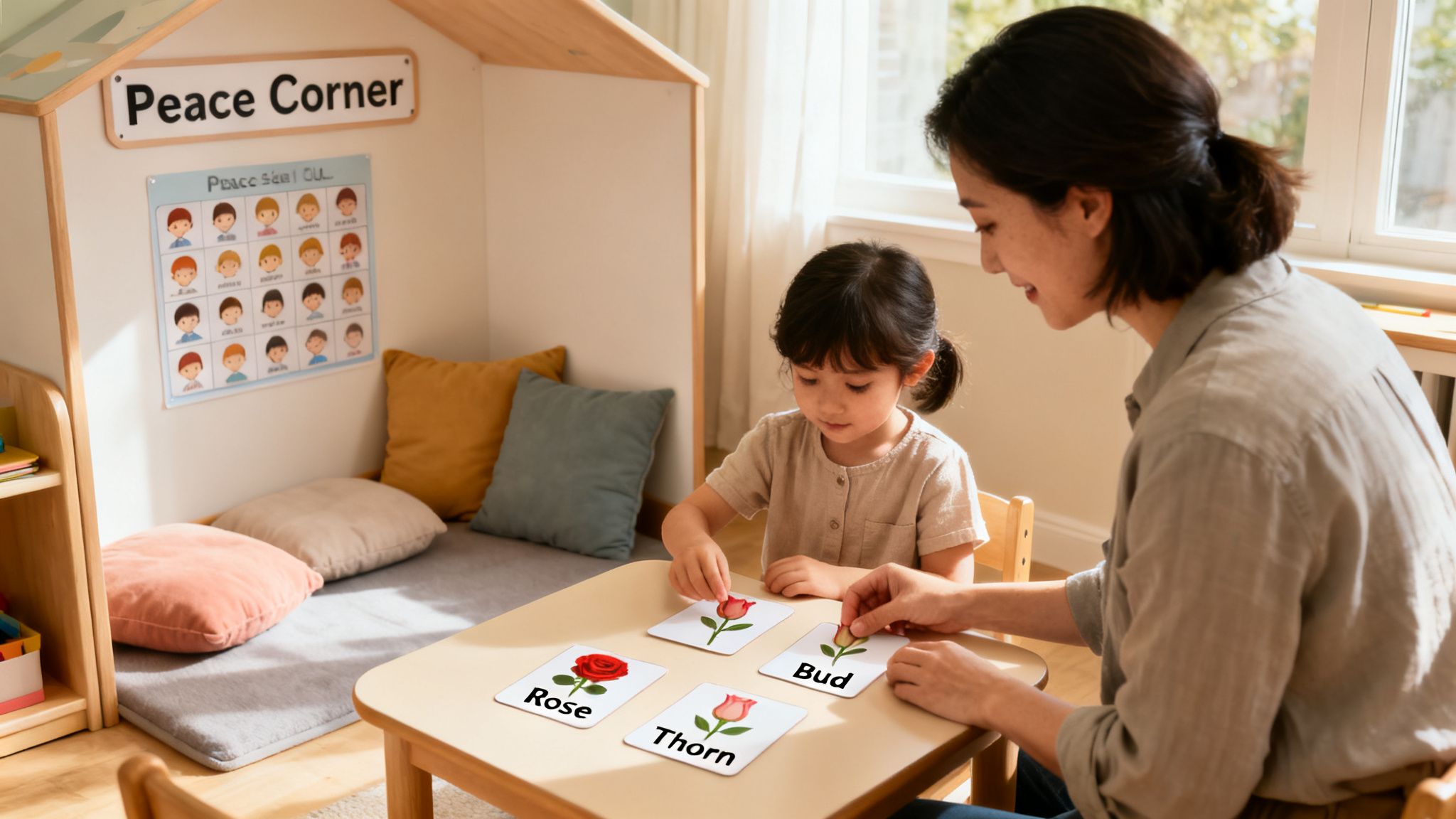
Start Small and Be Consistent: Encourage families to begin with a simple, five-minute activity. For example, a "Rose, Thorn, Bud" conversation at dinner where each person shares a highlight (rose), a challenge (thorn), and something they're looking forward to (bud). Consistency is more important than duration.
Create a Gratitude Jar: Provide families with instructions for a "Gratitude Jar." Each family member writes down things they are grateful for on small slips of paper throughout the week. During a weekly family meeting or Sunday dinner, they can read the notes aloud, celebrating the good things that happened.
Establish Bedtime Reflections: For younger children, a simple bedtime routine can be very effective. Parents can ask, "What was one thing that made you smile today?" or "Who helped you today, and how did it feel?" This calms the mind before sleep and ends the day on a positive note.
Practical Example: A school counselor shared a parent newsletter with a monthly gratitude challenge, including a template for a family gratitude jar. One family reported that their nightly "thankfuls" conversation helped their anxious first-grader feel more secure. Her dad would ask, "What was the best part of your day?" She started by saying, "recess," but eventually began sharing specifics like, "I'm thankful that Emily pushed me on the swing today." This helped her focus on positive social interactions at school.
Integrating gratitude into family life directly supports self-awareness and relationship skills. By creating these shared rituals, families build a common language of appreciation that strengthens their connection. For more ideas on bridging school and home, explore parent resources that offer practical gratitude activities.
5. Service-Based Gratitude and Acts of Kindness
Service-based gratitude moves appreciation from a feeling into tangible action. This approach teaches students to express thankfulness by helping others, fostering a deep understanding of interdependence and community. Service-learning, whether through small acts of kindness or organized projects, is a powerful way to show gratitude that builds empathy, reduces bullying, and gives students a sense of purpose.
This method is one of the most impactful ways to show gratitude because it connects students directly to their community. When students actively contribute, they see firsthand how their efforts make a difference, reinforcing that they have the power to create positive change. It shifts their perspective from being passive recipients of kindness to becoming active agents of appreciation.
How to Implement Service-Based Gratitude
Start Within the School: Begin with projects that serve the immediate school community. This makes the impact visible and personal. For example, older students could mentor younger ones, or a class could organize a "Staff Appreciation Day" where they write thank-you notes and perform small chores for teachers and custodians.
Connect Service to Reflection: After any act of kindness or service project, guide a reflection. Use prompts like, "How did it feel to help someone today?" or "Who benefits from our work, and who are we grateful to for this opportunity?" This step is crucial for connecting the action back to the feeling of gratitude.
Empower Student Ownership: Let students lead the way by identifying needs within their community. A class might notice the local park needs a cleanup or that a nearby animal shelter requires supplies. When students drive the project, their engagement and sense of accomplishment are much higher. Additionally, acknowledging the efforts of educators through gestures like thoughtful gifts for teachers can reinforce a culture of appreciation within the school community.
Practical Example: A fifth-grade class launched a "Kindness Campaign" that involved leaving anonymous sticky notes with positive messages on lockers. The teacher provided prompts like, "I noticed you were a good friend when…" One student, who was often quiet and withdrawn, wrote that finding a note saying "You have a great smile" was the highlight of his week. This simple act showed students how small, intentional gestures can have a big impact on their peers.
By participating in service, students develop crucial SEL competencies like social awareness and responsible decision-making. They learn to recognize the needs of others and take initiative to help, building a foundation for lifelong compassion. To explore this further, you can discover more about teaching kindness and building habits of compassion in kids.
6. Visual Gratitude Displays and Community Boards
Visual gratitude displays are physical or digital spaces where students and staff post appreciations, creating a visible culture of gratitude. These displays, like gratitude walls, thankfulness trees, or digital boards, serve as constant, public reminders of appreciation and belonging. They are one of the most effective ways to show gratitude because they make an abstract feeling concrete and communal.
This practice is powerful because it brings gratitude out of individual journals and into the shared environment. A hallway "Thankfulness Tree" with leaves displaying student appreciations or a classroom gratitude wall with daily sticky notes becomes a community touchstone. It reinforces positive school culture by making appreciation visible, accessible, and a part of the school’s daily fabric.
How to Implement Visual Gratitude Displays
Make it Visible and Accessible: Place displays in high-traffic areas like hallways, the cafeteria, or the school entrance for maximum visibility. Create low-barrier submission options so every student can participate, using written notes, drawings, or even pre-made stickers for younger children.
Keep it Fresh and Engaging: Change the prompt monthly to maintain interest. For example, one month the prompt could be, "Who are you grateful for in our school community?" and the next could be, "What part of our playground are you thankful for?" This keeps the practice dynamic and encourages students to look for new things to appreciate.
Build Student Ownership: Involve students in the installation, maintenance, and promotion of the display. Assigning a small group of students to collect, post, and organize the appreciations gives them a sense of responsibility and pride in the project. They become gratitude ambassadors for their peers.
Practical Example: At a middle school, the counselor created a "Gratitude Graffiti Wall" on a large paper roll in the main hall. Initially, posts were simple, like "pizza day." After modeling how to write specific notes— "I'm grateful for Mr. Evans because he stays after school to help with our math project"— the submissions became more meaningful. Students started writing notes like, "Thank you to the cafeteria staff for always being so friendly," strengthening staff-student connections.
By creating a public forum for thanks, visual displays directly support social awareness and relationship skills. Students learn to recognize and articulate the positive contributions of others, building empathy and a stronger sense of community. This practice turns individual feelings of gratitude into a collective celebration of the good within the school.
7. Strength-Based Feedback and Appreciation Meetings
Strength-based feedback is a structured conversation model that shifts the focus from deficit-based critiques to intentional appreciation of a student's inherent qualities. It reframes how students see themselves and how schools communicate with families. By intentionally highlighting strengths, character traits, and effort alongside growth areas, educators build confidence and resilience while maintaining high standards.
This approach is one of the most direct ways to show gratitude because it communicates, "I see you, and I value your unique contributions." Instead of starting with what’s wrong, it starts with what’s strong. This practice is especially powerful during one-on-one meetings or family-teacher conferences, as it builds a foundation of trust and respect, making it easier to discuss challenges productively.
How to Implement Strength-Based Feedback
Start with Strengths First: Begin every feedback session, whether with a student or their family, by identifying at least two or three specific strengths. For example, during a family-teacher conference, start by saying, "Before we discuss grades, I want to share how much I appreciate Maria's persistence. I saw her work through a very difficult math problem this week without giving up."
Use Specific, Actionable Language: Avoid generic praise like "You're smart." Instead, focus on observable behaviors and character strengths. Use concrete examples: "I noticed how you included a new student in your group at recess" or "Your focus during our science experiment was excellent; you followed every step carefully."
Connect Strengths to Growth: Frame challenges as opportunities to apply existing strengths. For a student who struggles with writing but is a great storyteller, you could say, "You have an amazing imagination. Let's work on using that strength to organize your fantastic ideas on paper." This empowers the student by giving them tools they already possess.
Practical Example: A middle school advisory group used this model for peer feedback on presentations. Instead of just pointing out errors, students were required to start with the "3 C's": one comment on Clarity ("I understood your main point because…"), one on Creativity ("I liked how you used…"), and one on Courage ("It was brave to…"). This protocol transformed peer review from a source of anxiety into a genuine exercise in mutual support and appreciation.
By focusing on what students do well, this practice reinforces key SEL competencies like self-awareness and social awareness. It teaches them to recognize their own value and appreciate the strengths in others, creating a more supportive and grateful school climate.
8. Gratitude-Based Conflict Resolution and Restorative Practices
Gratitude-based conflict resolution integrates appreciation into restorative processes, shifting the focus from blame to healing and connection. Instead of concentrating solely on wrongdoing, this approach encourages all parties to recognize positive qualities in one another, even amidst conflict. It provides a structured way to show gratitude as a tool for rebuilding trust, repairing relationships, and fostering empathy in a school community.
This method is powerful because it reframes conflict as an opportunity for growth rather than a purely negative event. By creating space for mutual appreciation, it helps students see the humanity in others, which is essential for genuine reconciliation. This practice moves beyond a simple apology to actively repair the social fabric, making it one of the most profound ways to show gratitude and rebuild community after harm has occurred.
How to Implement Gratitude-Based Conflict Resolution
Establish Safety First: Acknowledge the harm and validate feelings before introducing gratitude. The goal is not to dismiss the incident but to build a bridge toward repair. For example, a facilitator might start by saying, "We all agree that what happened was not okay. Now, let's talk about how we can move forward together."
Use Structured Prompts: In a restorative circle, after the harm has been discussed, guide students with specific prompts. For younger students (K-3), try: "Even though we are upset, what is one good thing you know about [person's name]?" For older students (4-8), a prompt could be: "What is a strength you see in this person that could help them make a better choice next time?"
End Peer Mediations with Appreciation: Conclude peer mediation sessions by having each student share one thing they appreciate about the other. This could be related to the process itself, like, "I appreciate that you listened to my side of the story," which reinforces positive communication and ends the session on a constructive note.
Practical Example: A middle school used gratitude in a restorative circle after a conflict involving social exclusion. After discussing the hurt caused, the facilitator asked each student to share something they secretly admired about the others using the prompt, "Even when we disagree, I appreciate that you…" One student admitted, "I appreciate that you always make people laugh, even when I felt left out." This moment opened the door for genuine apologies and a plan to be more inclusive.
This approach directly builds SEL competencies like social awareness and relationship management by teaching students to hold two truths at once: that someone can make a mistake and still possess admirable qualities. By practicing this, students learn that conflict does not have to be the end of a relationship. You can explore how this fits into a wider strategy by learning more about what restorative practices in education entail.
9. Gratitude Mentorship and Buddy Systems
Gratitude mentorship and buddy systems are structured pairing programs where one student or adult is intentionally matched with another to provide guidance, support, and a sense of belonging. The core of this practice is training mentors to actively notice, name, and appreciate their mentees' strengths, efforts, and growth. These relationships create a powerful, ongoing feedback loop of gratitude and positive connection, which is especially important for students who may feel disconnected or overlooked.
This approach is one of the most impactful ways to show gratitude because it moves appreciation from a one-time event to a sustained, relational practice. By design, it provides students with a dedicated person who is focused on seeing the good in them. This consistent validation helps build self-worth, improves social skills, and creates a safety net of support within the school community.
How to Implement Gratitude Mentorship
Train Mentors in Appreciation: Before pairing them, explicitly train mentors on how to give specific, meaningful praise. Instead of saying "good job," teach them to say, "I really appreciate how you kept trying on that math problem, even when it got frustrating." Provide sentence stems like, "I noticed you…" or "I was grateful when you…".
Structure the Relationship: Create a predictable schedule for meetings, whether it's a weekly lunch with a "Kindness Buddy" or a check-in before school with a teacher-mentor. Provide reflection prompts for mentors to consider between meetings, such as, "What is one strength my mentee showed this week?" or "What am I grateful for about our connection?".
Match with Purpose: Whenever possible, match mentors and mentees based on shared experiences or interests. A high school student who successfully navigated middle school social challenges can be an effective mentor for a current middle schooler. Pairing students in affinity groups, such as for students of color or LGBTQ+ youth, can also foster a deep sense of understanding and validation.
Practical Example: A middle school paired eighth-graders with sixth-graders for a "Kindness Buddies" program. Mentors were tasked with leaving one anonymous note of appreciation for their buddy each week. An eighth-grader, who was a mentor, wrote, "I'm grateful you're my buddy because you always say hi to me in the hall. It makes me feel seen as a leader." The simple, reciprocal act transformed the school's climate, reducing hallway anonymity and building cross-grade friendships.
These programs directly support SEL competencies like social awareness and relationship skills. The mentor learns empathy and leadership, while the mentee experiences a consistent source of encouragement, reinforcing their value within the community.
10. Gratitude-Infused School Assemblies and Ceremonies
Gratitude-infused assemblies are large-scale school events intentionally designed to celebrate appreciation and community. These high-visibility gatherings shift the focus from individual achievement to collective recognition, creating powerful, shared moments that reinforce a positive school culture. By embedding gratitude into ceremonies, schools make appreciation a public value and a cornerstone of the community's identity.
This approach is one of the most impactful ways to show gratitude because it models appreciation on a grand scale. When students see staff, peers, and community members publicly recognized for their contributions and character, it validates the importance of kindness and effort. These events serve as cultural touchstones, influencing how the entire school community relates to one another and celebrating the diverse ways people contribute to a positive environment.
How to Implement Gratitude-Infused Assemblies
Center on Inclusive Recognition: Ensure equity by celebrating a wide range of students and staff, not just those with perfect grades or attendance. Track recognition to include students from diverse backgrounds and those who demonstrate growth, resilience, or kindness. For example, a monthly "Peaceful Warrior" assembly can highlight students who resolved a conflict or supported a friend.
Involve Student Leadership: Empower students to help plan and facilitate the event. Student leaders can suggest themes, introduce speakers, or create segments that feel authentic to their peers. This co-creation gives students ownership and makes the message of gratitude more resonant.
Incorporate Peer-to-Peer Appreciation: Move beyond adult-led recognition. Create moments where students can thank each other, such as a "shout-out" segment where peers can publicly acknowledge a classmate's help or a "gratitude chain" where students write notes of thanks that are read aloud.
Practical Example: A middle school principal replaced a traditional awards ceremony with a "Community Celebration" assembly. Instead of just honoring academic achievements, they used student-made videos to showcase "unsung heroes" like the cafeteria staff who know students' names, the custodian who always says hello, and a bus driver who decorates the bus for holidays. This simple shift taught students that everyone's contribution is valuable and worthy of gratitude.
These events directly support social awareness and relationship skills by making gratitude a visible, communal practice. By consistently celebrating acts of kindness and contribution, schools build a culture where appreciation becomes second nature.
10 Gratitude Practices: Quick Comparison
Practice
Implementation complexity
Resource requirements
Expected outcomes
Ideal use cases
Key advantages
Gratitude Journaling in the Classroom
Low–Medium — regular routines and teacher facilitation
Minimal — journals/paper, prompts, brief class time
Improved mood, resilience, self-reflection, focus
K–8 morning meetings, daily SEL blocks, whole-class routines
Low-cost, scalable, creates tangible record of growth
Peer-to-Peer Gratitude Circles
Medium–High — needs facilitation and norms
Trained facilitator or peer leader, small-group time/space
Stronger belonging, empathy, peer trust
Advisory, restorative groups, targeted social skills work
Deep relational impact; elevates marginalized voices
Teacher-to-Student Gratitude Notes
Low–Medium — simple practice needing systemization
Teacher time, stationery or digital messaging, tracking system
High-visibility community moments; memorable culture-setting
Start Small, Build a Culture: Your Next Step Toward Gratitude
We’ve explored a wide range of practical ways to show gratitude, from the quiet introspection of Gratitude Journaling to the communal celebration of Gratitude-Infused School Assemblies. Each strategy, whether it's a Peer-to-Peer Gratitude Circle or a simple Teacher-to-Student Gratitude Note, offers a unique entry point for building a more connected and appreciative environment for children. The power isn't in adopting all ten methods at once; it's in recognizing that a profound cultural shift begins with a single, consistent action.
The journey toward a gratitude-rich community is a marathon, not a sprint. It’s built through small, repeatable moments that accumulate over time. Think of it like this: a single Strength-Based Feedback conversation might make one student’s day, but a school-wide commitment to this practice changes the very nature of student-teacher interactions. Similarly, a one-time Service-Based Gratitude project is valuable, but integrating regular acts of kindness into the curriculum builds a lasting foundation of empathy and community responsibility.
From Ideas to Action: Your Starting Point
The key takeaway is to avoid feeling overwhelmed by the possibilities. Instead, choose one strategy that feels both manageable and meaningful for your specific context.
For the busy classroom teacher: You might start with a Visual Gratitude Display. This requires minimal daily time but offers a constant, physical reminder of thankfulness. It can be as simple as a "Gratitude Graffiti Wall" where students can add a quick note with a sticky pad whenever they feel thankful.
For the engaged parent or caregiver: Consider implementing a Family Gratitude Ritual. This doesn't need to be complex. It could be a simple "Rose, Bud, Thorn" sharing at dinner, where each person names a highlight (rose), something they're looking forward to (bud), and a challenge (thorn) from their day, always ending by sharing one thing they are grateful for.
For the school administrator or counselor: Championing a Gratitude Mentorship program can create powerful cross-grade connections. Pairing older students with younger ones to work on gratitude activities gives both parties a sense of purpose and belonging, reinforcing positive behaviors across the school.
The goal is to select one of these ways to show gratitude and commit to it. Try it for four weeks. Observe the small shifts in attitude, language, and interaction. Notice if students using Gratitude-Based Conflict Resolution are quicker to find common ground or if a Community Gratitude Board encourages more positive hallway conversations. These small victories are the building blocks of a true culture of appreciation. For continuous inspiration and practical advice on integrating gratitude into daily life and educational settings, consider exploring the gleetime blog.
By weaving these intentional practices into the daily fabric of school and home, we do more than just teach children to say "thank you." We equip them with the emotional tools to see the good in their lives, to value the contributions of others, and to build resilience in the face of challenges. We are actively shaping a generation of individuals who are not only academically prepared but also emotionally intelligent, compassionate, and genuinely grateful. This is the ultimate goal, and it starts with your next small, courageous step.
Ready to bring a structured, expert-led approach to social-emotional learning to your school? Soul Shoppe provides proven programs that give students the tools to stop bullying, build empathy, and practice gratitude. Explore our workshops and resources to see how we can help you build a safer, more connected school community. Soul Shoppe
So, what exactly is social emotional learning? Think of it as giving kids an internal compass to help them navigate their own feelings and their relationships with others. It’s the process of developing the self-awareness, self-control, and people skills they need to succeed in school, at home, and eventually, in life.
These aren’t just “nice-to-have” traits; they are teachable skills that build resilience and empower kids to make responsible choices.
What Is Social Emotional Learning and Why It Matters Now
Imagine a child trying to build a block tower. Without understanding balance and structure, the tower just keeps falling over, which leads to a whole lot of frustration. Social emotional learning (SEL) provides that “balance and structure” for a child’s inner world. It’s not some lofty academic theory—it’s a practical toolkit for life.
SEL helps kids become better teammates, both in the classroom and on the playground. It’s about giving them the tools to understand their big feelings, show empathy for others, build real friendships, and make thoughtful decisions. For parents and teachers, this translates into more focused students, fewer conflicts, and kids who can bounce back when things get tough.
The Real-World Impact of SEL
The benefits of SEL aren’t just feel-good stories; they’re backed by solid research. A landmark meta-analysis reviewed by the Learning Policy Institute in 2017 discovered that students in SEL programs showed significant gains in social and emotional skills. This led to more positive behaviors, better peer relationships, and even higher grades and test scores.
This data drives home a critical point: emotional well-being and academic success are deeply connected. When children feel safe, understood, and equipped to handle their emotions, their minds are free to focus, learn, and grow. You can explore the evidence behind social emotional learning in schools to see the full picture.
Social emotional learning isn’t an “add-on” to education; it’s fundamental. It equips children with the internal architecture needed to build a successful and fulfilling life, one thoughtful choice at a time.
Building a Foundation for Lifelong Success
Ultimately, social emotional learning is about laying the groundwork for a child’s future happiness and success. The skills they pick up today become the bedrock for navigating everything from playground disagreements to complex workplace collaborations down the road.
By focusing on these core abilities, we empower children to:
Recognize and manage their emotions: Instead of getting swept away by anger or anxiety, they learn to name the feeling and choose a constructive way to respond. For example, a child might say, “I’m feeling frustrated with this puzzle,” and then take a short break instead of throwing the pieces.
Develop empathy for others: They practice seeing situations from another person’s point of view, a skill that’s absolutely essential for kindness and teamwork. A practical example is a student noticing a classmate is sitting alone at lunch and inviting them to join their table.
Establish positive relationships: They learn the communication and cooperation skills needed to build and keep healthy friendships. This could look like two kids deciding to take turns with a popular swing on the playground.
Make responsible decisions: They get used to thinking through how their actions might affect themselves and the people around them. For instance, a student chooses to finish their homework before playing video games because they understand the long-term benefit.
These skills are the building blocks of a resilient, compassionate generation. When we explore why SEL matters, we see it’s one of the most powerful ways to unlock a child’s full potential.
The Five Core Skills of Social Emotional Learning
Social emotional learning is built around five interconnected skills that work together, much like the different instruments in an orchestra. Each one plays a unique part, but when they harmonize, they create something truly resilient and beautiful. These skills, often called the CASEL 5, give us a clear and helpful framework for understanding exactly what we’re helping our kids build.
Let’s break down these essential building blocks. Getting a real feel for them is the first step to nurturing them in a child’s everyday life.
1. Self-Awareness: The Inner Weather Report
Self-awareness is simply the ability to recognize your own emotions, thoughts, and values and see how they influence your behavior. Think of it as a child’s internal weather report. Just as a meteorologist can identify sun, clouds, or an approaching storm, a self-aware child learns to identify their own feelings of happiness, frustration, or nervousness.
This goes beyond just naming feelings. It’s also about understanding personal strengths and weaknesses. A student with strong self-awareness knows what they’re good at and, just as importantly, where they might need a little help.
Practical Example: Before a big math test, a third-grader named Liam notices his stomach feels fluttery and his palms are sweaty. Instead of just feeling “bad,” he recognizes this feeling as anxiety. That awareness is the critical first step to managing it. Another example is a student realizing, “I’m really good at sharing my ideas, but I have trouble listening when others are talking.”
2. Self-Management: Choosing the Right Response
Once a child can read their internal weather, self-management is the skill of choosing how to respond. It’s like learning to shift gears in a car depending on the road conditions. A child with this skill can manage their emotions, thoughts, and behaviors to handle different situations and meet their goals.
This includes things like impulse control, handling stress, and motivating yourself. It’s about creating that tiny, powerful pause between a feeling and an action, which gives kids the power to choose a more constructive response.
Practical Example: After recognizing his test anxiety, Liam remembers a breathing exercise his teacher taught him. He takes three slow, deep breaths to calm his body and mind. Instead of letting the anxiety take over, he used a tool to manage it and was able to focus better on the test. At home, a child who wants to play but has to clean their room might tell themselves, “Okay, if I clean for 15 minutes, then I can take a 5-minute break.”
Self-awareness is knowing you feel a storm brewing inside. Self-management is knowing how to find your umbrella and navigate the rain without getting soaked.
3. Social Awareness: Seeing Through Another’s Eyes
Social awareness is the ability to understand others’ perspectives and feel empathy for them, especially for people from different backgrounds and cultures. It’s like putting on a pair of glasses that lets a child see the world from someone else’s point of view.
It involves picking up on social cues—like body language or tone of voice—and understanding how to act in different social situations. This skill is the absolute foundation of compassion and respect.
Practical Example: During recess, Maya sees her friend Alex sitting alone on a bench, looking down. Her social awareness kicks in, prompting her to think, “Alex looks sad. I wonder what’s wrong.” Instead of ignoring him, she decides to walk over and ask if he’s okay. In the classroom, a student might notice their teacher seems tired and decide to be extra quiet and helpful.
4. Relationship Skills: Building Strong Bridges
Relationship skills are the tools children use to build and maintain healthy, supportive connections with others. If social awareness is seeing the other side of a river, relationship skills are about building the bridge to get there.
These skills include things like clear communication, active listening, cooperation, and knowing how to handle conflicts in a healthy way. They empower children to work well in teams, make friends, and ask for help when they need it.
Practical Example: Two students, Chloe and Ben, both want to use the same blue crayon. Instead of just grabbing for it, Chloe uses her relationship skills and says, “Ben, can I use the blue when you’re finished, please?” This simple act of communication and compromise prevents a conflict before it even starts. Another example is a student asking a friend, “Can you explain that math problem to me? I didn’t understand it,” which demonstrates asking for help.
5. Responsible Decision-Making: Thinking Before Acting
Finally, responsible decision-making brings all the other skills together. It’s the ability to make caring and constructive choices about your behavior and how you interact with others. It involves really thinking about the consequences of your actions—for yourself and for everyone else.
A child practicing this skill can identify a problem, look at the situation from different angles, and think through the potential outcomes before they act.
Practical Example: A group of friends dares a student to write on a school wall. The student pauses. They consider how their actions would make the custodian feel (social awareness), know they would feel guilty afterward (self-awareness), and recognize they could get in big trouble. They make the responsible decision to say “no” and walk away. At home, this could be a child choosing to tell the truth about a broken vase, understanding that honesty is better than hiding it and getting into more trouble later.
The CASEL 5 Competencies At a Glance
These five skills don’t work in isolation; they overlap and build on one another every single day. Here’s a quick summary to see how they all fit together.
Competency
What It Means for Kids
Example in Action
Self-Awareness
Knowing your own feelings, strengths, and challenges.
“I feel frustrated when I don’t understand my homework.”
Self-Management
Controlling impulses, managing stress, and staying motivated.
“I’m angry, so I’m going to take five deep breaths before I speak.”
Social Awareness
Understanding and empathizing with others’ feelings and perspectives.
“My friend seems quiet today. I’ll ask if they’re okay.”
Relationship Skills
Communicating clearly, listening well, and resolving conflicts.
“Can we take turns with the ball so everyone gets to play?”
Responsible Decision-Making
Making thoughtful choices that consider yourself and others.
“I won’t join in teasing because it would hurt someone’s feelings.”
By focusing on these five areas, we can give children a holistic toolkit that prepares them not just for the classroom, but for life.
Supporting SEL Development from Kindergarten Through Middle School
A child’s social and emotional world changes dramatically between the first day of kindergarten and the last day of middle school. Just like we wouldn’t teach algebra to a first-grader, our approach to social-emotional learning has to meet kids where they are, developmentally. Giving them the right tools at the right time is how they build a strong, resilient foundation for life.
This journey happens in clear stages, each with its own milestones and challenges. Understanding this progression helps parents and educators offer strategies that actually make sense to kids and connect with what they’re experiencing right now.
This timeline shows how kids move from self-focused skills to social abilities and, finally, to responsible decision-making.
You can see how those early self-awareness skills are the essential first step, paving the way for more complex social interactions and ethical choices later on.
K-2nd Grade: The Foundational Building Blocks
In these early years, a child’s world is mostly about their own feelings and experiences. The main job of SEL here is to give them the basic vocabulary and tools to understand that inner world. We’re laying the essential groundwork for everything to come.
The primary focus is on self-awareness and self-management. Kids are learning to put a name to a feeling—”I feel angry,” or “I feel excited”—and starting to get that these feelings are totally normal. They’re also just beginning to understand impulse control, even if it’s a daily struggle.
Practical Examples for K-2nd Graders:
Feelings Chart: A teacher uses a chart with different emoji faces during a morning meeting. Students can point to the face that shows how they feel, giving them a simple, non-verbal way to express their emotions.
“Take Five” Breathing: When a student feels overwhelmed, a parent or teacher guides them to trace their hand while taking five slow breaths—breathing in as they trace up a finger and out as they trace down.
Story Time Empathy: After reading a story, a parent might ask, “How do you think the little bear felt when he lost his toy?” This simple question helps the child start to think about perspectives outside their own.
3rd-5th Grade: Navigating Friendships and Perspectives
As children move into upper elementary school, their social lives get a lot bigger. Friendships become more complicated, group dynamics start to matter, and being able to see things from someone else’s point of view is suddenly critical. The SEL focus naturally shifts outward toward social awareness and relationship skills.
During this stage, kids go from just naming their own feelings to recognizing and respecting the feelings of others. They’re learning the delicate art of compromise, how to really listen, and how to work through disagreements without just tattling or arguing. This is when they start building the bridges that connect their inner world to their friends’ worlds.
Practical Examples for 3rd-5th Graders:
Partner Problem-Solving: A teacher might pair students up to work on a tricky math problem. This requires them to listen to each other’s ideas, explain their own thinking, and work together on a solution.
“Perspective Detective” Game: A parent can describe a situation, like two siblings arguing over a game. They then ask their child to be a “detective” and describe how each sibling might be feeling and why.
Kindness Journals: Students keep a small notebook where they jot down one kind act they did or saw each day. This focuses their attention on positive social interactions and the impact of their actions.
This is the age when kids begin to realize that every person in their classroom has a rich inner life, just like they do. Fostering empathy here is a game-changer for creating a kind and inclusive school community.
6th-8th Grade: Complex Choices and Identity
Middle school is a time of massive change. Young adolescents are dealing with a stronger need for independence, intense peer pressure, and the first hints of abstract thinking. Here, the SEL focus sharpens onto responsible decision-making, pulling all five competencies together to navigate an increasingly complex social world.
The challenges are more nuanced now, involving everything from peer pressure and ethical dilemmas to managing a digital social life. Students need to draw on their self-awareness to know their own values, use self-management to resist negative influences, and apply social awareness to understand the long-term consequences of their choices on themselves and others.
Practical Examples for 6th-8th Graders:
Problem-Solving Scenarios: A teacher presents a scenario like, “Your friend wants you to help them cheat on a test. What are three different ways you could handle this, and what are the potential outcomes of each?”
Goal-Setting Journals: Students set a personal or academic goal, break it down into smaller steps, and track their progress. This builds both self-management and a sense of agency.
Digital Citizenship Discussions: A school counselor leads a talk about the impact of online comments, helping students connect their actions online to real-world feelings and consequences.
Unfortunately, just as these social challenges ramp up, school-based support can sometimes drop off. The OECD’s 2023 Survey on Social and Emotional Skills (SSES) found a “skills dip” as kids get older. While most 10-year-olds attend schools that prioritize SEL, that support often fades by age 15, which contributes to increased stress. This really highlights the need for consistent, age-appropriate SEL support through these critical middle school years. You can learn more about these global findings on SEL development.
Practical SEL Activities for the Classroom and Home
Understanding the core skills of social emotional learning is the first step; bringing them to life is the next. The most effective SEL happens when it’s woven into the fabric of daily routines, not just reserved for a special lesson. The goal is to create consistent opportunities for kids to practice these skills in real, everyday situations.
These simple, effective activities are designed for both teachers in busy classrooms and parents around the dinner table. They turn abstract concepts like empathy and self-regulation into tangible actions, making it easy to integrate powerful social emotional learning for kids into your day.
Simple and Effective SEL in the Classroom
A classroom that prioritizes SEL is a calmer, more focused, and more collaborative learning environment. It’s a place where students feel safe enough to take academic risks and supported enough to navigate social challenges. Here are a few foundational practices to get started.
Establish Morning Meetings
A Morning Meeting is a brief, structured gathering at the start of the day that builds a strong sense of community and belonging. This simple routine can set a positive tone for the entire day, making students feel seen, heard, and valued.
A typical meeting has four simple components:
Greeting: Students and the teacher greet each other by name, often with a handshake or a wave, fostering a sense of personal connection. Example: Students greet their neighbor by saying, “Good morning, [Name]. I hope you have a great day.”
Sharing: A few students share something about their lives, and others practice active listening by asking thoughtful questions. Example: A student shares about their weekend soccer game, and another asks, “What was your favorite part of the game?”
Group Activity: A quick, fun activity builds teamwork and cooperation. Example: The class works together to create a human knot and then tries to untangle it without letting go of hands.
Morning Message: The teacher shares a brief message outlining the day’s learning goals, reinforcing a shared purpose.
Create a Peace Corner
A Peace Corner (or Calming Corner) is a designated space in the classroom where students can go to self-regulate when they feel overwhelmed, angry, or anxious. It’s not a punishment or a “time-out” spot; it’s a supportive tool for building self-management.
A Peace Corner teaches an invaluable life lesson: It is okay to feel big emotions, and it is smart to take a moment to manage them constructively. It shifts the focus from punishing behavior to understanding and addressing the underlying feelings.
Stock this space with simple tools that help kids calm their bodies and minds.
Soft pillows or a beanbag for comfort.
Stress balls or fidget tools for sensory input.
Feeling flashcards to help them identify their emotions.
A journal and crayons for drawing or writing.
Use Turn-and-Talk Strategies
This simple instructional technique boosts engagement and gives every student a voice. Instead of just calling on one or two students, the teacher poses a question and asks students to turn to a partner and discuss their thoughts for a minute.
This practice directly builds relationship skills and social awareness. It teaches students how to listen actively to a peer’s idea, articulate their own thoughts clearly, and see a topic from another perspective. Example: After a science experiment, the teacher asks, “Turn and talk to your partner about what surprised you the most.”
Practical and Powerful SEL at Home
Home is the first classroom for social emotional learning. By integrating SEL into family routines, parents can reinforce the skills children are learning at school and deepen their emotional intelligence in a safe, loving environment. These activities require no special materials—just a little intention.
Practice the “Rose, Bud, Thorn” Check-In
This is a wonderful way to structure conversations around the dinner table or before bed. Each family member shares three things about their day, using a simple metaphor to guide the conversation.
Rose: A success or something that went well. Example: “My rose was that I got a good grade on my spelling test.”
Bud: Something they are looking forward to. Example: “My bud is that we are going to the park this weekend.”
Thorn: A challenge they faced or something that was difficult. Example: “My thorn was that I had a disagreement with my friend at recess.”
This activity builds self-awareness by encouraging kids to reflect on their experiences and name their feelings. It also fosters empathy as family members listen to and support each other’s “thorns.” You can find many more simple and effective exercises in our comprehensive guide to social emotional learning activities.
Start a Family Feelings Journal
A Family Feelings Journal is a shared notebook where family members can write or draw about their emotions. It’s a low-pressure way to build emotional vocabulary and normalize conversations about feelings.
Leave the journal in a common area. A parent might start by writing, “Today I felt proud when I saw you help your sister.” This models emotional expression and gives children a safe outlet to share things they might not want to say out loud. Example: A child might draw a picture of a rainy cloud and write, “I felt sad today because my friend moved away.”
Use Movie Nights for SEL Discussions
Movies and stories are powerful tools for teaching empathy and responsible decision-making. Characters face conflicts, make choices, and experience a wide range of emotions—all from the safety of the couch.
After watching a movie together, ask open-ended questions:
“How do you think the main character felt when that happened?”
“What would you have done if you were in their shoes?”
“Was that a kind choice? Why or why not?”
These conversations help children connect a character’s actions to their consequences, which is a foundational element of responsible decision-making.
How to Foster a School-Wide Culture of Empathy
True, lasting success with social emotional learning for kids happens when it becomes part of a school’s DNA. One-off activities are a great start, but a whole-school approach is what transforms the entire learning environment, weaving empathy and respect into the fabric of every interaction. This is the difference between SEL being just another item on a checklist and it becoming the very foundation of your school’s mission.
This unified commitment is about more than a new curriculum; it’s a culture shift. It begins when leadership champions SEL, provides meaningful professional development for all staff, and creates a shared language around emotions that’s used everywhere—from the principal’s office to the playground.
When a whole school community gets on the same page, the climate changes. You start to see behavioral issues decrease as a safer, more supportive atmosphere emerges—one where every single student feels like they belong and can truly thrive.
Championing SEL from a Leadership Level
For a school-wide culture of empathy to really take hold, it has to be championed from the top down. School administrators and educational leaders are the ones who steer the ship. When their support is visible and vocal, it sends a clear message to staff, students, and parents that SEL is a core priority, not just another passing trend.
This kind of leadership involves a few key actions:
Integrating SEL into the School Mission: Making sure social and emotional well-being are explicitly written into the school’s vision and mission statements.
Modeling SEL Skills: Demonstrating empathy, active listening, and respectful communication in every interaction with staff, students, and families.
Allocating Resources: Dedicating time in the school schedule for SEL practices and budgeting for professional development and supportive materials.
A principal who starts a staff meeting by asking everyone to share a “win” from their week is doing more than just being friendly. They are actively modeling the community-building practices they want to see in every classroom, making SEL a lived value, not just a posted one.
Building Staff Capacity Through Professional Development
Teachers and staff are on the front lines, but they can’t do this work without support. Meaningful professional development is what gives them the confidence and skills to weave SEL into their daily instruction and interactions.
Effective training goes way beyond a one-off workshop. It needs to provide ongoing coaching and chances to collaborate. It should empower staff not only to teach SEL concepts but also to manage their own emotional well-being, which helps prevent burnout and creates a more regulated classroom for everyone. Practical Example: A school might offer a training series on restorative practices, where teachers learn how to lead circles to resolve classroom conflicts, giving them a practical tool they can use immediately.
This investment in staff is a direct investment in student success. The global SEL market is projected to surge from USD 1.13 billion in 2022 to USD 5.21 billion by 2029—a clear sign of this massive shift in educational priorities. You can discover more about what’s driving this trend in the full market research.
Creating a Shared Language for Empathy
One of the most powerful parts of a whole-school approach is establishing a common vocabulary for feelings and conflict resolution. When everyone—from the bus driver to the librarian to the students themselves—uses the same words for emotions and problem-solving, it creates a consistent and predictable environment.
For example, a school might adopt simple tools like “I-statements” for expressing feelings (“I feel frustrated when…”) or a specific process for working through disagreements. This shared language cuts down on confusion and gives students the tools to navigate social situations more effectively, no matter where they are on campus. Practical Example: A school adopts the “Stop, Walk, and Talk” method for playground conflicts. Every staff member is trained to guide students through this same three-step process, ensuring consistency.
This consistency is a key ingredient in how to improve school culture from the ground up. By creating this unified framework, a school doesn’t just teach empathy—it lives it.
Common Questions About Social Emotional Learning
As social emotional learning for kids gets more time in the spotlight, it’s only natural for parents and educators to have questions. You want to understand what it really means for your child or your school.
Let’s cut through the noise and get straight to the heart of what SEL is, what it isn’t, and why it matters so much.
Is SEL Just Another Passing Educational Trend?
Not at all. While the term “social emotional learning” might feel new, the ideas behind it are as old as education itself. They’re rooted in decades of solid research on child development and human psychology.
Unlike fads that come and go, SEL has a huge body of evidence showing its positive impact on everything from academic performance to student behavior and long-term well-being. The goal was never to replace core subjects like math or reading. Instead, SEL gives kids the tools—like focus, resilience, and teamwork—that help them succeed in those subjects and, frankly, in life. It’s a lasting, research-backed approach to educating the whole child.
How Do I Know if SEL Is Actually Working?
You’ll see it in the little things, day in and day out. Success in SEL isn’t measured by a test score; it’s measured by observable changes in how kids navigate their world.
Success in SEL is visible when a child can name their frustration instead of having a tantrum, or when a group of students works through a disagreement respectfully instead of arguing. It’s about watching them grow into more aware, empathetic, and capable individuals over time.
You can look for specific signs of progress:
In School: A teacher might notice fewer discipline issues, more students helping each other without being prompted, and better focus during lessons. You’ll see it in how they participate in class and work together on projects.
At Home: You might see your child handle disappointment with more grace, show genuine empathy for a sibling, or start talking about their feelings more openly.
Our School Has a Tight Budget. Can We Still Implement SEL?
Absolutely. Effective social emotional learning for kids doesn’t require a huge budget or a fancy, pre-packaged curriculum. It can start with simple, powerful shifts in school culture that cost nothing more than intention.
Meaningful change often begins by weaving small, high-impact practices into the daily routine. A “mindful minute” to help students center themselves before a test, using a “morning meeting” to build community, or creating a shared, simple process for resolving conflicts can make a world of difference. The key is to start small and be consistent.
How Does SEL at School Connect with What I Do at Home?
The most powerful SEL happens when school and home are partners. When kids hear the same language and see similar behaviors in both places, the skills stick. It creates a consistent, predictable world where they feel safe enough to practice what they’re learning.
You can build this bridge in simple ways. Ask your child open-ended questions that go beyond “How was school?” Try asking, “What was something that made you feel proud today?” or “Was there a time when you felt confused?” For more in-depth discussions and ongoing insights, you can explore further articles and resources to find new strategies.
Reading stories together and talking about the characters’ feelings and choices is another fantastic tool. But most importantly, modeling how you manage stress or work through a disagreement teaches a lesson no worksheet ever could. This reinforcement helps children internalize these crucial skills for life.
At Soul Shoppe, we provide schools with the tools, programs, and support needed to build a culture of empathy and connection from the ground up. Our research-based, experiential approach helps students and staff develop a shared language for resolving conflict and understanding emotions. Learn how Soul Shoppe can help your school community thrive.