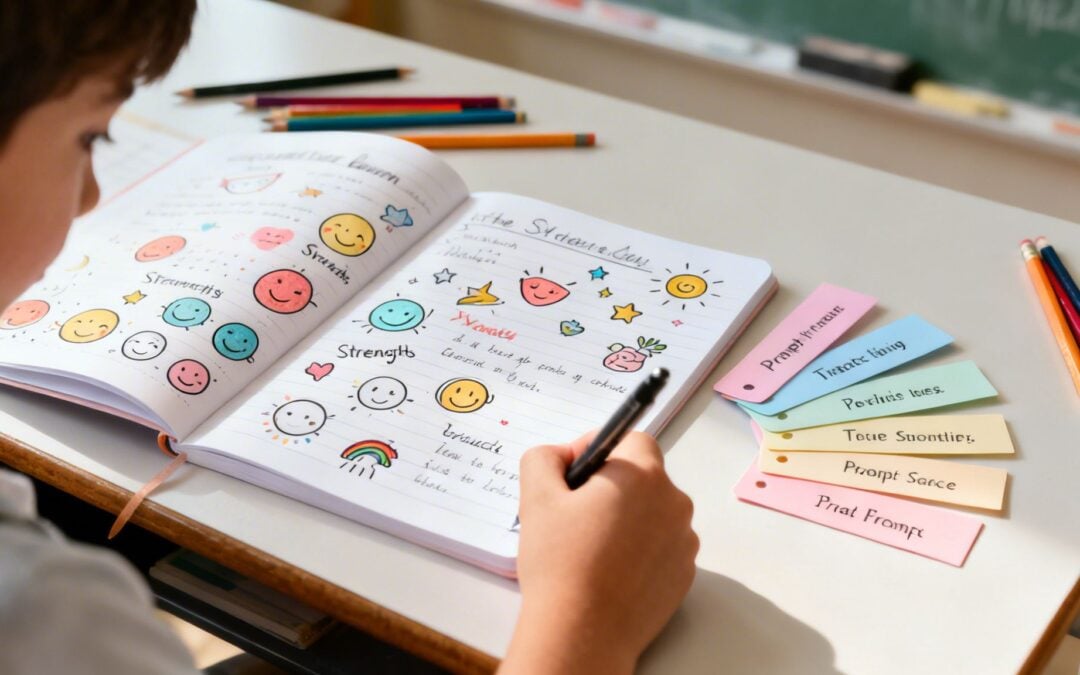
Soul Shoppe's work is made possible by donors and partners who care deeply about the young people in their communities! We can't do this work without you. Support our work in classrooms and on playgrounds across the nation by donating here.
The last five minutes of the day often tell the truth. A student is still carrying hurt from recess. Another is proud and restless after finally finishing a project. Backpacks slam shut, chairs scrape, and an adult asks, “How was your day?” The response is usually short because many children need a better doorway into reflection than a broad question or an empty page.
Journal entry prompts give them that doorway.
A useful prompt lowers the pressure without lowering the thinking. It gives students enough structure to get started and enough choice to answer honestly. That balance matters in SEL work. If a prompt is too vague, students freeze. If it is too scripted, they write what they think adults want to hear. The goal is not polished writing. The goal is helping students notice what happened, name what they felt, and decide what to do next.
That’s because reflection supports emotional regulation, mindfulness, and self-awareness. In practice, I have seen the same prompt work differently across ages and even across different days with the same child. A kindergartner may need to draw first and talk second. An upper elementary student may be ready to connect feelings to a specific event. A middle schooler can often handle a prompt that asks for patterns, choices, and repair.
This article is built for actual use, not just inspiration. The ten prompt types below function as mini lesson plans within a larger SEL framework. Each one includes grade-level adaptations for K-2, 3-5, and 6-8, sample student responses, and classroom or home variations such as exit tickets, partner shares, and quick write routines. For families and teachers who want to extend the work beyond the notebook, simple ways to show gratitude in daily interactions can reinforce what students write about.
There are trade-offs to keep in mind. Some prompts fit best during morning meeting, while others are more effective after conflict, during advisory, or at bedtime. Some students open up in writing. Others need to speak, sketch, or dictate first. Good SEL journaling stays flexible, predictable, and emotionally safe. Done well, it gives children and adolescents a repeatable way to understand themselves, relate to others, and carry insight from one day into the next.
1. Gratitude and Appreciation Reflection
A student walks in upset after a hard bus ride, and a broad prompt like “What are you grateful for?” falls flat. Gratitude reflection works better when it starts with something specific the student can name from the last few hours.
This prompt helps students notice support, comfort, effort, and small positive moments that are easy to miss during a busy day. It also builds a habit of paying attention to relationships, which makes it useful as more than a feel-good writing task. In practice, that matters. Students who struggle with regulation, including those affected by the link between ADHD and feelings, often need concrete reflection tools rather than vague requests to “be positive.”
Grade-level adaptations
K-2: “Draw a picture of someone who helped you today. Tell them, or write one word, why you are thankful.”
Sample response: a drawing of a friend sharing a crayon, with the word “sharing.”
3-5: “Write about three things that went well today, big or small. Why did they make you feel good?”
Sample response: “I’m grateful my friend sat with me at lunch because I was lonely. I’m also grateful for the sunny weather at recess and that I understood the math lesson.”
6-8: “Describe a time someone showed you support when you didn’t expect it. How did it change how you saw that person or the situation?”
What works in practice
Keep the writing brief. One to three sentences is often enough, especially at the start. Longer entries can produce richer thinking for some students, but they can also turn gratitude into a compliance task. A quick, specific reflection usually gets more honest responses than a polished paragraph.
Adult modeling matters here. “I appreciated how Maya held the door when my hands were full” gives students a usable example. “Be thankful” does not.
This prompt also works best when teachers and caregivers allow different response modes. Younger children may draw and label. Some students will talk first and write second. Others do better with a sentence stem, a partner share, or an exit ticket. If gratitude writing starts to sound forced, switch the question. Ask, “Who made today easier?” or “What helped you get through a hard part of the day?” That keeps the focus grounded in real experience.
A strong classroom variation is a pair-share after writing, with a clear boundary that students only share what feels comfortable. At home, a family gratitude jar keeps the routine short and visible. To connect reflection to action, Soul Shoppe’s ways to show gratitude offers family- and school-friendly examples, and these self-regulation strategies for students pair well with gratitude prompts on tougher days.
Start with what was helpful, not what was perfect.
2. Emotion Identification and Self-Regulation
Many students can feel a big emotion before they can name it. That gap matters. If a child can’t tell the difference between frustration, embarrassment, disappointment, and anger, it’s much harder to choose a helpful response.
This prompt slows the moment down. Instead of asking kids to explain everything, it asks them to notice what they felt, what set it off, and what they did next.
Grade-level adaptations
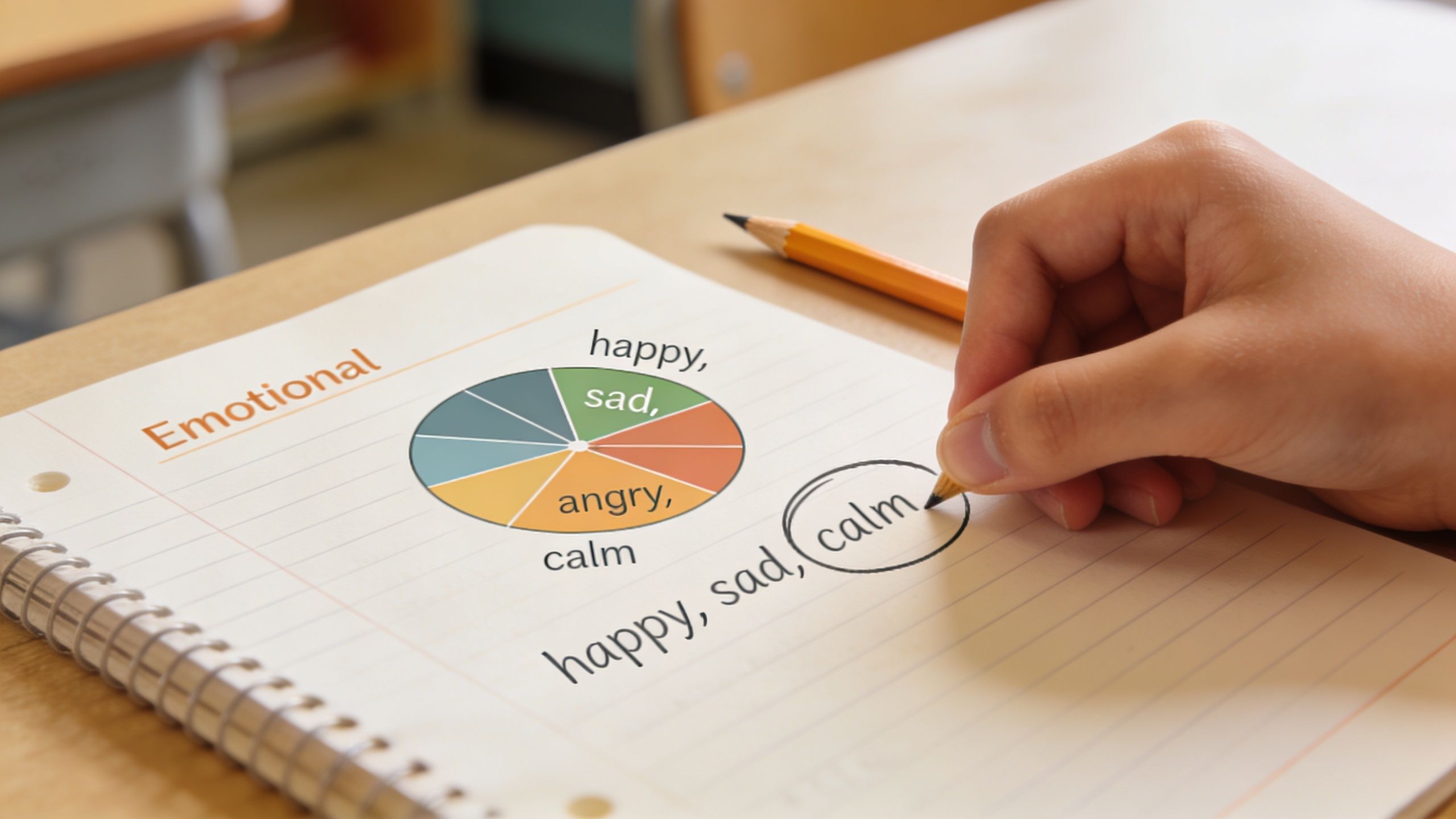
K-2: Use an emotion chart with faces. “Circle the face that shows how you felt when you couldn’t build your tower. What did you do to feel better?”
Sample response: the student circles “angry” and draws three deep breaths.
3-5: “Today, I felt ___ when ___. To help myself, I tried ___.”
Sample response: “Today, I felt frustrated when I couldn’t solve the word problem. To help myself, I tried asking a friend for a hint.”
6-8: “Reflect on a moment you felt a strong emotion. What signs did you notice in your body? Was your response helpful or unhelpful? What could you do differently next time?”
What helps and what doesn’t
What helps is normalizing the full range of emotions. What doesn’t help is rewarding only calm, tidy answers. Students need to know that “I was really mad” is acceptable language if it’s followed by reflection.
A co-created calming strategies chart gives students something concrete to reference in their writing. In many classrooms, a fast emotional check-in at the start of the day also helps adults catch patterns before behavior escalates. If you’re supporting students who have a harder time reading and managing emotional intensity, this discussion of the link between ADHD and feelings offers useful context for caregivers.
Practical rule: Don’t ask for regulation before you teach regulation.
For families and schools that want a shared toolbox, Soul Shoppe’s self-regulation strategies for students can pair well with this kind of journaling. The journal becomes the reflection space. The strategy chart becomes the action space.
3. Growth Mindset and Challenge Reflection
A challenge prompt helps students move from “I’m bad at this” to “I’m learning how to do this.” That shift sounds small, but it changes behavior. Students who can reflect on effort, strategy, and next steps usually stay engaged longer than students who read every mistake as proof that they can’t succeed.
This kind of journaling is especially useful after tests, group work, performances, and social setbacks. The writing doesn’t need to celebrate struggle. It needs to help students make sense of it.
Try these versions
K-2: “Draw a picture of something that was hard for you. Now draw what you did to keep trying.”
Sample response: a student draws struggling to tie a shoe, then practicing with a parent.
3-5: “Write about a ‘beautiful oops,’ a mistake that taught you something. What did you learn?”
Sample response: “My beautiful oops was spelling a word wrong in my story, but it gave me an idea for a funnier word to use instead.”
6-8: “Describe a recent academic or social challenge. What strategies did you use? What happened after you kept trying? What will you try next time?”
The trade-off
There’s a common mistake with growth mindset journaling. Adults sometimes push students to end every reflection with a neat success story. That can make the writing feel fake. A stronger prompt leaves room for partial progress.
Students can write, “I still don’t get fractions, but I asked a better question today.” That’s honest growth. It respects effort without pretending the problem disappeared.
A useful classroom exit ticket is one sentence: “One thing I learned from a mistake today was…” At home, parents can model their own imperfect learning. A child is more likely to write truthfully if the adults around them do too.
If you want language and activities that support this reflection style, Soul Shoppe’s growth mindset activities for kids that truly stick gives practical ways to reinforce the “not yet” mindset outside the journal.
4. Acts of Kindness and Empathy Exploration
A student holds the door for a classmate who is carrying a project, then sits down without saying a word. No adult praises it. By dismissal, the moment is gone unless someone helps the class notice why it mattered.
That is the job of this prompt type. It teaches students to pay attention to how everyday choices affect other people. Over time, that shifts kindness from a rule adults repeat to a habit students can name, reflect on, and choose again.
This category works especially well for students who do not see themselves as leaders. They may never volunteer to be the “helper,” but they still include, wait, notice, and repair. Journaling helps them see that empathy often shows up in small, quiet actions.
Prompt examples by age
K-2: “Who helped someone today? Draw what happened. How do you think the other person felt?”
Sample response: a drawing of a classmate picking up spilled crayons, with the teacher writing, “She felt better because she was not alone.”
3-5: “Be a kindness detective. Write about one kind thing you saw today. What happened before it? What changed after it?”
Sample response: “I saw Maria invite the new student to play at recess. Before that, he was standing by himself. After that, he was smiling and running with the group.”
6-8: “Describe a time you chose kindness when it would have been easier to ignore someone, join in, or stay silent. What helped you make that choice? What impact did it have?”
What actually helps students go deeper
The strongest empathy journals stay concrete. “Someone was nice” is too vague to teach much. Students learn more from prompts that ask who was affected, what changed, and what clues showed the other person’s feelings.
That same principle matters when adults respond. Specific feedback builds awareness. “You noticed that your partner looked embarrassed and waited for them” gives students language for empathy. General praise does not.
A useful follow-up question is: “What did that action change for someone else?” That question moves the reflection past good behavior and into perspective-taking.
There is a trade-off here. Public kindness routines such as a “Kindness Caught” wall can build a strong class norm, but they can also make some students perform kindness for recognition. Private journaling often gets more honest reflection, especially for older students who are sensitive to peer judgment. In practice, I use both. Public noticing sets the culture. Private writing helps students examine motive, impact, and missed chances.
These prompts are easy to adapt into mini-lessons instead of using them only as independent writing:
Exit ticket: “One kind thing I noticed today was ___, and it mattered because ___.”
Pair-share: Students read one sentence from their journal, then their partner adds, “The feeling I heard in that story was ___.”
Morning meeting follow-up: Invite students to write about a time they wished someone had noticed their feelings.
Home connection: Ask caregivers to share one small act of kindness they saw at home, then have the child reflect on how it affected the family.
If students need more direct teaching before they write, Soul Shoppe’s how to teach empathy with clear, student-friendly practices pairs well with this prompt type. It gives teachers and caregivers language they can model before asking students to reflect independently.
5. Conflict Resolution and Perspective-Taking
Students often replay a conflict in one direction only: what the other person did. Journaling gives them a safer place to sort out the whole interaction before speaking aloud. That matters because many kids can think more clearly on paper than in the heat of the moment.
This prompt is best used after a cooldown, not during peak upset. Reflection before regulation usually backfires.
How to phrase it
K-2: “Draw the problem. Now draw what each person wanted. What is a fair solution?”
3-5: “Write the story from two sides. First, tell what happened from your point of view. Then tell it from the other person’s point of view. What did each person want?”
6-8: “Rewrite your side of the conflict using an I-statement: ‘I felt ___ when you ___ because ___. Next time, I would like ___.’ Then reflect: what might make it hard for the other person to agree?”
What actually works
Private writing before a restorative conversation often produces better repair than immediate forced sharing. Students have time to move from blame to clarity. They can spot what they wanted, what the other person may have wanted, and what still needs repair.
What doesn’t work is using the journal as a punishment. “Go write about what you did wrong” turns reflection into compliance. A better invitation is: “Write so you can understand what happened and what you want to do next.”
Useful follow-up questions include:
What were you hoping would happen? This helps students identify unmet needs, not just surface behavior.
What do you think the other person was hoping for? This builds perspective-taking without requiring agreement.
What repair is possible now? This keeps the writing connected to action.
At home, this prompt can help after sibling conflict if each child gets separate time and space to write or draw first. In school, it pairs well with a Peace Path or any restorative routine students already know.
6. Body Awareness and Mindfulness Reflection
A student comes in from recess rubbing their stomach. Another starts tapping a foot faster right before a quiz. A third looks calm until shutdown hits all at once. Body-awareness journaling helps students catch stress earlier, name what they notice, and choose a regulating strategy before behavior takes over.
Used well, this is more than a prompt. It is a short SEL routine: notice, name, respond, reflect. That structure matters because students often need direct teaching here, not just an open-ended question on a page.
Age-based prompt ideas
K-2: “After we did our starfish breaths, where in your body feels calm? Color that spot on this body outline.”
Classroom variation: Use it as a 2-minute morning check-in or calm-down corner activity. Some children will draw instead of write, and that is often the better fit.
3-5: “Think about a time you felt worried. Where did you feel it in your body? What helps that part of your body relax?”
Classroom variation: Try this as an exit ticket after a test, performance task, or class meeting. Pair-share can work if students are allowed to pass.
Sample response: “I feel worry in my tummy like butterflies. Taking a drink of water helps.”
6-8: “What are your body’s early warning signs for stress? What are the signs you’re feeling relaxed and focused? How can you use that information during a busy school week?”
Classroom variation: Ask students to make a two-column list: “stress signals” and “reset strategies.” That format feels more private and concrete than a long personal reflection.
What actually works
Keep the focus on patterns, not disclosure. Students do not need to explain why they feel activated in order to learn what their body is telling them. For many kids, especially those carrying stress outside school, that difference is what makes the activity usable instead of overwhelming.
Choice is required here. A student should always be able to switch from internal sensations to external grounding: what they see, hear, touch, or do to settle. That flexibility matters because there is still a gap in many journaling resources around developmental specificity and trauma-informed practice, as noted in this discussion of missing guidance in common journal prompt resources.
Before journaling, a short guided reset helps. This quick video can support that transition:
A few trade-offs are worth naming. Body scans can help some students slow down, but they can also increase distress for students who do not feel safe focusing inward. Younger students usually do better with concrete body maps, colors, and simple sentence stems. Older students often want privacy, shorter prompts, and the option to keep their writing unread.
If body-focused reflection increases stress, switch the prompt immediately. Safety comes first.
7. Identity and Belonging Exploration
Students do better when they feel seen. They also do better when they can see themselves clearly. Identity journaling helps with both. It gives students language for their values, interests, communities, traditions, and strengths, and it creates room for complexity.
This prompt is especially helpful for students who feel flattened by labels. The child who’s “the quiet one,” “the math kid,” or “the one who gets in trouble” often has much more to say when the prompt opens wider.
Prompts that invite belonging
K-2: “Draw yourself in the middle of the page. Around you, draw and label the people, places, and things that are important to you.”
3-5: “Create an identity web. Put ‘Me’ in the center, then add family traditions, hobbies, favorite foods, languages you speak, and other important parts of who you are.”
6-8: “Where do you feel most like your true self? Describe that group or place. What makes it feel safe and real for you?”
Practical use in classrooms and homes
Literature helps here. After reading a story with themes of identity, culture, friendship, or belonging, students can compare the character’s experience with their own. That gives them some distance, which often leads to more honest reflection.
A gallery walk can also work if sharing is optional. Some students love displaying an identity web. Others don’t. Belonging grows when students have choice, not when disclosure is expected.
This is also a strong family prompt. Caregivers can ask about family values, traditions, and the communities a child feels part of. Those conversations help students connect private identity with public belonging.
8. Peer Support and Social Connection Reflection
A student has a hard morning, walks into class quiet, and says they are fine. By the end of the day, one classmate has shared supplies, another has invited them into a group, and a teacher has checked in twice. Many children miss those moments unless we teach them how to notice support, name it, and use it.
Peer support journaling helps students map relationships, practice help-seeking, and recognize that they also matter to other people. That shift matters in SEL work. Students who can identify safe people and small connection points are often better prepared to join groups, repair hurt feelings, and ask for help before a problem grows.
Prompts that build social awareness and support-seeking
K-2: “Draw a picture of a time someone helped you at school. What did they do? How did it make you feel?”
3-5: “Make a support map with three circles: friends, family, and school adults. Write one way each person can help you.”
6-8: “Write about a recent moment when you felt supported, included, or checked on. What made that moment feel real? What could you do to offer that kind of support to someone else?”
How to use this prompt well
This prompt works best when students get concrete categories. “Who supports you?” is too broad for many children. “Who helps you when you are confused, left out, upset, or stuck?” gives them a way in.
It also helps to treat social connection as teachable behavior, not personality. A student does not need to be outgoing to build connection. They need practice with specific moves such as asking to join, thanking a peer, checking on someone, or naming one trusted adult.
For classroom use, this can become a quick exit ticket, a partner share, or a private journal entry. In K-2, students can draw and dictate. In grades 3-5, a support map usually works better than a full paragraph. In grades 6-8, I would add one planning question: “What is one small social step you could take this week?” That turns reflection into action without forcing public sharing.
A sample response from an upper elementary student might sound like this: “I wrote my counselor because I was nervous about a friendship problem. She helped me think of what to say first. I also realized my friend Maya helped by saving me a seat at lunch.”
A middle school response might be more understated: “My friend asked why I was quiet in science. It was only one sentence, but it helped because it showed someone noticed.”
At home, caregivers can keep this simple. Ask, “Who helped you today?” and “Who did you help?” Those two questions build reciprocity, which is different from popularity.
Some students cannot name a support person yet. Start with possibility instead: “Who might be safe to ask next time?” That response still gives you useful information and can guide follow-up support.
9. Values and Purpose Reflection
Students make better choices when they have words for what matters to them. Values journaling helps children and adolescents connect behavior to identity. Instead of only asking, “What did you do?” the prompt asks, “What kind of person do you want to be?”
That shift is powerful for motivation. It also makes SEL more durable. Rules can be followed when adults are present. Values travel with the student.
Prompt examples
K-2: “What are our class rules, like be kind or be safe? Draw a picture of you following one. Why is it important?”
3-5: “What are three words you want people to use to describe you, like kind, honest, or creative? Write about one thing you did today that shows one of those words.”
6-8: “If you could make one positive change at our school, what would it be and why? What value, like fairness, community, or fun, does that change connect to?”
Useful structures
A values sort works well before writing. Students can choose a few value words from a larger list, then explain why those words matter right now. That’s often easier than asking them to generate values from scratch.
Another option is to connect values to current events, stories, or media. Ask, “What value did this character act on?” Then invite students to compare. The journal becomes a place for thinking, not just reporting.
In classrooms, a values word wall helps students find language they might not use on their own. At home, families can connect the prompt to everyday moments: honesty after a mistake, courage before a tryout, fairness during a disagreement, generosity during sharing.
10. Feedback Integration and Growth Planning
A student gets a paper back, sees three correction marks, and decides, “I’m bad at this.” That reaction is common. A good journal prompt slows the moment down and teaches a different habit. Students learn to name the feedback, sort their feelings, and choose one next step they can try.
This prompt works best after graded work, conferences, peer review, performances, or behavior coaching. The goal is not to make feedback feel pleasant. The goal is to make it usable.
Prompt examples
K-2: “Your teacher said, ‘Try to make your letters sit on the line.’ Practice three letters on this page. Circle the one that matches the line best. What helped you do that one well?”
3-5: “What did I do well? What is one part I need to improve? What is one step I will try on my next assignment?”
6-8: “Look at feedback from your last project, discussion, or behavior reflection. Which comment was hardest to accept? Which comment can help you improve most? Write two specific actions you will take next time.”
What makes this work
Students often need help separating identity from performance. “You need stronger evidence” is about the draft, not the student. “Wait to speak until your classmate finishes” is about a skill, not character. Writing gives enough distance for students to respond with more thought and less defensiveness.
Specificity matters here. “Try harder” rarely changes anything. “Add one example from the text before turning in my paragraph” gives the student something visible and measurable. For younger children, that may mean practicing one letter, one transition, or one breathing strategy. For older students, it may mean setting a process goal, such as checking the rubric before submission or asking one clarifying question during revision time.
I have found that this prompt is strongest when the journal entry ends with a plan the student can revisit within a few days. Keep the plan small. If the next step is too big, students avoid it. If it is concrete and close in time, they are more likely to follow through and notice progress.
Useful structures
A simple template helps students who freeze after receiving criticism:
What feedback did I get?
How did I feel when I heard it?
What part do I agree with?
What will I do next?
You can also vary the format so it fits the setting. Use it as an exit ticket after a writing conference. Turn it into a pair-share where students practice restating feedback in neutral language. At home, caregivers can ask, “What is one thing you want to keep doing, and what is one thing you want to change next time?” That keeps the conversation focused on growth instead of shame.
Sample student responses
K-2 sample: “My best letter is m because it sits on the line. I went slow.”
3-5 sample: “I explained my idea clearly. I need to use more details from the text. Next time I will highlight two details before I start writing.”
6-8 sample: “The hardest feedback was that I interrupted during group work because I did not notice I was doing it. The most helpful part was the suggestion to write my idea down first. Next time I will jot notes while others talk and wait until one person finishes before I speak.”
Over time, these entries show students a pattern. Feedback stops being a one-time reaction and becomes part of an ongoing learning plan. That shift matters in academics, behavior, and relationships.
Upper elementary/middle grades, advisory, leadership work
Anchors behavior in values and boosts engagement
Feedback Integration and Growth Planning
Medium–High, requires skillful feedback practices and follow-up
Teacher feedback training, time for goal setting, tracking tools
Better receptivity to critique, actionable growth steps, tracked progress
After assessments, peer review, conferences, goal-setting periods
Turns feedback into concrete plans and accountability
Putting Prompts into Practice Your Next Step
It is 2:10 p.m. The class just came back from recess. Two students are upset, one is withdrawn, and the group is louder than usual. That is not the moment for a long, open-ended writing task. It is the moment for one prompt, a clear routine, and a response format students already know.
Start there. Choose one prompt type that fits the need in front of you, then use it long enough to see patterns. In classrooms and at home, I usually see stronger results when adults stay with one category for two to four weeks instead of rotating constantly. Emotion identification works well during dysregulated stretches. Growth mindset prompts help after frustration or academic setbacks. Kindness, conflict resolution, and peer support prompts fit periods of social friction. The goal is not to cover all ten categories. It is to build a reflection habit students can use.
This article is built to support that kind of implementation. Each prompt type can function as a mini-lesson, not just a writing question. Teachers and caregivers can adjust the same core prompt for K-2, grades 3-5, and grades 6-8, then shift the format based on time and energy. A prompt can become an exit ticket, a pair-share, a morning meeting opener, a restorative follow-up, or a private journal entry. That flexibility matters because SEL works best when it fits real routines, not ideal ones.
Keep the structure predictable. Use the same notebook, half-sheet, or digital form each time. Tell students whether the response is private, optional to share, or expected to be discussed with a partner. Offer more than one response path. Drawing, sentence stems, checkboxes, dictation, and bullet points all count if they help students notice what happened, name what they felt, and decide what to do next.
Consistency matters more than length.
Research on expressive writing has long suggested that repeated reflection can support emotional processing and stress reduction. School journaling usually looks different from formal expressive writing studies. It is shorter, more scaffolded, and often tied to community routines. The practical takeaway still holds. Students get more from a steady practice than from a one-time “big reflection” activity.
Digital tools can help adults plan, but they should stay in a supporting role. One 2025 projection in PromptDrive’s article on AI prompts in research workflows says generative AI prompt adoption among education and market research professionals stands at 65% in 2025, up from 33% the prior year. That may help with drafting prompt banks, sorting themes, or organizing teacher notes. It does not replace adult judgment about developmental fit, cultural responsiveness, privacy, or signs that a student needs a conversation instead of another written response.
That trade-off is easy to miss. Efficient planning is useful. Over-automated SEL is not.
Younger students, multilingual learners, and students with trauma histories often need more adaptation than generic journaling resources provide. A first grader may need a picture prompt and one sentence stem. A fourth grader may do better with a feelings scale and a partner share before writing. A middle school student may need the option to pass, write privately, or respond to an outward-facing prompt such as, “What helps our class feel respectful during group work?” Flexibility is part of strong implementation, not a watered-down version of it.
It also helps to decide ahead of time what adults will do with what students write. If students disclose conflict, fear, or isolation, someone needs a follow-up plan. If entries are never revisited, students quickly learn that the routine is performative. Strong practice includes simple response systems: brief teacher check-ins, a note home when appropriate, a reteach for the whole group, or a small goal-setting conference. Reflection should lead to support, not just documentation.
You can also place prompts where they solve real problems. Use them after recess, after peer conflict, before tests, after read-alouds, during advisory, or at the close of the school day. Families can use the same prompt at dinner or bedtime with oral responses instead of writing. For older students and adults who want broader reflection ideas, meaningful self-discovery journaling prompts may offer additional inspiration. For schools and families seeking SEL support that includes practical tools for self-regulation, empathy, communication, and conflict resolution, Soul Shoppe is one relevant option to explore.
Start with one prompt type. Teach the routine clearly. Watch how students respond, then adjust the scaffolds, format, and follow-up. That is how journal prompts become a usable SEL practice instead of one more good idea that never sticks.
If you want support turning journal entry prompts into a consistent SEL practice, explore Soul Shoppe for programs, courses, and tools designed to help school communities and families build connection, empathy, safety, and practical self-regulation skills.
More than words. That’s what you’re dealing with when a student erases a drawing until the paper tears, or when a child knows an answer but won’t risk saying it out loud. Those moments often get labeled as perfectionism, shyness, or sensitivity. In practice, they’re often early signs of shaky self-worth.
That matters because self-esteem in girls can decline sharply in early adolescence. One summary of the research notes that girls’ self-esteem peaks around age 9, and body image satisfaction drops from 75 percent at ages 8 and 9 to 56 percent at ages 12 and 13, according to findings cited by Journal Buddies. By the teen years, body concerns and outside pressures can become even louder.
Praise helps, but praise alone is flimsy. Kids can become dependent on hearing “good job” and still crumble the moment something feels hard, awkward, or imperfect. Strong self-esteem grows from the inside out. It’s built through self-awareness, honest reflection, problem-solving, and the ability to recover after disappointment.
That’s where journaling earns its place. Structured prompts can support stress reduction, self-awareness, confidence, and perspective-taking, with benefits described in therapeutic writing research summarized by PositivePsychology’s journaling prompts guide. For teachers and parents, journaling also works because it’s flexible. You can use it in a morning meeting, after recess conflict, at counseling check-in, or as part of a bedtime routine.
The most effective self esteem journal prompts don’t ask kids to repeat empty positive phrases. They help children notice strengths, name values, process setbacks, and see proof of their own growth.
Below are eight journaling methods I’d use with K to 8 students. Each one serves a different psychological purpose, includes concrete examples, and works best when adults keep the tone steady, warm, and specific.
1. Daily Affirmations and Strengths Recognition
This is the simplest place to start, and it’s also the easiest place to get it wrong.
A lot of adults hand kids an affirmation like “I am amazing” and hope repetition will do the rest. Usually it doesn’t. Children trust evidence more than slogans. If the writing feels fake, they disengage fast.
Make affirmations concrete
The strongest affirmations are tied to real behavior.
A kindergartner who shared crayons can write, “I am a helpful friend because I shared my crayons today.” A 3rd grader might write, “My strength is persistence. I kept trying on my math page even when I felt stuck.” A middle school student can go further: “I handled a hard social moment calmly. I listened to my friend before giving advice.”
That shift matters. The child isn’t just claiming a trait. They’re identifying proof.
Practical rule: Never ask kids to write an affirmation without also asking, “What happened today that makes this true?”
In classrooms, I like sentence stems for younger or hesitant writers:
I am good at: helping, drawing, listening, building, noticing, trying again
I showed strength when: I kept going, told the truth, asked for help, included someone
Today I’m proud of: one action, not a whole identity
What works and what doesn’t
What works is specificity, repetition, and adult modeling. A teacher can write on the board, “I am patient because I explained the directions again without rushing.” That gives students a believable model.
What doesn’t work is forcing intensity. Kids don’t need to declare that they love everything about themselves. They need language for noticing what’s sturdy in them.
A few practical supports help:
Build a strengths bank: Post words like brave, thoughtful, persistent, creative, fair, calm, curious.
Pair self and peer noticing: Let students write one strength they saw in themselves and one they saw in a classmate.
Keep it short: Two sentences is enough if they’re honest.
2. Challenge Reflection and Problem-Solving Journal
Students build self-esteem faster from “I got through something hard” than from “I’m good at everything.”
That’s why challenge reflection is one of the most practical self esteem journal prompts you can use. It turns failure, conflict, and frustration into usable information.
Turn setbacks into evidence of capability
Younger students do well with an “Oops to Aha” format.
A 1st grader might write: “Oops: My block tower kept falling. Aha: I made the bottom wider. Now I know: I can try a different plan.”
A 4th grader can handle more emotional detail: “My challenge was working with a partner I didn’t know. I felt nervous and quiet. I asked what idea they wanted to start with. That helped us begin.”
A 7th grader can reflect on choices: “I got a low quiz grade and blamed the teacher at first. If I’m honest, I didn’t review until the night before. Next time I’ll make a study plan and use my organization skills.”
That last sentence is the key. Reflection without a next step can become rumination.
A structure kids can repeat
Use the same few prompts each time:
What happened: Name the challenge clearly.
How I felt: Frustrated, embarrassed, left out, confused, angry, disappointed.
What I did: The action taken, even if it was imperfect.
What I learned: One takeaway.
What I’ll try next: One concrete step.
Struggle is not a sign that a prompt failed. It’s often the exact material the child needs to work with.
What works here is normalizing challenge before asking students to reflect. Teachers can briefly share age-appropriate examples: “I mixed up our schedule this morning and had to regroup.” That lowers defensiveness.
What doesn’t work is turning journaling into a post-mistake punishment. If a child only writes after conflict or failure, they’ll start associating journaling with shame. Use it after challenges, yes, but also after recovery and repair.
For classrooms, anonymous “challenge examples” can help. A counselor or teacher can keep a folder of composite entries like “I felt left out at recess” or “I froze during a presentation” so students see that hard moments are common, not proof that something is wrong with them.
3. Values and Identity Exploration Journal
A student bombs a test, gets left out at lunch, or sees a friend get more attention online. By the end of the day, one quiet belief can take over: maybe I only matter when I perform, fit in, or look right.
Identity journaling interrupts that pattern. In this method, the goal is not just expression. It is helping kids build self-respect around values, roles, culture, character, and choice. That makes it a different tool from challenge reflection or affirmations. It helps children answer a steadier question: Who am I, even on an off day?
Help students define themselves beyond outcomes
For younger students, keep identity work concrete and visible. A 2nd grader might make a “Me Shield” with four sections:
people who matter to me
things I enjoy
strengths I use
one rule or belief I try to live by
That last section often tells you the most. A child who writes “Include others” or “Tell the truth” is starting to root identity in values.
Upper elementary students can connect values to behavior. A 5th grader might write, “I value honesty. I told my mom I broke the vase. I felt nervous, but I did what matches who I want to be.” That is fundamental work. The student is linking action, discomfort, and identity.
Middle school students are usually ready for contradiction and context. An 8th grader might write, “At home I’m funny and creative, but at school I stay quiet. I think I’m worried people will judge me.” That kind of entry gives adults something useful to respond to. It points to belonging pressure, not a lack of personality.
Use prompts that build identity language
Children often need words before they can reflect clearly. Give them a values menu and let them choose a few that feel true or aspirational: kindness, courage, creativity, fairness, loyalty, curiosity, responsibility, humor, faith, family, service, justice.
Then use prompts like these:
Which value mattered most to you today?
Where did your actions match that value?
Where did they drift away from it?
What part of yourself feels easy to show?
What part do you keep private?
Who are you with different people?
What do you want to be known for?
This works especially well in grades 4 through 8, when students are trying on identities quickly and often publicly. Some children answer too fast with labels they think adults want to hear. Slow them down. Ask for a moment, not a slogan.
How to implement it well at home or in class
Use identity journaling once or twice a week, not every day. Daily use can make the writing feel forced, especially for students who are still figuring themselves out.
In classrooms, I recommend giving students choice in format. Some write paragraphs. Some sort value cards first. Some draw identity maps with circles for family, friends, school, interests, culture, and beliefs. If you want a related way to help students notice what matters in their lives, these gratitude activities for kids pair well with values work because they move children from vague feelings to specific meaning.
At home, parents can keep the conversation light but honest. “What felt most like you today?” usually gets a better response than “What are your values?” The trade-off is speed versus depth. Simpler questions get more participation. Richer questions produce better insight, but only when trust is already there.
What helps and what gets in the way
What helps is making room for layered identity. A child can be shy in class and loud with cousins. Athletic and artistic. Caring and still learning how to handle anger. Kids need to see that complexity is normal.
What gets in the way is turning identity work into branding. If adults push children to pick one neat answer to “who am I,” journaling starts to shrink them instead of helping them grow. Identity develops through repetition, testing, and revision.
As noted earlier in the article, concerns about appearance and outside approval can distort self-worth, especially for older students. That is why this journaling method matters. It gives kids another place to stand.
4. Gratitude and Appreciation Journaling
A 3rd grader has a hard recess, comes back upset, and writes, “Nothing good happened today.” That is the moment this journaling method earns its place. Gratitude and appreciation journaling helps children widen the frame enough to notice support, relief, effort, and small wins without denying what hurt.
Used as a self-esteem tool, gratitude is not a feel-good list. It trains attention. Children who regularly fixate on mistakes, exclusion, or comparison need practice spotting what supported them, what mattered, and what they contributed themselves. That shift can build steadier self-worth because the child starts to see, “My day was hard, and I still noticed care, choice, and strength.”
Specificity matters. “I’m grateful for my family” is a start, but “I’m grateful my dad waited with me before school because I was nervous” gives the brain something real to hold onto. The same is true at school. “I’m grateful my friend shared a swing at recess because I felt left out” is stronger than a vague list item. So is self-appreciation: “I’m grateful I took three breaths instead of yelling.”
That last category is easy to skip. I do not recommend skipping it. If gratitude only points outward, some children learn to appreciate everyone except themselves.
For younger students, keep the method concrete and brief. A kindergarten or 1st grade journal can use “Three Good Things” with pictures and a few dictated words. A 3rd or 4th grader can finish the stem “I appreciated ___ because ___.” Middle school students usually benefit from a two-part entry: one thing they received, one thing they did.
A better prompt set than “What are you grateful for?”
The prompt shapes the depth of the answer. Rotate the lens so the practice stays active:
Support: Who helped you today, and what did they do?
Moment: What felt calm, fun, or meaningful?
Self: What did you handle well, even if it was small?
Body and senses: What did you notice that made the day easier or better?
Repair: What got better after a hard moment?
The word “because” often does the heavy lifting. Without it, many entries stay shallow.
There is also a real trade-off here. Daily gratitude can become performative if adults push it too hard or use it to shut down disappointment. A child who says, “I’m still mad,” should not be corrected into gratitude on command. The practice works better after the feeling is acknowledged. Then journaling can help the child add complexity: “I was angry after lunch, and I was also grateful my teacher checked on me.”
For classroom use, this method works well in advisory, morning meeting follow-up, calm-down corners, or Friday reflection. For home use, a shared notebook by the dinner table or bedside usually gets better follow-through than a formal workbook. Families and teachers who want more hands-on extensions can pair this section with these gratitude activities for kids that help children notice specific moments of care and joy.
Used consistently, gratitude and appreciation journaling becomes a resilience tool. It helps children record evidence that good experiences, caring relationships, and personal effort are still present, even on days that do not feel easy.
5. Growth Mindset and Learning Journey Journal
Monday morning, a student stares at a page and says, “I’m just bad at this.” By Friday, that same student may still find the work hard, but the journal can help them say something more accurate: “I used a different strategy, and part of it worked.”
That shift matters. This method builds self-esteem by helping children separate identity from current performance. In this toolkit of eight journaling approaches, the growth mindset journal is the tool for resilience under challenge. It teaches students to track progress, strategy, and recovery after mistakes.
Help students record change they can actually see
Children rarely build confidence from praise alone. They build it from evidence.
A 1st grader can tape in two handwriting samples and finish the sentence, “In September I needed help with ____. Now I can ____ on my own.” A 5th grader might write, “Flashcards were not enough for multiplication facts. Skip-counting and a partner game helped more.” In middle school, the reflection can get more precise: “I still get nervous in science, but asking one question before labs helped me understand the directions.”
Those examples do more than sound positive. They document process. That is the difference between empty encouragement and useful self-belief.
Use prompts that connect effort to strategy
Students need language they can use during hard moments, not just after success. Prompts like these work well:
What felt hard today, specifically?
What strategy did I try first?
What changed after I got stuck?
What mistake showed me what to practice next?
What can I say instead of “I’m bad at this”?
What is one sign I know more today than I did last week?
For younger students, keep it concrete and brief. “One thing I can do now is…” works better than abstract reflection. For grades 4 through 8, add comparison prompts and revision notes so students can examine how learning changed over time.
I usually recommend a weekly “learning journey” page with three parts: what improved, what still feels shaky, and what strategy to try next. That structure is simple enough for follow-through and strong enough to show patterns across a month or grading period.
Protect the journal from becoming fake positivity
There is a real trade-off here. Growth mindset language helps, but it can also irritate students if adults use it as a script instead of support.
A child who hears “just keep trying” after repeated frustration often feels misunderstood. The journal works better when adults acknowledge the barrier and then guide reflection: “What part is confusing?” “What have you already tried?” “What support would help?” Self-esteem grows when students feel competent and honest, not when they are pushed to sound optimistic.
That is why “yet” needs a companion. “I can’t do this yet” should lead to “My next step is…” Without that second part, the phrase becomes classroom wallpaper.
Match the method to age and setting
In K to 2, use drawings, stickers, sentence stems, and before-and-after work samples. In grades 3 to 5, students can track strategies across subjects and notice which ones help. In grades 6 to 8, the journal can include revision reflections, test corrections, project checkpoints, and short entries about persistence, planning, and asking for help.
For teachers, this aligns well with SEL goals around self-awareness, self-management, and responsible decision-making. For parents, it works best after homework, music practice, sports, or any moment where frustration tends to show up quickly. A short entry is enough if it captures one challenge, one action, and one next step.
Visible artifacts strengthen the practice. Keep drafts, corrected work, reading logs, and goal check-ins together so students can review their own evidence. If you want ready-to-use classroom extensions, Soul Shoppe’s growth mindset activities for kids that stick pair well with this journal routine.
Used consistently, this journal helps children build a more durable kind of confidence. They stop asking, “Am I smart at this?” and start asking, “What helps me learn this?”
6. Peer Feedback and Compliment Collection Journal
Some students cannot name a single strength in themselves, even when everyone around them can see several.
A compliment journal helps bridge that gap. It gives children a place to collect evidence from real relationships. Not flattery. Observations.
Teach students to gather useful feedback
For younger students, this can be very simple. A kind note gets taped into a journal with a quick drawing of how it felt to receive it.
In 4th grade, I’d use structured sentence frames during class meeting: “I noticed you…” “You helped me by…” “I appreciate your…”
Then students reflect in writing: “Maria said I was a good leader because I made sure everyone had a job in our group.”
In 7th grade, a monthly review works well: “I noticed people often say I’m funny and easy to talk to. I don’t usually think of that as a strength, but maybe it is.”
That reflection step is where the confidence grows. Otherwise students just collect compliments without integrating them.
Protect the process from becoming performative
This method can backfire if it turns into a popularity contest. The fix is structure.
Use brief routines like:
Compliment circles: Every student both gives and receives.
Specific praise only: No “you’re nice.” Ask for actions.
Private collection options: Some kids don’t want public attention.
Home-school connection: Invite one note a week from a caregiver or sibling.
A 2020 Journal of Consumer Research study found that low self-esteem can shape choices in self-verifying ways, including a tendency to choose options that align with negative self-views, as discussed in the study abstract and article page. In school terms, students sometimes reject positive evidence because it clashes with the story they already believe about themselves. That’s why compliment journaling needs repetition. One kind note won’t usually override a negative self-concept.
“I notice you waited for me when I was behind” is stronger than “You’re a good friend.”
What works is helping students ask, “What strength does this feedback reveal?” Leadership, humor, patience, courage, fairness, creativity, reliability. Give them words for what they’re collecting.
What doesn’t work is vague praise, public pressure, or sarcasm disguised as humor. Adults need to teach feedback carefully and monitor the tone.
7. Self-Compassion and Inner Friend Journal
Many students talk to themselves in ways they would never use with another human being.
“I’m so stupid.” “No one likes me.” “I ruin everything.”
If those thoughts go unchallenged, journaling can accidentally become a place where self-criticism gets rehearsed instead of softened. That’s why self-compassion prompts matter.
A useful video can help introduce the idea before writing:
Teach the inner friend voice
For younger children, separate “worry thoughts” from “kind thoughts.”
If a child spills paint: Worry thought: “I’m so clumsy.” Kind thought: “Accidents happen. I can clean this up.”
A 5th grader can use the friend test: “My inner critic said I’m the worst at kickball. What would I tell a friend? I’d say it was one turn and they’ll get another chance.”
An 8th grader can write more fully: “My inner critic shows up after bad grades and tells me I’m not smart enough. My inner friend says this is disappointing, but one grade doesn’t define me.”
Children begin to learn that painful feelings don’t need to become identity statements.
Three elements to build into prompts
The self-compassion approach often works best when students practice three moves:
Self-kindness: Can I speak to myself gently
Common humanity: Do other people struggle with this too
Mindfulness: Can I notice the feeling without becoming the feeling
Try prompts like:
What is my inner critic saying
What would I say to a good friend
What do I need right now
What is true, even though this is hard
A 2023 study on young adults found that higher self-esteem reduced depression risk, while more daily social media time increased the odds of depressive symptoms and weakened the protective link between self-esteem and depression, according to the Mobile Screen Time Project article in PMC. For older students especially, that means journaling may work better when adults also help them notice digital triggers. Middle schoolers can add prompts like, “What app or post made me feel smaller today?” and “What helped me come back to myself?”
What works is modeling self-compassion out loud. Teachers can say, “I forgot that stack of papers. That’s okay. I’ll fix it.” Parents can do the same.
What doesn’t work is asking kids to “be positive” when they’re upset. Self-compassion isn’t denial. It’s honesty without cruelty.
8. Goal-Setting and Personal Agency Journal
A student says, “I want to do better,” but cannot tell you what “better” means by Friday. That is usually a confidence problem on the surface and a planning problem underneath.
A goal-setting journal helps children connect effort, choices, and results. That matters for self-esteem because kids start to see themselves as people who can act on their world, not just react to it. Of the eight journaling methods in this guide, this one is the clearest tool for building agency.
Start with a goal the child can own
Self-esteem grows faster when the goal feels personal and reachable.
A kindergartner’s goal might be, “Zip my coat by myself.” The journal entry can be a simple drawing with boxes for practice days. A 4th grader might write, “I want to finish a long book. I will read 10 pages each night.” A 7th grader may choose a social goal, such as, “I want to make one new friend this semester. This week I will say hi to someone in science and ask a classmate to work together.”
The trade-off is real. Adult-chosen goals are often easier to manage, but student-chosen goals create stronger follow-through. Teachers and parents still need guardrails. Help the child narrow the target, set a timeline, and choose a first step that can happen soon.
Use prompts that lead to action
Open-ended reflection is useful, but agency journals work best when prompts push toward a decision. I usually look for five parts:
What do I want to get better at
Why does this matter to me
What is my first step
What might get in the way
What will I do if I get stuck
Those questions turn a wish into a plan. They also give adults something concrete to coach. Instead of saying, “Try harder,” you can ask, “Which step felt too big?” or “What support would help next time?”
Make progress visible
Children often miss their own growth because it happens gradually. A journal solves that if the format is simple enough to maintain.
Goal ladders, checkboxes, short weekly reflections, and quick teacher or parent notes all work. Younger students usually do better with visuals. Older students can handle written reflections about effort, obstacles, and adjustment. The point is not to fill pages. The point is to create a record that says, “I made a plan, I followed part of it, I changed what was not working, and I kept going.”
That pattern builds durable self-belief.
Keep the routine small enough to last
This method breaks down when adults make it too ambitious. A detailed journal used for four days does less good than a five-minute routine that lasts six weeks.
Use what already exists in the day. Try a two-minute homeroom check-in, a Friday advisory reflection, or a brief bedtime entry at home. As noted earlier in this article, schools often run into the same practical barriers with journaling: limited time, uneven buy-in, and difficulty tracking growth in ways that go beyond mood in the moment. A lean routine solves more of that than a perfect template.
For families or educators who want a clearer structure for student-owned targets, Soul Shoppe’s guide to goal setting for kids fits well with this journal practice.
One caution matters here. Do not use the journal only to record whether the child succeeded. Record strategy use too. A student who changed plans, asked for help, or started again after a setback is building agency, even before the final goal is complete.
Motivation building, executive function support, individualized plans
Builds agency via measurable progress; fosters intrinsic motivation
Putting Prompts into Practice Making Self-Esteem a Daily Habit
A Monday morning journal routine can fall apart fast. One student says they have nothing to write, another rushes through two words, and an adult starts wondering whether the whole idea is too much effort for too little return.
That moment usually does not mean the method is wrong. It means the routine is still new.
These eight journaling methods work when they become part of ordinary life, not a one-time reset after a hard day. Self-esteem grows through repeated practice. Students need steady chances to notice strengths, recover from mistakes, name what matters to them, accept care, and make small decisions that build agency.
Start with one method, not all eight. Use it for two weeks before you switch. In a classroom, that might mean three minutes during morning meeting, after recess, or as an exit routine. At home, it may work better after dinner or before bed. In counseling groups, one shared format across several sessions usually gives better results than introducing a new prompt set every time.
Repetition matters because depth comes later. Early entries are often brief, flat, or performative. Younger children may copy what they think adults want to hear. Older students may test whether the journal is private. Give the routine time to become safe and familiar before you decide it is not working.
Match the journal type to the problem you are seeing. A child who shuts down after mistakes usually benefits more from challenge reflection, growth mindset prompts, or self-compassion than from generic affirmations. A child who depends on constant praise often needs identity and values work. A discouraged learner may need a journal that tracks effort, strategy, and progress. A child who cannot name a single positive trait may need strengths recognition or a compliment collection journal first because those formats lower the demand.
Modeling changes the tone. When adults write too, journaling feels less like a task and more like a tool. A teacher might say, “I’m writing about a time I got frustrated and tried again.” A parent might share one gratitude sentence or one goal for the day. Students do not need a long speech. They need to see that reflection is something real people use.
Choice also keeps the habit going. Some children need sentence stems. Some do better with drawing plus one line of writing. Some older students will write more openly in a private notebook with little discussion. The goal is not one perfect format. The goal is a repeatable practice of noticing, naming, and responding to inner experience.
If you are building the habit into the start of the day, attach it to a cue that already happens. A sharpened pencil on each desk, a journal basket by the door, a calm song after breakfast, or the same chair by the bed can do more than a motivational talk. This piece on how to create a morning routine that sticks offers a useful reminder that consistency is usually built through simple cues, not willpower.
For schools and families that want wider SEL support around belonging, empathy, and emotional skills, Soul Shoppe is one relevant option. Their work focuses on helping school communities build connection, safety, and shared language that students can use every day. That context matters. Self-esteem is easier to build in environments where children feel known and respected.
The journal itself is only part of the work. The stronger influence is the relationship around it. When a child learns, over time, “I can tell the truth about what I feel. I can notice what is good in me. I can keep going after a hard moment,” that is the kind of self-esteem that holds up outside the page.
If you want support building these habits across a classroom, counseling program, or school community, explore Soul Shoppe. Their SEL programs, workshops, and resources can help students practice reflection, empathy, self-regulation, and healthy connection in ways that fit everyday school life.
It is 3:15 p.m. A first grader drops a backpack by the door, frowns, and says, “I don’t know” to every question about the day. Ten minutes later, the same child draws a huge storm cloud, a tiny playground, and one sentence: “I was sad when no won piked me.” That page tells you far more than a forced conversation ever could.
That is the quiet power of a journal in first grade. It gives children a place to put big feelings into small, manageable pieces. A drawing becomes a clue. A sentence starter becomes a bridge. Over time, the notebook works like a container that helps a child notice an emotion, connect it to an event, and begin to make sense of it.
For teachers and parents, that matters because young children tend to feel first and explain later. A journal can support both literacy and self-awareness without adding a complicated new routine. The strongest 1st grade journal prompts do more than fill a writing block. They help adults teach emotional vocabulary, reflection, empathy, and problem-solving in ways six- and seven-year-olds will find useful.
This article approaches journaling as an SEL practice, not just a list of writing ideas. Each prompt is paired with the reason it helps, ways to introduce it, sample student responses, and scaffolds for children who need more support. If a child freezes at a blank page, draws instead of writing, or can only manage a few words, that still counts as real journal work.
Journaling also integrates well into early writing instruction. First graders are learning how to tell a story, share an opinion, explain an idea, and add details that make their thinking clear. A journal gives them daily practice with all four. It also gives adults a window into patterns that are easy to miss during a busy day, especially when children need help naming feelings. A simple feelings chart for kids can make that work easier by giving children concrete words to choose from.
A practical routine stays simple and repeatable:
Use one predictable time: morning arrival, after lunch, or bedtime all work well.
Let drawing come first: many first graders can show an idea before they can spell it.
Offer a stem: “I felt ___ when ___” gives structure without doing the thinking for the child.
Model aloud: write your own short example or say the sentence before asking the child to begin.
Accept different entry points: one child may dictate, one may label a picture, and one may write three sentences.
Sample journal entry model Prompt: “Write about a time you were helpful.” Drawing: A child handing a crayon to a friend. Writing: “I was hlpfl wen I gav Leo a red kran.” That entry is successful because the child communicated an experience, a feeling, and a social action.
Used regularly, prompts like these can strengthen writing fluency and give children a dependable place to reflect. They can also support bigger coping skills over time. If you want to connect journaling with broader emotional growth at home or in class, this guide on how to build resilience in children pairs well with a journal habit.
1. My Feelings Today
Some prompts belong at the center of your routine. “My Feelings Today” is one of them.
When a child can name a feeling, the child has a better chance of handling it. In first grade, that naming typically starts with simple words like happy, sad, mad, worried, excited, lonely, proud, or calm. The journal gives those words a home.
A strong version of this prompt is short and concrete:
“My feeling today is ___. I feel this way because ___.”
If writing both parts feels too hard, let the child draw a face first, then add one word, then explain out loud.
How to set it up
In a classroom, place a feelings chart where children can easily see it. At home, keep a small page with feeling words tucked into the journal. Some adults also color-code emotions. Blue for sad, yellow for happy, red for angry, green for calm. The color is not the lesson. It is a support.
You can also use this feelings chart for kids as a reference tool when children get stuck between “fine” and the feeling they want to name.
Try one of these routines:
Morning check-in: Students draw a quick face and complete one sentence before the day begins.
After-school reset: Children write about one feeling from school before moving into home routines.
Whole-group empathy circle: Invite children to share just one word, not the whole entry, if privacy matters.
Why this prompt works so well
SEL starts with self-awareness. A child who writes, “I feel mad because my tower fell,” is already doing important work. That child is connecting an inner state to an event. Over time, those repeated connections support self-regulation.
A sample student entry might look like this:
“Today I feel nervus. I feel this way because we have music and I do not like loud sounds.”
That entry tells an adult much more than behavior alone ever could.
Practical teacher move If you notice the same child writing “worried” or “mad” across several days, use that pattern for a gentle one-on-one check-in, not for public discussion.
This prompt also helps adults avoid guessing. Instead of asking, “Why are you upset?” you can ask, “Do you want to draw it first?” That small shift opens the door.
2. A Time I Was Kind
Children need help noticing kindness in real life. They tend to think kindness only counts if it is big, public, or praised by an adult. This prompt teaches them to see the smaller moments that build a caring classroom or home.
“A Time I Was Kind” works best after children have heard and acted out a few examples. Shared a marker. Waited for a turn. Invited someone to play. Helped a sibling zip a coat. Sat next to a classmate who looked left out.
The writing can start with one sentence: “I was kind when I ___.”
Then ask a follow-up: “How did the other person feel?”
That second question gently stretches empathy.
Classroom and family examples
In school, I like to collect kindness stories over a week and return to them on Friday. Children begin to realize kindness is not rare. It happens all around them.
At home, parents can use the same prompt after dinner: “Did you do one kind thing today?” If the child says no, offer options: “Did you share, help, listen, or include someone?”
Here are a few real-world scenarios that work well:
Recess example: “I let Maya play tag with us.”
Home example: “I got my little brother a tissue.”
Learning example: “I showed Ben where the number line was.”
Scaffolds that make children more successful
Some children confuse kindness with obedience. Others only recall what adults praised. Narrow the lens by using role-play first. Act out two quick scenes, one kind and one unkind, then journal about the kind one.
Helpful supports include:
Sentence starter: “I was kind when I…”
Feeling extension: “That made my friend feel…”
Drawing cue: “Show what your hands or face were doing.”
A sample entry might read: “I was kind when I let Ana use my pink crayon. She felt hapy.”
That is enough. It is specific, social, and meaningful.
You can extend the prompt into community-building by creating a “Kindness Wall” with copied drawings or rewritten class dictations. Keep the original journals private if needed. The point is not display for display’s sake. The point is helping children see that kindness is something they do, not just something adults talk about.
3. What I’m Grateful For
A first grader has a hard morning. The shoe feels wrong. The bus was loud. A classmate sat in the usual seat. By the time journal time begins, the problem can feel as big as the whole day.
That is why gratitude prompts help so much. They give children a small, steady place to stand. Like turning on a flashlight in a messy room, gratitude helps a child notice what is still good, safe, and caring, even when the day feels wobbly.
For first graders, gratitude should stay concrete. Family members, pets, favorite foods, a cozy bed, a teacher, the playground, a grandparent who tells stories. Children this age write best about what they can see, touch, remember, or feel in their bodies.
A simple prompt works well: “I am grateful for ___ because ___.”
The SEL goal is bigger than polite language. This prompt teaches attention, perspective, and emotional balance. Children practice noticing support instead of only noticing frustration. That skill matters on ordinary days and on hard ones.
How to help children answer with detail
Some children freeze when they hear the word grateful. They know the word, but they do not always know where to start. Narrowing the choice helps.
Try one category at a time:
A person: “Who helped you today?”
A place: “Where do you feel calm or safe?”
A body ability: “What can your body do that helps you?”
A small moment: “What made today a little better?”
This structure gives adults a full SEL routine, not just a writing line. First, name one category. Next, let the child talk before writing. Then invite a drawing, a sentence, or dictation. If the child gets stuck, offer two choices instead of an open-ended question.
A breathing pause can also help. One slow breath before writing and one after. That small routine tells children, “We are settling our minds now.”
Why gratitude supports resilience
Gratitude does not ask children to ignore sadness, anger, or disappointment. It teaches them to hold two true things at once. “I had a hard recess” and “I am thankful my teacher helped me” can live in the same sentence.
That is emotional maturity in first-grade form.
If you want to connect gratitude writing with broader confidence-building activities for kids, pair this prompt with moments when children remember who supports them and what helps them keep going. Gratitude and confidence often grow side by side.
Scaffolds that make this prompt easier
Children tend to give very broad answers such as “my family” or “school.” Those are fine starting points, but specific details build stronger reflection. You can coach gently by asking, “Which person in your family?” or “What part of school?”
Helpful supports include:
Sentence starter: “I am grateful for ___ because ___.”
Oral rehearsal: “Tell me first. Then we will write one part.”
Drawing cue: “Draw the person, place, or moment before adding words.”
Extension question: “How did that help you feel?”
A sample student entry might read: “I am grateful for my sister because she reads with me.”
Another child might write: “I am grateful for my blanket because it helps me sleep.”
Both are developmentally strong. Each one shows connection, comfort, and cause.
Gratitude writing works especially well during transitions such as Monday mornings, bedtime, the day before a break, or after a stressful moment. Over time, children begin to see that reflection is not just a school task. It is a way to steady their hearts.
4. When I Felt Brave
Bravery in first grade can appear ordinary to adults and enormous to children.
It can be raising a hand, reading aloud, trying a new lunch, sleeping without a night-light, asking to join a game, or telling the truth after making a mistake. This prompt helps children see courage as something they already practice.
A good first-grade version sounds like this: “I felt brave when I ___.” Then add: “It was hard because ___.” And if the child is ready: “I did it anyway.”
Helping children define brave
Many children think brave means fearless. That definition blocks reflection because most brave moments come with fear.
Before journaling, I like to say: “Brave means doing something important even when it feels hard, scary, or new.”
Then I give examples children recognize:
Speaking up: asking for help
Trying: doing a hard math problem
Social courage: telling someone to stop
Body courage: going to the doctor or dentist
A sample student entry: “I felt brave when I read in front of the class. It was hard because I was shy.”
That sentence helps a child build identity around effort, not perfection.
Use brave entries as future reminders
This prompt becomes even more useful when adults return to it later. If a child is nervous about a class presentation, you can say, “Remember when you wrote about being brave at swim lessons? What helped then?”
That is how journaling grows into a practical coping tool.
One more reason to keep this prompt in regular rotation. A 2024 NCES report indicates U.S. public schools are increasingly diverse, with a significant portion of students being non-white. An analysis summarized by Waterford.org found that only 2% of prompts across major sites referenced global cultures, which means many children may not see their own experiences reflected in common prompt lists, according to Waterford.org’s discussion of journal prompts for kids. “When I Felt Brave” can help address that gap if adults invite children to define bravery through their own lived experiences, family traditions, languages, and communities.
Useful reframe When a child says, “It wasn’t brave. It was little,” answer with, “Little brave things count. Those are the ones we practice most.”
5. My Favorite Person and Why
This prompt invites children to write from love, admiration, and connection. It also gives adults a window into who helps a child feel safe, seen, and cared for.
Keep the wording open: “My favorite person is ___ because ___.”
Do not limit the answer to family. For some children it will be a parent or grandparent. For others it may be a sibling, neighbor, teacher, friend, coach, or cousin. That openness matters.
Keep the language inclusive
Children live in many kinds of families and communities. Some live with one parent, two parents, grandparents, foster caregivers, or extended family. Some may choose a person they miss. Some may choose a person at school because school feels steady.
You can support the writing by offering trait words: kind, funny, helpful, patient, brave, calm, gentle, playful
Instead of asking only “why,” also try: “How does this person make you feel?”
That leads to richer responses.
A sample entry: “My favorite person is my aunt because she is funny and she makes me feel safe.”
Notice that the child is not just naming a person. The child is identifying a relationship quality.
Practical ways to deepen the prompt
This prompt works well in partner sharing, but it should never require public reading. Some entries are personal. Offer choices.
You might invite children to:
Draw a portrait: Include a shared activity.
Label traits: Add words around the person’s picture.
Turn it into a note: Copy the entry onto a card for the person, if the child wants to.
At home, families can respond in the journal with one sentence back. A teacher can also send the prompt home for a keepsake page. Those little exchanges make journaling feel relational, not isolated.
This prompt is also a good way to teach descriptive writing without pressure. Children have something real to say. They are more likely to stretch their language when the subject matters to them.
If a child struggles to choose “favorite,” soften the wording. Try “Someone important to me” or “Someone I love spending time with.” The emotional work stays the same, and the pressure drops.
6. How I Helped a Friend
A child walks in after school and says, “I helped Jayden find his backpack.” That may sound like a small story. For a 1st grader, it is a window into empathy, responsibility, and confidence.
“How I Helped a Friend” helps children notice their own prosocial choices. Many children remember who helped them. Fewer pause to see themselves as someone who can comfort, include, explain, or assist. Journal writing makes that invisible SEL work visible.
A simple sentence frame keeps the task manageable: “I helped my friend when I ___.”
Then build the reflection one step at a time: “My friend needed help because ___.” “After I helped, my friend felt ___.” “I felt ___ too.”
That sequence works like training wheels. Children first name the action, then the need, then the feeling on both sides. If a child gets stuck, the middle sentence is often the missing piece. Once they can name why help was needed, the writing usually starts to flow.
Examples also matter here, but they should sound like real first grade life, not adult language. You might offer:
School routines: zipped a coat, found a folder, showed the right page
Friendship moments: invited someone to play, shared a seat, waited for a turn
Emotional support: sat with a classmate who looked sad, got a teacher, said kind words
Learning help: repeated directions, pointed to the next step, helped clean up supplies
Ask the child to choose one true moment from today or this week. Fresh memories are easier to write about than broad ideas about being helpful.
A sample student entry: “I helped my friend when I let her play with us at recess. She was alone. She felt happy. I felt happy too.”
That response shows more than kindness. It shows perspective-taking. The child noticed another person’s problem, took action, and connected that action to feelings. That is the heart of SEL writing.
How to teach the prompt so children do not confuse helping with fixing
Some children think helping means solving everything for another person. In class, I teach a gentler definition. Helping can mean noticing, including, supporting, or getting an adult. A first grader does not need to “fix” a friend’s sadness to be helpful. Sitting nearby, sharing materials, or telling the teacher can all count.
This prompt is also useful after conflict, but use it carefully. If a child had a hard social day, do not force a cheerful answer. Instead, invite the child to remember any time they were supportive, even from another day. That protects dignity and reminds the child, “You are still someone who can do good in a community.”
If students need more support with feelings language before writing, child-friendly tools such as these anxiety coping skills for kids can give adults phrases to model during reflection.
Practical scaffolds for home or school
You can make this prompt easier with a few small supports:
Use a choice bank: “Did you help with work, play, feelings, or clean-up?”
Let children draw first: A picture often unlocks the sentence.
Add a feelings word bank: proud, calm, happy, relieved, included, safe
Offer partner retell before writing: Saying the story out loud helps organize the page
At home, a parent might ask, “What did your friend need?” In the classroom, a teacher might ask, “How did your action change the moment?” Those questions move the child beyond “I helped” into cause and effect.
Over time, these entries do more than fill a journal. They help children build an identity: I am someone who notices others. I can make school feel safer and kinder. That belief supports both writing growth and healthy relationships.
7. What Worried Me and How I Felt Better
A first grader walks in looking fine, then melts down when the pencil breaks or the line moves too fast. Adults often see the moment of upset first. This prompt helps us see the story underneath it.
“What worried me and how I felt better” teaches two SEL skills at the same time. Children practice naming a trigger, and they practice remembering a strategy that helped. That combination matters. A worry named without support can leave a child stuck. A coping tool taught without context is harder to use in real life.
Use a simple three-part frame:
“What worried me was ___.” “I felt ___.” “I felt better when I ___.”
Keep the first entries small and familiar. A missing toy. A loud fire drill. Worry about reading out loud. A friend saying no. Fear of missing the bus. For young writers, small worries are like training wheels. They let children practice honest reflection without feeling exposed.
Teach the coping menu before the writing
Children cannot explain what helped if they do not yet have words for calming down. I treat this prompt like a toolbox check. Before asking children to write, make sure they can identify a few tools they have put to use.
A class or family coping menu might include:
Breathing: slow breaths in and out
Talking: telling a trusted adult or friend
Moving: stretching, walking, squeezing hands
Creating: drawing the problem or coloring
Comfort: holding a stuffed animal or sitting in a cozy spot
“What worried me was the fire drill. I felt scared. I felt better when my teacher told me what to do.”
That short response gives an adult useful information. You learn the trigger, the feeling, and the support that worked. Over time, entries like this become a map. They show children, “I can have a hard feeling and still get through it.”
How to scaffold the prompt for first graders
Some children freeze when asked to write about worry. That is common. Worry can scramble language, especially for young students.
Try these supports:
Offer a feelings bank: scared, nervous, confused, sad, frustrated
Let children draw first: a picture often helps them recall the event in order
Use sentence strips: one strip for the worry, one for the feeling, one for the coping step
Model your own mild example: “I worried I would be late. I felt rushed. I felt better when I made a plan.”
Give a private sharing choice: with the teacher, caregiver, or no read-aloud at all
A sample teacher prompt might be, “What happened first?” A parent might ask, “Who or what helped your body calm down?” Those questions guide the child toward reflection instead of turning the page into a retelling of the whole day.
When to follow up
Some journal entries need only a warm response: “Thank you for telling me.” Others call for a closer check-in, especially if the same worry appears often or the child cannot name anything that helped.
A good response sequence is simple. Validate the feeling. Listen to the whole story. Notice patterns. Then help the child return to one strategy that worked before.
Gentle reminder Never require a child to read a worry entry aloud. Journals build trust when children know some pages are for a trusted adult, not an audience.
8. When I Made a Good Choice
A first grader bumps a classmate by accident, pauses, and then says, “I’m sorry. Are you okay?” That small moment can pass by in seconds. A journal prompt helps the child slow it down and see what happened inside: I noticed a problem, I chose what to do next, and my choice affected someone else.
That reflection matters because “good choice” is a broad phrase. Young children hear it frequently, but many still need help naming what the choice was and why it helped. Writing gives them a simple mirror. It shows them that character is built in ordinary moments, not only in big acts of kindness or perfect behavior.
Try this prompt: “I made a good choice when I ___.” Then add: “I felt ___ after because ___.”
That last phrase strengthens the SEL lesson. It links behavior to an internal result such as relief, pride, calm, or connection. Over time, children begin to notice that their choices shape both the room around them and the feelings inside them.
What counts as a good choice
Some children define a good choice too narrowly. They may think it means staying quiet, following directions fast, or never making mistakes. A healthier definition is more useful for SEL. A good choice is a decision that helps keep someone safe, honest, responsible, or cared for.
You can teach that idea with categories like these:
Self-control: I used words when I was upset.
Responsibility: I cleaned up what I spilled.
Honesty: I told what really happened.
Problem-solving: I asked for help when I got stuck.
Respect: I waited for my turn.
Care for others: I checked if my friend was okay.
That gives children a framework, not just a rule.
A sample student entry might sound like this: “I made a good choice when I told the truth about breaking my crayon box. I felt nervous first. Then I felt proud because I was honest.”
Notice what makes that strong. The child names the action, the feeling before, and the feeling after. That sequence helps adults see developing self-awareness, conscience, and decision-making in one short response.
How to teach the prompt without making it feel like punishment
Use this prompt on calm, ordinary days. If it appears only after a hard moment, children start to hear it as a correction tool instead of a reflection tool.
A better routine is to notice specific behaviors before writing. You might say, “You kept your hands to yourself when you were frustrated,” or “You asked to join the game instead of grabbing.” Specific language works like a flashlight. It helps a child see the exact choice worth remembering.
Then scaffold the writing:
Name the moment: “What happened?”
Name the choice: “What did you decide to do?”
Name the feeling: “How did you feel after?”
Name the impact: “Who did that help?”
If a child gets stuck, offer a sentence frame such as: “I wanted to ___. I chose to ___. That was a good choice because ___.”
Scaffolding tips for first graders
This prompt is often harder than adults expect. Children may remember the event but struggle to explain why the choice mattered. They need concrete support.
Try these classroom or home supports:
Sort examples first: good choice for me, good choice for others, good choice for the group
Use picture cards: waiting, sharing, telling the truth, asking for help, cleaning up
Model a small example: “I was in a hurry, but I stopped and listened. That was a good choice because it showed respect.”
Let children draw the scene: the drawing can hold the memory while they build the sentence
Offer paired talk first: speaking the story aloud often makes writing easier
For children who often hear correction, this prompt can be especially powerful. It gives them evidence of success. One page at a time, they build a new self-story: I am someone who can stop, think, and choose well.
Why this prompt belongs in an SEL framework
This journal idea supports more than behavior. It strengthens self-awareness, social awareness, and responsible decision-making. It also helps adults respond with more precision. Instead of saying, “Be good,” a teacher or parent can point to a real action and reinforce the skill behind it.
Family conversations can deepen the learning. Ask, “What was one good choice you made today that another person may not have noticed?” That question can bring out quiet acts of growth, especially from children who are not eager to speak in a group.
Saved over weeks, these entries become a record of developing judgment. During a conference or check-in, a child can reread earlier pages and see progress in plain language: “I asked for help.” “I told the truth.” “I waited.” For a 6-year-old, that kind of evidence is powerful.
8-Point Comparison of 1st Grade Journal Prompts
Prompt
Implementation complexity
Resource requirements
Expected outcomes
Ideal use cases
Key advantages
My Feelings Today
Low, simple daily check-in, easy facilitation
Minimal, paper, crayons, feelings word bank/chart
Improved emotional vocabulary and self-awareness; teacher insight into mood patterns
Morning routines, daily SEL check-ins, individual monitoring
Low-pressure, visual + written options; aligns with SEL standards
A Time I Was Kind
Low-Medium, requires prompts and modeling
Minimal, sentence starters, role-play scripts, sharing circle
Increased prosocial behavior, empathy, confidence
Weekly reflection, kindness programs, community building
Reinforces kindness through reflection; builds classroom community
Behavior management, character education, conferences
Supports internalization of values; aids classroom management
Making Journaling a Lasting Habit of the Heart
A first grader drops a backpack by the door, shrugs when you ask about the day, and says, “Fine.” Ten minutes later, that same child draws a storm cloud, writes “I was mad at recess,” and adds, “I felt better when Sam played with me.” That is why journaling matters. The page gives children a place to name what happened before they have the words to explain it in conversation.
These prompts support much more than early writing practice. They help children sort feelings, remember caring moments, notice strengths, and connect actions with consequences. For adults, that makes journaling a simple SEL routine with a clear purpose. Each entry becomes a small window into self-awareness, empathy, coping, and decision-making.
Young children rarely reflect in a neat, polished way. Their thinking can emerge in pieces. A drawing holds one part. A sentence starter holds another part. Inventive spelling fills in the rest. That is developmentally appropriate. A journal works a lot like training wheels. It gives enough support for a child to try something hard, then build skill through repetition.
This routine helps at school and at home. In a classroom, a journal can show a teacher who needs extra support, who is proud of a kind choice, or who is still carrying worry from the morning. At home, journaling slows a rushed conversation and gives children more than one way to communicate. Some children talk first and write later. Others write first and talk after an adult responds with calm interest.
The strongest results usually come from a steady routine, not long entries. Three short writing times each week can teach more than one long session that feels tiring or forced. Children learn best when the structure stays predictable and the expectations stay manageable.
A few practices make that easier:
Keep the entry small: One picture and one sentence is enough for many first graders.
Use the same routine: Prompt, draw, write, share if wanted. Predictability helps children feel safe.
Offer scaffolds on purpose: Sentence stems, feeling word banks, and dictation support help children focus on reflection instead of getting stuck on mechanics.
Respond to meaning first: “You looked proud when you wrote this” supports SEL growth better than correcting every spelling choice.
Follow up with action: If a child writes about belly breathing, asking for help, or taking space, remind them to use that strategy the next time they need it.
Save old entries: Looking back helps children see patterns, growth, and progress they would otherwise miss.
This is also where the full framework around each prompt matters. The prompt itself is only the starting point. The adult guidance, sample responses, and scaffolding choices shape what the child learns from it. “What Worried Me and How I Felt Better,” for example, is not only a writing topic. It becomes a lesson in naming stress, remembering a coping tool, and building confidence that hard feelings can change.
Over time, these pages send a steady message. Your feelings are real. Your choices matter. Your words can help you understand yourself and care for other people. That message supports the heart of SEL. Children begin to see themselves not only as students who complete assignments, but as people who can reflect, repair, help, and grow.
For schools that want broader support around these same skills, Soul Shoppe is one relevant option. The organization works with school communities on connection, safety, empathy, self-regulation, communication, and conflict resolution. Those are the same skills adults reinforce when they use journal prompts with intention.
A notebook may look ordinary.
Used well, it becomes a record of emotional growth, one short entry at a time.
In the bustling worlds of classrooms and homes, creating space for quiet reflection can feel like a luxury. Yet, it's in these moments of stillness that children begin the essential journey of understanding who they are. This guide provides eight powerful types of self discovery journal prompts specifically designed for K-8 students, transforming a simple notebook into a profound instrument for personal growth.
For teachers and parents, this is not just about giving kids writing assignments. It's about providing a structured, safe, and effective tool to cultivate critical social-emotional learning (SEL) skills like self-awareness, empathy, and resilience. We will move beyond generic questions, offering practical, age-appropriate examples and facilitation tips to help you guide learners as they explore their values, strengths, emotions, and relationships.
You will find actionable strategies to implement these prompts, including:
Age-appropriate examples for early elementary (K-2), upper elementary (3-5), and middle school (6-8).
Sample student responses to illustrate a range of possible reflections.
Quick facilitation tips for both classroom and at-home settings.
These prompts are designed to build a foundation for psychological safety, creating environments where students feel seen, valued, and ready to thrive. This resource will equip you to turn a blank page into a meaningful opportunity for connection, self-understanding, and lasting insight.
1. The Values Clarification Prompt
A foundational exercise in self-awareness, the Values Clarification Prompt guides individuals to identify their core principles. This is more than just picking words from a list; it’s an introspective process of connecting personal beliefs to real-life experiences. By reflecting on moments of pride, authenticity, or deep satisfaction, students and adults can uncover what truly matters to them. This understanding forms the bedrock of personal identity and influences future decisions.
This prompt is a powerful tool for social-emotional learning, helping students navigate the complex social dynamics of school. As emphasized in the research of Brené Brown and frameworks from CASEL, living in alignment with one's values is central to well-being and resilience.
Why This Prompt Works
The strength of this prompt lies in its connection to concrete memories. It asks learners not to think about abstract ideals but to mine their own history for evidence of their values in action. This makes the concept of "values" tangible and personal, rather than a theoretical school lesson.
By anchoring values to specific past moments, students can see that their principles are not just ideas they hold, but truths they have already lived. This builds a strong, evidence-based sense of self.
How to Use This Prompt: Examples and Adaptations
This exercise can be adapted for various ages and settings, making it one of the most flexible self discovery journal prompts available.
For Lower Elementary (Grades K-2): Use simplified language. Ask, “Think of a time you felt super happy and proud of yourself. What were you doing? Who were you with?” After they share, you can help them name the value: “It sounds like helping your friend was really important to you. That’s called kindness.”
Practical Example: A teacher asks a 1st grader this prompt. The student draws a picture of themself giving a classmate a bandage on the playground. The teacher says, "You felt proud when you helped them. That shows you value being a caring friend."
For Upper Elementary (Grades 3-5): Introduce a list of value words (e.g., honesty, respect, creativity, friendship). Prompt them: “Write about a time you felt most like the ‘real you.’ What was happening? Look at this list. Which of these words best describes what was important to you in that moment?”
Practical Example: A 4th-grade student writes, "I felt like the real me when I showed my comic book to my friends, even though I was nervous. That felt like courage."
For Middle School (Grades 6-8): Students can handle more complex reflection. Use a two-part prompt:
“Describe a time you were proud of a choice you made, even if it was difficult.”
“What does this story tell you about what you believe is most important?”
Practical Example: A 7th grader writes about choosing not to join in when friends were gossiping. Their reflection might be: "It was hard, but it shows I value loyalty and respect for people, even when they aren't around."
For Caregivers at Home: Journal alongside your child. Share a story about a time you stood up for one of your values, like integrity or family. This modeling shows that identifying values is a lifelong process.
2. The Strengths and Superpowers Inventory
This empowering exercise shifts focus from deficits to assets, guiding individuals to identify personal strengths and talents they often undervalue. Instead of asking "what's wrong with me," this prompt encourages students and adults to catalog their 'superpowers'—both obvious talents and hidden strengths. This asset-based approach builds a positive self-concept by helping individuals recognize the unique value they bring to their communities.
Popularized by positive psychology pioneers like Martin Seligman and frameworks from Marcus Buckingham, this prompt is a core component of many asset-based educational approaches. By inventorying strengths, learners develop a vocabulary to describe their capabilities, which is a foundational step in building self-esteem and resilience.
Why This Prompt Works
The power of the Strengths and Superpowers Inventory lies in its concrete, evidence-based approach to self-worth. It encourages learners to move beyond vague feelings and identify specific, observable abilities. This process makes abstract concepts like "confidence" tangible by connecting them to real-world skills, whether it's a knack for making people laugh or a talent for organizing group projects.
When a student can name their strengths, like "I am a good listener" or "I am persistent," they are building a mental toolkit they can draw from during challenging times. It reframes their identity around what they can do, not what they can't.
How to Use This Prompt: Examples and Adaptations
This inventory is one of the most affirming self discovery journal prompts and can be easily adapted for any age. It’s a great way to kick off group activities and build a positive classroom culture.
For Lower Elementary (Grades K-2): Use the "superpower" metaphor. Ask, “If you were a superhero, what would your special power be? Is it being a super helper? A super-fast runner? A super kind friend?” Create a class poster with drawings of each child's superpower.
Practical Example: A kindergartener says her superpower is "making people smile." The teacher can respond, "That's a wonderful superpower! It's called humor or cheerfulness."
For Upper Elementary (Grades 3-5): Have students create a "Strengths Resume." Prompt them: “List three things you are good at, inside or outside of school. For each one, write a sentence about a time you used that strength.” Strengths could include humor, creativity, or being a loyal friend.
Practical Example: A student's resume might include: "Strength: Problem-solving. Example: I figured out how to fix our Lego tower when it kept falling over."
For Middle School (Grades 6-8): Introduce more nuance. Use a prompt like:
“Describe something you do that seems to come easily to you, even if others find it difficult.”
“What is a non-academic skill you have that you are proud of (e.g., patience, problem-solving, empathy)?”
Practical Example: An anxious student might identify that their "worry" is actually a strength in careful planning and attention to detail, writing, "I worry a lot about group projects, but it means I always make sure we have everything we need before we start."
For Caregivers at Home: Regularly "catch" your child using their strengths. Say, "I saw how you kept trying with that puzzle even when it was hard. That's your persistence superpower showing up!" This external validation is a key part of many effective self-esteem building activities.
3. The Emotion Explorer and Mindfulness: Understanding Feelings, Triggers, and Present-Moment Awareness
This dual-focus exercise develops both emotional literacy and present-moment awareness. It guides individuals to identify, name, and understand their feelings, patterns, and triggers while simultaneously practicing non-judgmental observation of their current experience. By combining journaling with mindfulness, learners build a detailed map of their inner world, see the links between thoughts and feelings, and create the crucial space needed to choose thoughtful responses over automatic reactions.
This approach draws on foundational concepts from Daniel Goleman's work on emotional intelligence and Jon Kabat-Zinn's Mindfulness-Based Stress Reduction (MBSR). Journaling actively promotes present-moment awareness and emotional regulation, aligning perfectly with the principles of mindfulness and overall well-being.
Why This Prompt Works
The power of this prompt is in its integration of feeling with sensing. It teaches that emotions are not just abstract concepts but have physical signatures in the body. By learning to notice a tense jaw or a tight chest, students gain an early-warning system for their emotional states, allowing them to self-regulate before feelings become overwhelming.
When students can name their feeling, locate it in their body, and breathe into it, they move from being controlled by their emotions to being in a relationship with them. This is the foundation of emotional resilience.
How to Use This Prompt: Examples and Adaptations
This exercise builds a core life skill and can be adapted for any age, making it one of the most essential self discovery journal prompts for social-emotional growth. You can explore more ideas through these mindfulness activities for students.
For Lower Elementary (Grades K-2): Use an emotion wheel or feeling flashcards. Ask, "Point to the face that shows how you feel right now. Where in your body do you feel like a grumpy storm cloud or a happy sunbeam?" This connects the feeling name to a body sensation.
Practical Example: A student points to the "sad" face. The teacher asks, "Where do you feel that sadness in your body?" The child might say, "My eyes feel heavy," creating a body-emotion link.
For Upper Elementary (Grades 3-5): Introduce a "body scan" before journaling. Prompt them: "Close your eyes for a minute and be a detective. Notice any tight spots or wiggly spots in your body. Now, write about a time this week you felt a big feeling. Where did you feel it in your body then?"
Practical Example: A 4th grader might discover they feel angry when left out and that anger feels like "a hot knot in my stomach." Now they have an early warning sign for that emotion.
For Middle School (Grades 6-8): Encourage more nuanced self-reflection with a "trigger map" prompt:
"Describe a recent situation where you had a strong, sudden emotional reaction (like snapping at someone or shutting down)."
"What was the trigger? What feeling came up? How did you know you were feeling it? What behavior followed?"
Practical Example: A student identifies that their trigger is being interrupted. The feeling is frustration, felt as a tight jaw. The behavior is sarcasm. This helps them see the pattern and consider a different response next time.
For Caregivers at Home: Model the practice openly. You might say, "I'm noticing I feel really frustrated because we're running late. My shoulders are getting tight. I'm going to take three deep breaths before we get in the car." This shows that managing emotions is a normal, healthy practice for everyone.
4. The Relationship Reflection: Exploring Connections and Dynamics
This relational self-discovery exercise prompts individuals to examine their connections with others. By exploring relationships with peers, teachers, and family, learners can identify patterns, understand their needs, and see how they show up in their interactions. The goal is to build awareness around relational habits, communication styles, and the roles we play.
Understanding these dynamics is key to social-emotional health. Concepts from attachment theory, along with the work of researchers like Brené Brown and Harriet Lerner, show that a sense of belonging and the ability to navigate conflict are essential for well-being. This prompt helps students build those specific skills.
Why This Prompt Works
The power of this prompt is its focus on the "self-in-relation-to-others." It moves beyond solo introspection to help students see how their inner world impacts their external connections, and vice versa. It makes abstract concepts like empathy and communication concrete by tying them to specific friendships and family interactions.
By examining real relationships, students learn that they are not just passive participants but active contributors to the health and quality of their connections. This awareness empowers them to make intentional choices that foster more positive bonds.
How to Use This Prompt: Examples and Adaptations
This exercise offers a powerful lens for students to understand their social world, making it one of the most practical self discovery journal prompts for building interpersonal skills.
For Lower Elementary (Grades K-2): Keep the focus on feelings and specific people. Ask, “Who is in your family circle? Who is in your friend circle? Draw them. How do you feel when you are with your best friend?” You can help them label feelings: “It sounds like you feel safe and happy when you play with them.”
Practical Example: A student draws their best friend and says, "We share." The teacher can say, "Sharing is what good friends do. That's how you show you care for each other."
For Upper Elementary (Grades 3-5): Introduce the idea of patterns. Prompt them: “Think about a time you had a disagreement with a friend. What did you do? What did they do? What do you usually do when you feel upset with someone?”
Practical Example: A student recognizes a pattern of withdrawing when upset. They write, "When my friend and I argued, I just stopped talking. I usually do that." This is the first step to choosing a different strategy next time.
For Middle School (Grades 6-8): Students can analyze more complex dynamics. Use a prompt that encourages deeper self-awareness:
“Describe a friendship where you feel completely yourself. What makes this relationship feel safe?”
“Now, describe a situation where you felt you had to act like someone else to fit in. What does this tell you about the kind of friend you want to be?”
Practical Example: A student contrasts feeling relaxed with a close friend versus feeling anxious with a "popular" group. They realize they want friends who appreciate their "nerdy" sense of humor.
For Caregivers at Home: Use concentric circles as a visual tool. Draw a small circle in the middle for your child, then a larger one around it, and another larger one. Ask, “Who are the people closest to you, in the inner circle? Who is in the next circle? Why are they there?” This helps them map and articulate the structure of their social world.
5. The Resilience and Challenge Narrative
This forward-focused self-discovery exercise prompts individuals to reflect on past challenges they have overcome. By narrating their own resilience stories, students identify the internal resources, support systems, and specific actions that helped them persevere. The goal is to recognize their existing capacity to handle difficulty and develop concrete strategies for future challenges, turning past struggles into a roadmap for future strength.
This narrative approach is supported by the work of researchers like Angela Duckworth (Grit) and Carol Dweck (growth mindset), who show that understanding one's ability to grow through effort is key to success. It helps students frame challenges not as failures, but as opportunities for learning and proving their own strength. For more practical strategies, discover our guide on building resilience in children.
Why This Prompt Works
The power of this prompt is in its ability to reframe a student's personal history. It moves them from a passive role ("bad things happened to me") to an active one ("I got through a hard thing, and here’s how"). This narrative construction builds self-efficacy and provides tangible proof of their own grit and resourcefulness.
When a student articulates their journey through a challenge, they are not just recounting a memory; they are authoring a story of their own competence. This story becomes a powerful reminder they can access during future difficulties.
How to Use This Prompt: Examples and Adaptations
These self discovery journal prompts are excellent for building confidence and can be tailored to help students process both small and large setbacks.
For Lower Elementary (Grades K-2): Focus on small, relatable worries. Ask, “Write about a time you felt worried but kept going anyway. What happened? What did you do to feel brave?”
Practical Example: A student writes about being scared on the first day of school but then finding a friend to play with. The teacher highlights their bravery: "You were worried, but you looked for a friend. That was a brave choice!"
For Upper Elementary (Grades 3-5): Introduce a simple narrative structure. Prompt them: “Think of a time you solved a tough problem. 1. What was the problem? 2. What did you feel? 3. What did you do to solve it?”
Practical Example: A student writes about learning a difficult math concept. "Problem: Long division. Felt: Confused. Action: I asked the teacher for help after class and practiced on a whiteboard."
For Middle School (Grades 6-8): Encourage deeper reflection on social and academic challenges. Use a multi-step prompt:
“Describe a time you recovered from a friendship conflict or a disappointing grade. What happened?”
“Who helped you? What did they do or say?”
“What strength did you discover in yourself during that time? How can you use that strength again?”
Practical Example: A student writes about getting a D on a test. They identify their sister helped them study differently and discovered they had the strength of persistence to try again.
For Caregivers at Home: Model vulnerability and resilience. Share a story about a challenge you faced, like a tough project at work. Emphasize what you learned and how it made you stronger, showing that overcoming obstacles is a normal part of life for everyone.
6. The Identity Exploration: Intersecting Identities and Belonging
This powerful self-discovery exercise invites individuals to explore the many layers of who they are, including race, culture, gender, interests, and family structure. It moves beyond a one-dimensional view, recognizing that identity is multifaceted and intersectional. This prompt encourages students to reflect on how different parts of their identity influence their experiences and sense of belonging in various spaces.
Inspired by Kimberlé Crenshaw's work on intersectionality and resources from Learning for Justice, this prompt helps students develop an awareness of their own unique story. Journaling about identity builds empathy, reduces isolation, and fosters a school community where everyone feels seen and valued for their authentic selves.
Why This Prompt Works
Identity exploration connects a student’s inner world with their external experiences. It provides a structured way to make sense of complex feelings about fitting in, being different, and what it means to belong. It validates all parts of a child's identity, showing them that who they are is a rich combination of many factors.
By examining their intersecting identities, students gain the language to articulate their experiences, understand others better, and advocate for themselves and their communities. It turns the abstract concept of identity into a personal, lived story.
How to Use This Prompt: Examples and Adaptations
This prompt is deeply personal and can be tailored for different ages, making it one of the most meaningful self discovery journal prompts for building an inclusive classroom.
For Lower Elementary (Grades K-2): Start with an "All About Me" identity web. Draw a circle with the child's name and add spokes for things like "My Family," "My Favorite Foods," "Languages I Speak," and "Things I'm Good At." Prompt them: “Draw a picture of a time you felt happy to share something special about your family or culture.”
Practical Example: A student draws a picture of their family celebrating Diwali. The teacher can invite them to share one thing about the holiday, celebrating that unique part of their identity.
For Upper Elementary (Grades 3-5): Introduce the idea of multiple identities. Prompt: “We are all made of many parts. Write about two important parts of you (like being an athlete and a big brother, or being creative and from an immigrant family). How do these parts of you fit together?”
Practical Example: A student writes, "Being the oldest sister means I have to be responsible, but being an artist means I like to be messy and creative. Sometimes it's hard to be both." This opens up a rich discussion about navigating different roles.
For Middle School (Grades 6-8): Students can engage with more complex ideas like intersectionality and representation. Use a multi-step prompt:
“In what spaces or situations do you feel most like yourself? What about that space makes you feel comfortable and seen?”
“Describe a time you felt your identity was misunderstood or stereotyped. What part of your identity was it related to? How did it feel?”
“Do you see people who share parts of your identity in books, movies, or in leadership positions at school? Why does this matter?”
Practical Example: A student might write about feeling most themselves in their coding club but feeling misunderstood in P.E. class, leading to a reflection on stereotypes about "techy" kids.
For Caregivers at Home: Model vulnerability. Share how different parts of your identity (e.g., your profession, your cultural background, your role as a parent) intersect. Discuss how you navigate spaces where one part of your identity is more visible than another. This shows that understanding our identity is an ongoing journey.
7. The Goal Setting and Growth Vision
This forward-focused self-discovery exercise guides individuals to clarify not just what they want to achieve, but who they want to become. It moves beyond academic or task-based goals to encourage reflection on personal growth, like becoming more confident, a better friend, or more resilient. By articulating a vision for their personal development and breaking it down into manageable steps, students develop agency, hope, and a clear sense of direction.
This prompt is inspired by the work of Carol Dweck on growth mindset and behavior change research from experts like James Clear. It helps students see that their character and skills are not fixed but can be cultivated through intention and effort, making it one of the most empowering self discovery journal prompts for building a proactive mindset.
Why This Prompt Works
The power of this prompt is its focus on personal agency and process over outcomes. It teaches children that they are the architects of their own character. Instead of just wishing they were different, they learn to create a concrete, actionable plan for growth, which builds self-efficacy and intrinsic motivation.
When students set goals for who they want to be rather than just what they want to get, they connect their daily actions to a deeper sense of purpose and identity. This makes the effort feel meaningful, not just mandatory.
How to Use This Prompt: Examples and Adaptations
This exercise can be scaled for different developmental stages, helping students build essential life skills from a young age. Successful goal setting for kids often involves making the process visual and celebratory.
For Lower Elementary (Grades K-2): Keep it simple and behavior-focused. Ask, “What’s one way you’d like to be an even better friend this week?”
Practical Example: A student decides, “My goal is to ask someone who looks lonely to play with me at recess.” This makes the abstract idea of "being a good friend" a concrete action. The teacher can then check in at the end of the week.
For Upper Elementary (Grades 3-5): Introduce the concept of breaking down a bigger goal.
Practical Example: A student who struggles with anger could set a goal to “notice my feelings and pause before I shout.” Their first step might be, “When I feel my face get hot, I will take one deep breath.” The journal becomes a place to track their attempts.
For Middle School (Grades 6-8): Encourage more complex, long-term growth visions. Use a prompt like:
“Imagine yourself at the end of the school year, feeling proud of the person you’ve become. What is different about you?”
“What is one small habit you could start this month to help you grow in that direction?”
Practical Example: A student aiming to be more confident in class could set a goal to raise their hand to answer one question per week. They can use their journal to reflect on how it felt each time they did it.
For Caregivers at Home: Create a family “growth goal” board. Each person can write down a personal growth goal (e.g., “My goal is to be more patient”) and the small steps they are practicing. Check in weekly to celebrate effort and progress, not just perfect achievement.
8. The Contribution and Legacy Reflection
This meaningful exercise shifts the focus of self-discovery from inward-looking reflection to an awareness of one's impact on the world. The Contribution and Legacy Reflection prompts individuals to consider how they contribute to their communities, the effect they have on others, and the legacy they want to create. It guides students to recognize their role as community members and change-makers, developing a sense of purpose and connection.
This prompt helps students move beyond a narrow self-focus to see themselves as part of a larger ecosystem. This concept is supported by Viktor Frankl's work on purpose and is a key element in service-learning and youth empowerment programs. By journaling about their contributions, no matter how small, learners build a sense of agency and belonging.
Why This Prompt Works
The power of this prompt is in its ability to connect personal actions to a bigger purpose. It shows students that even small acts of kindness or help have ripple effects, building their confidence as valuable members of their school, family, and community. This fosters intrinsic motivation and social responsibility.
By reflecting on their contributions, students learn that their presence matters. They move from being passive recipients of their environment to active creators of the community they wish to see.
How to Use This Prompt: Examples and Adaptations
This prompt is an excellent tool for building a positive classroom or family culture and can be adapted for a wide range of ages, making it one of the most impactful self discovery journal prompts for fostering empathy and leadership.
For Lower Elementary (Grades K-2): Keep the focus concrete and immediate. Ask, “Write or draw about a time you helped someone today. How did it make you feel? How do you think it made them feel?”
Practical Example: A student draws a picture of them sharing crayons. They realize that a small action made their friend happy, which in turn made them feel happy. The teacher can call this "being a community helper."
For Upper Elementary (Grades 3-5): Introduce the idea of ripple effects. Prompt them: “Describe one kind or helpful thing you did this week. Who did it affect? What might happen next because of your action?”
Practical Example: A student writes about inviting someone new to play. They reflect that this might make the new student feel more welcome all week and maybe even encourage them to invite someone else to play later.
For Middle School (Grades 6-8): Encourage deeper thinking about legacy and impact. Use a multi-part prompt:
“What is one problem in our school or community you care about?”
“What special skill or strength do you have that could help with this problem?”
“If you were to create a small project to help, what would be the first step? What impact do you hope it would have?”
Practical Example: A student who is good at art decides they care about loneliness. They propose a "Kindness Rocks" project where they paint positive messages on stones and leave them for others to find, using their art skills for a community-building purpose.
For Caregivers at Home: Model this reflection by talking about your own contributions at work or in the neighborhood. Ask, “What kind of family do we want to be? What’s one thing we can each do this week to help create that feeling in our home?”
Executive function support, advisory periods, habit-building
Builds agency, planning skills, and measurable progress
Contribution and Legacy Reflection
Low–Moderate; reflective plus action-oriented steps
Minimal–Moderate — prompts, service opportunities, facilitator
Increased sense of purpose, prosocial behavior, community ties
Service learning, citizenship education, community projects
Fosters purpose, motivates altruism, strengthens community connection
Putting Prompts into Practice: Cultivating a Community of Connection
The journey of self-discovery is not a destination but a continuous, rewarding practice of reflection and growth. Throughout this article, we’ve explored a powerful framework of eight distinct self discovery journal prompts, from the Values Clarification Prompt to the Contribution and Legacy Reflection. These are not merely writing exercises; they are tools for building a child’s inner architecture, providing them with the language and space to understand who they are, what they stand for, and how they connect to the world around them.
The true impact of these prompts emerges when they become part of a consistent routine, woven into the fabric of classroom culture and family life. By moving beyond a one-time activity and embracing journaling as an ongoing dialogue, you foster an environment of psychological safety and authentic expression. Students learn that their thoughts and feelings are valid, their struggles are a normal part of growth, and their unique identity is something to be celebrated. This consistent engagement is what transforms individual insights into a collective culture of empathy and support.
From Individual Reflection to Community Strength
A common mistake is treating journaling as a purely solitary activity. While individual reflection is crucial, the real magic happens when these personal discoveries become bridges to connection. The goal is to build a community where students feel seen, heard, and valued not just by adults, but by their peers.
Consider this practical pathway:
Individual Journaling: A student uses the Resilience and Challenge Narrative prompt to write about a time they struggled to learn a new skill, like riding a bike. They detail their frustration, the falls, and the moment they finally balanced.
Voluntary Sharing in Small Groups: In a small, facilitated group, the student shares their story. Another student might share a similar story about learning to swim, realizing they both felt "frustrated but determined."
Whole-Class Connection: As a group, they identify the common feeling: perseverance. The teacher can then anchor this shared experience, noting, "Look how many of us have felt that same way. We are a classroom of perseverant people."
This process turns an internal, personal victory into a shared, communal value. The journal prompt becomes the catalyst, but the structured sharing is what builds the community. You are not just teaching social-emotional learning; you are creating a living, breathing model of it.
Actionable Next Steps for Lasting Impact
To ensure these practices take root, focus on integration rather than addition. You don't need to find a new 30-minute block in your already packed schedule. Instead, infuse these prompts into existing structures.
For Teachers & Administrators: Start your Monday morning meetings or advisory periods with a 5-minute quick-write using a prompt like the Strengths and Superpowers Inventory. Use the Relationship Reflection prompt before a collaborative group project to set intentions for teamwork.
For Parents & Caregivers: Use a prompt as a dinner table conversation starter. Instead of asking, "How was school?" try, "What was a 'superpower' you used today?" or "What's one thing you're curious about right now?" The goal is to make reflection a natural part of your family's daily rhythm.
Remember, the power of these self discovery journal prompts lies in their consistency and the safe space you create around them. Every entry, every shared story, and every moment of quiet reflection is a step toward building a child who not only knows themselves but is also equipped to understand, support, and connect with others. For further exploration and a curated list of valuable insights, delve into these 7 powerful self discovery journal prompts to expand your toolkit. This work is the foundation of a healthy, compassionate, and resilient community.
Ready to deepen this work and bring experiential social-emotional learning to your entire school community? Soul Shoppe provides dynamic assemblies, parent workshops, and staff development programs that give students, educators, and families a shared language for empathy and conflict resolution. Visit Soul Shoppe to learn how we can help you build a more connected and supportive school culture.