

8 Essential Self Esteem Journal Prompts for Kids
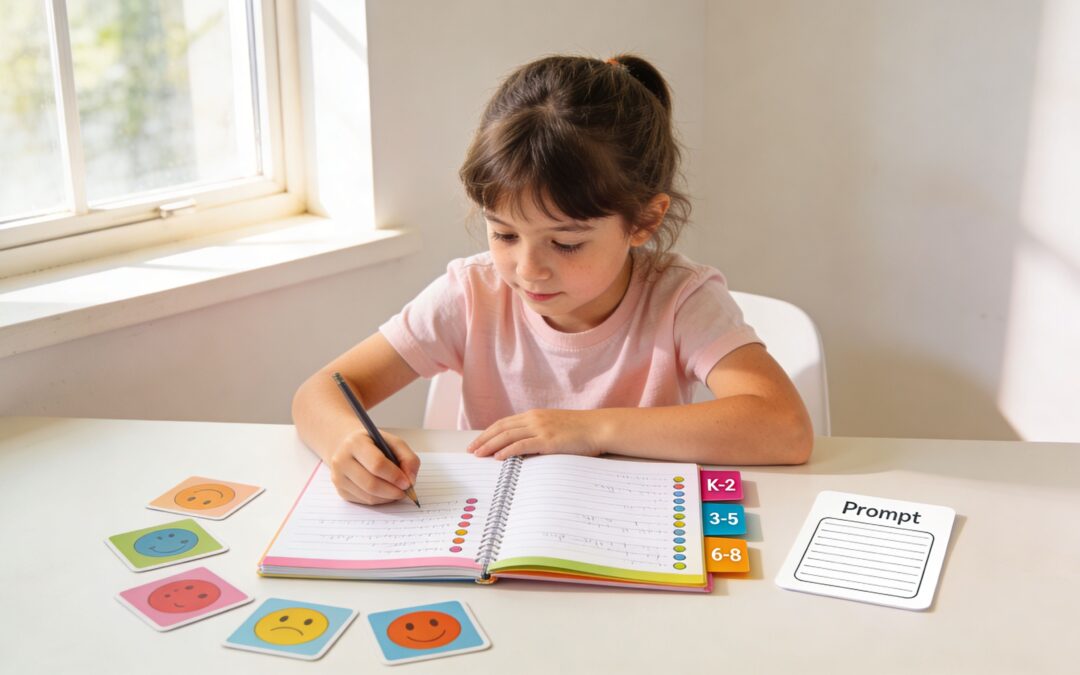
More than words. That’s what you’re dealing with when a student erases a drawing until the paper tears, or when a child knows an answer but won’t risk saying it out loud. Those moments often get labeled as perfectionism, shyness, or sensitivity. In practice, they’re often early signs of shaky self-worth.
That matters because self-esteem in girls can decline sharply in early adolescence. One summary of the research notes that girls’ self-esteem peaks around age 9, and body image satisfaction drops from 75 percent at ages 8 and 9 to 56 percent at ages 12 and 13, according to findings cited by Journal Buddies. By the teen years, body concerns and outside pressures can become even louder.
Praise helps, but praise alone is flimsy. Kids can become dependent on hearing “good job” and still crumble the moment something feels hard, awkward, or imperfect. Strong self-esteem grows from the inside out. It’s built through self-awareness, honest reflection, problem-solving, and the ability to recover after disappointment.
That’s where journaling earns its place. Structured prompts can support stress reduction, self-awareness, confidence, and perspective-taking, with benefits described in therapeutic writing research summarized by PositivePsychology’s journaling prompts guide. For teachers and parents, journaling also works because it’s flexible. You can use it in a morning meeting, after recess conflict, at counseling check-in, or as part of a bedtime routine.
The most effective self esteem journal prompts don’t ask kids to repeat empty positive phrases. They help children notice strengths, name values, process setbacks, and see proof of their own growth.
Below are eight journaling methods I’d use with K to 8 students. Each one serves a different psychological purpose, includes concrete examples, and works best when adults keep the tone steady, warm, and specific.
1. Daily Affirmations and Strengths Recognition
This is the simplest place to start, and it’s also the easiest place to get it wrong.
A lot of adults hand kids an affirmation like “I am amazing” and hope repetition will do the rest. Usually it doesn’t. Children trust evidence more than slogans. If the writing feels fake, they disengage fast.

Make affirmations concrete
The strongest affirmations are tied to real behavior.
A kindergartner who shared crayons can write, “I am a helpful friend because I shared my crayons today.” A 3rd grader might write, “My strength is persistence. I kept trying on my math page even when I felt stuck.” A middle school student can go further: “I handled a hard social moment calmly. I listened to my friend before giving advice.”
That shift matters. The child isn’t just claiming a trait. They’re identifying proof.
Practical rule: Never ask kids to write an affirmation without also asking, “What happened today that makes this true?”
In classrooms, I like sentence stems for younger or hesitant writers:
- I am good at: helping, drawing, listening, building, noticing, trying again
- I showed strength when: I kept going, told the truth, asked for help, included someone
- Today I’m proud of: one action, not a whole identity
What works and what doesn’t
What works is specificity, repetition, and adult modeling. A teacher can write on the board, “I am patient because I explained the directions again without rushing.” That gives students a believable model.
What doesn’t work is forcing intensity. Kids don’t need to declare that they love everything about themselves. They need language for noticing what’s sturdy in them.
A few practical supports help:
- Build a strengths bank: Post words like brave, thoughtful, persistent, creative, fair, calm, curious.
- Pair self and peer noticing: Let students write one strength they saw in themselves and one they saw in a classmate.
- Keep it short: Two sentences is enough if they’re honest.
If you want language students can borrow and adapt, Soul Shoppe’s post on positive affirmations for students is a useful companion.
2. Challenge Reflection and Problem-Solving Journal
Students build self-esteem faster from “I got through something hard” than from “I’m good at everything.”
That’s why challenge reflection is one of the most practical self esteem journal prompts you can use. It turns failure, conflict, and frustration into usable information.
Turn setbacks into evidence of capability
Younger students do well with an “Oops to Aha” format.
A 1st grader might write:
“Oops: My block tower kept falling.
Aha: I made the bottom wider.
Now I know: I can try a different plan.”
A 4th grader can handle more emotional detail:
“My challenge was working with a partner I didn’t know. I felt nervous and quiet. I asked what idea they wanted to start with. That helped us begin.”
A 7th grader can reflect on choices:
“I got a low quiz grade and blamed the teacher at first. If I’m honest, I didn’t review until the night before. Next time I’ll make a study plan and use my organization skills.”
That last sentence is the key. Reflection without a next step can become rumination.
A structure kids can repeat
Use the same few prompts each time:
- What happened: Name the challenge clearly.
- How I felt: Frustrated, embarrassed, left out, confused, angry, disappointed.
- What I did: The action taken, even if it was imperfect.
- What I learned: One takeaway.
- What I’ll try next: One concrete step.
Struggle is not a sign that a prompt failed. It’s often the exact material the child needs to work with.
What works here is normalizing challenge before asking students to reflect. Teachers can briefly share age-appropriate examples: “I mixed up our schedule this morning and had to regroup.” That lowers defensiveness.
What doesn’t work is turning journaling into a post-mistake punishment. If a child only writes after conflict or failure, they’ll start associating journaling with shame. Use it after challenges, yes, but also after recovery and repair.
For classrooms, anonymous “challenge examples” can help. A counselor or teacher can keep a folder of composite entries like “I felt left out at recess” or “I froze during a presentation” so students see that hard moments are common, not proof that something is wrong with them.
3. Values and Identity Exploration Journal
A student bombs a test, gets left out at lunch, or sees a friend get more attention online. By the end of the day, one quiet belief can take over: maybe I only matter when I perform, fit in, or look right.
Identity journaling interrupts that pattern. In this method, the goal is not just expression. It is helping kids build self-respect around values, roles, culture, character, and choice. That makes it a different tool from challenge reflection or affirmations. It helps children answer a steadier question: Who am I, even on an off day?
Help students define themselves beyond outcomes
For younger students, keep identity work concrete and visible. A 2nd grader might make a “Me Shield” with four sections:
- people who matter to me
- things I enjoy
- strengths I use
- one rule or belief I try to live by
That last section often tells you the most. A child who writes “Include others” or “Tell the truth” is starting to root identity in values.
Upper elementary students can connect values to behavior. A 5th grader might write, “I value honesty. I told my mom I broke the vase. I felt nervous, but I did what matches who I want to be.” That is fundamental work. The student is linking action, discomfort, and identity.
Middle school students are usually ready for contradiction and context. An 8th grader might write, “At home I’m funny and creative, but at school I stay quiet. I think I’m worried people will judge me.” That kind of entry gives adults something useful to respond to. It points to belonging pressure, not a lack of personality.
Use prompts that build identity language
Children often need words before they can reflect clearly. Give them a values menu and let them choose a few that feel true or aspirational: kindness, courage, creativity, fairness, loyalty, curiosity, responsibility, humor, faith, family, service, justice.
Then use prompts like these:
- Which value mattered most to you today?
- Where did your actions match that value?
- Where did they drift away from it?
- What part of yourself feels easy to show?
- What part do you keep private?
- Who are you with different people?
- What do you want to be known for?
This works especially well in grades 4 through 8, when students are trying on identities quickly and often publicly. Some children answer too fast with labels they think adults want to hear. Slow them down. Ask for a moment, not a slogan.
How to implement it well at home or in class
Use identity journaling once or twice a week, not every day. Daily use can make the writing feel forced, especially for students who are still figuring themselves out.
In classrooms, I recommend giving students choice in format. Some write paragraphs. Some sort value cards first. Some draw identity maps with circles for family, friends, school, interests, culture, and beliefs. If you want a related way to help students notice what matters in their lives, these gratitude activities for kids pair well with values work because they move children from vague feelings to specific meaning.
At home, parents can keep the conversation light but honest. “What felt most like you today?” usually gets a better response than “What are your values?” The trade-off is speed versus depth. Simpler questions get more participation. Richer questions produce better insight, but only when trust is already there.
What helps and what gets in the way
What helps is making room for layered identity. A child can be shy in class and loud with cousins. Athletic and artistic. Caring and still learning how to handle anger. Kids need to see that complexity is normal.
What gets in the way is turning identity work into branding. If adults push children to pick one neat answer to “who am I,” journaling starts to shrink them instead of helping them grow. Identity develops through repetition, testing, and revision.
As noted earlier in the article, concerns about appearance and outside approval can distort self-worth, especially for older students. That is why this journaling method matters. It gives kids another place to stand.
4. Gratitude and Appreciation Journaling
A 3rd grader has a hard recess, comes back upset, and writes, “Nothing good happened today.” That is the moment this journaling method earns its place. Gratitude and appreciation journaling helps children widen the frame enough to notice support, relief, effort, and small wins without denying what hurt.

Used as a self-esteem tool, gratitude is not a feel-good list. It trains attention. Children who regularly fixate on mistakes, exclusion, or comparison need practice spotting what supported them, what mattered, and what they contributed themselves. That shift can build steadier self-worth because the child starts to see, “My day was hard, and I still noticed care, choice, and strength.”
Specificity matters. “I’m grateful for my family” is a start, but “I’m grateful my dad waited with me before school because I was nervous” gives the brain something real to hold onto. The same is true at school. “I’m grateful my friend shared a swing at recess because I felt left out” is stronger than a vague list item. So is self-appreciation: “I’m grateful I took three breaths instead of yelling.”
That last category is easy to skip. I do not recommend skipping it. If gratitude only points outward, some children learn to appreciate everyone except themselves.
For younger students, keep the method concrete and brief. A kindergarten or 1st grade journal can use “Three Good Things” with pictures and a few dictated words. A 3rd or 4th grader can finish the stem “I appreciated ___ because ___.” Middle school students usually benefit from a two-part entry: one thing they received, one thing they did.
A better prompt set than “What are you grateful for?”
The prompt shapes the depth of the answer. Rotate the lens so the practice stays active:
- Support: Who helped you today, and what did they do?
- Moment: What felt calm, fun, or meaningful?
- Self: What did you handle well, even if it was small?
- Body and senses: What did you notice that made the day easier or better?
- Repair: What got better after a hard moment?
The word “because” often does the heavy lifting. Without it, many entries stay shallow.
There is also a real trade-off here. Daily gratitude can become performative if adults push it too hard or use it to shut down disappointment. A child who says, “I’m still mad,” should not be corrected into gratitude on command. The practice works better after the feeling is acknowledged. Then journaling can help the child add complexity: “I was angry after lunch, and I was also grateful my teacher checked on me.”
For classroom use, this method works well in advisory, morning meeting follow-up, calm-down corners, or Friday reflection. For home use, a shared notebook by the dinner table or bedside usually gets better follow-through than a formal workbook. Families and teachers who want more hands-on extensions can pair this section with these gratitude activities for kids that help children notice specific moments of care and joy.
Used consistently, gratitude and appreciation journaling becomes a resilience tool. It helps children record evidence that good experiences, caring relationships, and personal effort are still present, even on days that do not feel easy.
5. Growth Mindset and Learning Journey Journal
Monday morning, a student stares at a page and says, “I’m just bad at this.” By Friday, that same student may still find the work hard, but the journal can help them say something more accurate: “I used a different strategy, and part of it worked.”
That shift matters. This method builds self-esteem by helping children separate identity from current performance. In this toolkit of eight journaling approaches, the growth mindset journal is the tool for resilience under challenge. It teaches students to track progress, strategy, and recovery after mistakes.

Help students record change they can actually see
Children rarely build confidence from praise alone. They build it from evidence.
A 1st grader can tape in two handwriting samples and finish the sentence, “In September I needed help with ____. Now I can ____ on my own.” A 5th grader might write, “Flashcards were not enough for multiplication facts. Skip-counting and a partner game helped more.” In middle school, the reflection can get more precise: “I still get nervous in science, but asking one question before labs helped me understand the directions.”
Those examples do more than sound positive. They document process. That is the difference between empty encouragement and useful self-belief.
Use prompts that connect effort to strategy
Students need language they can use during hard moments, not just after success. Prompts like these work well:
- What felt hard today, specifically?
- What strategy did I try first?
- What changed after I got stuck?
- What mistake showed me what to practice next?
- What can I say instead of “I’m bad at this”?
- What is one sign I know more today than I did last week?
For younger students, keep it concrete and brief. “One thing I can do now is…” works better than abstract reflection. For grades 4 through 8, add comparison prompts and revision notes so students can examine how learning changed over time.
I usually recommend a weekly “learning journey” page with three parts: what improved, what still feels shaky, and what strategy to try next. That structure is simple enough for follow-through and strong enough to show patterns across a month or grading period.
Protect the journal from becoming fake positivity
There is a real trade-off here. Growth mindset language helps, but it can also irritate students if adults use it as a script instead of support.
A child who hears “just keep trying” after repeated frustration often feels misunderstood. The journal works better when adults acknowledge the barrier and then guide reflection: “What part is confusing?” “What have you already tried?” “What support would help?” Self-esteem grows when students feel competent and honest, not when they are pushed to sound optimistic.
That is why “yet” needs a companion. “I can’t do this yet” should lead to “My next step is…” Without that second part, the phrase becomes classroom wallpaper.
Match the method to age and setting
In K to 2, use drawings, stickers, sentence stems, and before-and-after work samples. In grades 3 to 5, students can track strategies across subjects and notice which ones help. In grades 6 to 8, the journal can include revision reflections, test corrections, project checkpoints, and short entries about persistence, planning, and asking for help.
For teachers, this aligns well with SEL goals around self-awareness, self-management, and responsible decision-making. For parents, it works best after homework, music practice, sports, or any moment where frustration tends to show up quickly. A short entry is enough if it captures one challenge, one action, and one next step.
Visible artifacts strengthen the practice. Keep drafts, corrected work, reading logs, and goal check-ins together so students can review their own evidence. If you want ready-to-use classroom extensions, Soul Shoppe’s growth mindset activities for kids that stick pair well with this journal routine.
Used consistently, this journal helps children build a more durable kind of confidence. They stop asking, “Am I smart at this?” and start asking, “What helps me learn this?”
6. Peer Feedback and Compliment Collection Journal
Some students cannot name a single strength in themselves, even when everyone around them can see several.
A compliment journal helps bridge that gap. It gives children a place to collect evidence from real relationships. Not flattery. Observations.
Teach students to gather useful feedback
For younger students, this can be very simple. A kind note gets taped into a journal with a quick drawing of how it felt to receive it.
In 4th grade, I’d use structured sentence frames during class meeting:
“I noticed you…”
“You helped me by…”
“I appreciate your…”
Then students reflect in writing:
“Maria said I was a good leader because I made sure everyone had a job in our group.”
In 7th grade, a monthly review works well:
“I noticed people often say I’m funny and easy to talk to. I don’t usually think of that as a strength, but maybe it is.”
That reflection step is where the confidence grows. Otherwise students just collect compliments without integrating them.
Protect the process from becoming performative
This method can backfire if it turns into a popularity contest. The fix is structure.
Use brief routines like:
- Compliment circles: Every student both gives and receives.
- Specific praise only: No “you’re nice.” Ask for actions.
- Private collection options: Some kids don’t want public attention.
- Home-school connection: Invite one note a week from a caregiver or sibling.
A 2020 Journal of Consumer Research study found that low self-esteem can shape choices in self-verifying ways, including a tendency to choose options that align with negative self-views, as discussed in the study abstract and article page. In school terms, students sometimes reject positive evidence because it clashes with the story they already believe about themselves. That’s why compliment journaling needs repetition. One kind note won’t usually override a negative self-concept.
“I notice you waited for me when I was behind” is stronger than “You’re a good friend.”
What works is helping students ask, “What strength does this feedback reveal?” Leadership, humor, patience, courage, fairness, creativity, reliability. Give them words for what they’re collecting.
What doesn’t work is vague praise, public pressure, or sarcasm disguised as humor. Adults need to teach feedback carefully and monitor the tone.
7. Self-Compassion and Inner Friend Journal
Many students talk to themselves in ways they would never use with another human being.
“I’m so stupid.”
“No one likes me.”
“I ruin everything.”
If those thoughts go unchallenged, journaling can accidentally become a place where self-criticism gets rehearsed instead of softened. That’s why self-compassion prompts matter.
A useful video can help introduce the idea before writing: