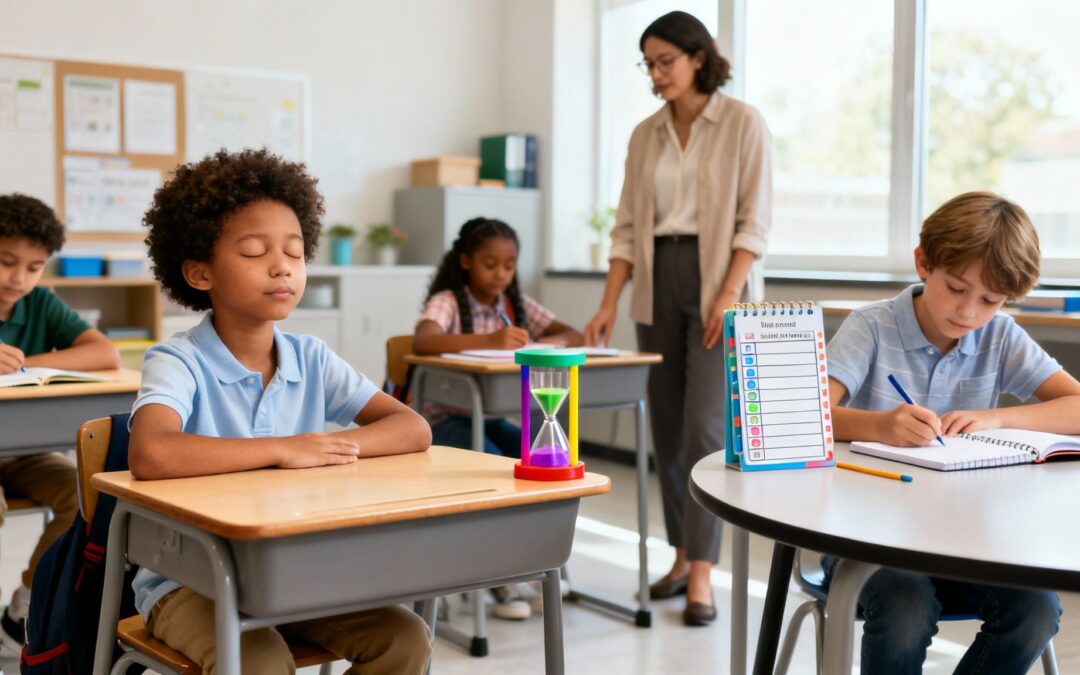
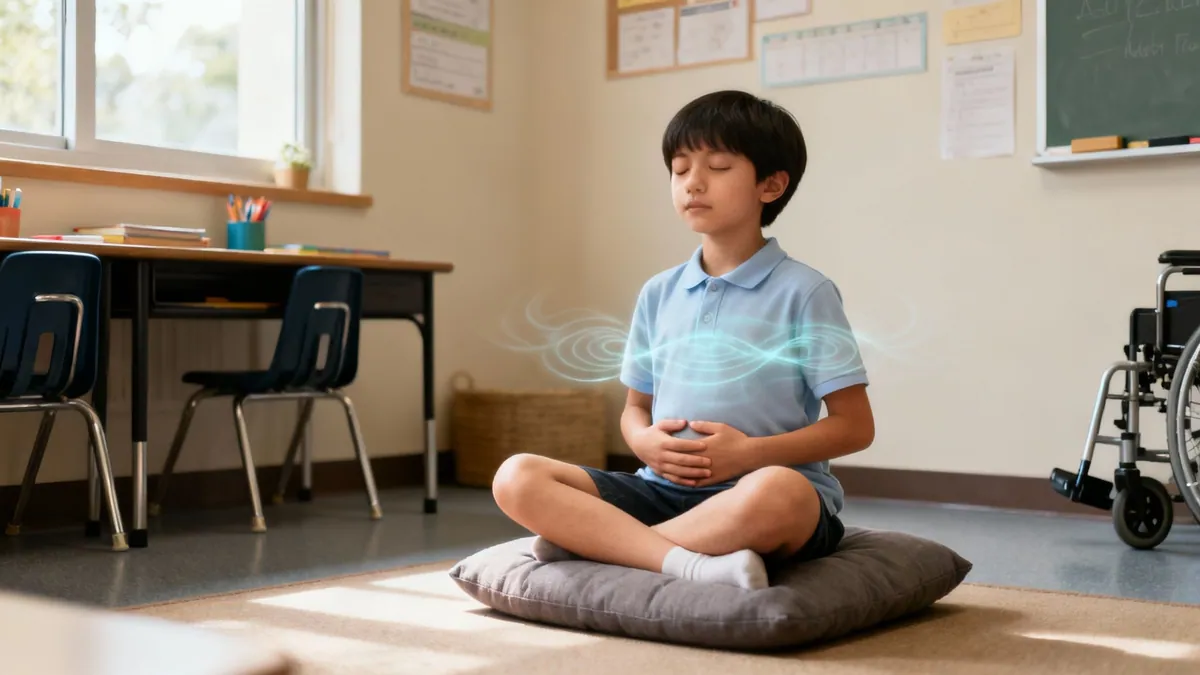
In a busy classroom or a bustling home, the ability to manage emotions, thoughts, and behaviors is more than just a skill-it’s a superpower. Self-regulation is the internal rudder that helps students navigate challenges, from a frustrating math problem to a disagreement with a friend. It’s the foundation upon which academic success, healthy relationships, and lifelong well-being are built. But this crucial ability doesn’t always develop on its own. Students need explicit guidance, consistent practice, and a toolbox filled with effective self regulation strategies for students to handle the ups and downs of school and life.
This article moves beyond generic advice to provide a comprehensive roundup of 10 evidence-informed strategies designed for K-8 learners. For each technique, we will provide practical, actionable steps that educators and parents can implement immediately. You’ll find age-appropriate examples, clear implementation guides for both classroom and home settings, and even sample language to use when introducing these concepts. We will also touch on the rationale behind each strategy and suggest ways to measure its impact, ensuring you can see the positive changes in action. For a holistic approach to student development, personalized executive function coaching can significantly strengthen organization, focus, and time management, fostering lifelong self-regulation habits. Let’s equip our students with the tools they need not just to learn, but to thrive.
1. Mindfulness and Breathing Techniques
Mindfulness is the practice of paying attention to the present moment on purpose, without judgment. When paired with intentional breathing, it becomes one of the most powerful and accessible self regulation strategies for students. These techniques activate the body’s parasympathetic nervous system, the “rest and digest” system, which counteracts the fight-or-flight stress response.
This foundational practice helps students create a crucial pause between a trigger and their reaction, allowing them to observe their feelings and choose a more thoughtful response. Research consistently shows that even brief mindfulness exercises can reduce student anxiety, improve focus, and build essential emotional regulation skills.
How to Implement It
For Younger Students (K-3): Make it tangible and playful.
Practical Example: Use a pinwheel and ask them to “spin the wheel slowly with your breath” to see how slow and steady their exhale can be.
Practical Example: Have them lie down with a stuffed animal on their belly and “rock the animal to sleep” with slow, deep belly breaths.
For Older Students (4-8): Introduce structured techniques like Box Breathing.
Practical Example: Guide them to trace a square on their desk with their finger: trace up for a 4-second inhale, trace across for a 4-second hold, trace down for a 4-second exhale, and trace back for a 4-second hold.
Tips for Success
Start Small: Begin with just one to two minutes of focused breathing. Consistency is more important than duration.
Teach During Calm: Introduce these skills when students are relaxed and regulated. This ensures they can access the strategy more easily when they are feeling stressed or overwhelmed.
Use Cues: Link the practice to a specific time, like after recess or before a test. A simple chime or “mindfulness bell” can serve as a consistent auditory cue to begin.
Why It Works: These practices directly interrupt the physiological stress cycle. Slow, deep breathing sends a signal to the brain that the environment is safe, lowering heart rate and blood pressure, which allows the prefrontal cortex (the thinking part of the brain) to come back online. For more ideas on integrating this into your daily routine, explore these calming activities for the classroom on soulshoppe.org.
2. Self-Talk and Positive Affirmations
Self-talk is the internal dialogue students use to make sense of their world and manage their emotions. By intentionally guiding this inner voice, students can use positive affirmations to reframe challenges, build confidence, and counteract negative thinking spirals. This cognitive strategy is foundational to developing a growth mindset, which is crucial for academic and social resilience.
When students learn to replace self-critical thoughts like “I can’t do this” with encouraging statements like “I can try a different way,” they are actively building the mental pathways for self-regulation. This practice empowers them to take control of their emotional responses rather than being controlled by them, turning moments of frustration into opportunities for growth.
How to Implement It
For Younger Students (K-3): Create “I am” or “I can” jars.
Practical Example: Have students write or draw simple affirmations on slips of paper (e.g., “I am a good friend,” “I can ask for help”) and pull one out each morning to read aloud. Link affirmations to characters in stories who overcame challenges.
For Older Students (4-8): Introduce the concept of a “thought swap.”
Practical Example: A student thinks, “I’m going to fail this test.” A parent or teacher can help them swap it to, “I studied for this test and I will do my best.” Have them write these affirmations on sticky notes for their binders, desks, or bathroom mirror at home.
Tips for Success
Co-Create Statements: Work with students to develop affirmations that feel authentic to them. Imposed statements are less likely to be adopted.
Keep it Present Tense: Encourage powerful, present-tense language like “I am capable” instead of future-oriented phrases like “I will be capable.”
Normalize the Process: Acknowledge that changing internal dialogue feels awkward at first. Model your own positive self-talk out loud when you face a minor challenge in the classroom.
Why It Works: This strategy is rooted in Cognitive-Behavioral Therapy (CBT) principles, which show that our thoughts directly influence our feelings and behaviors. By consciously changing their cognitive patterns, students can interrupt the cycle of negative emotion and choose a more regulated, productive response. This builds internal agency and is a core component of many self regulation strategies for students.
3. Goal-Setting and Action Planning
Goal-setting involves identifying specific objectives and creating a clear roadmap to achieve them. This powerful strategy transforms overwhelming challenges into manageable steps, teaching students vital executive functions like planning, organization, and persistence. By setting and working toward their own goals, students develop a strong sense of agency and self-efficacy, boosting intrinsic motivation.
This process helps students understand the direct link between their actions and outcomes. When they see tangible progress toward a personally meaningful objective, they learn to regulate their impulses and focus their energy productively, making it one of the most effective self regulation strategies for students who struggle with long-term projects or motivation.
How to Implement It
For Younger Students (K-3): Keep goals short-term and highly visual.
Practical Example: A student might set a goal to “read for 10 minutes every night this week.” Create a simple sticker chart where they add a sticker for each night they complete their reading, providing an immediate sense of accomplishment.
For Older Students (4-8): Introduce the S.M.A.R.T. (Specific, Measurable, Achievable, Relevant, Time-bound) goal framework.
Practical Example: A vague goal is “get better at math.” A S.M.A.R.T. goal is: “I will improve my math test score from a 75% to an 85% on the next unit test by completing all homework and attending after-school tutoring once a week for the next four weeks.”
Tips for Success
Model the Process: Share a simple personal or classroom goal you are working on. Talk through your plan, the obstacles you face, and how you adjust your strategy.
Use Visual Trackers: Employ goal ladders, progress bars on a whiteboard, or digital dashboards to make progress visible and motivating.
Celebrate the Effort: Acknowledge and praise the process, not just the final outcome. Celebrate milestones and the resilience shown when overcoming setbacks.
Connect to Interests: Help students create goals tied to their passions, such as mastering a new drawing technique or learning three new songs on an instrument.
Why It Works: Goal-setting activates the brain’s reward system. Each small success on the path to a larger goal releases dopamine, reinforcing the behavior and building momentum. This practice shifts a student’s focus from a reactive, short-term mindset to a proactive, forward-thinking one, which is the very foundation of self-regulation. The CASEL framework highlights goal-setting as a core competency for responsible decision-making.
4. Emotion Identification and Labeling (Emotional Vocabulary)
This strategy involves teaching students to recognize, name, and understand their emotions with greater precision. Moving beyond basic terms like ‘happy,’ ‘sad,’ or ‘mad,’ students build a richer emotional vocabulary to distinguish between related feelings, such as feeling annoyed versus furious, or nervous versus terrified. This skill, often called emotional granularity, is a cornerstone of effective self-regulation.
When students can accurately label what they are feeling, they create a cognitive space between the emotional trigger and their reaction. This pause allows the thinking part of their brain to engage, transforming a powerful, overwhelming feeling into a manageable problem to be solved. As pioneered by researchers like Marc Brackett, developing this vocabulary is a fundamental step toward building emotional intelligence.
How to Implement It
For Younger Students (K-3): Use highly visual and concrete tools.
Practical Example: Use an “Emotion Wheel” with expressive faces for daily check-ins. Ask, “Point to the face that shows how you’re feeling this morning.” Read stories like The Color Monster by Anna Llenas that link feelings to colors, and ask students, “What color are you feeling today?”
For Older Students (4-8): Introduce more nuanced vocabulary and feeling scales.
Practical Example: Instead of just “angry,” offer words like “frustrated,” “irritated,” “annoyed,” or “enraged.” Ask students to rate their frustration on a scale of 1-10 to help them understand emotional intensity.
Tips for Success
Connect to Body Sensations: Help students link feelings to physical sensations. Ask, “Where do you feel that worry in your body? Is it a knot in your stomach or tight shoulders?”
Model It Consistently: Adults should narrate their own feelings in a regulated way. For example, “I’m feeling a little frustrated that the projector isn’t working, so I’m going to take a deep breath before I try again.”
Validate All Feelings: Emphasize that all emotions are valid and okay to feel. The focus is on choosing helpful behaviors in response to those emotions, not on suppressing the feelings themselves.
Why It Works: Naming an emotion activates the prefrontal cortex, which helps to calm the amygdala (the brain’s emotional alarm system). This “name it to tame it” approach reduces the intensity of the emotional response, giving students greater control. Understanding how to manage emotions is a critical life skill. You can learn more about how to manage emotions in a positive way on soulshoppe.org.
5. Physical Activity and Movement Breaks
Structured physical activity and strategic movement breaks are powerful self regulation tools that reduce stress hormones, increase endorphins, and improve focus. Movement helps students process emotions physically, expend excess energy, and return to learning with better concentration and mood. This strategy recognizes the essential mind-body connection in development, providing an outlet for built-up tension or fatigue that can lead to dysregulation.
This approach is one of the most effective self regulation strategies for students because it directly addresses physiological needs. By engaging the body, students can reset their brains, making it easier to re-engage with academic tasks. Educational neuroscience research confirms that exercise boosts blood flow to the brain, enhancing cognitive functions like memory and attention.
How to Implement It
For Younger Students (K-3): Use guided “brain break” videos from platforms like GoNoodle for short, energetic bursts of activity.
Practical Example: Integrate movement into transitions by having students hop like frogs to the rug, walk like a T-Rex to line up, or stretch like cats before starting a new lesson.
For Older Students (4-8): Introduce more complex movement sequences like chair yoga or structured fitness circuits.
Practical Example: Before a test, lead a 3-minute session of desk stretches: neck rolls, shoulder shrugs, and reaching for the sky. Or, offer a “movement menu” where students can choose from a list of approved activities like stretching, walking a lap in the hallway, or doing desk push-ups.
Tips for Success
Schedule Proactively: Don’t wait for dysregulation to happen. Schedule movement breaks before challenging subjects, after long periods of sitting, or during transition times.
Vary Activities: Offer both calming movements (slow stretching, yoga) and energizing activities (dancing, jumping jacks) to match the classroom’s energy level and needs.
Make it Inclusive: Ensure all activities can be modified for students with different physical abilities so that everyone can participate successfully.
Use Music: Pair movement with upbeat or calming music to signal the start and end of the break and influence the mood.
This approach transforms mindfulness into a dynamic experience. In many special education classrooms, for instance, teachers use mindful movement to support sensory regulation and help students channel their physical energy constructively.
When to Use Mindful Movement
This activity is excellent for releasing pent-up energy, improving focus, and fostering a positive classroom climate. It is particularly useful:
As a brain break: To re-energize students and reset attention during long instructional periods.
During P.E. class: To introduce a non-competitive physical activity focused on self-awareness.
To start the day: To help students arrive in their bodies and prepare their minds for learning.
How to Implement Mindful Movement
Guide students through a sequence of simple, child-friendly poses or movements. Frame the activity with a story or theme to keep them engaged, such as pretending to be different animals or moving like elements in nature (a flowing river, a strong mountain).
Practical Example: “Mountain to Star”
“Let’s all stand up tall and strong like a mountain. Feel your feet planted firmly on the ground. Take a deep breath in. Now, as you breathe out, jump your feet apart and stretch your arms out wide like a sparkling star! Breathe in, and jump back to Mountain Pose. Let’s do that three times.”
Implementation Tips:
Make it Playful: Use animal names for poses like “Downward Dog” or “Cat-Cow.” Create a story around the movements, such as a “journey through the jungle.”
Offer Choices: Empower students by offering variations. For example, “You can be a tall, still tree or a tree swaying in the breeze.”
Start Short: Begin with 5-10 minute sessions and gradually increase the duration as students build stamina and interest.
Normalize All Bodies: Emphasize that every body is a “yoga body.” Model and celebrate effort over perfect form, ensuring all students feel successful and included.
4. Mindful Listening Circles
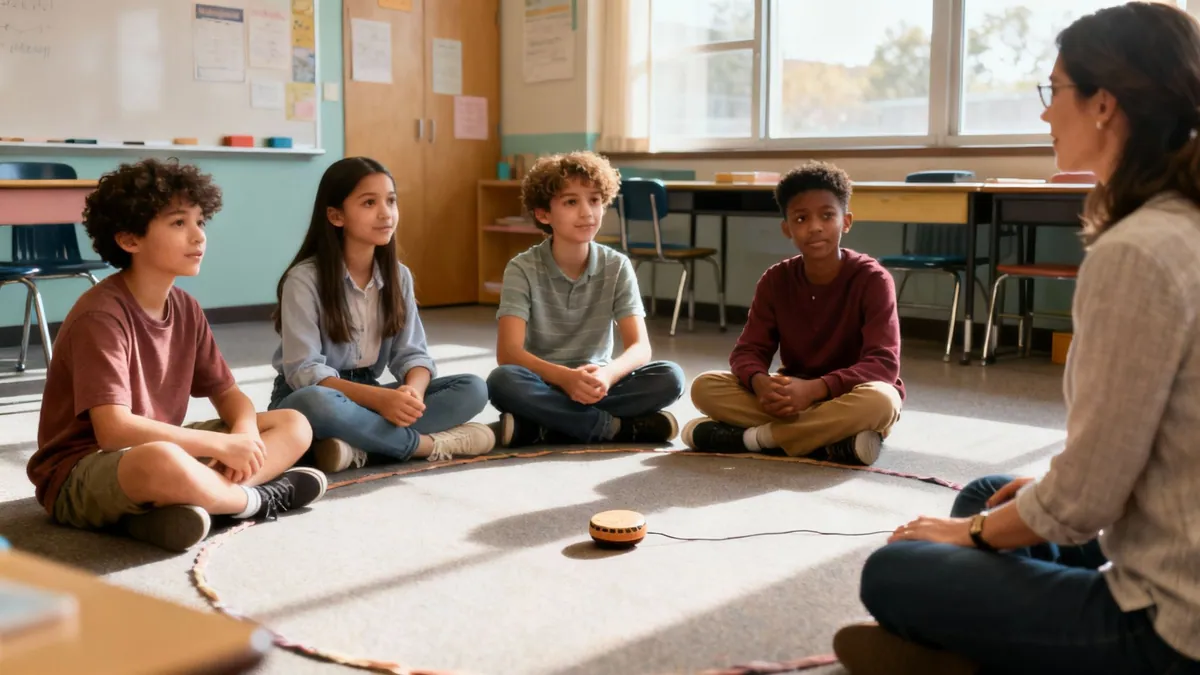
Mindful Listening Circles are structured group conversations where students practice deep, non-judgmental listening and authentic speaking. This powerful format often uses a “talking piece” to ensure only one person speaks at a time, creating a safe space for every voice to be heard and valued. It’s one of the most effective mindfulness activities for students to build empathy, community, and psychological safety.
This practice is central to programs like Soul Shoppe, which use circles to foster connection and teach essential social-emotional skills. You can learn more about developing these foundational abilities with listening skills activities for your classroom.
When to Use Mindful Listening Circles
This activity is ideal for building community and addressing social dynamics. It is particularly useful for:
Morning meetings: To check in with students and set a positive tone for the day.
Conflict resolution: To repair harm and find solutions after a disagreement.
Advisory or homeroom periods: To build a strong sense of belonging and team identity.
How to Implement Mindful Listening Circles
Gather students in a circle where everyone can see each other. Introduce a talking piece (a small, special object) and explain that only the person holding it may speak. Pose a prompt and pass the talking piece around the circle.
Practical Example Prompt:
“Our talking piece today is this smooth stone. When you are holding the stone, I invite you to share one ‘rose’—a happy moment from your weekend—and one ‘thorn’—a moment that was a little tricky. Remember, you can always pass if you don’t feel like sharing.”
Implementation Tips:
Establish Agreements: Co-create clear rules with students, such as “listen with respect,” “speak from the heart,” and “what’s said in the circle stays in the circle.”
Use a Talking Piece: This simple tool naturally teaches turn-taking and prevents interruptions, ensuring all students get an opportunity to share.
Honor the Right to Pass: Always give students the option to pass if they are not ready to share. This builds trust and safety.
Start with Light Prompts: Begin with simple, fun questions like, “What is one thing that made you smile today?” before moving to deeper topics. This helps students feel comfortable with the format.
5. Mindful Eating & Food Awareness
Mindful Eating & Food Awareness is a sensory-focused practice where students use all their senses to experience their food. Instead of eating on autopilot, they are guided to notice the colors, textures, aromas, and tastes, which grounds them in the present moment and helps them develop a healthier, more appreciative relationship with what they consume. This is one of the most accessible mindfulness activities for students as it can be integrated into daily routines like snack or lunch time.
This practice encourages students to slow down, listen to their body’s hunger and fullness cues, and build gratitude for their food. It turns a simple meal into a rich sensory experience and a moment for focused attention.
When to Use Mindful Eating
This activity is perfect for building routine mindfulness and teaching self-regulation around food. It is especially useful:
During snack time: To create a calm, focused break in the day.
In health or science class: To connect with lessons on nutrition, agriculture, or the five senses.
At the beginning of lunch: To set a calm tone in a typically chaotic cafeteria environment.
How to Implement Mindful Eating
Start with a single, simple food item like a raisin, a strawberry, or a small cracker. Guide students through a sensory exploration before they even take a bite.
Practical Example with a Raisin:
“Today we’re going to be food scientists with this one raisin. First, let’s just look at it. Notice its wrinkly lines. Now, feel it between your fingers. Is it squishy or hard? Next, hold it under your nose and take a sniff. What does it smell like? Now, place it in your mouth but don’t chew yet! Just notice how it feels on your tongue. Finally, take one very slow bite and see what flavors you discover.”
Implementation Tips:
Engage All Senses: Guide students to look at the food’s colors and shapes, feel its texture, smell its aroma, and listen to any sounds it makes before tasting it slowly.
Start with One Bite: Challenge them to take just one slow, mindful bite, noticing all the flavors and sensations as they chew.
Cultivate Gratitude: Prompt students to think about where the food came from: the plant, the farmer, the truck driver, and the grocery store.
Focus on Nutritious Choices: Choosing wholesome snacks makes the experience more impactful. For more inspiration, you can explore fun and healthy snack ideas for students.
Be Allergy-Aware: Always be mindful of student allergies and dietary restrictions, providing safe and inclusive options for everyone.
6. Loving-Kindness Meditation (Metta Practice)
Loving-Kindness Meditation, also known as Metta Practice, is a heart-centered mindfulness activity where students actively cultivate compassion. They silently repeat phrases of goodwill, first for themselves, then for loved ones, neutral people, and eventually even those with whom they have difficulty. This practice directly strengthens empathy, reduces negative self-talk, and fosters a more connected and caring classroom community.
This activity is especially useful for building community and addressing social-emotional challenges. It is a powerful tool to use:
During conflict resolution: To help students shift from anger to a more open-hearted perspective.
To start the day: As a morning meeting activity to set a positive, empathetic tone for the school day.
Within anti-bullying initiatives: To help students develop compassion for others and understand the impact of their actions.
How to Implement Loving-Kindness Meditation
Ask students to sit comfortably and close their eyes if they wish. Guide them to silently repeat a few simple phrases, directing the kind wishes inward first, then outward.
Practical Example Script:
“Let’s find a comfy seat. You can put a hand on your heart if you like. First, let’s send some kind wishes to ourselves. Silently in your mind, say: ‘May I be happy. May I be healthy. May I be safe.’ Now, think of someone you care about, like a family member or a friend. Picture them in your mind and send them the same wishes: ‘May you be happy. May you be healthy. May you be safe.'”
Implementation Tips:
Simplify Phrases: For younger students, use simple phrases like, “May I be happy. May I be safe.” Then, guide them to say, “May you be happy. May you be safe,” while thinking of a friend.
Start with the Easy: Begin by directing kindness toward oneself and then to people who are easy to love (family, pets, close friends) before moving toward more challenging relationships.
Acknowledge Difficulty: Model that it’s okay if it feels hard to send kind wishes to certain people. Emphasize that the goal is the intention, not a specific feeling.
Set Clear Boundaries: Reassure students that wishing someone well does not mean condoning harmful behavior. It is a practice for their own heart, not for excusing others’ actions.
7. Mindful Creative Expression & Journaling
Mindful Creative Expression combines art (coloring, drawing, painting) and reflective journaling into a nonjudgmental practice. These activities support emotional regulation and self-expression, offering an essential outlet for students who may struggle to share their feelings verbally. This approach helps students process emotions and develop metacognition in a safe, creative space.
This method provides a tangible way for students to explore their inner world. It allows them to give form to abstract feelings like joy, frustration, or sadness, making these emotions easier to understand and manage.
When to Use Mindful Creative Expression
This versatile practice is ideal for promoting introspection and emotional processing. It can be used:
During morning meetings: To set a positive intention for the day through gratitude journaling or drawing.
For conflict resolution: To help students reflect on a situation by drawing or writing about their perspective.
As a calm-down corner activity: To provide a self-soothing, constructive outlet for big emotions.
How to Implement Mindful Creative Expression
Establish a quiet, supportive environment where students feel safe to create without judgment. Provide a variety of materials and let students choose their preferred medium, whether it’s crayons, clay, or a simple notebook.
Practical Example: “Drawing Your Feelings”
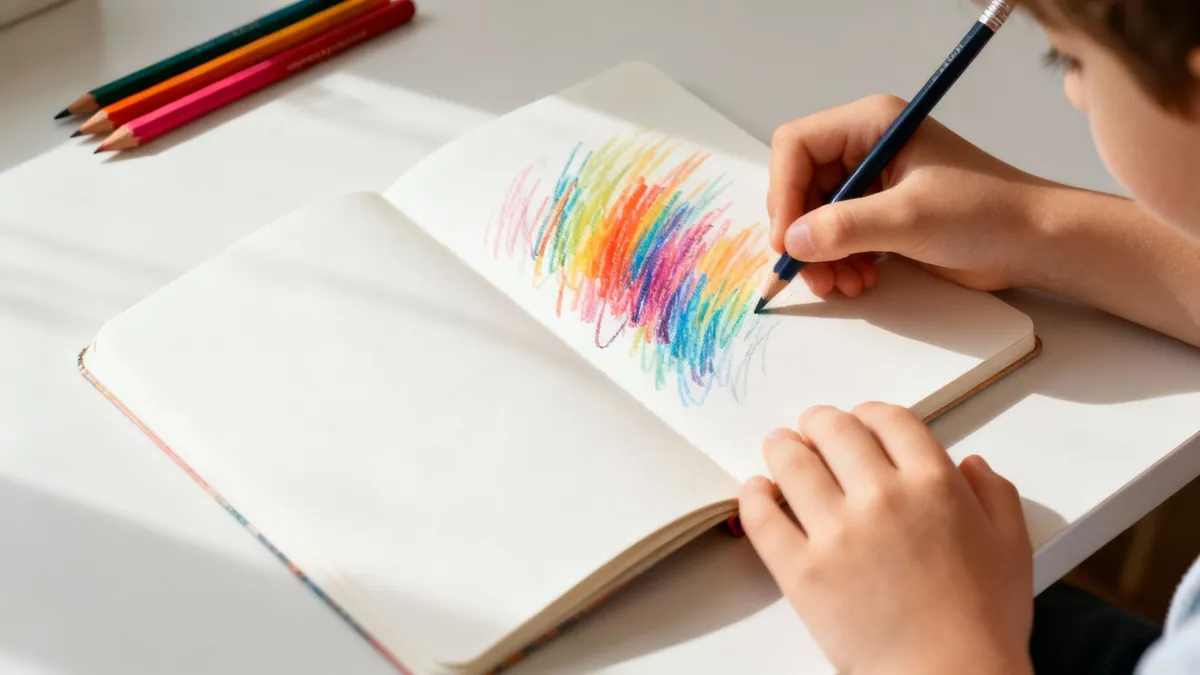
“Let’s check in with ourselves. What feeling is inside you right now? Is it a sunny yellow feeling? A stormy gray feeling? A calm blue feeling? You don’t have to draw a face or a person. Just choose the colors and shapes that feel like your feeling today and scribble them onto the paper.”
Implementation Tips:
Emphasize Process Over Product: Remind students, “There is no right or wrong way to create.” The goal is expression, not a perfect art piece.
Use Sentence Starters: For students who need more structure, provide prompts like, “Today I felt…” or “I feel proud when…”
Offer Drawing Alternatives: For pre-writers or students who prefer visuals, allow doodling or drawing in response to journal prompts.
Ensure Privacy and Respect: Never grade or correct journals. Create a culture where this work is seen as a personal reflection tool, not an assignment to be evaluated.
Mindful Observation invites students to slow down and use their senses to explore an object with focused curiosity. By closely examining a natural item like a leaf or a piece of artwork, students anchor their attention in the present moment, noticing details they might otherwise overlook. This practice cultivates a sense of wonder and appreciation while strengthening concentration skills.
This sensory-based approach is a tangible way to introduce mindfulness. It provides a concrete focal point, making it one of the most accessible mindfulness activities for students who may struggle with more abstract concepts like watching their breath.
When to Use Mindful Observation
This activity is excellent for grounding students and sharpening their focus, especially when transitioning between subjects. It’s an ideal tool to use:
During science lessons: To enhance nature study and encourage detailed scientific observation.
As a writing prompt: To inspire descriptive language and creative thinking before a writing task.
After a disruptive event: To calmly redirect group energy and re-establish a peaceful classroom environment.
How to Implement Mindful Observation
Begin by giving each student a simple object, like a smooth stone, a flower petal, or a seashell. Ask them to become “curiosity detectives” and investigate the object using only their senses.
Practical Example with a Leaf:
“Today, you are a nature detective and this leaf is your clue. First, use your detective eyes. What is the exact color? Do you see tiny lines, like roads on a map? Now, gently use your sense of touch. Is it smooth, waxy, or fuzzy? Be a detective and find one tiny detail you’ve never noticed before on a leaf.”
Implementation Tips:
Start with Sight: Prompt them with questions like, “What tiny lines or patterns do you see?” or “Notice all the different shades of color on your object.”
Engage Other Senses: Guide them to explore texture by asking, “How does it feel in your hand-is it smooth, rough, or bumpy?” If appropriate, you can also explore smell.
Use a Timer: Set a timer for 3-5 minutes to help students sustain their focus without feeling overwhelmed.
Encourage Sharing: After the observation, invite students to share one new thing they noticed. This fosters a non-judgmental atmosphere and values each student’s unique perspective.
9. Mindful Walking & Movement Meditation
Mindful Walking & Movement Meditation is an active practice that combines gentle physical movement with focused awareness. Students walk slowly and deliberately, paying full attention to the sensation of each step, their breath, and their surroundings. This activity is particularly beneficial for students with high energy needs, as it channels their physical energy into a grounding and calming exercise.
This method transforms everyday movement into an opportunity for mindfulness. By focusing on the physical act of walking, students learn to quiet their minds and connect with their bodies in the present moment, making it a powerful tool for self-regulation.
When to Use Mindful Walking
This is one of the most versatile mindfulness activities for students because it can be integrated into existing routines. Use it to:
During classroom transitions: Turn hallway walks into a quiet, orderly practice.
For movement breaks: Offer a structured alternative to free-play that helps reset focus.
Before challenging activities: Use a slow walk to calm nerves and center attention before a test or presentation.
During outdoor time: Leverage nature trails or school gardens for a multisensory experience.
How to Implement Mindful Walking
Ask students to walk at a much slower pace than usual, either in a line or following a designated path. Guide their attention to the physical sensations of movement.
Practical Example for Hallway Transitions:
“As we walk to the library, let’s try ‘turtle walking.’ We’re going to walk so slowly and quietly that no one would even know we’re here. Pay attention to your feet. Feel your heel touch the ground, then the middle of your foot, then your toes. See if you can walk the entire way to the library without your mind wandering off.”
Implementation Tips:
Start Slow and Short: Begin with a brief, 2-3 minute walk at a very slow pace to help students focus on the details of each movement.
Guide their Attention: Use simple verbal cues like, “Notice how your foot feels as it lifts off the ground,” or “Feel the floor beneath your shoes.”
Anchor with Phrases: Connect breath to movement with phrases like, “Breathing in, I take a step. Breathing out, I take a step.”
Create a Path: Use tape on the floor or a clear route outdoors to provide a simple structure for the walk, preventing distraction and keeping the group contained.
Normalize the Practice: Incorporate mindful walking into regular routines, like the walk to the library or cafeteria, to make it a familiar and expected part of the day.
10. Gratitude & Appreciation Practices
Gratitude practices guide students to mindfully notice and appreciate the positive elements in their lives. This activity shifts focus from what’s wrong to what’s right, encompassing people, experiences, and simple pleasures. Cultivating gratitude helps build resilience, fosters a sense of belonging, and promotes a positive classroom culture.
This powerful practice is more than just saying “thank you”; it’s about internalizing appreciation for the good things, big and small. By making gratitude a regular habit, we teach students to find joy in the everyday, which is a core skill for emotional well-being. To explore this topic further, Soul Shoppe offers valuable insights into what gratitude means for kids.
When to Use Gratitude Practices
This activity is versatile and can be used to set a positive tone, build community, or reframe a challenging day. It is particularly effective:
During morning meetings: To start the day with a positive and appreciative mindset.
At the end of the day or week: To reflect on positive moments and end on a high note.
To build classroom culture: Appreciation circles can strengthen peer relationships and reduce conflict.
How to Implement Gratitude & Appreciation Practices
Begin by introducing the concept of gratitude in simple terms. Ask students to think of one small thing that made them smile that day. This makes the idea accessible and less overwhelming.
Practical Example: “Gratitude Popcorn”
“Let’s end our day with some Gratitude Popcorn. I’ll start by sharing one small thing I’m grateful for today. I’m grateful for the sun shining during recess. As soon as I’m done, anyone who has something they’re grateful for can ‘pop up’ and share it. We won’t all go at once, just one at a time, like popcorn popping in a machine.”
Implementation Tips:
Start Specific: Guide students with specific prompts, such as, “I’m grateful for the way my friend shared their crayons with me,” or “I appreciate the sunny weather at recess.”
Model Authentically: Share your own genuine gratitude. Students can spot inauthenticity, so your sincere example is crucial.
Create a Gratitude Wall: Dedicate a bulletin board where students can post notes or drawings of things they are thankful for, creating a visual reminder of positivity.
Balance with Reality: Acknowledge that it’s okay to have tough days. Gratitude doesn’t mean ignoring challenges; it means finding good things even when life is hard.
Putting It All Together: Weaving Mindfulness into Your School’s DNA
Throughout this guide, we’ve explored a rich collection of mindfulness activities for students, from the quiet stillness of the Body Scan Meditation to the shared connection of Mindful Listening Circles. Each practice, whether it’s Mindful Breathing, Mindful Movement, or Gratitude Journaling, offers a unique pathway for young learners to develop crucial life skills. These are not just isolated exercises; they are building blocks for a more self-aware, regulated, and empathetic generation.
The core takeaway is that integrating these practices is less about adding a new subject and more about cultivating a new way of being. The true power of mindfulness unfolds through consistency and authentic modeling. When students see educators and caregivers participating with genuine intention, they learn that these tools are for everyone, not just for moments of crisis but for everyday well-being.
Your Actionable Next Steps
Making these mindfulness activities for students a sustainable part of your environment requires a thoughtful, gradual approach. Don’t feel pressured to implement all ten practices at once. Instead, consider these practical starting points:
Start Small and Build Momentum: Choose one or two activities that feel most accessible and relevant to your students’ needs. Perhaps you begin each morning with three rounds of “Belly Breathing” or dedicate five minutes after recess to a Mindful Listening Circle. Consistency is more impactful than variety in the beginning.
Create a Shared Language: Use mindfulness vocabulary consistently. Words like “anchor breath,” “noticing,” and “non-judgmental” can become part of your classroom’s daily lexicon, providing students with the language to articulate their internal experiences.
Integrate, Don’t Isolate: Weave these practices into your existing routines. A Mindful Observation exercise can be a 3-minute transition before a science lesson. A Mindful Eating practice can transform a routine snack time into a moment of sensory awareness and gratitude. This shows students that mindfulness is a tool for all parts of life.
Lead with Empathy and Patience: Remember, the goal is not perfect silence or flawless execution. The goal is practice. Celebrate effort over outcome, creating a safe space where students feel comfortable exploring their inner worlds without fear of getting it “wrong.”
The Lasting Impact of a Mindful School Culture
By championing these mindfulness activities for students, you are investing in skills that extend far beyond academic success. You are equipping them with the tools to navigate anxiety, manage conflict, cultivate empathy, and build resilience in the face of life’s inevitable challenges. A classroom grounded in these principles becomes a calmer, more focused, and more connected learning community.
This journey transforms not only the students but the educators as well. As you guide these practices, you are also nurturing your own sense of presence and well-being. This creates a positive feedback loop, where a more centered adult fosters a more centered environment for children to thrive. Ultimately, you are not just teaching mindfulness; you are building a foundation for lifelong emotional intelligence and compassionate action.
Ready to move from individual activities to a fully integrated, school-wide social-emotional learning program? Soul Shoppe provides comprehensive, evidence-based programs that embed mindfulness, empathy, and conflict resolution into the very fabric of your school’s culture. Explore how Soul Shoppe can partner with you to create a safer, more connected learning community for every student and educator.
In a world that often feels disconnected, fostering strong social-emotional skills is no longer a ‘nice-to-have’—it’s essential for academic success and lifelong well-being. Educators and parents are constantly seeking effective ways to help children navigate complex social landscapes, from the playground to the classroom. The challenge isn’t a lack of will, but finding practical, engaging, and proven strategies that stick.
This guide moves beyond theory to provide a comprehensive roundup of 10 powerful kids social skills activities designed for K-8 learners. Each activity is a building block for creating environments of empathy, cooperation, and resilience. Whether you’re a teacher structuring a lesson, a counselor leading a group, or a parent looking for at-home tools, this resource offers a clear roadmap.
Here, you will find a curated collection of actionable strategies organized by skill. We will cover everything from communication and conflict resolution to emotional regulation and cooperation. For each activity, we provide:
Step-by-step instructions for easy implementation.
Age-appropriate adaptations for grades K-8.
Real-world examples to see the skills in action.
Classroom and home adaptations for flexible use.
Drawing from decades of experience in social-emotional learning, like our work at Soul Shoppe, we’ll equip you with the specific tools needed to cultivate a thriving, connected community where every child feels they belong. Let’s dive into the activities that will transform your learning environment.
1. Circle Time / Community Circles
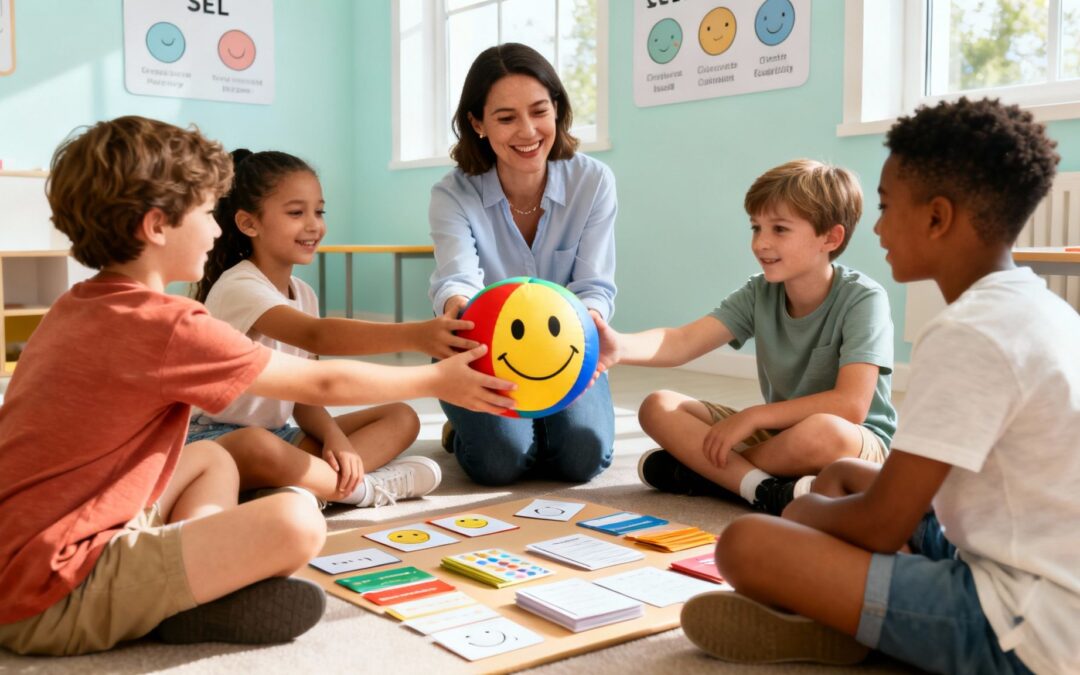
Circle Time, also known as Community Circles, is a foundational practice among kids social skills activities. It involves a structured gathering where children and a facilitator sit in a circle to share thoughts, feelings, and experiences in a safe, non-judgmental environment. This simple yet powerful format fosters a sense of belonging, builds trust, and develops essential active listening skills. The predictable structure creates a feeling of psychological safety, allowing even hesitant children to participate over time.
This practice is highly effective because it directly teaches turn-taking, respectful listening, and empathy. The core principle is that everyone has a voice and every voice deserves to be heard without interruption.
Why It Works
Community circles are a cornerstone of social-emotional learning (SEL) programs and are central to approaches like Responsive Classroom and Restorative Practices. They work by creating a dedicated time and space for connection, which is often lost in a busy academic day. The circle format itself is symbolic, communicating equality and unity where no single person has a more prominent position.
This activity directly addresses key SEL competencies such as self-awareness (identifying and sharing feelings), social awareness (listening to and understanding others’ perspectives), and relationship skills (communicating clearly and building positive connections).
How to Implement It
Establish Clear Agreements: Before starting, co-create circle rules with the children. Examples include: “We listen with our hearts,” “What’s said in the circle stays in the circle,” and “We respect the talking piece.”
Use a Talking Piece: Introduce an object like a special stone, ball, or stuffed animal. Only the person holding the object can speak. This simple tool is incredibly effective at managing turns and preventing interruptions.
Start with Low-Stakes Prompts: Begin with simple, fun questions to build comfort.
Practical Example (K-2): “If you were a superhero, what would your kindness power be?”
Practical Example (3-5): “Share one moment this week when someone was kind to you.”
Practical Example (6-8): “What’s one goal you have for this week, and how can the group support you?”
Model and Guide: As the facilitator, model active listening by making eye contact, nodding, and asking thoughtful follow-up questions when appropriate.
This practice is highly adaptable, from brief 10-minute morning check-ins in a kindergarten classroom to deeper, problem-solving restorative circles in middle school. To dive deeper into establishing these routines, explore these ideas for building community in the classroom.
2. Role-Playing and Perspective-Taking Scenarios
Role-Playing and Perspective-Taking Scenarios are dynamic, structured activities where children act out various social situations. This method allows them to safely explore complex interactions like friendship conflicts, peer pressure, or moments of exclusion. By stepping into different roles, participants practice empathy and develop practical communication and problem-solving skills in a low-stakes environment.
This play-based approach is powerful because it bridges the gap between knowing what to do and actually doing it. It leverages imaginative learning to build social-emotional resilience and prepare kids for real-life challenges.
Why It Works
Role-playing is a core component of proven SEL curricula like the Second Step program and is used in character education and bullying prevention initiatives. It works by making abstract social concepts concrete and memorable. Instead of just talking about being a good friend, children get to practice it. This experiential learning helps internalize social skills more effectively than passive instruction.
This activity directly targets key SEL competencies, particularly social awareness (understanding others’ perspectives and emotions) and responsible decision-making (evaluating consequences and choosing constructive actions). It also enhances relationship skills by equipping children with a toolkit of potential responses for difficult situations.
How to Implement It
Select a Relevant Scenario: Choose a situation that is relatable to your students.
Practical Example (K-2): A student wants to play with a toy that another student is using. How can they ask for a turn?
Practical Example (3-5): A student sees a classmate being left out of a game on the playground. What could they say or do?
Practical Example (6-8): A friend is pressuring you to share a secret about another classmate. How do you say no respectfully?
Assign Roles and Explain the Goal: Clearly define each role. You might have one child practice asking to join a game, while others act as the group playing. State the objective, such as “Our goal is to find a kind way to include someone.”
Act Out the Scenario: Let the children act out the scene. Avoid interrupting unless necessary. Observe their choices and communication styles.
Pause, Reflect, and Re-do: After the first run-through, lead a discussion. Ask questions like, “How did it feel to be in that role?” and “What could we try differently?” Then, allow the children to re-do the scene using new strategies.
These kids social skills activities are incredibly versatile and effective for building confidence and compassion. To learn more about the foundational skills involved, explore these strategies for teaching empathy to kids and teenagers.
3. Cooperative Games and Team Challenges
Cooperative games and team challenges are play-based kids social skills activities where groups work together toward a shared objective rather than competing against one another. This approach intentionally shifts the focus from winning or losing to collaboration, collective problem-solving, and communication. Games like building a bridge with limited materials or navigating a “minefield” blindfolded with verbal cues build trust and create positive peer relationships.
These activities are powerful because they put social skills into immediate practice. Children learn to negotiate roles, share ideas, and support teammates in a fun, low-stakes environment, emphasizing inclusion and equal participation.
Why It Works
Pioneered by figures like Terry Orlick and integrated into programs like Project Adventure, cooperative play directly addresses the need for belonging and contribution. By removing the element of individual competition, these games lower social anxiety and allow children to practice essential skills without the fear of personal failure. The shared goal creates an instant “team” dynamic, promoting empathy and understanding.
This approach is excellent for developing key SEL competencies, including relationship skills (teamwork, communication, social engagement) and responsible decision-making (working with others to solve problems and achieve a common goal). It teaches children that collective success is often more rewarding than individual victory.
How to Implement It
Set the Stage: Clearly explain the objective and emphasize that the goal is to succeed together. Use inclusive language like, “Our team’s mission is to…” instead of “You need to…”
Start Small: Begin with simple, non-physical challenges like “Group Count,” where the team tries to count to 10 with each person saying one number at random without interrupting another. This builds comfort and establishes the collaborative mindset.
Ensure Meaningful Roles: Structure the activity so every child has a necessary part to play.
Practical Example: In a challenge to build the tallest tower out of spaghetti and marshmallows, assign roles: a “Lead Architect” who helps the team decide on a design, a “Materials Manager” who distributes the supplies, and several “Builders” who construct the tower.
Debrief and Reflect: The most critical step is the post-activity discussion. Ask guiding questions: “What was challenging for our team?” “What did we do well together?” “What would we do differently next time?” This reflection is where the social learning is solidified.
These activities are highly adaptable, from a simple “Human Knot” game on the playground to more complex engineering challenges in the classroom. They are particularly effective for integrating new students or rebuilding a positive classroom culture.
4. Mindfulness and Self-Regulation Practices
Mindfulness and Self-Regulation Practices are kids social skills activities focused on teaching children how to manage their emotions, focus their attention, and respond to stress. Through simple techniques like breathing exercises, body scans, and guided meditation, children learn to notice their internal state without immediate judgment or reaction. This creates a crucial pause between feeling an emotion and acting on it, building the foundation for emotional awareness and control.
These evidence-based practices are vital because they equip children with internal tools to navigate social challenges. A child who can notice they are feeling angry is better equipped to choose a calm response instead of lashing out.
Why It Works
Mindfulness directly strengthens the prefrontal cortex, the part of the brain responsible for executive functions like impulse control and emotional regulation. Popularized by figures like Jon Kabat-Zinn and Daniel Goleman, and integrated into programs like Soul Shoppe’s workshops and Conscious Discipline, these practices make abstract concepts tangible. They give children a “how-to” guide for managing their inner world.
This activity directly supports key SEL competencies like self-management (managing stress, controlling impulses) and self-awareness (identifying emotions, recognizing strengths). By building these internal skills, children are better prepared to engage in positive social interactions.
How to Implement It
Start Small and Consistent: Begin with just one to two minutes of a simple breathing exercise each day.
Practical Example (K-2): Use “Flower and Candle” breathing. “Smell the flower” (breathe in through the nose) and “blow out the candle” (breathe out through the mouth).
Practical Example (3-8): Practice “Box Breathing”: inhale for four counts, hold for four, exhale for four, and hold for four.
Use Simple, Concrete Language: Guide children with clear instructions. For a body scan, you might say, “Notice how your feet feel on the floor. Are they warm? Are they tingly? Just notice.” This makes the experience accessible.
Model Authentically: Participate in the practice yourself. When you model calmness and focus, you show children that this is a valuable tool for everyone, not just a task for them to complete.
Connect to Emotions: Explicitly link the practice to real-life situations. Say, “When you feel that big wave of frustration before a math test, remember your ‘Box Breathing.’ It can help you feel more in control.”
These practices are incredibly versatile, from a “breathing buddy” (stuffed animal on the belly) for a kindergartener to using apps like Calm for a middle schooler’s advisory period. To learn more about these foundational skills, explore these techniques for teaching children how to self-soothe.
5. Peer Mentoring and Buddy Systems
Peer Mentoring and Buddy Systems are powerful kids social skills activities that pair older or more socially adept students with younger or less confident peers. This structured partnership creates a supportive, one-on-one relationship where positive social behaviors are modeled and practiced in a natural context. The goal is to build leadership, empathy, and responsibility in the mentor while providing friendship and a positive role model for the mentee.
This approach is highly effective because it leverages the influence of peers, which can often be more impactful than adult guidance for certain children. It creates authentic connections that strengthen the entire school community, reduce feelings of isolation, and promote a culture of kindness and support.
Why It Works
Buddy systems are rooted in the principles of social learning theory, where children learn by observing and imitating others. When a younger student sees an older “buddy” navigate a social situation successfully, it provides a tangible, relatable example to follow. These programs are cornerstones of bullying prevention and school climate initiatives, creating a network of support that permeates the campus.
This activity directly enhances key SEL competencies such as relationship skills (building positive connections, teamwork) and social awareness (developing empathy, appreciating diverse perspectives). Mentors develop responsible decision-making by taking their role seriously, while mentees gain confidence and a stronger sense of belonging.
How to Implement It
Train Your Mentors: Provide clear training for older buddies.
Practical Example: Role-play with mentors on how to start a conversation with their younger buddy. Give them a list of “go-to” questions like, “What’s your favorite thing to do at recess?” or “Tell me about a book you’re reading.”
Make Thoughtful Pairings: Match students based on shared interests, personalities, and needs. A quiet, artistic older student might be a perfect match for a shy younger child who loves to draw. Avoid pairing based only on academic performance.
Provide Structure: Don’t just leave them to figure it out. Plan specific, low-pressure activities to get them started, like a cross-age buddy reading session, a shared craft project, or a “get to know you” scavenger hunt.
Facilitate and Supervise: Regularly check in with both mentors and mentees separately to see how the relationship is going. Provide guidance and support to the mentors if they encounter challenges. Recognize their contributions to build motivation and a sense of pride.
6. Emotion Recognition and Feelings Charts
Emotion recognition activities and visual tools like feelings charts are fundamental kids social skills activities designed to help children identify, name, and understand the complex world of emotions. Using tools such as emotion cards, feeling thermometers, or daily mood check-ins, students build an essential emotional vocabulary. This practice teaches them that all feelings are valid, which is a critical first step toward managing them effectively.
This approach is highly effective because it makes the abstract concept of feelings concrete and accessible. By giving children the language to express their internal states, it empowers them to communicate their needs, develop empathy for others, and build a foundation for self-regulation.
Why It Works
Based on the principles of emotional intelligence popularized by Daniel Goleman and frameworks like The Zones of Regulation, these activities directly build social-emotional competencies. They create a classroom culture where feelings are acknowledged and discussed openly rather than suppressed. This practice demystifies emotions and reduces the shame often associated with challenging feelings like anger or sadness.
This activity directly supports key SEL competencies, including self-awareness (accurately identifying one’s emotions), social awareness (recognizing emotions in others), and self-management (learning to regulate emotional responses). It provides a shared, non-judgmental language for the entire community to use.
How to Implement It
Introduce a Visual Tool: Start with a simple, age-appropriate feelings chart or “emotion thermometer.” Display it prominently in the classroom or home. For younger kids, use faces with clear expressions; for older students, introduce more nuanced vocabulary.
Establish a Daily Check-In: Integrate a mood check-in into a consistent routine, like the morning meeting.
Practical Example: At the start of the day, have students place a clothespin with their name on the feeling that best matches their current state on a large chart. This gives the teacher a quick, non-verbal snapshot of the room’s emotional climate.
Model Authenticity: As the adult, share your own feelings in a regulated way. For example, “I am feeling a little frustrated because the projector isn’t working, so I am going to take a deep breath.”
Connect Feelings to Sensations: Help children notice the physical signs of their emotions. Ask questions like, “Where do you feel that anger in your body? Do you have tight fists or a hot face?” or “What does excitement feel like for you? A bubbly feeling in your stomach?”
This practice normalizes emotional expression and provides the tools needed for healthy coping strategies.
7. Conflict Resolution and Peer Mediation Programs
Conflict Resolution and Peer Mediation Programs are structured processes that empower students to resolve their own disputes constructively. Instead of relying on adult intervention and consequences, trained peer mediators guide their classmates through a communication protocol that includes active listening, identifying feelings, and collaborative problem-solving. This approach transforms conflict from a disruptive event into a valuable learning opportunity, building crucial life skills.
These programs are highly effective because they give students ownership over their problems and solutions. By learning to navigate disagreements respectfully, children develop agency, empathy, and the communication tools needed to maintain positive relationships, significantly reducing behavioral incidents over time.
Why It Works
Peer mediation is a powerful application of Restorative Practices and is a core component of programs like Peace Builders and Conflict Wise. It works by shifting the focus from blame and punishment to understanding and repair. The process is built on the idea that students are capable of understanding each other’s perspectives and finding mutually agreeable solutions when given the right framework.
This activity directly targets advanced SEL competencies, including relationship skills (practicing constructive conflict resolution), responsible decision-making (analyzing situations and generating solutions), and social awareness (taking others’ perspectives and showing empathy). The peer-led model also builds leadership skills and a sense of collective responsibility within the school community.
How to Implement It
Train Peer Mediators: Select and train a group of students in core mediation principles. This training should cover confidentiality, neutrality, active listening, and the steps of the mediation process.
Establish a Clear Process: Define the steps for mediation. A common model includes: introductions and ground rules, each person sharing their perspective without interruption, identifying common interests and needs, brainstorming solutions, and creating a written agreement.
Teach Core Communication Tools: Central to mediation is the use of “I-statements” to express feelings without blame.
Practical Example: Instead of “You’re so annoying for talking during the movie,” teach a child to say, “I feel frustrated when I hear talking during the movie because I can’t hear the story.”
Explore how to teach this skill with resources on the magic of I-feel statements for kids.
Define When Mediation is Appropriate: Clearly communicate that mediation is for peer-level conflicts (e.g., disagreements over games, rumors, misunderstandings) and is not suitable for situations involving bullying, harassment, or safety concerns, which require adult intervention.
By embedding these kids social skills activities into the school culture, you create a system where students see conflict not as a crisis, but as a solvable problem they are equipped to handle together.
8. Collaborative Art and Building Projects
Collaborative Art and Building Projects are dynamic, play-based kids social skills activities where children work together to create a single, shared outcome. From class murals to complex LEGO structures, these tasks require children to communicate, negotiate, and solve problems as a team. The focus is placed on the process of working together rather than the final product, fostering a sense of shared ownership and belonging.
This approach is highly effective because it moves social skills from theory to practice in a tangible, low-stakes context. Success depends entirely on cooperation, compromise, and the ability to value and integrate diverse ideas, making it a powerful vehicle for developing group cohesion.
Why It Works
Grounded in experiential and project-based learning, collaborative projects create an authentic need for social interaction. Unlike individual assignments, these activities make cooperation a non-negotiable part of the task. Children learn firsthand that sharing ideas, delegating roles, and navigating disagreements leads to a better outcome for everyone involved.
These activities directly target key SEL competencies, particularly relationship skills (communicating effectively, practicing teamwork) and responsible decision-making (working constructively with others, solving problems together). The hands-on nature of the work keeps children engaged while they naturally practice essential social behaviors.
How to Implement It
Set Clear Collaborative Goals: Before starting, define the shared objective and establish agreements on how decisions will be made. For example, “Our goal is to build a tower that is at least two feet tall, and we will vote on design ideas before we start building.”
Assign or Rotate Roles: To ensure equitable participation, define roles that cater to different strengths.
Practical Example: For a class mural project, one group could be the “Background Painters,” another the “Detail Artists,” and a third the “Lettering Team.” This ensures everyone has a clear and valued contribution.
Use Prompts That Require Teamwork: Design the challenge so no single child can complete it alone. For example, provide a limited set of materials that must be shared or create a task that is physically too large for one person.
Debrief the Process: After the project is complete, facilitate a reflection. Ask questions like, “What was the hardest part about working together?” or “What is one thing our team did really well?” to reinforce the social learning.
This strategy is incredibly versatile, working for everything from a 20-minute block-building challenge in first grade to a semester-long community garden project in middle school. The key is to celebrate the collaborative journey just as much as the final masterpiece.
9. Social Skills Coaching and Direct Instruction
Social Skills Coaching and Direct Instruction involves the explicit, structured teaching of specific social competencies. Unlike skills that children might absorb incidentally, this approach breaks down complex social interactions into manageable steps that are modeled, practiced, and reinforced. It’s a targeted strategy for ensuring all students, especially those who struggle with social cues, build a strong foundation for positive relationships.
This method is highly effective because it treats social skills like academic skills: they can be taught, practiced, and mastered. It provides clear, concrete language and strategies for navigating social situations like joining a group, asking for help, or handling disagreements, making it one of the most essential kids social skills activities for systematic support.
Why It Works
Direct instruction demystifies social expectations that can often seem unwritten or intuitive. By making the “hidden curriculum” of social interaction visible and teachable, it empowers students with confidence and a toolkit for success. This approach is a core component of many evidence-based Social-Emotional Learning (SEL) programs and is particularly beneficial for students who need more than just exposure to develop their social awareness.
This practice directly addresses key SEL competencies such as self-management (using coping skills), social awareness (taking others’ perspectives), and relationship skills (communicating effectively and resolving conflicts). By teaching the “how-to” behind these skills, educators can move from correcting social missteps to proactively building social competence.
How to Implement It
Break It Down: Deconstruct a complex skill into smaller, teachable parts. For “joining a game,” the steps might be: 1. Watch the game, 2. Find a natural pause, 3. Ask a friendly question, and 4. Accept the answer gracefully.
Model and Think Aloud: Demonstrate the skill correctly and incorrectly.
Practical Example: Act out how to join a group. First, do it in a disruptive way (e.g., interrupting loudly). Then, model the correct steps and use a “think-aloud” script: “Okay, they are in the middle of a point. I’ll wait until it’s over before I walk up. Now is a good time. I’ll smile and say, ‘This looks fun, can I join next round?'”
Use Guided Practice: Create low-stakes role-playing scenarios in a safe environment. Give students a chance to practice the skill with a partner or in a small group before trying it in a real-world situation like the playground.
Provide Specific Feedback: Offer feedback that is behavioral and encouraging. Instead of “Good job,” say, “I noticed you made eye contact and smiled when you asked to join. That was very welcoming.”
This targeted instruction can be delivered in various formats, from whole-class lessons using curricula like Second Step to small-group interventions led by a school counselor. For a deeper look at research-based, experiential instruction, explore how Soul Shoppe’s programs utilize direct teaching within engaging workshops.
10. Kindness and Gratitude Practices
Kindness and Gratitude Practices are a set of intentional kids social skills activities designed to shift focus from self to others. These routines involve regularly noticing and expressing appreciation through thank-you notes, compliment circles, or “random acts of kindness” challenges. This deliberate practice helps build positive peer relationships, fosters a stronger sense of belonging, and actively develops prosocial behaviors. It transforms kindness from an abstract concept into a visible, tangible part of the community culture.
These activities are powerful because they train the brain to look for the good in others and in daily situations. Consistently engaging in gratitude and kindness can directly counteract negative social dynamics like exclusion and bullying, creating a more positive and supportive environment for everyone.
Why It Works
Grounded in research from positive psychology and organizations like the Greater Good Science Center, these practices are proven to enhance well-being, empathy, and social connection. When children learn to articulate what they appreciate in others, they strengthen their social awareness by recognizing others’ positive contributions. Expressing this appreciation builds crucial relationship skills, teaching them how to offer genuine, specific praise.
The reciprocal nature of kindness creates an upward spiral of positive interaction. When one child receives a compliment or a thank-you note, they are more likely to “pay it forward,” amplifying the positive effects. This makes kindness a proactive strategy for building community, not just a reactive one for solving problems.
How to Implement It
Start a Gratitude Circle: Dedicate a few minutes at the end of the day or week. Go around the circle and have each child share one thing they are grateful for or one person they want to appreciate. Model specificity: instead of “Thanks to Maya,” say, “I appreciate Maya for helping me pick up my crayons when I dropped them.”
Create a Kindness Wall: Designate a bulletin board where students can post thank-you notes or “kindness sightings.” This makes positive actions visible to the entire community and encourages peer-to-peer recognition.
Launch a Kindness Challenge: Introduce a “Random Acts of Kindness” challenge for a week.
Practical Example: Give students a “bingo card” with simple, achievable acts of kindness, such as “Hold the door for someone,” “Invite someone new to play,” “Give a genuine compliment to a classmate,” or “Help a teacher without being asked.”
Model Authenticity: Your own modeling is crucial. Acknowledge acts of kindness you observe throughout the day and express your own gratitude genuinely. Ensure the practice feels authentic, not like a forced requirement.
Kids Social Skills Activities — 10-Item Comparison
Explicit social skills acquisition, measurable gains
Targeted small groups, students needing explicit support
Systematic, evidence-based, transferable skills
Kindness & Gratitude Practices
Low (easy routines)
Minimal (time, prompts, materials)
Improved climate, prosocial behavior, belonging
Whole-class culture building, school rituals
Low-cost, quick positive impact on climate
Putting It All Together: Building a Culture of Connection, One Activity at a Time
We’ve explored a comprehensive toolkit of kids social skills activities, from the foundational trust built in Community Circles to the complex problem-solving of Peer Mediation. Each activity, whether it’s a cooperative game or a quiet moment of mindfulness, serves as a single, powerful thread. When woven together consistently, these threads create a strong, resilient fabric of social and emotional intelligence that can support children throughout their entire lives.
The journey of fostering these crucial skills isn’t about one-off lessons or occasional interventions. It’s about fundamentally shifting the environment to one where empathy, communication, and respect are the default settings. It’s about transforming a classroom or a home into a living laboratory for social learning, where mistakes are seen as opportunities for growth and every interaction is a chance to practice.
Key Takeaways for Lasting Impact
Reflecting on the ten core activities, several themes emerge as essential for success:
Consistency is Crucial: A daily Feelings Chart check-in or a weekly Gratitude Practice has a far greater impact than a single, isolated social skills assembly. Repetition builds neural pathways and makes these skills second nature, not just a concept learned once.
Practice Over Preaching: Children learn social skills best by doing. Role-playing a conflict is more instructive than a lecture on “I-statements.” Engaging in a collaborative art project teaches teamwork more effectively than a worksheet on cooperation.
Integration is Everything: The most powerful social learning happens when it’s embedded into the daily routine. To truly foster a culture of connection and collaboration, it’s essential to integrate a variety of engaging student-centered learning activities that naturally encourage social interaction. A science project can become a lesson in cooperative problem-solving, and a history discussion can be an exercise in perspective-taking.
Your Actionable Next Steps
Feeling inspired but not sure where to begin? Don’t try to implement everything at once. The goal is sustainable change, not overwhelming yourself or your children.
Start Small and Specific: Choose just one or two activities that resonate with you and address an immediate need. If mornings are chaotic, perhaps start with a 2-minute mindfulness breathing exercise. If playground squabbles are common, introduce a simple conflict resolution script.
Model the Skills Yourself: Your actions are the most powerful lesson. Demonstrate active listening when your child speaks, use “I-feel” statements to express your own emotions, and openly practice gratitude. Children are keen observers; let them see these skills in authentic, everyday use.
Create a Predictable Routine: Schedule your chosen kids social skills activities into the day or week. For example, make “Community Circle Fridays” a special event to look forward to, or designate the first five minutes after lunch for quiet self-regulation practices. Predictability creates psychological safety, making children more receptive to learning and participating.
By intentionally providing these structured opportunities for practice, you are not just teaching children how to be “nice.” You are equipping them with the essential architecture for building healthy relationships, navigating complex social landscapes, managing stress, and developing a core sense of self-worth and belonging. You are empowering them to become confident, compassionate, and capable individuals who can contribute positively to every community they join. This is the profound, lasting value of investing in social and emotional learning, one activity at a time.
Ready to move beyond individual activities and build a comprehensive, school-wide culture of empathy and respect? Soul Shoppe provides dynamic, interactive programs and tools that bring social-emotional learning to life, reducing bullying and empowering students with skills for a lifetime. Explore how Soul Shoppe can partner with your school to create a community where every child feels safe, valued, and connected.
In today’s complex world, academic knowledge alone isn’t enough for students to succeed. The ability to understand emotions, build healthy relationships, and make responsible decisions, the core of social-emotional learning (SEL), is paramount. Yet, educators and parents often ask: What does this look like in practice? How do we move from theory to tangible, daily activities that build these critical skills?
To fully grasp the scope and benefits of these activities, it’s helpful to begin with a clear understanding of what is social emotional learning and its foundational principles. This guide provides a direct answer to the practical “how-to” by offering a comprehensive roundup of 10 research-backed social emotional learning activities designed for the modern K-8 classroom and adaptable for home use.
This is not a list of abstract ideas. Each activity is presented as a complete toolkit, offering:
Clear, step-by-step instructions to ensure easy implementation.
Practical examples and scenarios to bring concepts to life.
Differentiation strategies to meet diverse student needs.
Adaptations for both home and digital learning environments.
We will explore how these practices, aligned with the five core SEL competencies, can transform your classroom climate, reduce behavioral issues, and equip students with the tools they need to navigate their world with empathy and resilience. Let’s dive into the actionable strategies that create not just better students, but more connected and self-aware human beings.
1. Mindful Breathing & Body Scan Practice – Self-Awareness & Self-Regulation
This foundational practice combines two powerful mindfulness techniques: guided breathing and a systematic body scan. Students learn to use their breath as an anchor to the present moment and develop interoceptive awareness, the ability to notice internal body sensations. This combination is a cornerstone of effective social emotional learning activities, empowering students to recognize and manage their physiological responses to stress, anxiety, or excitement.
The goal is not to eliminate feelings but to observe them without judgment. By tuning into sensations like a tight jaw or a calm stomach, students gain crucial data about their emotional state, creating a moment of pause before they react. This practice directly builds skills in self-awareness and self-regulation.
How It Works: Implementation & Tips
Start by introducing a simple breathing exercise like box breathing (inhale for 4 counts, hold for 4, exhale for 4, hold for 4) or 4-7-8 breathing (inhale for 4, hold for 7, exhale for 8). Once students are comfortable, transition into a brief body scan.
Practical Example: A 3rd-grade teacher initiates a 3-minute body scan after recess. “Notice your feet on the floor. Are they warm? Tingly? Just notice. Now, bring your attention to your legs… your stomach… your shoulders. If you notice any wiggles, that’s okay. Just notice them and come back to my voice.”
Start Small: Begin with just 3-5 minutes, keeping eyes open if students prefer. Consistency is more important than duration.
Model It: As the educator, practice with the class. Let them see you taking deep breaths and relaxing your shoulders. Students learn through imitation.
Practice Proactively: Introduce these skills during calm moments. This builds the “muscle memory” needed to access the techniques during times of high stress or dysregulation.
Many schools report a significant increase in student focus after these brief mindfulness sessions. Teachers often use a one-minute breathing exercise before a test to reduce anxiety, while counselors find it an invaluable first-line intervention for escalated students. You can explore more ideas for creating a relaxed learning environment by reviewing additional calming activities for the classroom.