Soul Shoppe's work is made possible by donors and partners who care deeply about the young people in their communities! We can't do this work without you. Support our work in classrooms and on playgrounds across the nation by donating here.
In today’s complex world, the ability to navigate challenges, understand different perspectives, and collaborate on solutions is more critical than ever. For educators and parents, fostering these skills goes beyond academic instruction; it requires equipping students with practical social-emotional learning (SEL) tools. To move beyond worksheets and focus on building resilient young problem-solvers, educators can leverage strategies like Problem Based Learning, which challenges students to solve real-world problems. This approach sets the stage for deeper, more meaningful engagement.
This article provides a curated collection of ten powerful, classroom-ready problem-solving activity models designed for K–8 students. Each entry is a deep dive, offering not just a concept but a comprehensive guide. You will find step-by-step instructions, practical examples for teachers and parents, differentiation tips, and clear connections to core SEL competencies.
We will explore a range of powerful techniques, from the analytical Five Whys and Fishbone Diagrams to the empathetic practices of Restorative Circles and Empathy Mapping. You’ll discover how to implement structured dialogue with protocols like Brave Space Conversations and Collaborative Problem-Solving. The goal is to provide actionable frameworks you can use immediately to build a more connected, empathetic, and resilient school community. These aren’t just activities; they are frameworks for transforming your classroom or home into a dynamic space for growth, aligning with Soul Shoppe’s mission to help every child thrive. Let’s explore how these proven strategies can empower your students.
1. The Five Whys Technique
The Five Whys technique is a powerful root-cause analysis tool that helps students and educators move past surface-level issues to understand the deeper, underlying reasons for a problem. By repeatedly asking “Why?” (typically five times), you can peel back layers of a situation to uncover the core issue, which is often emotional or social. This problem solving activity is excellent for addressing conflicts, behavioral challenges, and social dynamics in a way that fosters empathy and genuine understanding.
This method transforms how we approach discipline, shifting the focus from punishment to support. Instead of simply addressing a behavior, we seek to understand the unmet need driving it.
How It Works: A Classroom Example
Imagine a student, Alex, consistently fails to turn in his math homework. A surface-level response might be detention, but using the Five Whys reveals a more complex issue.
Why didn’t you turn in your homework? “I didn’t do it.” (The initial problem)
Why didn’t you do it? “I didn’t understand how.” (Reveals a skill gap, not defiance)
Why didn’t you ask for help? “I was afraid to look dumb in front of everyone.” (Uncovers social anxiety)
Why were you afraid of looking dumb? “Last time I asked a question, some kids laughed at me.” (Identifies a past negative social experience)
Why do you think they laughed? “Maybe they don’t like me or think I’m not smart.” (Pinpoints the root cause: a feeling of social isolation and a need for belonging)
This process reveals that the homework issue is not about laziness but about a need for a safe and inclusive classroom environment. The solution is no longer punitive but focuses on building community and providing discreet academic support.
Key Insight: The Five Whys helps us see that behavior is a form of communication. By digging deeper, we can address the actual need instead of just reacting to the symptom.
Tips for Implementation
Create a Safe Space: This technique requires trust. Ensure the conversation is private and framed with genuine curiosity, not interrogation. Start by saying, “I want to understand what’s happening. Can we talk about it?”
Model the Process: Teach students the Five Whys method directly. Use it to solve classroom-wide problems, like a messy coatroom, so they learn how to apply it themselves. Practical Example: A teacher might say, “Our coatroom is always a mess. Why? Because coats are on the floor. Why? Because the hooks are full. Why? Because some people have multiple items on one hook. Why? Because there aren’t enough hooks for our class. Why? Because our class size is larger this year.” The root cause is a lack of resources, not student carelessness.
Be Flexible: Sometimes you may need more or fewer than five “whys” to get to the root cause. The goal is understanding, not adhering strictly to the number.
For more tools on building a supportive classroom culture where this problem solving activity can thrive, explore our Peace Corner resources.
2. Fishbone Diagram (Ishikawa Diagram)
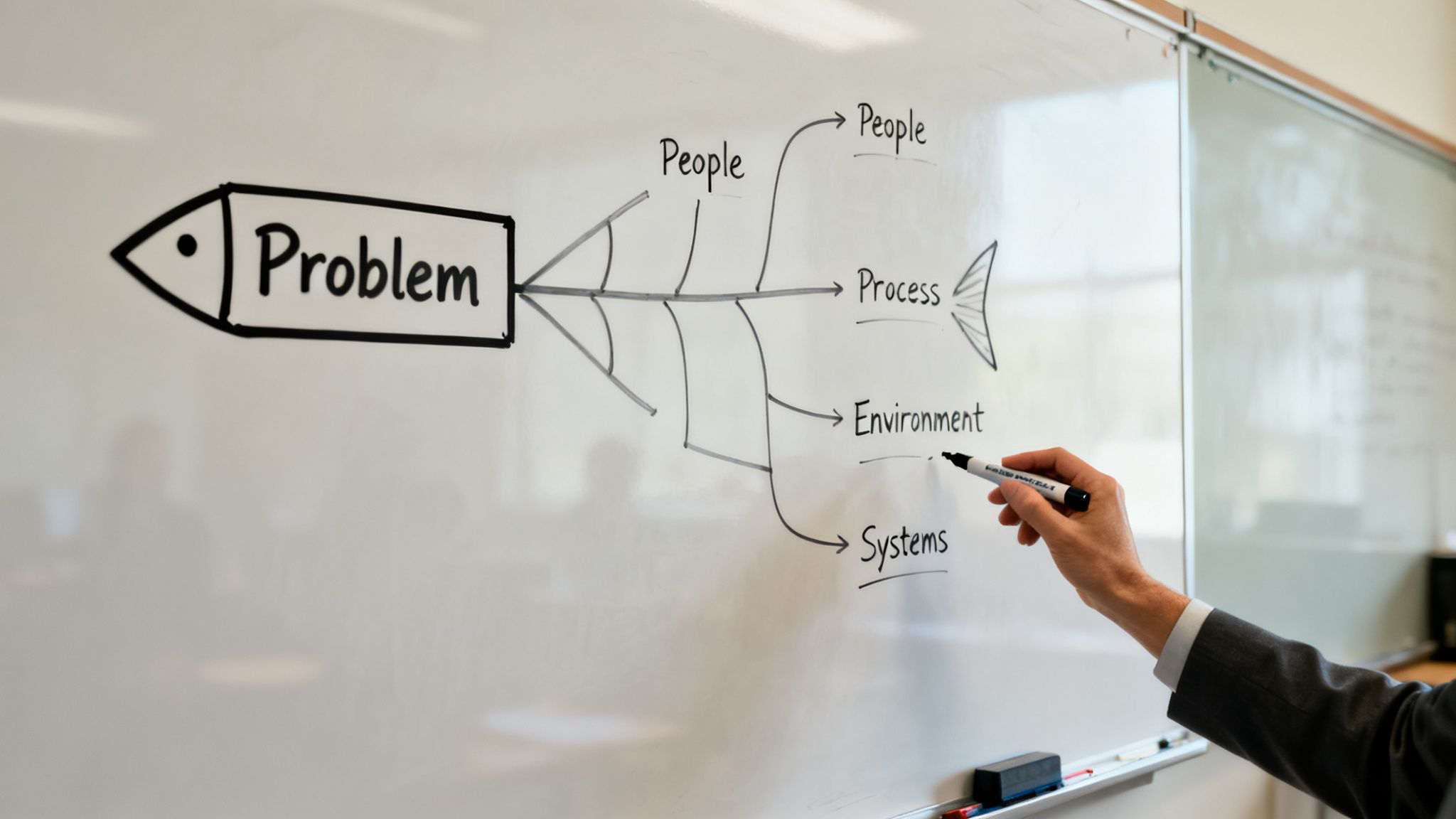
The Fishbone Diagram, also known as an Ishikawa or Cause and Effect Diagram, is a visual tool that helps groups brainstorm and map out the potential causes of a specific problem. Its structure resembles a fish skeleton, with the “head” representing the problem and the “bones” branching out into categories of potential causes. This problem solving activity is ideal for unpacking complex, multi-faceted issues like bullying, student disengagement, or chronic classroom disruptions.
It encourages collaborative thinking and prevents teams from jumping to a single, simplistic conclusion. Instead, it systematically organizes potential factors into logical groups, making it easier to see how different elements contribute to the central issue.
How It Works: A School-Wide Example
Imagine a school is struggling with low student engagement during Social-Emotional Learning (SEL) blocks. The problem statement at the “head” of the fish is: “Students are disengaged during SEL time.” The team then brainstorms causes under key categories.
Instruction (Methods): Lessons are not culturally relevant; activities are repetitive; delivery is lecture-based rather than interactive.
Environment (Setting): Classroom setup doesn’t support group work; SEL is scheduled right before lunch when students are restless.
People (Students/Staff): Staff lack confidence in teaching SEL topics; students don’t see the value or feel it’s “not cool.”
Resources (Materials): The curriculum is outdated; there are not enough materials for hands-on activities.
By mapping these factors, the school can see that the issue is not just one thing. The solution must address curriculum updates, teacher training, and scheduling changes. To help visualize potential causes for a problem, explore more detailed examples of Cause and Effect Diagrams.
Key Insight: Complex problems rarely have a single cause. The Fishbone Diagram helps teams see the interconnectedness of issues and develop more comprehensive, effective solutions.
Tips for Implementation
Be Specific: Start with a clear and concise problem statement. “Why do 4th graders have frequent conflicts during recess?” is much more effective than a vague statement like “Students are fighting.”
Involve Diverse Voices: Include teachers, students, counselors, and support staff in the brainstorming process to gain a 360-degree view of the problem.
Customize Your Categories: While traditional categories exist (like People, Process, etc.), adapt them to fit your school’s context. You might use categories like Policies, Peer Culture, Physical Space, and Family Engagement. Practical Example: For the problem “Students are frequently late to school,” a parent-teacher group might use categories like: Home Factors (alarms, morning routines), Transportation (bus delays, traffic), School Factors (boring first period, long entry lines), and Student Factors (anxiety, lack of motivation).
Focus on Action: After completing the diagram, have the group vote on the one or two root causes they believe have the biggest impact. This helps prioritize where to direct your energy and resources.
3. Design Thinking Workshops
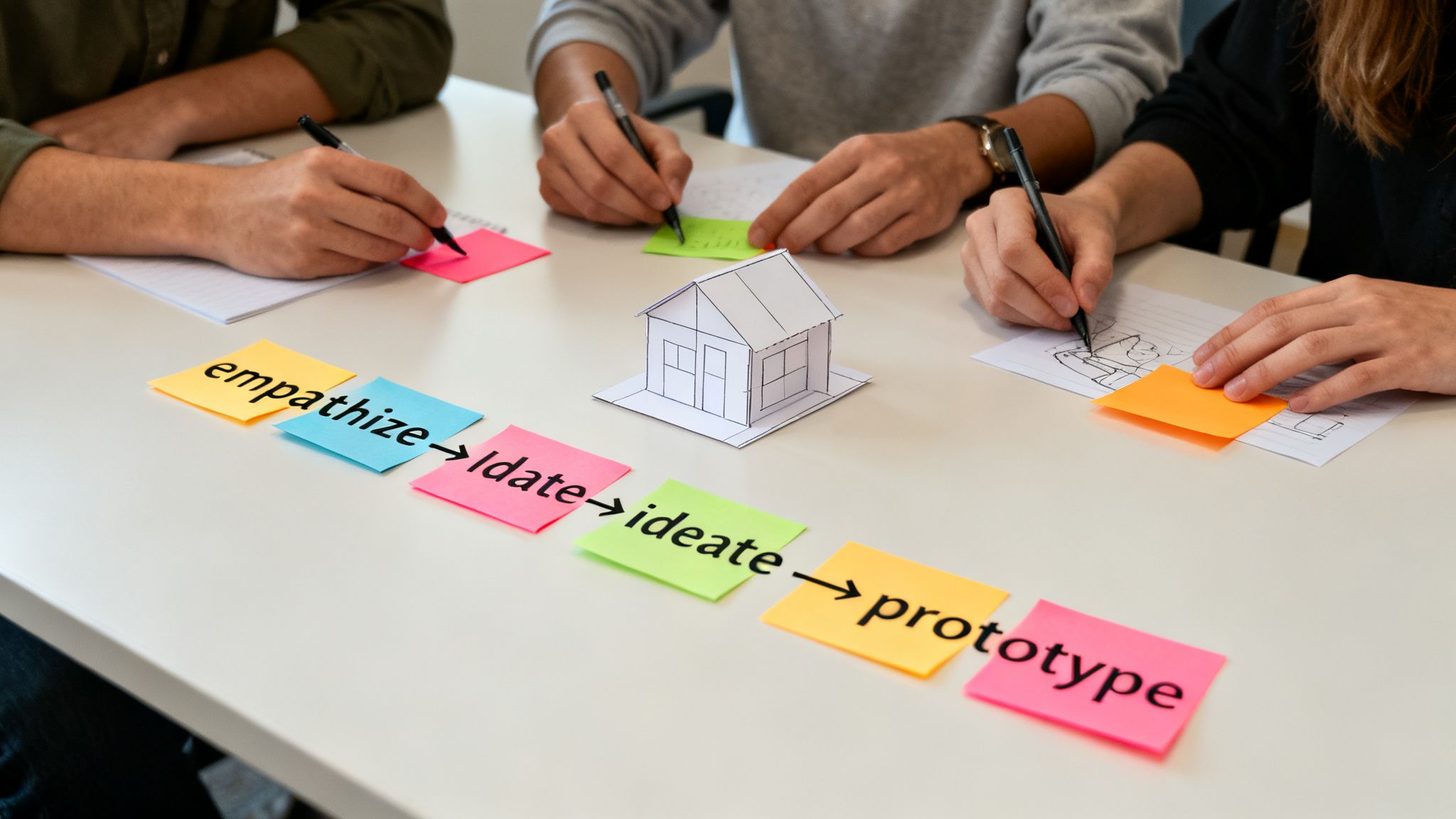
Design Thinking is a human-centered problem-solving framework that fosters innovation through empathy, collaboration, and experimentation. This problem solving activity guides students and educators to develop creative solutions for complex school challenges, from social dynamics to classroom logistics, by focusing on the needs of the people involved. It builds skills in critical thinking, communication, and resilience.
This approach shifts the focus from finding a single “right” answer to exploring multiple possibilities through an iterative process of understanding, ideating, prototyping, and testing. It empowers students to become active agents of positive change in their own community.
How It Works: A School Example
Imagine a group of students is tasked with improving the cafeteria experience, which many find chaotic and isolating. Instead of administrators imposing new rules, students use design thinking to create their own solutions.
Empathize: Students conduct interviews and observations. They talk to peers who feel lonely, kitchen staff who feel rushed, and supervisors who feel stressed. They discover the long lines and lack of assigned seating are key pain points.
Define: The group synthesizes their research into a clear problem statement: “How might we create a more welcoming and efficient lunch environment so that all students feel a sense of belonging?”
Ideate: The team brainstorms dozens of ideas without judgment. Suggestions range from a “talk-to-someone-new” table and a pre-order lunch app to music playlists and better line management systems.
Prototype: They decide to test the “conversation starter” table idea. They create a simple sign, a few icebreaker question cards, and ask for volunteers to try it out for a week.
Test: The team observes the prototype in action, gathers feedback from participants, and learns what works and what doesn’t. They discover students love the idea but want more structured activities. They iterate on their design for the next phase.
This process results in a student-led solution that directly addresses the community’s needs, building both empathy and practical problem-solving skills.
Key Insight: Design Thinking teaches that the best solutions come from deeply understanding the experiences of others. Failure is reframed as a valuable learning opportunity within the iterative process.
Tips for Implementation
Start with Curiosity: Frame the problem as a question, not a foregone conclusion. Begin with genuine interest in understanding the experiences of those affected without having a solution in mind.
Encourage ‘Yes, And…’ Thinking: During the ideation phase, build on ideas instead of shutting them down. This fosters a creative and psychologically safe environment where all contributions are valued.
Prototype with Low-Cost Materials: Prototypes don’t need to be perfect. Use cardboard, sticky notes, role-playing, and sketches to make ideas tangible and testable quickly and cheaply. Practical Example: To improve hallway traffic flow, students could create a small-scale model of the hallways using cardboard and use figurines to test different solutions like one-way paths or designated “fast” and “slow” lanes before proposing a change to the school.
For structured programs that help build the collaborative skills needed for design thinking, explore our Peacekeeper Program.
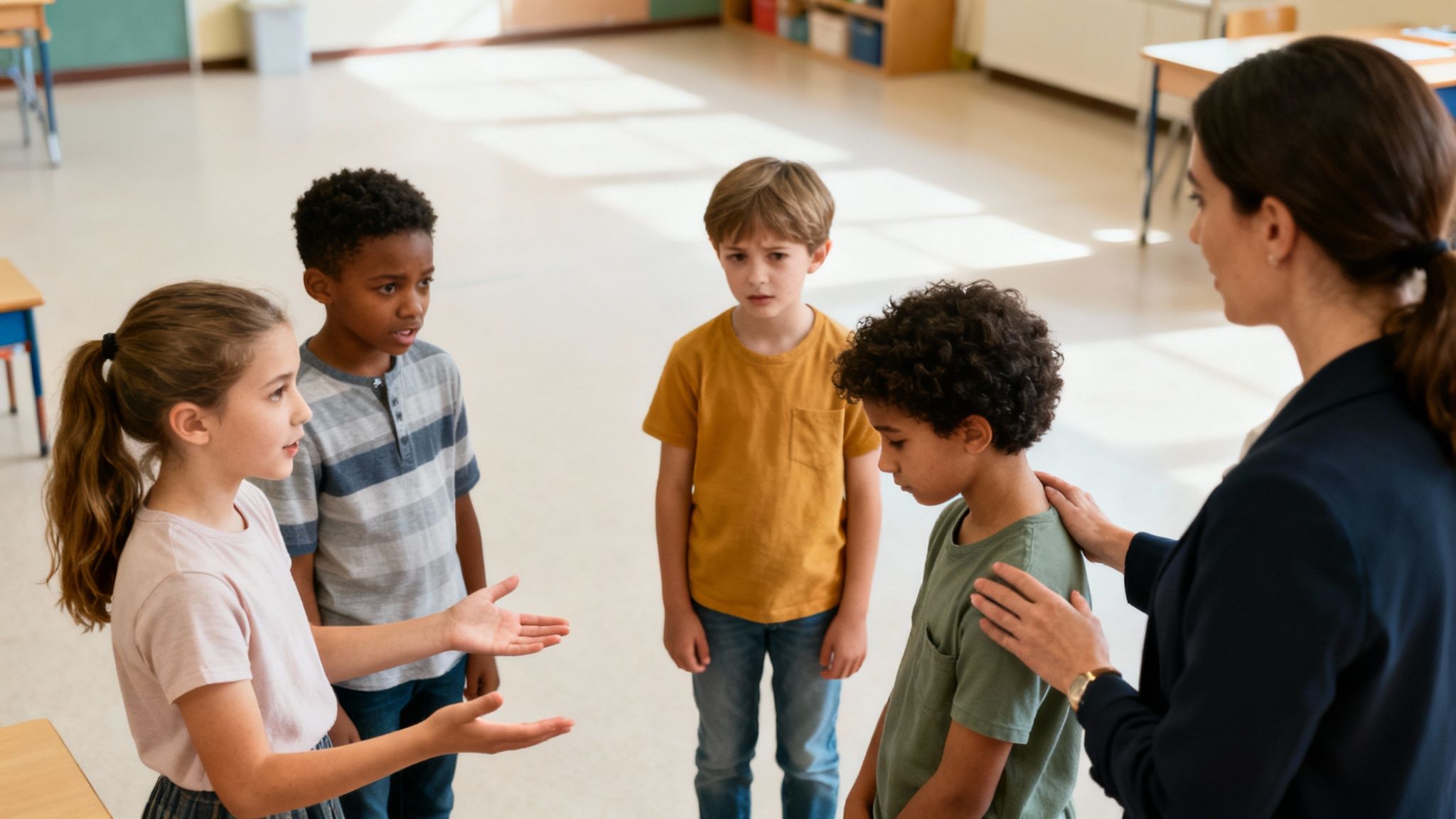
4. Restorative Practices and Peer Mediation
Restorative Practices and Peer Mediation offer a powerful framework for resolving conflict by focusing on repairing harm rather than assigning blame. This approach shifts the goal from punishment to accountability, healing, and reintegration. As a problem solving activity, it teaches students to take responsibility for their actions, understand their impact on others, and work collaboratively to make things right. It is especially effective for addressing complex issues like bullying and significant peer disagreements.
This method builds a stronger, more empathetic community by involving all affected parties in the solution. It empowers students to mend relationships and rebuild trust on their own terms.
How It Works: A Classroom Example
Imagine a conflict where a student, Maria, spread a hurtful rumor about another student, Sam. Instead of just sending Maria to the principal’s office, a peer mediation session is arranged. A trained student mediator facilitates the conversation.
Setting the Stage: The mediator establishes ground rules for respectful communication. Each student agrees to listen without interrupting and speak from their own experience.
Sharing Perspectives: The mediator first asks Sam to share how the rumor affected him. He explains that he felt embarrassed and isolated. Then, Maria is given a chance to explain her side.
Identifying Needs: The mediator helps both students identify what they need to move forward. Sam needs an apology and for the rumor to be corrected. Maria needs to understand why her actions were so hurtful and wants to be forgiven.
Creating an Agreement: Together, they create a plan. Maria agrees to privately tell the friends she told that the rumor was untrue and to apologize directly to Sam. Sam agrees to accept her apology and move on.
This process resolves the immediate conflict and equips both students with skills to handle future disagreements constructively.
Key Insight: Restorative practices teach that conflict is an opportunity for growth. By focusing on repairing harm, we build accountability and strengthen the entire community.
Tips for Implementation
Invest in Training: Thoroughly train both staff facilitators and student peer mediators. This training should cover restorative philosophy, active listening, and managing difficult conversations.
Use Proactively: Don’t wait for harm to occur. Use community-building circles regularly to build relationships and establish a culture of trust and open communication. Practical Example: A teacher can start each week with a “check-in” circle, asking students to share one success and one challenge from their weekend. This builds trust so that when a conflict arises, the circle format is already familiar and safe.
Establish Clear Protocols: Define when to use peer mediation versus a staff-led restorative conference. More serious incidents may require adult intervention.
Follow Up: Always check in with the involved parties after an agreement is made to ensure it is being honored and to offer further support if needed.
For a deeper dive into this transformative approach, you can explore what restorative practices in education look like in more detail and learn how to implement them in your school.
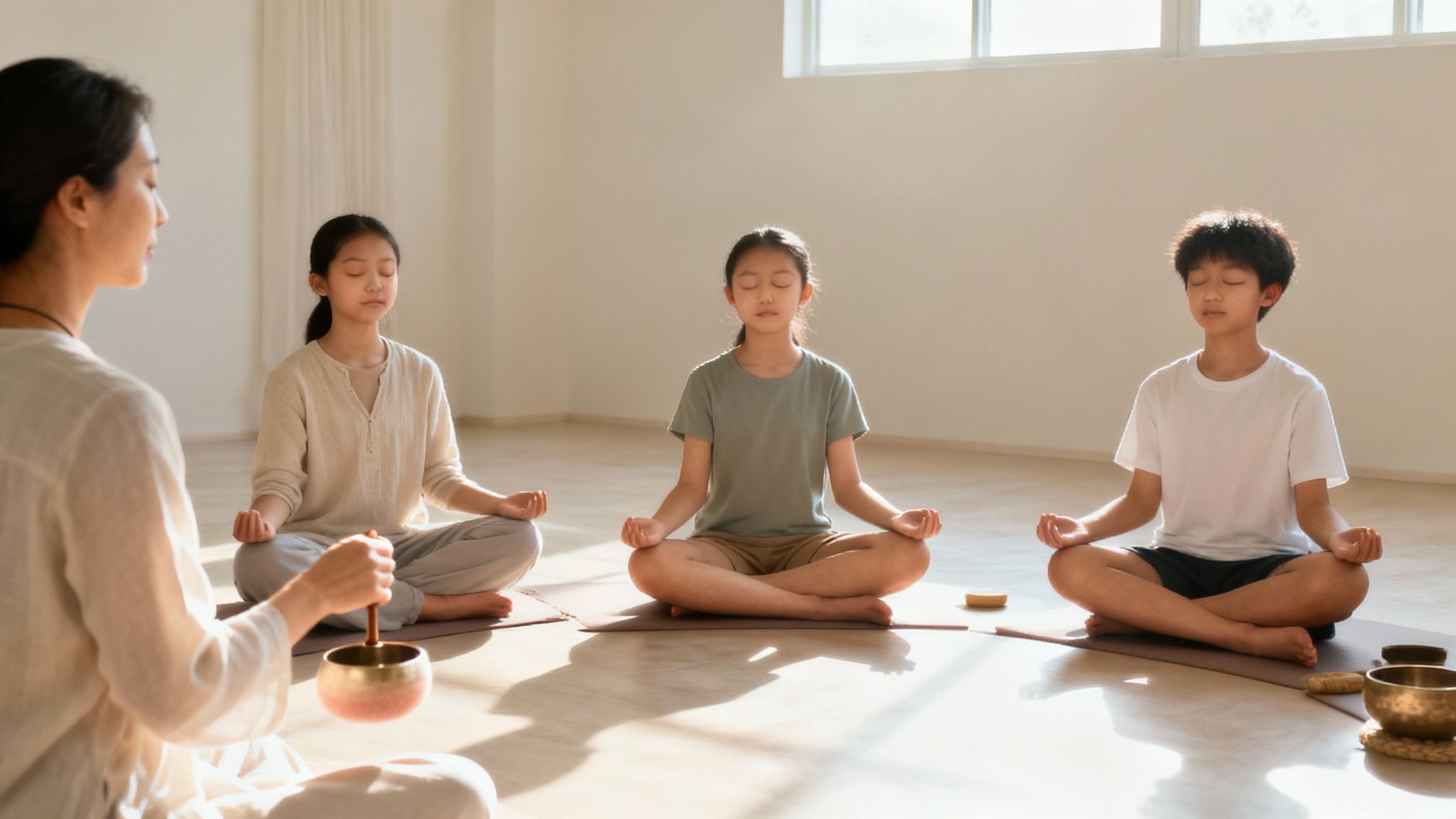
5. Mindfulness and Breathing Pause Exercises
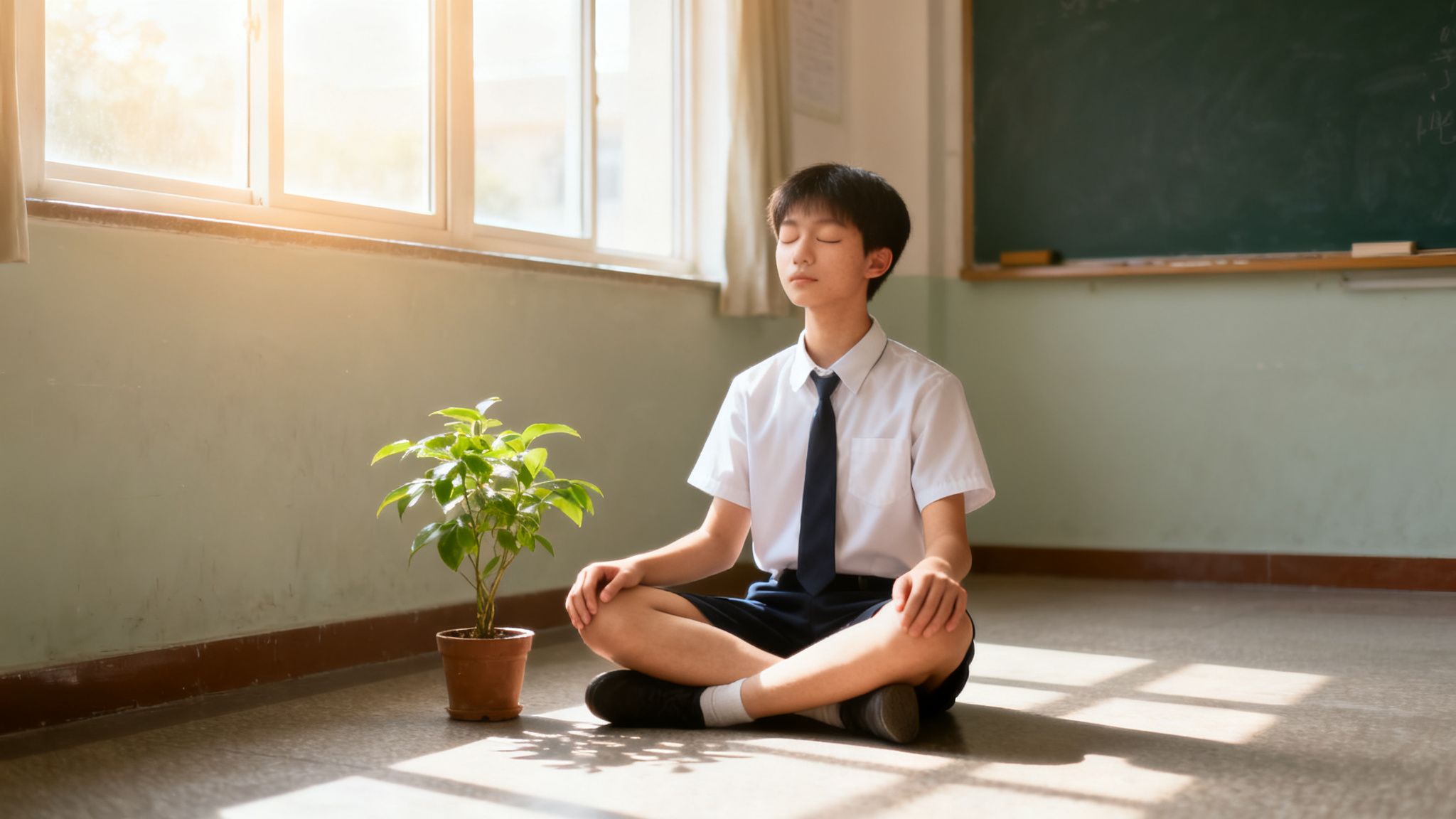
Mindfulness and Breathing Pause Exercises are structured practices that teach students to pause, notice their thoughts and emotions, and respond intentionally rather than react impulsively. These techniques create the mental space needed for effective problem-solving by supporting self-regulation and reducing reactive conflict. This problem solving activity is foundational, as it equips students with the internal tools to manage stress before tackling external challenges.
This approach transforms classroom management by empowering students to become active participants in their own emotional regulation. Instead of teachers managing behavior, students learn to manage themselves, which is a critical life skill.
How It Works: A Classroom Example
Consider a common scenario: two students, Maria and Leo, are arguing over a shared tablet. Emotions are escalating, and the argument is about to become a disruptive conflict. Instead of intervening immediately, the teacher initiates a pre-taught “Pause and Breathe” protocol.
The Trigger: The students begin raising their voices.
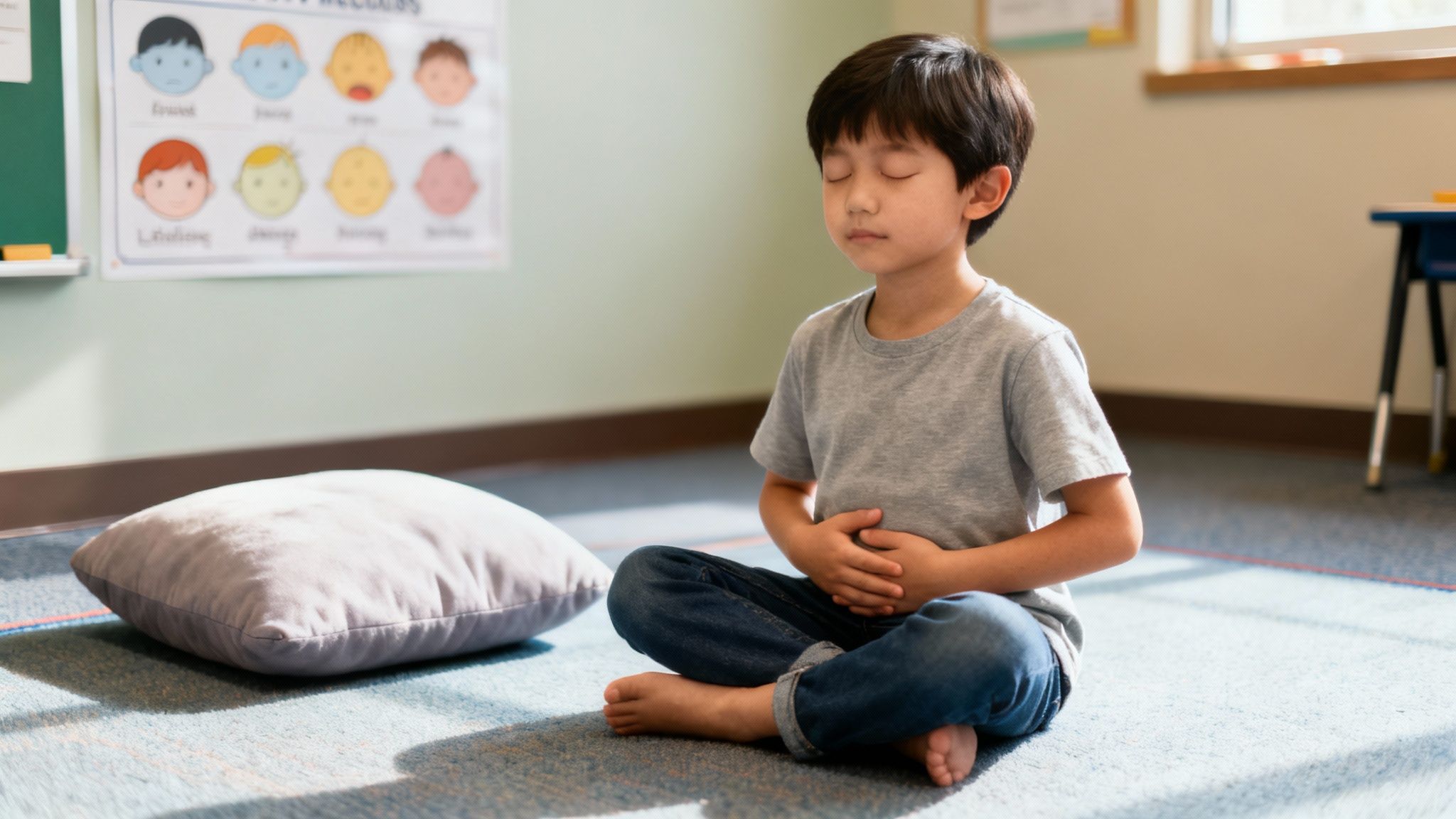
The Pause: The teacher calmly says, “Let’s take a Pause and Breathe.” Both students know this signal. They stop talking, place a hand on their belly, and take three slow, deep breaths.
Noticing: During these breaths, they shift their focus from the conflict to their physical sensations. They notice their fast heartbeat and tense shoulders. This brief moment of awareness interrupts the reactive emotional spiral.
Responding: After the pause, the teacher asks, “What do you both need right now?” Having calmed down, Maria can articulate, “I need to finish my turn,” and Leo can say, “I’m worried I won’t get a chance.”
The Solution: The problem is now reframed from a fight to a scheduling issue. The students can now work with the teacher to create a fair plan for sharing the tablet.
The breathing pause didn’t solve the problem directly, but it created the necessary calm and clarity for the students to engage in a constructive problem solving activity.
Key Insight: A regulated brain is a problem-solving brain. Mindfulness provides the essential first step of calming the nervous system so higher-order thinking can occur.
Tips for Implementation
Model and Co-Regulate: Practice these exercises with your students daily. Your calm presence is a powerful teaching tool. Never use a breathing exercise as a punishment.
Start Small: Begin with just one minute of “belly breathing” or a “listening walk” to notice sounds. Gradually build up duration and complexity as students become more comfortable.
Create a Ritual: Integrate a brief breathing exercise into daily routines, like after recess or before a test, to make it a normal and expected part of the day.
Connect to Emotions: Explicitly link the practice to real-life situations. Say, “When you feel that big wave of frustration, remember how we do our box breathing. That’s a tool you can use.” Practical Example: Before a math test, a teacher can lead the class in “4×4 Box Breathing”: breathe in for a count of 4, hold for 4, breathe out for 4, and hold for 4. This helps calm test anxiety and improve focus.
The Ladder of Inference is a thinking tool that helps students understand how they jump to conclusions. It illustrates the mental process of using selected data, interpreting it through personal beliefs, and forming assumptions that feel like facts. This problem solving activity is invaluable for deconstructing conflicts, misunderstandings, and hurtful situations by revealing the flawed thinking that often fuels them.
This method teaches students to slow down their reasoning and question their interpretations. Instead of reacting to a conclusion, they learn to trace their steps back down the ladder to examine the observable facts, making them more thoughtful communicators and empathetic friends.
How It Works: A Classroom Example
Imagine a student, Maya, sees her friend Chloe whisper to another student and then laugh while looking in her direction. Maya quickly climbs the ladder of inference and concludes Chloe is making fun of her, leading her to feel hurt and angry.
The Conclusion: “Chloe is a mean person and not my friend anymore.” (An action or belief)
The Assumption: “She must be telling a mean joke about me.” (An assumption based on the interpretation)
The Interpretation: “Whispering and laughing means they are being secretive and unkind.” (Meaning is added based on personal beliefs)
The Selected Data: Maya focuses only on the whisper, the laugh, and the glance in her direction. She ignores other data, like Chloe smiling at her earlier.
The Observable Reality: Chloe whispered to another student. They both laughed. They glanced toward Maya. (Just the facts)
By working back down the ladder, Maya can see her conclusion is based on a big assumption. The solution is not to confront Chloe angrily but to get curious and gather more data, for example, by asking, “Hey, what was so funny?”
Key Insight: The Ladder of Inference reveals that our beliefs directly influence how we interpret the world. By learning to separate observation from interpretation, we can prevent minor misunderstandings from becoming major conflicts.
Tips for Implementation
Use Visual Aids: Draw the ladder on a whiteboard or use a printable graphic. Visually mapping out the steps helps students grasp the abstract concept of their own thinking processes.
Model the Language: Teach students phrases to challenge assumptions. Encourage them to say, “I’m making an assumption that…” or, “The story I’m telling myself is…” This separates their interpretation from objective reality.
Practice ‘Getting Curious’: Instead of accepting conclusions, prompt students with questions like, “What did you actually see or hear?” and “What’s another possible reason that could have happened?” This builds a habit of curiosity over certainty. Practical Example: A parent sees their child’s messy room and thinks, “He’s so lazy and disrespectful.” Using the ladder, they can go back to the observable data: “I see clothes on the floor and books on the bed.” Then they can get curious: “What’s another possible reason for this?” Perhaps the child was rushing to finish homework or felt overwhelmed. The parent can then ask, “I see your room is messy. What’s getting in the way of cleaning it up?”
For more strategies on fostering mindful communication and emotional regulation, explore our conflict resolution curriculum.
7. Empathy Mapping and Perspective-Taking Exercises
Empathy Mapping is a powerful problem solving activity that guides students to step into someone else’s shoes and understand their experience from the inside out. By visually mapping what another person sees, hears, thinks, and feels, students move beyond simple sympathy to develop genuine empathy. This structured approach helps them analyze conflicts, social exclusion, and diverse viewpoints with greater compassion and insight.
This method transforms interpersonal problems from “me vs. you” into “us understanding an experience.” It builds the foundational social-emotional skills needed for collaborative problem-solving, making it an essential tool for creating a more inclusive and supportive classroom community.
How It Works: A Classroom Example
Imagine a conflict where a student, Maya, is upset because her classmate, Leo, laughed when she tripped during recess. Instead of focusing only on the action, the teacher uses an empathy map to explore both perspectives.
First, Maya maps Leo’s perspective:
Sees: Maya falling, other kids playing.
Hears: A loud noise, other kids laughing nearby.
Thinks: “That looked funny,” or “I hope she’s okay.”
Feels: Surprised, maybe amused, or a little embarrassed for her.
Then, Leo maps Maya’s perspective:
Sees: Everyone looking at her on the ground.
Hears: Laughter from his direction.
Thinks: “Everyone is laughing at me. I’m so embarrassed. He did that on purpose.”
Feels: Hurt, embarrassed, angry, and singled out.
This exercise reveals that while Leo’s reaction may have been thoughtless, Maya’s interpretation was rooted in deep feelings of embarrassment and hurt. The problem to solve is not just the laughter, but the impact it had and how to repair the trust between them.
Key Insight: Empathy mapping shows that intention and impact can be very different. Understanding this gap is the first step toward resolving conflicts and preventing future misunderstandings.
Tips for Implementation
Use Concrete Scenarios: Ground the activity in specific, relatable situations, like a disagreement over a game or feeling left out at lunch. Avoid abstract concepts that are hard for students to connect with.
Model Vulnerability: Share an appropriate personal example of a time you misunderstood someone’s perspective. This shows that everyone is still learning and creates a safe space for students to be honest.
Connect Empathy to Action: After mapping, always ask, “Now that we understand this, what can we do to help or make things better?” This turns insight into positive action. Practical Example: After reading a story about a new student who feels lonely, the class can create an empathy map for that character. Then, the teacher can ask, “What could we do in our class to make a new student feel welcome?” This connects the fictional exercise to real-world classroom behavior.
The Collaborative Problem-Solving (CPS) Protocol, developed by Dr. Ross Greene, is a structured dialogue method that transforms how adults address challenging behaviors in students. It operates on the core belief that “kids do well if they can,” shifting the focus from a lack of motivation to a lack of skills. This non-confrontational problem solving activity involves both the adult and student as equal partners in understanding and solving problems, making it a powerful tool for de-escalating conflicts and building competence.
This approach replaces unilateral, adult-imposed solutions with a joint effort, which reduces power struggles and turns every conflict into a valuable teaching opportunity. It is especially effective for students with social, emotional, and behavioral challenges.
How It Works: A Classroom Example
Consider a student, Maya, who frequently disrupts class during independent reading time by talking to her neighbors. Instead of assigning a consequence, a teacher uses the CPS protocol.
Empathy Step: The teacher pulls Maya aside when she is calm. “I’ve noticed that during reading time, it seems like you have a hard time staying quiet. What’s up?” The goal is to listen and gather information without judgment. Maya explains she gets bored and the words “get jumbled” after a few minutes.
Define the Problem Step: The teacher shares their perspective. “I understand it gets boring and difficult. My concern is that when you talk, it makes it hard for other students to concentrate, and for you to practice your reading.”
Invitation Step: The teacher invites collaboration. “I wonder if there’s a way we can make it so you can get your reading practice done without it feeling so boring, and also make sure your classmates can focus. Do you have any ideas?”
Together, they brainstorm solutions like breaking up the reading time with short breaks, trying an audio book to follow along, or choosing a high-interest graphic novel. They agree to try a 10-minute reading timer followed by a 2-minute stretch break. This solution addresses both Maya’s lagging skill (sustained attention) and the teacher’s concern (classroom disruption).
Key Insight: CPS reframes misbehavior as a signal of an unsolved problem or a lagging skill. By working together, we teach students how to solve problems, rather than just imposing compliance.
Tips for Implementation
Listen More Than You Talk: The Empathy step is crucial. Your primary goal is to understand the student’s perspective on what is getting in their way. Resist the urge to jump to solutions.
Be Proactive: Use the CPS protocol when everyone is calm, not in the heat of the moment. This makes it a preventative tool rather than a reactive one.
Focus on Realistic Solutions: Brainstorm multiple ideas and evaluate them together. A good solution is one that is realistic, mutually satisfactory, and addresses the concerns of both parties.
Follow Up: Check in later to see if the solution is working. Be prepared to revisit the conversation and adjust the plan if needed. Practical Example for Parents: A parent notices their child always argues about bedtime. Empathy: “I’ve noticed getting ready for bed is really tough. What’s up?” The child might say, “I’m not tired and I want to finish my game.” Define Problem: “I get that. My concern is that if you don’t sleep enough, you’re really tired and grumpy for school.” Invitation: “I wonder if there’s a way for you to finish your game and also get enough rest. Any ideas?” They might co-create a solution involving a 10-minute warning before screen-off time.
9. Brave Space Conversations and Dialogue Protocols
Brave Space Conversations and Dialogue Protocols are structured frameworks that teach students and adults how to navigate sensitive topics, express different viewpoints respectfully, and stay connected during disagreement. These protocols, inspired by works like Difficult Conversations and the Courageous Conversations framework, prioritize psychological safety and shared responsibility. This problem solving activity is essential for addressing bias, building inclusive communities, and maintaining relationships through conflict.
This approach moves beyond “safe spaces,” where comfort is the goal, to “brave spaces,” where the goal is growth through respectful, and sometimes uncomfortable, dialogue. It equips participants with the tools to talk about what matters most, even when it’s hard.
How It Works: A Classroom Example
Imagine a group of middle school students is divided over a current event involving social inequality. Tensions are high, and students are making hurtful comments. Instead of shutting down the conversation, a teacher uses a dialogue protocol.
Establish Norms: The class co-creates agreements like “Listen to understand, not to respond,” “Assume good intent but address impact,” and “It’s okay to feel uncomfortable.”
Introduce Sentence Starters: The teacher provides scaffolds to guide the conversation, such as “I was surprised when I heard you say…” or “Can you tell me more about what you mean by…?”
Facilitate Dialogue: A student shares their perspective on the event. Another student, instead of reacting defensively, uses a sentence starter: “I hear that you feel…, and my perspective is different. For me, I see…”
Focus on Impact: A student addresses a peer directly but respectfully: “When you said that, it made me feel invisible because my family has experienced this. Can we talk about that?”
Seek Mutual Understanding: The conversation continues, with the focus shifting from winning an argument to understanding each other’s lived experiences.
This structured process prevents the conversation from devolving into personal attacks and transforms a potential conflict into a powerful learning moment about empathy, perspective-taking, and community.
Key Insight: Brave spaces normalize discomfort as a necessary part of growth. They teach that the goal of difficult conversations isn’t always agreement, but a deeper mutual understanding and respect.
Tips for Implementation
Establish Psychological Safety First: Before diving in, clarify that the purpose is learning together. Emphasize that vulnerability is a strength and that mistakes are opportunities for growth.
Co-Create Norms: Involve students in creating the rules for the conversation. This gives them ownership and makes them more likely to hold themselves and their peers accountable.
Use Scaffolds and Sentence Frames: Provide language tools to help students articulate their thoughts and feelings constructively, especially when emotions are high. Practical Example: Provide a list of sentence frames on the board, such as: “Help me understand your thinking about…”, “The story I’m telling myself is…”, or “I’m curious about why you see it that way.”
Acknowledge the Discomfort: Start by saying, “This might feel a bit uncomfortable, and that’s okay. It means we are tackling something important.” This normalization reduces anxiety.
To learn more about fostering brave and respectful classroom environments, explore Soul Shoppe’s approach to building school-wide community.
Solution-Focused Brief Therapy (SFBT) Questioning is a strengths-based problem solving activity that shifts the focus from analyzing problems to envisioning solutions. Instead of dissecting what’s wrong, this approach uses targeted questions to help students identify their own strengths, resources, and past successes to build a better future. It empowers students by highlighting their capabilities and fostering a sense of agency.
This method is highly effective for interpersonal challenges and building resilience. It moves a student from a “stuck” mindset, where a problem feels overwhelming, to a proactive one focused on small, achievable steps forward.
How It Works: A Classroom Example
Consider a student who feels consistently left out during recess. A traditional approach might focus on why they are isolated, but SFBT questioning builds a path toward connection.
The Miracle Question: “Imagine you went to sleep tonight, and while you were sleeping, a miracle happened and your recess problem was solved. When you woke up tomorrow, what would be the first thing you’d notice that tells you things are better?” The student might say, “Someone would ask me to play.”
Identifying Exceptions: “Can you think of a time, even just for a minute, when recess felt a little bit better?” The student may recall, “Last week, I talked to Maria about a video game for a few minutes, and it was okay.” (This highlights a past success).
Scaling the Situation: “On a scale of 1 to 10, where 1 is the worst recess ever and 10 is the miracle recess, where are you today?” The student says, “A 3.” The follow-up is key: “What would need to happen to get you to a 4?” They might suggest, “Maybe I could try talking to Maria about that game again.” (This defines a small, concrete step).
This process helps the student create their own solution based on what has already worked, building confidence and providing a clear action to take.
Key Insight: SFBT questioning assumes that students already have the tools to solve their problems. Our job is to ask the right questions to help them discover and use those tools.
Tips for Implementation
Ask with Genuine Curiosity: Your tone should be supportive and inquisitive, not leading. Frame questions to explore possibilities, such as “What would that look like?” or “How did you do that?”
Focus on Strengths: Actively listen for and acknowledge the student’s capabilities. When they identify a past success, validate it: “Wow, it sounds like you were really brave to do that.”
Use Scaling Questions: These questions (e.g., “On a scale of 1-10…”) are excellent for measuring progress and identifying the next small step. The goal isn’t to get to 10 immediately but to move up just one point. Practical Example: A student is overwhelmed by a large project. The teacher asks, “On a scale of 1-10, where 1 is ‘I can’t even start’ and 10 is ‘It’s completely done,’ where are you?” The student says, “A 2, because I chose my topic.” The teacher responds, “Great! What’s one small thing you could do to get to a 3?” The student might say, “I could find one book about my topic.” This makes the task feel manageable.
To see how solution-focused language can be integrated into broader conflict resolution, explore our I-Message and conflict resolution tools.
Top 10 Problem-Solving Activities Comparison
Method
Implementation complexity
Resource requirements
Expected outcomes
Ideal use cases
Key advantages
The Five Whys Technique
Low — simple, linear process
Minimal — facilitator and quiet space
Surface to root-cause insights; increased reflection
Increased agency; small actionable steps; faster shifts in outlook
Individual counseling; resistant or low-engagement students
Strengths-based, efficient, fosters hope and concrete progress
Putting Problem-Solving into Practice
The journey from a reactive classroom to a responsive and collaborative community is built one problem solving activity at a time. The ten strategies detailed in this guide, from the analytical Five Whys technique to the empathetic practice of restorative circles, are more than just isolated exercises. They are foundational building blocks for creating a culture where challenges are seen as opportunities for growth, connection, and deeper understanding. Integrating these tools empowers students with a versatile toolkit, preparing them not only for academic hurdles but for the complex social dynamics they navigate daily.
The true power of these activities lies in their consistency and thoughtful application. A one-time Fishbone Diagram workshop can illuminate a specific issue, but embedding this thinking into regular classroom discussions transforms how students analyze cause and effect. Similarly, a single breathing pause can de-escalate a tense moment, but making it a routine transition practice cultivates emotional regulation as a lifelong skill. The goal is to move these strategies from a special event to an everyday habit.
Key Takeaways for Immediate Implementation
To make this transition feel manageable, focus on a few core principles that unite every problem solving activity we’ve explored:
Make Thinking Visible: Activities like the Ladder of Inference and Empathy Mapping help students externalize their internal thought processes. This visibility allows them to question their assumptions and see situations from multiple viewpoints, reducing misunderstandings that often fuel conflict.
Prioritize Psychological Safety: For any problem-solving to be effective, students must feel safe to be vulnerable. Brave Space Conversations and Restorative Practices are designed to build this foundation of trust, ensuring every voice is heard and valued without fear of judgment.
Shift from Blame to Contribution: The core of effective problem-solving is moving away from finding a person to blame and toward understanding the various factors that contributed to a problem. The Fishbone Diagram and Collaborative Problem-Solving (CPS) Protocol are excellent frameworks for this, encouraging shared ownership of both the problem and the solution.
Empower Student Agency: True mastery comes when students can independently select and use the right tool for the right situation. By introducing a variety of methods, you give them the agency to choose whether a situation calls for deep analysis (Five Whys), creative innovation (Design Thinking), or emotional connection (Peer Mediation).
Actionable Next Steps for Educators and Parents
The path to embedding these skills begins with small, intentional steps. You don’t need to implement all ten strategies at once. Instead, consider this a menu of options to be introduced thoughtfully over time.
Start with Yourself: Before introducing a new problem solving activity to students, practice it yourself. Try using the Five Whys to understand a recurring personal challenge or the Ladder of Inference to check your assumptions before a difficult conversation with a colleague or family member. Modeling is the most powerful form of teaching.
Choose a Low-Stakes Entry Point: Begin with an activity that feels accessible and addresses a current need. If classroom transitions are chaotic, introduce Mindfulness and Breathing Pauses. If group projects frequently result in friction, try an Empathy Mapping exercise as a kickoff to build mutual understanding.
Integrate, Don’t Add: Look for opportunities to weave these activities into your existing curriculum and routines. Use SFBT questioning during student check-ins (“What’s one small thing that’s going a little better today?”). Apply Design Thinking principles to a social studies project where students must solve a community issue. When problem-solving becomes part of the “how” of learning, it ceases to be just another thing “to do.”
By consistently applying these frameworks, you are doing far more than just teaching students how to solve problems. You are cultivating a generation of empathetic communicators, resilient thinkers, and collaborative leaders who can navigate a complex world with confidence and compassion. Each problem solving activity is a step toward building a school and home environment where every individual feels seen, heard, and capable of contributing to a positive solution.
Ready to build a comprehensive, school-wide culture of peace and problem-solving? Soul Shoppe provides dynamic programs, professional development, and hands-on tools that bring these activities to life, fostering empathy and resilience in your entire school community. Visit Soul Shoppe to learn how we can partner with you to create a safer, more connected learning environment.
So, what exactly is social emotional learning? Think of it as giving kids an internal compass to help them navigate their own feelings and their relationships with others. It’s the process of developing the self-awareness, self-control, and people skills they need to succeed in school, at home, and eventually, in life.
These aren’t just “nice-to-have” traits; they are teachable skills that build resilience and empower kids to make responsible choices.
What Is Social Emotional Learning and Why It Matters Now
Imagine a child trying to build a block tower. Without understanding balance and structure, the tower just keeps falling over, which leads to a whole lot of frustration. Social emotional learning (SEL) provides that “balance and structure” for a child’s inner world. It’s not some lofty academic theory—it’s a practical toolkit for life.
SEL helps kids become better teammates, both in the classroom and on the playground. It’s about giving them the tools to understand their big feelings, show empathy for others, build real friendships, and make thoughtful decisions. For parents and teachers, this translates into more focused students, fewer conflicts, and kids who can bounce back when things get tough.
The Real-World Impact of SEL
The benefits of SEL aren’t just feel-good stories; they’re backed by solid research. A landmark meta-analysis reviewed by the Learning Policy Institute in 2017 discovered that students in SEL programs showed significant gains in social and emotional skills. This led to more positive behaviors, better peer relationships, and even higher grades and test scores.
This data drives home a critical point: emotional well-being and academic success are deeply connected. When children feel safe, understood, and equipped to handle their emotions, their minds are free to focus, learn, and grow. You can explore the evidence behind social emotional learning in schools to see the full picture.
Social emotional learning isn’t an “add-on” to education; it’s fundamental. It equips children with the internal architecture needed to build a successful and fulfilling life, one thoughtful choice at a time.
Building a Foundation for Lifelong Success
Ultimately, social emotional learning is about laying the groundwork for a child’s future happiness and success. The skills they pick up today become the bedrock for navigating everything from playground disagreements to complex workplace collaborations down the road.
By focusing on these core abilities, we empower children to:
Recognize and manage their emotions: Instead of getting swept away by anger or anxiety, they learn to name the feeling and choose a constructive way to respond. For example, a child might say, “I’m feeling frustrated with this puzzle,” and then take a short break instead of throwing the pieces.
Develop empathy for others: They practice seeing situations from another person’s point of view, a skill that’s absolutely essential for kindness and teamwork. A practical example is a student noticing a classmate is sitting alone at lunch and inviting them to join their table.
Establish positive relationships: They learn the communication and cooperation skills needed to build and keep healthy friendships. This could look like two kids deciding to take turns with a popular swing on the playground.
Make responsible decisions: They get used to thinking through how their actions might affect themselves and the people around them. For instance, a student chooses to finish their homework before playing video games because they understand the long-term benefit.
These skills are the building blocks of a resilient, compassionate generation. When we explore why SEL matters, we see it’s one of the most powerful ways to unlock a child’s full potential.
The Five Core Skills of Social Emotional Learning
Social emotional learning is built around five interconnected skills that work together, much like the different instruments in an orchestra. Each one plays a unique part, but when they harmonize, they create something truly resilient and beautiful. These skills, often called the CASEL 5, give us a clear and helpful framework for understanding exactly what we’re helping our kids build.
Let’s break down these essential building blocks. Getting a real feel for them is the first step to nurturing them in a child’s everyday life.
1. Self-Awareness: The Inner Weather Report
Self-awareness is simply the ability to recognize your own emotions, thoughts, and values and see how they influence your behavior. Think of it as a child’s internal weather report. Just as a meteorologist can identify sun, clouds, or an approaching storm, a self-aware child learns to identify their own feelings of happiness, frustration, or nervousness.
This goes beyond just naming feelings. It’s also about understanding personal strengths and weaknesses. A student with strong self-awareness knows what they’re good at and, just as importantly, where they might need a little help.
Practical Example: Before a big math test, a third-grader named Liam notices his stomach feels fluttery and his palms are sweaty. Instead of just feeling “bad,” he recognizes this feeling as anxiety. That awareness is the critical first step to managing it. Another example is a student realizing, “I’m really good at sharing my ideas, but I have trouble listening when others are talking.”
2. Self-Management: Choosing the Right Response
Once a child can read their internal weather, self-management is the skill of choosing how to respond. It’s like learning to shift gears in a car depending on the road conditions. A child with this skill can manage their emotions, thoughts, and behaviors to handle different situations and meet their goals.
This includes things like impulse control, handling stress, and motivating yourself. It’s about creating that tiny, powerful pause between a feeling and an action, which gives kids the power to choose a more constructive response.
Practical Example: After recognizing his test anxiety, Liam remembers a breathing exercise his teacher taught him. He takes three slow, deep breaths to calm his body and mind. Instead of letting the anxiety take over, he used a tool to manage it and was able to focus better on the test. At home, a child who wants to play but has to clean their room might tell themselves, “Okay, if I clean for 15 minutes, then I can take a 5-minute break.”
Self-awareness is knowing you feel a storm brewing inside. Self-management is knowing how to find your umbrella and navigate the rain without getting soaked.
3. Social Awareness: Seeing Through Another’s Eyes
Social awareness is the ability to understand others’ perspectives and feel empathy for them, especially for people from different backgrounds and cultures. It’s like putting on a pair of glasses that lets a child see the world from someone else’s point of view.
It involves picking up on social cues—like body language or tone of voice—and understanding how to act in different social situations. This skill is the absolute foundation of compassion and respect.
Practical Example: During recess, Maya sees her friend Alex sitting alone on a bench, looking down. Her social awareness kicks in, prompting her to think, “Alex looks sad. I wonder what’s wrong.” Instead of ignoring him, she decides to walk over and ask if he’s okay. In the classroom, a student might notice their teacher seems tired and decide to be extra quiet and helpful.
4. Relationship Skills: Building Strong Bridges
Relationship skills are the tools children use to build and maintain healthy, supportive connections with others. If social awareness is seeing the other side of a river, relationship skills are about building the bridge to get there.
These skills include things like clear communication, active listening, cooperation, and knowing how to handle conflicts in a healthy way. They empower children to work well in teams, make friends, and ask for help when they need it.
Practical Example: Two students, Chloe and Ben, both want to use the same blue crayon. Instead of just grabbing for it, Chloe uses her relationship skills and says, “Ben, can I use the blue when you’re finished, please?” This simple act of communication and compromise prevents a conflict before it even starts. Another example is a student asking a friend, “Can you explain that math problem to me? I didn’t understand it,” which demonstrates asking for help.
5. Responsible Decision-Making: Thinking Before Acting
Finally, responsible decision-making brings all the other skills together. It’s the ability to make caring and constructive choices about your behavior and how you interact with others. It involves really thinking about the consequences of your actions—for yourself and for everyone else.
A child practicing this skill can identify a problem, look at the situation from different angles, and think through the potential outcomes before they act.
Practical Example: A group of friends dares a student to write on a school wall. The student pauses. They consider how their actions would make the custodian feel (social awareness), know they would feel guilty afterward (self-awareness), and recognize they could get in big trouble. They make the responsible decision to say “no” and walk away. At home, this could be a child choosing to tell the truth about a broken vase, understanding that honesty is better than hiding it and getting into more trouble later.
The CASEL 5 Competencies At a Glance
These five skills don’t work in isolation; they overlap and build on one another every single day. Here’s a quick summary to see how they all fit together.
Competency
What It Means for Kids
Example in Action
Self-Awareness
Knowing your own feelings, strengths, and challenges.
“I feel frustrated when I don’t understand my homework.”
Self-Management
Controlling impulses, managing stress, and staying motivated.
“I’m angry, so I’m going to take five deep breaths before I speak.”
Social Awareness
Understanding and empathizing with others’ feelings and perspectives.
“My friend seems quiet today. I’ll ask if they’re okay.”
Relationship Skills
Communicating clearly, listening well, and resolving conflicts.
“Can we take turns with the ball so everyone gets to play?”
Responsible Decision-Making
Making thoughtful choices that consider yourself and others.
“I won’t join in teasing because it would hurt someone’s feelings.”
By focusing on these five areas, we can give children a holistic toolkit that prepares them not just for the classroom, but for life.
Supporting SEL Development from Kindergarten Through Middle School
A child’s social and emotional world changes dramatically between the first day of kindergarten and the last day of middle school. Just like we wouldn’t teach algebra to a first-grader, our approach to social-emotional learning has to meet kids where they are, developmentally. Giving them the right tools at the right time is how they build a strong, resilient foundation for life.
This journey happens in clear stages, each with its own milestones and challenges. Understanding this progression helps parents and educators offer strategies that actually make sense to kids and connect with what they’re experiencing right now.
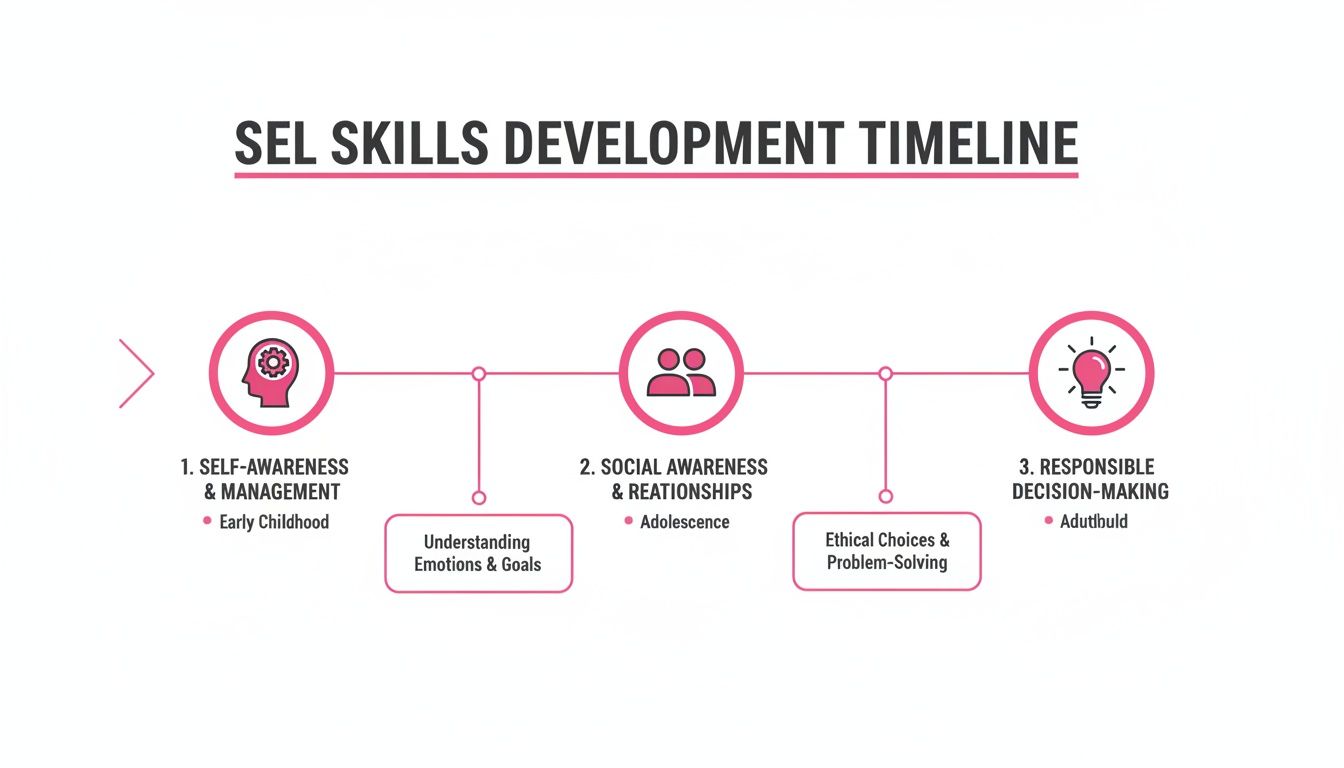
This timeline shows how kids move from self-focused skills to social abilities and, finally, to responsible decision-making.
You can see how those early self-awareness skills are the essential first step, paving the way for more complex social interactions and ethical choices later on.
K-2nd Grade: The Foundational Building Blocks
In these early years, a child’s world is mostly about their own feelings and experiences. The main job of SEL here is to give them the basic vocabulary and tools to understand that inner world. We’re laying the essential groundwork for everything to come.
The primary focus is on self-awareness and self-management. Kids are learning to put a name to a feeling—”I feel angry,” or “I feel excited”—and starting to get that these feelings are totally normal. They’re also just beginning to understand impulse control, even if it’s a daily struggle.
Practical Examples for K-2nd Graders:
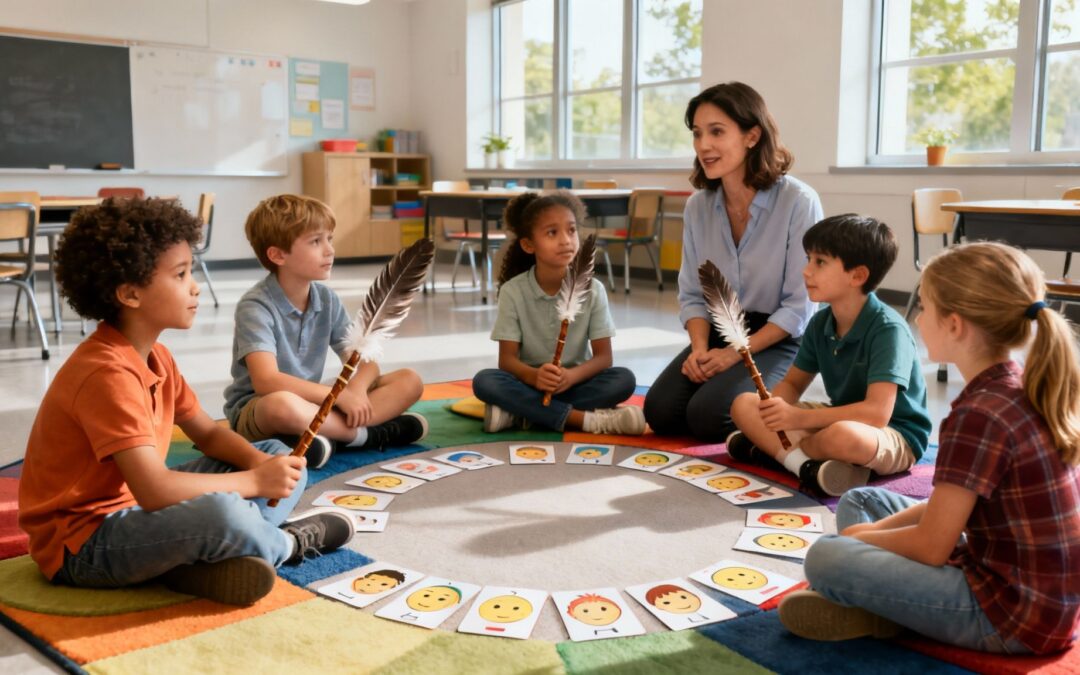
Feelings Chart: A teacher uses a chart with different emoji faces during a morning meeting. Students can point to the face that shows how they feel, giving them a simple, non-verbal way to express their emotions.
“Take Five” Breathing: When a student feels overwhelmed, a parent or teacher guides them to trace their hand while taking five slow breaths—breathing in as they trace up a finger and out as they trace down.
Story Time Empathy: After reading a story, a parent might ask, “How do you think the little bear felt when he lost his toy?” This simple question helps the child start to think about perspectives outside their own.
3rd-5th Grade: Navigating Friendships and Perspectives
As children move into upper elementary school, their social lives get a lot bigger. Friendships become more complicated, group dynamics start to matter, and being able to see things from someone else’s point of view is suddenly critical. The SEL focus naturally shifts outward toward social awareness and relationship skills.
During this stage, kids go from just naming their own feelings to recognizing and respecting the feelings of others. They’re learning the delicate art of compromise, how to really listen, and how to work through disagreements without just tattling or arguing. This is when they start building the bridges that connect their inner world to their friends’ worlds.
Practical Examples for 3rd-5th Graders:
Partner Problem-Solving: A teacher might pair students up to work on a tricky math problem. This requires them to listen to each other’s ideas, explain their own thinking, and work together on a solution.
“Perspective Detective” Game: A parent can describe a situation, like two siblings arguing over a game. They then ask their child to be a “detective” and describe how each sibling might be feeling and why.
Kindness Journals: Students keep a small notebook where they jot down one kind act they did or saw each day. This focuses their attention on positive social interactions and the impact of their actions.
This is the age when kids begin to realize that every person in their classroom has a rich inner life, just like they do. Fostering empathy here is a game-changer for creating a kind and inclusive school community.
6th-8th Grade: Complex Choices and Identity
Middle school is a time of massive change. Young adolescents are dealing with a stronger need for independence, intense peer pressure, and the first hints of abstract thinking. Here, the SEL focus sharpens onto responsible decision-making, pulling all five competencies together to navigate an increasingly complex social world.
The challenges are more nuanced now, involving everything from peer pressure and ethical dilemmas to managing a digital social life. Students need to draw on their self-awareness to know their own values, use self-management to resist negative influences, and apply social awareness to understand the long-term consequences of their choices on themselves and others.
Practical Examples for 6th-8th Graders:
Problem-Solving Scenarios: A teacher presents a scenario like, “Your friend wants you to help them cheat on a test. What are three different ways you could handle this, and what are the potential outcomes of each?”
Goal-Setting Journals: Students set a personal or academic goal, break it down into smaller steps, and track their progress. This builds both self-management and a sense of agency.
Digital Citizenship Discussions: A school counselor leads a talk about the impact of online comments, helping students connect their actions online to real-world feelings and consequences.
Unfortunately, just as these social challenges ramp up, school-based support can sometimes drop off. The OECD’s 2023 Survey on Social and Emotional Skills (SSES) found a “skills dip” as kids get older. While most 10-year-olds attend schools that prioritize SEL, that support often fades by age 15, which contributes to increased stress. This really highlights the need for consistent, age-appropriate SEL support through these critical middle school years. You can learn more about these global findings on SEL development.
Practical SEL Activities for the Classroom and Home
Understanding the core skills of social emotional learning is the first step; bringing them to life is the next. The most effective SEL happens when it’s woven into the fabric of daily routines, not just reserved for a special lesson. The goal is to create consistent opportunities for kids to practice these skills in real, everyday situations.
These simple, effective activities are designed for both teachers in busy classrooms and parents around the dinner table. They turn abstract concepts like empathy and self-regulation into tangible actions, making it easy to integrate powerful social emotional learning for kids into your day.
Simple and Effective SEL in the Classroom
A classroom that prioritizes SEL is a calmer, more focused, and more collaborative learning environment. It’s a place where students feel safe enough to take academic risks and supported enough to navigate social challenges. Here are a few foundational practices to get started.
Establish Morning Meetings
A Morning Meeting is a brief, structured gathering at the start of the day that builds a strong sense of community and belonging. This simple routine can set a positive tone for the entire day, making students feel seen, heard, and valued.
A typical meeting has four simple components:
Greeting: Students and the teacher greet each other by name, often with a handshake or a wave, fostering a sense of personal connection. Example: Students greet their neighbor by saying, “Good morning, [Name]. I hope you have a great day.”
Sharing: A few students share something about their lives, and others practice active listening by asking thoughtful questions. Example: A student shares about their weekend soccer game, and another asks, “What was your favorite part of the game?”
Group Activity: A quick, fun activity builds teamwork and cooperation. Example: The class works together to create a human knot and then tries to untangle it without letting go of hands.
Morning Message: The teacher shares a brief message outlining the day’s learning goals, reinforcing a shared purpose.
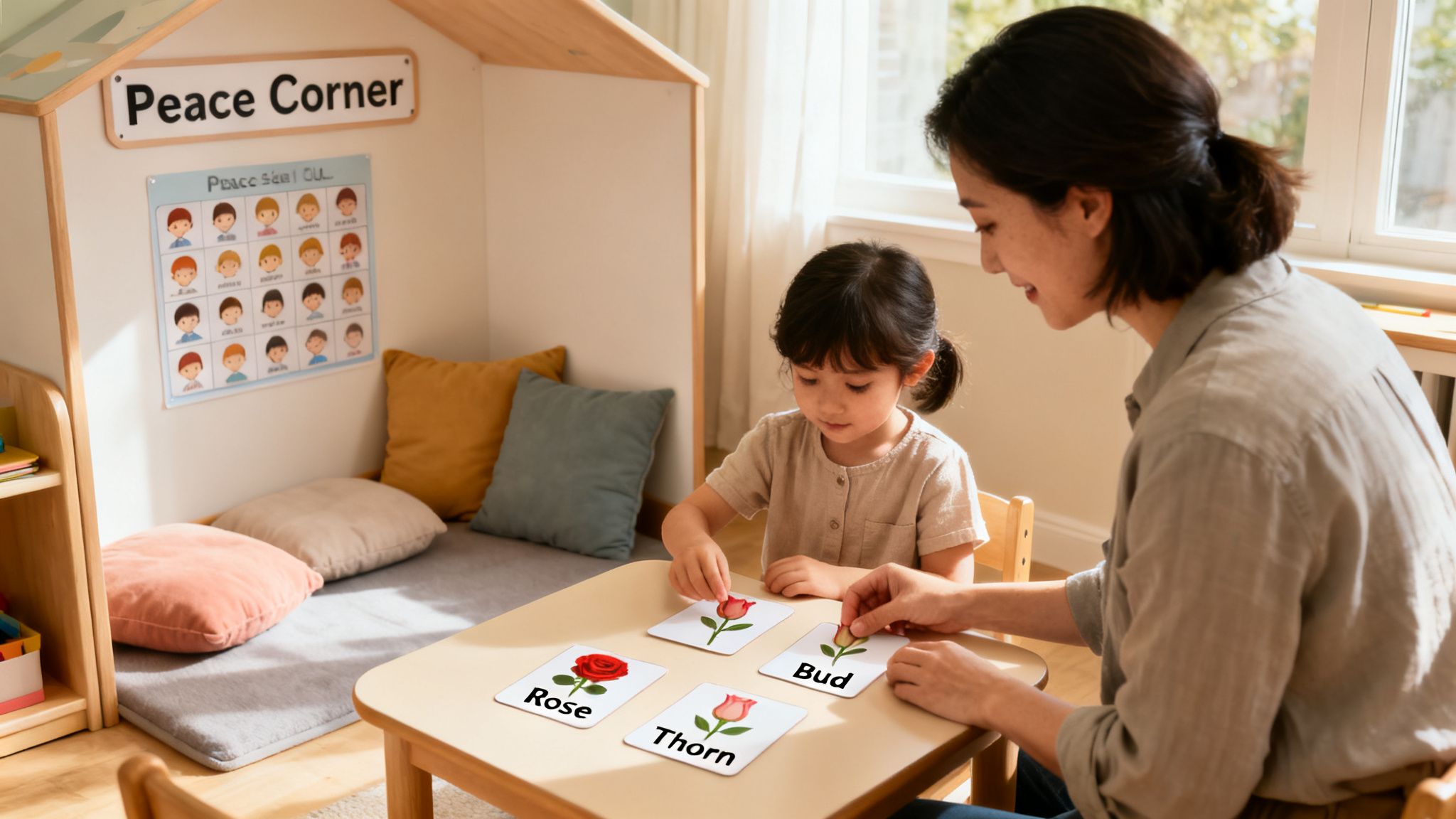
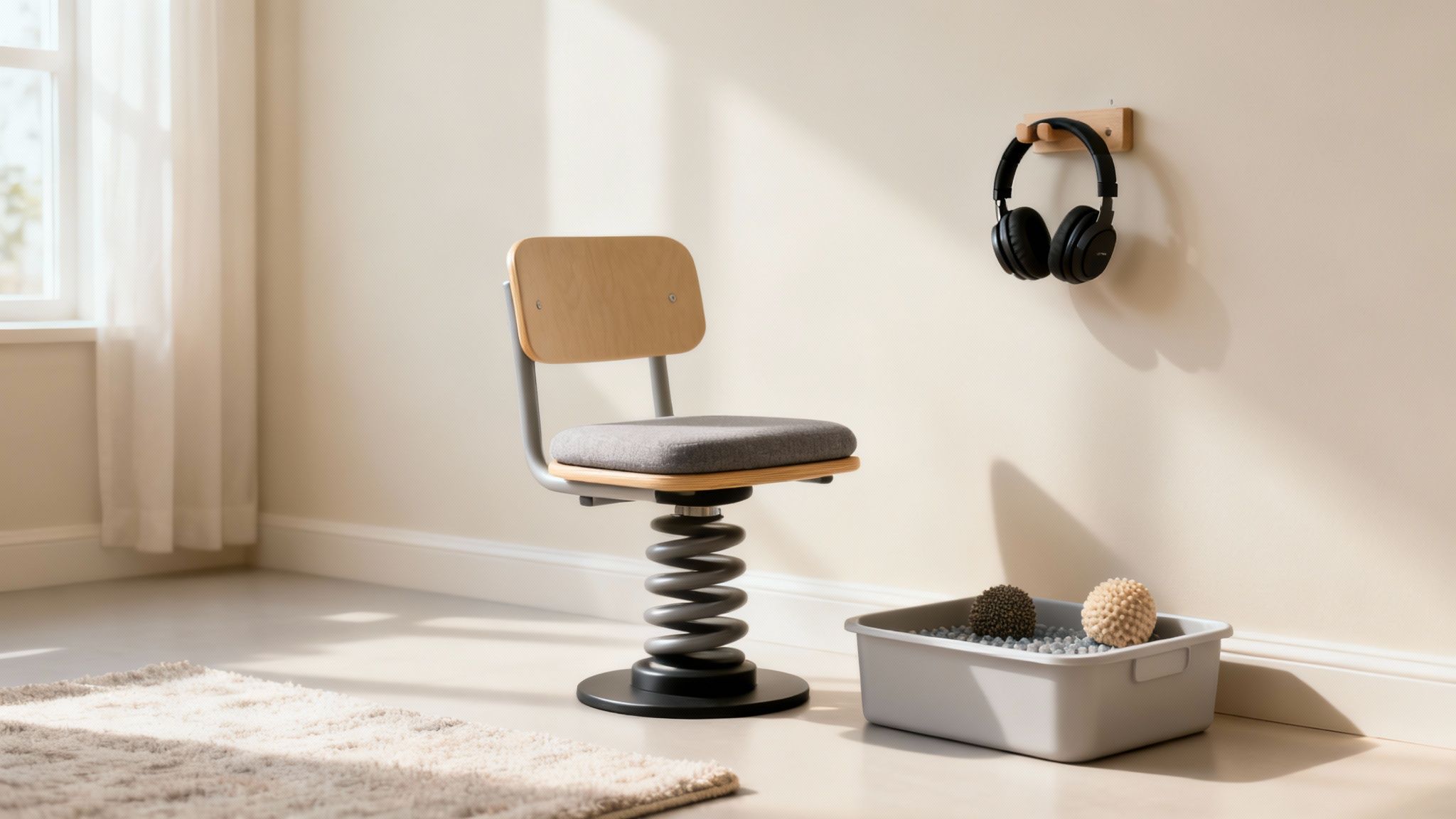
Create a Peace Corner
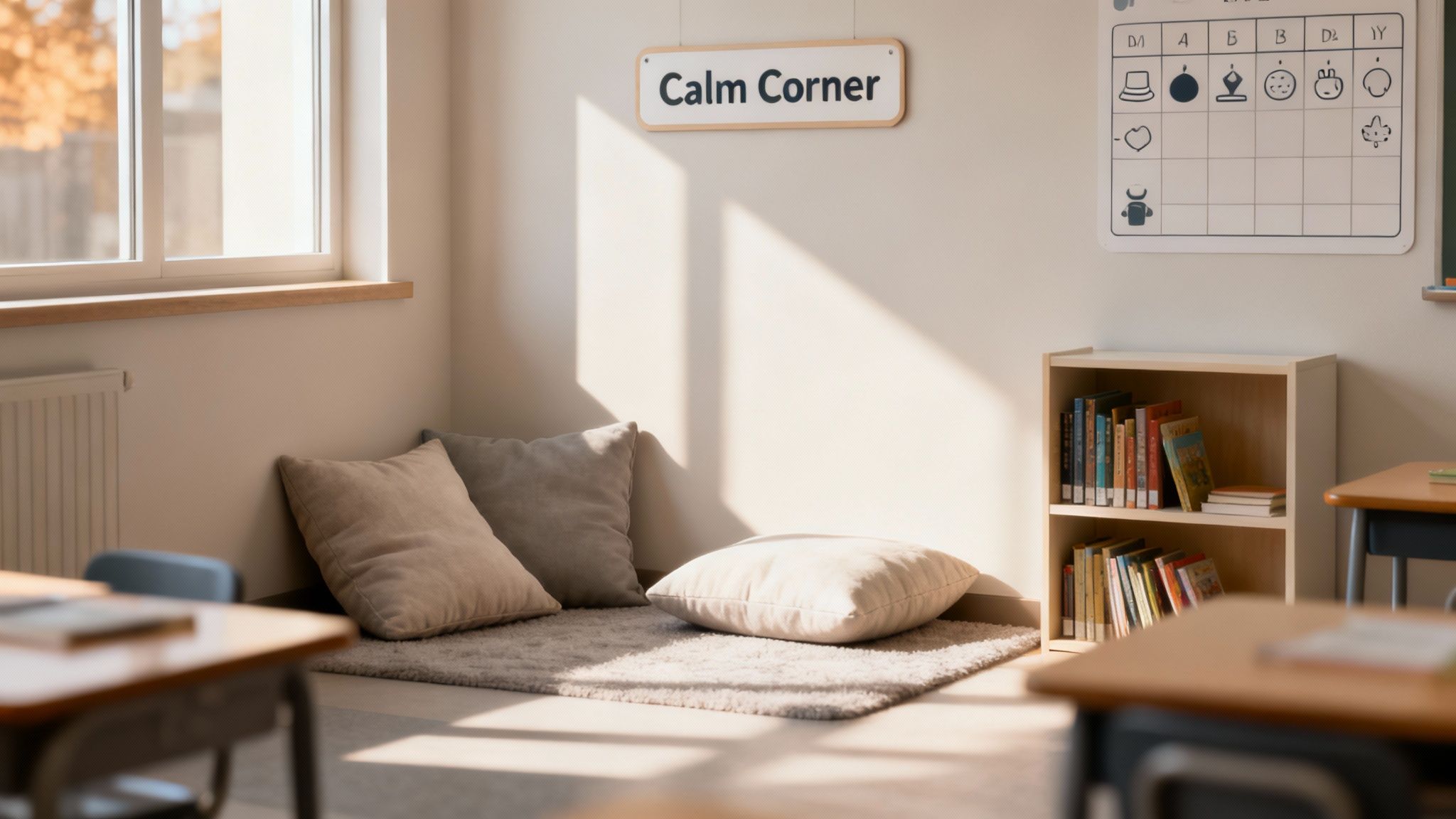
A Peace Corner (or Calming Corner) is a designated space in the classroom where students can go to self-regulate when they feel overwhelmed, angry, or anxious. It’s not a punishment or a “time-out” spot; it’s a supportive tool for building self-management.
A Peace Corner teaches an invaluable life lesson: It is okay to feel big emotions, and it is smart to take a moment to manage them constructively. It shifts the focus from punishing behavior to understanding and addressing the underlying feelings.
Stock this space with simple tools that help kids calm their bodies and minds.
Soft pillows or a beanbag for comfort.
Stress balls or fidget tools for sensory input.
Feeling flashcards to help them identify their emotions.
A journal and crayons for drawing or writing.
Use Turn-and-Talk Strategies
This simple instructional technique boosts engagement and gives every student a voice. Instead of just calling on one or two students, the teacher poses a question and asks students to turn to a partner and discuss their thoughts for a minute.
This practice directly builds relationship skills and social awareness. It teaches students how to listen actively to a peer’s idea, articulate their own thoughts clearly, and see a topic from another perspective. Example: After a science experiment, the teacher asks, “Turn and talk to your partner about what surprised you the most.”
Practical and Powerful SEL at Home
Home is the first classroom for social emotional learning. By integrating SEL into family routines, parents can reinforce the skills children are learning at school and deepen their emotional intelligence in a safe, loving environment. These activities require no special materials—just a little intention.
Practice the “Rose, Bud, Thorn” Check-In
This is a wonderful way to structure conversations around the dinner table or before bed. Each family member shares three things about their day, using a simple metaphor to guide the conversation.
Rose: A success or something that went well. Example: “My rose was that I got a good grade on my spelling test.”
Bud: Something they are looking forward to. Example: “My bud is that we are going to the park this weekend.”
Thorn: A challenge they faced or something that was difficult. Example: “My thorn was that I had a disagreement with my friend at recess.”
This activity builds self-awareness by encouraging kids to reflect on their experiences and name their feelings. It also fosters empathy as family members listen to and support each other’s “thorns.” You can find many more simple and effective exercises in our comprehensive guide to social emotional learning activities.
Start a Family Feelings Journal
A Family Feelings Journal is a shared notebook where family members can write or draw about their emotions. It’s a low-pressure way to build emotional vocabulary and normalize conversations about feelings.
Leave the journal in a common area. A parent might start by writing, “Today I felt proud when I saw you help your sister.” This models emotional expression and gives children a safe outlet to share things they might not want to say out loud. Example: A child might draw a picture of a rainy cloud and write, “I felt sad today because my friend moved away.”
Use Movie Nights for SEL Discussions
Movies and stories are powerful tools for teaching empathy and responsible decision-making. Characters face conflicts, make choices, and experience a wide range of emotions—all from the safety of the couch.
After watching a movie together, ask open-ended questions:
“How do you think the main character felt when that happened?”
“What would you have done if you were in their shoes?”
“Was that a kind choice? Why or why not?”
These conversations help children connect a character’s actions to their consequences, which is a foundational element of responsible decision-making.
How to Foster a School-Wide Culture of Empathy
True, lasting success with social emotional learning for kids happens when it becomes part of a school’s DNA. One-off activities are a great start, but a whole-school approach is what transforms the entire learning environment, weaving empathy and respect into the fabric of every interaction. This is the difference between SEL being just another item on a checklist and it becoming the very foundation of your school’s mission.
This unified commitment is about more than a new curriculum; it’s a culture shift. It begins when leadership champions SEL, provides meaningful professional development for all staff, and creates a shared language around emotions that’s used everywhere—from the principal’s office to the playground.
When a whole school community gets on the same page, the climate changes. You start to see behavioral issues decrease as a safer, more supportive atmosphere emerges—one where every single student feels like they belong and can truly thrive.
Championing SEL from a Leadership Level
For a school-wide culture of empathy to really take hold, it has to be championed from the top down. School administrators and educational leaders are the ones who steer the ship. When their support is visible and vocal, it sends a clear message to staff, students, and parents that SEL is a core priority, not just another passing trend.
This kind of leadership involves a few key actions:
Integrating SEL into the School Mission: Making sure social and emotional well-being are explicitly written into the school’s vision and mission statements.
Modeling SEL Skills: Demonstrating empathy, active listening, and respectful communication in every interaction with staff, students, and families.
Allocating Resources: Dedicating time in the school schedule for SEL practices and budgeting for professional development and supportive materials.
A principal who starts a staff meeting by asking everyone to share a “win” from their week is doing more than just being friendly. They are actively modeling the community-building practices they want to see in every classroom, making SEL a lived value, not just a posted one.
Building Staff Capacity Through Professional Development
Teachers and staff are on the front lines, but they can’t do this work without support. Meaningful professional development is what gives them the confidence and skills to weave SEL into their daily instruction and interactions.
Effective training goes way beyond a one-off workshop. It needs to provide ongoing coaching and chances to collaborate. It should empower staff not only to teach SEL concepts but also to manage their own emotional well-being, which helps prevent burnout and creates a more regulated classroom for everyone. Practical Example: A school might offer a training series on restorative practices, where teachers learn how to lead circles to resolve classroom conflicts, giving them a practical tool they can use immediately.
This investment in staff is a direct investment in student success. The global SEL market is projected to surge from USD 1.13 billion in 2022 to USD 5.21 billion by 2029—a clear sign of this massive shift in educational priorities. You can discover more about what’s driving this trend in the full market research.
Creating a Shared Language for Empathy
One of the most powerful parts of a whole-school approach is establishing a common vocabulary for feelings and conflict resolution. When everyone—from the bus driver to the librarian to the students themselves—uses the same words for emotions and problem-solving, it creates a consistent and predictable environment.
For example, a school might adopt simple tools like “I-statements” for expressing feelings (“I feel frustrated when…”) or a specific process for working through disagreements. This shared language cuts down on confusion and gives students the tools to navigate social situations more effectively, no matter where they are on campus. Practical Example: A school adopts the “Stop, Walk, and Talk” method for playground conflicts. Every staff member is trained to guide students through this same three-step process, ensuring consistency.
This consistency is a key ingredient in how to improve school culture from the ground up. By creating this unified framework, a school doesn’t just teach empathy—it lives it.
Common Questions About Social Emotional Learning
As social emotional learning for kids gets more time in the spotlight, it’s only natural for parents and educators to have questions. You want to understand what it really means for your child or your school.
Let’s cut through the noise and get straight to the heart of what SEL is, what it isn’t, and why it matters so much.
Is SEL Just Another Passing Educational Trend?
Not at all. While the term “social emotional learning” might feel new, the ideas behind it are as old as education itself. They’re rooted in decades of solid research on child development and human psychology.
Unlike fads that come and go, SEL has a huge body of evidence showing its positive impact on everything from academic performance to student behavior and long-term well-being. The goal was never to replace core subjects like math or reading. Instead, SEL gives kids the tools—like focus, resilience, and teamwork—that help them succeed in those subjects and, frankly, in life. It’s a lasting, research-backed approach to educating the whole child.
How Do I Know if SEL Is Actually Working?
You’ll see it in the little things, day in and day out. Success in SEL isn’t measured by a test score; it’s measured by observable changes in how kids navigate their world.
Success in SEL is visible when a child can name their frustration instead of having a tantrum, or when a group of students works through a disagreement respectfully instead of arguing. It’s about watching them grow into more aware, empathetic, and capable individuals over time.
You can look for specific signs of progress:
In School: A teacher might notice fewer discipline issues, more students helping each other without being prompted, and better focus during lessons. You’ll see it in how they participate in class and work together on projects.
At Home: You might see your child handle disappointment with more grace, show genuine empathy for a sibling, or start talking about their feelings more openly.
Our School Has a Tight Budget. Can We Still Implement SEL?
Absolutely. Effective social emotional learning for kids doesn’t require a huge budget or a fancy, pre-packaged curriculum. It can start with simple, powerful shifts in school culture that cost nothing more than intention.
Meaningful change often begins by weaving small, high-impact practices into the daily routine. A “mindful minute” to help students center themselves before a test, using a “morning meeting” to build community, or creating a shared, simple process for resolving conflicts can make a world of difference. The key is to start small and be consistent.
How Does SEL at School Connect with What I Do at Home?
The most powerful SEL happens when school and home are partners. When kids hear the same language and see similar behaviors in both places, the skills stick. It creates a consistent, predictable world where they feel safe enough to practice what they’re learning.
You can build this bridge in simple ways. Ask your child open-ended questions that go beyond “How was school?” Try asking, “What was something that made you feel proud today?” or “Was there a time when you felt confused?” For more in-depth discussions and ongoing insights, you can explore further articles and resources to find new strategies.
Reading stories together and talking about the characters’ feelings and choices is another fantastic tool. But most importantly, modeling how you manage stress or work through a disagreement teaches a lesson no worksheet ever could. This reinforcement helps children internalize these crucial skills for life.
At Soul Shoppe, we provide schools with the tools, programs, and support needed to build a culture of empathy and connection from the ground up. Our research-based, experiential approach helps students and staff develop a shared language for resolving conflict and understanding emotions. Learn how Soul Shoppe can help your school community thrive.
In a world that feels increasingly divided, the ability to genuinely understand another person’s point of view is more than a skill; it’s a superpower. For K-8 students, developing this ability, known as perspective-taking, is foundational for building healthy relationships, resolving conflicts, and creating inclusive communities. It’s the bedrock of social-emotional learning (SEL) that allows students to move from simple sympathy (feeling for someone) to true empathy (feeling with someone). This critical shift requires children to first understand their own emotions. A critical initial step in empathy is helping children identify and articulate their own feelings; consider using a simple feelings chart for kids to build this self-awareness.
This practical guide moves beyond abstract advice to offer a comprehensive roundup of powerful and actionable perspective taking activities designed for immediate use in classrooms, counseling sessions, and at home. We’ve compiled a variety of dynamic exercises suitable for kindergarten through middle school, ensuring you have the right tools for every developmental stage. Each item in this listicle includes:
Clear, step-by-step instructions.
Age-appropriate differentiations and modifications.
Specific SEL skills targeted by the activity.
Practical examples and sample scripts.
From role-playing and storytelling to art-based expression and restorative circles, these strategies are designed to cultivate deep, authentic empathy. Let’s explore how to move beyond the cliché and into transformative practices that create environments where every child feels seen, heard, and understood.
1. Role-Playing and Scenario-Based Activities
Role-playing is a powerful, hands-on method where students step into another person’s shoes to act out real-world scenarios. By embodying different characters, participants move beyond theoretical understanding to an experiential grasp of diverse viewpoints. This dynamic approach is one of the most effective perspective taking activities because it integrates movement, emotion, and social interaction, making empathy a tangible skill.
This method, popularized by practices like Augusto Boal’s Theatre of the Oppressed and used extensively by organizations like Soul Shoppe, allows students to safely explore complex social dynamics. They can practice navigating conflict, responding to peer pressure, and understanding the feelings of others in a controlled environment.
How It Works
The core of role-playing is assigning students specific roles within a predefined scenario. They act out the situation, making choices and reacting as their character would. The facilitator then guides a group reflection to unpack the experience.
For Younger Students (K-3): Use simple, relatable scenarios. Practical Example: Have two students act out a conflict over a shared toy. One student is the “grabber,” and the other is the “owner.” A third student can play the “friend” who sees it happen. Afterward, ask: “To the owner: how did it feel when the toy was taken?” “To the grabber: what did you want in that moment?” “To the friend: what did you see and how did it make you feel?”
For Older Students (4-8): Tackle more nuanced situations. Practical Example: A scenario could involve one student trying to convince another to cheat on a test, a group navigating the exclusion of a peer at lunch, or a student posting a hurtful comment online about a classmate. Assign roles like “the poster,” “the target,” and “the bystander” who saw the comment but didn’t say anything.
Implementation Tips for Success
To ensure these activities are productive and safe, structure is key. Always establish clear guidelines and objectives before you begin.
Start Small: Begin with low-stakes, lighthearted scenarios (e.g., disagreeing on a game to play at recess) before moving to more emotionally charged topics like bullying or exclusion.
Facilitate Debriefing: The learning happens in the reflection. After a role-play, use guided questions:
“To the person playing [Character A], what were you feeling when that happened?”
“What do you think [Character B] was thinking?”
“If we did this again, what could we change for a better outcome?”
Offer Opt-Outs: Participation should always be a choice. Allow students to observe if they are not comfortable acting. Observers can provide valuable insights during the debriefing.
Role-playing builds a strong foundation for social-emotional learning by transforming abstract concepts like empathy and respect into practical, memorable skills. By actively practicing these scenarios, students develop crucial communication skills that they can apply to real-life challenges.
2. Literature and Storytelling Circles
Stories are powerful vehicles for empathy, offering a direct window into another’s world. Literature and storytelling circles use the power of narrative to help students explore diverse viewpoints, motivations, and experiences. By engaging with characters in books or listening to peers’ personal stories, students practice one of the most fundamental perspective taking activities: seeing a situation through someone else’s eyes.
This approach is championed by educators like Harvey Daniels and Dr. Rudine Sims Bishop, who emphasize that books should serve as “windows, mirrors, and sliding glass doors.” Literature circles allow students to analyze character decisions, while storytelling circles build community by fostering understanding of each other’s lived realities.
How It Works
This method involves small groups reading and discussing texts or sharing personal narratives with a focus on viewpoint. The facilitator uses guided questions to deepen comprehension and encourage students to connect the story’s themes to their own lives.
For Younger Students (K-3): Use picture books with clear emotional arcs. Practical Example: After reading The Invisible Boy by Trudy Ludwig, ask: “How do you think Brian felt when no one included him?” and “What could the other kids have done to make him feel seen?” Then, have students turn and talk to a partner about a time they felt like Brian.
For Older Students (4-8): Use chapter books with complex characters and multiple perspectives, like Wonder by R.J. Palacio. Practical Example: Assign different small groups to be “experts” on a specific character (e.g., Via, Jack, Summer). Have them track their character’s point of view throughout the book and then present to the class how their character experienced a key event, like the first day of school, differently from others.
Implementation Tips for Success
Creating a safe and structured environment is essential for honest and respectful sharing. Establish clear norms before you begin any discussion or storytelling activity.
Select Diverse Texts: Choose culturally responsive literature that reflects your students’ identities and introduces them to new ones. Ensure a wide representation of family structures, cultures, and experiences.
Use Discussion Prompts: Scaffold conversations with sentence stems to help students articulate their thoughts. Examples include:
“I wonder why the character decided to…”
“From their perspective, they might have felt…”
“If I were in that situation, I would…”
Establish Group Norms: Before any circle, co-create rules for respectful listening, such as “one person speaks at a time,” “we listen to understand, not to reply,” and “what is shared in the circle stays in the circle.” This is especially crucial for personal storytelling.
By regularly engaging with stories, students build a cognitive framework for empathy. They learn that every person has a unique story that shapes their actions, a crucial skill for navigating social complexities in the classroom and beyond.
3. Empathy Mapping and Visual Perspective Activities
Empathy mapping is a powerful visual tool that helps students organize and understand another person’s experience. By creating a visual representation of what someone thinks, feels, says, and does, participants make invisible emotions and thoughts tangible. This concrete approach is one of the most effective perspective taking activities for younger learners, as it transforms abstract emotional concepts into an organized, easy-to-understand format.
Originally developed in the design thinking world by groups like IDEO, this method has been widely adopted by educators and counselors to build social awareness. It provides a structured way for students to move beyond their own viewpoint and systematically consider the complex inner world of another person, whether that’s a character in a book, a historical figure, or a peer in their classroom.
How It Works
The activity centers on a graphic organizer, often a simple chart with four quadrants: Thinks, Feels, Says, and Does. Students fill out the map for a specific person in a particular situation, using words, drawings, or both to capture their perspective.
For Younger Students (K-3): Focus on literary characters or simple classroom scenarios. Practical Example: After reading The Little Red Hen, students can create an empathy map for the protagonist. Teacher asks: “What was the Little Red Hen thinking when no one would help her? (Maybe: ‘I have to do this all by myself.’) What did she feel? (Maybe: ‘Tired’ or ‘Frustrated’). What did she say? (‘I will do it myself then.’) What did she do? (She baked the bread.)”
For Older Students (4-8): Use empathy maps to analyze more complex social dynamics. Practical Example: Have students create two empathy maps for the same situation from a history lesson, like the Boston Tea Party. One map is for a British soldier, and the other is for a Son of Liberty. This exercise visually highlights how two groups can experience the same event very differently.
Implementation Tips for Success
To get the most out of empathy mapping, it’s important to scaffold the process and create a supportive environment for exploration.
Use Templates: Start with pre-made templates labeled with sections like “Thinks,” “Feels,” “Says,” and “Does.” This provides a clear structure, especially for students new to the activity.
Model the Process: Before asking students to work independently, complete an empathy map together as a class. Use a very familiar character (from a movie or popular book) or a relatable situation (like feeling nervous before a presentation).
Ask Probing Questions: Guide students’ thinking with questions that encourage deeper reflection. Ask, “What might this person be secretly worried about?” or “What do they wish others understood about them?”
Integrate with Writing: Use the completed empathy maps as a pre-writing tool. Students can write a short story, journal entry, or a poem from the perspective of the person they mapped. You can learn more about methods like this when exploring how to teach empathy in the classroom.
Empathy mapping makes perspective-taking visible and accessible, giving students a repeatable process for building compassion and understanding in all aspects of their lives.
4. Peer Interviews and “Getting to Know You” Activities
Structured peer interviews transform typical icebreakers into meaningful perspective taking activities. Students ask carefully designed questions to learn about their classmates’ experiences, values, and backgrounds. This guided conversation moves beyond surface-level facts to build a genuine understanding of how a peer’s life has shaped their worldview.
This method, often used in restorative practices and community-building circles, helps dismantle assumptions and stereotypes. By actively listening to a partner’s story, students learn to appreciate the diversity within their own classroom, fostering a culture of curiosity and respect.
How It Works
The activity pairs students to interview each other using a set of prepared questions. The goal is not just to collect answers but to listen and ask follow-up questions. Afterward, students can reflect on what they learned about their partner and themselves.
For Younger Students (K-3): Keep interviews short with simple, concrete questions. Practical Example: Partners can draw pictures to represent their answers. Questions could include: “What is a favorite family tradition and why is it special?” or “Tell me about a time you felt really happy.” The interviewer then shares one interesting thing they learned about their partner with the class.
For Older Students (4-8): Use multi-layered questions that invite deeper reflection. Practical Example: A prompt could be: “Describe a challenge you’re proud of overcoming” or “What is something people often misunderstand about you?” After the interview, students can write a one-paragraph “bio” for their partner, focusing on what they learned about their character and strengths.
Implementation Tips for Success
Creating a safe and structured environment is crucial for these interviews to be effective. Clear guidelines help students feel comfortable sharing.
Create Question Banks: Develop a list of questions ranging from lighthearted (e.g., “What’s your favorite thing to do on a weekend?”) to more profound (e.g., “What is a value that is really important to your family?”). This allows you to tailor the activity to the group’s comfort level.
Model Active Listening: Before they begin, demonstrate what active listening looks like. Show how to make eye contact, nod, and ask clarifying questions like, “Can you tell me more about that?”
Establish Safety and Confidentiality: Clearly state that personal stories shared in pairs should stay between those two students unless they get permission to share with the larger group. This builds trust.
Use Sentence Starters: Provide prompts to help students formulate respectful and open-ended questions, such as:
“Tell me about a time when…”
“What’s important to you about…”
“How does it feel when…”
Peer interviews are a powerful tool for building a connected and empathetic classroom community. They teach students that every person has a unique story and that taking the time to listen is a profound act of respect.
5. Perspective-Taking Through Art, Music, and Creative Expression
Creative expression offers a unique and powerful pathway for exploring different viewpoints. By using mediums like visual art, music, or dance, students can process and communicate perspectives that are difficult to put into words. This approach engages different parts of the brain than verbal discussion, making it one of the most inclusive perspective taking activities for students who may not be comfortable expressing themselves through speech alone.
This method, championed by arts-integrated education advocates and SEL programs, acknowledges that emotion and perspective are deeply personal. Creating or responding to art allows students to build their emotional vocabulary and empathy in a way that feels natural and non-confrontational, turning abstract feelings into tangible creations.
How It Works
This activity centers on using creative prompts to inspire students to explore a specific point of view. The goal is not artistic perfection but the process of understanding and expressing a perspective. The facilitator then guides a sharing circle where students can present and discuss their work.
For Younger Students (K-3): Keep prompts concrete and feeling-focused. Practical Example: Play different pieces of music (one fast and upbeat, one slow and somber) and ask students to draw with colors and shapes that show how each song makes them feel. Or, after reading a story, ask them to draw a picture from the perspective of a secondary character, like the wolf in The Three Little Pigs.
For Older Students (4-8): Use more complex and abstract prompts. Practical Example: Have students create a “perspective collage” using magazine cutouts to represent how someone new to the school might see the cafeteria, hallways, and classrooms. Another powerful activity is to have them write a song or poem from the perspective of a historical figure they are studying.
Implementation Tips for Success
To create a supportive environment, it is crucial to emphasize process over product and honor all forms of creative expression.
Frame the Activity: Clearly state that the goal is to explore feelings and ideas, not to create a masterpiece. Use prompts like, “Create something that shows how [character] feels about…” to focus on expression, not technical skill.
Use Diverse Materials: Offer a variety of mediums, such as paint, clay, digital art tools, or musical instruments. Play music from diverse artists and cultures, and discuss whose stories are being told.
Facilitate Sharing Circles: After the creation process, invite students to share their work. Ask open-ended questions like, “What part of this piece shows the character’s feelings?” or “What story does this artwork tell?” Remember that some students may prefer to create and listen without sharing verbally.
By integrating the arts, you provide a versatile and deeply effective way for students to connect with the emotional lives of others. This approach validates different ways of processing the world and builds a classroom culture where every perspective is seen and valued.
6. Restorative Circles and Peer Dialogue Processes
Restorative circles are structured dialogues that bring together individuals affected by conflict to share their perspectives, understand the impact of actions, and collaboratively find a path forward. By creating a safe space for every voice to be heard, this method moves beyond punishment to focus on empathy and repair. This approach is one of the most transformative perspective taking activities because it helps participants understand the ripple effect of their actions on a community.
Pioneered by restorative justice leaders like Dr. Howard Zehr, this practice is now widely used in schools as an alternative to traditional discipline. It shifts the central question from “What rule was broken and who should be punished?” to “Who was harmed and what needs to happen to make things right?” This fundamental change empowers students to see situations from multiple viewpoints and take responsibility for community well-being.
How It Works
A facilitator guides participants through a series of scripted questions designed to promote listening and understanding. The use of a talking piece (an object that is passed around) ensures that only one person speaks at a time, and everyone has an equal opportunity to contribute.
For Younger Students (K-3): Use circles proactively to build community. Practical Example: A “check-in” circle can start the day with a simple prompt like, “Share one happy thing and one tricky thing from your morning.” After a minor conflict, like excluding a friend from a game, the circle can explore questions like, “How does it feel to be left out?” and “What could we do next time to make sure everyone feels welcome to play?”
For Older Students (4-8): Address more complex issues, such as a post-bullying incident. The circle would include the student who was targeted, the student who bullied, and supportive peers. Practical Example: The facilitator might ask the student who did the bullying, “What were you thinking and feeling right before it happened?” Then, to the student who was targeted, “What has been the hardest part for you since this happened?” This allows everyone to hear the full impact of the actions.
Implementation Tips for Success
Effective restorative circles require careful planning and skilled facilitation to ensure they are safe and productive for all involved.
Train Facilitators: Leaders must be thoroughly trained in restorative practices and trauma-informed approaches. The facilitator’s role is to maintain safety, not to judge or solve the problem.
Use a Consistent Framework: Guide the circle with a clear question structure. A common framework is:
“What happened?”
“Who has been affected by what happened, and how?”
“What needs to happen to make things right?”
Ensure Voluntary Participation: Forcing a student into a circle can undermine the entire process. Participation should be a choice, and individual “pre-circles” are essential to prepare everyone.
Build Community Proactively: Don’t wait for harm to occur. Use circles regularly to build relationships and establish trust, making it easier to navigate conflict when it arises. You can learn more about restorative practices in education to see how they build positive school climates.
Restorative circles teach students that their voices matter and their actions impact others, building a deep, practical understanding of empathy and mutual respect.
7. Programmatic and Community-Based Approaches: SEL, Mindfulness, and Service Learning
Beyond standalone lessons, programmatic approaches embed perspective-taking into the very fabric of school culture through comprehensive Social-Emotional Learning (SEL) curricula, mindfulness practices, and service learning. These structured methods intentionally teach empathy alongside self-awareness, relationship skills, and responsible decision-making. By combining direct instruction with real-world community engagement, these are powerful perspective taking activities that help students understand systemic issues and their role within a larger community.
This approach, championed by organizations like CASEL and demonstrated through experiential programs like those offered by Soul Shoppe, moves beyond individual scenarios to build a consistent, school-wide language for empathy and understanding. It connects classroom learning to authentic community needs, fostering a deep sense of civic responsibility and interconnectedness.
How It Works
These programs integrate perspective-taking skills across the curriculum and school day, rather than isolating them to a single lesson. They often combine classroom instruction with practical, reflective experiences.
For Younger Students (K-3): Use an SEL curriculum like Second Step or Responsive Classroom during morning meetings. Practical Example: A lesson might focus on identifying feelings in others using picture cards. This is followed by a class project like creating “get well soon” cards for a local children’s hospital, during which the teacher asks, “What words can we write that would make someone feel happy and cared for?”
For Older Students (4-8): Implement a service-learning project. Practical Example: Students could partner with a local food bank. First, they learn about food insecurity in social studies. Then, they volunteer to sort donations. Finally, they write a reflection answering: “After meeting volunteers and hearing stories, how has your perspective on hunger in our community changed?”
Implementation Tips for Success
Success with these broad approaches hinges on thoughtful planning, professional development, and authentic community partnerships.
Integrate, Don’t Add On: Weave SEL concepts into existing structures like morning meetings, advisory periods, and academic subjects. This makes the learning feel relevant and continuous.
Invest in Training: Effective implementation requires that all staff understand the philosophy and practical strategies of the chosen program. Quality professional development is non-negotiable.
Center Community Voice: When engaging in service learning, partner with community organizations as equals. Ensure projects are designed to meet genuine, community-identified needs rather than positioning students as “saviors.”
Build in Reflection: Structure time for reflection before, during, and after service projects. Use prompts like, “What do we expect to learn?” and “How has this experience changed our perspective?”
Cultivate Mindfulness: Introduce mindfulness to build the self-regulation and awareness necessary for perspective-taking. For deepening personal focus, practices such as meditating with crystals can be integrated to help students cultivate inner calm.
By adopting a programmatic approach, schools create a reinforcing ecosystem where perspective-taking is not just a lesson, but a lived value. These structured programs provide students with the consistent practice needed to develop a sophisticated and compassionate worldview. You can explore a variety of engaging social-emotional learning activities to supplement any curriculum.
8. Family and Cross-Generational Perspective-Taking Activities
Inviting family and community members into the classroom bridges the gap between home and school, enriching a student’s understanding of how personal history and culture shape viewpoints. These activities honor that students come from diverse family structures and backgrounds, positioning their lived experiences as valuable sources of knowledge. This approach makes learning relevant and affirms student identity, making it one of the most powerful perspective taking activities available.
This asset-based approach, rooted in frameworks like the Funds of Knowledge theory developed by Moll, Amanti, Neff, and Gonzalez, recognizes that families possess rich cultural and cognitive resources. By centering these voices, schools can build authentic partnerships and create a more inclusive learning environment where every family’s story is valued.
How It Works
This method involves creating structured opportunities for students to learn from their relatives and community elders. The focus is on storytelling and shared experiences, helping students connect curriculum concepts to the real world and understand the diverse viewpoints within their own community.
For Younger Students (K-3): Host a “Family Treasures” show-and-tell. Practical Example: Students bring an item from home that is special to their family (like a grandparent’s recipe, a cultural garment, or an old photograph) and invite a family member to help them share its story. This helps children see how objects can hold different meanings and histories for different people.
For Older Students (4-8): Implement a family history interview project. Practical Example: Students use a provided set of questions to interview an older relative about their life experiences, such as “What was school like for you?” or “Tell me about a time you had to be brave.” They can then present their findings by creating a “podcast” episode, a written report, or a visual timeline that is shared with the class.
Implementation Tips for Success
Creating a welcoming space for families is crucial for these activities to succeed. The goal is to build genuine, respectful relationships.
Offer Multiple Participation Options: Not all families can come to school during the day. Allow participation through recorded videos, written stories, drawings, or a live video call. This inclusivity ensures everyone who wants to share can.
Build Relationships First: Don’t make the first interaction with a family a request for them to share personal stories. Build rapport through positive communication, newsletters, and school events before extending an invitation to participate in a classroom activity.
Facilitate a Thoughtful Debrief: After a family or community member shares, guide a student discussion to process the experience. Ask questions like:
“What was one new thing you learned about your classmate’s family or culture?”
“How was their experience similar to or different from your own family’s?”
“How does learning this story change how you see our community?”
Engaging families and elders directly validates students’ identities and shows them that learning happens everywhere, not just within school walls. These cross-generational connections build a strong sense of community and teach students to appreciate the rich diversity of perspectives that make up their world.
Comparison of 8 Perspective-Taking Activities
Activity
Implementation complexity
Resource requirements
Expected outcomes
Ideal use cases
Key advantages
Role-Playing and Scenario-Based Activities
Low–Moderate — needs facilitator debrief skills
Minimal materials and space; teacher facilitation time
Rapid observable social skill practice; improved empathy and confidence
Bullying prevention, conflict resolution, social skill practice (K–8)
Highly engaging; immediate feedback; builds shared classroom language
Literature and Storytelling Circles
Moderate — requires skilled facilitation and time
Texts/resources, structured protocols, teacher/librarian support
Deeper perspective analysis, improved literacy and respectful dialogue
Cultural understanding, literacy-integrated SEL, community building
Integrates academics + SEL; highlights diverse voices; scalable
Empathy Mapping and Visual Perspective Activities
Low — templates and modeling make it easy to implement
Templates, art supplies, display space, time for reflection
Tangible artifacts showing perspective; accessible for varied learners
Early elementary, students with verbal or processing challenges, conflict mapping
Concrete and inclusive; supports visual/kinesthetic learners; reusable
Peer Interviews and “Getting to Know You” Activities
Low–Moderate — needs protocols and privacy safeguards
Question banks, partner time, facilitator prep, confidentiality norms
Stronger peer connections, active listening, reduced isolation
Welcoming new students, peer mentoring, building belonging
Direct relationship-building; adaptable across ages; low cost
Perspective-Taking Through Art, Music, and Creative Expression
Moderate — needs clear framing to link art to perspective
Art/music materials, space, arts facilitation or teacher training
Increased emotional expression, alternative access to empathy development
Supporting language learners, trauma processing, honoring diverse expression
Engages multiple modalities; less verbally demanding; affirming
Restorative Circles and Peer Dialogue Processes
High — requires extensive training and cultural shift
Trained facilitators, time, preparatory work, follow-up supports
Relationship repair, accountability, measurable reductions in harm
Putting Perspective into Practice: Your Next Steps
We’ve explored a rich tapestry of perspective taking activities, from the dramatic flair of role-playing scenarios to the quiet introspection of empathy mapping. Each of the eight approaches detailed in this guide, whether it’s harnessing the power of storytelling, engaging in restorative circles, or interviewing a peer, serves as a vital tool in building a foundation of social-emotional intelligence. These are not just isolated classroom exercises; they are invitations to cultivate a culture of empathy, curiosity, and genuine human connection.
The core takeaway is that perspective-taking is not a static skill learned in a single lesson. It is a dynamic, ongoing practice. It flourishes when woven into the very fabric of a child’s daily life, becoming as natural as reading or math. It is the practice of asking, “What might this look like from their side?” during a playground disagreement, a historical lesson, or a family discussion.
From Activities to Lifelong Habits
The true power of these strategies is realized when they move beyond the activity itself and become a routine way of thinking and interacting. The ultimate goal is to equip students with an internal framework for understanding others, a framework they can carry with them long after they leave the classroom.
For example, a student who regularly participates in Literature Circles doesn’t just learn to analyze characters; they learn to question their own initial judgments about people they meet. A child who has used an Empathy Map to understand a classmate’s frustration is better equipped to offer support instead of reacting with annoyance. This is where the magic happens: the activity becomes a habit, and the habit becomes a part of their character.
Key Insight: The most effective perspective taking activities are those that are consistently integrated, creating a predictable and safe environment where students feel empowered to explore different viewpoints without fear of judgment.
Your Actionable Next Steps
Embarking on this journey doesn’t require a complete overhaul of your curriculum or home life. Meaningful change begins with small, intentional steps. Here is how you can start putting these ideas into practice today:
Start Small and Be Specific: Don’t try to implement everything at once. Review the list of activities and choose just one that feels like a natural fit for your students’ age group and current needs. Perhaps you start by incorporating a “Getting to Know You” interview into your morning meeting once a week, or you select a book specifically for its potential to spark a perspective-taking discussion.
Model the Behavior: Children are keen observers. Let them see you practicing perspective-taking. You can do this by verbalizing your own thought process. For instance, a teacher might say, “I see that many of you are feeling tired today. I’m going to try to see this from your perspective and adjust our schedule to include a short movement break.” A parent might say, “I’m feeling frustrated, but I’m going to take a moment to understand why you might have felt you needed to do that.”
Connect to Academics: Seamlessly integrate these practices into existing lessons. When studying a historical event, prompt students to write a diary entry from the perspective of two different historical figures. In science, have them debate the environmental impact of a new technology from the viewpoint of a scientist, a business owner, and a community resident. This shows that perspective-taking is a critical thinking skill applicable across all subjects.
Embrace Imperfection: There will be moments when discussions are challenging or when students struggle to see another viewpoint. This is part of the learning process. The goal is not to achieve perfect empathy in every interaction but to consistently create opportunities for practice. Celebrate the effort, not just the outcome.
By committing to these practices, we are doing more than just teaching a social skill. We are nurturing compassionate leaders, thoughtful friends, and engaged citizens who can navigate a complex and diverse world with wisdom and kindness. We are giving them the invaluable gift of seeing the world not just through their own eyes, but through the eyes of others.
Ready to build a comprehensive, campus-wide culture of empathy and respect? Soul Shoppe offers experiential programs that provide students and staff with a shared language and practical tools for conflict resolution, emotional intelligence, and perspective-taking. Explore Soul Shoppe’s programs to bring these vital skills to your entire school community.
Understanding the impact of trauma on learning is no longer optional; it’s essential for creating classrooms where every student can thrive. Trauma, stemming from adverse childhood experiences (ACEs) or systemic stressors, can fundamentally alter a child’s brain development. This directly affects their ability to regulate emotions, build relationships, and access learning. For K-8 educators, this means that traditional classroom management techniques may not only be ineffective but could also re-traumatize a student who is struggling.
The goal isn’t to become a therapist. Instead, it’s about making a crucial shift in perspective from asking, “What’s wrong with this student?” to “What happened to this student, and how can I support them?” By implementing trauma informed teaching strategies, educators can build environments of psychological safety that calm the nervous system and reopen pathways to engagement, connection, and academic growth. A trauma-informed classroom is a space where students feel seen, safe, and supported, allowing their brains to move out of survival mode and into a state ready for learning.
This comprehensive guide moves beyond theory to provide ten actionable strategies tailored for the K-8 classroom. Each item includes practical, step-by-step implementation details, real-world examples, and guidance on how to adapt these methods to meet individual student needs. You will discover how to create predictable routines, foster authentic connections, and use restorative practices to build a more resilient and supportive learning community for every child.
1. Creating Psychologically Safe Classrooms
Psychological safety is the bedrock of all trauma-informed teaching strategies, creating an environment where students feel secure enough to take healthy academic and social risks. For students who have experienced trauma, the world can feel unpredictable and threatening. A psychologically safe classroom counteracts this by establishing consistency, predictability, and emotional validation, allowing a child’s nervous system to shift from a constant state of high alert to one of calm readiness for learning. This foundation is crucial for engagement, cognitive function, and building positive relationships.
A foundational element in creating a psychologically safe classroom is successfully forming a supportive community where students feel connected and valued. When students trust their teacher and peers, they are more willing to participate, ask for help, and navigate challenges without fear of judgment or shaming.
How to Implement This Strategy
Establish Predictable Routines: Post and review a visual daily schedule. Use timers or verbal cues to signal transitions consistently. For example, use the same short, calm song every day to signal clean-up time. This predictability reduces anxiety about what comes next.
Create Safe Spaces: Designate a “calm-down corner” or “cozy corner” with comfortable seating, sensory tools, and books. Teach students how to use this space to self-regulate, framing it as a tool for everyone. For instance, you could say, “If you feel your engine running too fast, you can take a 5-minute break in the cozy corner to help your body feel calm.” For more ideas, explore these detailed steps on how to create a safe space for students.
Co-Create Classroom Agreements: At the beginning of the year, work with students to establish shared expectations. Instead of a rule like “No shouting,” an agreement might be, “We use calm voices to show respect for our friends’ ears.” Phrase them positively and have all students sign the poster.
Practice Welcoming Rituals: Greet every student at the door by name each morning with a choice of a handshake, high-five, or wave. This simple, consistent act of connection reinforces that each child is seen and valued from the moment they arrive.
This approach is most effective when implemented universally from the first day of school, as it sets the tone for the entire year. It is particularly vital during times of change, such as after a school break or a disruptive event, to re-establish a sense of stability and security.
2. Self-Regulation and Co-Regulation Techniques
Self-regulation is the ability to manage emotions and behaviors, a skill that can be significantly underdeveloped in students who have experienced trauma. Co-regulation is the supportive process where a calm, regulated adult helps a child navigate distress and return to a state of balance. By explicitly teaching and modeling these skills, educators provide one of the most essential trauma informed teaching strategies, equipping students with tools to manage their internal states and engage in learning. Instead of just reacting to behavior, this approach addresses the underlying neurological need for safety and calm.
The work of neurobiologists like Dr. Dan Siegel emphasizes how co-regulation helps build neural pathways for independent self-regulation over time. When a teacher remains a calm, validating presence during a student’s meltdown, they are not just managing a moment; they are actively helping to wire the child’s brain for future resilience.
How to Implement This Strategy
Model Your Own Regulation: When you feel frustrated, narrate your process out loud. For example: “The projector isn’t working, and I’m feeling a little flustered. I’m going to take three deep ‘balloon breaths’ to calm down before we try again.” This makes internal processes visible and provides a concrete model for students to follow.
Teach Explicit Techniques: Teach self-regulation strategies during calm moments, not in the middle of a crisis. Practice “box breathing” (inhale for four, hold for four, exhale for four, hold for four) or “5-4-3-2-1 grounding” where students name five things they can see, four they can feel, three they can hear, two they can smell, and one they can taste.
Offer Proactive Regulation Breaks: Integrate short movement or sensory breaks into your daily schedule before students show signs of dysregulation. For example, before a math lesson, say, “Let’s get our brains ready! Everyone stand up and do 10 wall pushes.”
Validate and Support: When a student is upset, get down on their level and validate their emotion first. Say, “I can see you are very upset that your block tower fell down. That is so frustrating. I’m going to sit here with you until your body feels safe again.” This co-regulation builds trust and reduces shame. Explore additional self-regulation strategies for students to expand your toolkit.
This strategy is most effective when regulation skills are practiced daily, becoming as routine as academic drills. It is particularly crucial for students who exhibit big emotional responses, as it shifts the focus from punishment to skill-building, empowering them to manage their own nervous systems.
3. Strengths-Based and Asset-Focused Approaches
A strengths-based approach fundamentally shifts the educational focus from what students are lacking to what they possess. Instead of viewing behaviors through a deficit lens, this trauma-informed teaching strategy prioritizes identifying and cultivating each student’s unique talents, resilience, and interests. For children who have experienced trauma and may have internalized negative self-perceptions, this intentional focus on their assets is profoundly healing and empowering. It reframes their identity around capabilities rather than challenges, fostering a positive self-concept and a stronger connection to the school community.
This asset-focused mindset directly counters the sense of helplessness that trauma can create, showing students that they have inherent value and the capacity to succeed. By building instruction around student strengths, educators create more engaging and relevant learning experiences. This approach is closely linked to developing a growth mindset in the classroom, as it teaches students to view their abilities as skills that can be developed through effort and perseverance.
How to Implement This Strategy
Create Strength Profiles: At the beginning of the year, use interest inventories or “get to know you” activities to document 2-3 specific strengths for each student (e.g., “creative problem-solver,” “empathetic friend,” “persistent artist”). Refer to these profiles when planning lessons or assigning roles. For example, during group work, you might say, “Maria, since you are such a creative problem-solver, would you be in charge of brainstorming for your team?”
Use Strengths-Based Language: Instead of generic praise like “Good job,” be specific and connect it to a strength. For example, say, “David, I noticed how you asked Sam if he was okay after he fell. That showed what an empathetic friend you are.”
Assign Purposeful Classroom Jobs: Design roles that align with student talents. A student who is a natural organizer could be the “Materials Manager,” while a compassionate student could be the “Welcome Ambassador” for new classmates. A student who loves to draw could be the “Class Illustrator,” creating pictures for anchor charts.
Highlight Growth Over Grades: Shift recognition systems to celebrate progress, effort, and resilience. During parent conferences, start by sharing an anecdote of a child’s persistence: “I want to show you this first draft of Liam’s story and then his final version. The effort he put into revising it shows incredible growth in his perseverance.”
This approach is most powerful when used consistently across all interactions, from academic feedback to behavior management. It is especially important when a student is struggling, as it provides an opportunity to remind them of their past successes and inherent capabilities, reinforcing their ability to overcome current challenges.
4. Collaborative Problem-Solving and Student Voice
Trauma-informed teaching recognizes that students, particularly those who have experienced trauma, often feel a profound sense of powerlessness. Collaborative problem-solving directly counteracts this by inviting students into decision-making processes, valuing their perspectives, and building solutions together. This approach shifts the classroom dynamic from top-down, punitive discipline to one of dialogue and shared ownership, which builds student autonomy and reinforces that their voice matters in creating a functional, supportive community.
Popularized by Dr. Ross Greene, this strategy is built on the idea that “kids do well if they can.” When students face challenges, it is not due to a lack of will but a lack of skills. By working together to identify lagging skills and unsolved problems, teachers and students can find mutually agreeable solutions that address the root cause of the behavior, fostering both skill development and a stronger relationship.
How to Implement This Strategy
Hold Class Meetings: Dedicate regular time for students to discuss classroom concerns and co-create solutions. For example, if students are struggling with noisy transitions, a meeting could start with, “I’ve noticed our clean-up time has been really loud and it’s hard for us to get to the next activity. What are your ideas to make it smoother?”
Use Restorative Circles: After a conflict, gather involved students in a circle to share their perspectives. For instance, if two students argued over a shared toy, each would get a chance to answer, “What happened?” “How did it make you feel?” and “What do you need to feel better?” This teaches empathy and repairs harm rather than simply assigning blame.
Implement Student-Led Conferences: Empower students to present their learning progress, challenges, and goals to their parents or caregivers. This gives them agency over their academic journey and develops self-advocacy skills.
Start with Low-Stakes Decisions: Build student comfort by first asking for input on smaller issues. You could say, “Class, we have 15 minutes at the end of the day. Would you prefer a read-aloud or a quick drawing activity? Let’s take a vote.”
This strategy is most effective when used proactively to build community and consistently to address challenges as they arise. It is particularly crucial when behavioral issues surface, as it provides a non-punitive framework for understanding the student’s struggle and finding a path forward together.
5. Mindfulness and Present-Moment Awareness Practices
Mindfulness, the practice of paying attention to the present moment without judgment, is a powerful self-regulation tool. For students impacted by trauma, whose nervous systems can be stuck in a state of high alert, mindfulness helps anchor them in the safety of the here and now. This practice counters the effects of trauma, such as intrusive thoughts or anxiety about the future, by training the brain to focus, calm itself, and create a crucial pause between an emotional trigger and a reaction. Integrating mindfulness is one of the most direct trauma informed teaching strategies for building internal coping skills.
This strategy empowers students with the awareness and skills to manage their internal states. By teaching them to notice their breath, body sensations, and thoughts, we give them an invaluable resource for navigating stress both inside and outside the classroom.
How to Implement This Strategy
Start with Short, Guided Practices: Begin with simple one-minute breathing exercises. Guide students to “Put one hand on your belly. As you breathe in, feel your belly get big like a balloon. As you breathe out, feel it get smaller.” Gradually extend the time as students become more comfortable.
Use Sensory Anchors: Ring a mindfulness bell or chime to signal the start of a quiet transition. Ask students to simply listen until they can no longer hear the sound. This auditory focus brings everyone into the present moment before you give the next instruction.
Integrate Mindful Movement: Incorporate simple yoga stretches or “body scans.” For example, lead students in a “Mindful Walk” around the classroom, asking them to notice the feeling of their feet on the floor with each step. This helps reconnect mind and body. For resources, organizations like the Center for Healthy Minds offer science-backed practices for educators.
Model the Practice: Share your own experiences with mindfulness. You might say, “I’m feeling a little rushed, so I’m going to take three deep breaths to calm my body before we begin our lesson.” This normalizes the practice and shows its practical application.
This approach is most effective when introduced gently and practiced consistently, such as after recess or before an assessment, to help students settle their bodies and minds. It is crucial to always make participation optional, allowing students to opt out or modify the practice to ensure they feel in control and safe.
6. Relationship-Building and Authentic Connection
For students impacted by trauma, the presence of a stable, caring, and predictable adult can be a powerful healing force. Authentic connection is a core component of trauma-informed teaching strategies because it directly counteracts the relational harm and instability that often accompany adverse experiences. When a teacher invests in knowing a child as an individual, they create a secure attachment that allows the student’s brain to feel safe, valued, and ready to learn. This relationship becomes the secure base from which students feel empowered to explore, make mistakes, and engage with their peers and academic material.
Building these connections is not about being a student’s best friend; it is about providing unwavering positive regard and demonstrating genuine care. This consistent emotional support helps regulate the nervous system and builds the trust necessary for a student to feel comfortable being vulnerable in the classroom. Understanding the power of a positive teacher-student relationship is essential for creating a classroom culture where every child feels seen and supported.
How to Implement This Strategy
Schedule Intentional Connection Time: Dedicate a few minutes each day or week for non-academic check-ins. This could be greeting each student at the door with a personal question, such as “How was your brother’s soccer game last night?” or having a “lunch bunch” with a small group of students.
Discover and Reference Student Interests: Keep a simple log of students’ hobbies, favorite foods, or family members. If a student loves dinosaurs, you could leave a dinosaur book on their desk or say, “I saw this cool documentary about T-Rexes and it made me think of you!” This shows you listen and care about their lives outside of school.
Share Positive News with Families: Make it a habit to send a quick, positive note or email home. For example: “Hi Mrs. Davis, I wanted to let you know that Maria was an excellent helper to a new student today. You should be very proud of her kindness.” This builds a supportive relationship with caregivers and reinforces the child’s sense of value.
Practice the “Two-by-Ten” Strategy: For two minutes each day for ten consecutive days, have a personal, non-academic conversation with a specific student. Ask them about their favorite video game, their pet, or what they did over the weekend. This focused effort can significantly improve the dynamic with students who may be struggling to connect.
This strategy is foundational and should be applied consistently throughout the school year for all students. It is particularly crucial for students who exhibit withdrawn behaviors or externalize stress through challenging actions, as these are often signs that they need connection the most.
7. Trauma-Sensitive Discipline and Restorative Practices
Traditional, punitive discipline can often re-traumatize students by activating their fear responses, escalating conflict, and damaging the crucial teacher-student relationship. A trauma-informed approach recognizes that all behavior is a form of communication, often signaling an unmet need or a state of distress. Trauma-sensitive discipline shifts the focus from punishment to problem-solving, and from exclusion to restoration. This strategy aims to repair harm, teach accountability, and rebuild community trust while maintaining high behavioral expectations.
This pivot toward restorative practices, championed by organizations like the International Institute for Restorative Practices (IIRP), helps students develop essential social-emotional skills such as empathy, responsibility, and conflict resolution. Instead of isolating students, it brings them back into the community, reinforcing their sense of belonging and preserving their dignity. This approach addresses the root causes of misbehavior rather than just the symptoms, creating a more sustainable and supportive learning environment.
How to Implement This Strategy
Shift Your Language: Instead of asking a dysregulated student “Why did you do that?” which can provoke defensiveness, get curious. Try asking “I noticed you threw the pencil. Can you tell me what happened right before that?” This opens a non-judgmental dialogue focused on understanding the situation from the student’s perspective.
Focus on Repair and Restoration: When a conflict occurs, guide students with restorative questions. If a student knocks over another’s project, the restorative consequence might be helping them rebuild it. You could facilitate by asking, “What was the harm done?” and “What do you think you can do to make things right?”
Teach Replacement Behaviors: When a student doesn’t meet an expectation, explicitly model and teach the desired behavior. For instance, if a student yells out, you might say later in private, “I see you get really excited and have a hard time waiting to share. Let’s practice raising a quiet hand. Can you show me what that looks like?”
Conduct Private Conversations: Address misbehavior in a private, one-on-one conversation rather than publicly shaming a student. This preserves their dignity and strengthens your relationship. Start the conversation by reaffirming the connection: “You are an important part of our class, and I care about you. We need to talk about what happened at recess so we can solve it together.”
This strategy is most effective when used consistently by all staff to create a predictable and fair school culture. It is particularly crucial for addressing repeated behaviors, as these patterns often indicate an underlying need that punitive measures will not resolve. By prioritizing restoration over punishment, schools can transform discipline into a powerful opportunity for learning and healing.
8. Sensory Integration and Regulation Accommodations
Trauma can significantly impact a student’s nervous system, leading to dysregulation where they become either hypersensitive (overly responsive) or hyposensitive (under-responsive) to sensory input. A loud noise, bright light, or unexpected touch can trigger a fight, flight, or freeze response. Sensory integration and regulation accommodations are essential trauma informed teaching strategies that modify the environment and provide tools to help students manage sensory input, stay calm, and remain available for learning. By addressing sensory needs, educators help soothe a child’s nervous system, making the classroom feel safe and predictable.
This approach, rooted in the work of occupational therapists like Dr. A. Jean Ayres, recognizes that a regulated body is a prerequisite for a focused mind. Providing sensory support isn’t about rewarding behavior; it’s about providing the necessary tools for a child to achieve the optimal state of alertness for academic engagement.
How to Implement This Strategy
Offer Flexible Seating Options: Move beyond traditional desks. Provide wobble cushions, standing desks, yoga ball chairs, or floor cushions that allow for subtle movement, which helps with focus. A student who constantly tips their chair back might benefit from a wiggle seat to get that movement input safely.
Create Proactive Movement Breaks: Integrate short, structured movement activities throughout the day. For example, before a long reading block, say, “Let’s do 10 ‘chair push-ups’ to get our bodies ready to focus.” This provides heavy work that can be very calming for the nervous system.
Provide Sensory Tools: Make a toolkit of fidgets, stress balls, textured items, or weighted lap pads accessible to all students. You might create a “fidget pass” that students can quietly place on their desk when they need a tool, reducing disruption and empowering them to self-advocate for their needs.
Modify the Environment: Be mindful of sensory triggers. Dim harsh fluorescent lights with fabric covers, reduce visual clutter on walls, and provide noise-reducing headphones for students who are sensitive to sound during independent work. For a student easily overwhelmed by noise, offering headphones can be a game-changer.
This strategy is most effective when sensory supports are offered proactively before a student becomes visibly dysregulated. It’s particularly useful during periods requiring quiet focus or following high-energy activities like recess, helping students transition their bodies and minds back to a calm, learning-ready state.
9. Clear Communication and Predictable Expectations
Students who have experienced trauma often exist in a state of hypervigilance, constantly scanning their environment for potential threats. This heightened state of alert makes ambiguous instructions, sudden changes, and unclear expectations feel threatening, often triggering anxiety or defensive behaviors. One of the most stabilizing trauma informed teaching strategies is to establish and maintain clear communication and predictable expectations, which helps a child’s nervous system feel safe enough to lower its defenses and engage in learning.
This strategy is about making the implicit explicit. By clearly communicating what is happening now, what will happen next, and how to succeed, educators remove the guesswork that can be deeply dysregulating for vulnerable students. This predictability builds trust and creates an environment where cognitive resources can be dedicated to academics rather than to anticipating danger.
How to Implement This Strategy
Make Routines Visual and Explicit: Post a visual daily schedule with pictures and words. For multi-step tasks like morning arrival, create a small chart at the student’s desk: 1. Unpack backpack. 2. Turn in homework. 3. Start morning work. This removes reliance on auditory processing, which can be difficult for a stressed brain.
Provide Advance Warnings for Transitions: Use both verbal cues and a visual timer to signal upcoming changes. For example, say, “In five minutes, we will be cleaning up our writing journals,” while setting a visible countdown timer. For a student who struggles greatly, a personal 2-minute warning can be even more helpful.
Teach and Practice Expectations: Do not assume students know what “be respectful” looks like. Create an anchor chart that defines it in concrete terms. For example: “Being respectful in the hallway means: 1. Voices off. 2. Hands to ourselves. 3. Walking feet.” Then, practice it like a fire drill.
Use Consistent, Positive Language: Frame expectations in terms of what students should do. Instead of “Stop running,” try a calm “Please use your walking feet.” Reinforce positive behavior by noticing it: “I see you have your book open to the right page; that shows you are ready.” This approach builds self-efficacy without shaming.
This strategy is most effective when implemented consistently across all classroom activities and, ideally, throughout the entire school. It is particularly crucial at the beginning of the school year, after breaks, or when a substitute teacher is present to maintain a stable and secure learning environment.
10. Cultural Responsiveness and Anti-Bias Teaching
Trauma is not experienced in a vacuum; it intersects with a student’s race, culture, socioeconomic status, and other identities. For this reason, a core component of trauma informed teaching strategies must be a commitment to cultural responsiveness and anti-bias education. This approach recognizes that systemic issues like racism and discrimination are sources of ongoing collective trauma and create significant barriers to learning. It requires educators to honor students’ full identities and histories as a fundamental part of creating a safe and healing-centered environment.
This strategy moves beyond mere tolerance to actively affirming and sustaining students’ cultural backgrounds. It acknowledges that validating a child’s identity is crucial for their psychological well-being and academic success. As Dr. Zaretta Hammond outlines in Culturally Responsive Teaching and The Brain, building on students’ cultural frames of reference can actually foster deeper cognitive processing and engagement.
How to Implement This Strategy
Audit Your Curriculum and Classroom: Examine your books, lesson plans, and classroom visuals. For example, when studying communities, ensure you include examples from the diverse neighborhoods your students live in, not just generic suburban ones. Actively seek and incorporate materials that reflect your students’ identities.
Integrate Culturally Sustaining Practices: Go beyond celebrating specific heritage months. Learn about your students’ home cultures and find authentic ways to integrate their knowledge. For instance, if you have a large Spanish-speaking population, label classroom items in both English and Spanish, or use folktales from their home countries in a literacy unit.
Examine Personal Biases: Engage in professional development and personal reflection to understand your own implicit biases. Acknowledging how your own background shapes your worldview is the first step toward preventing those biases from negatively impacting your students.
Address Microaggressions and Bias Promptly: When a biased comment occurs, such as a student making fun of another’s name, address it directly and educatively. You could say, “In our classroom, we respect everyone’s name. Names are an important part of our identity.” Ignoring these incidents can re-traumatize students who are targeted.
This approach is essential for all students but is especially critical for those from marginalized communities who may experience identity-based harm both inside and outside of school. Implementing these practices consistently helps dismantle systems of inequity and ensures that the classroom is a place where every child feels seen, valued, and safe to learn.
10-Point Trauma-Informed Teaching Comparison
Strategy
Implementation Complexity
Resource Requirements
Expected Outcomes
Ideal Use Cases
Key Advantages
Creating Psychologically Safe Classrooms
Moderate — requires planning and consistent routines
Moderate — staff time, classroom setup, coordination
Addresses systemic causes of trauma; honors student identities
Putting It All Together: Your Next Steps in Trauma-Informed Practice
Embarking on the path of trauma-informed teaching is a commitment to fostering a fundamentally more humane and effective learning environment. Throughout this article, we’ve explored a comprehensive toolkit of trauma informed teaching strategies, moving from the foundational need for psychological safety to the nuanced application of restorative practices and culturally responsive pedagogy. Each strategy, whether it’s establishing predictable routines, co-regulating with a student in distress, or amplifying student voice, serves a singular, powerful purpose: to create a classroom where every child feels safe, seen, and supported enough to learn and thrive.
The core takeaway is that this work is not an add-on or a special initiative; it is the very bedrock of good teaching. It recognizes that a student’s nervous system must be calm and regulated before their prefrontal cortex can engage in higher-order thinking. Strategies like mindfulness exercises and sensory integration are not rewards or distractions; they are essential tools for learning readiness. Similarly, shifting from a punitive to a restorative mindset isn’t about excusing behavior but about teaching the critical social-emotional skills that prevent it from recurring.
Your Actionable Path Forward
Integrating these practices can feel overwhelming, but the journey starts with small, intentional steps. The goal is not to implement all ten strategies overnight but to build a sustainable, authentic practice over time.
Here is a practical roadmap to get you started:
Choose Your Starting Point: Select one or two strategies from this list that resonate most with you or address an immediate need in your classroom. Perhaps you’ll start with Strategy #6: Relationship-Building by committing to the “2×10” method, spending two minutes a day for ten consecutive days talking with a specific student about anything but schoolwork.
Build a Coalition: You are not alone in this work. Share an interesting strategy with a trusted colleague or bring up the concept of Strategy #7: Trauma-Sensitive Discipline at a team meeting. Building a shared language and support system with fellow educators is a powerful catalyst for school-wide change.
Seek Additional Support and Funding: Implementing new approaches, such as building a sensory corner (Strategy #8) or acquiring new SEL curriculum materials, often requires resources. As you plan your next steps, consider exploring resources such as special education grants for teachers to fund these vital strategies. These grants can provide the necessary financial backing to bring your trauma-informed vision to life.
Practice Self-Compassion: Remember that you, too, are human. There will be days when your own regulation is challenged. The principles of trauma-informed care apply to educators as much as they do to students. Acknowledge your efforts, give yourself grace, and focus on progress, not perfection.
This journey is a marathon, not a sprint. By consistently applying these trauma informed teaching strategies, you cultivate a classroom culture that ripples outward. You are not just managing behavior; you are nurturing resilience, fostering deep connection, and empowering students with the skills they need to navigate a complex world. Each time you greet a student by name, validate their feelings, or offer a choice, you are actively rewiring their brain for safety, trust, and academic success. Your commitment to this work transforms your classroom into a sanctuary of learning and a beacon of hope for every child who walks through your door.
For more than 20 years, Soul Shoppe has helped schools build these foundational skills through dynamic, experiential programs. Our on-site and digital workshops equip your entire school community with a shared language and practical tools to cultivate connection, empathy, and resilience. Discover how Soul Shoppe can help you create a thriving, trauma-informed learning environment.
Conflict is a natural and inevitable part of growing up. From playground disagreements over a turn on the swings to classroom collaboration challenges, kids constantly navigate social hurdles. How we equip them to handle these moments defines their ability to build healthy relationships, develop resilience, and contribute to a positive learning environment. Instead of viewing conflict as something to be avoided, we can reframe it as a powerful teaching opportunity. The ability to manage disagreements constructively is one of the most important life skills a child can develop, laying the groundwork for future academic and social success.
This guide provides a comprehensive roundup of ten research-informed conflict resolution activities for kids in grades K-8. Each activity is designed to be practical and actionable, offering educators, counselors, and parents the specific tools needed to teach essential social-emotional learning (SEL) skills. You’ll find step-by-step instructions for implementing strategies that foster:
Empathy and perspective-taking
Self-regulation and emotional management
Effective communication and active listening
These strategies move beyond temporary fixes, aiming to build a foundational skill set that will serve children throughout their lives. By integrating these practices, we can help students transform disputes into moments of connection and growth. This list will provide you with a structured, easy-to-follow toolkit for building a classroom or home culture rooted in understanding, respect, and collaborative problem-solving.
1. Restorative Circles
Restorative Circles are a powerful, structured approach to dialogue where students sit in a circle to discuss conflicts, share perspectives, and collaboratively find solutions. This method shifts the focus from punishment to repairing harm, making it one of the most effective conflict resolution activities for kids to build a strong, empathetic community. The core practice involves using a “talking piece” (like a small stone or ball) which is passed around the circle; only the person holding the piece may speak.
This simple rule ensures everyone is heard and encourages active listening rather than reactive responses. By creating a space for honest sharing, Restorative Circles help students understand the real impact of their actions, fostering accountability and genuine remorse. This practice is foundational for building a classroom culture where every voice matters and relationships are prioritized.
How It Works
Objective: To repair harm, build community, and develop empathy by giving every participant a voice in resolving a conflict.
Materials Needed: A designated “talking piece” that is easy to hold and pass.
Best For: Addressing classroom-wide issues (like gossip or exclusion), repairing harm after a specific conflict between students, and proactively building a positive community.
Step-by-Step Directions:
Arrange Seating: Have all participants sit in a circle where everyone can see one another. The facilitator sits in the circle as an equal member.
Introduce the Process: The facilitator explains the purpose of the circle, establishes group agreements (e.g., “respect the talking piece,” “listen with compassion”), and introduces the talking piece.
Opening Ritual: Start with a simple opening, like a brief moment of quiet reflection or a check-in question (e.g., “Share one word describing how you feel today”).
Guided Dialogue: The facilitator poses questions to guide the conversation, starting with those who were harmed. The talking piece is passed sequentially around the circle.
Develop Solutions: After all perspectives are shared, the facilitator asks, “What needs to happen to make things right?” The group works together to create a mutually agreeable plan.
Closing Ritual: End the circle with a closing round, such as sharing one thing each person will commit to doing.
Practical Example: After several students were excluded from a game at recess, a teacher holds a circle. The first question is, “What happened?” Each student shares their view. The next question is, “How did that make you feel?” A student who was excluded might say, “I felt lonely and invisible.” A student who did the excluding might say, “I felt pressured to only play with my close friends.” The final question, “What can we do to make sure everyone feels included next time?” leads to a group-created plan for inviting others to join games.
Restorative practices have a proven track record. For instance, Oakland Unified School District integrated restorative circles and saw significant improvements in peer relationships and school climate. The foundational principles are part of a broader framework known as restorative justice. For a deeper understanding of this approach, you can learn more about what restorative practices in education look like and how they transform school communities.
2. Peer Mediation and Collaborative Problem-Solving
Peer Mediation empowers students to resolve their own conflicts by training them as neutral facilitators. This approach shifts responsibility from adults to students, teaching them to guide their peers through a structured, collaborative problem-solving process. Instead of focusing on blame, mediators help students identify their underlying needs and co-create “win-win” solutions, making it a powerful tool among conflict resolution activities for kids.
This process not only de-escalates immediate disputes but also equips the entire student body with essential life skills. By learning to distinguish between a “position” (what they want) and an “interest” (why they want it), children develop empathy, communication, and negotiation abilities. This fosters a school culture where students feel capable of handling disagreements constructively, reducing reliance on adult intervention.
How It Works
Objective: To empower students to resolve their own disputes by training student mediators to facilitate a structured, interest-based negotiation process.
Materials Needed: A quiet, private space for mediations; mediation script or guide sheet for mediators; agreement forms to document solutions.
Best For: Resolving recurring interpersonal conflicts between students, such as arguments over games, rumors, or property. It is also excellent for building student leadership and school-wide problem-solving capacity.
Step-by-Step Directions:
Recruit and Train Mediators: Select and train a diverse group of students in a structured mediation process. Training should cover active listening, impartiality, confidentiality, and guiding peers to find their own solutions.
Establish Ground Rules: At the start of a mediation, the student mediator asks both parties to agree to rules like “take turns talking,” “no name-calling,” and “work to solve the problem.”
Each Person Tells Their Story: Each student explains their perspective without interruption. The mediator listens, summarizes, and reflects back what they heard to ensure each party feels understood.
Identify Interests: The mediator helps students move beyond their demands by asking questions like, “What is most important to you about this?” or “What do you need to happen to feel okay?”
Brainstorm Solutions: The mediator encourages students to brainstorm as many possible solutions as they can. All ideas are initially accepted without judgment.
Agree on a Solution: The students evaluate the brainstormed options and choose a mutually acceptable solution. The mediator writes it down on an agreement form, which both students sign.
Practical Example: Two students, Alex and Ben, both want to use the same basketball during recess. A peer mediator facilitates. Alex’s story: “Ben grabbed the ball from me!” Ben’s story: “I had it first!” The mediator asks, “Alex, why is it important for you to use the ball?” Alex explains he wants to practice for his team. The mediator asks Ben the same question, who says he just wants to have fun with friends. After brainstorming, they agree Alex can use the ball for the first 10 minutes to practice drills, and then Ben and his friends can use it for a game for the rest of recess.
Peer mediation has a strong evidence base. For example, schools implementing peer mediation programs, like those in San Francisco, have reported significant reductions in office referrals and playground conflicts. The principles are rooted in the work of negotiation experts like William Ury and the Harvard Negotiation Project. For families seeking engaging ways to practice collaborative skills at home, activities like a Family Real World Adventure Game can help build the teamwork and problem-solving mindset necessary for these skills to flourish.
3. Emotion Coaching and Check-In Conversations
Emotion Coaching is a responsive communication strategy where adults guide children to recognize, label, and manage their feelings. Instead of dismissing or punishing emotions, this approach treats them as opportunities for connection and teaching. Paired with brief, intentional check-in conversations, it becomes one of the most proactive conflict resolution activities for kids, as it builds the emotional literacy needed to prevent conflicts from escalating.
By validating a child’s feelings first, adults create a sense of psychological safety that makes problem-solving possible. A child who feels understood is more open to discussing their behavior and finding a better way forward. This method, popularized by Dr. John Gottman, shifts the adult role from a disciplinarian to an emotional guide, empowering kids with essential self-regulation skills they can use in any situation.
How It Works
Objective: To help children identify and understand their emotions, build emotional vocabulary, and develop healthy coping strategies to manage feelings constructively.
Materials Needed: None. Visual aids like an emotions chart or “feelings wheel” can be helpful for younger children.
Best For: De-escalating conflicts in the moment, preventing future conflicts by building emotional awareness, and strengthening adult-child relationships through trust and empathy.
Step-by-Step Directions:
Notice and Acknowledge: Tune in to the child’s emotions, paying attention to body language and tone. Acknowledge their feelings without judgment, e.g., “I can see you are very upset.”
Listen and Validate: Give the child your full attention and listen to their perspective. Validate their feelings by saying something like, “It’s understandable that you feel angry because your turn was skipped.”
Help Label the Emotion: Provide the child with the vocabulary to name their feeling. For instance, “It sounds like you’re feeling frustrated and left out.”
Set Limits and Boundaries (If Needed): After validating, clarify that while the feeling is okay, the behavior is not. For example, “You are allowed to be mad, but you are not allowed to push.”
Problem-Solve Together: Guide the child to brainstorm solutions. Ask questions like, “What could you do next time you feel this way?” or “How can we solve this problem together?”
Practical Example: A child, Maria, slams her book on the table after a group project discussion. A teacher approaches calmly and says, “That was a loud noise. It looks like you’re feeling really frustrated right now.” Maria nods, still upset. The teacher validates: “It’s hard when you have a different idea than your group. I get why you feel that way.” After a moment, she sets a boundary: “It’s okay to be frustrated, but it’s not okay to slam books. What’s another way you could show your group how you’re feeling or ask for a turn to share your idea?”
Research from Dr. John Gottman’s work shows that children who are emotion-coached have better friendships and are more resilient. For example, schools incorporating this model into their SEL curricula have seen significant improvements in classroom climate and overall student wellbeing. To further explore routine-based check-ins, you can discover more about using daily mood meters and reflection tools to boost student confidence.
Social-Emotional Learning (SEL) Curricular Programs are comprehensive, evidence-based frameworks that systematically teach core social and emotional skills. Instead of being a one-off activity, these curricula integrate conflict resolution, empathy, and responsible decision-making directly into classroom instruction through structured lessons and activities. By adopting a program, schools create a shared language and consistent approach to behavior and relationship management.
These programs equip students with the tools to understand their emotions, build healthy relationships, and navigate disagreements constructively. For example, a lesson might teach students to identify their “trigger points” before a conflict escalates. This makes SEL curricula one of the most proactive and impactful conflict resolution activities for kids, as it builds foundational skills that prevent many conflicts from ever starting.
How It Works
Objective: To embed social-emotional competencies like self-awareness, self-management, and relationship skills into the school day, providing students with a consistent framework for resolving conflicts.
Materials Needed: Varies by program, but typically includes a teacher’s guide, student workbooks or digital resources, posters, and activity materials.
Best For: Schools or districts seeking a structured, school-wide approach to improving student behavior, building a positive school climate, and reducing conflicts systemically.
Step-by-Step Directions:
Select a Curriculum: Research and choose a program aligned with your school’s values and student needs (e.g., Second Step, RULER, Zones of Regulation).
Provide Teacher Training: Ensure all staff receive comprehensive professional development on the curriculum’s philosophy, language, and lesson delivery.
Schedule SEL Time: Dedicate consistent time in the weekly schedule for SEL lessons, just as you would for core academic subjects.
Teach the Core Concepts: Deliver the lessons sequentially. For example, a unit might start with identifying emotions, then move to managing those emotions, and finally apply those skills to social problems.
Integrate and Reinforce: Use the curriculum’s language and concepts throughout the day. If a conflict occurs on the playground, a teacher can reference a specific strategy taught in a lesson, like “using an I-message.”
Involve Families: Share information and take-home activities with families so they can reinforce the concepts at home, creating consistency for the child.
Practical Example: A school using the “Zones of Regulation” curriculum teaches students to identify if they are in the Green Zone (calm), Blue Zone (sad/tired), Yellow Zone (frustrated/anxious), or Red Zone (angry/out of control). During a disagreement over game rules, one student recognizes he’s entering the “Yellow Zone.” Because of the SEL lesson, he knows to use a strategy. He tells his friend, “I’m in the Yellow Zone. I need to take a break,” and walks to the classroom’s designated calm-down corner before the conflict escalates into a Red Zone problem.
The impact of these programs is well-documented. Schools using the Second Step curriculum, for instance, often see a measurable improvement in students’ social competency and a reduction in aggression. Similarly, the RULER approach from the Yale Center for Emotional Intelligence has been shown to improve classroom emotional climates. By providing a common framework, these programs empower entire communities to handle conflict with skill and compassion.
5. Role-Playing and Scenario-Based Practice
Role-Playing and Scenario-Based Practice allows students to safely act out conflict scenarios in a structured environment. By taking on different roles such as the aggressor, the person harmed, a bystander, or a mediator, children can practice various responses and witness potential outcomes without real-world consequences. This active, kinesthetic approach helps solidify learning and makes it one of the most practical conflict resolution activities for kids.
This method is powerful because it moves conflict resolution from an abstract concept to a tangible skill. Students not only learn what to say but how to say it, practicing tone, body language, and active listening. It builds empathy by literally putting students in someone else’s shoes, helping them understand different perspectives in a visceral way. This practice is a cornerstone of many successful Social-Emotional Learning (SEL) programs.
How It Works
Objective: To practice communication and problem-solving skills, build empathy through perspective-taking, and test different conflict resolution strategies in a controlled setting.
Materials Needed: Pre-written scenario cards (optional), open space for acting.
Best For: Practicing specific skills like using “I-statements,” learning to de-escalate disagreements, and exploring the impact of bystander intervention.
Step-by-Step Directions:
Introduce the Scenario: The facilitator presents a common conflict scenario relevant to the students’ age. For example: “Two friends both want to use the same swing at recess.”
Assign Roles: Assign (or ask for volunteers for) roles: the two friends, and perhaps a bystander who sees the argument.
Act It Out: The students act out the scenario. The first run-through can show the conflict escalating naturally.
Pause and Discuss: The facilitator pauses the scene and asks processing questions: “How is each person feeling right now?” or “What could the bystander do to help?”
Re-enact with a Strategy: The group brainstorms a better approach (e.g., taking turns, finding another activity). The students then re-enact the scene using the new strategy.
Debrief and Reflect: After the role-play, the entire group discusses what they learned, focusing on the feelings and outcomes of each approach.
Practical Example: The scenario is: “Your friend told a secret you shared with them.” One student plays the person whose secret was told, and another plays the friend who told it. First, they act out a yelling match. The teacher pauses them and asks, “What else could you do?” The class suggests using an “I-statement.” They re-enact the scene. The student now says, “I felt really hurt and betrayed when I heard you told my secret because I trusted you. I need to know I can trust my friends.” This leads to a more productive conversation about the impact of the action.
Role-playing is a core component of proven SEL curricula, such as the Second Step program. Studies show that drama-based interventions and consistent scenario practice significantly improve students’ empathy and social perspective-taking, leading to more positive peer interactions.
6. Mindfulness and Breathing Techniques
Mindfulness and breathing techniques are fundamental tools that teach children to manage their internal state before, during, and after a conflict. These practices focus on developing self-awareness and self-regulation, allowing students to pause and notice their emotions instead of acting impulsively. By learning simple exercises like belly breathing or box breathing, children gain the ability to calm their nervous systems, which is a critical first step in engaging in productive dialogue and one of the most proactive conflict resolution activities for kids.
This approach empowers students by giving them control over their own emotional responses. When a child feels anger or frustration rising, having a go-to breathing technique provides an immediate, constructive action to take. Research shows that schools implementing mindfulness programs see a significant reduction in behavioral incidents, as children are better equipped to handle stress and approach peer disputes with a clearer, more thoughtful mindset.
How It Works
Objective: To teach children how to self-regulate their emotions, reduce stress responses, and approach conflicts from a place of calm and clarity.
Materials Needed: A quiet space, optional visuals like a pinwheel or a breathing ball.
Best For: Proactively building emotional regulation skills, de-escalating conflicts in the moment, and helping students manage anxiety and stress.
Step-by-Step Directions:
Introduce the Concept: Explain in simple terms that our breath can help our brains and bodies calm down when we feel big emotions like anger or sadness. Use an analogy, like letting the air out of a balloon slowly.
Model a Technique: Demonstrate a simple breathing exercise. For “Belly Breathing,” place a hand on your stomach and take a deep breath in through your nose, feeling your belly expand. Then, breathe out slowly through your mouth, feeling your belly go down.
Practice Together: Guide students through several rounds of the breathing exercise. Use visual cues, like pretending to smell a flower (breathing in) and blow out a candle (breathing out).
Connect to Emotions: Help students identify when to use this tool. Ask, “When might be a good time to use our calm breathing?” (e.g., “When I feel mad at a friend,” or “Before I take a test”).
Create a Calm-Down Corner: Designate a quiet area in the classroom with pillows and visual aids for breathing techniques that students can use independently when they feel overwhelmed.
Integrate into Daily Routines: Practice for 1-3 minutes daily, such as after recess or before a challenging subject, to build the skill as a habit.
Practical Example: Liam gets a math problem wrong and crumples his paper in frustration, ready to yell. His teacher, noticing his clenched fists, quietly says, “Liam, let’s do our box breathing.” She guides him to breathe in for a count of four, hold for four, breathe out for four, and hold for four, tracing a square in the air with her finger. After two rounds, Liam’s shoulders relax. He is now calm enough to look at his mistake without a major outburst, and the teacher can help him with the problem.
Mindfulness is not just about sitting still; it’s about building awareness. Programs like Mindful Schools have shown incredible success in K-8 settings by giving students practical tools for emotional management. To explore more ways to integrate these practices, you can find a variety of age-appropriate mindfulness activities for kids that support social-emotional learning and conflict resolution.
7. Nonviolent Communication (NVC) and Compassionate Listening
Nonviolent Communication (NVC), often called Compassionate Communication, is a framework that helps children express themselves honestly without blame or criticism. It focuses on four core components: observations, feelings, needs, and requests. This approach guides students to listen for the underlying needs in others’ words, making it a transformative tool among conflict resolution activities for kids that builds deep empathy and connection.
Instead of reacting with judgment, children learn to say, “When I see/hear [observation], I feel [feeling] because I need [need]. Would you be willing to [request]?” This structure moves conversations away from right-and-wrong thinking and toward mutual understanding. By teaching kids to identify their own feelings and needs, NVC empowers them to solve problems collaboratively, reducing defensiveness and fostering a culture of care.
How It Works
Objective: To teach children to communicate their feelings and needs without blame and to listen with empathy to the feelings and needs of others.
Materials Needed: Visual aids like posters or flashcards showing the four NVC steps, a list of “feelings” and “needs” words.
Best For: De-escalating interpersonal conflicts, teaching self-advocacy skills, building emotional vocabulary, and fostering a collaborative classroom environment.
Step-by-Step Directions:
Introduce the Four Steps: Explain the NVC model: Observations (what you saw/heard), Feelings (the emotion it triggered), Needs (the universal need behind the feeling), and Requests (a specific, positive action).
Build Vocabulary: Create and display lists of “Feelings Words” (e.g., sad, frustrated, joyful) and “Needs Words” (e.g., respect, safety, to be included).
Practice with Scenarios: Use role-playing or puppets to practice the NVC formula. For example, a student might practice saying, “When you took the ball without asking, I felt frustrated because I need to be respected. Would you be willing to ask me next time?”
Practice “Guessing” Needs: When a child is upset, model compassionate listening by guessing their feelings and needs. “Are you feeling angry because you need more playtime?”
Model the Language: Consistently use NVC language in your own interactions with students and other adults to make it a natural part of the environment.
Celebrate Efforts: Acknowledge and praise students when you see them attempting to use NVC to express themselves or understand a peer.
Practical Example: Instead of yelling, “You always leave me out!” a child learns to use NVC. She approaches her friend and says, “When I saw you and the others playing a new game at recess and I wasn’t invited [observation], I felt sad [feeling] because I need to feel included by my friends [need]. Would you be willing to ask me to play next time you start a new game [request]?” This gives the friend concrete information to work with, rather than just an accusation.
The NVC framework, developed by Marshall B. Rosenberg, has been successfully integrated into schools and restorative justice programs worldwide. Schools using NVC report significant improvements in peer relationships and a more collaborative classroom culture. For more resources and training materials, you can explore the Center for Nonviolent Communication.
8. Empathy-Building Activities and Perspective-Taking Exercises
Empathy-Building Activities are designed to help children understand and share the feelings of others by actively engaging in perspective-taking. Through exercises like analyzing stories, role-playing scenarios, or creating “empathy maps,” students learn to look beyond their own viewpoint. This approach is fundamental to conflict resolution, as it shifts a child’s focus from “who is right” to “how does the other person feel,” making it an essential set of conflict resolution activities for kids.
By practicing empathy, children build the cognitive and emotional skills needed to recognize emotions, appreciate diverse experiences, and connect with their peers. This proactive approach doesn’t just resolve conflicts; it prevents them from escalating by fostering a culture of compassion and mutual respect. Research consistently shows that anti-bullying programs incorporating empathy activities can reduce bullying incidents by 25-35%, demonstrating its powerful impact on school climate.
How It Works
Objective: To develop the ability to understand and share the feelings of another person, fostering compassion and improving social interactions.
Materials Needed: Storybooks with diverse characters, pictures or videos depicting emotions, chart paper, and markers for empathy maps.
Best For: Proactively building a positive classroom culture, resolving interpersonal disagreements rooted in misunderstanding, and helping students understand the impact of their words and actions.
Step-by-Step Directions:
Select a Scenario: Choose a relatable story, a short video clip, or a real (but anonymized) classroom situation. For example, a story about a new student feeling left out.
Introduce Perspective-Taking: Ask students to imagine they are a specific character in the scenario. Prompt them with questions like, “What is this person thinking?” or “How might their body feel right now?”
Create an Empathy Map: Draw a large head on chart paper divided into four quadrants: Says, Thinks, Feels, and Does. As a group, fill in each quadrant from the character’s perspective.
Connect to Personal Experience: Ask students if they have ever felt a similar way. This helps bridge the gap between a fictional character and their own lives.
Brainstorm Empathetic Responses: Guide the group to think about what the character might need from others. Ask, “What could someone say or do to help this person feel better?”
Practice through Role-Play: Have students act out the scenario, first as it happened, and then again using the empathetic responses they just brainstormed.
Practical Example: A teacher reads the book Wonder to the class. After a chapter where the main character, Auggie, is bullied, the teacher creates an empathy map. Students brainstorm what Auggie might be thinking (“Why are they so mean?”), feeling (“Lonely, ashamed, scared”), saying (nothing, or something quiet), and doing (looking at the ground, hiding his face). This exercise helps students who might have laughed at someone different understand the deep emotional impact of their actions.
Empathy is a skill that can be taught and strengthened with intentional practice. Programs like Michele Borba’s The Kindness Curriculum have shown that structured empathy education leads to significant improvements in peer relationships and classroom behavior. To explore more strategies, you can learn how to teach empathy effectively and integrate it into daily interactions.
9. Bully Bystander Intervention Training
Bully Bystander Intervention Training empowers students who witness bullying to become “upstanders” instead of passive onlookers. Research shows that peer intervention can stop over half of bullying incidents within seconds, making this one of the most impactful conflict resolution activities for kids. This approach shifts the culture from one of silent complicity to one of active peer support and collective responsibility for safety.
Instead of just focusing on the bully and the target, this training recognizes that bystanders hold immense power to change the outcome of a conflict. It teaches students safe and effective strategies to de-escelate situations, support a classmate, or get adult help. By equipping the silent majority with concrete tools, schools can build a proactive, prosocial community where bullying is less likely to occur.
How It Works
Objective: To teach students how to safely and effectively intervene in bullying situations, reducing peer-on-peer aggression and fostering a culture of mutual support.
Materials Needed: Scenarios or role-playing scripts, chart paper or a whiteboard for brainstorming strategies.
Best For: Whole-class or school-wide initiatives to proactively address bullying, building peer leadership skills, and creating a safer school climate.
Step-by-Step Directions:
Define Roles: Start by explaining the three roles in a bullying situation: the person doing the bullying, the person being targeted, and the bystander. Emphasize that bystanders have a choice: to do nothing or to become an “upstander.”
Introduce the ‘4 D’s’ of Intervention: Teach students four clear, safe strategies:
Direct: Directly tell the bully to stop (e.g., “Hey, leave them alone. That’s not cool.”).
Distract: Create a diversion to interrupt the situation (e.g., “Come on, the bell’s about to ring,” or “Did you see that game last night?”).
Delegate: Get help from an adult like a teacher, counselor, or principal.
Delay: Check in with the person who was targeted after the incident to offer support.
Role-Play Scenarios: Have students practice using these strategies in guided role-playing scenarios. Provide realistic situations and encourage them to try different approaches.
Discuss Safety: Reinforce that their safety is the top priority. If a situation feels dangerous, the best choice is always to Delegate (get an adult).
Distinguish ‘Tattling’ from ‘Telling’: Clarify the difference: tattling is meant to get someone in trouble, while telling (or reporting) is meant to get someone out of trouble.
Celebrate Upstanders: Create a system to acknowledge and celebrate students who act as upstanders, reinforcing this positive behavior school-wide.
Practical Example: A student, Chloe, sees two popular kids making fun of a classmate’s new haircut. Instead of confronting them directly, which feels scary (Direct), she uses a different strategy. She chooses Distract. She walks over to the targeted student and says loudly, “Hey, Mrs. Davis is looking for you! We need to go practice for the play.” She pulls the student away from the situation. Later, she uses Delay by checking in and saying, “I’m sorry they were mean. I really like your haircut.” She also decides to Delegate by letting her teacher know what happened in private.
10. Positive Behavioral Interventions and Supports (PBIS) with SEL Integration
Positive Behavioral Interventions and Supports (PBIS) is a proactive, school-wide framework designed to teach and promote positive behavior, creating a more supportive learning environment. Instead of just reacting to misbehavior, PBIS focuses on explicitly teaching students the social and emotional skills they need to succeed. When integrated with Social-Emotional Learning (SEL), it becomes one of the most comprehensive systems for improving how students navigate their social world, making it a powerful foundation for conflict resolution activities for kids.
By establishing clear, consistent expectations across the entire school-from the classroom to the playground-PBIS reduces the ambiguity that often leads to conflict. This systematic approach ensures that students understand what is expected of them and are positively reinforced for meeting those expectations. This creates a predictable and safe climate where students are better equipped to handle disagreements constructively, as they have a shared language and set of skills to draw upon.
How It Works
Objective: To create a positive school climate by systematically teaching, modeling, and reinforcing behavioral expectations, thereby preventing conflict before it starts.
Materials Needed: School-wide commitment, visual aids (posters with expectations), a system for positive reinforcement (e.g., tokens, verbal praise), and data tracking tools.
Best For: Establishing a consistent, school-wide culture of respect and responsibility, reducing overall disciplinary incidents, and integrating SEL competencies into daily school life.
Step-by-Step Directions:
Establish Expectations: A leadership team, including students and families, defines 3-5 broad, positively stated behavioral expectations (e.g., “Be Respectful,” “Be Responsible,” “Be Safe”).
Teach Explicitly: Create lesson plans to teach what these expectations look like in different settings (e.g., “Respect in the hallway means using quiet voices”). Use role-playing and direct instruction.
Create a Reinforcement System: Develop a system to acknowledge students when they meet the expectations. This could be verbal praise, a school-wide token economy, or other forms of recognition.
Implement Tiered Interventions: Use school data (like office referrals) to identify students who need more targeted support (Tier 2) or intensive, individualized support (Tier 3).
Integrate SEL and Conflict Resolution: Embed specific conflict resolution skills into the PBIS framework. For example, teach “I-statements” as part of what it means to “Be Respectful.”
Review Data and Adapt: Regularly analyze behavioral data to identify trends and adjust strategies. Celebrate successes to maintain momentum and buy-in from staff and students.
Practical Example: A school’s PBIS theme is “Be a STAR: Safe, Thoughtful, and Respectful.” In the cafeteria, “Respectful” is defined on a poster as “Wait your turn, use kind words, and include others.” A teacher sees a student letting another student cut in line and says, “Thank you for being respectful by including your friend.” Later, when two students argue over a seat, a lunch monitor can point to the poster and ask, “How can we solve this problem in a way that is thoughtful and respectful, like a STAR?”
PBIS is a data-driven framework with extensive evidence of success. The Center on PBIS provides a wealth of resources, research, and implementation guides for schools. For example, districts that combine PBIS with restorative practices have shown some of the strongest improvements in school climate and reductions in disciplinary disparities.
Comparison of 10 Kids Conflict-Resolution Activities
Item
Implementation complexity
Resource requirements
Expected outcomes
Ideal use cases
Key advantages
Restorative Circles
Medium–High (skilled facilitation, time)
Trained facilitators, scheduled circle time, consistent practice
Improved relationships; fewer disciplinary referrals; stronger community
Coherent, data-driven framework; tiered supports and consistency
From Conflict to Connection: Your Next Steps
Teaching conflict resolution is not about creating a world devoid of disagreements; it’s about empowering children with a durable toolkit to navigate them with confidence, empathy, and integrity. Throughout this guide, we’ve explored ten powerful conflict resolution activities for kids, moving from the structured dialogue of Restorative Circles to the internal focus of Mindfulness and Breathing Techniques. Each strategy, whether it’s the peer-led approach of Mediation or the compassionate framework of Nonviolent Communication, offers a unique pathway toward building more peaceful and connected communities.
The common thread weaving through these diverse activities is a fundamental shift in perspective. Instead of viewing conflict as a disruptive problem to be punished or avoided, we can reframe it as a critical opportunity for growth, learning, and deeper understanding. A disagreement over a shared toy is no longer just a moment of friction; it becomes a practical lesson in empathy, negotiation, and self-regulation.
Key Takeaways: Weaving Skills into Daily Life
The true power of these strategies is unlocked through consistent and intentional integration. A one-time role-playing session is helpful, but embedding these skills into the very fabric of the classroom or home environment creates lasting change.
Conflict is a Teachable Moment: Every argument, from a playground dispute to a sibling squabble, is a chance to practice the skills you’re teaching. Use these moments to guide children through identifying their feelings, using “I” statements, and actively listening to another’s perspective.
Consistency is Crucial: A school that combines a PBIS framework with daily Emotion Coaching and weekly Restorative Circles builds a multi-layered support system. At home, pairing mindfulness exercises with regular check-in conversations reinforces the message that emotional health is a family priority.
Modeling is Everything: Adults are the primary role models. When a teacher or parent demonstrates calm, active listening, and a willingness to see another’s point of view during their own conflicts, they provide the most powerful lesson of all. Children learn more from what we do than from what we say.
Your Actionable Next Steps
Transforming theory into practice can feel daunting, but progress begins with small, deliberate steps. Choose one or two activities from this list that resonate most with your specific needs and start there.
Start Small with a “Skill of the Week”: Dedicate one week to practicing a specific skill. For instance, focus on “Active Listening.” Model it in conversations, praise students when they demonstrate it, and use a simple debrief question at the end of the day: “When did you feel truly heard today?”
Create a “Peace Corner” or “Calm-Down Spot”: Designate a physical space in the classroom or home where a child can go to self-regulate. Stock it with tools discussed in this article, like breathing exercise cards, feeling wheels, or a journal for reflection. This normalizes the act of taking space to manage big emotions.
Integrate Language into Daily Routines: Make the vocabulary of conflict resolution part of your everyday language. Instead of saying, “Stop fighting,” try, “It looks like you two have a problem. How can you solve it together?” or “Let’s use our ‘I feel’ statements to explain what’s happening.”
By intentionally implementing these conflict resolution activities for kids, you are not just managing behavior; you are cultivating essential life skills. You are building a foundation for healthier relationships, stronger communities, and more resilient, empathetic, and emotionally intelligent individuals who can turn moments of conflict into opportunities for profound connection.
Ready to bring these powerful strategies to your entire school community with expert guidance? Soul Shoppe specializes in creating safe, empathetic, and connected school environments through interactive programs and professional development that make social-emotional learning and conflict resolution come alive. Explore Soul Shoppe to see how our proven, hands-on approach can help you build a more peaceful and supportive culture for every student.