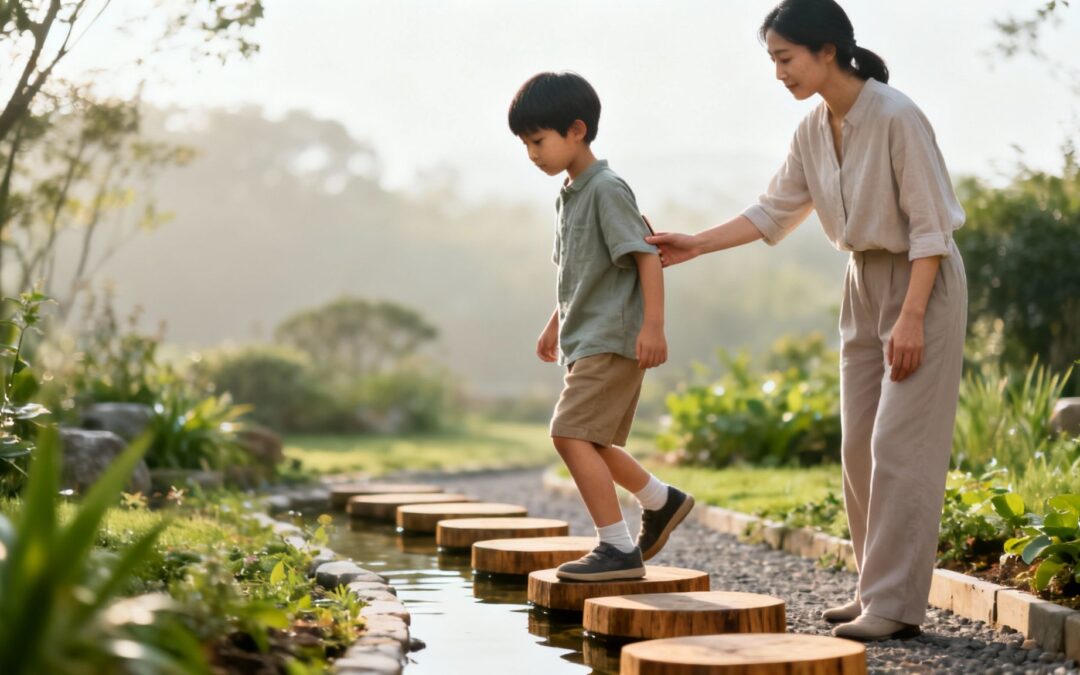
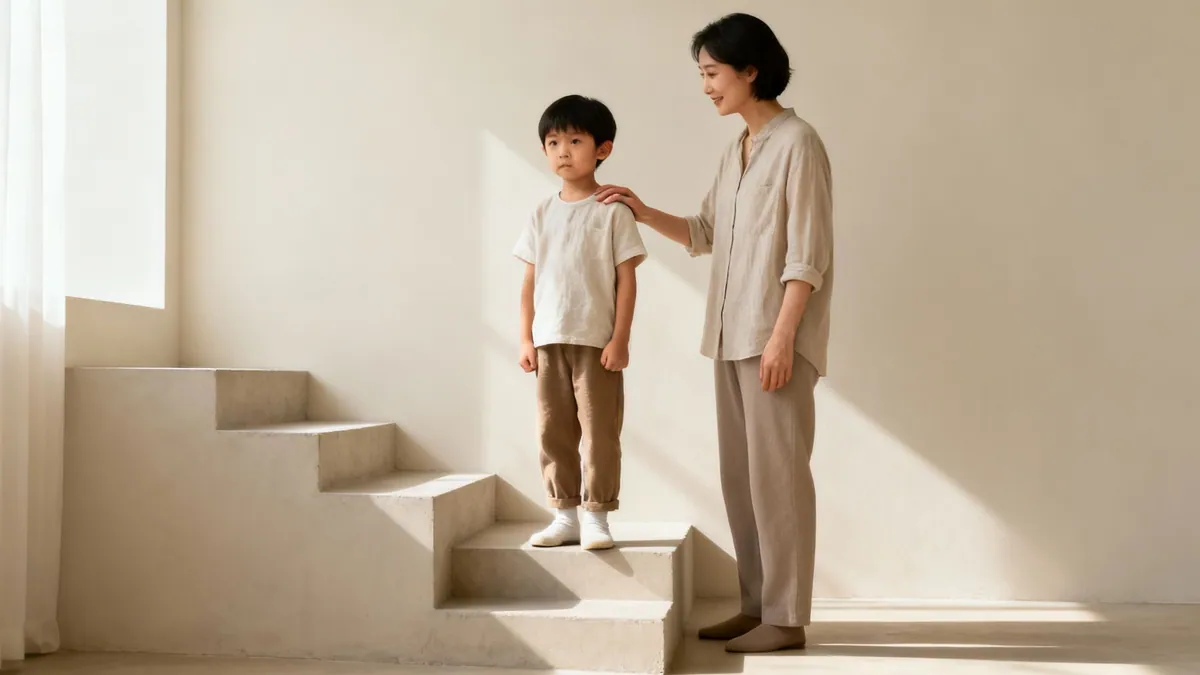
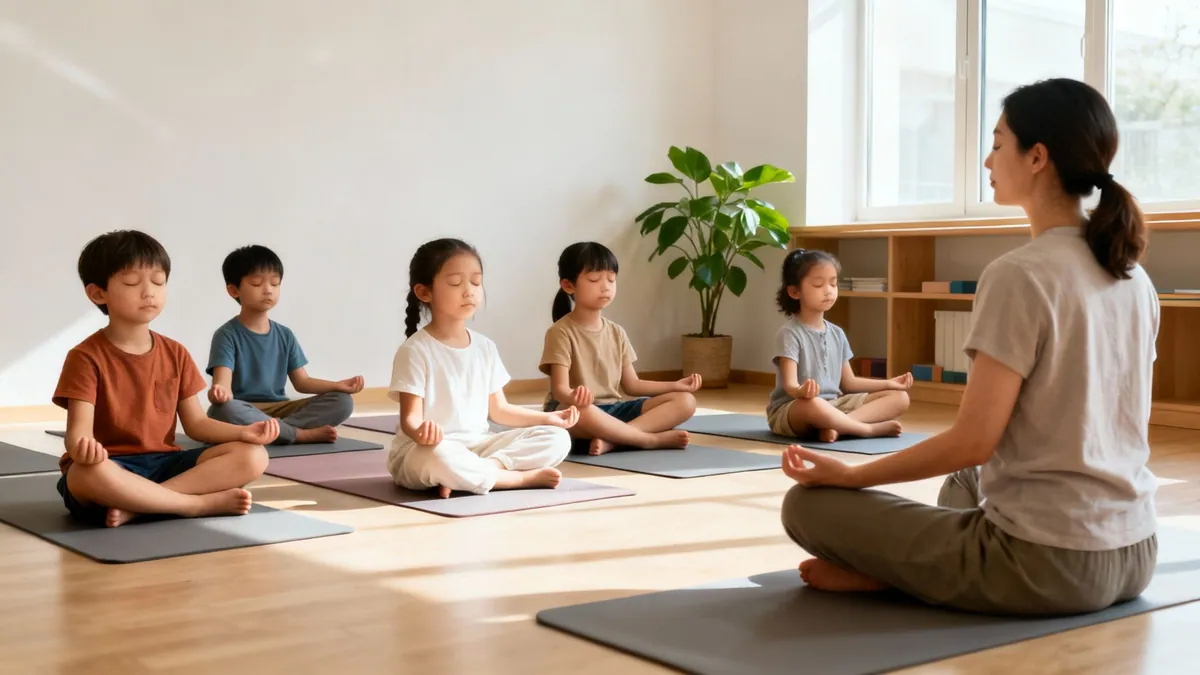
When we talk about building resilience in children, what we’re really talking about is giving them the tools to handle life. It’s about teaching them how to navigate challenges, adapt to curveballs, and bounce back when things don’t go their way. This isn’t about making them tough; it’s about fostering their ability to cope with stress, solve problems, and keep a positive outlook, all grounded in strong relationships and a belief in themselves.
Why Building Resilience in Children Is More Critical Than Ever
Today’s kids are navigating a world filled with pressures we never faced—from intense academic expectations to the constant buzz of social media. While we can’t shield them from every bump in the road, we can equip them with the skills to manage adversity when it arrives. Building resilience isn’t about creating an unbreakable shield. It’s about teaching them how to bend without breaking.
This is not some innate trait that some kids are born with and others aren’t. Resilience is a skill set, one that’s developed through practice, guidance, and supportive relationships. It’s the foundation that allows a child to try again after failing a test, work through a friendship dispute, or cope with a big disappointment.
The Growing Need for Resilience Skills
The data paints a clear picture: our kids need these skills more than ever. The youth mental health crisis has been accelerating for years. Even before the pandemic, feelings of persistent sadness and hopelessness among high schoolers had climbed by about 40% in a decade. These challenges, amplified by the pandemic effects on children, make proactive support an absolute necessity.
Fortunately, we know that targeted efforts make a real difference. One large-scale analysis showed that students who participated in resilience programs were 11% more likely to graduate from college and reported fewer mental health struggles down the line. You can explore more data on the youth mental health crisis in a report from the Pew Research Center.
Resilience is the capacity to prepare for, recover from, and adapt in the face of stress, challenge, or adversity. It’s a journey, not a destination, built through small, consistent actions over time.
So, what does this foundation actually look like in practice? It really comes down to three core pillars:
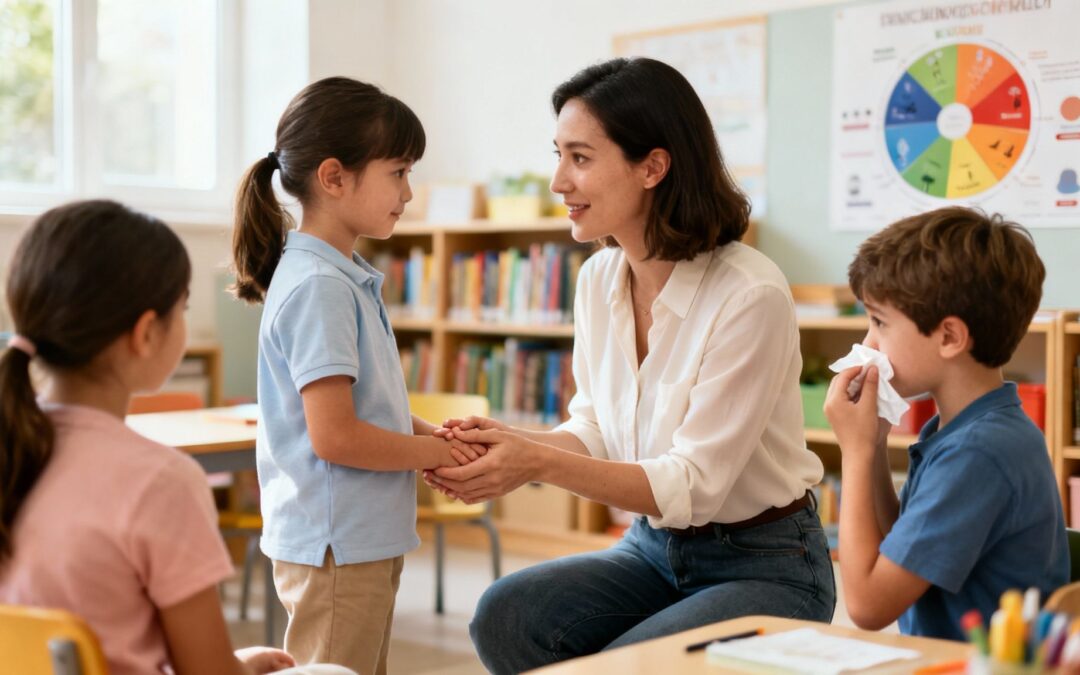
Strong Connections: The single greatest predictor of resilience is a stable, caring relationship with at least one adult. For example, a teacher who checks in with a student after they seemed upset, or a parent who listens without judgment after a tough day, provides that essential sense of safety.
Emotional Awareness: Kids need the vocabulary and confidence to identify what they’re feeling and express it constructively. For instance, being able to say, “I’m feeling frustrated because I can’t get this math problem,” is the first step toward managing that feeling.
Problem-Solving Skills: We need to empower kids to see challenges as solvable situations, not insurmountable walls. A practical example is helping a child brainstorm ways to deal with a lost library book instead of just paying the fine for them. This builds confidence and a sense of control.
This guide moves beyond theory to give you actionable, age-appropriate strategies for both the classroom and home. You’ll find practical examples and routines to help you nurture these core pillars and empower the children in your life to thrive.
Fostering the Strong Connections That Build Resilience
When you boil it all down, there’s one thing that matters more than anything else for building resilience in children: a stable, caring relationship with a supportive adult. This connection is the anchor. It’s the emotional safety net that gives kids the courage to take risks, mess up, and bounce back. It’s the consistent presence that sends the message, “You are safe, you are seen, and you matter—even when things are hard.”
Without that foundation, all the other strategies can fall flat. A child who feels disconnected or invisible will have a tough time absorbing lessons about managing their emotions or solving problems. But a child who feels securely attached has a powerful buffer against stress, which makes every other resilience-building effort that much more effective.
Creating Connection in the Classroom
As a teacher, building these bonds can feel like a tall order with all the curriculum and classroom management demands. But it’s the small, intentional actions that create a real sense of belonging and safety for every student. The goal isn’t to be every child’s best friend; it’s to be a consistently caring and predictable adult in their world.
A simple but powerful routine to try is the “two-minute connection.” The idea is to spend just two minutes a day for 10 consecutive days having a non-academic, personal chat with a specific student. You could ask about their weekend, their favorite video game, or their pet. This small investment shows you’re genuinely interested and can completely change how a student feels about school. To dig deeper into building these bonds, you can explore the power of a positive teacher-student relationship.
Another great tool is the “I Wish My Teacher Knew” box. It’s just a simple, anonymous drop-box where students can share anything they want you to know, from struggles at home to excitement about a new hobby.
Imagine this: a teacher notices Maria, one of her brightest students, has become withdrawn. Instead of calling her out in front of everyone, the teacher leaves a kind, private note on her desk. The next day, a slip of paper appears in the “I Wish My Teacher Knew” box: “My grandma is sick.” This little note opens the door for a compassionate, private check-in, reinforcing that the classroom is a safe place to be vulnerable.
Nurturing Strong Bonds at Home
At home, the daily rhythm of life is packed with chances to strengthen connections. Grand gestures are nice, of course, but it’s the consistency of small moments that builds a truly resilient family. One of the most powerful things you can do is commit to dedicated, device-free time every single day.
It doesn’t have to be long—even 15-20 minutes of focused attention can make a world of difference. Just put the phones away and be fully present with each other. A practical example could be shooting hoops in the driveway after school or reading a chapter of a book together before bed.
Here are a few conversation starters for dinner time or car rides that get you past the classic “How was your day?”:
What was the best part of your day? What was the hardest part?
Did anyone do something kind for you today? Did you get to do something kind for someone else?
If you could make one rule that everyone in the world had to follow, what would it be?
Tell me about a time today you felt proud of yourself.
Questions like these open the door to real conversations and show your child you’re genuinely interested in their inner world, not just their grades.
When a conflict pops up, like a disagreement with a friend, try using it as a chance to connect instead of just jumping in to solve it. Rather than immediately offering solutions, coach them through it. You could start with something like, “That sounds really frustrating. What do you think you want to do about it?” This simple shift validates their feelings and empowers them to think through solutions on their own, all while knowing you’ve got their back.
Ultimately, that feeling of being unconditionally supported is the true bedrock of resilience.
Developing Emotional Literacy and Self-Awareness in Kids
Before a child can manage a big feeling, they first have to know what that feeling is. This is where emotional literacy comes in—it’s the ability to recognize, understand, and label our own emotions, and it’s a non-negotiable first step in building resilience. It turns a confusing internal storm into something specific we can actually work with.
When kids can put a name to what they’re feeling, they gain an incredible sense of control. Just the simple act of naming it creates a little space, letting them observe the emotion instead of being totally swept away by it. For example, helping a child move from “I hate school!” to “I feel nervous about the spelling test” is a huge step in self-awareness.
Practical Tools for Naming and Taming Emotions
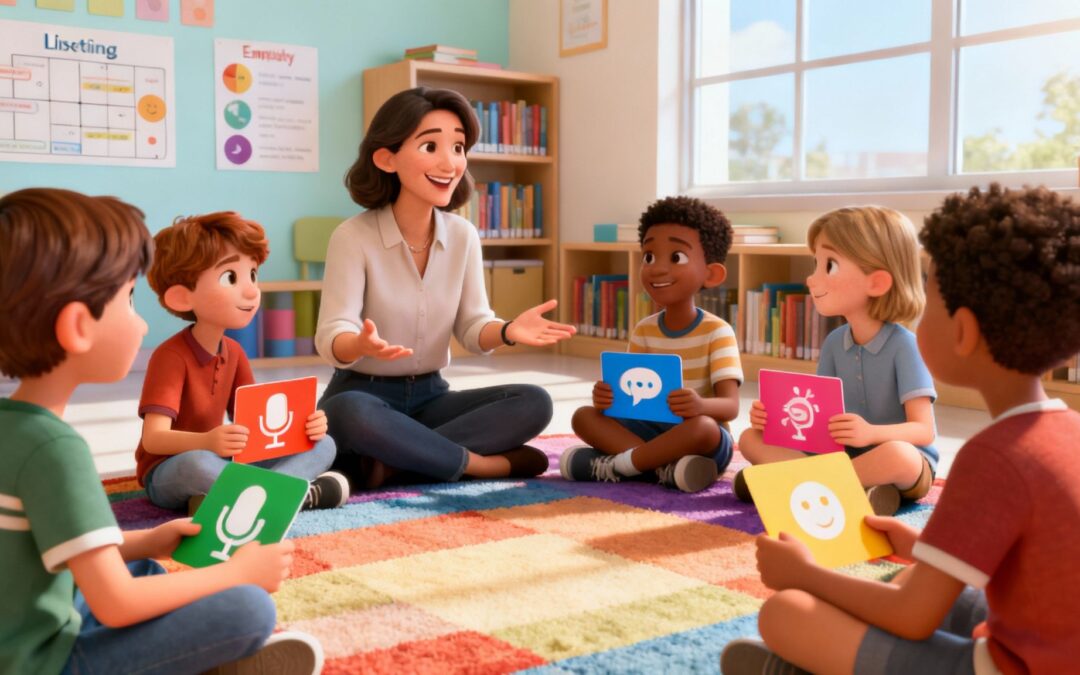
For younger kids, feelings are often huge, abstract concepts. That’s why visual and tangible tools are so effective; they make emotions more concrete and easier to talk about. These tools are fantastic for a classroom “calm-down corner” and just as useful in a family living room.
Two of our favorites are:
Feelings Wheels: These are colorful charts showing a whole range of emotions, usually with expressive faces to match. A child who is struggling to find the words can simply point to the face that matches how they feel, opening the door for a conversation.
Emotion Thermometers: This visual helps kids rate the intensity of their feelings, from a calm green at the bottom to an explosive red at the top. It’s a powerful way to show them that feelings like anger or excitement aren’t just on/off switches—they exist on a spectrum.
Imagine a teacher sees a student getting agitated during group work. Instead of just saying, “Calm down,” she could quietly ask, “Can you show me on the emotion thermometer where you are right now?” This validates the child’s feeling and starts a dialogue about what’s going on.
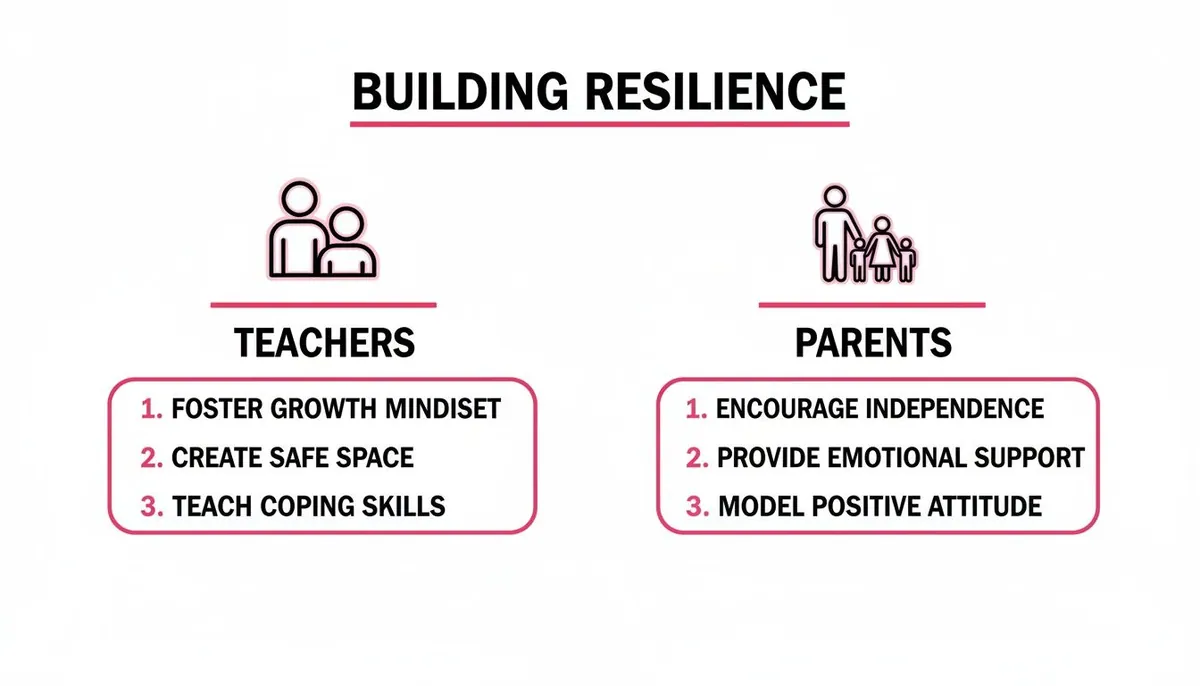
This infographic breaks down some key strategies both teachers and parents can use to build this skill.
As the visual shows, building resilience is truly a team effort. It works best when the strategies at home and school are consistent and aligned.
Age-Differentiated Strategies for Emotional Growth
A child’s ability to understand their inner world changes dramatically between kindergarten and middle school. Our strategies have to evolve right along with them. A one-size-fits-all approach just doesn’t cut it for a skill as personal as emotional intelligence.
While the focus here is on K-8, the foundational principles of validating emotions and providing tools apply even earlier. For those with younger children, you might find helpful parallels in resources covering strategies for handling toddler tantrums and power struggles.
The goal isn’t to prevent children from feeling sad, angry, or anxious. It’s to give them the confidence and the skills to navigate those feelings without getting stuck in them.
This process is about more than just naming feelings; it’s about connecting them to thoughts and actions. As kids mature, they can start to see what triggers their emotions and how their reactions impact themselves and others. For a deeper look at this, explore our guide on teaching emotional intelligence.
To make this practical, we’ve broken down some activities tailored to different developmental stages. The table below offers a clear roadmap for both parents and educators.
Age-Appropriate Activities for Building Emotional Literacy
Here are a few ways to bring these concepts to life in the classroom and at home, matching the activity to the child’s developmental stage.
Age Group
Core Skill Focus
Classroom Activity Example
Home Activity Example
K-2
Identifying & Naming Emotions
“Name It to Tame It” Story Time: Read a book where a character has a strong emotion. Pause and ask, “How do you think the bear is feeling right now? What clues tell us that?”
Feelings Check-in: Use a feelings chart at breakfast. Ask, “Which face shows how you’re feeling as we start our day?”
3-5
Managing Triggers & Impulses
“Box Breathing” Practice: After recess, guide the class through a simple 2-minute box breathing exercise to help them transition calmly. Count to 4 for inhale, hold, exhale, and hold.
Create a “Calm-Down Kit”: Work together to fill a box with items that help your child self-soothe, like a stress ball, a favorite book, or a small notepad for drawing.
6-8
Connecting Thoughts & Actions
“Think-Feel-Do” Journaling: Provide a simple prompt: “Write about a time you felt frustrated. What was the thought in your head? What did you feel in your body? What did you do?”
Reflective Conversations: When they share a problem, ask questions like, “What was going through your mind when that happened? How did that feeling influence your next step?”
By using these age-appropriate strategies consistently, we help kids build a strong internal toolkit. They learn that their emotions are signals to listen to, not sentences they’re stuck with. This awareness is the bedrock of self-regulation and a key ingredient for lifelong resilience.
Teaching Problem-Solving and a Growth Mindset
How to Implement Restorative Practices
Successfully integrating restorative practices requires a foundational shift in how conflict is viewed, not as a disruption to be punished but as an opportunity for learning and connection. This approach aligns directly with Soul Shoppe’s mission to equip students with essential conflict resolution tools.
Build the Foundation First: Start with proactive community-building circles (like the Talking Circles mentioned earlier) to establish trust and shared norms. This makes it easier to use circles for responsive situations when conflict arises.
Use Restorative Language: Consistently use restorative questions throughout the day. Instead of “Why did you do that?”, ask “What happened?” and “Who has been affected by what you did?” This shifts the focus from blame to impact.
Facilitate, Don’t Judge: In a responsive peace circle, the teacher’s role is to facilitate dialogue, not to impose a solution. Guide students through a structured conversation to understand each other’s perspectives and collectively decide on a path forward. For example, after a dispute over a game at recess, a circle could help students express their feelings and co-create new rules for the game that everyone agrees on.
Invest in Training: Effective facilitation is a skill. Seek out comprehensive training in restorative principles to ensure you can hold a safe and productive space for students, especially when discussing sensitive incidents.
Key Insight: Restorative practices are not just for when things go wrong; they are most effective when woven into the daily fabric of the classroom to proactively build empathy, accountability, and mutual respect.
As one of the most transformative classroom community building activities, restorative circles teach invaluable life skills. They provide a structured process for repairing relationships and fostering a culture where every member feels seen, heard, and responsible for the well-being of the group. Explore these conflict resolution strategies for students to further support this work.
6. Mindfulness and Self-Regulation Practices
Mindfulness and Self-Regulation Practices are structured activities that teach students to become aware of their thoughts, emotions, and bodily sensations without judgment. Integrating these practices into the daily routine helps students develop crucial self-regulation skills, emotional resilience, and the ability to focus. By creating moments of intentional calm, you build the psychological safety necessary for learning and connection, which are core competencies Soul Shoppe teaches to help kids and adults thrive.
How to Implement It:
These practices are not about emptying the mind but about paying attention to the present moment. Effective implementation involves making these exercises a predictable and supportive part of the classroom culture rather than a reactive tool used only during moments of chaos.
For example, a teacher might start each day with a “Mindful Minute,” guiding students to notice the feeling of their feet on the floor and the air entering and leaving their lungs. Another powerful practice is using a “Body Scan” after recess, asking students to mentally scan from their toes to their head, noticing and releasing any physical tension they are holding. These brief, consistent activities help students build their “attention muscle” over time.
Practical Tips for Success:
To make mindfulness accessible and effective, it’s important to introduce it in a way that feels safe and engaging for all students. The goal is progress, not perfection.
Start Small: Begin with very short practices, just 2-3 minutes long, and gradually extend the duration as students become more comfortable. This prevents overwhelm and builds confidence.
Frame it as ‘Brain Training’: For older students, use sports or fitness metaphors. Explain that mindfulness is like a workout for the brain, helping them strengthen their focus and manage stress.
Offer Multiple Modalities: Recognize that students have different needs. Offer options like mindful breathing, mindful walking, or mindful listening to sounds in the room.
Practice with Them: Your authentic participation is key. When you practice mindfulness alongside your students, you model its importance and create a shared experience of calm.
Key Insight: Teaching students to notice their internal state is a profound act of empowerment. It gives them the tools to respond to challenges thoughtfully instead of reacting impulsively, which is a cornerstone of a safe and respectful community.
Mindfulness is one of the most impactful classroom community building activities because it equips each student with the internal resources to manage stress and engage with others from a place of centeredness. When individuals feel more in control of their emotions, the entire community benefits from a more peaceful and productive learning environment. Dive deeper into the benefits of mindfulness in the classroom and discover more strategies.
7. Identity and Belonging Activities (All About Me Projects, Identity Exploration)
Identity and Belonging Activities are structured exercises where students explore and share their unique backgrounds, cultures, interests, and values. These practices help students feel seen, understood, and valued for who they are, which directly fosters a sense of belonging. By celebrating the diverse identities within the room, these activities build empathy, reduce stereotypes, and create a classroom where every student’s story matters. This approach acknowledges the whole child, a core component of creating the safe and connected learning environments that Soul Shoppe champions.
How to Implement This in Your Classroom
Activities that center student identity can be woven into the curriculum throughout the year. For instance, an “Identity Web” activity allows students to map different aspects of their identity, such as family roles (“oldest sister”), cultural heritage (“Mexican-American”), hobbies (“soccer player”), and personal strengths (“good at math”). Another powerful practice is creating “All About Me” books or posters that students share during a morning meeting, giving them a platform to be the expert on their own life. These projects validate individual experiences and build bridges of understanding between classmates.
Tips for Success
Establish Safety and Respect: Before any sharing, co-create agreements about respectful listening and asking thoughtful questions. This ensures the classroom is a safe space for vulnerability.
Provide Structure and Choice: Offer structured templates or prompts (e.g., “My favorite family tradition is…”) to guide students, but also allow for creative expression through art, writing, or technology. This reduces pressure and empowers student voice.
Model First: As the teacher, share your own identity web or “All About Me” project first. Your authenticity and willingness to be open will set a positive and trusting tone for the entire class.
Display Student Identities: Make student identities a visible and celebrated part of the classroom environment. Proudly display their posters, webs, and cultural artifacts to reinforce that every student belongs.
Key Insight: When students see their own identities and cultures reflected and respected in the classroom, they develop a stronger sense of ownership and belonging. This validation is a critical prerequisite for both social and academic engagement.
Identity exploration is one of the most impactful classroom community building activities for developing a truly inclusive culture. It moves beyond surface-level introductions to foster genuine connections rooted in mutual respect and appreciation for diversity. By making space for students to share their stories, you affirm their worth and build a cohesive community where every member feels they truly fit in.
8. Community Service and Cooperative Problem-Solving Projects
Community Service and Cooperative Problem-Solving Projects shift the focus of community building from internal classroom dynamics to external, shared goals. This approach involves students working together to address authentic challenges within their classroom, school, or local community. By uniting around a common purpose, students develop a profound sense of agency, empathy, and interconnectedness. They learn that their collective actions can create meaningful, positive change, reinforcing the idea that they are a capable and impactful team. This method is a cornerstone of service learning and project-based learning frameworks.
How to Implement This Activity
The power of this activity lies in student ownership. Begin by facilitating a discussion to identify genuine needs or problems that students care about. This could be anything from a messy classroom library to a lack of recycling bins in the cafeteria or the need for a “buddy bench” on the playground. Once a project is chosen, guide students through planning, collaboration, execution, and reflection. For example, a classroom garden project requires students to research plants, design the layout, delegate watering duties, and decide how to share the harvest. A school-wide kindness campaign might involve students creating posters, writing announcements, and tracking acts of kindness.
Practical Tips for Success
Start Small and Local: Begin with a manageable, classroom-level project, like organizing supplies or creating a welcoming bulletin board for a new student. Success here builds the confidence and skills needed for larger, school-wide initiatives.
Give Students a Voice: Involve students in every step, from identifying the problem to brainstorming solutions. When they feel a sense of ownership, their engagement and commitment skyrocket.
Break It Down: Deconstruct large projects into smaller, achievable milestones with clear roles. This prevents students from feeling overwhelmed and helps maintain momentum.
Focus on Reflection: Regularly schedule time for students to reflect on their progress, challenges, and the collaborative skills they are using. Ask questions like, “What was one way our team worked well together today?”
Key Insight: When students collaborate to serve a purpose greater than themselves, they build community not just by talking about values like kindness and responsibility, but by actively practicing them in a real-world context.
These collaborative efforts are among the most powerful classroom community building activities because they transform students from passive recipients of instruction into active citizens. This directly supports Soul Shoppe’s vision of empowering students to support their peers and work together to create a better environment for everyone. By solving real problems, students forge strong bonds built on shared accomplishment and mutual respect.
9. Structured Social-Emotional Check-ins and Mood Tracking
Structured Social-Emotional Check-ins are brief, consistent routines where students identify and share their emotional state. This practice normalizes emotional expression, builds self-awareness, and provides teachers with valuable insight into their students’ well-being. By creating a predictable and safe way for students to report how they feel, these check-ins signal that emotions are a valid and important part of the classroom experience, which is a key component of building a supportive community.
This method can be implemented in various ways. For instance, a teacher might have a “mood meter” chart near the classroom entrance with different color zones representing emotions (e.g., blue for sad/tired, green for calm/ready to learn, yellow for excited/silly, red for angry/upset), where students place a clothespin with their name on the color that matches their feeling. Other options include brief journal prompts like, “What’s one feeling you’re bringing to school today?” or using a simple digital form with emojis for students to fill out during morning homeroom.
Tips for Effective Implementation
To make these check-ins a successful part of your routine, consider these strategies:
Keep it Quick and Consistent: To ensure sustainability, keep the check-in process under five minutes. Making it a predictable part of the daily schedule, like right after the morning bell, helps it become a habit.
Offer Privacy: While group sharing can be powerful, always provide a private or anonymous option for students to indicate they are struggling. This could be a private form, a sticky note placed in a designated “I need a check-in” box, or a specific hand signal.
Act on the Data: The information gathered is only useful if it’s acted upon. When a student consistently reports feeling sad or angry, follow up with a quiet, private conversation to offer support. This shows students you are listening and that their feelings matter.
Use a Simple Scale: Use a clear and easy-to-understand scale that is developmentally appropriate. For younger students, colors or simple emojis work well. Older students might use a 1-5 number scale or a more nuanced set of feeling words. For more detailed strategies, you can explore how to boost student confidence with mood meters and reflection tools.
Key Insight: Daily emotional check-ins transform the abstract concept of “emotional awareness” into a concrete, daily practice. This routine gives students the language and permission to understand their inner world and communicates to them that the teacher is a safe and available resource for support.
As one of the most direct classroom community building activities, emotional check-ins create a climate of care and responsiveness. This practice directly aligns with Soul Shoppe’s mission to equip students with the tools for emotional intelligence, creating a foundation where every child feels seen, heard, and ready to learn. By integrating this simple yet powerful habit, you build a more empathetic and connected classroom.
10. Interactive Games, Energizers, and Team-Building Activities
Interactive games and energizers are structured, play-based activities that harness the power of fun and movement to build trust, communication, and positive peer relationships. These activities intentionally break down social barriers and create shared positive experiences, transforming the classroom dynamic from a group of individuals into a collaborative team. By engaging students in low-pressure, high-energy challenges, you can foster teamwork and energize the room during transitions or lulls in the day. This aligns directly with Soul Shoppe’s experiential, play-based approach to building connection.
How to Implement This Strategy
These activities are highly adaptable and can be used as quick brain breaks, dedicated team-building lessons, or to kickstart a day. For example, a game of “Silent Sequencing” where students must line up in order of their birthdays without speaking teaches nonverbal communication and problem-solving. A quick round of “Four Corners” can re-energize students after a long lesson while also serving as an informal poll or opinion gauge (e.g., “Go to the corner that represents your favorite season”).
Tips for Success
Explain the “Why”: Before starting a game, briefly explain its purpose. After the activity, lead a short debrief to discuss what students learned about communication, trust, or teamwork. This reflection turns fun into meaningful SEL learning.
Scaffold Trust Gradually: Begin with low-risk activities that don’t require physical contact or high levels of vulnerability. As students build comfort and rapport, you can introduce more complex challenges like a carefully supervised and scaffolded trust walk.
Prioritize Safety and Choice: Establish clear rules and boundaries to ensure physical and emotional safety. Always provide an “opt-out” option where students can choose to observe or take on a different role, like timekeeper, without judgment.
Observe and Intervene: Pay close attention to group dynamics. Use these games as an opportunity to observe social interactions, and be prepared to gently address any signs of exclusion or discomfort to reinforce a culture of inclusivity.
Key Insight: Structured play provides a unique context where students can practice essential social skills like negotiation, cooperation, and empathy in a low-stakes environment. The fun of the game makes the learning feel effortless and memorable.
Using classroom community building activities like these energizers and games is a powerful way to inject joy and movement into your routine. They provide a valuable medium for students to connect with their peers on a different level, strengthening the social fabric of the classroom one game at a time.
Classroom Community Activities: 10-Point Comparison
Practice
Implementation complexity
Resource needs
Expected outcomes
Ideal use cases
Key advantages
Circle Time / Talking Circles
Low–Moderate — requires facilitation skill
Minimal: time, talking piece, facilitator training
Increased belonging, active listening, normalized emotional expression
Daily routines, morning meetings, advisory periods (K-8)
Increased trust, engagement, improved communication
Transitions, team-building days, energizers between lessons
Fun engagement, lowers barriers, supports kinesthetic learners
Putting It All Together: Your Next Steps for Community Building
We’ve explored a comprehensive toolkit of ten powerful strategies, from the foundational practice of Talking Circles to the dynamic energy of collaborative projects. Each of these classroom community building activities serves as a vital thread in weaving a tapestry of connection, respect, and belonging. The true impact, however, lies not in completing a single activity, but in the consistent, intentional integration of these practices into the daily rhythm of your school environment.
This is not a checklist to be completed by the end of September. It is a continuous journey of listening, adapting, and co-creating a space where every individual feels seen, valued, and safe. The goal is to move beyond mere classroom management and into the realm of genuine community cultivation.
Key Takeaways for Lasting Impact
As you move forward, keep these core principles at the forefront of your planning and practice:
Consistency Over Intensity: A brief, daily Social-Emotional Check-in will build more trust and psychological safety over time than a single, elaborate team-building day. The routine nature of these interactions signals to students that their emotional well-being is a constant priority.
Student Agency is Paramount: The most vibrant communities are not built for students, but with them. Involve students in establishing norms for Restorative Circles, let them lead Gratitude and Appreciation Practices, and empower them to choose Community Service Projects that resonate with their passions.
Modeling is Your Most Powerful Tool: Your own vulnerability, empathy, and willingness to participate authentically in these activities set the tone for the entire community. When you share a personal story in a Talking Circle or model how to give specific, meaningful appreciation, you grant students permission to do the same.
Your Actionable Next Steps
Feeling inspired but not sure where to begin? Don’t try to implement everything at once. Sustainable change starts with small, deliberate steps.
Assess Your Current Needs: Take a moment to reflect on your specific classroom or school environment. Is there a need for more proactive conflict resolution? Perhaps students would benefit from enhanced self-regulation skills. Use this assessment to choose one or two activities from our list that directly address your most pressing needs. For example, if you notice frequent minor conflicts during recess, introducing Restorative Practices might be your most impactful starting point.
Schedule It In: The adage “what gets scheduled gets done” is especially true for community building. Block out 10-15 minutes on your daily or weekly calendar specifically for these practices. Treat this time as non-negotiable, just like you would for core academic subjects. A consistent “Mindful Monday” or “Feedback Friday” can quickly become a cherished and grounding routine for students.
Gather Feedback and Iterate: After trying an activity for a few weeks, check in with your students. Ask them directly: What did you enjoy about our Peer Buddy system? How could we make our Collaborative Learning Projects more effective? Use their insights to adapt and refine your approach, reinforcing the message that their voice and experience matter.
Ultimately, investing in these classroom community building activities is an investment in academic success, emotional well-being, and the development of compassionate, engaged citizens. You are not just teaching curriculum; you are creating a nurturing ecosystem where every student has the foundation they need to learn, grow, and thrive. The positive ripples from a strong, supportive classroom community extend far beyond your four walls, shaping how students interact with their families, their peers, and the world at large.
Community-building lands hardest when it is school-wide rather than one teacher’s effort. Our K–6 programs give every adult in the building the same tools and shared language. The Welcome — You Belong Banner is a simple place to start.
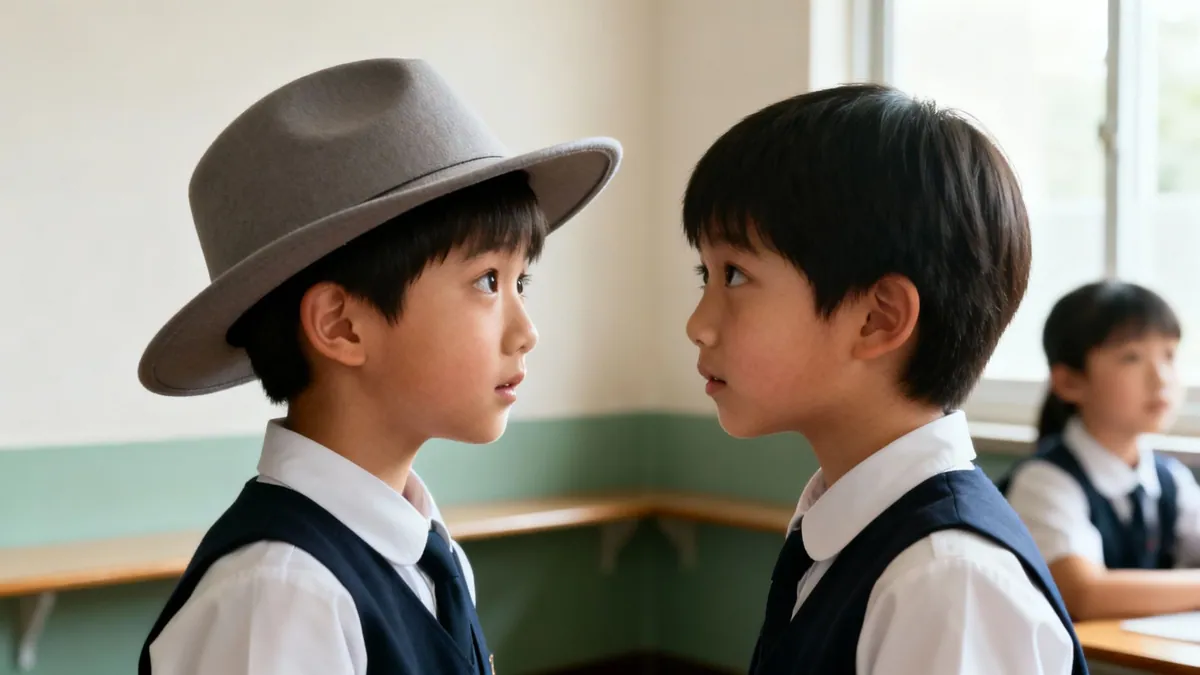
When we talk about teaching empathy, it’s easy to jump to the classic phrase, “walk a mile in someone else’s shoes.” It’s a nice starting point, but that idea barely scratches the surface. Empathy isn’t a single action or a fixed trait some kids just have. It’s a complex skill that we can intentionally nurture in every child, and it looks different as they grow.
Understanding What Empathy Actually Looks Like in Kids
To teach empathy well, we first have to understand what we’re looking for. It’s less about a vague feeling and more about a set of interconnected abilities we can actually observe, label, and practice with our kids.
The Three Types of Empathy in Action
Breaking empathy down into three distinct types really helps clarify what we’re aiming for in the classroom or at home. Each one builds on the last, creating a clear path from just understanding a feeling to doing something about it.
Cognitive Empathy (Perspective-Taking): This is the “thinking” part of empathy. It’s a child’s ability to understand what someone else might be feeling or thinking from their point of view. For example, a student might notice their friend didn’t get picked for the soccer team and think, “She must be so disappointed because she practiced all week.” They can grasp the situation intellectually without necessarily feeling the emotion themselves.
Emotional Empathy (Shared Feelings): This is the “feeling” part. Here, a child doesn’t just understand another’s emotion—they feel it right along with them. This is where deep connection happens, and it’s essential for building authentic relationships. For instance, when that same student sees their friend’s sad face, they might feel a lump in their own throat because they remember the sting of being left out.
Compassionate Empathy (Taking Action): This is the “doing” part. It’s what moves a child from understanding and feeling to being motivated to help. This is where empathy becomes a true force for good, turning an internal experience into an external act of kindness. For example, a student might go over to their friend and say, “I’m sorry you didn’t make the team. Do you want to practice together after school tomorrow?”
Empathy is the skill of connection. When we teach it, we’re not just creating kinder kids; we’re building stronger communities, one interaction at a time. It’s the foundation for collaboration, conflict resolution, and a genuine sense of belonging.
Real-World Classroom Scenarios
So what does this all look like during a typical school day? Let’s imagine a student, Leo, forgets his lunch at home.
A classmate with cognitive empathy might think, “Leo must be really hungry and maybe a little embarrassed.” They get what’s happening on an intellectual level.
Another student showing emotional empathy might actually feel a pang of worry or sadness for Leo. They might remember a time they were in the same boat and physically share in his distress.
But a student with compassionate empathy takes it one step further. They’re the one who walks over and says, “You can have half of my sandwich,” or asks the teacher if there’s any extra food. Their understanding and shared feelings spurred them to act.
Our goal as educators and parents is to guide children through all three stages, fostering a complete empathetic response. Building these skills is a crucial part of healthy child emotional development and sets them up for life.
The need for this guidance is clearer than ever. The OECD’s 2023 Survey on Social and Emotional Skills found that students in supportive, empathetic school climates showed up to 20-30% higher empathy scores. This highlights the direct and powerful impact of intentionally teaching these skills.
Integrating Empathy Into Daily Routines and Conversations
Teaching empathy isn’t about scheduling another lesson into an already packed day. It’s about weaving it into the very fabric of our interactions. The most powerful learning happens in those small, in-between moments—during morning greetings, snack time squabbles, and casual chats on the way to the bus.
By making a few intentional shifts in our language and routines, we can create an environment where empathy becomes a natural reflex, not a forced behavior. The goal is to make talking about feelings as normal and unremarkable as talking about the weather.
Start the Day with a Feelings Check-In
A simple and incredibly effective way to start is with a daily “Feelings Check-In.” This quick routine gives kids practice identifying and naming their emotions, which is the foundational first step to recognizing those same emotions in other people.
You can use an emotion wheel or a simple chart where kids can point to or name how they’re feeling. This isn’t just for the big, loud feelings like anger or sadness. It’s just as important to acknowledge joy, excitement, or even just feeling tired and a bit quiet.
In the Classroom: A teacher might say, “Good morning, everyone! Time for our Feelings Check-In. I’ll start. Today, I’m feeling hopeful because I’m so excited about our science experiment.”
At Home: A parent could ask at the breakfast table, “How’s everyone’s emotional battery today? Mine is feeling pretty charged up and happy.”
This simple act validates every feeling as acceptable and normal. It also gives you a valuable peek into a child’s inner world before the day’s challenges even begin. Consistently using practices like this is key to building emotionally grounded routines for kids.
Replace Dismissive Phrases with Validating Language
The words we choose have immense power. So often, we fall back on phrases that seem harmless, like “You’re fine,” “Don’t cry,” or “It’s not a big deal.” But these can inadvertently teach children that their feelings are wrong, overblown, or unimportant.
Swapping these automatic responses with validating statements shows kids that you see them and accept their emotional state. This tiny shift in language models how to respond with empathy, moving the conversation from dismissal to connection and inviting the child to explore their feelings in a safe space.
Language Swaps to Practice:
Instead of saying this…
Try saying this…
“You’re overreacting.”
“You’re having a really big reaction. Tell me what’s going on.”
“It’s not that big of a deal.”
“I can see this is really important to you. Let’s talk about it.”
“Just ignore them.”
“It sounds like those words really hurt your feelings.”
“You’re fine.”
“I see that you’re really frustrated right now. I’m here to help.”
This approach doesn’t mean you’re endorsing the behavior, but it acknowledges the very real emotion underneath it. Once a child feels truly heard, they become much more open to problem-solving and guidance.
Model Empathetic Listening During Disagreements
Conflicts aren’t just problems to be solved; they are prime opportunities for teaching empathy in real-time. When you step in to mediate a disagreement, your most important job is to model how to listen to understand, not just to respond.
A fantastic technique is to have each child repeat back what they heard the other person say before they get to share their own side. It immediately slows things down and forces them to actively listen instead of just planning their rebuttal.
A Practical Script for Mediating Peer Conflicts:
Acknowledge Both Sides: Start with, “Okay, I can see you are both very upset. Let’s figure this out together.”
One Person Speaks: “Sam, can you tell Maya what happened from your side? Maya, your job right now is just to listen.”
Reflect and Validate: “Maya, what did you hear Sam say he was feeling?” (Help her find the words if she needs it). “Sam, is that right?”
Switch Roles: “Great. Now, Maya, it’s your turn to share how you felt. Sam, you’ll be our listener.”
Find Common Ground: “It sounds like Sam felt frustrated because he wanted to use the blue marker, and Maya felt sad because she thought he was taking it from her. Do I have that right?”
This process gently shifts the focus from blame to understanding. To help guide these discussions and prompt deeper reflection, this resource with over 150 open-ended questions examples is fantastic for helping children explore their feelings and the perspectives of others.
By consistently integrating these small practices, we do more than just teach empathy—we cultivate a culture of empathy. Children learn that their feelings matter, that others’ feelings matter, and that connection is always possible, even in disagreement.
Actionable Empathy-Building Activities for Different Age Groups
Knowing how to talk about empathy is one thing, but bringing it to life with hands-on activities is where the real learning happens. The key is to choose activities that match a child’s developmental stage. What works for a five-year-old will look very different from what engages a thirteen-year-old, but the goal is the same: building the skill of perspective-taking.
And this isn’t just theory. Just imagine transforming a classroom in only 10 weeks with a simple empathy program. That’s exactly what happened in a groundbreaking study of 900 students. Before the program, teachers rated students’ empathy at an average of 5.55 out of 10. Afterward? It jumped to 7.
Even more telling, behavior scores soared from 6.52 to 7.89. These numbers show real, measurable improvements in how kids treat each other every single day. Consistent practice works.
Grades K–2: Building the Foundation
For our youngest learners, empathy starts with understanding and naming their own feelings. The goal is to connect emotions to facial expressions, body language, and specific situations in a way that feels like play.
Emotion Charades is a fantastic place to start.
How it works: Write simple emotions (happy, sad, angry, surprised, scared) on cards. A child picks a card and acts out the emotion without speaking while the others guess.
Materials: Index cards, a marker, and a bit of open space.
Discussion Prompts: Keep it simple and direct. Ask things like, “What did you see that made you guess ‘sad’?” or “When have you felt surprised like that?”
Puppets are another wonderfully effective tool. Grab some socks or paper bags to create simple characters and act out common social hiccups, like one puppet snatching a toy from another. This gives kids a safe, third-person way to explore tricky social dynamics without the pressure. For example, you can act out a scene where one puppet feels left out during playtime, and then ask the children, “What could the other puppets do to help their friend feel included?”
Grades 3–5: Stepping Into Someone Else’s Shoes
At this age, kids are ready to move beyond simply identifying emotions and can start genuinely thinking about the perspectives of others. They’re beginning to understand that people have different roles, experiences, and viewpoints.
This is the perfect time for a project like “Perspective Detectives.”
How it works: Students become investigators, tasked with interviewing different staff members at school—like the custodian, a cafeteria worker, or the school secretary.
Example Questions: Help them prepare questions that dig a little deeper, such as, “What’s the hardest part of your job?” or “What’s something you wish students knew about your work?”
The Goal: The kids then present their findings to the class, sharing what they learned about the daily lives and feelings of the people who help their school run. This activity directly teaches them that every person has a unique and valuable story.
“When children learn to see the world from another’s point of view, they don’t just become kinder—they become better problem-solvers, collaborators, and friends.”
This visual is a great reminder that daily empathy is built on three pillars: noticing feelings, validating them in others, and listening to truly understand.
Grades 6–8: Exploring Complex Perspectives
Middle schoolers can handle more complex and abstract scenarios. They’re grappling with their own identities and are capable of considering nuanced ethical dilemmas and motivations.
“Scenario Reversal” Journaling is a powerful exercise that challenges them to dig deep into perspective-taking.
How it works: Give students a short story or a scene from a book they’ve all read. Their task is to rewrite it from the perspective of the antagonist or a minor character.
Example: Imagine rewriting a chapter of Harry Potter from Draco Malfoy’s point of view. What are their motivations, fears, and justifications for their actions? Or rewrite a scene from the perspective of a quiet background character who just observed the main action.
Discussion Prompts: Spark conversation with questions like, “Did writing from this perspective change how you felt about the character?” and “What did you learn about their motivations that you didn’t see before?”
Another fantastic activity is to hold structured debates on ethical dilemmas. Present a scenario with no easy “right” answer and assign students to argue for different sides, regardless of their personal opinions. For example, “A new factory will bring jobs to your town but might pollute the river. Should it be built?” This forces them to build a case from a viewpoint they may not naturally hold, stretching their empathy muscles in a new way.
To help you get started, here’s a quick-reference table with more ideas you can adapt for your classroom or home.
Age-Appropriate Empathy-Building Activities
Grade Level
Activity Example
Primary Learning Objective
Materials Needed
K–2
Feelings Faces Collage
To identify and name a range of emotions using visual cues.
Magazines, scissors, glue, paper.
3–5
“Day in the Life” Story Swap
To understand and articulate another person’s daily experiences.
To analyze a real-world issue from multiple stakeholder viewpoints.
Whiteboard, markers, articles or videos on a local issue.
These activities are just starting points, of course. The most important thing is creating consistent opportunities for kids to practice seeing the world through someone else’s eyes.
For an even wider range of ideas, check out our complete guide to social skills activities for kids that you can easily adapt for any age group.
Using Stories and Role-Playing to Cultivate Perspective
Stories are like empathy gyms where kids can safely exercise their perspective-taking muscles. When a child gets lost in a good book or movie, they aren’t just following a plot; they’re stepping into another person’s world, feeling their joys, and wrestling with their problems. It’s a powerful and natural way to build empathy.
When kids connect with characters from different backgrounds, they start to see that their own experience isn’t the only one out there. Narratives give them a window into someone else’s inner life, making abstract ideas like compassion and understanding feel tangible and real.
Harnessing the Power of Storytelling
Of course, choosing the right stories is key. Look for books and short films that feature diverse characters and don’t shy away from complex social or emotional topics. The idea is to spark curiosity and conversation, not just to entertain.
Book Recommendations by Age Group:
For K–2:The Invisible Boy by Trudy Ludwig is a touching story about a boy named Brian who feels unseen by his classmates. It perfectly shows how small acts of kindness can make a huge difference in helping someone feel included.
For Grades 3–5:Wonder by R.J. Palacio offers a rich exploration of perspective. The story is told from multiple viewpoints, all centered around a boy with facial differences, which really drives the lesson home.
For Middle School:The Giver by Lois Lowry challenges older students to think about conformity, individuality, and what it truly means to feel. It’s a fantastic catalyst for deep, meaningful discussions.
But the real learning happens after the last page is turned. A good discussion is what transforms a simple reading session into a profound empathy lesson. You have to go beyond basic plot questions and dig into the characters’ emotional worlds. To get kids thinking more about what makes characters similar and different, an activity like the Same Same Different Game can be a really fun and useful tool.
Asking, “How would you feel if that happened to you?” is a good start. But a better question is, “What do you think the character was feeling but not saying?” This pushes kids to look for nonverbal cues and unspoken emotions—a critical empathy skill.
Bringing Empathy to Life with Role-Playing
While stories let children observe empathy, role-playing lets them actually practice it. It gives them a safe, structured way to rehearse their responses to real-life social situations without the pressure of a real conflict. They get to try on different perspectives and test out solutions in a low-stakes environment.
This kind of hands-on practice is incredibly effective. For example, a study showed that when nursing students participated in cultural empathy simulations, they had profound “aha moments” that lectures just couldn’t provide. It deepened their connection with diverse patients and truly prepared them for empathetic practice in the real world.
Setting Up Simple Role-Playing Scenarios
You don’t need elaborate scripts or a costume closet. The most powerful scenarios are simple, relatable, and focused on a clear social skill. The goal here is rehearsal, not a Broadway performance.
Here’s a simple flow that works:
Introduce a Relatable Scenario: Start with something familiar. “Imagine you see a new student sitting all by themselves at lunch. What could you do?” Or, “Let’s pretend someone just said your drawing was ‘weird.’ How would that feel?”
Assign Roles: Keep it simple. You just need a few kids to act out the scene: the new student, a student who approaches them, and maybe an observer.
Act It Out (Briefly): Let them play out the scene for just a minute or two. The point is to see their natural instincts in action.
Pause and Discuss: This is the most important part. Ask the actors and observers questions like, “How did it feel to be the person sitting alone?” or “What words made you feel welcome?”
Try It Again: Based on the conversation, have them replay the scene, trying out a new strategy. This repetition is what builds muscle memory for kind and empathetic behavior.
By consistently using both stories and role-playing, you give kids a well-rounded way to learn empathy. They first learn to understand and feel for others through stories, and then they get to practice turning those feelings into compassionate action.
Building a Strong School-to-Home Empathy Partnership
Teaching empathy in the classroom is a powerful start, but the real magic happens when those lessons are echoed at home. Children thrive on consistency. When the same language and values around empathy show up at their desk and their dinner table, the learning sticks.
This isn’t about giving parents or teachers another thing to do. It’s about building simple, sustainable bridges between the two most important parts of a child’s world. The goal is to create a supportive ecosystem where seeing from someone else’s perspective is a shared—and celebrated—value.
Simple Strategies for Teachers to Engage Families
As an educator, you can create easy-to-use resources that bring classroom learning to life at home. The key is to keep it light, optional, and definitely not feeling like homework.
Weekly “Dinner Table Topics”: Send home a short email or a note in a backpack with one or two open-ended questions. These prompts can tie directly into the empathy skills you’re working on in class.
For K-2: “This week, ask your child: ‘Can you think of a time a friend was sad? What did you do to help them feel better?'”
For Grades 3-5: “A great dinner topic: ‘Talk about a character from a movie or book who made a bad choice. Why do you think they did it?'”
Family Kindness Challenge: Create a simple, monthly “Kindness Challenge” that families can tackle together. This shifts the focus from an individual task to a fun, collective effort.
Example: “This month, our challenge is to do something kind for a neighbor. You could bake cookies, offer to water their plants, or simply write them a nice card together.”
These small touchpoints keep the conversation going and show parents what their children are learning in a practical way. To really make this partnership strong, it helps to borrow from effective community engagement strategies that focus on building collaborative relationships around a shared goal.
Practical Ways Parents Can Weave Empathy into Daily Life
For parents, reinforcing empathy doesn’t mean you need a lesson plan. It’s about recognizing and using the countless teaching moments that pop up naturally every single day.
The most powerful empathy lessons often happen in unplanned moments. By being intentional with our language during a movie night or a trip to the grocery store, we can turn ordinary routines into extraordinary learning opportunities.
Think about the things you already do together. With just a slight shift in focus, they can become rich empathy-building experiences.
Turn Everyday Activities into Empathy Practice:
Activity
How to Weave in Empathy
Watching a Movie or TV Show
Pause and talk about what motivates a character. Ask, “Why do you think she did that? How do you think she was feeling when she wasn’t invited to the party?”
Running Errands
Point out community helpers—the cashier, the mail carrier, the sanitation worker. “What would our day be like without their help? Their job looks hard sometimes.”
Reading a Bedtime Story
Go beyond the plot. Ask about the feelings of other characters. “How do you think the little bear felt when Goldilocks ate his porridge and broke his chair?”
Discussing Their Day
When they share a story about a conflict with a friend, gently probe for the other side. “That sounds really frustrating. I wonder what was going on for Alex that made him say that?”
By creating this seamless connection between school and home, we send a clear and consistent message. We show kids that empathy isn’t just a “school skill”—it’s a life skill that matters everywhere, to everyone.
Common Questions About Teaching Empathy
Even with the best lesson plans, teaching empathy in the real world can get messy. When you hit those inevitable roadblocks, it’s easy to feel stuck. Let’s walk through some of the most common questions that come up for both teachers and parents, with some practical answers you can use right away.
How Can I Teach Empathy to a Child Who Seems Less Empathetic?
First, remember that empathy is a skill we build, not a trait someone is born with. For a child who really struggles to connect with others’ feelings, the best place to start is with their own emotions.
Before they can understand how a friend feels, they need a solid vocabulary for their own feelings. Start by being their emotional mirror. When you see them getting frustrated, label it gently. Instead of reacting to the behavior, you could say, “Wow, it looks like you’re feeling really angry that your block tower fell down.”
Once they get good at recognizing what’s happening inside them, you can start building a bridge to understanding others. Stories and real-life moments are perfect for this.
Instead of a lecture or a punishment for taking a toy, try a simple, direct observation. “Look at Sarah’s face. She seems really sad because she wanted another turn.” This connects the action directly to the feeling it caused, which is far more powerful than a timeout. Patience is everything here; these small, consistent observations are what build the muscle of empathy over time.
What Is the Difference Between Empathy and Sympathy?
This is a huge one, and the distinction is critical.
Sympathy is feeling sorry for someone. It’s an outside-in perspective, like saying, “That’s too bad you fell.” While well-intentioned, sympathy can sometimes create distance, making the other person feel a bit like a victim.
Empathy, on the other hand, is about feeling with someone. It’s trying to imagine what their experience is like from the inside out. An empathetic response sounds more like, “Ouch, falling like that must have really hurt. Are you okay?” It creates connection.
Empathy is what builds a true sense of community and makes people feel seen. Sympathy can sometimes leave a person feeling even more alone. Our goal is always to model and encourage empathy, as it’s the skill that truly fosters strong, supportive relationships.
A great way to practice this is to reframe common scenarios. If a student is upset about a low grade, a sympathetic response is, “Oh no, that stinks.” An empathetic one goes a step further: “You look so disappointed. It’s tough when you study hard and don’t get the score you were hoping for.” It validates their feeling without just pitying the situation.
How Do I Know If My Efforts Are Working?
Progress isn’t going to show up on a report card. You’ll see it in the small, everyday interactions that shape your classroom or home culture. You’re looking for behavioral shifts, not a sudden personality transplant.
Keep an eye out for these positive signs:
More spontaneous sharing: Are kids offering to share supplies or take turns without you having to step in?
Offers of help: Do you see a child rush to help a classmate who dropped their books or is struggling with a zipper?
Shifts in conflict: Are disagreements on the playground being solved with words more often? For example, instead of pushing, a child says, “I was using that first!”
Empathetic language: Are you hearing kids use “I feel” statements or trying to guess how others feel? (“Maybe he’s mad because…”)
The truest sign of success isn’t one big, dramatic moment of kindness. It’s a classroom that just feels kinder, more collaborative, and more emotionally safe for everyone. Those small, positive shifts are the real measure of your impact.
At Soul Shoppe, we believe that teaching empathy creates safer, more connected school communities where every child can flourish. We provide students and educators with the practical tools needed to build healthy relationships, resolve conflicts, and foster a true sense of belonging.
Discover how our research-based programs can bring a culture of compassion to your school. Learn more about Soul Shoppe.
In a world that often feels disconnected, fostering strong social-emotional skills is no longer a ‘nice-to-have’—it’s essential for academic success and lifelong well-being. Educators and parents are constantly seeking effective ways to help children navigate complex social landscapes, from the playground to the classroom. The challenge isn’t a lack of will, but finding practical, engaging, and proven strategies that stick.
This guide moves beyond theory to provide a comprehensive roundup of 10 powerful kids social skills activities designed for K-8 learners. Each activity is a building block for creating environments of empathy, cooperation, and resilience. Whether you’re a teacher structuring a lesson, a counselor leading a group, or a parent looking for at-home tools, this resource offers a clear roadmap.
Here, you will find a curated collection of actionable strategies organized by skill. We will cover everything from communication and conflict resolution to emotional regulation and cooperation. For each activity, we provide:
Step-by-step instructions for easy implementation.
Age-appropriate adaptations for grades K-8.
Real-world examples to see the skills in action.
Classroom and home adaptations for flexible use.
Drawing from decades of experience in social-emotional learning, like our work at Soul Shoppe, we’ll equip you with the specific tools needed to cultivate a thriving, connected community where every child feels they belong. Let’s dive into the activities that will transform your learning environment.
1. Circle Time / Community Circles
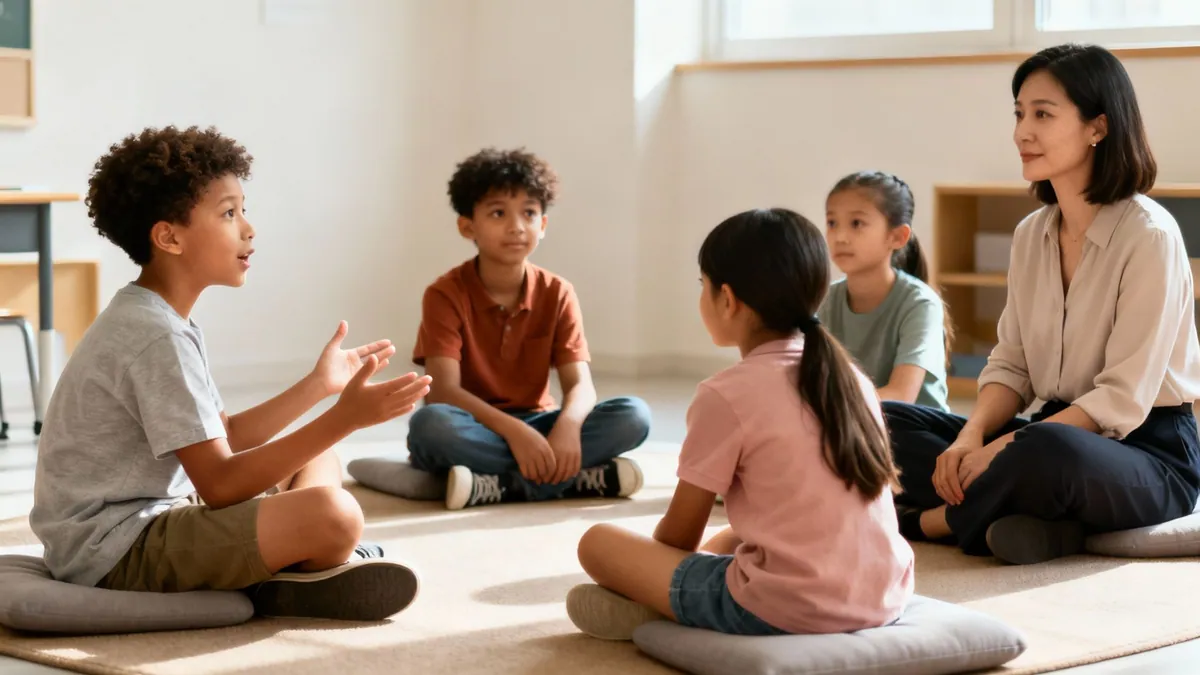
Circle Time, also known as Community Circles, is a foundational practice among kids social skills activities. It involves a structured gathering where children and a facilitator sit in a circle to share thoughts, feelings, and experiences in a safe, non-judgmental environment. This simple yet powerful format fosters a sense of belonging, builds trust, and develops essential active listening skills. The predictable structure creates a feeling of psychological safety, allowing even hesitant children to participate over time.
This practice is highly effective because it directly teaches turn-taking, respectful listening, and empathy. The core principle is that everyone has a voice and every voice deserves to be heard without interruption.
Why It Works
Community circles are a cornerstone of social-emotional learning (SEL) programs and are central to approaches like Responsive Classroom and Restorative Practices. They work by creating a dedicated time and space for connection, which is often lost in a busy academic day. The circle format itself is symbolic, communicating equality and unity where no single person has a more prominent position.
This activity directly addresses key SEL competencies such as self-awareness (identifying and sharing feelings), social awareness (listening to and understanding others’ perspectives), and relationship skills (communicating clearly and building positive connections).
How to Implement It
Establish Clear Agreements: Before starting, co-create circle rules with the children. Examples include: “We listen with our hearts,” “What’s said in the circle stays in the circle,” and “We respect the talking piece.”
Use a Talking Piece: Introduce an object like a special stone, ball, or stuffed animal. Only the person holding the object can speak. This simple tool is incredibly effective at managing turns and preventing interruptions.
Start with Low-Stakes Prompts: Begin with simple, fun questions to build comfort.
Practical Example (K-2): “If you were a superhero, what would your kindness power be?”
Practical Example (3-5): “Share one moment this week when someone was kind to you.”
Practical Example (6-8): “What’s one goal you have for this week, and how can the group support you?”
Model and Guide: As the facilitator, model active listening by making eye contact, nodding, and asking thoughtful follow-up questions when appropriate.
This practice is highly adaptable, from brief 10-minute morning check-ins in a kindergarten classroom to deeper, problem-solving restorative circles in middle school. To dive deeper into establishing these routines, explore these ideas for building community in the classroom.
2. Role-Playing and Perspective-Taking Scenarios
Role-Playing and Perspective-Taking Scenarios are dynamic, structured activities where children act out various social situations. This method allows them to safely explore complex interactions like friendship conflicts, peer pressure, or moments of exclusion. By stepping into different roles, participants practice empathy and develop practical communication and problem-solving skills in a low-stakes environment.
This play-based approach is powerful because it bridges the gap between knowing what to do and actually doing it. It leverages imaginative learning to build social-emotional resilience and prepare kids for real-life challenges.
Why It Works
Role-playing is a core component of proven SEL curricula like the Second Step program and is used in character education and bullying prevention initiatives. It works by making abstract social concepts concrete and memorable. Instead of just talking about being a good friend, children get to practice it. This experiential learning helps internalize social skills more effectively than passive instruction.
This activity directly targets key SEL competencies, particularly social awareness (understanding others’ perspectives and emotions) and responsible decision-making (evaluating consequences and choosing constructive actions). It also enhances relationship skills by equipping children with a toolkit of potential responses for difficult situations.
How to Implement It
Select a Relevant Scenario: Choose a situation that is relatable to your students.
Practical Example (K-2): A student wants to play with a toy that another student is using. How can they ask for a turn?
Practical Example (3-5): A student sees a classmate being left out of a game on the playground. What could they say or do?
Practical Example (6-8): A friend is pressuring you to share a secret about another classmate. How do you say no respectfully?
Assign Roles and Explain the Goal: Clearly define each role. You might have one child practice asking to join a game, while others act as the group playing. State the objective, such as “Our goal is to find a kind way to include someone.”
Act Out the Scenario: Let the children act out the scene. Avoid interrupting unless necessary. Observe their choices and communication styles.
Pause, Reflect, and Re-do: After the first run-through, lead a discussion. Ask questions like, “How did it feel to be in that role?” and “What could we try differently?” Then, allow the children to re-do the scene using new strategies.
These kids social skills activities are incredibly versatile and effective for building confidence and compassion. To learn more about the foundational skills involved, explore these strategies for teaching empathy to kids and teenagers.
3. Cooperative Games and Team Challenges
Cooperative games and team challenges are play-based kids social skills activities where groups work together toward a shared objective rather than competing against one another. This approach intentionally shifts the focus from winning or losing to collaboration, collective problem-solving, and communication. Games like building a bridge with limited materials or navigating a “minefield” blindfolded with verbal cues build trust and create positive peer relationships.
These activities are powerful because they put social skills into immediate practice. Children learn to negotiate roles, share ideas, and support teammates in a fun, low-stakes environment, emphasizing inclusion and equal participation.
Why It Works
Pioneered by figures like Terry Orlick and integrated into programs like Project Adventure, cooperative play directly addresses the need for belonging and contribution. By removing the element of individual competition, these games lower social anxiety and allow children to practice essential skills without the fear of personal failure. The shared goal creates an instant “team” dynamic, promoting empathy and understanding.
This approach is excellent for developing key SEL competencies, including relationship skills (teamwork, communication, social engagement) and responsible decision-making (working with others to solve problems and achieve a common goal). It teaches children that collective success is often more rewarding than individual victory.
How to Implement It
Set the Stage: Clearly explain the objective and emphasize that the goal is to succeed together. Use inclusive language like, “Our team’s mission is to…” instead of “You need to…”
Start Small: Begin with simple, non-physical challenges like “Group Count,” where the team tries to count to 10 with each person saying one number at random without interrupting another. This builds comfort and establishes the collaborative mindset.
Ensure Meaningful Roles: Structure the activity so every child has a necessary part to play.
Practical Example: In a challenge to build the tallest tower out of spaghetti and marshmallows, assign roles: a “Lead Architect” who helps the team decide on a design, a “Materials Manager” who distributes the supplies, and several “Builders” who construct the tower.
Debrief and Reflect: The most critical step is the post-activity discussion. Ask guiding questions: “What was challenging for our team?” “What did we do well together?” “What would we do differently next time?” This reflection is where the social learning is solidified.
These activities are highly adaptable, from a simple “Human Knot” game on the playground to more complex engineering challenges in the classroom. They are particularly effective for integrating new students or rebuilding a positive classroom culture.
4. Mindfulness and Self-Regulation Practices
Mindfulness and Self-Regulation Practices are kids social skills activities focused on teaching children how to manage their emotions, focus their attention, and respond to stress. Through simple techniques like breathing exercises, body scans, and guided meditation, children learn to notice their internal state without immediate judgment or reaction. This creates a crucial pause between feeling an emotion and acting on it, building the foundation for emotional awareness and control.
These evidence-based practices are vital because they equip children with internal tools to navigate social challenges. A child who can notice they are feeling angry is better equipped to choose a calm response instead of lashing out.
Why It Works
Mindfulness directly strengthens the prefrontal cortex, the part of the brain responsible for executive functions like impulse control and emotional regulation. Popularized by figures like Jon Kabat-Zinn and Daniel Goleman, and integrated into programs like Soul Shoppe’s workshops and Conscious Discipline, these practices make abstract concepts tangible. They give children a “how-to” guide for managing their inner world.
This activity directly supports key SEL competencies like self-management (managing stress, controlling impulses) and self-awareness (identifying emotions, recognizing strengths). By building these internal skills, children are better prepared to engage in positive social interactions.
How to Implement It
Start Small and Consistent: Begin with just one to two minutes of a simple breathing exercise each day.
Practical Example (K-2): Use “Flower and Candle” breathing. “Smell the flower” (breathe in through the nose) and “blow out the candle” (breathe out through the mouth).
Practical Example (3-8): Practice “Box Breathing”: inhale for four counts, hold for four, exhale for four, and hold for four.
Use Simple, Concrete Language: Guide children with clear instructions. For a body scan, you might say, “Notice how your feet feel on the floor. Are they warm? Are they tingly? Just notice.” This makes the experience accessible.
Model Authentically: Participate in the practice yourself. When you model calmness and focus, you show children that this is a valuable tool for everyone, not just a task for them to complete.
Connect to Emotions: Explicitly link the practice to real-life situations. Say, “When you feel that big wave of frustration before a math test, remember your ‘Box Breathing.’ It can help you feel more in control.”
These practices are incredibly versatile, from a “breathing buddy” (stuffed animal on the belly) for a kindergartener to using apps like Calm for a middle schooler’s advisory period. To learn more about these foundational skills, explore these techniques for teaching children how to self-soothe.
5. Peer Mentoring and Buddy Systems
Peer Mentoring and Buddy Systems are powerful kids social skills activities that pair older or more socially adept students with younger or less confident peers. This structured partnership creates a supportive, one-on-one relationship where positive social behaviors are modeled and practiced in a natural context. The goal is to build leadership, empathy, and responsibility in the mentor while providing friendship and a positive role model for the mentee.
This approach is highly effective because it leverages the influence of peers, which can often be more impactful than adult guidance for certain children. It creates authentic connections that strengthen the entire school community, reduce feelings of isolation, and promote a culture of kindness and support.
Why It Works
Buddy systems are rooted in the principles of social learning theory, where children learn by observing and imitating others. When a younger student sees an older “buddy” navigate a social situation successfully, it provides a tangible, relatable example to follow. These programs are cornerstones of bullying prevention and school climate initiatives, creating a network of support that permeates the campus.
This activity directly enhances key SEL competencies such as relationship skills (building positive connections, teamwork) and social awareness (developing empathy, appreciating diverse perspectives). Mentors develop responsible decision-making by taking their role seriously, while mentees gain confidence and a stronger sense of belonging.
How to Implement It
Train Your Mentors: Provide clear training for older buddies.
Practical Example: Role-play with mentors on how to start a conversation with their younger buddy. Give them a list of “go-to” questions like, “What’s your favorite thing to do at recess?” or “Tell me about a book you’re reading.”
Make Thoughtful Pairings: Match students based on shared interests, personalities, and needs. A quiet, artistic older student might be a perfect match for a shy younger child who loves to draw. Avoid pairing based only on academic performance.
Provide Structure: Don’t just leave them to figure it out. Plan specific, low-pressure activities to get them started, like a cross-age buddy reading session, a shared craft project, or a “get to know you” scavenger hunt.
Facilitate and Supervise: Regularly check in with both mentors and mentees separately to see how the relationship is going. Provide guidance and support to the mentors if they encounter challenges. Recognize their contributions to build motivation and a sense of pride.
6. Emotion Recognition and Feelings Charts
Emotion recognition activities and visual tools like feelings charts are fundamental kids social skills activities designed to help children identify, name, and understand the complex world of emotions. Using tools such as emotion cards, feeling thermometers, or daily mood check-ins, students build an essential emotional vocabulary. This practice teaches them that all feelings are valid, which is a critical first step toward managing them effectively.
This approach is highly effective because it makes the abstract concept of feelings concrete and accessible. By giving children the language to express their internal states, it empowers them to communicate their needs, develop empathy for others, and build a foundation for self-regulation.
Why It Works
Based on the principles of emotional intelligence popularized by Daniel Goleman and frameworks like The Zones of Regulation, these activities directly build social-emotional competencies. They create a classroom culture where feelings are acknowledged and discussed openly rather than suppressed. This practice demystifies emotions and reduces the shame often associated with challenging feelings like anger or sadness.
This activity directly supports key SEL competencies, including self-awareness (accurately identifying one’s emotions), social awareness (recognizing emotions in others), and self-management (learning to regulate emotional responses). It provides a shared, non-judgmental language for the entire community to use.
How to Implement It
Introduce a Visual Tool: Start with a simple, age-appropriate feelings chart or “emotion thermometer.” Display it prominently in the classroom or home. For younger kids, use faces with clear expressions; for older students, introduce more nuanced vocabulary.
Establish a Daily Check-In: Integrate a mood check-in into a consistent routine, like the morning meeting.
Practical Example: At the start of the day, have students place a clothespin with their name on the feeling that best matches their current state on a large chart. This gives the teacher a quick, non-verbal snapshot of the room’s emotional climate.
Model Authenticity: As the adult, share your own feelings in a regulated way. For example, “I am feeling a little frustrated because the projector isn’t working, so I am going to take a deep breath.”
Connect Feelings to Sensations: Help children notice the physical signs of their emotions. Ask questions like, “Where do you feel that anger in your body? Do you have tight fists or a hot face?” or “What does excitement feel like for you? A bubbly feeling in your stomach?”
This practice normalizes emotional expression and provides the tools needed for healthy coping strategies.
7. Conflict Resolution and Peer Mediation Programs
Conflict Resolution and Peer Mediation Programs are structured processes that empower students to resolve their own disputes constructively. Instead of relying on adult intervention and consequences, trained peer mediators guide their classmates through a communication protocol that includes active listening, identifying feelings, and collaborative problem-solving. This approach transforms conflict from a disruptive event into a valuable learning opportunity, building crucial life skills.
These programs are highly effective because they give students ownership over their problems and solutions. By learning to navigate disagreements respectfully, children develop agency, empathy, and the communication tools needed to maintain positive relationships, significantly reducing behavioral incidents over time.
Why It Works
Peer mediation is a powerful application of Restorative Practices and is a core component of programs like Peace Builders and Conflict Wise. It works by shifting the focus from blame and punishment to understanding and repair. The process is built on the idea that students are capable of understanding each other’s perspectives and finding mutually agreeable solutions when given the right framework.
This activity directly targets advanced SEL competencies, including relationship skills (practicing constructive conflict resolution), responsible decision-making (analyzing situations and generating solutions), and social awareness (taking others’ perspectives and showing empathy). The peer-led model also builds leadership skills and a sense of collective responsibility within the school community.
How to Implement It
Train Peer Mediators: Select and train a group of students in core mediation principles. This training should cover confidentiality, neutrality, active listening, and the steps of the mediation process.
Establish a Clear Process: Define the steps for mediation. A common model includes: introductions and ground rules, each person sharing their perspective without interruption, identifying common interests and needs, brainstorming solutions, and creating a written agreement.
Teach Core Communication Tools: Central to mediation is the use of “I-statements” to express feelings without blame.
Practical Example: Instead of “You’re so annoying for talking during the movie,” teach a child to say, “I feel frustrated when I hear talking during the movie because I can’t hear the story.”
Explore how to teach this skill with resources on the magic of I-feel statements for kids.
Define When Mediation is Appropriate: Clearly communicate that mediation is for peer-level conflicts (e.g., disagreements over games, rumors, misunderstandings) and is not suitable for situations involving bullying, harassment, or safety concerns, which require adult intervention.
By embedding these kids social skills activities into the school culture, you create a system where students see conflict not as a crisis, but as a solvable problem they are equipped to handle together.
8. Collaborative Art and Building Projects
Collaborative Art and Building Projects are dynamic, play-based kids social skills activities where children work together to create a single, shared outcome. From class murals to complex LEGO structures, these tasks require children to communicate, negotiate, and solve problems as a team. The focus is placed on the process of working together rather than the final product, fostering a sense of shared ownership and belonging.
This approach is highly effective because it moves social skills from theory to practice in a tangible, low-stakes context. Success depends entirely on cooperation, compromise, and the ability to value and integrate diverse ideas, making it a powerful vehicle for developing group cohesion.
Why It Works
Grounded in experiential and project-based learning, collaborative projects create an authentic need for social interaction. Unlike individual assignments, these activities make cooperation a non-negotiable part of the task. Children learn firsthand that sharing ideas, delegating roles, and navigating disagreements leads to a better outcome for everyone involved.
These activities directly target key SEL competencies, particularly relationship skills (communicating effectively, practicing teamwork) and responsible decision-making (working constructively with others, solving problems together). The hands-on nature of the work keeps children engaged while they naturally practice essential social behaviors.
How to Implement It
Set Clear Collaborative Goals: Before starting, define the shared objective and establish agreements on how decisions will be made. For example, “Our goal is to build a tower that is at least two feet tall, and we will vote on design ideas before we start building.”
Assign or Rotate Roles: To ensure equitable participation, define roles that cater to different strengths.
Practical Example: For a class mural project, one group could be the “Background Painters,” another the “Detail Artists,” and a third the “Lettering Team.” This ensures everyone has a clear and valued contribution.
Use Prompts That Require Teamwork: Design the challenge so no single child can complete it alone. For example, provide a limited set of materials that must be shared or create a task that is physically too large for one person.
Debrief the Process: After the project is complete, facilitate a reflection. Ask questions like, “What was the hardest part about working together?” or “What is one thing our team did really well?” to reinforce the social learning.
This strategy is incredibly versatile, working for everything from a 20-minute block-building challenge in first grade to a semester-long community garden project in middle school. The key is to celebrate the collaborative journey just as much as the final masterpiece.
9. Social Skills Coaching and Direct Instruction
Social Skills Coaching and Direct Instruction involves the explicit, structured teaching of specific social competencies. Unlike skills that children might absorb incidentally, this approach breaks down complex social interactions into manageable steps that are modeled, practiced, and reinforced. It’s a targeted strategy for ensuring all students, especially those who struggle with social cues, build a strong foundation for positive relationships.
This method is highly effective because it treats social skills like academic skills: they can be taught, practiced, and mastered. It provides clear, concrete language and strategies for navigating social situations like joining a group, asking for help, or handling disagreements, making it one of the most essential kids social skills activities for systematic support.
Why It Works
Direct instruction demystifies social expectations that can often seem unwritten or intuitive. By making the “hidden curriculum” of social interaction visible and teachable, it empowers students with confidence and a toolkit for success. This approach is a core component of many evidence-based Social-Emotional Learning (SEL) programs and is particularly beneficial for students who need more than just exposure to develop their social awareness.
This practice directly addresses key SEL competencies such as self-management (using coping skills), social awareness (taking others’ perspectives), and relationship skills (communicating effectively and resolving conflicts). By teaching the “how-to” behind these skills, educators can move from correcting social missteps to proactively building social competence.
How to Implement It
Break It Down: Deconstruct a complex skill into smaller, teachable parts. For “joining a game,” the steps might be: 1. Watch the game, 2. Find a natural pause, 3. Ask a friendly question, and 4. Accept the answer gracefully.
Model and Think Aloud: Demonstrate the skill correctly and incorrectly.
Practical Example: Act out how to join a group. First, do it in a disruptive way (e.g., interrupting loudly). Then, model the correct steps and use a “think-aloud” script: “Okay, they are in the middle of a point. I’ll wait until it’s over before I walk up. Now is a good time. I’ll smile and say, ‘This looks fun, can I join next round?'”
Use Guided Practice: Create low-stakes role-playing scenarios in a safe environment. Give students a chance to practice the skill with a partner or in a small group before trying it in a real-world situation like the playground.
Provide Specific Feedback: Offer feedback that is behavioral and encouraging. Instead of “Good job,” say, “I noticed you made eye contact and smiled when you asked to join. That was very welcoming.”
This targeted instruction can be delivered in various formats, from whole-class lessons using curricula like Second Step to small-group interventions led by a school counselor. For a deeper look at research-based, experiential instruction, explore how Soul Shoppe’s programs utilize direct teaching within engaging workshops.
10. Kindness and Gratitude Practices
Kindness and Gratitude Practices are a set of intentional kids social skills activities designed to shift focus from self to others. These routines involve regularly noticing and expressing appreciation through thank-you notes, compliment circles, or “random acts of kindness” challenges. This deliberate practice helps build positive peer relationships, fosters a stronger sense of belonging, and actively develops prosocial behaviors. It transforms kindness from an abstract concept into a visible, tangible part of the community culture.
These activities are powerful because they train the brain to look for the good in others and in daily situations. Consistently engaging in gratitude and kindness can directly counteract negative social dynamics like exclusion and bullying, creating a more positive and supportive environment for everyone.
Why It Works
Grounded in research from positive psychology and organizations like the Greater Good Science Center, these practices are proven to enhance well-being, empathy, and social connection. When children learn to articulate what they appreciate in others, they strengthen their social awareness by recognizing others’ positive contributions. Expressing this appreciation builds crucial relationship skills, teaching them how to offer genuine, specific praise.
The reciprocal nature of kindness creates an upward spiral of positive interaction. When one child receives a compliment or a thank-you note, they are more likely to “pay it forward,” amplifying the positive effects. This makes kindness a proactive strategy for building community, not just a reactive one for solving problems.
How to Implement It
Start a Gratitude Circle: Dedicate a few minutes at the end of the day or week. Go around the circle and have each child share one thing they are grateful for or one person they want to appreciate. Model specificity: instead of “Thanks to Maya,” say, “I appreciate Maya for helping me pick up my crayons when I dropped them.”
Create a Kindness Wall: Designate a bulletin board where students can post thank-you notes or “kindness sightings.” This makes positive actions visible to the entire community and encourages peer-to-peer recognition.
Launch a Kindness Challenge: Introduce a “Random Acts of Kindness” challenge for a week.
Practical Example: Give students a “bingo card” with simple, achievable acts of kindness, such as “Hold the door for someone,” “Invite someone new to play,” “Give a genuine compliment to a classmate,” or “Help a teacher without being asked.”
Model Authenticity: Your own modeling is crucial. Acknowledge acts of kindness you observe throughout the day and express your own gratitude genuinely. Ensure the practice feels authentic, not like a forced requirement.
Kids Social Skills Activities — 10-Item Comparison
Explicit social skills acquisition, measurable gains
Targeted small groups, students needing explicit support
Systematic, evidence-based, transferable skills
Kindness & Gratitude Practices
Low (easy routines)
Minimal (time, prompts, materials)
Improved climate, prosocial behavior, belonging
Whole-class culture building, school rituals
Low-cost, quick positive impact on climate
Putting It All Together: Building a Culture of Connection, One Activity at a Time
We’ve explored a comprehensive toolkit of kids social skills activities, from the foundational trust built in Community Circles to the complex problem-solving of Peer Mediation. Each activity, whether it’s a cooperative game or a quiet moment of mindfulness, serves as a single, powerful thread. When woven together consistently, these threads create a strong, resilient fabric of social and emotional intelligence that can support children throughout their entire lives.
The journey of fostering these crucial skills isn’t about one-off lessons or occasional interventions. It’s about fundamentally shifting the environment to one where empathy, communication, and respect are the default settings. It’s about transforming a classroom or a home into a living laboratory for social learning, where mistakes are seen as opportunities for growth and every interaction is a chance to practice.
Key Takeaways for Lasting Impact
Reflecting on the ten core activities, several themes emerge as essential for success:
Consistency is Crucial: A daily Feelings Chart check-in or a weekly Gratitude Practice has a far greater impact than a single, isolated social skills assembly. Repetition builds neural pathways and makes these skills second nature, not just a concept learned once.
Practice Over Preaching: Children learn social skills best by doing. Role-playing a conflict is more instructive than a lecture on “I-statements.” Engaging in a collaborative art project teaches teamwork more effectively than a worksheet on cooperation.
Integration is Everything: The most powerful social learning happens when it’s embedded into the daily routine. To truly foster a culture of connection and collaboration, it’s essential to integrate a variety of engaging student-centered learning activities that naturally encourage social interaction. A science project can become a lesson in cooperative problem-solving, and a history discussion can be an exercise in perspective-taking.
Your Actionable Next Steps
Feeling inspired but not sure where to begin? Don’t try to implement everything at once. The goal is sustainable change, not overwhelming yourself or your children.
Start Small and Specific: Choose just one or two activities that resonate with you and address an immediate need. If mornings are chaotic, perhaps start with a 2-minute mindfulness breathing exercise. If playground squabbles are common, introduce a simple conflict resolution script.
Model the Skills Yourself: Your actions are the most powerful lesson. Demonstrate active listening when your child speaks, use “I-feel” statements to express your own emotions, and openly practice gratitude. Children are keen observers; let them see these skills in authentic, everyday use.
Create a Predictable Routine: Schedule your chosen kids social skills activities into the day or week. For example, make “Community Circle Fridays” a special event to look forward to, or designate the first five minutes after lunch for quiet self-regulation practices. Predictability creates psychological safety, making children more receptive to learning and participating.
By intentionally providing these structured opportunities for practice, you are not just teaching children how to be “nice.” You are equipping them with the essential architecture for building healthy relationships, navigating complex social landscapes, managing stress, and developing a core sense of self-worth and belonging. You are empowering them to become confident, compassionate, and capable individuals who can contribute positively to every community they join. This is the profound, lasting value of investing in social and emotional learning, one activity at a time.
Ready to move beyond individual activities and build a comprehensive, school-wide culture of empathy and respect? Soul Shoppe provides dynamic, interactive programs and tools that bring social-emotional learning to life, reducing bullying and empowering students with skills for a lifetime. Explore how Soul Shoppe can partner with your school to create a community where every child feels safe, valued, and connected.
In today’s dynamic K-8 classrooms, the ability to communicate effectively is more than a ‘soft skill’-it’s the bedrock of learning, collaboration, and emotional well-being. From navigating friendships on the playground to engaging in thoughtful academic discussions, students need practical tools to listen, express themselves, and resolve conflicts peacefully. For educators, parents, and administrators, fostering these abilities can feel like a monumental task, especially when faced with diverse student needs and limited time.
This article cuts through the noise. We’ve compiled 10 powerful, classroom-ready communication skills activity ideas designed to build empathy, foster psychological safety, and create a culture of belonging. Each activity is broken down with step-by-step instructions, practical examples, and differentiation tips for various grade levels, so you can start building a more connected community tomorrow. These aren’t just games; they are foundational practices that equip students with the lifelong skills needed to thrive in school and beyond.
To make communication skills truly stick, it’s essential to move beyond passive learning. The activities detailed here are intentionally hands-on and interactive. Explore how implementing dynamic and participatory methods can enhance the learning experience by reviewing various active learning strategies to boost engagement. By creating an environment where students actively participate, you can ensure these crucial lessons resonate deeply. This guide provides the blueprint for that environment, offering clear, actionable steps for everything from Active Listening Circles to Perspective-Taking Role-Play, empowering you to cultivate stronger communicators in your classroom or home.
1. Active Listening Circles
Active Listening Circles are a structured and powerful communication skills activity designed to foster deep listening and empathy. In this exercise, participants sit in a circle, and only the person holding a designated “talking piece” is permitted to speak. All other members listen with full attention, without interrupting, planning a response, or judging. This simple protocol creates a safe, respectful space where speakers feel heard and validated.
This foundational technique is remarkably versatile. It can be used for morning meetings in a kindergarten class to share weekend news, or as a framework for restorative justice conversations to address peer conflicts in middle school. The focus is not on debate but on understanding, making it an essential tool for building a strong classroom community. A practical example is using a circle to discuss a book character’s choice. A teacher could pass a “talking stone” and ask, “How do you think the character felt when they made that decision?” Each student shares their idea while others listen, building a collective understanding of the character’s motivations without debating who is “right.”
Facilitation Tips & Implementation
To ensure a successful listening circle, facilitators should establish clear guidelines and model the desired behaviors.
Establish Clear Agreements: Co-create rules with the group, such as “Listen with your heart,” “Speak your truth,” and “What’s said in the circle stays in the circle.”
Use a Talking Piece: This can be any object, like a decorative stone, a small stuffed animal, or a ball. The talking piece visually designates the speaker and reinforces the “one voice at a time” rule.
Teach Non-Verbal Cues: Explicitly teach and practice non-verbal active listening skills like making eye contact, nodding, and maintaining an open posture.
Offer a ‘Pass’ Option: Always give students the option to pass their turn without penalty. This respects their comfort level and builds trust.
Start with Low-Stakes Topics: Begin with simple prompts like, “Share one good thing that happened this week,” before moving to more sensitive subjects. This builds psychological safety within the group.
By creating a predictable and safe structure, this communication skills activity helps students practice the core components of effective dialogue: speaking honestly and listening with compassion. Explore more in-depth strategies for Active Listening Circles to enhance this practice in your classroom. You can find more listening skills activities on soulshoppe.org.
2. Non-Violent Communication (NVC) Practice
Non-Violent Communication (NVC) is a structured framework that guides individuals to express themselves with clarity and compassion. Developed by psychologist Marshall Rosenberg, this communication skills activity teaches a four-step model: observations, feelings, needs, and requests. By separating objective observations from subjective judgments, NVC helps de-escalate conflict, reduce defensiveness, and foster genuine understanding between speakers.
This powerful approach transforms potentially adversarial conversations into opportunities for connection. It is highly effective in various school settings, from facilitating peer mediations where students resolve their own conflicts to structuring teacher-student conversations during disciplinary moments. Instead of saying, “You’re always interrupting,” a student learns to say, “When I see you talking while I’m sharing (observation), I feel frustrated (feeling) because I need to feel respected (need). Would you be willing to wait until I’m finished before you speak (request)?”.
Facilitation Tips & Implementation
To effectively introduce NVC, break down the four components and allow for ample practice in a safe environment.
Teach Each Step Separately: Dedicate a mini-lesson to each of the four components: Observations, Feelings, Needs, and Requests. Use sorting activities and real-life scenarios to help students distinguish between them.
Create Anchor Charts: Display the NVC framework on a classroom anchor chart. Include “feeling words” and “needs” lists to provide students with the vocabulary they need to express themselves accurately.
Use Role-Playing Scenarios: Practice with low-stakes, relatable scenarios before tackling real conflicts. For example: “Your friend borrowed your favorite pen and didn’t return it.” A student would practice saying, “I see my pen is not on my desk (observation). I feel worried (feeling) because I need to have my things with me (need). Would you be willing to help me look for it? (request).”
Celebrate the Attempt: Praise students for trying to use the NVC model, even if their phrasing isn’t perfect. The goal is to build the habit of communicating with intention and empathy.
Connect to Mindfulness: Link NVC to emotional regulation by teaching students to take a calming breath before responding. This pause creates the space needed to choose a compassionate response over a reactive one.
By equipping students with this structured communication skills activity, educators empower them to navigate disagreements constructively and build healthier relationships. You can learn more about the NVC model at The Center for Nonviolent Communication.
3. Perspective-Taking Through Role-Play
Perspective-Taking Through Role-Play is an experiential communication skills activity where participants act out scenarios from different viewpoints to build empathy and understanding. By stepping into someone else’s shoes, students can physically and emotionally experience a situation differently. This powerful exercise helps develop compassion, improve conflict resolution skills, and reduce bullying behaviors.
This method is incredibly effective for exploring complex social dynamics. For example, in a middle school classroom, students could role-play a lunch table exclusion scenario from the perspective of the person being excluded, a student doing the excluding, and a bystander. This helps participants understand the internal thoughts and feelings that drive behavior, fostering a more inclusive school climate. To further develop the ability to understand and share the feelings of others, consider exploring resources like ‘Let’s Talk About Empathy’.
Facilitation Tips & Implementation
The success of this communication skills activity depends heavily on creating a safe environment and conducting a thoughtful debrief.
Establish Psychological Safety: Begin by setting clear expectations for respect and confidentiality. Reassure students that this is a learning exercise, not a performance.
Brief Participants Privately: Give students their roles and a brief description of their character’s perspective in private. This prevents them from pre-judging other roles.
Use a ‘Fishbowl’ Format: Have a small group act out the scenario in the center while the rest of the class observes. This can feel safer for participants and provides learning opportunities for the audience.
Debrief Thoroughly: The post-activity discussion is crucial. Start with observational questions like, “What did you notice?” before moving to emotional reflections like, “How did that feel?”
Offer an Opt-Out: Always allow students to decline participation or take on an observer role without shame. This respects their boundaries and builds trust.
Follow Up with Reflection: Encourage students to process the experience through a private journal entry or a written reflection, solidifying their learning.
By embodying different perspectives, students gain a profound understanding of empathy that goes beyond simple definition. Learn more about how to build empathy in the classroom with these targeted strategies.