

8 Social Emotional Learning Activities for Preschool
The block shelf is crowded. One child is carefully building a tower. Another reaches for the same long block. Across the room, a child who had a hard drop-off is standing close to the door, trying not to cry. If you work with preschoolers, you know these moments aren't side issues. They are the day.
Social emotional learning begins as preschoolers learn it while waiting for a turn, hearing "not yet," noticing a friend's face, or finding words for a feeling that shows up fast and loud. They don't need abstract lectures. They need repeated, concrete practice with caring adults nearby.
That matters because preschool SEL isn't just a nice extra. A Learning Policy Institute brief on evidence for social and emotional learning reports that findings from hundreds of studies across six continents show a consistent, reliable effect of evidence-based SEL programs on students' social, emotional, behavioral, and academic outcomes across grade levels, including PreK through 12. In preschool terms, that means the games, routines, and conversations you use every day can support real developmental growth.
The activities below are practical social emotional learning activities for preschool, but they go beyond a quick list of ideas. Each one includes a simple objective, materials, steps, and easy adaptations for classrooms and home. Start with one. Repeat it often. That's usually where the biggest change happens.
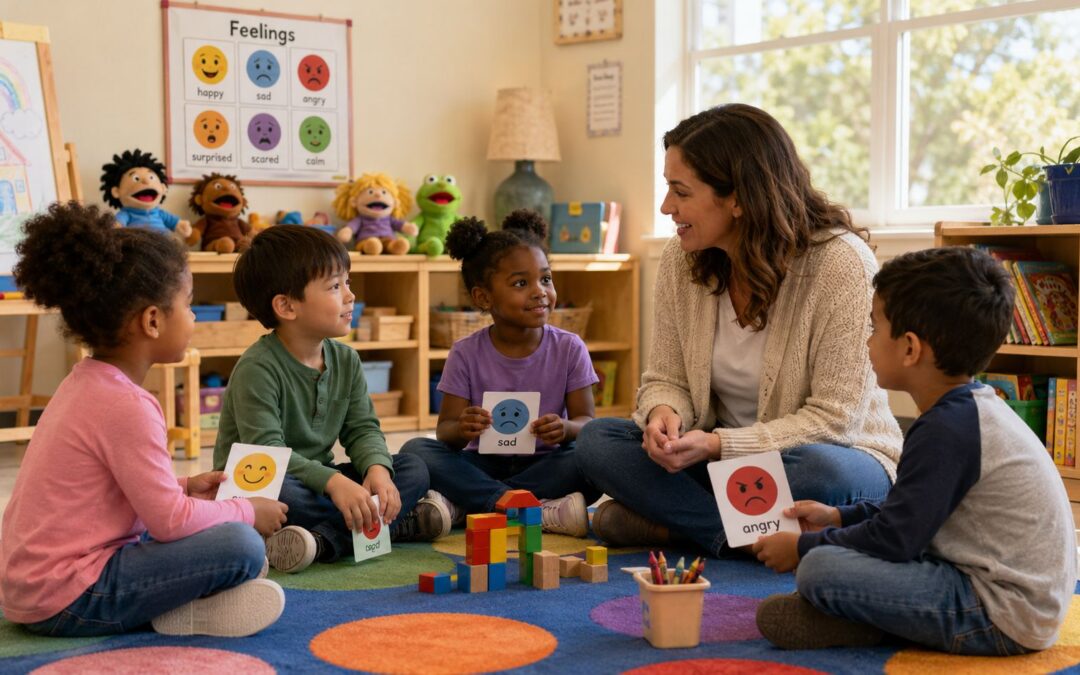
1. Emotion Recognition and Labeling Through Visual Cards
Some children say "mad" for every hard feeling. Others shut down when asked what's wrong. Visual emotion work helps because it gives young children something concrete to point to before they can explain it.
A simple feelings-card routine builds self-awareness. Children learn to notice faces, connect them to words, and eventually connect those words to their own bodies and experiences. That's the first step toward calmer behavior later.
What you'll need
- Emotion cards: Real photos work especially well. Include happy, sad, frustrated, worried, excited, tired, and proud.
- A mirror: Hand mirrors or one wall mirror lets children compare their faces to the cards.
- A feelings board: A pocket chart, magnet board, or clothespin chart works well.
- Optional color support: Some teachers add colors to help children sort emotions visually.
In a classroom, you might begin morning meeting by placing three photo cards in the center. Ask, "Which face looks like how your body feels today?" At home, a parent can keep a few cards on the fridge and use them before preschool, after pickup, and at bedtime.
How to do it
Start small. Put out two or three cards, not ten. Ask children to match the face, name the feeling, and copy the expression in the mirror.
Then add a short script:
- Name it: "This face looks frustrated."
- Notice the body: "Frustrated can feel tight in our hands."
- Connect it to life: "When blocks fall down, some people feel frustrated."
If a child can't answer verbally, let them point, hold up a card, or place a clip on a feelings chart for kids. That still counts as strong participation.
Practical rule: Don't correct a child's feeling choice too quickly. If they choose "angry" when they seem sad, stay curious. Young children are often sorting through mixed feelings.
For extension, pair this with a read-aloud or a robot story about feelings, then ask, "How did the character feel first? What changed?" That moves children from labeling feelings in faces to noticing feelings in stories and real life.
For sensory-sensitive or nonverbal children, reduce language demands. Offer two cards instead of many, skip direct eye contact, and let them respond by pointing, matching, or moving a token.
2. Mindfulness and Breathing Exercises with Movement
Some preschoolers need help slowing their bodies before they can use words. Breathing and movement work best when they are short, visible, and tied to the daily rhythm instead of saved only for crisis moments.
Preschool guidance often recommends breathing, mirror play, and role-play, but the more useful question is how to make these activities accessible for children with different sensory and language needs. Inclusive SEL guidance highlighted in this preschool SEL overview points to predictable routines, visual supports, and explicit emotion coaching as especially important. The same resource notes that the CDC estimates 1 in 36 children in the U.S. has autism, and global estimates suggest about 1 in 100 children are autistic.

A strong starter routine
Try belly breathing with a stuffed animal. Have children lie down or sit against a wall. Place the stuffed animal on the belly and say, "Let's help the bear ride up and down slowly."
Materials are minimal:
- Stuffed animal or beanbag
- Quiet floor space
- A short cue phrase such as "Smell the flower, blow the candle"
In school, this works well after arrival, before rest, or after outdoor play. At home, it fits naturally before leaving for preschool or after a difficult transition.
Step by step
Model first. Preschoolers need to see it in a body, not just hear instructions.
- Put the stuffed animal on the belly.
- Breathe in slowly through the nose if that's comfortable.
- Breathe out gently and watch the toy lower.
- Repeat a few times, then stand up and stretch arms high.
- Ask one simple reflection question such as, "Does your body feel busy or calm now?"
A belly breathing technique for children can help adults stay consistent with the language they use.
For children who don't like lying down, let them breathe while seated, rock in a chair, trace a finger up and down an arm, or blow a pinwheel. For children who become overstimulated by group practice, offer the same routine in a calm corner with one adult.
Later in the day, you can reinforce the same skill with this short video cue:
Make the goal visible
For preschoolers, invisible ideas fade fast. A drawing, a photo, or a simple picture card keeps the goal in view.
Research from Boston Children's Health Physicians notes that visually representing goals can support follow-through. For preschoolers, drawing the goal can increase task completion for independence skills by up to 50% compared with verbal instructions alone.
That doesn't mean every family needs a perfect chart. It means the child benefits from seeing what they're aiming for.
Try these easy versions:
- Draw it: Sketch a toothbrush, backpack, or toy bin.
- Use a photo: Take a picture of the child completing the step.
- Make a first-then card: “First shoes on, then outside.”
- Use one symbol: A cup icon near the sink means “put cup here.”
“Our goal is something we can see and do.”
Sample scripts for common preschool moments
Adults often ask for exact words. Here are a few.
| Situation | Try saying |
|---|---|
| Morning dressing | “Your goal is one sleeve by yourself. I'll help with the other one if you need it.” |
| Classroom cleanup | “We're all working on one cleanup goal. Put three items where they belong.” |
| Turn-taking | “Your goal is to ask for a turn with words.” |
| Bedtime routine | “Let's draw your bedtime goal. Pajamas first, then book.” |
The simpler the script, the more likely children are to remember it and act on it.
A Toolbox of Goal-Setting Activities and Examples
Sometimes adults understand the concept but still wonder, “What goal should I use tomorrow?”
The easiest answer is to start where the child already bumps into difficulty. If mornings are hard, build a morning goal. If transitions are rough, create a transition goal. If a child wants to help, turn that desire into a helper goal.
For families who like paper tools, journals, or planners for older kids and adults, it can be interesting to look at strategic partners for personal growth. For preschoolers, though, the “planner” is usually much simpler: a photo, a picture card, a basket label, or a tiny checklist with images.
Sample Preschool Goal-Setting Ideas
If you're planning classroom routines, preschool lesson plan ideas can help you connect goals to the flow of the day.
| Domain | Example Goal | What to Say | Activity Idea |
|---|---|---|---|
| Self-Care & Independence | Put both shoes by the door | “Your goal is shoes by the mat.” | Make a shoe spot with tape or a picture label |
| Self-Care & Independence | Wash hands before snack | “What comes first before we eat?” | Put picture cues by the sink |
| Self-Care & Independence | Zip coat after help starting | “You pull it up after I click it.” | Practice on a dressing board or jacket station |
| Helping & Community | Carry one napkin to the table | “Today you're our napkin helper.” | Set up a helper basket near meals |
| Helping & Community | Put one book back after reading | “When you finish, the book goes home to the shelf.” | Match books to shelf labels with pictures |
| Helping & Community | Greet one classmate or family member | “Can you say good morning to one friend?” | Use arrival name cards |
| Quiet Time & Focus | Sit and look at one book for a few minutes | “Your goal is book time with your body calm.” | Create a cozy reading spot |
| Quiet Time & Focus | Finish one simple puzzle step | “Let's find the edge piece first.” | Offer a small puzzle with a tray |
| Quiet Time & Focus | Stay with one center before switching | “Pick one job, then we'll check back.” | Use a center choice card |
| Movement & Motor Skills | Hop to the line | “Can your feet do two hops to the line?” | Make a hop path with floor spots |
| Movement & Motor Skills | Carry a tray with two hands | “Your goal is two hands all the way.” | Practice with beanbags or cups |
| Movement & Motor Skills | Stack blocks carefully | “Build up, then stop and look.” | Challenge the child to make a short tower |
| Social-Emotional Skills | Ask for help with words | “What can you say if it's too hard?” | Practice with puppets |
| Social-Emotional Skills | Wait for one turn | “Your goal is to wait, then go.” | Use a turn-taking game |
| Social-Emotional Skills | Use a calm-down spot | “When your body feels big, you can go to your cozy spot.” | Add a visual choice card for calming tools |
Choose the goal by watching, not guessing
The best examples come from observation. Notice where a child nearly succeeds. That's usually the sweet spot.
For example:
- A child who throws all the toys during cleanup may not need “better behavior.” They may need a smaller cleanup target.
- A child who avoids drawing may need a goal around sitting for one short art step, not finishing a whole project.
- A child who always asks for help immediately may need a goal like “try one step, then ask.”
Classroom lens: Strong goals often begin with, “I noticed you can almost do this.”
That tone protects dignity. It invites partnership instead of correction.
Tracking Progress with Purpose and Joy
Tracking can help children stay engaged, but only if it feels encouraging. When adults turn tracking into pressure, preschoolers either perform for the reward or avoid the task altogether.
The better approach is to make progress visible while keeping the emotional message clear. We're noticing effort. We're not grading worth.
Let the child do the tracking
Research using self-recording methods found that over 50% of preschoolers can state their own achievable goals and track progress with visual aids. That process includes identifying a goal, self-recording steps, and sharing the goal with peers. It's linked with significant increases in performance and motivation.
That matters because self-recording changes the child's role. They're no longer just receiving adult feedback. They're participating in their own growth.
Simple self-recording tools work best:
- Pom-pom jar: Add one pom-pom after the child completes the agreed step.
- Picture checklist: The child marks off images, not words.
- Sticker path: One sticker for each day they practice.
- Goal ladder: Each rung shows one tiny part of the task.
The tool should match the child's developmental level. If the tracker is confusing, it becomes one more demand.
Keep celebration grounded in effort
There's nothing wrong with being happy when a child meets a goal. The key is what you highlight.
Try responses like:
- “You kept working when it felt tricky.”
- “You remembered the first step on your own.”
- “You came back after getting frustrated.”
- “You used your picture card to help yourself.”
Those comments teach children what to value in themselves.
A supportive classroom routine can strengthen this. During meeting time, children might share one goal they're practicing or one step they tried that day. In many classrooms, simple daily check-ins and reflection tools create the emotional safety needed for that kind of sharing.
When tracking stops helping
Sometimes a chart loses its power. Sometimes a child starts demanding the sticker more than caring about the skill. That's your cue to adjust.
You might:
- Simplify the tracker: Move from a weekly chart to one card.
- Change the visual: Use photos instead of icons.
- Shorten the time frame: Track one routine, not the whole day.
- Pause the tool: Keep the goal, remove the chart for a while.
Tracking should support ownership. If it starts feeling like surveillance, it's time to reset.
Adapting Goal Setting for Every Child
Many goal-setting resources often fall short. They offer one chart, one script, and one version of success. Preschoolers don't come in one version.
Some children are highly verbal and eager to announce a goal. Others communicate through movement, gestures, AAC, or very few words. Some love visual charts. Others respond better to real photos, objects, or a short adult-child routine repeated the same way every day.
A 2024 expert consensus study noted that inclusive goal setting must be tailored to individual needs using child-specific tools. The same source also highlights a real gap in practical guidance, especially for children with diverse abilities. That gap matters in every preschool classroom.
Personalization isn't extra. It's the work.
If a child has communication differences, don't assume they can't participate in goal setting. Change the entry point.
For example:
- For children with limited verbal language: Offer two photo choices. “Coat” or “hands washed.”
- For children with motor challenges: Make the goal about one meaningful part of the routine they can own.
- For children who are easily overwhelmed: Use one goal in one setting, with the same adult and same visual each time.
- For highly active children: Build movement into the goal. “Carry two cushions to the circle” may work better than “sit still nicely.”
- For cautious or shy children: Start privately. A public goal-share can come later, or not at all.
Use tools that match the child, not adult convenience
Sticker charts are popular because adults can set them up quickly. But quick for adults isn't always accessible for children.
Better options might include:
- Real photos instead of cartoon icons
- Object cues like an actual spoon, shoe, or book
- Single-step boards rather than multi-step charts
- Simple tech supports if a child responds well to them
- Choice-based language so the child has some ownership
The most effective goal is the one the child can understand, enter, and experience as success.
In inclusive practice, child-led doesn't mean child-alone. It means we watch carefully, adapt thoughtfully, and refuse to confuse compliance with growth.
If you want support building inclusive, practical SEL routines around goal setting, communication, and self-regulation, Soul Shoppe offers programs and resources designed to help school communities and families create more connection, confidence, and belonging for every child.