

How to Launch Peer Mentoring Programs That Build Belonging
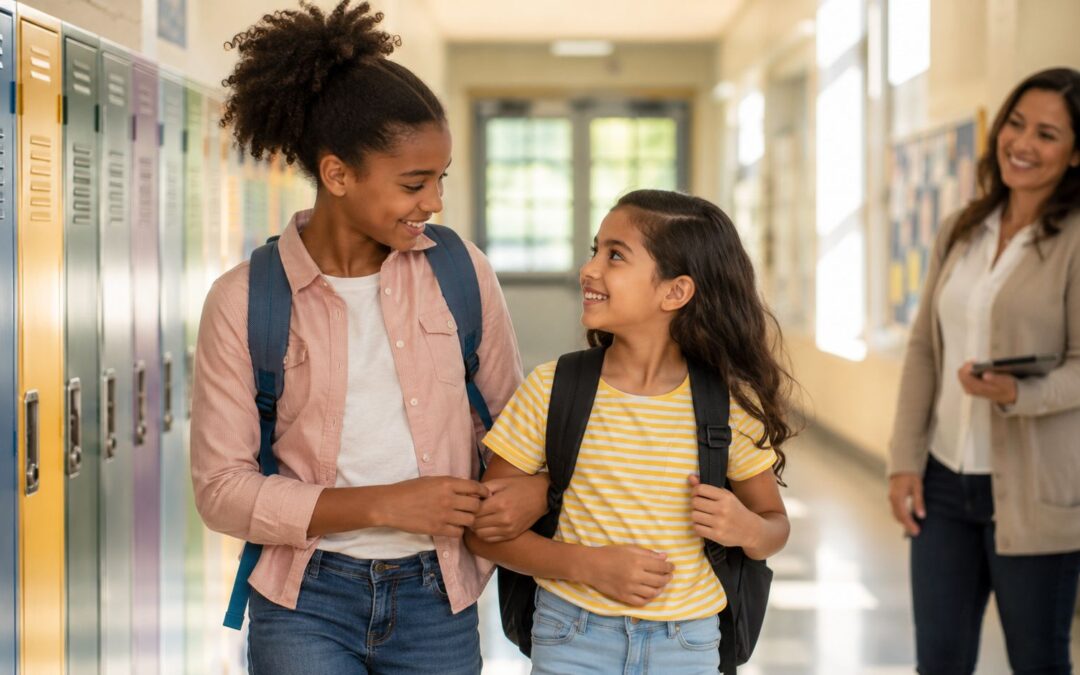
It's the first week of school, and a fifth grader is walking a nervous new second grader to the classroom door, showing her where to put her backpack, how to line up for lunch, and which bathroom pass to grab if she needs it. That tiny exchange can look ordinary from the hallway, but it often does more for a child's sense of safety than a pile of posters about kindness ever will. Peer mentoring programs work because they turn those small, repeated moments into a structure schools can rely on.
The strongest versions aren't casual buddy systems. They're planned SEL systems with trained mentors, adult supervision, and regular check-ins that help students feel known before anyone expects grades or behavior to shift. A recent systematic review found that formal peer mentoring programs were most consistently linked with positive academic outcomes when participation was voluntary, mentors were trained, matches were made with a formal model, programs had institutional support, and faculty were involved systematic review. That matters in a real school, because the difference between “we paired them up” and “we built a support loop” is usually the difference between a program that fades and one that sticks.
For a school counselor, the question isn't whether students like helping each other. They usually do. The question is whether the adults have built enough structure so the helping stays safe, useful, and equitable. That's what makes peer mentoring feel less like an add-on and more like part of the school's belonging strategy.
What Peer Mentoring Looks Like in a K-8 School
A second grader tears up at the backpack hooks on Monday morning. A fifth grader, wearing a mentor badge, walks over, kneels down, and says, “I'll show you where our class line starts.” That's peer mentoring in a K-8 building, not a flashy leadership program, just an older student offering advice, support, and knowledge to a younger one in a way that feels close enough to trust and simple enough to use peer mentoring definition.
The model works especially well in elementary and middle school because kids often listen differently to a near-age peer than they do to an adult. A trained sixth grader can remind a fourth grader how to organize a binder, where to go after dismissal, or what to do when a friend says something hurtful. That's not counseling, and it's not remediation. It's a relationship with clear limits that helps a child settle into the day.
Practical rule: If the match is doing heavy emotional work, the adult system is too far back. Mentors can listen and notice, but they can't carry a peer's crisis alone.

What it is not deserves equal attention. It's not a substitute for counseling, so a student in grief, panic, or family instability still needs a licensed adult's response. It's not a remediation track for the students who are “behind.” And it's not an unstructured buddy system where two kids are told to be nice and figure it out.
A better way to think about it is as a predictable school relationship with three structural ingredients, a trained older mentor, a consistent meeting rhythm, and a supervising adult. When those pieces are present, the program has a chance to support belonging instead of just adding another meeting to the calendar. For a clear parallel to schoolwide peer support language, this overview of peer support programs is worth a look alongside the planning work.
If your staff includes licensed clinicians or counselors who want to sharpen the mental-health side of the work, it can also help to browse continuing education for licensed clinicians from Be Your Best Self & Thrive Counseling, PLLC. That kind of training is useful when mentors need to recognize the line between supportive listening and a concern that belongs with an adult.
The cleanest K-8 programs usually sound like one another in practice. A mentor greets a younger student, follows a routine, asks one or two focused questions, and ends on time. The routine is what makes the relationship feel safe enough for a child to return to it next week.
Choosing the Right Program Model for Your Campus
A principal doesn't need a perfect model. She needs the one her building can supervise on a Tuesday afternoon when testing schedules, parent pickups, and a substitute shortage collide. The right choice depends on what problem you're trying to solve first, social adjustment, academic scaffolding, or a small, steady space for SEL practice.
Here's the simplest way to sort the options. Cross-age buddies fit best when younger students need help with routines, transitions, and school confidence. Near-peer tutors fit when students need academic language and a model that feels close to their own experience. Small-group circles fit when a counselor wants students to practice friendship skills, stress regulation, or respectful problem-solving in a more structured space.
| Comparing Peer Mentoring Models for K-8 Schools | Grade Pairing | Best For | Supervision Load |
|---|---|---|---|
| Cross-age buddies | Older and younger students, often 2 or more grades apart | Routines, belonging, school navigation | Moderate |
| Near-peer tutors | One to two grade levels apart | Academic scaffolding and homework habits | Moderate to high |
| Small-group circles | Mixed grades, usually four to six students | Friendship, SEL skills, and shared problem-solving | High |
A counselor I worked with on a busy elementary campus used cross-age buddies for morning arrival and reading time. The older students loved having a role, but the key win was that the younger children stopped treating the building like a maze. That was enough to justify the structure, because the school's biggest need was not tutoring, it was making the day feel predictable.
Near-peer tutoring looks different. A sixth grader sitting beside a fourth grader can explain how to break a long assignment into smaller parts, but the adult still needs to watch for skill mismatch. If the tutor is only two steps ahead academically, the pair can work beautifully. If the gap is too wide, the mentor slips into teacher mode and the relationship gets stiff.
For schools that want SEL practice more than academic support, small-group circles often make the most sense. They are less personal, more supervised, and easier to align with a schoolwide language around emotions and conflict. If you're weighing whether a peer mediation layer belongs on campus, this school-based mediation guide pairs well with the model decision.
Before you choose, run a short leadership-team check. Ask which grade span is most stable, which staff member can supervise consistently, and whether your students need connection, academic help, or both. If the answer is fuzzy, start smaller. A reliable pilot beats an ambitious rollout every time.
Decision filter: If you can't explain who supervises, how often they meet, and what outcome comes first, the model isn't ready yet.
Recruiting Mentors and Matching Mentees With Care
Recruitment is where many programs get stuck, because adults assume the “good kids” will volunteer and the rest will sort themselves out. That's backwards. The strongest mentor pools come from a broad invitation, clear expectations, and a short screening process that looks for empathy and reliability, not perfect behavior or top grades.
Start with a schoolwide announcement that names the job in plain language. Then ask teachers for nominations, but give them a simple prompt so they don't default to the most visible students in the room. A nomination note can say, “Name students who are kind, steady, curious about younger children, and able to follow directions.” That keeps the process from turning into a popularity contest.
A short mentor interview can be just five questions. Ask, “Why do you want to do this?” “What would you do if your mentee got upset?” and “How will you remember your weekly meeting?” A good answer doesn't have to be polished. It has to show the student can listen, show up, and ask for help when needed. For schools that want a platform-style workflow to manage applications and matching, these features tutoring businesses actually need are a useful reminder of how much the right system can simplify scheduling, communication, and follow-through.
Family note: “Your child has been invited to participate in a peer mentoring program that pairs students for regular, adult-supervised support. The meetings are designed to build belonging, confidence, and school routines. Mentors are trained to listen, keep boundaries, and get an adult when a concern is bigger than the program.”
Matching works best when you weigh shared interests, language needs, and social context instead of just who's available. A student who loves drawing and a younger child who talks nonstop about animals may connect quickly, even if they aren't in the same homeroom. A mismatch often shows up by week three, when one child does all the talking, the other goes quiet, or the pair can't settle into a routine. Re-pairing isn't failure. It's part of the design.
A family welcome note should explain what a mentee will experience in concrete terms. Parents want to know who is meeting their child, how often, and who to contact if the pairing feels off. The clearer you are at the start, the less likely you are to spend week four repairing confusion.

A practical matching rubric keeps the process honest. Give shared interests one check, language or family context another, and schedule fit a third. If the rubric says a pair is weak in two or more areas, pause before matching them and look again.
After the demo, ask the teacher, “Which move felt most doable tomorrow?” That question usually leads to transfer.
7. Action Research and Inquiry Coaching
Action research gives teachers permission to be curious instead of discouraged. When a classroom challenge keeps repeating, inquiry coaching helps the teacher turn frustration into a question they can study.
A teacher might notice that a few students avoid peer interaction during group work. Instead of labeling them as shy or oppositional, the teacher asks, “What helps anxious students enter peer conversation with more confidence?” With a coach, she collects observation notes, reviews student reflections, and tests supports like assigned partners, visual sentence stems, and low-risk opening prompts.
This kind of inquiry works especially well for SEL because so many relational problems are complex. A class may not need a bigger consequence system. It may need clearer co-regulation, more predictable repair routines, or stronger student voice.
Keep the question small and teachable
A useful inquiry question is focused enough to change practice quickly. “How can I improve classroom culture?” is too broad. “What happens to student participation when I give quiet think time before circle sharing?” is much more workable.
One middle school teacher might study student choice during conflict resolution lessons. He offers two response options, writing or speaking, and watches how different students engage. Over a few weeks, he may notice that some students open up more when they can first write privately, then choose whether to share publicly.
Small inquiry cycles often lead to better implementation than giant schoolwide initiatives.
For schools, action research can become a healthy habit. A team of teachers might investigate what increases belonging in their grade band. They can test simple practices such as greeting students at the door, using partner structures that rotate access, or ending the day with student appreciations.
The coach's role is to keep the inquiry manageable. Help the teacher choose one question, one or two forms of evidence, and one short time frame. That's enough to generate learning without creating a second job. For parents, the same inquiry stance can help at home. If homework always ends in tears, a caregiver can test whether starting with a regulation routine changes the tone of the evening.
8. Feedback and Observation Coaching
A teacher finishes a community circle and feels unsure. The lesson stayed calm, but only a few students spoke, one student shut down, and the teacher walks away wondering, Was that connection or compliance? Feedback and observation coaching helps answer that question with evidence the teacher can use right away.
In SEL-centered coaching, observation is less like inspection and more like a mirror. The coach watches for the small teaching moves that shape safety, trust, and participation, then reflects those moves back clearly. That matters because many of the most important classroom shifts are easy to miss while you are teaching in real time.
A coach might observe a perspective-taking lesson and script exact moments: “When you asked students how the character might feel, several said ‘sad.’ Then you asked, ‘What else might they be feeling?’ and paused for five seconds. More hands went up, and students added frustrated, confused, and angry.” Feedback like that helps a teacher connect one concrete move, wait time plus a follow-up prompt, to a richer emotional vocabulary and broader student participation.
The same pattern shows up in classroom climate. A teacher may redirect a student quickly and assume the moment went fine. The coach may notice something more specific. “After you said, ‘I want to hear you, and I need you to wait until Maya finishes,’ the student leaned back, stopped interrupting, and rejoined the discussion two minutes later.” That kind of feedback shows how tone, sequencing, and respect can protect both structure and belonging.
A simple feedback structure
The feedback cycle works best when it is short, clear, and repeated often enough to build trust.
- Start with a precise strength: Name one move that supported learning or connection.
- Share evidence, not labels: Describe teacher actions and student responses without scoring the lesson.
- Ask a reflection question: Invite the teacher to make meaning from the moment.
- Choose one next step: Keep the adjustment narrow enough to try in the next lesson.
For example, after a conflict resolution lesson, a coach might say, “When Marco interrupted, you acknowledged him, asked him to hold his thought, and returned to him after Jasmine finished. Both students stayed engaged.” Then the coach can ask, “What do you think that communicated about fairness to the group?”
That question matters. Feedback should help the teacher study impact, not just hear praise or correction.
A good observation cycle also pays attention to students who are quieter, more guarded, or still learning how to trust adults. The coach might track who volunteers first, who only speaks in pairs, who disengages during emotionally loaded moments, or when the room settles after a regulation prompt. Those details help teachers adjust with care. They also connect coaching to the broader work of implementing social-emotional learning in the classroom in ways students can feel.
If you're coaching around behavior support, strong observation feedback pairs well with practical classroom management strategies for teachers that center regulation and relationships, not just compliance.
Speed helps here. Feedback is usually more useful when it happens soon after the lesson, while the teacher can still picture the faces, the pauses, and the turning points.
9. Collaborative Planning and Co-Teaching
Collaborative planning and co-teaching bring coaching into the actual work of teaching. Instead of talking about a lesson from a distance, the coach and teacher build it together and share responsibility in the room.
This is especially useful when a teacher is trying a socially complex lesson. For example, a teacher may want students to interview a community member and practice empathy through listening, but worry that the conversation could stay shallow or become awkward. The coach helps plan scaffolds, such as question stems, reflection pauses, and norms for respectful listening.
During the lesson, the coach might facilitate one portion while the teacher watches student thinking. Then they switch. The teacher leads the next round while the coach notes which prompts drew out deeper perspective-taking and which ones fell flat.
Co-teaching helps when risk is high
A teacher who feels nervous about facilitating a restorative conversation after a student conflict often benefits from shared presence. The coach can sit within the circle, support transitions, and help the teacher stay grounded. Students usually feel that support too.
Another example comes from small-group dialogue. If a class struggles with peer discussion, the coach and teacher can split the room. One models how to prompt quieter students and keep dominant voices from taking over. The other practices with a second group, then gets immediate feedback.
A content-specific angle matters here as well. Content-specific instructional coaching is more impactful than general support when coach and teacher identify a precise goal tied to standards and student learning data, then model and reflect on a targeted strategy together, as described in this content-specific coaching overview.
Schools doing strong SEL implementation often use this model to move from theory into practice. If you're building lessons around belonging, empathy, or conflict repair, collaborative planning can help turn those values into real classroom moves. This is one place where how to implement social-emotional learning in the classroom becomes much more practical when paired with shoulder-to-shoulder coaching.
10. Book Studies and Study Groups
Book studies can be energizing or lifeless. They work when the reading gives teachers language for what they're seeing in classrooms and when the discussion turns quickly toward practice.
A useful SEL-focused study group might choose a book on student voice, belonging, restorative practice, or brave conversations. At the meeting, teachers shouldn't just summarize chapters. They should bring classroom examples. One teacher might share that students open up during written reflection but freeze in circle discussion. Another may realize that her class rules are clear, but students haven't had enough chances to co-create norms.
Make the reading visible in classrooms
The coach can help the group choose one small practice to try between meetings. For example, after reading about student agency, every teacher agrees to add one routine that increases student voice. A first-grade teacher lets students choose from two regulation tools during reset time. A seventh-grade teacher invites students to help generate discussion norms for hard topics.
The best study groups also make room for emotion. Staff may need to talk openly about where they feel stuck, skeptical, or tired. That conversation matters because trust shapes implementation. One underserved challenge in coaching is resistance and distrust. ASCD highlighted that “how to effectively coach teachers who are resistant or distrustful of coaching” remains a frequently asked question with limited nuanced guidance, and some teachers express greater trust when coaches stay grounded in classroom reality, including teaching regularly, as discussed in this ASCD reflection on resistant teachers.
A practical way to keep study groups focused is to narrow annual growth targets. Marzano Resources recommends that teachers select exactly three growth goals per school year, ideally across different lesson segments and verified through joint video analysis. That structure can help study groups move from “interesting ideas” to “the next three things I'll practice.”
For families, a lighter version works at home too. Parents can read or listen to one short piece on emotional regulation, then try a single phrase or routine with their child during the week and reflect on what happened.
Teacher Coaching Strategies: 10-Point Comparison Guide
| Approach | Implementation complexity | Resource requirements | Expected outcomes | Ideal use cases | Key advantages |
|---|---|---|---|---|---|
| Cognitive Coaching | High, requires skilled questioning and trust-building | Moderate–High, trained coaches, regular meeting time, documentation | Deeper teacher metacognition, increased autonomy; change may appear slowly | Individual teacher development, building reflective practice and SEL capacity | Fosters ownership, reduces defensiveness, sustainable professional growth |
| Instructional Rounds | Moderate–High, coordination of teams and protocols | High, time for multiple observations, trained facilitators, leadership support | Shared understanding of instruction, systemic improvement, common language | School- or grade-level improvement, scaling practices, collective SEL adoption | Peer learning, visibility into practice, builds collective expertise |
| Peer Coaching Partnerships | Low–Moderate, depends on partners' skills and norms | Low–Moderate, peer time, simple protocols, minimal cost | Ongoing reciprocal learning, improved reflection and collegial support | Team- or grade-level collaboration, mentorship, sustained practice refinement | Cost-effective, builds relationships, reciprocal leadership development |
| Data-Driven Coaching | High, requires data analysis and interpretation skills | High, reliable assessments, data systems, privacy safeguards, coach data literacy | Targeted, measurable improvements in student outcomes; accountability | Addressing specific student outcomes, monitoring SEL impact, ROI-focused initiatives | Evidence-based targeting, progress tracking, identifies high-impact strategies |
| Strengths-Based Coaching | Low–Moderate, identifying and amplifying strengths while balancing feedback | Low, observation time, coach skill in asset-based feedback | Increased teacher confidence, motivation, and retention; may leave some gaps | Morale-building, early-career support, cultivating asset-based SEL culture | Boosts motivation and trust, leverages existing teacher assets |
| Model Teaching & Demonstration Lessons | Moderate, requires skilled demonstrator and scheduling | Moderate–High, coach or expert teacher time, classroom access, possible recordings | Clear, concrete examples of practice; quicker uptake of specific strategies | Introducing unfamiliar or complex SEL strategies, modeling classroom techniques | Removes guesswork, builds confidence, shows practical implementation |
| Action Research & Inquiry Coaching | High, structured research cycles and analysis | Moderate–High, time for data collection, coaching in inquiry methods, tools | Context-specific solutions, teacher agency, documented evidence of impact | Teachers investigating classroom problems, building data literacy and reflective practice | Promotes ownership, produces actionable evidence, deepens reflective skill |
| Feedback & Observation Coaching | Moderate, consistent protocols and skilled observers needed | Moderate, frequent short observations, trained feedback providers | Faster improvement cycles, clearer link between teaching and student outcomes | Focused skill refinement, formative adjustments to SEL instruction | Provides concrete, timely evidence-based feedback for rapid adjustment |
| Collaborative Planning & Co-Teaching | High, intensive coordination and role clarity required | High, shared planning time, in-class co-teaching, skilled coach-teachers | Rapid skill development, real-time problem solving; risk of dependence if not faded | Intensive support for complex lessons, new teachers, gradual release of responsibility | Real-time modeling and support, deep planning collaboration, immediate coaching |
| Book Studies & Study Groups | Low, planning and facilitation of discussions | Low, books/resources, scheduled meeting time, facilitator | Shared knowledge base and language; translation to practice depends on follow-up | Building common SEL understanding, introducing research, team professional learning | Low-cost, broad engagement, connects research to classroom practice |
Building a Culture of Coaching and Connection
Implementing any one of these teacher coaching strategies can improve practice. Building a true coaching culture does something bigger. It changes how adults experience growth inside the school. Instead of waiting for evaluation, teachers expect support. Instead of hiding hard moments, they bring them into reflective conversation. Instead of treating SEL as a separate program, they weave it into instruction, transitions, conflict repair, and everyday relationships.
That shift matters because students don't experience school in separate boxes. A child doesn't stop needing belonging when math begins. A teacher doesn't stop needing emotional support because the lesson plan is ready. When coaching takes SEL seriously, it helps adults respond to the whole reality of school life. Coaches and leaders can then support not only what teachers teach, but how they regulate themselves, build trust, and create safety when things get messy.
Schools often ask which coaching model is best. The better question is which model fits the challenge in front of you. Cognitive coaching is useful when a teacher needs reflection. Demonstration lessons work when a teacher needs to see a move in action. Peer coaching helps when a team wants reciprocal learning. Co-teaching helps when the stakes feel high and real-time support matters. Data-driven coaching helps when people need a shared picture of what students are experiencing.
Across all of them, the same conditions keep showing up. Coaching works better when it is sustained over time. It works better when trust is clear. It works better when goals are focused enough to practice and revisit. And it works better when teachers feel that the process is done with them, not to them.
For principals and district leaders, this means protecting time for coaching cycles, not just announcing them. It means training coaches to use descriptive evidence, reflective questions, and affirmation before correction. It means making room for confidentiality, so teachers don't experience every coaching conversation as a hidden evaluation. It also means paying attention to the emotional load teachers carry. A staff member who feels judged, isolated, or overwhelmed will struggle to take instructional risks, no matter how strong the strategy sounds on paper.
For teachers, a coaching culture offers relief. You don't have to solve every classroom challenge alone. You can ask for a model lesson, a planning partner, or a second set of eyes on student participation. You can say, “I'm not sure my class feels safe during discussion,” and trust that someone will help you study it without turning it into a deficit story.
For parents and caregivers, the ripple effect is real. When schools coach teachers to build calm routines, repair conflict well, and strengthen belonging, children carry those skills home. Families often notice the difference in the language students use, the way they name feelings, and the confidence they show in solving peer problems.
The long-term goal isn't perfect teaching. It's a community where adults keep learning and kids keep feeling known. That's what makes coaching worth the effort. If your school is ready to deepen that work, support from organizations that center connection and practical SEL can help. Soul Shoppe's on-site and digital coaching models are one example of the kind of partnership that can help schools move from isolated strategies to a consistent culture of belonging. The same principles that strengthen schools also apply in other settings. This guide to improving company culture offers a useful reminder that trust, clarity, and shared values shape how people grow together.
Soul Shoppe helps schools turn SEL from a good intention into daily practice. Through workshops, assemblies, coaching, and digital tools, Soul Shoppe supports educators, students, and families in building safer, more connected communities where empathy, regulation, and healthy relationships can grow.