

10 Teacher Coaching Strategies for K-8 Schools in 2026
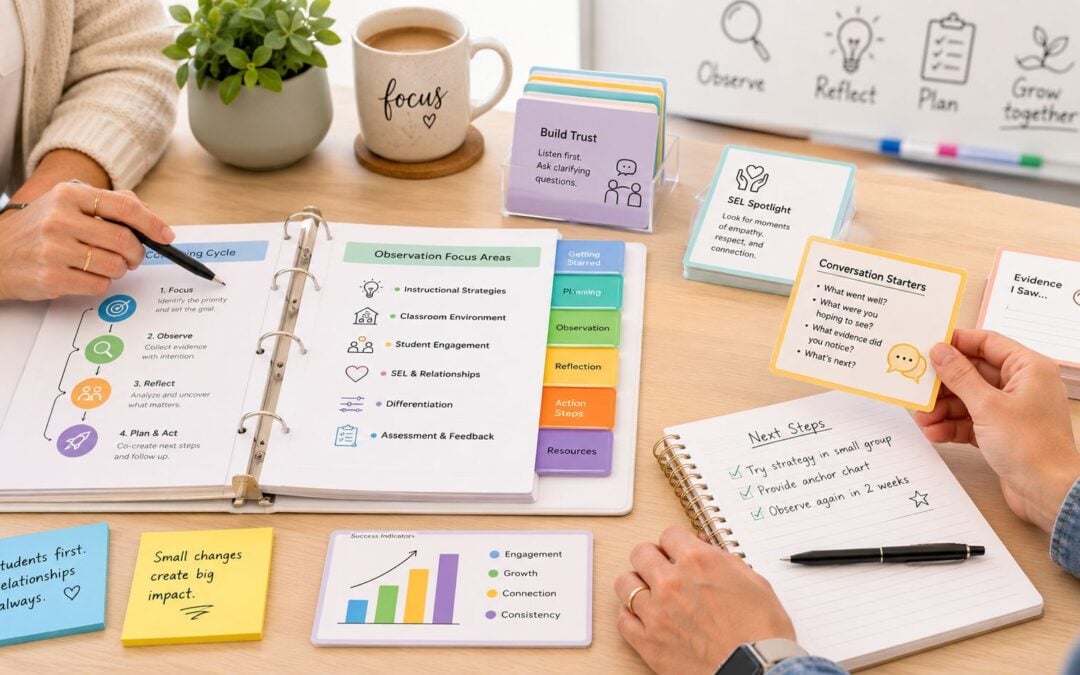
Monday morning starts with a teacher holding back tears after a rough class meeting, a principal trying to cover two absences, and a counselor hearing that another student “just shut down” during reading. In many K-8 schools, the pressure isn't only academic. It's emotional, relational, and constant. Teachers aren't asking for one more binder of strategies. They're asking for support they can use with real students in real classrooms.
That's where strong teacher coaching strategies matter. Good coaching doesn't sit on the sidelines. It helps a teacher respond when a child melts down during math, when a class can't handle partner talk, or when a staff team feels stretched thin and discouraged. It also helps adults build the kind of calm, connected classrooms that make learning possible.
The strongest coaching work is sustained, not one-and-done. A 2018 instructional coaching meta-analysis found effects on student achievement equivalent to roughly half a year to a full year of learning, and it described coaching as an ongoing partnership with support that evolves over time. That matters for SEL because emotional safety, trust, and relational skill-building also grow through repetition, reflection, and practice.
Schools are also investing more in this kind of support.1% as schools adopt more embedded professional learning tools. The opportunity isn't to chase trends. It's to build a coaching culture where teachers feel safe enough to grow and students feel safe enough to learn.
Here are 10 practical coaching approaches that can help K-8 schools move from surviving to thriving, with SEL woven through every one.
1. Cognitive Coaching
Cognitive coaching works best when a teacher doesn't need a speech. They need space to think. Instead of jumping in with fixes, the coach asks questions that help the teacher notice patterns, name concerns, and generate next steps that fit their students.
That matters in SEL work because teachers already make hundreds of emotional decisions each day. They decide whether to pause a lesson, whether to address a student's tone publicly, and whether to push through discomfort or slow down for connection. Cognitive coaching helps them examine those decisions without shame.

A strong example is a fourth-grade teacher who says, “My math block falls apart after the mini-lesson.” Instead of prescribing a brain break, the coach asks, “What did you notice about students' energy right before they drifted?” and “Which students stayed engaged longest?” The teacher realizes that participation drops when students don't get a turn to process with a partner. Together, they build in a quick feeling check and structured turn-and-talk before independent work.
Questions that open thinking
In SEL-focused coaching, the questions should stay grounded in what students did and felt. A coach might ask, “When the conflict started, what did you hope students would learn from your response?” or “Which part of the morning meeting helped students feel safest to contribute?”
Practical rule: Ask about evidence before interpretation. “What did you see and hear?” usually leads to better reflection than “Why do you think they were disrespectful?”
This works well in lesson planning too. A teacher preparing an empathy lesson may say, “I want students to understand different perspectives, but they freeze when I ask them to share.” The coach can guide reflection on scaffolds, such as sentence stems, partner rehearsal, or drawing before discussion.
A few habits make cognitive coaching stronger:
- Start broad: Open with questions that invite reflection, not defense.
- Use wait time: Teachers need thinking time just like students do.
- Name the non-evaluative stance: Say clearly that coaching is for growth, not rating.
- Capture growth over time: Keep short notes so teachers can see progress across cycles.
If your staff needs ideas for pairing reflective coaching with meaningful professional learning, this collection of professional development topics for teachers can help spark next steps.
2. Instructional Rounds
Instructional rounds help a school stop treating great teaching as private property. Instead of one coach carrying all the expertise, teams visit classrooms around a shared problem of practice and look for patterns together.
In an SEL-centered school, that shared focus might be “How do teachers create emotional safety during class discussions?” Observers might visit several classrooms and collect simple evidence: how teachers greet students, how they respond to mistakes, whether students get think time, and how conflict or discomfort is handled.
One elementary team might notice that in stronger classrooms, teachers normalize feelings without letting feelings take over the lesson. A teacher says, “You seem frustrated. Take a breath, and then tell us what's confusing,” and students stay engaged. In another room, the team may notice that students only volunteer when the teacher calls on the same few confident voices.
What to look for during rounds
Rounds become useful when the observation tool is tight and concrete. Keep the focus on visible practices, especially those that influence belonging and trust.
- Track teacher language: Write down exact phrases that build or reduce safety.
- Watch student access: Note who participates, who hesitates, and who gets invited in.
- Notice routines: Pay attention to transitions, partner talk, and repair after mistakes.
- Debrief by pattern: Discuss trends across rooms, not personalities.
A middle-grades team, for example, might observe several classrooms to study conflict resolution instruction. During the debrief, they may realize that students engage more when teachers ask them to generate repair options instead of handing them a script. That insight then shapes the next round of planning across the school.
The purpose of rounds isn't to find the best teacher in the building. It's to help the building learn what works.
Keep participation voluntary at first if trust is fragile. That often leads to better buy-in than launching rounds as a top-down initiative. Over time, teachers usually become more willing when they see that the process is descriptive, not evaluative.
3. Peer Coaching Partnerships
Some of the most useful teacher coaching strategies are also the most human. Peer coaching works because teachers often listen differently when the person beside them understands the daily rhythm of their grade level, curriculum, and students.
A strong partnership might pair two third-grade teachers who want to improve emotion-regulation routines. One teacher watches the other lead a morning reset after recess. She notes the exact script: “Feet on the floor, eyes soft, breathe in, breathe out, notice one feeling.” During the debrief, they discuss tone, pacing, and why the teacher didn't rush to quiet every fidgeting child.
Another useful pairing is a veteran teacher and a newer teacher working on restorative circles. The veteran models how to open the circle, how to invite quieter students in, and how to hold a boundary when one child turns the conversation into blame. The newer teacher then tries the routine while the partner collects notes on student responses.
What makes peer coaching feel safe
Peer coaching can turn sour if it becomes vague or personal. It gets better when the structure is simple and the focus is narrow.
- Set one clear focus: For example, “student voice during partner talk” or “repair after conflict.”
- Use a short note form: Track what students said, did, and how the teacher responded.
- Keep debriefs reciprocal: Both teachers should reflect and learn, even if only one taught.
- Protect confidentiality: What happens in the partnership stays there unless both agree to share.
A four-teacher group can work well too. One month, a teacher tries a cooperative structure for discussing a playground conflict scenario. The observers record who spoke first, who stayed silent, and which prompts helped students move from blame to problem-solving. The next month, another teacher tries a revised version.
Parents can use a similar idea at home. Two caregivers might compare how they guide sibling problem-solving, then talk about which phrases lower defensiveness and which ones escalate it. The principle is the same. Adults learn faster when they can observe, try, reflect, and try again together.
4. Data-Driven Coaching
Data-driven coaching sounds technical, but in practice it should feel clarifying. It helps a coach and teacher stop guessing. In SEL-rich classrooms, that means looking beyond test scores to the daily evidence of safety, belonging, participation, and regulation.
A coach might sit with a teacher and review notes from class meetings, observation records, student reflection sheets, or behavior patterns across the week. The question isn't “What's wrong with this class?” It's “What are students telling us through their behavior, participation, and responses?”
One especially useful angle comes from SEL-focused coaching research. In a study of coaching groups, teachers in SEL plus Equity groups received 9.86 coaching contacts compared with 3.53 in SEL-only groups. That finding points to a practical lesson for schools: when coaching explicitly addresses emotional safety and equity, teachers may engage more thoroughly with the process.
Use data that teachers trust
A teacher is more likely to lean in when the evidence feels close to daily practice. For example, a fifth-grade teacher may notice that one group of students rarely speaks during community circles. The coach can help gather specific evidence across several sessions: who volunteers, who needs prompting, and what kinds of prompts produce fuller responses.
Then the pair can test small changes. They might add silent reflection before sharing, offer drawing as a first step, or teach sentence frames such as “I felt ___ when ___ because ___.” In a later cycle, they compare participation patterns and student comfort.
Good coaching data should reduce blame, not increase it.
Data-driven coaching also helps schools tackle belonging gaps. If one group of students seems less connected, the coach can help teachers examine whose stories show up in lessons, who gets leadership opportunities, and whether routines allow different communication styles. Keep the data private, specific, and tied to action.
When schools use data this way, they move coaching away from opinion and toward shared inquiry. That's especially important in SEL work, where adults can slip into assumptions about motivation, attitude, or “buy-in” unless they anchor conversations in what students and teachers experience.
5. Strengths-Based Coaching
Teachers don't grow best by hearing a long list of what's missing. They grow when someone sees what's already working and helps them extend it. Strengths-based coaching does exactly that.
Consider a teacher who struggles with transitions but has warm, steady relationships with students. A deficit lens says, “You need stronger management.” A strengths lens says, “Your students respond to your one-on-one connection. Let's use that during transitions.” The coach helps the teacher build brief relational cues, greeting students by name before a shift, using a predictable check-in prompt, or assigning calming leadership roles to students who need movement.
That approach fits SEL because students feel the difference between control and connection. A teacher who already knows how to validate emotion has a strong foundation for restorative language, conflict repair, and classroom belonging.
Build from what the teacher already does well
One teacher may say she feels nervous about teaching empathy lessons because she doesn't want to “say the wrong thing.” But the coach notices that she naturally kneels beside upset students, names feelings without judgment, and asks gentle follow-up questions. Those are not small skills. They're core SEL practices.
A coach can say, “You already help students feel seen in unplanned moments. Let's bring that same instinct into your planned lesson.” Then they rehearse a few lines for read-aloud discussion, such as, “What might this character be carrying that we can't see?” or “Has anyone ever misunderstood your feelings?”
A practical feedback move comes from Instruction Partners' guidance on coaching conversations. Effective feedback begins by naming specific “glows” or strengths and then using evidence-based questions to help the teacher identify next steps in their own words, as described in this coaching reflection article.
For administrators, strengths-based coaching can improve morale without lowering expectations. For teachers, it often rebuilds confidence. For parents, the same idea works at home. If a child is kind with siblings but struggles with homework frustration, start by naming the existing strength: “You already know how to be patient with your sister. Let's use that same patience with yourself.”
This kind of coaching also supports self-efficacy in teaching, which matters when staff need to believe growth is possible before they'll risk trying something new.
6. Model Teaching and Demonstration Lessons
Sometimes a teacher doesn't need more explanation. They need to see the move. Demonstration lessons make invisible teaching decisions visible, especially in SEL work where tone, timing, and body language matter as much as the words.

A coach might model a restorative circle for a teacher who feels anxious after a conflict between students. The observing teacher can watch how the coach sets the room, opens with calm expectations, validates emotion without taking sides, and guides students toward listening before solution-making. Those details are hard to capture in a handout.
Modeling also helps with preventive SEL routines. If teachers want to start a daily grounding practice, the coach can demonstrate how to invite students into stillness without demanding perfection. The coach may use soft prompts, gentle pacing, and non-shaming redirection for students who giggle or fidget.
What to notice during a demo
Teachers often focus on the most visible part of the lesson, but the gold is in the micro-decisions.
- Watch the setup: Notice how the coach frames the purpose and lowers anxiety.
- Track language: Write down the exact phrases used to guide reflection or repair.
- Observe regulation: Pay attention to voice, pace, facial expression, and silence.
- Study student response: Look for who leans in, who resists, and what shifts participation.
A demonstration lesson works even better when it's followed quickly by teacher practice. The observing teacher might then lead a similar class meeting while the coach watches for one target, such as how the teacher invites multiple perspectives.
The broader evidence base supports this kind of sustained instructional support. A Brookings summary of meta-analytic evidence across 60 instructional coaching evaluations reported large positive effects on instructional practice at 0.49 standard deviations and smaller effects on student achievement at 0.18 standard deviations. That's one reason demonstration lessons should be part of an ongoing cycle, not treated as a one-time event.
Here's a short example in action: