Soul Shoppe's work is made possible by donors and partners who care deeply about the young people in their communities! We can't do this work without you. Support our work in classrooms and on playgrounds across the nation by donating here.
The block shelf is crowded. One child is carefully building a tower. Another reaches for the same long block. Across the room, a child who had a hard drop-off is standing close to the door, trying not to cry. If you work with preschoolers, you know these moments aren't side issues. They are the day.
Social emotional learning begins as preschoolers learn it while waiting for a turn, hearing "not yet," noticing a friend's face, or finding words for a feeling that shows up fast and loud. They don't need abstract lectures. They need repeated, concrete practice with caring adults nearby.
That matters because preschool SEL isn't just a nice extra. A Learning Policy Institute brief on evidence for social and emotional learning reports that findings from hundreds of studies across six continents show a consistent, reliable effect of evidence-based SEL programs on students' social, emotional, behavioral, and academic outcomes across grade levels, including PreK through 12. In preschool terms, that means the games, routines, and conversations you use every day can support real developmental growth.
The activities below are practical social emotional learning activities for preschool, but they go beyond a quick list of ideas. Each one includes a simple objective, materials, steps, and easy adaptations for classrooms and home. Start with one. Repeat it often. That's usually where the biggest change happens.
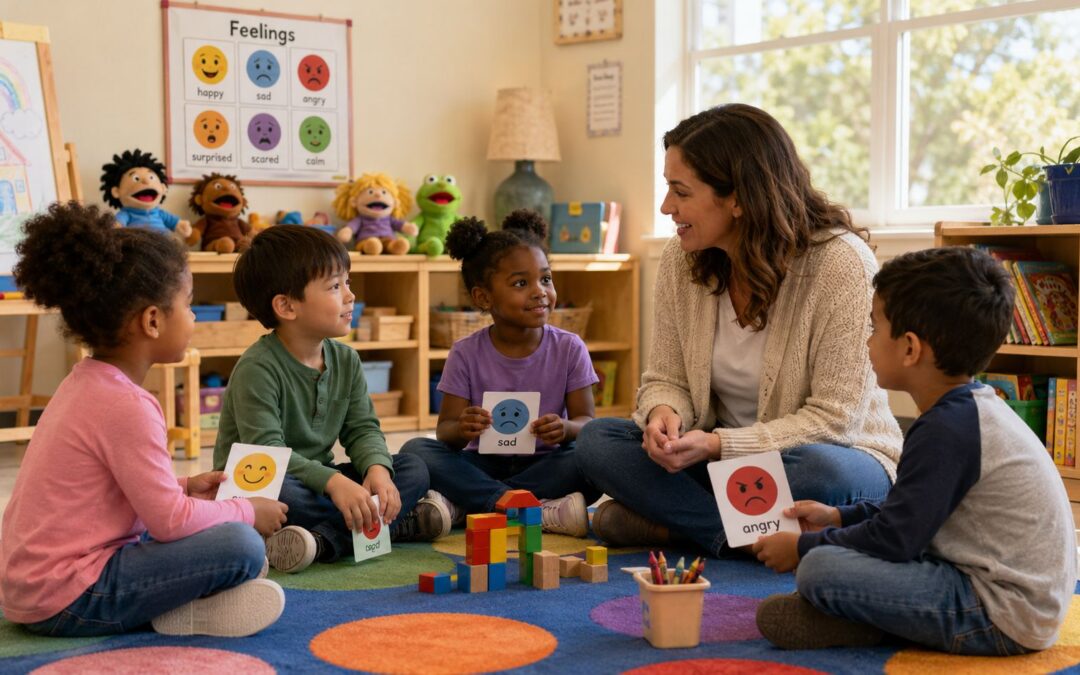
1. Emotion Recognition and Labeling Through Visual Cards
Some children say "mad" for every hard feeling. Others shut down when asked what's wrong. Visual emotion work helps because it gives young children something concrete to point to before they can explain it.
A simple feelings-card routine builds self-awareness. Children learn to notice faces, connect them to words, and eventually connect those words to their own bodies and experiences. That's the first step toward calmer behavior later.
What you'll need
Emotion cards: Real photos work especially well. Include happy, sad, frustrated, worried, excited, tired, and proud.
A mirror: Hand mirrors or one wall mirror lets children compare their faces to the cards.
A feelings board: A pocket chart, magnet board, or clothespin chart works well.
Optional color support: Some teachers add colors to help children sort emotions visually.
In a classroom, you might begin morning meeting by placing three photo cards in the center. Ask, "Which face looks like how your body feels today?" At home, a parent can keep a few cards on the fridge and use them before preschool, after pickup, and at bedtime.
How to do it
Start small. Put out two or three cards, not ten. Ask children to match the face, name the feeling, and copy the expression in the mirror.
Then add a short script:
Name it: "This face looks frustrated."
Notice the body: "Frustrated can feel tight in our hands."
Connect it to life: "When blocks fall down, some people feel frustrated."
If a child can't answer verbally, let them point, hold up a card, or place a clip on a feelings chart for kids. That still counts as strong participation.
Practical rule: Don't correct a child's feeling choice too quickly. If they choose "angry" when they seem sad, stay curious. Young children are often sorting through mixed feelings.
For extension, pair this with a read-aloud or a robot story about feelings, then ask, "How did the character feel first? What changed?" That moves children from labeling feelings in faces to noticing feelings in stories and real life.
For sensory-sensitive or nonverbal children, reduce language demands. Offer two cards instead of many, skip direct eye contact, and let them respond by pointing, matching, or moving a token.
2. Mindfulness and Breathing Exercises with Movement
Some preschoolers need help slowing their bodies before they can use words. Breathing and movement work best when they are short, visible, and tied to the daily rhythm instead of saved only for crisis moments.
Preschool guidance often recommends breathing, mirror play, and role-play, but the more useful question is how to make these activities accessible for children with different sensory and language needs. Inclusive SEL guidance highlighted in this preschool SEL overview points to predictable routines, visual supports, and explicit emotion coaching as especially important. The same resource notes that the CDC estimates 1 in 36 children in the U.S. has autism, and global estimates suggest about 1 in 100 children are autistic.
A strong starter routine
Try belly breathing with a stuffed animal. Have children lie down or sit against a wall. Place the stuffed animal on the belly and say, "Let's help the bear ride up and down slowly."
Materials are minimal:
Stuffed animal or beanbag
Quiet floor space
A short cue phrase such as "Smell the flower, blow the candle"
In school, this works well after arrival, before rest, or after outdoor play. At home, it fits naturally before leaving for preschool or after a difficult transition.
Step by step
Model first. Preschoolers need to see it in a body, not just hear instructions.
Put the stuffed animal on the belly.
Breathe in slowly through the nose if that's comfortable.
Breathe out gently and watch the toy lower.
Repeat a few times, then stand up and stretch arms high.
Ask one simple reflection question such as, "Does your body feel busy or calm now?"
For children who don't like lying down, let them breathe while seated, rock in a chair, trace a finger up and down an arm, or blow a pinwheel. For children who become overstimulated by group practice, offer the same routine in a calm corner with one adult.
Later in the day, you can reinforce the same skill with this short video cue:
3. Cooperative Games and Turn-Taking Activities
When a game has one winner, some preschoolers focus only on winning. When a game has a shared goal, children practice waiting, helping, noticing, and adjusting to one another. That's why cooperative play belongs near the center of preschool SEL.
Independent early-childhood guidance points to a practical group of high-adoption activities that are easy to repeat across school and home, including emotion charades, turn-taking games, group art projects, story discussions about characters' feelings, mirror play, and guided matching games, along with environmental supports like puppets, blocks, balls, and dress-up materials that encourage cooperative play and peer interaction in daily routines, as described in this overview of social-emotional development activities for preschoolers.
A simple game that works
Try "Build It Together." Put one container of blocks in the middle and give the group one prompt: "Let's make a home for the animals." The rule is simple. No one builds alone. Each child adds one piece, then passes the turn.
That single structure teaches waiting, watching, and shared planning. It also gives you language to coach social skills in real time: "You noticed Maya needed a turn," or "You asked before taking the long block."
Materials and steps
Materials: Blocks, magnetic tiles, large cardboard pieces, or even cups
Group size: Pairs or small groups are easiest
Teacher prompt: One shared goal and one visible turn-taking rule
Use this sequence:
Set the goal: "We're making one big bridge together."
Show the turn order: Use a visual card or point around the circle.
Coach the language: "Can I have a turn when you're done?" and "You can use it after me."
Reflect at the end: "What helped the group finish?"
Children learn more from the debrief than from the game alone. Name the exact social move you saw.
At home, siblings can do the same activity at the coffee table with blocks, crayons, or snack ingredients. In a classroom, you can rotate partners and add simple jobs like holder, builder, and encourager.
For neurodivergent children, shorten the wait time, use clear visual turn cues, and allow parallel participation first. A child can hand over pieces, choose colors, or place the final block without having to sustain the full group game.
4. Role-Playing and Dramatic Play for Social Scenarios
Pretend play gives children a safe place to practice hard moments before those moments happen again. That matters because preschool conflicts are often predictable. Someone wants to join a game. Someone gets left out. Someone grabs a toy because waiting feels impossible.
A puppet or dramatic play scenario lets you slow the moment down. Children can see the problem, try a response, and replay it with a different ending.
One everyday script
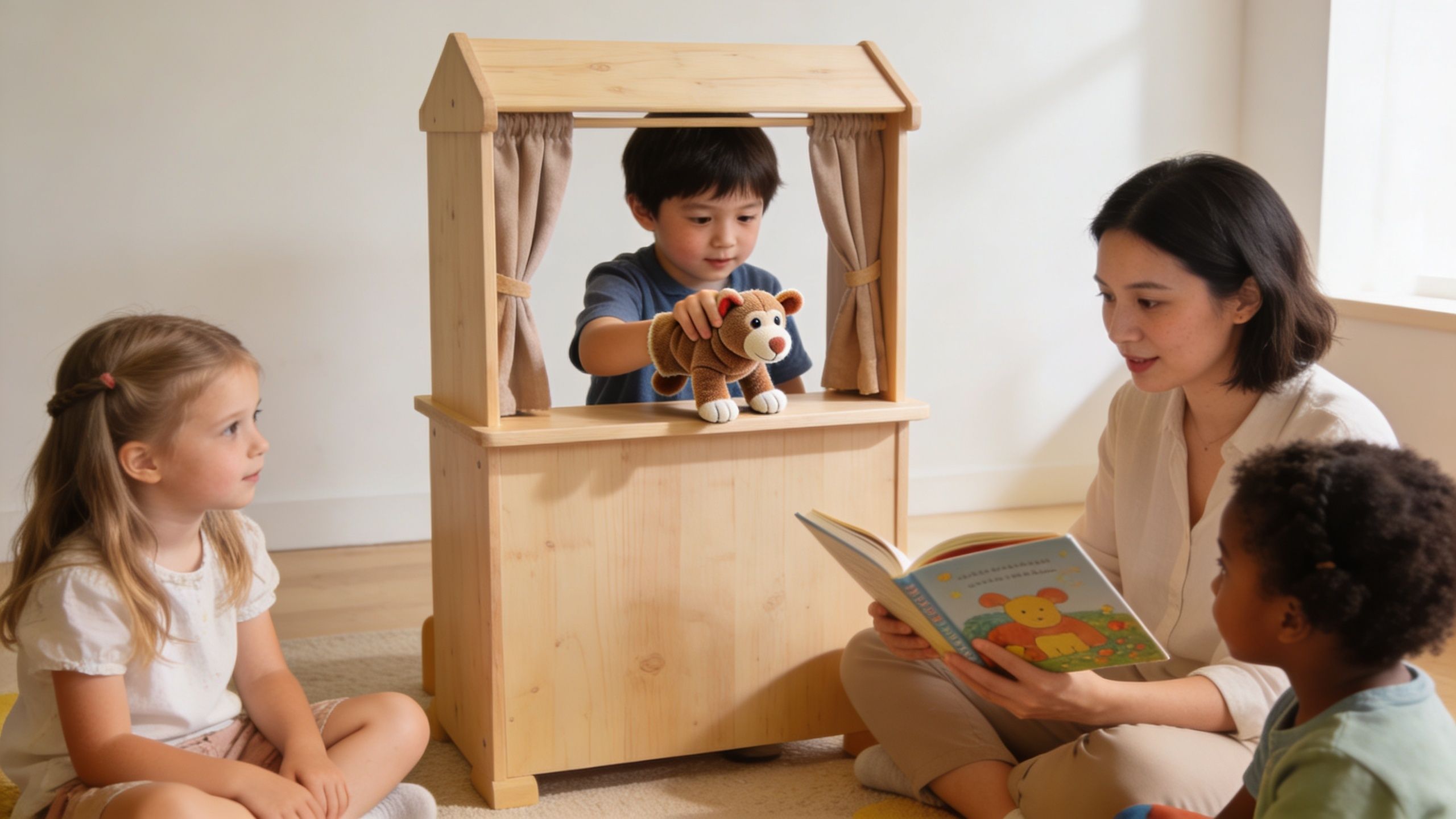
Use two puppets. Puppet A is playing with a toy kitchen. Puppet B walks over and says, "I want that." Puppet A turns away. Stop there and ask the children, "What could Puppet B say?"
Accept multiple usable responses:
"Can I have a turn when you're done?"
"Can I play with you?"
"Can I use the spoon while you use the pot?"
When children generate the language, they're more likely to use it later.
Materials and teaching steps
Materials: Puppets, dolls, stuffed animals, or dress-up props
Best scenarios: Sharing, joining play, accidental bumping, waiting, cleanup, disappointment
Adult role: Guide without giving a lecture
Try this pattern:
Act out a short problem.
Pause before the solution.
Invite children to suggest words or actions.
Replay the scene with one child helping voice the puppet.
Ask, "How did the problem change?"
At home, role-play can happen with toy animals at bedtime. In school, keep a "friendship prop box" near dramatic play so you can revisit real class issues later in the week without singling anyone out.
If a child doesn't want to perform, let them direct. They can point to the puppet, whisper a line to you, or choose between two options. That's still meaningful practice.
A helpful variation is to act out not just one "good" solution but several acceptable ones. Preschool social problem-solving works best when children learn flexible scripts, not rigid lines.
5. Gratitude and Kindness Practice Rituals
Kindness becomes more visible when adults name it out loud. Preschoolers often do caring things quickly and move on. A regular gratitude or kindness ritual helps them notice those moments and connect them to belonging.
This doesn't need to become a big project board. The strongest routines are short and repeatable.
A classroom ritual that takes minutes
At closing circle, pass around a soft object and invite one sentence: "Today I felt thankful when…" or "I saw kindness when…" Some children will say something big. Others will say, "Lila gave me the red crayon." Both responses matter.
At home, try the same practice at dinner or bedtime. A caregiver might begin with, "I felt grateful when you waited while I finished helping your brother."
Materials and steps
Materials: A talking piece, paper strips, a jar, or a bulletin board
Prompt choices: "Who helped you?" "How were you kind?" "What made you smile today?"
Time: Keep it brief and predictable
A few ways to make it work:
Model specific gratitude: "I appreciated how you helped pick up the blocks."
Keep responses concrete: Young children do better with examples than abstractions.
Use visuals: Photos of classmates can help children remember social moments.
Never force sharing: Quiet participation is still participation.
A useful reminder: Gratitude isn't a performance. If a child is upset, start by helping them feel safe. Reflection can come later.
You can also create a kindness chain. Each time you notice a prosocial act, add one paper link with a short description. "Helped zip coat." "Invited friend to play." "Waited for a turn." The chain makes caring behavior visible without turning it into a prize competition.
For children with language delays, let them point to a photo of a peer, hand over a drawing, or choose from picture prompts. The goal is recognition, not polished speech.
6. Conflict Resolution and Peer Mediation Circles
Most preschool conflicts don't need a long investigation. They need a simple, repeatable process that children can learn by heart. When adults solve every dispute for them, children may stop practicing their own social problem-solving.
A brief conflict circle gives structure to a messy moment. It slows everyone down and helps children hear that feelings, needs, and solutions all belong in the conversation.
The three-part script
Keep the language simple enough for a four-year-old:
What happened
How do you feel
What can we do now
That's enough. You don't need a long restorative meeting for every argument over blocks.
Use a peace spot, small rug, or two chairs side by side. Sit close, stay neutral, and coach each child through the same pattern. If needed, offer visual cards for "sad," "mad," "scared," "want turn," and "help."
How to run it in real life
Let's say two children are both crying over a truck. You might say:
"Tell me what happened."
"Show me how you feel."
"What can we do now so both bodies are safe?"
Possible solutions might include taking turns with a timer, using a similar toy, playing together, or asking an adult for help finding another plan. The key is that children help choose.
A NIH-hosted study of the Fun FRIENDS program found that social and emotional learning interventions in early childhood were associated with a significant decrease in both extroverted and introverted problem behaviors in the intervention group compared with the control group, with statistical significance at p < 0.05. For preschool settings, that's a useful reminder that structured SEL practice can shape the everyday behaviors that affect classroom readiness.
If children are too dysregulated to talk, co-regulate first. Breathe, move, sit nearby, or offer a sensory support. Then return to the script later.
This works at home too. Siblings can use the same three questions with adult coaching. Familiar language across settings makes the skill easier to remember.
7. Body Awareness and Self-Regulation Through Movement
Some children recognize feelings first in their bodies, not in words. Their hands clench. Their shoulders rise. They crash into play more roughly. Movement-based SEL helps them notice those signals and shift states safely.
A large 2024 meta-analysis in Child Development, summarized in NAEYC guidance on building social-emotional skills at home, found that early childhood SEL programs can improve social competence and reduce behavior problems, with stronger effects when interventions are structured, repeated, and supported by teacher practice rather than treated as occasional enrichment. That fits what many preschool teachers already know. A short routine used every day usually works better than a special activity used once in a while.
A repeatable movement routine
Try "Freeze, Feel, Breathe, Move."
Play music and invite children to move freely. Pause the music and say, "Freeze. What does your body feel like?" Then guide one regulating action such as stretching high, curling small, shaking hands out, or taking one slow breath before restarting the music.
This works because it links body awareness to action. Children begin to learn that a feeling in the body can be noticed and shifted.
Materials and adaptations
Materials: Music, open floor space, and simple picture cues
Good prompts: "Show me excited legs," "Show me worried shoulders," "Show me a calm breath"
Best timing: Before circle, after recess, during transitions, or before rest
At home, a parent can use the same game while waiting for dinner or switching from playtime to bath. In the classroom, keep a small movement menu on the wall with pictures for jump, stretch, stomp, squeeze, breathe, and rest.
For children who avoid imitation, don't require exact copying. Let them choose from two or three movements. For children with sensory sensitivities, avoid loud music and fast transitions. Quiet, predictable movement often works better.
The point isn't perfect yoga or perfect posture. The point is helping children notice, "My body feels like this, and I can do something about it."
8. Belonging and Inclusion Activities Through Classroom Community Building
A child can't practice empathy or problem-solving well if they don't feel safe and seen. Belonging is not separate from SEL. It's part of the condition that allows SEL to happen.
That matters even more in preschool, where children are learning whether classrooms are places where their names, bodies, languages, families, and support needs are welcome.
Start with daily rituals
Belonging grows through ordinary routines. Greet each child by name. Use family photos. Put books, dolls, and dramatic play props in the room that reflect different families, abilities, and backgrounds. Pair children thoughtfully so no one gets left on the edge of the group again and again.
A strong first move is to build a short class ritual:
Arrival choice: Wave, high five, hand on heart, or smile
Name practice: Everyone hears and says one another's names respectfully
Shared message: "Everyone belongs here"
Visual support: Picture schedule so the day feels predictable
Don't stop at posters and diverse books. Build participation paths into each activity. In emotion work, allow pointing instead of speaking. In games, shorten turns and use visual cues. In dramatic play, offer roles with different language demands. In movement, let children choose lower-sensory options.
A lot of preschool SEL advice names activities but doesn't explain adaptation. That's a gap. Predictable routines, explicit coaching, visual supports, and alternatives to verbal sharing often make the difference between a child participating and a child shutting down.
A useful classroom phrase is, "Different children need different kinds of help." When adults say that naturally, accommodations feel normal instead of stigmatizing.
Preschool SEL Activities, 8-Item Comparison
Activity
Implementation complexity
Resource requirements
Expected outcomes
Ideal use cases
Key advantages
Key limitations
Emotion Recognition and Labeling Through Visual Cards
Low, simple to set up and scaffold
Minimal: picture cards, emotion wheel, teacher time
Improved emotional vocabulary and self-awareness
Morning meetings, small groups, pre‑reader instruction
Accessible; multi‑sensory; adaptable for diverse learners
Can oversimplify emotions; needs repeated reinforcement; cultural bias risk
Requires space; may challenge sensory‑sensitive or self‑conscious children
Belonging and Inclusion Activities Through Classroom Community Building
Medium–High, ongoing, systemic commitment
Diverse materials, curriculum adjustments, leadership buy‑in
Greater sense of belonging, psychological safety, reduced exclusion
Whole‑class community building, diversity initiatives, onboarding
Long‑term culture change; reduces bullying; supports marginalized students
Requires sustained cultural competency work and leadership support; not solved by single activities
Weaving SEL into the Fabric of Your Day
It is 8:15 a.m. A child clings to a parent at drop-off, two children argue over the same truck, and another watches from the edge of the rug. In a preschool classroom or at home, these are not interruptions to social-emotional learning. They are the practice field.
The strongest social emotional learning activities for preschool fit into moments you already have. Arrival can become a simple feelings check-in. Cleanup can teach turn-taking and teamwork. Read-aloud time can help children notice what another person might feel. A disagreement in the block area can become a guided chance to use words, wait, and repair.
That is why this article has focused on mini-guides, not just a list of games. Young children do best when adults know the goal of an activity, gather a few simple materials, teach it in small steps, and adjust it for different settings. A breathing routine used at circle time can also work in the car before preschool. A kindness ritual from the classroom can become part of bedtime. SEL sticks better when children meet the same skill in more than one place.
Repetition is key, as preschoolers learn through practice, not explanation alone. A three-year-old rarely uses a conflict script after hearing it once, just as a child does not learn to zip a coat from one demonstration. They need the same words, the same gestures, and the same sequence many times, especially during calm moments before a hard moment arrives.
Growth often looks uneven. A child may name feelings accurately during group time and then cry or shove when frustrated outside. Another may watch for two weeks before joining a breathing activity, then suddenly begin using it on their own. That does not mean the routine failed. It means the child is still building the bridge between support from an adult and self-control.
Adults help build that bridge through consistency and co-regulation. Warm tone, predictable language, visual cues, and clear steps make SEL easier for young children to use when emotions run high. This is especially helpful for children who are still developing language, have sensory differences, or need more time to shift between activities.
Adaptation belongs at the center of good teaching. If a child will not speak in a group, let them point to a feelings card. If sitting still for breathing feels too hard, add movement. If open-ended sharing causes stress, offer a sentence starter or two choices. These adjustments do not water down SEL. They make the skill reachable.
For schools and multi-classroom programs, alignment usually helps more than novelty. Shared phrases such as "use kind words," "my turn, your turn," or "let's solve it together" give children a stable map. When teachers, aides, and families respond in similar ways, children spend less energy guessing what adults want and more energy practicing the skill itself.
Start with one routine that matches a real need in your day. If mornings are hard, begin with emotion check-ins. If transitions fall apart, try a movement-and-breathing reset. If conflicts keep repeating, teach one short problem-solving script and use it every time. That is the core of the approach.
Over time, these repeated routines shape the culture around the child. SEL stops feeling like a separate lesson and starts working like the threads in a piece of fabric, holding the day together steadily, and with care.
The block area is busy. One child is building a tall tower. Another reaches for the last long block. A third child bursts into tears because someone “looked at me mean.” If you work with preschoolers, that scene probably feels familiar.
These moments can look small to adults, but they’re where children learn some of their biggest life lessons. They’re learning how to wait, how to ask, how to notice another person’s feelings, and how to repair a hard moment. That’s social-emotional learning in real time, and it matters just as much as early literacy and number sense.
We know early social development has lasting importance. A 20-year study highlighted by RWJF followed nearly 800 kindergarteners and found that stronger early social competence was linked to better adult outcomes later on. That’s one reason so many educators now treat social skills as teachable, daily practice instead of “nice if there’s time.”
The good news is that preschoolers don’t need long lectures. They need repetition, play, modeling, and kind adults who know how to slow social moments down. The activities below are practical social skills activities for preschoolers you can use at school, in a counseling group, or at home. If you’re also thinking about the larger goal of helping children connect across differences, this idea of building social bridges for kids is a helpful lens.
1. Emotion Recognition Circle
Before children can solve problems together, they need words for what’s happening inside them. Emotion recognition gives them that starting point. When a child can say “I’m frustrated” instead of screaming or grabbing, you’ve already reduced the intensity of the moment.
This activity works best as a short, predictable ritual. I like it at morning meeting, after recess, or anytime the group needs to reconnect.
How to run it
Gather children in a circle with a small set of feeling cards. Start with four basic feelings: happy, sad, mad, and scared. Hold up one card at a time and ask, “What do you notice about this face?” rather than “What is this?” That small shift helps children read clues instead of guessing a right answer.
Then invite mirror practice. Children look at themselves and try the face. You might say, “Show me a surprised face,” then ask, “What do your eyebrows do when you feel surprised?” Preschoolers love the physicality of this, and it helps them connect body signals to emotions.
A simple classroom example: “Jada wanted the blue marker, but Mateo was using it. How might Jada feel?” Let children offer more than one answer. Frustrated, sad, disappointed, impatient. That’s where emotional vocabulary grows.
Practical rule: Keep the pace gentle. If a child doesn’t want to share publicly, let them point to a card, whisper to you, or simply listen.
Easy adaptations for different children
Some children jump right in. Others need more safety.
For shy children: Let them hold the card for you instead of speaking first.
For children with limited language: Offer two choices, such as “sad or mad?”
For children who become overwhelmed: Use real classroom situations later, one-on-one, rather than putting them on the spot in the group.
If you want a visual tool that children can keep using beyond circle time, a simple feelings chart for kids can help create shared language across the room.
2. Cooperative Games and Turn-Taking Activities
Some preschool games create winners and losers too quickly. Cooperative games do the opposite. They teach children that success can be shared, and that waiting, helping, and noticing others are part of the fun.
That matters because preschool social skills interventions can be especially effective. A 2024 meta-analysis in Frontiers in Psychology reviewed randomized controlled trials and found designed physical activities significantly improved preschoolers’ overall social skills, with the strongest effects seen in 12-week interventions.
Try these first
Start small. Two or three children can learn the rhythm of waiting and responding before you scale up to the full class.
Pass the soft ball: Sit in a circle and pass one ball with a simple script. “My turn, your turn.” Pause between passes so children feel the wait.
Group tower: Give one tray of blocks to a small group and invite them to build one structure together. Narrate social moves you want to see: “You made space for her idea.”
Parachute shake and freeze: Everyone holds the edge and works together to lift, lower, and freeze on cue.
I also like adapted movement games. In a cooperative version of Red Light, Green Light, the group’s job is to help everyone get across together. Children cheer for friends who stop successfully instead of racing to beat them.
What to say while they play
Your language shapes the learning. Use short narration that names the invisible skill.
Notice waiting: “You had the ball and you remembered whose turn was next.”
Notice repair: “He bumped your space, and you both kept going.”
Notice inclusion: “You moved over so everyone could fit.”
For families trying to replace passive screen time with connection-rich play, this roundup on how to reduce screen time with these toys pairs well with cooperative routines.
If you want more game ideas you can simplify for younger children, Soul Shoppe’s collection of sharing games for elementary students offers structures you can adapt for preschool by shortening turns and adding visuals.
3. Peer Buddy System and Buddy Assignments
A buddy system gives children a simple message: no one has to do preschool alone. For children who tend to wander, cling to adults, or hover near the edges of play, a buddy can make the day feel more predictable and less lonely.
This isn’t about forcing friendship. It’s about creating repeated chances to practice friendly habits with support.
What buddying can look like in preschool
Keep the assignment concrete. “Buddy” is too vague if children don’t know what it means yet. Tie it to specific moments.
For example, buddies can:
walk together to wash hands
sit together during snack once a week
help each other carry materials
check whether their partner has what they need for an activity
One child might say, “Come with me to the rug.” Another might help by pointing to the cubby or waiting at the door. These are small acts, but they build responsibility and awareness.
A strong buddy system is structured, not sentimental. Preschoolers need to be shown what helping looks and sounds like.
Pair thoughtfully and teach the role
Be intentional with matches. Pair a confident child with a gentle one, not the loudest child with the quietest. Sometimes two children with similar interests work beautifully. Sometimes a child who loves routines is the perfect partner for a child who struggles during transitions.
Model the exact language you want buddies to use:
“Do you want to come play?”
“You can stand by me.”
“Let’s ask the teacher together.”
“It’s your turn first.”
Rotate pairings over time so children practice with more than one peer. And keep expectations modest. A successful buddy period might last only one transition or one center block.
If you’d like more ways to create intentional peer connection, these relationship building activities can help extend the buddy idea into the whole classroom culture.
4. Conflict Resolution and Problem-Solving Circles
Preschool conflict usually sounds repetitive. “She took it.” “He won’t let me.” “I had it first.” Adults can solve these disputes quickly, but if we always step in as judge, children miss the chance to learn how repair works.
A problem-solving circle slows the moment down. It teaches children that conflict is something we can talk through, not just react to.
A simple preschool script
Use the same sequence every time. Consistency matters more than eloquence.
Try this:
What happened?
How do you feel?
What did you want?
What can we do now?
Keep children close, calm, and brief. You’re not looking for perfect storytelling. You’re helping each child feel heard and guiding them toward one workable next step.
A classroom example: Two children both want the same dump truck. You sit with them and say, “Tell me what happened.” One says, “I had it.” The other says, “I wanted it.” You reflect both. “You were using it. You wanted a turn.” Then offer choices if needed: timer, trade, play together, or find a similar truck.
This short video can help adults picture restorative language in practice:
When children need more support
Not every child can enter a circle right away. Some need regulation before conversation.
For children who are crying hard: Start with breathing or water, then return.
For children who go silent: Let them point to feeling cards or repeat after you.
For children who get stuck on blame: Keep returning to the present question, “What can help now?”
A meta-analysis on preschool social skills interventions found especially strong effects for preschool-aged children, including stronger outcomes on targeted skills like social initiation, turn-taking, and prosocial behaviors. That’s one reason direct teaching in moments like these can make such a difference.
If you want a fuller framework, these restorative circles in schools offer language and structure you can simplify for young children.
5. Empathy and Perspective-Taking Through Storytelling and Role-Play
Stories let children rehearse social life from a safe distance. A child who can’t yet talk about their own hurt feelings may readily explain why a puppet feels left out or why a story character needs help.
That’s why books, puppets, and dramatic play belong on any list of social skills activities for preschoolers. They make invisible feelings visible.
Use stories to ask better questions
Pick books with clear emotional moments. You don’t need a “social skills” label on the cover. You need characters who want something, lose something, worry, wait, or reconnect.
As you read, pause and ask:
“How do you think he feels right now?”
“What do you see that makes you think that?”
“What could a friend do?”
“Has our class ever had a moment like this?”
Children often give wonderfully concrete answers. “She’s sad because no one scooted over.” That’s empathy beginning to take shape.
Bring the story into play
After reading, move into role-play. Use puppets, stuffed animals, or dramatic play props. One puppet can say, “Can I play?” Another can say, “We need one more builder.” Practice both sides.
Dramatic role-play is especially useful because repeated pretend play gives children chances to revisit social themes. The preschool resource discussion from Begin Learning on social skills activities highlights dramatic role-play, group art, turn-taking games, and emotion charades as useful ways to build communication, empathy, and collaboration.
Children often show more empathy in pretend play than in direct conversation. Use that doorway.
For a child who resists joining group role-play, start with one adult and one puppet. Let the child be the audience first. Then invite them to hand the puppet a prop. Participation can grow in layers.
6. Mindfulness and Breathing Exercises for Group Calm
Some children need social coaching after they’re calm. Others need calming before any coaching can work. Mindfulness and breathing support that first step.
In preschool, this should stay concrete and brief. We’re not asking children to sit still for long periods. We’re helping them notice their bodies, slow down, and return to the group safely.
A few preschool-friendly calming routines
I like to teach two or three strategies and use them often.
Belly breathing: Children place a small stuffed animal or their hands on their belly and watch it rise and fall.
Butterfly breathing: Arms crossed over chest, hands on shoulders, slow breaths with gentle taps.
Five-senses grounding: Name something you can see, hear, or feel in the room.
Use these when the group is already fairly calm, not only during meltdowns. That way the skill feels familiar instead of corrective.
A practical example: after an energetic transition, dim the lights slightly, ring a soft chime, and invite everyone to do three balloon breaths. “Smell the flower. Blow up the balloon.” Then move into story time or small groups.
Make it optional without making it invisible
Some children won’t close their eyes. Some dislike deep breathing cues. Some need movement more than stillness. That’s fine.
Offer choices such as:
hands on belly or hands on knees
sitting on the rug or standing at the back
breathing with you or observing
Soul Shoppe has spent more than 20 years delivering research-based tools for mindfulness, communication, and self-regulation in school communities. That kind of shared language matters because calming strategies work best when adults and children both know what to call them and when to use them.
Keep your tone neutral. Mindfulness isn’t a consequence. It’s a support.
7. Gratitude and Appreciation Practices
Preschoolers often notice what feels unfair before they notice what feels kind. Appreciation practices gently rebalance that attention. They teach children to look for help, kindness, effort, and connection.
This isn’t about forced politeness. It’s about helping children recognize that other people’s actions affect them in good ways.
Start with specific appreciation
General praise stays fuzzy. Specific appreciation teaches social awareness.
Instead of “Say something nice to Leo,” try:
“What did Leo do that helped today?”
“Who made space for you at the table?”
“Who helped fix a problem?”
Children’s answers become more meaningful right away. “Mila gave me the tape.” “Ethan waited for me.” “My teacher helped when I was sad.”
One easy ritual is an appreciation circle to conclude the day. Another is an “I noticed” board where children draw a picture of someone helping, sharing, or including. Nonverbal children can point to photos, choose symbols, or add a sticker to a class gratitude chart.
Keep the routine warm and balanced
Appreciation should feel steady, not performative.
Model first: Let children hear adults appreciate each other.
Spread it around: Make sure the same outgoing children don’t receive all the public recognition.
Connect it to actions: Focus on what someone did, not who is “good.”
A lovely example is after cleanup. Pause and say, “Who noticed a helper?” One child might say, “Nora put the crayons back for everybody.” Another might add, “And she helped me find the lid.” That kind of noticing builds belonging over time.
Appreciation helps children see themselves as people who affect others positively. That identity matters.
8. Inclusive Play and Belonging Activities
Every class has children who don’t slide easily into group play. Some hover nearby. Some watch. Some want connection but become overwhelmed when it arrives. Social growth won’t happen if participation always depends on a child entering the group independently.
Inclusive play means building entry points on purpose. It’s one of the most important social skills activities for preschoolers because belonging is the soil where every other skill grows.
Create easier ways to join
Don’t rely on “Just go ask if you can play.” That’s a big leap for many preschoolers.
Instead, build supports:
visual cards with phrases like “Can I build too?”
assigned play partners during centers
small interest-based groups, such as trains, sensory bins, or animal play
adult-facilitated entry, such as “Sam has an idea for the bakery. Can we make room?”
For some children, joining is easier in a small, structured activity than in free play. A group mural, a cooking project, or a teacher-led block challenge can create natural roles and reduce social guesswork.
Adapt for anxious, autistic, or reluctant children
Many children need pacing and sensory support, not pressure. If a child has social anxiety, selective mutism, sensory sensitivities, or difficulty reading social cues, start with safety.
You might:
practice the activity one-on-one first
let the child participate beside the group before inside the group
use a familiar peer as a bridge
shorten the interaction and end while it still feels successful
Positive Action’s discussion of social activities for kids notes one example of reducing eye-contact pressure for some autistic children by starting with a sticker on the forehead rather than expecting direct gaze right away. That’s the kind of thoughtful scaffold many classrooms need. You can read more in their piece on social skills activities and games for kids.
Home-school consistency also helps children generalize these skills. Little Planet Preschool emphasizes that social development takes time, practice, and coaching from caring adults. Their article on building social skills in preschool is a useful reminder to keep language and expectations aligned across settings.
Play centers, supporting diverse learners, anti-exclusion efforts
Intentionally prevents exclusion; supports vulnerable children
Weaving Social Skills into Your Daily Rhythm
The most effective social skills teaching rarely looks dramatic. It looks like a teacher pausing before stepping in. It looks like a parent helping two children find words instead of deciding the winner. It looks like a counselor giving a class the same simple script often enough that children start using it on their own.
That daily repetition matters because social development grows through lived experience. Children learn empathy when someone helps them notice another child’s face. They learn cooperation when a game is built so everyone needs each other. They learn self-regulation when adults treat calming down as a skill, not a punishment.
You don’t need to implement all eight activities at once. Start with the one your group needs most. If your class is quick to cry or grab, begin with emotion recognition. If transitions fall apart, try buddy assignments. If children are excluding one another, put your energy into inclusive play structures and appreciation routines.
Then stay with it long enough for the routine to become familiar. Preschoolers thrive on repetition. The first week may feel clunky. The third week often feels easier. Over time, children begin using the language and moves you’ve modeled: “You can have a turn after me.” “He looks sad.” “Want to be my buddy?” “Let’s fix it.”
Adults need support too. Teachers and families are more consistent when they share language, expectations, and a few go-to practices. That’s where a whole-community approach can help. Soul Shoppe’s work is built around practical, experiential SEL tools that support self-regulation, communication, conflict resolution, and belonging across both school and home. Their approach fits especially well for communities that want more than isolated lessons. They want habits, rituals, and shared language that children encounter again and again.
Keep the tone hopeful. Social mistakes are part of learning. Preschoolers aren’t “bad at friendship.” They’re learning friendship. And they learn best with calm adults, simple structures, and lots of chances to try again.
If you’re also looking for playful ideas for younger children and mixed-age family settings, these fun activities for toddlers can complement early SEL routines at home.
If you want help turning these ideas into a consistent, schoolwide or family-supported SEL practice, explore Soul Shoppe. Their programs, workshops, digital tools, and educator resources are designed to help children and the adults around them build empathy, communication, self-regulation, and real belonging.
Beyond ABCs, the strongest preschool lesson plan ideas build a classroom where children learn how to be with themselves and with other people. You can see the difference quickly. One child is disappointed that the blue marker is gone, but instead of melting down, she says, “I’m frustrated.” Two children both want the same truck, and with support, they try turns instead of grabbing. A quiet child starts to join circle because the routines feel safe and predictable.
That kind of room doesn’t happen because a teacher added a poster about feelings. It happens because social-emotional learning is built into the day, not saved for a special lesson once a week. Preschoolers need repeated practice with naming emotions, calming their bodies, listening, solving problems, and feeling that they belong. Those skills are just as teachable as counting, sorting, or letter recognition.
That’s also why the best preschool lesson plan ideas aren’t only about themes like apples, weather, or community helpers. They connect academic learning with concrete social practice. Early math standards already point in this direction. Kindergarten students in the Common Core are expected to organize, represent, and interpret data in categories, including comparing how many are in each group, according to CCSS-aligned guidance summarized here. In preschool, that can look like graphing favorite feelings, tallying classroom choices, or sorting how classmates like to greet each other.
Busy teachers and parents don’t need more cute activities without a plan. They need lessons that work in real classrooms, with wiggles, conflicts, uneven language development, and a wide range of needs. The ideas below are built for that reality. Each one includes a clear activity, practical examples, differentiation moves, simple assessment, and a home extension so the lesson doesn’t stop at pickup.
1. Emotion Recognition and Naming Circle
Start with the simplest skill, giving feelings names children can use. Sit in a circle with a mirror, a few emotion cards, and one short picture book. Pick just three or four feelings at first, such as happy, sad, frustrated, and excited. More choices sound richer, but too many labels at once usually create guessing instead of understanding.
Ask children to look at a card, copy the face, then check themselves in the mirror. That mirror matters. Preschoolers often understand feelings better when they can connect the word to a face and body, not just hear an adult define it.
How to run it
Read a familiar story and pause on one page. Ask, “How does the character feel?” Then follow with, “What do you see that makes you think that?” That second question keeps the conversation grounded in observable clues like eyebrows, tears, posture, or voice.
At transition times, repeat a quick ritual. Children can point to a feeling card as they come to circle, lunch, or rest. If you want to deepen the work, Soul Shoppe’s guidance on naming feelings and helping kids find the words they need fits naturally with this kind of daily practice.
Practical rule: Don’t correct a child too quickly if they misread a feeling. Ask what they noticed first. The explanation often tells you more than the answer.
For differentiation, offer visual choices instead of open-ended questions for children with limited expressive language. For sensory-sensitive children, skip exaggerated group mimicking if it feels like too much and let them point or match instead.
Assessment: Note whether a child can match a facial expression to a feeling word, identify a character’s emotion, or name their own feeling with support.
Home extension: Send home two or three feeling words with simple prompts like “When did you feel excited today?”
What works: Repetition, mirrors, and familiar books.
What doesn’t: Abstract discussions about emotions without visual support.
2. Mindfulness and Breathing Activity Stations
Some children need movement to calm. Some need touch. Some need a script. A single whole-group breathing lesson rarely reaches everyone, which is why stations work well.
Set up three calm choices around the room. One can be bubble breathing. One can be a stuffed animal “belly buddy” station where children watch the toy rise and fall on their stomach. One can be a sensory station with a glitter bottle or soft fabric squares for slow touch and observation.
Keep the language concrete. “Smell the flower, blow out the candle” works better than “regulate your nervous system.” Practice when children are calm, not only after a conflict. If you wait until a child is already overwhelmed, the strategy feels like a demand instead of a tool.
Best station choices for preschool
A short rotation is enough. Preschool attention is brief, and calm practice should feel accessible, not heavy.
Bubble breathing: Children inhale, then blow slowly enough to make one large bubble instead of many fast ones.
Belly buddy breathing: Children lie down and watch a plush toy move as they breathe.
Slow-move path: Tape simple footprints on the floor and invite heel-to-toe walking.
Soul Shoppe’s explanation of the belly breathing technique gives families and staff a shared routine, which helps children use the same language across settings.
Teachers often ask whether mindfulness belongs in preschool. It does, if it stays physical, brief, and optional in delivery. Children don’t need long silent meditations. They need usable calming habits.
Some children will giggle through the first few rounds. That’s normal. Stay steady and keep going.
For differentiation, let children choose between seated, standing, or lying-down options. For children who resist stillness, begin with movement and end with one breath.
Assessment: Watch whether children can copy the breath pattern, choose a calming station, or return to group with less support over time.
Home extension: Send one breathing phrase home and encourage families to use it before bedtime or transitions.
What works: Consistent routines and visual prompts.
What doesn’t: Treating calming tools as consequences.
3. Kindness and Empathy Circle Stories
Books are one of the easiest ways to teach empathy because they let children practice noticing another person’s inner world. Choose stories with clear social moments. A character is left out. Someone makes a mistake. A friend helps. Keep the plot simple enough that children can track both action and feeling.
Read slowly and stop often. Ask, “What might help right now?” That question moves children from emotion recognition into response. You’re not only naming sadness. You’re teaching what caring can look like.
Turning story time into social practice
After reading, act out one moment with puppets or stuffed animals. If the story shows a child dropping blocks and feeling upset, one puppet can offer help, one can laugh, and children can compare the outcomes. This keeps empathy concrete.
Soul Shoppe’s approach to teaching empathy pairs well with this kind of discussion because preschoolers learn best when caring language is practiced, not merely praised.
Use a class kindness chart, but keep it descriptive. Write or draw what happened: “Mila got a tissue for Ben” or “Jordan moved over so Ava had space.” Avoid turning kindness into a competition for stickers.
Assessment: Listen for whether children can identify how a character feels and suggest one helpful response.
Differentiation: Offer picture choices for children who struggle with open discussion. For children with social communication differences, rehearse one response line such as “Do you want help?”
Home extension: Send home one book title and one dinner-table question, such as “When did someone help you today?”
One strong example is a classroom “kindness replay.” After lunch, the teacher briefly retells one helpful moment from the morning and asks children to show the feeling on their faces. That simple replay ties story language to real classroom life.
4. Conflict Resolution and Problem-Solving Role-Play
This lesson belongs in every preschool room because conflicts will happen anyway. The question isn’t whether children will argue over materials, space, or turns. The question is whether they’ll have any script beyond grabbing, crying, or shutting down.
Use a very simple scenario first. Two children want the same shovel. One child says, “I had it.” The other says, “I want it now.” Freeze the action and ask the group what the children could say or do next.
Lead in with a visual support, then show the role-play clip below during teacher planning or for family workshops.
A simple problem-solving path
Children need a short sequence they can remember under stress. Long scripts fall apart in real moments.
Say the problem: “We both want the truck.”
Listen: Use a talking object so each child gets a turn.
Pick a solution: Trade, take turns, use a timer, or find another similar item.
Check back: “Did that work?”
Soul Shoppe shares helpful examples in these conflict resolution activities for kids, and the key is the same in preschool as in older grades. Children need repeated rehearsal before a real disagreement.
What doesn’t work is forcing apologies on demand. A child can say “sorry” and still have no idea what to do next time. What works is helping children name the problem, hear another person, and try a concrete next step.
“Use your words” is too vague for most preschoolers. Give them the actual words.
For inclusive practice, use picture cards showing options like wait, trade, ask, or help. For children who struggle with transitions, keep the same conflict routine every day and post it at child height.
Assessment: Notice whether a child can state the problem, wait for a turn to speak, or choose from two possible solutions.
Home extension: Share the same classroom script with families so children hear the same language at home.
5. Belonging and Classroom Community Building
If children don’t feel they belong, every other lesson gets harder. They’re less willing to speak, take risks, ask for help, or recover from mistakes. Community building isn’t extra. It’s part of classroom management, family engagement, and learning readiness all at once.
A strong belonging lesson can be as simple as a daily greeting choice board. Children choose a wave, fist bump, dance move, or verbal hello. Then they see their photo moved from “home” to “school” on an attendance board. That small ritual tells a child, “You’re seen. You matter here.”
Routines that help children feel included
The strongest routines are predictable and visible. They don’t depend on which adult is leading that day.
Name practice: Use every child’s name often and learn the correct pronunciation from family members.
Shared jobs: Give every child a real classroom role, not just the most confident children.
Cooperative play: Choose activities where children build or create together instead of competing.
Family presence: Display family photos at eye level and refer to them naturally during the day.
For a simple movement option, cooperative games for team building can be adapted for preschool with shorter turns and clear visual expectations.
One useful classroom project is a “We Belong Here” mural. Each child adds a handprint, photo, or drawing of something important to them. During circle, children introduce one piece of their section. That works better than generic “all about me” pages that end up on a wall without shared discussion.
Assessment: Watch who enters easily, who hangs back, who knows classmates’ names, and who joins group tasks with support.
Differentiation: Offer nonverbal greeting choices, visual job cards, and a quiet participation option for children who warm up slowly.
Home extension: Ask families to send a photo, favorite song, or short note about what helps their child feel safe.
6. Social Stories and Friendship Skills Curriculum
Some social skills have to be taught directly. “Be nice” doesn’t tell a child how to join a game, ask for a turn, or respond when someone says no. Social stories help because they break a social moment into clear, repeatable steps.
Pick one friendship skill and stay with it for several days. Joining play is a good starting point. Read a short homemade social story with photos of your classroom: “I see children playing. I can watch first. I can say, ‘Can I play?’ I can join gently.” Using real photos from your room makes the story easier to transfer into daily play.
One skill at a time works best
Children learn social routines through repetition and consistency. When adults switch language constantly, children don’t know what to hold onto.
Try a mini-cycle like this over one week:
Day one: Read the social story and model the skill.
Day two: Practice with puppets.
Day three: Rehearse in centers with adult support.
Day four: Notice and narrate real examples.
Day five: Review with photos of children using the skill.
This is especially helpful for neurodiverse learners and children who need more predictability around social expectations. Existing preschool planning resources often leave that adaptation gap wide open, even though inclusive classrooms need concrete modifications for sensory needs, transitions, and social communication support, as discussed in this overview of inclusive preschool education gaps.
What works is using the same short language across adults. “Watch, ask, join gently” is easier than a long lecture in the block area.
Assessment: Track whether a child can use one step independently, such as watching first or asking to join.
Differentiation: Use picture cue cards, peer models, and shorter practice bursts in low-stress settings.
Home extension: Send the social story home so families can rehearse the same script before playdates or sibling play.
7. Self-Awareness and Personal Strengths Discovery
Preschoolers benefit from hearing what they’re good at, but broad praise isn’t enough. “Good job” fades quickly. Specific reflection helps children build a more stable sense of self.
Create a weekly “strength spotlight” for one child. Use photos, a quote, and one or two teacher observations. “You kept trying to fit the puzzle piece even when it was tricky.” “You noticed Maya was sad and brought her a tissue.” That kind of feedback teaches children to connect actions with identity.
Make strengths visible and specific
This lesson works best when strengths include both academic and social qualities. Otherwise, children start to think only fast finishers or strong talkers have value.
Use a small display or binder page with prompts like:
I enjoy
I’m learning
My friends know me for
One thing I’m proud of
Children can dictate responses while you write. Revisit those statements later so they don’t become a one-time poster and disappear into wall décor.
A nice extension is a “teacher noticing board” near sign-in. Families can read one sentence about what their child did well that day. Keep it concrete and effort-based.
Children believe the stories adults repeat about them. Make those stories accurate, generous, and specific.
For differentiation, let children respond through pointing, drawing, choosing photos, or moving objects instead of speaking. For children who struggle with self-expression, start with preference language: “I like,” “I don’t like,” “I want,” and “I need.”
Assessment: Listen for whether children can name a preference, a strength, or a task they’re still learning.
Home extension: Invite families to share one strength they see at home so school and home language align.
What works: Documentation, photos, and child dictation.
What doesn’t: Empty praise that gives no usable information.
8. Listening and Respectful Communication Lessons
Listening has to be taught as a physical and social skill. Preschoolers don’t automatically know how to wait, track a speaker, or respond respectfully, especially in a busy room with noise, movement, and competing interests.
Begin with a game, not a lecture. Sound scavenger hunts work well. Ask children to close their eyes for a few seconds and identify what they hear: a bell, footsteps, a zipper, water running. Then connect that same body posture to listening to a friend.
Teach what listening looks like
A visual checklist helps because “listen” is invisible unless you make it concrete. Draw simple icons for eyes watching, body still, mouth quiet, and ears listening.
The progression can look like this:
Model: Teacher and assistant show good and poor listening in a playful way.
Practice: Children use a talking object during partner share.
Reflect: Ask, “What did listening help us do?”
For early childhood classrooms, this kind of communication practice belongs alongside academics. Preschoolers naturally gather and organize information through hand-raising counts, tallying, and classroom voting, and teachers can help them see those moments as real data work, according to Stanford’s DREME guidance on data in the preschool classroom. A simple example is voting on which song to sing, then listening while classmates explain their choice.
What doesn’t work is expecting long carpet discussions without scaffolds. What works is short turns, visible supports, and specific praise such as, “You waited until Ana finished.”
Assessment: Watch whether a child can wait for a turn, repeat back one idea, or face the speaker during a short exchange.
Differentiation: Use visual timers, partner talk before whole group, and movement breaks between speaking turns.
Home extension: Encourage families to use one listening game during car rides or meals.
9. Celebrating Diversity and Inclusive Community Practices
Children notice differences early. They notice skin tones, languages, family structures, mobility devices, hairstyles, food, and names. If the classroom stays silent, children still form ideas. Inclusive teaching means guiding those observations with respect instead of pretending everyone is the same.
Start by looking at the room itself. Do the books, dolls, puzzles, dramatic play items, and posters reflect the children you teach and the wider world? If not, the lesson begins with changing the environment.
Small classroom choices send big messages
Use books and materials that include many kinds of families, cultures, and abilities in everyday situations, not only in holiday units. Normalize difference through routine conversation. “Ayaan says hello to grandma in Arabic.” “Lena has two homes.” “Mateo uses headphones when the room feels loud.”
This area is often underdeveloped in common preschool planning resources. Much of the available content still centers academic themes while offering limited guidance for directly embedding social-emotional learning into daily instruction, including empathy, emotional regulation, and peer connection, as noted in this discussion of a social-emotional integration gap in preschool planning.
One practical activity is a family story share. Invite each family to contribute a photo, object, song, greeting, or favorite food tradition. Keep it simple so participation is realistic. A family doesn’t need to come in person to be included.
When bias shows up, respond calmly and clearly. Children need correction without shame and guidance without silence.
For differentiation, preview new cultural materials for children who need routine, and provide sensory alternatives during music, food, or celebration activities. Inclusion isn’t only representation. It’s also access.
Assessment: Notice whether children show curiosity respectfully, use classmates’ names correctly, and include peers whose backgrounds differ from their own.
Home extension: Ask families to share one word, ritual, or tradition they’d like honored in the classroom.
10. Teaching Resilience and Growth Mindset Through Challenge Activities
A good challenge activity is hard enough to require effort and manageable enough that children can still succeed with support. That balance matters. If the task is too easy, children don’t practice persistence. If it’s too hard, you get shutdown, avoidance, or frantic behavior.
Try a building challenge with recycled materials, blocks, tape, and clothespins. Ask children to make a bridge for a toy animal or a house that won’t fall when the table is gently tapped. Then pause halfway through and ask, “What are you trying now?” That question shifts attention from outcome to strategy.
How to teach persistence without pressure
Use growth-minded language all through the lesson. “You’re still figuring it out.” “That didn’t work yet.” “What else could you try?” Keep your tone matter-of-fact. If adults become overly excited or evaluative, children start performing for approval instead of staying with the task.
Children also benefit from early exposure to data and investigation through play. Researchers and teacher supports connected to early childhood data science describe a need for practical tools that help teachers bridge abstract ideas through concrete experiences like sorting, observing, and representing information in play-based ways, as explained in Adding Data Science to Preschool Math. In a resilience lesson, children can compare which building designs stood longer or sort strategies that helped.
A reflection circle after the challenge is where much of the learning lands. Ask, “What was tricky?” “What did you do when it got frustrating?” “Who changed their plan?”
Assessment: Notice whether a child stays with a task, asks for help, tries a second strategy, or recovers after a mistake.
Differentiation: Offer graduated materials, visual step cards, and a break option for children who become overwhelmed.
Home extension: Send home one challenge prompt using common household materials and encourage families to praise effort and strategy, not speed or perfection.
These preschool lesson plan ideas work because they treat social-emotional learning as daily instruction, not an add-on. Children don’t build empathy from one kindness poster. They build it by hearing feelings named, watching adults model repair, practicing scripts in real moments, and revisiting the same skills across the year. That repetition is what turns a lesson into a habit.
If you’re trying to improve your planning, start smaller than you think you should. Pick one routine and make it consistent. An emotion check-in at arrival. A breathing station after recess. A friendship script in the block area. A class kindness replay before dismissal. Most classrooms improve through steady practice, not through a giant reset.
That matters in modern early childhood settings because the academic side of preschool has gotten more complex. Preschool enrollment reached 58% of 3 to 5-year-olds in the United States by 2023, according to the measurement lesson plans overview citing NCES data. At the same time, teachers are being asked to support early math, language, behavior, inclusion, and family partnership. The most workable response isn’t to carve the day into disconnected programs. It’s to teach whole-child skills through what you’re already doing.
For example, graphing can become a feelings lesson when children sort how they feel at morning meeting. That connects naturally to early standards for organizing and interpreting category data. A collaborative art project can become a belonging lesson when each child contributes something personal and the class practices noticing one another’s ideas. Story time can become empathy practice when children pause to read facial expressions and suggest caring responses. The strongest preschool lesson plan ideas do double duty.
Teachers also need permission to notice trade-offs. Whole-group discussions build shared language, but some children will participate better with puppets, picture cards, or partner talk first. Open-ended activities encourage voice and creativity, but many children need clear visuals and repeated scripts before they can succeed in them. Calm corners help when they’re taught proactively. They don’t help much when they’re introduced only after a child is already dysregulated and feels sent away.
Inclusion has to stay at the center of this work. If a lesson depends on long verbal responses, children with language delays or social communication differences may get left out. If it depends on noisy sensory materials, some children will spend the lesson coping rather than learning. If it assumes all families can attend daytime events or send supplies, belonging becomes uneven. Good planning anticipates those barriers and offers more than one path into participation.
Keep assessment simple and useful. In preschool, the best assessment often looks like a clipboard note, a photo, or one sentence recorded after an interaction. Can the child name a feeling with support? Ask to join play? Recover after frustration? Wait for a turn? Use a calming strategy? Those observations tell you more than a polished final product.
There’s also real value in shared language across school and home. Children do better when teachers, counselors, administrators, and caregivers use the same short phrases for breathing, listening, problem-solving, and repair. That’s one reason many schools look for SEL partners that support adults as well as children. Soul Shoppe’s work is built around connection, safety, empathy, and practical tools that school communities can use, including research-based experiential programs delivered over more than 20 years.
The goal isn’t a perfect classroom with no conflict, no tears, and no noise. Preschool shouldn’t look like that. The goal is a room where children learn what to do with big feelings, mistakes, and differences. When SEL sits at the heart of your planning, the classroom becomes calmer, clearer, and more humane. Children don’t just learn letters, numbers, and routines. They learn how to live and learn alongside other people.
If you want support turning these ideas into shared schoolwide practice, Soul Shoppe offers practical SEL programs, workshops, and tools that help children and adults build empathy, communication, conflict resolution, and belonging in everyday classroom life.
The first days of kindergarten can feel loud and tender at the same time. A child is holding a backpack almost as big as their body. A parent is smiling with watery eyes. A teacher is greeting everyone while noticing who clings, who wanders, who talks nonstop, and who says nothing at all.
That moment tells us something important. Before children can fully learn together, they need to feel safe together.
That’s why all about me kindergarten activities matter so much. They aren’t just cute first-week crafts. When we use them well, they help children say, “This is who I am,” and hear, “You belong here.” That shift builds the kind of classroom community where empathy, confidence, and calm problem-solving can start to grow.
The Magic of the First Few Weeks in Kindergarten
A kindergarten classroom in the first week is full of mixed signals. One child races to the block area. Another freezes at the doorway. Someone misses home. Someone else is ready to tell you about their dog, their cousin, and the missing tooth they had in June.
Those first few weeks set the emotional tone for the whole year. Children are learning the room, the routines, the grownups, and each other. They’re also asking silent questions all day long.
Am I safe here
Will anyone play with me
Does my teacher know me
Is there room for my family, my language, my feelings, and my story
Why identity work comes first
When we start with all about me activities, we give children a simple way to enter the community. They don’t need advanced academic skills to participate. They just need a place to notice themselves and a structure for sharing small pieces of who they are.
That’s powerful in kindergarten.
A self-portrait says, “I can show you me.” A name activity says, “My name matters here.” A favorites chart says, “Other kids like things I like too.” A family page says, “The people who care for me belong in this classroom story.”
Practical rule: If an activity helps a child feel seen before it asks them to perform, it’s doing important first-week work.
What teachers can do on day one
You don’t need a complicated unit to begin. Start with a few grounded routines that signal belonging.
Greet each child by name if possible, even if you’re still learning pronunciations.
Offer low-pressure choices such as drawing, stickers, or picture cards.
Model your own sharing with a simple teacher page about your favorite snack, color, or pet.
Name similarities out loud. “You both love pancakes.” “Three friends have baby sisters.”
Protect the pace. Some children are ready to talk. Others need time.
If you’re building first-week routines around connection, this piece on building community in the classroom offers a helpful frame for thinking about belonging as a daily practice, not a single lesson.
The deeper goal
The magic isn’t the poster on the wall. It’s what happens while children make it.
They watch each other. They listen. They compare. They laugh. They realize that difference isn’t a threat.
That’s the beginning of community. And in kindergarten, community has to be built on purpose.
What Are All About Me Activities
When people hear “All About Me,” they often think of one worksheet with a face outline, a spot for favorite color, and maybe a box for age. That can be part of it, but a strong all about me kindergarten unit is much richer than a single page.
It’s an identity-based set of activities that helps children explore who they are, how they’re alike and different, and how they fit into the classroom community.
The core parts children usually explore
Most all about me activities revolve around a few familiar themes:
Self-portraits help children notice physical features, practice observation, and represent themselves visually.
Name exploration gives children repeated chances to see, trace, build, and say their names with pride.
Favorites and preferences make sharing easy. Favorite foods, colors, games, and books are often the safest entry points for conversation.
Family and important people invite children to describe the people who care for them, without forcing one narrow definition of family.
These pieces work because they’re concrete. A kindergartner may not be ready to explain identity in abstract language, but they can tell you, “My grandma makes rice,” or “I like red rain boots,” or “My baby brother cries a lot.”
More than a tradition
All About Me activities have been a foundational back-to-school tradition for over a decade. A 2016 study by Little et al. in Facilitating the Transition to Kindergarten found that they support this transition by building self-awareness, enhancing peer connections, and boosting confidence, with improved social integration rates by up to 25% in classrooms using such icebreakers, as noted through this Teachers Pay Teachers kindergarten All About Me resource overview.
That’s why I don’t treat these activities as filler. I treat them as early community curriculum.
What an all about me unit can include
A full unit often includes a mix of experiences rather than one product:
Drawing work: self-portraits, family pictures, favorite place drawings
Oral language: partner sharing, circle time prompts, teacher interviews
Early writing: name practice, labels, dictated sentences
Home connection: family photos, caregiver questionnaires, take-home pages
If you want to extend the theme beyond school with hands-on projects, families often appreciate simple, low-pressure options like these easy crafts to do at home, especially when you frame them as conversation starters rather than art assignments.
A helpful way to think about it
An all about me unit works best when it answers three child-sized questions:
Question a child may be asking
Classroom response
Who am I
Activities about name, body, likes, feelings, strengths
Who are you
Partner sharing, interviews, listening games
Do I belong here
Group charts, class books, welcoming displays
Once teachers see that structure, planning gets easier. You’re not just collecting facts about children. You’re helping them build identity, language, and connection in ways they can manage.
Building More Than a Poster The SEL Benefits
If you’ve ever watched a kindergartner hold up a drawing and wait for the class to notice it, you’ve seen social-emotional learning in action. The child isn’t only sharing a paper. They’re taking a risk. They’re hoping to be received.
That’s why these activities matter so much. They help children practice the inner skills and relationship skills that make a classroom feel emotionally safe.
Self-awareness starts with simple choices
Young children build self-awareness by naming what they notice about themselves. That might sound small, but it’s foundational.
When a child says:
“I feel nervous”
“I like building”
“I’m good at drawing”
“I don’t like loud sounds”
they’re practicing the habit of paying attention to their own experience.
A self-portrait supports that work. So does choosing a favorite song for a class chart. So does finishing the sentence, “I feel proud when…”
These are not extra moments. They are how children begin to understand themselves.
Children often share more when the prompt is specific and sensory. “What food makes you feel cozy?” gets deeper responses than “What’s your favorite food?”
If you’re looking at all about me kindergarten through an SEL lens, it helps to connect each activity to a specific skill. This overview of the benefits of social-emotional learning gives useful language for that connection.
A short visual can also help when you’re planning or explaining the purpose to families:
Social awareness grows when children listen to each other
Kindergarteners are still learning that other people have experiences different from their own. All About Me activities create many small openings for that realization.
One child draws two homes. Another says they live with an aunt. Another shares that they speak a different language with grandparents. Another says they hate strawberries while three classmates cheer because they hate them too.
That’s social awareness in real time. Children start to notice difference without fear and similarity without pressure.
Here’s what teachers can say to deepen that moment:
Name the pattern: “We have many different families in our class.”
Normalize difference: “Not everyone likes the same things, and that’s okay.”
Lift shared humanity: “Everyone wants to feel included when they talk.”
Invite curiosity: “What did you learn about a friend today?”
A child learns to wait while a peer talks. Another practices asking a kind question. Someone else learns to respond with interest instead of blurting out their own story. These are relationship moves, and kindergarteners need them modeled clearly.
A few supports make a big difference:
Activity
SEL skill it supports
Teacher move
Partner interview
Listening and turn-taking
Give one question at a time
Favorites graph
Finding common ground
Name shared interests aloud
Class book page share
Speaking with confidence
Let children pass if needed
Family drawing discussion
Respect for differences
Use inclusive language about caregivers
Psychological safety comes first
Children participate more freely when they know they won’t be embarrassed, corrected harshly, or forced to disclose more than they want. That’s psychological safety at the kindergarten level.
You build it when you:
Offer choice: draw, dictate, point, or speak
Avoid public pressure: never force a shy child to present
Respond warmly: thank children for sharing instead of evaluating the content
Use inclusive prompts: “Who lives with you?” works better than “Tell us about your mom and dad.”
This is one place where identity and belonging activities from organizations such as Soul Shoppe can fit naturally into a broader SEL approach, because they give schools structured ways to help students explore who they are and practice seeing one another with empathy.
A poster can decorate a room. A well-led all about me activity can change how children treat each other in that room.
A Step-by-Step Guide to Launching Your Unit
Teachers often ask whether an all about me unit should take one morning or stretch across several days. In practice, many classrooms slow it down on purpose. Data from educator blogs indicates that 70% of TK and kindergarten teachers extend All About Me activities into 10 to 14 day units, and those longer experiences are linked with 40% improvement in fine motor proficiency through repeated self-portrait work and a 30% reduction in isolation reports per teacher surveys, according to this Sharing Kindergarten overview of All About Me ideas.
You don’t need to do a full two weeks to benefit. A five-day launch gives children repetition, routine, and a gentler entry into sharing.
Day 1 My name and me
Start with names because names carry identity, comfort, and recognition.
Activity: Invite children to decorate their printed names with crayons, stickers, dot markers, or small collage pieces. Then let them build their names with magnetic letters, play dough, or letter tiles.
Circle prompt: “What do you like about your name?” If that feels too abstract, ask, “Who says your name at home?” or “Does anyone have a nickname?”
Read-aloud idea: Choose a book centered on names, identity, or belonging.
For children who aren’t yet ready to talk in the whole group, let them whisper their answer to you or show it with a picture.
Day 2 My face and feelings
This is a good day for a first self-portrait. Keep the mood light. The goal isn’t realistic drawing. The goal is noticing features and connecting feelings to self-image.
Activity: Give children mirrors and invite them to look closely at their eyes, hair, skin tone, and smile. Offer multicultural crayons or markers if you have them. Ask them to finish one simple sentence such as “Today I feel…”
Circle prompt: “What face do you make when you feel excited?” You can model several expressions and let children mirror them.
A mirror turns self-portrait work into observation, not guessing. That helps many children feel more successful.
Day 3 My family and home
This day needs the most thoughtful language. Use open prompts that welcome many family structures.
Activity: Children draw the people they live with or the people who help care for them. Some may include pets, grandparents, siblings, foster parents, or more than one household. All of that belongs.
Circle prompt: “Who helps take care of you?” That question is often safer and more inclusive than asking children to label family roles.
Read-aloud idea: Pick a book that shows varied families and everyday home life.
Day 4 My favorite things
This is the easiest day for most children. It also creates quick bridges between peers.
Activity: Make a simple page with spaces for favorite food, color, game, animal, or place. Children can draw, dictate, or use picture choices. Turn some responses into class graphs.
Circle prompt: “What is one thing you love doing after school?”
This day works especially well for movement. Have children stand if they like apples, jump if they like playgrounds, or clap if they like painting.
Day 5 What makes me special
Now children are ready for a slightly deeper reflection. Focus on strengths, preferences, and kindness, not performance.
Activity: Create a final “All About Me” page or poster with sentence starters:
I am good at…
I feel happy when…
A friend can play with me by…
Something important about me is…
Circle prompt: “How can we help everyone feel included in our class?”
A simple weekly flow
Day
Focus
Main task
SEL connection
Monday
Name
Decorate and build name
Identity and recognition
Tuesday
Self-portrait and feelings
Draw self with mirror
Self-awareness
Wednesday
Family and home
Draw caregivers and home life
Belonging
Thursday
Favorites
Share likes and make graphs
Connection
Friday
Strengths and community
Create final page and class discussion
Confidence and inclusion
If you want to continue into a second week, repeat some formats with more depth. A second self-portrait later in the unit often shows visible growth in both drawing control and confidence.
Differentiated Activities for Every Learner
No kindergarten class is made up of one kind of learner. Some children talk before you ask the question. Some watch first and speak later. Some understand everything but don’t yet have the English words. Some know exactly what they want to say but struggle to get it onto paper.
That’s why all about me kindergarten activities need flexible entry points.
What adaptation really means
Adaptation doesn’t mean lowering the value of the task. It means removing barriers so the child can still do the meaningful part.
If the goal is self-expression, a child can meet that goal by drawing, pointing, dictating, using photos, choosing symbols, or speaking to a partner instead of the full group.
The structure matters here too. The Star of the Day protocol gives children a supported way to share themselves with peers. According to this Mrs. Wills Kindergarten article on All About Me activities, that routine is associated with a 35% to 50% reduction in isolation behaviors and uses teacher-guided interviewing to help children move from self-focused talk toward more relational speech.
Adapting All About Me Activities for Diverse Learners
Learner Profile
Challenge
Adaptation Strategy
English Language Learners
Limited vocabulary for personal sharing
Use picture cards, photo choices, gestures, and sentence frames such as “I like ___”
Children with motor-skill challenges
Drawing or writing feels frustrating
Offer stickers, stamps, pre-cut images, dictation, thicker tools, or digital drawing options
Shy or slow-to-warm students
Whole-group sharing feels overwhelming
Let them share with one peer, record their voice privately, or have the teacher present their page
Neurodiverse learners
Sensory, communication, or processing demands vary
Reduce visual clutter, preview prompts, offer clear routines, and allow alternative response modes
Children ready for more challenge
Basic prompts feel too simple
Add comparative questions, short dictated stories, or “three things about me” mini-books
If you support students with varied sensory and communication needs, this piece on how SEL supports neurodiverse students offers language that pairs well with identity-centered work.
Making Star of the Day feel safe
A spotlight routine only works when it stays predictable and gentle.
Try this pattern:
Preview the child privately so they know what will happen.
Use the same few questions each time.
Invite classmates to notice commonalities, not just differences.
Create a keepsake page with peer drawings or dictated compliments.
Allow passing on any question.
The safest sharing structures are predictable, short, and never forced.
One child might answer, “I like watermelon.” Another child hears that and says, “Me too.” That sounds tiny to adults. To a child who felt alone five minutes ago, it can mean everything.
Sample Prompts and Templates You Can Use Today
Some all about me worksheets stay on the surface because the prompts stay on the surface. “Favorite color” is fine, but children often reveal much more when we make the question playful, sensory, or connected to feelings.
A stronger prompt gives the child somewhere to go.
Identity prompts that invite real thinking
Try questions like these during circle time, in small groups, or on a class book page:
About self: What is something your hands love to do?
About personality: What makes you laugh fast?
About comfort: What helps you feel calm at school?
About pride: What is something you’ve learned to do?
About belonging: What should friends know about you?
These questions still work for young children because they connect to lived experience, not abstract categories.
Family and feelings prompts
When I want children to go a little deeper without making the task heavy, I use prompts like these:
Theme
Sample prompt
Family
Who are the people you like to be with at home?
Home life
What is something you like to do with your family?
Feelings
What helps when you feel sad or worried?
Friendship
How can someone be a good friend to you?
Celebration
What is something your family enjoys together?
For older kinders or children who like reflecting out loud, prompts inspired by simple journaling work well too. This collection of self-discovery journal prompts can help teachers reshape basic worksheet questions into richer conversations.
A simple template that works
You don’t need a fancy printable. A strong all about me page can be made on plain paper with a few boxes and sentence stems.
Try this layout:
Top box for self-portrait
Left box for my name
Right box for people who care for me
Bottom left for things I love
Bottom right for how to be my friend
That last box is one of my favorites. Children say things like: “I like gentle hands.” “Play kitchen with me.” “Ask me first.” “I want you to be silly.”
Those are useful social cues for classmates.
A great template doesn’t just collect facts. It gives children language for connection.
One completed example
A child named Mateo might fill it out like this:
Self-portrait with curly hair and a giant smile
“My name is Mateo”
Drawing of grandma, dad, baby sister, and dog
“I love noodles, trucks, and soccer”
“Be my friend by asking me to play”
That single page tells the teacher a lot. Mateo may respond to movement, family talk, pretend play, and clear invitations from peers. A worksheet becomes a relationship tool when we read it that way.
Partnering with Families for Deeper Connection
Children don’t build identity only at school. They build it in kitchens, cars, apartment hallways, childcare pickups, weekend routines, and bedtime conversations. When schools invite families into all about me work, children get a powerful message. The adults in my life are connected, and my whole story is welcome.
Keep family involvement simple
Families are much more likely to participate when the request is easy to understand and quick to complete.
Good options include:
A one-page questionnaire with prompts like “What comforts your child?” and “What do you want us to know about your family?”
One photo from home printed or sent digitally
A short story or tradition the child enjoys
A family artifact such as a recipe card, song title, or favorite book
Avoid making it feel like homework. The goal is connection, not perfection.
Use accessible language
Some caregivers won’t have time for long forms. Some may prefer speaking over writing. Some may need translation support. Some may be cautious about sharing private family information.
A few practices help:
Use plain language
Offer choices instead of requirements
Invite, don’t demand
Make space for many family structures
Let caregivers respond in the language they use at home if possible
You can also ask families for practical insight that helps children settle:
“What helps your child feel safe when they’re in a new place?”
That one question often gives teachers useful strategies right away.
Low-effort ways to build the home-school bridge
Not every family can come to school, and that’s okay. Connection can still happen through small routines.
Try:
A take-home conversation card with one question for dinner or bedtime
A shared class slide deck where each family adds one photo and one sentence
A classroom display made from family contributions
A weekly message highlighting a prompt children discussed so caregivers can continue it at home
When families see that identity is handled with warmth and respect, trust grows. And when children hear similar messages at school and at home, they settle into belonging more easily.
Frequently Asked Questions
What if a child has a family structure that doesn’t fit typical worksheets
Change the language before the problem starts. Use prompts like “Who lives with you?” or “Who takes care of you?” instead of assuming every child has a mom-and-dad household.
Also review your materials. If a worksheet only allows one kind of family, remake it. A blank house box or open drawing prompt is often better than rigid labels.
What if a child refuses to share
Don’t force public participation. A child can still belong without speaking to the whole class on day one.
Try a ladder of participation:
draw first
whisper to the teacher
share with one partner
let the teacher read their words
present later if they choose
The goal is trust. Once a child feels safe, their voice usually comes.
How can I do all about me kindergarten in a virtual or hybrid setting
Keep it simple and visual. Children can hold up an object from home, draw on paper and show it on screen, or complete one slide with family help.
Short routines work best. Ask one prompt at a time, model your own answer, and give children choices for how to respond. They can speak, point, draw, or use a photo. What matters most is that each child has a way to be seen by the group.
Soul Shoppe offers programs and resources that help school communities teach practical SEL skills like self-awareness, empathy, communication, and belonging. If you’re looking for structured support around identity, connection, and psychological safety in classrooms, you can explore their work at Soul Shoppe.