Soul Shoppe's work is made possible by donors and partners who care deeply about the young people in their communities! We can't do this work without you. Support our work in classrooms and on playgrounds across the nation by donating here.
The conflict probably started with something small. A student grabbed a marker. Another child snapped back. Someone shoved. By the time the class settled, one student was crying, one was defensive, and the adults were left deciding who should leave the room.
Many of us were trained to respond fast. Send the student out. Assign a consequence. Document the incident. Move on. But in K-8 settings, that often means the hurt stays in the room even after the child leaves it.
That's where people start asking, what is restorative justice, really. Is it a circle? A conversation? A softer discipline approach? In schools, it's better understood as a way of responding to harm that helps children face impact, repair relationships, and return to community with support.
For teachers and parents, this matters because kids rarely learn lasting conflict skills from punishment alone. They learn them when adults help them slow down, name what happened, hear how others were affected, and make a realistic plan to repair the harm. Practical examples make that difference easier to see, so throughout this guide I'll ground each idea in the kinds of school-day moments you're already navigating.
When a Time-Out Is Not Enough
On the playground, two third graders argue over whose turn it is on the swing. One cuts in line. The other yells. A backpack gets thrown. An aide sends both students to the office, and by lunch they're back in class, still glaring at each other.
The rule may have been enforced, but the problem isn't solved. One child feels embarrassed in front of peers. The other feels singled out. Their classmates are still buzzing about what happened. The adults handled behavior, but not the harm.
That gap is exactly why restorative justice matters in schools. It shifts discipline from punishing rule-breaking to repairing harm, gives voice to the person harmed, and defines accountability as understanding impact and making things right, as described in the Santa Clara County Office of Education restorative justice toolkit.
A classroom version might look like this: a student blurts out repeatedly, disrupts a lesson, and gets close to losing recess. Instead of moving straight to detention, the teacher pulls the student aside for a restorative conversation. The teacher asks what was going on, learns the child was upset after a difficult morning, and then helps the student name the impact on classmates, apologize, and make a plan to rejoin the group positively.
Practical rule: If a consequence removes a child from the moment but doesn't help repair trust, it's incomplete.
Restorative justice doesn't mean ignoring limits. It means asking better questions. Not only, “What rule was broken?” but also, “Who was affected?” “What do they need now?” and “How will we help this student repair the harm?”
For caring adults, that shift can feel simple and radical at the same time.
Shifting Focus From Punishment to Repair
Restorative justice is not one program. It's a framework for understanding harm. The heart of it is this idea: wrongdoing is an injury to people and community, not just a violation of rules. Success is measured by how much harm gets repaired, not by how severe the punishment is, as explained by the International Institute for Restorative Practices.
Two very different starting points
In a punitive model, adults often ask who broke the rule and what consequence fits. In a restorative model, adults ask what happened, who was affected, and what repair looks like.
Here's the difference in plain school language:
Approach
Main question
Likely result
Traditional discipline
Who did it, and what do they deserve?
Removal, shame, compliance
Restorative response
Who was hurt, what do they need, and how can the student repair harm?
Accountability, empathy, reintegration
That doesn't mean every situation ends in a circle. It means the adult response stays anchored in relationships.
What teachers and parents often get wrong
A common misunderstanding is that restorative justice means no consequences. It doesn't. A student may still lose a privilege, take space to regulate, or need a more formal intervention. The difference is that consequences are paired with reflection and repair.
Another confusion point is timing. Restorative conversations work best when students are calm enough to participate honestly. If a child is still flooded, the first job is regulation, not dialogue. That's one reason trauma-aware practice matters. Many educators find Homeless Engagement Lift Partnership insights helpful here because trauma-informed care reminds us that behavior often reflects distress, unmet needs, or survival responses.
Restorative work asks adults to hold two truths at once. A child can be responsible for harm and still need support.
If you want a fuller picture of how this mindset shows up across campus life, this guide on restorative practices in education offers a useful companion to the school-based lens here.
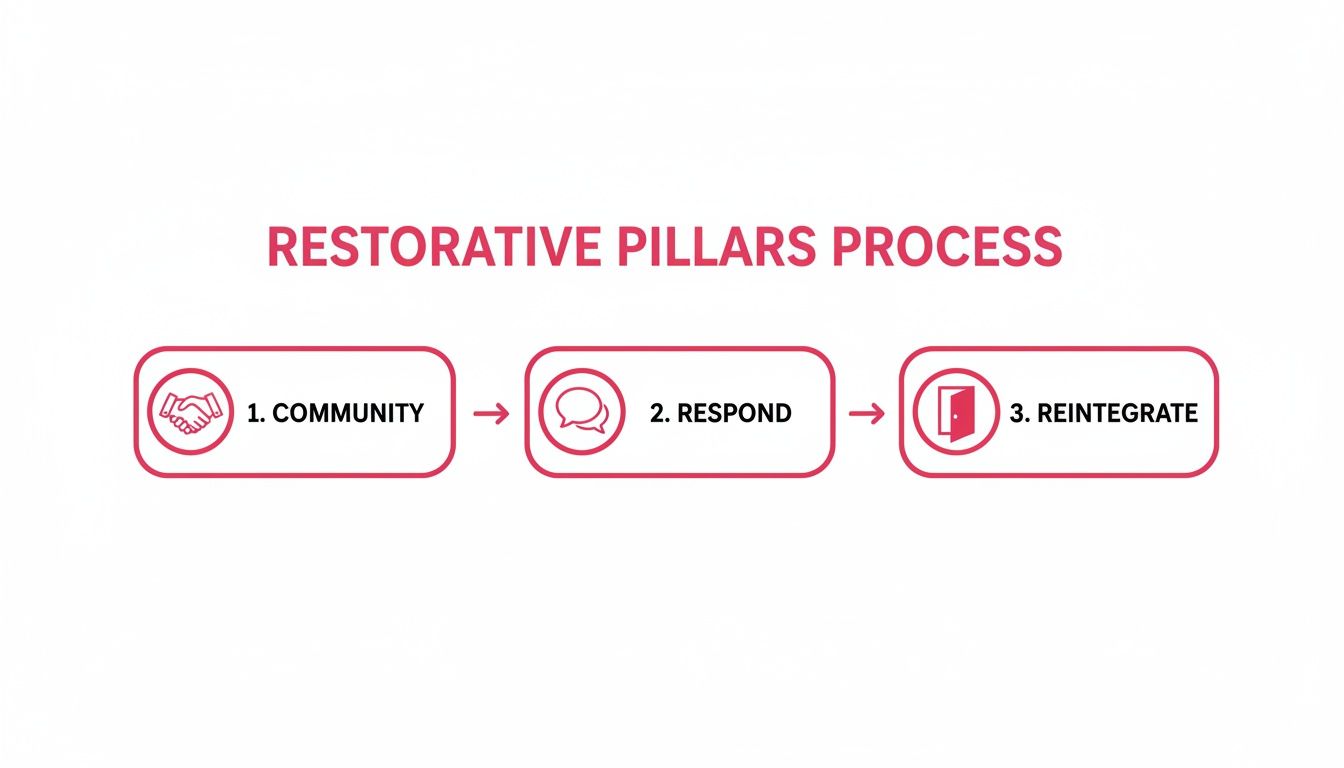
The Three Pillars of Restorative Practices in Schools
In K-8 schools, restorative work is strongest when adults treat it as a tiered practice, not a one-time response after a big incident. The most effective campuses build skills before conflict, respond thoughtfully when harm happens, and help students return to community afterward.
Building community before anything goes wrong
This first pillar is preventative. Teachers create routines that help students feel seen, safe, and connected before tension builds.
In practice, that might include:
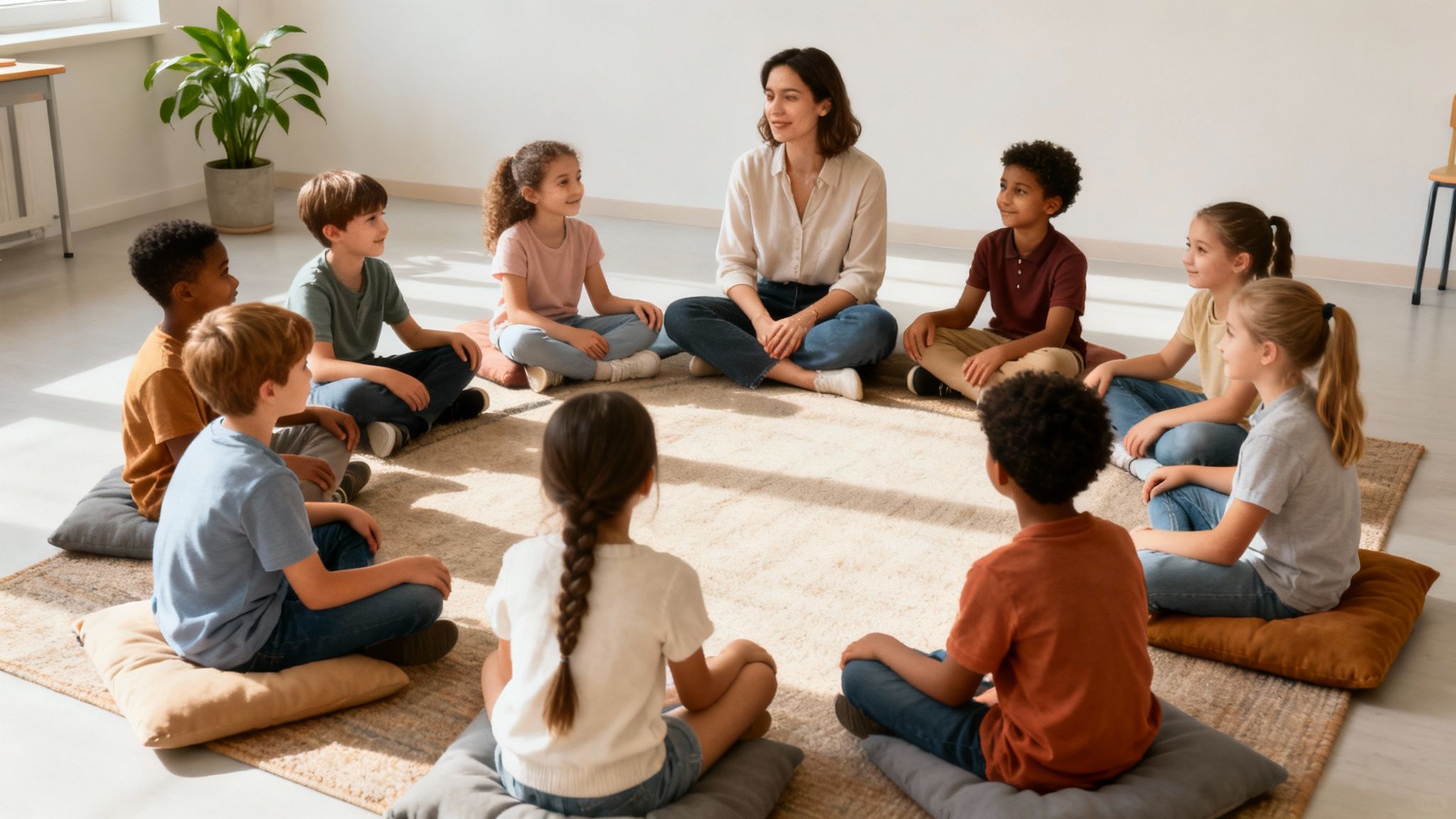
Morning circles: Students greet one another, share a feeling word, and answer a simple prompt like “What helps you focus?”
Class agreements: Instead of posting rules adults made alone, the class names how they want to treat each other.
Repair-friendly language: Teachers say, “Help me understand what happened,” instead of “Why did you do that?”
The purpose is simple. When students feel connected, they're more likely to regulate, speak truthfully, and care about impact. School-based restorative practices can range from informal conversations to formal conferences, and circles help build cooperation and prevent conflict before it escalates, according to Restorative Justice Colorado's overview of practices and models.
Responding to harm with structure
The second pillar is the one typically envisioned first. A conflict happens. Adults bring students into a process that is safe, guided, and focused on accountability.
This can look like a quick hallway conversation after an unkind comment, or a more formal meeting with students, caregivers, and support staff after repeated harm. The key is structure. Students need guided questions, equal time to speak, and a clear plan for repair.
A fourth grader who spread rumors might hear from classmates how that affected recess and group work. The goal isn't public shaming. It's helping the student understand impact and take meaningful responsibility.
Reintegrating students after conflict
This pillar is often skipped, and skipping it creates repeat problems. After a serious incident, students need help returning to class without being labeled by their worst moment.
Reintegration might include:
A re-entry check-in: A counselor or teacher meets with the student before they return.
A support plan: The student identifies what to do when emotions rise again.
A follow-up circle: The class or small group names what will help rebuild trust.
For schools wanting more concrete circle formats, these examples of restorative circles in schools can help teams move from theory to daily practice.
A restorative school doesn't just ask how to respond to harm. It builds conditions that make harm less likely.
Restorative Justice in Action School-Based Examples
Examples matter because restorative justice can sound abstract until you hear how an adult leads it with children. In schools, the basic structure includes five core steps: all involved parties discuss the incident, the harmed student and the accused student share feelings with equal time, the teacher facilitates with open-ended questions such as “How did your behavior impact your fellow students?”, students decide on a course of action, and everyone helps carry out the plan, as outlined by the University of San Diego's classroom guide.
Kindergarten through second grade with a sharing conflict
Two first graders argue over a special set of crayons. One grabs them. The other cries and refuses to sit near him at carpet time.
The teacher waits until both children are calm, then brings them together at a small table. She keeps the language concrete.
She asks:
“What happened?”
“What were you feeling?”
“What happened for your classmate when you grabbed?”
“What can you do now to fix it?”
One child says, “I thought he was taking too long.” The other says, “I felt mad because you didn't ask.”
The repair plan is simple and age-appropriate. The child who grabbed apologizes, returns the crayons, and agrees to use a turn-taking card next time. The teacher checks in later that day and again the next morning. For younger students, that follow-up matters as much as the conversation.
Third through fifth grade with social exclusion
A group of fourth graders leaves one classmate out of a recess game and then laughs when she asks to join. By afternoon, the excluded student doesn't want to participate in group work.
The teacher and counselor hold a brief restorative meeting with the involved students. Each child gets equal time to speak. The adults keep the focus on impact, not argument.
One student says, “We were only joking.” The harmed student says, “It didn't feel like joking. It felt like everyone wanted me gone.”
That's the moment many children need help with. Intent and impact are not the same thing.
The students agree to repair in three ways:
A direct apology that names the harm.
A recess reset where the group includes the student in a new game plan.
A class commitment to noticing exclusion before it hardens into a pattern.
If your school is building peer support and student-led problem solving, this resource on conflict resolution for schools offers practical next steps.
A short video can also help teams picture the tone and pacing of a restorative process in action.
Sixth through eighth grade with disrespect toward a teacher
A seventh grader mutters an insult when corrected in class, then knocks a notebook off the desk while leaving the room. A purely punitive response might stop there with removal and a referral.
A restorative response still takes the disruption seriously, but it also asks the student to face the human impact. Later, with an administrator present, the teacher facilitates a structured conversation.
She asks:
“What was happening for you right before the comment?”
“What impact did your words and actions have on me and the class?”
“What do you think needs to happen to make this right?”
The student admits he felt embarrassed after being corrected publicly. That doesn't excuse the behavior, but it gives the adults useful information. He apologizes to the teacher, writes a brief plan for what he'll do when he feels activated, and agrees to restore the classroom space before the next class period.
When students participate in the repair plan, they're more likely to follow through on it.
Across ages, the process changes in language and complexity, but the core remains the same. Kids tell the truth about harm, hear one another, and practice repair with adult support.
Proven Benefits for Your School Community
For school teams, the practical question isn't only what is restorative justice. It's whether the approach improves daily life for students and staff. The answer, in many schools, is yes.
Early-adopting districts that implemented restorative justice reported major reductions in suspension and expulsion rates, with some seeing up to 50% fewer exclusions within two years, and in one Chicago high school restorative circles were associated with a 40% drop in disciplinary incidents and a 25% increase in student attendance over one year, according to Edutopia's summary of restorative justice resources.
Those outcomes make sense when you look at what restorative practices build. They don't just respond to conflict. They strengthen relationships, improve communication, and give students repeated chances to practice empathy and self-regulation.
What schools tend to notice first
Often, the first visible change is a calmer tone. Students begin to expect that adults will listen, ask questions, and guide repair instead of escalating every problem into a power struggle.
Schools also report improvements in areas that matter a great deal to families and staff:
School climate: Students often feel safer and more connected when adults use consistent, relational responses.
Attendance and belonging: When children feel respected, they're more likely to want to be at school.
Social-emotional growth: Students practice perspective-taking, emotional language, and problem solving in real situations.
That connection to SEL is important. Restorative work doesn't sit off to the side from emotional development. It gives students a place to use the skills SEL tries to teach. This overview of the benefits of social-emotional learning pairs well with a restorative approach because both center belonging, self-awareness, and healthy relationships.
Schools don't become restorative because they hold a few circles. They become restorative when students trust that harm will be addressed fairly and humanely.
Your Roadmap to Introducing Restorative Practices
Many schools stall out because they try to launch everything at once. A better path is gradual, visible, and well supported.
Start with shared purpose
Before anyone runs a circle, adults need agreement on why the school is making this shift. Is the goal to reduce exclusionary discipline? Improve climate? Build stronger conflict skills? Usually it's all of the above, but leaders should say that clearly.
A small core team helps. Include an administrator, classroom teachers, counseling staff, and if possible, family voices. In K-8 settings, this team often becomes the anchor for consistency.
Train adults before expecting students to do it well
Restorative practice is not intuitive for every adult. Teachers need support with facilitation, regulation, bias awareness, and developmentally appropriate expectations.
Foundational training should help staff:
Use restorative language: Questions such as “Who was affected?” and “What needs to happen now?”
Know when not to circle up immediately: Students may need cooling-off time first.
Tell the difference between accountability and forced apology: Repair should be meaningful, not performative.
Begin with informal routines
Schools often make the work too formal too soon. Start smaller. Use restorative check-ins, affective statements, and quick problem-solving conversations in classrooms and common spaces.
Examples include:
At arrival: “What kind of day are you bringing into the room?”
After interruption: “What happened, and what do you need to rejoin well?”
After peer conflict: “How can you make this right before we move on?”
These small moves teach the language of repair before major incidents occur.
Build Tier 1 circles into the week
Community-building circles are where many schools find their footing. They help students practice listening, turn-taking, perspective-taking, and classroom belonging in low-stakes moments.
A second grade teacher might use a Monday circle prompt like, “What helps you feel included?” A middle school team might use advisory to ask, “How do you want people to treat you when you've made a mistake?”
One practical option schools sometimes use is Soul Shoppe's Student Peacemakers model, which trains students in a structured restorative process for peer conflict. That kind of peer-based support can complement adult-led circles and classroom SEL work when a campus wants students to share responsibility for repair.
Add formal responses carefully
Once adults have experience with informal practice, the school can build capacity for more formal restorative meetings. These require more preparation, clearer safety structures, and stronger facilitation.
A simple rollout sequence works well:
Assess current patterns in discipline, climate, and staff readiness.
Train all staff in common language and basic processes.
Pilot in one grade band or with one trained team.
Collect feedback from students, families, and staff.
Scale gradually with coaching and follow-up.
Leadership move: Protect time for staff reflection. Schools lose momentum when adults are expected to implement restorative practices without space to learn from mistakes.
Navigating Challenges and Measuring True Success
Restorative justice isn't a quick fix, and schools run into trouble when they treat it like one. The most common misstep is assuming it works the same way for every child and every situation.
A recent California OYCR brief found that restorative justice is less effective with younger youth and lower-level cases when schools default to it without developmental screening, and noted that practitioners have begun integrating restorative justice with SEL frameworks in the last 12 months to address that gap, as described in the California OYCR restorative justice brief. In K-8 schools, that means adults need judgment. A kindergartener who grabbed a toy may need co-regulation and direct coaching more than a formal restorative process. A middle school pattern of exclusion may need both a circle and explicit SEL instruction on empathy and group dynamics.
The challenges are real
Some staff worry restorative work takes too much time. It does take time. But unresolved conflict also takes time, often again and again.
Some adults fear it will seem soft. It isn't soft when done well. Asking a student to listen to impact, accept responsibility, and follow through on repair is demanding work.
Measure more than discipline referrals
Schools should absolutely track formal outcomes, but those numbers don't tell the whole story. True success also shows up in quieter indicators:
Belonging: Do students say they feel known and included?
Trust: Do families believe the school handles harm fairly?
Repair quality: Are agreements realistic, completed, and followed up on?
Classroom climate: Are students becoming more honest, more regulated, and more able to solve conflict with support?
The most ethical restorative schools keep asking not only, “Did behavior stop?” but also, “Did healing begin?”
If your school wants support turning restorative ideas into daily SEL practice, Soul Shoppe offers programs, workshops, and school community tools focused on connection, empathy, conflict resolution, and belonging for students and adults alike.
When you hear the term “school discipline,” what comes to mind? For many of us, it’s things like detention, suspension, or a trip to the principal’s office. This traditional approach focuses on rules and consequences. But what if we shifted the conversation from punishment to healing?
That’s the core idea behind restorative justice. Instead of asking, “What rule was broken and what’s the punishment?” it asks a fundamentally different set of questions: “Who was harmed? What do they need? And whose job is it to make things right?”
It’s a powerful shift that moves the goal from simply punishing misbehavior to actually repairing harm and rebuilding the relationships at the heart of a school community.
A New Way of Thinking About School Discipline
Think of traditional discipline as a one-way street. A student breaks a rule, a consequence is handed down, and that’s often the end of it. The problem is, this process rarely gets to the root cause of the behavior, and it does little to mend the broken trust between students or between students and staff.
Restorative justice, on the other hand, is more like a community roundabout. When a conflict happens, everyone involved has a chance to navigate a path forward together. The person who caused the harm, the person who was harmed, and even other affected community members all come into the circle. The goal isn’t just to assign blame but to foster understanding, healing, and true accountability.
This isn’t just another program; it’s a mindset that transforms school culture. By teaching empathy and connection, it creates a genuinely safer and more supportive place for everyone to learn and grow. You can dive deeper into how this works by exploring various restorative practices.
Moving Beyond Punishment
Let’s make this real. Imagine a student, Leo, scribbles all over another student’s, Maya’s, artwork.
A traditional response: The teacher sends Leo to the principal’s office, and he gets detention. Leo serves his time, but Maya is still upset about her ruined project, and the tension between them is left to fester. Nothing was really solved.
A restorative response: The teacher facilitates a conversation, maybe in a small circle. Leo has to face Maya and hears how his actions made her feel disrespected and sad. Maya gets to explain why her artwork was so important to her. Together, they decide that a good way for Leo to make it right would be to help her recreate the damaged part.
In the second scenario, Leo isn’t just “in trouble.” He’s confronting the real-world impact of his choices and taking direct responsibility for fixing the harm he caused. That’s what true accountability looks like in action.
The Focus Is on Relationships
At its heart, restorative justice recognizes a simple truth: conflict harms relationships, and those relationships must be at the center of any solution. It’s built on the understanding that strong communities are the foundation of a great school. When students feel seen, heard, and connected to one another, they are far better equipped to thrive, both academically and emotionally.
To help clarify the difference, let’s compare the two approaches side-by-side.
Traditional Discipline vs Restorative Justice at a Glance
Element
Traditional Discipline
Restorative Justice
Core Focus
Broken rules and assigning blame.
Harmed relationships and meeting needs.
Key Question
“What rule was broken and what is the punishment?”
“Who was harmed and what is needed to make things right?”
Accountability
Defined as accepting punishment.
Defined as understanding impact and repairing harm.
Outcomes
Often leads to isolation, resentment, and disconnection.
Fosters empathy, mutual understanding, and reintegration.
Communication
Top-down, authority-driven.
Dialogue-based, involving all affected parties.
Goal
Compliance and control.
Healing, learning, and community building.
As the table shows, the restorative path leads to a very different destination—one where students learn from their mistakes in a way that strengthens the entire school community.
This method creates a space for healing and accountability rather than division and punishment. It provides students with practical tools for self-regulation, communication, and conflict resolution that last a lifetime.
The Core Principles of Restorative Practices
To really get what restorative justice is all about in schools, you have to look past the textbook definition and dive into its foundations. These aren’t just abstract ideas; they’re the active ingredients that shift a school’s culture from punitive to healing. Think of them like the legs of a stool—if you take one away, the whole thing wobbles.
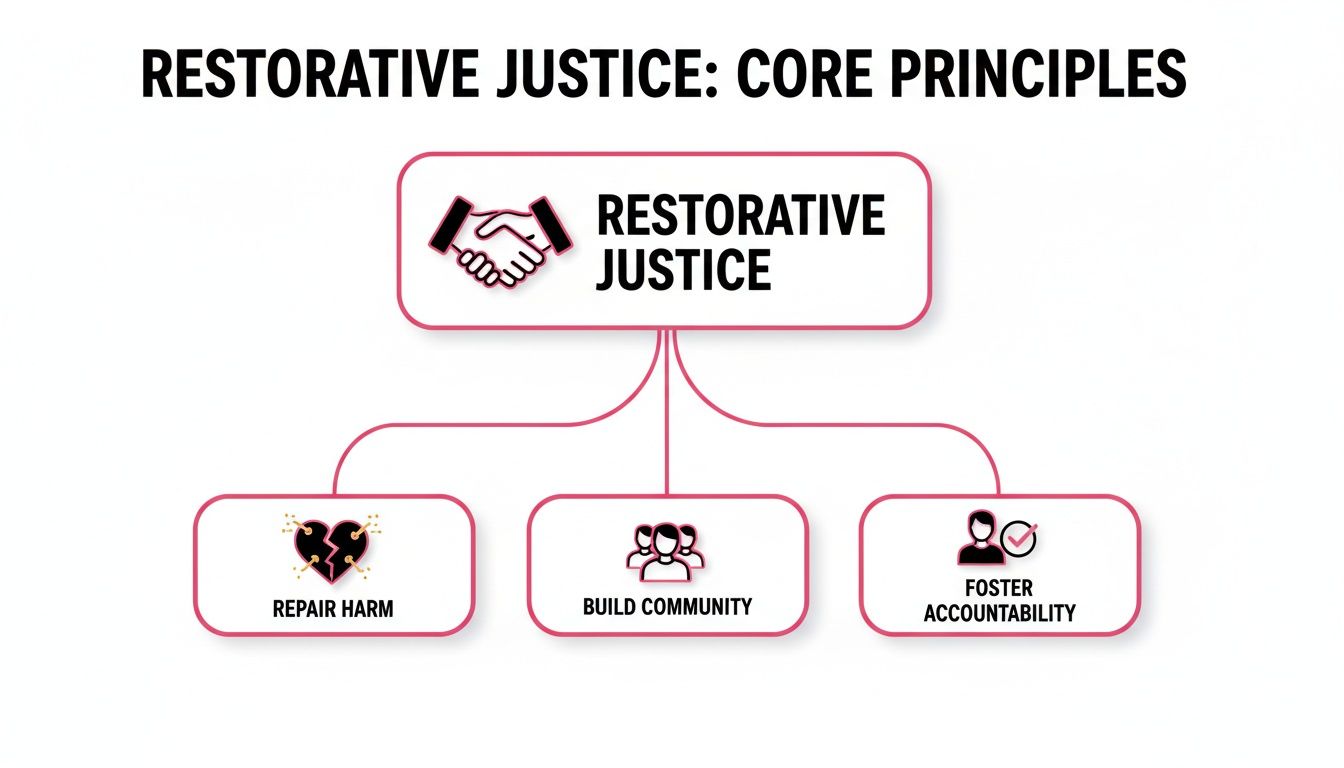
At its core, restorative justice is built on three interconnected principles. Each one moves the focus away from punishment and toward resolution, creating a stronger, more connected community along the way.
Repairing Harm
The first and most important principle is repairing harm. In a traditional system, when a rule gets broken, all eyes are on the rule-breaker. In a restorative model, the focus flips to the harm that was done and what the person who was hurt needs. Accountability isn’t about serving time in detention; it’s about actively taking steps to make things right.
This requires a student to directly acknowledge how their actions affected someone else. It pulls them out of a passive state of just accepting a consequence and into an active role of mending the tear they created in the community fabric.
Practical Example: Picture a fourth-grader, Alex, who gets frustrated during a group project and smashes a classmate’s carefully built model bridge.
Instead of an automatic timeout, the teacher helps them talk it out. The classmate shares how angry and disappointed she is that her hard work was destroyed.
Alex is then tasked with helping repair the damage. He spends his recess helping her find new materials and rebuild the bridge, piece by piece.
Through this, Alex doesn’t just “do his time.” He comes face-to-face with the results of his actions and helps fix the problem he made, learning a huge lesson about respect and responsibility.
Building Community
The second principle is building community. Restorative justice isn’t just a reactive plan for when things go south; it’s a proactive way to keep harm from happening in the first place. It’s based on the simple truth that conflict is far less likely in places where students feel safe, connected, and seen.
Strong relationships are the bedrock of a positive school climate. When students and teachers actually know and trust each other, they’re more likely to be vulnerable, work through disagreements respectfully, and cheer each other on. This sense of belonging is a massive piece of social-emotional wellness.
“Restorative practices create space for healing and accountability rather than division and punishment. They offer a way to make amends, rebuild trust, and strengthen relationships within the community.”
Practical Example: A second-grade teacher kicks off every single day with a five-minute “check-in circle.” Each student gets a chance to answer a simple prompt like, “Share one word that describes how you’re feeling today,” or “What’s one thing you’re looking forward to?”
This simple, daily routine carves out a predictable space for every student to be seen and heard.
Over time, kids get more comfortable sharing their feelings and listening to their peers.
This foundation of trust makes it so much easier to navigate conflicts when they pop up, because the lines of communication are already wide open.
Fostering True Accountability
Finally, the third principle is fostering true accountability. This might be the most misunderstood part of restorative justice. It’s not a “soft” approach that lets kids off the hook. In fact, it often demands more from them than traditional punishment ever could.
True accountability is about understanding the full ripple effect of your actions, facing the people you’ve harmed, and working together on a solution to fix the relationship. It’s about taking ownership, not just taking a penalty. This process builds essential life skills, and you can learn more about how it develops empathy in the classroom in our detailed guide.
Practical Example: A middle schooler spreads a nasty rumor about a classmate online. The rumor causes the targeted student a lot of pain and makes them feel isolated.
A restorative conference is held with both students, a school counselor, and their parents.
The student who was harmed gets to share how the rumor affected their friendships and sense of safety at school.
The student who started the rumor has to listen and then work with the other student to create a plan. This might involve posting a public correction, writing a sincere apology letter, and even presenting to their class about the dangers of cyberbullying.
This outcome requires courage, reflection, and a real commitment to making things right—a much deeper accountability than a simple suspension could ever provide.
Implementing Restorative Justice in Your School
Making the leap from understanding restorative justice in theory to putting it into practice can feel like a big step. The key is a structured, tiered approach that makes implementation feel manageable and, more importantly, effective. This model helps schools apply the right level of support at the right time—from proactive community building for everyone to more intensive responses when serious harm occurs.
Think of this framework less as a rigid set of rules and more as a flexible guide. It’s designed to help schools build a restorative culture from the ground up, ensuring every student benefits from a community-focused environment while also having clear processes for when things go wrong.
The diagram below shows how the core principles of repairing harm, building community, and fostering accountability all work together. They aren’t separate ideas but interconnected pillars holding up the entire restorative process.
Tier 1: Proactive Community Building for All Students
Tier 1 is the foundation. The goal here is to build such strong relationships and a positive classroom climate that most conflicts never even start. These practices are universal, meaning they are for every student, every day.
The focus is on proactive strategies that create a deep sense of belonging and psychological safety. When students feel genuinely connected and respected, they’re far more likely to succeed academically and less likely to act out. These strategies aren’t add-ons; they’re woven directly into the fabric of daily classroom life.
Practical Examples for Parents and Teachers
Daily Check-In Circles: Start or end the day with a quick circle where everyone shares an answer to a prompt. This simple act builds empathy, listening skills, and a sense of community.
Sample Prompt: “Share one kind thing you did for someone today,” or “What is one thing you’re feeling grateful for?”
Classroom Agreements: Instead of a top-down list of rules, the class works together to create agreements for how they want to treat one another. This gives students real ownership over their environment.
Process: The teacher might ask, “How do we want to feel in our classroom?” and “What can we all agree to do to make sure everyone feels that way?” The answers become the class’s living constitution.
Tier 2: Responsive Practices for Minor Conflicts
When the inevitable minor issues pop up—an argument over a game, a misunderstanding, or a small disagreement—Tier 2 practices offer a structured way to respond. These interventions are for some students, some of the time, and are designed to address harm quickly before it escalates.
This is where we shift from being proactive to responsive, using restorative language and conversations to guide students toward a resolution. It’s about teaching them to see conflict not as a fight to be won, but as a problem to be solved together.
The goal of a restorative conversation isn’t to find a winner and a loser. It’s to help everyone involved understand each other’s perspective and find a way to move forward in a good way.
Practical Examples for Parents and Teachers
Guided Restorative Conversations: A teacher or parent can facilitate a brief, structured chat between students in conflict.
Sample Question: “What were you thinking and feeling at the time?” or “What did you need in that moment that you weren’t getting?”
Peer Mediation: Older students can be trained to help younger students work through their disputes. This empowers kids to take on leadership roles in maintaining a peaceful school culture.
Process: Two students in conflict meet with a neutral student mediator who guides them through a problem-solving process without ever taking sides.
Tier 3: Intensive Interventions for Significant Harm
Tier 3 is reserved for more serious incidents that cause significant harm to individuals or the whole community. These are formal processes for a few students who need intensive, wrap-around support. They involve bringing everyone affected by an incident together to collectively decide how to repair the harm that was done.
This is the most intensive level and almost always requires a trained facilitator, like a school counselor or an administrator. The process involves careful preparation before the meeting and dedicated follow-up after to ensure it’s safe and productive for everyone involved.
Practical Examples for School Staff
Formal Restorative Conferences: This is a structured meeting that includes the person who caused harm, the person who was harmed, and their supporters (like parents or friends).
Goal: To give the harmed person a voice, help the person who caused harm understand the full impact of their actions, and create a plan for repair that everyone agrees on.
Re-Entry Circles: When a student returns to school after a suspension or another long absence, a circle can be held to welcome them back and begin mending relationships with peers and teachers.
The move toward these practices is growing. A recent EdWeek Research Center survey revealed that 48% of educators report their schools are using restorative justice more now than they did before the 2018-19 school year. By integrating these strategies, schools are better equipped to build the supportive environments essential for effective social-emotional learning programs for schools.
How Restorative Approaches Can Reshape a School Community
When a school begins to shift from a punitive to a restorative mindset, the change doesn’t just stop at student conflicts. It’s so much bigger than that. This approach doesn’t just manage behavior; it starts to transform the entire school ecosystem. The ripple effects create a climate where students feel safer, more connected, and truly understood, leading to powerful improvements in their well-being and how they show up to learn.
Instead of just handing out consequences, restorative practices dig deeper to repair harm and get to the root of what’s really going on. The question changes from “What rule was broken?” to “What happened here, and who was impacted?” This simple but profound shift opens the door to understanding a student’s unmet needs, whether it’s a lack of connection, a struggle at home, or a need for specific social skills.
This focus on understanding and healing brings real, tangible results. It’s not just a feel-good idea. Schools that commit to restorative approaches almost always see a major drop in disciplinary actions that pull kids out of the classroom.
Studies consistently show that schools implementing restorative justice see reduced rates of suspensions and expulsions. This is huge. It means more students stay in the learning environment where they belong, preventing them from falling behind academically and feeling disconnected from their school community.
Creating a Safer and More Connected Climate
One of the biggest wins of restorative justice in schools is the way it nurtures a positive school climate. When students are actively involved in building and maintaining their community—through circles, shared agreements, and open dialogue—they develop a powerful sense of ownership. They learn that their voice matters and that they have a shared responsibility to look out for one another.
This creates a culture of psychological safety where students feel comfortable taking academic risks, asking for help, and just being themselves. The result is a vibrant community where empathy and mutual respect become the norm, not the exception. To learn more about this, check out our guide on how to improve school culture.
Practical Example for Parents and Teachers: Imagine a typical hallway conflict where one student pushes another. A punitive approach might mean an immediate office referral and a detention slip. But a restorative approach leads to a conversation. A teacher might pull both students aside and ask:
“Can you each tell me what happened from your perspective?”
“How did that make you feel?”
“What do you need to feel respected and safe here?”
This dialogue doesn’t excuse the push. It addresses the underlying feelings, helps restore the relationship, and teaches invaluable conflict-resolution skills that prevent future incidents.
Closing Racial Gaps in School Discipline
One of the most powerful outcomes of restorative justice is its ability to create more equitable learning environments for every child. We know that traditional, zero-tolerance policies have often led to disproportionately high rates of suspension and expulsion for students of color. Restorative practices directly challenge this by replacing subjective, punitive responses with consistent, relationship-focused solutions.
By focusing on the harm and the needs of everyone involved, these approaches help reduce the influence of implicit bias in disciplinary decisions. The results can be remarkable, especially for students from marginalized backgrounds who have historically been over-disciplined.
This isn’t just a theory; it’s backed by some really compelling evidence. Restorative practices have been shown to be incredibly effective in reducing racial disparities in school discipline, with Black students often seeing the most significant benefits in major urban districts. Research in Chicago Public Schools, for instance, revealed transformative outcomes for Black students who had previously faced stark inequities in discipline. You can find more insights in this promising research from Brookings.
For restorative justice to really take root in a school, it can’t just be a classroom thing. When the principles of repairing harm and building community are echoed at home and championed by key staff, they become part of the school’s DNA.
This is where families and school counselors become so important. They aren’t just bystanders; they are active partners in creating a consistent, supportive environment for every child. When everyone works together, the positive effects multiply, and students truly start to internalize these crucial social-emotional skills.
How Families Can Support Restorative Practices at Home
When kids hear the same restorative language at home that they hear at school, it creates a seamless world for them. It reinforces the lessons they’re learning about empathy and accountability. After all, parents and caregivers are a child’s first and most influential teachers.
You don’t have to be an expert to bring these ideas into your family life. It often just means small shifts in how you talk about conflict—moving the focus away from blame and toward understanding and repair.
Practical Examples for Parents:
During Sibling Arguments: Instead of sending kids to separate rooms, try guiding a restorative chat. Ask questions that get them thinking about each other’s feelings.
“How do you think your actions made your brother feel?”
“What was going through your mind when that happened?”
“What’s one thing you can do to make things right between you?”
When a Rule is Broken: If a child makes a mess and doesn’t clean it up, connect the consequence directly to the harm.
Instead of a timeout, the repair could be helping with an extra household chore. This isn’t a punishment; it’s about contributing back to the family, which teaches responsibility in a tangible way.
By using restorative language at home, parents help their children build an internal compass for empathy and accountability. This consistency sends a powerful message: repairing our relationships is something our whole community values.
The Crucial Role of the School Counselor
School counselors are perfectly positioned to be the champions of a school’s restorative justice work. With their training in mediation, communication, and student well-being, they can act as facilitators, coaches, and guides for everyone involved.
Counselors often become the central hub for restorative efforts, helping weave these practices into every part of the school’s support system. Their expertise makes them natural leaders for navigating sensitive conversations and showing others how to do the same.
Key Responsibilities for School Counselors:
Leading Formal Conferences: When something serious happens, counselors can step in as skilled, neutral facilitators for Tier 3 incidents. They ensure the process feels safe and fair, keeping the focus on genuine repair for everyone.
Training and Coaching Teachers: Counselors are great resources for professional development. They can model how to lead community-building circles or use restorative questions to handle minor conflicts, building confidence and skill across the entire staff.
Integrating Principles into Counseling: In one-on-one or small group sessions, counselors can weave in restorative ideas. This might mean helping a student see the impact of their behavior on others or guiding them through the steps of mending a friendship.
When counselors take on these roles, they make sure restorative justice is applied with consistency and care, deepening its impact on students’ social and emotional health.
Navigating Common Challenges and Measuring Success
Adopting restorative justice is a journey, not a destination. And while the benefits are crystal clear, the path forward often includes challenges that demand patience, commitment, and a real willingness to learn. Understanding these potential hurdles from the get-go can help your school prepare practical, effective solutions.
The good news is that this is a growing movement. For instance, roughly 72 percent of charter schools now involve students in restorative practices, which is a big jump from the 58 percent seen in traditional public schools. This trend points to a broader shift in thinking, but it doesn’t erase the real-world obstacles. You can dive deeper into the trends and find new schools data on restorative practices here.
Overcoming Common Hurdles
One of the biggest initial challenges is getting full staff buy-in. It’s common for some educators to worry that restorative practices are too “soft” or will eat up precious instructional time. Others might feel they just don’t have the training to navigate difficult conversations with confidence.
The best way forward is to start small. A pilot program with a handful of willing teachers can be a powerful way to demonstrate success and build momentum across the school. Integrating short, simple practices—like a five-minute check-in circle to start the day—makes the whole process feel manageable instead of overwhelming.
The key is to show, not just tell. When staff see restorative circles calming a classroom and preventing larger conflicts, they begin to understand its value firsthand. It’s an investment that pays back in instructional time.
Another hurdle is the deep-rooted punitive mindset that many of us grew up with. Shifting an entire school’s culture from punishment to repair takes consistent effort and modeling from the top down.
Practical Solutions for Implementation:
Provide Ongoing Training: Don’t just do a one-off workshop. Offer coaching sessions that give teachers practical scripts and strategies they can use in their classrooms the very next day.
Create a Leadership Team: Pull together a small team of passionate educators and administrators to guide the implementation, answer questions, and support their colleagues.
Start with Community Building: Focus first on proactive Tier 1 practices. When you build a strong community foundation, it becomes so much easier to handle conflicts when they inevitably pop up.
How to Measure What Matters
Success with restorative justice looks different from traditional discipline metrics. Yes, a drop in suspensions is a fantastic outcome, but it’s only one piece of the puzzle. The real magic is often found in the subtle but powerful shifts in your school’s climate and relationships.
Measuring what matters means looking beyond the numbers to capture the qualitative changes that tell you you’re building a healthier community. This approach gives you a much richer, more accurate story of your progress.
Key Indicators of Success:
School Climate Surveys: Are students reporting a greater sense of belonging and safety? Do they feel like adults and their peers treat them with respect? These surveys provide invaluable data straight from the student experience.
Student and Staff Focus Groups: Host informal conversations to gather stories. Ask questions like, “Can you share a time when a conflict was resolved in a way that felt fair?” These narratives are what bring the data to life.
Teacher Anecdotes: Are teachers noticing more empathy in their classrooms? Are students starting to solve minor problems on their own without needing an adult to step in? These small observations are powerful signs of a real cultural shift.
By combining quantitative data (like attendance and discipline rates) with qualitative feedback, schools can paint a full picture of their restorative journey. This holistic view helps everyone celebrate wins, identify areas for growth, and truly understand the lasting impact of choosing connection over punishment.
Common Questions About Restorative Justice in Schools
When schools start exploring restorative justice, it’s natural for questions to pop up from parents, teachers, and even students. Shifting from a traditional discipline model is a big change, and getting clear answers helps everyone feel more confident.
Let’s tackle some of the most common questions about how this approach actually works in the classroom.
Does Restorative Justice Mean There Are No Consequences?
Not at all. This is probably the biggest misconception out there. Restorative justice doesn’t eliminate consequences; it redefines them to be more meaningful and educational. The focus shifts from punishment that isolates to actions that repair harm and rebuild community.
Think about it this way: instead of an automatic suspension for an argument, a restorative consequence might involve the students mediating their conflict with a trusted adult. They’d work together to create a plan to restore trust. This requires them to face the impact of their actions and take real responsibility for making things right—a much deeper and more lasting lesson than sitting at home.
Accountability is the engine of restorative justice, not a missing piece.
How Can a Busy Teacher Find Time for This?
This is a totally valid concern. The idea of adding one more thing to your plate can feel overwhelming. But the key is to start small and weave restorative practices into what you’re already doing.
Many teachers find that a small investment of time upfront actually saves them a ton of time down the road by preventing bigger conflicts.
A great place to begin is with a five-minute check-in circle during your morning meeting. When a minor issue pops up, try asking simple restorative questions like, “What happened?” and “Who was affected by this?” instead of immediately assigning blame. These small shifts build a foundation of communication that makes the classroom much easier to manage in the long run.
By proactively building community, you spend less time reacting to misbehavior. These small, consistent actions create a classroom culture where students begin to solve problems on their own.
Is This Approach Only for Older Students?
Nope! Restorative principles are incredibly adaptable and just as powerful for kindergarteners as they are for eighth graders. With younger children, you’re just focusing on simpler, more concrete concepts that build the foundation for empathy, communication, and self-regulation.
The language and activities just look a little different.
Practical Examples for Young Learners:
Using “I-Statements”: A teacher can guide a five-year-old to say, “I felt sad when you took my crayon without asking.” This is a huge first step in teaching kids to express their feelings without blaming.
Creating a “Calm-Down Corner”: Having a designated cozy space gives young students a tool for managing big emotions before they escalate into a bigger problem.
Simple Mediations: When two kids argue over a toy, a teacher can facilitate a very brief chat, helping them listen to each other and agree on a way to share.
The core ideas—understanding impact, feeling empathy, and making things right—are universal. They just grow in complexity as your students do.
At Soul Shoppe, we give schools the tools and training to build these essential skills from the ground up. Our goal is to help you create a safer, more connected learning community where every student feels they belong. Find out more about our Social Emotional Learning programs.
Restorative practices in education are about making a fundamental shift in how we think about student behavior. Instead of just punishing kids for breaking rules, the focus is on repairing harm and strengthening relationships. It’s an approach that moves past traditional consequences to get to the root of what’s happening and understand its impact on the whole community.
Shifting from Punishment to Connection
For decades, the go-to disciplinary model in many schools has been punitive. The main questions were always, “What rule was broken?” and “What’s the punishment?” This is kind of like yanking weeds out of a garden without ever checking the health of the soil. You might get rid of the visible problem for a moment, but you haven’t done anything to fix the conditions that let the weed grow in the first place. Often, a student’s behavior is just a form of communication—a signal that a need isn’t being met or that they feel disconnected.
Restorative practices, on the other hand, are all about nurturing that soil. This mindset flips the script and asks a totally different set of questions:
Who was harmed by this action?
What do they need to feel whole again?
Whose job is it to meet those needs and make things right?
This shift acknowledges a simple truth: when a student acts out, the harm doesn’t just stop with them. It ripples outward, affecting other students, teachers, and the entire feeling of the classroom. The goal is no longer just to punish one person but to mend those relationships and bring the student back into the community in a way that helps everyone learn and grow.
To give you a clearer picture, let’s look at how these two mindsets stack up side-by-side.
Punitive vs. Restorative Approaches at a Glance
Aspect
Traditional Punitive Approach
Restorative Practices Approach
Core Philosophy
Rule-breaking requires punishment and exclusion.
Harm to relationships requires repair and inclusion.
Guiding Questions
What rule was broken? Who is to blame? What punishment is deserved?
Who was harmed? What are their needs? How can we make things right?
Primary Goal
Deter future misbehavior through negative consequences.
Repair harm, restore relationships, and build community.
Focus
On the rule-breaker’s actions and assigning blame.
On the needs of everyone affected (the person harmed, the person who caused harm, and the community).
Typical Actions
Detention, suspension, expulsion, loss of privileges.
Restorative chats, circles, peer mediation, conferences, community service.
Outcomes
Can lead to resentment, shame, and disconnection.
Fosters empathy, accountability, and a stronger sense of belonging.
Seeing them laid out like this makes the difference pretty stark, doesn’t it? One is about enforcing rules, while the other is about nurturing people.
Moving Beyond Zero Tolerance
This isn’t a new idea that just popped up out of nowhere. It’s a direct response to a long history of exclusionary discipline in our schools. For years, research has shown how zero-tolerance policies—like automatic suspensions for relatively minor issues—are tied to lower achievement and higher dropout rates, especially for students of color. Restorative practices offer a powerful, more effective alternative. The real magic happens when you focus on building community in the classroombefore conflict ever starts, using tools like classroom circles and shared agreements to create a genuine sense of belonging.
The central idea is that human beings are happier, more cooperative and productive, and more likely to make positive changes in their behavior when those in positions of authority do things with them, rather than to them or for them.
Fostering a Culture of Belonging
At its heart, this approach is about creating safer, more supportive schools where every single student feels seen, heard, and valued. When we teach kids how to communicate their feelings, listen with empathy, and solve problems together, we’re giving them skills they’ll use for the rest of their lives. A core part of guiding these important dialogues involves mastering the art of asking questions that open up conversation instead of shutting it down. When a strong community becomes the foundation, academic and social success naturally follow.
The Three Pillars of a Restorative School
To really get what restorative practices are all about in a school setting, it helps to think of them as having three core pillars. These aren’t separate concepts; they’re interconnected stages that build on each other to create a resilient, supportive school culture. You can picture them as the foundation, the framework, and the open door of a restorative building.
The whole system works on a simple but powerful idea: the relationship bank account. Every positive chat, shared laugh, and moment of understanding is a deposit. When conflict comes up—and it always does—the community has this deep well of trust and connection to draw from to make things right.
Pillar 1: Building Community
This is the proactive, foundational pillar, and honestly, it’s where most of the real work happens. Building community is all about intentionally making those daily deposits into the relationship bank account. It’s about creating a genuine sense of belonging and psychological safety for every single student and staff member.
This is the essential groundwork that has to be in place before any harm occurs. Without a strong community, trying to respond to conflict is like trying to build on sand—there’s no shared trust to fall back on. This pillar is all about creating the shared experiences and norms that bind everyone together.
How This Looks in Practice:
Teacher Example: A teacher can kick off each day with a simple morning circle where every student shares how they’re feeling, perhaps using a “weather report” metaphor. A student might say, “I’m feeling sunny today because I have art class,” or “I’m a little cloudy because I didn’t sleep well.” This simple act normalizes talking about feelings and builds empathy from the first bell.
Parent Example: At home, a parent can create a similar ritual during dinner. Each family member could share one “rose” (something good that happened) and one “thorn” (a challenge they faced) from their day. This builds the habit of open communication.
Classroom Example: Instead of the teacher just handing down a list of rules, the class works together to create agreements for how they want to treat each other. A teacher might ask, “What does respect actually look like and sound like in our room?” The students’ own answers become their shared commitments.
A core belief of restorative practices is that it’s far better to build a strong community than to constantly have to repair a broken one. This proactive work of building social capital is the most critical piece of the puzzle.
Pillar 2: Responding to Harm
The second pillar is responsive—it kicks in when something goes wrong. When a conflict happens or someone is hurt, the focus immediately shifts away from blame, rules, and punishment. The key questions are no longer about who broke what rule, but about repairing the relationships that were damaged.
The goal is to understand the real impact of an action and give everyone involved a voice in figuring out the solution. This is where the school draws on all that trust built in the first pillar to navigate tough conversations. It turns moments of conflict into powerful opportunities for learning and growth.
How This Looks in Practice:
Parent Example: A parent finds out their child took a toy from a sibling. Instead of an immediate timeout, they might ask, “What happened? How do you think your brother felt when he couldn’t find his favorite toy? What do you think you can do to make it right?” This encourages accountability and empathy, not just compliance.
Teacher Example: A teacher sees two students arguing over a ball during recess. They pull them aside for a quick restorative chat: “I can see you’re both upset. Can each of you tell me your side of the story? What do you need to happen so you can both feel okay and get back to playing?”
Pillar 3: Reintegrating Individuals
This final pillar is maybe the most overlooked, but it’s absolutely vital. After the harm has been addressed and a plan for repair is in place, the community has to consciously and actively welcome the student back into the fold. This step is what prevents the shame and isolation that so often follow traditional punishment.
Reintegration makes sure that a student’s mistake doesn’t become their permanent identity. It sends a powerful message: “We are not throwing you away. You are still part of this community, and we will support you as you move forward.” This final step closes the loop, reinforcing the strength and resilience of the entire community.
How This Looks in Practice:
Teacher Example: After a student returns from an in-school suspension, their homeroom might hold a brief circle. The student could share what they learned, and their classmates can offer words of support, making it clear they are glad to have them back.
Parent Example: After a teenager breaks a family rule and has a consequence (like losing phone privileges), a parent can make a point to connect the next day. They might say, “I know yesterday was tough. I want you to know we love you, and we’re a team. Let’s talk about how we can make tomorrow better.” This separates the behavior from the person.
Putting Restorative Practices Into Action
Knowing the philosophy is one thing, but making it real in the hallways and classrooms? That’s where the magic happens. Shifting to a restorative model isn’t about one single program; it’s about having a toolbox of strategies ready to go. Think of it in three tiers, moving from proactive community-building for everyone to more intensive support when serious conflicts pop up.
And schools are catching on. According to recent federal school safety data, a whopping 59% of U.S. public schools reported using restorative practices in the 2021–22 school year. That’s a huge jump from just 42% in 2017–18, showing a clear move toward building connection over just handing out punishment.
Tier 1: Proactive Strategies for Everyone
The foundation of it all is Tier 1. These are the everyday, universal things you do to build a strong sense of community and stop conflicts before they even start. This is where you make daily deposits into the “relationship bank account.” The most powerful tool here? The community-building circle.
Circles are beautifully simple. They create a dedicated space where every single student has a voice and feels like they truly belong.
How to Run a Morning Check-In Circle
Set the Space: Get everyone in a circle where they can see each other. No desks or tables in the way—just open space.
Use a Talking Piece: This is key. Pick a special object (a smooth stone, a small stuffed animal) that gets passed around. Only the person holding it can speak.
Establish the Tone: The facilitator, usually the teacher, explains the circle’s purpose and shares a simple agreement, like “Respect the talking piece” or “Listen from the heart.”
Offer a Prompt: Ask a simple, low-stakes question to get the conversation flowing.
Pass the Piece: The facilitator goes first to model, then passes the talking piece around the circle. It’s always okay for a student to pass if they don’t feel like sharing.
Practical Examples: Circle Prompts for Different Ages
For Teachers (Grades K-2): “What’s one thing that made you smile this morning?” or “If you could be any animal, what would you be and why?”
For Teachers (Grades 3-5): “Share a time you felt proud of yourself this week,” or “What’s one thing you’re excited to learn?”
For Parents (at the dinner table): “What was the best part of your day?” or “What’s one thing you’re looking forward to this weekend?”
For Teachers (Grades 6-8): “What’s one challenge you’re navigating right now?” or “Who is someone you can count on for support, and why?”
This whole process is captured perfectly in the Restorative Pillars Process flow.
As the visual shows, you have to build that strong community first. It’s the bedrock that allows you to effectively respond to harm and, eventually, bring everyone back together.
Tier 2: Responsive Strategies for Minor Conflicts
Tier 2 kicks in when those smaller, everyday conflicts happen—think arguments on the playground or disagreements between friends. The go-to tool here is the restorative chat. It’s a quick, informal conversation that turns a moment of discipline into a moment of learning.
The goal of a restorative chat isn’t to figure out who’s right and who’s wrong. It’s to help students see each other’s point of view and work together to find a way forward.
Imagine two kids arguing over a ball. Instead of a time-out, a teacher can pull them aside for a quick restorative chat. It only takes a minute or two.
Having some go-to questions makes these conversations feel natural instead of forced.
Practical Scripts for Restorative Conversations
This table offers some simple, powerful questions you can use in restorative chats or circles. The idea is to move from blame to understanding and repair.
Situation
Key Restorative Questions to Ask
Goal of the Conversation
Two students argue over a game.
1. “What happened?” (Listen to each person.)
2. “What were you thinking at the time?”
3. “How has this affected you? How do you think it affected the other person?”
4. “What do you need to move forward?”
Help students understand the impact of their words/actions and collaboratively find a solution.
A student is disruptive in class.
1. “I noticed you were [describe behavior]. What was going on for you then?”
2. “Who do you think was affected by that?”
3. “What can we do to make things right and get back to learning?”
Connect behavior to impact on the community and empower the student to take responsibility for repair.
A student feels left out.
1. “What happened from your perspective?”
2. “What was it like for you when that happened?”
3. “What would have made it better?”
4. “What do you need from your classmates to feel included?”
Validate the student’s feelings, build empathy in others, and create a plan for inclusion.
These simple scripts are powerful because they teach kids how to solve their own problems. They are a core part of our guide to conflict resolution strategies for students.
Tier 3: Intensive Strategies for Significant Harm
For bigger issues—bullying, theft, or physical fights—you need a more formal and intensive approach. This is Tier 3, which often involves a formal restorative conference. It’s a structured meeting that brings together everyone impacted by an incident to collectively figure out how to repair the harm.
This isn’t a quick fix. A conference requires careful preparation and a trained facilitator to guide the process.
Practical Example: A Formal Conference
Imagine a student vandalized a school bathroom. A punitive response would be suspension. A restorative conference, however, would involve a meeting with the student, their parents, the principal, and the janitor who had to clean up the mess. The janitor would share how the act impacted their workload and morale. The student would have to face this direct impact, and the group would work together on a repair plan, which might include the student helping the janitor with after-school cleanup for a week.
Key Elements of a Formal Conference:
Participants: The meeting includes the person who caused the harm, the person who was harmed, and supporters for each (like parents, friends, or trusted staff members). A neutral facilitator is essential.
Voluntary Participation: Everyone has to agree to be there. You can’t force restoration.
Structured Process: The facilitator uses a script of restorative questions to keep the conversation safe, focused, and productive for everyone.
The Outcome: The group works together to create a written agreement. It clearly states what the person who caused harm will do to make things right, whether that’s an apology, replacing a broken item, or doing something for the community.
As schools continue to weave restorative practices into their culture, exploring effective online teaching strategies can also help deepen that sense of connection and engagement, making the classroom feel like a supportive community, whether it’s in-person or online.
How Restorative Practices Fuel Social-Emotional Learning
Restorative practices and Social-Emotional Learning (SEL) aren’t two separate initiatives you have to cram into a packed school day. It’s better to think of them as deeply intertwined partners.
If SEL is the “what”—the core skills like empathy, self-control, and good decision-making we want students to have—then restorative practices are the “how.” They provide the active, real-world moments where those skills come alive.
When a school truly commits to a restorative approach, it becomes a living laboratory for social-emotional growth. Students aren’t just learning about empathy in a worksheet; they’re practicing it in every circle and restorative chat. This is the magic that shifts SEL from a subject you teach to a culture you live.
Mapping Restorative Actions to SEL Competencies
The connection becomes undeniable when you map restorative actions directly to the five core SEL competencies. Restorative practices give students the perfect framework to build these essential life skills in authentic, meaningful ways—not just in theory, but in practice.
Self-Awareness: In a restorative circle, asking a student, “What were you thinking at the time?” isn’t an accusation. It’s an invitation for them to look inward and connect their feelings and motivations to their actions. That internal check-in is a powerful exercise in self-awareness.
Self-Management: Think about a student who has caused harm. Their first impulse might be to get defensive or shut down. By participating in a restorative conference, they have to learn to manage those emotions, take responsibility, and follow through on a plan to make things right. That’s a huge lesson in self-management.
Restorative practices give students the chance to practice SEL skills when the stakes are real. They learn to navigate tough emotions and tricky social situations with guidance and support, building resilience and emotional intelligence that will last a lifetime.
Building Relationships and Making Responsible Choices
Beyond individual skills, restorative practices are all about how we connect with others. This is where the final three SEL competencies really get to shine, transforming classroom dynamics and building a true foundation of mutual respect.
Social Awareness
Simply participating in a circle and listening as a talking piece makes its way around the room is an exercise in empathy. Students hear perspectives they’ve never considered, learning to understand and appreciate the feelings of their classmates. A child might realize for the first time that a joke they thought was harmless actually hurt someone’s feelings, which is a direct deposit into their social awareness bank.
Relationship Skills
Every restorative chat is basically a masterclass in relationship skills. Students learn how to communicate clearly, listen without interrupting, cooperate on finding a solution, and handle conflict without making it worse. Instead of a teacher swooping in to solve the problem for them, students are empowered to repair their own relationships—a skill they’ll use forever.
Responsible Decision-Making
The whole point of a restorative process is to answer one big question: “What can we do to make things right?” Answering this forces students to look at the situation from all sides, evaluate how their actions impacted others, and help create a solution that works for everyone involved. It’s the very definition of responsible decision-making in action.
By weaving these practices into the fabric of the school day, educators create a culture where social-emotional growth isn’t just an add-on; it’s central to the entire learning experience. To see how this fits into a bigger picture, it helps to explore different social-emotional learning programs for schools and see how they can support this work.
Ultimately, this integrated approach ensures students don’t just know what empathy is—they know what it feels like to both give and receive it.
Overcoming Common Implementation Challenges
Making the switch to a restorative model is a big cultural shift, and let’s be honest—it rarely happens without a few bumps in the road. Even with the best intentions, schools often run into predictable hurdles that can slow things down. Knowing what these challenges are ahead of time and having a plan to navigate them is the key to making restorative practices stick for the long haul.
The journey takes patience and persistence, but getting past these common obstacles is completely doable with a smart and empathetic approach.
Challenge 1: The “Soft on Discipline” Myth
One of the first things you’ll probably hear is that restorative practices are “soft” and let students off the hook. Staff, parents, and even some students might worry that without detentions or suspensions, there’s no real accountability for misbehavior.
This idea usually comes from a misunderstanding of what accountability actually means.
Restorative accountability isn’t about making a student suffer. It’s about making them understand the real impact of their actions and take responsibility for repairing the harm. This is often much harder—and far more meaningful—than just sitting in a room for an hour.
To tackle this myth, you have to reframe the conversation. Make it clear that restorative practices actually increase accountability. They require students to face the people they’ve harmed and actively work to make things right.
Challenge 2: Securing Staff Buy-In
Here’s a hard truth: you can’t mandate a change of heart. If teachers feel like this is just another top-down initiative being piled onto their already-full plates, they’ll resist. A lack of genuine buy-in is one of the fastest ways for implementation to fizzle out, leading to inconsistent use from one classroom to the next.
The secret to building support is to start small and show people that it works.
Start with a Pilot Group: Find a small group of enthusiastic, respected teachers who are willing to give it a try. Give them great training and lots of support.
Celebrate and Share Successes: When this group starts seeing positive changes—fewer disruptions, stronger relationships with students—get them to share their stories and data with the rest of the staff.
Provide Ongoing Training: Real buy-in comes from confidence. Offer continuous, practical training that gives teachers the scripts, tools, and coaching they need to feel like they can actually do this successfully.
Peer-to-peer influence is so much more powerful than any directive from the administration. When teachers see their colleagues succeeding and finding that this approach actually makes their jobs easier, organic buy-in will start to grow on its own.
Challenge 3: “I Don’t Have Time for This”
This is probably the most practical and valid concern teachers bring up. When you’re under pressure to get through the curriculum, finding time for a 10-minute restorative chat can feel impossible. It seems so much faster to just send a student to the office.
The solution is to shift the perspective from a short-term fix to a long-term investment.
Sure, a traditional punishment might be faster in the moment, but it rarely solves the underlying problem. That means the same issues are just going to pop up again and again, costing you more instructional time down the line. A restorative chat, on the other hand, gets to the root of the issue.
Think of it this way: Spending 10 minutes on a restorative conversation that stops a behavior from happening again saves you countless hours of classroom management and reteaching over the school year. It’s an upfront investment that pays huge dividends in reclaimed teaching time and a more peaceful classroom.
Building the Foundation for a Restorative Culture
Successful restorative practices don’t just happen because you adopt a few new scripts or meeting formats. They grow from something much deeper: a school culture rooted in psychological safety, genuine empathy, and real communication skills. Without this groundwork, even the best-structured restorative circle can feel hollow or just plain ineffective.
Think of it this way: restorative practices are like the frame of a house. For that frame to be strong and stable, it needs a solid concrete foundation. In a school, that foundation is built through dedicated social-emotional learning (SEL).
Equipping Students with the ‘How’
Restorative conversations ask a lot from students. We expect them to share their feelings, listen to others, and work together to find solutions. These are complex skills that don’t just appear overnight; they have to be intentionally taught and practiced. This is where SEL workshops and programs are essential.
They provide the “how” behind the restorative “what”:
How to accurately identify and name their own feelings.
How to listen with empathy to truly understand another person’s side of the story.
How to communicate their needs and boundaries respectfully.
How to calmly work through disagreements and find a peaceful way forward.
When students have these tools in their toolbox, they can actually engage in restorative conversations in a meaningful way. They can move past being defensive and start to hear how their actions impacted someone else, which is the whole point.
Building a restorative school isn’t just about responding to harm; it’s about proactively creating a community where every member feels seen, heard, and valued before conflict arises. This is the ultimate goal.
Investing in these foundational skills is the most critical first step you can take. It shifts the entire school environment from a place where kids are just held accountable to one where they’re also given the emotional and social tools they need to repair relationships and make their community stronger. A strong classroom culture that is peaceful and welcoming is the fertile ground from which all successful restorative work grows.
Still Have Questions? We’ve Got Answers.
As schools and parents get to know restorative practices, a few questions always seem to pop up. It makes sense—this is a big shift from the way many of us experienced school discipline. Let’s clear up some of the most common questions with straightforward, practical answers.
Is Restorative Justice the Same as Restorative Practices?
While they’re definitely related, they aren’t the same thing. Think of it like this: restorative practices is the big, overarching umbrella.
It covers everything from proactive community-building circles and quick, informal chats to the more structured conferences used after a serious incident. The goal is to build a strong community first, preventing harm before it happens.
Restorative justice, on the other hand, is a smaller, more specific tool under that umbrella. It typically refers to the formal processes used to repair significant harm, something you might see in the legal system. So, while all restorative justice is a type of restorative practice, most of the day-to-day work in schools is focused on building relationships, not just responding to conflict.
How Long Does It Take to See Results?
Shifting to a restorative culture is a marathon, not a sprint. This isn’t a quick fix you can install over a weekend; it’s a deep investment in your school community.
You might notice small, powerful changes pretty quickly—like more empathetic conversations in a classroom that starts using daily circles. But the bigger, measurable shifts take time.
A noticeable drop in suspensions and disciplinary referrals, along with a real improvement in school climate, typically takes one to three years of consistent, school-wide effort.
Real success depends on ongoing staff training, solid leadership support, and a genuine commitment to the process. It’s about planting a tree, not just a flower.
Can Parents Use Restorative Practices at Home?
Absolutely! The core ideas are incredibly powerful for strengthening family bonds and teaching kids essential life skills. Parents can easily bring the restorative mindset home to guide behavior in a more connected way.
Instead of jumping straight to a consequence like a time-out, a parent can use restorative questions to turn a sibling squabble into a moment of learning.
Here’s a practical example:
Imagine one child snatches a toy from another, and tears erupt. A restorative approach sounds less like a lecture and more like a conversation:
Step 1 (What happened?): “Okay, let’s take a breath. Tell me what just happened from your side.” (Make sure to listen to both kids.)
Step 2 (Who was affected?): “How do you think your brother felt when his favorite car was suddenly gone? And how did it feel for you when he started crying?”
Step 3 (How can we make it right?): “What’s one thing you could do to help make things right with your brother?”
Even simple shifts, like using “I-statements” (“I feel frustrated when there’s yelling”) instead of blame (“You’re always yelling!”), can model the empathy that’s at the very heart of restorative practices.
At Soul Shoppe, we know that a restorative culture is built on a foundation of empathy, communication, and conflict resolution. Our hands-on social-emotional learning programs give every child and adult the foundational skills needed for restorative practices to truly flourish, creating safer and more connected schools for everyone.
Find out how our workshops and assemblies can support your school’s journey at https://www.soulshoppe.org.