Soul Shoppe's work is made possible by donors and partners who care deeply about the young people in their communities! We can't do this work without you. Support our work in classrooms and on playgrounds across the nation by donating here.
A lot of schools are dealing with the same pattern right now. A disagreement starts at recess, follows students into the hallway, reappears during math, and ends with an office referral that doesn't really solve anything. The students feel wronged, the teacher loses instructional time, and the adults are left managing the same conflict in different forms all week.
That’s why conflict resolution for schools can’t live as a single lesson, a poster in the counseling office, or a once-a-year assembly. It has to be a system. When schools build shared language, predictable routines, tiered supports, and student leadership into daily practice, conflict becomes teachable instead of punishable.
Why a School-Wide Approach to Conflict Resolution Matters
A school rarely has a “behavior problem” in isolation. More often, it has a systems problem. Students move from classroom to playground to cafeteria to aftercare, and if each space handles conflict differently, children learn that resolution depends on which adult is closest, not on a skill they can use anywhere.
That inconsistency is expensive. It costs teaching time, emotional energy, and trust. It also sends a quiet message to students that conflict is something adults take over, rather than something children can learn to manage with support.
Discipline alone doesn’t teach replacement skills
A removal, a warning, or a consequence may stop a moment. It usually doesn’t teach what the student should do next time. If a child doesn’t know how to calm down, explain an upset, listen, repair harm, or re-enter a relationship, the same pattern returns with new players.
Schools that teach conflict resolution as part of daily practice tend to see broader gains. Research summarized by the Conflict Resolution Education report found that students in CRE programs ranked 12 percentile points higher in achievement than matched peers, while the same body of research found decreases in aggressiveness, discipline referrals, and suspension rates, along with improvements in school and classroom climate.
That matters because academic focus and emotional safety are connected. A classroom where students expect ridicule, retaliation, or constant adult rescue is not a classroom where deep learning holds.
Practical rule: If your conflict process only starts after a major incident, you’re already late.
A calm campus is built, not wished for
Leaders sometimes ask whether conflict resolution is “one more initiative.” In practice, it works better as an organizing principle for how adults respond, how students speak, and how relationships are repaired.
A school-wide model gives staff a common approach to questions like these:
What happens first: Does the adult separate students, coach them, or send them out?
What language is expected: Are students taught sentence stems, listening moves, and repair routines?
When does conflict become a support issue: Which students need more than universal instruction?
How do families hear about the work: Are they getting the same language children hear at school?
Schools already investing in social-emotional learning programs for schools usually find that conflict resolution becomes one of the clearest ways SEL shows up in visible, daily behavior.
What leaders should notice first
Before launching anything new, walk the campus and listen.
Look for repeated hotspots, repeated students, and repeated adult phrases. If one teacher says “use your words,” another says “stop arguing,” and a third says “go to the office,” the school is teaching three different conflict models at once.
A school-wide approach creates coherence. And coherence is what turns conflict from a drain on learning into part of how a school teaches children to live and learn together.
Laying the Foundation for a Peaceful School
Many programs fail because schools start with materials instead of agreements. They buy a curriculum, run a training, and hope the culture changes on its own. It usually doesn’t.
A peaceful school starts with adult clarity. Staff need to know what the school believes about conflict, when adults step in, what students are expected to practice, and how repair happens after harm.
Start with a clear operating belief
The most useful starting point is simple: conflict is normal, aggression is not, and resolution is teachable.
That belief changes the tone of the whole program. Instead of asking, “How do we stop kids from having conflict?” the school asks, “How do we teach students to handle conflict safely and skillfully?”
That difference shows up in policy language, referral practices, and classroom routines.
A short guiding statement can help. For example:
At our school, conflict is addressed through safety, regulation, communication, problem-solving, and repair. We teach students to resolve everyday disagreements with support, and we respond to harm in ways that protect the community and rebuild trust.
Build a representative team before you draft anything
Don’t assign this work to one counselor and hope it spreads. Build a small implementation team with enough range to catch blind spots.
Include:
A classroom teacher: Someone who knows what can realistically happen during a busy school day.
An administrator: Someone who can align discipline practice with the new approach.
A counselor or mental health staff member: Someone who can guide regulation, crisis response, and referral pathways.
A specials, recess, or lunch representative: Many conflicts happen outside core instruction.
A family voice: Parents often catch language gaps between school and home.
If your school serves students with high stress exposure, make sure your planning reflects trauma-informed care. Adults need to distinguish between willful harm, lagging skills, and nervous-system overload. Without that lens, schools can mistake dysregulation for defiance and over-punish children who need structure, co-regulation, and predictability.
Write a policy adults can actually use
The best conflict resolution policies are short enough to remember and specific enough to apply. A dense document nobody reads won’t change practice.
Your policy should answer five things:
What counts as classroom-manageable conflict
What requires immediate adult or administrative response
What process students are taught for everyday disagreement
How restorative repair happens after harm
How incidents are documented and reviewed
A workable policy often sounds like this in plain language:
Minor peer conflict: Staff coach students through the school’s shared process.
Repeated conflict: Teacher documents patterns and requests targeted support.
Safety concern or severe aggression: Adult secures safety first, then a restorative and support process follows when students are regulated.
Repair: Students rejoin community through accountability, not just time away.
Decide what adults will do consistently
Consistency doesn’t mean every teacher has the same personality. It means students get the same sequence.
For example, adults might agree to this response pattern:
Situation
Adult move
Heated but safe disagreement
Pause interaction, regulate, coach students through script
Ongoing repeated conflict
Track pattern, notify support team, involve family
Harmful incident with safety concern
Secure safety, separate, regulate, investigate, repair later
Classroom community impact
Use circle, class meeting, or restorative conversation
Plan for the first ninety days, not just launch day
Early implementation falls apart when schools ask adults to improvise. Give staff a narrow, manageable opening routine.
A practical rollout often includes:
Shared language posters in classrooms and common spaces
Short staff scripts for coaching student conflict
A referral pathway for students who need more support
A family communication plan that explains the approach in plain terms
A meeting cadence so the implementation team can adjust quickly
Schools sustain this work when adults stop treating conflict resolution as an add-on and start treating it as part of instruction, supervision, and relationship repair.
That’s the foundation. Without it, the rest becomes a set of disconnected tactics.
Designing Tiered Interventions for Student Support
Not every student needs the same level of help. Some children need daily modeling and simple scripts. Some need extra practice in small groups. A smaller number need individualized planning because conflict is tied to trauma, skill gaps, neurodivergence, persistent peer patterns, or significant emotional dysregulation.
That’s where a tiered model helps. It keeps schools from over-referring everyday conflict while still responding seriously when students need more.
Tier 1 is for every student, every day
Tier 1 is the core of conflict resolution for schools. This is what all students are taught, in all classrooms, whether they currently struggle with conflict or not.
For younger students, one of the clearest universal models is the NAEYC three-step approach. In that model, the teacher first states the behavior and identifies emotions, then explains the implications, and finally helps children address the problem and brainstorm solutions. The approach showed 85% efficacy in reducing incidents, and after 6 weeks of consistent use, 75% of children independently verbalized solutions, compared with 20% at baseline.
That kind of Tier 1 work looks simple, but it changes a lot. Instead of “Stop it,” students hear language like:
“You both want the same blocks.”
“You seem frustrated.”
“What could you say to tell him what you need?”
“What’s another way to solve this?”
What Tier 1 should include
A strong universal layer usually includes:
Common scripts: I-statements, listening stems, repair language
Visual supports: Posters in classrooms, playgrounds, and high-conflict spaces
Adult modeling: Staff using the same language with students and with each other
Re-teaching: Short refreshers after breaks, schedule changes, and difficult incidents
If you need examples of how conflict work connects to relationship skills more broadly, this guide on relationship conflict resolution is a useful companion for thinking about shared language across settings.
Tier 2 is for students who need more repetition and coaching
Some students understand the language during a lesson but can’t access it when emotions rise. Others get stuck in the same peer conflict patterns, even with classroom support. Tier 2 is where schools provide targeted, short-term help.
These supports might include check-in groups, lunch bunches, counselor-led social problem-solving groups, or planned rehearsal before high-risk times like recess or partner work.
A Tier 2 group might practice:
entering play
handling “no”
solving turn-taking problems
responding to teasing without escalation
repairing friendship conflict after exclusion
This layer works best when it’s practical, not abstract. Students need to rehearse the exact moments that keep tripping them up.
A student who can explain the steps in counseling but can’t use them on the blacktop doesn’t need more theory. They need rehearsal in context.
Tier 3 is individualized and coordinated
Tier 3 is for students with persistent, complex, or high-impact conflict needs. At this level, the question isn’t just “How do we stop the behavior?” It’s “What function is this conflict serving, what skills are missing, and what support plan will hold under stress?”
Tier 3 often includes individualized behavior plans, counseling support, family partnership, restorative re-entry after serious incidents, and close coordination across adults.
Individual plan, family meeting, restorative re-entry, coordinated supports
Student support team
The trade-off leaders need to accept
A tiered system requires discipline from adults. Schools often overuse Tier 3 responses for Tier 1 problems, or they under-respond to Tier 3 needs by repeating classroom reminders that clearly aren’t enough.
The right question is not “What consequence fits?” It’s “What level of instruction and support fits?”
When schools answer that well, staff stop feeling like every conflict is a crisis, and students stop getting mixed signals about what help is available.
Bringing Conflict Resolution into the Classroom
Teachers don’t need another abstract framework. They need language they can use at 10:12 a.m. when two students are both claiming the same marker, one child is near tears, and the rest of the class is watching.
That’s where classroom routines matter. The strongest conflict resolution programs give teachers a repeatable script, a physical place to regulate, and enough practice time that students don’t rely on adults for every disagreement.
Use one classroom protocol until students know it cold
The Responsive Classroom conflict resolution protocol is useful because it’s concrete. It teaches four steps: Calming down, Explaining the upset, Discussion, and Acknowledgment. In implemented classrooms, teachers reported a 70 to 80% reduction in teacher interventions for peer disputes after 3 months.
Those four steps are simple enough for young children and still useful with older elementary students when the language is adjusted.
A classroom version might sound like this:
Calming down “Pause. Take a breath. Step to the calm spot if you need it.”
Explaining the upset “Say, ‘I feel upset when ___ because ___.’”
Discussion “The listener says, ‘What I hear you saying is ___.’”
Acknowledgment “End with an agreement, a thank you, or another clear sign that the conflict is closed for now.”
A script teachers can use in the moment
Say two students are arguing over scissors during a project.
Teacher: “Both of you stop for a second. Nobody is in trouble. We’re going to solve it.”
Student A: “He grabbed them.”
Teacher: “First, calm your body. Two breaths.”
Student B: “But I had them first.”
Teacher: “You’ll both get a turn. A, use the sentence frame.”
Student A: “I feel mad when you take the scissors because I was still using them.”
Teacher: “B, say back what you heard.”
Student B: “You feel mad because I took the scissors when you were still using them.”
Teacher: “A, is that right?”
Student A: “Yes.”
Teacher: “Now B, your turn.”
Student B: “I felt frustrated because I thought you were done and I needed them.”
Teacher: “A, what did you hear?”
This kind of structure slows the moment down enough for learning to happen.
Set up a calm-down spot that actually works
A peace corner only helps if it’s a tool, not a punishment chair.
Include things students can use independently:
Breathing cards
A feelings chart
Sentence stems for conflict
Paper and pencil for drawing or writing
A visual of the class conflict steps
Place it where students can regulate without becoming a spectacle. Then teach how to use it during neutral times. Don’t wait until a conflict is already active.
If the first time students hear about the calm-down spot is during an argument, they’ll experience it as removal. If they practice with it ahead of time, they’ll use it as a tool.
Mini-lessons by grade band
K to 2 lesson idea
Read a story where two characters want the same object. Pause and ask:
“How is each character feeling?”
“What could one character say with an I-statement?”
“What would good listening look like?”
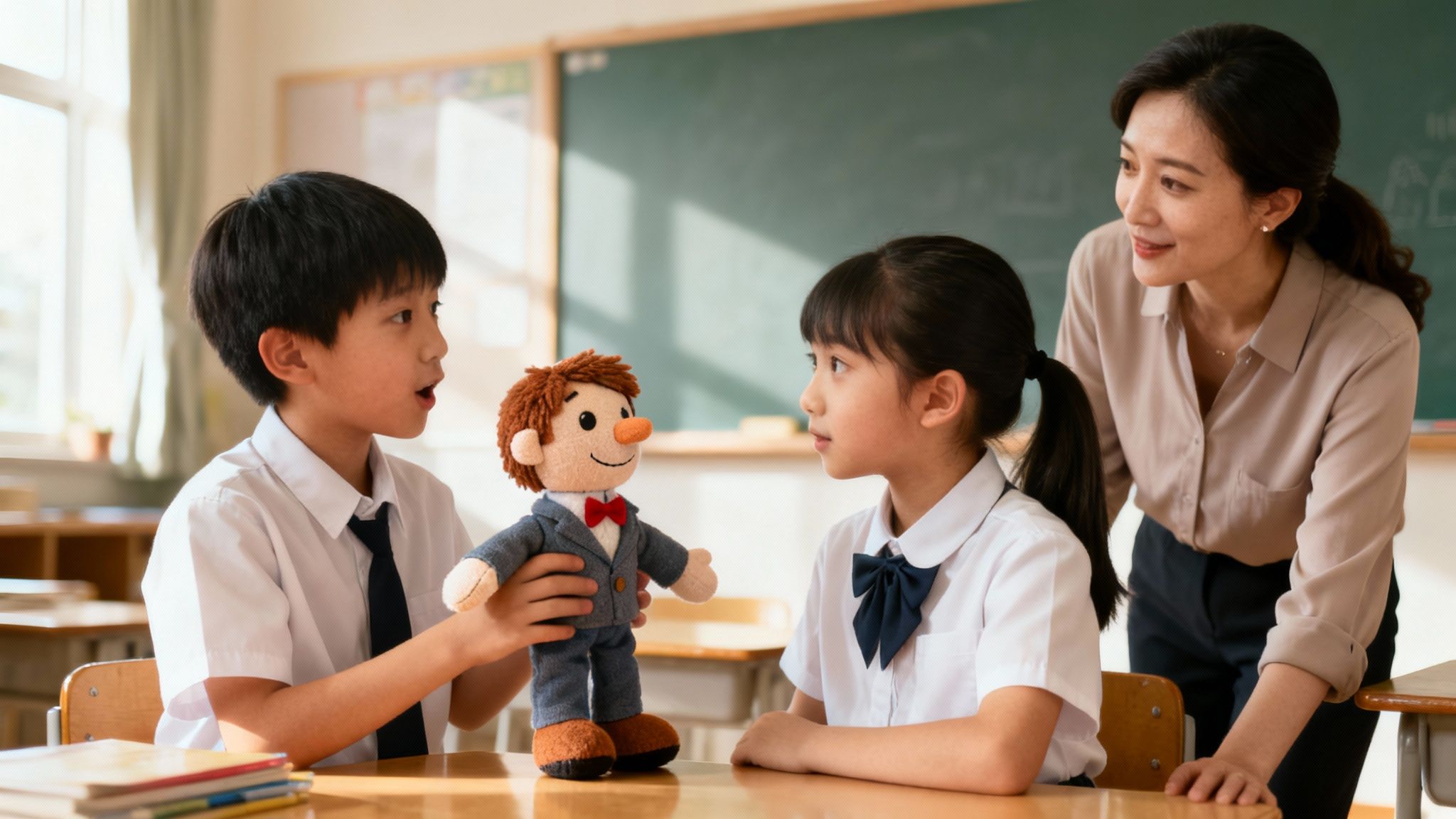
Then have students role-play with puppets or picture cards.
Grades 3 to 5 lesson idea
Give students a common school scenario: one student feels left out of a game, another says the teams were already set.
Ask pairs to practice:
speaker statement
listener paraphrase
solution brainstorm
closing acknowledgment
Middle grades adaptation
Use realistic conflicts: group work, social exclusion, rumor repair, seat disputes, digital misunderstandings that spill into school.
Students usually need less simplification and more credibility. Keep the process direct. Avoid babyish language.
Build it into classroom culture, not just crisis response
Teachers get better results when conflict resolution shows up before there’s conflict.
The classroom is where the system becomes real. If students only encounter conflict resolution language in assemblies or counseling sessions, they won’t use it when it counts.
Empowering Students with Peer Mediation and Restorative Practices
When adults handle every disagreement, students may comply, but they don’t become peacemakers. A school shifts culture when students learn that they can help hold the community together.
Peer mediation is one of the clearest ways to make that shift visible.
A well-run peer mediation program doesn’t ask children to manage unsafe situations or serious harm on their own. It gives trained students a role in resolving everyday disputes that are appropriate for peer support. That usually includes friendship tension, misunderstandings, line-cutting complaints, recess disagreements, and low-level social conflict.
The results are strong. A meta-analytic review summarized in the Civil Mediation Council report on resolving conflict in schools found a 93% agreement rate across 4,327 mediations. In schools with peer mediation programs, 77.5% reported less staff time spent sorting out conflict and 63.5% reported calmer playgrounds. One documented service managed 135 student conflict cases, and 59 of those could have led to permanent exclusion or prosecution without that support.
What student mediators need to learn
Peer mediators don’t need to sound like miniature lawyers. They need a few well-practiced habits.
Train students to do these things well:
Stay neutral: No taking sides, even when one student seems more persuasive.
Use a structure: Open, hear each side, identify the problem, brainstorm, agree on next steps.
Protect privacy: Explain what stays in mediation and what must be reported for safety.
Know limits: Unsafe behavior, threats, coercion, and severe bullying go to adults.
Close clearly: End with a specific agreement, not vague goodwill.
A simple student mediator opening script can be:
“I’m here to help both of you talk and listen. I’m not choosing who’s right. Each person gets a turn, and we’re looking for a solution you can both agree to.”
How to launch without overcomplicating it
Start smaller than you think. A pilot with a trained group of upper elementary or middle grade students is usually more sustainable than a schoolwide splashy launch with weak adult support.
Choose:
one coordinator
a quiet meeting space
a referral process
a short training sequence
a supervision routine
Restorative practices fit naturally here too. For a broader frame on how circles, repair conversations, and accountability can work alongside mediation, this overview of restorative practices in education is a helpful companion.
Here’s a short look at peer-led conflict support in action:
Use circles to strengthen the ground before harm happens
Peer mediation handles person-to-person disputes. Restorative circles help with group tension, shared impact, and community repair.
Use circles for:
class reset after a rough week
community building at the start of term
re-entry after conflict affects the whole room
reflection after exclusion or rumor spread
The mistake schools make is using circles only after things go wrong. Students need experience with turn-taking, listening, and respectful disagreement in lower-stakes moments first.
The trade-off that matters
Student leadership is powerful, but it’s not self-sustaining. Peer mediation programs need adult coordination, regular practice, and visible trust from staff. When schools announce the program and then stop tending to it, students quickly notice that the adults don’t really believe in it.
When schools do tend to it, students stop being passive recipients of discipline and start becoming active participants in school culture.
Building Community Buy-In with Staff Training and Family Engagement
A conflict resolution model only works when adults use the same language often enough that students can predict it. If the classroom teacher coaches repair, the recess aide threatens punishment, and the family only hears about incidents after the fact, the program won’t hold.
That’s why buy-in is not a side task. It is the implementation work.
The sustainability challenge is real. The Rutgers Policy Lab discussion of conflict resolution on the playground notes that many initiatives fade after initial grants because ongoing teacher training and school buy-in are missing, and it reports that dropout rates can be as high as 70% in underfunded districts when programs lack continuous support and integration.
Train the adults who actually see the conflict
Schools sometimes train teachers and forget everyone else. But students often practice their worst conflict habits in transition spaces.
Aides and noon supervisors: quick coaching language for common disputes
Office staff: calm intake when students arrive upset
Administrators: alignment between discipline and repair
Specialists and after-school staff: consistent language across settings
Keep the training concrete. Adults should leave with sentence stems, referral rules, and examples from real school situations.
A useful staff reminder card might include:
“Pause. Regulate first.”
“Name what you see without blame.”
“Have each student state impact.”
“Guide paraphrasing.”
“Decide whether this is classroom, targeted, or administrative support.”
Give families language they can recognize and reuse
Family engagement works best when schools avoid jargon. Most caregivers don’t need a long explanation of frameworks. They need to know what their child is learning and how to reinforce it at home.
A short newsletter blurb can say:
This month, students are practicing how to calm down, explain what upset them, listen to another person’s perspective, and solve everyday peer conflict respectfully. You can support this at home by asking, “What happened, how did you feel, and what would repair look like?”
Offer family workshops if you can, but don’t make the program dependent on attendance. Send home scripts, short videos, and common phrases.
Schools can also strengthen family partnership by creating more welcoming entry points into school life. Practical ideas for engaging parent volunteers in school events can help leaders create the kind of relational trust that makes hard conversations easier later.
Watch for the buy-in trap
There’s a difference between verbal agreement and operational agreement.
Staff might say they support conflict resolution, then continue to:
send every disagreement to the office
skip student reflection because it takes too long
use shame-based language when stressed
treat repair as optional
That’s why leaders need walkthroughs, coaching, and follow-up. One training day won’t change habits that formed over years.
Adults don’t need perfection. They need repetition, feedback, and permission to practice the same way students do.
Measuring Success and Ensuring Long-Term Impact
If a school only measures suspensions, it misses most of the story. Conflict resolution changes often show up first in classroom flow, student language, recess tone, and how quickly adults can return students to learning.
Track outcomes that help you see both culture and implementation.
Measure both behavior and climate
A useful school dashboard usually includes a mix of these:
Compare baseline to current data, revise policy, plan next year’s onboarding
Protect the work from staff turnover
The strongest long-term move is to build conflict resolution into existing systems instead of treating it like a standalone program.
Embed it in:
new staff onboarding
classroom expectation documents
student support team meetings
family handbooks
supervision training
leadership walkthrough tools
That’s how schools keep the work from disappearing when a champion leaves.
Conflict resolution for schools lasts when it becomes part of how the school functions, not just part of what the school says it values.
If your school is building a more connected, restorative approach to student conflict, Soul Shoppe offers practical SEL workshops, assemblies, and tools that help students and adults build shared language for self-regulation, communication, and conflict resolution across the whole campus.
Conflict is an inevitable part of life, but for students, it’s a critical learning opportunity. Navigating disagreements on the playground, in the classroom, or online isn’t just about stopping a fight; it’s about building foundational skills for a successful future. The ability to listen, express needs, and solve problems collaboratively is essential for academic success and emotional well-being. When students lack these tools, small misunderstandings can escalate into significant disruptions, impacting classroom culture and individual learning.
This article moves beyond generic advice to offer 10 evidence-based, actionable conflict resolution strategies students in grades K–8 can learn and practice. For educators, administrators, and parents, this guide provides the specific resources needed to teach these vital skills effectively. Inside, you will find a comprehensive toolkit designed for immediate implementation.
Each strategy includes:
Clear summaries and step-by-step instructions.
Age-differentiated tips for elementary and middle school students.
Sample scripts and phrases to guide conversations.
Practical classroom activities and role-playing scenarios.
Direct alignment with core Social-Emotional Learning (SEL) competencies.
Our goal is to equip you with powerful frameworks that build empathy, communication, and resilience. By mastering these techniques, you can help students turn moments of conflict into opportunities for connection and personal growth, creating safer and more collaborative school communities. Let’s explore the methods that transform how students handle disagreements.
1. Restorative Circles and Peer Conferencing
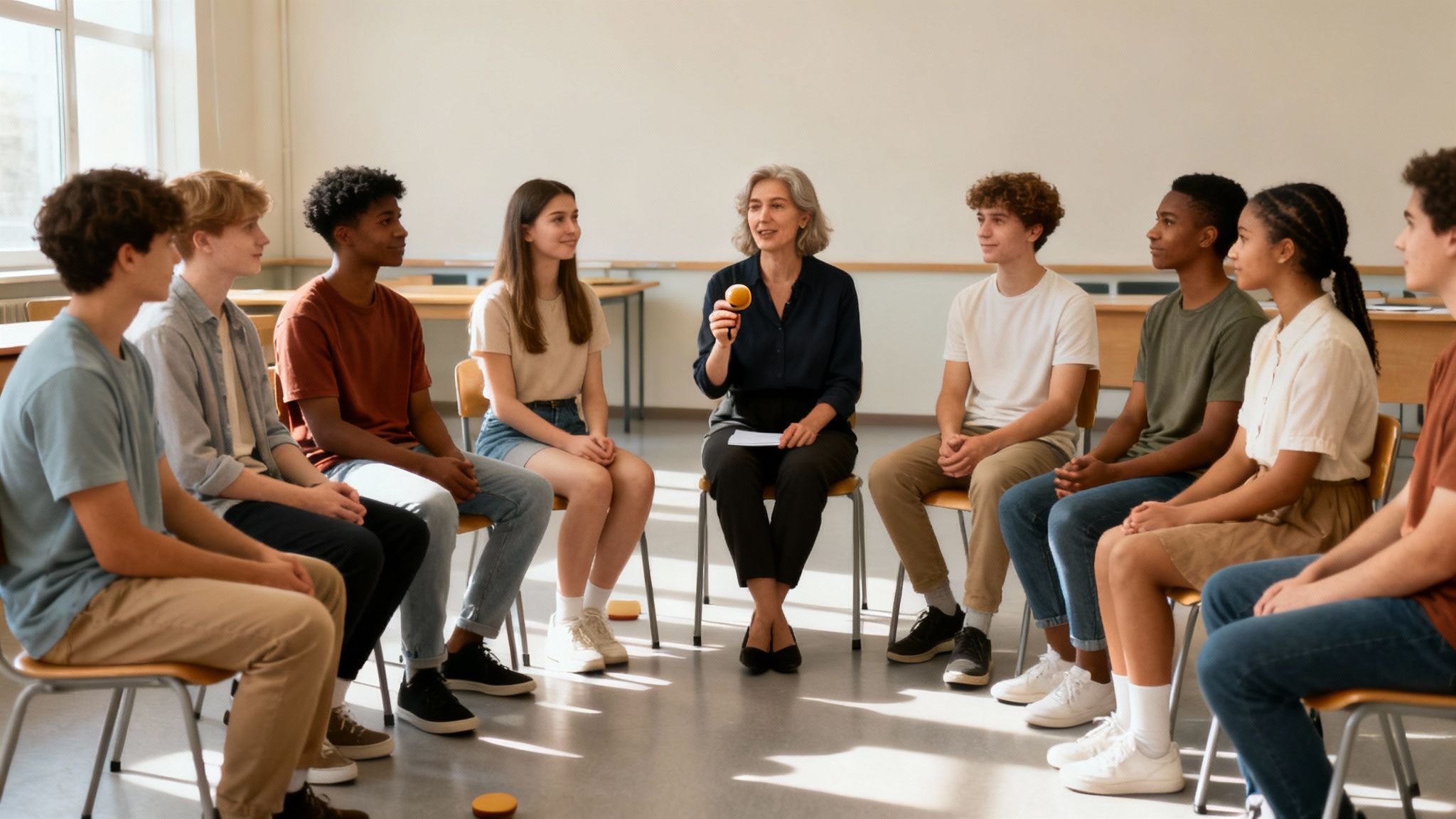
Restorative Circles are structured, supportive discussions that bring students together to address conflicts and their impact. Instead of focusing on punishment, this approach prioritizes repairing harm, understanding different perspectives, and rebuilding relationships. Students, along with a trained facilitator, sit in a circle to share their feelings and collaboratively find a path forward.
This method shifts the focus from “Who is to blame?” to “What happened, who was affected, and how can we make things right?” Peer conferencing is a related, often less formal, version where students mediate disagreements among themselves, guided by restorative principles. This is a powerful conflict resolution strategy for students because it builds empathy and community accountability.
Practical Example: Two students, Maya and Liam, had an argument over a group project, and Maya told other classmates not to work with Liam. A teacher facilitates a restorative circle with Maya, Liam, and two affected classmates. Using a talking piece, Maya shares she was frustrated Liam wasn’t contributing. Liam explains he was confused about his role. The classmates share they felt caught in the middle. They agree on a plan for clear roles in the next project and Maya apologizes for excluding Liam.
Why It Works
Restorative practices give students a voice and a sense of ownership over the solution. This process is highly effective for addressing issues like misunderstandings, exclusion, and minor physical conflicts. The Oakland Unified School District, for example, saw a 34% reduction in suspensions after implementing restorative justice programs. The focus on repairing relationships helps prevent future conflicts and strengthens the overall school climate. These circles are most effective for conflicts where ongoing relationships are important, such as between classmates or friends.
Establish clear guidelines: Co-create circle norms with students, such as “Speak from the heart,” “Listen with respect,” and “Honor the talking piece.”
Use a talking piece: Pass an object around the circle; only the person holding it may speak. This ensures everyone gets an uninterrupted turn.
Begin with low-stakes topics: Build student confidence by using circles for community-building before tackling serious conflicts. You can explore a variety of classroom community-building activities to get started.
2. Mindfulness-Based Conflict De-escalation
Mindfulness-Based Conflict De-escalation teaches students to use awareness techniques, such as focused breathing and body scans, to manage intense emotions during a conflict. This approach helps students pause before reacting impulsively, giving their prefrontal cortex time to engage in thoughtful problem-solving instead of a fight-or-flight response. It creates the internal space needed for constructive dialogue and is a foundational conflict resolution strategy for students.
By learning to recognize their physiological stress signals, students can self-regulate and approach disagreements with a calmer, clearer mind. Instead of escalating a situation, they learn to de-escalate their own emotional state first. This shift from reactionary behavior to a mindful response empowers students to handle friction more effectively and independently.
Practical Example: Two second-graders, Alex and Ben, both grab for the last red marker. Alex starts to cry, and Ben clenches his fists. Their teacher, noticing the rising tension, says, “Let’s both try ‘square breathing’.” She guides them: “Breathe in for four counts, hold for four, breathe out for four, hold for four.” After a few rounds, they are visibly calmer. The teacher can then ask, “Okay, what is the problem we need to solve with this one red marker?”
Why It Works
Mindfulness directly addresses the neurobiology of conflict by calming the amygdala, the brain’s emotional center. This strategy is highly effective for students who struggle with impulsivity, anger, or anxiety. For instance, San Francisco schools implementing mindfulness programs reported an 18% decrease in suspensions. By practicing mindfulness during calm moments, students build the “muscle memory” needed to access these skills under stress. This approach is best for de-escalating emotionally charged situations before a more structured resolution process, like a restorative circle, can begin.
How to Implement It
Start small and be consistent: Introduce short, 2-3 minute mindfulness practices during calm parts of the day. Consistency is more important than duration.
Use child-friendly language: Frame techniques with accessible terms. For example, use “belly breathing” (placing a hand on the stomach to feel it rise and fall) or describe a “calm body” (noticing stillness from toes to head).
Model the behavior: Demonstrate mindfulness yourself when you feel stressed. Saying, “I’m feeling frustrated, so I’m going to take three deep breaths,” builds credibility and normalizes the practice.
Create visual cues: Use posters of breathing techniques or a designated “calm-down corner” as reminders. You can find a variety of calming activities for the classroom to get started.
3. Collaborative Problem-Solving (CPS) Model
The Collaborative Problem-Solving (CPS) model is a structured approach that shifts the focus from winning an argument to working together to find a mutually agreeable solution. Developed by Dr. Ross Greene, this method operates on the principle that conflicts arise from unsolved problems or unmet needs. Instead of focusing on conflicting positions, students learn to identify the underlying concerns driving the disagreement.
This model guides students through a clear, three-step process: defining the problem from both perspectives, brainstorming potential solutions without judgment, and evaluating the options to choose one that works for everyone. As one of the most effective conflict resolution strategies for students, CPS empowers them to see conflict as a shared problem to be solved, not a battle to be won. It builds critical thinking and empathy by requiring them to understand and articulate another person’s point of view.
Practical Example: Two friends constantly argue about what game to play at recess. A parent or teacher guides them through CPS.
Empathy: The adult asks each child, “What’s the hardest part for you about choosing a game at recess?” One says, “I never get to play what I want.” The other says, “I don’t like running games.”
Define the Problem: The adult summarizes, “So, the problem is we need to find a game you both enjoy and feel you have a choice in.”
Brainstorm: They list all ideas: tag, drawing, building, rock-paper-scissors to decide, taking turns. They agree to try taking turns choosing the game each day.
Why It Works
CPS is highly effective because it moves students away from blame and towards practical solutions. By focusing on identifying “unsolved problems,” it depersonalizes the conflict. This method works well for recurring disagreements, such as arguments over classroom materials, group work disputes, or social exclusion. Schools that implement CPS often see a reduction in behavioral referrals and an increase in prosocial behaviors because students are equipped with a concrete tool to manage their own conflicts. The model is most effective for disputes where a tangible solution can be reached.
How to Implement It
Teach the three steps explicitly: Before using it in a real conflict, explicitly teach the steps: (1) Empathy and Understanding, (2) Defining the Problem, and (3) Invitation to Brainstorm. Use role-playing to practice.
Use neutral, guiding language: Frame the conversation with questions like, “What’s getting in the way for you?” or “I’ve noticed we have a hard time when…” This avoids blame.
Write down all ideas: During the brainstorming phase, write down every suggested solution, even silly ones. This validates all contributions and encourages creative thinking.
Evaluate solutions collaboratively: Guide students to assess the brainstormed list by asking, “Is this realistic? Does this work for both of you?” The chosen solution must be mutually agreeable. This process reinforces important communication skills and activities that are essential for success.
4. Peer Mediation and Student Leaders
Peer mediation is a conflict resolution strategy that trains designated student leaders to facilitate productive conversations between their peers. Instead of relying on adult intervention, trained student mediators guide conflicting parties through a structured process to express their concerns, understand each other’s perspectives, and collaboratively develop a solution. This approach empowers students to resolve their own disputes constructively.
This strategy leverages positive peer influence and builds a school culture where students take responsibility for their community. It reduces the burden on teachers and administrators while fostering essential life skills like leadership, empathy, and active listening in the student mediators and their peers. Peer mediation is one of the most effective conflict resolution strategies students can learn because it places them at the center of the solution-building process.
Practical Example: During a kickball game, two students argue over whether a player was out. Instead of a teacher intervening, they go to the “Peace Corner” where two trained fifth-grade peer mediators are on duty. The mediators ask each student to state their side of the story without interruption. They then help the students brainstorm solutions, like a “re-do” of the play or agreeing on a student umpire for the rest of the game. The students agree on a re-do and shake hands.
Why It Works
Peer mediation is highly effective for interpersonal conflicts, such as rumors, social exclusion, or disagreements over shared resources. Because mediators are students themselves, they often have a deeper understanding of the social dynamics at play. Programs in schools frequently report resolution rates of 50-60%, demonstrating that students can successfully manage playground disputes and relationship conflicts when given the proper tools. This approach is most effective when both parties are willing to participate and seek a mutually agreeable outcome.
How to Implement It
Recruit and train diverse mediators: Select a group of student leaders who represent the school’s diverse demographics. Provide them with at least 20 hours of foundational training in active listening, impartiality, and the mediation process.
Establish a clear referral system: Create a simple process for students to request mediation. This could involve a referral box in the counselor’s office or a simple online form.
Define ethical guidelines: Ensure mediators and participants understand and agree to confidentiality rules to build trust in the process. Mediators should only break confidentiality if there is a risk of harm.
Provide ongoing support: Schedule regular debrief sessions for mediators to discuss challenges and share successes. Offer ongoing coaching and celebrate their valuable contributions to the school community. For more guidance, you can learn how to empower students to find solutions with dedicated programs.
Social-Emotional Learning (SEL) is the process of developing the self-awareness, self-control, and interpersonal skills vital for school, work, and life success. Integrating an SEL curriculum directly into classroom instruction provides students with the foundational tools to navigate their emotions and relationships. It teaches core competencies like self-management, social awareness, and responsible decision-making, which are the building blocks of effective conflict resolution.
This approach treats conflict resolution not as an isolated skill but as an outcome of holistic emotional intelligence. Instead of only reacting to problems, SEL proactively equips students with the empathy, communication skills, and emotional regulation needed to prevent many conflicts from starting. When disputes do arise, students are better prepared to handle them constructively. This is one of the most foundational conflict resolution strategies students can develop, as it underpins all other techniques.
Practical Example: A third-grade class begins each day with a “morning meeting.” Today’s topic is responsible decision-making. The teacher presents a scenario: “You see a classmate take a pencil from the teacher’s desk. What are your options? What are the consequences of each option?” Students discuss the dilemma in small groups, practicing how to think through a problem before acting. This proactive lesson gives them a mental script for a real-life ethical conflict.
Why It Works
SEL integration creates a school-wide culture of respect and understanding. By embedding these skills into daily academic life, students learn to apply them in real-time. Research from CASEL shows that students receiving quality SEL instruction have better academic outcomes and improved behavior. For instance, schools using the Second Step curriculum have reported a 25% reduction in physical aggression. SEL is most effective when it is a consistent, school-wide initiative, not just a one-off lesson, creating a common language for students and staff to discuss feelings and solve problems.
How to Implement It
Select an evidence-based curriculum: Choose a program like those from CASEL or Positive Action that aligns with your school’s values and has a proven track record.
Provide comprehensive training: Equip all staff, not just teachers, with the skills and language to model and reinforce SEL competencies consistently.
Integrate, don’t isolate: Weave SEL concepts into core subjects like literature, history, and science. A character’s dilemma in a story, for example, can become a lesson in empathy and perspective-taking.
Engage families: Offer resources and workshops to help parents and caregivers reinforce SEL skills at home. Integrating social-emotional learning into the curriculum is crucial for developing students’ conflict resolution skills, and exploring social-emotional learning platforms like saucial.app can significantly enhance student development.
6. Empathy-Building and Perspective-Taking Exercises
Empathy-building and perspective-taking exercises are structured activities designed to help students understand the viewpoints, feelings, and experiences of others. Instead of reacting defensively, students learn to step into someone else’s shoes through role-plays, storytelling, and empathy interviews. This foundational skill builds compassion and shifts conflicts from competitive battles to cooperative problem-solving.
This approach transforms conflict resolution strategies for students by moving beyond simple behavioral rules and nurturing the emotional intelligence needed to truly understand a situation. By practicing empathy, students develop a crucial life skill that allows them to see the humanity in others, even during a disagreement.
Practical Example: A teacher reads a story where a character feels left out. Afterward, she asks the class, “Has anyone ever felt like that character? What does it feel like in your body when you are left out?” Students share experiences, building a shared understanding of that emotion. Later, when a student is excluded on the playground, the supervising adult can say, “Remember how we talked about feeling left out? How do you think Sarah is feeling right now?” This connects the abstract lesson to a real-life situation.
Why It Works
Empathy is the antidote to judgment and anger. When students can accurately imagine what another person is feeling, they are less likely to escalate conflicts and more willing to find mutually agreeable solutions. These exercises are particularly effective for addressing bullying, social exclusion, and misunderstandings rooted in different cultural or personal backgrounds. For instance, a middle school might use “empathy interviews,” where conflicting students ask each other structured questions to understand their differing perspectives on a shared problem. This process, popularized by thinkers like Marshall Rosenberg and researchers like Brené Brown, validates feelings and opens the door to genuine resolution.
How to Implement It
Start with fictional scenarios: Before tackling real conflicts, use stories or hypothetical situations. Ask, “How do you think the character felt when that happened?”
Use props for younger students: Puppets or stuffed animals can help K-2 students act out different perspectives without feeling self-conscious. A simple puppet show can powerfully demonstrate how two characters can see the same event differently.
Incorporate role-playing: Have students switch roles in a conflict scenario. Debrief afterward by asking reflective questions like, “What was it like to be in their shoes?” and “What did you learn about their point of view?”
Connect to literature: Use books and stories featuring diverse characters to spark discussions about different life experiences and feelings. Ask students to write a diary entry from a character’s perspective.
Teach “I-statements” with feeling words: Combine perspective-taking with clear communication. Instead of “You made me mad,” encourage “I felt hurt when…” to foster understanding rather than blame.
7. Nonviolent Communication (NVC) Framework
Nonviolent Communication (NVC) provides students with a powerful structure for expressing themselves and understanding others without blame or criticism. This compassionate communication model, developed by Marshall Rosenberg, breaks down dialogue into four clear components: observations (stating facts without judgment), feelings (identifying emotional responses), needs (recognizing underlying values), and requests (making specific, actionable asks).
This framework transforms confrontational language into productive conversation. Instead of saying, “You’re always hogging the ball,” a student learns to say, “I noticed I haven’t had a turn with the ball for ten minutes (observation), and I feel left out (feeling). I need to be included in the game (need). Can I have a turn next? (request).” This shift is a core element in many successful conflict resolution strategies for students, as it promotes self-awareness and empathy.
Practical Example: A middle schooler is upset because their friend shared a secret.
Instead of: “I can’t believe you told everyone! You’re a terrible friend.”
Using NVC: “When I heard you told Jessica what I said about my parents (observation), I felt really hurt and embarrassed (feeling). I need to be able to trust my friends with my private thoughts (need). Would you be willing to agree not to share my secrets in the future? (request).”
Why It Works
NVC works by de-escalating conflict and focusing on the universal human needs behind actions. It separates the person from the behavior, allowing students to address issues without attacking each other’s character. Successful NVC heavily relies on active listening and participation, moving beyond passive reception to truly engage with and understand others’ perspectives. It’s especially effective for interpersonal disputes, disagreements over resources, and situations where strong emotions are involved, as it provides a clear, repeatable script for navigating difficult feelings.
How to Implement It
Build vocabulary: Begin by explicitly teaching students a wide range of words for feelings and needs. Create “Feelings Wheels” or “Needs Inventories” and post them in the classroom for reference.
Use a simple script: Introduce a youth-friendly sentence frame like, “I noticed…, and I feel… because I need… Would you be willing to…?”
Practice with low-stakes scenarios: Use role-play cards with everyday situations (e.g., someone cutting in line, a friend not sharing a toy) to help students build muscle memory before tackling real conflicts.
Model consistently: Adults in the school should model NVC in their interactions with students and each other. This authenticity shows students that it is a valued communication tool for everyone. The Center for Nonviolent Communication offers a wealth of resources for educators.
8. Buddy and Mentorship Systems
Buddy and mentorship systems are structured programs that pair older students with younger ones or peers with classmates needing support. These relationships create natural opportunities for conflict prevention by fostering connection, belonging, and positive role modeling. A mentor can guide their mentee through social challenges, offering a safe and trusted perspective.
This strategy shifts the dynamic from adult intervention to peer-led support. A fourth grader paired with a first grader can help them navigate playground rules, or a new middle schooler can be matched with an eighth-grade mentor to ease their transition. These programs are powerful conflict resolution strategies for students because they build empathy and develop leadership skills while reducing feelings of isolation that often lead to conflict.
Practical Example: A school pairs every third-grader with a kindergartener as “reading buddies.” They meet once a week to read together. One day, a kindergartener is upset because another child won’t share the building blocks. Instead of running to a teacher, they find their third-grade buddy. The buddy helps them practice “I-statements” and walks with them to talk to the other child. The buddy’s presence provides the confidence the younger student needs to resolve the problem peacefully.
Why It Works
Mentorship provides a protective factor for vulnerable students and gives mentors a sense of purpose and responsibility. By modeling healthy communication and problem-solving, mentors help their mentees build the confidence to handle disagreements constructively. These programs are highly effective for supporting students new to the school, those with a history of behavioral challenges, or any child who could benefit from a positive connection. School-based mentoring programs have been shown to improve attendance, attitudes towards school, and social-emotional skills.
How to Implement It
Provide clear mentor training: Equip mentors with essential skills like active listening, setting boundaries, and knowing when to get an adult’s help.
Create structured activities: Plan initial meetings with specific activities or conversation starters, such as “Two Truths and a Lie” or creating a shared “All About Us” poster.
Establish regular check-ins: Schedule brief, consistent check-ins for mentors with a supervising adult to discuss progress, troubleshoot challenges, and feel supported.
Celebrate successes: Publicly acknowledge the positive impact of your mentors. This can be done through school announcements, certificates, or a special recognition event. Consider programs like Soul Shoppe’s junior leader development for a structured approach.
9. Classroom Agreements and Community Norms
Classroom Agreements are a set of co-created guidelines that establish shared expectations for how community members will treat each other and navigate disagreements. Instead of a list of rules imposed by an adult, this approach involves students in a collaborative process to define their own behavioral standards and conflict resolution protocols. This fosters a sense of ownership and collective responsibility for maintaining a positive classroom environment.
This strategy shifts the dynamic from adult-enforced compliance to community-led accountability. When conflicts arise, the agreements serve as an objective, shared reference point. This approach is a cornerstone of conflict resolution strategies for students because it empowers them to hold themselves and their peers accountable to standards they helped create, grounding solutions in community values.
Practical Example: At the start of the year, a teacher asks students, “How do we want our classroom to feel?” They brainstorm words like “safe,” “fun,” and “respected.” Then she asks, “What can we agree to do to make it feel that way?” The students create agreements like, “We listen when someone is talking,” and “We use kind words.” Two weeks later, one student interrupts another. The teacher can gently say, “Let’s check our agreements. Which one can help us right now?” This empowers students to self-correct based on their own rules.
Why It Works
Student-created agreements build intrinsic motivation for positive behavior and give students a framework for addressing problems respectfully. This process is highly effective for preventing common classroom conflicts like interrupting, disrespect, or exclusion. The Responsive Classroom approach, which heavily incorporates this practice, has been shown to improve social skills and academic performance. The agreements are most effective when they are treated as a living document, referenced daily and revised as needed to address the evolving needs of the classroom community.
How to Implement It
Frame the process positively: Guide students to create agreements about how they will treat each other, not just a list of “don’ts.” For example, frame it as “We listen to understand” instead of “Don’t interrupt.”
Facilitate, don’t dictate: Ask guiding questions like, “How do we want to feel in our classroom?” and “What can we agree to do to make sure everyone feels that way?”
Make them visible: Have students sign the final agreement and display it prominently. Younger students can illustrate each point to reinforce understanding.
Reference them regularly: When a conflict occurs, refer back to the norms by asking, “Which of our agreements can help us solve this problem?” or “How does this action fit with our agreement to show respect?”
10. Conflict Resolution Coaching and Adult Modeling
This strategy recognizes that the most powerful teachers of conflict resolution are the adults in a student’s life. Conflict Resolution Coaching and Adult Modeling focuses on training educators and staff to demonstrate healthy, constructive ways of handling disagreements. When adults consistently model self-regulation, respectful communication, and collaborative problem-solving, students internalize these behaviors as the norm.
The approach shifts the learning from a purely theoretical exercise to a lived reality. By seeing adults openly apologize, take deep breaths when frustrated, and listen actively to opposing views, students learn that conflict is a normal part of relationships that can be navigated successfully. This creates the emotional safety and credibility for students to practice these same conflict resolution strategies students themselves.
Practical Example: A parent gets frustrated trying to help their child with a difficult math problem. Instead of snapping, the parent says, “I’m feeling my frustration rise because this is tricky. Let me take a few deep breaths. Okay, let’s try looking at the example in the book one more time together.” This models self-regulation and problem-solving instead of blame. In the classroom, a teacher whose projector isn’t working could say aloud, “This is very frustrating, but getting angry won’t fix it. I’m going to ask Mr. Davis for help, since he’s good with technology.”
Why It Works
Students learn more from what they see than what they are told. When adults model vulnerability and repair, it dismantles the perception that authority figures are perfect and makes conflict resolution feel achievable. This approach is highly effective for establishing a school-wide culture of respect and trust. It works best for creating a foundational, preventative environment where other conflict resolution strategies can flourish. Schools that emphasize adult culture change often see significant improvements in climate surveys and reductions in disciplinary incidents.
How to Implement It
Provide comprehensive staff training: Equip all staff, including administrators, teachers, and support personnel, with the same conflict resolution language and tools that students are learning, such as Nonviolent Communication (NVC) or Collaborative & Proactive Solutions (CPS).
Narrate your process: When a conflict arises, model self-awareness aloud. For example, a teacher might say, “I’m feeling frustrated right now, so I’m going to take a moment to breathe before we continue this conversation.”
Apologize and repair openly: If you make a mistake or speak harshly, model accountability. An adult could say to a student, “I was wrong to raise my voice earlier. I’m sorry. Can we try that conversation again?”
Celebrate colleague collaboration: When students witness staff members resolving a disagreement respectfully, point it out. You might mention in a class meeting, “Mr. Smith and I had different ideas for the field trip, so we sat down, listened to each other, and found a solution that worked for everyone.” This is a powerful, real-world example of conflict resolution strategies students can emulate.
Low–Medium — facilitation to create and maintain meaningful agreements
Low — class time, visual displays, periodic review
Greater student ownership; clearer expectations; fewer power struggles
Classroom-level behavior management and democratic engagement
Student-created rules increase compliance and shared responsibility
Conflict Resolution Coaching & Adult Modeling
High — culture change requiring ongoing PD and vulnerability
High — coaching, time, system-wide commitment and consistency
Improved school climate; students learn implicitly from adults; increased trust
Whole-school reform, staff culture shifts, modeling for students
Powerful implicit teaching; aligns adult behavior with student learning
Building a Culture of Peace, One Skill at a Time
Equipping students with effective conflict resolution skills is one of the most profound investments an educational community can make. Moving beyond simple behavior management, the strategies detailed in this article-from the structured dialogue of Restorative Circles to the empathetic framework of Nonviolent Communication-represent a fundamental shift in how we view interpersonal challenges. They transform conflict from a disruptive event into a valuable learning opportunity. By systematically teaching these techniques, we are not just quieting classrooms; we are nurturing a generation of thoughtful, resilient, and compassionate leaders.
The journey to a peaceful school culture is not built on a single initiative but on a layered, integrated approach. The true power of these conflict resolution strategies for students is realized when they become part of the school’s DNA, woven into daily interactions, curriculum, and community norms.
From Theory to Daily Practice
The ultimate goal is to move these concepts off the page and into the lived experiences of students. This requires consistent reinforcement and a commitment from all adults in the community.
Consistency is Key: A one-time assembly on bullying or a single lesson on “I-Statements” is not enough. For these skills to stick, they must be practiced regularly, whether through weekly classroom meetings, daily mindfulness moments, or consistent use of shared language by all staff.
Adult Modeling is Non-Negotiable: Students learn more from what we do than what we say. When a teacher models Collaborative Problem-Solving with a frustrated student or a principal uses restorative questions to address a hallway dispute, it sends a powerful message. Every adult interaction becomes a lesson in respectful conflict resolution.
Empowerment Over Punishment: Shifting from a punitive to a restorative mindset is crucial. Instead of asking “Who is to blame and what is the punishment?”, we start asking “What happened, who was affected, and what needs to be done to make things right?”. This empowers students to take ownership of their actions and repair harm, fostering accountability and empathy.
The Lasting Impact of Conflict Competence
The benefits of mastering these skills extend far beyond the school gates. Students who learn to navigate disagreements constructively are better prepared for the complexities of higher education, the collaborative demands of the modern workplace, and the inevitable challenges of personal relationships. They develop stronger self-awareness, greater empathy for others, and the confidence to advocate for their needs peacefully.
By investing in these foundational skills, we are providing students with a toolkit for life. We are teaching them that their voice matters, that understanding others is a strength, and that problems can be solved together. This is the core of social-emotional learning and the bedrock of a healthy, functioning society.
Ultimately, building a culture of peace is an ongoing process, not a destination. It requires patience, dedication, and a shared belief that every student has the capacity to learn, grow, and contribute to a more harmonious world. The tools and strategies outlined here provide a clear roadmap for that journey. By committing to this work, we are not just creating better schools-we are actively building a better future, one peaceful resolution at a time.
Ready to bring a dynamic, experiential approach to social-emotional learning and conflict resolution to your school? The experts at Soul Shoppe provide powerful assemblies, in-class workshops, and professional development that transform school culture by giving students the tools they need to solve problems peacefully. Discover how Soul Shoppe can help you build a community of empowered, empathetic, and resilient learners.