Soul Shoppe's work is made possible by donors and partners who care deeply about the young people in their communities! We can't do this work without you. Support our work in classrooms and on playgrounds across the nation by donating here.
A child comes home quiet after school. They shrug at dinner, snap at a sibling over a small comment, then melt into tears when a backpack zipper sticks. Most adults see “a bad mood,” but children usually need something simpler and kinder, a name for what they feel, plus a clue about what to do next.
Words for emotions help children connect body signals, experiences, needs, and choices without treating feelings as good or bad. That matters because emotion language is learnable, and research shows it can be measured at scale, compared across ages, and linked with well-being and distress. It also matters because the words people use for feelings have changed over time, which means children are not just memorizing labels, they're learning a social language for inner life, as historical work on English emotion words shows (historical overview of emotion words, emotion vocabulary and well-being study).
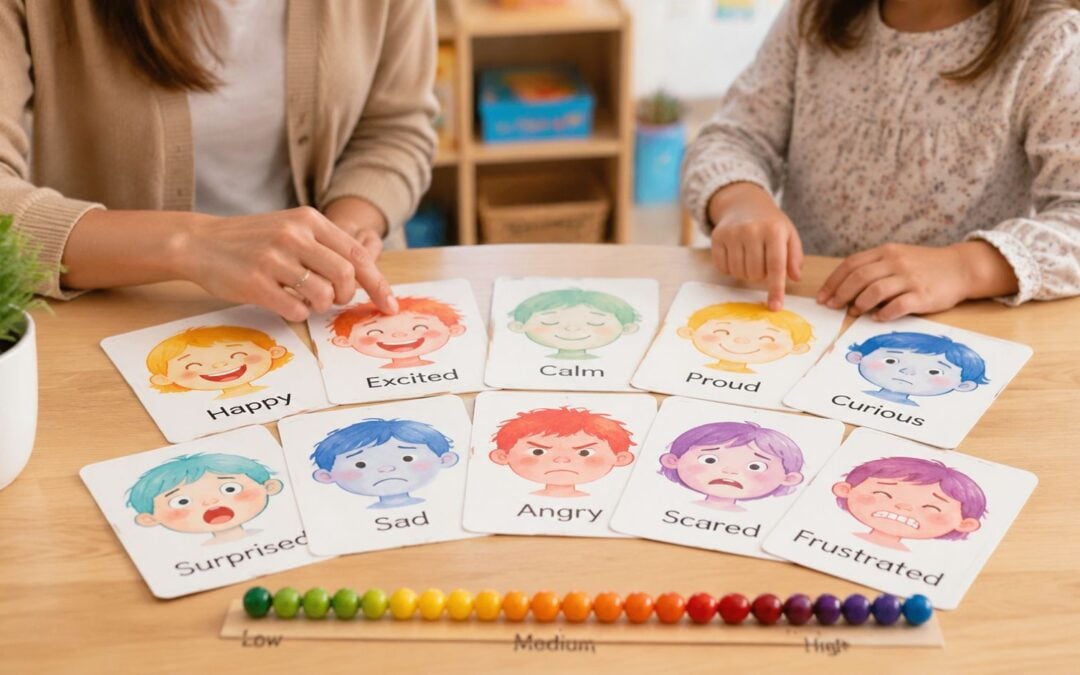
For K–8 learners, the best path starts with broad feeling words, then adds more precise labels, body cues, and context. Younger children usually need direct teaching and repeated practice, because emotion-specific vocabulary grows quickly in early childhood and then becomes more nuanced later, and instruction that targets specific feelings in context works better than just handing kids a list (children's emotion vocabulary development, emotion-specific vocabulary and comprehension). Keep that in mind as you move through these core words. Each one can become part of a calm classroom routine, a family check-in, or a printable chart children can use.
1. Happy
Happy is the easiest place to begin because children already recognize it in faces, voices, and movement. A happy child may smile, laugh, bounce, clap, or talk more freely, but happiness also shows up as quiet contentment, like settling comfortably into a favorite book. Adults can help children notice that happiness is not only “big joy,” it's also a steady sense that something feels right.
What happiness looks like in everyday life
A child might bounce when they hear they earned extra recess. A class might cheer when a peer finally masters a hard concept. At home, a child might grin through dinner after hearing good news from a grandparent. In each case, the feeling is visible, but the reason matters too.
Use simple prompts that connect body and meaning. You might say, “Your smile tells me you're feeling happy,” or, “I can see your shoulders got lighter when that happened.” In a classroom chart, a happy face or thumbs up gives younger children a quick visual match for the word. At the family table, ask, “What made you feel happy today?” and let the child answer in their own words.
Practical rule: Notice happiness without overexplaining it. When adults name it calmly, children learn that positive emotion can be recognized, shared, and remembered.
For a teacher-friendly extension, positive thinking exercises can pair well with a short gratitude moment, a celebration circle, or a “good news” share. how to tell happiness from joy can also help adults think more carefully about related words, especially when older students start asking why two positive feelings do not always feel the same.
2. Sad
Sad names sorrow, disappointment, or grief, and it deserves just as much teaching time as happy. Children need to know that sadness is normal, not a problem to hide. When adults treat sadness as welcome information, kids learn that difficult feelings can be handled without shame.
A student might tear up after losing a game. A child may feel heavy after a pet dies or a friend moves away. Another student might go quiet after critical feedback on schoolwork. Sadness often shows up as a slower body, lower voice, less eye contact, or pulling away from noise and conversation.
How to respond without rushing
Start by making room for the feeling. Say, “It's okay to feel sad when something didn't go the way you hoped.” Then pause. Many adults try to fix sadness too quickly, but children often need a calm witness before they need advice.
A few helpful supports fit naturally at school or home.
Name the cause: Ask, “What are you feeling sad about?” so the child can separate the feeling from the event.
Offer quiet support: Sit nearby, draw together, or let the child cry if needed.
Give choices for expression: Journaling, sketching, talking, or a trusted adult check-in can all help.
Make space for recovery: A feelings corner, a cozy chair, or a quiet hallway reset can help children return when they're ready.
Sadness becomes easier to carry when adults don't treat it as a behavior to stop. It's a feeling to understand, and often a sign that something mattered significantly.
3. Angry
Angry is a powerful word, and children usually learn it early because the feeling is easy to spot. Anger can show up when a child feels threatened, disrespected, blocked, or unheard. It also often covers other feelings, like hurt, fear, or frustration, so the word opens the door to deeper understanding rather than ending the conversation.
Helping children catch anger early
A child might slam a pencil after making a mistake. Another might yell when a peer cuts in line. Some children throw materials, clench fists, or speak in a sharp voice when they've hit their limit. The goal is not to shame the feeling, it's to teach children to notice it before it takes over.
An anger thermometer works well for that. You can teach levels early, before the feeling reaches a breaking point. A child at level 2 or 3 might still be able to breathe, move, or ask for help. At higher levels, the body is flooded, and learning pauses.
Try phrases that separate feeling from behavior.
I see you're angry, and we don't hit.
That sentence keeps the limit clear while still naming the emotion. During calm moments, build an anger action plan together. It can include a signal, a breathing reset, a water break, or a short walk to cool down. For more classroom-ready guidance, anger management for kids can support consistent language between school and home.
What anger may be hiding
Sometimes the underlying question is not “Why are you angry?” but “What got hurt underneath?” A child may be angry because they felt left out, embarrassed, or frightened. When adults ask gently, “Are you angry because you felt left out?” they help children move from reaction to reflection. That shift is a major step in self-regulation.
4. Scared or Afraid
Scared and afraid are protective words. They tell us a child's body thinks something might be unsafe, even when the threat is social, new, or imagined rather than physical. Fear can look mild, like hesitation, or intense, like freezing, clinging, or refusing to move.
A child may get quiet before presenting in front of the class. Another might cling to a teacher on the first day of school. Some children refuse to go to the bathroom alone, and others worry about failing a test or disappointing adults. Those behaviors can look oppositional from the outside, but fear is often the engine underneath them.
Building courage in small steps
The most useful response is calm validation. Say, “I notice you're feeling scared about this.” Then help the child name the fear more specifically. Vague fear gets easier to handle once it has a shape.
Children also do better when adults model courage in small, honest ways. You can say, “I get nervous before new groups too, so I take a breath and check my plan.” That kind of sentence makes fear manageable instead of mysterious.
A few supports help children move forward without pressure.
Use grounding: Try a 5 senses check-in or slow breathing.
Make a safety plan: Ask, “What would help you feel safer?”
Break the step apart: Let the child practice one piece at a time.
Avoid force: Pushing a child hard into fear usually makes the fear stronger.
For more ideas, anxiety coping skills for kids pairs well with short, repeatable routines that children can remember in the moment.
Fear needs respect, not punishment. When adults treat it as information, children can build courage instead of avoidance.
5. Frustrated
Frustrated is one of the most useful emotion words for school because it points to blocked effort. Unlike anger, frustration usually means the problem is the task, the delay, or the obstacle. That distinction helps children move from blame to problem-solving.
A child might sigh heavily over a hard math problem. Another may get upset when a block tower keeps falling down. Some children feel frustrated because they can't tie their shoes yet, and others react when a game doesn't turn out the way they planned. The feeling often shows up in the hands, shoulders, and voice before children can explain it.
Teaching the frustration pause
The goal is not to erase frustration. It's to help children stay inside it long enough to keep trying. A simple line like, “This is tricky, and it makes sense you're frustrated,” gives the child both empathy and direction.
Teach a frustration pause. The child stops, breathes, and decides what to try next. That can be as small as checking the first step again or asking for a hint. It works best when adults model it out loud.
You might say, “I'm frustrated too, so I'm going to reread the directions.” That sentence shows children that adults don't magically avoid frustration, they manage it.
A quick classroom or home routine can include:
Break it down: Divide a hard task into smaller steps.
Ask a support question: “What could help?”
Praise persistence: Notice effort, not only success.
Name the situation: Help children see that a blocked task is not the same as a personal failure.
When children build frustration tolerance, they get better at math, writing, building, sharing, and repairing friendships. They also learn that hard feelings can sit beside hard work.
6. Nervous or Anxious
Nervous and anxious both point to worry about what might happen next. The difference often lies in intensity and duration, but for children, both words matter because they help separate useful caution from unhelpful fear spirals. A nervous child may still move forward. An anxious child may get stuck.
A stomachache before a test, trouble sleeping before a field trip, worrying about making friends in a new class, or repeatedly asking “What if something goes wrong?” are all common signs. Children often feel the body cue before they know the word. That makes language especially important.
Making worry more specific
Start with reassurance that matches the moment. “Your body is preparing you, but you're safe,” is honest and calming. Then invite the child to name one specific worry rather than carrying a cloud of worry all at once.
A simple structure helps: what event is coming, what feels uncertain, and what part can be planned. If a child worries about an assembly, walk through the schedule. If a student worries about a test, review the format and the support they'll get.
For classroom and home practice, use:
5-4-3-2-1 sensory awareness
Slow breathing
Progressive muscle relaxation
Guided imagery
Clear previews of what comes next
Nervousness is normal before new things. But if a child's worry keeps growing, avoid brushing it off. Watch for the point where support from a counselor, school team, or pediatric professional may be needed. The word itself is a starting point, not the whole plan.
7. Excited
Excited is a high-energy positive feeling, and it often gets mistaken for happiness. The difference is timing and motion. Happiness can feel settled, while excitement points forward. A child is excited about what's coming next, and that future focus can make bodies louder, faster, and harder to regulate.
A student might bounce and talk rapidly about an upcoming field trip. A child may keep shooting their hand up because they're eager to answer. A group of children can get louder during a fun activity. Some children even lose focus in regular class after hearing exciting news, not because they're defiant, but because their energy is overflowing.
Channeling energy without shutting it down
The best response is not to dampen excitement, it's to guide it. First, name it. “I can see you're excited.” Then help the child shift that energy into something manageable.
You can say, “Show me with your body how excited you are, then let's breathe.” That gives the feeling a safe outlet without pretending it isn't there. It also teaches children that strong positive feelings need regulation too.
A few classroom-friendly supports work well:
Movement breaks before sustained seat work
Hands-on activities to use the energy
Count-to-5 resets before transitions
Excitement scales so children can notice when energy is climbing
Teachers can also use excitement as motivation. “When we focus during math, we'll have time for the exciting activity after.” That keeps the classroom calm while respecting the feeling. Children learn that enthusiasm is welcome, as long as it doesn't take over the room.
8. Embarrassed or Ashamed
Embarrassed and ashamed are social emotions, which means they are tied to how children think others see them. Mild embarrassment is normal and even useful, but shame can cut deeper. When shame becomes frequent or intense, children may stop trying, stop speaking, or avoid situations where they might be seen.
A child may look down after making a mistake in front of the class. Another may refuse to participate after being laughed at. A child might cover their face when corrected, or avoid a classmate after an awkward moment. These behaviors often hide a strong wish to disappear.
Naming the feeling without deepening it
Adults can help most by lowering the social spotlight. Offer privacy when possible. Speak kindly, and keep the correction focused on the behavior, not the child's worth. “You made a mistake. That doesn't make you bad,” is a sentence children remember because it protects dignity.
A little gentle humor can help when the adult is sharing their own embarrassing moment, but it should never be used to minimize the child. The core message is that mistakes are part of being human. For language that supports this kind of emotional naming, naming feelings and helping kids find the words they need fits naturally with a classroom culture built on safety.
Shame shrinks children. Respect helps them rejoin the group.
What to say in the moment
Try a brief, private check-in.
Name what you noticed: “I saw you look embarrassed.”
Offer a choice: “Do you want to talk, or do you want a minute?”
Separate action from identity: Focus on the moment, not the child's character.
Re-enter gently: Help the child return to the task with dignity intact.
When classrooms treat mistakes as learning moments, embarrassment loses some of its power and children become more willing to try again.
9. Disappointed
Disappointed belongs in every vocabulary set because children face it constantly. It happens when expectations aren't met or a hoped-for result doesn't arrive. The feeling can sit near sadness, anger, or frustration, which is why children often need help sorting it out.
A child might learn their favorite activity was cancelled. A student may not be chosen for a team or special role. A birthday gift may not match what they hoped for. Plans change, delays happen, and disappointment shows up fast.
Helping children sit with unmet expectations
Start with acknowledgment. “I see you're disappointed. That makes sense.” Then resist the urge to rush past the feeling. Children do learn resilience from disappointment, but only if adults let the feeling exist long enough to be understood.
Ask, “What were you hoping would happen?” That question helps children compare expectation with reality. Once the child can name that gap, you can move toward control and next steps. “We can't change this, but we can decide what to do now,” gives agency without pretending the disappointment didn't hurt.
Disappointment is a useful teaching moment for family life, too. When a birthday plan changes or a weekend outing gets delayed, adults can model their own response. “I'm disappointed too, and here's what I'll do,” shows children that disappointment is survivable and manageable.
One of the best supports is small, repeated practice with flexible plans. Children who learn to tolerate minor disappointments are often better prepared for larger ones later. They don't need perfect outcomes. They need language, repair, and a steady adult nearby.
10. Proud
Proud helps children notice accomplishment, effort, and character. Healthy pride is not the same as bragging. It says, “I did something hard, and it mattered.” That feeling supports confidence, persistence, and a stronger sense of identity.
A child may beam after finishing a difficult task. A student might stand taller when recognized for helping a classmate. Another child may show a page full of mistakes because they can see growth. A group can feel proud after working together on a project, especially when the effort mattered as much as the result.
Building pride the healthy way
The strongest pride comes from effort, values, and growth. Say, “Look how hard you worked on this,” or, “I'm proud of how you treated your friend.” Those comments point children toward choices they can repeat.
Avoid praise that only compares children to others. It can make pride depend on being better than someone else. Specific feedback works better, because it shows children exactly what they did well. “You organized your ideas clearly,” teaches more than a generic “good job.”
A good pride routine in class or at home can include a short reflection chart.
What did I work hard on?
What did I improve?
What kind choice did I make?
What do I want to keep doing?
Children who can name their own pride are less dependent on constant outside approval. They begin to notice that growth is worth celebrating even when nobody else is clapping.
Comparison of 10 Emotion Words
Emotion
Implementation complexity
Resource requirements
Expected outcomes
Ideal use cases
Key advantages
Happy
Low, simple recognition and celebration activities
Reinforces effort and values; fosters lasting motivation
Turn Emotion Words Into Everyday Practice
The strongest words for emotions routine is simple enough to repeat and detailed enough to guide action. Start with a basic feeling word, then offer a more precise synonym when the child is ready. Place the feeling on an intensity scale, notice a body cue, and choose one supportive next step. That sequence helps children move from vague reaction to usable language, which is exactly what they need in classrooms, at home, and during conflict.
A printable vocabulary chart can make that sequence visible. Use it during morning check-ins so children can point before they can fully explain. Bring it out after conflicts so students can separate what happened from what they felt. Keep it near a journal station, because written reflection often helps older children move from “mad” or “sad” to more accurate labels. Family conversations work too, especially at dinner, in the car, or after school when the day is still fresh.
The goal is not to turn children into perfect talkers about feelings. The goal is to give them enough language to recognize patterns, ask for help, and make safer choices. Naming an emotion does not excuse unsafe behavior. A child can be angry and still need to keep hands and feet safe. A child can be scared and still need to follow the plan. The word helps explain the experience, but the adult still has to hold the boundary.
That balance is where SEL becomes practical. When schools and families use the same words, children don't have to translate from one adult to another. They start to hear, “I feel frustrated when…” and “I need a break,” as normal parts of being human. Soul Shoppe's programs, courses, app, and resources fit that kind of shared language well, especially for communities that want consistent tools for self-regulation, communication, and conflict repair. You can also keep a running reflection journal for adults and students with Journal from Walling if you want a simple space to track the language children are using.
If your school, classroom, or family wants a shared emotional vocabulary that children can practice every day, visit Soul Shoppe and explore the SEL supports that help kids and grownups use words, not just reactions, to move through hard moments together.
A child cries after being bumped in line. Another stares at a group project, unable to start. A middle-school student checks a phone again and again after a friendship text goes unanswered. In each case, the feeling is real, but the child may not yet have the words or strategies to understand what's happening and respond constructively.
That's the practical answer to what is emotional literacy. It's the developing ability to recognize, understand, express, and regulate emotions in yourself and respond thoughtfully to emotions in other people. In a K–8 school, this skill appears in ordinary moments, during morning meeting, recess, partner work, dismissal, family dinner, and group chats.
A Classroom Moment That Shows Why This Matters
A third-grader is waiting in line when another student pushes ahead. Her face tightens, her hands curl, and then she bursts into tears. She can recognize that something feels wrong, but she can't yet separate anger, hurt, and unfairness, so the feeling comes out as crying and shouting.
Across the room, a fifth-grader's group project falls apart. One partner changes the plan, another stops participating, and the student freezes over the worksheet. The child may understand that the group is struggling, but doesn't know how to express, “I'm overwhelmed and I need us to choose one plan.” Without that language, withdrawal can look like defiance or disinterest.
Later, a middle-school student sends a message to a friend and receives no reply. The student reads the silence as rejection, becomes embarrassed or angry, and posts a sharp comment. The missing skills are more complex here. The student needs to recognize the emotional reaction, consider possible causes, express concern directly, and regulate the urge to respond immediately.
The four skills inside one busy day
These moments involve four connected abilities:
Recognizing: noticing body signals, facial expressions, tone, and emotional shifts.
Understanding: connecting a feeling to its cause, context, thoughts, and likely effects.
Expressing: communicating the feeling, need, or concern clearly.
Regulating: choosing a response that protects safety, learning, and relationships.
A teacher who helps the third-grader say, “I'm angry because my place was taken,” gives the child more than a vocabulary word. The teacher creates a pause between the event and the reaction. That pause can make room for a breathing strategy, a request for adult help, or a calm repair conversation.
Practical rule: Teach the feeling language before the next conflict, then prompt students to use it during the conflict.
The benefits reach beyond the individual child. When students can identify what's happening and repair after disagreement, teachers spend less time decoding behavior and more time supporting learning. Peer relationships become easier to restore, and children have a clearer path back into the lesson.
Emotional literacy doesn't require a separate lesson every time. A greeting, a modeled sentence, a check-in, or a short debrief can build it. The working definition becomes clearer when we look closely at the four abilities children practice.
Defining Emotional Literacy in Plain Language
Emotional literacy is the ability to recognize, understand, express, and regulate emotions in yourself and others. It develops gradually, and children can strengthen it through repeated practice at school and home.
A useful analogy is reading and writing. A child first decodes marks on a page, then understands meaning, produces language, and adjusts expression for the audience. Emotional literacy follows a similar path. Children decode emotional signals, make sense of them, communicate what they feel, and adjust their response to fit the situation.
Recognize the signal
Recognition means noticing an emotion in the body, behavior, voice, face, or situation. A kindergartner might say, “My tummy feels buzzy,” before having the word nervous. A teacher can respond, “Your tummy feels buzzy, and your hands are tight. You might be nervous about sharing.”
Recognition doesn't require perfect certainty. It starts with curiosity and observation.
Understand the meaning
Understanding connects the emotion to its context, causes, thoughts, and consequences. A fourth grader might notice that a classmate's voice sounds flat after a loss. The student can learn to avoid guessing, ask gently, and recognize that sadness may affect participation.
Modern research describes children's emotion knowledge in similarly concrete terms, including emotional context, causes, physical reactions, thoughts, behaviors, and responses that support regulation. The 2024 school-based research on children's emotion literacy treats these as teachable areas rather than vague personality traits.
Express the experience
Expression means communicating an emotion accurately and respectfully. A child might say, “I'm disappointed that the game ended,” instead of knocking over the pieces. A sixth grader might write, “I'm angry about what happened, so I'm going to wait before I reply.”
Expression includes words, tone, timing, gestures, and requests. Children need practice finding language that tells others what's happening without blaming them.
Regulate the response
Regulation doesn't mean suppressing feelings or pretending to be calm. It means managing the emotional response well enough to choose a safe and useful next step. That might involve breathing, moving, taking space, asking for help, checking the facts, or returning to a conversation later.
These abilities are age-staged. Younger children may begin with body cues and basic feeling words. Older students can examine mixed emotions, social context, impact, repair, and digital communication. The common thread is daily language, not a badge or one-time program.
How Emotional Literacy Differs From Related Ideas
Schools often use emotional literacy, emotional intelligence, and SEL as if they mean the same thing. They overlap, but each term points to a different teaching lens.
Emotional literacy focuses on the practical skill set of recognizing, understanding, expressing, and regulating emotion in social situations. It leaves out some of the broader systems and capacities associated with emotional intelligence. In class, use it when you're teaching a student to identify a feeling, explain its cause, communicate a need, or repair harm.
Emotional intelligence is a broader capacity for perceiving, using, understanding, and managing emotions. It can include self-awareness, self-management, social awareness, and relationship management. Emotional literacy gives students the language and practice that support those capacities, but it doesn't describe every aspect of effective decision-making or relationship leadership. This guide to emotional intelligence offers the neighboring concept in broader terms.
Social-emotional learning, or SEL, is the schoolwide framework for teaching and applying social and emotional competencies. It includes instruction, classroom routines, adult modeling, relationships, discipline practices, and family partnerships. Emotional literacy is one skill area inside that larger system.
Social awareness is a specific social-emotional competency involving empathy, perspective-taking, and attention to other people's experiences. It helps a student consider what a classmate may be feeling, but it doesn't by itself cover recognizing one's own body cues or regulating an impulsive reaction.
Digital emotional literacy adds another context. It applies the same core abilities to texts, online comments, group chats, social media, and AI-mediated communication, where facial expressions and vocal tone may be missing.
Concept
Scope
Primary Focus
Best Classroom Use
Emotional literacy
Individual and relational skill set
Recognizing, understanding, expressing, and regulating feelings
Teach specific feeling words, sentence stems, coping choices, and repair
Emotional intelligence
Broader emotional capacity
Using emotional information to navigate decisions and relationships
Discuss broader self-management, empathy, and relationship habits
SEL
K–12 framework and schoolwide approach
Instruction, climate, relationships, and applied competencies
Align routines, lessons, adult practice, and family engagement
Social awareness
One social-emotional competency
Perspective-taking and empathy
Analyze another person's viewpoint and needs
Digital emotional literacy
Emotional skill in digital contexts
Interpreting and managing emotion through screens
Practice pausing, checking meaning, and communicating online
The distinction helps teachers choose a measurable goal. “Build SEL” is a broad school aim. “Students will use a feeling word and a reason during conflict” is an emotional literacy target.
What the Research Shows About Teaching It
The strongest evidence comes from universal school-based SEL rather than from isolated emotion-vocabulary activities. A contemporary meta-analysis found significant gains compared with controls in student skills, attitudes, behaviors, school climate and safety, peer relationships, school functioning, and academic achievement (research review of universal school-based SEL).
That pattern fits what teachers see in practice. A student who can label rising frustration has a better chance of choosing a pause before interrupting. A student who can understand a peer's perspective has more tools for resolving a disagreement. Those small changes can improve the conditions in which teaching and learning occur.
What schools can reasonably expect
Schools shouldn't promise that an emotional literacy lesson will eliminate conflict or distress. Students will still become angry, disappointed, anxious, embarrassed, and impulsive. The more accurate expectation is stronger access to skills and more opportunities to use them under pressure.
Evidence from a school-based emotional well-being program for disadvantaged primary-school children found significant improvements in self-awareness, self-regulation, motivation, and social skills after intervention (intervention study on emotional well-being and emotional literacy). The practical lesson is that one activity can target several skills when it asks children to notice body cues, select a calming strategy, and rehearse a repair statement.
What transfer looks like: A student may still have a difficult reaction, but recover sooner, explain more accurately, and return to the relationship or task with less adult prompting.
Research supports sequenced, active, explicit, and repeated teaching. Students need to see adults model language, practice responses, receive feedback, and use the same tools across settings. A morning meeting, a recess debrief, and a family conversation can reinforce one another when they share familiar words and steps.
For school leaders, the outcome is a healthier climate, steadier peer relationships, fewer avoidable disruptions, and improved access to learning. For families, it's a practical reason to make feeling language part of ordinary conversation.
Practical Examples for Classrooms and Homes
A child arrives angry after recess, another keeps fidgeting during morning work, and a caregiver later receives a sharp text from home. Emotional literacy gives adults a shared way to handle these ordinary moments. The practice should be small enough to repeat, with the target skill named clearly rather than hidden inside a vague “SEL time” conversation.
Early elementary
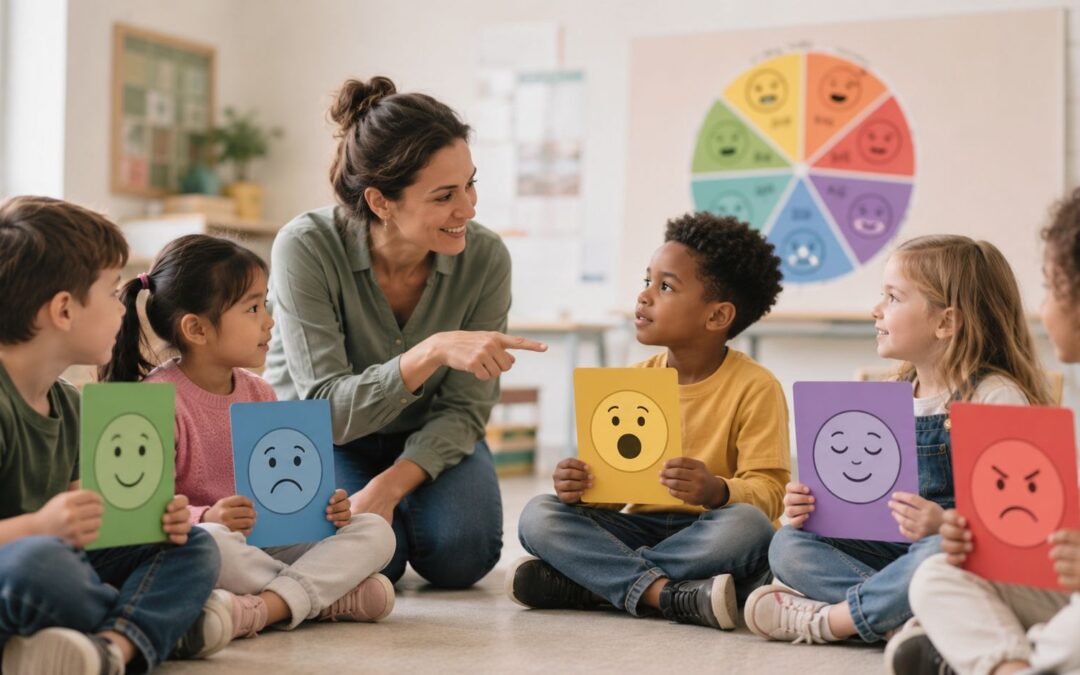
Start the day with a feelings word wall. Add familiar words such as happy, sad, mad, scared, and calm, then introduce more precise choices such as disappointed, worried, proud, lonely, or frustrated. During morning meeting, children can point to a word, gesture toward it, or describe a body cue.
The aim is recognition and expression, not public disclosure. A child might say, “I feel wiggly,” or place a private card near a check-in board. The teacher can model, “I'm frustrated because the materials aren't ready, so I'm going to take one slow breath and begin with what I have.” That example connects a feeling with its cause and a manageable response.
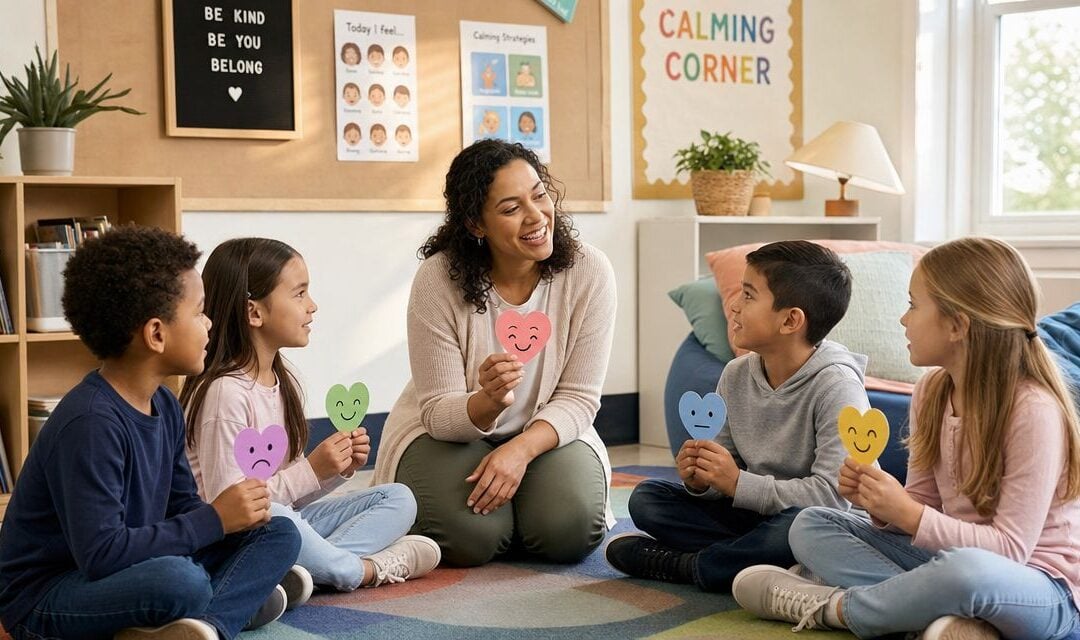
A classroom calm-down corner works best as a place to practice regulation, not as punishment. Include a feelings chart, breathing prompt, paper for drawing, and a short menu of choices. After the child settles, ask, “What did your body notice? What happened? What could help you rejoin?” At home, caregivers can use the same sequence after a sibling dispute: name the feeling, explore the cause, and offer a limited choice of next steps.
Upper elementary
In grades three through five, teachers can model sentence stems during real classroom friction:
“I felt ___ when ___ happened.” This links emotion to context.
“I'm guessing you might feel ___, is that close?” This practices empathy without claiming to know another person's mind.
“I need ___ so I can ___.” This turns a feeling into a constructive request.
“I'm ready to talk, but I need a short pause first.” This makes regulation visible.
A family dinnertime check-in can use a feelings wheel. Each person chooses a word and shares a cause, body signal, or coping response. A caregiver might say, “I felt relieved when the appointment ended because I had been worried.” The adult is teaching understanding, while allowing children to decide how much they want to share.
Teachers who need a simple record of patterns can pair student reflections with an online behavior tracking solution. Keep notes focused on observable behaviors and support needs, not labels or assumptions.
Middle school
For grades six through eight, use role-play in both directions. One student practices saying, “When the slides changed without telling me, I felt unprepared. Next time, can we check the plan together?” The partner responds, “I hear that the change affected you. I was trying to help, but I should have asked first.” Students then switch roles so the exercise does not frame one person as the problem.
This rehearses expression, perspective-taking, and repair in language students can use during group work, friendship conflict, or a family disagreement.
At home, create a family contract for tech-driven emotional moments. It might include pausing before replying to an insulting message, asking for clarification when tone is unclear, avoiding forwarded screenshots during conflict, and moving a heated exchange to face-to-face conversation or a voice call. The contract teaches digital context-awareness and regulation without treating devices as the enemy. Age-adaptable ideas are available in these emotional awareness activities for children and students.
Lesson Ideas Assessment Tips and School Implementation
A teacher can begin on Monday without creating a new course. Choose one feeling skill, teach it directly, and look for evidence of use during ordinary routines.
Three lessons ready for Monday
Feelings vocabulary with picture cards: Show facial expressions, body positions, and brief situations. Students sort the cards by possible feeling, explain their reasoning, and add a more precise word when “mad” or “sad” isn't enough. This primarily teaches recognition and understanding.
Empathy mapping with a short story: Draw four boxes labeled “What might the character notice,” “What might the character think,” “What might the character feel,” and “What might the character need.” Emphasize that students are making informed guesses, not stating facts about another person's inner life. This builds social awareness and perspective-taking.
Problem-solving circle: Use a recurring playground conflict. Each participant describes what happened without insults, names an emotion and need, listens to another viewpoint, and proposes a repair. The group chooses a next step that protects safety and belonging. This practices expression, regulation, and repair.
Assessment can stay low stakes. Teachers might notice whether students use a wider range of feeling words, explain causes more clearly, recover faster after upset, or seek help before behavior escalates. Track patterns over time through brief anecdotal notes, student reflections, or class discussions rather than reducing a complex skill to a single score.
Look for movement, not perfection: Progress may sound like “I'm still angry, but I can talk now,” or “I thought you ignored me, but I'll ask before assuming.”
Schools should embed practice in existing structures. Morning meetings, advisory, read-aloud discussions, recess reflection, restorative conversations, and family communication can carry the work without adding another block. Paraprofessionals, recess supervisors, counselors, and office staff also need the shared language because students practice emotional literacy across the campus, not only with their classroom teacher.
Send home feeling-word cards and short newsletters with one sentence stem or regulation strategy. Families don't need a full curriculum to reinforce the work. They need to hear the same language and know that adults value both emotional honesty and responsible action.
A short demonstration can help staff visualize the teaching move before they try it:
Common Misconceptions and the Digital Era
Myth: Feelings should stay outside the classroom. Students bring emotions with them, whether adults name them or not. A child who feels embarrassed may avoid work, provoke peers, or shut down. A brief check-in can make the feeling discussable before it controls the lesson.
Myth: Emotional talk is soft or off-task. Emotional literacy supports the behaviors that make learning possible. Students need language for frustration during challenging work, disappointment after feedback, and uncertainty during collaboration.
Myth: Children will outgrow emotional struggles. Development changes what students can understand, but it doesn't automatically provide the vocabulary or regulation strategies they need. Adults still have to model, prompt, and practice.
Myth: Children absorb these skills socially without explicit teaching. Some children pick up emotional language through conversation and supportive relationships. Others need direct instruction, repeated rehearsal, and adults who make invisible processes visible.
Digital emotional literacy
Online communication removes many cues children use in person. A short text can sound angry, playful, dismissive, or rushed depending on the reader. Students also face the permanence of screenshots, rapid emotional spread through group chats, social comparison, cyberbullying, and communication shaped by platforms or AI.
Digital emotional literacy applies the same four abilities to those conditions:
Recognize: Notice your reaction to a message and identify what cues are present.
Understand: Consider alternative explanations for ambiguous wording and the possible impact of forwarding or posting.
Express: Ask for clarification, state concern, and choose a channel that fits the problem.
Regulate: Pause before replying, step away from the device, and avoid escalating a public exchange.
Schools can establish device-free emotion check-in moments so students practice reading their own signals without a screen competing for attention. Teachers can also model interpretation: “That message felt harsh to you. What do we know for certain, what are we assuming, and what could we ask before responding?”
Emotional literacy begins with four teachable abilities, recognize, understand, express, and regulate. The evidence supports explicit, sequenced practice connected to classroom climate, relationships, behavior, and learning. The smallest first step is simple: choose one feeling word, model one sentence, and invite students or family members to use it during a real moment this week.
Soul Shoppe offers research-based SEL programs, workshops, and coaching that give school communities shared language for self-regulation, communication, empathy, and conflict resolution. Visit Soul Shoppe to explore tools that can help students and grownups practice emotional literacy at school and at home.
A student crumples a worksheet, mutters “I'm dumb,” and shuts down before you can get to their desk. Another child bumps a classmate in line, then insists, with total sincerity, “I didn't do anything.” At home, a parent asks, “How was school?” and gets the usual answer: “Fine.” Underneath that one-word reply might be embarrassment, loneliness, stress, or a friendship problem the child doesn't yet know how to name.
That's where Social-Emotional Learning, or SEL, matters.
When people ask why SEL is important, they're usually not asking for a definition. They're asking about real life. They want to know why some students melt down over small frustrations, why conflict spreads so fast in a classroom, why bright kids stop trying, or why a school can feel tense even when adults are working hard. SEL gives us a way to teach the missing skills behind those moments.
After many years working in schools, I've seen the same truth again and again. Most challenging behavior is communication. Most conflict is a skills gap. Most disconnection starts small. SEL helps children notice what they feel, manage what they feel, and act in ways that protect both themselves and the people around them.
More Than Just Behavior Management
A third-grader slams a book shut during math. A kindergarten student grabs a marker and refuses to give it back. Two fifth-graders stop speaking because one felt left out at recess. These moments can look like defiance, disrespect, or immaturity.
Often, they're something else. They're moments when a child doesn't yet have the words, the pause, or the problem-solving tools they need.
That's why SEL matters. It's not a reward for students who are already calm and cooperative. It's the teaching of the exact skills students need when life feels hard, unfair, embarrassing, or confusing. When we treat every upset as a discipline problem, we miss the lesson hidden inside it.
Practical rule: If a student can't yet identify a feeling, calm their body, hear another point of view, or repair harm, that student needs instruction, not just correction.
In schools, people sometimes reduce SEL to “helping kids behave.” That's too small. Behavior is only the visible part. Under it are attention, emotion regulation, confidence, empathy, communication, and decision-making. Those are learnable skills.
Here's what that looks like in practice:
In the classroom: A student who says “This is stupid” may be feeling lost and trying to protect themselves from looking incapable.
On the playground: A child who cuts in line may be excited, impulsive, or unsure how to join a group appropriately.
At home: A child who explodes after school may have held it together all day and finally run out of emotional energy.
SEL gives adults a roadmap in those moments. Instead of only asking, “How do I stop this behavior?” we also ask, “What skill is missing, and how can I teach it?” That shift changes everything. It moves us from control to coaching, from punishment alone to growth.
What Social-Emotional Learning Actually Is
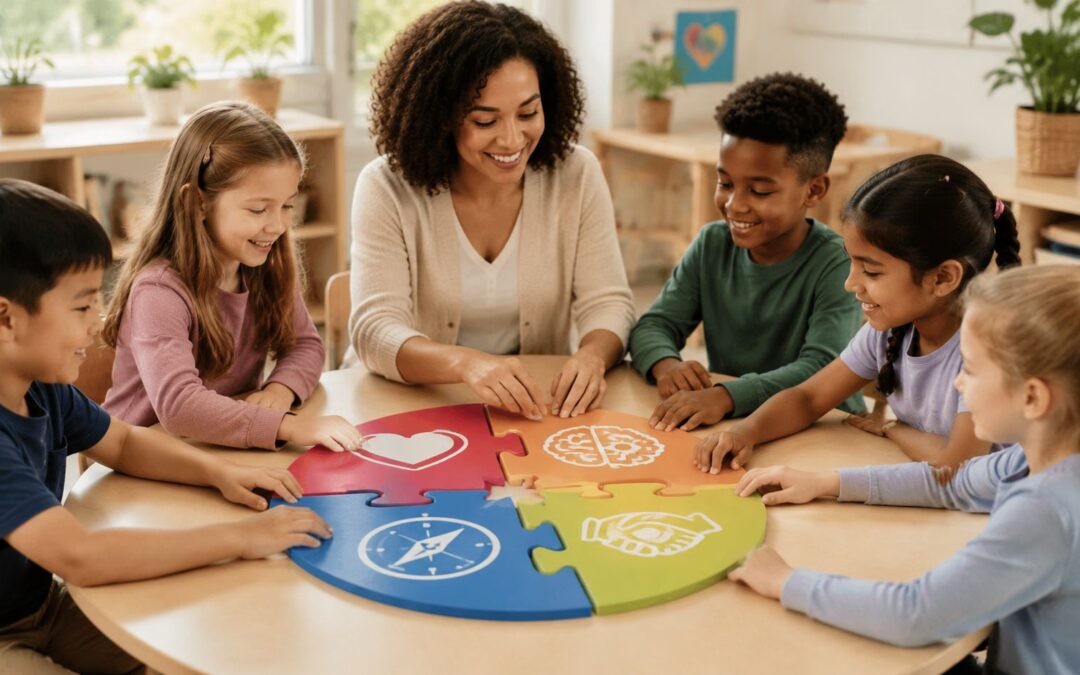
Social-emotional learning is the process of helping students understand themselves, manage emotions, relate well to others, and make thoughtful choices. CASEL organizes SEL around five core competencies. If you've ever felt that SEL sounds broad or fuzzy, this framework makes it concrete.
Self-awareness is the child's internal weather report. It's the ability to notice, “I'm frustrated,” “I'm nervous,” or “I'm proud of how I handled that.” A self-aware second-grader might say, “My stomach feels tight before spelling tests.” That's a huge step, because children can't manage what they can't name.
Self-management is the emotional brake pedal. It helps students pause before they react, use coping strategies, and keep going when things are difficult. In real life, this might look like a first-grader taking three breaths before responding, or a middle schooler asking for a short break instead of storming out.
Some students need extra support with these skills because the connection between attention, regulation, and emotion can be more complex. For families or teachers trying to understand that overlap, this article on ADHD, autism, and emotions offers helpful context.
Social awareness and relationship skills
Social awareness is the empathy lens. It helps children notice that other people have feelings, backgrounds, and perspectives different from their own. A socially aware student starts to think, “She wasn't ignoring me. Maybe she was nervous too.”
Relationship skills are the friendship-building tools. They include listening, taking turns, resolving conflict, apologizing sincerely, and asking for help. When a fourth-grader says, “I felt upset when you changed the rules. Can we start over?” that's relationship skill in action.
Children don't magically absorb these abilities. They learn them through modeling, repetition, practice, mistakes, and repair.
Responsible decision-making
Responsible decision-making is the ethical compass. It's what helps a student pause and consider, “Is this safe? Is it fair? What might happen next?” For younger children, that may be choosing not to blurt out a hurtful comment. For older students, it may be deciding how to respond when a group chat turns mean.
A simple way to remember the five competencies is this:
Competency
Simple image
What it looks like in daily life
Self-awareness
Internal weather report
Naming emotions and strengths
Self-management
Brake pedal
Calming down and staying on track
Social awareness
Empathy lens
Noticing others' feelings and perspectives
Relationship skills
Friendship tools
Listening, communicating, repairing conflict
Responsible decision-making
Ethical compass
Choosing actions with care
When adults understand SEL this way, it stops feeling abstract. It becomes visible in morning routines, partner work, recess conflicts, sibling arguments, and after-school conversations.
The Research-Backed Case for SEL
A principal is reviewing the budget. A teacher is looking at a class that keeps losing learning time to conflict, shutdown, and frustration. A caregiver is wondering why school feels harder for their child than the homework itself. All three are asking the same question. Will SEL make a real difference, or is it one more program with good intentions and thin results?
Research gives a clear answer. CASEL describes SEL as an evidence-based approach connected to better school outcomes and stronger long-term outcomes, based on many independent studies in its summary of what the research says about SEL.
Two findings often get attention quickly because they speak to both resources and results.
An analysis of six evidence-based programs shows a return of $11 for every $1 invested in SEL.
A 2011 meta-analysis of 213 K-12 programs found an average 11 percentile-point increase in academic achievement for participating students.
Those results make sense in day-to-day school life. Learning asks a lot of children. They have to listen when they are distracted, keep going when work feels hard, recover after mistakes, cooperate with classmates, and ask for help before frustration spills over. SEL supports those learning moves directly.
It helps to picture academics and SEL as two pedals on the same bike. Content knowledge helps students move forward. Social-emotional skills help them balance, steer, and keep going after a wobble. Without that second set of skills, even strong instruction can lose momentum.
Teachers usually see this before they read a research summary. A student who can calm their body after getting an answer wrong is more likely to try again. A pair of students who can solve a disagreement respectfully are more available for partner work. A classroom with predictable routines for listening, reflection, and repair protects instructional time.
For school leaders, the practical question is not only whether SEL works. It is whether the school is giving staff enough training, time, and consistency to teach these skills well. For teachers, the question becomes, “What routines can I repeat every day so students practice these skills?” For caregivers, it becomes, “What language can I use at home that matches what my child is hearing at school?” This role-by-role connection is where SEL starts to stick.
If you want a practical overview of how these outcomes show up in daily school life, Soul Shoppe offers a helpful article on the benefits of social-emotional learning.
Implementation quality matters just as much as good intentions. A feelings chart on the wall will not change much by itself. A one-time kindness lesson usually will not either. Students build these skills the same way they build reading fluency or math confidence. They need direct teaching, guided practice, repetition, feedback, and chances to use the skill in real moments.
That matters for every adult in a child's world. School leaders can choose materials and schedules that make practice possible. Teachers can build short, repeatable routines into transitions, meetings, and conflict repair. Caregivers can reinforce the same habits at home with simple questions such as, “What were you feeling?” “What happened next?” and “How can you make it right?”
The strongest case for SEL is not just that research supports it. It is that the findings match what experienced educators and families see every day. When children learn how to manage emotions, work through conflict, and make thoughtful choices, school runs better, relationships get stronger, and students are more ready to learn.
How SEL Transforms School Culture and Equity
A school doesn't become calm, inclusive, or connected because people put those words on a poster. Culture changes when adults and students share skills, language, and routines that make safety and belonging more likely.
When SEL is part of daily life, students start hearing and using the same language across settings. “Take a breath.” “Use an I-statement.” “What was your impact?” “How can you repair this?” That shared language lowers confusion and gives everyone a way back from conflict.
Safety and belonging are not side benefits
One of the most important findings in this area comes from CASEL's overview of SEL research. A 2023 review found that the largest effect of SEL programs was on students' perceptions of safety and inclusion at school, and the positive effects lasted six months or more after the program ended, as summarized in CASEL's SEL fundamentals page.
That finding rings true in school hallways. Students learn better when they aren't scanning for threat, embarrassment, exclusion, or social danger. Belonging isn't extra. It's part of readiness to learn.
When students believe, “I'm safe here, I matter here, and adults will help me repair mistakes,” they take more healthy risks in learning.
SEL also supports bullying prevention in a practical way. It helps children recognize emotions in themselves and others, interrupt impulsive behavior, and respond to hurt with accountability instead of escalation. CASEL notes that SEL helps reduce bullying and aggression while strengthening coping skills and resilience. Those are culture-building tools, not just student traits.
Here's a short video that shows how these ideas come alive in schools.
Why SEL also matters for equity
Equity conversations often focus, rightly, on access, opportunity, representation, and systems. SEL doesn't replace that work. But it can support it when schools use it well.
Students need language for self-advocacy. They need adults who can model listening across difference. They need classrooms where perspective-taking is taught, where repair is possible, and where a child's identity isn't treated as a problem to manage. SEL helps create those conditions.
Consider the difference between these two responses to a student who withdraws during partner work:
Without an SEL lens: “Participate. You need to speak up.”
With an SEL lens: “I notice you got quiet. Do you need think time, a partner choice, or help getting started?”
The second response preserves dignity. It assumes support before judgment. Over time, those moments shape whether students feel seen or merely managed.
SEL in Action Practical Examples for K-8
A teacher greets students at the door. One child walks in bouncing and loud. Another keeps eyes down and heads straight for a seat. A third is already upset about something that happened on the bus. By 8:10, the teacher is not just teaching math or reading. The teacher is helping students settle, connect, speak up, wait, recover, and try again. That is what SEL looks like in real school life.
The strongest SEL routines are simple enough to use on a busy Tuesday and steady enough to shape habits over time. Students learn these skills through repeated practice, clear language, and chances to use them in real moments. Earlier research discussed in this article points to a clear pattern. SEL works best when it is sequenced, active, focused, and explicit. In plain terms, schools get better results when adults teach these skills on purpose instead of hoping students pick them up on their own.
In the early grades, children need SEL they can see, hear, and physically practice. Abstract lectures do not stick. Short routines do.
Feeling check-ins: Use a feelings chart, emoji cards, or a quick morning prompt. A child who cannot yet explain, “I feel nervous because my mom left early,” can still point to a face that says worried. That small act builds emotional vocabulary.
Calm-down corners: Set up a space with breathing visuals, a timer, sensory tools, paper for drawing, or simple prompts such as “I need space” and “I am ready to join again.” The goal is regulation, not removal.
Read-aloud pause points: Stop during a story and ask, “What might this character be feeling?” or “What tells you that?” Young students learn perspective-taking through stories long before they can define the term.
A first-grade block area offers a good example. Two students want the same piece. The adult does not rush in to solve it for them. The adult coaches a script, one sentence at a time: “I feel frustrated.” “Can I use it when you are done?” “Yes, after I finish this part.” That is direct instruction, just as real as a phonics lesson.
How this looks by role:
School leaders: Give K-2 teachers shared visuals and common language so students hear similar prompts across classrooms.
Teachers: Practice one script for common conflicts and use it often enough that students can remember it under stress.
Caregivers: Use the same feeling words at home, especially during transitions like bedtime, homework, and getting out the door.
Grades 3 through 5
Upper elementary students can reflect more, explain their thinking, and work through conflict with a bit more structure. They still need coaching. They just need it in a form that respects their growing independence.
One reliable tool is the I-statement. Children often learn the formula but not the purpose. The goal is not sounding polished. The goal is saying something honest without attacking the other person. A useful example sounds like this: “I felt left out when the group started without me. Next time, please wait.”
Another routine that works well is a short conflict process:
Pause and breathe.
Say what happened.
Name the feeling.
Say what you need.
Choose a next step.
That sequence gives students a path to follow when emotions are high. It also helps adults stay steady. In many classrooms, the hardest part is not knowing what to say in the moment. A short sequence solves that problem.
A strong SEL routine fits inside a real school day and holds up during real conflict.
Cooperative learning can do a lot of SEL work here too. A science task, a reading partner activity, or a classroom job becomes social-emotional practice when the teacher teaches how to disagree, include others, divide roles, and repair mistakes.
How this looks by role:
School leaders: Protect time for teachers to agree on a few shared routines, so students do not have to relearn different expectations in every room.
Teachers: Model the language out loud. Students are more likely to use respectful problem-solving when they hear adults use it too.
Caregivers: Ask after school, “Did you have any problem you solved with words today?” That question reinforces the skill without turning home into another classroom.
Grades 6 through 8
Middle school students quickly spot anything that feels childish, forced, or disconnected from their actual lives. SEL works better when adults treat adolescents as thoughtful people who are learning judgment, identity, and self-control at the same time.
These approaches tend to land well:
Peer mediation: Students learn to listen to each side, reflect back what they heard, and help identify a fair next step. This gives them practice with perspective-taking and problem-solving.
Ethical dilemma discussions: Use realistic situations, such as being left out of a group chat, seeing a friend cheat, or deciding whether to repost a humiliating video. Students are far more engaged when the scenario feels familiar.
Goal-setting conferences: Ask students to choose one academic or personal goal, name likely obstacles, and identify one strategy they will use when motivation drops.
A seventh-grade digital conflict shows why this matters. A student posts a sarcastic comment about a classmate. If the adult response stops at punishment, the student may comply without learning much. If the adult guides a repair conversation, the student has to face impact, intention, and responsibility. Who was affected? What were you trying to get or avoid? What would repair look like now? That is the kind of practice that helps students grow up, not just quiet down.
How this looks by role:
School leaders: Make sure SEL in middle school includes advisory, student voice, and restorative responses, not just behavior reminders.
Teachers: Use current, believable scenarios and invite discussion instead of delivering a speech.
Caregivers: Stay curious before reacting. “Help me understand what happened” opens more learning than “What were you thinking?”
Across K-8, the pattern is the same. SEL becomes real when adults teach a skill, model it in ordinary moments, and give students another chance to practice tomorrow.
Next Steps for Supporting SEL
Knowing why SEL matters is one thing. Getting started without overwhelming your staff or family is another. The good news is that SEL works best when adults begin with small, consistent moves.
Effective SEL also has to support adults, not just students. District-facing materials note that strong SEL efforts can reduce teacher stress and improve school climate, and that adult wellbeing is part of what makes implementation sustainable, as described in Oxford School District's overview of why SEL is important.
Leaders shape whether SEL becomes a living practice or a short-lived initiative.
Vet programs for SAFE design: Ask whether the curriculum is sequenced, active, focused, and explicit. If lessons are scattered or vague, staff may work hard without seeing much change.
Support adult SEL: Give staff shared language for regulation, conflict, and repair. Teachers can't model what they've never been invited to practice.
Look at climate, not just discipline: Ask whether students feel safe, included, and connected. Those signals often tell you more than incident counts alone.
If you're evaluating options, Soul Shoppe is one example of an SEL organization that offers workshops, assemblies, coaching, and practical tools focused on self-regulation, communication, conflict resolution, and belonging.
For teachers
Teachers don't need to turn every lesson into an SEL lesson. They do need routines that make emotional skill-building normal.
Start with greetings and check-ins: A quick “thumb scale,” feeling word, or partner check-in can tell you a lot before instruction begins.
Teach repair language: Put simple stems on the wall, such as “I felt…,” “I need…,” and “How can I make this right?” Students use what they can see.
Close with reflection: End class with one brief question. “When did you persevere today?” or “How did your group solve a problem?” Reflection helps students notice growth.
For parents and caregivers
Families build SEL every day, often without calling it SEL.
Ask better after-school questions: Try “What was one hard moment today?” or “When did you feel proud?” Those questions invite real answers.
Name your own feelings calmly: Saying “I'm frustrated, so I'm taking a breath before I respond” gives children a model they can copy.
Coach, don't immediately rescue: When your child has a friendship problem, help them script what to say instead of solving it for them.
None of these steps are flashy. That's part of the point. SEL grows through daily repetition, not grand gestures.
Building a More Empathetic Future One Skill at a Time
SEL matters because children don't just need academic content. They need the skills that help them use that content well, especially when life feels stressful, social, or uncertain. They need to notice emotions, manage impulses, work through conflict, and make choices they can stand by.
That's why the question “Why is SEL important?” has such a practical answer. It's important because classrooms run on relationships. Learning depends on safety. Growth requires reflection, repair, and resilience. These are not soft extras. They are foundational skills for school, work, and life.
Adults need these skills too. In fact, children learn a great deal by watching how we listen, apologize, disagree, and reconnect. If you want a broader lens on how communication shapes growth and trust, Coachful's communication skills article offers a useful perspective that applies well beyond coaching.
When schools and families teach SEL on purpose, they aren't lowering standards. They're raising capacity. They're giving young people tools to manage challenge without losing themselves or one another.
If your school or community is ready to strengthen empathy, safety, communication, and conflict resolution, Soul Shoppe offers practical SEL programs and resources for students, educators, and families.
Somewhere between the math block and dismissal, it happens. Two students snap at each other over a pencil. One child puts their head down and won't try the assignment. Another keeps making jokes because that's easier than saying, "I'm overwhelmed."
Most teachers don't need a lecture on why behavior matters. You live it all day. What you need is a way to respond that helps kids settle, reconnect, and keep learning.
That's where social emotional learning fits. It isn't extra fluff, and it isn't a reward for classes that are already calm. It's a practical way to teach students how to notice feelings, manage stress, solve problems, and stay connected to the people around them. If you've been wondering how to implement social emotional learning in the classroom without adding one more impossible task to your plate, start small and think in layers: routines, lessons, relationships, and schoolwide support.
Creating a Classroom Where Every Student Thrives
A third grader rips up her paper after making a mistake. Two classmates start whispering about it, and now the whole table is off track. In another room, a middle school student shrugs and says, "I don't care," even though you can tell he does. These moments look different on the surface, but they often point to the same missing skills: naming emotions, handling frustration, reading social cues, and repairing conflict.
Social emotional learning gives teachers a way to teach those skills directly. Instead of only reacting after problems explode, you build habits that help students pause sooner and recover faster. That changes the feel of the room. Kids get more language for what they're feeling, and teachers get more options than "stop" and "sit down."
A 2018 meta-analysis reviewing 50 years of studies found that SEL programs produced significant gains in reading, mathematics, and science for PreK to 12 students, and the benefits were observed across grade levels and across student groups, as summarized in Northern University's overview of SEL research. That matters because it tells us SEL isn't a side project. It belongs in real classrooms with real academic demands.
What this looks like in an ordinary week
In practice, SEL can be as simple as greeting students by name, running a quick feelings check-in, teaching one sentence stem for conflict, and giving students a calm place to reset. Those moves don't solve everything. They do create enough safety and predictability for learning to happen more often.
If you want a child-friendly way to extend these ideas into resilience conversations, this story-based guide for young readers offers accessible language families and teachers can borrow. For the classroom environment itself, this piece on what makes a peaceful and welcoming classroom pairs well with daily SEL practice.
SEL works best when students experience it as part of the day, not as a special event that disappears when things get busy.
Building the Foundation with Core SEL Routines
The strongest classrooms don't rely on one great lesson. They rely on repeated routines. Students need the same emotional tools practiced again and again when they're calm, so those tools are available when they're upset.
A strong foundation for SEL starts with the five core competencies from CASEL: self-awareness, self-management, social awareness, relationship skills, and responsible decision-making. Research syntheses covering hundreds of studies, summarized by the Learning Policy Institute's report on evidence for social and emotional learning, found that this approach supports stronger social-emotional competencies, better behavior, and gains in academic performance.
Make the five competencies visible and simple
You don't need to introduce the CASEL language like a formal unit. Translate it into classroom language students can use.
Self-awareness means "I can notice what I'm feeling."
Self-management means "I can calm my body and make a plan."
Social awareness means "I can think about how someone else might feel."
Relationship skills means "I can listen, speak respectfully, and work things out."
Responsible decision-making means "I can choose a response that helps, not harms."
Post those ideas on the wall in student-friendly words. Refer to them when something real happens. If a student is frustrated during writing, say, "Let's use self-management." If two students interrupt each other, say, "This is relationship skills practice."
Start the day with one predictable check-in
Morning meeting doesn't have to be elaborate. In many classrooms, a five-minute routine is enough. The key is consistency.
Check-in: "Show with fingers, colors, or a one-word answer how you're arriving today."
Mini skill: one brief breathing, listening, or speaking routine.
Preview: "Today, we'll practice asking for help respectfully during partner work."
Here are a few check-in prompts you can use tomorrow:
For K to 2: "Point to the face that matches how you feel."
For 3 to 5: "What's one word for your energy right now?"
For 6 to 8: "What's something that might help you focus today?"
If you need help building routines that calm students before instruction starts, this guide on routines for kids and emotional grounding offers practical ideas that transfer well to classrooms.
Practical rule: Keep the routine short enough that you'll actually use it on busy days.
Teach one calming strategy until everyone knows it
Many teachers make the mistake of offering six coping tools at once. Start with one. Practice it when no one is upset. Then coach students to use it during mild frustration.
You can use this script:
"Let's take a turtle breath. Pretend you're a turtle pulling into your shell. Tuck your head down, breathe in slowly through your nose, and as you breathe out, slowly peek your head back out."
That works especially well in K to 3, but older students often respond if you present it plainly and skip babyish tone. For middle grades, you might call it "slow in, slower out" and have students track the breath with a hand on the desk.
Other low-prep regulation routines include:
Desk reset: Students put both feet down, relax shoulders, and take three quiet breaths.
Hand trace breathing: Trace one finger up and down the other hand while breathing in and out.
Count and choose: "Name what you're feeling. Rate it low, medium, or high. Choose one calm strategy."
Create a calm-down space that teaches, not punishes
A Peace Corner isn't time-out with softer decor. It should be a brief reset space students use to regulate and return.
Keep it simple. Add a small visual feelings chart, one breathing prompt, a reflection card, and a clear expectation such as: "Calm body. Quiet reset. Return when ready." A clipboard with sentence starters can help:
"I am feeling…"
"What happened was…"
"What I need next is…"
"When I go back, I will…"
For younger students, use pictures. For older students, use a short written reflection or a dry-erase board.
Build shared language for conflict
Students need actual words. "Use your words" is too vague. Give them sentence stems they can practice during low-stakes moments.
Try these:
I-statement: "I feel frustrated when you grab the marker because I wasn't finished."
Boundary: "Please don't touch my work without asking."
Repair: "I want to fix this. Can we start over?"
Request: "Next time, can you ask first?"
Role-play these during class meetings. Keep the scenarios ordinary: line cutting, teasing, interrupting, not sharing materials. Students are much more likely to use language they've rehearsed.
Weaving SEL into Your Academic Lessons
One of the biggest misconceptions about SEL is that it requires a separate block you don't have. In most classrooms, the more sustainable move is to build social and emotional skills into the lessons you're already teaching.
That means you use reading discussions to practice perspective-taking, math problem solving to practice frustration tolerance, and social studies to practice empathy and ethical thinking. SEL becomes part of how students learn, not one more thing stacked on top.
What SEL looks like during instruction
In literacy, ask students to support emotional inferences with evidence. "What clues in the text tell you how she was feeling?" moves the conversation beyond guessing. It teaches careful reading and emotional awareness at the same time.
In math, normalize productive struggle. Before students tackle a challenging problem, you might say, "If you feel stuck, that's the moment to use self-management. Pause, breathe, reread, and try one part." During partner work, coach them to ask, "Can you explain how you started?" instead of "What's the answer?"
In social studies, SEL often shows up through perspective. When students study a community, a migration, a protest, or a historical decision, invite them to ask: "What pressures might this group have faced?" or "How might two people have experienced this event differently?"
For more classroom-ready examples, this collection of social emotional learning strategies can help teachers expand beyond standalone activities.
Sample SEL Integration Activities by Grade Band
Grade Band
Literacy (Relationship Skills)
Math (Self-Management)
Social Studies (Social Awareness)
K-2
Read a picture book and ask, "How did the character know their friend was upset?" Then have students practice one kind response.
Before independent work, teach a "try, breathe, ask" routine. Students try one strategy, take one slow breath, then ask for help.
When learning about helpers in the community, ask, "What does this person do to care for others?"
3-5
During character analysis, ask students to compare two characters' communication choices and discuss what made one more respectful.
After a hard problem, students reflect: "What did I do when I got stuck?" Share useful coping moves with a partner.
When studying communities or regions, ask students to consider how people with different roles may see the same issue differently.
6-8
Use discussion stems such as "I hear your point, and I see it differently because…" during text-based conversation.
Teach students to notice stress signals during multi-step tasks and choose a reset move before giving up.
During historical inquiry, have students examine whose voices are centered, whose are missing, and how perspective shapes understanding.
Questions that pull double duty
A good integration question strengthens both the subject and the SEL skill. Here are a few that work across grade levels:
In reading: "What does this character need but isn't saying out loud?"
In writing: "How can you disagree respectfully in your response?"
In math: "What do you tell yourself when the first strategy doesn't work?"
In science: "How does your group decide whose idea to test first?"
In social studies: "What might seem fair to one group and unfair to another?"
Ask SEL questions during content lessons when students are already engaged. That's when the skill feels useful instead of abstract.
Fostering a Culture of Empathy and Connection
Some classrooms feel settled the moment students walk in. Not silent. Not rigid. Just steady. Students know how to join a group, how to disagree without escalating, and how to recover after a rough moment.
That kind of room is built through repeated human choices. The teacher notices tone. Students learn how to repair harm. Everyone shares some responsibility for belonging.
Use restorative conversations after conflict
When a conflict happens, many students expect one thing: blame. A restorative approach still holds students accountable, but it also teaches them how to understand impact and repair relationships.
A simple four-question script works well:
What happened?
What were you feeling at the time?
Who was affected, and how?
What needs to happen to make things right?
This can happen in a quiet corner, at a back table, or after class. Keep your voice steady. Don't rush to solve it for them. Let students do the thinking.
Here is what that might sound like with upper elementary students:
Student A: "He kept interrupting me."
Student B: "I thought you were ignoring me."
Teacher: "Who was affected?"
Student A: "Both of us. We stopped working."
Teacher: "What's one repair step?"
Student B: "I'll let you finish, then ask."
Give students jobs that build community
Not every class job has to involve papers or pencils. Some of the best jobs strengthen the social life of the room.
Consider roles like these:
Inclusion Ambassador: notices when someone is left out during partner or group work.
Peacemaker: reminds classmates to use agreed-upon sentence stems during small conflicts.
Welcome Greeter: helps new or absent students rejoin routines.
Calm Corner Manager: checks that reflection tools are put back and ready.
These roles matter because they tell students that empathy and responsibility aren't private virtues. They are part of how the classroom runs.
Let students see you practice SEL too
Years ago, I snapped at a class after a loud transition. I wasn't cruel, but my tone was sharper than I wanted. A minute later, I stopped, took a breath, and said, "That came out harsher than I meant. I was feeling frustrated, and I didn't handle it the way I want us to handle frustration here. I'm sorry. Let me try that again."
The room softened immediately. Not because I was perfect, but because I showed them what repair looks like.
A short video can help teachers picture this kind of relational work in action.
When teachers model calm correction, apology, and repair, students learn that SEL isn't something adults demand from kids. It's how the whole community treats one another.
Scaling SEL Beyond Your Classroom Walls
A classroom can do a lot. It can't do everything alone. SEL sticks when students hear similar language from teachers, support staff, and families, and when schools connect universal practice with extra support for students who need more.
That doesn't require a giant new initiative to begin. It does require coordination.
Bring families into the language
Many caregivers want to support emotional growth but aren't sure what language the school is using. A short weekly message can help. Keep it simple.
You might send:
Question of the week: "What helps you calm down when you're frustrated?"
Shared sentence stem: "I feel ___ when ___ because ___."
One family practice: take one breath before solving a sibling conflict.
For families with younger children, it can also help to connect SEL language with play. This article on understanding cooperative play for toddlers is a useful example of how relationship skills begin early and grow through guided interaction.
Support teachers with repetition, not one-off inspiration
Teachers usually don't need more posters. They need time to practice routines, see examples, reflect on what worked, and adjust. A schoolwide SEL effort is more likely to last when leaders create regular professional learning and common language across classrooms.
One option schools can consider is SEL programs for schools, including approaches that offer workshops, shared language, and coaching. Keep the focus practical. Ask: What will teachers be able to use next Monday morning?
Connect SEL to existing school systems
A peer-reviewed implementation guide described a schoolwide model that uses a leadership team, ongoing staff development, stakeholder communication, classroom consistency, and tiered supports. It also recommends universal screening of all elementary students three times per year to identify who may need Tier 2 or Tier 3 support, helping schools treat SEL as a data-informed MTSS process rather than a standalone lesson series, as outlined in this implementation guide available through PubMed Central.
That schoolwide frame matters. It means teachers aren't left carrying every need by themselves. A child who struggles with peer conflict in class might need small-group practice. A student who shuts down daily may need more individualized support. SEL works best when universal routines and targeted interventions fit together.
Keep progress monitoring manageable
You don't need a complex dashboard to notice growth. Start with tools teachers will use:
Observation notes: Can the student name a feeling, use a strategy, or rejoin after conflict?
Student reflections: "What helped me today?" or "What will I try next time?"
Team check-ins: Brief grade-level conversations about patterns and supports.
The point isn't to reduce children to checkboxes. It's to notice whether the supports are helping and whether some students need more.
Common Challenges and Your Next Steps
The most common obstacle is time. Teachers often think SEL means a separate lesson they can't fit. It doesn't have to. Start with two minutes at the beginning of the day, one shared sentence stem for conflict, or one calm-down strategy before independent work.
Another challenge is student buy-in. Some students, especially older ones, may act like SEL is cheesy. Usually, they resist the packaging, not the skill. Drop the overly cute language. Use direct wording like, "This is how you reset when you're frustrated in group work," and tie it to real classroom moments.
A third barrier is uneven school support. If your whole campus isn't aligned yet, you can still build consistency inside your room. Keep your routines simple enough to repeat every day. Invite colleagues to observe a check-in or borrow your sentence stems. Small visible wins often spread faster than formal mandates.
Quick fixes for common bumps
You don't have enough time: Start with a two-minute check-in or one breathing routine before a difficult transition.
Students think it's silly: Use age-respectful language and connect the skill to a current problem they care about.
It falls apart when you're stressed: Put your scripts on a card or slide so you don't have to improvise.
Families are confused: Send home the exact phrases students are learning in class.
You aren't seeing change yet: Look for small signs first. Faster recovery, fewer repeated arguments, or better help-seeking all count.
Start with the routine you'll still use on your hardest day. That's the one that becomes culture.
If you're deciding what to do next week, choose one thing only. A morning feeling check. An I-statement chart. A Peace Corner. A restorative script. Use it consistently before adding anything else.
SEL doesn't become sustainable because a teacher tries everything at once. It becomes sustainable because a teacher repeats a few useful practices until students trust them, use them, and begin offering them to one another.
If you're ready for deeper support, Soul Shoppe offers social-emotional learning programs, workshops, and resources designed to help school communities teach self-regulation, communication, mindfulness, and conflict resolution in practical ways. That can be useful if you want structured support for classrooms, staff, and families while you keep building a calmer, more connected school culture.