

8 Emotional Awareness Activities for SEL
A child slams a book shut, walks away from a group, or suddenly refuses to talk. At home, a caregiver asks what happened and hears, “I don't know,” followed by tears, silence, or another burst of anger. The child may not yet have the language to explain the experience, but the feeling is still communicating something.
Emotional awareness means more than choosing happy or angry from a chart. Children gradually learn to notice feelings, recognize body signals, identify triggers, sense intensity, understand possible needs, and consider what to do next. Those skills support self-awareness, self-management, social awareness, relationship skills, and responsible decision-making.
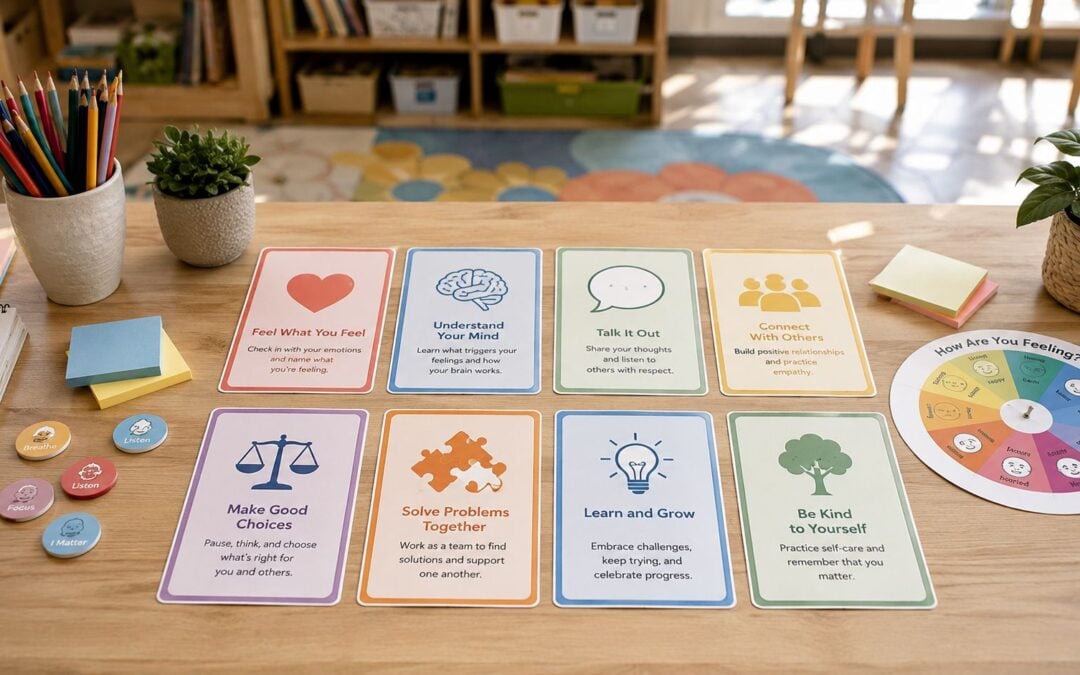
The eight emotional awareness activities below move from simple noticing and naming toward empathy and personalized regulation plans. Each one includes an objective, materials, steps, reflection prompts, developmental adaptations for K–2, 3–5, and 6–8, an exit ticket, and an implementation tip.
Introduce every activity during a calm moment. Model the skill yourself, offer choices, protect privacy, and never require a child to disclose personal experiences publicly. Soul Shoppe's shared language and practical SEL approach can also help schools use consistent tools across classrooms, counseling spaces, and homes.
1. Emotion Check-In Circles
A check-in circle gives children a brief, predictable way to notice and name their current state. Students might choose a color, weather pattern, animal, or feeling word. The point isn't to produce a perfect explanation. It's to make emotional awareness visible and give adults a gentle opportunity to notice who may need support.
Try it in the classroom or at home
Gather students in a circle with emotion cards, a color wheel, or a simple weather display. Ask each child to choose one option and share a sentence if they wish. A third-grade teacher might ask students to point to a color matching their Monday mood and explain their choice. At dinner, a parent could ask, “Was your day sunny, cloudy, rainy, or stormy?”
An adolescent counselor might use animal check-ins. A student who chooses a turtle may be signaling low energy or a wish for space, while another who chooses a hummingbird may feel restless. The metaphor makes participation less threatening without forcing students to use unfamiliar emotion vocabulary.
For younger children, begin with colors or pictures. Older students can name a more precise feeling, such as disappointed, relieved, guarded, or hopeful.
Practical rule: A student may pass without judgment. Participation should build safety, not become a public test of openness.
Use a consistent time, keep responses brief, and model authentic but appropriate vulnerability. The adult might say, “I'm feeling stretched today, so I'm going to take a slow breath before we begin.” For more ideas on making this routine consistent, explore these daily student check-in and mood meter tools.
Materials: Emotion cards, a color wheel, weather images, or animal cards.
Reflection prompts: “What helped you choose that feeling?” “Does the feeling seem small, medium, or strong?” “What might help you participate today?”
Adaptations: K–2 students can point or draw. Grades 3–5 can add a reason. Grades 6–8 can choose a metaphor and name what support would help.
Exit ticket: “Today I feel ___, and I may need ___.”
Implementation tip: Track patterns privately, never as labels. A repeated choice may invite a quiet check-in with a counselor or caregiver, but it isn't a diagnosis.
2. Emotion Sorting and Classification Games
Children often know that they feel “bad” before they can distinguish frustrated from angry or nervous from excited. Sorting games turn abstract emotional concepts into cards, pictures, movements, and conversations. Students compare feelings, notice differences in intensity, and develop language they can use during real problems.
Make emotional vocabulary concrete
Prepare cards showing basic emotions, facial expressions, body postures, and everyday situations. A kindergarten group might sort a picture of receiving a puppy into a happy bucket and a picture of a friend moving away into a sad bucket. A third-grade class can place “a little annoyed” and “extremely furious” along a continuum, then discuss what makes the experiences different.
For older students, use more nuanced situations. A fifth grader might consider whether a character feels embarrassment, shame, or self-consciousness after making a mistake in front of peers. The discussion matters more than choosing one supposedly correct answer. Several emotions may fit the same event, depending on the person's interpretation and history.
Build the class language together
Create an emotion vocabulary wall that grows throughout the year. Add synonyms, body clues, related needs, and possible responses. Students might connect frustrated with “stuck,” “tight hands,” and “a need for help,” while connecting relieved with “loose shoulders,” “a deep breath,” and “a need to rest.”
- Use visual support: Pair each word with faces, drawings, gestures, or color.
- Use familiar situations: Include recess conflicts, homework, sibling arguments, transitions, tests, and celebrations.
- Ask comparison questions: “How is worried different from scared?” “Can someone feel excited and nervous together?”
- Link names to action: After identifying a feeling, ask what could help the learner make a safe next choice.
Materials: Emotion cards, situation cards, chart paper, sticky notes, or a digital sorting tool.
Reflection prompts: “Which two feelings were hardest to separate?” “Can one situation create different feelings for different people?”
Adaptations: K–2 students can sort three or four basic emotions. Grades 3–5 can use intensity lines and feeling families. Grades 6–8 can analyze mixed emotions, assumptions, and context.
Exit ticket: “One new word for a feeling I know is ___.”
Implementation tip: Revisit the same vocabulary during conflict repair, literature discussions, and writing. Words become useful when adults use them outside the activity.

3. Body Awareness and Emotion Mapping
A child may notice a tight jaw, hot cheeks, shaky hands, a fast heartbeat, or a heavy stomach before identifying the emotion attached to those sensations. Body mapping helps students recognize these early signals. That awareness can create a pause before a feeling becomes overwhelming.
Map sensations without declaring one correct answer
Give students a body outline and colored pencils. Ask them to mark where they notice happiness, worry, anger, calm, or sadness. A first-grade student might color the heart yellow for happiness and the fists red for anger. A third grader could use a feelings thermometer and record what anxiety feels like at different intensity levels.
A sixth-grade counselor might guide a quiet scan from head to toe. Students notice whether their shoulders are raised, their stomach feels tight, or their breathing has changed. They can keep discoveries private or share only a general observation.
Body signals vary. One student may feel anger in the jaw, while another feels it in the chest or legs. Avoid telling children what they “should” feel.
“Your body may give you information, but you're the person who decides what the signal means.”
Materials: Body outline sheets, large poster paper, colored pencils, emotion thermometers, and optional quiet music.
Steps: Name one emotion, invite students to notice sensations, mark the body, and connect the signal to an early warning sign. Then pair the sign with a choice, such as breathing, stretching, movement, water, or asking for space.
Reflection prompts: “What do you notice first?” “What changes when the feeling gets stronger?” “Which response feels comfortable and safe?”
Adaptations: K–2 students can use colors and simple body words. Grades 3–5 can record intensity and early signals. Grades 6–8 can compare sensations across emotions and situations.
Exit ticket: “When I notice ___ in my body, I can try ___.”
Implementation tip: Practice during calm periods. Children may not be able to learn a body scan while already flooded. Offer a drawing or written alternative to students who don't want to lie down, close their eyes, or engage in movement.
For additional classroom ideas, see these body awareness activities for children.

4. Mindfulness and Breathing Practices for Emotional Awareness
Mindfulness gives children a way to notice thoughts, feelings, sounds, and body sensations without immediately reacting. Breathing and grounding practices are especially useful because students can carry them into a test, hallway conflict, family argument, or crowded cafeteria.
School-based mindfulness and cognitive-behavioral programs have been associated with improvements in emotional awareness and positive emotions, along with reductions in depression in children aged 7–12, according to a 2023 systematic review and meta-analysis. The practical lesson is simple: keep the practice brief, repeat it, and let students choose an approach that feels safe.
Offer several ways to pause
A kindergarten teacher can lead “bubble breaths.” Students pretend to blow one large bubble, inhaling gently and exhaling slowly. A fourth-grade class might use grounding by naming five things they see, four they can touch, three they hear, two they smell, and one they taste.
A sixth grader could use a guided breathing app before a test, then rate the emotion before and after practice. The rating isn't a grade and doesn't need to reach zero. Students are learning that they can notice an emotion and choose a response.
Materials: A timer, breathing cards, sensory objects, a feelings scale, or a guided audio resource.
Reflection prompts: “What did you notice before and after?” “Which anchor helped you stay present?” “Would you choose breathing, movement, sound, or an object next time?”
Adaptations: K–2 students can use pretend bubbles or stuffed animals that rise and fall with breathing. Grades 3–5 can practice grounding and belly breathing. Grades 6–8 can compare techniques and decide when each fits.
Exit ticket: “When I feel overwhelmed, I can pause by ___.”
Implementation tip: Don't use mindfulness as forced compliance or as a substitute for addressing unsafe conditions. A child may keep eyes open, move, draw, or use sound instead. These breathing techniques for kids can support a wider menu of choices. Adults can also improve productivity with mindfulness by modeling the same pause instead of demanding calm from children.

5. Emotion Charades and Role-Playing
Some children understand emotions more easily through movement than through writing or extended discussion. Charades lets them observe facial expressions, posture, gestures, pace, and personal space. Role-play adds perspective-taking, so students can explore what different people might feel in the same situation.
Start with a low-pressure guessing game. A second-grade student acts out excited, scared, sad, or angry while classmates identify clues. Ask, “What did you notice in the face?” and “How did the body move?” Remind students that these are clues, not universal rules. Not every sad person cries, and not every excited person moves loudly.
Move from performance to perspective
A fourth-grade class might role-play a recess conflict in which one student is excluded. Students act out the scene from different perspectives, then discuss possible feelings, needs, and repair choices. A sixth-grade counselor can use frozen “emotion sculptures” for disappointment, pressure, pride, or uncertainty.
Set boundaries before the activity begins. No student should mock another child's expression, imitate trauma, or be forced into a role. Give everyone a pass option and allow students to observe, narrate, draw, or work with a partner.
Materials: Emotion cards, short scenario cards, open floor space, and optional props.
Reflection prompts: “What clues did you notice?” “Could the same face mean something different?” “What might each person need next?”
Adaptations: K–2 students can use single emotions and whole-group acting. Grades 3–5 can explore friendship problems and repair language. Grades 6–8 can role-play peer pressure, test anxiety, disappointment, and misunderstandings.
Exit ticket: “One clue I noticed was ___, but I also know I should ask rather than assume.”
Implementation tip: Process every scenario. The discussion after the acting develops awareness more reliably than the performance itself.

6. Emotion Story-Sharing and Narrative Activities
Stories give children emotional distance. They can examine a character's fear, loneliness, jealousy, courage, or pride without having to reveal a personal experience. From that safe distance, students learn to identify emotions, consider motivations, predict responses, and connect feelings with choices.
Read aloud and pause for think-aloud modeling. In a first-grade classroom, a teacher might read The Feelings Book by Todd Parr and ask how a character feels, whether students have felt that way, and what might help. A third-grade class reading Chrysanthemum can track how the character moves from pride to hurt and back toward belonging.
Let students create the meaning
Avoid asking for one approved interpretation. Ask, “What makes you think the character feels that way?” and “What else could be happening?” A character may appear angry while also feeling embarrassed or afraid. This helps students understand that emotions can overlap and that behavior doesn't tell the whole story.
A fifth grader might write “The Time I Felt Brave,” describing nervousness before an event, body sensations during it, and what changed afterward. Sharing can be private, partner-based, drawn, recorded, or offered to a trusted adult.
Materials: Picture books, chapter excerpts, storyboards, drawing supplies, or a recording tool.
Reflection prompts: “What changed the character's feeling?” “What did the character need?” “What might you do in that situation?”
Adaptations: K–2 students can draw a face and dictate a sentence. Grades 3–5 can sequence emotional changes. Grades 6–8 can examine perspective, assumptions, identity, and consequences.
Exit ticket: “The character felt ___ because ___. A helpful next step might be ___.”
Implementation tip: Preview books and scenarios for grief, bullying, family separation, violence, or other potentially activating content. Offer a warning, an alternative text, and access to a trusted adult when needed.
7. Feelings Journals and Emotion Tracking
Private reflection helps children notice patterns that disappear during a busy day. A journal can contain words, drawings, symbols, audio, or a mixture of formats. Students may record the feeling, situation, body signal, intensity, response, and what happened afterward.
A second grader might use a color-coded chart and discover that frustration appears often during transitions. A caregiver could offer an anxious fourth grader a worry journal for drawing or writing before bed. A sixth grader who dislikes handwriting might record voice memos instead.
Protect privacy while building insight
Explain exactly what adults will and won't read. A journal should not become hidden surveillance, but adults also need a clear safety plan if a child discloses risk of harm. Share the boundary before students begin, and invite them to mark entries they want to discuss.
Use open prompts instead of yes-or-no questions:
- Name the feeling: “Today I felt ___.”
- Trace the trigger: “This started when ___.”
- Notice the body: “I felt it in my ___.”
- Identify support: “What helped, or what might help next time?”
- Look for change: “The feeling was different later because ___.”
For K–2, combine drawings with simple words and teacher scribing. Grades 3–5 can use sentence starters and pattern charts. Grades 6–8 can compare triggers, interpretations, strategies, and outcomes while keeping the work confidential.
Materials: Notebooks, feelings charts, colored pencils, tablets, or a voice recorder.
Reflection prompts: “What pattern do you notice?” “Which response helped even a little?” “What would you like an adult to understand?”
Exit ticket: “One pattern I noticed is ___.”
Implementation tip: Review entries with the child, not over the child. Use journal entry prompts to keep reflection specific. For children who find speaking easier than writing, letting them record a voice note instead works just as well.
8. Emotion Regulation Strategy Planning and Personal Toolkits
Awareness becomes more useful when children connect it to a chosen action. After a student can recognize a feeling and its early signals, they can build a personal plan for what to try next. The plan shouldn't promise that a strategy will erase an emotion. It gives the child options, agency, and a route back toward safety and participation.
A second grader might create a calm-down kit with a stress ball, breathing card, picture of a happy memory, and encouraging note. A fourth grader and parent could make a “When I'm Angry” card with choices such as breathing, counting, going outside, or talking with Dad. A sixth grader might create a digital plan with separate choices for anxiety, sadness, and frustration.
Match strategies to the child
Ask students which tools feel helpful, tolerable, and available. One child may prefer movement, another quiet, another music, another conversation. Include social supports and environmental changes, not only individual coping tools.
Materials: Index cards, sensory objects, drawing supplies, headphones, movement menus, and a list of trusted adults.
Steps: Identify the emotion, name the body signal, choose several possible strategies, practice them while calm, and record what happened. Include a plan for seeking adult help when the feeling stays intense or safety is at risk.
Adaptations: K–2 students can choose from picture cards. Grades 3–5 can match strategies to feelings and settings. Grades 6–8 can create situation-specific plans for class, home, sports, friendships, and online interactions.
Reflection prompts: “What do you notice first?” “Which option fits this setting?” “When should you ask an adult to help?”
Exit ticket: “When I notice ___, I'll try ___, then ask ___ if I still need support.”
Implementation tip: Children should choose and test strategies rather than receive a fixed prescription. Review plans regularly. A strategy that worked for a younger student may need adjustment as the child's needs and environments change.
Emotional Awareness Activities, 8-Point Comparison
| Practice | Implementation complexity | Resource requirements | Expected outcomes | Ideal use cases | Key advantages |
|---|---|---|---|---|---|
| Emotion Check-In Circles | Low, short routine requiring consistent facilitation | Minimal, prompts, optional cards or chart | Builds emotional vocabulary, community awareness, early identification of distress | Daily classroom routines, family meals, morning meetings | Low-cost, scalable, quickly builds belonging |
| Emotion Sorting and Classification Games | Moderate, needs structured activities and scaffolding | Cards/images or digital tools, prepared scenarios | Nuanced emotion vocabulary, improved differentiation and reasoning | Lessons on emotion vocabulary, small groups, vocabulary development | Concrete visual approach, repeatable, develops subtle distinctions |
| Body Awareness and Emotion Mapping | Moderate, requires trauma-sensitive facilitation and practice | Body outlines/posters, guided scripts, quiet space | Greater somatic awareness, early-warning sign recognition, better self-regulation | Mindfulness lessons, students with physical signs of stress, counseling | Links body sensations to emotions; enables early intervention |
| Mindfulness and Breathing Practices | Low–Moderate, short practices but benefit from consistent instruction | Minimal, time; optional apps/guided recordings | Increased present-moment awareness, immediate calming, improved regulation over time | Transitions, calming routines, test-anxiety support, daily practice | Research-backed, portable, immediately calming toolset |
| Emotion Charades and Role-Playing | Moderate, needs clear rules, facilitation, and space | Open area, scenario prompts, optional props | Improved nonverbal recognition, perspective-taking, embodied learning | Kinesthetic learners, empathy-building lessons, drama integration | Highly engaging and memorable; builds facial/body language skills |
| Emotion Story-Sharing and Narrative Activities | Moderate, requires careful book/media selection and discussion skill | Books/media, discussion time, writing/drawing materials | Enhanced empathy, contextualized emotion understanding, richer language | Literacy blocks, counseling groups, curriculum integration | Meaningful, curriculum-friendly, models emotional language |
| Feelings Journals and Emotion Tracking | Low–Moderate, habit-forming; needs privacy safeguards | Journals or apps, prompts, secure storage | Greater self-reflection, pattern recognition, private expression | Older children, students needing confidentiality, ongoing monitoring | Confidential, documents emotional growth, adaptable formats |
| Emotion Regulation Strategy Planning & Toolkits | High, requires prior awareness work and individualized coaching | Materials for toolkits, time for practice/review, adult support | Increased self-efficacy, practical coping strategies, reduced escalation | Individualized interventions, students building independent regulation | Empowers agency, bridges awareness to action, personalized and portable |
Turn Emotional Awareness Into a Shared Daily Practice
You don't need to introduce all eight activities at once. Begin with one routine that feels predictable and manageable, such as a morning color check-in or a private feelings card. Once students understand that the routine is brief, optional in its level of disclosure, and followed by respectful adult attention, add one body-awareness or regulation practice.
A useful progression is to ask three questions: “What am I feeling?” “What do I notice in my body?” and “What could I try next?” These questions connect identification to action. They also help adults avoid stopping at an emotion label when a child needs support with a transition, conflict, sensory overload, academic frustration, or loneliness.
Use the same language across settings whenever possible. A school might call the first signs of escalation “body clues,” while a family uses “warning signals.” Those phrases don't need to match perfectly, but shared concepts help children carry skills from the classroom to the playground, bus, home, and community.
Offer private alternatives. A child may point to a card, write a response, draw, use a digital form, speak with a trusted adult, or pass. Children with different verbal abilities, cultural communication styles, sensory needs, and experiences of stress won't all show awareness in the same way. A quiet student may be engaged even without speaking in a circle.
Notice patterns without turning them into identities. “You often choose worried” invites curiosity. “You're an anxious child” can make a temporary experience feel permanent.
Track participation and learning with light-touch checks. Ask students to name a feeling and body signal, match a scenario to more than one possible emotion, explain why a strategy might fit, or complete a short exit ticket. Review whether students can use the language during real moments, not only during lessons. Satisfaction matters, but concrete indicators such as student self-report, teacher observations, behavior ratings, and appropriate service-use information can offer a fuller picture. Research on school mindfulness and SEL has used these kinds of operational measures, including teacher-rated behavior and student reports, rather than relying only on enjoyment surveys. A randomized trial of an 8-week school mindfulness program reported stronger gains in emotion-regulation strategies and teacher-rated externalizing behavior than controls, as described in the published trial record.
The broader evidence supports treating emotional awareness as a teachable practice rather than a soft extra. A landmark meta-analysis of 213 interventions reported a grand mean effect size of 0.30 and an 11-percentile-point gain in academic achievement compared with controls, according to the Learning Policy Institute's evidence brief. A later contemporary synthesis examined 1,862 outcomes across 12 domains and found a statistically significant overall effect of Hedges' g = 0.194 in favor of SEL. Another review covering 12 programs, 59 studies, and 83,233 participants reported an overall effect size of 0.15, with benefits spanning social-emotional skills, attitudes, academic performance, prosocial behavior, and reductions in antisocial behavior, as reported in Child Development. Follow-up benefits were observed from 6 months up to 18 years after intervention and were consistent across race, socioeconomic background, and school location.
These findings don't mean every activity works identically for every student. Reviews of school-based mindfulness and cognitive-behavioral programs found stronger evidence for self-management than for broader social-awareness outcomes among adolescents, reinforcing the need to match activities to age and purpose. A 6-week mindfulness program delivered by school staff to primary students aged 9–10 was reported as feasible and enjoyable, with potential benefits for well-being and emotion regulation, according to the active controlled study. Start with a small routine, observe what students use, and adjust without treating the first version as final.
End each day or week with a simple reflection. Ask every child to name one feeling, one body signal, and one trusted strategy they can try next. If a disclosure suggests danger, abuse, self-harm, or a threat to someone else, follow your school or community safeguarding procedures and involve the appropriate qualified support. Emotional awareness activities support care and connection, but they don't replace mental health treatment or immediate safety intervention.
Schools looking for a consistent, experiential approach can consider Soul Shoppe's workshops, coaching, and shared tools for mindfulness, self-regulation, communication, conflict resolution, and restorative conversations. Its Peace Path process and check-in resources can help adults extend common language from classrooms into homes.
If a child or teen may be at risk right now: in the U.S., call or text 988 to reach the Suicide & Crisis Lifeline, free and available 24/7. If someone is in immediate danger, call 911. The activities on this page support connection and coping; they are not a substitute for care from a qualified mental health professional.
Soul Shoppe offers interactive workshops, assemblies, coaching, digital and on-site programs, and practical SEL tools that support emotional awareness, self-regulation, empathy, and conflict resolution. Visit Soul Shoppe to explore options for bringing shared emotional language and daily practices to your school community.