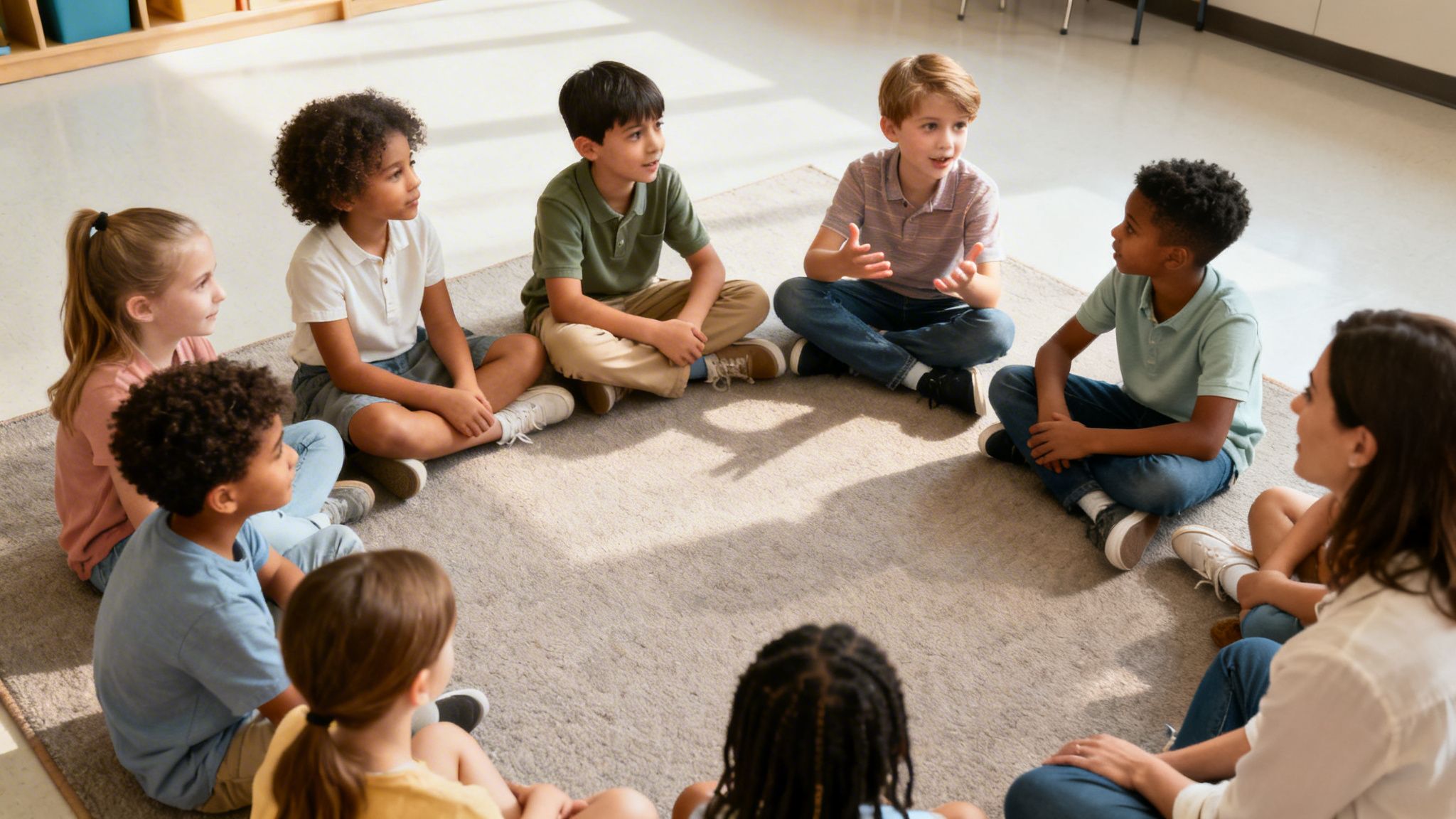
Soul Shoppe's work is made possible by donors and partners who care deeply about the young people in their communities! We can't do this work without you. Support our work in classrooms and on playgrounds across the nation by donating here.
A child walks into class already upset. Another student bumps their chair. The first child shouts, “Stop it!” The second child says, “I didn't even do anything.” By the time anyone figures out what happened, the room is tense, instruction has stopped, and two children feel misunderstood.
Versions of this happen all day, at school and at home. A kindergartner cries because they can't explain why they're overwhelmed. A fourth grader shuts down during group work. A seventh grader sends a sharp text, then insists, “That's not what I meant.” Adults usually see the behavior first. The communication need is underneath it.
That's why communication improvement matters so much in K-8 settings. It isn't just about teaching kids to use polite words. It's about helping them notice feelings, express needs, listen for meaning, repair conflict, and stay connected even when things feel hard. When schools and families use the same tools and language, children get something they rarely get by accident. They get consistency.
Why Communication Improvement Is Foundational for Kids
When adults talk about communication, they often mean speaking clearly. Kids need more than that. They need a way to say, “I'm confused,” “That felt unfair,” “I need space,” and “Can we try again?” They also need help hearing those messages from others without immediately moving into blame, defensiveness, or shutdown.
In SEL work, communication sits underneath almost everything else. A child can't ask for help if they don't have words for their frustration. They can't solve a friendship problem if they only know how to accuse. They can't fully participate in learning if every misunderstanding feels like a threat.
What strong communication looks like by age
Communication improvement should match development. A five-year-old and an eighth grader both need support, but the skills won't look the same.
Grade band
What communication often looks like
What we want to build
K-2
Big feelings, short language, quick reactions
Naming feelings, asking for help, turn-taking, listening with body and eyes
3-5
More words, but still impulsive under stress
Using “I” statements, asking clarifying questions, respectful disagreement
6-8
More social awareness, more peer pressure, more nuance
Reading tone, repairing harm, giving feedback, navigating group dynamics
A kindergartner might say, “He's mean.” With support, that becomes, “I got mad when he grabbed the marker.” An eighth grader may need help turning “Nobody listens in this group” into “I want a turn to explain my idea before we decide.”
That shift matters. It turns reaction into reflection.
Practical rule: If a child's language gets smaller when emotions get bigger, that's not manipulation. It's a sign they need structure, modeling, and time.
Communication is relational, not just verbal
Some of the hardest communication problems in schools aren't about vocabulary. They're about safety, trust, and power. A child may know the words but still not use them if they expect embarrassment, punishment, or dismissal.
That's one reason communication improvement has to include equity. Brookings' discussion of communication across language, literacy, and trust gaps points to practical supports like plain language, teach-back, interpreters, and trusted intermediaries. In school terms, that means we don't just ask, “Did we say it?” We ask, “Could this family understand it, trust it, and use it?”
For example, instead of sending home, “Please ensure completion of unfinished academic tasks,” a teacher can say, “If your child didn't finish classwork, please help them complete it tonight. If that's hard at home, send me a note and I'll help.”
Teach-back works well with children too. After giving instructions, say, “Tell me what you're going to do first.” That small move catches confusion early and reduces shame.
Why this belongs at the center of SEL
When communication improves, behavior often improves with it. Not because children become compliant, but because they become more capable. They can express themselves without exploding. They can listen without assuming attack. They can recover after mistakes.
That's part of why the benefits of social-emotional learning show up in both relationships and academics. Kids learn better when they feel understood, and they connect better when they have words that work.
Communication is a life skill, but in K-8 settings it's also a daily regulation tool. It helps children move from “something is wrong” to “here's what I need.”
Bringing Communication Skills to Life in the Classroom
Classroom communication lessons work best when they're brief, repeatable, and tied to real moments. Kids don't need one big lesson on respectful speaking in September. They need small routines they can practice in morning meeting, partner work, conflict repair, and transitions.
A shared classroom language helps. When everyone knows what “listen to understand” or “use an I-statement” means, you spend less time lecturing and more time coaching.
Active listening that kids can actually do
“Listen” is too vague for most children. They need visible actions.
Try teaching whole-body listening as a menu, not a compliance rule. Some students won't make eye contact consistently, and that's okay. Focus on behaviors that show attention and respect.
K-2 activity Use a listening detective game: Pair students. One student shares a favorite snack or animal. The listener has one job: repeat one detail they heard. Script it like this: “Your job is not to talk yet. Your job is to catch one important thing.”
3-5 activity Teach paraphrasing: Put sentence frames on the board: “I heard you say…” and “Do you mean…?” During partner talk, students must use one frame before adding their own idea.
6-8 activity Use disagreement rounds: Give pairs a low-stakes prompt such as whether recess should be longer or whether homework should be optional. One student speaks for a minute. The other must summarize the point fairly before responding.
What doesn't work is correcting listening only after a conflict. Build it during calm moments first.
I-statements that don't sound robotic
Kids often learn the formula but not the purpose. The point isn't to force stiff language. The point is to lower blame and increase clarity.
A simple classroom frame is: I feel… when… because… I need…
Examples:
“I feel frustrated when people talk while I'm reading because I lose my place. I need quiet for a minute.”
“I felt left out when the group started without me because I wanted to help. I need us to restart together.”
When a child says, “You're mean,” pause and coach the translation. “Try telling them what happened and how it affected you.”
Here are grade-band variations:
Grade band
Teacher prompt
Student example
K-2
“Say: I didn't like it when…”
“I didn't like it when you took my crayon.”
3-5
“Add the feeling word”
“I felt annoyed when you interrupted me.”
6-8
“Add a request”
“I felt dismissed when you laughed. Next time, let me finish first.”
Feedback and repair
Many classrooms teach sharing, but not enough teach repair. Kids need practice saying both “That didn't work for me” and “I want to make this right.”
Use these mini-scripts:
For giving feedback: “One thing that helped was…” or “Next time, it would help me if…”
For receiving feedback: “Okay, I hear that.” “Thanks for telling me.” “I want to fix it.”
With older students, I like to teach the difference between intent and impact. A student may not have meant harm, but impact still matters. That idea changes peer conversations fast.
A helpful outside resource for middle-grade conversation coaching is better conversations with Translate AI. It's useful when you want extra prompts for keeping discussions curious instead of combative.
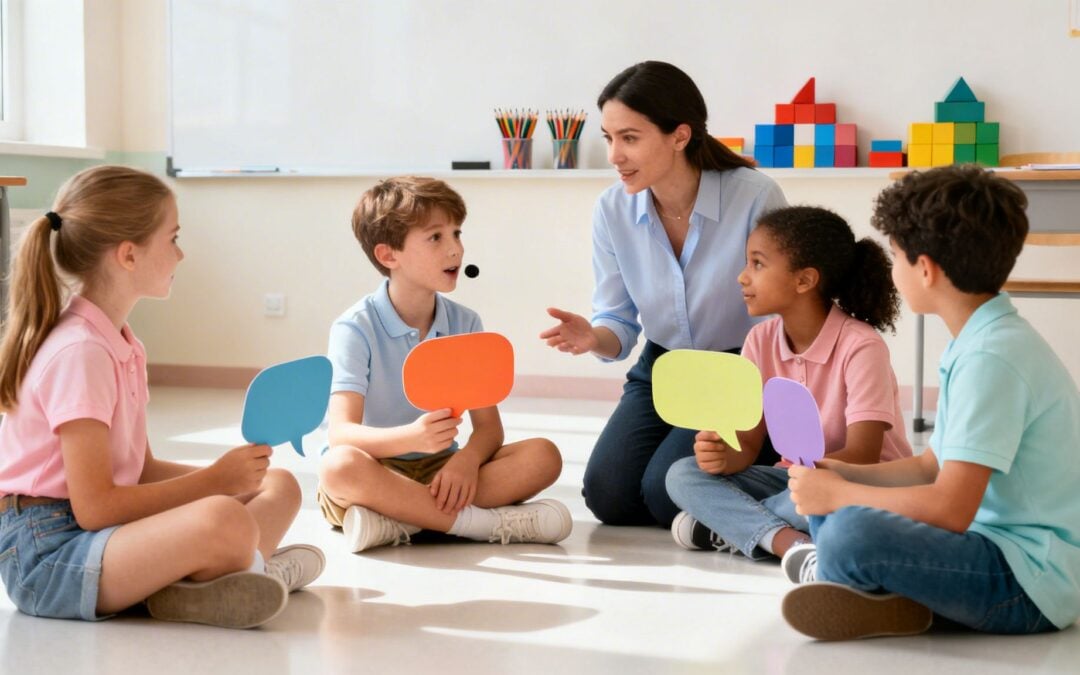
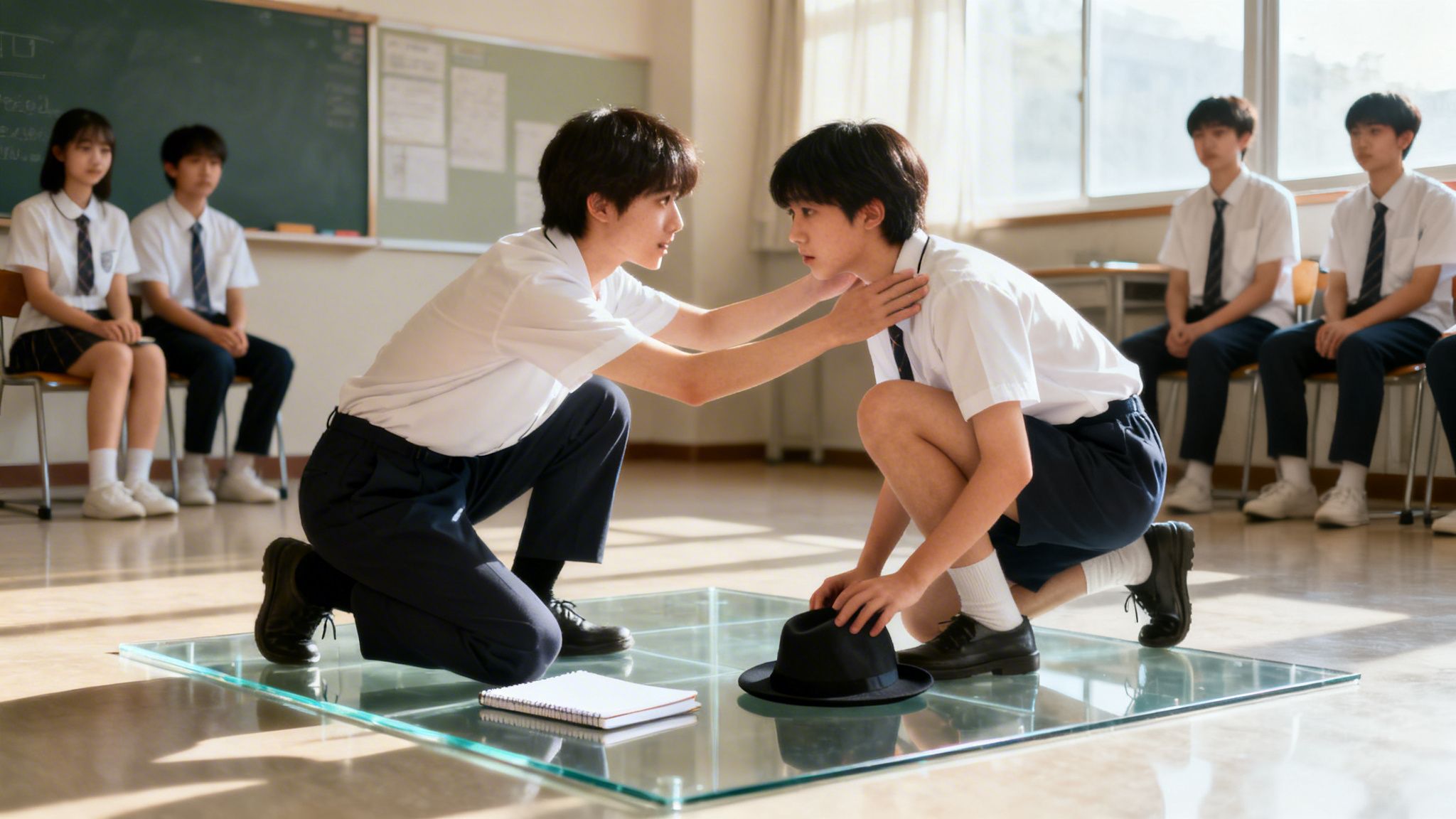
This is a good point to model what respectful talk sounds like in motion:
Nonverbal cues and group norms
Kids miss social cues for many reasons. They may be distracted, impulsive, anxious, neurodivergent, or inexperienced. Don't assume they're being rude. Teach what cues mean, then let them practice.
Try these routines:
Freeze and notice: Stop a role-play and ask, “What is this face or posture telling you?”
Silent line-up: Students line up by birthday month or shoe type without talking. Then reflect on gestures, eye contact, and problem-solving.
Tone swap: Say the same sentence in different tones. Ask students how the meaning changes.
If your school uses structured SEL support, one option is a program like Soul Shoppe, which offers workshops that teach shared language for communication and conflict resolution. The important part isn't the brand. It's that staff and students practice the same tools often enough for them to become usable under stress.
Partnering with Families for Communication Growth at Home
Families usually see the spillover from school stress. Homework refusal. Sibling fights. Bedtime blowups. Silence after a hard day. Parents don't need more theory in those moments. They need a sentence to say next.
Home communication improvement works when it feels doable. Short routines beat long lectures. Predictable language beats improvising while everyone's upset.
Replace pressure with structure
When adults ask, “How was school?” many children say, “Fine.” That's not defiance. It's often a broad question asked when the child is tired, hungry, or still regulating.
Use narrower prompts:
For younger kids: “What made you smile today?” “What felt hard?”
For older kids: “Was there a part of the day that felt annoying?” “Did anything surprise you?”
For any age: “Do you want listening, help, or space?”
That last question is gold. It stops adults from jumping into fixing mode too fast.
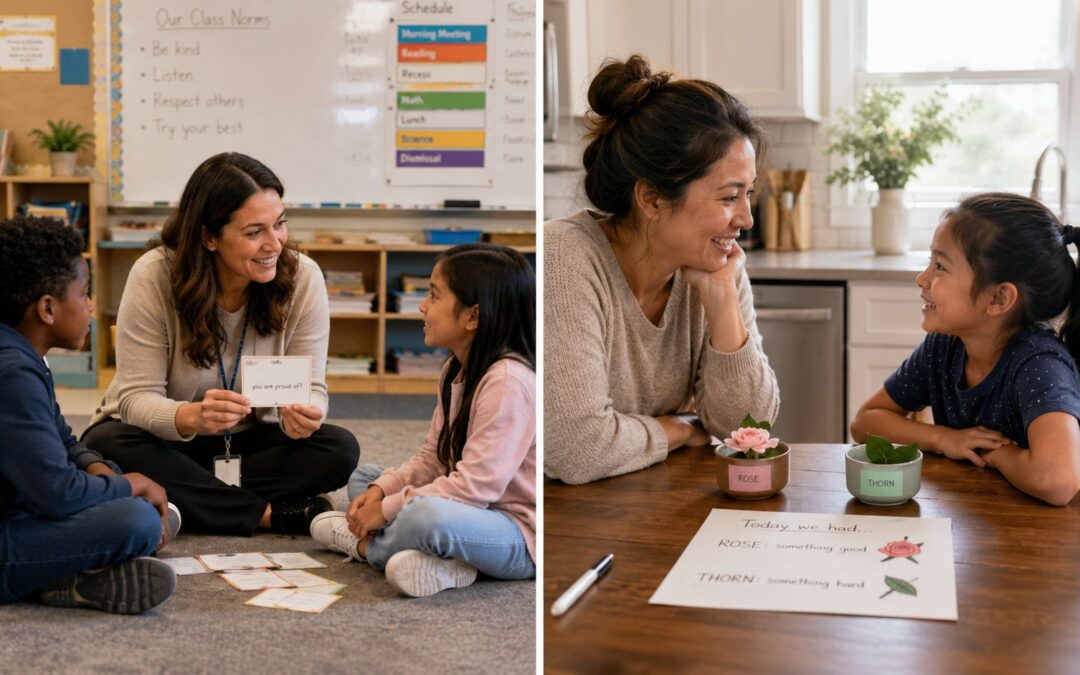
A simple home routine can be Rose, Thorn, and Help:
Rose: Something good from the day
Thorn: Something difficult
Help: One thing I need tomorrow
Scripts for common family friction points
Parents often tell me they know what not to say, but they freeze on what to say instead. Keep your scripts plain.
Homework conflict
Instead of: “You need to stop arguing and do it now.”
Try: “You don't want to start. I get it. Tell me what feels hard. Is it confusing, boring, or too much?”
Sibling conflict
Instead of: “Both of you knock it off.”
Try: “Pause. One person talks, one person listens. Start with what happened, not what kind of person your sibling is.”
Bedtime resistance
Instead of: “Why do you always make this difficult?”
Try: “Your body isn't ready to slow down yet. Let's choose. Two quiet songs or one short story?”
Screen time pushback
Instead of: “Because I said so.”
Try: “You want more time. I hear that. The limit is still the limit. Do you want to stop now and save time tomorrow, or stop now and help me choose tomorrow's plan?”
For families practicing feeling language, I-statements for kids can help translate blame into clearer, calmer language.
Home shift: Don't ask children to communicate respectfully while adults are speaking in accusations, threats, or sarcasm. Kids learn the pattern they hear most.
For busy households: Use one-minute check-ins in the car, during dinner cleanup, or before lights out.
For multilingual families: Encourage communication in the language that feels most natural and emotionally rich at home.
For caregivers at a distance: Use voice notes, visual schedules, shared journals, or brief video check-ins.
For children who struggle to talk face-to-face: Let them draw, point to feelings, write a note, or text a draft before speaking.
Build one bridge between school and home
The strongest school-home partnerships use the same phrases. If a teacher coaches, “Tell me what happened, how you felt, and what you need,” parents can use that exact language. If home uses “pause and repair,” school can echo it.
A shared script might look like this:
Pause the reaction
Name what happened
Name the feeling
Say what's needed next
Repair if necessary
That kind of consistency reduces confusion for children. They stop having to decode different adult systems and start practicing one usable skill across places.
The Adult's Role in Modeling and Self-Regulation
Kids notice our tone before they absorb our words. They watch how we handle interruption, disagreement, stress, and mistakes. That's why adult modeling is the strongest communication curriculum in the room.
A workplace poll of 1,000 employees found that 91% felt their leaders lacked critical communication skills in the Interact/Harris Poll summary shared by Becoming Your Best. That comes from a corporate setting, but the lesson carries over cleanly. Leadership breaks down when communication does. In schools and homes, adults are the leaders kids study most closely.
What modeling looks like in real life
Modeling doesn't mean sounding calm all the time. It means showing children what repair, clarity, and regulation look like when things aren't perfect.
Try these swaps:
Instead of “Calm down.” Try “I see you're upset. I'm staying with you. Let's slow your body first.”
Instead of “Use your words.” Try “You don't have the words yet. I can help. Are you mad, embarrassed, or worried?”
Instead of “You're being disrespectful.” Try “That tone tells me you're really frustrated. Let's talk in a way we can both hear.”
Instead of “We already went over this.” Try “I need to say that more clearly.”
That last one matters. Adults who restate without shaming teach children that misunderstanding is solvable.
Co-regulation comes before correction
When a child is flooded, logic won't land. Co-regulation means the adult lends steadiness before expecting skill. That might sound like a slower voice, fewer words, a lower body position, or a hand gesture the child already knows.
“Connection first, correction second.”
This isn't permissiveness. It's sequencing. A dysregulated child can't access the lesson you want to teach.
Questions adults should ask themselves
Communication improvement for kids usually starts with communication improvement for adults.
Consider these reflection prompts:
When I'm stressed, do I speed up, get louder, or repeat myself?
Do I ask children questions when I'm giving orders?
Do I leave space for an answer, or do I rush to fill silence?
Do I expect respectful language while using sarcasm or sharpness myself?
How often do I repair after I've misread a child?
Adults don't need to perform perfection. They need to model accountability. A simple “I spoke too sharply. Let me try that again” teaches more than a polished lecture on kindness.
Tracking Progress and Launching a Whole-School Initiative
A few strong classrooms can change student experience. A whole-school communication approach changes culture. The difference is consistency. Students hear the same language in class, on the playground, in the office, and at home-facing touchpoints.
The biggest mistake schools make is jumping straight to training materials or slogans. An evidence-based workflow for communication improvement starts with a baseline assessment, then measurable goals, role-specific training, practice opportunities, and monitoring and refining, as described in Moxie Institute's workplace communication guidance. Skipping the baseline is the common pitfall, because then nobody can tell whether improvement came from the training or from wishful thinking.
Start with what's actually happening
Before launching anything, gather a real picture of current communication patterns.
Useful baseline tools include:
Observation checklists: Notice how often adults prompt repair, how students enter group work, and what conflict language sounds like.
Student reflection forms: Ask simple questions like “When I'm upset, I know what to say” or “Adults at school help me feel heard.”
Family listening sessions: Find out where communication breaks down most often between school and home.
Staff self-audits: Let adults reflect on tone, clarity, wait time, and consistency.
If your school wants to think carefully about evidence and practical metrics, outcome measurement for SEL work is a useful reference point.
A five-part rollout that schools can sustain
Not every role needs the same training. A playground aide, classroom teacher, counselor, and front office staff member all communicate differently. The system works better when each group gets examples tied to their real day.
Baseline assessment Gather observations, surveys, and family input. Look for patterns, not just standout incidents.
Measurable goals Keep goals concrete. For example, a school might aim for more consistent use of shared conflict-repair prompts across classrooms.
Role-specific training Teachers may need sentence stems for academic disagreement. Office staff may need family-facing plain language. Recess staff may need quick de-escalation scripts.
Practice and reinforcement Put skills into meetings, advisories, classroom agreements, and family communication templates. If people only hear the strategy in training, it won't stick.
Monitor and refine Revisit the same tools you used at baseline. Ask what's changing, what's uneven, and what adults still need.
What to watch at the channel level
Sometimes communication fails because the message is wrong. Sometimes it fails because the channel is wrong. Selerix benchmark guidance on communication metrics notes that internal email open rates are commonly benchmarked at 65-75%, internal email click-through rates at 10-15%, and only 37% of employees reportedly watch internal videos to completion.
Schools can use that lesson without copying workplace culture. If a principal sends a long family email and few people act on it, the issue may be timing, overload, readability, or format. A translated text reminder, a short visual, or a teacher-recorded voice message may work better.
Leadership move: Measure whether families and staff can use the message, not just whether the message was sent.
Build buy-in through usefulness
Staff rarely resist communication improvement because they dislike communication. They resist one more initiative that feels disconnected from the school day.
Buy-in grows when staff can immediately use what they learn:
A sentence stem for hallway conflict
A teach-back routine for directions
A common repair script after peer harm
A plain-language family template for sensitive updates
School leaders should also model the same habits internally. If leadership wants calm, clear, respectful communication from staff, meetings and emails should reflect that expectation.
Building a Lasting Culture of Connection
Communication improvement isn't a one-time lesson, a poster, or a PD day. It's a daily practice that children and adults build together. Kids need direct teaching, but they also need repetition, coaching, and the safety to try again after they get it wrong.
The school-home bridge matters because children don't live in separate worlds. They carry stress, habits, and language from one setting into the other. When teachers and families share a few common tools, children spend less energy decoding adults and more energy learning how to express themselves, listen, and repair.
The most durable progress usually comes from simple things done consistently. A calm script. A check-in routine. A shared conflict process. A leader who models repair. A teacher who pauses to coach instead of shame. A parent who asks one better question in the evening.
Start small, but start on purpose. Choose one phrase, one routine, or one moment in the day where communication can get clearer, kinder, and more useful. That's how connection becomes culture.
Soul Shoppe helps school communities build shared language and practical SEL skills for communication, conflict resolution, self-regulation, and connection. If your school or family is looking for hands-on support, workshops, or tools that strengthen communication across classrooms and homes, explore Soul Shoppe.
Imagine a classroom with less conflict and more connection, or a home where disagreements are handled with respect instead of blame. This isn't a fantasy; it's the power of mastering the 'I-statement.' While many of us have heard the basic "I feel…" formula, its true potential lies in its versatility and nuance. This guide moves beyond the basics to provide a deep dive into specific I statement examples that give teachers, parents, and school leaders the exact words and strategies needed to teach self-regulation, boundary-setting, empathy, and conflict resolution.
This article delivers a classroom- and home-ready collection of scripts and tactics for K-8 students. We will explore practical, age-appropriate examples for eight distinct situations, including expressing emotions without blame, setting needs, and even offering appreciation. By structuring communication this way, I-statements become a powerful tool for giving and receiving clear messages. This skill is foundational for delivering effective constructive feedback, a crucial component of personal and academic growth for both children and adults.
You will find actionable tips, do's and don'ts, and coaching strategies to help you implement these tools immediately. By understanding these different applications, you'll equip children with a shared language to build healthier relationships, advocate for their needs, and navigate their social world with confidence and kindness. Let's explore the specific I statement examples that can create a more positive and communicative environment.
1. I-Statement for Expressing Emotions Without Blame
The most fundamental tool in social-emotional learning is the classic I-statement, designed to express feelings and needs without resorting to blame. It pivots communication away from accusatory "you" statements, which often trigger defensiveness, and toward a clear expression of a personal emotional experience. This structure is a cornerstone of conflict resolution, popularized by pioneers like Marshall Rosenberg and foundational to SEL programs like Soul Shoppe.
The power of this approach lies in its simple, three-part formula: "I feel [emotion] when [specific, non-judgmental observation] because [the impact it has on me]." This framework provides a concrete, teachable script that helps both children and adults articulate complex feelings constructively. For a person to use this tool effectively, they must first identify their feelings, which is a skill in itself. For support with this, you can explore resources for helping kids find the words they need.
From Blame to Personal Truth
Let's break down the strategic shift. A "you" statement points a finger, while an I-statement offers a window into one's own experience.
Instead of: "You're so mean for leaving me out."
Say: "I feel hurt when I'm not included in the game at recess because it makes me feel lonely."
Instead of: "You never listen to me!"
Say: "I feel frustrated when I'm interrupted because I lose my train of thought."
Practical Example for a Teacher: Instead of "Stop shouting out answers," a teacher might say, "I feel concerned when answers are shouted out, because it means not everyone gets a chance to think."
Key Insight: The I-statement is non-negotiable because it is a statement of personal feeling, not an accusation of fact. No one can argue with how you feel; they can only listen and respond to your stated experience.
Teach the Formula: Explicitly teach the "I feel… when… because…" structure. Use anchor charts with sentence stems as visual reminders.
Start Small: Practice with low-stakes scenarios, like sharing preferences ("I feel happy when we read this book because the characters are funny") before tackling conflicts.
Model Consistently: Adults must model this behavior. Use I-statements in staff meetings, during classroom instruction, and at home. When students hear it used regularly, it becomes a normal part of their communication toolkit.
Role-Play: Dedicate time to role-playing common conflicts, allowing students to practice forming their own i statement examples in a safe, guided environment. For instance, have two students role-play a scenario where one cuts in line.
2. I-Statement for Setting Boundaries and Needs
Beyond simply expressing feelings, a more advanced I-statement helps children and adults clearly articulate personal boundaries and needs. This structure moves from expressing an emotional reaction to proactively stating what is needed to feel safe, respected, and supported. It is a critical skill for building healthy relationships and self-advocacy, influenced by the work of researchers like Brené Brown on vulnerability and boundaries and integrated into school counseling best practices.
The formula empowers individuals to make a request without making a demand: "I need [specific, concrete need] because [reason/impact], and I would appreciate [a specific, actionable request]." This framework teaches students that having needs is normal and helps peers understand the 'why' behind a request, making them more likely to respond with empathy. It's a foundational tool for preventing misunderstandings that can lead to conflict or bullying.
From Vague Wants to Clear Requests
This I-statement variation helps students move from feeling helpless or resentful to taking constructive action. It gives the other person a clear pathway to help meet the need.
Instead of: "Stop bothering me after school!"
Say: "I need some alone time after school because my social battery is drained, and I would appreciate it if you'd text before coming over."
Instead of: "You always decide what we do. It's not fair."
Say: "I need to feel included in decisions that affect our group because I feel disrespected otherwise, and I'd appreciate you asking for my opinion before we start."
Practical Example for a Parent: Instead of "Clean your room now!", a parent could say, "I need the living room floor to be clear because it helps me feel calm, and I'd appreciate you putting your toys in the bin before bedtime."
Key Insight: Stating a need and a specific, appreciated action is empowering. It shifts the dynamic from complaint to collaboration, inviting the other person to be a part of the solution rather than the source of the problem.
How to Implement This in Your Classroom or Home
Teaching boundary-setting requires creating a culture where needs are seen as valid.
Teach the Formula: Introduce the "I need… because… and I would appreciate…" structure. Post it alongside the basic "I feel" formula.
Normalize Needs: Regularly discuss that everyone has needs (for space, for quiet, for help, for inclusion) and that it is strong, not weak, to state them.
Use Relevant Scenarios: Role-play situations that K-8 students actually face: a friend who copies homework, a sibling who barges into their room, or a group that doesn't share the ball. This makes practicing these i statement examples feel authentic.
Coach Tone and Body Language: Remind students that how they say something matters. Practice delivering boundary statements with a calm, firm tone and confident posture, not an aggressive or pleading one.
3. I-Statement for Appreciation and Positive Reinforcement
Beyond conflict, I-statements are a powerful tool for building belonging and psychological safety by expressing appreciation. This positive application inverts the typical conflict-resolution formula to focus on what is working, creating a culture of recognition and connection. This approach, central to restorative practices in schools and positive psychology, helps students see and name the good in others, strengthening peer relationships and reducing feelings of isolation.
The structure shifts to highlight positive impact: "I appreciate [specific action or quality] about you because [the positive impact it had on me or others]." This framework moves beyond a simple "thank you" to articulate why an action mattered, making the appreciation more meaningful and reinforcing prosocial behaviors. Programs like Soul Shoppe emphasize this form of communication to build authentic connection and empathy.
From Vague Praise to Specific Recognition
This method transforms generic compliments into impactful statements of value. It teaches students to be specific and authentic in their praise.
Instead of: "You're a good friend."
Say: "I appreciate how you included Maya in our group project because it showed kindness and made her feel valued."
Instead of: "You're funny."
Say: "I appreciate your sense of humor because it makes our class feel more relaxed and fun."
Practical Example for a Teacher: Instead of "Good job," say to a student, "I appreciate how you helped Sam pick up his crayons because it showed teamwork and saved us time."
Key Insight: Specific appreciation reinforces character and action, not just personality. It tells a person that what they do matters, encouraging them to repeat those positive behaviors.
How to Implement This in Your Classroom or Home
Building a culture of appreciation requires creating intentional routines.
Teach the Formula: Introduce the "I appreciate… because…" sentence stem. Brainstorm words related to positive actions and qualities (e.g., patient, inclusive, helpful, creative).
Create Appreciation Rituals: Establish regular structures like a weekly appreciation circle where students share statements with one another. A peer recognition board or a gratitude journal can also make this a consistent practice.
Model Authenticity: Adults should model specific and sincere appreciation regularly. When you see a student help another, use this I-statement format to praise them publicly.
Focus on Peer-to-Peer: The goal is for students to give and receive appreciation from each other, not just from the teacher. Encourage them to notice the positive actions of their classmates, building a stronger and more supportive community from within.
4. I-Statement for Perspective-Taking and Empathy
Building on the basic I-statement, this more developed structure fosters empathy by combining self-expression with an attempt to understand the other person's point of view. It encourages speakers to move beyond their own emotional world and consider the feelings and experiences of others. This advanced form is a key component in restorative practices and peer mediation programs, which focus on repairing harm and building community.
This approach uses a multi-part formula: "I feel [emotion] when [situation], and I imagine you might feel [possible emotion] because [reasoning]." It teaches students to articulate their feelings while also making an educated guess about the other person's perspective. The inclusion of phrases like "I imagine" or "I wonder if" is critical, as it signals an attempt to understand rather than a claim to know exactly what the other person is feeling.
From Self-Awareness to Mutual Understanding
This I-statement model shifts the goal from simply stating one's own feelings to opening a dialogue about mutual experiences. It validates one's own emotions while creating a bridge to the other person's reality.
Instead of: "You're being so unfair and not listening."
Say: "I feel frustrated when we argue about the rules, and I imagine you might feel like I'm not listening because you want to be heard, too."
Instead of: "Why are you sitting all by yourself? That's weird."
Say: "I feel concerned when I see you sitting alone at lunch, and I imagine you might feel lonely because having friends to eat with is important."
Practical Example for a Parent: A parent mediating a sibling fight might say, "I see you're angry that your tower was knocked down, and I wonder if your brother feels left out because he wanted to play, too."
Key Insight: This statement de-escalates conflict by showing you are trying to understand the other person's perspective. It communicates, "Your feelings matter to me, and I'm trying to see this from your side," which can disarm defensiveness and encourage collaboration.
How to Implement This in Your Classroom or Home
Teaching this empathetic I-statement requires building foundational skills first.
Teach Perspective-Taking: Before introducing this formula, focus on empathy. Use literature, role-playing, and other perspective-taking activities to help children practice seeing situations from multiple viewpoints.
Introduce Sentence Stems: Provide clear sentence starters like, "I feel… when… and I wonder if you feel…" or "I feel… when… and I imagine you might feel… because…" on anchor charts.
Model and Validate: Regularly model this in your own communication. When a child uses this structure, validate their effort: "Thank you for trying to understand how they might be feeling. That shows a lot of care."
Practice in Low-Stakes Scenarios: Start with hypothetical situations or storybook characters. For instance, "I feel sad for the wolf in the story, and I imagine he might feel misunderstood because everyone thinks he's bad." This helps build the cognitive habit before applying it to real conflicts. These i statement examples show that the tool can be used for more than just disagreements.
5. I-Statement for Peer Support and Advocacy
Beyond personal expression, I-statements can be adapted to empower students as empathetic and supportive peers. This variation moves from expressing one's own needs to noticing and responding to the needs of others. It provides a structured way for students to act as upstanders, offering help without overstepping boundaries or making assumptions. This approach is central to effective peer support programs, bystander intervention training, and Soul Shoppe's model of creating a school culture where students actively support each other.
The formula for this type of statement is: "I notice [specific, non-judgmental observation], and I care about you. I want to [offer of support], so can I [specific action]?" This framework equips students to translate their concern into concrete, respectful action, reinforcing a community of care.
From Bystander to Upstander
This I-statement shifts a student's role from a passive observer to an active, caring advocate. It gives them the words to intervene kindly and safely.
Instead of: Watching a friend struggle in silence.
Say: "I notice you seem really upset lately, and I care about you. Can I listen, or would it help if I told a counselor with you?"
Instead of: Ignoring a peer who is being excluded.
Say: "I see someone treating you badly, and I care about you. I want to sit with you at lunch. Would that be okay?"
Practical Example for a Teacher to Coach: A teacher can coach a student by saying, "It looks like Maria is having a tough time. Maybe you could go over and say, 'I notice you're sitting by yourself. Can I join you?'"
Key Insight: This I-statement model puts the person being supported in the driver's seat. The offer of help respects their agency by asking for permission ("Can I…?"), ensuring the support is wanted and appropriate.
How to Implement This in Your Classroom or Home
Building a culture of peer advocacy requires clear guidance and structure.
Teach the Formula: Introduce the "I notice… I care… Can I…?" structure. Discuss why each part is important, especially the "ask" at the end.
Define Boundaries: Clearly teach the difference between peer support (listening, offering company, getting an adult) and peer counseling (trying to solve big problems). Establish clear rules for when students must tell a trusted adult, particularly for safety concerns.
Role-Play Scenarios: Use realistic situations common in K-8 settings for role-playing. Practice scenarios like seeing someone left out, noticing a friend is sad, or seeing someone get teased online. This builds muscle memory for these specific i statement examples.
Create Support Structures: Formalize opportunities for peer support through buddy systems, peer mentoring programs, or designated "support circles" where students can practice and get feedback.
6. I-Statement for Self-Regulation and Mindfulness
This internally-focused I-statement shifts the tool from interpersonal communication to personal emotional regulation. It's a structure that helps students build self-awareness by connecting an internal feeling or physiological state to a specific, actionable coping strategy. This approach is central to trauma-informed care and modern mindfulness programs, empowering students to recognize their own needs and take ownership of their emotional well-being.
The framework empowers students to become detectives of their own inner worlds with a clear script: "I notice I'm feeling [emotion/physical sensation], so I'm going to [specific coping strategy] to help myself feel [desired state]." This model moves beyond simply naming a feeling; it prompts an immediate, positive action. The goal is to build an internal habit of recognizing dysregulation and activating a tool to return to a calm, focused state.
From Reaction to Regulation
Instead of acting out on an impulse, this I-statement creates a mindful pause. It bridges the gap between a feeling and a constructive response, building a foundation for emotional resilience.
Instead of: An outburst or putting their head down in frustration.
Say: "I notice I'm feeling frustrated with this math problem, so I'm going to take a movement break before I say something I regret."
Instead of: Appearing disengaged or distracted.
Say: "I notice my mind is wandering and I'm struggling to focus, so I'm going to do a body scan meditation to recenter myself."
Practical Example for a Parent to Model: A parent might say aloud, "I notice I'm feeling really stressed by all this noise, so I'm going to put on my headphones and listen to quiet music for five minutes to help myself feel calm."
Key Insight: This internal I-statement makes self-regulation a visible and teachable skill. It normalizes the process of having big feelings and demonstrates that everyone has the power to manage them with practice.
How to Implement This in Your Classroom or Home
Integrating this practice helps students build a toolkit for lifelong emotional health.
Teach Regulation Zones: Introduce a framework like the "window of tolerance" to help students understand the concepts of being regulated (calm, focused), hyper-aroused (anxious, angry), and hypo-aroused (zoned out, tired).
Build a Strategy Menu: Co-create a visual menu of coping strategies. Categorize them by type (movement, breathing, sensory, cognitive) so students can choose what works best for them. For more ideas, explore these self-regulation strategies for students.
Practice When Calm: Dedicate time to practicing regulation skills like box breathing or mindful listening when students are not dysregulated. This builds muscle memory, making the skills accessible during moments of stress.
Create a Calm Space: Designate a corner of the classroom or home where students can go to use their strategies without judgment. Stock it with sensory tools, cushions, or other calming items.
7. I-Statement for Clarifying Misunderstandings Before Conflict Escalates
This preventive I-statement is designed to clear up potential misunderstandings before they harden into full-blown conflicts. It combines emotional expression with genuine curiosity, moving from assumption to clarification. This approach, rooted in principles from Nonviolent Communication (NVC) and Crucial Conversations, teaches students to give peers the benefit of the doubt and seek connection over confrontation.
The structure prioritizes curiosity: "I want to check in because I felt [emotion] when you [specific action], and I'm wondering if [possible alternative explanation]?" This framework gives the other person an opportunity to share their perspective without feeling attacked, immediately de-escalating the situation. It shifts the focus from "what you did wrong" to "what I might have misunderstood."
From Assumption to Personal Truth
This type of I-statement proactively addresses the root cause of many peer conflicts: making negative assumptions. By including a question, it invites dialogue instead of demanding an apology.
Instead of: "Why didn't you invite me to your party? That was so mean."
Say: "I want to check in because I felt left out when I heard about your party, and I'm wondering if maybe you had limited space or I missed the invitation?"
Instead of: "Stop laughing at me!"
Say: "I felt hurt when you laughed, and I'm wondering if you were laughing at something else and I just misunderstood the situation?"
Practical Example for a Teacher: "I want to check in because I felt a little confused when I saw you on your phone, and I'm wondering if you were looking up a word for the assignment or if something else was going on?"
Key Insight: This statement gives the other person an "out." By offering a possible, neutral explanation, you make it safe for them to clarify their intent without getting defensive, preserving the relationship.
How to Implement This in Your Classroom or Home
Teaching this proactive approach requires modeling curiosity and vulnerability.
Teach the Power of Clarity: Explicitly teach that assumptions often cause unnecessary hurt feelings. Use the phrase, "When in doubt, check it out."
Model Openness: Adults must use this framework in their own interactions. Students who see teachers and parents clarifying misunderstandings with colleagues or partners will learn that it’s a strong, healthy way to communicate.
Practice with Low-Stakes Scenarios: Start with neutral situations. For example: "I felt confused when you put the art supplies away, and I'm wondering if you thought we were done or if they belong somewhere else?"
Celebrate Proactive Use: Acknowledge and praise students when you see them using these i statement examples to check in with a peer instead of letting a misunderstanding fester. This reinforces the behavior you want to see. For more ideas on building these skills, explore these conflict resolution strategies for kids.
8. I-Statement for Growth Mindset and Learning From Mistakes
This powerful I-statement variation shifts the focus from the shame of making an error to the opportunity for growth. It helps children and adults normalize mistakes as an essential part of the learning process, building resilience and a growth mindset. This framework is heavily influenced by the work of Carol Dweck on mindset, Brené Brown on vulnerability, and restorative practices in schools that prioritize learning over punishment.
The structure goes beyond simply stating a feeling; it encourages reflection and a plan for future action. The formula is: "I made a mistake when I [specific action], and I learned [insight/lesson]. Next time, I will [specific change]." This script guides a person from acknowledging an error to extracting a valuable lesson and creating a concrete plan for improvement, turning a moment of failure into a step toward competence.
From Failure to Forward Momentum
This I-statement transforms a mistake from a dead end into a learning opportunity. It replaces the defensiveness or shame that often accompanies errors with a proactive, solution-oriented mindset.
Instead of: "I'm so bad at math."
Say: "I made a mistake on this math test, and I learned that I need to ask for help with this concept. Next time, I will ask my teacher for help before the test."
Instead of: "I always mess things up!"
Say: "I made a mistake when I rushed through my project, and I learned that taking my time produces better work. Next time, I will start earlier and double-check my work."
Practical Example for a Teacher to Model: After a lesson doesn't go well, a teacher can say in front of the class: "I made a mistake by not explaining those instructions clearly enough. I learned that a visual aid would help. Next time, I will put the steps on the board."
Key Insight: This framework separates the action from the person's identity. The focus shifts from "I am a mistake" to "I made a mistake," which is a critical distinction for developing a healthy self-concept and the resilience to try again.
How to Implement This in Your Classroom or Home
Integrating this reflective practice helps build a culture where mistakes are seen as valuable.
Teach the Formula: Introduce the "I made a mistake… and I learned… Next time, I will…" structure. Post it on an anchor chart as a visible tool for processing setbacks.
Model Vulnerability: Adults must lead by example. When you make a mistake, narrate your own process using this I-statement. Saying "I made a mistake when I got frustrated with the computer, and I learned I need to take a break. Next time, I will step away for a minute" shows students it's a normal process.
Create Reflection Time: Dedicate moments for reflection, such as during class meetings or through journal prompts. Ask students to share a "mistake and a make-it-better plan" from their week.
Celebrate the Learning: When a student applies a lesson from a past mistake, acknowledge their growth. Praising the effort to change behavior reinforces the value of these i statement examples and the learning process itself.
Putting I-Statements Into Practice: Key Takeaways for Lasting Change
Throughout this guide, we've explored the incredible versatility of "I" statements. Far from a one-size-fits-all script, the I statement examples we've broken down reveal a powerful framework for building essential social-emotional skills in children and adults alike. Moving from theory to daily practice is where the real work begins, and the key is to approach it with patience, consistency, and intention.
Mastering this skill is a journey, not a destination. By committing to this practice, you are not just teaching a communication trick; you are building a foundation for a more resilient, self-aware, and compassionate generation.
From Examples to Everyday Habits
The goal is to shift "I" statements from a tool you pull out during a conflict to a natural part of everyday communication. The journey from learning to habit requires a structured, yet flexible, approach. Remember the diverse applications we covered, from expressing difficult emotions to offering positive reinforcement.
Actionable Takeaway: Start by focusing on one specific application. For the next week, challenge yourself and your students or children to use "I" statements exclusively for expressing appreciation. For example, instead of a generic "Good job," model, "I feel so proud when I see you working hard to solve a tough math problem because it shows your determination." This low-stakes practice builds the muscle for higher-stakes conversations later.
Modeling Is the Most Powerful Teacher
Children absorb communication habits from the adults around them. Your commitment to using "I" statements in your own life-with colleagues, partners, and the children you guide-is the most effective lesson you can offer. They see how you handle frustration, set boundaries, and repair misunderstandings.
Think back to the growth mindset example: "I feel frustrated because my lesson plan didn't work as expected, but I am going to try a new approach tomorrow." When students hear an adult model this, it normalizes struggle and reframes mistakes as learning opportunities. It sends a clear message: challenges are part of the process, and we have the tools to talk about them constructively.
Strategic Insight: Your authenticity matters more than perfection. If you stumble over your words or forget to use an "I" statement in the moment, circle back. You can say, "You know, I'm thinking about how I reacted earlier. I want to try that again. I felt overwhelmed when the room got loud, and I need a few minutes of quiet to reset." This act of repair is an incredibly powerful lesson in itself.
Building a Shared Language for Your Community
The true impact of these tools is realized when they become part of a community's shared language. Whether in a classroom or a household, a consistent vocabulary for feelings and needs reduces guesswork and emotional escalation. When everyone understands the "I feel [emotion] when [situation] because [impact]" structure, it creates a predictable and safe environment for communication.
This is where the structured I statement examples become invaluable. They provide the scaffolding needed for students to build their skills, from simple sentence stems for younger learners to more complex scripts for navigating peer advocacy or clarifying misunderstandings.
Actionable Takeaway: Create a "Communication Corner" in your classroom or home. Post anchor charts with the different "I" statement formulas we've discussed. During a morning meeting or family dinner, pick one example and have everyone practice tailoring it to a real or hypothetical situation. This consistent, low-pressure reinforcement makes the language stick.
By weaving these practices into the fabric of your daily interactions, you move beyond simply managing behavior. You begin to cultivate a culture of empathy, respect, and profound human connection. You are giving children the words they need to understand themselves and connect with others-a skill that will serve them for a lifetime.
Ready to bring a structured, school-wide approach to social-emotional learning into your community? For decades, Soul Shoppe has helped schools build more peaceful and compassionate cultures by teaching essential skills like "I" statements through assemblies, workshops, and comprehensive curriculum. Explore how Soul Shoppe can support your students and staff today.
We’ve all been there—listening to someone talk, but our minds are busy formulating a reply, offering a solution, or just waiting for our turn to speak. Empathetic listening asks us to do something different. It’s the art of tuning into the feeling behind the words, not just the words themselves.
This kind of listening is all about connection over correction. It’s about creating a safe space where someone can be truly heard.
Defining Empathetic Listening in Education
To really define empathetic listening, try thinking of yourself as an “emotional detective” instead of a “problem solver.” Your first job isn't to fix anything or give advice. It's simply to understand and acknowledge the speaker's emotional state, which is the secret to building trust and psychological safety.
This skill is a cornerstone of effective social-emotional learning (SEL). When students feel genuinely heard and understood, they’re far more likely to open up, take healthy risks, and form real relationships with their peers and the adults in their lives.
Listening to Connect, Not Just Comprehend
There’s a big difference between empathetic listening and other ways we listen. It isn’t passive listening (where we’re just hearing sounds) or even active listening (which often focuses on remembering facts to repeat back). Empathetic listening goes deeper, tuning into the feelings simmering just below the surface.
For educators and parents, getting this right is a game-changer for building strong relationships. The foundation of strong interpersonal skills is this kind of genuine understanding.
Think about this common classroom moment:
Student: "I'll never finish this history project. It's just too much work, and I don't even know where to start."
Active Listening Response: "So, you're saying the project feels too big and you need a plan. Let’s break it down into smaller steps."
Empathetic Listening Response: "It sounds like you're feeling really overwhelmed and maybe a little stuck. That’s a tough feeling when you're facing a big project."
See the difference? The active listening response is helpful, but it jumps right to solving the problem. The empathetic response first acknowledges the student’s feeling of being overwhelmed. This small act of validation shows the student their feelings matter, opening the door to more productive problem-solving later.
By validating the emotion first, you create a space where the student feels safe enough to be honest about their struggles. This is the cornerstone of trust between a teacher or parent and a child.
This shift turns interactions from transactional to relational. It creates an environment where children feel secure enough to express themselves fully. The focus moves from just managing behavior to truly nurturing a child’s emotional well-being, which in turn supports their academic and social growth.
The Three Pillars of Empathetic Listening
To really get what empathetic listening is, it helps to think of it as a skill built on three core pillars. When educators and parents master these, they shift from just hearing a child's words to truly connecting with the feelings underneath. Think of these pillars as the foundation holding up a bridge of trust between you and a student.
This isn't about being passive; it's about being fully present and responsive. Instead of jumping in with advice or criticism, you create a space of genuine emotional safety. This sense of trust is the bedrock for building belonging in any school community.
Pillar 1: Attentive Presence
The first pillar is all about attentive presence. This means giving a child your complete, undivided attention, showing them with your body language that they are the most important thing in that moment.
It’s putting your phone down. It's turning away from the laptop. It's making eye contact that says, "I'm with you." Small cues like nodding or leaning in signal that you are fully engaged and ready to hear what they need to share.
Parent Example: Your child walks in from school, shoulders slumped. Instead of multitasking while asking what’s wrong, you stop what you’re doing, sit with them, and just say, “You look like you had a tough day. I’m here if you want to talk about it.” This simple act shows they have your complete focus.
Teacher Example: A student is lingering after class, clearly wanting to talk. Instead of tidying your desk, you can pause, turn your body fully toward them, and say, "I have a few minutes. What's on your mind?" This signals that they are your priority.
Pillar 2: Validating Their Feelings
Next up is validating their feelings, and this might be the most powerful step of all. It involves figuring out the core emotion the child is expressing and reflecting it back to them without any judgment.
Your goal isn't to agree or disagree with the situation, but simply to show that you understand their emotional reality. This is a crucial part of building emotional intelligence, as it teaches kids that their feelings are real, valid, and deserve to be heard.
Teacher Example: A student slams their book shut, exclaiming, “This is impossible!” Instead of correcting their attitude, you can say, “It sounds like you’re feeling really frustrated and stuck right now.” This names the emotion and shows you get it.
Parent Example: Your child is crying because they weren't invited to a birthday party. Instead of saying, "There will be other parties," try validating their hurt: "It feels so painful to be left out. I'm sorry you're feeling so sad right now."
Pillar 3: Withholding Premature Advice
The final pillar is withholding premature advice. For many adults, this is the hardest one. Our natural instinct is to fix things and solve problems for the kids we care about.
But jumping in with a solution too quickly can feel like a dismissal. It sends the unintentional message that their feelings are just an obstacle to be cleared away, not a valid experience to be processed.
Teacher Example: A student says, "I don't think anyone in my group likes my ideas." A problem-solving response is, "Let's find you a new group." An empathetic response is to pause, then say, "That sounds really discouraging. It’s hard to feel like your voice isn’t being heard."
Parent Example: Your teen complains, "I have too many assignments and I can't keep up." Instead of immediately creating a schedule for them, try saying, "It sounds like you're completely buried in work. That must be so stressful."
When you pause before offering solutions, you give the child space to work through their own feelings and sometimes even discover their own answers. Once they feel heard and validated, they become much more receptive to guidance. This patient approach builds resilience and empowers them to become stronger problem-solvers down the road.
Empathetic Listening vs Active Listening Key Differences
Though people often use the terms interchangeably, empathetic listening and active listening are two very different tools. Knowing when to use each one is a game-changer for parents and educators. It can be the difference between a child feeling truly heard and supported, or simply feeling… managed.
Think of it like having a toolkit for communication. You wouldn’t use a hammer to turn a screw, right? Same idea here.
Active Listening: Listening to Comprehend
At its core, active listening is about understanding information. The goal is to accurately hear and confirm the facts. When you listen actively, your mind is zeroed in on the details. You summarize what you’ve heard and ask questions to make sure you got it right. It’s perfect for those straightforward, get-it-done conversations.
This is the skill you pull out when the goal is purely about comprehension. It shines when a student needs to understand the steps for a project or when a parent needs to confirm the logistics of a weekend plan. It’s all about getting the details straight.
Teacher Example: A student seems confused about a homework assignment. Using active listening, the teacher might say, “Okay, let me repeat that back to make sure we’re on the same page. You’ll choose a historical figure, write one page on their major accomplishment, and find a photo. Did I get that right?”
Parent Example: A child is explaining their after-school plan. The parent listens and confirms, “So you’re going to Maria’s house, her mom will drive you home at 5 PM, and you need to finish your math homework there. Is that the plan?”
Empathetic Listening: Listening to Connect
On the other hand, empathetic listening is about connecting with emotion. Here, the facts take a backseat. Your goal isn’t to solve a problem or absorb a list of details; it’s to understand what the other person is feeling. This is where you build trust, create emotional safety, and show someone their feelings are valid.
When a student is upset about a playground argument, they don't need a step-by-step solution right away. They need to feel understood. Empathetic listening is the tool for that job.
This is your cue to set your problem-solving brain aside for a moment. Instead of asking, "What happened?" you might gently ask, "How did that make you feel?" It’s a subtle but powerful shift from information to emotion. Diving into different communication approaches, like exploring the art of listening, can add so much depth to our interactions with kids.
Teacher Example: A student is sitting alone after being left out of a game. An empathetic response sounds like, “It looks like you’re feeling really sad right now. It hurts to be left out.”
Parent Example: A teen is stressing about a big test. Instead of jumping to advice like, "Just study more," an empathetic parent might say, "It sounds like you're under a lot of pressure. That must feel really overwhelming."
This simple diagram breaks down the three pillars of empathetic listening. It's all about being present, validating feelings, and—this is the hard part—holding back the urge to give advice.
Empathetic Listening vs Active Listening Key Differences
To make it even clearer, let's break down the two side-by-side. This table highlights the primary goals, focus areas, and outcomes of each approach, helping you decide which tool is right for the moment.
Aspect
Empathetic Listening
Active Listening
Primary Goal
To connect and build emotional safety.
To comprehend and confirm information.
Focus
The speaker's emotions and feelings.
The facts and details of what is being said.
Your Role
A safe harbor for emotions.
A fact-checker ensuring accuracy.
Key Question
"How does that feel?"
"Did I understand that correctly?"
Best For
Relational conversations; offering support.
Transactional conversations; giving instructions.
Outcome
The speaker feels understood, validated, and safe.
The speaker feels heard and confident the message was received.
Both listening styles are incredibly valuable. The real skill lies in recognizing what a child needs in a given moment—is it a solution, or is it support? Choosing the right one builds stronger, more trusting relationships.
If you're looking to practice these skills, check out our guide with a great active listening activity you can easily adapt for your classroom or home.
How Empathetic Listening Transforms School Communities
When we bring empathetic listening into our schools, it’s not just about improving one-on-one chats. It’s a powerful tool that changes the whole feel of the campus. It builds psychological safety—that sense of trust where students feel comfortable enough to take a chance on a tough question, ask for help, or just be themselves without worrying about being judged.
This feeling of safety has a direct effect on how kids treat each other. It’s one of the most effective tools we have for resolving conflict and even preventing bullying. When a child learns to truly hear a classmate's side of things, even when they disagree, they’re taking the first real step toward kindness.
Building Safer and More Engaged Schools
Schools that make a point to teach and model this skill see real, noticeable changes. It creates an environment where students feel seen and heard, which is directly tied to better behavior and a powerful sense of belonging. The more connected kids feel to their school, the more they want to be a part of its success.
This shift sends ripples through the entire community. Research from BetterUp found that empathetic listeners build trust 40% faster just by using simple cues like eye contact and asking follow-up questions. In U.S. schools, programs that focus on these skills are linked to a 32% drop in behavioral issues. We've seen it in our own work, too—partnerships like Soul Shoppe's with the Junior Giants Strike Out Bullying program have been shown to cut student isolation by 38%. You can discover more insights about building trust through listening on BetterUp's blog.
This practice also deepens the teacher-student relationship, making the classroom a more cooperative and engaged space. When that connection is strong, academic achievement naturally follows. You can explore a deeper dive into how to improve school culture with these strategies.
By fostering an environment of active understanding, empathetic listening lays the groundwork for holistic approaches such as client-centered care, fundamentally reshaping how schools operate.
From Understanding to Positive Action
The benefits don't just stay within the school walls. As students and staff get better at hearing the emotions behind the words, they’re also building lifelong skills in problem-solving and collaboration. That ability to connect on a human level is what holds a positive community together.
Think about these key outcomes:
Reduced Conflict: When students can understand a peer's feelings, they're far less likely to turn to aggression or exclusion.
Increased Participation: Kids who feel safe and respected are more willing to share their ideas and join in on class discussions.
Stronger Resilience: Feeling understood helps students navigate tough times and bounce back from setbacks with more confidence.
Ultimately, empathetic listening is what turns a school from a simple collection of individuals into a truly connected community—a place where everyone feels like they belong.
Empathetic Listening Examples for Teachers and Parents
Understanding the definition of empathetic listening is the easy part. The real work comes when you’re face-to-face with a frustrated child and have to put it into action. The secret is to resist the urge to jump in and solve the problem, and instead, focus on validating the feeling behind it.
Let's walk through a few real-world examples. Pay attention to how the empathetic responses avoid giving advice and instead focus on naming the child's emotion first. This simple shift is often the key to helping a child feel truly seen and heard.
Scenario 1: In the Classroom
Imagine a student slumped in their chair, pushing their math paper away. They’re visibly upset and mutter, “I’m just bad at math. I can’t do this.”
What to Avoid: "Don't give up, just try again. It's not that hard if you focus." This kind of response dismisses their frustration and can make them feel even more defeated.
What to Say Instead: "I can see how frustrating this problem is for you. It feels like you’ve hit a wall, and that's a really tough feeling." This response acknowledges their struggle and opens the door to connection and support.
When educators move from simply hearing to truly listening—asking things like, "What part feels impossible?"—it makes a massive difference. In fact, students who feel genuinely heard are 25% more likely to ask for help and stick with a challenge. Over Soul Shoppe's 20+ years of work, schools that adopt these methods have seen a 40% drop in student isolation reports. You can dive deeper into this topic by reading this insightful article from EdTechReview on teaching students to listen with empathy.
Scenario 2: At Home
Your child storms in after a fight with a friend over a toy. They slam their door and yell, “It’s not fair! Alex took my favorite car and wouldn’t give it back!”
The goal of empathetic listening is to communicate: "Your feelings make sense, and I am here with you." It doesn’t mean you agree with their behavior, only that you understand the emotion driving it.
This validation is everything. It shows them their feelings are legitimate, which helps calm their reactive brain and allows them to think more clearly about what happened.
Here’s how to handle it:
What to Avoid: "You two need to learn how to share. It's just a toy." This response minimizes their feelings and immediately jumps into a lecture, which almost guarantees they’ll shut down.
What to Say Instead: "It sounds like you're really angry because you felt it wasn't fair when Alex took the car. Is that right?" This reflects back their feeling (anger) and the reason for it (unfairness), showing them you’re connecting with their experience.
Once your child feels their anger has been heard and accepted, you can then gently guide them toward a solution. Try asking something like, "That sounds so frustrating. What do you think should happen next?" This approach not only empowers them to solve their own problems but also builds a stronger, more trusting relationship between you.
Simple Activities to Practice Empathetic Listening
Think of empathetic listening like a muscle—it gets stronger the more you use it. Building this skill doesn’t need a grand, complicated plan. All it takes are simple, consistent exercises woven into your daily routines.
When we practice regularly, empathy stops being an abstract idea and starts becoming second nature. This makes it so much easier for both kids and adults to tap into this skill when emotions are running high. The goal is to make understanding another person’s feelings feel just as natural as asking them about their day.
For Teachers in the Classroom
You can bring empathetic listening practice into your classroom without overhauling your lesson plans. These activities are designed to be quick, easy, and focused on tuning into emotions and noticing what isn't being said.
Partner Share: Pair up your students and give them a simple prompt like, "Share one thing that made you happy or frustrated today." One student speaks for two minutes, and the other just listens. The listener's only job is to reflect back the feeling they heard, not just the facts. For example, "It sounds like you felt really proud when you finished your art project."
Emotion Charades: Write different feelings (like joy, frustration, confusion, or disappointment) on slips of paper. Students can take turns acting out the emotion without using any words. The rest of the class guesses what feeling they're showing. This is a fun way to sharpen observation skills, which are crucial for picking up on non-verbal cues.
Story Detective: After reading a story to the class, ask questions that focus on the characters' feelings. For example: "How do you think the wolf felt when the third pig's house didn't fall down?" or "What clues in the pictures tell us how the main character is feeling?"
The point of these exercises is to help students shift their focus from asking, "What happened?" to wondering, "How did that feel?" This simple change is the key to unlocking deeper understanding.
For Parents at Home
Home is where children first learn the language of emotion. Weaving empathy into your family’s conversations builds a powerful foundation of trust and connection. Even small additions to your daily routine can make a world of difference.
The 'One Feeling Question' at Dinner: When your child tells you a story about their day, listen for the emotion behind the words. Then, ask one simple follow-up question that focuses only on that feeling. If your child says, "My tower kept falling over and it was so annoying," you could ask, "What did that annoyance feel like in your body?" This validates their emotion before you jump into problem-solving.
Watch TV with "Emotion Goggles": While watching a show or movie together, hit pause during an emotional scene. Ask your child, "What do you think that character is feeling right now? How can you tell?" This teaches them to look for emotional cues in body language and tone of voice.
Putting It Into Practice: Your Questions Answered
Even with the best intentions, putting empathetic listening into practice can bring up some real-world challenges. Let's walk through a few common questions that educators and caregivers often have.
How Can I Practice Empathetic Listening if I Don't Have Much Time?
This is a big one. The good news is that empathetic listening is about the quality of your attention, not the quantity of time you spend.
A focused, two-minute conversation where you put your phone away, make eye contact, and truly validate a child's feeling is far more powerful than a distracted 20-minute talk. If a student sighs and says, "I messed up my whole drawing," a quick, heartfelt response like, "Oh, that sounds so frustrating when that happens," connects with them instantly. Make the moments you have count.
What if I Disagree with the Child's Perspective?
It’s crucial to remember that empathy does not equal agreement. The goal is simply to understand and acknowledge their feelings, not to endorse their viewpoint or actions. You can show a child you understand their emotion without saying their reaction was right.
You can say, "I can see you're really angry you weren't picked for the team," without having to say, "You're right to be angry."
Example for Parents: Your teen breaks a rule and is upset about the consequence. You can say, "I understand you're really disappointed about losing your phone privileges for the weekend. It's okay to feel upset about that." This validates their feeling without changing the consequence.
Validating the emotion first builds trust. It opens the door for a much more productive conversation later about how to handle that situation next time.
Can Empathetic Listening Be Taught to Young Children?
Absolutely. For younger children (think K-2), we just need to focus on the foundational skills. Use tools like feeling faces charts to help them put a name to emotions they see in themselves or in characters from a story.
You can model good listening by simply getting down on their eye level when they speak. Simple turn-taking games or activities like "Feelings Charades" are perfect for building those early empathy muscles and helping them define empathetic listening through their own actions.
Example for Teachers: During circle time, when a child shares a story, you can model for the class: "It sounds like you felt really excited when you went to the park! Who else has felt excited before?" This connects the feeling to a shared experience.
At Soul Shoppe, we provide schools with the tools to build kinder, safer, and more connected communities. Our programs equip students and educators with the social-emotional skills they need to thrive. Discover how we can support your school.
We often think of communication as just talking—the words we say. But it’s so much more than that. It’s the look on a child's face when they finally solve a tough math problem, the high-five between teammates after a game, and the quiet understanding in a shared glance.
This is interpersonal communication: the complete, two-way exchange of ideas, feelings, and information between people. It's the foundation of how we build relationships, work together, and figure out disagreements.
What Is Interpersonal Communication?
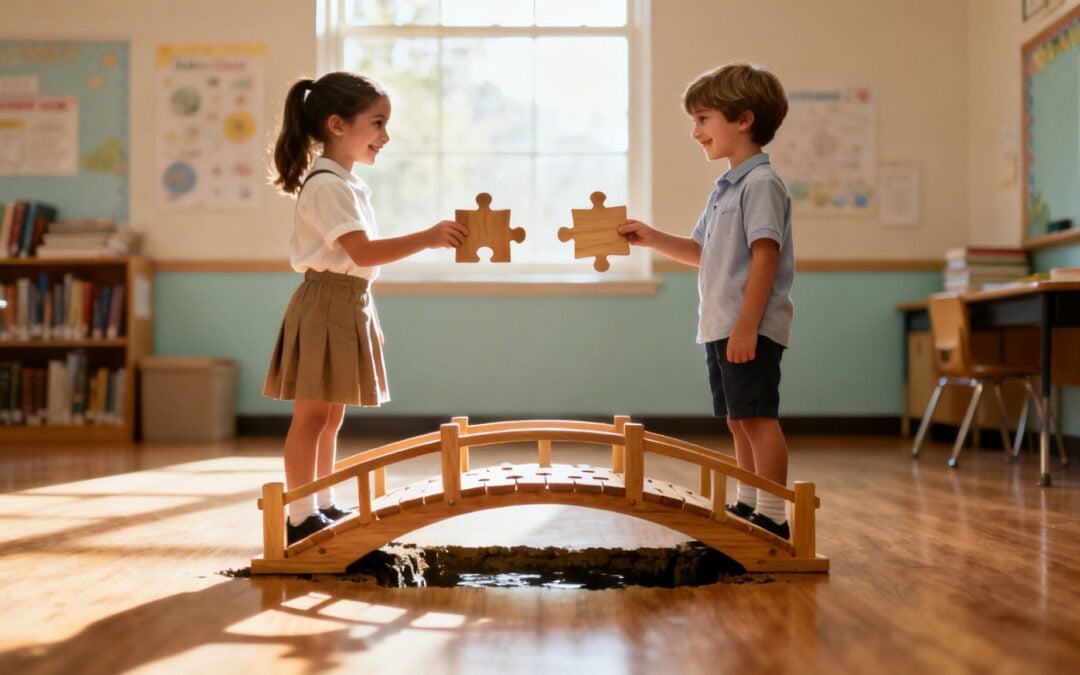
Think of every conversation as building a bridge. Each word is a plank, every gesture a nail, and every moment of listening reinforces the whole structure. When all the parts work together, you create a strong connection that allows understanding to travel back and forth.
But a single missing plank—like a joke that doesn't land—or a wobbly nail—like a misunderstood frown—can make that bridge feel unsafe. For instance, a teacher might say, "Great job," but if their arms are crossed and they aren't looking at the student, the message feels confusing.
For parents and teachers, this perspective is powerful. It shifts the focus from just correcting a child’s words to helping them see how their entire message—their tone, their body language, their listening—is received by others. It turns every interaction into a teachable moment.
The Four Pillars of a Communication Bridge
To make this idea even more concrete for kids (and adults!), we can break down any interaction into four key pillars. When students understand these parts, they can start to see why a conversation might feel strong or wobbly.
Pillar
What It Means
Example in a Classroom
Verbal
The words you choose to say.
Saying, "Can I please have a turn when you're done?" instead of "Give me that!"
Non-Verbal
Your body language, facial expressions, and gestures.
Making eye contact and smiling while listening to a friend share their weekend story.
Listening
Truly hearing and trying to understand what someone else is communicating.
A student nods along and waits for their classmate to finish explaining a math problem before asking a question.
Empathy
Trying to feel what the other person is feeling.
A child sees a classmate fall on the playground and says, "That looked like it hurt. Are you okay?"
Each pillar is crucial. A conversation with great words but poor listening still feels one-sided, just like a bridge that's missing a key support.
Why This Skill Matters Now More Than Ever
Interpersonal communication is the bedrock of a healthy school environment. It's how children learn to navigate friendships, resolve conflicts, and build a sense of belonging. But the way we all connect is changing.
While face-to-face conversations are still the top method for personal communication for about 40% of people, that number drops to just 25% for 18-24-year-olds. This shift shows just how important it is to be intentional about teaching these skills, both for in-person and digital worlds.
By teaching students how to communicate effectively, we are giving them the tools to build psychological safety, support their peers, and form healthy relationships that last a lifetime. This skill is a core component of their overall development.
Putting It All Together in the Classroom
So what does this look like on a typical school day? You're already seeing it in action.
Sharing During Circle Time: A first grader who says, "I'm sad because my toy broke" while looking at the floor is using both verbal and non-verbal cues to share an emotion. A classmate who responds with, "I'm sorry that happened," and gives a gentle pat on the shoulder is completing that communication loop with empathy.
A Playground Disagreement: Two fourth graders are arguing over a kickball rule. A teacher can guide them to use "I-statements"—like, "I feel frustrated when the rules aren't clear"—instead of blaming with, "You're cheating!" This shifts the focus from attack to explanation.
Collaborating on a Project: A group of seventh graders has to assign tasks, share ideas, and give constructive feedback to build a presentation. Their success depends almost entirely on their ability to listen and express their thoughts clearly and respectfully. One student might say, "That's a good start, but what if we added more pictures to make it interesting?" instead of, "Your part is boring."
These everyday interactions are the training ground for a child’s broader growth. Strong communication skills are deeply tied to a child’s entire social and emotional journey. You can see just how connected these concepts are in our guide on what is social and emotional development.
The Three Essential Elements of Communication
Think of great communication like a three-legged stool. For it to be steady and strong, all three legs—verbal cues, non-verbal signals, and active listening—need to be in place. When we teach kids how to use all three, they don’t just get better at talking; they get better at connecting. Let’s break down what each of these elements looks like in the classroom and at home.
Verbal Communication: The Music Behind the Words
When we talk about verbal communication, it’s easy to get hung up on just the words themselves. But the real magic is in how we say them. The “music” behind our words—our tone of voice, volume, and speed—often says more than the words do.
A child who mumbles a quick "I'm sorry" isn't communicating the same thing as a child who says it clearly and sincerely. The first feels like a chore, while the second shows they actually understand their impact. Helping kids tune into this verbal music is a huge first step toward more meaningful conversations.
Practical Example: A student, Leo, is getting frustrated during a group project because he feels his ideas aren't being heard.
Ineffective Communication: He throws his hands up and yells, "You guys never listen to me!" His loud volume and sharp tone immediately make his group defensive. The conversation shuts down.
Effective Communication: His teacher pulls him aside and prompts him to try again, this time focusing on his tone. Leo takes a breath and says, "Hey, I have an idea I'm excited about. Could we talk it through for a minute?" His calm, inviting language opens the door for collaboration instead of closing it with conflict.
Non-Verbal Communication: The Silent Language
So much of what we communicate happens without a single word. Non-verbal communication is the silent language of facial expressions, gestures, posture, and eye contact. These signals are powerful because they often reveal our true feelings, sometimes even more honestly than our words.
In fact, some research suggests that body language can carry as much as 55% of a message’s total meaning.
A student slumping in their chair could be bored, sure. But they might also be exhausted, overwhelmed, or even feeling unwell. A classmate who avoids eye contact might not be disinterested—they might just be shy. Teaching kids to notice these cues in others, and to be aware of their own, is a cornerstone of social awareness.
Practical Example: A teacher notices a student, Ava, with her head down on her desk during a lesson.
Assumption: The teacher might assume Ava is being disrespectful or bored and say, "Ava, sit up and pay attention."
Reading the Cue: Instead, the teacher walks over quietly and asks, "I notice you have your head down. Is everything okay?" Ava explains she has a headache. The teacher's approach, based on reading a non-verbal cue, leads to support instead of conflict.
Active Listening: More Than Just Hearing
The final piece of the puzzle is active listening. This is worlds away from just passively hearing noise while waiting for your turn to talk. Active listening is a full-body sport—it’s the conscious effort to understand, process, and respond to what someone is really saying. It sends a clear message: "I'm with you, and you matter."
For students, this means learning to pause their own thoughts and truly absorb what a peer is sharing. The key skills involved are:
Reflecting: Paraphrasing what they heard to make sure they got it right. For example, "So, it sounds like you're feeling frustrated because the rules seem unfair?"
Asking Clarifying Questions: Digging a little deeper instead of jumping to conclusions. For instance, "When you say he 'always' takes the ball, can you tell me more about that?"
Showing Engagement: Using non-verbal cues to show they're tuned in—nodding, making eye contact, and putting away distractions.
Practical Example: A child, Maya, comes home looking defeated and says, "Nobody played with me today."
Passive Hearing: A busy parent, focused on making dinner, might reply, "Oh, that's a shame. You'll play with them tomorrow." The conversation ends there, leaving Maya feeling unheard.
Active Listening: The parent pauses what they're doing, turns to face Maya, gets down on her level, and says, "That sounds like it felt really lonely at recess today. What happened?" This response validates Maya's feelings and opens the door for a real, supportive conversation.
When we teach children to listen this way, we give them an incredible tool for building empathy and resolving conflicts on their own. To get your students practicing this skill, check out our guide with a fun and simple active listening activity.
How Communication Fuels Social-Emotional Learning
We often talk about social-emotional skills and communication skills as separate things. But in reality, they’re deeply intertwined. Think of it this way: interpersonal communication isn't just another skill to learn; it's the very current that makes social emotional learning (SEL) come to life in the classroom and on the playground.
The five core SEL competencies—self-awareness, self-management, social awareness, relationship skills, and responsible decision-making—are the building blocks. But communication is the mortar that holds them all together.
A student might feel a surge of frustration (self-awareness), but if they can't express that feeling constructively, it stays bottled up. That's when we see disruptive outbursts or silent withdrawal. Effective communication is the bridge between knowing an emotion and managing it successfully.
Connecting Communication to SEL Competencies
To see how this works in a real-world scenario, let's imagine a classic playground disagreement. Maria and Sam are in the middle of a kickball game when they hit a snag over the rules. How this little conflict plays out depends entirely on their ability to communicate.
Self-Awareness: Maria feels her face get hot. She recognizes that she's angry because she believes Sam isn't playing by the rules they agreed on.
Self-Management: Her first impulse is to yell, "That's not fair!" Instead, she takes a deep breath to calm that initial flash of anger, giving herself a moment to think.
Social Awareness: Sam looks over and sees Maria's clenched fists and tight expression. He reads her non-verbal cues and realizes she's genuinely upset, which makes him more willing to listen instead of just getting defensive.
Relationship Skills: Using an "I-statement," Maria starts the conversation. "I feel frustrated when the rules seem to change mid-game." Sam, in turn, asks a clarifying question: "What rule do you think I broke?" This simple exchange keeps the friendship intact.
Responsible Decision-Making: They talk it out and agree on a clear rule for the rest of the game that everyone can stick to. They solved a problem together instead of letting it ruin recess.
Without the ability to name a feeling, listen to a friend, and negotiate a solution, none of these SEL skills could have been put into practice. The two are fundamentally linked.
Fostering a Supportive School Environment
When schools make teaching these communication skills a priority, the ripple effect goes far beyond one playground moment. It begins to shape the entire school culture into a place where students and staff feel seen, heard, and valued.
That sense of value is a powerful thing. While the data comes from the corporate world, a Gallup study found that when people feel more valued, productivity can increase by 12% and turnover can be cut by 27%. The principle holds true in schools: a climate built on strong interpersonal skills and respect leads to less isolation and a more engaged, supportive community for everyone.
Interpersonal communication is the thread that weaves the five SEL competencies together. By teaching students how to articulate their feelings, listen with empathy, and solve problems together, we are not just teaching them to be better communicators—we are nurturing emotionally intelligent and resilient human beings.
This table breaks down exactly how specific communication skills support the development of core SEL competencies in everyday classroom life.
Connecting Communication Skills to SEL Competencies
SEL Competency
Associated Interpersonal Skill
Classroom Example
Self-Awareness
Identifying and naming emotions.
A student says, "I'm feeling nervous about the presentation," instead of just being quiet or getting a stomach ache.
Self-Management
Using a calm tone of voice.
A student takes a breath before responding to a frustrating comment from a peer, instead of yelling back.
Social Awareness
Active listening and observing non-verbal cues.
A child notices a classmate is sitting alone with their head down and asks, "Are you okay? You look sad."
Relationship Skills
Giving and receiving constructive feedback.
During a group project, one student says, "I like that idea, and what if we also added this?" instead of "That's a bad idea."
Responsible Decision-Making
Negotiating and finding a compromise.
Two students who both want the same book agree to take turns, with one reading the first chapter and then swapping.
As you can see, these aren't abstract academic concepts. They are small, teachable moments that happen every single day.
Actionable Ways to Teach Communication in the Classroom
Theory is one thing, but putting it into practice is where students really start to get what interpersonal communication is all about. For us as educators, this means weaving intentional strategies into the daily fabric of our classrooms. These simple, actionable methods make abstract concepts like empathy and active listening feel real, giving kids the tools they need to connect, collaborate, and navigate conflicts.
The goal isn't to add another subject to an already packed schedule. It's about integrating these skills into the activities you're already doing. When we do this, learning feels natural and reinforces the idea that good communication is something we practice all the time—not just during a special lesson.
Start with Safe and Structured Sharing
Morning Meetings or daily check-ins are the perfect place to build a foundation of trust and practice core communication skills. By creating a predictable and safe space for sharing, you lower the stakes for quieter students and set a positive, connected tone for the entire day.
Here are a few ways to focus these moments on communication:
Practice Compliments: Dedicate one meeting a week to giving and receiving genuine compliments. First, model how to be specific. Instead of a generic, "You're nice," try something like, "I really appreciated how you included me in the game at recess today." This teaches students to notice and name specific positive behaviors.
Ask Open-Ended Questions: Encourage students to ask questions that invite more than a "yes" or "no" answer. Prompt them with starters like, "Tell me more about…" or "What was your favorite part of…" This simple shift teaches them to show curiosity and helps deepen their conversations. For example, instead of asking, "Did you have a good weekend?" ask, "What was something fun you did this weekend?"
Teach Students to Own Their Feelings with I-Statements
One of the most powerful tools you can give a child is the "I-Statement." This simple sentence structure is a game-changer. It helps students own their feelings without placing blame, which can instantly turn a potential conflict into a productive conversation. The focus shifts from accusing someone else to simply expressing a personal feeling or need.
An I-Statement has a simple formula: "I feel [emotion] when [situation] because [reason]." This structure empowers students to articulate what's happening inside them, clearly and calmly.
Practical Example: A disagreement over supplies.
Without an I-Statement (Blaming): A student might yell, "You always take my markers without asking!" This is an accusation, and it's guaranteed to make the other child defensive.
With an I-Statement (Explaining): The student says, "I feel frustrated when my markers are gone from my desk because I can't finish my drawing." This version clearly states the emotion and the impact without attacking the other person, opening the door for a solution.
When you consistently model and encourage I-Statements, you're giving students a script for navigating those tricky moments. It's a small change in language with a massive impact. To help your students get comfortable with this, you can explore various activities for building communication skills.
Use Activities to Practice Active Listening
Active listening isn't a passive skill; it requires explicit instruction and plenty of practice. A fantastic way to do this is through structured activities that you can easily adapt for different grade levels. Below is a sample lesson outline you can tweak for your own classroom.
Sample Lesson: The "Talking Stick" and Structured Debates
The core idea is simple: only the person holding a specific object (the "talking stick") is allowed to speak. This physically enforces the concept of taking turns and truly listening without interrupting.
For K-2 Students (Talking Stick):
Gather students in a circle and introduce a special object as the talking stick.
Pose a simple question, like, "What is your favorite thing to do on the weekend?"
The student holding the stick shares their answer. They then pass it to another student, who must first say, "I heard you say that you like…" before sharing their own answer. This small step reinforces the listening component.
For 3-5 Students (Building on the Concept):
Use the talking stick for more complex topics, such as, "What makes a good friend?"
After one student speaks, the next must ask a clarifying question about what they shared before offering their own opinion. For example, "You said being honest is important. Can you give an example of that?"
For 6-8 Students (Structured Debates):
Evolve the talking stick into a more formal debate on a relevant topic (like school uniforms or social media rules).
Assign students to "pro" and "con" sides. Each speaker gets a set amount of time to make their point.
Before offering a rebuttal, the opposing side must accurately summarize the previous speaker's argument. This ensures they were listening to understand, not just to respond.
This infographic really shows how these communication skills directly fuel the key areas of social-emotional learning.
As you can see, strong communication acts as the central hub connecting self-awareness, social awareness, and relationship skills. Without it, real social-emotional growth just isn't possible. These classroom strategies are so vital because they prepare students for a future where clear and empathetic interaction is everything. A 2023 report found that knowledge workers spend up to 38.9 hours every week on communication, yet 44% feel dissatisfied with their tools, leading to huge productivity losses. By teaching these skills early, we help students avoid those same struggles in their future academic and professional lives.
How Parents Can Strengthen Communication Skills at Home
The communication skills your child learns in the classroom truly take root when they’re nurtured at home. As a parent, you are the most important model for what healthy, loving communication looks like. The small, consistent habits you build together make all the difference.
These everyday moments create a safe space where children feel heard, valued, and comfortable expressing themselves. This not only supports their schoolwork but also builds the foundation for a lifetime of open, healthy relationships.
Go Beyond "How Was Your Day?"
The dinner table can be a perfect, low-pressure spot for building those communication muscles. But we all know the classic question, "How was your day?" often gets a one-word answer: "Fine." To inspire a real conversation, try asking more specific, open-ended questions that invite a story.
These conversation starters show you’re genuinely curious about their world:
"What was something that made you laugh today?"
"Tell me about a time you felt confused or frustrated today."
"If you could replay one moment from your day, what would it be and why?"
"Who did you help today, or who helped you?"
"What's one thing you learned that surprised you?"
Questions like these teach children to reflect on their day and find the words for their thoughts and feelings. This simple practice helps them understand what is interpersonal communication in their own lives—by living it with you every evening.
Have Fun with Screen-Free Family Activities
Not all communication practice has to feel like a formal lesson. Fun, screen-free activities can sharpen verbal and non-verbal skills without anyone even noticing they're "learning." The real goal is to connect and have a good time together.
Try adding some of these activities to your family routine:
Play Charades or Pictionary: These classics are fantastic for honing non-verbal skills. Players have to get creative, conveying a complex idea like "baking a cake" or "swimming with dolphins" using only their bodies, expressions, or drawings.
Co-Create a Story: Start a story with one sentence, like, "Once there was a brave squirrel who dreamed of flying…" Then, each person adds the next sentence. This game requires active listening to build on what was just said and encourages teamwork and imagination.
Hold a "Feelings" Weather Report: At the end of the day, ask everyone to describe their emotional state using a weather metaphor. A child might say, "I'm mostly sunny with a few clouds of frustration from math class, and maybe a little drizzle of sadness because my friend was away." This gives kids a creative, low-stakes way to practice talking about their emotions. For more tools to help children voice their feelings, you can learn about using I-Statements for kids.
These playful moments are incredibly powerful. They reinforce turn-taking, listening, and expressing ideas—all cornerstones of strong communication. Implementing structured communication skills training at home through play gives children practical tools for better interactions.
Bridge the Generational Communication Gap
In a world of texts and DMs, practicing face-to-face conversation is more important than ever. One recent survey found that a quarter of organizations struggle most with communicating with Gen-Z, whose preferred method is often messaging apps. This highlights a potential gap that parents can help bridge.
Modeling and practicing conversational skills at home ensures children develop the flexibility to communicate effectively across different mediums and generations.
By turning everyday moments into opportunities for connection, you empower your child to build stronger relationships, solve problems creatively, and navigate the world with confidence and empathy. Home is the first and most important classroom for these life-changing skills.
Common Myths About Interpersonal Communication
Before we can help our kids become great communicators, we have to clear up a few common misconceptions. These myths can get in the way of teaching this skill effectively, both in the classroom and at home. Let's bust a few of these ideas so we can better empower our young learners.
Myth 1: Good Communicators Are Born, Not Made
It’s easy to fall into the trap of thinking some kids are just “natural” communicators while others aren't. This mindset suggests that an outgoing child is destined to succeed socially, while a shy child will always struggle.
The truth is, interpersonal communication is a skill, not a fixed personality trait. Just like learning to read or ride a bike, it can be taught, practiced, and improved with gentle guidance. Every single child has the capacity to grow into a more confident and effective communicator.
Practical Example: A quiet student consistently uses one-word answers. A teacher can practice with them by asking them to describe one object in the room using three words. This small, structured task builds their confidence and skill in verbal expression without the pressure of a full conversation.
Myth 2: Talking More Means Better Communication
We often assume the most talkative person in the room is the best communicator. But quantity is not the same as quality. A child who dominates a conversation, constantly interrupts, or talks at others instead of with them isn't communicating well—they're just broadcasting.
Real communication is a two-way street. Listening is just as important as talking. A student who quietly listens to a friend's problem and asks thoughtful questions to show they care is a far stronger communicator than one who only talks about their own day.
Parent and Teacher Takeaway: Make a point to praise active listening when you see it. When a child waits for their sibling to finish a story before jumping in, acknowledge their effort. "I noticed you listened so carefully to your sister's whole story before you spoke. That was really kind, and it showed you care about what she has to say."
Myth 3: Avoiding Conflict Is Always the Goal
Many of us were taught that arguing is bad and that the best approach is to simply avoid conflict. While we certainly want to prevent pointless squabbles, teaching kids to sidestep every disagreement leaves them unprepared for life.
Conflict is inevitable. The real goal is to teach healthy conflict resolution, one of the most valuable life skills a child can learn. This process teaches them how to express their own needs respectfully, listen to another’s perspective, and collaborate on a solution. Guiding kids through small disagreements is actually a huge gift.
Practical Example: Two students both want to be the line leader. Instead of just picking one, a teacher can facilitate a conversation. "It sounds like you both really want to be the leader. How can we solve this so you both feel it's fair?" The students might decide to take turns, or one could be the leader today and the other tomorrow. They learn to negotiate a solution instead of one winning and one losing.
Frequently Asked Questions About Interpersonal Communication
As educators and parents, we're constantly in the middle of real-time communication challenges with our kids. When you're in the thick of it, theory goes out the window. Here are answers to some of the most common questions we hear, with practical advice that puts these skills into action.
How Do I Encourage a Shy Child to Participate Without Making Them Anxious?
For a quiet or shy child, the classroom spotlight can feel overwhelming. The goal isn’t to force them into the center of attention, but to create a gentle on-ramp for participation, building their confidence one small, safe step at a time. It's about inviting, not demanding.
Offer Non-Verbal Roles: Let them be a helper. Ask them to hold the talking stick, point to the next speaker, or distribute materials during a group activity. This gives them a vital role in the group without the pressure of speaking.
Use Turn-and-Talk Partners: Sharing with the entire class is a huge hurdle. A "turn-and-talk" shrinks the audience down to one. Pairing a shy student with a supportive, kind peer in this low-stakes setting is a great first step toward sharing in a larger group.
Give a Heads-Up: Anxiety often comes from the element of surprise. Quietly let the child know you'll be asking them a specific, easy question soon. For example, "In a few minutes, I'm going to ask you what your favorite part of the story was. Think about it for a minute." This gives them time to prepare an answer and feel ready.
What Is the Difference Between Interpersonal and Intrapersonal Skills?
This is a fantastic question, and the answer is simpler than it sounds. Just think of "inter" as meaning "between" and "intra" as meaning "within."
Interpersonal skills are all about the space between people. It’s the external stuff—how we talk, listen, read body language, and work together. It’s communication in action with others. Example: Asking a friend, "Do you want to play?"
Intrapersonal skills are what happen within ourselves. This is our self-talk, our ability to notice and manage our own feelings, and our understanding of our own values. It's the foundation of self-awareness. Example: A child thinking to themself, "I feel lonely. I think I'll ask someone to play."
The two are deeply connected. A child first needs the intrapersonal skill to recognize, "I am feeling frustrated," before they can use the interpersonal skill to say, "I feel frustrated when…"
What Are the First Steps to Mediate a Conflict Between Two Students?
When you step in to help with a conflict, your most important job is to be a facilitator, not a judge. The goal is to guide students toward finding their own solution, not to impose one. A simple three-step process can cool things down and open the door to resolution.
Separate and Regulate: First, get them into separate spaces. This gives them both physical and emotional breathing room. Guide each child to take a few deep, calming breaths. You can't solve a problem when emotions are running high and the "fight-or-flight" response has taken over. Say This: "Let's both take a quiet minute to calm our bodies down before we talk."
Listen to Each Side (Separately): Give each student your full, uninterrupted attention as they tell their side of the story. Use active listening to show you're hearing them. Reflect their feelings back: "So you felt angry because you thought she took your marker on purpose?" This step is critical for them to feel heard and validated.
Bring Them Together to Find a Solution: Once everyone is calm, bring them back together. Coach them to use "I-statements" to explain their feelings. Then, shift the focus to the future by asking, "What is one thing we can do to solve this problem right now?" Help them brainstorm ideas like apologizing, taking turns, or creating a new rule for next time.
This process doesn't just end the argument; it teaches children a powerful life lesson: that disagreement is survivable and that they have the power to repair their relationships.
At Soul Shoppe, we believe that teaching these essential skills creates a safer, more connected school community where every child can flourish. We provide schools with the tools, programs, and support needed to build a culture of empathy and respect from the ground up. Learn more about our SEL programs.
In any K-8 classroom, the ability to communicate effectively is more than just a ‘nice-to-have’. It’s the foundational skill that underpins academic success, emotional well-being, and a positive school climate. When students can listen with empathy, express their needs clearly, and navigate disagreements constructively, the entire learning community flourishes. These abilities are not innate; they must be intentionally taught, modeled, and practiced. At the heart of all effective communication, especially in building a thriving classroom, lies a deep understanding of emotional intelligence, which enables students to manage their feelings and understand others’.
For educators and parents seeking to cultivate these core competencies, finding the right communication skill activity can feel overwhelming. This guide cuts through the noise. It offers a curated collection of eight powerful, research-backed activities designed for the modern K-8 classroom and easily adaptable for home use. We will move beyond generic advice to provide concrete, actionable strategies that foster genuine connection.
This article provides a clear roadmap for each activity, including:
Learning Objectives: What students will achieve.
Step-by-Step Instructions: How to implement the activity.
Grade-Level Differentiation: Tips for adapting to K-2, 3-5, and 6-8 students.
SEL Connections: Aligning activities with key social-emotional learning goals.
Assessment and Reflection: Simple ways to measure understanding.
Our goal is to equip you with the practical tools needed to build a culture of connection, safety, and mutual respect, one conversation at a time. Let’s dive into the activities that will transform how your students communicate.
1. Active Listening Circles
Active Listening Circles are a structured and powerful communication skill activity designed to cultivate focused listening and empathy. In this format, participants sit in a circle, and one person speaks at a time without interruption, often holding a “talking piece” to signify their turn. The core practice involves the other members giving their complete attention, not just to hear the words, but to understand the speaker’s perspective and feelings.
This activity is foundational because it creates a space of psychological safety. When students know they will be heard fully and without judgment, they are more willing to share openly and honestly. The listener’s role is not to immediately respond or problem-solve, but to first reflect back what they heard, validating the speaker’s experience.
Why It Works
This method, rooted in restorative practices and indigenous traditions, slows down communication and prioritizes understanding over reacting. It directly counters the common habit of formulating a reply while someone is still speaking. For students, this builds crucial social-emotional skills like self-awareness, social awareness, and responsible decision-making. The circle format itself is symbolic, promoting equality and community by placing every participant on the same level.
Implementation Tips for Educators and Parents
To successfully implement this activity, start small and be consistent.
Establish Clear Norms: Co-create ground rules with participants. Key rules include: speak from the heart, listen from the heart, no interruptions, and respect confidentiality.
Use a Talking Piece: Introduce an object (like a ball, a decorated stone, or a stuffed animal) that grants the holder the exclusive right to speak. This physical cue helps manage turn-taking.
Model and Scaffold: Begin by modeling the process. Use sentence stems to guide listeners, such as, “What I heard you say is…” or “It sounds like you feel…” before they share their own thoughts. For example, if a student says, “I was sad because no one played with me at recess,” the next student could practice by saying, “What I heard you say is you felt lonely during recess because you wanted someone to play with.”
Start with Low-Stakes Topics: Begin with simple prompts like, “Share one good thing that happened this weekend,” or “What is a challenge you are proud of overcoming?” before moving to more sensitive subjects.
Adapt for Different Ages: For younger students (K-2), keep circle time short and use simple prompts like, “What is your favorite animal and why?” For older students (6-8), circles can address more complex issues like peer conflicts, social pressures, or community problem-solving. A parent could use this at home by asking, “What was the best part of your day?” at the dinner table, passing a “talking spoon” to each family member.
This deliberate practice of focused attention is a cornerstone of effective communication. For more ideas on building these foundational skills, explore these listening skills activities that can complement circle work.
2. Role-Playing and Perspective-Taking Scenarios
Role-Playing and Perspective-Taking Scenarios are an experiential communication skill activity where students act out realistic social situations to practice communication strategies and develop empathy. Participants take on various roles, such as a bystander, a peer, or an adult, to experience conflicts from multiple angles. This approach helps them navigate challenges like exclusion, peer pressure, or disagreements in a safe, controlled environment.
This activity is powerful because it moves communication skills from theory to practice. By stepping into someone else’s shoes, students internalize the emotional impact of words and actions. This experiential learning is crucial for developing emotional intelligence and building a toolkit of effective responses for real-life situations, such as those addressed in anti-bullying programs that feature bystander intervention scenarios.
Why It Works
Grounded in drama-based learning and methodologies like Augusto Boal’s Theater of the Oppressed, this activity makes abstract concepts like empathy tangible. It allows students to experiment with different communication styles, like assertive versus aggressive language, and see the immediate outcomes without real-world consequences. For educators, it provides a dynamic way to assess a student’s social understanding and guide them toward more constructive behaviors. The process of acting and reflecting helps cement learning in a way that lectures or worksheets cannot.
Implementation Tips for Educators and Parents
To use role-playing effectively, focus on creating a supportive atmosphere and structured reflection.
Start with Low-Stakes Scenarios: Begin with simple situations, like asking to join a game or disagreeing politely about what to play. For example, a scenario could be: “Two friends both want to use the same swing. How can they solve this problem?” This builds confidence before tackling more sensitive topics like peer pressure or exclusion.
Establish a Safe Space: Clearly state that this is a practice space and there are no “wrong” answers, only learning opportunities. Avoid casting students in roles that mirror their real-life conflicts.
Rotate Roles: Ensure every participant has the chance to play different roles within a scenario. For example, in a scenario about teasing, a student might first play the person being teased, then the teaser, and finally a bystander who steps in. This deepens their understanding by allowing them to experience the situation from multiple viewpoints.
Structure the Debrief: After each role-play, lead a structured discussion. Use reflection questions like, “How did it feel to be in that role?” or “What is one thing you might do differently next time?” to guide the conversation.
Use Observation Guides: Give students who are not actively participating a task, such as watching for specific body language or listening for “I-statements.” This keeps the entire group engaged and focused on the learning objective.
This hands-on practice is vital for building social competence. To explore this topic further, discover these perspective-taking activities that can enhance students’ ability to understand others.
3. Non-Violent Communication (NVC) Training
Non-Violent Communication (NVC) is a powerful framework that transforms how students express themselves and understand others. Developed by Marshall Rosenberg, this communication skill activity teaches participants to move beyond blame and judgment, focusing instead on a four-step process: Observation, Feelings, Needs, and Requests (OFNR). Students learn to state what they see without evaluation, identify their emotions, connect those feelings to universal human needs, and make clear, positive requests.
This approach is transformative because it shifts the focus from winning an argument to fostering connection and mutual understanding. By giving students a concrete structure to navigate difficult conversations, NVC de-escalates conflict and builds empathy. Instead of reacting with anger or defensiveness, students learn to express their authentic experience and listen to the needs of others, creating a foundation for restorative solutions and stronger relationships.
Why It Works
NVC provides a shared, compassionate language that reframes conflict as an opportunity for growth. It directly addresses the root causes of misunderstandings-unmet needs-rather than just the surface-level behaviors. For students, this builds sophisticated emotional intelligence, self-advocacy, and conflict resolution skills. The OFNR framework helps them untangle complex emotions and articulate them constructively, which is a cornerstone of social-emotional wellness and a key element in effective anti-bullying strategies.
Implementation Tips for Educators and Parents
Successfully integrating NVC requires modeling and consistent practice.
Introduce Components Sequentially: Don’t teach all four steps at once. Spend a week on each component: first, practice making pure observations (“I see…”) versus judgments (“You always…”). For example, instead of “You are being messy,” practice saying, “I see your coat and backpack are on the floor.” Then, build an emotional vocabulary using a feelings wheel before connecting feelings to needs.
Use Sentence Stems: Provide clear scaffolds to guide students. Post a visual chart with the stems: “When I see/hear… I feel… because I need… Would you be willing to…?“
Practice with Low-Stakes Scenarios: Start with simple, non-conflict situations. For example, a student could practice: “When I see a new art project is announced (Observation), I feel excited (Feeling) because I need creativity (Need). Would you be willing to tell me what supplies we’ll use (Request)?” A parent might use this at home: “When I see your wet towel on the bed (Observation), I feel frustrated (Feeling) because I need our space to be tidy (Need). Would you be willing to hang it up in the bathroom (Request)?”
Model NVC Language: Adults should explicitly use the OFNR framework in their interactions. A teacher might say, “When I hear talking while I’m giving instructions, I feel frustrated because I need respect and for everyone to be safe. Would you be willing to listen quietly until I’m finished?”
Create Visual Aids: Design posters that break down the four steps with examples and list common feelings and needs. This gives students a reference point during challenging moments.
4. I-Messages and Assertive Communication Workshops
I-Messages and Assertive Communication Workshops are a foundational communication skill activity that teaches students to express their feelings and needs clearly without blaming or accusing others. The core of this practice is shifting from accusatory “You” statements (e.g., “You never listen to me!”) to ownership-based “I” statements (e.g., “I feel frustrated when I’m interrupted because I lose my train of thought”). This simple linguistic change is transformative, reducing defensiveness and opening the door for constructive dialogue.
This activity is crucial for conflict resolution and self-advocacy. By learning to articulate their own experience, students develop assertiveness, the healthy middle ground between passivity and aggression. They learn to set boundaries and make requests respectfully, empowering them to navigate social challenges in the classroom, on the playground, and at home.
Why It Works
This method, popularized by psychologist Thomas Gordon, directly addresses the root of many conflicts: perceived attacks. A “You” statement often feels like a criticism, prompting the listener to shut down or fight back. An “I” message, however, is an undeniable expression of personal feeling, making it much easier for the other person to hear and empathize. For students, this builds emotional intelligence by connecting feelings to specific events and encouraging them to take responsibility for their emotional responses.
Implementation Tips for Educators and Parents
To successfully implement this communication skill activity, focus on scaffolding, practice, and real-world application.
Introduce the Formula: Teach a simple structure for I-Messages, such as “I feel [emotion] when you [specific behavior] because [reason/impact].” Post sentence stems on a classroom wall for easy reference.
Differentiate Communication Styles: Explicitly teach the difference between passive (avoiding conflict), aggressive (blaming or threatening), and assertive (clear, respectful, honest) communication. Use role-playing to demonstrate each style. For example: “Someone cuts in front of you in line.” A passive response is saying nothing. An aggressive response is yelling, “Hey, get out of my spot!” An assertive response is saying, “I feel frustrated when you cut in line because I was waiting my turn.”
Start with Low-Stakes Scenarios: Begin practice with non-threatening situations. For example, have a student practice saying, “I feel left out when a game starts without me because I wanted to play too,” before tackling more intense peer conflicts.
Focus on Non-Verbal Cues: Remind students that assertive communication involves more than words. Practice maintaining a calm tone of voice, making eye contact, and using confident but relaxed posture.
Connect to Home: Encourage parents to practice I-Messages with their children. A simple family activity could be sharing one “I feel…” statement about their day at the dinner table, normalizing the practice. For instance, a child might say, “I felt proud when I finished my math homework because it was really hard.”
Building this skill helps students advocate for themselves effectively and respectfully. For a deeper look into this powerful tool, explore the magic of I feel statements for kids and how they can transform disagreements.
5. Fishbowl Discussion and Observation Technique
The Fishbowl Discussion and Observation Technique is a dynamic group communication skill activity where a small group of students sits in an inner circle (the “fishbowl”) to discuss a topic. The rest of the class sits in an outer circle as observers, paying close attention to the communication patterns, dialogue quality, and non-verbal cues within the inner group. This method sharpens both speaking and observation skills simultaneously.
This activity is powerful because it encourages meta-cognition about social interactions. Observers are not passive; they are active listeners tasked with analyzing the conversation’s flow. This provides a structured way for students to learn from their peers, identify effective communication strategies in real-time, and understand group dynamics from an outside perspective before rotating into the discussion themselves.
Why It Works
This technique, popular in cooperative learning, separates the acts of speaking and analyzing, allowing students to focus on one skill at a time. The inner circle practices articulating ideas and building on others’ points, while the outer circle develops critical observation and listening skills. It makes the invisible elements of a conversation, like interruptions, active listening, and turn-taking, visible and discussable. The structure naturally builds accountability for both respectful dialogue and thoughtful observation.
Implementation Tips for Educators and Parents
To ensure a fishbowl discussion is productive and insightful, clear structure and focused observation are key.
Assign Specific Observation Roles: Give the outer circle a clear task. For example, have them use a worksheet to track: “Who asks clarifying questions?” or “Tally the number of times someone is interrupted versus the number of times someone builds on another’s idea.” Another example is having one observer track body language, noting when students lean in to listen or cross their arms.
Rotate Roles Regularly: Allow students in the outer circle to rotate into the “fishbowl” every 5-10 minutes. This can be done by having a few empty chairs in the inner circle that observers can move into when they have a point to add.
Model and Debrief the Process: Before starting, model what respectful observation looks like. Afterward, dedicate time to debriefing both the content of the discussion and the process of communication. Use prompts like, “What communication habits did you notice that helped the conversation move forward?”
Start with Engaging, Low-Stakes Topics: Begin with prompts like, “Should students have more say in school rules?” or discussing a scene from a class novel. This allows students to practice the format before tackling more complex or sensitive subjects.
Adapt for Different Ages: For younger students (2-4), keep the inner circle small (3-4 students) and the observation task simple, like “Give a thumbs-up when you hear a kind word.” For older students (5-8), observers can analyze more complex dynamics, such as identifying evidence-based arguments versus opinion-based statements.
This structured activity transforms a standard classroom discussion into a rich learning experience about how we communicate.
6. Peer Mediation and Conflict Resolution Training
Peer Mediation and Conflict Resolution Training is a structured communication skill activity that empowers students to act as a neutral third parties, helping their peers resolve disagreements peacefully. This comprehensive program equips student mediators with tools like active listening, I-statements, empathy, and a step-by-step problem-solving process. Instead of adults intervening, students guide their classmates toward mutually acceptable solutions.
This activity is transformative because it shifts the school culture from punitive to restorative. It gives students ownership over their social environment and builds leadership capacity. When peers facilitate conflict resolution, it can feel less intimidating and more relatable for those involved, fostering genuine understanding and sustainable agreements.
Why It Works
Rooted in the principles of restorative justice and conflict resolution education (CRE), this approach teaches that conflict is a normal part of life and can be a catalyst for growth. It moves beyond simply stopping a negative behavior and focuses on repairing harm and relationships. Training students as mediators develops high-level emotional intelligence, critical thinking, and a profound sense of responsibility within the school community. This student-led model creates a ripple effect of positive communication.
Implementation Tips for Educators and Parents
A successful peer mediation program requires a strong framework and consistent support.
Recruit Diverse Mediators: Select a group of students who represent the diverse demographics of your school to ensure all students feel seen and understood.
Provide Robust Training: Initial training should be comprehensive (at least 8-16 hours) and followed by ongoing monthly coaching sessions to refine skills and debrief challenging cases. For example, training should include role-playing common conflicts, like a dispute over a game at recess or a misunderstanding in a group project.
Establish a Clear Process: Develop a clear referral system so teachers, staff, and students know how to request a mediation. Train the disputants on the process so they understand the ground rules and expectations. For instance, a teacher might fill out a simple form to refer two students who are arguing over a shared resource.
Create a Visible Presence: Designate a specific, quiet space for mediations and use bulletin boards or announcements to keep the program visible. This normalizes seeking help to resolve conflicts.
Define Escalation Protocols: Train mediators to recognize when a conflict is too serious for them to handle (e.g., involving bullying, safety concerns) and establish a clear protocol for escalating these issues to a trusted adult. A practical example is teaching mediators the phrase: “This sounds really important, and I think we need an adult’s help to solve this one.”
By teaching students how to navigate disagreements constructively, you provide them with invaluable life skills. To explore more foundational techniques, discover these conflict resolution strategies for kids that complement peer mediation training.
7. Mindfulness-Based Communication and Reflective Listening Practices
Mindfulness-Based Communication is an activity that integrates simple mindfulness techniques with reflective listening to help students communicate with greater presence and emotional regulation. This approach teaches students to pause and notice their internal state before speaking or reacting, especially in high-emotion situations. The core practice involves brief mindfulness exercises like focused breathing or body scans to create the calm and mental clarity needed for empathetic, effective communication.
This communication skill activity is transformative because it addresses the root of many communication breakdowns: emotional reactivity. By learning to ground themselves, students can move from a reactive, defensive state to a responsive, thoughtful one. This creates a foundation of self-awareness that allows them to listen more deeply and express themselves more clearly, turning potential conflicts into opportunities for understanding.
Why It Works
Popularized by thought leaders like Jon Kabat-Zinn and Thich Nhat Hanh, this method connects emotional regulation directly to communication quality. When a student is dysregulated, their capacity for empathy and problem-solving diminishes. Mindfulness provides the practical tools to manage that internal state. By practicing these techniques, students build the neural pathways for self-control and presence, which are essential for navigating complex social interactions at school and at home.
Implementation Tips for Educators and Parents
To successfully integrate mindfulness into communication practices, be consistent and start with simple, accessible exercises.
Anchor to Routines: Start class or family meetings with a one-minute breathing exercise. For example, have students place a hand on their belly and feel it rise and fall. This anchors the day in calm. A parent could do this before homework time by saying, “Let’s take three slow ‘balloon breaths’ together to get our minds ready.”
Create a Calm-Down Corner: Designate a space with mindfulness tools like breathing posters, grounding objects (a smooth stone, a soft blanket), and visual timers. Encourage its use before tackling a tough conversation.
Model the Practice: Genuinely practice mindfulness yourself. When you feel frustrated, say, “I’m feeling upset, so I am going to take three deep breaths before I respond.” This models the skill in a real-world context.
Use Simple Language: Use accessible prompts like, “Let’s find our ‘anchor spot’ where we feel our breath the most,” or “Notice your feet on the floor when you feel wobbly.”
Integrate into Conflict Resolution: Before peer mediations, guide students through a brief grounding exercise. Ask them to notice their body in the chair and take a slow breath. This prepares them to listen rather than just react.
This approach builds a powerful internal toolkit for communication. Soul Shoppe’s programs often weave these practices in to help students develop the self-awareness needed for building safer, more connected school communities.
8. Empathy Mapping and Perspective-Building Exercises
Empathy Mapping is a structured, visual communication skill activity that guides students to step into another person’s experience. Using a simple framework, participants consider what someone else might be seeing, hearing, thinking, and feeling in a particular situation. This powerful exercise moves beyond simple sympathy and cultivates genuine empathy by encouraging a deeper, more holistic understanding of different viewpoints.
This activity is essential for building inclusive and supportive communities. When students practice considering the perspectives of others, especially those with different backgrounds or abilities, they develop the cognitive and emotional skills needed to prevent misunderstandings, resolve conflicts, and counter bullying. It makes the abstract concept of empathy tangible and actionable.
Why It Works
Originating in design thinking and adapted for social-emotional learning, empathy mapping makes perspective-taking a concrete process. It requires students to look for clues and make informed inferences rather than simply guessing or projecting their own feelings. This structured approach helps decenter their own experience and build a more nuanced understanding of their peers, literary characters, or community members. The visual nature of the map helps students organize complex social information, making it accessible for diverse learners.
Implementation Tips for Educators and Parents
To use empathy maps effectively, focus on creating a clear structure and safe environment for exploration.
Use Visual Templates: Provide a simple worksheet divided into sections like Says, Thinks, Does, and Feels. This visual organizer guides students through the process and helps them capture their ideas.
Start with Fictional Characters: Begin by having students create an empathy map for a character in a book or a movie. This low-stakes starting point allows them to practice the skill without the social pressure of analyzing a real-life peer conflict. For example, map the perspective of a new student in a story before discussing a new student in your own class.
Ask Deepening Questions: Guide students beyond surface-level observations. Ask follow-up questions like, “Why might they feel that way?” or “What experiences might lead them to think that?” to encourage critical thinking.
Connect Maps to Action: After completing a map, ask students to consider what the person might need. Brainstorm supportive actions, turning empathy into a catalyst for kindness. For instance, after mapping the feelings of a student who was left out, the class could discuss, “What could we do to make sure everyone feels included at recess?“
Model the Process: Complete an empathy map together as a class or family. Choose a relatable scenario, such as a younger sibling’s frustration or a parent’s busy day, and model how to consider their perspective without judgment. For example: “Let’s make an empathy map for Grandma after she cooked a big holiday dinner. What was she feeling? (Tired, happy). What was she doing? (Washing dishes). What might she have been thinking? (I hope everyone enjoyed the meal).”
8-Activity Communication Skills Comparison
Method
Implementation complexity
Resource requirements
Expected outcomes
Ideal use cases
Key advantages
Active Listening Circles
Low–Medium: simple structure but needs facilitation skills
Literature study, DEI lessons, bullying prevention, mediation prep
Visual, concrete tool accessible to diverse learners; links empathy to action
From Practice to Progress: Weaving Communication Skills into Your School’s DNA
The journey from a noisy classroom to a connected community is paved with intentional practice. The eight powerful strategies detailed in this article, from Active Listening Circles to Empathy Mapping, are far more than isolated exercises. They are foundational tools designed to build a culture of understanding, respect, and emotional intelligence. Each communication skill activity serves as a vital thread in weaving a stronger, more resilient social fabric within your school or home.
Moving beyond the individual activity is where the real transformation begins. The ultimate goal is not to simply complete a worksheet or a role-play scenario but to integrate these practices into the very DNA of your daily interactions. Consistent application is the key to turning learned concepts into lived habits.
Synthesizing the Core Lessons: From Activities to Habits
Let’s distill the most critical takeaways from the activities we’ve explored. These are the principles that bridge the gap between a single lesson and a lasting cultural shift.
Listening is an Action: As demonstrated in Active Listening Circles and Mindfulness-Based Communication, true listening is not passive. It is an active, engaged process that requires full presence, empathy, and the suspension of judgment. The simple act of reflecting back what one hears can de-escalate conflict and validate feelings instantly.
Perspective is a Superpower: Activities like Role-Playing, Fishbowl Discussions, and Empathy Mapping all share a common, powerful goal: to help students step outside of their own experiences. When a child can genuinely consider, “How would I feel if that happened to me?” or “What might they be thinking?”, the foundation for compassion is built.
Language Shapes Reality: The shift from blaming “you-statements” to accountable “I-messages” is monumental. This principle, central to Non-Violent Communication and Assertive Communication workshops, empowers students to express their needs and feelings without attacking others, transforming potential conflicts into opportunities for mutual understanding.
Your Actionable Roadmap for Lasting Change
Transforming your school’s culture requires a strategic, tiered approach. It’s not about doing everything at once, but about starting with consistent, manageable steps. Here’s a practical plan for implementation:
Start with a Single Routine: Don’t try to introduce all eight activities in one week. Choose one to embed into a daily or weekly routine. For example, begin every Monday with a brief Active Listening Circle during your morning meeting. Consistency will build familiarity and skill far more effectively than sporadic, varied lessons.
Model, Model, Model: The most effective way to teach these skills is to live them. Use “I-messages” when addressing classroom challenges (“I feel concerned when the noise level gets too high because it’s hard for everyone to focus”). Acknowledge student perspectives, even in moments of correction (“I understand you’re feeling frustrated with the assignment. Let’s talk about the part that’s tricky.”).
Celebrate the Small Wins: Progress, not perfection, is the goal. When you overhear a student use an “I-message” on the playground or see a pair resolve a disagreement using peer mediation steps, acknowledge it. Public or private praise reinforces the value of these skills and encourages others. A simple, “I was so impressed with how you both listened to each other to solve that problem,” can be incredibly powerful.
By championing every communication skill activity as a stepping stone toward a larger vision, you are not just teaching lessons for a test. You are equipping your students with the essential tools for a lifetime of healthier, more meaningful, and more successful relationships, both inside the classroom and far beyond its walls.
Ready to take the next step in building a compassionate and connected school culture? Soul Shoppe provides dynamic programs, from engaging student assemblies to in-depth staff training, designed to embed these vital communication and empathy skills into your school’s core. Explore how our evidence-based approach can help you turn practice into profound and lasting progress at Soul Shoppe.