Soul Shoppe's work is made possible by donors and partners who care deeply about the young people in their communities! We can't do this work without you. Support our work in classrooms and on playgrounds across the nation by donating here.
In today's complex world, equipping students with tools for emotional resilience is as crucial as teaching reading and math. The growing need for supportive environments at school and home has made intentional mental health support a priority. This guide moves beyond theory, offering a practical collection of 10 evidence-informed mental health activities designed specifically for K-8 students.
Each activity provides a clear, actionable framework that teachers, administrators, and parents can implement immediately. From building emotional vocabulary with feelings identification exercises to fostering peaceful conflict resolution, these tools are designed for real-world application. For example, a teacher might use a restorative circle to address a classroom disagreement over playground rules, while a parent could introduce a simple gratitude practice at the dinner table to shift the family's focus toward positivity.
The goal is to provide tangible ways to nurture social-emotional well-being. This includes structured programs and also enriching personal pursuits. For instance, consider the profound benefits of learning to play an instrument, which can boost brain function, mood, and overall skills, contributing significantly to a child's foundation of well-being.
Whether you're an educator seeking to create a calmer, more connected classroom or a caregiver wanting to strengthen communication at home, this listicle offers the specific steps, materials, and adaptations you need. These are not just ideas; they are ready-to-use strategies from trusted sources like Soul Shoppe, which has spent over two decades helping school communities cultivate safety and connection.
1. Mindfulness and Breathing Exercises
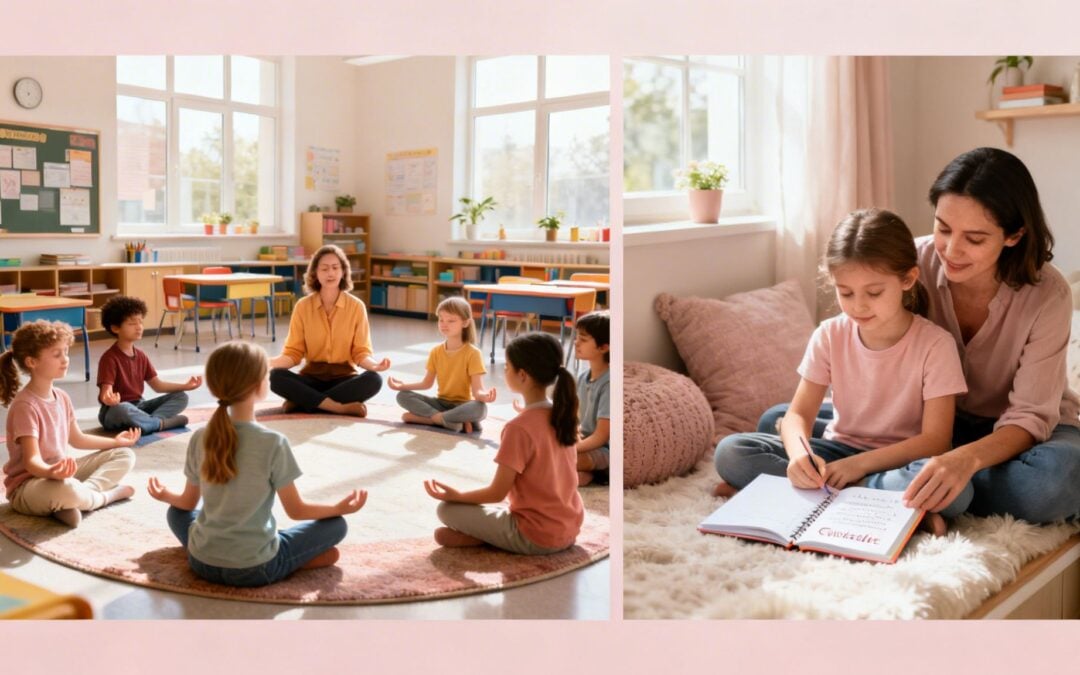
Mindfulness and breathing exercises are structured practices that teach students to focus their attention on the present moment. These mental health activities guide children to notice their breath, bodily sensations, and thoughts without judgment. The core purpose is to help regulate the nervous system, which can reduce feelings of anxiety and improve emotional awareness, creating a calmer, more focused learning environment.
These foundational social-emotional learning (SEL) skills are already seeing success in schools. For example, some elementary classrooms start the day with a "mindful minute," where students listen to a chime until the sound fades completely. Others use "breathing buddies," placing a small stuffed animal on a student's belly to visually guide deep, calming breaths. These simple but effective practices are core to programs from organizations like Mindful Schools, which have been implemented in hundreds of schools.
Quick Guide for Implementation
Age Range: K-8
Time: 3-10 minutes
Materials: Optional: chime or bell, comfortable cushions, small objects (e.g., stuffed animals, smooth stones).
How to Get Started
Introduce the Concept: Explain mindfulness as "noticing what's happening right now." For breathing, you can use the analogy of a balloon slowly inflating and deflating. Example: For younger kids, say, "Let's pretend our bellies are balloons. When we breathe in, the balloon gets big. When we breathe out, all the air comes out slowly."
Start Small: Begin with short, 1- to 3-minute guided sessions. Use consistent cues like a specific time of day (e.g., after recess) or a gentle sound to signal the start of the practice.
Practice Together: Model engagement by participating alongside your students. This shows that it's a shared activity and not a task to be completed. Example: A teacher can say, "I'm going to do my 'balloon breaths' with you. Let's all take one big breath in… and let it out."
Normalize Wandering Minds: Remind students that it is natural for their minds to wander. The practice is gently bringing their attention back to their breath, not achieving a perfectly empty mind. For a great foundational technique, you can learn more about the belly breathing technique and teach it to your students.
Facilitator Tip: Create a dedicated "Peace Corner" or "Mindfulness Corner" in your classroom or home. Stock it with soft pillows, calming visuals, and maybe a few fidget tools to create an inviting space for self-regulation.
2. Emotional Check-In and Feelings Identification
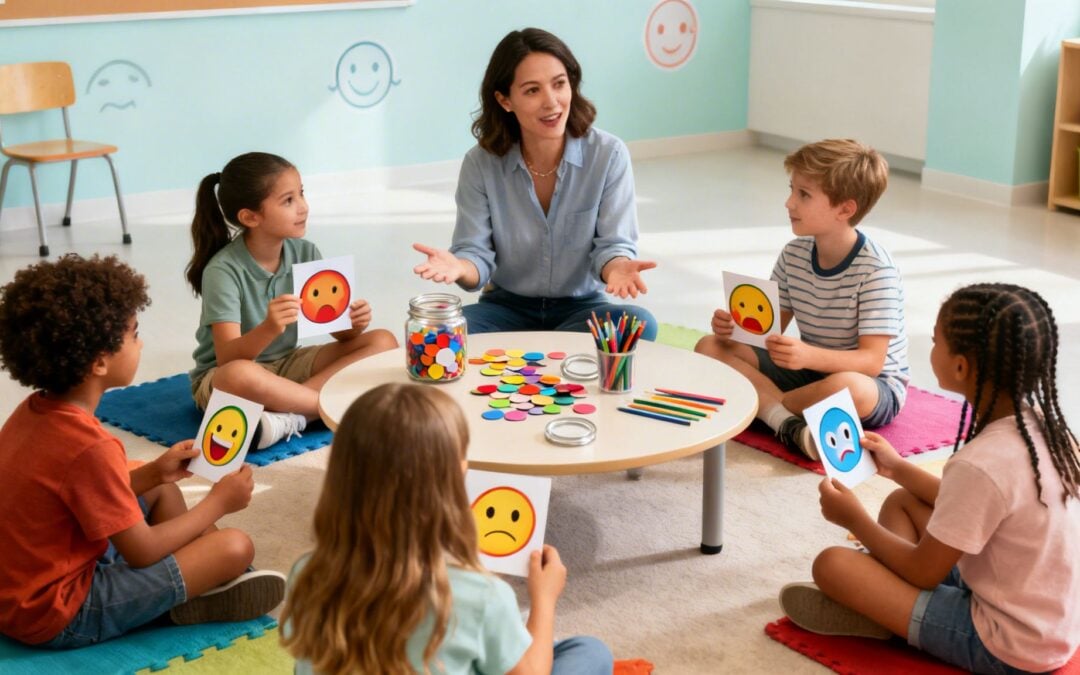
Emotional check-ins are structured activities where students learn to identify, name, and talk about their emotions. These mental health activities build emotional literacy, the foundation of emotional intelligence, by using tools like feeling charts and regular check-in conversations. The core purpose is to give students a shared, non-judgmental language for their feelings, which helps create a more empathetic and supportive classroom community.
This practice is central to many social-emotional learning (SEL) programs and is easily adapted across different age groups. For example, K-2 classrooms often start the day with a "feelings share" during their morning meeting, where each child points to a face on a chart that matches their current emotion. In middle school, teachers might use an "emotional exit ticket," asking students to anonymously write down a word or two describing how they feel after a lesson. These consistent routines normalize talking about feelings and help educators identify students who might need extra support.
Introduce the Vocabulary: Start with a basic set of emotion words (e.g., happy, sad, angry, scared) for younger students and expand to more complex words (e.g., frustrated, anxious, proud, content) for older ones.
Establish a Routine: Make emotional check-ins a predictable part of the day, such as at the beginning of class or after lunch. Example: A parent can ask at dinner, "What was your 'high point' and 'low point' today?" to open a discussion about feelings. A teacher can have students place a clothespin with their name on it next to an emotion word on a chart as they enter the room.
Model Vulnerability: Share your own feelings in an age-appropriate way. Saying, "I'm feeling a little frustrated because the projector isn't working, so I'm going to take a deep breath," shows students how to manage emotions constructively.
Use Visual Aids: Visuals are key, especially for younger students or visual learners. You can find great examples of a feelings chart for kids to use as a starting point in your classroom or home.
Facilitator Tip: Emphasize that all emotions are valid; there are no "good" or "bad" feelings. The focus is on recognizing the emotion and choosing a helpful response, not on judging the feeling itself. Always respect a student's choice not to share and never force participation.
3. Conflict Resolution and Peer Mediation Programs
Conflict resolution and peer mediation programs are structured systems that teach students practical communication and problem-solving skills to resolve disagreements. These mental health activities empower children to act as neutral third-party mediators, guiding their peers through a process of negotiation and mutual understanding. The purpose is to build a school culture where conflict is seen as an opportunity for growth, reducing social isolation and giving students ownership over their community's well-being.
These programs are a powerful tool for developing advanced social-emotional skills. For instance, many middle schools implement peer mediation where trained students use "I-statements" to help classmates discuss issues like rumors or social exclusion without blaming each other. Similarly, restorative justice circles, used in districts like Oakland USD, bring students together to talk through the impact of their actions and collaboratively decide how to repair harm. These initiatives, inspired by models from The Community Boards Program, create safer, more connected school environments.
Quick Guide for Implementation
Age Range: 3-8 (Formal mediation programs are typically grades 3-8)
Time: 15-30 minutes per session
Materials: A designated quiet space, "peace table" or neutral meeting area, talking piece (optional), script or flowchart for mediators.
How to Get Started
Recruit and Train Mediators: Select a diverse group of student volunteers who represent different social circles. Provide them with foundational training on listening, impartiality, and the steps of mediation.
Establish Clear Procedures: Create a simple referral process so students and teachers know how and when to request mediation. Define what issues are appropriate for peer mediation (e.g., arguments over a game, misunderstandings) versus those needing adult intervention (e.g., bullying, safety concerns).
Structure the Session: Teach mediators to follow a script. Example Script: 1) Welcome and set rules. 2) Person A tells their side. 3) Person B tells their side. 4) Clarify feelings and needs. 5) Brainstorm solutions. 6) Agree on a plan.
Coach, Don't Solve: Train teachers to guide students toward using mediation rather than immediately solving their problems for them. For excellent foundational skills, you can learn more about conflict resolution strategies for kids to support this process.
Facilitator Tip: Publicly acknowledge your peer mediators' contributions, perhaps through school announcements or certificates. This validates their important work, reinforces the program's value to the school community, and motivates continued participation.
4. Social-Emotional Learning (SEL) Curricula and Workshops
Social-emotional learning (SEL) curricula and workshops are structured educational programs that systematically teach core life skills. These mental health activities move beyond single exercises to provide a comprehensive framework for developing self-awareness, self-management, social awareness, relationship skills, and responsible decision-making. The goal is to embed these competencies into the school's culture, giving students a shared language and consistent tools to navigate their emotions and social interactions.
These programs are already a cornerstone of effective school mental health strategies. For instance, the Second Step program is used in thousands of schools, providing weekly lessons on topics like empathy and problem-solving. Other schools adopt the Responsive Classroom approach, which integrates SEL into daily academic instruction. Experiential programs like those from Soul Shoppe offer interactive assemblies and workshops, such as the Peaceful Warriors Summit, that allow students to practice conflict resolution and empathy in real-time, dynamic scenarios. This makes abstract concepts tangible and memorable.
Quick Guide for Implementation
Age Range: K-8
Time: Varies; 20-45 minute lessons weekly, or half/full-day workshops.
Materials: Dependent on the specific curriculum; may include lesson plans, student workbooks, posters, videos, and facilitator guides.
How to Get Started
Form a Team: Create an SEL committee with teachers, administrators, counselors, and parents to evaluate and select a program that fits your school's unique needs and culture.
Start with a Pilot: Introduce a new curriculum or workshop series in one or two grade levels first. This allows you to gather feedback and work out implementation challenges before a school-wide rollout.
Invest in Training: Ensure all staff involved receive robust professional development with ongoing coaching. Teacher confidence and buy-in are critical for the program's success.
Communicate and Involve Families: Host an informational night or send home resources explaining the program and its benefits. Example: Send home a one-page summary of the month's SEL theme (e.g., "Empathy") with a conversation starter for the dinner table. For more ideas, you can explore different SEL programs for schools to find the right fit.
Facilitator Tip: Integrate SEL concepts across subjects. Connect a lesson on empathy to a character in a novel, or discuss responsible decision-making during a history lesson about a major event. This shows students that SEL skills are relevant everywhere, not just during a specific "SEL time."
5. Gratitude and Positive Psychology Practices
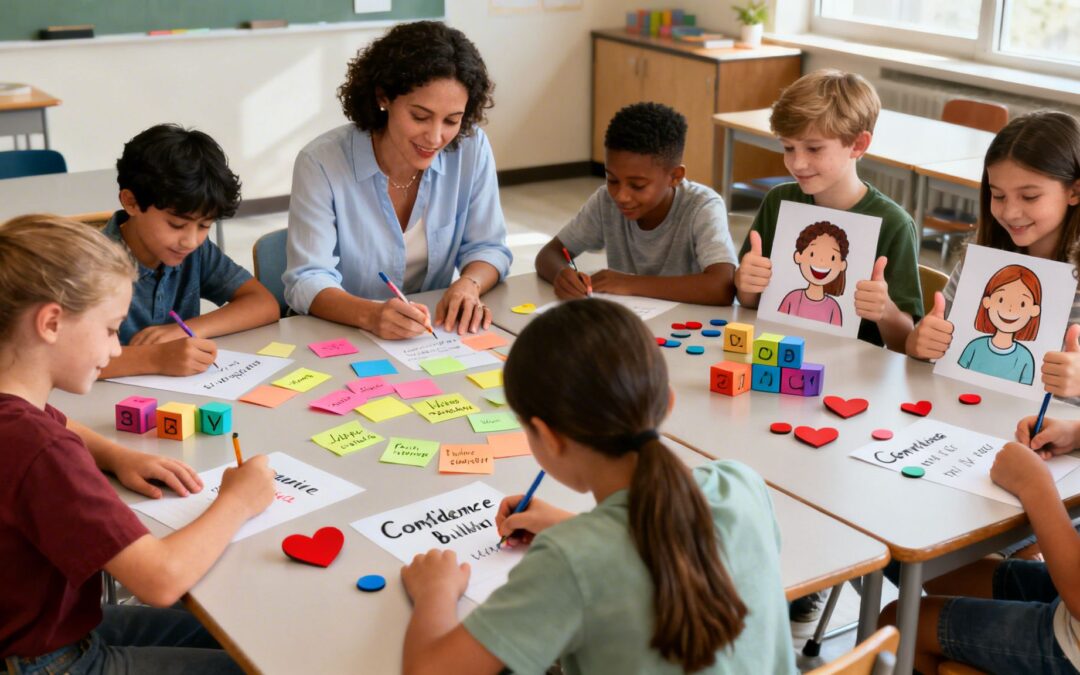
Gratitude and positive psychology practices are mental health activities designed to shift a student’s focus toward positive experiences, personal strengths, and appreciation for others. These exercises guide children to intentionally notice the good in their lives, which can counteract the brain's natural tendency to focus on negative events. The main goal is to build resilience, boost optimism, and improve overall well-being by rewiring thought patterns toward positivity and thankfulness.
These concepts, popularized by researchers like Martin Seligman and Brené Brown, are being successfully integrated into school cultures. For instance, many classrooms now host a weekly "Appreciation Circle" where students share something they are grateful for about a classmate. Others implement "Strength Spotting," where students identify and acknowledge a peer's positive character trait, like perseverance or kindness. These practices help foster a supportive community, reduce symptoms of anxiety and depression, and build lasting emotional skills.
Quick Guide for Implementation
Age Range: K-8
Time: 5-15 minutes
Materials: Optional: journal or notebook, jar, sticky notes, "appreciation" board.
How to Get Started
Introduce the Concept: Explain gratitude as "noticing the good things" and positive psychology as "focusing on our strengths." Use a simple analogy like a "gratitude lens" that helps you see the bright spots in your day.
Start with Simple Rituals: Begin with a small, consistent practice, such as "Thankful Thursday," where each student writes one thing they are grateful for on a sticky note and adds it to a classroom display. Parent Example: At bedtime, ask your child to name "three good things" that happened that day, no matter how small.
Model Authenticity: Participate yourself by sharing genuine and specific examples of gratitude. Instead of saying, "I'm thankful for our class," try, "I'm grateful for how quietly you all worked during reading time; it helped us create a peaceful room."
Make It Visual and Tangible: Create a "Gratitude Jar" where students can drop notes of thanks throughout the week. To incorporate gratitude into daily life, exploring these 8 gratitude journal prompts can be a great starting point for enhancing positive psychology practices.
Facilitator Tip: When practicing strength-spotting, be specific. Instead of saying "You're smart," praise the action: "I noticed you didn't give up on that hard math problem. That showed real perseverance." This makes the feedback more meaningful and helps students recognize their own character strengths.
6. Social Skills and Cooperative Learning Activities
Social skills and cooperative learning activities are structured methods for explicitly teaching and practicing key social competencies. These mental health activities guide students through teamwork, perspective-taking, active listening, and conflict resolution in a supportive setting. The main goal is to build strong relationship skills, which are foundational for emotional well-being, academic success, and creating a positive school climate where all students feel they belong.
These collaborative approaches are central to frameworks like Kagan Cooperative Learning and educational philosophies that prioritize equity. For example, a teacher might use a "Think-Pair-Share" structure where students first consider a question individually, then discuss it with a partner before sharing with the whole class. Another powerful application is the "Jigsaw" method, where each student in a group becomes an "expert" on one piece of a topic and then teaches it to their peers. These techniques are cornerstones of programs like the Junior Giants, which uses teamwork in sports to promote character development and inclusion.
Quick Guide for Implementation
Age Range: K-8
Time: 15-45 minutes (can be integrated into any lesson)
Materials: Dependent on the academic task; chart paper for group roles, sentence starters, or discussion prompts.
How to Get Started
Teach Skills Directly: Before starting a group task, explicitly teach the social skill you want students to practice, such as "using encouraging words" or "making sure everyone has a turn to speak." Example: A teacher could model this by saying, "An encouraging word sounds like, 'Great idea!' or 'Let's try that.'"
Assign Structured Roles: Give each group member a specific job, like a Recorder (writes down ideas), a Speaker (shares with the class), a Materials Manager (gathers supplies), or a Timekeeper. This ensures everyone participates.
Use Randomized Groups: Intentionally mix up student groups frequently. This helps break down social cliques and encourages students to build relationships with a wider range of peers.
Debrief the Process: After the activity, lead a brief discussion about how the teamwork went. Ask questions like, "What went well in your group today?" and "What is one thing we could do better next time?"
Facilitator Tip: Create and post visual aids with sentence starters for respectful disagreement (e.g., "I see your point, but have you considered…") or collaboration (e.g., "Building on that idea…"). This provides students with the language they need to navigate social interactions successfully.
7. Mindful Movement and Yoga for Children
Mindful movement and yoga are physical mental health activities that integrate body-based awareness with intentional motion. These practices, which include yoga, creative dance, and guided stretching, teach children to notice how their bodies feel as they move. The core purpose is to build the mind-body connection, offering a healthy outlet for stored-up energy and emotions while improving physical coordination and self-awareness.
These kinesthetic practices are increasingly common as brain breaks and structured physical education. For instance, many classrooms use short, guided movement videos between academic lessons to help students reset and refocus. Some schools offer kids' yoga as an after-school program, using animal-themed poses to make it engaging. These activities, championed by organizations like the Kids' Yoga Alliance, are excellent for kinesthetic learners who process information and emotion through physical action.
Set the Stage: Create a safe space where students have room to move without bumping into others. Explain that the goal is to notice how their bodies feel, not to achieve a perfect pose.
Use Accessible Language: Frame poses with kid-friendly names like "Cat-Cow," "Downward-Facing Dog," or "Tree Pose." Instead of complex terms, use simple cues like "stretch your arms to the sky."
Start with Short Sequences: Begin with brief 5-minute routines. You can follow a guided video together or lead a simple series of three to four poses, like a morning stretch routine to wake up the body. Example sequence: Start in "Mountain Pose" (standing tall), reach up for "Volcano Pose," fold forward, then finish in "Child's Pose."
Connect Movement to Emotion: Ask reflective questions like, "What does a strong mountain pose feel like in your body?" or "How does it feel to stretch like a cat waking up from a nap?" This builds emotional vocabulary. For a fun and accessible introduction, try this "Zen Den" guided yoga session with your students:
Facilitator Tip: Emphasize effort over perfection. Celebrate every child's participation by saying things like, "I love how you are all trying these new shapes with your bodies." Offer modifications, such as doing a pose while seated in a chair or against a wall for balance support.
8. Restorative Practices and Community Circles
Restorative practices are proactive processes that build community, relationships, and shared responsibility, while also providing a framework for responding to harm when it occurs. These mental health activities shift the focus from punishment to repairing relationships. Community circles and restorative conferences bring groups together to discuss issues, celebrate connections, repair harm, and problem-solve collaboratively, creating a foundation of psychological safety.
This approach is central to bullying prevention and creating a supportive school climate. For example, many elementary classrooms now start with a "Morning Circle," where students check in and share feelings using a talking piece. When conflict arises, a "Peacemaking Circle" can be held to address the behavior's impact, involving all affected parties to decide on a meaningful resolution. Restorative justice programs in Oakland schools have demonstrated success in reducing suspensions and improving the sense of belonging among students.
Quick Guide for Implementation
Age Range: K-8
Time: 15-45 minutes
Materials: A talking piece (a special object to signify whose turn it is to speak), comfortable seating arranged in a circle, optional: chart paper for co-creating agreements.
How to Get Started
Start Proactively: Begin with low-stakes community-building circles before using them for conflict. Use prompts like, "Share a time you felt proud" or "What is one hope you have for our class?"
Co-Create Norms: Establish ground rules together, such as "Listen with respect," "Speak from the heart," and "One person speaks at a time." This creates shared ownership of the space.
Introduce a Talking Piece: Explain that only the person holding the object can speak. Practical Example: Use a decorated rock, a small stuffed animal, or a special stick. Say, "Whoever is holding the 'talking turtle' is the only one who can talk. This helps us be great listeners."
Use Restorative Questions: When addressing harm, move from "What rule was broken?" to restorative questions: "What happened?", "Who has been affected?", and "What needs to be done to make things right?". Learn more about the core principles of restorative practices at the National Association for Community and Restorative Justice.
Facilitator Tip: Trust is the bedrock of restorative work. Invest significant time in building relationships and establishing circle norms before attempting to address sensitive conflicts. A well-facilitated proactive circle is the best preparation for a responsive one.
9. Family Engagement and Home-Based SEL Activities
Family engagement and home-based SEL activities extend social-emotional learning beyond the classroom, creating a consistent support system for children. These mental health activities involve structured programs and resources like parent workshops, take-home practice exercises, and communication guides. The goal is to empower families with the tools and language to reinforce SEL concepts at home, ensuring that a child's emotional growth is supported in all areas of their life.
This approach bridges the gap between school and home, which is critical for lasting impact. For instance, a school might send home a weekly "Dinner Table Topics" card with questions like, "What was one 'rose' (a good thing) and one 'thorn' (a challenge) from your day?" This simple practice encourages emotional sharing. Organizations like CASEL provide extensive family resources, and schools use apps like ClassDojo to share SEL moments and tips directly with parents, building a strong, collaborative community around each child.
Quick Guide for Implementation
Age Range: K-8
Time: 10-15 minutes per activity
Materials: Varies by activity; often includes worksheets, conversation prompts, or simple household items.
How to Get Started
Introduce with a Positive Frame: Position these as opportunities for family connection, not as homework. Emphasize that these activities are designed to be fun and build stronger relationships.
Make It Accessible: Provide resources in multiple formats and languages. A short video, a printable PDF, and a text message prompt can all deliver the same activity, reaching families where they are.
Start with Low-Barrier Activities: Begin with simple, universally positive topics like gratitude or kindness. For example, a "Gratitude Jar" where family members write down things they are thankful for each day is an easy entry point.
Connect to School Learning: Explicitly link home activities to what students are learning in class. Practical Example: If students learn "I-Statements" in class, a take-home note could explain the concept and suggest a practice scenario for parents: "Instead of 'You made me mad,' try 'I feel mad when I have to ask you three times to clean your room.'" For families seeking more tools, our parent resources and newsletter offer practical guidance.
Facilitator Tip: Host optional, informal "office hours" or a virtual coffee chat for parents to ask questions about the SEL activities. This creates a no-pressure environment for support and helps you gather valuable feedback to improve the resources.
10. Bullying Prevention and Peer Support Programs
Bullying prevention and peer support programs are structured initiatives that aim to create a psychologically safe school environment. These are essential mental health activities because they directly address peer harm, which can cause significant anxiety, depression, and social isolation. The goal is to shift school culture from one of passive bystanders to one of active allies, teaching students the skills to prevent bullying, support those who are targeted, and engage in restorative practices.
These programs go beyond simple "be nice" campaigns by providing clear definitions of bullying and concrete strategies for action. For example, evidence-based models like the Olweus Bullying Prevention Program are implemented school-wide, involving students, staff, and parents. Other initiatives, like the Junior Giants Strike Out Bullying program, partner with community organizations to promote respect and positive peer relationships. These efforts often include training peer mediators who help classmates resolve lower-level conflicts before they escalate.
Materials: Curriculum guides, posters, anonymous reporting boxes or digital forms, student handbooks.
How to Get Started
Define and Teach: Clearly define what bullying is (and isn't) using student-friendly language. Focus on the three key elements: it's unwanted aggressive behavior, involves a power imbalance, and is repeated or has the potential to be repeated.
Train the Adults: Ensure all staff, from teachers to bus drivers, are trained to recognize and intervene in bullying situations consistently. This builds a foundation of trust and safety.
Establish Clear Reporting: Create multiple, safe ways for students to report incidents, including anonymously. This could be a physical "courage box" in the library or a simple online form.
Teach Bystander Intervention: Equip students with safe strategies to act as "upstanders." Example Role-Play: One student pretends to tease another. The "upstander" can practice saying, "Hey, leave them alone," or walking over to the targeted student and saying, "Do you want to go play somewhere else with me?" Our own work at Soul Shoppe is dedicated to building these skills in K-8 students.
Facilitator Tip: Focus on restorative practices rather than purely punitive ones. When harm occurs, facilitate conversations that help the student who bullied understand the impact of their actions and find meaningful ways to repair the relationship and community trust.
10-Point Comparison: Mental Health Activities
Program
Implementation complexity
Resource requirements
Expected outcomes
Ideal use cases
Key advantages
Mindfulness and Breathing Exercises
Low–Medium (brief routines, teacher training)
Minimal (scripts/apps, small space)
Immediate calming, better focus and self-regulation
Morning meetings, transitions, classroom calming
Quick to implement, scalable, low cost
Emotional Check‑In and Feelings Identification
Low–Medium (structured routines)
Low (charts, visual supports, time)
Improved emotional vocabulary and early distress identification
Comprehensive prevention, supports victims and bystanders
Putting It All Together: A Whole-Community Approach to Mental Health
This article has detailed ten distinct categories of powerful mental health activities, from individual mindfulness practices to school-wide peer support programs. Each one offers a specific set of tools for building emotional intelligence, resilience, and a stronger sense of community. But their true power is unlocked not when used in isolation, but when woven into the very fabric of a child’s daily life, both at school and at home. The goal is to move beyond one-off lessons and create an ecosystem of consistent, predictable support.
Viewing these practices as a menu rather than a checklist allows you to build a sustainable plan. A single school assembly on bullying prevention, for example, has a limited impact. But when paired with weekly restorative circles in the classroom, ongoing conflict resolution training, and parent workshops on positive communication, the message is reinforced, and the skills become ingrained. It is this layering of strategies that builds a truly supportive environment where children feel safe enough to be vulnerable and confident enough to solve problems.
Your Action Plan: From Individual Activities to a Unified Strategy
Moving from knowledge to action is the most important step. The key is to start small and build momentum. Overhauling everything at once can be overwhelming and counterproductive. Instead, focus on creating small, consistent habits that will grow over time.
Consider this phased approach for implementation:
Phase 1: Start with Low-Hanging Fruit. Begin with activities that require minimal time and resources. For instance, a teacher could introduce a two-minute "Belly Breathing" exercise after recess each day to help students transition back to learning. A parent could start a simple dinner-time tradition of sharing one thing they were grateful for that day. These small but consistent mental health activities establish a foundation of emotional awareness.
Phase 2: Build and Expand. Once a few practices become routine, you can introduce more structured activities. A school might pilot a peer mediation program with a single grade level before expanding it. A family could designate one night a week for a "Feelings Charades" game, making emotional expression a fun and regular part of their interaction. The goal here is to deepen the practice and involve more people.
Phase 3: Integrate and Systematize. In this phase, you connect the dots between different initiatives. The language used in a classroom's social-emotional learning curriculum should align with the techniques taught in the peer mediation program. The skills a child learns in a school-based gratitude circle can be reinforced with a family gratitude jar at home. This creates a common vocabulary and a unified approach to well-being across different environments.
Key Takeaway: The most effective mental health support isn't about doing everything at once. It's about doing one or two things consistently, and then thoughtfully adding more layers of support until these practices become second nature for the entire community.
Committing to these practices is an investment in our collective future. When we provide children with a robust toolkit of mental health activities, we are not just helping them manage stress or navigate a single conflict. We are equipping them with the core competencies they need to build healthy relationships, make responsible decisions, and face life’s inevitable challenges with confidence and compassion. We are creating a generation of adults who are more self-aware, empathetic, and resilient. This consistent, community-wide effort transforms a school from a place of academic instruction into a true center of well-being where every child can flourish.
For schools and districts ready to take a deeper, more structured approach, partnering with an expert organization can make all the difference. Soul Shoppe provides evidence-based social-emotional learning programs, professional development for staff, and parent resources designed to build a positive and safe school climate. Explore how Soul Shoppe can help you integrate these powerful mental health activities into a cohesive, school-wide strategy.
We often talk about the importance of empathy, but where does it come from? The answer starts with a skill called perspective-taking.
So, what is perspective-taking, really? Think of it as the ability to mentally "try on" someone else's point of view—to see the world through their eyes, even if just for a moment. It’s the cognitive workhorse behind empathy, effective communication, and solving conflicts peacefully.
It’s about moving beyond our own immediate experience to understand another person’s thoughts, feelings, and beliefs, without needing to agree with them.
What Is Perspective Taking Really
Let's go deeper than a simple definition. At its heart, perspective-taking is an active, curious process. It’s not just noticing a friend is sad. It's wondering why they might be feeling that way based on their unique situation and what they’re going through.
This is a game-changer on the playground, in a group project, or around the dinner table.
For a child, it’s the shift from seeing a classmate grab a toy and thinking, "He's mean!" to considering, "Maybe he didn't know I was still using it." That subtle pivot is how we build bridges instead of walls.
The Three Types of Perspective Taking
Perspective-taking isn't a one-size-fits-all skill. It actually develops in stages and shows up in different forms. Understanding these types can help parents and teachers see where a child is thriving and where they might need a little more support.
Perceptual Perspective Taking: This is the most basic form and one of the first to develop. It's the simple, concrete understanding of what another person can physically see from their vantage point. A practical example is asking a child, "I see the door from here. Can you see the door from your chair, or is the bookshelf in your way?"
Cognitive Perspective Taking: This is a bigger leap. It’s the ability to understand that other people have different thoughts, beliefs, and knowledge. For instance, a child developing this skill realizes that a friend doesn't know a secret just because they know it. A teacher might ask, "Even though you know the answer, does Sarah know it if she wasn't here yesterday?"
Emotional Perspective Taking: This is where we get to the heart of empathy. It's the ability to infer what another person is feeling. A parent might use this by saying, "Your brother looks upset. How do you think he feels about his tower falling over?"
A Practical Example: A Classroom Disagreement
Imagine two students, Maria and Leo, are arguing over a shared tablet. Maria is upset because Leo snatched it without asking. Leo is frustrated because he's rushing to finish his assignment.
Without perspective-taking, the conflict just gets louder. "It's my turn!" "No, it's mine!"
But a teacher can guide them to practice the skill.
"Maria, can you think of why Leo might be feeling so rushed right now? What is he trying to get done? Leo, how do you think it made Maria feel when you grabbed the tablet without talking to her first?"
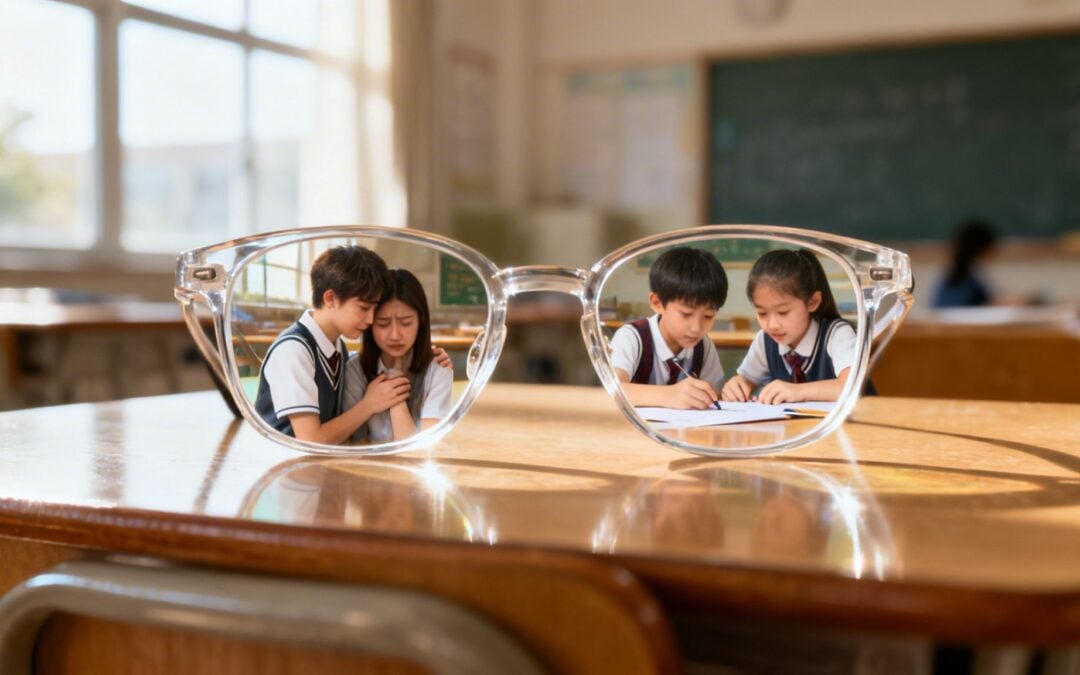
This simple prompt encourages both students to put on each other’s "mental glasses." Maria might realize Leo is stressed about a deadline, and Leo might understand his action felt disrespectful to Maria. This doesn’t magically fix the problem, but it reframes the conflict. It becomes a shared problem they can solve together instead of a battle to be won.
This skill is a close cousin to another important concept; you can learn more about this in our guide to define empathetic listening.
By truly understanding perspective-taking, we can see why it’s a non-negotiable skill for our children. It lays the foundation for a more compassionate and collaborative world, one interaction at a time.
Why Perspective Taking Is an SEL Superpower
What if you could give your students a superpower that improves almost every social interaction they’ll ever have? That’s what perspective-taking does. It’s so much more than a soft skill; it’s a core part of social-emotional learning (SEL) that fuels positive change in classrooms, homes, and entire communities.
When we talk about perspective-taking, we mean the ability to see a situation from someone else’s point of view. It’s the engine that drives empathy, makes communication clearer, and sets the stage for real conflict resolution. Without it, kids are stuck seeing the world through their own narrow lens.
This one skill is the difference between a student thinking a quiet classmate is being rude, and realizing they might just be having a tough morning. It’s a small mental shift that completely changes the social landscape.
Building Stronger Friendships and Reducing Conflict
One of the first things you’ll notice when kids develop perspective-taking skills is that their friendships get healthier. Students who can genuinely understand a friend's feelings or point of view are just better at navigating the normal ups and downs of relationships.
We see it time and again: children who are good at this are more likely to help, share, and comfort others. This naturally makes them more well-liked by their peers and helps them avoid feeling left out or rejected.
Practical Example: A Playground Disagreement Two students, Sam and Chloe, both want the last swing on the playground.
Without Perspective-Taking: Sam just grabs it and says, "It's mine!" Chloe gets upset, an argument starts, and they both walk away angry.
With Perspective-Taking: Sam sees the disappointed look on Chloe's face. He pauses and asks, "Did you want this swing?" Chloe explains she had a bad morning and just wanted a minute alone. Sam gets it. "Oh, okay. You can have it. I'll go on the slide."
What could have been a fight becomes a moment of connection. Sam learned something about Chloe, and Chloe felt seen and understood. That tiny interaction not only prevented a problem but actually strengthened their friendship.
Fostering a Positive School Climate
When perspective-taking becomes a real value in a school, the whole atmosphere changes. It’s a powerful defense against bullying, exclusion, and day-to-day classroom friction. After all, bullying is often rooted in a complete failure to see the other person's humanity.
A school environment that actively teaches and models perspective-taking is an environment where bullying has a much harder time taking root. Students learn to see their classmates as complex people with their own stories, not just as simple targets.
This skill also makes group projects and other collaborative work run so much more smoothly. Students become better at:
Listening to and valuing their teammates’ ideas.
Understanding why a peer might be struggling with their part of the task.
Compromising and finding solutions that work for the whole group.
A practical example is during a group project. When one student fails to complete their part, instead of getting angry, a classmate with perspective-taking skills might ask, "Is everything okay? You seem a little stressed." This opens the door to understanding that the student might be overwhelmed with other work, rather than just being lazy.
This creates a more cooperative, less competitive classroom where students feel safe enough to share their thoughts and ideas. The many benefits of social-emotional learning are truly unlocked when perspective-taking is front and center.
Developing Resilience and Social Awareness
Finally, perspective-taking is absolutely essential for building resilience. It gives children the tools to handle tricky social situations without getting overwhelmed or completely shutting down. They learn that not every negative moment is a personal attack.
For example, if a child isn't invited to a birthday party, their first instinct might be to feel hurt and rejected. A parent can help them practice perspective-taking by asking, "I know you feel sad. Can we think of some other reasons? Maybe their parents only allowed a small number of guests, or maybe they only invited kids from their soccer team." This helps the child realize the situation might not be a personal slight.
This social awareness helps them "read the room" and adjust their behavior, which is a vital skill for success in school and in life. By making perspective-taking a priority, we're not just teaching kids to be nice; we're giving them a strategic social-emotional superpower that will serve them for the rest of their lives.
The Developmental Journey of Perspective Taking
Knowing what perspective taking is is one thing, but seeing how it blossoms in a child is another entirely. This skill doesn't just switch on one day. It’s a slow, steady journey that unfolds over years, much like a child learns to walk before they can run. They have to master simple social viewpoints first before they can ever hope to navigate complex friendships and disagreements.
This developmental path isn't a strict schedule but more of a general roadmap. It’s helpful to think of it through frameworks like Vygotsky's sociocultural theory, which shows us how much social interaction shapes a child’s growing mind. Each stage builds on the one before, and when we know what’s typical for each age, we can offer the right support at just the right time.
Perspective-taking abilities change significantly as children mature. The table below breaks down these stages, offering a quick guide for educators and parents to see what's happening at each age and how they can best support this growth.
Developmental Stages of Perspective Taking
Age Group
Typical Abilities
Practical Example
Supportive Prompt for Adults
Kindergarten – 2nd Grade
Egocentric View: Sees the world from their own physical viewpoint. Begins to identify basic emotions in others.
A child hides by covering their own eyes, thinking "If I can't see you, you can't see me."
"I see you're looking at the blue car. What do you think I see from where I'm sitting?"
3rd Grade – 5th Grade
Second-Person View: Understands that others have different thoughts, feelings, and information.
A child realizes that their friend might not know about the surprise party, even though they do. They keep it a secret.
"Can you think of any other reasons your friend might have seemed upset today? What might they be thinking?"
Middle School & Beyond
Third-Person View: Can step back and see a situation from a neutral, outside perspective.
Two friends in a fight can analyze the problem as if they were an uninvolved observer, seeing both sides.
"Let's pretend you're a mediator. How would you describe the problem fairly to both people?"
By tailoring our guidance to a child's developmental stage, we can meet them where they are and help them build these crucial skills one step at a time.
Early Foundations: Kindergarten to 2nd Grade
In these early years, kids are naturally egocentric. Their universe spins around their own feelings and experiences—and that's completely normal. At this stage, perspective taking is very concrete and tied to what they can physically see.
The main skill popping up is perceptual perspective taking. This is the literal ability to get that someone else sees something differently from their own physical spot.
A great way to practice this is to sit on the floor with a child and put a big book or toy between you. Ask them what they see on their side. Then, ask what they think you see from your side. It’s a simple game that helps them grasp the core idea that two people can have different views of the exact same object.
The focus here is on linking actions to feelings. For example, a child learns that if they snatch a toy, it makes their friend sad. They aren't ready to dive deep into their friend's inner world, but they're laying the foundation for emotional empathy.
As you can see, perspective taking is a core skill that fuels other SEL superpowers like empathy, friendship, and resilience as kids grow.
This shows how a child’s ability to handle more complex social and emotional situations matures right alongside their perspective-taking skills.
Expanding Horizons: 3rd to 5th Grade
Once kids hit the upper elementary grades, their thinking takes a huge leap. They move past just physical views and start to understand that other people have different thoughts, beliefs, and knowledge. This is cognitive perspective taking. They finally get that just because they know the secret to a surprise party, it doesn't mean everyone else does.
This is a game-changer for social life, as friendships get way more complicated. Kids at this age can start to put themselves in someone else's "mental shoes" and think about their intentions.
A key shift during this period is the ability to recognize that a person's actions are driven by their own unique thoughts and knowledge. This insight is fundamental to moving past black-and-white thinking and seeing the nuances in social situations.
For example, imagine a student is sad because their friend didn't save them a seat at lunch. Instead of just focusing on the hurt, a teacher can ask, "Can you think of any reasons why your friend might not have saved you a seat? Maybe they didn't see you, or maybe someone else asked to sit there first." This nudges the child to explore other possibilities beyond their own feelings.
Advanced Understanding: Middle School and Beyond
Middle school drops kids into a whole new level of social complexity, and their perspective-taking skills have to level up, too. Now, adolescents become capable of something pretty sophisticated: seeing a situation from a neutral, third-party perspective. They can actually step back from a fight and look at it like an outside observer would.
This skill is absolutely vital for navigating peer pressure, solving messy arguments, and understanding bigger societal issues. They learn that truth isn't always black and white and that two people can have totally valid but opposite views on the same problem.
Say two friends are arguing over a group project. One feels the other isn't pulling their weight, while the second feels swamped with other commitments. A counselor could guide them by saying, "Let's pretend you're a reporter writing a story about this. What would each person's side of the story be? What's the fair way to describe what happened?"
This simple prompt helps them detach from their intense emotions and see the situation more objectively—the ultimate goal of mature perspective taking. When you understand this developmental journey, you can be a much better guide for students every step of the way.
Proven Classroom Strategies to Teach Perspective Taking
Helping students define perspective taking for themselves is one of the most powerful things we can do as educators. It’s not just an abstract theory—it’s a practical tool that helps kids navigate their social world with more kindness and understanding.
The best part? You don’t need a whole separate curriculum. These strategies can be woven right into the fabric of your daily routine. Everyday moments can become powerful lessons in empathy.
The key is making this skill visible and practical. When teachers model perspective taking, it becomes a natural part of the classroom culture rather than just another rule to follow. Let’s look at a few proven ways you can start doing this tomorrow.
Use Think-Alouds During Read-Alouds
Storytime is the perfect laboratory for practicing perspective taking. As you’re reading to your class, just pause and model your own thought process out loud. This "think-aloud" technique makes the internal process of seeing another's viewpoint clear and simple for your students.
Instead of just reading the words on the page, you can show your curiosity:
"Hmm, the wolf says he just had a cold, but the pig looks terrified. I wonder what the pig is thinking right now?"
"Wow, she just lost her favorite toy. How do you think she's feeling inside right now? What would you want a friend to do for you if that happened?"
"He isn't sharing his snack. What could be a reason for that? Maybe he's extra hungry today or didn't have breakfast."
This simple act invites students to step into the characters' shoes. It shows them there’s almost always more than one reason for a person's behavior, moving them beyond snap judgments.
Integrate Perspective Taking into Core Subjects
Perspective taking isn’t just for your SEL block; it's a critical thinking skill that makes every academic subject richer. By weaving it into your existing lessons, you reinforce the concept all day long.
In Literature: Go beyond simple comprehension questions. Ask students to dig into character motivations. Why did a character make a certain choice? How did their past experiences shape their actions? For example, "Why do you think the villain in this story acts so mean? What might have happened in their past to make them this way?"
In History and Social Studies: History is packed with opportunities. Instead of just having students memorize dates, ask them to explore events from multiple viewpoints.
Example: When studying a conflict, you could divide the class into groups representing different sides. Have each group research and argue from that perspective. This helps them see that history is often a matter of interpretation and that different groups can experience the same event in profoundly different ways.
Research supports this approach. Using case studies from history or even lived experiences helps students analyze conflicts. They can search for evidence of where a lack of perspective taking led to problems and discuss how empathy might have changed the outcome.
Leverage Structured Role-Playing
Role-playing takes perspective taking from a mental exercise to a physical one. It’s a safe way for students to practice navigating the kinds of conflicts they face every day on the playground or in the classroom.
You can start with simple, common scenarios:
Set the Scene: Two students both want to use the same computer.
Assign Roles: One student needs the computer to finish work. The other wants to play a game.
Practice the Script: Guide them to use "I feel" statements and to state what they think the other person wants. For example: "I feel frustrated because I need to finish my work. I get that you want to play a game, and you've been waiting for a turn."
This kind of structured practice builds muscle memory for empathy. It gives students the words they need when a real conflict pops up. For even more hands-on ideas, check out our guide on fun and engaging perspective taking activities.
Empower with Question Stems
Finally, give your students the tools to practice perspective taking on their own. Post a few simple question stems around the classroom as visual reminders they can use during disagreements or group projects.
Helpful question stems include:
"How might they see this differently?"
"What's another reason they might have done that?"
"What do they need right now?"
"Can you say back what you heard them say?"
By consistently using these strategies, you create an environment where understanding others is a skill that’s both valued and practiced. You're not just managing behavior; you're building a foundation for compassionate, socially aware kids.
How Parents Can Build Perspective Taking at Home
While classrooms provide a wonderful, structured space for social-emotional learning, the most powerful lessons often take root at home. As a parent, you play a vital role in nurturing perspective taking, turning everyday family moments into real-world learning opportunities.
These small, consistent practices are your secret weapon. The goal isn't to add more to your already full plate, but to weave this skill into the things you already do—from watching movies to navigating sibling squabbles. When perspective taking becomes a natural part of your family’s dialogue, you show your child how much it matters in a way no lesson plan ever could.
Turn Dinnertime into a "Feeling" Feast
The family dinner table is more than a place to eat; it’s a daily empathy gym. Make it a habit to go beyond "How was your day?" and ask questions that gently nudge your children to think about the feelings of others.
Try a simple game like "Rose, Thorn, Bud." Each person shares:
A Rose: The best part of their day.
A Thorn: A challenging moment they had.
A Bud: Something they're looking forward to.
This simple structure creates a perfect opening for practicing perspective taking. If a child shares a “thorn” about a conflict with a friend, you can gently ask, "That sounds so frustrating. How do you think your friend might have been feeling in that moment?" This normalizes thinking about another person's experience.
Use Media as an Empathy Mirror
Family movie night—or even a 10-minute cartoon—is a fantastic laboratory for building perspective taking. The characters on screen offer a low-stakes way for kids to practice walking in someone else’s shoes.
The key is to pause and ponder. When a character makes a surprising choice or shows a big emotion, hit pause and get curious.
"Why do you think she did that? What’s another reason she might have acted that way?"
"Look at his face. What do you think he’s feeling, and what makes you say that?"
"How would you feel if that happened to you?"
By exploring characters’ motivations and emotions, you’re teaching your child to look for the “why” behind people’s actions. This builds the mental habit of considering what’s happening beneath the surface—a core skill for empathy.
This simple act turns passive screen time into an active, engaging lesson. Reading stories together works just as well; you can find some great titles in our curated list of books on emotions for children.
Navigate Sibling Squabbles with a Script
Sibling disagreements are inevitable. But they’re also prime opportunities to teach conflict resolution and empathy in the heat of the moment. Instead of just sending kids to separate corners, use these moments to explicitly practice perspective taking.
Introduce a simple "Stop and State" rule. Before you jump in to find a solution, each child must first try to calmly state the other’s point of view.
Practical Example: The Broken Toy
One child is crying because their sibling broke their favorite toy. The other child is defensive, insisting it was an accident.
Stop: Separate them and help them both take a breath to calm down.
State: Ask the upset child, "Can you try to explain what your brother is saying happened?" Then turn to the other and ask, "Can you tell me how your sister is feeling right now and why?"
Solve: Once they've each made an effort to see the other's side, they can start working on a solution together, like fixing the toy or offering a real apology.
This process forces a pause and requires them to step outside their own intense feelings, even for a second. It shows them that understanding isn't the same as agreeing, but it’s the essential first step toward finding a fair and kind solution.
Building Empathetic Schools with Soul Shoppe Programs
Understanding perspective-taking is the first step, but the real magic happens when you weave it into the fabric of your entire school community. This is where theory gets its hands dirty. At Soul Shoppe, we guide schools from just talking about empathy to actually building it into the campus DNA with our research-based, hands-on programs.
We create a psychologically safe space where students from kindergarten through 8th grade can actively practice seeing the world through someone else’s eyes. Our approach isn't about lectures; it's about doing. Through interactive workshops, students engage in activities designed to help them step into another person’s shoes and see a familiar situation from a totally new angle.
Creating a Shared Language for Empathy
One of the most powerful ways to make perspective-taking a campus-wide habit is to establish a shared language. When everyone—from the principal to the youngest student—uses the same words to talk about feelings and conflict, it creates a powerful cultural touchstone. Our programs introduce simple, memorable tools that make it easier for students to communicate with real understanding.
For instance, we might walk students through a conflict with a simple, three-part script:
"I feel…" to express their own emotions without placing blame.
"I hear you saying…" to prove they were listening to the other person's side.
"What I need is…" to clearly and respectfully ask for what would help.
This shared vocabulary turns an abstract idea into concrete action. It gives kids the words they need to navigate tough moments with confidence, turning potential fights into opportunities for real connection.
Experiential Learning That Sticks
Let's be honest: kids learn best by doing. Soul Shoppe’s facilitators lead students through dynamic activities that make perspective-taking a tangible experience, not just a vocabulary word. These aren't sleepy, passive assemblies; they are high-energy workshops where empathy is practiced in real time.
A core belief at Soul Shoppe is that emotional skills are built through practice, just like any other skill. We don't just tell students to be empathetic; we give them the chance to feel what it’s like to understand someone else's point of view in a real, immediate way.
A teacher might see a student who usually struggles in groups suddenly pause and ask, "Wait, what's your idea?" after one of our programs. That tiny shift is the direct result of practicing the skill in a safe, guided environment.
When you partner with an organization like Soul Shoppe, you can scale these strategies across your entire campus. You can turn your school into a community where every single child feels seen, heard, and truly valued.
Common Questions About Teaching Perspective Taking
As you start weaving perspective-taking into your daily conversations with kids, you're bound to have some questions pop up. It’s a complex skill, and figuring out the best way to teach it isn't always straightforward. We get it.
Here are some of the most common questions we hear from parents and educators, along with our most practical, real-world answers.
Is Perspective Taking the Same as Empathy?
They’re incredibly close partners, but they aren't the same thing. Think of it this way: perspective-taking is the mental work of trying to see the world from someone else’s viewpoint. It’s a thinking skill. Empathy is the feeling part—it’s feeling with someone because you understand where they're coming from.
You really can't have true empathy without first taking someone’s perspective. It’s the key that unlocks the door. For instance, a student uses perspective-taking to guess that their friend is quiet because they didn't do well on a math test. That understanding then opens the door for them to feel empathy for their friend's disappointment.
My Child Struggles with This. When Should I Be Concerned?
First off, it is completely normal for younger kids (think K-2) to see the world primarily through their own eyes. Their brains are naturally self-focused at this stage. Just keep modeling the skill, using simple feeling words, and talking through different points of view.
But if a child in the upper elementary grades (4th or 5th) consistently seems unable to consider other viewpoints—and it's starting to cause friction in their friendships—that's a good time to team up with their teacher to brainstorm more targeted support.
For example, if your child always blames others for conflicts and can't articulate why a friend might be upset ("I don't know, he's just being weird"), it's a good cue to be more intentional. You can work with the teacher to see if this pattern shows up at school, too.
How Do I Teach This Without Making My Child a Pushover?
This is such an important question and a worry we hear all the time. The goal here is to teach understanding, not automatic agreement. We always stress that "understanding why someone feels a certain way doesn't mean you have to agree with them."
Frame perspective-taking as a tool for smarter, more effective communication. You can use phrases like, "You don't have to agree with your friend, but let's try to figure out why they're so upset." For instance, "I understand you feel it's unfair that your brother got to choose the movie, but you can still tell him you want to choose next time. Understanding his reason doesn't mean you give up your turn." This helps them see that understanding others gives them more information and makes them a better friend and problem-solver, not someone who just gives in.
For adults and older teens looking to deepen their own social-emotional skills, exploring options like professional counselling services can provide valuable strategies for personal growth.
Soul Shoppe provides research-based social-emotional learning programs that equip K-8 schools with the tools and language to build empathetic, connected communities where every student can thrive. Learn how we can support your school.
Welcome to our practical guide to Social-Emotional Learning (SEL) for elementary students. In an environment where emotional intelligence is as critical as academic knowledge, providing young learners with tools to understand their feelings and connect with others is essential. This article offers a deep dive into powerful sel activities for elementary students, designed to be practical, engaging, and effective for teachers, counselors, and parents alike.
We move beyond abstract ideas to give you actionable steps, specific examples, and adaptations for different age groups. For instance, instead of just suggesting "breathing exercises," we detail how a "Bear Breath" technique can calm a first grader's pre-test jitters, while a "4-7-8 Breathing" script can help a fifth grader manage frustration during a group project. This guide is your roadmap to implementing these important practices.
Our goal is to help you cultivate resilient, emotionally intelligent learners who are ready to collaborate, solve problems, and succeed. The following curated collection of activities will help build a strong foundation for lifelong well-being and academic success. You will find detailed instructions for everything from peer empathy exercises to growth mindset lessons, all organized to be easily implemented in a classroom or at home. Let's explore the activities that will foster a more connected, safe, and empathetic community for your students.
1. Mindfulness and Breathing Exercises
Mindfulness and breathing exercises are structured practices that teach students to anchor their attention in the present moment. These foundational SEL activities for elementary students help them develop self-awareness and self-management by learning to calm their own nervous system, particularly during moments of high energy, stress, or conflict. The core idea is simple: by focusing on the physical sensation of breathing, a child can create distance from overwhelming emotions and respond more thoughtfully.
To deepen the understanding of these practices, educators can explore resources that explain in detail what mindfulness meditation entails. These exercises are not about emptying the mind but rather about paying attention on purpose, without judgment. This skill is critical for building emotional intelligence and resilience.
How to Implement in Your Classroom
Effective integration relies on consistency and modeling. You can introduce these practices as "brain breaks" between subjects, as a centering routine to start the day, or as a cool-down activity after recess.
Belly Breathing: Have students place a hand on their belly and feel it rise and fall like a balloon as they inhale and exhale slowly. Practical Example: Before a spelling test, say, "Let's take three balloon breaths. Put your hand on your belly. Breathe in and feel the balloon get bigger… now breathe out and let the air out slowly."
Box Breathing: Guide students to inhale for a count of four, hold for four, exhale for four, and hold for four. Drawing a square in the air with their finger can help them track the steps. Practical Example: When the class is noisy after recess, say, "Let's get our focus back with box breathing. Trace a square in the air. Breathe in… hold… breathe out… hold."
Five Senses Grounding: When a student is anxious, ask them to name five things they can see, four things they can feel, three things they can hear, two things they can smell, and one thing they can taste. Practical Example: If a child is crying over a scraped knee, you could say, "Okay, let's calm our body. Can you tell me five blue things you see in the room right now?"
Classroom Tip: Practice alongside your students. When they see you taking deep breaths before a challenging lesson, it normalizes the strategy and demonstrates its practical application in everyday life. Start with sessions as short as one minute and gradually increase the duration as students become more comfortable.
2. Emotion Identification and Feelings Vocabulary Activities
Emotion identification activities are interactive lessons and games designed to expand students' emotional vocabulary, helping them name and understand feelings in themselves and others. These foundational SEL activities for elementary students build emotional literacy, a critical component of self-awareness and social awareness. The goal is to give children the specific words they need to move beyond "mad" or "sad" to more nuanced feelings like "frustrated," "disappointed," or "anxious," enabling better communication and self-regulation.
Pioneered by experts like Marc Brackett at the Yale Center for Emotional Intelligence, this work emphasizes that if you can name an emotion, you can begin to manage it. By making feelings vocabulary a regular part of classroom conversation, educators create a safe environment where all emotions are acknowledged as valid, even if the behaviors they cause need guidance.
How to Implement in Your Classroom
Integrating these activities works best through consistent, playful practice rather than a single lesson. Use them during morning meetings, as transitions, or in response to social situations that arise naturally.
Feelings Wheel or Chart: Create a large, visible feelings wheel in the classroom. During check-ins, students can point to the emotion that best describes how they feel, providing a low-pressure way to share. Practical Example: During morning meeting, have students put a clothespin with their name on it next to the feeling on the chart that best matches their mood.
Emotion Charades: Write different emotions on cards. A student picks a card and acts out the feeling without words, while classmates guess. Practical Example: A student picks "frustrated." They might stomp their foot lightly and cross their arms. Another student guesses, "Are you angry?" The teacher can then ask, "What's the difference between angry and frustrated?"
Literature-Based Discussion: During read-alouds, pause and ask, "How do you think this character is feeling right now? What clues in the story or pictures tell you that?" Practical Example: While reading Where the Wild Things Are, pause and ask, "When Max was sent to his room, what feeling was he showing? Look at his face. Is it just anger, or maybe disappointment too?"
Classroom Tip: Collaboratively create a classroom "emotions anchor chart" with your students. As you introduce new feelings words throughout the year, add them to the chart with simple definitions or drawings. This co-created resource fosters ownership and makes the vocabulary more meaningful.
To find more games, charts, and tools for your classroom, you can find further resources for teaching emotional vocabulary to kids that make learning about feelings engaging and effective.
3. Gratitude and Positive Reflection Practices
Gratitude and positive reflection practices are simple yet powerful exercises that teach students to intentionally notice and appreciate the good in their lives. These foundational SEL activities for elementary students build self-awareness and social awareness by shifting focus from problems to positives. The core principle, supported by positive psychology research, is that training the brain to look for what's working builds resilience, strengthens relationships, and improves overall well-being.
By consistently identifying things they are thankful for, students learn to recognize the value in everyday moments, people, and their own abilities. This practice counters negativity bias and helps children develop a more balanced and optimistic outlook, which is crucial for managing challenges and building strong emotional health.
How to Implement in Your Classroom
Integrating gratitude into your daily routine can be simple and quick, making it a sustainable practice. The key is modeling authentic appreciation and providing structured opportunities for students to share. You can add these activities to your morning meeting, use them as a calm-down transition, or conclude the day on a positive note.
Gratitude Journals: Provide notebooks where students can write or draw something they are grateful for each day. Practical Example: At the end of the day, prompt students: "Today, draw or write about one person who was kind to you." For younger students, provide the sentence starter, "I am thankful for…"
Appreciation Circles: During a morning meeting, have students go around the circle and complete the sentence, "Today, I am grateful for…" This builds community as students listen to their peers' appreciations. Practical Example: On a Monday, you might ask, "Share one thing you are grateful for that you did this weekend."
Thank You Letters: Guide students in writing and delivering letters of appreciation to classmates, school staff, or family members. This directly practices relationship skills and empathy. Practical Example: Before a holiday break, have students write a short thank-you note to the school custodian, librarian, or a cafeteria worker, telling them one specific thing they appreciate.
Classroom Tip: Expand the concept of gratitude beyond material things. Use sentence starters to help students appreciate experiences ("I'm grateful for learning how to…"), people ("I'm thankful for my friend because…"), and personal strengths ("I'm proud that I was able to…"). This teaches them to find value in a wide range of life experiences.
For additional guidance on fostering a culture of thankfulness, explore these practical ways to show gratitude that can be adapted for both school and home environments.
4. Cooperative Learning and Team-Building Games
Cooperative learning and team-building games are structured group activities designed to build collaboration, communication, and problem-solving skills. These essential SEL activities for elementary students create an environment where interdependence is necessary for success, which helps foster a sense of belonging and reduces feelings of isolation. The focus is on shared goals, requiring students to listen to peers, negotiate ideas, and work together, thereby strengthening relationship skills and social awareness.
By participating in these activities, students learn to appreciate diverse perspectives and contribute to a common objective. The process helps them understand the give-and-take of working in a group, a critical life skill. To better understand the framework behind these interactions, educators can find value in exploring resources that explain what collaborative problem-solving is and how it supports student development. These games are not just about fun; they are carefully designed practice for real-world social navigation.
How to Implement in Your Classroom
Successful integration depends on clear structure and intentional debriefing. You can use these games as icebreakers, brain breaks, or dedicated time during morning meetings to build a strong classroom community from the very beginning of the school year.
Human Knot: Have a small group of students stand in a circle, reach across to grab the hands of two different people, and then work together to untangle themselves into a single circle without letting go. Practical Example: Split the class into groups of 6-8. After they form a "knot," tell them, "Talk to your teammates to figure out who needs to move where. You might have to go under someone's arms!"
Silent Sequencing: Give each student in a small group a card with a number, a letter of the alphabet, or part of a picture sequence. The group must line themselves up in the correct order without speaking. Practical Example: Give a group of five students cards showing the life cycle of a butterfly. They must use gestures and observation to line up in the correct order: egg, caterpillar, chrysalis, butterfly, etc.
All Aboard: Mark a small area on the floor with tape (the "ship"). Challenge a group of students to fit entirely inside the space. Gradually make the ship smaller in each round, requiring more creative problem-solving and cooperation. Practical Example: Start with a hula-hoop. Challenge a group of 8 to get both feet inside. Then, fold a large towel in half and challenge them again.
Classroom Tip: After each activity, lead a short debrief session. Ask questions like, "What was challenging about that?" or "What did your team do well to succeed?" This reflection is where the most significant SEL learning occurs, as it connects the game to real-life teamwork and communication skills.
5. Peer Empathy and Perspective-Taking Activities
Peer empathy and perspective-taking activities are structured exercises designed to help students understand and share the feelings of others. These essential SEL activities for elementary students focus on building social awareness and relationship skills by encouraging children to see situations from another person’s viewpoint. The main goal is to develop both the cognitive ability to imagine another's experience and the emotional capacity to connect with their feelings, which is foundational for kindness, conflict resolution, and positive relationships.
This approach is central to the work of experts like Daniel Goleman, who identifies empathy as a key component of emotional intelligence. Programs like Soul Shoppe's bullying prevention curriculum put these ideas into practice, teaching students that understanding someone else's perspective is the first step to resolving conflicts peacefully. These activities move beyond simply telling students to "be nice" and give them the tools to actually understand why their actions affect others.
How to Implement in Your Classroom
Integrating empathy-building exercises requires creating a safe space where students feel comfortable sharing and exploring different viewpoints. You can use literature, real-life scenarios, or structured role-plays as a springboard for these discussions.
Character Perspective Switch: During a read-aloud, pause the story and ask students to act out how a different character might feel. Practical Example: After reading The Three Little Pigs, ask, "How would the story be different if the wolf told it? What might he say about why he was blowing the houses down? Maybe he was just cold and had a bad cough?"
Empathy Interviews: Pair students and provide them with gentle, open-ended questions to ask each other, such as "Can you tell me about a time you felt really proud?" or "What is something that makes you feel happy?" This builds active listening skills and mutual understanding. Practical Example: Give partners three minutes each. Student A asks Student B, "What's your favorite thing to do on the weekend and why?" Student A can only listen and then summarizes what they heard.
Scenario Role-Play: Present a common, low-stakes conflict, like two students wanting to use the same playground ball. Have them role-play the situation and then switch roles to experience the other side. Debrief with questions like, "What did it feel like to be in their shoes?" Practical Example: Set the scene: "Maria and Leo both want the red ball at recess." Ask two students to act it out. Then say, "Okay, switch! Now, Leo, you're Maria. How does it feel to see someone else grab the ball you wanted?"
Classroom Tip: Start with fictional characters or hypothetical situations before moving to real classroom conflicts. This creates a safe distance, allowing students to practice empathy skills without feeling personally targeted. Regularly celebrate and point out instances where students show genuine understanding or compassion for a peer.
For more resources on fostering empathy and peaceful conflict resolution, explore the tools offered by the Junior Giants Strike Out Bullying partnership, which provides excellent models for youth programs.
6. Social-Emotional Learning Circles and Community Meetings
Social-Emotional Learning (SEL) circles and community meetings are structured group discussions where students share experiences, solve problems, and build a sense of belonging. These dedicated times create a predictable space for voice, connection, and collective problem-solving. This practice is one of the most effective SEL activities for elementary students because it directly develops relationship skills, social awareness, and responsible decision-making in a safe, peer-supported environment. The core idea is that by sitting in a circle, every member is equal and visible, fostering a community where listening is as important as speaking.
These meetings establish a consistent rhythm for relationship-building and maintenance, moving beyond academic instruction to nurture the whole child. Concepts like the soul circles developed by Soul Shoppe emphasize creating psychological safety, allowing students to express themselves without fear of judgment. This routine practice strengthens the classroom ecosystem, making it more resilient to conflict and more conducive to learning.
How to Implement in Your Classroom
Success with community circles depends on consistency and clear expectations. You can hold them daily as a morning meeting to set a positive tone or weekly to address emerging classroom issues. They can also be used as needed for problem-solving or celebrating successes.
Establish a Routine: Begin each day with a 10-15 minute morning meeting. Include a greeting, a sharing component, a group activity, and a brief message for the day to build predictability. Practical Example: Start with a "Handshake Greeting" where students walk around and shake 3 classmates' hands. Then have them share one thing they're excited to learn today.
Use a Talking Piece: Introduce a special object, like a small decorated stone or a soft ball, as a "talking piece." Only the person holding the object may speak, which teaches patience and respectful listening. Practical Example: Hold up a "talking stone" and say, "We are going to pass this around the circle. When it's your turn, please share one goal you have for this week. If you don't want to share, you can just pass it to the next person."
Set Clear Norms Together: Co-create guidelines with your students. Examples include: "Listen with your heart," "Speak your truth," "Respect the talking piece," and "What's said in the circle stays in the circle."
Provide Sentence Starters: Support reluctant speakers with prompts like, "I feel happy when…" or "One challenge I'm facing is…" This lowers the barrier to participation. Practical Example: Write on the board: "I'm proud that I…" and invite students to complete the sentence when it's their turn.
Classroom Tip: Start with low-risk topics. Ask students to share their favorite weekend activity or something they are proud of. As trust builds, you can gradually move toward more complex conversations, such as resolving a playground conflict or discussing ways to make the classroom more inclusive.
For additional guidance on facilitating these powerful conversations, explore the principles of restorative circles in schools which offer frameworks for repairing harm and strengthening community bonds through structured dialogue.
7. Growth Mindset and Resilience-Building Lessons
Growth mindset and resilience-building lessons teach students that intelligence and skills can be developed through dedication and hard work. These critical SEL activities for elementary students shift the focus from fixed traits to the power of effort, practice, and learning from mistakes. Popularized by researchers like Carol Dweck, these lessons help children build resilience by reframing failure as an essential part of the learning process, empowering them to persist through challenges.
The core principle is teaching students about neuroplasticity, the brain's ability to form new connections. When children understand their brain can grow stronger with effort, they see challenges not as roadblocks but as opportunities. This fosters self-management and a positive, motivated approach to learning that extends far beyond the classroom walls.
How to Implement in Your Classroom
Integrating a growth mindset requires intentional language, celebratory framing of mistakes, and consistent reinforcement. You can weave these concepts into daily instruction, feedback, and classroom culture.
Introduce "The Power of Yet": When a student says, "I can't do this," add the word "yet." This simple linguistic shift frames the task as an achievable goal rather than an impossible one. Practical Example: A student says, "I can't tie my shoes." You respond with a smile, "You can't tie your shoes yet. Let's practice one step."
Create a "Mistake Wall" or "Productive Struggle" Board: Dedicate a space in the classroom to celebrate mistakes as learning opportunities. Have students share what they learned from an error, normalizing the experience and highlighting its value. Practical Example: Post a sticky note that says, "I kept getting 15 instead of 16, but I learned I was forgetting to carry the one!"
Use Process-Focused Feedback: Instead of praising intelligence ("You're so smart!"), praise the process and effort. Practical Example: Instead of "You're a great artist," say, "I love how you used so many different colors in your drawing and how you kept working on the details."
Share Stories of Resilience: Discuss famous figures or even your own personal stories of overcoming challenges through persistence. This shows students that struggle is a universal part of success. Practical Example: Read a picture book about Michael Jordan being cut from his high school basketball team and talk about how he used that failure to motivate himself.
Classroom Tip: Model a growth mindset yourself. When you make a mistake in front of the class, acknowledge it openly and talk through how you will fix it or what you learned. This authentic modeling is powerful and shows students that everyone is a learner.
For a deeper dive into the research and practical applications, Carol Dweck's work on mindset theory provides foundational knowledge for educators aiming to build resilient, motivated learners.
8. Conflict Resolution and Peer Mediation Training
Conflict resolution and peer mediation training are structured programs that equip students with the skills to manage disagreements constructively. These essential SEL activities for elementary students focus on relationship skills and responsible decision-making by teaching a clear, step-by-step process for peaceful problem-solving. Instead of relying on adult intervention for every dispute, students learn to become active agents in creating a positive and supportive school climate.
The goal is to shift the classroom culture from one of tattling and escalation to one of communication and mutual respect. Programs like those developed by Soul Shoppe provide research-based training that empowers students to handle peer conflicts on their own. By learning to listen, identify needs, and find common ground, children build confidence and empathy.
How to Implement in Your Classroom
Consistency is key to making conflict resolution a part of your school's DNA. Start by teaching a simple, school-wide framework that all students and staff can use. This creates a common language for solving problems.
Introduce 'I-Statements': Teach students to express their feelings without blaming others. Practical Example: Instead of a student yelling, "You always take the blue crayon!" teach them to say, "I feel frustrated when the blue crayon is gone because I wanted to use it for the sky. Can I use it when you're done?"
Role-Play Scenarios: Use common classroom conflicts (e.g., cutting in line, disputes over game rules) as role-playing exercises. Have students practice walking through the conflict resolution steps, from active listening to brainstorming solutions. Practical Example: Set up a scenario where two students disagree on the rules of a game. Have them practice saying, "Let's take a break," listening to each other's side, and then suggesting a compromise, like, "How about we play your way this time and my way next time?"
Establish a Peace Corner: Designate a quiet area in the classroom where two students can go to work through a problem using a scripted "peace path" or conversation guide. Practical Example: The "Peace Corner" could have a sand timer and posters with prompts like: 1. Cool down. 2. Use an I-Statement. 3. Listen. 4. Find a solution.
Train Peer Mediators: Select and train older elementary students to act as neutral facilitators during recess or lunch. These mediators help younger students talk through their problems but do not solve the issues for them.
Classroom Tip: Model the conflict resolution process in your own interactions. When a disagreement occurs between students, calmly guide them through the steps rather than simply assigning a consequence. Acknowledge and celebrate when you see students successfully resolving a conflict on their own to reinforce the behavior.
9. Self-Care and Wellness Activities
Self-care and wellness activities are practices that teach students to intentionally care for their physical, mental, and emotional well-being through healthy habits. These foundational SEL activities for elementary students build self-management and responsible decision-making skills by connecting daily actions to overall health. The core concept is to empower children with the understanding that caring for themselves is a fundamental responsibility that supports their ability to learn, grow, and interact positively with others.
Teaching wellness helps students recognize the critical link between their physical state and their emotional responses. By understanding how sleep, nutrition, and movement affect their mood and focus, they gain the tools for self-regulation and resilience. This approach is central to the work of organizations like CASEL and others that promote a complete view of student well-being as a precursor to academic and social success.
How to Implement in Your Classroom
Effective integration means weaving wellness into the fabric of the school day, not just treating it as a separate lesson. Frame these activities as tools for success, helping students feel their best so they can do their best.
Movement and Brain Breaks: Integrate short, structured movement breaks between lessons. This could be a two-minute dance party, a series of simple yoga poses, or stretching exercises led by a student. Practical Example: After a long period of quiet seat work, put on a fun song and say, "Okay, two-minute dance break to wake up our bodies and brains!"
Nutrition and Hydration Stations: Create a classroom culture that encourages healthy habits. Designate a water bottle refill station and have "hydration breaks." Discuss healthy snack choices and how they provide "brain fuel." Practical Example: After recess, announce a two-minute "Water Break" where everyone takes a sip from their water bottle before starting the next lesson.
Self-Soothing Toolkits: Help each student create a personal "calm-down kit" with items like a small stress ball, a comforting object, or a card with breathing exercise instructions. Practice using these kits when feeling overwhelmed. Practical Example: A student who is feeling anxious before a presentation can quietly take out their stress ball and squeeze it under their desk.
Classroom Tip: Model self-care openly and without apology. You might say, "I'm feeling a little scattered, so I'm going to take a few deep breaths before we start math." This normalizes self-care and shows students that everyone needs these strategies to manage daily challenges.
For more resources on building a culture of well-being, explore the holistic approaches to student thriving offered by programs like Soul Shoppe, which emphasize the connection between inner wellness and positive community behavior.
10. Identity Exploration and Belonging Activities
Identity exploration and belonging activities guide students to understand and celebrate their unique backgrounds while fostering connections across differences. These powerful SEL activities for elementary students focus on building self-awareness and social awareness, creating an inclusive classroom where every child feels seen, valued, and safe. By examining the multiple dimensions of their identity-from culture and family to personal interests-students learn to appreciate diversity and recognize their shared humanity.
This approach is informed by the work of scholars like Gloria Ladson-Billings on culturally relevant pedagogy, which emphasizes connecting curriculum to students' lived experiences. The goal is to move beyond surface-level celebrations and embed a genuine sense of belonging into the school's fabric. When students feel psychologically safe, they are more willing to engage, learn, and form positive relationships.
How to Implement in Your Classroom
Creating a safe space is the first step. Explicitly teach about inclusive language and establish clear norms for respectful dialogue. Integrate diverse perspectives and literature throughout your curriculum, not just during designated heritage months.
Identity Maps: Give students a large piece of paper with their name in the center. Have them draw spokes outward to different aspects of their identity, such as "family," "hobbies," "culture," "favorite foods," and "languages." This visual tool helps them see how multifaceted they are. Practical Example: A student might write "soccer player," "big brother," "loves tacos," and "speaks Spanish and English" on their map.
Cultural Heritage Sharing: Invite students (and their families, if possible) to share a story, tradition, food, or object that is important to their cultural heritage. This builds pride and educates peers. Practical Example: A student brings in a matryoshka doll from home and explains how the stacking dolls represent generations of their family.
"I Am From" Poems: Use a template to guide students in writing poems that describe their unique origins, memories, and personal histories. These poems can be shared to build empathy and understanding. Practical Example: A student might start their poem with the line "I am from Saturday morning pancakes…" or "I am from the sound of my grandma's laugh…"
Classroom Tip: Model vulnerability by sharing aspects of your own identity and how it shapes your perspective. When you visibly celebrate the diverse backgrounds present in your classroom and address microaggressions promptly, you reinforce the message that every student belongs.
To further encourage a sense of self-worth and belonging, a personalized nursery rhyme book can make children feel truly special by featuring them as the hero of their own story. For additional support, look to resources from Soul Shoppe, which offer practical strategies for building psychological safety and belonging for all students.
Comparison of 10 SEL Activities
Practice
Implementation complexity
Resource requirements
Expected outcomes
Ideal use cases
Key advantages
Mindfulness and Breathing Exercises
Low — short sessions; teacher modeling recommended
Minimal — quiet space, scripts/audio
Faster calming, improved focus and self-regulation
Bringing It All Together: Your Next Steps in Building an SEL-Powered Community
The journey toward a more emotionally intelligent and connected learning environment is built on small, consistent actions. This article has provided a detailed roadmap with numerous sel activities for elementary students, spanning from mindfulness exercises to cooperative games and conflict resolution strategies. These aren't just one-off lesson plans; they are foundational tools for cultivating a culture of empathy, resilience, and belonging.
The true impact of these activities comes from their thoughtful integration into the daily fabric of your classroom, school, or home. Success isn't about implementing all ten ideas at once. It's about choosing what resonates most with your students' needs and your community's goals, and starting there.
Key Takeaways and Actionable Next Steps
Mastering social-emotional learning is not a race; it is a developmental process for both adults and children. As you move forward, keep these core principles in mind to guide your efforts.
1. Start Small and Build Momentum: Instead of feeling overwhelmed by the variety of options, select one or two activities to introduce. For example, you might decide to begin every day with a simple two-minute breathing exercise (from our Mindfulness section) for a month. Once that becomes a comfortable routine, you could introduce a weekly "Gratitude Circle" on Fridays. This gradual approach makes the integration feel manageable and sustainable.
2. Model, Model, Model: Children learn social and emotional skills by observing the adults around them. When a conflict arises, model "I-statements" yourself. If you feel frustrated, narrate your own self-regulation process out loud: "I'm feeling a little overwhelmed by this task, so I'm going to take a few deep breaths before I continue." Your vulnerability and authenticity give students permission to do the same.
Expert Insight: The most powerful SEL instruction happens when educators and parents embody the skills they are teaching. Your actions provide a living curriculum that is more impactful than any worksheet or formal lesson.
3. Integrate, Don't Isolate: Look for natural opportunities to weave SEL into your existing schedule.
During Reading: Use a perspective-taking activity when discussing a character's motivations. Ask, "How do you think that character felt? What clues in the story tell us that?"
On the Playground: When a disagreement over a game occurs, guide students through the conflict resolution steps you've practiced in the classroom.
At Home: During dinner, use a prompt from the "Emotion Identification" activities. Ask everyone to share a "rose" (a positive part of their day) and a "thorn" (a challenging part of their day).
The Broader Impact: Why This Work Matters
Investing in these sel activities for elementary students pays dividends that extend far beyond the classroom walls. When children develop strong self-awareness, they become better learners, more capable of managing frustration and persevering through academic challenges. When they practice empathy and responsible decision-making, they build healthier relationships and contribute to a safer, more inclusive school climate.
You are not just teaching students how to be better students; you are equipping them with the essential life skills to become compassionate friends, engaged community members, and resilient adults. Every gratitude journal entry, every cooperative game, and every successfully mediated conflict is a building block for a more caring and connected world. The work you are doing is profound.
Take a moment to acknowledge the importance of this commitment. Choose your first step, implement it with intention, and trust in the process. You have the tools to begin transforming your community today.
Ready to deepen your school's commitment to social-emotional learning with expert guidance? Soul Shoppe provides research-based programs, from dynamic assemblies to on-site professional development, designed to build a positive school climate and give your staff the tools for lasting success. Explore how Soul Shoppe can support your community's SEL journey.
Engaging a child's five senses is more than just a fun classroom activity; it's a powerful gateway to social-emotional learning (SEL). When we guide students to intentionally see, hear, touch, taste, and smell, we help them build the foundational skills for self-awareness, self-regulation, and empathy. A well-designed 5 senses activity isn't just about sensory input. It's about processing that input to understand ourselves and our connections to others better.
For parents and educators, these activities are practical tools for creating moments of calm and deep learning. To fully grasp how sensory play can foster these skills, it's beneficial to first understand What Is Emotional Intelligence and its significance. This article moves beyond generic ideas to provide a curated roundup of five powerful, research-backed sensory experiences.
Each activity is designed for K-8 settings and homes, complete with step-by-step instructions, specific SEL connections, and practical tips for implementation. We'll explore how to turn simple sensory exploration into profound lessons in emotional intelligence, creating the kind of safe, connected environments where every child can thrive. You'll find actionable strategies to help students connect colors to feelings, sounds to gratitude, and textures to empathy.
1. Color Emotion Mapping (Sight)
Color Emotion Mapping is a visual sensory activity that helps individuals connect colors to their feelings. Participants choose colors that represent their current emotional state, creating a visual map of their internal world. This simple yet profound exercise makes it easier to talk about complex feelings, especially for those who struggle to find the right words. By focusing on the sense of sight, this 5 senses activity provides a concrete way to explore abstract emotions.
Popularized by social-emotional learning (SEL) programs like the Zones of Regulation curriculum, the activity is grounded in color psychology. It gives students and adults a shared, non-verbal language for expressing how they feel, fostering greater self-awareness and empathy within a group.
How to Implement Color Emotion Mapping
This activity requires minimal materials and can be adapted for various ages and settings.
Suggested Time: 15-25 minutes
Appropriate Ages: Kindergarten through 8th Grade (and beyond)
Materials: Colored paper, markers, crayons, colored pencils, or even digital color palettes. A blank sheet of paper or a pre-drawn body outline for each participant.
Step-by-Step Directions:
Introduce the Concept: Explain that colors can be connected to feelings. For example, a teacher could ask a K-2 class, "If your happiness was a color, what color would it be? What about feeling grumpy?" For older students (grades 6-8), you might ask, "What color represents feeling stressed? What color feels like calm?"
Provide Materials: Give each participant a blank paper and access to a wide range of colors.
Prompt for Reflection: Ask participants to quietly think about how they are feeling right now. They can think about their body, their thoughts, and their overall mood.
Create the Map: Instruct them to choose colors that match their current feelings and draw or color on their paper. They can fill the whole page, draw abstract shapes, or color inside a body outline to show where they feel sensations. For example, a student might color their stomach red to show anxiety or their head blue to show sadness.
Facilitate Sharing (Optional): Invite volunteers to share their color map. Use gentle, open-ended questions like, "Can you tell me about the colors you chose?" or "What does blue mean for you today?"
Key Insight: The goal is not to interpret the colors for the student but to create a safe space for them to assign their own meaning. Emphasize that there are no "wrong" colors for any emotion.
Actionable Tips for Educators and Parents
You can integrate Color Emotion Mapping into daily routines to build emotional literacy.
Classroom Check-In: Use it during morning meetings. A second-grade teacher could have a "Color of the Day" chart where students place a colored sticky note next to their name to show how they are starting their day. This gives the teacher a quick visual of the classroom's emotional climate.
Conflict Resolution: When students have a disagreement, a school counselor can use this activity to help them identify the feelings underneath the conflict. For example, two middle school friends in an argument might both use gray to represent feeling misunderstood, which can be a starting point for finding common ground.
Journaling Prompt: After creating a color map, provide a follow-up journal prompt: "Write about a time you felt this color before." or "What could help you move from this color to a different one?"
At-Home Temperature Check: A parent can keep a set of colored markers on the fridge. During a busy evening, they can ask their child, "Can you draw me a quick shape showing the color of your day?" This opens a low-pressure conversation about their experiences.
For a deeper look at how colors and feelings are discussed with children, this video offers a simple, engaging explanation.
Mindful Sound Listening is a guided auditory practice where participants focus their full attention on sounds, either from their immediate environment or a specific instrument like a singing bowl. This 5 senses activity trains the brain to stay in the present moment, sharpens listening skills, and promotes a state of calm. By concentrating on the sense of hearing, it helps individuals quiet internal chatter and regulate their nervous system.
This method is central to programs like the Mindfulness in Schools Project (MiSP) and Calm Classroom, which use sound as an anchor for attention. The predictable, resonant tone of a bell or bowl can signal a transition, reset a classroom's energy, and create psychological safety. It’s a powerful tool for building foundational self-regulation and focus, especially in busy school environments.
How to Implement Mindful Sound Listening
This auditory activity is highly adaptable and requires only a single sound-making tool to start.
Suggested Time: 2-10 minutes
Appropriate Ages: Kindergarten through 8th Grade (and beyond)
Materials: A singing bowl, a small bell, chimes, or a digital recording of one of these sounds.
Step-by-Step Directions:
Introduce the Activity: Explain that you will be practicing listening with full attention. Say, "We're going to use our sense of hearing to listen to a special sound. Your only job is to listen until you can't hear the sound anymore."
Prepare for Listening: Invite participants to find a comfortable but alert posture. They can sit upright in their chairs with their feet on the floor or lie down. They might close their eyes or look softly at the floor.
Create the Sound: Ring the bell or play the singing bowl once, letting the sound resonate.
Guide the Listening: Instruct participants to raise a hand quietly when they can no longer hear the sound. This helps them maintain focus.
Facilitate Reflection (Optional): After the sound has completely faded, ask students to notice what they are feeling. You can invite them to share what the experience was like, what other subtle sounds they noticed, or what thoughts came up. For example, a student might share, "After the bell stopped, I heard the clock ticking and the fan humming."
Key Insight: The goal isn't silence of the mind but rather a gentle redirection of attention. If students report that their minds wandered, congratulate them for noticing. That act of noticing is mindfulness in action.
Actionable Tips for Educators and Parents
You can easily integrate sound-based mindfulness into daily routines to foster a calmer, more focused environment.
Signal Transitions: A first-grade teacher can ring a chime to signal the end of "center time" and the start of "clean-up time." The sound becomes a predictable, non-verbal cue that helps students switch tasks peacefully, replacing loud verbal reminders.
Start the Day: Use a gratitude bell during a morning meeting. A school counselor leading a small group could ring a bell, and each student could share one thing they are grateful for when it's their turn. This combines mindfulness with positive reflection.
Pre-Test Reset: Before a test or a challenging academic task, a fifth-grade teacher can lead a one-minute listening exercise with a singing bowl. This helps students settle their nerves and focus their minds for the work ahead.
Bedtime Routine: A parent can use a recording of a singing bowl on their phone as part of a bedtime routine. The child's task is to lie still and listen until the sound is gone, helping them wind down and prepare for sleep.
3. Texture Exploration & Tactile Empathy Building (Touch)
Texture Exploration is a hands-on activity where participants investigate various textures like smooth, rough, bumpy, and soft. By focusing on the sense of touch, this 5 senses activity builds sensory awareness and connects tactile input to emotions. The exercise helps individuals recognize that just as people have different comfort textures, they also have different emotional needs and sensitivities.
This activity is often used in occupational therapy and sensory-friendly classrooms to promote self-regulation and emotional understanding. It provides a concrete way to discuss abstract concepts like empathy and acceptance, creating a space where differences are explored with curiosity rather than judgment. For example, a student might use a 'texture bag' with a favorite soft fabric as a calming tool during a stressful test.
How to Implement Texture Exploration
This activity can be easily adapted for different age groups and requires simple, accessible materials.
Suggested Time: 20-30 minutes
Appropriate Ages: Kindergarten through 8th Grade
Materials: A collection of items with distinct textures (e.g., sandpaper, cotton balls, smooth stones, bubble wrap, corduroy, foil, sponges). Blindfolds or "mystery bags" are optional.
Step-by-Step Directions:
Introduce the Concept: Explain that you will be exploring the sense of touch. Start with an open exploration, allowing participants to see and feel the different items.
Guided Exploration: Ask participants to close their eyes or use a blindfold (if comfortable). Hand them one textured item at a time.
Prompt for Description: Ask them to describe what they feel. Use sensory-focused questions like, "Is it rough or smooth? Soft or hard? Warm or cold?" For example, when feeling sandpaper, a student might say "It feels scratchy and bumpy."
Connect to Feelings: Once they've described the texture, ask how it makes them feel. For instance, "Does this bumpy texture feel surprising? Does the soft one feel calming?" A student might say the soft cotton ball "feels like a fluffy cloud and makes me feel sleepy."
Facilitate a Discussion: After exploring several textures, lead a group conversation about their experiences. Discuss how some people loved the rough texture while others preferred the smooth one, linking this to personal preferences and needs.
Key Insight: The main goal is to build a bridge between physical sensations and emotional responses. Emphasize that there is no "right" way to feel about a texture, which teaches acceptance of diverse perspectives.
Actionable Tips for Educators and Parents
You can integrate texture-based activities into daily routines to foster empathy and self-regulation.
Create a Texture Palette: A third-grade teacher could set up a "sensory station" with a 'texture palette' where students can go to touch different materials when they feel overwhelmed or need a brain break. This gives students a tangible self-regulation strategy.
Use Texture Metaphors: During conflict resolution, a school counselor can ask students to describe the situation using textures. A student might say, "Their words felt like sandpaper," helping them articulate the emotional impact in a new way.
Design 'Comfort Kits': Help students identify a personal "comfort texture" they can keep at their desk, like a smooth stone or a small piece of faux fur. This becomes a discreet calming tool during anxious moments. A parent can help a child create a similar kit at home for homework time.
Empathy Building Exercise: In an anti-bullying lesson, a fourth-grade teacher could have students pass around a piece of rough sandpaper and a smooth stone. Then, they can discuss which texture unkind words feel like and which texture kind words feel like, making the concept of emotional impact more concrete.
4. Mindful Tasting & Gratitude for Nourishment (Taste)
Mindful Tasting is a sensory activity that uses a small piece of food to anchor attention to the present moment. Participants slowly eat an item like a raisin or apple slice, focusing intently on the taste, texture, and aroma. This foundational mindfulness exercise turns the simple act of eating into a powerful 5 senses activity, building self-awareness and regulation skills. By slowing down, students learn to notice details they usually miss and develop a sense of gratitude for their food.
This practice is a cornerstone of established mindfulness programs like Mindfulness-Based Stress Reduction (MBSR) and is widely used in social-emotional learning (SEL) curricula. It provides students with a tangible tool to calm an anxious mind, focus their attention, and connect with their bodies in a positive way.
How to Implement Mindful Tasting
This activity requires very few materials and can be a quiet, calming experience for any group. Crucially, always check for food allergies and sensitivities beforehand.
Suggested Time: 5-15 minutes
Appropriate Ages: Kindergarten through 8th Grade (and beyond)
Materials: A small food item for each participant. Good options include a single raisin, a small piece of dark chocolate, a cranberry, a thin apple slice, or a pretzel.
Step-by-Step Directions:
Introduce the Concept: Explain that you will be exploring a piece of food using all your senses, as if for the very first time. Frame it as a fun experiment to see what you can notice.
Provide Materials: Give one food item to each participant. Ask them not to eat it yet.
Guide the Sensory Exploration: Lead students through a slow, deliberate process using gentle prompts.
Sight: "Look at the item in your hand. Notice its color, its shape, and the tiny lines or wrinkles on its surface." (e.g., "Look at how the light shines on the raisin.")
Touch: "Feel its texture between your fingers. Is it rough, smooth, sticky, or hard?"
Sound: "Hold it up to your ear. Does it make a sound if you roll it between your fingers?"
Smell: "Bring it to your nose and take a slow breath in. What do you smell? Is it sweet, earthy, or something else?"
Taste: "Slowly place it in your mouth but don't chew yet. Notice the sensation on your tongue. Now, take one slow bite and notice the burst of flavor. Chew slowly and see how the taste and texture change."
Facilitate Reflection: After everyone has finished, ask open-ended questions like, "What was that like for you?" or "Did you notice anything surprising about your raisin?"
Key Insight: The goal is not to rush but to experience each moment of eating. Remind students there is no right or wrong thing to notice; the practice is simply about paying attention. Offer a "dignified opt-out" where students can choose to just observe.
Actionable Tips for Educators and Parents
You can use Mindful Tasting to create moments of calm and build gratitude in various settings.
Classroom Transition: Use this activity to help students settle down after recess or before a test. A third-grade teacher could lead a three-minute mindful tasting with a small pretzel to help the class transition from a noisy lunchroom to quiet independent reading time.
Anxiety Regulation: A school counselor can guide an anxious student through a mindful chocolate tasting. The intense sensory focus on the melting chocolate can ground the student in the present, interrupting a cycle of worried thoughts.
Dinner Time Routine: At home, a parent can start a meal by mindfully eating the first bite. For example, with spaghetti, everyone can silently taste the first forkful, noticing the texture of the pasta and the tangy flavor of the sauce before starting their conversation.
Gratitude Practice: After the tasting, extend the reflection. A teacher could ask a class after eating an apple slice, "Let's thank the tree that grew the apple, the sun that made it sweet, and the farmer who picked it." This connects the simple act of eating to a larger system of nourishment.
5. Scent Journeys & Emotional Anchoring (Smell)
Scent Journeys & Emotional Anchoring is a guided sensory activity where individuals explore different scents to build olfactory awareness and create powerful connections between smell and emotional states. Because the olfactory system links directly to the brain's memory and emotion centers, this 5 senses activity uses scent as a potent tool for emotional regulation and creating psychological safety. Participants learn to use specific scents as portable self-regulation tools, helping them manage stress or anxiety in real-world situations.
This approach is supported by neuroscience research on olfaction and emotion, as well as practices from trauma-informed care and mindfulness programs. It recognizes that scent can be an "emotional anchor," a sensory cue that helps ground a person in a feeling of calm or focus. For example, a student might learn to associate the smell of lavender with deep breathing exercises, creating a reliable shortcut to a calmer nervous system.
How to Implement Scent Journeys
This activity can be a calming group experience or a personalized tool for individual students. Always prioritize safety and be mindful of potential sensitivities.
Suggested Time: 10-20 minutes
Appropriate Ages: Kindergarten through 8th Grade
Materials: Cotton balls or fabric scraps, small containers, and a variety of mild, natural scents such as lemon peels, lavender buds, fresh mint leaves, or drops of vanilla extract.
Step-by-Step Directions:
Introduce the Concept: Explain that our sense of smell is strongly connected to our memories and feelings. Ask, "Have you ever smelled something that reminded you of a person or a place, like cookies baking at home?"
Prepare the Scents: Place a few drops of an essential oil or a small piece of the scented item (e.g., a mint leaf) onto a cotton ball and put it in a container. Prepare several different scents.
Guide the Exploration: Pass one scent around at a time. Instruct participants to close their eyes, take a gentle sniff, and notice what thoughts, feelings, or sensations come up.
Facilitate Discussion: Ask open-ended questions like, "What does this scent make you think of?" or "How does this smell make your body feel- energized, relaxed, or something else?" For example, smelling cinnamon, a student might say, "It reminds me of my grandma's house at Christmas and makes me feel warm."
Create an Anchor (Optional): Guide students to choose a scent they find particularly calming or focusing. Pair the scent with a simple breathing exercise, creating a personal "scent anchor" for future use.
Key Insight: The power of this activity comes from personal association. Respect individual preferences and aversions, as a scent that is calming for one person may be overstimulating for another. Always offer the choice to opt out.
Actionable Tips for Educators and Parents
You can integrate scent-based regulation into daily routines to support emotional well-being.
Calm-Down Corner: A school counselor can stock a calm-down corner with a few approved scents (like lavender or chamomile) on cotton balls in sealed jars. Students can choose one to smell while practicing their coping strategies.
Focus Tool: During independent work, a third-grade teacher might use a diffuser with a drop of peppermint or lemon scent for a short period to help students feel more alert and focused.
Transition Support: A parent can use a consistent, pleasant scent during a transition that is often challenging, like getting ready for school. A spritz of a calming room spray can signal it's time to get dressed, creating a predictable and soothing morning ritual.
Personal Regulation Kit: Help students create their own portable scent anchor. A student who experiences anxiety before tests could carry a small cloth with a drop of their chosen calming scent (like lavender) to smell discreetly at their desk, helping to ground them in the moment. You can also use scented products like aromatic mixer melts at home to create a consistent calming or invigorating atmosphere.
5-Senses Mindful Activities Comparison
Activity
Implementation complexity
Resource requirements
Expected outcomes
Ideal use cases
Key advantages
Color Emotion Mapping (Sight)
Low — simple setup but needs guided reflection
Low — colored paper, markers, paint
Builds emotional vocabulary, visual records of feelings, nonverbal expression
Strong neurological tie to emotion, highly personalizable, portable tools
Putting It All Together: Weaving Sensory SEL into Your Daily Routine
Throughout this guide, we've explored five distinct yet interconnected pathways for building social-emotional skills through sensory engagement. From mapping our feelings with Color Emotion Mapping to grounding ourselves with Mindful Sound Listening, each 5 senses activity offers a practical tool for K-8 students. We’ve seen how Texture Exploration can build tactile empathy, how Mindful Tasting cultivates gratitude, and how Scent Journeys can create powerful emotional anchors for self-regulation.
The true value of these practices, however, lies not in their occasional use but in their consistent integration into the fabric of your classroom or home. This isn't about adding another complex item to your already packed schedule. It’s about reframing moments you already have into powerful opportunities for connection, self-awareness, and growth.
Making Sensory SEL a Sustainable Habit
Integrating any new 5 senses activity successfully hinges on starting small and building momentum. The goal is to create a sustainable routine that becomes second nature for both you and your children or students.
Consider these practical starting points:
Transition Times: Use a gratitude bell or a brief Mindful Sound Listening exercise to signal the end of one activity and the beginning of another. This creates a moment of calm, helping students reset their focus instead of carrying chaotic energy into the next task.
Morning Meetings or Check-Ins: Begin the day with a Scent Journey. Pass around a cotton ball with a calming scent like lavender and ask students to share one word about how it makes them feel. This simple ritual starts the day with mindfulness and emotional sharing.
Snack or Lunch Time: Introduce Mindful Tasting once a week. Instead of a formal, lengthy exercise every day, choose one day to guide students through mindfully eating the first bite of their snack, noticing the texture, taste, and smell.
Art & Creative Writing: Weave Color Emotion Mapping directly into your existing art curriculum. When studying a painting, ask, "What emotions do you think the artist was feeling based on these color choices?" This connects art history to personal emotional expression.
Key Insight: The most effective implementation doesn't feel like a separate "SEL lesson." It feels like a natural part of how your group communicates, solves problems, and supports one another. A consistent, simple 5 senses activity done daily has a greater impact than a complex one done sporadically.
By embedding these sensory tools into daily routines, you create a shared language and a predictable structure for emotional exploration. Students learn that their feelings are valid and that they possess tangible strategies to manage them. This consistency builds a foundation of psychological safety, empowering them to take emotional risks, practice empathy, and build resilience. You are not just teaching them an activity; you are giving them lifelong skills for a more connected and self-aware existence.
Ready to build a more connected and compassionate school culture? For over two decades, Soul Shoppe has helped schools implement practical, student-centered tools that reduce conflict and build empathy, much like the sensory activities discussed. Explore our programs and see how we can help your students thrive at Soul Shoppe.
True self-esteem isn’t just about feeling good; it’s the foundation for resilience, academic risk-taking, and healthy peer relationships. In an increasingly complex world, students in kindergarten through eighth grade need more than just academic knowledge. They need a strong sense of self-worth to navigate challenges and thrive both in and out of the classroom. This article moves beyond generic praise to provide a comprehensive roundup of 10 practical, research-informed building self esteem activities that parents and teachers can implement immediately.
Drawing from key social-emotional learning (SEL) principles, we’ll explore structured exercises designed for school and home. Each item includes step-by-step instructions, materials lists, differentiation tips, and alignment to SEL competencies. This isn’t just a list; it’s a toolkit for creating environments where every child can build the confidence to succeed. For students embarking on new journeys, engaging in rewarding activities like choosing martial arts for beginners can significantly boost fitness, confidence, and self-defense skills, proving invaluable to their personal development.
From mindfulness practices and strengths identification to peer connection exercises and goal-setting frameworks, you will find actionable strategies tailored for K-8 students. Our goal is to equip educators and families with the tools to foster genuine confidence, one activity at a time. Let’s get started.
1. Mindfulness and Self-Regulation Practice
Structured mindfulness exercises offer a direct pathway to improved self-esteem by teaching students to observe their thoughts and emotions without judgment. This practice helps children and adolescents understand that feelings are temporary and do not define their worth. Through guided breathing, body scans, and focused attention, students learn to quiet external and internal noise, creating a sense of calm and control. This foundational ability to self-regulate is a critical component of building self esteem activities, as it gives students confidence in their capacity to handle stress and navigate challenges.
Implementation Examples
School-Wide: A school assembly run by a group like Soul Shoppe can introduce core mindfulness concepts to the entire student body, creating a shared language and experience.
Classroom Routine: A second-grade teacher can start each day with a 3-minute “breathing buddy” activity, where students place a small stuffed animal on their belly and watch it rise and fall with each breath. Before a test, a teacher can lead a 1-minute “squeeze and release” exercise, where students tense and relax their hands and feet to release anxiety.
Small-Group Support: A school counselor can lead weekly sessions for students with anxiety, using body scan meditations to help them identify and release physical tension. For example, guiding them to notice the feeling of their feet on the floor, the chair supporting their back, and the air on their skin.
Home Connection: A parent can create a “calm-down corner” with a comfy pillow and a jar of glitter. When a child feels overwhelmed, they can shake the glitter jar and watch the sparkles settle, mimicking how their busy thoughts can settle.
Actionable Tips for Success
To make mindfulness effective, consistency and a supportive environment are key. Start with very short sessions, especially for younger students (3-5 minutes is ideal), and gradually increase the duration. It is important for adults to model the practice themselves; teachers and parents who practice mindfulness can more authentically guide students. Create a designated calm space with minimal distractions and use consistent verbal cues.
For more detailed guidance, discover our complete guide to teaching mindfulness to children and its benefits. This practice directly supports the Self-Awareness and Self-Management competencies of Social-Emotional Learning (SEL).
2. Strengths-Based Learning and Identification
A strengths-based approach shifts the focus from fixing student deficits to recognizing and nurturing their inherent talents and positive qualities. This developmental method helps children articulate their natural skills and character traits, building a foundation of confidence and positive self-perception. By identifying and using their personal strengths, students gain motivation and a more complete view of their own competence beyond just academic scores, making it one of the most effective building self esteem activities.
Implementation Examples
School-Wide: A character education program can feature a “Strength of the Week” (e.g., perseverance, creativity) in morning announcements, and teachers nominate students they see demonstrating that strength for public recognition.
Classroom Routine: A fifth-grade teacher can facilitate a “strength circle” where students sit together and take turns identifying a positive quality they’ve observed in a peer. For example: “I noticed Maria’s strength is leadership because she helped our group get organized during the project.”
Small-Group Support: During individual conferences, a counselor can work with a student to create a “strengths shield,” where the student draws symbols representing their talents (e.g., a book for “love of learning,” a smiley face for “humor”) in different quadrants.
Home Connection: During dinner, a parent can ask, “What was a moment today where you felt proud of how you handled something?” and then help the child connect that action to a strength, like “That showed a lot of responsibility.”
Actionable Tips for Success
For this approach to succeed, staff must be trained to use strength-spotting language consistently. Teach students a shared vocabulary of strengths and character traits and create visible reminders like classroom posters or a class book celebrating everyone’s unique abilities. When providing feedback, connect a student’s strengths directly to their academic work or how they solved a problem. Regularly involving families helps reinforce these positive messages.
This method directly supports the Self-Awareness and Social Awareness competencies of Social-Emotional Learning (SEL).
3. Peer Connection and Belonging Activities
Structured social activities that foster genuine connections are powerful tools for building self esteem activities because they directly address a student’s fundamental need for belonging. When children and adolescents feel seen, valued, and accepted by their peers, they are less likely to experience isolation and more likely to develop a positive self-concept. These activities create a safe and supportive environment for authentic interaction, empathy-building, and mutual respect, which are foundational elements for healthy self-esteem. A strong sense of community provides a crucial buffer against feelings of inadequacy and self-doubt.
Implementation Examples
School-Wide: A program like the Peaceful Warriors Summit from Soul Shoppe can bring diverse student leaders together to build community and practice prosocial skills. Another example is a school-wide partnership with organizations like Junior Giants to run “Strike Out Bullying” initiatives.
Classroom Routine: A third-grade teacher can incorporate a daily morning meeting where students respond to a low-stakes prompt, like “If you could have any superpower, what would it be and why?” to find common interests.
Small-Group Support: A middle school counselor could establish a “lunch bunch” for new students or shy students. The first session could involve a simple game like “Two Roses and a Thorn,” where each person shares two positive things about their week (roses) and one small challenge (thorn).
Home Connection: Parents can encourage participation in extracurricular groups. Before a playdate, a parent can talk with their child about being a good host, suggesting they ask their friend what they’d like to play first to practice being considerate.
Actionable Tips for Success
To ensure these activities build confidence, it’s vital to create psychological safety. Start with low-risk sharing activities (e.g., “What is your favorite weekend activity?”) before moving toward more personal topics. Establish clear and consistent norms around respectful listening and confidentiality. Intentionally mix social groups during activities to broaden students’ connection circles and prevent cliques from solidifying. Making these practices a regular part of the school rhythm, rather than one-off events, is key to developing lasting peer bonds.
For more ideas, explore these classroom community-building activities that can be adapted for various settings. This approach directly strengthens the Social Awareness and Relationship Skills competencies of Social-Emotional Learning (SEL).
4. Goal-Setting and Progress Tracking
A structured process of setting and tracking goals provides students with tangible proof of their own competence. When children set meaningful goals, monitor their progress, and celebrate their achievements, they build self-efficacy and agency. This experience of accomplishment is a direct contributor to healthy self-esteem, grounding a student’s sense of worth in real-world effort and growth. This is one of the most powerful building self esteem activities because it makes personal development visible and concrete.
Implementation Examples
Individual Conferences: A fourth-grade teacher helps a student set a goal of “reading for 20 minutes every night.” They create a simple chart with checkboxes for each day of the week. The student colors in a box each night, providing a visual representation of their progress.
Classroom Data Walls: A kindergarten class creates a “Kindness Tree.” Their goal is to give 10 compliments a day. Each time a student gives a genuine compliment, they get to add a paper leaf to the bare tree, watching it “grow” as they meet their collective goal.
Student-Led Meetings: During an IEP meeting, a middle schooler’s goal is to advocate for their needs. With support, they practice saying, “Could you please repeat the instructions? I need to hear them twice.” Successfully doing this in class is a celebrated achievement.
Home Connection: A parent helps their child set a goal of learning to tie their shoes. They break it down into small steps: 1) making the “bunny ears,” 2) crossing them over, etc. They practice one step at a time and celebrate mastering each part before moving to the next.
Actionable Tips for Success
To make goal-setting effective, the process must be explicitly taught and consistently reinforced. Adults should model goal-setting and use visual trackers appropriate for the grade level. Build in regular review cycles, such as a quick weekly check-in for younger students, to maintain momentum. Critically, the focus should always be on effort and progress, not just on the final outcome of success or failure. Celebrating small wins and teaching students how to adjust their strategies after a setback are key to building resilience. Involve families by sending home goal sheets that connect to positive behaviors at home.
For a deeper look into this topic, explore our guide on goal-setting for kids and its benefits. This practice strongly supports the Self-Management and Responsible Decision-Making SEL competencies.
5. Resiliency Training and Growth Mindset Development
Explicit instruction in resilience helps students bounce back from setbacks, view challenges as learning moments, and maintain effort despite difficulty. This is a core component of building self esteem activities because it reframes failure as a temporary state, not a personal indictment. When paired with growth mindset training, which teaches that abilities can be developed through hard work and strategy, students gain profound confidence. They begin to see that their capacity to improve is within their control, fundamentally changing how they interpret obstacles and building a robust sense of self-worth based on effort and perseverance.
Implementation Examples
School-Wide: A school principal shares a “Famous Failures” story during morning announcements, highlighting how someone like Michael Jordan was cut from his high school basketball team but persevered.
Classroom Routine: A fifth-grade teacher introduces “The Power of Yet.” When a student says, “I can’t do fractions,” the teacher and class respond, “You can’t do fractions… yet!” This becomes a regular, positive refrain.
Small-Group Support: A literature circle reads a book where the main character fails repeatedly before succeeding (e.g., The Most Magnificent Thing by Ashley Spires). The group charts the character’s feelings at each failure and what they did to keep going.
Home Connection: A parent sees their child get frustrated building a complex LEGO set. Instead of fixing it for them, they say, “Wow, this is a tricky part. What’s another way we could try to connect these pieces? Let’s look at the instructions together.” This praises the problem-solving process.
Actionable Tips for Success
The key to fostering resilience is creating a culture where mistakes are expected, normalized, and even celebrated as part of the learning process. Adults should model this by openly discussing their own learning challenges and how they work through them. Use specific, sincere praise focused on effort and strategy, such as, “I noticed you tried three different approaches to solve that; that’s great problem-solving.” Teach students to use metacognitive language by asking, “What strategies haven’t you tried yet?” Finally, build in moments of “productive struggle” by assigning tasks that are slightly beyond a student’s current mastery level, reinforcing that challenge is normal and manageable.
For a deeper dive into this topic, explore our guide on building resilience in children. This approach directly supports the Self-Management and Responsible Decision-Making competencies of Social-Emotional Learning (SEL).
6. Creative Expression and Arts-Based Activities
Structured opportunities for students to express their thoughts, emotions, and identities through art, music, movement, or performance provide a powerful, non-verbal path to self-discovery. Creative expression gives children a safe outlet for processing complex feelings, builds a sense of competence through tangible creation, and encourages them to represent themselves authentically. This process helps students see that their unique perspective has value, which is a cornerstone of many effective building self esteem activities. When students share their work, they also learn to receive meaningful feedback and recognition from peers, strengthening their social confidence.
Implementation Examples
School-Wide: A school can organize an “Express Yourself” art gallery where every student’s work is displayed, regardless of skill level. Each piece is accompanied by a short artist’s statement explaining what the piece means to them.
Classroom Routine: Following a read-aloud about a character experiencing a strong emotion (e.g., sadness), a first-grade teacher asks students to “draw the feeling” using colors and shapes instead of words, then share what their drawing represents.
Small-Group Support: An art therapist or counselor can work with a small group on creating “inside/outside masks.” Students decorate the outside of a plain mask to show how they think others see them and the inside to show who they really are or how they feel.
Home Connection: A parent can create a “feelings playlist” with their child. They can find songs that sound happy, sad, angry, or calm, and talk or dance about how the music makes them feel, validating all emotions.
Actionable Tips for Success
To ensure creative activities boost self-esteem, it is crucial to emphasize process over product. The goal is expression, not artistic perfection. Provide students with choices in materials, formats, and topics to give them ownership over their work. Establish structured sharing protocols like, “What do you notice? What does this tell you about the artist?” to foster respectful feedback. Displaying all student work equally, not just the “best” pieces, sends a powerful message that every contribution is valued.
This approach directly supports the Self-Awareness and Social Awareness competencies of Social-Emotional Learning (SEL).
7. Empathy and Perspective-Taking Development
Intentionally teaching empathy helps students understand and validate the feelings and viewpoints of others. When children learn to see the world from another’s perspective, they build stronger social connections and recognize their own capacity for kindness. This ability to form meaningful relationships and have a positive impact on their peers is a powerful component of building self esteem activities. It shifts a child’s focus from internal self-criticism to external contribution, reinforcing their value within a community.
Implementation Examples
School-Wide: A “Buddy Bench” is placed on the playground. Students are taught that if they see someone sitting there, it’s a signal they feel lonely, and they should invite them to play. This provides a concrete action for showing empathy.
Classroom Routine: A fourth-grade teacher uses a picture book with no words and asks students to write down what they think each character is thinking or feeling on each page. They then share and discuss the different perspectives.
Small-Group Support: A counselor facilitates a role-playing scenario where two students have a conflict over a shared toy. Each student acts out the scene from their own perspective, and then they switch roles to experience the other’s point of view.
Home Connection: A parent and child are watching a movie. The parent pauses and asks, “How do you think that character felt when their friend said that? What makes you think so?” This encourages the child to think beyond the plot.
Actionable Tips for Success
Creating a psychologically safe environment where diverse experiences are respected is foundational. Adults should model empathetic language by naming and validating feelings, such as saying, “It sounds like you felt frustrated when your tower fell.” Use sentence stems like, “I can see why you would feel…” to guide student conversations. Distinguishing between sympathy (“I feel sorry for you”) and empathy (“I feel with you”) is an important lesson. Regularly celebrate acts of kindness and empathy you witness in the classroom or at home to reinforce these positive behaviors.
This approach directly supports the Social Awareness and Relationship Skills competencies of Social-Emotional Learning (SEL).
8. Positive Self-Talk and Internal Dialogue Coaching
Coaching students in positive self-talk is one of the most direct building self esteem activities, as it teaches them to become their own internal advocate. This practice involves explicit instruction in recognizing automatic negative thoughts and consciously replacing them with encouraging, realistic internal dialogue. By developing a supportive inner voice, students learn to frame challenges constructively and acknowledge their worth, which builds resilience and confidence in their abilities. Instead of succumbing to self-criticism, they develop the skill to be their own cheerleader.
Implementation Examples
Classroom Environment: A teacher helps students identify their “inner critic” (the voice that says “I can’t”) and their “inner coach” (the voice that says “I can try”). They can draw what these two “characters” look like and write down things each one might say.
Small-Group Coaching: A school counselor works with a group on the “T-F-A” model: Thought, Feeling, Action. They analyze a situation: The Thought “No one will play with me” leads to the Feeling of sadness, which leads to the Action of sitting alone. They then brainstorm a new thought, like “I can ask someone to play,” and trace how that changes the feeling and action.
Individual Practice: A teacher gives a student a sticky note to put on their desk before a math test. It says, “I have practiced for this. I can take my time and try my best.” This serves as a tangible reminder to use positive self-talk.
Home Connection: A child says, “I’m so stupid, I spilled my drink.” The parent reframes this by saying, “You’re not stupid, you had an accident. Let’s get a towel and clean it up. Accidents happen.” This models self-compassion.
Actionable Tips for Success
To effectively teach internal dialogue coaching, begin by raising awareness. Help students simply notice their internal chatter without judgment. When introducing affirmations, ensure they are realistic and specific (“I can ask the teacher for help”) rather than generic (“I am the best”). A powerful technique is to use “yet” language, such as changing “I can’t do this” to “I can’t do this yet.”
It’s important to practice this skill during low-stakes moments before expecting students to use it during high-stress situations like tests or social conflicts. Encourage students to use personal pronouns (“I can…”) for greater ownership. This approach pairs well with teaching self-compassion, which involves asking students to treat themselves with the same kindness they would offer a friend. This practice directly supports the Self-Awareness and Self-Management SEL competencies.
9. Leadership Development and Student Voice Programs
Structured opportunities for students to develop and exercise leadership skills are powerful building self esteem activities. When students make meaningful decisions about their school community and see their voices heard and acted upon, they build a strong sense of agency, competence, and positive impact. These programs move beyond token roles, giving children real responsibility and demonstrating that their perspectives matter. This direct experience of influencing their environment is a foundational element in developing genuine self-worth and confidence in their abilities.
Implementation Examples
School-Wide: A student leadership council is given a budget and real authority to survey peers, select, and purchase new playground equipment, with an advisor guiding the process of gathering quotes and making a final decision.
Classroom Routine: A fifth-grade teacher creates weekly “Classroom Jobs” with real responsibility, such as a “Tech Expert” who helps classmates with login issues or a “Greeter” who welcomes visitors and explains what the class is learning.
Small-Group Support: A school counselor trains older students to be “Reading Buddies” for younger grades. They are taught how to ask engaging questions and give positive feedback, developing their leadership and nurturing skills.
Home Connection: A parent can put their child “in charge” of a part of a family routine. For example, a 7-year-old can be the “Pet Manager,” responsible for remembering to feed the dog every evening, giving them a sense of contribution and responsibility.
Actionable Tips for Success
To ensure leadership programs are effective, focus on inclusivity and genuine authority. Be intentional about inviting and encouraging a wide range of students into leadership, not just the most outgoing ones. Create multiple pathways for leadership that appeal to different strengths, such as a tech committee, a kindness club, or a new-student welcoming team. It is critical to provide explicit skill training in communication, facilitation, and group decision-making. When student decisions are made, ensure they are implemented transparently; if a proposal cannot be adopted, explain why respectfully. This practice directly supports the Responsible Decision-Making and Relationship Skills competencies of Social-Emotional Learning (SEL).
10. Emotional Literacy and Family Engagement
This approach combines systematic instruction in recognizing and naming emotions with intentional partnerships with families. When students develop emotional literacy, they gain agency over their inner lives, which is a cornerstone of building self esteem activities. Extending this learning into the home by engaging families creates a consistent support system where SEL language and practices are reinforced, allowing self-esteem to flourish across all contexts of a child’s life. This synergy between school and home makes emotional skill development a sustained, community-wide effort.
Implementation Examples
Classroom Routine: A first-grade class starts each day with a “feelings check-in.” Each student has a clothespin with their name on it and they clip it to a chart with faces showing “happy,” “sad,” “angry,” “excited,” or “tired.” This normalizes talking about feelings.
School-Wide Culture: In the school cafeteria, posters show a “size of the problem” scale. A “small problem” (like spilling milk) has a suggested small reaction, while a “big problem” has a different one. This gives students a visual tool to regulate their emotional responses.
Small-Group Support: A school counselor reads a story with middle schoolers and gives them “feelings flashcards.” When a character faces a challenge, students hold up the card that they think best represents the character’s emotion, sparking a discussion.
Home Connection: A school sends home a “Feelings Wheel” magnet for the refrigerator. When a child is upset, a parent can say, “It looks like you’re feeling something big. Can you point to the word on the wheel that is closest to your feeling?”
Actionable Tips for Success
To successfully integrate emotional literacy and family engagement, start by teaching basic emotions and gradually expand the vocabulary. It is vital to validate all feelings while teaching students appropriate ways to express them. Connect emotions to physical sensations by asking, “Where do you feel that worry in your body?” For a deeper dive into the cognitive underpinnings of this work, exploring the field of psychology can provide valuable context.
When engaging families, keep strategies practical for busy households. Meet families where they are by offering support in multiple formats, languages, and at various times. Most importantly, create two-way communication channels to listen to family input and train staff to be culturally responsive, acknowledging that parenting is a difficult job. This approach directly supports the Self-Awareness and Relationship Skills competencies of Social-Emotional Learning (SEL).
10-Item Comparison: Self-Esteem Building Activities
Item
Implementation complexity
Resource requirements
Expected outcomes
Ideal use cases
Key advantages
Mindfulness and Self-Regulation Practice
Low–Medium — simple routines but needs consistent facilitation
Low — minimal materials, brief training/time
Reduced anxiety, improved focus and self-regulation
Daily classroom routines, transitions, universal SEL
Evidence-based, low cost, broadly accessible
Strengths-Based Learning and Identification
Medium — requires training and assessment integration
Real responsibility and tangible impact; develops leadership skills
Emotional Literacy and Family Engagement
High — sustained school-family coordination and outreach
High — workshops, translations, staff time, materials
Foundational SEL gains, improved home-school consistency, early identification
Whole-school SEL foundation, family workshops, morning check-ins
Reinforces skills across contexts; strong predictor of sustained outcomes
Putting the Pieces Together: Creating a Culture of Confidence
Building authentic self-esteem is not about completing a single worksheet or holding a one-off assembly. It is the cumulative effect of countless small, intentional moments that signal to a child they are seen, valued, and capable. The ten categories of building self esteem activities explored in this article, from Mindfulness and Self-Regulation to Emotional Literacy and Family Engagement, represent the essential building blocks for this foundation. Their real power emerges not in isolation but when they are woven into the very fabric of a school’s culture and a family’s daily life.
Think of it like building a sturdy structure. A single brick is useful, but a wall constructed of many interlocking bricks, reinforced with mortar, creates something strong and lasting. Similarly, a Strengths-Based Learning activity is powerful on its own. But when that same student also practices positive self-talk, learns to set and track meaningful goals, and feels a deep sense of belonging among their peers, their self-esteem becomes resilient and self-sustaining. This integrated approach moves a child from simply knowing their strengths to believing in their inherent worth.
From Individual Activities to a Cohesive System
For school administrators and education leaders, the primary takeaway is the importance of systemic support. A collection of great ideas is not a plan. Creating a culture of confidence requires providing teachers with the necessary training, protected time for implementation, and high-quality resources. It means establishing a shared vocabulary around social-emotional learning so that a conversation started in a counselor’s office can be seamlessly continued in the classroom, on the playground, and at the dinner table.
Key Takeaway: The most effective building self esteem activities are not isolated events. They are interconnected practices that reinforce one another, creating a supportive ecosystem where students can safely explore their identity, practice resilience, and build confidence.
For classroom teachers, the next step is to look for small, consistent opportunities for integration. You don’t need to stop your math lesson for a 30-minute self-esteem block. Instead, you can:
Integrate Positive Self-Talk: Before a challenging quiz, lead a 60-second “I can handle this” internal dialogue exercise.
Connect to Goal-Setting: Frame a long-term research project as an opportunity for students to set mini-goals and track their own progress, fostering a sense of accomplishment.
Emphasize Strengths: When forming groups for a science experiment, consciously pair students based on complementary strengths you’ve helped them identify, such as “detail-oriented observer” and “creative problem-solver.”
Reinforcing Confidence Beyond the School Bell
Parents and caregivers play a crucial role as the primary architects of a child’s emotional home. Your next step is to create a safe harbor where the skills learned at school can be practiced without judgment. This means modeling your own emotional literacy by saying, “I’m feeling frustrated right now, so I’m going to take a few deep breaths.” It involves celebrating effort over outcomes and reframing setbacks as learning opportunities, turning a failed bike ride into a lesson on persistence.
By connecting these efforts, we create a powerful feedback loop. A child who feels understood at home is more likely to engage in peer connection activities at school. A student who masters goal-setting in the classroom can apply that skill to their personal passions, like learning an instrument or a new sport. This synergy is what transforms individual building self esteem activities into a lasting sense of self-worth. The goal is not just to help a child feel good in a single moment but to equip them with the internal tools and external support system needed to navigate life’s complexities with a core belief in their own value.
To unify your school community with a consistent, research-backed framework, explore the programs offered by Soul Shoppe. Their comprehensive approach provides the tools, language, and on-site support needed to seamlessly integrate these critical confidence-building practices into every classroom. Discover how Soul Shoppe can help you create a culture where every child thrives by visiting their website: Soul Shoppe.