Soul Shoppe's work is made possible by donors and partners who care deeply about the young people in their communities! We can't do this work without you. Support our work in classrooms and on playgrounds across the nation by donating here.
Emotional intelligence is one of those terms we hear a lot, but what does it actually mean for a child? Put simply, it’s their ability to understand what’s happening inside them—their feelings—and to recognize and respond to the feelings of others. It’s the essential toolkit that helps them handle big emotions, solve social puzzles, and bounce back from challenges.
Think of it as the true foundation for learning. Before a child can tackle a tricky math problem or write a story, they need to be able to manage their own inner world.
The Real Foundation for Your Child’s Success
Imagine a classroom. A student gets a tough problem wrong and feels a wave of frustration. Instead of crumpling up the paper or shutting down, they take a deep breath and ask the teacher for help. Or picture two siblings wanting the same toy. Instead of a shouting match, one says, “I feel sad when you grab that from me. Can I have a turn when you’re done?”
That’s emotional intelligence (EI) in action. It’s not a "soft skill"—it’s a life skill.
Developing emotional intelligence is like teaching a child to read their own internal weather map, and eventually, the maps of others, too. When they can see a storm of anger brewing, they learn to find shelter—like taking space or breathing deeply—instead of letting it wash over everything. This gives them the power to respond thoughtfully instead of just reacting.
The Core Components of Emotional Intelligence
At its heart, emotional intelligence in kids is built on a few key abilities. These skills work together to help a child become more resilient, focused, and kind.
Self-Awareness: This is where it all starts. It’s the ability to recognize and name their own emotions. A child with self-awareness can think, “I am feeling nervous about this test,” instead of just complaining about a stomach ache. Practical Example: A teacher might ask, "I see you're rubbing your tummy before the spelling bee. Is that your body telling you you're feeling a little nervous?"
Self-Management: Once a child can name a feeling, they can learn what to do with it. This means controlling impulses, handling frustration without a meltdown, and staying focused on a goal even when it’s hard. Practical Example: A child who feels angry after losing a game chooses to squeeze a stress ball for a minute instead of yelling at their friend.
Social Awareness (Empathy): This is the ability to tune into what other people are feeling. It’s what allows a child to notice a classmate looks sad and offer a kind word, or to see a friend is excited and share in their joy. Practical Example: A student sees a classmate sitting alone at lunch and asks, "Do you want to come sit with us? You look a little lonely."
Relationship Skills: This is where the other skills come together. Kids use their awareness and self-control to communicate clearly, resolve conflicts peacefully, and build the positive, supportive friendships that every child needs. Practical Example: Two friends want to play different games at recess. One says, "How about we play your game for ten minutes and then my game for ten minutes?"
These aren't just nice-to-have traits; they are the building blocks for a successful and happy life. In fact, long-term research has shown that emotional intelligence is a powerful predictor of future success. The Dunedin Study, which has followed over 1,000 individuals since 1972, found that a child’s emotional skills are one of the most reliable indicators of their well-being and achievements in adulthood.
Supporting a child's mental well-being is a key part of their development, and there are many valuable programmatic and community-based resources for mental health awareness that can help.
When we focus on these skills, we give children a massive advantage. You can learn more about the specific benefits of social-emotional learning in our detailed guide.
What Emotional Intelligence Looks Like in Kids
Emotional intelligence isn’t some abstract idea or another grade to worry about on a report card. It’s a set of real-world skills we can actually see in our kids’ daily actions, conversations, and choices.
When we learn to spot emotional intelligence for kids in action, it helps us know what to celebrate and where to offer a bit more support.
What EI looks like, though, changes dramatically as children grow up. A kindergartener showing emotional awareness behaves very differently from a middle schooler trying to handle complex social pressures. Understanding these developmental stages is the key to guiding them well. If you want a refresher on the basics, you can read more in our article that asks, what is emotional intelligence.
This timeline gives a simple overview of how core EI skills like self-awareness, self-management, and empathy tend to develop over time.
As you can see, these skills build on each other. It all starts with a child learning to recognize their own feelings, then moves into managing them, and eventually blossoms into understanding the feelings of others.
The following table breaks down what you can typically expect to see from students in kindergarten through 8th grade.
Developmental Milestones in Emotional Intelligence
Age Group
Key EI Skills
Examples in Action
K–2nd Grade
Self-Awareness (Naming feelings)
"I'm sad we have to leave the park."
Early Empathy (Noticing others)
Offering a toy to a crying friend.
Basic Self-Management
Asking for help with a zipper instead of having a tantrum.
3rd–5th Grade
Perspective-Taking
"Maybe they're grumpy because they didn't sleep well."
Self-Management (Perseverance)
Taking a break from tough homework and returning to it.
Social Awareness (Impact on others)
"I'm sorry I hurt your feelings when I said that."
6th–8th Grade
Advanced Empathy (Understanding context)
Realizing a friend is quiet because they're worried, not mad.
Relationship Skills (Resisting peer pressure)
Saying "No thanks, I'm not into that," to a risky idea.
Responsible Decision-Making
Balancing homework and social time without getting overwhelmed.
Of course, every child develops at their own pace. This table is just a guide to help you recognize these crucial skills as they emerge.
In Young Children (Kindergarten to 2nd Grade)
For our youngest learners, emotional intelligence is all about taking that first step from pure instinct to a simple, intentional action. It's the very beginning of connecting a big feeling to a word, and then to a choice.
A child who is building these skills might shout, “I’m mad!” instead of throwing a toy across the room. They're learning to name the emotion rather than letting it completely take over their body.
Here are a few other ways it shows up:
Sharing with a Purpose: A child sees a friend is upset because they don’t have a red crayon and offers them theirs. This is early empathy in its purest form—noticing another's distress and wanting to help.
Asking for Help: Instead of dissolving into frustration over a tricky puzzle, a child says, "This is too hard for me," and finds a teacher or parent. This shows self-awareness of their own limits and a constructive way to handle it.
Using Feeling Words: A child can point out basic emotions in themselves and others, saying things like, "I'm sad we have to leave the park," or "He looks happy."
A child’s ability to name their feeling is the first step toward taming it. When they can say “I am angry,” they create a small but powerful space between the feeling and their reaction, which is where self-control is born.
In Elementary Students (3rd to 5th Grade)
As kids hit the upper elementary grades, their social worlds get bigger and their schoolwork gets tougher. At this stage, emotional intelligence starts to look more like perspective-taking and perseverance. They begin to grasp the "why" behind their own feelings and the feelings of their friends.
For instance, watching a child engage in cooperative play can tell you a lot about their growing social awareness and ability to manage relationships.
Here’s what you might see in this age group:
Understanding a Teammate's Frustration: After losing a kickball game, a child might go over to a disappointed teammate and say, “It’s okay, we tried our best.” They're showing they can see and respond to another person's point of view.
Working Through Homework Challenges: When stuck on a difficult math problem, a child might take a quick break, ask a specific question, and then come back to the task instead of shutting down. This is self-management in action.
Apologizing with Sincerity: After an argument, a child can say, “I’m sorry I hurt your feelings,” showing they understand their words and actions have an impact on others.
In Middle Schoolers (6th to 8th Grade)
In middle school, emotional intelligence becomes absolutely essential for getting through shifting friendships, academic pressure, and the search for a sense of self. Tweens and teens with strong EI are just better equipped to handle the social drama and make responsible choices.
Their emotional skills show up in more subtle but powerful ways:
Navigating Complex Friendships: An eighth grader might notice their friend is being quiet and figure out it's because they're worried about a test, not because they're mad at them. They can offer support instead of jumping to a negative conclusion.
Managing Academic Pressure: Faced with five different assignments, a student with EI skills can prioritize their work, manage their time, and cope with the stress without becoming completely overwhelmed.
Resisting Peer Pressure: When friends suggest breaking a school rule, an emotionally intelligent middle schooler can read the situation, think about the consequences, and make a choice that aligns with their own values—even if it makes them unpopular for a moment.
How Emotional Intelligence Boosts School and Life Success
For a busy teacher or parent, adding one more thing to the to-do list can feel overwhelming. So why focus on emotional intelligence for kids? Because it isn't an extra task—it's the foundation for everything else. A child who can navigate their feelings is better equipped to learn, collaborate, and bounce back from setbacks, paving the way for success in school and beyond.
To see the difference EI makes, let’s imagine two very different classrooms.
The Classroom Without Emotional Intelligence
In our first classroom, feelings are present but rarely talked about. A student named Alex gets a math problem wrong and feels a hot flash of frustration. Lacking the tools to manage it, he scribbles on his paper, sighs loudly, and checks out, missing the rest of the lesson.
Later, during a group project, one student becomes bossy. Frustration quietly builds until it explodes into an argument. The project grinds to a halt, learning stops, and a feeling of resentment hangs in the air. This classroom is full of disruptions that constantly derail academic progress.
The Classroom With Emotional Intelligence
Now, let’s step into a classroom where EI is intentionally taught. Here, when a student named Maya struggles with that same math problem, she recognizes the familiar feeling of frustration. She takes a deep breath—a technique her teacher taught her—and asks for help. She keeps trying and eventually gets it, building not just her math skills, but her confidence, too.
When a disagreement pops up during a group project, a student speaks up: "I feel frustrated when we can't agree. Can we take a minute to listen to everyone's ideas?" The team uses the moment to practice communication and problem-solving. They strengthen their collaboration and get the project done.
An emotionally intelligent classroom doesn't get rid of conflict or frustration. It gives students the tools to work through these challenges constructively, turning potential disruptions into powerful opportunities for growth.
This ability to understand and manage emotions creates a powerful ripple effect that goes far beyond just getting better grades.
The Connection Between EI, Bullying, and School Climate
A positive school climate is directly linked to the emotional well-being of the students in it. When kids feel unhappy, unseen, or disconnected, negative behaviors like bullying have room to grow. This isn't just a hunch; global research confirms it.
A wide-ranging UNICEF report, for instance, uncovered a clear link between a child's happiness and their experience at school. The data showed that children with low life satisfaction are five times more likely to be bullied. They are also more than twice as likely to say they don't look forward to going to school. You can read the full research about child well-being to see the deep connection for yourself.
This brings us to a critical point: emotional intelligence, especially empathy, is the natural antidote to bullying.
Empathy builds understanding: When children learn to imagine how someone else feels, it becomes much harder to cause them pain. They begin to grasp the real impact of their words and actions. Practical Example: A student who accidentally trips another student immediately says, "Oh no, are you okay? I'm so sorry!" because they can imagine how it feels to fall.
Empathy encourages "upstanders": In a school culture built on empathy, students are more likely to stand up for a peer who is being mistreated. They feel a shared responsibility for each other. Practical Example: A student sees someone being teased and says, "Hey, leave them alone. That's not cool."
Empathy creates connection: A school that makes EI a priority helps every student feel seen, heard, and valued. This reduces the isolation that can both fuel bullying and make students a target. Practical Example: During circle time, a teacher ensures every student gets a chance to share something about their weekend, making each child feel like their story matters.
Ultimately, investing in emotional intelligence for kids isn't separate from your academic goals. It's the essential work that clears the way for deeper learning, creates a safer school climate, and builds a community where every child can truly thrive.
Practical Ways to Build EI in Your Classroom
Understanding why emotional intelligence for kids is so crucial is the first big step. Now comes the fun part: bringing these skills to life right in your own classroom. And here's the good news—you don't need a total curriculum overhaul. You can build a more emotionally intelligent space through small, consistent practices that create huge ripples of positive change.
These aren't just abstract ideas. They’re practical tools you can start using tomorrow. They work by creating a shared language for feelings and giving students predictable ways to handle their inner worlds. The result is a calmer, more connected classroom where every child has a chance to shine.
Start the Day with a Feelings Check-In
One of the best ways to build self-awareness is to simply make talking about feelings a normal part of the day. A daily Feelings Check-In can take just a few minutes during your morning meeting but sets a powerful tone. It gives students permission to show up exactly as they are and helps you see what's really going on beneath the surface.
Here are a few simple ways you can do this:
Feelings Wheel: Put up a chart with different emotion faces (happy, sad, tired, frustrated, excited). Students can point to or place a sticky note on the feeling that fits them best that morning. A teacher might say, "I see a few friends are pointing to 'tired' today. Let's do a quick stretch to wake up our bodies."
A "1-to-5" Scale: Ask students to silently show you on their fingers where their energy or mood is, with 1 being "low and slow" and 5 being "ready to go." This gives you a quick snapshot of the room's emotional weather. You can follow up with, "Thanks for sharing. For my friends who are a 1 or 2, what's one thing that could help you get to a 3 today?"
Journal Prompt: For older kids, a quick prompt like, "One feeling I'm bringing to school today is _____ because _____," can foster deeper reflection. Sharing can be optional, making it a safe space for honest writing.
This simple routine validates every emotion and shows kids that it’s safe to be human. It also gives you invaluable insight into which students might need a little extra support that day.
Create a Peace Corner for Self-Regulation
Every classroom needs a safe harbor—a place where students can go to calm down and reset when they feel overwhelmed. This isn’t a "time-out" corner for punishment. It’s a Peace Corner for self-care. It’s a resource students choose to use when they recognize they need a moment.
A Peace Corner empowers students by giving them a place to go to solve their problem, rather than sending them away because of their problem. It teaches them to take responsibility for managing their own emotions.
To set up your Peace Corner, find a quiet spot and stock it with simple tools that help with self-regulation.
What to Include in a Peace Corner:
Item
Purpose
Example
Calming Tools
Provides sensory input to help soothe the nervous system.
Helps students identify and name what they are feeling.
Laminated cards with emotion faces, or a feelings wheel poster.
Breathing Guides
Gives students a concrete action to take for calming down.
A poster showing "box breathing" or simple "belly breaths."
Timer
Provides a clear structure for how long they use the space.
A simple sand timer set for 3-5 minutes.
When you introduce the Peace Corner, explain its purpose and model how to use it respectfully. For instance: "Friends, sometimes my brain feels fuzzy and frustrated. When that happens, I can go to the Peace Corner, take three deep breaths while watching the glitter jar settle, and then I can come back to my work. It's here for you, too."
Teach Conflict Resolution with I-Statements
Conflict is a normal part of life. Your classroom is the perfect training ground for teaching kids how to handle it constructively. One of the most powerful tools for this is the "I-Statement." This simple technique shifts the focus from blaming ("You always shout!") to clearly expressing one's own feelings and needs.
The formula is direct and easy to remember: I feel [emotion] when [specific behavior] because [reason]. I need [request].
Let’s see how it works. Instead of a student shouting, "Stop it! You're so annoying!" they learn to say: "I feel frustrated when there's shouting because it's hard for me to focus. I need us to use quiet voices."
See the difference? This structure immediately takes the accusation out of the conversation and opens the door to a solution. You can teach this by role-playing common classroom scenarios. For example, have two students act out a conflict over sharing markers, first with blaming language ("You took my marker!") and then using an I-Statement. For even more great ideas, check out our guide on emotional intelligence activities for kids.
By making I-Statements the go-to method for resolving disagreements, you’re giving students a skill they’ll use for the rest of their lives.
Simple Ways to Nurture Emotional Intelligence at Home
While classrooms are great places for social learning, a child’s journey with emotional intelligence really starts at home. As a parent, you’re their first and most important emotion coach. You don't have to be a perfect expert—you just need to be present and willing to turn everyday challenges into learning moments.
When you weave simple, consistent strategies into your family life, you build a shared language around feelings. This reinforces what kids learn at school and creates a solid foundation for resilience, empathy, and connection.
Name It to Tame It
Ever seen a child’s brain get completely hijacked by a big feeling? During a meltdown, they’re flooded with emotion, making it almost impossible to think straight. One of the most powerful things you can do is help them name their feeling.
This simple act, sometimes called "Name It to Tame It," helps pull them out of a purely reactive state. Giving a feeling a name activates the thinking part of the brain, which in turn helps calm the emotional part. It turns that overwhelming chaos into something they can start to wrap their head around.
What This Looks Like in Real Life:
During a sibling squabble: Instead of just sending them to separate corners, get down on their level. "You look so frustrated that he took your toy. It's tough to share when you're having fun with something."
After a letdown: If a playdate gets canceled, you might say, "I see you're feeling really disappointed. You were so excited to go."
When they struggle with a task: If a child is getting upset building with LEGOs, you could say, "Wow, it looks like you're feeling really annoyed that the tower keeps falling down. That is frustrating."
This doesn’t magically fix the problem, but it does validate their experience. And that’s the first step toward helping them manage the feeling.
Become an Emotion Coach
Emotion coaching is a fantastic way to build emotional intelligence for kids. It’s all about validating their feelings while still setting clear limits on their behavior. It sends a crucial message: all feelings are okay, but not all actions are.
The core idea behind emotion coaching is to connect before you correct. By first acknowledging the feeling, you show your child you’re on their side. That makes them much more open to your guidance.
This approach balances empathy with firm expectations, teaching kids that their emotions don’t have to drive their choices.
Sample Scripts for Tough Moments:
When they're angry: "It's okay to feel angry that it's time to turn off the tablet. I get that it’s frustrating to stop. It is not okay to throw the remote. How about we stomp our feet like a dinosaur to get the mad feelings out?"
When they feel left out: "It sounds like you felt really sad when your friends didn't invite you to play. It hurts to feel left out. Let's brainstorm something fun we can do together right now."
When they're scared: "I can see that you're scared of the dark. Lots of kids feel that way. Let’s get your nightlight, and I'll stay with you for a few minutes until you feel safe."
Notice the pattern? Each script follows a simple flow:
Validate the Feeling: "I see you're feeling…"
Set the Boundary: "…but it's not okay to…"
Offer a Better Way: "Let's try this instead."
This turns a moment of discipline into a lesson in self-regulation and problem-solving. Fostering this skill is one of the greatest gifts you can give your child. For more great ideas, check out our favorite books on emotions for children.
Building a School-Wide Emotional Intelligence Culture
While incredible emotional growth happens inside individual classrooms, creating a truly supportive learning environment means thinking bigger. For principals and district leaders, the real goal is to scale these efforts into a school-wide culture.
This isn’t about just handing out a new curriculum. It’s about moving beyond pockets of excellence to build a unified system where emotional intelligence for kids is woven into the very fabric of the school day. The journey starts with getting genuine buy-in from every staff member, fostering a shared belief that nurturing students' emotional lives is just as vital as teaching academics.
Creating a Unified Campus Culture
A strong school culture is built on a foundation of shared language and consistent practices. When every adult on campus—from the librarian to the bus driver—uses the same terms for feelings and conflict resolution, students get a clear, reinforcing message.
This creates a predictable environment where they feel safe enough to practice their new skills. To get there, schools can focus on a few key strategies:
Adopt a Shared Vocabulary: Standardize the language you use to talk about emotions. If classrooms are teaching "I-Statements," make sure yard duties and administrators use the same format when helping kids work through a disagreement. Practical Example: A playground supervisor sees two kids arguing and says, "Let's take a break. Can you each try using an 'I feel…' statement to tell me what's going on?"
Provide High-Quality Professional Development: Offer ongoing training for all staff on the core principles of emotional intelligence. When everyone understands the "why" behind the work, they feel more equipped and motivated to support it. Practical Example: A training session could involve staff role-playing how to respond to a student having a meltdown in the hallway.
Integrate EI into School-Wide Events: Weave emotional intelligence themes into assemblies, spirit weeks, and parent nights. An assembly could celebrate acts of empathy, or a parent workshop could teach emotion coaching skills for families to use at home. Practical Example: Create a "Kindness Catcher" bulletin board in the main hall where students and staff can post notes about kind acts they witnessed.
A school's culture is ultimately defined by its daily interactions. When a student hears consistent language about empathy and respect from their teacher, the principal, and the cafeteria staff, they learn that these values are not just a classroom rule—they are a community-wide commitment.
Measuring and Sustaining Success
To keep the focus on emotional intelligence, leaders need to show that it’s working. While student surveys are helpful, the most powerful proof often comes from clear shifts in school-wide data. A successful EI program doesn't just make people feel good; it changes behavior.
Tracking these metrics gives you a clear picture of your return on investment:
Disciplinary Incidents: A drop in office referrals and suspensions is often one of the first and most powerful signs that students are learning to manage their emotions and solve problems constructively.
Attendance Rates: When school feels like a safer, more welcoming place, students are more likely to want to be there. You’ll often see an increase in daily attendance and a decrease in chronic absenteeism.
Academic Performance: When kids aren't as distracted by social conflicts or emotional turmoil, they have more mental energy available for learning.
Fortunately, we know that emotional intelligence for kids can be reliably measured. A comprehensive review of 40 rigorous studies confirmed that validated tools for assessing trait emotional intelligence (TEI) in children provide dependable results. This research shows that TEI is a significant predictor of school behavior and academic success, giving schools a solid, evidence-based reason to assess and support this critical skill. You can discover more about these findings on assessing emotional intelligence.
Common Questions About Emotional Intelligence for Kids
Even when we're fully on board with teaching emotional intelligence, practical questions always come up. That’s perfectly normal. This is a journey of growth for the adults as much as it is for the kids. Let's walk through some of the most common concerns we hear from parents and educators.
Is It Too Late to Start Teaching My Older Child EI?
Absolutely not. While getting an early start is fantastic, it's never too late to begin. The brain is remarkably adaptable, and older kids, tweens, and teens are actually at a perfect stage for this work.
They're starting to grapple with complex social situations and have a greater capacity for self-reflection. This makes it an ideal time to introduce these skills. Practical Example: You could watch a movie together and pause to ask, "Why do you think that character reacted so angrily? What do you think they were really feeling underneath?" This opens a low-pressure conversation about complex emotions and motivations.
What If I’m Not Good at Managing My Own Emotions?
This is such a common and honest concern. It's also a wonderful opportunity to grow right alongside your child. You don't have to be perfect—you just have to be willing to be real and open to learning. In fact, some of the most powerful teaching moments come from our own stumbles.
When you make a mistake, like losing your temper, you get to model a healthy repair. By apologizing and saying, “I was feeling really frustrated and I shouldn't have yelled. I’m going to take a deep breath now,” you teach your child that everyone is a work in progress and that repairing relationships is a vital skill.
This kind of honesty shows kids that managing big feelings is a lifelong practice, not a destination. It makes the whole idea feel more human and achievable.
How Is EI Different from Just Being Nice?
This is a really important distinction. "Being nice" often gets tied up with people-pleasing, sometimes even at the expense of our own needs. Emotional intelligence is a much deeper skill set. It’s about understanding and managing emotions—your own and others'—so you can navigate situations effectively and authentically.
An emotionally intelligent child can be kind and empathetic, but they can also:
Set healthy boundaries: For example, saying, “I can’t play right now, I need some quiet time.”
Express disagreement respectfully: Such as, “I see your point, but I think about it differently.”
Handle conflict constructively: They can use I-Statements to express their needs without blaming others.
Practical Example: A "nice" child might let a friend borrow their favorite pen even if it makes them anxious. An emotionally intelligent child might say, "I feel worried about lending my favorite pen because it's special to me. You can borrow this other one, though!" They show kindness while still honoring their own feelings.
Won’t Focusing on Emotions Take Time Away from Academics?
It’s a frequent worry, but research and real-world classroom experience show the exact opposite is true. Investing a few minutes in emotional skills actually creates a more focused and efficient learning environment.
Think about it: students who can manage their frustration don't give up as easily on a tough math problem. Classrooms with fewer emotional disruptions have more time for actual instruction. A child who feels emotionally safe and connected is primed to focus, collaborate, and take learning risks. Those few minutes spent on EI pay huge dividends in academic engagement and achievement.
At Soul Shoppe, we believe in creating school communities where every child feels safe, connected, and understood. Our programs provide the practical tools and shared language that empower students and staff to build an emotionally intelligent culture from the ground up.
So, what exactly is social emotional learning? Think of it as giving kids an internal compass to help them navigate their own feelings and their relationships with others. It’s the process of developing the self-awareness, self-control, and people skills they need to succeed in school, at home, and eventually, in life.
These aren’t just “nice-to-have” traits; they are teachable skills that build resilience and empower kids to make responsible choices.
What Is Social Emotional Learning and Why It Matters Now
Imagine a child trying to build a block tower. Without understanding balance and structure, the tower just keeps falling over, which leads to a whole lot of frustration. Social emotional learning (SEL) provides that “balance and structure” for a child’s inner world. It’s not some lofty academic theory—it’s a practical toolkit for life.
SEL helps kids become better teammates, both in the classroom and on the playground. It’s about giving them the tools to understand their big feelings, show empathy for others, build real friendships, and make thoughtful decisions. For parents and teachers, this translates into more focused students, fewer conflicts, and kids who can bounce back when things get tough.
The Real-World Impact of SEL
The benefits of SEL aren’t just feel-good stories; they’re backed by solid research. A landmark meta-analysis reviewed by the Learning Policy Institute in 2017 discovered that students in SEL programs showed significant gains in social and emotional skills. This led to more positive behaviors, better peer relationships, and even higher grades and test scores.
This data drives home a critical point: emotional well-being and academic success are deeply connected. When children feel safe, understood, and equipped to handle their emotions, their minds are free to focus, learn, and grow. You can explore the evidence behind social emotional learning in schools to see the full picture.
Social emotional learning isn’t an “add-on” to education; it’s fundamental. It equips children with the internal architecture needed to build a successful and fulfilling life, one thoughtful choice at a time.
Building a Foundation for Lifelong Success
Ultimately, social emotional learning is about laying the groundwork for a child’s future happiness and success. The skills they pick up today become the bedrock for navigating everything from playground disagreements to complex workplace collaborations down the road.
By focusing on these core abilities, we empower children to:
Recognize and manage their emotions: Instead of getting swept away by anger or anxiety, they learn to name the feeling and choose a constructive way to respond. For example, a child might say, “I’m feeling frustrated with this puzzle,” and then take a short break instead of throwing the pieces.
Develop empathy for others: They practice seeing situations from another person’s point of view, a skill that’s absolutely essential for kindness and teamwork. A practical example is a student noticing a classmate is sitting alone at lunch and inviting them to join their table.
Establish positive relationships: They learn the communication and cooperation skills needed to build and keep healthy friendships. This could look like two kids deciding to take turns with a popular swing on the playground.
Make responsible decisions: They get used to thinking through how their actions might affect themselves and the people around them. For instance, a student chooses to finish their homework before playing video games because they understand the long-term benefit.
These skills are the building blocks of a resilient, compassionate generation. When we explore why SEL matters, we see it’s one of the most powerful ways to unlock a child’s full potential.
The Five Core Skills of Social Emotional Learning
Social emotional learning is built around five interconnected skills that work together, much like the different instruments in an orchestra. Each one plays a unique part, but when they harmonize, they create something truly resilient and beautiful. These skills, often called the CASEL 5, give us a clear and helpful framework for understanding exactly what we’re helping our kids build.
Let’s break down these essential building blocks. Getting a real feel for them is the first step to nurturing them in a child’s everyday life.
1. Self-Awareness: The Inner Weather Report
Self-awareness is simply the ability to recognize your own emotions, thoughts, and values and see how they influence your behavior. Think of it as a child’s internal weather report. Just as a meteorologist can identify sun, clouds, or an approaching storm, a self-aware child learns to identify their own feelings of happiness, frustration, or nervousness.
This goes beyond just naming feelings. It’s also about understanding personal strengths and weaknesses. A student with strong self-awareness knows what they’re good at and, just as importantly, where they might need a little help.
Practical Example: Before a big math test, a third-grader named Liam notices his stomach feels fluttery and his palms are sweaty. Instead of just feeling “bad,” he recognizes this feeling as anxiety. That awareness is the critical first step to managing it. Another example is a student realizing, “I’m really good at sharing my ideas, but I have trouble listening when others are talking.”
2. Self-Management: Choosing the Right Response
Once a child can read their internal weather, self-management is the skill of choosing how to respond. It’s like learning to shift gears in a car depending on the road conditions. A child with this skill can manage their emotions, thoughts, and behaviors to handle different situations and meet their goals.
This includes things like impulse control, handling stress, and motivating yourself. It’s about creating that tiny, powerful pause between a feeling and an action, which gives kids the power to choose a more constructive response.
Practical Example: After recognizing his test anxiety, Liam remembers a breathing exercise his teacher taught him. He takes three slow, deep breaths to calm his body and mind. Instead of letting the anxiety take over, he used a tool to manage it and was able to focus better on the test. At home, a child who wants to play but has to clean their room might tell themselves, “Okay, if I clean for 15 minutes, then I can take a 5-minute break.”
Self-awareness is knowing you feel a storm brewing inside. Self-management is knowing how to find your umbrella and navigate the rain without getting soaked.
3. Social Awareness: Seeing Through Another’s Eyes
Social awareness is the ability to understand others’ perspectives and feel empathy for them, especially for people from different backgrounds and cultures. It’s like putting on a pair of glasses that lets a child see the world from someone else’s point of view.
It involves picking up on social cues—like body language or tone of voice—and understanding how to act in different social situations. This skill is the absolute foundation of compassion and respect.
Practical Example: During recess, Maya sees her friend Alex sitting alone on a bench, looking down. Her social awareness kicks in, prompting her to think, “Alex looks sad. I wonder what’s wrong.” Instead of ignoring him, she decides to walk over and ask if he’s okay. In the classroom, a student might notice their teacher seems tired and decide to be extra quiet and helpful.
4. Relationship Skills: Building Strong Bridges
Relationship skills are the tools children use to build and maintain healthy, supportive connections with others. If social awareness is seeing the other side of a river, relationship skills are about building the bridge to get there.
These skills include things like clear communication, active listening, cooperation, and knowing how to handle conflicts in a healthy way. They empower children to work well in teams, make friends, and ask for help when they need it.
Practical Example: Two students, Chloe and Ben, both want to use the same blue crayon. Instead of just grabbing for it, Chloe uses her relationship skills and says, “Ben, can I use the blue when you’re finished, please?” This simple act of communication and compromise prevents a conflict before it even starts. Another example is a student asking a friend, “Can you explain that math problem to me? I didn’t understand it,” which demonstrates asking for help.
5. Responsible Decision-Making: Thinking Before Acting
Finally, responsible decision-making brings all the other skills together. It’s the ability to make caring and constructive choices about your behavior and how you interact with others. It involves really thinking about the consequences of your actions—for yourself and for everyone else.
A child practicing this skill can identify a problem, look at the situation from different angles, and think through the potential outcomes before they act.
Practical Example: A group of friends dares a student to write on a school wall. The student pauses. They consider how their actions would make the custodian feel (social awareness), know they would feel guilty afterward (self-awareness), and recognize they could get in big trouble. They make the responsible decision to say “no” and walk away. At home, this could be a child choosing to tell the truth about a broken vase, understanding that honesty is better than hiding it and getting into more trouble later.
The CASEL 5 Competencies At a Glance
These five skills don’t work in isolation; they overlap and build on one another every single day. Here’s a quick summary to see how they all fit together.
Competency
What It Means for Kids
Example in Action
Self-Awareness
Knowing your own feelings, strengths, and challenges.
“I feel frustrated when I don’t understand my homework.”
Self-Management
Controlling impulses, managing stress, and staying motivated.
“I’m angry, so I’m going to take five deep breaths before I speak.”
Social Awareness
Understanding and empathizing with others’ feelings and perspectives.
“My friend seems quiet today. I’ll ask if they’re okay.”
Relationship Skills
Communicating clearly, listening well, and resolving conflicts.
“Can we take turns with the ball so everyone gets to play?”
Responsible Decision-Making
Making thoughtful choices that consider yourself and others.
“I won’t join in teasing because it would hurt someone’s feelings.”
By focusing on these five areas, we can give children a holistic toolkit that prepares them not just for the classroom, but for life.
Supporting SEL Development from Kindergarten Through Middle School
A child’s social and emotional world changes dramatically between the first day of kindergarten and the last day of middle school. Just like we wouldn’t teach algebra to a first-grader, our approach to social-emotional learning has to meet kids where they are, developmentally. Giving them the right tools at the right time is how they build a strong, resilient foundation for life.
This journey happens in clear stages, each with its own milestones and challenges. Understanding this progression helps parents and educators offer strategies that actually make sense to kids and connect with what they’re experiencing right now.
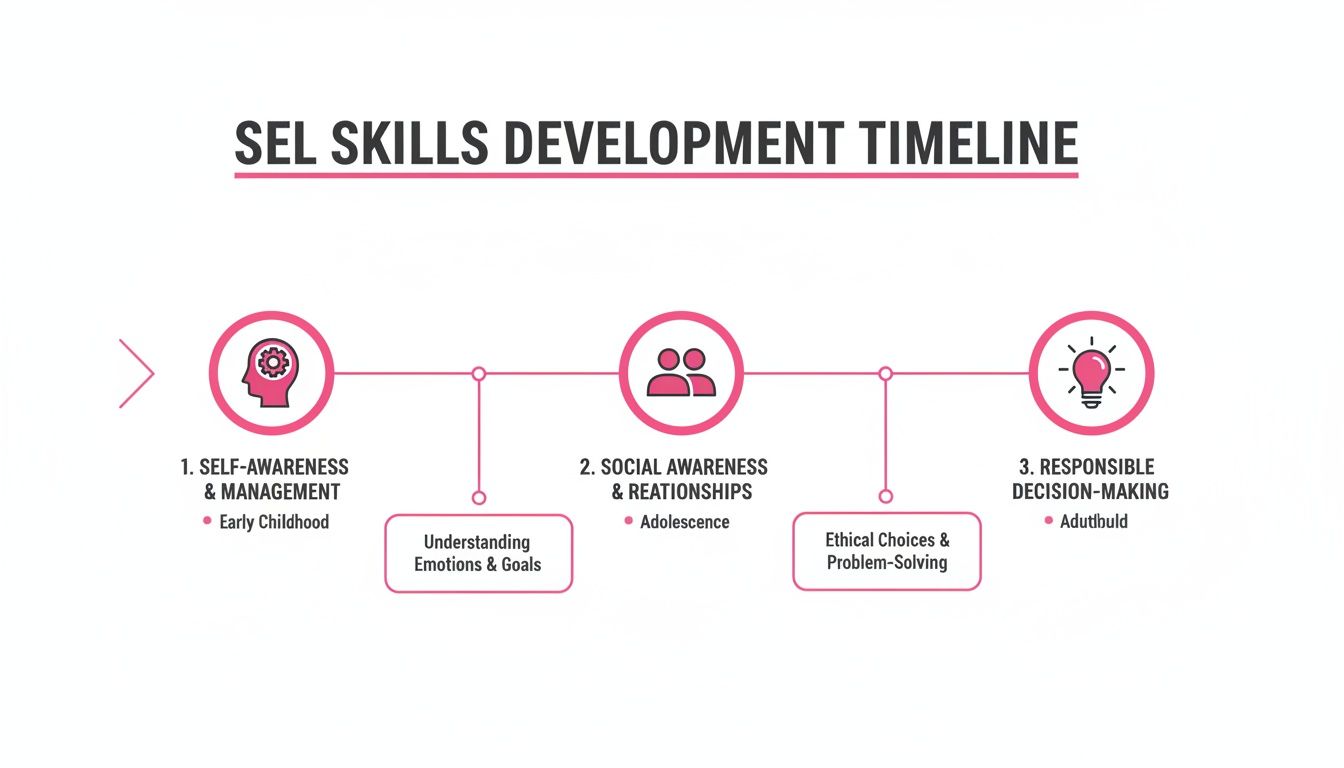
This timeline shows how kids move from self-focused skills to social abilities and, finally, to responsible decision-making.
You can see how those early self-awareness skills are the essential first step, paving the way for more complex social interactions and ethical choices later on.
K-2nd Grade: The Foundational Building Blocks
In these early years, a child’s world is mostly about their own feelings and experiences. The main job of SEL here is to give them the basic vocabulary and tools to understand that inner world. We’re laying the essential groundwork for everything to come.
The primary focus is on self-awareness and self-management. Kids are learning to put a name to a feeling—”I feel angry,” or “I feel excited”—and starting to get that these feelings are totally normal. They’re also just beginning to understand impulse control, even if it’s a daily struggle.
Practical Examples for K-2nd Graders:
Feelings Chart: A teacher uses a chart with different emoji faces during a morning meeting. Students can point to the face that shows how they feel, giving them a simple, non-verbal way to express their emotions.
“Take Five” Breathing: When a student feels overwhelmed, a parent or teacher guides them to trace their hand while taking five slow breaths—breathing in as they trace up a finger and out as they trace down.
Story Time Empathy: After reading a story, a parent might ask, “How do you think the little bear felt when he lost his toy?” This simple question helps the child start to think about perspectives outside their own.
3rd-5th Grade: Navigating Friendships and Perspectives
As children move into upper elementary school, their social lives get a lot bigger. Friendships become more complicated, group dynamics start to matter, and being able to see things from someone else’s point of view is suddenly critical. The SEL focus naturally shifts outward toward social awareness and relationship skills.
During this stage, kids go from just naming their own feelings to recognizing and respecting the feelings of others. They’re learning the delicate art of compromise, how to really listen, and how to work through disagreements without just tattling or arguing. This is when they start building the bridges that connect their inner world to their friends’ worlds.
Practical Examples for 3rd-5th Graders:
Partner Problem-Solving: A teacher might pair students up to work on a tricky math problem. This requires them to listen to each other’s ideas, explain their own thinking, and work together on a solution.
“Perspective Detective” Game: A parent can describe a situation, like two siblings arguing over a game. They then ask their child to be a “detective” and describe how each sibling might be feeling and why.
Kindness Journals: Students keep a small notebook where they jot down one kind act they did or saw each day. This focuses their attention on positive social interactions and the impact of their actions.
This is the age when kids begin to realize that every person in their classroom has a rich inner life, just like they do. Fostering empathy here is a game-changer for creating a kind and inclusive school community.
6th-8th Grade: Complex Choices and Identity
Middle school is a time of massive change. Young adolescents are dealing with a stronger need for independence, intense peer pressure, and the first hints of abstract thinking. Here, the SEL focus sharpens onto responsible decision-making, pulling all five competencies together to navigate an increasingly complex social world.
The challenges are more nuanced now, involving everything from peer pressure and ethical dilemmas to managing a digital social life. Students need to draw on their self-awareness to know their own values, use self-management to resist negative influences, and apply social awareness to understand the long-term consequences of their choices on themselves and others.
Practical Examples for 6th-8th Graders:
Problem-Solving Scenarios: A teacher presents a scenario like, “Your friend wants you to help them cheat on a test. What are three different ways you could handle this, and what are the potential outcomes of each?”
Goal-Setting Journals: Students set a personal or academic goal, break it down into smaller steps, and track their progress. This builds both self-management and a sense of agency.
Digital Citizenship Discussions: A school counselor leads a talk about the impact of online comments, helping students connect their actions online to real-world feelings and consequences.
Unfortunately, just as these social challenges ramp up, school-based support can sometimes drop off. The OECD’s 2023 Survey on Social and Emotional Skills (SSES) found a “skills dip” as kids get older. While most 10-year-olds attend schools that prioritize SEL, that support often fades by age 15, which contributes to increased stress. This really highlights the need for consistent, age-appropriate SEL support through these critical middle school years. You can learn more about these global findings on SEL development.
Practical SEL Activities for the Classroom and Home
Understanding the core skills of social emotional learning is the first step; bringing them to life is the next. The most effective SEL happens when it’s woven into the fabric of daily routines, not just reserved for a special lesson. The goal is to create consistent opportunities for kids to practice these skills in real, everyday situations.
These simple, effective activities are designed for both teachers in busy classrooms and parents around the dinner table. They turn abstract concepts like empathy and self-regulation into tangible actions, making it easy to integrate powerful social emotional learning for kids into your day.
Simple and Effective SEL in the Classroom
A classroom that prioritizes SEL is a calmer, more focused, and more collaborative learning environment. It’s a place where students feel safe enough to take academic risks and supported enough to navigate social challenges. Here are a few foundational practices to get started.
Establish Morning Meetings
A Morning Meeting is a brief, structured gathering at the start of the day that builds a strong sense of community and belonging. This simple routine can set a positive tone for the entire day, making students feel seen, heard, and valued.
A typical meeting has four simple components:
Greeting: Students and the teacher greet each other by name, often with a handshake or a wave, fostering a sense of personal connection. Example: Students greet their neighbor by saying, “Good morning, [Name]. I hope you have a great day.”
Sharing: A few students share something about their lives, and others practice active listening by asking thoughtful questions. Example: A student shares about their weekend soccer game, and another asks, “What was your favorite part of the game?”
Group Activity: A quick, fun activity builds teamwork and cooperation. Example: The class works together to create a human knot and then tries to untangle it without letting go of hands.
Morning Message: The teacher shares a brief message outlining the day’s learning goals, reinforcing a shared purpose.
Create a Peace Corner
A Peace Corner (or Calming Corner) is a designated space in the classroom where students can go to self-regulate when they feel overwhelmed, angry, or anxious. It’s not a punishment or a “time-out” spot; it’s a supportive tool for building self-management.
A Peace Corner teaches an invaluable life lesson: It is okay to feel big emotions, and it is smart to take a moment to manage them constructively. It shifts the focus from punishing behavior to understanding and addressing the underlying feelings.
Stock this space with simple tools that help kids calm their bodies and minds.
Soft pillows or a beanbag for comfort.
Stress balls or fidget tools for sensory input.
Feeling flashcards to help them identify their emotions.
A journal and crayons for drawing or writing.
Use Turn-and-Talk Strategies
This simple instructional technique boosts engagement and gives every student a voice. Instead of just calling on one or two students, the teacher poses a question and asks students to turn to a partner and discuss their thoughts for a minute.
This practice directly builds relationship skills and social awareness. It teaches students how to listen actively to a peer’s idea, articulate their own thoughts clearly, and see a topic from another perspective. Example: After a science experiment, the teacher asks, “Turn and talk to your partner about what surprised you the most.”
Practical and Powerful SEL at Home
Home is the first classroom for social emotional learning. By integrating SEL into family routines, parents can reinforce the skills children are learning at school and deepen their emotional intelligence in a safe, loving environment. These activities require no special materials—just a little intention.
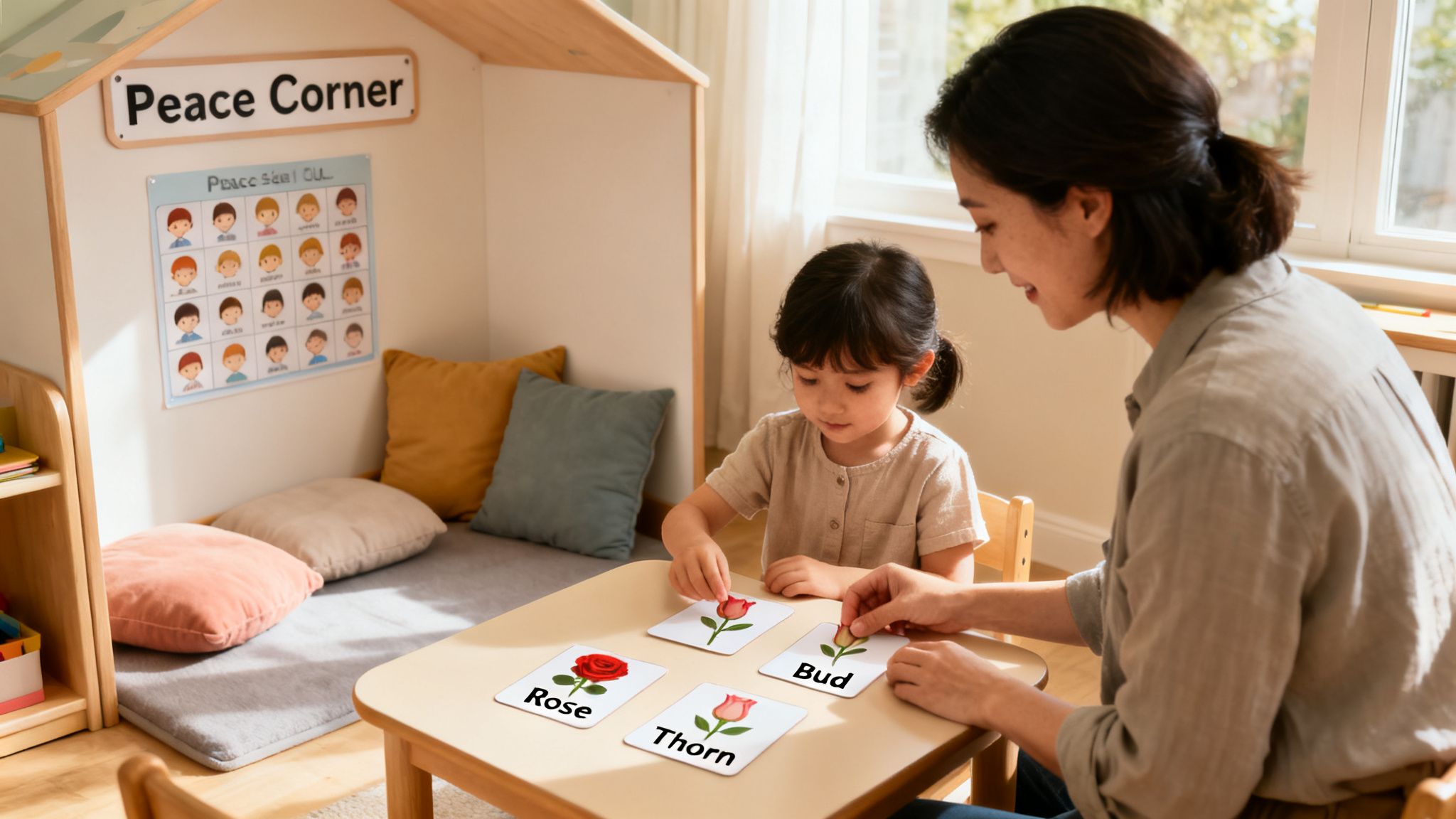
Practice the “Rose, Bud, Thorn” Check-In
This is a wonderful way to structure conversations around the dinner table or before bed. Each family member shares three things about their day, using a simple metaphor to guide the conversation.
Rose: A success or something that went well. Example: “My rose was that I got a good grade on my spelling test.”
Bud: Something they are looking forward to. Example: “My bud is that we are going to the park this weekend.”
Thorn: A challenge they faced or something that was difficult. Example: “My thorn was that I had a disagreement with my friend at recess.”
This activity builds self-awareness by encouraging kids to reflect on their experiences and name their feelings. It also fosters empathy as family members listen to and support each other’s “thorns.” You can find many more simple and effective exercises in our comprehensive guide to social emotional learning activities.
Start a Family Feelings Journal
A Family Feelings Journal is a shared notebook where family members can write or draw about their emotions. It’s a low-pressure way to build emotional vocabulary and normalize conversations about feelings.
Leave the journal in a common area. A parent might start by writing, “Today I felt proud when I saw you help your sister.” This models emotional expression and gives children a safe outlet to share things they might not want to say out loud. Example: A child might draw a picture of a rainy cloud and write, “I felt sad today because my friend moved away.”
Use Movie Nights for SEL Discussions
Movies and stories are powerful tools for teaching empathy and responsible decision-making. Characters face conflicts, make choices, and experience a wide range of emotions—all from the safety of the couch.
After watching a movie together, ask open-ended questions:
“How do you think the main character felt when that happened?”
“What would you have done if you were in their shoes?”
“Was that a kind choice? Why or why not?”
These conversations help children connect a character’s actions to their consequences, which is a foundational element of responsible decision-making.
How to Foster a School-Wide Culture of Empathy
True, lasting success with social emotional learning for kids happens when it becomes part of a school’s DNA. One-off activities are a great start, but a whole-school approach is what transforms the entire learning environment, weaving empathy and respect into the fabric of every interaction. This is the difference between SEL being just another item on a checklist and it becoming the very foundation of your school’s mission.
This unified commitment is about more than a new curriculum; it’s a culture shift. It begins when leadership champions SEL, provides meaningful professional development for all staff, and creates a shared language around emotions that’s used everywhere—from the principal’s office to the playground.
When a whole school community gets on the same page, the climate changes. You start to see behavioral issues decrease as a safer, more supportive atmosphere emerges—one where every single student feels like they belong and can truly thrive.
Championing SEL from a Leadership Level
For a school-wide culture of empathy to really take hold, it has to be championed from the top down. School administrators and educational leaders are the ones who steer the ship. When their support is visible and vocal, it sends a clear message to staff, students, and parents that SEL is a core priority, not just another passing trend.
This kind of leadership involves a few key actions:
Integrating SEL into the School Mission: Making sure social and emotional well-being are explicitly written into the school’s vision and mission statements.
Modeling SEL Skills: Demonstrating empathy, active listening, and respectful communication in every interaction with staff, students, and families.
Allocating Resources: Dedicating time in the school schedule for SEL practices and budgeting for professional development and supportive materials.
A principal who starts a staff meeting by asking everyone to share a “win” from their week is doing more than just being friendly. They are actively modeling the community-building practices they want to see in every classroom, making SEL a lived value, not just a posted one.
Building Staff Capacity Through Professional Development
Teachers and staff are on the front lines, but they can’t do this work without support. Meaningful professional development is what gives them the confidence and skills to weave SEL into their daily instruction and interactions.
Effective training goes way beyond a one-off workshop. It needs to provide ongoing coaching and chances to collaborate. It should empower staff not only to teach SEL concepts but also to manage their own emotional well-being, which helps prevent burnout and creates a more regulated classroom for everyone. Practical Example: A school might offer a training series on restorative practices, where teachers learn how to lead circles to resolve classroom conflicts, giving them a practical tool they can use immediately.
This investment in staff is a direct investment in student success. The global SEL market is projected to surge from USD 1.13 billion in 2022 to USD 5.21 billion by 2029—a clear sign of this massive shift in educational priorities. You can discover more about what’s driving this trend in the full market research.
Creating a Shared Language for Empathy
One of the most powerful parts of a whole-school approach is establishing a common vocabulary for feelings and conflict resolution. When everyone—from the bus driver to the librarian to the students themselves—uses the same words for emotions and problem-solving, it creates a consistent and predictable environment.
For example, a school might adopt simple tools like “I-statements” for expressing feelings (“I feel frustrated when…”) or a specific process for working through disagreements. This shared language cuts down on confusion and gives students the tools to navigate social situations more effectively, no matter where they are on campus. Practical Example: A school adopts the “Stop, Walk, and Talk” method for playground conflicts. Every staff member is trained to guide students through this same three-step process, ensuring consistency.
This consistency is a key ingredient in how to improve school culture from the ground up. By creating this unified framework, a school doesn’t just teach empathy—it lives it.
Common Questions About Social Emotional Learning
As social emotional learning for kids gets more time in the spotlight, it’s only natural for parents and educators to have questions. You want to understand what it really means for your child or your school.
Let’s cut through the noise and get straight to the heart of what SEL is, what it isn’t, and why it matters so much.
Is SEL Just Another Passing Educational Trend?
Not at all. While the term “social emotional learning” might feel new, the ideas behind it are as old as education itself. They’re rooted in decades of solid research on child development and human psychology.
Unlike fads that come and go, SEL has a huge body of evidence showing its positive impact on everything from academic performance to student behavior and long-term well-being. The goal was never to replace core subjects like math or reading. Instead, SEL gives kids the tools—like focus, resilience, and teamwork—that help them succeed in those subjects and, frankly, in life. It’s a lasting, research-backed approach to educating the whole child.
How Do I Know if SEL Is Actually Working?
You’ll see it in the little things, day in and day out. Success in SEL isn’t measured by a test score; it’s measured by observable changes in how kids navigate their world.
Success in SEL is visible when a child can name their frustration instead of having a tantrum, or when a group of students works through a disagreement respectfully instead of arguing. It’s about watching them grow into more aware, empathetic, and capable individuals over time.
You can look for specific signs of progress:
In School: A teacher might notice fewer discipline issues, more students helping each other without being prompted, and better focus during lessons. You’ll see it in how they participate in class and work together on projects.
At Home: You might see your child handle disappointment with more grace, show genuine empathy for a sibling, or start talking about their feelings more openly.
Our School Has a Tight Budget. Can We Still Implement SEL?
Absolutely. Effective social emotional learning for kids doesn’t require a huge budget or a fancy, pre-packaged curriculum. It can start with simple, powerful shifts in school culture that cost nothing more than intention.
Meaningful change often begins by weaving small, high-impact practices into the daily routine. A “mindful minute” to help students center themselves before a test, using a “morning meeting” to build community, or creating a shared, simple process for resolving conflicts can make a world of difference. The key is to start small and be consistent.
How Does SEL at School Connect with What I Do at Home?
The most powerful SEL happens when school and home are partners. When kids hear the same language and see similar behaviors in both places, the skills stick. It creates a consistent, predictable world where they feel safe enough to practice what they’re learning.
You can build this bridge in simple ways. Ask your child open-ended questions that go beyond “How was school?” Try asking, “What was something that made you feel proud today?” or “Was there a time when you felt confused?” For more in-depth discussions and ongoing insights, you can explore further articles and resources to find new strategies.
Reading stories together and talking about the characters’ feelings and choices is another fantastic tool. But most importantly, modeling how you manage stress or work through a disagreement teaches a lesson no worksheet ever could. This reinforcement helps children internalize these crucial skills for life.
At Soul Shoppe, we provide schools with the tools, programs, and support needed to build a culture of empathy and connection from the ground up. Our research-based, experiential approach helps students and staff develop a shared language for resolving conflict and understanding emotions. Learn how Soul Shoppe can help your school community thrive.
When we think of children developing skills, our thoughts often drift to milestones such as learning to ride a bike or acing their first test. However, children need more than physical achievements to thrive in life. Child emotional development includes several skills that help children understand themselves and others better. These skills help them navigate life in a fulfilling way. Furthermore, these skills promote future success well into adulthood.
What is Social and Emotional Development?
Social and emotional development refers to a child’s experience and expression of emotions and how they manage them. It also includes the ability to establish positive and rewarding relationships (Cohen and others 2005).
Social and emotional development is crucial in the first five years of life. However, emotional development continues well into adolescence.
Why is Teaching Child Emotional Development Valuable?
Nurturing a child’s emotional development helps to promote future happiness and success. Studies have shown that teaching emotional development improves students’ social and emotional skills and behaviors. Furthermore, it positively affects classroom organization, classroom management, and more.
4 Skills of Emotional Learning
Emotional development leads to five important skills, according to the National Center for Safe and Supportive Learning Environments. These include: emotional regulation, self and social awareness, learning how to establish positive relationships, and good decision making. These skills are vital to the success of children and adolescents.
Emotional Regulation
Emotional regulation is an essential part of development. It is defined as “The ability to exert control over one’s own emotional state. It may involve behaviors such as rethinking a challenging situation to reduce anger or anxiety, hiding visible signs of sadness or fear, or focusing on reasons to feel happy or calm” (PsychologyToday). Emotional regulation is critical to children’s relationships with themselves and others. Those that don’t have this type of regulation often experience emotional outbursts and isolation. It can also lead to depression and self-harming behaviors. However, it is a teachable skill. Through workshops and lessons in the classroom, we can teach children how to regulate emotions and have control over their thoughts and feelings.
Self and Social Awareness
Learning self-awareness is a critical aspect of emotional development. Self-awareness helps children acknowledge their strengths and weaknesses. This allows them to actively participate in their own success.
Self-aware children typically have more social awareness. Social awareness is the ability to have empathy for others. This leads to understanding the perspective of other cultures and social groups. Both self-awareness and social awareness are vital to the growth of each child and help children grow up to be conscientious adults.
Learning How To Have Positive Relationships
When children learn self and social awareness, they are better able to experience positive relationships. Building positive relationships encompasses several skills. One key aspect is knowing how to express emotions appropriately. At the same time, children need to learn how to respond to others with empathy. Empathy is the ability to emotionally understand the feelings of another.
Other skills children need to learn when building positive relationships include how to:
make friends
respond to conflict in a relationship
listen to others
give and receive feedback
These are just a few of the wide array of skills needed to build and maintain relationships. Successful relationships and rich social lives produce lasting benefits throughout life.
Good Decision Making
We tend to think good decision-making skills are developed through “trial and error.” However, that is a fallacy. Good decision-making is more than learning from successes and failures. It is a way of thinking about making decisions before a consequence occurs. This skill involves teaching children how to identify the problem, and possible solutions and consequences. By thinking critically about decision-making, they can make better choices.
Good decision-making affects children well throughout childhood and helps them to become more responsible and self-confident.
What are the Emotional Development Stages?
Early Childhood Emotional Development
Social and emotional development occurs rapidly in the first five years of life. This time of development is essential to the ultimate happiness and well-being of children.
In the early stages of child emotional development, children begin to learn self-awareness. In addition, they start exploring how to express emotions. They also learn how to interact with others. Furthermore, they learn how to safely explore their environment. In the early stages, children look to others to learn social cues. These cues help them navigate how to respond and play with others.
These building blocks of emotional development in early childhood are nurtured through positive reinforcement.
Elementary and Middle School Emotional Development
Between the ages of 5-13 emotional development progresses to include more self-regulation, problem-solving, social awareness, and more.
The child emotional development stages are listed below. Note that the time frame may be different for each child: (Source: Child-Encyclopedia).
Early Elementary (K-2nd Grade)
Learning how to fit in with other children
Continuing to learn self regulation
Learning self conscious emotions (such as embarrassment)
Needing support from adults but growing their self reliance skills
Middle Elementary (3rd-5th Grade)
Increased problem solving skills
Distancing self from adults and becoming more peer focused
Focus on problem solving
Understanding of multiple emotional states in the same person
Typically following norms for behavior
Middle School (6-8th grade)
Increased dependence on peers
Focus on social awareness and roles
Learning how to differentiate between close friends and acquaintances
Becoming more fluent in problem solving with multiple solutions
Increased emotional empathy
Learning impression management
High School
Learning how to communicate emotions and thoughts effectively
Becoming more proficient with impression management
We can increase children’s emotional intelligence to provide them with a better quality of life. Self-confidence, better relationships, and resilience can all be achieved through emotional development. When children are emotionally resilient, they can manage adversity and difficult times. In addition, research has demonstrated that intervening in children’s emotional development has a positive impact on their academic success. Whichever stage of emotional development children are in, there are appropriate lessons and support.
Soul Shoppe has workshops dedicated to the mission of creating safe learning environments. They help eliminate bullying, as well as teach empathy, emotional literacy skills, and conflict resolution. Learn more about social emotional learning for elementary students and social emotional development for middle school programs.