

Conflict Resolution for Middle School: A Classroom-Ready
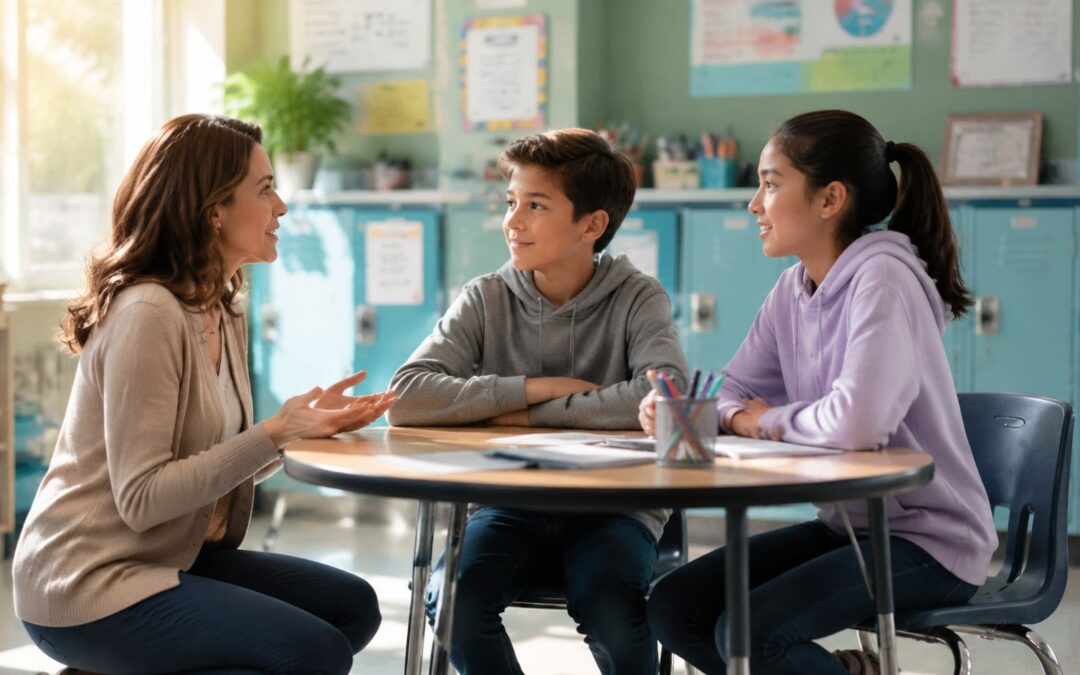
A seventh grader shoves past another student in the hallway. The second student turns, raises his voice, and within moments a careless shoulder bump has become a public argument. A teacher points to an “I-statement” poster and asks both students to explain their feelings. They stare at the wall, mutter a memorized apology, and leave angrier than before.
This scene is familiar because conflict resolution for middle school often fails at the moment students need it most. The activity may look thoughtful on paper, yet the adults haven’t accounted for audience pressure, embarrassment, friendship politics, digital rumors, or the speed at which an adolescent nervous system reacts. Effective instruction has to move beyond attractive scripts and help students use skills under pressure.
Why Middle School Conflicts Need a Different Approach
Middle school students aren’t older elementary students, and they aren’t miniature high school students. Early adolescence brings rapid emotional and social change. Students are developing judgment while also navigating heightened emotional reactivity, stronger sensitivity to peer approval, and a growing concern with social status. A private correction can feel manageable. A public invitation to “talk it out” can feel like humiliation.
That distinction changes the adult response. A peace table designed for younger children may feel childish to a seventh grader who worries that classmates are watching. A high school peer mediation model may assume more independence, verbal confidence, and willingness to reflect than some younger adolescents can yet access. The student who refuses to speak may not be uninterested in repair. They may be protecting themselves from losing face.
The audience is part of the conflict
Consider two students involved in a group-chat dispute. One posted a screenshot, another shared it, and classmates added comments. By the time the students reach school, the original disagreement has become a status contest. Asking them to apologize in front of peers may reward performance instead of honesty.
Begin with three questions:
- Who is watching? A student may choose escalation because backing down publicly carries a social cost.
- What happened before the visible incident? Hallway conflicts often begin with online messages, exclusion, teasing, or a rumor that adults haven’t seen.
- What does each student risk by participating? Fear of retaliation, embarrassment, or being labeled weak can make a structured conversation feel unsafe.
A useful first step is to teach students that conflict resolution isn’t the same as immediate reconciliation. A student can set a boundary, request space, report harassment, or participate in a repair conversation. The correct response depends on the situation.
Practical rule: Never confuse a quiet student with a regulated student. Silence can mean reflection, fear, shutdown, or strategic self-protection.
Compliance isn’t the same as learning
Students can repeat “I feel frustrated when you interrupt me” without understanding when or why to use the sentence. Genuine skill acquisition shows up when a student pauses before posting, asks for clarification, names the actual problem, or chooses adult support instead of retaliation.
That requires repeated practice in realistic settings. The field of school conflict resolution has deep roots, with school-based programs, including peer mediation, emerging in American schools in the early 1970s. A review of the field later estimated that U.S. schools had more than 6,000 conflict resolution programs (historical review of implementation and outcomes). The lesson for today’s middle schools isn’t that every program works automatically. It’s that the model became valuable because students need structured, repeatable ways to manage disagreement.
For a broader foundation in communication, boundaries, and cooperation, teachers and caregivers can also use these social skills for middle school ideas. The strongest approach calibrates language, privacy, practice, and accountability to the way early adolescents think and behave in real time.
Evidence-Backed Frameworks That Actually Work
No single framework solves every middle school conflict. The practical choice depends on the problem, staff capacity, available data, and whether administrators will protect time for consistent implementation. These approaches are most useful when adults teach the skill before a crisis, model it during ordinary classroom friction, and revisit it after an incident.
Restorative practices
Restorative practices help students examine harm, responsibility, and repair. A teacher might say, “I’m concerned that a private screenshot was shared and several students were targeted.” Then the teacher asks restorative questions such as:
- What happened from your perspective?
- Who was affected?
- What were you thinking or feeling at the time?
- What needs to happen now to repair the harm?
In practice, the teacher doesn’t force a dramatic confession. The teacher meets with students separately when needed, checks safety, and brings students together only when each person can participate without intimidation.
Sixty-second snapshot: A student says, “I only reposted it because everyone else was laughing.” The teacher responds, “You didn’t create the original message, but your choice affected what happened next. What could repair that part?” The student identifies the repost, removes it where possible, and agrees to correct the false claim privately.
Restorative work is especially helpful when a relationship needs repair, but it can fall flat when staff use circles as a substitute for investigation, boundaries, or consequences.
RULER tools
The RULER Approach, developed by Yale’s Center for Emotional Intelligence, gives students shared language for recognizing and managing emotion. A Mood Meter can help a student distinguish irritation from shame or anxiety before the feeling becomes an accusation. A Meta-Moment creates a pause between the emotional trigger and the chosen response.
Sixty-second snapshot: A student circles “angry” on a classroom emotion display, then realizes the stronger feeling is embarrassment. The teacher asks, “What response would help the person you want to be in this moment?” The student chooses to request a private conversation rather than confront a peer at lunch.
Collaborative Problem Solving
Collaborative Problem Solving replaces a power struggle with a conversation about an unsolved problem and a lagging skill. In a Plan B conversation, the adult first listens, identifies the student’s concern, names the adult concern, and invites a realistic solution.
Sixty-second snapshot: A student keeps interrupting group work. Instead of saying, “You need to follow directions,” the teacher asks, “I’ve noticed you’re taking over when the group disagrees. What makes it hard to wait for your turn?” The student says classmates ignore his ideas. Together they plan a visible turn-taking routine.
Adapted peer mediation
Peer mediation can give students ownership, but middle school mediators need careful selection, substantial practice, supervision, and clear referral limits. They shouldn’t handle threats, coercion, serious harassment, or situations involving a major power imbalance.
A CDC school safety fact sheet reported that 38% of middle and high schools offered peer mediation, while 58% taught conflict resolution or violence prevention in a required course (CDC school safety fact sheet). Those figures show that mediation and direct instruction have both been used as parts of formal prevention systems.
| Framework | Best For | Staff Training Time | Time to Impact | Key Limitation |
|---|---|---|---|---|
| Restorative practices | Harm, relationship repair, community concerns | Moderate | Gradual | Unsafe or forced conversations can deepen harm |
| RULER tools | Emotion recognition and regulation | Moderate | Visible in daily routines | Naming emotion doesn’t resolve the underlying problem |
| Collaborative Problem Solving | Repeated behavior and unmet needs | Moderate to substantial | Gradual | Requires patience and consistent adult follow-through |
| Peer mediation | Appropriate student-to-student disputes | Substantial | Depends on referrals and supervision | Not suitable for every conflict |
Schools comparing broader SEL options can review SEL programs for schools while keeping the central question in view: how will students practice, use, and demonstrate the skill?
Classroom-Ready Implementation Strategies
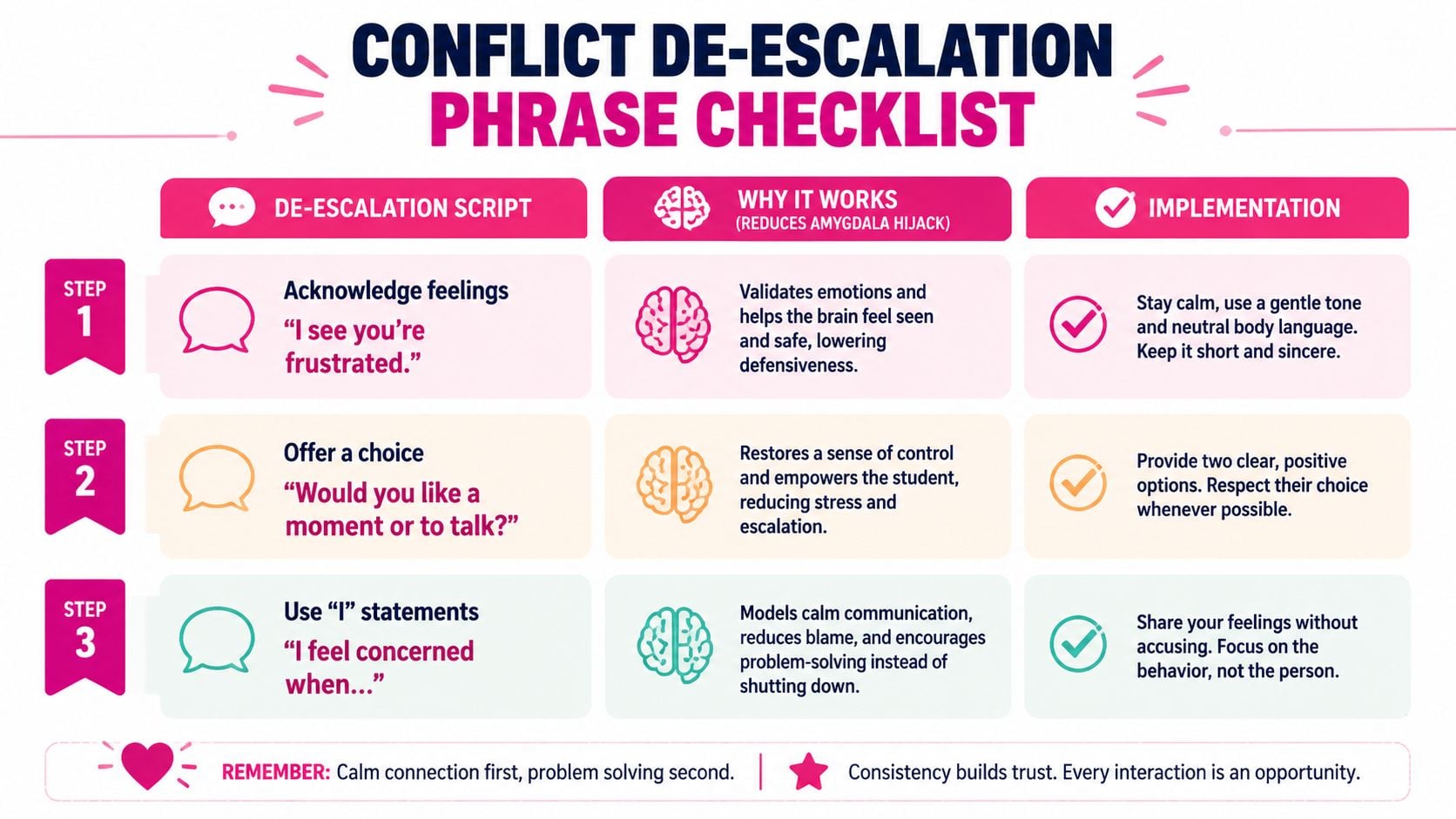
The first move during a conflict is regulation, not analysis. A student whose body is braced for threat won’t absorb a lecture about empathy. Use a low voice, reduce the audience, create physical space, and offer a small choice.
Try these phrases:
- Acknowledge: “I can see this matters to you.”
- Offer choice: “Would you like a moment, or would you rather talk with me privately?”
- Set a boundary: “I’ll listen, but I won’t let anyone threaten or insult another student.”
- Invite a next step: “Tell me what happened from your point of view.”
- Avoid escalation: Replace “Calm down” with “Take a breath. We can solve one part of this at a time.”
A role-play that feels real
Use a scenario card rather than asking students to invent a conflict.
Scenario card: A student sends a Snapchat message claiming that a classmate cheated. Another student forwards it to friends. By morning, several classmates are whispering. The accused student confronts the sender near the lockers.
Student instructions:
- Identify the observable facts without adding motives.
- Choose one de-escalation phrase.
- Use an “I” statement to describe impact.
- Request a specific next step.
- Decide when an adult must become involved.
Observer checklist:
- Did the speaker avoid insults and threats?
- Did the speaker describe behavior rather than label a person?
- Did the listener allow the other person to finish?
- Did either student ask for space or adult support?
- Did the proposed solution address the rumor, not just the argument?
Debrief with questions such as, “Which phrase lowered the temperature?” and “What would change if the students were surrounded by peers?” Don’t praise a polished performance alone. Ask students to identify the moment when the conflict could have gone in a different direction.
A fifteen-minute restorative circle
Keep the protocol short and predictable.
- Opening, two minutes: “We’re here to understand what happened and decide what needs to happen next.”
- Ground rules, two minutes: One person speaks at a time. Students may pass once. No insults, threats, interruptions, or retaliation.
- First round, four minutes: “What happened from your perspective?”
- Impact round, three minutes: “Who was affected, and how?”
- Repair round, three minutes: “What would make the next interaction safer or more respectful?”
- Close, one minute: Summarize the agreement and name who will follow up.
Use a talking object only if it helps students wait their turn. A visibly structured process works better than a symbolic object that feels childish or confusing.
A short video can help staff rehearse language before using it with students:
When the plan breaks down
A student refuses. Don’t force disclosure in front of peers. Offer a private check-in, a written response, or a delayed conversation, while still addressing safety and behavior.
The conflict began online. Save relevant information according to school policy, separate the digital facts from assumptions, and teach that off-campus activity can still affect school safety. Don’t ask students to recreate a public online argument in a public classroom.
Power is unequal. Don’t mediate when one student is frightened, coerced, targeted, or unable to disagree freely. Investigate, protect the targeted student, involve the appropriate safeguarding process, and use restorative dialogue only if safety and genuine choice are present.
For SPED classrooms, shorten directions, preview the sequence visually, allow processing time, and provide alternate communication methods. For multilingual learners, use translated emotion words, visuals, sentence frames, and a chance to rehearse privately before speaking publicly. Teachers can find additional SEL activities for middle school to build practice into existing routines. Even visual reminders, including custom apparel for bullying awareness, can reinforce shared language when they support instruction rather than replace it.
The first two weeks
During the first week, teach one de-escalation phrase, model it, and practice it with low-stakes disagreements. During the second week, add the role-play, collect student reflections, and coach the language during real group work. Keep a simple record of referrals, repeated locations, conflict types, and whether students used the taught strategy. The point isn’t to create paperwork. It’s to see whether the skill appears outside the lesson.
What the Research Really Shows About Effectiveness
A polished conflict-resolution activity can produce a quiet classroom for one period and still leave recurring conflicts unchanged. Research therefore needs to examine more than student satisfaction. A large middle-school evaluation combined teacher and student surveys, disciplinary records across school years, mediation records, and matched comparisons between students who mediated and those who did not (middle-school peer mediation evaluation). This kind of design helps schools ask whether behavior changed beyond the mediation room.
A whole-school restorative-practices trial across 14 middle schools found no significant intention-to-treat effects across the full outcome set, with p-values above 0.14. Students who reported more experience with restorative practices, however, also reported better school climate, stronger peer attachment, improved social skills, and lower physical and cyberbullying victimization (whole-school restorative-practices trial). Consistent delivery matters more than program selection alone, according to this body of research.
The same source describes a Learning Policy Institute analysis across 485 middle schools and about 2 million students. Greater exposure to restorative practices during the move from fifth to sixth grade was associated with improved English and math performance, lower suspension probability, and fewer suspension days, with stronger effects for Black and Latino/a students (Learning Policy Institute findings within the review). Schools should measure how often students encounter the practices and how consistently adults use them, rather than treating adoption as proof of implementation.
What to measure
Track the chain from instruction to daily behavior:
- Reach: Which students received instruction, coaching, mediation, or circle participation?
- Fidelity: Did adults follow the agreed sequence, language, and safety checks?
- Immediate response: Did students feel heard, identify the issue, and understand the next step?
- Behavioral change: Did repeated referrals, fights, harassment reports, or classroom disruptions change over time?
- Equity: Who is referred, excluded, interrupted, or asked to repair harm?
A Pennsylvania middle-school evaluation reported significantly greater improvement in conflict responses for treatment-group students, with a treatment effect of F[1,31]=52.86, p<.0005 (ERIC evaluation of a middle-school conflict-resolution program). It also reported decreased violence and stronger use of conflict-resolution tools in hypothetical situations. Direct teaching and rehearsal can build usable skills, while transfer to everyday conflicts still requires observation and follow-up.
| Framework | Effectiveness Rating | Key Outcomes | Common Pitfalls |
|---|---|---|---|
| Restorative practices | Mixed, stronger with consistent exposure | Climate, attachment, social skills, disciplinary outcomes | Adoption without sufficient uptake |
| Peer mediation | Promising for appropriate disputes | Satisfaction, agreements, structured dialogue | Weak supervision or unsafe referrals |
| Direct conflict instruction | Evidence of skill improvement | Better responses and application in scenarios | One lesson without follow-up |
| Cooperative learning | Positive evidence for peer relations and empathy | Better relationships and lower bullying risk | Unstructured group work |
A broader review found 23 studies covering 4,327 mediations, with 4,028 agreements, a 93% success rate, and 88% participant satisfaction with agreements (peer mediation outcomes review). These figures describe mediation outcomes, not proof that an entire school experienced fewer fights. Record agreements separately from recurrence, safety concerns, and disciplinary patterns.
Curriculum research adds another warning. A 2019 review of six middle-school peace and conflict curricula reported that none had been evaluated with outcome-assessment studies (review of peace education and conflict-resolution curricula). An activity may produce thoughtful discussion in the moment, yet schools still need to check whether students use the language during lunch, group work, online conflict, and other settings without immediate adult guidance.
Scaling from Classroom to Campus-Wide Programs
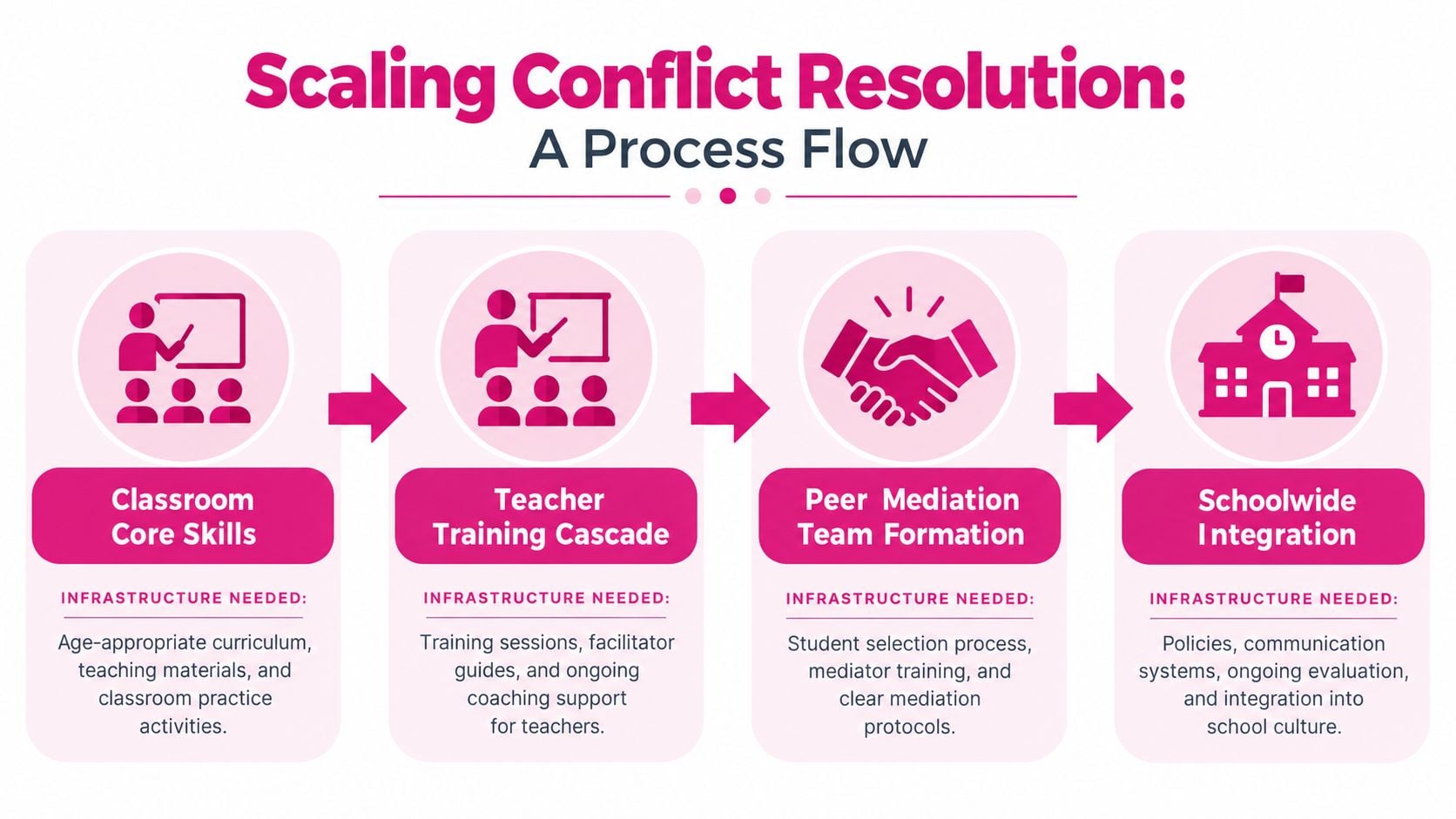
A schoolwide conflict-resolution program becomes real in the places where conflicts unfold, such as a crowded lunchroom, a hallway after dismissal, or a group chat that spills into first period. Shared posters help, but students need consistent language, protected practice time, clear referral rules, supervision, and measures showing whether support reaches them.
Begin with a classroom core, then test it against campus conditions. Teachers can use the same phrases for pausing, describing impact, requesting space, and seeking help. Counselors can map recurring conflict types and locations. Administrators must distinguish incidents requiring investigation from those that may qualify for mediation, and identify situations that peer processes cannot safely handle.
Build the adult system first
A training cascade has value only when the first group rehearses the actual language, decisions, and coaching process. Staff should role-play a hallway escalation, a group-chat rumor, a refusal to participate, and a conflict involving unequal power. A presentation may create agreement in the room; rehearsal shows whether adults can respond under pressure.
Consider two versions of the same lunch conflict. In the first, one supervisor sends students to different adults, another insists on an immediate apology, and a third offers mediation without checking safety. Students receive mixed signals, and the school cannot tell what intervention occurred. In the second, supervisors use a shared pause script, document the incident, complete the same safety check, and refer it through one process. The difference is not a more appealing activity. It is a system that can be observed and improved.
Administrators should examine discipline patterns before selecting a campus goal. If referrals cluster around lunch, train lunch supervisors and practise there. If rumors and friendship disputes dominate, build scenarios around those experiences rather than generic workplace examples.
Peer mediation should follow adult consistency and clear safety limits. Research on peer mediation programs in elementary and secondary schools describes commonly referred conflicts involving gossip and rumors, dating and friendship issues, and harassment. The study reported that 53% of mediated conflicts involved eighth graders. Schools can prepare upper-grade mediators for rumor spreading and friendship breakups, while checking whether local referrals show the same pattern.
Measure reach, fidelity, and impact
As noted in the earlier research summary, consistent delivery matters more than initial adoption. Use a small dashboard:
- Reach: Record which grades and student groups receive lessons or referrals.
- Fidelity: Sample whether staff followed the agreed protocol and completed safety checks.
- Impact: Review recurring incidents, student climate feedback, and classroom observations.
- Equity: Compare access to support across student groups without treating demographic patterns as explanations by themselves.
Family engagement helps students practise beyond school. Send home a short conversation guide with prompts such as, “What happened?” “What did you need?” and “What could make tomorrow easier?” Provide translated versions and invite caregivers to practise during ordinary disagreements.
A developed peer structure may benefit from guidance on peer mediation in schools, adapted to local safety policies, staffing, and student needs. Funding can cover training, substitute time, materials, and coaching. Leaders still need to assign ownership and protect practice time.
Your Implementation Roadmap and Next Steps
Start by listening to the school you have. Review referral records, ask students where conflicts begin, interview teachers about repeated patterns, and identify which adults students trust. Don’t select a framework because its activities look engaging. Select it because the problem, staff capacity, and safety conditions match its demands.
Use this rollout sequence:
- First, establish a baseline. Record conflict locations, broad incident types, adult responses, repeat referrals, and student perceptions of safety and belonging.
- Next, choose a narrow starting point. A grade-level routine, advisory lesson, lunch supervision plan, or carefully screened mediation process is easier to improve than a vague campus initiative.
- Train adults through rehearsal. Practice the words, pauses, documentation, and referral decisions staff will use in real moments.
- Pilot and review. Watch whether students receive the intervention, whether adults deliver it consistently, and whether outcomes differ across groups.
- Expand only after adjustment. Add classrooms, staff, and peer mediators when the core process is clear enough to survive staff absence or schedule pressure.
During the first ninety days, expect uneven participation, awkward language, and some students testing whether adults mean what they say. Respond with coaching, not constant reinvention. If students refuse, preserve choice while maintaining boundaries. If staff skip the process, simplify the protocol and observe the setting where it breaks down. If referrals rise at first, examine whether students are finally reporting incidents rather than assuming the program caused the increase.
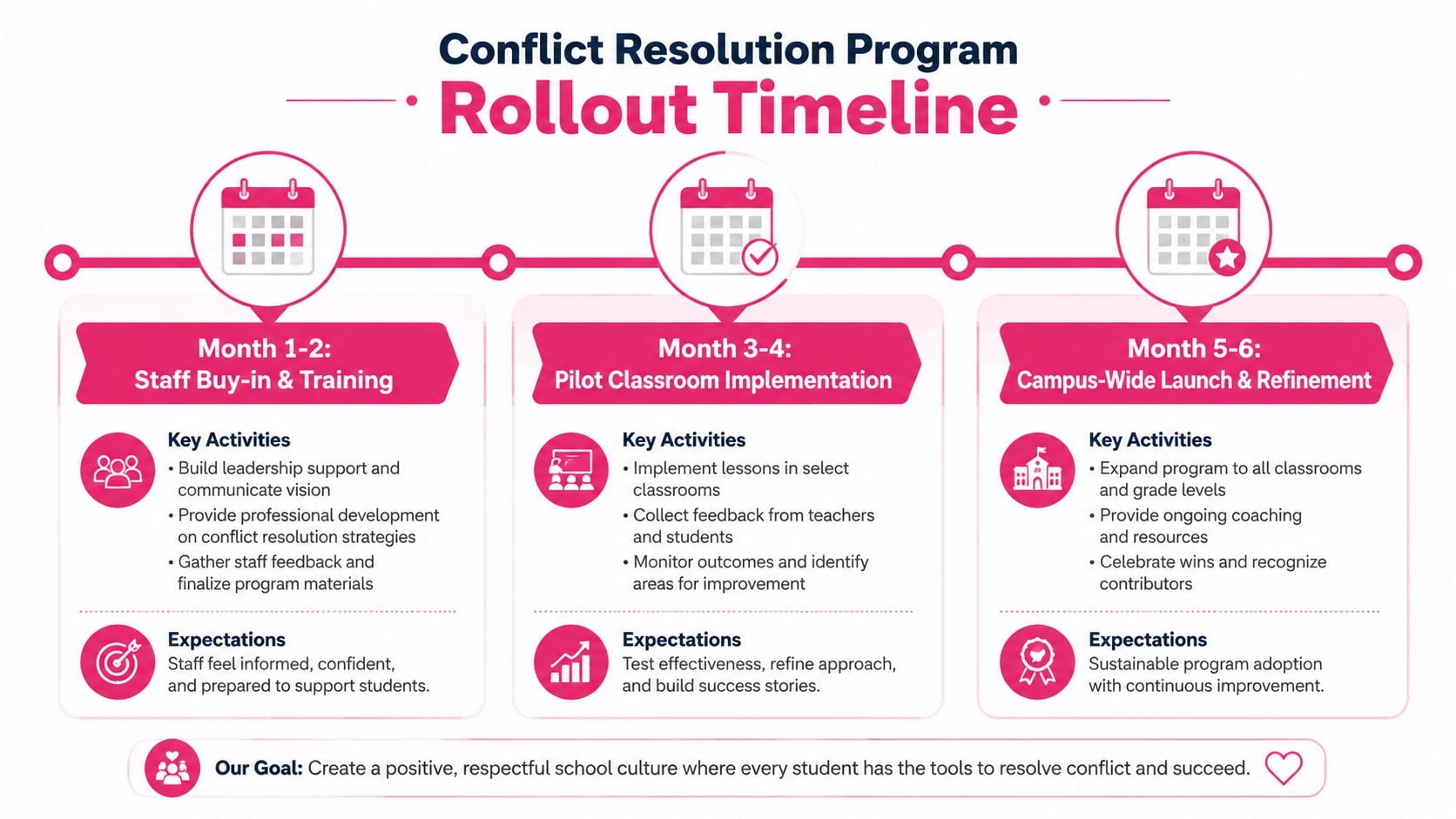
The supplied rollout timeline offers a practical structure: Month 1-2 for staff buy-in and training, Month 3-4 for pilot classroom implementation, and Month 5-6 for campus-wide launch and refinement. Treat those phases as a planning scaffold, not a guarantee. Staff turnover, budget constraints, and shifting priorities make documentation essential. Keep a short protocol, train new adults through the same scenarios, and review outcome data alongside student voice.
The central test is simple: can students use the skill when the audience is watching, the rumor is online, and the adult isn’t standing beside them? Build toward that test gradually, measure more than apologies, and protect safety whenever repair isn’t appropriate.
Soul Shoppe offers interactive workshops and coaching that give school communities shared language for communication, self-regulation, empathy, and conflict resolution. Visit Soul Shoppe to explore practical ways to bring those tools into middle school classrooms, family conversations, and campus-wide SEL systems.