

Social Skills for Middle School: A Practical Guide
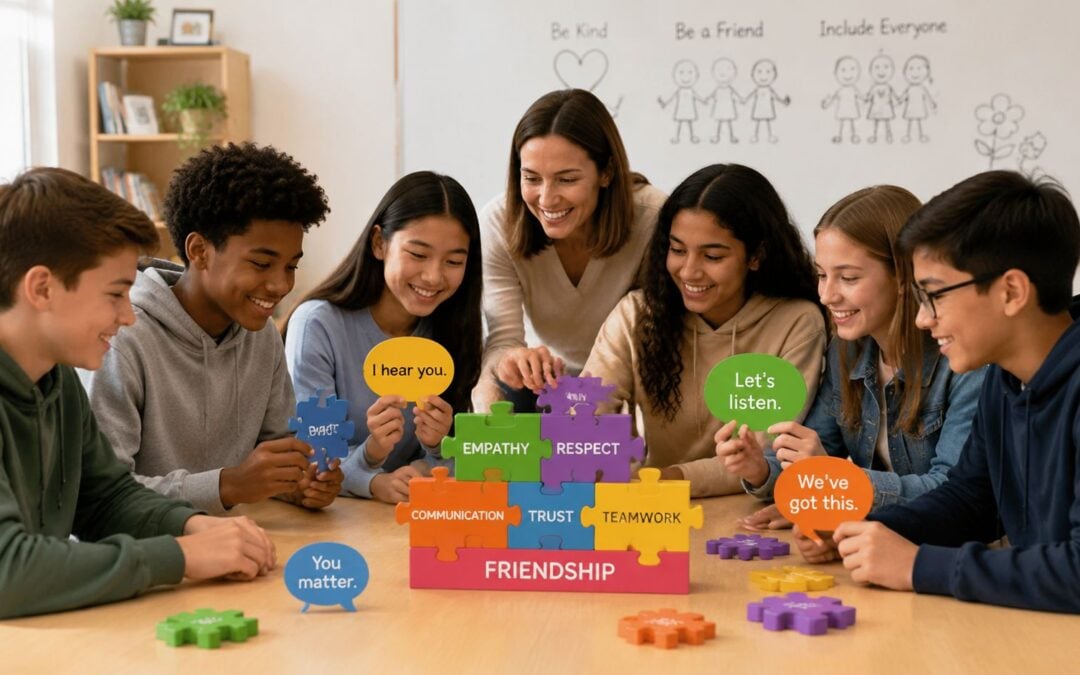
When students enter middle school, social-emotional growth doesn't continue in a straight line. A large longitudinal study summarized by the University of Virginia found that three of four measured SEL competencies, self-efficacy, self-management, and social awareness, declined during middle school, with the slump beginning around sixth grade before rebounding in high school. That pattern changes the question educators should ask. Social skills for middle school aren't a soft extra or a reward for finishing academic work. They're a developmental and academic-support priority.
Students in grades 6–8 are learning how to enter conversations, handle status, interpret digital messages, recover from mistakes, and participate with peers whose expectations may differ from their own. Parents and teachers can help by teaching these behaviors explicitly, rehearsing them in low-risk situations, and connecting them to belonging, peer safety, classroom participation, and access to learning.
Why Middle School Is the Critical Window for Social Skills
Middle school creates a particularly important intervention window because several changes arrive together. Students become more sensitive to peer reactions, friendships become more socially complex, and classroom participation can feel publicly risky. At the same time, students are still developing the planning, inhibition, and emotional regulation needed to pause before reacting.
The research summarized by the University of Virginia describes a middle-school SEL slump rather than a simple pattern of adolescent misbehavior. A Harvard CEPR summary of related work describes a panel study spanning grades 4 through 12 that found middle-school declines alongside widening gaps by socioeconomic and racial groups. That makes social development in grades 6–8 an equity issue, not only a behavior concern.
| Metric | Elementary, Grade 5 | Middle School, Grades 6–8 | Impact |
|---|---|---|---|
| Self-efficacy | Often stronger before the transition | Declines during the middle-school period | Students may take fewer academic and social risks |
| Self-management | More established in familiar settings | Can dip as demands and peer pressures increase | Conflict and impulsive reactions can interrupt learning |
| Social awareness | Built through stable routines and relationships | Becomes harder as group dynamics grow more complex | Students may misread cues or overlook exclusion |
| School belonging | Supported by established connections | Can weaken during the transition | Participation, trust, and persistence may suffer |
The timing matters. Students aren't fixed in a “socially awkward” identity during these years. Their skills are developing, and well-designed instruction can give them practice precisely when peer acceptance, identity formation, and classroom participation become more consequential. A teacher who teaches conversation entry, repair, and perspective-taking is giving students tools they can use in group work, lunchrooms, extracurricular activities, and online interactions.
Practical rule: Treat a social breakdown as a teachable moment, not proof of a permanent character flaw.
Peer networks create both risk and opportunity. A student who can join a group respectfully, listen for an opening, and respond to disagreement has more ways to access collaborative learning. A student who can't yet do those things may avoid a group, dominate it, or withdraw after one uncomfortable exchange. In that sense, social skills become part of the infrastructure of attendance, belonging, and academic engagement.
Schools should also resist waiting for students to “grow out of it.” The research on SEL importance supports a broader view of social-emotional learning, one that connects emotional development with students' ability to learn and function within a community. Early, consistent practice can protect confidence and peer functioning while schools address the gaps that become more visible during adolescence.
Core Social-Emotional Competencies Every Middle Schooler Needs
Students need more than reminders to “be nice.” They need a shared vocabulary, visible models, and repeated opportunities to practice specific behaviors.
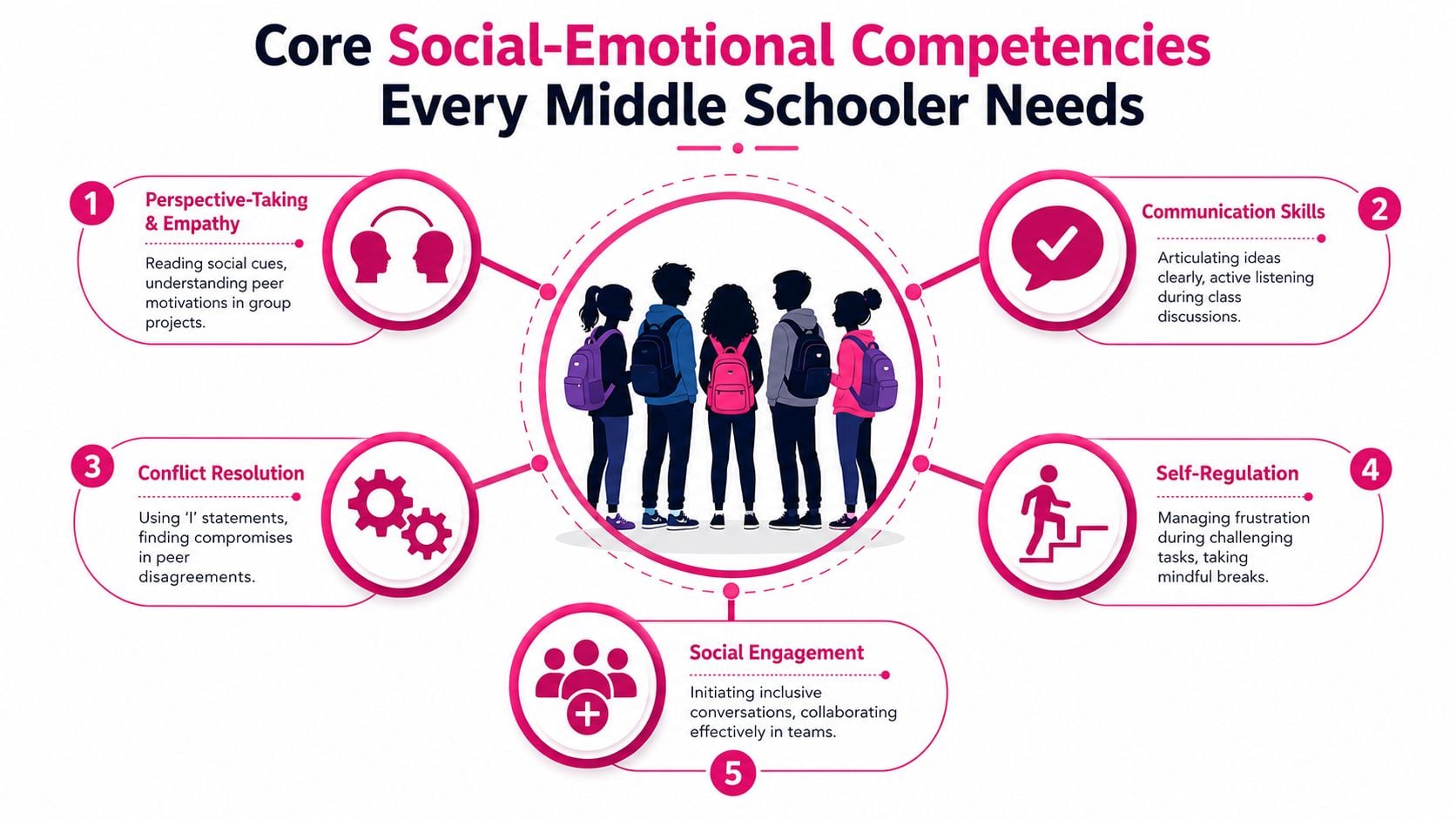
Perspective-taking and empathy
Perspective-taking means asking what another person may know, feel, want, or misunderstand before deciding what their behavior means. Empathy adds the willingness to respond with care.
In a group project, Maya sees Jordan staring at the instructions and not contributing. Without this skill, she might say, “You're being lazy.” With practice, she can pause and ask, “Did the directions make sense? Do you want to choose a role together?” The second response leaves room for confusion, anxiety, language differences, or a different working style.
Teach students to look for observable evidence, generate more than one possible explanation, and check their assumption with a respectful question.
Self-regulation in social situations
Self-regulation isn't the same as staying quiet. It means noticing an emotional signal, creating a pause, and choosing a response that protects the student's goals.
During a frustrating lab, a student may feel blamed when a partner points out an error. An unregulated response might include sarcasm, shouting, or leaving the group. A practiced response sounds like, “I'm getting frustrated. I need a minute, then I'll come back and fix my part.”
Adults can teach a simple sequence: notice, pause, name, choose. A visual cue, breathing routine, movement break, or private check-in can make the sequence accessible without publicly singling out a student.
Assertive communication
Assertiveness lets students express needs and boundaries without attacking or surrendering their voice. A useful structure is: “I feel or notice…, I need…, can we…?”
If a partner keeps interrupting, “You never listen” invites a defensive argument. “I lose my train of thought when I'm interrupted. Please let me finish, then I'll listen to your idea” is clearer and more actionable. Students also need practice receiving feedback, saying no, and asking for clarification.
Collaborative problem-solving
Group work exposes whether students can negotiate roles, share control, and repair a disagreement. A team might disagree about who presents. One student wants the speaking role, another has prepared the visual, and a third has done most of the research.
Instead of letting the loudest student decide, teach the group to list the task requirements, identify each person's preference, and build a plan that distributes responsibility. The skill is not avoiding disagreement. It's using disagreement to reach a workable decision.
Social awareness and inclusion
Social awareness helps students notice who gets invited, who gets interrupted, and who remains on the edge of a group. It also helps them understand that classmates may communicate, celebrate, or participate in different ways.
A student can practice inclusion by moving beyond “everyone is already included” and using a concrete action: invite a classmate into a paired discussion, explain an unwritten game rule, or ask whose perspective hasn't been heard. These competencies are learnable behaviors, not personality types. The five core SEL competencies explained can help adults align their language across classrooms and home conversations.
Common Social Challenges Students Face in Grades 6 Through 8
A seventh-grade student named Luis often takes over group work. He answers before others finish, rewrites classmates' ideas, and insists that his method is the only efficient one. His grades may look strong, but classmates stop volunteering around him. The teacher sees incomplete collaboration, while Luis may see only “people who don't try.”
The intervention isn't a vague instruction to cooperate. Luis can practice a two-turn rule, listen to two contributions before adding another, and ask, “What do you think?” The teacher can privately frame the goal as increasing the group's thinking, not reducing Luis's intelligence.
Friendship conflict creates another familiar pattern. A student receives a short message, assumes it means anger, forwards a screenshot, and confronts the friend the next morning. Tone disappears easily in text, and an audience can turn a private misunderstanding into public conflict. Students need a pause script: “I might be reading this wrong. Can we talk in person before I respond?”
A new student may understand the academic work but struggle to enter established peer networks. A teacher can assign rotating partners with defined roles, teach conversation openings, and avoid making the new student perform gratitude in front of the class. Inclusion works better when the structure doesn't depend on one child's courage.
Bullying situations also reveal a skills gap. A bystander may recognize harm yet fear becoming the next target. Give students multiple options, such as interrupting safely, redirecting the targeted student, documenting and reporting, or seeking an adult. “That joke isn't okay here” is one possible script, but students should never be required to confront danger directly.
Social confidence grows when students have a specific next move, not when adults repeat “just speak up.”
Academic performance can expose social needs too. A high-achieving student who rejects feedback may protect their self-image by refusing collaboration. A student who misses cues may appear defiant. Neurodivergent students may interpret indirect language differently, English language learners may need additional processing time, and students from different cultural backgrounds may encounter unfamiliar norms around eye contact, interruption, or disagreement. Cultural responsiveness means teaching the classroom expectation clearly without treating one communication style as the only respectful one.
These challenges are developmentally common, but “common” doesn't mean students should handle them without instruction. Families can use the guide to negative peer pressure to start conversations about choices, belonging, and the difference between loyalty and unsafe behavior. Teachers can connect the same ideas to group roles, digital citizenship, and restorative conversations.
Practical Activities and Scripts for Building Social Skills
Short, repeated practice usually works better than an occasional lecture. The activities below fit into advisory, morning meetings, counseling sessions, or a brief family conversation.
Perspective-Taking Pause
Objective: Separate facts from assumptions during conflict.
- Present a short scenario, such as, “Your partner doesn't reply when you ask for their part.”
- Have students name only what they observed.
- Ask them to generate possible explanations.
- Invite them to choose a respectful question.
- Role-play the question and response.
Adult script: “We know the message wasn't answered. We don't know why. What are two explanations that don't involve mind-reading?”
Debrief: “How does checking an assumption change what you do next?”
Group Work Contract
Objective: Make collaboration expectations visible before problems begin.
- Ask students to identify behaviors that help a group function.
- Record agreements about turn-taking, roles, deadlines, and repair.
- Add a process for disagreement.
- Have each student choose one behavior to practice.
- Revisit the contract after the task.
Student script: “If we disagree, we'll explain our reasons, listen once more, and choose the option that best meets the assignment.”
Differentiation: Offer sentence frames and visual role cards. Let students contribute by speaking, writing, pointing, or selecting from choices.
Feelings Forecast
Objective: Build self-awareness before emotional pressure rises.
At the beginning of class or during dinner, students choose a word, color, or symbol for their current state. They identify one situation that may challenge them and one support they can use.
Adult script: “What emotional weather are you bringing today? What might change it, and what can you do if the forecast gets stormy?”
Students don't need to disclose private details. They can say, “I'm at low energy and may need written directions.”
Repair rehearsal
Objective: Practice returning to a relationship after harm.
- Give pairs a scenario involving an interruption, exclusion, or hurtful comment.
- Ask the student who caused the harm to name the behavior without excuses.
- Add an acknowledgment of impact.
- Practice a repair request.
- Let the other student decide what response feels appropriate.
Script: “I interrupted you and made it harder for you to finish. I'm sorry. Next time I'll write my thought down and wait. Is there anything you need from me now?”
For additional activity ideas that can be adapted for counseling, advisory, or group work, educators can consult the California Teen Center 2026 activities guide. Keep activities voluntary when disclosure could feel exposing, and offer alternatives for students who need processing time or reduced social demand. A structured social skills group approach can provide consistent practice for students who need more repetition.
| SEL Competency | Activity Name | Time Required | Best Setting |
|---|---|---|---|
| Self-awareness | Feelings Forecast | Brief check-in | Advisory or home |
| Self-management | Pause and Choose | Short rehearsal | Classroom or counseling |
| Social awareness | Perspective-Taking Pause | Short role-play | Advisory |
| Relationship skills | Group Work Contract | Planning activity | Any project class |
| Responsible decision-making | Repair Rehearsal | Scenario practice | Home or school |
How Social Skills Drive Belonging and Peer Connection
Belonging depends on more than whether a student has a friend. It also depends on whether the student can enter a group, remain safe during disagreement, ask for help, and trust that adults will respond when exclusion occurs.
Survey data from the Australian Longitudinal Study of Australian Children found that 80–90% of 12–13-year-olds and 14–15-year-olds reported having friends (statistical report). Friendship is widespread, but friendship quality and peer acceptance still shape school engagement and academic access. A student can have friends outside school and still feel unable to participate in a particular classroom community.
A school-based social-skills study involving 56 students found statistically significant changes in peer-network measures after a seven-session intervention. Degree centrality increased from 9.34 to 12.16, while closeness centrality shifted from 0.0062 to 0.0058 (peer-network study). These measures don't mean every student suddenly becomes socially confident. They do show why instruction can be evaluated as a change in peer connection, not just a change in self-reported behavior.
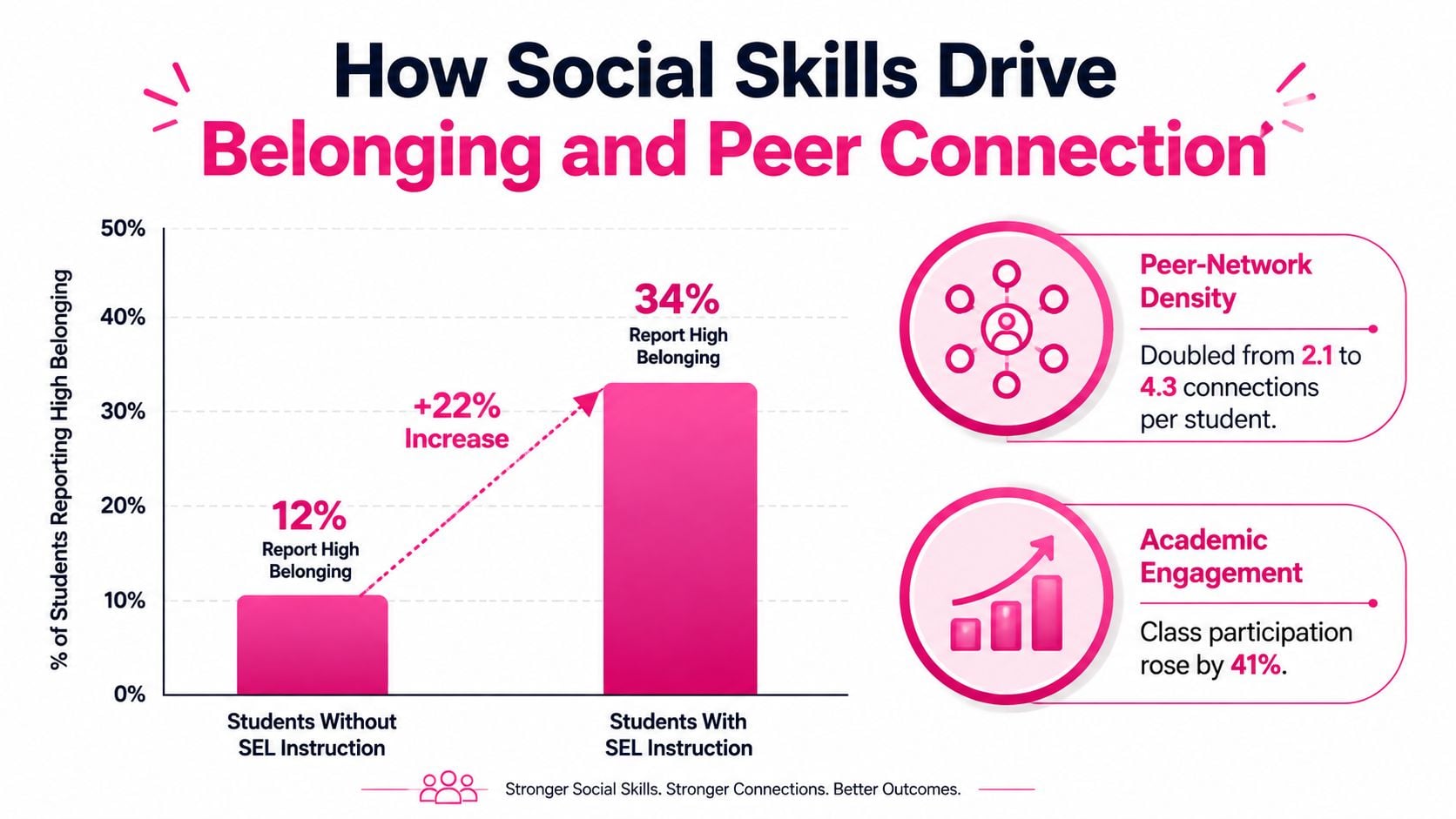
A systematic review of 49 middle-school studies found that supportive teacher and peer relationships consistently predicted stronger school connectedness. Discrimination, peer victimization, and mental-health difficulties predicted weaker connectedness, while longitudinal evidence indicated that connectedness tends to decline across middle school (systematic review).
That evidence changes how schools should interpret participation. A quiet student may need a safer entry point, not a public demand to speak. A student who dominates may need structured turn-taking, not only a reprimand. A teacher who makes peer connection teachable can widen access to group discussion, feedback, and academic risk-taking.
The peer climate also matters for bystanders. Recent research discussed in the verified YouthTruth analysis connects belonging with students' willingness to intervene as bystanders. A school that teaches scripts while ignoring bullying and exclusion leaves students with tools but no safe culture in which to use them. Social skills instruction works best when adults pair individual practice with clear reporting routes, consistent responses, and deliberate opportunities to build cross-group connections.