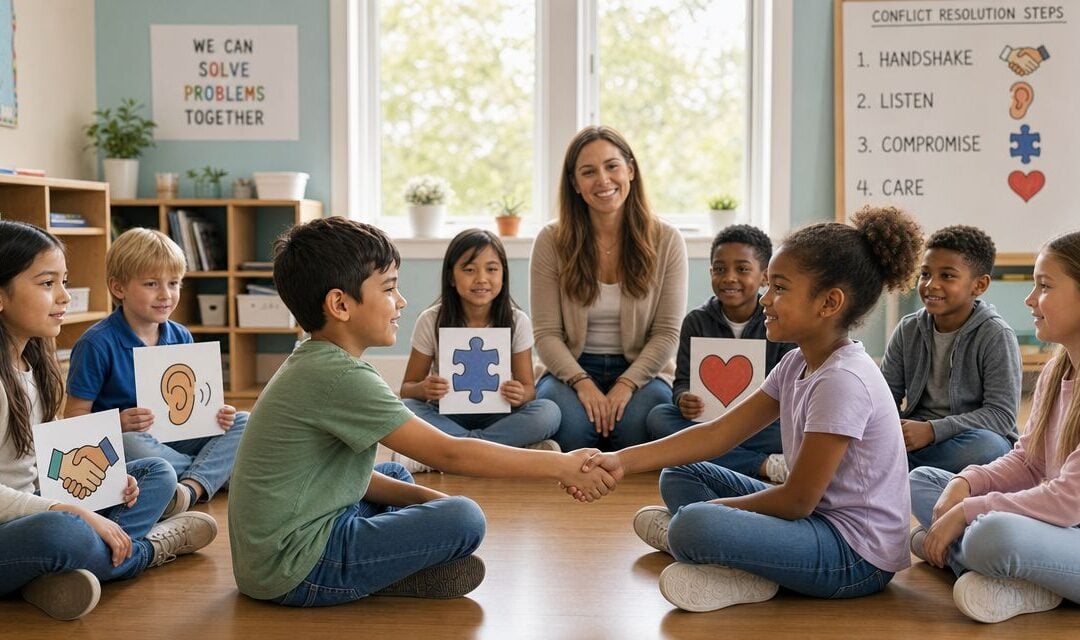
A disagreement over a single red crayon. A tense moment on the kickball field. A friendship strained by a misunderstanding. Conflict is part of growing up, and in a school or home with children, it can show up before you've even finished your coffee.

The good news is that conflict doesn't have to turn into blame, shutdown, or punishment. Handled well, it becomes a teaching moment. Children learn how to name feelings, listen, repair harm, and stay connected even when they disagree.

If you've been asking what are some conflict resolution strategies that work with K through 8 students, the most helpful answer isn't one trick. It's a set of teachable methods. Strong conflict work usually relies on collaboration rather than positional winning, and professional surveys summarized by Niagara Institute found that collaborating is the most commonly used style among professionals at 59.8%, followed by compromising at 24.4% in workplace settings (Niagara Institute workplace conflict statistics).

That matters for kids too. The same habits that help adults resolve conflict also help students. Listen first. Focus on needs, not just demands. Look for a solution both people can live with. Below are eight practical strategies, each with simple examples, age-based adaptations, and scripts you can use in classrooms, counseling offices, cafeterias, and at home.

1. Collaborative Problem-Solving

When two children are stuck, adults often rush to decide who's right. Collaborative Problem-Solving works better when the issue is a true peer conflict and both students are calm enough to participate. Instead of picking a winner, you help them identify concerns on both sides and build a solution together.

This approach fits school life because students usually have to keep learning and living alongside each other. They sit in the same classroom, line up for the same specials, and often see each other again at recess. A forced apology may end the moment, but it rarely solves the problem underneath.

A simple classroom protocol

Try this sequence with elementary and middle school students:

  • Name the problem: “You both want the same ball at recess.”
  • Hear each side: “Tell me what happened from your point of view.”
  • Identify the need: “So you wanted a turn, and you wanted the game to keep going.”
  • Brainstorm options: “What are three ways this could work?”
  • Check for buy-in: “Can both of you agree to try that today?”

A lot of adult success in conflict resolution comes from separating people from the problem and focusing on interests rather than positions. That's also a strong fit for children. “I need the marker because I'm still working” is different from “It's mine.”

Practical rule: Validate first, solve second. A child who feels unheard usually argues harder.

For younger students, keep the language concrete. “What happened?” “How did you feel?” “What do you need now?” For older students, you can add reflection: “What part of this felt unfair to you?”

At home, this may sound like: “You both want the front seat. I'm not deciding yet. First tell me what matters to each of you.” In a classroom, a teacher might use a partner talk format and then jot possible solutions on a sticky note.

If you want a hands-on routine students can practice before real conflict hits, this problem-solving activity for students can help build the habit.

Sample script

“I'm not here to decide who wins. I'm here to help us figure out what each person needs. Then we'll find a plan you can both try.”

That one sentence changes the tone immediately.

2. Restorative Practices

Some conflicts aren't just disagreements. Someone was embarrassed, excluded, shoved, or mocked. In those moments, the goal isn't only to stop the behavior. It's to repair harm and rebuild trust.

A diverse group of young people sitting in a circle during a guided group therapy session.

Restorative practices give students a way to answer questions that punishment alone can't address. What happened? Who was affected? What needs to be done to make things as right as possible? That shift matters in classrooms because children need accountability and belonging at the same time.

A restorative conversation after a lunchtime incident might include the student who caused harm, the student who was hurt, and a trained adult. The adult keeps the structure steady and calm. Everyone gets a turn without interruption.

Questions that repair instead of inflame

A restorative exchange often sounds like this:

  • For the student who caused harm: “What were you thinking at the time?” “Who was affected by what happened?”
  • For the student who was harmed: “What was that like for you?” “What do you need now?”
  • For both students: “What agreement will help repair this?”

This works well in class meetings too. A quick community circle can address a pattern such as rude joking, exclusion during group work, or conflict over game rules.

When schools want to build a broader system, they often pair circles with staff training, shared language, and referral routines. This overview of restorative justice in schools gives a good school-based picture of how that looks.

One caution matters here. Not every conflict belongs in peer dialogue. Federal civil rights guidance also reminds schools that harassment, bullying, discrimination, repeated aggression, and power-imbalance situations may require documentation, reporting, separation, counseling support, or administrative action rather than informal mediation alone (Harvard Program on Negotiation article referencing school conflict strategy and escalation concerns).

Repair is not the same as minimizing. Students can be held accountable and still be treated with dignity.

A short video can help adults picture the tone and pacing of this work in practice.

3. Mindfulness and Self-Regulation

Many conflicts don't begin with the issue itself. They begin with an overwhelmed nervous system. A child feels embarrassed, threatened, tired, or overstimulated, and the conflict explodes from there.

That's why self-regulation comes before problem-solving so often. A student who's breathing fast, crying hard, or clenching fists usually can't do perspective-taking yet. They need help returning to calm first.

A young boy sitting in a peaceful lotus position on a mat, practicing mindfulness and meditation indoors.

What regulation looks like by age

In K to 2, use body-based tools. “Smell the flower, blow out the candle.” “Push your feet into the floor.” “Put your hands on your belly and count to four.”

In grades 3 to 5, students can learn cues. “My face feels hot.” “My chest feels tight.” “I need a pause before I talk.” By middle school, many can reflect on triggers and choose a strategy themselves.

A calm corner, breathing card, feelings chart, or short body scan can all help. The point isn't to make children silent. The point is to help them notice what they're feeling before they act on it.

A conflict-management review in PubMed Central notes that conflict handling tends to go better when people are emotionally regulated and when the environment feels neutral and psychologically safe (PubMed Central review on conflict management and training). That's true in a fourth-grade classroom just as much as it is in a workplace.

A script adults can use

“Your body looks really activated right now. We're not solving this yet. First we're going to get you steady.”

That language helps children understand that calming down isn't a punishment. It's part of the skill.

For daily routines, teachers might open the day with one minute of quiet breathing. Parents might use a reset before siblings re-enter play. If you want practical ways to build this into the week, these mindfulness activities for students offer age-friendly ideas.

4. Active Listening and Empathetic Communication

Conflict gets worse when children feel interrupted, corrected, or dismissed. It softens when someone listens closely enough to catch both the facts and the feelings.

That sounds simple, but it takes practice. Most students, and plenty of adults, listen while preparing a defense. Active listening teaches a different habit. Stay with the speaker. Reflect back what you heard. Check that you understood before you respond.

A young man and woman sitting on a bench having a serious conversation in a classroom.

A simple listening frame for students

Teach students three moves:

  • Listen without interrupting: Hands still, eyes on speaker, mouth quiet.
  • Reflect the message: “What I hear you saying is…”
  • Check accuracy: “Did I get that right?”

In practical use, a second grader might say, “You felt mad because I cut in line.” A sixth grader might say, “So you weren't trying to be rude. You thought it was your group's turn.”

Harvard's negotiation guidance emphasizes understanding perceptions, managing emotions, and identifying underlying interests instead of trying to win the argument. In schools, that translates directly into reflective listening and empathy. Children don't have to agree with each other to understand each other.

“Tell me more” is often more useful than “Calm down.”

At home, try this during sibling conflict: “Before you answer your brother, repeat what you heard him say.” In class, partner students and let one speak for thirty seconds while the other only reflects.

What adults should avoid

Some phrases shut listening down fast:

  • “You're overreacting.” It dismisses emotion.
  • “I know exactly how you feel.” It can make the child feel replaced.
  • “But…” right after a reflection. It usually cancels the empathy that came before it.

Among conflict resolution strategies that help immediately, this one belongs near the top. Children often settle faster when they feel accurately heard.

5. Peer Mediation and Student Leadership

Adults can't be everywhere. Hallways, lunch tables, playgrounds, and bus lines all produce conflict in real time. Peer mediation gives students a structured way to help classmates resolve lower-level disputes before they grow.

The key word is structured. Peer mediation isn't “kids handling it themselves” with no support. Students need training, clear boundaries, and adult supervision. When done well, it turns student leaders into calm facilitators rather than junior disciplinarians.

Where peer mediation works best

This approach fits situations like friendship tension, turn-taking disputes, minor name-calling that hasn't become a bullying pattern, and disagreements during games or group projects. It doesn't fit threats, harassment, intimidation, bias incidents, or anything involving safety concerns.

A middle school might train a group of diverse student mediators and assign them a supervised lunch-space table. A fourth-grade class might have rotating peace helpers who guide classmates through a teacher-taught script.

Useful mediator prompts include:

  • “What happened from your view?”
  • “What did you need in that moment?”
  • “What agreement can you both keep?”

Students often respond well to peers because the power dynamic feels different. A classmate can model calm language in a way that feels relatable. The process also teaches leadership, confidentiality, and fairness.

What adults still need to do

Adults should train mediators to recognize when a conflict is beyond peer handling. If one student is frightened, repeatedly targeted, much younger, or under social pressure, a staff member should step in.

A good school routine includes private debriefs with peer mediators after tough cases. Ask what they noticed, where they felt stuck, and whether follow-up is needed.

This method also reinforces a larger truth from conflict research. Collaboration works best when people are motivated, emotionally steady, and working in a safe process. Peer mediation can create that structure for everyday student conflict.

6. Nonviolent Communication and Compassionate Communication

Children often speak in judgments. “She's mean.” “He never shares.” “They always leave me out.” Those statements may reflect real pain, but they don't help another child know what to do next.

Nonviolent Communication offers a cleaner path. It teaches students to move from blame to clarity using four parts: observation, feeling, need, and request.

A school-friendly version of the four steps

You can teach it like this:

  • Observation: “When you took the marker while I was using it…”
  • Feeling: “…I felt frustrated…”
  • Need: “…because I needed time to finish…”
  • Request: “…would you ask before taking it next time?”

That structure slows the rush to accusation. It helps children separate facts from interpretation. “You didn't pass me the ball” is different from “You hate me.”

For younger students, shorten it to “I feel… when… I need…” Many classrooms use visual prompts or sentence stems on the wall. Some even use animal metaphors or color coding to make the language memorable.

Language shift: Move students from “You always” to “When this happened.”

At home, a parent can model it too. “When toys are left on the stairs, I feel worried because I need people to be safe. Please pick them up before dinner.” That's conflict education in daily life.

Why it helps in K through 8 settings

This method is especially useful for children who escalate quickly with harsh words or who shut down because they don't know how to express a need. It also pairs well with restorative circles and mediation because it gives students a common sentence structure.

Start with low-stakes practice. Use common school scenarios such as borrowed supplies, seat changes, exclusion from a game, or teasing during cleanup. Repetition matters. Children need many chances to use the wording before it appears naturally during real conflict.

7. Conflict Coaching and Individual Support

Some students don't need a whole-class strategy first. They need one trusted adult and a quiet place to think. Conflict coaching works well for children who repeat the same conflict pattern, struggle with social anxiety, misread peers, or become flooded too quickly to use group tools on the spot.

A coach can be a counselor, dean, teacher, mentor, or family support staff member. The conversation is one-on-one and practical. What happened? What did you feel? What pattern do you notice? What could you try next time?

A coaching conversation in practice

A fifth grader who keeps arguing during group work might meet with a counselor after lunch. The adult could help the student spot a trigger: “You get upset when your idea isn't chosen right away.” Then they practice a replacement response: “Can I explain my idea before we decide?”

A student athlete who has repeated teammate conflict might role-play how to ask for space without sounding hostile. A child who freezes during friendship issues might rehearse one sentence to use the next day.

This process works best in a psychologically safe setting, with specific follow-up and a concrete plan. A conflict-management review in healthcare settings describes a useful sequence that maps well here too: perspective-sharing, clarifying questions, generating alternatives, reality-checking, and agreeing on who will do what and when. That's very close to what a good school counselor does in an individual session, even when the language is simpler.

When coaching is especially useful

Consider conflict coaching when a student:

  • Repeats the same conflict often
  • Needs rehearsal before speaking to peers
  • Has strong reactions that block problem-solving
  • May need added support beyond discipline

Sometimes conflict behavior is tied to planning, impulse control, or flexibility challenges. In those cases, broader support can help, including tools like this guide to executive function coaching, which explains coaching supports for skills that affect daily behavior and self-management.

8. Bully Prevention and Upstander Programs

Not every student conflict is a balanced disagreement. Sometimes one child holds social power, repeats harmful behavior, and targets another child who can't easily defend themselves. That's not a “both sides just need to communicate better” situation.

Schools need bully prevention and upstander teaching, not just conflict-resolution scripts. Students should know how to get help, support a peer, and avoid feeding harmful behavior with laughter, filming, or silence.

What to teach students directly

Children can learn a short set of upstander responses:

  • Stand with the targeted student: Sit beside them, invite them into a game, walk with them.
  • Get adult help: Report clearly and quickly.
  • Refuse to join in: Don't laugh, repost, or encourage the behavior.

For adults, the work is to respond consistently. Separate students if needed. Document what happened. Check on the student who was harmed. Address the behavior with accountability and follow-up, not only a one-time warning.

A 2025 PMC article summarizing guidance on conflict management notes the value of handling conflict early and visibly, lowering the emotional temperature, and identifying the underlying problem before relationship damage hardens. The same summary also cites CPP Global's report that workplace disputes consume about 2.8 hours per employee per week, which equals roughly 145.6 hours annually per employee over a 52-week year (PMC article summarizing early intervention and CPP Global data). In schools, the principle carries over clearly. Delayed response lets patterns grow.

Conflict is not always the right frame

This distinction matters: bullying, harassment, repeated aggression, and bias-based harm need adult-led action. Students can still learn empathy and repair when appropriate, but safety comes first.

Families and schools often need shared language around this. “Work it out” is not enough when one child is being targeted. For practical parent and school ideas, this guide on how to stop bullying offers concrete next steps.

8-Point Conflict Resolution Comparison

A useful way to read this chart is to picture a K to 8 school day. A second grader melts down during a game at recess. Two fifth graders keep repeating the same argument during group work. A middle school student has a pattern of hurtful comments online. Those situations all involve conflict, but they do not call for the same response. This comparison helps adults choose the right tool, with enough detail to use it in classrooms and at home.

You can read the table like a toolbox. Some strategies work best as daily habits. Others fit moments of harm, repeated patterns, or schoolwide prevention. That is the value of a K to 8 playbook. It does not stop at naming theories. It helps adults match the method to the child's age, the level of emotion, and the kind of support the situation needs.

Strategy Implementation complexity Resource requirements Expected outcomes Ideal use cases Key advantages
Collaborative Problem-Solving (CPS) Moderate, structured three-step process that needs facilitation Facilitator training, time for joint sessions, private space Mutually agreeable solutions, improved relationships, stronger problem-solving skills Peer and classroom conflicts, ongoing relationships Produces workable shared solutions, builds student problem-solving skills
Restorative Practices High, schoolwide shift with policy alignment Staff training, time for circles or conferences, consistent follow-through Repaired harm, stronger school climate, fewer repeated conflicts Community-level harm, repeated incidents, damaged relationships Focuses on repair and accountability, strengthens community bonds
Mindfulness & Self-Regulation Low to moderate, works best through routine practice Staff coaching, brief daily practice time, simple materials or apps Reduced reactivity, improved emotional regulation, better readiness to learn Prevention, emotion dysregulation, whole-class resets Builds internal self-control, useful for individual and group practice, supported by research
Active Listening & Empathetic Communication Low to moderate, teachable with modeling and repetition Training, role-play practice, classroom routine integration Fewer misunderstandings, calmer conversations, stronger trust Any interpersonal conflict, class meetings, parent-child conversations Gives students a foundation they can use across settings, supports many other strategies
Peer Mediation & Student Leadership Moderate to high, requires selection, training, and supervision Upfront training, adult oversight, dedicated meeting space Increased access to resolution, student leadership, reduced staff load in appropriate cases Peer-to-peer disputes, lunch or recess conflicts, scalable student support Helps students take constructive roles, uses peer influence, builds leadership
Nonviolent Communication (NVC) Moderate, involves learning and practicing a four-part framework Training, age-appropriate adaptations, repeated guided practice Clearer requests, less defensiveness, deeper empathy Communication instruction, mediation, restorative conversations Offers a clear structure focused on feelings and needs, supports connection
Conflict Coaching & Individual Support Moderate to high, one-on-one skilled intervention Trained coaches, time-intensive sessions, confidentiality Individual skill growth, increased confidence, targeted behavior change Students with recurring issues, trauma histories, social anxiety, repeated peer conflict Individualized support, deep exploration of patterns, works well alongside other approaches
Bully Prevention & Upstander Programs High, sustained schoolwide implementation Ongoing training, policy development, data systems, family engagement Reduced bullying, stronger belonging, more student reporting and intervention Whole-school culture change, cyberbullying, prevention efforts Community responsibility model, active bystanders, evidence-based reductions in bullying

One caution helps here. A strong comparison chart can make every option look interchangeable. They are not. Peer mediation may fit a disagreement over rules in a game. It does not fit coercion, repeated targeting, or bias-based harm. Conflict coaching can help one student see a pattern in their reactions. It cannot replace schoolwide prevention work. Matching strategy to situation is what makes the playbook practical, not just informative.

Building a Culture of Peace Your Next Step

These eight strategies work best when they stop being special interventions and start becoming normal routines. That's the fundamental shift. Children learn conflict resolution through repetition, modeling, and shared language across the spaces where they live and learn.

If you're a teacher, you don't need to launch all eight at once. Pick one method that matches the problem in front of you. If your class is reactive, start with mindfulness and self-regulation. If students talk over one another, teach active listening. If harm has happened and relationships feel frayed, begin with restorative questions.

If you're a parent, choose one simple script and use it consistently. “Tell me what happened.” “What were you feeling?” “What do you need now?” “What can you do to make it better?” Repeated often, those questions teach children that conflict is something they can move through, not just something adults punish.

For school leaders, the bigger job is coherence. A campus gets stronger when classroom teachers, counselors, recess staff, and families use similar language. That makes conflict less mysterious for children. They know what to expect. They know the adults won't jump straight to blame. They also learn that some situations call for collaboration, while others require immediate protection, documentation, and firm adult action.

That's an important distinction in any K through 8 playbook. Ordinary peer conflict can often be coached, mediated, or restored. Safety issues need escalation. Both approaches are part of good conflict practice.

There's also a practical reason schools are paying more attention to this area. Conflict resolution is increasingly treated as a real software and services category, with one market report projecting growth in the global conflict resolution solutions market from US$11.79 billion in 2026 to US$19.31 billion by 2033, and noting mediation as the largest segment in 2026 because of its flexibility and cost-effectiveness across workplace, commercial, and family disputes (Coherent Market Insights conflict resolution solutions market projection). Even if you're not shopping for a platform, that projection reflects something educators already feel every day. Schools need systems, not just good intentions.

The most important next step is small and steady. Teach one routine. Practice it in calm moments. Use it again when conflict appears. Over time, students begin to internalize the pattern. They pause more often. They listen longer. They repair faster. That doesn't create a conflict-free school. It creates a school where conflict is handled with more skill, care, and safety.

For schools that want structured support, Soul Shoppe is one relevant option. The organization offers social-emotional learning programs and conflict-resolution tools for school communities, including shared language around self-regulation, communication, and repair.


If you'd like school-based support for teaching students how to handle conflict with empathy and accountability, explore Soul Shoppe. Their programs help school communities build shared practices around mindfulness, communication, bullying prevention, and conflict resolution.