
8 Self Discovery Journal Prompts for Students (2026 Guide)
In the bustling worlds of classrooms and homes, creating space for quiet reflection can feel like a luxury. Yet, it's in these moments of stillness that children begin the essential journey of understanding who they are. This guide provides eight powerful types of self discovery journal prompts specifically designed for K-8 students, transforming a simple notebook into a profound instrument for personal growth.
For teachers and parents, this is not just about giving kids writing assignments. It's about providing a structured, safe, and effective tool to cultivate critical social-emotional learning (SEL) skills like self-awareness, empathy, and resilience. We will move beyond generic questions, offering practical, age-appropriate examples and facilitation tips to help you guide learners as they explore their values, strengths, emotions, and relationships.
You will find actionable strategies to implement these prompts, including:
- Age-appropriate examples for early elementary (K-2), upper elementary (3-5), and middle school (6-8).
- Sample student responses to illustrate a range of possible reflections.
- Quick facilitation tips for both classroom and at-home settings.
These prompts are designed to build a foundation for psychological safety, creating environments where students feel seen, valued, and ready to thrive. This resource will equip you to turn a blank page into a meaningful opportunity for connection, self-understanding, and lasting insight.
1. The Values Clarification Prompt
A foundational exercise in self-awareness, the Values Clarification Prompt guides individuals to identify their core principles. This is more than just picking words from a list; it’s an introspective process of connecting personal beliefs to real-life experiences. By reflecting on moments of pride, authenticity, or deep satisfaction, students and adults can uncover what truly matters to them. This understanding forms the bedrock of personal identity and influences future decisions.

This prompt is a powerful tool for social-emotional learning, helping students navigate the complex social dynamics of school. As emphasized in the research of Brené Brown and frameworks from CASEL, living in alignment with one's values is central to well-being and resilience.
Why This Prompt Works
The strength of this prompt lies in its connection to concrete memories. It asks learners not to think about abstract ideals but to mine their own history for evidence of their values in action. This makes the concept of "values" tangible and personal, rather than a theoretical school lesson.
By anchoring values to specific past moments, students can see that their principles are not just ideas they hold, but truths they have already lived. This builds a strong, evidence-based sense of self.
How to Use This Prompt: Examples and Adaptations
This exercise can be adapted for various ages and settings, making it one of the most flexible self discovery journal prompts available.
- For Lower Elementary (Grades K-2): Use simplified language. Ask, “Think of a time you felt super happy and proud of yourself. What were you doing? Who were you with?” After they share, you can help them name the value: “It sounds like helping your friend was really important to you. That’s called kindness.”
- Practical Example: A teacher asks a 1st grader this prompt. The student draws a picture of themself giving a classmate a bandage on the playground. The teacher says, "You felt proud when you helped them. That shows you value being a caring friend."
- For Upper Elementary (Grades 3-5): Introduce a list of value words (e.g., honesty, respect, creativity, friendship). Prompt them: “Write about a time you felt most like the ‘real you.’ What was happening? Look at this list. Which of these words best describes what was important to you in that moment?”
- Practical Example: A 4th-grade student writes, "I felt like the real me when I showed my comic book to my friends, even though I was nervous. That felt like courage."
- For Middle School (Grades 6-8): Students can handle more complex reflection. Use a two-part prompt:
- “Describe a time you were proud of a choice you made, even if it was difficult.”
- “What does this story tell you about what you believe is most important?”
- Practical Example: A 7th grader writes about choosing not to join in when friends were gossiping. Their reflection might be: "It was hard, but it shows I value loyalty and respect for people, even when they aren't around."
- For Caregivers at Home: Journal alongside your child. Share a story about a time you stood up for one of your values, like integrity or family. This modeling shows that identifying values is a lifelong process.
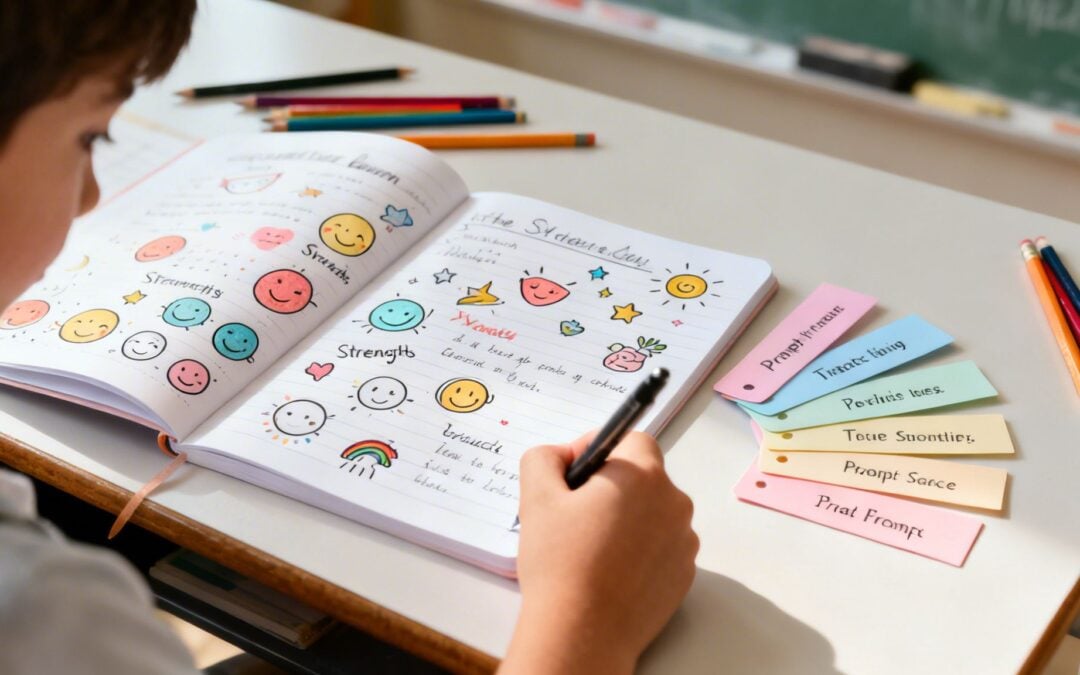
2. The Strengths and Superpowers Inventory
This empowering exercise shifts focus from deficits to assets, guiding individuals to identify personal strengths and talents they often undervalue. Instead of asking "what's wrong with me," this prompt encourages students and adults to catalog their 'superpowers'—both obvious talents and hidden strengths. This asset-based approach builds a positive self-concept by helping individuals recognize the unique value they bring to their communities.

Popularized by positive psychology pioneers like Martin Seligman and frameworks from Marcus Buckingham, this prompt is a core component of many asset-based educational approaches. By inventorying strengths, learners develop a vocabulary to describe their capabilities, which is a foundational step in building self-esteem and resilience.
Why This Prompt Works
The power of the Strengths and Superpowers Inventory lies in its concrete, evidence-based approach to self-worth. It encourages learners to move beyond vague feelings and identify specific, observable abilities. This process makes abstract concepts like "confidence" tangible by connecting them to real-world skills, whether it's a knack for making people laugh or a talent for organizing group projects.
When a student can name their strengths, like "I am a good listener" or "I am persistent," they are building a mental toolkit they can draw from during challenging times. It reframes their identity around what they can do, not what they can't.
How to Use This Prompt: Examples and Adaptations
This inventory is one of the most affirming self discovery journal prompts and can be easily adapted for any age. It’s a great way to kick off group activities and build a positive classroom culture.
- For Lower Elementary (Grades K-2): Use the "superpower" metaphor. Ask, “If you were a superhero, what would your special power be? Is it being a super helper? A super-fast runner? A super kind friend?” Create a class poster with drawings of each child's superpower.
- Practical Example: A kindergartener says her superpower is "making people smile." The teacher can respond, "That's a wonderful superpower! It's called humor or cheerfulness."
- For Upper Elementary (Grades 3-5): Have students create a "Strengths Resume." Prompt them: “List three things you are good at, inside or outside of school. For each one, write a sentence about a time you used that strength.” Strengths could include humor, creativity, or being a loyal friend.
- Practical Example: A student's resume might include: "Strength: Problem-solving. Example: I figured out how to fix our Lego tower when it kept falling over."
- For Middle School (Grades 6-8): Introduce more nuance. Use a prompt like:
- “Describe something you do that seems to come easily to you, even if others find it difficult.”
- “What is a non-academic skill you have that you are proud of (e.g., patience, problem-solving, empathy)?”
- Practical Example: An anxious student might identify that their "worry" is actually a strength in careful planning and attention to detail, writing, "I worry a lot about group projects, but it means I always make sure we have everything we need before we start."
- For Caregivers at Home: Regularly "catch" your child using their strengths. Say, "I saw how you kept trying with that puzzle even when it was hard. That's your persistence superpower showing up!" This external validation is a key part of many effective self-esteem building activities.
3. The Emotion Explorer and Mindfulness: Understanding Feelings, Triggers, and Present-Moment Awareness
This dual-focus exercise develops both emotional literacy and present-moment awareness. It guides individuals to identify, name, and understand their feelings, patterns, and triggers while simultaneously practicing non-judgmental observation of their current experience. By combining journaling with mindfulness, learners build a detailed map of their inner world, see the links between thoughts and feelings, and create the crucial space needed to choose thoughtful responses over automatic reactions.
This approach draws on foundational concepts from Daniel Goleman's work on emotional intelligence and Jon Kabat-Zinn's Mindfulness-Based Stress Reduction (MBSR). Journaling actively promotes present-moment awareness and emotional regulation, aligning perfectly with the principles of mindfulness and overall well-being.
Why This Prompt Works
The power of this prompt is in its integration of feeling with sensing. It teaches that emotions are not just abstract concepts but have physical signatures in the body. By learning to notice a tense jaw or a tight chest, students gain an early-warning system for their emotional states, allowing them to self-regulate before feelings become overwhelming.
When students can name their feeling, locate it in their body, and breathe into it, they move from being controlled by their emotions to being in a relationship with them. This is the foundation of emotional resilience.
How to Use This Prompt: Examples and Adaptations
This exercise builds a core life skill and can be adapted for any age, making it one of the most essential self discovery journal prompts for social-emotional growth. You can explore more ideas through these mindfulness activities for students.
- For Lower Elementary (Grades K-2): Use an emotion wheel or feeling flashcards. Ask, "Point to the face that shows how you feel right now. Where in your body do you feel like a grumpy storm cloud or a happy sunbeam?" This connects the feeling name to a body sensation.
- Practical Example: A student points to the "sad" face. The teacher asks, "Where do you feel that sadness in your body?" The child might say, "My eyes feel heavy," creating a body-emotion link.
- For Upper Elementary (Grades 3-5): Introduce a "body scan" before journaling. Prompt them: "Close your eyes for a minute and be a detective. Notice any tight spots or wiggly spots in your body. Now, write about a time this week you felt a big feeling. Where did you feel it in your body then?"
- Practical Example: A 4th grader might discover they feel angry when left out and that anger feels like "a hot knot in my stomach." Now they have an early warning sign for that emotion.
- For Middle School (Grades 6-8): Encourage more nuanced self-reflection with a "trigger map" prompt:
- "Describe a recent situation where you had a strong, sudden emotional reaction (like snapping at someone or shutting down)."
- "What was the trigger? What feeling came up? How did you know you were feeling it? What behavior followed?"
- Practical Example: A student identifies that their trigger is being interrupted. The feeling is frustration, felt as a tight jaw. The behavior is sarcasm. This helps them see the pattern and consider a different response next time.
- For Caregivers at Home: Model the practice openly. You might say, "I'm noticing I feel really frustrated because we're running late. My shoulders are getting tight. I'm going to take three deep breaths before we get in the car." This shows that managing emotions is a normal, healthy practice for everyone.
4. The Relationship Reflection: Exploring Connections and Dynamics
This relational self-discovery exercise prompts individuals to examine their connections with others. By exploring relationships with peers, teachers, and family, learners can identify patterns, understand their needs, and see how they show up in their interactions. The goal is to build awareness around relational habits, communication styles, and the roles we play.
Understanding these dynamics is key to social-emotional health. Concepts from attachment theory, along with the work of researchers like Brené Brown and Harriet Lerner, show that a sense of belonging and the ability to navigate conflict are essential for well-being. This prompt helps students build those specific skills.
Why This Prompt Works
The power of this prompt is its focus on the "self-in-relation-to-others." It moves beyond solo introspection to help students see how their inner world impacts their external connections, and vice versa. It makes abstract concepts like empathy and communication concrete by tying them to specific friendships and family interactions.
By examining real relationships, students learn that they are not just passive participants but active contributors to the health and quality of their connections. This awareness empowers them to make intentional choices that foster more positive bonds.
How to Use This Prompt: Examples and Adaptations
This exercise offers a powerful lens for students to understand their social world, making it one of the most practical self discovery journal prompts for building interpersonal skills.
- For Lower Elementary (Grades K-2): Keep the focus on feelings and specific people. Ask, “Who is in your family circle? Who is in your friend circle? Draw them. How do you feel when you are with your best friend?” You can help them label feelings: “It sounds like you feel safe and happy when you play with them.”
- Practical Example: A student draws their best friend and says, "We share." The teacher can say, "Sharing is what good friends do. That's how you show you care for each other."
- For Upper Elementary (Grades 3-5): Introduce the idea of patterns. Prompt them: “Think about a time you had a disagreement with a friend. What did you do? What did they do? What do you usually do when you feel upset with someone?”
- Practical Example: A student recognizes a pattern of withdrawing when upset. They write, "When my friend and I argued, I just stopped talking. I usually do that." This is the first step to choosing a different strategy next time.
- For Middle School (Grades 6-8): Students can analyze more complex dynamics. Use a prompt that encourages deeper self-awareness:
- “Describe a friendship where you feel completely yourself. What makes this relationship feel safe?”
- “Now, describe a situation where you felt you had to act like someone else to fit in. What does this tell you about the kind of friend you want to be?”
- Practical Example: A student contrasts feeling relaxed with a close friend versus feeling anxious with a "popular" group. They realize they want friends who appreciate their "nerdy" sense of humor.
- For Caregivers at Home: Use concentric circles as a visual tool. Draw a small circle in the middle for your child, then a larger one around it, and another larger one. Ask, “Who are the people closest to you, in the inner circle? Who is in the next circle? Why are they there?” This helps them map and articulate the structure of their social world.
5. The Resilience and Challenge Narrative
This forward-focused self-discovery exercise prompts individuals to reflect on past challenges they have overcome. By narrating their own resilience stories, students identify the internal resources, support systems, and specific actions that helped them persevere. The goal is to recognize their existing capacity to handle difficulty and develop concrete strategies for future challenges, turning past struggles into a roadmap for future strength.

This narrative approach is supported by the work of researchers like Angela Duckworth (Grit) and Carol Dweck (growth mindset), who show that understanding one's ability to grow through effort is key to success. It helps students frame challenges not as failures, but as opportunities for learning and proving their own strength. For more practical strategies, discover our guide on building resilience in children.
Why This Prompt Works
The power of this prompt is in its ability to reframe a student's personal history. It moves them from a passive role ("bad things happened to me") to an active one ("I got through a hard thing, and here’s how"). This narrative construction builds self-efficacy and provides tangible proof of their own grit and resourcefulness.
When a student articulates their journey through a challenge, they are not just recounting a memory; they are authoring a story of their own competence. This story becomes a powerful reminder they can access during future difficulties.
How to Use This Prompt: Examples and Adaptations
These self discovery journal prompts are excellent for building confidence and can be tailored to help students process both small and large setbacks.
- For Lower Elementary (Grades K-2): Focus on small, relatable worries. Ask, “Write about a time you felt worried but kept going anyway. What happened? What did you do to feel brave?”
- Practical Example: A student writes about being scared on the first day of school but then finding a friend to play with. The teacher highlights their bravery: "You were worried, but you looked for a friend. That was a brave choice!"
- For Upper Elementary (Grades 3-5): Introduce a simple narrative structure. Prompt them: “Think of a time you solved a tough problem. 1. What was the problem? 2. What did you feel? 3. What did you do to solve it?”
- Practical Example: A student writes about learning a difficult math concept. "Problem: Long division. Felt: Confused. Action: I asked the teacher for help after class and practiced on a whiteboard."
- For Middle School (Grades 6-8): Encourage deeper reflection on social and academic challenges. Use a multi-step prompt:
- “Describe a time you recovered from a friendship conflict or a disappointing grade. What happened?”
- “Who helped you? What did they do or say?”
- “What strength did you discover in yourself during that time? How can you use that strength again?”
- Practical Example: A student writes about getting a D on a test. They identify their sister helped them study differently and discovered they had the strength of persistence to try again.
- For Caregivers at Home: Model vulnerability and resilience. Share a story about a challenge you faced, like a tough project at work. Emphasize what you learned and how it made you stronger, showing that overcoming obstacles is a normal part of life for everyone.
6. The Identity Exploration: Intersecting Identities and Belonging
This powerful self-discovery exercise invites individuals to explore the many layers of who they are, including race, culture, gender, interests, and family structure. It moves beyond a one-dimensional view, recognizing that identity is multifaceted and intersectional. This prompt encourages students to reflect on how different parts of their identity influence their experiences and sense of belonging in various spaces.

Inspired by Kimberlé Crenshaw's work on intersectionality and resources from Learning for Justice, this prompt helps students develop an awareness of their own unique story. Journaling about identity builds empathy, reduces isolation, and fosters a school community where everyone feels seen and valued for their authentic selves.
Why This Prompt Works
Identity exploration connects a student’s inner world with their external experiences. It provides a structured way to make sense of complex feelings about fitting in, being different, and what it means to belong. It validates all parts of a child's identity, showing them that who they are is a rich combination of many factors.
By examining their intersecting identities, students gain the language to articulate their experiences, understand others better, and advocate for themselves and their communities. It turns the abstract concept of identity into a personal, lived story.
How to Use This Prompt: Examples and Adaptations
This prompt is deeply personal and can be tailored for different ages, making it one of the most meaningful self discovery journal prompts for building an inclusive classroom.
- For Lower Elementary (Grades K-2): Start with an "All About Me" identity web. Draw a circle with the child's name and add spokes for things like "My Family," "My Favorite Foods," "Languages I Speak," and "Things I'm Good At." Prompt them: “Draw a picture of a time you felt happy to share something special about your family or culture.”
- Practical Example: A student draws a picture of their family celebrating Diwali. The teacher can invite them to share one thing about the holiday, celebrating that unique part of their identity.
- For Upper Elementary (Grades 3-5): Introduce the idea of multiple identities. Prompt: “We are all made of many parts. Write about two important parts of you (like being an athlete and a big brother, or being creative and from an immigrant family). How do these parts of you fit together?”
- Practical Example: A student writes, "Being the oldest sister means I have to be responsible, but being an artist means I like to be messy and creative. Sometimes it's hard to be both." This opens up a rich discussion about navigating different roles.
- For Middle School (Grades 6-8): Students can engage with more complex ideas like intersectionality and representation. Use a multi-step prompt:
- “In what spaces or situations do you feel most like yourself? What about that space makes you feel comfortable and seen?”
- “Describe a time you felt your identity was misunderstood or stereotyped. What part of your identity was it related to? How did it feel?”
- “Do you see people who share parts of your identity in books, movies, or in leadership positions at school? Why does this matter?”
- Practical Example: A student might write about feeling most themselves in their coding club but feeling misunderstood in P.E. class, leading to a reflection on stereotypes about "techy" kids.
- For Caregivers at Home: Model vulnerability. Share how different parts of your identity (e.g., your profession, your cultural background, your role as a parent) intersect. Discuss how you navigate spaces where one part of your identity is more visible than another. This shows that understanding our identity is an ongoing journey.
7. The Goal Setting and Growth Vision
This forward-focused self-discovery exercise guides individuals to clarify not just what they want to achieve, but who they want to become. It moves beyond academic or task-based goals to encourage reflection on personal growth, like becoming more confident, a better friend, or more resilient. By articulating a vision for their personal development and breaking it down into manageable steps, students develop agency, hope, and a clear sense of direction.
This prompt is inspired by the work of Carol Dweck on growth mindset and behavior change research from experts like James Clear. It helps students see that their character and skills are not fixed but can be cultivated through intention and effort, making it one of the most empowering self discovery journal prompts for building a proactive mindset.
Why This Prompt Works
The power of this prompt is its focus on personal agency and process over outcomes. It teaches children that they are the architects of their own character. Instead of just wishing they were different, they learn to create a concrete, actionable plan for growth, which builds self-efficacy and intrinsic motivation.
When students set goals for who they want to be rather than just what they want to get, they connect their daily actions to a deeper sense of purpose and identity. This makes the effort feel meaningful, not just mandatory.
How to Use This Prompt: Examples and Adaptations
This exercise can be scaled for different developmental stages, helping students build essential life skills from a young age. Successful goal setting for kids often involves making the process visual and celebratory.
- For Lower Elementary (Grades K-2): Keep it simple and behavior-focused. Ask, “What’s one way you’d like to be an even better friend this week?”
- Practical Example: A student decides, “My goal is to ask someone who looks lonely to play with me at recess.” This makes the abstract idea of "being a good friend" a concrete action. The teacher can then check in at the end of the week.
- For Upper Elementary (Grades 3-5): Introduce the concept of breaking down a bigger goal.
- Practical Example: A student who struggles with anger could set a goal to “notice my feelings and pause before I shout.” Their first step might be, “When I feel my face get hot, I will take one deep breath.” The journal becomes a place to track their attempts.
- For Middle School (Grades 6-8): Encourage more complex, long-term growth visions. Use a prompt like:
- “Imagine yourself at the end of the school year, feeling proud of the person you’ve become. What is different about you?”
- “What is one small habit you could start this month to help you grow in that direction?”
- Practical Example: A student aiming to be more confident in class could set a goal to raise their hand to answer one question per week. They can use their journal to reflect on how it felt each time they did it.
- For Caregivers at Home: Create a family “growth goal” board. Each person can write down a personal growth goal (e.g., “My goal is to be more patient”) and the small steps they are practicing. Check in weekly to celebrate effort and progress, not just perfect achievement.
8. The Contribution and Legacy Reflection
This meaningful exercise shifts the focus of self-discovery from inward-looking reflection to an awareness of one's impact on the world. The Contribution and Legacy Reflection prompts individuals to consider how they contribute to their communities, the effect they have on others, and the legacy they want to create. It guides students to recognize their role as community members and change-makers, developing a sense of purpose and connection.
This prompt helps students move beyond a narrow self-focus to see themselves as part of a larger ecosystem. This concept is supported by Viktor Frankl's work on purpose and is a key element in service-learning and youth empowerment programs. By journaling about their contributions, no matter how small, learners build a sense of agency and belonging.
Why This Prompt Works
The power of this prompt is in its ability to connect personal actions to a bigger purpose. It shows students that even small acts of kindness or help have ripple effects, building their confidence as valuable members of their school, family, and community. This fosters intrinsic motivation and social responsibility.
By reflecting on their contributions, students learn that their presence matters. They move from being passive recipients of their environment to active creators of the community they wish to see.
How to Use This Prompt: Examples and Adaptations
This prompt is an excellent tool for building a positive classroom or family culture and can be adapted for a wide range of ages, making it one of the most impactful self discovery journal prompts for fostering empathy and leadership.
- For Lower Elementary (Grades K-2): Keep the focus concrete and immediate. Ask, “Write or draw about a time you helped someone today. How did it make you feel? How do you think it made them feel?”
- Practical Example: A student draws a picture of them sharing crayons. They realize that a small action made their friend happy, which in turn made them feel happy. The teacher can call this "being a community helper."
- For Upper Elementary (Grades 3-5): Introduce the idea of ripple effects. Prompt them: “Describe one kind or helpful thing you did this week. Who did it affect? What might happen next because of your action?”
- Practical Example: A student writes about inviting someone new to play. They reflect that this might make the new student feel more welcome all week and maybe even encourage them to invite someone else to play later.
- For Middle School (Grades 6-8): Encourage deeper thinking about legacy and impact. Use a multi-part prompt:
- “What is one problem in our school or community you care about?”
- “What special skill or strength do you have that could help with this problem?”
- “If you were to create a small project to help, what would be the first step? What impact do you hope it would have?”
- Practical Example: A student who is good at art decides they care about loneliness. They propose a "Kindness Rocks" project where they paint positive messages on stones and leave them for others to find, using their art skills for a community-building purpose.
- For Caregivers at Home: Model this reflection by talking about your own contributions at work or in the neighborhood. Ask, “What kind of family do we want to be? What’s one thing we can each do this week to help create that feeling in our home?”
8-Point Comparison: Self-Discovery Journal Prompts
| Prompt | Implementation complexity | Resource requirements | Expected outcomes | Ideal use cases | Key advantages |
|---|---|---|---|---|---|
| The Values Clarification Prompt | Low–Moderate; guided reflection activities | Minimal — prompts, journals, facilitator time | Clearer personal values; improved decision-making | Character education, self-awareness lessons, early adolescence | Builds authenticity, priority clarity, aids conflict resolution |
| The Strengths and Superpowers Inventory | Low–Moderate; activities plus peer input | Minimal–Moderate — inventories, peer exercises, facilitator | Increased confidence; recognition of personal and peer strengths | Confidence-building, group formation, asset-based interventions | Asset-focused, boosts self-efficacy, improves collaboration |
| Emotion Explorer and Mindfulness | Moderate–High; ongoing practice and skilled facilitation | Moderate — trained facilitator, regular practice time, safe space | Better emotional literacy, self-regulation, reduced stress | SEL curriculum, anxiety management, self-regulation training | Foundational for regulation, reduces reactivity, improves focus |
| The Relationship Reflection | Moderate; sensitive facilitation and confidentiality needed | Moderate — mapping tools, discussion time, adult support | Greater relational awareness, improved communication, belonging | Bullying prevention, peer mediation, relationship skill-building | Identifies dynamics, supports belonging, improves empathy |
| Resilience and Challenge Narrative | Low–Moderate; narrative structure with supportive framing | Minimal–Moderate — prompts, reflection time, adult support for some | Stronger resilience, problem-solving, hope and agency | Growth mindset lessons, transition support, recovery from setbacks | Reinforces agency, links past coping to future strategies |
| Identity Exploration: Intersecting Identities | High; culturally responsive and trauma-aware facilitation required | Moderate–High — trained facilitators, curriculum, safe space | Deeper identity awareness, equity consciousness, belonging | Diversity/inclusion work, anti-bias education, identity development | Highlights intersectionality, fosters inclusion and pride |
| Goal Setting and Growth Vision | Low–Moderate; structured planning plus follow-up | Minimal–Moderate — templates, check-ins, teacher coaching | Clear growth goals, improved planning, sustained motivation | Executive function support, advisory periods, habit-building | Builds agency, planning skills, and measurable progress |
| Contribution and Legacy Reflection | Low–Moderate; reflective plus action-oriented steps | Minimal–Moderate — prompts, service opportunities, facilitator | Increased sense of purpose, prosocial behavior, community ties | Service learning, citizenship education, community projects | Fosters purpose, motivates altruism, strengthens community connection |
Putting Prompts into Practice: Cultivating a Community of Connection
The journey of self-discovery is not a destination but a continuous, rewarding practice of reflection and growth. Throughout this article, we’ve explored a powerful framework of eight distinct self discovery journal prompts, from the Values Clarification Prompt to the Contribution and Legacy Reflection. These are not merely writing exercises; they are tools for building a child’s inner architecture, providing them with the language and space to understand who they are, what they stand for, and how they connect to the world around them.
The true impact of these prompts emerges when they become part of a consistent routine, woven into the fabric of classroom culture and family life. By moving beyond a one-time activity and embracing journaling as an ongoing dialogue, you foster an environment of psychological safety and authentic expression. Students learn that their thoughts and feelings are valid, their struggles are a normal part of growth, and their unique identity is something to be celebrated. This consistent engagement is what transforms individual insights into a collective culture of empathy and support.
From Individual Reflection to Community Strength
A common mistake is treating journaling as a purely solitary activity. While individual reflection is crucial, the real magic happens when these personal discoveries become bridges to connection. The goal is to build a community where students feel seen, heard, and valued not just by adults, but by their peers.
Consider this practical pathway:
- Individual Journaling: A student uses the Resilience and Challenge Narrative prompt to write about a time they struggled to learn a new skill, like riding a bike. They detail their frustration, the falls, and the moment they finally balanced.
- Voluntary Sharing in Small Groups: In a small, facilitated group, the student shares their story. Another student might share a similar story about learning to swim, realizing they both felt "frustrated but determined."
- Whole-Class Connection: As a group, they identify the common feeling: perseverance. The teacher can then anchor this shared experience, noting, "Look how many of us have felt that same way. We are a classroom of perseverant people."
This process turns an internal, personal victory into a shared, communal value. The journal prompt becomes the catalyst, but the structured sharing is what builds the community. You are not just teaching social-emotional learning; you are creating a living, breathing model of it.
Actionable Next Steps for Lasting Impact
To ensure these practices take root, focus on integration rather than addition. You don't need to find a new 30-minute block in your already packed schedule. Instead, infuse these prompts into existing structures.
- For Teachers & Administrators: Start your Monday morning meetings or advisory periods with a 5-minute quick-write using a prompt like the Strengths and Superpowers Inventory. Use the Relationship Reflection prompt before a collaborative group project to set intentions for teamwork.
- For Parents & Caregivers: Use a prompt as a dinner table conversation starter. Instead of asking, "How was school?" try, "What was a 'superpower' you used today?" or "What's one thing you're curious about right now?" The goal is to make reflection a natural part of your family's daily rhythm.
Remember, the power of these self discovery journal prompts lies in their consistency and the safe space you create around them. Every entry, every shared story, and every moment of quiet reflection is a step toward building a child who not only knows themselves but is also equipped to understand, support, and connect with others. For further exploration and a curated list of valuable insights, delve into these 7 powerful self discovery journal prompts to expand your toolkit. This work is the foundation of a healthy, compassionate, and resilient community.
Ready to deepen this work and bring experiential social-emotional learning to your entire school community? Soul Shoppe provides dynamic assemblies, parent workshops, and staff development programs that give students, educators, and families a shared language for empathy and conflict resolution. Visit Soul Shoppe to learn how we can help you build a more connected and supportive school culture.
