Soul Shoppe's work is made possible by donors and partners who care deeply about the young people in their communities! We can't do this work without you. Support our work in classrooms and on playgrounds across the nation by donating here.
Step into any kindergarten classroom and you'll see the same pattern by 9:15 a.m. Someone is beaming because they got the red marker. Someone else is in tears because a friend sat in “their” spot. Another child is trying hard to join a game but doesn't yet have the words. The day is full of reading, counting, lining up, cleaning up, waiting, sharing, losing, trying again, and all of the feelings that come with it.
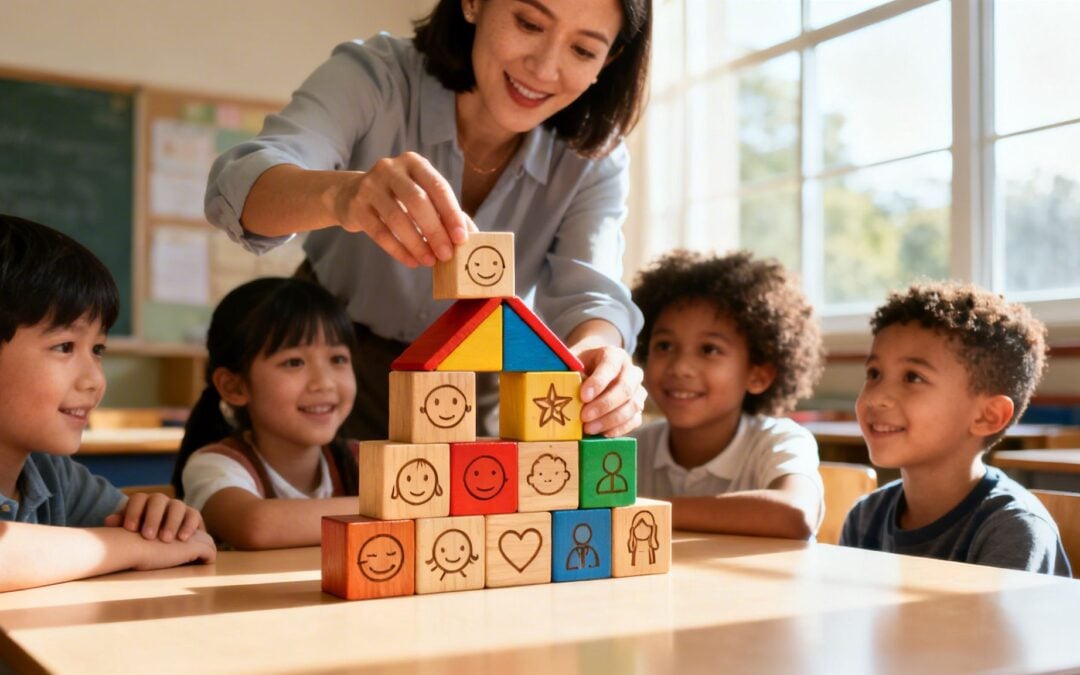
That's why social emotional learning activities for kindergarten matter so much. They aren't extras for the end of the day if there's time left. They're part of how young children learn to be in school with other people. When children can name feelings, notice body signals, solve small conflicts, and reconnect after hard moments, the rest of the classroom runs better too.
The long view matters. A longitudinal study of over 9,000 elementary students in Baltimore City Public Schools found that kindergarteners rated “Not Ready” in social-emotional readiness were up to 80% more likely to be retained by fourth grade, up to 80% more likely to require special education services, and up to seven times more likely to face suspension or expulsion at least once, according to New America's summary of the research.
You don't need a complicated system to start. You need routines children can use. The seven activities below are built like a lesson plan in a box, with materials, directions, differentiation, and simple ways to tell whether they're working.
1. Emotion Recognition and Connection Circles
A good circle routine does two jobs at once. It builds emotional vocabulary, and it gives children a reliable place to belong. In kindergarten, that predictability matters as much as the feelings lesson itself.
This one works best when you keep it short and repeat it daily. Fifteen to twenty minutes is usually enough. Long circles lose children fast, especially if too much talking comes from adults.
Lesson plan in a box
Learning focus: Naming feelings, listening to peers, and making simple connections between emotions and experiences.
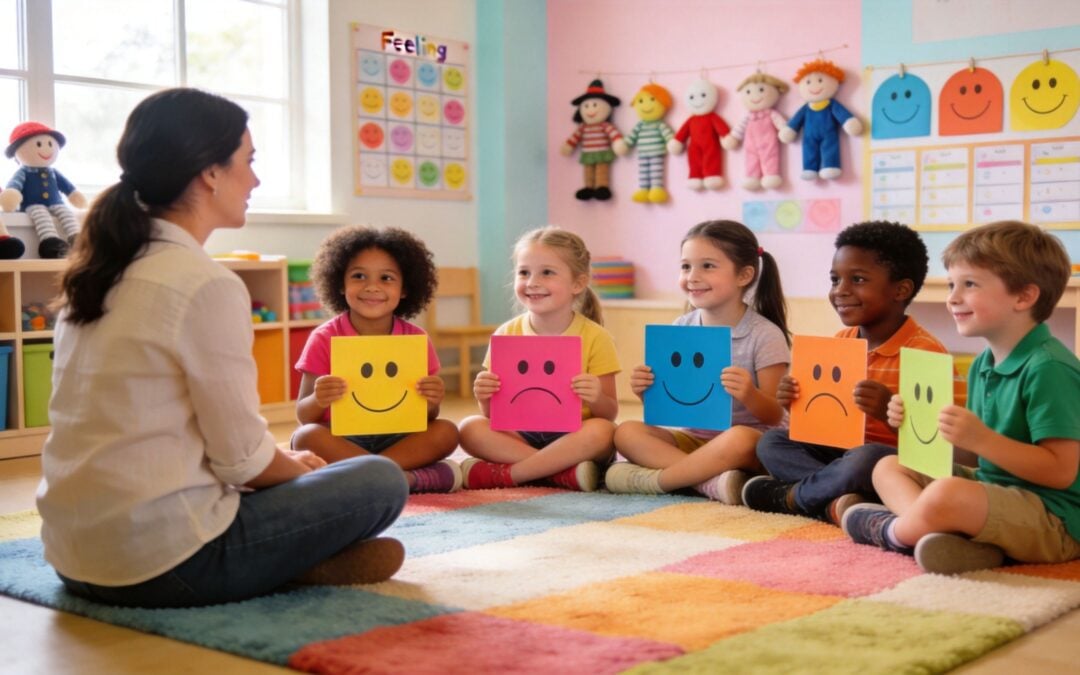
Materials: Feelings cards with clear faces, a talking piece, chart paper, and a class feelings chart for kids.
Directions:
Open with a ritual: Sit in a circle and pass the talking piece. Each child says their name and points to a feeling card or color.
Model a real check-in: The teacher goes first. “I feel disappointed because it's raining and we can't go outside yet. I know that feeling will pass.”
Add one connection question: Ask, “What helps when you feel frustrated?” or “What does your face look like when you feel proud?”
Build a class anchor chart: Record children's words and draw simple icons beside them for pre-readers.
What works and what doesn't
What works is structure. Children do better when the order stays the same, the visuals are concrete, and everyone knows the listening rules. A talking piece helps because it makes turn-taking visible.
What doesn't work is pushing children to disclose more than they want to share. Some children will point to a card, whisper, or say “pass.” That still counts as participation.
Practical rule: Don't correct a child's feeling. If a child says, “I'm mad and sad,” accept both and help them add words.
Differentiate it this way:
For emerging speakers: Let them point, hold up a card, or copy a sentence stem.
For children with big energy: Give them a fidget or assign a circle job like card helper.
For home use: Parents can do the same routine at dinner with three feeling choices instead of a full chart.
Simple assessment: Notice whether children move from generic words like “good” and “bad” toward more precise words like “nervous,” “lonely,” or “excited.” Also watch whether they begin responding to peers with comments such as “me too” or “that happened to me.”
2. Mindfulness and Breathing Practice Activities
Breathing practice gets dismissed when adults make it too abstract. Kindergarteners don't need a lecture on the nervous system. They need something they can see, feel, and copy.
Bubble breath, balloon belly, and smell-the-flower breathing all work because they are physical and playful. The best time to teach them is when children are calm, not in the middle of a meltdown.
Lesson plan in a box
Learning focus: Self-regulation, body awareness, and calming during transitions or rising frustration.
Materials: Bubbles, a stuffed animal for belly breathing, visual cue cards, and a child-friendly guide to belly breathing technique.
Directions:
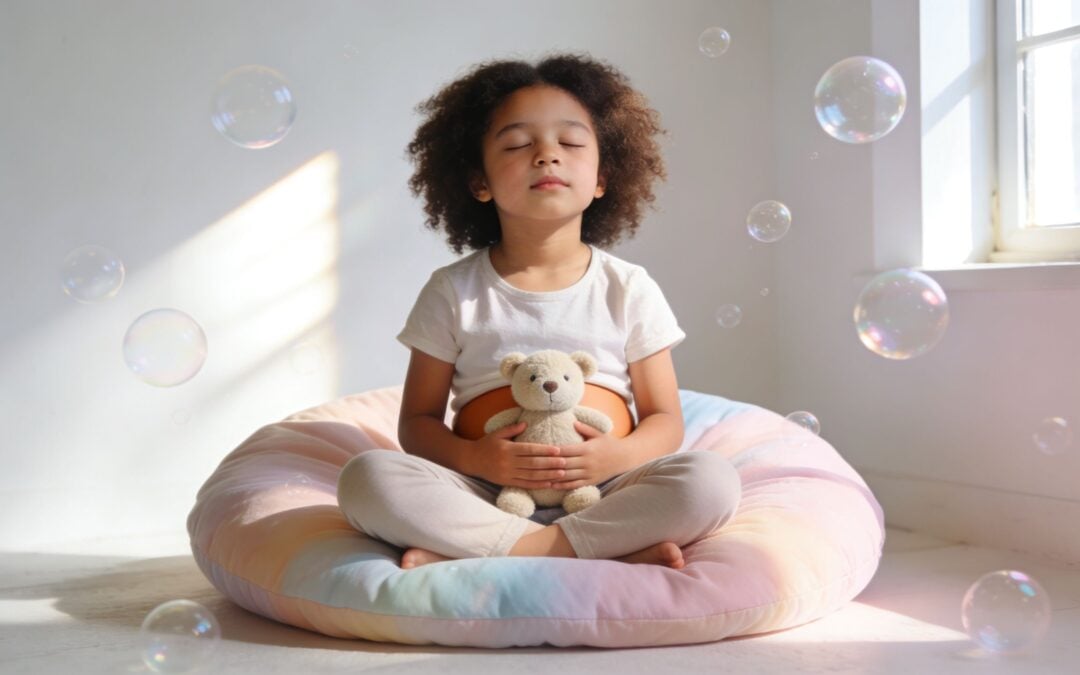
Teach one breath first: Place a stuffed animal on a child's belly while they lie down or sit back. Breathe in slowly to “lift” the animal, then breathe out to lower it.
Practice with movement: Have children make their arms wide like a balloon while inhaling, then slowly hug themselves while exhaling.
Use it in real moments: Before lining up, after recess, or after a conflict, invite the class to choose one breath together.
Keep it brief: Two or three minutes is enough for the first few weeks.
A universal kindergarten study of the Fun FRIENDS program in Japan found significant reductions in problem behaviors, and the program used developmentally appropriate SEL practices such as emotional regulation, social skills, parent reinforcement, and play-based activities, according to the PMC article on Fun FRIENDS.
Common mistakes
The biggest mistake is treating breathing as compliance. If a child hears “go calm down” every time they're upset, the strategy starts to feel like punishment. Offer it as support, not a command.
The second mistake is offering only one way to regulate. Some children breathe better while standing, swaying, or pressing their hands together. Choice helps.
Breathing practice should feel like rehearsal, not correction.
Differentiate it this way:
For sensory-seeking children: Pair breathing with wall pushes or stretching.
For children who resist closing eyes: Keep eyes open and focus on a bubble wand, pinwheel, or teacher's hand signal.
For home use: Try one breathing cue before bed, before homework, or before leaving the house.
Simple assessment: Track whether children begin using breathing language on their own. You'll hear it in phrases like “I need balloon breaths” or see it when they pause before reacting during transitions.
3. Kindness and Empathy Building Activities
Kindness activities work best when they move beyond “be nice.” Kindergarteners need to see, hear, and practice what kindness looks like in real situations. Help, waiting, inviting, checking in, and noticing someone's feelings are all more teachable than the word nice.
A simple empathy routine can grow out of storytime, play, or a classroom problem. If one child is left out at blocks, that's your lesson right there.
Lesson plan in a box
Learning focus: Perspective-taking, caring actions, and inclusive language.
Materials: Read-aloud book about friendship, chart paper, sentence stems, and a short family resource on how to teach empathy.
Directions:
Read and stop often: Ask, “How does this character feel?” and “What might help?”
Role-play two versions: Act out an unkind response, then replay the same moment with a kinder choice.
Make it concrete: Build a “kindness looks like” chart with examples such as sharing tape, scooting over, asking “want to play?” and helping clean up.
Close with one action: Each child chooses one kind act to try during center time.
Make praise specific
General praise fades quickly. Descriptive feedback teaches. “You noticed Maya looked sad and offered her a seat” is more useful than “good job being nice.”
One practical trade-off is visibility. Public kindness chains and class shout-outs can motivate some children, but others start performing for praise. Keep some recognition quiet and direct.
Differentiate it this way:
For shy children: Let them draw a kind act rather than perform it.
For children who act before thinking: Use puppets first so they can rehearse at a safe distance.
For families: Send home one weekly prompt such as “Ask someone in your home what kind act helped them today.”
Simple assessment: Watch for transfer during play. Are children beginning to invite peers in, offer help, or use feeling language when someone is upset? That's the true test.
4. Conflict Resolution and Problem-Solving Role-Plays
Most kindergarten conflict is predictable. Someone grabs. Someone cuts in line. Someone says, “You can't come.” Because the conflicts repeat, the language should repeat too. Children need short phrases they can remember when upset.
Start with puppets. Puppets lower the pressure, slow down the scene, and make it easier for children to notice what happened without feeling blamed.
Lesson plan in a box
Learning focus: Using words in conflict, listening to another person, and choosing a simple next step.
Materials: Two puppets, picture cards showing common school conflicts, visual prompts with phrases, and a classroom guide to conflict resolution activities for kids.
Directions:
Act out a familiar problem: A puppet grabs a block tower piece without asking.
Pause the scene: Ask children what each puppet might be feeling.
Teach two sentence frames: “I don't like when…” and “Can we solve this?”
Practice a few endings: Take turns, find another block, rebuild together, or ask for help.
This short video can support your modeling:
Keep the script simple
You don't need a long peace process for five-year-olds. Three steps are enough in most classrooms: say the problem, listen, pick a solution. If children are too escalated, step in and co-regulate first.
What doesn't work is forcing instant apologies. A child can say “sorry” and still have learned nothing. It's more effective to help them repair with action, like returning the marker, checking on a friend, or inviting someone back into play.
“Use the words before you need the words.” Practice at calm times so children can access them during stress.
Differentiate it this way:
For language learners: Add picture cards for key phrases.
For impulsive children: Let them physically hold a step card to pace the conversation.
For home use: Parents can role-play sibling conflicts using stuffed animals instead of direct correction.
Simple assessment: Listen for independent use of taught phrases and notice whether children need less adult mediation in recurring conflicts.
5. Self-Awareness and Personal Strength Activities
Kindergarteners often know what they like before they know what they're good at. That's a useful starting point. Preferences, interests, helpers, and proud moments all lead toward self-awareness.
An “All About Me” activity becomes SEL when it goes beyond favorite color. Children need chances to identify what helps them, what feels hard, and where they shine.
Lesson plan in a box
Learning focus: Recognizing strengths, preferences, support systems, and personal identity.
Materials: Mirrors, paper for self-portraits, family questionnaire, crayons, and sentence stems such as “I'm good at…” and “I feel proud when…”.
Directions:
Start with observation: Children look in a mirror and draw themselves.
Add personal details: Invite them to finish prompts about favorite play, people who help them, and something they're learning.
Use peer noticing: Pair children to share one strength they saw in a classmate, such as “you build carefully” or “you help people zip coats.”
Display the work: Put self-portraits and strength statements at child eye level.
What to watch for
Some children light up when asked about strengths. Others freeze because they aren't used to talking about themselves in positive ways. That's normal. Offer examples tied to observable behavior, not personality labels alone.
A useful trade-off here is between polish and authenticity. Adult-made projects may look beautiful, but they hide the child's real voice. Messier work often tells you more.
Differentiate it this way:
For children who struggle to generate ideas: Offer photo choices or oral interviews.
For children with limited fine motor stamina: Let them dictate while an adult scribes.
For families: Ask caregivers to contribute one “I notice…” statement about their child at home.
Simple assessment: Look for richer self-descriptions over time. “I like dinosaurs” can grow into “I keep trying when puzzles are hard” or “I ask friends to play.”
6. Cooperative Games and Team Building Activities
Not every game in kindergarten needs a winner. In fact, some of the best social emotional learning activities for kindergarten remove winning on purpose so children can focus on communication and shared goals.
Cooperative games help children practice waiting, noticing others, and solving problems together without the emotional spike of competition. That makes them especially useful early in the year or after social tension in the class.
Lesson plan in a box
Learning focus: Cooperation, turn-taking, shared attention, and group problem-solving.
Materials: Parachute or sheet, soft ball, blocks, painter's tape, or any simple movement props.
Directions:
Choose one shared mission: Keep the ball on the parachute, build one class tower, or cross a taped “river” together using mats.
Name the success condition clearly: “We succeed if everyone stays in the game and we solve it together.”
Pause for reflection: After one round, ask what helped the group.
Repeat with one change: Add a challenge such as quieter voices, slower bodies, or a new partner.
Good competition versus bad friction
There's nothing wrong with occasional competitive play, but young children often need more coaching than adults expect when they lose. Cooperative formats reduce that friction and make room for children who usually withdraw.
The mistake is assuming children automatically know how to collaborate. They don't. You still need to model phrases like “your turn,” “let's try your idea,” and “we need everyone.”
A related implementation gap in SEL is measurement. One summary notes that many programs still don't include reliable assessment tools, which leaves schools looking for practical ways to track growth in skills like emotion regulation and empathy. The discussion of this gap in kindergarten SEL implementation points toward simple observation rubrics and checklists as an area educators still need.
Differentiate it this way:
For children who dominate: Give them a listening role or ask them to repeat another child's idea first.
For children who hesitate: Pair them with a steady peer and assign a clear job.
For home use: Families can do cooperative puzzles, blanket forts, or “build one tower together” challenges.
Simple assessment: Use a quick teacher checklist. Note who waits, who invites others in, who recovers after mistakes, and who can share materials without adult prompting.
7. Gratitude and Appreciation Practices
Gratitude routines can become shallow fast if they turn into forced positivity. In kindergarten, appreciation works when it stays specific, honest, and connected to relationships. Children don't need to be thankful all the time. They need practice noticing what is good while still having room for hard feelings.
This is a strong closing or transition routine because it helps children end the day connected rather than scattered.
Lesson plan in a box
Learning focus: Noticing support, expressing appreciation, and strengthening classroom belonging.
Materials: Paper leaves or sticky notes, a bulletin board or wall space, sentence stems, and markers.
Directions:
Set a narrow prompt: “Name one person, place, or moment from today you appreciate.”
Model specificity: “I appreciate Mateo because he held the door when my hands were full.”
Record it visibly: Add children's words to a thankfulness tree or appreciation board.
Invite response: Let the child receiving appreciation say “thank you” or smile and wave if they prefer.
Keep it grounded
Some children will say “my toys” or “ice cream” every time. That's fine at first. Then gently widen the lens with follow-up questions about people, effort, comfort, or help.
What doesn't work is using gratitude to bypass real problems. If a child had a hard day, let both things be true. “You were sad at cleanup, and you also appreciated playing with Ana” is a healthy message.
The market for SEL tools and programs continues to grow, with the global social and emotional learning market projected to rise from USD 2.71 billion in 2026 to USD 15.67 billion by 2034, according to Fortune Business Insights' SEL market projection. For schools, that growth is one more reason to choose routines that staff can sustain, not just purchase.
Appreciation lands best when children can connect it to a real action they saw or received.
Differentiate it this way:
For children who struggle to generate ideas: Offer stems like “I appreciated when…” or “Thank you for…”
For nonwriters: Let them dictate or draw the appreciated moment.
For families: Try a bedtime routine where each person thanks one other person for something specific from the day.
Simple assessment: Notice whether children begin offering appreciation without prompting and whether peer relationships soften around children who are often overlooked.
Morning meetings, end-of-day reflections, family routines
Low-cost way to reinforce positivity and appreciation
Weaving SEL into the Fabric of Your Classroom
These routines work because they fit real kindergarten life. They don't require a special week, a perfect class, or an hour carved out of an already full schedule. They work when they show up in morning meeting, transitions, play, conflict, cleanup, and dismissal.
Consistency matters more than variety. One teacher may get strong results from a daily feelings circle and one breathing routine. Another may lean on puppets for conflict role-play and a weekly appreciation board. Both approaches can work if children get repeated practice and adults use shared language across the day.
There's also a practical reason to treat this work as foundational. Some newer conversations in SEL point to a gap between standalone activities and classroom instruction. The discussion of SEL integrated with academics reflects what many educators already know firsthand. Children participate more fully in literacy, math, and play when they feel safe, connected, and capable of managing frustration.
If you're leading a classroom, start with one routine you can sustain for a month. If you're an administrator, look for schoolwide language and simple observation tools so teachers aren't each inventing their own system. If you're a parent, borrow one practice and repeat it at home in a low-pressure way. Repetition builds transfer.
These choices also support engagement. Children learn more when they feel that they belong, can take risks, and know what to do after mistakes. That's one reason classroom culture and how to increase student engagement are so closely connected.
For schools that want a more coordinated approach, Soul Shoppe is one relevant option. The organization offers SEL programs focused on connection, safety, empathy, self-regulation, mindfulness, communication, and conflict resolution for school communities. What matters most, though, isn't picking the fanciest program. It's choosing practices that adults will use, children can understand, and families can reinforce.
Kindergarteners are learning far more than letters and numbers. They're learning how to be with themselves and with other people. That deserves time on the schedule.
If you want support building a shared SEL language across classrooms, families, and school staff, explore Soul Shoppe for programs, tools, and practical strategies centered on connection, safety, and empathy.
A child is melting down over the wrong color cup. A class is coming in from recess loud, wiggly, and half ready to learn. A student who knows the math freezes the second the test lands on the desk.
Most adults don't need a definition of stress in kids. They see it every day.
What many of us do need is a simple answer to a practical question. What is mindfulness for kids, really? Not the fancy version. Not the version that sounds like a spa brochure. The version that helps a five-year-old settle their body, a nine-year-old notice frustration before it turns into an argument, or a middle schooler get through a hard moment without shutting down.
Mindfulness is one of those ideas that can sound abstract until you see it in action. Then it looks surprisingly ordinary. A child notices their shoulders are tight. A teacher leads three slow breaths before a quiz. A parent says, “Let's pause and feel our feet on the floor,” instead of “Calm down” for the fifth time.
That's the heart of it. Mindfulness gives kids a way to notice what's happening inside them, so they have a better chance of choosing what to do next.
Families are already moving in this direction. Meditation use among U.S. children grew over 400% between 2012 and 2017, reaching about 4.3 million children according to this pediatric meditation study. That doesn't mean every child is sitting cross-legged in silence. It does mean more adults are looking for tools that support attention, calm, and emotional regulation.
Your Guide to Childhood Mindfulness
If you work with children, you've probably had a moment when you thought, “This kid isn't giving me a hard time. They're having a hard time.”
That shift matters. It changes the job from stopping behavior to building skills.
Mindfulness is one of those skills. I think of it as a child-sized inner toolkit. It helps kids notice body signals, emotions, thoughts, and sensory input before those things take over the whole moment. For teachers, that can mean smoother transitions and fewer reactive moments. For parents, it can mean less power struggle and more connection.
What kids are really learning
Children aren't learning to be perfectly calm. They're learning to recognize what's going on.
That can sound like:
Body awareness: “My tummy feels tight.”
Emotion awareness: “I think I'm getting mad.”
Attention control: “My brain keeps leaving the page.”
Pause skills: “I can stop for one breath before I yell.”
These are small skills, but they add up. A child who can notice is a child who has more room to respond.
Practical rule: Mindfulness isn't about making children quieter for adult comfort. It's about helping children feel safer and more capable inside their own minds and bodies.
You don't need to be an expert
A lot of adults hesitate because they think they need special training, a perfect voice, or a totally peaceful classroom. You don't.
You need a few simple practices, a calm tone, and realistic expectations. Some days a mindful moment will feel beautiful. Some days it will feel clunky. Both still count as practice.
Try this mindset shift:
Start tiny. One breath, one sound, one sensation.
Stay concrete. Kids understand “notice your feet” better than “center yourself.”
Make it normal. Use mindfulness before hard moments, not only after problems.
Be curious, not controlling. Invite noticing instead of demanding stillness.
That's where mindfulness becomes useful. It stops being a concept and starts becoming something children can do.
What Mindfulness for Kids Actually Means
Mindfulness for kids means paying attention on purpose to what's happening right now, with kindness instead of judgment.
That's the clear version.
Mindfulness is a noticing skill. Kids notice their breath, body, thoughts, feelings, or surroundings without needing to fix everything immediately.
The easiest way to explain it to a child
Children usually understand mindfulness faster through analogy than definition.
You might say:
It's a pause button. When feelings get big, mindfulness helps us slow down before we act.
It's an anchor. When the day feels stormy, attention to breath or body gives us something steady.
It's a noticing superpower. We practice seeing what our body, brain, and heart are telling us.
If you're teaching younger children, try this sentence: “Mindfulness means we pay close attention to what's happening right now.”
If you're talking with older kids, try: “Mindfulness helps you notice what's going on inside you, so your feelings don't boss you around.”
What mindfulness is not
Adults often get stuck at this point. They hear “mindfulness” and picture a child sitting for a long time with an empty mind. That's not the goal.
Mindfulness for kids is not:
Emptying the mind: Thoughts will keep showing up.
Perfect stillness: Some children focus better while doodling, walking, or squeezing a pillow.
Forced relaxation: A child may still feel upset while practicing.
A reward for calm kids only: It's often most useful for kids who struggle with attention, worry, or impulsive reactions.
A helpful way to say it is, “We're not trying to stop thoughts. We're practicing noticing them.”
Why the simple version works
Structured practice can support focus in very practical ways. An 8-week mindfulness program for children ages 8 to 10, using 5- to 20-minute sessions, led to significant reductions in inattention (d=0.45) and ADHD symptoms (d=0.52) in a study reported in this research review on mindfulness-oriented meditation for children.
For everyday adults, the takeaway is simple. Children don't need complicated theory. They need repeatable practice.
A few minutes of guided noticing, done regularly, can help a child strengthen the skill of coming back. Back to breath. Back to body. Back to the moment they're in.
The Science-Backed Benefits for Learning and Well-being
Teachers and parents often ask a fair question. Is mindfulness helping kids, or is it just another nice-sounding routine?
The strongest answer is that mindfulness supports skills children use all day long. Focus. Emotional regulation. Recovery after stress. Those are core parts of social-emotional learning, and they also affect academics, relationships, and behavior.
What changes for students
In school, mindfulness often looks small on the surface. A slower entrance after recess. Less snapping at peers. More ability to return to work after frustration.
Underneath those moments, children are practicing a few important capacities:
Skill area
What it can look like in real life
Attention
Returning to the task after distraction
Emotional regulation
Feeling upset without immediate outburst
Self-awareness
Naming body clues before behavior escalates
Response flexibility
Pausing before blurting, pushing, or quitting
That's why mindfulness fits naturally alongside other SEL resources for teachers. It doesn't replace strong routines, relationship-building, or behavior support. It strengthens the internal skills that help those systems work.
What the brain research suggests
One of the most compelling findings comes from middle school students. A study at MIT found that 8 weeks of daily mindfulness training reduced stress and suspensions for sixth graders, and brain imaging showed reduced activation in the amygdala when students viewed stressful images, according to MIT's summary of the research.
You don't need to explain the amygdala to a second grader. But adults can think of it this way: mindfulness helps students get less hijacked by stress.
A mindful child still has big feelings. The difference is that the feeling is less likely to take the steering wheel immediately.
Why this matters in classrooms and homes
Kids learn best when they feel safe enough to think. They connect better when they can slow down enough to listen. They solve problems better when their bodies aren't in full alarm mode.
That's why mindfulness matters beyond “calm.” It supports readiness.
When adults use it well, mindfulness becomes less about compliance and more about capacity. A child gains a way to settle, notice, and re-enter the moment with a bit more choice.
Simple Mindfulness Practices for Different Age Groups
A practice that helps a four-year-old settle can make a seventh grader roll their eyes. Age matters, but so does context. Teachers need something they can lead in under two minutes. Parents need language that works in the car, at bedtime, or right after a hard moment.
A helpful rule is simple. The younger the child, the more mindfulness should feel like play. As children grow, you can add reflection, choice, and more private forms of practice.
Ages 3 to 5
Preschool mindfulness works best when children can see it, hear it, or touch it. Long explanations usually miss the mark. A short sensory game often works better than asking a child to “relax.”
Try these:
Belly Buddy Breathing Have the child lie down with a stuffed animal on their belly. Say, “Let's help your bear rise up and float back down.” Keep it to a few breaths. If you want more playful examples, this guide to belly breathing for kids gives simple ways to teach it at school or at home.
Listening Freeze Ring a bell or tap a chime. Say, “Raise your hand when the sound is gone.” This gives children a concrete target. They are practicing attention even if they cannot describe the skill yet.
Glitter Jar Watching Shake a glitter jar and say, “Our feelings can get swirly. Let's watch what happens when we stay still for a moment.” The visual does the teaching for you.
A good classroom version is one minute on the carpet before story time. A good home version is one round before nap or bedtime.
Grades K to 2
Children in early elementary can follow a few steps, especially if their hands are busy. They still do better with concrete directions than abstract language.
Good options include:
Box Breathing with Fingers Trace one side of a square or one finger at a time while breathing in, pausing, breathing out, and pausing again. Keep the pace gentle. If “hold your breath” creates tension, say “pause” instead.
Mindful Coloring Invite children to notice colors, pencil pressure, and how their body feels as they color. This fits well after recess, after lunch, or during a reset corner.
Five Senses Check-In Ask, “What is one thing you see, one thing you hear, and one thing you feel in your body?” Keep it brief and matter-of-fact.
Adults sometimes worry that this is too soft or too vague. In practice, these short exercises work like attentional warm-ups. For children who process sensory input differently, some adults also find guided supports helpful when supporting neurodivergent children's well-being through sensory-aware mindfulness routines.
Grades 3 to 5
Older elementary students are usually ready to notice thoughts, feelings, and body signals with more detail. They still need the practice to stay concrete. “Notice what your shoulders feel like” works better than “observe your internal state.”
Try:
Body Scan Guide attention from head to toes. Ask students to notice places that feel tight, warm, heavy, or buzzy.
Thought Clouds Say, “A thought can show up and pass by, like a cloud. You do not have to grab every one.” This helps children separate noticing from reacting.
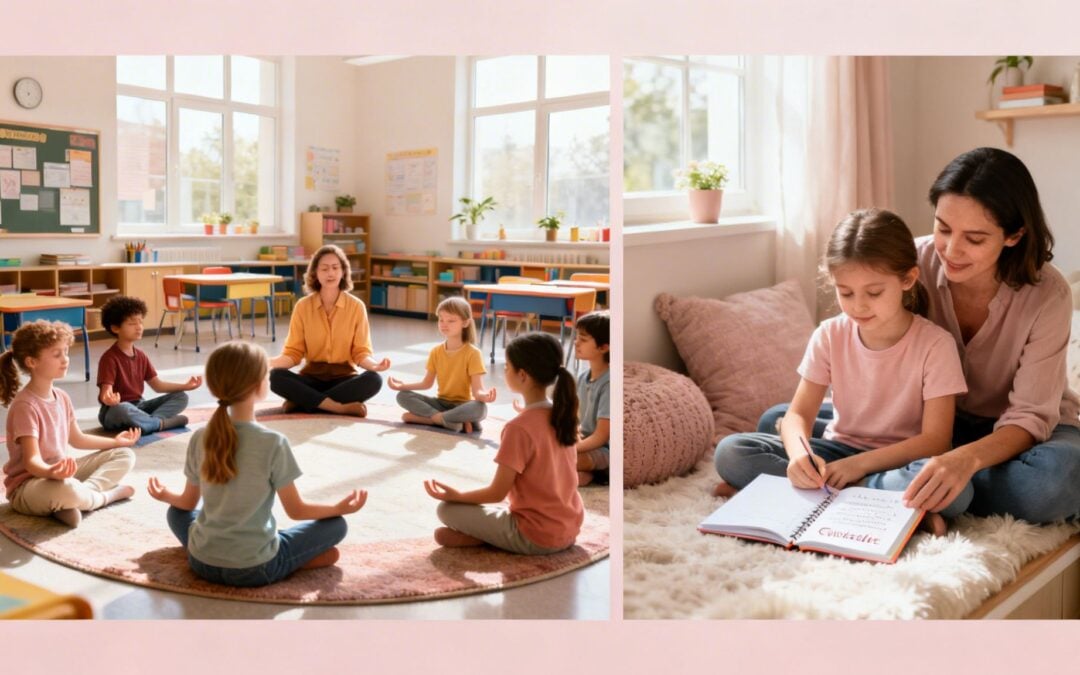
Three Good Things Journal Ask students to write or draw three things that went well today, even small ones. Researchers at Greater Good in Education describe gratitude and mindful reflection practices for school-age children as one way to build emotional awareness and positive attention in daily routines, in their collection of mindfulness activities for children.
In class, this can be a two-minute notebook routine after lunch or before dismissal. At home, it works well at dinner or bedtime.
Grades 6 to 8
Middle schoolers usually want dignity, choice, and privacy. If a practice sounds babyish, many will reject it before they try it. The framing matters almost as much as the activity.
A few practices tend to land better:
One-Minute Reset Before Class “Feel your feet on the floor. Loosen your jaw. Take one slower breath. Pick one thing you want to focus on next.”
Mindful Walking Invite students to notice pressure in their feet, the pace of their steps, and two sounds around them. This can work well in hallways, on the way to lunch, or during PE cooldowns.
Private Journaling Prompt “What am I feeling right now?” “What might help for the next ten minutes?” Short prompts lower resistance.
If students resist the word mindfulness, use language like reset, focus practice, or stress skill. Skepticism is common, especially with older kids. Consistency usually matters more than enthusiasm at the start.
Mindful Activities for the Classroom and at Home
The most effective mindfulness habits usually live inside ordinary routines. They don't need a yoga mat, a candle, or a perfect mood. They need repetition and a moment that already exists.
In the classroom
A third-grade class comes in buzzing after recess. Instead of launching straight into directions, the teacher says, “Hands on desks. Feel your feet. Take one slow breath in, and one long breath out.” The room doesn't become silent. It does become more reachable.
These kinds of resets work best at predictable times:
At the doorway: “Notice your feet crossing into the room.”
Before a test: “Relax your jaw. Drop your shoulders. Take two slower breaths.”
After conflict: “Let's notice what our body feels like before we talk it through.”
During transitions: “Listen for three sounds before you move.”
Teachers who want broader routines for regulation and transitions may also find The Kingdom of English teaching resources useful, especially when pairing mindfulness with clear classroom management habits.
Another easy option is to choose one routine and keep it for a week. A daily mindful minute before writing workshop often works better than five different activities introduced all at once. If you want a larger menu, this collection of mindfulness activities for kids includes ideas that fit school and home settings.
This short video can help adults picture how a guided mindful moment sounds in practice.
At home
At home, mindfulness works best when it's woven into moments families already have.
A few examples:
At breakfast “Let's take one bite and notice the crunch, temperature, and taste.”
In the car “Who can find three blue things before the light changes?” This trains attention without calling it a lesson.
At bedtime Try a simple feelings weather report: “What's your inside weather right now? Sunny, foggy, stormy, windy?” Children often answer this more easily than “How do you feel?”
After a hard moment “Put your hands on your belly. Let's feel one breath together before we solve this.”
One small habit beats one perfect lesson
Parents and teachers often overestimate how long mindfulness needs to take. Most children benefit more from brief, repeatable practice than from occasional long sessions.
Choose one moment in the day and attach mindfulness to it. Arrival. Snack. Bedtime. Homework start. Consistency helps children recognize the skill when they need it most.
Using Mindful Language and Sample Scripts
The words adults choose can either open a child up or make them feel managed. Mindful language sounds invitational, concrete, and non-shaming.
Instead of “Settle down right now,” try language that helps the child notice what's happening.
How to introduce an activity
If mindfulness is new, don't oversell it. Keep the tone light.
Try these opening lines:
“Let's be scientists and notice what our breath is doing.”
“We're going to practice paying attention, not being perfect.”
“You don't have to feel calm. Just notice what you notice.”
“If your mind wanders, that's okay. We just gently come back.”
For older kids, honesty helps. You might say, “This is a focus tool. Some people use it when they're stressed, distracted, or annoyed.”
Guiding a child through a big feeling
When a child is flooded, long explanations usually don't land. Use short sentences.
A script for frustration:
“I can see this is a big moment.”
“Let's pause.”
“Where do you feel it in your body?”
“Can we take one slower breath together?”
“Do you want to sit, squeeze a pillow, or stand while we calm our body?”
A script for anger:
“Your body looks like it's in storm mode.”
“Let's help the storm get smaller.”
“Press your feet into the floor.”
“Breathe in. Breathe out longer.”
“When you're ready, we can talk.”
Sometimes pairing mindfulness with communication tools helps. These examples of I-statements for kids and adults can be useful after the child has settled enough to speak.
Language shift: Replace “Calm down” with “Let's notice what your body needs.”
Checking in after a mindful moment
Reflection helps children connect the practice to their experience.
You can ask:
“What did you notice?”
“Was your breath fast, slow, or somewhere in between?”
“Did any part of your body feel tight?”
“What changed, even a little?”
“What should we try next time?”
For children who don't want to talk, offer choices:
“Thumbs up, middle, or down?”
“Draw it, say it, or skip it?”
“Show me with a color how your body feels now.”
The goal isn't a perfect verbal reflection. The goal is building a habit of noticing with honesty.
Overcoming Common Challenges and Roadblocks
Most adults don't struggle because they disagree with mindfulness. They struggle because real children are messy, schedules are tight, and calm is not available on command.
When a child says it's boring
That's useful feedback. It usually means the activity is too long, too abstract, or too adult-shaped.
For younger children, playful design matters. A 2023 meta-analysis found that mindfulness program efficacy can drop by 40% for children under 6 if the practices aren't gamified, and preschoolers do better with playful, non-verbal activities like glitter jars or savoring snacks, according to this Mindful.org overview.
Try turning “breathe” into:
Hot cocoa breaths
Feather breathing
Listening detective
Mindful snack explorer
When kids can't sit still
They may not need to.
Use movement-based mindfulness instead:
walk slowly and feel each step
stretch arms overhead while breathing
toss and catch a scarf while noticing rhythm
do a standing body scan
Stillness is one option, not the definition.
When you don't have time
Use the edges of the day. One breath before opening the car door. One sensory check before homework. One body reset before math.
Short practice counts. In many settings, the most sustainable version is the one adults will regularly repeat.
When you feel too stressed to lead it
This is common for teachers and parents. You don't need to perform calm. You can model practice.
Say, “I'm feeling stressed too, so I'm going to take one slow breath with you.”
That sentence does two things. It keeps the exercise real, and it shows children that regulation is a skill grownups practice too.
Start with less than you think is necessary. Children usually learn mindfulness best when adults make it brief, regular, and kind.
If you want structured, research-based support for bringing mindfulness and other SEL tools into classrooms, school communities, or family life, Soul Shoppe offers experiential programs that teach practical skills for self-regulation, communication, empathy, and conflict resolution.
In today's complex world, equipping students with tools for emotional resilience is as crucial as teaching reading and math. The growing need for supportive environments at school and home has made intentional mental health support a priority. This guide moves beyond theory, offering a practical collection of 10 evidence-informed mental health activities designed specifically for K-8 students.
Each activity provides a clear, actionable framework that teachers, administrators, and parents can implement immediately. From building emotional vocabulary with feelings identification exercises to fostering peaceful conflict resolution, these tools are designed for real-world application. For example, a teacher might use a restorative circle to address a classroom disagreement over playground rules, while a parent could introduce a simple gratitude practice at the dinner table to shift the family's focus toward positivity.
The goal is to provide tangible ways to nurture social-emotional well-being. This includes structured programs and also enriching personal pursuits. For instance, consider the profound benefits of learning to play an instrument, which can boost brain function, mood, and overall skills, contributing significantly to a child's foundation of well-being.
Whether you're an educator seeking to create a calmer, more connected classroom or a caregiver wanting to strengthen communication at home, this listicle offers the specific steps, materials, and adaptations you need. These are not just ideas; they are ready-to-use strategies from trusted sources like Soul Shoppe, which has spent over two decades helping school communities cultivate safety and connection.
1. Mindfulness and Breathing Exercises
Mindfulness and breathing exercises are structured practices that teach students to focus their attention on the present moment. These mental health activities guide children to notice their breath, bodily sensations, and thoughts without judgment. The core purpose is to help regulate the nervous system, which can reduce feelings of anxiety and improve emotional awareness, creating a calmer, more focused learning environment.
These foundational social-emotional learning (SEL) skills are already seeing success in schools. For example, some elementary classrooms start the day with a "mindful minute," where students listen to a chime until the sound fades completely. Others use "breathing buddies," placing a small stuffed animal on a student's belly to visually guide deep, calming breaths. These simple but effective practices are core to programs from organizations like Mindful Schools, which have been implemented in hundreds of schools.
Quick Guide for Implementation
Age Range: K-8
Time: 3-10 minutes
Materials: Optional: chime or bell, comfortable cushions, small objects (e.g., stuffed animals, smooth stones).
How to Get Started
Introduce the Concept: Explain mindfulness as "noticing what's happening right now." For breathing, you can use the analogy of a balloon slowly inflating and deflating. Example: For younger kids, say, "Let's pretend our bellies are balloons. When we breathe in, the balloon gets big. When we breathe out, all the air comes out slowly."
Start Small: Begin with short, 1- to 3-minute guided sessions. Use consistent cues like a specific time of day (e.g., after recess) or a gentle sound to signal the start of the practice.
Practice Together: Model engagement by participating alongside your students. This shows that it's a shared activity and not a task to be completed. Example: A teacher can say, "I'm going to do my 'balloon breaths' with you. Let's all take one big breath in… and let it out."
Normalize Wandering Minds: Remind students that it is natural for their minds to wander. The practice is gently bringing their attention back to their breath, not achieving a perfectly empty mind. For a great foundational technique, you can learn more about the belly breathing technique and teach it to your students.
Facilitator Tip: Create a dedicated "Peace Corner" or "Mindfulness Corner" in your classroom or home. Stock it with soft pillows, calming visuals, and maybe a few fidget tools to create an inviting space for self-regulation.
2. Emotional Check-In and Feelings Identification
Emotional check-ins are structured activities where students learn to identify, name, and talk about their emotions. These mental health activities build emotional literacy, the foundation of emotional intelligence, by using tools like feeling charts and regular check-in conversations. The core purpose is to give students a shared, non-judgmental language for their feelings, which helps create a more empathetic and supportive classroom community.
This practice is central to many social-emotional learning (SEL) programs and is easily adapted across different age groups. For example, K-2 classrooms often start the day with a "feelings share" during their morning meeting, where each child points to a face on a chart that matches their current emotion. In middle school, teachers might use an "emotional exit ticket," asking students to anonymously write down a word or two describing how they feel after a lesson. These consistent routines normalize talking about feelings and help educators identify students who might need extra support.
Introduce the Vocabulary: Start with a basic set of emotion words (e.g., happy, sad, angry, scared) for younger students and expand to more complex words (e.g., frustrated, anxious, proud, content) for older ones.
Establish a Routine: Make emotional check-ins a predictable part of the day, such as at the beginning of class or after lunch. Example: A parent can ask at dinner, "What was your 'high point' and 'low point' today?" to open a discussion about feelings. A teacher can have students place a clothespin with their name on it next to an emotion word on a chart as they enter the room.
Model Vulnerability: Share your own feelings in an age-appropriate way. Saying, "I'm feeling a little frustrated because the projector isn't working, so I'm going to take a deep breath," shows students how to manage emotions constructively.
Use Visual Aids: Visuals are key, especially for younger students or visual learners. You can find great examples of a feelings chart for kids to use as a starting point in your classroom or home.
Facilitator Tip: Emphasize that all emotions are valid; there are no "good" or "bad" feelings. The focus is on recognizing the emotion and choosing a helpful response, not on judging the feeling itself. Always respect a student's choice not to share and never force participation.
3. Conflict Resolution and Peer Mediation Programs
Conflict resolution and peer mediation programs are structured systems that teach students practical communication and problem-solving skills to resolve disagreements. These mental health activities empower children to act as neutral third-party mediators, guiding their peers through a process of negotiation and mutual understanding. The purpose is to build a school culture where conflict is seen as an opportunity for growth, reducing social isolation and giving students ownership over their community's well-being.
These programs are a powerful tool for developing advanced social-emotional skills. For instance, many middle schools implement peer mediation where trained students use "I-statements" to help classmates discuss issues like rumors or social exclusion without blaming each other. Similarly, restorative justice circles, used in districts like Oakland USD, bring students together to talk through the impact of their actions and collaboratively decide how to repair harm. These initiatives, inspired by models from The Community Boards Program, create safer, more connected school environments.
Quick Guide for Implementation
Age Range: 3-8 (Formal mediation programs are typically grades 3-8)
Time: 15-30 minutes per session
Materials: A designated quiet space, "peace table" or neutral meeting area, talking piece (optional), script or flowchart for mediators.
How to Get Started
Recruit and Train Mediators: Select a diverse group of student volunteers who represent different social circles. Provide them with foundational training on listening, impartiality, and the steps of mediation.
Establish Clear Procedures: Create a simple referral process so students and teachers know how and when to request mediation. Define what issues are appropriate for peer mediation (e.g., arguments over a game, misunderstandings) versus those needing adult intervention (e.g., bullying, safety concerns).
Structure the Session: Teach mediators to follow a script. Example Script: 1) Welcome and set rules. 2) Person A tells their side. 3) Person B tells their side. 4) Clarify feelings and needs. 5) Brainstorm solutions. 6) Agree on a plan.
Coach, Don't Solve: Train teachers to guide students toward using mediation rather than immediately solving their problems for them. For excellent foundational skills, you can learn more about conflict resolution strategies for kids to support this process.
Facilitator Tip: Publicly acknowledge your peer mediators' contributions, perhaps through school announcements or certificates. This validates their important work, reinforces the program's value to the school community, and motivates continued participation.
4. Social-Emotional Learning (SEL) Curricula and Workshops
Social-emotional learning (SEL) curricula and workshops are structured educational programs that systematically teach core life skills. These mental health activities move beyond single exercises to provide a comprehensive framework for developing self-awareness, self-management, social awareness, relationship skills, and responsible decision-making. The goal is to embed these competencies into the school's culture, giving students a shared language and consistent tools to navigate their emotions and social interactions.
These programs are already a cornerstone of effective school mental health strategies. For instance, the Second Step program is used in thousands of schools, providing weekly lessons on topics like empathy and problem-solving. Other schools adopt the Responsive Classroom approach, which integrates SEL into daily academic instruction. Experiential programs like those from Soul Shoppe offer interactive assemblies and workshops, such as the Peaceful Warriors Summit, that allow students to practice conflict resolution and empathy in real-time, dynamic scenarios. This makes abstract concepts tangible and memorable.
Quick Guide for Implementation
Age Range: K-8
Time: Varies; 20-45 minute lessons weekly, or half/full-day workshops.
Materials: Dependent on the specific curriculum; may include lesson plans, student workbooks, posters, videos, and facilitator guides.
How to Get Started
Form a Team: Create an SEL committee with teachers, administrators, counselors, and parents to evaluate and select a program that fits your school's unique needs and culture.
Start with a Pilot: Introduce a new curriculum or workshop series in one or two grade levels first. This allows you to gather feedback and work out implementation challenges before a school-wide rollout.
Invest in Training: Ensure all staff involved receive robust professional development with ongoing coaching. Teacher confidence and buy-in are critical for the program's success.
Communicate and Involve Families: Host an informational night or send home resources explaining the program and its benefits. Example: Send home a one-page summary of the month's SEL theme (e.g., "Empathy") with a conversation starter for the dinner table. For more ideas, you can explore different SEL programs for schools to find the right fit.
Facilitator Tip: Integrate SEL concepts across subjects. Connect a lesson on empathy to a character in a novel, or discuss responsible decision-making during a history lesson about a major event. This shows students that SEL skills are relevant everywhere, not just during a specific "SEL time."
5. Gratitude and Positive Psychology Practices
Gratitude and positive psychology practices are mental health activities designed to shift a student’s focus toward positive experiences, personal strengths, and appreciation for others. These exercises guide children to intentionally notice the good in their lives, which can counteract the brain's natural tendency to focus on negative events. The main goal is to build resilience, boost optimism, and improve overall well-being by rewiring thought patterns toward positivity and thankfulness.
These concepts, popularized by researchers like Martin Seligman and Brené Brown, are being successfully integrated into school cultures. For instance, many classrooms now host a weekly "Appreciation Circle" where students share something they are grateful for about a classmate. Others implement "Strength Spotting," where students identify and acknowledge a peer's positive character trait, like perseverance or kindness. These practices help foster a supportive community, reduce symptoms of anxiety and depression, and build lasting emotional skills.
Quick Guide for Implementation
Age Range: K-8
Time: 5-15 minutes
Materials: Optional: journal or notebook, jar, sticky notes, "appreciation" board.
How to Get Started
Introduce the Concept: Explain gratitude as "noticing the good things" and positive psychology as "focusing on our strengths." Use a simple analogy like a "gratitude lens" that helps you see the bright spots in your day.
Start with Simple Rituals: Begin with a small, consistent practice, such as "Thankful Thursday," where each student writes one thing they are grateful for on a sticky note and adds it to a classroom display. Parent Example: At bedtime, ask your child to name "three good things" that happened that day, no matter how small.
Model Authenticity: Participate yourself by sharing genuine and specific examples of gratitude. Instead of saying, "I'm thankful for our class," try, "I'm grateful for how quietly you all worked during reading time; it helped us create a peaceful room."
Make It Visual and Tangible: Create a "Gratitude Jar" where students can drop notes of thanks throughout the week. To incorporate gratitude into daily life, exploring these 8 gratitude journal prompts can be a great starting point for enhancing positive psychology practices.
Facilitator Tip: When practicing strength-spotting, be specific. Instead of saying "You're smart," praise the action: "I noticed you didn't give up on that hard math problem. That showed real perseverance." This makes the feedback more meaningful and helps students recognize their own character strengths.
6. Social Skills and Cooperative Learning Activities
Social skills and cooperative learning activities are structured methods for explicitly teaching and practicing key social competencies. These mental health activities guide students through teamwork, perspective-taking, active listening, and conflict resolution in a supportive setting. The main goal is to build strong relationship skills, which are foundational for emotional well-being, academic success, and creating a positive school climate where all students feel they belong.
These collaborative approaches are central to frameworks like Kagan Cooperative Learning and educational philosophies that prioritize equity. For example, a teacher might use a "Think-Pair-Share" structure where students first consider a question individually, then discuss it with a partner before sharing with the whole class. Another powerful application is the "Jigsaw" method, where each student in a group becomes an "expert" on one piece of a topic and then teaches it to their peers. These techniques are cornerstones of programs like the Junior Giants, which uses teamwork in sports to promote character development and inclusion.
Quick Guide for Implementation
Age Range: K-8
Time: 15-45 minutes (can be integrated into any lesson)
Materials: Dependent on the academic task; chart paper for group roles, sentence starters, or discussion prompts.
How to Get Started
Teach Skills Directly: Before starting a group task, explicitly teach the social skill you want students to practice, such as "using encouraging words" or "making sure everyone has a turn to speak." Example: A teacher could model this by saying, "An encouraging word sounds like, 'Great idea!' or 'Let's try that.'"
Assign Structured Roles: Give each group member a specific job, like a Recorder (writes down ideas), a Speaker (shares with the class), a Materials Manager (gathers supplies), or a Timekeeper. This ensures everyone participates.
Use Randomized Groups: Intentionally mix up student groups frequently. This helps break down social cliques and encourages students to build relationships with a wider range of peers.
Debrief the Process: After the activity, lead a brief discussion about how the teamwork went. Ask questions like, "What went well in your group today?" and "What is one thing we could do better next time?"
Facilitator Tip: Create and post visual aids with sentence starters for respectful disagreement (e.g., "I see your point, but have you considered…") or collaboration (e.g., "Building on that idea…"). This provides students with the language they need to navigate social interactions successfully.
7. Mindful Movement and Yoga for Children
Mindful movement and yoga are physical mental health activities that integrate body-based awareness with intentional motion. These practices, which include yoga, creative dance, and guided stretching, teach children to notice how their bodies feel as they move. The core purpose is to build the mind-body connection, offering a healthy outlet for stored-up energy and emotions while improving physical coordination and self-awareness.
These kinesthetic practices are increasingly common as brain breaks and structured physical education. For instance, many classrooms use short, guided movement videos between academic lessons to help students reset and refocus. Some schools offer kids' yoga as an after-school program, using animal-themed poses to make it engaging. These activities, championed by organizations like the Kids' Yoga Alliance, are excellent for kinesthetic learners who process information and emotion through physical action.
Set the Stage: Create a safe space where students have room to move without bumping into others. Explain that the goal is to notice how their bodies feel, not to achieve a perfect pose.
Use Accessible Language: Frame poses with kid-friendly names like "Cat-Cow," "Downward-Facing Dog," or "Tree Pose." Instead of complex terms, use simple cues like "stretch your arms to the sky."
Start with Short Sequences: Begin with brief 5-minute routines. You can follow a guided video together or lead a simple series of three to four poses, like a morning stretch routine to wake up the body. Example sequence: Start in "Mountain Pose" (standing tall), reach up for "Volcano Pose," fold forward, then finish in "Child's Pose."
Connect Movement to Emotion: Ask reflective questions like, "What does a strong mountain pose feel like in your body?" or "How does it feel to stretch like a cat waking up from a nap?" This builds emotional vocabulary. For a fun and accessible introduction, try this "Zen Den" guided yoga session with your students:
Facilitator Tip: Emphasize effort over perfection. Celebrate every child's participation by saying things like, "I love how you are all trying these new shapes with your bodies." Offer modifications, such as doing a pose while seated in a chair or against a wall for balance support.
8. Restorative Practices and Community Circles
Restorative practices are proactive processes that build community, relationships, and shared responsibility, while also providing a framework for responding to harm when it occurs. These mental health activities shift the focus from punishment to repairing relationships. Community circles and restorative conferences bring groups together to discuss issues, celebrate connections, repair harm, and problem-solve collaboratively, creating a foundation of psychological safety.
This approach is central to bullying prevention and creating a supportive school climate. For example, many elementary classrooms now start with a "Morning Circle," where students check in and share feelings using a talking piece. When conflict arises, a "Peacemaking Circle" can be held to address the behavior's impact, involving all affected parties to decide on a meaningful resolution. Restorative justice programs in Oakland schools have demonstrated success in reducing suspensions and improving the sense of belonging among students.
Quick Guide for Implementation
Age Range: K-8
Time: 15-45 minutes
Materials: A talking piece (a special object to signify whose turn it is to speak), comfortable seating arranged in a circle, optional: chart paper for co-creating agreements.
How to Get Started
Start Proactively: Begin with low-stakes community-building circles before using them for conflict. Use prompts like, "Share a time you felt proud" or "What is one hope you have for our class?"
Co-Create Norms: Establish ground rules together, such as "Listen with respect," "Speak from the heart," and "One person speaks at a time." This creates shared ownership of the space.
Introduce a Talking Piece: Explain that only the person holding the object can speak. Practical Example: Use a decorated rock, a small stuffed animal, or a special stick. Say, "Whoever is holding the 'talking turtle' is the only one who can talk. This helps us be great listeners."
Use Restorative Questions: When addressing harm, move from "What rule was broken?" to restorative questions: "What happened?", "Who has been affected?", and "What needs to be done to make things right?". Learn more about the core principles of restorative practices at the National Association for Community and Restorative Justice.
Facilitator Tip: Trust is the bedrock of restorative work. Invest significant time in building relationships and establishing circle norms before attempting to address sensitive conflicts. A well-facilitated proactive circle is the best preparation for a responsive one.
9. Family Engagement and Home-Based SEL Activities
Family engagement and home-based SEL activities extend social-emotional learning beyond the classroom, creating a consistent support system for children. These mental health activities involve structured programs and resources like parent workshops, take-home practice exercises, and communication guides. The goal is to empower families with the tools and language to reinforce SEL concepts at home, ensuring that a child's emotional growth is supported in all areas of their life.
This approach bridges the gap between school and home, which is critical for lasting impact. For instance, a school might send home a weekly "Dinner Table Topics" card with questions like, "What was one 'rose' (a good thing) and one 'thorn' (a challenge) from your day?" This simple practice encourages emotional sharing. Organizations like CASEL provide extensive family resources, and schools use apps like ClassDojo to share SEL moments and tips directly with parents, building a strong, collaborative community around each child.
Quick Guide for Implementation
Age Range: K-8
Time: 10-15 minutes per activity
Materials: Varies by activity; often includes worksheets, conversation prompts, or simple household items.
How to Get Started
Introduce with a Positive Frame: Position these as opportunities for family connection, not as homework. Emphasize that these activities are designed to be fun and build stronger relationships.
Make It Accessible: Provide resources in multiple formats and languages. A short video, a printable PDF, and a text message prompt can all deliver the same activity, reaching families where they are.
Start with Low-Barrier Activities: Begin with simple, universally positive topics like gratitude or kindness. For example, a "Gratitude Jar" where family members write down things they are thankful for each day is an easy entry point.
Connect to School Learning: Explicitly link home activities to what students are learning in class. Practical Example: If students learn "I-Statements" in class, a take-home note could explain the concept and suggest a practice scenario for parents: "Instead of 'You made me mad,' try 'I feel mad when I have to ask you three times to clean your room.'" For families seeking more tools, our parent resources and newsletter offer practical guidance.
Facilitator Tip: Host optional, informal "office hours" or a virtual coffee chat for parents to ask questions about the SEL activities. This creates a no-pressure environment for support and helps you gather valuable feedback to improve the resources.
10. Bullying Prevention and Peer Support Programs
Bullying prevention and peer support programs are structured initiatives that aim to create a psychologically safe school environment. These are essential mental health activities because they directly address peer harm, which can cause significant anxiety, depression, and social isolation. The goal is to shift school culture from one of passive bystanders to one of active allies, teaching students the skills to prevent bullying, support those who are targeted, and engage in restorative practices.
These programs go beyond simple "be nice" campaigns by providing clear definitions of bullying and concrete strategies for action. For example, evidence-based models like the Olweus Bullying Prevention Program are implemented school-wide, involving students, staff, and parents. Other initiatives, like the Junior Giants Strike Out Bullying program, partner with community organizations to promote respect and positive peer relationships. These efforts often include training peer mediators who help classmates resolve lower-level conflicts before they escalate.
Materials: Curriculum guides, posters, anonymous reporting boxes or digital forms, student handbooks.
How to Get Started
Define and Teach: Clearly define what bullying is (and isn't) using student-friendly language. Focus on the three key elements: it's unwanted aggressive behavior, involves a power imbalance, and is repeated or has the potential to be repeated.
Train the Adults: Ensure all staff, from teachers to bus drivers, are trained to recognize and intervene in bullying situations consistently. This builds a foundation of trust and safety.
Establish Clear Reporting: Create multiple, safe ways for students to report incidents, including anonymously. This could be a physical "courage box" in the library or a simple online form.
Teach Bystander Intervention: Equip students with safe strategies to act as "upstanders." Example Role-Play: One student pretends to tease another. The "upstander" can practice saying, "Hey, leave them alone," or walking over to the targeted student and saying, "Do you want to go play somewhere else with me?" Our own work at Soul Shoppe is dedicated to building these skills in K-8 students.
Facilitator Tip: Focus on restorative practices rather than purely punitive ones. When harm occurs, facilitate conversations that help the student who bullied understand the impact of their actions and find meaningful ways to repair the relationship and community trust.
10-Point Comparison: Mental Health Activities
Program
Implementation complexity
Resource requirements
Expected outcomes
Ideal use cases
Key advantages
Mindfulness and Breathing Exercises
Low–Medium (brief routines, teacher training)
Minimal (scripts/apps, small space)
Immediate calming, better focus and self-regulation
Morning meetings, transitions, classroom calming
Quick to implement, scalable, low cost
Emotional Check‑In and Feelings Identification
Low–Medium (structured routines)
Low (charts, visual supports, time)
Improved emotional vocabulary and early distress identification
Comprehensive prevention, supports victims and bystanders
Putting It All Together: A Whole-Community Approach to Mental Health
This article has detailed ten distinct categories of powerful mental health activities, from individual mindfulness practices to school-wide peer support programs. Each one offers a specific set of tools for building emotional intelligence, resilience, and a stronger sense of community. But their true power is unlocked not when used in isolation, but when woven into the very fabric of a child’s daily life, both at school and at home. The goal is to move beyond one-off lessons and create an ecosystem of consistent, predictable support.
Viewing these practices as a menu rather than a checklist allows you to build a sustainable plan. A single school assembly on bullying prevention, for example, has a limited impact. But when paired with weekly restorative circles in the classroom, ongoing conflict resolution training, and parent workshops on positive communication, the message is reinforced, and the skills become ingrained. It is this layering of strategies that builds a truly supportive environment where children feel safe enough to be vulnerable and confident enough to solve problems.
Your Action Plan: From Individual Activities to a Unified Strategy
Moving from knowledge to action is the most important step. The key is to start small and build momentum. Overhauling everything at once can be overwhelming and counterproductive. Instead, focus on creating small, consistent habits that will grow over time.
Consider this phased approach for implementation:
Phase 1: Start with Low-Hanging Fruit. Begin with activities that require minimal time and resources. For instance, a teacher could introduce a two-minute "Belly Breathing" exercise after recess each day to help students transition back to learning. A parent could start a simple dinner-time tradition of sharing one thing they were grateful for that day. These small but consistent mental health activities establish a foundation of emotional awareness.
Phase 2: Build and Expand. Once a few practices become routine, you can introduce more structured activities. A school might pilot a peer mediation program with a single grade level before expanding it. A family could designate one night a week for a "Feelings Charades" game, making emotional expression a fun and regular part of their interaction. The goal here is to deepen the practice and involve more people.
Phase 3: Integrate and Systematize. In this phase, you connect the dots between different initiatives. The language used in a classroom's social-emotional learning curriculum should align with the techniques taught in the peer mediation program. The skills a child learns in a school-based gratitude circle can be reinforced with a family gratitude jar at home. This creates a common vocabulary and a unified approach to well-being across different environments.
Key Takeaway: The most effective mental health support isn't about doing everything at once. It's about doing one or two things consistently, and then thoughtfully adding more layers of support until these practices become second nature for the entire community.
Committing to these practices is an investment in our collective future. When we provide children with a robust toolkit of mental health activities, we are not just helping them manage stress or navigate a single conflict. We are equipping them with the core competencies they need to build healthy relationships, make responsible decisions, and face life’s inevitable challenges with confidence and compassion. We are creating a generation of adults who are more self-aware, empathetic, and resilient. This consistent, community-wide effort transforms a school from a place of academic instruction into a true center of well-being where every child can flourish.
For schools and districts ready to take a deeper, more structured approach, partnering with an expert organization can make all the difference. Soul Shoppe provides evidence-based social-emotional learning programs, professional development for staff, and parent resources designed to build a positive and safe school climate. Explore how Soul Shoppe can help you integrate these powerful mental health activities into a cohesive, school-wide strategy.
Learning how to self soothe is one of the most important skills we can teach our kids. It’s what allows them to navigate big, overwhelming feelings and build the resilience they’ll need for a lifetime. When a child can recognize an emotional storm coming, use a personal strategy to find their calm, and practice this in a safe space, they build a foundation for everything else—from focusing in class to creating positive friendships.
The Foundations of Self-Soothing in Children
Let’s clear up a common myth right away. Teaching a child to self-soothe has nothing to do with leaving them alone to “cry it out.” True self-soothing is a skill that’s learned, not forced. It develops through our active guidance, modeling, and co-regulation—the process of calming with them.
Think of it as the ability to independently manage emotional waves. It’s a skill that grows slowly, right alongside their developing brains. For our youngest kids, regulation is almost entirely external; they need a trusted adult to be their anchor in a storm. Over time, they start to internalize the strategies we show them, eventually learning to use them all on their own.
Creating Emotional Safety
The journey always begins with emotional safety. Before a child can even think about managing their feelings, they have to know it’s okay to have them—even the messy, inconvenient ones.
A huge part of this is giving them the words for what’s happening inside. When we create a shared, simple language for emotions, we demystify the experience. For example, a teacher might say to a second-grader, “It looks like you’re feeling frustrated because that puzzle piece won’t fit. Frustration can feel tight and hot in your body, can’t it?” This does two things: it labels the feeling and normalizes the physical sensation without judgment. You’re helping them connect the inner feeling to an outer word, which is a core building block of social-emotional development.
A child’s ability to self-soothe is directly tied to the feeling of being seen and understood by their caregivers. When we validate their emotions, we give them the security to explore and eventually manage those feelings independently.
While we’re focusing on school-aged kids here, these principles start way earlier. The groundwork for self-regulation is laid in infancy. If you’re curious about this stage, there are great guides on how to teach baby to self soothe that dig into the specifics.
Identifying Triggers and Modeling Responses
A key piece of the puzzle is learning to spot what sets off big emotions in the first place. These triggers change dramatically with age. What sends a kindergartener into a tailspin is worlds away from what rattles a middle schooler.
When we can anticipate these age-specific triggers, we can be proactive about modeling healthy ways to respond. A young child who’s crushed over losing a game might just need a hug and a quiet moment. A parent might say, “Losing feels so disappointing. It’s okay to be sad. Let’s get a big hug.” For an older student stressing about a test, you might model taking a few deep breaths and using positive self-talk, saying, “Wow, this test feels like a lot. I’m going to take three slow breaths to calm my brain down.”
To help you get started, here’s a look at some common triggers and simple soothing responses you can model for different age groups.
Age-Based Emotional Triggers and Initial Soothing Responses
This table breaks down some of the most frequent emotional stressors for K-8 students and offers immediate, age-appropriate actions you can model to help them begin the self-soothing process.
Age Group
Common Triggers
Initial Soothing Response to Model
K–2
Losing a game, sharing toys, transitioning between activities, loud noises.
“Let’s take a slow breath together.” Hugging a favorite stuffed animal. Moving to a quiet corner.
3–5
Peer disagreements, homework frustration, feeling left out, academic pressure.
“It’s okay to feel upset. Let’s write or draw about it.” Squeezing a stress ball. Taking a short walk.
6–8
Social drama, test anxiety, fear of failure, body image concerns, complex homework.
“I can see this is tough. Let’s listen to a calm song.” Journaling thoughts. Talking to a trusted friend.
By consistently modeling these simple actions, you give kids a real-life script they can draw from when their own emotions feel too big to handle alone.
Building a Sensory Toolkit for Calming Down
Once a child can name their feelings and triggers, we can give them something physical to do about it. This is where a sensory toolkit—often called a “calm-down kit”—becomes one of the most powerful resources you can have, both at home and in the classroom.
Engaging the senses is one of the fastest ways to ground a child who feels like they’re spiraling. When big emotions hijack their brain, the logical, thinking part goes offline. Sensory input helps cut through the noise, pulling them out of that reactive state and back into their bodies.
The Power of Sensory Engagement
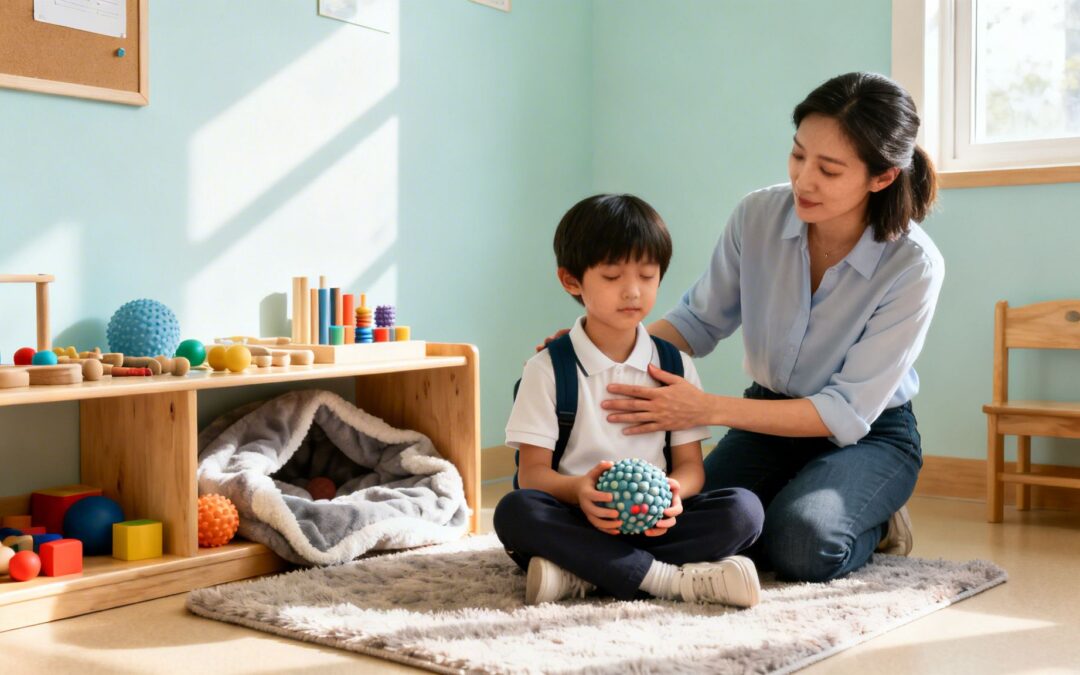
A calm-down kit isn’t just a box of toys to distract a child. It’s a hand-picked collection of items designed to provide specific sensory input that actively de-escalates stress. Research backs this up, showing that tactile (touch) and proprioceptive (deep pressure) input have a significant calming effect on the nervous system.
You don’t need to spend a fortune on fancy gadgets. Honestly, some of the most effective items are things you probably already have, or can find at a local dollar store. The whole point is to offer a variety of textures, weights, and even smells that a child can turn to when their world feels a little too loud.
Here are a few powerful, low-cost ideas to get your kit started:
For Touch: A scrap of faux fur, a smooth river stone, a small sequin pillow, or different fabric swatches like velvet, corduroy, and silk.
For Pressure: A weighted lap pad (easy to make with a pouch of rice or dried beans), a perfectly squishy stress ball, or some therapy putty.
For Scent: Scented putty or play-doh with calming smells like lavender or chamomile. Even peppermint can be great for helping a child refocus their attention.
Co-Creating the Kit With Your Child
This is the most important part: build the toolkit with your child. When they get to choose what goes inside, they develop a sense of ownership over the tools and are far more likely to actually use them.
Find a calm, quiet moment to sit down together. Explain the kit’s purpose in a way they’ll understand. A parent might say, “Remember how your body feels when you get really frustrated? Let’s make a special box of things that can help your body feel calm and safe again.” A teacher could say, “Our classroom is a team. Let’s build a ‘Peace Corner’ with tools anyone can use when they need a quiet moment to reset.”
When a child co-creates their own sensory toolkit, they are not just picking out items; they are practicing self-awareness. They learn to identify what truly helps them feel better, turning a box of objects into a powerful symbol of their own competence and control.
For instance, a third-grader feeling anxious before a spelling test might pull out their peppermint-scented putty. The act of kneading it provides calming deep pressure to their hands, while the focusing scent helps clear their mind. To effectively build a robust sensory toolkit, it’s beneficial to consider specific best toys for sensory seekers that cater to varied sensory needs, providing targeted input for calming and focus.
Practical Examples in Action
Let’s look at how this plays out in the real world. These scenarios show how a simple toolkit can be woven right into a child’s day.
Example 1: A Kindergartener After a Loud Assembly
Scenario: Leo comes back from a noisy all-school assembly feeling jittery and overstimulated. He’s having a hard time settling down for quiet reading.
Tool: His teacher quietly guides him to the classroom’s “calm-down corner,” where he has his own small sensory box. He picks out a small, weighted lizard to place on his lap.
Outcome: The gentle pressure from the weighted animal helps ground him. That simple, physical sensation gives his nervous system the input it needs to settle down. In just a few minutes, he’s ready to rejoin the group.
Example 2: A Middle Schooler After a Disagreement
Scenario: Maya, a seventh-grader, has a small argument with a friend at lunch and comes home feeling upset and withdrawn.
Tool: Instead of pushing her to talk, her parent reminds her about the “chill out” basket they created together. Maya grabs a soft fleece blanket and her sketchbook.
Outcome: She wraps herself tightly in the blanket, giving herself a comforting, cocoon-like hug. She then spends 10 minutes doodling, which lets her process her feelings without having to find the words. This is a fantastic example of using established self-regulation strategies for students in a personal and meaningful way.
Mindful Movements and Breathing You Can Teach Today
While sensory tools are fantastic for grounding, some of the most powerful self-soothing strategies don’t come in a box. When we teach children how to use their own breath and body, we give them a toolkit they can carry anywhere, for life.
This isn’t just about telling a kid to “take a deep breath.” These are engaging, memorable activities designed to interrupt the stress cycle and return a child’s sense of control. Mastering this skill is at the heart of learning how to self soothe.
Breathing Exercises With Kid-Friendly Scripts
The goal is to make breathing feel less like a chore and more like a superpower. Using simple, playful scripts helps kids connect with the practice and, more importantly, remember it when they need it most.
Here are a few of my go-to’s that work wonders in both classrooms and homes.
1. Balloon Breaths This one is perfect for helping kids visualize their breath and slow down, which is incredibly helpful for taming anxiety.
The Script: “Pretend your belly is a big balloon. Put your hands right on your tummy. As you breathe in slowly through your nose, feel that balloon get bigger and bigger. Now, breathe out slowly through your mouth, letting all the air whoosh out as your balloon deflates.”
Practical Scenario: A parent sees their fourth-grader getting frustrated over a tough math problem. They might say, “Hey, let’s pause and do three Balloon Breaths to give our brains a mini-break.” This shifts the moment from struggle to proactive self-care.
2. Dragon Breaths This is the one I pull out for releasing frustration or big, pent-up energy. It encourages a strong, cleansing exhale.
The Script: “Sit up tall like a mighty dragon. Take a giant breath in through your nose, filling up your whole belly. Now, open your mouth wide and breathe out a powerful, fiery breath—whoosh!—to get all that mad energy out.”
Practical Scenario: After a disagreement on the playground, a teacher sees a student stomping back to class. Instead of scolding, they can get down on the child’s level and say, “I see some fiery feelings in you. Let’s be dragons together and breathe that fire out.”
3. Box Breathing (or Square Breathing) This technique is excellent for older kids (grades 3–8) because it introduces rhythm and focus. It involves tracing a square in the air or on their leg to pace the breath.
The Script: “Let’s draw a square with our breath. Using your finger, trace one side up as you breathe in for four counts. Hold your breath for four counts as you trace the line across the top. Breathe out for four counts as you trace down the other side. And hold your breath for four counts as you trace the bottom to finish the square.”
Practical Scenario: A middle schooler is visibly nervous before a presentation. A counselor could quietly guide them: “Let’s do some Square Breathing at your desk. No one even has to know. Just trace the square on your notebook.”
Mindful breathing activates the parasympathetic nervous system—the body’s natural “rest and digest” mode. By intentionally slowing their breath, children can lower their heart rate and signal to their brain that they are safe, effectively short-circuiting an anxious response.
Mindful Movements to Reset and Refocus
Sometimes, a child’s body just needs to move to let go of tension. These simple stretches can be done right at a desk or in a small space, making them perfect for classroom transitions or quick resets at home.
Starfish Stretches This full-body stretch is a fantastic way to wake up the body and release tension after sitting for a while.
How to Do It: “Stand up and reach your arms and legs out as wide as you can, like a big starfish! Stretch your fingers and toes. Now, curl into a tiny, tight ball. Let’s do it again—big starfish stretch, then tiny ball.”
Practical Scenario: A teacher notices the class energy is getting chaotic after a loud assembly. They can announce, “Okay, everyone, on your feet! Let’s do three big Starfish Stretches to help our bodies feel calm and ready for our next activity.” It gives students a physical outlet and instantly resets the room’s atmosphere.
Teaching these techniques is a vital step in helping kids build their emotional regulation skills, but it’s just one piece of the puzzle. The need for these practices is wider than you might think. For instance, a 2023 Safer Society survey found that while 74% of people have a daily self-care practice, 80% still report high burnout. More telling for us, 45% of respondents reported high stress in the prior six months. You can read the full research about these findings to see how stress is affecting people of all ages.
You don’t need fancy programs or complex exercises to teach a child how to self-soothe. In fact, some of the most powerful strategies are probably already happening in your home or classroom. The key is to turn these everyday activities into intentional tools for emotional regulation.
It’s all about helping a child connect the dots. When we guide them to see why listening to a certain song or doodling in a notebook makes them feel better, we’re handing them the keys. They move from just passively distracting themselves to mindfully managing their inner world.
Turn Passive Habits Into Active Soothing
Many activities kids already gravitate toward are, at their core, a form of self-regulation. Our job is to help them recognize this and use these habits on purpose. Instead of just seeing screen time or hobbies as “downtime,” we can frame them as real and valid self-care tools.
This isn’t just a hunch; it’s how kids are already coping. A 2023 survey revealed that 93% of youth use self-care to manage their emotions. The most common methods? Listening to music (72%), watching movies or TV (53%), and playing video games (47%). You can dive into the full breakdown of these powerful self-care findings to see just how central these activities are to their well-being.
By validating these existing habits, we remove the shame that can sometimes come with them. We send a clear message: “What you’re doing to feel better isn’t just okay—it’s a skill. Let’s get good at using it when you need it most.”
This shift in perspective is everything. It helps kids build a personalized menu of calming options that feel genuine and easy to reach for, boosting their confidence to handle whatever comes their way.
Create a “Calm-Down Playlist”
Music has a direct line to the emotional centers of the brain. The right song can shift a child’s mood, slow their heart rate, and give them a much-needed mental break. Building a “Calm-Down Playlist” with a child is a fantastic collaborative exercise.
For the Classroom: During a quiet moment, ask students to share one song that helps them feel calm or happy. Compile them into a class playlist to use during independent work, tricky transitions, or after a high-energy gym class.
For Home: Sit down with your child and explore different kinds of music. Try instrumental tracks, nature sounds, or even their favorite gentle pop songs. Ask them how each one makes their body feel. Does it make them want to tap their feet or relax their shoulders?
Practical Example: A fifth-grade teacher sees his class is getting antsy before a math test. He says, “Okay team, let’s put on our calm-down playlist for five minutes while we get our pencils ready.” A quiet, instrumental track comes on, and without him saying another word, the energy in the room visibly settles.
Set Up a “Doodle Corner” for Quiet Expression
Drawing, doodling, and coloring aren’t just for art class—they’re forms of non-verbal processing. For a child who can’t find the words for their big feelings, a pen and paper can be a lifeline. It gives them a way to get frustration or sadness out without having to talk about it.
In the Classroom: Designate a small, cozy area with paper, colored pencils, and markers. Frame it as a spot to “draw your feelings out” or to “give your brain a quiet break.”
At Home: Keep a “doodle basket” with sketchbooks and art supplies somewhere easy to grab. When you see your child is upset, you can suggest, “It looks like you have some big feelings right now. Do you want to go doodle them out in your book for a bit?”
Practical Example: An eight-year-old is fuming after an argument with her brother. She stomps off and grabs her sketchbook. She starts by furiously drawing dark, scribbly storm clouds. After a few minutes, she begins adding little sunbeams peeking through. The act of drawing helps her process the anger and move through it on her own terms.
Adapting Strategies for Different Ages and Needs
What works for a five-year-old won’t fly with a fifth-grader. The journey to learning how to self-soothe isn’t a one-size-fits-all path. What brings comfort to a six-year-old might feel silly or even embarrassing for a thirteen-year-old, so adapting our strategies is key.
As kids grow, their worlds expand. Their ability to think abstractly, understand their own feelings, and connect with others deepens. This means our approach has to evolve right alongside them, shifting from purely sensory methods for our youngest learners to more cognitive and relational tools for older students.
Kindergarten to Second Grade: Concrete Comfort
For kids in K-2, the world is very literal and hands-on. Their emotional regulation is deeply tied to their senses and what their bodies are experiencing. When big feelings hit, they need concrete, physical actions to feel safe and grounded again.
Self-soothing strategies at this age should be simple, easy to remember, and focused on the body.
Hugging a Stuffed Animal: The gentle pressure and soft texture offer immediate comfort. Practical Example: A first-grader feels sad after a playground squabble and the teacher allows them to get the classroom’s “feel-better bear” from the calm-down corner to hold at their desk for a few minutes.
Using a Weighted Lap Pad: During quiet reading, a child who feels wiggly and overstimulated can place a small weighted pad on their lap. That deep pressure sends calming signals straight to the nervous system.
Looking at a Calm-Down Jar: A glitter jar is a perfect visual anchor. Practical Example: A kindergartener is upset about their parent leaving at drop-off. The teacher can sit with them for a moment, shake the glitter jar, and say, “Let’s watch all the glitter settle. By the time it’s calm, our hearts might feel a little calmer, too.”
The goal here is to move from co-regulation to self-regulation. We start by modeling the soothing action with them—hugging them, breathing deeply beside them—and then guide them to use a physical tool on their own, like their favorite stuffed animal.
These early skills are incredibly important. Research shows that a child’s ability to self-soothe grows dramatically even in the first year of life, jumping from just 27.55% at one month to 46.39% by twelve months. This early development, often supported by comfort objects, helps build lifelong emotional health. You can learn more about how these foundational soothing skills develop and why they matter for a child’s future.
Third to Fifth Grade: Building a Bridge to Self-Awareness
Students in upper elementary are in a fascinating transition. They still absolutely benefit from sensory strategies, but they’re also starting to develop the ability to use more internal, cognitive techniques. They can actually think about their feelings and begin using simple self-talk.
This is the perfect age to connect concrete actions with their growing self-awareness.
Drawing or Journaling: A fourth-grader who’s frustrated with a tough math problem can be encouraged to “draw their frustration” or write down three angry words. This gets the feeling out without needing a complex conversation.
Using a Fidget Tool Discreetly: A fidget spinner or therapy putty can be used under a desk to manage pre-test jitters. It gives them quiet sensory input that helps focus the mind without distracting anyone else.
Listening to a Short Guided Meditation:Practical Example: A teacher can have students put their heads down for three minutes before a test and play a short audio clip: “Imagine a calm, blue light filling up your body, from your toes to your head, making you feel peaceful and focused.”
Sixth to Eighth Grade: Thinking and Connecting to Calm Down
By middle school, students are swimming in a sea of complex social dynamics and higher academic stakes. A squishy ball might still have its place, but they need more sophisticated tools that respect their growing independence and need for privacy.
The focus naturally shifts to internal self-talk and trusted peer connections.
Practicing Positive Self-Talk: A student who bombed a quiz can be taught to reframe their thoughts. Practical Example: A parent can model this by saying, “I’m so frustrated I burned dinner! Okay, deep breath. It’s not the end of the world. Let’s order a pizza and I’ll try that recipe again tomorrow.” This shows the student how to talk themselves through a mistake.
Creating a Calming Music Playlist: Music is a huge mood regulator for this age. An eighth-grader overwhelmed by social drama can put on their headphones and tune into a pre-made “chill” playlist, creating a personal bubble of calm.
Relational Soothing: Encourage them to reach out to a trusted friend. Practical Example: A teacher might notice a student is upset and say, “It looks like you’re having a hard time. Would you feel better if you took five minutes to talk with Sarah in the hallway?” This validates peer support as a healthy coping strategy.
When Self-Soothing Is Not Enough
Self-soothing skills are powerful tools, but they have their limits. It’s just as important to teach a child how to calm down as it is to recognize when their distress is bigger than what a coping strategy can solve.
These techniques are designed to help a child through temporary, manageable upsets. They aren’t a fix for chronic anxiety, deep-seated sadness, or overwhelming emotional pain. Knowing the difference is a critical part of supporting them effectively.
So, how can you tell when a child has moved beyond needing a calming corner and requires more specialized help? There are several clear indicators to watch for.
Red Flags to Monitor
Keep an eye out for persistent shifts in a child’s behavior, mood, or school performance. We’re not talking about a few off days, but consistent patterns that don’t get better even when they use their go-to soothing strategies.
Here are a few key signs that a higher level of care might be needed:
Significant School Changes: This could be a sudden or steady drop in grades, a consistent refusal to go to school, or frequent complaints of feeling sick without any clear physical cause. Example: A student who used to love math now complains of stomachaches every day before math class.
Extreme Emotional Outbursts: Look for meltdowns or tantrums that are far more intense or frequent than what’s typical for their age. This is especially concerning if they involve aggression, self-harm, or destroying property. Example: A ten-year-old throws a chair when asked to do their homework, a behavior that is new and extreme.
Persistent Withdrawal: You might notice them regularly pulling away from friends, family, and activities they used to love. Maybe they’re spending a lot more time alone in their room and seem disconnected. Example: A usually social teen stops answering texts from friends and quits the soccer team without explanation.
This decision tree infographic is a great starting point, outlining age-specific self-soothing strategies that can help you respond to a child’s needs.
Think of it as your first line of defense. The visual shows how to match techniques to a child’s developmental stage, but if you’ve tried these and things aren’t improving, it’s a clear signal to look further.
Reaching out for professional help is not a failure—it is a proactive and courageous act of care. It means you are expanding the child’s circle of support, bringing in partners who have specialized tools to help.
If you’re seeing these red flags, the first step is to document your observations. Make a few notes on the frequency, intensity, and context of the behavior.
Then, it’s time to start a conversation with the right people. At school, that might be the school counselor or psychologist. For parents, it’s about calmly sharing what you’ve noticed and suggesting you work together to find more support. You can also explore additional anxiety coping skills for kids to continue building out your toolkit.
Common Questions About Teaching Self-Soothing
As you start teaching and modeling self-soothing, it’s completely natural for questions to pop up. This is a nuanced skill, and every child’s journey will look a little different. Let’s walk through some of the most common questions we hear from parents and educators.
One of the first things everyone wants to know is, “How long will this take?” The honest answer is, there’s no set timeline. Self-soothing isn’t a single lesson you teach once; it’s an ongoing process. It takes a tremendous amount of patience and, more than anything, consistent modeling from the trusted adults in a child’s life.
What If My Child Resists?
Another big one we hear is, “What if my child refuses to use the calming corner?” Resistance like this is often a signal that the child needs more ownership of the space and the process.
This is a time to sidestep a power struggle. Instead, co-create the space and choose the tools with them. When a child has a hand in picking out that super-soft blanket or the perfect squishy stress ball, they’re much more likely to see it as their own helpful resource, not a time-out spot.
The goal is to build independence, not create another point of conflict. If a tool isn’t working, it’s not a failure on the child’s part. It’s simply a sign that you need to explore different strategies together.
Here are a few other common questions we get, along with some quick thoughts:
Can a middle schooler learn to self-soothe if they never have before? Absolutely. For older kids and tweens, you’ll want to focus on more mature strategies. Think about things like journaling, creating calming music playlists, or practicing positive self-talk. It is never too late to start building these essential life skills.
How do I balance letting my child self-soothe with giving them comfort? This is where co-regulation becomes your best friend. The process often starts with you soothing with them. For example, you might sit next to an upset child, rub their back, and do deep breaths with them. As you feel their body and breath start to calm, you can gradually step back a little, allowing them to take over by saying, “You’re doing a great job calming your body. Keep it up.” This teaches them they aren’t alone while building their own capacity for independence.
At Soul Shoppe, we believe that providing students with these essential emotional tools creates safer, more connected school communities. We have spent over 20 years developing research-based programs that empower children to manage their emotions and build empathy. Discover how our on-site and digital programs can support your students.
Think of it as the process of learning how to be human—how to understand our own big feelings, get along with other people, and make choices we can be proud of. It’s the essential toolkit kids build over time that helps them navigate the world successfully. This isn’t just about being “nice”; it’s the foundation for everything from acing a math test to bouncing back from a tough day.
Understanding Social Emotional Development
Imagine a child building a house. Their academic skills—like reading and math—are the blueprints and the raw materials. But their social-emotional skills? Those are the actual tools. Without a solid hammer, a level, and a tape measure, even the best blueprints won’t result in a sturdy, reliable structure.
This development is what’s happening beneath the surface. It’s the internal compass that guides a child through playground disagreements, the focus needed for a group project, and the empathy required to celebrate a friend’s victory instead of feeling jealous.
The Five Core Building Blocks
Social emotional development really boils down to five interconnected skills. These aren’t just abstract ideas; they are practical, everyday abilities that kids use constantly. Let’s break down what they actually look like.
A great way to visualize these skills is to think of them as the five essential pillars holding up a child’s well-being and success.
The Five Pillars of Social Emotional Development
Core Skill
What It Looks Like in a Child
Self-Awareness
Recognizing, “I feel frustrated right now because this puzzle is hard.”
Self-Management
Taking three deep breaths when feeling angry instead of yelling or stomping.
Social Awareness
Noticing a classmate is sad and asking if they’re okay.
Relationship Skills
Listening to a friend’s idea and finding a way to work together.
Responsible Decision-Making
Choosing to tell a teacher about bullying instead of just watching.
Each of these pillars supports the others, creating a strong, resilient, and well-rounded person.
It’s so important to remember that these skills aren’t something kids are just born with. They are learned and practiced, day in and day out, through interactions with parents, teachers, and friends—just like learning to read or ride a bike.
Ultimately, these five competencies work together to help a child not just succeed in school, but thrive in life. To see how these skills connect and build on one another, you can dive deeper into the five core SEL competencies explained in our detailed guide. If you’re interested in the science and theory behind this, you can explore psychology resources to get a broader academic perspective.
The Real-World Payoff of Strong Social Emotional Skills
So we understand the building blocks of social emotional development, but let’s get to the question every parent and teacher asks: Why does this actually matter?
The answer is simple. These aren’t just feel-good, abstract concepts. They have a massive, tangible impact on a child’s everyday life—at school, at home, and for years to come. Think of these skills less as “soft skills” and more as a direct investment in a child’s academic success, mental health, and their ability to be a good human being in a complex world.
Better Learning and Academic Performance
An emotionally regulated child is a child who is ready to learn. It’s really that straightforward.
Picture a student staring down a tough math problem. Without the right emotional tools, frustration can quickly boil over, leading to a total shutdown. That moment doesn’t just halt their own learning; it can disrupt the entire classroom.
Now, imagine a different student. They feel that same frustration bubbling up, but they have the skills to recognize it, take a deep breath, and ask for help instead of giving up. That single skill—self-regulation—is directly tied to better focus, stronger memory, and higher grades. When a child isn’t hijacked by their emotions, their brain is free to do its real job: absorbing new ideas and solving problems.
Key Takeaway: Emotional regulation isn’t separate from academics—it’s the foundation that makes deep learning possible. A calm, focused mind is a learning mind.
The research on this is overwhelming. One landmark meta-analysis looked at 424 different studies covering over 500,000 students. The conclusion was clear: students in social emotional learning programs consistently showed improved social skills, better attitudes about school, and stronger academic performance than their peers.
Safer Classrooms and Fewer Conflicts
At its heart, social emotional learning is the ultimate antidote to bullying and daily classroom drama. When kids develop empathy and social awareness, they learn to step into someone else’s shoes. That ability is an absolute game-changer on the playground.
Practical Examples:
A child with empathy will be the one to spot a classmate sitting alone and invite them to play.
A child with strong relationship skills can disagree about the rules of a game without it turning into a screaming match. For instance, they might say, “How about we try my way this time, and your way next time?”
A child who can make responsible decisions will be more likely to stand up for a peer who is being treated unkindly by telling a trusted adult.
These skills transform a room full of individuals into a supportive, collaborative community where students feel safe enough to be themselves. And when conflicts inevitably pop up, kids have the tools to solve them peacefully. They learn to use “I feel” statements instead of fists or hurtful words. The importance of these skills is huge, because they create a positive school climate where everyone can actually thrive.
Building Lifelong Resilience and Mental Health
Maybe the most profound benefit of social emotional learning is its long-term impact on a child’s mental well-being. These skills are a child’s first line of defense against life’s inevitable curveballs, building a resilient mindset that will serve them long into adulthood.
Practical Examples:
Managing Anxiety: A child who learns to identify and manage their anxiety is better equipped to handle the stress of a big test. They might use a calming technique like deep breathing or positive self-talk before the test begins.
Navigating Peer Pressure: A teenager who has practiced responsible decision-making has a stronger compass for navigating social situations. They might have a pre-planned response for when a friend offers them a vape, like “No thanks, I’m not into that.”
By giving children a vocabulary for their feelings and practical strategies to cope with them, we’re essentially handing them a protective shield against future mental health struggles. This isn’t about trying to prevent kids from ever feeling sad, angry, or scared. It’s about teaching them how to move through those feelings constructively, building a quiet confidence and a strong sense of self along the way.
Social Emotional Milestones for K–8 Students
Just like kids learn to crawl before they walk and sound out letters before they read a whole book, their social and emotional skills grow in predictable stages. Understanding these developmental milestones helps us—whether we’re parents or teachers—give the right kind of support at the right time. It’s all about celebrating their progress and spotting where a child might need a little extra help.
Social emotional development isn’t a race. It’s a journey, and what we look for in a kindergartener is worlds away from what we expect from a middle schooler. A five-year-old who can simply name their feeling as “sad” is right on track, while an eighth-grader is learning to navigate much more complex social currents.
Each stage builds on the last, creating a foundation for the next level of emotional intelligence and social skill.
As you can see, the journey starts with very concrete skills and blossoms into the more abstract thinking needed to manage relationships and personal choices as kids get older.
A Parent’s Guide to Social Emotional Milestones
Watching a child grow socially and emotionally can feel like a mystery. What’s typical for a 7-year-old versus a 12-year-old? This table breaks down what you can generally expect to see at each stage, along with some gentle flags that a child might need a bit more guidance or support.
Age Group
Typical Milestones to Look For
Signs a Child May Need Support
K–2nd Grade (Ages 5–7)
Can name basic emotions (happy, sad, mad). Begins to share and take turns. Shows simple empathy, like hugging a sad friend. Follows two-step directions in a game.
Frequently grabs toys or has trouble waiting for a turn. Can’t name any feelings or seems disconnected from them. Struggles to play with others without constant conflict.
3rd–5th Grade (Ages 8–10)
Develops more complex friendships and can resolve minor disagreements. Understands others’ perspectives better. Can handle losing a game without a major meltdown. Starts working well in group projects.
Has difficulty keeping friends or is often in conflict. Regularly blames others for their problems. Seems unable to cope with small disappointments. Struggles to see things from another’s point of view.
6th–8th Grade (Ages 11–14)
Navigates peer pressure and begins to make responsible choices. Develops a stronger sense of personal identity and values. Shows deeper empathy for others’ experiences. Can articulate their own needs and set boundaries.
Is easily swayed by peers or engages in risky behavior to fit in. Seems to have a very low sense of self-worth. Is consistently unkind or dismissive of others’ feelings. Has trouble managing online social interactions.
Remember, every child develops at their own pace. This guide is here to offer context, not to create worry. It’s about being aware and ready to help them build the skills they need for the road ahead.
Early Elementary (Kindergarten – 2nd Grade)
This is where it all begins. In these early years, children are learning the absolute fundamentals of social life and emotional awareness. Their world is still very much centered around themselves, and the idea that other people have different thoughts and feelings is a brand-new concept.
The main job here is learning to identify feelings in simple terms and follow basic social rules. Things we take for granted, like sharing a coveted toy or waiting in line, are monumental tasks that require immense self-control for a six-year-old.
What to Look For (Practical Examples):
Identifying Basic Feelings: They can say, “I’m sad because you took my toy,” or “I’m happy we’re playing.”
Following Simple Rules: During a classroom game like “Simon Says,” they can follow two- or three-step directions.
Taking Turns: A student can wait for their turn in a board game, even if they’re bursting with excitement.
Showing Simple Empathy: They might try to comfort a crying friend by offering a hug or a favorite stuffed animal.
Upper Elementary (3rd – 5th Grade)
As kids hit the upper elementary grades, their social lives get a lot more complicated. Friendships aren’t just about who has the best toys anymore; they’re now built on loyalty, inside jokes, and learning how to work through disagreements.
At this stage, children are developing a much stronger capacity for empathy. They’re getting better at putting themselves in someone else’s shoes and learning to manage trickier emotions like frustration, disappointment, and jealousy.
What to Look For (Practical Examples):
Navigating Complex Friendships: A child can work through an argument with a friend without needing an adult to step in every time. They might use a compromise, like “Let’s play your game for 10 minutes, then my game for 10 minutes.”
Managing Disappointment: They can lose a game at recess and, while they might feel bummed, they can still shake hands with the other team.
Developing Empathy: They might notice a classmate is being left out and go out of their way to invite them to join the group.
Working Cooperatively: Students can actually collaborate on a group project, listening to others’ ideas and sharing their own.
Middle School (6th – 8th Grade)
Welcome to middle school, where everything shifts. The influence of friends often becomes the most powerful force in a child’s life, and the focus turns to fitting in and figuring out their own identity. It’s a messy, beautiful, and critical time.
This is when a stronger sense of self really starts to form. Kids are learning to make responsible choices on their own and handle the intense pressures of both online and real-world social dynamics. Because their brains can now think more abstractly, they’re able to consider the long-term consequences of their actions.
If you’re looking for ways to support this age group, exploring different social-emotional learning activities can provide some great, practical ideas.
What to Look For (Practical Examples):
Handling Peer Influence: A student can say “no” when a friend is pressuring them to do something they know isn’t right, like skipping a class.
Developing a Sense of Self: They can talk about their own values and interests, even if they’re different from what’s popular, like preferring to read a book instead of going to a party.
Making Responsible Choices: A student finds a lost phone on the bus and decides to turn it in to the driver instead of keeping it.
Showing Advanced Empathy: They can understand and show compassion for someone whose life is very different from their own, perhaps after reading a book or watching a documentary about another culture.
Actionable Ways to Nurture Social Emotional Growth
Knowing the milestones of social emotional development is one thing, but actively nurturing those skills is where the real work begins. This is where theory meets practice.
The good news for parents and teachers? Supporting this growth doesn’t require a special curriculum or expensive tools. It’s all about weaving intentional practices into the everyday moments you already share with children, turning daily routines into powerful learning opportunities.
These strategies are designed to be simple and effective, easy to slip into a busy classroom or a bustling home. By being active coaches in a child’s emotional journey, we can give them the scaffolding they need to build self-awareness, manage their feelings, and connect meaningfully with others.
Fostering Self-Awareness: The Ability to See Within
Before a child can manage an emotion, they have to be able to recognize and name it. Think of self-awareness as the bedrock skill of what is social emotional development—it’s their internal compass. The goal is to give kids a rich vocabulary for their feelings that goes far beyond just “happy” or “mad.”
Practical Examples:
Create a Feelings Wheel: In the classroom or at home, a simple chart with faces showing a range of emotions (proud, frustrated, worried, excited) works wonders. During a check-in, a child can just point to the face that matches how they feel. It’s a low-pressure way to communicate what’s going on inside.
Start a Simple Journaling Practice: For older elementary or middle school students, a “one-sentence journal” can be a powerful tool. Each day, they write just one sentence about how they felt and why. This small habit builds the muscle of self-reflection over time.
Narrate Emotions Out Loud: Model this for them. You might say, “I’m feeling a little frustrated because I can’t find my keys, and it’s making my shoulders feel tight.” This shows them that everyone has feelings and demonstrates how to connect an emotion to a physical sensation and a cause.
Building Self-Management: The Power to Regulate
Once a child can name their feeling, the next step is learning what to do with it. Self-management is all about developing the skills to handle stress, control impulses, and push through challenges. It’s the difference between a frustration-fueled meltdown and taking a moment to reset.
Key Insight: The goal isn’t to suppress or get rid of big feelings. It’s to teach children how to navigate them constructively without causing harm to themselves or others.
One of the most effective ways to do this is by creating a dedicated space and teaching specific calming techniques they can turn to.
Practical Examples:
Design a Calm-Down Corner: This isn’t a “time-out” spot. It’s a safe, cozy space a child can choose to go to when they feel overwhelmed. Stock it with sensory items like a soft blanket, a squishy ball, or a coloring book. This empowers them to take charge of their own regulation.
Teach “Box Breathing”: For older students dealing with test anxiety or social stress, this simple technique is a game-changer. Guide them to breathe in for a count of four, hold for four, exhale for four, and pause for four, visualizing a box in their mind. It’s a discreet tool they can use anywhere.
Use “If-Then” Plans: Help kids prepare for tough situations ahead of time. For example, “If I start to feel angry during the game, then I will go get a drink of water and do three box breaths.” This proactive approach gives them a clear action plan instead of leaving them to react in the heat of the moment.
Developing Strong Relationship Skills
Social emotional development really flourishes in our connections with others. Relationship skills cover everything from clear communication and active listening to cooperation and peaceful conflict resolution. These are the skills essential for making friends, working in groups, and just being part of a community.
A core piece of this is teaching children how to express their needs and feelings without blaming others. Learning to use “I feel” statements is a foundational communication skill that can stop countless conflicts from escalating.
Practical Examples:
Role-Play Difficult Conversations: Practice really does help. Set up a scenario, like a friend who keeps cutting in line. Help the child practice saying, “I feel frustrated when you cut in front of me because it doesn’t feel fair. I need you to wait for your turn.” Role-playing in a calm moment builds the confidence they need for real-life situations.
Practice Active Listening: In a conversation, challenge kids to repeat back what they heard the other person say before sharing their own opinion. Something as simple as, “So what I hear you saying is…” fosters genuine understanding and empathy.
Assign Collaborative Projects: Give kids tasks that require teamwork, whether it’s building a LEGO tower at home or finishing a group report at school. Afterward, debrief with them: “What went well? What was hard about working together? What would you do differently next time?”
By focusing on these actionable strategies, you can transform your home or classroom into a space where children feel seen, understood, and equipped with the tools they need to thrive. For more ideas, check out these engaging emotional intelligence activities for kids that you can start using today.
Why Social Emotional Skills Are a Global Priority
The conversation around social-emotional development isn’t just happening in local school districts—it’s a worldwide educational movement. Countries all over the globe are waking up to a fundamental truth: if we want to prepare students for the future, we have to teach them how to be resilient, collaborative, and empathetic human beings.
This global shift is being driven by a clear-eyed look at what the future actually requires. Tomorrow’s workplaces and communities won’t be defined by academic knowledge alone. Success will hinge on the ability to communicate across differences, solve messy problems together, and adapt to constant change. These aren’t ‘soft skills’; they are essential survival skills for a deeply interconnected world.
A New Definition of School Readiness
For decades, the main yardstick for a school’s success was academic readiness. But today, global education leaders understand that a child’s ability to manage their emotions and work well with others is just as critical. This shift paints a much more complete picture of what it means to be an educated, well-rounded person.
Investing in social-emotional learning is now seen as a core part of a nation’s long-term health and success. And this isn’t just a K-12 thing; the ongoing development of these skills is crucial for lifelong learning. We see this in professional settings, like in various Community of Practice examples where people work together to sharpen their abilities through shared experiences. That collaborative spirit is exactly what we’re trying to build in our schools.
Responding to a Worldwide Need
International research confirms just how urgent this work is. The OECD’s Survey on Social and Emotional Skills (SSES) is the largest global effort to track these competencies, and its findings have been a wake-up call. The data shows that students’ social and emotional skills often take a nosedive as they hit adolescence.
Even more concerning, the survey reveals significant gaps between children from different socioeconomic backgrounds, highlighting a global inequity in who gets access to quality social-emotional support. You can discover more about the OECD’s global findings on social and emotional learning.
For school leaders, this global perspective makes a powerful case for investing in social-emotional programs. It’s not just about improving classroom behavior. It’s about aligning with international best practices and giving every single student the tools they need to thrive in a complex, globalized future.
Key Insight: Prioritizing social emotional development is a strategy for building stronger, kinder, and more innovative societies. It ensures students are prepared not just for a test, but for the test of life.
This global consensus sends a clear message. When we teach a child how to understand their feelings or resolve a conflict peacefully, we are doing so much more than just helping one student. We are contributing to a more compassionate and competent future generation—one that’s capable of tackling challenges we can’t yet even imagine.
How Soul Shoppe Programs Create Positive School Climates
Understanding the theory behind social-emotional development is one thing. But for schools, the real question is: How do you bring it to life in a way that actually sticks? This is where a structured, school-wide system makes all the difference. Instead of leaving SEL to chance, dedicated programs can transform a school’s entire climate.
Soul Shoppe helps schools move from the ‘what’ to the ‘how’ with a hands-on, practical approach. We focus on building skills through direct experience, not just lectures. Our interactive assemblies and in-class workshops make learning engaging and memorable for students from kindergarten all the way through middle school.
Making Skills Usable and Visible
The goal is to give students tools they can use the moment they walk out of the workshop. We don’t just talk about abstract ideas like “conflict resolution”; we give them a shared vocabulary and tangible strategies they can apply on the playground, in the cafeteria, and at home.
For example, students learn specific techniques to manage frustration or respectfully disagree with a friend. This creates a common language across the entire school, so everyone is on the same page.
Practical tools students learn include:
The “I-Message” Formula: A simple, non-blaming way to express feelings and needs. Think, “I feel frustrated when I’m interrupted because my idea is important to me,” instead of “You always cut me off!”
Peace Path for Conflict Resolution: This is a step-by-step physical guide—often painted right on the playground—that students can literally walk through to solve problems peacefully on their own.
“Stop, Walk, and Talk”: A clear, three-step process for handling minor conflicts before they escalate. It empowers students to take ownership of their interactions.
Empowering Teachers and Staff
A positive school climate isn’t built by students alone. It takes every single adult on campus actively modeling and participating. That’s why our programs also focus heavily on empowering teachers, administrators, and staff.
We provide practical training and ongoing resources that give educators the confidence to reinforce these skills consistently. This approach transforms the adults from passive observers into active coaches of social-emotional development.
A school’s culture is shaped by the daily interactions between every person in the building. When staff and students share the same tools and language for empathy and respect, the entire community becomes a safer, more supportive place to learn and grow.
By weaving these practices into the school day, we help create a culture where kindness, respect, and emotional intelligence aren’t just taught—they’re a part of the very fabric of daily life.
Your Questions About Social-Emotional Development, Answered
As social-emotional development becomes a bigger part of the conversation in schools and at home, it’s natural for parents and educators to have questions. This final section gives clear, straightforward answers to some of the most common things people ask as they navigate this important journey with their children.
What if My Child’s School Doesn’t Have an SEL Program?
Don’t worry. If your school doesn’t have a formal program, remember that you are your child’s first and most important teacher when it comes to these skills. The most meaningful learning often happens in the small, everyday moments you share.
Practical Examples You Can Use at Home:
Model Empathy: While watching a show, you could say, “That character looks really sad. I wonder what would make them feel better?” This simple act teaches your child to notice and consider others’ feelings.
Use Dinnertime for ‘Feelings Check-Ins’: Go around the table and share one high point and one low point from the day. This creates a safe, routine space for everyone to talk about emotions like excitement, frustration, or disappointment.
Isn’t This Just Another Term for Soft Skills?
While there’s definitely some overlap, thinking about what is social emotional development is more specific and structured than the general idea of “soft skills.” Modern social-emotional learning uses a research-backed framework—like the five core competencies—that gives educators and parents measurable outcomes to work toward.
It’s not just about being polite. It’s about intentionally teaching skills like emotional regulation and responsible decision-making in a way that can be practiced, tracked, and improved over time.
When Is the Best Age to Start Teaching These Skills?
The answer is simple: it starts from day one. When a parent soothes a crying infant, they are giving the very first lesson in emotional regulation. When a toddler learns to take turns with a toy, they are practicing relationship skills.
Key Takeaway: Social-emotional development begins at birth, but it’s crucial to remember that it’s never too late to start. Whether a child is five or fifteen, they can always build new skills and strengthen their emotional intelligence.
How Can I Tell if My Child Is Making Progress?
Progress isn’t always a straight line, and it won’t show up on a report card. Instead of looking for perfect behavior, watch for the small, observable changes that show your child is starting to use their new tools.
Observable Signs of Progress:
Sharing More Willingly: A child who used to grab toys might start offering to take turns without being prompted.
Handling Disappointment Calmly: After losing a game, they might still express sadness but stop short of yelling or storming off.
Using Feeling Words: You might hear them say, “I feel frustrated right now,” instead of just acting out that frustration.
These small shifts are huge victories. They show that a child is internalizing these critical life skills and building a stronger foundation for whatever comes next.
At Soul Shoppe, we believe every child deserves the tools to navigate their world with kindness and confidence. Our programs bring these essential skills to life, creating school climates where every student can thrive. Learn how Soul Shoppe can support your school community.