
Soul Shoppe's work is made possible by donors and partners who care deeply about the young people in their communities! We can't do this work without you. Support our work in classrooms and on playgrounds across the nation by donating here.
You've launched the lessons. Teachers have introduced calm-down strategies, conflict resolution language, and class circles. A few students are already using the tools. A few aren't. Now the central question shows up in your staff meeting or in the quiet minutes after dismissal.
How do you know whether your SEL work is helping students?
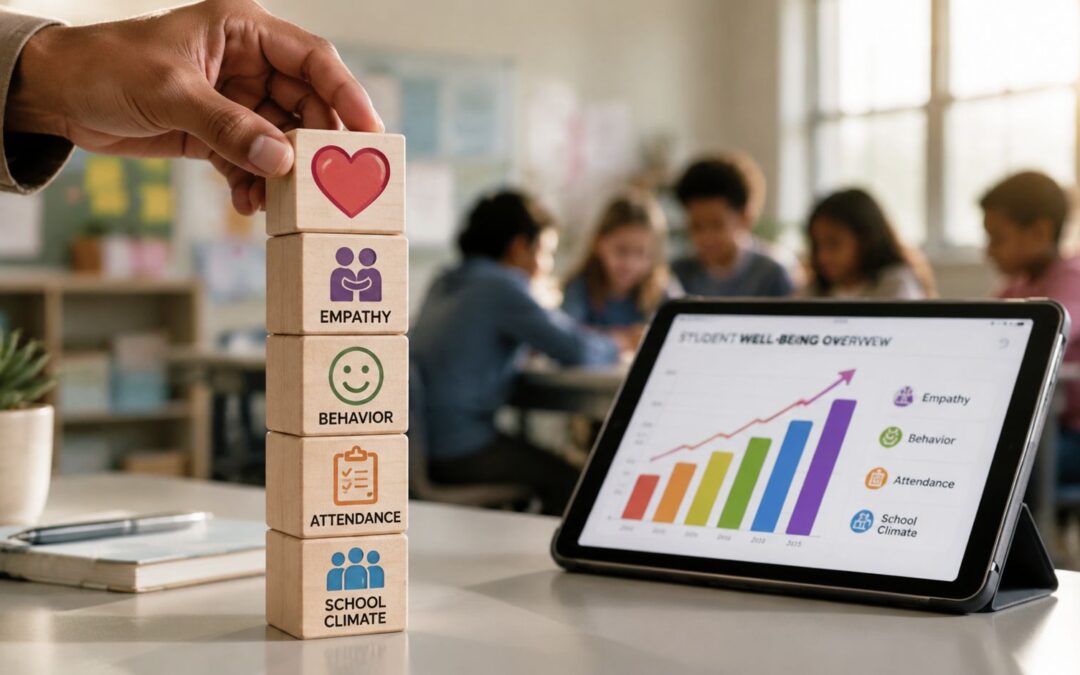
That question can make people tense, because measurement often sounds like compliance. More forms. More spreadsheets. More one-size-fits-all reporting. But good outcome measurement isn't about proving you did something. It's about learning what changed for students, where support is working, and which children still need more care.
When schools approach measurement this way, data stops being a burden and starts becoming a form of listening. It helps a principal notice whether belonging is slipping in one grade level. It helps a teacher see whether a student is using self-regulation tools more often. It helps families and schools talk about the same child with clearer language and less guesswork.
Why Measure SEL Outcomes in Your School
A principal might say, “We trained staff, rolled out lessons, and students liked the assembly. Isn't that enough?” It's a fair question. Activity matters. Effort matters. But neither one tells you whether students feel safer, handle conflict better, or ask for help sooner.
That's where outcome measurement changes the conversation. Instead of asking, “Did we deliver the program?” you ask, “What changed for students because of it?”
Measurement helps you see student impact
In schools, SEL can feel hard to measure because the outcomes are human. A student pauses before reacting. A class starts solving small problems without adult escalation. A child who used to shut down begins naming feelings out loud. These changes are real, but they're easy to miss if no one is looking for them on purpose.
That's why schools need a practical way to notice growth over time.
Good measurement doesn't reduce children to numbers. It gives adults a shared way to notice patterns in children's experience.
A useful SEL measurement process can help you answer questions like these:
Student skills: Are students getting better at recognizing feelings, calming their bodies, or repairing peer conflict?
Classroom patterns: Are teachers seeing fewer disruptions tied to frustration or social misunderstanding?
School climate: Do students report a stronger sense of belonging and emotional safety?
Support needs: Which groups, classrooms, or routines need extra attention?
For families, this also creates more meaningful conversations than vague updates like “SEL is going well.” You can describe what children are practicing and what adults are observing.
If you want a broader picture of why schools invest in this work in the first place, this overview of the benefits of social-emotional learning gives helpful context.
Other fields already treat outcomes seriously
SEL sometimes gets treated as “soft,” but other fields have shown that human experience can be measured with rigor and care. In healthcare, outcome measurement became a major quality-improvement discipline by standardizing and weighting outcome categories. For example, the Centers for Medicare & Medicaid Services assigns 22% weight to patient experience, which shows how seriously healthcare systems treat the human impact of services, as described in this review of healthcare outcome measures and weighting.
Schools can learn from that mindset. Not by turning children into hospital metrics, but by taking student well-being seriously enough to measure it thoughtfully.
From proving to improving
The biggest shift is this: measurement should support improvement.
A school that measures well isn't trying to “catch” teachers or produce a glossy report. It's trying to learn. If one grade level is thriving and another is struggling, you can respond. If one strategy helps students recover from conflict faster, you can spread it. If families aren't participating in surveys, you can redesign the outreach.
That's what makes outcome measurement worth doing. It helps adults make better decisions for kids.
What Outcome Measurement Really Means for SEL
People often mix up outputs and outcomes. In schools, that confusion causes a lot of frustration because teams think they've measured impact when they've only counted activity.
The clearest way to understand outcome measurement is this: it tracks the result of your work, not just the work itself.
Outputs are what you did
Outputs are the visible actions adults can count.
You held classroom lessons. You trained staff. You ran recess circles. You sent home caregiver materials. Those things matter because they show implementation. But they don't answer the deeper question of whether students changed.
Under the U.S. Government Performance and Results Act, outcome measures are defined as an assessment of the results of a program compared to its intended purpose, while output measures are counts of activity. That distinction is explained in the Office of Justice Programs guide to understanding performance measures.
Outcomes are what changed
In SEL, outcomes are the shifts you hope to see in students' skills, behavior, and lived experience.
A few examples make this easier:
What you count
What you want to know
Teachers taught weekly SEL lessons
Students are more likely to use calming strategies during frustration
The school hosted peer conflict workshops
Students resolve disagreements with less adult intervention
Families received home connection activities
Caregivers hear students using feeling words more often at home
Think about a fitness plan. An output is going to the gym three times a week. An outcome is building stamina, lowering stress, or being able to walk up stairs without getting winded. The activity creates the possibility of change, but it isn't the same as change.
That's the same in a school. A lesson on empathy is not the outcome. A student noticing a classmate's feelings and changing how they respond is the outcome.
What this means in day-to-day school life
For teachers, outcome measurement usually sounds more complicated than it is. You're already noticing outcomes all day long. You see who can recover after disappointment. You hear which students can say, “I feel left out,” instead of lashing out. You notice who joins group work more confidently.
The task is to make those observations more intentional and more consistent.
Practical rule: If your measurement only tells you what adults delivered, you're tracking implementation. If it tells you what students gained, changed, or experienced, you're closer to true outcome measurement.
That's also why schools often benefit from a small set of shared tools and language. A teacher reflection form, a short student check-in, and a few common behavior indicators can go a long way. This collection of social-emotional learning tools is a useful place to look for ideas you can adapt.
When educators understand this distinction, the process gets much less intimidating. You don't need to measure everything. You need to measure the changes that matter most.
Key SEL Outcomes You Can Actually Measure
Once schools stop trying to measure “SEL” as one giant idea, the work becomes much more manageable. You can break it into a few outcome areas that adults can observe, students can reflect on, and families can recognize at home.
Social-emotional skills
This is the most direct category. It focuses on the inner tools students are building, such as self-awareness, empathy, emotional regulation, and problem-solving.
At school, you might see a student pause, take a breath, and ask for space instead of yelling. At home, a parent might notice that same child saying, “I'm frustrated,” rather than melting down immediately.
A few concrete examples include:
Self-awareness: A student can name a feeling and connect it to a trigger.
Empathy: A child notices that a sibling or classmate is upset and responds with care.
Self-regulation: A student uses a calming strategy before behavior escalates.
Communication: A student uses “I feel” or “I need” statements during conflict.
These outcomes line up closely with the skills many schools teach directly, so they're a strong place to start.
Student behavior
This area looks at how SEL shows up externally. Not every behavior issue is an SEL issue, but many school behaviors are tied to stress, weak regulation skills, peer conflict, or a low sense of safety.
At school, you might track patterns like repeated peer disputes, recovery after redirection, or willingness to participate in group work. At home, a caregiver may notice that a child is more cooperative during transitions or more able to accept “no” without a long struggle.
This category often helps skeptical adults buy in, because the changes are visible.
Outcome area
At school
At home
Emotional regulation
Student returns to learning after a setback
Child calms more quickly after disappointment
Social competence
Student works through recess conflict with words
Child plays more cooperatively with siblings
Self-awareness
Student names feelings during check-in
Child explains why they're upset
Decision-making
Student makes safer, kinder choices with peers
Child thinks ahead about consequences
School climate
Some SEL outcomes don't belong to one child. They belong to the whole environment.
A school climate outcome asks whether students feel like they belong, whether classrooms feel emotionally safe, and whether adults and children trust one another enough to speak candidly. Teachers often sense climate shifts before they can explain them. Hallways feel calmer. Group work gets easier. Students participate more freely.
At home, climate can show up in how children talk about school. Do they describe school as a place where they feel known and supported, or as a place they endure?
If your school is aligning measurement with broader expectations, these social-emotional learning standards can help frame what student growth should look like over time.
Academic indicators connected to SEL
Academic data isn't the same as SEL data, but it can still be useful as a related indicator.
For example, if students feel more connected and better regulated, teachers may notice stronger classroom engagement, steadier attendance, better transitions, or more willingness to try challenging tasks. At home, parents may see less homework avoidance or less anxiety around school mornings.
When a child feels safe, connected, and capable, learning becomes more available.
The important thing is not to overclaim. Attendance, participation, and task persistence are influenced by many factors. Still, they can help round out the picture when you look at them alongside direct SEL outcomes.
Choosing the Right Measurement Tools and Methods
Some schools get stuck because they think outcome measurement requires a long survey, a pricey platform, or a formal assessment that takes staff hours to administer. Sometimes those tools are useful. Often, a simpler mix works better.
The right method is the one that gives you trustworthy information your staff can collect and use.
Start with tool quality, not tool popularity
A polished dashboard doesn't guarantee a good measure. For a metric to be a true outcome measure, it needs validation. That includes checks such as test-retest reliability, convergent validity, and evidence that the tool can detect meaningful change over time, as described in the Digital Medicine Society roadmap published in npj Digital Medicine.
In plain language, a valid tool should do three things:
Measure the right thing: If a survey says it measures belonging, the questions should reflect belonging.
Give stable results: If nothing meaningful has changed, scores shouldn't swing wildly.
Notice real growth: If students improve, the tool should be able to pick that up.
If a school skips this step, adults can make decisions based on noise instead of signal.
A practical menu of methods
You don't need only one method. In fact, SEL is usually best measured through a combination of perspectives.
Consider using a mix like this:
Student self-report: Short surveys, reflection prompts, check-ins, or exit tickets that ask students how safe, connected, or regulated they feel.
Teacher observation: Simple rubrics or checklists focused on behaviors teachers already notice, such as recovery after conflict or use of peer communication skills.
Behavior logs: Notes on recurring incidents, conflict patterns, office referrals, or time needed to re-engage after escalation.
Family feedback: Quick caregiver check-ins about emotion words, cooperation, routines, or school-related stress at home.
Student voice groups: Small discussions that add context to survey results.
For a classroom teacher, that might look like a weekly observation tracker for a few focus students. For a parent, it could be a simple home feelings chart or one question at bedtime: “When did you feel connected today?”
A common mistake is collecting more data than anyone can act on. Instead, choose methods based on what decision you need to make.
If you want to know whether a classroom routine is helping students settle, teacher observation may be enough. If you want to understand belonging across grade levels, student surveys and focus groups may be more useful. If you're trying to compare what school staff see with what families see, caregiver check-ins matter.
A short video can also help teams think more concretely about selecting tools and using them well.
The best system is usually modest, consistent, and clear. Staff can explain it. Students can respond to it. Families can participate in it. And leaders can use the results without needing a data analyst to interpret every line.
Designing Your Outcome Measurement Strategy
A strong strategy doesn't start with a spreadsheet. It starts with one clear question: what student change matters most right now?
If your team tries to measure every SEL goal at once, the plan will likely collapse under its own weight. Schools do better when they begin with a focused aim and build from there.
A simple sequence that schools can use
A practical school plan usually includes these moves:
Define the goal Pick one meaningful change. For example, “Students in grades 4 and 5 will use safer, more constructive conflict-resolution strategies during recess.”
Choose indicators Decide what would show that change. Maybe teachers track repair language, playground staff log conflict intensity, and students complete a short reflection on peer problem-solving.
Select tools and timing Choose methods that match your capacity. A quick student survey each term and a staff checklist every two weeks may be realistic. A lengthy universal assessment every month may not be.
Collect baseline information Before you launch a new strategy, find out what is happening now. Otherwise, you won't know whether the shift you see later is meaningful.
Assign roles Clarify who collects what, who reviews it, and when the team meets to discuss patterns.
Decide how results will lead to action If data shows one classroom thriving and another struggling, what support follows?
Include families you might otherwise miss
Many school plans can appear accurate yet be less so. If feedback only comes from families who answer email surveys, your picture will be incomplete.
Research on underserved populations found that optimized outcome data collection often requires hybrid approaches, multiple outreach modes, high-touch follow-up, and text messaging rather than one digital survey channel alone, as summarized in this PubMed-indexed study on patient-reported outcome collection. The lesson for schools is direct. If you rely on one form of outreach, you may systematically miss the families you most need to hear from.
A low response rate from certain families isn't a family problem first. It's a design problem first.
Practical ways to make your plan more inclusive
A school can build better participation with small design choices:
Use multiple formats: Offer paper, digital, phone, and in-person options when possible.
Make outreach personal: A text from a trusted staff member often works better than a mass message.
Translate clearly: Families are more likely to respond when the language is familiar and plain.
Keep requests short: One or two useful questions are better than a long form no one finishes.
Follow up more than once: Busy families often need reminders and flexible timing.
A principal doesn't need a perfect system on day one. A small, well-run plan is far more valuable than an ambitious one no one can sustain. If your school can clearly name one outcome, gather a baseline, and check progress consistently, you've already moved from reporting activity to learning from impact.
Turning Measurement Data into Meaningful Action
Data becomes valuable when adults use it to make student support more precise. Without that step, outcome measurement is just organized storage.
A helpful way to think about this is the closed-loop improvement process. The Harvard outcomes-measurement framework describes an effective cycle that includes defining outcomes, capturing data, comparing results against benchmarks, and then using the findings to identify areas for improvement and spread effective practices, as outlined in this Harvard outcomes measurement framework.
A school example
A middle school reviews student climate check-ins and teacher observations. The pattern is clear. Students in one grade are participating in class, but many report that they don't feel known by peers. Staff also notice more low-level social friction during transitions.
The team doesn't respond by blaming teachers or announcing a new initiative every week. They choose one targeted action. Advisory teachers begin short relationship-building routines, use more structured partner talk, and create regular reflection prompts about inclusion and peer support.
After a few weeks, staff review the same indicators again. They ask: Are students naming stronger peer connections? Are conflicts shifting? Which advisories need coaching? That's outcome measurement doing its real job. Not proving that advisory exists, but helping adults improve it.
A family example
A parent starts using a simple daily mood tracker with their child. Nothing fancy. Just a brief check-in before school and after school, along with one question about what felt hard.
After a short stretch, the parent notices a pattern. Their child's stress spikes on mornings with math. That opens the door to a useful conversation with the teacher. Together, they add a steadier preview routine, reduce uncertainty before independent work, and give the child a clear way to ask for help.
No one needed a giant report. They needed a pattern they could act on.
The most useful data point is often the one that helps an adult change support this week.
Share findings in ways people can use
Different audiences need different versions of the same story.
Teachers need specifics: Which routines are helping, which students need support, and what's changing over time.
School leaders need patterns: Which grades, classrooms, or student groups may need coaching or added resources.
Families need clarity: What students are practicing, what adults are noticing, and how caregivers can reinforce the same skills at home.
A one-page visual summary can be enough for many family communications. Grade-level teams may need a more detailed discussion protocol. The key is to make the information usable, not overwhelming.
If your team wants examples of how organizations communicate impact through lived experience, these stories showcasing Arise Innovations' impact offer a useful reminder that numbers and human stories work best together.
When schools use data this way, measurement becomes less threatening. It stops feeling like judgment and starts feeling like coordinated care.
Putting It All Together for Your Students
Outcome measurement works best when you treat it as a tool for attention, not a tool for pressure. You're trying to see students more clearly. You're trying to understand whether your SEL efforts are changing daily life in classrooms, hallways, and homes.
The most important mindset shift is simple. Don't start with, “How do we prove this program worked?” Start with, “What are students experiencing, and how can we respond better?” That question leads to better tools, better conversations, and better decisions.
You also don't need a giant system to begin. One grade-level goal, one short student check-in, one observation routine, and one family feedback method can be enough to get started. Small, consistent measurement beats ambitious plans that disappear after a month.
When done well, outcome measurement is an act of care. It helps schools listen at scale. It helps teachers name growth they can feel but haven't yet documented. It helps families see that SEL isn't extra. It's part of how children learn, connect, recover, and belong.
Choose one outcome that matters in your setting. Track it with intention. Review it with your team. Then ask the best question in school improvement: what should we do next for our students?
If your school wants practical, relationship-centered SEL support, Soul Shoppe offers programs and resources that help students, educators, and families build connection, empathy, and emotional safety in everyday school life.
A lot of school leaders are already doing SEL. It just doesn't always feel organized.
You might walk into one classroom and see a teacher leading a breathing reset before math. In another, students are using sentence stems to solve a peer conflict. Down the hall, the counselor is running a lunch group on friendship skills. All of that matters. But if each practice lives on its own, students experience SEL as a set of isolated moments instead of a shared way of learning and relating.
That's where social emotional learning standards help. They turn good intentions into a school-wide system. They give adults a common language, help teams decide what to teach when, and make student growth more visible in daily practice.
From Scattered Acts of SEL to a School-Wide Strategy
A principal once described her school to me this way: “We have caring teachers, solid routines, and lots of SEL moments. But I'm not sure students are building skills in a consistent way.”
That's a common K-8 reality.
A second-grade teacher may use a calming corner beautifully. A fifth-grade teacher may coach students to use “I feel” statements during group work. A middle school advisor may facilitate strong conversations about belonging and peer pressure. Each adult is helping. The problem isn't effort. The problem is fragmentation.
What scattered SEL looks like in practice
When SEL is scattered, you often see patterns like these:
Different language in every room. One class says “take a break,” another says “reset,” and another says “self-regulate,” with no shared student-friendly language.
Uneven skill building. Students practice emotion naming in primary grades but get far less support with stress management or conflict repair later on.
Unclear expectations for staff. Teachers care, but they don't always know which skills belong in universal classroom instruction and which need targeted support.
Family confusion. Parents hear about mindfulness one week and problem-solving the next, but they can't tell what the school intends to teach over time.
A coherent framework changes that. Instead of asking each adult to invent SEL from scratch, standards identify the competencies and grade-band expectations students should develop across the school experience.
Practical rule: If a student moves from one classroom to another, the language of SEL should feel familiar, not brand new.
That's why I encourage leaders to think of standards as a blueprint, not a script. They don't replace teacher judgment. They organize it. They help you connect classroom routines, advisory lessons, discipline practices, and family communication into one strategy.
If your team is comparing stand-alone lessons with broader implementation options, it can help to review examples of social-emotional learning programs for schools and then ask a sharper question: Which program or practice aligns to the skills we want students to learn over time?
The shift school leaders are really making
The move isn't from “no SEL” to “SEL.”
It's from random acts of support to a developmental plan. In a standards-based model, adults can answer practical questions with more confidence:
What should a kindergartner be learning about feelings?
What should a fourth grader know about managing frustration during collaboration?
What should an eighth grader be able to do when social tension rises?
Once a staff can answer those questions together, SEL stops feeling like one more initiative. It becomes part of how the school teaches, responds, and builds community every day.
What Are Social Emotional Learning Standards
Social emotional learning standards are the skills and developmental expectations a school or state wants students to build in areas like self-awareness, self-management, empathy, relationships, and decision-making.
The simplest comparison is academic standards. In reading, standards tell us what students should know and do at different grade levels. SEL standards do the same thing for social and emotional development. They clarify the “what” and the “when.”
They are not a boxed curriculum.
A curriculum is the set of lessons, routines, and materials you use. Standards are the framework behind those choices. That distinction matters because schools often get stuck here. A team adopts a program and assumes the program itself is the plan. A stronger approach starts with standards, then chooses lessons and routines that match them.
The five competencies most educators recognize
Many state and district frameworks are organized around the five CASEL competencies:
Self-awareness Students recognize emotions, strengths, challenges, and how feelings affect behavior. In a classroom, this might sound like, “I'm frustrated because this is hard,” instead of shutting down or acting out.
Self-management Students regulate emotions, manage impulses, set goals, and use coping strategies. A first grader may take three breaths and ask for a break. A seventh grader may plan how to stay calm before a presentation.
Social awareness Students notice other people's feelings and perspectives, including people with different backgrounds or experiences. In practice, this shows up when students listen before reacting or adjust their words when a peer is upset.
Relationship skills Students communicate clearly, resolve conflict, cooperate, and seek or offer help. Teachers see this during partner work, recess repair conversations, and group projects.
Responsible decision-making Students consider consequences, safety, ethics, and the impact of choices on themselves and others. This is the skill behind pausing before posting, gossiping, excluding, or escalating.
Why standards have to be teachable
A good standard can be translated into something adults can observe. That's one reason frameworks matter. They move us from broad hopes like “be respectful” to teachable behaviors like naming emotions, taking turns, repairing harm, or resolving conflict.
Washington State's framework shows how concrete this can become. It uses 6 standards and 17 benchmarks in a grade-band competency structure, while CASEL's model uses five competencies. The same technical guidance explains that evidence-based elementary SEL programs commonly target specific behaviors such as social skills, identifying others' feelings, identifying one's own feelings, and behavioral coping or relaxation, with several appearing in roughly 92–100% of reviewed programs in that analysis of program components (Washington State SEL standards and benchmarks).
That's the part busy teams often need to hear. Standards work when they can be turned into visible student actions.
A standard is only useful if a teacher can answer, “What would this look like during math, recess, and dismissal?”
For teams teaching in blended, online, or tech-rich environments, the same logic applies to adult collaboration. This overview of social learning for digital educators is useful because it shows how shared learning structures can support consistent practice across settings.
If your staff needs a clearer grounding in why this work belongs alongside academics, this short read on why SEL matters can help frame the conversation.
The Growing Adoption of SEL Standards Nationwide
If SEL standards still feel optional in your district, the national picture tells a different story.
Schools across the United States have moved SEL from the margins toward the center of school design. By the 2023–24 school year, 83% of U.S. principals reported that their schools used an SEL curriculum, and the number of states with K-12 SEL standards grew from 14 in 2019 to 27 by 2022 (CASEL implementation update).
Why this shift matters for school leaders
That trend changes the leadership conversation.
A few years ago, SEL could be treated as an add-on driven by a counselor, a grant, or a small team of enthusiastic teachers. In many places, that's no longer realistic. Standards-based SEL is increasingly part of the same coherence work leaders already do for literacy, math, attendance, behavior, and school climate.
Here's what that looks like on the ground:
Curriculum conversations change. Teams ask whether the school's SEL lessons are aligned across grade bands, not just whether a teacher likes a particular activity.
Professional learning gets more focused. Staff need support with modeling, practice, and classroom integration, not just awareness.
Climate goals become more teachable. Instead of saying “we want students to be respectful,” schools define the specific social and emotional skills behind respectful behavior.
Family communication gets clearer. Parents can see the progression of skills the school is teaching, not just hear occasional SEL buzzwords.
Adoption doesn't guarantee implementation
This is the part that deserves honesty. A state can publish standards, and a district can purchase materials, but students still won't benefit unless adults use those standards consistently.
That's why leaders should read the adoption trend as an opportunity, not a finish line.
A standards document can help a school answer important design questions:
Which skills are expected at each grade band?
Where are those skills taught explicitly?
Where are they practiced in academic settings?
How do adults reinforce them during conflict, stress, and transition moments?
The existence of standards tells you SEL has entered the infrastructure of schooling. It doesn't tell you whether students are experiencing it in a meaningful way.
That distinction matters in K-8 settings because developmental shifts happen quickly. A school with strong implementation doesn't just say it values empathy and self-management. It teaches those skills on purpose, from kindergarten through middle school, in language students can use.
How SEL Standards Look Across Grade Levels
One reason social emotional learning standards can feel abstract is that words like “self-management” sound broad. Teachers and parents usually understand them once they can picture actual student behavior.
Let's use self-management as the example. Across K-8, the standard stays recognizable, but the behavior becomes more advanced as students grow. A six-year-old and a thirteen-year-old both need impulse control and stress management. They just show those skills differently.
A grade-band view of one competency
Grade Band
Example Skill: Impulse Control
Example Skill: Stress Management
K-2
Waits for a turn, keeps hands to self, uses a teacher prompt before blurting out
Uses a calming corner, takes belly breaths, names “I need help” or “I need a break”
3-5
Pauses before reacting in group work, notices body signals, uses agreed class routines during frustration
Chooses a coping strategy before a test, uses self-talk, asks for clarification instead of shutting down
6-8
Stops and thinks before posting, arguing, or escalating with peers, reflects on triggers and patterns
Plans ahead for stressful events, uses regulation tools independently, recovers after setbacks without disrupting others
The point isn't that every student will demonstrate these skills perfectly. The point is that adults can teach, model, notice, and coach them.
What this looks like in real classrooms
In K-2, self-management is concrete and immediate. A teacher might post visuals for feelings, model how to breathe slowly, and guide students to say, “I feel mad, and I need space.” Parents can support the same skill at home by using a simple routine such as pause, breathe, and talk.
In grades 3-5, students can handle more reflection. A fourth-grade teacher might stop after a tense group task and ask, “What did your body feel like when your idea wasn't chosen?” That question helps students connect internal cues to behavior. At home, caregivers can ask after a hard day, “What helped you calm down, and what made it harder?”
For grades 6-8, the work becomes more social, internal, and identity-linked. Students need help noticing stress patterns, peer influence, and the gap between feeling and action. A middle school teacher might coach students to prepare for a stressful presentation with a plan: what to say to themselves, what breathing strategy to use, and what support to ask for if they freeze.
Middle school students often know the language of regulation before they can use it under pressure. They still need practice.
Two questions that keep grade-band planning realistic
When a team builds around standards, I recommend using these filters:
Can we observe it? “Demonstrates self-management” is too broad by itself. “Uses a taught strategy to calm down after frustration” is more workable.
Can we teach it more than once? If a skill only shows up in one assembly or one advisory lesson, it won't stick. Students need repeated practice in routines, transitions, collaboration, and conflict.
Say your school identifies “manage strong feelings during disagreement” as a priority.
A developmental sequence might look like this:
K-2 Students learn to stop, name a feeling, and ask an adult for help.
3-5 Students practice using sentence stems, listening, and trying one regulation strategy before responding.
6-8 Students reflect on triggers, disagree without personal attacks, and repair relationships after conflict.
That's what it means to live the standard. The wording may come from a state document, but the learning shows up in everyday behavior.
How to Map SEL Standards to Your School Curriculum
Most schools don't need to build an SEL system from nothing. They need to organize what already exists, fill the gaps, and make the sequence clearer.
That starts with curriculum mapping. Not a giant binder project. A practical one.
Start with an SEL audit
Gather a small team that includes classroom teachers, student support staff, and an administrator. Then look at where SEL is already happening.
Ask questions like these:
Which skills do we already teach on purpose?
Where do students practice those skills during the week?
Which grade levels have strong routines but weak explicit instruction?
Where are adults using different language for the same skill?
You'll usually find that your school already teaches a lot. The issue is alignment.
For example, a third-grade ELA unit may already ask students to infer character feelings. That connects to social awareness. A science lab may require turn-taking and problem-solving, which can support relationship skills and responsible decision-making. Morning meeting may teach emotion naming, but maybe there's no clear plan for how students build on that in upper grades.
Use SAFE as a quality filter
Strong social emotional learning standards don't come alive through random activities. They need a coherent instructional design. One widely used guide is SAFE, which stands for Sequenced, Active, Focused, and Explicit. CASEL-linked guidance emphasizes that standards should be thorough and developmentally appropriate so schools can match them with evidence-based programs and make SEL a learning progression instead of an occasional add-on (SAFE design guidance for SEL standards).
A quick way to use SAFE is to review your current lessons and ask:
Sequenced Do skills build over time, or are lessons dropped in randomly?
Active Do students practice through role-play, reflection, discussion, and real interaction?
Focused Is there protected attention to SEL, or are expectations implied but never taught?
Explicit Can students name the skill they are learning and when to use it?
A workable mapping process for K-8 schools
Here is a process I've seen work well:
Choose a small set of priority standards Don't try to map everything at once. Pick a few school-wide skills such as emotion regulation, conflict resolution, and perspective-taking.
Create a grade-band look-for list Define what those skills should look like in K-2, 3-5, and 6-8.
Map existing touchpoints Include homeroom, advisory, morning meeting, ELA discussions, partner tasks, recess systems, and discipline repair processes.
Spot the gaps Maybe students are taught how to identify feelings but not how to recover after peer conflict. Maybe staff expect self-management in middle school but haven't built the progression leading there.
Align tools and routines A school might use classroom circles, reflection sheets, peer mediation scripts, or one structured provider. For example, Soul Shoppe offers digital and on-site SEL programs that teach practical tools and shared language for self-regulation, mindfulness, communication, and conflict resolution. The key question isn't brand loyalty. It's alignment.
Plan adult practice Standards fail when only students are expected to use the language. Adults need common prompts, modeling routines, and response practices too.
Revisit quarterly Mapping is not one-and-done. Schools need to ask whether taught skills are actually showing up in student behavior.
If your staff can't name where a skill is introduced, practiced, reinforced, and revisited, that skill probably isn't embedded yet.
For teams creating mini-lessons, family explainers, or advisory refreshers, clear visuals can help. This guide to educational video production is useful if you want to turn standards into short, reusable teaching supports for staff or caregivers.
If you want examples of routines, prompts, and implementation supports, this collection of social-emotional learning tools can help teams move from planning to day-to-day use.
Measuring Progress with SEL Assessments
School leaders eventually ask the right question: How do we know whether students are building these skills?
That question matters because SEL growth isn't always obvious from a single lesson or a single week. It shows up over time in how students handle frustration, collaborate with peers, ask for help, and recover from mistakes.
A large Harvard summary of panel research tracking students in grades 4 through 12 found that core SEL competencies such as self-management and social awareness declined during middle school, and the Learning Policy Institute summary cited there describes SEL research across hundreds of studies on six continents with medium to large effect sizes across several outcomes. CASEL also reports evidence from more than 1 million students worldwide across PreK-12 showing positive impacts on academic achievement and school functioning (Harvard summary of SEL trends and research base).
That combination is important. Students' social-emotional skills can shift over time, and schools can support that growth when instruction is intentional.
Three common ways schools assess SEL
Assessment approach
What it can show
Best use in K-8
Watch-outs
Student self-report
How students perceive their own skills, feelings, and sense of belonging
Older elementary and middle school reflection, climate checks, growth conversations
Younger students may need support understanding questions; responses can reflect mood or interpretation
Teacher rating scales
Patterns adults observe over time in classroom behavior and peer interaction
Universal screening, progress monitoring, identifying support needs
Adults need shared criteria so ratings stay consistent
Direct performance tasks or demonstrations
Whether students can apply a skill in a structured task or scenario
Skill checks during role-plays, advisory, circles, and restorative practice
Harder to administer at scale and requires staff calibration
What to look for in an assessment tool
Schools sometimes choose tools because they're available, quick, or bundled with a curriculum. A better approach is to ask whether the tool has solid documentation for its purpose, development, structure, norms, reliability, validity, fairness, administration, and scoring.
In plain language, you want to know:
What is this tool actually designed to measure?
Is it appropriate for this age group?
Will staff understand how to interpret the results?
Can the data inform instruction rather than just sit in a spreadsheet?
Use data for improvement, not labeling
SEL assessment works best when it supports reflection and action.
A fourth-grade team might notice that students can identify emotions but struggle to use coping strategies independently. That finding should shape reteaching. A middle school may learn that students report lower confidence in handling peer conflict. That should lead to more modeling, practice, and coaching.
Assessment should help adults improve supports, not turn SEL into a high-stakes score.
That's especially true for K-8 settings. Younger students need developmentally sensitive measures. Older students need assessment practices that respect identity, privacy, and context. In both cases, the most useful data connects back to observable behavior and practical next steps.
Building Lasting Support for Your SEL Program
The strongest standards-based SEL plan can still stall if adults don't trust it, understand it, or see themselves in it.
Sustainability depends less on polished documents and more on whether teachers, families, and students experience SEL as useful, fair, and connected to daily school life.
Close the gap between paper and practice
One of the biggest implementation problems is simple: a school has standards, but classrooms vary widely in students' real experience.
That gap shows up when one teacher teaches conflict repair directly while another handles every disagreement as misbehavior. It shows up when students hear strong language about belonging in assemblies but don't see it reflected in hallway correction, group work, or discipline follow-up.
Leaders can reduce that gap by focusing on a few essential elements:
Shared adult language Agree on a small set of prompts and terms students will hear across settings.
Visible modeling Teachers and staff need to demonstrate apology, reflection, emotional regulation, and respectful disagreement.
Routine practice Skills need to appear in transitions, collaboration, and problem-solving, not just during a weekly SEL block.
Coaching over compliance Staff usually need examples, rehearsal, and feedback more than another checklist.
Treat equity as a design issue
SEL only helps all students when schools avoid turning it into a lesson in compliance with dominant norms.
Research on historically underserved populations argues that SEL can advance equity when it is embedded in school-family-community partnerships and responsive to learner context, and New York's revised benchmarks explicitly center belonging, identity, and perspectives across difference (ACT report on SEL and historically underserved populations).
That matters in practical terms.
A culturally responsive SEL approach asks questions like:
Are we teaching “self-management” as silent compliance, or as skillful regulation with dignity?
Do students see their identities, languages, and family ways of communicating reflected in examples and discussions?
Are we teaching perspective-taking in ways that honor difference instead of flattening it?
Do families get invited in as partners, or only contacted when behavior becomes a concern?
SEL should expand students' capacity and belonging. It shouldn't ask them to leave parts of themselves at the door.
How to build buy-in that lasts
Buy-in grows when adults see that SEL makes school more workable.
Teachers tend to engage when they can connect standards to real classroom pain points such as transitions, peer conflict, disengagement, and stress. Families engage when schools explain skills in everyday language and offer examples they can use at home. Students engage when they feel the work helps them manage actual situations, not just complete a lesson.
A durable approach often includes:
A clear reason for the work Explain how the standards support learning, relationships, and school climate.
Small, visible early wins Start with a few routines or skills that staff can use right away.
Family-facing examples Share short examples of what a skill sounds like at school and how caregivers can reinforce it at home.
Staff reflection time Adults need space to ask hard questions, especially about consistency and equity.
Regular recalibration Revisit whether written expectations are showing up in student experience.
The schools that sustain SEL aren't the ones with the most posters. They're the ones where adults use the standards to guide instruction, relationships, and responses every day.
If your school wants help turning social emotional learning standards into concrete routines, shared language, and student-ready tools, Soul Shoppe offers programs and resources designed to support self-regulation, communication, conflict resolution, and belonging across whole school communities.