Soul Shoppe's work is made possible by donors and partners who care deeply about the young people in their communities! We can't do this work without you. Support our work in classrooms and on playgrounds across the nation by donating here.
When students enter middle school, social-emotional growth doesn't continue in a straight line. A large longitudinal study summarized by the University of Virginia found that three of four measured SEL competencies, self-efficacy, self-management, and social awareness, declined during middle school, with the slump beginning around sixth grade before rebounding in high school. That pattern changes the question educators should ask. Social skills for middle school aren't a soft extra or a reward for finishing academic work. They're a developmental and academic-support priority.
Students in grades 6–8 are learning how to enter conversations, handle status, interpret digital messages, recover from mistakes, and participate with peers whose expectations may differ from their own. Parents and teachers can help by teaching these behaviors explicitly, rehearsing them in low-risk situations, and connecting them to belonging, peer safety, classroom participation, and access to learning.
Why Middle School Is the Critical Window for Social Skills
Middle school creates a particularly important intervention window because several changes arrive together. Students become more sensitive to peer reactions, friendships become more socially complex, and classroom participation can feel publicly risky. At the same time, students are still developing the planning, inhibition, and emotional regulation needed to pause before reacting.
The research summarized by the University of Virginia describes a middle-school SEL slump rather than a simple pattern of adolescent misbehavior. A Harvard CEPR summary of related work describes a panel study spanning grades 4 through 12 that found middle-school declines alongside widening gaps by socioeconomic and racial groups. That makes social development in grades 6–8 an equity issue, not only a behavior concern.
Metric
Elementary, Grade 5
Middle School, Grades 6–8
Impact
Self-efficacy
Often stronger before the transition
Declines during the middle-school period
Students may take fewer academic and social risks
Self-management
More established in familiar settings
Can dip as demands and peer pressures increase
Conflict and impulsive reactions can interrupt learning
Social awareness
Built through stable routines and relationships
Becomes harder as group dynamics grow more complex
Students may misread cues or overlook exclusion
School belonging
Supported by established connections
Can weaken during the transition
Participation, trust, and persistence may suffer
The timing matters. Students aren't fixed in a “socially awkward” identity during these years. Their skills are developing, and well-designed instruction can give them practice precisely when peer acceptance, identity formation, and classroom participation become more consequential. A teacher who teaches conversation entry, repair, and perspective-taking is giving students tools they can use in group work, lunchrooms, extracurricular activities, and online interactions.
Practical rule: Treat a social breakdown as a teachable moment, not proof of a permanent character flaw.
Peer networks create both risk and opportunity. A student who can join a group respectfully, listen for an opening, and respond to disagreement has more ways to access collaborative learning. A student who can't yet do those things may avoid a group, dominate it, or withdraw after one uncomfortable exchange. In that sense, social skills become part of the infrastructure of attendance, belonging, and academic engagement.
Schools should also resist waiting for students to “grow out of it.” The research on SEL importance supports a broader view of social-emotional learning, one that connects emotional development with students' ability to learn and function within a community. Early, consistent practice can protect confidence and peer functioning while schools address the gaps that become more visible during adolescence.
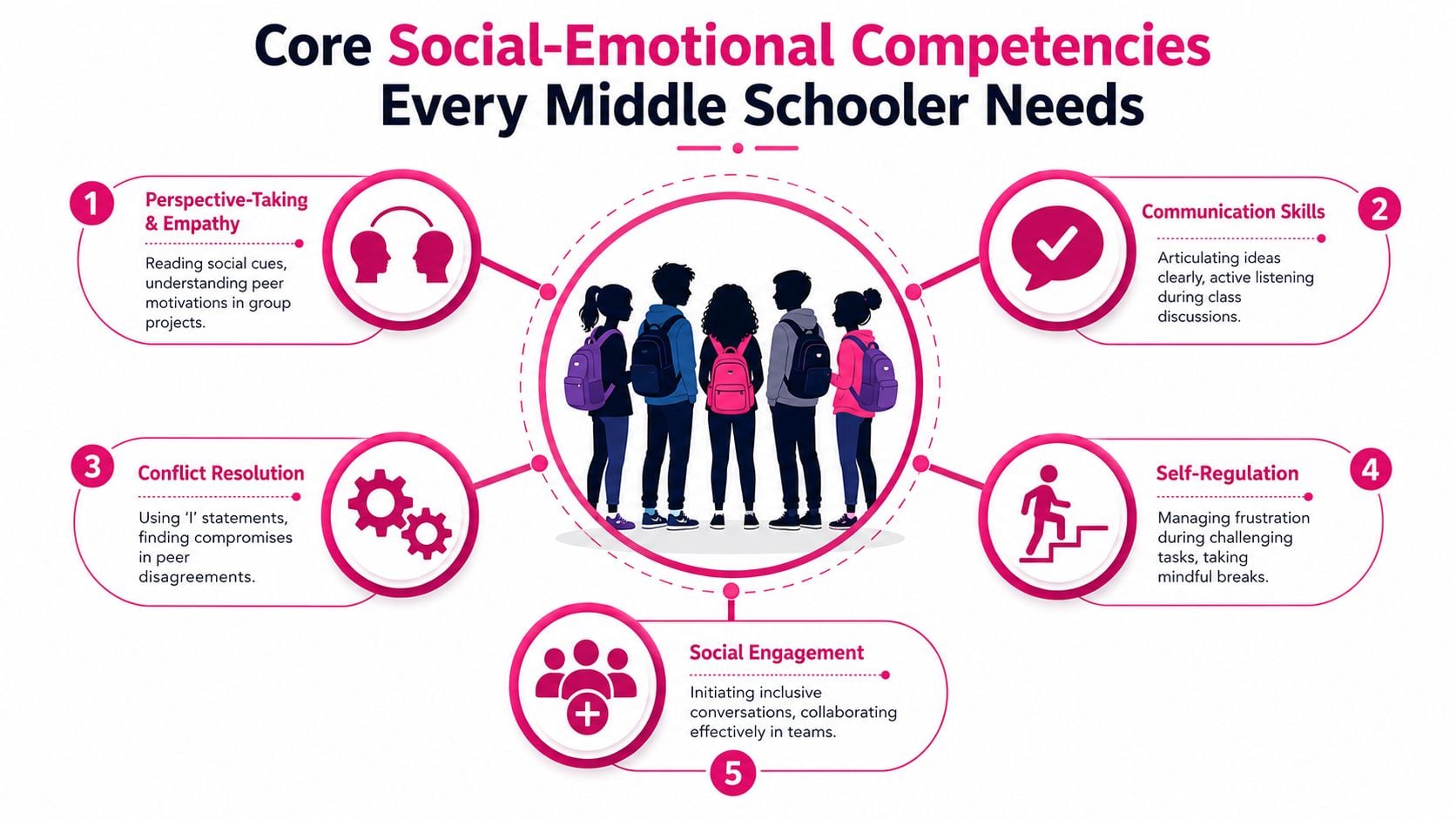
Core Social-Emotional Competencies Every Middle Schooler Needs
Students need more than reminders to “be nice.” They need a shared vocabulary, visible models, and repeated opportunities to practice specific behaviors.
Perspective-taking and empathy
Perspective-taking means asking what another person may know, feel, want, or misunderstand before deciding what their behavior means. Empathy adds the willingness to respond with care.
In a group project, Maya sees Jordan staring at the instructions and not contributing. Without this skill, she might say, “You're being lazy.” With practice, she can pause and ask, “Did the directions make sense? Do you want to choose a role together?” The second response leaves room for confusion, anxiety, language differences, or a different working style.
Teach students to look for observable evidence, generate more than one possible explanation, and check their assumption with a respectful question.
Self-regulation in social situations
Self-regulation isn't the same as staying quiet. It means noticing an emotional signal, creating a pause, and choosing a response that protects the student's goals.
During a frustrating lab, a student may feel blamed when a partner points out an error. An unregulated response might include sarcasm, shouting, or leaving the group. A practiced response sounds like, “I'm getting frustrated. I need a minute, then I'll come back and fix my part.”
Adults can teach a simple sequence: notice, pause, name, choose. A visual cue, breathing routine, movement break, or private check-in can make the sequence accessible without publicly singling out a student.
Assertive communication
Assertiveness lets students express needs and boundaries without attacking or surrendering their voice. A useful structure is: “I feel or notice…, I need…, can we…?”
If a partner keeps interrupting, “You never listen” invites a defensive argument. “I lose my train of thought when I'm interrupted. Please let me finish, then I'll listen to your idea” is clearer and more actionable. Students also need practice receiving feedback, saying no, and asking for clarification.
Collaborative problem-solving
Group work exposes whether students can negotiate roles, share control, and repair a disagreement. A team might disagree about who presents. One student wants the speaking role, another has prepared the visual, and a third has done most of the research.
Instead of letting the loudest student decide, teach the group to list the task requirements, identify each person's preference, and build a plan that distributes responsibility. The skill is not avoiding disagreement. It's using disagreement to reach a workable decision.
Social awareness and inclusion
Social awareness helps students notice who gets invited, who gets interrupted, and who remains on the edge of a group. It also helps them understand that classmates may communicate, celebrate, or participate in different ways.
A student can practice inclusion by moving beyond “everyone is already included” and using a concrete action: invite a classmate into a paired discussion, explain an unwritten game rule, or ask whose perspective hasn't been heard. These competencies are learnable behaviors, not personality types. The five core SEL competencies explained can help adults align their language across classrooms and home conversations.
Common Social Challenges Students Face in Grades 6 Through 8
A seventh-grade student named Luis often takes over group work. He answers before others finish, rewrites classmates' ideas, and insists that his method is the only efficient one. His grades may look strong, but classmates stop volunteering around him. The teacher sees incomplete collaboration, while Luis may see only “people who don't try.”
The intervention isn't a vague instruction to cooperate. Luis can practice a two-turn rule, listen to two contributions before adding another, and ask, “What do you think?” The teacher can privately frame the goal as increasing the group's thinking, not reducing Luis's intelligence.
Friendship conflict creates another familiar pattern. A student receives a short message, assumes it means anger, forwards a screenshot, and confronts the friend the next morning. Tone disappears easily in text, and an audience can turn a private misunderstanding into public conflict. Students need a pause script: “I might be reading this wrong. Can we talk in person before I respond?”
A new student may understand the academic work but struggle to enter established peer networks. A teacher can assign rotating partners with defined roles, teach conversation openings, and avoid making the new student perform gratitude in front of the class. Inclusion works better when the structure doesn't depend on one child's courage.
Bullying situations also reveal a skills gap. A bystander may recognize harm yet fear becoming the next target. Give students multiple options, such as interrupting safely, redirecting the targeted student, documenting and reporting, or seeking an adult. “That joke isn't okay here” is one possible script, but students should never be required to confront danger directly.
Social confidence grows when students have a specific next move, not when adults repeat “just speak up.”
Academic performance can expose social needs too. A high-achieving student who rejects feedback may protect their self-image by refusing collaboration. A student who misses cues may appear defiant. Neurodivergent students may interpret indirect language differently, English language learners may need additional processing time, and students from different cultural backgrounds may encounter unfamiliar norms around eye contact, interruption, or disagreement. Cultural responsiveness means teaching the classroom expectation clearly without treating one communication style as the only respectful one.
These challenges are developmentally common, but “common” doesn't mean students should handle them without instruction. Families can use the guide to negative peer pressure to start conversations about choices, belonging, and the difference between loyalty and unsafe behavior. Teachers can connect the same ideas to group roles, digital citizenship, and restorative conversations.
Practical Activities and Scripts for Building Social Skills
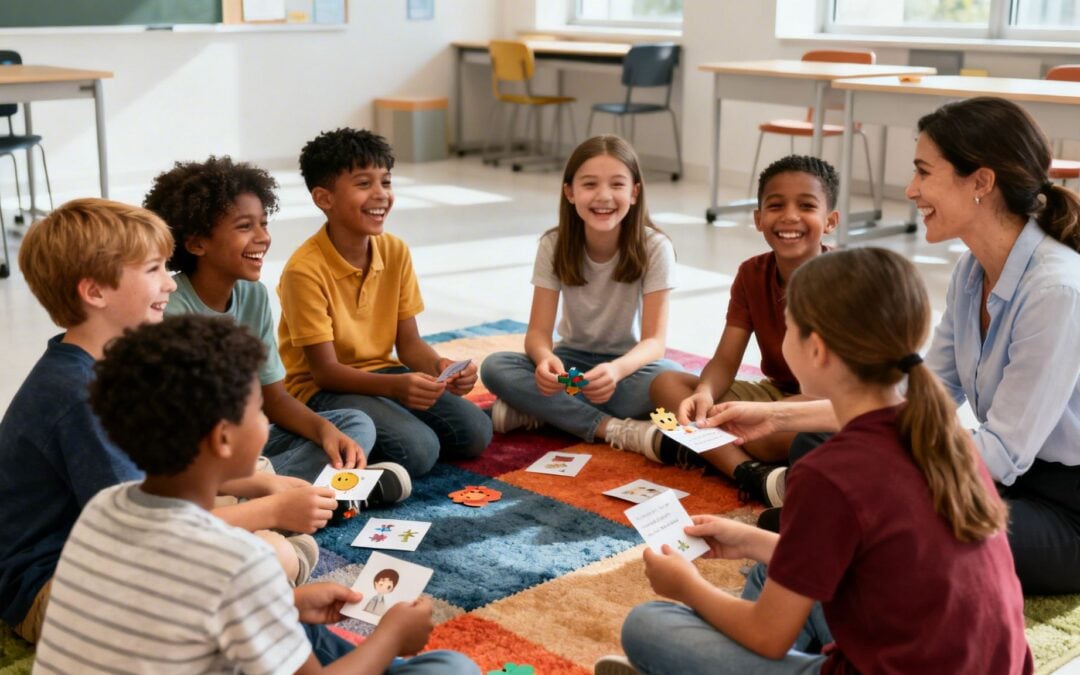
Short, repeated practice usually works better than an occasional lecture. The activities below fit into advisory, morning meetings, counseling sessions, or a brief family conversation.
Perspective-Taking Pause
Objective: Separate facts from assumptions during conflict.
Present a short scenario, such as, “Your partner doesn't reply when you ask for their part.”
Have students name only what they observed.
Ask them to generate possible explanations.
Invite them to choose a respectful question.
Role-play the question and response.
Adult script: “We know the message wasn't answered. We don't know why. What are two explanations that don't involve mind-reading?”
Debrief: “How does checking an assumption change what you do next?”
Group Work Contract
Objective: Make collaboration expectations visible before problems begin.
Ask students to identify behaviors that help a group function.
Record agreements about turn-taking, roles, deadlines, and repair.
Add a process for disagreement.
Have each student choose one behavior to practice.
Revisit the contract after the task.
Student script: “If we disagree, we'll explain our reasons, listen once more, and choose the option that best meets the assignment.”
Differentiation: Offer sentence frames and visual role cards. Let students contribute by speaking, writing, pointing, or selecting from choices.
Feelings Forecast
Objective: Build self-awareness before emotional pressure rises.
At the beginning of class or during dinner, students choose a word, color, or symbol for their current state. They identify one situation that may challenge them and one support they can use.
Adult script: “What emotional weather are you bringing today? What might change it, and what can you do if the forecast gets stormy?”
Students don't need to disclose private details. They can say, “I'm at low energy and may need written directions.”
Repair rehearsal
Objective: Practice returning to a relationship after harm.
Give pairs a scenario involving an interruption, exclusion, or hurtful comment.
Ask the student who caused the harm to name the behavior without excuses.
Add an acknowledgment of impact.
Practice a repair request.
Let the other student decide what response feels appropriate.
Script: “I interrupted you and made it harder for you to finish. I'm sorry. Next time I'll write my thought down and wait. Is there anything you need from me now?”
For additional activity ideas that can be adapted for counseling, advisory, or group work, educators can consult the California Teen Center 2026 activities guide. Keep activities voluntary when disclosure could feel exposing, and offer alternatives for students who need processing time or reduced social demand. A structured social skills group approach can provide consistent practice for students who need more repetition.
SEL Competency
Activity Name
Time Required
Best Setting
Self-awareness
Feelings Forecast
Brief check-in
Advisory or home
Self-management
Pause and Choose
Short rehearsal
Classroom or counseling
Social awareness
Perspective-Taking Pause
Short role-play
Advisory
Relationship skills
Group Work Contract
Planning activity
Any project class
Responsible decision-making
Repair Rehearsal
Scenario practice
Home or school
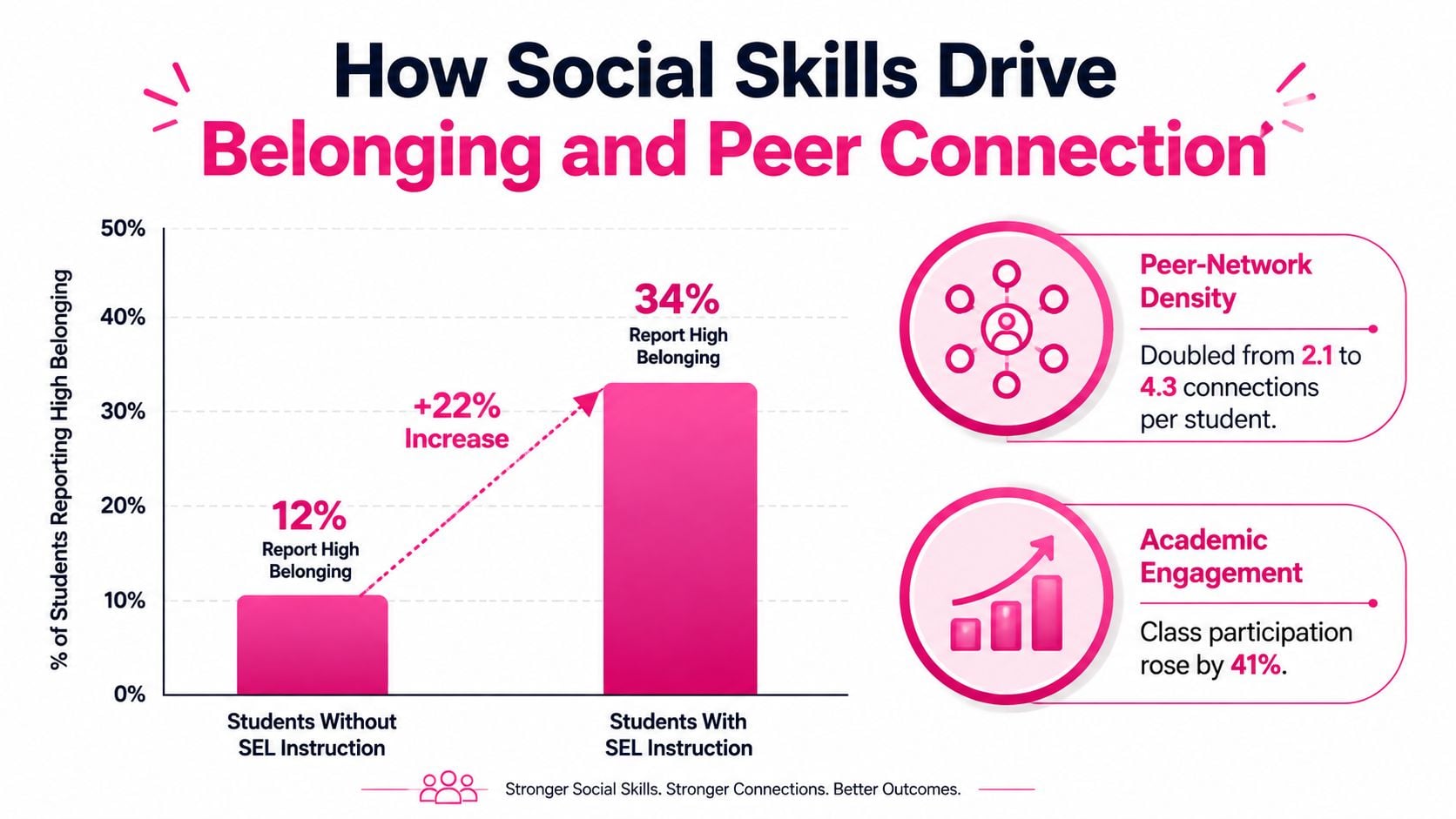
How Social Skills Drive Belonging and Peer Connection
Belonging depends on more than whether a student has a friend. It also depends on whether the student can enter a group, remain safe during disagreement, ask for help, and trust that adults will respond when exclusion occurs.
Survey data from the Australian Longitudinal Study of Australian Children found that 80–90% of 12–13-year-olds and 14–15-year-olds reported having friends (statistical report). Friendship is widespread, but friendship quality and peer acceptance still shape school engagement and academic access. A student can have friends outside school and still feel unable to participate in a particular classroom community.
A school-based social-skills study involving 56 students found statistically significant changes in peer-network measures after a seven-session intervention. Degree centrality increased from 9.34 to 12.16, while closeness centrality shifted from 0.0062 to 0.0058 (peer-network study). These measures don't mean every student suddenly becomes socially confident. They do show why instruction can be evaluated as a change in peer connection, not just a change in self-reported behavior.
A systematic review of 49 middle-school studies found that supportive teacher and peer relationships consistently predicted stronger school connectedness. Discrimination, peer victimization, and mental-health difficulties predicted weaker connectedness, while longitudinal evidence indicated that connectedness tends to decline across middle school (systematic review).
That evidence changes how schools should interpret participation. A quiet student may need a safer entry point, not a public demand to speak. A student who dominates may need structured turn-taking, not only a reprimand. A teacher who makes peer connection teachable can widen access to group discussion, feedback, and academic risk-taking.
The peer climate also matters for bystanders. Recent research discussed in the verified YouthTruth analysis connects belonging with students' willingness to intervene as bystanders. A school that teaches scripts while ignoring bullying and exclusion leaves students with tools but no safe culture in which to use them. Social skills instruction works best when adults pair individual practice with clear reporting routes, consistent responses, and deliberate opportunities to build cross-group connections.
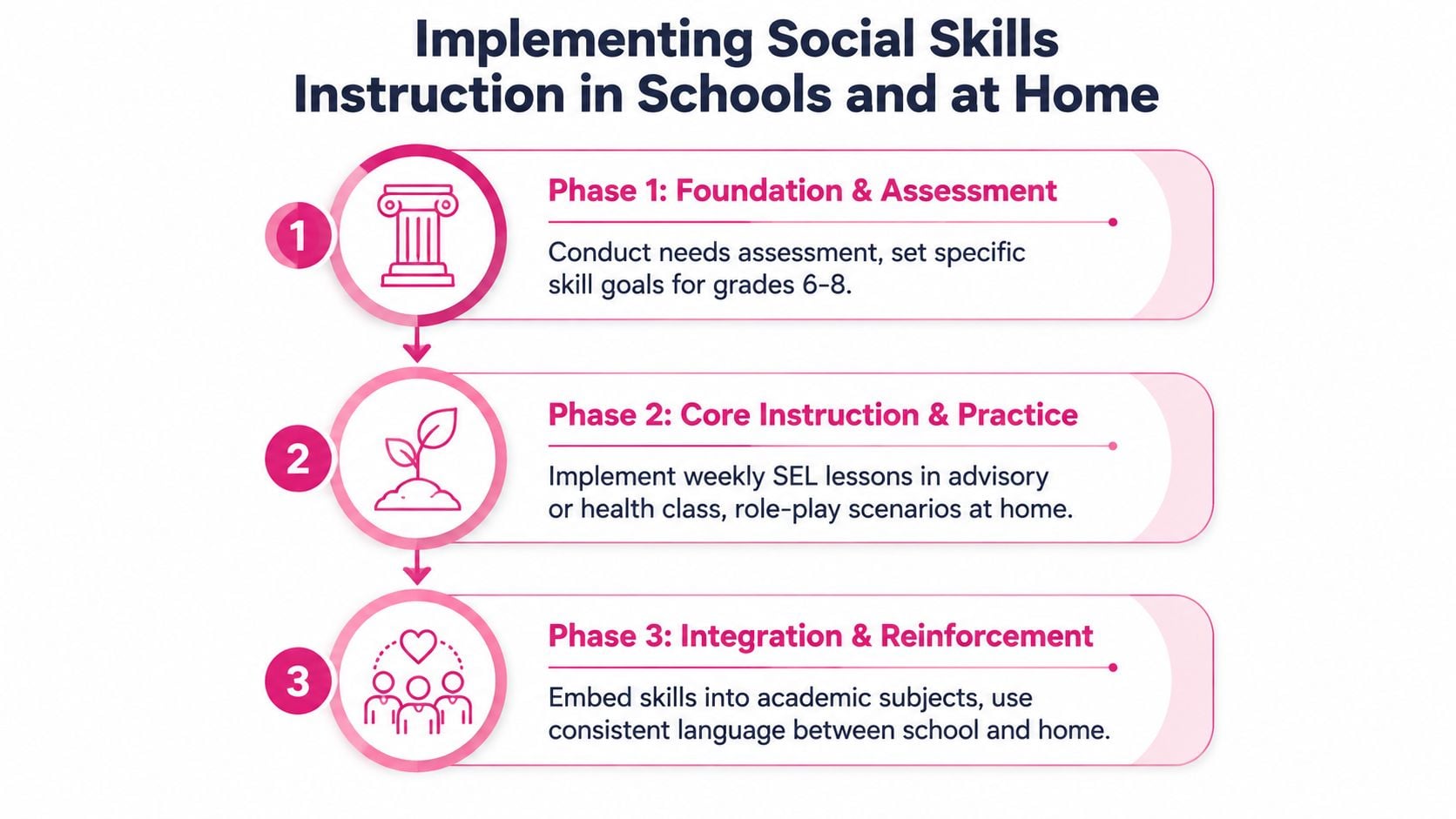
Implementing Social Skills Instruction in Schools and at Home
A sustainable plan begins with observation, not assumptions. Ask students which social situations feel difficult, review patterns in group work and referrals, and invite staff to record what they see during transitions, lunch, and collaborative tasks. Keep the questions focused on skills and conditions rather than labeling students as popular, difficult, or unmotivated.
Build a shared sequence
Start with a small set of skills, such as entering a group, regulating during conflict, and repairing harm. Teach the same words in advisory, classrooms, counseling, and family conversations. Students benefit when “pause,” “check the story,” and “repair” mean the same thing wherever they hear them.
A school can pilot regular practice, then adjust based on student feedback and observations. Short sessions fit more naturally into advisory or homeroom than a one-time assembly. Schedule explicit instruction before predictable pressure points, including the start of the school year, major transitions, and intensive collaborative assignments.
Reinforce instead of reteach from scratch
Teachers should name the skill when they see it: “You waited, asked a question, and made room for another idea.” At home, caregivers can model the same process during ordinary disagreement.
Try these conversation starters:
Notice the choice: “What did you do when the group ignored your idea?”
Explore the impact: “How might your words have landed?”
Plan the next move: “What could you say tomorrow that protects your boundary?”
Connect to learning: “How did feeling safe or unsafe affect your concentration?”
Avoid common implementation mistakes. Don't reduce SEL to a poster, a reward system, or a single presentation. Don't ask one counselor to carry the entire program while other adults use conflicting responses. Don't collect only discipline counts. Brief pre- and post-reflections, teacher observations, and carefully designed peer-nomination tools can help schools notice changes in confidence, participation, and connection while protecting student privacy.
Families can reinforce the work without turning dinner into therapy. Choose one weekly scenario, model your own pause, and invite the student to generate a response. The adult's job is to scaffold reflection, not interrogate the child for a perfect answer.
Programs and Resources to Support Your SEL Journey
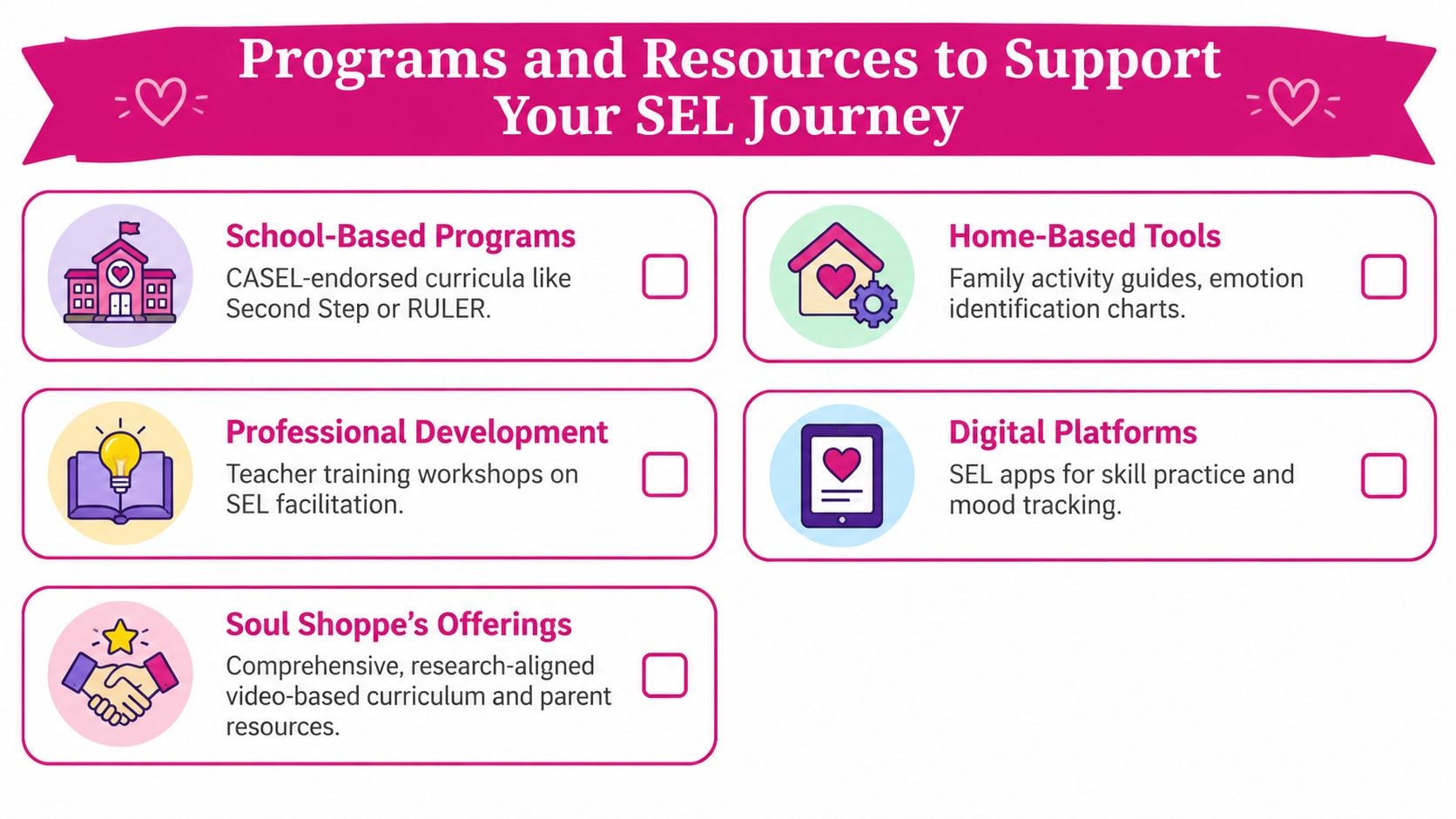
Schools choosing resources for social skills for middle school should look beyond attractive lessons. The strongest fit will be developmentally appropriate for grades 6–8, culturally responsive, practical within advisory or homeroom, accessible to neurodivergent learners and English language learners, and designed to help adults observe progress.
CASEL's program guidance and framework can help leaders compare curricula and clarify the competencies a school wants to prioritize. Second Step and the Yale Center for Emotional Intelligence offer complementary materials for classroom instruction, emotion language, and adult learning. Families may also benefit from simple activity guides, conversation prompts, and visual emotion tools that make practice possible outside school.
Soul Shoppe provides school SEL programming and resources focused on practical skills such as self-regulation, empathy, communication, and conflict resolution, with formats that can include student experiences, adult support, and family engagement. Schools should evaluate any provider by asking how lessons are adapted for middle-school development, how staff learn the shared language, and how the school will monitor belonging and peer safety over time.
The case for investment is straightforward. Middle school is a period when social-emotional competencies can dip, peer relationships become more influential, and belonging can determine whether students participate fully in academic life. Schools that teach students how to regulate, connect, include, and repair are addressing both immediate peer experiences and the foundation students carry into high school.
Soul Shoppe offers research-based SEL programs, interactive student experiences, adult support, and family resources that teach practical tools for self-regulation, empathy, communication, and conflict resolution. To build a shared approach to social skills for middle school, visit Soul Shoppe and explore options for your school community.
In today's classrooms and communities, the ability for students to connect, empathize, and collaborate is more than a 'nice-to-have'—it's foundational to academic success and emotional well-being. Strong peer relationships create the psychological safety necessary for students to take risks, ask for help, and engage fully in their learning. When students feel a sense of belonging, they are more likely to participate, cooperate, and support one another.
For parents and teachers, fostering these connections isn't about forcing friendships; it's about intentionally creating opportunities for positive interaction. This guide moves beyond generic advice to provide a curated roundup of 10 powerful, research-based relationship building activities. Each entry is designed for practical implementation, complete with age-differentiated examples, clear instructions, and alignment with core Social-Emotional Learning (SEL) competencies.
Whether you are a teacher building a supportive classroom culture, a school counselor leading a small group, or a parent helping your child navigate social dynamics, these activities offer concrete tools to help every student feel seen, valued, and connected. From Cooperative Games that teach teamwork to Empathy Mapping that encourages perspective-taking, this list provides specific, actionable strategies to strengthen the bonds that underpin a thriving learning environment. You will find practical examples for various age groups, helping you adapt each exercise for your specific needs.
1. Two Truths and a Lie
This classic icebreaker is one of the most effective and adaptable relationship building activities for any age group. It fosters a climate of psychological safety and shared discovery with minimal setup. Participants share three statements about themselves: two that are true and one that is false. The group then guesses which statement is the lie, leading to surprising revelations and genuine connections.
The activity’s strength lies in its participant-led nature. Each person controls the level of personal information they disclose, making it a low-stakes way to practice vulnerability. For example, a student might share, "I have a pet tarantula," "I have been to Hawaii," and "My favorite food is broccoli." This simple format sparks curiosity and helps peers find common ground in a playful, non-threatening manner.
How to Implement "Two Truths and a Lie"
Objective: To build rapport, foster active listening, and create a safe space for sharing.
Best For: All ages (K-8+), opening new groups, warm-ups before deeper discussions.
Time: 10-20 minutes.
Materials: None required (optional: whiteboards, index cards, or paper for writing).
Step-by-Step Instructions:
Model First: The facilitator (teacher, counselor, or parent) should always go first to set a clear example. Share three interesting but not overly obvious statements about yourself.
Give Thinking Time: Allow students 1-2 minutes to silently prepare their three statements. For younger students (K-2), provide sentence starters like, "My favorite animal is…" or "I have visited…" to guide them.
Share in Small Groups: Have students share in pairs or small groups of 3-4. This increases participation and reduces the pressure of presenting to a large audience.
Guess Respectfully: Instruct students to listen carefully to each person's three statements before discussing and making a group guess.
Reveal and Elaborate: After the group guesses, the sharer reveals the lie and can briefly elaborate on one of the true statements, adding context and personality.
Key Insight: The debrief is as important as the activity itself. After a round, ask questions like, "What did we learn about our classmates today?" or "What made a lie believable?" This reflection reinforces the goal of getting to know one another beyond surface-level assumptions. Soul Shoppe, a social-emotional learning organization, frequently uses this activity to establish a safe, playful tone at the beginning of their classroom workshops.
2. Circle of Trust / Talking Circles
This intentional gathering is one of the most powerful relationship building activities for establishing equity and deepening connections. Rooted in indigenous wisdom and restorative practices, Talking Circles create a space where participants sit in a circle and take turns speaking and listening without interruption. This structured format promotes authentic dialogue and ensures every person has an equal voice and visibility.
The circle's strength is its ability to build empathy and understanding of diverse perspectives. By using a "talking piece" (an object that grants the holder the right to speak), the dynamic shifts from a free-for-all debate to focused, respectful listening. It is used effectively in restorative justice circles to address peer conflict, as well as in daily morning meetings to build a positive classroom community from the start.
How to Implement "Circle of Trust / Talking Circles"
Objective: To build empathy, cultivate respect for diverse perspectives, and create a brave space for authentic sharing.
Best For: All ages (K-8+), community building, conflict resolution, daily check-ins.
Time: 15-30 minutes (adaptable).
Materials: A designated "talking piece" (e.g., a decorated stone, a small stuffed animal, a special stick).
Step-by-Step Instructions:
Establish Circle Agreements: Before the first circle, collaboratively create agreements with the group. These often include principles like "Listen with respect," "Speak from the heart," "What is said in the circle stays in the circle," and "It's okay to pass."
Introduce the Talking Piece: Explain that only the person holding the object may speak. This simple rule is key to ensuring everyone is heard and interruptions are eliminated.
Pose an Open-Ended Prompt: The facilitator starts by asking a question that invites reflection, not a simple "yes" or "no" answer.
Practical Example (K-2): "Share one thing that makes you smile."
Practical Example (3-5): "Talk about a time you showed kindness to someone."
Practical Example (6-8): "Describe a challenge you are proud of overcoming."
Model and Pass: The facilitator answers the prompt first, then passes the talking piece to the next person in the circle. Remind participants they can pass if they do not wish to share.
Allow for Silence: Do not rush to fill pauses. Silence gives participants time to think and shows respect for the person who just spoke.
Close with Intention: End the circle with a closing ritual. This could be a shared quote, a moment of silent reflection, or a collective thank you to honor what was shared.
Key Insight: The structure itself teaches social-emotional skills. The act of waiting for the talking piece builds impulse control, while listening to every peer's perspective cultivates empathy. As a core component of restorative practices, circles shift the focus from punishment to understanding, helping communities repair harm and strengthen bonds after a conflict.
3. Cooperative Games and Team Challenges
Cooperative games shift the focus from individual competition to shared success, making them powerful relationship building activities. In these exercises, groups work together toward a common goal, requiring communication, problem-solving, and mutual support. This approach builds group cohesion while teaching practical collaboration skills that are essential in both academic and social settings.
The value of cooperative play is evident in its application across various youth settings. An elementary PE class might use the "Human Knot" to encourage physical problem-solving, while a middle school advisory period could feature a digital escape room to foster strategic thinking. Furthermore, a variety of energising indoor team building activities can effectively boost cooperation and communication among students, particularly in diverse learning environments. The shared struggle and eventual success create strong bonds and positive memories.
How to Implement Cooperative Games and Team Challenges
Objective: To improve communication, build trust, and develop group problem-solving skills.
Best For: All ages (K-8+), breaking down cliques, building team identity, applying SEL skills.
Time: 15-30 minutes.
Materials: Varies by activity (e.g., rope for Human Knot, building blocks for a tower challenge, or just open space).
Step-by-Step Instructions:
Select an Appropriate Challenge: Choose a game that fits the group's developmental level.
Practical Example (K-2): "Keep the Balloon Up." Students work together to keep one or more balloons from touching the floor.
Practical Example (3-5): "Group Juggle." Students stand in a circle and toss a soft ball to one another, aiming to establish a pattern and see how quickly they can complete it without dropping the ball.
Practical Example (6-8): "Spaghetti Tower." Groups get 20 sticks of spaghetti, a yard of tape, and a marshmallow. The goal is to build the tallest freestanding tower with the marshmallow on top.
Clearly State the Cooperative Goal: Before starting, explicitly state that the goal is to succeed as a team. For example, "The goal is for everyone in your group to untangle the knot, not to see which group finishes first."
Facilitate, Don't Direct: Your role is to monitor group dynamics. Watch for students who may be excluded or for individuals who dominate the conversation. Gently intervene with questions like, "Let's hear what Maria thinks," or "How can we make sure everyone has a chance to help?"
Allow for Productive Struggle: Don't be too quick to offer solutions. Let students experience the challenge of working together. This is where the most significant learning and bonding occurs.
Debrief with Reflection: After the game, lead a discussion. Ask questions like, "What was the hardest part?" "What did someone do that helped the group succeed?" and "How can we use this teamwork in our classroom?" Soul Shoppe provides many excellent ideas for cooperative games that build community.
Key Insight: The primary goal is the process, not the outcome. Whether a team "wins" or "loses" the challenge is less important than how they communicated, supported each other, and managed frustration. Emphasize that these skills are the same ones needed to be a good friend, a helpful classmate, and a supportive teammate in any situation.
4. Guided Reflection and Journaling Prompts
Structured writing or drawing exercises provide a quiet, introspective path toward stronger relationships, starting with the one we have with ourselves. By using guided prompts, individuals reflect on their experiences, emotions, and interactions, creating a powerful foundation for empathy and connection. This method is especially valuable for introverted students who may process their thoughts more effectively internally before sharing with others.
Journaling’s effectiveness comes from the safe, private space it creates for honest self-expression. A student can explore complex feelings about a peer conflict or celebrate a moment of kindness without the pressure of an immediate audience. For instance, a prompt like, "Describe a time you felt proud of how you treated a friend," allows a child to connect positive actions to their own emotions, building both self-awareness and social-emotional skills.
How to Implement "Guided Reflection and Journaling Prompts"
Objective: To develop self-awareness, practice self-regulation, and create a safe outlet for emotional processing before sharing with others.
Best For: All ages (K-8+), introverted learners, after-conflict resolution, morning meetings, or individual check-ins.
Time: 10-15 minutes.
Materials: Journals or notebooks, paper, writing/drawing tools (optional: digital tools like the Soul Shoppe app).
Step-by-Step Instructions:
Introduce the Prompt Clearly: Present a single, open-ended prompt.
Practical Example (K-2): "Draw a picture of a time you felt happy with a friend. What were you doing?"
Practical Example (3-5): "Write about a time it was hard to be a good friend. What happened and what did you learn?"
Practical Example (6-8): "Reflect on a time you disagreed with a friend. How did you handle it, and what might you do differently next time?"
Offer Multiple Formats: Emphasize that there is no "right" way to respond. Students can write sentences, use bullet points, draw a picture, or create a mind map. This accommodates different learning styles and expressive preferences.
Create Quiet Reflection Time: Build in 5-10 minutes of uninterrupted, quiet time for students to work in their journals. The focus is on reflection, not production. Ensure the space feels calm and free of pressure.
Make Sharing Voluntary: If sharing is part of the activity, make it optional and low-stakes. Use partner sharing or a "talking circle" where students can pass if they choose. Never force a student to read their private reflections aloud.
Connect to a Theme: Use themed journals (e.g., Gratitude, Friendship, Managing Big Feelings) to give the practice structure over time and track growth in specific areas.
Key Insight: The primary goal is honest reflection, not writing quality. To build trust, keep initial journal entries private. As a facilitator, your role is to create the conditions for safety and underscore that journaling is a tool for understanding ourselves, not an assignment to be graded. Programs like Soul Shoppe integrate journaling to help students master self-regulation, turning internal reflection into a cornerstone of healthy peer relationships.
5. Peer Mentoring and Buddy Systems
Pairing experienced students with younger or socially isolated peers is a powerful strategy for building an inclusive school climate. These structured buddy systems create authentic opportunities for support, modeling, and friendship. By creating a formal program, schools can nurture prosocial behaviors, reduce bullying, and give students a profound sense of belonging.
The effectiveness of this approach comes from its peer-led foundation. A mentor relationship feels more natural and less intimidating than adult intervention. For instance, a school might pair a confident 5th grader with a shy kindergartener to help them navigate the lunchroom, or train a group of 8th graders to act as peer allies for new students. These connections build genuine peer bonds that increase feelings of safety and community.
How to Implement "Peer Mentoring and Buddy Systems"
Objective: To build empathy, foster leadership skills, reduce social isolation, and create a supportive peer culture.
Best For: All ages (K-8+), school-wide initiatives, supporting new students, and bullying prevention.
Time: Ongoing throughout the school year or a semester.
Materials: Training materials, mentor applications, and a clear role description.
Step-by-Step Instructions:
Define the Program's Goal: Be clear about the purpose. Is it to help new students adjust, support academic skills, or improve social dynamics at recess? This will guide your mentor selection and training.
Train Your Mentors: Explicitly teach mentors key skills. Provide training on active listening, confidentiality, problem-solving, and knowing when to get an adult involved. Use frameworks like Soul Shoppe’s communication tools to give mentors specific language to use.
Match Pairs Intentionally: Thoughtfully pair students based on personality, shared interests, and specific goals. Avoid random pairings. A quiet, artistic 6th grader might be a great match for a new 4th grader who loves to draw.
Structure Low-Pressure Activities: Start the relationships with fun, informal activities.
Practical Example (K-5): "Reading Buddies." Older students read picture books to their younger buddies once a week.
Practical Example (6-8): "Lunch Buddies." Mentors meet their mentees for lunch once a month to chat and help them connect with other peers.
Provide Ongoing Support and Check-Ins: Schedule regular check-ins with the mentors. Give them a safe space to share their experiences, ask for advice, and discuss any concerns. This prevents mentor burnout and ensures the program's health.
Key Insight: A mentor’s role is to be a supportive friend, not to fix another student’s problems. Clarify this boundary from the start with a role description that states, “Your job is to be a friendly peer support and a positive role model.” This empowers mentors to act within their capacity and helps them understand that their primary contribution is building a trusting relationship.
6. Empathy Mapping and Perspective-Taking Exercises
These structured relationship building activities guide students to analyze another person's experience by considering what they might see, hear, think, and feel. By mapping out another's perspective, whether it's a fictional character, a peer, or a public figure, students practice the foundational SEL skill of empathy. This process builds a deeper understanding of others, reduces conflict, and encourages supportive behaviors in the community.
The power of empathy mapping lies in its structured approach to a complex emotional skill. It moves students beyond simple sympathy toward genuine perspective-taking. For instance, after reading a story, a first-grade class might map out how a character felt when they were left out. In middle school, students could use an empathy map to analyze the perspective of someone who engaged in bullying, exploring the potential needs or pressures that led to their actions. This helps dismantle assumptions and fosters a more compassionate school climate.
How to Implement "Empathy Mapping"
Objective: To develop empathy, improve social awareness, and promote pro-social problem-solving.
Best For: All ages (K-8+), conflict resolution, literature analysis, anti-bullying initiatives.
Time: 15-30 minutes.
Materials: Whiteboard, chart paper, or individual worksheets with an empathy map template (sections for See, Hear, Think, Feel, Needs/Wants).
Step-by-Step Instructions:
Introduce the Subject: Select a subject for the empathy map. This could be a character from a book, a historical figure, a student in a hypothetical scenario, or even a real but anonymized situation from the school community.
Explain the Map: Draw or distribute the empathy map. Guide students through each quadrant: What does this person See in their environment? What do they Hear from others? What might they Think to themselves? How do they Feel?
Brainstorm Collaboratively: As a class or in small groups, have students brainstorm ideas for each quadrant.
Practical Example (K-2): After reading The Recess Queen, create a class empathy map for the character "Mean Jean." What did she see (kids running away)? What did she feel (lonely, angry)?
Practical Example (3-5): Use a map to explore the perspective of a new student on their first day of school. What might they be thinking and feeling?
Identify Needs and Pains: After filling out the main quadrants, discuss the person’s underlying needs, wants, or pains. What is their core challenge or desire in this situation?
Connect to Action: Ask students, "Now that we understand this perspective, how could we support this person?" or "What is one kind thing we could do?" This step turns empathy into compassionate action. More perspective-taking activities can help build this skill.
Key Insight: The goal is understanding, not necessarily agreement or forcing a conclusion that "we are all the same." After mapping, focus reflection on how this new perspective might change future interactions. In its conflict resolution curriculum, Soul Shoppe uses role-play and perspective-taking to help students understand the impact of their actions, a crucial step in restorative practices after harm has occurred.
7. Social-Emotional Learning (SEL) Skill-Building Workshops and Assemblies
Moving beyond brief icebreakers, structured SEL skill-building workshops and assemblies are powerful relationship building activities that directly teach core competencies. These are not one-off events but intentional, interactive presentations designed to equip students with practical tools for self-awareness, conflict resolution, and social awareness. By focusing on experiential learning, these programs make abstract concepts like empathy concrete and memorable.
The effectiveness of this approach comes from its direct instruction model. Instead of hoping students absorb skills implicitly, organizations like Soul Shoppe create signature assemblies that explicitly teach students how to use "I-statements" to resolve conflicts or how to recognize and regulate their emotions. These skills become a shared language for the entire school community, fostering a culture of mutual respect and understanding that reduces bullying and improves classroom dynamics.
How to Implement SEL Skill-Building Workshops
Objective: To explicitly teach, model, and practice specific SEL skills (e.g., conflict resolution, emotional regulation) in a structured, school-wide format.
Best For: All ages (K-8+), whole-school culture initiatives, targeted interventions for specific grade levels or behavioral challenges.
Time: 45-60 minutes for an assembly or workshop; can be a series or a single event.
Materials: Varies by program; often includes props, visuals, take-home resources, and follow-up lesson plans for teachers.
Step-by-Step Instructions:
Identify a Specific Need: Before booking a program, use school climate data or teacher feedback to pinpoint a precise skill gap. Are students struggling with managing frustration or resolving playground disputes? Choose a workshop that addresses that exact need.
Select a Reputable Provider: Partner with an organization that specializes in experiential SEL, such as Soul Shoppe, which has a 20-year track record. Ensure their approach is interactive and aligns with your school’s values.
Prepare Students and Staff: Frame the assembly as an exciting, practical learning opportunity, not a lecture on behavior. Brief teachers beforehand on the key skills that will be introduced so they can help reinforce them.
Engage During the Event: Encourage active participation. Effective programs use student volunteers to model skills, role-play real-world scenarios, and lead call-and-response chants that make learning sticky.
Plan for Reinforcement: A one-time assembly is a starting point. Use the provider's follow-up materials, such as posters and classroom activities, to integrate the new skills into daily routines and school-wide language.
Practical Example: A teacher can reference a "Peace Path" poster taught in the assembly when two students have a disagreement. They can walk the students through the steps on the poster: 1. Cool down. 2. Use "I-statements." 3. Brainstorm solutions.
Key Insight: To get leadership buy-in, frame SEL workshops as a direct investment in academic achievement. Explain that when students learn to manage their emotions and relationships, they are more available for learning, leading to improved attendance, focus, and test scores. Presenting SEL as a cornerstone of a successful academic environment, not just a "nice-to-have" program, is critical for securing resources and support.
8. Restorative Practices and Repair Circles
When conflict causes harm, restorative practices shift the focus from punishment to accountability, healing, and community repair. Unlike punitive measures that isolate individuals, these practices bring together those affected to understand the impact of actions and collaboratively find a path forward. This process is one of the most profound relationship building activities because it rebuilds trust after it has been broken.
The core of this approach is the repair circle, a facilitated meeting that includes the person who caused harm, the person harmed, and supporters for each. For instance, after a bullying incident, a restorative circle allows the student who was targeted to explain the emotional impact, and the student who did the bullying to understand the consequences beyond a simple disciplinary action. This structured dialogue helps rebuild the social fabric and prevents future harm by addressing root causes.
How to Implement "Restorative Practices and Repair Circles"
Objective: To repair harm, rebuild trust, and teach accountability and empathy after a conflict.
Best For: All ages (K-8+), responding to peer conflict, bullying, or community disruptions.
Time: 30-60 minutes, depending on the complexity of the situation.
Materials: A talking piece (an object to signify whose turn it is to speak), a quiet and private space.
Step-by-Step Instructions:
Invest in Training: Facilitating a repair circle requires skill. Seek professional development from organizations like Soul Shoppe to learn how to manage difficult conversations and guide participants toward resolution.
Conduct Pre-Meetings: Meet with the person who caused harm and the person who was harmed separately. Prepare them for the process, listen to their perspectives, and ensure they are willing to participate.
Set the Stage: Begin the circle by clearly stating its purpose: "Our goal today is to understand what happened and work together to make things right." Establish ground rules, such as using the talking piece and listening without interrupting.
Use Restorative Questions: Guide the conversation with specific, non-blaming questions:
What happened?
What were you thinking at the time?
Who has been affected by what you did, and how?
What do you think you need to do to make things right?
Create a Repair Agreement: Collaboratively develop a concrete plan of action.
Practical Example: After a student repeatedly interrupted a classmate's presentation, a repair agreement might include: 1) A sincere, specific apology to the presenter. 2) The student practices active listening skills with a counselor. 3) The student writes a short reflection on why respecting others' work is important.
Key Insight: Restorative practices are most effective when they are also used proactively to build community from the start, not just reactively after harm. Soul Shoppe coaches teachers to use circle formats for daily check-ins, creating a foundation of trust that makes repair conversations more successful when conflicts arise. To learn more, see this detailed overview of what restorative practices in education are and how they can be implemented.
9. Gratitude and Strength-Based Recognition Activities
These structured activities create a culture where students regularly acknowledge peer strengths, express gratitude, and celebrate positive contributions. This practice combats isolation by ensuring every student feels seen and valued for their unique qualities. By making recognition a daily habit, schools build an environment of belonging and mutual respect.
The power of these relationship building activities comes from their consistency. When students are taught how to spot and name specific strengths in others, it shifts their focus from deficits to assets. For instance, instead of a generic "good job," a student might learn to say, "I appreciated how you included Sarah in our game at recess; that was really kind." This level of specificity makes the recognition more meaningful and helps students see positive behaviors in concrete terms.
How to Implement "Gratitude and Strength-Based Recognition"
Objective: To build a culture of appreciation, improve self-esteem, and help students recognize positive qualities in themselves and others.
Best For: All ages (K-8+), morning meetings, classroom community building, restorative practices.
Time: 5-15 minutes, depending on the activity.
Materials: Sticky notes, index cards, a "gratitude jar," or a designated bulletin board.
Step-by-Step Instructions:
Teach Genuine Recognition: Model how to give specific and sincere appreciation. Explain the "what and why" format: "I noticed you (specific action), and it mattered because (specific impact)."
Integrate Into Routines: Make recognition a predictable part of the day or week. Use a "Gratitude Circle" during morning meetings, asking, "Who did you see being a good friend yesterday and what did they do?"
Offer Multiple Formats: Accommodate different comfort levels.
Practical Example: Create a "Shout-Out" bulletin board where students can write positive notes about classmates on sticky notes and post them publicly.
Practical Example: Use a "Gratitude Jar" where students drop in private notes of thanks for others. The teacher can read a few aloud (with permission) at the end of the week.
Celebrate Diverse Strengths: Ensure a wide range of contributions are celebrated, including academic, social, creative, and athletic skills. Highlight qualities like kindness, perseverance, and leadership.
Model Receiving Gratitude: Teach students how to accept a compliment gracefully. Practice simple responses like, "Thank you, that means a lot to me," to avoid deflecting positive feedback.
Key Insight: To ensure every student is seen, facilitators should discreetly track who receives recognition. If certain students are consistently overlooked, find opportunities to "spotlight" their strengths publicly or prompt peers to notice their contributions. This intentional approach ensures that recognition activities are truly inclusive and reinforce the value of every single member of the community.
10. Social Skills and Conversation Coaching
This targeted approach moves beyond general activities to provide direct instruction in specific social skills that are foundational to forming relationships. It involves modeling, role-playing, and guided practice in areas like initiating conversations, reading social cues, or managing disagreements. This coaching is especially helpful for socially isolated students, those with social anxiety, or anyone needing explicit support to build peer connections.
The power of this method is in its precision. Instead of hoping social skills develop on their own, coaching breaks them down into small, achievable steps. For instance, a counselor might role-play with a student how to join a group at recess, starting with observing the group, finding a natural opening, and using a simple phrase like, "Hi, what are you playing?" This makes the abstract goal of "making friends" a concrete, repeatable process.
How to Implement "Social Skills and Conversation Coaching"
Objective: To teach, practice, and reinforce specific social behaviors required for building and maintaining positive relationships.
Best For: All ages (K-8+), students struggling with social isolation, small groups, or one-on-one intervention.
Time: 15-30 minute sessions, ongoing as needed.
Materials: Role-play scenarios, video modeling examples, checklists for specific skills.
Step-by-Step Instructions:
Assess the Specific Need: Identify the precise skill gap. Is the student struggling with eye contact, asking questions, or joining a group? Start with one small, observable goal, such as, "Ask one follow-up question during a conversation."
Model and Explain: Explicitly model the skill. The adult should think aloud to reveal the internal process. For example, "I see they are talking about video games. I also like video games, so I will wait for a pause and then ask, 'Which game is your favorite?'"
Practice in a Safe Setting: Use role-play in a counselor's office or a quiet corner of the classroom to practice the skill.
Practical Example: A parent can practice with their child how to ask a friend to play at the park. Role-play both a "yes" scenario and a "no, maybe later" scenario so the child feels prepared for either outcome.
Provide Specific Feedback: Offer immediate and positive feedback. Say, "You did a great job making eye contact when you asked that question. That helped your friend feel heard."
Plan for Generalization: Help the student apply the skill in a real-world setting. Before lunch, you might say, "Remember how we practiced asking a question? Let’s try to do that with one person at your table today."
Key Insight: Acknowledge the student's feelings throughout the process. Coaching social skills can feel vulnerable, so it's important to validate their anxiety by saying, "I know this feels new and a bit scary, and I am proud of you for trying." Celebrating small wins and connecting them to real-life success helps build the confidence needed for these relationship building activities. You can find more strategies for successful social skills training and implementation.
Low-cost, frequent reinforcement that increases visibility
Social Skills & Conversation Coaching
Medium–High — individualized instruction and practice
Trained coach, structured lessons, time for in vivo practice
Improved observable social behaviors, confidence, better peer interactions
Small-group interventions, students with social anxiety or ASD
Targeted, skill-based coaching that boosts real-world success
From Activities to Culture: Making Connection a Daily Practice
The journey through this extensive list of relationship building activities reveals a powerful truth: fostering connection is not about isolated events but about intentional, consistent practice. We’ve explored a variety of methods, from the introductory fun of Two Truths and a Lie to the deep, healing work of Restorative Practices. Each activity, whether it's a quick Cooperative Game or a structured Peer Mentoring program, serves as a vital tool in your toolkit. However, the real impact emerges when these tools are no longer seen as special occasions but as integral parts of your school or home's daily rhythm.
The activities detailed in this guide, such as Empathy Mapping, Gratitude Circles, and Social Skills Coaching, are designed to be more than just fillers in a schedule. They are foundational blocks for building a culture where students feel seen, heard, and valued. The key is to move from doing activities to being a community that embodies the principles behind them. This requires a fundamental shift in mindset, championed by the adults in the environment.
Bridging the Gap: From One-Off Exercises to Daily Habits
To make this cultural shift a reality, consider how these activities can be woven into the fabric of your daily and weekly routines. The goal is to make positive social interaction the default, not the exception.
Morning Meetings: Instead of a simple roll call, start the day with a quick round of a Gratitude and Strength-Based Recognition activity. A simple prompt like, "Share one person you're grateful for today and why," can set a positive tone for the entire day.
Academic Integration: Embed these practices directly into your curriculum. When studying a historical conflict, use an Empathy Map to help students understand the different perspectives involved. When starting a group science project, kick it off with a Cooperative Game to build team cohesion before the academic work begins.
Conflict Resolution: Move away from punitive measures and toward a restorative approach. When a disagreement arises on the playground, don't just separate the students. Guide them through a mini-Repair Circle, giving each a chance to speak and be heard, fostering mutual understanding and a path forward.
True connection isn't built in a single assembly or a one-time workshop. It is cultivated in the small, consistent, and intentional interactions that happen every single day. It’s the teacher who models active listening, the administrator who champions peer mentoring, and the parent who facilitates a Talking Circle at the dinner table.
The Lasting Impact of Strong Relational Skills
Investing the time and resources into these relationship building activities yields benefits that extend far beyond a peaceful classroom or a harmonious home. You are equipping children with essential life skills. The ability to perspective-take, communicate needs clearly, resolve conflict constructively, and build supportive networks are predictors of long-term well-being, academic success, and career fulfillment.
To foster a culture where connection is a daily practice, implementing robust and effective community building strategies is essential for creating a sustainable and supportive environment. When students feel a deep sense of belonging, they are more engaged, more resilient, and more available for learning. They learn to trust others and, just as importantly, to trust themselves. By prioritizing these practices, you are not just managing behavior; you are nurturing compassionate, capable, and connected human beings who will positively shape their communities for years to come.
Ready to move from simply implementing activities to building a thriving, connected school culture? Soul Shoppe provides the expert training, curriculum, and ongoing support needed to embed these powerful relationship building activities into the very DNA of your school. Learn more about how Soul Shoppe can help your community today.