Soul Shoppe's work is made possible by donors and partners who care deeply about the young people in their communities! We can't do this work without you. Support our work in classrooms and on playgrounds across the nation by donating here.
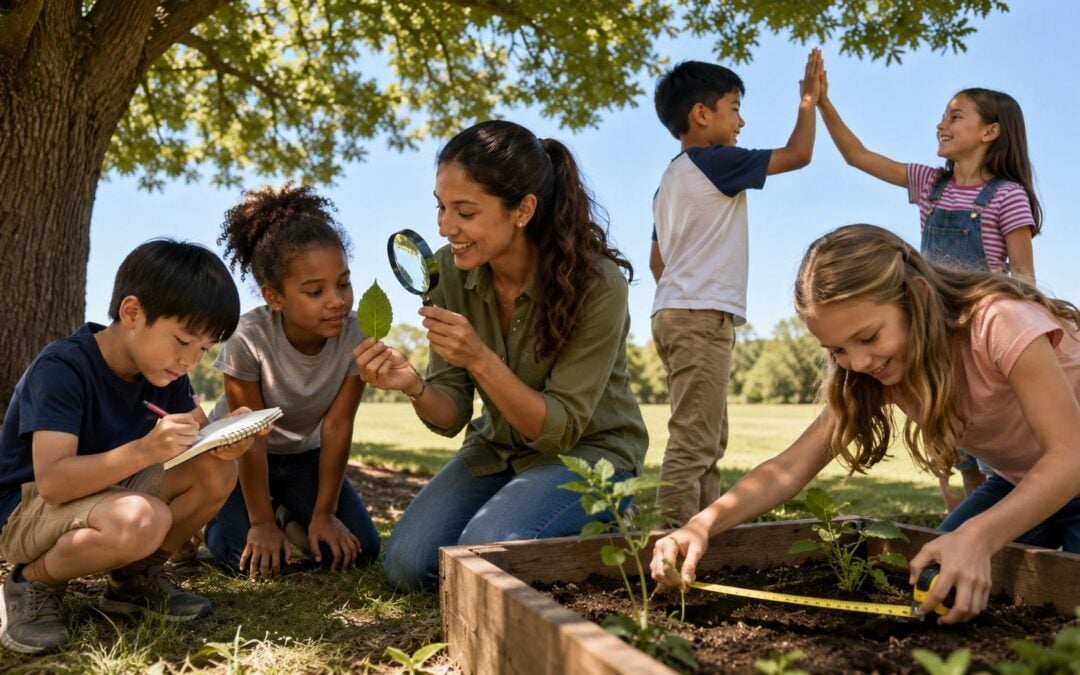
A third-grade class is spread across the blacktop, searching for shapes that match a geometry card. Nearby, a kindergarten group sits beneath an oak tree, passing around a pinecone and describing its texture. At the garden beds, fifth graders measure soil, compare plant growth, and argue cheerfully about which row needs more water. These moments look ordinary, but they carry more educational weight than a simple break from class.
Outdoor learning means any structured academic, social, or reflective experience outside the classroom walls. It can happen in a schoolyard, courtyard, neighborhood, garden, nature area, or local park. The setting changes, but the purpose remains clear: students use movement, observation, conversation, and real materials to understand ideas and practice skills.
K–8 students are especially ready for this approach. They're curious, sensory-driven, and still learning through their bodies as much as through explanations. A lesson outside can give a child who struggles with a worksheet another way to count, describe, collaborate, or demonstrate understanding.
The strongest outdoor learning benefits aren't limited to one subject. Research connects well-designed outdoor experiences with engagement, ownership of learning, social development, self-concept, wellbeing, and physical activity. Academic improvement appears in some settings, but the most consistent gains often involve attention, regulation, cooperation, and meaningful participation.
The practical question for educators isn't whether every lesson should move outdoors. It's how to design outdoor experiences that are accessible, purposeful, repeatable, and connected to curriculum and social-emotional learning. The examples below pair research evidence with activities a teacher or caregiver can run with minimal preparation.
Why Outdoor Learning Matters for K–8 Students
The blacktop math hunt works because students aren't only hearing about shapes. They're finding rectangles in fences, counting angles in playground equipment, and explaining their reasoning to a partner. The kindergarten circle works because the oak tree gives children a shared object of attention, while the fifth-grade garden task turns measurement into a decision with visible consequences.
These activities also change the social rhythm of the school day. Students move between stations, negotiate materials, ask questions that arise naturally, and see classmates contribute in different ways. A child who rarely speaks during whole-group instruction may become the careful observer who notices a bird nest, identifies a pattern, or helps a partner balance a structure.
Outdoor learning is more than recess
Recess gives students valuable unstructured time, but outdoor learning adds an intentional objective. A teacher might ask students to record evidence of erosion, write sensory descriptions, compare perimeter measurements, or practice a conflict-resolution routine during a team challenge. The lesson can be playful, but it still has a learning target and a way to notice progress.
That distinction matters for families, too. A neighborhood walk can become an informal science lesson when a child tracks cloud changes, a language lesson when they create a story from observed details, or a self-management exercise when they pause to identify sounds and body sensations.
A 2022 systematic review of learning in natural outdoor settings found consistent benefits across several domains, including increased engagement and ownership of learning, stronger social and collaborative skills, and improved self-concept, with some evidence of academic improvement in the review of outdoor learning research. The review treats outdoor learning as an educational strategy, not just recreation.
A multidimensional case for K–8 schools
Outdoor experiences can support reading, science, math, physical development, and SEL at the same time. Students may read a field guide, estimate the height of a tree, cooperate on a shelter design, and reflect on frustration during one carefully planned activity.
That range makes outdoor learning especially useful when schools want to strengthen the whole child without creating a separate program for every need. It also raises an important equity question: who has safe, welcoming access to nature outside school, and who depends on school to provide it?
The most effective plans treat outdoor learning as part of the school's instructional design. They make room for access needs, define clear supervision routines, and give teachers practical activities that can be repeated rather than relying on occasional field trips.
What the Research Says About Outdoor Learning Benefits
The research is encouraging, but it's more precise than the phrase “nature helps children learn.” Evidence points to several outcome areas, and the strength of the result depends on the program's design, duration, learner age, and intended outcome.
Academic outcomes need context
A historical review of environmental education in California reported that secondary students from 11 Californian schools who participated in outdoor environmental learning scored higher in 72% of academic assessments, including reading, science, math, attendance rates, and grade-point averages, than students from traditional schools in the reviewed outdoor-learning evidence. That finding is important, but it shouldn't be treated as a promise that every outdoor lesson will produce broad academic gains.
Outdoor instruction can make academic content more concrete. Students can measure actual garden beds, use descriptive language for changing weather, or read informational text before checking evidence outside. Research summarized in school-learning reviews also reports that one outdoor-learning intervention left children more focused and on-task during later indoor lessons, with almost half the number of teacher redirects in this evidence review of outdoor learning.
Social, emotional, physical, and cognitive outcomes
The wider evidence base includes social cooperation, confidence, wellbeing, environmental awareness, physical skills, cognitive skills, and risk-management skills. A review of Forest School research identified gains across seven major outcome areas, showing why schools shouldn't judge outdoor learning only by test performance through the systematic review of Forest School research.
A separate review found that children's time outdoors is consistently linked to higher physical activity and better cardiorespiratory fitness, while more time outside is associated with lower sedentary behavior in the review of children's outdoor time. Recent evidence also emphasizes stress reduction, attention, self-regulation, sleep, physical activity, and cognition as especially credible areas of benefit in the review of nature exposure and outdoor activity.
Domain
Reported outcome
Typical magnitude
Academic
Higher performance across 72% of assessments in the cited California review
Broad but context-dependent
Engagement
Greater engagement and ownership of learning
Consistent qualitative and measurable benefits
Social-emotional
Stronger cooperation, confidence, self-concept, and wellbeing
Multidimensional gains
Attention
Fewer teacher redirects after one outdoor-learning intervention
Almost half the number of redirects
Physical
More physical activity and less sedentary behavior with more outdoor time
Consistent association
Forest School
Gains across seven outcome areas
Benefits vary by design and learner
For educators exploring the field, resources on starting environmental education programs can help translate broad principles into school-based planning. Teachers should still read results carefully. Self-selected participants, short intervention windows, inconsistent definitions of outdoor learning, and differences in age or baseline need can limit how confidently one program's result transfers to another school. A 2022 systematic review and a later mixed-methods synthesis both point toward structured, repeated, nature-specific experiences rather than one-off outdoor lessons as the more credible path to sustained benefits in the systematic review of outdoor learning. For additional SEL research framing, educators can consult Soul Shoppe's research resources.
Social-Emotional Growth in Outdoor Settings
Outdoor settings give children real social problems to solve. They must decide who carries the bucket, how a group crosses a muddy patch, whether a structure is stable, or what to do when two students want the same materials. Those moments create practice opportunities that a teacher can observe and coach in real time.
Three features make this setting especially useful for SEL: sensory richness, physical movement, and informal peer interaction.
Novelty can reset attention
A change in surroundings gives students new details to notice. The sound of traffic, the texture of bark, the movement of clouds, or the pattern of shadows can help children shift attention away from a difficult indoor routine. In CASEL-aligned terms, this supports self-awareness and self-management, because students can notice their internal state and choose a response.
A teacher might see a student pause before grabbing a material, name that they're frustrated, and ask for a turn without prompting. That self-correction is more useful than a quiet line held together only by adult reminders.
Movement supports regulation
Walking, carrying, balancing, digging, and stretching give students appropriate ways to use physical energy. Movement doesn't solve every behavior challenge, but it can help children return to a calmer state before discussion or written work.
Use a simple regulation cue: “Notice your feet, slow your breathing, and choose your next safe step.” This connects body awareness to self-management without turning the activity into a lecture.
Peer interaction builds belonging
Outdoor tasks often create informal groupings based on interest or role. One student may observe, another may build, and another may record. These flexible roles can interrupt fixed classroom hierarchies and give quieter students a meaningful way to contribute.
The teacher's job is to name the skill, not dominate the interaction. Ask, “How did your group decide?” or “What helped both people get heard?” Those questions connect the experience to relationship skills, social awareness, and responsible decision-making. Activities focused on empathy and listening can also draw from these empathy-building activities.
Conflict resolution becomes concrete outdoors. When students disagree over space or materials, guide them to describe the problem, hear each perspective, generate options, and test a fair solution. Over time, teachers may notice more equitable turn-taking and faster de-escalation because students have rehearsed those moves repeatedly.
Practical rule: Don't remove every manageable disagreement. Coach students through safe, respectful problem-solving so the outdoor setting becomes a rehearsal space for community life.
Equity and Access Considerations
Outdoor learning can widen opportunity, but only when schools design for students who face the greatest barriers. A child with a large yard, reliable transportation, and outdoor clothing may already receive nature exposure outside school. Another child may depend on the schoolyard for every safe chance to explore plants, weather, movement, and open space.
Urban schools may have limited green areas, but they can still use courtyards, sidewalks, rooftops where permitted, shaded blacktops, community gardens, and neighborhood walks. The educational value comes from purposeful observation and participation, not from having a forest on campus.
Accessibility must be planned before the activity is announced. Students with mobility disabilities may need firm, navigable pathways, reachable materials, and roles that don't depend on uneven terrain. Students with sensory sensitivities may need quiet zones, advance notice about textures or sounds, flexible clothing, and the option to observe before joining.
Weather and health needs also shape participation. Schools should provide shade, water, weather gear, sunscreen routines aligned with family and school policies, and allergy-aware plant choices. Families without transportation shouldn't be excluded from meaningful off-campus experiences, so bus-supported trips and partnerships with local parks can matter.
Barrier
Who it affects
School planning response
Limited green space
Students in dense urban areas
Use courtyards, gardens, sidewalks, and schoolyard investigations
Uneven terrain
Students with mobility disabilities
Provide accessible pathways, reachable materials, and alternative roles
Weather exposure
Students sensitive to heat, cold, rain, or sun
Plan shade, water, gear, indoor alternatives, and clear weather rules
Allergens
Students with allergies or respiratory needs
Select plants carefully, review health plans, and offer low-trigger locations
Missing clothing or equipment
Families with limited resources
Maintain shared weather gear, spare clothing, and washable materials
Transportation limits
Students unable to reach parks independently
Use school buses, nearby sites, and community partnerships
The 72% academic-assessment finding from the California review should not lead schools to assume all students receive the same benefit. Access, program quality, baseline need, and duration influence outcomes. Equity is a design question: who can enter the activity, who can participate fully, and whose knowledge gets recognized?
Sample Outdoor Activities Tied to SEL Objectives
The best activities are short enough to repeat and open-ended enough to reveal student thinking. A clipboard, chalk, natural materials, and a clear prompt can support meaningful work in a schoolyard or courtyard.
Sound Mapping
Grade band: K–8 Materials: Paper, pencils, clipboards SEL objective: Self-awareness How to run it: Students sit or stand safely in one place and mark sounds with symbols or words. Younger children can draw; older students can distinguish near and far sounds or describe how each sound affects their body.
Facilitation prompt: “What did you notice first, and what changed when you paid closer attention?” Debrief: “Which sound helped you feel settled, and which one made it harder to focus?”
This activity works well before reading or independent writing because it gives students a quiet transition into attention.
Nature Trust Walk
Grade band: K–5, adapted for older students Materials: Cones or a clearly marked path SEL objective: Relationship skills How to run it: Pair students. One partner gives verbal directions along a simple, accessible route while the other walks with eyes open and focuses on listening. Switch roles, then discuss how the directions felt.
Facilitation prompt: “What made the instructions clear and respectful?” Debrief: “How did your partner show that they were listening?”
Keep the route familiar and never require blindfolds. The goal is communication, not discomfort.
Weather Problem-Solving Stations
Grade band: K–8 Materials: Weather cards, chart paper, simple observation tools SEL objective: Responsible decision-making How to run it: Groups rotate through prompts such as choosing clothing for conditions, protecting a paper structure from wind, or deciding whether a planned activity needs modification.
Facilitation prompt: “What evidence supports your choice?” Debrief: “What would you change after seeing the result?”
This links science reasoning with practical judgment. Families can use the same routine before a walk or outdoor play.
Group Habitat Build
Grade band: K–8 Materials: Sticks, leaves, cardboard, string, or reusable blocks SEL objective: Teamwork and social awareness How to run it: Groups design a shelter or habitat for a fictional small animal. Assign rotating roles, but let students negotiate details.
Facilitation prompt: “Whose idea haven't we tested yet?” Debrief: “How did your group respond when the first plan didn't work?”
For more sensory-based variations, teachers and caregivers can adapt ideas from this five-senses activity resource. Families seeking structured movement opportunities beyond school can also explore a summer camp for active kids as one possible community option.
Reflection Circle
Grade band: K–8 Materials: A designated sitting spot and optional reflection cards SEL objective: Self-management How to run it: Students sit in a circle and complete one sentence: “I noticed,” “I contributed,” “I found difficult,” or “Next time I will.” Passing is allowed.
Facilitation prompt: “What choice helped you stay engaged?” Debrief: “What will you carry into the next classroom activity?”
The circle turns an outdoor experience into transferable learning rather than leaving the SEL lesson implicit.
Implementation Tips for Schools and Classrooms
Sustainable outdoor learning depends less on elaborate spaces than on dependable routines. Teachers are more likely to use the schoolyard when they know when they're going, what students will do, how safety will work, and where materials are stored.
Build a repeatable schedule
Start with short outdoor blocks connected to existing lessons. A class might take vocabulary outside for observation writing, move a math rotation to the blacktop, or use a garden bed during a science unit. The visual implementation guide suggests integrating 20–30 minute outdoor blocks across morning, midday, and afternoon routines [in the implementation infographic below].
Create a shared calendar so classes don't compete for the same area. Store clipboards, chalk, magnifiers, measuring tools, and weather gear in labeled bins near the exit. Chalk circles, tree-shaded benches, and movable tubs can turn an ordinary yard into a set of learning zones without major construction.
Agree on safety before the first lesson
Staff should define simple rules for rain, temperature, air quality, lightning, supervision, allergies, water, sunscreen, and clothing. Permission slips should explain the regular routine, while individual health plans guide specific accommodations.
Paraprofessionals can serve as outdoor co-teachers when they receive activity guides, communication prompts, and safety protocols. A short staff meeting can establish:
Purpose: Identify the curriculum and SEL objective.
Place: Select an accessible area and a backup location.
People: Assign supervision zones and support roles.
Materials: Prepare one labeled bin per activity.
Health: Confirm water, medication, allergy, and weather procedures.
Evidence: Decide what teachers will observe or collect.
Extend lessons instead of doubling preparation
Take the same anchor text outdoors and ask students to find evidence in the environment. Use the same math vocabulary while measuring real objects. Bring indoor writing prompts outside, then return for drafting and revision.
Parent volunteers can support observation stations, material management, or garden care when school policies allow. Local parks, libraries, and environmental organizations may offer locations or expertise. These partnerships expand capacity, but schools should keep the learning target and access expectations under school control.
Outdoor learning becomes sustainable when it feels like a familiar teaching move, not a special event that requires a new plan from scratch.
Measuring Impact and Bringing It All Together
Administrators don't need a complicated research project to determine whether outdoor learning is helping. They need a small set of shared measures, a baseline, and a regular review cycle that combines numbers with what teachers and students report.
Choose measures across academic participation, SEL, and physical experience. Track enough to notice patterns, but not so much that teachers spend the lesson recording data instead of teaching.
Metric
Domain
Data source
Cadence
Outdoor lesson attendance
Access and participation
Attendance records
Reviewed regularly
Time-on-task observations
Engagement
Walkthrough form
During selected lessons
Formative assessment changes
Academic learning
Existing grade-level checks
At baseline and review points
Self-regulation rubric
SEL
Teacher observation
Repeated classroom cycle
Peer-conflict referrals
SEL and belonging
Referral or behavior records
Reviewed regularly
Outdoor minutes
Physical access
Class or school log
Weekly
Student reflection themes
Wellbeing and voice
Journals or exit slips
After selected activities
A useful process begins with a baseline using tools the school already has. Record current outdoor participation, observe attention during a familiar lesson, review existing formative data, and ask teachers to tally how often students attempt a conflict-resolution strategy outdoors.
After a 90-day implementation period, repeat the same measures using a practical outcome-measurement approach. The purpose isn't to claim that outdoor learning caused every change. It's to compare patterns, identify which activities students access, and determine whether particular learners need different supports.
A one-page dashboard can include a few numbers, two student reflection themes, a teacher observation, and an access note. For example, leaders might see that students participate regularly but need more shade, or that group builds create strong collaboration while weather stations produce richer academic discussion.
Return to the blacktop math hunt. Its value isn't that every child will suddenly master geometry. Its value is that students can move, notice, explain, cooperate, and receive feedback in a setting that makes learning visible. With honest measurement and thoughtful design, outdoor learning becomes a practical equity lever that strengthens academic participation, regulation, belonging, and the daily K–8 experience.
Soul Shoppe helps schools build the connection, safety, empathy, and conflict-resolution skills that make outdoor learning more inclusive and productive. Visit Soul Shoppe to explore interactive SEL programs, workshops, coaching, and practical tools for students, educators, and families.
The first clue often shows up before the bell. A child who has been redirected three times is also the first one to greet a new classmate, help unzip a backpack, or notice who looks lost at the carpet. A tired adult can miss that in a busy morning, but a strengths based approach asks for a different habit, notice what a child already does well, then build the day around that asset instead of only the problem.
That shift matters because schools don't run on one note. Kids need correction, yes, but they also need adults who can see competence, connection, and effort in the same child who forgot a pencil or blurted out an answer. When teachers lead with strengths, they're not pretending behavior never needs attention, they're changing the starting point so the plan can include success, not just repair. For a connected SEL lens on why that matters, this Soul Shoppe overview of social emotional learning fits well with the same idea, kids learn best when they feel seen and safe.
Why a Strengths Based Approach Matters in Elementary Classrooms
The morning circle is already moving when the teacher notices it. One student has interrupted twice, another is squirming, and the new classmate still hasn't found a place to sit. Then the same child who got redirected three times slides over, pats the rug, and says, “You can sit here.”
That moment is the difference between a deficit lens and a strengths based approach. The deficit lens tracks what went wrong first, then builds a response around fixing it. The strengths-based lens sees the same child as someone who has social awareness, initiative, and a way of making other people feel safe, then asks how those qualities can be used on purpose during the school day.
What changes when adults look for assets first
A classroom built on strengths still has rules. It still has consequences. What changes is the adult's first question. Instead of, “What's wrong with this child?” the teacher asks, “What does this child already bring that we can build on?” That small shift changes tone, language, and planning.
It also changes how children hear themselves. A student who is treated as a problem quickly learns to perform the role. A student who is named for a real strength hears something more useful, “I can do something that matters here.” That doesn't erase struggle, but it gives the child a place to stand while learning.
Practical rule: If the only time a child hears their name is during correction, the room is teaching them that mistakes define them.
Schools like this approach because it fits naturally with SEL work. Teachers are already trying to build self-awareness, relationship skills, and responsible decision-making. A strengths based approach gives those goals a concrete habit, notice what works, then use it more often. For a broader SEL context, the Soul Shoppe SEL article offers a useful companion frame.
Defining the Strengths Based Approach Without the Jargon
A strengths based approach starts with a child's resources, relationships, and environment, then uses those assets to shape support. The Social Care Institute for Excellence describes it as outcomes led rather than services led, which means the goal comes first, and the support is chosen to match the goal and the person's real-life context.
A deficit model works the other way around. It starts with what is missing or difficult, then assigns help based on the problem category. That model can be useful for identifying risk, but it often makes adults ignore what a child already does well. A strengths based approach keeps the need in view without letting the need become the child's whole identity.
A quick way to explain it in a meeting
Try this: “Instead of asking only what the student can't do, we ask what they already do, who supports them, and what outcome they want.” That language works with teachers, parents, counselors, and administrators because it keeps the conversation practical.
Question asked
Deficit lens
Strengths based approach
What is the main concern?
What the student is doing wrong
What the student can already do, plus what support they need
What do we focus on first?
Problems and risk
Resources, relationships, and goal setting
How is help chosen?
By the category of the issue
By the student's outcome and available strengths
What does success look like?
Less of the unwanted behavior
More movement toward a meaningful goal
A child struggling with reading offers a simple example. Under a deficit lens, the note might say, “Needs intervention for weak decoding.” Under a strengths based approach, the conversation sounds more like, “He remembers stories well, uses pictures to figure out meaning, and works hard with one-on-one support. Let's use those skills while we build decoding.”
That difference matters because it keeps adults from confusing a skill gap with a lack of value. It also keeps the plan linked to the child's real life, not just a service label. SCIE's framing is helpful because it reminds educators that the point is not to feel positive, it is to produce better outcomes by using what is already there.
What the Research Shows About Strengths Based Work
A strengths based approach has support, but it is not magic, and that honesty helps schools use it well. A 2023 narrative review and meta-analysis of strength-based psychotherapies examined 57 effect sizes nested in 9 trials and found a small but statistically significant advantage for strengths-based methods, with an overall weighted effect size of g = 0.166, 95% CI [0.027, 0.305], and p < .01 in favor of the strengths-based treatments PMC review of strength-based psychotherapies. The practical takeaway is simple. The approach has measurable support, but it is not a cure-all.
Another systematic review of strengths-based interventions in severe mental illness gives school teams a useful boundary. It did not show significant differences versus control models for functioning or quality of life, and controls did better on symptoms PMC systematic review of strengths-based interventions. That does not cancel the value of the approach. It does show that strengths based work should not be treated as a stand-alone symptom treatment.
What that means for schools
The clearest reading is this. Strengths based practice works best as a service-delivery framework for self-determination, goal attainment, and better engagement. It is especially useful when adults need a way to organize support around relationships, voice, and practical next steps. It is less persuasive as a replacement for clinical care when a child has significant mental health needs.
Schools also need to be careful not to turn strengths language into a feel-good script with no follow-through. A student does not need adults to praise effort in the abstract, the student needs adults to notice what already works and change the support around it. That includes how goals are written, how families are invited into planning, and how adults respond when a child's current setting is making success harder than it should be.
That is why leaders should treat it as a schoolwide way of working, not a slogan. It belongs in conference conversations, coaching notes, family meetings, and student goal setting. It does not belong as a shortcut around assessment or intervention. For a simple example of how confidence can be built through everyday language and consistent support, see this guide to building confidence in kids.
Core Principles Every Teacher and Coach Should Know
A strengths based classroom sounds warm, but it only works when adults practice a few concrete habits. The first is asset focus, which means naming what the child can already do instead of making every note about failure. The second is collaboration, which keeps the student and family in the conversation instead of handing them a finished plan.
The third principle is using the environment as a resource. A child's strengths aren't only inside the child, they also live in relationships, routines, and settings that make success more likely. The fourth is goal setting linked to strengths, which turns “be better” into something a child can do. A fifth, and often missed, is identity-specific strengths, which means recognizing that culture, language, disability, and marginalized experience shape what strength looks like.
A classroom plan gets stronger when it names the child's skill and the adult's next move in the same sentence.
Here's a script teachers can use right away. Instead of “You are bad at reading,” try, “You remember stories well and use pictures to figure out meaning, let's build on that skill.” At home, the parallel line can be, “You stayed calm while waiting for help, let's use that patience again during homework.”
Another useful move comes from relationship patterns. When a student struggles in groups but does well with one trusted peer, that peer connection can become a bridge to larger collaboration. The adult is not lowering expectations, the adult is using an existing strength in the environment.
The identity piece matters more than many staff realize. Research on identity-specific strengths argues that the skills, knowledge, and perspective gained through marginalized experience are strengths too. That matters for multilingual learners, students with disabilities, and racially marginalized youth, whose strengths may show up as translation, care for siblings, survival skills, or cultural knowledge, not just the traits printed on a school rubric.
For teachers who want the mindset behind this work, Soul Shoppe's article on self-efficacy in teaching pairs well with strengths language because adults do this work best when they believe their small moves matter.
Classroom and Family Activities You Can Use Tomorrow
A strengths based routine doesn't need new curriculum. It needs a repeatable way to help children name what works and then use it again. The simplest place to start is morning meeting for K-2, where children can share one thing they're good at or one thing that helped them yesterday.
For grades 3-5, a two stars and a strength journal works well. Kids can write two things that went well and one strength they used to make them happen. For grades 6-8, a peer-buddy bridge is often better, especially for group work, because older students are more likely to accept help from a peer than from an adult.
A few ready-to-use activities
Strengths Circle, K-2: Materials, a talking piece. Time, 5 minutes. SEL focus, self-awareness and relationship skills. Ask, “What is something you do that helps other people?”
Two Stars and a Strength Journal, 3-5: Materials, notebook or half-sheet reflection page. Time, 7 minutes. SEL focus, self-management and self-awareness. Ask, “Which strength helped you finish a hard task today?”
Peer Strengths Nomination, 6-8: Materials, sticky notes or a simple form. Time, 10 minutes. SEL focus, social awareness and relationship skills. Ask, “Who helped the group move forward, and what strength did they use?”
Family Strengths Interview, any grade: Materials, a short question card. Time, 10 to 15 minutes. SEL focus, communication and belonging. Ask, “What helps you get through hard days?”
A home version can mirror each activity without feeling school-like. At dinner, a parent can ask, “What went well today, and what helped?” A child can answer with a real example, and the adult can name the strength they hear in it.
Here's a simple two-week sequence that keeps the work light. Week 1, use a strengths circle or dinner-table check-in twice. Week 2, add one reflection journal entry and one peer-buddy conversation. That's enough to start changing the language in the room without taking over instructional time.
For a related family lens, Soul Shoppe's confidence article offers a nice companion idea, confidence grows when kids hear specific feedback about what they can already do.
Make practice feel natural, not forced
You don't need to turn home into a lesson plan. Fold emotional intelligence development into what already happens.
During sibling conflict: Ask each child to say what happened, what they felt, and one repair idea.
Before school: Have your child choose one regulation tool for the day, such as breathing, asking for help, or taking space.
After screen time struggles: Reflect together. “What did your body feel like when I said time was up?”
At bedtime: Ask, “Was there a moment today when you handled a feeling well?”
A child who says, “I was mad, but I walked away,” is showing real progress. That's worth noticing.
Tracking Progress in Emotional Intelligence Skills
Adults often ask, “How do I know if this is working?” That's the right question. Emotional intelligence development should feel observable, not mysterious.
A research-based workflow for EI development follows a simple sequence: measure, give feedback, then practice behavior. Reviews of EI assessment approaches also show why it helps to look beyond self-report alone and include what adults can observe in daily interactions, as explained in this review of emotional intelligence assessment and development. For schools thinking about wider SEL evaluation, this piece on outcome measurement offers a useful planning lens.
What to track
Don't start with a giant rubric. Track a few visible behaviors tied to the skill you're teaching.
Good indicators include:
Emotion language: Does the child use clearer feeling words?
Pause behavior: Do they stop before reacting, even briefly?
Help-seeking: Do they ask for support sooner?
Perspective-taking: Do they notice another person's feelings?
Repair attempts: Do they apologize, restate, or try again?
A simple school and home method
Use one weekly note sheet with three columns.
This week I noticed
What support helped
What to practice next
Child named frustration instead of yelling
Adult prompt and breathing card
Practice asking for a break
Child included a peer in group work
Teacher praise and role-play from prior lesson
Keep practicing invitation language
Child recovered faster after losing a game
Parent coached body reset first
Work on losing words that stay respectful
This kind of tracking works because it keeps the focus on behavior, support, and next steps.
Feedback that builds growth
Specific feedback is more useful than broad praise.
Instead of “Good job managing your emotions,” try:
“You were upset, and you used words instead of grabbing.”
“I noticed you looked at her face before you answered.”
“You took space, then came back ready to talk.”
That tells the child exactly what skill they used.
Look for progress under stress: A child doesn't need perfect behavior to show growth. If the recovery is faster, the language is clearer, or the repair happens sooner, that counts.
Frequently Asked Questions About EI Development
What if a child refuses to participate?
Resistance usually means one of three things. The task feels unsafe, the child doesn't yet have the language, or they're protecting themselves from embarrassment.
Lower the pressure. Let them point instead of speak. Let them draw instead of share aloud. Let them listen for a week before joining. Emotional skill-building works better when children feel respected, not cornered.
What should I do during a full meltdown?
Focus on safety and regulation first. Keep your voice low. Use fewer words. Reduce the audience when possible.
Later, when the child is calm, revisit the moment with curiosity. Ask, “What was happening right before it got too big?” Then teach one replacement move, not five.
How do I respond when a child shows empathy in one moment and cruelty in another?
That inconsistency is part of development. Children often know the right thing in calm moments and lose access to it when they feel threatened, embarrassed, jealous, or dysregulated.
Treat the hurtful behavior seriously, but don't conclude that the empathy lesson “didn't work.” It means the child needs more practice using the skill under pressure.
Can emotional intelligence be taught, or is it just personality?
It can be taught. That's one of the most important ideas in this whole field. Children come with different temperaments, but the skills involved in emotional intelligence can be modeled, practiced, observed, and strengthened over time.
How can teachers and parents work together without overwhelming each other?
Keep it simple and specific. Pick one shared focus for a few weeks, such as using feeling words, asking for a break, or repairing after conflict. Then share short observations instead of long reports.
A message like this is enough: “We're practicing respectful disagreement language at school. If it comes up at home, the phrase we're using is, ‘I didn't like that. Please stop.’”
Why invest this much in emotional intelligence development?
Because these skills matter far beyond childhood. Workforce data compiled in one source set reports that 90% of top performers have high emotional intelligence and that EQ accounts for 58% of job performance, according to these emotional intelligence statistics. For educators and families, the practical takeaway is straightforward. When we teach children how to understand feelings, manage behavior, and care for relationships, we're helping them in school now and preparing them for adult life later.
What if progress feels slow?
It often is. Emotional growth usually shows up in inches before it shows up in leaps. A child who used to explode for twenty minutes may still get upset, but recover in eight. A student who used to deny everything may say, “I was annoyed.” Those are meaningful changes.
Stay with the small evidence. That's where lasting growth begins.
If you want structured support for building emotionally intelligent classrooms, families, and school communities, Soul Shoppe offers SEL programs, workshops, and tools focused on self-regulation, communication, empathy, and conflict resolution for K-8 settings.
The class is only ten minutes in, and two students are already talking over each other. One child grabs a marker without asking. Another rolls their eyes when a partner shares an idea. You stop the lesson to remind everyone about listening, but the same patterns return by lunch.
At home, it can look just as familiar. A sibling interrupts at the table. A child snaps, “That’s mine,” instead of asking for space. A caregiver repeats the same correction three times and wonders why nothing sticks.
This is why teaching about respect can’t stay at the level of “be nice.” Students need clear language, repeated practice, and adults who respond the same way at school and at home. Respect is a daily skill. It shows up in tone, body language, turn-taking, conflict, and follow-through.
Introduction to Respect and Its Impact
Respect often gets mistaken for simple politeness. Manners matter, but respect goes deeper than saying “please” and “thank you.” It means recognizing another person’s dignity, boundaries, feelings, ideas, and right to belong.
In schools, that affects more than behavior. Research from the Rutgers Social-Emotional Learning Research Lab found that respectful school climates were directly linked to higher academic achievement across 48,000 students in 115 schools and 48 districts over two years, with stronger teacher-student relationships at the center of those outcomes, as described in this Education Week analysis of the Rutgers findings.
At home, respect affects whether routines feel safe or tense. Families notice it in how children ask for help, handle disappointment, and respond when someone says no. Teachers notice it in how students collaborate, recover after conflict, and trust adults enough to learn.
Practical rule: If adults can’t point to what respect looks and sounds like, children can’t practice it consistently.
A workable respect plan has to answer four questions:
What does respect look like? Observable actions, not vague values.
How do we teach it? Direct lessons, modeling, and repeated rehearsal.
How do families reinforce it? Shared scripts and simple home routines.
How do we know it’s growing? Rubrics, observations, and reflection.
When those pieces line up, respect stops being a poster on the wall and becomes part of the culture.
Defining Respect and Setting Inclusive Learning Objectives
Respect needs a definition children can use. I teach it as showing care for people, space, feelings, and differences through your words, actions, and choices.
That definition works because it’s concrete. A kind thought is helpful, but students need behavior they can practice. If a child asks, “Was that respectful?” they should be able to look at what happened and decide.
What respect looks like in real life
In a K to 8 setting, respect usually shows up in a few observable ways:
Listening with your body and words. Waiting, facing the speaker, and not cutting people off.
Using safe boundaries. Asking before touching, noticing personal space, and handling materials carefully.
Acknowledging differences. Not mocking accents, abilities, identities, preferences, or learning styles.
Responding to conflict without harm. Using calm language, asking for help, and repairing after mistakes.
Treating shared spaces responsibly. Cleaning up, returning materials, and noticing community needs.
Those behaviors also help adults teach related skills like empathy, problem-solving, and self-regulation. If you want support connecting those ideas, this piece on how to teach empathy pairs well with respect lessons.
Grade-band objectives that stay clear
Children don’t all show respect in the same way at the same age. The objective has to match their development.
Grade band
Learning objective
Example of success
K to 2
Students can name respectful and disrespectful choices in common classroom situations.
A student says, “I can wait my turn,” or “I need space.”
3 to 5
Students can explain how respect affects group work, friendships, and conflict.
A student disagrees without insults and can restate a peer’s idea.
6 to 8
Students can apply respect during disagreement, online communication, and peer pressure.
A student uses a calm response, sets a boundary, or repairs harm after conflict.
Keep the wording simple. “Students will demonstrate mutual regard in collaborative interactions” sounds formal, but it’s harder for children and families to use. “Listen, wait, use kind words, respect space, repair harm” is easier to remember.
Inclusive objectives for neurodiverse learners
Some students understand respect but struggle to show it in expected ways. That’s especially important for neurodiverse learners who may need direct support with social cues, transitions, sensory needs, or flexible language.
Avoid assuming intent. A child who looks away may still be listening. A student who blurts out may need support with turn-taking, not a lecture about caring.
Use objectives that allow more than one respectful response:
Offer visual choices. “Listening can look like eyes on speaker, hands still, or quiet drawing while listening.”
Use social scripts. “Can I have a turn when you’re done?” or “I need a quieter space.”
Pre-teach routines. Show what respectful disagreement sounds like before group work begins.
Give sensory supports. A calmer body often leads to more respectful interaction.
Practice with real contexts. Hallways, lunch lines, group projects, and recess matter more than abstract discussion.
Respect isn’t sameness. It’s helping each student meet community expectations in a way that preserves dignity.
A shared definition for school and home
The strongest respect goals travel across settings. I like sending home a one-sentence version families can use at dinner, during homework, or while managing sibling conflict:
Respect means I notice that other people matter too.
That line helps adults redirect behavior without long lectures. If a child interrupts, grabs, mocks, or refuses to listen, you can return to the same anchor. It keeps expectations steady, even when the setting changes.
Crafting Multi-Day Lesson Plans with Interactive Activities
Children don’t learn respect from one assembly, one read-aloud, or one hard conversation after a conflict. They learn it through repetition. A short, structured week gives you enough time to introduce the skill, practice it, reflect on it, and try again.
Research on the multilevel anti-bullying intervention Steps to Respect found significant declines in bullying and bystander aggression within six months when teachers delivered 10 to 12 structured SEL lessons that emphasized respect and problem-solving, as summarized in this George Fox University paper on the program.
A five-day rhythm that works
You don’t need a perfect script. You do need a predictable pattern. This weekly flow works in kindergarten, third grade, and sixth grade with small adjustments.
Day 1 understanding respect
Start with a warm-up. Ask, “What does respect sound like?” Give students think time, then collect examples.
Suggested flow
Warm-up. Circle share or turn-and-talk.
Mini-lesson. Define respect using classroom examples.
Modeling. Act out one respectful and one disrespectful version of the same scenario.
Reflection. Students finish the sentence, “Respect matters because…”
Kindergarten example
Read a short story about sharing space or waiting for a turn. Then ask, “Which choice helped everyone feel safe?”
Third grade example
Use a partner scenario. One student interrupts, one waits and repeats what they heard. Have the class compare both.
Sixth grade example
Discuss group chats, class discussions, and disagreement. Ask, “Can you disagree respectfully? What would that sound like?”
Day 2 practicing respect
Now move from naming to doing.
Set up role-plays based on common moments from your own environment:
Lining up
Choosing partners
Borrowing supplies
Joining a game
Disagreeing in a group
Responding to a mistake
Give students sentence stems, not just directions.
Sample stems
“I’m still talking.”
“Can I use that when you’re done?”
“I disagree, but I want to hear your idea.”
“I need space.”
“Let’s try that again respectfully.”
For younger children, keep scenarios short. For older students, add complexity. Ask what respect looks like when both people are upset.
Three versions of the same activity
One activity can span multiple grades if you scale the language and demand.
Activity
Kindergarten
Third grade
Sixth grade
Respect Relay
Students sort picture cards into respectful and not respectful choices.
Teams act out short situations and identify a better response.
Groups solve a conflict scenario and justify their response.
Partner listening
One child shares a favorite color, partner repeats it.
Students summarize a partner’s idea before giving their own.
Students paraphrase, ask a clarifying question, then respond.
Space and boundaries
Practice asking before hugging or borrowing.
Notice personal space in desk groups and games.
Discuss consent, digital boundaries, and sarcasm.
Day 3 building empathy through perspective-taking
Respect gets stronger when students can imagine another person’s experience. This is the day to slow down and ask, “How might that feel?”
Use one story, one photo prompt, or one teacher-created scenario. Keep the discussion grounded:
What happened?
How might each person feel?
Which action showed respect?
What could someone do to repair harm?
A simple option is a “step in, step back” discussion. Students speak only after they restate one idea they heard from someone else.
“Before you answer, tell me one thing your classmate just said.”
That one sentence can transform discussions. It teaches listening and lowers reactive responses.
Day 4 resolving conflict respectfully
Many lessons falter without practical application. Adults talk about respect in calm moments, but children need it most during stress.
Teach a short conflict routine. Don’t make it too wordy.
Example classroom routine
Stop and take a breath.
Say what happened without blame.
Say what you need.
Listen to the other person.
Choose a next step or ask an adult for help.
Use quick scripts:
“I felt frustrated when you took my pencil.”
“I need you to ask first.”
“I hear that you were in a hurry.”
“Next time, let’s trade.”
For sixth grade, include digital conflict and group project tension. For kindergarten, use puppets or visuals. For third grade, add peer mediation practice.
A strong bank of ready-to-use teaching respect activities can make this day easier because the most difficult part is often choosing scenarios students recognize.
Day 5 reflecting and celebrating
The week shouldn’t end with a test. It should end with noticing growth.
Try one of these:
Respect journal. “One respectful choice I made this week was…”
Partner feedback. “I felt respected when you…”
Class celebration. Name specific actions, not general praise.
Commitment card. “Next week I will work on…”
Avoid broad comments like “You were all great.” Be precise instead.
Examples of specific feedback
“You waited for Maya to finish before you responded.”
“You asked for space without yelling.”
“You returned the marker and apologized.”
“You changed your tone after the reminder.”
Timing and materials without overcomplicating it
A full lesson doesn’t need to take an hour.
Simple planning guide
Warm-up. Short and predictable.
Mini-lesson or modeling
Practice activity
Debrief
Closing reflection
Useful materials
Scenario cards
Visual sentence stems
Chart paper
Sticky notes
Emotion cards
Reflection journals
Timer
Puppets for younger grades
Common confusion points and easy fixes
Teachers and caregivers often hit the same snags.
“My students can define respect, but they don’t do it.” That usually means they need more rehearsal in real situations. Add role-play and immediate feedback.
“Some students laugh during role-plays.” Assign clear roles. Observer, speaker, responder. Then ask observers to name one respectful move they noticed.
“One child dominates every discussion.” Use turn tokens, partner-first sharing, or a rule that each student must paraphrase before adding new ideas.
“A student knows the script but melts down when upset.” Practice the routine in calm moments. Keep language short. Add visual supports and co-regulation.
The goal isn’t a flawless week. The goal is enough repeated experience that respectful behavior becomes more available when students need it.
Engaging Families with Practical Home Strategies and Scripts
Families often agree that respect matters, but many don’t know what to say in the moment. A child interrupts, argues, mocks a sibling, or storms away, and the adult has about five seconds to respond. That’s why home strategies work best when they’re short, repeatable, and connected to classroom language.
Gallup reported that only 37% of U.S. employees strongly agree they are treated with respect at work, which is one reason early respect habits matter far beyond childhood, as noted in Gallup’s workplace respect findings.
Home routines that actually stick
The most effective home plan is small. Pick one or two rituals and use them consistently.
Dinner table listening round
Each person answers one prompt without interruption. The next speaker first says one thing they heard.
Prompts can be simple:
“Something that felt hard today.”
“One way someone showed respect.”
“One way I want to try again tomorrow.”
Sibling reset routine
When conflict starts, pause and walk through this script:
“Say what happened.”
“Say how you feel.”
“Say what you need next.”
“Listen to the other person.”
“Choose a repair.”
Object ownership cues
Many respect struggles start with shared materials. For younger children, visible ownership helps. Families who want practical ways to reinforce responsibility may find this article on teaching kids ownership through name labels useful for creating calmer routines around personal items, school supplies, and family spaces.
Sample scripts for tense moments
Parents often ask for exact wording. Here are scripts that keep dignity intact.
When a child is disrespectful, correct the behavior without attacking the child.
If a child interrupts
“Pause. I want to hear you. Show respect by waiting until I finish, then you can speak.”
If siblings are arguing over an item
“Hands off for a moment. Use words first. Tell your brother what you need without blame.”
If a child uses a rude tone
“Try that again with a respectful voice. I’m listening.”
If a child refuses a boundary
“You don’t have to like the limit. You do need to speak respectfully.”
For children who need help expressing frustration, teaching families to use I-statements for kids gives them a structure that sounds like, “I feel upset when my things are taken. I need you to ask first.”
A weekly family challenge
Try a one-week “respect at home” challenge. Keep it simple enough that busy families can do it.
Monday Notice one respectful action from each family member.
Tuesday Practice asking before borrowing.
Wednesday Use one repair phrase after a conflict. “I’m sorry,” “Can I try that again?” or “How can I fix it?”
Thursday Do a gratitude circle. Each person thanks someone for a specific action.
Friday Reflect together. Ask, “What got easier? What still feels hard?”
A short video can help caregivers hear this language in a relatable way.