
Pandemic Effects on Children

Pandemic Effects on Children

The pandemic has caused major disruptions in routines and social activities for children. These disruptions have led to social isolation and a crisis that is reaching into 2022. 

Many children have missed their sports games, music lessons, birthday parties, and other activities. At the same time, they’ve been kept from friends and family, making it more difficult for them to enjoy much needed social support. All this has taken a toll on children’s social and emotional health. Additionally, it has affected their academic performance and led to a stark situation overall. 

It is imperative that adults understand the pandemic effects on children. The more clearly we see the big picture and its overall effects on kids, the more we can help them cope with the changes and difficulties they have faced. Our ability to relate to their current trauma can improve the accuracy and effectiveness with which we embolden children with resilience and the ability to navigate the unknown. 

In this article, we will explain pandemic effects on children and provide strategies to help you support your kids at home.

What are the Pandemic Effects on Children

Childhood Development

child in mask - pandemic effects on children

The pandemic effects on children are broad and far-reaching. Children have been one of the most adversely impacted demographics internationally, as they have experienced disruptions, fear, and social isolation during a most vulnerable time in their lives. 

Some skills that can only be developed in the company of other children have been disrupted. For younger children especially, the inability to access daycare and play dates has been problematic. Being separated from their peers and teachers has slowed their social and emotional development. For older children, the isolation has made it harder to build vital relationships (Children’s Hospitals)

According to Children’s Hospitals, the main list of childhood development skills being interrupted by the pandemic include:

  • Self and social awareness
  • Learning to have positive relationships
  • Self regulation
  • Good decision making
  • Problem solving

Also at risk are learning skills, which have been halted abruptly with the need for distance learning. COVID has affected every child; it’s resulted in a collective traumatic event. 

Academics

Children have been unable to regularly attend school in person. Consequently, they have fallen behind academically. 

During the first year of the pandemic (2020), children’s grades and ability to learn new information began to decline. Unfortunately, they have not yet caught up in 2022. 

One study by the NWEA studied 8th graders. They found that 1out of 3 8th graders are testing at lower levels than normal in both math and reading (NY Times). Additionally, the students whose test scores are suffering most are Black, Hispanic, and living near or under the poverty level. According to Michael Petrilli of the Thomas B. Fordham Institute, “We haven’t seen this kind of academic crisis in living memory” (NY Times).

Behavior Problems at School

Although many people believe that children’s lives have gone back to normal since being allowed to go back to school on a limited basis, they have not. 

Our “new normal” is rife with uncertainty, less social interaction, and a sense of loss. As a result, behavior problems in school have increased. Children have struggled in a variety of ways. Some have become more aggressive and started fights in both the classroom and online. Similarly, some children have taken up swearing while others are vandalizing their schools. Still others are running out of their classrooms as a result of built-up pressure and panic attacks, or have stopped participating in class altogether.

School used to be a haven for many students. Over the course of the pandemic, they have become microcosms of international chaos caused by the pandemic. 

Furthermore, practices such as making children sit apart from their friends at lunchtime, social distancing at school, and fear of the virus are making the situation worse. According to the NY Times, the car rides to and from school have even become fear-laden since they have been recognized as an opportunity for the virus to infect children. 

The trade off of protecting children from the virus at the expense of their academic and social development is wreaking havoc on our children’s emotional well-being. 

Mental Health

mental health of children and teens

Students’ mental health has suffered. Being isolated from their friends, activities, and routines has had a profound effect. In addition, as economic effects worsened, families are experiencing a greater degree of poverty. In turn, children are witnessing more family stress. The culmination of these adverse consequences of the pandemic has led to a large increase in anxiety and depression. 

It was reported in one study in late 2020 that 22% of children showed increased signs of depression, anxiety, and stress (KFF). At the same time, children have had less access to mental health services so parents have had to bring their ailing children to emergency rooms in the midst of a mental health crisis. 

As a result, the American Academy of Pediatrics declared a national state emergency for children’s mental health. This was based on the number of emergency room visits for mental health crises. 

At the same time, suicide attempts have risen primarily in children aged 12 to 17 (KFF). In particular, the number of ER visits for suspected suicide rose by 51% for girls aged 12-17 since 2019  (NY Times). For younger children aged 5-11, there was a 22% increase in ER visits for mental health (Yale Medicine). It’s evident that children are suffering greatly from the pandemic. 

In the midst of this chaos, there are ways to help re-establish order and safety for your children at home.

How to Support Children at Home
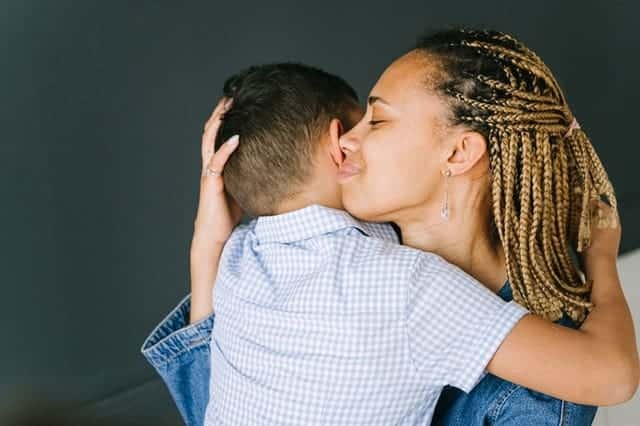
mother hugging child

There is a wide variety of activities that can help support your child’s cognitive and behavioral development at home during the pandemic. Here are 5 activities you can complete in less than 10 minutes a day. 


1. Teaching emotional intelligence by labeling emotions. 

Help them label their feelings, and then empathize with why they feel that way. If they need help, offer words to help them articulate their feelings. Questions such as, “Do you think you feel frustrated or angry, or sad?” will help them label their feelings.  


2. Encourage self care activities for mental health.

Teaching your children the tenets of self-care is an important way to combat anxiety and depression. Activities such as having a dance party at home, drawing or painting, or taking a hot bubble bath are all useful. There are many self-care activities you can incorporate into your daily routine at home depending on your family’s time limitations. 


3. Teach your children how to adapt to change.

The pandemic has increased stress on children. As a result, teaching your kids how to adapt to change is an important tool. Keep routines at home as consistent as possible and discuss change before it happens, if you can. Acknowledge your children’s worries and fears, and allow them to feel their emotions (WISC). It can be helpful to write a list of to-do’s for each day with your child so they know what to expect. 


4. Work on mindfulness with your children. 

Mindfulness is very effective at lowering stress. It teaches children to accept and pay attention to what is occurring in the present moment. This, in turn, helps them face daily challenges. There are many apps that teach mindfulness practices. There are also age-appropriate activities provided on numerous child development websites. 


5. Utilize positive parenting tips

For as long as the pandemic lasts it is crucial to be supportive of children at home. We recommend parents utilize positive parenting tips. These help children cope, build emotional skills, and adapt during difficult times. Chief among these tips is nurturing your children and building connections with them so they know they can come to you with their questions, concerns, and burdens.


Soul Shoppe provides social emotional learning programs for schools. homes, and businesses. In addition, we teach a variety of self-care activities. Please reach out to us with questions. 


You May Also Like:

Self Regulation Activities

Virtual Social Learning Activities

Effects of Social Isolation on Children 

How To Teach Empathy To Kids and Teenagers

Feelings Posters

Self Awareness Skills


Sources: Children’s Hospitals, KFF, Positive Psychology, WISC, Yale Medicine

There’s No Such Thing As A Bully

There’s No Such Thing As A Bully

At some point in our childhoods, most of us have been bullied. If not bullied ourselves, we’ve witnessed someone else getting bullied. Some of us have even been the bully. So how can we say “there’s no such thing as a bully”? It’s a radical proposition, and it’s one of the core assumptions we make at Soul Shoppe.

Over the years, we’ve had many opportunities to interact with children who were identified as bullies. When we were able to get beneath the behavior, to really connect with them, we saw every time that there was a need not getting met. Something was going on – a parent was ill, parents were divorcing, violence in the environment – there was a lack of safety and security or some overwhelming event. Children who have to navigate these situations may feel isolated, misunderstood, afraid and lonely. The bullying behavior meets a small piece of their need, even if it’s in a negative way. They get attention. They have power. Their actions matter. Or maybe it just feels good to have someone else feel afraid and upset too.

When we look underneath any bullying situation, there is always a young person with big feelings and they don’t know what else to do. They have emotions they don’t know how to manage. Bullying is a symptom of a bigger problem, never the root of the problem. And those big emotions didn’t start with them.

There’s no such thing as a bully. There is only a kid who is hurting and needs support. When we label a child a “bully,” we make their behavior define who they are. We start to look at and interact with them as if THEY are the problem, instead of addressing the behavior and where it’s really coming from. Changing how we view the behavior is one of the ways we can stop bullying at its roots. We can give kids tools, time and space to manage their emotions. We can show them how to listen to and have empathy for one another.

Our Free To Be assembly is a great way to introduce these practices into schools. Educators who want to deepen their anti-bullying and community-building practices can get a few ideas here. And finally, check out Soul Shoppe founder vicki! Abadesco’s Tedx Talk to find out what happened when one class “bully” was given a chance to be heard.

Around the Shoppe

Around the Shoppe

Soul Shoppe Partners with DropLabels.org

Over the next 8 weeks, Soul Shoppe is partnering with DropLabels.org to help raise awareness about the impact that labeling has on people. Every week, DropLabels.org will post a video with a Soul Shoppe staffer who tells their own story about labels. Personal stories like the ones you’ll hear in the coming weeks are an integral part of Soul Shoppe workshops.

Telling your story is important. It can help start a conversation or even start a process of healing. Someone hearing your story might be inspired to speak up, too.  Check out this week’s story here.

Got Soul Shoppe?

Are you thinking about bringing Soul Shoppe’s award winning programs to your school? Get in touch! Contact us for more information or to book for the 2018-19 school year. Find out what others have to say about the impact our programs have had.

Tend to Feelings and Needs

Tend to Feelings and Needs

We made it to June, and the end of another school year is here! In these busy days before we launch into summer, there seems to be an endless list of work to be done, meetings and events to attend, and people wanting to have important conversations. When we are pressed for time, our communication may not be at its best. Miscommunications and misunderstandings happen. We move so fast that it’s a challenge to think about what we are feeling and what we really need from others. It’s even a bigger challenge to take the time express these thoughts and feelings to someone to get clarification and, ultimately, connection.

At Soul Shoppe we use a tool to help us express our feelings and needs in a way that helps us keep our relationships healthy. It supports us to be heard so there can be more understanding with the people in our lives. Too often we don’t take the time to identify the words needed to share our true feelings about an experience. That can lead to resentment, unexpressed hurt, sadness or anger — and these feelings create a wall of separation between ourselves and the people we care about.

Welcome to the I-Message. The I-Message tool consists of four steps, each with its own small risk, where you have to get a little bit vulnerable and do things slightly differently in order to build stronger connections –both to ourselves and to others.

I feel … (usually a feeling word)
When …
I need … (what do YOU really need?)
Will you please …

And here’s how it might work in real life. We recently talked with a person who was having some challenging feelings with their spouse. They were upset that their spouse was sitting on the couch doing nothing. Initially, what they wanted to say was, “Will you get off the couch?!?” in a voice filled with attitude and accusation. We asked this person to talk more about what they were really feeling and what they needed, and they shared that they wanted connection. With that in mind, they created this I-Message:

I feel lonely
WhenI don’t have connection and attention
I need some time with you
Will you please let me know when we can connect?

Imagine that request came to you. Would you be receptive to that message and open to building connection? Probably. Entering into this process is about taking responsibility for ourselves. When we own what we feel and ask for what we need, we empower ourselves without disempowering someone else. That’s so much better than getting surprised by what we are feeling and not getting what we need!

We invite you to try out the I-Message the next time you feel yourself in a reaction. Take a step back and pause to notice and name what you are feeling. What happened just before the feeling? What do you need now? Then put it in the frame of an I-Message and say it to someone. Notice the response you get and how connection opens up. Most of all, notice the difference you feel within yourself. Every time we take the time to get in touch with our own feelings and have the courage to voice our needs, we take a step closer to creating the connected, loving relationships we want in our lives.

Spotlight on a Champion

Got Soul Shoppe?

Scheduling Now for the 2018-19 School Year

Are you thinking about bringing Soul Shoppe’s award winning programs to your school? Get in touch! Contact us for more information or to book for the 2018-19 school year. Find out what others have to say about the impact our programs have had.

Check Us Out in Alameda Magazine!

Check Us Out in Alameda Magazine!

“Helping Kids Tame Their Inner Dragon”

We were featured in Alameda Magazine for our work with Frank Otis!

Here’s a snippet of the article:

“On a recent Wednesday morning at Alameda’s Frank Otis Elementary, animated fourth-graders were seemingly spellbound by what they were learning. Many of them were also grinning ear to ear or laughing. The students were having so much fun that you’d hardly imagine that the lesson of the day was a topic many adults often find a bit painful and daunting to talking about: how to cope with the very messy feelings of anger, irritation, annoyance, and frustration that can cause you to blow up and lash out.

But instead of solemn or embarrassed faces, it was all joy and excitement as the guest speaker, Anthony Jackson, a facilitator for the Soul Shoppe program, taught kids to recognize their own emotions and their impact on others. He coached students on how to wrestle with the build-up of emotions that can overwhelm kids, from sadness and anger to irritation and loneliness, comparing them to a balloon that could burst if you don’t pay attention to what’s inside.

‘The balloon is a place inside of us where we put our feelings we don’t know what to do with,’ Jackson explained. ‘They are not bad or wrong feelings. They are just feelings. And if we don’t take care of them, they come out on someone else.’ ”

Want to read the full article? Read more here!

Spring Clean Up

Spring Clean Up

Let’s talk about mistakes.The big messy juicy mistakes–both the words we say and the ones we don’t. The places where we are not our best selves or the moments we wish we could do over. We are going to make mistakes. People are not born to be perfectionists, we are born to take risks, to try and to fail. We are, after all, human. So let’s admit that we all make messes.

We live in a world where we are told that faster is better. But in living out that value, we miss things; we miss people, and we don’t think we can slow down. We deliberately don’t attend to something we see. Or we tell ourselves that we will return to that person later when we have time, though that time never comes. In some cases faster is better, but that is rarely true for a human connection with someone. Building empathy and trust takes time. And moving quickly in our relationships with people can create confusion, hurt and misunderstanding. Fortunately, there is a way to genuinely repair the mistakes we will inevitably make with others.

At Soul Shoppe, we use the Clean-Up as a guide for young people to navigate through those mistakes. The Clean-Up is a five-step process focused on repairing harm. It starts with recognizing the harm that was caused, feeling the impact of it, and apologizing. When we understand the hurt from an action or behavior we were part of, we naturally want to learn what we could do instead and make a commitment to do things differently next time. The process ends with asking for forgiveness.

Why’s it’s Hard to Say Sorry

Young people are initially reluctant to use the Clean-Up. They sometimes have had the experience of being pushed into saying “sorry” before they actually feel that way. Or they’re told they won’t get in trouble if they tell the truth when we know there will be consequences. In these situations, young people feel blame and shame and rarely get to the important process of experiencing empathy, apologizing and making it right. When we have the intention to make it right and the willingness to listen, so much more connection and compassion is available. And the next time we make a mistake (and there will be a next time), we know we have a tool to help us clean it up rather than keep us separated.

The Clean-Up gives us a way to build connection, and through admitting our mistakes, it gives us access to our own power. We recognize that we have power to impact the people around us, to repair relationships and to understand that our mistakes can be part of our growth. When we frame young people’s mistakes positively as part of the way they’re powerful, it helps them build self-esteem rather than focusing on how they’re “bad.” It gives them more freedom in their lives.

As adult allies, we can be role models to show young people what it looks like when we take responsibility for the hurt we have caused. Is there a young person or adult in your life you could do a Clean-Up with? Someone you know you hurt or missed? This level of honesty and courage is what our young people are longing for. Try it on and see what happens in your relationships. It’s time for some Spring Clean-Up!