

Outdoor Learning Benefits Every Educator Should Know
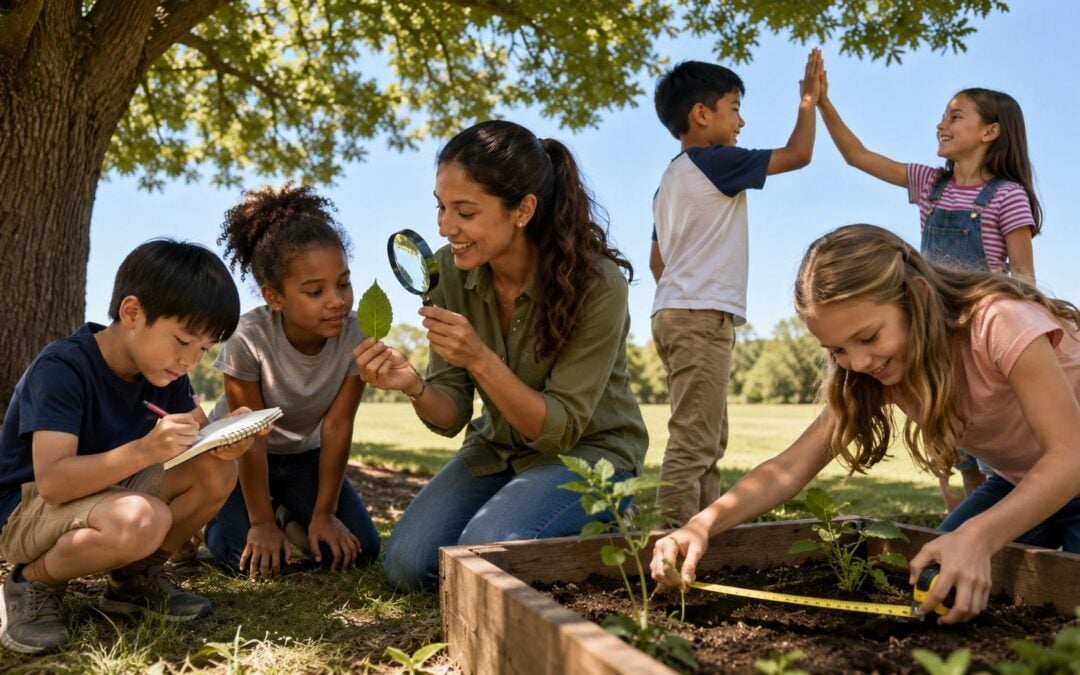
A third-grade class is spread across the blacktop, searching for shapes that match a geometry card. Nearby, a kindergarten group sits beneath an oak tree, passing around a pinecone and describing its texture. At the garden beds, fifth graders measure soil, compare plant growth, and argue cheerfully about which row needs more water. These moments look ordinary, but they carry more educational weight than a simple break from class.
Outdoor learning means any structured academic, social, or reflective experience outside the classroom walls. It can happen in a schoolyard, courtyard, neighborhood, garden, nature area, or local park. The setting changes, but the purpose remains clear: students use movement, observation, conversation, and real materials to understand ideas and practice skills.
K–8 students are especially ready for this approach. They're curious, sensory-driven, and still learning through their bodies as much as through explanations. A lesson outside can give a child who struggles with a worksheet another way to count, describe, collaborate, or demonstrate understanding.
The strongest outdoor learning benefits aren't limited to one subject. Research connects well-designed outdoor experiences with engagement, ownership of learning, social development, self-concept, wellbeing, and physical activity. Academic improvement appears in some settings, but the most consistent gains often involve attention, regulation, cooperation, and meaningful participation.
The practical question for educators isn't whether every lesson should move outdoors. It's how to design outdoor experiences that are accessible, purposeful, repeatable, and connected to curriculum and social-emotional learning. The examples below pair research evidence with activities a teacher or caregiver can run with minimal preparation.
Why Outdoor Learning Matters for K–8 Students
The blacktop math hunt works because students aren't only hearing about shapes. They're finding rectangles in fences, counting angles in playground equipment, and explaining their reasoning to a partner. The kindergarten circle works because the oak tree gives children a shared object of attention, while the fifth-grade garden task turns measurement into a decision with visible consequences.
These activities also change the social rhythm of the school day. Students move between stations, negotiate materials, ask questions that arise naturally, and see classmates contribute in different ways. A child who rarely speaks during whole-group instruction may become the careful observer who notices a bird nest, identifies a pattern, or helps a partner balance a structure.
Outdoor learning is more than recess
Recess gives students valuable unstructured time, but outdoor learning adds an intentional objective. A teacher might ask students to record evidence of erosion, write sensory descriptions, compare perimeter measurements, or practice a conflict-resolution routine during a team challenge. The lesson can be playful, but it still has a learning target and a way to notice progress.
That distinction matters for families, too. A neighborhood walk can become an informal science lesson when a child tracks cloud changes, a language lesson when they create a story from observed details, or a self-management exercise when they pause to identify sounds and body sensations.
A 2022 systematic review of learning in natural outdoor settings found consistent benefits across several domains, including increased engagement and ownership of learning, stronger social and collaborative skills, and improved self-concept, with some evidence of academic improvement in the review of outdoor learning research. The review treats outdoor learning as an educational strategy, not just recreation.
A multidimensional case for K–8 schools
Outdoor experiences can support reading, science, math, physical development, and SEL at the same time. Students may read a field guide, estimate the height of a tree, cooperate on a shelter design, and reflect on frustration during one carefully planned activity.
That range makes outdoor learning especially useful when schools want to strengthen the whole child without creating a separate program for every need. It also raises an important equity question: who has safe, welcoming access to nature outside school, and who depends on school to provide it?
The most effective plans treat outdoor learning as part of the school's instructional design. They make room for access needs, define clear supervision routines, and give teachers practical activities that can be repeated rather than relying on occasional field trips.
What the Research Says About Outdoor Learning Benefits
The research is encouraging, but it's more precise than the phrase “nature helps children learn.” Evidence points to several outcome areas, and the strength of the result depends on the program's design, duration, learner age, and intended outcome.
Academic outcomes need context
A historical review of environmental education in California reported that secondary students from 11 Californian schools who participated in outdoor environmental learning scored higher in 72% of academic assessments, including reading, science, math, attendance rates, and grade-point averages, than students from traditional schools in the reviewed outdoor-learning evidence. That finding is important, but it shouldn't be treated as a promise that every outdoor lesson will produce broad academic gains.
Outdoor instruction can make academic content more concrete. Students can measure actual garden beds, use descriptive language for changing weather, or read informational text before checking evidence outside. Research summarized in school-learning reviews also reports that one outdoor-learning intervention left children more focused and on-task during later indoor lessons, with almost half the number of teacher redirects in this evidence review of outdoor learning.
Social, emotional, physical, and cognitive outcomes
The wider evidence base includes social cooperation, confidence, wellbeing, environmental awareness, physical skills, cognitive skills, and risk-management skills. A review of Forest School research identified gains across seven major outcome areas, showing why schools shouldn't judge outdoor learning only by test performance through the systematic review of Forest School research.
A separate review found that children's time outdoors is consistently linked to higher physical activity and better cardiorespiratory fitness, while more time outside is associated with lower sedentary behavior in the review of children's outdoor time. Recent evidence also emphasizes stress reduction, attention, self-regulation, sleep, physical activity, and cognition as especially credible areas of benefit in the review of nature exposure and outdoor activity.
| Domain | Reported outcome | Typical magnitude |
|---|---|---|
| Academic | Higher performance across 72% of assessments in the cited California review | Broad but context-dependent |
| Engagement | Greater engagement and ownership of learning | Consistent qualitative and measurable benefits |
| Social-emotional | Stronger cooperation, confidence, self-concept, and wellbeing | Multidimensional gains |
| Attention | Fewer teacher redirects after one outdoor-learning intervention | Almost half the number of redirects |
| Physical | More physical activity and less sedentary behavior with more outdoor time | Consistent association |
| Forest School | Gains across seven outcome areas | Benefits vary by design and learner |
For educators exploring the field, resources on starting environmental education programs can help translate broad principles into school-based planning. Teachers should still read results carefully. Self-selected participants, short intervention windows, inconsistent definitions of outdoor learning, and differences in age or baseline need can limit how confidently one program's result transfers to another school. A 2022 systematic review and a later mixed-methods synthesis both point toward structured, repeated, nature-specific experiences rather than one-off outdoor lessons as the more credible path to sustained benefits in the systematic review of outdoor learning. For additional SEL research framing, educators can consult Soul Shoppe's research resources.
Social-Emotional Growth in Outdoor Settings
Outdoor settings give children real social problems to solve. They must decide who carries the bucket, how a group crosses a muddy patch, whether a structure is stable, or what to do when two students want the same materials. Those moments create practice opportunities that a teacher can observe and coach in real time.
Three features make this setting especially useful for SEL: sensory richness, physical movement, and informal peer interaction.
Novelty can reset attention
A change in surroundings gives students new details to notice. The sound of traffic, the texture of bark, the movement of clouds, or the pattern of shadows can help children shift attention away from a difficult indoor routine. In CASEL-aligned terms, this supports self-awareness and self-management, because students can notice their internal state and choose a response.
A teacher might see a student pause before grabbing a material, name that they're frustrated, and ask for a turn without prompting. That self-correction is more useful than a quiet line held together only by adult reminders.
Movement supports regulation
Walking, carrying, balancing, digging, and stretching give students appropriate ways to use physical energy. Movement doesn't solve every behavior challenge, but it can help children return to a calmer state before discussion or written work.
Use a simple regulation cue: “Notice your feet, slow your breathing, and choose your next safe step.” This connects body awareness to self-management without turning the activity into a lecture.

Peer interaction builds belonging
Outdoor tasks often create informal groupings based on interest or role. One student may observe, another may build, and another may record. These flexible roles can interrupt fixed classroom hierarchies and give quieter students a meaningful way to contribute.
The teacher's job is to name the skill, not dominate the interaction. Ask, “How did your group decide?” or “What helped both people get heard?” Those questions connect the experience to relationship skills, social awareness, and responsible decision-making. Activities focused on empathy and listening can also draw from these empathy-building activities.
Conflict resolution becomes concrete outdoors. When students disagree over space or materials, guide them to describe the problem, hear each perspective, generate options, and test a fair solution. Over time, teachers may notice more equitable turn-taking and faster de-escalation because students have rehearsed those moves repeatedly.
Practical rule: Don't remove every manageable disagreement. Coach students through safe, respectful problem-solving so the outdoor setting becomes a rehearsal space for community life.
Equity and Access Considerations
Outdoor learning can widen opportunity, but only when schools design for students who face the greatest barriers. A child with a large yard, reliable transportation, and outdoor clothing may already receive nature exposure outside school. Another child may depend on the schoolyard for every safe chance to explore plants, weather, movement, and open space.
Urban schools may have limited green areas, but they can still use courtyards, sidewalks, rooftops where permitted, shaded blacktops, community gardens, and neighborhood walks. The educational value comes from purposeful observation and participation, not from having a forest on campus.
Accessibility must be planned before the activity is announced. Students with mobility disabilities may need firm, navigable pathways, reachable materials, and roles that don't depend on uneven terrain. Students with sensory sensitivities may need quiet zones, advance notice about textures or sounds, flexible clothing, and the option to observe before joining.
Weather and health needs also shape participation. Schools should provide shade, water, weather gear, sunscreen routines aligned with family and school policies, and allergy-aware plant choices. Families without transportation shouldn't be excluded from meaningful off-campus experiences, so bus-supported trips and partnerships with local parks can matter.
| Barrier | Who it affects | School planning response |
|---|---|---|
| Limited green space | Students in dense urban areas | Use courtyards, gardens, sidewalks, and schoolyard investigations |
| Uneven terrain | Students with mobility disabilities | Provide accessible pathways, reachable materials, and alternative roles |
| Weather exposure | Students sensitive to heat, cold, rain, or sun | Plan shade, water, gear, indoor alternatives, and clear weather rules |
| Allergens | Students with allergies or respiratory needs | Select plants carefully, review health plans, and offer low-trigger locations |
| Missing clothing or equipment | Families with limited resources | Maintain shared weather gear, spare clothing, and washable materials |
| Transportation limits | Students unable to reach parks independently | Use school buses, nearby sites, and community partnerships |
The 72% academic-assessment finding from the California review should not lead schools to assume all students receive the same benefit. Access, program quality, baseline need, and duration influence outcomes. Equity is a design question: who can enter the activity, who can participate fully, and whose knowledge gets recognized?
Sample Outdoor Activities Tied to SEL Objectives
The best activities are short enough to repeat and open-ended enough to reveal student thinking. A clipboard, chalk, natural materials, and a clear prompt can support meaningful work in a schoolyard or courtyard.

Sound Mapping
Grade band: K–8
Materials: Paper, pencils, clipboards
SEL objective: Self-awareness
How to run it: Students sit or stand safely in one place and mark sounds with symbols or words. Younger children can draw; older students can distinguish near and far sounds or describe how each sound affects their body.
Facilitation prompt: “What did you notice first, and what changed when you paid closer attention?”
Debrief: “Which sound helped you feel settled, and which one made it harder to focus?”
This activity works well before reading or independent writing because it gives students a quiet transition into attention.
Nature Trust Walk
Grade band: K–5, adapted for older students
Materials: Cones or a clearly marked path
SEL objective: Relationship skills
How to run it: Pair students. One partner gives verbal directions along a simple, accessible route while the other walks with eyes open and focuses on listening. Switch roles, then discuss how the directions felt.
Facilitation prompt: “What made the instructions clear and respectful?”
Debrief: “How did your partner show that they were listening?”
Keep the route familiar and never require blindfolds. The goal is communication, not discomfort.
Weather Problem-Solving Stations
Grade band: K–8
Materials: Weather cards, chart paper, simple observation tools
SEL objective: Responsible decision-making
How to run it: Groups rotate through prompts such as choosing clothing for conditions, protecting a paper structure from wind, or deciding whether a planned activity needs modification.
Facilitation prompt: “What evidence supports your choice?”
Debrief: “What would you change after seeing the result?”
This links science reasoning with practical judgment. Families can use the same routine before a walk or outdoor play.
Group Habitat Build
Grade band: K–8
Materials: Sticks, leaves, cardboard, string, or reusable blocks
SEL objective: Teamwork and social awareness
How to run it: Groups design a shelter or habitat for a fictional small animal. Assign rotating roles, but let students negotiate details.
Facilitation prompt: “Whose idea haven't we tested yet?”
Debrief: “How did your group respond when the first plan didn't work?”
For more sensory-based variations, teachers and caregivers can adapt ideas from this five-senses activity resource. Families seeking structured movement opportunities beyond school can also explore a summer camp for active kids as one possible community option.
Reflection Circle
Grade band: K–8
Materials: A designated sitting spot and optional reflection cards
SEL objective: Self-management
How to run it: Students sit in a circle and complete one sentence: “I noticed,” “I contributed,” “I found difficult,” or “Next time I will.” Passing is allowed.
Facilitation prompt: “What choice helped you stay engaged?”
Debrief: “What will you carry into the next classroom activity?”
The circle turns an outdoor experience into transferable learning rather than leaving the SEL lesson implicit.
Implementation Tips for Schools and Classrooms
Sustainable outdoor learning depends less on elaborate spaces than on dependable routines. Teachers are more likely to use the schoolyard when they know when they're going, what students will do, how safety will work, and where materials are stored.
Build a repeatable schedule
Start with short outdoor blocks connected to existing lessons. A class might take vocabulary outside for observation writing, move a math rotation to the blacktop, or use a garden bed during a science unit. The visual implementation guide suggests integrating 20–30 minute outdoor blocks across morning, midday, and afternoon routines [in the implementation infographic below].

Create a shared calendar so classes don't compete for the same area. Store clipboards, chalk, magnifiers, measuring tools, and weather gear in labeled bins near the exit. Chalk circles, tree-shaded benches, and movable tubs can turn an ordinary yard into a set of learning zones without major construction.
Agree on safety before the first lesson
Staff should define simple rules for rain, temperature, air quality, lightning, supervision, allergies, water, sunscreen, and clothing. Permission slips should explain the regular routine, while individual health plans guide specific accommodations.
Paraprofessionals can serve as outdoor co-teachers when they receive activity guides, communication prompts, and safety protocols. A short staff meeting can establish:
- Purpose: Identify the curriculum and SEL objective.
- Place: Select an accessible area and a backup location.
- People: Assign supervision zones and support roles.
- Materials: Prepare one labeled bin per activity.
- Health: Confirm water, medication, allergy, and weather procedures.
- Evidence: Decide what teachers will observe or collect.
Extend lessons instead of doubling preparation
Take the same anchor text outdoors and ask students to find evidence in the environment. Use the same math vocabulary while measuring real objects. Bring indoor writing prompts outside, then return for drafting and revision.
Parent volunteers can support observation stations, material management, or garden care when school policies allow. Local parks, libraries, and environmental organizations may offer locations or expertise. These partnerships expand capacity, but schools should keep the learning target and access expectations under school control.
Outdoor learning becomes sustainable when it feels like a familiar teaching move, not a special event that requires a new plan from scratch.
Measuring Impact and Bringing It All Together
Administrators don't need a complicated research project to determine whether outdoor learning is helping. They need a small set of shared measures, a baseline, and a regular review cycle that combines numbers with what teachers and students report.
Choose measures across academic participation, SEL, and physical experience. Track enough to notice patterns, but not so much that teachers spend the lesson recording data instead of teaching.
| Metric | Domain | Data source | Cadence |
|---|---|---|---|
| Outdoor lesson attendance | Access and participation | Attendance records | Reviewed regularly |
| Time-on-task observations | Engagement | Walkthrough form | During selected lessons |
| Formative assessment changes | Academic learning | Existing grade-level checks | At baseline and review points |
| Self-regulation rubric | SEL | Teacher observation | Repeated classroom cycle |
| Peer-conflict referrals | SEL and belonging | Referral or behavior records | Reviewed regularly |
| Outdoor minutes | Physical access | Class or school log | Weekly |
| Student reflection themes | Wellbeing and voice | Journals or exit slips | After selected activities |
A useful process begins with a baseline using tools the school already has. Record current outdoor participation, observe attention during a familiar lesson, review existing formative data, and ask teachers to tally how often students attempt a conflict-resolution strategy outdoors.
After a 90-day implementation period, repeat the same measures using a practical outcome-measurement approach. The purpose isn't to claim that outdoor learning caused every change. It's to compare patterns, identify which activities students access, and determine whether particular learners need different supports.
A one-page dashboard can include a few numbers, two student reflection themes, a teacher observation, and an access note. For example, leaders might see that students participate regularly but need more shade, or that group builds create strong collaboration while weather stations produce richer academic discussion.
Return to the blacktop math hunt. Its value isn't that every child will suddenly master geometry. Its value is that students can move, notice, explain, cooperate, and receive feedback in a setting that makes learning visible. With honest measurement and thoughtful design, outdoor learning becomes a practical equity lever that strengthens academic participation, regulation, belonging, and the daily K–8 experience.
Soul Shoppe helps schools build the connection, safety, empathy, and conflict-resolution skills that make outdoor learning more inclusive and productive. Visit Soul Shoppe to explore interactive SEL programs, workshops, coaching, and practical tools for students, educators, and families.