

Mastering Emotional Regulation for Kids: 2026 Guide
You're probably here because a child is having a hard time right now.
Maybe it's the student who crumples a worksheet and shouts when a partner changes the rules. Maybe it's the child who looks fine all day, then melts down over the wrong color cup at home. Maybe it's your own kid, sobbing on the bedroom floor after a sibling conflict that seemed small to everyone else.
When adults see these moments again and again, it's easy to think the problem is behavior. But usually the issue is skill. The child doesn't yet know how to notice what's happening inside, slow the escalation, and choose a response that works.
That's why emotional regulation for kids matters so much. It isn't about making children quiet, compliant, or “easy.” It's about helping them move through big feelings without getting lost in them. That skill supports learning, friendships, family life, and a child's growing sense that “I can handle hard things.”
For some children, movement-based activities can help because they pair body awareness, routine, and adult coaching. If you're curious how structured physical practice can support confidence and self-control, these important BJJ insights for parents offer a useful lens. Emotional skills also connect closely to broader social-emotional learning, which is why many educators start with why SEL is important before building classroom routines.
Why Emotional Regulation Is a Superpower for Kids
A child who can regulate emotions isn't a child who never gets upset. It's a child who can get upset and recover.
That distinction matters. Adults often praise the child who stays calm and worry about the child who falls apart. But emotional regulation is not the absence of emotion. It's the ability to notice feelings, make sense of them, and find a path forward.
What this looks like in real life
In a classroom, one student hears “put your pencils away” and moves on. Another hears the same direction, feels disappointment, and blurts out, “This is stupid.” At home, one child loses a board game and asks for a rematch. Another flips the game board and storms off.
Those moments can look defiant from the outside. Often they're really signs that the child's internal system got overloaded.
Practical rule: Don't ask first, “How do I stop this behavior?” Ask, “What skill is missing in this moment?”
When adults make that shift, everything changes. We stop treating regulation like a discipline issue alone and start teaching it like we teach reading, tying shoes, or riding a bike. A child practices with support. An adult models the steps. Progress comes in small, repeatable moments.
Why it deserves the word superpower
Children use emotional regulation everywhere. They use it when they wait for a turn, hear “no,” lose a game, get corrected, join a group, recover from embarrassment, and try again after frustration.
That's why emotional regulation for kids is a foundational skill, not a side topic. It helps children participate in school, repair conflict, and stay open to learning even when feelings are intense. For parents and teachers, that means the work isn't just calming kids down in hard moments. It's building the inner tools they'll carry into the next one.
Understanding Emotional Regulation in Childhood
Think of emotional regulation as a child's emotional thermostat. It helps them notice when their internal temperature is rising, dropping, or changing fast. The thermostat doesn't stop weather from happening. It helps the child respond to it.

Children are not born with a fully working emotional thermostat. They build it over time. According to the APA, emotion regulation in children is a multi-component system that depends on attention control, planning, cognitive development, and language development. In early childhood, regulation is largely behavioral and depends on caregiver co-regulation through soothing, distraction, and modeling. More independent regulation emerges as executive functions mature. The APA also notes that secure, trusting caregiver relationships are associated with better emotion regulation in toddlers, and that intervention programs for preschool and school-age children can produce gains in executive function, emotion identification and regulation, and adjustment (APA on emotion regulation).
The four building blocks
Here's a simple way to understand what children are doing when they regulate.
- Attention control helps a child shift focus away from the spark that's making things worse.
- Planning helps a child pause and choose a next step instead of reacting automatically.
- Thinking skills help a child understand cause and effect, perspective, and consequences.
- Language helps a child name feelings and ask for help.
If one of those pieces is still developing, the child may struggle even when they know the rule.
A student may know “keep hands to yourself” and still shove when angry because their body moved faster than their planning skills. A preschooler may cry every time a parent leaves because they feel distress but don't yet have the language to say, “I'm worried you won't come back.” A child who can say, “I'm frustrated and need a break,” is showing real growth.
Co-regulation comes before self-regulation
One of the biggest misunderstandings adults have is expecting self-control before a child has enough supported practice.
Young children borrow regulation from adults. They settle because someone gets low, quiet, and steady. They recover because an adult names what happened and offers a next step. That's co-regulation.
Children learn to calm with us before they can reliably calm by themselves.
Over time, the adult support gets lighter. The child starts using the same words, cues, and routines independently. That's the bridge from co-regulation to self-regulation.
If you want a helpful companion concept, emotional intelligence in children overlaps with this work because children need both awareness and strategy.
What adults often get wrong
Adults sometimes teach regulation as if it means “stop crying,” “use a calm voice,” or “go take a break.” Those can be helpful directions, but they're not the whole skill.
Regulation starts earlier. A child has to notice what they feel, understand what it means, and recognize what their body is signaling. If we skip those steps, we end up demanding control without teaching the path to it.
That's why emotional regulation for kids works best when adults slow down and teach the process, not just the outcome.
Developmental Milestones and Signs of Struggle
Children's regulation skills change a lot from toddlerhood through elementary school. Expectations need to change too. A toddler who screams when frustrated is not the same as a third grader who stomps away after losing a game, even if both need support.
The easiest way to stay grounded is to ask two questions. What's typical at this age? And what signs suggest the child needs more teaching, more support, or a closer look at stress in their environment?
Emotional regulation milestones by age
| Age Range | Typical Regulation Behaviors | How Adults Can Support |
|---|---|---|
| Toddler | Strong feelings come fast. Recovery often depends on adult comfort, distraction, routine, and simple limits. | Use short phrases, predictable routines, and physical co-regulation such as sitting nearby, rocking, or soft voice cues. |
| Preschool | Children begin naming basic feelings, following simple calming routines, and using play to work through emotions. They still need frequent reminders. | Teach feeling words, model calm-down steps, rehearse transitions, and keep expectations concrete. |
| Early elementary | Children can start linking triggers, feelings, and choices. They may use some strategies independently when calm, but often lose access to them under stress. | Practice skills ahead of time, use visual cues, coach after conflict, and keep language consistent across adults. |
| Later elementary | Children can reflect more, take another person's perspective, and discuss problems after they settle. Social stress often becomes a bigger trigger. | Help children prepare for peer conflict, embarrassment, competition, and workload. Encourage self-advocacy and repair conversations. |
This table helps adults avoid two common errors. One is expecting too much too soon. The other is overlooking a child who seems “fine” because their distress is expressed subtly.
What dysregulation can look like
Some children externalize. You see yelling, hitting, bolting, arguing, or refusing.
Other children internalize. You see shutdown, silence, stomachaches, perfectionism, tearfulness, clinginess, or a child who says “I don't know” to every feeling question.
Both patterns matter.
Research from the Australian Institute of Family Studies notes that early adversity can disrupt the development of emotional literacy and body-awareness. Children may show either suppressed or intensified emotional expression and may fail to connect body signals such as a racing heartbeat, dry mouth, or a “wobbly tummy” with anxiety or fear. The implication is that adults should explicitly teach the body-emotion link and safe expression, not just push for behavioral compliance (AIFS guidance on adversity and regulation).
Watch the body, not just the behavior
A child often shows stress in the body before behavior makes sense to adults.
Look for patterns like:
- Tight muscles before a conflict
- Fast breathing during a difficult transition
- Complaints about stomach or head pain before school or social situations
- Frozen posture when asked to speak in front of others
- Rapid talking or irritability when a task feels overwhelming
A child who says “my tummy feels weird” may be giving you the earliest possible clue that regulation support is needed.
This is why child emotional development matters in practice. If adults can spot early signals, they can step in before the child reaches the point of explosion or shutdown.
When to worry less and teach more
A hard moment does not automatically mean something is wrong. Children get overwhelmed. They misread social situations. They overreact. They recover.
What matters more is the pattern. Does the child need the same level of adult help every time? Are feelings hard to name? Do conflicts repeat with no learning afterward? Does the child seem disconnected from body signals or unable to express distress safely?
If so, support should get more explicit. Slow things down. Teach the body-feeling connection. Rehearse specific responses. Reduce shame. Regulation grows when children feel understood and coached, not judged.
Core Emotional Regulation Strategies for Home and School
The most useful tools are simple enough to use every day. I often teach them as Name It, Feel It, Tame It. Children remember the rhythm, and adults can use the same language at home and school.
Near the beginning, keep your goal small. You're not trying to eliminate big feelings. You're helping the child build a repeatable sequence.

Name it
Children regulate better when they can label what they feel before the feeling takes over.
Try a few routines that make emotional language normal:
- Daily check-ins. Ask, “What's your weather today? Sunny, cloudy, stormy, mixed?” This works well for younger children who don't yet have many feeling words.
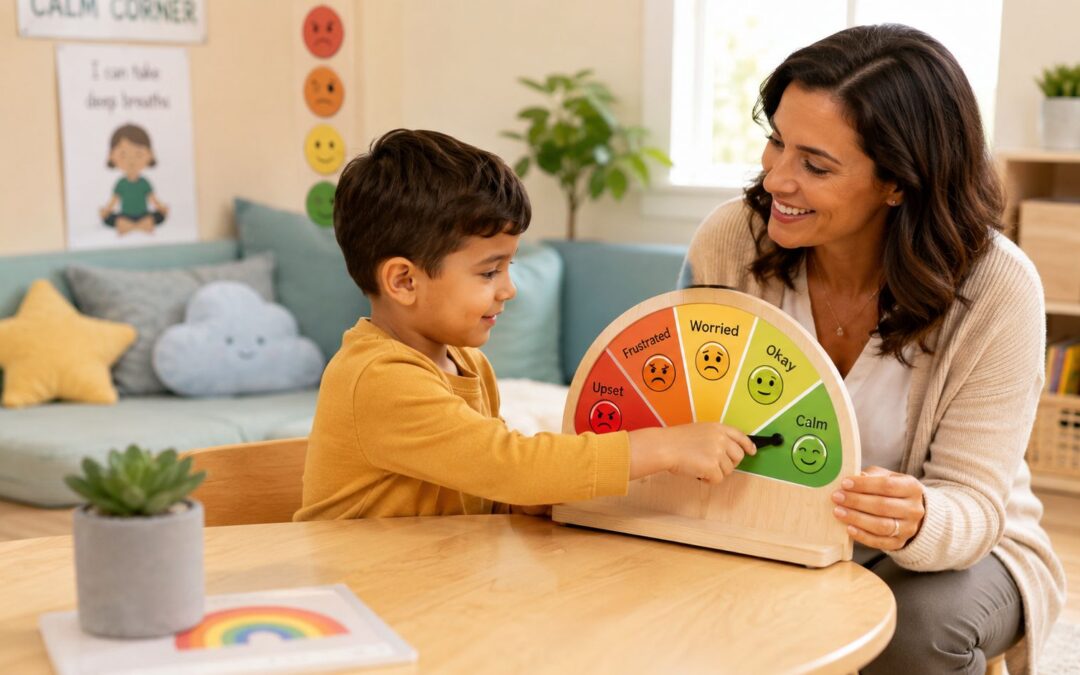
- Feeling charts. Keep a small chart on the fridge, near a classroom meeting area, or inside a folder. Let children point if words are hard.
- Story pauses. While reading, stop and ask, “What do you think this character is feeling? How can you tell?”
Sample script:
“I can see your face got tight and your voice got louder. I'm wondering if you're frustrated or disappointed.”
That script matters because it doesn't force a label. It offers one.
Feel it
This step teaches the body-emotion link. Many children know they're upset only after they're already deep into the reaction.
Use short, concrete activities:
Body map
Draw a simple outline of a body. Ask, “Where do you feel anger? Where do you feel worry?” A child might color the hands, chest, tummy, or face.Two-minute body scan
Say, “Close or lower your eyes if that feels okay. Notice your jaw. Your shoulders. Your hands. Your belly. What feels tight, hot, buzzy, or heavy?”Signal matching
Make cards with body clues on one side and feelings on the other. Examples include shaky hands, hot cheeks, lump in throat, fast heart, and tired shoulders.
Sample script:
“Your fists are tight. Your body is telling us something before your words are ready.”
For families and teachers who want more classroom-ready routines, self-regulation strategies for kids can help expand this toolkit.
Tame it
Once children can name the feeling and notice body cues, they need a short menu of responses. Keep the menu small. Too many choices can backfire in the moment.
A few dependable options:
- Dragon breaths. Inhale through the nose. Exhale slowly like a dragon blowing warm air, not a fire blast.
- Wall push. Press both hands into a wall for a slow count. This gives physical input without disrupting others.
- 5-4-3-2-1 grounding. Name things you can see, feel, hear, smell, and taste or imagine tasting.
- Ask for a break. Teach the child the exact words. “I need a minute.” “Can I reset and come back?” “Can I get water and return?”
Coach's note: Calming strategies work better when children practice them while calm, not for the first time during a meltdown.
A short video can help adults model these skills in a concrete way: